A KEY TO THE FAMILIES. (continued 6)
Reading edition
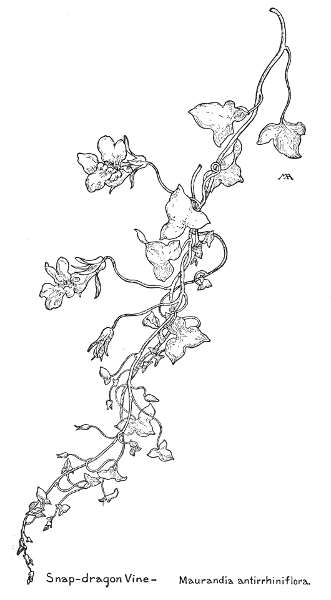
Snap-dragon Vine—Maurandia antirrhiniflora.
There are many kinds of Antirrhinum, natives of Europe, Asia, and western North America; herbs; the lower leaves often opposite, and the upper ones alternate; the sepals five; the corolla two-lipped, swollen at the base on the lower side, but with no spur, the palate nearly closing the throat; the stamens four. The name is from the Greek, meaning "nose-like," because the shape of the flowers suggests the snout of an animal.
Sticky Snap-dragon Antirrhìnum glandulòsum Pink, purple Spring California
This is a conspicuous perennial, handsome though rather coarse, hairy and sticky all over, with stout leafy stems, from two to five feet tall, with branches but no tendrils, and soft, rather dark green leaves. The flowers are half an inch long, the corolla pink with a yellow palate, and they are crowded in fine, long, one-sided clusters. This is common in the South and looks a good deal like some of the cultivated kinds; when its flowers are pinched from the sides they open their mouths in the same funny way.
White Snap-dragon Antirrhìnum Coulteriànum White and lilac Spring California
This has tendril-like pedicels, which curl around nearby plants, but the stem is stout and erect, over two feet tall, smooth below and hairy above, with smooth, dark green leaves, and bears a long, crowded, one-sided cluster of pink buds and pretty white flowers. They are each about half an inch long, with hairy calyxes, and the corollas are prettily tinged with lilac or pink, but are too pale in color, though the general effect of the plant is rather striking. The anthers are bright yellow. This grows in the South. A. vírga is a smooth plant, from two and a half to five feet tall, with many wand-like stems, springing from a perennial base, and reddish-purple flowers, about half an inch long, forming a long, rather one-sided cluster. This grows in the chaparral, on ridges of the Coast Ranges, blooming in June, but is not common.
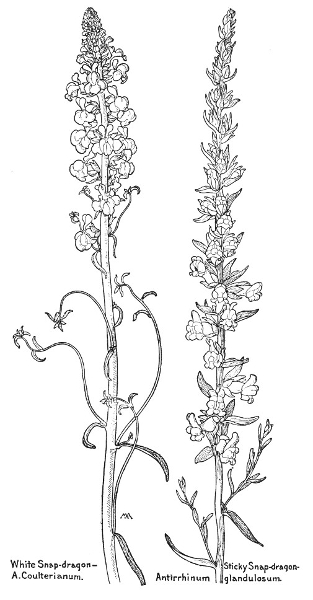
White Snap-dragon—A. Coulterianum. Sticky Snap-dragon—Antirrhinum glandulosum.
Trailing Snap-dragon Antirrhìnum stríctum Blue Spring California
This is an odd-looking plant, from one to two feet tall, which seems unable to decide whether or not it is a vine, for the pedicels of the flowers are exceedingly slender and twist like tendrils and by their means the plant clings to its neighbors and raises its weak stems from the ground, or, if it finds no support, it stands almost erect and waves its tendrils aimlessly in the air. It is smooth all over, with dark green leaves and pretty, bright purplish-blue flowers, about half an inch long, with a pale, hairy palate, which almost closes the throat. This grows in the South, near the sea. A. vàgans is similar and is common farther north in California, growing on dry open wooded hills or in canyons of the Coast Ranges, blooming in summer and autumn.
There are many kinds of Castilleja, almost always perennials, usually parasitic on the roots of other plants, usually handsome and striking, the conspicuous feature being the large leafy bracts, colored like flowers, which adorn the upper part of the stem. They usually have several stems, springing from woody roots; leaves alternate, without leaf-stalks, green below and gradually merging above into colored bracts; flowers crowded in terminal clusters, mixed with bracts; calyx tubular, flattened, more or less cleft in front or behind, or on both sides, the lobes sometimes two-toothed, colored like the bracts, enclosing the tube of the corolla; corolla less conspicuous and duller in color than the calyx, tubular, two-lipped, the lower lip short and very small, not inflated, with three small teeth, the upper lip long and beaklike, enclosing the four stamens and single threadlike style; stigma cap-shaped or two-lobed; anther-sacs unequally attached to the filament, one by its middle and the other hanging by its tip; capsule egg-shaped or oblong, splitting open, containing many seeds. These gaudy plants are well named Indian Paint Brush, for the flower-cluster and leaf-tips look as if they had been dipped in color. Red Feather is also good but Painted Cup is rather poor, as there is nothing cup-like about the flower. They were named for Castillejo, a Spanish botanist.
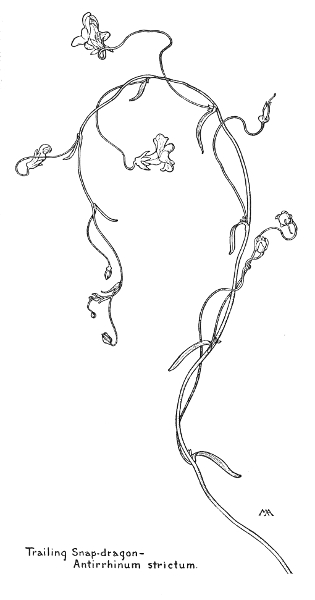
Trailing Snap-dragon—Antirrhinum strictum.
Paint Brush Castillèja miniàta Red Summer Northwest
This is a very handsome kind, from two to four feet tall, with a smooth stem, and smooth leaves, which are not crinkled, toothed, or lobed, and with more or less hairy bracts, which are beautifully tinted with many shades of pink, red, and purple. This is a magnificent plant, especially when we find it growing along irrigation ditches, among blue Lupines, yellow Mimulus and other bright flowers, where the combinations of color are quite wonderful, and it is the handsomest and commonest sort around Yosemite, where it grows in meadows and moist places, from the foothills nearly up to timber-line.
Scarlet Paint Brush Castillèja pinetòrum Red and yellow Summer Cal., Oreg.
This is not quite so large or handsome as the last, but gives much the effect of a brush dipped in red paint, for the yellowish bracts are beautifully tipped with scarlet and the flowers are also bright red. The rough stem is a foot or more tall, the roughish dark green leaves are not toothed or lobed, but have crinkled edges, and the bracts usually have three lobes. These plants grow in the mountains and often make bright patches of color in the landscape.
Paint Brush Castillèja angustifòlia Red Spring, summer Utah., Nev.
This is very variable, and is usually about a foot high, with several hairy stems, springing from a long yellow root. The leaves are slightly rough, but not coarse, with fine white hairs along the margins, and light gray-green in color, the lowest ones not lobed, a few of the upper ones with two lobes, but most of the leaves, and the bracts, slashed into three lobes. The calyx is covered with white hairs, and the upper lip of the corolla is bright green. The whole plant is most beautiful and harmonious in color, not coarse like many Castillejas, and the upper part is clothed with innumerable delicate yet vivid tints of salmon, rose, and deep pink, shading to scarlet and crimson, forming a charming contrast to the quiet tones of the lower foliage. This grows in gravelly soil, on dry plains and hillsides, and the clumps of bloom are very striking among the sage-brush.
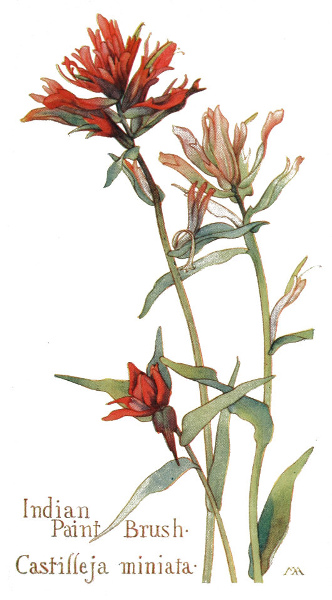
Indian Paint Brush—Castilleja miniata.
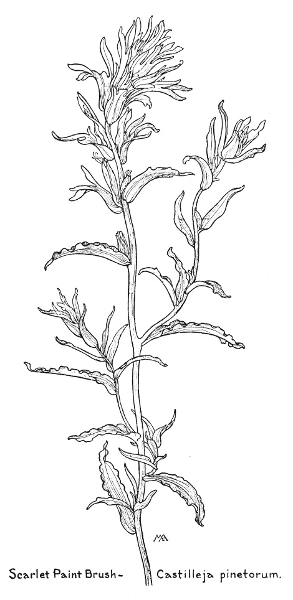
Scarlet Paint Brush—Castilleja pinetorum.
There are a good many kinds of Stemodia, widely distributed, only two in the United States; the corolla blue or purplish and two-lipped; the stamens four, not protruding.
Stemodia Stemòdia durantifòlia Blue Spring Southwest, etc.
This is a rather pretty plant, which is quite effective when growing in quantities. The stem is hairy and sticky, from a foot to a foot and a half tall, with hairy leaves, which have a few sharp teeth. The flowers are three-eighths of an inch long, with sticky-hairy calyxes and bright purplish-blue corollas, white and hairy in the throat. This has a slightly unpleasant, aromatic smell and grows in moist spots, often in mountain canyons near streams, as far east as Texas and also in the tropics.
There are many kinds of Linaria, most abundant in the Old World; herbs; the upper leaves alternate, the lower opposite, usually toothless; the corolla like Antirrhinum, but with a spur; the stamens four, not protruding.
Toad Flax Linària Canadénsis Blue, lilac Spring, summer West, etc.
A slender plant, from six to eighteen inches tall and smooth all over, with branching stems, dark green leaves, and pretty little flowers, delicately scented, from a quarter to half an inch long, with bright purplish-blue or pale lilac corollas, veined with purple. This is found in dry soil across the continent and sometimes grows in such quantities around San Diego as to form blue patches in the landscape.
There are many kinds of Veronica; ours are rather low herbs, though some are trees in the tropics, widely distributed, living in meadows and moist places; flowers small, usually blue or white, never yellow; calyx with four divisions, rarely five; corolla wheel-shaped, with a very short tube and four, rarely five, lobes, the lower one narrower than the others; stamens two, sticking out at each side of the base of the upper lobe; anthers blunt, with slender filaments; ovary two-celled, with a slender style and round-top stigma; capsule more or less flattened, two-lobed or heart-shaped, splitting open, containing few or many seeds. They were named in honor of St. Veronica.
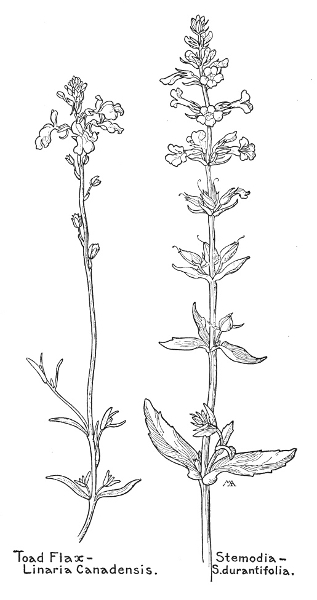
Toad Flax—Linaria Canadensis. Stemodia—S. durantifolia.
Hairy Speedwell Verónica Tournefórtii Blue Spring, summer, autumn Utah, Cal., etc.
This is one of the most attractive of the little Speedwells, for its flowers are bright and quite large. The stems are branching, hairy and purplish, some short and erect, others long and trailing, and the leaves are alternate above and opposite below, dull yellowish-green, hairy and rather soft, with scalloped edges. The flowers grow singly, on slender flower-stalks over an inch long, springing from the angles of the upper leaves, and the corolla is three-eighths of an inch across, the upper lobe deep brilliant blue, veined with dark blue, the side lobes similar in color but not so bright, the lower lobe almost white, without blue veins, and each lobe with a little pale yellow at its base. The stamens and pistil are white, the anthers becoming brown and the style bent to one side, and the capsule is somewhat heart-shaped, containing several cup-shaped seeds. This forms patches along roadsides and in fields, the soft foliage dotted with the quaint bright blue flowers, opening a few at a time in bright sunlight and closing at night. This is a native of Europe and Asia and is found across the continent.
American Brooklime Verónica Americàna Blue Summer Across the continent
In shallow water, or in very wet meadows, we find these little flowers. They are smooth perennials, with straggling, branching, purplish stems, more or less creeping, and rooting from the lower joints, from one to three feet long. The yellowish-green leaves usually have short leaf-stalks and are often toothed and the very small, pale blue flowers, with white centers and veined with purple, grow in loose spreading clusters.
Alpine Speedwell Verónica Wormskjòldii Blue Summer Northwest, Ariz., etc.
A pretty little plant, with smooth, stiffish, toothless leaves and deep bright blue flowers, with a little white at the base of the petals and veined with purple. This is found in damp spots in the mountains, up to twelve thousand feet, in northern places across the continent, and as far south as Arizona.
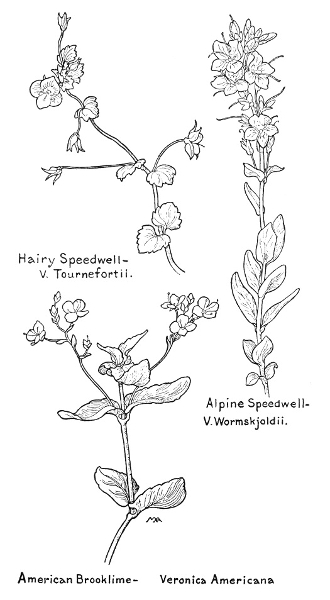
Hairy Speedwell—V. Tournefortii. Alpine Speedwell—V. Wormskjoldii. American Brooklime—Veronica Americana.
There are a great many kinds of Pentstemon and some of our handsomest and most conspicuous western flowers are included among them. They are natives of North America, chiefly herbs, sometimes branching below; the leaves usually opposite, the upper ones without leaf-stalks and more or less clasping; the flowers showy, in long clusters; the calyx with five lobes; the corolla two-lipped, with a more or less swollen tube, the upper lip two-lobed, the lower three-cleft and spreading; the stamens four, in pairs, and also a fifth stamen, which is merely a filament without any anther, but is conspicuous and often hairy; the style threadlike, with a round-top stigma; the pod usually pointed; the seeds numerous. The common name, Beard-tongue, is in allusion to the usually hairy tip of the sterile filament. Pentstemon is from the Greek meaning five stamens. This name is often mispronounced; the accent should be on the second syllable and long.
Large Beard-tongue Pentstèmon glandulòsus Lilac, purple Summer Oreg., Wash., Idaho
An exceedingly handsome plant, a foot and a half tall, with a stout reddish stem, rather downy and sticky, and dark green leaves, rather shiny and stiff, and downy on the under side. The flowers are an inch and a half long, so large that they look like Fox-glove, and are beautifully shaded from pale lilac to deep reddish-purple, with purple filaments and white anthers and pistil. The calyx is reddish, sticky and downy, and the outside of the corolla glistens with sticky fuzz. This grows in the mountains.
Pentstemon Pentstèmon Rattáni var. mìnor Blue Summer Utah, Oreg., Cal.
This forms pretty clumps of bright color, with several stems about eight inches tall, smooth below, and smooth dark green leaves. The flowers are less than half an inch long, with a downy calyx and bright purplish-blue corolla, with a purplish throat. This grows in mountain canyons.
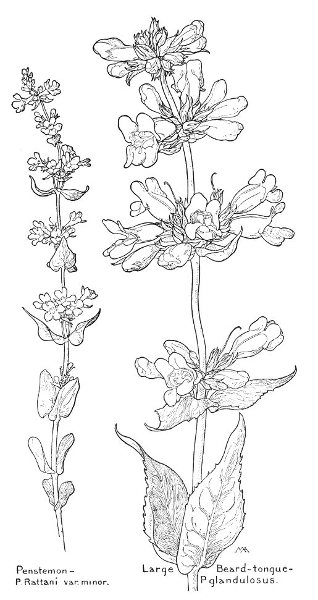
Penstemon—P. Rattani var. minor. Large Beard-tongue—P. glandulosus.
Blue Pentstemon, Beard-tongue Pentstèmon cyanánthus Blue Spring, summer Utah, Ariz., Wyo.
This is perhaps the most beautiful of all the Pentstemons, with several smooth, stoutish, pale green, leafy stems, from one to two feet tall and smooth, pale bluish-green leaves, with more or less "bloom," toothless and thickish, the upper ones somewhat clasping. The flowers are not hairy or sticky, and are over an inch long, forming a handsome cluster about eight inches long. The sepals are narrow and pointed, the corolla is tinted with various beautiful shades of blue and purple, often with a white throat and blue lobes, or with a pink throat and deep blue lobes, the sterile filament has a thickened, more or less hairy, yellow tip, and the pale yellow anthers are more or less hairy. This plant is beautiful in every way, for the foliage is fine in form and color and the flowers are brilliantly variegated, yet harmonious and graceful. This grows on hillsides and in mountain valleys, at rather high altitudes, and used to be common and conspicuous on the "benches" around the Salt Lake Valley, but it is gradually being exterminated by sheep. It thrives and improves when transplanted into gardens. P. acuminàtus is similar, but the cluster is looser and the flowers often pink and purple. It forms fine patches of color at the Grand Canyon.
Honeysuckle Pentstemon Pentstèmon cordifòlius Red Summer California
A handsome shrub, with much the general appearance of a Honeysuckle, woody below, with long slender branches and pretty heart-shaped leaves. The flowers are often in pairs and are each an inch and a half long, with bright scarlet corollas, conspicuously two-lipped, the stamens protruding, and form large clusters towards the ends of the branches. This grows in light shade in the woods and trails its long branches and garlands of bright flowers over the neighboring shrubs and trees.
Pride-of-the-mountain Pentstèmon Newbérryi Pink, lilac Summer California
A beautiful little shrub, making splendid patches of vivid color on high bare rocks in the mountains, where it is very conspicuous, hanging over the edges of inaccessible ledges. The stems are woody below and very branching, about a foot high, and the leaves are usually toothed, smooth, stiffish, and thickish. The flowers are an inch and a quarter long, with a rather sticky calyx and bright carmine-pink corolla, moderately two-lipped, with a patch of white hairs on the lower lip; the stamens protruding, with conspicuous, white, woolly anthers, and the style remaining on the tip of the capsule like a long purple thread. This is slightly sweet-scented and is common around Yosemite. The alpine form is less than four inches high, with larger, lilac flowers and toothless leaves.
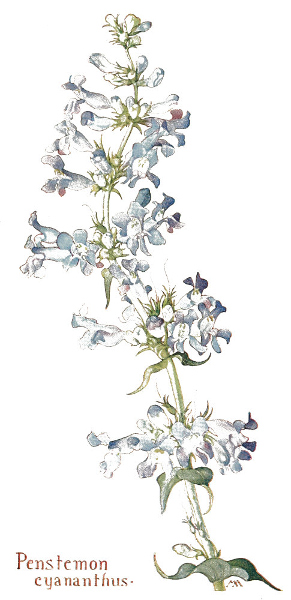
Penstemon cyananthus.
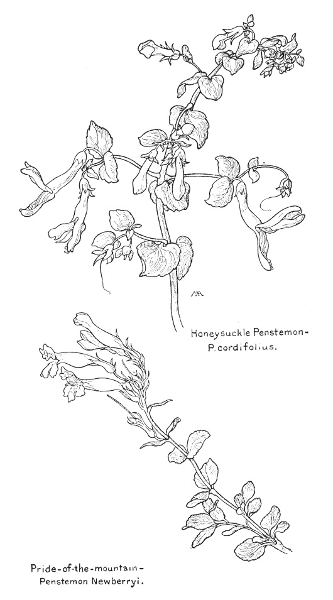
Honeysuckle Penstemon—P. cordifolius. Pride-of-the-mountain—Penstemon Newberryi.
Bushy Beard-tongue Pentstèmon antirrhinoìdes Yellow Spring California
This is a rather pretty shrub, about four feet high, with pale woody branches, purplish twigs, and many, small, rich green leaves. The flowers have a glossy, bright green calyx and a yellow corolla, which is three-quarters of an inch long, streaked with dull-red outside and slightly hairy, the sterile stamen hairy and yellow.
Variable Pentstemon Pentstèmon confértus Yellow, blue, purple Summer Northwest and Cal.
This has a smooth stem and smooth, toothless leaves, but is very variable both in form and color, for the typical plant, from Oregon and the Rocky Mountains, has yellow flowers, but in Yosemite the variety caerùleo-purpùreus always has blue or purple flowers, but the plants vary in general appearance. In good soil, such as the floor of the Valley, the stem is sometimes two feet tall and the flowers are about half an inch long, grouped in whorls along the stem, but at high altitudes the plant shrinks to a few inches in height.
Cardinal Pentstemon Pentstèmon Párryi Scarlet Spring Arizona
These wands of flaming scarlet are conspicuous along the trails in the Grand Canyon and are exceedingly beautiful, very graceful in form and vivid in color. The smooth, purplish, somewhat leafy stems, from one and a half to two feet tall, spring from a clump of rather small leaves, which are toothless, smooth, and rather light green in color. The flowers are three-quarters of an inch long, the corolla with five rounded lobes and very slightly two-lipped, and look something like Scarlet Bugler, but are smaller and more delicate, and are sometimes mistaken for Cardinal Flowers by people from the East.
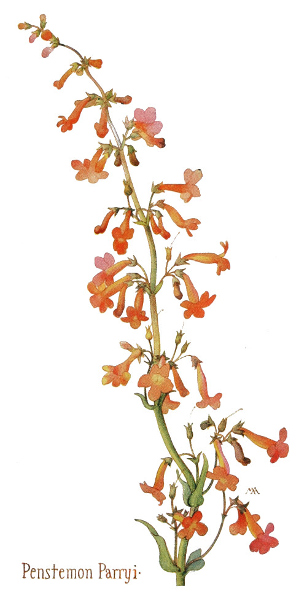
Penstemon Parryi.
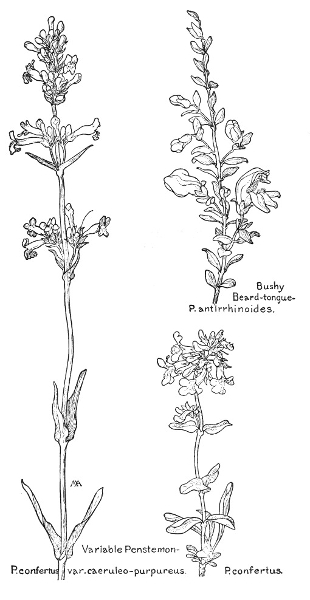
Bushy Beard-tongue—P. antirrhinoides. Variable Penstemon—P. confertus. var. caeruleo-purpureus. P. confertus.
Pentstemon Pentstèmon Wrìghtii Pink, purple Spring Arizona
This is very much like the last in every way, except the color of its flowers. The leaves are smooth and thickish, bluish-green, with a "bloom," the lower ones with a few irregular, blunt teeth, or with wavy margins, and the flowers, which are the same shape and size as the last, are deep, bright pink, with a magenta line on each lobe and some white hairs on the lower lip. The filaments are purple, with whitish anthers, and the fifth stamen resembles a tiny brush, with yellow bristles on the upper side and pointing into the throat. The whole effect of the graceful flower-cluster is bright, beautiful, and conspicuous, growing among the rocks, on hillsides and in canyons.
Pentstemon Pentstèmon laètus Blue, purple Summer California
This is very beautiful and varied in color and is the commonest kind in Yosemite, from one to two feet high, with roughish, toothless leaves and several slender, erect, somewhat hairy branches, ending in long loose clusters of flowers. The corollas are an inch long, and vary from deep bright blue through all shades of violet to deep pink, with two white ridges in the throat, and with two white anthers visible and two purple ones hidden in the throat. The flowers' faces have a quaint, wide-awake expression. This grows on dry rocky slopes and is often mistaken for P. heterophýllus, which is rather common in open places in the Coast Ranges. P. linarioìdes, blooming in late summer at the Grand Canyon, is somewhat similar, but the flowers are smaller and more delicate, and the leaves are smooth, small, and narrow.
Scarlet Bugler Pentstèmon Èatoni Red Spring Ariz., Utah
Very beautiful, from two to three feet high; with purplish stems, smooth leaves, and flowers an inch long, with a bright scarlet, funnel-shaped corolla, not much two-lipped, the stamens not protruding. These graceful wands of vivid color are conspicuous in the Grand Canyon. P. centranthifòlius, common in California, is similar, the corolla less two-lipped, and has very smooth, thickish leaves. P. Bridgésii, found in Yosemite, is similar, but the corolla is decidedly two-lipped.
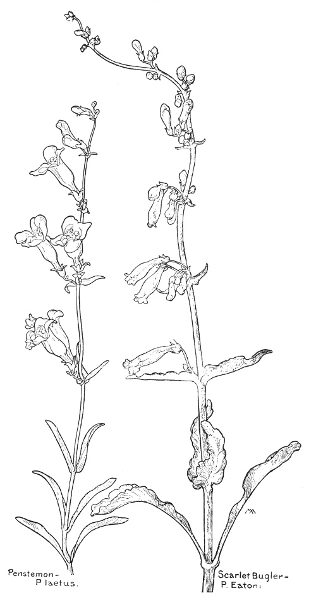
Penstemon—P. laetus. Scarlet Bugler—P. Eatoni.
Yawning Pentstemon Pentstèmon breviflòrus Flesh-color Summer California
A bushy plant, from two to five feet high, with many smooth, slender branches, terminating in long loose clusters of flowers. The leaves are smooth, rather dark green, the lower ones sharply toothed, and the flowers are three-quarters of an inch long; the corolla flesh-color, tipped with pink, with some purple lines on the lower lip, and some fine white hairs on the upper; the buds yellow, tipped with dark red. These flowers are too dull in color to be effective, but they are sweet-smelling and have ridiculous faces with widely yawning mouths. This is quite common in Yosemite, forming large clumps on open rocky slopes. Indians use the tough stems for making baskets.
Scarlet Pentstemon Pentstèmon Tórreyi Red Summer Arizona
Exceedingly handsome, with smooth, pale green stems, two feet or more tall, and smooth, rather bluish-green leaves, with slightly rippled edges. The corolla is an inch and a quarter long, vivid scarlet, paler inside, strongly two-lipped, with long, conspicuous stamens, with pale yellow anthers, the style remaining on the tip of the capsule like a long purple thread. This makes splendid clumps of gorgeous color and is common on the rim of the Grand Canyon.
There are a number of kinds of Collinsia, natives of North America, with the leaves opposite or in whorls; the flowers single or in whorls; the calyx five-cleft; the corolla irregular, with a short tube and two-lipped; the upper lip two-cleft and more or less erect, the lower lip larger and three-lobed, the side lobes spreading or drooping, the middle lobe keel-like and folded together and enclosing the two pairs of stamens and the threadlike style, which has a small round-top or two-lobed stigma. The fifth stamen is represented by a minute gland on the upper side of the corolla tube near the base. The form of the flowers somewhat suggests those of the Pea Family. If we pull the lower lip apart we find the odd little crevice in which the stamens are concealed.
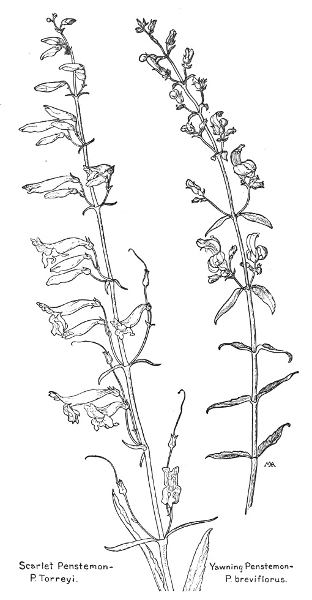
Scarlet Penstemon—P. Torreyi. Yawning Penstemon—P. breviflorus.
Chinese Houses Collínsia bícolor Purple and white Spring, summer California
These are charming plants, from six inches to a foot and a half tall, with very delicately made flowers. The leaves are smooth or downy and more or less toothed, with rough edges, and the flowers are arranged in a series of one-sided clusters along the upper part of the stem, which is more or less branching. The corollas are about three-quarters of an inch long and vary in color, being sometimes all white. In the shady woods around Santa Barbara they often have a white upper lip, which is tipped with lilac and specked with crimson, and a lilac lower lip, and here they are much more delicate in appearance than on the sea-cliffs at La Jolla, where they grow in quantities among the bushes and are exceedingly showy. In the latter neighborhood the flowers are nearly an inch long and the upper lip is almost all white and marked with a crescent of crimson specks above a magenta base, and the lower lip is almost all magenta, with a white stripe at the center, the contrast between the magenta and white being very striking and almost too crude. The arrangement of the flowers is somewhat suggestive of the many stories of a Chinese pagoda and the plant is common.
Blue-lips Collínsia multiflòra Lilac, blue, and pink Summer Northwest
A very attractive little plant, smooth all over, about six inches tall, with toothless, light green leaves and pretty flowers, each over half an inch long. The upper petals are pinkish-lilac, the lower petals a peculiar shade of bright blue, and the tube is pink; the contrast between the blue and pink giving an odd and pretty effect. This grows in the woods around Mt. Shasta.
There are many kinds of Scrophularia, most of them natives of Europe. They are rank perennial herbs, usually with opposite leaves; the corolla with no spur and with five lobes, all erect except the lowest one, which is small and turned back; the stamens five, four of them with anthers and the fifth reduced to a scale under the upper lip. These plants are supposed to be a remedy for scrofula.
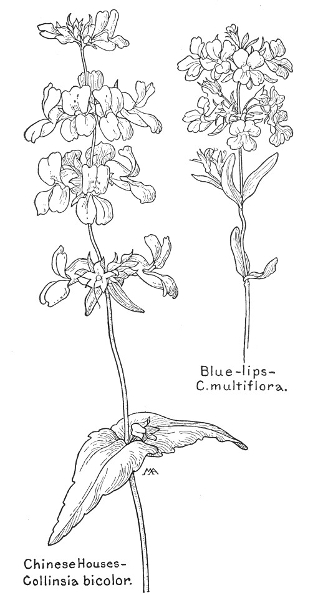
Blue-lips—C. multiflora. Chinese Houses—Collinsia bicolor.
California Bee-plant Scrophulària Califórnica Red, green Spring, summer Northwest, Cal.
This is a coarse plant, smooth, or rather sticky and hairy, with several stout, square stems, and forming a large clump, from two to six feet high. The little flowers have a quaint appearance, but are usually only about a quarter of an inch long, with brownish-red or greenish corollas, which are neither pretty nor conspicuous, but the variety floribúnda, of southern California, has flowers which are nearly half an inch long, with rich red corollas, handsome and brilliant in effect. These plants yield a great deal of honey and are common and widely distributed.
There are several kinds of Diplacus, much resembling Mimulus, except that they are shrubs, with evergreen leaves.
Sticky Monkey-flower, Bush Monkey-flower Diplácus longiflòrus (Mimulus) Salmon-color (varying from pale yellow to red) Spring, summer California
When in full bloom, this is a handsome and very conspicuous shrub, for the flowers are numerous and unusual in coloring, being usually a peculiar shade of salmon-color, which at a distance gives the effect in the landscape of some sort of exotic rhododendron. It is from two to six feet high, with very dark green, sticky, usually toothless leaves, with their margins rolled back, dark sticky buds and large flowers, which are sometimes three inches long, the corolla varying in color from almost white to scarlet, with a white stigma. They bloom more or less all the year round and there are several similar, named varieties.
Bush Monkey-flower Diplácus puníceus (Mimulus) Red Spring, summer, autumn California
This is much like the last, and is often very handsome. In the crevices of the sea-cliffs at La Jolla it makes tangled thickets of woody stems and dark green foliage, ornamented with many scarlet or rich deep-red flowers, with a velvety surface like that of a pansy and with orange ribs in the throat. This is common throughout California.
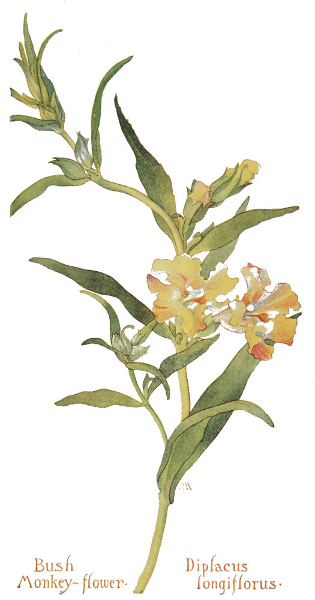
Bush Monkey-flower—Diplacus longiflorus.
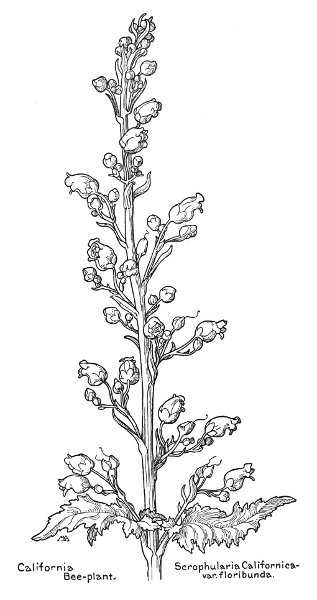
California Bee-plant—Scrophularia Californica var. floribunda.
There are many kinds of Mimulus, or Monkey-flower, usually growing in moist places, with erect or slanting, juicy stems; leaves opposite, usually toothed; flowers generally handsome, on flower-stalks from the axils of the leaves; calyx covering the tube of the corolla, bell-shaped, five-angled and five-toothed, upper tooth usually larger; corolla two-lipped, the upper lip with two lobes, erect or turned back, the lower with three, rounded, spreading lobes, the tube not swollen at base and with a pair of ridges within on the lower side; stamens four, in pairs, not inclosed in the upper lip, their two anther-cells spreading apart, no rudiment of a fifth stamen; style threadlike, stigma with two, flat, spreading tips. When an insect alights it touches the stigma, which immediately folds its tips together, thus exposing the anthers, so that the insect becomes dusted with pollen. This can be observed by touching the stigma with a pencil. The odd little grinning face of these flowers suggested both the common name and the Greek, derived from "ape."
Monkey-flower Mímulus brévipes Yellow Spring California
A very handsome plant, from one to two feet high, rather hairy and sticky all over, with dark green leaves, usually toothless, and large, clear bright yellow flowers, an inch and a half long, with a pair of ridges in the throat and a pale green stigma. This grows on hillsides, the rich green foliage and bronze-colored buds contrasting finely with the bright flowers. The leaves are quite unlike those of the Common Yellow Monkey-flower.
Pink Monkey-flower Mímulus Lewísii Pink Spring, summer West, etc.
A graceful mountain perennial, growing near streams, from two to three feet tall, with bright green, toothed leaves, thin in texture, more or less hairy, without leafstalks; the stems and buds slightly sticky. The lovely flowers are nearly two inches long, the corolla varying from pale pink to rose-red, with two, hairy, yellow ridges in the throat, the stamens not protruding from the tube. This pink kind takes the place in the high mountains of the Scarlet Monkey-flower of lower altitudes and is found as far east as Colorado.
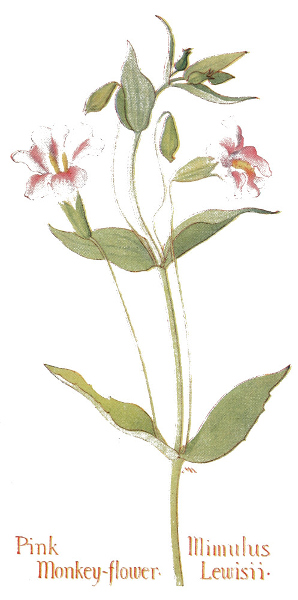
Pink Monkey-flower—Mimulus Lewisii.
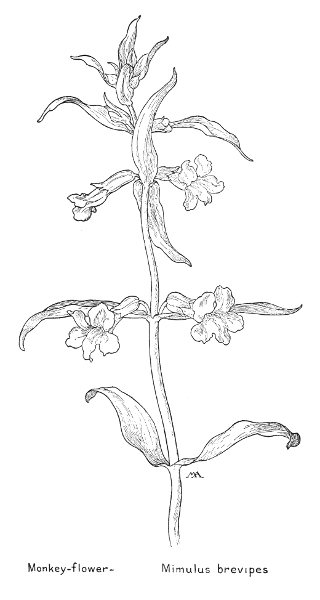
Monkey-flower—Mimulus brevipes.
Scarlet Monkey-flower Mímulus cardinàlis Red Spring, summer Southwest. Oreg.
An exceedingly handsome kind, sometimes nearly five feet high, much like the last, but with vivid scarlet corollas, decidedly two-lipped, the upper lip erect and the lower lobes turned back, the stamens protruding from the tube. I first saw these gorgeous flowers glowing like bits of flame among the ferns and grasses that bordered a beautiful spring in a cave in the Grand Canyon, where icy water fell on them drop by drop through a crevice in the rocky roof far above them and kept them glistening with moisture. This is often cultivated in gardens.
Little Yellow Monkey-flower Mímulus primuloìdes Yellow Summer Cal., Oreg.
A charming little plant, from three to six inches tall, with pretty delicate flowers, from half an inch to an inch long, the corolla-lobes all alike, bright yellow, often dotted with crimson, growing singly on the tips of very slender flower-stalks, springing from a cluster of bright yellowish-green leaves, usually toothed, smooth, or sometimes hairy. This grows in moist mountain meadows.
Little Pink Monkey-flower Mímulus Tórreyi Pink Summer California
A delicate little plant, from three inches to a foot high, rather hairy and sticky, with very slender branching stems, yellowish-green, toothless leaves, and bright flowers, about three-quarters of an inch long, with almost no flower-stalks; the corolla-lobes pink, veined with purple, the tube crimson, with two yellow ridges in the throat. A patch of these little flowers scattered over a sandy slope in Yosemite, sometimes growing with a tiny blue and white Lupine that likes the same sort of place, is an exceedingly pretty sight. It grows in the mountains, preferring moderate altitudes, becoming lower and deeper in color in higher places.
Desert Monkey-flower Mímulus Fremóntii Pink Spring California
A charming little plant, something like the last but prettier, three or four inches tall, with very slender, stiff, purplish, branching stems and smooth, thickish, light green leaves, purplish on the under side. The flowers are nearly an inch across, with a hairy calyx and bright purplish-pink corolla, streaked with magenta, with yellow ridges on the lower lip and plaits inside the throat. They look exceedingly pretty on the pale sand of the Mojave Desert.
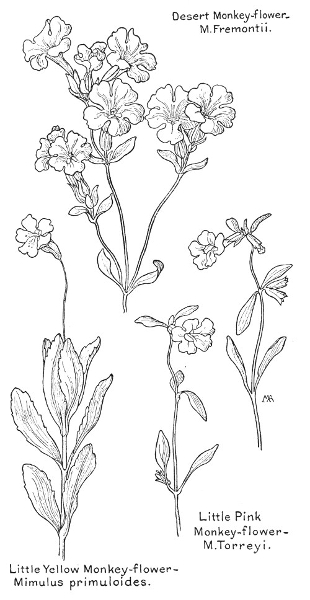
Desert Monkey-flower—M. Fremontii. Little Pink Monkey-flower—M. Torreyi. Little Yellow Monkey-flower—Mimulus primuloides.
Common Yellow Monkey-flower Mímulus Langsdórfii Yellow Spring, summer Southwest, Utah, etc.
There are several varieties of this common and attractive plant, some tall and robust, others very short. The stems are smooth, not sticky, thickish and pale, sometimes branching, about a foot tall, and the leaves are from one to three inches long, smooth, or slightly downy, especially on the under side of the upper leaves, and usually bright green, the veins prominent on the back, the upper leaves without leaf-stalks and more or less clasping, the lower ones with leaf-stalks varying in length. The flowers are from three-quarters of an inch to two inches long, clear bright yellow, the throat nearly closed and hairy, usually with some dark red dots between the hairy ridges on the lower lip. This grows in wet places in the mountains and in canyons, is widely distributed in the West, and has now strayed as far east as Connecticut.
Musk-plant Mímulus moschàtus Yellow Spring, summer West, etc.
This plant is more or less hairy and seems to be wet all over with slimy dew and smells of musk. When the stems are cut and put in water a slimy sort of mucilage drips from them. It is about ten inches tall, with rather pretty yellow flowers, barely an inch long, with some hairs and reddish specks in the throat. This is widely distributed, in wet places, from Ontario westward.
There are numerous kinds of Orthocarpus, many of them Californian, difficult to distinguish. Like Castilleja, their upper leaves often pass into colored bracts and the calyx is colored, but the corolla is not similar, for the upper lip is small and the three-lobed lower lip is swollen and conspicuous; calyx short, four-cleft; stamens four, two of them short, enclosed in the upper lip; style long, with a round-top stigma; leaves without leaf-stalks, usually alternate, often cut into three to five narrow divisions; fruit an oblong capsule with many seeds. Perhaps it is called Owl's-clover because, in some kinds, the flowers look like the faces of owls.
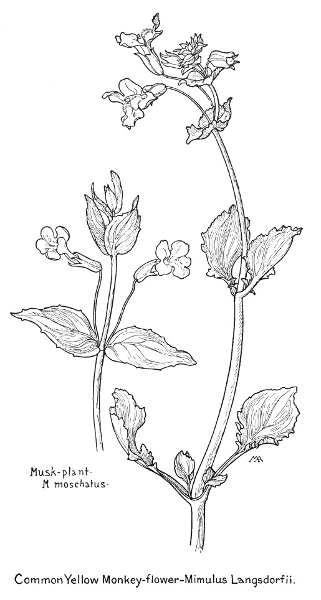
Musk-plant—M. moschatus. Common Yellow Monkey-flower—Mimulus Langsdorfii.
Yellow Pelican Flower Orthocàrpus faucibarbàtus Yellow, whitish Spring California
One of the handsomest of its kind, a fine thrifty plant, but not at all coarse, and much prettier and more effective than the next. The branching stem is about a foot tall, and the leaves are very light, bright yellowish-green, and thin in texture. The flowers are about an inch long, with very clear bright yellow "pouches" and greenish "beaks" tipped with white. They have a curiously solid appearance, as if carved out of yellow wax, and are very pleasing and fresh in color, harmonizing well with the light green bracts, which give a very feathery effect to the top of the cluster. Like most of its relations, the flowers are more effective when we look down on them, growing among the grass, than when they are picked and we see them in profile. The corollas are sometimes pinkish-white. This is common in the valleys of the Coast Ranges.
Johnny-tuck Orthocàrpus eriánthus Yellow Spring Cal., Oreg.
From five to ten inches tall, with a slender, downy, purplish stem, often branching, dull green, downy leaves and purplish-tipped bracts. The sulphur-yellow flowers are usually an inch long, with a magenta "beak" and a very slender, white tube. They are pretty and very common on plains.
Pink Johnny-tuck, Pink Popcorn Flower Orthocàrpus eriánthus var. rosèus Pink Spring California
A delicate little plant, from five to ten inches tall, with a slender, downy, reddish stem, hairy, dull green leaves and bracts, and very pretty little flowers, nearly an inch long; the corollas varying from almost white to bright pink, but all the same shade on one plant, with a little yellow at the center and a maroon-colored "beak." They are deliciously sweet-scented, like violets, and grow in dry places. The variety versícolor, Popcorn Beauty, has fragrant white flowers.
Yellow Owl's Clover Orthocàrpus lùteus Yellow Summer West, etc.
This often makes patches of bright color. It is from six to twelve inches tall, with stiff, slender, hairy stems, hairy leaves, and pretty bright yellow flowers, nearly half an inch long. This grows in dry sunny places as far east as Colorado, reaching an altitude of ten thousand feet.
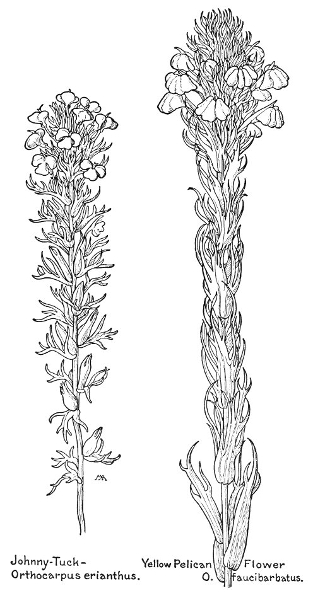
Johnny-Tuck—Orthocarpus erianthus. Yellow Pelican Flower—O. faucibarbatus.
Escobita, Owl's Clover Orthocàrpus densiflòrus Purplish-pink Spring California
The Spanish name, which means "little broom," is very appropriate for this pretty plant. The stiff, downy stem is from five to fifteen inches tall and the downy leaves are light green and become tipped with purplish-pink as they mount up the stalk. The flowers are about three-quarters of an inch long and have a white lower lip, which is tipped with yellow and has a crimson dot on each lobe, and the straight, erect "beak" is crimson. The cluster is crowded with purplish-pink and white bracts and though the flowers themselves are not conspicuous the effect is feathery and very pretty, especially when the plants grow in such quantities as to color a whole field with soft pink, or when mixed with beautifully contrasting patches of blue Lupine. This is common along the coast. O. purpuráscens, common in the Northwest and Southwest, is similar, but it has a hairy "beak," hooked at the tip, and the general effect is handsomer and much brighter in color, but less feathery.
Owl's Clover Orthocàrpus purpureo-álbus Pink and White Summer Ariz., Utah, New Mex.
An interesting annual plant, quite pretty, about a foot high, the stem sometimes branching and the branches suggesting those of a candelabrum, clothed with soft, finely divided, dull green leaves and ending in spikes of green bracts and pretty little flowers, three-quarters of an inch long. The calyx is green, the upper lip of the corolla is purplish-pink and the lower lip is swollen, three-lobed and cream-white, turning pink in fading. This grows in dry places at altitudes of from six to eight thousand feet. Only one of the branches is given in the picture.
Owl's Clover Orthocàrpus exsértus White and pink Spring, summer California
A pretty little plant, from six to eight inches high, with hairy leaves cut into narrow divisions and passing into pinkish-lilac bracts towards the top of the stalk, which are mixed with pink and white flowers, each about an inch long, so that the effect of the whole is a spike of pink and white. The lower lip of the corolla is white and the upper lip is pink, with a furry tip. This grows in fields. O. attenuàtus, common in fields in the Northwest, is a slender inconspicuous kind, about nine inches tall, with soft, thin, dull green leaves, most of them not lobed, and pale green bracts, often tipped with white. The corollas are dull white, the lower lip dotted with purple or yellow, and the whole effect of the cluster is feathery, very slender, and pale in color.
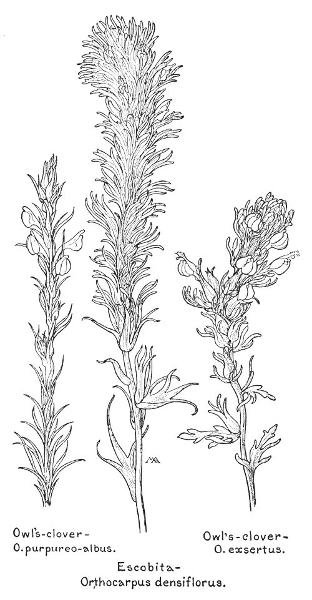
Owl's-clover—O. purpureo-albus. Escobita—Orthocarpus densiflorus. Owl's-clover—O. exsertus.
There are a good many kinds of Pedicularis, usually with finely-cut leaves and spikes of queerly-shaped flowers, usually yellow, sometimes red or white; the corolla conspicuously two-lipped, the upper lip hood-like, long and narrow, the lower lip three-lobed; the stamens four, two of them short, in the upper lip; the capsule flattened or compressed, beaked, splitting open, and containing many seeds. These plants are supposed to cause lice in sheep that feed on them, so they have the ugly name of Lousewort, both in English and Latin.
Indian Warrior Pediculàris densiflòra Crimson Spring Cal., Oreg.
A robust and very decorative plant, with rich coloring. The stout, purplish stems are slightly hairy, from nine inches to nearly two feet tall, and spring from a graceful cluster of large leaves, which are crisp in texture and smooth or slightly downy, rich green and often tinged with bronze. The flowers are an inch or more long, with purplish, hairy calyxes and crimson corollas, and form a very handsome though rather coarse-looking cluster, mixed with purplish bracts, and finely shaded in color, from the carmine buds at the top to the wine-color of the faded flowers at the base. This grows on wooded hillsides and in deep shade. The flowers are sometimes white.
Duck-bill Pediculàris ornithorhýncha Pink Summer Wash., Oreg.
This is an odd-looking plant, about six inches tall, with a stout, purplish stem, woolly at the top, springing from a pretty cluster of smooth, bright green leaves. The flowers are about three-quarters of an inch long, with purplish, woolly calyxes and bright pink corollas, which are veined and tipped with deeper color, with purplish bracts. They are very eccentric in shape and the upper lip has a ludicrous resemblance to the head of a duck. This grows in the mountains.
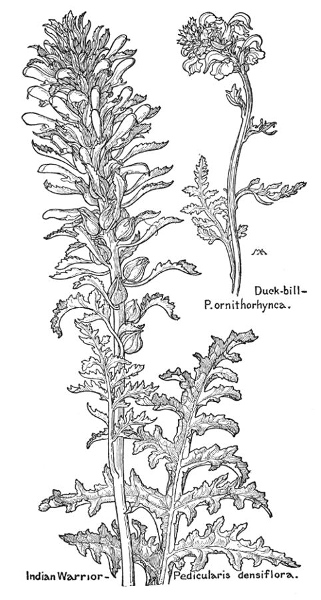
Duck-bill—P. ornithorhynca. Indian Warrior—Pedicularis densiflora.
Alpine Betony Pediculàris centranthèra Magenta and white Spring Utah, Ariz., New Mex.
This grows in dry rocky soil at high altitudes, forming a low clump of pretty bronze-colored leaves, cut into many small crinkled lobes, and giving the effect of stiff little ferns, with a short spike of oddly pretty flowers, each over an inch long, with a purplish, hairy calyx and a corolla with a white tube and magenta lips, the anthers projecting like sharp little teeth from under the arching upper lip. P. semibarbàta, growing in dry woods in Yosemite, forms a rosette of crinkled bronze foliage, with short spikes of yellow flowers.
Elephants' Heads, Butterfly-tongue Pediculàris Groenlándica Pink Summer West, etc.
A handsome plant, with quaint flowers. The smooth, slender, purplish stem is a foot or more tall, with a few alternate leaves, and springs from a cluster of smooth, fern-like foliage, much like that of P. ornithorhyncha, often tinged with bronze, and bears a long, crowded spike of many flowers. They are slightly fragrant, about three-quarters of an inch long, with purplish calyxes and deep pink or reddish corollas, which look absurdly like little elephants' heads. This grows in the mountains, across the continent.
BROOM-RAPE FAMILY. Orobanchaceae.
A rather small family, resembling Scrophulariaceae, widely distributed; parasitic herbs, without green foliage, with alternate scales instead of leaves; flowers perfect, irregular; calyx five-cleft, or split on one or both sides; corolla two-lipped; stamens four, in pairs, with slender filaments, on the corolla-tube (sometimes also the rudiment of a fifth stamen); ovary superior, style slender, stigma disk-like, with two or four lobes; fruit a capsule.
There are several kinds of Thalesia.
One-flowered Cancer-root Thalèsia uniflòra (Orobanche) Purplish Spring, summer Northwest, Utah, etc.
A queer little thing, but pretty and delicate, with a very short stem, mostly underground, bearing one or more slender, slightly hairy, dull yellow, scaly flower-stems from three to eight inches tall, each with a single flower, less than an inch long, with a dull yellow, hairy calyx, and a hairy, lilac corolla, tinged with dull yellow and veined with purple, with two yellow ridges in the throat. This is not common and is found across the continent.
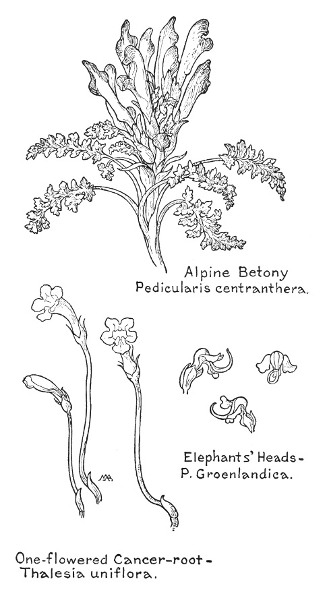
Alpine Betony—Pedicularis centranthera. Elephants' Heads—P. Groenlandica. One-flowered Cancer-root—Thalesia uniflora.
MADDER FAMILY. Rubiaceae.
A large family, widely distributed, chiefly tropical. Ours are herbs, or shrubs; leaves opposite or in whorls; flowers regular, usually perfect; calyx with four teeth or none; corolla with four or five united lobes, often hairy inside; stamens on the corolla, as many as its lobes and alternate with them; ovary inferior, with one or two styles; fruit a capsule, berry, or stone-fruit. Coffee, Quinine, and Madder, used for dye, belong to this family. I am told that the latter plant is escaping around Salt Lake and is well established there. The Latin name means "red."
There are many kinds of Houstonia, North American, usually growing in tufts, leaves opposite; flowers small; calyx four-lobed; corolla funnel-form or salver-form, four-lobed; style slender, with two long stigmas; fruit a capsule. Sometimes the flowers are perfect, but usually they are of two kinds, one kind with high anthers and short pistil, the other kind with long pistil and anthers inside the corolla-tube; visiting insects carry pollen from the high anthers of the one to the high stigmas of the other, and from the low anthers to the low stigmas, thus ensuring cross-pollination.
Desert Innocence Houstònia rùbra Pink and white Summer Arizona
A pretty little desert plant, about two inches high, forming close tufts of sage-green foliage, like harsh moss, with stiff needle-like leaves and woody stems, sprinkled with charming little pink and white flowers. The corolla is three-eighths of an inch across, with a long slender tube, the stamens lilac, and the odd little nodding capsules have two round lobes. This grows in the dreadful sandy wastes of the Petrified Forest.
Kelloggia Kellóggia galioìdes Spring, summer White, pink, yellowish West, etc.
The only kind, a slender little plant, from six inches to a foot tall, usually with smooth leaves, with small stipules. The tiny flowers are white, pink, or greenish-yellow, with a bristly calyx, and the corolla usually has four petals, but sometimes five or three; the stigmas two. The fruit is covered with hooked bristles. This grows in mountain woods, as far east as Wyoming.
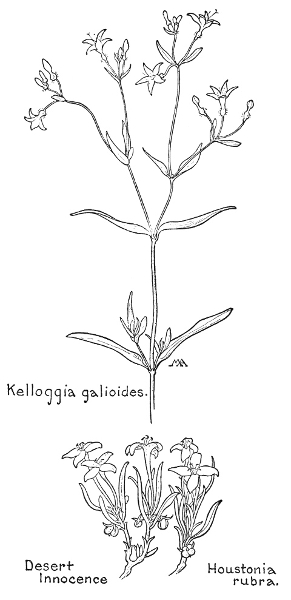
Kelloggia galioides. Desert Innocence—Houstonia rubra.
There are many kinds of Galium, widely distributed; sometimes shrubs; stems square; leaves in whorls, without stipules; flowers small, usually perfect, in clusters; calyx usually with no border; corolla wheel-shaped, four-lobed; stamens four, short; ovary two-lobed; styles two, short, with round-top stigmas; fruit dry or fleshy, consisting of two similar, rounded parts, each with one seed. The common name, Bed-straw, comes from a tradition that the manger of the Infant Christ was filled with these plants. Other names are Goose-grass and Cleavers.
Northern Bed-straw Gàlium boreàle White Summer Northwest, etc.
A rather attractive, smooth, perennial, with a stout, leafy stem, sometimes branching, and the leaves in fours, with three veins, the margins sometimes rough and hairy. The small flowers are white and so numerous as to be quite pretty. The fruit is small, at first bristly, but smooth when ripe. This grows in northern mountains across the continent, also in Europe and Asia, up to ten thousand feet.
VALERIAN FAMILY. Valerianaceae.
Not a large family, widely distributed, most abundant in the northern hemisphere; herbs, with opposite leaves and no stipules; flowers usually perfect, rather small, in clusters; the calyx sometimes lacking, or small, but often becoming conspicuous in fruit; corolla somewhat irregular, tube sometimes swollen or spurred at base, lobes united and spreading, usually five; stamens one to four, with slender filaments, on the corolla, alternate with its lobes; ovary inferior, with one to three cells, only one containing an ovule, the others empty; style slender; fruit dry, not splitting open, containing one seed.
There are many kinds of Valerianella, much alike, distinguished principally by their fruits.
Corn-salad Valerianélla macrosèra (Plectritis) Pink Spring, summer Northwest, Cal.
This has a juicy stem, from a few inches to over a foot tall, springing from a clump of smooth, very bright green leaves, and bearing most of the flowers at the top, in a small close cluster, with narrow purplish bracts. They are tiny, with a slightly irregular corolla, light pink, with two tiny crimson dots on each side of the lowest lobe, three dark brown anthers, and a calyx without a border. This is rather pretty, growing in long grass in damp places, but the flowers are too small to be effective.
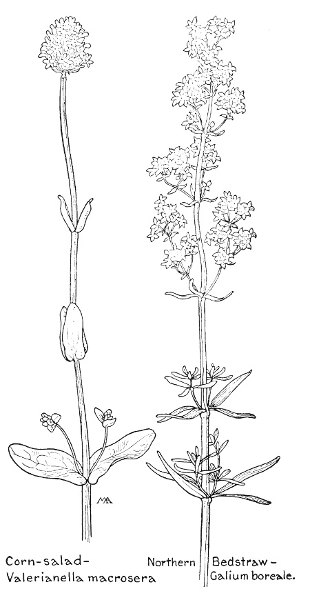
Corn-salad—Valerianella macrosera. Northern Bedstraw—Galium boreale.
There are many kinds of Valerian, rather tall perennials, chiefly of cool regions and some in the Andes. They are more or less bad-smelling plants, especially the root; the leaves mostly from the base and the small flowers in terminal clusters, some of them perfect, some with stamens and pistils on separate plants, some with the two sorts mixed; the calyx with from five to fifteen bristle-like teeth, curled up and inconspicuous in flower, but spread out and feathery in fruit; the corolla white or pink, more or less funnel-form, with five nearly equal lobes; the stamens three; the style sometimes with three minute lobes. The name is from the Latin, meaning "strong," in allusion to the medicinal properties.
Wild Valerian Valeriàna sitchénsis White, pinkish Summer Wash., Oreg.
A very handsome and attractive plant, much like the kind that is cultivated in gardens. It grows from one to three feet tall, from a creeping rootstock, with smooth, juicy, hollow stems and handsome bright green foliage. The leaves are smooth and the leaflets of the stem-leaves are coarsely toothed. The flowers are white or pinkish, with pink buds, and are crowded in fine large, rather flat-topped clusters. The stamens are long and give a pretty feathery appearance to the cluster. The flowers are strongly sweet-scented, but the roots usually have a horrible smell when they are broken. V. sylvática looks much the same, but the leaves are mostly toothless, and it is widely distributed in the United States, both East and West, also growing in Asia. Both are woodland plants, liking rich moist soil.
Arizona Valerian Valeriàna Arizònica Pink Spring Arizona
An attractive plant, from three to nine inches tall, with smooth hollow stems, smooth leaves, and pretty clusters of flowers, but not nearly so large as the last. They are purplish-pink and slightly sweet-scented. This grows in crevices in the rocks in moist places.
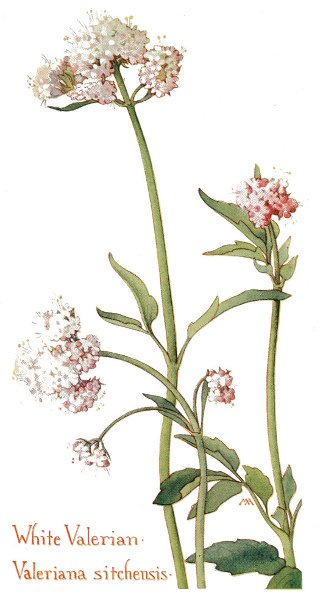
White Valerian—Valeriana sitchensis.
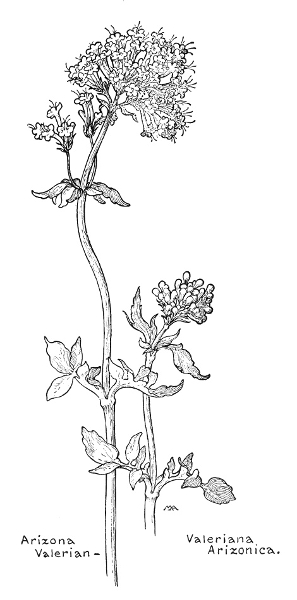
Arizona Valerian—Valeriana Arizonica.
HONEYSUCKLE FAMILY. Caprifoliaceae.
Not a large family, mostly of the northern hemisphere; herbs, shrubs, shrubby vines or trees; leaves opposite, usually without stipules; flowers perfect, regular or irregular; calyx with three to five divisions; corolla usually with five united lobes, sometimes two-lipped; stamens on the corolla tube, usually as many as its lobes and alternate with them; ovary inferior, with one style; fruit a berry, stone-fruit, or capsule.
There are many kinds of Lonicera, shrubs, or twining woody vines; leaves usually without teeth or lobes, the upper ones sometimes united around the stem; flowers usually irregular; calyx with five, minute teeth; corolla more or less funnel-shaped, often two-lipped, four lobes forming the upper lip and one lobe the under, tube often swollen at base; stamens five; style with a cap-like stigma; fruit berrylike.
Orange Honeysuckle Lonicèra ciliòsa Orange and scarlet Summer Northwest
A climbing or trailing shrub, with brilliant flowers, set off by bright green leaves, thin in texture, with pale "bloom" on the under side and usually hairy margins, the lower ones with short leaf-stalks, the upper usually united and forming a disk. The flowers are scentless, about an inch and a quarter long, with smooth, trumpet-shaped corollas, bright orange at base, shading to scarlet above, with a bright green stigma and crimson or brownish anthers. This lives in the woods and sometimes climbs to the tops of quite tall trees, ornamenting them with its splendid clusters of flowers and sprinkling the forest floor with its fallen blossoms in a shower of scarlet and gold.
Black Twinberry Lonicèra involucràta Yellow Spring, summer West
A bush, from three to seven feet high, with thick, woody, pale gray stems and bright green leaves, glossy and thin in texture, or rather coarse and hairy, with fine hairs along the margins. The flower-stalks each bear a pair of flowers, without scent, emerging from an involucre of two bracts. The corolla is rather hairy and sticky, half an inch or more long, a pretty shade of warm dull yellow, sometimes tinged with red outside, with five, short, nearly equal lobes, the tube swollen at base. The involucre becomes dark red, its lobes turn back and display a pair of berries, disagreeable to the taste, as large as peas, nearly black, the whole affair striking in color and form. This grows in moist mountain woods and seems to have smoother, glossier foliage, and smaller flowers, in Utah than elsewhere.
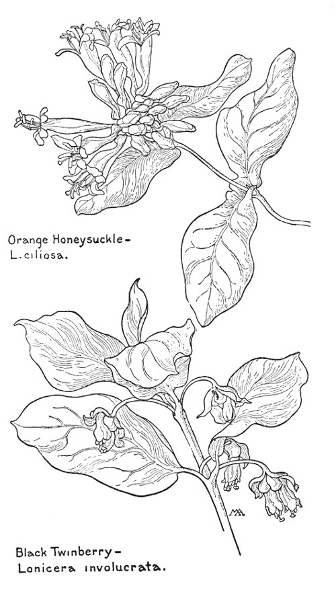
Orange Honeysuckle—L. ciliosa. Black Twinberry—Lonicera involucrata.
Pink Honeysuckle Lonicèra hispídula Pink Summer Wash., Oreg., Cal.
Rather pretty, with a woody trunk and hairy twigs, climbing over shrubs and trees, sometimes to a height of twenty feet. The leaves are pale on the under side, the upper ones usually united around the stem, and the flowers are about three-quarters of an inch long, with pink corollas and long stamens, and form long clusters, which are pretty but not effective, though the translucent, orange-red berries are handsome and conspicuous. This varies very much, especially in hairiness and color of the foliage, and is quite common in canyons and along streams in the Coast Ranges. The Yellow Honeysuckle, L. Califórnica, is similar, but with smooth branches and leaves and pale yellow flowers; growing in Oregon and northern California.
There are two kinds of Linnaea.
Twin-flower Linnaèa boreàlis var. Americàna Pink Summer Northwest, Utah, etc.
One of the loveliest of woodland plants; the long, woody stems trail over the ground and send up straight, slender branches, a few inches tall, clothed with leathery, evergreen leaves, bright green and glossy, and terminating in a slender, slightly hairy flower-stalk, which bears a pair of little nodding flowers, about half an inch long, hanging on very slender pedicels, with two bracts. The corollas are regular, with five lobes, delicate pink, veined with deeper color and paler at the margins, with a white pistil and four, white stamens, not protruding. The fruit is roundish and dry, with one seed. This often carpets the forest floor with its glossy foliage, ornamenting the moss with its fairy-like blossoms, which perfume the air with a fragrance like Heliotrope. It is found in cold, mountain woods, up to thirteen thousand feet, across the continent and also in Europe and Asia, and was named after Linnaeus because it was a favorite of his.
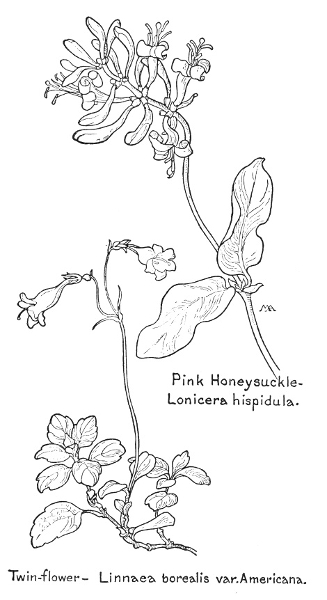
Pink Honeysuckle—Lonicera hispidula. Twin-flower—Linnaea borealis var. Americana.
There are several kinds of Symphoricarpos, of North America and Mexico; low, branching shrubs, with small leaves, scaly leaf-buds, and small, pink or white flowers, with two bracts, in clusters; the calyx roundish, with four or five teeth; the corolla regular, more or less bell-shaped, with four or five lobes; the fruit a roundish, white or red berry, containing two bony seeds. We often find Snowberries cultivated in old-fashioned gardens.
Snowberry Symphoricàrpos racemòsus Pink Spring, summer U. S.
An attractive shrub, about four feet high, with slender branches and yellowish twigs. The pretty leaves are mostly smooth, rich green, but not glossy, paler and sometimes downy on the under side, thin, but rather crisp in texture, usually with a few shallow scallops along the margins. The flowers are about a quarter of an inch long, with bell-shaped corollas, purplish-pink outside, white and woolly in the inside, the stamens and style not protruding. The berry is large and pure-white, with white, almost tasteless pulp, which is said to be slightly poisonous. This is very common in California, in the hill country, and is found across the continent.
Snowberry Symphoricàrpos longiflòrus White Summer Arizona
A straggling shrub, from two to three feet high, with small, slightly velvety, rather pale green leaves, white on the under side, sometimes set edgewise on the stem. The flowers are about half an inch long, with a slender, white, salver-form corolla, with widely separating lobes and very smooth inside, the anthers partially protruding from the throat, and the pretty berries are waxy-white. This grows at the Grand Canyon.
Snowberry Symphoricàrpos oreóphilus Pink Spring, summer Idaho, Utah, Ariz.
A branching shrub, not especially pretty, about three feet high, with shreddy bark, pinkish twigs, and light, bluish-green, toothless leaves, usually smooth. The flowers are about half an inch long, with a tubular corolla, with short lobes, flesh-color, tinged with purplish-pink, the stamens and style not protruding and the buds purplish-pink. This grows in the mountains, up to eight or ten thousand feet.
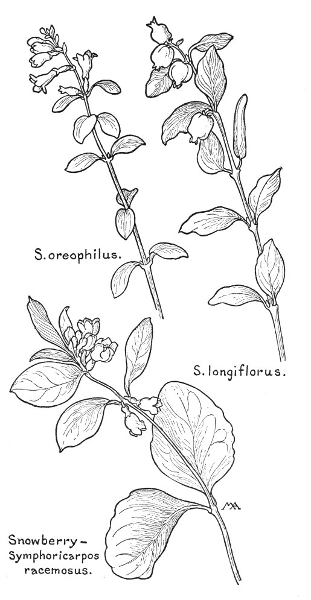
S. oreophilus. S. longiflorus. Snowberry—Symphoricarpos racemosus.
GOURD FAMILY. Cucurbitaceae.
A large family, chiefly of the tropics, climbing or trailing, herbaceous vines, usually with tendrils, rather juicy, with no stipules; leaves alternate, with leaf-stalks, usually lobed or cut; flowers some staminate and some pistillate; calyx bell-shaped or tubular, usually five-lobed; petals mostly united, usually five, on the calyx; stamens generally three, with short filaments, often united; ovary inferior; fruit fleshy, often with a hard rind, usually with flat seeds.
There are many kinds of Micrampelis, natives of America.
Chilicothe, Wild Cucumber Micrámpelis fabàcea (Echinocystis) White Summer California
A graceful, decorative vine, with many tendrils and spreading to a great distance, sometimes as much as thirty feet, partly climbing over bushes and partly on the ground, springing from an enormous bitter root as large as a man's body, the leaves slightly rough. The pretty little flowers are half an inch across, the calyx with small teeth or with none and the corolla cream-white, with from five to seven lobes; the staminate flowers in loose clusters and the pistillate ones single. The fruit is peculiar and conspicuous, a big green ball, very prickly and measuring two inches across. The Indians used to make hair-oil out of the seeds. This is also called Big-root and Man-in-the-ground.
There are several kinds of Cucurbita, natives of America, Asia, and Africa. This is the Latin name for the Gourd.
Calabazilla, Gourd Cucúrbita foetidíssima Yellow Spring Southwest, etc.
This is a near relation of the common Pumpkin and Squash and resembles them. It is an exceedingly coarse, but very decorative vine, with bristly stems, trailing on the ground and sometimes twenty-five feet long. The leaves are about eight inches long, bluish-gray, thick and velvety, covered with bristles and exceedingly unpleasant to touch but handsome in appearance. The gaudy flowers measure five or six inches across, with a bristly calyx and bell-shaped, orange-yellow corolla. The root is enormous, sometimes six feet long, the fruit is a smooth, yellow gourd, and the whole plant has a horrible smell. This is found in dry soil, from Nebraska west, and is common in southern California.
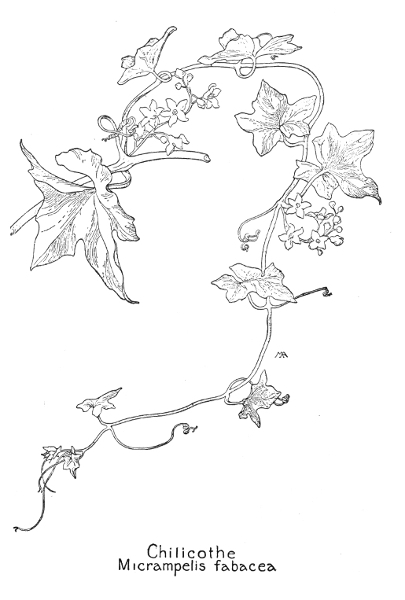
Chilicothe—Micrampelis fabacea.
BELLFLOWER FAMILY. Campanulaceae.
A large family, widely distributed. Ours are small herbs, with bitter milky juice; leaves alternate, without stipules; flowers perfect, usually with five sepals; corolla with five united lobes; stamens five; ovary inferior, style long, sometimes hairy, with two to five stigmas, which do not expand until some time after the flower opens.
There are a great many kinds of Campanula; ours are chiefly perennials, with more or less bell-shaped corollas; the capsule tipped with the remains of the calyx and opening at the sides by minute holes. The name is from the Latin, meaning "little bell."
Harebell, Blue Bells of Scotland Campánula rotundifòlia Violet Summer West, etc.
This is the well-known kind, sung by the poets, and found across our continent and in Europe and Asia, reaching an altitude of twelve thousand feet. A charming, graceful little plant, with slender stems, from six inches to two feet tall, springing from a cluster of dull green, roundish or heart-shaped leaves, which usually wither away before the flowers bloom; the stem-leaves long and narrow. The flowers hang on threadlike pedicels, usually in a loose cluster, and are less than an inch long, violet or blue and paler at the base, with a long white pistil and pale yellow or lilac anthers. Neither the plants nor the flowers are nearly so fragile as they look, for the stems are wiry and the flowers are slightly papery in texture. This plant is variable and may include more than one kind. It seems hardly necessary to remark that it is not to be confused with Calochortus albus, which is unfortunately sometimes called Hairbell and is entirely different, but I have several times been asked whether they were the same.
Bellflower Campánula Scoúleri White, lilac Summer Northwest, Cal.
A pretty little plant, with smooth, slender stems, from six to eight inches tall, and smooth, toothed leaves. The flowers are in a loose cluster and are more the shape of little Lilies than of Blue Bells, white tinged with lilac, or pale blue, with yellow anthers and a long pistil with three pink stigmas. The California Harebell, C. prenanthoìdes, has blue flowers, similar in shape.
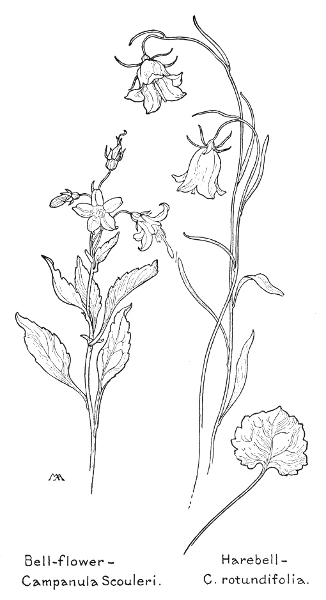
Bell-flower—Campanula Scouleri. Harebell—C. rotundifolia.
SUNFLOWER FAMILY. Compositae.
The youngest and largest plant family, comprising about seven hundred and fifty genera and ten thousand species, highly specialized for insect pollination, easily recognized as a whole, but many of its members difficult to distinguish. Some tropical kinds are trees; ours are usually herbs, sometimes shrubs, without stipules; the leaves opposite, alternate or from the root; the flowers all small and crowded in heads, on the enlarged top of the flower-stalk, which is called the "receptacle," and surrounded by a common involucre of separate bracts, few or many, arranged in one or more rows; the receptacle also sometimes having scale-like or bristle-like bracts among the flowers, its surface smooth, or variously pitted and honey-combed. The flowers are sometimes perfect, or with only pistils, or only stamens, or with stamens and pistils on different plants, or all kinds mixed. The calyx-tube is sometimes a mere ring, or its margin consists of hairs, bristles or scales, called the "pappus." The corollas are chiefly of two sorts; they are tubular and usually have five lobes or teeth, but often the flowers around the margin of the head are strap-shaped, that is, the border of the corolla is expanded into what is called a "ray." For instance, the yellow center, or "disk," of a Daisy is composed of a crowded mass of tiny tube-shaped flowers, which is surrounded by a circle of white, strap-shaped flowers, or rays, which look like petals. A Thistle, on the other hand, has no rays and the head is made up of tube-shaped flowers only. Stamens usually five, on the corolla-tube, alternate with its lobes, anthers usually united into a tube surrounding the style, which has two branches in fertile flowers, but usually undivided in sterile flowers; ovary inferior, one-celled, maturing into an akene, often tipped with hairs from the pappus to waft it about, or with hooks or barbs to catch in fur of animals. (Descriptions of genera have been omitted as too technical.)
There are many kinds of Carduus (Cnicus) (Cirsium), widely distributed; with tubular flowers only.
Thistle Càrduus Còulteri Pink, crimson Spring, summer California
A strikingly handsome, branching plant, from three to seven feet high, with light green leaves, very decorative in form, more or less downy on the upper side and pale with down on the under. The flower-heads, about two inches long, have bright lilac-pink or crimson flowers and more or less woolly involucres. This grows in the hills and mountains of the Coast Ranges.
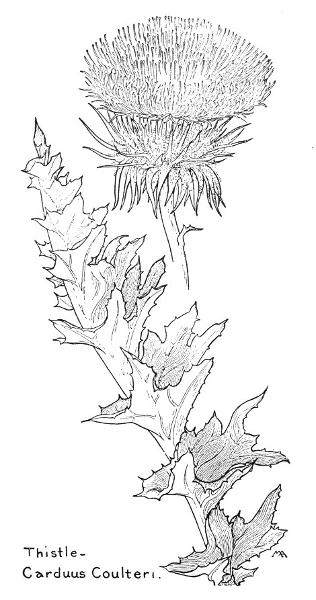
Thistle—Carduus Coulteri.
Arizona Thistle Càrduus Arizònicus Pink Summer Arizona
A very striking and decorative plant, both in form and color, from two to six feet tall, with a pale, branching, leafy stem, covered with close, white down, springing from a cluster of large root-leaves. The leaves are gray-green, covered with white down, and show great beauty of design, being sharply and symmetrically lobed and toothed, the margins armed with long yellow prickles. The flower-heads are an inch and a half long, with beautiful carmine and pale-pink flowers, all with no tinge of purple, the vivid spots of color giving a very brilliant effect in contrast with the pale foliage. This grows in the Grand Canyon and is conspicuous along the Berry trail, a little way below the rim.
Thistle Càrduus candadíssimus Pink, crimson Summer California
A very handsome and decorative plant, about three feet tall, with spreading stems, covered with white down, and dull-green leaves, pale with down on the under side and often covered with white down all over. The handsome flower-heads are two inches or more long and have deep pink or crimson flowers and very woolly involucres.
California Thistle Càrduus Califórnicus White Spring California
A branching plant, from two to six feet tall, very leafy below, with very dark bluish-green leaves, with more or less woolly down on the upper side and pale with matted down on the under side. The flower-heads are nearly three inches across, with cream-white or rarely purple flowers, and the bracts are caught together with silky, cobwebby down. This is common in the Sierra Nevada.
Western Thistle Càrduus occidentàlis Red, purple Spring Cal., Oreg.
A stout plant, two or three feet high, with large prickly leaves, and more or less covered all over with cottony wool. The flower-head is about two inches long, and nearly as wide, and is a ball of white, cobwebby wool, pierced all over with brown spines, and tipped with wine-colored flowers. This is common on sandy hills, near the coast, from San Francisco south. Yellow-spined Thistle, C. ochrocéntrus, found in Nevada and Arizona and as far east as Colorado, has purple flowers and leaves deeply slashed and armed with long yellow spines. This grows at the Grand Canyon.
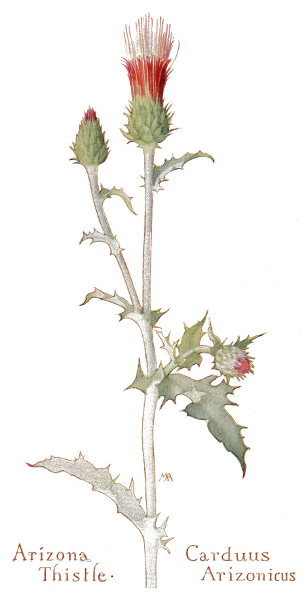
Arizona Thistle—Carduus Arizonicus.
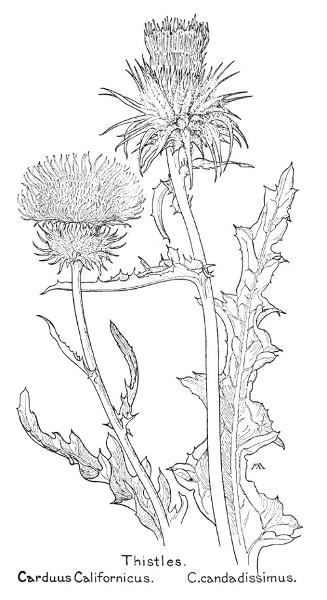
Thistles. Carduus Californicus. C. candadissimus.
There are a good many kinds of Anaphalis, natives of the north temperate zone, but only one in North America.
Pearly Everlasting Anáphalis margaritàcea White Summer U. S., etc.
This is the prettiest of the Everlastings, from one to three feet tall, with a leafy stem, covered with white wool, and alternate, toothless leaves, which are rather long and narrow, gray-green and more or less woolly on the upper side, pale and woolly on the under. The flower-heads are numerous, forming close, roundish clusters. The heads are without rays, but the tiny, yellow, tubular flowers are surrounded by many small, white, papery bracts, resembling petals, making the involucre the conspicuous feature and forming a pretty little, round, white head. This is common in dry places, East and West, and found in Asia. There is a picture in Mathews' Field Book. Rosy Everlasting, Antennària ròsea, has the same general appearance, but the bracts are pink, giving a pretty pink tint to the flower-cluster, and is found in the Northwest at high altitudes. Another kind of Everlasting is Gnaphàlium microcéphalum, Cudweed, a mountain plant of the Northwest and California, with similar foliage, but with larger, looser clusters of cream-white flowers, conspicuous at a distance, though not pretty close by. There is a picture of a similar species in Mathews' Field Book.
There are several kinds of Encelia.
Encelia Encèlia eriocéphala Yellow Spring Southwest
A handsome, desert plant, with rough, purplish stems, a foot and a half tall, dull-green, hairy leaves, and flowers over an inch across, in loose clusters, with bright golden-yellow rays, yellow centers, and woolly involucres. This makes fine conspicuous clumps of bright color on the pale desert sand.
Golden Hills, Brittle-bush Encèlia farinòsa Yellow Spring Arizona
A conspicuous shrubby plant, from two to four feet high, with many stout, branching stems, grayish, downy twigs, and large clumps of downy, gray-green leaves, from which spring the long, slender flower-stalks, bearing loose clusters of handsome flowers. They are each over an inch and a quarter across, with bright yellow rays and orange centers and are well set off by the rather pale foliage. This grows on hillsides among the rocks and gives a golden hue which may be seen at a distance of seven or eight miles.
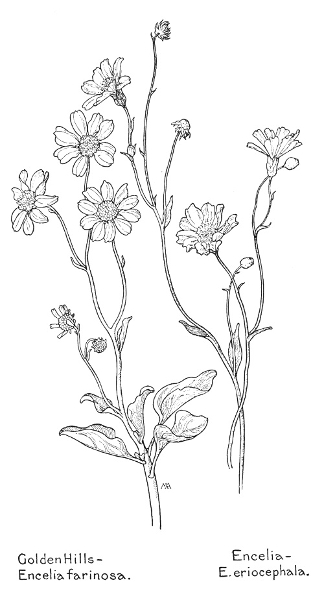
Golden Hills—Encelia farinosa. Encelia—E. eriocephala.
California Encelia Encèlia Califórnica Yellow Spring California
A handsome conspicuous shrub, two feet or more high, gray and downy when young but becoming smoother and greener, with downy, reddish twigs, dark green leaves, and numerous flowers, on long flower-stalks. They are two or three inches across, with three-toothed, bright yellow rays and very dark maroon or brown centers, specked with yellow, and velvety or hairy involucres. This grows on sea-cliffs, where it makes very effective masses of color, in fine contrast to the blue of the sea below and the sky above.
Encèlia frutéscens Yellow Spring Southwest
A rather straggling shrub, about two feet high, with whitish, woody stems, pale reddish twigs, and bright green leaves, which are roughened with minute prickles on the margins and under sides, but look quite shiny. The flower-heads are over half an inch long, in western Arizona usually without any rays, and are not especially pretty, like a starved Sunflower whose rays have shrivelled away in the dry heat of the desert, but the effect of the foliage, which suggests little apple leaves, is decidedly attractive in the arid sandy places it frequents.
There are many kinds of Helianthus, natives of the New World.
Common Sunflower Heliánthus ánnuus Yellow Summer West, etc.
A handsome kind, with a rough stem, from two to ten feet tall, roughish leaves, more or less toothed, the upper alternate, the lower opposite, and a flower-head from two to four inches across, with bright golden-yellow, toothless rays, a maroon center, and a very dark green involucre, with stiff, overlapping bracts. This is larger in cultivation and is a very useful plant, for its flowers yield honey and a yellow dye, its seeds oil and food, the leaves are good for fodder, and the stalks for textile fiber. It is common nearly everywhere along roadsides, as far east as Missouri, and is found as a stray in the East.
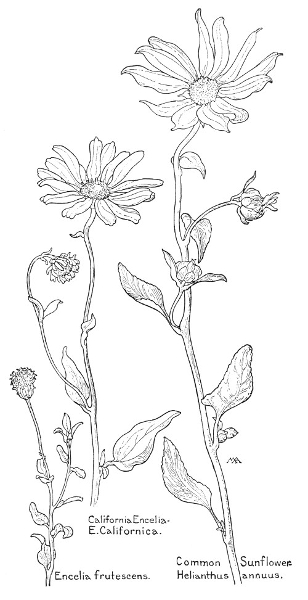
California Encelia—E. Californica. Encelia frutescens. Common Sunflower—Helianthus annuus.
Sunflower Heliánthus fasciculàris Yellow Spring Nev., Ariz., etc.
A handsome kind, forming a clump from two to four feet high, with several leafy, rough stems and harsh, rather shiny leaves. The fine flowers measure four inches across, with bright yellow rays, deeper yellow centers, and bronze, rough, rather resinous involucres. This is common around Reno and grows in dry mountain valleys as far east as Colorado.
Hairy Golden Aster Chrysópsis villòsa Yellow Summer Arizona, etc.
A striking plant, quite handsome, with a hairy, pale, leafy stem, from six inches to two feet tall, and gray-green, rather velvety leaves, generally toothless. The flowers are an inch or more across, with bright golden-yellow rays and centers of the same shade, growing singly, or in a more or less crowded cluster at the top of the stalk. This is common in open ground and dry hills, up to an altitude of ten thousand feet, as far east as Alabama, and there are many varieties. The Greek name means "golden aspect."
Velvet-rosette Psathyròtes ánnua Yellow Spring Southwest
A curious and pretty little desert plant, that looks as if it were trying to protect itself from cold rather than heat, as its pretty foliage and stems seem all made of silvery, gray velvet, forming a symmetrical rosette, dotted with the small, rayless, yellow flower-heads, like fuzzy buttons. The rosette is decorative in form, about a foot across, spreading flat and close to the ground, and is conspicuous on the bare sand of the desert. Only one of the branches is given in the picture.
Easter Daisy, Ground Daisy Townséndia exscàpa Pink Spring Ariz., New Mex. to Saskatchewan
This is a charming and quaint little plant, with close, downy rosettes of small, gray-green leaves and two or three, pretty, daisy-like flowers, all crowded together close to the ground. The flowers are over an inch across, with numerous, pale-pink rays, deeper pink on the under side, and a bright yellow center, and when they bloom in early spring, on bare rocky soil, they are exceedingly attractive.
There are a great many kinds of Erigeron, widely distributed, most abundant in the New World, easily confused with Asters, but usually with numerous and finer rays, so that the effect is more delicate.
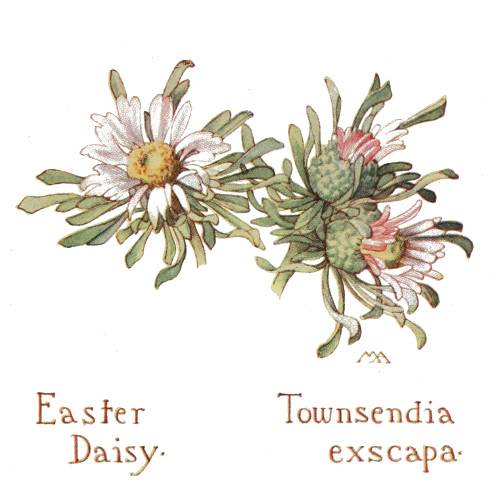
Easter Daisy—Townsendia exscapa.
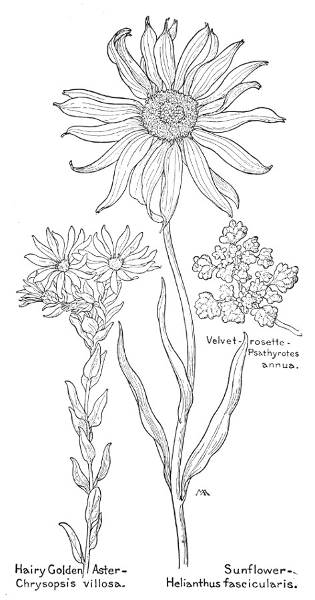
Velvet-rosette—Psathyrotes annua. Hairy Golden Aster—Chrysopsis villosa. Sunflower—Helianthus fascicularis.
Fleabane Erígeron Bréweri Purple Summer California
This is rather pretty, with slender, brittle, downy stems, from six to eighteen inches tall, and small, narrow, rough, dull green leaves. The flowers grow singly, at the ends of short leafy branches, and are each less than an inch across, with rather few violet or pinkish-purple rays and a yellow center. This is common around Yosemite and looks a good deal like an Aster.
Whip-lash Fleabane Erígeron flagellàris White, pink Summer Ariz., Utah, etc.
A rather odd-looking plant, with numerous, very slender, weak, branching stems, trailing on the ground, and very small, toothless, grayish-green, downy leaves, forming a rather dense, low bush, about two and a half feet across, the long sprays interlacing and dotted here and there with pretty little flowers, with numerous fine, white, pink-tipped rays and a yellow center. The sprays often take root at the tip. This grows in the Grand Canyon, and is found as far east as Colorado.
Rayless Fleabane Erígeron concínnus var. aphanáctis Yellow Spring Utah, Nev., Cal. etc.
A rather attractive little plant, forming small clumps, about five inches high, with several very hairy stems and light dull green, very hairy leaves. The many flower-heads are less than half an inch across, deep yellow, without rays. This grows on dry plains and mesas, as far east as Colorado, and has a rather starved appearance.
Spreading Fleabane Erígeron divérgens Violet Spring, summer, autumn West, etc.
A dear little common plant, from six to fifteen inches high, with several slender, branching, hairy stems, and soft, hairy, gray-green leaves, the upper ones small and narrow, without leaf-stalks and the lower ones sometimes with two or three lobes and with leaf-stalks. The flower-heads, several or many, on slender flower-stalks, measure nearly an inch across in spring, but are smaller in summer, and have numerous very narrow rays, white towards the center, shading to bright violet or pink at the tips, with a bright yellow center. This often grows in quantities on dry plains and mountain-sides, as far east as Texas, and is quite charming, the tufts of foliage, dotted with pretty delicate little flowers, not touching each other, but sprinkled over a large space, recalling the little flowers in early Italian pictures. E. pùmilis, of the Northwest and Utah, is much the same, with white rays.
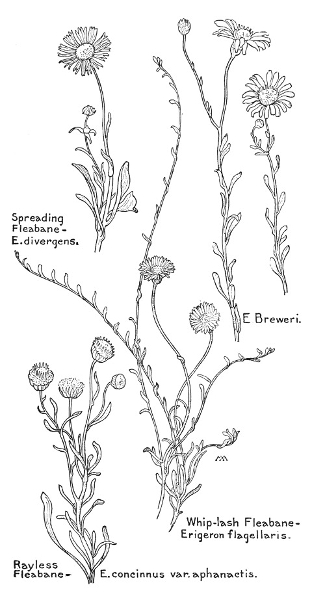
Spreading Fleabane—E. divergens. E Breweri. Whip-lash Fleabane—Erigeron flagellaris. Rayless Fleabane—E. concinnus var. aphanactis.
Large Mountain Fleabane Erígeron salsuginòsus Lilac Summer West, etc.
A large, handsome kind, abundant in the higher mountains and growing in moist places, as far east as Colorado. The stems are downy and leafy, from one to two feet tall, the leaves are smooth or slightly hairy, with bristle-like points, and the flowers are an inch and a half or more across, with bright yellow centers and clear bright lilac rays, not very narrow.
Yellow Fleabane Erígeron àureus (Aplopappus Brandegei) Yellow Summer Wash., Oreg.
A little alpine plant, about three inches tall, with downy stems, thickish, gray-green leaves, covered with close white down and forming a mat of foliage on the rocks at high altitudes. The flowers are rather more than half an inch across, with a woolly involucre, dark yellow center, and deep yellow rays, an unusual color among Fleabanes.
Seaside Daisy, Beach Aster Erígeron glàucus Violet, pink Spring, summer Cal., Oreg.
Very cheerful, sturdy-looking flowers, with stout, hairy stems, four to ten inches tall, and stiffish, slightly hairy leaves, rather pale in color. The handsome flowers are an inch and a half across, with numerous violet, lilac, or pink rays and rather dark yellow centers. This grows near the sea and is common on cliffs and sandy shores, where it makes beautiful spots of bright color.
Skevish, Philadelphia Fleabane Erígeron Philadélphicus Pink, mauve Spring, summer U. S.
A pretty perennial, from one to three feet tall, usually soft and hairy, the slender stems usually branching above and most of the leaves toothed. The flowers usually form a loose cluster at the top, the buds drooping, and the heads are from half an inch to an inch across, with yellow centers and a very feathery fringe of pink or pinkish rays. This grows in fields and woods. There is a picture in Mathews' Field Book. E. Còulteri, the large White Mountain Daisy, is a beautiful kind, from six to twenty inches tall, with bright green leaves, often toothed, sometimes downy, and the flowers usually single, an inch and a half across, usually with pure white rays. This grows in Yosemite meadows and similar mountain places, in Utah, California, and Colorado. E. compósitus is a little Alpine plant, forming dense leafy mats, easily recognized by the broad tips of the leaves being cut into lobes, usually three. The flowers are an inch or more across, with violet or white rays. This grows on the granite peaks around Yosemite, and in other Alpine regions, as far east as Colorado.
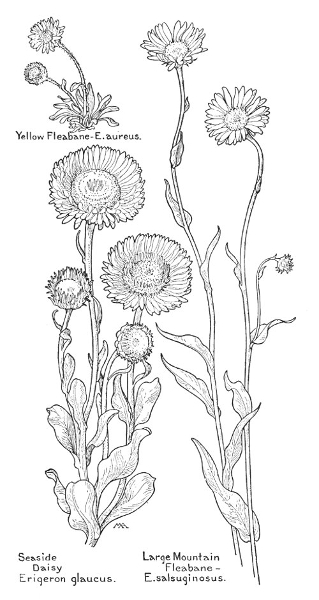
Yellow Fleabane—E. aureus. Seaside Daisy—Erigeron glaucus. Large Mountain Fleabane—E. salsuginosus.
Ptilonella Ptilonélla scàbra (Blepharipappus) White Spring Oreg., Ida., Nev., Cal.
A charming little desert plant, graceful and airy in character, with stiff, very slender, branching, roughish stems, about ten inches tall, and dull green leaves, very rough to the touch, with the edges rolled back. The delicate little flowers are an inch across, with pure white rays, and with white centers, which are specked with black and pink. This is common on the mesas around Reno and looks much like some kinds of Madia.
Desert Holly Perèzia nàna Pink Spring Ariz., Tex.
An odd little desert plant, only two or three inches high, with stiff, smooth, dull bluish-green leaves, with prickly edges, like holly leaves but not so stiff, and one quite pretty, light purplish-pink flower, the head about an inch long, with purplish bracts. The effect of the whole plant is of a little sprig stuck into the sand.
Brown-foot Perèzia Wrìghtii Pink Spring Ariz., Tex.
Much like the last, but more commonplace looking, for the flowers are smaller and the plant much larger. It is about a foot high and grows among rocks, and the general effect of dull mauve is rather pretty, though not bright in color. The common name alludes to the plant being covered with a mass of brown hairs at the base.
There are several kinds of Gutierrezia, all American.
Brown-weed Gutierrèzia Saròthrae (G. Euthamiae) Yellow Summer, autumn West, etc.
A bushy plant, resinous, smooth or nearly so, from six inches to two feet high, with many stiff, upright branches and alternate, toothless, narrow leaves, an inch or so long. The flowers have yellow centers and small yellow rays, forming clusters at the ends of the branches, and though very small are so numerous as to make effective clumps of bright color. This grows at the Grand Canyon, and in dry rocky places, as far east as the Central States.
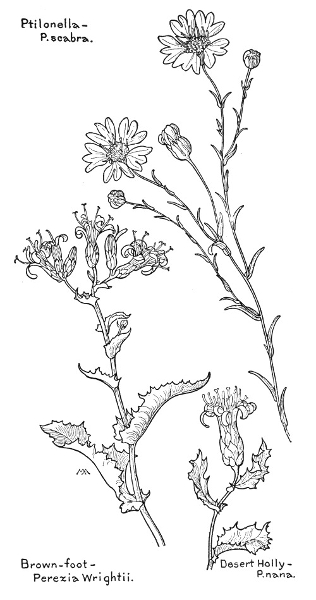
Ptilonella—P. scabra. Brown-foot—Perezia Wrightii. Desert Holly—P. nana.
There are a good many kinds of Helenium, natives of North and Central America.
Sneeze-weed Helènium Bigelòwii Yellow Summer, autumn Cal., Oreg.
A handsome plant, with a roughish stem, from two to four feet tall, and toothless, rather coarse leaves, rougher on the underside, the lower part of the leaf grown to the stem along its middle in a curious way. The flowers are from an inch and a half to two inches across, with bright golden-yellow rays and a rich-brown center, powdered with yellow pollen, and the budding flower heads look like brown buttons. This grows in meadows and along streams, at moderate altitudes, and is found in Yosemite.
Hymenopáppus lùteus Yellow Summer Ariz., New Mex., Col., Utah
A pretty and rather unusual-looking plant, with a cluster of root-leaves, gray-green and downy, cut into many fine divisions, and slender stems, about a foot tall, with two or three, narrow, alternate, toothless leaves, and bearing at the top a few pretty, bright yellow flower-heads, nearly an inch across, with tube-shaped flowers only. This grows in dry, open places.
There are many kinds of Madia, sticky, heavy-scented herbs, commonly called Tarweed and called Madi in Chili. They are used medicinally by Spanish-Californians.
Common Madia, Tarweed Màdia élegans Yellow Summer, autumn West
Pretty flowers, with hairy stems, from six inches to three feet tall, and velvety or hairy leaves, more or less sticky and the upper ones alternate. The flowers grow in loose clusters and are from one to over two inches across, with bright yellow rays, sometimes with a spot of maroon at the base which gives an extremely pretty effect, and a yellow or maroon center. This often makes pretty patches of color in sandy places, and is widely distributed and very variable. Woodland Madia, M. madioìdes, is similar, but not so pretty.
Gum-weed Màdia dissitiflòra Yellow Summer California
A slender plant, over a foot tall, with hairy stem and leaves, which are aromatic when crushed, and rather pretty little flowers, about half an inch across, with pale yellow rays, yellow centers specked with black, and sticky-hairy involucres. This grows along roadsides and the edges of woods.
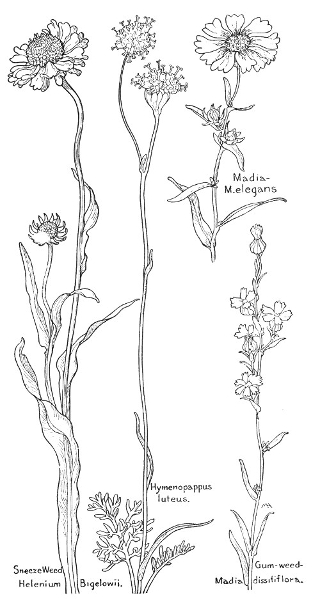
Madia—M. elegans. Hymenopappus luteus. Sneeze Weed—Helenium Bigelowii. Gum-weed—Madia dissitiflora.
There are many kinds of Coreopsis, natives of America, South Africa, and Australasia, several of them cultivated in gardens. They are called Tickseed.
Desert Coreopsis Coreópsis Bigelòwii Yellow Spring California
This is very pretty, with one or several, slender, smooth stems, about ten inches tall, springing from a tuft of pretty, bright green, smooth, shiny leaves, cut into narrow divisions and slightly succulent. The flowers are an inch and a half to two inches across, with bright yellow rays, lighter at the tips, and an orange center, and look exceedingly pretty in the Mohave Desert.
Sea Dahlia Coreópsis marítima (Leptosyne) Yellow Spring California
A magnificent plant, forming large clumps, two feet high, but not at all coarse in character. The leaves are very bright green, smooth and quite succulent, and cut into narrow lobes, so that the effect is graceful and unusual looking. The superb flowers are often four inches across, with clear light yellow rays and orange-yellow centers, and the lower row of bracts stand out stiffly like a ruffle and are like the leaves in texture and color, contrasting oddly with the upper bracts, which are satiny in texture and almost as yellow as the rays. These plants are conspicuously beautiful on the sea cliffs near San Diego.
Trixis Tríxis angustifòlia var. latiúscula Yellow Spring Southwest, New Mex.
A small evergreen shrub, about a foot high, with smooth, light dull green leaves, with a few fine teeth, and loose clusters of rather pretty, bright yellow flowers, the heads about three-quarters of an inch long. This grows on rocky hillsides and is quite effective.
There are a great many kinds of Chrysanthemum, widely distributed in the northern hemisphere.
Ox-eye Daisy Chrysánthemum Leucánthemum White Spring, summer, autumn Northwest, etc.
This is the well known common kind, a general favorite, except with farmers, naturalized from Europe and also found in Asia; a perennial weed in pastures, meadows, and waste places, more or less all over the United States, but much more common in the Northeast. It grows from one to three feet high, the leaves toothed and cut, and the flower-heads measuring from one to two inches across, with bright golden centers and pure white rays.
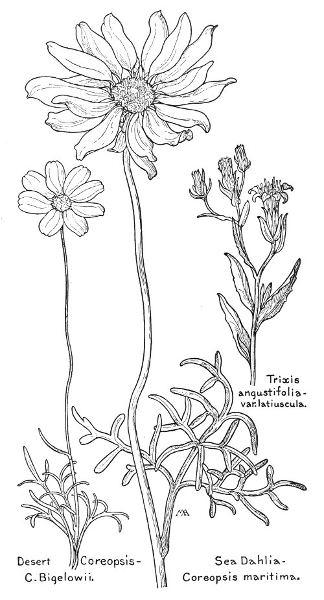
Trixis angustifolia—var. latiuscula. Desert Coreopsis—C. Bigelowii. Sea Dahlia—Coreopsis maritima.
There are several kinds of Coreothrogyne, some resembling Lessingia, others Aster.
Woolly Aster Coreothrógyne filaginifòlia Pink, purple Spring, summer, autumn California
This forms a clump from one to three feet high, with many erect stems, white with woolly down, at least when young, and crowded with alternate, pale grayish-green leaves, thin and soft in texture and covered with down. The flower-heads are an inch across, with purplish-pink rays and dark yellow centers, and contrast rather prettily with the pale foliage. In Yosemite this grows on rocky ledges below five thousand feet and blooms late. It is common from Monterey to Santa Barbara, blooming at almost all seasons, and is very variable.
Psilóstrophe tagetìna var. sparsiflòra (Riddellia) Yellow Spring, summer Arizona
These flowers do not look much like those of a composite, but give more the effect of yellow Wallflowers. The plant is very attractive, from one to two feet tall, with alternate, bluish-green leaves, most of them toothless, and handsome clusters of lemon-yellow flowers. They are each about three-quarters of an inch across, delicately scented, and usually have four large rays, mixed with a few smaller and more irregularly shaped, all much more like petals than rays and becoming papery in fading. The picture is of a plant growing in the Grand Canyon.
Paper Flowers Psilóstrophe Coòperi Yellow Spring Southwest
A pretty, compact, shrubby plant, woody below, about a foot high, with tangled branches, pale downy twigs, and thickish, dull green, downy leaves. The pretty flowers are an inch and a quarter across, with an orange-yellow center and five or six, large, clear bright yellow rays, twisted to one side and puckered at the base, turning back and becoming papery as they fade. This plant is at its best in sandy soil and is very effective in the desert. When fully developed it is very symmetrical in outline, forming a charming yellow globe of flowers.
There are several kinds of Xylorrhiza, nearly related to the Aster group and by some authorities regarded as Asters.
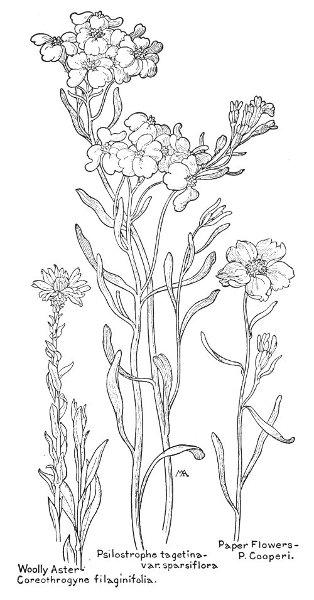
Woolly Aster—Coreothrogyne filaginifolia. Psilostrophe tagetina—var. sparsiflora. Paper Flowers—P. Cooperi.
Xylorrhiza Xylorrhìza tortifòlia Lilac Spring Southwest, Utah, Col.
A handsome plant, growing in clumps over two feet high, with prickly leaves and beautiful flowers, two inches and a half across, with rays shading from bright lilac to nearly white and yellow centers. This is common in the Grand Canyon.
There are a good many kinds of Arnica, natives of the northern hemisphere. This is the ancient name and a European kind is much used medicinally.
Heart-leaved Arnica Árnica cordifòlia Yellow Summer West, except Ariz.
A handsome mountain flower, with a hairy stem, from six inches to two feet tall, and velvety leaves, coarsely toothed, the lower ones usually heart-shaped. The flower-heads are usually single, over two inches across, with bright yellow rays, an orange center, and a hairy involucre. This is common in rich moist soil in mountain valleys, as far east as Colorado.
Broad-leaved Arnica Árnica latifòlia Yellow Summer Northwest
A handsome kind, sometimes a foot and a half tall, with pretty flowers, about two inches across, with very bright yellow rays. The bright green leaves are thin in texture and practically smooth, the lower ones more or less roundish, with leaf stalks. This grows in mountain woods.
There are many kinds of Artemisia; herbs or shrubs, usually bitter and aromatic, widely distributed.
Common Sage-brush Artemísia tridentàta Yellow Summer, autumn West, etc.
This is the characteristic sort, often immensely abundant and found as far east as Colorado, often tinting the landscape for miles with its pale and beautiful foliage and one of the dominant shrubs in the Great Basin. It is very branching, from one to twelve feet high, with a distinct trunk and shreddy bark, and the twigs and alternate leaves are all gray-green, covered with silvery down, the upper leaves small and toothless, the lower wedge-shaped, with usually three, blunt teeth. The small yellow flowers have no rays and grow in small, close clusters, forming long sprays towards the ends of the branches. Sagebrush is a "soil indicator" and when the prospective rancher finds it on land he knows at once that it will be good for even dry farming, as the soil contains no salt or alkali.
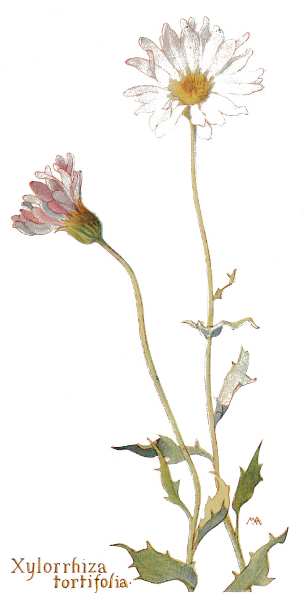
Xylorrhiza tortifolia.
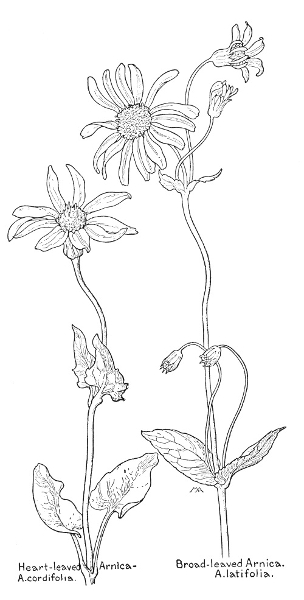
Heart-leaved Arnica—A. cordifolia. Broad-leaved Arnica—A. latifolia.
There are a good many kinds of Eriophyllum, common and very variable, woolly plants.
Woolly Yellow Daisy Eriophýllum lanàtum Yellow Spring, summer Cal., Oreg., Wash.
This is a handsome kind, in favorable situations forming large conspicuous clumps, from one to two feet high, covered with bright golden flowers, each over an inch across. The leaves are dull green on the upper side, but the under side and the buds and stems are all covered with fine white down. The leaves are variable in form, sometimes neither lobed nor toothed, and sometimes cut into narrow toothed divisions. This has a variety of forms and grows on hillsides.
Eriophyllum Eriophýllum caespitòsum var. integrifòlium Yellow Summer Northwest, etc.
This forms low tufts of pale gray downy foliage, contrasting well with the bright yellow flower-heads, each about an inch across. This grows around Yosemite and in other mountain places, as far east as Wyoming, and has a variety of forms.
Golden Yarrow Eriophýllum confertiflòrum Yellow Summer California
This has small flowers, but it forms such large clumps that the effect of the golden-yellow clusters is handsome and very conspicuous, on dry hills and mountains and along roadsides in summer. It is woody below, from one to two feet high, and the leaves are more or less woolly. The variety discoídeum has no rays.
There are many kinds of Anthemis, natives of Europe, Asia, and Africa.
Mayweed, Chamomile, Dog Fennel Ánthemis Cótula White Summer, autumn U. S., etc.
This little weed is common in waste places and fields and along roadsides, almost all over the world. It is a branching annual, from one to two feet tall, with feathery light green foliage, cut into many long, narrow divisions, almost smooth, with a disagreeable smell and strong acrid taste. The many daisy-like flowers have heads about an inch across, with from ten to eighteen white rays and convex yellow centers. There is a picture of this plant in Mathews' Field Book.
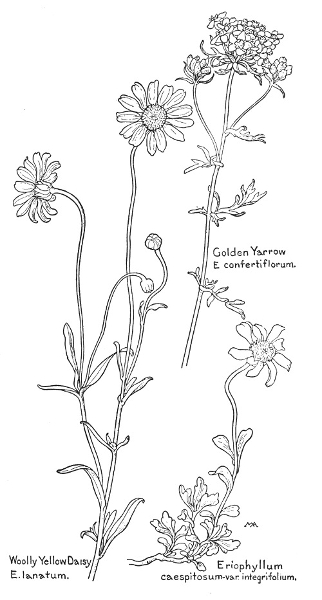
Golden Yarrow—E. confertiflorum. Woolly Yellow Daisy—E. lanatum. Eriophyllum caespitosum—var. integrifolium.
There are a good many kinds of Chaenactis, the flower-heads with tubular flowers only, but in some kinds the marginal flowers are larger and have a broad border resembling a kind of ray.
Chaenactis Chaenáctis Douglásii White Spring, summer Utah, Cal., New Mex.
A rather pretty plant, from eight inches to over a foot tall and more or less downy, with stiffish, gray-green, leaves, cut into many short, blunt lobes and teeth. The flower-heads are about an inch long, and contain numerous small, pearly-white or pinkish, tube-shaped flowers, with long, purplish pistils. This grows in dry open places, the flowers turn pink in fading and are sweet-smelling and quite pretty, though not striking. C. macrántha, which grows in the Grand Canyon, has similar flowers, rather prettier, with a somewhat sickly scent, but it is a lower plant.
Golden Girls Chaenáctis lanòsa Yellow Spring California
A charming desert plant, with several downy stems, over a foot tall, springing from a feathery cluster of pretty, bright green, thickish leaves, cut into narrow divisions, rather downy and often tinged with red. The flower-head is nearly an inch and a half across, without rays, but the marginal flowers in the head are larger and have broad borders that look like rays. They are a beautiful shade of clear bright yellow.
Morning Bride Chaenáctis Fremóntii White Spring Southwest
This is very much like the last in size, form, and foliage and is equally charming, but the flowers are all pure white, or pinkish, instead of yellow. It is one of the most attractive of the white desert flowers.
Desert Star Erimiástrum bellidoìdes Lilac Spring Arizona
A charming little desert plant, with spreading stems and small, narrow, toothless, gray bluish-green leaves, which are soft, but sprinkled with small, stiff, white bristles, the whole forming a rosette, five or six inches across, growing flat on the sand and ornamented with many pretty little flowers. They are each set off by a little rosette of leaves and are over half an inch across, with pinkish-lilac rays, shading to white towards the yellow center and tinted with bright purple on the back.
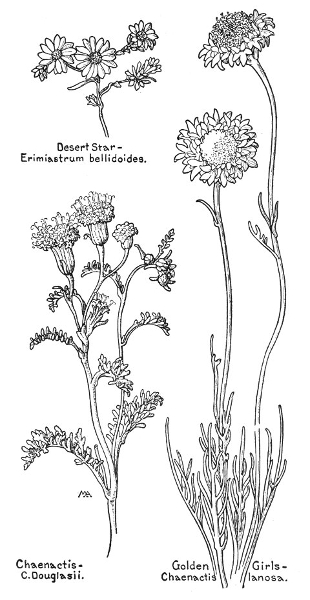
Desert Star—Erimiastrum bellidoides. Chaenactis—C. Douglasii. Golden Girls—Chaenactis lanosa.
Venegasia Venegàsia carpesioìdes Yellow Summer California
These big, leafy plants, with their bright flowers, are a splendid feature of the California woods and canyons in June, especially on the slopes of the Santa Inez mountains, where they often cover large areas with green and gold; unfortunately the smell is rather disagreeable. The leafy stems are four or five feet high, nearly smooth, with alternate, bright green leaves, almost smooth and thin in texture, and the flowers, resembling Sun-flowers, are over two inches across, with clear yellow rays, an orange center, and an involucre of many green scales, overlapping and wrapped around each other, so that the bud looks much like a tiny head of lettuce. This was named for Venegas, a Jesuit missionary, and is the only kind, growing near the coast in the South.
Lessingia Lessíngia leptóclada Lilac Summer California
This is a slender plant, from six inches to two feet tall, with pale gray green, woolly leaves, the lower ones somewhat toothed, and pale pinkish-lilac flowers, not very conspicuous in themselves, but sometimes growing in such quantities that they form pretty patches of soft pinkish color in sandy places. The flower-head is about half an inch long, with no rays, but the outer flowers in the head are larger and have long lobes resembling rays. This is very variable, especially in size, and is common along dry roadsides and quite abundant in Yosemite. The picture is of a small plant. L. Germanòrum, which is common on sandy hills along the coast from San Francisco to San Diego, has yellow flowers and blooms in autumn.
There are many kinds of Baeria, not easily distinguished.
Sunshine, Gold Fields Baéria grácilis Yellow Southwest
This is a dear little plant, often covering the fields with a carpet of gold. The slender stems are about six inches tall, with soft, downy, light green leaves, usually opposite, and pretty fragrant flowers, about three-quarters of an inch across, with bright yellow rays and darker yellow centers. This is sometimes called Fly Flower, because in some places it is frequented by a small fly, which is annoying to horses. B. macrántha is a much larger plant, a biennial, with a tuberous root, from seven inches to a foot and a half tall, with long, narrow, toothless leaves, with hairy margins, and flower-heads from an inch to an inch and a half across, with yellow rays and hairy involucres. This grows along the coast in California, blooming in May and June.
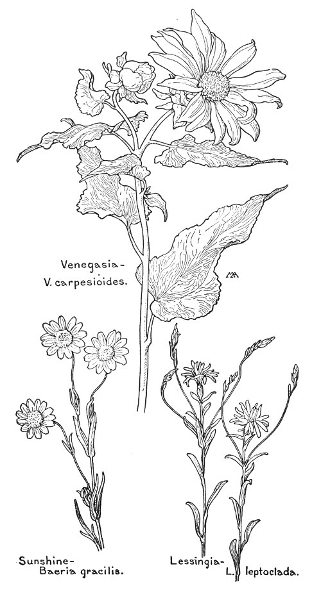
Venegasia—V. carpesioides. Sunshine—Baeria gracilis. Lessingia—L. leptoclada.
There are several kinds of Bahia, natives of western North America, Mexico, and Chile, herbs or shrubs, more or less woolly.
Bahia Bàhia absinthifòlia Yellow Spring Arizona
This is from eight to fifteen inches tall, with pretty flowers, an inch and a half across, with bright yellow rays and deep yellow centers, contrasting well with the pale gray-green foliage, which is covered with close white down. This grows in arid situations on the mesas and often forms clumps.
There are several kinds of Crassina, natives of the United States and Mexico.
Desert Zinnia Crassìna pùmila (Zinnia) White Spring Arizona
Nothing could look much less like a garden Zinnia than this dry, prickly-looking dwarf shrub. It is from three inches to a foot high, the branches crowded with very small, stiff, dull green leaves, and the flowers are about an inch across, rather pretty but not conspicuous, with a yellow center and four or five, broad, cream-white rays, often tinged with dull pink. This plant grows on the plains and is a "soil-indicator," as it flourishes on the poorest, stoniest, and most arid land.
Wild Marigold Bàileya multiradiàta Yellow Spring, summer, etc. Southwest, Tex.
Charming flowers, with a thrifty, cultivated appearance like that of a garden flower. The plant is a foot tall, with grayish-green, woolly stems and foliage, and the handsome flower is an inch and a half across, with a fine ruffle of many bright yellow rays, prettily scalloped, and a yellow center, rather deeper in color. In Arizona bouquets of these flowers may be gathered during every month in the year.
Bàileya pauciradiàta Yellow Spring Southwest
An odd little desert plant, about six inches tall, with a thickish stem and soft, thickish leaves, covered all over with silky, white wool, giving a pale, silky effect to the whole plant, which is quite pretty, though the pale yellow flowers, each about half an inch across, are not striking.
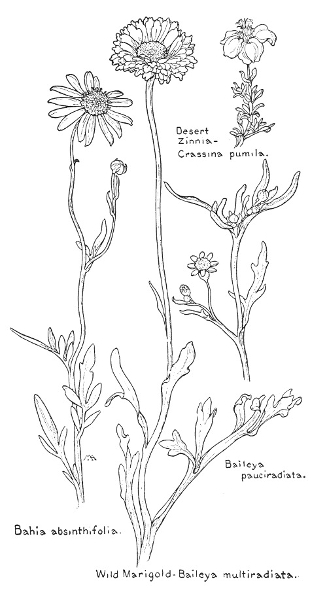
Desert Zinnia—Crassina pumila. Baileya pauciradiata. Bahia absinthifolia. Wild Marigold—Baileya multiradiata.
Pentachaeta Pentachaèta àurea Yellow Spring California
Gay, yet delicate little flowers, with slender branching stems, about eight inches tall, and light green, very narrow leaves. The flowers are an inch across, with a feathery ruffle of very numerous narrow rays, light yellow at the tips, growing deeper towards the orange-colored center, and the pretty buds are often tinged with pink or purple. This often grows in patches and is common in southern California.
Daisy Dwarf Actinolèpis lanòsa White Spring Arizona
A quaint little desert plant, only two or three inches tall, with thickish, pale gray-green leaves, covered with close white down, and pretty little flowers, growing singly at the ends of tiny branches, each half an inch across, with a yellow center and pure white rays, which fold back at night. These little flowers are too small to be very conspicuous, but are charming in effect, sprinkled over the bare sand, and when growing in quantities on nearly bare mesas give a whitish appearance to the ground.
There are a good many kinds of Blepharipappus.
Yellow Tidy-tips Blepharipáppus élegans (Layia) Yellow Spring California
Very pretty flowers, with slender, branching, hairy stems, about a foot tall, and light green, hairy leaves. The flowers are about two inches across, with yellow rays, tipped with white or very pale yellow, neatly arranged around the deep yellow centers, which are specked with black. The rays twist up in fading and turn to a pretty shade of dull pink. This is common and a very handsome kind.
White Tidy-tips Blepharipáppus glandulòsus (Layia) White Spring Southwest, Oreg., Wash.
A beautiful kind, eight or nine inches tall, with pale green, hairy leaves, the lower ones toothed, and a slender stem, bearing a charming flower, nearly an inch and a half across, with neat pure white rays and a bright yellow center. This grows in mountain canyons and is widely distributed as far north as British Columbia.
There are several kinds of Gaillardia, all American. They are much cultivated in gardens, were named in honor of Gaillard de Merentonneau, a French botanist.
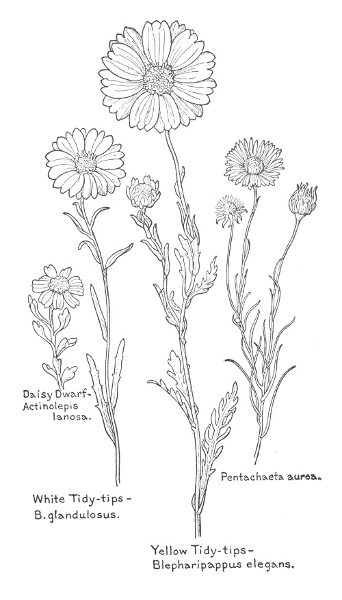
Daisy Dwarf—Actinolepis lanosa. Pentachaeta aurea. White Tidy-tips—B. glandulosus. Yellow Tidy-tips—Blepharipappus elegans.
Blanket-flower, Gaillardia Gaillàrdia pinnatífida Yellow Summer Ariz., Col., Tex.
This is handsome and conspicuous, with a slender, rough stalk, about a foot tall, dull green, stiff, rather hairy leaves, mostly from the root, and beautiful flowers, an inch and a half across, with golden-yellow rays, with three teeth, and a center of shaded maroon and yellow, which is very velvety and pretty and becomes an attractive, purplish, fuzzy, round head when the rays drop off. This grows on the plains. G. aristàta, found throughout the West and as far east as Colorado, is an exceedingly handsome kind, sometimes over two feet tall, with beautiful yellow flowers, sometimes measuring four inches across.