A KEY TO THE FAMILIES. (continued 4)
Reading edition
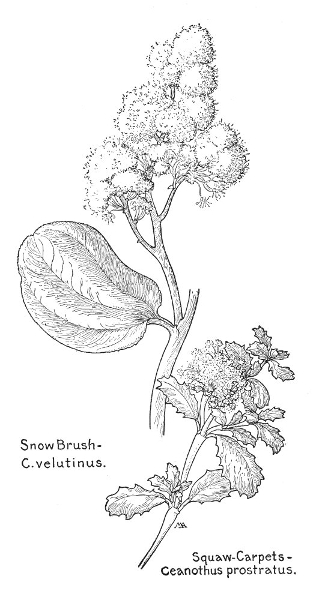
Snow Brush—C. velutinus. Squaw-Carpets—Ceanothus prostratus.
Deer-brush, Mountain Lilac Ceanòthus integérrimus White, blue Summer Cal., Oreg., Wash., Ariz.
A graceful shrub, or small tree, six to fifteen feet tall, the slender trunk and branches covered with dull yellowish-green bark and the bright green foliage setting off the feathery flower clusters, two to six inches long, scattered lightly over the bush and composed of innumerable, tiny, sweet-scented blossoms. The leaves are alternate, half an inch to three inches long, toothless, thin in texture, very slightly downy or smooth, with three veins, and the flowers cream-white, occasionally blue or pink, with conspicuous stamens, which give the plume-like sprays a delicate foamy effect against the dark forest background. This shrub is a beautiful sight when in flower and sometimes covers the mountainsides with drifts of snowy bloom, filling the air with delicate perfume. It is quite variable and sometimes has dark shiny leaves and small compact clusters of flowers. It is often called White Tea-tree, because the bark is used medicinally.
Blue Mountain Lilac Ceanòthus parvifòlius Blue Summer California
An attractive mountain shrub, growing in Yosemite, and elsewhere in the Sierra Nevada Mountains at similar altitudes, low and spreading, about three feet high, with smooth, pale green branches and small, smooth, toothless leaves, dark green and shining on the upper side, pale on the under. The oblong clusters of minute blue flowers are slightly sweet-scented and about two inches long.
MALLOW FAMILY. Malvaceae.
A large family, widely distributed; mostly herbs, with mucilaginous juice and tough, fibrous bark; leaves alternate, mostly palmately-veined and lobed, with stipules; flowers regular, perfect, or the stamens and pistils on different plants; sepals five, often with an outer row of bracts below, resembling another calyx; petals five, their bases or claws united with each other and with the base of the stamen-tube; stamens numerous, united by their filaments into a column, forming a tube enclosing the pistils; fruit a capsule, breaking when ripe into several one-seeded parts, or splitting down the back of the valves, allowing the seeds to escape. The little fruits are commonly called "cheeses." True Mallows are introduced "weeds" in this country.
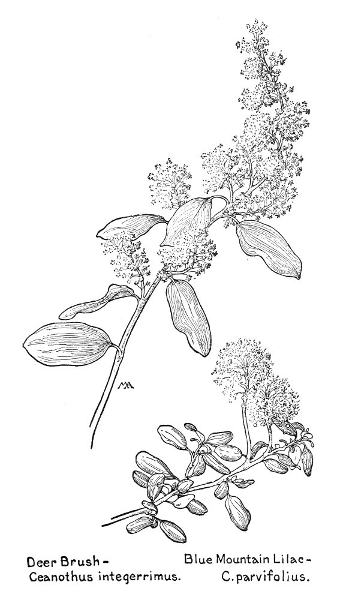
Deer Brush—Ceanothus integerrimus. Blue Mountain Lilac—C. parvifolius.
Arizona Wild Cotton Thurbéria thespesioìdes (Ingenhouzia triloba) White Summer Arizona
The only kind, a fine shrub, from four to eight feet high, with smooth leaves, most of them with three lobes, and handsome cream-white flowers, tinged with pink on the outside and measuring two inches across. This grows in the mountains of southern Arizona and is beautiful under cultivation, often growing to a height of six or eight feet in a season.
There are a number of kinds of Sidalcea, difficult to distinguish; perennials; leaves round in general outline, variously cut and lobed; flowers showy, in terminal clusters; calyx with no outer bracts, or with only one; stamen-column double; stigmas threadlike, distinguishing them from Malvastrum and Sidalcea.
Rose Mallow Sidálcea Califórnica Pink Spring California
This has velvety leaves, those from the root much less deeply lobed than the others, and a slender, slightly hairy stalk, one to two feet tall, leaning to one side and bearing a loose raceme of rose-pink flowers, with petals about an inch long. Only one or two flowers are open at a time, but they are very pretty and conspicuous in open woods and along the edges of fields, around Santa Barbara, in May.
Oregon Mallow Sidálcea Oregàna Pink Summer, autumn Northwest
A pretty plant, with one or more smooth, pale, branching stems, about two feet tall, and dark green leaves, with conspicuous veins. The buds are downy and the flowers are about three-quarters of an inch across, with pale pink petals, prettily veined, shading to white at the center. The anthers are white and the pistil, when the stigmas have expanded, is prettily tipped with a tiny crimson brush.
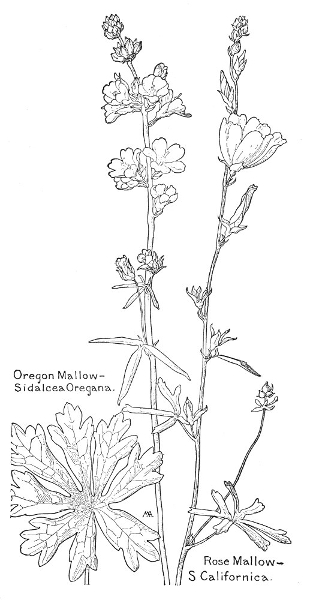
Oregon Mallow—Sidalcea Oregana. Rose Mallow—S. Californica.

Checker-bloom Sidálcea malvaeflòra Pink Spring California
A pretty perennial, with several leaning, hairy stems, one or two feet tall, and dark green leaves. Some plants have perfect flowers, an inch or more across, often very pale pink, and others have only rudimentary stamens and smaller flowers, usually deep pink in color, but the plant is very variable. This is common near the coast. It is sometimes called Wild Hollyhock.
Mallow Sidálcea Neo-Mexicàna Pink Summer Ariz., Utah, New Mex., Col., Wyo.
This is from one to three feet tall, with smooth, rather dark green leaves and very pretty, pale purplish-pink flowers with pale-yellow anthers and pinkish pistil. This grows in the mountains.
There are many kinds of Malvastrum, natives of America and Africa; perennial herbs or shrubs; the calyx often with three outer bracts; the stamen-column bearing anthers at the top; the stigmas with round heads. The name is from the Greek, meaning "star-mallow."
Spotted Mallow Malvástrum rotundifòlium Pink Spring Southwest
A very pretty desert plant, from six to eight inches tall, the coloring of the flowers, stems, and leaves vivid and oddly contrasting, for the stems are bright red and hairy, and the leaves stiff, hairy, and bronze-green in color, while the lovely globe-shaped flowers, which are over an inch across, are delicately shaded from lilac to rose outside and paler inside, with conspicuous round blotches of orange-vermilion at the base of each petal within. The calyx and buds are very hairy, the petals each have a twist to one side, and the mauve stamens form a pretty cluster in the center. These flowers last a long time in water, closing at night and opening again in the morning.
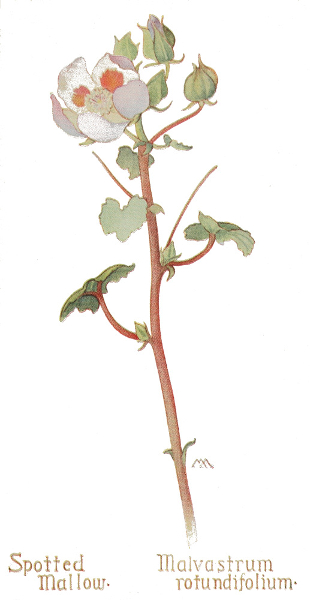
Spotted Mallow—Malvastrum rotundifolium.
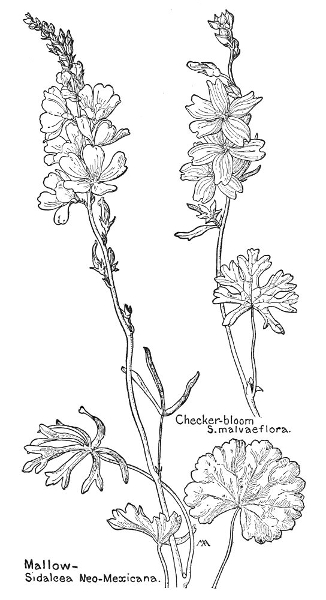
Checker-bloom—S. malvaeflora. Mallow—Sidalcea Neo-Mexicana.
False Mallow Malvástrum Thúrberi Pink Spring, summer California
A handsome shrub, from five to ten feet high, woody below, with long, slender, wandlike branches and thick, very downy, light bluish-green leaves. The pretty lilac-pink flowers are from one to nearly two inches across and pleasantly scented, and the foliage is soft and pretty in appearance, though rather harsh to the touch, its pale tones blending harmoniously with the delicate blossoms. This is common in southern California.
There are several kinds of Lavatera, mostly from the Old World.
Tree Mallow Lavàtera assurgentiflòra Pink Spring California
This was planted in the mission gardens by the Fathers and is now common around San Francisco. It is a branching shrub, from six to fifteen feet high, with a twisted, gray trunk and large handsome leaves, light green and very soft and smooth to the touch, paler and downier on the under side. The flowers are handsome and conspicuous, two or three inches across, with bright pink petals, warm and rich in tone, beautifully striped with maroon and shading to yellowish-white towards the center, with a purple pistil and grayish anthers. The flowers and seed-vessels hang on curved pedicels, like pipe-stems, giving a rather odd effect. The leaves and twigs are very mucilaginous.
There are many kinds of Sphaeralcea, much like Malvastrum, except that they have two or three ovules, instead of one, in each cavity of the ovary. The name is from the Greek, meaning "globe-mallow," in allusion to the usually roundish fruit.
Scarlet Mallow Sphaerálcea pedàta Red Spring Southwest
These graceful wands of brilliant bloom are very common in spring in Arizona. The flowers are over an inch across, vivid yet delicate in color, shading from luminous scarlet to clear pale-orange. The buds are tipped with deeper red and the foliage is rather pale green, somewhat hairy and downy. The stems are from one to two feet tall and bend slightly to one side, swaying to and fro in the wind and displaying their flaming blossoms to great advantage.
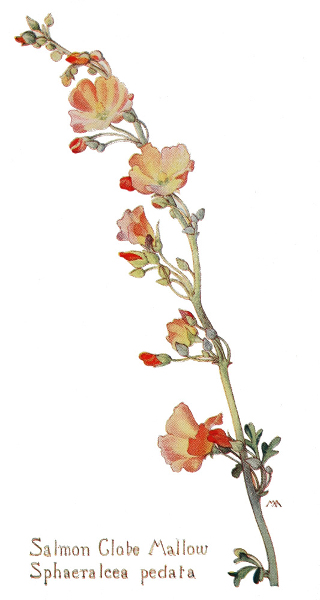
Salmon Globe Mallow—Sphaeralcea pedata.
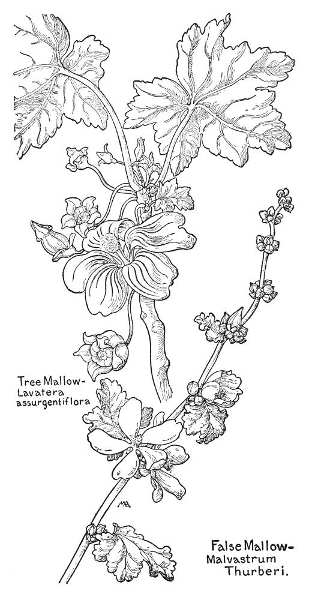
Tree Mallow—Lavatera assurgentiflora. False Mallow—Malvastrum Thurberi.
ST. JOHN'S-WORT FAMILY. Hypericaceae.
Not a large family, mostly natives of temperate and warm regions. Ours are herbs, sometimes shrubby, without stipules, with opposite, toothless leaves, with clear or black dots; the flowers regular and complete, all the parts borne on the receptacle; the sepals and petals usually five; the stamens usually numerous, sometimes grouped in three to five clusters; the ovary superior; the fruit a capsule.
There are many kinds of Hypericum, widely distributed; the leaves without leaf-stalks, the flowers yellow, with three to six styles. This is the ancient Greek name. These plants bloom in June, about St. John's Day, and so tradition gives them magic properties, appropriate to the Eve of that day, when fairies and witches are abroad, and they are commonly called St. John's-wort.
St. John's-wort Hypéricum concínnum Yellow Summer California
This has very pretty flowers and grows from three to eighteen inches tall, with smooth stems, branching and woody at base, and smooth, rather bluish-green leaves, usually folded, not clasping at base, usually with only a few dots. The flowers are an inch or more across, with bright golden petals, with some black dots, and numerous stamens in three bunches, forming large, fuzzy, golden centers. This grows on dry hills and is supposed to be poisonous to sheep.
St. John's-wort Hypéricum formòsum var. Scoúleri Yellow Summer West
A pretty plant, from six inches to three feet tall, with a stiff stem, often branching towards the top, and rather dull green leaves, blunt, oblong and clasping at base, about an inch long, thin in texture, with black dots on the margins. The flowers are from half an inch to an inch across, with bright yellow petals, dotted with black, and are very pretty, but not so handsome as the last. This grows in moist places, chiefly in the mountains, and is common in Yosemite.
Creeping St. John's-wort Hypéricum anagalloìdes Orange Summer Northwest
An attractive little plant, only a few inches tall, with many weak, slender, branching stems, spreading on the ground and rooting at the joints, and small, smooth, light yellowish-green leaves, often tinged with red. It grows in wet places and forms close mats of foliage, sprinkled with light-orange or salmon-colored flowers, a quarter of an inch or more across, with fifteen to twenty, yellow stamens. The effect is something like Anagallis, Scarlet Pimpernel, hence the name. This is common in Yosemite and similar places, up to nine thousand feet.
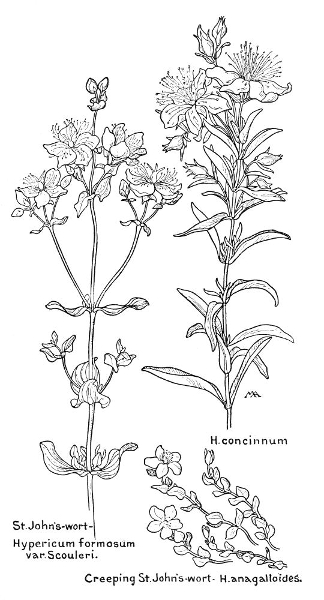
H. concinnum. St. John's-wort—Hypericum formosum var. Scouleri. Creeping St. John's-wort—H. anagalloides.
FOUQUIERA FAMILY. Fouquieriaceae.
A very small family, with one genus and only a few species; natives of the Southwest and Mexico; the flowers are brilliant red, in terminal clusters; the sepals five, not united; the petals five, united into a tube, the lobes somewhat spreading; the stamens ten to fifteen, protruding, inserted under the pistil; the ovary imperfectly three-celled; the styles three, long, somewhat united; the seeds three to six, oblong, flattened, surrounded by a membranous wing or long, white hairs. These plants are very puzzling, but interesting, and as they are not nearly related they have at various times been classified with other families.
Flaming Sword, Ocotillo, Candle Flower Fouquièra spléndens Red Spring Ariz., Cal., New Mex.
A magnificent desert shrub, when in full bloom, but strangely forbidding in aspect in spite of its beauty. Its many stiff stems, from six to twenty feet tall, entirely without branches, stand up stiffly from the root, like a bunch of wands, and are armed their whole length with terrible thorns, which in the spring are masked with beautiful foliage, like little apple leaves. From the tip of each wand springs a glorious cluster, from six to ten inches long, composed of hundreds of scarlet flowers, each about an inch long, and crowded closely together, suggesting a flame and waving to and fro in the wind with a startling effect against the pale desert sand. When the flowers and leaves are gone, the clumps of dry, thorny sticks look quite dead and it is hard to believe that they were so splendid early in the season. They make an impenetrable fence and are much used by the Indians for hedges.
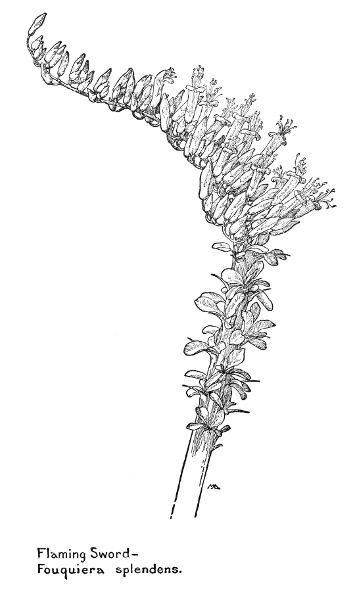
Flaming Sword—Fouquiera splendens.
VIOLET FAMILY. Violaceae.
A rather large family, widely distributed, but we have only three genera, the principal one being Viola, which is the ancient Latin name, used by Virgil.
There are many kinds of Viola, widely distributed, blooming in spring, but often flowering again in the autumn; low, perennial herbs, with stipules; leaves alternate, or from the root; flowers complete, irregular, nodding, nectar-yielding, usually single; sepals five, with small ear-shaped projections at the base; petals five, slightly bearded within, so as to afford a foothold for bees, the lowest petal larger and with a spur at the back; stamens five, short, with broadened filaments and anthers opening inward, so as to cover the pistil all but the end of the style, the two lower anthers with spurs at the base, which project into the spur of the petal; ovary superior and one-celled; style club-shaped, with a one-sided stigma. The flowers are often of two kinds, the earlier ones with long flower-stalks, with petals and showy, but not producing seed; the later ones with short stalks, with small or no petals, but fertile, often cleistogamous, that is, fertilized in the bud. The capsule splits open and as the three valves dry they fold firmly together lengthwise and force out the seeds.
Pine Violet Vìola lobàta Yellow Spring, summer Cal., Oreg.
A pretty plant, growing in the woods, with leafy stems, from four to fourteen inches high, with leafy stipules and smooth, rather light green leaves, deeply lobed, so that they look unlike most Violet leaves. The flowers are more or less clustered, an inch or more across, with bright yellow petals, veined with purple inside, tinged with purplish-brown outside, the two side petals with a little hairy patch at the base inside.
Western Heartsease Vìola ocellàta White and yellow Spring, summer Cal., Oreg.
A shy little woodland plant, from five to twelve inches tall, with creeping rootstocks and small, dry stipules. The flowers are an inch or less across, the two upper petals white, tinged with reddish-purple on the outside, and the other petals white or yellow, with a splash of purple on each of the two side petals and the lower one veined with purple. This grows in shady woods.
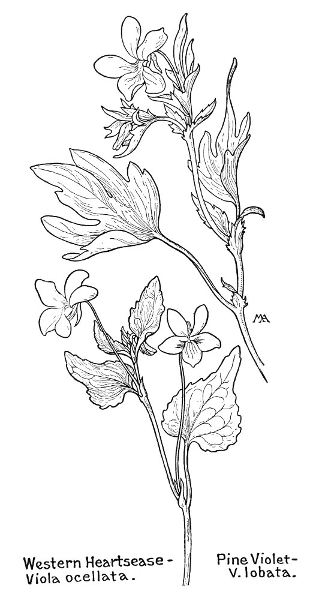
Western Heartsease—Viola ocellata. Pine Violet—V. lobata.
Yellow Mountain Violet Vìola venòsa Yellow Spring Northwest and Utah
An attractive kind, usually about three inches tall, with almost smooth leaves, often with purplish veins, with blunt tips and margins obscurely or coarsely toothed, or almost toothless, and with long leafstalks. The flowers are usually less than half an inch long, with clear yellow petals, more or less tinged with purple on the outside, the lower petal usually with several, purplish-black veins, the two side petals with one or two veins. This has no scent, the capsule is roundish and hairy, and the cleistogamous flowers are abundant. It grows on dry mountainsides and is very variable both as to flower and foliage and much smaller at great altitudes, the whole plant being not more than an inch high. The drawing is of a Utah plant.
Canada Violet Vìola Canadénsis Pale-violet, white Spring, summer West, etc., except Cal.
This is quite tall, the slender, rather weak stems being sometimes over a foot high, with smooth leaves, often with some hairs on the veins of the under side. The flowers, over half an inch across, with a short petal-spur, are almost white, delicately veined with purple, yellow in the throat and tinged with violet or purple on the outside. Occasionally they are pure-white all over and sometimes sweet-scented. The capsule is oval and smooth. This is common in eastern mountain woods, and to eastern eyes looked far from home when we found it in Walnut Canyon in Arizona.
Pale Mountain Violet Vìola adúnca var. glàbra Pale-blue Spring, summer Utah
This is small and low, about three inches high, with leafy stems, forming a clump of small, smooth, more or less toothed leaves, with blunt tips, dark green on the upper side and paler on the under, with two, quite large, fringed bracts at the bases of the leaf-stalks, and two, small, fringed bracts on the flower-stems, half an inch below the flower. The flowers are scentless, measure less than half an inch across, and are pale-blue or almost white, with veins of dark blue on the lower petal and tufts of white, fuzzy hairs inside, at the base of the side petals, the spur purplish. This grows in mountain canyons, at a height of five thousand to nine thousand feet, and is very small at great altitudes.
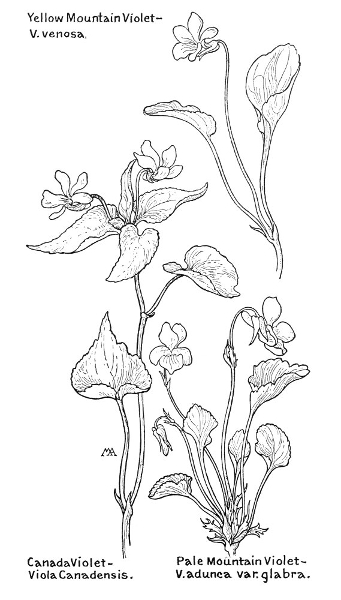
Yellow Mountain Violet—V. venosa. Canada Violet—Viola Canadensis. Pale Mountain Violet—V. adunca var. glabra.
Blue violet Vìola adúnca var. lóngipes Blue, purple Spring Cal., Oreg.
A pretty plant, two to four inches high, with slightly hairy leaves and flowers nearly an inch long, with bright purplish-blue or violet petals, more or less veined with purple, the side petals hairy at base inside. This grows near the coast.
Johnny Jump-up, Yellow Pansy Vìola pedunculàta Yellow Spring California
Charming flowers, often growing in quantities on open hillsides. The leafy stems are from two to six inches high, the leaves rather dark green and the scentless flowers, about an inch across, have bright golden petals, with some purple lines at the base of the three lower ones, the spur and upper petals tinged with brownish-purple on the outside, the two side petals hairy at base inside, and the stigma hairy. The Spanish-Californian name is Gallito. There is no technical difference between Pansies and Violets.
LOASA FAMILY. Loasaceae.
Not a very large family, all but one natives of America; herbs, armed with hooked, stinging or sticky hairs; without stipules; the flowers perfect, with five sepals and five to ten petals; the stamens numerous, with threadlike filaments, the outer ones sometimes petal-like, inserted with the petals on the throat of the calyx and usually arranged in clusters opposite the petals; the ovary inferior, with a threadlike style; the capsule crowned with the calyx-lobes.
There are many kinds of Mentzelia, all western, often with white shining stems and alternate leaves; the calyx cylindrical or top-shaped, with five lobes; the petals five or ten; the styles three, somewhat united. The barbed hairs which clothe the stems and leaves make the plant stick to whatever it touches, probably helping to distribute the seeds, hence the common name Stick-leaf.
Blazing Star Mentzèlia laevicàulis Yellow Summer, autumn West, except Wash. and Ariz.
A stout, branching biennial, two to over three feet tall, with shining white stems, almost smooth, long, rather narrow, wavy-toothed leaves and enormous flowers, in clusters of two or three at the ends of the branches and opening only in bright sunlight. They are from three to five inches across, with five, broad, light yellow petals and quantities of very long stamens, making a beautiful center. Five of the stamens have broadened filaments, resembling narrow petals, the style is three-cleft, and the capsule is oblong, containing many flat, winged seeds. These plants usually grow in dry stream-beds and are not rare, but through various accidents I have never been able to secure a drawing of either this or the next.
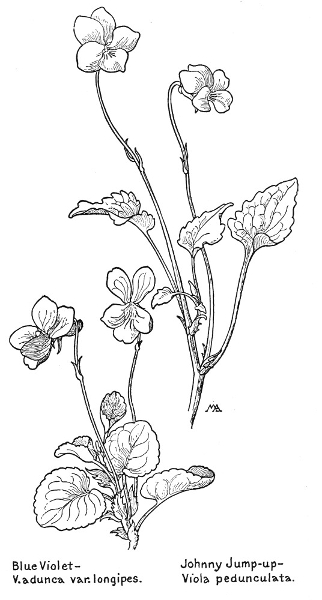
Blue Violet—V. adunca var. longipes. Johnny Jump-up—Viola pedunculata.
Evening Star Mentzèlia Líndleyi Yellow Summer California
A more slender plant than the last, with magnificent flowers, two and a half inches across, which open in the evening and remain open during the following morning. They have five, broad petals, with pointed tips, bright golden-yellow, colored with vermilion at the base, and handsome yellow centers. The filaments are very slender, some of the outer ones slightly broadened at base, and the style is not cleft. This grows in the mountains. There is a drawing of it in Miss Parsons's Wild Flowers of California. It is called Buena Mujer, or Good Woman, by the Spanish Californians, because the leaves stick so tightly to one.
Mentzèlia multiflòra Yellow Spring Southwest, Utah, etc.
An odd-looking plant, with very pale, straggling stems and thickish leaves, a pretty shade of pale green, all exceedingly disagreeable to touch. The buds are tipped with salmon-color and the flowers are an inch and a half to two inches across, with a long green calyx-tube with buff lobes, ten petals, bright yellow inside and pale buff outside, and pretty, fuzzy, yellow centers. They open in the evening, about five o'clock, and the plant would be pretty, in spite of its harsh foliage, if more of the flowers were out at one time. This is common along roadsides in the Southwest and in New Mexico and Colorado.
Mentzèlia gracilénta Yellow Spring Southwest
This has several pale greenish or pinkish stems, from a few inches to a foot and a half tall, which look smooth but are very harsh to the touch, springing from a cluster of stiff, harsh, dull-green leaves, variously lobed or toothed. The flowers are nearly an inch across, with glossy, bright yellow petals and beautiful, fuzzy, yellow centers, and are very delicate and pretty.
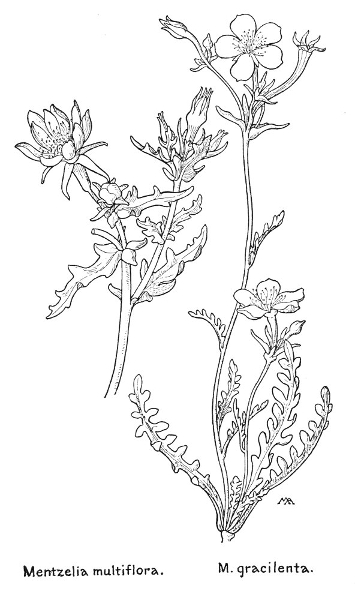
Mentzelia multiflora. M. gracilenta.
ROCK-ROSE FAMILY. Cistaceae.
A rather large family, mostly of the Mediterranean region; herbs or low shrubs; flowers regular, perfect, all the parts borne on the receptacle; sepals five, the two outer ones smaller and bract-like, or lacking; petals three to five; stamens many; ovary superior, one-celled, with a single style, or none; fruit a capsule, with several or many seeds.
There are many kinds of Helianthemum, widely distributed, perennials; leaves alternate, undivided, toothless; flowers yellow and, in most North American species, of two sorts; the earlier ones with large, yellow petals, very numerous stamens and a many-seeded pod; the later ones, small, clustered, with small petals or none, three to ten stamens, and small, few-seeded pods.
Rock-rose Heliánthemum scopàrium Yellow Spring California
A pretty plant, with many, slender stems and narrow, yellowish-green leaves, forming clumps from one to two feet high. The flowers are half an inch to three-quarters of an inch across, the buds and calyxes reddish and the petals clear yellow, the pistil greenish, with a three-lobed stigma. In favorable situations, such as Point Loma, this makes attractive little bushes, neat yet feathery, suggesting large clumps of grass, sprinkled thickly with flowers.
CACTUS FAMILY. Cactaceae.
A large family, nearly all natives of America and of dry or desert places, with strange characteristics, which make them easily recognized as a whole, but many of the individuals have not yet been studied or described; fleshy plants, with thick stems, often flattened, ridged or covered with knobs, mostly without leaves, usually with spines, which generally protrude from cushions of small bristles; the flowers perfect, regular, showy, and mostly single; sepals, petals, and stamens all numerous; ovary inferior, with a long style and several stigmas; fruit usually a pulpy berry, containing many seeds.
There are many kinds of Echinocactus, round or oval plants, mostly ribbed, with bunches of spines of several kinds, arranged in straight or spiral rows; the fruits scaly, though spineless.
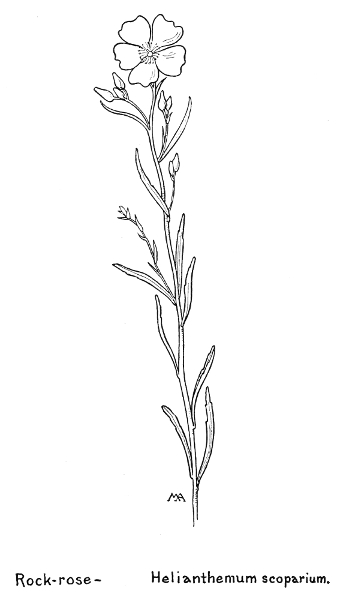
Rock-rose—Helianthemum scoparium.
Barrel Cactus, Bisnaga Echinocáctus Wislizèni Yellow, reddish Summer Southwest
A common and useful kind, the shape and often the size of a barrel, covered with spines. The Indians cut off the top of the plant and pound the pulp with a stick into a soft mass, which they squeeze with their hands, extracting a large amount of watery juice, which is wholesome and not unpalatable and has often saved lives in the desert. Indians use the spines for fish-hooks, hence a common name, Fishhook Cactus, and the celebrated cactus candy is made from it. The flowers are large.
There are many kinds of Echinocereus, oblong or cylindrical, spiny plants, generally a few inches tall, usually growing in clumps; stems ridged, or with spiny ribs; fruits spiny.
Hedgehog Cactus Echinocèreus Polyacánthus Red Spring Ariz., New Mex. Tex.
This forms a clump of several stems, each about the shape and size of a cucumber, and armed with bunches of long, stiff spines. The flowers are two or three inches long, with deep red petals, dull pink anthers, and a bright green pistil. This grows in the Grand Canyon.
There are many kinds of Opuntia, with jointed stems, cylindrical or flattened, armed with bristles, usually with spines. The fruits and fleshy joints are good for fodder, if the spines are removed, and hence there has been much inquiry into the economic value of these plants. It has been found that the spiny species are the most valuable for fodder, under extremely arid conditions, as the spines can be burned off, while the unarmed forms are subject to the attacks of so many animals that a crop cannot be secured without the protection of fences. The spines are removed either by singeing the growing plant with a torch, or the upper parts are cut off and thrown into a fire, or sometimes the plants are made into fodder by being chopped up, spines and all, in a machine. The Prickly Pears in Sicily and the Orient came from America.
Opúntia acanthocàrpa Yellow Spring Southwest
From three to six feet tall, resembling Cholla, with long, cylindrical joints and whitish spines. The pretty flowers are about two inches long, with orange-yellow petals and an ivory-white pistil. The fruits are spiny and become dry when ripe. This grows in the desert around Needles.
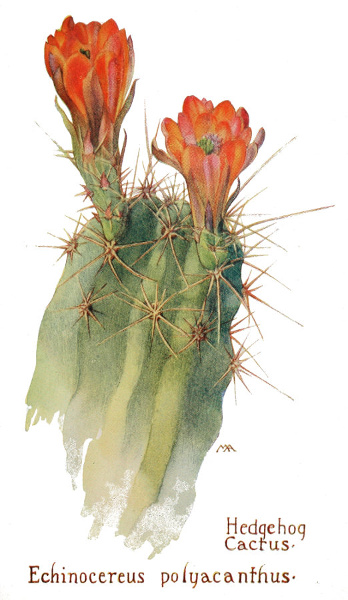
Hedgehog Cactus—Echinocereus polyacanthus.
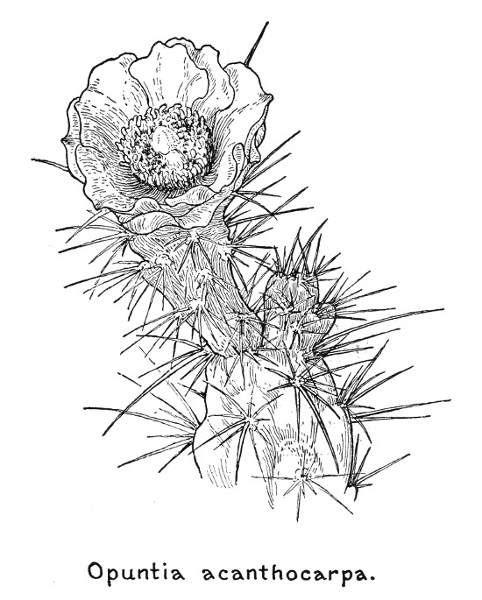
Opuntia acanthocarpa.
Cholla Opúntia fúlgida Red Spring, summer Arizona
A horrible shrub, or dwarf tree, four to six feet high, with a thick trunk and several, spreading, contorted branches, with cylindrical joints, twisting in awkward ways. The trunk and larger limbs are brownish-gray, starred with dead, dry spines, but the twigs are pale bluish-green, covered thickly with stars of pale-yellowish spines, each an inch or so long, with a barbed tip. From the numerous magenta flowers strange, yellowish, cup-shaped fruits develop, seeming to spring one out of the other in a haphazard way, hanging in long chains, awkward but rather ornamental, and remaining on the plants for several years without change, except that they grow slightly larger. The distant effect of this plant is a pale, fuzzy mass, attractive in color, giving no hint of its treacherous character—more like a wild beast than a plant! The joints suggest a very ferocious chestnut-burr and break off at a touch, thrusting their spines deeply into the flesh of the unwary passer-by, so that the Indian story, that this plant flings its darts at wayfarers from a distance, might almost as well be true, and the barbs making the extraction difficult and painful. The ground under the plants is strewn with fallen joints, which take root and propagate themselves. Small animals pile these around their holes for defense, several kinds of birds build in the thorny branches and are safe from enemies, and the fruits, being spineless and succulent, are valuable for fodder, so the Cholla is not entirely malevolent. The name is pronounced Choya. There are many similar kinds, some with very handsome rose-like flowers, others with bright scarlet fruits. They are curious and interesting inhabitants of the desert.
Prickly Pear Opúntia basilàris Pink Spring Arizona
Low plants, with no main stem, with spreading, flattened branches, the joints of which are flat disks, resembling fleshy, bluish-green leaves. These disks are half an inch to an inch thick and six inches long, more or less heart-shaped, sprouting one out of the other, at unexpected angles. The beautiful flower is about three inches across, like a tissue-paper rose, pale or very deep pink, with a whitish pistil, yellow anthers, and crimson filaments. The joints have a strong fishy smell, when cut, and are dotted with tufts of small, brown bristles, exceedingly unpleasant to get in one's fingers. This is rare and grows at the Grand Canyon. Prickly pears usually have yellow flowers and long spines.
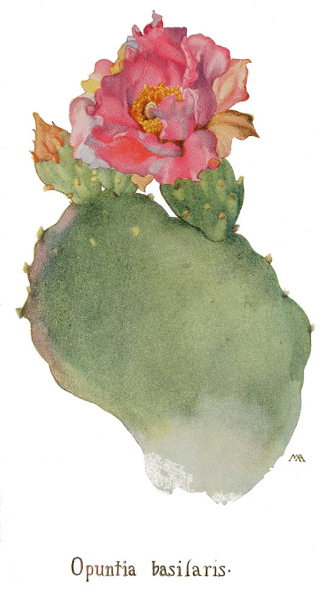
Opuntia basilaris.
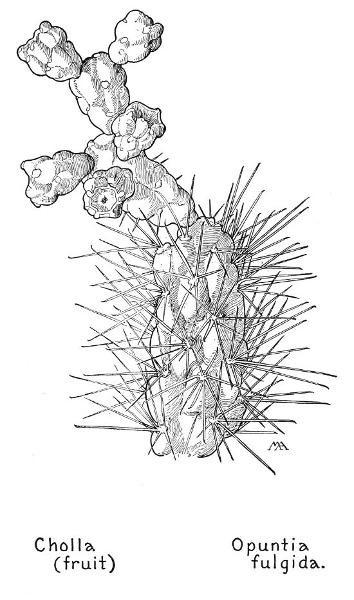
Cholla (fruit). Opuntia fulgida.
Common Prickly Pear Opúntia Yellow Spring, summer Southwest
There are fifty or more common kinds of Prickly Pear, many of them as yet undescribed and little known. They have flattened joints and yellow flowers, like the one illustrated, which is typical, often measuring three or four inches across, the petals variously tinted outside with salmon, rose, and brown.
There are many kinds of Cactus, round, cylindrical, or oval plants, covered with knobs, bearing clusters of spines, those of some species having hooked tips. They may be known by their smooth fruits, without scales or spines.
Pincushion Cactus Cáctus Gràhami (Mamillaria) Pink Spring Arizona
A quaint little plant, often no bigger than a billiard ball, with long, blackish, hooklike spines, projecting from stars of smaller spines. The flowers are pink and the berries are smooth, fleshy fingers of brightest scarlet, edible, pretty and odd. Sometimes we see one of these prickly little balls peeping from under a rock and again we find them growing in a colony, looking much like a pile of sea-urchins. This grows in the Grand Canyon, and there are similar kinds in southern California.
There are many kinds of Cereus, with cylindrical or oval stems, from a few inches to forty feet tall, not jointed, with ribs or rows of knobs, running lengthwise, and clusters of spines.
Column Cactus, Sahuaro Cèreus gigantèus White Spring, summer Arizona
These tree-like plants are wonderfully dignified and solemn in aspect, with none of the grotesque or ferocious effect so common among their relations. They grow in numbers on the mountain slopes around Tucson and are easily recognized by their size and very upright form, rearing their thick, cylindrical branches straight up in the air, to a height of thirty or forty feet. They are smooth and light green, armed with rows of spines in stars along the ridges, and ornamented during May and June with handsome, large, whitish, wax-like flowers, very perfect in form, opening in the daytime, blooming most abundantly on the sunny side of the plant and remaining open but a short time. Woodpeckers often make holes for nests in the branches, which are used afterwards by a little native owl, the smallest kind in the world, and by honey-bees, and these holes often lead to decay and to the ultimate death of the tree. The fruits, with crimson flesh and black seeds, are valued by the Papago Indians for food, and mature in enormous quantities in midsummer, but birds eat up many of the seeds and of the millions reaching the ground only a very few germinate and develop into odd, little round plants, a few inches high, often eaten by some animal before they become sufficiently prickly for protection.
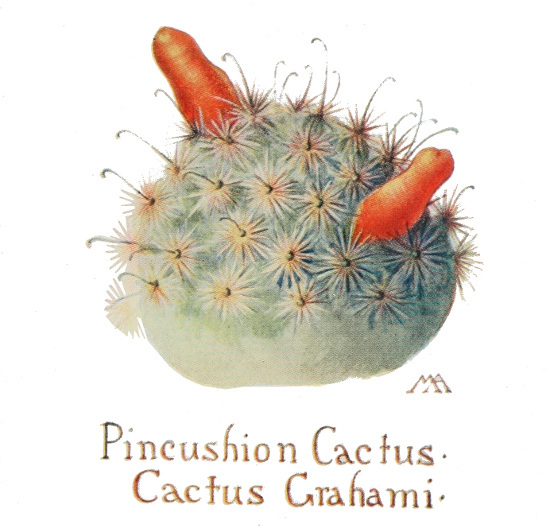
Pincushion Cactus—Cactus Grahami.
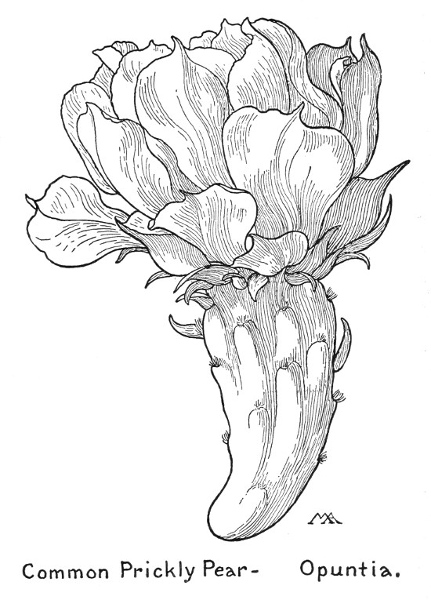
Common Prickly Pear—Opuntia.
EVENING PRIMROSE FAMILY. Onagraceae.
A large family, widely distributed, most abundant in America; herbs, with no stipules; flowers usually perfect, their parts usually in fours; calyx-tube attached to the usually four-celled, inferior ovary and usually prolonged beyond it; stamens four or eight, inserted with the petals, on the throat of the calyx-tube, or on a disk; style single with a four-lobed or round-headed stigma; fruit usually a four-celled capsule, containing small seeds or a nut. The flowers are generally showy and many are cultivated.
Eulòbus Califórnicus Yellow Spring Southwest
This is the only kind of Eulobus. It would be a pretty plant, if more flowers were out at one time and if they did not close so soon. The smooth, hollow, loosely-branching stem is from one to three feet tall, with a "bloom," the leaves are smooth, rather light dull-green, and the buds are erect. The flowers are about three-quarters of an inch across, with a very short calyx-tube, light-yellow petals, fading to reddish-pink, eight stamens, four of them smaller and shorter, and the light-green stigma with a round top. The slender pods are three inches long, smooth, cylindrical, and turning stiffly down, with many seeds. This grows in mountain canyons.
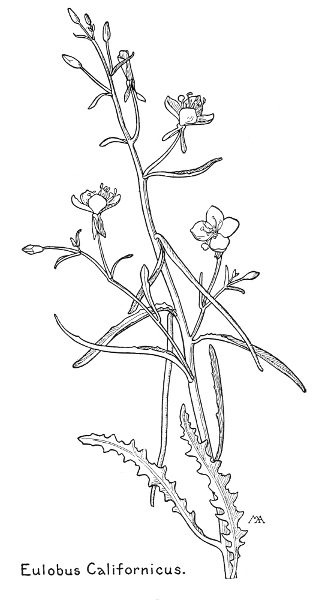
Eulobus Californicus.
There are a few kinds of Chamaenerion; perennials, often woody at base; leaves alternate; flowers in clusters, perfect, slightly irregular, white or purplish; petals four; stamens eight; style threadlike, with a four-cleft stigma; capsule long, four-sided, containing numerous seeds, tipped with a tuft of hairs. The calyx-tube is not prolonged beyond the ovary, which chiefly distinguishes this genus from Epilobium.
Fire-weed, Great Willow-herb Chamaenèrion angustifòlium (Epilobium) Purple, pink Summer Across the continent
A striking and decorative perennial, from two to six feet tall, with alternate leaves, pale on the under side, the veins making a scalloped border near the margin, the upper leaves and stems sometimes slightly downy, and the drooping buds deep reddish-pink or purple. The flowers form a fine cluster, with small bracts, each flower an inch or more across, the sepals often pink or purple and the petals bright purplish-pink; the stamens drooping, with purplish anthers; the style hairy at base, the capsule two or three inches long. This is very common, both East and West, reaching an altitude of ten thousand feet, and often growing in such quantities in the mountains as to cover large tracts with bright color. The seeds are furnished with tufts of white, silky hairs, making the plant very conspicuous when gone to seed, covering it with untidy bunches of pale down and giving a strange shaggy effect. It often flourishes in places that have been burned over, hence the name Fire-weed, and Willow-herb is from the leaves and the silky down on the seeds, suggestive of willows.
Water Willow-herb Chamaenèrion latifòlium (Epilobium) Magenta Summer Northwest
This grows in wet places; the flowers are larger and handsomer than the last, but it is not so tall. The stems are stout, reddish, and branching, from six to eighteen inches high, both stem and leaves with a "bloom," and the leaves are thickish, bluish-green on the upper side and paler yellowish-green on the under, sometimes toothed, with no veined border. The buds are deep-red and the flowers form a handsomer cluster, shorter than the last, with leafy bracts, each flower from one to over two inches across, with reddish-pink sepals, deep-red outside, and magenta petals veined with deeper color, sometimes notched, one petal longer than the others; the anthers purplish; the pistil drooping and purplish, with a smooth style. This plant is also covered with tufts of white down when gone to seed. The contrasting purples and reds of the flowers give a very vivid effect, set off by the bluish-green foliage, especially when growing among the gray rocks of moraines, watered by icy glacier streams. It reaches an altitude of ten thousand feet, growing in the East and in Europe and Asia.
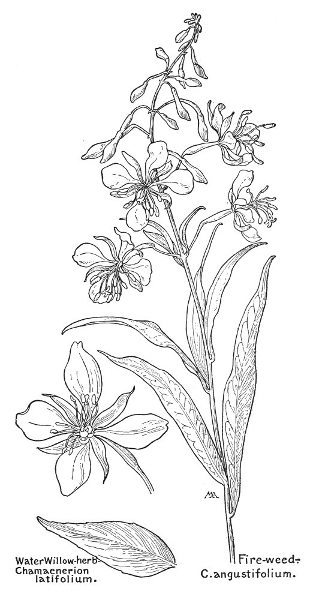
Water Willow-herb—Chamaenerion latifolium. Fire-weed—C. angustifolium.
There are many kinds of Epilobium, differing from Chamaenerion chiefly in the calyx-tube, which is prolonged beyond the ovary.
Willow Herb Epilòbium Franciscànum Pink Spring Northwest
A perennial, not especially pretty, with a stout, reddish stem, from one to three feet tall, slightly downy above, and dull green leaves, mostly smooth and the lower ones opposite. The flowers are less than half an inch across, with bright or pale, purplish-pink petals, deeply notched and not spreading. This grows in wet spots around San Francisco.
There are several kinds of Gayophytum; differing from Epilobium in the capsule and seeds, and easily distinguished from them by the hairy buds; leaves alternate, long, narrow, and toothless; flowers small; petals four, white or pink, with very short claws; stamens, with swinging anthers, eight, four shorter and usually sterile; capsule club-shaped. The species are difficult to distinguish, because of the smallness of the flowers.
Gayophýtum eriospérmum White Summer Cal., Oreg.
A delicate little plant, with smooth, purplish stems, exceedingly slender branches, dull green leaves, and pretty little flowers, an eighth of an inch to half an inch across, white, with a little yellow in the center, fading to pink. This grows in sandy soil, at rather high altitudes, in Yosemite.
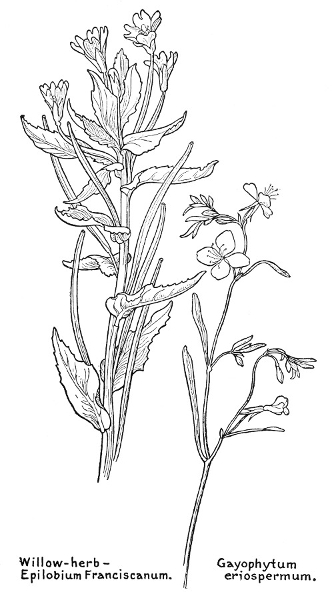
Willow-herb—Epilobium Franciscanum. Gayophytum eriospermum.
There are numerous kinds of Godetia, variable and difficult to distinguish, not yet fully understood by botanists, all western and mostly Californian, with narrow, alternate leaves and handsome flowers, which close at night. They have four petals and resemble Onagra, but the flowers are never yellow and the anthers are not swinging, but fixed to the tips of the filaments by their bases; also resembling Clarkia, but the petals are without claws. The calyx is often colored, tube more or less funnel-form, lobes turned back, or more or less united and turned to one side; stamens eight, unequal, the shorter ones opposite the petals; style threadlike; stigma with four, short lobes; capsule four-sided, or cylindrical, mostly ribbed, rather leathery, splitting open, with four valves, containing many seeds. These plants bloom in late spring, hence the pretty name, Farewell-to-Spring.
Farewell-to-Spring Godètia defléxa Pink Summer California
A branching plant, woody at base, two feet high, with smooth stems; smooth, toothed leaves; nodding buds and large handsome flowers. The petals are pale-pink, about an inch long, the pistil pink, and at a distance the effect of the flower is much like a Mallow. As is usual with Godetias, the sepals are stuck together and stand out at one side, giving the flower a quaint effect of having thrown back a little hood in order to look about. This grows in light shade.
Farewell-to-Spring Godètia quadrivúlnera Pink, lilac Spring, summer Northwest
This is common in the foothills of the Sierras and Coast Ranges and has a slender stem, about a foot tall, with more or less downy leaves, sometimes slightly toothed, and a few very pretty flowers, about an inch and a half across, with bright lilac-pink petals, usually splashed with carmine. This red spot gives a vivid effect and the delicate flowers look exceedingly gay and charming, as they sway in the wind among tall grasses on open hillsides.
Godètia Góddardii var. capitàta Pink Spring, summer California
From one to two feet tall, with a rather stout, more or less branching stem and soft, rather downy, dull green leaves. The flowers are about an inch across, with purplish-pink petals, often stained with crimson at the tips. This is found on dry hills in the Coast Ranges.
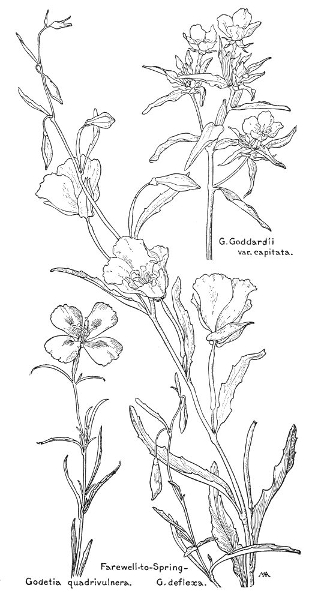
Farewell-to-Spring—G. deflexa.
G. Goddardii var. capitata. Godetia quadrivulnera.
Godètia vimínea Purplish-pink Summer Northwest
A handsome plant, with nearly smooth, slender, reddish stems, a few inches to two feet tall, and smooth, pale-green, toothless, narrow leaves, mostly without leaf-stalks. The buds are erect and the flowers form a long, loose cluster, with bright purplish-pink petals, half an inch to over an inch long, with a large, magenta blotch near the center, or at the tip, and yellowish at base; the stamens and pistil all purple; the calyx-lobes not caught together, but turned primly back. This forms fine patches of bright color in rather meadowy places in Yosemite and elsewhere in the Sierra Nevada foothills. G. Dudleyàna is pretty and slender, with drooping buds and light lilac-pink flowers, the petals paler at base, with darker dots, the calyx-lobes caught together and turned to one side, and also makes beautiful patches of color on sunny slopes around Yosemite.
There are several kinds of Clarkia, resembling Godetia, but the petals have claws. The stems are brittle; the leaves mostly alternate, with short, slender leaf-stalks; the buds nodding; the flowers in terminal clusters, with four petals, never yellow, and four sepals, turned back; the stamens eight, those opposite the petals often rudimentary; the stigma four-lobed; the capsule long, leathery, erect, more or less four-angled, with many seeds. Named in honor of Captain Clarke, of the Lewis and Clarke expedition, the first to cross the Rocky Mountains to the Pacific, in 1806.
Clarkia Clàrkia élegans Pink Spring, summer California
A conspicuous plant, on account of the oddly contrasting colors of the flowers, and very variable both in size and smoothness. It grows from six inches to six feet high; the stems more or less branching; the leaves sometimes toothed and often reddish; the buds and calyxes often woolly. The flowers are very gay; the sepals being dark red or purple, the petals, with long, slender claws, bright pink and the anthers scarlet! The stamens, four long and four short, have a hairy, reddish scale at the base of each filament, the anthers of the shorter stamens often white, and the capsule is usually curved, with no stalk, nearly an inch long, often hairy. When the foliage is red, as it often is, the various combinations of red in the flowers and leaves are quite startling. This is common in the foothills of the Sierra Nevada and Coast Ranges and is often rather shabby looking, but in favorable situations is very handsome.
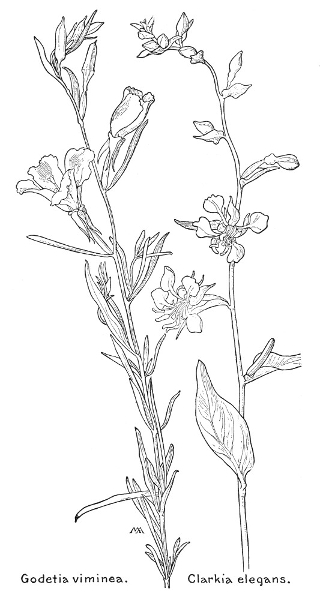
Godetia viminea. Clarkia elegans.
Clarkia Clàrkia rhomboídea Purple Spring, summer Northwest, Nev., Utah
Pretty and delicate and not nearly so conspicuous as the last, with a slender, smooth, branching stem, one to three feet tall, with smooth leaves, mostly alternate, nodding buds, and a few pretty flowers, about three-quarters of an inch across. The sepals are reddish-yellow; the petals pinkish-purple, often dotted with purple at base, with a short, broad, toothed claw; the stigma magenta; the filaments purple, with a whitish, hairy scale at the base of each; the anthers grayish, all perfect; the capsule four-angled, slightly curved, about an inch long. This grows in the foothills of the Sierra Nevada and Coast Ranges and is widely distributed in Yosemite, but nowhere very abundant.
Pink Fairies Clàrkia pulchélla Pink Summer Northwest
Odd and exceedingly charming flowers, with very slender, very slightly downy, purplish, branching stems, from six inches to a foot tall, and smooth leaves. The flowers are fantastic in form, the airiest and most fairy-like blossoms that can well be imagined, over two inches across, their delicate petals with long, toothed claws and three lobes, bright rose-pink, shading to a deeper tint at the base, the calyx slightly downy and reddish. Four of the stamens are perfect and four are rudimentary; the anthers are reddish; the pistil white; the capsule an inch long, eight-angled, with a spreading stalk. It is a pretty sight to see these gay flowers dancing in the wind on open mountain slopes. C. concínna (Eucharidium), of the Coast Ranges, is similar, equally beautiful and even more brilliant in coloring; the flowers sometimes in such quantities as to make patches of bright pink color, very effective when growing among yellow Sedums, Scarlet Larkspurs, and scarlet Indian Pinks, in shady mountain canyons.
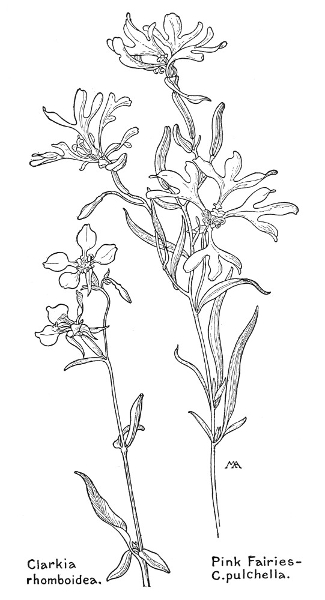
Clarkia rhomboidea. Pink Fairies—C. pulchella.
There are several kinds of Sphaerostigma; leaves alternate; flowers yellow, white or pink, turning green or reddish; stamens eight, with oblong, swinging anthers; style threadlike, with a round-top stigma; capsule four-celled, usually long and narrow, four-angled, often twisted, with no stalk.
Evening Primrose Sphaerostígma bistórta (Oenothera) Yellow Spring California
A common kind, very variable in its manner of growth, being tall and erect in moist, shady places and spreading flat on the ground in dry, sunny spots. The leaves are dull green, more or less downy and more or less toothed, and the flowers are three-quarters of an inch across, clear yellow, usually with a speck, or blotch, of reddish-brown at the base of each petal; the stamens and pistil also yellow; the pods reddish and very much twisted. Gravelly washes are often thickly sprinkled with these gay and charming flowers.
Sphaerostígma Veitchiànum (Oenothera) Yellow Spring California
Much like the last, but the flowers are only a little over a quarter of an inch across. The pods are dark red and shiny, with a few hairs.
Beach Primrose Sphaerostígma viridéscens (Oenothera cheiranthifolia var. suffruticosa) Yellow All seasons California
A beautiful seashore plant, forming large, low clumps of reclining stems and pale gray, downy foliage, the twigs and younger leaves silvery-white. The flowers are about an inch and a quarter across, clear yellow, often with two, dark red dots at the base of each petal; the stamens and pistil also yellow of the same shade; the pods pinkish, downy, and much twisted. The flat masses of pale foliage, strewn with golden disks, are exceedingly effective, growing in drifting sand hills along the coast, from San Francisco south.
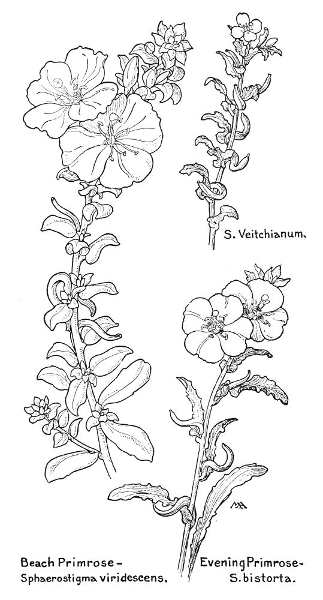
S. Veitchianum. Beach Primrose—Sphaerostigma viridescens. Evening Primrose—S. bistorta.
Sphaerostígma tortuòsa. (Oenothera) White Spring Nevada
A queer little, stunted-looking, desert plant, with almost no stem, but with several branches, spreading flat on the ground, stiff, smooth and purplish, with crowded clusters of flowers, leaves, and pods, mostly at the ends, the whole forming flat clumps, from six to ten inches across. The leaves are smooth, slightly thickish, pale bluish-green and toothless; the buds are erect, and the flowers are over a quarter of an inch across, white, with yellow anthers and a green stigma. The pods are very much twisted and form odd little snarly bunches.
There are only a few kinds of Chylisma; the flowers in terminal clusters; the calyx with a more or less funnel-form tube and four lobes; the petals four, not notched; the stamens eight, unequal; the stigma with a round top, the capsule long, membranous, with a stalk.
Chylisma Chylísma scapoìdea var. clavaefórmis (Oenothera) White Spring Ariz., Utah
A charming desert plant, from a few inches to a foot tall, with one or more, pinkish, smooth, rather leafy stems, springing from a pretty clump of smooth, bluish-green leaves. The delicate flowers are about three-quarters of an inch across and form a graceful cluster of several or many blossoms. The petals are white or yellow, often tinted with pink, with some specks of maroon at the base, and the sepals are pinkish-yellow; the stamens pale yellow; the stigma green; the pods erect.
There are several kinds of Pachylophus; perennials, stemless or nearly so; leaves from the root; calyx downy, with a long tube; petals white or pink; stamens eight, with threadlike filaments, the alternate ones longer; style threadlike; stigma four-cleft; capsule woody.
White Evening Primrose Pachýlophus marginàtus (Oenothera) White Summer Ariz., Utah, Nev., Col.
This has a few large flowers, three inches or more across, with pure-white diaphanous petals, fading to pink, and pink calyx-lobes. The buds are erect, hairy and pink, and the flowers spring from a cluster of long, downy root-leaves, narrowing to slender leaf-stalks, with hairs on the veins and on the toothed and jagged margins, and have almost no flower-stalk, but the hairy calyx-tube is so long, sometimes as much as seven inches, that it looks like a stalk. The root is thick and woody and the capsule is egg-shaped and ribbed, with no stem. There is a patch of these wonderful flowers in the Grand Canyon on Bright Angel trail, halfway between the rim and the plateau, where in a shaded spot beside a great rock the pure blossoms seem to shed a moonlight radiance. They are equally beautiful on the dry plains of Utah, where they grow in quantities.
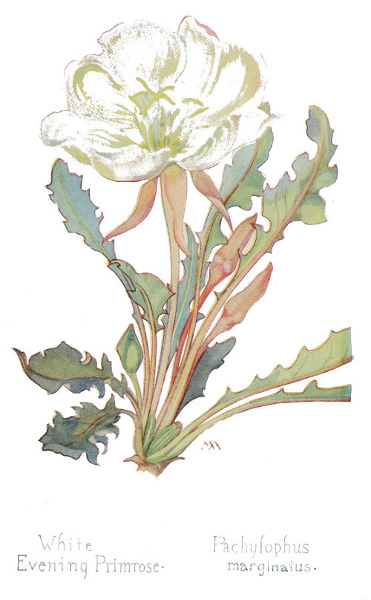
White Evening Primrose—Pachylophus marginatus.
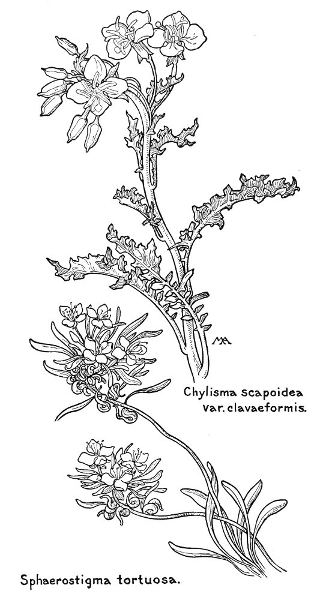
Chylisma scapoidea var. clavaeformis. Sphaerostigma tortuosa.
There are several kinds of Anogra, resembling Onagra, but with white or pink flowers and the seeds differently arranged; the stems often clothed with papery bark; the buds drooping. The name is an anagram of Onagra.
Prairie Evening Primrose Anogra albicàulis. (Oenothera) White Spring, summer Southwest, etc.
A conspicuous kind, often growing in large patches, with whitish, downy, branching stems, from a few inches to a foot tall, often with shreddy bark, and downy, pale bluish-green leaves, more or less toothed. The drooping, downy buds are tinted with reddish-pink and the lovely flowers are from one and a half to three inches across, with pure white petals, tinted with yellow at base, changing to pink after pollination and fading to crimson. The stamens have cobwebby threads, white filaments, and yellow anthers, the pistil is green and the curved capsule is downy or hairy. The whole color scheme, of pale sea-green foliage, reddish buds, and white, rose-color, and crimson flowers, is delicate, harmonious, and effective. This grows in sandy places, and on the prairies from Dakota to Mexico.
Cut-leaved Evening Primrose Anogra coronopifòlia (Oenothera) White Summer, autumn Ariz., Utah, etc.
A pretty plant, with an erect, leafy stem, six inches to two feet tall, springing from running rootstocks, and pale green, more or less downy, leaves, finely cut into numerous, small, narrow lobes, so that they look like rather dry little ferns. The delicate flowers are the usual Evening Primrose shape, about an inch across, in the axils of the leaves, with pure white petals, greenish at the base and turning pink in fading, and a calyx-tube two inches long, with turned-back, pinkish-green lobes. The anthers are brown, the pistil green, the throat of the corolla is closed by a fringe of white hairs, the buds are drooping and the capsule is oblong and hairy. This is common on prairies and plains, from Nebraska to Utah, and south to New Mexico, reaching an altitude of nine thousand feet.
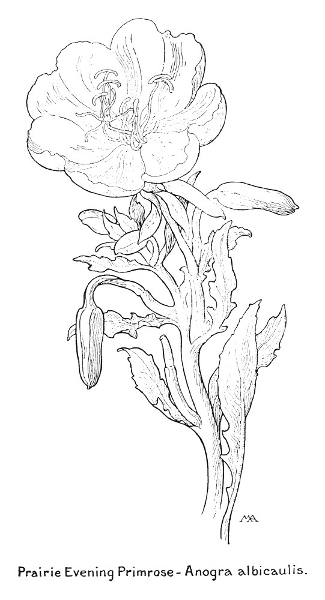
Prairie Evening Primrose—Anogra albicaulis.
There are several kinds of Onagra, differing from Anogra in having yellow flowers and in the arrangement of the seeds; with stems; leaves alternate, with wavy or toothed margins; buds erect; flowers night-blooming, in terminal clusters; calyx-tube long; petals four; stamens eight, equal in length; stigma four-cleft; capsule four-angled, more or less tapering.
Evening Primrose Ónagra Hóokeri (Oenothera) Yellow Summer West
A fine biennial, with stout, leafy stems, from three to six feet high, bearing splendid flowers, over three inches across, with clear yellow petals, fading to pink, and reddish calyx-lobes. The leaves, stems, and buds all downy and the buds erect. The stigma has four, slender lobes, forming a little cross, and the yellow pollen is loosely connected by cobwebby threads, clinging to visiting insects, and is thus carried from flower to flower; the capsule is an inch long. This is much handsomer than the common Evening Primrose, O. biénnis, and especially fine in Yosemite. As the mountain shadows begin to slant across the Valley the blossoms commence to open, until the meadows are thickly strewn with "patens of bright gold." They stay open all night, withering with the noonday sun.
There are several kinds of Lavauxia; low, usually stemless; leaves mostly from the root; calyx-tube slender; petals four; stamens eight, the alternate ones longer; ovary short, stigma four-cleft; capsule stout, four-angled or winged.
Sun-cups Lavaùxia primivèris (Oenothera) Yellow Spring Arizona
An attractive little plant, in the desert, with no stem, the flowers with long, slender calyx-tubes, resembling stems, springing from a clump of rather downy root-leaves. The buds are hairy and the flowers are about an inch across, light yellow, with pale yellow stamens and stigma. This plant varies a good deal in size, bearing one or several flowers, and the margins of the leaves almost toothless or irregularly slashed. It superficially resembles Taráxia ovàta, the Sun-cups so common on the southwestern coast, for the flowers have the same little fresh, sunny faces, but the latter has a round-topped stigma.
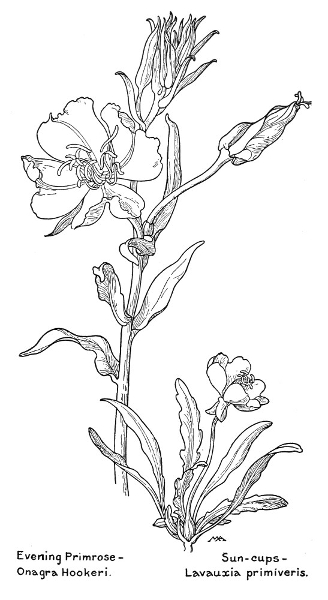
Evening Primrose—Onagra Hookeri. Sun-cups—Lavauxia primiveris.
PARSLEY FAMILY. Umbelliferae.
A large family, widely distributed, not abundant in the tropics; usually strong-smelling herbs, remarkable for their aromatic oil, mostly with hollow, grooved stems; leaves alternate, compound, generally deeply cut, leaf-stalks often broadened at base; flowers very small, usually in broad, flat-topped clusters, generally with bracts; calyx usually a five-toothed rim around the top of the ovary; petals five, small, usually with tips curled in, inserted on a disk, which crowns the ovary and surrounds the base of the styles; stamens five, with threadlike filaments and swinging anthers, also on the disk; ovary two-celled, inferior, with two threadlike styles; fruit two, dry, seedlike bodies, when ripe separating from each other, and usually suspended from the summit of a slender axis, each body marked with ribs, usually with oil-tubes between the ribs. The examination of these oil-tubes in mature fruits, with a microscope, is necessary to determine most of the genera and species, so description of genera is omitted here, and botanists have added to the difficulties of the amateur by giving almost every genus more than one name. The flowers are much alike, yet the leaves often differ very much in the same genus. Many kinds are poisonous, although others, such as Parsley, Carrot, and Parsnip, are valuable food plants.
Peucédanum Euryptèra Yellow Spring California
A fine robust plant, a foot or more tall, with stout, purplish stems and smooth, crisp leaves, the lower ones with three leaflets, the upper with five, and the teeth tipped with bristles. The flowers are greenish-yellow and the main cluster measures four or five inches across, with no bracts at base, but the small clusters have bracts. The flowers are ugly, but the foliage is handsome and the seed vessels richly tinted with wine-color, making the plant decorative and conspicuous on the sea cliffs of southern California.
Turkey Peas Orogènia linearifòlia White Spring Northwest and Utah
A quaint little plant, only about three inches high, with a tuberous root, spreading, slanting stems, and smooth leaves, all from the root, with three, long, narrow leaflets; a reddish, stiff, papery scale sheathing the stem at base. The minute, white flowers form a cluster less than an inch across, without bracts, with a stout, ridged flower-stalk and composed of from two to ten smaller clusters, with small bracts; the anthers red. This grows in rich moist soil, in shady valleys, on mountain ridges; in the Wasatch Mountains, sometimes on the edge of the snow.
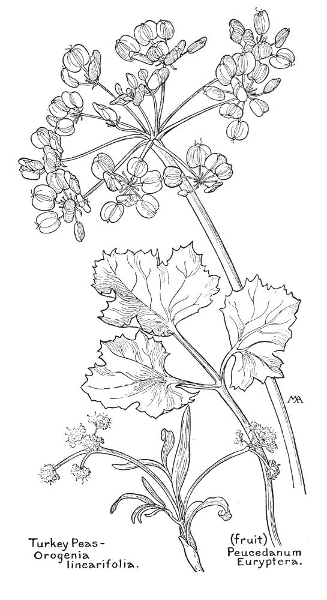
Turkey Peas—Orogenia linearifolia. (fruit) Peucedanum Euryptera.
Pterýxia Califórnica (Cymópterus) Yellow Summer Cal., Oreg.
Over a foot tall, with very pretty, dark green foliage and rather ugly, dull yellow flowers, in flat-topped clusters, three inches across. The leaves are in a cluster at the root, with long leaf-stalks sheathing at base, very finely cut and toothed, with stiffish points; the main flower-cluster without bracts, but the smaller clusters with narrow bracts.
Whisk-broom Parsley Cogswéllia platycàrpa (Peucedanum simplex) Yellow Spring Northwest and Utah
An odd-looking plant, for the foliage looks like pieces of a whisk-broom stuck in the ground. It is six to fourteen inches tall, with a thickish root and minute, sulphur-yellow flowers, forming a flat-topped cluster, about two inches across, without bracts, and composed of three to fifteen smaller clusters, with small bracts; usually only the outermost flowers of both the large and small clusters are fertile. The stem and leaves are stiff and sage-green, the root-leaves with broad leaf-stems, reddish and papery at base, sheathing the stem, and all the leaves cut into narrow divisions, not much thicker than pine needles, folded together so that they appear to be cylindrical. This grows on dry gravelly hills, at an altitude of from six to eight thousand feet.
Leptotaènia multífida (Ferula) Yellowish-green Spring, summer Northwest, Nev., Utah, New Mex.
A fine, stout plant, about two feet tall, with a thick, spindle-shaped root and dark, rich-green, feathery foliage; the large leaves, over a foot long, appearing smooth but really imperceptibly downy, finely cut and lobed, with long, stout leaf-stalks; the small flowers, yellowish-green or bronze-color, in flat-topped clusters, two or three inches across, with few or no bracts, with tall, stout flower-stalks, and composed of about eighteen, small clusters, forming round knobs, with many bracts, on slender pedicels of various lengths. This grows in rich soil and is conspicuous on account of its size and foliage.
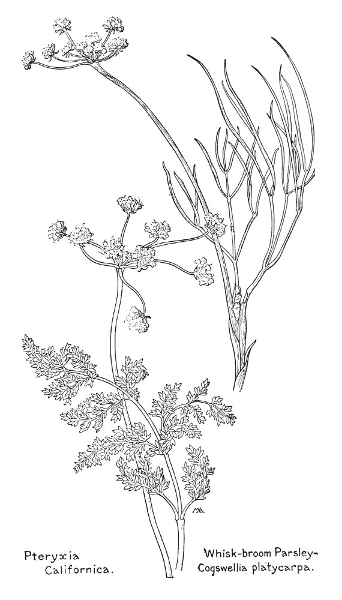
Pteryxia Californica. Whisk-broom Parsley—Cogswellia platycarpa.
Velaèa argùta Yellow Spring California
This has a stout, brownish stem, about eight inches tall, and fine, conspicuous foliage, mostly in a clump at the base, the leaves rich-green and very glossy, stiff and crisp in texture, though not thick, with bristle-tipped teeth. The rather ugly little flowers are greenish-yellow and the main cluster has no bracts. This grows in canyons in southern California.
Purple Sanicle, Nigger-babies Sanícula bipinnatífida Purplish Spring, summer Cal., Oreg.
This has branching, purplish stems, from six inches to three feet tall, and handsome foliage. The flowers are maroon-color and are crowded into balls, less than half an inch across, forming a loose, irregular cluster, with leafy bracts at the base. The effect of the dark flowers and fine foliage is rather attractive and it is common on grassy slopes in the hills.
Eulòphus Bolánderi White Summer Northwest
This has a smooth, stiff stem, one to two feet tall, the leaves cut into long, narrow divisions, and the flowers very small, cream-white or pinkish, forming a flat-topped cluster, about two inches across, with narrow, pale bracts. This is quite pretty and common in Yosemite.
Indian Parsnip Aulospérmum lóngipes (Cymopterus) Yellow Spring Utah, Col., Wyo.
Decorative in form and color and unusual looking, with smooth, pale bluish-green foliage, with a "bloom," the leaves prettily cut and lobed, with pinkish leafstalks, forming, when young, a large rosette, close to the ground, but the stem gradually lengthens until the cluster of leaves, after the flowers are gone, finds itself on the summit of a long stem, sheathed at base. The minute, bright yellow flowers form flat-topped clusters, with flower-stems two or three inches tall, not hollow, the main cluster about an inch across, usually without bracts, and composed of five to ten smaller clusters, with bracts. When the plant is young the general effect of the flat, pale gray rosette of fern-like leaves, spotted with the contrasting yellow of the flowers, is pretty and striking. Sometimes a few of the flowers are purple. This has a thick root and grows on dry sunny hills, in gravelly soil.
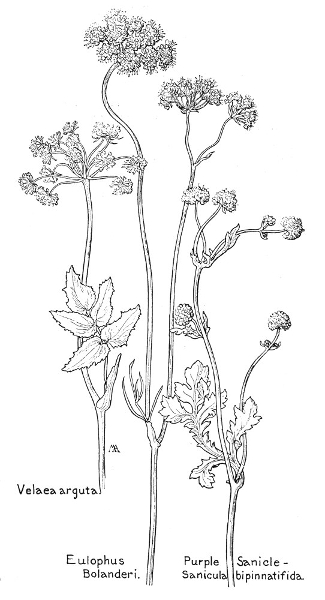
Velaea arguta. Eulophus Bolanderi. Purple Sanicle—Sanicula bipinnatifida.
DOGWOOD FAMILY. Cornaceae.
Not a very large family, most abundant in the northern hemisphere, mostly trees or shrubs. They have simple, mostly toothless leaves, without stipules, usually opposite or in whorls. The flowers are in round or flat-topped clusters and have four or five sepals and petals and four to many stamens. The inferior ovary becomes a stone-fruit that looks like a berry. Cornus is from the Greek for "horn," in allusion to the toughness of the wood.
There are many kinds of Cornus, some natives of Mexico and Peru, with small, white, greenish or purple flowers, in clusters, which often have an involucre of large, white bracts.
Pacific Dogwood Córnus Nuttállii White Spring, summer Oreg., Wash., Cal.
A handsome shrub or small tree, from ten to thirty feet high and growing in rich woods, often near streams. The flower clusters are composed of numerous, small, greenish flowers, forming a large, protruding knob, which is surrounded by large, white, petal-like bracts, usually six in number, giving the effect of a single handsome flower, measuring from three to six inches across. It resembles the Flowering Dogwood of the East, but as the flowers have six instead of four "petals," the tips of which in Yosemite are neither puckered nor stained with pink, they look different to eastern eyes and the general appearance, though equally fine, is less picturesque, probably because the shrub is rather larger and less straggling, the flowers bigger and more symmetrical, and the leaves brighter green. The effect of the flat masses of creamy white bloom among the darker forest trees is magnificent, and in Washington and Oregon the leaves turn to brilliant red in the autumn. The fruit is a cluster of bright red berries. The wood is exceedingly hard and is used in cabinet-making. There is a tradition that when Dogwood blooms corn should be planted.
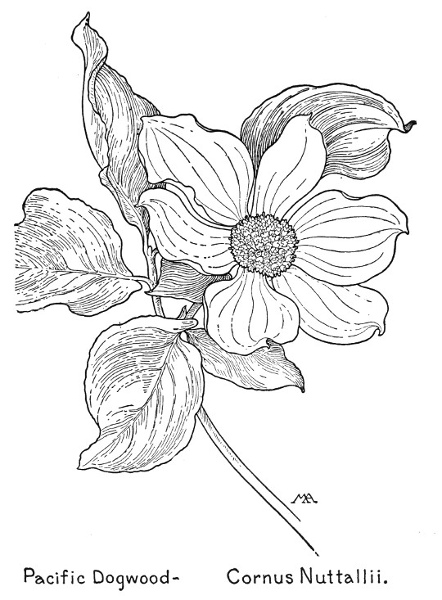
Pacific Dogwood—Cornus Nuttallii.
Red-osier Dogwood Córnus stolonífera var. ripària White Spring, summer, autumn Utah, Ariz., New Mex., Col.
A handsome shrub, five to eight feet high, with smooth, dark red branches and bright red twigs. The leaves are thin in texture, smooth and rich-green on the upper side, paler on the under, and the small, cream-white flowers, with long, yellow stamens, form handsome, flat-topped clusters, about two inches across, smelling pleasantly of honey; the berries are dull white. This is common.
Bunchberry Córnus Canadénsis White Summer West, except Ariz.
A charming little plant, about six inches high, growing in moist, cool woods and common in the East. The slender stem, with one or two pairs of small leaves, springs from creeping, woody shoots and is crowned by a circle of larger leaves, six, or rarely four, in number, smooth and bright green, setting off a pretty white blossom, with a slender flower-stalk. This looks like a single flower, measuring about an inch across, but it is really composed of a number of tiny, greenish flowers, forming a cluster in the center, and surrounded by four white bracts, which look like large petals. The flowers are succeeded by a bunch of red berries, insipid in flavor, but vivid scarlet in hue.
HEATH FAMILY. Ericaceae.
A large and interesting family, of very wide geographic distribution, in temperate and cold regions; herbs, shrubs, or trees; the leaves undivided, without stipules; the flowers mostly perfect; the calyx with four or five divisions; the corolla usually regular, with four or five, usually united, petals; the stamens inserted under the pistil, usually as many, or twice as many, as the petals; the ovary usually superior, with one style; the fruit a capsule, berry, or stone-fruit, usually with many small seeds.
There are many kinds of Gaultheria, mostly of the Andes; ours are evergreen shrubs, with alternate, aromatic leaves and nodding flowers; the calyx five-cleft; the corolla more or less urn-shaped, with five teeth; the stamens ten; the fruit a berry, composed of the fleshy calyx surrounding the ovary and containing many seeds. The Wintergreen, or Checkerberry, used for flavoring, belongs to this genus.
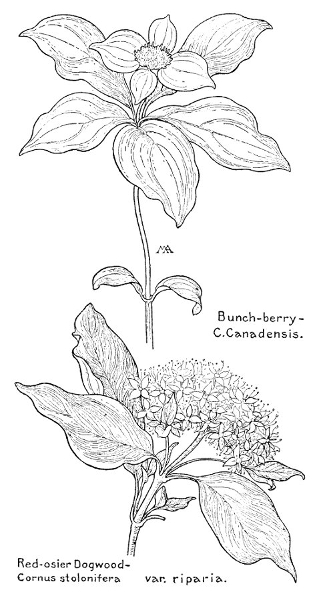
Bunch-berry—C. Canadensis. Red-osier Dogwood—Cornus stolonifera var. riparia.
Western Wintergreen Gaulthèria ovatifòlia White Summer Northwest
A pretty little shrub, growing in mountain woods, a few inches high, with woody stems, spreading on the ground, and glossy foliage, almost hiding the flowers. The twigs are fuzzy and the leaves are dark rich-green, the small flowers white and the berries red.
Salal, Shallon Gaulthèria Shállon White, pink Spring, summer Northwest
An attractive little shrub, usually from one to three feet high, with handsome foliage. The leaves are finely toothed, dark olive-green, leathery and rather glossy, pale on the under side, and the waxy flowers hang gracefully on a stiffly bending flower-stem, which is sticky and hairy and often bright red, with large, scaly, red bracts at the base of the pedicels and smaller bracts halfway up. The flowers are nearly half an inch long, with a yellowish calyx, covered with reddish hairs, and a white corolla, tipped with pink, or all pink; the filaments hairy, with orange anthers. There is often so much bright pinkish-red about the flower-stems and bracts that the effect, with the waxy flowers and dark foliage, is very pretty. This plant often grows in great quantities, thickly covering the floor of the redwood forests. It is called Salál by the Oregon Indians, who value the black, aromatic berries as an important article of food.
There are many kinds of Azalea, of North America and Asia, mostly tall, branching shrubs; leaves alternate, thin, deciduous; flowers large, in terminal clusters, developing from cone-like, scaly buds; calyx small, five-parted; corolla funnel-form, five-lobed or somewhat two-lipped; stamens five, rarely ten, protruding, usually drooping; style long, slender, drooping; capsule more or less oblong.
Western Azalea Azàlea occidentàlis (Rhododendron) White Summer Cal., Oreg.
One of the most beautiful western shrubs, from two to ten feet high, loosely branching, with splendid clusters of flowers and rich-green leaves, almost smooth, from one to four inches long, with a small, sharp tip and clustered at the ends of the twigs. The corolla is from one and a half to three inches long, slightly irregular, white with a broad stripe of warm-yellow on the upper petal and often all the petals striped with pink. The western woodland streams are bordered with these wonderful blossoms, leaning over the water and filling the air with their delicious fragrance.
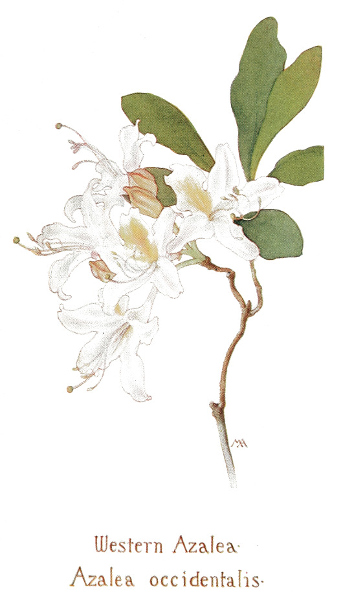
Western Azalea—Azalea occidentalis.
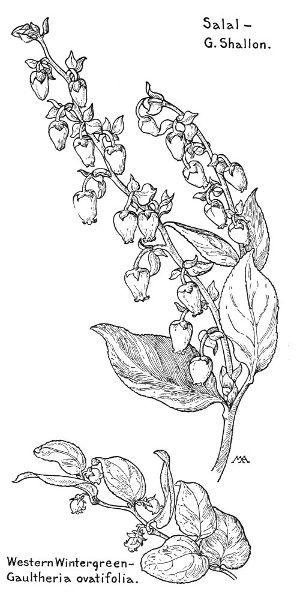
Salal—G. Shallon. Western Wintergreen—Gaultheria ovatifolia.
There are many kinds of Rhododendron, most abundant in Asia, resembling Azalea, but with evergreen, leathery leaves. The name is from the Greek, meaning "rose-tree."
California Rose Bay Rhododéndron Califórnicum Pink Spring, summer Northwest
A magnificent shrub, the handsomest in the West, from three to fifteen feet high, with a grayish trunk and fine, evergreen foliage. The leaves are from three to ten inches long, rich-green and leathery, smooth but not shiny, paler on the under side, spreading out around the large flower-clusters, so as to set them off to great advantage, and the flowers are over two inches across, scentless, with small, pale sepals and pink corollas, almost white at the base and shading to deep pink at the edges, which are prettily ruffled. The upper petal is freckled with golden-brown, or greenish spots and arrow-shaped markings, the pistil is crimson and the stamens, with pale pink filaments and pale yellow anthers, curve in, like little serpents' heads. The coloring of the flower clusters, mixed with the crimson-tipped buds, is a combination of delicate and brilliant tints and in such places as the redwood forests, along the Noyo River in California, where the shrub develops into a small tree, the huge clusters, glowing high above us among the dark forest trees, are a wonderful sight. This is the "State flower" of Washington.
There are a good many kinds of Arctostaphylos, mostly western; evergreen shrubs, with very crooked branches; smooth, dark red or brown bark; alternate leaves, and usually nodding, white or pink flowers, with bracted pedicels, in terminal clusters, the parts usually in fives; the corolla urn-shaped; the stamens usually ten, not protruding, the filaments hairy; the ovary raised on a disk on the receptacle; the fruit berry-like, several nutlets surrounded by soft pulp. The leaves, by a twisting of their stalks, assume a vertical position on the branches, a habit which enables many plants of dry regions to avoid unnecessary evaporation. These shrubs are often very abundant and with Chaparral Pea, Buck Brush, Scrub Oak, etc., form the extensive brush thickets known as chaparral, so characteristic of the western mountain scenery. The Greek name means "bear-berry," as bears are fond of the berries, and Manzanita is from the Spanish for "little apple," as the fruits often resemble tiny apples. They are dry but pleasantly acid and are popular with Indians, bears, and chipmunks, and jelly can be made from them. The largest Manzanita tree known is one in Napa County, California, thirty-five feet high and as large across.
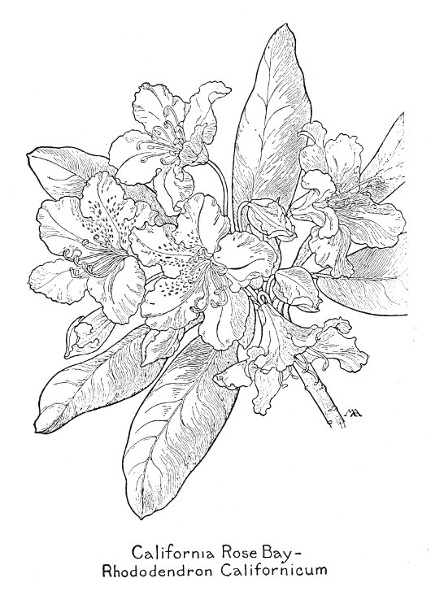
California Rose Bay—Rhododendron Californicum.
Green Manzanita Arctostáphylos pátula Pink Winter, spring California
A decorative shrub, from four to six feet high, with spreading branches. The leaves are from one to two inches long, smooth, pale green, and leathery and the flowers are waxy, a quarter of an inch or more long, crowded in pretty, roundish clusters, of various shades of pink. The very smooth trunk and branches are picturesquely gnarled and twisted and, in fine contrast to the pale foliage, are rich mahogany-color, with here and there openings in the outer bark, showing the gray, under layer, as if the branches had been dipped in hot chocolate, which had melted off in some places. The berry is about a quarter of an inch across, smooth and fleshy. This forms most of the chaparral on the slopes around the Yosemite Valley, ranging from over four thousand to nine thousand feet in altitude, and is widely distributed in the Sierra Nevada Mountains.
Manzanita Arctostáphylos bícolor Pink Spring California
A handsome shrub, three or four feet high, with rich-green leaves, very glossy on the upper side and covered with close white down on the under. The waxy flowers are a lovely shade of pink and the pretty fruit is about the size of a pea, like a tiny greenish-yellow apple, with a brownish-red cheek. This grows in the South near the coast.
Kinnikinic. Red Bearberry Arctostáphylos Ùva-Úrsi White Spring, summer West, etc.
An attractive little shrub, with many trailing branches, creeping over the ground and often covering the rocks with a beautiful mat of evergreen foliage. The leaves are small, toothless, shining and leathery and the little white or pinkish, bell-shaped flowers hang in pretty little clusters and are succeeded by smooth, round, red berries. This is common in the mountains, across the continent, reaching an altitude of ten thousand feet. The Indians use it medicinally and in the curing of animal skins. There is a picture of this in Schuyler Mathews' Field Book.
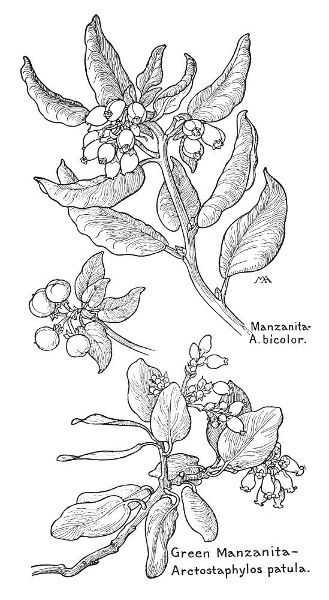
Manzanita—A. bicolor. Green Manzanita—Arctostaphylos patula.
There are a great many kinds of Vaccinium, widely distributed; branching shrubs, with alternate leaves and small flowers, usually in clusters; the ovary inferior, the fruit a many-seeded berry, crowned with the remains of the calyx-teeth. This is the classic Latin name. These plants include Blueberry, Huckleberry, and Bilberry.
California Huckleberry Vaccínium ovàtum White, pink Spring, summer Cal., Oreg.
An attractive shrub, from four to eight feet high, with beautiful, glossy, evergreen foliage, which is very ornamental and much used in household decoration. The older leaves are rich dark green, contrasting finely with the younger, apple-green leaves and, in the spring, with the charming little red ones, with which the twigs are tipped. They are leathery in texture and very neatly arranged along the branches, which are ornamented with pretty clusters of waxy, white or pink flowers, a quarter of an inch long, or with purple berries, without a "bloom," which are edible and make excellent preserves. This grows on hills near the coast, especially among the redwoods.
There is one kind of Azaleastrum; resembling Rhododendron, but with deciduous leaves; and resembling Azalea, but the flowers developing from lateral instead of terminal buds, the corolla with five, regular lobes, and the stamens shorter.
Small Azalea Azaleástrum albiflòrum (Rhododendron) White Summer Northwest
An attractive shrub, from two to six feet high and loosely branching, with grayish-brown bark and rich-green leaves, glossy, but not stiff or leathery. The flowers are about an inch across, with a sticky, aromatic, pale green calyx and waxy-white corolla, the style and stamens pale yellow or white. They have no scent and are not so handsome as the last, but are very beautiful, growing in high mountains, often close to the snow line.
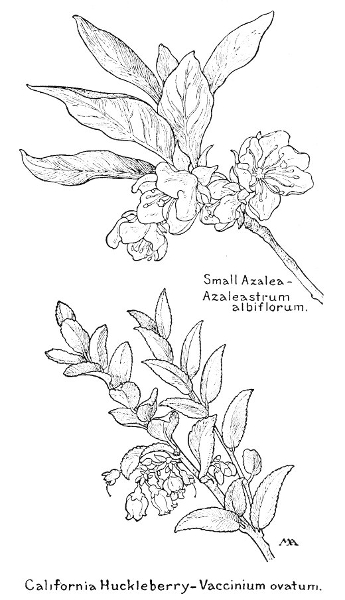
Small Azalea—Azaleastrum albiflorum. California Huckleberry—Vaccinium ovatum.
There are several kinds of Kalmia, almost all of eastern North America, the flowers alike in form.
Swamp Laurel Kálmia microphýlla (K. glauca var. microphylla) Pink Summer Northwest, etc.
A very pretty little evergreen shrub, from a few inches to over a foot high, with glossy, leathery, rich-green leaves, whitish on the under side, with the margins rolled back. The flowers are single or in clusters, each about half an inch across, with five sepals and a bright purplish-pink, saucer-shaped corolla, with five lobes, which is prettily symmetrical and intricate in form. There are ten little pouches below the border and in these the tips of the ten anthers are caught, so that the filaments curve over from the center, and at the touch of a visiting insect they spring out of the pouches and dust the visitor's back with pollen, which is carried to another flower. The little, pointed buds, angled and deep in color, are also pretty and the capsule is roundish, with many small seeds. This grows in northern swamps, across the continent.
There are several kinds of Menziesia, some Japanese; branching shrubs, with alternate, deciduous, toothless leaves, and small, nodding flowers, in clusters, developing from scaly buds, their parts almost always in fours; stamens eight, not protruding; capsule more or less egg-shaped.
Fool's Huckleberry Menzièsia urcelolària (M. ferruginea) Yellowish, reddish Summer Northwest
A rather attractive little bush, from two to six feet high, with light brown bark, hairy twigs and slightly hairy leaves, with hairy margins. The flowers are less than half an inch long, with a hairy calyx and dull cream-colored corolla, tinged with dull-pink or red, and hang prettily in a circle, on drooping pedicels, which become erect as the capsules ripen. When crushed, the stems and foliage have a strong skunk-like smell.
There are only a few kinds of Ledum, all much alike.
Woolly Labrador Tea Lèdum Groenlándicum White Spring, summer Northwest, etc.
A loosely-branching, evergreen shrub, from one to four feet high. The bark is reddish and the twigs are covered with reddish wool, the color of iron rust, and the leathery, dark green leaves, which are alternate, with rolled-back margins, are also covered with reddish wool on the under side. The flowers are a good deal less than half an inch across, with five, very small sepals; five, spreading, white petals; a green ovary, and from five to seven, long, conspicuous stamens, giving a feathery appearance to the pretty flower-clusters, which before blooming are enclosed in large, scaly buds. Both foliage and flowers are aromatic. This is found across the continent, as far south as Pennsylvania, and in Greenland. L. glandulòsum is similar, but not woolly. These plants grow in swamps and damp places and are considered poisonous.
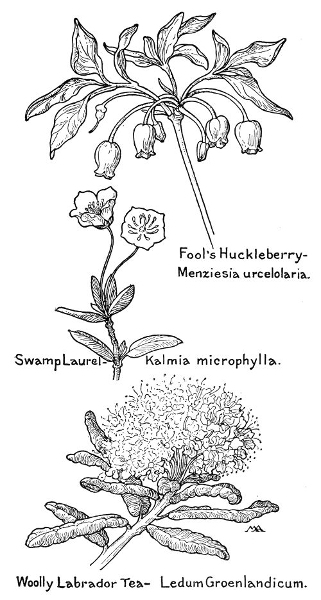
Fool's Huckleberry—Menziesia urcelolaria. Swamp Laurel—Kalmia microphylla. Woolly Labrador Tea—Ledum Groenlandicum.
There are only a few kinds of Phyllodoce, of arctic and alpine regions; low shrubs, with small, leathery, evergreen leaves; flowers nodding, with bracts, in terminal clusters; calyx usually with five divisions; corolla more or less bell-shaped, usually five-lobed; stamens usually ten; stigma with a round top, or four to six lobes; capsule roundish: often called Heather, but we have no native Heather.
Red Heather Phyllódoce Bréweri (Bryanthus) Pink Summer Northwest
A charming little shrub, from six to ten inches tall, with gay flowers and dark yellowish-green leaves, standing out stiffly from the stem, like the bristles of a bottle-brush. The flowers are sweet-scented, nearly half an inch across, with reddish calyxes and pedicels and bright pink, saucer-shaped corollas, with from seven to ten, long, purple stamens, a purple pistil and crimson buds. This makes heathery patches on high mountain slopes, up to twelve thousand feet in the Sierra Nevadas.
Red Heather Phyllódoce empetrifórmis (Bryanthus) Pink Summer Northwest
Much like the last, but the nodding flowers are smaller and not quite so pretty, with bell-shaped corollas and the stamens not protruding. It forms beautiful patches of bright purplish-pink color on mountainsides, up to eleven thousand feet, farther north than the last.
Yellow Heather Phyllódoce glanduliflòra (Bryanthus) Yellowish Summer Northwest
This makes heather-like patches on rocks and has many rough, woody stems, crowded with yellowish-green leaves, shorter and broader than those of Red Heather. The drooping flowers are about three-eighths of an inch long, with a hairy, greenish-yellow calyx and yellowish corolla, something between cream and pale-lemon in color. At a distance the effect of the flowers is much more yellow than close by, but they are not so pretty as either the red or white heathers.
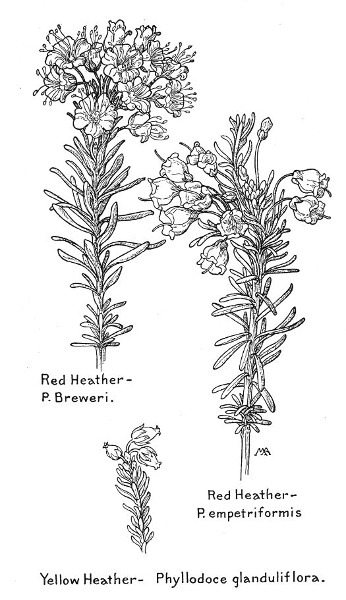
Red Heather—P. Breweri. Red Heather—P. empetriformis. Yellow Heather—Phyllodoce glanduliflora.
There are several kinds of Cassiope, named for the mother of Andromeda, resembling Heather; the sepals four or five, without bracts at the base; the corolla bell-shaped, with four or five lobes; differing from Phyllodoce in capsule, form of corolla and filaments.
White Heather Cassìope Mertensiàna White Summer Northwest
This makes thick patches of many woody stems, a few inches high, the twigs thickly clothed with odd-looking, small, dark green leaves, overlapping like scales and ridged on the back. The single flowers are white and waxy, resembling the bells of Lily-of-the-valley, often with red calyxes and pedicels, and are pretty and delicate, set off by the stiff, dark foliage. This grows in the highest mountains, at an altitude of ten thousand feet and above.
WINTERGREEN FAMILY. Pyrolaceae.
A small family, natives of the northern hemisphere; low, generally evergreen, perennials, with branched rootstocks; leaves with leaf-stalks; flowers perfect, nearly regular, white or pink; calyx with four or five lobes; corolla with four or five lobes, or five petals; stamens twice as many as the divisions of the corolla; ovary superior, stigma more or less five-lobed; fruit a capsule, with many minute seeds.
Single Beauty Monèses uniflòra White Summer Northwest, etc.
The only kind, much like Chimaphila, a charming little perennial, with a single flower-stalk, from two to six inches tall, springing from a cluster of glossy, bright green leaves, with toothed edges, and bearing a single, lovely sweet-scented blossom, about three-quarters of an inch across, with usually five sepals and five, spreading, waxy-white petals; the long, straight style, with a five-lobed stigma, projecting from the ovary, which forms a green hump in the center of the flower, surrounded by eight or ten stamens. This little flower modestly turns its face down to the ground and we have to pick it to find how very pretty it is. It grows in wet, northern mountain woods, across the continent.
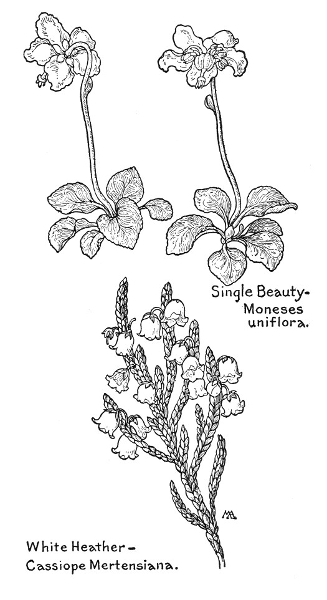
Single Beauty—Moneses uniflora. White Heather—Cassiope Mertensiana.
There are a good many kinds of Pyrola; leaves mostly from the root; flowers usually nodding, in clusters, with bracted flower-stalks; sepals and petals five; stamens ten; capsule roundish, five-lobed, cobwebby on the edges. These plants are often called Shinleaf, because English peasants used the leaves for plasters. Pyrola is from the Latin for "pear," because of the resemblance of the leaves of some kinds. The aromatic Wintergreen, or Checker-berry, used for flavoring, is a Gaultheria, of the Heath Family.
Pyrola Pýrola bracteàta Pink Summer California
One of our most attractive woodland plants, from six to twenty inches tall, with handsome, glossy, rather leathery, slightly scalloped leaves. The buds are deep reddish-pink and the flowers are half an inch across, pink or pale pink, and waxy, with deep pink stamens and a green pistil, with a conspicuous style, curving down and the tip turning up. The pretty color and odd shape of these flowers give them a character all their own and they are sweet-scented. This is found in Yosemite and in other cool, shady, moist places, and there are several similar kinds.
There are several kinds of Chimaphila, of North America and Asia, with reclining stems and erect, leafy branches.
Pipsissewa Chimáphìla Menzièsii White Summer Northwest and California
A very attractive little evergreen plant, three to six inches high, with dark green, glossy, leathery, toothed, leaves, sometimes mottled with white, and one to three, pretty flowers, about three-quarters of an inch across, with yellowish sepals and waxy-white or pinkish petals, more or less turned back. The ovary forms a green hump in the center and has a broad, flat, sticky stigma, with five scallops, and the ten anthers are pale yellow or purplish. This has a delicious fragrance, like Lily-of-the-valley, and grows in pine woods in the Sierra Nevada and Coast Ranges. Chimaphila is a Greek name, meaning "winter-loving."
INDIAN PIPE FAMILY. Monotropaceae.
A small family, mostly North American; saprophytes, (plants growing on decaying vegetable matter,) without leaves; flowers perfect; calyx two- to six-parted; corolla united or not, with three to six lobes or petals, occasionally lacking; stamens six to twelve; ovary superior; fruit a capsule.
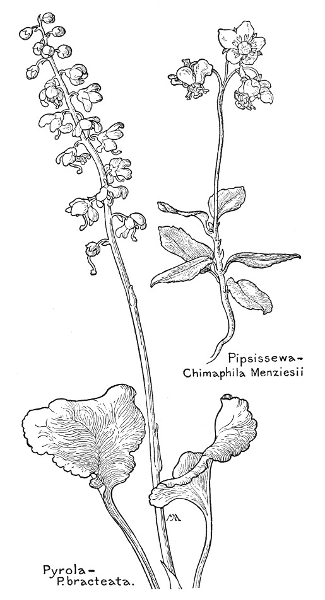
Pipsissewa—Chimaphila Menziesii. Pyrola—P. bracteata.
Snow-plant Sarcòdes sanguínea Red Spring, summer Cal., Oreg., Nev.
The only kind, a strange plant, widely celebrated for its peculiar beauty. The name is misleading, for the splendid creatures push their way, not through the snow, but through the dark forest carpet of pine-needles, soon after the snow has melted. The fleshy stems are from six inches to over a foot tall, the leaves reduced to red scales, and the bell-shaped flowers, with five lobes, are crowded towards the upper half of the stem and mingled with long, graceful, curling, red bracts. The plants are shaded with red all over, from flesh color, to rose, carmine, and blood-red, and are translucent in texture, so that when a shaft of sunlight strikes them they glow with wonderful brilliance, almost as if lighted from within. They sometimes grow as many as fifteen together, and are found in the Sierras, up to nine thousand feet. They are pointed out to tourists by Yosemite stage drivers, but the government forbids their being picked, for fear of extermination.
Indian Pipe Monótropa uniflòra White Summer West, etc.
The only American kind, an odd plant, all translucent white, beautiful but unnatural, glimmering in the dark heart of the forest like a pallid ghost, mournfully changing to gray and black as it fades. The stem is about six inches tall, springing from a mass of fibrous roots and bearing a single flower, beautiful but scentless, about three-quarters of an inch long, with two to four sepals, five or six petals, and ten or twelve stamens, with pale yellow anthers. Sometimes the whole plant is tinged with pink. This grows in rich moist woods, almost throughout temperate and warm North America, in Japan and India, and is also called Ghost-flower and Corpse-plant.
Pine-sap Hypópitys Hypópitys (Monotropa) Flesh-color Summer West, etc.
There are two kinds of Hypopitys. This is much like the last, but not so pallid, with several stout stems, about eight inches tall, bearing a long one-sided cluster of flowers, sometimes slightly fragrant, each about half an inch long. The whole plant is waxy, flesh-color or yellowish, tinged with red or pink, and though interesting is not so delicately pretty as Indian Pipe. It seems to be a stouter plant around Mt. Rainier than in the East and grows in thick woods, across the continent and in Europe and Asia. H. sanguínea is a new kind, recently discovered in the Arizona mountains; six to twelve inches tall, growing in dense shade at high altitudes, and brilliant red throughout.
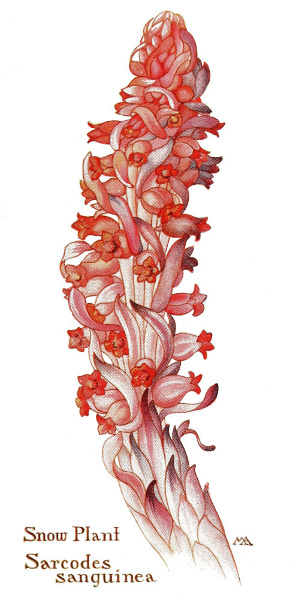
Snow Plant—Sarcodes sanguinea.
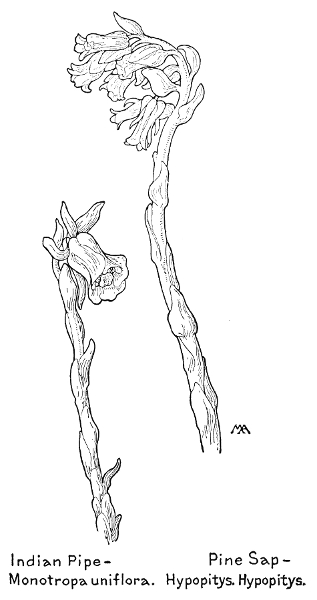
Indian Pipe—Monotropa uniflora. Pine Sap—Hypopitys Hypopitys.
Pine-drops Pteróspora Andromedèa White Summer Across the continent
The only kind, found only in North America, a strange plant, harmonious in color, with a fleshy, brownish or reddish stem, from one to four feet tall, with yellowish bracts and covered with sticky hairs, springing from a mass of matted, fibrous, astringent roots. The flowers are a quarter of an inch long, with pink pedicels, brownish bracts, a brownish-pink calyx, with five lobes, and an ivory-white corolla, with five teeth; the stamens ten, net protruding; the style short, with a five-lobed stigma; the capsule roundish, five-lobed, with many winged seeds. We often find dead insects stuck to the stem. In winter, the dry, dark red stalks, ornamented with pretty seed-vessels, are attractive in the woods. This usually grows among pine trees, across the continent, but nowhere common. The Greek name means "wing-seeded." It is also called Giant Bird's-nest and Albany Beech-drops. Allótropa virgàta, of the Northwest, is similar, but smaller, with five, roundish sepals and no corolla.
Flowering-fungus Pleuricóspora fimbriolàta Flesh-color Summer California
There are two kinds of Pleuricospora; this is from three to eight inches tall, with flowers half an inch long, deliciously fragrant, with four or five, scale-like, fringed sepals, four or five, separate, fringed petals, resembling the sepals, and eight or ten stamens. The ovary is egg shaped, one-celled, with a thick style and flattish stigma, and the fruit is a watery berry. If the waxy, flesh-colored flowers were set off by proper green leaves they would be exceedingly pretty, but they are crowded on a fleshy stem, of the same color as themselves, mixed with fringed bracts, with brownish scales instead of leaves, and have an unnatural appearance. I found thirty of these curious plants, growing in a little company, pushing their way up through the mold and pine-needles, in the Wawona woods.
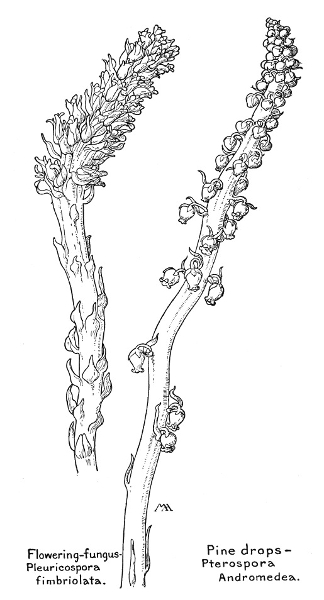
Flowering-fungus—Pleuricospora fimbriolata. Pine drops—Pterospora Andromedea.
PRIMROSE FAMILY. Primulaceae.
A rather large family, widely distributed; herbs; leaves undivided; flowers perfect, regular, parts usually in fives, corolla mostly with united petals, stamens on the base or tube of the corolla, opposite its lobes, sometimes with some extra, sterile filaments; ovary one-celled, mostly superior, with one style and round-headed stigma; fruit a capsule, with one or many seeds.
There are several kinds of Anagallis, not native in this country.
Scarlet Pimpernel Poor-man's Weather-glass Anagállis arvénsis Red Summer West, etc.
A little weed, common in gardens and waste places, with smooth, four-sided, stems, branching and half trailing on the ground, smooth, toothless, bright green leaves and charming little flowers, a quarter of an inch or more across, with a five-lobed calyx and wheel-shaped, five-lobed corolla, usually bright orange-red and darker in the center, rarely white; the stamens five, with hairy filaments; the capsule smooth and roundish, containing many minute seeds. The flowers and leaves are usually in pairs, the seed-vessels on the tips of slender stems, curving around and toward each other, as if the plant were stretching out its little hands, and opening its little blossoms only in bright weather and closing them at night. The Greek name means "amusing." The plant was used medicinally by the ancients.
There are three kinds of Trientalis, much alike, perennials, with tuberous roots. The Latin name means "one third of a foot," the height of these plants.
Star-flower Trientàlis latifòlia White, pink Spring, summer Northwest, Cal., Nev.
A little woodland plant, with a slender stem, from three to six inches tall, bearing at the top a circle of from four to six, smooth, bright green leaves and one or two, threadlike flower-stalks, each tipped with a delicate flower. The corolla is about half an inch across, wheel-shaped, with no tube and usually with six, white or pinkish petals, sometimes deep pink, or flecked with lilac outside. The ovary makes a purplish dot in the center, surrounded by curling, yellow anthers, with threadlike filaments united at base. The capsule contains a few, rather large, white seeds. We often find these dainty little plants growing in companies, their starry blossoms glimmering in the shade, prettily set off by their neat circle of leaves.
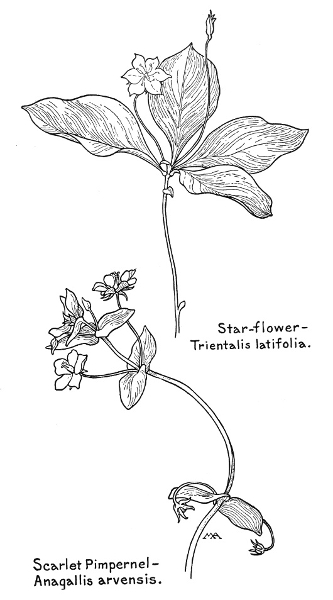
Star-flower—Trientalis latifolia. Scarlet Pimpernel—Anagallis arvensis.
There are a good many kinds of Dodecatheon, of North America and Asia; perennials, with root-leaves; flowers in bracted, terminal clusters; calyx with four or five lobes, turned back in flower but erect in fruit; corolla with four or five, long lobes, turned strongly back over the short tube and thick throat; stamens of the same number as the lobes, the anthers pointing straight forward, inserted on the throat of the corolla, filaments short, flat and united, or lacking; style long; capsule containing many seeds. The Greek name, meaning "twelve gods," seems far-fetched, but Linnaeus fancied the cluster of flowers resembled a little assembly of divinities. Common names are Prairie Pointers, Mosquito-bills, Wild Cyclamen, and American Cowslip, the latter poor, because misleading.
Large Shooting-star Dodecàtheon Jéffreyi Pink Summer Cal., Oreg.
A very decorative plant, with a smooth, stout, reddish stem, five to eighteen inches tall, very slightly hairy towards the top, springing from a cluster of root-leaves, five to eighteen inches long, smooth, sometimes slightly toothed, and bearing a cluster of from five to fifteen beautiful flowers. The corolla is usually an inch or more long, usually with four petals, purplish-pink, paler at the base, with a yellow and maroon ring and maroon "bill." This has a faint, oddly sweet scent and grows in wet, mountain meadows. I found a very beautiful white form at Lost Lake, in Yosemite, more delicate, with lighter green foliage and pure white corollas, ringed with yellow and maroon.
Shooting-star Dodecàtheon Clèvelandi White Spring California
Not so handsome as the last, but very attractive, with a slightly roughish stem, twelve to sixteen inches tall, bearing a fine crown of flowers and springing from a cluster of smooth, slightly thickish leaves, paler on the under side, with a few teeth. The sepals are slightly downy and the corollas are about three-quarters of an inch long, with pure-white petals, sometimes lilac-tinged, yellow at base, with a ring of maroon scallops and a dark purple "bill." The flowers are deliciously fragrant, like Clove Pinks. This grows in the south.
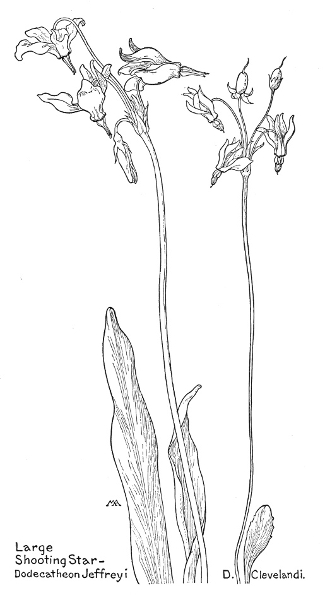
Large Shooting Star—Dodecatheon Jeffreyi. D. Clevelandi.
Small Shooting-star Dodecàtheon pauciflòrum Pink Spring, summer West
A charming little plant, growing in wet, rich mountain meadows, with a smooth reddish stem, about eight inches tall, bearing a bracted cluster of several delicate flowers, and springing from a loose clump of smooth leaves. The flowers are about three-quarters of an inch long, with bright purplish-pink petals, with a ring of crimson, a ring of yellow and a wavy line of red, where they begin to turn back; the stamens with united filaments and long purplish-brown anthers; the pistil white.
OLIVE FAMILY. Oleaceae.
A rather large family, widely distributed, including Olive, Lilac, and Privet; trees and shrubs; leaves mostly opposite; without stipules; flowers perfect or imperfect, with two to four divisions, calyx usually small or lacking, corolla with separate or united petals, sometimes lacking; stamens two or four, on the corolla, ovary superior, two-celled, with a short style or none; fruit a capsule, berry, stone-fruit, or wing-fruit.
There are many kinds of Fraxinus, almost all trees.
Flowering Ash, Fringe-bush Fráxinus macropétala White Spring Arizona
An odd and beautiful shrub, growing on Bright Angel trail, in the Grand Canyon, about as large as a lilac bush, with smooth, bright-green leaves, some of the leaflets obscurely toothed, and drooping plumes of fragrant white flowers. The calyx is very small, and the four petals are so long and narrow that the effect of the cluster is of a bunch of white fringe. The fruit is a flat winged-seed.
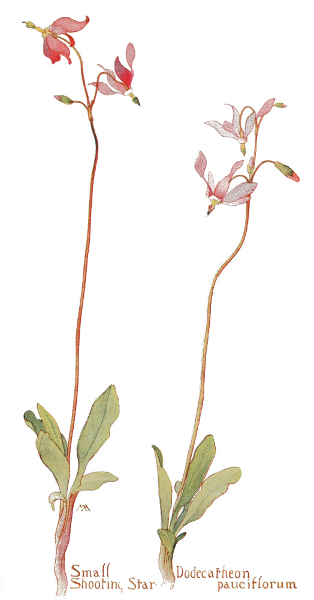
Small Shooting Star—Dodecatheon pauciflorum.
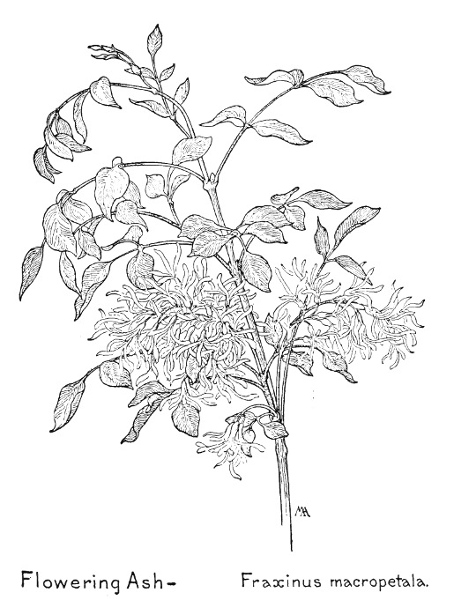
Flowering Ash—Fraxinus macropetala.
GENTIAN FAMILY. Gentianaceae.
A large family, widely distributed, most abundant in temperate regions; smooth herbs, with colorless, bitter juice; leaves toothless, usually opposite, without leaf-stalks or stipules; flowers regular; calyx four to twelve-toothed; corolla with united lobes, twisted or overlapping in the bud, of the same number as the calyx-teeth; stamens inserted on the tube or throat of the corolla, as many as its lobes, alternate with them; ovary superior, mostly one-celled, with a single style or none, and one or two stigmas; fruit a capsule, mostly with two valves, containing many seeds. These plants were named for King Gentius of Illyria, said to have discovered their medicinal value.
There are several kinds of Frasera, North American, all but one western; herbs, with thick, bitter, woody roots; leaves opposite or in whorls; flowers numerous; corolla wheel-shaped, with four divisions, each with one or two fringed glands and sometimes also a fringed crown at base; stamens on the base of the corolla, with oblong, swinging anthers, the filaments often united at base; ovary egg-shaped, tapering to a slender style, with a small, more or less two-lobed, stigma; capsule leathery, egg-shaped, with flattish seeds.
Columbo, Deer's Tongue Fràsera speciòsa Greenish-white Spring, summer, autumn West, etc.
A handsome plant, though rather coarse, from two to six feet tall, with a pale glossy stem, very stout, sometimes over two inches across at the base, and very smooth, pale green leaves, in whorls of four and six, the lower ones sometimes a foot long. The flowers are mixed with the leaves all along the upper part of the stem, but mostly crowded at the top in a pyramidal cluster about six inches long, and are each nearly an inch and a half across, with a greenish or bluish-white corolla, the lobes bordered with violet and dotted with purple, and on each lobe two glands covered by a fringed flap, resembling a small petal, these fringes forming a sort of cross on the corolla. The four stamens stand stiffly out between the corolla-lobes and the general effect of the flower is so symmetrical that it suggests an architectural or ecclesiastical ornament. Though the flowers are not bright, this plant is decorative on account of its luxuriant size and pale foliage, and if Mr. Burbank could make the flowers clear white or purple it would be magnificent. It grows in the western mountains, as far east as Dakota and New Mexico. The finest I ever saw were on an open slope, in a high pass in the Wasatch Mountains, where they reared their pale spires proudly far above the surrounding herbage.
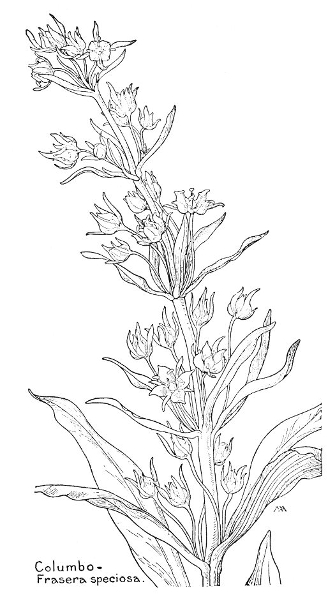
Columbo—Frasera speciosa.
Small Columbo Fràsera nitìda Bluish-white Summer Cal., Oreg.
Quite a pretty plant, too colorless to be effective at a distance, but not coarse, with a smooth, pale stem, over a foot tall, and smooth, dull, bluish-green leaves, slightly stiffish, prettily bordered with white, mostly in a clump near the base. The flowers are about half an inch across, shaped like the last; with bluish-white petals, specked with dull-purple, with a green line on the outside, with one green gland near the center, fringed all around; large whitish anthers, becoming pinkish, and a white pistil.
There are a good many kinds of Erythraea, widely distributed, usually with red or pink flowers; calyx with five or four, narrow lobes, or divisions; corolla salver-form, with five or four lobes; anthers twisting spirally after shedding their pollen; stigmas two, oblong or fan-shaped. The Greek name means "red" and the common name, Centaury, from the Latin, meaning "a hundred gold pieces," alludes to the supposedly valuable medicinal properties of these plants.
Canchalagua, California Centaury Erythraèa venústa (Centaurium) Pink Spring, summer California
From three to twelve inches tall, with apple-green leaves, mostly on the stems, smooth and thin in texture, and flowers an inch or more across, a very vivid shade of purplish-pink, with a yellow or white "eye," bright yellow anthers and green pistil. These are attractive, because they look so gay and cheerful, but the color is a little crude. The flowers are not so large in Yosemite as they are in some places, such as Point Loma, but are very numerous and cover large patches with brilliant color. These plants are called Canchalagua by Spanish-Californians, who use them medicinally.
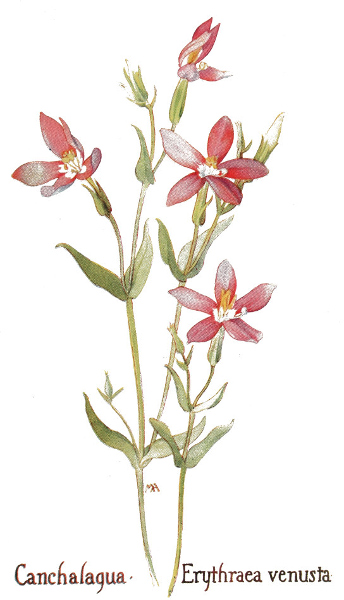
Canchalagua—Erythraea venusta.
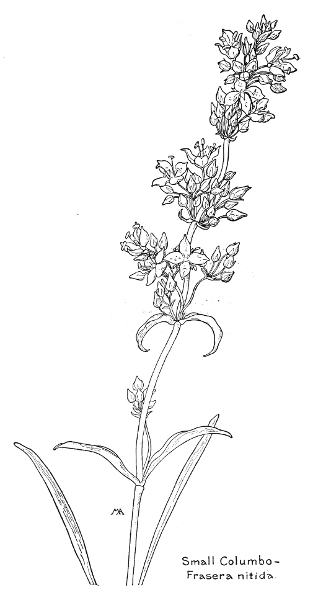
Small Columbo—Frasera nitida.
Tall Centaury Erythraèa exaltàta (E. Douglasii) (Centaurium) Pink Spring, summer, autumn West, etc.
This has a slender, leafy stem, from a few inches to over a foot tall, and flowers not so large as the last, but pretty and gay, about half an inch across, bright pink with a distinct white "eye." This grows in sandy soil, as far east as Wyoming.
There are many kinds of Gentiana, of northern regions and the Andes; calyx tubular, usually with five teeth; corolla variously shaped with from four to seven lobes, often fringed, or with folds between the teeth; style short or lacking; stigma two-lipped.
Northern Gentian Gentiàna acùta Purple Summer West, etc.
A pretty plant, with leafy, often branching stems, from six to twenty inches tall, and numerous flowers, with stiff pedicels and leafy bracts, forming several small clusters along the upper part of the stem. They are each about half an inch long, various shades of purple or blue, sometimes white, and easily recognized by the little crown of white fringe in the throat of the rather tubular, five-lobed corolla. These plants have very small roots, so that it is difficult to pick them without pulling them up, and as they are annuals they are easily exterminated. They are common in northern mountains, in moist places across the continent, and in Europe and Asia.
Gentian Gentiàna propínqua Purple Summer Northwest
This has smooth, thin leaves and pretty flowers, three-quarters of an inch long, with lilac or purple corollas, satiny in texture, with four lobes, pointed at the tips and more or less fringed. This grows in high mountains.
Blue Gentian Gentiàna calycòsa Blue Autumn Northwest
A handsome perennial, with leafy stems, from five to fifteen inches tall, bearing one or several, fine flowers at the top. They are an inch and a half long, with a bright blue corolla, dotted with green, with plaited folds and small teeth between the five lobes. This has been found in Yosemite, but is more common at Lake Tahoe. There are many other handsome large Blue Gentians in the West. G. lùtea, with yellow flowers, is the German kind from which the well-known drug, gentian, is made.
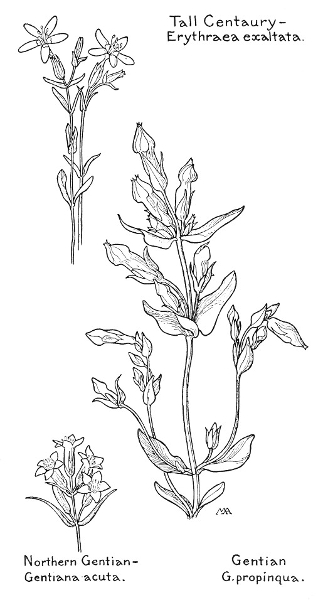
Tall Centaury—Erythraea exaltata. Northern Gentian—Gentiana acuta. Gentian—G. propinqua.
MILKWEED FAMILY. Asclepiadaceae.
A large family, widely distributed, most abundant in warm regions; ours are perennial herbs, usually with milky juice and tough fibrous inner bark; leaves generally large, toothless, without stipules; flowers peculiar in shape, in roundish clusters; calyx with a short tube or none and five lobes; corolla five-lobed; stamens five, on the base of the corolla, with short, stout filaments, anthers more or less united around the disk-like stigma, which covers and unites the two short styles of the superior ovary. The two parts of the ovary develop into two conspicuous pods, opening at the side, containing numerous flattish seeds, arranged along a thick, central axis, usually each with a tuft of silky down to waft it about.
There are many kinds of Asclepias, with oddly-shaped flowers, interesting and decorative in form; calyx rather small, the pointed sepals turned back; corolla with its petals turned entirely back, so as to cover the sepals and expose the peculiar-looking central arrangements of the flower, called the "crown." In the middle is the large, flat, shield-shaped, five-lobed or five-angled stigma, surrounded by the anthers, which are more or less united to each other and to the stigma, encircled by five, odd, little honey-bearing hoods, the same color as the petals, each with a horn, either enclosed within it or projecting from it, the whole collection of stigma, anthers, and hoods, forming the "crown." The pods are thick and pointed. Named for Æsculapius, as some of these plants are medicinal. Indians used to make twine from the fibrous bark of some kinds.