A KEY TO THE FAMILIES. (continued 5)
Reading edition
Showy Milkweed Asclèpias speciòsa Pink Spring, summer West
A handsome plant, decorative in form and harmonious in coloring, with a stout stem, from one to four feet tall, and light bluish-green leaves, usually covered with white down. The flowers are sweet-scented, with woolly pedicels, purplish-pink petals, and waxy, white "hoods," the buds yellowish-pink. The cluster, about three inches across, sometimes comprises as many as fifty flowers and is very beautiful in tone, being a mass of delicately blended, warm, soft tints of pink, cream, and purple. This grows in canyon bottoms and along streams.
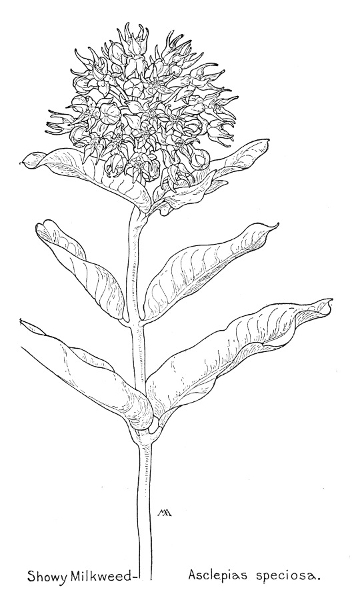
Showy Milkweed—Asclepias speciosa.
Pale Milkweed Asclèpias eròsa Greenish-white Spring California
This is three feet or more tall, fine-looking, though too pale, with a stout, smooth, gray-green stem and gray-green leaves, mottled with white and very stiff, the under side white-woolly, and flower-clusters two and a half inches across, composed of numerous greenish-white flowers, each half an inch long, their stalks covered with white wool.
Desert Milkweed Asclèpias vestìta var. Mohavénsis Yellow and pink Spring California
A foot and a half tall, with very fragrant flowers, and very woolly all over, especially the upper leaves, stems and buds, which are thick with long white wool. The buds are pinkish-purple and the flowers have dull pink petals and cream-colored hoods, becoming yellow, and form clusters over two inches across. This grows in the Mohave Desert and the effect is harmonious, but not so handsome as the last.
The genus Gomphocarpus is distinguished from Asclepias by the absence of horns or crests in the hoods.
Purple Milkweed Gomphocàrpus cordifòlius (Asclepias) Purple and yellow Summer Oreg., Cal.
A handsome plant, smooth all over and more or less tinged with purple, with a stout, purple stem, from one and a half to three feet tall, with rubbery, dull, light bluish-green leaves. The flowers are scentless, with purplish sepals, maroon or purple petals, and yellowish or pinkish hoods, and form a very loose graceful cluster, over three inches across, dark in color and contrasting well with the foliage. This is common in Yosemite and elsewhere in California, at moderate altitudes.
The genus Asclepiodora, of the southern part of North America, resembles Asclepias, but the flowers are larger, the petals not turned back, the hoods flatter, with crests instead of horns; leaves mainly alternate; corolla wheel-shaped; petals spreading; hoods oblong, blunt, spreading and curving upward, crested inside; five tiny appendages alternating with the anthers and forming an inner crown around the stigma. The name is from the Greek, meaning the gift of Æsculapius.
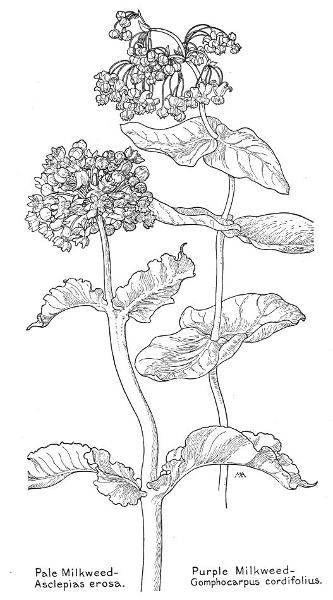
Pale Milkweed—Asclepias erosa. Purple Milkweed—Gomphocarpus cordifolius.
Spider Milkweed Asclepiodòra decúmbens Green and maroon Spring, summer Southwest
A striking plant, though dull in color, from one to one and a half feet tall, with a rough, rather slanting stem, dull green, roughish, rather leathery leaves, and clusters of slightly sweet-scented, queer-looking flowers, each over half an inch across, with greenish-yellow petals, the hoods white inside and maroon outside, their tips curved in, a green stigma and brown anthers. The effect is a dull-yellow rosette, striped with maroon, curiously symmetrical and stiff in form, suggesting an heraldic "Tudor rose." The pods, three or four inches long, stand up stiffly, on pedicels curved like hooks. This grows on dry hillsides and is widely distributed.
DOGBANE FAMILY. Apocynaceae.
A large family, widely distributed, chiefly tropical; ours are perennial herbs, with milky, bitter juice; leaves toothless, usually opposite, without stipules; flowers perfect, parts in fives; corolla united; stamens on the corolla, as many as its lobes, alternate with them, ovary superior, in two parts, united by a single or two-parted style, developing into two pods; seeds often tufted with hairs. The Greek name alludes to the superstition that these plants are poisonous to dogs.
There are many kinds of Apocynum, with branching stems, tough fibrous bark, and small, white or pink flowers, in clusters; calyx with pointed teeth, its tube adhering to the ovaries by means of a thickish, five-lobed disk; corolla bell-shaped, five-lobed, with five, small, triangular appendages, inside the tube, opposite the lobes; stamens with short, broad filaments and arrow-shaped anthers, slightly adhering to the blunt, obscurely two-lobed stigma; pod slender, cylindrical; seeds numerous, small, feathery.
Spreading Dogbane, Honey-bloom Apócynum androsaemifòlium White, pink Summer West, etc.
An attractive plant, from one to four feet high, with many, smooth, widely spreading branches, purplish on one side, and smooth leaves, rather dark green above, pale underneath, with yellowish veins. The little flowers are white, tinged with pink, often striped with pink inside, mainly in loose clusters at the ends of the branches, and though not conspicuous are delicate and pretty. The pods are from two to seven inches long. This is widely scattered in fields and open woods, occurring in a variety of forms, and common in the East.
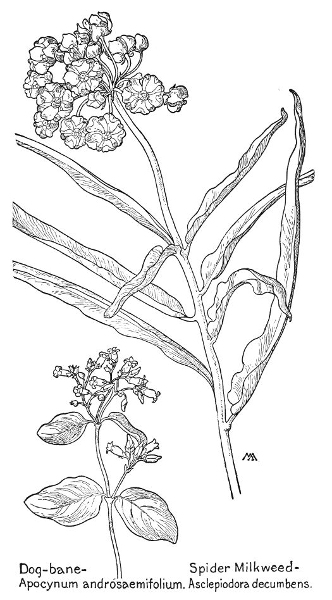
Dog-bane—Apocynum androsaemifolium. Spider Milkweed—Asclepiodora decumbens.
BUCK-BEAN FAMILY. Menyanthaceae.
A small family, widely distributed; perennial herbs, with creeping rootstocks, growing in water or marshes; the leaves smooth, alternate, or from the root; the flowers perfect, regular, in clusters; the calyx five-lobed; the corolla more or less funnel-form with five lobes or teeth; the stamens five, on the corolla and alternate with its lobes; the ovary superior, or partly so, with one cell; the fruit usually an oval capsule, with a few flattish, smooth seeds.
Buck-bean Menyánthes trifoliàta White Spring, summer Northwest
This is the only kind, a handsome plant, eight or ten inches tall, with a stout, yellowish-green stem and rich green leaves, with long, sheathing leaf-stalks and three leaflets, with toothless or somewhat scalloped edges. The flowers are about half an inch long, with a white corolla, tinged with pink or lilac, the spreading lobes covered with white hairs, with black and yellow, swinging anthers and a green pistil, with a two-lipped stigma. There are from ten to twenty flowers in each cluster and the effect is charming, suggesting a bunch of little fringed lilies. This grows in northern bogs across the continent and also in Europe and Asia. It used to be found around San Francisco, but is now extinct.
MORNING-GLORY FAMILY. Convolvulaceae.
A large family, most abundant in the tropics; ours are herbs, usually with twining or trailing stems; the leaves alternate, or mere scales, without stipules; the flowers perfect, with five sepals; the corolla with united petals, more or less funnel-form and more or less five-lobed, folded lengthwise and twisted in the bud; the stamens five, on the base of the corolla; the ovary superior, with from one to three styles; the fruit usually a capsule, with from one to four large seeds.
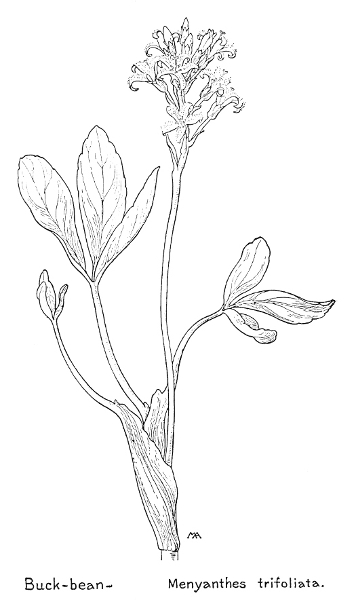
Buck-bean—Menyanthes trifoliata.
There are a great many kinds of Convolvulus, widely distributed; ours are mostly twining or prostrate perennials; the flowers large, with a slender style and two stigmas; the fruit a capsule, usually with two large seeds. The name is from the Latin, meaning "to entwine." These plants are often called Bindweed.
Field Morning-glory Convólvulus arvénsis White, pinkish Spring, summer, autumn West, etc.
This is a troublesome weed, introduced from Europe, with very deep roots and pretty flowers. The leaves are dull green and look roughish, though they are smooth or nearly so, and the flowers are about an inch across, white inside, striped with pink and tinged with yellow at the base, and pink outside, striped with duller, deeper color. The stamens and pistil are white and the buds purplish-pink. The flower stalks usually have a pair of bracts near the middle.
Yellow Morning-glory Convólvulus occidentàlis Cream-color Summer Northwest
An attractive plant, with pretty foliage and large, pale flowers, the stems trailing on the ground and climbing over low bushes. The leaves are smooth and dark bluish-green and the flowers are about two inches and a half across, very pale yellow, almost cream-color, with stripes of slightly deeper yellow, tinged with pink. The anthers and the pistil are pale yellow and the flower-stalks have two bracts just beneath the calyx.
There are many kinds of Cuscuta, or Dodder, widely distributed and difficult to distinguish; leafless parasites, without green coloring, with twining, threadlike stems and inconspicuous flowers, in clusters. The seed germinates in the soil and produces a twining stem, which attaches itself to a neighbor by means of suckers. These plants are easily recognized, for they look like tangled bunches of coarse thread, and are often very conspicuous on account of their coloring, sometimes making fine masses of bright orange-color, beautiful in tone, though the plants are very unattractive. They have other names, such as Love-vine and Strangle-weed.
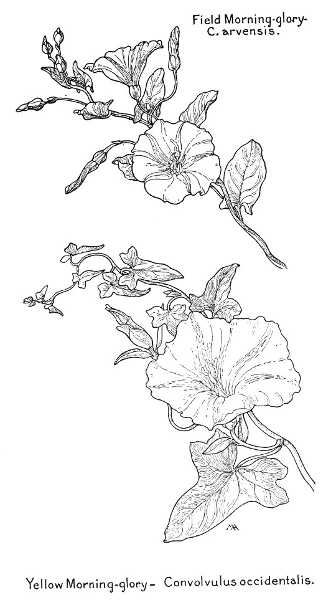
Field Morning-glory—C. arvensis. Yellow Morning-glory—Convolvulus occidentalis.
PHLOX FAMILY. Polemoniaceae.
Not a large family, most abundant in western North America, a few in Europe and Asia; sometimes slightly woody; the leaves without stipules; the flowers generally regular; the calyx with five united sepals; the corolla with five united petals, rolled up in the bud and often remaining more or less twisted to one side in the flowers; the stamens with slender filaments, with swinging anthers, often unequally inserted, on the tube or throat of the corolla and alternate with its lobes; the ovary superior, with a slender style and three-lobed stigma, but in immature flowers the three branches are folded together so that the style appears to have no lobes; the pod with three compartments, containing few or many seeds, which are sometimes winged and sometimes mucilaginous.
There are a good many kinds of Polemonium, growing in cool places, usually perennials; the leaves alternate, with leaflets, not toothed; the calyx not ribbed or angled, bell-shaped; the corolla more or less bell-shaped; the stamens equally inserted, but often of unequal lengths; the seeds mucilaginous when wet. This is the Greek name, used by Dioscorides.
Jacob's Ladder Polemònium occidentàle (P. coeruleum) Blue Summer Northwest
A graceful plant, with attractive and unusual-looking foliage. The juicy stem and tender, bright green leaves are smooth or hairy and the pretty flowers are nearly three-quarters of an inch across, bright rather purplish blue, paler inside and delicately veined with blue, with a yellow "eye." The stamens are protruding, with white anthers, and the pistil is long and protruding, even in quite small buds. This is variable and grows in damp places in the mountains, across the continent and also in the Old World. The common name comes from the shape of the leaf and it is also called Greek Valerian. Another handsome sort is P. carnèum, with flowers varying in color from salmon to purple, growing in the mountains of California and Oregon, but rather rare.
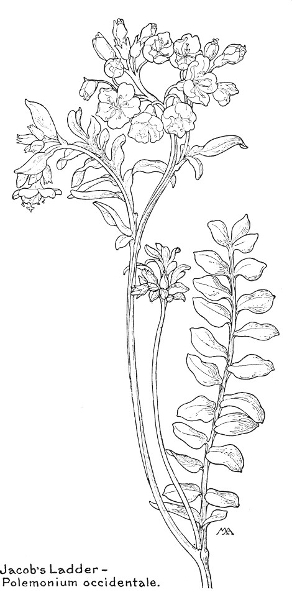
Jacob's Ladder—Polemonium occidentale.
There are many kinds of Linanthus; low, slender annuals, with opposite, palmately-divided leaves and thus differing from Gilia, the divisions narrow or threadlike, looking almost like whorls in some kinds, or rarely toothless, occasionally some of the upper leaves alternate; the flowers scattered, or in terminal, roundish clusters; the calyx-tube thin and dry between the ribs or angles, the teeth equal; the corolla more or less wheel-shaped, funnel-form, or salver-form; the stamens equally inserted on the corolla; the seeds few or many, developing mucilage when moistened. The Greek name means "flax flower."
Linánthus Párryae (Gilia) White Spring California
A queer little plant, only about two inches high, with almost no stem, very small, stiff leaves, and several large, pretty flowers, with cream-white corollas, about an inch across, with five crests in the throat, and the tube tinged with purple on the outside. They are exceedingly fragile and diaphanous in texture and form little white tufts, which look very odd and attractive, sprinkled over the sand in the Mohave Desert.
Linánthus brevicùlus (Gilia) Pink, violet Spring California
This has slender, purplish, rather hairy stems, from six to eight inches tall, stiff, dull green, hairy leaves, tipped with bristles, and flowers over half an inch across, with sticky, hairy calyxes. The slender corolla-tubes are half an inch long, with delicate rose-pink or violet petals, white anthers, and a whitish pistil. This looks very pretty growing on the bare sand of the Mohave Desert.
Linánthus androsàceus (Gilia) Lilac, pink, or white Spring, summer California
This is very pretty, with a stiff, slender, hairy, branching stem, from three inches to a foot tall, with stiffish, dull green leaves, apparently in whorls and cut into very narrow divisions, with bristles or hairs along the margins. The flowers are over half an inch across, with a long threadlike tube, and are usually bright lilac but sometimes pink or white, with a yellow, white, or almost black "eye," orange-colored anthers and a long, yellow pistil. The flower-cluster is mixed with many bracts and the stems often branch very symmetrically, with clusters at the tips. This is common on dry hillsides, growing in the grass, and often makes bright patches of color. There are several named varieties.
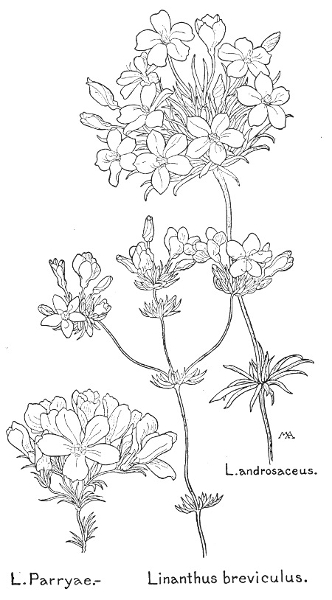
L. androsaceus. L. Parryae. Linanthus breviculus.
Evening Snow Linánthus dichótomus (Gilia) White Spring California
Exceedingly pretty flowers, with very slender, brown stems, often branching, from two to twelve inches tall, and a few, rather inconspicuous, dull green leaves. The flowers are an inch or more across, with a salver-form corolla, with a long slender tube, white and beautifully sheeny in texture, bordered with dull pink on the outside, showing where the petals overlapped in the bud; the stamens and pistil not showing in the throat. They have a strong and unpleasant odor, but the effect of the airy flowers is beautiful, especially in the desert, as they sway to and fro in the wind on their slender stalks. They open only in the evening, but stay open all night and keep on opening and closing for several days, getting larger as they grow older. This is common on open slopes and hills, but is variable and not easily distinguished from similar species.
Yellow Gilia Linánthus àureus (Gilia) Yellow Spring Arizona
A charming little desert plant, about three inches tall, with a very slender, usually smooth, widely branching stem and small, pale green leaves, apparently in whorls and cut into very narrow divisions, quite stiff and tipped with a bristle. The flowers are about half an inch across, bright yellow, with an orange-colored "eye" and tube, orange anthers and a yellow pistil, and they look exceedingly gay and pretty on the pale sand of the desert.
Linánthus parviflòrus (Gilia) White, pink, lilac Spring California
A very pretty little plant, slightly hairy, with a slender stem, from three to ten inches tall, and clusters of small, stiff, dark green leaves. The flowers are about three-quarters of an inch across, with long, threadlike, yellow tubes, sometimes an inch and a half long, and white, pink, or lilac petals, with an orange or white "eye" and often brownish on the outside, with yellow anthers and a conspicuously long, yellow pistil. This is common throughout California, growing in open ground on hills and sea-cliffs. L. parviflorus var. aciculàris is similar, but smaller. The flowers are similar, but often have so little white about them that they are yellow in general effect, and are sometimes specked with crimson at the base of the petals. They grow in sandy places in southern California.
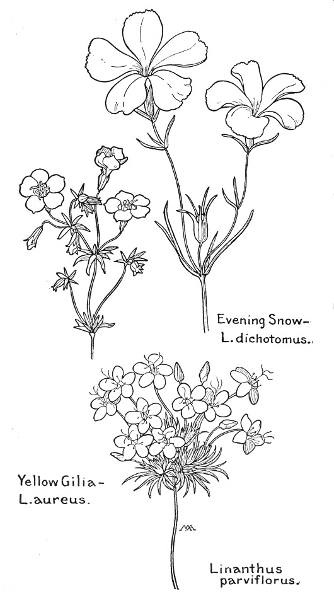
Evening Snow—L. dichotomus. Yellow Gilia—L. aureus. Linanthus parviflorus.
Ground Pink, Fringed Gilia Linánthus dianthiflòrus (Gilia) Pink Spring California
Charming little flowers, exceedingly delicate and gay. The stem is usually only a few inches tall, the leaves are very narrow, and the flowers are three-quarters of an inch across, with bright pink petals, prettily toothed at the tips, shading to white and yellow in the center and often with a purple ring in the throat. This is common in southern California and often grows in quantities, sprinkling the ground with its bright little flowers.
Linánthus liniflòrus (Gilia) White Spring, summer California
This is a few inches tall, with purplish stems, which are so very slender and wiry that they look hardly thicker than hairs and the flowers seem to be hovering in the air, giving an exceedingly pretty and delicate effect. The leaves are stiff and dark green and the flowers are half an inch or more across, with a yellowish tube and white petals, delicately veined with blue, with a pale yellow pistil and orange anthers. This grows on the dry tops of mesas, in southern California.
There are many kinds of Phlox, natives of North America and Asia, usually perennials, the leaves toothless, mostly opposite, at least the lower ones; the calyx five-ribbed; the corolla salver-form; the stamens inserted very unequally in the tube and not protruding; the seeds not mucilaginous. The salver-form corolla and the seeds not being mucilaginous distinguishes Phlox from Gilia. The name is from the Greek, meaning "flame."
Alpine Phlox Phlóx Douglásii White, lilac Summer Northwest, etc.
A charming little plant, with woody stems a few inches tall and partly creeping along the ground, densely crowded with numerous needle-like leaves, forming dull green, cushion-like mats, sometimes over a foot across and suggesting some sort of prickly moss. These prickly cushions are sprinkled thickly all over with pretty lilac flowers and the effect is most attractive. The flowers vary in tint from white to pink and purple and are nearly three-quarters of an inch across and slightly sweet-scented. The tube is longer than the hairy calyx, and the petals fold back in fading. This grows on gravelly slopes and summits around Yosemite and in the Northwest, from the Rocky Mountains to Nebraska, and its patches of pale color are often conspicuous in dry rocky places, or in open forests, at an altitude of three to seven thousand feet.
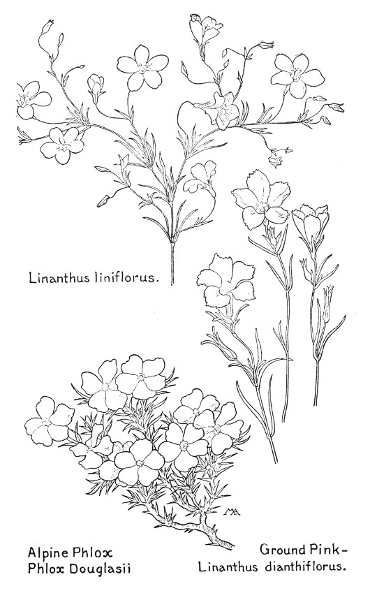
Linanthus liniflorus. Alpine Phlox—Phlox Douglasii. Ground Pink—Linanthus dianthiflorus.
Wild Sweet William Phlóx longifòlia Pink Spring, summer, autumn West, etc.
Very attractive common flowers, with many stems, three to eight inches high, from a woody base. The leaves are smooth or somewhat downy, stiffish, pale gray-green and rather harsh, and the flowers are over three-quarters of an inch across, clear pink, of various shades from deep-pink to white, with an angled calyx. Only two yellow stamens show in the throat and the style is long and slender. This grows on hills and in valleys, as far east as Colorado, and its pretty flowers are very gay and charming, particularly when growing in large clumps in fields or beside the road. P. Stánsburyi, common on the plateau in the Grand Canyon, blooming in May, is similar, but has sticky hairs on the calyx.
There are many kinds of Gilia, variable and not easily distinguished; the leaves nearly always alternate and thus differing from Linanthus; the corolla funnel-form, tubular, or bell-shaped, but, unlike Phlox, rarely salver-form and the seeds are usually mucilaginous when wet. These plants were named for Gil, a Spanish botanist.
Scarlet Gilia, Skyrocket Gília aggregàta Red Spring, summer, autumn Southwest, Utah, etc.
A brilliant biennial or perennial plant, varying in general form and color. In Utah it is somewhat coarse and usually has a single, leafy, roughish, rather sticky stem, from one to two feet tall, purplish towards the top, and thickish, somewhat sticky leaves, deeply lobed and cut, in a cluster at the root and alternate along the stem, dull bluish-green in color, smooth on the under side, with more or less sparse woolly down on the upper side, as if partially rubbed off. The flowers have no pedicels, or very short ones, and form small clusters in the angles of the leaves along the upper part of the stem, but are mainly at the top, in a large, handsome, somewhat flat-topped, loose cluster. They are each more than half an inch across, with a corolla of clear scarlet, the lobes shading at base to white, finely streaked with crimson and prettily fringed at the tips. The stamens are equally or unequally inserted in the corolla throat, the buds are prettily twisted and fringed at the tips and usually have a dark purplish calyx. Sometimes the flowers are all scattered along the stalk, making a wand of bloom. This grows on mountain sides and sometimes has a very disagreeable smell, hence the local name of Polecat Plant. In Yosemite it is much more delicate in character, with several, smooth or downy, reddish, leafy stems, from one to four feet high, from a branched base, bearing very graceful clusters of flowers, the petals of various shades of scarlet, pink, and crimson, often streaked with white, or yellowish dotted with red, their long points curled back. Often the buds are scarlet and the flowers pink, giving a very vivid effect. The protruding stamens are inserted in the notches between the lobes of the corolla, with red or pink filaments and yellow or purple anthers. This has the look of a hothouse flower and is very beautiful and striking when growing in masses in high mountain woods. This has several common names which are very misleading, such as Wild Cypress and Wild Honeysuckle. There are several named varieties. It grows in the Southwest and also from British Columbia to New Mexico.
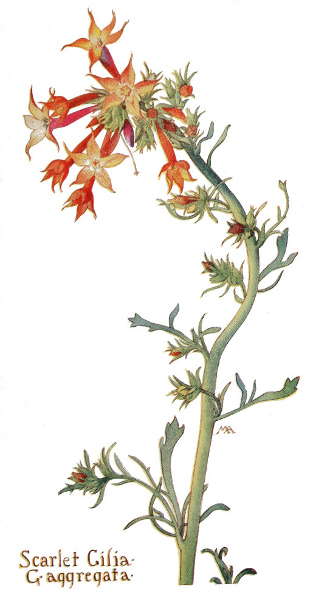
Scarlet Gilia—G. aggregata.
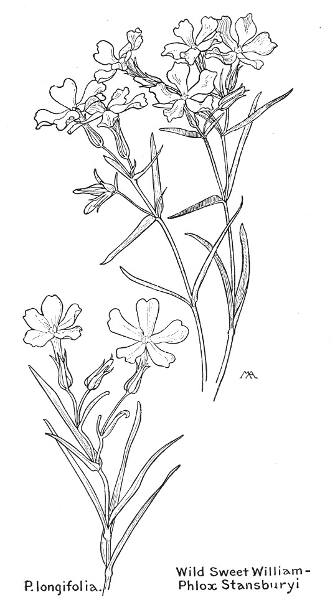
P. longifolia. Wild Sweet William—Phlox Stansburyi.
Bird's Eyes Gília trìcolor White and purple and yellow Spring Southwest
A beautiful kind, with rather hairy, branching stems, from six inches to over a foot tall, and dull green, rather hairy leaves, prettily cut into long narrow lobes. The flowers are in clusters, sweet-scented and beautifully marked, with corollas a half-inch or more in length, open funnel-shaped, with a yellow tube marked by a white border, and two dark purple spots in the throat below each of the blue or whitish corolla-lobes, forming an "eye." The calyx lobes often have purple margins, the anthers are bright blue, with lilac filaments, and the pistil is lilac. This is common on low hills in western California.
Blue Desert Gilia Gília rigídula Blue Summer Arizona
A strange little desert plant, stunted-looking but with brilliant flowers, forming low, prickly clumps of stiff, dry, dull green, needle-like foliage, suggesting cushions of harsh moss, with numerous woody stems, two or three inches high, and numbers of pretty flowers, half an inch across, deep bright blue, with a little yellow in the center; the stamens, with bright yellow anthers, projecting from the throat. This bravely opens its bright blue eyes in the desert wastes of the Petrified Forest.
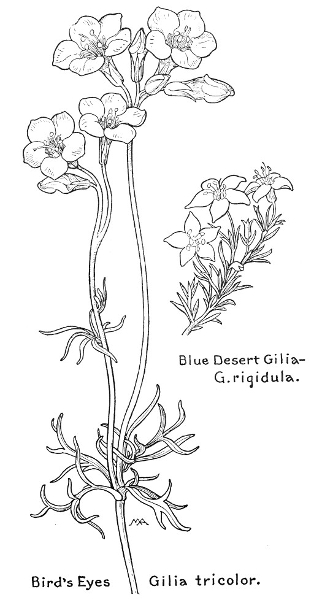
Blue Desert Gilia—G. rigidula. Bird's Eye—Gilia tricolor.
Downy Gilia Gília floccòsa Blue Spring Southwest
A little desert plant, about three inches tall, more or less downy all over, the upper leaves and buds covered with soft white down and the lower leaves dark green and stiff, tipped with a bristle. The tiny flowers have a blue corolla, varying from sky-blue to almost white, with a yellow throat and white stamens, and although they are too small to be conspicuous, the effect of the bits of blue on the desert sand is exceedingly pretty.
Small Prickly Gilia Gília púngens White Summer California
This resembles Alpine Phlox in general effect, but the corolla is funnel-form instead of salver-form, for the lobes do not spread so abruptly. The many stems are woody below, a few inches high, and crowded with leaves, which are dull green, stiff, and cut into needle-like divisions, which look like single leaves, about half an inch long. The flowers are pretty and fragrant, half an inch across, white or pale pink, often with purplish streaks on the outside, with rounded lobes, the edge of each overlapping the next, and yellow anthers, not projecting from the throat of the corolla. This forms loose mats on rocky ledges, at high altitudes.
Gília multicàulis Lilac Spring California
A rather pretty little plant, about eight inches tall, with several slender, slightly hairy stems and leaves cut into very narrow divisions. The little flowers are pale lilac, quite delicate and pretty, though not conspicuous, and form clusters at the tips of the branches. This sometimes grows in quantities in the hills of southern California and is variable.
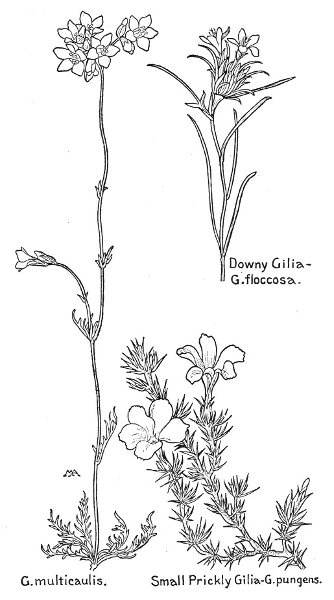
Downy Gilia—G. floccosa. G. multicaulis. Small Prickly Gilia—G. pungens.
Large Prickly Gilia Gília Califórnica Pink Summer California
An unusual-looking, conspicuous, shrubby plant, suggesting some kind of small prickly pine or cedar, with lovely flowers. It forms large straggling clumps, about two feet high, with many woody stems and rich-green foliage, the leaves cut into small, spreading, needle-like lobes, and ornamented with numbers of brilliant flowers. They are an inch or more across, with bright pink petals and a white "eye," and are most delicate in texture, with a satiny sheen and smelling sweet like violets. This grows on hills and is very beautiful on Mt. Lowe.
Gília achillaefòlia Blue, white Spring, summer California
This varies a good deal in color and beauty. The stems are smooth and slender, from one to two feet tall, and the leaves are alternate, smooth or downy, delicately cut into many fine divisions. The numerous small flowers are funnel-form, with projecting stamens, and form a close round head, which is an inch or more across, without bracts. The calyx is more or less woolly, with sharp triangular teeth, the tips turned back. Usually the flowers are blue of some shade, deep or pale, sometimes forming patches of color in the fields, but the prettiest I have seen grew in the woods near Santa Barbara, the individual flowers larger than usual and pure white, with bright blue anthers. It is common in Yosemite, but rather dull bluish-white and not pretty.
Gília capitàta Blue Spring, summer Northwest and California
Very much like the last, but the flowers are smaller and form a smaller, more compact head. The corollas are blue, with narrow petals, varying in tint from purplish-blue to pale lilac, the calyx not woolly, and the cluster is about an inch across, the stamens giving it a fuzzy appearance. The leaves are smooth or slightly downy and the seed-vessels form pretty pale green heads. This is common and sometimes grows in such quantities as to be very effective.
Gília multiflòra Blue Summer Ariz., New Mex.
The general effect of this plant is inconspicuous, though the flowers are quite pretty close by. The roughish woody stem is only a few inches tall and then branches abruptly into several long sprays, clothed with many very small, narrow, pointed, thickish, dull green leaves and ornamented towards the end with small clusters of flowers, which are lilac or blue, marked with purple lines, less than half an inch across, with five irregular lobes and blue anthers. This grows at the Grand Canyon and in dry open places in the mountains.
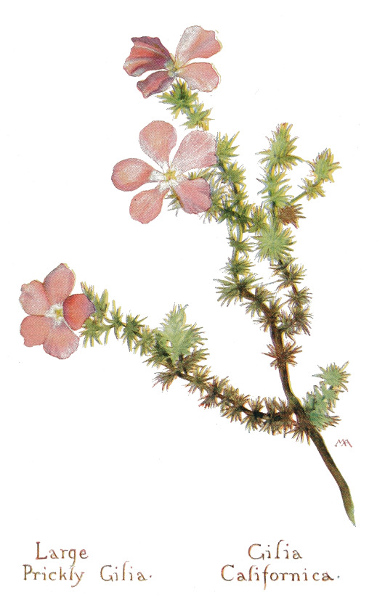
Large Prickly Gilia—Gilia Californica.
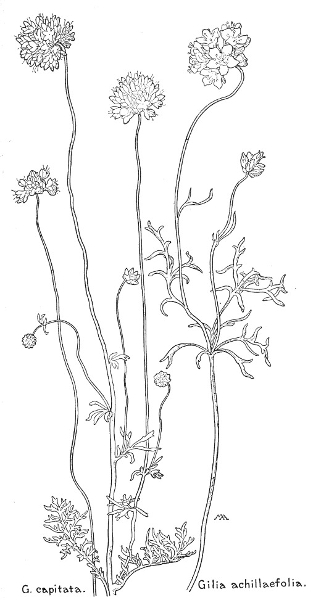
G. capitata. Gilia achillaefolia.
There are several kinds of Collomia, almost all annuals; leaves alternate, usually toothless; flowers in clusters; differing from Gilia and Linanthus in the calyx, which increases in size as it grows older; corolla tube-shaped, funnel-form, or salver-form, with spreading lobes; stamens unequally inserted on the corolla-tube, with unequal filaments; seeds usually mucilaginous.
Collòmia grandiflòra (Gilia) Buff Summer Cal., Utah, Wash.
Very pretty flowers, which attract attention because of their unusual coloring. The leafy stem is from one to two feet tall and slightly downy and the leaves are generally toothless, smooth, and rather dark green. The flowers form a roundish terminal cluster, which is about two inches across, surrounded by broad bracts, which are sticky to the touch. The corolla is funnel-form, about an inch long, various shades of buff or salmon-color, and as the downy buds are yellow, the newly-opened flowers buff, and the older ones pinkish or cream-white, the combinations of color are odd and effective. This is quite common in Yosemite, in warm situations, and much cultivated in Germany. It is sometimes called Wild Bouvardia, but this is a poor name, as it is that of a plant belonging to an entirely different family.
Collòmia lineàris (Gilia) Pink Summer West
From six inches to over a foot tall, with a rather stout, very leafy stem, more or less branching, and alternate leaves, smooth, toothless, and rather dark green, the upper stems and buds hairy and sticky. The flowers have no pedicels and narrow funnel-form or salver-form corollas, bright pink, about a quarter of an inch across, and are crowded in roundish clusters, at the tips of the leafy branches, the larger clusters toward the top. Though the tiny flowers are bright and pretty this is not an effective plant. It grows in dry, open, sandy places and the foliage has a rather disagreeable smell when crushed.
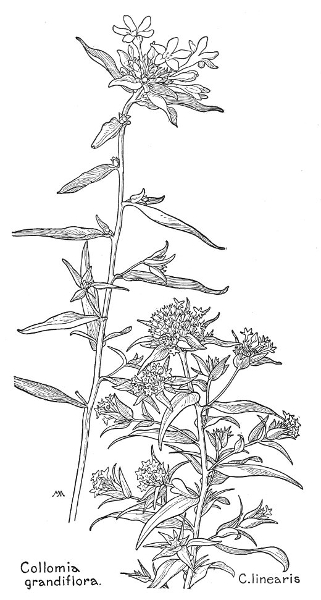
Collomia grandiflora. C. linearis.
WATERLEAF FAMILY. Hydrophyllaceae.
Herbs or shrubs, mostly natives of western North America; often hairy; with no stipules; the leaves mainly alternate or from the root; the flowers chiefly blue or white, often in coiled clusters; the calyx with five united sepals; the corolla with five united petals; the stamens five, on the base of the corolla and alternate with its lobes, with threadlike filaments and usually with swinging anthers; the ovary superior, the styles two or two-cleft; the fruit a capsule, containing few or many seeds. The leaves were formerly supposed to have water-cavities in them, hence the misleading name. Some of this family resemble some of the Borages, but the stamens are long, the styles are two, at least above, and the ovary has not the four conspicuous lobes of the latter family.
There are many kinds of Phacelia, hairy plants, with no appendages between the sepals; resembling Hydrophyllum, except that the petals overlap in the bud, instead of being rolled up, and the seeds are different. The name is from the Greek, meaning "cluster."
Phacelia Phacèlia lóngipes Purple Spring California
This has pretty and rather unusual looking foliage, for the leaves are a peculiar shade of bluish-green, with purplish margins. They are somewhat sticky, soft and velvety, and although hairy are not disagreeable to touch. The hairy, purplish stems grow from a few inches to a foot tall and the pretty flowers are lilac or purple, with yellow anthers, and measure three-quarters of an inch across. This grows on sunny, sandy mountain slopes.
Phacelia Phacèlia glechomaefòlia Lilac, white Summer Ariz., Utah, Cal.
A low plant, partly creeping, with weak, brittle, sticky stems and soft, slightly thickish, very dull yellowish-green leaves, sticky and often dingy with dust. The flowers are usually violet, but sometimes pure white, about three-eighths of an inch across, with yellow stamens, and are rather pretty. I found this little plant growing under a huge red rock in the Grand Canyon, on apparently perfectly dry, bare soil. It has an aromatic and slightly unpleasant smell and is rare.
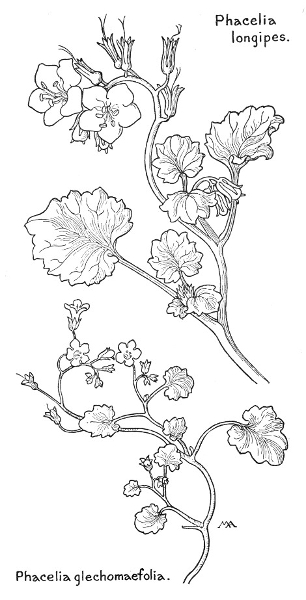
Phacelia longipes. Phacelia glechomaefolia.

Phacelia Phacèlia serícea Purple Summer Northwest, Nev., Utah
A mountain plant, which in favorable situations is exceedingly handsome and conspicuous, about a foot tall, but sometimes more, with downy, leafy stems, and handsome, silky-downy foliage, cut into many narrow divisions. The bell-shaped flowers are three-eighths of an inch across, rich purple, with very long, purple filaments and yellow anthers, and are crowded in magnificent clusters, sometimes eight inches long and very feathery. The corolla dries up and remains on the fruit. This has a disagreeable smell and grows at very high altitudes, where it is unusual to find such large showy flowers. In dry unfavorable situations it is often small and pale in color.
Phacelia Phacèlia Párryi Purple Spring California
This has very handsome flowers, but the plant is too straggling. The branching, reddish stems are very hairy and rather sticky, from one to nearly two feet tall, with dull green, hairy leaves, which are harsh but not disagreeable to touch, and the flowers are over three-quarters of an inch across, with a very hairy calyx and a bright purple corolla, with a cream-colored spot, the shape of a horseshoe, at the base of each petal. The filaments are purple and hairy, with cream-colored anthers and the style is white, tipped with purple. This sometimes grows in such quantities as to give a very brilliant color effect and is found from Los Angeles to San Diego.
Vervenia Phacèlia dístans Violet Spring Southwest
This is from eight inches to two feet high, with hairy, soft, dull green leaves and hairy stems, which are usually branching and spreading. The flowers are less than half an inch across, with a very hairy, sticky calyx, a violet corolla, varying in tint from dull white to bright blue, fading to purple, and purple filaments with whitish anthers. This grows in dry places and is common, often forming large clumps covered with flowers which are quite effective in color, though the plants are too straggling and hairy to be very attractive close by. P. ramosíssima is similar but coarser, the flowers are larger, and the plant is exceedingly hairy, the calyxes being covered with conspicuous, long, white hairs, and the whole plant unpleasant to touch.
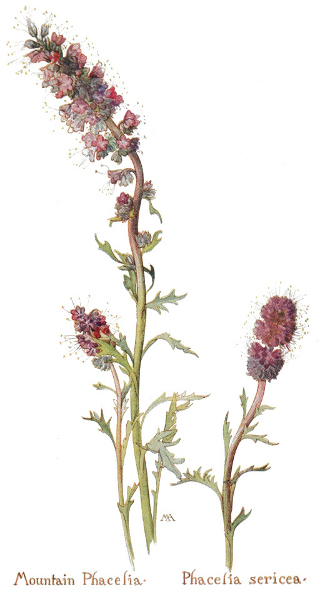
Mountain Phacelia—Phacelia sericea.
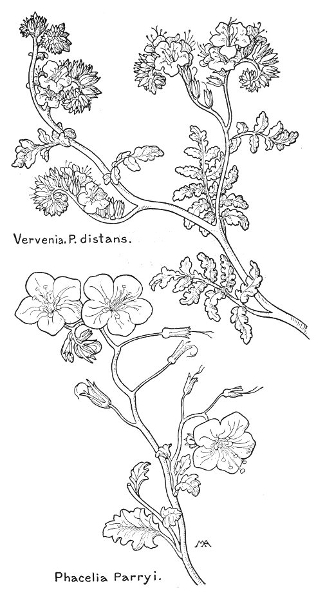
Vervenia. P. distans. Phacelia Parryi.
Phacelia Phacèlia Fremóntii Purple Spring Southwest and Utah
A charming little desert plant, four or five inches high, with one or more, purplish, branching stems, springing from a pretty cluster of thickish, dull green root-leaves. The flowers are half an inch across, with sticky, hairy calyxes and buds and bright purple corollas, with bright yellow throats, from which the stamens do not protrude. These little flowers look very gay and pretty against the desert sand.
Phacelia Phacèlia lineàris Purple Spring, summer Northwest and Utah
This is a delicate and pretty plant, in spite of its hairy foliage, from six inches to a foot high, with a hairy stem, purplish and somewhat branching, and alternate leaves, which are sometimes deeply cleft, usually have no leaf-stalks and are hairy and light yellowish-green in color. The flowers are pretty, grouped in rather long clusters, and are each about half an inch across, with a hairy calyx and a corolla delicately tinted with various shades of clear lilac and blue, shading to white in the center, with long narrow appendages in the throat between the stamens, which are long and conspicuous, giving a feathery appearance to the cluster. The anthers are dark purple and mature before the stigma, and the buds are pink and white. This grows on dry hillsides, often under sage-brush.
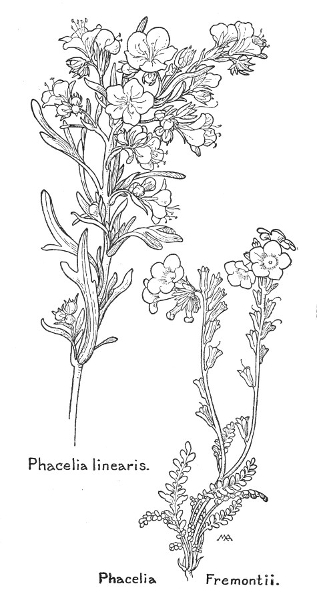
Phacelia linearis. Phacelia Fremontii.
Phacelia Phacèlia grandiflòra Lilac Summer California
A very handsome kind, though rather coarse, and hairy and sticky all over, but with lovely, delicate flowers. The stems are from one to three feet tall and the dark green leaves are velvety on the upper side and hairy on the under. The flowers often measure two inches across, with a lilac or mauve corolla, shading to white in the center, flecked and streaked with brown, blue, or purple, and the stamens have purple filaments and pale yellow anthers. This plant is unpleasantly sticky, with a viscid fluid which stains everything with which it comes in contact, is poisonous to some people, and is found from Santa Barbara to San Diego.
Phacèlia víscida var. albiflòra White Spring California
This is a white variety, with pretty, delicate white flowers. Phacelia viscida is very much like P. grandiflora, and has about the same range, but is not so large a plant, usually about a foot tall, with smaller flowers, about an inch across. The corollas are blue, with purple or white centers.
Wild Canterbury-bell Phacèlia Whitlàvia Purple Summer California
Charming flowers, though the foliage is rather too hairy. The stout, reddish stems are hairy, brittle, and loosely branching, about a foot tall, and the leaves dull green and hairy. The handsome flowers are in graceful nodding clusters, with a bell-shaped corolla, about an inch long, a rich shade of bluish-purple, the long conspicuous stamens and pistils giving an airy look to the blossoms. The filaments are purple and the anthers almost white and, as in other Phacelias, when the corolla drops off the long forked style remains sticking out of the calyx like a thread. This grows in light shade in rich moist soil in the hills.
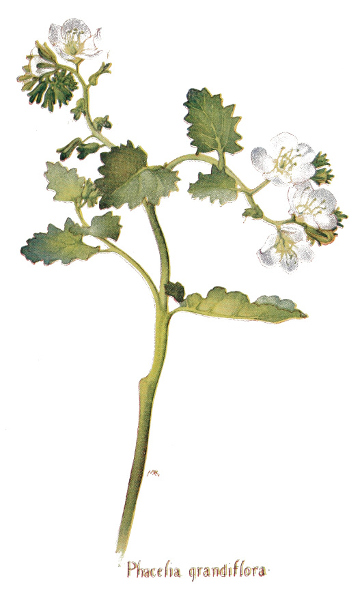
Phacelia grandiflora.
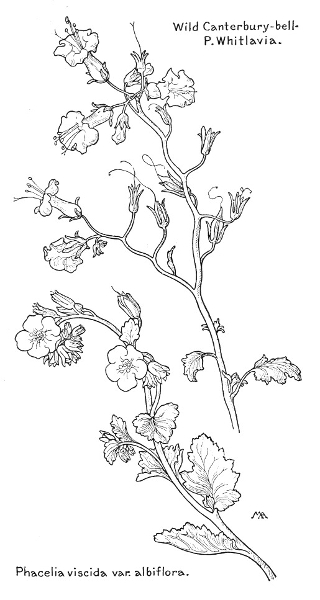
Wild Canterbury-bell—P. Whitlavia. Phacelia viscida var. albiflora.
Alpine Phacelia Phacèlia alpìna Lilac Summer Utah, Nev., etc.
This just misses being a very pretty plant, for the leaves are attractive, but the flowers are too small and too dull in color for the general effect to be good. The stems are about ten inches tall, purplish and downy, and the leaves are dull green and rather downy, with conspicuous veins. The buds are hairy and the flowers are lilac and crowded in coiled clusters, to which the long stamens give a very feathery appearance. This is found in the mountains, as far east as Montana and Colorado, and reaches an altitude of over twelve thousand feet.
Wild Heliotrope Phacèlia crenulàta Lilac Spring Arizona
This is a fine plant, from six to eighteen inches tall, with purplish stems and handsome coarse foliage, all rough, hairy, and very sticky. The flowers are lilac, with purple stamens and pistil, and the general effect is that of a large coarse Heliotrope. The flowers have a pleasant scent, but the foliage has a strong and disagreeable smell, and it grows on the plateau in the Grand Canyon.
Arizona Phacelia Phacèlia Arizònica White, mauve Spring Arizona
A little desert plant, not very pretty, with several hairy flower-stalks, from three to six inches tall, springing from a rosette of soft thickish leaves, slightly hairy, dull green in color, and something the shape of the leaves of P. Fremontii, but the lobes not nearly so small. The flowers are in tightly coiled clusters; the corolla a little more than a quarter of an inch across, dull white, with a pinkish line on each lobe and lilac anthers, the general effect being mauve.
There are a good many kinds of Nemophila, natives of North America, mostly Californian, slender, fragile herbs, with alternate or opposite leaves, more or less divided, and usually large, single flowers, with rather long flower-stalks. The calyx has an appendage, resembling an extra little sepal, between each of the five sepals, which makes these plants easy to recognize, and the corolla is wheel-shaped or bell-shaped, usually with ten, small appendages within, at the base, and the petals are rolled up in the bud; the stamens are short; the styles partly united. The name is from the Greek, meaning "grove lover," because these plants like the shade.
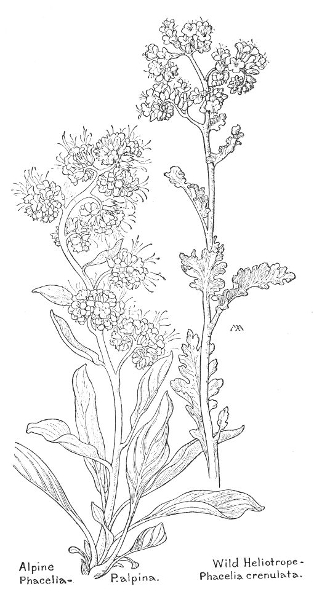
Alpine Phacelia—P. alpina. Wild Heliotrope—Phacelia crenulata.
Baby Blue-eyes, Mariana Nemóphila insígnis Blue and white Spring California
These are exceedingly charming little plants, with slender, weak, hairy stems, varying a good deal in height, but usually low and spreading, and pretty, light green, soft, hairy foliage, sprinkled with many lovely flowers, an inch or more across, with hairy calyxes and sky-blue corollas, which are clear white in the center and more or less specked with brown, with ten hairy scales in the throat. The blue of their bright little faces is always wonderfully brilliant, but they are variable and are usually deeper in color and rather smaller in the South. This is one of the commonest kinds of Nemophila in California and it is a general favorite. It is called Mariana by the Spanish Californians.
Baby Blue-eyes Nemóphila intermèdia Blue and white Summer California
This is much like the last, but it is a taller and more slender plant, usually about ten inches high. The lovely delicate flowers are less than an inch across, with light blue corollas, usually shading to white at the center and delicately veined with blue, or speckled with purple dots. This grows among the underbrush.
Spotted Nemophila Nemóphila maculàta White and purple Summer California
These are charming flowers, their corollas oddly and prettily marked. The weak, hairy stems, from three to twelve inches long, are usually spreading and the leaves are opposite, hairy, and light green. The flowers are about an inch across, with hairy calyxes and white corollas, which are prettily dotted with purple and usually have a distinct indigo spot at the tip of each petal, which gives an unusual effect. The filaments are lilac and the anthers and pistil are whitish. This is common in meadows around Yosemite and in other places in the Sierras at moderate altitudes.
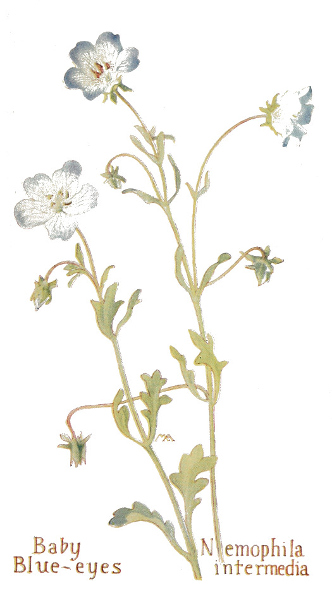
Baby Blue-eyes—Nemophila intermedia.
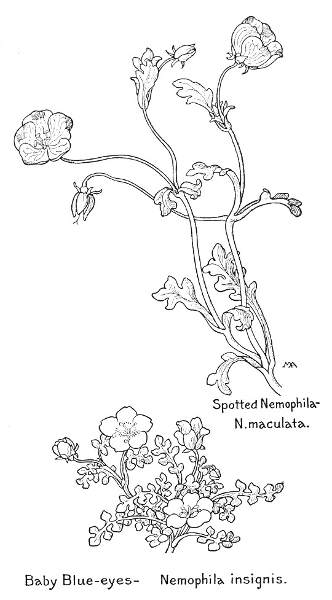
Spotted Nemophila—N. maculata. Baby Blue-eyes—Nemophila insignis.
Climbing Nemophila Nemóphila aurìta Purple Summer California
This is a straggling plant, with pretty delicate flowers, which suggest some sort of Nightshade. The stems are pale, square, juicy and very brittle, from one to three feet long, and the leaves are bright green and most of them are alternate, with leafstalks which are winged and clasping at base. The backs of the leaves, and the stems and calyxes, are covered with hooked bristles, which enable the plant to climb over its neighbors and give it the feeling of Bed-straw to the touch. The flowers are nearly an inch across, with purple corollas, shading to white in the center and paler outside, with purple scales in the throat and purple stamens. This is rather coarser than most Nemophilas and grows in light shade on hillsides.
There are several kinds of Conanthus, low hairy herbs, with alternate, toothless leaves. The calyx and corolla are without appendages; the stamens are not protruding, and are unequal in length and unequally inserted in the tube of the corolla; the style is two-lobed and the capsule is roundish and contains from ten to twenty, smooth seeds.
Conanthus Conánthus aretioìdes Pink Spring Idaho, Nev., Ariz.
This is a pretty little desert plant, spreading its branches flat on the ground and bearing tufts of grayish-green, very hairy foliage and a number of charming little flowers, which are three-eighths of an inch across, with very hairy calyxes and bright purplish-pink corollas, with a white and yellow "eye" and a long, slender, yellow tube, which is slightly hairy on the outside. The styles and anthers are of various lengths in different plants. These gay little flowers look very pretty on the dreary mesas around Reno and suggest some sort of Gilia.
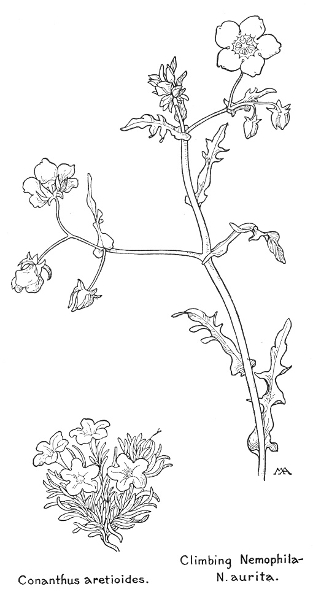
Conanthus aretioides. Climbing Nemophila—N. aurita.
There are only two kinds of Romanzoffia.
Romanzoffia Romanzóffia sitchénsis White Summer Northwest, etc.
This is a charming little perennial plant, which forms beautiful clumps of delicate foliage and flowers, suggesting some sort of Saxifrage. The many, smooth, slender, pale green stems, from four to nine inches tall, spring from slender, threadlike rootstocks, bearing tubers, and the leaves are mostly from the root, smooth, bright green, and prettily scalloped, with long leaf-stalks. The flowers are in loose clusters and are each half an inch or more long, with a white corolla, which is without appendages inside and is exceedingly beautiful in texture, with yellow stamens, unequally inserted, and a long, threadlike style, with a small stigma. These little plants grow in moist, shady spots among the rocks, as far north as Alaska and often reach very high altitudes, where it is a delight to find their pearly flowers and lovely foliage in some crevice in the cliffs watered by a glacier stream. These plants are found as far north as Alaska and were named in honor of Count Romanzoff, who sent the Kotzebue expedition to Alaska.
There are several kinds of Emmenanthe, much like Phacelia, but the stamens not protruding, and the corolla bell-shaped, cream-color or yellow, becoming papery in withering and not falling off, hence the Greek name, meaning "lasting flower."
Emmenanthe Emmenánthe lùtea Yellow Spring, summer Idaho, Nev., etc.
A low plant, with many, downy branches, spreading almost flat on the ground, and small, thickish leaves, light dull green, and slightly downy. The flowers are rather more than a quarter of an inch across, with hairy calyxes, and bright yellow corollas, hairy outside, with ten little appendages inside, and grow in coiled clusters. The little flowers are gay and pretty and look bright and cheerful on the desert sands where they live. This is found as far east as Oregon.
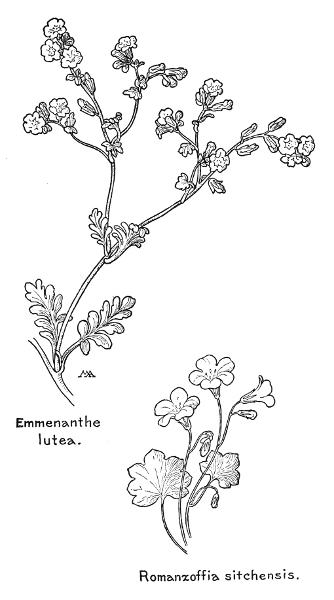
Emmenanthe lutea. Romanzoffia sitchensis.
Whispering Bells Emmenánthe penduliflòra Yellowish Spring, summer Southwest
Pretty plants, from eight to fourteen inches tall, with branching, hairy stems and light green, soft, downy leaves. The flowers are less than half an inch long, with pale yellow corollas, and are at first erect, but gradually droop until they hang gracefully on their very slender pedicels. They become dry and papery as they wither, but keep their form, and when the wind shakes their slender stems they respond with a faint rustling sound. This grows in dry places and is common in the South. In Arizona it grows only in protected canyons.
There are several kinds of Hydrophyllum, perennial or biennial herbs, with fleshy running rootstocks and large, more or less divided leaves, mostly alternate. The corolla is bell-shaped, with a honey-gland at the base of each of the petals, which are rolled up in the bud. The filaments are hairy, the style two-cleft above, both stamens and style are generally long and protruding, and the ovary is one-celled and hairy, containing from one to four seeds.
Cat's Breeches, Waterleaf Hydrophýllum capitàtum Lilac Spring Northwest, Utah
This is a pretty plant, from six to twelve inches high, with a rather weak stem and conspicuous leaves, which are alternate, pale green, soft and downy, or hairy, with five or seven divisions, prettily lobed and cut, with rather prominent veins, and long, succulent, pinkish leafstalks, sheathing the stem. The flowers are rather small, with short pedicels, and a number are crowded together in roundish clusters, about an inch across, with almost no flower-stalk. The calyx is covered with white hairs, the corolla is lilac or white, somewhat hairy on the outside, and the stamens and style are long and conspicuous, sticking out like cats' whiskers and giving a pretty feathery appearance to the whole cluster, which becomes in fruit a conspicuous, very fuzzy, round head, covered with bristly white hairs, making the children's quaint common name for this plant quite appropriate. It grows in rich soil, in mountain woods, and is one of the earliest spring flowers. It is sometimes called Bear's Cabbage, but this name is far fetched, both as regards bears and cabbages!
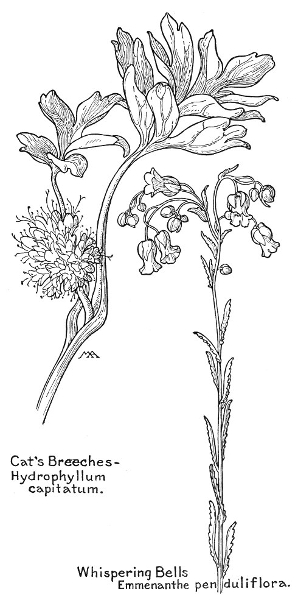
Cat's Breeches—Hydrophyllum capitatum. Whispering Bells—Emmenanthe penduliflora.
There are several kinds of Eriodictyon, shrubs, with alternate, toothed, leathery, evergreen leaves, which are netted-veined, generally green and smooth on the upper side and whitish and downy on the under, with leaf-stalks; the flowers in coiled clusters; the corolla more or less funnel-form or salver-form, without appendages in the tube; the stamens and the two distinct styles not protruding; the capsule small, with few seeds. The name is from the Greek for "wool" and "net," in allusion to the netted wool on the under surface of the leaves.
Yerba Santa, Mountain Balm Eriodíctyon Califórnicum White, lilac Summer Cal., Oreg., Wash.
A branching shrub, from two to six feet high, with thickish leaves, with toothed or wavy margins, from two to six inches long, dark and shiny on the upper side, pale with close down and netted-veined on the underside. The flowers are not especially pretty, about half an inch long, with white, lilac, or purple corollas, and are slightly sweet scented. The leaves are strongly and pleasantly aromatic when they are crushed and were used medicinally by the Indians, hence the Spanish name, meaning "holy herb." Cough-syrup is made from them and also substitutes for tobacco and hops. This grows on dry hills and is very variable, being sometimes a handsome shrub. There are intermediate forms between this and the next, E. tomentosum, which are difficult to distinguish.
Woolly Yerba Santa Eriodíctyon tomentòsum Lilac Spring California
A large leafy shrub, about five feet high and much handsomer than the last, with velvety, light green branches and very velvety, purplish twigs. The beautiful leaves are veined like chestnut leaves and made of the thickest, softest, sea-green or gray velvet, like a mullein leaf in texture, but much smoother and softer. The flowers are three-quarters of an inch long, with a pale pinkish-lilac corolla, shading to purple and white, downy on the outside, and form quite handsome clusters, mixed with pretty gray velvet buds, the lilac of the flowers harmonizing well with the gray foliage. This grows in quantities on Point Loma, and other places along the coast, from San Diego to Santa Barbara. There are several similar varieties.
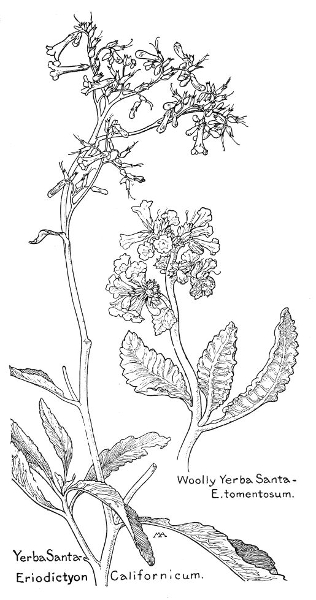
Woolly Yerba Santa—E. tomentosum. Yerba Santa—Eriodíctyon Californicum.
BORAGE FAMILY. Boraginaceae.
A large family, widely distributed, chiefly rough-hairy herbs, without stipules; usually with alternate, toothless leaves; flowers usually in coiled, one-sided clusters; calyx usually with five sepals; corolla usually symmetrical, with five united petals, often with crests or appendages in the throat; stamens five, inserted in the tube of the corolla, alternate with its lobes; ovary superior, with a single, sometimes two-cleft, style, and usually deeply four-lobed, like that of the Mint Family, forming in fruit four seed-like nutlets. Mature fruit is necessary to distinguish the different kinds. These plants superficially resemble some of the Waterleaf Family, but the four lobes of the ovary are conspicuous.
There are many kinds of Lappula, chiefly of the north-temperate zone; leaves narrow; corolla blue or white, salver-form or funnel-form, with a very short tube, the throat closed by five short scales, the stamens, with short filaments, hidden in the tube; ovary deeply four-lobed; style short; nutlets armed with barbed prickles, forming burs, giving the common name, Stickseed, and the Latin name, derived from "bur." Some of them resemble Forget-me-nots, but are not true Myosotis.
White Forget-me-not Láppula subdecúmbens White Spring, summer Northwest
Though the foliage is harsh, this plant is so graceful and has such pretty flowers that it is most attractive. It is from ten to eighteen inches tall, with several yellowish, hairy stems, springing from a perennial root and a cluster of root-leaves, the stem-leaves more or less clasping at base, all bluish-green, covered with pale hairs, with prominent veins on the back and sparse bristles along the edges. The flowers form handsome, large, loose clusters and the hairy buds are tightly coiled. The calyx is hairy, with blunt lobes, and the corolla, about half an inch across, is pure white, or tinged with blue, often marked with blue, with two ridges on the base of each petal, and the throat closed by five yellow crests, surrounded by a ring of fuzzy white down. This grows on dry plains and hillsides, sometimes making large clumps.
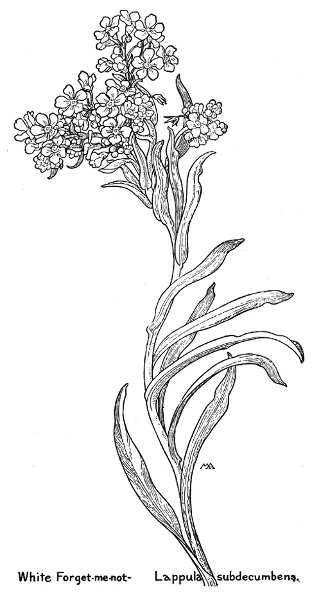
White Forget-me-not—Lappula subdecumbens.
Wild Forget-me-not Láppula velùtina Blue Summer California
Beautiful flowers, resembling true Forget-me-nots, but larger, with velvety, often reddish stems, from one to two feet tall, velvety leaves, and flowers in handsome, loose, somewhat coiling clusters. The corolla is about half an inch across, sky-blue, the most brilliant blue of any flower in Yosemite, with five, white, heart-shaped crests in the throat; the buds pink. This is rather common in the Sierra Nevada at moderate altitudes. L. nervòsa, of high altitudes, is similar, but with smaller flowers, the leaves rough-hairy, but green. This has very prickly nutlets, which stick in the wool of sheep and are dreaded by shepherds. L. floribúnda, also growing in the mountains of California and Oregon, has similar, small, blue flowers, sometimes pink, and hairy, gray foliage. L. Califórnica, of the northern Sierra Nevada mountains, has small white flowers.
There are many kinds of Lithospermum, chiefly of the northern hemisphere; with reddish, woody roots, hairy leaves, without leaf-stalks, and flowers crowded in clusters, mixed with leaves and leafy bracts; corolla funnel-form or salver-form, the throat often hairy or crested; stamens with short filaments, not protruding from the throat of the corolla; ovary four-lobed, with a slender style, stigma with a round head or two lobes; nutlets usually white and smooth. The Greek name means "stony seed." Puccoon is the Indian name, and these plants are also called Gromwell, and sometimes Indian Dye-stuff, because the Indians made dye from the roots, which yield a beautiful delicate purple color.
Hairy Puccoon Lithospérmum pilòsum Yellow Spring, summer Northwest, Utah, etc.
A rather pretty plant, about a foot tall, with several, stout, yellowish-green stems, covered with white hairs and very leafy, springing from a thick perennial root. The leaves are bluish-gray green and downy, harsh on the under side, and the flowers are numerous and pleasantly scented, with a very hairy calyx and a salver-form corolla, about three-eighths of an inch across, silky outside, the throat downy inside, but without crests. The flowers are yellow, an unusual shade of pale corn-color, and harmonize with the pale foliage, but are not conspicuous, and the flower cluster is so crowded with leaves and leafy bracts that it is not effective. This grows in dry fields, as far east as Nebraska, and sometimes makes pretty little bushes, over two feet across.
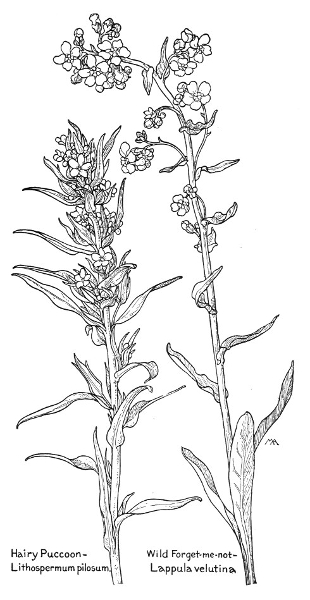
Hairy Puccoon—Lithospermum pilosum. Wild Forget-me-not—Lappula velutina.
Pretty Puccoon Lithospérmum angustifòlium Yellow Spring West, etc.
These are pretty flowers, but have a disagreeable smell. They are perennials, with a deep root and hairy or downy, branching stems, from six inches to two feet high, and hairy or downy leaves, which are rather grayish green. The flowers are in terminal leafy clusters and are of two sorts. The corollas of the earlier ones are very pretty, clear bright yellow, sometimes nearly an inch and a half long, with toothed lobes, which are charmingly ruffled at the edges, and with crests in the throat, but the later flowers are small, pale, and inconspicuous. This grows in dry places, especially on the prairies, and is very widely distributed in the western and west central states.
Gromwell Lithospérmum multiflòrum Yellow Summer Ariz., Utah, etc.
This has a rough, hairy stem, about a foot tall, and dull green, rough, hairy leaves, with bristles along the edges. The yellow flowers are half an inch long and form rather pretty coiled clusters. This grows in open woods at the Grand Canyon, and is found as far east as New Mexico and Colorado.
There are a good many kinds of Amsinckia, natives of the western part of our country and of Mexico and South America. They are rather difficult to distinguish, rough, hairy or bristly, annual herbs, the bristles usually from a raised base, and with yellow flowers, in curved, rather showy, clusters. The corolla is more or less salver-form, without crests, but with folds; the stamens and pistil not protruding, the stigma two-lobed. In order to insure cross pollination by insects, in some kinds the flowers are of two types, as concerns the insertion of the stamens on the corolla and the length of the style. Several of these plants are valuable in Arizona for early spring stock feed, and the leaves of young plants are eaten by the Pima Indians for greens and salads.
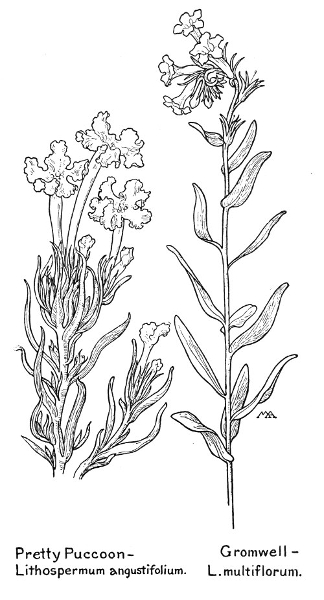
Pretty Puccoon—Lithospermum angustifolium. Gromwell—L. multiflorum.
Saccato Gordo, Fiddle-neck, Buckthorn Weed Amsínckia inlermèdia Yellow Spring, summer West
This has bright flowers, but the foliage is dreadfully harsh. The stem is from one to three feet tall, often widely branching, with white bristles scattered over it, and the leaves are dull green and bristly. The flowers are pretty, about half an inch long, with narrow sepals and bright orange corollas, with five bright red spots between the lobes. The nutlets are roughened with short, hard points. These plants are very common and sometimes form rank thickets in fields and waste places. They are very abundant in southern Arizona and are valued as a grazing plant for stock and are therefore known as Saccato Gordo, which means "fat grass."
There are many kinds of Cryptanthe, most of them western and difficult to distinguish. They are slender, hairy plants, with small flowers, which are usually white, in coiled clusters; the calyx bristly; the corolla funnel-form, usually with five crests closing the throat; the nutlets never wrinkled. These plants resemble white Forget-me-nots and are sometimes so called. The Greek name means "hidden flower," perhaps because of the minute flowers of some kinds.
Nievitas Cryptánthe intermèdia White Spring Cal., Ariz.
A rather attractive little plant, but inconspicuous except when it grows in patches, when it powders the fields with white, like a light fall of snow, and suggests the pretty Spanish name, which is a diminutive of "nieve," or snow. The slender, roughish stem is about ten inches tall, the light green leaves are hairy, with fine bristles along the edges, and the pretty little flowers are white, about a quarter of an inch across, with yellow crests in the throat. Popcorn Flower, Plagiobòthrys nothofúlvus, of the Northwest, is also called Nievitas, as it often whitens the ground with its small, fragrant, white flowers, which are very much like the last.
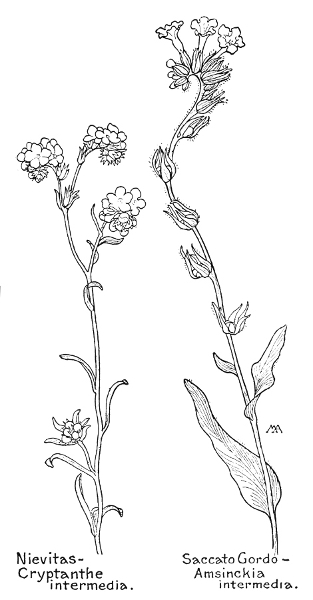
Nievitas—Cryptanthe intermedia. Saccato Gordo—Amsinckia intermedia.
There are a good many kinds of Mertensia, natives of the northern hemisphere. They are handsome perennials, never very hairy and sometimes perfectly smooth all over, with leafy stems and broad leaves, sometimes dotted, the lower ones with leaf-stalks. The pretty, nodding flowers are in clusters and have a purple, blue, or white corolla, often turning pink, more or less trumpet-shaped, the lobes not spreading much, the throat open, with or without crests; the ovary deeply four-lobed, with a threadlike style and one stigma; the nutlets wrinkled. These plants are all commonly called Lungwort.
Languid Lady, Lungwort Merténsia Sibírica Blue Summer Northwest
A very attractive and graceful mountain plant, with pretty flowers and fine foliage. The stems are hollow and usually smooth, from one to five feet tall, and the leaves are rather thin and soft in texture, usually smooth, with a "bloom." The flowers are in handsome loose clusters, most of them drooping, and have a corolla over half an inch long, which is a beautiful shade of bright light blue, often tinged with pink, with white crests in the throat, and the style is long and protruding. The buds are bright pink, contrasting well with the blue flowers. This grows near streams, in the higher mountains. It is often called Mountain Bluebell, but that name belongs to Campanula and is therefore misleading. (This has recently been "separated" into several species.)
Lungwort Merténsia brevístyla Blue Spring, summer Utah, Col., Wyo.
This is an attractive plant and looks a good deal like a Forget-me-not. It grows from four to ten inches tall and has dull bluish-green leaves, which are downy on the upper side and smooth on the under, and graceful clusters of pretty little flowers. The buds are pinkish-purple and the flowers are small, with hairy calyxes and brilliant sky-blue corollas, the stamens and style not protruding. This grows in mountain canyons, up to an altitude of seven thousand feet.
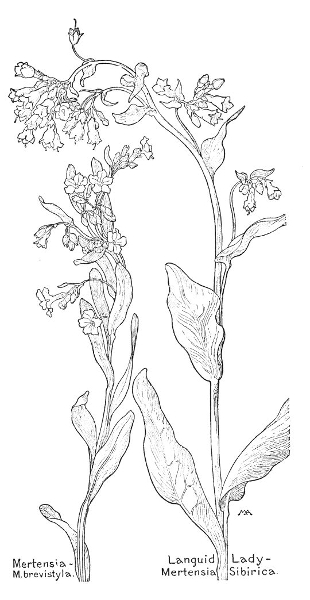
Mertensia—M. brevistyla. Languid Lady—Mertensia Sibirica.
There are many kinds of Heliotrope, widely distributed in temperate and tropical regions; ours have small, white or blue flowers, in coiled spikes; the corolla salver-form or funnel-form, without crests or hairs; the stamens not protruding, the filaments short or none, the anthers sometimes joined by their pointed tips; the ovary not four-lobed, but sometimes grooved, with a short style, the stigma cone-shaped or round.
Sea-side Heliotrope, Chinese Pusley Heliotròpium Curassávicum White Summer, autumn Cal., Oreg., etc.
This is not a pretty plant and is rather insignificant because of its dull coloring. It forms low, branching, straggling clumps, with thickish stems and leaves, which are succulent and perfectly smooth, with a "bloom," and the flowers are small, the corolla white or pale lilac, with a yellow "eye" which changes to purple, forming crowded coiled spikes, mostly in pairs, without bracts. The fruit consists of four nutlets. This is widely distributed, in moist, salty or alkaline places, growing also in the East and in South America and the Old World.
There are several kinds of Oreocarya, natives of western North America and Mexico, coarse, hairy, perennial or biennial herbs, with thick woody roots; the leaves narrow, alternate or from the root; the flowers small, mostly white, in clusters, with a funnel-form or salver-form corolla, usually with crests and folds in the throat; the stamens not protruding; the style usually short. The name is from the Greek, meaning "mountain-nut," which does not seem very appropriate.
Oreocarya Oreocàrya multicàulis White Spring Ariz., Utah, etc.
A rather pretty plant, about six inches tall, not rough and harsh like most kinds of Oreocarya, for the pale grayish-green stem and leaves are covered with white down. The flowers are quite pretty, about three-eighths of an inch across, with white corollas, with yellow crests in the throat. This is found as far east as southern Colorado and New Mexico. O. setosíssima is quite tall, growing in the Grand Canyon, and has a large cluster of small white flowers and is harsh and hairy all over, covered with such long stiff white hairs as to make it conspicuous and very unpleasant to touch.
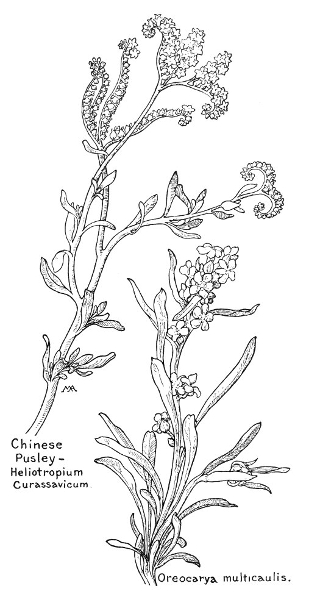
Chinese Pusley—Heliotropium Curassavicum. Oreocarya multicaulis.
VERBENA FAMILY. Verbenaceae.
A large family, widely distributed; herbs and shrubs; leaves opposite, or in whorls; flowers perfect, in clusters; calyx with four or five lobes or teeth; corolla with four or five united lobes, almost regular or two-lipped; stamens on the corolla, usually four, in two sets; ovary superior, with one style and one or two stigmas, when ripe separating into from two to four, one-seeded nutlets.
There are many kinds of Verbena, chiefly American; perennials; calyx tubular, with five teeth; corolla usually salver-form, with five lobes, usually slightly two-lipped; stigmas with two lobes, only the larger lobe fertile; fruit four nutlets. This is the Latin name of some sacred plant.
Wild Verbena Verbèna Arizònica Lilac Spring Arizona
This is very much like a garden Verbena, an attractive little plant, from four to six inches tall, with hairy stems and prettily shaped leaves, dull green, soft and hairy. The gay little flowers are about half an inch across, with a bright pinkish-lilac corolla, with a white or yellowish "eye," and a sticky-hairy calyx, and form a charming flat-topped cluster. This grows among the rocks, above the Desert Laboratory at Tucson and in similar places.
Common Vervain Verbèna prostràta Lilac Spring, summer, autumn California
A loosely-branching plant, from one to two feet tall, with dull green, hairy stems, dull green, soft, hairy leaves, and very small flowers in a long spike, too few open at one time to be effective. The corolla is lilac or bluish, often with a magenta tube and magenta "eye." This grows in dry open hill country.
MINT FAMILY. Labiatae.
A very large family, with distinctive characteristics; widely distributed. Ours are herbs or low shrubs, generally aromatic, with usually square and hollow stems; leaves opposite, with no stipules; flowers perfect, irregular, in clusters, usually with bracts; calyx usually five-toothed, frequently two-lipped; corolla more or less two-lipped, upper lip usually with two lobes, lower lip with three; stamens usually four, in pairs, on the corolla-tube, alternate with its lobes; ovary superior, with four lobes, separating when ripe into four, small, smooth, one-seeded nutlets, surrounding the base of the two-lobed style, like the four nutlets of the Borage Family, but the flowers of the latter are regular. These plants are used medicinally and include many herbs used for seasoning, such as Sage, Thyme, etc.
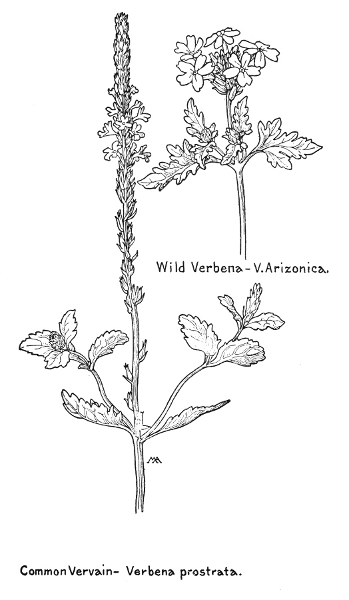
Wild Verbena—V. Arizonica. Common Vervain—Verbena prostrata.
There are a few kinds of Micromeria; trailing perennials; flowers small; calyx tubular, with five teeth; corolla two-lipped, with a straight tube; stamens four, all with anthers, not protruding. The Greek name means "small."
Yerba Buena, Tea-vine Micromèria Chamissónis (M. Douglasii) Lilac, white Spring, summer Cal., Oreg., Wash.
An attractive little plant, resembling the little eastern Gill-over-the-ground, with slender trailing stems, slightly downy foliage, and lilac or whitish flowers, about a quarter of an inch long. The calyx and corolla are hairy on the outside; the corolla has an erect upper lip, sometimes notched, and a spreading, three-lobed lower lip, and the stamens are four, the lower pair shorter. This is common in shady places near the coast. It has a pleasant aromatic fragrance and was used medicinally by California Indians, so it was called "good herb" by the Mission Fathers, and is still used as a tea by Spanish-Californians, who call it Yerba Buena del Campo, "field herb," distinguishing it from Yerba Buena del Poso, "herb of the well," the garden mint.
There are several kinds of Monardella, fragrant herbs, all western, chiefly Californian; leaves mostly toothless; flowers small, in terminal heads, on long flower-stalks, with bracts, which are often colored; calyx tubular, with five, nearly equal teeth; corolla with erect upper lip, two-cleft, lower lip with three, nearly equal lobes; stamens four, protruding, sometimes the lower pair longer.
Western Pennyroyal, Mustang Mint Monardélla lanceolàta Lilac Summer California
An attractive plant, pretty in color and form, with purplish, often branching stems, from six inches to over two feet high, smooth leaves, and small bright pinkish-lilac flowers, crowded in terminal heads, about an inch across, with purplish bracts. The outer ring of flowers blooms first and surrounds a knob of small green buds, so that the effect of the whole flower-head slightly suggests a thistle. This has a strong, pleasant smell like Pennyroyal and is abundant in Yosemite, and elsewhere in the Sierra Nevada foothills.
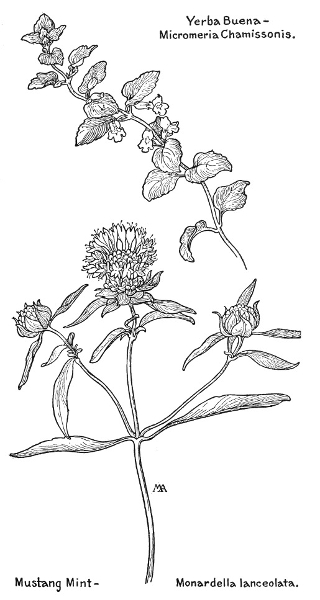
Yerba Buena—Micromeria Chamissonis. Mustang Mint—Monardella lanceolata.
There are several kinds of Ramona, abundant in southern California; shrubby plants, with wrinkled leaves and flowers like those of Salvia, except for differences in the filaments; stamens two. They are very important honey-plants, commonly called Sage, and by some botanists considered to be a species of Salvia.
Desert Ramona Ramòna incàna (Audibertia) Blue Spring Southwest
A low desert shrub, from two to three feet high, varying very much in color. On the plateau in the Grand Canyon it is delicate and unusual in coloring, with pale gray, woody stems and branches and small, stiffish, gray-green, toothless leaves, covered with white down. The small flowers are bright blue, projecting from close whorls of variously tinted bracts, and have long stamens, protruding from the corolla-tube, with blue filaments and yellow anthers, and a blue style. The bracts are sometimes lilac, sometimes pale blue, or cream-color, but always form delicate pastelle shades, peculiar yet harmonizing in tone with the vivid blue of the flowers and with the pale foliage. This is strongly aromatic when crushed. In the Mohave Desert it is exceedingly handsome, but the coloring is often less peculiar, as the foliage is not quite so pale as in other places, such as the Grand Canyon, and the flowers vary from blue to lilac or white. It blooms in spring and when its clumps of purple are contrasted with some of the yellow desert flowers, clustered about the feet of the dark Joshua Trees which grow around Hesperia, the effect is very fine.
Humming-bird Sage Ramòna grandiflòra (Audibertia) Red Spring California
This is a handsome and very decorative plant, though rather coarse and sticky, with a stout, bronze-colored stem, which is woody at base, from two to three feet tall, and velvety, wrinkled leaves, from three to eight inches long, with scalloped edges and white with down on the under side. The flowers are an inch and a half long, with crimson corollas of various fine shades, which project from the crowded whorls of broad, bronze or purplish bracts, arranged in tiers along the stem. Sometimes there are as many as nine of these clusters and the effect of the whole is dark and very rich, especially in shady places. This is common in the hills, from San Francisco south. Humming-birds are supposed to be its only visitors.
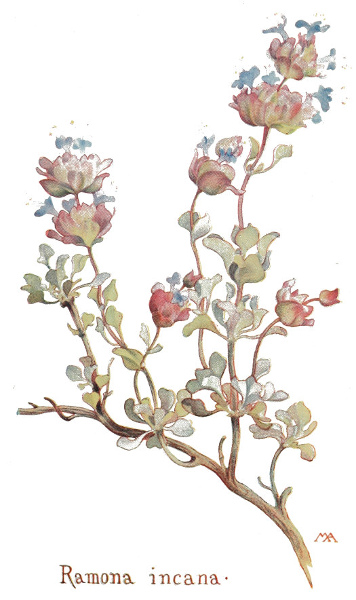
Ramona incana.
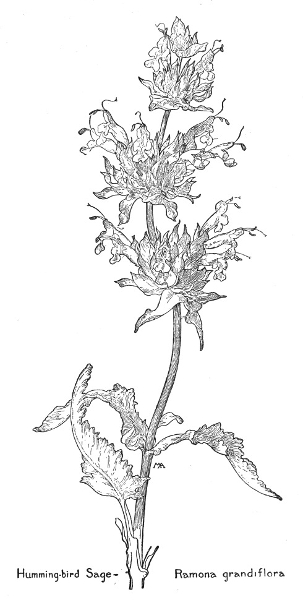
Humming-bird Sage—Ramona grandiflora.
White Ball Sage Ramòna nívea (Audibertia) Lilac Spring California
A very conspicuous, shrubby plant, much handsomer than Black Sage, from three to six feet high, with many, downy, stout, leafy stems, woody below, forming enormous clumps of pale foliage. The leaves are covered with pale down and are a delicate shade of sage-green and feel like soft thick velvet, and the mauve or lilac flowers, about three-quarters of an inch long, are arranged in a series of very round, compact balls along the stiff stalks. This is a honey-plant and smells strong of sage, and is common in the South, giving a beautiful effect of mingled mauve and gray.
White Sage Ramòna polystàchya (Audibertia), (Salvia apiana) White, lilac Spring California
Not so handsome as the last, but a very conspicuous plant, on account of its size and the pale tint of its foliage, though the flowers are too dull in color to be striking. It is shrubby and has a number of stems, which form a loose clump from three to six feet high, with rather leathery, resinous leaves, all but the upper ones with scalloped edges, and the whole plant is covered with fine white down, so that the general effect is pale gray, blending with the white or pale lilac flowers and purplish buds. The flowers are about half an inch long and are very queer in form, for the only conspicuous part is the lower lip, which is very broad with a ruffled edge and is turned straight up and backward, so as to conceal almost all the rest of the flower. The long jointed stamens, which are borne on the lower lip, stand out awkwardly like horns and from one side of the flower's face a long white pistil sticks out, with something the effect of a very long cigar hanging out of the corner of its mouth! All these eccentric arrangements are apparently for the purpose of securing cross-pollination from the bees, which frequent these flowers by the thousand, as this is a famous bee-plant and the white honey made from it is peculiarly delicious. It grows abundantly in valleys and on hillsides, from Santa Barbara to San Diego, and has a very strong disagreeable smell.
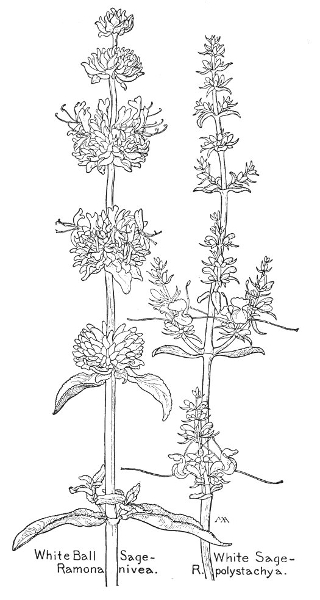
White Ball Sage—Ramona nivea. White Sage—R. polystachya.
Black Sage, Ball Sage Ramòna stachyoìdes (Audibertia) Lilac, white Spring California
A conspicuous shrubby plant, from three to six feet high, with stiffish leaves, which are downy on the under side, wrinkled on the upper, and grayish-green and downy when young, but become smoother and dark green as they grow older. The flowers are pale lilac or white, half an inch long, and the calyx-lobes and bracts are tipped with bristles. The compact flower clusters, usually about five in number and rather small, are arranged in tiers on long slender stalks, which stand up stiffly all over the bush. This is common on southern hillsides, often forming dense thickets for long distances, smells strong of sage and is an important bee-plant.
There are several kinds of Hyptis, very abundant in South America and Mexico, but only a few reaching the southwestern border of our country; the calyx with five almost equal teeth; the corolla short, the lower lip sac-shaped and abruptly turned back, the other four lobes nearly equal and flat; the stamens four, included in the sac of the lower lobe.
Hyptis Hýptis Émoryi Purple Spring Arizona
A shrub, from three to five feet high, with very pale, roundish, woody stems and branches and small, very pale gray leaves, thickish and soft, covered with white woolly down. The little fragrant, bluish-purple flowers, with white woolly calyxes, are crowded in close clusters about an inch long. Only a few flowers are out at one time and they are too small to be pretty, but the effect of the shrub as a whole is rather conspicuous and attractive, on account of its delicate coloring, the lilac of the flower-clusters harmonizing with the gray foliage, which gives out a very strong smell of sage when crushed. This grows among the rocks above the Desert Laboratory at Tucson and in similar places, blooming in early spring and much visited by bees.
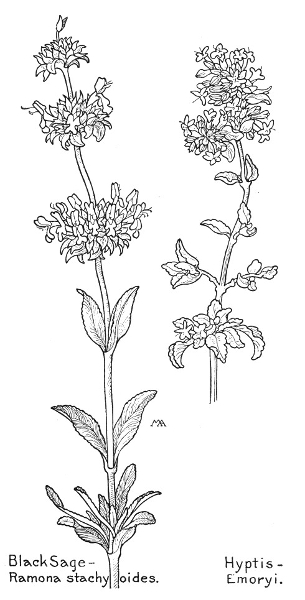
Black Sage—Ramona stachyoides. Hyptis—Emoryi.
Self-heal Prunélla vulgàris Purple Spring, summer, autumn Across the continent
There are several kinds of Prunella, widely distributed, but this is the only one common in this country and is probably not native. It is abundant in dampish places, in the far West often staying green all winter, a perennial, sometimes hairy, from two inches to over a foot high. The leaves, often obscurely toothed, have leaf-stalks and the small flowers are crowded in a series of whorls, with purplish bracts and forming a spike or head. The calyx is two-lipped, with five teeth and often purplish, and the corolla is purple, pink, or occasionally white, with an arched upper lip, a spreading, three-lobed lower lip, and four stamens, under the upper lip of the corolla, the lower pair longer. This is usually not pretty, but in favorable situations in the West is often handsome, with brighter-colored, larger flowers. The name, often spelled Brunella, is said to be derived from an old German word for an affection of the throat, which this plant was supposed to cure. There is a picture in Mr. Mathews' Field Book.
There are many kinds of Stachys, widely distributed; herbs, often hairy, with a disagreeable smell; the calyx with five, nearly equal teeth; the corolla with a narrow tube, the upper lip erect, the lower lip spreading and three-lobed, the middle lobe longest; the stamens four, in pairs, usually under the upper lip of the corolla.
Hedge Nettle Stàchys ciliàta Magenta Spring, summer Northwest
This is a handsome plant, with a stout, rough, hairy stem, over two feet tall, and very bright green leaves, which are thin in texture but velvety. The flowers are in whorls, making a large cluster, and have a purplish calyx, smooth or with a few stiff hairs, and a corolla about an inch long, deep pink or magenta, sometimes spotted with white inside. Though the flowers are rather crude in color, they contrast finely with the bright green foliage. S. coccínea is a very handsome kind, with a tubular scarlet corolla, and grows in the mountain canyons of Arizona.
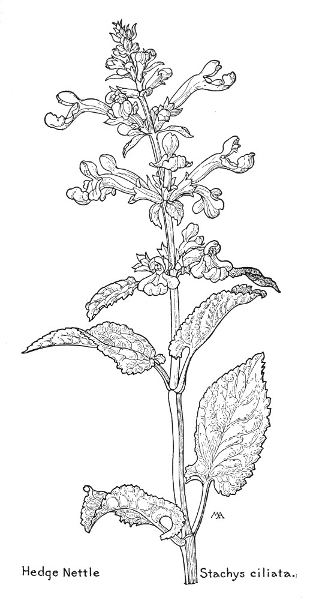
Hedge Nettle Stachys ciliata.
Common Hedge Nettle Stàchys bullàta Pink, purple Spring, summer Wash., Oreg., Cal.
This is common and varies in appearance, being often a coarse-looking weed, but sometimes the flowers are pretty. The rough, hairy stem is about a foot tall, the wrinkled leaves are soft and more or less hairy, and the flowers are about half an inch long, usually pale purplish-pink or purple, streaked and specked with deeper color, but are sometimes bright pink and then the long clusters are quite effective, growing in the road-side hedges. The plant is aromatic when crushed.
There are many kinds of Scutellaria, widely distributed; bitter herbs, some shrubby, with blue or lilac flowers; the calyx with two lips, the upper one with a protuberance on its back; the corolla smooth inside, the upper lip arched, sometimes notched, the lower lip more or less three-lobed; the stamens four, under the lip, all with anthers, the upper pair hairy. The curious helmet-shaped calyx, in which the seeds are generally enclosed at maturity, suggests the common names, Skullcap and Helmet-flower.
Skullcap Scutellària angustifòlia Blue Spring, summer Cal., Oreg., Wash.
A pleasing plant, from six inches to over a foot tall, not aromatic, with almost smooth leaves, most of them toothless. The flowers are pretty, though not striking, in pairs from the angles of the leaves, with a purplish-blue corolla, nearly an inch long, with a white tube, the lower lip woolly inside. The calyx is curiously shaped and after the flower drops off resembles a tiny green bonnet. When these little calyxes are pinched from the sides they open their mouths and show the seeds inside. This is quite common throughout the Sierras. S. antirrhinoìdes is similar, growing in Utah and the Northwest. S. Califórnica has cream-white flowers, less than an inch long, the lower lip hairy inside, and downy leaves, narrow at base, the lower leaves purplish on the under side and more or less toothed, the upper ones toothless. It grows in open woods in the Coast Ranges and Sierra Nevada mountains. S. tuberòsa is from three to five inches high, with tuberous rootstocks; the leaves more or less oval, downy, thin in texture, with a few teeth, the lower ones purplish on the under side, with long leaf-stalks, the flowers dark blue, about three-quarters of an inch long, each pair, instead of standing out at opposite sides of the stem, generally turn sociably together, first to one side and then to the other. This blooms in spring and grows in the Coast Ranges of California and Oregon.
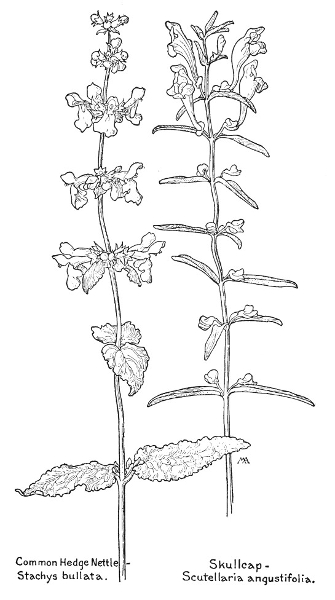
Common Hedge Nettle—Stachys bullata. Skullcap—Scutellaria angustifolia.
Bladder-bush Salazària Mexicàna Blue and white Spring Southwest
This is the only kind, a very curious spiny desert shrub, about three feet high, varying a great deal in general appearance in different situations. The stems and foliage are gray-green and imperceptibly downy and the flowers are over three-quarters of an inch long, with a corolla which is hairy outside and has a lilac and white upper lip and a dark blue lower one. The calyxes become inflated and form very curious papery globes, over half an inch in diameter, very pale in color, tinged with yellow, pink, or lilac, and extremely conspicuous. In the desert around Needles, in California, the general form of the shrub is very loose and straggling, with slender twisting branches and small, pale gray-green leaves, both flowers and leaves very scanty and far apart, so that the bunches of bladder-like pods are exceedingly conspicuous. In the Mohave Desert it becomes a remarkably dense shrub, a mass of dry-looking, criss-cross, tangled branches, spiky twigs, and dull green leaves, speckled all over with the dark blue and white flowers and the twigs crowded with pods. Sometimes the flowers are magenta instead of blue, but are all alike on one bush. The stems are not square, as in most Mints. The drawing is of a plant at Needles.
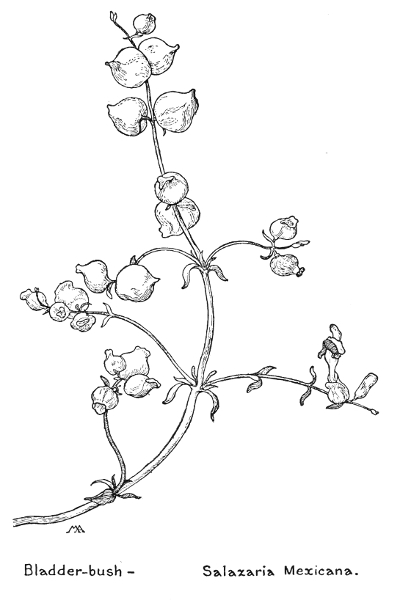
Bladder-bush—Salazaria Mexicana.
There are only a few kinds of Sphacele.
Pitcher Sage, Wood-balm Sphácele calycìna White Spring, summer California
This is a rather handsome shrubby plant, from two to five feet high, woody at base, with many stout, leafy, woolly or hairy stems, and rather coarse leaves, hairy, more or less wrinkled and toothed, and rather dark green. The flowers are over an inch long, in pairs along the upper stem, something the shape of a Monkey-flower, with a five-toothed calyx and a corolla with four, short, spreading lobes and the fifth lobe much longer and erect, the tube broad and dull-white, with a hairy ring at the base inside, the lobes tinged with pink or purple; the stamens four, one pair shorter. After the flowers have faded the large, pale green, inflated calyxes, veined with dull purple, become conspicuous. If the flowers were brighter in color this would be very handsome. It is strongly but rather pleasantly aromatic and grows on dry hills in southern California. The name is from the Greek, meaning "sage," as these plants have sage-like foliage and smell, but the flowers are quite different.
There are several kinds of Salvia, widely distributed, herbs or shrubs; flowers usually in whorls, with bracts; upper lip of the corolla erect, seldom two-lobed, lower lip spreading and three-lobed; resembling Ramona, except that the two stamens have filaments which are apparently two-forked, one fork bearing an anther cell and the other only the mere rudiment of an anther; the smooth nutlets are mucilaginous when wet. The Latin name means "to save," as some kinds are medicinal.
Thistle Sage, Persian Prince Sálvia carduàcea Lilac Spring, summer California
A fantastically beautiful and decorative plant, very individual in character. The stout purplish stem, a foot or two tall and covered with white wool, springs from a rosette of thistle-like leaves of palest green, so thickly covered with cushions of white wool that they appear to be inflated, their teeth tipped with brown spines. The stem bears a series of flower-clusters, resembling large, round, pale balls of wool, pierced here and there by long prickles and encircled by lovely flowers, so etherial that they appear almost to hover in the air. They are each about an inch long, the corolla clear bright lilac with an erect upper lip with two lobes, their fringed tips crossed one over the other, and the lower lip with small side lobes and a very large, fan-shaped, middle lobe, which is delicately fringed with white. The pistil is purple and the anthers are bright orange, which gives a piquant touch to the whole color scheme of pale green and lilac. There are several tiers of these soft yet prickly balls, which suggest the pale green turbans of an eastern potentate, wreathed with flowers. The buds poke their little noses through the wool, in a most fascinating way, like babies coming out of a woolly blanket, and fresh buds keep on coming through and expanding as the faded blossoms fall, so that these flowers last longer in water than we would expect from their fragile appearance. The plants when they are crushed give out a rather heavy smell of sage, with a dash of lemon verbena. They grow on the dry open plains of the South.
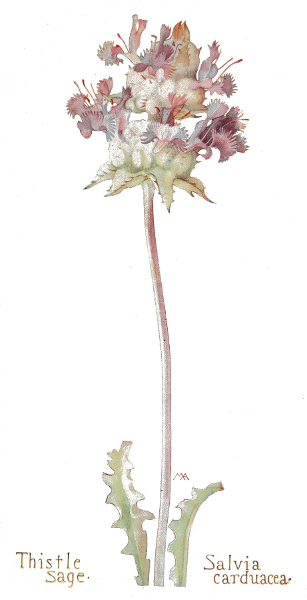
Thistle Sage—Salvia carduacea.
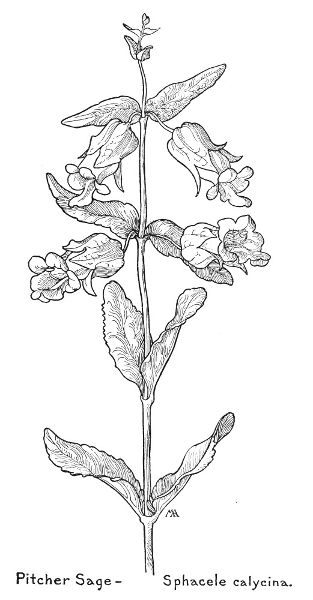
Pitcher Sage—Sphacele calycina.
Chia Sálvia columbàriae Blue Spring Southwest
This is an odd-looking plant, but is often quite handsome. The stout purplish stem, from six inches to over two feet tall, springs from a cluster of rough, very dull green leaves, sometimes so wrinkled as to look like the back of a toad, and bears a series of round, button-like heads, consisting of numerous, purple, bristly bracts, ornamented with small, very bright blue flowers. Though the flowers are small, the contrast between their vivid coloring and the purple or wine-colored bracts is very effective. The seeds have been for centuries an important food product among the aborigines and this plant in ancient Mexico was cultivated as regularly as corn, the meal being extremely nourishing and resembling linseed meal. The Mission Fathers used it for poultices and it is still in demand among the Spanish-Californians. This grows on dry hillsides and smells of sage.
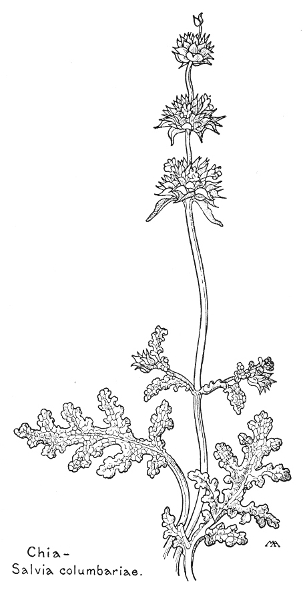
Chia—Salvia columbariae.
There are several kinds of Trichostema, all North American; herbs, sometimes shrubby; leaves toothless, or with wavy margins; flowers in clusters; calyx usually with five unequal lobes; corolla with a long slender tube and five oblong lobes nearly alike, forming in bud a roundish ball, enclosing the coiled stamens; stamens four, the upper pair longer, with very long, blue or purple filaments, conspicuously protruding from the corolla, suggesting both the Greek name, meaning "hair-like stamens," and the common name, Blue-curls.
Romero, Woolly Blue-curls Trichostèma lanàtum Blue Summer, autumn California
This is shrubby and usually has many stems, from two to four feet high, with stiffish leaves, dark green on the upper side, paler and woolly on the under, the margins rolled back, and beautiful flower-clusters, which are sometimes a foot long. The bright blue corolla is nearly an inch long, with a border shaped like a violet, the smaller buds are pink, and the purple stamens and style are two inches long and very conspicuous. The calyxes, stems, and buds are all covered with fuzzy, pink wool, forming a most unusual and beautiful color scheme, giving a changeable almost iridescent effect of mauve and pink, in remarkable contrast to the brilliant blue of the flowers. This grows on rocky hills in southern California, is pleasantly aromatic and used medicinally by Spanish-Californians. T. lanceolàtum is called Camphor Weed, because of its strong odor, like camphor but exceedingly unpleasant. It grows on dry plains and low hills in the Northwest and is an important bee-plant, blooming in summer and autumn, and is also called Vinegar Weed.
There are a few kinds of Agastache, all North American, perennial herbs, mostly tall and coarse; leaves toothed, with leaf-stalks; flowers small, in a terminal spike, with bracts; calyx bell-shaped, with five teeth and slightly two-lipped; corolla with a two-lobed, erect, upper lip, the lower lip spreading and three-lobed, the middle lobe broader and scalloped; stamens four, all with anthers, the upper pair longer; nutlets smooth. The Greek name means "many spikes."
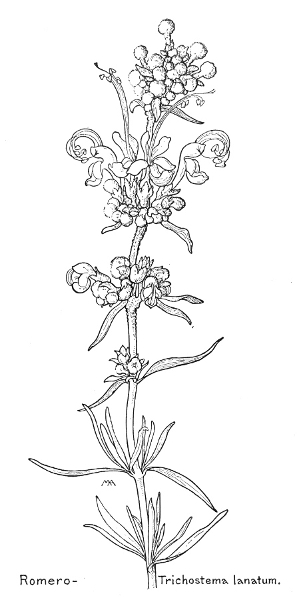
Romero—Trichostema lanatum.
Giant Hyssop Agástache urticifòlia (Lophanthus) Pink Summer West, etc.
A handsome plant, from three to five feet high, with stout, branching stems, usually smooth, sometimes hairy, and smoothish, dark green leaves. The small flowers have a green calyx, with mauve teeth, a white or pale violet corolla, and long, protruding stamens, with lilac anthers. They are crowded in spikes, from two to six inches long, and the whole effect is rather bright purplish-pink, feathery and pretty. This has a strong aromatic smell and grows along the edges of meadows and is abundant in Yosemite at moderate altitudes, but in other places reaches an altitude of over eight thousand feet and is found as far east as Colorado. A. pallidiflòra, with greenish-white calyxes and white corollas, too dull in color to be pretty, grows in the Grand Canyon and in New Mexico and Colorado.
There are several kinds of Monarda, all North American; aromatic herbs; leaves toothed; flowers crowded in heads, usually with bracts, which are sometimes colored; calyx tubular, with five teeth, often hairy inside; corolla more or less hairy outside, two-lipped, upper lip erect or arched, sometimes notched, lower lip spreading and three-lobed, the middle lobe larger; stamens two, with swinging anthers, sometimes also two rudimentary stamens; nutlets smooth. These plants are called Balm, Bergamot, and Horse-mint.
Horse-mint Monàrda pectinàta (M. citriodora in part) Pink Summer Ariz., Utah, etc.
This is handsome when growing in masses, though the flowers are not sufficiently positive in color. It grows from one to three feet high, with a stout, roughish stem, sometimes branching, and leaves which are thin and soft in texture, with a dull surface, but not rough, and more or less toothed. The flowers are nearly an inch long and project from crowded heads of conspicuous purplish bracts, tipped with bristles. The calyx is very hairy inside, the lobes tipped with long bristles, and the corolla is pale pink, lilac, or almost white, not spotted, with a very wide open, yawning mouth, the stamens and the curling tips of the pistil protruding from under the upper lip. This grows on dry plains, especially in sandy soil, as far east as Colorado and Texas, reaching an altitude of six thousand feet, and is strongly aromatic when crushed.
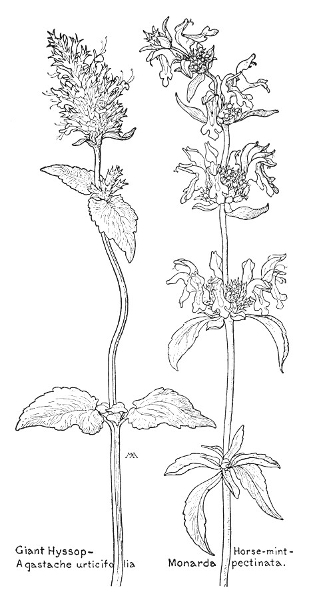
Giant Hyssop—Agastache urticifolia. Horse-mint—Monarda pectinata.
POTATO FAMILY. Solanaceae.
A large family, widely distributed, most abundant in the tropics. Ours are herbs, shrubs, or vines; leaves alternate, without stipules; flowers perfect, usually regular, in clusters; calyx and corolla usually with five united lobes; stamens on the throat of the corolla, as many as its lobes and alternate with them; ovary superior, two-celled, with a slender style; fruit a berry or capsule, with many seeds. Many important plants, such as Tobacco, Belladonna, Tomato, Egg-plant, Red-pepper, and Potato, belong to this family. Many have a strong odor.
There are several kinds of Datura, widely distributed; ours are chiefly weeds, coarse, tall, branching herbs, with rank odor and narcotic properties; leaves large, toothed or lobed, with leaf-stalks; flowers large, single, erect, with short stalks, in the forks of the stems; calyx with a long tube and five teeth, the lower part remaining in the form of a collar or rim around the base of the capsule; corolla funnel-form, with a plaited border and broad lobes with pointed tips; stamens with very long, threadlike filaments, but not protruding; style threadlike, with a two-lipped stigma; fruit a large, roundish, usually prickly capsule, giving these plants the common name, Thorn-Apple. Datura is the Hindoo name.
Tolguacha, Large-flowered Datura Datùra meteloìdes White Spring, summer Southwest, Nev., Utah
A handsome and exceedingly conspicuous plant, forming a large clump of rather coarse, dark foliage, adorned with many magnificent flowers. The stout, velvety stems are bronze-color, from two to four feet high, the leaves are dark green, velvety on the under side, and the flowers are sometimes ten inches long, white, tinged with lilac outside, drooping like wet tissue-paper in the heat of the afternoon, and with sweet though heavy scent. I remember seeing a grave in the desert, marked by a wooden cross and separated from a vast waste of sand by clumps of these great white flowers. It grows in valley lands, reaching an altitude of six thousand feet. It is used as a narcotic by the Indians and resembles D. stramònium, Jimson-weed, from Asia, common in the East and found also in the West, but it is far handsomer. D. suaveòlens, Floriponda or Angels' Trumpets, is a large shrub, with very large, pendulous, creamy flowers, and is often cultivated in the old mission gardens in California. The flowers are very fragrant at night.
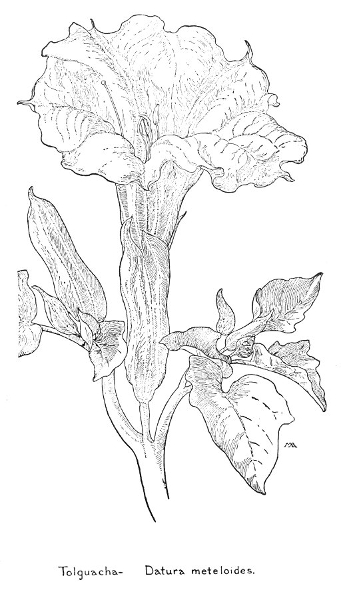
Tolguacha—Datura meteloides.
There are many kinds of Physalis, most of them American, difficult to distinguish; herbs, often slightly woody below; flowers whitish or yellowish; corolla more or less bell-shaped, with a plaited border; style slender, somewhat bent, with a minutely two-cleft stigma. In fruit the calyx becomes large and inflated, papery, angled and ribbed, wholly enclosing the pulpy berry, which contains numerous, flat, kidney-shaped seeds. The name is from the Greek, meaning "bladder," and refers to the inflated calyx, and the common names, Ground-cherry and Strawberry-tomato, are suggested by the fruit, which is juicy, often red or yellow, and in some kinds is edible.
Ground-cherry Phýsalis crassifòlia Yellow Southwest
A pretty, delicate, desert plant, from six to eight inches high, with branching stems and light green leaves. It is sprinkled with pretty cream-yellow flowers, which are not spotted or dark in the center, with yellow anthers, and is hung with odd little green globes, each about three-quarters of an inch long, which are the inflated calyxes containing the berries.
Bladder-cherry Phsýalis Féndleri Yellow Summer Ariz., Utah
A straggling perennial plant, about a foot high, with widely-branching, roughish stems, springing from a deep tuberous root. The leaves are dull green, roughish, rather coarse in texture, but not large, mostly less than an inch long, coarsely and irregularly toothed, and the flowers are the shape of a shallow Morning-glory, half an inch across, pale dull-yellow, marked with brown inside, with yellow anthers. This does not bear its berries close to the ground, as do many of its relations, and is not pretty. It grows in dry places, reaching an altitude of eight thousand feet.
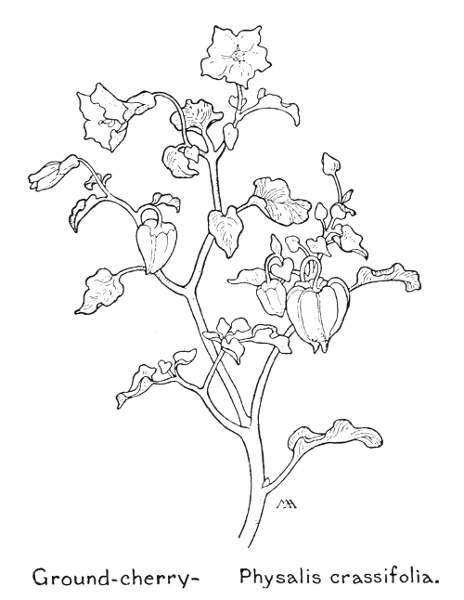
Ground-cherry—Physalis crassifolia.
There are a great many kinds of Solanum, abundant in tropical America; herbs or shrubs, sometimes climbing; often downy; calyx wheel-shaped, with five teeth or lobes, corolla wheel-shaped, the border plaited, with five angles or lobes and a very short tube; anthers sometimes grouped to form a cone, filaments short; fruit a berry, either enclosed in the calyx or with the calyx remaining on its base. This is the Latin name of the Nightshade, meaning "quieting."
Purple Nightshade Solànum Xánti Purple Spring, summer California
This is much handsomer than most of the eastern Nightshades, hairy and sticky, with several spreading stems, from one to three feet high, springing from a perennial root, with thin, roughish leaves, more or less toothed. In favorable situations the flowers are beautiful, each about an inch across, and form handsome loose clusters. The corolla is saucer-shaped, bright purple, with a ring of green spots in the center, bordered with white and surrounding the bright yellow cone formed by the anthers. The berry is pale green or purple, the size of a small cherry. This is sometimes sweet-scented and is very fine on Mt. Lowe and elsewhere in southern California, but is paler and smaller in Yosemite. Blue Witch, S. umbellíferum, is very similar, more woody below, with deep green stems, shorter branches, smaller, thicker leaves, and a dull white or purplish berry. It grows in the foothills of the Coast Ranges and Sierra Nevada Mountains and flowers chiefly in summer, but more or less all through the year.
Nightshade Solànum Douglásii White Spring, summer Southwest
A branching plant, about two feet high and across, with roughish stems and thin, smooth or slightly hairy, dark green leaves, toothless, or the margins more or less coarsely toothed. The flowers are white, tinged with lilac, with a purplish ring surrounding the yellow cone formed by the anthers. In southern California the flowers are nearly half an inch across, but smaller elsewhere. The berries are black. This is common throughout California near the coast. S. nìgrum, the common Nightshade, is a weed in almost all countries, common in waste places and in cultivated soil, and has small white flowers and black berries, about as large as peas and said to be poisonous.
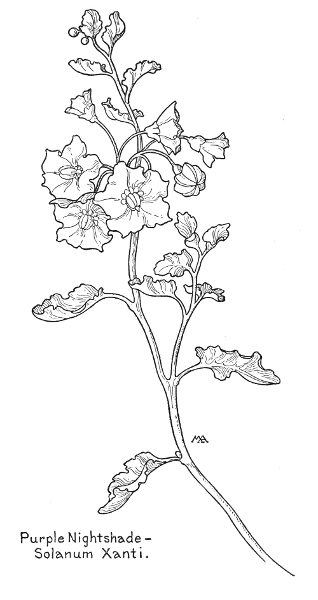
Purple Nightshade—Solanum Xanti.
There are many kinds of Nicotiana, or Tobacco, chiefly American; acrid, narcotic herbs or shrubs, usually sticky-hairy; leaves large, toothless; corolla funnel-form or salver-form, with a long tube and spreading border, plaited in the bud; stamens with threadlike filaments and broad anthers, not protruding; capsule smooth, containing numerous small seeds. The name is in honor of Nicot, diplomat and author of the first French dictionary, who sent some of these plants to Catherine de' Medici from Portugal in 1560.
San Juan Tree, Tree Tobacco Nicotiàna glaùca Yellow Spring Southwest
A very slender, loosely-branching evergreen shrub, from six to fifteen feet high, with graceful, swaying branches and smooth, thick leaves, with a "bloom," the lower leaves eight inches long. The flowers are nearly two inches long, greenish at first and then becoming a rather pretty shade of warm dull-yellow, and hang in graceful clusters from the ends of the branches. The calyx is unequally five-toothed, the tube of the corolla downy on the outside; the anthers whitish; the ovary on a yellowish disk, with a long style and two-lobed stigma, and the capsule oblong, half an inch long. This was introduced into California from South America about fifty years ago and is now common in waste places and cultivated valleys.
There are many kinds of Lycium, shrubs or woody vines, named for the country Lycia.
Desert Matrimony Lycium Còoperi White Spring Southwest
An odd-looking desert shrub, everything about it so closely crowded as to give a queer bunchy and clumsy effect. It is three or four feet high, with thick, dark gray, gnarled, woody branches, crowded with tufts of small, dull, light green leaves, which are thickish, stiffish, obscurely downy and toothless, and mingled with close little bunches of flowers. The flowers are about half an inch long, with a large, yellowish, hairy calyx, with five lobes, a white corolla, which is slightly hairy outside, with five lobes and a narrow, greenish tube, and pale yellow anthers, not protruding. They are rather pretty near by, but the appearance of the whole shrub is too pale to be effective. The familiar Matrimony Vine of old-fashioned gardens belongs to this genus.
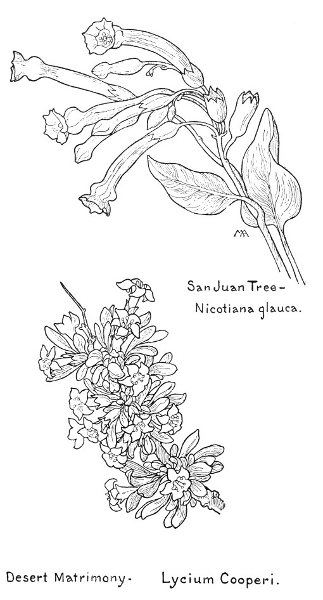
San Juan Tree—Nicotiana glauca. Desert Matrimony—Lycium Cooperi.
FIGWORT FAMILY. Scrophulariaceae.
A large family, widely distributed, most of them natives of temperate regions; chiefly herbs, with bitter juice, sometimes narcotic and poisonous; without stipules; the flowers usually irregular; the calyx usually with four or five divisions, sometimes split on the lower or upper side, or on both sides; the corolla with united petals, nearly regular or two-lipped, two of the lobes forming the upper lip, which is sometimes beaklike, and three lobes forming the lower lip; the stamens on the corolla and alternate with its lobes, two or four in number, two long and two short, and sometimes also a fifth stamen which often has no anther, the anthers two-celled; the ovary superior, usually two-celled, the style slender, the stigma sometimes forked; the fruit a pod, splitting from the top into two parts and usually containing many seeds. This is a curious and interesting family, its members very dissimilar in appearance, having expressed their individuality in many striking and even fantastic forms.
There are several kinds of Maurandia, perennial herbs, climbing by their slender twisted leaf-stalks and occasionally also by their flower-stalks; the leaves triangular-heartshaped or halberd-shaped, only the lower ones opposite; the flowers showy, purple, pink, or white; the corolla with two lines or plaits, instead of a palate, which are usually bearded.
Snap-dragon Vine Maurándia antirrhìniflora (Antirrhinum maurandioides) Purple or pink and yellow Spring Ariz., New Mex.
This is a beautiful trailing or climbing vine, smooth all over, with charming foliage and twining stems, much like those of a Morning-glory, springing from a thickened, perennial root. The pretty flowers are over an inch long, with a purple or raspberry-pink corolla, with bright yellow blotches on the lower lip, forming an odd and striking combination of color. This blooms all through the spring and summer and may be found growing in the bottom of the Grand Canyon, near the river, where its delicate prettiness is in strange contrast to the dark and forbidding rocks over which it clambers and clothes with a mantle of tender green.