A KEY TO THE FAMILIES. (continued 2)
Reading edition

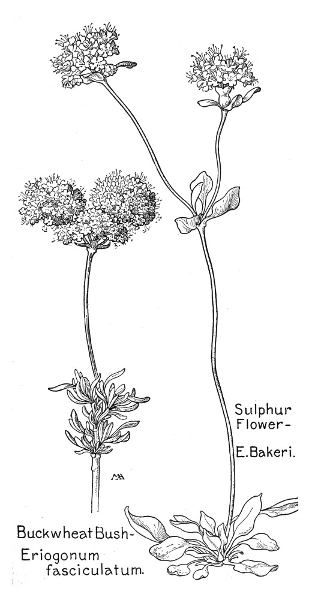
Sulphur Flower—E. Bakeri. Buckwheat Bush—Eriogonum fasciculatum.
Wild Buckwheat Eriógonum racemòsum Pink, white Summer Ariz., Utah
A pretty desert variety of Wild Buckwheat. The pale downy stem is from one to two feet tall, rather stout, with two or three erect branches at the top, and the leaves are all from the base, gray-green in color and covered with close white down on the under side. The small white and pink flowers are clustered along the branches in small heads, with reddish involucres, forming a spike about three inches long. The whole effect of the plant is curiously pale, but quite pretty. It grows plentifully on the rim of the Grand Canyon.
There are many kinds of Polygonum, East and West, many of them insignificant, some aquatic, some woody at base, with alternate leaves, and sheathing stipules; the sepals four or five; the stamens five to nine; the style with two or three branches and round-top stigmas. The name is from the Greek, meaning "many knees," in allusion to the swollen joints of some kinds.
Knot-weed Alpine Smartweed Polýgonum bistortoìdes White Summer West
This is about two feet tall, very pretty and rather conspicuous, and the general effect of the smooth stem and sheathing, green leaves is somewhat grasslike. The flowers, which are small and cream-white, with pretty stamens and pinkish bracts, grow in close, roundish, pointed heads, an inch or two long, at the tips of the stalks. The buds are pink and the heads in which the flowers have not yet come out look as if they were made of pink beads. This is an attractive plant, growing among the tall grasses in mountain meadows, and smells deliciously of honey.
PIGWEED FAMILY. Chenopodiaceae.
A large family, widely distributed, growing usually in salty or alkaline soil; herbs or shrubs, generally succulent and salty or bitter, often covered with white scurf or meal, without stipules; leaves thick, usually alternate, sometimes none; flowers perfect or imperfect, small, greenish, without petals; calyx with two to five sepals, rarely with only one, pistillate flowers sometimes with no calyx; stamens as many as the sepals, or fewer, and opposite them; ovary mostly superior with one to three styles or stigmas; fruit small, dry, with one seed, sometimes with a bladder-like covering. Spinach and Beets belong to this family; many are "weeds," such as Lamb's Quarters.
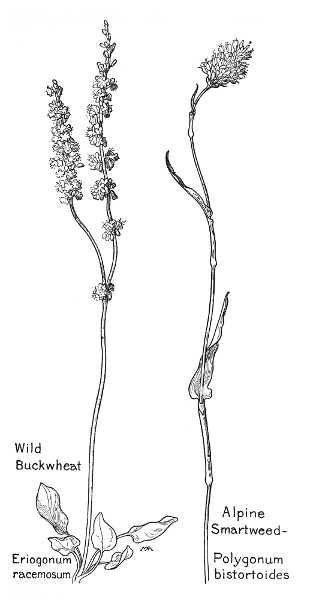
Wild Buckwheat—Eriogonum racemosum. Alpine Smartweed—Polygonum bistortoides.
There are two kinds of Grayia, named after Asa Gray; low shrubs; the stamens and pistils in separate flowers, on the same or on different plants.
Hop Sage Gràyia spinòsa (G. polygaloides) Greenish, with red bracts Spring Calif., Nev., Utah, Ariz.
An odd and beautiful desert shrub, about three feet high, very dense in form, with interlacing, angular, gray branches, spiny and crowded with small, alternate, toothless leaves, pale-green and thickish, but not stiff. The flowers are small and inconspicuous, but the pistillate ones are enveloped in conspicuous bracts, which enlarge and become papery in fruit, something like those of Docks, and often change from yellowish-green to all sorts of beautiful, bright, warm tints of pink, or to magenta, and the branches become loaded with beautifully shaded bunches of these curious seed-vessels, giving a strange, crowded look to the shrub, which in favorable situations, such as the Mohave Desert, makes splendid masses of color, especially when contrasted with the pale gray of Sage-brush.
There is only one kind of Cycloloma; leaves alternate, smooth or downy, irregularly toothed; flowers perfect or pistillate, with five sepals, five stamens, and two or three styles; fruit winged horizontally.
Tumbleweed Cyclolòma atriplicifòlium Purple or green Summer West of Mississippi River
Very curious round plants, six to twenty inches high, usually purple all over, sometimes green and rarely white, giving a brilliant effect in the fall to the sandy wastes they inhabit. They are a mass of interlacing branches, with hardly any leaves, except at the base, and very small flowers. When their seeds are ripe, and they are dry and brittle, the wind easily uproots them and starts them careening across the plain, their seeds flying out by the way. They turn over and over and leap along, as if they were alive, bringing up at last against a wire fence, or some such obstacle, where perhaps a traveler sees them from the train and wonders at the extraordinary-looking, dry, round bunches. There are other Tumble-weeds, such as Tumbling Mustard, Sisymbrium allissimum, and Amaránthus álbus, not of this family.
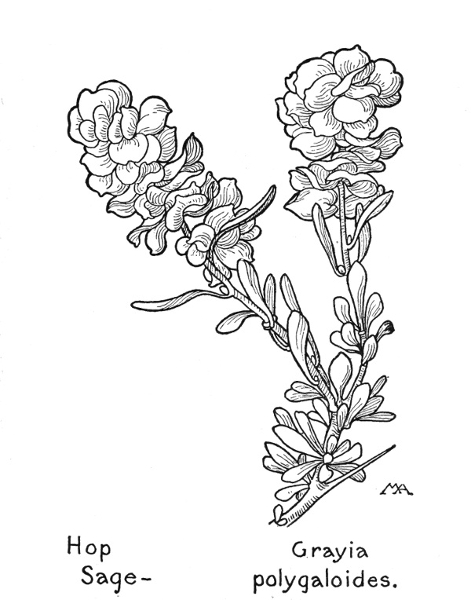
Hop Sage—Grayia polygaloides.
FOUR-O'CLOCK FAMILY. Nyctaginaceae.
A rather large family, widely distributed, most abundant in America. Ours are herbs, often succulent, with no stipules; stems often fragile, swollen at the joints; leaves opposite, usually toothless, often unequal; flowers perfect, with no petals, but the calyx colored like a corolla, with four or five lobes or teeth, and more or less funnel-shaped; one or several flowers in a cluster with an involucre; stamens three to five, with slender filaments; style one, with a round-top stigma; the green base of the calyx drawn down around the ovary, making it appear inferior, and hardening into a nutlike fruit; seeds sometimes winged.
Quamoclidions have the odd habit of opening in the afternoon, hence the common name, Four-o'clock. The flowers usually have five stamens, and are grouped several together in a cluster, which emerges from an involucre so much resembling a calyx that it is often mistaken for one. The effect is of the flowers having clubbed together and made one calyx do for the lot. The fruit is hard, smooth, and roundish.
Four-o'clock Quamoclídion multiflòrum. (Mirabilis) Pink, purple Spring Southwest and Col.
The leaves of this low, stout, and spreading perennial are an inch or two long, light bluish-green, somewhat heart-shaped, rather rough and coarse, and the stems are often hairy and sticky. The foliage contrasts strikingly in color with the gaudy pink or magenta flowers, an inch across and slightly sweet-scented, the shape of Morning-glories and resembling them, as they have the same stripes of deeper color. The long stamens droop to one side, the pistil is long and purple and the bell-shaped involucre contains about six flowers. These plants are conspicuous and quite handsome. They grow on the plateau in the Grand Canyon.
There are several kinds of Hesperonia, much like Quamoclidion, but the bell-shaped involucre contains only one flower, which is also bell-shaped, usually with five separate stamens. The fruit is roundish, not angled or ribbed, usually smooth.
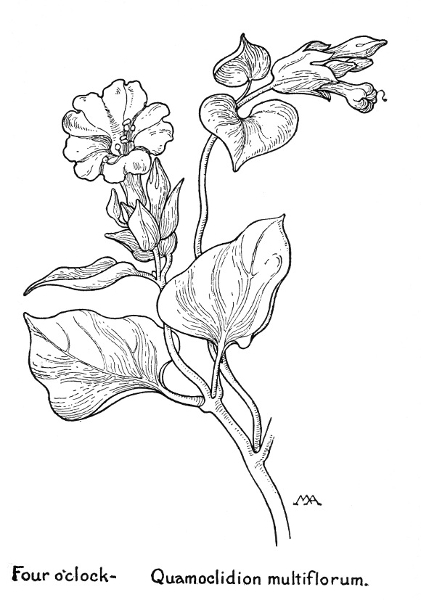
Four o'clock—Quamoclidion multiflorum.
California Four-o'clock Hesperònia Califórnica (Mirabilis) Magenta, pink Spring, summer California
This is very common in southern California and forms quite large, low clumps of rather yellowish green, sticky and hairy foliage, sprinkled with numbers of bright little flowers, opening in the afternoon. The base is woody and the weak, hairy stems are supported on bushes, as if climbing over them. The leaves are rather thick, about an inch long, and the flowers are open bell-shaped, about three-quarters of an inch across, usually magenta, but often pink of various shades, sometimes quite pale in tint with long stamens drooping to one side, and the involucre is often purplish and very hairy and sticky. The effect at a distance is gay and attractive, though the plant is not quite so pretty close by.
Hesperònia glutinòsa var. grácilis White, pinkish Spring Arizona
This has a straggling, hairy, sticky stem, over a foot long, and thickish, dull-green leaves, hairy and sticky. The flowers are about half an inch long, white or tinged with pink, and are rather delicate and pretty, though the plant is not especially attractive. It blooms at night, the flowers gradually closing with the morning sun. This variety is common in the southern part of the state, in mountain canyons, and Hesperonia glutinosa is common in the north.
There are several kinds of Abronia, all American, with branching, usually sticky-hairy stems, thick, toothless leaves, with leaf-stalks, in pairs and one of each pair somewhat larger than the other. The flowers are more or less salver-form, with five lobes, a threadlike style, and from three to five, unequal stamens, on the tube of the perianth and not protruding from it. They are numerous and in clusters, with involucres, on long flower-stalks, from the angles of the leaves. The fruit is winged. The name is from the Greek meaning graceful, but most of these plants are rather awkward in their manner of growth.
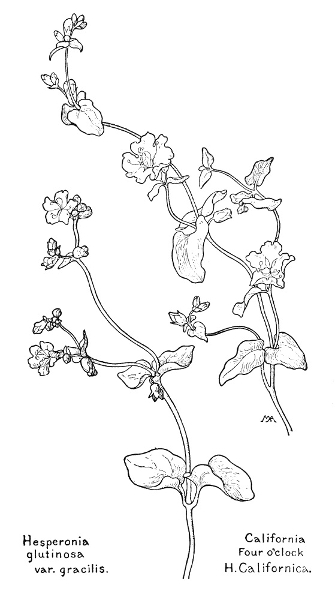
Hesperonia glutinosa var. gracilis. California Four o'clock—H. Californica.
Sand Puffs Abrònia sálsa White Spring, summer, Autumn Utah
This plant is, as a whole, so delicately tinted and so decorative in form, that it is most attractive, particularly against the sandy soil where it grows, deserving the Greek name more than some of its slightly awkward sisters. It is about fourteen inches tall, with a stoutish, rather straggling, prostrate stem, which is pale, pinkish, sticky and fuzzy. The leaves have long leaf-stalks and are pale bluish-green, leathery and smooth, but fuzzy on the mid-vein of the under side, and the flowers are numerous, rather small, in handsome roundish clusters, which are about two inches across, with a papery, pinkish or yellowish involucre, of about five, separate, rounded bracts. The calyx is corolla-like and salver-form, with a long, yellowish or greenish tube and five lobes, prettily crinkled at the edges. The seed-vessel is very curious, resembling a round, yellowish sponge, with hooks sticking out of it, and the flowers are deliciously sweet-scented. This is sometimes called Snowball.
Pink Sand-Verbena Abrònia villòsa Pinkish-lilac Summer Ariz., Cal., Utah
The coloring of this plant, one of the prettiest of its kind, is striking and unusual, and makes it very conspicuous, growing in the sand near the sea or in the desert. The thickish leaves are light bluish-green and the thick stem, which straggles rather awkwardly over the ground, is a peculiar shade of pink and sticky and hairy, as are also the involucres. The small delicate flowers are an odd tint of pinkish-lilac, light but vivid, in striking contrast to the coloring of stems and foliage, and form very pretty clusters, with an involucre of five to fifteen papery bracts. They are very fragrant and look much like garden Verbenas, so the name is not so unhappy as some. A. umbellàta has slender stems and almost smooth leaves, sometimes with wavy margins, about an inch long, narrowed at base to a slender leaf-stalk, and deep-pink flowers. It is common all along the California coast and blooms in the summer and autumn. A. marítima is found from Santa Barbara to San Diego and is a very stout, coarse, sticky plant, with small, deep-magenta flowers.
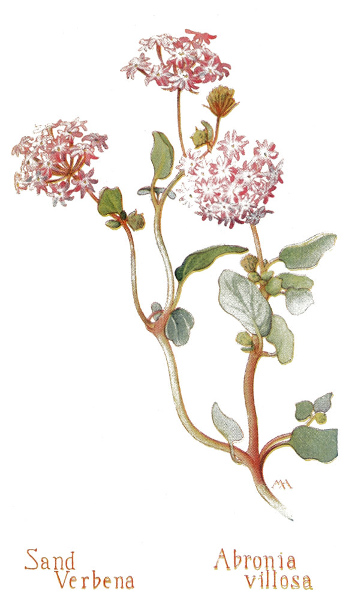
Sand Verbena—Abronia villosa.
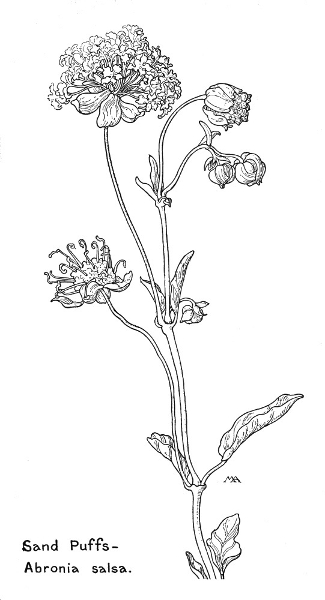
Sand Puffs—Abronia salsa.
Yellow Sand-Verbena Abrònia latifòlia Yellow Spring, summer, autumn Wash., Oreg., Cal.
Pretty at a distance, but rather coarse close by, a straggling plant, with long, thick, rubbery stems, lying on the ground, thickish leaves, and small yellow flowers, slightly fragrant and forming pretty clusters about an inch and a half across, with five bracts. This is common along the seashore, blooming more or less all through the year. It has a long, thick root, which is eaten by the Indians.
There are a good many kinds of Allionia, one Asiatic, the rest American. The bell-shaped flowers have unequal stamens, usually three, on the receptacle. The peculiar, five-lobed involucre, which becomes large and papery after flowering, contains from three to five flowers. The fruit is ribbed and often hairy. The shape of the involucre probably suggested the common name Umbrella-wort.
Narrow-leaved Umbrella-wort Alliònia lineàris Purple, pink, white Summer Utah, Ariz., etc.
A pretty plant, one to four feet tall, with a slender stem and long, narrow, bluish-green leaves, with somewhat wavy margins, and almost no leaf-stalks. The flowers are fragile and pretty, of various shades of pink, the shape of small Morning-glories, half an inch across, the stamens and style protruding. There are from three to five in a cluster, in a purple and green involucre. This involucre is curious, for before the flowers come out it is closed around a bunch of buds, looking as if it were itself a pretty five-angled bud, and one would not suspect that there were other little buds inside it. When the flowers bloom and drop, which they do very soon, this involucre unfolds and expands until it becomes an exceedingly thin, papery, five-lobed disk, three-quarters of an inch across, veined with purple, very pretty and delicate, looking like an odd little flower without a heart. The smooth stem forks towards the top and the branches, which are slightly hairy, bear numerous clusters of involucres with flowers inside them. This grows in dry soil, is widely distributed and found as far east as Illinois.
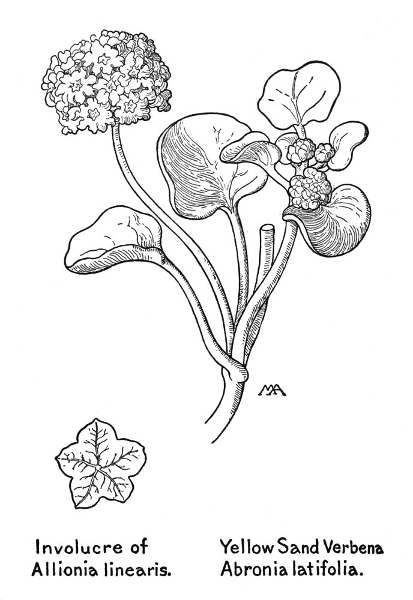
Involucre of Allionia linearis. Yellow Sand Verbena—Abronia latifolia.
CARPET-WEED FAMILY. Aizoaceae.
Not a very large family, mostly natives of warm regions. Ours are branching herbs, lying mostly on the ground; leaves mostly opposite or in whorls; flowers perfect; sepals four or five; petals numerous, small or none; stamens few or many, usually on the calyx; ovary sometimes superior; fruit a capsule. In this country most of this family are dull little plants, with inconspicuous flowers.
There are many kinds of Mesembryanthemum, mostly African; ours are smooth, very succulent perennials; without stipules; leaves opposite; calyx-lobes unequal and leaf-like; petals long, narrow and very numerous, inserted with the innumerable stamens on the calyx-tube; ovary with ten or twelve styles, becoming a sort of berry, containing many minute seeds, and opening at the top in rainy weather. The terribly long name is from the Greek, meaning "noonday flower."
Ice-plant Mesembryánthemum crystállinum White, pinkish Spring California
One of the queerest looking plants that it is possible to imagine, the stout stems and large flat leaves thickly encrusted with millions of small translucent beads, resembling glass or ice and giving a glistening effect to the whole plant. They cluster especially thickly along the wavy margins and under sides of the leaves, and on the calyxes, and feel quite hard to the touch, but when they are crushed underfoot they exude a watery juice, which is said to be alkaline and injurious to shoe-leather. The stems and leaves are light bright-green, the tips and margins tinged with bright pinkish-red, especially on dry mesas, where this plant sometimes covers the ground for long distances with flat rosettes, forming a thick, red carpet, beautiful in color. In shadier, damper places, such as the crevices in the sea-cliffs at La Jolla, it becomes quite a large, tall plant, scarcely tinged with red and very glistening. The flowers are about an inch across, with a greenish center, surrounded by numerous, small, yellowish anthers and a single row of many, white or flesh-colored petals, suggesting the tentacles of a sea-anemone. In fact the whole plant is curiously suggestive of some low form of animal life. It is very troublesome to farmers in the south near the sea, and also flourishes in the Mohave Desert, in France and the Canary Islands.
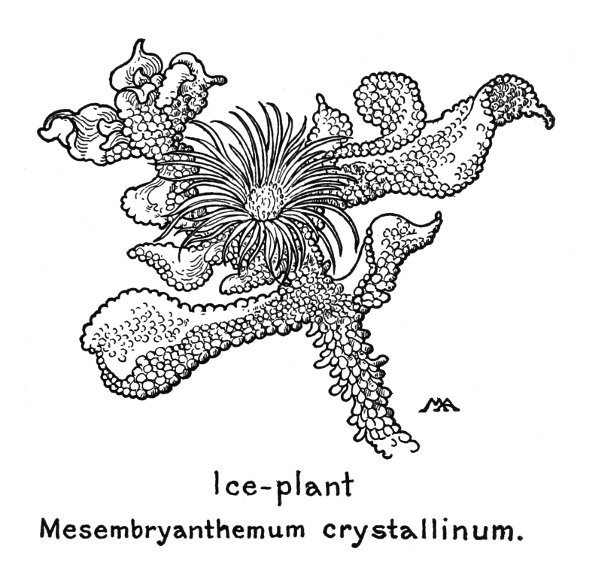
Ice-plant—Mesembryanthemum crystallinum.
Sea Fig, Fig-marigold Mesembryánthemum aequilateràle Pink Spring California
A very strange and conspicuous plant, often clothing sandy slopes with a curious mantel of trailing, fleshy stems and foliage thickly sprinkled with thousands of gaudy flowers. The stems are stout and flattish, several feet long; the leaves three-sided, with flat faces, tipped with a small reddish point; the calyx-lobes three-sided like the leaves. The stems, leaves, and the calyx-lobes are all pale bluish-green with a "bloom" and exceedingly succulent, the watery juice running out in large drops when the plant is broken. The twigs seem to be fitted into a sort of socket, from which they come out very easily, so that the plant comes apart almost at a touch. The fragrant flowers are two or three inches across, bright but crude in color, the numerous, purplish-pink petals resembling the rays of a composite and encircling a fuzzy ring of innumerable stamens, with white, threadlike filaments and small, straw-colored anthers, around a dark-green center, composed of the top of the calyx and the six to ten styles of the ovary. This accommodating plant is very useful and ornamental in hot, sandy places, where not much else will grow, and may be seen hanging its long stems over the sea-cliffs all along the coast, from Patagonia to Marin County in California. It also grows in Africa and is extensively cultivated. The fruit is edible, with pulp and tiny seeds something like a fig.
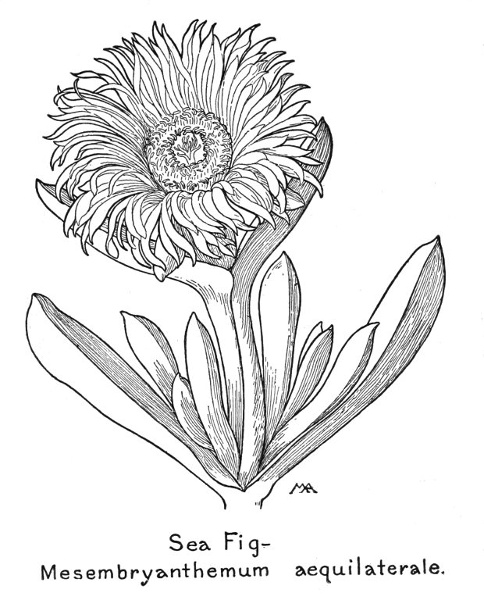
Sea Fig—Mesembryanthemum aequilaterale.
PINK FAMILY. Caryophyllaceae.
A large family, widely distributed, most abundant in the northern hemisphere, including both the handsome Pinks and the insignificant Chickweeds. They are herbs, with regular, mostly perfect flowers, with four or five sepals; usually with four or five petals, sometimes with none; stamens as many, or twice as many, as the petals; ovary superior, one-celled; styles two to five in number; fruit a capsule, containing several or many, kidney-shaped seeds, opening by valves, or by teeth, at the top; leaves opposite, toothless; stems usually swollen at the joints. The name Pink comes from the petals of some kinds being cut into points, or "pinked."
There are numerous kinds of Arenaria, widely distributed, difficult to distinguish, with small, white flowers with five petals, usually not notched, ten stamens and usually three styles; leaves usually long and narrow, often stiff and growing in tufts; capsule roundish, splitting into usually three valves, each with two parts. These plants often grow in dry, sandy places, some at very high altitudes, some by the sea, hence the Latin name meaning "sandy," and the common one, Sandwort.
Fendler's Sandwort Arenària Féndleri White Summer Utah, Ariz., etc.
This has pretty little white flowers, about half an inch across, and is variable. Sometimes the stem is roughish, only three or four inches tall, springing from a tuft of small leaves, stiff and almost prickly. Sometimes the stem is smooth, six or eight inches tall, and the leaves resemble rather fine, stiff grass. This grows on dry hills and mountains, up to thirteen thousand feet, from Nebraska and Wyoming to Utah, Arizona, and New Mexico.
There are many kinds of Silene, widely distributed, more or less sticky plants, hence the common name, Catchfly; flowers mostly rather large; calyx inflated or tubular, with five teeth; petals five, with long claws, which often have scales at the top, forming a "crown"; stamens ten; styles usually three; capsule opening by three or six teeth at the tip; seeds numerous.
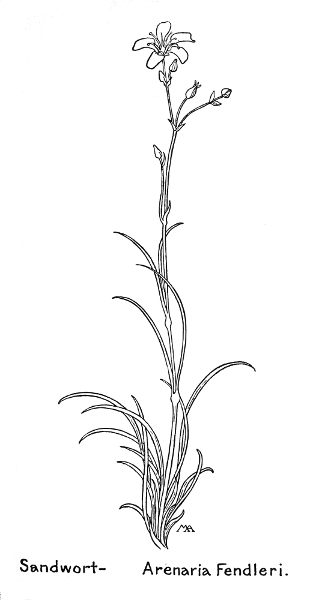
Sandwort—Arenaria Fendleri.
Moss Campion. Cushion Pink Silène acàulis Purple Summer Alpine regions
An attractive little dwarf, living only in the high mountains. It has a long tap-root and many spreading stems, crowded with tiny, stiff, pointed, dark-green leaves, forming close tufts, from six to twenty inches across, resembling cushions of harsh moss and spangled all over with pretty little flowers. They are less than half an inch across with a bell-shaped calyx and five bright pinkish-purple petals, occasionally white, with a "crown" of small scales. We find this brave little plant crouching on bleak mountain tops, blossoming gayly at the edge of the snows that never melt, in arctic alpine regions across the world, up to a height of thirteen thousand feet. It is variable. There is a picture in Mrs. Henshaw's Mountain Wild Flowers of Canada.
Windmill Pink Silène Ánglica (S. Gallica) White Spring Northwest, etc.
A rather inconspicuous "weed" from Europe, common in fields and along roadsides, with a slender, hairy stem, about a foot tall, and hairy leaves. The small flowers grow in a one-sided cluster and have a purplish calyx, sticky and hairy, and white or pinkish petals, with a small "crown," each petal twisted to one side like the sails of a windmill. This is widely distributed in nearly all warm temperate regions.
Indian Pink Silène Califórnica Red Summer Northwest
From six inches to over a foot tall, with a thick, perennial tap-root, one to two feet long, and branching, half-erect stems, both leaves and stems covered with fine down, the dull-green foliage contrasting well in color with the vivid vermilion of the gorgeous flowers. They are more than an inch across, the petals usually slashed into two broad lobes, flanked by two narrower, shorter points at the sides, the "crown" conspicuous. The flowers are even more brilliant in color than S. laciniata and are startlingly beautiful, glowing like coals of fire on the brown forest floor, in the open mountain woods they usually frequent. It is widely distributed in the Coast Ranges and Sierra Nevada Mountains, but nowhere very common. S. Hookeri has beautiful large pink flowers, often more than two inches across, sometimes white, and grows on shady hillsides in the Northwest, except in Idaho.
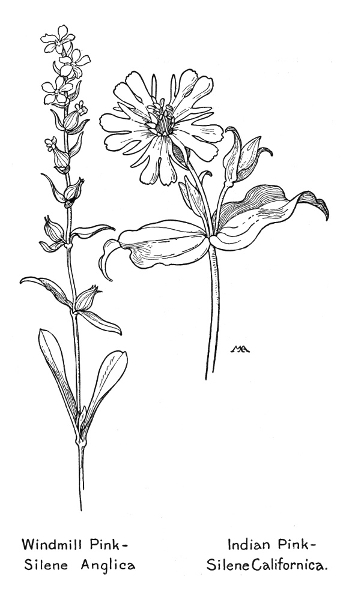
Windmill Pink—Silene Anglica. Indian Pink—Silene Californica.
Indian Pink Silène laciniàta Red Summer California
This has handsome conspicuous flowers, clear vermilion or pinkish-scarlet in color, about an inch and a half across, with the five petals prettily slashed at the ends into four long divisions. Each petal has two little crests, which form a pretty "crown" in the throat of the corolla. The roughish, slender stems, from one to over two feet high, have several branches, the flowers growing two or three at the ends. The leaves are long, narrow, and rather rough and the whole plant is hairy and sticky. This is common around Pasadena and other places in southern California and is beautiful on Point Loma, where the brilliant flowers gleam among the underbrush like bits of flame. S. laciniàta var. Gréggii is common in Arizona and New Mexico.
Silène Lyalli White Summer Northwest
Rather pretty, with a slender stem about a foot tall, smooth, bluish-green leaves, and flowers about three-quarters of an inch across; the calyx much inflated, yellowish-white and papery, with brownish veins, and the petals cream-color, with two lobes and a "crown."
There are a few kinds of Vaccaria, of Europe and Asia, smooth annuals, with clasping leaves and red or pink flowers in terminal clusters; calyx five-angled and inflated in fruit, five-toothed, without bracts; petals longer than the calyx, without appendages; stamens ten; styles two. Both the Latin and common names allude to the value of some kinds for fodder.
Cow-herb Vaccària vaccària (Saponaria) Pink Summer Across the continent
Quite pretty, with a leafy, branching stem, from one to three feet tall, bluish-green leaves, and flowers less than an inch long, with a ribbed, yellowish-green calyx, with reddish teeth, and the petals a very pretty and unusual shade of deep, warm reddish-pink, veined with deeper color. This is a European "weed," common in waste places and cultivated fields.
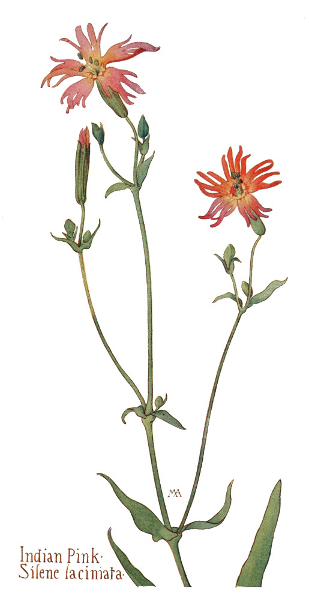
Indian Pink—Silene laciniata.
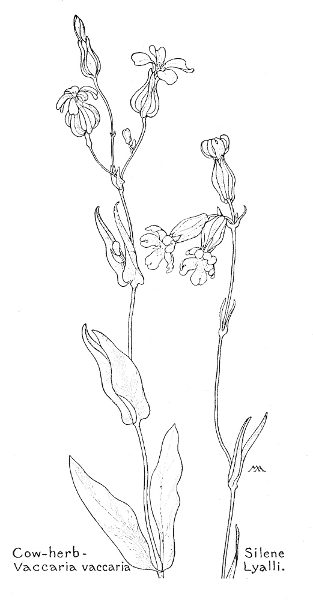
Cow-herb—Vaccaria vaccaria. Silene Lyalli.
There are many kinds of Alsine, widely distributed, low herbs, liking moist ground and shady places, with small, starry white flowers; with four or five sepals; four or five petals, deeply two-lobed or none; three to ten stamens and three to five styles; capsule roundish or oblong, rather shorter than that of Cerastium, splitting to below the middle, with twice as many valves as there are styles and many seeds. Many of these plants are weeds. They are often called Stitchwort. The Greek name means "grove," the home of some kinds.
Tall Chickweed Alsìne lóngipes. (Stellaria) White Summer Northwest, Nev., Utah, etc.
An attractive little plant, with smooth stems, from six to fifteen inches tall, and pretty little flowers, less than half an inch across, growing singly, or in loose clusters, with white petals which are deeply two-lobed, so that they appear to be ten. The capsule is almost black when ripe. This is common in moist and grassy places in Yosemite and when growing in the shade is taller and more slender than in the open. It reaches an altitude of ten thousand feet and is found in the East and in Asia.
There are many kinds of Cerastium, abundant in the temperate zone, resembling Alsine, but usually downy and therefore called Mouse-ear Chickweeds. The flowers are white, usually with five sepals, five petals notched at the tips or with two lobes, ten or five stamens and five stigmas. The cylindrical capsule, often curved, splits at the top into ten teeth.
Field Chickweed Cerástium arvénse White Spring, summer U. S.
On the ledges moistened by the mist and spray that blow from the Yosemite waterfalls, among the glistening, wet grasses, these pretty little white flowers are quite conspicuous. They smell pleasantly of honey, measure about half an inch across, and have more or less downy stems, from five to ten inches tall. This is the prettiest Cerastium, though not so "mousy" as some, and grows in dry as well as moist situations.
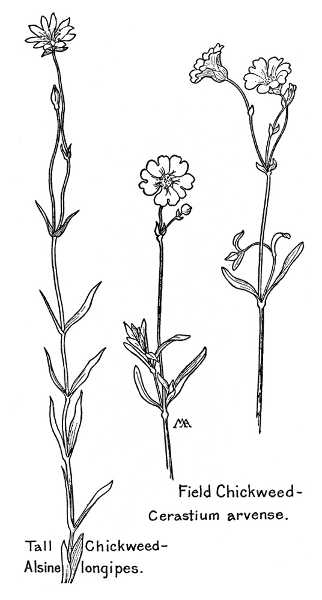
Field Chickweed—Cerastium arvense. Tall Chickweed—Alsine longipes.
PURSLANE FAMILY. Portulacaceae.
A rather small family, mostly American; herbs, usually with thick, succulent leaves and stems, with flowers opening only in sunlight. They usually have only two sepals, but the petals number from two to five or more; the stamens are sometimes numerous, but when they are of the same number as the petals they are opposite them; the one-celled ovary is superior, becoming a many-seeded capsule. Pusley, or Purslane, is one of the commonest garden weeds; everybody knows how difficult it is to keep the spreading rosettes out of gravel walks, and we are all familiar with the gaudy, ephemeral flowers of the cultivated Portulaca. The Purslane-tree, or Spek-boom, of South Africa is often the principal food of elephants and its foliage gives the characteristic coloring to the landscape.
There are several kinds of Montia, closely related to Claytonia, mostly natives of North America, rather succulent plants, very smooth and often with a "bloom." The flowers are white or pinkish, with two sepals; the five petals, equal or somewhat unequal, separate or more or less united at base; the stamens five or three; the style branches three; the capsule with three valves and one to three, shiny, black seeds, which when ripe are shot out of the capsule by the elastic closing of the valves.
Miner's Lettuce Móntia parviflòra White Spring, summer West, except Ariz.
The Indians gather these pretty succulent little plants for salad and indeed the tender, bright-green leaves look as if they would taste very nice. They grow in a loose bunch, with several stems, a few inches to a foot high. The root-leaves have long leaf-stalks and vary very much in size and shape, the earliest being long and narrow, like little green tongues, but the later ones oval, round and kidney-shaped, and they vary also in tint, in dry places being sometimes a dull yellowish-pink. The stem-leaves are quite odd, for a single pair have united around the stem and become a circular or somewhat two-lobed disk, one or two inches broad, the stalk piercing right through its center. This leaf forms a pretty, shallow saucer, with a small, loose cluster of tiny flowers, on slender flower-stalks, springing from the middle. This is common everywhere in orchards or vineyards, and in shady places in the foothills and canyons, and has long been cultivated in England for salad. It is also called Indian Lettuce and Squaw Cabbage. M. perfoliàta is similar.
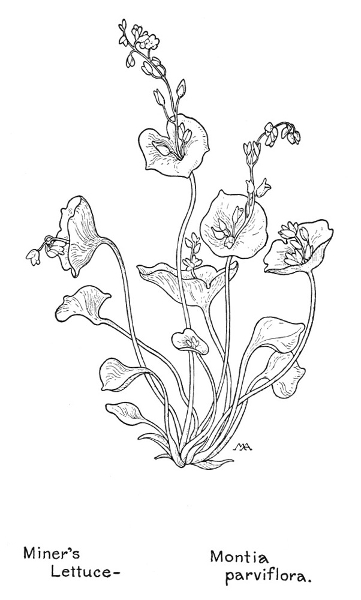
Miner's Lettuce—Montia parviflora.
Spring Beauty Móntia parvifòlia White and pink Spring Northwest
This charming little flower resembles the Spring Beauty of the East, Claytonia Virginica, and blooms in late spring, among the ferns and wet grasses near the Yosemite waterfalls and in similar places. The white flowers, about three-quarters of an inch across, are often tinged with pink and the five stamens are violet. The tender stems, about eight inches tall, are weak and almost trailing and the pale-green leaves are smooth, the lower ones slightly thick and succulent, with little bulblets in the axils, which drop off in drying; the capsule mostly has only one seed.
There are several kinds of Claytonia, resembling Montia.
Spring Beauty Claytònia lanceolàta Pink and white Spring Northwest, Cal., Nev., and Utah
A pretty little plant, three or four inches high, with a juicy, reddish stem and thickish, bluish-green, juicy leaves, the root-leaf narrow, the two stem-leaves broader. The flowers, over half an inch across, are white, tinged and delicately veined with pink, with a little yellow at the base of the petals; the pistil and stamens pink; the two sepals yellowish-green. This grows on moist mountain slopes, up to an altitude of nine thousand feet, sometimes at the edge of the snow, is pretty and delicate and also resembles the eastern Spring Beauty.
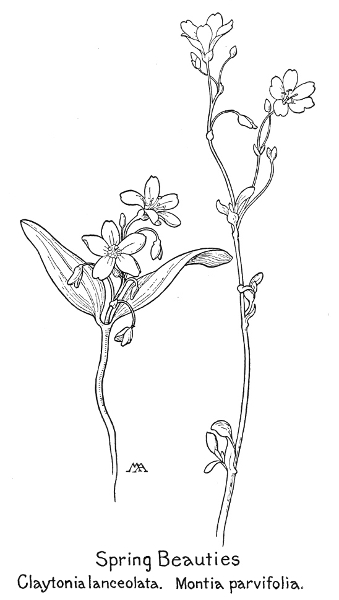
Spring Beauties Claytonia lanceolata. Montia parvifolia.
There are only one or two kinds of Spraguea, natives of North America; low herbs, not very succulent, with fleshy roots; the leaves alternate, or from the root; the small flowers in coiled clusters; the two sepals and the four petals all papery; the stamens one, two, or three in number; the style long, with two stigmas; the capsule roundish, with two valves, containing few or many, shining, black seeds.
Pussy-paws Spràguea umbellàta (Calyptridium) Pink Summer, autumn Northwest
Sandy spots in the mountains are often brightened by lovely patches of the soft pink blooms of this attractive and odd-looking little plant. Near Wawona, on the Glacier Point trail, I saw at least half an acre of sand carpeted with beautiful rose-color. In moderate altitudes the plants are about ten inches tall, but they get dwarfish as they climb and on the mountain-tops they are only an inch or so high, with close mats of small leaves. They have strong tap-roots and the leaves are dull gray-green, rather thick and stiff but hardly succulent, and grow mostly in rosettes at the base, those on the stem having shrunk to mere bracts, with several, smooth, reddish stalks springing from among them. Each stem bears a close, roundish head, two or three inches across, consisting of many tightly-coiled tufts of shaded pink, each composed of innumerable, small, pink flowers, the papery, pink and white sepals and bracts being the most conspicuous part. They overlap each other and have daintily ruffled edges. The three stamens are long and protruding and the style long and threadlike. The flower-clusters are like soft pink cushions, so the pretty little name of Pussy-paws is appropriate, both to form and coloring. Chipmunks are very fond of the small, black seeds.
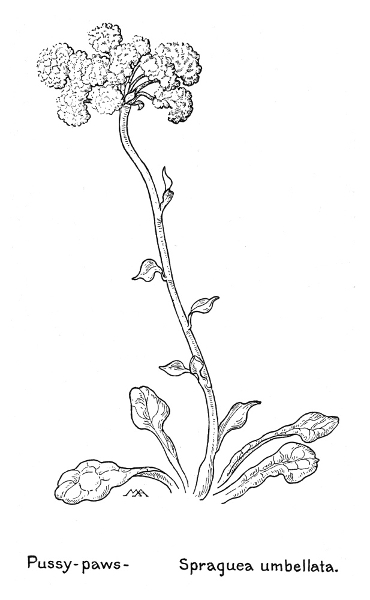
Pussy-paws—Spraguea umbellata.
BUTTERCUP FAMILY. Ranunculaceae.
The members of this large and handsome family vary so much in appearance that it is difficult for the amateur to realize that they are nearly related. In fact they have no very distinctive characteristics. They are all herbs, except Clematis, which is shrubby, and all have bitter juice, which is never milky or colored, numerous stamens and usually several pistils, which are superior and one-celled, bearing a single style, and all the parts of the flower are separate from each other and inserted on the receptacle. The flowers are often of eccentric forms, with spurs or hoods; sometimes they dispense with petals altogether and instead have colored sepals which resemble petals. The leaves are of all sorts and shapes, usually more or less lobed and cut, but have no stipules and often their bases clasp the stem. The fruit is an akene, pod, or berry. Many of our most beautiful and popular garden flowers are included in this family, which is large and distributed throughout the world, but not abundant in the tropics.
There are numerous kinds of Ranunculus, mostly perennials, with fibrous roots, growing in temperate and cold regions. Ours have yellow or white flowers, with three to five sepals and from three to fifteen petals, each of the petals with a nectar-gland at its base; the numerous pistils developing into a roundish or oblong head of akenes. The leaves are variously cut and lobed, the stem leaves alternate. Some sorts grow in the water and some have creeping stems. Some kinds of Ranunculus are liable to be confused with some sorts of Cinquefoils, but the calyx of a Buttercup has no bractlets, as has that of a Cinquefoil. The Latin name means "little frog," as these plants like marshes.
Common Western Buttercup Ranúnculus Califórnicus Yellow Winter, spring Wash., Oreg., Cal.
The commonest kind are attractive, often coloring the fields for miles with bright gold, but the flowers are not so pretty as some common eastern kinds. The stems are branching and more or less hairy, nine inches to a foot and a half tall, with dark-green leaves, smooth, hairy or velvety, and velvety, hairy buds. The flowers are about an inch across, with from nine to sixteen, bright-yellow, shiny petals and pale-green sepals, turned closely back. The akenes have hooked beaks. This runs into many scarcely distinguishable varieties.
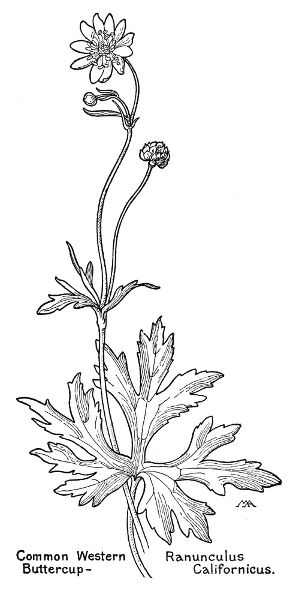
Common Western Buttercup—Ranunculus Californicus.
Few flowers are more beautiful and interesting in color and construction than Larkspurs. We are all familiar with their tall spires of oddly-shaped blossoms, growing in gardens, and we find them even more charming in their natural surroundings, glowing like sapphires on desert sands, or adorning mountain woods with patches of vivid color. There are many kinds; ours are perennials, with palmately-divided leaves and usually blue or white flowers, very irregular in form, with five sepals, resembling petals, the upper one prolonged into a spur at the back, and usually four petals, two of which are small and inside the calyx-spur, the larger two partly covering the pistils and the numerous stamens. The pistils, from one to five, become many-seeded pods. Some Larkspurs are poisonous to cattle. The Latin name is from a fancied resemblance of the flower to the dolphin of decorative art. Spanish Californians call it Espuela del caballero, Cavalier's spur.
Blue Larkspur Delphínium scapòsum Blue Summer Ariz., New Mex.
Though sometimes rather small, this is extremely pretty. In the Grand Canyon, on the plateau, it is about a foot tall, with rather leathery, brownish-green leaves, mostly from the root, and from five to twelve flowers in a cluster. They measure nearly an inch across and are brilliant and iridescent in coloring, as except for two small whitish petals, they are the deepest, brightest blue, exquisitely tinted with violet, with brown anthers. At Tucson, among the rocks above the Desert Laboratory, it grows to over a foot in height, with a cluster over six inches long and light dull-green leaves, slightly stiff and thick, with long leaf-stalks, the lobes tipped with a bristle, forming a handsome clump. This grows on dry plains and rocky hillsides, up to seven thousand feet. The picture is from a Grand Canyon plant.
Larkspur Delphínium Hánseni White, pinkish Summer California
If the flowers were a little less pale in color this would be a gorgeous plant, for it sometimes grows nearly four feet high. The branching stem springs from a cluster of thick, tapering roots, each branch terminating in a long, crowded cluster of twenty or thirty flowers, opalescent in tint, either white, with a bluish or greenish spot on the tip of each sepal, or very pale pink, with a purplish or bluish spot. The dull, yellowish-green leaves are rather thickish and downy, the pods erect. This grows in dryish places, at moderate altitudes, and freely around Yosemite.
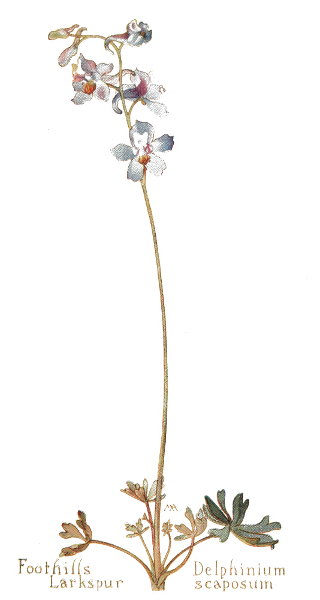
Foothills Larkspur—Delphinium scaposum.
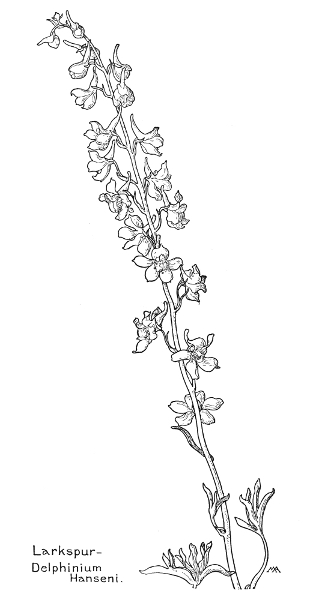
Larkspur—Delphinium Hanseni.
Blue Larkspur Delphínium bícolor Blue Spring, summer Northwest and Utah
A splendid flower when at its best, from six inches to a foot and a half tall, with a smooth stem, reddish below, and smooth, bright-green leaves, pale on the under side, round in general outline, the lower ones with long, reddish leaf-stalks sheathing the stem, the roots thick but not tuberous. The beautiful flowers are sometimes an inch and a half across, on long, rather spreading pedicels, few or many, in a long loose cluster, the buds slightly downy. The general effect of the flowers is deep bright-blue, but when we examine them more closely we find that the slightly woolly spurs are purplish, the blue sepals have on the back protuberances, which are pinkish on the front and greenish on the back, the two, small, upper petals are white, delicately striped with purple, and the lower ones, which are fuzzy with tufts of white down and two-cleft, are deep pinkish-purple; sometimes the whole flower is much paler in color. The anthers are large and green at first, becoming small and yellow, their threadlike filaments curling. This grows on dry hills. D. Párryi, of California, is about two feet tall, similar in coloring, but even handsomer, with a cluster nearly a foot long, closely crowded with beautiful flowers, each an inch and a half across. The lower leaves are slashed nearly to the center, into seven divisions, each with three, long, narrow lobes.
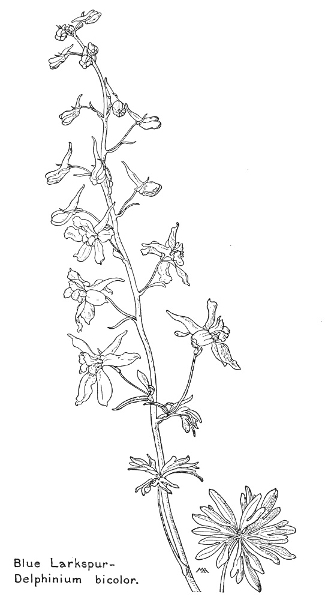
Blue Larkspur—Delphinium bicolor.
Sacramento Larkspur Delphínium variegàtum Purple Spring, summer California
Very handsome, over a foot tall, the upper stem downy, the lower more or less hairy and the leaves more or less velvety. The flowers are an inch or more long and rather few, with long pedicels, forming a loose cluster. They are downy on the outside, all bright-purple, except the two upper petals, which are white tipped with purple, the lower petals edged and tipped with hairs, the spur stoutish and wrinkled. These flowers, though described as blue, seem to me to have more true purple than most Larkspurs. They probably vary a good deal in color. This grows in the Coast Ranges and the Sacramento Valley. There are many similar blue Larkspurs.
Scarlet Larkspur, Christmas-horns Delphínium nudicaùle Red Spring Wash., Oreg., Cal.
Scarlet seems an odd color for a Larkspur, but there are two red ones in the West. This is an exceedingly airy, graceful plant and suggests a Columbine more than a Larkspur. The stem is slender and branching, from one to over two feet tall, with a "bloom"; the leaves thickish, smooth, dark rich green on the upper side and pale on the under. The flowers are far apart, from two to twelve, on long pedicels, forming a very loose, open cluster. Each flower is about an inch long; the sepals scarlet shading to yellow, the spur tipped with deeper red, the petals yellow tipped with crimson, not woolly, the two upper notched and much larger than the two lower ones, which are small and slashed into two points, the edges of both sepals and petals more or less hairy; the buds pale yellowish-green, tinged with pink and red. These charming flowers have an elfin look all their own, as they swing their little pointed red caps in the light shade of cool canyons along the mountain streams they love. In southern California we find D. cardinàle, a handsomer plant, sometimes six feet tall, its flowers larger and deeper red and forming a larger, closer cluster.
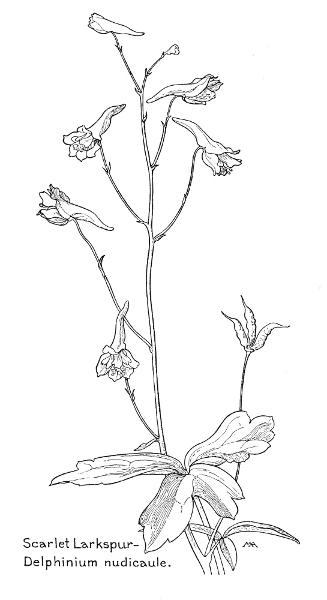
Scarlet Larkspur—Delphinium nudicaule.
The picturesque Columbine gets its melodious name from the Latin for "dove," because the spurs suggest a circle of pretty little pigeons, and this common name is less far-fetched than the Latin one, Aquilegia, which comes from a fancied resemblance of the spurs to an eagle's claws. These plants are well known and easily recognized by the peculiar shape of the flowers. Everything about them is decorative and beautiful, the foliage is pretty and the flowers large, brightly colored, and conspicuous. They are all perennials, with branching stems and compound leaves; the flowers usually nodding, with five sepals all alike and resembling petals, and five petals, also all alike, with conspicuous, hollow spurs. The stamens, the inner ones without anthers, are numerous and the five pistils develop into a head of five, erect, many-seeded pods. There is honey in the spurs, which can be reached only by "long-tongued" insects or humming birds, which thus assist in cross-pollination, and bees obviate the difficulty of having short tongues by ingeniously cutting holes in the spurs. There are a good many beautiful kinds, both East and West.
Scarlet Columbine Aquilègia truncàta Red and yellow Spring Wash., Oreg., Cal.
This charming plant grows from one to over three feet high, is branching and smooth, and has pretty light-green leaves and nodding flowers, which are over an inch and a half across. The outside of the corolla is pale-scarlet, veined and tipped with yellow, the inside is yellow and the spurs are erect and three quarters of an inch long. The flower resembles the Scarlet Columbine of the East, but the plant is taller, with fewer flowers. It is common in moist, rich woods in Yosemite and the Coast Ranges, from the foothills well up to the alpine zone.
White Columbine Aquilègia leptocèra White Summer Northwest and Utah
An exceedingly beautiful flower, a white sister of the large Blue Columbine, which is the "State flower" of Colorado, and sometimes sufficiently tinged with blue to show the relationship. It is a rather slender plant, usually with several stems, from one to two feet tall, the foliage rather bluish-green, the flowers large and usually pure-white, and is found in the mountains.
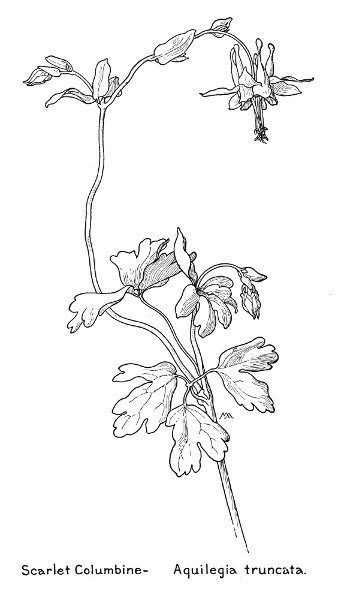
Scarlet Columbine—Aquilegia truncata.
Monkshoods have almost as much charm as their cousins Columbine and Larkspur, with a quaintness and individuality all their own. There are a good many kinds; mountain plants, growing in temperate regions, with rather weak stems and leaves much like those of Larkspur. The blue and white blossoms have a "hood," which gives these plants their very appropriate name. This is formed by the upper and larger one of the five, petal-like sepals arching over and forming a hood, or helmet, under which the two small petals, with spurs and claws, are hidden; sometimes there are three or more petals below, which are minute and resemble stamens. The real stamens are numerous and ripen before the pistils, thus ensuring cross-pollination, and the fruit consists of a head, of from three to five, many-seeded pods. The thick or turnip-shaped root is used medicinally and is virulently poisonous, so these plants are sometimes called Wolfsbane. Aconite is the ancient Greek name and other common names are Blue-weed and Friar's-cap.
Monkshood Aconìtum Columbiànum Blue and white Summer West
This handsome perennial, from two to six feet tall, grows near streams, in mountain meadows or open woods. The flowers measure from half an inch to over an inch long and are mostly bright-blue and white, tinged with violet, but shade from almost white to deep-blue, veined with purple. They are paler inside and grow on slender pedicels, in a long loose cluster, on a somewhat bending stem. The two, small, hammer-shaped petals are nearly concealed under the hood. The leaves are alternate, the lower ones with long leaf-stalks, and deeply cleft into three or five, toothed or lobed, divisions. This reaches an altitude of twelve thousand feet.
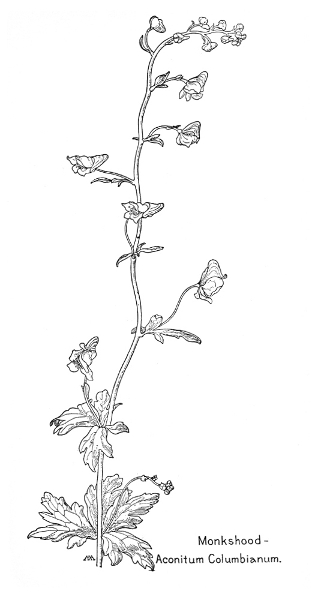
Monkshood—Aconitum Columbianum.
Wild Peony Paeònia Bròwnii Dark-red Winter, spring Wash., Oreg., Cal.
There are two kinds of Peony. This is a robust and very decorative perennial, rich and unusual in coloring, the fine foliage setting off the dark flowers to perfection. The roots are woody, the stems smooth, from eight inches to a foot and a half tall, and the leaves are smooth, rich green, but not shiny. The nodding flowers are an inch and a half across, with five or six greenish-purple sepals, five or six petals, rich deep-red, tinged and streaked with yellow and maroon; dull-yellow stamens and green pistils. The whole flower is quite thick and leathery in texture and rather coarse, sometimes so dark that it is almost black. The flowers are often fragrant, but the plant has a disagreeable smell, something like Skunk-cabbage, when crushed. The large seed-pods, usually five, are thick, leathery and smooth, with several seeds and are a very conspicuous feature, the stems drooping as they ripen and the pods resting on the ground in big bunches. The whole plant is rather succulent and the foliage and stems are more or less tinged with red and have a "bloom," especially on the sepals. This grows in all sorts of places, in the hot plains of the south and at the edge of the snow, in northern, mountain canyons. In the south it blooms in January and is sometimes called Christmas-rose. The root is used medicinally by the Spanish-Californians and by the Indians, "to give their horses long wind." These plants were named in honor of Paion, the physician of the gods.
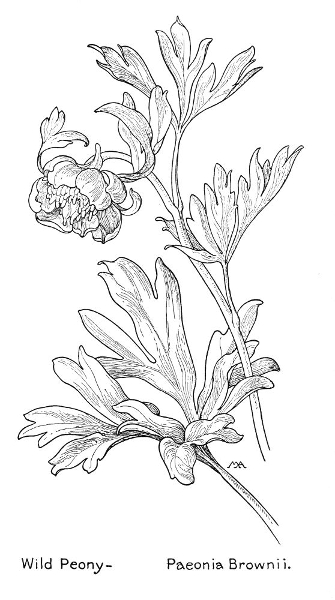
Wild Peony—Paeonia Brownii.
There are only a few kinds of Actaea, tall perennials, with large, alternate, thrice-compound leaves and small, white flowers, in short, terminal clusters. The sepals number about four and resemble petals; the petals are from four to ten, or sometimes none, with claws; the stamens are numerous, with conspicuous white filaments; the one pistil has a broad, somewhat two-lobed, stigma, and the fruit is a large, showy, red or white, somewhat poisonous berry, containing many, smooth, flat seeds.
Baneberry Actaèa argùta White Spring, summer West, except Ariz.
This is a fine plant, from one to two feet tall, with a stoutish, smooth, branching stem and handsome leaves, prettily cut, with pointed teeth, thin and soft in texture, with conspicuous veins. The sepals and petals of the small cream-white flowers are less conspicuous than the numerous white stamens, which give a very feathery appearance to the flower-cluster, which is one or two inches long and speckled with the dark tips of the pistils. The sepals and petals drop off early and the stamens lengthen, so that the cluster becomes very airy and delicate. The general effect of the plant, which grows near shady mountain streams, is striking and graceful. It grows also in the East and is sometimes slightly sweet-scented, but often has an unpleasant smell. The handsome, poisonous berries are oval or round, red or white, with a polished surface, and contain many seeds. This reaches an altitude of ten thousand feet. A very similar kind, A. viridiflòra, grows in the mountains of Arizona.
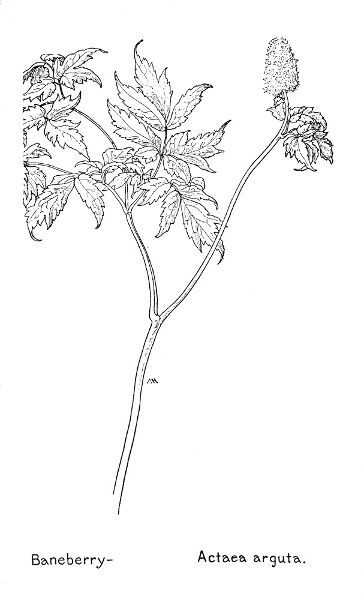
Baneberry—Actaea arguta.
Globe-flower Tróllius láxus White Spring U. S.
This is our only kind of Trollius. It is an exceedingly beautiful flower, particularly when found growing in the snow, or near the edge of a field of melting ice, in high mountains and along the margins of glaciers. The handsome, toothed leaves are palmately-lobed or divided, the lower ones with long leaf-stalks, rich green and glossy and setting off the flowers, which grow singly at the tips of smooth, rather weak stems, from one to two feet tall, and measure about an inch and a half across. The sepals, from five to seven in number, are large, cream-white, slightly greenish outside, and are the conspicuous part of the flower, for the petals are very small and yellow, so that they resemble stamens. From fifteen to twenty-five of these little petals, in a row, surround the numerous, real stamens and form a beautiful golden center. The fruit is a head, measuring an inch across, composed of eight to fifteen small pods, with beaks, containing many, smooth, oblong seeds. This plant looks very much like an Anemone but it has these small yellow petals and Anemones have none, and the center is larger and brighter yellow and the foliage coarser.
There are three kinds of Trautvetteria, two American and one Asiatic.
False Bugbane Trautvettèria grándis White Summer West
A handsome plant, with a smooth, pale-green stem, from two to three feet tall, and fine large leaves, prettily cut, smooth and rather bright green, the lower ones sometimes eight inches across. The white flower clusters are large, very pretty, airy and feathery, consisting of numerous small flowers, with small petal-like sepals, usually four, and no petals, the numerous stamens, with white filaments, being the conspicuous part and forming a little pompon. The akenes are numerous, inflated and four-angled, and form a head. It is a pity that this attractive plant has such a horrid name. It grows in moist woods at Mt. Rainier and in similar places.
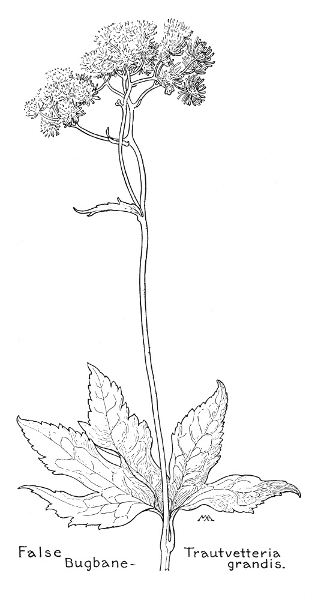
False Bugbane—Trautvetteria grandis.
Anemones grow in temperate and cold regions everywhere. They have no petals, but their sepals, numbering from four to twenty, resemble petals. The stem-leaves are in whorls, forming a kind of involucre below the flower. There are many kinds; some have nearly smooth, pointed akenes, some densely woolly ones, and in some the akenes have feathery tails. The name, pronounced anemòne in Latin and in English anémone, is appropriate to the fragile kinds, such as the eastern Wood Anemone, for it means "flower shaken by the wind."
Canyon Anemone Anemòne sphenophýlla White Spring Arizona
An attractive plant, eight inches to a foot tall, with pretty flowers and foliage. The flowers are white, tinged with pink, less than an inch across, often downy outside, and the head of fruit is oblong, sleek, and silky downy. This grows on dry, rocky slopes in the Grand Canyon, above the plateau. Around Tucson the flowers are less pretty, but the foliage handsomer.
Three-leaved Anemone Anemòne deltoìdea White Summer Wash., Oreg., Col.
Delicate, pale flowers, conspicuous in dark mountain woods, with slightly downy, purplish stems, from eight to ten inches tall, and pretty leaves, thin in texture, the involucre-leaves without leaf-stalks, rather light-green, dull on the upper side, paler and shiny on the under. The pretty flowers are an inch and a half to over two inches across, with five, pure-white sepals, usually two of them larger and longer than the others, and a light bright-yellow center. This is abundant at Mt. Rainier. A. quinquefòlia var. Gràyi, of the Coast Ranges, is similar, the flower often tinged with blue, the involucre-leaves with leaf-stalks.
Northern Anemone Anemòne parviflòra White Summer Northwest
A pretty little plant, with a rather hairy, reddish stem, from four to twelve inches tall, glossy, dark-green leaves, paler and downy on the under side, and flowers about half an inch across, cream-white, tinged with purple or blue on the outside; the akenes very woolly. This reaches an altitude of ten thousand five hundred feet, growing in the East and in Asia and is the smallest of the mountain Anemones.
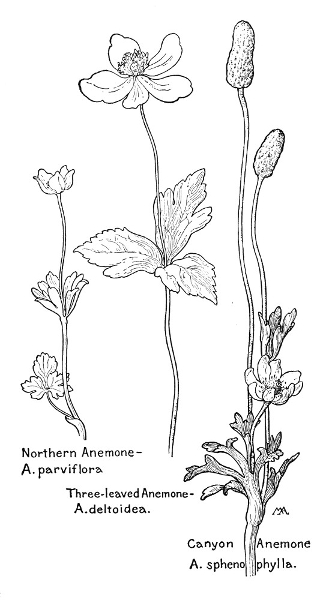
Northern Anemone—A. parviflora. Three-leaved Anemone—A. deltoidea. Canyon Anemone—A. sphenophylla.
Western Anemone Anemòne occidentàlis White Spring Northwest
These beautiful mountain flowers bloom in early spring, sometimes poking their pretty faces right through a hole melted in a snow-bank, and the brave little things are quite thickly covered with silky wool all over, as if to keep themselves warm. The flowers, which often bloom before the leaves expand, are about two inches across, with five to eight, cream-white sepals, tinged with blue and hairy on the outside, and are much less delicate looking than most Anemones. The stout stems are very woolly, from six to eighteen inches tall, and the leaves are beautiful, cut into numerous, very fine divisions, exceedingly feathery and pretty. The akenes have long, feathery tails and form very large, silky, fluffy heads, which are very handsome and conspicuous.
There are a good many kinds of Caltha, succulent marsh plants, of temperate and arctic regions; the leaves undivided, mostly from the base and more or less heart-shaped; the flowers with large, petal-like sepals and no petals. This is the Latin name of the Marigold.
White Marsh Marigold Cáltha leptosépala White Summer Northwest
A pretty little mountain, marsh plant with a smooth, stout, purplish stem from four to eight inches tall, and smooth, light-green leaves, often veined with purple on the under side. The flowers are an inch and a quarter across, with eight or ten, cream-white sepals, tinged with blue on the outside, and pretty golden centers of numerous stamens. This blooms at the edge of the retreating snow and reaches an altitude of twelve thousand feet. C. palústris, the Yellow Marsh Marigold, found in the Northwest and common in the East, has beautiful yellow flowers, resembling large Buttercups.
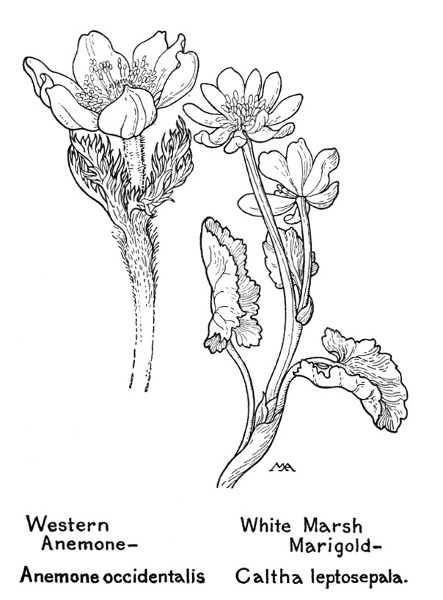
Western Anemone—Anemone occidentalis. White Marsh Marigold—Caltha leptosepala.
There are many varieties of Clematis, or Virgin's Bower, familiar to us all, both East and West, and general favorites, widely distributed and flourishing in temperate regions; perennials, woody below, which is unusual in this family. Usually they are beautiful trailing vines, which climb over bushes and rocks, holding on by their twisting, curling leaf-stalks. The flowers have no petals, or only very small ones, but their sepals, usually four, resemble petals; the stamens are numerous. The numerous pistils form a round bunch of akenes, their styles developing into long feathery tails, and these gray, plumy heads are very conspicuous and ornamental, when the flowers are gone. The leaves are opposite, which is unusual in this family, with slender leaf-stalks, and are usually compound. Some plants have only staminate flowers and some only pistillate ones, and the appearance is quite different, the flowers with stamens being handsomer.
Virgin's Bower, Pipe-stem Clématis lasiántha White, pale-yellow Spring California
Near the summit of Mt. Lowe, and in similar places, we find this beautiful vine clambering over the rocks. The flowers measure an inch and a quarter to over two inches across and they vary in tint from almost pure white to a lovely soft shade of pale-yellow, the handsome clusters forming a beautiful contrast to the dark-green foliage. The stamens and pistils are on different plants. The flowers, leaves, and stems are all more or less velvety and the akenes have tails an inch long, forming a head, about two inches across. The flowers are often so numerous as to make conspicuous masses of pale color on canyon sides, in the Coast Range and Sierra Nevada Mountains.
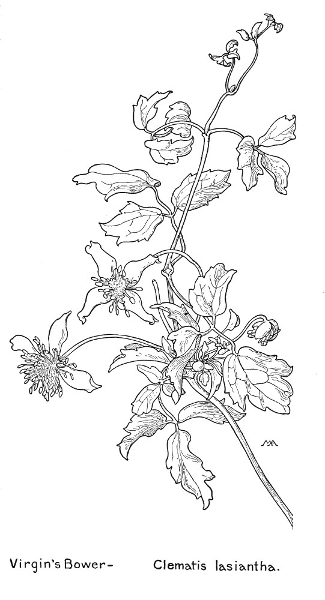
Virgin's Bower—Clematis lasiantha.
There are a few kinds of Atragene, resembling Clematis.
Purple Clematis Atrágene occidentàlis (Clematis) Violet, blue Summer West
This is peculiarly attractive, as the flowers are large and beautiful and the foliage very pretty. The leaves are divided into three, pointed leaflets, which are thin in texture, light bright-green and prettily cut or lobed, and the trailing or climbing stems are almost smooth, slender and purplish above and woody below. The flowers, which are not in clusters, measure from two to three inches across, with four, sometimes five, violet or blue sepals, spreading widely as the flower grows older, and the outer stamens are broad and resemble small petals. The flowers are followed by handsome feathery heads, which are large and silky. This pretty vine is found in the Grand Canyon, not far below the Rim, and in many mountain places. The foliage varies somewhat in different climates.
There are many kinds of Thalictrum, not easily distinguished, widely distributed, a few in the Andes, India, and Africa; perennials, with tall stems, from a short rootstock, and handsome, compound leaves; the flowers perfect or imperfect, many, small, in clusters, with four to seven sepals and no petals; the akenes tipped with the long styles and forming a head. Some of these plants have a disagreeable smell. They grow in moist places, both East and West.
Meadow Rue Thalíctrum Féndleri Greenish-white Summer West
Though its flowers are small and colorless, this plant is conspicuous for delicacy and grace. The leaves of tender green suggest the fronds of Maidenhair Fern and are almost as beautiful, while the flowers are odd and pretty. A shower of numerous, pale-yellow stamens, with purplish, threadlike filaments, falls from the center of four, greenish-white sepals and forms a charming little tassel. These tassels hang on the ends of very slender pedicels, in loose clusters. The smooth stems are from one to three feet tall and the smooth leaves are thin in texture, thrice-compound, with many, rounded leaflets, the lower leaves with long leaf-stalks. This Meadow Rue has its pistils and stamens on different plants, the flowers with tassels of stamens being prettier and more conspicuous than the small, green, pistillate ones. The variety Wrìghtii is common in Arizona.
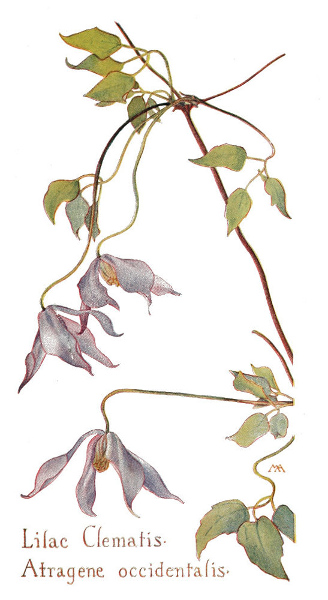
Lilac Clematis—Atragene occidentalis.
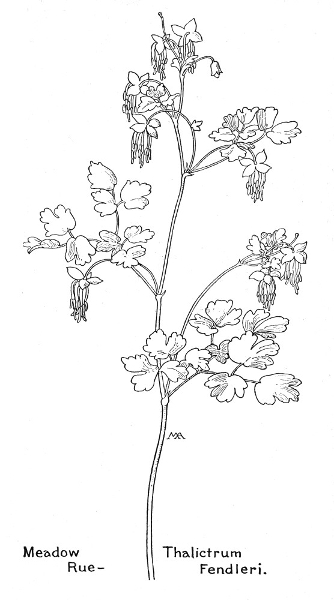
Meadow Rue—Thalictrum Fendleri.
BARBERRY FAMILY. Berberidaceae.
Not a large family, widely distributed; shrubs or herbs; leaves alternate or from the root; flowers perfect; sepals and petals few, many, or none, generally in several overlapping rows; stamens on the receptacle, usually as many as the petals and opposite them; pistil one, with a short style, or none; fruit a berry or capsule.
There are several kinds of Vancouveria, perennial herbs with slender, creeping rootstocks; named after Vancouver the explorer.
Inside-out Flower, Barrenwort Vancouvèria parviflòra White, lilac Spring Wash., Oreg., Cal.
A charming woodland plant, its airy flower cluster, which has much the effect of an Alum-root, in beautiful contrast to the crisp, evergreen foliage. The large leaves are all from the root, with wiry, purplish leaf-stalks and beautifully-shaped leaflets, each an inch or more broad, pale on the under side, the older leaves dark, rich green, leathery and very glossy and the younger ones bright apple-green and thinner in texture. They form a handsome cluster, varying a good deal in size, and the general effect suggests some very crisp and sturdy sort of Maidenhair Fern. The stem is from one to two feet tall, wiry, purplish, and hairy, and bears a very loose cluster of tiny, drooping, white or lilac-tinged flowers. The six, white sepals resemble petals; the six, white petals are smaller than the sepals, lined with yellow, and there are six to nine bracts, resembling sepals, and six stamens. The minute buds are purplish and the little flowers are exceedingly pretty and odd, when we examine them closely, for the sepals turn back so abruptly from the tiny petals, and from the projecting cluster of stamens, that the name Inside-out Flower is appropriate. The fruit is a kind of capsule with many seeds. This grows in shady woods, especially among redwoods, up to seven thousand feet. V. hexándra has thinner leaflets, not evergreen, and the leaflets of V. chrysántha have white margins.
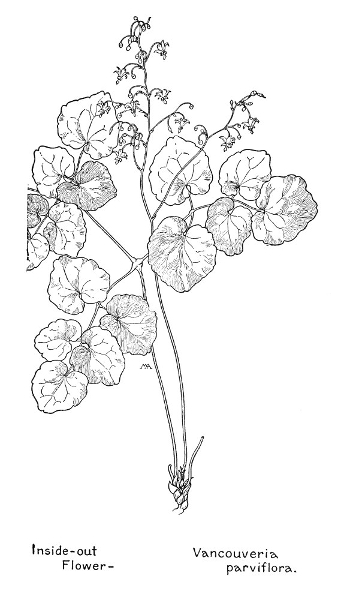
Inside-out Flower—Vancouveria parviflora.
There are many kinds of Barberry, widely distributed; shrubs, with yellow wood; the leaves often spiny and the flowers yellow; the sepals six to nine, with bracts and resembling petals; the petals six, in two overlapping rows, each with two glands at the base; the stamens six, with anthers that open by little valves like trap-doors, hinged at the top, sensitive and, when they are touched, closing around the shield-shaped stigma; the fruit a berry, with one or few seeds.
Oregon Grape, Trailing Barberry Bérberis rèpens Yellow Spring Cal., Ariz., Utah, Nev.
This does not look much like the common cultivated kinds of Barberry, for it grows close to the ground in a straggling bunch. In favorable situations it is a handsome and conspicuous plant. The leaves, with from three to seven leaflets, are stiff, prickly, and evergreen like Holly, and the yellow flowers are in clusters at the ends of the stems, with opposite bracts. The six sepals, petals, and stamens are all opposite, that is, with a petal in front of each sepal and a stamen in front of each petal. In Arizona the flowers are rather small and the clusters short, but in Utah they are far handsomer, rich golden-yellow and sweet-scented, forming clusters two inches long. The fruit is a handsome blue berry with a "bloom," the color of wild grapes, contrasting well with the foliage when it turns red in the autumn, and delicious jelly is made from them. B. aquifòlium, of Oregon and Washington, is similar, with much more beautiful, very shining leaves. B. Féndleri, of the Southwest, is from three to six feet high, the branches smooth and shiny as if varnished, the leaves with smooth edges or spiny teeth, and the flowers in numerous drooping clusters. The calyx has conspicuous, red bracts and the berry is red.
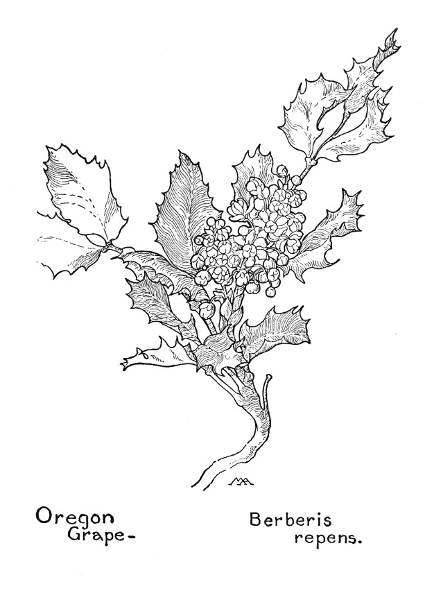
Oregon Grape—Berberis repens.
Sweet-after-Death Áchlys triphýlla White Summer Wash., Oreg., Cal.
The only kind, an attractive perennial, popular on account of its sweet-smelling foliage, which, however, is not fragrant until the leaves are dried. It has a very slender rootstock and only one large leaf, with a very long, slender leaf-stalk and three, oddly-shaped leaflets, from two to six inches across, bright-green, smooth and thin in texture, but not glossy. The single, very slender flower-stalk, from one to two feet tall, bears a crowded spike of many, tiny, scentless, white flowers, without either calyx or corolla, but consisting of a cluster of stamens, with long, threadlike filaments, the outer ones broader, and a pistil with a broad stigma and no style. The effect of the cluster is feathery and pretty and the broad leaf is very conspicuous, on account of its size and shape. The crescent-shaped fruit contains one seed, is at first fleshy, but becomes dry and leathery. This grows in the woods in the Coast Ranges, from near sea-level up to seven thousand feet. It is also called Vanilla Leaf and Deer-foot.
WATER LILY FAMILY. Nymphaeaceae.
A small family, widely distributed in fresh-water lakes and streams; aquatic, perennial herbs, with thick, horizontal rootstocks, or with tubers, large, floating, or erect leaves, and large, solitary flowers, with long flower-stalks; sepals three to twelve; petals three to many; stamens six to numerous; ovary superior, stigmas distinct or united into a disk. We have no white Water Lilies in the West.
Indian Pond Lily, Spatter-dock Nymphaèa polysépala (Nuphar) Yellow Summer Cal., Oreg., Wash., Col., Wyo.
Like the eastern Spatter-dock, this is a coarse, but rather handsome and decorative plant. The leathery leaves are shaped like a rounded heart and sometimes a foot long. The cup-shaped calyx, two to four inches across, is the conspicuous part of the flower, consisting of seven to twelve, thickish sepals, yellow and petal-like, the outer greenish. There are twelve to eighteen petals, half an inch long, resembling stamens. The real stamens have dark-red anthers, but yellow pollen, and both petals and stamens are densely crowded around the ovary. The round fruit has a narrow neck, concave top, and many seeds. In quiet mountain ponds we find these yellow flowers, on stout stems standing up out of the water, the lily-pads floating idly on its surface. Indians grind the seeds into meal for porridge, or else roast them and eat them like popcorn.
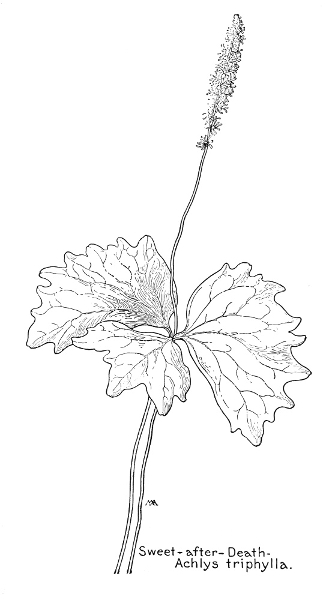
Sweet-after-Death—Achlys triphylla.
STRAWBERRY SHRUB FAMILY. Calycanthaceae.
A very small family, of only two genera, one North American, one Japanese; aromatic shrubs, with opposite, toothless leaves, with short leaf-stalks, without stipules; flowers large, solitary, at the ends of leafy branches; sepals, petals, and stamens, indefinite in number, in many, overlapping series, passing one into the other, so that one cannot tell which is which, and all borne on the receptacle, which is hollow, resembling a rose-hip, almost enclosing the numerous pistils; stamens short, the inner ones without anthers; receptacle becoming a large, leathery, oblong or pear-shaped fruit, containing few or many, smooth, shining akenes.
There are three kinds of Calycanthus in this country, two of them eastern; flowers purple or red, stamens inserted in several rows.
Strawberry Shrub Calycánthus occidentàlis Red Summer California
This resembles the familiar shrub of old-fashioned gardens and the flowers have the same pleasant and elusive aroma, something like strawberries, much more spicy when crushed. The shrub is four to ten feet high, with rather coarse, harsh foliage and large, handsome flowers, two or three inches across, warm maroon in color, shading to brown and purple, with yellow stamens. This is handsome and conspicuous, because of the uncommon and rich coloring of its flowers, and grows along watercourses in the canyons of the foothills and is most common in northern California. It has many other names, such as Sweet Shrub, Carolina Allspice, Wineflowers, etc.
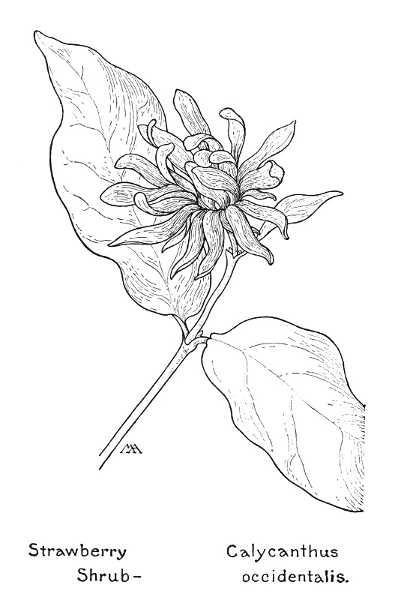
Strawberry Shrub—Calycanthus occidentalis.
POPPY FAMILY. Papaveraceae.
A rather large family, widely distributed, most abundant in the north temperate zone; herbs, rarely shrubs, with milky, mostly yellow juice and narcotic or acrid properties; the leaves mostly alternate, without stipules; the parts of the flower usually all separate and distinct, borne on a top-shaped receptacle. There are usually two sepals, which fall off when the blossom opens, and usually four petals, overlapping and crumpled in the bud; the stamens are usually numerous and conspicuous, with thread-like filaments; the superior ovary becomes a many-seeded capsule.
There are only two kinds of Romneya, much alike, smooth, stout, perennial herbs, several feet high, with colorless sap, the leaves alternate and more or less divided; three sepals, each with a broad wing on the back; six, large, white petals; many stamens; the ovary covered with bristles. These plants are nowhere common, but are found from Santa Barbara south, and in lower California sometimes grow in great profusion. They are extensively cultivated and much admired abroad.
Matilija Poppy, Giant Poppy Romnèya trichocàlyx White Summer California
This is often considered the handsomest flower in the West and it would be hard to find anything more beautiful and striking than its magnificent blossoms. The plant has somewhat the effect of a Peony-bush, sometimes, in cultivation, as much as five feet high, with many smooth stems and handsome, smooth, light-green foliage, the leaves cut and lobed, those near the top with a few prickles. The splendid flowers are enormous, from five to nine inches across, with diaphanous, white petals, crinkled like crêpe tissue-paper, and bright golden centers, composed of hundreds of yellow stamens surrounding a greenish-white pistil. The blossoms remain open for several days. The hard, round buds are covered with short, brown hairs. This is the true Matilija Poppy, (pronounced Matíliha,) as it is the kind that grows in the canyon of that name, but the tremendous floods of 1914 drowned most of these beautiful plants in that locality. R. Còulteri is similar, but the buds are smooth and the stems more robust.
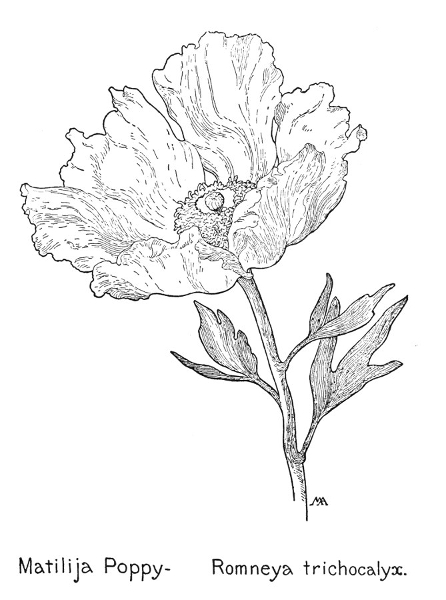
Matilija Poppy—Romneya trichocalyx.
There are several kinds of Argemone, natives of the warmer parts of America, with bitter, yellow juice, spiny-toothed leaves and large, conspicuous flowers, the buds erect; sepals two or three, with odd little horns; petals twice as many as the sepals; stamens numerous; style very short, with a radiate stigma; capsule prickly, oblong, opening at the top, containing numerous seeds.
Thistle Poppy, Milk Thistle Argemòne híspida White Summer Southwest
The prickly, bluish-green foliage of this decorative and handsome plant is thistle-like both in form and color. The leafy, branching stems, two or three feet high, are covered with dense, white or yellowish prickles and bear several lovely flowers, over three inches across, with delicately crumpled, white petals and beautiful golden centers, composed of numerous yellow stamens, both stem and leaves having a bluish "bloom." The three prickly green sepals each have a spine-like beak and form a queer-looking, three-horned bud; the pistil has a purplish, cap-shaped stigma, with six lobes, and the prickly ovary becomes a very prickly capsule. This grows in dry places and looks very beautiful and striking when we find its fragile flowers waving in the wind against a background of hot desert sand. It varies a good deal in prickliness and in the form both of plant and flower. When there is only one large flower in bloom, surrounded by a circle of prickly buds, it suggests a fairy princess, guarded by a retinue of fierce warriors. The flowers are often quite broad and flat, and then are sometimes given the prosaic name of Fried-eggs.
There are many kinds of Papaver; with milky juice, leaves lobed or cut, nodding flower buds, showy regular flowers, with two or three sepals and four to six petals. The stigmas are united to form a disk with rays and the fruit is a round or oblong capsule, opening near the top. Both the Latin and common name, Poppy, are ancient. Opium is made from P. somníferum of the Mediterranean.
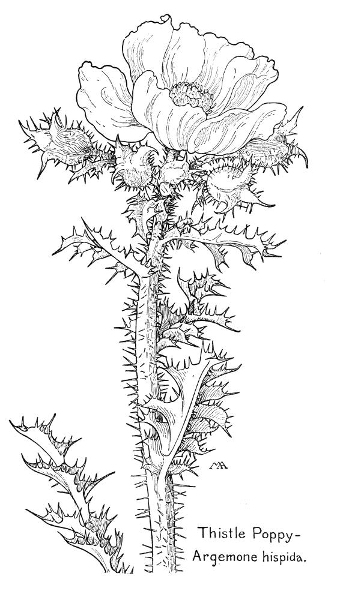
Thistle Poppy—Argemone hispida.
Wind Poppy Papàver heterophýllum Red Spring California
A slender, graceful plant, one or two feet tall, with smooth, branching, purplish stems, smooth leaves, variously cut and lobed, and charming flowers, gay yet delicate. They are about an inch and a half across, usually with four, scarlet petals, each with a spot of maroon at the base, and a bright-green pistil and maroon filaments with pale-yellow anthers. The buds and seed-pods are smooth. This varies a good deal, smells strong of opium when picked, and its flowers glow like jewels among the underbrush on open hillsides, but fall to pieces when gathered.
There are a good many kinds of Eschscholtzia, with bitter, watery juice; leaves alternate, cut into many fine divisions; buds erect; flowers yellow; receptacle cuplike, often with a rim; the two sepals united to form a pointed cap, which is pushed off by the four petals as they expand; stamens numerous, with short filaments and long anthers; style very short, usually with four stigmas; pod long, narrow and ribbed, containing many seeds. These plants were collected at San Francisco in 1816 by von Chamisso, a German poet and naturalist, and named in honor of his friend Eschscholtz, a botanist.
California Poppy Eschschóltzia Califórnica Yellow Spring Cal., Oreg.
Probably the most celebrated western flower and deservedly popular. It varies a great deal in general form and coloring, but is usually a fine plant, over a foot tall, with stems and leaves a beautiful shade of light bluish-green, and the flowers two or three inches across, usually bright-yellow, shading to orange at the base, but sometimes almost cream-color. They open in sunlight and when blooming in quantities are a beautiful sight, covering the hillsides with a cloth of gold. In southern Arizona a similar kind often borders the dry beds of streams with bright color, with much the same value in the landscape as the Marsh Marigolds along New England streams. It is the State flower of California and has many poetic Spanish names, such as Torosa, Amapola, and Dormidera, besides Copa de Oro, meaning "Cup of gold."
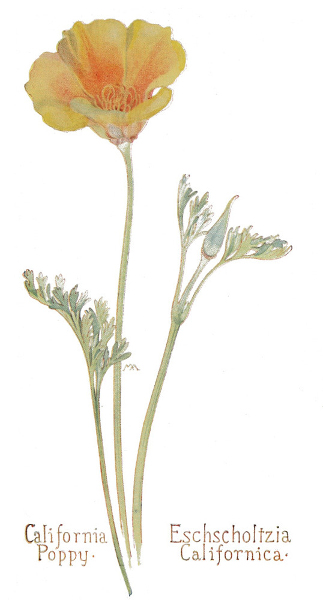
California Poppy—Eschscholtzia Californica.
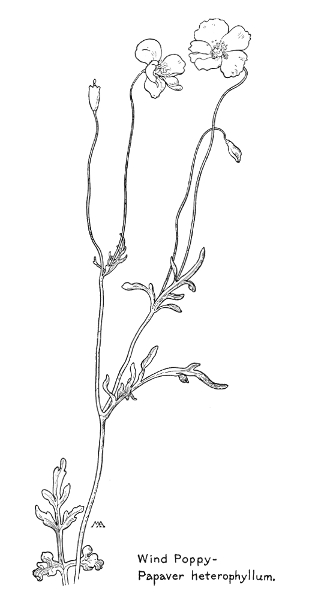
Wind Poppy—Papaver heterophyllum.
There are several kinds of Dendromecon, smooth shrubs, with alternate, toothless, leathery leaves and yellow flowers, with two sepals and four petals; stamens numerous, with short filaments; ovary with a short style and two, oblong stigmas. The name is from the Greek for "tree" and "poppy."
Tree Poppy Dendromécon rígida Yellow All seasons California
This is not a true Poppy, but the flowers are sufficiently like to be quite surprising when we find them growing on what appears to be a small willow tree! It is a handsome and decorative shrub, both in form and color, two to eight feet high, with pale woody stems, the main stem with shreddy bark, and light bluish-green foliage, the leaves something like those of willow, but quite stiff and leathery, with a little pointed tip, the short leaf-stalks twisted so as to bring the leaf into a vertical position. Sprinkled all over the bush are numbers of beautiful, clear golden-yellow flowers, one to three inches across, with orange-colored anthers and a pale-yellow pistil. This grows on dry, sunny hillsides, at middle altitudes, and is common in southern California, but is particularly fine near Santa Barbara. The flowers have a slight smell like cucumber and may be found in bloom at all seasons of the year. The ribbed seed-pod is long and narrow.
There is only one kind of Platystemon, with stem leaves opposite or in whorls; sepals three, soon falling; petals six; stamens many, with broad, flat filaments. The numerous pistils are at first partly united, forming a compound ovary; when ripe they separate into knotted pods, which break apart between the seeds. The name means "broad stamens."
Cream-cups Platystèmon Califórnicus Cream-color Spring Cal., Oreg., Ariz.
Pretty graceful plants, their creamy blossoms often whitening the spring meadows. The slender hairy stems are about a foot tall, the leaves and the nodding buds light-green and hairy, and the pretty flowers, about an inch across, are delicate cream-color, the petals often stained with bright-yellow, either at the tip or base, or both, with pretty creamy centers. This is common in the foothills, plains, and valleys.
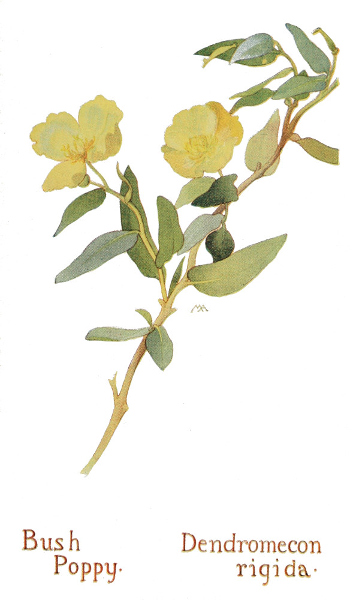
Bush Poppy—Dendromecon rigida.
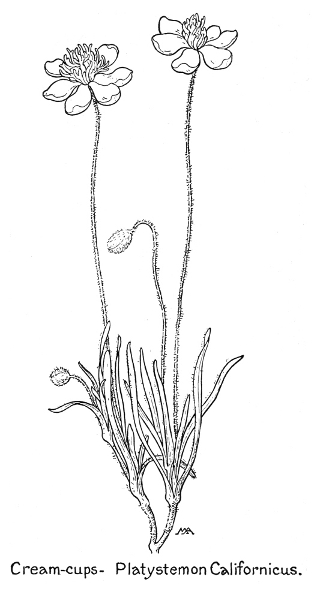
Cream-cups—Platystemon Californicus.
BLEEDING HEART FAMILY. Fumariaceae.
A small family, widely distributed; very smooth, tender, perennial herbs, with watery juice; alternate, compound leaves, finely cut, lobed and fringed into many divisions, and irregular, perfect flowers, of peculiar shape, with two, scale-like sepals, and four petals, the inner pair narrower than the outer and united by their tips over the stamens and style. The six stamens are in two, equal sets, the filaments of each set somewhat united, the middle anther of each set with two cells, the others with only one. The superior ovary develops into a long, dry, one-celled capsule, containing shiny, black seeds. This family has been united to the Poppies by Bentham and Hooker, because the plan of the flowers is similar, though their appearance is unlike.
There are several kinds of Bicuculla, natives of North America and Asia; perennials, with beautiful foliage and decorative flowers, of the curious and intricate shape we are familiar with in old-fashioned gardens. The pedicels have two bracts; the corolla is heart-shaped at base; the outer pair of petals are oblong and concave, with spreading tips and spurred or pouched at base, the inner pair are narrow and clawed, with crests or wings on the back; the style is slender, with a two-lobed stigma, each lobe with two crests. The creeping rootstock is surrounded by a bulb-like cluster of fleshy grains. These plants are often called Dutchman's Breeches, from the shape of the flower, which, of course, also gives the pretty name Bleeding Heart. Bicuculla is from the Latin, meaning "double-hooded."
Bleeding Heart Bicucúlla formòsa (Dicentra) Pink Summer Cal., Oreg., Wash.
This is a very beautiful and interesting plant, about two feet tall, with delicate pale-green leaves, beautifully cut and lobed, all from the root, with very long leaf-stalks, and a few, graceful sprays of purplish-pink flowers, each about three-quarters of an inch long. This has a fleshy, spreading rootstock and grows in shady spots, in rich, moist woods, at moderate altitudes, but is not very common. It is found in the Yosemite Valley. B. uniflòra is a diminutive alpine plant, from one to three inches high, usually with only one white or flesh-colored flower, about half an inch long, which is often hidden among dead leaves. This grows in rich soil on mountain sides in the Wasatch and Teton Mountains and in the Sierra Nevada, and is found in the Yosemite Valley and on Mt. Lyall, at a height of ten thousand five hundred feet. This is called Squirrel Corn and Steer's Head.
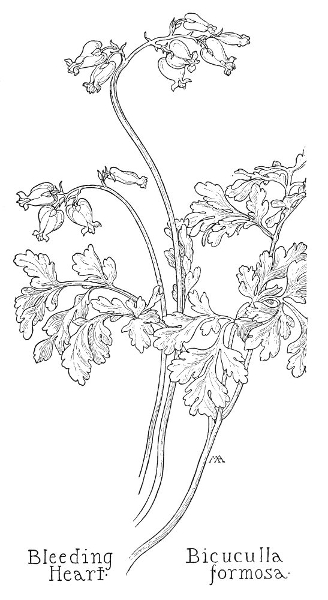
Bleeding Heart—Bicuculla formosa.
Golden Eardrops Bicucúlla chrysántha (Dicentra) Yellow Summer California
The general appearance of this handsome plant is striking and Japanese in effect, and the coloring of the feathery, pale-green foliage and the golden-yellow flowers is exceedingly odd and beautiful. The large, finely-cut leaves are sometimes a foot long, and resemble delicate ferns, and the smooth, stout, rather coarse flower-stems bear a few pretty flowers, which are a soft shade of yellow, about three-quarters of an inch long, the usual Bleeding Heart shape, but not drooping, and with a strong narcotic odor, much like that of poppies. This is sometimes as much as four feet high and grows in sunny places on dry ridges in the Coast Ranges, but is nowhere common.
There are many kinds of Capnoides, natives of the north temperate zone and Africa. They have oddly-shaped flowers, something like Bleeding Heart, but with only one spur, at the back on the upper side, instead of two. The name is from the Greek, meaning "smokelike," in allusion to the odor of some kinds.
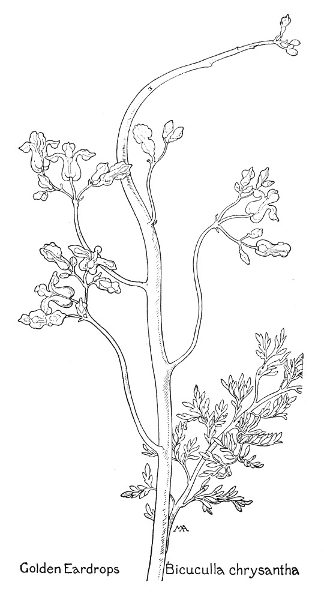
Golden Eardrops—Bicuculla chrysantha.
Golden Corydal Capnoìdes aùreum (Corydalis) Yellow Spring West
This has hollow, branching and spreading stems, from six to fourteen inches tall, with very pretty, delicate, pale-green foliage and bright-yellow flowers, each about half an inch long, on slender pedicels, in a loose cluster. The spurs give them a quaint and pert effect. The style stays on the tip of the long curved capsule, which looks like a bean-pod, drooping or sticking out at an awkward angle from the stem. This is especially fine in some of the mountain valleys in Utah, making beautiful clumps of foliage; it is widely distributed and is also found in the East. In the West it is sometimes called Dutchman's Breeches and confused with that plant, but rather absurdly so, for the Dutchman could have only one leg!
Pink Corydalis Capnoìdes Scoúleri (Corydalis) Pink Summer Wash., Oreg.
A very beautiful and decorative plant, two or three feet tall, with large, exceedingly graceful leaves, vivid yet delicate in color and thin in texture, beautifully cut and lobed. The flowers are about an inch long, pale-pink shaded with deeper color, each with a long, cylindrical spur, and form pretty clusters, which show up very effectively against the tender green of the large clumps of delicate foliage, which are conspicuously beautiful. This grows in rich soil, in mountain woods, and is charming in the forests in Mt. Rainier National Park.
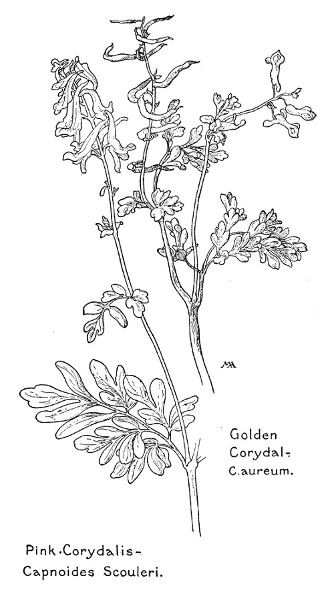
Pink Corydalis—Capnoides Scouleri. Golden Corydal—C. aureum.
MUSTARD FAMILY. Cruciferae.
A large family, widely distributed. Both the English and Latin names are appropriate, for the watery juice of these plants is pungent, like mustard, and the flowers spread out their four petals in the form of a cross. They are herbs, the leaves alternate or from the root, usually with no leaf-stalks. The flowers have four petals, with claws; four sepals, the two outer ones narrow, apt to drop off; six stamens, two of them short. The ovary is superior, usually with a single style and stigma, and usually develops into a pod, divided in two by a transparent partition, which remains after the pod has opened from below; in some kinds the pod remains closed. The flowers generally grow in clusters and though they are often small they produce honey and so are frequented by bees and flies. The family is easily recognized by the four petals and in most species by two stamens being shorter than the others, but the flowers are so much alike that the various kinds have to be determined by examining the fruit. Radish and Horse-radish, Mustard and Water-cress all belong to this family, as well as many familiar garden flowers, such as Sweet Alyssum, Candytuft, Rockets, and Stocks, and many are common weeds, such as Peppergrass and Shepherd's Purse.
There are several kinds of Dentaria, smooth perennials, with rather large white or pink flowers and tuberous rootstocks.
Milk Maids, Pepper-root Dentària Califórnica White, pink Spring Cal., Oreg.
A charming plant, with a purplish stem, from six inches to two feet tall, and pretty leaves, varying in shape, those from the root being roundish in outline, or with three leaflets, but the stem-leaves with three or five leaflets. The flowers are about three-quarters of an inch across, with pure-white or pale-pink petals. This is one of the loveliest of the early spring flowers in the Coast Ranges and usually found in damp spots, both in woods and open places, often whitening the meadows with its blossoms.
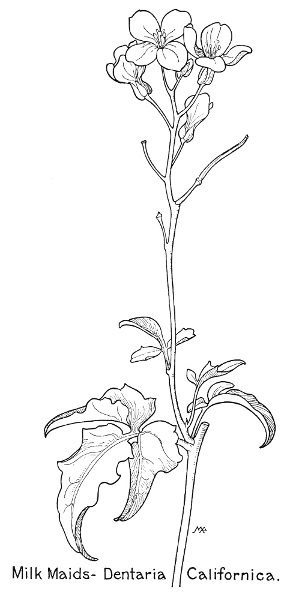
Milk Maids—Dentaria Californica.
There are a good many kinds of Thelypodium, natives of North America, all western or southwestern; mostly smooth plants, the leaves usually with leaf-stalks, the flowers in clusters; stamens long, conspicuous, with very narrow, arrow-shaped anthers; pods long, cylindrical or four-sided, often twisted, sometimes on a slender stalk; seeds oblong, flattish, in one row in each cell.
Thelypòdium torulòsum Lilac Spring, summer West, etc.
This has small flowers, but often grows in such quantities on the flats near Salt Lake that it tints the fields with purple. The purplish stem is from twelve to fifteen inches tall and the leaves are light bluish-green and very smooth, the root-leaves with long leaf-stalks, and the stem-leaves arrow-shaped and clasping at base. The flowers are about half an inch across, with a purplish-tinged calyx and pale pinkish-lilac petals, and form flat-topped clusters. The pods are spreading and rather knobby. This usually grows on dry hills, reaching an altitude of over nine thousand feet, as far east as Wyoming.
There are many kinds of Arabis, widely distributed, with small, white or purplish flowers.
Fendler's Arabis Árabis Féndleri Magenta Spring Arizona
This is a rather pretty plant, a foot or more tall, with more or less hairy stems and leaves and pretty clusters of magenta flowers, each about a quarter of an inch across. It grows on the rim of the Grand Canyon.
There are many kinds of Erysimum, most abundant in Europe and Asia. They are usually biennial or perennial, more or less downy; mostly with yellow flowers; the pods long, narrow and squarish or flattish, rarely round, with numerous seeds, in one row. In Europe these plants often grow in the crannies of old walls, hence the common name.
Western Wallflower Erýsimum ásperum Orange, lemon-yellow Spring, summer West, etc.
The vivid glowing orange of these handsome flowers is exceedingly effective among the dark tree-trunks of the mountain forests where they often grow. They are widely distributed as far east as Ohio. The stout, purplish stems are from one to two feet tall and the long, narrow leaves, often toothed, are apt to be purplish on the under side, and both stem and leaves are rather rough. The fragrant flowers, each about three-quarters of an inch across, form a handsome cluster, about three inches across. The calyx is yellow, the pistil green, and the anthers brown. The conspicuous, four-sided pods are spreading or erect, from one to five inches long, with a stout beak. In the high mountains the orange-color gives way to the variety perénne, with lemon-colored flowers, perhaps commoner than the orange, not so tall, and wonderfully handsome in the Wasatch Mountains, around Mt. Rainier and similar places, and widely distributed. The Cream-colored Wallflower, E. capitàtum, blooms early, growing near the coast; the flowers large, handsome, but not sweet-scented.
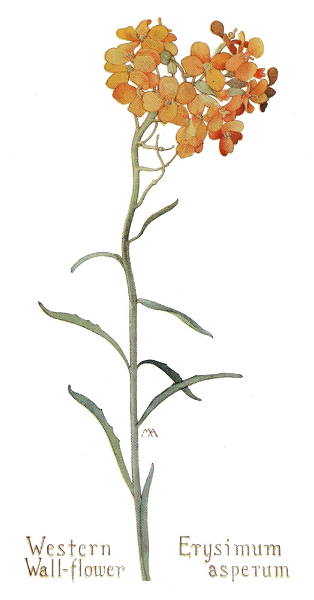
Western Wall-flower—Erysimum asperum.
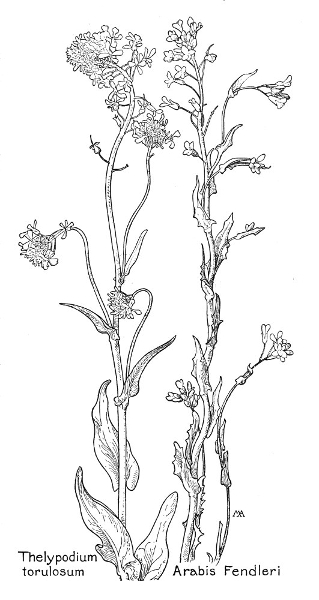
Thelypodium torulosum. Arabis Fendleri.
There are a good many kinds of Thlaspi, of temperate and arctic regions: smooth low plants, mostly mountain; root-leaves forming a rosette; stem-leaves more or less arrow-shaped and clasping; flowers rather small, white or purplish; sepals blunt; style slender, sometimes none, with a small stigma; pod flat, roundish, wedge-shaped, or heart-shaped, with crests or wings.
Wild Candytuft, Pennycress Thláspi glaùcum White Spring, summer, autumn Northwest and Utah
A rather pretty little plant, with several flower-stalks, springing from rosettes of leaves, dull-green, somewhat purplish and thickish, smooth and obscurely toothed, all more or less covered with a "bloom"; the flowers small, slightly fragrant, forming clusters less than an inch across, the white petals longer than the thin, greenish sepals. This grows on moist, mountain slopes. T. alpéstre, of the Northwest, is similar, but without "bloom."
There are only a few kinds of Dithyrea, grayish, hairy plants, resembling Biscutella of the Mediterranean, with yellowish or whitish flowers.
Dithýrea Wislizéni White Summer Ariz., New Mex., Tex., Okla., Ark.
A little desert plant, from six to twelve inches tall, with branching stems; pale, yellowish-green, downy leaves, about an inch long, with wavy or toothed margins; small white flowers and funny little seed-pods, sticking out at right-angles from the stem. This grows at an altitude of three to four thousand feet and is found in the Petrified Forest.
There are many kinds of Streptanthus, difficult to distinguish, smooth plants, often with a "bloom"; stems branching; leaves often clasping at base, the lower ones usually more toothed or lobed than the upper. The flowers are very peculiar in shape, not like most Mustards, but suggesting the shape of a Bleeding Heart flower; the sepals usually colored like the petals, two or all of them bulging at base, so that the calyx is broad below and contracted above; the corolla regular or irregular, the petals purple or white, with claws and narrow, wavy or crisp borders; the stamens four long and two short, or in three unequal pairs, the longest pair often united below; the pods long, narrow, flattish or cylindrical, on a broad receptacle; the seeds flat and more or less winged. These plants are called Jewel-flower, but the name does not seem particularly appropriate.
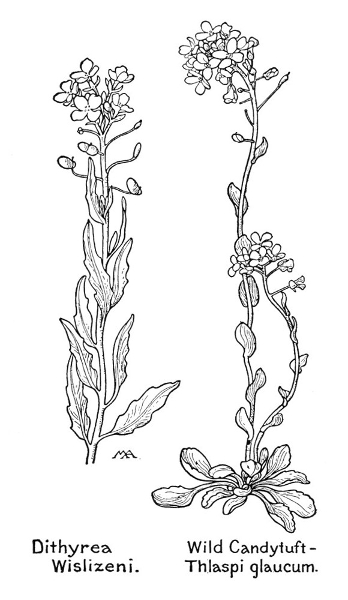
Dithyrea Wislizeni. Wild Candytuft—Thlaspi glaucum.
Shield-leaf Streptánthus tortuòsus Yellowish, purplish Summer California
Nothing about this odd-looking plant is pretty and it almost seems as if it were trying to make up by eccentricity for its lack of beauty. It is common in dry, sandy places in the mountains and our attention is first attracted to the tall, branching stalks, because they are strung with such queer-looking leaves. In summer the upper ones are bright-yellow or dull-purple and they clasp the stem and curve over, so that they look like small brass shields, pierced by the stem. There are three or four of these curving leaves, very smooth and shiny, and several more below, which are flatter and dark-green, and the stem, from six inches to three feet high, is oddly twisted and leans to one side. The small flowers are yellowish or mauve, veined with purple, less than half an inch long and peculiar in shape. The contrast in color between the flowers and leaves is very odd and very ugly, but as if this were not enough, later in the season the curious thing hangs itself with ridiculously long, slender pods, like great hooks, and looks queerer and more disheveled than ever.
Arizona Streptanthus Streptánthus Arizònicus White Spring Arizona
Prettier and not so queer-looking as the last. The leaves are arrow-shaped, clasping at base, rather leathery, bluish-green, with a "bloom" and tinged with purple on the backs, the lower ones toothed, and the pods are about two inches long, flat and tinged with purple. The flowers are half an inch long, pearly-white, the petals yellowish, veined with purple, and are quite pretty. This grows in dry places.
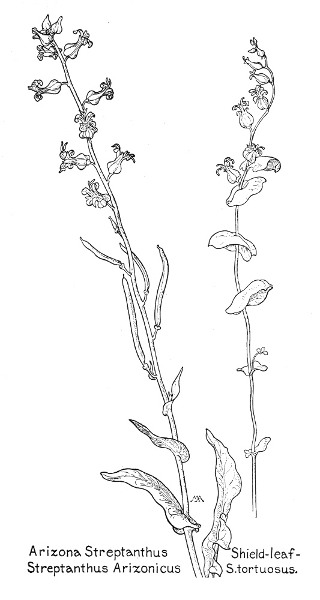
Arizona Streptanthus—Streptanthus Arizonicus. Shield-leaf—S. tortuosus.
There are only a few kinds of Stanleya, all western; tall, stout, smooth perennials, or biennials, with a "bloom"; flowers large, mostly yellow, without bracts, in long, terminal, clusters; sepals long, narrow; petals long, narrow, with long claws; stamens six, very nearly equal; ovary on a short stalk, with a short style or none; pods long, narrow and flattish, with long stalks; seeds numerous. Named for Lord Edward Stanley, President of the Linnaean Society.
Golden Prince's Plume Stánleya pinnatífida Yellow Spring Southwest and New Mex.
The pretty common name of this tall, handsome plant was given by Helen Hunt Jackson and the long, feathery wand of numerous blossoms is beautiful and suggests a plume. On the other hand, the straggling flowers have such long, narrow, curling petals, the threadlike filaments look so much like curling antennae and the long, thin pods stick out so awkwardly, like insects' legs, from among the flowers on the lower part of the stalk, that we find the general effect is rather weird and spidery. In fact the plant I drew had a large yellow spider, precisely the color of the flowers, half-concealed among them. The stem is from two to five feet high; the leaves are smooth, pale bluish-green, the lower ones with leaflets and a leaf-stalk, and the flowers are bright-yellow, or cream-color, about an inch across. This grows usually in dampish spots, in arid regions. The picture is of one I found in Indian Garden Canyon, a branch of the Grand Canyon.
Dryopétalon runcinàtum White Spring Arizona
The only kind, a fine plant, well worth cultivation; smooth and branching, about two feet tall, with handsome, bluish-green leaves, with a "bloom," the root-leaves with long, purplish leaf-stalks and sometimes nine inches long; the flowers half an inch across, with a lilac-tinged calyx and white petals, prettily toothed, forming a pretty, rather flat-topped cluster. The pods are very slender, nearly straight, one or two inches long. This grows among rocks, in protected situations, and is not common. Only a few, separate flowers are given in the picture, as the plant I found, near the Desert Laboratory at Tucson, was almost out of bloom.
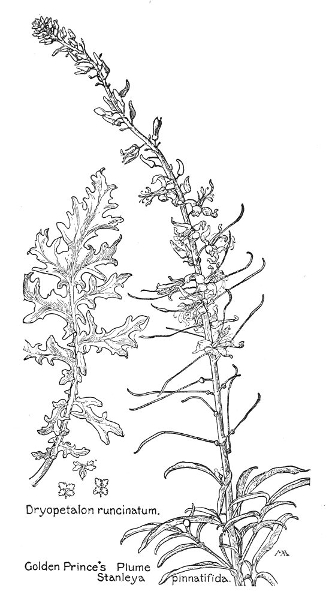
Dryopetalon runcinatum. Golden Prince's Plume—Stanleya pinnatifida.
There are a good many kinds of Lesquerella, all American; low plants, more or less hairy or scurfy; flowers mostly yellow, in clusters; petals without claws; pods roundish, more or less inflated, and giving the common name, Bladder-pod, also used for Isomeris arborea.
White Bladder-pod Lesquerélla purpùrea White, pink Spring Arizona
Pretty little plants, often growing in quantities among rocks in mountain canyons. The slender stems are from a few inches to over a foot tall, springing from a cluster of root-leaves, varying a good deal in shape, dull-green and harsh to the touch. The flowers are half an inch or more across, with white petals, often tinged with pink, with a little yellow in the throat, and form a pretty, rather flat-topped cluster.
Yellow Bladder-pod Lesquerélla Arizònica Yellow Summer Arizona
In desert places, such as the terrible sandy wastes of the Petrified Forest, where it seems a miracle that anything should grow, we find the close, pale, gray-green tufts of this little plant, crowned with racemes of small bright-yellow flowers. The small, thickish leaves are long, narrow and white with close down, the stems, about three inches high, branch at the root and the little pods are tipped with a style of about their own length. L. Gordóni, of Arizona, also has clusters of little yellow flowers, often covering sandy hillsides with bright color; the leaves slightly stiff and rough, the pods much inflated. It resembles L. purpurea in general form and size.
There are many kinds of Brassica, coarse "weeds" in this country. This is the ancient Latin name for Cabbage, which belongs to this genus, as well as Cauliflower, Turnip, and Brussels Sprouts.
Black Mustard Brássica nìgra Yellow Summer U. S.
A European "weed," common everywhere. In California it grows to an enormous height, sometimes twelve feet, and when in bloom is a beautiful feature of the landscape, covering the fields with a shimmering sheet of pale gold. The leaves are dark-green, smooth or with a few hairs, all with leaf-stalks, the lower leaves large and jagged, cut into leaflets, the upper leaves mostly toothless. The fragrant flowers form long clusters, each flower about three-quarters of an inch across; the small, cylindrical pods stand erect, close to the branching stem. A valuable, antiseptic oil is made from the black, pungent seeds, exported from California by the ton.
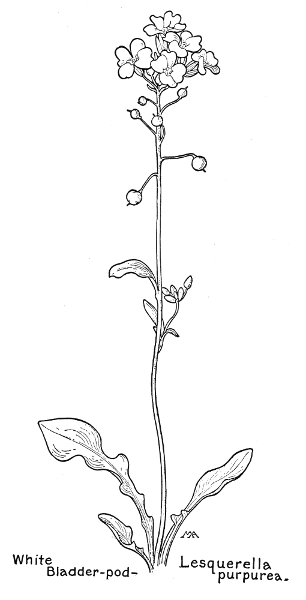
White Bladder-pod—Lesquerella purpurea.
CAPER FAMILY. Capparidaceae.
The flowers of this family are much like the Mustards, but the stamens are all of equal length and are often more than six; the leaves are alternate and consist of three or several leaflets, with stalks, and the plant usually tastes bitter and disagreeable instead of pungent. There is no partition in the pods, which are on long, threadlike stalks; the ovary is superior and the seeds are kidney-shaped. Many flowers have only a rudimentary pistil and never produce fruit. The Caper, of which we eat the pickled flower-buds for a relish, is a shrub which grows in the Levant. The family is quite large and flourishes in warm regions.
There are several kinds of Cleomella, resembling Cleome, except that the pods are different.
Cleomella Cleomélla lóngipes Yellow Spring Nev., Cal., Oreg.
This is a handsome, rather odd-looking plant, with a stout, smooth, yellowish or purplish stem, sometimes branching and over a foot tall. The leaves are bright light-green, smooth, toothless and slightly thickish, and the three leaflets are sometimes each tipped with a hair, and have a tuft of small hairs at the base of the leaf-stalk, in place of a stipule. The flowers are about half an inch across, and are a beautiful warm shade of golden-yellow, the long stamens being of the same color and giving a very pretty feathery appearance to the large cluster. The pods are queer-looking little things and stick straight out from the stem. This has a slightly unpleasant smell, but looks very gay and pretty in the fields and along the edges of the mesas around Reno.
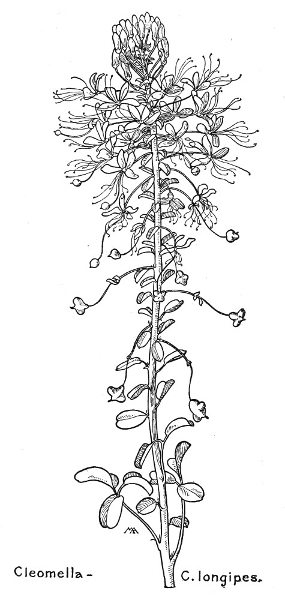
Cleomella—C. longipes.
There are many kinds of Cleome; ours are branching herbs, with palmately-divided leaves; the flowers with four sepals, four petals, and six stamens. The ovary has a stalk with a gland at its base and becomes a long pod, with a long stalk and many seeds.
Bee-plant Cleòme serrulàta Pinkish-lilac, white Summer Southwest, etc.
In Arizona this exceedingly handsome plant often covers the dry beds of rivers with acres of beautiful color. The smooth, branching stem is sometimes as much as eight feet high. The upper leaves are long and narrow and the lower are larger and usually have three leaflets, but all are bluish-green and peculiarly soft and smooth to the touch. The buds are purple and the delicate flowers, with threadlike flower-stalks, grow in a handsome, feathery cluster, sometimes a foot long, with numerous bracts. They have four, pinkish-lilac or white petals and six exceedingly long, threadlike stamens with minute, curling, green anthers. The lilac pistil is also very long and before the flower drops off begins to develop into a small, flat, green pod. These gradually lengthen, until the stem is ornamented with many hooklike pods, with slender stalks, hanging all along it. Many of the flowers do not produce fruit. The foliage when it is crushed gives off a rank, unpleasant smell, which is responsible for the local name of Skunk-weed. This is widely distributed and is found in the central and northern part of the United States, as well as in the Southwest.
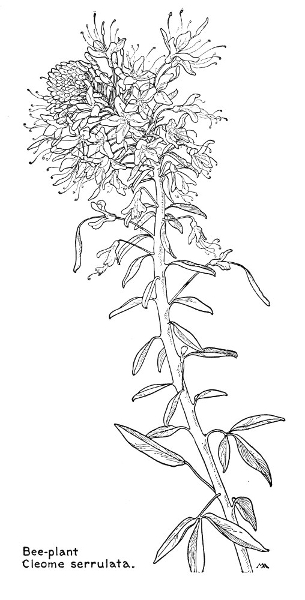
Bee-plant—Cleome serrulata.
Yellow Cleome Cleòme platycàrpa Yellow Spring Nevada
An odd-looking plant, with very pretty, feathery flower-clusters. The hairy stem is over a foot tall and the leaves are bright yellowish-green and mostly smooth on the upper side, with hairy margins and hairy on the under side. The flowers are a warm shade of bright golden-yellow and form a handsome, rather flat-topped cluster, with long stamens, and the oblong pods are an inch long or less, flat and much broader than those of the last. The flowers are slightly sweet-scented and the whole plant exudes a faint unpleasant odor. This is conspicuous on the dreary mesas around Reno, often growing with Cleomella longipes, which it very much resembles in general appearance, except for the pods, which are quite different.
There is only one kind of Isomeris.
Bladderpod Isómeris arbòrea Yellow Spring California
This is a shrub about three feet high, which is attractive except for its unpleasant smell. The leaves are smooth, toothless, stiffish and thickish, and bluish-green, with a small bristle at the tip, and mostly with three leaflets. The pretty flowers are nearly an inch across and warm yellow in color, not very bright but pretty in tone, with six very long, yellow stamens, and form a short, oblong cluster. The ovary has such a long stalk, even in the flower, that it gives an odd appearance and it develops into a very curious and conspicuous, drooping pod, an inch and a half long, much inflated and resembling a very fat pea-pod, on a long stalk, with two rows of seeds like little peas inside it, which taste very bitter. This is quite common on southern mesas. The name Bladderpod is also used for Lesquerella, which belongs to the Mustard Family.
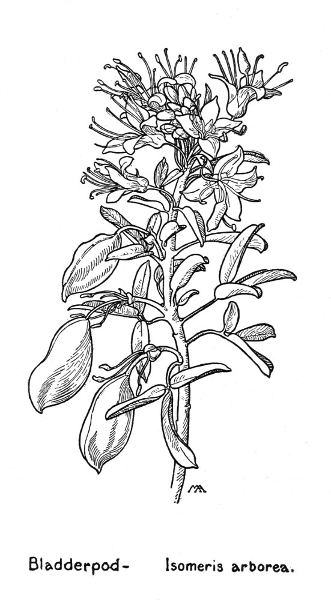
Bladderpod—Isomeris arborea.
ORPINE FAMILY. Crassulaceae.
A rather large family, widely distributed; odd-looking, mostly very succulent herbs, with smooth, fleshy leaves and stems, without stipules; flowers in clusters; sepals, petals, pistils, and stamens, all of the same number, usually four or five, sometimes the stamens twice as many; ovary superior; receptacle with honey-bearing scales, one behind each pistil; pistils separate, developing into small dry pods, containing few or many, minute seeds. Some of these plants look like tiny cabbages and we are all familiar with their tight little rosettes in the formal garden-beds of hotels and railway stations, where they are so stiff and unattractive that we hardly recognize them when we find them looking exceedingly pretty in their natural homes. The Latin name means "thick."
There are many kinds of Sedum, no one kind very widely distributed; fleshy herbs; leaves usually alternate; flowers star-like, often in one-sided clusters; stamens and pistils sometimes in different flowers on different plants; sepals and petals four or five; stamens eight or ten, on the calyx, the alternate ones usually attached to the petals; styles usually short. The Latin name means "to sit," because these plants squat on the ground, and Stonecrop is from their fondness for rocks.
Douglas Stonecrop Sèdum Douglásii Yellow Spring, summer Northwest
This makes beautiful golden patches, on dry slopes or more or less open hilltops, usually among limestone rocks. The reddish stems are from six to ten inches tall, the leaves are rather long and narrow, thick but flat, forming pretty pale-green rosettes, more or less tinged with pink and yellow, and the pretty starry flowers are three-quarters of an inch across, bright-yellow, with greenish centers, the stamens giving a feathery appearance.