PART II HISTORICAL STUDIES (continued 2)
Reading edition
THE ALLEGED DESTRUCTION OF LEICESTER
(1068)
This question was raised and discussed by Mr Freeman in his History of the Norman Conquest (iv. 196-7). We there read as follows:
Is it possible that in the case of Leicester, at least, no power was left either to follow or to resist? While we have no evidence either way on which we can rely with confidence, one of those secondary and local records, which sometimes contain fragments of authentic tradition, suggests, in a perfectly casual way, that a doom fell upon Leicester, which might, doubtless, with some exaggeration, be spoken of as utter destruction. And this incidental hint may perhaps draw some indirect confirmation from the highest evidence of all [Domesday] ... and it may be that Leicester earned its overthrow by a defence worthy of a borough which was to give its name to the greatest of England's later worthies.
The 'record' referred to is quoted in a footnote, and is a history of the foundation of Leicester Abbey, one of a class of narratives notoriously inaccurate and corrupt:
Robertus Comes Mellenti, veniens in Angliam cum Willelmo Duce Normanniæ, adeptus consulatum Leycestriæ, ex dono dicti Ducis et Conquestoris Angliæ, destructa prius civitate Leicestriæ cum castello et ecclesia infra castellum tempore prædicti Conquestoris, reædificavit ipsam æcclesiam Sancta Mariæ infra castellum.
Now, it strikes one in the first place as somewhat unlikely that William, on his arrival at Leicester, should find a castle to destroy. But, further, how could Robert have obtained the 'consulatus' of Leicester from the Conqueror, when he is well known to have first obtained it (under very peculiar circumstances) from Henry I? If this known event has been so glaringly ante-dated, may not the alleged 'destruction' be so likewise? These it may be said are only doubts. But, as it happens, we can not only discredit the suggested 'destruction' in the days of the Conqueror: we can actually fix its date as the reign of Henry I.
We learn from Orderic that the town of Leicester ('urbs Legrecestria') was divided into four quarters, of which Ivo de Grantmesnil possessed two, one in his own right, and one (which was the King's share) as the King's reeve and representative. We also learn that he was among the 'seditiosi proceres', who rebelled against Henry in 1101, and that of these, 'aliqui contra fideles vicinos guerram arripuerunt et gremium almæ telluris rapacitatibus et incendiis, cruentisque cædibus maculaverunt'. Ivo is again mentioned by Orderic in 1102, not only among the 'proditores' of the previous year, who were now called to account, but also as a special ringleader in that internecine conflict to which he had already referred. He tells us that Henry
Ivonem quoque, quia guerram in Anglia cœperat et vicinorum rura suorum incendia combusserat (quod in illa regione crimen est inusitatum nec sine grave ultione fit expiatum), rigidus censor accusatum nec purgatum ingentis pecuniæ redditione oneravit, et plurimo angore tribulatum mæstificavit.
In short, as Dr Stubbs reminds us, Ivo 'has the evil reputation of being the first to introduce the horrors of private warfare into England'. Bearing in mind the divided authority from which Leicester suffered, and the statement that Ivo, ruling half the town, plundered and made fierce war upon his neighbours, we arrive at the conclusion that the 'destruction', which, in the Monasticon narrative, precedes the accession of the Count of Meulan to the comitatus of Leicester, may be assigned, without a shadow of doubt, to the struggle of 1101.
On Ivo's disgrace, as is well known, the wily Count stepped at once into his shoes, 'et auxilio regis suâque calliditate totam sibi civitatem mancipavit, et inde consul in Anglia factus'. There is no reason to doubt the statement that St Mary 'de Castro' was rebuilt and refounded by Count Robert after his obtaining this position at Leicester.
It is singular that just as the Monasticon seems to have misled Mr Freeman at Leicester, so it is responsible for Thierry's 'story of the fighting monks of Oxford', at about the same time, a story of which Mr Freeman wrote that 'the whole story is a dream', and 'would not have been allowable even in an historical novel' (iv. 779-80).
ELY AND HER DESPOILERS
(1072-5)
The elaborate record of this trial is only found, I believe, in the Trinity College (Cambridge) MS., O. 2, 1 (fos. 210b-213b) from which it has been printed by Mr Hamilton in his Inquisitio Comitatus Cantabrigiensis (pp. 192-5). This 'placitum', therefore, would seem to have remained unknown till the publication of that work (1876).
The date of this important document can be fixed within a few years. It mentions Earl Waltheof among those before whom the plea was held, so that it cannot be later than 1075; and as it also mentions 'Rodulfus comes', it is evidently previous to the revolt of the earls in that year. On the other hand, it is later than the death of William Malet, for it mentions his son Robert as in possession, and later, therefore, than the restoration of Waltheof at the beginning of 1070. Moreover, it is subsequent to the death of Stigand ('post obitum illius'). Now Stigand was not even deposed till the spring of 1070; and we know from Domesday and other sources that he lived some time afterwards. We may safely say, therefore, that this 'placitum' did not take place till after the suppression of the Ely revolt in the autumn of 1071. Practically, therefore, our document belongs to the years 1072-1075. Now, as Abbot Thurstan did not die till 1076—the date given in the Liber Eliensis, and accepted by Mr Freeman—it follows that this great act of restitution in favour of the Abbey took place under Abbot Thurstan himself, a fact unmentioned by the chroniclers, and unsuspected by Mr Freeman, who held that he found no favour in William's eyes.
The great length of this document—so important for its bearing on Domesday—precludes its discussion in detail. But its opening clause must be given and some of its features pointed out.
Ad illud placitum quo pontifices Gosfridus et Remigius, consul vero Waltheuus, necnon vicecom[ites] Picotus atque Ilbertus jussu Willelmi Dei dispositione Anglor[um] regis, cum omni vicecomitatu sicut rex preceperat, convenerunt, testimonio hominum rei veritatem cognoscentium determinaverunt terras que injuste fuerant ablate ab ecclesia sancte Dei genitricis Marie de insulâ ely ... quatinus de dominio fuerant, tempore videlicet regis Ædwardi, ad dominium sine alicujus contradictione redirent quicunque eas possideret.
The mention of Count Eustace among those withholding lands proves that at the date of this document he was already restored to his possessions. Another individual whose name occurs several times in this document is Lisois ('De Monasteriis'), the hero of the passage of the Aire. Collating its evidence with that of Domesday, we find that Lisois had been succeeded, at the date of the great record, by the well-known Eudo Dapifer in a fief, ranging over at least five counties—Cambridgeshire, Bedfordshire, Norfolk, Suffolk, and Essex—in all of which Domesday records his name as the predecessor of Eudo. This is of the more interest because Mr Freeman wrote:
The only notice of this Lisois which I can find in Domesday is in ii. 49b, where he appears in possession, but seemingly illegal possession, of a small holding in Essex.
So again we have in our document this passage relating to Stigand:
He sunt proprie ville monasterii insule Ely quos Stigandus archipresul tenebat, unde per annum victum fratribus reddidit tantum quantum pertinet ad hoc. Has vero tenet rex noster W. post obitum illius, Methelwald et Crokestune et Snegelwelle et Dictun.
THE LORDS OF ARDRES
In the History of the Norman Conquest (2nd ed.) we read of Eustace of Boulogne:
An incidental notice of one of his followers throws some light on the class of men who flocked to William's banners, and on the rewards which they received. One Geoffrey, an officer of the Abbey of Saint Bertin at Saint Omer, who had the charge of its possessions in the County of Guines, sent his sons, Arnold and Geoffrey, to the war ... and in the end they received a grant of lands both in Essex and in the border shires of Mercia and East-Anglia, under the superiority of their patron Count Eustace (iii. 314).
In an Appendix on 'Arnold of Ardres', which Mr Freeman devoted to this subject (iii. 725-6), he gave the 'Historia Comitum Ardensium' (of Lambert of Ardres) for his authority, and he verified, by Domesday, the Manors which Lambert assigns to 'these adventurers', holding that a Bedfordshire estate was omitted, while 'Stebintonia', which he identified with Stibbington, Hunts, was wrongly included, as it was 'held of Count Eustace by Lunen'.
The first point to be noticed here is that 'these adventurers' were the sons (as Lambert explains) not of any 'Geoffrey', a mere Abbey officer, but of a local magnate, Arnold, Lord of Ardres. The next is that Lambert was quite correct in his list of Manors.
In the fourth series of his historical essays Mr Freeman included a paper on 'The Lords of Ardres', for which he availed himself of Dr Heller's edition of Lambert in the Monumenta (vol. xxiv). In this edition the passage runs:
Feodum Stevintoniam et pertinencias eius, Dokeswordiam, Tropintoniam, Leilefordiam, Toleshondiam, et Hoilandiam (cap. 113, p. 615).
Dr Heller, on this, notes:
Secundum 'Domesday Book' recepit Ernulfus de Arda Dochesworde, Trupintone (com. Cantabrig.) et Stiventone (comit. Bedford) a comite Eustacio ... e contra Toheshunt [sic] Hoiland, Leleford recepit ab eodem comite Adelolfus de Merc (prope Calais).
This note enabled Mr Freeman to identify 'Adelolfus' (which he had failed to do in the Norman Conquest), though he must have overlooked the identification of 'Stevintonia' (namely Stevington, Beds.), for we find him still writing:
But of the English possessions reckoned up by our author two only ... can be identified in Domesday as held by Arnold ... The local writer seems to have mixed up the possessions of Arnold with those of a less famous adventurer from the same reign, Adelolf—our Athelwulf—of Merck (pp. 184-5).
And he again insisted that 'Arnold had other lands in Bedfordshire'.
We will now turn to an entry in the Testa de Nevill from the 'milites tenentes de honore Bononie':
Comes de Gines tenet xii. milites, scilicet—in Bedefordescire, in Stiveton et Parva Wahull iii milites, in Cantabr' in Dukesword, et Trumpeton iii milites ... in Essex, Tholehunt et Galdhangr' iii milites, in Hoyland' et Lalesford ibidem iii milites.
It is interesting to observe that the village of Marck in the Pas de Calais has, through Adelolf and his heirs, transferred its name to the Essex parish of Mark's Tey, though not to that of Marks Hall (so named in Domesday).
While on the subject of the Lords of Ardres, it may be convenient to give the reference to a letter of mine to the Academy (May 28, 1892), explaining that Lambert's 'Albericus Aper', who puzzled Dr Heller and Mr Freeman, was our own Aubrey de Vere, first Earl of Oxford, and that Lambert's statement (accepted by Mr Freeman) as to the parentage of Emma, wife of Count Manasses, had been disproved by Stapleton.
EARLY IRISH TRADE WITH CHESTER AND ROUEN1
The eighth report of the Royal Commission on Historical Manuscripts speaks of the records of the city of Chester as 'beginning with Henry the Second's writ of licence to the citizens of Chester to trade in Durham [sic] as they were wont to do in the time of Henry the First' (p. xv). The records themselves are similarly described in the actual report on them (pp. 355-403) as 'beginning with a curious writ, addressed by Henry the Second to his bailiffs of the city of Durham' [sic]. This, which is among those items spoken of as 'especially interesting and important', figures thus as the head of the calendar:
(1) Henry II. Licence to the burgesses of Chester to buy and sell at Durham [sic] as they were wont to do in the time of Henry I—'Henricus Dei gratia Rex Anglie et Dux Normannie et Aquitanie et Comes Andegavie balluis [sic] de Dunelina [sic] salutem:—Precipio quod Burgenses Cestrie possint emere et vendere ad detaillum [or doraillum] apud Dunelinam [sic] habendo et faciendo easdem consuetudines quas faciebant tempore Regis Henrici avi mei et easdem ibi habeant rectitudines et libertates et liberas consuetudines quas tempore illo habere solebant, teste, Willelmo filio Ald' dapifero Apud Wintoniam.
Durham is not only a most improbable place for such a writ to refer to, but is also an impossible rendering of the Latin name. The interest and importance of this 'curious writ' has, in short, been obscured and lost through the ignorance of Mr J. C. Jeaffreson, to whom the report was entrusted. The charters which follow the writ, and which are printed on the same page, refer to this writ as relating to Ireland; and the town, of course, to which it refers is not Durham but Dublin (Duuelina).
What, then, was its date? The clue, unfortunately, is slight; but it may not improbably belong to the close of 1175 or early part of 1176. This brings us to the interesting question, why was such a writ issued? Remembering that during his stay at Dublin (November 1171-January 1172) Henry II had granted that city to his men of Bristol, we may hold it in accordance with the spirit of the time, and, indeed, a matter of virtual certainty, that Bristol would have striven on the strength of this grant to exclude 'its rival port' (Conquest of England, p. 443) from the benefits of the Dublin trade. Chester would, therefore, appeal to the King on the strength of its antecedent rights, and would thus have obtained from him this writ, recognizing and confirming their validity.
The Domesday customs of the city (i. 262b) contain a curious allusion to its Irish trade:
Si habentibus martrinas pelles juberet prepositus regis ut nulli venderet donec sibi prius ostensas compararet, qui hoc non observabat xl. solidis emendabat ... Hæc civitas tunc reddebat de firma xlv. lib et iii. timbres pellium martrinium.
There is nothing to show where these marten skins came from, or why they are mentioned under Chester alone. But on turning to the customs of Rouen, as recorded in the charters of Duke Henry (1150-1) and King John (1199), we find they were imported from Ireland.
Quæcunque navis de Hibernia venerit, ex quo caput de Gernes [Guernsey] transierit, Rothomagum veniat, unde ego habeam de unaquâque nave unum tymbrium de martris aut decem libras Rothomagi, si ejusdem navis mercatores jurare poterint se ideo non mercatos fuisse illas martras ut auferrent consuetudinem ducis Normanniæ, et vicecomes Rothomagi de unaquaque habeat viginti solidos Rothomagi et Camerarius Tancarvillæ unam accipitrem aut sexdecim solidos Rothomagi.
WALTER TIREL AND HIS WIFE
In his detailed examination of all the evidence bearing on the death of William Rufus, the late Mr Freeman carefully collected the few facts that are known relative to Walter Tirel. They are, however, so few that he could add nothing to what Lappenberg had set forth (ii. 207) in 1834. He was, however, less confident than his predecessor as to the identity of Walter Tirel with the Essex tenant of that name in Domesday. I hope now to establish the facts beyond dispute, to restore the identity of Walter Tirel, and also to show for the first time who his wife really was.
The three passages we have first to consider are these, taking them in the same order as Mr Freeman:
Adelidam filiam Ricardi de sublimi prosapia Gifardorum conjugem habuit, quæ Hugonem de Pice, strenuissimum militem, marito suo peperit (Ord. Vit.).
Laingaham tenet Walterus Tirelde R. quod tenuit Phin dacus pro ii. hidis et dimidia et pro uno manerio (Domesday, ii. 41).
Adeliz uxor Walteri Tirelli reddit compotum de x. marcis argenti de eisdem placitis de La Wingeham (Rot. Pip., 31 Hen. I).
Dealing first with the Domesday entry, which comes, as Mr Freeman observed, 'among the estates of Richard of Clare', I would point out that though Ellis (who misled Mr Freeman) thought that 'Tirelde' was the name, the right reading is 'tenet Walterus Tirel de R[icardo]', two words (as is not unusual) being written as one. Turning next to the words of Orderic, we find that Lappenberg renders them 'Adelaide, Tochter des Richard Giffard', and Mr Freeman as 'a wife Adelaide by name, of the great line of Giffard'. But there is no trace of a Richard Giffard, nor can 'Adelida' herself be identified among the Giffards. The explanation of the mystery, I hold, is that she was the daughter, not of a Giffard, but of Richard de Clare, by his wife Rohese, daughter of Walter Giffard the elder. It is noteworthy that Orderic employs a precisely similar expression in the case of another Adeliza, the daughter of Robert de Grentmesnil. He terms her 'soror Hugonis de Grentemaisnil de clara stirpe Geroianorum', though she was only descended from the famous Geroy through her mother. Richard's daughter was sufficiently described as 'Adelida filia Ricardi', just as her brothers were known as 'Gilbertus filius Ricardi', 'Rogerus filius Ricardi', etc. The position of that mighty family was such that this description was enough, and they were even known collectively as the 'Ricardi', or 'Richardenses' (Mon. Ang., iv. 609). This is well illustrated by the passage in the Ely writer, describing Adeliza's brother Richard, Abbot of Ely, as
parentum undique grege vallatus, quorum familiam ex Ricardis et Gifardis constare tota Anglia et novit et sensit. Ricardi enim et Gifardi, duæ scilicet ex propinquo venientes familiæ, virtutis fama et generis copia illustres effecerat.
The above forms are curious, but not without parallel. Thus the descendants of Urse d'Abetot are spoken of as 'Ursini' in Heming's Cartulary. Æthelred of Rievaulx speaks of 'Poncii' and 'Morini' as present at the battle of the Standard; Gerald, in a well-known passage (v. 335), speaks of the 'Giraldidæ' and 'Stephanidæ', and Orderic, we have seen, of the 'Geroiani'.
The doubly influential character of this descent is well illustrated in this passage (quantum valeat) from the chronicle of St John's Abbey, Colchester.
Parcebatur tamen Eudoni, propter genus uxoris ipsius Rohaisæ: erat enim hæc de genere nobilissimo Normannorum, filia scilicet Ricardi, qui fuit filius Gilbert Comitis, duxitque Rohaisam uxorem, quæ erat soror Willelmi Giffardi, Episcopi Wintoniæ. Itaque, cum fratres et propinqui junioris Rohaisæ quoslibet motus machinaturi putarentur, si contra maritum ipsius aliquid durius decerneretur, sic factum est ut interventu predicti Episcopi, etc., etc.
This passage is, I believe, the sole evidence for the real parentage of Bishop William. It was clearly unknown to Canon Venables, who wrote the Bishop's life for the Dictionary of National Biography.
Like most of these 'foundation' histories, this document is in part untrustworthy. But it is Dugdale who has misread it, and not the document itself that is responsible for the grave error (Baronage, i. 110) that Eudo's wife was 'Rohese, daughter of Walter Giffard, Earl of Buckingham'. Here again, as in the Tirel case, the daughter of a Clare, by a Giffard, is converted into a Giffard. The error arose from referring the 'qui' to Eudo instead of to his father-in-law, Richard. The 'Historia' is perfectly consistent throughout in its identification of the younger Rohese, of whom it states that 'commorata est marito annis triginta duobus, cui ante habiles annos nupta est' (iv. 609).
In asserting under 'Clare' (Baronage, i. 208) that Eudo married the widow (not the daughter) of Richard, Dugdale relied on another and more inaccurate document (Mon. Ang., v. 269) which actually does speak of
Rohesia una sororum Walteri [Giffard secundi]—duas plures enim habuit—conjuncta in matrimonio Ricardo filio Gilberti, qui in re militari, tempore Conquestoris, omnes sui temporis magnates præcessit—
as marrying Eudo Dapifer after her husband's death. But we must decide in favour of the Colchester narrative: Eudo's wife was her daughter and namesake.
Com. Gilb. de Penbroc omnibus hominibus Francis et Anglis sal. Sciatis me concessisse illam convencionem et vendicionem quam Hugo Tirell fecit Gervasio de Chorhella de manerio suo de Laingham parte mea. Nam Comes de Clara ex parte sua illud idem concessit, de cuius feodo predictum manerium movet.
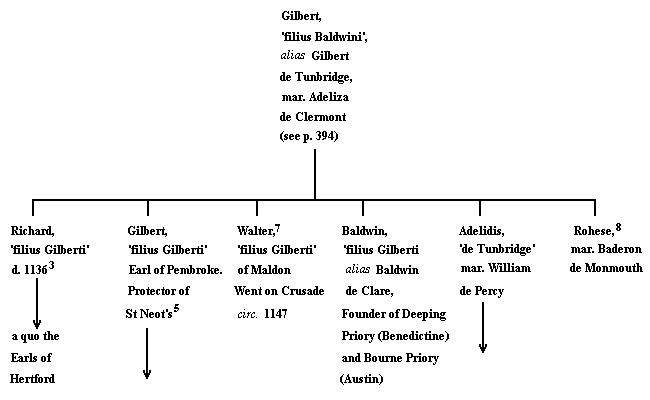
I have explained in my article on the Clares in the Dictionary of National Biography that there has been much confusion as to the family history. As the errors are very persistent, it may perhaps be of some service, especially for identifying names, if I append a pedigree for the period of the Tirel connection, which will distinguish the descendants of Count Gilbert, 'illustrious in his forefathers and his descendants'.
Among the most persistent of errors are those which identify Richard 'filius Baldwini' with Richard de Redvers (who was of a different family and died long before him), and which make this compound Richard an Earl of Devon.
Planché endeavoured to slay the former of these errors—which, originating in the Monasticon, is embalmed in Dugdale's Baronage—as Taylor had previously done in his 'Wace', and the Duchess of Cleveland has rightly observed in her Battle Abbey Roll (1889) that 'there is not the slightest authority for assuming' the identity. But the necessity for again correcting the error is shown by its reappearance in Mr Freeman's Exeter (1887) and by the life of Baldwin de Redvers, in the Dictionary of National Biography, by Mr Hunt, which begins by stating that he was 'the eldest son of Richard, Earl of Devon, the son of Baldwin de Moeles', whereas his father was not an Earl, and was not the son of Baldwin de Moeles.
I may also take this opportunity of pointing out that (as is shown in my Geoffrey de Mandeville) Richard fitz Gilbert (d. 1136) was not an earl, the earldom of Herts having been ante-dated like that of Devon.
Dugdale again has omitted, because he failed to identify, another daughter of the house of Clare, who made a most interesting match. This was 'Adelidis de Tunbridge', wife of William de Percy, a niece and namesake, I confidently suggest, of Walter Tirel's wife. She seems to have brought into the Percy family the names of Richard and Walter. The charters which establish, I think, her identity are those of Sallay Abbey, in which Maud (widow of William, Earl of Warwick) and her sister Agnes (ancestress of the later Percies) speak of their mother as 'Adelidis de Tunbridge' (Mon. Ang., v. 512-13). She can only, therefore, in my opinion, have been a daughter of Gilbert 'de Tunbridge'; and with this conclusion the dates harmonize well. Yet another daughter was Margaret, wife of William de Montfichet, who brought into that family the names of Gilbert and Richard.
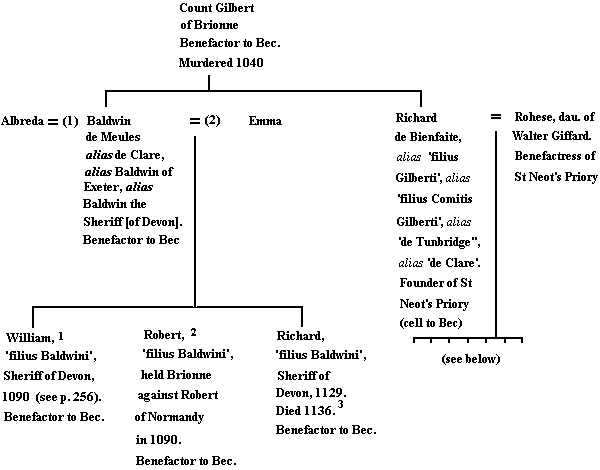
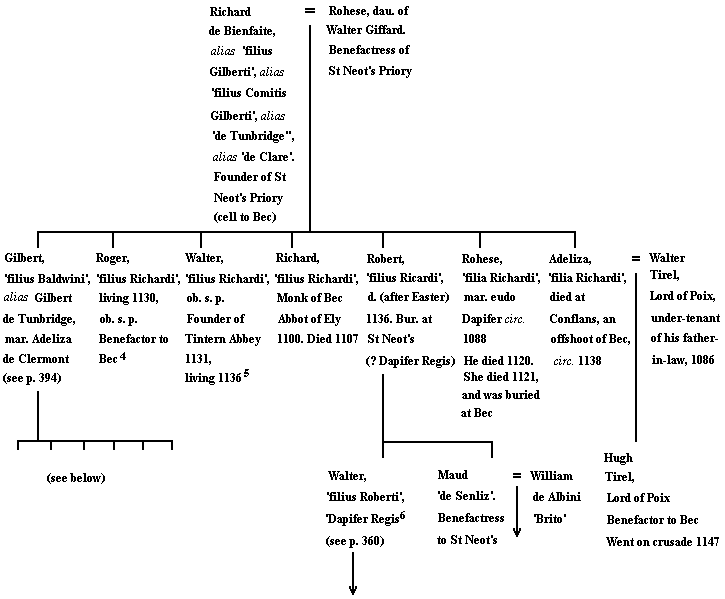
Ego Willelmus de Albineio Brito et Matild' uxor mea dedimus et concessimus ecclesiam de Cratefeld deo et ecclesie Sci. Neoti et monachis Beccensibus pro anima Roberti filii Ricardi et antecessorum meorum.
Then follows their son's confirmation, as 'Willelmus de Albeneio filius Matillidis de Seint Liz'. Next, 'Willelmus de Albeneio filius Matild' de Senliz', gives land, 'quam terram Domina Matild' Senliz mater mea eis prius concesserat'—her said grant of land in Cratfield duly following as from 'Matild de Senliz filia Roberti filii Ricardi'. Further, we have Walter fitz Robert (fitz Richard) confirming this grant by his sister Matildis. Finally, we learn that Cratfield belonged to her in 'maritagio'. Now (as 'Cratafelda') it belonged in Domesday to Ralf Baignard. His honour, on his forfeiture, was given to Robert fitz Richard, who was thus able to give Cratfield 'in maritagio' to his daughter. Here then is independent proof of what her parentage really was, and further independent proof, if needed, is found in this entry (1185):
Matillis de Sainliz que fuit filia Roberti filii Richardi, et mater Willelmi de Albeneio est de donatione Domini Regis et est lx. annorum (Rot. de Dominabus, p. 1).
We thus learn that, as with Avicia 'de Rumilly', daughter of William Meschin, it was possible for a woman to bear, strange though it may seem, the maiden name of her mother. Clearly, Maud was the widow of William de Albini, who sent in his carta (under Leicestershire) in 1166, and died, as I reckon, from the Pipe Rolls, in November 1167. She was not, as alleged, the widow of the William who fought at the Battle of Tinchebrai in 1106.
Willelmus prioris Willelmi regis Angliæ filius, eodem anno a Waltero de Bekam, ex improviso, interficitur. Qui, cum rege in saltu venatum iens, dum sagitta cervum appeteret, eadem divinitus retorta, rex occiditur. Cujus interitus sancte recordationis viro Hugoni, abbati Cluniacensi est præostensus, etc., etc.
Neither of these writers knew of the English evidence, nor did they solve the mystery of Walter Tirel's wife, whom they, like Lappenberg, imagined to be the daughter of a Richard Giffard. This tends to diminish our trust in the pedigree they give. They took a Walter Tirel to England at the Conquest, but only because Wace mentions the 'Pohiers', or men of Poix, and because the name of Tirel is found in the Battle Roll. In their view, Hugh Tirel, Lord of Poix, the crusader of 1147, was grandson of the famous Walter. Now Orderic, whose evidence on the point they ignore, says, as we have seen, he was the son; and as the chronicler was contemporary both with father and son, we cannot think him mistaken. Moreover, the Pipe-Roll of 1130 cannot be harmonized with their pedigree. Adeliz, wife (? widow) of Walter Tirel, then answered for Langham, and could not be 'Adeline dame de Ribecourt', who was dead, according to both writers, before 1128 (or 1127), and who could not, in any case, have aught to do with Langham.
But there is other evidence, unknown to these French writers, which proves that the version they give must be utterly wrong. Among the archives at Evreux there is a charter of Hugh Tirel to the Abbey of Bec, granting 'decem marcas argenti in manerio quod dicitur Lavigaham' to its daughter-house of Conflans, where, he says, his mother had taken the religious 'habit', and retired to die. The Priors of Conflans, and [St Denis of] Poix are among the witnesses; and we read of the charter's date:
Hoc concessum est apud piceium castrum anno M.cxxxviii. ab incarnatione dominica viii. idus martii.
I close this study with an extract from that interesting charter by which Richard I empowered Henry de Cornhill to enclose and impark his woods at Langham, the same day (December 6, 1189) on which he empowered his neighbours the burgesses of Colchester to hunt the fox, the hare and the 'cat' within their borders. The words are:
Thus did the wealthy Londoner become a country squire seven centuries ago. Nor is it irrelevant to observe that the 'Langham Lodge coverts' are familiar to this day to those who hunt with the Essex and Suffolk.
WALDRIC, WARRIOR AND CHANCELLOR
The importance of fixing the sequence of chancellors, for chronological purposes and especially the dating of charters, is very great. Waldric, who preceded Ranulf as chancellor to Henry I, was, as a warrior and then a bishop, a man of mark. It has hitherto been supposed, as by Mr Archer (who wrote his life for the Dictionary of National Biography), that his latest appearance as chancellor was early in 1106, before the King's departure for Normandy. His feat in taking Duke Robert prisoner at Tinchebrai (September 28, 1106) is well known, but was believed to be the only evidence of his presence in Normandy with the King. There is, however, in Gallia Christiana (vol. xi) a valuable charter recording a 'causa seu placitum', decided before King Henry at Rouen, November 7, 1106, among those present being 'Waldricus qui tunc temporis erat regis cancellarius'. We can trace, therefore, his tenure of the office up to that date.
Facta est hec carta Anno.... ab incarnacione domini Mo centesimo viio apud Wintoniam.
A CHARTER OF HENRY I (1123)
A good illustration of the value of charters for chronological and biographical purposes is afforded by one which Henry I granted to the church of Exeter. It is printed in the Monasticon under Plimpton, to the foundation of which priory it is asserted to have been preliminary. That foundation is assigned to 1121. The charter, however, is also found among those confirmed by Henry VIII (Confirmation Roll, i Henry VIII, p. 5, No. 13), with a list of witnesses arranged in correct order; whereas the Monasticon version is taken from the pleadings under Richard II (Coram Rege, Hil. 2 Richard II, Rot. 20, Devon), and records the witnesses in grievous disorder. The explanation of such disorder is that the clerk in the latter case was not familiar with the system on which the attestations to these charters were arranged, the names of the leading witnesses being placed in a line above the others. This will be made evident from the two lists of witnesses:
Right Order Wrong Order
King Henry
Queen Adeliza Queen Adeliza
William, Archbishop of Canterbury William, Archbishop of Canterbury
Thurstan, Archbishop of York Robert, Earl of Gloucester
Richard, Bishop of London Thurstan, Archbishop of York
William, Bishop of Winchester William, Earl of Surrey
Roger, Bishop of Salisbury Roger, Bishop of Salisbury
Alexander, Bishop of Lincoln Roger, Earl of Warwick
Evrard, Bishop of Norwich Alexander, Bishop of Lincoln
Hervey, Bishop of Ely Robert, Earl of Leicester
Ralf, Bishop of Chichester Evrard, Bishop of Norwich
Ranulf, Bishop of Durham Hugh Bigot, dapifer
Robert, Bishop of Coventry Hervey, Bishop of Ely
'Theold', Bishop of Worcester William de Pirou, dapifer
Bernard, Bishop of St David's Ralf, Bishop of Chichester
Richard, Bishop of Hereford William d'Aubeny
Godfrey, Bishop of Bath Ranulf, Bishop of Durham
Geoffrey the Chancellor Nigel d'Aubeny
Geoffrey, Abbot of St Peter's, Winchester Robert, Bishop of Coventry
Osbert, Abbot of Tavistock Richard fitz Baldwin
Thurstan, Abbot of Sherborne 'Theold', Bishop of Worcester
Vincent, Abbot of Abingdon Baldwin de Redvers
Seffrid, Abbot of Glastonbury Bernard, Bishop of St David's
Robert, Earl of Gloucester Johel de Berdestaple
William, Earl of Surrey Richard, Bishop of Hereford
David, Earl of Huntingdon Guy de Totness
Ranulf, Earl of Chester Godfrey, Bishop of Bath
Roger, Earl of Warwick Robert de Cadentona [sic]
Robert, Earl of Leicester Geoffrey the Chancellor
Hugh Bigot, dapifer William fitz Odo
William de Pirou, dapifer Geoffrey, Abbot of St Peter's, Winchester
William d'Aubeny
Nigel d'Aubeny Goislin de Pomereda
Richard fitz Baldwin Osbert, Abbot of Tavistock
Baldwin de Redvers Rainald de Valle Torta
Johel de Berdestaple Thurstan, Abbot of Sherborne
Guy de Totness William fitz Richard
Robert de 'Badentona' Vincent, Abbot of Abingdon
William fitz Odo Herbert de Alneto
Goislin de Pomereda Seffrid, Abbot of Glastonbury
Rainald de Valle Torta Humfrey de Bohun
William fitz Richard William, Abbot of Cerne
Herbert de Alneto Walter fitz Thurstan1
Humfrey de Bohun
Walter fitz Thurstan
It is obvious that this charter was granted before the death of the Bishop of Worcester (October 20, 1123), and before the King's departure from England (June 1123). But it must be subsequent to the death of the previous chancellor, Ranulf (Christmas 1122), and to the appointment or consecration (February 1123) of Archbishop William. The narrow limit thus ascertained points to the Easter court of 1123 at Winchester, the great gathering of bishops and earls implying some such occasion. Easter fell that year on April 15th.
Now two sees had fallen vacant at the beginning of the year, those of Lincoln and of Bath. Lincoln was given to Alexander, whether at Easter (Winchester), as stated by Henry of Huntingdon, or in Lent, as asserted by the continuator of Florence; but he was not consecrated till July 22nd. Bath was bestowed on Godfrey, whose consecration did not take place till August 26th, though Henry of Huntingdon assigns his appointment, like that of Alexander, to Easter (Winchester). Both these bishops, it will be seen, attest the above charter, which proves that it cannot be earlier than Easter (April 15th), while the evidence below practically limits it to the Easter court at Winchester.
Turning to Geoffrey the chancellor, we find in this charter perhaps his earliest appearance. Foss, in his useful work, is here a year out. He wrongly assigned the death of the preceding chancellor, Ranulf, to Christmas 1123, instead of Christmas 1122, and he assumed that our charter must be subsequent to Bishop Godfrey's consecration (August 26, 1123), and, in fact, that it belonged to 1124 (to which year he wrongly assigned the death of Bishop Theowulf). It is important for chronological purposes to date the change of chancellor correctly. I have already determined (p. 365) the date
The correction of this date of Ranulf's death affects that of the foundation of Laund Priory, Leicestershire, which is assigned by Nichols and by the Editors of the Monasticon to 'about 1125'. As the foundation charter is addressed to William, Archbishop of Canterbury, and Alexander, Bishop of Lincoln, it must be subsequent to Alexander's promotion in the spring of 1123 (if not to his consecration on June 22nd). This is admitted by Foss, who accepts the charter without question. There is nothing in the document to excite suspicion, nor do I impugn it without reluctance. But the awkward fact remains that it is witnessed by Ranulf the chancellor, who died, as we have seen, at the beginning of 1123, and actually in the lifetime of Bishop Robert, Alexander's predecessor at Lincoln. There can be no question as to Ranulf's death, for the sequence of events is inexorable. Henry of Huntingdon tells us that (1) the king spent Christmas (1122) at Dunstable; that (2) he went thence to Berkhampstead, where Ranulf was accidentally killed; that (3) he then visited Woodstock, where Bishop Robert met with an equally sudden death; that (4) at the Purification (February 2, 1123) he gave the See of Canterbury to William of Corbeuil; that (5) he gave (at Winchester) the See of Lincoln to Alexander at Easter. It is singular that the members of the foundation had two strings to their bow, another charter of Henry I being adduced for Inspeximus. Its witnesses imply a later date, and their names do not involve any chronological difficulty.
We have in this Exeter charter one of the earliest attestations (according to my theory) of Robert as Earl of Gloucester. It should be noted that he takes at once precedence of all other earls, just as he had taken, before his elevation, precedence of all laymen under the rank of earl.
THE ORIGIN OF THE NEVILLES
It is difficult to believe that so interesting a genealogical question as the origin of this famous house should have remained as yet undetermined. I have shown above (p. 137) that we can identify in Domesday Gilbert and Ralph de Neville, the earliest bearers of the name in England, as knightly tenants of the Abbot of Peterborough; but the existing house, as is well known, descends from them only through a female. It is at its origin in the male line that I here glance. The innumerable quarters in which, unfortunately, information of this kind has been published makes it impossible for me to say whether I have been forestalled. So far, however, as I can find at present, two different versions are in the field.
First, there is Dugdale's view that Robert fitz Maldred, their founder, was 'son of Dolfin, son of Earl Gospatric, son of Maldred fitz Crinan by Algitha daughter of Uchtred, Earl of Northumberland, who was son-in-law to King Æthelred'. This was, apparently, Mr Shirley's view, for, in his Noble and Gentle Men of England he derives the Nevilles from 'Gospatric, the Saxon Earl of Northumberland', though he makes Robert fitz Maldred his great-grandson, as Rowland had done in his work on the House of Nevill (1830), by placing Maldred between Dolfin and Robert fitz Maldred. Even that sceptical genealogist, Mr Foster, admitted in his peerage their descent from this Earl Gospatric. The immediate ancestry, however, of their founder, Robert fitz Maldred, can be proved, and is as follows:
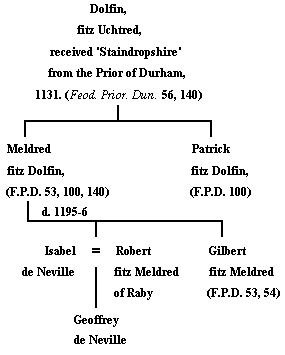
Drummond's Noble British Families (1842) set out a new origin for the family without any hesitation, and this was adopted by the Duchess of Cleveland, whose elaborate work on the Battle Abbey Roll has much excellent genealogy. Their patriarch Dolfin was now made the son of that Uchtred, who was a grandson and namesake of Dugdale's Earl Uchtred, temp. King Æthelred. A chart pedigree is required to show the descent of the earls:
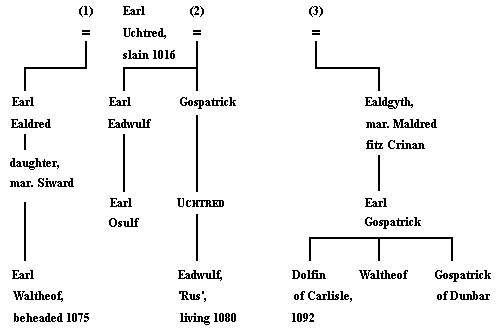
THE ALLEGED INVASION OF ENGLAND IN 1147
The accepted view of Henry's movements has hitherto been that, by his father's permission, in the autumn of 1142 he accompanied the Earl of Gloucester to England; that he remained there about four years; that, by his father's wish, at the end of 1146 or beginning of 1147 he returned from England; that he then spent two years and four months over sea; that in the spring of 1149 he again came to England, and was knighted at Carlisle by the king of Scots on May 22nd. As to the above long visit, commencing in 1142, Gervase of Canterbury is our chief authority, but the other chroniclers (omitting for the present the Gesta Stephani) harmonize well with his account. Gervase and Robert of Torigni alike mention but one arrival of Henry (1142) and one departure (1146 or 1147), thus distinctly implying there was then only one visit—namely, that visit which Gervase tells us lasted four years. The only slight discrepancy between Gervase and Robert is found in the date of Henry's departure. Robert places that event under 1147, and mentions that Henry visited Bec May 29th in that year. There is also, Mr Howlett has pointed out, charter evidence implying that Henry was back in Normandy in March or April. Now Gervase says distinctly that he was away from England two years and four months. The chroniclers, Gervase included, say that he returned to England in the middle of May 1149. Counting back the two years and four months, this would bring us to January 1147, as the date of his departure from England. But there is a charter of his to Salisbury Cathedral, tested, as Mr Howlett observes, at Devizes, April 13, 1149. If this evidence be trustworthy, it would take us back to December 1146, instead of January 1147. It is easy to see how Gervase may have included in 1146, and Robert in 1147, an event which appears to have taken place about the end of the one or the beginning of the other year.
Much has been made of the alleged circumstance that Gervase assigned the Earl of Gloucester's death to 1146, whereas he is known to have died in 1147. But reference to his text will show that he does nothing of the kind. Writing of Henry's departure at the close of 1146, he tells us that the earl was destined never to see him again, for he died in November [i.e. November 1147]. He is here obviously anticipating.
THE ALLEGED DEBATE ON DANEGELD (1163)
The passage which forms our best evidence is found in Grim's Life of St Thomas, and its relative portion is as follows:
Movetur quæstio de consuetudine quadam quae in Anglia tenebatur. Dabantur de hida bini solidi ministris regis qui vicecomitum loco comitatus servabant, quos voluit rex conscribere fisco et reditibus propriis associare. Cui archiepiscopus in faciem restitit, dicens, non debere eos exigi pro reditibus, 'nec pro reditu', inquit, 'dabimus eos, domine rex, salvo beneplacito vestro: sed si digne nobis servierint vicecomites, et servientes vel ministri provinciarum, et homines nostros manutenuerint, nequaquam eis deerimus in auxilium.' Rex autem aegre ferens archiepiscopi responsionem, 'Per oculos Dei', ait, 'dabuntur pro reditu, et in scriptura regis scribentur'.
On this passage Dr Stubbs thus comments:
£ s. d.
Paid in 141 10 0
Paid out previously 63 0 0
Allowed for remissions 20 1 2
Balance due 22 13 10
—— —— ——
247 5 0
A GLIMPSE OF THE YOUNG KING'S COURT (1170)
The interest of the document is to be sought in its witnesses, and its place of testing, and above all in the date which, I hope to show, they suggest. The mention of the two inseparable archdeacons proves that this date cannot be later than 1174, and consequently, as the young king was present, must have been previous to his revolt in 1173, and therefore to his departure from England about the close of 1172. On the other hand, the date must be subsequent to June 1170, when the young king was crowned, and therefore probably to the meeting at Fréteval (July 22, 1170), at which the Archdeacon of Canterbury was present.
But if we turn to the other possible period, the latter half of 1170, we find an occasion when six of the witnesses to the above charter can actually be shown to have been present, under circumstances of peculiar interest, with the young king at Winchester.
'Le juefne Rei aveit à Wincestre trové. Là èrent del pais li barun assemblé.'
'Pur c'èrent assemblé cele genz à cel jur, Et li prince et li cunte et des baruns plusur.'
THE FIRST KNOWN FINE (1175)
The earlier document I here print from the valuable cartulary of Evesham (Vesp. B. xxiv., fo. 71, etc.) is, I contend, a true fine, and is fortunately dated with exactitude (July 20th):
The transcript of this fine is immediately followed by a royal charter confirming it, and establishing Roger in possession:
H. dei gratia ... Sciatis me concessisse et presenti carta confirmasse finem que factus fuit in curia mea inter, etc., etc. ... et Wibertus eam reddidit solutam et quietam in manu abbatis de evesham de cujus feodo terra illa est.... Et ideo volo et firmiter precipio.... Test. Willelmo Audelin', Willelmo filio Radulfi, Willelmo Basset, Berteram de Verdun, Gaufrido Salvagio. Apud Evesham.
Mr Eyton, to whom this fine was unknown, does not, in his Court and Itinerary of Henry II, include Evesham among the places visited by the king in 1175, but makes him visit Feckenham about October (p. 196). But as we learn from the above fine that Henry was at Evesham on July 20th, Mr Eyton's conclusions must be reconsidered. Henry, according to him, was at Woodstock July 8th and at Nottingham August 1st. Now this latter date is derived from a Nottingham charter (p. 193), among the witnesses to which are William fitz Audelin 'Dapifer', William Basset, and William fitz Ralf, the very three justices before whom our fine had been levied at Evesham on July 20th. I hold, therefore, that Henry proceeded (possibly through Lichfield, as Mr Eyton asserts) from Woodstock to Nottingham via Evesham; and, further, that he visited Feckenham (to the north of Evesham) on this occasion, and not, as Mr Eyton imagined, in October. We find accordingly that of the Feckenham charters quoted by that writer (p. 196), one is witnessed by all three of our officers, William fitz Audelin 'Dapifer', William fitz Ralf, and William Basset; one by William fitz Audelin and William fitz Ralf; and the third by William fitz Ralf and William Basset.
Now, working from the Pipe-Rolls, Mr Eyton discovered that:
while the king was in Staffordshire there were pleas held in that county which are expressed to have been held by William fitz Ralph, Bertram de Verdon, and William Basset in curia Regis (p. 193).
He also noted that
the Pipe-Roll of 1175, after duly recounting the results of the ordinary assizes, held by William de Lanvall and Thomas Basset (who appear to have visited York while the king was there), contains the following (in regard to a different kind of judicature than that at which the two justiciars presided), and which probably took place in a court of which the king in person was president:
'Placita et conventiones per Willelmum filius Radulfi, Bertram de Verdon, et Willelmum Basset, in curia Regis.' These Placita were apparently nothing more than fines with the crown (p. 194).
So, too, he found that at Northampton
the three justiciars who had attended him in his special curia in Staffordshire and at York, negotiated a fine by Robert de Nevill, 'pro rehabenda saisina de Uppetona quæ fuit Radulfi de Waltervilla' (p. 194).
My own evidence proves that the same three justiciars had been with him, earlier in the summer, in his special curia at Evesham, where an actual fine was levied.
The great importance of this royal iter consists in its bearing on the evolution of the curia regis. The years 1175 and 1176 form a critical epoch in this institutional development. Dr Stubbs, writing on this subject, reminds us that 'the first placita curiæ regis mentioned by Madox are in 1175' (i. 600), and speaks of the 'two circuits of the justices in 1175, and the six circuits of the judges in 1176' (ibid.). So far, indeed, all is clear. The two judicial eyres of 1175 are known to us from the Pipe-Rolls; the six of 1176 are found in the chronicles also, for they were settled by the Assize of Northampton in January of that year (i. 484-5). The really difficult subject is the king's own iter, for which, we have seen, there is clear evidence, but of which Dr Stubbs, working from Madox, seems to have been unaware. His words are:
All the eighteen justices of 1176 were officers of the Exchequer; some of them are found in 1175 holding 'placita curiæ regis' in bodies of three or four judges, and not in the same combinations in which they took their judicial journeys. We can scarcely help the conclusion that the new jurisprudence was being administered by committees of the general body of justices, who were equally qualified to sit in the Curia and Exchequer, and to undertake the fiscal and judicial work of the eyre.
[Note: For instance, in 1176, William fitz Ralf, Bertram de Verdun, and William Basset hear pleas in Curia Regis touching Bucks. and Beds.; yet on the eyre, these two counties are visited by three other judges, etc.]
I
II
It will be observed that the Oxford fine is described as made 'in curia regis', while the Leicester one is not. It would seem, then, that in spite of the distinction drawn at first on the rolls, the phrase 'curia regis' was already creeping in as describing a court at which the king was not present.
Holme Lewes
Quare volo et firmiter precipio quod finis ille sicut coram me factus est stabilis sit, et firmiter et inconcusse ex utraque parte teneatur. Et ideo volo et firmiter precipio ut finis iste et concordia stabilis sit et firma maneat et inconcusse inter eos teneatur, sicut facta fuit coram me et utrobique concessa.
The parentage and the true name of William fitz Audelin are thus, at length, clearly established.
THE MONTMORENCY IMPOSTURE
I am not aware whether these pretensions have ever been regularly exposed: they seem to have been thought too fantastic for serious criticism. At the same time, it must be remembered that they have been formally and officially recognized by Sir W. Betham as Deputy Ulster, by the English crown (on the strength of his statement) and by the Chevalier De la Rue, 'garde-général des archives du Royaume', on the French side, in 1818. On the other hand, it must not be forgotten that MM. de Montmorency at the time, in spite of the repeated and strenuous appeals of the Morres family, declined to admit their claim to be members of the house of Montmorency.
The controversy hinged on a well-known personage. 'Herveius de Monte Mauricii', as Giraldus terms him. The French house, taking their stand on the historians of their family, insisted that he was the only Montmorency who had gone to Ireland in his time, and that as he had, admittedly, left no legitimate issue, the Morres claim was untenable. The Irish house contended that, on the contrary, others of the family had come over also, and that they were lineally descended from one of Hervey's brothers, but the whole story undoubtedly sprang from the mention of this Hervey—the sole connecting link—and from the curious form in which Giraldus chose to latinize his name.
Now Duchesne, the historian of the house of Montmorency, whose version Desormeaux and Père Anselme did but follow in the main, wrote thus of Hervey:
But this 'Autheur' is Giraldus Cambrensis, on whom Duchesne based his account, and who, we find, does not speak of Hervey as stepfather, but as paternal uncle of Strongbow:
Herveius de Monte Mauricii, vir quoque fugitivus a facie fortunæ, inermis et inops, ex parte Richardi comitis cujus patruus erat, explorator potius quam expugnator advenit (i. 3).
Col. Hervey Morres went so far as to accuse Duchesne and Desormeaux 'd'adulation, d'immoralité, et de mauvaise foi' in giving this account of his great namesake; and he proceeded to substitute a version of his own, severing the hapless man and converting him into two! To make this clear, I must print the essential part of the pedigree as given by him.
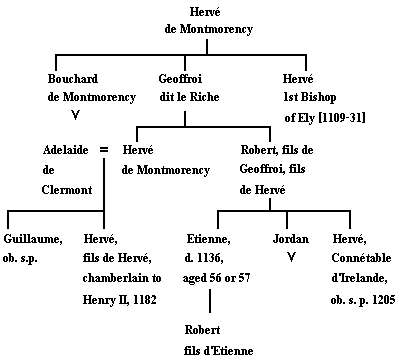
The explanation is extremely simple: the whole pedigree is concocted with a view to making the Irish Hervey uncle to Robert fitz Stephen. This was done to satisfy the supposed requirements of Giraldus, whose words Col. Morres thus triumphantly quoted:
Robertus Stephanides ... Inter cæteros Herveius de Montemaurisco Roberti patruus, nepoti suo se comitem præbuit (p. 77).
Unfortunately for him, he had gone, not to Giraldus, but to 'Stonyhurst de rebus Hibernicis i. 69-70, d'après Giraldus Cambrensis'. Stonyhurst had carelessly made Giraldus speak of Hervey as uncle, not to Earl Richard, but to Robert fitz Stephen, and the pedigree was accordingly constructed to fit this error. When the error is corrected, the pedigree collapses; and the very passage which is quoted to confirm it at once unmasks the concoction.
And now having made it clear that both sides were in error, I shall set forth the true explanation of the words of Giraldus. The clue is given us by those Deeping charters which, oddly enough, Col. Morres duly quoted and appealed to. The first is found in the Monasticon, ii. 601:
Adeliz, uxor Gilberti filii Ricardi et Gillebertus, et Baldewinus, et Rohaisia pueri Gilberti episcopo Lincolniensi ... salutem.... Hiis testibus, Gilberto filio Gilberti, Galterio, Hervæo, Baldwino fratribus ejus et Rohaisia sorore eorum, etc., etc.
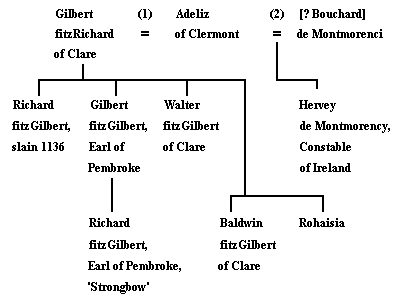
Hervey de Montmorency is also mentioned in the Bilegh Abbey confirmation charter of Richard I, but it gives us no information.
On the other hand, the 'dimidiation' of Hervey in the pedigree put forward by the Morres family was merely the fruit of the resolve to make him at all costs uncle to Robert fitz Stephen, as the words of Giraldus were supposed to require, in their misquoted form.
Having now shown that the alleged descent can be absolutely disproved so far as concerns the only Montmorenci whose name occurs in connection with Ireland, I proceed to glance at his supposed relatives, none of whom, it is important to remember, even bore the name of Montmorency.
The chart pedigree printed above (p. 357) will show how Robert fitz Stephen was converted into a Montmorenci, though the parentage of his father Stephen, constable of Cardigan, is wholly unknown. It need scarcely be said that no proof is, or can be, given for this filiation; but the following passage on Stephen is an excellent illustration of the sort of evidence which is vouched for this wholly imaginary pedigree:
Ce seigneur, très-jeune encore, en 1087, confirma conjointement avec son père et son aïeul Hervé, fils de Bouchard, la donation faite par Turillus le Gros à l'abbaye de St. Florent de Saumur de certaines bénéfices.
Sig. Hervei filii Burchardi, Sig. Roberti filii ejus, Sig. Stephani militis ejus.
All that is needed, we are told, is to read grandson ('petit fils') instead of filius for Robert, and great-grandson for miles—on the ground that miles sometimes meant 'un jeune homme'! Such is a type of the 'proofs' on which this pedigree rests. But its absurdities and inconsistencies go even further than this. The dates work out as follows:
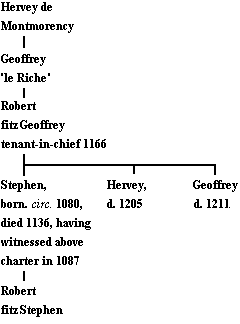
But what are we to say when we learn further that this Stephen, who died in '1136', is the 'Stephanus de Marisco' who appears in the Liber Niger as a tenant of the Bishop of Ely in 1166! The probable, and indeed only, explanation is that Col. Morres did not even know when the returns in the Liber Niger were compiled. Their real date again destroys this cock-and-bull pedigree, or genealogical nightmare, which, for sheer topsy-turveydom, has, I venture to assert, never been surpassed.
I strongly suspect that the whole story arose from the occurrence in Ireland, in the thirteenth century, of the latinized name 'De Marisco' or 'De Mariscis', which represents of course, neither Montmorenci nor Morres, but simply Marsh. Genealogists, no doubt, were attracted by the form 'De Monte Maurisco' into tracing a connection; but, so far as can be understood, Col. Morres discarded this resemblance, and represented his alleged ancestors as 'seigneurs de Mariscis ou des marches' in England, connecting them with the fen district in Cambridgeshire. It would be easy to show that the early pedigree positively teems with absurdities similar to those I have already exposed, but it would be sheer waste of time to devote any more attention to proofs, which Col. Morres proudly boasted were 'vérifiés avec la plus scrupuleuse attention par l'autorité competente et sanctionnés désormais par l'autorisation du prince qui gouverne aujourd'hui l'empire britannique' (p. 25).
Toutes les citations puisées par monsieur de Morrès dans les monuments, registres, et terriers publics d'Angleterre étant, comme je n'en doute pas, aussi exactes que celles du Monasticon (p. 37).
The value of his loudly-trumpeted verdict may be estimated from this admission.
THE OXFORD DEBATE ON FOREIGN SERVICE (1197)
And Mr Freeman repeats the parallel:
The two chief accounts of the Oxford debate are found in Roger Hoveden and the Magna Vita St Hugonis. As they are both printed in Select Charters, I need not repeat them here. There is, however, an independent version in the Vita of Giraldus Cambrensis, which it may be desirable to add:
In Anglicanam coepit [rex] ecclesiam duris exactionibus debacchari. Unde collecto in unum regni clero, habitoque contra insolitum et tam urgens incommodum districtiore consilio, verbum ad importunas pariter et importabiles impositiones contradictionis et cleri totius pro ecclesiastica libertate responsionis, in ore Lincolnensis tanquam personae prae ceteris approbatae religionis authenticae magis communi omnium desiderio est assignatum (vii. 103-4).
Gerald's editor impugns the correctness of these statements, on the grounds that the assembly was not clerical merely and that the bishop did not speak on behalf of the whole church. But the passage seems to me to refer to a meeting of the clergy in which it was decided that St Hugh should be their spokesman at the council. Of the other objection I shall treat below.
According to Hoveden, Richard asked for either (1) three hundred knights who would serve him, at their own costs, for a year, or (2) a sum sufficient to enable him to hire three hundred knights for a year at the rate of three shillings a day. The Magna Vita, however, implies that the former alternative alone was laid before the council. The grounds on which St Hugh protested are thus given by our two authorities:
Respondit pro se, quod ipse in hoc voluntati regis nequaquam adquiesceret, tum quia processu temporis in ecclesiae suae detrimentum redundaret, tum quia successores sui dicerent, 'Patres nostri comederunt uvam acerbam, et dentes filiorum obstupescunt' (Hoveden).
Scio equidem ad militare servitium domino regi, sed in hac terra solummodo exhibendum, Lincolniensem ecclesiam teneri; extra metas vero Angliae nil tale ab ea deberi. Unde mihi consultius arbitror ad natale solum repedare ... quam hic pontificatum gerere et ecclesiam mihi commissam, antiquas immunitates perdendo, insolitis angariis subjugare (Magna Vita).
Creiment k'il seit en feu tornez Et en costume seit tenu Et par costume seit rendu.
It was in this spirit that Hugh of Avalon, I take it, made his stand: other prelates might waive the point, in consideration of the king's necessities, but he, at least, would never allow a standing exemption to be broken through and thus impaired for all time.
The final loss of Normandy had, of course, altered the case, but even while it still formed part of an English King's possessions, there must always have been scope for argument as to feudal obligations. To quote once more from the same article:
But the point to which I would call attention is the nature and intention of this gathering. Orderic writes:
Confirmatus itaque in regno, turmas optimatum ascivit, et Guentoniæ congregatis, quæ intrinsecus ruminabat sic ore deprompsit.
Mr Freeman attaches to the speech that follows no small importance. Holding that the king 'was now ready to take the decisive step of crossing the sea himself or sending others to cross it', he pointed out that:
Of course, in reading Mr Freeman's works we must reconcile ourselves to 'Gemot' and 'Witan' being thrust upon us at every turn, however radically false a conception these words may convey. At the close of his dealing with this episode, he refers us, as a parallel, to the 'full Gemot' of 1047, in which 'the popular character of the assembly still', we learn, 'impresses itself on the language of history'. Now Orderic describes those who were summoned to our Winchester gathering as 'turmas optimatum'; he makes William begin his speech 'nostri egregii barones'; and he places in his mouth language essentially feudal and Norman:
Mr Freeman expressed astonishment and delight at William's 'constitutional language', and declared that though, in its actual wording, the speech, of course, was Orderic's:
And then follows the usual lament for 'the days of King Eadward', when it was not a 'cabinet', but a crowd, that dealt with the delicate question of peace or war.
Of the two, the father seems, as I have said, to have met with more opposition than the son. One might therefore produce an argument ad absurdum, and contend that, on Mr Freeman's showing, an English King was not less, but more, absolute than a Norman Duke. In any case we have now seen that the ideas about 'constitutional usage', and so forth, imported here by Mr Freeman, were nothing but a figment of his brain. The Assembly of Winchester no more resulted from 'English constitutional law' than did the Assembly of Lillebonne, convened for a similar purpose. William Rufus had to deal with barons who could not be anxious to invade Normandy merely to make him Duke of the Normans. If they had any preference in the matter, it would be rather for Robert than for William, for a weak rather than a strong ruler; but, apart from preference, the barons would be loth to engage in internecine warfare merely for the personal advantage of one brother or the other. This was seen in the peaceful close of the invasion by Duke Robert, as with that of Duke Henry half a century later. The question, in short, that arose in 1066, when a Duke of the Normans asked his barons to make him King of the English, arose once more in the days of his son, when a King of the English asked his barons to make him Duke of the Normans.
For we see that in all these fantasies of a brain viewing plain facts through a mist of moots and 'witan', we have what can only be termed history in masquerade.
RICHARD THE FIRST'S CHANGE OF SEAL (1198)
With the superficial student and the empiric politician, it is too common to relegate the investigation of such changes to the domain of archæology. I shall not attempt to rebut the imputation; only, if such things are archæology, then archæology is history.—Stubbs, Preface to R. Hoveden, IV, lxxx.
Historical research is about to pass, if indeed it is not already passing, into a new sphere—the sphere of Archæology. The central idea of that great advance which the present generation has witnessed in the domain of history has been the rebuilding of the historical fabric on the relatively sure foundation of original and contemporary authorities, studied in the purest texts. Chronicles, however, are not inexhaustible: for many periods they are all too few. The reaper has almost done his work; the turn of the gleaner has come. The smaller quellen of history have now to be diligently examined and made to yield those fragments of information which will supplement, often where most needed, our existing stock of knowledge.
But this is not our only gain as we leave the broad highways trodden by so many before us. Those precious fragments which are to form our spoils will enable us to do more than supplement the statements of our standard chroniclers: they will afford the means of checking, of testing, by independent evidence, these statements, of submitting our witnesses to a cross-examination which may shake their testimony and their credit in a most unexpected manner.
As an instance of the results to be attained by archæological research, I have selected Richard the First's celebrated change of seal. Interesting as being the occasion on which the three lions first appear as the Royal arms of England—arms unchanged to the present day—it possesses exceptional historical importance from the circumstances by which it was accompanied, and which led, admittedly, to its adoption.
It should be observed that all these writers rely merely on Hoveden, none of them throwing any light on the process of confirmation, or telling us how it was effected, and whether any traces of it remain. An independent writer, M. Boivin-Champeaux, in his monograph on William Longchamp, discusses the episode at some length, and asserts that the repudiated documents were 'assujettis, pour leur revalidation, à une nouvelle et coûteuse scellure'. Like the others, however, he relies on the authority of Hoveden, and consequently repeats the same date.
In the course of examining some ancient charters, I recognized one of them as nothing less than an actual instance of a confirmation consequent on this change of seal. But its incomprehensible feature was that the charter was confirmed on August 22, 1198, having originally been granted, 'sub primo sigillo', so recently as January 7th preceding. How could this be possible if the great seal had been changed so early as August 1194, and if the first seal, as stated by Dr Stubbs, was 'broken' on that occasion? Careful and prolonged research among the charters of the period (both in the original and in transcripts) has enabled me to answer the question, and to prove that (as, of course, the above charter implies) the change of seal did not take place in 1194, but 1198, and between January and May of that year.
Is erat tenor carte nostre in primo sigillo nostro. Quod quia aliquando perditum fuit, et, dum capti essemus in alem[anniâ], in aliena potestate constitutum, mutatum est. Huius autem innovationis testes sunt Hii, etc., etc.
We may here turn to the passage in Hoveden [ed. Stubbs, iii. 267] on which historians have relied, and see how far the reasons for the change given in the charters themselves correspond with those alleged by the chronicler.
Fecit sibi novum sigillum fieri, et mandavit, per singulas terras suas, quod nihil ratum foret quod fuerat per vetus sigillum suum; tum quia cancellarius ille operatus fuerat inde minus discrete quam esset necesse, tum quia sigillum illud perditum erat, quando Rogerus Malus Catulus, vicecancellarius suus, submersus erat in mari ante insulam de Cipro, et præcepit rex quod omnes qui cartas habebant venirent ad novum sigillum ad cartas suas renovandas.
In both cases we find there are two reasons given; but while one of these is the same in both, namely the temporary loss of the seal when Roger Malchael was drowned, the other is wholly and essentially different. The whole aspect of the transaction is thus altered. To illustrate this I shall now place side by side the independent glosses of the Bishop of Oxford and of M. Boivin-Champeaux:
Richard's first seal was lost when the vice-chancellor was drowned between Rhodes and Cyprus in 1190; but it was recovered with his dead body. The seal that was now broken must have been the one which the chancellor had used during the king's absence. Richard, however, when he was at Messina, had allowed his seal to be set to various grants for which he took money, but which he never intended to confirm. Therefore probably he found it convenient now to have a new seal in lieu of both the former ones, although he threw the blame of the transactions annulled upon the chancellor. The importance of the seal is already very great. (Const. Hist., i. 506, note.) Sur deux exemplaires usuels du grand sceau, le premier, que portait le vice-chancelier Mauchien, avait été perdu lors de l'ouragan qui, en vue de Chypre avait assailli la flotte Anglo-Normande, le second était resté en Angleterre; mais il avait subi, par suite de la revolution du 10 octobre, de nombreuses vicissitudes. Richard se prévalut de ces circonstances jointes au désaveu de la trève de Tillières pour publier un édit aux termes duquels tous les actes publics passés sous son règne, qui avaient été légalisés avec les anciens sceaux étaient frappés de nullité et assujettis, pour leur revalidation â une nouvelle et coûteuse scellure. Cette ordonnance aurait pu, à la rigueur, se colorer, si elle n'avait concerné que les actes accomplis pendant l'expédition et la captivité du roi; mais le comble de l'impudence et de l'iniquité était de l'appliquer même à ceux qui avaient précéde son départ ou suivi son retour (p. 223).
Again, when Miss Norgate writes of the 'withdrawal of the seal from William', and when Dr Stubbs tells us that the king 'took the seal from' him, these statements may have two meanings. But M. Boivin-Champeaux is more precise: 'L'emploi de ces procédés emportait le mépris et la violation non seulement de tous les actes étrangers au chancelier, mais encore de tous ceux où il avait mis la main. Il ne pouvait décemment conserver les sceaux. Le roi les lui enleva.' This is a distinct assertion that Longchamp was deprived of his office. Yet all our evidence points to the conclusion that he remained chancellor to the day of his death.
Let us now look at the other chroniclers. R. Coggeshall is independent and precise:
Accessit autem ad totius mali cumulum, juxta vitæ ejus terminum, prioris sigilli sui renovatio, quo exiit edictum per totum ejus regnum ut omnes cartæ, confirmationes, ac privilegiatæ libertates quæ prioris sigilli impressione roboraverat, irrita forent nec alicujus libertatis vigorem obtinerent, nisi posteriori sigillo roborarentur. In quibus renovandis et iterum comparandis innumerabilis pecunia congesta est (p. 93).
This is in complete accordance with the now ascertained fact that Richard changed his seal, and regranted the old charters, within the last year of his life. Similarly independent and precise evidence is afforded by the Annals of Waverley:
We see, then, that the evidence (1) of the seals, (2) of the charters, (3) of the circumstances of the time, (4) of other chroniclers, all concur in pointing to the spring of 1198. And now we will lastly appeal to Hoveden against himself. After telling us of the king's proclamation on the refusal of the religious to contribute to the carucage in the spring of 1198, he adds:
Præterea præcepit idem rex ut omnes, tam clerici quam laici, qui cartas sive confirmationes habebant de sigillo suo veteri deferrent eas ad sigillum suum novum renovandas, et nisi fecerint, nihil quod actum fuerat per sigillum suum vetus ratum haberetur (iv. 66).
The only conclusion to be drawn from this cumulative evidence is that the earlier passage in Hoveden (1194) which has been so universally accepted, must be rejected altogether. Against the facts I have adduced it cannot stand.
How far does the rejection of this statement on the change of seal affect the statement which precedes it as to the Truce of Tillières? Hoveden places the latter and the former in the relation of cause and effect:
Deinde veniens in Normanniam moleste tulit quicquid factum fuerat de supradictis treugis, et imputans cancellario suo hoc per eum fuisse factum, abstulit ab eo sigillum suum, et fecit, etc. (iii. 267).
It should be superfluous for me to add that, in thus correcting previous statements, I have not impeached the accuracy of our greatest living historian, who could only form his judgment from the evidence before him. The result of my researches has been to show that the evidence itself breaks down when submitted to the test of fact.
Granted at Confirmed at Grantee Authority
16 April, 119424 Winchester 27 May, 1198 Lions Robert fitz Roger Cart. Ant. EE. 6
2 December, 1189 Canterbury 15 June, 1198 Château Gaillard Hugh Bardulf Cart. Ant. EE. 10
10 October, 1189 Westminster 1 July, 1198 Château Gaillard Ely Cart. Ant. JJ. 43
28 November, 1189 Canterbury 1 July, 1198 Château Gaillard Ely Cart. Ant. NN. 26
1 July, 1190 Dangu 3 July, 1198 Château Gaillard William Longchamp Cart. Ant. JJ. 46
5 September, 1189 Westminster 30 July, 1198 Lire Rievaulx Abbey Rievaulx Cartulary (Surtees Soc.), p. 308
17 September, 1189 Geddington 30 July, 1198 Lire Rievaulx Abbey Rievaulx Cartulary (Surtees Soc.), p. 308
25 April, 1194 22 August, 1198 Thomas Basset Hist. MSS., 9th Report, ii. 404
12 December, 1194 Chinon 22 August, 1198 Roche d'Orival Alan Basset Cott. Cart. xvi. 1 (Rymer i. 67)
7 January, 1198 Vaudreuil 22 August, 1198 Roche d'Orival Alan Basset Anc. Deeds, Ser. A. No. 5924
8 December, 1189 Dover 10 September [1198] Château Gaillard Shaftesbury Abbey Harl. MS. 61, fo. 26
6 December, 1189 Dover 15 September [1198] Château Gaillard Peterborough Abbey Cart. Ant. EE. 21
14 March, 1190 Nonancourt 18 September, 1198 Château Gaillard Waltham Abbey Cart. Ant. RR. 7 & 8
23 March, 1190 Rouen 19 September, 1198 Château Gaillard Roger de Sancto Manveo Cart. Ant. BB. 6
29 November, 1189 Canterbury 9 October, 1198 Château Gaillard Fontevrault Cart. Ant. F. 1
6 October, 1189 Westminster 20 October, 1198 Lions St Leonard's, Stratford Add. MS. 6, 166, fo. 341
7 December, 1189 Dover 24 October, 1198 Château Gaillard Stratford Langthorne Abbey Cart. Ant. E. 1
23 March, 1190 Rouen 5 November, 1198 Château Gaillard St Jacques de Boishallebout Add. Cart. (Brit. Mus.) No. 3
7 December, 1189 Dover 10 November, 1198 Château Gaillard Boxley Abbey Cart. Ant. Q. 8
17 September, 1189 Geddington 12 November [1198] Château Gaillard St Alban's Abbey Ancient Deeds, A. 1050
28 November,25 1189 Canterbury 13 November, 1198 Château Gaillard Tynmouth Priory Cart. Ant. BB. 18
27 July, 1197 Isle d'Andely 14 November, 1198 Château Gaillard Llanthony Abbey Cart. Ant. B. 26
10 November, 1189 Westminster 30 November, 1198 Lions The Templars Deville's Transcripts
5 August, 1190 Marseilles 7 December, 1198 Lions Church of Durham Surtees Soc., vol. IX. p. lvi.
September, 1197 Rouen 17 December, 1198 'Sanctum Ebruskum' Domus Dei (Southampton) Cart. Ant. D. 30
1189 [No place] 24 January, 1199 Cahagnes Spalding Priory Add. MS. 5844, fo. 228
15 April, 1190 Evreux 3 March, 1199 Château du Loir Gilbert fitz Roger Hist. MSS., 10th Report, 325
22 June, 1190 Chinon 11 March, 1199 Chinon W. Briwerre Great Coucher II. 1, 67 IV. (1, 2)
25 April, 1194 Portsmouth 5 April, 1199 [No place] Noel 'serviens' Cart. Ant. D. 30
COMMUNAL HOUSE DEMOLITION
There was a strange custom peculiar to the ancient community of the Cinque Ports, which has not, so far as I know, been found elsewhere in England. If a member of any one of these towns was elected to serve as Mayor or 'Jurat' (the governing bodies consisting of a Mayor and twelve 'Jurats'), and refused to accept the office, his house was publicly demolished by the community. An extract from the Custumal of Sandwich, headed 'Pena maioris electi recusantis officium suum', will make the custom clear:
Although the custom of house demolition is apparently, as I have said, peculiar in England to the Cinque Ports, it was of widespread occurrence abroad. Thither, therefore, we must turn our steps in order to investigate its history.
It is in Flanders and in Northern France, and in Picardy, most of all, that we find this singular custom prevailing, and discover its inseparable connection with the institution of the Commune. It would seem that the penalty of house demolition was originally decreed for offences against the commune in its corporate capacity. Thierry, basing his conclusions mainly on the charters of the commune of Amiens and the daughter-charter of Abbeville writes:
Celui qui se soustrait à la justice de la Commune est puni de banissement, et sa maison est abattue. Celui qui tient des propos injurieux contre la Commune encourt la même peine. Voilà pour les dispositions communes aux chartes d'Amiens et d'Abbeville, c'est-à-dire pour celles qui authentiquement sont plus anciennes que l'acte royal de 1190. Si l'on ne s'y arrête pas et qu'on relève dans cet acte d'autres dispositions, probablement primitives aussi, on trouvera les peines du crime politique, l'abatis de maison et le banissement, appliquées à celui qui viole sciemment les constitutions de la Commune et à celui qui, blessé dans une querelle, refuse la composition en justice et refuse pareillement de donner sécurité à son adversaire.
The public character of the ceremony, which was no less marked at Sandwich (vide supra), is well illustrated in the Ordonnances of Philip of Alsace (circ. 1178) on the powers of his baillis in Flanders:
Domus diruenda Judicio Scabinorum, post quindenam a scabinis indultam, quandocunque comes præceperit, aut ballivus ejus, diruetur a communia villæ, campana pulsata per Scabinos; et qui ad diruendam illam non venerit, in forisfacto erit, etc., etc.
This ringing of the communal bell—parallel to the moot-bell of England—is an important feature in the matter. Without insisting upon a stray allusion, one may ask whether an entry in the Colchester records in the sixteenth century, threatening that if an offending burgess does not make amends, the town will 'ring him out of his freedom', may not be explained by this practice.
Now, my contention is that, as the practice of communal house demolition wandered down into Gascony, and thence actually crossed the Pyrenees into Spain, so—in the opposite direction—it crossed the channel and established itself in the Cinque Ports. As these movements become better understood, we are learning to treat them scientifically, and to trace them through their growth to their origin. In the case of the commune, the principle of filiation enables us to accomplish this with remarkable success.
But, it may be asked, is there any instance, on the other side of the channel, of house demolition being the penalty prescribed for refusal to accept office as Mayor or Jurat? It is, I reply, at Amiens the very penalty prescribed for that offence! The Custumal of Amiens contained these two clauses:
Et convient que chis qui pris est faiche le serment de le mairie; et se il ne veult faire, on abatera se maison, et demourra en le merchy du roy au jugement de esquevins.
Again, we find the infliction of fines for non-acceptance of municipal office a familiar custom in England even to the present day. These fines were undoubtedly commutations for an original expulsion from the community; and at Colchester, for example, we have a case of a man being deprived of 'his freedom' for declining the office of alderman, and of his having to make 'submission' and pay a fine before it was restored. The fact is, that in every community, whether urban or rural, where office was a necessary but burdensome duty—like modern jury-service or mediaeval 'suit'—a penalty had to be imposed upon those who declined to discharge it. The peculiarity of the Sandwich and Amiens cases consists not in the imposition of a penalty, but in the character of the penalty imposed.
Pass we now from the consideration of this penalty to the wider and important conclusions suggested by its local occurrence.
From Picardy, which faced the Cinque Ports, they derived, I believe, their confederation. To quote Thierry:
Let me briefly summarize the arguments on which I base my hypothesis:
(4) In the Cinque Ports, as in the French Communes, we find side by side with this elective administration, a royal officer, with us a Warden, with them the Sénéchal (or Prévôt or Bailli) du Roi.
(5) The very same penalty of house demolition for refusal to accept office as Mayor or Jurat was exacted in the Cinque Ports (and nowhere else in England) as at Amiens.
'R. Com(es) leg(recestriæ) Baronibus regis de Hastingg' salutem. Precipio quod abbas et monachi de Hulmo teneant bene et in pace et juste terras suas in Gernemut ... sicut eas melius tenuerunt tempore Regis H. avi regis ... T. R. Basset per breve regis de ultra mare' (Galba E. 2, fo. 33b).
THE CINQUE PORTS CHARTERS
This brings us at once to Edward's alleged charter; and, indeed, my critic recurs at the outset to his belief in 'the Ports having been chartered as a Confederation by Edward the Confessor' (p. 439). At the close of the article he reminds us again that he 'accepted the charter of Edward the Confessor as a faithful landmark, and showed how the history of our early kings and their institutions appeared to coincide with the statement'. But he adds that 'if proof can be brought against the issue of such a charter', he will be 'the first to recognize it'.
temporibus Regum Angliæ Edwardi, Willelmi primi et secundi, Henrici regis proavi nostri, et temporibus Regis Richardi et Regis Johannis avi nostri et Domini Henrici Regis patris nostri per cartas eorundem, sicut cartæ illæ quas iidem Barones nostri inde habent, et quas inspeximus, rationabiliter testantur.
And in none of them is any charter mentioned earlier than that of Henry II.
These charters of John are most important, but have not, so far as I know, received scientific treatment. The charter to Hastings is in many ways distinct from the others. It alone speaks of the 'Honours at Court', the rights at Yarmouth, and the ship-service due, and alone mentions that this service was rendered 'pro hiis libertatibus'. The charter to Rye and Winchelsea is modelled on that of Hastings, and neither of them goes back beyond the charter of Henry II. The charters to Dover and to Hythe, it will be found, are closely parallel, and in both cases the privileges are to be enjoyed as in the times of Edward, William I, William II, and Henry (I). Sandwich has her liberties confirmed as in the days of Henry I, King William, 'and our predecessors'; Romney as in the days of Henry I.
We see, then, that when we interpret the great charter of Edward I to the Ports (1278) in the light of evidence, not of supposition, we find that Henry II and John did grant separate charters to the different Ports as to other towns (not a collective charter to them all), and that these therefore must have been the charters referred to in the general confirmation of 1278. In other words, it was Edward I, not Edward the Confessor, who granted the first 'Charter to the Confederation', as a whole. Utterly subversive though it be of Professor Burrows' view, this is the only conclusion in harmony with the known facts.
Thus the sole result of examining my critic's evidence is to make me carry my scepticism further still. I now hold that even so late as the days of John, the Ports had individual relations to the crown, although their relations inter se were becoming of a closer character, as was illustrated by the fact that their several charters were all obtained at the same time. Hastings alone, as yet, had rights at Yarmouth recognized: hers were the only portsmen styled 'barons' by the crown.
The geographical position of Hastings also severs its case, as widely as do its privileges, from those of the Kentish ports. It is therefore difficult to resist the impression that the distinction in John's charter had a real origin and meaning. The 'barons' of Hastings were, I believe, the men of the King's town (not, as alleged, the Abbot's) and so far from the Abbot's men being admitted to share their distinction, we find the latter, at Rye and Winchelsea, styled in John's charter 'homines', not even 'homines nostri'.
The accepted view as to Rye and Winchelsea is thus set forth by Professor Burrows:
The Confessor had evidently intended to make the little group of Sussex towns, the 'New Burgh', Winchelsea, and Rye, a strong link of communication between England and Normandy; but Godwin and Harold had contrived to prevent the two latter from becoming the property of the Abbey of Fécamp, to which Edward granted them in the early part of his reign; and this formed one of the Norman grievances. William promised to restore them to the Abbey, and when he had conquered England he kept his word.... Of the grant of Winchelsea and Rye to the same Abbey as part of the lands of Steyning we have distinct evidence in the charter of resumption issued by Henry III in 1247 (p. 27; cf. supra, p. 248).
Although this view has always been held by local historians and antiquaries, it seems to me obvious that there must be error somewhere. Rye and Winchelsea belonged geographically to the Abbey's lordship of Brede in the extreme west of the county; its lordship of Steyning was in East Sussex. On examining for myself the charter of resumption and comparing it with the Abbey's claims as to Brede at the quo warranto inquiry, I discovered the solution of the mystery. Rye and Winchelsea were not, as alleged, appurtenant to Steyning, but belonged to the Manor of Brede. The Abbey, however, claimed on behalf of its Manor of Brede (including Rye and Winchelsea) all the franchises granted to Steyning, contending that they were meant to extend to all its lands in Sussex. This claim was urged and recognized in the case of the charter of resumption (1246), the source of the whole misapprehension.
It is admitted that the title was at first only held by the Portsmen in common with the citizens of several other places, as that of a responsible man in a privileged community, of a 'baro' or 'vir' of some dignity; but, of course, not in the least in the sense of a 'baron' such as the word came to mean in the twelfth and thirteenth centuries.
ADDENDA
Pages 20, 107. In case I should not have made sufficiently clear my views as to the filiation of the Domesday MSS., it may be well to explain that what I deny on p. 21 is that the Inq. Com. Cant. and the Inq. El. can both have been copied from a third document intermediate between them and the original returns. But, as I state on pp. 20, 123, it cannot be proved that the Inq. Com. Cant. was itself transcribed direct from the original returns, as it might, possibly, be only a copy of an earlier transcript of these returns.
Page 30. A remarkable instance of the occasional untrustworthiness of the figures given in these texts is afforded by the Manors of Stretham and Wilburton, co. Cambridgeshire, which were farmed together. The correct figures for their ploughteams were these:
Dominium Homines Total
Stretham 41 5 9
— —
7 9
The footnotes show the errors.
Thus the A text, which is the best known, gives two figures out of three wrongly for Wilburton, and Mr Pell, by accepting as genuine these two erroneous figures, was led to quite erroneous conclusions.
Pages 68-9. The parallel for this system of counting by threes and sixes is found in the wergild of Scandinavia, with its rétt of 3 marcs, or 6, or 12, the 6 or the 12 aurar, the 12 ells or the 12 feet of vadmal.
For the formulæ on p. 68 an instructive parallel is found in the Frostathing's Law:
If a haulld wounds a man, he is liable to pay 6 baugar(rings) to the king, and 12 aurar are in each ring ... a lendrmann 12, a jarl 24, a king 48, 12 aurar being in each ring.
Thus we find in Scandinavia the counterpart of the system of counting found in the 'Danish' districts of England, just as we find in Angeln and Ditmarsh the counterpart of the 'hide', with its four 'yards', found in southern England (Archæologia, xxxvii. 380).
Page 105. For the election of juratores we may compare the Abingdon Abbey case, under Henry II: 'ex utroque parte seniores viri eligerentur qui secundum quod eis verum videretur ... jurarent; ... segregati qui jurarent diversis opinionibus causam suam confundebant'. For juries of eight or sixteen we may compare Jocelin de Brakelonde's narrative of a suit for an advowson in 1191: 'delatum est juramentum per consensum utriusque partis sexdecim legalibus de hundredo'.
Page 126. Compare here Mr Freeman's text (iii. 413-4):
There can be little doubt that William's ravages were not only done systematically, but were done with a fixed and politic purpose.... It is impossible to doubt that the systematic harrying of the whole country round Hastings was done with the deliberate purpose of provoking the English king.... The work was done with a completeness which shows that it was something more than the mere passing damage wrought by an enemy in need of food.
Domesday is appealed to, as in the Appendix, for this view.
Page 205. Though I have spoken in the text of William de Montfichet, following, like Dugdale, the Liber Niger, I have since found that the tenant of the fief, in 1166, was his son Gilbert, the carta being wrongly assigned in the Liber Niger itself to William. There are similar and instructive errors to be found in it.
Page 244. The succession of Schelin, the Domesday under-tenant by his son Robert, in 1095 identifies the former with Schelin, the Dorset tenant-in-chief, from whom Shilling Ockford took its name, and who was succeeded in Dorset also by his son Robert (Montacute Cartulary).
Pages 293-4. To guard (as I have to do at every turn) against misrepresentation, I may explain that the Battle Chronicle is the primary authority I follow for the feigned flight. Its words 'fugam, cum exercitu duce simulante', distinctly assert that the Duke himself, with the main body of his army, 'turned in seeming flight'. It must, surely, be because this evidence is quite opposed to Mr Freeman's view that he ignored it in his text (pp. 488-90). The essential point to grasp, according to my own view, is that a detachment, told off for the purpose, thrust itself between the pursuing English and the hill to cut off their retreat, and that the main body of the Normans then faced about. The English, one may add, are hardly likely to have ventured down into the plain unless the feigned flight was so general as to make them think they could safely do so.
Pages 311-12. 'Mainly from oral tradition.' This refers, of course, to Mr Archer's contention.
Page 356. On the great influence, by their connection, of the Clares see also the Becket Memorials (iii. 43), where Fitz Stephen writes (1163):
Illi autem comiti de Clara fere omnes nobiles Angliæ propinquitate adhærebant, qui et pulcherrimam totius regni sororem habebat, quam rex aliquando concupierat.
We are reminded here of the curious story in the Monasticon (iv. 608) that, some forty years before, Roheis de Clare, the wife of Eudo Dapifer, was, on his death (1120), destined by her brethren for the second wife of Henry I, a story which illustrates, at least, the position attributed to the family.
Pages 357-8. The Montfichet match is not shown in the chart pedigree, nor is the important marriage of Adeliza, another daughter of Gilbert (fitz Richard) de Clare, to Aubrey de Vere, the Chamberlain, which is well ascertained (Geoffrey de Mandeville, pp. 390-2). By him she had inter alios a daughter, with the Clare name of 'Rohese', who married Geoffrey de Mandeville, first Earl of Essex (ibid.). The existence of this Adeliza may be held to be against my affiliation of 'Adelidis de Tunbridge', which avowedly is only a conjecture.
Page 360. A chart pedigree is here given to illustrate the connection of Robert fitz Richard (de Clare), through his wife, with the Earls of Northampton and the Scottish kings:
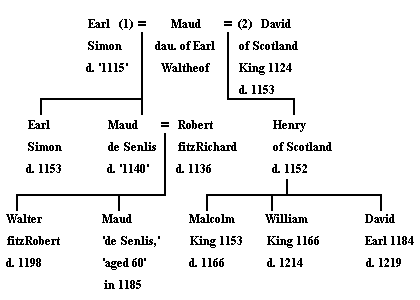
Robert fitz Richard and his children (see p. 359) are included in this pedigree, in order to show that their ages present no chronological difficulty, and that the length of time they survived him is clearly due to his marrying rather late in life.
Page 388. I have identified a third fine, since this book was in type, as belonging to the great circuits of 1176. It proves that they began early in the year.
INDEX
A | B | C | D | E | F | G | H | I | J | K | L | M | N |O | P | Q | R | S | T | V | W | Y
(Note: The Page number is the link to the reference. Pagex indicates that the reference is only, or mainly, in the Footnote. Footnotes on an indicated page should be checked for additional imformation.)
Abetot, Urse d', 129, 141-512, 147-8, 159, 238250, 239, 245, 324, 356
Abingdon Abbey: its knights, 179, 239-40
Airy, Revs. W. and B. R., 55-6
Albini 'Brito', William de, 172, 173; his wife, 359-60
Albini, Henry de, 163, 171, 173-4
—— Nigel de, 174, 179
Alfred, the name of, 254; see also Lincoln
Alfred of Espagne (not Spain), 254, 255
Alfred of Marlborough, 252, 254
Alneto, Herbert de, 369
Amiens: Custumal of, 419
Andrews, Dr, 303161
'Anglicus numerus'—see Hundred
Archer, Mr T. A., 25637, 2634, 264, 265, 266-7, 269, 270-3, 284106, 289, 290, 364, 431; his remarkable statement, 27341; champions Prof Freeman, 300; throws him over, 300-1; contradicts him flatly, 301-2, 306; opposes him wrongly, 274-7; his tactics, 302, 307-8, 309; his knowledge of Old French, 30922; on Wace's age and sources, 311-2; on his sobriety, 313; on Prof Freeman's errors, 33413, 3401
Archers: use of, 280, 283104, 284-287
'Archijustitiarii,' the, 433
Ardres, the lords of, 351-2
Armorial bearings: earliest, 3571, 3595
Arms of England, Royal, 406
Arques, The relief of, 294-6
Arundel, Earl of: his carta [1166], 196
—— Earldom of, 153
Assessment, the system of, 430; Anglo-Saxon, 48 sqq.; reduced, 51-55, 64; independent of area or value, 62; said to be determined by area, 80, 82, by value, 63; origin of, 82 sqq.
Assessment for danegeld, 378-9
—— in East Anglia, 88-91; in Kent, 91 sqq., 95; exemption from, 95-7; changes of, 129; of Abingdon and Worcester Abbeys, 140; in Lindsey, 149: see also Vills; Wara
Auxilium—see Scutage
Aynho, Northants, 381
Bainard, Ralf (or Baignard), 350, 360
Baldwin (de Clare), the Sheriff, 25637, 340, 34146, 359, 394; his sons, ib. 357-8, 369
Bampton (or 'Badentona', Cadentona [sic]), Robert of, 367, 369
Barbery Abbey, 157
Barnstaple, Fief of, 369; Honour of, 212
Barones were tenants-in-chief, 102
Barons—see Cinque Ports
Basset family and fief, 129
—— Ralf, 160, 169
—— Richard, 161-5, 172-3
—— Thomas, 381, 384, 386, 387
—— William, 385-8
Bath, Godfrey, Bishop of, 366, 367-8
Baudri: his poem, 269, 284, 286, 287-8
Bayeux Tapestry, 264, 269, 270-2, 276-7, 28088, 288-9, 290, 300, 310, 318
Bayonne, Custumal of, 418
Beauchamp (or Bello campo), family and fief, 141-8, 159, 160-3
Beauchamp, Maud de, 156, 158-9
—— Philip de, 163
Beaumont, Robert de, 27341
Becket, Thomas; his opposition in 1163, 377, 379-80, 398; his movements in 1170, 383, 402
Bedfordshire, Assessment in, 55-8
Bell: Ringing of the town, 417
Bémont, M. Ch., 334
Berkshire, Hidation in, 63-4
Betham, Sir W., 392, 397
Bigot, Roger, 255
Birch, Mr de Gray, 18, 118250, 140
Bishops: knight service of, 198-9, 220; their style before consecration, 32711, 367-8
Blois—see Peter
Boivin-Champeaux, M., 407, 408-10, 412
Bosham: Capellaria de, 19962, 201, 249
Boulogne, Eustace, Count of, 250, 256, 293, 324, 325, 349, 351
Boulogne, Eustace (the younger), Count of, 214
Bourne (Cambridgeshire), Honour of, 204
Bourne (Lincoln): descent of, 136-7
Brakelond, Jocelin de, 400-1, 40218, 431
Bretons, 254-5, 256-7, 291; their alleged inferiority, 27981
Breve abbatis, the: its meaning, 35, 36, 115-6
Brihtric, son of Ælfgar, 323, 324-5
Bristol: its trade with Ireland, 354
Britanny, Honour of, 196
Buci, Robert de, 129, 172-3
Buckinghamshire, Hidation in, 64
Burkes: origin of the, 390-1
'Burna' (Westbourne), 327
Burrows, Prof Montagu, 248, 420-1, 422-9
Cahors, Patrick de, 95
Cambridge: its wards, 68; its 'lawmen', 79; alleged earldom of, 152-3
Cambridgeshire, hundreds of: analysed, 48-55—see also Inquisitio; Picot
Camerarius, Aubrey de Vere, 175, 178-9, 432; his son Robert, 179
'Candidus'—see Hugh 'Candidus'
Canterbury, See of: its knights, 199, 236
Canterbury, Geoffrey (Ridel), Archdeacon of, 381, 382, 383-4, 388
cartæ of 1166, 189 sqq., 210-11, 225, 228, 396; sealing of, 194; their evidence, 198-9 sqq.; errors in, 226-7, 234, 431
Caruca, the Domesday: contained eight oxen, 40, 41
Carucate: 120 acres in the, 4275, 67; as a measure of assessment, 66 sqq., 73, 78, 79-82; connected with the plough team, 95
Castle-guard, 20064, 232216
Castles built in England, 249-53
Chancellors—see Geoffrey, Ranulf, Regenbald, Waldric
Charters, the re-sealed [1198], 412-15
Chester: Earls of, 151-3; 'lawmen' of, 79; its trade with Dublin, 353-4
Chokes, Anselin de, 177
Church, the: exactions from the, 221, 242-3, 400, 410
Cinque Ports: their system of 'purses', 88183; peculiar penalty in, 416 sqq.; confederation of, 420-1, 422-4; its name, 421
Cinque Ports: Barons of, 421-2, 428-9; 'honours at court', 422, 425
Cinque Ports: their charters, 424-6, 429; their courts, 42914; their complex polity, 429
Cirencester Charters, The: 323, 326
Civic League, an alleged, 331-3
Civitas, meaning of, 262
Clare family and fief, 226, 355-60, 394, 431-2. See Baldwin
Clare, Baldwin Fitz Gilbert de, 134, 179, 359, 394
Clare, Richard Fitz Gilbert de, 255, 355
Clermont, Adeliz de, 394
Cleveland, Duchess of, 297, 358, 371
Clinton—see Glynton
Cockayne, Mr T. O., 1241, 1253, 1289
Colchester: Charter to, 363; municipal custom at, 417
Commendatio, 36-40
Commune: offences against the, 416-420; spread of the, 418-19; its independent growth, 426, 429
Constabularia, the, 206, 208, 227
Consuetudines: due from sokemen and freeman, 36-9
Corfe Castle, 263
Cornhill, Gervase de, 357
—— Henry de, 363
Cornwall, assessment in, 62; low, 84, 86; see also Devon
Cornwall, earldom of, 369
—— Reginald, Earl of, 381, 384, 385
Counties, groups of: defined by assessment, 85-6
Courcy, William de, 180
Coutances, Geoffrey, Bishop of, (114238), 114-15, 238250
Craon, Alan de, 164, 172, 174
Crown, Power of the, 399
Curia Regis, The, 385-9, 405, 432-3; mention of, 120. See Placita
Danegeld: normal, 55, 91; its origin, 82-83; its local incidence, 84-6; its connection with the Hundred, 88-91, 125, 128, 130; early levy of, 124-5; remitted on 'waste', 125; unpaid, 128-9; its assessment, 165-6, 379; alleged debate on, 377; not compounded for, 378
Danish districts: assessment of the, 66, 67-8, 430; the 'long' hundred in, 66-7; limits of, 67-8, 79, 94; carucated, 82-3. See 'Six carucates'
Dare—see Recedere
Defensio: represents assessment, 102, 166
De La Rue, Chevalier, 392, 397
Delgove, M. l'Abbé, 361-2
Democracy: its failure, 302-5
Derbyshire: a Danish district, 68; low assessment of, 85; possible Hundreds in, 165-6
Devon: assessment in, 61-2; low, 84, 86; earldom of, 358, 369; Sheriffs of, 236239
Dialogus de Scaccario, 121-2
'Dispensator', Robert, 141-5, 147-8, 155, 158-9, 245
Distraint, 243
Domesday Book: omissions in, 26-7, 35, 41; errors in, 28-30, 41, 4476, 77, 78, 47, 74, 113, 119, 180-1, 326; general excellence, 29-30; duplicate entries in, 30-5, 350; not a verbal transcript, 31-5; analysis required, 56, 64, 82, 88; its love of variety, 31, 34, 77, 223-4; Leets mentioned in, 90; its compilation, 118; Liber de Wintonia, 118; its two volumes, 119-20; its date, 118, 209-10; used by the pseudo-Ingulf, 120; first mention of, 120-1; Liber de thesauro, 121; preserved at Winchester, 121-2; removed to Westminster, 121-2; names of tenants in, 131-3, 137-9; its alleged silence as to feudal tenures, 184-5, 240; contrasted with returns of 1166, 189-90; mentions knight service, 236