PART I TERRITORIAL STUDIES (continued 2)
Reading edition
The probability is, then, that what we have called the enhanced ferm, was enhanced by something less than the gross profits we have instanced; that is, that a part of those profits, say the Burgage rents, or some of them, had contributed to the dimidia firma noctis before the commutation.
All these ready assumptions, we must remember, are introduced to account for a discrepancy which does not exist.
Great masses of Mr Eyton's work consist of similar guesses and assumptions. Now, if these were kept scrupulously apart from the facts, they would not much matter; but they are so inextricably confused with the real facts of Domesday that, virtually, one can never be sure if one is dealing with facts or fancies.
And far more startling than the case of Somerset is that of Dorset, the 'Key to Domesday'. Mr Eyton here held that Dorchester, Bridport, and Wareham paid a full firma unius noctis each, the total amount being reckoned by him at the astounding figure of £312 (p. 70)! Exeter, which affords a good comparison, paid only £18 (as render), though the king had 285 houses there: the three Dorset towns in which, says Mr Eyton, the Crown had 323 houses, paid in all, according to him, £312. The mere comparison of these figures is sufficient. But further, Mr Eyton observes (p. 93), that in 1156 'Fordington, Dorchester, and Bridport' were granted by Henry II to his uncle, 'as representing Royal Demesne to the annual value of £60'. This is an instructive commentary on his view that Dorchester and Bridport alone rendered £208 per annum. Our doubts being thus aroused, we turn to Domesday and find that it does not speak of any of these towns as paying that preposterous firma. The right formula for that would be 'reddit firmam unius noctis' (p. 84). Instead of that, we only have 'exceptis consuetudinibus quæ pertinent ad firmam unius noctis' (p. 70). The explanation is quite simple. Just as in Somerset, Mr Eyton admits, Langport and Ilchester, although boroughs, were 'interned' in groups of Royal demesne, paying the firma unius noctis, so in Dorset the boroughs were 'interned' in groups of Royal demesne. Indeed one of these groups was headed by Dorchester, and is styled by Mr Eyton the 'Dorchester group'. But he boldly assumed that 'Dorchester' must have two different meanings:
[A] We assume about 100 acres to have belonged to the Domesday Burgh, and perhaps 882 acres to represent land, subinfeuded at Domesday, and annexed to Dorchester Hundred. [B] It follows that we assume about 429 acres, [to be that] ... which here figures [fo. 75] under the name Dorchester.
Apart from the Manors grouped for a firma unius noctis, if we take the comital Manors (mansiones de comitatu) of Somerset, which were in the King's hands in 1086, we find their rentals given on quite a different principle to those of the Manors in private hands.
(1) They are entered as renders ('reddit'), not as values ('valet').
(2) The sums rendered are 'de albo argento'.
(3) In at least ten out of the fifteen cases, they are multiples of the strange unit £1 3s.
As this fact seems to have escaped Mr Eyton's notice, I append a list of these Manors, showing the multiples of this unit that their renders represent:
£ s d
Crewkerne 46 0 0 40
Congresbury 28 15 0 25
Old Cleeve 23 0 0 20
North Curry 23 0 0 20
Henstridge 23 0 0 20
Camel 23 0 0 20
Dulverton 11 10 0 10
Creech St Michael 9 4 0 8
Langford 4 12 0 4
Capton205 2 6 0 2
Whatever this strange unit represented, it formed the basis in these Manors of a reckoning wholly independent of the 'hides' or ploughlands of the Manor, and as clearly artificial as the system of hidation I have made it my business to explain.
XV. 'WARA'
The meaning of 'Wara' is made indisputable by the I.C.C. When land was an appurtenance, quoad ownership, of a Manor in one township, but was assessed in another in which it actually lay, the land was said to be in the former, but its 'wara' in the latter. As this 'wara' was an integral part of the total assessment of the township, it had to be recorded, under its township, in the I.C.C. Here are the three examples in point:
[Histon.] De his xx. hidis jacet Warra de una hida et dimidia in hestitone de manerio cestreford. Hanc terram tenuit comes alanus [sic] et est appretiata in essexia (p. 40).
[Shelford.] De his xx. hidis tenet petrus valonensis iii. hidas de firma regis in neueport.... Hæc terra est berewica in neueport, sed Wara jacet in grantebrigge syra (p. 49).
[Trumpington.] De his vii. hidis [tenet] unus burgensis de grenteburga i. virgam. Et Warra jacet in trompintona, et terra in grantebrigga (p. 51).
To these I may add a fourth instance, although in this case the name wara does not occur:
[Bathburgam.] De his vii. hidis tenet Picotus in manu regis dimidiam hidam et dimidiam virgam. Hæc terra jacet in cestreforda et ibi est appretiata xxx. sol. in essexia (p. 36).
The lands at Histon and 'Bathburgam' were mere outlying portions of the royal Manor of Chesterford in Essex, and those at Shelford were a 'berewick' of the royal Manor of Newport, also in Essex. But they were all assessed in Cambridgeshire, where they actually lay.
So also we read under Berkshire (61b): 'Hæc terra jacet et appreciata est in Gratentun quod est in Oxenefordscire, et tamen dat scotum in Berchesire'. Again (203b) we read under Pertenhall: 'Hec terra sita est in Bedefordsire, set geldum et servitium reddit in Hontedunscyre'. A good instance of the same arrangement in another part of England is found in those Worcestershire Manors which were annexed as estates to Hereford, but which were assessed in those Worcestershire Hundreds where they actually lay (see p. 60).
A similar expression is applied to the possession of 'soca'. Thus under Shelford we read:
De hac terra adhuc tenuerunt iii. sochemanni dimidiam hidam sub gurdo comite. Non potuerunt recedere sine licentia comitis gurdi. Et soca jacebat in Witlesforda (p. 48).
Here the land was in Shelford, but the jurisdiction (soca) was attached to Earl Gyrth's Manor of Whittlesford.
Prof Vinogradoff has dealt with 'the word wara' in his Villainage in England (i. 241-4), and asserts that the 'origin and use of the term is of considerable importance'. But he does not allude to the above evidence, and I cannot follow him in his argument. While rightly disregarding Mr Pell's fanciful derivation from 'warectum', he asserts that:
We often find the expression 'ad inwaram' in Domesday, and it corresponds to the plain 'ad gildam [sic] regis'. If a Manor is said to contain seven hides ad inwaram, it is meant that it pays to the king for seven hides.... The Burton cartulary, the earliest survey after Domesday, employed the word 'wara' in the same sense.
One cannot disprove the first proposition without reading through all Domesday for this purpose. I can only say that I do not remember ever meeting in Domesday Book with such an expression. The solitary instance of its use known to me is in the Liber Niger of Peterborough (p. 159), where we read: 'in Estona sunt iii. hidæ ad in Waram'; and there the relevant entry in Domesday has no such expression. Of the statement as to the Burton cartulary, one can positively say it is an error. Its 'waræ' have quite another meaning and are spoken of as virgates would elsewhere be.
Collation with what I have termed the Northamptonshire geld-roll renders it clear that 'wara', in Domesday, represents the old English word for 'defence', in the sense of assessment, the 'defendit se' formula of the great Survey leading even to the phrase of 'Defensio x. acrarum', for assessment to Danegeld, which is found in the first volume of Fines published by the Pipe-Roll Society.
XVI. THE DOMESDAY 'JURATORES'
I now approach the subject of the Domesday juratores.
The order in which the Hundreds occur must not be passed over, because their sequence distinctly suggests a regular circuit of the country. Here is the sequence given in our three authorities: the I.C.C., the I.E., and the list of jurors prefixed to the latter:
Staplehow Staplehow Staplehow
Cheveley Cheveley Cheveley
Staines Staines Staines
Radfield Flammenditch Erningford
Flammenditch Childeford Triplow
Childerford Radfield Radfield
Triplow Triplow Whittlesford
Erningford Erningford Weatherley
Weatherley Weatherley Stow
Stow Stow Papworth
Papworth Papworth Northstow
Northstow Northstow Chesterton
Chesterton Ely
Ely
On comparing the first two of these lists it will be found that (except in the case of three contiguous Hundreds, which does not affect the argument) the Hundreds are taken in a certain sequence, which is seen, on reference to the valuable map prefixed to Mr Hamilton's book, to represent a circuit of the southern portion of the county from north-east to north-west, followed by an inquest on the district to its north, the 'two Hundreds' of Ely.
The third list, on the other hand, misplaces the Hundreds of Triplow and Erningford altogether, and wholly omits that of Childeford. The transposition and omission are both notable evidence that the B and C texts, as I shall urge, were derived from some common original which contained these defects.
The essential point, however, is that a circuit was made of the county whether merely by the sheriff, or, as seems most probable, by the Domesday Commissioners themselves—the 'barones regis' of the record—who must have attended the several Hundred-courts in succession.
Cum illis (i.e. omnes illius comitatus homines) Baiocensis episcopus, qui placito præerat, non bene crederet; præcepit ut, si verum esse quod dicebant scirent, ex seipsis duodecim eligerent, qui quod omnes dixerant jure jurando confirmarent.
Now we read of this jury:
Hi autem fuerunt Edwardus de Cipenham, Heruldus et Leofwine saca de Exninge, Eadric de Giselham, Wlfwine de Landwade, Ordmer de Berlincham, et alii sex de melioribus comitatus.
Investigation shows that the names mentioned are local. The land in dispute was a holding in Isleham in the Hundred of Staplehoe. One juror, Eadric, came from Isleham itself, two from Exning, one from Chippenham, one from Landwade, while the sixth, Ordmer, was an under-tenant of Count Alan, in the Manor from which he took his name (Badlingham), and was a Domesday juror for the Hundred. These six, then, were clearly natives chosen for their local knowledge. The other six, chosen 'de melioribus comitatus', were probably, as at the Domesday inquest, Normans (Franci). Thus the double character of the jury would be here too preserved, and the principle of testimony from personal knowledge upheld.
This corresponds, it will be seen, exactly with the writ to which the Inquisitio Eliensis was, I hold, the return: 'Inquire ... qui eas (terras) juraverunt et qui jurationem audierunt' (infra, p. 114).
We may take, as a typical set of juratores, those for the Hundred of Erningford, the survey of which, in Mr Hamilton's book, occupies pp. 51-68. I give them in their order:
[Francigenæ] [Angli]
Walterus Monachus Colsuenus
Hunfridus de anseuilla Ailmarus eius filius
Hugo petuuolt Turolfus
Ricardus de Morduna Alfuuinus odesune
It will be observed that Colsweyn belongs to a special class, the English under-tenants. He is thus distinct at once from the Francigenæ, and from the villeins of the township. He and his peers, however, are classed with the latter as jurors, because they are both of English nationality. In the great majority of cases the English juratores cannot be identified as under-tenants, and may therefore be presumed to have belonged to the township deputations.
XVII. THE 'INQUISITIO ELIENSIS'
The record known by this name has long been familiar to Domesday students, but no one, so far as I know, has ever approached the questions: Why was it compiled? When was it compiled? From what sources was it compiled? These three questions I shall now endeavour to answer.
The Inquisitio Eliensis is a document of the same kind with the Exeter Domesday; relating to the property of the Monastery of Ely recorded afterwards in the two volumes of the Domesday Survey (p. xiv).
From this it would seem that Ellis believed the Inquisitio, at any rate, to be previous to Domesday Book, but he practically left its origin altogether in doubt.
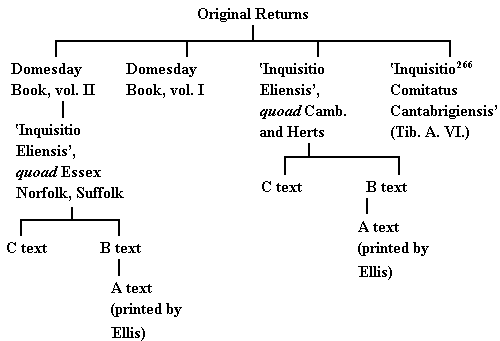
Starting from this conclusion, let us now proceed to ask, what was the document from which B and C copied independently? Clearly, it was not Domesday Book, for outside the eastern counties they record the returns in full, like the Inq. Com. Cant. itself. Were they then taken from the original returns, or at least from the copy of those returns in the Inq. Com. Cant.? This point can only be determined by close analysis of the variants; if we find B and C containing occasionally the same errors and peculiarities, although copied independently, it follows that the document from which they both copied must have contained those same errors and peculiarities. Let us take the case of Papworth. The right reading, as given both in Domesday and the Inq. Com. Cant., I have placed on the left, and the wrong reading, in B and C, on the right:
[tenet abbas] ii. hidas et iii. virgas et dim. [virgam].
I. hida et i. virga et dimidia [virga] in dominio.
Here are some further illustrations of errors in the I.E.:
D.B. and I.C.C. I.E.
VIII. hidas et dimidiam et dimidiam virgam.... In dominio iii. hidæ et dimidia (p. 18). II. carruce in dominio. Et tercia potest fieri (p. 21). I. hida et dimidia et xii. acræ in dominio (p. 87). tenet Radulfus de Picot (p. 85). Johannes filius Waleranni (p. 27). VIII. hidis et dimidia et dimidia virga ... iii. hidæ et dimidia et dimidia virga in dominio (p. 104). IIIIor. carruce ... in dominio. I. hida et xii. acræ in dominio (p. 110). Rod[bertus] tenet de vicecomite (p. 110). Johannem filium Walteri (p. 103).
In comparing the text of the I.E. with that of the I.C.C., we shall find most striking and instructive variants in the lists of juratores for the several Hundreds. Take, for instance, the lists for the Hundreds of Cheveley and Staines, which follow one another in both MSS.
I.C.C. I.E.
caueleie cauelai223
Ric[ardus] Ric[ardus] prefectus huius hundreti.
Euerard[us] filius Brientii Æduuard[us] homo Alb[er]ici de uer
Radulfus de hotot Radulfus de hotot
Will[elmu]s de mara Will[elmu]s de mara
Stanhardus de seuerlei Standard224 de seuerlaio
Carolus de cauelei Brunesune Carlo de cauelaio227
Vlmar[us] homo Wigoni et o[mne]s alii franci et angli juraverunt Wlmar' homo Wighen228
These are the lists for Staines Hundred.
I.C.C. I.E.
stane stanas
Harold[us] Alerann[us]
Roger[us] Rogger[us] homo Walt[er]i giffardi230
Aleranus francigena
Ric[ardus] fareman Ric[ardus] p[ræ]fectus hui[us] hundreti
Farmannus
Leofuuin[us] de bodischesham Leofuuin[us]
Harald homo Hard[uuini] de scalariis
Alric[us] de Wilburgeham et omnes franci et angli. Aluric[us] de Wiburgeham et alii omnes franci et angli de hoc hundreto.
In these two lists the points to strike us are that Harold is placed first on one list and seventh on another; Aleran third on one list and first on another; and 'Fareman' distinguished more clearly in the I.E. than in the I.C.C. as a separate individual.
If we now collect from the other Hundreds some instances of instructive variants, we shall obtain important evidence.
I.C.C. I.E.
Rob[ertus] de Fordham Rob[er]tus angli[cus] de Fordham
Picotus vicecomes [Omitted]232
Walterus Monac[us] Walt[erus]233
Gerardus Lotaringus de salsintona Girardus lotherensis
Herveus de salsitona
Pagan[us] homo hardeuuini Paganus dapifer Hard'
Rad[ulfus] de scannis Radulfus de bans234
Fulco Waruhel Fulcheus homo vicecomitis
Rumold[us] de cotis Rumold homo comitis Eustachio
Will[elmu]s Will[elmus] homo picoti vice comitis
Wlwi de doesse Wlwi de etelaie
Godlid de stantona Godliue
I.C.C. I.E.
flamencdic flammingedich
Robert[us] de Hintona Rodb[er]t[us] de Histona
Fulcard[us] de Dittona Osmundus parvus
Osmund[us] parvulus Fulcold homo abbatis de Ely
Baldeuuinus cum barba Baldeuuinus cocus
Æduuin[us] presbyter Æduuinus presbyter
Ulfric[us] de teuersham Wlfuric de teuersham
Silac[us] eiusdem villæ Syla
Godwun[us] nabesone Goduuine de fulburne
It is impossible to examine the italicized variations in these parallel texts without coming to the conclusion that they must have been independently derived from some common original, an original containing more detail than either of them. On the other hand, the comparatively close agreement between the texts of the actual returns in the I.C.C. and the I.E. leads one to infer that these were copied with far more exactitude than the comparatively unimportant surnames of the jurors. For us the value of these variations in the jurors' lists lies in the evidence afforded to the origin of the existing MSS.
The object of this careful scrutiny has been to prove that as certain errors and peculiarities are found in two independent MSS., they must have existed in the original document from which both were copied, and which was neither the I.C.C. transcripts nor the original Domesday returns. What then was this document? It was, and can only have been, the true Inquisitio Eliensis, the date and origin of which I shall discuss below. Further, I should imagine this document to have probably been a roll or rolls, which—on its contents being subsequently transcribed into a book for convenience—was allowed, precisely as happened to the Domesday rolls themselves, to disappear. In perfect accordance with this view we find the whole contents of the Inquisitio arranged for a special purpose, and no mere transcript of the Domesday returns. Thus, after abstracting all the entries relating to the Cambridgeshire estates, and subjoining a list of houses held in Cambridge itself, it proceeds to add up all the items independently, and record their total values to the Abbey. This analysis is carried out for several counties (pp. 121-4), and is, of course, peculiar to the Inquisitio, although inserted between the abstracts of the Domesday returns for Cambridgeshire and Herts. So too the breviate or short abstract of the estates (pp. 168-173), which was part of the original document—for it is found in all the derived MSS.—must have been specially compiled for it, and so also was the Nomina Villarum (pp. 174-83).
Another peculiarity of the Inquisitio is the care with which it records the names of sokemen on the Abbey estates when omitted in the I.C.C. and D.B. This may lead us to ask whether its compilers supplied these names from their personal knowledge. We might think not, for in some cases they are recorded by the D.B. and the I.C.C., while in one (p. 106) the I.E. actually omits the name, reading only 'quidam sochemanus', where the other two documents (p. 46) supply his name ('Fridebertus'). From this we might infer that the names were probably recorded in the original returns, but deemed of too slight importance to be always copied by the transcriber. Yet the balance of evidence leads me to believe that the I.E. did supply names from independent knowledge. With the values, however, the case is clearer. The I.E. contains special and exclusive information on the value of socman-holdings, and must, I think, have derived it from some other source than the original Domesday returns. Here are some instances in point.
I.C.C. I.E.
III. sochemanni fuerunt ... secundus homo abbatis de Ely tenuit ii.235 hidas ... Potuerunt recedere (p. 83). In Erningetone fuit quidam sochemannus, Ædwardus, et habuit i. hidam. Homo abbatis Eli fuit in obitu regis Ædwardi, sed terram suam vendere potuit; sed soca semper S. Ædeldrede remansit (p. 110).
X. sochemanni ... et i. istorum homo abbatis de Ely fuit. Dimidiam hidam habuit. Non potuit dare neque vendere, et ii. istorum, homines predicti abbatis, iii. virgas habuerunt, vendere potuerunt; soca remansit abbati (p. 91). In Ouro fuit quidam sochemannus nomine Standardus, qui dimidiam hidam habuit sub abbate ely. Non potuit ire ab eo nec separare ab ecclesia et valet viginti solidos. Et modo habet Hardwinus. Et alii ii. sochemanni iii. virgatas habuerunt. Potuerunt dare vel vendere sine soca cui voluerunt et modo tenet Hardwinus. Et valet xv. solidos (p. 112).
Et xus [sochemannus] homo abbatis de ely fuit. i. hidam et dim. habuit. Et omnes isti recedere potuerunt; et vendere terram suam cui voluerunt (p. 95). Quidam sochemannus sub abbate eli i. hidam et dim. tenuit T.R.E. potuit dare sine licentiam [sic] eius, sine socha. Et modo Picot vicecomes tenet eam sub abbate ely. Valet x. sol. (p. 113).
This last passage, of itself, is full of instruction. Firstly, the I.E. alone gives the value of the holding. Secondly, the I.E. preserves the 'sine socha' which qualifies the holder's right. Now D.B. gives the last clause as:
Hi omnes terras suas vendere potuerunt. Soca tantum hominis abbatis de Ely remansit æcclesiæ.
This qualification corresponds with the 'sine socha' of the I.E., and is, we should observe, wholly omitted in the I.C.C. Thirdly, the three versions of the original return employ three different words to express the same one—'recedere', 'vendere', 'dare'. Fourthly, the superiority of the C text of the I.E. over B (which makes two blunders in this passage) and of B over its offspring A (which adds a third) is here well illustrated. Fifthly, the phrase 'Picot vicecomes tenet eam sub abbate ely' differs notably from Domesday, which assigns the estate to Picot unreservedly, and still more from the I.C.C. which reads 'tenet Robertus de Picoto vicecomite in feudo regis'.
The next example is taken from the township immediately preceding.
I.C.C. I.E.
V. istorum (sochemannorum) homines abbatis de Ely fuerunt. Et unus istorum i. virg. et dim. habuit. Non potuit recedere. Et alii iiii. habuerunt v. hidas et i. virg. Potuerunt recedere sine soca (p.95). Fuerunt quinque sochemani T.R.E. unus istorum sugga nomine habuit una virg. et dim. sub abbate ely. Non potuit recedere. Et valet x. sol. Et alii iiiior sochemani v. hidas et i. virg. tenuerunt de abbate eli. Potuerunt dare preter licentiam abbatis et sine socha et modo tenet eam Picot vicecomes de abbate ely et valet iii. lib. (p. 112).
I have said that in all these cases it might perhaps be held that the additional details found in the I.E. were not due to special information possessed by its compilers, but were derived from the original returns, though omitted by their other transcribers. It is possible, however, to put the matter to the test. If, anticipating for a moment, we find that we have, for the eastern counties, in Domesday the actual materials from which the compilers of the I.E. worked, we can assert that any additional details must have been supplied from their own knowledge. An excellent instance in point is afforded by Tuddenham, in Suffolk:
D.B. I.E.
In Tudenham Geroldus i. lib' hominem ... comend' Saxæ de abbate T.R.E. xii. ac' pro man', iii. bord' Semp' i. car. ii. ac' prati ... val. iii. sol.; et in eadem ii. liberi homines comend' i. sancte Æ. et alter comend' heroldi x. ac', et dim. car. et val. ii. sol. Hoc tenet Geroldus de R. [de Raimes] (ii. 423
b
).
In Tudenham i. li. homo Ælfric' commend' S. Ædel' xii. ac' et iii. b. et i. c. et iii. ac' prati et val. viginiti iii. s.
Acres Pence
Abbot's sokeman 8 20
Harold's sokeman 2 4
——————
10 24
Domesday records the totals only.
Enough has now been said of the twelfth century transcripts in which alone are preserved to us the contents of the Inquisitio. We have seen that they point to the existence of some common original, which, while closely parallel with Domesday, as a record of the Abbey's possessions, contained certain special features and additional information. Why, when, and from what sources that original was compiled, I shall now endeavour to explain.
XVIII. THE ELY RETURN
Willelmus Rex Anglorum Lanfranco archiepiscopo salutem.... Inquire per episcopum Constantiensem et per episcopum Walchelinum et per ceteros qui terras sanctæ Ædeldrede scribi et jurari fecerunt, quomodo jurate fuerunt et qui eas juraverunt, et qui jurationem audierunt, et qui sunt terre, et quante, et quot, et quomodo vocate [et] qui eas tenent. His distincte notatis et scriptis fac ut cite inde rei veritatem per tuum breve sciam. Et cum eo veniat legatus abbatis.
Return
Isti homines juraverunt, etc., etc.
Especially important is the fact that the return contains the jurors' names, in accordance with the express injunction to that effect in the Conqueror's writ.
Now if this theory meet with acceptance, and the writ be taken to refer, as I suggest, to the Domesday Inquest itself, it follows that the Bishop of Coutances and Bishop Walchelin were the heads of the Domesday Commission for this district. This, of course, has been hitherto unknown; but it adds to the presumption in favour of the facts that Bishop Walchelin is not mentioned in any of the Ely writs as taking part in the placita concerning the Abbey's lands, and that, therefore, the only Inquest in which he could have been concerned was the Domesday Inquest itself. It should be added, however, that these two Bishops may have been, respectively, the heads of two distinct commissions for adjoining groups of counties.
The heading to the Inquisitio Eliensis is so well known, and has been so often quoted by historians, that it is a gain to fix its status, the more so as it has been loosely described as the 'official' instructions for the Survey itself. We may also determine the date of the writ as the very close of the Conqueror's reign. For it must have been issued between William's departure from England, circ. September 1086, and his death (September 1087).
And now, how was the return compiled? It deals, we find, with six counties, arranged in this order: Cambridgeshire, Herts, Essex, Norfolk, Suffolk, and Hunts. For Cambridgeshire it copies, clearly, from the original returns. For Herts it must have done so also, because it gives full details, which are not found in Domesday Book. This conclusion is confirmed by the fact that, for these two counties, it gives the jurors' names (for the hundreds dealt with), which it could only have obtained from those original returns. For Essex, Norfolk, and Suffolk, on the contrary, it simply gives the same version as the second volume of Domesday Book, and omits accordingly the jurors' names. The case of the four Manors in Hunts I leave in doubt, because the version in the Inquisitio (pp. 166-7) has more details than that of Domesday, though the latter is here exceptionally full, and because it places first the Manor which comes fourth in Domesday (i. 204). The additional details (as to live-stock) are such as we might expect to be derived from the additional returns; but the names of the witnesses for the Hundred are not recorded, a fact to be taken in conjunction with the belated entry of these Huntingdonshire Manors not following, as they should, those in Cambridgeshire and Herts.
In addition to the Inquisitio itself, as printed by the Record Commission, there is a record, or collection of records, which follows it in all three MSS., and which is printed in Mr Hamilton's book (pp. 168-89). Although its character is not there described, it can be determined. For in the Inquisitio there are three references to the 'breve abbatis de ely' (pp. 123-4), all three of which can be identified in the above record (pp. 175-7). It is noteworthy that the record in question is only complete in C, which confirms my view that B and its offspring A were independent of C.
Though the word Breve in Domesday Book normally means the king's writ, there are passages which seem to have been overlooked, and in which it bears another and very suggestive meaning. One of them is found at the end of the Survey of Worcestershire and was foolishly supposed by the compilers of the index volume (pp. 250, 315) to relate to lands held by 'Eddeva' and entered immediately before it. The passage is an independent note, running thus:
In Esch Hund' jacent x. hidæ in Fecheham et iii. hidæ in Holewei et scriptæ sunt in brevi de Hereford.
In Dodintret Hund' jacent xiii. hidæ de Mertelai et v. hidæ de Suchelei quæ hic placitant et geldant, et ad Hereford reddunt firmam suam, et sunt scriptæ in breve regis (i. 178).
This usage is found in both volumes. We read of land at Marham, Norfolk, held by Hugh de Montfort; 'est mensurata in brevi Sanctæ Adeldret' (ii. 238), where the reference is to the 'Terra Sanctæ Adeldredræ' (ii. 212), and of Hurstington Hundred, Hunts, 'Villani et sochemanni geldant secundum hidas in brevi scriptas' (i. 203). The reference, in both cases, is to the text itself.
This, indeed, is the point to which I am working. For Essex, Norfolk, and Suffolk, I believe, the compilers of the Inquisitio (1086-7) must have worked from the second volume of Domesday as we have it now. We see it firstly, in the order of the counties; secondly, in the absence of the jurors' names; thirdly, in the system of entering the lands. With a fourth and minute test I have dealt just above.
With Essex, we enter at once on a different system. This portion, which extends from p. 125 to p. 130 (line 8), is arranged not by Hundreds but by fiefs. It first gives the lands actually held by the Abbey (as coming first in Domesday), and then those of which laymen were in possession. To the latter section are prefixed the words: 'Has terras calumpniatur abbas de ely secundum breve regis'. From Essex we pass to Norfolk, the entries for which, commencing on p. 130 with the words 'In Teodforda', end on p. 141 at 'Rogerus filius Rainardi'. These again are divided into two portions, namely, the lands credited to the Abbey in Domesday (pp. 130-6), and those which it claimed but which Domesday enters under other owners (pp. 137-41). Between the two comes the total value of the former portion and a list of the Norfolk churches held by the Abbey. Last of the Eastern counties is Suffolk, which begins on p. 141 at 'In Tedeuuartstreu hund.', and ends on p. 166. This also is in two portions, but the order seems to be reversed, the alleged aggressions on the Abbey's lands coming first and its uncontested possessions last. The latter portion begins on p. 153, where the B text inserts the word 'Sudfulc'.
The following parallel passages are of interest as showing how closely the I.E. followed D.B. even when recording a judicial decision.
D.B. I.E.
In dermodesduna tenuerunt xxv. liberi homines i car. terræ ex quibus habuit sca. Al. commend. et socam T.R.E. Tunc vi. car. modo ii., et iii. acre prati, et val. xx. sol. Rogerus bigot[us] tenet de abbate, quia abbas eam derationavit super eum coram episcopo de sancto Laudo, sed prius tamen tenebat de rege (ii. 383). In dermodesduna tenuerunt xxv. lib. homines i car. terre ex quibus habuit S. Ædel. sacam et socam et commend. T.R.E. Tunc vi. car. modo ii., et iii. acre prati, et val. xx. sol. R. bigot tenet de Abbate quia Abbas eam dirationavit super eum coram episcopo constantiensi. Sed prius tamen tenuit de rege (p. 157).
The one variation, the Bishop's style, has a curious parallel in Domesday Book (i. 165), where under the rubric 'Terra Episcopi Constantiensis' we read 'Episcopus de Sancto Laudo tenet', etc.
Imperial orders have gone forth that the coming Codex, the Domesday that is to outlive centuries, is to be completed before Easter (April 5th, in that year [1086]), when King William himself expects to receive it in his Court and Palace of Winchester (Notes on Domesday, 15).
And he explicitly stated that:
But was it worked then? All that the chronicle says of the King is that the 'gewrita wæran gebroht to him', a phrase which does not imply more than the original returns themselves.
Of course, the chief authority quoted is the colophon to the second volume:
Anno millesimo octogesimo sexto ab incarnatione Domini vicesimo vero regni Willelmi facta est ipsa descriptio non solum per hos tres comitatus sed etiam per alios.
Now, all this might, I think, be explained if we took the so-called second volume to be really a first attempt at the codification of the returns. Its unsatisfactory character must have demonstrated the need for a better system, which, indeed, its unwieldy proportions must have rendered imperative. So drastic and so successful, on this hypothesis, was the reform, that while these three counties had needed a volume of 450 folios, the rest of England that was surveyed—some thirty counties—was compressed into a single volume of 382 folios, and on a system which rendered consultation easier and more rapid. In every respect the first volume is a wonderful improvement on the second, but the authorities may have shrunk from ordering the latter to have been compiled de novo, when the work, though unsatisfactory, had once been done.
This, it must of course be remembered, is all hypothesis, a hypothesis suggested by the facts. If it were proved that at the time when the Ely return was made, the 'second' volume had been compiled, and the 'first' had not, I should have established my case. But it might be urged that the 'first' volume did exist at the time, and that the Ely scribes used the returns instead, because they contained fuller information. To this I reply, so far as the details of the estates are concerned, that neither the terms of the writ nor the heading of the Inquisitio involved the inclusion of such details as Domesday Book omitted. If the scribes inserted them, it must have been merely because they inserted everything they found in the records from which they copied. It might still be urged that they went to the returns for the names of the juratores; but why, if so, did they not do so for the three eastern counties? It certainly seems to me to be the most satisfactory explanation that the materials supplied for compiling this return, as being the recognized official records, were the so-called 'second' volume of Domesday, and (for the rest) the original returns.
XIX. FIRST MENTION OF DOMESDAY BOOK
The absence of any authoritative mention, in its early days, of our great record gives a special importance to an entry in the Chronicle of Abingdon (ii. 115-6), where we read that Abbot Faritius was impleaded by certain men:
Sed is abbas in castello Wincestre coram episcopis Rogero Saresberiensi, et Roberto Lincolniensi, et Ricardo Londoniensi, et multis regis baronibus, ratiocinando ostendit declamationem eorum injustam esse. Quare, justiciarorum regis judicio obtinuit ut illud manerium, etc. ... sed quia rex tunc in Normanniâ erat, regina, quæ tunc præsens erat, taliter hoc sigillo suo confirmavit.
Then follows the Queen's writ, announcing the decision of the plea held in the royal 'Curia', together with the names of the 'barons' present. These names enable us to determine a certain limit for the date of the plea. 'Thurstinus Capellamus', for instance, implies that it was previous to his obtaining the See of York in 1114, while the presence of Richard, Bishop of London, places it subsequent to July 26, 1108. It must, therefore, have been held during the King's absence between July 1108 and the end of May 1109; or in his later absence from August 1111 to the summer of 1113.
The action of the Queen in presiding over this placitum illustrates a recognized practice, of which we have an instance in Domesday itself (i. 238b), where it is stated that Bishop Wulfstan, 'terram deplacitasse coram regina Mathilde in presentia iiiior. vicecomitatuum'. The Queen's description of the Curia Regis as 'curia domini mei et mea' should be compared with the phrase employed by the Queen of Henry II, who, similarly acting in her husband's absence, speaks of the Great Justiciar as 'Justicia Regis et mea'.
But the essential portion of the passage before us is this:
Sciatis quod Faritius abbas de Abendona in curia domini mei et mea, apud Wintoniam in thesauro ... per Librum de Thesauro, diratiocinavit quod, etc.
Annulum aureum in investituræ signum ... qui statim simul cum privilegio in archivis Wintoniae repositus fuerat.
Giraldus certainly must have looked on the Royal Treasury at Winchester as the only recognized repository for all such objects as these.
'de appulatione navis' (I.C.C.) = 'de theloneo retis' (D.B.). 'ferarum siluaticarum' (I.C.C.) = 'bestiarum siluaticarum' (D.B.). 'silua ad sepes refici.' (I.C.C.) = 'nemus ad claud. sepes' (D.B.).
* 'Commend' abbati' (D.B., ii 387 b).
* Author of Our Public Records.
THE NORTHAMPTONSHIRE GELD-ROLL
This remarkable document was printed by Sir Henry Ellis (1833) in his General Introduction to Domesday (i. 184-7) from the fine Peterborough Cartulary belonging to the Society of Antiquaries (MS. 60). I shall not, therefore, reprint it here, but will give the opening entry as a specimen of its style:
This is unto Suttunes (Sutton) hundred, that is an hundred hides. So it was in King Edward's day. And thereof is 'gewered' one and twenty hides and two-thirds of a hide, and [there are] forty hides inland and ten hides [of] the King's ferm land, and eight and twenty hides and the third of a hide waste.
Now, although written in old English, it is well subsequent to the Conquest, for it mentions inter alias 'Rodbertes wif heorles', who, we shall find, was Maud, wife of the Count of Mortain. It also mentions William and Richard Engaine, Northamptonshire tenants in Domesday. On the other hand, it cannot be later than 1075, for it speaks of lands held by 'the lady, the King's wife'; and this was Edith, Edward's widow, whose Northamptonshire lands passed to King William at her death in 1075. Of the very few names mentioned, one may surprise and the other puzzle us. The former is that of 'the Scot King', holding land even then in a shire where his successors were to hold it so largely: the other is 'Osmund, the King's writer', in whom one is grievously tempted to detect the future Chancellor, Saint and Bishop. But, apart from his identity, his peculiar style, exactly equating, as it does, the Latin 'clericus regis', emboldens me to make the hazardous suggestion that we possibly have in this document an English rendering of a Latin original, executed in the Peterborough scriptorium.
Its salient feature is one that, at first sight, might seem to impugn its authenticity. This is the almost incredible amount of land lying 'waste'. If we confine our attention to the land liable to geld represented by the first and fourth columns in my analysis below, we see that by far the larger proportion of it is entered as 'waste': yet this witness to a terrible devastation is the best proof of its authenticity; for it sets before us the fruits of those ravages in the autumn of 1065, which are thus described by Mr Freeman, paraphrasing the English chronicle:
Morkere's Northern followers dealt with the country about Northampton as if it had been the country of an enemy. They slew men, burned corn and houses, carried off cattle, and at last led captive several hundred prisoners, seemingly as slaves. The blow was so severe that it was remembered even when one would have thought that that and all other lesser wrongs would have been forgotten in the general overthrow of England. Northamptonshire and the shires near to it were for many winters the worse.
Mr Freeman, had he read it, would have eagerly welcomed our record's striking testimony to the truth of the Chronicle's words.
The devastation that our roll records had been well repaired at the time of Domesday; but we obtain a glimpse of it in the Rockingham entry: 'Wasta erat quando rex W. jussit ibi castellum fieri. Modo valet xxvi. sol.' (i. 220).
But it is not only that the entries of 'waste' on our roll are thus explained: they further prove it to be, as I have urged, a 'Danegeld' roll. For, when we compare it with the Pipe-Roll of 2 Henry II (1156), we find the latter similarly allowing for the non-receipt of geld from land 'in waste'; and it is specially noteworthy that the portion thus 'waste' is in every case, as on our roll, entered after the others. The fact that the geld was remitted on land that had been made 'waste' is now established by collation of these two records.
Incidentally, it may be pointed out that as our document bears witness to the devastation of Northamptonshire in 1065, so the first surviving roll of Henry II illustrates the local range of devastation under Stephen. In Kent, which had been throughout under the royal rule, the waste was infinitesimal; in Yorkshire it was slight; but in the Midlands, which had long been the battle-ground of rival feudal magnates, it was so extensive that, as here in Northamptonshire after the Conquest, there was more land exempted as 'waste' than there was capable of paying.
Before leaving this subject I briefly compare the cases of Northamptonshire and of East Sussex. In the former, we have seen, it is only our document that preserves for us evidence of the ravages in 1065; Domesday does not record them, because they had then (1086) been repaired. But in East Sussex, the entries are fuller; and as was observed by Mr Hayley, an intelligent local antiquary:
This notion would hardly have needed any answer except from the sort of sanction given to it by the two writers who quote Mr Hayley. I do not believe that any army of any age ever passed through a district without doing some damage, but to suppose that Harold systematically harried his own kingdom does seem to me the height of absurdity.
And he, further, indignantly denied that such a King as Harold was 'likely to mark his course by systematic harrying'. Now, Mr Hayley had never charged him with 'systematic harrying'; he had merely traced with much ingenuity, the approach of his army to Senlac by the damage, Mr Freeman admits, its passage, when assembled, must have caused.
the lasting nature of the destruction wrought at this time is shown by the large number of places round about Hastings which are returned in Domesday as 'waste'.
Hence he argued, Harold, even had he been 'Swegen himself'—
could not have done the sort of lasting damage which is implied in the lands being returned as 'waste' twenty years after. The ravaging must have been something thorough and systematic, like the ravaging of Northumberland a few years later.
The whole argument rests on a careless reading of Domesday. It was on passages such as these that Mr Hayley had relied:
Totum manerium T.R.E. valebat xx. lib. Et post vasta fuit. Modo xviii. lib. et x. sol.
Totum manerium T.R.E. valebat xiiii. lib. Postea vastatum fuit. Modo xxii. lib.
Thus, so far from being returned in 1086 as 'waste', these Manors, we see, had already recovered from their devastation at the Conquest, and had even, in some cases, increased their value. And so Mr Freeman's argument falls to the ground.
But as he was eager to vindicate Harold from a quite imaginary charge, I will try to clear William from Mr Freeman's very real one. Having wrongly concluded that the ravages were 'lasting', and must therefore have been 'systematic', Mr Freeman wrote:
There can be little doubt but that William's ravages were not only done systematically, but were done with a fixed and politic purpose (p. 413) ... there can be little doubt that they were systematic ravages done with the settled object of bringing Harold to a battle (p. 741).
Possibly the writer had in his mind the harrying of the lands of the Athenians, as described in the pages of Thucydides: but how can it have been politic for William, not only to provoke Harold, but to outrage the English people? It was Harold with whom his quarrel lay; and as to those he hoped to make his future subjects, to ravage their lands wilfully and wantonly was scarcely the way to commend himself to their favour: it would rather impel them, in dread of his ways, to resist his dominion to the death.
But if William's policy be matter of question, Domesday at least is matter of fact; and Mr Freeman's followers cannot be surprised at the opposition he provoked, when we find him thus ridiculing a student for a charge he never made, and proved to have himself erred from his careless reading of Domesday.
Inland Terra Regis Waste Total
Sutton 21⅔ 40 10 28⅓ 100 [100]
Warden 17¾ 40 41¼ 99 [99]
Cleyley 18 40 42 100 [100]
Gravesend 18½ 35 5 41½ 100 [100]
'Eadbolds Stow' 23½ 45 5 26½ 100 [100]
'Ailwardsley' 16½ 40 [6½] 37 100 [100]
Foxley 16 30 21 33 100 [100]
Wyceste
19
40
20
21
100
Huxlow 8 15 39 62 [62]
Willybrook 7 11 31 13 62 [62]
Upton Green
50
27
[3½]
29½
110
Neuesland
[80½]
59
12½
Navisford 15 14 33 62 [62]
Polebrook 10 20 32 62 [62]
Newbottlegrove 44⅞ 72 33⅛ 150 [150]
Gilsborough 16 68 66 150 [150]
Wiceslea W. 10 40 30 80 [80]
Wiceslea E. 15 34 31 80 [80]
'Stotfald' 9⅛ 40 50⅛ 99¼ [100]
Higham 49½ 44 56 149½ [150]
'Malesley' 12 30 8 30 80 [80]
Corby 8½ 12¼ 12¼ [?4] 10¾ 47¾ [47]
Rothwell
10
20
7½
[7½]
45
'Andwertheshoe'
[?26]
25
39
Ordlingbury 29½ 24½ 21 80 [80]
'Wimersley' 41 60 49 150 [150]
The association of Pytchley with hunting is carried back even further still. For Richard and William Engaine had for their predecessor in title, Ælfwine the huntsman ('venator'), who owned their lands when King Edward sat upon the throne.
From the date I have assigned to this document (ante-1075), it may fairly claim to represent our earliest financial record. Its illustrative value for Danegeld and the Hundred, and consequently for Domesday Book, will be obvious to every student.
THE KNIGHTS OF PETERBOROUGH
(Temp. Henry I)
Asketillus de Sancto Medardo tenet de abbatia de Burch in Hamtonascira x. hidas et iii. partes i. virgæ, et in Lincolnescira iii. carrucatas et inde servit se vi. milite. Et de feudo hujus militis dedit rex Willelmus senior Eudoni Dapifero in Estona hidam et dimidiam et mandavit de Normannia in Angliam Episcopo Constantiarum et R. de Oilli per breves suos ut inde darent ei excambium ad valens in quocumque vellet de iii. vicinis comitatibus; sed abbas noluit.
We duly find 'Anschitillus' in Domesday, holding 'Witheringham', Northants and 'Osgodeby', Linc., of the Abbot (i. 221b, 345b). In the same way we are enabled to identify the 'Rogerius Infans' of our list with 'Rogerius' who held 'Pilchetone', according to Domesday (i. 221b), of the Abbot, 'Ascelinus de Waltervilla' with the 'Azelinus' of Domesday (Ibid.), 'Gosfridus nepos Abbatis', with 'Goisfridus' who held in 'Sudtorp' (Ibid.), and 'Rogerius Malfed' with that 'Rogerius' who held of the Abbot at Woodford (i. 222). 'Rogerus', on the other hand, who held in Domesday two hides at Milton, Northants (i. 221b), and seven bovates at Cleatham, Linc. (i. 346), is represented in our list by the entry:
Turoldus de Meletona ii. hidas in Hamtonascira, et in Lindeseia vi. bovatas, et inde servit se altero milite (p. 171).
The chief lesson taught us here is the rashness of assuming the identity of tenants happening to bear the same name. For even among the few who are named as holding of the Abbot of Peterborough, we have found three Rogers quite distinct from one another.
The entries which follow are of value as absolute proofs of succession:
Domesday Descriptio Militum
In Dailintone tenet Ricardus de abbate iiiior. hidas (i. 222). In Risun habuit Elnod iiii. bovatas terre ad geldum ... Nunc habet Colsuan de abbate Turoldo (i. 345b). Rodbertus filius Ricardi iiii. hidas in Hamtonascira, et inde servit se altero milite (p. 175). Picotus filius Colsuaini habet dimidiam carrucatam in Rison, quam abbas dedit patri suo tali servicio quod esset ad placita abbatis et manuteneret res suas et homines suos in scira et in aliis locis (p. 175).
One of the most interesting and important points in this list of knights is the gleam of new light it throws on Hereward 'the Wake'. In it we read:
Hugo de Euremou iii. hidas in dominio et vii. bovatas in Lincolneshira, et servit pro ii. militibus.
Ansford iii. carucatas et servit pro dimidia hida [sic].
Now Hugh de Euremou is the name of the man who, according to the pseudo-Ingulf, married Hereward's daughter. Here we have proof of his real existence, and are enabled moreover to detect him, I claim, in that Hugh who, as a 'miles' of the Abbot, held three hides at 'Edintone' [Etton, Northants] in Domesday (i. 222). Mr Freeman speaking of the vacancy at Bayeux in 1908, wrote:
Turning for a moment from Hugh to Ansford, we read in the Lincolnshire 'Clamores':
Terram Asford in Bercham hund' dicit Wapentac non habuisse Herewardum die quo aufugiit (D.B., i. 376b).
In Witham et Mannetorp et Toftlund habuit Hereward xii. bovatas terræ ad geldum.... Ibi Asuert [sic] homo abbatis Turoldi habet, etc....
Berew[ita] hujus M. in Bercaham et Estou i. carucata terræ ad geldum. ... Ibi Asford habet, etc....
In Estov Soca in Witham iiii. bovatæ terræ et dimidia ad geldum.... Ibi Asfort de abbate habet, etc.... (i. 346).
Primus Hugo de Euremu. Baldwinus Wake tenet in Depinge, Plumtre, et Stove feoda duorum militum.... Et præterea dictus Baldewinus tenet feodum unius militis in Wytham et Bergham de terra Affordi. Et prædictus Baldewinus de predictis feodis abbati de Burgo debet plenarie respondere de omni forensi [servitio].
Returning to Hereward himself, we find Mr Freeman writing (of the spring of 1070):
Again, there is now no doubt where Hereward ought 'to be quartered'. Two other places with which the Domesday survey connects him are Rippingale and, possibly, Laughton to the north of Bourne. Living thus on the edge of the fenland, he may well have been a leader among 'that English folk of the fenlands' who rose, says the Peterborough Chronicle, in the spring of 1070, to join the Danish fleet and throw off the Norman yoke. And the prospect of being ousted from his Peterborough lands by a follower of the new French abbot would have added a personal zest to his patriotic zeal.
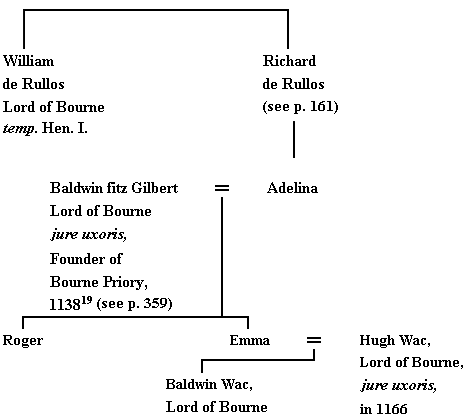
As for the honour of Bourne, it can be shown from the carta of Hugh Wac in 1166, from our list of knights, and from the Pipe-Roll of 1130, to have been formed from separate holdings and to have descended as follows:
The Psuedo-Ingulf's version runs:
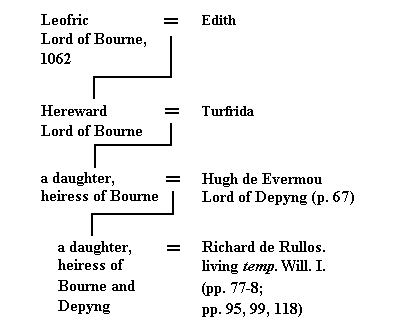
It will be seen how skilfully the author of this famous forgery brings in the names of real people while confusing their connection and their dates. Richard de Rullos, for instance, was living shortly before 1130, yet is here described as living under the Conqueror, though represented as marrying the great granddaughter of a man who was himself in the prime of life in 1062. The whole account of him as an ardent agriculturist, devoted to the improvement of live-stock and the reclamation of waste, is quaintly anachronistic; but the fact of his being a friend and benefactor to Crowland is one for which the writer had probably some ground. For my part, I attach most importance to his incidental statement that the daring deeds of Hereward the outlaw, 'adhuc in triviis canuntur', an allusion, perhaps unnoticed, to a ballad history surviving, it may be, so late as the days when the forgery was compiled.
But, leaving Hereward, no entries in this list are more deserving of notice than those which bring before us the famous name of Nevile:
Gislebertus de Nevila [tenet] ii. carrucatas in Lincolnescira, et servit Abbatiæ pro ii. hidis et inde inventi i. militem (p. 171).
Radulfus de Nevila [tenet] x. carrucatas in Lincolnescira et i. hidam et dimidiam in Hamtonascira et servit se tercio milite (p. 175).
Hugh Candidus wrote of the former:
Heres Galfridi de Nevile tenet in Lincolnescire, scilicet in Waletone [sic] justa Folkingham, et Yoltorpe duas carrucatas terra et inde facit plenum servitium unius militis (p. 59).
With this clue we are enabled to detect Gilbert de Nevile in that 'Gislebertus homo Abbatis', who held of the Abbot (D.B., i. 345b) at 'Walecote' (Walcot near Folkingham). So also Hugh 'Candidus' writes of the other Nevile fee:
Heres Radulfi de Nevile tenet decem carrucatas terræ in Lincolnshire, scilicet in Scottone Malmetone; et in Norhamtonscire unam hidam et dimidiam, scilicet in Holme, Rayniltorp, et inde facit plenum servitium trium militum (p. 55).
Between Ralf and Gilbert de Nevile on fo. 346 we find 'Gislebertus homo Abbatis' holding ten bovates at Hibaldstow. This was the 'Gislebertus Falvel' of our return, not Gilbert de Nevile.
THE WORCESTERSHIRE SURVEY
(Temp. Henry I)
We have, in the case of the see of Worcester, the means of testing some of the changes which took place among its tenants within a generation of Domesday. This is a survey of that portion of its lands which lay within the county of Worcester. Although printed by Hearne in his edition of Heming's Cartulary (fos. 141, 141d), it escaped notice, I believe, till I identified it myself in Domesday Studies (p. 546). As it follows immediately on the transcript of the Domesday Survey of the fief, the fact that it represents a later and distinct record might, at first sight, be overlooked.
Let us now compare, Manor by Manor, the earlier with the later Survey:
Domesday Survey temp. Henry i
Chemesege Kemesige
Bishop [13] Bishop 13
Urso 7 Walter de Beauchamp 9
Roger de Laci 2
Walter Ponther 2 Hugh Puiher 2
—— ——
24 24
Wiche Wike
Bishop 3¾ Bishop 3
Urso 9¾ Walter de Beauchamp 10½
Robert Despenser ½ Nicholas (de Beauchamp?) ½
Osbern fitz Richard 1 Hugh fitz Osbern 1
—— ——
15 15
Fledebirie Fledebyri
Bishop 7 Bishop 3
Bishop of Hereford 5 Bishop of Hereford 5
Urso 12
Robert Despenser 5 Walter de Beauchamp 22
Alricus archid[iaconus] 1
Roger de Laci 10 Hugh de Laci 10
—— ——
40 40
Breodun Bredune
Bishop 10 Bishop 13
Monks 4 Monks 4
Ælricus Archd. 2
Urso 16 Walter de Beauchamp 16
Durand 2 Gile (? bertus) 1
Brictric fil' Algar (in king's hands) 1 King 1
—— ——
35 35
Rippel et Uptun Rippel et Uptun
Bishop 13 Bishop 14
Ordric 1
Siward 5
Roger de Laci 3 Hugh de Laci 3
Urso 1
Ralph de Bernai (in king's hands) 1 Walter de Beauchamp 6
Brictric fil' Algar (in king's hands) 1 King 2
—— ——
25 25
Blochelei Bloccelea
Bishop 25½ Bishop 22
Richard 2 Bishop 2
Ansgot 1½ Walter de Beauchamp 5
Stephen fil' Fulcred 3 'Dæilesford' 3
Hereward 5 'Eunilade' 5
Monks 1 Monks 1
—— ——
38 38
Tredingtun Tredintun
[Bishop 17] Bishop 17
Monks 2 Monks 2
Gilbert fil' Thorold 4 'Langedun' 4
—— ——
23 23
Norwiche Northewike
Bishop 3½ Bishop 6½
Urso 7¾ Walter de Beauchamp 10
Ordric 4¼
Alric Arch' 1
Walter Ponther 7½ Hugh Puiher 7½
Herlebaldus 1 King 1
—— ——
25 25
Ovreberie cum Penedoc Werebyri et Penedoc
The Church of Worcester 6 6
Seggesbarne Segesberewe
The Church of Worcester 3 3
Scepwestun Scepwestune
The Church of Worcester 2 2
Herferthun cum Wiburgestoke Herfortune cum Wiburga Stoke
The Church of Worcester 3 3
Grimanleh Grimeleage
The Church of Worcester 2 2
Robert Despencer 1 Walter de Beauchamp 1
—— ——
3 3
Halhegan cum Bradewesham Hallhagan cum Bradewasse
The Church of Worcester 1 [The Church of Worcester 1]
Duo Radmanni 2 Walter de Beauchamp 1½
Roger de Laci 3½ Roger de Laci 3½
Walter de Burh ½ Count of Meulan 1
Hugh de Grentmesnil ½
—— ——
7½ 7
Cropetorn cum Neothetune Croppethorne
Church of Worcester 14 Monks 15
Robert Despencer 11 Walter de Beauchamp 9
Urso 6 Robert Marmion 7
Abbot of Evesham 9 Abbot of Evesham 9
[Ibid. 10] Ibid. 'quiete a geldo' 10
—— ——
50 50
Total for Oswaldslaw Hundred
Hides Tenants Heming's Total
(ut supra) (ut supra) 'He sunt ccc. hide ad
24 Bishop 93½ Osuualdes lauues hundret.'
15
40 Monks 39
35 Walter de Beauchamp 90 'Episcopus habet in
25 King 4 dominio' xciiii.
38 Hugh Puher 9½ 'Monachi' xl.

23
Hugh de Laci
13
'Walterus de Bealcamp'
xx.
25 Roger de Laci 3½
24 Robert Marmion 7 'Alii barones' lxiii.
50 Bishop of Hereford 5 'Rex' iii.
— Abbot of Evesham 19
299 Hugh fitz Osbern 1 72½
Count of Meulan 1
Gile (?bertus) 1
Alii 12
Nicholas (? de Beauchamp) ½ 'Quiete apud Hamtun a geldo' x.
———— ——
299 230
Huerteberie Heortlabyri
Church of Worcester 20 Bishop 15
Walter de Beauchamp 5
——
20
Vlwardelei Wlfwardile
Church of Worcester 5 Monks 5
Stoche Stoka
Church of Worcester 10 Monks 10
Alvievecherche Ælfithe cyrce
Church of Worcester 13 Bishop 13
Clive cum Lenc Clive cum Leng
Church of Worcester 10½ Monks 10
Fepsetenatun Fepsintune
Church of Worcester 5 Monks 1
Walter Ponther
1
Hugh Puiher
1
Roger de Laci 5 Hugh de Laci 5
—— ——
11 7
Hambyrie Heanbyri
Church of Worcester 14 Bishop 13½
Walter de Beauchamp ½
—— ——
14
Ardolvestone et Cnistetone Eardulfestun et Cnihtetun
Church of Worcester ('de victu monachorum') 15 Monks 15
Total 'Summa in Kinefolka'
Bishop 41½ 'Episcopus in dominio xli.'
Monks 41 'Monachi xli.'
Walter de Beauchamp 5½ 'Walterus de Bealcamp vi.'
Hugh de Laci 5 'Hugo de Laci v.'
Hugh Puiher 1 'Hugo Puiher i.'
—— ——
94 94
In Oswaldeslaw 299
Outside ditto 94
——
393
It will be seen that of these 397 hides only 393 are accounted for above. The explanation is this. Of the five hides held in 'Fepsintune' by the Church of Worcester in Domesday, only one is entered in the above list, the other four being wholly omitted, both in the list itself and in the total. These four omitted hides bring up the 393 to 397, the exact sum that we have to account for.
If the Manors in the above Survey are examined with care seriatim, it will be found that they bear manifest witness to the aggressions of Urse d'Abetot, who, we may gather from this Cartulary, was the bête noire of the Church of Worcester. The various extensions of his Domesday holdings, as at 'Fledebyrie', where twelve hides had been increased to twenty-two, were partly due to the accession of the lands he inherited from his brother, but partly also to his absorption of the lands of other tenants and of portions of the episcopal demesne. All the benefit of these accessions passed to his son-in-law and successor, Walter de Beauchamp.
Droitwich
H[oc] debet computari ad Scacarium Regis vicecomiti Wirecestrie. Habes x. hidas ad Danegeld et Wasto forestæ ii. hidas.
Et in Ederesfeld vi hid[æ]. Et in happeworda i. hid[a]. Et in Biselega i. hid[a]. Et in Burlega i. hyda.
Fragment of a Survey subsequent to 1130 and perhaps circa 1150
(Cott. MS. Vesp., B. xxiv. fo. 8.)
... manerio de hambyry. Estona Ric' dimidiam hidam. In hundredo de Camele. In Waresleia v. hidæ de manerio de hertlebery. Summa quater xx. et xiii. hidæ.
In hundredo de persora habet ecclesia de Westmustier has terras quas tenet Willelmus de bello campo. Hekintona iii. hidæ et iii. virgatæ. Chaddesleia ii. hidæ. Langeduna Osmundi i. hida et dimidia. Colleduma iii. hidæ et iii. virgatæ. Graftona Ebrandi i. hida et iii. virgatæ. Flavel et pidelet v. hidæ. Newentona x. hidæ. Broctona Inardi iii. hidæ. Pidelet radulfi iii. hidæ. Berford v. hidæ. Branefford i. hida. Wicha Inardi iii. hidæ. Burlingeham ii. hidæ et i. virgata. Cumbrintona ii. hidæ. Poiwica Willelmi de bello campo i. hida. Newebolt i. hida. Medeleffeld i. hida de poiwica. Ad bergam i. hida. Olendene i. hida. Arleia i. virgata. Poiwica Inardi i. hida. Summa lx. hidæ et dimidia.
In predicto hundredo de persora feudum Abbatis persore. Belega xxi. hidæ. Branefford i. hida. Wadberga iii. hidæ et dimidia. Cumbrintona i. hida et dimidia. Lega Ricardi dimidia hida. Walecote et torendune i. hida et dimidia.
In hundredo de Leisse tenet idem Willelmus Chirchlench iiii. hidas de abbatia de Evesham. Croulega v. hidas de feudo Osberti filii hugonis.
In hundredo de Clent. Belua viii. hidæ de feudo folwi paganelli. Salawarpa v. hidæ de feudo Rogeri Comitis. Item Salawarpa i. hida de feudo episcopi Cestrie. Chaluestona i. hida de feudo Roberti filii Archembaldi. Apud Wich dimidiam hidam Gunfrei. Item apud Wich i. hidam de terra Sancti Guthlaci quam Rodbertus filius Willelmi tenet. Item ibidem dimidiam hidam de Cormell' quam Gilebertus tenet. Cokehulla ii. hidæ et dimidiam de feudo regis. Hactona iii. hidæ de feudo episcopi baiocensis. Escreueleia i. hida. Summa tocius cclxiiii. hidæ et dimidia et dimidia virgata.
Terra rogeri de toeney. Esla iii. hidæ. Bertona iii. hidæ et iii. virgatæ. Alcrintona ii. hidæ. Linda ii. hidæ et ad halac i. hida. Mora hugonis i. hida et dimidia. Werueslega ii. hidæ et dimidia. Alboldeslega ii. hidæ et dimidia. Rudmerlega i. hida et dimidia. Estlega i. hida Geldans et una hida quieta. Sceldeslega i. hida. Almelega Ricardi de portes xi. hidæ.
In the former of these two fragments we recognize in John of Sudeley the younger son of Harold, son of Earl Ralf. It would be of interest if we might identify his tenant, Richard fitz Robert, with the younger son of his brother, Robert. The succession in the tenancy of the Crowland hide (St Guthlac's) needs explanation. In Domesday (176) Urse held Dunclent of Nigel the physician, who held both here and at Droitwich under Crowland Abbey. It must have been through him at Droitwich also that William fitz Richard became tenant, for Robert fitz William (who was clearly the latter's son) held here of Walter de Beauchamp in the second fragment.
It is in tracing William de Beauchamp's succession, as under-tenant to his grandfather Urse, that we find the chief interest of the second fragment. He has succeeded him, for instance, as tenant to the Abbeys of Westminster, Pershore, and Coventry (the fief of the last having now become that of 'the Bishop of Chester'). At Wadborough, however, it was Robert 'Dispensator' whom he had succeeded as tenant of Pershore. In one case we find him holding of Robert fitz Erchembald, whose Domesday predecessor we thus learn was William Goizenboded (177b). We may also note his tenure of Madresfield (now Lord Beauchamp's seat)—the earliest mention, I think, of the place—as a limb of Powick. Fulk Paynell, of whom William held at Beoley, had now succeeded to the Domesday fief of William fitz Ansculf, whose tenant 'Robert' may have been Robert 'Dispensator'. Osbern fitz Hugh had similarly succeeded to the Richard's Castle fief held, in Domesday, by his grandfather.
I append a partial comparison of Domesday with the Henry I survey so far as concerns Droitwich, where property, owing to its value, was divided among many owners.
DROITWICH
Domesday Temp. Henry I
H. H.
Willelmus filius Corbucion (Witone) 2 Petrus Corbezun (de Witton) 2
Church of St Denis 1 'De feodo sancti Dionysii Ricardus corvus et Willelmus filius Oueclini' 1
De Sancto Guthlaco Nigellus Medicus 1 De Sancto Guthlaco Willelmus filius Ricardi 1
Heraldus filius Radulfi Comitis 1 De Johanne de Suthlega Ricardus filius Roberti 1
De Pagano filio Johannis Godwi ½
Urso tenet Witune in Wich et Gunfrid de eo ½ De Waltero de Bello Campo Theobaldus et Petrus ½


Æcclesia sancti Petri de Glou. ½ De la Berton de Gloucestra Randulf filius Ringulfi ½
In Wich est dimidia hida quæ pertinet ad aulam de Glou. ½ De monachis Gloucestrie Baldwinus et Lithulfus ½
De Comite Warewice Randulfus et Essulfus filii Ringulf ¾
De Waltero del Burc Randulf et Essulf ½
Ibi duo presbyteri [de Westmonasterio] tenet i. hidam que nunquam geldavit 1 De Westmonasterio Theobaldus et Walterus fil' Thorald 1
Isdem [Radulfus] tenent in Wich i. hidam de x. hidis[geldantibus] 1 De Almelega fil' Aiulfi et mater ejus 1
THE LINDSEY SURVEY
(1115-18)
Remarkable from a palaeographic standpoint, as well as from the nature of its contents, the record, which is found in a Cottonian MS. (Claud. C. 5), has been singularly unfortunate in its editors. As Mr Greenstreet truly observed:
The indefatigable Hearne, seeing that the manuscript related to a very ancient period of our history, and recognizing its great importance, printed it in the Appendix to his 'Liber Niger', but he does not appear to have properly examined either the question of the date of the writing, or the internal evidence.... As a natural consequence of his superficial examination, he associates it wrongly with the reign of Henry II.
It is, unfortunately, necessary to explain that Mr Waters in the table of contents described his translation as 'from the Cotton MS., Claudius C. 5', and wrote on the opposite page:
This MS. engaged the attention of Thomas Hearne, the antiquary, who has printed it amongst the additaments to his edition of the Liber Niger Scaccarii; but Hearne was one of those industrious but uncritical antiquaries who had no conception of the duties of an editor of the importance of accuracy.
To the enterprise of Mr Greenstreet scholars were indebted for an édition de luxe of the record in facsimile, which made its appearance shortly after the treatise of Mr Waters. Unfortunately, no attempt was made in the appended literal translation to identify the names of places or persons, while such a word as '[ap]pendiciis', which occasionally appears in the survey, is mistaken for a place-name 'Pendicus'. The book enjoys, however, the great advantage of an index.
Richard, Earl [of Chester], has 6 cars. in Barnetby-le-Wold, where [William], the constable of Chester, is his tenant [as his father was Earl Hugh's in Domesday].
But on turning to Mr Greenstreet's facsimiles, we find that the survey had nothing about 'the constable of Chester', the words 'constabularia [sic] Cestrie' being only a faint interlineation by a later hand.
And even where a reference to the true text does not at once dispose of the matter, these statements of Mr Waters are, on other grounds, open at times to question. He assumes, for instance, that Hugh fitz Ranulf, who occurs as a landowner in the survey, was a younger son of Ranulf Meschin, afterwards Earl of Chester (p. 12). No such son would seem to be known; and this assumption, moreover, does violence to chronology. For the pedigree it involves is this:
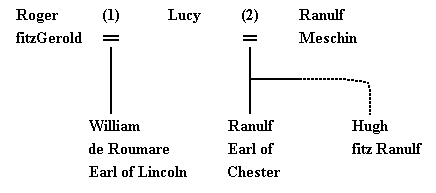
Now William de Roumare was not old enough to claim his inheritance from the King till 1122, and his half-brother, Ranulf, was some years younger than he was, as the words of Orderic imply in 1140. Consequently Hugh, the youngest brother, can have been only a boy in 1122. How then could he, as Mr Waters alleges, have held a fief in right of his wife so early as 1115 or thereabouts?
In this assumption, however, he only follows Stapleton, to whom he here refers, and who relied on an abstract in the cartulary of Spalding (fol. 416 a, b). This abstract which cannot, from its form, preserve the wording of the original charter, runs:
Sciant tam presentes quam futuri quod Hugo frater Rannulfi comitis Cestrie et Matild' uxor ejus, fil' filia [sic] Lucie comitisse concesserunt, etc., etc.
Remembering the dictum of Dr Stubbs that 'Stephen's earldoms are a matter of great constitutional importance', it is worth while to examine this earldom of Cambridge.
By King Stephen he was made Earl of Cambridge, as we learn from the following extract from a charter of Alexander, Bishop of Lincoln, in 1139, founding the nunnery of Haverholm, in the parish of Ruskington, of the order of St. Gilbert of Sempringham. 'But this donation ... we have confirmed ... by the testimony of Rannulph, Earl of Chester, and of William, Earl of Cambridge, his brother' (p. 34).
The words in the original are:
Testimonio Rannulfi comitis Cestriæ et Willelmi comitis Cantebrigiæ fratris ejus (Mon. Ang., v. 949).
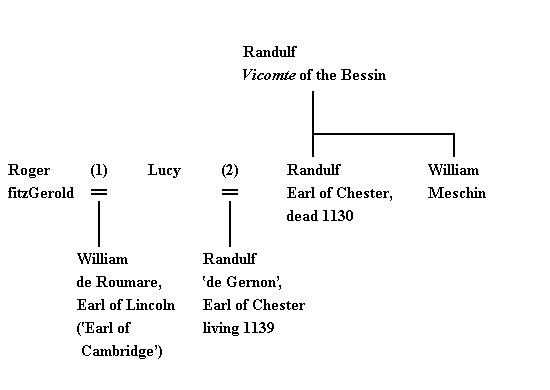
The pedigree shows my solution of the mystery. The two brother-earls of 1139 are those who are found so constantly together, and who were jointly concerned, next year, in the surprise of Lincoln, but who were really only half-brothers, though they spoke of one another as 'frater'.
The identity of the 'Earl of Cambridge' is thus clearly established; but there of course remains the question why he is not here styled 'Earl of Lincoln'. Every mention of him as Earl of Lincoln is later, if this charter be rightly dated, so that he may possibly have changed his style. It is really strange that precisely as William, Earl of Lincoln, is here once styled Earl of Cambridge, so William, Earl of Arundel, is twice styled Earl of Lincoln, as I have shown in my Geoffrey de Mandeville (p. 324), though in that case also the fact had never been suspected. It is most tempting, if rash, to suggest that the reason why the Earl of Lincoln was at first Earl of Cambridge is that the Earl of Arundel (Sussex) was at first Earl of Lincoln, and thus kept him out of that title.
In any case an error has now been corrected, and one of Stephen's alleged earls disposed of.
We know from the Continuator [sic] of Peter of Blois (p. 121) that Stephen and his elder brother Theobald were on a visit to Henry I, at Oxford, at some period between March 7th and August 1st, 1114, when Theobald is described as Count of Blois, and Stephen as 'pulcherrimus adolescens dominus postea rex Anglorum'. It is manifest that at this date Stephen was not yet Count of Moreton, so the Roll must be later than March 7th, 1114 (p. 3).
Stapleton, who worked out the descent, held that Roger's son Robert, who had succeeded by 1130, and who was slain in 1143, was father of the Robert who died in 1218. I would rather interpolate another Robert between the two:
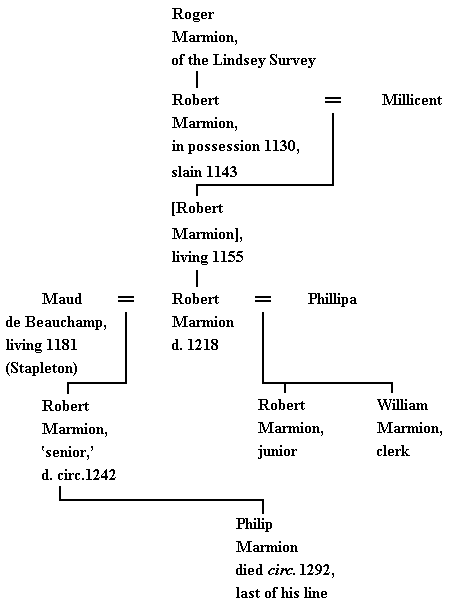
The pedigree really turns on the charter of Henry III in 1249, to Philip Marmion, confirming the royal charters to his ancestor. Mr Stapleton declares that Henry inspected and confirmed
The charter which King Henry, his great-great-grandfather, had made to Robert Marmyon, great-grandfather of Philip Marmyon, of having warren in all his land in the county of Warwick, and especially at Tamworth; and likewise of the charter of King Henry, his uncle ['Avunculus noster' is the reading transcribed on the rolls, obviously in error of 'atavus noster'], which he had made to the said Robert of having warren in all his land of Lindesay (Rot. Scacc. Norm., II. cvi.).
(1) The charter of Henry I, granting Robert Marmion freewarren in Warwickshire (specially at Tamworth) as his father had.
(2) The charter of Henry II (confirming the above charter), 'T. Tom. Canc. apud Brugiam', and therefore granted in 1155.
(3) The charter of Henry III, who had inspected— (a) 'Cartam quam Henr' rex avus [sic] noster [i.e. Henry II] fecit Roberto Marmyon proavo Philippi Marmyun'; (b) 'Cartam Henrici regis avunculi nostri quam fecit Roberto'; and confirmed them as the charters, 'H. Regis avi nostri et H. regis avunculi nostri', to Philip Marmion.
It is clear then that Henry III inspected the charter of his grandfather ('avus') Henry II (not, as Mr Stapleton wrote, his great-great-grandfather'), in 1155, to Robert Marmion, 'proavus' of Philip. This, it will be seen, could only be the Robert whom I have inserted in the pedigree. Nor can Mr Stapleton's 'atavus' assumption be accepted in view of the facts. The 'avunculus' and namesake of Henry III would duly have been the 'young king' Henry (crowned 1170). If 'avunculus' is a clerical error, the word to substitute is 'avus'; but the careful way in which the charter distinguishes the King's two predecessors is quite opposed to the idea that they were in both cases his grandfather.
Leaving now this question of pedigree, there is a theory as to the name of Marmion which one cannot pass over in silence, because it has received the sanction even of Stapleton. Writing on the date of the Lindsey Survey, that eminent authority observes:
His meaning, though clumsily expressed, as was sometimes the case, is that the Latin 'Dispensator' represented the name 'Marmion'. This theory would seem to be derived from the word 'Marmiton' (not 'Marmion') which means not a 'Dispensator', but a scullion, the most despised of the menials employed in the kitchen. There was indeed in old French a rare word 'Marmion', but according to Godefroy, it was equivalent to 'Marmot', the name of the Marmoset. In any case, therefore, this illustrious surname, immortalized by Scott
They hailed him Lord of Fontenaye, Of Lutterworth and Scrivelbaye, Of Tamworth tower and town
had nothing to do with 'Dispensator', but meant either a scullion or a monkey, and was one of those nicknames that the Normans loved to inexorably bestow on one another.
What was the actual relation of the Marmions to Robert 'Dispensator' is a problem as yet unsolved. Mr Waters wrote:
In any case, as I wrote in my Ancient Charters (1888) of a document there published:
The succession of Urse [de Abetot] to this [Lincolnshire] fief is a genealogical discovery which throws a wholly new light on the very difficult problem of the relation of Marmion to Despenser, and is fatal to the assertion of Mr Chester Waters that 'Roger Marmion was the immediate heir of Robert Dispenser'.
THE LEICESTERSHIRE SURVEY
(1124-29).
The date of this survey is thus determined. The frequent mention of 'Rex D[avid]' places it subsequent to his accession to the throne in April 1124. On the other hand, the name of Ralf Basset (the justiciar) shows it to be anterior to his death; and he was dead before Mich., 1130 (Rot. Pip., 31 Hen. I). Moreover, it speaks more than once of Hugh de Leicester as 'Vicecomes', and Hugh's shrievalty seems from the Pipe-Roll to have terminated at Mich., 1129. We may therefore place this survey between the spring of 1124 and the autumn of 1129, with a likelihood of its having been compiled nearer the latter date.
Text of the Survey
... 'Comes Lerc[estri]æ vj. car.
Gosecote Wap'
Framelaund Wap'
[FINIS.]
We will now collate some of our 'Hundreds' with the relative entries in Domesday.
Lodington Hundred
(1086) (1124-29)
Skeffington
Rex 12 Norman de Verdon 8½
Richard Basset 3½
Tugby
Rex 6 Norman de Verdon 6
Allexton
Countess Judith 6 King David's fee 5¼
Rex ¾
Lodington
Robert de Buci 12 Richard Basset 12
Twyford
Rex 4½ Richard de Rullos 8¾
Thorpe Sackville
Henry de Ferrers 8¾
East Norton
[?Rex 3] [Richard Basset] 1¼
Robert dispensator 4½ Walter de Beauchamp 6
Geoffrey de la Guerche 4½ Roger de Mowbray 4¾
—— ——
12 12
Tilton Hundred
Tilton
Rex 2 Rex 1¾
Robert Despencer 3 Walter de Beauchamp 3
Archbishop of York 1 Archbishop 1
—— ——
6 5¾
Newton Burdet
Geoffrey de la Guerche 6 Walter de Beauchamp 4
Hubert serviens ½ Roger de Mowbray 8
Loseby
Countess Judith 9 King David 12
Whadborough
Rex 3 Rex 4
Halsted
Rex 2¾ Norman de Verdon 2¾
Beby Hundred
Beby
Crowland Abbey 10½ Crowland Abbey 12
Keyham
Rex 4 Rex 4
Hungerton
9
Sileby
Hugh de Grantmesnil 8½ Earl of Leicester 913⁄16
Earl of Chester 3
Rex 3¼ Richard Basset 2
Robert de Ferrers 1¼
Barkby Hundred
Barkby
Robert de Todeni 18 'Belvoir' 5
Hambleton
'Belvoir' 6
Barkby Thorpe
Adeliza de Grentmesnil 1½ Earl of Leicester 1½
Thurmaston
Hugh de Grentmesnil 10
Hugh de Grentmesnil
3½
Canons [of St Mary de
Castro, Leicester]
3
Croxton
Rex 23⁄16
Newbold Folvile
Henry de Ferrers 1 Robert de Ferrers 1½
Barnesby
Rex 4⅝ Rex 31⁄16
Earl of Leicester 1⅝
Gaddesby
Rex 8⅜ Rex 89⁄16
Rex 1 Bishop of Lincoln 1
Countess Judith 2 Earl of Leicester 11⁄16
Richard Basset ½
King David 2
Hundred of Ashby
Ashby Folvile
Countess Judith
4
King David
5
Countess Judith 1½ Hugh of Leicester 1
Humfrey
camerarius
1
Humberston
Hugh de Grentmesnil? Roger de Ramis 8
Walter de Mustere 1
Ralf de Martinwast 3
Belgrave
Hugh de Grentmesnil 7 Earl of Leicester 12
Adeliza de Grentmesnil 1
Thurmaston
Earl of Leicester [10]
Burstall
Hugh de Grentmesnil 6 Earl of Leicester 9
Wanlip
'In manu Regis' 4 Earl of Leicester 7
Hugh de Grentmesnil
2
Earl of Leicester
6
Rearsby Hundred
Reresby
Robert de Buci 1¾ Richard Basset 5
Rex 1⅞ Earl of Chester 2½
Countess Judith 2½ King David 4½
Queneborough
Geoffrey de la Guerche 9 'Belvoir' 12
Syston
Hugh de Grentmesnil 9 Earl of Leicester 12
Brooksby
Earl of Chester 2 Earl of Chester 5
Countess Judith ¾ King David 1
Quenby
Robert de Todeni 2 'Belvoir' 6
Robert de Todeni (in South Croxton) 4
Thurcaston
Hugh de Grentmesnil 9 Earls [of Leicester] 8
Cropston
Rothley
Rex 5 Rex 5
Dalby Hundred
Great Dalby
Bishop of Lincoln 8 Bishop of Lincoln 9½
Robert de Buci 1 Ralf Basset 1⅜
Humfrey Cam. 1 William 'Gam' 1
Frisby
Rex (Barrow) 1 Earl of Chester 4
Rex 8 Rex 8
Retherby
Rex (Barrow) 2¾ Earl of Chester 6
Ashfordby
Rex (Rothley) 12 Earl of Leicester 13
Radulfus Framen 3½
Wartnaby
Rex 6 Rex 6
Hundred of Dalby on the Wolds
Dalby on the Wolds
Ralf fitz Hubert 9 Edward of Salisbury 9
Earl of Leicester 3
Grimston
Rex 213⁄16 Rex 213⁄16
Robert de Buci 3 Richard Basset 3
Saxelby
Rex 1 Rex 1
Earl of Leicester 5
Sileby
Hugh de Grentmesnil 8½ Earl of Leicester 6
Cossington
Earl of Chester 6 Earl of Chester 6
Hoton
Robert de Lorz 4 Robert de Jor' 2
Thrussington
Guy de Raimbercurt 12 Thomas 10¼?
Guy de Raimbercurt [18] Roger de Mowbray 1¾?
Wilges
Robert de Buci 2 Roger de Mowbray 2
Ragdale
Robert de Buci 6 Roger de Mowbray 6
Hoby
Thomas 7¼
Dru de Bevrere 4¼ 'Albemarle' 4¾
Hundred of Tong
Tong
Henry de Ferrers 21½ Robert de Ferrers 12
Kegworth
Earl of Chester 15 Earl of Chester 15
Worthington
Henry de Ferrers 4 3 or 12
In the case of this last Hundred our survey records a conflict of testimony and, in so doing, mentions incidentally (as would Domesday) the witness of the Hundred-court. Henry de Ferrers in the Domesday Survey, is credited with 21½ car. in 'Tunge cum omnibus appendiciis', and with four in 'Werditone' (i. 233). But here Tong, 'cum appendiciis', is reckoned at twelve car. only. There remained, therefore, to be accounted for a large balance of car., and these the men of the Hundred assigned to his Manor of Worthington. It is desirable to analyse some of the fiefs in our survey, and, by comparison with Domesday, to trace their descent or origin.
Roger de Mowbray's fief
(1124-29) (1086)
car [Geoffrey de la Guerche]
Picwell and Lucerthorp 15 Pichewelle and Luvestorp 14
East Norton 4¾ East Norton 4½
Newton Burdet 8 Newton Burdet 6
Thrussington 1¾
[Robert de Buci]
Wileges 2 Wilges 2
Rachedale 6 Ragendele 6
[Geoffrey de la Guerche]
Somerby 6 Dalby 4
Dalby 1⅞ Dalby 2½
Gillethorp 3 Godtorp 3½
Burg 1 Burg 1
Eastwell 6 Eastwell 6
Melton 15 Melton
Burton 11⅞ Burton 11⅞
[Fredebie 95⁄16 Fredebie 10]
Chirchebia 24 Cherchebi (17 + 7) 24
Kettleby 9(?) Chettlebi 8
Sixtenebia 4½ Sistenebi (2½ + 2) 4½
Alebia 9 Alebia 7¾
Wyfordebia 1½ Wordebia 1½
Goutebi 6 Goutebi 6
Stacthirn 8 Stachetone 8¼
Anschitel's fief
car car
Scanketon' 2 Scantone 2 Robert de Veci.
Chiburd 12 Chiborne 12 Robert de Veci.
Edward of Salisbury's fief
Dalby on the Wolds 9 Dalbi 9 Ralf fitz Hubert.
William Meschin's fief
Seustern 5 Seustern 5 William Lovet.
Henry de Albini's fief
Scegla 2 Sela 2 Nigel de Albini.
Gilbert's son's fief
Sproxcheston 2 Sprotone 2 Godfrey de Cambrai.
William Chamberlain's fief
Great Dalby 1 Dalby 1 Hunfridus Camerarius.
Thomas's fief
Thrussington 10¾ Hoby 7¼ 18 Thrussington 18 Guy de Raimbercurt.

Count of Mortain's fief
Broctone 12 Broctone 12 Rex.
Knipton 8¾ Cnipeton 8¾ Rex.
Croxton 24 Croxton 24 Rex.
Harestan 12 Horstan 12 Rex.
Alan de Craon's fief
Stoneby 8 Stoneby 8 Guy de Craon.
Waltham 2½ Waltham 2½ Guy de Craon.
Sproxton 3 Sproxton 2 Guy de Craon.
William de Albini's fief
Cold Overton 12 Cold Overton 12 Dru de Bevrere.
Knipton 3¼ Knipton 3¼ Robert de Todeni.
Herdebi and Plungar 17 Herdeby 17 Robert de Todeni.
Stacthirn 8½ Stacthirn 9¾ Robert de Todeni.
Bottlesford 32 Bottlesford 24(?) Robert de Todeni.
Henry Tuchet's fief
Claxton 10⅞ Claxton 6 Howes 4½ 10½ Robert Hostiarius.
Robert Hostiarius
Richard Basset's fief
Langton 3¼
Chiburd 1
Skeffington 3½ Skeffington 3½ Rex.
Lodington 12 Lodington 12 Robert de Buci.
Sileby 2 Sileby 2¼ Rex.
Gaddesby ½
Reresby 5 Reresby 1¾ Robert de Buci.
Grimstone 3 Grimstone 3 Robert de Buci.
Overton 4 Overton 4 Robert de Buci.
Kettleby and 9 Holwell 5 6 Robert de Buci.
Holwell Kettleby
Goatby 6 Goatby 6 Robert de Buci.
Scaldeford Scaldeford ½ Robert de Buci.
Wymondham 3½ Wymondham 3½ Robert de Buci.
and Thorpe
Hardebi 1 Hertebi 1 Robert de Buci.
As Robert de Buci was then in possession, it cannot have been, here at least, till later that Basset succeeded him.
I will close with the names of those who had succeeded the Domesday tenants-in-chief.
HEIRS
Count of Meulan Earl of Leicester
Earl Aubrey (Escheat)
'Countess' Godgifu
'Countess' Ælfgifu Earl of Chester (Donnington)
Earl of Chester Earl of Chester
Hugh de Grentmesnil Earl of Leicester
Henry de Ferrers Robert de Ferrers
Robert de Todeni William de Albini
Robert de Veci [Anschitil]
Roger de Busli [Honour of Blyth]
Walter de Beauchamp
Robert Dispensator Robert Marmion
Henry Tuchet (10⅞)
Robertus Hostiarius, (10½)
Ralf Mortimer
Ralf fitz Hubert Edward of Salisbury
Guy de Raimbercurt [Thomas]
Guy de Craon Alan de Craon
William Peverel Honour of Peverel
William Buenvaslet Comes War'?
William Loveth Will. Meschin
Geoffrey Alselin
Geoffrey de 'Wirce' [Escheat]
Godfrey de Cambrai the son of Gilbert
Gunfrid de Cioches
Humfrey Camerarius Willelmus Camerarius
Drogo de Bevrere Albemarle
Nigel de Albini Henry de Albini
'Countess' Judith King David
THE NORTHAMPTONSHIRE SURVEY
(Hen. i-Hen. ii)
This 'Hydarium' of Northamptonshire is found in a Peterborough Cartulary (Cott. MS. Vesp. E. 22, fo. 94 et seq.). It is drawn up Hundred by Hundred, like the surveys of Leicestershire and of Lindsey, and is, therefore, probably connected with the assessment of Danegeld. Although it is of special value for reconstituting the Domesday Vills, the assessment it records so often varies from that which is found in Domesday that we cannot institute a close comparison. The introduction of a 'parva virgata' further complicates the reckoning. That the original document was written on a roll is shown by the use of the phrase 'per alium rotulum'. The statement on fo. 97b that there ought, at one place, to be half a hide more 'per rotulos Wyncestr[ie]', would seem to refer to Domesday; but on the next page we read:
In Pytesle Abbas de Burgo v. hid. [et] dim. set tamen in Rotulis Wyncestr[ie] vi. hid. et iii. parvas virgatas.
Since Domesday records this holding as 'v. hid. et una virgata terræ', the reference (if the text of the survey is right) must clearly be to some other record preserved in the national treasury.
I append about a fifth of the Survey as a specimen of the whole.
Hokeslawe
Twywell. Albr[icus] camerar[ius] ii. hidas de feudo Abbatis de Thorneya. Ibidem de feudo Comitis David. Ibidem de feudo Abbatis Burgi i. magnam virgatam.
In Slipton i. hidam et unam virgatam de feudo Will'i de Corcy. Ibidem Ricardus filius Hugonis ii. partes unius hidæ de feudo Burgi. Ibidem Rogerus nepos Abbatis tertiam partem unius hidæ de eodem feudo.
In Suburc [Sudboro'] ii. hidas [et] dim. de feudo Westmonaster'.
In Drayton Albr[icus] camerar[ius] dimidiam hidam de feudo R[egis].
In Yslep [Islip] idem Albri[cus] de feudo Regis. Ibidem iiiior. sokemanni Regis i. hidam de feudo Westmonaster'.
In Audewyncle [Aldwinkle] Abbas de Burgo iiii. hidas [et] dimidiam quas Ascelinus de Waterville tenet. Ibidem Galfridus de Glynton i. magnam virgatam de feudo Glovernie pertinens ad Barton. Ibidem Ricardus filius Wydonis iii. hidas dim. virg. minus de feudo Regine [sic].
Item in Benifeld [Benefield] Willelmus le Lisurs iii. magnas virg. de feudo Regis.
In Bernewelle [Barnwell] Robertus de ferariis vi. hidas et i. magnam virg. de feudo Regis. Ibidem Reginaldus le Moyne vi. hidas de feudo de Rammeseye.
In Lilleford Willelmus Olyfart v. hidas de feudo Regis Scotie.
Naueford
In Tytheni [? Tichmarsh] Robertus de Ferr[ers] x. hid. Ibidem Ascelinus de Waterville iii. hid. et i. virg. et tres partes dim. hid. de Burgo.
In Thrapston Radulfus fil. Oger ii. hid. et i. virg. de feudo de Brunne. Ibidem Robertus filius Edelinæ i. hid. et i. virg. de feudo de Clare.
In Torpe et Achirche Ascelinus de Waterville vi. hid. [et] dim. de feudo Burgi.
In Clopton Walterus i. hid. et i. virg. de feudo Regis. Ibidem iii. hid. [et] dim. de feudo Burgi. Ibidem Ascelinus dim. hid. de feudo Burgi.
Wadenhowe [Wadenhoe]. Albricus de Ver ii. hid. et i. virg. de feudo Regis David. Ibidem Wymunt de Stok[e] i. virg. de feudo Burgi. Ibidem Rogerus Infans ii. parvas virg. de eodem feudo. Ibidem Wivienus de Chirchefelde dim. hid. de eodem feudo. Ibidem Galfridus de Gonthorp ii. hid. de eodem feudo. In Catteworthe i. hid. [et] dim. de feudo Burgi.
Pokebroc
In Pokebroc Robertus de Cauz i. hid. et. i. virg. de feudo Regis. Ibidem Walterus de Clopton ii. hid. et dim. de feudo Burgi. Ibidem Rogerus Marmium i. hid. et i. virg. de eodem feudo.
In Armeston [Armston] de Burgelay ii. hid. [et] dim. de eodem feudo. Ibidem Turkil i. hid. de eodem feudo. Ibidem Wydo Maufee i. hid. de eodem feudo. Ibidem Galfridus de Gunthorp ii. partes dim. hid. de eodem feudo. Ibidem Tedrik' iii. partes de dim. hid. de eodem feudo.
In Pappele [Papley] i. hid.
In Lillington [Lutton] i. hid.
In Hennington Berengerus le Moyne ii. hid. [et] dim. de feudo de Rammes[eye]. Ibidem Ricardus filius Gilberti i. hid. et i. virg. et dim. de feodo Burgi. Ibidem Wydo Maufe dim. hid. et dim. virg. de eodem feodo. Ibidem Reginaldus le Moyne dim. hid. et dim. virg. de eodem feodo.
In Kynesthorp [Kingsthorp] Walterus de Lodington i. hid. et i. virg. de feodo Burgi. Ibidem Willelmus de Chirchetot dim. hid. de feodo Regis.
In Therninge [Thurning] Rogerus Marmioun iii. parvas virg. de feodo Burgi.
In Ayston [Ashton] Abbas de Burgo iiii. hid. in dominico. Ibidem Papilun dim. hid. de eodem feodo. Ibidem Leuenoth dim. hid. de eodem feodo.
Duo Hundred de Nasso
In Stinton Willelmus de Lisurs ii. hid.
In Wirthorpe Abbas Croylaund ii. hid. Ibidem de feodo Eudonis Dapiferi i. virg.
In Eston [Easton] Simon i. hid. [et] dim.
In Peychirche [Peakirk]. In Etton. In Northburgo dim. virg.
In dominico Abbatis de Burgo sancti Petri lxx. hid. et iii. virg. et dim.
Hundred de Sutton
In eadem villa [King's Sutton] Dominus Rex habit in dominico iiii. hid.
In eadem villa Willelmus de Quency i. hid. [et] dim. et parvam virg. terre de Comitat[u] Leycestr[ie]. Ibidem Alfredus viii. parvas virg. de Gilberto de Pinkeny. Ibidem Paganus i. hid. et dim. et i. parvam virg. de feodo Comit[is] Leycestri[ie], Robertus filius Osberti tenuit.
In Evenle i. hid. et i. parvam virg. de feodo Comit[is] Leyc[estrie].
In Preston dim. hid. de feodo Comit[is] Leyc[estrie].
In Croulton [Croughton] iiiior. parvas virg. de feodo Comit[is] Leyc[estrie]. Ibidem Sewar' i. hid. et ii. parvas virg. de feodo Leyc[estrie]. Ibidem Brien filius Comitis i. hid. [et] dim. et ii. parvas virg. de feodo de Walinford.
In Neubottle Regis [sic] de Reynes vi. hid. et i. parvam virg. de feodo Comitis Leyc[estrie], Willelmus de Lepyn tenuit.
In furningho [Farningho] iiii. hid. de feodo Comitis Leyc[estrie].
In Cherlington [Charlton] Maynardus i. hid. [et] dim. et i. parvam virg. Ibidem Simon Chendut i. hid. [et] dim. de feodo de Berkamstede et i. parvam virg. Ibidem Odo dapifer viii. parvas virg. de feodo de Colescestra.
In Gremesbir' [Grimsbury] Aunsel' de Chokes ii. hid. et iiii. parvas virg. scil. quarta pars ii. hid.
In Middleton Willelmus Me[s]chin i. hid. et dim. et i. parvam virg. de feodo Willelmi de Curcy.
In alia Middleton [Middleton Chenduit] Simon Chendut ii. hid. de feodo de Berkamstede.
In Thayniford [Thenford] Mainfenn de Walrentone i. hid. Ibidem Robertus Basset i. hid. de feodo de Walingford.
In Ayno [Aynho] Willelmus de Mandeville iii. hid.
In Walton i. hid. cum ii. virg. in Sutton quas Suouild tenuit.
In Gildeby i. hid. et vii. parvas virg. de feodo de Mortal' [sic].
Hundred de Albodestowe
In Chacombe iiii. hid. de feodo Episc. Lincoln.
In Evenle ii. hid. et [sic] i. parvam virg. minus quas Alouf de Merke tenuit.
In Thorpe [Thorpe-Mandeville] ii. hid.
In Stanes [Stene] Gilbertus de Pinkeny ii. hid.
In Colewyth [Culworth] Willelmus ii. hid. et iiii. parvas virg. Ibidem Otuer i. hid.
In Rodestone [Radston] ii. hid. de feodo Comitis Cestr[ie].
In Wytefeld [Whitfield] Gilbertus de Monte ii. hid. et ii. virg. in dominico.
In Merston [Merston St Lawrence] Radulfus Murdac iiii. hid. de feodo Comitis Leyc[estrie].
In Siresham Thomas Sorel i. hid. [et] dim. Ibidem Comes Leyc[estrie] i. parvam virg. Ibidem Gilo dim. hid. Ibidem Willelmus filius Alui' [? Alan] iiii. parvas virg.
In Helmendene [Helmedon] Willelmus de Torewelle iiii. hid. de feodo Comitis Leyc[estrie].
In Chelverdescote dim. hid. Idem. Comes Leyc[estrie].
In Brackle et Hausho [Hawes] idem Comes vii. hid. [et] dim.
Hundred de Wardon
In Estone [Aston] et Apeltreya [Apeltre] Willelmus de Bolonia vii. hid. de feodo Comitis de Mandeville.
I have given sufficient of the survey to prove that, in spite of confusion and corruption, it possesses a real value. If we take, for instance, Polebrook ('Pochebroc'), a township of five hides, we find that in Domesday (221b, 228) Eustace ('the Sheriff') held a hide and a quarter in capite and three hides and three quarters as a tenant of Peterborough Abbey (see p. 138). Now our survey shows us the former holding in the hands of Robert de Cauz, while the other has been broken up, two-thirds of it passing to Walter 'de Clopton' and one-third to Roger Marmion.
At the close of the survey I have here discussed there is a list of the knights of Peterborough (fos. 99b, 100) holding in Northamptonshire. It ought to be carefully compared with the one I have examined above (p. 131), being, it seems probable, about a generation later. Such entries as these, at least, are conclusive for the holding to which they refer:
Paganus de Helpestun terciam partem unius militis (Chronicon Petroburgense, p. 171). Roger fil[ius] Pagan[i] in Helpestun terciam partem i. militis (Vesp. E. xxii., fo. 100).
In the same way, Roger Marmion had been succeeded by Robert. This second list is of special value from the fact that the Peterborough carta of 1166 gives no particulars of the knights or of their fees.
Or Sh——.
'Ego Albericus, regis camerarius terram de Twiwell quamdiu vixero de domino abbate Guntero et monachis de Thorneya per talem conventionem teneo adfirmam.'
'Ego Robertus filius Albrici camerarii regis terram de Twiwelle quamdiu vixero de domino abbate Roberto et monachis de Thorneia per eandem conventionem in feodi firmam teneo per quam conventionem pater meus ante me tenuit.'
The Great Chamberlain occurs again on fo. 97b, where we read:
'In alia Adington Albric[us] Camerar[ius], ii. hid. de feodo Regis.'
THE INTRODUCTION OF KNIGHT SERVICE INTO ENGLAND1
'The growth of knighthood is a subject on which the greatest obscurity prevails; and the most probable explanation of its existence in England, the theory that it is a translation into Norman forms of the thegnage of the Anglo-Saxon law, can only be stated as probable.'—Stubbs, Const. Hist., i. 260.
In approaching the consideration of the institutional changes and modifications of polity resulting from the Norman Conquest, the most conspicuous phenomenon to attract attention is undoubtedly the introduction of what it is convenient to term the feudal system. In the present paper I propose to discuss one branch only of that process, namely, the introduction of that military tenure which Dr Stubbs has termed 'the most prominent feature of historical feudalism'.
Mr Freeman, however, who had an equal horror of Ranulf Flambard and of the 'feudal system', did not hesitate to connect the two more closely even than Dr Stubbs, though invoking the authority of the latter in support of his extreme views. The passages to which I would invite attention, as expressing most concisely Mr Freeman's conclusions, are these:
The system of military tenures, and the oppressive consequences which were held to flow from them, were a work of the days of William Rufus.
I have now endeavoured to make plain one of the chief flaws in the view at present accepted, namely, that it is mainly grounded on the negative evidence of Domesday, which evidence will not bear the construction that has been placed upon it—and further that, even if it did, we should be landed in a fresh difficulty, the gulf between Domesday and Henry's charter being only to be bridged by the assumption that Ranulf Flambard 'devised' and introduced military tenure, with its results—an assumption, we have seen, which the facts of the case not only fail to support, but even discountenance wholly.
The customary service of one fully armed man for each five hides was probably the rate at which the newly endowed follower of the king would be expected to discharge his duty ... and the number of knights to be furnished by a particular feudatory would be ascertained by inquiring the number of hides that he held.
The value of the knight's fee must already have been fixed—twenty pounds a year.
The number of hides which the knight's fee contained being known, the number of knights' fees in any particular holding could be easily discovered.
All the imposts of the ... Norman reigns, were, so far as we know, raised on the land, and according to computation by the hide: ... the feudal exactions by way of aid ... were levied on the hide.
It cannot even be granted that a definite area of land was necessary to constitute a knight's fee; ... It is impossible to avoid the conclusion that the extent of a knight's fee was determined by rent and valuation rather than acreage, and that the common quantity was really expressed in the twenty librates, etc.
The variation in the number of hides contained in the knight's fee.
We find then, I submit, that the recognized leaders of existing opinion on the subject cannot agree among themselves in giving us a clear answer, when we ask them what determined the amount of 'service' due from a Norman tenant-in-chief, or, in other words, how that 'service' was developed in unbroken continuity from Anglo-Saxon obligations.
Having completed my criticisms of the accepted view, and set forth its chief difficulties, I shall now propound the theory to which my own researches have led me, following the same method of proof as that adopted by Mr Seebohm in his English Village Community, namely working back from the known to the relatively unknown, till the light thrown upwards by the records of the twelfth century illumines the language of Domesday and renders the allusions of monks and chroniclers pregnant with meaning.
1. THE 'CARTAE' OF 1166
In the formal returns (cartae) made to the exchequer in 1166 by the tenants-in-chief (barones) of England, of which the official transcripts are preserved in the Liber Niger and the Liber Rubeus, we have our earliest glimpse of the organization of that purely feudal host among whom our lands had been parcelled out to be held, as I shall show, by military service. We have, therefore, in them our best starting-point for an inquiry into the origin and growth of military tenure in England.