Chapter IX · (continued 2)
Reading edition
This judgment, however, must not obscure the fact that the book had a remarkably large sale; and that this, of itself, is an evidence that multitudes of readers found it not only erudite, but readable and interesting.
II. THE REVIVAL OF ROMANTIC POETRY
The old order changeth, yielding place to new; And God fulfills Himself in many ways, Lest one good custom should corrupt the world. Tennyson's "The Passing of Arthur."
The Meaning of Romanticism. While Dryden, Pope, and Johnson were successively the dictators of English letters, and while, under their leadership, the heroic couplet became the fashion of poetry, and literature in general became satiric or critical in spirit, and formal in expression, a new romantic movement quietly made its appearance. Thomson's The Seasons (1730) was the first noteworthy poem of the romantic revival; and the poems and the poets increased steadily in number and importance till, in the age of Wordsworth and Scott, the spirit of Romanticism dominated our literature more completely than Classicism had ever done. This romantic movement--which Victor Hugo calls "liberalism in literature"--is simply the expression of life as seen by imagination, rather than by prosaic "common sense," which was the central doctrine of English philosophy in the eighteenth century. It has six prominent characteristics which distinguish it from the so-called classic literature which we have just studied:
1. The romantic movement was marked, and is always marked, by a strong reaction and protest against the bondage of rule and custom, which, in science and theology, as well as in literature, generally tend to fetter the free human spirit.
2. Romanticism returned to nature and to plain humanity for its material, and so is in marked contrast to Classicism, which had confined itself largely to the clubs and drawing-rooms, and to the social and political life of London. Thomson's Seasons, whatever its defects, was a revelation of the natural wealth and beauty which, for nearly a century, had been hardly noticed by the great writers of England.
3. It brought again the dream of a golden age[200] in which the stern realities of life were forgotten and the ideals of youth were established as the only permanent realities. "For the dreamer lives forever, but the toiler dies in a day," expresses, perhaps, only the wild fancy of a modern poet; but, when we think of it seriously, the dreams and ideals of a people are cherished possessions long after their stone monuments have crumbled away and their battles are forgotten. The romantic movement emphasized these eternal ideals of youth, and appealed to the human heart as the classic elegance of Dryden and Pope could never do.
4. Romanticism was marked by intense human sympathy, and by a consequent understanding of the human heart. Not to intellect or to science does the heart unlock its treasures, but rather to the touch of a sympathetic nature; and things that are hidden from the wise and prudent are revealed unto children. Pope had no appreciable humanity; Swift's work is a frightful satire; Addison delighted polite society, but had no message for plain people; while even Johnson, with all his kindness, had no feeling for men in the mass, but supported Sir Robert Walpole in his policy of letting evils alone until forced by a revolution to take notice of humanity's appeal. With the romantic revival all this was changed. While Howard was working heroically for prison reform, and Wilberforce for the liberation of the slaves, Gray wrote his "short and simple annals of the poor," and Goldsmith his Deserted Village, and Cowper sang,
My ear is pained, My soul is sick with every day's report Of wrong and outrage with which earth is filled. There is no flesh in man's obdurate heart, It does not feel for man.[201]
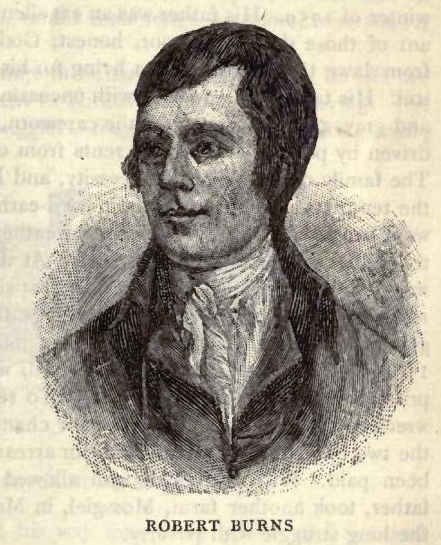
This sympathy for the poor, and this cry against oppression, grew stronger and stronger till it culminated in "Bobby" Burns, who, more than any other writer in any language, is the poet of the unlettered human heart.

5. The romantic movement was the expression of individual genius rather than of established rules. In consequence, the literature of the revival is as varied as the characters and moods of the different writers. When we read Pope, for instance, we have a general impression of sameness, as if all his polished poems were made in the same machine; but in the work of the best romanticists there is endless variety. To read them is like passing through a new village, meeting a score of different human types, and finding in each one something to love or to remember. Nature and the heart of man are as new as if we had never studied them. Hence, in reading the romanticists, who went to these sources for their material, we are seldom wearied but often surprised; and the surprise is like that of the sunrise, or the sea, which always offers some new beauty and stirs us deeply, as if we had never seen it before.
6. The romantic movement, while it followed its own genius, was not altogether unguided. Strictly speaking, there is no new movement either in history or in literature; each grows out of some good thing which has preceded it, and looks back with reverence to past masters. Spenser, Shakespeare, and Milton were the inspiration of the romantic revival; and we can hardly read a poem of the early romanticists without finding a suggestion of the influence of one of these great leaders.[202]
There are various other characteristics of Romanticism, but these six--the protest against the bondage of rules, the return to nature and the human heart, the interest in old sagas and mediæval romances as suggestive of a heroic age, the sympathy for the toilers of the world, the emphasis upon individual genius, and the return to Milton and the Elizabethans, instead of to Pope and Dryden, for literary models--are the most noticeable and the most interesting. Remembering them, we shall better appreciate the work of the following writers who, in varying degree, illustrate the revival of romantic poetry in the eighteenth century.
THOMAS GRAY (1716-1771)
The curfew tolls the knell of parting day; The lowing herd wind slowly o'er the lea; The plowman homeward plods his weary way, And leaves the world to darkness and to me. Now fades the glimmering landscape on the sight, And all the air a solemn stillness holds, Save where the beetle wheels his droning flight, And drowsy tinklings lull the distant folds.
So begins "the best known poem in the English language," a poem full of the gentle melancholy which marks all early romantic poetry. It should be read entire, as a perfect model of its kind. Not even Milton's "Il Penseroso," which it strongly suggests, excels it in beauty and suggestiveness.
Life of Gray. The author of the famous "Elegy" is the most scholarly and well-balanced of all the early romantic poets. In his youth he was a weakling, the only one of twelve children who survived infancy; and his unhappy childhood, the tyranny of his father, and the separation from his loved mother, gave to his whole life the stamp of melancholy which is noticeable in all his poems. At the famous Eton school and again at Cambridge, he seems to have followed his own scholarly tastes rather than the curriculum, and was shocked, like Gibbon, at the general idleness and aimlessness of university life. One happy result of his school life was his friendship for Horace Walpole, who took him abroad for a three years' tour of the Continent.
THOMAS GRAY
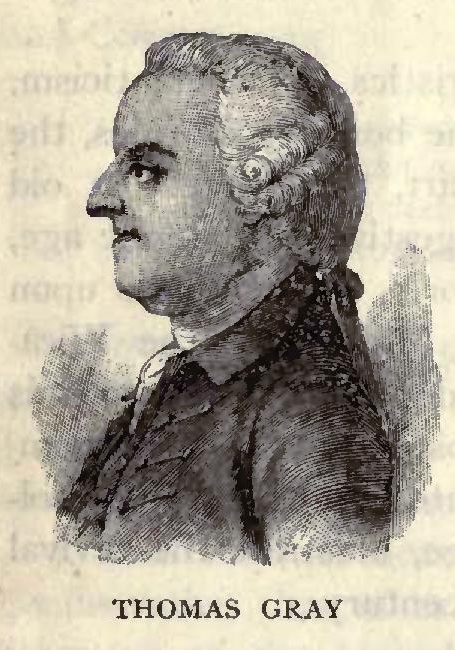
No better index of the essential difference between the classical and the new romantic school can be imagined than that which is revealed in the letters of Gray and Addison, as they record their impressions of foreign travel. Thus, when Addison crossed the Alps, some twenty-five years before, in good weather, he wrote: "A very troublesome journey.... You cannot imagine how I am pleased with the sight of a plain." Gray crossed the Alps in the beginning of winter, "wrapped in muffs, hoods and masks of beaver, fur boots, and bearskins," but wrote ecstatically, "Not a precipice, not a torrent, not a cliff but is pregnant with religion and poetry."
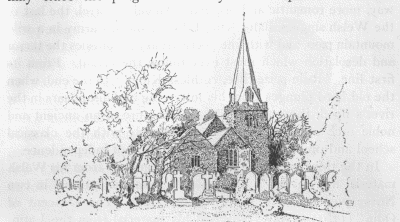
On his return to England, Gray lived for a short time at Stoke Poges, where he wrote his "Ode on Eton," and probably sketched his "Elegy," which, however, was not finished till 1750, eight years later. During the latter years of his shy and scholarly life he was Professor of Modern History and Languages at Cambridge, without any troublesome work of lecturing to students. Here he gave himself up to study and to poetry, varying his work by "prowlings" among the manuscripts of the new British Museum, and by his "Lilliputian" travels in England and Scotland. He died in his rooms at Pembroke College in 1771, and was buried in the little churchyard of Stoke Poges.
CHURCH AT STOKE POGES
Works of Gray. Gray's Letters, published in 1775, are excellent reading, and his Journal is still a model of natural description; but it is to a single small volume of poems that he owes his fame and his place in literature. These poems divide themselves naturally into three periods, in which we may trace the progress of Gray's emancipation from the classic rules which had so long governed English literature. In the first period he wrote several minor poems, of which the best are his "Hymn to Adversity" and the odes "To Spring" and "On a Distant Prospect of Eton College." These early poems reveal two suggestive things: first, the appearance of that melancholy which characterizes all the poetry of the period; and second, the study of nature, not for its own beauty or truth, but rather as a suitable background for the play of human emotions.
The second period shows the same tendencies more strongly developed. The "Elegy Written in a Country Churchyard" (1750), the most perfect poem of the age, belongs to this period. To read Milton's "Il Penseroso" and Gray's "Elegy" is to see the beginning and the perfection of that "literature of melancholy" which largely occupied English poets for more than a century. Two other well-known poems of this second period are the Pindaric odes, "The Progress of Poesy" and "The Bard." The first is strongly suggestive of Dryden's "Alexander's Feast," but shows Milton's influence in a greater melody and variety of expression. "The Bard" is, in every way, more romantic and original. An old minstrel, the last of the Welsh singers, halts King Edward and his army in a wild mountain pass, and with fine poetic frenzy prophesies the terror and desolation which must ever follow the tyrant. From its first line, "Ruin seize thee, ruthless King!" to the end, when the old bard plunges from his lofty crag and disappears in the river's flood, the poem thrills with the fire of an ancient and noble race of men. It breaks absolutely with the classical school and proclaims a literary declaration of independence.
In the third period Gray turns momentarily from his Welsh material and reveals a new field of romantic interest in two Norse poems, "The Fatal Sisters" and "The Descent of Odin" (1761). Gray translated his material from the Latin, and though these two poems lack much of the elemental strength and grandeur of the Norse sagas, they are remarkable for calling attention to the unused wealth of literary material that was hidden in Northern mythologv. To Gray and to Percy (who published his Northern Antiquities in 1770) is due in large measure the profound interest in the old Norse sagas which has continued to our own day.
Taken together, Gray's works form a most interesting commentary on the varied life of the eighteenth century. He was a scholar, familiar with all the intellectual interests of his age, and his work has much of the precision and polish of the classical school; but he shares also the reawakened interest in nature, in common man, and in mediæval culture, and his work is generally romantic both in style and in spirit. The same conflict between the classic and romantic schools, and the triumph of Romanticism, is shown clearly in the most versatile of Gray's contemporaries, Oliver Goldsmith.
OLIVER GOLDSMITH (1728-1774)
OLIVER GOLDSMITH
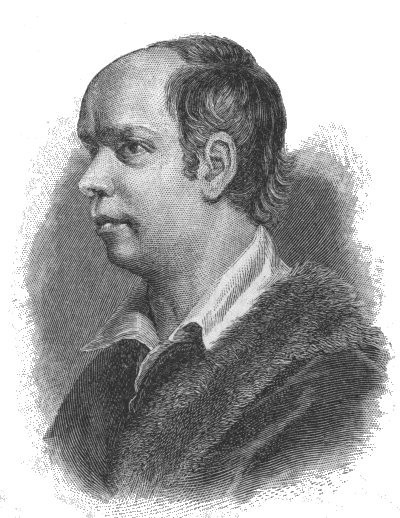
Because The Deserted Village is one of the most familiar poems in our language, Goldsmith is generally given a high place among the poets of the romantic dawn. But the Village, when we read it carefully, turns out to be a rimed essay in the style of Pope's famous Essay on Man; it owes its popularity to the sympathetic memories which it awakens, rather than to its poetic excellence. It is as a prose writer that Goldsmith excels. He is an essayist, with Addison's fine polish but with more sympathy for human life; he is a dramatist, one of the very few who have ever written a comedy that can keep its popularity unchanged while a century rolls over its head; but greater, perhaps, than the poet and essayist and dramatist is Goldsmith the novelist, who set himself to the important work of purifying the early novel of its brutal and indecent tendencies, and who has given us, in The Vicar of Wakefield, one of the most enduring characters in English fiction. In his manner, especially in his poetry, Goldsmith was too much influenced by his friend Johnson and the classicists; but in his matter, in his sympathy for nature and human life, he belongs unmistakably to the new romantic school. Altogether he is the most versatile, the most charming, the most inconsistent, and the most lovable genius of all the literary men who made famous the age of Johnson.
Life. Goldsmith's career is that of an irresponsible, unbalanced genius, which would make one despair if the man himself did not remain so lovable in all his inconsistencies. He was born in the village of Pallas, Ireland, the son of a poor Irish curate whose noble character is portrayed in Dr. Primrose, of The Vicar of Wakefield, and in the country parson of The Deserted Village. After an unsatisfactory course in various schools, where he was regarded as hopelessly stupid, Goldsmith entered Trinity College, Dublin, as a sizar, i.e. a student who pays with labor for his tuition. By his escapades he was brought into disfavor with the authorities, but that troubled him little. He was also wretchedly poor, which troubled him less; for when he earned a few shillings by writing ballads for street singers, his money went oftener to idle beggars than to the paying of his honest debts. After three years of university life he ran away, in dime-novel fashion, and nearly starved to death before he was found and brought back in disgrace. Then he worked a little, and obtained his degree in 1749.
Strange that such an idle and irresponsible youth should have been urged by his family to take holy orders; but such was the fact. For two years more Goldsmith labored with theology, only to be rejected when he presented himself as a candidate for the ministry. He tried teaching, and failed. Then his fancy turned to America, and, provided with money and a good horse, he started off for Cork, where he was to embark for the New World. He loafed along the pleasant Irish ways, missed his ship, and presently turned up cheerfully amongst his relatives, minus all his money, and riding a sorry nag called Fiddleback, for which he had traded his own on the way.[203] He borrowed fifty pounds more, and started for London to study law, but speedily lost his money at cards, and again appeared, amiable and irresponsible as ever, among his despairing relatives. The next year they sent him to Edinburgh to study medicine. Here for a couple of years he became popular as a singer of songs and a teller of tales, to whom medicine was only a troublesome affliction. Suddenly the Wanderlust seized him and he started abroad, ostensibly to complete his medical education, but in reality to wander like a cheerful beggar over Europe, singing and playing his flute for food and lodging. He may have studied a little at Leyden and at Padua, but that was only incidental. After a year or more of vagabondage he returned to London with an alleged medical degree, said to have been obtained at Louvain or Padua.
The next few years are a pitiful struggle to make a living as tutor, apothecary's assistant, comedian, usher in a country school, and finally as a physician in Southwark. Gradually he drifted into literature, and lived from hand to mouth by doing hack work for the London booksellers. Some of his essays and his Citizen of the World (1760-1761) brought him to the attention of Johnson, who looked him up, was attracted first by his poverty and then by his genius, and presently declared him to be "one of the first men we now have as an author." Johnson's friendship proved invaluable, and presently Goldsmith found himself a member of the exclusive Literary Club. He promptly justified Johnson's confidence by publishing The Traveller (1764), which was hailed as one of the finest poems of the century. Money now came to him liberally, with orders from the booksellers; he took new quarters in Fleet Street and furnished them gorgeously; but he had an inordinate vanity for bright-colored clothes, and faster than he earned money he spent it on velvet cloaks and in indiscriminate charity. For a time he resumed his practice as a physician, but his fine clothes did not bring patients, as he expected; and presently he turned to writing again, to pay his debts to the booksellers. He produced several superficial and grossly inaccurate schoolbooks,--like his Animated Nature and his histories of England, Greece, and Rome,--which brought him bread and more fine clothes, and his Vicar of Wakefield, The Deserted Village, and She Stoops to Conquer, which brought him undying fame.
After meeting with Johnson, Goldsmith became the object of Boswell's magpie curiosity; and to Boswell's Life of Johnson we are indebted for many of the details of Goldsmith's life,--his homeliness, his awkward ways, his drolleries and absurdities, which made him alternately the butt and the wit of the famous Literary Club. Boswell disliked Goldsmith, and so draws an unflattering Portrait, but even this does not disguise the contagious good humor which made men love him. When in his forty-seventh year, he fell sick of a fever, and with childish confidence turned to a quack medicine to cure himself. He died in 1774, and Johnson placed a tablet, with a sonorous Latin epitaph, in Westminster Abbey, though Goldsmith was buried elsewhere. "Let not his frailties be remembered; he was a very great man," said Johnson; and the literary world--which, like that old dictator, is kind enough at heart, though often rough in its methods--is glad to accept and record the verdict.
Works of Goldsmith. Of Goldsmith's early essays and his later school histories little need be said. They have settled into their own place, far out of sight of the ordinary reader. Perhaps the most interesting of these is a series of letters for the Public Ledger (afterwards published as The Citizen of the World), written from the view point of an alleged Chinese traveler, and giving the latter's comments on English civilization.[204] The following five works are those upon which Goldsmith's fame chiefly rests:
The Traveller (1764) made Goldsmith's reputation among his contemporaries, but is now seldom read, except by students who would understand how Goldsmith was, at one time, dominated by Johnson and his pseudo-classic ideals. It is a long poem, in rimed couplets, giving a survey and criticism of the social life of various countries in Europe, and reflects many of Goldsmith's own wanderings and impressions.
The Deserted VillageThe Deserted Village (1770), though written in the same mechanical style, is so permeated with honest human sympathy, and voices so perfectly the revolt of the individual man against institutions, that a multitude of common people heard it gladly, without consulting the critics as to whether they should call it good poetry. Notwithstanding its faults, to which Matthew Arnold has called sufficient attention, it has become one of our best known poems, though we cannot help wishing that the monotony of its couplets had been broken by some of the Irish folk songs and ballads that charmed street audiences in Dublin, and that brought Goldsmith a welcome from the French peasants wherever he stopped to sing. In the village parson and the schoolmaster, Goldsmith has increased Chaucer's list by two lovable characters that will endure as long as the English language. The criticism that the picture of prosperous "Sweet Auburn" never applied to any village in Ireland is just, no doubt, but it is outside the question. Goldsmith was a hopeless dreamer, bound to see everything, as he saw his debts and his gay clothes, in a purely idealistic way.
The Good-Natured Man and She Stoops to Conquer are Goldsmith's two comedies. The former, a comedy of character, though it has some laughable scenes and one laughable character, Croaker, met with failure on the stage, and has never been revived with any success. The latter, a comedy of intrigue, is one of the few plays that has never lost its popularity. Its lively, bustling scenes, and its pleasantly absurd characters, Marlowe, the Hardcastles, and Tony Lumpkin, still hold the attention of modern theater goers; and nearly every amateur dramatic club sooner or later places She Stoops to Conquer on its list of attractions.
The Vicar of WakefieldThe Vicar of Wakefield is Goldsmith's only novel, and the first in any language that gives to home life an enduring romantic interest. However much we admire the beginnings of the English novel, to which we shall presently refer, we are nevertheless shocked by its frequent brutalities and indecencies. Goldsmith like Steele, had the Irish reverence for pure womanhood, and this reverence made him shun as a pest the vulgarity and coarseness in which contemporary novelists, like Smollett and Sterne, seemed to delight. So he did for the novel what Addison and Steele had done for the satire and the essay; he refined and elevated it, making it worthy of the old Anglo-Saxon ideals which are our best literary heritage.
Briefly, The Vicar of Wakefield is the story of a simple English clergyman, Dr. Primrose, and his family, who pass from happiness through great tribulation. Misfortunes, which are said never to come singly, appear in this case in flocks; but through poverty, sorrow, imprisonment, and the unspeakable loss of his daughters, the Vicar's faith in God and man emerges triumphant. To the very end he is like one of the old martyrs, who sings Alleluia while the lions roar about him and his children in the arena. Goldsmith's optimism, it must be confessed, is here stretched to the breaking point. The reader is sometimes offered fine Johnsonian phrases where he would naturally expect homely and vigorous language; and he is continually haunted by the suspicion that, even in this best of all possible worlds, the Vicar's clouds of affliction were somewhat too easily converted into showers of blessing; yet he is forced to read on, and at the end he confesses gladly that Goldsmith has succeeded in making a most interesting story out of material that, in other hands, would have developed either a burlesque or a brutal tragedy. Laying aside all romantic passion, intrigue, and adventure, upon which other novelists depended, Goldsmith, in this simple story of common life, has accomplished three noteworthy results: he has made human fatherhood almost a divine thing; he has glorified the moral sentiments which cluster about the family life as the center of civilization; and he has given us, in Dr. Primrose, a striking and enduring figure, which seems more like a personal acquaintance than a character in a book.
WILLIAM COWPER (1731--1800)
In Cowper we have another interesting poet, who, like Gray and Goldsmith, shows the struggle between romantic and classic ideals. In his first volume of poems, Cowper is more hampered by literary fashions than was Goldsmith in his Traveller and his Deserted Village. In his second period, however, Cowper uses blank verse freely; and his delight in nature and in homely characters, like the teamster and the mail carrier of The Task, shows that his classicism is being rapidly thawed out by romantic feeling. In his later work, especially his immortal "John Gilpin," Cowper flings fashions aside, gives Pegasus the reins, takes to the open road, and so proves himself a worthy predecessor of Burns, who is the most spontaneous and the most interesting of all the early romanticists.
WILLIAM COWPER
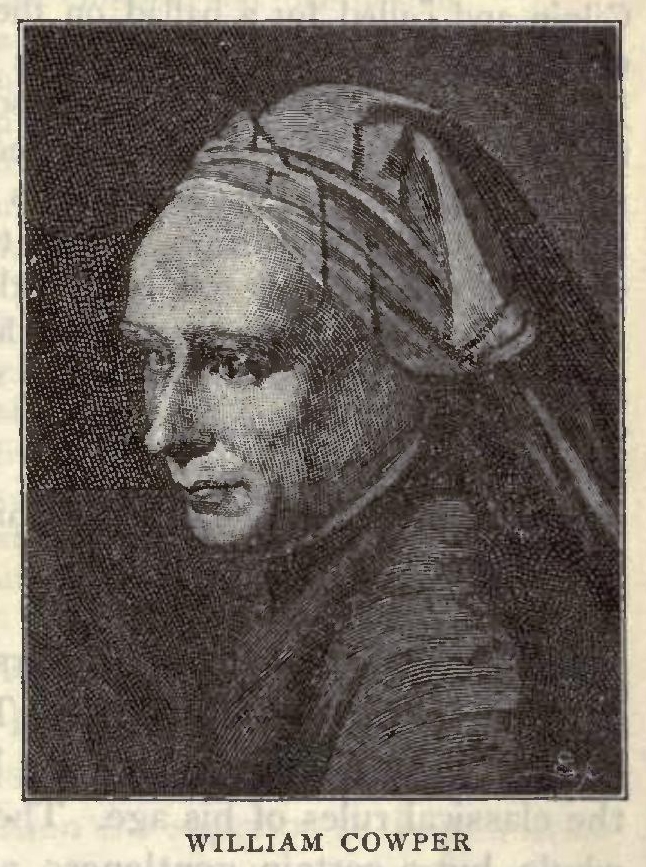
Life. Cowper's life is a pathetic story of a shy and timid genius, who found the world of men too rough, and who withdrew to nature like a wounded animal. He was born at Great Berkhamstead, Hertfordshire, in 1731, the son of an English clergyman. He was a delicate, sensitive child, whose early life was saddened by the death of his mother and by his neglect at home. At six years he was sent away to a boys' school, where he was terrified by young barbarians who made his life miserable. There was one atrocious bully into whose face Cowper could never look; he recognized his enemy by his shoe buckles, and shivered at his approach. The fierce invectives of his "Tirocinium, or a Review of Schools" (1784), shows how these school experiences had affected his mind and health. For twelve years he studied law, but at the approach of a public examination for an office he was so terrified that he attempted suicide. The experience unsettled his reason, and the next twelve months were spent in an asylum at St. Alban's. The death of his father, in 1756, had brought the poet a small patrimony, which placed him above the necessity of struggling, like Goldsmith, for his daily bread. Upon his recovery he boarded for years at the house of the Unwins, cultured people who recognized the genius hidden in this shy and melancholy yet quaintly humorous man. Mrs. Unwin, in particular, cared for him as a son; and whatever happiness he experienced in his poor life was the result of the devotion of this good woman, who is the "Mary" of all his poems.
A second attack of insanity was brought on by Cowper's morbid interest in religion, influenced, perhaps, by the untempered zeal of one John Newton, a curate, with whom Cowper worked in the small parish of Olney, and with whom he compiled the famous Olney Hymns. The rest of his life, between intervals of melancholia or insanity, was spent in gardening, in the care of his numerous pets, and in writing his poems, his translation of Homer, and his charming letters. His two best known poems were suggested by a lively and cultivated widow, Lady Austen, who told him the story of John Gilpin and called for a ballad on the subject. She also urged him to write a long poem in blank verse; and when he demanded a subject, she whimsically suggested the sofa, which was a new article of furniture at that time. Cowper immediately wrote "The Sofa," and, influenced by the poetic possibilities that lie in unexpected places, he added to this poem from time to time, and called his completed work The Task. This was published in 1785, and the author was instantly recognized as one of the chief poets of his age. The last years of his life were a long battle with insanity, until death mercifully ended the struggle in 1800. His last poem, "The Castaway," is a cry of despair, in which, under guise of a man washed overboard in a storm, he describes himself perishing in the sight of friends who are powerless to help.
Cowper's Works. Cowper's first volume of poems, containing "The Progress of Error," "Truth," "Table Talk," etc., is interesting chiefly as showing how the poet was bound by the classical rules of his age. These poems are dreary, on the whole, but a certain gentleness, and especially a vein of pure humor, occasionally rewards the reader. For Cowper was a humorist, and only the constant shadow of insanity kept him from becoming famous in that line alone.
The TaskThe Task, written in blank verse, and published in 1785, is Cowper's longest poem. Used as we are to the natural poetry of Wordsworth and Tennyson, it is hard for us to appreciate the striking originality of this work. Much of it is conventional and "wooden," to be sure, like much of Wordsworth's poetry; but when, after reading the rimed essays and the artificial couplets of Johnson's age, we turn suddenly to Cowper's description of homely scenes, of woods and brooks, of plowmen and teamsters and the letter carrier on his rounds, we realize that we are at the dawn of a better day in poetry:
He comes, the herald of a noisy world, With spatter'd boots, strapp'd waist, and frozen locks: News from all nations lumbering at his back. True to his charge, the close-packed load behind, Yet careless what he brings, his one concern Is to conduct it to the destined inn, And, having dropped the expected bag, pass on. He whistles as he goes, light-hearted wretch, Cold and yet cheerful: messenger of grief Perhaps to thousands, and of joy to some; To him indifferent whether grief or joy. Houses in ashes, and the fall of stocks, Births, deaths, and marriages, epistles wet With tears that trickled down the writer's cheeks Fast as the periods from his fluent quill, Or charged with amorous sighs of absent swains, Or nymphs responsive, equally affect His horse and him, unconscious of them all.
Miscellaneous WorksCowper's most laborious work, the translation of Homer in blank verse, was published in 1791. Its stately, Milton-like movement, and its better rendering of the Greek, make this translation far superior to Pope's artificial couplets. It is also better, in many respects, than Chapman's more famous and more fanciful rendering; but for some reason it was not successful, and has never received the recognition which it deserves. Entirely different in spirit are the poet's numerous hymns, which were published in the Olney Collection in 1779 and which are still used in our churches. It is only necessary to mention a few first lines--"God moves in a mysterious way," "Oh, for a closer walk with God," "Sometimes a light surprises"--to show how his gentle and devout spirit has left its impress upon thousands who now hardly know his name. With Cowper's charming Letters, published in 1803, we reach the end of his important works, and the student who enjoys reading letters will find that these rank among the best of their kind. It is not, however, for his ambitious works that Cowper is remembered, but rather for his minor poems, which have found their own way into so many homes. Among these, the one that brings quickest response from hearts that understand is his little poem, "On the Receipt of My Mother's Picture." beginning with the striking line, "Oh, that those lips had language." Another, called "Alexander Selkirk," beginning, "I am monarch of all I survey," suggests how Selkirk's experiences as a castaway (which gave Defoe his inspiration for Robinson Crusoe) affected the poet's timid nature and imagination. Last and most famous of all is his immortal "John Gilpin." Cowper was in a terrible fit of melancholy when Lady Austen told him the story, which proved to be better than medicine, for all night long chuckles and suppressed laughter were heard in the poet's bedroom. Next morning at breakfast he recited the ballad that had afforded its author so much delight in the making. The student should read it, even if he reads nothing else by Cowper; and he will be lacking in humor or appreciation if he is not ready to echo heartily the last stanza:
Now let us sing, Long live the King, And Gilpin, long live he! And when he next doth ride abroad May I be there to see.
ROBERT BURNS (1759-1796)
After a century and more of Classicism, we noted with interest the work of three men, Gray, Goldsmith, and Cowper, whose poetry, like the chorus of awakening birds, suggests the dawn of another day. Two other poets of the same age suggest the sunrise. The first is the plowman Burns, who speaks straight from the heart to the primitive emotions of the race; the second is the mystic Blake, who only half understands his own thoughts, and whose words stir a sensitive nature as music does, or the moon in midheaven, rousing in the soul those vague desires and aspirations which ordinarily sleep, and which can never be expressed because they have no names. Blake lived his shy, mystic, spiritual life in the crowded city, and his message is to the few who can understand. Burns lived his sad, toilsome, erring life in the open air, with the sun and the rain, and his songs touch all the world. The latter's poetry, so far as it has a philosophy, rests upon two principles which the classic school never understood,--that common people are at heart romantic and lovers of the ideal, and that simple human emotions furnish the elements of true poetry. Largely because he follows these two principles, Burns is probably the greatest song writer of the world. His poetic creed may be summed up in one of his own stanzas:
Give me ae spark o' Nature's fire, That's a' the learning I desire; Then, though I trudge thro' dub an' mire At pleugh or cart, My Muse, though hamely in attire, May touch the heart.
ROBERT BURNS
Life.[205] Burns's life is "a life of fragments," as Carlyle called it; and the different fragments are as unlike as the noble "Cotter's Saturday Night" and the rant and riot of "The Jolly Beggars." The details of this sad and disjointed life were better, perhaps, forgotten. We call attention only to the facts which help us to understand the man and his poetry.
Burns was born in a clay cottage at Alloway, Scotland, in the bleak winter of 1759. His father was an excellent type of the Scotch peasant of those days,--a poor, honest, God-fearing man, who toiled from dawn till dark to wrest a living for his family from the stubborn soil. His tall figure was bent with unceasing labor; his hair was thin and gray, and in his eyes was the careworn, hunted look of a peasant driven by poverty and unpaid rents from one poor farm to another. The family often fasted of necessity, and lived in solitude to avoid the temptation of spending their hard-earned money. The children went barefoot and bareheaded in all weathers, and shared the parents' toil and their anxiety over the rents. At thirteen Bobby, the eldest, was doing a peasant's full day's labor; at sixteen he was chief laborer on his father's farm; and he describes the life as "the cheerless gloom of a hermit, and the unceasing moil of a galley slave." In 1784 the father, after a lifetime of toil, was saved from a debtor's prison by consumption and death. To rescue something from the wreck of the home, and to win a poor chance of bread for the family, the two older boys set up a claim for arrears of wages that had never been paid. With the small sum allowed them, they buried their father, took another farm, Mossgiel, in Mauchline, and began again the long struggle with poverty.
Such, in outline, is Burns's own story of his early life, taken mostly from his letters. There is another and more pleasing side to the picture, of which we have glimpses in his poems and in his Common-place Book. Here we see the boy at school; for like most Scotch peasants, the father gave his boys the best education he possibly could. We see him following the plow, not like a slave, but like a free man, crooning over an old Scotch song and making a better one to match the melody. We see him stop the plow to listen to what the wind is saying, or turn aside lest he disturb the birds at their singing and nest making. At supper we see the family about the table, happy notwithstanding their scant fare, each child with a spoon in one hand and a book in the other. We hear Betty Davidson reciting, from her great store, some heroic ballad that fired the young hearts to enthusiasm and made them forget the day's toil. And in "The Cotter's Saturday Night" we have a glimpse of Scotch peasant life that makes us almost reverence these heroic men and women, who kept their faith and their self-respect in the face of poverty, and whose hearts, under their rough exteriors, were tender and true as steel.
A most unfortunate change in Burns's life began when he left the farm, at seventeen, and went to Kirkoswald to study surveying. The town was the haunt of smugglers, rough-living, hard-drinking men; and Burns speedily found his way into those scenes of "riot and roaring dissipation" which were his bane ever afterwards. For a little while he studied diligently, but one day, while taking the altitude of the sun, he saw a pretty girl in the neighboring garden, and love put trigonometry to flight. Soon he gave up his work and wandered back to the farm and poverty again.
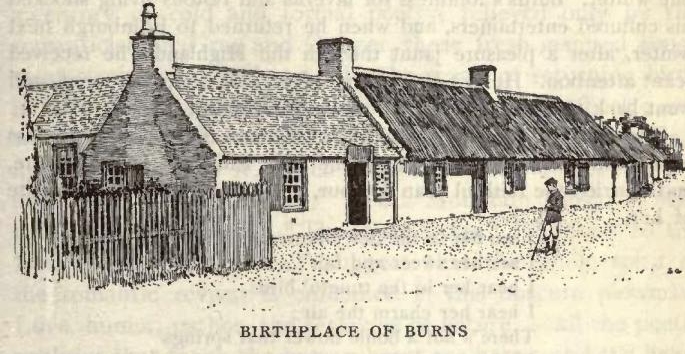
When twenty-seven years of age Burns first attracted literary attention, and in the same moment sprang to the first place in Scottish letters. In despair over his poverty and personal habits, he resolved to emigrate to Jamaica, and gathered together a few of his early poems, hoping to sell them for enough to pay the expenses of his journey. The result was the famous Kilmarnock edition of Burns, published in 1786, for which he was offered twenty pounds. It is said that he even bought his ticket, and on the night before the ship sailed wrote his "Farewell to Scotland," beginning, "The gloomy night is gathering fast," which he intended to be his last song on Scottish soil.
In the morning he changed his mind, led partly by some dim foreshadowing of the result of his literary adventure; for the little book took all Scotland by storm. Not only scholars and literary men, but "even plowboys and maid servants," says a contemporary, eagerly spent their hard-earned shillings for the new book. Instead of going to Jamaica, the young poet hurried to Edinburgh to arrange for another edition of his work. His journey was a constant ovation, and in the capital he was welcomed and feasted by the best of Scottish society. This inexpected triumph lasted only one winter. Burns's fondness for taverns and riotous living shocked his cultured entertainers, and when he returned to Edinburgh next winter, after a pleasure jaunt through the Highlands, he received scant attention. He left the city in anger and disappointment, and went back to the soil where he was more at home.
The last few years of Burns's life are a sad tragedy, and we pass over them hurriedly. He bought the farm Ellisland, Dumfriesshire, and married the faithful Jean Armour, in 1788, That he could write of her,
I see her in the dewy flowers, I see her sweet and fair; I hear her in the tunefu' birds, I hear her charm the air: There's not a bonie flower that springs By fountain, shaw, or green; There's not a bonie bird that sings, But minds me o' my Jean,
is enough for us to remember. The next year he was appointed exciseman, i.e. collector of liquor revenues, and the small salary, with the return from his poems, would have been sufficient to keep his family in modest comfort, had he but kept away from taverns. For a few years his life of alternate toil and dissipation was occasionally illumined by his splendid lyric genius, and he produced many songs--"Bonnie Doon," "My Love's like a Red, Red Rose," "Auld Lang Syne," "Highland Mary," and the soul-stirring "Scots wha hae," composed while galloping over the moor in a storm--which have made the name of Burns known wherever the English language is spoken, and honored wherever Scotchmen gather together. He died miserably in 1796, when only thirty-seven years old. His last letter was an appeal to a friend for money to stave off the bailiff, and one of his last poems a tribute to Jessie Lewars, a kind lassie who helped to care for him in his illness. This last exquisite lyric, "O wert thou in the cauld blast," set to Mendelssohn's music, is one of our best known songs, though its history is seldom suspected by those who sing it.
The Poetry of Burns. The publication of the Kilmarnock Burns, with the title Poems Chiefly in the Scottish Dialect (1786), marks an epoch in the history of English Literature, like the publication of Spenser's Shepherd's Calendar. After a century of cold and formal poetry, relieved only by the romanticism of Gray and Cowper, these fresh inspired songs went straight to the heart, like the music of returning birds in springtime. It was a little volume, but a great book; and we think of Marlowe's line, "Infinite riches in a little room," in connection with it. Such poems as "The Cotter's Saturday Night," "To a Mouse," "To Mountain Daisy," "Man was Made To Mourn," "The Twa Dogs," "Address to the Deil," and "Halloween," suggest that the whole spirit of the romantic revival is embodied in this obscure plowman. Love, humor, pathos, the response to nature,--all the poetic qualities that touch the human heart are here; and the heart was touched as it had not been since the days of Elizabeth. If the reader will note again the six characteristics of the romantic movement, and then read six poems of Burns, he will see at once how perfectly this one man expresses the new idea. Or take a single suggestion,--
Ae fond kiss, and then we sever! Ae farewell, and then forever! Deep in heart-wrung tears I'll pledge thee, Warring sighs and groans I'll wage thee. Who shall say that Fortune grieves him While the star of hope she leaves him? Me, nae cheerfu' twinkle lights me; Dark despair around benights me. I'll ne'er blame my partial fancy, Naething could resist my Nancy; But to see her was to love her; Love but her, and love forever. Had we never lov'd sae kindly, Had we never lov'd sae blindly, Never met--or never parted-- We had ne'er been broken-hearted.
The "essence of a thousand love tales" is in that one little song. Because he embodies the new spirit of romanticism, critics give him a high place in the history of our literature; and because his songs go straight to the heart, he is the poet of common men.
Songs for MusicOf Burns's many songs for music little need be said. They have found their way into the hearts of a whole people, and there they speak for themselves. They range from the exquisite "O wert thou in the cauld blast," to the tremendous appeal to Scottish patriotism in "Scots wha hae wi' Wallace bled," which, Carlyle said, should be sung with the throat of the whirlwind. Many of these songs were composed in his best days, when following the plow or resting after his work, while the music of some old Scotch song was ringing in his head. It is largely because he thought of music while he composed that so many of his poems have the singing quality, suggesting a melody as we read them.
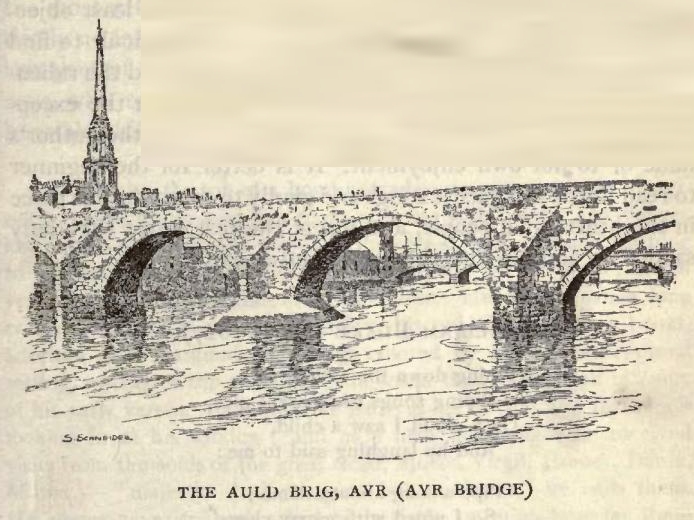
Among his poems of nature, "To a Mouse" and "To a Mountain Daisy" are unquestionably the best, suggesting the poetical possibilities that daily pass unnoticed under our feet. These two poems are as near as Burns ever comes to appreciating nature for its own sake. The majority of his poems, like "Winter" and "Ye banks and braes o' bonie Doon," regard nature in the same way that Gray regarded it, as a background for the play of human emotions.
Of his poems of emotion there is an immense number. It is a curious fact that the world is always laughing and crying at the same moment; and we can hardly read a page of Burns without finding this natural juxtaposition of smiles and tears. It is noteworthy also that all strong emotions, when expressed naturally, lend themselves to poetry; and Burns, more than any other writer, has an astonishing faculty of describing his own emotions with vividness and simplicity, so that they appeal instantly to our own. One cannot read, "I love my Jean," for instance, without being in love with some idealized woman; or "To Mary in Heaven," without sharing the personal grief of one who has loved and lost.
Miscellaneous PoemsBesides the songs of nature and of human emotion, Burns has given us a large number of poems for which no general title can be given. Noteworthy among these are "A man's a man for a' that," which voices the new romantic estimate of humanity; "The Vision," from which we get a strong impression of Burns's early ideals; the "Epistle to a Young Friend," from which, rather than from his satires, we learn Burns's personal views of religion and honor; the "Address to the Unco Guid," which is the poet's plea for mercy in judgment; and "A Bard's Epitaph," which, as a summary of his own life, might well be written at the end of his poems. "Halloween," a picture of rustic merrymaking, and "The Twa Dogs" a contrast between the rich and poor, are generally classed among the poet's best works; but one unfamiliar with the Scotch dialect will find them rather difficult.
Of Burns's longer poems the two best worth reading are "The Cotter's Saturday Night" and "Tam o' Shanter,"--the one giving the most perfect picture we possess of a noble poverty; the other being the most lively and the least objectionable of his humorous works. It would be difficult to find elsewhere such a combination of the grewsome and the ridiculous as is packed up in "Tam o' Shanter." With the exception of these two, the longer poems add little to the author's fame or to our own enjoyment. It is better for the beginner to read Burns's exquisite songs and gladly to recognize his place in the hearts of a people, and forget the rest, since they only sadden us and obscure the poet's better nature.
WILLIAM BLAKE (1757-1827)
Piping down the valleys wild, Piping songs of pleasant glee, On a cloud I saw a child, And he laughing said to me: "Pipe a song about a lamb;" So I piped with merry cheer. "Piper, pipe that song again;" So I piped:, he wept to hear. "Piper, sit thee down and write In a book, that all may read;" So he vanished from my sight, And I plucked a hollow reed, And I made a rural pen, And I stained the water clear, And I wrote my happy songs Every child may joy to hear.[206]
Of all the romantic poets of the eighteenth century, Blake is the most independent and the most original. In his earliest work, written when he was scarcely more than a child, he seems to go back to the Elizabethan song writers for his models; but for the greater part of his life he was the poet of inspiration alone, following no man's lead, and obeying no voice but that which he heard in his own mystic soul. Though the most extraordinary literary genius of his age, he had practically no influence upon it. Indeed, we hardly yet understand this poet of pure fancy, this mystic this transcendental madman, who remained to the end of his busy life an incomprehensible child.
Life. Blake, the son of a London tradesman, was a strange, imaginative child, whose soul was more at home with brooks and flowers and fairies than with the crowd of the city streets. Beyond learning to read and write, he received education; but he began, at ten years, to copy prints and to write verses. He also began a long course of art study, which resulted in his publishing his own books, adorned with marginal engravings colored by hand,--an unusual setting, worthy of the strong artistic sense that shows itself in many of his early verses. As a child he had visions of God and the angels looking in at his window; and as a man he thought he received visits from the souls of the great dead, Moses, Virgil, Homer, Dante, Milton,--"majestic shadows, gray but luminous," he calls them. He seems never to have asked himself the question how far these visions were pure illusions, but believed and trusted them implicitly. To him all nature was a vast spiritual symbolism, wherein he saw elves, fairies, devils, angels,--all looking at him in friendship or enmity through the eyes of flowers and stars:
With the blue sky spread over with wings, And the mild sun that mounts and sings; With trees and fields full of fairy elves, And little devils who fight for themselves; With angels planted in hawthorne bowers, And God himself in the passing hours.
And this curious, pantheistic conception of nature was not a matter of creed, but the very essence of Blake's life. Strangely enough, he made no attempt to found a new religious cult, but followed his own way, singing cheerfully, working patiently, in the face of discouragement and failure. That writers of far less genius were exalted to favor, while he remained poor and obscure, does not seem to have troubled him in the least. For over forty years he labored diligently at book engraving, guided in his art by Michael Angelo. but inventing his own curious designs, at which we still wonder. The illustrations for Young's "Night Thoughts," for Blair's "Grave," and the "Inventions to the Book of Job," show the peculiarity of Blake's mind quite as clearly as his poems. While he worked at his trade he flung off--for he never seemed to compose--disjointed visions and incomprehensible rhapsodies, with an occasional little gem that still sets our hearts to singing:
Ah, sunflower, weary of time, Who countest the steps of the sun; Seeking after that sweet golden clime Where the traveller's journey is done; Where the youth pined away with desire, And the pale virgin shrouded in snow, Rise from their graves, and aspire Where my sunflower wishes to go!
That is a curious flower to find growing in the London street; but it suggests Blake's own life, which was outwardly busy and quiet, but inwardly full of adventure and excitement. His last huge prophetic works, like Jerusalem and Milton (1804), were dictated to him, he declares, by supernatural means, and even against his own will. They are only half intelligible, but here and there one sees flashes of the same poetic beauty that marks his little poems. Critics generally dismiss Blake with the word "madman"; but that is only an evasion. At best, he is the writer of exquisite lyrics; at worst, he is mad only "north-northwest," like Hamlet; and the puzzle is to find the method in his madness. The most amazing thing about him is the perfectly sane and cheerful way in which he moved through poverty and obscurity, flinging out exquisite poems or senseless rhapsodies, as a child might play with gems or straws or sunbeams indifferently. He was a gentle, kindly, most unworldly little man, with extraordinary eyes, which seem even in the lifeless portraits to reflect some unusual hypnotic power. He died obscurely, smiling at a vision of Paradise, in 1827. That was nearly a century ago, yet he still remains one of the most incomprehensible figures in our literature.
Works of Blake. The Poetical Sketches, published in 1783, is a collection of Blake's earliest poetry, much of it written in boyhood. It contains much crude and incoherent work, but also a few lyrics of striking originality. Two later and better known volumes are Songs of Innocence and Songs of Experience, reflecting two widely different views of the human soul. As in all his works, there is an abundance of apparently worthless stuff in these songs; but, in the language of miners, it is all "pay dirt"; it shows gleams of golden grains that await our sifting, and now and then we find a nugget unexpectedly:
My lord was like a flower upon the brows Of lusty May; ah life as frail as flower! My lord was like a star in highest heaven Drawn down to earth by spells and wickedness; My lord was like the opening eye of day; But he is darkened; like the summer moon Clouded; fall'n like the stately tree, cut down; The breath of heaven dwelt among his leaves.
On account of the chaotic character of most of Blake's work, it is well to begin our reading with a short book of selections, containing the best songs of these three little volumes. Swinburne calls Blake the only poet of "supreme and simple poetic genius" of the eighteenth century, the one man of that age fit, on all accounts, to rank with the old great masters.[207] The praise is doubtless extravagant, and the criticism somewhat intemperate; but when we have read "The Evening Star," "Memory," "Night," "Love," "To the Muses," "Spring," "Summer," "The Tiger," "The Lamb," "The Clod and the Pebble," we may possibly share Swinburne's enthusiasm. Certainly, in these three volumes we have some of the most perfect and the most original songs in our language.
Of Blake's longer poems, his titanic prophecies and apocalyptic splendors, it is impossible to write justly in such a brief work as this. Outwardly they suggest a huge chaff pile, and the scattered grains of wheat hardly warrant the labor of winnowing. The curious reader will get an idea of Blake's amazing mysticism by dipping into any of the works of his middle life,--Urizen, Gates of Paradise, Marriage of Heaven and Hell, America, The French Revolution, or The Vision of the Daughters of Albion. His latest works, like Jerusalem and Milton, are too obscure to have any literary value. To read any of these works casually is to call the author a madman; to study them, remembering Blake's songs and his genius, is to quote softly his own answer to the child who asked about the land of dreams:
"O what land is the land of dreams, What are its mountains and what are its streams? --O father, I saw my mother there, Among the lilies by waters fair." "Dear child, I also by pleasant streams Have wandered all night in the land of dreams; But though calm and warm the waters wide, I could not get to the other side."
MINOR POETS OF THE REVIVAL
We have chosen the five preceding poets, Gray, Goldsmith, Cowper, Burns, and Blake, as the most typical and the most interesting of the writers who proclaimed the dawn of Romanticism in the eighteenth century. With them we associate a group of minor writers, whose works were immensely popular in their own day. The ordinary reader will pass them by, but to the student they are all significant as expressions of very different phases of the romantic revival.
James Thomson (1700-1748). Thomson belongs among the pioneers of Romanticism. Like Gray and Goldsmith, he wavered between Pseudo-classic and the new romantic ideals, and for this reason, if for no other, his early work is interesting, like the uncertainty of a child who hesitates whether to creep safely on all fours or risk a fall by walking. He is "worthy to be remembered" for three poems,--"Rule Britannia," which is still one of the national songs of England The Castle of Indolence, and The Seasons. The dreamy and romantic Castle (1748), occupied by enchanter Indolence and his willing captives in the land of Drowsyhed, is purely Spenserian in its imagery, and is written in the Spenserian stanza. The Seasons (1726-1730), written in blank verse, describes the sights and sounds of the changing year and the poet's own feelings in the presence of nature. These two poems, though rather dull to a modern reader, were significant of the early romantic revival in three ways: they abandoned the prevailing heroic couplet; they went back to the Elizabethans, instead of to Pope, for their models; and they called attention to the long-neglected life of nature as a subject for poetry.
William Collins (1721-1759). Collins, the friend and disciple of Thomson, was of a delicate, nervous temperament, like Cowper; and over him also brooded the awful shadow of insanity. His first work, Oriental Eclogues (1742), is romantic in feeling, but is written in the prevailing mechanical couplets. All his later work is romantic in both thought and expression. His "Ode on the Popular Superstitions of the Highlands" (1750) is an interesting event in the romantic revival, for it introduced a new world, of witches, pygmies, fairies, and mediæval kings, for the imagination to play in. Collins's best known poems are the odes "To Simplicity," "To Fear," "To the Passions," the little unnamed lyric beginning "How sleep the brave," and the exquisite "Ode to Evening." In reading the latter, one is scarcely aware that the lines are so delicately balanced that they have no need of rime to accentuate their melody.
George Crabbe (1754-1832). Crabbe is an interesting combination of realism and romanticism, his work of depicting common life being, at times, vaguely suggestive of Fielding's novels. The Village (1783), a poem without a rival as a picture of the workingmen of his age, is sometimes like Fielding in its coarse vigor, and again like Dryden in its precise versification. The poem was not successful at first, and Crabbe abandoned his literary dreams. For over twenty years he settled down as a clergyman in a country parish, observing keenly the common life about him. Then he published more poems, exactly like The Village, which immediately brought him fame and money. They brought him also the friendship of Walter Scott, who, like others, regarded Crabbe as one of the first poets of the age. These later poems, The Parish Register (1807), The Borough (1810), Tales in Verse (1812), and Tales of the Hall (1819), are in the same strain. They are written in couplets; they are reflections of nature and of country life; they contain much that is sordid and dull, but are nevertheless real pictures of real men and women, just as Crabbe saw them, and as such they are still interesting. Goldsmith and Burns had idealized the poor, and we admire them for their sympathy and insight. It remained for Crabbe to show that in wretched fishing villages, in the lives of hardworking men and women, children, laborers, smugglers, paupers,--all sorts and conditions of common men,--there is abundant romantic without exaggerating or idealizing their vices and virtues.
James Macpherson (1736-1796). In Macpherson we have an unusual figure, who catered to the new romantic interest in the old epic heroes, and won immense though momentary fame, by a series of literary forgeries. Macpherson was a Scotch schoolmaster, an educated man, but evidently not over-tender of conscience, whose imagination had been stirred by certain old poems which he may have heard in Gaelic among the Highlanders. In 1760 he published his Fragments of Ancient Poetry collected in the Highlands, and alleged that his work was but a translation of Gaelic manuscripts. Whether the work of itself would have attracted attention is doubtful; but the fact that an abundance of literary material might be awaiting discovery led to an interest such as now attends the opening of an Egyptian tomb, and a subscription was promptly raised in Edinburgh to send Macpherson through the Highlands to collect more "manuscripts." The result was the epic Fingal (1762), "that lank and lamentable counterfeit of poetry," as Swinburne calls it, which the author professed to have translated from the Gaelic of the poet Ossian. Its success was astonishing, and Macpherson followed it up with Temora (1763), another epic in the same strain. In both these works Macpherson succeeds in giving an air of primal grandeur to his heroes; the characters are big and shadowy; the imagery is at times magnificent; the language is a kind of chanting, bombastic prose:
Now Fingal arose in his might and thrice he reared his voice. Cromla answered around, and the sons of the desert stood still. They bent their red faces to earth, ashamed at the presence of Fingal. He came like a cloud of rain in the days of the sun, when slow it rolls on the hill, and fields expect the shower. Swaran beheld the terrible king of Morven, and stopped in the midst of his course. Dark he leaned on his spear rolling his red eyes around. Silent and tall he seemed as an oak on the banks of Lubar, which had its branches blasted of old by the lightning of heaven. His thousands pour around the hero, and the darkness of battle gathers on the hill.[208]
The publication of this gloomy, imaginative work produced a literary storm. A few critics, led by Dr. Johnson, demanded to see the original manuscripts, and when Macpherson refused to produce them,[209] the Ossianic poems were branded as a forgery; nevertheless they had enormous success. Macpherson was honored as a literary explorer; he was given an official position, carrying a salary for life; and at his death, in 1796, he was buried in Westminster Abbey. Blake, Burns, and indeed most of the poets of the age were influenced by this sham poetry. Even the scholarly Gray was deceived and delighted with "Ossian"; and men as far apart as Goethe and Napoleon praised it immoderately.
Thomas Chatterton (1752-1770). This "marvelous boy," to whom Keats dedicated his "Endymion," and who is celebrated in Shelley's "Adonais," is one of the saddest and most interesting figures of the romantic revival. During his childhood he haunted the old church of St. Mary Redcliffe, in Bristol, where he was fascinated by the mediæval air of the place, and especially by one old chest, known as Canynge's coffer, containing musty documents which had been preserved for three hundred years. With strange, uncanny intentness the child pored over these relics of the past, copying them instead of his writing book, until he could imitate not only the spelling and language but even the handwriting of the original. Soon after the "Ossian" forgeries appeared, Chatterton began to produce documents, apparently very old, containing mediæval poems, legends, and family histories, centering around two characters,--Thomas Rowley, priest and poet, and William Canynge, merchant of Bristol in the days of Henry VI. It seems incredible that the whole design of these mediæval romances should have been worked out by a child of eleven, and that he could reproduce the style and the writing of Caxton's day so well that the printers were deceived; but such is the fact. More and more Rowley Papers, as they were called, were produced by Chatterton,--apparently from the archives of the old church; in reality from his own imagination,--delighting a large circle of readers, and deceiving all but Gray and a few scholars who recognized the occasional misuse of fifteenth-century English words. All this work was carefully finished, and bore the unmistakable stamp of literary genius. Reading now his "Ælla," or the "Ballad of Charite," or the long poem in ballad style called "Bristowe Tragedie," it is hard to realize that it is a boy's work. At seventeen years of age Chatterton went for a literary career to London, where he soon afterwards took poison and killed himself in a fit of childish despondency, brought on by poverty and hunger.
Thomas Percy (1729-1811). To Percy, bishop of the Irish church, in Dromore, we are indebted for the first attempt at a systematic collection of the folk songs and ballads which are counted among the treasures of a nation's literature.[210] In 1765 he published, in three volumes, his famous Reliques of Ancient English Poetry. The most valuable part of this work is the remarkable collection of old English and Scottish Ballads, such as "Chevy Chase," the "Nut Brown Mayde," "Children of the Wood," "Battle of Otterburn," and many more, which but for his labor might easily have perished. We have now much better and more reliable editions of these same ballads; for Percy garbled his materials, adding and subtracting freely, and even inventing a few ballads of his own. Two motives probably influenced him in this. First, the different versions of the same ballad varied greatly; and Percy, in changing them to suit himself, took the same liberty as had many other writers in dealing with the same material. Second; Percy was under the influence of Johnson and his school, and thought it necessary to add a few elegant ballads "to atone for the rudeness of the more obsolete poems." That sounds queer now, used as we are to exactness in dealing with historical and literary material; but it expresses the general spirit of the age in which he lived.
Notwithstanding these drawbacks, Percy's Reliques marks an epoch in the history of Romanticism, and it is difficult to measure its influence on the whole romantic movement. Scott says of it, "The first time I could scrape a few shillings together, I bought myself a copy of these beloved volumes; nor do I believe I ever read a book half so frequently, or with half the enthusiasm." Scott's own poetry is strongly modeled upon these early ballads, and his Minstrelsy of the Scottish Border is due chiefly to the influence of Percy's work.
Besides the Reliques, Percy has given us another good work in his Northern Antiquities (1770) translated from the French of Mallet's History of Denmark. This also was of immense influence, since it introduced to English readers a new and fascinating mythology, more rugged and primitive than that of the Greeks; and we are still, in music as in letters, under the spell of Thor and Odin, of Frea and the Valkyr maidens, and of that stupendous drama of passion and tragedy which ended in the "Twilight of the Gods." The literary world owes a debt of gratitude to Percy, who wrote nothing of importance himself, but who, by collecting and translating the works of other men, did much to hasten the triumph of Romanticism in the nineteenth century.
III. THE FIRST ENGLISH NOVELISTS
The chief literary phenomena of the complex eighteenth century are the reign of so-called Classicism, the revival of romantic poetry, and the discovery of the modern novel. Of these three, the last is probably the most important. Aside from the fact that the novel is the most modern, and at present the most widely read and influential type of literature, we have a certain pride in regarding it as England's original contribution to the world of letters. Other great types of literature, like the epic, the romance, and the drama, were first produced by other nations; but the idea of the modern novel seems to have been worked out largely on English soil;[211] and in the number and the fine quality of her novelists, England has hardly been rivaled by any other nation. Before we study the writers who developed this new type of literature, it is well to consider briefly its meaning and history.
The Story ElementMeaning of the Novel. Probably the most significant remark made by the ordinary reader concerning a work of fiction takes the form of a question: Is it a good story? For the reader of to-day is much like the child and the primitive man in this respect, that he must be attracted and held by the story element of a narrative before he learns to appreciate its style or moral significance. The story element is therefore essential to the novel; but where the story originates is impossible to say. As well might we seek for the origin of the race; for wherever primitive men are found, there we see them gathering eagerly about the story-teller. In the halls of our Saxon ancestors the scop and the tale-bringer were ever the most welcome guests; and in the bark wigwams of the American Indians the man who told the legends of Hiawatha had an audience quite as attentive as that which gathered at the Greek festivals to hear the story of Ulysses's wanderings. To man's instinct or innate love for a story we are indebted for all our literature; and the novel must in some degree satisfy this instinct, or fail of appreciation.
The RomanceThe second question which we ask concerning a work of fiction is, How far does the element of imagination enter into it? For upon the element of imagination depends, largely, our classification of works of fiction into novels, romances, and mere adventure stories. The divisions here are as indefinite as the border land between childhood and youth, between instinct and reason; but there are certain principles to guide us. We note, in the development of any normal child, that there comes a time when for his stories he desires knights, giants, elves, fairies, witches, magic, and marvelous adventures which have no basis in experience. He tells extraordinary tales about himself, which may be only the vague remembrances of a dream or the creations of a dawning imagination,--both of which are as real to him as any other part of life. When we say that such a child "romances," we give exactly the right name to it; for this sudden interest in extraordinary beings and events marks the development of the human imagination,--running riot at first, because it is not guided by reason, which is a later development,--and to satisfy this new interest the romance[212] was invented. The romance is, originally, a work of fiction in which the imagination is given full play without being limited by facts or probabilities. It deals with extraordinary events, with heroes whose powers are exaggerated, and often adds the element of superhuman or supernatural characters. It is impossible to draw the line where romance ends; but this element of excessive imagination and of impossible heroes and incidents is its distinguishing mark in every literature.
The NovelWhere the novel begins it is likewise impossible to say; but again we have a suggestion in the experience of every reader. There comes a time, naturally and inevitably, in the life of every youth when the romance no longer enthralls him. He lives in a world of facts; gets acquainted with men and women, some good, some bad, but all human; and he demands that literature shall express life as he knows it by experience. This is the stage of the awakened intellect, and in our stories the intellect as well as the imagination must now be satisfied. At the beginning of this stage we delight in Robinson Crusoe; we read eagerly a multitude of adventure narratives and a few so-called historical novels; but in each case we must be lured by a story, must find heroes and "moving accidents by flood and field" to appeal to our imagination; and though the hero and the adventure may be exaggerated, they must both be natural and within the bounds of probability. Gradually the element of adventure or surprising incident grows less and less important, as we learn that true life is not adventurous, but a plain, heroic matter of work and duty, and the daily choice between good and evil. Life is the most real thing in the world now,--not the life of kings, or heroes, or superhuman creatures, but the individual life with its struggles and temptations and triumphs or failures, like our own; and any work that faithfully represents life becomes interesting. So we drop the adventure story and turn to the novel. For the novel is a work of fiction in which the imagination and the intellect combine to express life in the form of a story and the imagination is always directed and controlled by the intellect. It is interested chiefly, not in romance or adventure, but in men and women as they are; it aims to show the motives and influences which govern human life, and the effects of personal choice upon character and destiny. Such is the true novel,[213] and as such it opens a wider and more interesting field than any other type of literature.
Precursors of the Novel. Before the novel could reach its modern stage, of a more or less sincere attempt to express human life and character, it had to pass through several centuries of almost imperceptible development. Among the early precursors of the novel we must place a collection of tales known as the Greek Romances, dating from the second to the sixth centuries. These are imaginative and delightful stories of ideal love and marvelous adventure,[214] which profoundly affected romance writing for the next thousand years. A second group of predecessors is found in the Italian and Spanish pastoral romances, which were inspired by the Eclogues of Virgil. These were extremely popular in the fourteenth and fifteenth centuries, and their influence is seen later in Sidney's Arcadia, which is the best of this type in English.
The third and most influential group of predecessors of the novel is made up of the romances of chivalry, such as are found in Malory's Morte d'Arthur. It is noticeable, in reading these beautiful old romances in different languages, that each nation changes them somewhat, so as to make them more expressive of national traits and ideals. In a word, the old romance tends inevitably towards realism, especially in England, where the excessive imagination is curbed and the heroes become more human. In Malory, in the unknown author of Sir Gawain and the Green Knight, and especially in Chaucer, we see the effect of the practical English mind in giving these old romances a more natural setting, and in making the heroes suggest, though faintly, the men and women of their own day. The Canterbury Tales, with their story interest and their characters delightfully true to nature, have in them the suggestion, at least, of a connected story whose chief aim is to reflect life as it is.
In the Elizabethan Age the idea of the novel grows more definite. In Sidney's Arcadia (1580), a romance of chivalry, the pastoral setting at least is generally true to nature; our credulity is not taxed, as in the old romances, by the continual appearance of magic or miracles; and the characters, though idealized till they become tiresome, occasionally give the impression of being real men and women. In Bacon's The New Atlantis (1627) we have the story of the discovery by mariners of an unknown country, inhabited by a superior race of men, more civilized than ourselves,--an idea which had been used by More in his Utopia in 1516. These two books are neither romances nor novels, in the strict sense, but studies of social institutions. They use the connected story as a means of teaching moral lessons, and of bringing about needed reforms; and this valuable suggestion has been adopted by many of our modern writers in the so-called problem novels and novels of purpose.
Nearer to the true novel is Lodge's romantic story of Rosalynde, which was used by Shakespeare in As You Like It. This was modeled upon the Italian novella, or short story, which became very popular in England during the Elizabethan Age. In the same age we have introduced into England the Spanish picaresque novel (from picaro, a knave or rascal), which at first was a kind of burlesque on the mediæval romance, and which took for its hero some low scoundrel or outcast, instead of a knight, and followed him through a long career of scandals and villainies. One of the earliest types of this picaresque novel in English is Nash's The Unfortunate Traveller, or the Life of Jack Wilton (1594), which is also a forerunner of the historical novel, since its action takes place during that gorgeous interview between Henry VIII and the king of France on the Field of the Cloth of Gold. In all these short stories and picaresque novels the emphasis was laid not so much on life and character as on the adventures of the hero; and the interest consisted largely in wondering what would happen next, and how the plot would end. The same method is employed in all trashy novels and it is especially the bane of many modern story-writers. This excessive interest in adventures or incidents for their own sake, and not for their effect on character, is what distinguishes the modern adventure story from the true novel.
In the Puritan Age we approach still nearer to the modern novel, especially in the work of Bunyan; and as the Puritan always laid emphasis on character, stories appeared having a definite moral purpose. Bunyan's The Pilgrim's Progress (1678) differs from the Faery Queen, and from all other mediæval allegories, in this important respect,--that the characters, far from being bloodless abstractions, are but thinly disguised men and women. Indeed, many a modern man, reading the story of the Christian;--has found in it the reflection of his own life and experience. In The Life and Death of Mr. Badman (1682) we have another and even more realistic study of a man as he was in Bunyan's day. These two striking figures, Christian and Mr. Badman, belong among the great characters of English fiction. Bunyan's good work,--his keen insight, his delineation of character, and his emphasis upon the moral effects of individual action,--was carried on by Addison and Steele some thirty years later. The character of Sir Roger de Coverley is a real reflection of English country life in the eighteenth century; and with Steele's domestic sketches in The Tatler, The Spectator, and The Guardian (1709-1713), we definitely cross the border land that lies outside of romance, and enter the region of character study where the novel has its beginning.
The Discovery of the Modern Novel. Notwithstanding this long history of fiction, to which we have called attention, it is safe to say that, until the publication of Richardson's Pamela in 1740, no true novel had appeared in any literature. By a true novel we mean simply a work of fiction which relates the story of a plain human life, under stress of emotion, which depends for its interest not on incident or adventure, but on its truth to nature. A number of English novelists--Goldsmith, Richardson, Fielding, Smollett, Sterne--all seem to have seized upon the idea of reflecting life as it is, in the form of a story, and to have developed it simultaneously. The result was an extraordinary awakening of interest, especially among people who had never before been greatly concerned with literature. We are to remember that, in previous periods, the number of readers was comparatively small; and that, with the exception of a few writers like Langland and Bunyan, authors wrote largely for the upper classes. In the eighteenth century the spread of education and the appearance of newspapers and magazines led to an immense increase in the number of readers; and at the same time the middle-class people assumed a foremost place in English life and history. These new readers and this new, powerful middle class had no classic tradition to hamper them. They cared little for the opinions of Dr. Johnson and the famous Literary Club; and, so far as they read fiction at all, they apparently took little interest in the exaggerated romances, of impossible heroes and the picaresque stories of intrigue and villainy which had interested the upper classes. Some new type of literature was demanded, this new type must express the new ideal of the eighteenth century, namely, the value and the importance of the individual life. So the novel was born, expressing, though in a different way, exactly the same ideals of personality and of the dignity of common life which were later proclaimed in the American and in the French Revolution, and were welcomed with rejoicing by the poets of the romantic revival. To tell men, not about knights or kings or types of heroes, but about themselves in the guise of plain men and women, about their own thoughts and motives and struggles, and the results of actions upon their own characters,--this was the purpose of our first novelists. The eagerness with which their chapters were read in England, and the rapidity with which their work was copied abroad, show how powerfully the new discovery appealed to readers everywhere.
Before we consider the work of these writers who first developed the modern novel, we must glance at the work of a pioneer, Daniel Defoe, whom we place among the early novelists for the simple reason that we do not know how else to classify him.
DANIEL DEFOE (1661(?)-1731)
To Defoe is often given the credit for the discovery of the modern novel; but whether or not he deserves that honor is an open question. Even a casual reading of Robinson Crusoe (1719), which generally heads the list of modern fiction, shows that this exciting tale is largely an adventure story, rather than the study of human character which Defoe probably intended it to be. Young people still read it as they might a dime novel, skipping its moralizing passages and hurrying on to more adventures; but they seldom appreciate the excellent mature reasons which banish the dime novel to a secret place in the haymow, while Crusoe hangs proudly on the Christmas tree or holds an honored place on the family bookshelf. Defoe's Apparition of Mrs. Veal, Memoirs of a Cavalier, and Journal of the Plague Year are such mixtures of fact, fiction, and credulity that they defy classification; while other so-called "novels," like Captain Singleton, Moll Flanders, and Roxana, are but, little better than picaresque stories, with a deal of unnatural moralizing and repentance added for puritanical effect. In Crusoe, Defoe brought the realistic adventure story to a very high stage of its development; but his works hardly deserve, to be classed as true novels, which must subordinate incident to the faithful portrayal of human life and character.
DANIEL DEFOE
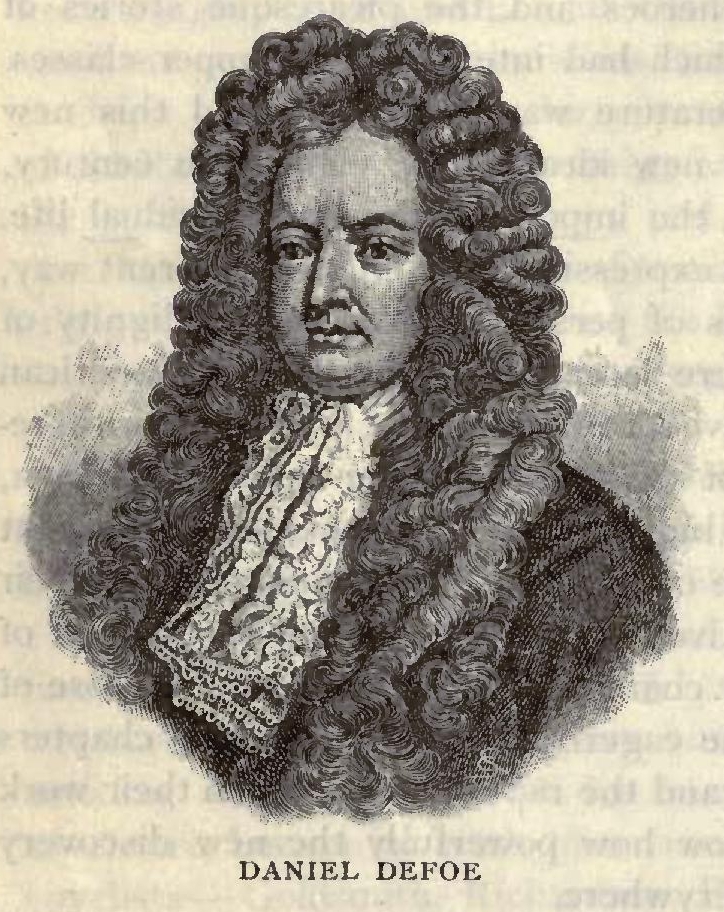
Life. Defoe was the son of a London butcher named Foe, and kept his family name until he was forty years of age, when he added the aristocratic prefix with which we have grown familiar. The events of his busy seventy years of life, in which he passed through all extremes, from poverty to wealth, from prosperous brickmaker to starveling journalist, from Newgate prison to immense popularity and royal favor, are obscure enough in details; but four facts stand out clearly, which help the reader to understand the character of his work. First, Defoe was a jack-at-all-trades, as well as a writer; his interest was largely with the working classes, and notwithstanding many questionable practices, he seems to have had some continued purpose of educating and uplifting the common people. This partially accounts for the enormous popularity of his works, and for the fact that they were criticised by literary men as being "fit only for the kitchen." Second, he was a radical Nonconformist in religion, and was intended by his father for the independent ministry. The Puritan zeal for reform possessed him, and he tried to do by his pen what Wesley was doing by his preaching, without, however, having any great measure of the latter's sincerity or singleness of purpose. This zeal for reform marks all his numerous works, and accounts for the moralizing to be found everywhere. Third, Defoe was a journalist and pamphleteer, with a reporter's eye for the picturesque and a newspaper man's instinct for making a "good story." He wrote an immense number of pamphlets, poems, and magazine articles; conducted several papers,--one of the most popular, the Review, being issued from prison,--and the fact that they often blew hot and cold upon the same question was hardly noticed. Indeed, so extraordinarily interesting and plausible were Defoe's articles that he generally managed to keep employed by the party in power, whether Whig or Tory. This long journalistic career, lasting half a century, accounts for his direct, simple, narrative style, which holds us even now by its intense reality. To Defoe's genius we are also indebted for two discoveries, the "interview" and the leading editorial, both of which are still in daily use in our best newspapers.
The fourth fact to remember is that Defoe knew prison life; and thereby hangs a tale. In 1702 Defoe published a remarkable pamphlet called "The Shortest Way with the Dissenters," supporting the claims of the free churches against the "High Fliers," i.e. Tories and Anglicans. In a vein of grim humor which recalls Swift's "Modest Proposal," Defoe advocated hanging all dissenting ministers, and sending all members of the free churches into exile; and so ferociously realistic was the satire that both Dissenters and Tories took the author literally. Defoe was tried, found guilty of seditious libel, and sentenced to be fined, to stand three days in the pillory, and to be imprisoned. Hardly had the sentence been pronounced when Defoe wrote his "Hymn to the Pillory,"--
Hail hieroglyphic state machine, Contrived to punish fancy in,--
a set of doggerel verses ridiculing his prosecutors, which Defoe, with a keen eye for advertising, scattered all over London. Crowds flocked to cheer him in the pillory; and seeing that Defoe was making popularity out of persecution, his enemies bundled him off to Newgate prison. He turned this experience also to account by publishing a popular newspaper, and by getting acquainted with rogues, pirates, smugglers, and miscellaneous outcasts, each one with a "good story" to be used later. After his release from prison, in 1704, he turned his knowledge of criminals to further account, and entered the government employ as a kind of spy or secret-service agent. His prison experience, and the further knowledge of criminals gained in over twenty years as a spy, accounts for his numerous stories of thieves and pirates, Jonathan Wild and Captain Avery, and also for his later novels, which deal almost exclusively with villains and outcasts.
When Defoe was nearly sixty years of age he turned to fiction and wrote the great work by which he is remembered. Robinson Crusoe was an instant success, and the author became famous all over Europe. Other stories followed rapidly, and Defoe earned money enough to retire to Newington and live in comfort; but not idly, for his activity in producing fiction is rivaled only by that of Walter Scott. Thus, in 1720 appeared Captain Singleton, Duncan Campbell, and Memoirs of a Cavalier; in 1722, Colonel Jack, Moll Flanders, and the amazingly realistic Journal of the Plague Year. So the list grows with astonishing rapidity, ending with the History of the Devil in 1726.
In the latter year Defoe's secret connection with the government became known, and a great howl of indignation rose against him in the public print, destroying in an hour the popularity which he had gained by a lifetime of intrigue and labor. He fled from his home to London, where he died obscurely, in 1731, while hiding from real or imaginary enemies.
Works of Defoe. At the head of the list stands Robinson Crusoe (1719-1720), one of the few books in any literature which has held its popularity undiminished for nearly two centuries. The story is based upon the experiences of Alexander Selkirk, or Selcraig, who had been marooned in the island of Juan Fernandez, off the coast of Chile, and who had lived there in solitude for five years. On his return to England in 1709, Selkirk's experiences became known, and Steele published an account of them in The Englishman, without, however, attracting any wide attention. That Defoe used Selkirk's story is practically certain; but with his usual duplicity he claimed to have written Crusoe in 1708, a year before Selkirk's return. However that may be, the story itself is real enough to have come straight from a sailor's logbook. Defoe, as shown in his Journal of the Plague Year and his Memoirs of a Cavalier, had the art of describing things he had never seen with the accuracy of an eyewitness.
Robinson CrusoeThe charm of the story is its intense reality, in the succession of thoughts, feelings, incidents, which every reader recognizes to be absolutely true to life. At first glance it would seem that one man on a desert island could not possibly furnish the material for a long story; but as we read we realize with amazement that every slightest thought and action--the saving of the cargo of the shipwrecked vessel, the preparation for defense against imaginary foes, the intense agitation over the discovery of a footprint in the sand--is a record of what the reader himself would do and feel if he were alone in such a place. Defoe's long and varied experience now stood him in good stead; in fact, he "was the only man of letters in his time who might have been thrown on a desert island without finding himself at a loss what to do;"[215] and he puts himself so perfectly in his hero's place that he repeats his blunders as well as his triumphs. Thus, what reader ever followed Defoe's hero through weary, feverish months of building a huge boat, which was too big to be launched by one man, without recalling some boy who spent many stormy days in shed or cellar building a boat or dog house, and who, when the thing was painted and finished, found it a foot wider than the door, and had to knock it to pieces? This absolute naturalness characterizes the whole story. It is a study of the human will also,--of patience, fortitude, and the indomitable Saxon spirit overcoming all obstacles; and it was this element which made Rousseau recommend Robinson Crusoe as a better treatise on education than anything which Aristotle or the moderns had ever written. And this suggests the most significant thing about Defoe's masterpiece, namely, that the hero represents the whole of human society, doing with his own hands all the things which, by the division of labor and the demands of modern civilization, are now done by many different workers. He is therefore the type of the whole civilized race of men.
In the remaining works of Defoe, more than two hundred in number, there is an astonishing variety; but all are marked by the same simple, narrative style, and the same intense realism. The best known of these are the Journal of the Plague Year, in which the horrors of a frightful plague are minutely recorded; the Memoirs of a Cavalier, so realistic that Chatham quoted it as history in Parliament; and several picaresque novels, like Captain Singleton, Colonel Jack, Moll Flanders, and Roxana. The last work is by some critics given a very high place in realistic fiction, but like the other three, and like Defoe's minor narratives of Jack Sheppard and Cartouche, it is a disagreeable study of vice, ending with a forced and unnatural repentance.
SAMUEL RICHARDSON (1689-1761)
To Richardson belongs the credit of writing the first modern novel. He was the son of a London joiner, who, for economy's sake, resided in some unknown town in Derbyshire, where Samuel was born in 1689. The boy received very little education, but he had a natural talent for writing letters, and even as a boy we find him frequently employed by working girls to write their love letters for them. This early experience, together with his fondness for the society of "his dearest ladies" rather than of men, gave him that intimate knowledge of the hearts of sentimental and uneducated women which is manifest in all his work. Moreover, he was a keen observer of manners, and his surprisingly accurate descriptions often compel us to listen, even when he is most tedious. At seventeen years of age he went to London and learned the printer's trade, which he followed to the end of his life. When fifty years of age he had a small reputation as a writer of elegant epistles, and this reputation led certain publishers to approach him with a proposal that he write a series of Familiar Letters, which could be used as models by people unused to writing. Richardson gladly accepted the proposal, and had the happy inspiration to make these letters tell the connected story of a girl's life. Defoe had told an adventure story of human life on a desert island, but Richardson would tell the story of a girl's inner life in the midst of English neighbors. That sounds simple enough now, but it marked an epoch in the history of literature. Like every other great and simple discovery, it makes us wonder why some one had not thought of it before.
Richardson's Novels. The result of Richardson's inspiration was Pamela, or Virtue Rewarded, an endless series of letters[216] telling of the trials, tribulations, and the final happy marriage of a too sweet young maiden, published in four volumes extending over the years 1740 and 1741. Its chief fame lies in the fact that it is our first novel in the modern sense. Aside from this important fact, and viewed solely as a novel, it is sentimental, grandiloquent, and wearisome. Its success at the time was enormous, and Richardson began another series of letters (he could tell a story in no other way) which occupied his leisure hours for the next six years. The result was Clarissa, or The History of a Young Lady, published in eight volumes in 1747-1748. This was another, and somewhat better, sentimental novel; and it was received with immense enthusiasm. Of all Richardson's heroines Clarissa is the most human. In her doubts and scruples of conscience, and especially in her bitter grief and humiliation, she is a real woman, in marked contrast with the mechanical hero, Lovelace, who simply illustrates the author's inability to portray a man's character. The dramatic element in this novel is strong, and is increased by means of the letters, which enable the reader to keep close to the characters of the story and to see life from their different view points. Macaulay, who was deeply impressed by Clarissa, is said to have made the remark that, were the novel lost, he could restore almost the whole of it from memory.
Richardson now turned from his middle-class heroines, and in five or six years completed another series of letters, in which he attempted to tell the story of a man and an aristocrat. The result was Sir Charles Grandison (1754), a novel in seven volumes, whose hero was intended to be a model of aristocratic manners and virtues for the middle-class people, who largely constituted the novelist's readers. For Richardson, who began in Pamela with the purpose of teaching his hearers how to write, ended with the deliberate purpose of teaching them how to live; and in most of his work his chief object was, in his own words, to inculcate virtue and good deportment. His novels, therefore, suffer as much from his purpose as from his own limitations. Notwithstanding his tedious moralizing and his other defects, Richardson in these three books gave something entirely new to the literary world, and the world appreciated the gift. This was the story of human life, told from within, and depending for its interest not on incident or adventure, but on its truth to human nature. Reading his work is, on the whole, like examining the antiquated model of a stern-wheel steamer; it is interesting for its undeveloped possibilities rather than for its achievement.