Chapter XI · (continued 2)
Reading edition
After the moderate success of Vanity Fair, Thackeray wrote the three novels of his middle life upon which his fame chiefly rests,--Pendennis in 1850, Henry Esmond in 1852, and The Newcomes in 1855. Dickens's great popular success as a lecturer and dramatic reader had led to a general desire on the part of the public to see and to hear literary men, and Thackeray, to increase his income, gave two remarkable courses of lectures, the first being English Humorists of the Eighteenth Century, and the second The Four Georges,--both courses being delivered with gratifying success in England and especially in America. Dickens, as we have seen, was disappointed in America and vented his displeasure in outrageous criticism; but Thackeray, with his usual good breeding, saw only the best side of his generous entertainers, and in both his public and private utterances emphasized the virtues of the new land, whose restless energy seemed to fascinate him. Unlike Dickens, he had no confidence in himself when he faced an audience, and like most literary men he disliked lecturing, and soon gave it up. In 1860 he became editor of the Cornhill Magazine, which prospered in his hands, and with a comfortable income he seemed just ready to do his best work for the world (which has always believed that he was capable of even better things than he ever wrote) when he died suddenly in 1863. His body lies buried in Kensal Green, and only a bust does honor to his memory in Westminster Abbey.
Henry Esmond Works of Thackeray. The beginner will do well to omit the earlier satires of Thackeray, written while he was struggling to earn a living from the magazines, and open Henry Esmond (1852), his most perfect novel, though not the most widely known and read. The fine historical and literary, flavor of this story is one of its most marked characteristics, and only one who knows something of the history and literature of the eighteenth century can appreciate its value. The hero, Colonel Esmond; relates his own story, carrying the reader through the courts and camps of Queen Anne's reign, and giving the most complete and accurate picture of a past age that has ever appeared in a novel. Thackeray is, as we have said, a realist, and he begins his story by adopting the style and manner of a scholarly gentleman of the period he is describing. He has an extraordinary knowledge of eighteenth-century literature, and he reproduces its style in detail, going so far as to insert in his narrative an alleged essay from the Tatler. And so perfectly is it done that it is impossible to say wherein it differs from the style of Addison and Steele.
Realism of EsmondIn his matter also Thackeray is realistic, reflecting not the pride and pomp of war, which are largely delusions, but its brutality and barbarism, which are all too real; painting generals and leaders, not as the newspaper heroes to whom we are accustomed, but as moved by intrigues, petty jealousies, and selfish ambitions; showing us the great Duke of Marlborough not as the military hero, the idol of war-crazed multitudes, but as without personal honor, and governed by despicable avarice. In a word, Thackeray gives us the "back stairs" view of war, which is, as a rule, totally neglected in our histories. When he deals with the literary men of the period, he uses the same frank realism, showing us Steele and Addison and other leaders, not with halos about their heads, as popular authors, but in slippers and dressing gowns, smoking a pipe in their own rooms, or else growing tipsy and hilarious in the taverns,--just as they appeared in daily life. Both in style and in matter, therefore, Esmond deserves to rank as probably the best historical novel in our language.
The Plot of EsmondThe plot of the story is, like most of Thackeray's plots, very slight, but perfectly suited to the novelist's purpose. The plans of his characters fail; their ideals grow dim; there is a general disappearance of youthful ambitions. There is a love story at the center; but the element of romance, which furnishes the light and music and fragrance of love, is inconspicuous. The hero, after ten years of devotion to a young woman, a paragon of beauty, finally marries her mother, and ends with a few pious observations concerning Heaven's mercy and his own happy lot. Such an ending seems disappointing, almost bizarre, in view of the romantic novels to which we are accustomed; but we must remember that Thackeray's purpose was to paint life as he saw it, and that in life men and things often take a different way from that described in romances. As we grow acquainted with Thackeray's characters, we realize that no other ending was possible to his story, and conclude that his plot, like his style, is perhaps as near perfection as a realistic novelist can ever come.
Vanity FairVanity Fair (1847--1848) is the best known of Thackeray's novels. It was his first great work, and was intended to express his own views of the social life about him, and to protest against the overdrawn heroes of popular novels. He takes for his subject that Vanity Fair to which Christian and Faithful were conducted on their way to the Heavenly City, as recorded in Pilgrim's Progress. In this fair there are many different booths, given over to the sale of "all sorts of vanities," and as we go from one to another we come in contact with "juggling, cheats, games, plays, fools, apes, knaves, rogues, and that of every kind." Evidently this is a picture of one side of social life; but the difference between Bunyan and Thackeray is simply this,--that Bunyan made Vanity Fair a small incident in a long journey, a place through which most of us pass on our way to better things; while Thackeray, describing high society in his own day, makes it a place of long sojourn, wherein his characters spend the greater part of their lives. Thackeray styles this work "a novel without a hero." The whole action of the story, which is without plot or development, revolves about two women,--Amelia, a meek creature of the milk-and-water type, and Becky Sharp, a keen, unprincipled intriguer, who lets nothing stand in the way of her selfish desire to get the most out of the fools who largely constitute society. On the whole, it is the most powerful but not the most wholesome of Thackeray's works.
PendennisIn his second important novel, Pendennis (1849-1850), we have a continuation of the satire on society begun in Vanity Fair. This novel, which the beginner should read after Esmond, is interesting to us for two reasons,--because it reflects more of the details of Thackeray's life than all his other writings, and because it contains one powerfully drawn character who is a perpetual reminder of the danger of selfishness. The hero is "neither angel nor imp," in Thackeray's words, but the typical young man of society, whom he knows thoroughly, and whom he paints exactly as he is,--a careless, good-natured but essentially selfish person, who goes through life intent on his own interests. Pendennis is a profound moral study, and the most powerful arraignment of well-meaning selfishness in our literature, not even excepting George Eliot's Romola, which it suggests.
The NewcomesTwo other novels, The Newcomes (1855) and The Virginians (1859), complete the list of Thackeray's great works of fiction. The former is a sequel to Pendennis, and the latter to Henry Esmond; and both share the general fate of sequels in not being quite equal in power or interest to their predecessors. The Newcomes, however, deserves a very high place,--some critics, indeed, placing it at the head of the author's works. Like all Thackeray's novels, it is a story of human frailty; but here the author's innate gentleness and kindness are seen at their best, and the hero is perhaps the most genuine and lovable of all his characters.
Thackeray's EssaysThackeray is known in English literature as an essayist as well as a novelist. His English Humorists and The Four Georges are among the finest essays of the nineteenth century. In the former especially, Thackeray shows not only a wide knowledge but an extraordinary understanding of his subject. Apparently this nineteenth-century writer knows Addison, Fielding, Swift, Smollett, and other great writers of the past century almost as intimately as one knows his nearest friend; and he gives us the fine flavor of their humor in a way which no other writer, save perhaps Larnb, has ever rivaled.[240] The Four Georges is in a vein of delicate satire, and presents a rather unflattering picture of four of England's rulers and of the courts in which they moved. Both these works are remarkable for their exquisite style, their gentle humor, their keen literary criticisms, and for the intimate knowledge and sympathy which makes the' people of a past age live once more in the written pages.
General Characteristics. In treating of Thackeray's view of life, as reflected in his novels, critics vary greatly, and the following summary must be taken not as a positive judgment but only as an attempt to express the general impression of his works on an uncritical reader. He is first of a realist, who paints life as he sees it. As he says himself, "I have no brains above my eyes; I describe what I see.". His pictures of certain types, notably the weak and vicious elements of society, are accurate and true to life, but they seem to play too large a part in his books, and have perhaps too greatly influenced his general judgment of humanity. An excessive sensibility, or the capacity for fine feelings and emotions, is a marked characteristic of Thackeray, as it is of Dickens and Carlyle. He is easily offended, as they are, by the shams of society; but he cannot find an outlet, as Dickens does, in laughter and tears, and he is too gentle to follow Carlyle in violent denunciations and prophecies. He turns to satire,--influenced, doubtless, by eighteenth-century literature which he knew so well, and in which satire played too large a part.[241] His satire is never personal, like Pope's, or brutal, like Swift's, and is tempered by kindness and humor; but it is used too freely, and generally lays too much emphasis on faults and foibles to be considered a true picture of any large class of English society.
Thackeray as a Moralist Besides being a realist and satirist, Thackeray is essentially a moralist, like Addison, aiming definitely in all his work at producing a moral impression. So much does he revere goodness, and so determined is he that his Pendennis or his Becky Sharp shall be judged at their true value, that he is not content, like Shakespeare, to be simply an artist, to tell an artistic tale and let it speak its own message; he must explain and emphasize the moral significance of his work. There is no need to consult our own conscience over the actions of Thackeray's characters; the beauty of virtue and the ugliness of vice are evident on every page.
His Style Whatever we may think of Thackeray's matter, there is one point in which critics are agreed,--that he is master of a pure and simple English style. Whether his thought be sad or humorous, commonplace or profound, he expresses it perfectly, without effort or affectation. In all his work there is a subtle charm, impossible to describe, which gives the impression that we are listening to a gentleman. And it is the ease, the refinement, the exquisite naturalness of Thackeray's style that furnishes a large part of our pleasure in reading him.
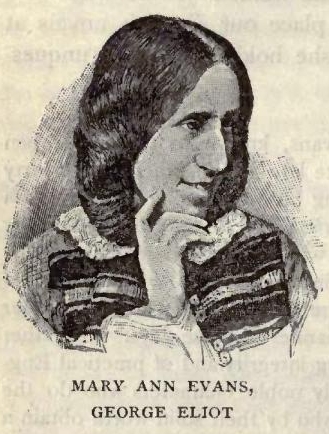
MARY ANN EVANS, GEORGE ELIOT (1819-1880)
In nearly all the writers of the Victorian Age we note, on the one hand, a strong intellectual tendency to analyze the problems of life, and on the other a tendency to teach, that is, to explain to men the method by which these problems may be solved. The novels especially seem to lose sight of the purely artistic ideal of writing, and to aim definitely at moral instruction. In George Eliot both these tendencies reach a climax. She is more obviously, more consciously a preacher and moralizer than any of her great contemporaries. Though profoundly religious at heart, she was largely occupied by the scientific spirit of the age; and finding no religious creed or political system satisfactory, she fell back upon duty as the supreme law of life. All her novels aim, first, to show in individuals the play of universal moral forces, and second, to establish the moral law as the basis of human society. Aside from this moral teaching, we look to George Eliot for the reflection of country life in England, just as we look to Dickens for pictures of the city streets, and to Thackeray for the vanities of society. Of all the women writer's who have helped and are still helping to place our English novels at the head of the world's fiction, she holds at present unquestionably the highest rank.
Life. Mary Ann (or Marian) Evans, known to us by her pen name of George Eliot, began to write late in life, when nearly forty years of age, and attained the leading position among living English novelists in the ten years between 1870 and 1880, after Thackeray and Dickens had passed away. She was born at Arbury Farm, Warwickshire, some twenty miles from Stratford-on-Avon, in 1819. Her parents were plain, honest folk, of the farmer class, who brought her up in the somewhat strict religious manner of those days. Her father seems to have been a man of sterling integrity and of practical English sense,--one of those essentially noble characters who do the world's work silently and well, and who by their solid worth obtain a position of influence among their fellow-men.
A few months after George Eliot's birth the family moved to another home, in the parish of Griff, where her childhood was largely passed. The scenery of the Midland counties and many details of her own family life are reflected in her earlier novels. Thus we find her and her brother, as Maggie and Tom Tulliver, in The Mill on the Floss; her aunt, as Dinah Morris, and her mother, as Mrs. Poyser, in Adam Bede. We have a suggestion of her father in the hero of the latter novel, but the picture is more fully drawn as Caleb Garth, in Middlemarch. For a few years she studied at two private schools for young ladies, at Nuneaton and Coventry; but the death of her mother called her, at seventeen years of age, to take entire charge of the household. Thereafter her education was gained wholly by miscellaneous reading. We have a suggestion of her method in one of her early letters, in which she says: "My mind presents an assemblage of disjointed specimens of history, ancient and modern; scraps of poetry picked up from Shakespeare, Cowper, Wordsworth, and Milton; newspaper topics, morsels of Addison and Bacon, Latin verbs, geometry, entomology, and chemistry; reviews and metaphysics, all arrested and petrified and smothered by the fast-thickening everyday accession of actual events, relative anxieties, and household cares and vexations."

When Mary was twenty-one years old the family again moved, this time to Foleshill Road, near Coventry. Here she became acquainted with the family of Charles Bray, a prosperous ribbon manufacturer, whose house was a gathering place for the freethinkers of the neighborhood. The effect of this liberal atmosphere upon Miss Evans, brought up in a narrow way, with no knowledge of the world, was to unsettle many of her youthful convictions. From a narrow, intense dogmatism, she went to the other extreme of radicalism; then (about 1860) she lost all sympathy with the freethinkers, and, being instinctively religious, seemed to be groping after a definite faith while following the ideal of duty. This spiritual struggle, which suggests that of Carlyle, is undoubtedly the cause of that gloom and depression which hang, like an English fog, over much of her work; though her biographer, Cross, tells us that she was not by any means a sad or gloomy woman.
In 1849 Miss Evans's father died, and the Brays took her abroad for a tour of the continent. On her return to England she wrote several liberal articles for the Westminster Review, and presently was made assistant editor of that magazine. Her residence in London at this time marks a turning point in her career and the real beginning of her literary life. She made strong friendships with Spencer, Mill, and other scientists of the day, and through Spencer met George Henry Lewes, a miscellaneous writer, whom she afterwards married.
Under his sympathetic influence she began to write fiction for the magazines, her first story being "Amos Barton" (1857), which was later included in the Scenes of Clerical Life (1858). Her first long novel, Adam Bede, appeared early in 1859 and met with such popular favor that to the end of her life she despaired of ever again repeating her triumph. But the unexpected success proved to be an inspiration, and she completed The Mill on the Floss and began Silas Marner during the following year. Not until the great success of these works led to an insistent demand to know the author did the English public learn that it was a woman, and not an English clergyman, as they supposed, who had suddenly jumped to the front rank of living writers.
Up to this point George Eliot had confined herself to English country life, but now she suddenly abandoned the scenes and the people with whom she was most familiar in order to write an historical novel. It was in 1860, while traveling in Italy, that she formed "the great project" of Romola,--a mingling of fiction and moral philosophy, against the background of the mighty Renaissance movement. In this she was writing of things of which she had no personal knowledge, and the book cost her many months of hard and depressing labor. She said herself that she was a young woman when she began the work, and an old woman when she finished it. Romola (1862--1863) was not successful with the public, and the same may be said of Felix Holt the Radical (1866) and The Spanish Gypsy (1868). The last-named work was the result of the author's ambition to write a dramatic poem which should duplicate the lesson of Romola; and for the purpose of gathering material she visited Spain, which she had decided upon as the scene of her poetical effort. With the publication of Middlemarch (1871-1872) George Eliot came back again into popular favor, though this work is less spontaneous, and more labored and pedantic, than her earlier novels. The fault of too much analysis and moralizing was even more conspicuous in Daniei Deronda (1876), which she regarded as her greatest book. Her life during all this time was singularly uneventful, and the chief milestones along the road mark the publication of her successive novels.
During all the years of her literary success her husband Lewes had been a most sympathetic friend and critic, and when he died, in 1878, the loss seemed to be more than she could bear. Her letters of this period are touching in their loneliness and their craving for sympathy. Later she astonished everybody by marrying John Walter Cross, much younger than herself, who is known as her biographer. "Deep down below there is a river of sadness, but ... I am able to enjoy my newly re-opened life," writes this woman of sixty, who, ever since she was the girl whom we know as Maggie Tulliver, must always have some one to love and to depend upon. Her new interest in life lasted but a few months, for she died in December of the same year (1880). One of the best indications of her strength and her limitations is her portrait, with its strong masculine features, suggesting both by resemblance and by contrast that wonderful portrait of Savonarola which hangs over his old desk in the monastery at Florence.
Works of George Eliot. These are conveniently divided into three groups, corresponding to the three periods of her life. The first group includes all her early essays and miscellaneous work, from her translation of Strauss's Leben Jesu, in 1846, to her union with Lewes in 1854. The second group includes Scenes of Clerical Life, Adam Bede, Mill on the Floss, and Silas Marner, all published between 1858 and 1861. These four novels of the middle period are founded on the author's own life and experience; their scenes are laid in the country, and their characters are taken from the stolid people of the Midlands, with whom George Eliot had been familiar since childhood. They are probably the author's most enduring works. They have a naturalness, a spontaneity, at times a flash of real humor, which are lacking in her later novels; and they show a rapid development of literary power which reaches a climax in Silas Marner.
The novel of Italian life, Romola (1862-1863), marks a transition to the third group, which includes three more novels,--Felix Holt (1866), Middlemarch (1871-1872), Daniel Deronda (1876), the ambitious dramatic poem The Spanish Gypsy (1868), and a collection of miscellaneous essays called The Impressions of Theophrastus Such (1879). The general impression, of these works is not so favorable as that produced by the novels of the middle period. They are more labored and less interesting; they contain much deep reflection and analysis of character, but less observation, less delight in picturing country life as it is, and very little of what we call inspiration. We must add, however, that this does not express a unanimous literary judgment, for critics are not wanting who assert that Daniel Deronda is the highest expression of the author's genius.
General CharacterThe general character of all these novels may be described, in the author's own term, as psychologic realism. This means that George Eliot sought to do in her novels what Browning attempted in his poetry; that is, to represent the inner struggle of a soul, and to reveal the motives, impulses, and hereditary influences which govern human action. Browning generally stops when he tells his story, and either lets you draw your own conclusion or else gives you his in a few striking lines. But George Eliot is not content until she has minutely explained the motives of her characters and the moral lesson to be learned from them. Moreover, it is the development of a soul, the slow growth or decline of moral power, which chiefly interests her. Her heroes and heroines differ radically from those of Dickens and Thackeray in this respect,--that when we meet the men and women of the latter novelists, their characters are already formed, and we are reasonably sure what they will do under given circumstances. In George Eliot's novels the characters develop gradually as we come to know them. They go from weakness to strength, or from strength to weakness, according to the works that they do and the thoughts that they cherish. In Romola, for instance, Tito, as we first meet him, may be either good or bad, and we know not whether he will finally turn to the right hand or to the left. As time passes, we see him degenerate steadily because he follows his selfish impulses, while Romola, whose character is at first only faintly indicated, grows into beauty and strength with every act of self-renunciation.
Moral TeachingIn these two characters, Tito and Romola, we have an epitome of our author's moral teaching. The principle of law was in the air during the Victorian era, and we have already noted how deeply Tennyson was influenced by it. With George Eliot law is like fate; it overwhelms personal freedom and inclination. Moral law was to her as inevitable, as automatic, as gravitation. Tito's degeneration, and the sad failure of Dorothea and Lydgate in Middlemarch, may be explained as simply as the fall of an apple, or as a bruised knee when a man loses his balance. A certain act produces a definite moral effect on the individual; and character is the added sum of all, the acts of a man's; life,--just as the weight of a body is the sum of the weights of many different atoms which constitute it. The matter of rewards and punishments, therefore, needs no final judge or judgment, since these things take care of themselves automatically in a world of inviolable moral law.
Perhaps one thing more should be added to the general characteristics of George Eliot's novels,--they are all rather depressing. The gladsomeness of life, the sunshine of smiles and laughter, is denied her. It is said that once, when her husband remarked that her novels were all essentially sad, she wept, and answered that she must describe life as she had found it.
What to Read. George Eliot's first stories are in some respects her best, though her literary power increases during her second period, culminating in Silas Marner, and her psychological analysis is more evident in Daniel Deronda. On the whole, it is an excellent way to begin with the freshness and inspiration of the Scenes of Clerical Life and read her books in the order in which they were written. In the first group of novels Adam Bede is the most natural, and probably interests more readers than all the others combined. The Mill on the Floss has a larger personal interest, because it reflects much of George Eliot's history and the scenes and the friends of her early life. The lack of proportion in this story, which gives rather too much space to the girl-and-boy experiences, is naturally explained by the tendency in every man and woman to linger over early memories.
Silas MarnerSilas Marner is artistically the most perfect of George Eliot's novels, and we venture to analyze it as typical of her ideals and methods. We note first the style, which is heavy and a little self-conscious, lacking the vigor and picturesqueness of Dickens, and the grace and naturalness of Thackeray. The characters are the common people of the Midlands, the hero being a linen weaver, a lonely outcast who hoards and gloats over his hard-earned money, is robbed, thrown into utter despair, and brought back to life and happiness by the coming of an abandoned child to his fire. In the development of her story the author shows herself, first, a realist, by the naturalness of her characters and the minute accuracy with which she reproduces their ways and even the accents of their speech; second, a psychologist, by the continual analysis and explanation of motives; third, a moralist, by showing in each individual the action and reaction of universal moral forces, and especially by making every evil act bring inevitable punishment to the man who does it. Tragedy, therefore, plays a large part in the story; for, according to George Eliot, tragedy and suffering walk close behind us, or lurk at every turn in the road of life. Like all her novels, Silas Marner is depressing. We turn away from even the wedding of Eppie--which is just as it should be--with a sense of sadness and incompleteness. Finally, as we close the book, we are conscious of a powerful and enduring impression of reality. Silas, the poor weaver; Godfrey Cass, the well-meaning, selfish man; Mr. Macey, the garrulous, and observant parish clerk; Dolly Winthrop, the kind-hearted countrywoman who cannot understand the mysteries of religion and so interprets God in terms of human love,--these are real people, whom having once met we can never forget.
RomolaRomola has the same general moral theme as the English novels; but the scenes are entirely different, and opinion is divided as to the comparative merit of the work. It is a study, a very profound study of moral development in one character and of moral degeneracy in another. Its characters and its scenes are both Italian, and the action takes place during a critical period of the Renaissance movement, when Savonarola was at the height of his power in Florence. Here is a magnificent theme and a superb background for a great novel, and George Eliot read and studied till she felt sure that she understood the place, the time, and the people of her story. Romola is therefore interesting reading, in many respects the most interesting of her works. It has been called one of our greatest historical novels; but as such it has one grievous fault. It is not quite true to the people or even to the locality which it endeavors to represent. One who reads it here, in a new and different land, thinks only of the story and of the novelist's power; but one who reads it on the spot which it describes, and amidst the life which it pictures, is continually haunted by the suggestion that George Eliot understood neither Italy nor the Italians. It is this lack of harmony with Italian life itself which caused Morris and Rossetti and even Browning, with all his admiration for the author, to lay aside the book, unable to read it with pleasure or profit. In a word, Romola is a great moral study and a very interesting book; but the characters are not Italian, and the novel as a whole lacks the strong reality which marks George Eliot's English studies.
MINOR NOVELISTS OF THE VICTORIAN AGE
In the three great novelists just considered we have an epitome of the fiction of the age, Dickens using the novel to solve social problems, Thackeray to paint the life of society as he saw it, and George Eliot to teach the fundamental principles of morality. The influence of these three writers is reflected in all the minor novelists of the Victorian Age. Thus, Dickens is reflected in Charles Reade, Thackeray in Anthony Trollope and the Brontë sisters, and George Eliot's psychology finds artistic expression in George Meredith. To these social and moral and realistic studies we should add the element of romance, from which few of our modern novelist's can long escape. The nineteenth century, which began with the romanticism of Walter Scott, returns to its first love, like a man glad to be home, in its delight over Blackmore's Lorna Doone and the romances of Robert Louis Stevenson.
Charles Reade. In his fondness for stage effects, for picturing the romantic side of common life, and for using the novel as the instrument of social reform, there is a strong suggestion of Dickens in the work of Charles Reade (1814-1884). Thus his Peg Woffington is a study of stage life from behind the scenes; A Terrible Temptation is a study of social reforms and reformers; and Put yourself in his Place is the picture of a workingman who struggles against the injustice of the trades unions. His masterpiece, The Cloister and the Hearth (1861), one of our best historical novels, is a somewhat laborious study of student and vagabond life in Europe in the days of the German Renaissance. It has small resemblance to George Eliot's Romola, whose scene is laid in Italy during the same period; but the two works may well be read in succession, as the efforts of two very different novelists of the same period to restore the life of an age long past.
Anthony Trollope. In his realism, and especially in his conception of the novel as the entertainment of an idle hour, Trollope (1815-1882) is a reflection of Thackeray. It would be hard to find a better duplicate of Becky Sharp, the heroine of Vanity Fair, for instance, than is found in Lizzie Eustace, the heroine of The Eustace Diamonds. Trollope was the most industrious and systematic of modern novelists, writing a definite amount each day, and the wide range of his characters suggests the Human Comedy of Balzac. His masterpiece is Barchester Towers (1857). This is a study of life in a cathedral town, and is remarkable for its minute pictures of bishops and clergymen, with their families and dependents. It would be well to read this novel in connection with The Warden (1855), The Last Chronicle of Barset (1867), and other novels of the same series, since the scenes and characters are the same in all these books, and they are undoubtedly the best expression of the author's genius. Hawthorne says of his novels: "They precisely suit my taste,--solid and substantial, and ... just as real as if some giant had hewn a great lump out of the earth and put it under a glass case, with all the inhabitants going about their daily business and not suspecting that they were being made a show of."
Charlotte Brontë. We have another suggestion of Thackeray in the work of Charlotte Brontë (1816-1855). She aimed to make her novels a realistic picture of society, but she added to Thackeray's realism the element of passionate and somewhat unbalanced romanticism. The latter element was partly the expression of Miss Brontë's own nature, and partly the result of her lonely and grief-stricken life, which was darkened by a succession of family tragedies. It will help us to understand her work if we remember that both Charlotte Brontë and her sister Emily[242] turned to literature because they found their work as governess and teacher unendurable, and sought to relieve the loneliness and sadness of their own lot by creating a new world of the imagination. In this new world, however, the sadness of the old remains, and all the Brontë novels have behind them an aching heart. Charlotte Brontë's best known work is Jane Eyre (1847), which, with all its faults, is a powerful and fascinating study of elemental love and hate, reminding us vaguely of one of Marlowe's tragedies. This work won instant favor with the public, and the author was placed in the front rank of living novelists. Aside from its value as a novel, it is interesting, in many of its early passages, as the reflection of the author's own life and experience. Shirley (1849) and Villette (1853) make up the trio of novels by which this gifted woman is generally remembered.
Bulwer Lytton. Edward Bulwer Lytton (1803-1873) was an extremely versatile writer, who tried almost every kind of novel known to the nineteenth century. In his early life he wrote poems and dramas, under the influence of Byron; but his first notable work, Pelham (1828), one of the best of his novels, was a kind of burlesque on the Byronic type of gentleman. As a study of contemporary manners in high society, Pelham has a suggestion of Thackeray, and the resemblance is more noticeable in other novels of the same type, such as Ernest Maltravers (1837), The Caxtons (1848-1849), My Novel (1853), and Kenelm Chillingly (1873). We have a suggestion of Dickens in at least two of Lytton's novels, Paul Clifford and Eugene Aram, the heroes of which are criminals, pictured as the victims rather than as the oppressors of society. Lytton essayed also, with considerable popular success, the romantic novel in The Pilgrims of the Rhine and Zanoni, and tried the ghost story in The Haunted and the Haunters. His fame at the present day rests largely upon his historical novels, in imitation of Walter Scott, The Last Days of Pompeii (1834), Riettza (1835), and Harold (1848), the last being his most ambitious attempt to make the novel the supplement of history. In all his novels Lytton is inclined to sentimentalism and sensationalism, and his works, though generally interesting, seem hardly worthy of a high place in the history of fiction.
Kingsley. Entirely different in spirit are the novels of the scholarly clergyman, Charles Kingsley (1819-1875). His works naturally divide themselves into three classes. In the first are his social studies and problem novels, such as Alton Locke (1850), having for its hero a London tailor and poet, and Yeast (1848), which deals with the problem of the agricultural laborer. In the second class are his historical novels, Hereward the Wake, Hypatia, and Westward Ho! Hypatia is a dramatic story of Christianity in contact with paganism, having its scene laid in Alexandria at the beginning of the fifth century. Westward Ho! (1855), his best known work, is a stirring tale of English conquest by land and sea in the days of Elizabeth. In the third class are his various miscellaneous works, not the least of which is Water-Babies, a fascinating story of a chimney sweep, which mothers read to their children at bedtime,--to the great delight of the round-eyed little listeners under the counterpane.
Mrs. Gaskell. Mrs. Elizabeth Gaskell (1810-1865) began, like Kingsley, with the idea of making the novel the instrument of social reform. As the wife of a clergyman in Manchester, she had come in close contact with the struggles and ideals of the industrial poor of a great city, and she reflected her sympathy as well as her observation in Mary Barton (1848) and in North and South (1855). Between these two problem novels she published her masterpiece, Cranford, in 1853. The original of this country village, which is given over to spinsters, is undoubtedly Knutsford, in Cheshire, where Mrs. Gaskell had spent her childhood. The sympathy, the keen observation, and the gentle humor with which the small affairs of a country village are described make Cranford one of the most delightful stories in the English language. We are indebted to Mrs. Gaskell also for the Life of Charlotte Brontë, which is one of our best biographies.
Blackmore. Richard Doddridge Blackrhore (1825--1900) was a prolific writer, but he owes his fame almost entirely to one splendid novel, Lorna Doone, which was published in 1869. The scene of this fascinating romance is laid in Exmoor in the seventeenth century. The story abounds in romantic scenes and incidents; its descriptions of natural scenery are unsurpassed; the rhythmic language is at times almost equal to poetry; and the whole tone of the book is wholesome and refreshing. Altogether it would be hard to find a more delightful romance in any language, and it well deserves the place it has won as one of the classics of our literature. Other works of Blackmore which will repay the reader are Clara Vaughan (1864), his first novel, The Maid of Sker (1872), Springhaven (1887), Perlycross (1894), and Tales from the Telling House (1896); but none of these, though he counted them his best work, has met with the same favor as Lorna Doone.
Meredith. So much does George Meredith (1828-1909) belong to our own day that it is difficult to think of him as one of the Victorian novelists. His first notable work, The Ordeal of Richard Feverel, was published in 1859, the same year as George Eliot's Adam Bede; but it was not till the publication of Diana of the Crossways in 1885, that his power as a novelist was widely recognized. He resembles Browning not only in his condensed style, packed with thought, but also in this respect,--that he labored for years in obscurity, and after much of his best work was published and apparently forgotten he slowly won the leading place in English fiction. We are still too near him to speak of the permanence of his work, but a casual reading of any of his novels suggests a comparison and a contrast with George Eliot. Like her, he is a realist and a psychologist; but while George Eliot uses tragedy to teach a moral lesson, Meredith depends more upon comedy, making vice not terrible but ridiculous. For the hero or heroine of her novel George Eliot invariably takes an individual, and shows in each one the play of universal moral forces. Meredith constructs a type-man as a hero, and makes this type express his purpose and meaning. So his characters seldom speak naturally, as George Eliot's do; they are more like Browning's characters in packing a whole paragraph into a single sentence or an exclamation. On account of his enigmatic style and his psychology, Meredith will never be popular; but by thoughtful men and women he will probably be ranked among our greatest writers of fiction. The simplest and easiest of his novels for a beginner is The Adventures of Henry Richmond (1871). Among the best of his works, besides the two mentioned above, are Beauchamp's Career (1876) and The Egoist (1879). The latter is, in our personal judgment, one of the strongest and most convincing novels of the Victorian Age.
Hardy. Thomas Hardy (1840-) seems, like Meredith, to belong to the present rather than to a past age, and an interesting comparison may be drawn between these two novelists. In style, Meredith is obscure and difficult, while Hardy is direct and simple, aiming at realism in all things. Meredith makes man the most important phenomenon in the universe; and the struggles of men are brightened by the hope of victory. Hardy makes man an insignificant part of the world, struggling against powers greater than himself,--sometimes against systems which he cannot reach or influence, sometimes against a kind of grim world-spirit who delights in making human affairs go wrong. He is, therefore, hardly a realist, but rather a man blinded by pessimism; and his novels, though generally powerful and sometimes fascinating, are not pleasant or wholesome reading. From the reader's view point some of his earlier works, like the idyllic love story Under the Greenwood Tree (1872) and A Pair of Blue Eyes (1873), are the most interesting. Hardy became noted, however, when he published Far from the Madding Crowd, a book which, when it appeared anonymously in the Cornhill Magazine (1874), was generally attributed to George Eliot, for the simple reason that no other novelist was supposed to be capable of writing it. The Return of the Native (1878) and The Woodlanders are generally regarded as Hardy's masterpieces; but two novels of our own day, Tess of the D'Ubervilles (1891) and Jude the Obscure (1895), are better expressions of Hardy's literary art and of his gloomy philosophy.
Stevenson. In pleasing contrast with Hardy is Robert Louis Stevenson (1850-1894), a brave, cheery, wholesome spirit, who has made us all braver and cheerier by what he has written. Aside from their intrinsic value, Stevenson's novels are interesting in this respect,--that they mark a return to the pure romanticism of Walter Scott. The novel of the nineteenth century had, as we have shown, a very definite purpose. It aimed not only to represent life but to correct it, and to offer a solution to pressing moral and social problems. At the end of the century Hardy's gloom in the face of modern social conditions became oppressive, and Stevenson broke away from it into that land of delightful romance in which youth finds an answer to all its questions. Problems differ, but youth is ever the same, and therefore Stevenson will probably be regarded by future generations as one of our most enduring writers. To his life, with its "heroically happy" struggle, first against poverty, then against physical illness, it is impossible to do justice in a short article. Even a longer biography is inadequate, for Stevenson's spirit, not the incidents of his life, is the important thing; and the spirit has no biographer. Though he had written much better work earlier, he first gained fame by his Treasure Island (1883), an absorbing story of pirates and of a hunt for buried gold. Dr. Jekyll and Mr. Hyde (1886) is a profound ethical parable, in which, however, Stevenson leaves the psychology and the minute analysis of character to his readers, and makes the story the chief thing in his novel. Kidnapped (1886), The Master of Ballantrae (1889), and David Balfour (1893) are novels of adventure, giving us vivid pictures of Scotch life. Two romances left unfinished by his early death in Samoa are The Weir of Hermiston and St. Ives. The latter was finished by Quiller-Couch in 1897; the former is happily just as Stevenson left it, and though unfinished is generally regarded as his masterpiece. In addition to these novels, Stevenson wrote a large number of essays, the best of which are collected in Virginibus Puerisque, Familiar Studies of Men and Books, and Memories and Portraits. Delightful sketches of his travels are found in An Inland Voyage (1878), Travels with a Donkey (1879), Across the Plains (1892), and The Amateur Emigrant (1894). Underwoods (1887) is an exquisite little volume of poetry, and A Child's Garden of Verses is one of the books that mothers will always keep to read to their children.
In all his books Stevenson gives the impression of a man at play rather than at work, and the reader soon shares in the happy spirit of the author. Because of his beautiful personality, and because of the love and admiration he awakened for himself in multitudes of readers, we are naturally inclined to exaggerate his importance as a writer. However that may be, a study of his works shows him to be a consummate literary artist. His style is always simple, often perfect, and both in his manner and in his matter he exercises a profound influence, on the writers of the present generation.
III. ESSAYISTS OF THE VICTORIAN AGE
THOMAS BABINGTON MACAULAY (1800-1859)
Macaulay is one of the most typical figures of the nineteenth century. Though not a great writer, if we compare him with Browning or Thackeray, he was more closely associated than any of his literary contemporaries with the social and political struggles of the age. While Carlyle was proclaiming the gospel of labor, and Dickens writing novels to better the condition of the poor, Macaulay went vigorously to work on what he thought to be the most important task of the hour, and by his brilliant speeches did perhaps more than any other single man to force the passage of the famous Reform Bill. Like many of the Elizabethans, he was a practical man of affairs rather than a literary man, and though we miss in his writings the imagination and the spiritual insight which stamp the literary genius, we have the impression always of a keen, practical, honest mind, which looks at present problems in the light of past experience. Moreover, the man himself, with his marvelous mind, his happy spirit, and his absolute integrity of character, is an inspiration to better living.
Life. Macaulay was born at Rothley Temple, Leicestershire, in 1800. His father, of Scotch descent, was at one time governor of the Sierra Leone colony for liberated negroes, and devoted a large part of his life to the abolition of the slave trade. His mother, of Quaker parentage, was a brilliant, sensitive woman, whose character is reflected in that of her son. The influence of these two, and the son's loyal devotion to his family, can best be read in Trevelyan's interesting biography.
As a child, Macaulay is strongly suggestive of Coleridge. At three years of age he began to read eagerly; at five he "talked like a book"; at ten he had written a compendium of universal history, besides various hymns, verse romances, arguments for Christianity, and one ambitious epic poem. The habit of rapid reading, begun in childhood, continued throughout his life, and the number and vari ety of books which he read is almost incredible. His memory was phenomenal. He could repeat long poems and essays after a single reading; he could quote not only passages but the greater part of many books, including Pilgrim's Progress, Paradise Lost, and various novels like Clarissa. Once, to test his memory, he recited two newspaper poems which he had read in a coffeehouse forty years before, and which he had never thought of in the interval.
At twelve years of age this remarkable boy was sent to a private school at Little Shelford, and at eighteen he eqgered Trinity College, Cambridge. Here he made a reputation as a classical scholar and a brilliant talker, but made a failure of his mathematics. In a letter to his mother he wrote: "Oh for words to express my abomination of that science.... Discipline of the mind! Say rather starvation, confinement, torture, annihilation!" We quote this as a commentary on Macaulay's later writings, which are frequently lacking in the exactness and the logical sequence of the science which he detested.
After his college course Macaulay studied law, was admitted to the bar, devoted himself largely to politics, entered Parliament in 1830, and almost immediately won a reputation as the best debater and the most eloquent speaker, of the Liberal or Whig party. Gladstone says of him: "Whenever he arose to speak it was a summons like a trumpet call to fill the benches." At the time of his election he was poor, and the loss of his father's property threw upon him the support of his brothers and sisters; but he took up the burden with cheerful courage, and by his own efforts soon placed himself and his family in comfort. His political progress was rapid, and was due not to favoritism or intrigue, but to his ability, his hard work, and his sterling character. He was several times elected to Parliament, was legal adviser to the Supreme Council of India, was a member of the cabinet, and declined many offices for which other men labor a lifetime. In 1857 his great ability and services to his country were recognized by his being raised to the peerage with the title of Baron Macaulay of Rothley.
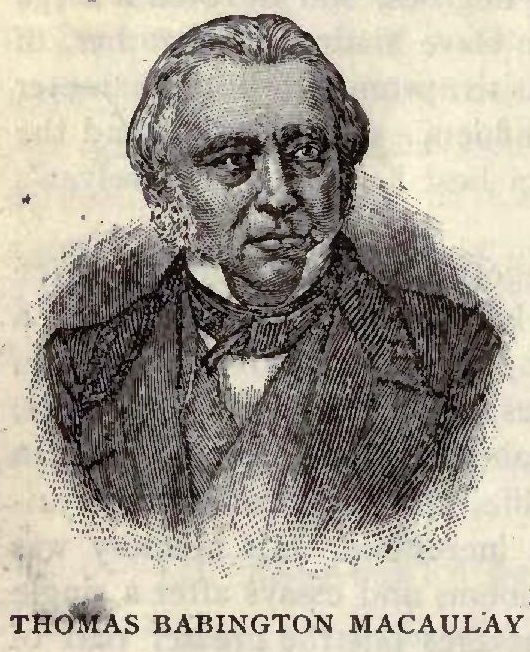
THOMAS BABINGTON MACAULAY
Macaulay's literary work began in college with the contribution of various ballads and essays to the magazines. In his later life practical affairs claimed the greater part of his time, and his brilliant essays were written in the early morning or late at night. His famous Essay on Milton appeared in the Edinburgh Review in 1825. It created a sensation, and Macaulay, having gained the ear of the public, never once lost it during the twenty years in which he was a contributor to the magazines. His Lays of Ancient Rome appeared in 1842, and in the following year three volumes of his collected Essays. In 1847 he lost his seat in Parliament, temporarily, through his zealous efforts in behalf of religious toleration; and the loss was most fortunate, since it gave him opportunity to begin his History of England,--a monumental work which he had been planning for many years. The first two volumes appeared in 1848, and their success can be compared only to that of the most popular novels. The third and fourth volumes of the History (1855) were even more successful, and Macaulay was hard at work on the remaining volumes when he died, quite suddenly, in 1859. He was buried, near Addison, in the Poets' Corner of Westminster Abbey. A paragraph from one of his letters, written at the height of his fame and influence, may give us an insight into his life and work:
I can truly say that I have not, for many years, been so happy as I am at present.... I am free. I am independent. I am in Parliament, as honorably seated as man can be. My family is comfortably off. I have leisure for literature, yet I am not reduced to the necessity of writing for money. If I had to choose a lot from all that there are in human life, I am not sure that I should prefer any to that which has fallen to me. I am sincerely and thoroughly contented.
Essay on MiltonWorks of Macaulay. Macaulay is famous in literature for his essays, for his martial ballads, and for his History of England. His first important work, the Essay on Milton (1825), is worthy of study not only for itself, as a critical estimate of the Puritan poet, but as a key to all Macaulay's writings. Here, first of all, is an interesting work, which, however much we differ from the author's opinion, holds our attention and generally makes us regret that the end comes so soon. The second thing to note is the historical flavor of the essay. We study not only Milton, but also the times in which he lived, and the great movements of which he was a part. History and literature properly belong together, and Macaulay was one of the first writers to explain the historical conditions which partly account for a writer's work and influence. The third thing to note is Macaulay's enthusiasm for his subject,--an enthusiasm which is often partisan, but which we gladly share for the moment as we follow the breathless narrative. Macaulay generally makes a hero of his man, shows him battling against odds, and the heroic side of our own nature awakens and responds to the author's plea. The fourth, and perhaps most characteristic thing in the essay is the style, which is remarkably clear, forceful, and convincing. Jeffrey, the editor of the Edinburgh Review, wrote enthusiastically when he received the manuscript, "The more I think, the less I can conceive where you picked up that style." We still share in the editor's wonder; but the more we think, the less we conceive that such a style could be picked up. It was partly the result of a well-stored mind, partly of unconscious imitation of other writers, and partly of that natural talent for clear speaking and writing which is manifest in all Macaulay's work.
Other EssaysIn the remaining essays we find the same general qualities which characterize Macaulay's first attempt. They cover a wide range of subjects, but they may be divided into two general classes, the literary or critical, and the historical. Of the literary essays the best are those on Milton, Addison, Goldsmith, Byron, Dryden, Leigh Hunt, Bunyan, Bacon, and Johnson. Among the best known of the historical essays are those on Lord Clive, Chatham, Warren Hastings, Hallam's Constitutional History, Von Ranke's History of the Papacy, Frederick the Great, Horace Walpole, William Pitt, Sir William Temple, Machiavelli, and Mirabeau. Most of these were produced in the vigor of young manhood, between 1825 and 1845, while the writer was busy with practical affairs of state. They are often one-sided and inaccurate, but always interesting, and from them a large number of busy people have derived their first knowledge of history and literature.
Lays of Ancient RomeThe best of Macaulay's poetical work is found in the Lays of Ancient Rome (1842), a collection of ballads in the style of Scott, which sing of the old heroic days of the Rome Roman republic. The ballad does not require much thought or emotion. It demands clearness, vigor, enthusiasm, action; and it suited Macaulay's genius perfectly. He was, however, much more careful than other ballad writers in making his narrative true to tradition. The stirring martial spirit of these ballads, their fine workmanship, and their appeal to courage and patriotism made them instantly popular. Even to-day, after more than fifty years, such ballads as those on Virginius and Horatius at the Bridge are favorite pieces in many school readers.
History of EnglandThe History of England, Macaulay's masterpiece, is still one of the most popular historical works in the English language. Originally it was intended to cover the period from the accession of James II, in 1685, to the death of George IV, in 1830. Only five volumes of the work were finished, and so thoroughly did Macaulay go into details that these five volumes cover only sixteen years. It has been estimated that to complete the work on the same scale would require some fifty volumes and the labor of one man for over a century.
In his historical method Macaulay suggests Gibbon. His own knowledge of history was very great, but before writing he read numberless pages, consulted original documents, and visited the scenes which he intended to describe. Thackeray's remark, that "Macaulay reads twenty books to write a sentence and travels one hundred miles to make a line of description," is, in view of his industry, a well-warranted exaggeration.
As in his literary essays, he is fond of making heroes, and he throws himself so heartily into the spirit of the scene he is describing that his word pictures almost startle us by their vivid reality. The story of Monmouth's rebellion, for instance, or the trial of the seven bishops, is as fascinating as the best chapters of Scott's historical novels.
While Macaulay's search for original sources of information suggests the scientific historian, his use of his material is much more like that of a novelist or playwright. In his essay on Machiavelli he writes: "The best portraits are perhaps those in which there is a slight mixture of caricature, and we are not certain that the best histories are not those in which a little of the exaggeration of fictitious narrative is judiciously employed. Something is lost in accuracy, but much is gained in effect."[243] Whether this estimate of historical writing be true or false, Macaulay employed it in his own work and made his narrative as absorbing as a novel. To all his characters he gives the reality of flesh and blood, and in his own words he "shows us over their houses and seats us at their tables." All that is excellent, but it has its disadvantages. In his admiration for heroism, Macaulay makes some of his characters too good and others too bad. In his zeal for details he misses the importance of great movements, and of great leaders who are accustomed to ignore details; and in his joy of describing events he often loses sight of underlying causes. In a word, he is without historical insight, and his work, though fascinating, is seldom placed among the reliable histories of England.
General Characteristics. To the reader who studies Macaulay's brilliant essays and a few chosen chapters of his History, three things soon become manifest. First, Macaulay's art is that of a public speaker rather than that of a literary man. He has a wonderful command of language, and he makes his meaning clear by striking phrases, vigorous antitheses, anecdotes, and illustrations. His style is so clear that "he who runs may read," and from beginning to end he never loses the attention of his readers. Second, Macaulay's good spirits and enthusiasm are contagious. As he said himself, he wrote "out of a full head," chiefly for his own pleasure or recreation; and one who writes joyously generally awakens a sense of pleasure in his readers. Third, Macaulay has "the defect of his qualities." He reads and remembers so much that he has no time to think or to form settled opinions. As Gladstone said, Macaulay is "always conversing or recollecting or reading or composing, but reflecting never." So he wrote his brilliant Essay on Milton, which took all England by storm, and said of it afterward that it contained "scarcely a paragraph which his mature judgment approved." Whether he speaks or writes, he has always before him an eager audience, and he feels within him the born orator's power to hold and fascinate. So he gives loose rein to his enthusiasm, quotes from a hundred books, and in his delight at entertaining us forgets that the first quality of a critical or historical work is to be accurate, and the second to be interesting.
THOMAS CARLYLE (1795-1881)
In marked contrast with Macaulay, the brilliant and cheerful essayist, is Thomas Carlyle, the prophet and censor of the nineteenth century. Macaulay is the practical man of affairs, helping and rejoicing in the progress of his beloved England. Carlyle lives apart from all practical interests, looks with distrust on the progress of his age, and tells men that truth, justice, and immortality are the only worthy objects of human endeavor. Macaulay is delighted with material comforts; he is most at home in brilliant and fashionable company; and he writes, even when ill and suffering, with unfailing hopefulness and good nature. Carlyle is like a Hebrew prophet just in from the desert, and the burden of his message is, "Woe to them that are at ease in Zion!" Both men are, in different ways, typical of the century, and somewhere between the two extremes--the practical, helpful activity of Macaulay and the spiritual agony and conflict of Carlyle--we shall find the measure of an age which has left the deepest impress upon our own.
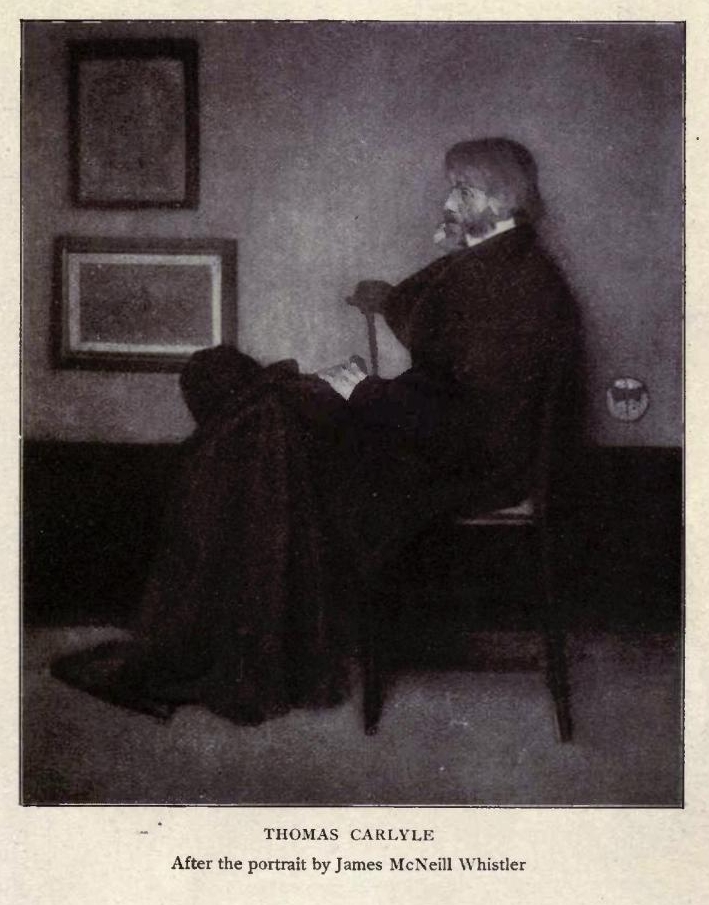
Life of Carlyle. Carlyle was born at Ecclefechan, Dumfriesshire, in 1795, a few months before Burns's death, and before Scott had published his first work. Like Burns, he came of peasant stock,--strong, simple, God-fearing folk, whose influence in Carlyle's later life is beyond calculation. Of his mother he says, "She was too mild and peaceful for the planet she lived in"; and of his father, a stone mason, he writes, "Could I write my books as he built his houses, walk my way so manfully through this shadow world, and leave it with so little blame, it were more than all my hopes."
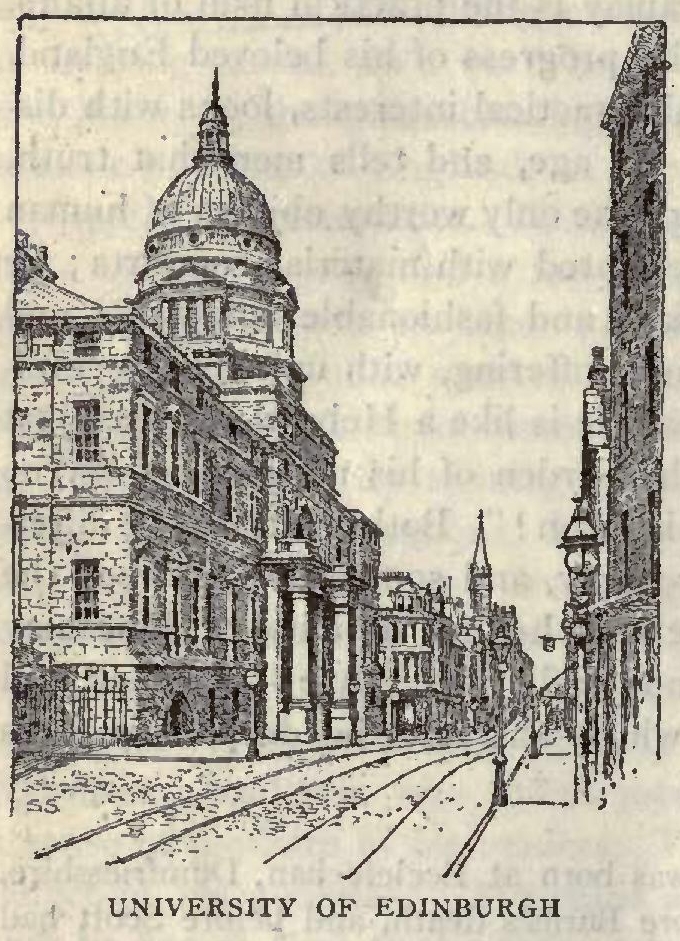
Of Carlyle's early school life we have some interesting glimpses in Sartor Resartus. At nine years he entered the Annan grammar school, where he was bullied by the older boys, who nicknamed him Tom the Tearful. For the teachers of those days he has only ridicule, calling them "hide-bound pedants," and he calls the school by the suggestive German name of Hinterschlag Gymnasium. At the wish of his parents, who intended Carlyle for the ministry, he endured this hateful school life till 1809, when he entered Edinburgh University. There he spent five miserable years, of which his own record is: "I was without friends, experience, or connection in the sphere of human business, was of sly humor, proud enough and to spare, and had begun my long curriculum of dyspepsia." This nagging illness was the cause of much of that irritability of temper which frequently led him to scold the public, and for which he has been harshly handled by unfriendly critics.
UNIVERSITY OF EDINBURGH
The period following his university course was one of storm and stress for Carlyle. Much to the grief of the father whom he loved, he had given up the idea of entering the ministry. Wherever he turned, doubts like a thick fog surrounded him,--doubts of God, of his fellow-men, of human progress, of himself. He was poor, and to earn an honest living was his first problem. He tried successively teaching school, tutoring, the study of law, and writing miscellaneous articles for the Edinburgh Encyclopedia. All the while he was fighting his doubts, living, as he says, "in a continual, indefinite, pining fear." After six or seven years of mental agony, which has at times a suggestion of Bunyan's spiritual struggle, the crisis came in 1821, when Carlyle suddenly shook off his doubts and found himself. "All at once," he says in Sartor, "there arose a thought in me, and I asked myself: 'What Art thou afraid of? Wherefore like a coward dost thou forever pip and whimper, and go cowering and trembling? Despicable biped! What is the sum total of the worst that lies before thee? Death? Well, Death; and say the pangs of Tophet too, and all that the Devil and Man may, will, or can do against thee! Hast thou not a heart; canst thou not suffer whatsoever it be; and, as a Child of Freedom, though outcast, trample Tophet itself under thy feet, while it consumes thee? Let it come then; I will meet it and defy it!' And as I so thought, there rushed like a stream of fire over my whole soul; and I shook base Fear away from me forever." This struggle between fear and faith, and the triumph of the latter, is recorded in two remarkable chapters, "The Everlasting No" and "The Everlasting Yea," of Sartor Resartus.
Carlyle now definitely resolved on a literary life, and began with any work that offered a bare livelihood. He translated Legendre's Geometry from the French, wrote numerous essays for the magazines, and continued his study of German while making translations from that language. His translation of Goethe's Wilhelm Meister Appeared in 1824, his Life of Schiller in 1825, and his Specimens of German Romance in 1827. He began at this time a correspondence with Goethe, his literary hero, which lasted till the German poet's death in 1832. While still busy with "hack work," Carlyle, in 1826, married Jane Welsh, a brilliant and beautiful woman, whose literary genius almost equaled that of her husband. Soon afterwards, influenced chiefly by poverty, the Carlyles retired to a farm, at Craigen-puttoch (Hawks' Hill), a dreary and lonely spot, far from friends and even neighbors. They remained here six years, during which time Carlyle wrote many of his best essays, and Sartor Resartus, his most original work. The latter went begging among publishers for two years, and was finally published serially in Fraser's Magazine, in 1833-1834. By this time Carlyle had begun to attract attention as a writer, and, thinking that one who made his living by the magazines should be in close touch with the editors, took his wife's advice and moved to London "to seek work and bread." He settled in Cheyne Row, Chelsea,--a place made famous by More, Erasmus, Bolingbroke, Smollett, Leigh Hunt, and many lesser lights of literature,--and began to enjoy the first real peace he had known since childhood. In 1837 appeared The French Revolution, which first made Carlyle famous; and in the same year, led by the necessity of earning money, he began the series of lectures--German. Literature (1837), Periods of European Culture (1838), Revolutions of Modern Europe (1839), Heroes and Hero Worship (1841)--which created a sensation in London. "It was," says Leigh Hunt, "as if some Puritan had come to life again, liberalized by German philosophy and his own intense reflection and experience."
Though Carlyle set himself against the spirit of his age, calling the famous Reform Bill a "progress into darkness," and democracy "the rule of the worst rather than the best," his rough sincerity was unquestioned, and his remarks were more quoted than those of any other living man. He was supported, moreover, by a rare circle of friends,--Edward Irving, Southey, Sterling, Landor, Leigh Hunt, Dickens, Mill, Tennyson, Browning, and, most helpful of all, Emerson, who had visited Carlyle at Craigenputtoch in 1833. It was due largely to Emerson's influence that Carlyle's works were better appreciated, and brought better financial rewards, in America than in England.
Carlyle's fame reached its climax in the monumental History of Frederick the Great (1858-1865), published after thirteen years of solitary toil, which, in his own words, "made entire devastation of home life and happiness." The proudest moment of his life was when he was elected to succeed Gladstone as lord rector of Edinburgh University, in 1865, the year in which Frederick the Great was finished. In the midst of his triumph, and while he was in Scotland to deliver his inaugural address, his happiness was suddenly destroyed by the death of his wife,--a terrible blow, from which he never recovered. He lived on for fifteen years, shorn of his strength and interest in life; and his closing hours were like the dull sunset of a November day. Only as we remember his grief and remorse at the death of the companion who had shared his toil but not his triumph, can we understand the sorrow that pervades the pages of his Reminiscences. He died in 1881, and at his own wish was buried, not in Westminster Abbey, but among his humble kinsfolk in Ecclefechan. However much we may differ from his philosophy or regret the harshness of his minor works, we shall probably all agree in this sentiment from one of his own letters,--that the object of all his struggle and writing was "that men should find out and believe the truth, and match their lives to it."
Works of Carlyle. There are two widely different judgments of Carlyle as a man and a writer. The first, which is founded largely on his minor writings, like Chartism, Latter-Day Pamphlets, and Shooting Niagara, declares that he is a misanthrope and dyspeptic with a barbarous style of writing; that he denounces progress, democracy, science, America, Darwin,--everybody and everything that he does not understand; that his literary opinions are largely prejudices; that he began as a prophet and ended as a scold; and that in denouncing shams of every sort he was something of a sham himself, since his practice was not in accord with his own preaching. The second judgment, which is founded upon Heroes and Hero Worship, Cromwell, and Sartor Resartus, declares that these works are the supreme manifestation of genius; that their rugged, picturesque style makes others look feeble or colorless by comparison; and that the author is the greatest teacher, leader, and prophet of the nineteenth century.
Somewhere between these two extremes will be found the truth about Carlyle. We only note here that, while there are some grounds for the first unfavorable criticism, we are to judge an author by his best rather than by his worst work; and that a man's aims as well as his accomplishments must be taken into consideration. As it is written, "Whereas it was in thine heart to build an house unto my name, thou didst well that it was in thine heart." Whatever the defects of Carlyle and his work, in his heart he was always planning a house or temple to the God of truth and justice.
Carlyle's important works may be divided into three general classes,--critical and literary essays, historical works, and Sartor Resartus, the last being in a class by itself, since there is nothing like it in literature. To these should be added a biography, the admirable Life of John Sterling, and Carlyle's Letters and Reminiscences, which are more interesting and suggestive than some of his better known works. We omit here all consideration of translations, and his intemperate denunciations of men and institutions in Chartism, Latter-Day Pamphlets, and other essays, which add nothing to the author's fame or influence.
Essay on BurnsOf the essays, which are all characterized by Carlyle's zeal to get at the heart of things, and to reveal the soul rather than the works of a writer, the best are those on "Burns," "Scott," "Novalis," "Goethe," "Characteristics," "Signs of the Times," and "Boswell's Life of Johnson."[244] In the famous Essay on Burns, which is generally selected for special study, we note four significant things: (1) Carlyle is peculiarly well fitted for his task, having many points in common with his hero. (2) In most of his work Carlyle, by his style and mannerisms and positive opinions, generally attracts our attention away from his subject; but in this essay he shows himself capable of forgetting himself for a moment. To an unusual extent he sticks to his subject, and makes us think of Burns rather than of Carlyle. The style, though unpolished, is fairly simple and readable, and is free from the breaks, crudities, ejaculations, and general "nodulosities" which disfigure much of his work. (3) Carlyle has an original and interesting theory of biography and criticism. The object of criticism is to show the man himself, his aims, ideals, and outlook on the universe; the object of biography is "to show what and how produced was the effect of society upon him; what and how produced was his effect on society." (4) Carlyle is often severe, even harsh, in his estimates of other men, but in this case the tragedy of Burns's "life of fragments" attracts and softens him. He grows enthusiastic and--a rare thing for Carlyle--apologizes for his enthusiasm in the striking sentence, "We love Burns, and we pity him; and love and pity are prone to magnify." So he gives us the most tender and appreciative of his essays, and one of the most illuminating criticisms of Burns that has appeared in our language.
Heroes and Hero WorshipThe central idea of Carlyle's historical works is found in his Heroes and Hero Worship (1841), his most widely read book. "Universal history," he says, "is at bottom the history of the great men who have worked here." To get at the truth of history we must study not movements but men, and read not state papers but the biographies of heroes. His summary of history as presented in this work has six divisions: (1) The Hero as Divinity, having for its general subject Odin, the "type Norseman," who, Carlyle thinks, was some old heroic chief, afterwards deified by his countrymen; (2) The Hero as Prophet, treating of Mahomet and the rise of Islam; (3) The Hero as Poet, in which Dante and Shakespeare are taken as types; (4) The Hero as Priest, or religious leader, in which Luther appears as the hero of the Reformation, and Knox as the hero of Puritanism; (5) The Hero as Man of Letters, in which we have the curious choice of Johnson, Rousseau, and Burns; (6) The Hero as King, in which Cromwell and Napoleon appear as the heroes of reform by revolution.
It is needless to say that Heroes is not a book of history; neither is it scientifically written in the manner of Gibbon. With science in any form Carlyle had no patience; and he miscalculated the value of that patient search for facts and evidence which science undertakes before building any theories, either of kings or cabbages. The book, therefore, abounds in errors; but they are the errors of carelessness and are perhaps of small consequence. His misconception of history, however, is more serious. With the modern idea of history, as the growth of freedom among all classes, he has no sympathy. The progress of democracy was to him an evil thing, a "turning of the face towards darkness and anarchy." At certain periods, according to Carlyle, God sends us geniuses, sometimes as priests or poets, sometimes as soldiers or statesmen; but in whatever guise they appear, these are our real rulers. He shows, moreover, that whenever such men appear, multitudes follow them, and that a man's following is a sure index of his heroism and kingship.
Whether we agree with Carlyle or not, we must accept for the moment his peculiar view of history, else Heroes can never open its treasures to us. The book abounds in startling ideas, expressed with originality and power, and is pervaded throughout by an atmosphere of intense moral earnestness. The more we read it, the more we find to admire and to remember.
French RevolutionCarlyle's French Revolution (1837) is to be taken more seriously as a historical work; but here again his hero worship comes to the front, and his book is a series of flashlights thrown upon men in dramatic situations, rather than a tracing of causes to their consequences. The very titles of his chapters--"Astraea Redux," "Windbags," "Broglie the War God"--do violence to our conception of history, and are more suggestive of Carlyle's individualism than of French history. He is here the preacher rather than the historian; his text is the eternal justice; and his message is that all wrongdoing is inevitably followed by vengeance. His method is intensely dramatic. From a mass of historical details he selects a few picturesque incidents and striking figures, and his vivid pictures of the storming of the Bastille, the rush of the mob to Versailles, the death of Louis XVI, and the Reign of Terror, seem like the work of an eyewitness describing some terrible catastrophe. At times, as it portrays Danton, Robespierre, and the great characters of the tragedy, Carlyle's work is suggestive of an historical play of Shakespeare; and again, as it describes the rush and riot of men led by elemental passion, it is more like a great prose epic. Though not a reliable history in any sense, it is one of the most dramatic and stirring narratives in our language.
Oliver CromwellTwo other historical works deserve at least a passing notice. The History of Frederick the Great (1858-1865), in six volumes, is a colossal picture of the life and times of the hero of the Prussian Empire. Oliver Cromwell's Letters and Speeches is, in our personal judgment, Carlyle's best historical work. His idea is to present the very soul of the great Puritan leader. He gives us, as of first importance, Cromwell's own words, and connects them by a commentary in which other men and events are described with vigor and vividness. Cromwell was one of Carlyle's greatest heroes, and in this case he is most careful to present the facts which occasion his own enthusiasm. The result is, on the whole, the most lifelike picture of a great historical character that we possess. Other historians had heaped calumny upon Cromwell till the English public regarded him with prejudice and horror; and it is an indication of Carlyle's power that by a single book he revolutionized England's opinion of one of her greatest men.
Sartor ResartusCarlyle's Sartor Resartus (1834), his only creative work, is a mixture of philosophy and romance, of wisdom and nonsense,--a chaotic jumble of the author's thoughts, feelings, and experiences during the first thirty-five years of his life. The title, which means "The Tailor Patched-up," is taken from an old Scotch song. The hero is Diogenes Teufelsdroeckh, a German professor at the University of Weissnichtwo (don't know where); the narrative concerns this queer professor's life and opinions; and the central thought of the book is the philosophy of clothes, which are considered symbolically as the outward expression of spirit. Thus, man's body is the outward garment of his soul, and the universe is the visible garment of the invisible God. The arrangement of Sartor is clumsy and hard to follow. In order to leave himself free to bring in everything he thought about, Carlyle assumed the position of one who was translating and editing the old professor's manuscripts, which are supposed to consist of numerous sheets stuffed into twelve paper bags, each labeled with a sign of the zodiac. The editor pretends to make order out of this chaos; but he is free to jump from one subject to another and to state the most startling opinion by simply using quotation marks and adding a note that he is not responsible for Teufelsdroeckh's crazy notions,--which are in reality Carlyle's own dreams and ideals. Partly because of the matter, which is sometimes incoherent, partly because of the style, which, though picturesque, is sometimes confused and ungrammatical, Sartor is not easy reading; but it amply repays whatever time and study we give to it. Many of its passages are more like poetry than prose; and one cannot read such chapters as "The Everlasting No," "The Everlasting Yea," "Reminiscences," and "Natural Supernaturalism," and be quite the same man afterwards; for Carlyle's thought has entered into him, and he walks henceforth more gently, more reverently through the world, as in the presence of the Eternal.
Carlyle's StyleGeneral Characteristics. Concerning Carlyle's style there are almost as many opinions as there are readers. This is partly because he impresses different people in widely different ways, and partly because his expression varies greatly. At times he is calm, persuasive, grimly humorous, as if conversing; at other times, wildly exclamatory, as if he were shouting and waving his arms at the reader. We have spoken of Macaulay's style as that of the finished orator, and we might reasonably speak of Carlyle's as that of the exhorter, who cares little for methods so long as he makes a strong impression on his hearers. "Every sentence is alive to its finger tips," writes a modern critic; and though Carlyle often violates the rules of grammar and rhetoric, we can well afford to let an original genius express his own intense conviction in his own vivid and picturesque way.
His MessageCarlyle's message may be summed up in two imperatives,--labor, and be sincere. He lectured and wrote chiefly for the upper classes who had begun to think, somewhat sentimentally, of the conditions of the laboring men of the world; and he demanded for the latter, not charity or pity, but justice and honor. All labor, whether of head or hand, is divine; and labor alone justifies a man as a son of earth and heaven. To society, which Carlyle thought to be occupied wholly with conventional affairs, he came with the stamp of sincerity, calling upon men to lay aside hypocrisy and to think and speak and live the truth. He had none of Addison's delicate satire and humor, and in his fury at what he thought was false he was generally unsympathetic and often harsh; but we must not forget that Thackeray--who knew society much better than did Carlyle--gave a very unflattering picture of it in Vanity Fair and The Book of Snobs. Apparently the age needed plain speaking, and Carlyle furnished it in scripture measure. Harriet Martineau, who knew the world for which Carlyle wrote, summed up his influence when she said that he had "infused into the mind of the English nation ... sincerity, earnestness, healthfulness, and courage." If we add to the above message Carlyle's conceptions of the world as governed by a God of justice who never forgets, and of human history as "an inarticulate Bible," slowly revealing the divine purpose, we shall understand better the force of his ethical appeal and the profound influence he exercised on the moral and intellectual life of the past century.
JOHN RUSKIN (1819-1900)
In approaching the study of Ruskin we are to remember, first of all, that we are dealing with a great and good man, who is himself more inspiring than any of his books. In some respects he is like his friend Carlyle, whose disciple he acknowledged himself to be; but he is broader in his sympathies, and in every way more hopeful, helpful, and humane. Thus, in the face of the drudgery and poverty of the competitive system, Carlyle proposed, with the grim satire of Swift's "Modest Proposal," to organize an annual hunt in which successful people should shoot the unfortunate, and to use the game for the support of the army and navy. Ruskin, facing the same problem, wrote: "I will endure it no longer quietly; but henceforward, with any few or many who will help, do my best to abate this misery." Then, leaving the field of art criticism, where he was the acknowledged leader, he begins to write of labor and justice; gives his fortune in charity, in establishing schools and libraries; and founds his St. George's Guild of workingmen, to put in practice the principles of brotherhood and cooperation for which he and Carlyle contended. Though his style marks him as one of the masters of English prose, he is generally studied not as a literary man but as an ethical teacher, and we shall hardly appreciate his works unless we see behind every book the figure of the heroically sincere man who wrote it.
Life. Ruskin was born in London, in 1819. His father was a prosperous wine merchant who gained a fortune in trade, and who spent his leisure hours in the company of good books and pictures. On his tombstone one may still read this inscription written by Ruskin: "He was an entirely honest merchant and his memory is to all who keep it dear and helpful. His son, whom he loved to the uttermost and taught to speak truth, says this of him." Ruskin's mother, a devout and somewhat austere woman, brought her son up with Puritanical strictness, not forgetting Solomon's injunction that "the rod and reproof give wisdom."
Of Ruskin's early years at Herne Hill, on the outskirts of London, it is better to read his own interesting record in Praeterita. It was in some respects a cramped and lonely childhood, but certain things which strongly molded his character are worthy of mention. First, he was taught by word and example in all things to speak the truth, and he never forgot the lesson. Second, he had few toys, and spent much time in studying the leaves, the flowers, the grass, the clouds, even the figures and colors of the carpet, and so laid the foundation for that minute and accurate observation which is manifest in all his writings. Third, he was educated first by his mother, then by private tutors, and so missed the discipline of the public schools. The influence of this lonely training is evident in all his work. Like Carlyle, he is often too positive and dogmatic,--the result of failing to test his work by the standards of other men of his age. Fourth, he was obliged to read the Bible every day and to learn long passages verbatim. The result of this training was, he says, "to make every word of the Scriptures familiar to my ear in habitual music." We can hardly read a page of his later work without finding some reflection of the noble simplicity or vivid imagery of the sacred records. Fifth, he traveled much with his father and mother, and his innate love of nature was intensified by what he saw on his leisurely journeys through the most beautiful parts of England and the Continent.
Ruskin entered Christ Church College, Oxford, in 1836, when only seventeen years old. He was at this time a shy, sensitive boy, a lover of nature and of every art which reflects nature, but almost entirely ignorant of the ways of boys and men. An attack of consumption, with which he had long been threatened, caused him to leave Oxford in 1840, and for nearly two years he wandered over Italy searching for health and cheerfulness, and gathering materials for the first volume of Modern Painters, the book that made him famous.
JOHN RUSKIN
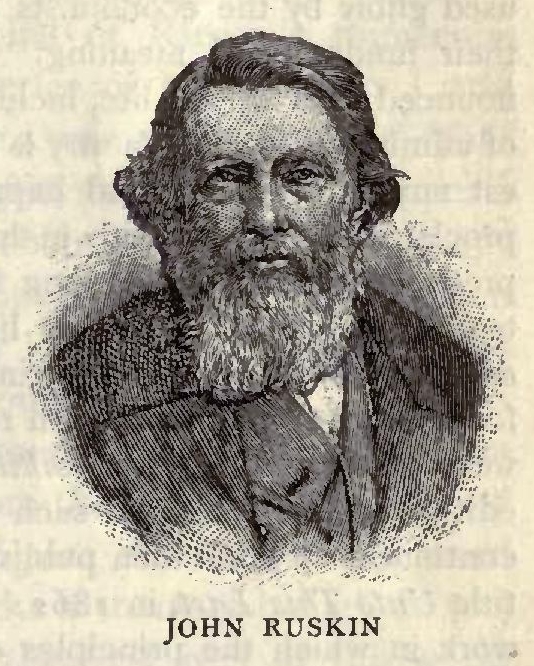
Ruskin's literary work began in childhood, when he was encouraged to write freely in prose and poetry. A volume of poems illustrated by his own drawings was published in 1859, after he had won fame as a prose writer, but, save for the drawings, it is of small importance. The first volume of Modern Painters (1843) was begun as a heated defense of the artist Turner, but it developed into an essay on art as a true picture of nature, "not only in her outward aspect but in her inward spirit." The work, which was signed simply "Oxford Graduate," aroused a storm of mingled approval and protest; but however much critics warred over its theories of art, all were agreed that the unknown author was a master of descriptive prose. Ruskin now made frequent trips to the art galleries of the Continent, and produced four more volumes of Modern Painters during the next seventeen years. Meanwhile he wrote other books,--Seven Lamps of Architecture (1849), Stones of Venice (1851-1853), Pre-Raphaelitism, and numerous lectures and essays, which gave him a place in the world of art similar to that held by Matthew Arnold in the world of letters. In 1869 he was appointed professor of art at Oxford, a position which greatly increased his prestige and influence, not only among students but among a great variety of people who heard his lectures and read his published works. Lectures on Art, Aratra Pentelici (lectures on sculpture), Ariadne Florentina (lectures on engraving), Michael Angela and Tintoret, The Art of England, Val d'Arno (lectures on Tuscan art), St. Mark's Rest (a history of Venice), Mornings in Florence (studies in Christian art, now much used as a guidebook to the picture galleries of Florence), The Laws of Fiesole (a treatise on drawing and painting for schools), Academy of Fine Arts in Venice, Pleasures of England,--all these works on art show Ruskin's literary industry. And we must also record Love's Meinie (a study of birds), Proserpina (a study of flowers), Deucalion (a study of waves and stones), besides various essays on political economy which indicate that Ruskin, like Arnold, had begun to consider the practical problems of his age.
At the height of his fame, in 1860, Ruskin turned for a time from art, to consider questions of wealth and labor,--terms which were used glibly by the economists of the age without much thought for their fundamental meaning. "There is no wealth but life," announced Ruskin,--"life, including all its powers of love, of joy, and of admiration. That country is the richest which nourishes the greatest number of noble and happy human beings." Such a doctrine, proclaimed by Goldsmith in his Deserted Village, was regarded as a pretty sentiment, but coming from one of the greatest leaders and teachers of England it was like a bombshell. Ruskin wrote four essays establishing this doctrine and pleading for a more socialistic form of government in which reform might be possible. The essays were published in the Cornhill Magazine, of which Thackeray was editor, and they aroused such a storm that the publication was discontinued. Ruskin then published the essays in book form, with the title Unto This Last, in 1862. Munera Pulveris (1862) was another work in which the principles of capital and labor and the evils of the competitive system were discussed in such a way that the author was denounced as a visionary or a madman. Other works of this practical period are Time and Tide, Fors Clavigera, Sesame and Lilies, and the Crown of Wild Olive.
The latter part of Ruskin's life was a time of increasing sadness, due partly to the failure of his plans, and partly to public attacks upon his motives or upon his sanity. He grew bitter at first, as his critics ridiculed or denounced his principles, and at times his voice is as querulous as that of Carlyle. We are to remember, however, the conditions under which he struggled. His health had been shattered by successive attacks of disease; he had been disappointed in love; his marriage was unhappy; and his work seemed a failure. He had given nearly all his fortune in charity, and the poor were more numerous than ever before. His famous St. George's Guild was not successful, and the tyranny of the competitive system seemed too deeply rooted to be overthrown. On the death of his mother he left London and, in 1879, retired to Brantwood, on Coniston Lake, in the beautiful region beloved of Wordsworth. Here he passed the last quiet years of his life under the care of his cousin, Mrs. Severn, the "angel of the house," and wrote, at Professor Norton's suggestion, Praeterita, one of his most interesting books, in which he describes the events of his youth from his own view point. He died quietly in 1900, and was buried, as he wished, without funeral pomp or public ceremony, in the little churchyard at Coniston.
Works of Ruskin. There are three little books which, in popular favor, stand first on the list of Ruskin's numerous works,--Ethics-of-the-Dust, a series of Lectures to Little Housewives, which appeals most to women; Crown of Wild Olive, three lectures on Work, Traffic, and War, which appeals to thoughtful men facing the problems of work and duty; and Sesame and Lilies, which appeals to men and women alike. The last is the most widely known of Ruskin's works and the best with which to begin our reading.
Sesame and LiliesThe first thing we notice in Sesame and Lilies is the symbolical title. "Sesame," taken from the story of the robbers' cave in the Arabian Nights, means a secret word or talisman which unlocks a treasure house. It was intended, no doubt, to introduce the first part of the work, called "Of Kings' Treasuries," which treats of books and reading. "Lilies," taken from Isaiah as a symbol of beauty, purity, and peace, introduces the second lecture, "Of Queens' Gardens," which is an exquisite study of woman's life and education. These two lectures properly constitute the book, but a third is added, on "The Mystery of Life." The last begins in a monologue upon his own failures in life, and is pervaded by an atmosphere of sadness, sometimes of pessimism, quite different from the spirit of the other two lectures.
Kings' TreasuriesThough the theme of the first lecture is books, Ruskin manages to present to his audience his whole philosophy of life. He gives us, with a wealth of detail, a description of what constitutes a real book; he looks into the meaning of words, and teaches us how to read, using a selection from Milton's Lycidas as an illustration. This study of words gives us the key with which we are to unlock "Kings' Treasuries," that is, the books which contain the precious thoughts of the kingly minds of all ages. He shows the real meaning and end of education, the value of labor and of a purpose in life; he treats of nature, science, art, literature, religion; he defines the purpose of government, showing that soul-life, not money or trade, is the measure of national greatness; and he criticises the general injustice of his age, quoting a heartrending story of toil and suffering from the newspapers to show how close his theory is to daily needs. Here is an astonishing variety in a small compass; but there is no confusion. Ruskin's mind was wonderfully analytical, and one subject develops naturally from the other.
Of Queens' GardensIn the second lecture, "Of Queens' Gardens," he considers the question of woman's place and education, which Tennyson had attempted to answer in The Princess. Ruskin's theory is that the purpose of all education is to acquire power to bless and to redeem human society; and that in this noble work woman must always play the leading part. He searches all literature for illustrations, and his description of literary heroines, especially of Shakespeare's perfect women, is unrivaled. Ruskin is always at his best in writing of women or for women, and the lofty idealism of this essay, together with its rare beauty of expression, makes it, on the whole, the most delightful and inspiring of his works.
Unto This LastAmong Ruskin's practical works the reader will find in Fors Clavigera, a series of letters to workingmen, and Unto This Last, four essays on the principles of political economy, the substance of his economic teachings. In the latter work, starting with the proposition that our present competitive system centers about the idea of wealth, Ruskin tries to find out what wealth is; and the pith of his teaching is this,--that men are of more account than money; that a man's real wealth is found in his soul; not in his pocket; and that the prime object of life and labor is "the producing of as many as possible full-breathed, bright-eyed, and happy-hearted human creatures." To make this ideal practical, Ruskin makes four suggestions: (1) that training schools be established to teach young men and women three things,--the laws and practice of health, habits of gentleness and justice, and the trade or calling by which they are to live; (2) that the government establish farms and workshops for the production of all the necessaries of life, where only good and honest work shall be tolerated and where a standard of work and wages shall be maintained; (3) that any person out of employment shall be received at the nearest government school: if ignorant he shall be educated, and if competent to do any work he shall have the opportunity to do it; (4) that comfortable homes be provided for the sick and for the aged, and that this be done in justice, not in charity. A laborer serves his country as truly as does a soldier or a statesman, and a pension should be no more disgraceful in one case than in the other.
Works on ArtAmong Ruskin's numerous books treating of art, we recommend the Seven Lamps of Architecture (1849), Stones of Venice (1851-1853), and the first two volumes of Modern Painters (1843-1846). With Ruskin's art theories, which, as Sydney Smith prophesied, "worked a complete revolution in the world of taste," we need not concern ourselves here. We simply point out four principles that are manifest in all his work: (1) that the object of art, as of every other human endeavor, is to find and to express the truth; (2) that art, in order to be true, must break away from conventionalities and copy nature; (3) that morality is closely allied with art, and that a careful study of any art reveals the moral strength or weakness of the people that produced it; (4) that the main purpose of art is not to delight a few cultured people but to serve the daily uses of common life. "The giving brightness to pictures is much," he says, "but the giving brightness to life is more." In this attempt to make art serve the practical ends of life, Ruskin is allied with all the great writers of the period, who use literature as the instrument of human progress.