Chapter XI · (continued 3)
Reading edition
General Characteristics. One who reads Ruskin is in a state of mind analogous to that of a man who goes through a picture gallery, pausing now to admire a face or a landscape for its own sake, and again to marvel at the technical skill of the artist, without regard to his subject. For Ruskin is a great literary artist and a great ethical teacher, and we admire one page for its style, and the next for its message to humanity. The best of his prose, which one may find in the descriptive passages of Præterita and Modern Painters, is written in a richly ornate style, with a wealth of figures and allusions, and at times a rhythmic, melodious quality which makes it almost equal to poetry. Ruskin had a rare sensitiveness to beauty in every form, and more, perhaps, than any other writer in our language, he has helped us to see and appreciate the beauty of the world around us.
Ethical TeachingAs for Ruskin's ethical teaching, it appears in so many forms and in so many different works that any summary must appear inadequate. For a full half century he was "the apostle of beauty" in England, and the beauty for which he pleaded was never sensuous or pagan, as in the Renaissance, but always spiritual, appealing to the soul of man rather than to his eyes, leading to better work and better living. In his economic essays Ruskin is even more directly and positively ethical. To mitigate the evils of the unreasonable competitive system under which we labor and sorrow; to bring master and man together in mutual trust and helpfulness; to seek beauty, truth, goodness as the chief ends of life, and, having found them, to make our characters correspond; to share the best treasures of art and literature with rich and poor alike; to labor always, and, whether we work with hand or head, to do our work in praise of something that we love,--this sums up Ruskin's purpose and message. And the best of it is that, like Chaucer's country parson, he practiced his doctrine before he preached it.
MATTHEW ARNOLD (1822-1888)
In the world of literature Arnold has occupied for many years an authoritative position as critic and teacher, similar to that held by Ruskin in the world of art. In his literary work two very different moods are manifest. In his poetry he reflects the doubt of an age which witnessed the conflict between science and revealed religion. Apparently he never passed through any such decisive personal struggle as is recorded in Sartor Resartus, and he has no positive conviction such as is voiced in "The Everlasting Yea." He is beset by doubts which he never settles, and his poems generally express sorrow or regret or resignation. In his prose he shows the cavalier spirit,--aggressive, light-hearted, self-confident. Like Carlyle, he dislikes shams, and protests against what he calls the barbarisms of society; but he writes with a light touch, using satire and banter as the better part of his argument. Carlyle denounces with the zeal of a Hebrew prophet, and lets you know that you are hopelessly lost if you reject his message. Arnold is more like the cultivated Greek; his voice is soft, his speech suave, but he leaves the impression, if you happen to differ with him, that you must be deficient in culture. Both these men, so different in spirit and methods, confronted the same problems, sought the same ends, and were dominated by the same moral sincerity.
Life. Arnold was born in Laleham, in the valley of the Thames, in 1822. His father was Dr. Thomas Arnold, head master of Rugby, with whom many of us have grown familiar by reading Tom Brown's School Days. After fitting for the university at Winchester and at Rugby, Arnold entered Balliol College, Oxford, where he was distinguished by winning prizes in poetry and by general excellence in the classics. More than any other poet Arnold reflects the spirit of his university. "The Scholar-Gipsy" and "Thyrsis" contain many references to Oxford and the surrounding country, but they are more noticeable for their spirit of aloofness,--as if Oxford men were too much occupied with classic dreams and ideals to concern themselves with the practical affairs of life.
After leaving the university Arnold first taught the classics at Rugby; then, in 1847, he became private secretary to Lord Lansdowne, who appointed the young poet to the position of inspector of schools under the government. In this position Arnold worked patiently for the next thirty-five years, traveling about the country, examining teachers, and correcting endless examination papers. For ten years (1857-1867) he was professor of poetry at Oxford, where his famous lectures On Translating Homer were given. He made numerous reports on English and foreign schools, and was three times sent abroad to study educational methods on the Continent. From this it will be seen that Arnold led a busy, often a laborious life, and we can appreciate his statement that all his best literary work was done late at night, after a day of drudgery. It is well to remember that, while Carlyle was preaching about labor, Arnold labored daily; that his work was cheerfully and patiently done; and that after the day's work he hurried away, like Lamb, to the Elysian fields of literature. He was happily married, loved his home, and especially loved children, was free from all bitterness and envy, and, notwithstanding his cold manner, was at heart sincere, generous, and true. We shall appreciate his work better if we can see the man himself behind all that he has written.
Arnold's literary work divides itself into three periods, which we may call the poetical, the critical, and the practical. He had written poetry since his school days, and his first volume, The Strayed Reveller and Other Poems, appeared anonymously in 1849. Three years later he published Empedocles on Etna and other Poems; but only a few copies of these volumes were sold, and presently both were withdrawn from circulation. In 1853-1855 he published his signed Poems, and twelve years later appeared his last volume of poetry. Compared with the early work of Tennyson, these works met with little favor, and Arnold practically abandoned poetry in favor of critical writing.
The chief works of his critical period are the lectures On Translating Homer (1861) and the two volumes of Essays in Criticism (1865-1888), which made Arnold one of the best known literary men in England. Then, like Ruskin, he turned to practical questions, and his Friendship's Garland (1871) was intended to satirize and perhaps reform the great middle class of England, whom he called the Philistines. Culture and Anarchy, the most characteristic work of his practical period, appeared in 1869. These were followed by four books on religious subjects,--St. Paul and Protestantism (1870), Literature and Dogma (1873), God and the Bible (1875), and Last Essays on Church and Religion (1877). The Discourses in America (1885) completes the list of his important works. At the height of his fame and influence he died suddenly, in 1888, and was buried in the churchyard at Laleham. The spirit of his whole life is well expressed in a few lines of one of his own early sonnets:
One lesson, Nature, let me learn of thee, One lesson which in every wind is blown, One lesson of two duties kept at one Though the loud world proclaim their enmity-- Of toil unsever'd from tranquillity; Of labour, that in lasting fruit outgrows Far noisier schemes, accomplish'd in repose, Too great for haste, too high for rivalry.
His Poetry.Works of Matthew Arnold. We shall better appreciate Arnold's poetry if we remember two things: First, he had been taught in his home a simple and devout faith in revealed religion, and in college he was thrown into a world of doubt and questioning. He faced these doubts honestly, reverently,--in his heart longing to accept the faith of his fathers, but in his head demanding proof and scientific exactness. The same struggle between head and heart, between reason and intuition, goes on to-day, and that is one reason why Arnold's poetry, which wavers on the borderland between doubt and faith, is a favorite with many readers. Second, Arnold, as shown in his essay on The Study of Poetry, regarded poetry as "a criticism of life under the conditions fixed for such criticism by the laws of poetic truth and poetic beauty." Naturally, one who regards poetry as a "criticism" will write very differently from one who regards poetry as the natural language of the soul. He will write for the head rather than for the heart, and will be cold and critical rather than enthusiastic. According to Arnold, each poem should be a unit, and he protested against the tendency of English poets to use brilliant phrases and figures of speech which only detract attention from the poem as a whole. For his models he went to Greek poetry, which he regarded as "the only sure guidance to what is sound and true in poetical art." Arnold is, however, more indebted than he thinks to English masters, especially to Wordsworth and Milton, whose influence is noticeable in a large part of his poetry.
Of Arnold's narrative poems the two best known are Balder Dead (1855), an incursion into the field of Norse mythology which is suggestive of Gray, and Sohrab and Rustum (1853), which takes us into the field of legendary Persian history. The theme of the latter poem is taken from the Shah-Namah (Book of Kings) of the Persian poet Firdausi, who lived and wrote in the eleventh century.
Sohrab and RustrumBriefly, the story is of one Rustem or Rustum, a Persian Achilles, who fell asleep one day when he had grown weary of hunting. While he slept a band of robbers stole his favorite horse, Ruksh. In trailing the robbers Rustum came to the palace of the king of Samengan, where he was royally welcomed, and where he fell in love with the king's daughter, Temineh, and married her. But he was of a roving, adventurous disposition, and soon went back to fight among his own people, the Persians. While he was gone his son Sohrab was born, grew to manhood, and became the hero of the Turan army. War arose between the two peoples, and two hostile armies were encamped by the Oxus. Each army chose a champion, and Rustum and Sohrab found themselves matched in mortal combat between the lines. At this point Sohrab, whose chief interest in life was to find his father, demanded to know if his enemy were not Rustum; but the latter was disguised and denied his identity. On the first day of the fight Rustum was overcome, but his life was spared by a trick and by the generosity of Sohrab. On the second day Rustum prevailed, and mortally wounded his antagonist. Then he recognized his own son by a gold bracelet which he had long ago given to his wife Temineh. The two armies, rushing into battle, were stopped by the sight of father and son weeping in each other's arms. Sohrab died, the war ceased, and Rustum went home to a life of sorrow and remorse.
Using this interesting material, Arnold produced a poem which has the rare and difficult combination of classic reserve and romantic feeling. It is written in blank verse, and one has only to read the first few lines to see that the poet is not a master of his instrument. The lines are seldom harmonious, and we must frequently change the accent of common words, or lay stress on unimportant particles, to show the rhythm. Arnold frequently copies Milton, especially in his repetition of ideas and phrases; but the poem as a whole is lacking in Milton's wonderful melody.
The classic influence on Sohrab and Rustum is especially noticeable in Arnold's use of materials. Fights are short; grief is long; therefore the poet gives few lines to the combat, but lingers over the son's joy at finding his father, and the father's quenchless sorrow at the death of his son. The last lines especially, with their "passionate grief set to solemn music," make this poem one of the best, on the whole, that Arnold has written. And the exquisite ending, where the Oxus, unmindful of the trivial strifes of men, flows on sedately to join "his luminous home of waters" is most suggestive of the poet's conception of the orderly life of nature, in contrast with the doubt and restlessness of human life.
Miscellaneous PoemsNext in importance to the narrative poems are the elegies, "Thyrsis," "The Scholar-Gipsy," "Memorial Verses," "A Southern Night," "Obermann," "Stanzas from the Grande Chartreuse," and "Rugby Chapel." All these are worthy of careful reading, but the best is "Thyrsis," a lament for the poet Clough, which is sometimes classed with Milton's Lycidas and Shelley's Adonais. Among the minor poems the reader will find the best expression of Arnold's ideals and methods in "Dover Beach," the love lyrics entitled "Switzerland," "Requiescat," "Shakespeare," "The Future," "Kensington Gardens," "Philomela," "Human Life," "Callicles's Song," "Morality," and "Geist's Grave."--the last being an exquisite tribute to a little dog which, like all his kind, had repaid our scant crumbs of affection with a whole life's devotion.
Essays in CriticismThe first place among Arnold's prose works must be given to the Essays in Criticism, which raised the author to the front rank of living critics. His fundamental idea of criticism appeals to us strongly. The business of criticism, he says, is neither to find fault nor to display the critic's own learning or influence; it is to know "the best which has been thought and said in the world," and by using this knowledge to create a current of fresh and free thought. If a choice must be made among these essays, which are all worthy of study, we would suggest "The Study of Poetry," "Wordsworth," "Byron," and "Emerson." The last-named essay, which is found in the Discourses in America, is hardly a satisfactory estimate of Emerson, but its singular charm of manner and its atmosphere of intellectual culture make it perhaps the most characteristic of Arnold's prose writings.
Among the works of Arnold's practical period there are two which may be taken as typical of all the rest. Literature and Dogma (1873) is, in general, a plea for liberality in religion. Arnold would have us read the Bible, for instance, as we would read any other great work, and apply to it the ordinary standards of literary criticism.
Culture and AnarchyCulture and Anarchy (1869) contains most of the terms--culture, sweetness and light, Barbarian, Philistine, Hebraism, and many others--which are now associated with Arnold's work and influence. The term "Barbarian" refers to the aristocratic classes, whom Arnold thought to be essentially crude in soul, notwithstanding their good clothes and superficial graces. "Philistine" refers to the middle classes,--narrow-minded and self-satisfied people, according to Arnold, whom he satirizes with the idea of opening their minds to new ideas. "Hebraism" is Arnold's term for moral education. Carlyle had emphasized the Hebraic or moral element in life, and Arnold undertook to preach the Hellenic or intellectual element, which welcomes new ideas, and delights in the arts that reflect the beauty of the world. "The uppermost idea with. Hellenism," he says, "is to see things as they are; the uppermost idea with Hebraism is conduct and obedience." With great clearness, sometimes with great force, and always with a play of humor and raillery aimed at the "Philistines," Arnold pleads for both these elements in life which together aim at "Culture," that is, at moral and intellectual perfection.
General Characteristics. Arnold's influence in our literature may be summed up, in a word, as intellectual rather than inspirational. One cannot be enthusiastic over his poetry, for the simple reason that he himself lacked enthusiasm. He is, however, a true reflection of a very real mood of the past century, the mood of doubt and sorrow; and a future generation may give him a higher place than he now holds as a poet. Though marked by "the elemental note of sadness," all Arnold's poems are distinguished by clearness, simplicity, and the restrained emotion of his classic models.
As a prose writer the cold intellectual quality, which mars his poetry by restraining romantic feeling, is of first importance, since it leads him to approach literature with an open mind and with the single desire to find "the best which has been thought and said in the world." We cannot yet speak with confidence of his rank in literature; but by his crystal-clear style, his scientific spirit of inquiry and comparison, illumined here and there by the play of humor, and especially by his broad sympathy and intellectual culture, he seems destined to occupy a very high place among the masters of literary criticism.
JOHN HENRY NEWMAN (1801-1890)
Any record of the prose literature of the Victorian era, which includes the historical essays of Macaulay and the art criticism of Ruskin, should contain also some notice of its spiritual leaders. For there was never a time when the religious ideals that inspire the race were kept more constantly before men's minds through the medium of literature.
Among the religious writers of the age the first place belongs unquestionably to Cardinal Newman. Whether we consider him as a man, with his powerful yet gracious personality, or as a religious reformer, who did much to break down old religious prejudices by showing the underlying beauty and consistency of the Roman church, or as a prose writer whose style is as near perfection as we have ever reached, Newman is one of the most interesting figures of the whole nineteenth century.
Life. Three things stand out clearly in Newman's life: first, his unshaken faith in the divine companionship and guidance; second, his desire to find and to teach the truth of revealed religion; third, his quest of an authoritative standard of faith, which should remain steadfast through the changing centuries and amid all sorts and conditions of men. The first led to that rare and beautiful spiritual quality which shines in all his work; the second to his frequent doctrinal and controversial essays; the third to his conversion to the Catholic church, which he served as priest and teacher for the last forty-five years of his life. Perhaps we should add one more characteristic,--the practical bent of his religion; for he was never so busy with study or controversy that he neglected to give a large part of his time to gentle ministration among the poor and needy.
He was born in London, in 1801. His father was an English banker; his mother, a member of a French Huguenot family, was a thoughtful, devout woman, who brought up her son in a way which suggests the mother of Ruskin. Of his early training, his reading of doctrinal and argumentative works, and of his isolation from material things in the thought that there were "two and only two absolute and luminously self-evident beings in the world," himself and his Creator, it is better to read his own record in the Apologia, which is a kind of spiritual biography.
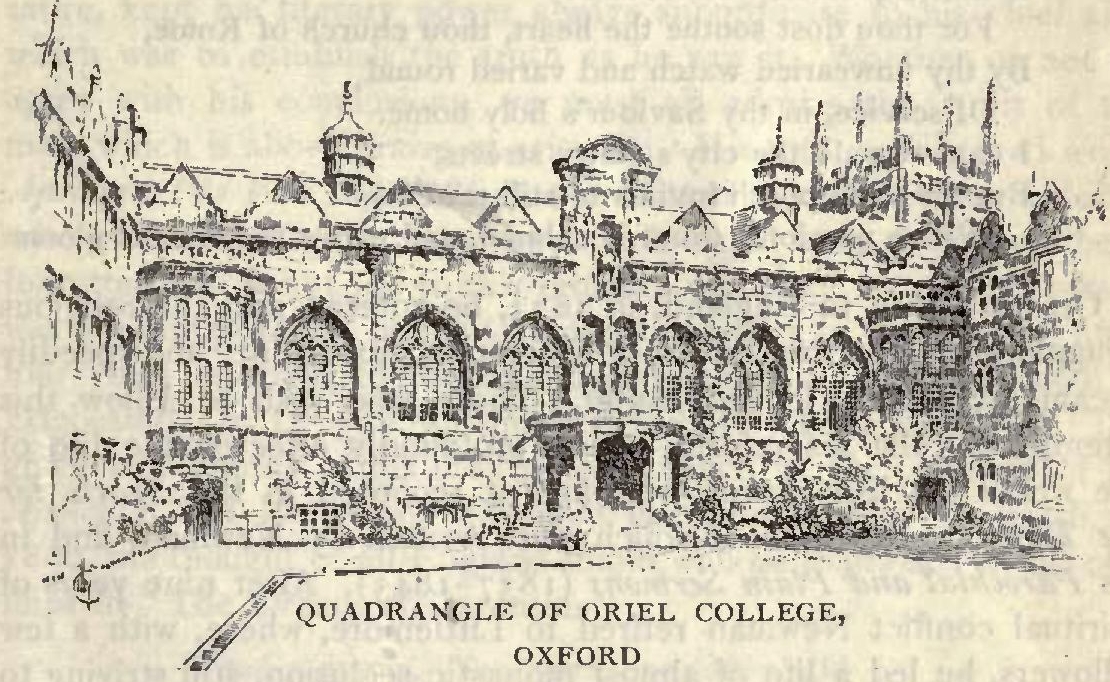
At the age of fifteen Newman had begun his profound study of theological subjects. For science, literature, art, nature,--all the broad interests which attracted other literary men of his age,--he cared little, his mind being wholly occupied with the history and doctrines of the Christian church, to which he had already devoted his life. He was educated first at the school in Ealing, then at Oxford, taking his degree in the latter place in 1820. Though his college career was not more brilliant than that of many unknown men, his unusual ability was recognized and he was made a fellow of Oriel College, retaining the fellowship, and leading a scholarly life for over twenty years. In 1824 he was ordained in the Anglican church, and four years later was chosen vicar of St. Mary's, at Oxford, where his sermons made a deep impression on the cultivated audiences that gathered from far and near to hear him.
QUADRANGLE OF ORIEL COLLEGE, OXFORD
A change is noticeable in Newman's life after his trip to the Mediterranean in 1832. He had begun his life as a Calvinist, but while in Oxford, then the center of religious unrest, he described himself as "drifting in the direction of Liberalism." Then study and bereavement and an innate mysticism led him to a profound sympathy with the mediæval Church. He had from the beginning opposed Catholicism; but during his visit to Italy, where he saw the Roman church at the center of Its power and splendor, many of his prejudices were overcome. In this enlargement of his spiritual horizon Newman was greatly influenced by his friend Hurrell Froude, with whom he made the first part of the journey. His poems of this period (afterwards collected in the Lyra Apostolica), among which is the famous "Lead, Kindly Light," are noticeable for their radiant spirituality; but one who reads them carefully sees the beginning of that mental struggle which ended in his leaving the church in which he was born. Thus he writes of the Catholic church, whose services he had attended as "one who in a foreign land receives the gifts of a good Samaritan":
O that thy creed were sound! For thou dost soothe the heart, thou church of Rome, By thy unwearied watch and varied round Of service, in thy Saviour's holy home. I cannot walk the city's sultry streets, But the wide porch invites to still retreats, Where passion's thirst is calmed, and care's unthankful gloom.
On his return to England, in 1833, he entered into the religious struggle known as the Oxford or Tractarian Movement,[245] and speedily became its acknowledged leader. Those who wish to follow this attempt at religious reform, which profoundly affected the life of the whole English church, will find it recorded in the Tracts for the Times, twenty-nine of which were written by Newman, and in his Parochial and Plain Sermons (1837-1843). After nine years of spiritual conflict Newman retired to Littlemore, where, with a few followers, he led a life of almost monastic seclusion, still striving to reconcile his changing belief with the doctrines of his own church. Two years later he resigned his charge at St. Mary's and left the Anglican communion,--not bitterly, but with a deep and tender regret. His last sermon at Littlemore on "The Parting of Friends" still moves us profoundly, like the cry of a prophet torn by personal anguish in the face of duty. In 1845 he was received into the Catholic church, and the following year, at Rome, he joined the community of St. Philip Neri, "the saint of gentleness and kindness," as Newman describes him, and was ordained to the Roman priesthood.
By his preaching and writing Newman had exercised a strong influence over his cultivated English hearers, and the effect of his conversion was tremendous. Into the theological controversy of the next twenty years we have no mind to enter. Through it all Newman retained his serenity, and, though a master of irony and satire, kept his literary power always subordinate to his chief aim, which was to establish the truth as he saw it. Whether or not we agree with his conclusions, we must all admire the spirit of the man, which is above praise or criticism. His most widely read work, Apologia Pro Vita Sua (1864), was written in answer to an unfortunate attack by Charles Kingsley, which would long since have been forgotten had it not led to this remarkable book. In 1854 Newman was appointed rector of the Catholic University in Dublin, but after four years returned to England and founded a Catholic school at Edgbaston. In 1879 he was made cardinal by Pope Leo XIII. The grace and dignity of his life, quite as much as the sincerity of his Apologia, had long since disarmed criticism, and at his death, in 1890, the thought of all England might well be expressed by his own lines in "The Dream of Gerontius":
I had a dream. Yes, some one softly said, "He's gone," and then a sigh went round the room; And then I surely heard a priestly voice Cry Subvenite; and they knelt in prayer.
Apologia Pro Vita SuaWorks of Newman. Readers approach Newman from so many different motives, some for doctrine, some for argument, some for a pure prose style, that it is difficult to recommend the best works for the beginner's use. As an expression of Newman's spiritual struggle the Apologia Pro Vita Sua is perhaps the most significant. This book is not light reading and one who opens it should understand clearly the reasons for which it was written. Newman had been accused of insincerity, not only by Kingsley but by many other men, in the public press. His retirement to solitude and meditation at Littlemore had been outrageously misunderstood, and it was openly charged that his conversion was a cunningly devised plot to win a large number of his followers to the Catholic church. This charge involved others, and it was to defend them, as well as to vindicate himself, that Newman wrote the Apologia. The perfect sincerity with which he traced his religious history, showing that his conversion was only the final step in a course he had been following since boyhood, silenced his critics and revolutionized public opinion concerning himself and the church which he had joined. As the revelation of a soul's history, and as a model of pure, simple, unaffected English, this book, entirely apart from its doctrinal teaching, deserves a high place in our prose literature.
CallistaIn Newman's doctrinal works, the Via Media, the Grammar of Assent, and in numerous controversial essays the student of literature will have little interest. Much more significant are his sermons, the unconscious reflection of a rare spiritual nature, of which Professor Shairp said: "His power shows itself clearly in the new and unlooked-for way in which he touched into life old truths, moral or spiritual.... And as he spoke, how the old truth became new! and how it came home with a meaning never felt before! He laid his finger how gently yet how powerfully on some inner place in the hearer's heart, and told him things about himself he had never known till then. Subtlest truths, which would have taken philosophers pages of circumlocution and big words to state, were dropped out by the way in a sentence or two of the most transparent Saxon." Of greater interest to the general reader are The Idea of a University, discourses delivered at Dublin, and his two works of fiction, Loss and Gain, treating of a man's conversion to Catholicism, and Callista, which is, in his own words, "an attempt to express the feelings and mutual relations of Christians and heathens in the middle of the third century." The latter is, in our judgment, the most readable and interesting of Newman's works. The character of Callista, a beautiful Greek sculptor of idols, is powerfully delineated; the style is clear and transparent as air, and the story of the heroine's conversion and death makes one of the most fascinating chapters in fiction, though it is not the story so much as the author's unconscious revelation of himself that charms us. It would be well to read this novel in connection with Kingsley's Hypatia, which attempts to reconstruct the life and ideals of the same period.
PoemsNewman's poems are not so well known as his prose, but the reader who examines the Lyra Apostolica and Verses on Various Occasions will find many short poems that stir a religious nature profoundly by their pure and lofty imagination; and future generations may pronounce one of these poems, "The Dream of Gerontius," to be Newman's most enduring work. This poem aims to reproduce the thoughts and feelings of a man whose soul is just quitting the body, and who is just beginning a new and greater life. Both in style and in thought "The Dream" is a powerful and original poem and is worthy of attention not only for itself but, as a modern critic suggests, "as a revelation of that high spiritual purpose which animated Newman's life from beginning to end."
Newman's styleOf Newman's style it is as difficult to write as it would be to describe the dress of a gentleman we had met, who was so perfectly dressed that we paid no attention to his clothes. His style is called transparent, because at first we are not conscious of his manner; and unobtrusive, because we never think of Newman himself, but only of the subject he is discussing. He is like the best French prose writers in expressing his thought with such naturalness and apparent ease that, without thinking of style, we receive exactly the impression which he means to convey. In his sermons and essays he is wonderfully simple and direct; in his controversial writings, gently ironical and satiric, and the satire is pervaded by a delicate humor; but when his feelings are aroused he speaks with poetic images and symbols, and his eloquence is like that of the Old Testament prophets. Like Ruskin's, his style is modeled largely on that of the Bible, but not even Ruskin equals him in the poetic beauty and melody of his sentences. On the whole he comes nearer than any other of his age to our ideal of a perfect prose writer.
Critical WritersOther Essayists of the Victorian Age. We have selected the above five essayists, Macaulay, Carlyle, Arnold, Newman, and Ruskin, as representative writers of the Victorian Age; but there are many others who well repay our study. Notable among these are John Addington Symonds, author of The Renaissance in Italy, undoubtedly his greatest work, and of many critical essays; Walter Pater, whose Appreciations and numerous other works mark him as one of our best literary critics; and Leslie Stephen, famous for his work on the monumental Dictionary of National Biography, and for his Hours in a Library, a series of impartial and excellent criticisms, brightened by the play of an original and delightful humor.
The ScientistsAmong the most famous writers of the age are the scientists, Lyell, Darwin, Huxley, Spencer, Tyndall, and Wallace,--a wonderful group of men whose works, though they hardly belong to our present study, have exercised an incalculable influence on our life and literature. Darwin's Origin of Species (1859), which apparently established the theory of evolution, was an epoch-making book. It revolutionized not only our conceptions of natural history, but also our methods of thinking on all the problems of human society. Those who would read a summary of the greatest scientific discovery of the age will find it in Wallace's Darwinism,--a most interesting book, written by the man who claims, with Darwin, the honor of first announcing the principle of evolution. And, from a multitude of scientific works, we recommend also to the general reader Huxley's Autobiography and his Lay Sermons, Addresses, and Reviews, partly because they are excellent expressions of the spirit and methods of science, and partly because Huxley as a writer is perhaps the clearest and the most readable of the scientists.
The Spirit of Modern Literature. As we reflect on the varied work of the Victorian writers, three marked characteristics invite our attention. First, our great literary men, no less than our great scientists, have made truth the supreme object of human endeavor. All these eager poets, novelists, and essayists, questing over so many different ways, are equally intent on discovering the truth of life. Men as far apart as Darwin and Newman are strangely alike in spirit, one seeking truth in the natural, the other in the spiritual history of the race. Second, literature has become the mirror of truth; and the first requirement of every serious novel or essay is to be true to the life or the facts which it represents. Third, literature has become animated by a definite moral purpose. It is not enough for the Victorian writers to create or attempt an artistic work for its own sake; the work must have a definite lesson for humanity. The poets are not only singers, but leaders; they hold up an ideal, and they compel men to recognize and follow it. The novelists tell a story which pictures human life, and at the same time call us to the work Of social reform, or drive home a moral lesson. The essayists are nearly all prophets or teachers, and use literature as the chief instrument of progress and education. Among them all we find comparatively little of the exuberant fancy, the romantic ardor, and the boyish gladness of the Elizabethans. They write books not primarily to delight the artistic sense, but to give bread to the hungry and water to the thirsty in soul. Milton's famous sentence, "A good book is the precious life-blood of a master spirit," might be written across the whole Victorian era. We are still too near these writers to judge how far their work suffers artistically from their practical purpose; but this much is certain,--that whether or not they created immortal works, their books have made the present world a better and a happier place to live in. And that is perhaps the best that can be said of the work of any artist or artisan.
Summary of the Victorian Age. The year 1830 is generally placed at the beginning of this period, but its limits are very indefinite. In general we may think of it as covering the reign of Victoria (1837-1901). Historically the age is remarkable for the growth of democracy following the Reform Bill of 1832; for the spread of education among all classes; for the rapid development of the arts and sciences; for important mechanical inventions; and for the enormous extension of the bounds of human knowledge by the discoveries of science.
At the accession of Victoria the romantic movement had spent its force; Wordsworth had written his best work; the other romantic poets, Coleridge, Shelley, Keats, and Byron, had passed away; and for a time no new development was apparent in English poetry. Though the Victorian Age produced two great poets, Tennyson and Browning, the age, as a whole, is remarkable for the variety and excellence of its prose. A study of all the great writers of the period reveals four general characteristics: (1) Literature in this Age has come very close to daily life, reflecting its practical problems and interests, and is a powerful instrument of human progress. (2) The tendency of literature is strongly ethical; all the great poets, novelists, and essayists of the age are moral teachers. (3) Science in this age exercises an incalculable influence. On the one hand it emphasizes truth as the sole object of human endeavor; it has established the principle of law throughout the universe; and it has given us an entirely new view of life, as summed up in the word "evolution," that is, the principle of growth or development from simple to complex forms. On the other hand, its first effect seems to be to discourage works of the imagination. Though the age produced an incredible number of books, very few of them belong among the great creative works of literature. (4) Though the age is generally characterized as practical and materialistic, it is significant that nearly all the writers whom the nation delights to honor vigorously attack materialism, and exalt a purely ideal conception of life. On the whole, we are inclined to call this an idealistic age fundamentally, since love, truth, justice, brotherhood--all great ideals--are emphasized as the chief ends of life, not only by its poets but also by its novelists and essayists.
In our study we have considered: (1) The Poets; the life and works of Tennyson and Browning; and the chief characteristics of the minor poets, Elizabeth Barrett (Mrs. Browning), Rossetti, Morris, and Swinburne. (2) The Novelists; the life and works of Dickens, Thackeray, and George Eliot; and the chief works of Charles Reade, Anthony Trollope, Charlotte Brontë, Bulwer-Lytton, Kingsley, Mrs. Gaskell, Blackmore, George Meredith, Hardy, and Stevenson. (3) The Essayists; the life and works of Macaulay, Matthew Arnold, Carlyle, Newman, and Ruskin. These were selected, from among many essayists and miscellaneous writers, as most typical of the Victorian Age. The great scientists, like Lyell, Darwin, Huxley, Wallace, Tyndall, and Spencer, hardly belong to our study of literature, though their works are of vast importance; and we omit the works of living writers who belong to the present rather than to the past century.
Selections for Reading. Manly's English Poetry and Manly's English Prose (Ginn and Company) contain excellent selections from all authors of this period. Many other collections, like Ward's English Poets, Garnett's English Prose from Elizabeth to Victoria, Page's British Poets of the Nineteenth Century, and Stedman's A Victorian Anthology, may be used to advantage. All important works may be found in the convenient and inexpensive school editions given below. (For full titles and publishers see the General Bibliography.)
Tennyson. Short poems, and selections from Idylls of the King, In Memoriam, Enoch Arden, and The Princess. These are found in various school editions, Standard English Classics, Pocket Classics, Riverside Literature Series, etc. Poems by Tennyson, selected and edited with notes by Henry Van Dyke (Athenaeum Press Series), is an excellent little volume for beginners.
Browning. Selections, edited by R.M. Lovett, in Standard English Classics. Other school editions in Everyman's Library, Belles Lettres Series, etc.
Elizabeth Barrett Browning. Selections, edited by Elizabeth Lee, in Standard English Classics. Selections also in Pocket Classics, etc.
Matthew Arnold. Sohrab and Rustum, edited by Trent and Brewster, in Standard English Classics. The same poem in Riverside Literature Series, etc. Selections in Golden Treasury Series, etc. Poems, students' edition (Crowell). Essays in Everyman's Library, etc. Prose selections (Holt, Allyn & Bacon, etc.).
Dickens. Tale of Two Cities, edited by J.W. Linn, in Standard English Classics. A Christmas Carol, David Copperfield, and Pickwick Papers. Various good school editions of these novels in Everyman's Library, etc.
Thackeray. Henry Esmond, edited by H.B. Moore, in Standard English Classics. The same novel, in Everyman's Library, Pocket Classics, etc.
George Eliot. Silas Marner, edited by R. Adelaide Witham, in Standard English Classics. The same novel, in Pocket Classics, etc.
Carlyle. Essay on Burns, edited by C.L. Hanson, in Standard English Classics, and Heroes and Hero Worship, edited by A. MacMechan, in Athenaeum Press Series. Selections, edited by H.W. Boynton (Allyn & Bacon). Various other inexpensive editions, in Pocket Classics, Eclectic English Classics, etc.
Ruskin. Sesame and Lilies, edited by Lois G. Hufford, in Standard English Classics. Other editions in Riverside Literature, Everyman's Library, etc. Selected Essays and Letters, edited by Hufford, in Standard English Classics. Selections, edited by Vida D. Scudder (Sibley); edited by C.B. Tinker, in Riverside Literature.
Macaulay. Essays on Addison and Milton, edited by H.A. Smith, in Standard English Classics. Same essays, in Cassell's National Library, Riverside Literature, etc. Lays of Ancient Rome, in Standard English Classics, Pocket Classics, etc.
Newman. Selections, with introduction by L.E. Gates (Holt); Selections from prose and poetry, in Riverside Literature. The Idea of a University, in Manly's English Prose.
Bibliography. (note. For full titles and publishers of general reference books, see General Bibliography.) History. Text-book, Montgomery, pp. 357-383; Cheyney, pp. 632-643. General Works. Gardiner, and Traill. Special Works. McCarthy's History of Our Own Times; Bright's History of England, vols. 4-5; Lee's Queen Victoria; Bryce's Studies in Contemporary Biography.
Literature. General Works. Garnett and Gosse, Taine. Special Works. Harrison's Early Victorian Literature; Saintsbury's A History of Nineteenth Century Literature; Walker's The Age of Tennyson; same author's The Greater Victorian Poets; Morley's Literature of the Age of Victoria; Stedman's Victorian Poets; Mrs. Oliphant's Literary History of England in the Nineteenth Century; Beers's English Romanticism in the Nineteenth Century; Dowden's Victorian Literature, in Transcripts and Studies; Brownell's Victorian Prose Masters.
Tennyson. Texts: Cabinet edition (London, 1897) is the standard. Various good editions, Globe, Cambridge Poets, etc. Selections in Athenaeum Press (Ginn and Company).
Life: Alfred Lord Tennyson, a Memoir by his son, is the standard; by Lyall (in English Men of Letters); by Horton; by Waugh. See also Anne T. Ritchie's Tennyson and His Friends; Napier's The Homes and Haunts of Tennyson; Rawnsley's Memories of the Tennysons.
Criticism: Brooke's Tennyson, his Art and his Relation to Modern Life; A. Lang's Alfred Tennyson; Van Dyke's The Poetry of Tennyson; Sneath's The Mind of Tennyson; Gwynn's A Critical Study of Tennyson's Works; Luce's Handbook to Tennyson's Works; Dixon's A Tennyson Primer; Masterman's Tennyson as a Religious Teacher; Collins's The Early Poems of Tennyson; Macallum's Tennyson's Idylls of the King and the Arthurian Story; Bradley's Commentary on In Memoriam; Bagehot's Literary Studies, vol. 2; Brightwell's Concordance; Shepherd's Bibliography.
Essays: By F. Harrison, in Tennyson, Ruskin, Mill, and Other Literary Estimates; by Stedman, in Victorian Poets; by Hutton, in Literary Essays; by Dowden, in Studies in Literature; by Gates, in Studies and Appreciations; by Forster, in Great Teachers; by Forman, in Our Living Poets. See also Myers's Science and a Future Life.
Browning. Texts: Cambridge and Globe editions, etc. Various editions of selections. (See Selections for Reading, above.)
Life: by W. Sharp (Great Writers); by Chesterton (English Men of Letters); Life and Letters, by Mrs. Sutherland Orr; by Waugh, in Westminster Biographies (Small & Maynard).
Criticism: Symons's An Introduction to the Study of Browning; same title, by Corson; Mrs. Orr's Handbook to the Works of Browning; Nettleship's Robert Browning; Brooke's The Poetry of Robert Browning; Cooke's Browning Guide Book; Revell's Browning's Criticism of Life; Berdoe's Browning's Message to his Times; Berdoe's Browning Cyclopedia.
Essays: by Hutton, Stedman, Dowden, Forster (for titles, see Tennyson, above); by Jacobs, in Literary Studies; by Chapman, in Emerson and Other Essays; by Cooke, in Poets and Problems; by Birrell, in Obiter Dicta.
Elizabeth Barrett Browning. Texts: Globe and Cambridge editions, etc.; various editions of selections. Life: by J. H. Ingram; see also Bayne's Two Great Englishmen. Kenyon's Letters of E. B. Browning.
Criticism: Essays, by Stedman, in Victorian Poets; by Benson, in Essays.
Matthew Arnold. Texts: Poems, Globe edition, etc. See Selections for Reading, above. Life: by Russell; by Saintsbury; by Paul (English Men of Letters); Letters, by Russell.
Criticism: Essays by Woodberry, in Makers of Literature; by Gates, in Three Studies in Literature; by Hutton, in Modern Guides of English Thought; by Brownell, in Victorian Prose Masters; by F. Harrison (see Tennyson, above).
Dickens. Texts: numerous good editions of novels. Life: by J. Forster; by Marzials (Great Writers); by Ward (English Men of Letters); Langton's The Childhood and Youth of Dickens.
Criticism: Gissing's Charles Dickens; Chesterton's Charles Dickens; Kitten's The Novels of Charles Dickens; Fitzgerald's The History of Pickwick. Essays: by F. Harrison (see above); by Bagehot, in Literary Studies; by Lilly, in Four English Humorists; by A. Lang, in Gadshill edition of Dickens's works.
Thackeray. Texts: numerous good editions of novels and essays. Life: by Melville; by Merivale and Marzials (Great Writers); by A. Trollope (English Men of Letters); by L. Stephen, in Dictionary of National Biography. See also Crowe's Homes and Haunts of Thackeray; Wilson's Thackeray in the United States.
Criticism: Essays, by Lilly, in Four English Humorists; by Harrison, in Studies in Early Victorian Literature; by Scudder, in Social Ideals in English Letters; by Brownell, in Victorian Prose Masters.
George Eliot. Texts: numerous editions. Life: by L. Stephen (English Men of Letters); by O. Browning (Great Writers); by her husband, J.W. Cross.
Criticism: Cooke's George Eliot, a Critical Study of her Life and Writings. Essays: by J. Jacobs, in Literary Studies; by H. James, in Partial Portraits; by Dowden, in Studies in Literature; by Hutton, Harrison, Brownell, Lilly (see above). See also Parkinson's Scenes from the George Eliot Country.
Carlyle. Texts: various editions of works. Heroes, and Sartor Resartus, in Athenaeum Press (Ginn and Company); Sartor, and Past and Present, 1 vol. (Harper); Critical and Miscellaneous Essays, 1 vol. (Appleton); Letters and Reminiscences, edited by C. E. Norton, 6 vols. (Macmillan).
Life: by Garnett (Great Writers); by Nichol (English Men of Letters); by Froude, 2 vols. (very full, but not trustworthy). See also Carlyle's Reminiscences and Correspondence, and Craig's The Making of Carlyle.
Criticism: Masson's Carlyle Personally and in his Writings. Essays: by Lowell, in My Study Windows; by Harrison, Brownell, Hutton, Lilly (see above).
Ruskin. Texts: Brantwood edition, edited by C.E. Norton; various editions of separate works. Life: by Harrison (English Men of Letters); by Collingwood, 2 vols.; see also Ruskin's Praeterita.
Criticism: Mather's Ruskin, his Life and Teaching; Cooke's Studies in Ruskin; Waldstein's The Work of John Ruskin; Hobson's John Ruskin, Social Reformer; Mrs. Meynell's John Ruskin; Sizeranne's Ruskin and the Religion of Beauty, translated from the French; White's Principles of Art; W. M. Rossetti's Ruskin, Rossetti, and Pre-Raphaelitism.
Essays: by Robertson, in Modern Humanists; by Saintsbury, in Corrected Impressions; by Brownell, Harrison, Forster (see above).
Macaulay. Texts: Complete works, edited by his sister, Lady Trevelyan (London, 1866); various editions of separate works (see Selections for Reading, above). Life: Life and Letters, by Trevelyan, 2 vols.; by Morrison (English Men of Letters).
Criticism: Essays, by Bagehot, in Literary Studies; by L. Stephen, in Hours in a Library; by Saintsbury, in Corrected Impressions; by Harrison, in Studies in Early Victorian Literature; by Matthew Arnold.
Newman. Texts: Uniform edition of important works (London, 1868-1881); Apologia (Longmans); Selections (Holt, Riverside Literature, etc.). Life: Jennings's Cardinal Newman; Button's Cardinal Newman; Early Life, by F. Newman; by Waller and Barrow, in Westminster Biographies. See also Church's The Oxford Movement; Fitzgerald's Fifty Years of Catholic Life and Progress.
Criticism: Essays, by Donaldson, in Five Great Oxford Leaders; by Church, in Occasional Papers, vol. 2; by Gates, in Three Studies in Literature; by Jacobs, in Literary Studies; by Hutton, in Modern Guides of English Thought; by Lilly, in Essays and Speeches; by Shairp, in Studies in Poetry and Philosophy. See also Button's Cardinal Newman.
Rossetti. Works, 2 vols. (London, 1901). Selections, in Golden Treasury Series. Life: by Knight (Great Writers); by Sharp; Hall Caine's Recollections of Dante Gabriel Rossetti; Gary's The Rossettis; Marillier's Rossetti; Wood's Rossetti and the Pre-Raphaelite Movement; W.M. Hunt's Pre-Raphaelitism and the Pre-Raphaelite Brotherhood.
Criticism: Tirebuck's Rossetti, his Work and Influence. Essays: by Swinburne, in Essays and Studies; by Forman, in Our Living Poets; by Pater, in Ward's English Poets; by F.W.H. Myers, in Essays Modern.
Morris. Texts: Story of the Glittering Plain, House of the Wolfings, etc. (Reeves & Turner); Early Romances, in Everyman's Library; Sigurd the Volsung, in Camelot Series; Socialistic writings (Humboldt Publishing Co.). Life: by Mackail; by Cary; by Vallance.
Criticism: Essays, by Symons, in Studies in Two Literatures; by Dawson, in Makers of Modern English; by Saintsbury, in Corrected Impressions. See also Nordby's Influence of Old Norse Literature.
Swinburne. Texts: Complete works (Chatto and Windus); Poems and Ballads (Lovell); Selections (Rivington, Belles Lettres Series, etc.). Life: Wratislaw's Algernon Charles Swinburne, a Study.
Criticism: Essays, by Forman, Saintsbury (see above); by Lowell, in My Study Windows; see also Stedman's Victorian Poets.
Charles Keade. Texts: Cloister and the Hearth, in Everyman's Library; various editions of separate novels. Life: by C. Reade.
Criticism: Essay, by Swinburne, in Miscellanies.
Anthony Trollope. Texts: Royal edition of principal novels (Philadelphia, 1900); Barchester Towers, etc., in Everyman's Library. Life: Autobiography (Harper, 1883).
Criticism: H.T. Peck's Introduction to Royal edition, vol. 1. Essays: by H. James, in Partial Portraits; by Harrison, in Early Victorian Literature. See also Cross, The Development of the English Novel.
Charlotte and Emily Brontë. Texts: Works, Haworth edition, edited by Mrs. H. Ward (Harper); Complete works (Dent, 1893); Jane Eyre, Shirley, and Wuthering Heights, in Everyman's Library. Life of Charlotte Brontë: by Mrs. Gaskell; by Shorter; by Birrell (Great Writers). Life of Emily Brontë: by Robinson. See also Leyland's The Brontë Family.
Criticism: Essays, by L. Stephen, in Hours in a Library; by Gates, in Studies and Appreciations; by Harrison, in Early Victorian Literature; by G.B. Smith, in Poets and Novelists. See also Swinburne's A Note on Charlotte Brontë.
Bulwer-Lytton. Texts: Works, Knebsworth edition (Routledge); various editions of separate works; Last Days of Pompeii, etc., in Everyman's Library. Life: by his son, the Earl of Lytton; by Cooper; by Ten Brink.
Criticism: Essay, by W. Senior, in Essays in Fiction.
Mrs. Gaskell. Various editions of separate works; Cranford, in Standard English Classics, etc. Life: see Dictionary of National Biography. Criticism: see Saintsbury's Nineteenth-Century Literature.
Kingsley. Texts: Works, Chester edition; Hypatia, Westward Ho! etc., in Everyman's Library. Life: Letters and Memories, by his wife; by Kaufmann.
Criticism: Essays, by Harrison, in Early Victorian Literature; by L. Stephen, in Hours in a Library.
Stevenson. Texts: Works (Scribner); Treasure Island, in Everyman's Library; Master of Ballantrae, in Pocket Classics; Letters, edited by Colvin (Scribner). Life: by Balfour; by Baildon; by Black; by Cornford. See also Simpson's Edinburgh Days; Eraser's In Stevenson's Samoa; Osborne and Strong's Memories of Vailima.
Criticism: Raleigh's Stevenson; Alice Brown's Stevenson. Essays: by H. James, in Partial Portraits; by Chapman, in Emerson and Other Essays.
Hardy. Texts: Works (Harper). Criticism: Macdonnell's Thomas Hardy; Johnson's The Art of Thomas Hardy. See also Windle's The Wessex of Thomas Hardy; and Dawson's Makers of English Fiction.
George Meredith. Texts: Novels and Selected Poems (Scribner).
Criticism: Le Gallienne's George Meredith; Hannah Lynch's George Meredith. Essays: by Henley, in Views and Reviews; by Brownell, in Victorian Prose Masters; by Monkhouse, in Books and Plays. See also Bailey's The Novels of George Meredith; Curie's Aspects of George Meredith; and Cross's The Development of the English Novel.
Suggestive Questions. (NOTE. The best questions are those which are based upon the books, essays, and poems read by the pupil. As the works chosen for special study vary greatly with different teachers and classes, we insert here only a few questions of general interest.) 1. What are the chief characteristics of Victorian literature? Name the chief writers of the period in prose and poetry. What books of this period are, in your judgment, worthy to be placed among the great works of literature? What effect did the discoveries of science have upon the literature of the age? What poet reflects the new conception of law and evolution? What historical conditions account for the fact that most of the Victorian writers are ethical teachers?
2. Tennyson. Give a brief sketch of Tennyson's life, and name his chief works. Why is he, like Chaucer, a national poet? Is your pleasure in reading Tennyson due chiefly to the thought or the melody of expression? Note this figure in "The Lotos Eaters":
Music that gentlier on the spirit lies Than tired eyelids upon tired eyes.
What does this suggest concerning Tennyson's figures of speech in general? Compare "Locksley Hall" with "Locksley Hall Sixty Years After." What differences do you find in thought, in workmanship, and in poetic enthusiasm? What is Tennyson's idea of faith and immortality as expressed in In Memoriam?
3. Browning. In what respects is Browning like Shakespeare? What is meant by the optimism of his poetry? Can you explain why many thoughtful persons prefer him to Tennyson? What is Browning's creed as expressed in "Rabbi Ben Ezra"? Read "Fra Lippo Lippi" or "Andrea del Sarto," and tell what is meant by a dramatic monologue. In "Andrea" what is meant by the lines,
Ah, but a man's reach should exceed his grasp, Or what's a heaven for?
4. Dickens. What experiences in Dickens's life are reflected in his novels? What are his favorite types of character? What is meant by the exaggeration of Dickens? What was the serious purpose of his novels? Make a brief analysis of the Tale of Two Cities, having in mind the plot, the characters, and the style, as compared with Dickens's other novels.
5. Thackeray. Read Henry Esmond and explain Thackeray's realism. What is there remarkable in the style of this novel? Compare it with Ivanhoe as a historical novel. What is the general character of Thackeray's satire? What are the chief characteristics of his novels? Describe briefly the works which show his great skill as a critical writer.
6. George Eliot. Read Silas Marner and make a brief analysis, having in mind the plot, the characters, the style, and the ethical teaching of the novel. Is the moral teaching of George Eliot convincing; that is, does it suggest itself from the story, or is it added for effect? What is the general impression left by her books? How do her characters compare with those of Dickens and Thackeray?
7. Carlyle. Why is Carlyle called a prophet, and why a censor? Read the Essay on Burns and make an analysis, having in mind the style, the idea of criticism, and the picture which this essay presents of the Scotch poet. Is Carlyle chiefly interested in Burns or in his poetry? Does he show any marked appreciation of Burns's power as a lyric poet? What is Carlyle's idea of history as shown in Heroes and Hero Worship? What experiences of his own life are reflected in Sartor Resartus? What was Carlyle's message to his age? What is meant by a "Carlylese" style?
8. Macaulay. In what respects is Macaulay typical of his age? Compare his view of life with that of Carlyle. Read one of the essays, on Milton or Addison, and make an analysis, having in mind the style, the interest, and the accuracy of the essay. What useful purpose does Macaulay's historical knowledge serve in writing his literary essays? What is the general character of Macaulay's History of England? Rqad a chapter from Macaulay's History, another from Carlyle's French Revolution, and compare the two. How does each writer regard history and historical writing? What differences do you note in their methods? What are the best qualities of each work? Why are both unreliable?
9. Arnold. What elements of Victorian life are reflected in Arnold's poetry? How do you account for the coldness and sadness of his verses? Read Sohrab and Rustum and write an account of it, having in mind the story, Arnold's use of his material, the style, and the classic elements in the poem. How does it compare in melody with the blank verse of Milton or Tennyson? What marked contrasts do you find between the poetry and the prose of Arnold?
10. Ruskin. In what respects is Ruskin "the prophet of modern society"? Read the first two lectures in Sesame and Lilies and then give Ruskin's views of labor, wealth, books, education, woman's sphere, and human society. How does he regard the commercialism of his age? What elements of style do you find in these lectures? Give the chief resemblances and differences between Carlyle and Ruskin.
11. Read Mrs. Gaskell's Cranford and describe it, having in mind the style, the interest, and the characters of the story. How does it compare, as a picture of country life, with George Eliot's novels?
12. Read Blackmore's Lorna Doone and describe it (as in the question above). What are the romantic elements in the story? How does it compare with Scott's romances in style, in plot, in interest, and in truthfulness to life?
CHRONOLOGY
Nineteenth Century
HISTORY LITERATURE
1825. Macaulay's Essay on Milton
1826. Mrs. Browning's early poems
1830. William IV 1830. Tennyson's Poems, Chiefly Lyrical
1832. Reform Bill
1833. Browning's Pauline
1833-1834. Carlyle's Sartor Resartus
1836-1865. Dickens's novels
1837. Victoria (d. 1901) 1837. Carlyle's French Revolution
1843. Macaulay's essays
1844. Morse's Telegraph 1843-1860. Ruskin's Modern Painters
1846. Repeal of Corn Laws
1847-1859. Thackeray's important novels
1847-1857. Charlotte Brontë's novels
1848-1861. Macaulay's History
1853. Kingsley's Hypatia
Mrs. Gaskell's Cranford
1854. Crimean War
1853-1855. Matthew Arnold's poems
1856. Mrs. Browning's Aurora Leigh
1857. Indian Mutiny
1858-1876. George Eliot's novels
1859-1888. Tennyson's Idylls of the King
1859. Darwin's Origin of Species
1864. Newman's Apologia
Tennyson's Enoch Arden
1865-1888. Arnold's Essays in Criticism
1867. Dominion of Canada
established 1868. Browning's Ring and the Book
1869. Blackmore's Lorna Doone
1870. Government schools
established
1879. Meredith's The Egoist
1880. Gladstone prime minister
1883. Stevenson's Treasure Island
1885. Ruskin's Praeterita begun
1887. Queen's jubilee
1889. Browning's last work, Asolando
1892. Death of Tennyson
1901. Edward VII