Chapter VI
Reading edition
THE AGE OF ELIZABETH (1550-1620)
I. HISTORY OF THE PERIOD
Political Summary. In the Age of Elizabeth all doubt seems to vanish from English history. After the reigns of Edward and Mary, with defeat and humiliation abroad and persecutions and rebellion at home, the accession of a popular sovereign was like the sunrise after a long night, and, in Milton's words, we suddenly see England, "a noble and puissant nation, rousing herself, like a strong man after sleep, and shaking her invincible locks." With the queen's character, a strange mingling of frivolity and strength which reminds one of that iron image with feet of clay, we have nothing whatever to do. It is the national life that concerns the literary student, since even a beginner must notice that any great development of the national life is invariably associated with a development of the national literature. It is enough for our purpose, therefore, to point out two facts: that Elizabeth, with all her vanity and inconsistency, steadily loved England and England's greatness; and that she inspired all her people with the unbounded patriotism which exults in Shakespeare, and with the personal devotion which finds a voice in the Faery Queen. Under her administration the English national life progressed by gigantic leaps rather than by slow historical process, and English literature reached the very highest point of its development. It is possible to indicate only a few general characteristics of this great age which had a direct bearing upon its literature.
Religious TolerationCharacteristics of the Elizabethan Age. The most characteristic feature of the age was the comparative religious tolerance, which was due largely to the queen's influence. The frightful excesses of the religious war known as the Thirty Years' War on the Continent found no parallel in England. Upon her accession Elizabeth found the whole kingdom divided against itself; the North was largely Catholic, while the southern counties were as strongly Protestant. Scotland had followed the Reformation in its own intense way, while Ireland remained true to its old religious traditions, and both countries were openly rebellious. The court, made up of both parties, witnessed the rival intrigues of those who sought to gain the royal favor. It was due partly to the intense absorption of men's minds in religious questions that the preceding century, though an age of advancing learning, produced scarcely any literature worthy of the name. Elizabeth favored both religious parties, and presently the world saw with amazement Catholics and Protestants acting together as trusted counselors of a great sovereign. The defeat of the Spanish Armada established the Reformation as a fact in England, and at the same time united all Englishmen in a magnificent national enthusiasm. For the first time since the Reformation began, the fundamental question of religious toleration seemed to be settled, and the mind of man, freed from religious fears and persecutions, turned with a great creative impulse to other forms of activity. It is partly from this new freedom of the mind that the Age of Elizabeth received its great literary stimulus.
Social contentment2. It was an age of comparative social contentment, in strong contrast with the days of Langland. The rapid increase of manufacturing towns gave employment to thousands who had before been idle and discontented. Increasing trade brought enormous wealth to England, and this wealth was shared to this extent, at least, that for the first time some systematic care for the needy was attempted. Parishes were made responsible for their own poor, and the wealthy were taxed to support them or give them employment. The increase of wealth, the improvement in living, the opportunities for labor, the new social content--these also are factors which help to account for the new literary activity.
Enthusiasm3. It is an age of dreams, of adventure, of unbounded enthusiasm springing from the new lands of fabulous riches revealed by English explorers. Drake sails around the world, shaping the mighty course which English colonizers shall follow through the centuries; and presently the young philosopher Bacon is saying confidently, "I have taken all knowledge for my province." The mind must search farther than the eye; with new, rich lands opened to the sight, the imagination must create new forms to people the new worlds. Hakluyt's famous Collection of Voyages, and Purchas, His Pilgrimage, were even more stimulating to the English imagination than to the English acquisitiveness. While her explorers search the new world for the Fountain of Youth, her poets are creating literary works that are young forever. Marston writes:[114] "Why, man, all their dripping pans are pure gold. The prisoners they take are fettered in gold; and as for rubies and diamonds, they goe forth on holydayes and gather 'hem by the seashore to hang on their children's coates." This comes nearer to being a description of Shakespeare's poetry than of the Indians in Virginia. Prospero, in The Tempest, with his control over the mighty powers and harmonies of nature, is only the literary dream of that science which had just begun to grapple with the forces of the universe. Cabot, Drake, Frobisher, Gilbert, Raleigh, Willoughby, Hawkins,--a score of explorers reveal a new earth to men's eyes, and instantly literature creates a new heaven to match it. So dreams and deeds increase side by side, and the dream is ever greater than the deed. That is the meaning of literature.
The Drama4. To sum up, the Age of Elizabeth was a time of intellectual liberty, of growing intelligence and comfort among all classes, of unbounded patriotism, and of peace at home and abroad. For a parallel we must go back to the Age of Pericles in Athens, or of Augustus in Rome, or go forward a little to the magnificent court of Louis XIV, when Corneille, Racine, and Molière brought the drama in France to the point where Marlowe, Shakespeare, and Jonson had left it in England half a century earlier. Such an age of great thought and great action, appealing to the eyes as well as to the imagination and intellect, finds but one adequate literary expression; neither poetry nor the story can express the whole man,--his thought, feeling, action, and the resulting character; hence in the Age of Elizabeth literature turned instinctively to the drama and brought it rapidly to the highest stage of its development.
II. THE NON-DRAMATIC POETS OF THE ELIZABETHAN AGE
EDMUND SPENSER (1552-1599)
(Cuddie) "Piers, I have pipéd erst so long with pain That all mine oaten reeds been rent and wore, And my poor Muse hath spent her sparéd store, Yet little good hath got, and much less gain. Such pleasaunce makes the grasshopper so poor, And ligge so layd[115] when winter doth her strain. The dapper ditties that I wont devise, To feed youth's fancy, and the flocking fry Delghten much--what I the bet forthy? They han the pleasure, I a slender prize: I beat the bush, the birds to them do fly: What good thereof to Cuddie can arise? (Piers) Cuddie, the praise is better than the price, The glory eke much greater than the gain:..." Shepherd's Calendar, October
In these words, with their sorrowful suggestion of Deor, Spenser reveals his own heart, unconsciously perhaps, as no biographer could possibly do. His life and work seem to center about three great influences, summed up in three names: Cambridge, where he grew acquainted with the classics and the Italian poets; London, where he experienced the glamour and the disappointment of court life; and Ireland, which steeped him in the beauty and imagery of old Celtic poetry and first gave him leisure to write his masterpiece.
EDMUND SPENSER
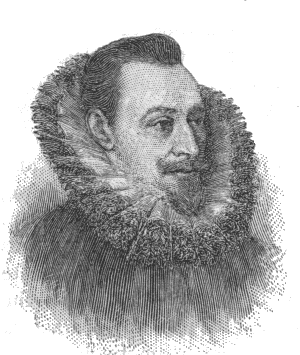
Life. Of Spenser's early life and parentage we know little, except that he was born in East Smithfield, near the Tower of London, and was poor. His education began at the Merchant Tailors' School in London and was continued in Cambridge, where as a poor sizar and fag for wealthy students he earned a scant living. Here in the glorious world that only a poor scholar knows how to create for himself he read the classics, made acquaintance with the great Italian poets, and wrote numberless little poems of his own. Though Chaucer was his beloved master, his ambition was not to rival the Canterbury Tales, but rather to express the dream of English chivalry, much as Ariosto had done for Italy in Orlando Furioso.
After leaving Cambridge (1576) Spenser went to the north of England, on some unknown work or quest. Here his chief occupation was to fall in love and to record his melancholy over the lost Rosalind in the Shepherd's Calendar. Upon his friend Harvey's advice he came to London, bringing his poems; and here he met Leicester, then at the height of royal favor, and the latter took him to live at Leicester House. Here he finished the Shepherd's Calendar, and here he met Sidney and all the queen's favorites. The court was full of intrigues, lying and flattery, and Spenser's opinion of his own uncomfortable position is best expressed in a few lines from "Mother Hubbard's Tale":
Full little knowest thou, that has not tried, What hell it is, in suing long to bide: To lose good days, that might be better spent; To waste long nights in pensive discontent;
To fret thy soul with crosses and with cares; To eat thy heart through comfortless despairs; To fawn, to crouch, to wait, to ride, to run, To spend, to give, to want, to be undone.
In 1580, through Leicester's influence, Spenser, who was utterly weary of his dependent position, was made secretary to Lord Grey, the queen's deputy in Ireland, and the third period of his life began. He accompanied his chief through one campaign of savage brutality in putting down an Irish rebellion, and was given an immense estate with the castle of Kilcolman, in Munster, which had been confiscated from Earl Desmond, one of the Irish leaders. His life here, where according to the terms of his grant he must reside as an English settler, he regarded as lonely exile:
My luckless lot, That banished had myself, like wight forlore, Into that waste, where I was quite forgot.
It is interesting to note here a gentle poet's view of the "unhappy island." After nearly sixteen years' residence he wrote his View of the State of Ireland (1596),[116] his only prose work, in which he submits a plan for "pacifying the oppressed and rebellious people." This was to bring a huge force of cavalry and infantry into the country, give the Irish a brief time to submit, and after that to hunt them down like wild beasts. He calculated that cold, famine, and sickness would help the work of the sword, and that after the rebels had been well hounded for two winters the following summer would find the country peaceful. This plan, from the poet of harmony and beauty, was somewhat milder than the usual treatment of a brave people whose offense was that they loved liberty and religion. Strange as it may seem, the View was considered most statesmanlike, and was excellently well received in England.
In Kilcolman, surrounded by great natural beauty, Spenser finished the first three books of the Faery Queen. In 1589 Raleigh visited him, heard the poem with enthusiasm, hurried the poet off to London, and presented him to Elizabeth. The first three books met with instant success when published and were acclaimed as the greatest work in the English language. A yearly pension of fifty pounds was conferred by Elizabeth, but rarely paid, and the poet turned back to exile, that is, to Ireland again.
Soon after his return, Spenser fell in love with his beautiful Elizabeth, an Irish girl; wrote his Amoretti, or sonnets, in her honor; and afterwards represented her, in the Faery Queen, as the beautiful woman dancing among the Graces. In 1594 he married Elizabeth, celebrating his wedding with his "Epithalamion," one of the most beautiful wedding hymns in any language.
Spenser's next visit to London was in 1595, when he published "Astrophel," an elegy on the death of his friend Sidney, and three more books of the Faery Queen. On this visit he lived again at Leicester House, now occupied by the new favorite Essex, where he probably met Shakespeare and the other literary lights of the Elizabethan Age. Soon after his return to Ireland, Spenser was appointed Sheriff of Cork, a queer office for a poet, which probably brought about his undoing. The same year Tyrone's Rebellion broke out in Munster. Kilcolman, the ancient house of Desmond, was one of the first places attacked by the rebels, and Spenser barely escaped with his wife and two children. It is supposed that some unfinished parts of the Faery Queen were burned in the castle.
From the shock of this frightful experience Spenser never recovered. He returned to England heartbroken, and in the following year (1599) he died in an inn at Westminster. According to Ben Jonson he died "for want of bread"; but whether that is a poetic way of saying that he had lost his property or that he actually died of destitution, will probably never be known. He was buried beside his master Chaucer in Westminster Abbey, the poets of that age thronging to his funeral and, according to Camden, "casting their elegies and the pens that had written them into his tomb."
Spenser's Works. The Faery Queen is the great work upon which the poet's fame chiefly rests. The original plan of the poem included twenty-four books, each of which was to recount the adventure and triumph of a knight who represented a moral virtue. Spenser's purpose, as indicated in a letter to Raleigh which introduces the poem, is as follows:
To pourtraict in Arthure, before he was king, the image of a brave Knight, perfected in the twelve private Morall Vertues, as Aristotle hath devised; which is the purpose of these first twelve bookes: which if I finde to be well accepted, I may be perhaps encoraged to frame the other part of Polliticke Vertues in his person, after that hee came to be king.
Each of the Virtues appears as a knight, fighting his opposing Vice, and the poem tells the story of the conflicts. It is therefore purely allegorical, not only in its personified virtues but also in its representation of life as a struggle between good and evil. In its strong moral element the poem differs radically from Orlando Furioso, upon which it was modeled. Spenser completed only six books, celebrating Holiness, Temperance, Chastity, Friendship, Justice, and Courtesy. We have also a fragment of the seventh, treating of Constancy; but the rest of this book was not written, or else was lost in the fire at Kilcolman. The first three books are by far the best; and judging by the way the interest lags and the allegory grows incomprehensible, it is perhaps as well for Spenser's reputation that the other eighteen books remained a dream.
Argument of the Faery Queen. From the introductory letter we learn that the hero visits the queen's court in Fairy Land, while she is holding a twelve-days festival. On each day some distressed person appears unexpectedly, tells a woful story of dragons, of enchantresses, or of distressed beauty or virtue, and asks for a champion to right the wrong and to let the oppressed go free. Sometimes a knight volunteers or begs for the dangerous mission; again the duty is assigned by the queen; and the journeys and adventures of these knights are the subjects of the several books. The first recounts the adventures of the Redcross Knight, representing Holiness, and the lady Una, representing Religion. Their contests are symbolical of the world-wide struggle between virtue and faith on the one hand, and sin and heresy on the other. The second book tells the story of Sir Guyon, or Temperance; the third, of Britomartis, representing Chastity; the fourth, fifth, and sixth, of Cambel and Triamond (Friendship), Artegall (Justice), and Sir Calidore (Courtesy). Spenser's plan was a very elastic one and he filled up the measure of his narrative with everything that caught his fancy,--historical events and personages under allegorical masks, beautiful ladies, chivalrous knights, giants, monsters, dragons, sirens, enchanters, and adventures enough to stock a library of fiction. If you read Homer or Virgil, you know his subject in the first strong line; if you read Cædmon's Paraphrase or Milton's epic, the introduction gives you the theme; but Spenser's great poem--with the exception of a single line in the prologue, "Fierce warres and faithfull loves shall moralize my song"--gives hardly a hint of what is coming.
As to the meaning of the allegorical figures, one is generally in doubt. In the first three books the shadowy Faery Queen sometimes represents the glory of God and sometimes Elizabeth, who was naturally flattered by the parallel. Britomartis is also Elizabeth. The Redcross Knight is Sidney, the model Englishman. Arthur, who always appears to rescue the oppressed, is Leicester, which is another outrageous flattery. Una is sometimes religion and sometimes the Protestant Church; while Duessa represents Mary Queen of Scots, or general Catholicism. In the last three books Elizabeth appears again as Mercilla; Henry IV of France as Bourbon; the war in the Netherlands as the story of Lady Belge; Raleigh as Timias; the earls of Northumberland and Westmoreland (lovers of Mary or Duessa) as Blandamour and Paridell; and so on through the wide range of contemporary characters and events, till the allegory becomes as difficult to follow as the second part of Goethe's Faust.
Poetical Form. For the Faery Queen Spenser invented a new verse form, which has been called since his day the Spenserian stanza. Because of its rare beauty it has been much used by nearly all our poets in their best work. The new stanza was an improved form of Ariosto's ottava rima (i.e. eight-line stanza) and bears a close resemblance to one of Chaucer's most musical verse forms in the "Monk's Tale." Spenser's stanza is in nine lines, eight of five feet each and the last of six feet, riming ababbcbcc. A few selections from the first book, which is best worth reading, are reproduced here to show the style and melody of the verse.
A Gentle Knight was pricking on the plaine, Ycladd[117] in mightie armes and silver shielde, Wherein old dints of deepe woundes did remaine The cruell markes of many a bloody fielde; Yet armes till that time did he never wield: His angry steede did chide his foming bitt, As much disdayning to the curbe to yield: Full iolly[118] knight he seemd, and faire did sitt, As one for knightly giusts[119] and fierce encounters fitt. And on his brest a bloodie crosse he bore, The deare remembrance of his dying Lord, For whose sweete sake that glorious badge he wore, And dead, as living ever, him ador'd: Upon his shield the like was also scor'd, For soveraine hope, which in his helpe he had, Right faithfull true he was in deede and word; But of his cheere[120] did seeme too solemne sad; Yet nothing did he dread, but ever was ydrad.[121]
This sleepy bit, from the dwelling of Morpheus, invites us to linger:
And, more to lulle him in his slumber soft, A trickling streame from high rock tumbling downe, And ever-drizling raine upon the loft, Mixt with a murmuring winde, much like the sowne Of swarming bees, did cast him in a swowne. No other noyse, nor peoples troublous cryes, As still are wont t'annoy the walled towne, Might there be heard: but carelesse Quiet lyes, Wrapt in eternal silence farre from enimyes.
The description of Una shows the poet's sense of ideal beauty:
One day, nigh wearie of the yrkesome way, From her unhastie beast she did alight; And on the grasse her dainty limbs did lay In secrete shadow, far from all mens sight; From her fayre head her fillet she undight,[122] And layd her stole aside; Her angels face, As the great eye of heaven, shynéd bright, And made a sunshine in the shady place; Did never mortall eye behold such heavenly grace. It fortunéd, out of the thickest wood A ramping lyon rushéd suddeinly, Hunting full greedy after salvage blood: Soone as the royall Virgin he did spy, With gaping mouth at her ran greedily, To have at once devourd her tender corse: But to the pray whenas he drew more ny, His bloody rage aswaged with remorse,[123] And, with the sight amazd, forgat his furious forse. Instead thereof he kist her wearie feet, And lickt her lilly hands with fawning tong; As he her wrongéd innocence did weet.[124] O how can beautie maister the most strong, And simple truth subdue avenging wrong!
Minor Poems. Next to his masterpiece, the Shepherd's Calendar (1579) is the best known of Spenser's poems; though, as his first work, it is below many others in melody. It consists of twelve pastoral poems, or eclogues, one for each month of the year. The themes are generally rural life, nature, love in the fields; and the speakers are shepherds and shepherdesses. To increase the rustic effect Spenser uses strange forms of speech and obsolete words, to such an extent that Jonson complained his works are not English or any other language. Some are melancholy poems on his lost Rosalind; some are satires on the clergy; one, "The Briar and the Oak," is an allegory; one flatters Elizabeth, and others are pure fables touched with the Puritan spirit. They are written in various styles and meters, and show plainly that Spenser was practicing and preparing himself for greater work.
Other noteworthy poems are "Mother Hubbard's Tale," a satire on society; "Astrophel," an elegy on the death of Sidney; Amoretti, or sonnets, to his Elizabeth; the marriage hymn, "Epithalamion," and four "Hymns," on Love, Beauty, Heavenly Love, and Heavenly Beauty. There are numerous other poems and collections of poems, but these show the scope of his work and are best worth reading.
Importance of the Shepherd's Calendar. The publication of this work, in 1579, by an unknown writer who signed himself modestly "Immerito," marks an important epoch in our literature. We shall appreciate this better if we remember the long years during which England had been without a great poet. Chaucer and Spenser are often studied together as poets of the Renaissance period, and the idea prevails that they were almost contemporary. In fact, nearly two centuries passed after Chaucer's death,--years of enormous political and intellectual development,--and not only did Chaucer have no successor but our language had changed so rapidly that Englishmen had lost the ability to read his lines correctly.[125]
This first published work of Spenser is noteworthy in at least four respects: first, it marks the appearance of the first national poet in two centuries; second, it shows again the variety and melody of English verse, which had been largely a tradition since Chaucer; third, it was our first pastoral, the beginning of a long series of English pastoral compositions modeled on Spenser, and as such exerted a strong influence on subsequent literature; and fourth, it marks the real beginning of the outburst of great Elizabethan poetry.
Characteristics of Spenser's Poetry. The five main qualities of Spenser's poetry are (1) a perfect melody; (2) a rare sense of beauty; (3) a splendid imagination, which could gather into one poem heroes, knights, ladies, dwarfs, demons and dragons, classic mythology, stories of chivalry, and the thronging ideals of the Renaissance,--all passing in gorgeous procession across an ever-changing and ever-beautiful landscape; (4) a lofty moral purity and seriousness; (5) a delicate idealism, which could make all nature and every common thing beautiful. In contrast with these excellent qualities the reader will probably note the strange appearance of his lines due to his fondness for obsolete words, like eyne (eyes) and shend (shame), and his tendency to coin others, like mercify, to suit his own purposes.
It is Spenser's idealism, his love of beauty, and his exquisite melody which have caused him to be known as "the poets' poet." Nearly all our subsequent singers acknowledge their delight in him and their indebtedness. Macaulay alone among critics voices a fault which all who are not poets quickly feel, namely that, with all Spenser's excellences, he is difficult to read. The modern man loses himself in the confused allegory of the Faery Queen, skips all but the marked passages, and softly closes the book in gentle weariness. Even the best of his longer poems, while of exquisite workmanship and delightfully melodious, generally fail to hold the reader's attention. The movement is languid; there is little dramatic interest, and only a suggestion of humor. The very melody of his verses sometimes grows monotonous, like a Strauss waltz too long continued. We shall best appreciate Spenser by reading at first only a few well-chosen selections from the Faery Queen and the Shepherd's Calendar, and a few of the minor poems which exemplify his wonderful melody.
Comparison between Chaucer and Spenser. At the outset it is well to remember that, though Spenser regarded Chaucer as his master, two centuries intervene between them, and that their writings have almost nothing in common. We shall appreciate this better by a brief comparison between our first two modern poets.
Chaucer was a combined poet and man of affairs, with the latter predominating. Though dealing largely with ancient or mediæval material, he has a curiously modern way of looking at life. Indeed, he is our only author preceding Shakespeare with whom we feel thoroughly at home. He threw aside the outgrown metrical romance, which was practically the only form of narrative in his day, invented the art of story-telling in verse, and brought it to a degree of perfection which has probably never since been equaled. Though a student of the classics, he lived wholly in the present, studied the men and women of his own time, painted them as they were, but added always a touch of kindly humor or romance to make them more interesting. So his mission appears to be simply to amuse himself and his readers. His mastery of various and melodious verse was marvelous and has never been surpassed in our language; but the English of his day was changing rapidly, and in a very few years men were unable to appreciate his art, so that even to Spenser and Dryden, for example, he seemed deficient in metrical skill. On this account his influence on our literature has been much less than we should expect from the quality of his work and from his position as one of the greatest of English poets.
Like Chaucer, Spenser was a busy man of affairs, but in him the poet and the scholar always predominates. He writes as the idealist, describing men not as they are but as he thinks they should be; he has no humor, and his mission is not to amuse but to reform. Like Chaucer he studies the classics and contemporary French and Italian writers; but instead of adapting his material to present-day conditions, he makes poetry, as in his Eclogues for instance, more artificial even than his foreign models. Where Chaucer looks about him and describes life as he sees it, Spenser always looks backward for his inspiration; he lives dreamily in the past, in a realm of purely imaginary emotions and adventures. His first quality is imagination, not observation, and he is the first of our poets to create a world of dreams, fancies, and illusions. His second quality is a wonderful sensitiveness to beauty, which shows itself not only in his subject-matter but also in the manner of his poetry. Like Chaucer, he is an almost perfect workman; but in reading Chaucer we think chiefly of his natural characters or his ideas, while in reading Spenser we think of the beauty of expression. The exquisite Spenserian stanza and the rich melody of Spenser's verse have made him the model of all our modern poets.
MINOR POETS
Though Spenser is the one great non-dramatic poet of the Elizabethan Age, a multitude of minor poets demand attention of the student who would understand the tremendous literary activity of the period. One needs only to read The Paradyse of Daynty Devises (1576), or A Gorgeous Gallery of Gallant Inventions (1578), or any other of the miscellaneous collections to find hundreds of songs, many of them of exquisite workmanship, by poets whose names now awaken no response. A glance is enough to assure one that over all England "the sweet spirit of song had arisen, like the first chirping of birds after a storm." Nearly two hundred poets are recorded in the short period from 1558 to 1625, and many of them were prolific writers. In a work like this, we can hardly do more than mention a few of the best known writers, and spend a moment at least with the works that suggest Marlowe's description of "infinite riches in a little room." The reader will note for himself the interesting union of action and thought in these men, so characteristic of the Elizabethan Age; for most of them were engaged chiefly in business or war or politics, and literature was to them a pleasant recreation rather than an absorbing profession.
Thomas Sackville (1536-1608). Sir Thomas Sackville, Earl of Dorset and Lord High Treasurer of England, is generally classed with Wyatt and Surrey among the predecessors of the Elizabethan Age. In imitation of Dante's Inferno, Sackville formed the design of a great poem called The Mirror for Magistrates. Under guidance of an allegorical personage called Sorrow, he meets the spirits of all the important actors in English history. The idea was to follow Lydgate's Fall of Princes and let each character tell his own story; so that the poem would be a mirror in which present rulers might see themselves and read this warning: "Who reckless rules right soon may hope to rue." Sackville finished only the "Induction" and the "Complaint of the Duke of Buckingham." These are written in the rime royal, and are marked by strong poetic feeling and expression. Unfortunately Sackville turned from poetry to politics, and the poem was carried on by two inferior poets, William Baldwin and George Ferrers.
Sackville wrote also, in connection with Thomas Norton, the first English tragedy, Ferrex and Porrex, called also Gorboduc, which will be considered in the following section on the Rise of the Drama.
Philip Sidney (1554-1586). Sidney, the ideal gentleman, the Sir Calidore of Spenser's "Legend of Courtesy," is vastly more interesting as a man than as a writer, and the student is recommended to read his biography rather than his books. His life expresses, better than any single literary work, the two ideals of the age,--personal honor and national greatness.
As a writer he is known by three principal works, all published after his death, showing how little importance he attached to his own writing, even while he was encouraging Spenser. The Arcadia is a pastoral romance, interspersed with eclogues, in which shepherds and shepherdesses sing of the delights of rural life. Though the work was taken up idly as a summer's pastime, it became immensely popular and was imitated by a hundred poets. The Apologie for Poetrie (1595), generally called the Defense of Poesie, appeared in answer to a pamphlet by Stephen Gosson called The School of Abuse (1579), in which the poetry of the age and its unbridled pleasure were denounced with Puritan thoroughness and conviction. The Apologie is one of the first critical essays in English; and though its style now seems labored and unnatural,--the pernicious result of Euphues and his school,--it is still one of the best expressions of the place and meaning of poetry in any language. Astrophel and Stella is a collection of songs and sonnets addressed to Lady Penelope Devereux, to whom Sidney had once been betrothed. They abound in exquisite lines and passages, containing more poetic feeling and expression than the songs of any other minor writer of the age.
George Chapman (1559?-1634). Chapman spent his long, quiet life among the dramatists, and wrote chiefly for the stage. His plays, which were for the most part merely poems in dialogue, fell far below the high dramatic standard of his time and are now almost unread. His most famous work is the metrical translation of the Iliad (1611) and of the Odyssey (1614). Chapman's Homer, though lacking the simplicity and dignity of the original, has a force and rapidity of movement which makes it superior in many respects to Pope's more familiar translation. Chapman is remembered also as the finisher of Marlowe's Hero and Leander, in which, apart from the drama, the Renaissance movement is seen at perhaps its highest point in English poetry. Out of scores of long poems of the period, Hero and Leander and the Faery Queen are the only two which are even slightly known to modern readers.
Michael Drayton (1563-1631). Drayton is the most voluminous and, to antiquarians at least, the most interesting of the minor poets. He is the Layamon of the Elizabethan Age, and vastly more scholarly than his predecessor. His chief work is Polyolbion, an enormous poem of many thousand couplets, describing the towns, mountains, and rivers of Britain, with the interesting legends connected with each. It is an extremely valuable work and represents a lifetime of study and research. Two other long works are the Barons' Wars and the Heroic Epistle of England; and besides these were many minor poems. One of the best of these is the "Battle of Agincourt," a ballad written in the lively meter which Tennyson used with some variations in the "Charge of the Light Brigade," and which shows the old English love of brave deeds and of the songs that stir a people's heart in memory of noble ancestors.
III. THE FIRST ENGLISH DRAMATISTS
The Origin of the Drama. First the deed, then the story, then the play; that seems to be the natural development of the drama in its simplest form. The great deeds of a people are treasured in its literature, and later generations represent in play or pantomime certain parts of the story which appeal most powerfully to the imagination. Among primitive races the deeds of their gods and heroes are often represented at the yearly festivals; and among children, whose instincts are not yet blunted by artificial habits, one sees the story that was heard at bedtime repeated next day in vigorous action, when our boys turn scouts and our girls princesses, precisely as our first dramatists turned to the old legends and heroes of Britain for their first stage productions. To act a part seems as natural to humanity as to tell a story; and originally the drama is but an old story retold to the eye, a story put into action by living performers, who for the moment "make believe" or imagine themselves to be the old heroes.
To illustrate the matter simply, there was a great life lived by him who was called the Christ. Inevitably the life found its way into literature, and we have the Gospels. Around the life and literature sprang up a great religion. Its worship was at first simple,--the common prayer, the evening meal together, the remembered words of the Master, and the closing hymn. Gradually a ritual was established, which grew more elaborate and impressive as the centuries went by. Scenes from the Master's life began to be represented in the churches, especially at Christmas time, when the story of Christ's birth was made more effective, to the eyes of a people who could not read, by a babe in a manger surrounded by magi and shepherds, with a choir of angels chanting the Gloria in Excelsis.[126] Other impressive scenes from the Gospel followed; then the Old Testament was called upon, until a complete cycle of plays from the Creation to the Final Judgment was established, and we have the Mysteries and Miracle plays of the Middle Ages. Out of these came directly the drama of the Elizabethan Age.
PERIODS IN THE DEVELOPMENT OF THE DRAMA
1. The Religious Period. In Europe, as in Greece, the drama had a distinctly religious origin.[127] The first characters were drawn from the New Testament, and the object of the first plays was to make the church service more impressive, or to emphasize moral lessons by showing the reward of the good and the punishment of the evil doer. In the latter days of the Roman Empire the Church found the stage possessed by frightful plays, which debased the morals of a people already fallen too low. Reform seemed impossible; the corrupt drama was driven from the stage, and plays of every kind were forbidden. But mankind loves a spectacle, and soon the Church itself provided a substitute for the forbidden plays in the famous Mysteries and Miracles.
Miracle and Mystery Plays. In France the name miracle was given to any play representing the lives of the saints, while the mystère represented scenes from the life of Christ or stories from the Old Testament associated with the coming of Messiah. In England this distinction was almost unknown; the name Miracle was used indiscriminately for all plays having their origin in the Bible or in the lives of the saints; and the name Mystery, to distinguish a certain class of plays, was not used until long after the religious drama had passed away.
The earliest Miracle of which we have any record in England is the Ludus de Sancta Katharina, which was performed in Dunstable about the year 1110.[128] It is not known who wrote the original play of St. Catherine, but our first version was prepared by Geoffrey of St. Albans, a French school-teacher of Dunstable. Whether or not the play was given in English is not known, but it was customary in the earliest plays for the chief actors to speak in Latin or French, to show their importance, while minor and comic parts of the same play were given in English.
For four centuries after this first recorded play the Miracles increased steadily in number and popularity in England. They were given first very simply and impressively in the churches; then, as the actors increased in number and the plays in liveliness, they overflowed to the churchyards; but when fun and hilarity began to predominate even in the most sacred representations, the scandalized priests forbade plays altogether on church grounds. By the year 1300 the Miracles were out of ecclesiastical hands and adopted eagerly by the town guilds; and in the following two centuries we find the Church preaching against the abuse of the religious drama which it had itself introduced, and which at first had served a purely religious purpose.[129] But by this time the Miracles had taken strong hold upon the English people, and they continued to be immensely popular until, in the sixteenth century, they were replaced by the Elizabethan drama.
Cycles of PlaysThe early Miracle plays of England were divided into two classes: the first, given at Christmas, included all plays connected with the birth of Christ; the second, at Easter, included the plays relating to his death and triumph. By the beginning of the fourteenth century all these plays were, in various localities, united in single cycles beginning with the Creation and ending with the Final Judgment. The complete cycle was presented every spring, beginning on Corpus Christi day; and as the presentation of so many plays meant a continuous outdoor festival of a week or more, this day was looked forward to as the happiest of the whole year.
Probably every important town in England had its own cycle of plays for its own guilds to perform, but nearly all have been lost. At the present day only four cycles exist (except in the most fragmentary condition), and these, though they furnish an interesting commentary on the times, add very little to our literature. The four cycles are the Chester and York plays, so called from the towns in which they were given; the Towneley or Wakefield plays, named for the Towneley family, which for a long time owned the manuscript; and the Coventry plays, which on doubtful evidence have been associated with the Grey Friars (Franciscans) of Coventry. The Chester cycle has 25 plays, the Wakefield 30, the Coventry 42, and the York 48. It is impossible to fix either the date or the authorship of any of these plays; we only know certainly that they were in great favor from the twelfth to the sixteenth century. The York plays are generally considered to be the best; but those of Wakefield show more humor and variety, and better workmanship. The former cycle especially shows a certain unity resulting from its aim to represent the whole of man's life from birth to death. The same thing is noticeable in Cursor Mundi, which, with the York and Wakefield cycles, belongs to the fourteenth century.
The Stage and the ActorsAt first the actors as well as the authors of the Miracles were the priests and their chosen assistants. Later, when The town guilds took up the plays and each guild became responsible for one or more of the series, the actors were carefully selected and trained. By four o'clock on the morning of Corpus Christi all the players had to be in their places in the movable theaters, which were scattered throughout the town in the squares and open places. Each of these theaters consisted of a two-story platform, set on wheels. The lower story was a dressing room for the actors; the upper story was the stage proper, and was reached by a trapdoor from below. When the play was over the platform was dragged away, and the next play in the cycle took its place. So in a single square several plays would be presented in rapid sequence to the same audience. Meanwhile the first play moved on to another square, where another audience was waiting to hear it.
Though the plays were distinctly religious in character, there is hardly one without its humorous element. In the play of Noah, for instance, Noah's shrewish wife makes fun for the audience by wrangling with her husband. In the Crucifixion play Herod is a prankish kind of tyrant who leaves the stage to rant among the audience; so that to "out-herod Herod" became a common proverb. In all the plays the devil is a favorite character and the butt of every joke. He also leaves the stage to play pranks or frighten the wondering children. On the side of the stage was often seen a huge dragon's head with gaping red jaws, belching forth fire and smoke, out of which poured a tumultuous troop of devils with clubs and pitchforks and gridirons to punish the wicked characters and to drag them away at last, howling and shrieking, into hell-mouth, as the dragon's head was called. So the fear of hell was ingrained into an ignorant people for four centuries. Alternating with these horrors were bits of rough horse-play and domestic scenes of peace and kindliness, representing the life of the English fields and homes. With these were songs and carols, like that of the Nativity, for instance:
As I out rode this enderes (last) night, Of three jolly shepherds I saw a sight, And all about their fold a star shone bright; They sang terli terlow, So merryly the shepherds their pipes can blow. Down from heaven, from heaven so high, Of angels there came a great companye With mirth, and joy, and great solemnitye; They sang terli terlow, So merryly the shepherds their pipes can blow.
Such songs were taken home by the audience and sung for a season, as a popular tune is now caught from the stage and sung on the streets; and at times the whole audience would very likely join in the chorus.
After these plays were written according to the general outline of the Bible stories, no change was tolerated, the audience insisting, like children at "Punch and Judy," upon seeing the same things year after year. No originality in plot or treatment was possible, therefore; the only variety was in new songs and jokes, and in the pranks of the devil. Childish as such plays seem to us, they are part of the religious development of all uneducated people. Even now the Persian play of the "Martyrdom of Ali" is celebrated yearly, and the famous "Passion Play," a true Miracle, is given every ten years at Oberammergau.
2. The Moral Period of the Drama.[130] The second or moral period of the drama is shown by the increasing prevalence of the Morality plays. In these the characters were allegorical personages,--Life, Death, Repentance, Goodness, Love, Greed, and other virtues and vices. The Moralities may be regarded, therefore, as the dramatic counterpart of the once popular allegorical poetry exemplified by the Romance of the Rose. It did not occur to our first, unknown dramatists to portray men and women as they are until they had first made characters of abstract human qualities. Nevertheless, the Morality marks a distinct advance over the Miracle in that it gave free scope to the imagination for new plots and incidents. In Spain and Portugal these plays, under the name auto, were wonderfully developed by the genius of Calderon and Gil Vicente; but in England the Morality was a dreary kind of performance, like the allegorical poetry which preceded it.
To enliven the audience the devil of the Miracle plays was introduced; and another lively personage called the Vice was the predecessor of our modern clown and jester. His business was to torment the "virtues" by mischievous pranks, and especially to make the devil's life a burden by beating him with a bladder or a wooden sword at every opportunity. The Morality generally ended in the triumph of virtue, the devil leaping into hell-mouth with Vice on his back.
The best known of the Moralities is "Everyman," which has recently been revived in England and America. The subject of the play is the summoning of every man by Death; and the moral is that nothing can take away the terror of the inevitable summons but an honest life and the comforts of religion. In its dramatic unity it suggests the pure Greek drama; there is no change of time or scene, and the stage is never empty from the beginning to the end of the performance. Other well-known Moralities are the "Pride of Life," "Hyckescorner," and "Castell of Perseverance." In the latter, man is represented as shut up in a castle garrisoned by the virtues and besieged by the vices.
Like the Miracle plays, most of the old Moralities are of unknown date and origin. Of the known authors of Moralities, two of the best are John Skelton, who wrote "Magnificence," and probably also "The Necromancer"; and Sir David Lindsay (1490-1555), "the poet of the Scotch Reformation," whose religious business it was to make rulers uncomfortable by telling them unpleasant truths in the form of poetry. With these men a new element enters into the Moralities. They satirize or denounce abuses of Church and State, and introduce living personages thinly disguised as allegories; so that the stage first becomes a power in shaping events and correcting abuses.
The Interludes. It is impossible to draw any accurate line of distinction between the Moralities and Interludes. In general we may think of the latter as dramatic scenes, sometimes given by themselves (usually with music and singing) at banquets and entertainments where a little fun was wanted; and again slipped into a Miracle play to enliven the audience after a solemn scene. Thus on the margin of a page of one of the old Chester plays we read, "The boye and pigge when the kinges are gone." Certainly this was no part of the original scene between Herod and the three kings. So also the quarrel between Noah and his wife is probably a late addition to an old play. The Interludes originated, undoubtedly, in a sense of humor; and to John Heywood (1497?-1580?), a favorite retainer and jester at the court of Mary, is due the credit for raising the Interlude to the distinct dramatic form known as comedy.
Heywood's Interludes were written between 1520 and 1540. His most famous is "The Four P's," a contest of wit between a "Pardoner, a Palmer, a Pedlar and a Poticary." The characters here strongly suggest those of Chaucer.[131] Another interesting Interlude is called "The Play of the Weather." In this Jupiter and the gods assemble to listen to complaints about the weather and to reform abuses. Naturally everybody wants his own kind of weather. The climax is reached by a boy who announces that a boy's pleasure consists in two things, catching birds and throwing snowballs, and begs for the weather to be such that he can always do both. Jupiter decides that he will do just as he pleases about the weather, and everybody goes home satisfied.
All these early plays were written, for the most part, in a mingling of prose and wretched doggerel, and add nothing to our literature. Their great work was to train actors, to keep alive the dramatic spirit, and to prepare the way for the true drama.
3. The Artistic Period of the Drama. The artistic is the final stage in the development of the English drama. It differs radically from the other two in that its chief purpose is not to point a moral but to represent human life as it is. The artistic drama may have purpose, no less than the Miracle play, but the motive is always subordinate to the chief end of representing life itself.
The First Comedy The first true play in English, with a regular plot, divided into acts and scenes, is probably the comedy, "Ralph Royster Doyster." It was written by Nicholas Udall, master of Eton, and later of Westminster school, and was first acted by his schoolboys some time before 1556. The story is that of a conceited fop in love with a widow, who is already engaged to another man. The play is an adaptation of the Miles Gloriosus, a classic comedy by Plautus, and the English characters are more or less artificial; but as furnishing a model of a clear plot and natural dialogue, the influence of this first comedy, with its mixture of classic and English elements, can hardly be overestimated.
The next play, "Gammer Gurton's Needle" (cir. 1562), is a domestic comedy, a true bit of English realism, representing the life of the peasant class.
Gammer Gurton is patching the leather breeches of her man Hodge, when Gib, the cat, gets into the milk pan. While Gammer chases the cat the family needle is lost, a veritable calamity in those days. The whole household is turned upside down, and the neighbors are dragged into the affair. Various comical situations are brought about by Diccon, a thieving vagabond, who tells Gammer that her neighbor, Dame Chatte, has taken her needle, and who then hurries to tell Dame Chatte that she is accused by Gammer of stealing a favorite rooster. Naturally there is a terrible row when the two irate old women meet and misunderstand each other. Diccon also drags Doctor Rat, the curate, into the quarrel by telling him that, if he will but creep into Dame Chatte's cottage by a hidden way, he will find her using the stolen needle. Then Diccon secretly warns Dame Chatte that Gammer Gurton's man Hodge is coming to steal her chickens; and the old woman hides in the dark passage and cudgels the curate soundly with the door bar. All the parties are finally brought before the justice, when Hodge suddenly and painfully finds the lost needle--which is all the while stuck in his leather breeches--and the scene ends uproariously for both audience and actors.
This first wholly English comedy is full of fun and coarse humor, and is wonderfully true to the life it represents. It was long attributed to John Still, afterwards bishop of Bath; but the authorship is now definitely assigned to William Stevenson.[132] Our earliest edition of the play was printed in 1575; but a similar play called "Dyccon of Bedlam" was licensed in 1552, twelve years before Shakespeare's birth.
To show the spirit and the metrical form of the play we give a fragment of the boy's description of the dullard Hodge trying to light a fire on the hearth from the cat's eyes, and another fragment of the old drinking song at the beginning of the second act.
At last in a dark corner two sparkes he thought he sees Which were, indede, nought els but Gyb our cat's two eyes. "Puffe!" quod Hodge, thinking therby to have fyre without doubt; With that Gyb shut her two eyes, and so the fyre was out. And by-and-by them opened, even as they were before; With that the sparkes appeared, even as they had done of yore. And, even as Hodge blew the fire, as he did thincke, Gyb, as she felt the blast, strayght-way began to wyncke, Tyll Hodge fell of swering, as came best to his turne, The fier was sure bewicht, and therfore wold not burne. At last Gyb up the stayers, among the old postes and pinnes, And Hodge he hied him after till broke were both his shinnes, Cursynge and swering othes, were never of his makyng, That Gyb wold fyre the house if that shee were not taken.
Fyrste a Songe: Backe and syde, go bare, go bare; Booth foote and hande, go colde; But, bellye, God sende thee good ale ynoughe, Whether it be newe or olde! I can not eate but lytle meate, My stomacke is not good; But sure I thinke that I can dryncke With him that weares a hood. Thoughe I go bare, take ye no care, I am nothinge a-colde, I stuffe my skyn so full within Of ioly good ale and olde. Backe and syde, go bare, etc.
The First TragedyOur first tragedy, "Gorboduc," was written by Thomas Sackville and Thomas Norton, and was acted in 1562, only two years before the birth of Shakespeare. It is remarkable not only as our first tragedy, but as the first play to be written in blank verse, the latter being most significant, since it started the drama into the style of verse best suited to the genius of English playwrights.
The story of "Gorboduc" is taken from the early annals of Britain and recalls the story used by Shakespeare in King Lear. Gorboduc, king of Britain, divides his kingdom between his sons Ferrex and Porrex. The sons quarrel, and Porrex, the younger, slays his brother, who is the queen's favorite. Videna, the queen, slays Porrex in revenge; the people rebel and slay Videna and Gorboduc; then the nobles kill the rebels, and in turn fall to fighting each other. The line of Brutus being extinct with the death of Gorboduc, the country falls into anarchy, with rebels, nobles, and a Scottish invader all fighting for the right of succession. The curtain falls upon a scene of bloodshed and utter confusion.
The artistic finish of this first tragedy is marred by the authors' evident purpose to persuade Elizabeth to marry. It aims to show the danger to which England is exposed by the uncertainty of succession. Otherwise the plan of the play follows the classical rule of Seneca. There is very little action on the stage; bloodshed and battle are announced by a messenger; and the chorus, of four old men of Britain, sums up the situation with a few moral observations at the end of each of the first four acts.
Classical Influence upon the Drama. The revival of Latin literature had a decided influence upon the English drama as it developed from the Miracle plays. In the fifteenth century English teachers, in order to increase the interest in Latin, began to let their boys act the plays which they had read as literature, precisely as our colleges now present Greek or German plays at the yearly festivals. Seneca was the favorite Latin author, and all his tragedies were translated into English between 1559 and 1581. This was the exact period in which the first English playwrights were shaping their own ideas; but the severe simplicity of the classical drama seemed at first only to hamper the exuberant English spirit. To understand this, one has only to compare a tragedy of Seneca or of Euripides with one of Shakespeare, and see how widely the two masters differ in methods.
Dramatic Unities In the classic play the so-called dramatic unities of time, place, and action were strictly observed. Time and place must remain the same; the play could represent a period of only a few hours, and whatever action was introduced must take place at the spot where the play began. The characters, therefore, must remain unchanged throughout; there was no possibility of the child becoming a man, or of the man's growth with changing circumstances. As the play was within doors, all vigorous action was deemed out of place on the stage, and battles and important events were simply announced by a messenger. The classic drama also drew a sharp line between tragedy and comedy, all fun being rigorously excluded from serious representations.
The English drama, on the other hand, strove to represent the whole sweep of life in a single play. The scene changed rapidly; the same actors appeared now at home, now at court, now on the battlefield; and vigorous action filled the stage before the eyes of the spectators. The child of one act appeared as the man of the next, and the imagination of the spectator was called upon to bridge the gaps from place to place and from year to year. So the dramatist had free scope to present all life in a single place and a single hour. Moreover, since the world is always laughing and always crying at the same moment, tragedy and comedy were presented side by side, as they are in life itself. As Hamlet sings, after the play that amused the court but struck the king with deadly fear:
Why, let the stricken deer go weep, The hart ungalled play; For some must watch, while some must sleep: So runs the world away.
Two Schools of DramaNaturally, with these two ideals struggling to master the English drama, two schools of writers arose. The University Two Schools Wits, as men of learning were called, generally of Drama upheld the classical ideal, and ridiculed the crude-ness of the new English plays. Sackville and Norton were of this class, and "Gorboduc" was classic in its construction. In the "Defense of Poesie" Sidney upholds the classics and ridicules the too ambitious scope of the English drama. Against these were the popular playwrights, Lyly, Peele, Greene, Marlowe, and many others, who recognized the English love of action and disregarded the dramatic unities in their endeavor to present life as it is. In the end the native drama prevailed, aided by the popular taste which had been trained by four centuries of Miracles. Our first plays, especially of the romantic type, were extremely crude and often led to ridiculously extravagant scenes; and here is where the classic drama exercised an immense influence for good, by insisting upon beauty of form and definiteness of structure at a time when the tendency was to satisfy a taste for stage spectacles without regard to either.
The TheaterIn the year 1574 a royal permit to Lord Leicester's actors allowed them "to give plays anywhere throughout our realm of England," and this must be regarded as the beginning of the regular drama. Two years later the first playhouse, known as "The Theater," was built for these actors by James Burbage in Finsbury Fields, just north of London. It was in this theater that Shakespeare probably found employment when he first came to the city. The success of this venture was immediate, and the next thirty years saw a score of theatrical companies, at least seven regular theaters, and a dozen or more inn yards permanently fitted for the giving of plays,--all established in the city and its immediate suburbs. The growth seems all the more remarkable when we remember that the London of those days would now be considered a small city, having (in 1600) only about a hundred thousand inhabitants.
A Dutch traveler, Johannes de Witt, who visited London in 1596, has given us the only contemporary drawing we possess of the interior of one of these theaters. They were built of stone and wood, round or octagonal in shape, and without a roof, being simply an inclosed courtyard. At one side was the stage, and before it on the bare ground, or pit, stood that large part of the audience who could afford to pay only an admission fee. The players and these groundlings were exposed to the weather; those that paid for seats were in galleries sheltered by a narrow porch-roof projecting inwards from the encircling walls; while the young nobles and gallants, who came to be seen and who could afford the extra fee, took seats on the stage itself, and smoked and chaffed the actors and threw nuts at the groundlings.[133] The whole idea of these first theaters, according to De Witt, was like that of the Roman amphitheater; and the resemblance was heightened by the fact that, when no play was on the boards, the stage might be taken away and the pit given over to bull and bear baiting.
The StageIn all these theaters, probably, the stage consisted of a bare platform, with a curtain or "traverse" across the middle, separating the front from the rear stage. On the latter unexpected scenes or characters were "discovered" by simply drawing the curtain aside. At first little or no scenery was used, a gilded sign being the only announcement of a change of scene; and this very lack of scenery led to better acting, since the actors must be realistic enough to make the audience forget its shabby surroundings.[134] By Shakespeare's day, however, painted scenery had appeared, first at university plays, and then in the regular theaters.[135] In all our first plays female parts were taken by boy actors, who evidently were more distressing than the crude scenery, for contemporary literature has many satirical references to their acting,[136] and even the tolerant Shakespeare writes:
Some squeaking Cleopatra boy my greatness.
However that may be, the stage was deemed unfit for women, and actresses were unknown in England until after the Restoration.
Shakespeare's Predecessors in the Drama. The English drama as it developed from the Miracle plays has an interesting history. It began with schoolmasters, like Udall, who translated and adapted Latin plays for their boys to act, and who were naturally governed by classic ideals. It was continued by the choir masters of St. Paul and the Royal and the Queen's Chapel, whose companies of choir-boy actors were famous in London and rivaled the players of the regular theaters.[137] These choir masters were our first stage managers. They began with masques and interludes and the dramatic presentation of classic myths modeled after the Italians; but some of them, like Richard Edwards (choir master of the Queen's Chapel in 1561), soon added farces from English country life and dramatized some of Chaucer's stories. Finally, the regular playwrights, Kyd, Nash, Lyly, Peele, Greene, and Marlowe, brought the English drama to the point where Shakespeare began to experiment upon it.
Each of these playwrights added or emphasized some essential element in the drama, which appeared later in the work of Shakespeare. Thus John Lyly (1554?-1606), who is now known chiefly as having developed the pernicious literary style called euphuism,[138] is one of the most influential of the early dramatists. His court comedies are remarkable for their witty dialogue and for being our first plays to aim definitely at unity and artistic finish. Thomas Kyd's Spanish Tragedy (c. 1585) first gives us the drama, or rather the melodrama, of passion, copied by Marlowe and Shakespeare. This was the most popular of the early Elizabethan plays; it was revised again and again, and Ben Jonson is said to have written one version and to have acted the chief part of Hieronimo.[139] And Robert Greene (1558?-1592) plays the chief part in the early development of romantic comedy, and gives us some excellent scenes of English country life in plays like Friar Bacon and Friar Bungay.
Methods of the Early DramatistsEven a brief glance at the life and work of these first playwrights shows three noteworthy things which have a bearing on Shakespeare's career: (1) These men were usually actors as well as dramatists. They knew the stage and the audience, and in writing their plays they remembered not only the actor's part but also the audience's love for stories and brave spectacles. "Will it act well, and will it please our audience," were the questions of chief concern to our early dramatists. (2) Their training began as actors; then they revised old plays, and finally became independent writers. In this their work shows an exact parallel with that of Shakespeare. (3) They often worked together, probably as Shakespeare worked with Marlowe and Fletcher, either in revising old plays or in creating new ones. They had a common store of material from which they derived their stories and characters, hence their frequent repetition of names; and they often produced two or more plays on the same subject. Much of Shakespeare's work depends, as we shall see, on previous plays; and even his Hamlet uses the material of an earlier play of the same name, probably by Kyd, which was well known to the London stage in 1589, some twelve years before Shakespeare's great work was written.
All these things are significant, if we are to understand the Elizabethan drama and the man who brought it to perfection. Shakespeare was not simply a great genius; he was also a great worker, and he developed in exactly the same way as did all his fellow craftsmen. And, contrary to the prevalent opinion, the Elizabethan drama is not a Minerva-like creation, springing full grown from the head of one man; it is rather an orderly though rapid development, in which many men bore a part. All our early dramatists are worthy of study for the part they played in the development of the drama; but we can here consider only one, the most typical of all, whose best work is often ranked with that of Shakespeare.
CHRISTOPHER MARLOWE (1564-1593)
Marlowe is one of the most suggestive figures of the English Renaissance, and the greatest of Shakespeare's predecessors. The glory of the Elizabethan drama dates from his Tamburlaine (1587), wherein the whole restless temper of the age finds expression:
Nature, that framed us of four elements Warring within our breasts for regiment, Doth teach us all to have aspiring minds: Our souls--whose faculties can comprehend The wondrous architecture of the world, And measure every wandering planet's course, Still climbing after knowledge infinite, And always moving as the restless spheres-- Will us to wear ourselves and never rest. Tamburlaine, Pt. I, II, vii.
Life. Marlowe was born in Canterbury, only a few months before Shakespeare. He was the son of a poor shoemaker, but through the kindness of a patron was educated at the town grammar school and then at Cambridge. When he came to London (c. 1584), his soul was surging with the ideals of the Renaissance, which later found expression in Faustus, the scholar longing for unlimited knowledge and for power to grasp the universe. Unfortunately, Marlowe had also the unbridled passions which mark the early, or Pagan Renaissance, as Taine calls it, and the conceit of a young man just entering the realms of knowledge. He became an actor and lived in a low-tavern atmosphere of excess and wretchedness. In 1587, when but twenty-three years old, he produced Tamburlaine, which brought him instant recognition. Thereafter, notwithstanding his wretched life, he holds steadily to a high literary purpose. Though all his plays abound in violence, no doubt reflecting many of the violent scenes in which he lived, he develops his "mighty line" and depicts great scenes in magnificent bursts of poetry, such as the stage had never heard before. In five years, while Shakespeare was serving his apprenticeship, Marlowe produced all his great work. Then he was stabbed in a drunken brawl and died wretchedly, as he had lived. The Epilogue of Faustus might be written across his tombstone:
Cut is the branch that might have grown full straight, And burned is Apollo's laurel bough That sometime grew within this learnéd man.
Marlowe's Works. In addition to the poem "Hero and Leander," to which we have referred,[140] Marlowe is famous for four dramas, now known as the Marlowesque or one-man type of tragedy, each revolving about one central personality who is consumed by the lust of power. The first of these is Tamburlaine, the story of Timur the Tartar. Timur begins as a shepherd chief, who first rebels and then triumphs over the Persian king. Intoxicated by his success, Timur rushes like a tempest over the whole East. Seated on his chariot drawn by captive kings, with a caged emperor before him, he boasts of his power which overrides all things. Then, afflicted with disease, he raves against the gods and would overthrow them as he has overthrown earthly rulers. Tamburlaine is an epic rather than a drama; but one can understand its instant success with a people only half civilized, fond of military glory, and the instant adoption of its "mighty line" as the instrument of all dramatic expression.
FaustusFaustus, the second play, is one of the best of Marlowe's works.[141] The story is that of a scholar who longs for infinite knowledge, and who turns from Theology, Philosophy, Medicine, and Law, the four sciences of the time, to the study of magic, much as a child might turn from jewels to tinsel and colored paper. In order to learn magic he sells himself to the devil, on condition that he shall have twenty-four years of absolute power and knowledge. The play is the story of those twenty-four years. Like Tamburlaine, it is lacking in dramatic construction,[142] but has an unusual number of passages of rare poetic beauty. Milton's Satan suggests strongly that the author of Paradise Lost had access to Faustus and used it, as he may also have used Tamburlaine, for the magnificent panorama displayed by Satan in Paradise Regained. For instance, more than fifty years before Milton's hero says, "Which way I turn is hell, myself am hell," Marlowe had written:
Faust. How comes it then that thou art out of hell? Mephisto. Why this is hell, nor am I out of it.
Hell hath no limits, nor is circumscribed In one self place; for where we are is hell, And where hell is there must we ever be.
Marlowe's third play is The Jew of Malta, a study of the lust for wealth, which centers about Barabas, a terrible old money lender, strongly suggestive of Shylock in The Merchant of Venice. The first part of the play is well constructed, showing a decided advance, but the last part is an accumulation of melodramatic horrors. Barabas is checked in his murderous career by falling into a boiling caldron which he had prepared for another, and dies blaspheming, his only regret being that he has not done more evil in his life.
Marlowe's last play is Edward II, a tragic study of a king's weakness and misery. In point of style and dramatic construction, it is by far the best of Marlowe's plays, and is a worthy predecessor of Shakespeare's historical drama.
Marlowe and ShakespeareMarlowe is the only dramatist of the time who is ever compared with Shakespeare.[143] When we remember that he died at twenty-nine, probably before Shakespeare had produced a single great play, we must wonder what he might have done had he outlived his wretched youth and become a man. Here and there his work is remarkable for its splendid imagination, for the stateliness of its verse, and for its rare bits of poetic beauty; but in dramatic instinct, in wide knowledge of human life, in humor, in delineation of woman's character, in the delicate fancy which presents an Ariel as perfectly as a Macbeth,--in a word, in all that makes a dramatic genius, Shakespeare stands alone. Marlowe simply prepared the way for the master who was to follow.
Variety of the Early Drama. The thirty years between our first regular English plays and Shakespeare's first comedy[144] witnessed a development of the drama which astonishes us both by its rapidity and variety. We shall better appreciate Shakespeare's work if we glance for a moment at the plays that preceded him, and note how he covers the whole field and writes almost every form and variety of the drama known to his age.
Types of DramaFirst in importance, or at least in popular interest, are the new Chronicle plays, founded upon historical events and characters. They show the strong national spirit of the Elizabethan Age, and their popularity was due largely to the fact that audiences came to the theaters partly to gratify their awakened national spirit and to get their first knowledge of national history. Some of the Moralities, like Bayle's King Johan (1538), are crude Chronicle plays, and the early Robin Hood plays and the first tragedy, Gorboduc, show the same awakened popular interest in English history. During the reign of Elizabeth the popular Chronicle plays increased till we have the record of over two hundred and twenty, half of which are still extant, dealing with almost every important character, real or legendary, in English history. Of Shakespeare's thirty-seven dramas, ten are true Chronicle plays of English kings; three are from the legendary annals of Britain; and three more are from the history of other nations.
Other types of the early drama are less clearly defined, but we may sum them up under a few general heads: (1) The Domestic Drama began with crude home scenes introduced into the Miracles and developed in a score of different ways, from the coarse humor of Gammer Gurton's Needle to the Comedy of Manners of Jonson and the later dramatists. Shakespeare's Taming of the Shrew and Merry Wives of Windsor belong to this class. (2) The so-called Court Comedy is the opposite of the former in that it represented a different kind of life and was intended for a different audience. It was marked by elaborate dialogue, by jests, retorts, and endless plays on words, rather than by action. It was made popular by Lyly's success, and was imitated in Shakespeare's first or "Lylian" comedies, such as Love's Labour's Lost, and the complicated Two Gentlemen of Verona. (3) Romantic Comedy and Romantic Tragedy suggest the most artistic and finished types of the drama, which were experimented upon by Peele, Greene, and Marlowe, and were brought to perfection in The Merchant of Venice, Romeo and Juliet, and The Tempest. (4) In addition to the above types were several others,--the Classical Plays, modeled upon Seneca and favored by cultivated audiences; the Melodrama, favorite of the groundlings, which depended not on plot or characters but upon a variety of striking scenes and incidents; and the Tragedy of Blood, always more or less melodramatic, like Kyd's Spanish Tragedy, which grew more blood-and-thundery in Marlowe and reached a climax of horrors in Shakespeare's Titus Andronicus. It is noteworthy that Hamlet, Lear, and Macbeth all belong to this class, but the developed genius of the author raised them to a height such as the Tragedy of Blood had never known before.
These varied types are quite enough to show with what doubtful and unguided experiments our first dramatists were engaged, like men first setting out in rafts and dugouts on an unknown sea. They are the more interesting when we remember that Shakespeare tried them all; that he is the only dramatist whose plays cover the whole range of the drama from its beginning to its decline. From the stage spectacle he developed the drama of human life; and instead of the doggerel and bombast of our first plays he gives us the poetry of Romeo and Juliet and Midsummer Night's Dream. In a word, Shakespeare brought order out of dramatic chaos. In a few short years he raised the drama from a blundering experiment to a perfection of form and expression which has never since been rivaled.
IV. SHAKESPEARE
The Wonder of ShakespeareOne who reads a few of Shakespeare's great plays and then the meager story of his life is generally filled with a vague wonder. Here is an unknown country boy, poor and poorly educated according to the standards of his age, who arrives at the great city of London and goes to work at odd jobs in a theater. In a year or two he is associated with scholars and dramatists, the masters of their age, writing plays of kings and clowns, of gentlemen and heroes and noble women, all of whose lives he seems to know by intimate association. In a few years more he leads all that brilliant group of poets and dramatists who have given undying glory to the Age of Elizabeth. Play after play runs from his pen, mighty dramas of human life and character following one another so rapidly that good work seems impossible; yet they stand the test of time, and their poetry is still unrivaled in any language. For all this great work the author apparently cares little, since he makes no attempt to collect or preserve his writings. A thousand scholars have ever since been busy collecting, identifying, classifying the works which this magnificent workman tossed aside so carelessly when he abandoned the drama and retired to his native village. He has a marvelously imaginative and creative mind; but he invents few, if any, new plots or stories. He simply takes an old play or an old poem, makes it over quickly, and lo! this old familiar material glows with the deepest thoughts and the tenderest feelings that ennoble our humanity; and each new generation of men finds it more wonderful than the last. How did he do it? That is still an unanswered question and the source of our wonder.
WILLIAM SHAKESPEARE
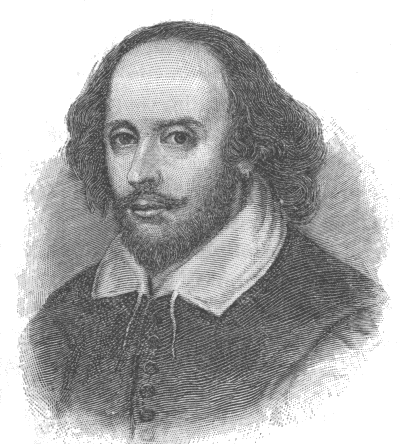
Genius or TrainingThere are, in general, two theories to account for Shakespeare. The romantic school of writers have always held that in him "all came from within"; that his genius was his sufficient guide; and that to the overmastering power of his genius alone we owe all his great works. Practical, unimaginative men, on the other hand, assert that in Shakespeare "all came from without," and that we must study his environment rather than his genius, if we are to understand him. He lived in a play-loving age; he studied the crowds, gave them what they wanted, and simply reflected their own thoughts and feelings. In reflecting the English crowd about him he unconsciously reflected all crowds, which are alike in all ages; hence his continued popularity. And in being guided by public sentiment he was not singular, but followed the plain path that every good dramatist has always followed to success.
Probably the truth of the matter is to be found somewhere between these two extremes. Of his great genius there can be no question; but there are other things to consider. As we have already noticed, Shakespeare was trained, like his fellow workmen, first as an actor, second as a reviser of old plays, and last as an independent dramatist. He worked with other playwrights and learned their secret. Like them, he studied and followed the public taste, and his work indicates at least three stages, from his first somewhat crude experiments to his finished masterpieces. So it would seem that in Shakespeare we have the result of hard work and of orderly human development, quite as much as of transcendent genius.
Life (1564-1616). Two outward influences were powerful in developing the genius of Shakespeare,--the little village of Stratford, center of the most beautiful and romantic district in rural England, and the great city of London, the center of the world's political activity. In one he learned to know the natural man in his natural environment; in the other, the social, the artificial man in the most unnatural of surroundings.
From the register of the little parish church at Stratford-on-Avon we learn that William Shakespeare was baptized there on the twenty-sixth of April, 1564 (old style). As it was customary to baptize children on the third day after birth, the twenty-third of April (May 3, according to our present calendar) is generally accepted as the poet's birthday.
His father, John Shakespeare, was a farmer's son from the neighboring village of Snitterfield, who came to Stratford about 1551, and began to prosper as a trader in corn, meat, leather, and other agricultural products. His mother, Mary Arden, was the daughter of a prosperous farmer, descended from an old Warwickshire family of mixed Anglo-Saxon and Norman blood. In 1559 this married couple sold a piece of land, and the document is signed, "The marke + of John Shacksper. The marke + of Mary Shacksper"; and from this it has been generally inferred that, like the vast majority of their countrymen, neither of the poet's parents could read or write. This was probably true of his mother; but the evidence from Stratford documents now indicates that his father could write, and that he also audited the town accounts; though in attesting documents he sometimes made a mark, leaving his name to be filled in by the one who drew up the document.
Of Shakespeare's education we know little, except that for a few years he probably attended the endowed grammar school at Stratford, where he picked up the "small Latin and less Greek" to which his learned friend Ben Jonson refers. His real teachers, meanwhile, were the men and women and the natural influences which surrounded him. Stratford is a charming little village in beautiful Warwickshire, and near at hand were the Forest of Arden, the old castles of Warwick and Kenilworth, and the old Roman camps and military roads, to appeal powerfully to the boy's lively imagination. Every phase of the natural beauty of this exquisite region is reflected in Shakespeare's poetry; just as his characters reflect the nobility and the littleness, the gossip, vices, emotions, prejudices, and traditions of the people about him.
I saw a smith stand with his hammer, thus, The whilst his iron did on the anvil cool, With open mouth swallowing a tailor's news; Who, with his shears and measure in his hand, Standing on slippers, which his nimble haste Had falsely thrust upon contrary feet, Told of a many thousand warlike French That were embattailed and ranked in Kent.[145]
Such passages suggest not only genius but also a keen, sympathetic observer, whose eyes see every significant detail. So with the nurse in Romeo and Juliet, whose endless gossip and vulgarity cannot quite hide a kind heart. She is simply the reflection of some forgotten nurse with whom Shakespeare had talked by the wayside.
Not only the gossip but also the dreams, the unconscious poetry that sleeps in the heart of the common people, appeal tremendously to Shakespeare's imagination and are reflected in his greatest plays. Othello tries to tell a curt soldier's story of his love; but the account is like a bit of Mandeville's famous travels, teeming with the fancies that filled men's heads when the great round world was first brought to their attention by daring explorers. Here is a bit of folklore, touched by Shakespeare's exquisite fancy, which shows what one boy listened to before the fire at Halloween:
She comes In shape no bigger than an agate-stone On the fore-finger of an alderman, Drawn with a team of little atomies Athwart men's noses as they lie asleep; Her waggon-spokes made of long spinners' legs, The cover of the wings of grasshoppers, The traces of the smallest spider's web, The collars of the moonshine's watery beams, Her whip of cricket's bone, the lash of film, Her waggoner a small grey-coated gnat,
Her chariot is an empty hazel nut Made by the joiner squirrel, or old grub, Time out o' mind the fairies' coachmakers. And in this state she gallops night by night Through lovers' brains, and then they dream of love;
O'er lawyers' fingers, who straight dream on fees, O'er ladies' lips, who straight on kisses dream.[146]
So with Shakespeare's education at the hands of Nature, which came from keeping his heart as well as his eyes wide open to the beauty of the world. He speaks of a horse, and we know the fine points of a thoroughbred; he mentions the duke's hounds, and we hear them clamoring on a fox trail, their voices matched like bells in the frosty air; he stops for an instant in the sweep of a tragedy to note a flower, a star, a moonlit bank, a hilltop touched by the sunrise, and instantly we know what our own hearts felt but could not quite express when we saw the same thing. Because he notes and remembers every significant thing in the changing panorama of earth and sky, no other writer has ever approached him in the perfect natural setting of his characters.
When Shakespeare was about fourteen years old his father lost his little property and fell into debt, and the boy probably left school to help support the family of younger children. What occupation he followed for the next eight years is a matter of conjecture. From evidence found in his plays, it is alleged with some show of authority that he was a country schoolmaster and a lawyer's clerk, the character of Holofernes, in Love's Labour's Lost, being the warrant for one, and Shakespeare's knowledge of law terms for the other. But if we take such evidence, then Shakespeare must have been a botanist, because of his knowledge of wild flowers; a sailor, because he knows the ropes; a courtier, because of his extraordinary facility in quips and compliments and courtly language; a clown, because none other is so dull and foolish; a king, because Richard and Henry are true to life; a woman, because he has sounded the depths of a woman's feelings; and surely a Roman, because in Coriolanus and Julius Cæsar he has shown us the Roman spirit better than have the Roman writers themselves. He was everything, in his imagination, and it is impossible from a study of his scenes and characters to form a definite opinion as to his early occupation.
ANNE HATHAWAY COTTAGE
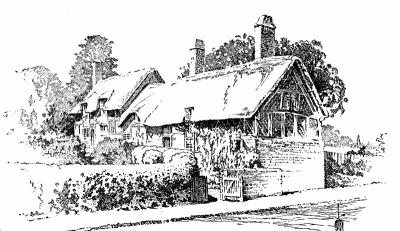
In 1582 Shakespeare was married to Anne Hathaway, the daughter of a peasant family of Shottery, who was eight years older than her boy husband. From numerous sarcastic references to marriage made by the characters in his plays, and from the fact that he soon left his wife and family and went to London, it is generally alleged that the marriage was a hasty and unhappy one; but here again the evidence is entirely untrustworthy. In many Miracles as well as in later plays it was customary to depict the seamy side of domestic life for the amusement of the crowd; and Shakespeare may have followed the public taste in this as he did in other things. The references to love and home and quiet joys in Shakespeare's plays are enough, if we take such evidence, to establish firmly the opposite supposition, that his love was a very happy one. And the fact that, after his enormous success in London, he retired to Stratford to live quietly with his wife and daughters, tends to the same conclusion.
About the year 1587 Shakespeare left his family and went to London and joined himself to Burbage's company of players. A persistent tradition says that he had incurred the anger of Sir Thomas Lucy, first by poaching deer in that nobleman's park, and then, when haled before a magistrate, by writing a scurrilous ballad about Sir Thomas, which so aroused the old gentleman's ire that Shakespeare was obliged to flee the country. An old record[147] says that the poet "was much given to all unluckiness in stealing venison and rabbits," the unluckiness probably consisting in getting caught himself, and not in any lack of luck in catching the rabbits. The ridicule heaped upon the Lucy family in Henry IV and the Merry Wives of Windsor gives some weight to this tradition. Nicholas Rowe, who published the first life of Shakespeare,[148] is the authority for this story; but there is some reason to doubt whether, at the time when Shakespeare is said to have poached in the deer park of Sir Thomas Lucy at Charlescote, there were any deer or park at the place referred to. The subject is worthy of some scant attention, if only to show how worthless is the attempt to construct out of rumor the story of a great life which, fortunately perhaps, had no contemporary biographer.
Of his life in London from 1587 to 1611, the period of his greatest literary activity, we know nothing definitely. We can judge only from his plays, and from these it is evident that he entered into the stirring life of England's capital with the same perfect sympathy and understanding that marked him among the plain people of his native Warwickshire. The first authentic reference to him is in 1592, when Greene's[149] bitter attack appeared, showing plainly that Shakespeare had in five years assumed an important position among playwrights. Then appeared the apology of the publishers of Greene's pamphlet, with their tribute to the poet's sterling character, and occasional literary references which show that he was known among his fellows as "the gentle Shakespeare." Ben Jonson says of him: "I loved the man and do honor his memory, on this side idolatry, as much as any. He was indeed honest, and of an open and free nature." To judge from only three of his earliest plays[150] it would seem reasonably evident that in the first five years of his London life he had gained entrance to the society of gentlemen and scholars, had caught their characteristic mannerisms and expressions, and so was ready by knowledge and observation as well as by genius to weave into his dramas the whole stirring life of the English people. The plays themselves, with the testimony of contemporaries and his business success, are strong evidence against the tradition that his life in London was wild and dissolute, like that of the typical actor and playwright of his time.
Shakespeare's first work may well have been that of a general helper, an odd-job man, about the theater; but he soon became an actor, and the records of the old London theaters show that in the next ten years he gained a prominent place, though there is little reason to believe that he was counted among the "stars." Within two years he was at work on plays, and his course here was exactly like that of other playwrights of his time. He worked with other men, and he revised old plays before writing his own, and so gained a practical knowledge of his art. Henry VI (c. 1590-1591) is an example of this tinkering work, in which, however, his native power is unmistakably manifest. The three parts of Henry VI (and Richard III, which belongs with them) are a succession of scenes from English Chronicle history strung together very loosely; and only in the last is there any definite attempt at unity. That he soon fell under Marlowe's influence is evident from the atrocities and bombast of Titus Andronicus and Richard III. The former may have been written by both playwrights in collaboration, or may be one of Marlowe's horrors left unfinished by his early death and brought to an end by Shakespeare. He soon broke away from this apprentice work, and then appeared in rapid succession Love's Labour's Lost, Comedy of Errors, Two Gentlemen of Verona, the first English Chronicle plays,[151] A Midsummer Night's Dream, and Romeo and Juliet. This order is more or less conjectural; but the wide variety of these plays, as well as their unevenness and frequent crudities, marks the first or experimental stage of Shakespeare's work. It is as if the author were trying his power, or more likely trying the temper of his audience. For it must be remembered that to please his audience was probably the ruling motive of Shakespeare, as of the other early dramatists, during the most vigorous and prolific period of his career.
BIRTHPLACE OF SHAKESPEARE
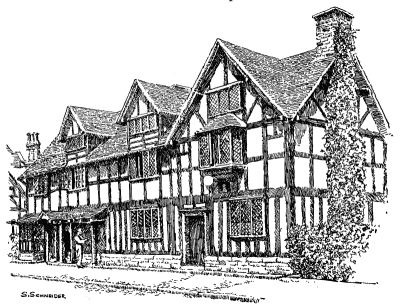
Shakespeare's poems, rather than his dramatic work, mark the beginning of his success. "Venus and Adonis" became immensely popular in London, and its dedication to the Earl of Southampton brought, according to tradition, a substantial money gift, which may have laid the foundation for Shakespeare's business success. He appears to have shrewdly invested his money, and soon became part owner of the Globe and Blackfriars theaters, in which his plays were presented by his own companies. His success and popularity grew amazingly. Within a decade of his unnoticed arrival in London he was one of the most famous actors and literary men in England.
Following his experimental work there came a succession of wonderful plays,--Merchant of Venice, As You Like It, Twelfth Night, Julius Cæsar, Hamlet, Macbeth, Othello, King Lear, Antony and Cleopatra. The great tragedies of this period are associated with a period of gloom and sorrow in the poet's life; but of its cause we have no knowledge. It may have been this unknown sorrow which turned his thoughts back to Stratford and caused, apparently, a dissatisfaction with his work and profession; but the latter is generally attributed to other causes. Actors and playwrights were in his day generally looked upon with suspicion or contempt; and Shakespeare, even in the midst of success, seems to have looked forward to the time when he could retire to Stratford to live the life of a farmer and country gentleman. His own and his father's families were first released from debt; then, in 1597, he bought New Place, the finest house in Stratford, and soon added a tract of farming land to complete his estate. His profession may have prevented his acquiring the title of "gentleman," or he may have only followed a custom of the time[152] when he applied for and obtained a coat of arms for his father, and so indirectly secured the title by inheritance. His home visits grew more and more frequent till, about the year 1611, he left London and retired permanently to Stratford.
TRINITY CHURCH, STRATFORD-ON-AVON
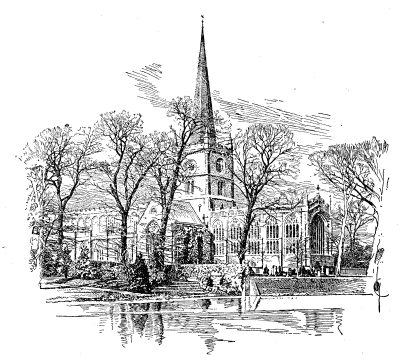
Though still in the prime of life, Shakespeare soon abandoned his dramatic work for the comfortable life of a country gentleman. Of his later plays, Coriolanus, Cymbeline, Winter's Tale, and Pericles show a decided falling off from his previous work, and indicate another period of experimentation; this time not to test his own powers but to catch the fickle humor of the public. As is usually the case with a theater-going people, they soon turned from serious drama to sentimental or more questionable spectacles; and with Fletcher, who worked with Shakespeare and succeeded him as the first playwright of London, the decline of the drama had already begun. In 1609, however, occurred an event which gave Shakespeare his chance for a farewell to the public. An English ship disappeared, and all on board were given up for lost. A year later the sailors returned home, and their arrival created intense excitement. They had been wrecked on the unknown Bermudas, and had lived there for ten months, terrified by mysterious noises which they thought came from spirits and devils. Five different accounts of this fascinating shipwreck were published, and the Bermudas became known as the "Ile of Divels." Shakespeare took this story--which caused as much popular interest as that later shipwreck which gave us Robinson Crusoe--and wove it into The Tempest. In the same year (1611) he probably sold his interest in the Globe and Blackfriars theaters, and his dramatic work was ended. A few plays were probably left unfinished[153] and were turned over to Fletcher and other dramatists.