Chapter X · (continued 2)
Reading edition
PrometheusPrometheus Unbound (1818-1820), a lyrical drama, is the best work of Shelley's revolutionary enthusiasm, and the most characteristic of all his poems. Shelley's philosophy (if one may dignify a hopeless dream by such a name) was a curious aftergrowth of the French Revolution, namely, that it is only the existing tyranny of State, Church, and society which keeps man from growth into perfect happiness. Naturally Shelley forgot, like many other enthusiasts, that Church and State and social laws were not imposed upon man from without, but were created by himself to minister to his necessities. In Shelley's poem the hero, Prometheus, represents mankind itself,--a just and noble humanity, chained and tortured by Jove, who is here the personification of human institutions.[228] In due time Demogorgon (which is Shelley's name for Necessity) overthrows the tyrant Jove and releases Prometheus (Mankind), who is presently united to Asia, the spirit of love and goodness in nature, while the earth and the moon join in a wedding song, and everything gives promise that they shall live together happy ever afterwards.
Shelley here looks forward, not back, to the Golden Age, and is the prophet of science and evolution. If we compare his Titan with similar characters in Faust and Cain, we shall find this interesting difference,--that while Goethe's Titan is cultured and self-reliant, and Byron's stoic and hopeless, Shelley's hero is patient under torture, seeing help and hope beyond his suffering. And he marries Love that the earth may be peopled with superior beings who shall substitute brotherly love for the present laws and conventions of society. Such is his philosophy; but the beginner will read this poem, not chiefly for its thought, but for its youthful enthusiasm, for its marvelous imagery, and especially for its ethereal music. Perhaps we should add here that Prometheus is, and probably always will be, a poem for the chosen few who can appreciate its peculiar spiritlike beauty. In its purely pagan conception of the world, it suggests, by contrast, Milton's Christian philosophy in Paradise Regained.
Shelley's revolutionary works, Queen Mab (1813), The Revolt of Islam (1818), Hellas (1821), and The Witch of Atlas (1820), are to be judged in much the same way as is Prometheus Unbound. They are largely invectives against religion, marriage, kingcraft, and priestcraft, most impractical when considered as schemes for reform, but abounding in passages of exquisite beauty, for which alone they are worth reading. In the drama called The Cenci (1819), which is founded upon a morbid Italian story, Shelley for the first and only time descends to reality. The heroine, Beatrice, driven to desperation by the monstrous wickedness of her father, kills him and suffers the death penalty in consequence. She is the only one of Shelley's characters who seems to us entirely human.
Adonais Far different in character is Epipsychidion (1821), a rhapsody celebrating Platonic love, the most impalpable, and so one of the most characteristic, of all Shelley's works. It was inspired by a beautiful Italian girl, Emilia Viviani, who was put into a cloister against her will, and in whom Shelley imagined he found his long-sought ideal of womanhood. With this should be read Adonais (1821), the best known of all Shelley's longer poems. Adonais is a wonderful threnody, or a song of grief, over the death of the poet Keats. Even in his grief Shelley still preserves a sense of unreality, and calls in many shadowy allegorical figures,--Sad Spring, Weeping Hours, Glooms, Splendors, Destinies,--all uniting in bewailing the loss of a loved one. The whole poem is a succession of dream pictures, exquisitely beautiful, such as only Shelley could imagine; and it holds its place with Milton's Lycidas and Tennyson's In Memoriam as one of the three greatest elegies in our language.
Shelley and Wordsworth In his interpretation of nature Shelley suggests Wordsworth, both by resemblance and by contrast. To both poets all natural objects are symbols of truth; both regard nature as permeated by the great spiritual life which animates all things; but while Wordsworth finds a spirit of thought, and so of communion between nature and the soul of man, Shelley finds a spirit of love, which exists chiefly for its own delight; and so "The Cloud," "The Skylark," and "The West Wind," three of the most beautiful poems in our language, have no definite message for humanity. In his "Hymn to Intellectual Beauty" Shelley is most like Wordsworth; but in his "Sensitive Plant," with its fine symbolism and imagery, he is like nobody in the world but himself. Comparison is sometimes an excellent thing; and if we compare Shelley's exquisite "Lament," beginning "O world, O life, O time," with Wordsworth's "Intimations of Immortality," we shall perhaps understand both poets better. Both poems recall many happy memories of youth; both express a very real mood of a moment; but while the beauty of one merely saddens and disheartens us, the beauty of the other inspires us with something of the poet's own faith and hopefulness. In a word, Wordsworth found and Shelley lost himself in nature.
JOHN KEATS (1795-1821)
Keats was not only the last but also the most perfect of the Romanticists. While Scott was merely telling stories, and Wordsworth reforming poetry or upholding the moral law, and Shelley advocating impossible reforms, and Byron voicing his own egoism and the political discontent of the times, Keats lived apart from men and from all political measures, worshiping beauty like a devotee, perfectly content to write what was in his own heart, or to reflect some splendor of the natural world as he saw or dreamed it to be. He had, moreover, the novel idea that poetry exists for its own sake, and suffers loss by being devoted to philosophy or politics or, indeed, to any cause, however great or small. As he says in "Lamia":
... Do not all charms fly At the mere touch of cold philosophy? There was an awful rainbow once in heaven: We know her woof, her texture; she is given In the dull catalogue of common things. Philosophy will clip an Angel's wings, Conquer all mysteries by rule and line, Empty the haunted air, and gnomed mine-- Unweave a rainbow, as it erewhile made The tender-person'd Lamia melt into a shade.
Partly because of this high ideal of poetry, partly because he studied and unconsciously imitated the Greek classics and the best works of the Elizabethans, Keats's last little volume of poetry is unequaled by the work of any of his contemporaries. When we remember that all his work was published in three short years, from 1817 to 1820, and that he died when only twenty-five years old, we must judge him to be the most promising figure of the early nineteenth century, and one of the most remarkable in the history of literature.
Life. Keats's life of devotion to beauty and to poetry is all the more remarkable in view of his lowly origin. He was the son of a hostler and stable keeper, and was born in the stable of the Swan and Hoop Inn, London, in 1795. One has only to read the rough stable scenes from our first novelists, or even from Dickens, to understand how little there was in such an atmosphere to develop poetic gifts. Before Keats was fifteen years old both parents died, and he was placed with his brothers and sisters in charge of guardians. Their first act seems to have been to take Keats from school at Enfield, and to bind him as an apprentice to a surgeon at Edmonton. For five years he served his apprenticeship, and for two years more he was surgeon's helper in the hospitals; but though skillful enough to win approval, he disliked his work, and his thoughts were on other things. "The other day, during a lecture," he said to a friend, "there came a sunbeam into the room, and with it a whole troop of creatures floating in the ray; and I was off with them to Oberon and fairyland." A copy of Spenser's Faery Queen, which had been given him by Charles Cowden Clark, was the prime cause of his abstraction. He abandoned his profession in 1817, and early in the same year published his first volume of Poems. It was modest enough in spirit, as was also his second volume, Endymion (1818); but that did not prevent brutal attacks upon the author and his work by the self-constituted critics of Blackwood's Magazine and the Quarterly. It is often alleged that the poet's spirit and ambition were broken by these attacks;[229] but Keats was a man of strong character, and instead of quarreling with his reviewers, or being crushed by their criticism, he went quietly to work with the idea of producing poetry that should live forever. As Matthew Arnold says, Keats "had flint and iron in him"; and in his next volume he accomplished his own purpose and silenced unfriendly criticism.
For the three years during which Keats wrote his poetry he lived chiefly in London and in Hampstead, but wandered at times over England and Scotland, living for brief spaces in the Isle of Wight, in Devonshire, and in the Lake district, seeking to recover his own health, and especially to restore that of his brother. His illness began with a severe cold, but soon developed into consumption; and added to this sorrow was another,--his love for Fannie Brawne, to whom he was engaged, but whom he could not marry on account of his poverty and growing illness. When we remember all this personal grief and the harsh criticism of literary men, the last small volume, Lamia, Isabella, The Eve of St. Agnes, and Other Poems (1820), is most significant, as showing not only Keats's wonderful poetic gifts, but also his beautiful and indomitable spirit. Shelley, struck by the beauty and promise of "Hyperion," sent a generous invitation to the author to come to Pisa and live with him; but Keats refused, having little sympathy with Shelley's revolt against society. The invitation had this effect, however, that it turned Keats's thoughts to Italy, whither he soon went in the effort to save his life. He settled in Rome with his friend Severn, the artist, but died soon after his arrival, in February, 1821. His grave, in the Protestant cemetery at Rome, is still an object of pilgrimage to thousands of tourists; for among all our poets there is hardly another whose heroic life and tragic death have so appealed to the hearts of poets and young enthusiasts.
The Work of Keats. "None but the master shall praise us; and none but the master shall blame" might well be written on the fly leaf of every volume of Keats's poetry; for never was there a poet more devoted to his ideal, entirely independent of success or failure. In strong contrast with his contemporary, Byron, who professed to despise the art that made him famous, Keats lived for poetry alone, and, as Lowell pointed out, a virtue went out of him into everything he wrote. In all his work we have the impression of this intense loyalty to his art; we have the impression also of a profound dissatisfaction that the deed falls so far short of the splendid dream. Thus after reading Chapman's translation of Homer he writes:
Much have I travelled in the realms of gold, And many goodly states and kingdoms seen; Round many western islands have I been Which bards in fealty to Apollo hold. Oft of one wide expanse had I been told That deep-browed Homer ruled as his demesne; Yet did I never breathe its pure serene Till I heard Chapman speak out loud and bold: Then felt I like some watcher of the skies When a new planet swims into his ken; Or like stout Cortez when with eagle eyes He stared at the Pacific--and all his men Looked at each other with a wild surmise-- Silent, upon a peak in Darien.
In this striking sonnet we have a suggestion of Keats's high ideal, and of his sadness because of his own ignorance, when he published his first little volume of poems in 1817. He knew no Greek; yet Greek literature absorbed and fascinated him, as he saw its broken and imperfect reflection in an English translation. Like Shakespeare, who also was but poorly educated in the schools, he had a marvelous faculty of discerning the real spirit of the classics,--a faculty denied to many great scholars, and to most of the "classic" writers of the preceding century,--and so he set himself to the task of reflecting in modern English the spirit of the old Greeks.
The imperfect results of this attempt are seen in his next volume, Endymion, which is the story of a young shepherd beloved by a moon goddess. The poem begins with the striking lines:
A thing of beauty is a joy forever; Its loveliness increases; it will never Pass into nothingness; but still will keep A bower quiet for us; and a sleep Full of sweet dreams, and health, and quiet breathing,
which well illustrate the spirit of Keats's later work, with its perfect finish and melody. It has many quotable lines and passages, and its "Hymn to Pan" should be read in connection with Wordsworth's famous sonnet beginning, "The world is too much with us." The poem gives splendid promise, but as a whole it is rather chaotic, with too much ornament and too little design, like a modern house. That Keats felt this defect strongly is evident from his modest preface, wherein he speaks of Endymion, not as a deed accomplished, but only as an unsuccessful attempt to suggest the underlying beauty of Greek mythology.
Lamia and Other Poems Keats's third and last volume, Lamia, Isabella, The Eve of St. Agnes, and Other Poems (1820), is the one with which the reader should begin his acquaintance with this master of English verse. It has only two subjects, Greek mythology and mediæval romance. "Hyperion" is a magnificent fragment, suggesting the first arch of a cathedral that was never finished. Its theme is the overthrow of the Titans by the young sun-god Apollo. Realizing his own immaturity and lack of knowledge, Keats laid aside this work, and only the pleadings of his publisher induced him to print the fragment with his completed poems.
Throughout this last volume, and especially in "Hyperion," the influence of Milton is apparent, while Spenser is more frequently suggested in reading Endymion.
Of the longer poems in the volume, "Lamia" is the most suggestive. It is the story of a beautiful enchantress, who turns from a serpent into a glorious woman and fills every human sense with delight, until, as a result of the foolish philosophy of old Apollonius, she vanishes forever from her lover's sight. "The Eve of St. Agnes," the most perfect of Keats's mediæval poems, is not a story after the manner of the metrical romances, but rather a vivid painting of a romantic mood, such as comes to all men, at times, to glorify a workaday world. Like all the work of Keats and Shelley, it has an element of unreality; and when we read at the end,
And they are gone; aye, ages long ago These lovers fled away into the storm,
it is as if we were waking from a dream,--which is the only possible ending to all of Keats's Greek and mediæval fancies. We are to remember, however, that no beautiful thing, though it be intangible as a dream, can enter a man's life and leave him quite the same afterwards. Keats's own word is here suggestive. "The imagination," he said, "may be likened to Adam's dream; he awoke and found it true."
It is by his short poems that Keats is known to the majority of present-day readers. Among these exquisite shorter poems we mention only the four odes, "On a Grecian Urn," "To a Nightingale," "To Autumn," and "To Psyche." These are like an invitation to a feast; one who reads them will hardly be satisfied until he knows more of such delightful poetry. Those who study only the "Ode to a Nightingale" may find four things,--a love of account, when he paused in the crowded street tears would spring to his eyes,--tears of pure pleasure at the abundance of so much good life; and when he wrote, he simply interpreted that crowded human life of joy and sorrow, as Wordsworth interpreted the woods and waters, without any desire to change or to reform them. He has given us the best pictures we possess of Coleridge, Hazlitt, Landor, Hood, Cowden Clarke, and many more of the interesting men and women of his age; and it is due to his insight and sympathy that the life of those far-off days seems almost as real to us as if we ourselves remembered it. Of all our English essayists he is the most lovable; partly because of his delicate, old-fashioned style and humor, but more because of that cheery and heroic struggle against misfortune which shines like a subdued light in all his writings.
CHARLES LAMB
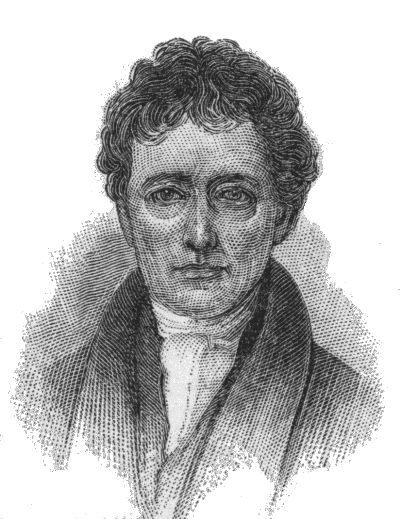
Life. In the very heart of London there is a curious, old-fashioned place known as the Temple,--an enormous, rambling, apparently forgotten structure, dusty and still, in the midst of the endless roar of the city streets. Originally it was a chapter house of the Knights Templars, and so suggests to us the spirit of the Crusades and of the Middle Ages; but now the building is given over almost entirely to the offices and lodgings of London lawyers. It is this queer old place which, more than all others, is associated with the name of Charles Lamb. "I was born," he says, "and passed the first seven years of my life in the Temple. Its gardens, its halls, its fountain, its river... these are my oldest recollections." He was the son of a poor clerk, or rather servant, of one of the barristers, and was the youngest of seven children, only three of whom survived infancy. Of these three, John, the elder, was apparently a selfish creature, who took no part in the heroic struggle of his brother and sister. At seven years, Charles was sent to the famous "Bluecoat" charity school of Christ's Hospital. Here he remained seven years; and here he formed his lifelong friendship for another poor, neglected boy, whom the world remembers as Coleridge.[230]
CHRIST'S HOSPITAL, LONDON
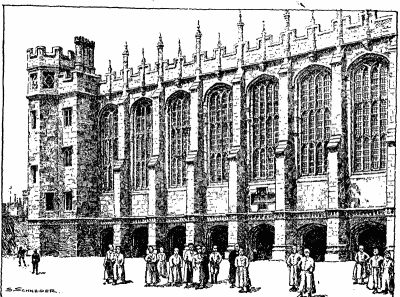
When only fourteen years old, Lamb left the charity school and was soon at work as a clerk in the South Sea House. Two years later he became a clerk in the famous India House, where he worked steadily for thirty-three years, with the exception of six weeks, in the winter of 1795-1796, spent within the walls of an asylum. In 1796 Lamb's sister Mary, who was as talented and remarkable as Lamb himself, went violently insane and killed her own mother. For a long time after this appalling tragedy she was in an asylum at Hoxton; then Lamb, in 1797, brought her to his own little house, and for the remainder of his life cared for her with a tenderness and devotion which furnishes one of the most beautiful pages in our literary history. At times the malady would return to Mary, giving sure warning of its terrible approach; and then brother and sister might be seen walking silently, hand in hand, to the gates of the asylum, their cheeks wet with tears. One must remember this, as well as Lamb's humble lodgings and the drudgery of his daily work in the-big commercial house, if he would appreciate the pathos of "The Old Familiar Faces," or the heroism which shines through the most human and the most delightful essays in our language.
When Lamb was fifty years of age the East India Company, led partly by his literary fame following his first Essays of Elia, and partly by his thirty-three years of faithful service, granted him a comfortable pension; and happy as a boy turned loose from school he left India House forever to give himself up to literary work.[231] He wrote to Wordsworth, in April, 1825, "I came home forever on Tuesday of last week--it was like passing from life into eternity." Curiously enough Lamb seems to lose power after his release from drudgery, and his last essays, published in 1833, lack something of the grace and charm of his earlier work. He died at Edmonton in 1834; and his gifted sister Mary sank rapidly into the gulf from which his strength and gentleness had so long held her back. No literary man was ever more loved and honored by a rare circle of friends; and all who knew him bear witness to the simplicity and goodness which any reader may find for himself between the lines of his essays.
Works. The works of Lamb divide themselves naturally into three periods. First, there are his early literary efforts, including the poems signed "C. L." in Coleridge's Poems on Various Subjects (1796); his romance Rosamund Gray (1798); his poetical drama John Woodvil (1802); and various other immature works in prose and poetry. This period comes to an end in 1803, when he gave up his newspaper work, especially the contribution of six jokes, puns, and squibs daily to the Morning Post at sixpence apiece. The second period was given largely to literary criticism; and the Tales from Shakespeare (1807)--written by Charles and Mary Lamb, the former reproducing the tragedies, and the latter the comedies--may be regarded as his first successful literary venture. The book was written primarily for children; but so thoroughly had brother and sister steeped themselves in the literature of the Elizabethan period that young and old alike were delighted with this new version of Shakespeare's stories, and the Tales are still regarded as the best of their kind in our literature. In 1808 appeared his Specimens of English Dramatic Poets Contemporary with Shakespeare. This carried out the splendid critical work of Coleridge, and was the most noticeable influence in developing the poetic qualities of Keats, as shown in his last volume.
Essays of EliaThe third period includes Lamb's criticisms of life, which are gathered together in his Essays of Elia (1823), and his Last Essays of Elia, which were published ten years later. These famous essays began in 1820 with the appearance of the new London Magazine[232] and were continued for many years, such subjects as the "Dissertation on Roast Pig," "Old China," "Praise of Chimney Sweepers," "Imperfect Sympathies," "A Chapter on Ears," "Mrs. Battle's Opinions on Whist," "Mackery End," "Grace Before Meat," "Dream Children," and many others being chosen apparently at random, but all leading to a delightful interpretation of the life of London, as it appeared to a quiet little man who walked unnoticed through its crowded streets. In the first and last essays which we have mentioned, "Dissertation on Roast Pig" and "Dream Children," we have the extremes of Lamb's humor and pathos.
Lamb's styleThe style of all these essays is gentle, old-fashioned, irresistibly attractive. Lamb was especially fond of old writers and borrowed unconsciously from the style of Burton's Anatomy of Melancholy and from Browne's Religio Medici and from the early English dramatists. But this style had become a part of Lamb by long reading, and he was apparently unable to express his new thought without using their old quaint expressions. Though these essays are all criticisms or appreciations of the life of his age, they are all intensely personal. In other words, they are an excellent picture of Lamb and of humanity. Without a trace of vanity or self-assertion, Lamb begins with himself, with some purely personal mood or experience, and from this he leads the reader to see life and literature as he saw it. It is this wonderful combination of personal and universal interests, together with Lamb's rare old style and quaint humor, which make the essays remarkable. They continue the best tradition of Addison and Steele, our first great essayists; but their sympathies are broader and deeper, and their humor more delicious than any which preceded them.
THOMAS DE QUINCY (1785-1859)
In De Quincey the romantic element is even more strongly developed than in Lamb, not only in his critical work, but also in his erratic and imaginative life. He was profoundly educated, even more so than Coleridge, and was one of the keenest intellects of the age; yet his wonderful intellect seems always subordinate to his passion for dreaming. Like Lamb, he was a friend and associate of the Lake poets, making his headquarters in Wordsworth's old cottage at Grasmere for nearly twenty years. Here the resemblance ceases, and a marked contrast begins. As a man, Lamb is the most human and lovable of all our essayists; while De Quincey is the most uncanny and incomprehensible. Lamb's modest works breathe the two essential qualities of sympathy and humor; the greater number of De Quincey's essays, while possessing more or less of both these qualities, are characterized chiefly by their brilliant style. Life, as seen through De Quincey's eyes, is nebulous and chaotic, and there is a suspicion of the fabulous in all that he wrote. Even in The Revolt of the Tartars the romantic element is uppermost, and in much of De Quincey's prose the element of unreality is more noticeable than in Shelley's poetry. Of his subject-matter, his facts, ideas, and criticisms, we are generally suspicious; but of his style, sometimes stately and sometimes headlong, now gorgeous as an Oriental dream, now musical as Keats's Endymion, and always, even in the most violent contrasts, showing a harmony between the idea and the expression such as no other English writer, with the possible exception of Newman, has ever rivaled,--say what you will of the marvelous brilliancy of De Quincey's style, you have still only half expressed the truth. It is the style alone which makes these essays immortal.
Life. De Quincey was born in Manchester in 1785. In neither his father, who was a prosperous merchant, nor his mother, who was a quiet, unsympathetic woman, do we see any suggestion of the son's almost uncanny genius. As a child he was given to dreams, more vivid and intense but less beautiful than those of the young Blake to whom he bears a strong resemblance. In the grammar school at Bath he displayed astonishing ability, and acquired Greek and Latin with a rapidity that frightened his slow tutors. At fifteen he not only read Greek, but spoke it fluently; and one of his astounded teachers remarked, "That boy could harangue an Athenian mob better than you or I could address an English one." From the grammar school at Manchester, whither he was sent in 1800, he soon ran away, finding the instruction far below his abilities, and the rough life absolutely intolerable to his sensitive nature. An uncle, just home from India, interceded for the boy lest he be sent back to the school, which he hated; and with an allowance of a guinea a week he started a career of vagrancy, much like that of Goldsmith, living on the open hills, in the huts of shepherds and charcoal burners, in the tents of gypsies, wherever fancy led him. His fear of the Manchester school finally led him to run away to London, where, without money or friends, his life was even more extraordinary than his gypsy wanderings. The details of this vagrancy are best learned in his Confessions of an English Opium-Eater, where we meet not simply the facts of his life, but also the confusion of dreams and fancies in the midst of which he wandered like a man lost on the mountains, with storm clouds under his feet hiding the familiar earth. After a year of vagrancy and starvation he was found by his family and allowed to go to Oxford, where his career was marked by the most brilliant and erratic scholarship. When ready for a degree, in 1807, he passed his written tests successfully, but felt a sudden terror at the thought of the oral examination and disappeared from the university, never to return.
THOMAS DE QUINCEY
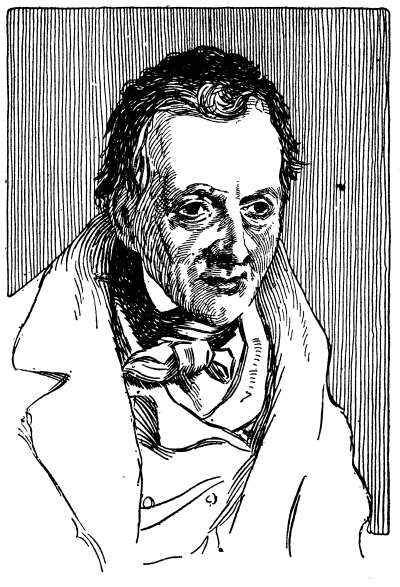
It was in Oxford that De Quincey began the use of opium; to relieve the pains of neuralgia, and the habit increased until he was an almost hopeless slave to the drug. Only his extraordinary will power enabled him to break away from the habit, after some thirty years of misery. Some peculiarity of his delicate constitution enabled De Quincey to take enormous quantities of opium, enough to kill several ordinary men; and it was largely opium, working upon a sensitive imagination, which produced his gorgeous dreams, broken by intervals of weakness and profound depression. For twenty years he resided at Grasmere in the companionship of the Lake poets; and here, led by the loss of his small fortune, he began to write, with the idea of supporting his family. In 1821 he published his first famous work, the Confessions of an English Opium-Eater, and for nearly forty years afterwards he wrote industriously, contributing to various magazines an astonishing number of essays on a great variety of subjects. Without thought of literary fame, he contributed these articles anonymously; but fortunately, in 1853, he began to collect his own works, and the last of fourteen volumes was published just after his death.
In 1830, led by his connection with Blackwood's Magazine, to which he was the chief contributor, De Quincey removed with his family to Edinburgh, where his erratic genius and his singularly childlike ways produced enough amusing anecdotes to fill a volume. He would take a room in some place unknown to his friends and family; would live in it for a few years, until he had filled it, even to the bath tub, with books and with his own chaotic manuscripts, allowing no one to enter or disturb his den; and then, when the place became too crowded, he would lock the door and go away and take another lodging, where he repeated the same extraordinary performance. He died in Edinburgh in 1859. Like Lamb, he was a small, boyish figure, gentle, and elaborately courteous. Though excessively shy, and escaping as often as possible to solitude, he was nevertheless fond of society, and his wide knowledge and vivid imagination made his conversations almost as prized as those of his friend Coleridge.
Works. De Quincey's works may be divided into two general classes. The first includes his numerous critical articles, and the second his autobiographical sketches. All his works, it must be remembered, were contributed to various magazines, and were hastily collected just before his death. Hence the general impression of chaos which we get from reading them.
Critical essaysFrom a literary view point the most illuminating of De Quincey's critical works is his. Literary Reminiscences. This contains brilliant appreciations of Wordsworth, Coleridge, Lamb, Shelley, Keats, Hazlitt, and Landor, as well as some interesting studies of the literary figures of the age preceding. Among the best of his brilliant critical essays are On the Knocking at the Gate in Macbeth (1823), which is admirably suited to show the man's critical genius, and Murder Considered as One of the Fine Arts (1827), which reveals his grotesque humor Other suggestive critical works, if one must choose among such a multitude, are his Letters to a Young Man (1823), Joan of Arc (1847), The Revolt of the Tartars (1840), and The English Mail-Coach (1849). In the last-named essay the "Dream Fugue" is one of the most imaginative of all his curious works.
Confessions of an Opium-Eater, etc.Of De Quincey's autobiographical sketches the best known is his Confessions of an English Opium-Eater (1821). This is only partly a record of opium dreams, and its chief interest lies in glimpses it gives us of De Quincey's own life and wanderings. This should be followed by Suspiria de Profundis (1845), which is chiefly a record of gloomy and terrible dreams produced by opiates. The most interesting parts of his Suspiria, showing De Quincey's marvelous insight into dreams, are those in which we are brought face to face with the strange feminine creations "Levana," "Madonna," "Our Lady of Sighs," and "Our Lady of Darkness." A series of nearly thirty articles which he collected in 1853, called Autobiographic Sketches, completes the revelation of the author's own life. Among his miscellaneous works may be mentioned, in order to show his wide range of subjects, Klosterheim, a novel, Logic of Political Economy, the Essays on Style and Rhetoric, Philosophy of Herodotus, and his articles on Goethe, Pope, Schiller, and Shakespeare which he contributed to the Encyclopedia Britannica.
The style of De QuinceyDe Quincey's style is a revelation of the beauty of the English language, and it profoundly influenced Ruskin and other prose writers of the Victorian Age. It has two chief faults,--diffuseness, which continually leads De Quincey away from his object, and triviality, which often makes him halt in the midst of a marvelous paragraph to make some light jest or witticism that has some humor but no mirth in it. Notwithstanding these faults, De Quincey's prose is still among the few supreme examples of style in our language. Though he was profoundly influenced by the seventeenth-century writers, he attempted definitely to create a new style which should combine the best elements of prose and poetry. In consequence, his prose works are often, like those of Milton, more imaginative and melodious than much of our poetry. He has been well called "the psychologist of style," and as such his works will never be popular; but to the few who can appreciate him he will always be an inspiration to better writing. One has a deeper respect for our English language and literature after reading him.
Secondary Writers of Romanticism. One has only to glance back over the authors we have been studying--Wordsworth, Coleridge, Southey, Byron, Shelley, Keats, Scott, Lamb, De Quincey--to realize the great change which swept over the life and literature of England in a single half century, under two influences which we now know as the French Revolution in history and the Romantic Movement in literature. In life men had rebelled against the too strict authority of state and society; in literature they rebelled even more vigorously against the bonds of classicism, which had sternly repressed a writer's ambition to follow his own ideals and to express them in his own way. Naturally such an age of revolution was essentially poetic,--only the Elizabethan Age surpasses it in this respect,--and it produced a large number of minor writers, who followed more or less closely the example of its great leaders. Among novelists we have Jane Austen, Frances Burney, Maria Edgeworth, Jane Porter, and Susan Ferrier,--all women, be it noted; among the poets, Campbell, Moore, Hogg ("the Ettrick Shepherd"), Mrs. Hemans, Heber, Keble, Hood, and "Ingoldsby" (Richard Barham); and among miscellaneous writers, Sidney Smith, "Christopher North" (John Wilson), Chalmers, Lockhart, Leigh Hunt, Hazlitt, Hallam, and Landor. Here is an astonishing variety of writers, and to consider all their claims to remembrance would of itself require a volume. Though these are generally classed as secondary writers, much of their work has claims to popularity, and some of it to permanence. Moore's Irish Melodies, Campbell's lyrics, Keble's Christian Year, and Jane Porter's Thaddeus of Warsaw and Scottish Chiefs have still a multitude of readers, where Keats, Lamb, and De Quincey are prized only by the cultured few; and Hallam's historical and critical works are perhaps better known than those of Gibbon, who nevertheless occupies a larger place in our literature. Among all these writers we choose only two, Jane Austen and Walter Savage Landor, whose works indicate a period of transition from the Romantic to the Victorian Age.
JANE AUSTEN (1775-1817)
We have so lately rediscovered the charm and genius of this gifted young woman that she seems to be a novelist of yesterday, rather than the contemporary of Wordsworth and Coleridge; and few even of her readers realize that she did for the English novel precisely what the Lake poets did for English poetry,--she refined and simplified it, making it a true reflection of English life. Like the Lake poets, she met with scanty encouragement in her own generation. Her greatest novel, Pride and Prejudice, was finished in 1797, a year before the appearance of the famous Lyrical Ballads of Wordsworth and Coleridge; but while the latter book was published and found a few appreciative readers, the manuscript of this wonderful novel went begging for sixteen years before it found a publisher. As Wordsworth began with the deliberate purpose of making poetry natural and truthful, so Miss Austen appears to have begun writing with the idea of presenting the life of English country society exactly as it was, in opposition to the romantic extravagance of Mrs. Radcliffe and her school. But there was this difference,--that Miss Austen had in large measure the saving gift of humor, which Wordsworth sadly lacked. Maria Edgeworth, at the same time, set a sane and excellent example in her tales of Irish life, The Absentee and Castle Rackrent; and Miss Austen followed up the advantage with at least six works, which have grown steadily in value until we place them gladly in the first rank of our novels of common life. It is not simply for her exquisite charm, therefore, that we admire her, but also for her influence in bringing our novels back to their true place as an expression of human life. It is due partly, at least, to her influence that a multitude of readers were ready to appreciate Mrs. Gaskell's Cranford, and the powerful and enduring work of George Eliot.
Life. Jane Austen's life gives little opportunity for the biographer, unless, perchance, he has something of her own power to show the beauty and charm of commonplace things. She was the seventh child of Rev. George Austen, rector of Steventon, and was born in the parsonage of the village in 1775. With her sisters she was educated at home, and passed her life very quietly, cheerfully, in the doing of small domestic duties, to which love lent the magic lamp that makes all things beautiful. She began to write at an early age, and seems to have done her work on a little table in the family sitting room, in the midst of the family life. When a visitor entered, she would throw a paper or a piece of sewing over her work, and she modestly refused to be known as the author of novels which we now count among our treasured possessions. With the publishers she had little success. Pride and Prejudice went begging, as we have said, for sixteen years; and Northanger Abbey (1798) was sold for a trivial sum to a publisher, who laid it aside and forgot it, until the appearance and moderate success of Sense and Sensibility in 1811. Then, after keeping the manuscript some fifteen years, he sold it back to the family, who found another publisher.
An anonymous article in the Quarterly Review, following the appearance of Emma in 1815, full of generous appreciation of the charm of the new writer, was the beginning of Jane Austen's fame; and it is only within a few years that we have learned that the friendly and discerning critic was Walter Scott. He continued to be her admirer until her early death; but these two, the greatest writers of fiction in their age, were never brought together. Both were home-loving people, and Miss Austen especially was averse to publicity and popularity. She died, quietly as she had lived, at Winchester, in 1817, and was buried in the cathedral. She was a bright, attractive little woman, whose sunny qualities are unconsciously reflected in all her books.
Works. Very few English writers ever had so narrow a field of work as Jane Austen. Like the French novelists, whose success seems to lie in choosing the tiny field that they know best, her works have an exquisite perfection that is lacking in most of our writers of fiction. With the exception of an occasional visit to the watering place of Bath, her whole life was spent in small country parishes, whose simple country people became the characters of her novels. Her brothers were in the navy, and so naval officers furnish the only exciting elements in her stories; but even these alleged heroes lay aside their imposing martial ways and act like themselves and other people. Such was her literary field, in which the chief duties were of the household, the chief pleasures in country gatherings, and the chief interests in matrimony. Life, with its mighty interests, its passions, ambitions, and tragic struggles, swept by like a great river; while the secluded interests of a country parish went round and round quietly, like an eddy behind a sheltering rock. We can easily understand, therefore, the limitations of Jane Austen; but within her own field she is unequaled. Her characters are absolutely true to life, and all her work has the perfection of a delicate miniature painting. The most widely read of her novels is Pride and Prejudice; but three others, Sense and Sensibility, Emma, and Mansfield Park, have slowly won their way to the front rank of fiction. From a literary view point Northanger Abbey is perhaps the best; for in it we find that touch of humor and delicate satire with which this gentle little woman combated the grotesque popular novels of the Udolpho type. Reading any of these works, one is inclined to accept the hearty indorsement of Sir Walter Scott: "That young lady has a talent for describing the involvements and feelings and characters of ordinary life which is to me the most wonderful I ever met with. The big bowwow strain I can do myself, like any now going; but the exquisite touch which renders ordinary commonplace things and characters interesting from the truth of the description and the sentiment, is denied to me. What a pity such a gifted creature died so early!"
WALTER SAVAGE LANDOR (1775-1864)
While Hazlitt, Lamb, De Quincey, and other romantic critics went back to early English literature for their inspiration, Landor shows a reaction from the prevailing Romanticism by his imitation of the ancient classic writers. His life was an extraordinary one and, like his work, abounded in sharp contrasts. On the one hand, there are his egoism, his unncontrollable anger, his perpetual lawsuits, and the last sad tragedy with his children, which suggests King Lear and his daughters; on the other hand there is his steady devotion to the classics and to the cultivation of the deep wisdom of the ancients, which suggests Pindar and Cicero. In his works we find the wild extravagance of Gebir, followed by the superb classic style and charm of Pericles and Aspasia. Such was Landor, a man of high ideals, perpetually at war with himself and the world.
Life. Lander's stormy life covers the whole period from Wordsworth's childhood to the middle of the Victorian Era. He was the son of a physician, and was born at Warwick, in 1775. From his mother he inherited a fortune; but it was soon scattered by large expenditures and law quarrels; and in his old age, refused help by his own children, only Browning's generosity kept Landor from actual want. At Rugby, and at Oxford, his extreme Republicanism brought him into constant trouble; and his fitting out a band of volunteers to assist the Spaniards against Napoleon, in 1808, allies him with Byron and his Quixotic followers. The resemblance to Byron is even more strikingly shown in the poem Gebir, published in 1798, a year made famous by the Lyrical Ballads of Wordsworth and Coleridge.
A remarkable change in Lander's life is noticeable in 1821, when, at forty-six years of age, after having lost his magnificent estate of Llanthony Abbey, in Glamorganshire, and after a stormy experience in Como, he settled down for a time at Fiesole near Florence. To this period of calm after storm we owe the classical prose works for which he is famous. The calm, like that at the center of a whirlwind, lasted but a short time, and Landor, leaving his family in great anger, returned to Bath, where he lived alone for more than twenty years. Then, in order to escape a libel suit, the choleric old man fled back to Italy. He died at Florence, in 1864. The spirit of his whole life may be inferred from the defiant farewell which he flung to it:
I strove with none, for none was worth my strife; Nature I loved, and next to Nature Art; I warmed both hands before the fire of life; It sinks, and I am ready to depart.
Works. Landor's reaction from Romanticism is all the more remarkable in view of his early efforts, such as Gebir, a wildly romantic poem, which rivals any work of Byron or Shelley in its extravagance. Notwithstanding its occasional beautiful and suggestive lines, the work was not and never has been successful; and the same may be said of all his poetical works. His first collection of poems was published in 1795, his last a full half century later, in 1846. In the latter volume, The Hellenics,--which included some translations of his earlier Latin poems, called Idyllia Heroica,--one has only to read "The Hamadryad," and compare it with the lyrics of the first volume, in order to realize the astonishing literary vigor of a man who published two volumes, a half century apart, without any appreciable diminution of poetical feeling. In all these poems one is impressed by the striking and original figures of speech which Landor uses to emphasize his meaning.
It is by his prose works, largely, that Landor has won a place in our literature; partly because of their intrinsic worth, their penetrating thought, and severe classic style; and partly because of their profound influence upon the writers of the present age. The most noted of his prose works are his six volumes of Imaginary Conversations (1824-1846). For these conversations Landor brings together, sometimes in groups, sometimes in couples, well-known characters, or rather shadows, from the four corners of the earth and from the remotest ages of recorded history. Thus Diogenes talks with Plato, Æsop with a young slave girl in Egypt, Henry VIII with Anne Boleyn in prison, Dante with Beatrice, Leofric with Lady Godiva,--all these and many others, from Epictetus to Cromwell, are brought together and speak of life and love and death, each from his own view point. Occasionally, as in the meeting of Henry and Anne Boleyn, the situation is tense and dramatic; but as a rule the characters simply meet and converse in the same quiet strain, which becomes, after much reading, somewhat monotonous. On the other hand, one who reads the Imaginary Conversations is lifted at once into a calm and noble atmosphere which braces and inspires him, making him forget petty things, like a view from a hilltop. By its combination of lofty thought and severely classic style the book has won, and deserves, a very high place among our literary records.
The same criticism applies to Pericles and Aspasia, which is a series of imaginary letters, telling the experiences of Aspasia, a young lady from Asia Minor, who visits Athens at the summit of its fame and glory, in the great age of Pericles. This is, in our judgment, the best worth reading of all Landor's works. One gets from it not only Landor's classic style, but--what is well worth while--a better picture of Greece in the days of its greatness than can be obtained from many historical volumes.
Summary of the Age of Romanticism. This period extends from the war with the colonies, following the Declaration of Independence, in 1776, to the accession of Victoria in 1837, both limits being very indefinite, as will be seen by a glance at the Chronology following. During the first part of the period especially, England was in a continual turmoil, produced by political and economic agitation at home, and by the long wars that covered two continents and the wide sea between them. The mighty changes resulting from these two causes have given this period the name of the Age of Revolution. The storm center of all the turmoil at home and abroad was the French Revolution, which had a profound influence on the life and literature of all Europe. On the Continent the overthrow of Napoleon at Waterloo (1815) apparently checked the progress of liberty, which had started with the French Revolution,[233] but in England the case was reversed. The agitation for popular liberty, which at one time threatened a revolution, went steadily forward till it resulted in the final triumph of democracy, in the Reform Bill of 1832, and in a number of exceedingly important reforms, such as the extension of manhood suffrage, the removal of the last unjust restrictions against Catholics, the establishment of a national system of schools, followed by a rapid increase in popular education, and the abolition of slavery in all English colonies (1833). To this we must add the changes produced by the discovery of steam and the invention of machinery, which rapidly changed England from an agricultural to a manufacturing nation, introduced the factory system, and caused this period to be known as the Age of Industrial Revolution.
The literature of the age is largely poetical in form, and almost entirely romantic in spirit. For, as we have noted, the triumph of democracy in government is generally accompanied by the triumph of romanticism in literature. At first the literature, as shown especially in the early work of Wordsworth, Byron, and Shelley, reflected the turmoil of the age and the wild hopes of an ideal democracy occasioned by the French Revolution. Later the extravagant enthusiasm subsided, and English writers produced so much excellent literature that the age is often called the Second Creative period, the first being the Age of Elizabeth. The six chief characteristics of the age are: the prevalence of romantic poetry; the creation of the historical novel by Scott; the first appearance of women novelists, such as Mrs. Anne Radcliffe, Jane Porter, Maria Edgeworth, and Jane Austen; the development of literary criticism, in the work of Lamb, De Quincey, Coleridge, and Hazlitt; the practical and economic bent of philosophy, as shown in the work of Malthus, James Mill, and Adam Smith; and the establishment of great literary magazines, like the Edinburgh Review, the Quarterly, Blackwood's, and the Athenaeum.
In our study we have noted (1) the Poets of Romanticism: the importance of the Lyrical Ballads of 1798; the life and work of Wordsworth, Coleridge, Scott, Byron, Shelley, and Keats; (2) the Prose Writers: the novels of Scott; the development of literary criticism; the life and work of the essayists, Lamb, De Quincey, Landor, and of the novelist Jane Austen.
Selections for Reading. Manly's English Poetry and Manly's English Prose (each one vol.) contain good selections from all authors studied. Ward's English Poets (4 vols.), Craik's English Prose Selections (5 vols.), Braithwaite's The Book of Georgian Verse, Page's British Poets of the Nineteenth Century, and Garnett's English Prose from Elizabeth to Victoria, may also be used to advantage. Important works, however, should be read entire in one of the inexpensive school editions given below. (Full titles and publishers may be found in the General Bibliography at the end of this book.)
Wordsworth. Intimations of Immortality, Tintern Abbey, best lyrics and sonnets, in Selections, edited by Dowden (Athenaeum Press Series); selections and short poems, edited by M. Arnold, in Golden Treasury Series; Selections, also in Everyman's Library, Riverside Literature Series, Cassell's National Library, etc.
Coleridge. Ancient Mariner, edited by L. R. Gibbs, in Standard English Classics; same poem, in Pocket Classics, Eclectic English Classics, etc.; Poems, edited by J. M. Hart, in Athenæum Press (announced, 1909); Selections, Golden Book of Coleridge, in Everyman's Library; Selections from Coleridge and Campbell, in Riverside Literature; Prose Selections (Ginn and Company, also Holt); Lectures on Shakespeare, in Everyman's Library, Bohn's Standard Library, etc.
Scott. Lady of the Lake, Marmion, Ivanhoe, The Talisman, Guy Mannering, Quentin Durward. Numerous inexpensive editions of Scott's best poems and novels in Standard English Classics, Pocket Classics, Cassell's National Library, Eclectic English Classics, Everyman's Library, etc.; thus, Lady of the Lake, edited by Edwin Ginn, and Ivanhoe, edited by W. D. Lewis, both in Standard English Classics; Marmion, edited by G. B. Acton, and The Talisman, edited by F. Treudly, in Pocket Classics, etc.
Byron. Mazeppa and The Prisoner of Chillon, edited by S. M. Tucker, in Standard English Classics; short poems, Selections from Childe Harold, etc., in Canterbury Poets, Riverside Literature, Holt's English Readings, Pocket Classics, etc.
Shelley. To a Cloud, To a Skylark, West Wind, Sensitive Plant, Adonais, etc., all in Selections from Shelley, edited by Alexander, in Athenæum Press Series; Selections, edited by Woodberry, in Belles Lettres Series; Selections, also in Pocket Classics, Heath's English Classics, Golden Treasury Series, etc.
Keats. Ode on a Grecian Urn, Eve of St. Agnes, Hyperion, Lamia, To a Nightingale, etc., in Selections from Keats, in Athenæum Press; Selections also in Muses' Library, Riverside Literature, Golden Treasury Series, etc.
Lamb. Essays: Dream Children, Old China, Dissertation on Roast Pig, etc., edited by Wauchope, in Standard English Classics; various essays also in Camelot Series, Temple Classics, Everyman's Library, etc. Tales from Shakespeare, in Home and School Library (Ginn and Company); also in Riverside Literature, Pocket Classics, Golden Treasury, etc.
De Quincey. The English Mail-Coach and Joan of Arc, in Standard English Classics, etc.; Confessions of an English Opium-Eater, in Temple Classics, Morley's Universal Library, Everyman's Library, Pocket Classics, etc.; Selections, edited by M. H. Turk, in Athenæum Press; Selections, edited by B. Perry (Holt).
Landor. Selections, edited by W. Clymer, in Athenæum Press; Pericles and Aspasia, in Camelot Series; Imaginary Conversations, selected (Ginn and Company); the same, 2 vols., in Dutton's Universal Library; selected poems, in Canterbury Poets; selections, prose and verse, in Golden Treasury Series.
Jane Austen. Pride and Prejudice, in Everyman's Library, Pocket Classics, etc.
Bibliography.[234]
History. Text-book, Montgomery, pp. 323-357; Cheyney, 576-632. General Works. Green, X, 2-4, Traill, Gardiner, Macaulay, etc. Special Works. Cheyney's Industrial and Social History of England; Warner's Landmarks of English Industrial History; Hassall's Making of the British Empire; Macaulay's William Pitt; Trevelyan's Early Life of Charles James Fox; Morley's Edmund Burke; Morris's Age of Queen Anne and the Early Hanoverians.
Literature. General Works. Mitchell, Courthope, Garnett and Gosse, Taine (see General Bibliography). Special Works. Beers's English Romanticism in the Nineteenth Century; A. Symons's The Romantic Movement in English Poetry; Dowden's The French Revolution and English Literature, also Studies in Literature, 1789-1877; Hancock's The French Revolution and the English Poets; Herford's The Age of Wordsworth (Handbooks of English Literature); Mrs. Oliphant's Literary History of England in the End of the Eighteenth and Beginning of the Nineteenth Centuries; Saintsbury's History of Nineteenth Century Literature; Masson's Wordsworth, Shelley, Keats, and Other Essays; Poets and Poetry of the Nineteenth Century, vols. 1-3; Gates's Studies and Appreciations; S. Brooke's Studies in Poetry; Rawnsley's Literary Associations of the English Lakes (2 vols.).
Wordsworth. Texts: Globe, Aldine, Cambridge editions, etc.; Poetical and Prose Works, with Dorothy Wordsworth's Journal, edited by Knight, Eversley Edition (London and New York, 1896); Letters of the Wordsworth Family, edited by Knight, 3 vols. (Ginn and Company); Poetical Selections, edited by Dowden, in Athenaeum Press; various other selections, in Golden Treasury, etc.; Prose Selections, edited by Gayley (Ginn and Company). Life: Memoirs, 2 vols., by Christopher Wordsworth; by Knight, 3 vols.; by Myers (English Men of Letters); by Elizabeth Wordsworth; Early Life (a Study of the Prelude) by E. Legouis, translated by J. Matthews; Raleigh's Wordsworth; N.C. Smith's Wordsworth's Literary Criticism; Rannie's Wordsworth and His Circle. Criticism: Herford's The Age of Wordsworth; Masson's Wordsworth, Shelley, and Keats; Magnus's Primer of Wordsworth; Wilson's Helps to the Study of Arnold's Wordsworth; Essays, by Lowell, in Among My Books; by M. Arnold, in Essays in Criticism; by Hutton, in Literary Essays; by L. Stephen, in Hours in a Library, and in Studies of a Biographer; by Bagehot, in Literary Studies; by Hazlitt, in The Spirit of the Age; by Pater, in Appreciations; by De Quincey, in Essays on the Poets; by Fields, in Yesterdays with Authors; by Shairp, in Studies in Poetry and Philosophy. See also Knight's Through the Wordsworth Country, and Rawnsley's Literary Associations of the English Lakes.
Coleridge. Texts: Complete Works, edited by Shedd, 7 vols. (New York 1884); Poems, Globe, Aldine, and Cambridge editions, in Athenaeum Press (announced, 1909), Muses' Library, Canterbury Poets, etc.; Biographia Literaria, in Everyman's Library; the same, in Clarendon Press; Prose Selections, Lectures on Shakespeare, etc. (see Selections for Reading, above); Letters, edited by E.H. Coleridge (London, 1895). Life: by J.D. Campbell; by Traill (English Men of Letters); by Dykes; by Hall Caine (Great Writers Series); see also Coleridge's Biographia Literaria, and Lamb's essay, Christ's Hospital, in Essays of Elia. Criticism: Brandl's Coleridge and the English Romantic Movement. Essays, by Shairp, in Studies in Poetry and Philosophy; by Woodberry, in Makers of Literature; by J. Forster, in Great Teachers; by Dowden, in New Studies; by Swinburne, in Essays and Studies; by Brooke, in Theology in the English Poets; by Saintsbury, in Essays in English Literature; by Lowell in Democracy and Other Essays; by Hazlitt, and by Pater (see Wordsworth, above). See also Beers's English Romanticism; Carlyle's chapter on Coleridge, in Life of John Sterling.
Southey. Texts: Poems, edited by Dowden (Macmillan); Poetical Works (Crowell); Selections in Canterbury Poets; Life of Nelson, in Everyman's Library, Temple Classics, Morley's Universal Library, etc. Life: by Dowden (English Men of Letters). Essays, by L. Stephen, in Studies of a Biographer; by Hazlitt and Saintsbury (see above).
Scott. Texts: Numerous good editions of novels and poems. For single works, see Selections for Reading, above. Life: by Lockhart, 5 vols. (several editions; best by Pollard, 1900); by Hutton (English Men of Letters); by A. Lang, in Literary Lives; by C. D. Yonge (Great Writers); by Hudson; by Saintsbury (Famous Scots Series). Criticism: Essays, by Stevenson, Gossip on Romance, in Memories and Portraits; by Shairp, in Aspects of Poetry; by Swinburne, in Studies in Prose and Poetry; by Carlyle, in Miscellaneous Essays; by Hazlitt, Bagehot, L. Stephen, Brooke, and Saintsbury (see Coleridge and Wordsworth, above).
Byron. Texts: Complete Works, Globe, Cambridge Poets, and Oxford editions; Selections, edited by M. Arnold, in Golden Treasury (see also Selections for Reading, above); Letters and Journals of Byron, edited by Moore (unreliable). Life: by Noel (Great Writers); by Nichol (English Men of Letters); The Real Lord Byron, by J. C. Jeaffreson; Trelawny's Recollections of Shelley and Byron. Criticism: Hunt's Lord Byron and His Contemporaries; Essays, by Morley, Macaulay, Hazlitt, Swinburne, and M. Arnold.
Shelley. Texts: Centenary Edition, edited by Woodberry, 4 vols.; Globe and Cambridge Poets editions; Essays and Letters, in Camelot Series (see Selections for Reading, above). Life: by Symonds (English Men of Letters); by Dowden, 2 vols.; by Sharp (Great Writers); by T. J. Hogg, 2 vols.; by W. M. Rossetti. Criticism: Salt's A Shelley Primer; Essays, by Dowden, in Transcripts and Studies; by M. Arnold, Woodberry, Bagehot, Forster, L. Stephen, Brooke, De Quincey, and Hutton (see Coleridge and Wordsworth, above).
Keats. Texts: Complete Works, edited by Forman, 4 vols. (London, 1883); Cambridge Poets Edition, with Letters, edited by H. E. Scudder (Houghton, Mifflin); Aldine Edition, with Life, edited by Lord Houghton (Macmillan); Selected Poems, with introduction and notes by Arlo Bates (Ginn and Company); Poems, also in Everyman's Library, Muses' Library, Golden Treasury, etc.; Letters, edited by S. Colvin, in Eversley Edition. Life: by Forman, in Complete Works; by Colvin (English Men of Letters); by W. M. Rossetti (Great Writers); by A. E. Hancock. Criticism: H. C. Shelley's Keats and His Circle; Masson's Wordsworth, Shelley, Keats, and Other Essays; Essays, by M. Arnold, in Essays in Criticism, also in Ward's English Poets, vol. 4; by Hudson, in Studies in Interpretation; by Lowell, in Among My Books, or Literary Essays, vol. 2; by Brooke, De Quincey, and Swinburne (above).
Lamb. Texts: Complete Works and Letters, edited by E. V. Lucas, 7 vols. (Putnam); the same, edited by Ainger, 6 vols. (London, 1883-1888); Essays of Elia, in Standard English Classics, etc. (see Selections for Reading); Dramatic Essays, edited by B. Matthews (Dodd, Mead); Specimens of English Dramatic Poets, in Bohn's Library. Life: by E. V. Lucas, 2 vols.; by Ainger (English Men of Letters); by Barry Cornwall; Talfourd's Memoirs of Charles Lamb. Criticism: Essays, by De Quincey, in Biographical Essays; by F. Harrison, in Tennyson, Ruskin, Mill, and Other Literary Estimates; by Pater, and Woodberry (see Wordsworth and Coleridge, above). See also Fitzgerald's Charles Lamb, his Friends, his Haunts, and his Books.
De Quincey. Texts: Collected Writings, edited by Masson, 14 vols. (London, 1889-1891); Confessions of an Opium-Eater, etc. (see Selections for Reading). Life: by Masson (English Men of Letters); Life and Writings, by H. A. Page, 2 vols.; Hogg's De Quincey and his Friends; Findlay's Personal Recollections of De Quincey; see also De Quincey's Autobiographical Sketches, and Confessions. Criticism: Essays, by Saintsbury, in Essays in English Literature; by Masson, in Wordsworth, Shelley, Keats, and Other Essays; by L. Stephen, in Hours in a Library. See also Minto's Manual of English Prose Literature.
Landor. Texts: Works, with Life by Forster, 8 vols. (London, 1876); Works, edited by Crump (London, 1897); Letters, etc., edited by Wheeler (London, 1897 and 1899); Imaginary Conversations, etc. (see Selections for Reading). Life: by Colvin (English Men of Letters); by Forster. Criticism: Essays, by De Quincey, Woodberry, L. Stephen, Saintsbury, Swinburne, Dow-den (see above). See also Stedman's Victorian Poets.
Jane Austen. Texts: Works, edited by R. B. Johnson (Dent); various other editions of novels; Letters, edited by Woolsey (Roberts). Life: Austen-Leigh's Memoir of Jane Austen; Hill's Jane Austen, her Home and her Friends; Mitton's Jane Austen and her Times. Life, by Goldwin Smith; by Maiden (Famous Women Series); by O. F. Adams. Criticism: Pollock's Jane Austen; Pellew's Jane Austen's Novels; A. A. Jack's Essay on the Novel as Illustrated by Scott and Miss Austen; H. H. Bonnell's Charlotte Brontë, George Eliot, and Jane Austen; Essay, by Howells, in Heroines of Fiction.
Maria Edgeworth. Texts: Tales and Novels, New Langford Edition, 10 vols. (London, 1893) various editions of novels (Dent, etc.); The Absentee, and Castle Rackrent, in Morley's Universal Library. Life: by Helen Zimmerman; Memoir, by Hare.
Mrs. Anne Radclife. Romances, with introduction by Scott, in Ballantynes' Novelists Library (London, 1824); various editions of Udolpho, etc.; Saintsbury's Tales of Mystery, vol. i. See Beers's English Romanticism.
Moore. Poetical Works, in Canterbury Poets, Chandos Classics, etc.; Selected poems, in Golden Treasury; Gunning's Thomas Moore, Poet and Patriot; Symington's Life and Works of Moore. Essay, by Saintsbury.
Campbell. Poems, Aldine edition; Selections, in Golden Treasury. Life, by Hadden.
Hazlitt. Texts: Works, edited by Henley, 12 vols. (London, 1902); Selected Essays, in Temple Classics, Camelot Series, etc. Life: by Birrell (English Men of Letters); Memoirs, by W. C. Hazlitt. Essays, by Saintsbury; by L. Stephen.
Leigh Hunt. Texts: Selected essays, in Camelot Series, also in Cavendish Library (Warne); Stories from the Italian Poets (Putnam). Life: by Monkhouse (Great Writers). Essays, by Macaulay; by Saintsbury; by Hazlitt. See also Mrs. Field's A Shelf of Old Books.
Suggestive Questions. (NOTE. In a period like the Age of Romanticism, the poems and essays chosen for special study vary so widely that only a few general questions on the selections for reading are attempted.)
1. Why is this period of Romanticism (1789-1837) called the Age of Revolution? Give some reasons for the influence of the French Revolution on English literature, and illustrate from poems or essays which you have read. Explain the difference between Classicism and Romanticism. Which of these two types of literature do you prefer?
2. What are the general characteristics of the literature of this period? What two opposing tendencies are illustrated in the novels of Scott and Jane Austen? in the poetry of Byron and Wordsworth?
3. Wordsworth. Tell briefly the story of Wordsworth's life, and name some of his best poems. Why do the Lyrical Ballads (1798) mark an important literary epoch? Read carefully, and make an analysis of the "Intimations of Immortality"; of "Tintern Abbey." Can you explain what political conditions are referred to in Wordsworth's "Sonnet on Milton"? in his "French Revolution"? Does he attempt to paint a picture in his sonnet on Westminster Bridge, or has he some other object in view? What is the central teaching of the "Ode to Duty"? Compare Wordsworth's two Skylark poems with Shelley's. Make a brief comparison between Wordsworth's sonnets and those of Shakespeare and of Milton, having in mind the thought, the melody, the view of nature, and the imagery of the three poets. Quote from Wordsworth's poems to show his belief that nature is conscious; to show the influence of nature on man; to show his interest in children; his sensitiveness to sounds; to illustrate the chastening influence of sorrow. Make a brief comparison between the characters of Wordsworth's "Michael" and of Burns's "The Cotter's Saturday Night." Compare Wordsworth's point of view and method, in the three poems "To a Daisy," with Burns's view, as expressed in his famous lines on the same subject.
4. Coleridge. What are the general characteristics of Coleridge's life? What explains the profound sympathy for humanity that is reflected in his poems? For what, beside his poems, is he remarkable? Can you quote any passages from his poetry which show, the influence of Wordsworth? What are the characters in "The Ancient Mariner"? In what respect is this poem romantic? Give your own reasons for its popularity. Does the thought or the style of this poem impress you? If you have read any of the Lectures on Shakespeare, explain why Coleridge's work is called romantic criticism.
5. Scott. Tell the story of Scott's life, and name his chief poems and novels. Do you recall any passage from his poetry which suggests his own heroism? Why was he called "the wizard of the North"? What is the general character of his poetry? Compare Marmion with one of the old ballads, having in mind the characters, the dramatic interest of the story, and the style of writing. In what sense is he the creator of the historical novel? Upon what does he depend to hold the reader's attention? Compare him, in this respect, with Jane Austen. Which of his characters impress you as being the most lifelike? Name any novels of the present day which copy Scott or show his influence. Read Ivanhoe and the Lady of the Lake; make a brief analysis of each work, having in mind the style, the plot, the dramatic interest, the use of adventure, and the truth to nature of the different characters.
6. Byron. Why is Byron called the revolutionary poet? (Illustrate, if possible, from his poetry.) What is the general character of his work? In what kind of poetry does he excel? (Quote from Childe Harold to illustrate your opinion.) Describe the typical Byronic hero. Can you explain his great popularity at first, and his subsequent loss of influence? Why is he still popular on the Continent? Do you find more of thought or of emotion in his poetry? Compare him, in this respect, with Shelley; with Wordsworth. Which is the more brilliant writer, Byron or Wordsworth? Which has the more humor? Which has the healthier mind? Which has the higher ideal of poetry? Which is the more inspiring and helpful? Is it fair to say that Byron's quality is power, not charm?
7. Shelley. What are the chief characteristics of Shelley's poetry? Is it most remarkable for its thought, form, or imagery? What poems show the influence of the French Revolution? What subjects are considered in "Lines written among the Euganean Hills"? What does Shelley try to teach in "The Sensitive Plant"? Compare Shelley's view of nature, as reflected in "The Cloud" or "The West Wind," with Wordsworth's view, as reflected in "The Prelude," "Tintern Abbey," "Daffodils," etc. To what class of poems does "Adonais" belong? What is the subject of the poem? Name others of the same class. How does Shelley describe himself in this poem? Compare Shelley's "Adonais" and Milton's "Lycidas" with regard to the view of life after death as expressed in the poems. What kinds of scenes does Shelley like best to describe? Compare his characters with those of Wordsworth; of Byron. Do you recall any poems in which he writes of ordinary people or of ordinary experiences?
8. Keats. What is the essence of Keats's poetical creed, as expressed in the "Ode on a Grecian Urn"? What are the remarkable elements in his life and work? What striking difference do you find between his early poems and those of Shelley and Byron? What are the chief subjects of his verse? What poems show the influence of the classics? of Elizabethan literature? Can you explain why his work has been called literary poetry? Keats and Shelley are generally classed together. What similarities do you find in their poems? Give some reasons why Keats introduces the old Bedesman in "The Eve of Saint Agnes." Name some of the literary friends mentioned in Keats's poetry.
Compare Keats's characters with those of Wordsworth; of Byron. Does Keats ever remind you of Spenser? In what respects? Is your personal preference for Wordsworth, Byron, Shelley, or Keats? Why?
9. Lamb. Tell briefly the story of Lamb's life and name his principal works. Why is he called the most human of essayists? His friends called him "the last of the Elizabethans." Why? What is the general character of the Essays of Elia? How is the personality of Lamb shown in all these essays? Cite any passages showing Lamb's skill in portraying people. Make a brief comparison between Lamb and Addison, having in mind the subjects treated, the style, the humor, and the interest of both essayists. Which do you prefer, and why?
10. De Quincey. What are the general characteristics of De Quincey's essays? Explain why he is called the psychologist of style. What accounts for a certain unreal element in all his work. Read a passage from The English Mail-Coach, or from Joan of Arc, or from Levana, Our Lady of Sorrows, and comment freely upon it, with regard to style, ideas, interest, and the impression of reality or unreality which it leaves.
11. Landor. In what respect does Landor show a reaction from Romanticism? What qualities make Landor's poems stand out so clearly in the memory? Why, for instance, do you think Lamb was so haunted by "Rose Aylmer"? Quote from Landor's poems to illustrate his tenderness, his sensitiveness to beauty, his power of awakening emotion, his delicacy of characterization. Do you find the same qualities in his prose? Can you explain why much of his prose seems like a translation from the Greek? Compare a passage from the Imaginary Conversations with a passage from Gibbon or Johnson, to show the difference between the classic and the pseudo-classic style. Compare one of Landor's characters, in Imaginary Conversations, with the same character in history.
12. Jane Austen. How does Jane Austen show a reaction from Romanticism? What important work did she do for the novel? To what kind of fiction was her work opposed? In what does the charm of her novels consist? Make a brief comparison between Jane Austen and Scott (as illustrated in Pride and Prejudice and Ivanhoe), having in mind the subject, the characters, the manner of treatment, and the interest of both narratives. Do Jane Austen's characters have to be explained by the author, or do they explain themselves? Which method calls for the greater literary skill? What does Jane Austen say about Mrs. Radcliffe, in Northanger Abbey? Does she make any other observations on eighteenth-century novelists?
CHRONOLOGY
End of the Eighteenth and Beginning of the Nineteenth Century
HISTORY LITERATURE
1760-1820. George III
1770-1850. Wordsworth
1771-1832. Scott
1789-1799. French Revolution
1796-1816. Jane Austen's novels
1798. Lyrical Balads of Wordsworth
and Coleridge
1800. Union of Great Britain and
Ireland
1802. Colonization of Australia 1802. Scotts Minstrelsy of the Scottish
Border
1805. Battle of Trafalgar 1805-1817. Scotts poems
1807. Wordsworth's Intimations of
1807. Abolition of slave trade Immortality. Lamb's Tales
from Shakespeare
1808-1814. Peninsular War
1809-1818. Byron's Childe Harold
1812. Second war with United States 1810-1813. Coleridge's Lectures on
Shakespeare
1814. Congress of Vienna 1814-1831. Waverley Novels
1815. Battle of Waterloo
1816. Shelley's Alastor
1817. Coleridge's Biographia Literaria
1817-1820. Keats's poems
1818-1820. Shelley's Prometheus
1819. First Atlantic steamship
1820. George IV (d. 1830) 1820. Wordsworth's Duddon Sonnets
1820-1833. Lamb's Essays of Elia
1821. De Quincey's Confessions
1824-1846. Landor's Imaginary Conversations.
1826. First Temperance Society
1829. Catholic Emancipation Bill
1830. William IV (d. 1837) 1830. Tennyson's first poems
First railway
1831. Scott's last novel
1832. Reform Bill
1833. Emancipation of slaves 1833. Carlyle's Sartor Resartus
Browning's Pauline
1834. System of national education
1837. Victoria (d. 1901)
1853-1861. De Quincey's Collected
Essays