STRANGE SIGHTS and SPORTING SCENES.
Reading edition
"The Wonder of all the Wonders that the World ever Wondered at."
UNDER the title of "Horæ Subsecivæ," in the Dublin University Review, in 1833, vol. i., p. 482, by the late Dr. West, of Dublin, appeared the following amusing trifle:—
"Among Swift's works, we find a jeu d'esprit, entitled 'The Wonder of all the Wonders that the World ever Wondered at,' and purporting to be an advertisement of a conjurer. There is an amusing one of the same kind by a very humorous German writer, George Christopher Lichtenberg, which, as his works are not much known here, is perhaps worth translating. The occasion on which it was written was the following. In the year 1777, a celebrated conjurer of those days arrived at Göttingen. Lichtenberg, for some reason or other, did not wish him to exhibit there; and, accordingly, before the other had time even to announce his arrival, he wrote this advertisement, in his name, and had it printed and posted over the town. The whole was the work of one night. The result was, that the real Simon Pure decamped next morning without beat of drum, and never appeared in Göttingen again. Lichtenberg had spent some time in England, and understood the language perfectly, so that he may have seen Swift's paper. Still, even granting that he took the hint from him, it must be allowed he has improved on it not a little, and displayed not only more delicacy, which, indeed, was easy enough, but more wit also.
"'Notice.
"'The admirers of supernatural Physics are hereby informed that the far-famed magician, Philadelphus Philadelphia (the same that is mentioned by Cardanus, in his book De Naturâ Supernaturali, where he is styled "The envied of Heaven and Hell"), arrived here a few days ago by the mail, although it would have been just as easy for him to come through the air, seeing that he is the person who, in the year 1482, in the public market at Venice, threw a ball of cord into the clouds, and climbed upon it into the air till he got out of sight. On the 9th of January, of the present year, he will commence at the Merchants' Hall, publico-privately, to exhibit his one-dollar tricks, and continue weekly to improve them, till he comes to his five-hundred-guinea tricks; amongst which last are some which, without boasting, excel the wonderful itself, nay are, as one may say, absolutely impossible.
"'He has had the honour of performing with the greatest possible approbation before all the potentates, high and low, of the four quarters of the world; and even in the fifth, a few weeks ago, before her Majesty Queen Oberea, at Otaheite.
"'He is to be seen every day, except on Mondays and Thursdays, when he is employed in clearing the heads of the honourable members of the Congress of his countrymen at Philadelphia; and at all hours, except from eleven to twelve in the forenoon, when he is engaged at Constantinople; and from twelve to one, when he is at his dinner.
"'The following are some of his common one-dollar tricks; and they are selected, not as being the best of them, but as they can be described in the fewest words:—
"'1. Without leaving the room, he takes the weathercock off St. James's Church, and sets it on St. John's, and vice versâ. After a few minutes he puts them back again in their proper places. N.B. All this without a magnet, by mere sleight of hand.
"'2. He takes two ladies, and sets them on their heads on a table, with their legs up; he then gives them a blow, and they immediately begin to spin like tops with incredible velocity, without breach either of their head-dress by the pressure, or of decorum by the falling of their petticoats, to the very great satisfaction of all present.
"'3. He takes three ounces of the best arsenic, boils it in a gallon of milk, and gives it to the ladies to drink. As soon as they begin to get sick, he gives them two or three spoonfuls of melted lead, and they go away in high spirits.
"'4. He takes a hatchet, and knocks a gentleman on the head with it, so that he falls dead on the floor. When there, he gives a second blow, whereupon the gentleman immediately gets up as well as ever, and generally asks what music that was.
"'5. He draws three or four ladies' teeth, makes the company shake them well together in a bag, and then puts them into a little cannon, which he fires at the aforesaid ladies' heads, and they find their teeth white and sound in their places again.
"'6. A metaphysical trick, otherwise commonly called παν, metaphysica, whereby he shows that a thing can actually be and not be at the same time. It requires great preparation and cost, and is shown so low as a dollar, solely in honour of the University.
"'7. He takes all the watches, rings, and other ornaments of the company, and even money if they wish, and gives every one a receipt for his property. He then puts them all in a trunk, and brings them off to Cassel. In a week after, each person tears his receipt, and that moment finds whatever he gave in his hands again. He has made a great deal of money by this trick.
"'N.B. During this week, he performs in the top room at the Merchants' Hall; but after that, up in the air over the pump in the market-place; for whoever does not pay, will not see.'"
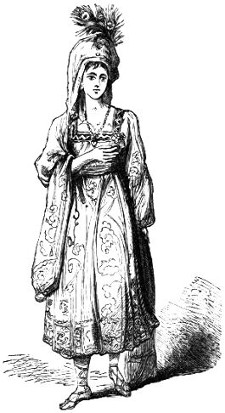
The Princess Caraboo. From a sketch by Bird, R.A.
"The Princess Caraboo."
Early in the year 1865 there died at Bristol a female of considerable personal attractions, whose early history was amusing enough, yet took a strong hold upon credulous persons half-a-century since. She pretended to be a native of Javasu, in the Indian Ocean, and to have been carried off by pirates, by whom she had been sold to the captain of a brig. Her first appearance was in the spring of 1817, at Almondsbury, in Gloucestershire. Having been ill-used when on board the ship, she had jumped overboard, she said, swam on shore, and wandered about six weeks before she came to Almondsbury. She appears next to have found her way to Bath, and there to have created a sensation in the literary and fashionable circles of Bath and other places, which lasted till it was discovered that the whole affair was a romance, cleverly sustained and acted out by a young and prepossessing girl, who sought to maintain the imposition by the invention of hieroglyphics and characters to represent her native language.
In 1817, there was published at Bristol a narrative of this singular imposition, "practised upon the benevolence of a lady residing in the Vicinity of Bristol by a young woman of the name of Mary Willcocks, alias Baker, alias Bakerstendht, alias Caraboo, Princess of Javasu;" for which work Bird, the Royal Academician, drew two portraits.
It was ascertained that she was a native of Witheridge, in Devonshire, where her father was a cobbler. She appears to have taken flight to America, and in 1824 she returned to England, and hired apartments in New Bond Street, where she exhibited herself to the public at the charge of one shilling; but she did not attract any great attention.
On being deposed from the honours which had been awarded to her, "the Princess" retired into comparatively humble life, and married. There was a kind of grim humour in the occupation which she subsequently followed, that of an importer of leeches: but she conducted her operations with much judgment and ability, and carried on her trade with credit to herself and satisfaction to her customers. The quondam "Princess" died, leaving a daughter, who, like her mother, is described as very beautiful.
There is, it should be added, a very strange story of the Princess having got an introduction to Napoleon Bonaparte at St. Helena, of which affair the following account appeared in Felix Farley's Bristol Journal, September 13th, 1817:—
"A letter from Sir Hudson Lowe, lately received from St. Helena, forms at present the leading topic of conversation in the higher circles. It states that on the day preceding the date of the last dispatches, a large ship was discovered in the offing. The wind was strong from the S.S.E. After several hours' tacking, with apparent intention to reach the island, the vessel was observed to bear away for the N.W., and in the course of an hour the boat was seen entering the harbour. It was rowed by a single person. Sir Hudson went alone to the beach, and to his astonishment saw a female of interesting appearance drop the oars and spring to land. She stated that she had sailed from Bristol, under the care of some missionary ladies, in a vessel called the Robert and Anne, Captain Robinson, destined for Philadelphia; that the vessel being driven out of its course by a tempest, which continued for several successive days, the crew at length perceived land, which the captain recognised to be St. Helena: that she immediately conceived an ardent desire of seeing the man with whose future fortunes she was persuaded her own were mysteriously connected; and her breast swelled with the prospect of contemplating face to face an impostor not equalled on earth since the days of Mohammed; but a change of wind to the S.S.E. nearly overset her hopes. Finding the captain resolved to proceed according to his original destination, she watched her opportunity, and springing with a large clasp-knife into a small boat which was slung at the stern, she cut the ropes, dropt safely into the ocean, and rowed away. The wind was too strong from the land to allow of the vessel being brought about to thwart her object. Sir Hudson introduced her to Bonaparte under the name of Caraboo! She described herself as Princess of Javasu, and related a tale of extraordinary interest, which seemed in a high degree to delight the captive chief. He embraced her with every demonstration of enthusiastic rapture, and besought Sir Hudson that she might be allowed an apartment in his house, declaring that she alone was an adequate solace in his captivity.
"Sir Hudson subjoins: 'The familiar acquaintance with the Malay tongue possessed by this most extraordinary personage (and there are many on the island who understand that language), together with the knowledge she displays of the Indian and Chinese politics, and the eagerness with which she speaks of these subjects, appear to convince every one that she is no impostor. Her manner is noble and fascinating in a wonderful degree.'
"A private letter adds the following testimony to the above statement, 'Since the arrival of this lady, her manners, and I may say the countenance and figure of Bonaparte appear to be wholly altered. From being reserved and dejected, he has become gay and communicative. No more complaints are heard about inconveniences at Longwood. He has intimated to Sir Hudson his determination to apply to the Pope for a dispensation to dissolve his marriage with Maria Louisa, and to sanction his indissoluble union with the enchanting Caraboo.'"
However, corroboration of this strange story is wanting.
Fat Folks.—Lambert and Bright.
About the centre of the new burial-ground of St. Martin's Stamford Baron, is a black slate inscribed with gilt letters to the memory of that immense mass of mortality, Daniel Lambert, the most popularly known of "Fat Folks."
"Altus in animo, in Corpore Maximus. In remembrance of that prodigy in nature, Daniel Lambert, a native of Leicester, Who was possessed of an exalted and convivial mind; and, in personal greatness had no competitor. He measured 3 ft. 1 in. round the leg; and weighed 52 st. 11 lbs.! He departed this life on the 21st June, 1809, aged 39 years. As a testimony of respect, this Stone is erected by his friends in Leicester."
Daniel Lambert was born on the 13th of March, 1770, at Leicester. His parents were not persons of remarkable dimensions: but he had an uncle and aunt on the father's side who were both very heavy.
At the age of 19, young Lambert began to imagine that he should be a heavy man. He possessed extraordinary muscular power, and at the above age could lift great weights, and carry five-hundred weight with ease. He succeeded his father in the office of keeper of the prison at Leicester, within a year after which his bulk began rapidly to increase, owing to his confinement and sedentary life. Though he never possessed any extraordinary agility, he was able to kick to the height of seven feet, standing on one leg.
About the year 1793, when Lambert weighed 32 stone, he walked from Woolwich to London, with much less apparent fatigue than several middle-sized men who were his companions. Upon this Mr. Wadd remarks: "It is clear, therefore, that he was a strong, active man, and continued so after the disease had made great progress; and I think it may fairly be inferred that he would not have fallen a sacrifice so early in life, if he had possessed fortitude enough to meet the evil, and to have opposed it with determined perseverance."
Lambert was very expert in swimming, and taught hundreds of the young people of Leicester. His power of floating, owing to his uncommon bulk, was so great that he could swim with two men of ordinary size upon his back. He proved a humane keeper of the prison, and upon his retirement from the office, the magistrates settled upon him an annuity of 50l. for life, without any solicitation.
He now lived a life of leisure at Leicester, but his uncommon corpulence brought him many visitors; and he at length found that he must either submit to be a close prisoner in his own house, or endure the inconveniences without receiving any of the profits of an exhibition. He then determined to visit London; and as it was impossible to procure a carriage large enough to admit him, he had a vehicle built to convey him to the metropolis, where he arrived in the spring of 1806, and fixed his abode in Piccadilly. Here he was visited by much company. Among them was the celebrated Polish dwarf, Count Boruwlaski, who had before seen Lambert at Birmingham; the little man exclaimed that he had seen the face twenty years ago, but it was not surely the same body. In the course of conversation, Lambert asked what quantity of cloth the Count required for a coat, and how many he thought his would make him. "Not many," answered Boruwlaski; "I take good large piece of cloth myself—almost tree-quarters of a yard." At this rate, one of Lambert's sleeves would have abundantly sufficed for the purpose. The Count felt one of Mr. Lambert's legs, "Ah, mine Got!" he exclaimed, "pure flesh and blood; I feel de warm. No deception, I am pleased, for I did hear it was deception." Mr. Lambert asked if the Count's lady was alive; to which he replied, "No, she is dead, and I am not very sorry, for when I affront her, she put me on the mantel-shelf for punishment."[30]
In September, 1806, Lambert returned to Leicester, but repeated his visit in the following year, and fixed his abode in Leicester Square. Here, for the first time, he felt inconvenienced by the atmosphere of the metropolis; accordingly, by the advice of Dr. Heaviside, his physician, Lambert returned to his native place. He then made a tour through the principal cities and towns of England, and proved as attractive in the provinces as he had formerly been in the metropolis. He now enjoyed excellent health, and felt perfectly at ease, either while sitting up or lying in bed. His diet was plain, and the quantity moderate. For many years he never drank anything stronger than water. He slept well, but scarcely so much as other persons, and his respiration was as free as any moderately-sized individual. His countenance was manly and intelligent; he possessed great information, much ready politeness, and conversed with ease and facility. He had a powerful and melodious tenor voice, and his articulation was perfectly clear and unembarrassed.
Lambert had, however, for some time shown dropsical symptoms. In June 1809, he was weighed at Huntingdon, and by the Caledonian balance was found to be 52 stone 11 lb. (14 lb. to the stone), 10st. 4lb. heavier than Bright, the miller of Malden. His measure round the body was three yards four inches, and one yard one inch round the leg.
A few days after this measurement, on June 20th, he arrived from Huntingdon, at the Wagon and Horses Inn, St. Martin's, Stamford, where preparations were made to receive company the next day, and during Stamford races. He was announced for exhibition; he gave his orders cheerfully, without any presentiment that they were to be his last: he was then in bed, only fatigued from his journey, but anxious to be able to see company early in the morning. Before nine o'clock however, the day following, he was a corpse! He died in his apartment on the ground-floor of the inn, for he had long been incapable of walking up-stairs.
His interment was an arduous labour. His coffin measured six feet four inches long, four feet four inches wide, and two feet four inches deep, and contained one hundred and twelve superficial feet of elm. It was built upon two axletrees and four wheels; the room-door and wall of the room in which he lay were taken down to allow of his exit, and thus his remains were drawn to the place of interment at St. Martin's, Stamford. His grave was dug with a gradual slope for several yards; and upwards of twenty men were employed for nearly half-an-hour in getting the massive corpse into its resting-place: the immense substance of the legs made the coffin, of necessity, at most a square case. The funeral was attended by thousands of persons from Stamford and the country many miles round.
At the Wagon and Horses Inn were preserved two suits of Lambert's clothes: seven ordinarily-sized men were repeatedly enclosed within his waistcoat, without breaking a stitch or straining a button; each suit of clothes cost 20l. His name was remembered for a time as a tavern sign: one on the north side of Ludgate Street remained till within a few years.
The great weight of Edward Bright, the miller of Malden, has been incidentally mentioned. He died on November 10th, 1750, at the age of 30. He was an active man till within a year or two of his death; when his corpulency so overpowered his strength, that his life was a burthen to him; yet, as we have seen, he was ten stone four pounds lighter than Lambert. Mr. Wadd says it is supposed that Bright's weight at his death was forty-four stone, or 616 pounds.
Horace Walpole relates the following story of Bright's weight backed against that of the Duke of Cumberland:—"There has been a droll cause in Westminster Hall: a man laid another a wager that he produced a person who should weigh as much again as the Duke. When they had betted, they recollected not knowing how to desire the Duke to step into the scale. They agreed to establish his weight at twenty stone, which, however, is supposed to be two more than he weighs. One Bright was then produced, who is since dead, and who actually weighed forty-two stone and a half. As soon as he was dead, the person who had lost objected that he had been weighed in his clothes, and though it was impossible to suppose that his clothes could weigh above two stone, they went to law. There were the Duke's twenty stone bawled over a thousand times,—but the righteous law decided against the man who had won!"
Bright, when twelve years old, weighed one hundred and forty-four pounds; and there was another boy in Malden at the same time, fourteen years of age, who weighed as much.
There was, however, an Essex man, who not only attained a great weight, but lived to a great age, which is remarkable among persons of this class. This was James Mansfield, a butcher, who died at the village of Debden, on November 9th, 1862, in his 82nd year. Though not above the ordinary height, he measured nine feet round and weighed thirty-three stone. When sitting in his chair, made especially for his use, his abdomen covered his knees and hung down almost to the ground. When he lay down, it was necessary to pack his head to prevent suffocation: he could only lie upon one side. He was exhibited, in 1851, in Leicester Square, as "the greatest man in the world." In a suit of his clothes four ordinarily-sized men might be comfortably buttoned up. Mansfield, just before his death, was a hale old man, of good constitution, and a sanguine and happy temperament.
Corpulency naturally subjects its bearers to some of
"The thousand natural shocks That flesh is heir to."
Among these inconveniences is the absolute prohibition from horsemanship, and the difficulty of transportation from place to place, which may be illustrated by the following anecdotes, related by Mr. Wadd, in Brande's Journal, 1828:—
Mr. B.——, of Bath, a remarkably large, corpulent, and powerful man, wanting to go by the mail, tried for a place a short time before it started. Being told it was full, he still determined to get admission, and opening the door, which no one near him ventured to oppose, he got in. When the other passengers came, the ostler reported that there was a gentleman in the coach; he was requested to come out, but having drawn up the blind, he remained quiet. Hearing, however, a consultation on the means of making him alight, and a proposal to "pull him out," he let down the blind, and laying his enormous hand on the edge of the door, he asked, who would dare to pull him out, drew up the blind again, and waiting some time, fell asleep. About one in the morning he awoke, and calling out to know whereabout he was on the journey, he perceived, what was the fact, that to end the altercation with him, the horses had been put to another coach, and that he had spent the night at the inn-door at Bath, where he had taken possession of the carriage.
A similar occurrence took place at Huddersfield. A gentleman went to a proprietor of one of the coaches to take a place for Manchester, but owing to the enormous size of his person he was refused, unless he would consent to be taken as lumber, at 9d. per stone, hinting at the same time the advantage of being split in two. The gentleman was not to be disheartened by this disappointment, but adopted the plan of sending the ostler of one of the inns to take a place for him, which he did, and in the morning wisely took the precaution by fixing himself in the coach, with the assistance of the bystanders, from whence he was not to be removed easily. There placed, he was taken to his destination. The consequence was, on his return he was necessitated to adopt a similar process, to the no small disappointment of the proprietors, who were compelled to convey three gentlemen who had previously taken their places in a chaise, as there was no room beside this importunate passenger, who weighed about thirty-six stone.
A Cure for Corpulence.
In 1863, a philanthropist laid before the public the narrative of a man who was tremendously fat, who tried hard for years to thin himself, and who at last succeeded. Mr. Banting, the gentleman who had the courage and good feeling to write and publish this narrative, not long before, measured 5ft. 5in., and weighed about 14¼ stone. He owns that he had a great deal to bear from his unfortunate make. In the first place, the little boys in the streets laughed at him; in the next place, he could not tie his own shoes; and, lastly, he had, it appears, to come down-stairs backwards. But he was a man who struggled gallantly, and whatever he was recommended to do, he honestly tried to carry out. He drank mineral waters, and consulted physicians, and took sweet counsel with innumerable friends, but all was in vain. He lived upon sixpence a-day, and earned it, so that the favourite recipe of Abernethy failed in his case. He went into all sorts of vapour baths and shampooing baths. He took no less than ninety Turkish baths, but nothing did him any good; he was still as fat as ever. A kind friend recommended increased bodily exertion every morning, and nothing seemed more likely to be effectual than rowing. So this stout warrior with fat got daily into a good, safe, heavy boat, and rowed a couple of hours. But he was only pouring water into the bucket of the Danaides. What he gained in one way he lost in another. His muscular vigour increased; but then, with this there came a prodigious appetite which he felt compelled to indulge, and consequently he got fatter than he had been. At last he hit upon the right adviser, who told him what to do, and whose advice was so successful that Mr. Banting could soon walk down-stairs forwards, put his old clothes quite over the suit that now fitted him, and, far from being made the victim of unkind or ill-judged chaff, was universally congratulated on his pleasant and becoming appearance. The machinery by which this change was effected was of a very simple kind. He was told to leave off eating anything but meat. It appears that none of his numerous friendly advisers, and none of the physicians he consulted, penetrated so far into the secresy of his domestic habits as to have discovered that twice a day he used formerly to indulge in bowls of bread and milk. The Solomon who saved him cut off this great feeder of fat, and since then Mr. Banting has been a thinner and a happier man.—Abridged from the Saturday Review.
Epitaphs on Fat Folks.
In the year 1755, died the great tallow-chandler whose life and death are thus laconically recorded on his tombstone:—
Here lies in earth an honest fellow, Who died by fat, and lived by tallow.
Another corpulent person is thus lamented:—
Here lies the body of Thomas Dollman, A vastly fat, though not a very tall man; Full twenty stone he weighed, yet I am told, His captain thought him worth his weight in gold: Grim Death, who ne'er to nobody shows favour, Hurried him off for all his good behaviour; Regardless of his weight, he bundled him away, 'Fore any one "Jack Robinson" could say.
A moral lesson is given in the following:—
But why he grew so fat i' th' waist, Now mark ye the true reason, When other people used to fast, He feasted in that season. So now, alas! hath cruel Death Laid him in his sepulchre. Therefore, good people, here 'tis seen, You plainly may see here, That fat men sooner die than lean, Witness Fat Johnny Holder.
The son of a Dean, a man of very spare habit, expressing to the son of a Bishop his astonishment at the great difference of the size of their fathers, the Bishop being very fat, he explained the reason in the following extempore parody of the old song:—
There's a difference between A Bishop and a Dean, And I'll tell you the reason why: A Dean cannot dish up A dinner like a Bishop, To feed such a fat son as I.
Count Boruwlaski, the Polish Dwarf.
One of the best attested cases of dwarfish existence on record is that of Joseph Boruwlaski, the Polish dwarf, who was the delight of our grandfathers, and who, after the age of seventy, suddenly found himself able with his hand to raise the latch of a door which up to that period he had always raised with a stick. How many inches he grew is not recorded, but the fact of his growth is sufficiently astonishing, and is only paradoxical so long as we continue to hold the general opinion that "men do not grow after reaching maturity," whereas, in strict language, we must admit that they grow as long as they live, but do not normally surpass the standard of maturity; growth continues, but only to supply the waste, not enough, as in childhood, to supply the waste and furnish surplus for the increase.
Count Joseph Boruwlaski is, in many respects, the most interesting dwarf of whom we have accurate records, and he has written his own memoir to complete our interest. He has given us his height at various epochs as follows:—
Ft. In.
At one year old he measured 0 11
At three „ „ 1 2
At six „ „ 1 5
At ten „ „ 1 9
At fifteen „ „ 2 1
At twenty „ „ 2 4
At twenty-five years old he measured 2 11
At thirty „ „ 3 3
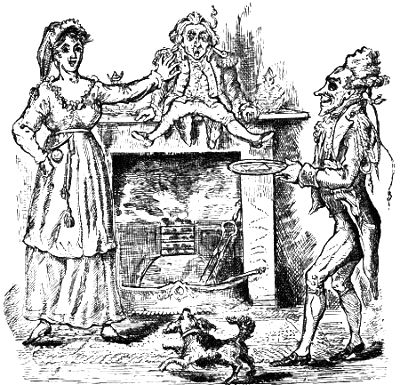
Count Boruwlaski in disgrace with his wife.
Here he stopped until he was seventy. He was born at Chaliez, in Russian Poland, November, 1739, of noble parents, who were richer in pedigree than in land or money. They were both well formed, healthy, and of the ordinary size; yet of their six children, three were dwarfs; and, to add to the singularity, the dwarfs alternated with well-formed children. Joseph was 8 inches in length when born, yet perfectly well-formed, and he sucked with infantine success, walking and talking at about the usual age.
On reaching his ninth year, he lost his father, who left a widow and six children very ill-provided for. Luckily, a friend of the widow, a Madame de Caorliz, adopted Joseph, and with her the boy spent four happy years. His benefactress then married, and this event produced a change in his fortunes. A dwarf so remarkable was naturally enough an envied possession; and the Countess Humieska, a very great person indeed, felt the desire natural in so great a person, to have this among her curiosities. Domiciled with the great Countess, Joseph began to taste the splendours and luxuries of courts. They travelled through Poland, Germany, and France, and everywhere he was the lion of the hour. At Vienna he was presented to Maria Theresa, who, pleased with his courtly compliments, kissed him, and complimented the Countess on her travelling companion. On another occasion, Joseph, in the lap of the Empress, who had sixteen children of her own, and doted on them, was looking at the hand in which his own was clasped, and which flashed light from a ring bearing her cipher in brilliants. She asked him if he was pleased with the ring; he told her it was the hand he looked at, and at the same time raised it to his lips. The flattered Empress insisted on giving him the ring; but alas! it was too large, whereupon she called to a young lady of about six years old, and taking from her a fine diamond ring, placed it on Joseph's finger: this young lady was Marie Antoinette.
From Vienna the travellers proceeded to Munich, and thence, after countless fêtes, they went to Luneville, the court of Stanislas Leckzinski, titular King of Poland. Here Joseph met the dwarf Bébé, of whom Boruwlaski gives this account:—"With this prince (Stanislas) lived the famous Bébé, till then considered the most extraordinary dwarf that was ever seen; and who was, indeed, perfectly well proportioned, and with a pleasant physiognomy, but who (I am sorry to say it, for the honour of us dwarfs) had all the defects in his mind and way of thinking which are commonly attributed to us. He was at that time about thirty,[31] and his height two feet eight inches; and when measured, it appeared that I was much shorter, being no more than two feet four inches. At our first interview he showed much fondness for me; but, on perceiving that I preferred the company and conversation of sensible people, and above all, when he perceived that the King took pleasure in my society, he conceived the most violent jealousy and hatred of me; so that I escaped his fury only by a miracle. One day, we were both in the apartment of his Majesty, who caressed me, and asked me several questions, testifying his pleasure and approbation of my replies in the most affectionate manner. Then addressing Bébé, he said: 'You see, Bébé, what a difference there is between him and you. He is amiable, cheerful, entertaining, and instructed, whereas you are but a little machine.' At these words I saw fury sparkle in his eyes; he answered nothing, but his countenance and blush proved how violently he was agitated. A moment after, the King having gone into his cabinet, Bébé availed himself of the opportunity to execute his revengeful projects; and slyly approaching, seized me by the waist, and endeavoured to push me on to the fire. Luckily, I laid hold with both hands of the iron prop which sustained the tongs and poker, and thus prevented his wicked intentions. The noise I made in defending myself brought back the king to my assistance. He afterwards called the servants, and ordered Bébé corporal punishment. In vain did I intercede."
On quitting the court of Stanislas, Boruwlaski visited that of Versailles, where the Queen, the Duke of Orleans, and other distinguished personages, made as much of him as vanity could desire. The Count Orginski, finding he had a taste for music, provided him a master for the guitar. At the table of this nobleman, he one day allowed himself to be concealed in a large vase, which was placed amid the dishes, and to which the attention of the guests was directed, till their curiosity was fairly roused, expecting some rarity surpassing all the delicacies of the already sumptuous banquet; and then Joseph suddenly stood up, amid shouts of laughter.
From Paris he went to Holland, and thence back to Poland. His reception in Warsaw was enthusiastic; and as travel and reading had given polish to his manners and culture to his intellect, his society became sought after for something more than mere curiosity. He now attended the theatre, and became fascinated with the actresses. His first love was a French actress, who, amused and flattered, pretended to return his passion, and for a time he was in a delirium of happiness; but an unlucky discovery of her having talked about his passion with mockery, cruelly dispelled his brief dream. To be in love with an actress, and to find that she has been laughing at the passion she has inspired, and only feigning to return it for some object of her own, is what many young men have had to experience; but perhaps in none could the mortification of self-love have been so cruel as in the little dwarf, who knew the ridicule which must necessarily attend his presumption in claiming the privilege of a man. But the heart having once known the bitter-sweet of love, will not long be kept from it; and Joseph soon fixed his affections on Isolina, a protégée of the Countess Humieska, who, living under the same roof with him, was much astonished to observe that he allowed every other lady to take him on her lap and caress him; she accused him of not liking her, because to her only he was reserved and shy. Now, he had not forgotten the ridicule of the French actress: for a whole twelvemonth he continued loving in silence, in doubt, and in trouble. His health suffered; at last, passion triumphed over his fears; he declared his love, which the lady treated as the love of a child. "Really," said she, "you are a child, and I cannot help laughing at your extravagance." He tried to convince her that he was no child, and would not be loved like a child; when she burst out laughing, told him he knew not what he said, and left the room.
This was a ludicrous situation, but with a tragic aspect; a young and lively woman receiving a passionate declaration from a being not taller than a child three or four years old, may be excused if her sense of the ludicrous prevented her understanding the seriousness of the passion she inspired. Joseph was hurt, but not altogether dissatisfied. The secret no longer pressed its uneasy burden on his mind. She knew of his love; she could now interpret his reserve—his melancholy—his silent adoration. In time she might be touched. For the first few days, indeed, there seemed little hope of such an issue. She bantered him incessantly, and the more he tried to speak to her as a man, the more she persisted in treating him like a child. The effect of this was a serious illness; for two months he was in danger. He recovered, and she, from that time, gave up the dangerous game; and they were eventually married.
We must now accompany Boruwlaski to England, where he was received by the Duke and Duchess of Devonshire, and was presented to the King and Queen, and patronized by the Prince of Wales and the nobility.
Among the remarkable persons whom the Count met was O'Brien, the Irish giant. "Our surprise," says Boruwlaski, "was mutual—the giant remained a moment speechless with astonishment, and then stooping half-way, he presented his hand, which could easily have contained a dozen of mine, and made me a very pretty compliment." When they stood beside each other, the giant's knee was nearly on a level with the dwarf's head. They both resided together some time at an inn at Epping, where they often walked out together, greatly to the amusement of the townsfolk.
Mathews, the comedian, was a friend and admirer of Boruwlaski, and contrived to get an interview arranged with George IV. for the presentation of a copy of the Count's Memoirs, published in 1788. Mathews and his little charge were ushered into the presence of the sovereign: the King rose and met Boruwlaski, raised him up in his arms, in a kind embrace, saying, "My dear old friend, how delighted I am to see you!" and then placed the little man upon a sofa. But the Count's loyalty not being so satisfied, he descended with the agility of a schoolboy, and threw himself at his master's feet, who, however, would not suffer him to remain in that position for a minute, but raised him again upon the sofa. In the course of the conversation, the Count, addressing the King in French, was told that his English was so good it was quite unnecessary to speak in any other language; for his Majesty, with his usual tact, easily discerned that he should be a loser in resigning the Count's prettily-broken English, which (as he always thought in his native language, and literally translated its idioms) was the most amusing imaginable, and totally distinct from the imperfect English of other foreigners.... The King, in the course of conversation, said, "But, Count, you were married when I first knew you: I hope madame is still alive, and as well as yourself." "Ah, no! Majesty; Isolina die thirty year! Fine woman! sweet, beauty body! You have no idea, Majesty." "I am sorry to hear of her death; such a charming person must have been a great loss to you, Count." "Dat is very true, Majesty; indid, indid, it was great sorrow for me!" His Majesty then inquired how old the Count was, and on being told, with a start of surprise observed, "Count, you are the finest man of your age I ever saw. I wish you could return the compliment." To which Boruwlaski, not to be outdone in courtesy, ludicrously replied, "Oh! Majesty, fine body! indid, indid; beauty body!"
The King, on accepting the book which the Count wished to present, turned to the Marchioness of Conyngham, and took from her a little case containing a beautiful miniature watch and seals, attached to a superb chain, the watch exquisitely ornamented with jewels. This the King begged the Count to accept, saying, as he held the Memoirs in the other hand, "My dear friend, I shall read and preserve this as long as I live, for your sake; and in return I request you will wear this for mine." His Majesty said to Mathews, in the absence of the Count, "If I had a dozen sons, I could not point out to them a more perfect model of good breeding and elegance than the Count; he is really a most accomplished and charming person."
It appears that, by the kindness of friends, Boruwlaski had purchased an annuity, which secured him independence for the remainder of his life. Out of this transaction arose a laughable incident. One day he called at the insurance office with Mr. Mathews, and on being asked how he was, he replied, with the vivacity of eighteen, "Oh, never better! quite vel!" and he ran out of the office from the gaze of the aged insurer, scarcely able to restrain his merriment till he got out of hearing. He then told Mr. Mathews, during his convulsions of laughter, that the person they had just seen was the granter of his annuity. "Ha! ha! ha! O Mattew, I cannot help! Oh poor devil, poor hold body! It maks me laffing, poor hold hanimal! Oh he say prayer for me die, often when he slip! Oh you may depend—ha! ha! ha! but Boruwlaski never die! He calcoolated dat dwarf not live it long, et I live it forty year to plag him. Oh he is in a hobbel debblishly! I tellee dat! He fifty year yonger den Boruwlaski; mintime he dead as soon as me. Oh yes, you may be sure dat—dat is my oppinnon. Boruwlaski never die," playfully nodding his little head, "you may depend." Mr. Mathews asked him if the old man had any family (feeling some compassion for his hard case), to which the Count cried out, "Oh he have it shildren twenty, like a pig, poor devel! mintime he riche body! Oh he have it goold et wast many bank nott. Bote he have it greet prepencity to keep him fast hold, poor idiot! It macks me laffing!"—(See the Memoirs of Charles Mathews, by Mrs. Mathews.)
To these characteristics we are enabled to add that of an English letter, written by the Count in his eighty-ninth year, the handwriting of which is singularly firm and steady, resembling that of a school boy of about fourteen. We shall copy it literatim from the autograph letter in the possession of Lord Houghton. It is addressed to Miss Emma George, at Miss Bird's, Pitt street, Edinburgh, and runs thus:—
"Dear Emma.—I am a fraid you will think me negligent in not answering your kind Letter which I received both. which made me delay write soonere I was en a visite at Newcastle, and I remain rathere to lon. and with the acceident happing when I burn your Lette in which been your derection, when I do so after reading, for alwais afraid of aney mischiefe at homes, what you know my situation, in which I remain to this day. and increas dayli more and more unhappy. I have maney things to tell you and you wish to know about me, but I cannot trust to a Lettere to disclos, and gave you picture of my precise state of my Life with extended Field, to make description of my trouble but only I may say truly. That I find myselfe without friend in a Stranger Country. Yet from the aspect of flattering appearance. I thought aftere a very fatiging journey in the begonning of my Life, that no kind of vexation would distourb my present state of happiness at Durham. Upon which my mind being grounded, in expectation of all feliesity. But here what to say of my sorrow with astonishment, when I found overeeting, when I behod now nothing but betterness of heart, and so heavy a Cloud over my existance in misery. So I have not on friend, but I have wakeful body who watch all my motion. So I have my share to be partner with you and support on othere, when we are left to ourself in a Pilgrimage in which we are engaged so severely. To be sure I feel the disappointments of my situation. Yet I have experience that I cannot help thinking that it was well that Providence had blessed me, to alowd me kindly as litll as it is: Yet to accomodated Dear Emma according to fortune which God gave me, which Dear Emma will receive next month your 5l. I beg Dear Emma make your selfe happy and not uneasy if some time I delay in answering your Lettere. Notwithstanding you most know me now to trust me and have Confidence in me that I ame not Changable nature, but remain, and believe me, your sincer affectiont, Joseph Boruwlaski.
"Durham 17 March 1828."
This singular being lived to the extraordinary age of ninety-eight; a great age for an ordinary man, and quite without example in the history of dwarfs. He died at Bank's Cottage, near Durham, on the 5th of September, 1837, and his remains were placed near those of Stephen Kemble, in the Nine Altars of Durham Cathedral. It is stated in the Gentleman's Magazine (October, 1837), that the cottage was the gift of some of the prebendaries of Durham, who also allowed him a handsome income. They may have given him the cottage, but the income came, as Boruwlaski himself informs us, from the Misses Metcalfe. In the parish church of St. Mary-the-Less is a mural tablet of white stone, with an inscription erected in memory of the Count, who long resided in the city, and has, indeed, given his name to a bend in the river, known as "Count's Corner."—(Walker's Brief Sketch of Durham, 4th edition, 1865.) If the reader attentively considers the story we have narrated, he will perceive that the Count, although an anomaly in respect of size, was in all other respects a perfectly formed man, and is distinguished from most other dwarfs by longevity, paternity, and intelligence. The anomaly, therefore, could not have been deeply seated. He was a perfect copy of nature's finest work in duodecimo. A full-length portrait of him may be seen in the Hunterian Museum, life-size, leaning against a chair.
It may be interesting to narrate a few more examples of dwarf life, from accredited sources.
M. St. Hilaire relates from the Philosophical Transactions, 1751-2, the case of a dwarf named Hopkins, who, at fifteen years of age, stood only 2 ft. 7 in., and weighed between 12 and 13 lbs. He had all the signs of old age. He was bent, deformed, and troubled with a dry cough. His hearing and sight were bad; his teeth almost all decayed. He was very thin, and so weak as scarcely to be able to stand. Till the age of seven he had been gay, healthy, and active; nor at that age did he show any indications of stopped growth. He was well formed, and weighed nineteen pounds, i.e. six pounds more than he weighed at fifteen. From that period his health declined, and his body wasted. He came from healthy parents of ordinary stature, and was the second of six children, another of whom also was a dwarf.
Dantlow, the Russian dwarf, was only thirty inches high; he was without arms, and had only four toes on each foot. With his feet he made pen-and-ink sketches rivalling etchings; and knitted stockings with needles made of wood. He fed himself with his left foot; learned with great facility, and was eager to learn.
M. Virey describes a German girl, exhibited in Paris in 1816. She was of parents above the average height, who had previously produced a male dwarf. At eight years old she weighed no more than an ordinary infant; her height was eighteen inches. In temper she was gay, restless, and excitable. Her pulse normally was at ninety-four.
M. Virey also relates the following example; Thérèse Souvray, was destined to become the bride of Bébé, to whom she was solemnly affianced in the year 1761; but death snatched the bridegroom from her, and as the fiancée of this celebrated man, she was exhibited in Paris during the year 1821. She was then seventy-three years of age; gay, healthy, lively, and danced with her sister, two years her senior, and measuring only three feet and a half, French measure.
In 1865, there died in Paris the dwarf Richebourg, who was an historical personage. Richebourg, who was only 60 centimètres high, was in his sixteenth year placed in the household of the Duchess of Orleans (the mother of King Louis-Philippe). He was often made useful for the transmission of dispatches. He was dressed up as a baby, and important State papers placed in his clothes, and thus he was able to effect a communication between Paris and the émigrés, which could hardly have taken place by any other means. The most suspicious of sans culottes never took it into his head to stop a nurse with a baby in her arms. For the last thirty years he lived in Paris in one of the houses in the remotest part of the Faubourg St. Germain. He had a morbid dread of appearing in public, and it is recorded that during this long period he never put his foot outside the house. He received from the Orleans family a pension of 3,000 francs per annum. He had attained the ripe age of ninety-two.
A writer in Fraser's Magazine, August, 1856, from the above and other examples of dwarfs quoted by him, sets down these few general conclusions upon the question of their organization:—"In doing so," he remarks, "it will be well to bear in mind that the very fact of dwarfs being anomalies, renders any generalization respecting them subject to many qualifications in each particular instance. Thus, although it is true, as a general fact, that they are short-lived and unintelligent, we see examples of more than ordinary intelligence in Boruwlaski and his brother, and Jeffrey Hudson, and of longevity in them. One may assert, indeed, that longevity and intelligence are intimately allied in the dwarf organization; for, whenever the anomaly of growth is not profound enough to affect the health, it is presumably too superficial to affect the intelligence; and, vice versâ, when we see a being passing rapidly from childhood to old age, we may be certain that the organization is too aberrant from the normal type to permit the free development of intelligence. Another general fact about dwarfs, and one to which we know of no exception, is that they are very excitable, and consequently, irascible; when in good health, lively, restless, and turbulent. This, indeed, is a characteristic of men and animals of the small type."
The Irish Giant.
This extraordinary person, whose height was eight feet seven-and-a-half inches, was born at Kinsale, in Ireland. His real name was Patrick Cotter. He was of obscure parentage, and originally laboured as a bricklayer. His uncommon size rendered him a mark for the cunning of a showman, who, for the payment of 50l. per annum, had the privilege of exhibiting Cotter for three years in England. Not contented with his bargain, the huckster underlet to another speculator the liberty of showing him; and poor Cotter, through resisting this nefarious transaction, was saddled with a fictitious debt, and thrown into a spunging-house in Bristol. In this situation he was visited by a gentleman of the city, who, compassionating his distress, and having reason to think that he was unjustly detained, generously became his bail, and investigated the affair; and not only obtained Cotter his liberty, but freed him from all kind of obligation to serve his taskmaster any longer. He was then but eighteen years old. He retained, to his last breath, a due sense of the good offices of the Bristol stranger, conferred upon him when he was sorely in need; and the giant did not forget his benefactor in his will.
It happened to be September when Cotter was liberated; and by the further assistance of his benefactor, he was enabled to exhibit himself in the St. James's fair at Bristol; and in three days he found himself possessed of thirty pounds, English money. He now commenced a regular exhibition of his person, which he continued until within two years of his death, when having realized sufficient money to enable him to keep a carriage, and live in good style, he declined to exhibit any more, which was always irksome to his feelings. He was unoffending and amiable in his manners; was possessed of good sense, and his mind was not uncultivated; he long kept a journal of his life, which a whim of the moment induced him to commit to the flames. He died in his forty-sixth year, September 8th, 1806, at the Hotwells, Bristol. He was buried in the Roman Catholic chapel, Trenchard Street, at six o'clock in the morning, this early hour being fixed on to prevent as much as possible the assemblage of a crowd; but it is stated that at least 2,000 persons were present. The coffin, of lead, measured nine feet two inches in the clear, and the wooden case four inches more; it was three feet across the shoulders. No hearse could be procured long enough to contain the coffin, the projecting end of which was draped with black cloth. Fourteen men bore it from the hearse to the grave, into which it was let down with pulleys. To prevent any attempt to disturb his remains, of which Cotter had, when living, the greatest horror, the grave was made twelve feet deep, in a solid rock. A plaster cast of his right hand may be seen at the College of Surgeons, Lincoln's Inn Fields.
Birth Extraordinary.
On Sunday, the 23rd of October, 1836, occurred an event interesting to physiologists. The wife of a dwarf, Don Santiago de los Santos (herself a dwarf), was delivered of a well-formed male infant, at their residence, No. 167, High Holborn, near Museum Street. The accoucheurs were Mr. Bowden, of Sloane Street, Chelsea, who had before attended Donna Santiago on a similar occasion; and Dr. Davis of Savile Row. Both gentlemen had for some time been very assiduous in their attentions to the little lady; but the infant, though it came into the world alive, did not survive above half-an-hour. Its length was thirteen and a half inches: its weight one pound four ounces and a half (avoirdupois); it was in every respect well-formed; and the likeness of the face to that of its father was very striking. It was carried in a coffin to St. George's Church, Bloomsbury; but being there refused sepulture, it was taken home, preserved in spirits, and subsequently exhibited. Dr. Davis was anxious to have it submitted to dissection, and to lecture upon it in the theatre of University College; this, however, was objected to by the Lilliputian parents, who appeared poignantly to feel the proposition.
Don Santiago, who was only twenty-five inches high, was at this time in his fiftieth year. He was a native of the Spanish settlement of Manilla, in one of the forests of which he was exposed and deserted, on account of his diminutive size. He was, however, miraculously saved by the Viceroy, who was hunting in that quarter, and humanely ordered him to be taken care of, and nursed with the same tenderness as his own children, with whom the little creature was brought up and educated, until he had attained the age of manhood. His birth dated from the period of his exposure, which was in 1786. His parents, it was ascertained, were farmers; and were with their other children (sons, daughters), of robust frame, and rather above the usual height.
When the Don was twenty years of age, his humane protector died; and attachment to the place of his birth prevented his accompanying his foster brother and sisters to Old Spain. This wilfulness cost him dearly; neglected by his parents and family, he suffered hardships and privations of the most afflicting nature. At length he found his way to Madras, and was, in the year 1830, brought to England by the captain of a trading vessel. During the voyage he was washed overboard by a heavy sea; but hencoops and spars being thrown out, and other assistance afforded, his life was saved.
On his arrival in northern latitudes, he suffered severely from cold, and even when accustomed to the climate, he could not swallow cold water. Still, he never went near a fire, although he felt sensibly if his room was not kept warm. He was stoutly built, and generally in cheerful spirits and good health. His complexion was of a slight copper colour, and the expression of his countenance was pleasing and intelligent. His habits were temperate, and he seldom drank anything but warm water; but on birthdays and other anniversaries, he indulged in a few glasses of wine. He was fond of music and dancing, and gallant to the ladies; but his ruling passion appeared to be a fondness for jewellery and silver-plate, to which ornaments he had been accustomed in the house and at the table of the Viceroy of Manilla. His mind appeared to be deeply impressed with the tenets of the Roman Catholic church, in which his foster-father took care to have him instructed. He read his prayer-book and psalter morning and evening, very devoutly crossing himself, and performing his genuflexions and the other ceremonies inculcated by the teachers of that faith. Once or twice a month, he went to the Spanish Ambassador's chapel, where, secluded from observation, he worshipped with the sincerity and devotion of a good Catholic. Besides his native tongue, he spoke an Indian patois, conversed freely in Portuguese, and in English indifferently well.
He became acquainted with his little wife in Birmingham, of which town she was a native. Her name was Ann Hopkins; her height was thirty-eight inches, or thirteen inches taller than her dwarf spouse. She was thirty-one years of age, and was a pretty little creature possessing much symmetry and grace. Her father stood six feet one inch and a half out of his shoes; her mother was of middle size, and her brothers and sisters, nine in number, were all tall and robust. The little Don and Donna lived together very affectionately, their attachment having been mutual and at first sight; their only difference of opinion being, that she being of the Protestant faith, they did not worship together. They were married on the 6th of July, 1834, in the Roman Catholic chapel at Birmingham; and two days after, at St. Martin's church, in the same town, by the Rev. Mr. Foy; the high bailiff giving away the bride. The crowd of spectators was so great that the assistance of the police was necessary to secure the ingress and egress of the little couple into and out of the church. Much uneasiness was caused to the bridegroom by the refusal of one clergyman to ratify his marriage in the Protestant church, on the supposition that it was contrary to the canon law; but this difficulty was ultimately arranged.—Abridged from the Morning Advertiser.
William Hutton's "Strong Woman."
William Hutton, the Birmingham manufacturer, was accustomed to take a month's tour every summer, and to note down his observations on places and people. Some of the results appeared in distinct books, some in his autobiography, and some in the Gentleman's Magazine, towards the close of the last century and the beginning of the present. One year he would be accompanied by his father, a tough old man, who was not frightened at a twenty-mile walk; another year he would go alone; while on one occasion his daughter went with him, she riding on horseback, and he trudging on foot by her side. Various parts of England and Wales were thus visited, at a time when tourists' facilities were slender indeed. It appears from his lists of distances that he could "do" fifteen or twenty miles a day for weeks together; although his mode of examining places led to a much slower rate of progress.
One of the odd characters which Hutton met with at Matlock, in Derbyshire, in July 1801, is worth describing in his own words. After noticing the rocks and caves at that town, he said, "The greatest wonder I saw was Miss Phœbe Bown, in person five feet six, about thirty, well-proportioned, round-faced and ruddy; a dark penetrating eye, which, the moment it fixes upon your face, stamps your character, and that with precision. Her step (pardon the Irishism) is more manly than a man's, and can easily cover forty miles a day. Her common dress is a man's hat, coat with a spencer about it, and men's shoes; I believe she is a stranger to breeches. She can lift one hundred-weight with each hand, and carry fourteen score. Can sew, knit, cook, and spin, but hates them all, and every accompaniment to the female character, except that of modesty. A gentleman at the New Bath recently treated her so rudely, that 'she had a good mind to have knocked him down.' She positively assured me she did not know what fear is. She never gives an affront, but will offer to fight anyone who gives her one. If she has not fought, perhaps it is owing to the insulter being a coward, for none else would give an affront [to a woman]. She has strong sense, an excellent judgment, says smart things, and supports an easy freedom in all companies. Her voice is more than masculine, it is deep toned; the wind in her face, she can send it a mile; has no beard; accepts any kind of manual labour, as holding the plough, driving the team, thatching the ricks, &c. But her chief avocation is breaking in horses, at a guinea a week! always rides without a saddle; and is supposed the best judge of a horse, cow, &c., in the country; and is frequently requested to purchase for others at the neighbouring fairs. She is fond of Milton, Pope, Shakespeare, also of music; is self-taught; performs on several instruments, as the flute, violin, harpsichord, and supports the bass-viol in Matlock church. She is an excellent markswoman, and, like her brother-sportsmen, carries her gun upon her shoulder. She eats no beef or pork, and but little mutton: her chief food is milk, and also her drink—discarding wine, ale, and spirits."—From the Book of Days.
Wildman and His Bees.
In Winchester Place, now Pentonville Road, near to the south-east corner of Penton Street, stood "Prospect House," so called from the fine view which it commanded over London and the circumjacent country. In the British Museum is a fine pen-and-ink drawing of a view of London from Pentonville, by Antonio Canaletti; and we find "Prospect House" in the rate-books in 1669; there were bowling-greens attached to it "for gentleman bowlers." Subsequently the house was named from its proprietor, and became popularly known as Dobney's, or D'Aubigny's. Mrs. Dobney, who kept the house for many years, died in 1760, at the age of eighty-six. It then passed to a new proprietor, a Mr. Johnson, who built on the bowling-green, which was near the corner of Penton Street, an amphitheatre for equestrian performances, al fresco, and engaged one Price, who had been starring at the Three Hats, a rival house close by, to exhibit his original feats of horsemanship. In 1769, the house was the scene of Philip Jonas's exhibition of "dexterity of hands;" and about this time was shown here the skeleton of a whale sixty feet long. In 1770, the house was taken for a boarding school, but was soon closed. It was then re-opened as the Jubilee Tea Gardens (from the Jubilee got up at Stratford-upon-Avon, by Garrick, in honour of Shakespeare); the interiors of the boxes were painted with scenes from some of his plays.
In 1772, the celebrated Daniel Wildman exhibited here his bees every evening (wet evenings excepted). He made several new and amazing experiments; he rode standing upright, one foot on the saddle, and the other on the horse's neck, with a curious mask of bees on his head and face. He also rode standing upright on the saddle with the bridle in his mouth, and by firing a pistol, made one part of the bees march over a table, and the other part swarm in the air and return to their proper hive again. Wildman's performances of the "Bees on Horseback" were also thus described:—
He with uncommon art and matchless skill Commands those insects, who obey his will; With bees others cruel means employ, They take their honey and the bees destroy; Wildman humanely, with ingenious ease, He takes the honey, but preserves the bees.
Wildman also sold bees from one stock in "the common or newly-invented hives." He published a "Guide for Bee Management" at his Bee and Honey Warehouse, No. 326, Holborn. In 1774, the gardens were much neglected, the walks not being kept in order, nor the hedges properly cut; but there were several good apartments in the house, besides handsome tea-rooms; but the ground was cleared about 1790, and the present handsome dwelling-houses in Winchester Place were built upon part of the site. The gardens, though much shorn of their beauty and attractiveness, continued in existence until the year 1810, when they disappeared; and the only memorial that remains on the site of this once famed place of amusement, is a mean court in Penton Street, known as Dobney's Court. Mr. Upcott, of the London Institution, had in his collection a drawing of Prospect House, taken about 1780.—Pinks' History of Clerkenwell.
Lord Stowell's love of Sight-seeing.
Lord Stowell loved manly sports, and was not above being pleased with the most rude and simple diversions. He gloried in Punch and Judy—their fun stirred his mirth without, as in Goldsmith's case, provoking spleen. He made a boast on one occasion that there was not a puppet-show in London he had not visited, and when turned fourscore, was caught watching one at a distance with children of less growth in high glee. He has been known to make a party with Windham to visit Cribb's, and to have attended the Fives Court as a favourite resort. "There were curious characters," he observed, "to be seen at these places." He was the most indefatigable sight-seer in London. Whatever show could be visited for a shilling, or less, was visited by Lord Stowell. In the western end of London there was a room generally let for exhibitions. At the entrance, as it is said, Lord Stowell presented himself, eager to see "the green monster serpent," which had lately issued cards of invitation to the public. As he was pulling out his purse to pay for his admission, a sharp but honest north-country lad, whose business it was to take the money, recognised him as an old customer, and knowing his name, thus addressed him: "We can't take your shilling, my lord; 'tis the old serpent which you have seen twice before in other colours; but ye shall go in and see her." He entered, saved his money, and enjoyed his third visit to the painted beauty. This love of seeing sights was, on another occasion, productive of the following whimsical incident. Some thirty years ago, an animal, called a "Bonassus," was exhibited in the Strand. On Lord Stowell's paying it a second visit, the keeper very courteously told his lordship that he was welcome to come, gratuitously, as often as he pleased. Within a day or two after this, however, there appeared, under the bills of the exhibition, in conspicuous characters, "Under the patronage of the Right Hon. Lord Stowell;" an announcement of which the noble and learned lord's friends availed themselves, by passing many a joke upon him; all of which he took with the greatest good humour.
Lord Stowell was a great eater, and, says Mr. Surtees, "the feats which he performed with the knife and fork were eclipsed by those which he would afterwards display with the bottle." His habits were slovenly and unclean. "The hand that could pen the neatest of periods was itself often dirty and unwashed; and the mouth which could utter eloquence so graceful, or such playful wit, fed voraciously, and selected the most greasy food." Then again, he was an unquestionable miser. He kept a very mean establishment. Fond as he was of his wine, he would drink less at his own than at other tables. "He could drink any given quantity," as was wittily observed by his brother, Lord Eldon, but was abstemious where he had to pay. The most painful fact that remains to be recorded respecting him is, that when his only son William had formed an attachment that was unexceptionable, he, though it may be said he rolled in riches, would not make him a sufficient allowance to enable him to marry. It has been stated that his son died from the effects of intemperate habits; and it must be added, that but for this disappointment the young man might have lived. In despair he plunged into excesses. His father just survived him, and his great wealth was gathered up by collaterals. Perhaps his fondness of poking about London, visiting cheap shows, was connected more with his avarice than with his curiosity. After his elevation to the peerage, he was actually seen coming out of a penny show in London—cheap excitement! Like Lord Eldon, though a great friend of the church, he never attended public worship. What had been said of his brother might have been said of him, that he was more properly a buttress of the church than a pillar, for he was never seen inside it. At the same time, there is no reason to doubt that he was a good Christian; probably, like many other University men, he had a surfeit of chapels when at college, and shuddered at the thought of again entering one. With all his failings, and notwithstanding his avarice, which increased with his years, Lord Stowell must be regarded as having been, after a peculiar sort, a kindly, amiable man.
John Day and Fairlop Fair.
In the Forest of Hainault, in Essex, about a mile from Barking side, stood the famous Fairlop Oak, which the tradition of the country traces half-way up the Christian era. This forest possesses more beautiful scenery than, perhaps, any other forest in England. Fifty years since the oak was still a noble tree. About a yard from the ground, where its bole was thirty-six feet in circumference, it spread into eleven vast arms, yet not in the manner of an oak, but rather in that of a beech, its shade overspreading an area of 300 feet in circuit. Around this fine old tree, eighty years since, archery meetings were held by the gentry of the district, with picnics in tents, bands of music, &c.; and then, to protect the old oak, it was enclosed with a spiked paling, inscribed as follows: "All good foresters are requested not to hurt this old tree, as a plaister has been put to its wounds." The extremities of its branches had been sawn off, and Forsyth's composition applied to them, to preserve them from decay.
But the tree has a more popular history. Upon a small estate, near the oak, in the last century, there dwelt one John Day, a well-to-do block and pump maker, of Wapping, who used to repair annually, on the first Friday in July, to the forest, and there meet a party of his neighbours, and dine under the shade of the famous oak, on beans and bacon. In the course of a few years, Day's rural feast induced other parties to follow his homely example, and suttling booths were erected for their accommodation. In addition to the entertainment given to his friends, Mr. Day never failed, on the day of the feast, to provide several sacks of beans, with a proportionate quantity of bacon, which he distributed from the trunk of the tree to the persons there assembled. About the year 1723, the scene on the first Friday in July exhibited the appearance of a regular fair, such as John Gay, in one of his Pastorals, almost contemporaneously describes in these lines:—
Pedlars' stalls with glitt'ring toys are laid, The various fairings of the country maid: Long silken laces hang upon the twine, And rows of pins and amber bracelets shine. Here the tight lass, knives, combs, and scissors spies, And looks on thimbles with desiring eyes. The mountebank now treads the stage, and sells His pills, his balsams, and his ague spells. Now o'er and o'er the nimble tumbler springs, And on the rope the vent'rous maiden swings; Jack-Pudding, in his parti-coloured jacket, Tosses the glove and jokes at every packet; Here raree-shows are seen, and Punch's feats, And pockets picked in crowds, and various cheats.
For several years before the death of the generous founder of this fair and public bean-feast, the pump and block makers of Wapping went annually to the fair in the forest, seated in a boat of one entire piece of fir, covered with an awning, mounted on a coach-carriage, and drawn by six horses; attended with flags and streamers, a band of music, and a great number of persons on foot and horseback. The number of carriages was then increased to three, two of them being rigged as ships. At six o'clock precisely they all paraded round the oak, singing a glee composed for the occasion; after which the holiday-keepers returned to town.
A few years before Mr. Day's death, the Fairlop Oak lost a large limb, out of which he had a coffin made for his own interment. He died on the 19th of October, 1767, at the age of eighty-four. His remains, pursuant to his own request, were conveyed to Barking by water, attended by six journeymen pump and block makers, to each of whom he bequeathed a new leather apron and a guinea. There is a memorial of him in Barking churchyard.
The fair long survived the patriarchal pump-maker, good John Day, as did also the oak. It was enclosed, as we have stated, at the commencement of the present century. But, notwithstanding the appeal to the "good foresters," and the respect due to the veteran of the forest, the rabble broke down the palings and lit their fires within the trunk in the cavities formed by the roots, and several of the limbs were broken off. The space within the trunk may be estimated by the evidence of a resident in the neighbourhood. "When a boy," he writes, "I have driven in a hot day from out of the hollow three or four horses, and sometimes four or five cows." But the tree received the greatest injury on the 25th of June, 1805, when a party of sixty persons, who came from London to play at cricket, &c., kindled a fire, which, after they had left, spread very considerably, and caught the tree. It was not discovered for two hours, and though a number of persons brought water to extinguish it, yet the main branch on the south side and part of the trunk were consumed. Fifteen years later, the high winds of February 1820, brought the massive trunk and limbs to the turf which the tree had for so many ages overshadowed with its verdant foliage. Its wood was very much prized; a pulpit was made of it for Wanstead Church; the rest of the timber of the Fairlop Oak was purchased by Mr. Seabrook, the builder, who formed with it the very handsome pulpit and reading-desk for the church of St. Pancras, in the New Road, then in course of erection.
The fair was still continued, though the loss of the oak and the assemblage of booths and shows, and theatrical exhibitions, which bordered the area in the forest, destroyed the simplicity that was originally intended to be preserved by the founder. As the fair was held on Friday, it became a great point to extend it to Sunday, when shoals of visitors came; and, though the shows were interdicted, the refreshment resorts grew to such licence as it became necessary to curb. Of the fair of 1843, we have a special remembrance. The block-makers, sail-makers, and mast-makers, as usual, came to "gay Fairlop," in their amphibious frigates, gaily decorated and mounted on carriages, each drawn by six horses; and the wives of the men in their holiday gear followed in open landaus. But the Essex magistrates had now by notice restricted the fair to one day. The booths and shows were less numerous than on former occasions, but the gipsies were in great numbers; the knights of the pea and thimble were vigilantly routed by the police. The Lea Bridge and Ilford roads were crowded with horses and vehicles; and many persons went by railway to Ilford, and thence to the forest. But there came a heavy July rain to spoil the sport, and the fair grew flat. The booths and shows could not be removed till Monday, but nothing was allowed to be sold after Friday, and the exhibitions were closed. Nevertheless, the Sunday visitors came in thousands.
By these curtailments, Fairlop Fair was gradually brought to an end, though not until it had existed for a century and a quarter.
A Princely Hoax.
In the autumn of 1785, when the Prince of Wales was at Brighton, he was much in the company of Mr. and Mrs. Lawrell; of whom and the Prince, Lady Llanover, in her Memoirs of Mrs. Delany, relates the following piquant story, which she received from a gentleman, as well as from Miss Burney, who had it from Lady Rothes, Sir Lucas Pepys' wife.[32] It happened one afternoon that Mrs. Lawrell alone was of a party with the Prince of Wales, Lady Beauchamp, and some other fine people. Mrs. Lawrell, like a good wife, about nine o'clock, said she must go home to her husband. The Prince said, he and the party would come and sup with them; the lady received the gracious intimation with all the respect that became her, and hastened home to acquaint her husband and make preparation. Whether Mr. Lawrell was more or less sensible of the honour that was designed him than his wife, I don't know, but he said he should not come if he could help it, and if he did come, he should have nothing to eat. It was in vain Mrs. Lawrell remonstrated; he continued inflexible, and she had nothing for it but to put him to bed, and write a note to Lady Beauchamp, informing her Mr. Lawrell was taken suddenly ill, and begging she would entertain the Prince in her stead. Between one and two o'clock in the morning, when the company were pretty merry, the Prince, whether he guessed at the reason or was concerned for the indisposition of his friend, said it was a pity poor Lawrell should die for want of help, and they immediately set about writing notes to all the physicians, surgeons, and apothecaries they could think of in the place, informing them as from Mr. L. that he was taken suddenly ill, and begged their immediate assistance; these notes very soon set the medical body in motion towards Mr. L.'s doors; a few of the most alert apothecaries came first, but they were got rid of by the servants, who assured them it was a mistake, that their master and mistress were well and asleep, and that they did not care to wake them. Soon after came Sir Lucas Pepys, who declaring that "nobody would presume to impose upon a person of his character," insisted on seeing Mr. L., and was pressing by the maid towards his bedchamber; she was then forced to waken her mistress, and Mr. L. being very drowsy and disinclined to rise, his lady was obliged to appear in great deshabille, and with the utmost difficulty, persuaded Sir Lucas he was imposed upon, and prevailed with him to retire. During their dispute the staircase was filled with the rest of the faculty arriving in shoals.
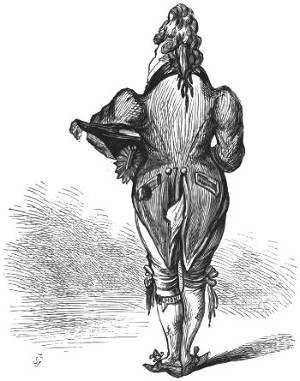
The Prince Regent.
Sir John Waters's Escape.
This distinguished man, in the Peninsular War, was the most admirable spy ever attached to an army. He would assume the character of Spaniards of every degree and station, so as to deceive the most acute. He gave the most reliable and valuable information to Lord Wellington, and on one occasion he was entrusted by his Lordship with a very particular mission, which he undertook effectually to perform, and to return on a particular day with the information required. Just after leaving the camp, however, he was taken prisoner, before he had time to exchange his uniform: a troop of dragoons intercepted him, and carried him off; and the commanding officers desired two soldiers to keep a strict watch over him and carry him to head-quarters. He was, of course, disarmed, and being placed on a horse, was galloped off by his guards. He slept one night in the kitchen of a small inn; conversation flowed on very glibly, and as he appeared a stupid Englishman, who could not understand a word of French or of Spanish, he was allowed to listen, and thus obtained precisely the intelligence he was in search of. The following morning, being again mounted, he overheard a conversation between his guards, who deliberately agreed to rob him, and shoot him at a mill where they were to stop, and to report to their officer that they had been compelled to fire at him in consequence of his attempt to escape.
Shortly before their arrival at the mill, the dragoons took from their prisoner his watch and his purse, lest they might meet with some one who would insist on having a portion of the spoil. On reaching the mill, they dismounted, and to give appearance of truth to their story, they went into the house, leaving their prisoner outside, in the hope that he would make some attempt to escape. In an instant, Waters threw his cloak upon a neighbouring olive-bush, and mounted his cocked hat on the top. Some empty flour sacks lay upon the ground, and a horse laden with well-filled flour-sacks stood at the door. Sir John contrived to enter one of the empty sacks, and throw himself across the horse. When the soldiers came out of the house, they fired their carbines at the supposed prisoner, and galloped off.
A short time after, the miller came out, and mounted his steed. Waters contrived to rid himself of the encumbrance of the sack, and sat up behind the man, who, suddenly turning round, saw a ghost, as he believed, for the flour that still remained in the sack had whitened his fellow-traveller and given him a ghostly appearance. A push sent the frightened miller to the ground, when away rode Waters with his sacks of flour, which at length bursting, made a ludicrous spectacle of man and horse.
On reaching the English camp, where Lord Wellington was anxiously deploring his fate, a sudden shout from the soldiers made his lordship turn round, when a figure resembling the statue in Don Juan, galloped up to him. Wellington, affectionately shaking him by the hand, said, "Waters, you never yet deceived me; and though you have come in a most questionable shape, I must congratulate you and myself." This is one of the many capital stories in Captain Gronow's First Series of Anecdotes.
Colonel Mackinnon's Practical Joking.
Colonel Mackinnon, commonly called "Dan," was famous for practical jokes. Before landing at St. Andero's, with some other officers who had been on leave in England, he agreed to personate the Duke of York, and make the Spaniards believe that his Royal Highness was amongst them. On nearing the shore, a Royal standard was hoisted at the masthead, and Mackinnon disembarked, wearing the star of his shako on his left breast, and accompanied by his friends, who agreed to play the part of aides-de-camp to royalty. The Spanish authorities were soon informed of the arrival of the Royal Commander-in-Chief of the British army; so they received Mackinnon with the usual pomp and circumstance. The Mayor of the place, in honour of the arrival, gave a grand banquet, which terminated with the appearance of a huge bowl of punch, whereupon Dan, thinking that the joke had gone far enough, suddenly dived his head into the china bowl, and threw his heels into the air. The surprise and indignation of the solemn Spaniards was such that they made a most intemperate report of the hoax that had been played on them to Lord Wellington. Dan, however, was ultimately forgiven, after a severe reprimand.
Another of his freaks was the following:—Lord Wellington was curious about visiting a convent near Lisbon, and the Abbess made no difficulty. Mackinnon, hearing this, contrived to get clandestinely within the walls, and it was generally supposed it was neither his first nor his second visit. When Lord Wellington arrived, Dan Mackinnon was to be seen among the nuns, draped in their sacred costume, with his head and whiskers shaved, and as he possessed good features, he was declared to be one of the best-looking among those chaste dames. This adventure is supposed to have been known to Lord Byron, and to have suggested a similar episode in Don Juan, the scene being laid in the East.—Captain Gronow.
A Gourmand Physician.
Dr. George Fordyce, the anatomist and chemical lecturer, was accustomed to dine every day, for more than twenty years, at Dolly's chop-house, in Queen's Head Passage, Paternoster Row. His researches in comparative anatomy had led him to conclude that man, through custom, eats oftener than nature requires, one meal a day being sufficient for that noble animal, the lion. He made the experiment on himself at his favourite dining-house, and, finding it successful, he continued the following regimen for the above term of years.
At four o'clock, his accustomed dinner hour, he entered Dolly's chop-house, and took his seat at a table always reserved for him, on which were instantly placed a silver tankard full of strong ale, a bottle of port-wine, and a measure containing a quarter of a pint of brandy. The moment the waiter announced him, the cook put a pound-and-a-half of rump-steak on the gridiron; and on the table some delicate trifle, as a bonne bouche, to serve until the steak was ready. This delicacy was sometimes half a broiled chicken, sometimes a plate of fish; when he had eaten this, he took a glass of his brandy, and then proceeded to devour his steak. We say devour, because he always ate as rapidly as if eating for a wager. When he had finished his meat, he took the remainder of his brandy, having, during his dinner, drunk the tankard of ale, and afterwards the bottle of port.
The Doctor then adjourned to the Chapter Coffee-house, in Paternoster Row, and stayed while he sipped a glass of brandy and water. It was then his habit to take another at the London Coffee-house, and a third at the Oxford, after which he returned to his house in Essex Street, to give his lecture on chemistry. He made no other meal till his return next day, at four o'clock, to Dolly's.
Dr. Fordyce's intemperate habits sometimes placed his reputation, as well as the lives of his patients, in jeopardy. One evening he was called away from a drinking-bout, to see a lady of title, who was supposed to have been taken suddenly ill. Arrived at the apartment of his patient, the Doctor seated himself by her side, and having listened to the recital of a train of symptoms, which appeared rather anomalous, he next proceeded to examine the state of her pulse. He tried to reckon the number of its beats; the more he endeavoured to do this, the more his brain whirled, and the less was his self-control. Conscious of the cause of his difficulty and in a moment of irritation, he inadvertently blurted out, "Drunk, by Jove!" The lady heard the remark, but remained silent; and the Doctor having prescribed a mild remedy, one which he invariably took on such occasions, he shortly afterwards departed.
At an early hour next morning he was roused by a somewhat imperative message from his patient of the previous evening, to attend her immediately; and he at once concluded that the object of this summons was either to inveigh against him for the state in which he had visited her on the former occasion, or perhaps for having administered too potent a medicine. Ill at ease from these reflections, he entered the lady's room, fully prepared for a severe reprimand. The patient, however, began by thanking him for his immediate attention, and then proceeded to say how much she had been struck by his discernment on the previous evening; confessed that she was occasionally addicted to the error which he had detected; and concluded by saying that her object in sending for him so early was to obtain a promise that he would hold inviolably secret the condition in which he found her. "You may depend upon me, madam," replied Dr. Fordyce, with a countenance which had not altered since the commencement of the patient's story; "I shall be silent as the grave."
This story has also been told of Abernethy; but to Dr. Fordyce belongs the paternity.
Dick England, the Gambler.
Towards the close of the last century among the most noted gamblers and blacklegs in the metropolis was Dick England, one of whose haunts was the Golden Cross, Charing Cross, where he was accustomed to look out for raw Irishmen coming to town by the coaches, whom he almost invariably plucked. His success soon enabled him to keep an elegant house in St. Alban's Street, where he engaged masters to teach him accomplishments to fit him for polite life. In 1779 and 1783, he kept a good table, sported his vis-à-vis, and was remarkably choice in the hackneys he rode, giving eighty or ninety guineas for a horse, a sum nearly equal to two hundred guineas in the present day. Another of his haunts was Munday's Coffee-house in Maiden Lane, where he generally presided at a table d'hôte, and by his finesse and agreeable conversation won him many friends. Being at times the hero of his own story, he unguardedly exposed some of his own characteristic traits, which his self-possession generally enabled him to conceal. His conduct among men of family was, however, generally guarded; and he was resolute in enforcing payment of the sums he won.
One evening he met a young tradesman at a house in Leicester Fields to have an hour's play, for which he gave a banker's draft, but requested to have his revenge in a few more throws, when he soon regained what he had lost and as much in addition. It now being past three in the morning, England proposed that they should retire; but the tradesman, suspecting himself tricked, refused payment of what he had lost. England then tripped up his heels, rolled him in the carpet, took a case-knife from the sideboard, flourished it over the young man, and at last cut off his long hair close to the scalp. Dreading worse treatment, he gave a cheque for the amount and wished England good morning.
England fought a duel at Cranford Bridge in 1784, with Mr. Le Roule, a brewer, from Kingston: from him England had won a large sum, for which a bond had been given, and which, not being paid, led to the duel, in which Le Roule was killed. England fled to Paris and was outlawed; it is reported that early in the Revolution he furnished some useful intelligence to our army in the campaign in Flanders, for which he was remunerated by the British Cabinet. While in France he was several times imprisoned, and once ordered to the guillotine, but pardoned through the exertion and influence of one of the Convention, who also procured for him a passport for home. After an absence of twelve years, he was tried for the duel, found guilty of manslaughter, fined one shilling, and sentenced to one year's imprisonment. Subsequent to his release he passed the remainder of his life at his house in Leicester Square, where he lived to the age of eighty. His end was an awful one: on being called to dinner, he was found lying dead on his sofa.
Brighton Races, Thirty Years Since.
Brighton Races, like most other Brighton amusements, took their rise from the patronage of George IV. Those of Lewes were of earlier origin and greater pretension, until the Prince began to run his horses and lose his money on the Brighton course, which then attracted some of the best horses and some of the most celebrated sportsmen in the kingdom. Of the races at this period the following sketch is given by Mr. Thomas Raikes, in his Diary:—
"1836.—Last week died Lord George Germaine, brother to the Duke of Dorset; they were both in their youth great friends to the late King, when Prince of Wales, fond of the turf, and, with the late Delme Radcliffe, the three best gentlemen riders at the once-famed Bibury Races, which are now replaced by those at Heaton Park. They were all three little men, light weights, and, when dressed in their jackets and caps, would rival Buckle and Chiffney. In those days, the Prince made Brighton and Lewes Races the gayest scene of the year in England. The Pavilion was full of guests; the Steine was crowded with all the rank and fashion from London during that week; the best horses were brought from Newmarket and the North, to run at these races, on which immense sums were depending; and the course was graced by the handsomest equipages. The 'legs' and betters, who had arrived in shoals, used all to assemble on the Steine at an early hour to commence their operations on the first day, and the buzz was tremendous, till Lord Foley and Mellish, the two great confederates of that day, would approach the ring, and then a sudden silence ensued; to await the opening of their betting-books. They would come on perhaps smiling, but mysterious, without making any demonstration; at last, Mr. Jerry Cloves would say, 'Come, Mr. Mellish, will you light the candle, and set us a-going?' Then, if the master of Buckle would say, 'I'll take three to one about Sir Solomon,' the whole pack opened, and the air resounded with every shade of odds and betting. About half-an-hour before the signal of departure for the hill, the Prince himself would make his appearance in the crowd—I think I see him now, in a green jacket, a white hat, and tight nankeen pantaloons, and shoes, distinguished by his high-bred manner and handsome person; he was generally accompanied by the late Duke of Bedford, Lord Jersey, Charles Wyndham, Shelley, Brummel, M. Day, Churchill, and, oh! extraordinary anomaly, the little old Jew Travis, who, like the dwarf of old, followed in the train of royalty. The Downs were covered with every species of conveyance, and the Prince's German wagon (so were barouches called when first introduced at that time) and six bay horses, the coachman on the box being replaced by Sir John Lade, issued out of the gates of the Pavilion, and, gliding up the green ascent, was stationed close to the great stand, where it remained the centre of attraction for the day. At dinner-time the Pavilion was resplendent with lights, and a sumptuous banquet was served to a large party; while those who were not included in that invitation found a dinner with every luxury at the Club-house on the Steine, kept by Ragget during the season, for the different members of White's and Brookes's who chose to frequent it, and where the cards and dice from St. James's Street were not forgotten. Where are the actors in all those gay scenes now?"