ENGLISH ECCENTRICS. (continued 2)
Reading edition
The King and Queen and their suite were wantonly charged with gluttony and drunkenness by persons who ought to have known better. "It is true," observes Lord Byron, in his Voyage to the Sandwich Islands, "that, unaccustomed to our habits, they little regarded regular hours for meals, and that they liked to eat frequently, though not to excess. Their greatest luxury was oysters, of which they were particularly fond; and one day, some of the chiefs having been out to walk, and seeing a grey mullet, instantly seized it and carried it home, to the great delight of the whole party; who, on recognizing the native fish of their own seas, could scarcely believe that it had not swum hither on purpose for them, or been persuaded to wait till it was cooked before they ate it." The best proof of their moderation is, however, that the charge at Osborne's Hotel, in the Adelphi, during their residence there, amounted to no greater an average than seventeen shillings a head per day for their table: as they ate little or no butcher's meat, but lived chiefly on fish, poultry, and fruit, by no means the cheapest articles in London, their gluttony could not have been great. So far from their always preferring the strongest liquors, their favourite beverage was some cider, with which they had been presented by Mr. Canning.
The popular comic song of The King of the Cannibal Islands was written à propos to the above royal visit.
Sir Edward Dering's Luckless Courtship.
Sir Edward Dering, the founder of the Surrenden library, and a distinguished member of Parliament in the troublous times of Charles I., was born in the Tower of London in 1598, his father having been deputy-lieutenant of that fortress. He studied at Magdalen College, Cambridge, and was knighted by James I. in 1618. Sir Edward was thrice married. The story of an unsuccessful courtship, after his second widowhood, is as good as a play, and indeed more amusing than many dramas of the period based upon a similar subject. The object of this enterprise was a city dame, the widow of a well-connected mercer, Richard Bennett by name. The widow Bennett, by the custom of London and the will of her husband, was possessed of two-thirds of the deceased's property, besides all her jewels and chains of pearl and gold, her diamond and other rings, her husband's coach and the four grey coach-mares and geldings, with all things thereunto belonging. In addition to these substantial recommendations, she seems to have had some personal charms of her own, and no other encumbrance than one little boy. In those days it was not necessary to advertise for a husband, and Mistress Bennett could not lack suitors. Three of the most conspicuous were named Finch, Crow, and Raven, much to the amusement of London society in those days. The first was Sir Heneage Finch, Recorder of London, who had been Speaker of the House of Commons in 1626, and owned a handsome house at Kensington, since converted into a Royal Palace. The next was Sir Sackville Crow, who was Treasurer of the Navy, of which office he was subsequently deprived, owing to an unfortunate deficit of which he was unable to give a satisfactory account. The third was one Raven, a physician. This fatuous individual, not having found much success in the way of ordinary courtship, could think of no better expedient to gain his ends than to present himself in the widow's bedchamber after she had retired to rest, when, having woke the lady, he proceeded to press his suit. The widow screamed thieves and murder, the servants rushed in, and the doctor was secured and handed over to the parish constable. On the next day he was brought before Mr. Recorder, who found the proceeding to be "flat burglary," and committed his unlucky rival to gaol. When brought up for trial he pleaded guilty to the "burglary," but under advice of the judge withdrew the plea, and was ultimately found guilty of "ill-demeanour," and was condemned to fine and imprisonment.
It was on the morning after Dr. Raven's mad freak that Sir Edward Dering presented himself as a suitor. How he commenced this important enterprise, and how he sped, we learn from a minute journal which he kept of his proceedings, and which he did not afterwards think it necessary to burn. Here are a few entries. Thus begins the journal:—
Nov. 20. Edmund, King. I adventured, was denied. Sent up a letter, which was returned, after she had read it.
This repulse rendered it necessary to resort to crooked means. Servants are corruptible, and so we find—
Nov. 21. I inveigled G. Newman with 20s.
Nov. 24. I did re-engage him, 20s. I did also oil the cash-keeper, 20s.
Nov. 26. I gave Edmund Aspull [the cash-keeper] another 20s. I was there, but denied sight.
Unpromising this, but Sir Edward does not lose courage.
Nov. 27. I sent a second letter, which was kept.
There is hope, then, but we must not relax. Same day.
I set Sir John Skeffington upon Matthew Cradock.
Matthew Cradock is a cousin of the widow, and her trusty adviser. Same day.
The cash-keeper supped with me.
Nov. 28. I went to Mr. Cradock, but found him cold.
Sir John Skeffington could not have exerted himself much.
Nov. 29. I was at the Old Jewry Church and saw her, both forenoon and afternoon.
Dec. 1. I sent a third letter, which was likewise kept.
The widow had a troublesome affair on her hands. It appears that one Steward, under the abominable system of wardships which then prevailed, had obtained a grant from the crown of the wardship of Mrs. Bennett's little boy, then four years old. The widow was in treaty with Steward to buy from him the wardship of her own child, which the rogue refused to release for 1,500l., offered him in hard cash. Between this affair, and Dr. Raven and other suitors, the widow had enough to think of. Steward had also made matrimonial proposals, which Mrs. Bennett deemed it not prudent to cut short at once, while the bargaining for the wardship was going on. On the 5th December Sir Edward communicates with one Loe, an influential person with the widow. Loe answers, "that Steward was so testy that she durst not give admittance unto any, until he and she were fully concluded for the wardship—that she had a good opinion of me—that he (Loe) heard nobly of me—that he would inform me when Steward was off—that he was engaged for another—that I need not refrain from going to the church where she was, unless I thought it to disparage myself." Acting on this advice, Sir Edward goes to St. Olave's next Sunday, and on coming out of church George Newman whispers in his ear, "Good news! Good news!" After dinner George calls on Sir Edward, who had taken a lodging in the sight of the widow's house, and tells him that she "liked well his carriage, and that if his land were not settled on his eldest son there was good hope." The bearer of such news certainly merits oiling, so, Sir Edward says, "I gave him twenty shillings." That evening Sir Edward supped with his rival, Sir Heneage Finch, who gave him to understand that he himself despaired of his own suit, and was ready to vacate the field, and even promised to assist the worthy knight.
The plot now thickens. Sir Edward, on New Year's Day, in a fit of injured dignity, demanded back those letters that had "been kept;" they were promptly returned; he afterwards repented him of this rash proceeding; Izaak Walton, angler, biographer, and man-milliner, was enlisted in the cause, and laboured strenuously, like an honest man and an angler, therein; and the widow, Sir Edward, and the enthusiastic Izaak, all had wonderful dreams, which came to nothing. On the 9th of January Sir Edward notes, "George Newman says she hath two suits of silver plate, one in the country and the other here, and that she hath beds of 100l. the bed!" Such a prize deserves striving for, and an attack is commenced in a new quarter. George Newman, with Susan, the widow's nursemaid, and her little child, going into Finsbury Fields to walk, are met by Taylor, Sir Edward's landlord. Taylor inveigles the child to come with him; George Newman and Susan follow, not unwillingly. Sir Edward says, "I entertained the child with cake, and gave him an amber box, and to them, wine. Susan professed that she and all the house prayed for me, and told me the child called me 'father.' I gave her 5s., and entreated her to desire her mistress not to be offended at this, which I was so glad of. She said she thought she would not." The widow's cousin Cradock arrives in town. "Izaak Walton," says Sir Edward, "undertook him at his first coming, and did his part well. Cradock said he would do his best, if I would be ruled by him," &c. Other suitors now intervene, and occasion much anxiety. They, too, have their canvassers and agents, and the widow's residence becomes a perfect focus of intrigue. The Dean of Canterbury, Dr. Isaac Bargrave, Sir Edward's relative, is brought to bear, and he procures Dr. Featley, a celebrated city divine, to call on the widow and use his influence. The affair begins to assume public importance. The grave Sir Henry Wotton, coming from Eton to pay his respects to his Majesty, meets Sir Edward in the Privy Chamber, and, with a knowing look, wishes him "a full sail," &c. Alas! all this labour and bribery was destined to come to nothing. The comedy ended by the widow, who all along had kept her own counsel, marrying the smooth-tongued Sir Heneage Finch, who had sat quietly in the background, probably knowing his position to be assured. Sir Edward was more successful in a subsequent matrimonial enterprise. He found an excellent and amiable wife, and must, we should think, have often laughed over his adventures with the widow.[8]
Gretna-Green Marriages.
In the summer of 1753, a young lady at Ranelagh Gardens, Chelsea, became acquainted with a handsome young gentleman. They danced together on another day; they met at the same place, and again danced. He was a handsome young fellow, and the lady was beautiful and wealthy, as well as high-born. She was sister to the two leading statesmen of England—Mr. Pelham, the Prime Minister; and the Duke of Newcastle, who had been Secretary of State. Her lover was a notorious highwayman, Jack Freeland by name, with many other aliases. He, professing to be a gentleman of fortune, proposed marriage, to which she assented. From reasons suggested about family objections on both sides, they agreed to repair to the Fleet prison to be wedded. At the foot of Fleet Street, matrimonial visitors in that day entered the region of touters, who accosted couples with such addresses as "Married, sir?" "Wish to be married, ma'am?" And by rival touters who asserted, "His parson be no good—only a cove what mends shoes; get married with mine: mine is a regular hordained parson." Perhaps a third assertion, that "Them fellows' parsons be no good; get married respectable; show you in no time to a real Oxford and Cambridge professor." Following these persons up narrow passages on Ludgate Hill, the couples were married for such fees as private bargain regulated in dingy up-stairs rooms of taverns: or going into the Fleet Prison, were united there by clerical prisoners who found the place too lucrative and pleasant as a lodging to make them anxious about paying their debts to get out. Those prisoners, like some other of the "Fleet parsons"—indeed it was from the prison that the term "Fleet marriages" arose—had also their touters stationed in the adjoining streets to bring them customers. Miss Pelham and her gallant highwayman were conducted to a Fleet parson. But a gentleman happened to observe them who knew both. To save the lady he caused the robber-bridegroom to be arrested, and carried the tidings to the Prime Minister, her brother. The case led to much discussion. In the heat of offended dignity, the Pelhams caused Lord Chancellor Hardwicke to introduce a Bill for the better regulation and solemnizing of marriage. It passed hastily through both houses of Parliament, and became law. Except in the case of Jews and Quakers, it required all parties to be married by a regularly ordained clergyman of the Church, and only after a due proclamation of banns.
The Marriage Law of Scotland did not exact that there should be a religious ceremony, nor even the presence of a clergyman, though the religious habits of the people prefer both. To be valid, the Scottish law required only that the marriage contract should be witnessed. When the Fleet was shut against lovers in 1754, those impatient of parental control, and possessed of means to defray travelling expenses, repaired to Scotland. Edinburgh for a time supplied their wants: the last, we believe, who carried on a regular traffic in runaway weddings here was Joseph Robertson, who, several years ago, died miserably of hunger in London. But it was on the line of the borders adjoining England that those weddings abounded. At Lamberton Toll, the nearest Scottish ground to Berwick, the business was for many years done at a very low price. After the erection of the suspension-bridge, six miles above Berwick, marriages were performed there. A "Sheen Brig" wedding became a common occurrence both to Northumberland and Berwickshire lovers. At Coldstream, also, those marriages were common. But it was at Gretna-Green, and Sark Toll Bar, and Springfield, nine miles from Carlisle, that the "high-fly" runaways from England tied their nuptial knots in greatest number. All the space between Carlisle and the Border was common land, until of late years, inhabited only by smugglers and persons of unsettled life. The Scottish parish of Gretna, on the north side of the Sark stream, which there divides the countries, had a population of a like character. After the act of 1754 had shut the Fleet parsons out of shop in London, one of them paid his debts in the prison, and advertised his removal to Gretna. Thither he was followed by adventurous couples who failed to obtain the consent of parents and guardians to their union. At his death a native of the place, known as "Scott o' the Brig" (Sark Bridge), took up the business. He was succeeded by one Gordon, an old soldier; and Gordon by the notorious Joseph Paisley. Paisley was succeeded by several rivals, of whom Elliot and Laing were the principals. Mr. Linton, of Gretna Hall, became chief priest after Laing's death, which occurred through cold taken in a journey to Lancaster, in 1826, where he was required as a witness in the prosecution of the Wakefields for the abduction of Miss Turner.
In 1841, the writer visited Gretna and Springfield to inspect the registers, and found them a mass of loose papers. At that time the larger part of the matrimonial trade was done—for couples arriving on foot—by Mrs. Baillie and Miss Baillie, her daughter, who kept Sark Bridge Toll; the post-chaise weddings going to Mr. Linton, of Gretna Hall: his register, unlike the older ones, was a well-written official-looking volume. Peter Elliot, formerly priest, was then an old man. He had in his younger days been a postboy, but was reduced to the office of "strapper" in a stable at Carlisle. Excess of whisky on his part, and the more genteel competition of the occupier of Gretna Hall, had driven him out of the marriage trade. But in his lifetime he had been concerned in many races and chases over the nine miles between Carlisle and Gretna, and would tell of the beautiful daughters of England, whom, with whip and spur and shout, and wild halloo, he had carried at the gallop across the border; the pursuing guardian, or jilted lover, or angry father in sight behind, urging on post-boys who also whipped and spurred and hallooed, but took care never to overtake the fugitives until too late. Then there were tales of how time was too short even for the brief ceremony, and how the officiating priest broke off, exclaiming, "Ben the house, ben and into bed, into bed, my leddy!" They were proud to boast of two Lord Chancellors having been married there, one of whom, Erskine, arrived in the travelling costume of an old lady.
About the year 1794 it was estimated that sixty couples were married annually, they paying an average of 15 guineas each, yielding a revenue of 945l. a year or thereabout. The form of certificate was in latter times printed, the officiating priest not being always sufficiently sober to write; nor when sober was he an adept in penmanship, as the following from the pen of Joseph Paisley may show:—
"This is to sartify all persons that may be concernid that (A. B.) from the parish of (C.) and in county of (D.) and (E. F.) from the parish of (G.) and county of (H.), and both comes before me and declayred themselves both to be single persons, and nowe mayried by the forme of the Kirk of Scotland and agreeible to the Church of England, and givne ondre my hand this 18th day of March, 1793."
Joseph Paisley, writer of this, was originally a weaver, at some other time a tobacconist. He was the so-called "Blacksmith," though there is no record that he, his predecessors, or successors were real blacksmiths. He removed from Gretna to the village of Springfield, half a mile distant, in 1791, and attended to his lucrative employment till his death in 1814. He was tall in person, and in prime of life well-proportioned; but before he died had grown enormously corpulent, weighing upwards of 25 stone. By his natural enemies—the parish clergymen—he was said to be grossly ignorant and coarse in his manners, drinking a Scotch pint of whisky in various shapes of toddy and raw drams in a day. On one occasion he and a companion, named Ned the Turner, sat down on a Monday morning to an anker of strong cognac, and before the evening of Saturday they kicked the empty cask out at the door! He was also celebrated for his stentorian lungs and almost incredible muscular strength. He could with one hand bend a strong poker over his arm, and was frequently known to straighten an ordinary horse-shoe with his hands. But he could not break asunder the bands of matrimony which he so easily rivetted. Law stamped his handiwork with the title of sanctity. The Gretna and Sark Toll marriages greatly increased in number through the facilities of railway conveyance. The fugitives, when obtaining a start by an express train, could not be overtaken by another, while the ordinary third-class carried away so many customers for cheap marriages from their English parish clergy, that the Legislature was invoked, and enacted that on and after the 1st January, 1857, no marriage should be valid in Scotland unless the parties had both resided in Scotland for the last six weeks next preceding the wedding-day. In the evidence upon this Bill, one of the marriers, Murray, of Gretna, admitted that he had married between 700 and 800 couples in a year; and as there were two or three other of these marriers in good practice, the number of couples married at Sark Toll Bar and at Gretna may be safely estimated at upwards of 1,000 in a year.
The alteration in the law was effected through the happy effort of a magistrate of Cumberland, immediately and ably supported by the magistrates of the county, who signed a petition committed to the charge of Lord Brougham. His Lordship forthwith introduced a Bill, after Easter, 1856, which Bill passed through Parliament without opposition.[9]
The Agapemone, or Abode of Love.
This strange place, Agapemone (Gr. αγαπη love, and μονη an abode), was the general residence of a peculiar sect of religionists, established in 1845 at Charlinch, near Taunton, in Somersetshire. They were originally a branch of the sect called Lampeters, and their peculiar tenets are, that the day of grace and prayer is passed, and the time of judgment arrived. They carry out their belief by perpetual praises to God, but do not adopt the use of prayer. The members enter into a community of property, and profess to live in a state of constant joyousness and mutual love. In 1849 a singular trial, connected with this institution, occupied the Court of Exchequer for three days. It was an action brought by Miss Louisa Nottidge, a maiden lady of large property, against her brother and brother-in-law, for forcibly abducting her from the Agapemone, and confining her in a lunatic asylum. It appeared that the plaintiff and her three sisters, all ladies of considerable property, had become converts to the opinions of this sect, and taken up their abode in the Agapemone, where the sisters were married to three of the clerical rulers of the establishment; but Miss Louisa Nottidge, who had remained single, was forcibly taken away by the two defendants, and sent to a lunatic asylum; for which alleged wrong she obtained 50l. damages; thus showing that she was not insane, and that the law, as the Chief Baron observed, tolerated every sect, however absurd, that did not inflict a social wrong, or openly violate the laws of morality.
Since that period the sect has been sending its missionaries to different parts of the country, in order to gain converts. On the 26th of September, 1856, two of these missionaries called a meeting at the Hanover Square Rooms, in London, when one of them addressed the assembled visitors in an unintelligible jargon relative to the mission of a certain "Brother Prince," the head of the Agapemone, who had, he said, been made a "vessel of mercy" for the human race, and who was to supersede the Gospel by some new religious dispensation which he had been specially commissioned to teach. The other missionary then stated that he would explain who Brother Prince was. He was by nature, he said, a child of wrath, but by grace a vessel of mercy. The testimony of Brother Prince was concerning what Jesus Christ had done by his own person. Some eleven years ago, he said, the Holy Ghost fulfilled in Brother Prince all that he came to be and to do. The speaker proceeded to allude to a second spiritual manifestation which, he said, occurred at the Agapemone about five years ago, in which case the phenomenon was exhibited in the person of a woman—a prophetess—"not privately, but in the presence of all." These sentiments were uttered in the midst of general execration; and a resolution was unanimously passed, "That the statements which had been made that evening were contrary to common sense, degrading to humanity, and blasphemous towards God."—English Cyclopædia.
Singular Scotch Ladies.
Lord Cockburn, in his Memorials of his Time, speaks of "a singular race of Scotch old ladies," who were a delightful set; warm-hearted, very resolute, indifferent about the modes and habits of the modern world, and adhering to their own ways, who dressed, spoke, and did exactly as they chose. Among these examples of perfect naturalness was a Miss Menie Trotter, of whom Miss Grahame, in her Mystifications, relates:—"She was penurious in small things, but her generosity could rise to circumstances. Her dower was an annuity from the estate of Mortonhall. She had contempt for securities, and would trust no bank with her money, but kept all her bills and bank-notes in a green silk bag that hung on her toilette-glass. On each side of the table stood a large white bowl, one of which contained her silver, the other her copper money, the latter always full to the brim, accessible to Peggy, her handmaid, or any other servant in the house, for the idea of any one stealing money never entered her brain. Indeed, she once sent a present to her niece, Mrs. Cuninghame, of a fifty-pound note wrapped up in a cabbage-leaf, and entrusted it to the care of a woman who was going with a basket of butter to the Edinburgh market. My friend Mrs. Cuninghame related to me this and the following histories of her aunt:—One day, in the course of conversation, she said to her niece, 'Do you ken, Margaret, that Mrs. Thomas R—— is dead. I was gaun by the door this morning, and thought I wad just look in and speer for her. She was very near her end, but quite sensible, and expressed her gratitude to God for what He had done for her and her fatherless bairns. She said "she was leaving a large young family with very small means, but she had that trust in Him that they would not be forsaken, and that He would provide for them." Now, Margaret, ye'll tell Peggy to bring down the green silk bag that hangs on the corner of my looking-glass, and ye'll tak' twa thousand pounds out o' it, and gi'e it Walter Ferrier for behoof of thae orphan bairns; it will fit out the laddies, and be something to the lassies. I want to make good the words, "that God wad provide for them," for what else was I sent that way this morning, but as a humble instrument in his hands?'"
Miss Trotter had a strong friendship for a certain Mrs. B——, who had an only son, and he was looked on as a simpleton, but his relatives had interest to get him a situation as clerk in a bank, where he contrived to steal money to the extent of five hundred pounds. His peculations were discovered, and in those days he would have been hanged, but Miss Trotter hearing the report started instantly for Edinburgh, went to the bank, and ascertained the truth. She at once laid down five hundred pounds, telling them, "Ye maun not only stop proceedings, but ye maun keep him in the bank in some capacity, however mean, till I find some other employment for him." Then she fitted the lad out, and sent him to London, where she had a friend to whom she wrote, offering another five hundred pounds to any one who would procure him a situation abroad, in which he might gain an honest living, and never be trusted with money. After all this was settled, she went herself and communicated the facts to his mother.
Mrs. Bond, of Hackney.
About the year 1771 there died one of the four children of Bond, a jeweller, residing in an alley leading from Wellclose Square to Ratcliffe Highway. She left property, to be divided between Mrs. S. Bond, of Hackney, and a sister. The latter died in the year 1801, and left her property, amounting to about 6,000l., to her surviving sister, Sarah, who bought an annuity of 700l. By living in a most parsimonious manner she contrived to scrape together about 13,000l. three per cent., 1,000l. four percent., and 150l. per year Long Annuities.
In 1821 Mrs. Bond, who was of most eccentric habits, died at her residence, Cambridge Heath, Hackney, leaving, it was said, great wealth, which was to be paid to King George the Fourth, if no relative could be found to claim it. After her death, vestry and parish clerks, beadles, sextons, country schoolmasters, and persons holding any official situations about cathedral churches, &c.—in short, innumerable persons who had leisure or opportunity for such inquiry, set about searching for Mrs. Bond's pedigree; but all to no effect. Some ludicrous incidents, however, occurred in the neighbourhood of Mrs. Bond's residence, where persons arrived from various parts of the country to claim a relationship. Among the number a man and his son arrived from Sunderland, whence they had walked. He stated that his name was Bond; he was sure the deceased was his sister, and he would not quit London without the money. Upon investigation he could produce no other authority than being of the same name, and was, therefore, compelled to retrace his steps, almost penniless.
About a week afterwards, a decently-dressed elderly woman, named Bond, made her appearance. She had just arrived outside the coach from the environs of Carmarthen. Her story was that about fifty years previously (1771), her sister left her and proceeded to London to seek her fortune. They had never corresponded, but from the name and description of the deceased, she had no doubt she was her sister, and the money accordingly belonged to her. It had cost her nearly all the money she could raise to come from Wales, fully satisfied of being amply repaid for her trouble, but she met with the same fate as the preceding applicant.
The next claimant was a sailor, who had just returned from the West Indies, where he had been moored, he said, thirty-five years. He had left in England two sisters named Bond: one was of very eccentric manners, particularly for her love of money; the sailor declared that he had frequently seen her make a meal off cat's meat. The above he considered sufficient proof of his relationship. He insisted upon entering a caveat against the claim of his Majesty, but acknowledging that the King appeared to be the legal claimant, he swore he would go and see his royal master, and ask him if he had any objection to share the money with him!
It would be tedious to enumerate the persons who put in their claims from various parts of the world; but the King's proctor stood first in the Prerogative Court, and nothing had transpired to affect his right in behalf of his Majesty.
The hut on Cambridge Heath wherein Mrs. Bond died was closed for some time; at length it was announced to be let; but such was the anxiety to get possession of it that the notice was removed. The number of applications were, doubtless, made under the impression that hoards of money were yet undiscovered in the hut.
The claimant most likely entitled to the property was a Mr. Bond, a butcher, in Shoreditch, who traced out that he was second cousin to the wealthy spinster, his grandfather having been the only brother of the father of Mrs. Bond; and the only bar to his administering was that he had not been able to ascertain the church where Mrs. Bond's father and mother were married, a most essential point to prove the legitimacy of Mrs. Sarah Bond. There were no fewer than eight caveats against the administrator.
John Ward, the Hackney Miser.
In Church Street, Hackney, one of the most interesting of our suburban parishes for its antiquarian history, stands a mansion, which, though plain in itself, has long been traditionally conspicuous, from the infamous character of its founder. This was John Ward, a man who was so notorious for his readiness to take advantage of the foibles, the wants, and vices of his fellow-men, that it attracted the satirical acrimony of Pope, who, in his epistle to Allen, Lord Bathurst, On the Use of Riches, has placed him in a niche in the Temple of Obloquy, in company with a trio, who seem fit to descend with him to posterity, or rather to accompany him in the descent alluded to in the following lines:—
Like doctors thus, when much dispute has pass'd, We find our tenets just the same at last; Both fairly owning riches, in effect, No grace of Heaven or token of the elect: Given to the fool, the mad, the vain, the evil, To Ward, to Waters, Chartres, and the Devil.
Of Ward's private history little is known. He is said to have been early in life employed in a floorcloth manufactory. The exact period when he built the house at Hackney is uncertain. He resided in it in the year 1727, at which time he sat in Parliament for Melcombe Regis. But having made a mistake with respect to a name in a deed in which the interest of the Duchess of Buckingham was implicated, he was prosecuted by her and convicted of forgery, was first expelled the House of Commons, and then stood in the pillory, on the 17th of March, 1727. As misfortune seldom comes alone, about this time Ward was suspected of joining in a conveyance with Sir John Blunt to secrete 50,000l. of that director's estate forfeited to the South Sea Company by Act of Parliament. The Company recovered the 50,000l. against Ward, and by execution swept away the whole of the furniture and other effects in the mansion at Hackney. These being insufficient to cover even the costs, Ward sought to protect his other property, set up prior conveyances of his real estate to his brother and son, and concealing all his personal, which was computed to be 150,000l. Against these paper fortifications, a bill in Chancery, ten times as voluminous, and twenty times more zig-zag, was erected; a countermine of immense depth was sprung, and however ably his works were defended, they were at length carried. The conveyances were set aside, Ward was imprisoned, and hazarded the forfeiture of his life by not giving in his effects till the last day, which was that of his examination. During his confinement his amusement was to give poison to dogs and cats, and see them expire by slower or quicker torments!
In the Post-boy newspaper of the period we find these records of Ward's career:—In June, 1719, he recovered 300l. damages from one Thomas Dyche, a schoolmaster of Bow, for printing and publishing a libel upon Ward, reflecting upon the discharge of his trust about repairing Dagenham Breach. In May, 1726, he fled to France or Flanders. In June, 1731, he was indicted, with certain others, for wounding several officers of the Commissioners of Bankruptcy; and in September, 1732, he surrendered to the Commissioners, and was kept under examination at Guildhall from three o'clock that afternoon till three the next morning, when he was committed to the Fleet for further examination.
To sum up the wealth of Ward at the several eras of his life: at his standing in the pillory he was worth above 200,000l.; at his commitment to prison he was worth 150,000l., but became so far diminished in his reputation as to be thought a worse man by fifty or sixty thousand.
Among a variety of curious papers of Mr. Ward was found the following extraordinary document, in his own handwriting, which may very appropriately be called The Miser's Prayer:—
"O Lord, Thou knowest that I have nine estates in the City of London, and likewise that I have lately purchased one estate in fee simple in the county of Essex; I beseech Thee to preserve the two counties of Middlesex and Essex from fire and earthquakes; and as I have a mortgage in Hertfordshire, I beg of Thee likewise to have an eye of compassion on that county; and for the rest of the counties Thou mayst deal with them as Thou art pleased. O Lord, enable the Bank to answer their bills, and make all my debtors good men. Give a prosperous voyage and return to the 'Mermaid' sloop, because I have insured it; and as Thou hast said the days of the wicked are but short, I trust in Thee that Thou wilt not forget Thy promise, as I have purchased an estate in reversion, which will be mine on the death of that profligate young man, Sir J. L. Keep my friends from sinking, and preserve me from thieves and housebreakers, and make all my servants so honest and faithful that they may attend to my interests, and never cheat me out of my property, night or day."
"Poor Man of Mutton."
This is a term applied to the remains of a shoulder of mutton, which, after it has done its regular duty as a roast at dinner, makes its appearance as a broiled bone at supper or upon the next day.
The late Earl of B., popularly known by the name of Old Rag, being indisposed at an hotel in London, the landlord came to enumerate the good things he had in his larder, hoping to prevail on his guest to eat something. The Earl, at length, starting suddenly from his couch, and throwing back a tartan nightgown, which had covered his singularly grim and ghastly face, replied to his host's courtesy:—"Landlord, I think I could eat a morsel of a poor man." Boniface, surprised alike at the extreme ugliness of Lord B.'s countenance and the nature of the proposal, retreated from the room, and tumbled down-stairs precipitately, having no doubt that this barbaric chief when at home was in the habit of eating a joint of a tenant or vassal when his appetite was dainty.—Jamieson's Etymological Dictionary.
Lord Kenyon's Parsimony.
Lord Kenyon studied economy even in the hatchment put up over his house in Lincoln's Inn Fields after his death. The motto was certainly found to be "Mors janua vita"—this being at first supposed to be the mistake of the painter. But when it was mentioned to Lord Ellenborough, "Mistake!" exclaimed his lordship, "it is no mistake. The considerate testator left particular directions in his will that the estate should not be burdened with the expense of a diphthong!" Accordingly, he had the glory of dying very rich. After the loss of his eldest son, he said with great emotion to Mr. Justice Allan Park, who repeated the words soon after to the narrator:—"How delighted George would be to take his poor brother from the earth, and restore him to life, although he receives 250,000l. by his decease!"
Lord Kenyon occupied a large, gloomy house in Lincoln's Inn Fields: there is this traditional description of the mansion in his time—"All the year through it is Lent in the kitchen and Passion-week in the parlour." Some one having mentioned that, although the fire was very dull in the kitchen-grate, the spits were always bright,—"It is quite irrelevant," said Jekyll, "to talk about the spits, for nothing 'turns' upon them." * * He was curiously economical about the adornment of his head. It was observed for a number of years before he died, that he had two hats and two wigs—of the hats and the wigs one was dreadfully old and shabby, the other comparatively spruce. He always carried into court with him the very old hat and the comparatively spruce wig, or the very old wig and the comparatively spruce hat. On the days of the very old hat and the comparatively spruce wig, he shoved his hat under the bench and displayed his wig; but on the days of the very old wig and the comparatively spruce hat, he always continued covered. He might often be seen sitting with his hat over his wig, but the Rule of Court by which he was governed on this point is doubtful.
Mary Moser, the Flower-Painter.
Mary Moser was the only daughter of George Michael Moser, R.A., goldchaser and enameller, and the first Keeper of the Royal Academy of Arts in London. His daughter was a very distinguished flower-painter, and was the only lady besides Angelica Kauffman who was ever elected an Academician: she became afterwards Mrs. Lloyd. Miss Moser, says Smith, in his Life of Nollekens, was somewhat precise, but was at times a most cheerful companion: he has printed three of her letters, two to Mrs. Lloyd, the wife of the gentleman to whom she herself was afterwards married; and the other to Fuseli, while in Rome, of whom she was said to have been an admirer. In one to the former, alluding to the absurd fashions of the beginning of the reign of George the Third, she says:—"Come to London and admire our plumes; we sweep the skies! a duchess wears six feathers, a lady four, and every milkmaid one at each corner of her cap. Fashion is grown a monster: pray tell your operator that your hair must measure three-quarters of a yard from the extremity of one wing to the other." The second letter is chiefly on Lord Chesterfield's Advice to his Son: she says to her friend, "If you have read Lord Chesterfield's Letters, give me your opinion of them, and what you think of his Lordship: for my part, I admire wit and adore good manners, but at the same time I should detest Lord Chesterfield, were he alive, young, and handsome, and my lover, if I supposed, as I do now, his wit was the result of thought, and that he had been practising the graces in the looking-glass." In her letter to Fuseli, she gives this account of the Exhibition of the Royal Academy in the year 1770:—"Reynolds was like himself in pictures which you have seen; Gainsborough beyond himself in a portrait of a gentleman in a Vandyck habit; and Zoffany superior to everybody in a portrait of Garrick in the character of Abel Drugger, with two figures, Subtle and Face. Sir Joshua agreed to give a hundred guineas for the picture; Lord Carlisle had an hour after offered Reynolds twenty to part with it, which the Knight generously refused, resigned his intended purchase to the Lord, and the emolument to his brother artist. He is a gentleman! Angelica made a very great addition to the show, and Mr. Hamilton's picture of Briseis parting from Achilles was very much admired; the Briseis in taste, à l'antique, elegant and simple. Cotes, Dance, Wilson, &c., as usual."
Mary Moser decorated an entire room with flowers at Frogmore for Queen Charlotte, for which she received 900l.; the room was called Miss Moser's room. After her marriage, she practised only as an amateur; she died at an advanced age in 1819. When West was re-instated in the chair of the Royal Academy, in 1803, there was one voice for Mrs. Lloyd, and when Fuseli was taxed with having given it, he said, according to Knowles, his biographer, "Well, suppose I did; she is eligible to the office; and is not one old woman as good as another?" West and Fuseli were ill-according spirits.
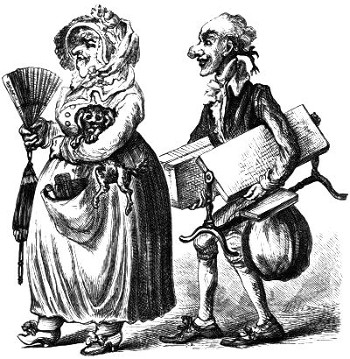
An Old Maid on a Journey. The Eccentric Miss Banks.
The Eccentric Miss Banks.
Oddities of dress were half-a-century ago much oftener to be seen than in the present day; or, rather, their singularities were more grotesque than the peculiarities of the present day. John Thomas Smith, writing in 1818, says—"It is scarcely possible for any person possessing the smallest share of common observation to pass through the streets in London without noticing what is generally denominated a character, either in dress, walk, pursuits, or propensities." At the head of his remarks on the eccentricity of some of their dresses he places Miss Sophia Banks, Sarah, the sister of Sir Joseph, who was looked after by the eye of astonishment wherever she went, and in whatever situation she appeared. Her dress was that of the Old School; her Barcelona quilted petticoat had a hole on either side for the convenience of rummaging two immense pockets, stuffed with books of all sizes. This petticoat was covered with a deep stomachered gown, sometimes obscuring the pocket-holes, similar to many of the ladies of Bunbury's time, which he has introduced into his prints. In this dress she might frequently be seen walking, followed by a six-foot servant with a cane almost as tall as himself. Miss Banks, for so that lady was called for many years, was frequently heard to relate the following curious anecdote of herself: after making repeated inquiries of the wall-vendors of halfpenny ballads for a particular one which she wanted, she was informed by the claret-faced woman who strung up her stock by Middlesex Hospital gates, that if she went to a printer's in Long Lane, Smithfield, probably he might supply her ladyship with what her ladyship wanted. Away trudged Miss Banks through Smithfield: but before she entered Mr. Thompson's shop, she desired her man to wait for her at the corner, by the plum-pudding stall. "Yes, we have it," was the printer's answer to her interrogative. He then gave Miss Banks what is called a book, consisting of many songs. Upon her expressing her surprise when the man returned her eightpence from her shilling, and the great quantity of songs he had given her, when she only wanted one—"What, then!" observed the man, "are you not one of our characters? I beg your pardon."
This lady and Lady Banks, out of compliment to Sir Joseph, who had been deeply engaged in the production of wool, had their riding-habits made of his produce, in which dresses the two ladies at one period on all occasions appeared. Indeed, so delighted was Miss Banks with this overall covering, that she actually gave the habit-maker orders for three at a time, and they were called Hightum, Tightum, and Scrub. The first was her best, the second her second-best, and the third her every-day one.
Once when Miss Banks and her sister-in-law visited a friend with whom they were to stay several days, on the evening of their arrival they sat down to dinner in their riding-habits. Their friend had a large party after dinner to meet them, and they entered the drawing-room in their riding-habits. On the following morning they again appeared in their riding-habits; and so on, to the astonishment of every one, till the conclusion of their visit.
Although Miss Banks paid great attention to many persons, there were others to whom she was wanting in civility. A great genius, who had arrived a quarter-of-an-hour before the time specified on the card for dinner, was shown into the drawing-room, where Miss Banks was putting away what are sometimes called rattletraps. When the visitor observed, "It is a fine day, ma'am," she replied, "I know nothing at all about it. You must speak to my brother upon that subject when you are at dinner." Notwithstanding the very singular appearance of Miss Banks, she was, when in the prime of life, a fashionable whip, and drove four-in-hand. Miss Banks died in 1818.
Thomas Cooke, the Miser of Pentonville.
At No. 16, Winchester Place, now No. 64, Pentonville Road, lived, for a period of fifteen years, Thomas Cooke, a notorious miser, who heaped up wealth by the most ungenerous means and servility of behaviour:
Gold banished honour from his mind, And only left the name behind.
He was born about 1725 or 1726, at Clewer, near Windsor, and was the son of an itinerant fiddler. He was left to the care of a grandmother, who resided at Swannington, near Norwich. He obtained employment in a factory, where the leading trait of his character manifested itself. His companions in labour clubbed a portion of their week's earnings to form a mess. This Cooke declined, and determined to live more cheaply; and when others went to dine, he went to the side of a neighbouring brook, and made breakfast and dinner one meal, which consisted of a halfpenny loaf, an apple, and a draught of water from the brook, taken up on the brim of his cap. His economy so far seems to have been judicious, as it enabled him to pay a boy who was an usher in the village school to instruct him in the rudiments of education.
When he arrived at manhood, he obtained employment as porter to a drysalter and paper-maker at Norwich; he was next made a journeyman, with increased wages. He then, through his master, got an appointment in the Excise, in a district near London; and his master also gave him a letter of introduction to a sugar-baker in the metropolis. After a tedious journey by waggon, he reached London, with only eight shillings in his pocket. There was some delay and expense before he could act as an exciseman, and his immediate necessities compelled him to take the situation of porter to the sugar-baker. He then became a journeyman, and by his parsimonious habits saved money enough to pay the preliminary expenses, and was enabled to assume the office to which he had so long aspired.
He was then appointed to inspect a paper-mill at Tottenham, where he closely watched a new process in paper-making. During Cooke's official visits to this mill the owner died, and his widow resolved to carry on the business with the aid of a foreman. Cooke had noted here many infractions of the law, which, designedly or otherwise, were daily taking place; and having summed up the penalties incurred thereby, which he set off against the value of the concern, he privately informed the widow that he had complained of these malpractices, and told her that if the fines were levied, they would amount to double the value of the property she possessed, and reduce her to want and imprisonment. This he followed up by an overture of marriage, and assured the lady that he only knew of the frauds of her establishment. The widow consented to become his wife when the appointed days of mourning for her first husband had expired. To this Cooke agreed, but lest she might prove fickle, he required of her a promise in writing. On his marriage, Cooke became possessed of her property, which was considerable, together with the lease of the mills at Tottenham.
He next purchased a large sugar-baker's business in Puddle Dock. His parsimony now became extreme: he kept no table, but obtained the greater part of his daily food by well-timed visits to persons of his acquaintance. He had good conversational powers, and these he usually turned to his profit. Sometimes, when walking the streets, he fell down in a pretended fit, opposite to the house of one whose bounty he sought. No humane person could well refuse admission to a man in apparent distress and of respectable appearance, whose well-powdered wig and long ruffles induced a belief that he was some decayed citizen who had seen better days. For the assistance thus kindly given he would express his gratitude in the most energetic manner. He would ask for a glass of water, but if wine was offered, he said, "No, he never drank anything but water;" but when pressed by his kind host, would take it, and exclaim, "God bless my soul, sir, this is very excellent wine! Pray, sir, who is your wine merchant? for indeed, to tell you the truth, it was the difficulty of getting good wine that caused me to leave it off entirely." Upon invitation, he would take another glass, and thanking his host, depart. A few days after, he would call at the house of his kind entertainer just at dinner-time, professedly to thank him for having saved his life, and on being invited to dine would at first demur, urging that "My gruel is waiting for me at home." On sitting down to dinner he would take notice of the children; and after great pretended kindness, would say to the mother, "God bless them, pretty dears. Pray, madam, will you have the goodness to give me all their names in writing?" Thus artfully did he contrive to make his kind entertainers think that he designed to do some good thing for their children; and they now sought the continuance of his friendship by occasional presents of game or a dozen or two of the wine he had so much approved.
Many persons were in this way made the victims of Cooke's sophistries. By these gifts, his housekeeping expenses were reduced to fifteen-pence a day, and it was sinful extravagance if they reached two shillings. Such comestibles as he could not consume, he disposed of to the dealers and others. He drank only water, but as for the "gormandizing, gluttonous maids, they could not drink, not they, what he did; nothing would serve them but table-beer." This he kept in his front parlour, with a lock-tap to it, of which he held the key, and at meal-times he drew exactly half-a-pint for each woman.
With all his rigid economy, Cook found, to his great grief, that by his sugar-bakery he had lost 500l. in twelve months. To amend this state of affairs, and to discover some of the secrets of the trade, he invited several sugar-bakers to dine with him, and plying them well with wine, wheedled out of the persons in business the coveted information. His wife was alarmed at this seeming extravagance, but he silenced her scruples by telling her he would "suck as much of the brains" of some of the fools as would amply repay them.
Having retired from business, he resided for a time at the Angel Inn, Islington, from whence he removed to Winchester Place. The plot of garden-ground in the rear he sowed with cabbage-seed, and with his own hands manured it. To obtain the manure, he would, on moonlight nights, go out with a shovel and basket and take up the horse-dung which lay in the City Road. This scheming obtained for him the name of "Cabbage Cooke."
The only luxury he allowed his wife was a small quantity of table-beer; and by his general mal-treatment he caused her so much grief that she died of a broken heart. Soon after his wife's death, he paid his addresses to several rich widows, but none would listen to his suit, especially as he desired all their property should be made over to him.
Cooke was fond of horse-racing, and contrived to be present at Epsom races at the expense of some of his acquaintances. He once had a horse; but finding it too expensive to keep at livery, for this purpose he converted the kitchen of his house into a stable, and he used to curry and fodder the horse with his own hands.
During his fifteen years' residence in Winchester Place, he never once painted the house inside or outside, nor would he allow the landlord to paint it. He was then served with legal notice to quit; this he disregarded. At last he so implored the landlord not to turn him into the street, that he consented to allow him time to provide himself with a house, and this in presence of an associate whom he brought purposely in the room. The landlord then had him served with an ejectment; but upon the case being brought to trial, Cooke brought forward in evidence the witness to the promise of the landlord, who was accordingly nonsuited. The landlord, however, brought another action, in which he succeeded; and Cooke removed to No. 85, White Lion Street, Pentonville.
Sickness and old age now compelled Cooke to seek medical advice, when he obtained, by some artifice, a patient's dispensary letter; but his cheat was discovered. Cooke's principle was, "No cure, no pay;" and when a physician, to whom he had been very troublesome, told him he could do nothing more for him, he said, "Then give me back my money, sir. Why did you rob me of my money, unless you meant to cure me?" Yet Cooke was a professing Christian, and a regular attendant at the ordinances of religion, and he seldom failed to receive the sacrament. He died August 26th, 1811, at the age of eighty-six, and was buried on the 30th at St. Mary's, Islington. Some of the mob threw cabbage-stalks on his coffin as it was lowered into the grave.
The wealth that Cooke had amassed during his long life-time, by meanness, artifice, and pretended poverty, amounted to the large sum of 127,205l. in the Three per cent. Consols. During his lifetime his charities were but few. But, as if to atone for a life of avarice, he left by will the bulk of his riches to several charitable societies, and a few trifling legacies to individuals.
Thomas Cooke, the Turkey Merchant.
This eccentric gentleman was resident at Constantinople as a merchant at the time Charles XII. of Sweden was in Turkey, in 1714, and contributed in a very munificent manner to the relief of the royal prisoner. Mr. Cooke well knew the Divan wished to get rid of the king, their prisoner, who always pleaded poverty and inability to pay his debts; and they having lent him money, were afraid to lend him any more. He, however, devised a scheme to assist him, and applied to the Lord High Treasurer, who heard the proposal with great satisfaction, but was surprised to be told, "Your excellency must find the money." To this he answered, by a very natural question, "How will you ever pay us?" Mr. Cooke replied, they were building a mosque, and would stand in need of lead to cover it, which he would engage to supply. Next morning the proposal was accepted, and the arrangements concluded.
Mr. Cooke then treated with the King of Sweden, and offered him a certain sum of money upon condition of being repaid in copper, the exportation of which from Sweden had been for some time prohibited, at a stipulated price. The offer was accepted, and the money paid to the king by the hands of La Mortraye, the well-known author of several volumes of Travels; and Mr. Cooke received an order upon the states of Sweden to be paid in copper, which he sold to a house in that kingdom, at an advance of 12,000l. sterling upon the first cost, besides the profit he obtained upon the sale of his lead. The money lent was not sufficient for the king's liberation; he stayed in Turkey till he had nothing left but a knife and fork. Upon hearing of the king's situation, Mr. Cooke one day surprised him with a present of his whole sideboard of plate; and for this conduct towards their sovereign his name was idolized by the Swedes.
Mr. Cooke was for many years in the commission of the peace for the county of Middlesex, and was three years governor of the Bank of England. He was a man of singular character, very shrewd, but highly esteemed, particularly for his unbounded munificence. Having made his will, whereby he had bequeathed 1,000l. to the clerks of the Bank, he resolved on being his own executor, and to give them the money in his lifetime. Accordingly, in the month of February, preceding his death, he sent a note of 1,000l. to the governor of the Bank, requesting that it might be distributed among the clerks, in the proportion of one guinea for every year that each person had been in their service, and the remaining 3l. to the porters.
Mr. Cooke died at Stoke Newington, 12th of August, 1752, aged eighty. By his own directions he was attended to the grave by twelve poor housekeepers belonging to a box-club at Stoke Newington, of which he had long been a generous and useful member. To each man he bequeathed a guinea and a suit of clothes, and as much victuals and drink as he chose; but if either of the legatees got fuddled he was to forfeit his legacy, and was only to receive half-a-crown for his day's work. Mr. Cooke's corpse was wrapped in a clean blanket, sewed up, and, being put into a common coffin, was conveyed, with the above attendants, in three coaches, to the grave close to a stile, near Sir John Morden's College, on Blackheath, of which he was a trustee. The corpse was then taken out of the coffin, which was left in the college for the first pensioner it would fit, and buried in a winding-sheet upright in the ground, according to the Eastern custom.
Cooke's widow maintained the same benevolent character with himself, and died at Stoke Newington, January 15th, 1763. They had issue two daughters, both of whom died before their father.
"Lady Lewson," of Clerkenwell.
In Cold Bath Square, for the space of ninety years, lived Mrs. Lewson, commonly called "Lady Lewson," from her very eccentric manner of dress. She was born in the year 1700, in the reign of William and Mary, in Essex Street, Strand, of respectable parents named Vaughan; and she was married at an early age to Mr. Lewson, a wealthy gentleman, then living in Cold Bath Square, in the house wherein she subsequently continued to reside. She became a widow at the age of twenty-six, having only one daughter living at the time. She was left by her husband in affluent circumstances; she preferred to continue single, and remained so, although she had many suitors. When her daughter married, Mrs. Lewson was left alone, and being of retired habits, she rarely went out, or permitted the visits of any person. During the last thirty years of her life, she kept only one servant, an old woman, who died after a servitude of twenty years: she was succeeded by her grand-daughter, who marrying, was replaced by an old man, who attended the different houses in the Square to go of errands, clean shoes, &c. "Lady Lewson" took this man into her house, and he acted as her steward, butler, cook, and housemaid; and with the exception of two old lapdogs and a cat, was her only companion.
The house in which she lived was large and elegantly furnished; the beds were kept constantly made, although they had not been slept in for about thirty years. Her apartment was only occasionally swept out, and never washed; and the windows were so encrusted with dirt, that they hardly admitted a ray of light. She used to tell her acquaintances that if the rooms were washed, it might be the occasion of her catching cold; and as to cleaning the windows, many accidents happened through that ridiculous practice—the glass might be broken, the person who cleaned them might be injured, and the expense would fall upon her. There was a large garden in the rear of the house, which she kept in good order; and here, when the weather was fine, she sometimes sat and read, or chatted of times past with such of her acquaintances as she could be persuaded to admit. She seldom visited, except at the house of a grocer in Cold Bath Square, with whom she dealt. She had survived many years every relative, and was thus left to indulge her odd tastes.
She was so partial to the fashions that prevailed in her youthful days, that she never changed the manner of her dress from that worn in the time of George I., being always decorated
With ruffs, and cuffs, and fardingales.
She always wore powder, with a large tache, made of horsehair, upon her head, over which the hair was turned, and she placed the cap, which was tied under her chin, and three or four rows of curls hung down her neck. She generally wore a silk dress, with a long train, a deep flounce all round, and a very long waist; her gown was very tightly laced up to her neck, round which was a ruff or frill; the sleeves came down below the elbows, and to each of them four or five large cuffs were attached; a large bonnet, quite flat, high-heeled shoes, a large black silk cloak trimmed with lace, and a gold-headed cane, completed her every-day costume for eighty years; in which dress she occasionally walked round the Square. She never washed herself, because she thought those persons who did so were always taking cold, or engendering some dreadful disorder; her method was to besmear her face and neck all over with hog's-lard, because that was soft and lubricating; and because she wanted a little colour on her cheeks, she bedaubed them with rose-pink. Her manner of living was very methodical: she would only drink tea out of one cup, and always sat in her favourite chair. She enjoyed good health, and entertained the greatest aversion to medicine. At the age of eighty-three, she cut two new teeth, and she was never troubled with tooth-ache. She lived in five reigns, and had the events of the year 1715 (the Scottish Rebellion) fresh in her recollection.
The sudden death of an old lady who was a neighbour made a deep impression on Mrs. Lewson; believing her own time had come, she became weak, took to her bed, refused medical aid, and on Tuesday, the 28th of May, 1816, died at her house in Cold Bath Square, at the age of 116; she was interred in Bunhill Fields burying-ground. "At her death," says Mr. Warner, in his MS. Notes on Clerkenwell, "I went over the house, and was struck with astonishment at the number of bars, bolts, &c., to the whole of the doors and windows; the ceilings of the upper floor were completely lined with strong boards, braced together with iron bars, to prevent any one getting into the house from the roof. The ashes had not been removed for many years; they were neatly piled up, as if formed into beds for some particular purpose, around the yard. Her furniture, &c., were sold by auction, and persons were admitted to view by producing a catalogue, which was sold at sixpence, and would permit any number of persons at one time."[10]
Profits of Dust-sifting, and Dust-heaps.
Many years ago a dust-sifter, named Mary Collins, residing in Bell Street, Lisson Grove, was robbed by a nurse, when her evidence before the police magistrate was remarkable for the extraordinary disclosures it incidentally afforded of the large profits obtained from the apparently humble vocation of dust-sifting. The articles stolen were in a pocket, and were thus described: one coral necklace, large beads; one ditto, with pearl clasp; several handsome brooches; five gold seals; some gold rings; several gold shirt-pins; a quantity of loose beads; broken bits of gold and silver, &c. Mr. Rawlinson, the magistrate, expressed his surprise at her having such a motley assortment of valuables. Complainant: Your worship, we find them amongst the dust.—Mr. Rawlinson: Indeed! what, all these articles?—Complainant: Oh, your worship, that's nothing; we find many more things than them: we find almost every small article that can be mentioned. We are employed by the dust contractor, who allows us 8d. per load for sifting, besides which we have all the spoons and other articles which we may find amongst the dust.—Mr. Rawlinson: That is dustman's law, I suppose: but pray how many silver spoons may you find in the course of the year?—Complainant: It is impossible to say: sometimes more and sometimes less.
Mr. Rawlinson declared that what she had just related was quite novel to him. The urbane manner of the worthy magistrate won upon the old lady and made her quite communicative. She had followed her occupation eight years, and what with the "perquisites" (id est, articles found), and the savings from "hard labour," she had realized sufficient money to think about house-building, and had then a house erecting which she expected would cost her at least 300l. She had deposited 100l. in the hands of her employer, in part payment, and as a proof that all was not vaunting, she produced her box, in which were thirty-nine sovereigns, two five-pound bank-notes, and several guineas and half-sovereigns.
Early in the present century, the spot of ground on which now stands Argyle Street, Liverpool Street, Manchester Street, and the corner of Gray's Inn Road, was covered with a mountain of filth and cinders, the accumulation of many years, and which afforded food for hundreds of pigs. The Russians bought the whole of the ash-heap, and shipped it to Moscow, to be used in rebuilding that city after it had been burned by the French. The Battle-bridge dustmen had a certain celebrity in their day. The ground on which the dust-heap stood was sold in 1826 to the Pandemonium Company for fifteen thousand pounds; they walled in the whole, and built a theatre, which now remains at the corner of Liverpool Street. The Company's scheme was, however, abandoned, and the ground was let on building leases. The heap is mentioned in the burlesque song, Adam Bell, the Literary Dustman:[11]
You recollect the cinder heap, Vot stood in Gray's Inn Lane, sirs?
When the street now called the Caledonian Road was in the fields, there was at the Battle-bridge end of the road a large accumulation of horse-bones, which were stored there by some horse-slaughterers. And in 1833, Battle-bridge was described in the New Monthly Magazine as "the grand centre of dustmen, scavengers, horse and dog dealers, knackermen, brickmakers, and other low but necessary professionalists." The dust-heap is described as "that sublime, sifted wonder of cockneys, the cloud-kissing dust-heap which sold for twenty thousand pounds;" but this is doubtful.
Mr. T. C. Noble has communicated to Pinks's History of Clerkenwell the following particulars of the Dust and Cinder Heap, &c.—"The estate at Battle-bridge comprised from seventeen to twenty acres. Of this my grandfather took sixteen small dilapidated houses, and the dust and cinder heap, which, it was said, had been existing on the spot since the Great Fire of London. He gave about 500l. for the lot, although the parties wanted 800l. Bricks were then very scarce, so he very soon realized a good sum for the old buildings, while Russia, hearing in some way of this enormous dust-heap, purchased it for purposes in rebuilding Moscow. The site of the mountain of dust is now covered by the houses of Derby Street, and I may add, the names of the thoroughfares erected on this estate were derived from the popular ministers of that day. The rental derived from the property by my grandfather exceeded 1,000l. a year."
John Thomas Smith gives the following notes upon oddities of the above class:—"Within my time many men have indulged most ridiculously in their eccentricities. I have known one who had made a pretty large fortune in business get up at four o'clock in the morning and walk the streets to pick up horse-shoes which had been slipped in the course of the night, with no other motive than to see how many he could accumulate in the course of a year. I also remember a rich soap-boiler who never missed an opportunity of pocketing nails, pieces of iron hoops, and bits of leather in his daily walks; and these he would spread upon a large walnut-tree three-flapped dining-table, with a similar view to that of the horse-shoe collector. This wealthy citizen would often put on a red woollen cap and a waggoner's frock, in order to stoke his own furnace; after which he would dress, get into his coach, and, attended by tall servants in bright blue liveries, drive to his villa, where his hungry friends were waiting his arrival."
Sir John Dinely, Bart.
This eccentric baronet, of the family of the Dinelys, of Charlton, descended by the female line from the Royal House of Plantagenet, having dissipated the wreck of the family estates, obtained the pension and situation of a poor knight of Windsor. His chief occupation consisted in advertising for a wife, and nearly thirty years were passed in assignations to meet the fair respondents to his advertisements. His figure was truly grotesque: in wet weather he was mounted on a high pair of pattens; he wore the coat of the Windsor uniform, with a velvet embroidered waistcoat, satin breeches, silk stockings, and a full-bottomed wig. In this finery he might be seen strolling one day; and next out marketing, carrying a penny loaf, a morsel of butter, a quartern of sugar, and a farthing candle. Twice or thrice a year he came to London, and visited Vauxhall Gardens and the theatres. His fortune, if he could recover it, he estimated at 300,000l. He invited the widow as well as the blooming maiden of sixteen, and addressed them in printed documents, bearing his signature, in which he specified the sum the ladies must possess; he expected less property with youth than age or widowhood; adding that few ladies would be eligible that did not possess at least 10,000l. a year, which, however, was nothing compared to the honour his high birth and noble descent would confer; the incredulous he referred to Nash's Worcestershire. He addressed his advertisements to "the angelic fair" from his house in Windsor Castle (one of the poor knight's houses). He cherished to the last the expectation of forming a connubial connection with some lady of property, but, alas! he died a bachelor in 1808.[12]
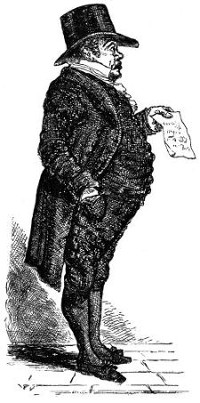
A well-known character on 'Change. Rothschild.
The Rothschilds.
In the Memoirs of Sir Thomas Fowell Buxton, edited by his son, we find this amusing letter, dated 1834: "We yesterday dined at Ham House, to meet the Rothschilds; and very amusing it was. He (Rothschild) told us his life and adventures. He was the third son of the banker at Frankfort. 'There was not,' he said, 'room enough for us all in that city. I dealt in English goods. One great trader came there, who had the market to himself; he was quite the great man, and did us a favour if he sold us goods. Somehow I offended him, and he refused to show me his patterns. This was on a Tuesday; I said to my father, "I will go to England." I could speak nothing but German. On the Thursday I started. The nearer I got to England, the cheaper goods were. As soon as I got to Manchester, I laid out all my money, things were so cheap; and I made good profit. I soon found that there were three profits—the raw material, the dyeing, and the manufacturing. I said to the manufacturer, "I will supply you with material and dye, and you supply me with manufactured goods." So I got three profits instead of one, and I could sell goods cheaper than anybody. In a short time I made my 20,000l. into 60,000l. My success all turned on one maxim. I said, I can do what another man can, and so I am a match for the man with the patterns, and for all the rest of them! Another advantage I had. I was an off-hand man. I made a bargain at once. When I was settled in London, the East India Company had 800,000 ounces of gold to sell. I went to the sale, and bought it all. I knew the Duke of Wellington must have it. I had bought a great many of his bills at a discount. The Government sent for me, and said they must have it. When they had got it, they did not know how to get it to Portugal. I undertook all that, and I sent it through France; and that was the best business I ever did.'
"Another maxim, on which he seemed to place great reliance, was, never to have anything to do with an unlucky place or an unlucky man. 'I have seen,' said he, 'many clever men, very clever men, who had not shoes to their feet. I never act with them. Their advice sounds very well; but fate is against them; they cannot get on themselves; and if they cannot do good to themselves, how can they do good to me?' By aid of these maxims he has acquired three millions of money. 'I hope,' said ——, 'that your children are not too fond of money and business, to the exclusion of more important things. I am sure you would not wish that.'—Rothschild: 'I am sure I should wish that. I wish them to give mind, and soul, and heart, and body, and everything to business; that is the way to be happy. It requires a great deal of boldness and a great deal of caution to make a great fortune; and when you have got it, it requires ten times as much wit to keep it. If I were to listen to all the projects proposed to me, I should ruin myself very soon. Stick to one business, young man,' said he to Edward; 'stick to your brewery, and you may be the great brewer of London. Be a brewer, and a banker, and a merchant, and a manufacturer, and you will soon be in the Gazette.
"'One of my neighbours is a very ill-tempered man; he tries to vex me, and has built a great place for swine close to my walk. So, when I go out, I hear, first grunt, grunt, squeak, squeak; but this does me no harm. I am always in good humour. Sometimes to amuse myself I give a beggar a guinea. He thinks it is a mistake, and for fear I should find it out, off he runs as hard as he can. I advise you to give a beggar a guinea sometimes, it is very amusing.' The daughters are very pleasing. The second son is a mighty hunter, and his father lets him buy any horses he likes. He lately applied to the Emperor of Morocco for a first-rate Arab horse. The Emperor sent him a magnificent one; but he died as he landed in England. The poor youth said very feelingly, 'that was the greatest misfortune he ever had suffered;' and I felt strong sympathy with him. I forgot to say, that soon after Mr. Rothschild came to England, Bonaparte invaded Germany. 'The Prince of Hesse Cassel,' said Rothschild, 'gave my father his money; there was no time to be lost; he sent it to me. I had 600,000l. arrive unexpectedly by the post; and I put it to such good use, that the Prince made me a present of all his wine and his linen.'"
A Legacy of Half a Million of Money.
On the 30th of August, 1852, there died at Chelsea John Camden Neild, a wealthy gentleman, who had bequeathed an immense legacy to Queen Victoria. His father was a native of Knutsford, in Cheshire; as a goldsmith in London he made a large fortune. He was a truly benevolent man, especially in his efforts for the improvement of prisons, and originated the Society for the Relief of Persons imprisoned for Small Debts. He married the daughter of John Camden, Esq., of Battersea, in Surrey, a direct descendant of the great antiquary of the same name. He died in 1814, and was buried at Chelsea.
John Camden Neild, the only surviving son of the above, was born in 1780; educated at Trinity College, Cambridge, studied at Lincoln's Inn, and in 1808 was called to the bar. In 1814 he succeeded to the whole of his father's property, estimated at 250,000l.; but he made a very different use of his wealth. Avarice was his ruling passion; he became a confirmed miser, and for the last thirty years of his life gave himself over to heaping up riches. He lived in a large but meanly furnished house in Cheyne Walk, Chelsea; and he slept on a bare board, and latterly on an old stump bedstead, on which he died. His favourite companion was a large black cat, which was in his chamber when he breathed his last.
He had considerable property at North Marston, in Buckinghamshire, and here he often stayed for days together, besides his half-yearly visits to receive rents. As lessee of the rectory, it was incumbent on him to repair the chancel of the church; the leaded roof having become full of fissures, he had them covered with strips of painted calico, saying they would "last his time." During this odd repair, he sat all day on the roof, to keep the workmen employed and even ate his dinner there, which consisted of hard-boiled eggs, dry bread, and buttermilk.
His dress was an old-fashioned swallow-tailed coat, brown trousers, short gaiters, and shoes which were generally patched and down at the heels. His stockings and linen were generally full of holes; but when he stayed a night at a tenant's, the mistress often mended them while he was in bed. He was short and punchy in figure, scarcely above five feet in height, with a large round and short neck. He always carried an old green cotton umbrella, but never wore a great coat, which he considered too extravagant for his slender means. He travelled outside a coach, where his fellow-travellers took him for a decayed gentleman in extreme poverty. Once, when visiting his Kentish property on a bitterly cold day, the coach stopped at Farningham, where the other passengers subscribed for a glass of brandy-and-water, which they sent to the poor gentleman, in pity for their thinly-clad companion who still sat on the coach-roof, while they were by the inn fireside.
He often took long journeys on foot, when he would avail himself of any proffered "lift," and he was even known to sit on a load of coal, to enable him to proceed a little further without expense; yet he would give the driver a penny or two for the accommodation; for, miser as he was, he never liked to receive anything without paying for it—however small the scale; nor would he partake of any meal or refreshment when asked by the clergymen of the parishes where his estates lay. Yet with tenants of a lower grade he would share the coarse meals and lodging of the family. At North Marston he used to reside with the tenant on the rectory farm; while staying here, about 1828, he attempted to cut his throat, but his life was saved chiefly by the prompt assistance of the tenant's wife. This attempt was supposed to have been caused by a sudden fall in the funds, in which he had just made a large investment.
Sometimes he would eat his dinner at a tenant's, where he would beg a basin of milk, and buy three eggs for a penny, get them hard-boiled, and eat two for his dinner, with another basin of milk; the third egg he would save for next morning's breakfast. He used to examine minutely the nature of his land, and keep an account of the number of trees on his estates: he had been known to walk from twelve to fifteen miles to count only a few trees.
Mr. Neild's general answer to all applications for charitable contributions was a refusal; in some instances it was otherwise. He once, but only once, gave a pound for the Sunday-school at North Marston; he promised 300l. towards building an infirmary for Buckinghamshire, but withheld it from an objection to the site.
Mr. Neild was not, as stated at the time of his death, "a frigid, spiritless specimen of humanity," for he possessed considerable knowledge in legal and general literature and the classics. Nor did he entirely pass over merit. Finding the son of one of his tenants to possess strong natural abilities, he paid wholly or in part the expenses of his school and college education. This person is now a distinguished scholar and a dignitary of the Church of England.
Mr. Neild was buried on the 16th of September, according to his own desire, in the chancel of North Marston Church. His will then necessarily came to light, and great was the sensation which it occasioned. After bequeathing a few trifling legacies to different persons, he left the whole of his vast property, estimated at 500,000l., to "Her Most Gracious Majesty Queen Victoria, begging Her Majesty's most gracious acceptance of the same for her sole use and benefit, and her heirs, &c." To each of his three executors he bequeathed 100l. The will had excited such curiosity, that, though his life had passed almost unnoticed, a large concourse of persons assembled at Chelsea to witness the removal of his body, and the church and churchyard at North Marston were crowded with wondering—not lamenting—spectators. Among his tenants, workmen, and the poor of the parish where he possessed so much property, not a tear was shed, not a regret uttered, as his body was committed to its last resting-place. The only remark heard was, "Poor creature! had he known so much would have been spent on his funeral, he would have come down here to die to save the expense!"
Two caveats were entered against his will, but were subsequently withdrawn, and the Queen was left to take undisputed possession of his property. Her Majesty immediately increased Mr. Neild's bequest to his three executors to 1,000l. each; she provided for his old housekeeper, to whom he had made no bequest, though she had lived with him six-and-twenty years; and she secured an annuity to the woman who had frustrated Mr. Neild's attempt at suicide.
Her Majesty, in 1855, had restored the chancel of North Marston Church, and inserted an east window of beautifully stained glass, beneath which is a reredos with this inscription: "This Reredos and the Stained Glass Window were erected by Her Majesty Queen Victoria (D.G.B.R.F.D.), in the eighteenth year of her reign, in memory of John Camden Neild, Esq., of this parish, who died August 30th, 1852, aged 72."[13]
This man of wealth must not be confounded with the Mr. Neeld who came into possession of great wealth on the demise of his uncle, Philip Rundell, the wealthy goldsmith of Ludgate Hill. He died in 1827, at the age of eighty-one; and, according to the Gentleman's Magazine, "had never married, and never kept an establishment, but lived much with one niece at Brompton, and another, the wife of John Bannister, the eminent comedian." The eldest son of the latter, on coming of age, was invited to breakfast with Mr. Rundell, who placed in the young man's hands at parting a sealed letter, which he was not to open till he reached home. It was then found to contain a bequest of 10,000l., payable on the death of the donor, and of his own marriage. This incident was related to Mr. Britton by Mr. Bannister, who also indulged him by repeating two songs which he had written and sung at Mr. Rundell's, on two birthdays of the aged goldsmith. Bannister also inherited 5,000l. for his own life, and then to devolve to his daughter; and his son had an additional legacy from Mr. Rundell. Numerous other large sums of money were bequeathed to other relatives, friends, and public foundations; but the most important item in the will is the residuary clause, whereby the testator "gives to his esteemed friend, Joseph Neeld, the younger, all the rest of his real and mixed estate, which," says the magazine, "it is computed will amount to not less than 890,000l. The personal effects were sworn at upwards of 1,000,000l., the utmost limit to which the scale of the probate duty extends."
Eccentricities of the Earl of Bridgewater.
Forty years since there lived in Paris the Rev. Francis Henry Egerton, Earl of Bridgewater, of whom we find this probably overcharged but curious account in a Parisian journal of the year 1826; than his lordship no one has a higher claim to a distinguished place in the history of human oddities:—"Those who have once seen—nay, those who have never seen this meagre personage drag himself along, supported by two huge lacqueys, with his sugar-loaf hat, slouched down over his eyes, cannot fail to recognize him. An immense fortune enables him to gratify the most extravagant caprices that ever passed through the head of a rich Englishman. If he be lent a book, he carries his politeness so far as to send it back, or rather have it conveyed home, in a carriage. He gives orders that two of his most stately steeds be caparisoned under one of his chariots, and the volume, reclining at ease in milord's landau, arrives, attended by four footmen in costly livery, at the door of its astounded owner. His carriage is frequently to be seen filled with his dogs. He bestows great care on the feet of these dogs, and orders them boots, for which he pays as dearly as for his own. Lord Bridgewater's custom is an excellent one for the boot-maker; for, besides the four feet of each of his dogs, the supply of his own two feet must give constant employment to several operatives. He puts on a new pair of boots every day, carefully preserving those he has once worn, and ranging them in order; he commands that none shall touch them, but takes himself great pleasure in observing how much of the year has each day passed, by the state of his boots."
"Lord Egerton is a man of few acquaintance, and very few of his countrymen have got as far as his dining-hall. His table, however, is constantly set out with a dozen covers, and served by suitable attendants. Who, then, are his privileged guests? No less than a dozen of his favourite dogs, who daily partake of milord's dinner, seated very gravely in arm-chairs, each with a napkin round his neck, and a servant behind to attend to his wants. These honourable quadrupeds, as if grateful for such delicate attentions, comport themselves during the time of repast with a decency and decorum which would do more than honour to a party of gentlemen; but if, by any chance, one of them should, without due consideration, obey the natural instinct of his appetite, and transgress any of the rules of good manners, his punishment is at hand. The day following the offence the dog dines, and even dines well; but not at milord's table; banished to the ante-chamber, and dressed in livery, he eats in sorrow the bread of shame, and picks the bone of mortification, while his place at table remains vacant till his repentance has merited a generous pardon!"
This eccentric nobleman died in February, 1829, and by his will, dated February 25th, 1825, bequeathed 8,000l. for the writing, printing, and publishing of the well-known Bridgewater Treatises.
The Denisons, and the Conyngham Family.
The history of the Denison family, the last representative of which died in 1849, leaving a fortune of more than two millions and a half, affords a lesson which the mercantile world cannot study too curiously. Somewhat more than one hundred and twenty years ago, the elder Denison made his way on foot to London from Skipton-in-Craven, his native place, with a few shillings in his pocket, and, being a parish-boy, not knowing even how to read or write. Another account states that he was a woollen-cloth-merchant at Leeds, and came to London in a waggon, being attended on his departure by his friends, who took a solemn leave of him, as the distance was then thought so great that they might never see him again. He was recommended by a townswoman of his own (of the name of Sykes, whom he afterwards married) to the house of Dillon and Co., where she was herself a domestic servant; and for some time the lad was employed to sweep the shop and go on errands. His zeal and industry recommended him, however, to his employers, and having been taught to read, he rose to a clerkship. After the death of his wife he obtained an independence by marrying one Elizabeth Butler, daughter of a rich hatter in Tooley Street, and set up in business for himself in Princes Street, Lothbury, where by incessant attention to business and strict parsimony, he managed to scrape together a considerable fortune. He finally removed to St. Mary Axe, where he lived and died, after having purchased the estates in Surrey and Yorkshire (of Lord King and the Duke of Leeds), Denbies and Seamere; by joining the Heywoods, eminent bankers of Liverpool, his wealth rapidly increased. The Annual Register of 1806, in recording these facts and his end, states that through life Mr. Denison was a dissenter: he remained to the last an illiterate man.
By his second wife he had one son and two daughters. The son, William Joseph, a man of sound principle and excellent character, though less penurious than his father, who, when he entertained a friend at dinner in St. Mary Axe, used to walk to the butcher's and bring home a rump-steak in a cabbage-leaf in his pocket, was remarkable for his disinclination to detach even the smallest sum from his enormous capital. Thus, when the nephew to whom he bequeathed 85,000l. per annum, fell into railway difficulties (the speculation having been undertaken with the sanction of his uncle), he permitted him, to avoid legal proceedings, to withdraw to Boulogne-sur-Mer, and reside there a twelvemonth with his young family, rather than pay for him the sum of 2,000l.
Mr. Denison, the father, died in 1806; his son, succeeding to the banking business (the firm being now Denison, Heywood, and Kennard), continued to accumulate; and at his death, in 1849, he left two millions and a half of money. He had sat in Parliament for Surrey since 1818. He was a man of cultivated tastes, and possessed a knowledge of art and elegant literature. He feared to be thought ostentatious, and could with difficulty be prevailed on to have a lodge erected at the entrance to a new road which he had just formed on his estate in Surrey.
Mr. Denison's two sisters were Elizabeth, married, in 1794, to Henry, first Marquis Conyngham; and Maria, married, in 1793, to Sir Robert Lawley, Bart., created, in 1831, Baron Wenlock. Up to the age of twenty-seven, Miss Denison resided with her father in St. Mary Axe. Here the rich and beautiful heiress was won and wedded in 1794 by the Honourable Henry Burton, then a captain, twenty-eight years old, and the eldest son of the fortunate Francis Pierpoint Burton, of Buncraggy, who succeeded through his mother, after the death of her two brothers, to the barony and estates of the old Conynghams, won at the battle of the Boyne by Sir Albert Conyngham, Lieutenant-General of the Ordnance of Ireland, and aggrandized by many forfeitures and marriages subsequently. Captain Burton carried off his wife to Ireland, and only revisited England in his forty-second year, to kiss hands, in 1808, on his promotion to a major-generalship. On succeeding to his father's title and estates, his lordship so improved their condition that he was justly regarded as one of the benefactors of his country; and a visit to his estate at Slane, on the banks of the Boyne, is recorded by Mr. Parkinson in his Experiences of Agriculture in the same terms as a visit to Holkham would have been chronicled in the days of Mr. Coke. The barony of Conyngham was increased to an earldom as a reward for the spirited conduct of his lordship's father, which led to a reciprocity of trade between Ireland and England. Upon the conclusion of the war with France, when George IV. paid a visit to Ireland, he was hospitably received and entertained at Slane Castle. Here, probably, commenced that more intimate acquaintance between His Majesty and the Marquis Conyngham and his family which induced the King, upon his return to England, to invite the whole family to court, and, after they had accepted the invitation, to retain them in his household. In 1816 his lordship was created Viscount Slane (the restoration of an ancient title forfeited in the Rebellion), Earl of Mountcharles, and Marquis Conyngham; and in 1821 he was enrolled in the British Peerage as Baron Minster, of Minster Abbey, in the county of Kent. The Marchioness was left a widow in 1832, and survived until 1861, having attained the venerable age of ninety-two, and lived to see both her sons peers of the realm—the one in succession of his father; the second, Albert Denison, as the heir to her own father's great fortune and estates, with the title of Baron Londesborough.