DELUSIONS, IMPOSTURES, and FANATIC MISSIONS. (continued 2)
Reading edition
Kelly did all his feats upon The devil's looking glass—a stone.
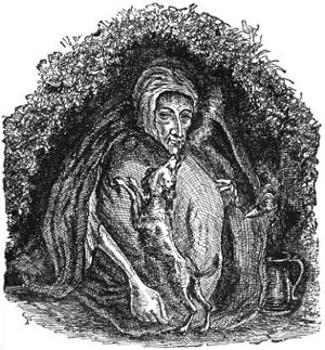
Margaret Finch, the Norwood Gipsy.
Norwood Gipsies.
Two centures ago, Norwood, in Surrey, was celebrated as the haunt of many of the gipsy-tribe, who in the summertime pitched their blanket-tents beneath its shady trees. Thus we find Pepys recording a visit to the place, under the date of August 11th, 1688:—"This afternoon my wife, and Mercer, and Deb. went with Pelling to the gipsies at Lambeth, and had their fortunes told; but what they did I did not inquire." [Norwood is in the southern part of Lambeth parish.]
From their reputed knowledge of futurity, the Norwood gipsies were often consulted by the young and credulous. This was particularly the case some sixty or seventy years ago, when it was customary among the working class and servants of London to walk to Norwood on the Sunday afternoon to have their fortunes told, and also to take refreshment at the Gipsy House, said to have been first licensed in the reign of James the First. The house long bore on its sign-post a painting of the deformed figure of Margaret Finch, the Queen of the gipsies.
The register of Beckenham, under the date of October 24th, 1740, records the burial of Margaret Finch, who lived to the age of 109 years. After travelling over various parts of the kingdom (during the greater part of a century), she settled at Norwood, whither her great age and the fame of her fortune-telling attracted numerous visitors. From a habit of sitting on the ground, with her chin resting on her knees, the sinews became so contracted that she could not rise from that posture. After her death they were obliged to enclose her body in a deep square box. Her funeral was attended by two mourning-coaches, a sermon was preached on the occasion, and a great concourse of people attended the ceremony. There is an engraved portrait of this gipsy queen, from a drawing made in 1739.
In the summer of 1815, the gipsies of Norwood were "apprehended as vagrants, and sent in three coaches to prison," and this magisterial interference, and the increase of houses and population, have long since driven the gipsies from their haunts; but the association is preserved in the Gipsy Hill station of the Crystal Palace Railway.
"Cunning Mary," of Clerkenwell.
Early in the seventeenth century, one Mary Woods, of Norwich, a person who professed skill in palmistry, came to London in the way of her vocation, and lodged at the house of one Crispe, a barber, in Clerkenwell. Having received such a valuable inmate, the barber soon afterwards removed "Cunning Mary" and her husband to the more fashionable neighbourhood of the Strand, and there the barber became a willing agent in procuring subjects or patients for his female lodger. One branch of her business consisted in furnishing ladies who desired to become mothers with charms and medicines which would assist them in attaining their end. In the next house to Somerset Place dwelt a Mrs. Isabel Peel, wife of a tradesman, who to her great grief was childless. The barber, at his lodger's suggestion, whispered in her ear, that the very skilful person who was an inmate of his house could provide her with means to help forward her desires. An interview was arranged, and by "fair speech and cozening skill" Mary Woods persuaded Mrs. Peel of her power, but demanded no less a sum than twenty pounds for its exercise. In cash, the amount was beyond the patient's means, but she delivered to her adviser "two lawn and other wrotte (wrought) wares," and received in return a small portion of an infallible powder, which the cunning woman sewed in a little piece of taffeta, and bade the aspirant after maternity wear it round her neck.
The news that a woman of such marvellous skill had come to lodge in Westminster soon spread. Anxious ladies in many of the neighbouring mansions sent for her, and she specially got a footing in Salisbury House. Mrs. Jane Sacheverell, who attended on Lady Cranborne, was one of her victims. The Countess of Essex had several interviews with her in the same friendly mansion, and gave her a diamond ring worth fifty or sixty pounds, sent by her husband the Earl, out of France, with directions to pawn it, in order to procure a portion of the infallible powder, "which was very costly." The Countess also bestowed upon Mrs. Woods "certain pieces of gold worth between thirty and forty pounds." When the affair was called in question, Mrs. Woods asserted that the Countess gave her these things to procure "a kind of poison that would be in a man's body three or four days without swelling," and that this poison was to be given to the Earl of Essex. But Mrs. Woods was an infamous person, whose uncorroborated assertion was worth nothing, and she had previously mentioned to Mrs. Peel that her employment by the Countess had relation merely to the child-giving powder.
Mrs. Woods possessed other faculties besides those with reference to which she was consulted by Mrs. Peel and Mrs. Sacheverell. She could "help" ladies to husbands, and "cause and procure whom they desired to have, to love them." On this branch of her business she was consulted by Mrs. Cooke, Lady Walden's gentlewoman, who gave her twenty pounds and more, in twenty-shilling pieces of gold; and, finally, also, by Mrs. Clare, who is described as lying in the Court at Whitehall, and as being a waiting gentlewoman in attendance upon the young Lady Windsor. Mrs. Clare, like several other of the ladies named, had no ready money, but the fees paid by her were very handsome. They comprised a standing cup and cover of silver gilt, worth fourteen pounds; a petticoat of velvet, layed with three silver laces, that cost forty pounds; and two diamond rings, the one worth twenty pounds, and the other five pounds.
After the bubble had burst, and Cunning Mary absconded with her plunder, Mrs. Peel says that she "ripped the taffeta to see what powder it was, and found it but a little dust swept out of the flower (floor?)."[21]
Jerusalem Whalley.
Mr. Whalley was elected for Newcastle, 1785, before he was of age, which was not unusual in Ireland, and sat for it to 1790, and for Enniscorthy from 1797 to June, 1800. He acquired the sobriquet of Jerusalem Whalley in consequence of a bet, said to have been 20,000l., that he would walk (except where a sea-passage was unavoidable) to Jerusalem and back within twelve months. He started September 22, 1788, and returned June 1, 1789.
Lord Cloncurry describes Whalley as a perfect specimen of the Irish gentleman of the olden time. Gallant, reckless, and profuse, he made no account of money, limb, or life, when a feat was to be won, or a daring deed to be attempted. He spent a fine fortune in pursuits not more profitable than his expedition to play ball at Jerusalem; and rendered himself a cripple for life by jumping from the drawing-room window of Daly's club-house, in College Green, Dublin, on to the roof of a hackney-coach which was passing.
The lawless behaviour of the yeomanry corps which he commanded obtained for him another and less agreeable appellation, "Bever-chapel Whalley." His residence in Stephen's Green was, in 1855, converted into a nunnery. Sir Jonah Barrington states that 4,000l. was paid to Mr. Whalley by Mr. Gould, M.P. for Kilbeggan.
Whalley, "Buck Whalley" as he was sometimes called, is stated to have been the founder of the Hell-fire Club. Having a taste for the fine arts, and means to gratify it, he accumulated a large number of valuable paintings in his mansion at Stephen's Green, Dublin, of which the following account has appeared in the Dublin University Magazine:—"In the centre of the south side of St. Stephen's Green stands a noble building, with a large stone lion reposing over the entrance, and finding his legs and tail encroached on by grass and weeds. This mansion belonged to the great Buck Whalley, and witnessed many a noble feast and mad carouse during the viceroyalty of the Duke of Buckingham. At last, when all the pleasures that could be procured on Irish land were tried, and found to result in satiety and disgust, and his tailor and wine-merchant began to disturb him, he sought new excitement in his wager that he would have a game of ball against the walls of Jerusalem; and he succeeded, as already stated. A bard, who contributed to a collection of political squibs, entitled, Both Sides of the Gutter, sang the going forth of the expedition: it is entitled, Whalley's Embarkation, to the tune of 'Rutland Gigg.'"
Father Mathew and the Temperance Movement.
No great cause was ever inaugurated with more eccentric or more genuine fervour than the advocacy of the Temperance principles by Father Mathew, the Capuchin Friar. "Here goes in the name of God!" said the Father, on the 10th of April, 1838, when he pledged his name in the cause of Temperance, and, together with the Protestant priest, Charles Duncombe, the Unitarian philanthropist, Richard Dowden, and the stout Quaker, William Martin, publicly inaugurated a movement at Cork, destined in a few years to count its converts by millions, and to spread its influence as far as the English language was spoken. In this good work, the habitually impulsive temperament of the Irish was acted upon for the purest and most beneficial of purposes; and one element of its success lay in the unselfishness of the Father, who was himself a serious sufferer by the results of his philanthropic exertions. A distillery in the south of Ireland, belonging to his family, and from which he himself derived a large income, was shut up in consequence of the disuse of whisky among the lower orders, occasioned by his preaching. But his "Riverance" was most unscrupulously tyrannized over by his servant John, a wizened old bachelor, with a red nose, privately nourished by Bacchus; and he was only checked in his evil doings when the Father, more exasperated than usual, exclaimed, "John, if you go on in this way, I must certainly leave this house." On one occasion, there was a frightful smack of whisky pervading the pure element which graced the board, which he accounted for by saying he had placed the forbidden liquid, with which he "cleaned his tins," in the jug by mistake.
The Temperance cause prospered, but Father Mathew, through his eccentric love of giving, found it impossible to keep out of debt, which ever kept him in thraldom. The hour of his deepest bitterness was when, while publicly administering the pledge in Dublin, he was arrested for the balance of an account due to a medal manufacturer; the bailiff to whom the duty was entrusted kneeling down among the crowd, asking his blessing, and then quietly showing him the writ.
This is one of the many anecdotes told by Mr. Maguire, in his admirable Life of Father Mathew, who, we learn from the same authority, at a large party attempted to make a convert of Lord Brougham, who resisted, good-humouredly but resolutely, the efforts of his dangerous neighbour. "I drink very little wine," said Lord Brougham; "only half-a-glass at luncheon, and two half glasses at dinner; and though my medical adviser told me I should increase the quantity, I refused to do so." "They are wrong, my lord, for advising you to increase the quantity, and you are wrong in taking the small quantity you do; but I have my hopes of you." And so, after a pleasant resistance on the part of the learned lord, Father Mathew invested his lordship with the silver medal and ribbon, the insignia and collar of the Order of the Bath. "Then I will keep it," said Lord Brougham, "and take it to the House, where I shall be sure to meet the old Lord —— the worse of liquor, and I will put it on him." Lord Brougham was as good as his word; for, on meeting the veteran peer, he said: "Lord ——, I have a present from Father Mathew for you," and passed the ribbon quietly over his neck. "Then I'll tell you what it is, Brougham, by —— I will keep sober for this day," said his lordship, who kept his word, to the great amusement of his friends.
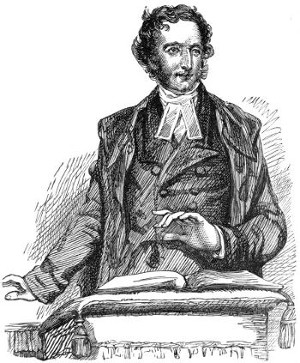
Edward Irving.
Eccentric Preachers.
Scores, nay, hundreds of volumes have been gathered upon the oddities of character which mankind, in all ages, have presented to the observant writer who loves to "shoot folly as it flies." Voltaire has said, "Every country has its foolish notions.... Let us not laugh at any people;" and it would be difficult to find any age which has not its curiosities of character, to be laughed at and turned to still better account; for, of whatever period we write, something may be done in the way of ridicule towards turning the popular opinion. Diogenes owes much of his celebrity to his contempt of comfort, by living in a tub, and his oddity of manner. Orator Henley preached from his "gilt tub" in Clare Market, and thus earned commemoration in the Dunciad:—
Still break the benches, Henley, with thy strain, While Sherlock, Hare and Gibson preach in vain; O, worthy thou of Egypt's wise abodes, A decent priest, where monkeys were the gods! But Fate with butchers placed thy priestly stall, Meek modern faith to murder, hack, and haul.
Eccentricity has its badge and characteristics by which it gains distinction and notoriety, and which in some cases serve as a lure to real excellence. The preaching of Rowland Hill is allowed to have been excellent; but his great popularity was won by his eccentric manner, and the many piquant anecdotes and witticisms, and sallies of humour unorthodox, with which, during his long ministry, he interlarded his sermons. However, he thought the end justified the means; and certain it is that it drew very large congregations. The personal allusions to his wife, which Rowland Hill is related to have used in the pulpit, were, however, fictitious, and at which Hill expressed great indignation. "It is an abominable untruth," he would exclaim; "derogatory to my character as a Christian and a gentleman. They would make me out a bear."
The success of Edward Irving, the popular minister of the National Scotch Church in London, was of a more mixed character. It is stated, upon good authority, that he first chose the stage as a profession, and acted in Ryder's company, in Kirkaldy, a few miles from Edinburgh, about fifty-five years since. The obliquity of his vision, his dialect, and peculiarly awkward gait and manner, created so much derision, that he left the stage for the pulpit, after about three months' probation.
Irving's sermons were not liked at first; and it was not until he was recognised by Dr. Chalmers that Irving became popular. But he was turned out of his church, and treated as a madman, and he died an outcast heretic. "There was no harm in the man," says a contemporary, "and what errors he entertained, or extravagancies he allowed in connection with supposed miraculous gifts, were certain in due time to burn themselves out." It was not so much the error of his doctrine as the peculiarity of his manner, the torrent of his eloquence, his superlative want of tact, that provoked his enemies, and frightened his friends. The strength of his faith was wonderful. Once, when he was called to the bedside of a dying man late at night he went immediately. Presently he returned, and beckoned one of his friends to accompany him. The reason was, that he really believed in the efficacy of prayer, and held to the promise—"If two of you shall agree on earth as touching anything that ye shall ask, it shall be done." It was necessary, therefore, that two should go to the sick man. So, also, he had a child that died in infancy, to whom he was in the habit of addressing "words of godliness, to nourish the faith that was in him." And Irving adds that the patient heed of the child was wonderful. He really believed that the infant, by some incomprehensible process, could guess what he was saying, and profit by it. His love for children was very great; and he, a very popular man in London, might be seen, day by day, marching along the streets of Pentonville of an afternoon, his wife by his side, and his baby in his arms.
His sermons had a large sale, going through many editions. But Irving complains that, in spite of these large sales, he could never get the religious publishers to whom he had entrusted his book to give him anything but a pitiful return. It is amusing to find him in one letter complaining that there is neither grace nor honour in the religious booksellers, and requesting his wife in negotiating the sale of his next venture to "try Blackwood, or some of these worldlings," in the evident expectation that "these worldlings" were a good deal more liberal in their dealings, not to say honest, than those whom he regarded as his peculiar friends.
Irving a Millenarian.
The Millenarians proudly claim the late Edward Irving as having been one of the most earnest believers in the personal reign of Christ. In his latter days he was a Millenarian in the strictest sense of the word. From the year 1827 to 1830, the Millenarianism question was brought under the notice of thousands of Christians, who, though remarkable for their knowledge of Scripture on other points, had never bestowed a single thought on the question of Christ's personal reign on earth. The cause of this was the prominence given to it by the Rev. E. Irving, then at the summit of his popularity. Solely with the generous view of assisting a Spanish friend, he had, in the previous year, studied the Spanish language, and had made such progress as to be able to translate it into English. Just at this time appeared in Spanish, The Coming of the Messiah in Glory and Majesty, with which Irving was much struck, as powerfully expressing his own views on the Millenarian question, that he at once set to work, and translated it into English. Its author professed to have been a Jewish convert to Christianity, and gave the name of Juan Josaphat Ben-Ezra on the title-page. He was, however, a Spanish priest and a Jesuit. It is not known whether Mr. Irving was aware of the fraud which had been thus practised upon the readers of the book; he described it as "the chief work of a master's hand," and "a masterpiece of reasoning," and "a gift which he had revolved well how he might turn to profit."
Irving likewise established The Morning Watch for the sole purpose of advocating Millenarian views; but the extravagance of some of the collateral notions which the preacher intermingled with simple Millenarianism rather impeded than promoted the object in view. The doctrine, too, of speaking with tongues, the assertion of the peccability of Christ's humanity, the zealous advocacy of the opinion that the power of working miracles was still vested in the Church, and not the expectation only, but from time to time, the repeated assertion, most emphatically, that Christ would come immediately to reign personally on the earth—all these, and other sentiments no less confidently advanced, and earnestly inculcated both from Irving's pulpit and through the press, injured rather than benefited the cause of Millenarianism among the more sober-minded men in the religious world.
Moreover, he retained these momentous errors till his dying hour, and added one more to them. When his physicians and friends, seeing him in the last stage of consumption, prepared him in the spirit of affectionate faithfulness for the solemn event which was at hand, he would not believe that he was dying, or ever would die, but that he would be changed in the twinkling of an eye, and in a transformed body, made unspeakably glorious, be caught up to heaven. The Millenarians therefore do not strengthen their cause by quoting the name of Edward Irving as an authority in favour of their views.
The intense enthusiasm with which Irving entered into the notion of a personal reign of Christ on earth is well described in his Life by Mrs. Oliphant. "The conception," she says, "of a second advent nearly approaching was like the beginning of a new life. The thought of seeing his Lord in the flesh, cast a certain ecstasy on the mind of Irving. It quickened tenfold his already vivid apprehension of spiritual things. The burden of his prophetic mystery, so often darkly pondered, so often interpreted in a mistaken sense, seemed to him, in the light of that expectation, to swell into divine choruses of preparation for the splendid event which, with his bodily eyes, undimmed by death, he hoped to behold." It is generally thought that the extravagancies which, towards the close of his career, proceeded both from his lips and his pen, were to be traced to a mind which, through its prophetic studies, had lost its balance. Yet, to the last, he made many proselytes to his Millenarian notions.
Irving originated the idea of Christ, with his saints, remaining and reigning in the air after he has caught up his people to meet him there, instead of reigning literally on the earth. Irving also originated the doctrine of secret rapture, or the assumption that Christ will come and take up his people who are alive with him into the air when he raises the saints who are in their graves, and summons them to meet him in aerial regions. So deeply did this notion take possession of many of those who adopted Mr. Irving's Millenarian views, in conjunction with this other idea—that Christ's second coming might be looked for at any hour—that they were as firmly persuaded they would not see death, as they were of any truth in the Word of God.[22]
A Trio of Fanatics.
The names of Sharp, Bryan, and Brothers will not soon be forgotten among the so-called prophets of the present century. The first of this inspired trio was William Sharp, one of the greatest masters in the English school of engraving; Bryan was what is termed an irregular Quaker, who had engrafted sectarian doctrines on an original stock of fervid religious feeling; and Richard Brothers, who styled himself the "Nephew of God," predicted the destruction of all sovereigns, &c.
Sharp was, at one time, so infected with wild notions of political liberty, and so free in his talk, that he was placed under arrest by the Government and several times examined before the Privy Council, for the purpose of ascertaining whether or not, in his speeches or writings, he had committed himself far enough to be tried with Horne Tooke for high treason; but Sharp, being a handsome-looking, jocular man, and too cheerful for a conspirator, the Privy Council came to a conclusion that the altar and the throne had not much to fear from him. At one of the examinations, when Mr. Pitt and Mr. Dundas were present, after he had been worried with questions, which, Sharp said, had little or nothing to do with the business, he deliberately took out of his pocket a prospectus for subscribing to his portrait of General Kociusko, after West, which he was then engraving; and handing the paper first to Pitt and Dundas, he requested them to put their names down as subscribers, and then to give his prospectus to the other members of the Council for their names. The singularity of the proposal set them laughing, and he was soon afterwards liberated.
Sharp possessed a fraternal regard for Bryan, had him instructed in copper-plate printing, supplied him with paper, &c., and enabled him to commence business; but they soon quarrelled. A strong tide of animal spirits, not unaccompanied by some intellectual pretensions and shrewdness of insight, characterized the mind of Jacob Bryan; which, when religion was launched on it, swelled to enthusiasm, tossed reason to the skies, or whirled her in mystic eddies. Sharp found him one morning groaning on the floor, between his two printing-presses, at his office in Marylebone Street, complaining how much he was oppressed, by bearing, after the pattern of the Saviour, part of the sins of the people; and he soon after had a vision, commanding him to proceed to Avignon on a Divine Mission. He accordingly set out immediately, in full reliance on Divine Providence, leaving his wife to negotiate the sale of his printing business: thus Sharp lost his printer, but Bryan kept his faith. The issue of this mission was so ambiguous, that it might be combined into an accomplishment of its supposed object, according as an ardent or a cool imagination was employed on the subject; but the missionary (Bryan) returned to England, and then became a dyer, and so much altered, that a few years after he could even pun upon the suffering and confession which St. Paul has expressed in his text—"I die daily."
The Animal Magnetism of Mesmer and the mysteries of Emanuel Swedenborg had, by some means or other, in Sharp's time, become mingled in the imaginations of their respective or their mutual followers; and Bryan and several others were supposed to be endowed, though not in the same degree, with a sort of half-physical and half-miraculous power of curing diseases, and imparting the thoughts or sympathies of distant friends. De Loutherbourg, the painter (one of the disciples), was believed by the sect to be a very Esculapius in this divine art; but Bryan was held to be far less powerful, and was so by his own confession. Sharp had also some inferior pretensions of the same kind, which gradually died away.
But, behold! Richard Brothers arose! The Millennium was at hand! The Jews were to be gathered together, and were to re-occupy Jerusalem; and Sharp and Brothers were to march thither with their squadrons! Due preparations were accordingly made, and boundless expectations were raised by the distinguished artist. Upon a friend remonstrating that none of their preparations appeared to be of a marine nature, and inquiring how the chosen colony were to cross the seas, Sharp answered, "Oh, you'll see; there'll be an earthquake, and a miraculous transportation will take place." Nor can Sharp's faith or sincerity on this point be in the least distrusted; for he actually engraved two plates of the prophet Brothers, having calculated that one would not print the great number of impressions that would be wanted when the important event should arrive; and he added to each the following inscription: "Fully believing this to be the man appointed by God, I engrave his likeness: W. Sharp." The writing engraver, Smith, put the comma after the word "appointed," and omitted it in the subsequent part of the sentence. The mistake was not discovered until several were worked off; the unrectified impressions are in great request. Whether this be true, or only a hoax by Smith to put collectors on a false scent, has not been ascertained; there is no such impression in the British Museum. If the reader paused in the place where Sharp intended, the sentence expressed, "Fully believing this to be the man appointed by God,"—to do what? to head the Jews in their predestined march to recover Jerusalem? or to die in a madhouse? one being expressed as much as the other.
Brothers, however, in his prophecy, had mentioned dates, which were stubborn things. Yet the failure of the accomplishment of this prophecy may have helped to recommend "the Woman clothed with the Sun!" who now arose, as might be thought somewhat mal à propos, in the West. Such was Joanna Southcote. The Scriptures had said: "The sceptre shall not depart from Israel, nor a lawgiver from between his feet, until Shiloh come; and to him shall the gathering of my people be." When Brothers was incarcerated in a madhouse in Clerkenwell, Johanna, then living in service at Exeter, persuaded herself that she held converse with the devil, and communion with the Holy Ghost, by whom she pretended to be inspired. When the day of dread that was to leave London in ruins, while it ushered forth Brothers and Sharp on their holy errand, passed calmly over, the seers of coming events began to look out for new ground, and to prevaricate most unblushingly. The days of prophecy, said Sharp, were sometimes weeks or months; nay, according to one text, a thousand years were but as a single day, and one day was but as a thousand years. But he finally clung to the deathbed prediction of Jacob, supported as it was by the ocular demonstration of the coming Shiloh. In vain Sir William Drummond explained that Shiloh was in reality the ancient Asiatic name of a star in Scorpio; or that Joanna herself sold for a trifle, or gave away in her loving kindness, the impression of a trumpery seal, which at the Great Day was to constitute the discriminating mark between the righteous and the ungodly. We shall hear more of Sharp in association with Joanna Southcote, presently.
Sharp died poor; he earned much money, but his egregious credulity accounts for its dispersion. He was an epicure in his living, he grew corpulent, and had gout; he died of dropsy, at Chiswick, July 25th, 1824, and was interred in the churchyard of that hamlet, near De Loutherbourg, for whom, at one period, he entertained much mystic reverence.
This great engraver, this William Sharp, was an enthusiast for human freedom. He engraved, from a liking for the man, Northcote's portrait of Sir Francis Burdett; and bestowed unusual care on an engraving after Stothard's beautiful bistre-drawing of "Boadicea animating the Britons." For many years preceding his death he was a wholesale believer in Joanna Southcote; as we have already seen—and he had implicit faith in mystical doctrines; of his portrait of Brothers, Horne Tooke well observed, that, coupled with its extraordinary inscription, it "exhibited one of the most eminent proofs of human genius and human weakness ever contained on the same piece of paper."
Burnet, the engraver, used to relate that Sharp had an ingenious way of carrying a proof print to a purchaser, in an umbrella contrived to serve two additional duties—a print-case, and a walking-stick.
When John Martin exhibited his picture of Belshazzar's Feast, Sharp called upon him at his house, introduced himself, praised his picture, and asked permission to engrave it. "That I was flattered by a request of the kind from so great an artist," says Martin, "you will readily imagine; and I so expressed myself." Sharp felt pleased. "My belief," said Sharp, "is, that yours is a divine work—an emanation immediately from the Almighty; and my belief further is, that while I am engaged on so divine a work, I shall never die." When Martin told this story, he added, with a smile, his eyes twinkling with mischief, "Poor Sharp! a wild enthusiast, but—a masterly engraver."[23]
Richard Brothers was born at Placentia, in Newfoundland, and had served in the navy, but resigned his commission, because, to use his own words, he "conceived the military life to be totally repugnant to the duties of Christianity, and he could not conscientiously receive the wages of plunder, bloodshed, and murder." This step reduced him to great poverty, and he appears to have suffered much in consequence. His mind was already shaken, and his privations and solitary reflections seem at length to have entirely overthrown it. The first instance of his madness appears to have been his belief that he could restore sight to the blind. He next began to see visions and to prophesy, and soon became persuaded that he was commissioned by Heaven to lead back the Jews to Palestine. It was in the latter part of 1794 that he announced, through the medium of the press, his high destiny. His rhapsody bore the title of "A revealed Knowledge of the Prophecies and Times, Book the First. Wrote under the direction of the Lord God, and published by his sacred command; it being the first sign of warning for the benefit of all nations. Containing, with other great and remarkable things, not revealed to any other person on earth, the restoration of the Hebrews to Jerusalem, by the year 1798: under their revealed prince and prophet." A second part speedily followed, which purported to relate "particularly to the present time, the present war, and the prophecy now fulfilling: containing, with other great and remarkable things, not revealed to any other person on earth, the sudden and perpetual fall of the Turkish, German, and Russian Empires." Among many similar flights in this second part, was one which described visions revealing to him the intended destruction of London, and claimed for the prophet the merit of having saved the city by his intercession with the Deity.[24]
Brothers gained a great number of partisans, not only among uneducated persons, but among men of talent. We have seen Sharp, the engraver, as his devoted disciple. Among these followers was Mr. Halhed, who had been a schoolfellow of Sheridan at Harrow; they also had a sort of literary partnership, and they fell passionately in love with the same woman, Miss Linley. Halhed was a profound scholar, a man of wit, and a member of the House of Commons; he published pamphlets in advocacy of the prophetic mission of Brothers, and even made a motion in the House in favour of the prince of the Jews, as Brothers delegated himself.
Brothers took more of a political turn than his companions. He had been a lieutenant in the navy, and during the years 1792-3-4, greatly disturbed the minds of the credulous with his prophecies. We have said that he styled himself the "Nephew of God," and predicted the destruction of all sovereigns; he also foretold the downfall of the naval power of Great Britain.
His writings, founded on erroneous explanations of the Scriptures, at length made so much noise, that Government found it expedient to interfere, and on the 14th of March, 1795, he was apprehended at his lodgings, No. 58, in Paddington Street, under a warrant from the Secretary of State. After a long examination before the Privy Council, in which Brothers persisted in the divinity of his legation, he was committed to the custody of a State messenger. On the 27th he was declared a lunatic, by a jury appointed under a commission of lunacy, assembled at the King's Arms, in Palace Yard, and was subsequently removed to a private madhouse at Islington. While here, he continued to see visions and to pour forth his rhapsodies in print. One of these productions was a letter of two hundred pages, to "Miss Cott, the recorded daughter of King David, and future Queen of the Hebrews, with an Address to the Members of His Britannic Majesty's Council." The lady to whom this letter was addressed had become an inmate of the same asylum with Brothers, and he became so enamoured of her, that he discovered her to be "the recorded daughter of both David and Solomon," and his spouse "by divine ordinance." Brothers was subsequently removed to Bedlam; but in the year 1806 was discharged by the authority of Lord Chancellor Erskine. He died in Upper Baker Street, on the 25th of January, 1824. He was seen in the street a few days before his death, walking with great difficulty, and apparently in the last stage of consumption. It is recorded that the minister who attended Brothers in his last moments died of a broken heart; and the medical man under whose care he had been confined, committed suicide.
Brothers appears to have unwittingly suggested to Coleridge and Southey the clever poem of the Devil's Walk, by the mad prophet asserting that he had seen the devil walk leisurely into London one day!
The Spenceans.
Early in the present century there arose in the metropolis a religio-political sect, which took its name from an itinerant bookseller, named T. Spence, who formed a sort of Constitution on the principle that "all human beings are equal by nature and before the law, and have a continual and inalienable property in the earth and in its natural productions;" and consequently that "every man, woman, and child, whether born in wedlock or not (for Nature and Justice know nothing of illegitimacy), is entitled quarterly to an equal share of the rents of the parish where they have settled." This he called "the Constitution of Spensonia;" and the Abstract from which we have quoted he called "A Receipt to make a Millennium, or Happy World." By this reference and by some allusions to the Jewish economy, he also gave his system a slight connection with religion—but it was very slight; for he neither regarded the precepts of the moral law, nor the doctrines of the Gospel. He admitted, however, of a Sabbath every fifth day; but only as a day of rest and amusement—not for any purposes of devotion. A scheme somewhat similar to the above was formed in the time of the English Commonwealth, and it is probable Spence may have borrowed his system partly from that source.
Spence was punished for his vagaries; for, in 1801, he was sentenced to pay a fine of 50l. and to suffer twelve months' imprisonment for publishing Spence's Restorer of Society, which was deemed a seditious libel. Spence died in October, 1814.
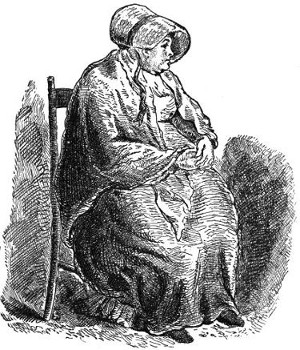
Joanna Southcote.
Joanna Southcote, and the Coming of Shiloh.
This "dropsical old woman," Joanna Southcote, was a native of Exeter, and was born in April, 1750. She was employed chiefly in that city as a domestic servant, and up to the age of forty or thereabout, she seems to have aspired to no higher occupation. But having joined the Methodists, and become acquainted with one Saunderson, who laid claim to the spirit of prophecy, the notion of a like pretension was gradually communicated to Joanna. She wrote prophecies, and she dictated prophecies, sometimes in prose and sometimes in rhymed doggerel; her influence extended, and the number of her followers increased; she announced herself as the woman spoken of in the 12th chapter of Revelation, and obtained considerable sums by the sale of seals, which were to secure the salvation of those who purchased them. Her confidence increased with her reputation, and she challenged the bishop and clergy of Exeter to a public investigation of her miraculous powers, but they treated her challenge with contemptuous neglect, which she and her converts imputed to fear.
By degrees, Exeter became too narrow a stage for her performances, and she came to London on the invitation and at the expense of Sharp, the eminent engraver. She was very illiterate, but wrote numerous letters and pamphlets, and her prophecies, nearly unintelligible as they were, had a large sale. In the course of her Mission, as she called it, promising a speedy approach of the Millennium, she employed a boy, who pretended to see visions, and attempted, instead of writing, to adjust them on the walls of her chapel, "the House of God," a large building which adjoined the Elephant and Castle Inn, at Newington Butts. A schism took place among her followers, one of whom, named Carpenter, took possession of the place, and wrote against her; not denying her Mission, but asserting that she had exceeded it.
It may, however, be interesting here to describe what may be termed the modus operandi of the delusion. Great pains were now taken to ascertain the truth of her commission. "From the end of 1792," says Mr. Sharp, who, we have already seen, was the most devout of her believers, "to the end of 1794, her writings were sealed up with great caution, and remained secure till they were conveyed by me to High House, Paddington; and the box which contained them was opened in the beginning of January, 1803. Her writings were examined during seven days, and the result of this long scrutiny was the unanimous decision of twenty-three persons appointed by divine command, as well as of thirty-five others that were present, that her calling was of God." They came to this conclusion from the fulfilment of the prophecies contained in these writings, and to which she appealed with confidence and triumph. It was a curious circumstance, however, that her handwriting was illegible. Her remark on this occasion was, "This must be, to fulfil the Bible. Every vision that John saw in Heaven must take place on earth; and here is the sealed book, that no one can read!"
A protection was provided for all those who subscribed their names as volunteers, for the destruction of Satan's kingdom. To every subscriber a folded paper was delivered, endorsed with his name, and secured with the impression of Joanna's seal in red wax; this powerful talisman consisted of a circle enclosing the two letters J. C., with a star above and below, and the following words, "The sealed of the Lord, the Elect, Precious, Man's Redemption, to inherit the tree of life, to be made heirs of God and joint-heirs of Jesus Christ." The whole was authenticated by the signature of the prophetess in her illegible characters, and the person thus provided was said to be sealed. Conformably, however, to the 7th chapter of the Revelation, the number of those highly protected persons was not to exceed 144,000.[25]
Early in her last year, she secluded herself from male society, and fancied that she was with child—by the Holy Spirit!—that she was to bring forth the Shiloh promised by Jacob Bryan, and which she pretended was to be the second appearance of the Messiah! This child was to be born before the end of harvest, on the 19th of October, 1814, at midnight, as she was certain it was impossible for her to survive undelivered till Christmas. The harvest, however, was ended, and Christmas came, without the fulfilment of her predictions. Some months previously, Joanna had declared her pretended situation, and invited the opinion of the faculty. Several medical men admitted her pregnancy, others doubted; and some, among whom was Dr. Sims, denied it. There was, indeed, the external appearance of pregnancy; and, in consequence, the enthusiasm of her followers, who are said to have amounted at that time to no fewer than one hundred thousand, was greatly excited. An expensive cradle was made, and considerable sums were contributed, in order to have other things prepared in a style worthy of the expected Shiloh. Among the costly presents made to her was a Bible which cost 40l., and the superb cot or cradle 200l., besides a richly-embroidered coverlid, &c.
It was now deemed necessary, to satisfy certain worldly doubts, that medical men should be called in to give a professional opinion as to the fact, from a consideration of all the symptoms, and without reference to miraculous agency. One of these gentlemen, Mr. Mathias, appearing incredulous of Joanna's pregnancy, was asked "if he would believe when he saw the infant at the breast?" He protested against a question so blasphemous; but his further attendance was dispensed with, as she had been answered, "that he had drawn a wrong judgment of her disorder." Mr. Mathias, too, let out some strange information, showing that Joanna passed much of her time in bed, ate much and often, and prayed never; but to keep up the delusion that she was with child, she, like other ladies in that situation, had longings. On one occasion she longed for asparagus, and ate one hundred and sixty heads, at no small cost, before she allayed her liking.
Dr. Richard Reece[26] was now consulted by Joanna as to her pregnancy. He was not a proselyte to her religious views, but is thought to have been deceived by her symptoms, and declared to a deputation of her followers his belief of her being pregnant by some means or other. As her supposed time of deliverance approached, Joanna fell ill, and began to doubt her inspiration, most probably by her fears awakening her conscience; and as Dr. Reece continued in attendance, he witnessed the following scene:—"Five or six of her friends, who were waiting in an adjoining room, being admitted into her bedchamber, she desired them," says Dr. Reece, "to be seated round her bed; when, spending a few minutes in adjusting the bed-clothes with seeming attention, and placing before her a white handkerchief, she addressed them in the following words: 'My friends, some of you have known me nearly twenty-five years, and all of you not less than twenty; when you have heard me speak of my prophecies, you have sometimes heard me say that I doubted my inspiration; but at the same time, you would never let me despair. When I have been alone, it has often appeared delusion; but when the communication was made to me, I did not in the least doubt. Feeling, as I now do feel, that my dissolution is drawing near, and that a day or two may terminate my life, it all appears delusion.' She was by this exertion quite exhausted, and wept bitterly."
"On reviving in a little time, she observed, that it was very extraordinary, that after spending all her life in investigating the Bible, it should please the Lord to inflict that heavy burden on her. She concluded this discourse by requesting that everything on this occasion might be conducted with decency. She then wept; and all her followers present seemed deeply affected, and some of them shed tears. 'Mother,' said one (it is believed Mr. Howe), 'we will commit your instructions to paper, and rest assured they shall be conscientiously followed.' They were accordingly written down with much solemnity, and signed by herself, with her hand placed on the Bible in the bed. This being finished, Mr. Howe again observed to her, 'Mother, your feelings are human; we know that you are a favourite woman of God, and that you will produce the promised child; and whatever you may say to the contrary will not diminish our faith.' This assurance revived her, and the scene of crying was changed with her to laughter."
Mr. Howe was not the only one of her disciples whose sturdy belief was not to be shaken by the most discouraging symptoms. Colonel Harwood, a zealous believer, entreated Dr. Reece not to retract his opinion as to her pregnancy, though the latter now saw the folly and absurdity of it; and when the Colonel approached the bed on which Joanna was about to expire, and she said to him, "What does the Lord mean by this? I am certainly dying;" he replied, smiling, "No, no, you will not die; or if you should, you will return again."
About ten weeks before Christmas she was confined to her bed, and took very little sustenance, until pain and sickness greatly reduced her. On the night of the 19th of October, a very large number of persons assembled in the street where she lived—Manchester Street, Manchester Square[27]—to hear the announcement of the looked-for advent; but the hour of midnight passed over, and the crowd were only induced to disperse by being informed that Joanna had fallen into a trance.
Mr. Want, a surgeon, had warned her of her approaching end; but she insisted that all her sufferings were only preparatory to the birth of the Shiloh. At last she admitted the possibility of a temporary dissolution, and expressly ordered that means should be taken to preserve warmth in her for four days, after which she was to revive and be delivered. On December 27th, 1814, she actually died, in her sixty-fifth year, she having previously declared that if she was deceived, she was, at all events, misled by some spirit, either good or evil. In four days after, she was opened in the presence of fifteen medical men, when it was demonstrated that she was not pregnant, and that her complaint arose from bile and flatulency, from indulgence and want of exercise. In her last hour she was attended by Ann Underwood, her secretary; Mr. Tozer, who was called her high priest; Colonel Harwood, and some other persons of property; and so determined were her followers to be deceived, that neither death nor dissection could convince them of their error. The silencing of her preacher, Tozer, and shutting up of the chapel which he had opened, had by no means diminished the number of her believers.
While the surgeons were investigating the causes of her death, and the mob were gathering without-doors, in anticipation of a riot or a miracle, Sharp, the engraver, continued to maintain that she was not dead, but entranced. And, at a subsequent period, when he was sitting to Mr. Haydon for his portrait, he predicted to the painter, that Joanna would reappear in the month of July 1822. "But suppose she should not?" said Haydon. "I tell you she will," retorted Sharp; "but if she would not, nothing should shake my faith in her Divine Mission." And those who were near Sharp's person during his last illness, state that in this belief he died. Even when she was really dead, the same blind confidence remained. Mrs. Townley, with whom she had lived, said cheerfully, "she would return to life, for it had been foretold twenty years before."
Mr. Sharp also asserted that the soul of Joanna would return, it having gone to heaven to legitimate the child which would be born. Though symptoms of decomposition arose, Mr. Sharp still persisted in keeping the body hot, according to the directions which she had given on her death-bed, in the hope of a revival. Dr. Reece having remarked that if the ceremony of her marriage continued two days longer, the tenement would not be habitable on her return, "The greater will be the miracle," said Mr. Sharp. Consent at last was given to inspect the body, and all the disciples stood round, smoking tobacco. Their disappointment was excessive at finding nothing to warrant the long cherished opinion, but their faith remained immovable.
Her corpse was removed on the 31st of December to an undertaker's in Oxford Street, where it remained till the interment. On the 2nd of January, 1815, it was carried in a hearse, so remarkably plain, as to have the appearance of one returning from rather than proceeding to church; it was accompanied by one coach equally plain, in which were three mourners. In this manner they proceeded to the new cemetery adjoining St. John's Wood Chapel, with such secrecy, that there was scarcely a person in the ground unconnected with it. A fourth person arrived as the body was being borne to the grave; this was supposed to be Tozer. The grave was taken, and notice given of the funeral, under the name of Goddard. Neither the minister of St. John's, who read the service, nor any of the subordinate persons belonging to the chapel, were apprised of the real name about to be buried, till the funeral reached the ground. The grave is on the west side, opposite No. 44 on the wall, and twenty-six feet from it, where is a flat stone with this inscription:—
"In memory of Joanna Southcote, who departed this life December 27, 1814, aged 65 years. While through all thy wondrous days, Heaven and earth enraptur'd gazed, While vain Sages think they know Secrets Thou Alone canst show; Time alone will tell what hour Thou'lt appear to 'Greater' Power.
Sabineus."
On a black marble tablet, let into the wall opposite to the above spot, is the following inscription, in gilt letters:—
"Behold the time shall come, that these Tokens which I have told Thee, shall come to pass, and the Bride shall Appear, and She coming forth, shall be seen, that now is withdrawn from the Earth."
2nd of Esdras, chap. 7, verse 26.
"For the Vision is yet for an appointed time, but at the end it shall speak, and Not Lie, though it tarry, Wait for it; Because it will surely come, it will not tarry."
Habakkuk, chap. ii. ver. 3d.
"And whosoever is delivered from the Foresaid evils, shall see My Wonders."
2nd of Esdras, chap. 7th, ver. 27th.
(See her writings.)
This Tablet was Erected, By the sincere friends of the above, Anno Domini, 1828.
The number of Joanna's followers continued to be very great for many years after her death: they believed that there would be a resurrection of her body, and that she was still to be the mother of the promised Shiloh.
The Southcotonians also still met and committed various extravagancies. In 1817 a part of the disciples, conceiving themselves directed by God to proclaim the coming of the Shiloh on earth, for this purpose marched in procession through Temple Bar, when the leader sounded a brazen trumpet, and declared the coming of Shiloh, the Prince of Peace; while his wife shouted, "Wo! wo! to the inhabitants of the earth, because of the coming of Shiloh!" The crowd pelted the fanatics with mud, some disturbance ensued, and some of the disciples were taken into custody, and had to answer for their conduct before a magistrate. A considerable number of the sect appear to have remained in Devonshire, Joanna's native county.
The whole affair was one of the most monstrous delusions of our time. "It is not long since," says Sir Benjamin Brodie, in his Psychological Inquiries, 3rd edition, "no small number of persons, and not merely those belonging to the uneducated classes, were led to believe that a dropsical old woman was about to be the mother of the real Shiloh." The writer, however, adds that Joanna was "not altogether an impostor, but in part the victim of her own imagination."
A small square volume of Southcotonian hymns was published, entitled, "Hymns or Spiritual Songs," composed from the prophetical writings of Joanna Southcote, by P. Pullen, and published by her order. "And I saw an angel," &c.—Rev. xx. 1, 2. The "Little Flock" are thus addressed by their "Poet Laureat:"—"By permission of our 'spiritual mother, Johanna Southcote,' I have composed the following hymns from her prophetic writings; and should you feel that pleasure in singing them to the honour and glory of God, for the establishment of her blessed kingdom, and the destruction of Satan's power, as I have felt in the perusal of her writings, I am fully persuaded that they will ultimately tend to your everlasting happiness, and I hope and trust to the speedy completion of what we ardently long and daily pray for, namely, 'HIS KINGDOM to come, that HIS will may be done on earth as it is in heaven, and that we may be delivered from evil;' that that blessed prayer may be soon, very soon fulfilled, is the earnest desire of your fellow labourer, Philip Pullen. London, 16th September, 1807."
"The reader of these Hymns," says a Correspondent of Notes and Queries, "will not feel the spiritual elevation spoken of by Mr. Pullen, unless, perhaps, he has, like him, drunk at that fountain-head, i.e. studied the 'prophetic writings:' the songs for the now 'scattered sheep' being rhapsodical to a degree, and intelligible only to such an audience as that some of your sexagenarian readers may have found assembled under the roof of the 'House of God.' The leading titles to these Hymns are, 'True Explanations of the Bible,' 'Strange Effects of Faith,' 'Words in Season,' 'Communications and Visions,' not published, 'Cautions to the Sealed,' 'Answers to the Books of Garrett and Brothers,' 'Rival Enthusiasts,' and such like. Pullen, their poet, was formerly a schoolmaster, and afterwards an accountant in London, and is called by Upcott, in his Dictionary of Living Authors, 1816, an empiric.
"A couplet in the first hymn bears an asterisk, intimating that it is published at the particular request of Johanna Southcote; it is short, and will afford at once a specimen of the poetical calibre of the volume, and the pith of the 'Spiritual Mother's' views:—
"To Father, Son, and Holy Ghost, One God in power THREE, Bring back the ancient world that's lost To all mankind—and me."
Joanna Southcote published many pamphlets, and one of her disciples, Elias Carpenter, issued several curious and mystical tracts. The lists of these publications are too long to be quoted here. Probably the most complete collection preserved of the extraordinary productions by and relating to this wonderful imposture, was that made by Sir Francis Freeling, together with cuttings from all the newspapers, and bound in 7 vols. 8vo, 1803 to 1815. The titles of the principal tracts fill a page of Thorpe's Catalogue, Part III., 1850. For another very rare collection, in 6 vols., 8vo, see J. C. Hotten's Catalogue for October 1858. Perhaps the most tangible explanation attempted of Joanna Southcote's mission is that by Carpenter, in the Missionary Magazine, 1814. To Carpenter is attributed the following anonymous work, "The Extraordinary Cure of a Piccadilly Patient, or Dr. Reece physicked by Six Female Physicians, 1815."
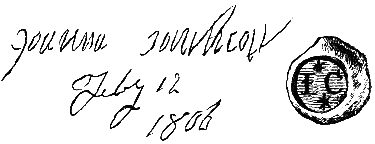
Leeds: August 20, 1809.
Mr. Urban,—Herewith you receive the original seal with which that miserable enthusiast, Joanna Southcott, imposed on the husband of Mary Bateman, the wicked wretch who was lately tried and executed at this place, for the murder of a woman named Perigo. It was found in their cottage when she was taken into custody. The words are as follow:—
John Bateman, The Sealed of the Lord. The Elect precious; Man's Redemption; To inherit the tree of life; to be made Heirs of God and Joint Heirs with Jesus Christ. Joanna Southcott Feb. 12, 1806.
The Founder of Mormonism.
Joseph Smith, "the Prophet," has left to the world a short sketch of himself and his system of Mormonism, which is one of the most remarkable movements of modern times. He was born in the State of Vermont, in 1805, and was brought up to husbandry. When about fourteen years old he began to reflect upon the importance of being prepared for a future state, and inquiring into the plan of salvation. He tells us:—"I retired to a secret place in a grove, and began to call upon the Lord. While fervently engaged in supplication, my mind was taken away from the objects with which I was surrounded, and I was enwrapt in a heavenly vision, and saw two glorious personages, who exactly resembled each other in feature and likeness, surrounded with a brilliant light which eclipsed the sun at noonday. They told me that all the religious sects were believing in incorrect doctrines, and that none of them was acknowledged of God as his Church and Kingdom. And I was expressly commanded to go not after them, at the same time receiving a promise that the fulness of the Gospel should at some future time be made known to me."
This "fulness of the Gospel" was that revealed in The Book of Mormon, of the discovery of which and its contents he says:—"On the evening of the 21st of September, A.D. 1823, while I was praying unto God and endeavouring to exercise faith in the precious promises of Scripture, on a sudden, a light like that of day, only of a far purer and more glorious appearance and brightness, burst into the room; indeed, the first sight was as though the house was filled with consuming fire. The appearance produced a shock that affected the whole body. In a moment, a personage stood before me surrounded with a glory yet greater than that with which I was already surrounded. The messenger proclaimed himself to be an angel of God, sent to bring the joyful tidings, that the covenant which God made with ancient Israel was at hand to be fulfilled; that the preparatory work for the second coming of the Messiah was speedily to commence; that the time was at hand for the Gospel in all its fulness to be preached in power unto all nations, that a people might be prepared for the Millenial reign.
"I was informed also concerning the aboriginal inhabitants of this country (America), and shown who they were and from whence they came; a brief sketch of their origin, progress, civilisation, laws, governments, of their righteousness and iniquity, and the blessings of God being finally withdrawn from them as a people, was made known unto me. I was also told where there were deposited some plates, on which was engraven an abridgment of the records of the ancient prophets that had existed on this continent. The angel appeared to me three times the same night, and unfolded the same things. After having received many visits from the angels of God, unfolding the majesty and glory of the events that should transpire in the last days, on the morning of the 22nd of September, 1827, the angel of the Lord delivered the records into my hands.
"These records were engraven on plates which had the appearance of gold; each plate was six inches wide and eight inches long, and not quite so thick as common tin. They were filled with engravings in Egyptian characters, and bound together in a volume, as the leaves of a book, with three rings running throughout the whole: it was partly sealed. With the records was found a curious instrument, which the ancients called Urim and Thummim, which consisted of two transparent stones set in the rim on a bow fastened to a breastplate. Through the medium of the Urim and Thummim I translated the record by the gift and power of God.
"In this important and interesting book, the history of ancient America is unfolded from its first settlement by a colony that came from the Tower of Babel, at the confusion of languages, to the beginning of the fifth century of the Christian era."
It should here be noticed that the Prophet's account of his early life, before the appearance of the angel and the discovery of the plates, is remarkably vague. He had been very rudely educated, and for some time got a living by trying for mineral veins by a divining rod; and some affirm that, like Sidrophel, he used "the devil's looking-glass—a stone," and was consulted as to the discovery of hidden treasures, whence he had come to be commonly known as the "money-digger;" and on one occasion he had been, at the instigation of a disappointed client, imprisoned as a vagabond. He is also stated to have carried off and married a Miss Hales, during the interval between the first angelic visitation and the discovery of the plates of Nephi.
As to the Book of Mormon itself, the authorship has been claimed for one Solomon Spalding, a Presbyterian preacher, who, having fallen into poverty, composed a religious romance, entitled The Manuscript Found, which professed to be a narrative of the migration of the Lost Tribes of Israel from Jerusalem to America, and their subsequent adventures on the continent. The work was written but Spalding could not find anyone who would print it, and ten years after his death, the manuscript was carried by his widow to New York, and was stolen by, or somehow got into the hands of, Smith, or his early associate, Rigdon. There is nothing in the book to contradict the supposition that it is the work of Smith himself—for as to its being a divine revelation, the most cursory examination of the book will convince an educated man of the utter improbability of that, if its possibility were otherwise conceivable. Be the author who he may, Smith having obtained the book—whether from Solomon Spalding's travelling-chest, his own brain, or the stone-box which the angel discovered to him—thought it behoved him to make his treasure known. At first he told the members of his own and his father's household, and they believed the truth of his mission and the reality of the gift. But, he says: "As soon as the news of this discovery was made known, false reports, misrepresentations, and slander flew, as on the wings of the wind, in every direction. My house was frequently beset by mobs and evil-designing persons; several times I was shot at, and very narrowly escaped; and every device was made to get the plates away from me, but the power and blessing of God attended me, and several began to believe my testimony."
Among these was a farmer, Martin Harris, whom Smith persuaded to convert his stock into money in order to assist in printing the book. But Harris wished first to consult some scholar, and Smith entrusted him with a copy of a portion of one of the golden plates to carry to New York. Harris took the copy to Dr. Anthon, who was unable to make out the characters, which he described to be "reformed Egyptian"—and this is one of the proofs "cited by Mormonite teachers of the authenticity of the book." But Dr. Anthon's account is very different: he tells us that from the first he considered the work an imposture, and his account of it is the only description which has been published, and is as follows:—"The paper was a singular scrawl. It consisted of all kinds of crooked characters disposed in columns, and had evidently been prepared by some person who had before him at the time a book containing various alphabets. Greek and Hebrew letters, crosses and flourishes, Roman letters inverted or placed sidewise, were arranged in perpendicular columns, and the whole ended in a rude delineation of a circle divided into various compartments, decked with various strange marks, and evidently copied after the Mexican calendar, given by Humboldt, but copied in such a way as not to betray the source whence it was derived."
No sooner was the discovery published than the faithful as well as unbelievers flocked to obtain a sight of the marvellous plates, and the prophet and his mother were driven to great shifts to conceal them. At length it was revealed to Smith that the desired sight should be vouchsafed to three witnesses, whose "testimony" is prefixed to every printed copy of the Book of Mormon. These witnesses aver, in their strange language, "that an angel of God came down from heaven, and he brought and lay before our eyes, that we beheld and saw the plates, and the engravings thereon." But a more specific testimony was given by eight other witnesses, to whom Smith was permitted to show the plates. Mrs. Smith says that these eight men went with Joseph into a secret place, "where the family were in the habit of offering up their secret devotions. They went to this place because it had been revealed to Joseph that the plates would be carried by one of the ancient Nephites. Here it was that these eight witnesses, whose names are recorded in the Book of Mormon, looked upon and handled them." The witnesses themselves say:—"We have seen and hefted, and know of a surety that the said Smith has got the plates of which we have spoken." Of these eight witnesses, three were members of Smith's own family. After these witnesses had seen the plates, Mrs. Smith tells us, "the angel again made his appearance to Joseph, at which time Joseph delivered up the plates into the angel's hands;" and Joseph himself says:—"He (the angel) has them in charge to this day;" thus disposing of any demand to see the original plates. Smith carried on the process of translating the plates by retiring behind a screen, where he read the plates though the "curious instrument called the Urim and Thummim," while a scribe outside the screen wrote as he dictated.
The Book of Mormon was published in 1830. In the previous year Smith and his scribe had been baptized by an angel, and power given them to baptize others.
Smith may now carry on the narrative. On April 6, 1830, "The Church of Jesus Christ of Latter Day Saints" was first organized in Manchester, Ontario county, State of New York. Some few were called and ordained by the spirit of revelation and prophecy, and began to preach as the Spirit gave them utterance, and though weak, yet they were strengthened by the power of God; and many were brought to repentance, were immersed in the water, and were filled with the Holy Ghost by the laying on of hands. They saw visions and prophesied, devils were cast out, and the sick healed by the laying-on of hands. From that time the work rolled forth with astonishing rapidity, and churches were formed in the States of New York, Pennsylvania, Ohio, Indiana, Illinois, and Missouri. In the last named State, a considerable settlement was formed in Jackson county. Great numbers joined the Church; "we made large purchases of land, our farms teemed with plenty, and peace and happiness were enjoyed in our domestic circle and throughout our neighbourhood; but, as we could not associate with our neighbours—who were many of them of the basest of men, and had fled from the face of civilized society to the frontier country to escape the hands of justice—in their midnight revels, their Sabbath-breaking, horse-racing, they commenced at first to ridicule, then to persecute; and finally an organized mob assembled and burnt our houses, tarred and feathered, and whipped many of our brethren [Smith himself was tarred and feathered], and finally drove them from their habitations; these, houseless and homeless, contrary to law, justice, and humanity, had to wander on the bleak prairies till the children left their blood on the prairie. This took place in November, 1833." The Government, he says, "winked at these proceedings, and the result was that a great many of them died; many children were left orphans; wives, widows; and husbands, widowers. Our farms were taken possession of by the mob, many thousands of cattle, sheep, horses, and hogs were taken, and our household goods, store goods, and printing-presses were broken, taken, or otherwise destroyed."
Driven from Jackson, the Mormonites settled in Clay county, and being threatened with violence, removed to Caldwell and Davies counties. Here their numbers rapidly increased; but troubles again came upon them; their bank failed, and Smith was obliged to conceal himself; and finally, by an "extraordinary order" of the Governor of Missouri, in 1838, they were violently ejected from their homes, plundered of their goods, and subjected, the women especially, to the most frightful atrocities.
Being thus expelled from Missouri, they settled in Illinois, and in 1839, on the Mississippi, laid the foundation of their famous city, Nauvoo, or the Beautiful, which was incorporated in 1840. Smith dwells with great delight on this city, which he had seen rise up under his presidency from a wild tract to be a place of "1,500 well-built houses, and more than 15,000 inhabitants, all looking to him for temporal as well as spiritual guidance." He describes as provided for—"the University of Nauvoo, where all the arts and sciences will grow with the growth and strengthen with the strength of this beloved city of the Saints of the Last Days." But the grand feature of the city was the Great Temple, which Smith thus sketches: "The Temple of God, now in the course of erection, being already raised one story, and which is 120 feet by 80 feet, of stone with polished pilasters, of an entire new order of architecture, will be a splendid house for the worship of God, as well as an unique wonder of the world, it being built by the direct revelation of Jesus Christ for the salvation of the living and the dead."
The progress of Nauvoo was even more rapid than that of any of the preceding places. Dangers of various kinds beset Smith, but he escaped from them all; and by a provision in the city charter, formed an independent civic militia, of which he was lieutenant-general: and he consolidated his spiritual government, and made careful provision for an ample succession of hardy as well as zealous missionaries. But Smith becoming embroiled with the civil authority of the State, got up a sort of social scheme of his own, and was actually in 1844 nominated for President. The storm now gathered around him; the "gentile" inhabitants of Nauvoo, who had always been most troublesome, supported by some of the dissatisfied among the saints, established an opposition newspaper, which denounced the morals of the Prophet, as well as his system of government; the city council condemned the newspaper to silence; and a mob broke into the office and destroyed the presses. The proprietors charged some of the Mormon leaders with inciting the mob to this act, and they were arrested, but set at liberty. The injured parties now carried their complaint to the Governor of Illinois, who had long been waiting for a legal opportunity to crush the power of Smith; he was arrested on a charge of treason and sedition, June 24th, 1844. He put Nauvoo into a state of defence, and his militia was drawn out; but to avoid bloodshed, on the approach of the State troops, Smith surrendered, on a promise of safety till his legal trial; and he, with others, was committed to Carthage jail. A guard, small in number, and purposely chosen from among Smith's declared enemies, was set over them; but on the 27th of June, a mob of about two hundred armed ruffians broke into the jail, and firing at the door of the room, shot Smith's brother Hyram dead at once. Joseph Smith attempted to escape by the window, but was knocked down, carried out, and shot. His dying exclamation is said to have been, "O Lord my God." His body was given up to his friends, and buried with great solemnity.
Smith had estimated his followers at 150,000, from among almost every civilized people on the face of the earth. He had become intoxicated with power and prosperity, and was lustful and intemperate. In the Mormon creed, polygamy is not referred to; though there is no doubt that in the last year of Smith's life this was one of the charges brought against the Mormonites. Still, the doctrine of a plurality of wives was never openly taught until after Smith's death, and if he proclaimed it at all, he confined the revelation to the initiated. He is said, however, to have sealed to himself "plural wives," as the Mormons express it, about two years before his death; and the privilege may have been accorded to some of the chief of his followers.
He was still regarded as the glorified prophet and martyr. In Nauvoo the popular cry was for revenge, but this was changed to forbearance. Brigham Young was elected as Smith's successor; and he removed his people beyond the farthest settlements of his countrymen, convinced that only in a country far distant from societies living under the established forms, could the vision of the Prophet stand a chance of realization. They were allowed by their enemies to finish their beautiful temple; and this being accomplished in September, 1846, the last band of the brethren departed from the land of their hopes to seek a new land of promise.
They chose the site of their new city beyond the Great Salt Lake, in the territory of Utah, to be their appointed Zion, principally governed by the maxims of the Mormon leaders, and Brigham Young, the Mormon prophet. We may here state briefly that the Mormons profess to be a separate people, living under a patriarchal dispensation, with prophets, elders, and apostles, who have the rule in temporal as well as religious matters, their doctrines being embodied in the Book of Mormon; that they look for a literal gathering of Israel in this western land; and that here Christ will reign personally for a millennium, when the earth will be restored to its paradisaical glory.
Nauvoo, after the departure of the Mormons, became the seat of a colony of French communists, or Icarians, under the direction of M. Cabet, who were, however, far from successful. The population has much dwindled. The great Mormon temple of Nauvoo was, in October, 1848, set on fire by an incendiary and destroyed.
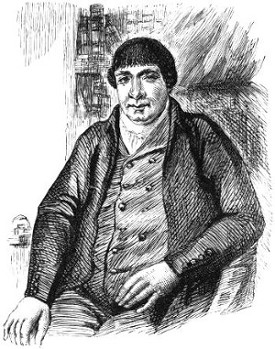
William Huntington. The Coalheaver Preacher.
Huntington, the Preacher.
William Huntington, who, by virtue of his preaching, came to ride in his coach, and marry the titled widow of a Lord Mayor, was no ordinary man. He was born in the year 1774, in the Weald of Kent, between Goudhurst and Cranbrook, where his father was a day-labourer. The boy worked in various ways, and having "a call," he became an Arminian preacher, at the same time that at Thames Ditton he carried coals on the river, at 10s. a week: hence he was generally known as the Coalheaver. He preached inordinately long sermons, sometimes of two hours' duration; his prayers were mostly made up of Scriptural phrases.
It suited the purpose of Huntington to represent himself as living under the special favour of Providence, because he intended to live by it: that is, upon the credulity of those whom he could persuade to believe him: and the history of his success, which he published under the title of God the Guardian of the Poor, and the Bank of Faith; or, a Display of the Providences of God, which have at sundry times, attended the Author, is a production equally singular and curious.
One reason which he gives for writing this marvellous treatise is, that we are often tempted to believe that God takes no notice of our temporal concerns. "I found God's promises," he says, "to be the Christian's bank note; and a living faith will always draw on the divine banker, yea, and the spirit of prayer, and a deep sense of want, will give an heir of promise a filial boldness at the inexhaustible bank of heaven." Accordingly, for great things and for little he drew boldly upon the bank. Thus, he was provided with game and fish. One day, when he had nothing but bread in the house, he was moved by the Spirit to take a by-path, where he had never gone before; but the reason was, that a stoat was to kill a fine large rabbit, just in time for him to secure the prey. When his wife was lying-in, and there was no tea in the house, and they had neither money nor credit, his wife bade the nurse set the kettle on in faith, and before it boiled, a stranger brought a present of tea to the door. At another time, a friend, without solicitation, gives him half-a-guinea when he was penniless; and lest he should have any difficulty in obtaining change for it, when he crossed Kingston bridge, he casts his eyes on the ground, and finds a penny to pay the toll. He borrows a guinea, which he is unable to pay at the time appointed, so he prays that God would send him one from some quarter or another, and forthwith the lender calls and desires him to consider it a free gift. He wants a new parsonic livery: "wherefore," says he, "in humble prayer I told my most blessed Lord and Master that my year was out, and my apparel bad; that I had nowhere to go for these things but to him; and as he had promised to give his servants food and raiment, I hoped he would fulfil his promise to me, though one of the worst of them." So, having settled it in his own mind that a certain person in London would act as the intermediate agent in this providential transaction, he called upon him, and, as he expected, the raggedness of his apparel led to a conversation which ended in the offer of a new suit, and of a greatcoat to boot.
He lived in this manner seven or eight years, not, indeed, taking no thought for the morrow, but making no other provision for it than by letting the specific object of his prayers and their general tendency always be understood, where a word to the unwise was sufficient. Being now in much request, and "having many doors open to him for preaching the Gospel very wide apart," he began to want a horse, then to wish, and lastly to pray, for one. "I used my prayers," he says, "as gunners use their swivels, turning them every day, as various cases required;" before the day was over he was presented with a horse, which had been purchased for him by subscription. The horse was to be maintained by his own means, but what of that? "I told God," says he, "that I had more work for my faith now than heretofore; for the horse would cost half as much to keep as my whole family. In answer to which this Scripture came to my mind with power and comfort, 'Dwell in the land, and do good, and verily thou shalt be fed.' This was a bank-note put into the hand of my faith, which, when I got poor, I pleaded before God, and he answered it; so that I lived and cleared my way just as well when I had my horse to keep as I did before."
Huntington was no ordinary man. The remarkable circumstance which occurred concerning a certain part of his dress has been told in various books. The old song says—
A light heart and a thin pair of breeches Go through the world, my brave boys;
but the latter qualification is better for going through the world on foot than on horseback; so Uncle Toby found it, so did Huntington, who, in this part of his history, must be his own historian: no language but his own can do justice to such a story.
"Having now," says Huntington, "had my horse for some time, and riding a great deal every week, I soon wore my breeches out, as they were not fit to ride in. I hope the reader will excuse my mentioning the word breeches, which I should have avoided, had not this passage of Scripture obtruded into my mind, just as I had revolved in my own thoughts not to mention this kind providence of God. 'And thou shalt make them linen breeches to cover their nakedness; from the loins even unto the thighs shall they reach. And they shall be upon Aaron and upon his sons when they come into the tabernacle of the congregation, or when they come near unto the altar to minister in the holy place; that they bear not iniquity and die. It shall be a statute for ever unto him and his seed after him.' Exod. xxviii. 42, 43. By which, and three others, namely, Ezek. xliv. 18; Lev. vi. 10; and Lev. xiv. 4, I saw that it was no crime to mention the word breeches, nor the way in which God sent them to me; Aaron and his sons being clothed entirely by Providence; and as God himself condescended to give orders what they should be made of, and how they should be cut. And I believe the same God, ordered mine, as I trust will appear in the following history.
"The Scripture tells us to call no man master; for one is our master, even Christ. I therefore told my most bountiful and ever-adored Master what I wanted; and he, who stripped Adam and Eve of their fig-leaved aprons, and made coats of skin, and clothed them; and who clothes the grass of the field, which to-day is and to-morrow is cast into the oven, must clothe us, or we shall go naked; and so Israel found it, when God took away his wool and his flax, which he gave to cover their nakedness, and which they prepared for Baal: for which iniquity was their skirts discovered and their heels made bare. Jer. xiii. 22.
"I often made very free in my prayers with my invaluable Master for this favour; but he still kept me so amazingly poor that I could not get them at any rate. At last I determined to go to a friend of mine at Kingston, who is of that branch of business, to bespeak a pair; and to get him to trust me until my Master sent me the money to pay him. I was that day going to London, fully determined to bespeak them as I rode through the town. However, when I passed the shop, I forgot it; but when I came to London, I called on Mr. Croucher, a shoe-maker in Shepherd's Market, who told me a parcel was left there for me, but what it was he knew not. I opened it, and behold there was a pair of leather breeches, with a note in them! the substance of which was, to the best of my remembrance, as follows:—
"'Sir,—I have sent you a pair of breeches, and hope they will fit. I beg your acceptance of them; and if they want any alteration, leave in a note what the alteration is, and I will call in a few days and alter them.
I. S.'
"I tried them on, and they fitted as well as if I had been measured for them; at which I was amazed, having never been measured by any leather breeches maker in London. I wrote an answer to the note to this effect:—
"'Sir,—I received your present and thank you for it. I was going to order a pair of leather breeches to be made, because I did not know till now that my Master had bespoke them of you. They fit very well, which fully convinces me that the same God who moved thy heart to give, guided thy hand to cut: because He perfectly knows my size, having clothed me in a miraculous manner for near five years. When you are in trouble, Sir, I hope you will tell my Master of this, and what you have done for me, and He will repay you with honour.'
"This is as near as I am able to relate it, and I added:—
"'I cannot make out I. S. unless I put I for Israelite indeed, and S for sincerity; because you did not sound a trumpet before you, as the hypocrites do.'"
The plan of purveying for himself by prayer, with the help of hints in proper place and season, answered so well, that Huntington soon obtained, by the same means, a new bed, a rug, a pair of new blankets, doe-skin gloves, and a horseman's coat; and as often as he wanted new clothes, some chosen almoner of the Bank of Faith was found to supply him. His wife was instructed to provide for her own wants by the same easy and approved means. Gowns came as they were wanted, hampers of bacon and cheese, now and then a large ham, and now and then a guinea, all which things Huntington called precious answers to prayer.
Some awkward disclosures were now made, and he became weary of Thames Ditton, and having a well-timed vision, he secretly wished that God would remove him from that place; and as London was the place where he might reasonably expect to work less and feed better, it was "suddenly impressed on his mind to leave Thames Ditton, and take a house in the great metropolis, where hearers were more numerous, and that this was the meaning of the words spoken to him in the vision." It was likewise suggested to his mind that the people had been permitted of late to persecute him more than usual, that they might drive him to this removal. "And I much question," says Huntington, "if ever God sends his word there again, for I think they are left almost as inexcusable as Chorazin and Capernaum!" The impression which he had now received was acknowledged as a plain and evident call by the good friends who negotiated his bills upon the Bank of Faith, and accordingly to London he and his family went.
His next draft upon the Bank was to a larger amount. During three years he had secretly wished for a chapel of his own, because, as he says, he was sick of the errors that were perpetually broached by some or other in Margaret Street Chapel, where he then preached with Lady Huntingdon's people. Much, however, as he desired this, he protests that he could not ask God for such a favour, thinking it was not to be brought about by one so very mean, low, and poor as himself. But fortune favours the bold. One of his friends looked at a suitable piece of ground, by particular impulse of Providence; and he took Huntington to look at it also. Another friend, under a similar impulse, planned a chapel one day while he was hearing Huntington preach a sermon; and he offered to undertake the management of the building without fee or reward. Thus encouraged, he took the ground and began to build Providence Chapel, when he was 20l. in debt, and had no other funds than the freewill offerings of his hearers, and the money which they were willing to lend him upon his credit with the Bank of Faith. The first offering amounted to no more than 11l., which were soon expended on the foundations. He bespoke a load of timber, and going to the right person for it, it was sent him with a bill and receipt in full as a contribution towards the chapel. Another "good man" came with tears in his eyes to bless Mr. Huntington for the good which he had received under his sermons, and to request that he might paint the pulpit, desk, &c., as a grateful acknowledgment. A bed-room was very handsomely furnished for him that he might not be under the necessity of walking home in the cold winter nights. A looking-glass for his chapel study was presented by one person, a book-case by another, chairs for the vestry, a pulpit cushion, a splendid Bible, a set of china, and a well-stored tea-chest, were supplied in like manner: money was liberally lent as well as given; the chapel "sprang up like a mushroom;" and when it was finished, he says, "I was in arrears for 1,000l., so that I had plenty of work for faith, if I could get plenty of faith to work; and while some deny a Providence, Providence was the only supply I had."
His never-failing friends settled him in a country-house, stocked his garden and his farm for him; and that he might travel conveniently to and from his chapel, they presented him with a coach and pair of horses, and subscribed to pay the taxes for both. To crown all, having buried his wife, the gleaner, he preached himself into the good graces of Lady Saunderson, the widow of the Lord Mayor, and married her.
His uniform prosperity received but one shock. The chapel in Titchfield Street, which he had raised from the ground and carried up into the air, when ground-room was wanting, was burnt down. This was thought by some of Huntington's followers to be a judgment upon him for having inclosed the free seats, and "laid out the whole chapel in boxes like an opera house." But Huntington looked at this misfortune otherwise. Writing to one of his friends, he says: "Such a stroke as this twenty-seven years ago would have caused our hope to give up the ghost; but being a little stronger in the Lord, faith has heavier burdens laid on. The temple built by Solomon, and that built by Cyrus, were both burnt. It will cause a little rejoicing among the Philistines, as has been the case often: they once triumphed gloriously, when the ark of God was taken, supposing that Dagon had overcome the God of Israel; but their joy was short. This I know, that it shall work for our good, but how I know not; if I did, I must walk by sight, and not by faith." He then held out a sort of threat of removing into the country; but his London followers were presently in motion, "some looking out for a spot of ground, some bringing their offerings, others wishing the glory of the latter house may exceed that of the former." "But," says he, "it is to bear the same name: this I gave them to understand from the pulpit, and assigned the following reasons for it:—that unless God provided men to work, and money to pay them, and materials to work with, no chapel could be erected; and, if he provided all these, Providence must be its name." The chapel, accordingly, was built in Gray's Inn Lane, and upon a larger scale than the last: taught by his former experience, Huntington took care not to make himself responsible for any of the expenses, and when it was finished, managed matters so well with his obedient flock, that the chapel was made over to him as his own, for he is said to have refused to preach in it on any other conditions.[28]
The preacher had innumerable applicants for spiritual advice. To one person who consults him, he says:—"You need not have made any apology, as the troubled minds of sensible sinners are my peculiar province. I am authorised and commissioned by the God of heaven to transact business and negotiate affairs between the King of kings and self-condemned rebels." One madman assures him that he was actually electrified in body and soul by one of his books. This man saw a brilliant star over the head of Huntington while he was preaching, and Huntington publishes the letter and assures him that dreams (of which he has communicated a curious story) are from the Spirit of God. Sometimes he found that correspondents were troublesome, new-born babes being never satisfied when they desire the sincere milk of the word. A certain Mrs. Bull writes to him rather more frequently than is agreeable. Huntington lets Mrs. Bull know that he does not like her head-dress; he finds fault with her preposterous streamers, and her first, second, and third tier of curls; but tells her that a little more furnace-work will teach her to pull down those useless topsails. This prediction was verified rather more literally than it was meant, for the said Mrs. B., thinking it was not his business to interfere with her head-dress, was about to resent it in a sharp letter; "but," says she, "happening to fall asleep by the fire, as I was reading the Bible, the candle caught the lappet of my cap, and a good deal of my hair, and I own it a great mercy that I was not consumed myself, and you may be assured that you will see neither streamers, curls, nor topsails again."
Mr. Bramah, the celebrated engineer, appears among Huntington's controversial correspondents; and he tells him that he makes a good patent lock, but cuts a poor figure with the keys of the kingdom of heaven.
Mr. Bensley, the printer, was one of his believers, which explains the handsome appearance of Huntington's collected works, in twenty volumes, octavo; his spiritual employer calls him dear brother in the Lord, and dear Tom in the flesh. Trader in faith as he was, there were some social qualities about him which won and secured the attachment of his friends, even of those upon whom he drew most largely. He mentions particularly Mr. and Mrs. Baker, of Oxford Street, who, having no children of their own, kept caring and travailing many years for him; and though "sorely tried by various losses in business, bankruptcies, and bad debts, supplied him with money whenever he required it." "While the chapel was building," he says, "when money was continually demanded, if there was one shilling in the house, I was sure to have it." This couple and another, with whom he was on terms of equal intimacy, agreed, as they were bound together with their chosen pastor for life and for eternity, not to be divided in death; and accordingly they jointly purchased a piece of ground near Petersham, and erected a substantial tomb there, wherein they might rest together in the dust.