DELUSIONS, IMPOSTURES, and FANATIC MISSIONS.
Reading edition
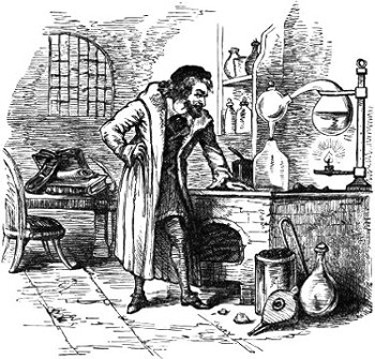
The Alchemist.
Modern Alchemists.
IT may take some readers by surprise to learn that there have been true believers in alchemy in our days. Dr. Price is commonly set down in popular journals as the last of the alchemists. This is, however, a mistake, as we shall proceed to show; before which, however, it will be interesting to sketch the history of this reputed alchemist.
Towards the close of the last century, Dr. James Price, a medical practitioner in the neighbourhood of Guildford, Surrey, acquired some notoriety by an alleged discovery of methods of transmuting mercury into gold or silver. He had been a student of Oriel College, Oxford, where he obtained the degree of Bachelor of Physic. In 1782 he published an account of his experiments on mercury, silver, and gold, performed at Guildford, in that year, before Lord King and others, to whom he appealed as eye-witnesses of his wonder-working power. It seems that mercury being put into a crucible, and heated in the fire with other ingredients (which had been shown to contain no gold), he added a red powder; the crucible was again heated, and being suffered to cool, amongst its contents, on examination, was found a globule of pure gold. By a similar process with a white powder, he produced a globule of silver. The character of the witnesses of these manifestations gave credit and celebrity for a time to Price, who was honoured by the University with the degree of Doctor of Physic, and he was also elected a Fellow of the Royal Society. Dr. Price had now placed himself in a perilous position; for persons acquainted with the history of alchemy must have conjectured how the gold and silver in his experiments might have been procured with any transmutation of mercury or any other substance. The Royal Society authoritatively required that the pretensions of the new associate should be properly sifted, and his claim as a discoverer be clearly established, or his character as an impostor exposed. A repetition of the doctor's experiments before a committee of the Royal Society was commanded on pain of expulsion; when the unfortunate man, rather than submit to the ordeal, took a draught of laurel-water, and died on July 31, 1783, in his twenty-fifth year.
At the beginning of the present century, some persons of eminence in science thought favourably of alchemy. Professor Robinson, writing to James Watt, February 11, 1800, says, "The analysis of alkalies and alkaline earth will presently lead, I think, to a doctrine of a reciprocal convertibility of all things into all ... and I expect to see alchemy revive, and be as universally studied as ever."
Sir Walter Scott, in his well-known paper on Astrology and Alchemy, in The Quarterly Review, tells us that about the year 1801, an adept lived, or rather starved, in the metropolis, in the person of the editor of an evening newspaper, who expected to compound the alkahat, if he could only keep his materials digested in his lamp-furnace for the space of seven years. Scott adds, in pleasant banter, "the lamp burnt brightly during six years, eleven months, and some odd days, and then unluckily it went out. Why it went out, the adept could never guess; but he was certain that if the flame could only have burnt to the end of the septenary cycle, the experiment must have succeeded."
The last true believer in alchemy was not Dr. Price, but Peter Woulfe, the eminent chemist, and Fellow of the Royal Society, and who made experiments to show the nature of mosaic gold. Mr. Brande says: "It is to be regretted that no biographical memoir has been preserved of Woulfe. I have picked up a few anecdotes respecting him from two or three friends who were his acquaintance. He occupied chambers in Barnard's Inn, Holborn (the older buildings), while residing in London, and usually spent the summer in Paris. His rooms, which were extensive, were so filled with furnaces and apparatus that it was difficult to reach his fireside. A friend told me that he once put down his hat, and never could find it again, such was the confusion of boxes, packages, and parcels that lay about the chamber. His breakfast-hour was four in the morning; a few of his select friends were occasionally invited to this repast, to whom a secret signal was given by which they gained entrance, knocking a certain number of times at the inner door of his apartment. He had long vainly searched for the Elixir, and attributed his repeated failures to the want of due preparation by pious and charitable acts. I understand that some of his apparatus is still extant, upon which are supplications for success and for the welfare of the adepts. Whenever he wished to break an acquaintance, or felt himself offended, he resented the supposed injury by sending a present to the offender, and never seeing him afterwards. These presents were sometimes of a curious description, and consisted usually of some expensive chemical product or preparation. He had an heroic remedy for illness; when he felt himself seriously indisposed, he took a place in the Edinburgh mail, and having reached that city, immediately came back in the returning coach to London."
A cold taken in one of these expeditions terminated in inflammation of the lungs, of which Woulfe died in the year 1805. Of his last moments we received the following account from his executor, then Treasurer of Barnard's Inn. By Woulfe's desire, his laundress shut up his chambers, and left him, but returned at midnight, when Woulfe was still alive. Next morning, however, she found him dead! His countenance was calm and serene, and apparently he had not moved from the position in his chair in which she had last left him.
Twenty years after the death of Peter Woulfe, Sir Richard Phillips visited "an alchemist" named Kellerman, at the village of Lilley, between Luton and Hitchin. He was believed by some of his neighbours to have discovered the Philosopher's Stone and the Universal Solvent. His room was a realisation of the well-known picture of Tenier's Alchemist. The floor was strewed with retorts, crucibles, alembics, jars, and bottles of various shapes, intermingled with old books. He gave Sir Richard a history of his studies, mentioned some men in London who, he alleged, had assured him that they had made gold; that having, in consequence, examined the works of the ancient alchemists, and discovered the key which they had studiously concealed from the multitude, he had pursued their system under the influence of new lights; and, after suffering numerous disappointments, owing to the ambiguity with which they described their processes, he had at length happily succeeded; had made gold, and could make as much more as he pleased, even to the extent of paying off the National Debt in the coin of the realm!
Killerman then enlarged upon the merits of the ancient alchemists, and on the blunders and assumptions of modern chemists. He quoted Roger and Francis Bacon, Paracelsus, Boyle, Boerhaave, Woulfe, and others to justify his pursuits. As to the term Philosopher's Stone, he alleged that it was a mere figure to deceive the vulgar. He appeared to give full credit to the silly story of Dee's finding the Elixir at Glastonbury, by means of which, as he said, Kelly for a length of time supported himself in princely splendour. Kellerman added, that he had discovered the blacker than black of Apollonius Tyanus: it was itself "the powder of projection for producing gold."
It further appeared that Kellerman had lived in the premises at Lilley for twenty-three years, during fourteen of which he had pursued his alchemical studies with unremitting ardour, keeping eight assistants for superintending his crucibles, two at a time, relieving each other every six hours; that he had exposed some preparations to intense heat for many months at a time; but that all except one crucible had burst, and that, Kellerman said, contained the true "blacker than black." One of his assistants, however, protested that no gold had ever been found, and that no mercury had ever been fixed; for he was quite sure Kellerman could not have concealed it from his assistants; while, on the contrary, they witnessed his severe disappointment at the result of his most elaborate experiments.
Of late years there have been some strange revivals of alchemical pursuits. In 1850 there was printed in London a volume of considerable extent, entitled, A Suggestive Inquiry into the Hermetic Mystery—the work of a lady, by whom it has been suppressed; we have seen it described as "a learned and valuable book."
By this circumstance we are reminded that some five-and-thirty years since it came to our knowledge that a man of wealth and position in the City of London, an adept in alchemy, was held in terrorem by an unprincipled person, who extorted from him considerable sums of money under threats of exposure, which would have affected his mercantile interests.
Nevertheless, alchemy has, in the present day, its prophetic advocates, who predict what may be considered a return to its strangest belief. A Göttingen professor says, in the Annales de Chimie, No. 100, that in the nineteenth century the transmutation of metals will be generally known and practised. Every chemist and every artist will make gold; kitchen utensils will be of silver and even gold, which will contribute more than anything else to prolong life, poisoned at present by the oxide of copper, lead, and iron which we daily swallow with our food. More recently, MM. Dr. Henri Fabre and Franz have placed before the French Academy their discovery of the means of transmuting silver, copper, and quicksilver into gold.
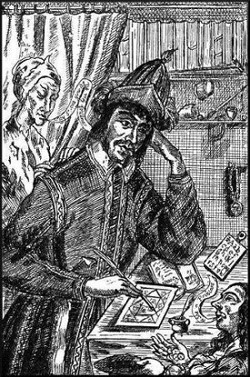
Jack Adams, the Astrologer
Magnifico Smokentissimo Custardissimo Astrologissimo Cunningmanisso Rabbinissimo Viro Jacko Adams de Clerkenwell Greeno hanc lovelissimam Sui Picturam.
Hovbedeboody pinxit et scratchabat.
Jack Adams, the Astrologer.
Among the celebrities of Clerkenwell Green was Jack Adams, whose nativity was calculated by Partridge, who affirmed that he was born on the 3rd of December, 1625, and that he was so great a natural, or simpleton, as to be obliged to wear long coats, besides other marks of stupidity; and that the parish not only maintained him, but allowed a nurse to attend him to preserve him from harm. Allusion is made to him in a satirical ballad of 1655:—
Jack Adams, sure, was pamet (poet) by the vein.
And in the Wits, or Sport upon Sport, 1682, we read of his visit to the Red Bull playhouse, where Simpleton, the smith, appearing on the stage with a large piece of bread-and-butter, Jack Adams, knowing him, cried out, "Cuz, Cuz, give me some," to the great pleasure of the audience. Ward thus mentions his celebrity:—
What mortal that has sense or thought Would strip Jack Adams of his coat; Or who would be by friends decoyed To wear a badge he would avoid?
Jack Adams was a conjurer and professor of the celestial sciences; he was (says Granger's Supplement) "a blind buzzard, who pretended to have the eyes of an eagle. He was chiefly employed in horary questions, relative to love and marriage, and knew, upon proper occasions, how to soothe and flatter the expectations of those who consulted him, as a man might have much better fortune from him for five guineas than for the same number of shillings. He affected a singular dress, and cast horoscopes with great solemnity. When he failed in his predictions, he declared that the stars did not absolutely force, but powerfully incline, and threw the blame upon wayward and perverse fate. He assumed the character of a learned and cunning man; but was no otherwise cunning than as he knew how to overreach those credulous mortals who were as willing to be cheated as he was to cheat them, and who relied implicitly upon his art." Mr. Warner says: "A short time after we removed into the house (No. 7, Clerkenwell Green), two young women applied to have their fortunes told; upon being informed they were under some mistake, one expressed great surprise, and stated that was the place she always came to, and she thought some of Mr. Adams's family always resided there. This was the first time I ever heard anything of Jack Adams. Several similar applications were made by other persons, and we afterwards learnt that it had been occupied by persons of that profession for many years, and they generally went by the name of Adams."[15]
In an old print we have Jack Adams in a fantastic dress, with a tobacco-pipe in his girdle, standing at a table on which lies a horn-book and Poor Robin's Almanack. On one shelf is a row of books, and on another several boys' playthings, particularly tops, marbles, and a small drum. Before him is a man genteelly dressed, presenting five pieces; from his mouth proceeds a label, inscribed, "Is she a princess?" This is meant for Carleton, who married the pretended German princess. Behind him is a ragged, slatternly woman, who has also a label in her mouth, with these words: "Sir, can you tell my fortune?" In Poor Robin's Almanack for 1785 are these lines:
Now should I choose t'invoke a Muse— Muses are fickle madams; Else I could go my poem through Ere you could say Jack Adams.
In the City of London Library is an original print of Jack Adams, and a copy by Caulfield.
The Woman-hating Cavendish.
Eccentricity in men of science is not rare. The Hon. Henry Cavendish, who demonstrated, in 1781, the composition of water, was a remarkable instance. He was an excellent mathematician, electrician, astronomer, and geologist; and as alchemist shot far ahead of his contemporaries. But he was a sort of methodical recluse, and an enormous fortune left him by his uncle did little to change his habits. His shyness and aversion to society bordered on disease. To be looked at or addressed by a stranger seemed to give him positive pain, when he would dart away as if hurt. At Sir Joseph Banks's soirées he would stand for a long time on the landing, afraid to face the company. At one of these parties the titles and qualifications of Cavendish were formally recited when he was introduced to an Austrian gentleman. The Austrian became complimentary, saying his chief reason for coming to London was to see and converse with Cavendish, one of the greatest ornaments of the age, and one of the most illustrious philosophers that ever existed. Cavendish answered not a word, but stood with his eyes cast down, abashed, and in misery. At last, seeing an opening in the crowd, he flew to the door, nor did he stop till he reached his carriage and drove directly home. Any attempt to draw him into conversation was almost certain to fail, and Dr. Wollaston's recipe for treating with him usually answered best: "The way to talk to Cavendish is, never to look at him, but to talk as if it were into a vacancy, and then it is not unlikely you may set him going."
Among the anecdotes which floated about it is related that Cavendish, the club Crœsus, attended the meetings of the Royal Society Club with only money enough in his pocket to pay for his dinner; that he declined taking tavern soup, picked his teeth with a fork, invariably hung his hat upon the same peg, and always stuck his cane in his right boot. More apocryphal is the anecdote that one evening Cavendish observed a pretty girl looking out from an upper window on the opposite side of the street, watching the philosophers at dinner. She attracted notice, and one by one they got up, and mustered round the window to admire the fair one. Cavendish, who thought they were looking at the moon, bustled up to them in his odd way, and when he saw the real object of attraction, turned away with intense disgust, and grunted out "Pshaw!" the more amorous conduct of his brother philosophers having horrified the woman-hating Cavendish.
If men were a trouble to him, women were an abhorrence. With his housekeeper he generally communicated with notes deposited on the hall-table. He would never see a female servant; and if an unlucky maid showed herself she was instantly dismissed. To prevent inevitable encounters he had a second staircase erected in his villa at Clapham. In all his habits he was punctiliously regular, even to his hanging his hat upon the same peg. From an unvarying walk he was, however, driven by being gazed at. Two ladies led a gentleman on his track, in order that he might obtain a sight of the philosopher. As he was getting over a stile he saw, to his horror, that he was being watched, and he never appeared in that path again. That he was not quite merciless to the sex was proved by his saving a lady from the pursuit of a mad cow.
Cavendish's town house was near the British Museum, at the corner of Gower Street and Montague Place. Few visitors were admitted, and those who crossed the threshold reported that books and apparatus were its chief furniture. He collected a large library of scientific books, hired a house for its reception in Dean Street, Soho, and kept a librarian. When he wanted one of his own books, he went there as to a circulating library, and left a formal receipt for whatever he took away. Nearly the whole of his villa at Clapham was occupied as workshops; the upper rooms were an observatory, the drawing-room was a laboratory. On the lawn was a wooden stage, from which access could be had to a large tree, to the top of which Cavendish, in the course of his astronomical and meteorological observations, and electrical experiments, occasionally ascended. His apparatus was roughly constructed, but was always exact and accurate.
His household was strangely managed. He received but little company, and the few guests were treated on all occasions to the same fare—a leg of mutton. One day, four scientific friends were to dine with him; when his housekeeper asked him what was to be got for dinner, Cavendish replied, "A leg of mutton."
"Sir," said she, "that will not be enough for five."
"Well, then, get two," was the reply.
Cavendish extended his eccentric reception to his own family. His heir, Lord George Cavendish, visited him once a-year, and was allowed an audience of but half-an-hour. His great income was allowed to accumulate without attention. The bankers where he kept his account, finding they had in hand a balance of 80,000l., apprised him of the same. The messenger was announced, and Cavendish, in great agitation, desired him to be sent up; and, as he entered the room, the ruffled philosopher cried, "What do you come here for! what do you want with me?"
"Sir, I thought it proper to wait upon you, as we have a very large balance in hand of yours, and we wish your orders respecting it."
"If it is any trouble to you, I will take it out of your hands. Do not come here to plague me!"
"Not the least trouble to us, sir, not the least; but we thought you might like some of it to be invested."
"Well, well, what do you want to do?"
"Perhaps you would like 40,000l. invested."
"Do so, do so! and don't come here to trouble me, or I'll remove it," was the churlish finale of the interview.
Cavendish died in 1810, at the age of seventy-eight. He was then the largest holder of Bank-stock in England. He owned 1,157,000l. in different public funds; he had besides, freehold property of 8,000l. a-year, and a balance of 50,000l. at his bankers. He was long a member of the Royal Society Club, and it was reported at his death that he had left a thumping legacy to Lord Bessborough, in gratitude for his Lordship's piquant conversation at the club meetings; but no such reason can be found in the will lodged at Doctors' Commons. Therein, Cavendish names three of his club-mates—namely, Alexander Dalrymple to receive 5,000l., Dr. Hunter 5,000l., and Sir Charles Blagden (coadjutor in the water question) 15,000l. After certain other bequests, the will proceeds: "The remainder of the funds (nearly 100,000l.) to be divided: one-sixth to the Earl of Bessborough," while Lord George Henry Cavendish had two-sixths instead of one. "It is, therefore," says Admiral Smyth, in his History of the Royal Society Club, "patent that the money thus passed over from uncle to nephew was a mere consequence of relationship, and not at all owing to any flowers or powers of conversation at the Royal Society Club."
Cavendish never changed the fashion or cut of his dress, so that his appearance in 1810, in a costume of sixty years previously, was odd, and drew upon him the notice which he so much disliked. His complexion was fair, his temperament nervous, and his voice squeaking. The only portrait that exists of him was sketched without his knowledge. Dr. George Wilson, who has left a clever memoir of Cavendish, says: "An intellectual head, thinking—a pair of wonderful acute eyes, observing—a pair of very skilful hands, experimenting or recording, are all that I realize in reading his memorials."
Modern Astrology.—"Witch Pickles."
It would be an acquisition to our knowledge if some one competent to the task would collect materials for the history of the men who, within the present century, have made a profession of judicial astrology. Attention is occasionally drawn to the practices of itinerant fortune-tellers, many of whom still procure a livelihood. The astrologer, however, or, as he is denominated in some districts of England—more particularly in Yorkshire—a "planet-ruler," and sometimes "a wise man," is of a higher order. He does not itinerate, is generally a man of some education, possessed of a good deal of fragmentary knowledge and a smattering of science. He very often conceals his real profession by practising as a "Water Doctor" or as a "Bone-setter," and some possess a considerable amount of skill in the treatment of ordinary diseases.
The more lucrative part of his business was that which they carried on in a secret way. He was consulted in cases of difficulty by a class of superstitious persons, and an implicit faith was placed in his statements and predictions. The "wise man" was sought in all cases of accident, disaster, or loss. He was consulted as to the probabilities of the return and safety of the distant and the absent; of the chances of the recovery of the sick, and of the destiny of some beloved friend or relative. The consultation with such a man would often have a sinister aim; to discover by the stars whether an obnoxious husband would survive, or whether the affections of courted or inconstant lover could be secured. Very often long-continued diseases and inveterate maladies were ascribed to an "ill-wish;" and the planet-ruler was sought to discover who was the ill-wisher, and what charm would remove the spell. It is needless to say that the practices of these astrologers were productive, in a large number of cases, of much disturbance among neighbours and relatives, and great mischief to all concerned, except the man who profited by the credulity of his dupes.
Some of these charlatans no doubt were believers in the imposture, but the greater number were arrant cheats. In Leeds and its neighbourhood there were, some five-and-thirty years ago, several "wise men." Among the number was a man known by no other name than that of "Witch Pickles." He was avowedly an Astrological Doctor, and ruled the planets for those who sought him for that purpose. He dwelt in a retired house on the road from Leeds to York, about a mile from the Shoulder of Mutton public-house, at the top of March Lane. His celebrity extended for above fifty miles, and persons came from the Yorkshire Wolds to consult him. The man and the house were held in awe by boys and even older persons who had belief in his powers. Little was known of his habits, and he had few visitors but those who sought his professional assistance. He never committed anything to writing. He was particular in inquiring into all the circumstances of any case on which he was consulted before he pronounced. He then, as he termed it, proceeded to draw a figure, in order to discover the conjunction of the planets, and then entered upon the explanation of what the stars predicted. Strange things were told of him, such as that he performed incantations at midnight on certain days in the year when particular planets were in the ascendant; and that on such occasions strange sights and sounds would be seen and heard by persons passing the house. These were the embellishments of vulgar rumour. The man was quiet and inoffensive in his demeanour, and was fully sensible of the necessity of a life of seclusion. He is believed to have practised a few tricks to awe his visitors, such as lighting a candle or fire without visible agency, and other tricks far more ingenious than the modern table-rapping.
"Witch Pickles" was only one among the number who derived a large profit from this kind of occupation. He was one of the more respectable of the class, as he never descended to the vile tricks of others of the profession—tricks practised upon weak and credulous women and girls—which will not bear description.[16]
One of the most celebrated works on Astrology is that of Dr. Sibly, twelfth edition, 1817, in two octavo volumes, containing more than eleven hundred pages. The following will give an idea of the pretensions of the book, which is a remarkable book, if it really went through twelve editions. The owner of a privateer, which had not been heard of, called to know her fate. Dr. Sibly gave judgment on a figure "rectified to the precise time the question was propounded. The ship itself appeared well formed and substantial, but not a swift sailer, as is demonstrated by an earthy sign possessing the cusp of the ascendant, and the situation of the Dragon's Head in five degrees of the same sign." The ship itself was pronounced to have been captured.
"From the whole account it is clear that Dr. Sibly's system—how now esteemed by astrologers the writer knows not—has but this alternative: either one and the same figure will tell the fate of all the ships which have not been heard of, including their sailing qualities, or the stars will never send an owner to ask for news except just at the moment when they are in a position to describe this particular ship."[17]
Hannah Green; or, "Ling Bob."
This noted sibyl lived in a cottage on the edge of the moor on the left of the old road from Otley to Bradford, between Carlton and Yeadon, and eight miles from Leeds. She was popularly known as "The Ling-bob Witch," a name given her, it is supposed, from her living among the ling-bobs, or heather-tubs. She was resorted to on account of her supposed knowledge of future events; but, like the rest of her class, her principal forte was fortune-telling, from which it is said she for herself realized a handsome fortune.
Many strange tales have been told of her; such as her power of transforming herself, after nightfall, into the shape of any she list; and of her odd pranks in her nightly rambles, her favourite character being that of the hare, in which personation she was unluckily shot by an unsuspecting poacher, who was almost terrified out of his senses by the awful screams which followed the sudden death of the Ling-bob witch.
In the year 1785, D——, of Sheffield, being at Leeds, had the curiosity to pay a visit to the noted Hannah Green. He first questioned her respecting the future fortunes of a near relative of his, who was then in circumstances of distress, and indeed in prison. She told him immediately that his friend's trouble would continue full three times three years, and he would then experience a great deliverance, which, in fact, was on the point of being literally verified, for he was then in the Court of King's Bench.
He then asked her if she possessed any foreknowledge of what was about to come to pass on the great stage of the world; to which she replied in the affirmative. She said, war would be threatened once, but would not happen; but the second time it would blaze out in all its horrors, and extend to all the neighbouring countries; and that the two countries [these appear to be France and Poland], at a great distance one from the other, would in consequence obtain their freedom, although after hard struggles. After the year 1790, she observed, many great persons, even kings and queens, would lose their lives, and that not by fair means. In 1794, a great warrior of high blood is to fall in the field of battle; and in 1795, a distant nation [thought to be negro slaves], who have been dragged from their own country, will rise as one man, and deliver themselves from their oppressors.
Hannah appears to have been one of a somewhat numerous class, many of whom were resident in Yorkshire. Very few of them went beyond the attempt to foretell the future events in the lives of individuals; they did not work with such high ambition as drawing the horoscopes of nations. Their predictions were always vague, and so framed as to cover a number of the most probable events in the life of every individual.
Hannah really died on the 12th of May, 1810, after having practised her art about forty years; and Ling-bob became a haunted and dreaded place. The house remained some years untenanted and ruinous, but was afterwards repaired and occupied. Her daughter and successor, Hannah Spence, laid claim to the same prescience, but it need hardly be added, without the same success.[18]
Oddities of Lady Hester Stanhope.
This eccentric lady, grand-daughter of the great Lord Chatham, held implicit faith in the influence of the stars on the destiny of men, a notion from which every crowned head in Europe is not, at this day, exempt.
Lady Hester brought her theories into a striking though rather ridiculous system. She had a remarkable talent for divining characters by the conformation of men. This every traveller could testify who had visited her in Syria; for it was after she went to live in solitude that her penetration became so extraordinary. It was founded both on the features of the face and on the shape of the head, body, and limbs. Some indications she went by were taken from a resemblance to animals; and wherever such indications existed, she inferred that the dispositions peculiar to those animals were to be found in the person. But, independent of all this, her doctrine was that every creature is governed by the star under whose influence it was born.
"Animal magnetism," said Lady Hester, "is nothing but the sympathy of our stars. Those fools who go about magnetizing indifferently one person and another, why do they sometimes succeed and sometimes fail? Because if they meet with those of the same star with themselves, their results will be satisfactory; but with opposite stars they can do nothing."
"What Lady Hester's own star was," says her physician, "may be gathered from what she said one day, when, having dwelt a long time on this her favourite subject, she got up from the sofa, and approaching the window, she called me. 'Look,' said she, 'at the pupil of my eyes; there! my star is the sun—all sun—it is in my eyes: when the sun is a person's star it attracts everything.' I looked, and I replied that I saw a rim of yellow round the pupil. 'A rim!' cried she; 'it isn't a rim—it's a sun; there's a disk, and from it go rays all around: 'tis no more of a rim than you are. Nobody has got eyes like mine.'"
Lady Hester delighted in anecdotes that went to show how much and how justly we may be biassed in our opinions by the shape of any particular part of a person's body independent of the face. She used to tell a story of ——, who fell in love with a lady on a glimpse of those charms which gave such renown to the Onidian Venus. This lady, luckily or unluckily, happened to tumble from her horse, and by that singular accident fixed the gazer's affections irrevocably. Another gentleman, whom she knew, saw a lady at Rome get out of a carriage, her head being covered by an umbrella, which the servant held over her on account of the rain; and seeing nothing but her foot and leg, swore he would marry her—which he did.
Lady Hester delighted in prophecies some of which, with their fulfilments and non-fulfilments, are very amusing. There is reason to think, from what her ladyship let fall at different times, that Brothers, the fortune-teller in England, and Metta, a village doctor on Mount Lebanon, had considerable influence on her actions and, perhaps, her destiny. When Brothers was taken up and thrown into prison (in Mr. Pitt's time), he told those who arrested him to do the will of heaven, but first to let him see Lady Hester Stanhope. This was repeated to her ladyship, and curiosity induced her to comply with the man's request. Brothers told her that "she would one day go to Jerusalem and lead back the chosen people; that on her arrival in the Holy Land, mighty changes would take place in the world, and that she would pass seven years in the desert." Trivial circumstances will foster a foolish belief in a mind disposed to encourage it. Mr. Frederick North, afterwards Lord Guildford, in the course of his travels came to Brusa, where Lady Hester had gone for the benefit of the hot baths. He, Mr. Fazakerley, and Mr. Gally Knight would often banter her on her future greatness among the Jews. "Well, madam, you must go to Jerusalem. Hester, Queen of the Jews! Hester, Queen of the Jews!" was echoed from one to another; and probably at last the coincidence of a name, a prophecy, and the country towards which she found herself going, were thought, even by herself, to be something extraordinary. Metta took up the book of fate from that time and showed her the part she was to play in the East. This man, Metta, for some years subsequent to 1815, was in her service as a kind of steward. He was advanced in years, and, like the rest of the Syrians, believed in astrology, spirits, and prophecy. No doubt he perceived in Lady Hester Stanhope a tincture of the same belief; and on some occasion in conversation he said he knew of a book on prophecy which he thought had passages in it that related to her. This book, he persuaded her, could only be had by a fortunate conjunction connected with himself; and he said if she would only lend him a good horse to take him to the place where it was, he would procure her a sight of it, but she was never to ask where he fetched it from. All this exactly suited Lady Hester's love of mystery. A horse was granted to him; he went off and returned with a prophetic volume which he said he could only keep a certain number of hours. It was written in Arabic, and he was to read and explain the text. The part which he propounded was, "That a European female would come and live on Mount Lebanon at a certain epoch, would build a house there, and would obtain power and influence greater than a sultan's; that a boy without a father would join her; that the coming of the Mahedi would follow, but be preceded by war, pestilence, famine, and other calamities; that the Mahedi would ride a horse born saddled, and that a woman would come from a far country to partake in the mission." There were many other incidents besides which were told.
"The boy without a father" was thought by Lady Hester to be the Duke of Reichstadt; but when he died, not at all discountenanced, she fixed on some one else. Another portion of the prophecy was not so disappointing, for in 1835 the Baroness de Feriat, an English lady residing in the United States, wrote of her own accord, asking to come and live with her, "When," remarks the discriminating doctor, "the prophecy was fulfilled." For the fulfilment of the remainder of the prophecy, Lady Hester was resolved at least not to be unprepared. She kept with the greatest care two mares, called Laïla and Lulu; the latter for Lady Hester herself, and the former, which was "born saddled," or in other words of a peculiar hollow-backed breed, was for the Murdah or Mahedi, the coming of whom she had brought herself to expect, by the words of St. John, "There is one shall come after me who is greater than I." These mares she cherished with care equal to that paid by the ancient Egyptians to cats; and she would not allow them to be seen by strangers, except by those whose stars would not be baneful to cattle.
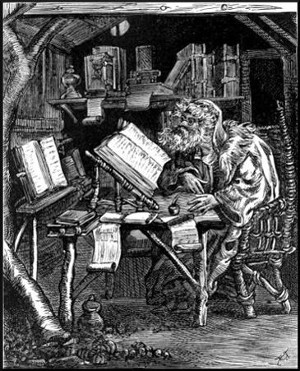
A Hermit of the Sixteenth Century.
Hermits and Eremitical Life.
Men have, in most times, withdrawn themselves from the world and taken up their abode in caverns or ruins, or whatever shelter they could find, and lived on herbs, roots, coarse bread and water. In many cases, such persons have deemed these austerities as acceptable to God, and this has become one of the rudest forms of monastic life. It is not from this class of persons that we propose to introduce a few portraits of hermit life, but rather to those whose peculiarities have taken a more eccentric turn, almost in our own time.
The Hon. Charles Hamilton, in the reign of George II., proprietor of Pain's Hill, near Cobham, Surrey, built a hermitage upon a steep brow in the grounds of that beautiful seat. Of this hermitage Horace Walpole remarks that it is a sort of ornament whose merit soonest fades, it being almost comic to set aside a quarter of one's garden to be melancholy in. There is an upper apartment supported in part by contorted logs and roots of trees, which form the entrance to the cell, but the unfurnished and neglected state of the whole proves the justness of Walpole's observation. Mr. Hamilton advertised for a person who was willing to become a hermit in that beautiful retreat of his. The conditions were that he was to continue in the hermitage seven years, where he should be provided with a Bible, optical glasses, a mat for his bed, a hassock for his pillow, an hour-glass for his timepiece, water for his beverage, food from the house, but never to exchange a syllable with the servant. He was to wear a camlet robe, never to cut his beard or nails, nor ever to stray beyond the limits of the grounds. If he lived there, under all these restrictions, till the end of the term, he was to receive seven hundred guineas. But on breach of any of them, or if he quitted the place any time previous to that term, the whole was to be forfeited. One person attempted it, but a three weeks' trial cured him.
A Correspondent of Notes and Queries describes a gentleman near Preston, Lancashire, as more successful in the above eccentricity. He advertised a reward of 50l. a year for life to any man who would undertake to live seven years underground, without seeing anything human; and to let his toe and finger nails grow, with his hair and beard, during the whole time. Apartments were prepared underground, very commodious, with a cold bath, a chamber organ, as many books as the occupier pleased, and provisions served from his own table. Whenever the recluse wanted any convenience he was to ring a bell, and it was provided for him. Singular as this residence may appear, an occupier offered himself, and actually stayed in it, observing the required conditions, for four years.
In the year 1863 there was living in the village of Newton Burgoland, near Ashby-de-la-Zouch, Leicestershire, a hermit whose real name was scarcely known, though he had resided there nearly fifteen years. Yet he was no recluse, no ascetic, but lived comfortably, and enjoyed his dinner, his beer, and his pipe; and, according to his own definition, he was entitled to be called a hermit. "True hermits," he said, "throughout every age, have been the firm abettors of freedom." As regarded his appearance, his fancies, and his habits, he was a hermit, a solitaire in the midst of human beings. He wore a long beard, and had a very venerable appearance. He was very fantastic in his dress, and had a multitude of suits. He had no less than twenty different kinds of hats, each with its own name and form, with some emblem or motto on it—sometimes both. Here are a few examples:—
No. Name Motto or Emblem
1 Odd Fellows Without money, without friends, without credit.
5 Bellows Blow the flames of freedom with God's word of truth.
7 Helmet Will fight for the birthright of conscience, love, life, property, and national independence.
13 Patent Teapot To draw out the flavour of the tea best—Union and Goodwill.
17 Wash-basin of Reform White-washed face and collyed heart.
20 The toils of industry are sweet; a wise people live at peace.
The shapes of the hats and the devices on them were intended to symbolize some important fact or sentiment.
He had twelve suits of clothes, each with a peculiar name, differing from the others, and, like his hats, intended to be emblematical. One dress, which he called "Odd Fellows," was of white cotton or linen. It hung loosely over the body, except being bound round the waist with a white girdle buckled in the front. Over his left breast was a heart-shaped badge, bearing the words, "Liberty of Conscience," which he called his "Order of the Star." The hat which he wore with the dress was nearly white, and of common shape, but had on it four fanciful devices, bound with black ribbon, and inscribed, severally, with these words: "Bless, feed—good allowance—well clothed—all workingmen."
Another dress, which he called "Foresters," was a kind of frock-coat, made of soft brown leather, slightly embroidered with braid. This coat was closed down the front with white buttons, and bound round the waist with a white girdle, fastened with a white buckle. The hat, slightly resembling a turban, was divided into black and white stripes, running round it.
Another dress, which he named "Military," had some resemblance to the military costume at the beginning of the present century; the hat was between the old-fashioned cocked-hat and that worn by military commanders; but, instead of the military plume, it had two upright peaks on the crown, not unlike the tips of a horse's ears. This hat, which he asserted cost five pounds, he never wore but on important occasions.
A mania for symbolization pervaded all his thoughts and doings. His garden was a complete collection of emblems. The trees—the walks—the squares—the beds—the flowers—the seats and arbours—were all symbolically arranged. In the passage leading into the garden were "the three seats of Self-Inquiry," each inscribed with one of these questions: "Am I vile?" "Am I a Hypocrite?" "Am I a Christian?" Among the emblems and mottoes which were marked by different coloured pebbles or flowers were these:—"The vessels of the Tabernacle;" "The Christian's Armour—olive-branch, baptismal-font, breastplate of righteousness, shield of faith," &c. "Mount Pisgah;" a circle enclosing the motto, "Eternal Love has wed my Soul;" "A Beehive;" "A Church;" "Sacred Urn;" "Universal Grave;" "Bed of Diamonds;" "A Heart, enclosing the Rose of Sharon." All the Implements used in Gardening: "The two Hearts' Bowers;" "The Lovers' Prayer;" "Conjugal Bliss;" "The Hermit's Coat-of-Arms;" "Gossips' Court," with motto, "Don't tell anybody!" "The Kitchen-walk" contains representations of culinary utensils, with mottoes. "Feast Square" contains, "Venison Pasty;" "Round of Beef," &c. "The Odd Fellows' Square," with "The Hen-pecked Husband put on Water-gruel." "The Oratory," with various mottoes; "The Orchestry," mottoes, "God save our Noble Queen;" "Britons never shall be Slaves," &c. "The Sand-glass of Time;" "The Assembly-room;" "The Wedding-Walk;" "The Holy Mount;" "Noah's Ark;" "Rainbow;" "Jacob's Ladder," &c. "The Bank of Faith;" "The Saloon;" "The Enchanted Ground;" "The Exit"—all with their respective emblems and mottoes. Besides these fantastical devices, there are, or were, in his garden, representations of the Inquisition and Purgatory; effigies of the Apostles; and mounds covered with flowers, to represent the graves of the Reformers. In the midst of the religious emblems stood a large tub, with a queer desk before it, to represent a pulpit. His garden was visited by persons residing in the neighbourhood, when he would clamber into his tub, and harangue the people against all kinds of real or fancied religious and political oppressions. He declaimed vociferously against the Pope as Antichrist and the enemy of humanity; and when he fled from Rome in the guise of a servant, our old hermit decked his head with laurels, and, thus equipped, went to the Independent Chapel, declaring that "the reign of the man of sin was over." He also raised a mock-gallows in his garden, and suspended on it an effigy of the Pope, whimsically dressed, with many books sticking out of his pockets, which, he said, contained the doctrines of Popery. However, these preachings proved very unprofitable; the hermit grew poor, and gladly accepted any assistance which did not require him to relinquish his eccentric mode of living. In his own words, his heart was in his garden. We abridge this account from a contribution to the Book of Days.
It is curious to find many instances of what are termed "Ornamental Hermits," set up by persons of fortune seeking to find men as eccentric as themselves, to represent, as it were, the eremitical life in hermitages provided for them upon their estates.
Archibald Hamilton, afterwards Duke of Hamilton (as his daughter, Lady Dunmore, told Mr. Rogers, the poet), advertised for "a hermit," as an ornament to his pleasure-grounds; and it was stipulated that the said hermit should have his beard shaved but once a year, and that only partially.
Gilbert White, in his poem, The Invitation to Selborne, has these lines:—
Or where the Hermit hangs the straw-clad cell, Emerging gently from the leafy dell: By fancy plann'd, &c.
In a note, this hermitage is said to have been a grotesque building, contrived by a young gentleman who used occasionally to appear in the character of a hermit.
Some fancy of this kind at Lulworth Castle, in Dorsetshire, exaggerated or highly coloured by O'Keefe, was supposed to afford him the title and incident of his extravagant but laughable comedy of The London Hermit; or, Rambles in Dorsetshire, first played in 1793.
In Blackwood's Magazine for April, 1830, it is stated by Christopher North, in the Noctes Ambrosianæ, that the then editor of another magazine had been "for fourteen years hermit to Lord Hill's father, and sat in a cave in that worthy baronet's grounds with an hour-glass in his hand, and a beard belonging to an old goat, from sunrise to sunset, with orders to accept no half-crowns from visitors, but to behave like Giordano Bruno." In 1810, a correspondent of Notes and Queries, visiting the grounds at Hawkstone, the seat of the Hills, was shown the hermitage there, with a stuffed figure dressed like the hermits of pictures, seen by a dim light; and the visitors were told that it had been inhabited in the daytime by a poor man, to whom the eccentric but truly benevolent Sir Richard Hill gave a maintenance on that easy condition; but that the popular voice against such slavery had induced the worthy baronet to withdraw the reality and substitute the figure.
A person advertised to be engaged as a hermit, in the Courier, January 11th, 1810: "A young man, who wishes to retire from the world and live as a hermit, in some convenient spot in England, is willing to engage with any nobleman or gentleman who may be desirous of having one. Any letter directed to S. Lawrence (post paid), to be left at Mr. Otton's, No. 6, Coleman's Lane, Plymouth, mentioning what gratuity will be given, and all other particulars, will be duly attended."
In 1840, there died in the neighbourhood of Farnham, in Surrey, a recluse or hermit, who had been originally a wealthy brewer, but becoming bankrupt, wandered about the country, and having spent at an inn what little money he had, took up his abode in the cavern popularly known as "Mother Ludlam's Hole," in Moor Park. The "poor man" did not long avail himself of this ready-made excavation, but chose his resting place just above, in the sandstone rock, upon a spot where a fox had been run to ground and dug out not long since. The hermit occasionally walked out, but was little noticed, although, from the bareness of the trees, his retreat was seen from a distance. He soon excavated for himself twenty-five feet in the sandstone, and about five feet in height, with a shaft to the summit of the hill, for the admission of light and air. Here, in unbroken solitude, with fewer luxuries than Parnell's hermit—
His food the fruits, his drink the crystal well—
our Surrey hermit subsisted almost entirely upon ferns, which abound in this neighbourhood. On January 11th, 1840, he was seen by two labourers, who described him as not having "two pounds of flesh on all his bones." He was carried to the nearest cottage, placed in a warm bath, next wrapped in blankets, and conveyed to the poor-house of Farnham, where he soon died; his last words being, "Do take me to the cave again."
A few miles from Stevenage, and not more than thirty from the metropolis, there was living, not many years since, in strange seclusion, a man of high intellectual powers, in the prime of manhood, and possessing ample means, yet wasting his days in eremitic misery. A Correspondent of the Wolverhampton Chronicle was invited to see this extraordinary character, and here is the result of his visit:—
"I had pictured to my mind a venerable old man, with a beard as white as snow, a massive girdle, and a profusion of books and hour-glass, in a cell of picturesque beauty and neatness. Alas, how soon was I to experience that imagination is one thing and reality another! I shall not venture in future to speculate upon objects so unearthly. At the termination of the road a mansion of no ordinary size met my view, but better and happier times had reigned within; without, all was desolation and ruin; time, that destroyer of all things, had done its work here; every inlet was barricaded by the rude axe and hammer; its portals no mortal had passed for eleven long years; the interior, which was one rich in design and comfort, is now mouldering to decay; no cheering voice is heard within its walls, only the noise of rats and vermin. In tracing my steps to the scene of the hermit's cell, which is situated at the back of the building, and looking through the wooden bars of a window devoid of glass, I perceived a dismal, black, and dirty cellar, with an earth floor; not one vestige of furniture, except a wooden bench and a few bottles, with the remnants of a fire.
"With difficulty, by the faint rays of light admitted into this loathsome den, I could trace a human form, clothed only in a horse rug, leaving his arms, legs, and feet perfectly bare; his hair was prodigiously long, and his beard tangled and matted. On my addressing him he came forward with readiness. I found him a gentleman by education and birth, and most courteous in his manner; he anxiously inquired after several aristocratic families in Staffordshire and adjoining counties. It is evident he had at one period mixed in the first circles, but the secret of his desolate retirement is, and probably ever will remain, a mystery to his neighbours and tenantry, by whom he is supplied with food (chiefly bread and milk). Already eleven weary winters has he passed in this dreary abode, his only bed being two sheepskins, and his sole companions the rats, which may be seen passing to and fro with all the ease of perfect safety. During the whole of his seclusion he has strictly abstained from ablution, consequently his countenance is perfectly black. How much it is to be regretted that a man so gifted as this hermit is known to be should spend his days in dirt and seclusion."
To another class belonged one Roger Crab, a gentleman of fortune, long resident at Bethnal Green, and one of the eccentric characters of the seventeenth century. All that is known of him is gathered from a pamphlet, now very rare, written principally by himself, and entitled, The English Hermit, or Wonder of the Age: by this it appears that he had served seven years in the Parliamentary army, and had his skull cloven in their service, for which he was so ill requited that he was sentenced to death by the Lord Protector, and afterwards suffered two years' imprisonment. When he obtained his release, he opened a shop at Chesham, as a dealer in hats. He had not long been settled there before he imbibed a notion that it was a sin against his body and soul to eat any sort of fish, flesh, or living creature, or to drink wine, ale, or beer. Thinking himself at the same time obliged to follow literally the injunction given to the young man in the Gospel, he quitted business, and disposing of his property, gave it among the poor, reserving to himself only a small cottage at Ickenham, in Middlesex, where he resided; he had a rood of land for a garden, on the produce of which he subsisted at the expense of three farthings a week, his food being bran, herbs, roots, dock-leaves, mallows, and grass; his drink water.
How such an extraordinary change of diet agreed with his constitution, the following passage from his pamphlet will show:—"Instead of strong drinks and wines I give the old man a drop of water; and instead of roast mutton and rabbits, and other dainty dishes, I give him broth thickened with bran, and pudding made with bran, and turnip-leaves chopped together, and grass; at which the old man (meaning my body) being moved, would know what he had done that I used him so hardly; then I showed him his transgression: so the warre began; the law of the old man in my fleshy members rebelled against the law of my mind, and had a shrewed skirmish; but the mind being well enlightened, held it so that the old man grew sick and weak with the flux, like to fall to the dust; but the wonderful love of God, well-pleased with the battle, raised him up again, and filled him with the voice of love, peace, and content of mind, and is now become more humble; for he will eat dock-leaves, mallows, or grasse."
Little is known of Crab's subsequent history, or whether he continued his diet of herbs; but a passage in his epitaph seems to intimate that he never resumed the use of animal food. It is not one of the least extraordinary parts of his history, that he should so long have subsisted on a diet which, by his own account, had reduced him almost to a skeleton in 1655—being twenty-five years previous to his death—in 1680: he is buried in Stepney churchyard.
The Recluses of Llangollen.
Many years ago, there lived together, in romantic seclusion, in the Vale of Llangollen, in Denbighshire, two ladies, remarkable not only for the singularity of their habits and dispositions, but as the daughters of ancient and most distinguished families in the Irish peerage.
Lady Eleanor Butler was the youngest sister of John, sixteenth Earl of Ormonde, and aunt of Walter, seventeenth Earl, who died in 1820. Miss Mary Ponsonby was the daughter of Chambre Ponsonby, Esq., and half-sister to Mrs. Lowther, of Bath.
These two ladies retired at an early age, about the year 1729, from the society of the world to the Vale of Llangollen. Lady Butler had already rejected several offers of marriage, and as her affection for Miss Ponsonby was supposed to have formed the bar to any matrimonial alliance, their friends, in the hope of breaking off so disadvantageous a companionship, proceeded so far as to place the former in close confinement. The youthful friends, however, found means to elope together, but being speedily overtaken, were brought back to their respective relations. Many attempts were renewed to entice Lady Butler into wedlock; but on her solemnly and repeatedly declaring that nothing should induce her to alter her purpose of perpetual maidenhood, her friends desisted from further importuning her.
Not many months after this a second elopement was planned. Each lady taking with her a small sum of money, and having confided the place of their retreat to a confidential servant of the Ormonde family, who was sworn to inviolable secrecy, they deputed her to announce their safety at home, and to request that the trifling annuities allowed them might not be discontinued. The message was received with kindness, and their incomes were even considerably increased.
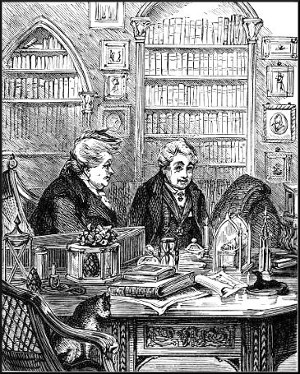
The Ladies of Llangollen.
When Miss Seward visited the spot, our heroines had resided in their romantic retirement about seventeen years; yet they were only known to the neighbouring villagers as the Ladies of the Vale. The verses which Miss Seward dedicated to the Recluses, and wherein she celebrated "gay Eleanor's smile," and "Zara's look serene," conclude with this morceau of sentimental affectation:—
May one kind ice-bolt from the mortal stores Arrest each vital current as it flows, That no sad course of desolated hours Here vainly nurse their unsubsiding woes. While all who honour virtue gently mourn Llangollen's vanish'd pair, and wreathe their sacred urn.
But they did not vanish for many a long year: they neither married nor died till they were grown too old for the world to care whether they did either or both. On one occasion, indeed, a party of tourists, male and female, unable to procure accommodation at the village inn, requested and obtained admittance at "the cottage," when they proved to be near relatives of Miss Ponsonby. No entreaties, however, could allure their fair cousin from her seclusion.
Lady Eleanor is described as tall, of lively manners, and masculine. She usually wore a riding-habit, and donned her hat with the air of a finished sportsman. Her companion, on the contrary, was fair, pensive, gentle, and effeminate. Their abode was a neat cottage, with about two acres of pleasure-ground. Avoiding every appearance of dissipation or gaiety, they led a life as retired as the situation. Two female servants waited on them, and while Miss Ponsonby superintended the house, my Lady amused herself with the garden. The name of the retreat is Plas Newydd, about a quarter of a mile from Llangollen, hidden among the trees on ascending the Vale behind the church. By some the ladies are said not to have led here a life of absolute seclusion, but to have visited their neighbours and received friends. The cottage was built purposely for them. They died after a life full of good deeds, within eighteen months of each other—Lady Eleanor, June 2nd, 1829, at the patriarchal age of ninety; Miss Ponsonby, December 9th, 1830. Their monument, in Llangollen churchyard, in which they were buried, has three sides, each bearing a touching epitaph; the third to the memory of Mary Carrol, a faithful Irish servant.
Snuff-taking Legacies.
On April 2nd, 1776, there died, at her house in Boyle Street, Burlington Gardens, one Mrs. Margaret Thompson, whose will affords a notable specimen of the ruling passion strong in death. The will is as follows:—"In the name of God, Amen. I, Margaret Thompson, being of sound mind, &c., do desire that when my soul is departed from this wicked world, my body and effects may be disposed of in the manner following: I desire that all my handkerchiefs that I may have unwashed at the time of my decease, after they have been got together by my old and trusty servant, Sarah Stuart, be put by her, and by her alone, at the bottom of my coffin, which I desire may be made large enough for that purpose, together with such a quantity of the best Scotch snuff (in which she knoweth I always had the greatest delight) as will cover my deceased body; and this I desire the more especially as it is usual to put flowers into the coffins of departed friends, and nothing can be so fragrant and refreshing to me as that precious powder. But I strictly charge that no man be suffered to approach my body till the coffin is closed, and it is necessary to carry me to my burial, which I order in the manner following:—
"Six men to be my bearers, who are known to be the greatest snuff-takers in the parish of St. James, Westminster; instead of mourning, each to wear a snuff-coloured beaver hat, which I desire may be bought for that purpose, and given to them. Six maidens of my old acquaintance, viz. &c., to bear my pall, each to bear a proper hood, and to carry a box filled with the best Scotch snuff to take for their refreshment as they go along. Before my corpse, I desire the minister may be invited to walk and to take a certain quantity of the said snuff, not exceeding one pound, to whom also I bequeath five guineas on condition of his so doing. And I also desire my old and faithful servant, Sarah Stuart, to walk before the corpse, to distribute every twenty yards a large handful of Scotch snuff to the ground and upon the crowd who may possibly follow me to the burial-place; on which condition I bequeath her 20l. And I also desire that at least two bushels of the said snuff may be distributed at the door of my house in Boyle Street."
She then particularizes her legacies; and over and above every legacy she desires may be given one pound of good Scotch snuff, which she calls the grand cordial of nature.
Burial Bequests.
In June, 1864, there died at Drogheda one Miss Hardman, at the advanced age of ninety-two years. She was buried in the family vault in Peter's Protestant Church. The funeral took place on the eighth day of her decease. It is not usual in Ireland to allow so long an interval to elapse between the time of a person's death and burial; in this instance it was owing to the expressed wish of the deceased, and this originated in a very curious piece of family and local history. Everybody has heard of the lady who was buried, being supposed dead, and who bearing with her to the tomb, on her finger, a ring of rare price, this was the means of her being rescued from her charnel prison-house. A butler in the family of the lady, having his cupidity excited, entered the vault at midnight in order to possess himself of the ring, and in removing it from the finger the lady was restored to consciousness and made her way in her grave-clothes to her mansion. She lived many years afterwards before she was finally consigned to the vault. The heroine of the story was a member of the Hardman family—in fact, the late Miss Hardman's mother—and the vault in Peter's Church was the locality where the startling revival scene took place.
The story is commonly told in explanation of a monument in the Church of St. Giles, Cripplegate, London, which is commemorative of Constance Whitney, and represents a female rising from a coffin. "This," says Mr. Godwin, in his popular history of the Churches of London, "has been erroneously supposed to commemorate a lady, who, having been buried in a trance, was restored to life through the cupidity of the sexton, which induced him to dig up the body to obtain possession of a ring." The female rising from the coffin is undoubtedly emblematic of the Resurrection, and may have been repeated upon other monuments elsewhere; but there is no such monument at Drogheda, which as above is claimed as the actual locality.
On May 24th, 1837, there died at Primrose Cottage, High Wycombe, Bucks, Mr. John Guy, aged sixty-four. His remains were interred in a brick grave in Hughenden Churchyard: on a marble slab, on the lid of the coffin, is inscribed:
Here, without nail or shroud, doth lie, Or covered with a pall, John Guy, Born May 17th, 1773. Died, „ 24th, 1837.
On his gravestone are the following lines:—
In coffin made without a nail, Without a shroud his limbs to hide; For what can pomp or show avail, Or velvet pall to swell the pride?
Mr. Guy was possessed of considerable property, and was a native of Gloucestershire. His grave and coffin were made under his directions more than a twelvemonth previous to his death; he wrote the inscriptions, he gave the orders for his funeral, and wrapped in separate pieces of paper five shillings for each of the bearers. The coffin was very neatly made, and looked more like a piece of cabinet-work for a drawing-room than a receptacle for the dead.
Dr. Fidge, a physician of the old school, who in early days had accompanied the Duke of Clarence (afterwards William IV.) when a midshipman as medical attendant, possessed a favourite boat; upon his retirement from Portsmouth Dockyard, where he held an appointment, he had this boat converted into a coffin, with the sternpiece fixed at its head. This coffin he kept under his bed for many years. The circumstances of his death were very remarkable. Feeling his end approaching, and desiring to add a codicil to his will, he sent for his solicitor. On entering his chamber he found him suffering from a paroxysm of pain, but which soon ceased; availing himself of the temporary ease to ask him how he felt, he replied, smiling: "I feel as easy as an old shoe," and looking towards the nurse in attendance, said: "Just pull my legs straight, and place me as a dead man; it will save you trouble shortly," words which he had scarcely uttered before he calmly died.
Job Orton, of the Bell Inn, Kidderminster, had his tombstone, with an epitaphic couplet, erected in the parish churchyard; and his coffin was used by him for a wine-bin until required for another purpose.
Dr. John Gardner, "the worm doctor," originally of Long Acre, erected his tomb and wrote the inscription thereon some years before his death. Strangers reading the inscription naturally concluded he was like his predecessor, "Egregious Moore," immortalized by Pope, "food for worms," whereas he was still following his profession, that of a worm-doctor, in Norton Folgate, where he had a shop, in the window of which were displayed numerous bottles containing specimens of tape and other worms, with the names of the persons who had been tormented by them, and the date of their ejection. Finding his practice declining from the false impression conveyed by his epitaph, he dexterously caused the word intended to be interpolated, and the inscription for a long time afterwards ran as follows:—
intended Dr. John Gardner's last and best bedroom. ^
He was a stout, burly man, with a flaxen wig, and rode daily into London on a large roan-coloured horse.
Not a few misers have carried their penury into the arrangements for their interment. Edward Nokes, of Hornchurch, by his own direction, was buried in this curious fashion:—A short time before his death, which he hastened by the daily indulgence in nearly a quart of spirits, he gave strict charge that his coffin should not have a nail in it, which was actually adhered to, the lid being made fast with hinges of cord, and minus a coffin-plate, for which the initials E. N. cut upon the wood were substituted. His shroud was made of a pound of wool. The coffin was covered with a sheet in place of a pall, and was carried by six men, to each of whom he directed should be given half-a-crown. At his particular desire, too, not one who followed him to the grave was in mourning; but, on the contrary, each of the mourners appeared to try whose dress should be the most striking. Even the undertaker was dressed in a blue coat and scarlet waistcoat.
Another deplorable case might be cited, that of Thomas Pitt, of Warwickshire. It is reported that some weeks prior to the sickness which terminated his despicable career, he went to several undertakers in quest of a cheap coffin. He had left behind him 3,475l. in the public funds.
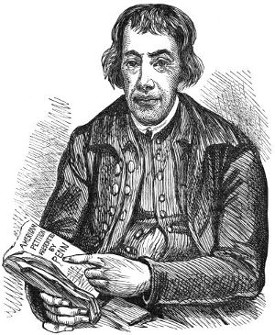
Major Peter Labelliere. From Kingsbury's print.
Burials on Box Hill and Leith Hill.
As the railway traveller passes over Red Hill, on the London and Brighton line, his attention can scarcely fail to be struck with two prominent points in the charming landscape—Box Hill, covered with its patronymic shrub; and Leith Hill, surmounted by a square tower. On each of these elevations is buried an eccentric person: one with his head downwards, and the other in the usual horizontal position; but the fondness for exaggerating things already extraordinary, has led to the common misstatement that one person is buried with his head downwards, and the other standing upon his feet. Of the two interments, however, the following are the true versions.
On the north-western brow of Box Hill, and nearly in a line with the stream of the Mole, as it flows towards Burford Bridge, was interred, some sixty-five years since, Major Peter Labelliere, an officer of marines. During the latter years of his life he had resided at Dorking, and, in accordance with his own desire, he was interred on this spot, long denoted by a wooden stake or stump. This gentleman in early life fell in love with a lady, who, although he was remarkably handsome in person, rejected his addresses. This circumstance inflicted a deep wound on his mind, which, at a later period, religion and politics entirely unsettled. Yet his eccentricities were harmless, and himself the only sufferer. At this time the Duke of Devonshire, who had been formerly fond of the major's society, settled on him a pension of 100l. a year. Labelliere then lived at Chiswick, and there wrote several tracts, both polemical and political, but the incoherency of his arguments was demonstrative of mental incapacity. From Chiswick he frequently walked to London, his pockets filled to overflowing with newspapers and pamphlets, and on the road he delighted to harangue the ragged boys who followed him. He next removed to Dorking, and there resided in a mean cottage, called "The Hole in the Wall," on Butter Hill. Among the anecdotes of his eccentricity it is related that, to a gentleman with whom he was intimate he presented a packet, carefully folded and sealed, with a particular injunction not to open it till after his death. This request was strictly complied with, when it was found to contain merely a blank memorandum-book.
Long prior to his decease he selected the point of Box-Hill we have named, where, in compliance with his oft-expressed wish, he was buried, without church rites, with his head downwards; in order, he said, that as "the world was turned topsy-turvy, it was fit that he should be so buried that he might be right at last."[19] He died June 6th, 1800, and was interred on the 10th of the same month, when great numbers of persons witnessed his funeral; and the slight wooden bridge which then crossed the Mole having been removed by some mischievous persons during the interment many had to wade through the river on returning homewards. The Major earned not the uncommon reward of eccentricity—his portrait being engraved—by H. Kingsbury. Under Labelliere's name is inscribed in the print—
"A Christian patriot and Citizen of the World."
The interment on Leith Hill is less characterised by oddity than that of Major Labelliere on Box Hill. In a mansion on the south side of Leith Hill lived Mr. Richard Hull, a gentleman of fortune, who, in 1766, with the permission of Sir John Evelyn, of Wotton, built a tower on the summit of Leith Hill, from which the sea is visible, and it became a landmark for mariners. It comprised two rooms, which were handsomely furnished by the founder, for the accommodation of those who resorted thither to enjoy the prospect. Over the entrance, on the west side, was placed a stone with a Latin inscription, which may be thus translated: "Traveller, this very conspicuous tower was erected by Richard Hull, of Leith Hill Place, Esq., in the reign of George III., 1766, that you might obtain an extensive prospect over a beautiful country; not solely for his own pleasure, but for the accommodation of his neighbours and all men."
Mr. Hull, was, by his own direction, interred within this tower, and an epitaph inscribed on a marble slab let into the wall, on the ground-floor, stated that he died January 18th, 1772, in his eighty-third year. He was the oldest bencher of the Middle Temple, and sat many years in the Parliament of Ireland. He lived, in his earlier years, in intimacy with Pope, Trenchard, Bishop Berkeley, and other distinguished men of the period; "and, to wear off the remainder of his days, he purchased Leith Hill Place for a retirement, where he led the life of a true Christian and rural philosopher; and, by his particular desire, his remains were here deposited, in a private manner, under this tower, which he had erected a few years before his death."
After the decease of the founder, the building was neglected, and suffered to fall into decay; but about 1796, Mr. W. Philip Perrin, who had purchased Mr. Hull's estate, had the tower thoroughly repaired, heightened several feet, and surmounted by a coping and battlement, so as to render it a more conspicuous sea-mark; but the lower part was filled in with lime and rubbish, and the entrance walled up. Leith Hill is the highest eminence in Surrey, its extreme point being 993 feet above the sea-level. It commands a view 200 miles in circumference. Dennis, the critic, described this prospect as superior to anything he had ever seen in England or Italy, in its surpassing "rural charms, pomp, and magnificence."
Jeremy Bentham's Bequest of his Remains.
Bentham's long life was incessantly and laboriously devoted to the good of his species: in pursuance of which he ever felt that incessant labour a happy task, that long life but too short for its benevolent object. The preservation of his remains by his physician and friend, to whose care they were confided, was in exact accordance with his own desire. He had early in life determined to leave his body for dissection. By a document dated as far back as 1769, he being then only twenty two-years of age, bequeathed it for that purpose to his friend, Dr. Fordyce. The document is in the following remarkable words:—
"This my will and general request I make, not out of affectation of singularity, but to the intent and with the desire that mankind may reap some small benefit in and by my decease, having hitherto had small opportunities to contribute thereto while living."
A memorandum affixed to this document shows that it had undergone Bentham's revision two months before his death, and that this part of it had been solemnly ratified and confirmed. The Anatomy Bill, passed subsequently to his death, for which a foundation had been laid in The Use of the Dead to the Living (first published in the Westminster Review, and afterwards reprinted, and a copy given to every member of Parliament), had removed the main obstructions in the way of obtaining anatomical knowledge; but the state of the law previous to the adoption of the Anatomy Act was such as to foster the popular prejudices against dissection, and the effort to remove these prejudices was well worthy of a philanthropist. After all the lessons which science and humanity might learn from the dissection of his body had been taught, Bentham further directed that the skeleton should be put together and kept entire; that the head and face should be preserved; that the whole figure, arranged as naturally as possible, should be attired in the clothes he ordinarily wore, seated in his own chair, and maintaining the attitude and aspect most familiar to him.
Mr. Bentham was perfectly aware that difficulty and even obloquy might attend a compliance with the directions he gave concerning the disposal of his body. He therefore chose three friends, whose firmness he believed to be equal to the task, and asked them if their affection for him would enable them to brave such consequences. They engaged to follow his directions to the letter, and they were faithful to their pledge. The performance of the first part of this duty is thus described by an eye-witness, W. J. Fox, in the Monthly Repository for July, 1832:—
"None who were present can ever forget that impressive scene. The room (the lecture-room of the Webb Street School of Anatomy) is small and circular, with no window but a central sky-light, and capable of containing about three hundred persons. It was filled, with the exception of a class of medical students and some eminent members of that profession, by friends, disciples, and admirers of the deceased philosopher, comprising many men celebrated for literary talent, scientific research, and political activity. The corpse was on the table in the middle of the room, directly under the light, clothed in a night-dress, with only the head and hands exposed. There was no rigidity in the features, but an expression of placid dignity and benevolence. This was at times rendered almost vital by the reflection of the lightning playing over them; for a storm arose just as the lecturer commenced, and the profound silence in which he was listened to was broken and only broken by loud peals of thunder, which continued to roll at intervals throughout the delivery of his most appropriate and often affecting address. With the feelings which touch the heart in the contemplation of departed greatness, and in the presence of death, there mingled a sense of the power which that lifeless body seemed to be exercising in the conquest of prejudice for the public good, thus co-operating with the triumphs of the spirit by which it had been animated. It was a worthy close of the personal career of the great philanthropist and philosopher. Never did corpse of hero on the battle-field, 'with his martial cloak around him,' or funeral obsequies chanted by stoled and mitred priests in Gothic aisles, excite such emotions as the stern simplicity of that hour in which the principle of utility triumphed over the imagination and the heart."
The skeleton of Bentham, dressed in the clothes which he usually wore, and with a wax face, modelled by Dr. Talrych, enclosed in a mahogany case, with folding-doors, may now be seen in the Anatomical Museum of University College Hospital, Gower Street, London.
The Marquis of Anglesey's Leg.
Among the curiosities of Waterloo are the grave of the late Marquis of Anglesey's leg, and the house in which it was cut off, and where the boot belonging to it is preserved! The owner of the house to whose share this relic has fallen finds it a most lucrative source of revenue, and will, in spite of the absurdity of the thing, probably bequeath it to his children as a valuable property. He has interred the leg most decorously in the garden of the inn, within a coffin, under a weeping willow, and has honoured it with a monument and the following epitaph:—
Ci est enterrée la Jambe de l'illustre et vaillant Comte d'Uxbridge, Lieutenant-Général de S. M. Britannique, Commandant en chef la cavalrie Anglaise, Belge, et Hollandaise, blessé le 18 Juin, 1815, à la mémorable bataille de Waterloo; qui par son héroisme a concouru au triomphe de la cause du genre humain; Glorieusement décidée par l'éclatante victoire du dit jour.
Some wag scribbled this infamous couplet beneath the inscription:—
Here lies the Marquis of Anglesey's limb, The devil will have the rest of him.
More apposite is the following epitaph, attributed to Mr. Canning, on reading the description of the tomb erected to the memory of the Marquis of Anglesey's leg:—
Here rests,—and let no saucy knave Presume to sneer or laugh, To learn that mould'ring in this grave There lies—a British calf. For he who writes these lines is sure That those who read the whole, Will find that laugh was premature, For here, too, lies a soul. And here five little ones repose, Twin born with other five, Unheeded by their brother toes, Who all are now alive. A leg and foot, to speak more plain, Lie here of one commanding; Who, though he might his wits retain, Lost half his understanding. And when the guns, with thunder bright, Poured bullets thick as hail, Could only in this way be taught To give the foe leg bail. And now in England just as gay As in the battle brave, Goes to the rout, the ball, the play, With one leg in the grave. Fortune in vain has showed her spite, For he will soon be found, Should England's sons engage in fight, Resolved to stand his ground. But Fortune's pardon I must beg; She meant not to disarm: And when she lopped the hero's leg, She did not seek his h-arm. And but indulged a harmless whim, Since he could walk with one: She saw two legs were lost on him, Who never meant to run.
When the Marquis of Anglesey was, for the second time, Lord Lieutenant of Ireland, he became very unpopular through an unguarded speech; and Mr. O'Connell, in one of his flowery addresses, quoted the lines:—
God takes the good, too good on earth to stay; And leaves the bad, too bad to take away.
The great orator continued:—
This couplet's truth in Paget's case we find; God took his leg, and left himself behind.
Of a ballad sung in the streets of Dublin, the chorus ran as follows:—
He has one leg in Dublin, the other in Cork, And you know very well what I mean, O!
It was stated that he had an artificial leg in Cork.
The Cottle Church.
"For more than twenty years," says Mr. De Morgan in his "Budget of Paradoxes"[20] in the Athenæum, 1865, "printed papers have been sent about in the name of Elizabeth Cottle. It is not so remarkable that such papers should be concocted, as that they should circulate for such a length of time without attracting public attention. Eighty years ago, Mrs. Cottle might have rivalled Lieutenant Brothers or Joanna Southcote. Long hence, when the now current volumes of our journals are well ransacked works of reference, those who look into them will be glad to see this feature of our time: I therefore make a few extracts, faithfully copied as to type. The Italic is from the new Testament; the Roman is the requisite interpretation:—
"Robert Cottle 'was numbered (5196) with the transgressors' at the back of the Church in Norwood Cemetery, May 12, 1858—Isa. liii. 12. The Rev. J. G. Collinson, Minister of St. James's Church, Clapham, the then district church, before All Saints was built, read the funeral service over the Sepulchre wherein never before man was laid.
"Hewn on the stone, 'at the mouth of the sepulchre,' is his name—Robert Cottle, born at Bristol, June 2, 1774; died at Kirkstall Lodge, Clapham Park, May 6, 1858. And that day (May 12, 1858) was the preparation (day and year for 'the PREPARED place for you'—Cottleites—by the widowed mother of the Father's house, at Kirkstall Lodge—John xiv. 2, 3). And the Sabbath (Christmas Day, December 25, 1859) drew on (for the resurrection of the Christian body on 'the third [Protestant Sun]-day'—1 Cor. xv. 35). Why seek ye the living (God of the New Jerusalem—Heb. xii. 22; Rev. iii. 12) among the dead (men): he (the God of Jesus) is not here (in the grave), but is risen (in the person of the Holy Ghost, from the supper, of 'the dead in the second death' of Paganism). Remember how he spake unto you (in the Church of the Rev. George Clayton, April 14, 1839). I will not drink henceforth (at this last Cottle supper) of the fruit of this (Trinity) vine, until that day (Christmas Day, 1859), when I (Elizabeth Cottle) drank it new with you (Cottleites) in my Father's kingdom—John xv. If this (Trinitarian) cup may not pass away from me (Elizabeth Cottle, April 14, 1839), except I drink it ('new with you Cottleites, in my Father's kingdom'), thy will be done—Matt. xxvi. 29, 42, 64. 'Our Father which art (God) in heaven, hallowed be thy name, thy (Cottle) kingdom come, thy will be done in earth, as it is (done) in (the new) Heaven (and new earth of the new name of Cottle—Rev. xxi. 1; iii. 12).
"... (Queen Elizabeth, from A. D. 1558 to 1566). And this WORD yet once more (by a second Elizabeth)—the WORD of his oath, signifieth (at John Scott's baptism of the Holy Ghost) the removing of those things (those Gods and those doctrines) that are made (according the Creeds and Commandments of men) that those things (in the moral law of God) which cannot be shaken (as a rule of faith and practice) may remain; wherefore we receiving (from Elizabeth) a kingdom (of God) which cannot be moved (by Satan) let us have grace (in his grace of Canterbury) whereby we may serve God acceptably (with the acceptable sacrifice of Elizabeth's body and blood of the communion of the Holy Ghost) with reverence (for truth) and godly fear (of the unpardonable sin of blasphemy against the Holy Ghost), for our God (the Holy Ghost) is a consuming fire (to the nation that will not serve him in the Cottle Church). We cannot defend ourselves against the Almighty, and if He is our defence, no nation can invade us.
"In verse 4 the Church of St. Peter is in prison between four quaternions of Soldiers—the Holy Alliance of 1815. Rev. vii. 1. Elizabeth, the Angel of the Lord Jesus appears to the Jewish and Christian body with the vision of prophecy to the Rev. Geo. Clayton and his clerical brethren, April 8th, 1839. Rhoda was the name of her maid at Putney Terrace who used to open the door to her Peter, the Rev. Robert Ashton, the Pastor of 'the little flock' 'of 120 names together, assembled in an upper (school) room' at Putney Chapel, to which little flock she gave the revelation (Acts i. 13, 15) of Jesus the same King of the Jews yesterday at the prayer meeting, December 31, 1841, and to-day, January 1, 1842, and for ever. See book of Life, page 24. Matt. xviii. 19; xxi. 13-16. In verse 6 the Italian body of St. Peter is sleeping 'in the second death' between the two Imperial soldiers of France and Austria. The Emperor of France from January 1 to July 11, 1859, causes the Italian chains of St. Peter to fall off from his Imperial hands.
"I say unto thee, Robert Ashton, thou art Peter, a stone, and upon this rock, of truth, will I Elizabeth, the Angel of Jesus, build my Cottle Church, and the gates of hell, the doors of St. Peter at Rome, shall not prevail against it—Matt. xvi. 18; Rev. iii. 7-12."
"This will be enough for the purpose. When anyone who pleases can circulate new revelations of this kind, uninterrupted and unattended to, new revelations will cease to be a good investment of eccentricity. I take it for granted that the gentlemen whose names are mentioned have nothing to do with the circulars or their doctrines. Any lady who may happen to be entrusted with a revelation may nominate her own pastor, or any other clergyman, one of her apostles; and it is difficult to say to what court the nominees can appeal to get the commission abrogated.
"March 16, 1865. During the last two years the circulars have continued. It is hinted that funds are low; and two gentlemen, who are represented as gone 'to Bethelem asylum in despair,' say that Mrs. Cottle will 'spend all that she hath, while Her Majesty's ministers are flourishing on the wages of sin.' The following is perhaps one of the most remarkable passages in the whole:—
"Extol and magnify Him (Jehovah, the everlasting God, see the Magnificat and Luke i. 45, 46-68-73-79), that rideth (by rail and steam over land and sea, from his holy habitation at Kirkstall Lodge, Psa. lxxvii. 19, 20), upon the (Cottle) heavens as it were (September 9, 1864, see pages 21, 170), upon an (exercising, Psa. cxxxi. 1), horse-(chair, bought of Mr. John Ward, Leicester Square)."
Horace Walpole's Chattels saved by a Talisman.
In the spring of 1771, Walpole's house in Arlington Street was broken open in the night, and his cabinets and trunks forced and plundered. The Lord of Strawberry was at his villa when he received by a courier the intelligence of the burglary. In an admirable letter to Sir Horace Mann he thus narrates the sequel:—"I was a good quarter of an hour before I recollected that it was very becoming to have philosophy enough not to care about what one does care for; if you don't care there's no philosophy in bearing it. I despatched my upper servant, breakfasted, fed the bantams as usual, and made no more hurry to town than Cincinnatus would if he had lost a basket of turnips. I left in my drawers 270l. of bank-bills and three hundred guineas, not to mention all my gold and silver coins, some inestimable miniatures, a little plate, and a good deal of furniture, under no guard but that of two maidens.... When I arrived, my surprise was by no means diminished. I found in three different chambers three cabinets, a large chest, and a glass case of china wide open, the locks not picked, but forced, and the doors of them broken to pieces. You will wonder that this should surprise me when I had been prepared for it. Oh! the miracle was that I did not find, nor to this hour have found, the least thing missing. In the cabinet of modern medals, there were, and so there are still, a series of English coins, with downright John Trot guineas, half-guineas, shillings, sixpences, and every kind of current money. Not a single piece was removed. Just so in the Roman and Greek cabinet; though in the latter were some drawers of papers, which they had tumbled and scattered about the floor. A great exchequer chest, that belonged to my father, was in the same room. Not being able to force the lock, the philosophers (for thieves that steal nothing deserve the title much more than Cincinnatus, or I) had wrenched a great flapper of brass with such violence as to break it into seven pieces. The trunk contained a new set of chairs of French tapestry, two screens, rolls of prints, and a suit of silver stuff that I had made for the king's wedding. All was turned topsy-turvy, and nothing stolen. The glass case and cabinet of shells had been handled as roughly by these impotent gallants. Another little table with drawers, in which, by the way, the key was left, had been opened too, and a metal standish that they ought to have taken for silver, and a silver hand-candlestick that stood upon it, were untouched. Some plate in the pantry, and all my linen just come from the wash had no more charms for them than gold or silver. In short I could not help laughing, especially as the only two movables neglected were another little table with drawers and the money, and a writing box with the bank-notes, both in the same chamber where they made the first havoc. In short, they had broken out a panel in the door of the area, and unbarred and unbolted it, and gone out at the street-door, which they left wide open at five o'clock in the morning. A passenger had found it so, and alarmed the maids, one of whom ran naked into the street, and by her cries waked my Lord Rommey, who lives opposite. The poor creature was in fits for two days, but at first, finding my coachmaker's apprentice in the street, had sent him to Mr. Conway, who immediately despatched him to me before he knew how little damage I had received, the whole of which consists in repairing the doors and locks of my cabinets and coffers.
"All London is reasoning on this marvellous adventure, and not an argument presents itself that some other does not contradict. I insist that I have a talisman. You must know that last winter, being asked by Lord Vere to assist in settling Lady Betty Germaine's auction I found in an old catalogue of her collection this article, 'The Black Stone into which Dr. Dee used to call his spirits.' Dr. Dee, you must know, was a great conjuror in the days of Queen Elizabeth and has written a folio of the dialogues he held with his imps. I asked eagerly for this stone; Lord Vere said he knew of no such thing, but if found, it should certainly be at my service. Alas, the stone was gone! This winter I was again employed by Lord Frederic Campbell, for I am an absolute auctioneer, to do him the same service about his father's (the Duke of Argyle's) collection. Among other odd things he produced a round piece of shining black marble in a leathern case, as big as the crown of a hat, and asked me what that possibly could be? I screamed out, 'Oh Lord, I am the only man in England that can tell you! It is Dr. Dee's Black Stone!' It certainly is; Lady Betty had formerly given away or sold, time out of mind, for she was a thousand years old, that part of the Peterborough collection which contained natural philosophy. So, or since, the Black Stone had wandered into an auction, for the lotted paper is still on it. The Duke of Argyle, who bought everything, bought it. Lord Frederic gave it to me; and if it was not this magical stone, which is only of high-polished coal, that preserved my chattels, in truth I cannot guess what did."
At the Strawberry Hill sale, in 1842, this precious relic was sold for 12l. 12s., and is now in the British Museum. It was described in the catalogue as "a singularly interesting and curious relic of the superstition of our ancestors—the celebrated Speculum of Kennel Coal, highly polished, in a leathern case. It is remarkable for having been used to deceive the mob, by the celebrated Dr. Dee, the conjuror, in the reign of Queen Elizabeth," &c. When Dee fell into disrepute, and his chemical apparatus and papers and other stock-in-trade were destroyed by the mob, who made an attack upon his house, this Black Stone was saved. It appears to be nothing more than a polished piece of cannel coal; but this is what Butler means when he says:—