STRANGE SIGHTS and SPORTING SCENES. (continued 2)
Reading edition
The period to which this lively sketch refers was from 1800 to 1820. Soon after this, George the Fourth began to live a more secluded life, and though his horses ran at Brighton Races, the King never made his appearance there, and the meet began to decline.
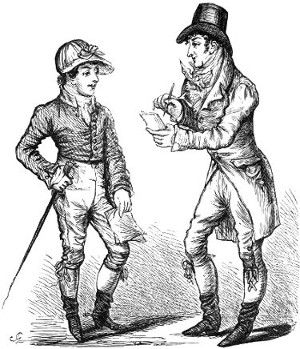
A Hero of the Turf and his Agent. Colonel Mellish and Buckle the Jockey.
Colonel Mellish.
The star of the race-course of modern times was the late Colonel Mellish, certainly the cleverest man of his day, as regards the science and practice of the turf. No one could match (i.e., make matches) with him, nor could anyone excel him in handicapping horses in a race. But, indeed, nihil erat quod non tetigit non ornavit. He beat Lord Frederick Bentinck in a foot-race over Newmarket Heath. He was a clever painter, a fine horseman, a brave soldier, a scientific farmer, and an exquisite coachman. But—as his friends said of him—not content with being the second-best man of his day, he would be the first, which was fatal to his fortune and his fame. It, however, delighted us to see him in public, in the meridian of his almost unequalled popularity, and the impression he made upon us remains. We remember even the style of his dress, peculiar for its lightness of hue—his neat white hat, white trousers, white silk stockings, ay, and we may add, his white but handsome face. There was nothing black about him but his hair and his mustachios, which he wore by virtue of his commission, and which to him were an ornament. The like of his style of coming on the race-course at Newmarket was never witnessed there before him nor since. He drove his barouche himself, drawn by four beautiful white horses, with two outriders on matches to them, ridden in harness bridles. In his rear was a saddle-horse groom, leading a thorough-bred hack, and at the rubbing-post on the heath was another groom—all in crimson liveries—waiting with a second hack. But we marvel when we think of his establishment. We remember him with thirty-eight race-horses in training, seventeen coach-horses, twelve hunters in Leicestershire, four chargers at Brighton, and not a few hacks! But the worst is yet to come. By his racing speculations he was a gainer, his judgment pulling him through; but when we heard that he would play to the extent of 40,000l. at a sitting—yes, he once staked that sum on a throw—we were not surprised that the domain of Blythe passed into other hands; and that the once accomplished owner of it became the tenant of a premature grave. "The bowl of pleasure," says Johnson, "is poisoned by reflection on the cost," and here it was drunk to the dregs. Colonel Mellish ended his days, not in poverty, for he acquired a competency with his lady, but in a small house within sight of the mansion that had been the pride of his ancestors and himself. As, however, the wind is tempered to the shorn lamb, Colonel Mellish was not without consolation. He never wronged anyone but himself; and, as an owner of race-horses, and a bettor, his character was without spot.—Nimrod.
Doncaster Eccentrics.
Among the visitors to Doncaster race-course are many of the lower grade, some of whom have contrived to get hanged. Such was the case some half-century since with Daniel Dawson, who employed himself, or was employed by others, in poisoning with arsenic the drinking-water of horses whose success in the future race was not desirable to Daniel or his patrons. Several steeds perished in this way at the hands of Daniel, in the north as well as at Newmarket. Ultimately a case from the latter locality was proved against him, through the treachery of a confederate, and Daniel suffered for it at Cambridge. Had he been a martyr in a good cause, he could not have died with more becomingness. Daniel complained of no one, did not even reproach himself; and expressed his satisfactory conviction that he "should certainly ascend to Heaven from the drop." Brutal as his offence was, it seems ill-measured justice that takes a man's life for that of a beast.
Dawson is beyond our own recollection; but we can remember a more singular and a much more honest fellow, whose appearance on the Doncaster course was as confidently looked for, and as ardently desired, as that of any of the Lords Lieutenant of the various Ridings. We allude to the once famous Jemmy Hirst, the Rawcliffe tanner, whose last of about fifty visits to the "Sillinger" and "Coop" contests was made when he was hard upon ninety years of age. When Jemmy retired from the tanning business with means to set up as a gentleman, the first object he purchased was not a carriage, but a coffin, depositing therein some of the means whereby he kept himself alive, namely, his provisions. The walls of the room in which this lugubrious sideboard was erected were hung round with all sorts of rusty agricultural implements. This lord of a strange household retained a valet and a female "general servant." His stud consisted of mules, dogs, and a bull; mounted on which he is said to have hunted with the Badsworth hounds. His most familiar friends were a tame fox and otter. He certainly rode the bull when he went out shooting, and was then accompanied by pigs as pointers. In fair-time Hirst used to take this bull and a couple of its fellows to be baited, sitting proudly by himself while his valet went about collecting the "coppers." His waistcoat was a glossy garment made of the neck feathers of the drake, from the pocket of which he would issue his own bank-notes, bearing responsibilities of payment to the amount of "Five half-pence."
His carriage was a sort of palanquin, carried aloft by high wheels, and its peculiarity was that there was not a nail about it. This vehicle was really better known at Doncaster than the stately carriage of Lord Fitzwilliam himself. It was the boast of the proud and dirty gentleman who sat enthroned there, that he had never paid and never would pay any sort of tax to the King; and how he managed to shoot, as he did, without paying a licence, was best known to himself. He was the most popular man on the course, and, unlike very many who began rich and ended poor, Jemmy increased in wealth year by year. He was wont to contrast himself with "the Prince's friend," Col. Mellish, who inherited an immense property, won two Legers in two consecutive years, 1804-5, and finally died almost a pauper. Jemmy had undoubtedly, in his view of things, done better than Col. Mellish; but the tanner, through life, never thought of the welfare but of one human being—that of James Hirst. He was as selfish as the butcher-churchwarden of Doncaster, who ruined the grand old tower of the church by placing a hideous clock face in it, which was so constructed that no one could see the time by it except from the butcher's own door!
We should hardly render Hirst justice, however, if we omitted to state how such a great man departed from this earth. The folding-doors of his old coffin were closed upon him. Eight buxom widows carried his corpse for a honorarium of half-a-crown each. Jemmy had expressed a desire to have eight old maids to undertake this service, bequeathing half-a-guinea to each as hire. But the ladies in question were not forthcoming. So the widows were engaged in their place; but why the fee was lowered we cannot tell, unless it was to pay for the bagpipe and fiddle which headed the procession. All the country round flocked in to do Jemmy honour or to enjoy the holiday; and for many a year afterwards might the sorrowing comment be heard on Doncaster Course,—"Nay, lad! t'Coop-day seems nought-loike wi'out Jemmy!" and the mourners took out his "Fihawpence notes," and compared their own touching respective memories of the departed glory of Doncaster.
At the close of Jemmy's career the wonderfully dressed "swell mob" was busiest if not brightest. The latter was only short-lived. A party of them really dazzled common folk by the splendour of their turn-out, both as regarded themselves and their equipage. People took them for foreign princes, or native nobility returned from foreign climes, and not yet familiarly known to the public. The impression did not last long. The well-dressed, finely-curled, highly scented, richly-jewelled strangers, sauntering among the better known aristocracy, commenced a series of predatory operations which speedily brought them within the fastness of the town gaol. No one who saw them there a day or two later, after seeing them on the course, will ever forget the sight and the strange contrast. Stripped of their finery, closely cropped, and clad in coarse flannel dresses, they might be seen seated at a board, with a hot lump of stony-looking rice before them for a dinner.
Altogether, there was occasionally a very mixed society on and about the course: among the so-to-speak professional habitués, men who made a business of the pursuit there—who were actors rather than spectators, and all of whom have disappeared without leaving a successor in his peculiar line,—we may mention the old Duke of Leeds, redolent of port; the white-faced Duke of Cleveland, "the Jesuit of the Ring;" P. W. Ridsale, ex-footman, then millionaire, finally pauper; blacksmith Richardson, who, shaking his head at "Leeds," would remark of himself, that sobriety alone had saved him from being hanged; Mr. Beardsworth, who had been originally a hackney-coachman, then sporting his crimson liveries; Mr. Crook, who commenced life with a fish-basket; and the well-known son of the ostler at the Black Swan, in York, wearing diamond rings and pins, betting his thousands, and looking as cool the while, as if he not only largely used the waters of Pactolus, but owned half the gold-dust on its banks.
The two extremes of the official men as regarded rank, were, perhaps, Lord George Bentinck and Mr. Gully, the ex-pugilist. The former introduced, at Doncaster, the signal-flag to regulate the "starts," and he founded the Bentinck Fund (with the money subscribed for a testimonial to himself), for the relief of decayed jockeys and trainers. The two men were equals in one respect, the coolness with which they either won or lost. They who remember the year when Petre's Matilda beat Gully's Mameluke, and who witnessed the event and its results, speak yet with a sort of pride of Gully's conduct. He had lost immensely; but he was the first man who appeared in the betting-rooms to pay anyone who had a bet registered against him; and he was the last man to leave, not retiring till he was satisfied that there did not remain a single claimant. He paid away a grand total on that occasion which properly invested, would have set all the poor in Doncaster at ease for ever.—Abridged from the Athenæum, No. 1715.
"Walking Stewart."
Early in the year 1821, London lost one of its famous eccentrics, who rejoiced in the above distinction, which, it must be admitted, he had fairly earned. He was one of the lions of the great town, and his ubiquitous nature was thus ingeniously sketched:—
"Who that ever weathered his way over Westminster Bridge has not seen Walking Stewart (his invariable cognomen) sitting in the recess on the brow of the bridge, spencered up to his throat and down to his hips with a sort of garment, planned, it would seem, to stand powder, as became the habit of a military man; his dingy, dusty inexpressibles (truly inexpressibles), his boots travel-stained, black up to his knees—and yet not black neither—but arrant walkers, both of them, or their complexions belied them; his aged, but strongly-marked, manly, air-ripened face, steady as truth; and his large, irregular, dusty hat, that seemed to be of one mind with the boots? We say, who does not thus remember Walking Stewart, sitting, and leaning on his stick, as though he had never walked in his life, but had taken his seat on the bridge at his birth, and had grown old in his sedentary habit? To be sure, this view of him is rather negatived by as strong a remembrance of him in the same spencer and accompaniments of hair-powder and dust, resting on a bench in the Park, with as perfectly an eternal air: nor will the memory let him keep a quiet, constant seat here for ever; recalling him, as she is wont, in his shuffling, slow perambulation of the Strand, or Charing Cross, or Cockspur Street. Where really was he? You saw him on Westminster Bridge, acting his own monument. You went into the Park—he was there! fixed as the gentleman at Charing Cross. You met him, however, at Charing Cross, creeping on like the hour-hand upon a dial, getting rid of his rounds and his time at once! Indeed, his ubiquity appeared enormous, and yet not so enormous as the profundity of his sitting habits. He was a profound sitter. Could the Pythagorean system be entertained, what other would now be tenanted by Walking Stewart? Truly, he seemed always going, like a lot at an auction, and yet always at a stand, like a hackney-coach! Oh, what a walk was his to christen a man by! A slow, lazy, scraping, creeping, gazing pace—a shuffle—a walk in its dotage—a walk at a stand-still—yet was he a pleasant man to meet. We remember his face distinctly, and allowing a little for its northern hardness, it was certainly as wise, as kindly, and as handsome a face as ever crowned the shoulders of a soldier, a scholar and a gentleman.
"Well! Walking Stewart is dead! He will no more be seen niched in Westminster Bridge, or keeping his terms as one of the benchers of St. James's Park, or painting the pavement with moving but uplifted feet. In vain we looked for him 'at the hour when he was wont to walk.' The niche in the bridge is empty of its amiable statue, and as he is gone from this spot he has gone from all, for he was ever all in all! Three persons seemed departed in him. In him there seems to have been a triple death!"
We are tempted "to consecrate a passage" to him, as John Buncle expresses it, from a tiny pamphlet entitled "The Life and Adventures of the celebrated Walking Stewart, including his travels in the East Indies, Turkey, Germany, and America," and the author, "a relative," has contrived to out-do his subject in getting over the ground, for he manages to close his work at the end of the sixteenth page.
John Stewart, or Walking Stewart, was born of two Scotch parents, in 1749, in London, and was in due time sent to Harrow, and thence to the Charter House, where he established himself as a dunce—no bad promise in a boy, we think. He left school and was sent to India, where his character and energies unfolded themselves, as his biographer tells us, for his mind was unshackled by education.
He resolved to amass 3,000l., and then to return to England. No bad resolve. To attain this, he quitted the Company's Service and entered that of Hyder Ally. He now turned soldier, and became a general. Hyder's generals were easily made and unmade. Stewart behaved well and bravely, and paid his regiment without drawbacks, which made him popular. Becoming wounded somehow, and having no great faith in Hyder's surgeons, he begged leave to join the English for medical advice. Hyder gave a Polonius kind of admission, quietly determining to cut the traveller and his journey as short as possible, for his own sake and that of the invalid. Stewart sniffed the intention of Ally, and taking an early opportunity of cutting his company before they could cut him, he popped into a river, literally swam for his life, reached the bank, ran before his hunters like an antelope, and arrived safely at the European forts. He got in breathless, and lived. How he was cured of his wounds is thus told by Colonel Wilks in his Sketches of the South of India:—
"An English gentleman commanded one of the corps, and was most severely wounded after a desperate resistance; others in the same unhappy situation met with friends, or persons of the same caste, to procure for them the rude aid offered by Indian surgery; the Englishman was destitute of this poor advantage; his wounds were washed with simple warm water, by an attendant boy, three or four times-a-day; and, under this novel system of surgery, they recovered with a rapidity not exceeded under the best hospital treatment."
A writer in the Quarterly Review, 1817, appends to the above quotation the following:—"This English gentleman is the person distinguished by the name of Walking Stewart, who, after the lapse of half a century, is still alive, and still, we believe, walking daily, in the neighbourhood of the Haymarket and Charing Cross."
Hitherto, Stewart had saved little money. He now entered the Nabob of Arcot's service, and became prime minister, the memoir does not say how.
At length he took leave of India, and travelled over Persia and Turkey on foot, in search of a name, it should seem, or, as he was wont to say, "in search of the Polarity, and Moral Truth." After many adventures he arrived in England: he brought home money, and commenced his London life in an Armenian dress, to attract attention.
He next visited America, and on his return, "made the tour of Scotland, Germany, Italy, and France, on foot, and ultimately settled in Paris," where he made friends. He intended to live there; but after investing his money in French property, he smelt the sulphur cloud of the Revolution, and retreated as fast as possible, losing considerable property in his flight. He returned to London, and suddenly and unexpectedly received 10,000l. from the India Company, on the liquidation of the debts of the Nabob of Arcot. He bought annuities, and fattened his yearly income. The relative says:—"One of his annuities was purchased from the County Fire Office at a rate which, in the end, was proved to have been paid three, and nearly four times over. The calculation of the assurers was here completely at fault: every quarter brought Mr. Stewart regularly to the cashier, whom he accosted with, 'Well, man alive! I am come for my money!'"—which Stewart enjoyed as a joke.
Mr. Stewart now lived in better style, gave dinners and musical parties. Every evening a conversazione was given at his house, enlivened by music; on Sundays he gave select dinner parties, followed by a philosophical discourse, and a performance of sacred music, chiefly selected from the works of Handel, and concluding with the "Dead March in Saul," which was always received by the company as a signal for their departure.
Stewart was attached to King George IV., and lived peaceably until the arrival of Queen Caroline, when her deputations and political movements alarmed the great pedestrian, and awakened his walking propensities, and his friends had great difficulty to prevent him from going to America.
Stewart's health declined in 1821; he went to Margate, returned, became worse, and on Ash Wednesday he died.
To all entreaties from friends that he would write his travels, he replied, No; that his were travels of the mind. He, however, wrote essays, and gave lectures on the philosophy of the mind. It is very odd that men will not tell what they know, and will attempt to talk of what they do not know.
Youthful Days of the Hon. Grantley Berkeley.[33]
At Cranford, Mr. Grantley Berkeley had the first enjoyments of a boy let loose into the country with a brother for a companion. "All day," he says, "we were together fishing, shooting, setting traps for vermin, rat hunting,—in short, seeking sport wherever it was attainable." This, as he suggests, was not exactly the orthodox way of bringing up a boy as he should go; but he is certain that it laid the foundation of his after success as a sportsman. Among other incidents of these days, he broke his collarbone and dislocated his shoulder; and, among other exercises popular in his time, he became familiar with Cribb, Figg, and other heroes of the then "ring," and derived from them as much pugilistic science as they could impart to a young, active, and enthusiastic pupil. At Cranford, moreover, he enjoyed a little private bull-baiting, but that was confessedly more on the account of his brother Augustus, or his brother Augustus's dog, than himself. "Bull," which was the name of the latter, was an eager and extempore performer in this department of the writer's education. At length "Bull" and Augustus left Grantley, who tells us:—
"As we proceeded along the high road, nearing the spot of our separation, we were overtaken by a respectable tradesman, as he appeared, driving his wife towards the neighbouring town in a buggy. It was Augustus's last chance of inducting us into a row, and not to be lost; so he made some most insulting remark upon these unoffending passengers, which so provoked the female, that she unfortunately took up the casus belli, and, with other abuse, called her assailant a 'barber's clerk.' He replied, 'I know I am a barber, and I have shaved you.' When the man heard this wordy war he joined in it. On this my brother told him, that 'if it was not for his woman he would pull him out of his rattletrap and tread on him.' Here was a circumstance that caused my boyish mind considerable speculation. Hard names and some swearing seemed not much to insult the man in the buggy; but on hearing the female at his side called his 'woman,' his wrath knew no bounds. With the exclamation, 'My woman, you rascal! she is my wife!' he set to work lashing my brother with his gig whip, commencing a sort of artillery duel at long practice, not in accordance with the cavalry arm of my brother, nor with his way of fighting. A charge upon the buggy was therefore made by him, keeping his right side open for mischief; and in the obscure darkness I could hear the crown of the hat of the driver get ten blows for one, for his long weapon was useless at close quarters. The female, wife or woman, whichever she was, very quickly saw that the combat was all one way, for with a very much damaged crown her king crouched down on the cushion at her side; so that she awakened up the heath with shrieks of 'Murder!' 'Be off, as hard as you can split,' was then the order to us from the offender. We obeyed, as we heard the heels of his horse speed on far in advance of the buggy."
[32] From The Times Review of his Life, 1865.
To give Mr. Grantley Berkeley fair credit, he condemns the recklessness of such robust adventures, but he pleads that such was the practice in the days when he was raised; and to his own advantage, as he admits, he was summarily recalled to a more quiet regimen by the sudden appearance of a tutor who required from him other exercises. Nevertheless, his stories of little private fights with the sons of the Vicar of Berkeley and one of the keepers, which are very amusing, show that in stable and backyards he enjoyed consolations, though he declares that this was done chiefly for the amusement of his brother Henry, who used to invite him to the stable with the gloves to fight one of the boys above mentioned, when the battle always ended by his knocking the head of his opponent into the manger. He says,
"I remember that for months during these, to my brother, amusing combats my lips were sometimes so cut against my teeth that I could not eat any salad with vinegar, the acid occasioned so much smarting. I could lick my antagonist as far as the fight with the gloves was permitted to go, but in a few days at the word of command the lad was ready for another licking, so that week after week I had no peace, and had to lick him again; nor had I resolution enough to withstand the taunts of being vanquished, if I refused to set to, although my superior proficiency had been a hundred times asserted. All things must have an end: every day strengthened my tall and growing limbs, and every day my power over my antagonist increased, when, for some ill conduct, he lost his service and these, to him, not very agreeable encounters. My brother then for a time lost his amusement; 'Othello's occupation' was gone, for nothing came into service at Cranford that approached the age of a boy. A new footman was, however, inducted, a grown man and not a little one, but a cross-grown lout of a fellow; and, mere boy as I was, we were ordered to the stable, in front of my brother's usual throne, the corn-bin, and there desired to do battle. By this time I had got into such habits of pugnacious obedience that if a bear had been introduced, and I had been told that the beast was to vanquish me, I should at once have boxed with him. The combat I am now alluding to was not unlike one of a boy and bear. I stepped back, put in, and then gave way successfully, for a short time; but at last the man met me with a half-round blow, and hit me clean down on the rough stones of the stable. Henry did not seem to care much; but Moreton, who was present, spoke out loudly against the shame of putting such a boy to fight with a grown man, and I believe, feeling slightly annoyed at the way he had overmatched me, our elder brother stopped any further assault on my part, and suggested that Peter should put the gloves on with his own servant, a well-built, active little fellow, whom he had daily thrashed into one of the most expert boxers of his size. Peter, all agreeable, set to with Shadrach, when the former caught such a right-hander in the face as sent him as if he had been shot upon the stable stones. He rose crying, and deprived of all wish for another blow—my fall very sufficiently avenged. I have often wondered why I was not cowed by all this brutality, or why I ever took to those more gentle accomplishments in life that used to get me the name of 'dandy' among some of my rougher compeers. However, time wore on; I fought through the stable-boys and men-servants, and had sense enough not to acquire any rudeness of manner, nor dislike to more refined occupations."
The author then gives some anecdotes of the persons who visited the Cranford-bridge Inn at this time, most of them for shooting or hunting; and such is the penalty which one gentleman still alive must pay for his presence on one of these occasions that Mr. Berkeley stigmatizes him as a most dangerous companion to shoot with, as he was nearly peppering his (Mr. B.'s) legs and those of the Duke of York. Liston and Dowton, the comedians, used also to come to the Cranford-bridge Inn, and Mr. Berkeley tells a characteristic story of the latter. The astonishment of John Varley, the artist, who taught his sisters drawing, at a man on horseback clearing a fence in his presence, is depicted with a dash of humour, and it is evident from what Mr. Berkeley says of Varley in other respects that he must have been well acquainted with his various eccentricities.
Again we come upon some of his hunting experiences in the neighbourhood of Cranford, such as those shared with Lord Alvanley, who in answer to the question, "What sport?" at White's, replied, "Oh, the melon and asparagus beds were devilish heavy—up to our hocks in glass all day; and all Berkeley wanted was a landing-net to get his deer out of the water." It was with G. B. also that the late Sir George Wombwell, having missed his second horse, spoke to one of the surly cultivators of that stiff vale thus:—"I say farmer, —— it, have you seen my fellow?" The man, with his hands in his breeches' pockets, eyed his questioner in silence for a minute and then exclaimed, "No, upon my soul I never did!" Hunting about Harrow became very expensive from the damage it did to the farmers in that district, and the claims for compensation which it entailed upon Mr. Berkeley and his friends. The result of this, he says, at once became evident; a mine of wealth would soon have been insufficient to cover the cost of a single run over the Harrow vale, and "reluctantly I saw that if I intended to keep hounds I must go farther from the metropolis, and seek a wilder scene in which to hunt a fox instead of a stag, and thus take a higher degree in the art of hunting." Accordingly, negotiations were entered into for his becoming the master of hounds to the Oakley Club in Bedfordshire for 1,000l. a-year, the club taking all the cost of the earth-stopping upon themselves and other incidental expenses. The depreciation of West India property which occurred about this time, and the larger expenses contingent on taking a country in which to hunt a fox four days a week, made him resolve to give up his seasons in London and settle down quietly to a country life, thus avoiding every unnecessary expenditure. His arrangements, in spite of opposition from some members of the club, appear to have been satisfactory and eventually popular, until the sport of his last season was positively brilliant, when in Yardley Chase alone he found seventeen foxes, and killed fourteen of them with a run.
What Became of the Seven Dials
Whoever is familiar with the history of St. Giles's will recollect that Seven Dials is an open area so called because there was formerly a column in the centre, on the summit of which were (traditionally) seven sun-dials, with a dial facing each of the seven streets which radiate from thence. They are thus described in Gay's Trivia:—
"Where famed St. Giles's ancient limits spread, An in-rail'd column rears its lofty head; Here to seven streets seven dials count their day, And from each other catch the circling ray; Here oft the peasant, with inquiring face, Bewilder'd trudges on from place to place; He dwells on every sign with stupid gaze— Enters the narrow alley's doubtful maze— Tries every winding court and street in vain, And doubles o'er his weary steps again."
This column was removed in July, 1773, on the supposition that a considerable sum of money was lodged at the base; but the search was ineffectual.
Several years ago, Mr. Albert Smith, who lived at Chertsey, discovered in his neighbourhood part of the Seven Dials—the column doing duty as a monument to a Royal Duchess—when he described the circumstance in a pleasant paper, entitled "Some News of a famous Old Fellow," in his Town and Country Magazine. The communication is as follows:—
"Let us now quit the noisome mazes of St. Giles's and go out and away into the pure and leafy country. Seventeen or eighteen miles from town, in the county of Surrey, is the little village of Weybridge. Formerly a couple of hours and more were passed pleasantly enough upon a coach through Kingston, the Moulseys, and Walton, to arrive there, over a sunny, blowy common of pink heath and golden furze, within earshot, when the wind was favourable, of the old monastery bell, ringing out the curfew from Chertsey church. Now the South-Western Railway trains tear and racket down in forty-five minutes, but do not interfere with the rural prospects, for their path lies in such a deep cutting, that the very steam does not intrude upon the landscape.
"One of the 'lions' to be seen at Weybridge is Oatlands, with its large artificial grotto and bath-room, which is said—but we cannot comprehend the statement—to have cost the Duke of Newcastle, who had it built, 40,000l. The late Duchess of York died at Oatlands, and lies in a small vault under Weybridge Church, wherein there is a monument, by Chantrey, to her memory. She was an excellent lady, well-loved by all the country people about her, and when she died they were anxious to put up some sort of tribute to her memory. But the village was not able to offer a large sum of money for this purpose. The good folks did their best, but the amount was still very humble, and so they were obliged to dispense with the services of any eminent architect, and build up only such a monument as their means could compass. Somebody told them that there was a column to be sold cheap in a stone mason's yard, which might answer their purpose. It was accordingly purchased; a coronet was placed upon its summit; and the memorial was set up on Weybridge Green, in front of the Ship Inn, at the junction of the roads leading to Oatlands, to Shepperton Locks, and to Chertsey. This column turned out to be the original one from Seven Dials.
"The stone on which the 'dials' were engraved or fixed, was sold with it. The poet Gay, however, was wrong when he spoke of its seven faces. It is hexagonal in its shape; this is accounted for by the fact that two of the streets opened into one angle. It was not wanted to assist in forming the monument, but was turned into a stepping-stone, near the adjoining inn, to assist the infirm in mounting their horses, and there it now lies, having sunk by degrees into the earth; but its original form can still be easily surmised. It may be about three feet in diameter.
"The column itself is about thirty feet high, and two feet in diameter, displaying no great architectural taste. It is surmounted by a coronet, and the base is enclosed by a light iron railing. An appropriate inscription on one side of the base, indicates its erection in the year 1822; on the others, are some lines to the memory of the Duchess.
"Relics undergo strange transpositions. The Obelisk from the mystic solitudes of the Nile to the centre of the Place de la Concorde in bustling Paris—the monuments of Nineveh to the regions of Great Russell Street—the frescoes from the long, dark, and silent Pompeii to the bright and noisy Naples—all these are odd changes. But in proportion to their importance, not much behind them is that of the old column from the crowded, dismal regions of St. Giles to the sunny tranquil Green of Weybridge."
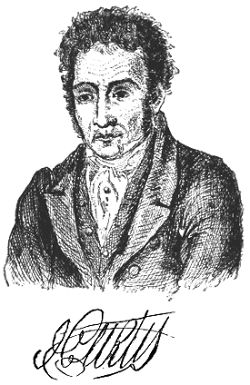
Curtis the Biographer of Corder. An Old Bailey Celebrity.
An Old Bailey Character.
Some thirty years ago there appeared in the second series of the Great Metropolis[34] a sketch of one Mr. Curtis, an eccentric person who was to be seen in the New Court in the Old Bailey, as constantly as the Judge himself. He (Curtis) was known to everybody in and about the place. For nearly a quarter of a century he had been in constant attendance at the Old Bailey from the opening to the close of each session, never being absent with the exception of two occasions, when attending the county assizes. He wrote short-hand, and was so passionately fond of reporting that he had taken down for his own special amusement every case verbatim which came before the New Court; and such was his horror of the Old Court, that you might as soon expect to hear the Bishop of London in a Dissenters' chapel as to find Mr. Curtis in the Old Court. He was notable for early rising: four o'clock in the morning he considered a late hour. It was an event in his life to lie in bed till five. By seven he had completed his morning journeys, which usually embraced a distance—for he was particularly fond of going over the same ground twice if not thrice in a morning—of from six to eight miles. Among the places visited, Farringdon Market, Covent Garden Market, Hungerford Market, and Billingsgate were never under any circumstances omitted. His own notion was that he had walked as much within thirty years before seven in the morning as would have made the circuit of the globe three or four times. He was, perhaps, the most inveterate pedestrian known; locomotion seemed to be a necessity of his nature. There was only one exception to this rule—that was, when he was taking down the trials at the Old Bailey. He considered it as the greatest favour that could be conferred on him to be asked to walk ten or twelve miles by an acquaintance. He was very partial to wet weather, and as fond of a rainy day as if he were a duck. He was never so comfortable as when thoroughly drenched. Thunder and lightning threw him into ecstasies; he was known to have luxuriated for some hours on Dover cliff in one of the most violent thunderstorms ever remembered in this country. He once walked from the City to Croydon Fair and back again on three consecutive days of the Fair; making with his locomotive achievements in Croydon a distance of nearly fifty miles a-day; and this without any other motive than that of gratifying his pedestrian propensities. He had a horror of coaches, cabs, omnibuses, and all sorts of vehicles; and he was not known to have been ever seen in one. Judging from his partiality to heavy showers of rain, he seemed to be to a certain extent an amphibious being; and he often declared, with infinite glee, that he was once thrown into a pond without suffering any inconvenience. The benefits of air and exercise were manifest in his cheerful disposition and healthy-looking, though somewhat weather-beaten countenance: he seemed the happiest little thick-built man alive.
He not only rose very early, but was also late in going to bed. On an average, he had not for twenty years slept above four hours in the twenty-four. He was often weeks without going to bed at all, and it sufficed him to have two or three hours' doze in his arm-chair, and with his clothes on. In the year 1834, he performed an unusual feat in this way: he sat up one hundred consecutive nights and days, without stretching himself on a bed, or putting himself into an horizontal position, even for a moment. For one century of consecutive nights, as Curtis phrased it, he neither put off his clothes to lie down in bed, nor anywhere else, for a second; all the sleep he had during the time was an occasional doze in his arm-chair.
Curtis's taste for witnessing executions, and for the society of persons sentenced to death, was remarkable. He had been present at every execution in the metropolis and its neighbourhood for the last quarter of a century. He actually walked before breakfast to Chelmsford, which is twenty-nine miles from London, to be present at the execution of Captain Moir. For many years he had not only heard the condemned sermons preached in Newgate, but spent many hours in the gloomy cells with the persons who had been executed in London during that period. He passed much time with Fauntleroy, and was with him a considerable part of the day previous to his execution. With Corder, too, of Red Barn notoriety, he contracted a friendship: immediately on the discovery of the murder of Maria Martin, he hastened to the scene, and remained there till Corder's execution. He afterwards wrote the Memoirs of Corder, which were published by Alderman Kelly, Lord Mayor, in 1837-8: the work had portraits of Corder and Maria Martin, and of Curtis, and nothing pleased him better than to be called the biographer of Corder.
By some unaccountable fatality, Curtis, where he was unknown, often had the mortification of being mistaken under very awkward circumstances for other persons. At Dover he was once locked up all night on suspicion of being a spy. When he went to Chelmsford to be present at Captain Moir's execution, he engaged a bed at the Three Cups inn; on returning thither in the evening the servants rushed out of his sight, or stared suspiciously at him, he knew not why, till at length the landlady, keeping some yards distant from him, said in tremulous accents, "We cannot give you a bed here; when I promised you one, I did not know the house was full." "Ma'am," replied Curtis, indignantly, "I have taken my bed, and I insist on having it." "I am very sorry for it, but you cannot sleep here to-night," was the reply. "I will sleep here to-night; I've engaged my bed, and refuse me at your peril," reiterated Curtis. The landlady then offered him the price of a bed in another place, to which Curtis replied, resenting the affront, "No, ma'am; I insist upon my rights as a public man; I have a duty to perform to-morrow." "It's all true. He says he's a public man, and that he has a duty to perform," were words which every person in the room exchanged in suppressed whispers with each other. The waiter now stepped up to Mr. Curtis, and taking him aside, said—"The reason why Mistress will not give you a bed is because you're the executioner." Curtis was astounded, but in a few moments laughed heartily at the mistake. "I'll soon convince you of your error, ma'am," said Curtis, walking out of the house. He returned in a few minutes with a gentleman of the place, who having testified to his identity being different from that supposed, the landlady apologized for the mistake, and, as some reparation, gave him the best bed in the inn.
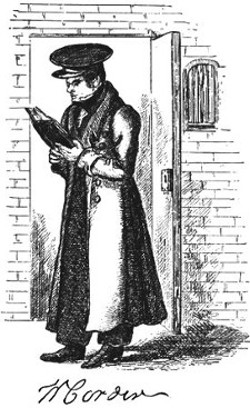
However, a still more awkward mistake occurred. After passing night after night with Corder in prison, Curtis accompanied him to his trial, and stood up close behind him at the bar. An artist had been sent from Ipswich to sketch a portrait of Corder for one of the newspapers of that town; but the sketcher mistook Curtis for Corder, and in the next number of the journal Mr. Curtis figured at full length as the murderer of Maria Martin! He bore the mistake with good humour, and regarded this as one of the most amusing incidents of his life.
Amidst these harmless eccentricities, Mr. Curtis effected much good amongst prisoners under sentence of death. "I speak within bounds," says the author of the Great Metropolis, "when I mention that he has from first to last spent more than a hundred nights with unhappy prisoners under sentence of death, conversing with them with all seriousness and with much intelligence on the great concerns of that eternal world on whose brink they were standing. I saw a long and sensible letter which the unhappy man named Pegsworth, who was executed in March, 1837, for the crime of murder, addressed a few days before his death to Mr. Curtis, and in which he most heartily thanked Mr. C. for all the religious instructions and admonitions he had given him; adding, that he believed he had derived great spiritual benefit from them."
Bone and Shell Exhibition.
It is curious to note with what odd results of patient labour our forefathers were amused to the top of their bent. They were Curiosities in the strictest sense of the term; but as to the information conveyed by their exhibition, it was generally a lucus à non lucendo.
In Suffolk Street, Cockspur Street, an ingenious Mrs. Dards got up a display of this kind, consisting of an immense collection of artificial flowers, made entirely by herself with fish-bones, the incessant labour of many years, of which she said to Mr. J. T. Smith:—"No one can imagine the trouble I had in collecting the bones for that bunch of lilies of the valley. Each cup consists of the bones which contain the brains of the turbot; and from the difficulty of matching the sizes, I never should have completed my task had it not been for the kindness of the proprietors of the London, Freemasons', and Crown and Anchor taverns, who desired their waiters to save the fish-bones for me."
This ingenious person distributed a card embellished with flowers and insects, upon which was engraven an advertisement, stating the exhibition to be the labour of thirty years, and to contain "a great variety of beautiful objects equal to nature." Likewise enabled to gratify them.
"With bones, scales, and eyes, from the prawn to the porpoise, Fruit, flies, birds, and flowers, oh, strange metamorphose!"
"Quid Rides?"
"People," says Mr. De Morgan, "are apt to believe that a smart saying or a ready retort are not a real occurrence; it was made up: it is too good to be true, &c." Perhaps there is no story which would be held more intrinsically deniable than that of the tobacconist who adopted Quid rides? for his motto on his carriage.
A friend, whose years, it will be seen, are many, has given me the following note:—
"Jacob Brandon was a tobacco-broker in the last century, a remarkable man in his way, supposed to be rich, a good companion, and extravagant in his expenses. Before the year 1800, I saw a chariot in Cheapside with a coat-of-arms, or rather a shield bearing a hand (sample) of tobacco and a motto, Quid rides? It was an old carriage, and at the time belonged to a job-master, so the driver told a person who was curious to know what the arms meant. It was this man's curiosity that caused my noticing the arms. Mentioning the circumstance in my father's presence, he said it was Brandon's old carriage. He had become gouty, and could not walk; he bought the carriage, had it newly painted, and was asked for his arms. This required consideration. Some thought Brandon was a Jew, or of Jewish extraction. Be this as it may, he loved a joke, and cared little for armorial bearings. He was telling a party in Lloyd's Coffee-house about his new carriage, and that he had determined to have a symbol of his profession on it, but that he wanted a motto. A well-known member of Lloyd's, a wit, and, as I afterwards found out, a curious reader, suggested Quid rides? which was forthwith adopted. This was Harry Calendon. I knew him well; he died within the present century. I have found that some of his witty stories about living persons were taken from old books. My father knew Brandon well, and employed him. Now, as to Quid rides? being proposed by some Irish wit as a motto for Lundy Foot, of Dublin, famous for a particular snuff, I have heard something of the history and habits of Lundy Foot; he had no carriage with arms on it. His snuff is still sold with its distinguishing wrapper and stamp, but no Quid rides?—which would certainly have been perpetuated if it had ever been adopted by the manufacturer of the snuff."
"Bolton Trotters."
This was the cognomen given to the muslin-weavers of Bolton in the days of their prosperity. The trade was that of a gentleman. They brought home their work in top-boots and ruffled shirts, carried a cane, and in some instances took a coach. Many weavers at that time used to walk about the street with a five-pound Bank of England note spread out under their hatbands; they would smoke none but long "churchwarden" pipes, and objected to the intrusion of any other handicraftsmen into the particular rooms in the public-houses which they frequented.
The "Bolton Trotters" were much addicted to practical joking, of which Mr. French, in his Life of Samuel Crompton, narrates this story:—"One of the craft visiting Bolton on a market-day, having delivered his work at the manufacturing warehouse, and obtained materials for his succeeding work, placed them carefully in one end of his blue linen wallet, and filled the other end with articles of clothing and provisions, upon which he had expended his recently received wages. He had, however, reserved a portion for his accustomed potation upon such occasions; and that he might enjoy this solace of his labour in comfort and safety, he left his wallet at the warehouse before visiting his favourite tavern. The good ale did its office, and when elevated to just the proper pitch for trotting, he met a brother of the loom, who, like himself, had transacted his day's business, and was now ready to trudge home with his wallet on his shoulder. The two weavers mingled with a little crowd gathered together to hear the strains of the Bolton volunteer band performing near the Swan Hotel. He who had left his wallet at the warehouse was not, however, too much engrossed by the martial music to neglect the tempting opportunity to trot his quondam friend, with whom he stood shoulder to shoulder, though each looked in a different direction. Provided with a needle and stout thread, and being the shorter man of the two, he had no difficulty in sewing the edge of his neighbour's well-filled wallet to the lapel of his own velveteen jacket, and then, during a momentary movement in the crowd, adroitly hitched it from his neighbour's to his own shoulder. An immediate and clamorous charge of robbery was made, and met by an indignant denial from the trotter, who coolly remonstrated with the loser on his culpable want of ordinary care, pointing out, at the same time, at the means he had taken to secure his own wallet, which no one, he said, could steal from him. This evidence was unanswerable, particularly as it was supported by many of the bystanders who had seen the whole transaction, and joined heartily in the laugh at the weaver who had been so effectually trotted for their amusement. A reconciliation was effected through the ordinary means on these occasions, of an adjournment to the alehouse."
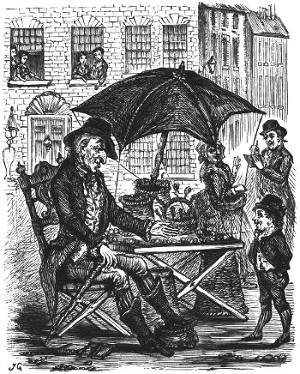
Lord Coleraine keeping an Apple-Stall. John Thomas Smith sketching the Scene.
Eccentric Lord Coleraine.
J. T. Smith, in his Life of Nollekens, has left these sensible remarks upon a class of persons whose lives present many instances of right feeling and upright conduct, although mixed up with less estimable qualities. "I believe," says Mr. Smith, "every age produces at least one eccentric in every city, town, and village. Be this as it may, go where you will, you will find some half-witted fellow, under the nickname either of Dolly, Silly Billy, or Foolish Sam, who is generally the butt and sport of his neighbours, and from whom, simple as he may sometimes be, a sensible answer is expected to an unthinking question: like the common children, who will, to our annoyance, inquire of our neighbour's parrot what it is o'clock. In some such light Nollekens was often held by his brother artists; and I once heard Fuseli cry out, when on the opposite side of the street: 'Nollekens, Nollekens, why do you walk in the sun? If you have no love for your few brains, you should not melt your coat buttons!'"[35]
The eccentric character is, likewise, sure to be found in London, where there are several curious varieties of this class of persons to be met with. In our walks, perchance, we may meet a man who always casts his eye towards the ground, as if he were ashamed of looking any one in the face; and who pretends, when accosted, to be near-sighted, so that he does not know even the friend that had served him. This short-sightedness is very common. Indeed, he draws his hat across his forehead to act as an eye-shade, so that his sallow visage cannot be immediately recognised, which makes him look as if he had done something wrong; whilst his coat is according to the true Addison cut, with square pockets large enough to carry the folio Ship of Fools. No man was more gazed at than Lord Coleraine, who lived near the New Queen's Head and Artichoke, in Marylebone Fields, and who never met Nollekens without saluting him. "Well, Nollekens, my old boy, how goes it? You never sent me the bust of the Prince." To which Nollekens replied: "You know you said you would call for it one of these days, and give me the money, and take it away in a hackney-coach." "I remember," says J. T. Smith, "seeing his lordship, after he had purchased a book entitled the American Buccaneers, sit down close to the shop from which he had bought it, in the open street, in St. Giles's, to read it. I also once heard Lord Coleraine, as I was passing the wall at the end of the Portland Road, where an old apple-woman, with whom his lordship held frequent conversations, was packing up her fruit, ask her the following question: 'What are you about, mother?' 'Why, my lord, I am going home to my tea; if your lordship wants any information I shall come again presently.' 'Oh! don't balk trade. Leave your things on the table as they are: I will mind your shop till you come back;' so saying, he seated himself in the old woman's wooden chair, in which he had often sat before whilst chatting with her. Being determined to witness the result, after strolling about till the return of the old lady, I heard his lordship declare the amount of his receipts by saying: 'Well, mother, I have taken threepence-halfpenny for you. Did your daughter Nancy drink tea with you?'"
Eccentric Travellers.
Curious stories are told of tourists being so fascinated by certain incidents in their travels as to be diverted from their purposes by finding themselves so comfortable as to wish to proceed no further—a lesson of content which is rarely lost on sensible persons.
It is told of an English gentleman, who started on a tour in 1815, the year of the battle of Waterloo, that he landed at Ostend, with the design of pushing on to Brussels, and took his place in the canal-boat that plied between Brussels and Ghent. The traveller went abroad, not merely to see foreign lands, but with the hope of meeting with illustrious personages and distinguished characters. Finding, however, that on board the trekschuit he not only fell in with many persons worth meeting, but had the opportunity of sitting down with them at the table-d'hôte, he thought he could not do better, and went backwards and forwards, never getting farther than Ghent.
Mr. Thackeray, in his Vanity Fair, gives this somewhat different version of the story:—"The famous regiment ... was drafted in canal-boats to Bruges, thence to march to Brussels. Jos. accompanied the ladies in the public boats; the which all old travellers in Flanders must remember for the luxury and accommodation they afforded. So prodigiously good was the eating and drinking on board these sluggish but most comfortable vessels, that there are legends extant of an English traveller, who, coming to Belgium for a week, and travelling in one of these boats, was so delighted with the fare there, that he went backwards and forwards from Ghent to Bruges perpetually, until the railroads were introduced, when he drowned himself on the last trip of the passage-boat." Possibly the catastrophe is an embellishment.
To these ana, Mr. Sala has added the story of the Englishman, who is said to have made a bet that Van Amburgh, the lion-tamer, would be eaten by his voracious pupils within a given time; and who followed him about the continents of Europe and America in the hope of seeing him at last devoured, and so winning his stakes. Eugène Sue introduces this mythical Englishman among the dramatis personæ of the Wandering Jew.
The Russians, also, have a story of an eccentric traveller—of course, an Englishman—who posted overland, and in the depth of winter, to St. Petersburgh, merely to see the famous wrought-iron gates of the Summer Garden. He is said to have died of grief at finding the gates superior to those at the entrance to his own park at home. Add to this the lying traveller, who boasted that he had been everywhere, and who, being asked how he liked Persia, replied that he scarcely knew, as he had only stayed there a day. Note, likewise, among eccentricities, the nobleman of whom it was inquired, at dinner, what he thought of Athens during an Oriental tour. He turned to his body-servant, waiting behind his chair, and said, "John, what did I think of Athens?"
In May, 1865, died Charles Waterton, "the gentle and gifted squire" of Walton Hall, in Yorkshire, in his eighty-second year. Of this gentleman one of the most eccentric incidents in modern travel is related to have occurred in his wanderings in South America. His attendant Indian had made an instrument to take a cayman, or alligator, of Guiana, on the banks of the Essequibo river. It was very simple; there were four pieces of tough, hard wood, a foot long, and about as thick as your little finger; they were tied round the ends of a rope in such a manner that if you conceive the rope to be an arrow, these four sticks would form the arrow's head; or that one end of the four united sticks answered to the point of the arrow's head, while the other end of the sticks expanded at equal distances round the rope. Now, it is evident that if the cayman swallowed this, the other end of the rope (which was thirty yards long) being fastened to a tree, the more he pulled the faster the barbs would stick into his stomach. The hook was well baited with flesh, and entrails twisted round the rope for about a foot above it. Into the steep sand-banks of the river the Indian pricked a stick, and at its extremity was fixed the machine which hung suspended about a foot from the water. Mr. Waterton and his companions then went back to their hammocks for the night.
Next morning was found a cayman ten feet and a half long, fast to the end of the rope. The next point was to get him out of the water without injuring his scales. After revolving many projects, Mr. Waterton had his canoe brought round; he then took out the mast, eight feet long, and as thick as his wrist, and wrapped the sail round the end of it; he then sunk down on one knee, about four yards from the water's edge, backed by his seven attendants, and pulled the cayman to the surface; he plunged furiously, and immediately went below again on their slackening the rope; they pulled again, and out he came. "By the time," says Mr. Waterton, "the cayman was within ten yards of me, I saw he was in a state of fear and perturbation; I instantly dropped the mast, sprung up, and jumped on his back, turning half round as I vaulted, so that I gained my seat with my face in a right position. I immediately seized his fore-legs, and, by main force, twisted them on his back; thus they served me for a bridle." He now plunged furiously, and lashed the sand with his tail. The people stoutly dragged him and the traveller about forty yards on the sand. After repeated attempts to regain his liberty, the cayman gave in, exhausted. Mr. Waterton then tied up his jaws, and secured his fore-feet in the position he had held them; there was still another struggle; while some of the people pressed upon his head and shoulders, Mr. Waterton threw himself upon his tail, keeping it down to the ground; and having conveyed the cayman away, his throat was cut, and dissection commenced.
This account of "catching a crocodile" was at first regarded as a "downright falsehood." Pliny, in his Natural History, however, describes a race of men who swam after the crocodile of the Nile, "and mounted on his back, like horsemen, as he opens his jaws to bite, with his head turned up, they thrust a club in his mouth, and holding the ends of it, one in the right hand and the other in the left, they bring him to shore, as if captive with bridles." In a rare book of plates of field sports one represents, probably from this account of Pliny, some men riding on crocodiles, and bringing them to land by means of a pole across their mouths, whilst others are killing them with large clubs. Beneath is inscribed in Latin: "Tentyra, an island of the Nile, in Egypt, is inhabited by an intrepid people, who climb the crocodile's back, and, bridling his mouth with a staff, force him out of the river, and slay him."
Dr. Pococke describes a method of taking the crocodile in Egypt still more like that of South America. He says: "They make some animal cry at a distance from the river, and when the crocodile comes out, they thrust a spear into his body, to which a rope is tied; they let him go into the water to spend himself, and afterwards, drawing him out, run a pole into his mouth, and, jumping on his back, tie his jaws together." To return to the Squire of Walton Hall.
Waterton is thus characterised by a personal friend:—He was one of those men whose life, reaching back and retaining many characteristics of the past, contrasted the present sameness with a manner of life much more varied, but now almost forgotten. Rising always at three in the morning, he gave an hour, as he said, "to the health and preservation of the soul," and was then ready for the occupations and pursuits of the day. His conversation and manners had that charm which comes of ancestry, of ancient riches, and a polished education enlivened by a sparkling wit.
In attachment to his religion he was as zealous as his great ancestor, Sir Thomas More, whose clock, from the house at Chelsea, still tells the hours at Walton Hall. His undoubting faith, and the consolations it afforded him, might, indeed, be envied by some of those who worship at other altars.
His hospitality was kind and generous: a stewed carp from the lake carried you back to the good old times, and furnished a dish not soon to be forgotten.
To those who knew him well there was something remarkably genial in the society of the good old squire, and his manner of receiving and bidding them adieu will be long remembered by his friends.
Mr. Thackeray, in The Newcomes, relates of Mr. Waterton this interesting trait:—"A friend who belongs to the old religion took me, last week, into a church where the Virgin lately appeared in person to a Jewish gentleman, flashed down upon him from heaven in light and splendour celestial, and, of course, straightway converted him. My friend bade me look at the picture, and kneeling down beside me, I know, prayed with all his honest heart that the truth might shine down upon me too; but I saw no glimpse of heaven at all, I saw but a poor picture, an altar with blinking candles, a church hung with tawdry strips of red and white calico. The good, kind W. went away, humbly saying, 'That such might have happened again if Heaven so willed it.' I could not but feel a kindness and admiration for the good man. I know that his works are made to square with his faith, that he dines on a crust, lives as chastely as a hermit, and gives his all to the poor."
Elegy on a Geologist.
Archbishop Whately, one day, with genial humour, wrote a supposed "Elegy on Dr. Buckland," of which the following is a portion:—
"Where shall we our great Professor inter, That in peace may rest his bones? If we hew him a rocky sepulchre He'll rise and brake the stones, And examine each stratum that lies around, For he's quite in his element underground. If with mattock and spade his body we lay In the common alluvial soil, He'll start up and snatch these tools away Of his own geological toil; In a stratum so young the Professor disdains That embedded should lie his organic remains. Then exposed to the drip of some case-hardening spring His carcase let stalactite cover, And to Oxford the petrified sage let us bring When he is encrusted all over; There, 'mid mammoths and crocodiles, high on a shelf, Let him stand as a monument raised to himself."