MEN OF LETTERS. (continued 2)
Reading edition
Mr. Wright.—"Whoever is acquainted with the miscreant calling himself 'Peter Pindar,' needs not be informed, that his disregard and hatred of truth are habitual. He will not, therefore, be surprised to learn that the account this Peter has published in a morning paper is a shameless tissue of falsehoods from beginning to end.
"I was not in the shop when it happened; but I am authorized, by the only two witnesses of it, to lay before the public the following statement:—
"Mr. Giffard was sitting by the window with a newspaper in his hand, when Peter Pindar came into the shop, and saying, 'Is not your name Giffard?' without waiting for an answer, raised a stick he had brought for the purpose, and levelled a blow at his head with all his force. Mr. Giffard fortunately caught the stick in his left hand, and quitting his chair, wrested it instantly from the cowardly assassin, and gave him two severe blows with it; one of which made a dreadful impression on Peter's skull. Mr. Giffard had raised the stick to strike him a third time, but seeing one of the gentlemen present about to collar the wretch, he desisted, and coolly said, 'Turn him out of the shop.' This was literally and truly all that passed.
"After Peter was turned into the street, the spectacle of his bleeding head attracted a mob of hackney-coachmen, watermen, paviours, &c., to whom he told his lamentable case, and then, with a troop of boys at his heels, proceeded to a surgeon's in St. James's Street, to have his wounds examined, after which he slunk home.—J. Wright."
Peter used to boast that he was the only author that ever outwitted or took in a publisher. His works were very popular, and produced the writer a large annual income. Walker, his publisher, in Paternoster Row, was disposed to purchase the copyrights, and print a collected edition. He first made the author a handsome offer in cash, and then an annuity. The poet drove a hard bargain for the latter, and said that "as he was very old and in a dangerous state of health, with a d—d asthma and stone in the bladder, he could not last long." The publisher offered 200l. a year; the Doctor required 400l. and every time the Doctor visited the Row, he coughed violently, breathed apparently in much pain, and acted the incurable invalid in danger so effectively that the publisher at last agreed to pay him 250l. annually for life. A collected edition of his works was printed in 1812, but it is defective, for they were so numerous that the author could not retain them all in his memory. An imperfect list in the Annual Biography for 1819 enumerates no less than sixty-four works. One of the portraits of the Doctor was published as a separate print, which did not sell to any extent; but its publisher derived a great profit by taking out the name of Peter Pindar and substituting that of "Renwick Williams the Monster," who was infamous for stabbing women in the street. This incident was told to Mr. Britton by Wolcot himself.
There is a fashion in the burlesque poetry of every age that is palatable to the public of that age only. The subjects of Wolcot's verses were ephemeral, and are now mostly forgotten. But his popularity was not entirely earned by his audacious personalities. His versification is nervous, his language racy and idiomatic, his wit often genuine; and through all his puns and quaintnesses there runs a strain of strong manly sense. Wolcot was equal to Churchill as a satirist, as ready and versatile in his powers, and possessed of a quick sense of the ludicrous, as well as a rich vein of fancy and humour. Some of his songs and effusions are tender and pleasing. Burns greatly admired his ballad of "Lord Gregory," and wrote another on the same subject. After all his biting satires on George III. and Pitt, he accepted a pension from the administration of which Pitt was the head—not to laud it, but to vituperate its opponents. He had a shrewd intellect, and his literary compositions have the finish of an artist; but he was utterly selfish, and was a self-indulgent voluptuary.
Peter lived to the age of eighty-one, much to the annoyance of his publisher, Walker. His last abode was in a small house in Montgomery's nursery-gardens, which occupied the site of the north side of Euston Square. Here he dwelt in a secluded, cheerless manner, the victim of an asthma, very deaf, and almost entirely blind, with only a female servant to attend him. His mind, however, retained its full power. He lived only for himself; declined dinner invitations, "to avoid the danger of loading his stomach with more than Nature required;" lay in bed the greater part of his time, because "it would be folly in him to be groping around his drawing-room," and because, "when up and in motion he was obliged to carry a load of eleven or twelve stone, while here he had only a few ounces of blanket to support." When out of bed, he amused himself with his violin, or examining, as well as his sight permitted, his crayons and pictures. He showed no aversion to "receive notoriety-hunters," who came to see and hear "Peter Pindar," but evinced no desire for society.
John Britton, who lived in Burton Street, often went to see Peter on a Saturday afternoon, and there met Mr. John Taylor, editor of the Sun newspaper. This gentleman was an inveterate and reckless punster, and often teased Peter by some pointless puns. At one of these visits, on taking leave, Taylor exclaimed, pointing to Peter's head and rusty wig, "Adieu! I leave thee without hope, for I see Old Scratch has thee in his claws." Peter died in the above house, January 14th, 1810, and was buried in the churchyard of St. Paul, Covent Garden, close to the grave of Butler. He left a considerable property to his relations. In early life he lived in the same parish, at No. 13, Tavistock Row; and in the garret of this house he wrote many of his invectives against George III. and the Royal Academicians. In 1807, he lodged in the first floor of a house in Pratt Place, Camden Town, rented by a Mr. and Mrs. Knight. The husband was a sea-faring man, seldom at home; and the Doctor, who was not over-scrupulous, is said to have seduced the wife's affections. Knight brought an action against the Doctor, but the jury very properly acquitted him of the charge.—See Cunningham's London, p. 409.
Peter was not emulous to shine as a wit in his colloquial intercourse, either with strangers or his most intimate associates. Indeed, his usual manner exhibited so little of that character which strangers had imagined of the writer of his lively satires, that they were commonly disappointed. The wife of a player, at whose house Wolcot often passed an evening, used to say that "his wit seems to lie in the bowl of a teaspoon." Angelo, in his Reminiscences, tells us that he could not guess the riddle, until one evening he observed that each time Peter replenished his glass goblet with brandy-and-water, in breaking the sugar, the corners of his lips were curled into a satisfactory smile, and he began some quaint story, as if, indeed, the new libation begot a new thought. To prove the truth of the discovery, one night, after supper, at his own home in Bolton Row, Angelo made the experiment. One of the party being in the secret, and fond of practical joking, came provided with some small square pieces of alabaster. Peter's glass waning fast, the joker contrived to slip the alabaster into a sugar-basin provided for the purpose; when the Doctor, reaching the hot water, and pouring in the brandy, the sugar-tongs were handed to him, and then the advanced basin of alabaster. "Thank you, my boy," said Peter, putting in five or six pieces, and taking his teaspoon, began stirring as he commenced his story. Unsuspicious of the trick, Peter proceeded, "Well, sirs,—and so the old parish priest. What I tell you (then his spoon was at work) happened when I was in that infernally hot place, Jamaica (then another stir). Sir, he was the fattest man on the island (then he pressed the alabaster); yes, d——, sir, and when the thermometer, at ninety-five, was dissolving every other man, this old slouching, drawling son of the church got fatter and fatter, until, sir—(curse the sugar! some devil-black enchanter has bewitched it.) By ——, sir, this sugar is part and parcel of that old pot-bellied parson—it will never melt;" and he threw the contents of the tumbler under the grate. The whole party burst into laughter, and the joke cut short the story. The mock sugar was slipped out of the way, and the Doctor, taking another glass, never suspected the frolic.
Peter, on seeing West's picture of Satan in the Exhibition, broke out in the following couplet:—
"Is this the mighty potentate of evil? 'Tis damn'd enough, indeed, but not the Devil."
The Author of "Dr. Syntax."
Dr. Syntax's Tour in Search of the Picturesque was a large prize in the lottery of publication and was also a novelty in origin and writing. It was written to a set of designs instead of the designs being made to illustrate the poet: in other words, the artist preceded the author by making a series of drawings, in which he exhibited his hero in a succession of places, and in various associations, calculated to exemplify his hobby-horsical search for the picturesque. Some of these drawings, made by Rowlandson, than whom no artist ever expressed so much with so little effort, were shown at a dinner-party at John Bannister's, in Gower Street, when it was agreed that they should be recommended to Ackermann, in the Strand, for publication. That gentleman readily purchased, and handed them, two or three at a time, to William Combe, who was then confined in the King's Bench Prison for debt. He fitted the drawings with rhymes, and they were first published in the Poetical Magazine, where they became so popular that they extended to three tours in as many volumes, and passed through several editions. The work reminds one of Drunken Barnaby's Journal by its humour: it has been called "rhyming, rambling, rickety, and ridiculous," but by a very inexperienced critic. The illustrations were, doubtless, the attraction, which was so great, that the demand kept pace with the supply. Hence Syntax was succeeded by the Dance of Life, the Dance of Death, Johnny Quægenus, and Tom Raw the Griffin, all of the same class and character, and ultimately extending to 295 prints, with versified letter-press "by Dr. Syntax." Of late years these works have been republished at reduced prices.
Combe, the author of these strange works was of good family connection, had been educated at Eton and Oxford, and very early came into possession of a large fortune, in ready money. He started in the world by taking a large mansion at the west end of London, furnished it superbly hired servants, and bought carriages, and assembled around him a set of sycophants and parasites, who made short work of it, for from the commencement to the drop-scene of the farce did not exceed one year. The consequence was disgraceful ruin, and Combe fled from his creditors and from society. We next hear of him as a common soldier, and recognized at a public-house with a volume of Greek poetry in his hand. He was relieved; but he still lived a reckless life, by turns in the King's Bench Prison and the Rules, the limits of which do not appear to have been to him much punishment. Horace Smith, who knew Combe, refers to the strange adventures and the freaks of fortune of which he had been a participator and a victim: "a ready writer of all-work for the booksellers, he passed all the latter portion of his time within the Rules, to which suburban retreat the present writer was occasionally invited, and never left without admiring his various acquirements, and the philosophical equanimity with which he endured his reverses." Mr. Smith further states, that if there was a lack of matter occasionally to fill up the columns of their paper, "Combe would sit down in the publisher's back-room and extemporize a letter from Sterne at Coxwould, a forgery so well executed that it never excited suspicion." Mr. Robert Cole, the antiquary, had among his autographs a list of the literary works and letters of Combe.
Combe was principally employed by Ackermann, who, for several years, paid him at least 400l. a-year. On the first lithograph stone which Mr. Ackermann printed, when he had prepared everything for working, Combe wrote:—
"I have been told of one Who, being asked for bread, In its stead Return'd a stone. "But here we manage better. The stone we ask To do its task, And it returns in every letter."
"William Combe, Jan. 23, 1817."
Combe was often a guest at Ackermann's table; he proved a friend to him during his last illness, and contributed to the expenses of his funeral, tomb, &c. Subsequent to his death, in 1823, a small volume was published, entitled Letters to Marianne, said to have been written by him after the age of seventy, to a young girl. We remember to have visited him in the Rules, near New Bethlem Hospital, when we learnt that he had written a memoir of his chequered life. Campbell, in his Life of Mrs. Siddons, states that Combe lived nearly twenty years in the King's Bench, and never quitted that prison; which is not correct. Combe had nearly been Mrs. Siddons's reading preceptor.
Rowlandson, who designed the Syntax illustrations, was as improvident as Combe: he had a legacy of 7,000l., and other property, bequeathed to him by an aunt: this he dissipated in the gaming-houses of Paris and London, where he alternately won and lost without emotion several thousand pounds. When penniless, he would return to his professional duties, sit down coolly to make a series of new designs, and exclaim stoically, "I've played the fool, but (holding up his pencils) here is my resource." To Rowlandson, as well as Combe, Ackermann proved a warm and generous patron and employer.
Dr. Doran, in his piquant Notes to the Last Journals of Horace Walpole, tells us that "Combe burst on the world as a wonderfully well-dressed beau, and was received with éclat for the sake of his wealth, talents, grace, and personal beauty. He was popularly called 'Count Combe,' till his extravagance had dissipated a noble fortune; and then, addressing himself to literature, the Count was forgotten in the Author. In the Gentleman's Magazine for May, 1862, there is a list of his works, originally furnished by his own hand. Not one was published with his name, and they amount in number to sixty-eight. Combe was a teetotaller in the days when drunkenness was in fashion, and was remarkable for disinterestedness and industry. He was the friend of Hannah More, whom he loved to make weep by improvised romances, in which he could 'pile up the agony' with wonderful effect. Religious faith and hope enabled William Combe to triumph over the sufferings of his latter years. His second wife, the sister of the gentle and gifted Mrs. Cosway, survived him."
Horace Walpole, 1779, speaking of the poem, The World as it Goes, describes it as "by that infamous Combe, the author of the Diabolical. It has many easy poetic lines, imitates Churchill, and is fully as incoherent and absurd in its plan as the worst of the latter's."
Again, in 1778, Walpole describes "Combe" as "a most infamous rascal, who had married a cast mistress of Lord Beauchamp, and wrote many satiric poems not quite despicable for the poetry, but brutally virulent against that Lord, and others, particularly Lord Irnham." But, as Dr. Doran aptly observes, "Walpole however fond of satire, hated satirists, particularly when they were fearless and outspoken, like Combe."
Mrs. Radcliffe and the Critics.
It is singular that although Mrs. Radcliffe's beautiful descriptions of foreign scenery, composed solely from the materials afforded by travellers, collected and embodied by her own genius, were marked in a particular degree with the characteristics of fancy portraits, yet many of her contemporaries conceived them to be exact descriptions of scenes which she had visited in person. One report transmitted to the public by the Edinburgh Review, stated that Mr. and Mrs. Radcliffe had visited Italy; that Mr. Radcliffe had been attached to one of the British embassies in that country; and that it was here his gifted consort imbibed the taste for picturesque scenery, and for mouldering ruins, and for the obscure and gloomy anecdotes which tradition relates of their former inhabitants. This is so far a mistake, as Mrs. Radcliffe never was in Italy; but it has been mentioned, in explanation, that she probably availed herself of the acquaintance she formed in 1793 with the magnificent scenery on the banks of the Rhine, and the frowning remains of feudal castles with which it abounds. The inaccuracy of the reviewer is of no great consequence; but a more absurd report found its way into print, namely, that Mrs. Radcliffe, having visited the fine old Gothic mansion of Haddon House, had insisted upon remaining a night there, in the course of which she had been inspired with all that enthusiasm for Gothic residences, hidden passages, and mouldering walls, which marks her writings. Mrs. Radcliffe, we are assured, never saw Haddon House; and although it was a place excellently worth her attention, and could hardly have been seen by her without suggesting some of those ideas in which her imagination naturally revelled, yet we should suppose the mechanical aid to invention—the recipe for fine writing—the sleeping in a dismantled and unfurnished old house, was likely to be rewarded with nothing but a cold, and was an affectation of enthusiasm to which Mrs. Radcliffe would have disdained to have recourse.
These are the opinions of Sir Walter Scott; appended to them are these somewhat depreciatory remarks made by Dunlop, in his History of Fiction:—
"In the writings of Mrs. Radcliffe there is a considerable degree of uniformity and mannerism, which is perhaps the case with all the productions of a strong and original genius. Her heroines too nearly resemble each other, or rather they possess hardly any shade of difference. They have all blue eyes and auburn hair—the form of each of them has 'the airy lightness of a nymph'—they are all fond of watching the setting sun, and catching the purple tints of evening, and the vivid glow or fading splendour of the western horizon. Unfortunately they are all likewise early risers. I say unfortunately, for in every exigency Mrs. Radcliffe's heroines are provided with a pencil and paper, and the sun is never allowed to rise nor set in peace. Like Tilburina in the play, they are 'inconsolable to the minuet in Ariadne,' and in the most distressing circumstances find time to compose sonnets to sunrise, the bat, a sea-nymph, a lily, or a butterfly."
The tenor of Mrs. Radcliffe's private life seems to have been peculiarly calm and sequestered. She probably declined the sort of personal notoriety which, in London society, usually attaches to persons of literary merit; and, perhaps, no author whose works were so universally read and admired was so little personally known even to the most active of that class of people of distinction, who rest their peculiar pretensions to fashion upon the selection of literary society. Her estate was certainly not the less gracious; and it did not disturb Mrs. Radcliffe's domestic comforts, although many of her admirers believed, and some are not yet undeceived, that, in consequence of brooding over the terrors which she depicted, her reason had at length been overturned, and that the author of The Mysteries of Udolpho only existed as the melancholy inmate of a private madhouse. This report was so generally spread, and so confidently repeated in print, as well as in conversation, that the writer believed it for several years, until, greatly to his satisfaction, he learned, from good authority, that there neither was, nor ever had been, the most distant foundation for this unpleasing rumour.
A false report of another kind gave Mrs. Radcliffe much concern. In Miss Seward's Correspondence, among the literary gossip of the day, it is roundly stated that the Plays upon the Passions were Mrs. Radcliffe's, and that she owned them. Mrs. Radcliffe was much hurt at being reported capable of borrowing from the fame of a gifted sister; and Miss Seward would, no doubt, have suffered equally, had she been aware of the pain she inflicted by giving currency to a rumour so totally unfounded. The truth is, that residing at a distance from the metropolis, and living upon literary intelligence as her daily food, Miss Seward was sometimes imposed upon by those friendly caterers, who were more anxious to supply her with the newest intelligence, than solicitous about its accuracy.
Mrs. Radcliffe died at her residence in Stafford Row, Pimlico, on the 7th of February, 1823; and her remains rest in the vault of the Chapel-of-ease to St. George's parish, in the Bayswater Road, facing Hyde Park.
Cool Sir James Mackintosh.
Mackintosh, a name dear to letters and philosophy, was no lawyer in the narrow-minded sense of the word, and when appointed judge at Bombay, was lamentably thrown away upon such society as he met there. Accustomed to lead in the conversations of the conversation-men of the metropolis—such as Sharp, Rogers, Dumont—he found himself transplanted among those who afforded a sad and bitter contrast. It was like Goëthe's oak-plant, with its giant fibres, compressed within the dimensions of a flower-pot. On the third day after his arrival, most forcibly was he reminded of the contrast, when one of the members of the Council, the conversation turning upon quadrupeds, turned to him and inquired what was a quadruped. It was the same sagacious Solomon who asked him for the loan of some book, in which he could find a good account of Julius Cæsar. Mackintosh jocosely took down a volume of Lord Clarendon's History of the Rebellion, in which mention is made of a Sir Julius Cæsar, Master of the Rolls in the time of Charles the First. The wiseacre actually took the book home with him, and after some days brought it back to Sir James, remarking that he was disappointed on finding that the book referred to Julius Cæsar only as a lawyer, without the slightest mention of his military exploits.
Sir James was subject to certain Parson Adams-like habits of forgetfulness of common things and lesser proprieties; and this brought down upon him no slight share of taunt and ridicule. It happened, on his arrival at Bombay, that there was no house ready for his reception, and it would be a fortnight before a residence in the fort could be prepared for him. Mr. Jonathan Duncan, the Governor of the Presidency, therefore, with great kindness, offered him his garden-house, called Sans Pareil, for the temporary accommodation of Sir James and his family. But months and months elapsed, till a twelvemonth had actually revolved; Mackintosh and his wife, during all this time, found themselves so comfortable in their quarters, that they forgot completely the limited tenure on which they held them, appearing by a singular illusion, not to have the slightest suspicion of Mr. Duncan's proprietorship, notwithstanding some pretty intelligible hints on the subject from that gentleman, but communicated with his usual delicacy and politeness. At last, politeness and delicacy were out of the question, and the poor Governor was driven to the necessity of taking forcible possession of his own property. This was partly indolence, partly absence of mind in Sir James. He was constitutionally averse to every sort of exertion, and especially that of quitting any place where he found himself comfortable.
Before he went out to India, he made a trip into Scotland with his lady; and having taken up his abode for the night at an inn in Perthshire, not far from the beautiful park of Lord Melville (then Mr. Dundas) sent a request to Lady Jane Dundas (Mr. Dundas being absent) for permission to see the house and grounds, which was most civilly granted. Mr. Dundas being expected in the evening, her ladyship politely pressed them to stay for dinner, and to pass the night, their accommodation at the inn, not being of the best description. Mr. Dundas returned the same day, and though their politics were as adverse as possible, was so charmed with the variety of Mackintosh's conversation, that he requested his guests to prolong their visit for two or three days. So liberal, however, was the interpretation they put upon the invitation, that the two or three days were protracted into as many months, during which, every species of hint was most ineffectually given, till their hosts told them, with many polite apologies, that they expected visitors and a numerous retinue, and could no longer accommodate Mr. and Mrs. Mackintosh.
During Sir James Mackintosh's Recordership of Bombay, a singular incident occurred. Two Dutchmen having sued for debt two English officers, Lieutenants Macguire and Cauty, these officers resolved to waylay and assault them. This was rather a resolve made in a drunken excitement than a deliberate purpose. Fortunately, the Dutchmen pursued a different route from that which they had intended, and they prosecuted the two officers for the offence of lying-in-wait with intent to murder. They were found guilty, and brought up for judgment. Previous to his pronouncing judgment, however, Sir James received an intimation that the prisoners had conceived the project of shooting him as he sat on the bench, and that one of them had for that purpose a loaded pistol in his writing-desk. It is remarkable that the intimation did not induce him to take some precautions to prevent its execution—at any rate, not to expose himself needlessly to assassination. On the contrary, the circumstances only suggested the following remarks:—"I have been credibly informed that you entertained the desperate project of destroying your own lives at that bar, after having previously destroyed the judge who now addresses you. If that murderous project had been executed, I should have been the first British judge who ever stained with his blood the seat of justice. But I can never die better than in the discharge of my duty." All this eloquence might have been spared. Macguire submitted to the judge's inspection of his writing-desk, and showed him that, though it contained two pistols, neither of them was charged. It is supposed to have been a hoax—a highly mischievous one, indeed—but the statement was primâ facie so improbable, that it was absurd to give it the slightest credit.
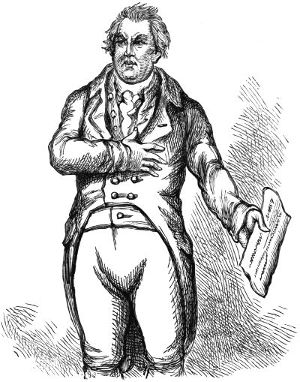
"Peter Porcupine." W. Cobbett.
Eccentricities of Cobbett.
Cobbett began his career a political writer of ultra-Conservative stamp. He first became known to the public as "Peter Porcupine," under which name he fiercely attacked the democratic writers and speakers of France and America. He was then resident in America, and encountered one or two trials at law for alleged libels, in his defence of monarchical and aristocratic institutions. The Porcupine Papers attracted much notice in England, were quoted and lauded by the government organs—quoted in both Houses of Parliament, and eulogized in the pulpit. The writer was considered one of the most powerful supports of the principles of the British constitution. This series of papers was republished in England, in twelve volumes octavo, under the patronage of the Prince Regent, to whom, it is believed, the work was dedicated.
On his return from America, Cobbett began a daily paper called the Porcupine. This was soon discontinued, and he began the Register. Both these papers were strongly in favour of the government; and the Register ran through several volumes before a change took place in the political opinions of the editor—a change hastened, if not caused, by an affront offered him by William Pitt. Windham was a great admirer of Cobbett, and after reading one of his Porcupine papers, declared that the author was "worthy of a statue in gold." Pitt had refused to meet the author of the Register at Windham's table; and this Cobbett resented, and never forgave. Very soon after this, a marked change took place in his politics; henceforth he was more consistent, and the last Register which came from his pen, very shortly before his death, breathed the same spirit which he had shown years before as one of the leaders of the democratic party.
One of Cobbett's oddities was the wood-cut of a gridiron which for many years headed the Political Register, as an emblem of the martyrdom which he avowed he was prepared to undergo, upon certain conditions. The gridiron will be recollected as one of the emblems of St. Lawrence, and we see it as the large gilt vane of one of the City churches dedicated to the saint.
As he was broiled on a gridiron for refusing to give up the treasures of the church committed to his care, so Cobbett vowed that he would consent to be broiled upon certain terms, in his Register, dated Long Island, on the 24th of September, 1819, wherein he wrote the well-known prophecy on Peel's Cash Payments Bill of that year as follows:—"I, William Cobbett, assert that to carry their bill into effect is impossible; and I say that if this bill be carried into full effect, I will give Castlereagh leave to lay me on a gridiron, and broil me alive, while Sidmouth may stir the coals, and Canning stand by and laugh at my groans."
On the hoisting of the gridiron on the Register, he wrote and published the fulfilment of his prophecy in the following statement:—"Peel's bill, together with the laws about small notes, which last were in force when Peel's bill was passed; these laws all taken together, if they had gone into effect, would have put an end to all small notes on the first day of May, 1823; but to precede this blowing-up of the whole of the funding system, an act was passed, in the month of July, 1822, to prevent these laws, and especially that part of Peel's bill which put an end to small Bank of England notes, from going into full effect; thus the system received a respite; but thus did the parliament fulfil the above prophecy of September, 1819."
A large sign-gridiron was actually made for Mr. Cobbett. It was of dimensions sufficient for him to have lain thereon (he was six feet high); the implement was gilt, and we remember to have seen it in his office-window, in Fleet Street; but it was never hoisted outside the office. It was long to be seen on the gable-end of a building next Mr. Cobbett's house at Kensington.
Cobbett possessed extraordinary native vigour of mind; but every portion of his history is marked by strange blunders. Shakspeare, the British Museum, antiquities, posterity, America, France, Germany, are, one and all, either wholly indifferent to him, or objects of his bitter contempt. He absurdly condemned the British Museum as "a bundle of dead insects;" abused drinking "the immortal memory" as a contradiction of terms; and stigmatized "consuming the midnight oil" as cant and humbug. His political nicknames were very ludicrous: as big O for O'Connell; Prosperity Robinson for a flaming Chancellor of the Exchequer; and shoy-hoy for all degrees of quacks and pretenders. Still, his own gridiron was a monstrous piece of quackery, as audacious as any charlatan ever set up.
When he had a subject that suited him, he is said to have handled it not as an accomplished writer, but "with the perfect and inimitable art with which a dog picks a bone." Still, his own work would not bear this sort of handling—witness the biting critique upon his English grammar, which provoked the remark that he would undertake to write a Chinese grammar.
In country or in town, at Barn Elms, in Bolt Court or at Kensington, Cobbett wrote his Registers early in the morning: these, it must be admitted, had force enough; for he said truly, "Though I never attempt to put forth that sort of stuff which the intense people on the other side of the Channel call eloquence, I bring out strings of very interesting facts; I use pretty powerful arguments; and I hammer them down so closely upon the mind, that they seldom fail to produce a lasting impression." This he owed, doubtless, to his industry, early rising, and methodical habits.
Cobbett affected to despise all acquirements which he had not. In his English Grammar he selects examples of bad English from the writings of Dr. Johnson and Dr. Watts, and is very contemptuous on "what are called the learned languages;" but he would not have entered upon Latin or Greek.
It seemed to be Cobbett's aim to keep himself fresh in the public eye by some means of advertisement or other; a few were very reprehensible, but none more than his disinterring the bones of Thomas Paine, buried in a field on his own estate near New Rochelle, and bringing these bones to England, where, Cobbett calculated, pieces of them would be worn as memorials of the gross scoffer. Cobbett, however, never more widely mistook English feeling: instead of arousing, as he expected, the enthusiasm of the republican party in this country, he only drew upon himself universal contempt.
Heber, the Book-Collector.
There have been many instances of the indulgence of book collecting to the extent which is termed book-madness; but none more remarkable than that of Mr. Richard Heber, half-brother to the celebrated Bishop of Calcutta of the same name. Mr. Heber inherited property which permitted him to spend immense sums in the purchase of books; and he received an education which enabled him to appreciate the books when purchased. He was not therefore, strictly speaking, a bibliomaniac, and nothing more, though his exertions in collecting amounted to eccentricities. He would make excursions from the family seats in Yorkshire and Shropshire to London, to attend book sales; and when the termination of the war in 1815 opened the Continent to English travellers, Heber visited France, Belgium and the Netherlands, and made large purchases of books in each country. He cared for nothing but books. He kept up a correspondence with all the great dealers in old books throughout the kingdom. On hearing of a curious book, he was known to have put himself into a mail-coach, and travelled three or four hundred miles to obtain it, fearful to entrust his commission to any agent. He was known to say seriously to his friends, on their remarking on his many duplicates, "Why, you see, sir, no man can do comfortably without three copies of a work. One he must have for a show copy, and he will, probably, keep it at his country-house. Another he will require for his use and reference; and, unless he is inclined to part with this, which is very inconvenient, or risk the injury of his best copy, he must needs have a third at the service of his friends."
Mr. Hill Burton, in his Book-hunter, relates the following incident of Heber's experience in the rarity-market. A celebrated dealer in old books was passing a chandler's shop, where he was stopped by a few filthy old volumes in the window. One of them he found to be a volume of old English poetry, which he—a practised hand in that line—saw was utterly unknown as existing, though not unrecorded. Three and sixpence was asked; he stood out for a half-a-crown, on first principles, but, not succeeding, he paid the larger sum, and walked away, book in pocket, to a sale, where the first person he saw was Heber. Him the triumphant bookseller drew into a corner, with "Why do you come to auctions to look for scarce books, when you can pick up such things as this in a chandler's shop for three and sixpence?" "Bless me, ——, where did you get this?" "That's tellings! I may get more there." "——, I must have this." "Not a penny under thirty guineas!" A cheque was drawn, and a profit of 17,900 per cent. cleared by the man who had his eyes about him, in whose estimation such a sum was paltry compared with the triumph over Heber.
Mr. Heber's taste strengthened as he grew older. Not only was his collection of old English literature unprecedented, but he brought together a larger number of fine copies of Latin, Greek, French, Spanish, Italian, and Portuguese books than had ever been possessed by a private individual. His house at Hodnet, in Shropshire, was nearly all library. His house in Pimlico (where he died in 1833) was filled with books from top to bottom: every chair, table, and passage containing "piles of erudition." A house in York Street, Westminster, was similarly filled. He had immense collections of books in houses rented merely to contain them, at Oxford, Paris, Antwerp, Brussels, and Ghent. When he died, curiosity was naturally excited to know what provision he had made in reference to his immense store of books; but when his will was discovered, after a long and almost hopeless search among bills, notes, memoranda, and letters, it was found, to the astonishment of every one on reading it, that the library was not even mentioned! It seemed as if Heber cared nothing what should become of the books, or who should possess them, after his decease; and as he was never married, or influenced greatly by domestic ties, his library was considered by the executors of his will as merely so much "property," to be converted into cash by the aid of the auctioneer. What was the number of books possessed by him or the amount of money paid for them, appears to have been left in much doubt. Some estimated the library at 150,000 volumes, formed at a cost of 100,000l.; others reckoned it at 500,000 volumes, at an aggregate value of 250,000l. The truth was, his executors did not know in how many foreign towns his collections of books were placed. Thus it could not accurately be ascertained what portion of the whole was sold by auction in London in 1834-6; but the mere catalogue of that portion fills considerably more than two thousand printed octavo pages. The sales were conducted by Mr. Evans, Messrs. Sotheby, and other book-auctioneers, and occupied two hundred and two days, extending through a period of upwards of two years from April 10, 1834, to July 9, 1836. One copy of the catalogue has been preserved, with marginal manuscript notes, relating to almost every lot; and from this a summary of very curious information is deducible. It appears that, whatever may have been the number of volumes sold by auction, or otherwise got rid of abroad, those sold at this series of auctions in London were 117,613 in number, grouped into 52,672 lots. As regards the ratio borne by the prices obtained, to those which Mr. Heber had paid for the books in question, the account as rendered showed that the auctioneer's hammer brought 56,775l. for that which had cost 77,150l. It would appear, therefore, that the losses accruing to Mr. Heber's estate through his passion for book-collecting, amounted to upwards of 20,000l., and this irrespective of the fate of the continental libraries.
Sir John Soane Lampooned.
Sir John Soane, who bequeathed to the country his Museum in Lincoln's Inn Fields, which cost him upwards of 50,000l., was the son of a bricklayer, and was born at Reading in 1753; he was errand-boy to Dance, the architect, and subsequently his pupil. He rose to great eminence, grew rich and liberal; he gave for Belzoni's elaborate sarcophagus in the Soane Museum, 2,000 guineas; paid large sums for art rarities; subscribed 1,000l. for the Duke of York's monument, was contended with his knighthood, and declined to receive a baronetcy. Yet he was a man of overweening vanity, and was much courted by legacy-hunters; whilst his alienation from his son assisted in raising up many enemies, in addition to those which Soane's remarkable success brought against him. From the latter section may have proceeded the following curious and popular squib of the day, said to have been found under the plates at one of the artistic or academic dinners. It is headed:—
"The Modern Goth.
"Glory to thee, great Artist! soul of taste! For mending pigsties where a plank's misplaced: Whose towering genius plans from deep research Houses and temples fit for Master Birch To grace his shop on that important day, When huge twelfth-cakes are raised in bright array. Each pastry pillar shows thy vast design— Hail! then, to thee, and all great works of thine. Come, let me place thee, in the foremost rank, With him whose dullness discomposed the bank; [A line illegible.] Thy style shall finish what his style begun. Thrice happy Wren! he did not live to see The dome that's built and beautified by thee. Oh! had he lived to see thy blessed work, To see plaster scored like loins of pork; To see the orders in confusion move: Scrolls fixed below, and pedestals above: To see defiance hurled at Rome and Greece, Old Wren had never left the world in peace. Look where I will, above, below, is shown A pure disordered order of thine own; Where lines and circles curiously unite, A base, confounded, compound Composite: A thing from which, in truth it may be said, Each lab'ring mason turns abash'd his head; Which Holland reprobates, and Dance derides, Whilst tasteful Wyatt holds his aching sides. Here crawl, ye spiders! here, exempt from cares, Spin your fine webs above the bulls and bears! Secure from harm enjoy the charnell'd niche: No maids molest you, for no brooms can reach; In silence build from models of your own, But never imitate the works of Soane!"
Soane is described by his biographer as "one of the vainest and most self-sufficient of men, who courted praise and adulation from every person and source, but dreaded, and was even maddened by, anything like impartial and discriminating criticism." But he grew so disgusted with his flatterers, that a short time before his death he shut himself up in a house at Richmond, to get out of the way of their attentions.
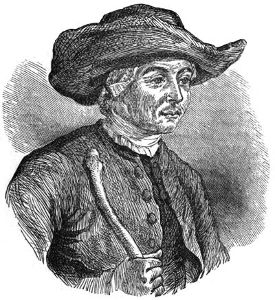
Jedediah Buxton. Ætat. 49.
Numeros memini. Virgil.
Extraordinary Calculators.
On the 3rd of July, 1839, some of the eminent members of the Academy of Sciences at Paris, including MM. Arago, Lacroix, Libri, and Sturm, met to examine a remarkable boy whose powers of mental calculation were deemed quite inexplicable. This boy, named Vito Mangiamele, a Sicilian, was the son of a shepherd, and was about eleven years old. The examiners asked him several questions which they knew, under ordinary circumstances, to be tedious of solution—such as, the cube root of 3,796,416, and the 10th root of 282,475,249; the first of these he answered in half-a-minute, the second in three minutes. One question was of the following complicated character—"What number has the following proportions, that if its cube is added to 5 times its square, and then 42 times the number, and the number 42 be subtracted from the result, the remainder is equal to 0 or zero." M. Arago repeated this question a second time, but while he was finishing the last word, the boy replied—"The number is 5!"
In the same year, Master Bassle, who was only thirteen years of age, went through an extraordinary mnemonic performance at Willis's Rooms, London. Five large sheets of paper, closely printed with tables of dates, specific gravities, velocities, planetary distances, &c., were distributed among the visitors, and every one was allowed to ask Master Bassle a question relating to these tables, to which was received a correct answer. He would also name the day of the week on which any day of the month had fallen in any particular year. He could repeat long series of numbers backwards and forwards, and point out the place of any number in the series; and to prove that his powers were not merely confined to the rows of numbers in the printed tables, he allowed the whole company to form a long series, by contributing each two or three digits in the order in which they sat; and then, after studying this series for a few minutes, he committed it to memory, and repeated it entire, both backwards and forwards, from the beginning to the end. These performances are believed to have been not the result of any natural mnemonic power, but of a method to be acquired by any person in the course of twelve lessons.
Zerah Colburn, who excited much interest in London in 1812, was a native of Vermont, in the United States. At six years old, he suddenly showed extraordinary powers of mental calculation. By processes which seemed to be almost unconscious to himself, and were wholly so to others, he answered arithmetical questions of considerable difficulty. When eight years old, he was brought to London, where he astonished many learned auditors and spectators by giving correct solutions to such problems as the following: raise 8 up to the 16th power; give the square root of 106,929; give the cube root of 268,336,125; how many seconds are there in 48 years? The answers were always given in very few minutes—sometimes in a few seconds. He was ignorant of the ordinary rules of arithmetic, and did not know how or why particular modes of process came into his mind. On one occasion, the Duke of Gloucester asked him to multiply 21,734 by 543. Something in the boy's manner induced the Duke to ask how he did it, from which it appeared that the boy arrived at the result by multiplying 65,202 by 181, an equivalent process; but why he made this change in the factors, neither he nor any one else could tell. Zerah Colburn was unlike other boys also in this, that he had more than the usual number of toes and fingers; a peculiarity observable also in his father and in some of his brothers.
An exceptional instance is presented in the case of Mr. Bidder, of this faculty being cultivated to a highly useful purpose. George Parker Bidder, when six years old, used to amuse himself by counting up to 100, then to 1,000, then to 1,000,000: by degrees he accustomed himself to contemplate the relations of high numbers, and used to build up peas, marbles, and shot, into squares, cubes, and other regular figures. He invented processes of his own, distinct from those given in books on arithmetic, and could solve all the usual questions mentally more rapidly than other boys with the aid of pen and paper. When he became eminent as a civil engineer, he was wont to embarrass and baffle the parliamentary counsel on contested railway bills, by confuting their statements of figures almost before the words were out of their mouths. In 1856, he gave to the Institution of Civil Engineers an interesting account of this singular arithmetical faculty—so far, at least, as to show that memory has less to do with it than is generally supposed; the processes are actually worked out seriatim, but with a rapidity almost inconceivable.
The most famous calculator in the last century was Jedediah Buxton, who, in 1754, resided for several weeks at St. John's Gate, Smithfield. This man, though he was the son of a schoolmaster, and the grandson of the vicar of his native parish, Elmeton, in Derbyshire, had never learned to write, but he could conduct the most intricate calculations by his memory alone; and such was his power of abstraction that no noise could disturb him. One who had heard of his astonishing ability as a calculator, proposed to him for solution the following question:—In a body whose three sides measure 23,145,789 yards, 5,642,732 yards, and 54,965 yards, how many cubical eighths-of-an-inch are there? This obtuse reckoning he made in a comparatively short time, although pursuing the while, with many others, his labours in the fields. He could walk over a plot of land and estimate its contents with as much accuracy as if it had been measured by the chain. His knowledge was, however, limited to figures. In 1754, Buxton walked to London, with the express intention of obtaining a sight of the King and Queen, for beyond figures, royalty formed the only subject of his curiosity. In this intention he was disappointed: he was, however, introduced to the Royal Society, whom he called the "volk of the Siety Court." They tested his powers, and dismissed him with a handsome gratuity.
He was next taken by his hospitable entertainer at St. John's Gate, to see Garrick in the character of Richard III. at Drury Lane Theatre, when undazzled by the splendour of the stage appointments, and unmoved by the eloquent passion of the actor, the simple rustic employed himself in reckoning the number of words he heard, and the sum total of the steps made by the dancers; and after the performance of a fine piece of music, he declared that the innumerable sounds had perplexed him.
To these feats may be added the following:—Buxton multiplied a sum of thirty-nine places of figures into itself and even conversed whilst performing it. His memory was so great, that he could leave off and resume the operation at the distant period of a week, or even several months. He said that he was drunk once with reckoning by memory from May 17 until June 16, and then recovered after sleeping soundly for seven hours. The question which occupied him so intensely was the reduction of a cube of upwards of 200,000,000 of miles into barleycorns, and then into hairs'-breaths of an inch in length. He kept an account of all the beer which he had drunk for forty years, which was equal to five thousand one hundred and sixteen pints: of these two thousand one hundred and thirty-two were drunk at the Duke of Kingston's and only ten at his own house.
There was a portrait of Buxton at Rufford Abbey, Nottinghamshire. A print of him was engraved in the Gentleman's Magazine, June, 1754, with this subscription: "Jedediah Buxton. Ætat. 49.—Numeros memini. Virgil." He was married and had several children, and died at the age of 70, in the year 1777.
Charles Lamb's Cottage at Islington.
In a very pleasant paper on "Ideal Houses," in No. 4 of the Cornhill Magazine, we find this clever sketch of a few of the amiable eccentricities of our famous Essayist, Charles Lamb:—
"I believe," says the contributor, "more in the influence of dwellings upon human character than in the influence of authority on matters of opinion. The man may seek the house, or the house may form the man; but in either case the result is the same. A few yards of earth, even on this side of the grave, will make all the difference between life and death. If our dear old friend, Charles Lamb, was now alive (and we must all wish he was, if only that he might see how every day is bringing him nearer the crown that belongs only to the Prince of British Essayists), there would be something singularly jarring to the human nerves in finding him at Dalston, but not so jarring in finding him a little farther off at Hackney. He would still have drawn nourishment in the Temple and in Covent Garden; but he must surely have perished if transplanted to New Tyburnia. I cannot imagine him living at Pentonville (I cannot, in my uninquiring ignorance, imagine who Penton was, that he should name a ville?), but I can see a certain appropriate oddity in his cottage at Colebrook Row, Islington.
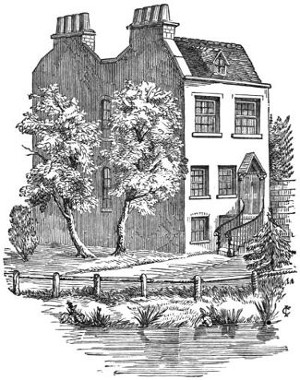
Colebrook Cottage.
"In the first place, we may agree that this London suburb is very odd, without going into the vexed question of whether it was very 'merry.' In the second place, this same Colebrook Row was built a few years before our dear old friend was born—I believe, in 1770. In the third place, it was called a 'Row,' though 'Lane' or 'Walk' would have been as old and as good; but 'Terrace' or 'Crescent' would have rendered it unbearable. The New River flowed calmly past the cottage walls—as poor George Dyer found to his cost—bringing with it fair memories of Isaak Walton and the last two centuries. The house itself had also certain peculiarities to recommend it. The door was so constructed that it opened into the chief sitting-room; and this, though promising much annoyance, was really a source of fun and enjoyment to our dear old friend. He was never so delighted as when he stood on the hearth-rug receiving many congenial visitors as they came to him on the muddiest-boot and the wettest-of-umbrella days. His immediate neighbourhood was also peculiar.
"It was there that weary wanderers came to seek the waters of oblivion. Suicide could pitch upon no spot so favourable for its sacrifice as the gateway leading into the river inclosure before Charles Lamb's cottage. Waterloo Bridge had not long been built, and was not then a fashionable theatre for self-destruction. The drags were always kept ready in Colebrook Row, at a small tavern a few doors from the cottage. The landlord's ear, according to his own account, had become so sensitive by repeated practice, that when aroused at night by a heavy splash in the water, he could tell by the sound whether it was an accident or a wilful plunge. He never believed that poor George Dyer tumbled in from carelessness, though it was no business of his to express an opinion on the matter. After the eighth suicide within a short period, Charles Lamb began to grow restless.
"'Mary,' he said to his sister, 'I think it's high time we left this place;' and so they went to Edmonton."
Thomas Hood.
This remarkable man of genius whose wit and humour entitle him to high rank in English literature, was born in 1798, in the Poultry, London, where his father was, for many years, acting partner in the firm of Vernor, Hood, and Sharpe, extensive booksellers and publishers. "There was a dash of ink in my blood," he writes: "my father wrote two novels, and my brother was decidedly of a literary turn, to the great disquietude, for a time, of an anxious parent." Thomas Hood was sent to a school in Tokenhouse Yard, in the City, as a day-boarder. The two maiden sisters, who kept the school, and with whom Hood took his dinner, had the odd name of Hogsflesh, and they had a sensitive brother, who was always addressed as "Mr. H.," and who subsequently became the prototype of Charles Lamb's unsuccessful farce, called "Mr. H."
In 1812, Hood was sent to a day-school, his account of which is as follows:—"In a house formerly a suburban seat of the unfortunate Earl of Essex, over a grocer's shop, up two pair of stairs, there was a very select day-school, kept by a decayed Dominie, as he would have been called in his native land. In his better days, when my brother was his pupil, he had been master of one of those wholesale concerns in which so many ignorant men have made fortunes, by favour of high terms, low ushers, gullible parents, and victimized little boys. Small as was our college, its principal maintained his state, and walked gowned and covered. His cap was of faded velvet, of black, or blue, or purple, or sad-green, or, as it seemed, of altogether, with a sad nuance of brown; his robe of crimson damask lined with the national tartan. A quaint, carved, high-backed elbowed article, looking like an émigré from a set that had been at home in an aristocratical drawing-room under the ancien régime, was his professional chair, which, with his desk, was appropriately elevated on a dais some inches above the common floor. From this moral and material eminence he cast a vigilant yet kindly eye over some dozen of youngsters: for adversity, sharpened by habits of authority, had not soured him, or mingled a single tinge of bile with the peculiar red-streak complexion so common to the wealthier natives of the north...." "In a few months, my education progressed infinitely farther than it had done in as many years under the listless superintendence of B.A. and LL.D. and assistants. I picked up some Latin, was a tolerable grammarian, and so good a French scholar, that I earned a few guineas—my first literary fee—by revising a new edition of Paul et Virginie for the press. Moreover, as an accountant, I could work a summum bonum, that is, a good sum."
Young Hood finished his education at Wanostrocht's Academy at Camberwell; and removed thence to a merchant's counting-house in the City, where he realized his own inimitable sketch of the boy "Just set up in Business:"—
"Time was I sat upon a lofty stool, At lofty desk, and with a clerkly pen Began each morning at the stroke of ten To write in Bell and Co.'s commercial school, In Warnford Court, a shady nook and cool, The favourite retreat of merchant men; Yet would my quill turn vagrant even then, And take stray dips in the Castalian pool. Now double entry—now a flowery trope— Mingling poetic honey with trade wax: Blogg, Brothers—Milton—Grote and Prescott—Pope— Bristles and Hogg—Glyn, Mills, and Halifax— Rogers and Towgood—Hemp—the Bard of Hope— Barilla—Byron—Tallow—Burns, and Flax."
In 1824, Hood, after having contributed to some periodicals at Dundee in 1821, obtained the situation of sub-editor of the London Magazine. "My vanity," says he, "did not rashly plunge me into authorship, but no sooner was there a legitimate opening than I jumped at it, à la Grimaldi, head foremost, and was speedily behind the scenes."
Mr. Hood's first work was anonymous—his Odes and Addresses to Great People—a little, thin, mean-looking foolscap sub-octavo of poems with nothing but wit and humour (could it want more?) to recommend it. Coleridge was delighted with the work, and taxed Charles Lamb by letter with the authorship.
His next work was A Plea for the Midsummer Fairies, a serious poem of infinite beauty, full of fine passages and of promise; it obtained praise from the critics, but little favour from the public; and Hood's experience of the unpleasant truth that
"Those who live to please must please to live,"
induced him to have recourse again to his lively vein. He published a second and third series of Whims and Oddities, and in 1829 commenced the Comic Annual, and it was continued nine years. It proved very profitable; it was a small, widely-printed volume, with rough woodcuts drawn by Hood, who had been some time on probation with Sands and Le Keux, the engravers. Several thousand copies were sold annually, as the publishers' ledgers show. Then came out the comic poem of The Epping Hunt, which, Hood tells us, "was penned by an underling at the Wells, a person more accustomed to riding than writing," as shown in this epistle:—"Sir,—Abouut the Hunt. In anser to your Innqueries, their as been a great falling off latterally, so much so this year that there was nobody allmost. We did a mear nothing provisionally, hardly a Bottle extra, which is as proof in Pint. In short our Hunt may be sad to be in the last Stag of a Decline. Bartholomew Rutt." Next appeared The Dream of Eugene Aram, with this note: "The late Admiral Burney went to school at an establishment where the unhappy Eugene Aram was usher subsequent to his crime. The Admiral stated that Aram was generally liked by the boys; and that he used to discourse to them about murder in somewhat of the spirit which is attributed to him in this poem." The poem is exquisitely written throughout, and is sometimes little less than sublime.
In the spring of 1831, Hood became the occupier of Lake House, near Wanstead; and while residing here, he wrote his novel of Tylney Hall, in which the characters are exuberant with wit and humour, but the plot is defective. Hood next published Hood's Own; or, Laughter from Year to Year, a volume of comic lucubrations, reprinted, "with an infusion of New Blood for General Circulation." He next went to the Continent for the benefit of his health. When in Belgium, he published his Up the Rhine, constructed on the groundwork of Humphrey Clinker. The work consists of a series of imaginary letters from a hypochondriacal old bachelor, his widowed sister, his nephew, and a servant-maid, who form the imaginary travelling party. Each individual writes to a friend in England, and describes the scenes, manners, and circumstances, in a manner suitable to the assumed character. The nephew's remarks seem to embody the opinions and observations of Hood himself. The book is illustrated with whimsical cuts in Hood's rough but effective style, and abounds in good sense as well as humour. Here is a specimen:—
"An English lady resident at Coblentz, one day wishing to order of her German servant (who did not understand English) a boiled fowl for dinner, Grettel was summoned, and that experiment began. It was one of the lady's fancies, that the less her words resembled her native tongue, the more they must be like German. So her first attempt was to tell the maid that she wanted a cheeking, or keeking. The maid opened her eyes and mouth, and shook her head. 'It's to cook,' said the mistress, 'to cook, to put in an iron thing, in a pit—pat—pot.' 'Ish understand risht,' said the maid, in her Coblentz patois. 'It's a thing to eat,' said her mistress, for dinner—for deener—with sauce, soace—sowose.' No answer. 'What on earth am I to do?' exclaimed the lady, in despair, but still made another attempt. 'It's a little creature—a bird—a bard—a beard—a hen—a hone—a fowl—a fool; it's all covered with feathers—fathers—feeders!' 'Ha, ha,' cried the delighted German, at last getting hold of a catchword, 'Ja, ja! fedders—ja woh!' and away went Grettel, and in half-an-hour returned triumphantly, with a bundle of stationers' quills."
Hood afterwards became editor of the New Monthly Magazine, from which he retired in 1843. In the course of this year, public feeling had been much excited by cases of distress and destitution, which came before the London police-magistrates, arising from the excessively low rate of wages paid by dealers in ready-made linen to their workwomen. Taking advantage of a market overstocked with labourers, these tradesmen got their work done for a rate of payment so small that fourteen or fifteen hours' labour were frequently required in order to obtain sixpence! Hood's sympathy was excited, and "The Song of the Shirt" was the result—"a burst of poetry and indignant passion by which he produced tears almost as irrepressibly as in other cases he produced laughter." "The Song of the Shirt" was sent to a comic periodical, but was refused insertion; it has, however, been sung through the whole length and breadth of the three kingdoms.
Our author's last periodical was Hood's Magazine, which he continued to supply with the best of its contributions till within a month before his death. It contained a novel, which was interrupted by his last illness and death; the last chapters were, in fact, written by him when he was propped up by pillows in bed. He had the consolation, a short time before his death, of having a Government pension of 100l. a-year, which was offered him by Sir Robert Peel, in the following noble and touching letter, Sir Robert knowing of his illness, but not of his imminent danger—"I am more than repaid," writes Peel, "by the personal satisfaction which I have had in doing that for which you return me warm and characteristic acknowledgments. You perhaps think that you are known to one with such multifarious occupations as myself merely by general reputation as an author; but I assure you that there can be little which you have written and acknowledged which I have not read, and that there are few who can appreciate and admire more than myself the good sense and good feeling which have taught you to infuse so much fun and merriment into writings correcting folly and exposing absurdities, and yet never trespassing beyond those limits within which wit and facetiousness are not very often confined. You may write on with the consciousness of independence as free and unfettered as if no communication had ever passed between us. I am not conferring a private obligation upon you, but am fulfilling the intentions of the Legislature, which has placed at the disposal of the Crown a certain sum (miserable, indeed, in amount) to be applied to the recognition of public claims on the bounty of the Crown. If you will review the names of those whose claims have been admitted on account of their literary or scientific eminence, you will find an ample confirmation of the truth of my statement. One return, indeed, I shall ask you—that you will give me the opportunity of making your personal acquaintance."
To this statement in the Cornhill Magazine are appended the following reflections:—"O sad, marvellous picture of courage, of honesty, of patient endurance, of duty struggling against pain! How noble Peel's figure is standing by that sick-bed, how generous his words, how dignified and sincere his compassion! And the poor dying man, with a heart full of natural gratitude towards his noble benefactor, must turn to him and say—'If it be well to be remembered by a Minister, it is better still not to be forgotten by him in a 'hurly Burleigh!' Can you laugh? Is not the joke horribly pathetic from the poor dying lips? As dying Robin Hood must fire a last shot with his bow—as one reads of Catholics on their death-bed putting on a Capuchin dress to go out of the world—here is poor Hood at his last hour putting on his ghastly motley, and uttering one joke more. He dies, however, in dearest love and peace with his children, wife, friends: to the former especially his whole life had been devoted, and every day showed his fidelity, simplicity, and affection. In going through the record of his most pure, modest, honourable life, and living along with him, you come to trust him thoroughly, and feel that here is a most loyal, affectionate, and upright soul, with whom you have been brought into communion. Can we say as much of all lives of all men of letters? Here is one at least without guile, without pretension, without scheming, of pure life, to his family and little modest circle of friends tenderly devoted."
After a lethargy, which continued four days, Hood died May 3rd, 1845. He was buried in Kensal Green Cemetery, where a poetical monument has been erected to his memory. He left a son, who inherits much of his father's genius.
"Hood," says one of his biographers, "was undoubtedly a man of genius. His mind was stored with a vast collection of materials drawn from a great variety of sources, but especially his own observations; and he possessed the power of working up those materials into combinations of wit and humour and pathos of the most original and varied kinds. He has wit of the highest quality, as original and as abundant as Butler's or Cowley's, drawn from as extensive an observation of nature and life, if not from so wide a reach of learning, and combined with a richness of humour of which Butler had little and Cowley none. His humour is frequently as extravagantly broad as that of Rabelais, but he has sometimes the delicate touches of that of Addison. As a punster he stands alone. His puns do not consist merely of double meanings of words—a low kind of punning, of which minds of a low order are capable, and with which his imitators have deluged English comedy and comic literature—but of double meanings of words combined with double meanings of sense in such a manner as to produce the most extraordinary effects of surprise and admiration. His power of exciting laughter is wonderful, his drollery indescribable, inimitable. His pathetic power is not equal to his comic, but it is very great. The moral tendency of Hood's works is excellent. In the indulgence of his spirit of fun, he is anything but strait-laced as regards the introduction of images and phrases which a fastidious person might call vulgar or coarse; but an indecent description or even allusion will not easily be found. He is liberal-minded, a warm eulogist as well as a glowing depicter of the good feelings of our nature and the generous actions which those feelings prompt, and he is an unsparing satirist of vice, pretension, and cant in all their forms.
"Hood, in his person, was thin, pale, and delicate; in his temper he was kind and cheerful; he seems to have imbibed the social and benevolent feeling of his friend Lamb, and he was no less than Lamb a favourite among his friends. His long-continued sufferings only stimulated him to amuse himself and others by the exercise of his extraordinary imagination; and when at last he could no longer bear up under his bodily pains, his complaint was simple, but it indicated a terrible degree of suffering—'I cannot die, I cannot die.'"
A Witty Archbishop.
An industrious student, a deep thinker, an acute reasoner, a learned mind, a correct and at times elegant writer—these are titles of honour which the mere out-side-world, travelling in its flying railway-carriage, will gladly award to the late Archbishop of Dublin (Dr. Whately). Not so familiar are certain minor and more curious gifts, which he kept by him for his own and his friends' entertainment, which broke out at times on more public occasions. He delighted in the oddities of thought, in queer quaint distinctions; and if an object had by any possibility some strange distorted side or corner, or even point, which was undermost, he would gladly stoop down his mind to get that precise view of it, nay, would draw it in that odd light for the amusement of the company.
Thus he struck Guizot, who described him as "startling and ingenious, strangely absent, familiar, confused, eccentric, amiable, and engaging, no matter what unpoliteness he might commit, or what propriety he might forget." In short, a mind with a little of the Sydney Smith's leaven, whose brilliancy lay in precisely these odd analogies. It was his recreation to take up some intellectual hobby, and make a toy of it. Just as, years ago, he was said to have taken up that strange instrument the boomerang, and was to be seen on the sands casting it from him, and watching it return. It was said, too, that at the dull intervals of a visitation, when ecclesiastical business languished, he would cut out little miniature boomerangs of card, and amuse himself by illustrating the principle of the larger toy by shooting them from his finger.
The even, and sometimes drowsy, current of Dublin society was almost always enlivened by some little witty boomerang of his, fluttering from mouth to mouth, and from club to club. The Archbishop's last was eagerly looked for. Some were indifferent, some were trifling; but it was conceded that all had an odd extravagance, which marked them as original, quaint, queer. In this respect he was the Sydney Smith of the Irish capital, with this difference—that Sydney Smith's king announced that he would never make the lively Canon of St. Paul's a Bishop.
Homœopathy was a medical paradox, and was therefore welcome. Yet in this he travelled out of the realms of mere fanciful speculation, and clung to it with a stern and consistent earnestness faithfully adhered to through his last illness. Mesmerism, too, he delighted to play with. He had, in fact, innumerable dadas, as the French call them, or hobby-horses, upon which he was continually astride.
This led him into a pleasant affection of being able to discourse de omnibus rebus, &c., and the more recondite or less known the subject, the more eager was he to speak. It has been supposed that the figure of the "Dean," in Mr. Lever's pleasant novel of Roland Cashel, was sketched from him. Indeed, there can be no question but that it is an unacknowledged portrait.
"What is the difference," he asked of a young clergyman he was examining, "between a form and a ceremony? The meaning seems nearly the same; yet there is a very nice distinction." Various answers were given. "Well," he said, "it lies in this: you sit upon a form, but you stand upon ceremony."
"Morrow's Library" is the Mudie of Dublin; and the Rev. Mr. Day, a popular preacher. "How inconsistent," said the archbishop, "is the piety of certain ladies here. They go to Day for a sermon, and to Morrow for a novel!"
At a dinner-party he called out suddenly to the host, "Mr. ——!" There was silence. "Mr. ——, what is the proper female companion of this John Dory?" After the usual number of guesses an answer came, "Anne Chovy." [This has been attributed to Quin, the actor and epicure.]
Another Riddle.—"The laziest letter in the alphabet? The letther G!" (lethargy).
The Wicklow Line.—The most unmusical in the world—having a Dun-Drum, Still-Organ, and a Bray for stations.
Doctor Gregg.—The new bishop and he at dinner. Archbishop: "Come, though you are John Cork, you musn't stop the bottle here." The answer was not inapt: "I see your lordship is determined to draw me out."
On Dr. K——x's promotion to the bishopric of Down, an appointment in some quarters unpopular: "The Irish government will not be able to stand many more such Knocks Down as this!"
The merits of the same bishop being canvassed before him, and it being mentioned that he had compiled a most useful Ecclesiastical Directory, with the Values of Livings, &c., "If that be so," said the archbishop, "I hope the next time the claims of our friend Thom will not be overlooked." (Thom, the author of the well known Almanack.)
A clergyman, who had to preach before him, begged to be let off, saying, "I hope your grace will excuse my preaching next Sunday." "Certainly," said the other indulgently. Sunday came, and the archbishop said to him, "Well! Mr. ——, what became of you! we expected you to preach to-day." "Oh, your grace said you would excuse my preaching to-day." "Exactly; but I did not say I would excuse you from preaching."
At a lord lieutenant's banquet a grace was given of unusual length. "My lord," said the archbishop, "did you ever hear the story of Lord Mulgrave's chaplain?" "No," said the lord lieutenant. "A young chaplain had preached a sermon of great length. 'Sir,' said Lord Mulgrave, bowing to him, 'there were some things in your sermon of to-day I never heard before.' 'Oh, my lord,' said the flattered chaplain, 'it is a common text, and I could not have hoped to have said anything new on the subject.' 'I heard the clock strike twice,' said Lord Mulgrave."
At some religious ceremony at which he was to officiate in the country, a young curate who attended him grew very nervous as to their being late. "My good young friend," said the archbishop, "I can only say to you what the criminal going to be hanged said to those around, who were hurrying him, 'Let us take our time, they can't begin without us.'"—(Yorick Junior.—Notes and Queries. Third Series.)
The following charade, said to be one of the last by Dr. Whatley, has puzzled many wise heads:—
"Man cannot live without my first, By day and night it's used; My second is by all accursed, By day and night abused. My whole is never seen by day, And never used by night; Is dear to friends when far away, But hated when in sight."
A Correspondent of Notes and Queries suggests the following solution:—
"Ignis, or fire, all men will own Essential to the life of man; Fatuus, a fool, has been, 'tis known, Cursed and abused since time began. Some Ignis Fatuus, Will-o'-wisp. Not seen by day, nor used by night, Men love, and for their phantom list, When 'tis unseen, but hate its sight."
Literary Madmen.
"Great wits are sure to madness near allied, And their partitions do their bounds divide."—Dryden.
This bold assertion has long since been pronounced incorrect. Nevertheless, the barrier between genius and madness has not been traced. Eccentricity is often mistaken for craziness; and the entire subject is beset with nice points and shades of controversy. In 1860 appeared Octave Delepierre's Histoire Littéraire des Fous, upon the soundness of which critics are divided in opinion. The following sketch of its contents, however, shows the work to be full of interest.
A history of literary madmen is yet to be written—whether it be a history of authors who have gone mad, or of persons who, being mad, have turned authors. It is singular to notice what relief madmen find in literary composition; so much so, that it has been employed as a method of cure in more than one of our lunatic asylums. At the Crichton Royal Institution, Dumfriesshire, a little journal, entitled the New Moon, was published every month, the contents being contributed, set up, and printed by the inmates in their lucid moments. Occasionally there was a little incoherence—a little roughness; but, as a whole, the New Moon would bear comparison with many other amateur periodicals. Here are two stanzas written by a man tortured by long sleeplessness, whom private misfortunes had driven mad:—
"Go! sleep, my heart, in peace, Bid fear and sorrow cease: He who of worlds takes care, One heart in mind doth bear. "Go! sleep, my heart, in peace, If death should thee release, And this night hence thee take, Thou yonder wilt awake."
Theology has sent more people mad than any other pursuit—a truth of which M. Delepierre's Histoire Littéraire des Fous furnishes some interesting illustrations.
The writer has, however, occasionally mistaken eccentricity for craziness. Simon Stylites on his pillar and St. Anthony in his cave were crazed; but we do not think that Baxter's Hooks and Eyes for Believers' Breeches is an indication of insanity any more than such works as La Seringue Spirituelle pour les Ames constipées en Dévotion, or La Tabatière Spirituelle pour faire éternuer les Ames dévotes. Very probably, if we could refer to these works, we should find that the title had little or nothing in common with the contents, but as a mere trick to catch purchasers. Few people would charge Latimer with being mad because he preached a "Sermon on a Pack of Cards." Nor do we think any conclusion can be drawn unfavourable to the Jesuit missionary Paoletti from the mere fact of his writing a treatise to prove that the American aborigines were eternally damned without hope of redemption, because they were the offspring of the Devil and one of Noah's daughters. His mind had not lost its balance to such a degree as that of old Portel, who persuaded himself that the soul of John the Baptist had passed into his body; or of Miranda, a living man, who fancies himself the forty-ninth incarnation of Adam through Romulus and Mohamed; while Queen Victoria is the seventieth embodiment of the soul of Eve, by way of Miriam and the Virgin Mary! Geoffrey Vallée was another monomaniac of this class, who began by having a shirt for every day in the year, which he used to send into Flanders to be washed at a certain spring, and ended by being burnt at the stake as an atheist for a silly book he wrote. Our own John Mason, who proclaimed Christ's coming, and declared Water Stratford, near Buckingham, to be the seat of his throne, has had many imitators at home and abroad.
Endeavours to interpret prophecy and explain the Apocalypse have turned many a brain, even in our own days. One Francis Potter wrote a book with the following title:—"An Interpretation of the number 666, wherein it is shown that this number is an exquisite and perfect character, truly, exactly, and essentially describing that state of government to which all other notes of Antichrist do agree." A Frenchman, Soubira, ran mad on the same subject about the same period. In 1828 he published a pamphlet with this meagre title—"666." Here is a sample:—
Les banquiers de la France 666
Des organistes de la Foi 666
Et des concerts de la cadence 666
Vont accomplir la loi 666
Et conterminer l'alliance 666
Joseph O'Donnelly fancied he had discovered the primitive language, and printed some specimens of it at Brussels in 1854.
The literary madman is often harmless enough, and his condition being not rarely the result of an overtasked brain, in his lucid moments he is his former self. If in his mad moments Lee called upon Jupiter to rise and snuff the moon; it was in his calmer hours that he replied to the sneers of a silly poet—"It is very difficult to write like a madman, but very easy to write like a fool." Christopher Smart was another poetical lunatic, whose best pieces were composed while he was under restraint. These are not, however, very remarkable, their chief merit consisting in their history. Like the Koran, they were committed to writing under circumstances of great difficulty; the whitened walls of his cell were his paper, and his pen the end of a piece of wood burnt in the fire. Thomas Lloyd belonged to this class, but few of his fragments have been preserved. Milman, of Pennsylvania, lost his bride by lightning on their wedding-day: his reason never recovered the shock.
Luke Clennel, the engraver, forgot his art during his long state of unreason, but would compose very passable verses; while John Clare, whose poetry brought him into note, and led to his ruin, scarcely wrote at all during his mad moods. Thomas Bishop took to the drama, and his Koranzzo's Feast, or the Unfair Marriage, a tragedy founded on facts 2,366 years ago, is a serious performance, amply illustrated. Among the characters are four queens, three savages, and five ghosts, not including the ghost of a clock, intended as part of the stage furniture. The most singular of this class of one-sided writers is M. G. Desjardins, who, we believe, is still alive. It is impossible to imagine a head more completely turned than his.
Another writer of this eccentric class is Paulin Gagne, author of L'Unitéide, ou la Femme-Messie, a poem in twelve cantos. The thirty-eighth act of the eighth canto passes in a potato-field, and the scene is opened by Pataticulture in a speech of this fashion:—
"Peuples et Rois, je suis la Pataticulture, Fille de la nature et du siècle en friture; J'ai toujours adoré ce fruit délicieux Que, dit-on, pour extra, mangeaient jadis les Dieux."
He winds up by declaring that
"Dans la pomme de terre est le salut de tous."
In the following act, Carroticulture is introduced with a new version of the Marseillaise:—
"Allons, enfans de la Cacrotte."
Science and Philosophy have had their victims; and those, though we must except Newton, so long reckoned among those whose brain had given way under intense thought, we must include Kant, his disciple Wirgman, and others of less note. William Martin, whose two brothers made themselves famous in very different lines—one by setting fire to York Minster, the other by his paintings—was as mad as could be desired, both in science and poetry. Here is a sample combined:—
"The creation of the world, Likewise Adam and Eve, we know, Made by the Great God, from Whom all blessings flow."
The famous Walking Stewart went crazy on "the polarization of moral truth." At the dinner-table he spoilt the digestion of his guests by turning the conversation to his one beloved subject, and he was as fatal as the Ancient Mariner to any man who might chance to address him a civil word in public places or conveyances.
A deplorable instance of this class is afforded by Wirgman, the Kantesian, just named, who, after making a fortune as a goldsmith and silversmith, in St. James's Street, Westminster, squandered it all as a regenerating philosopher. He printed several works, and had paper made specially for one, the same sheet being of several different colours; and as he changed the work many times while it was printing, the expense was enormous: one book of four hundred pages cost 2,276l. He published a grammar of the five senses, which was a sort of system of metaphysics for the use of children; and he maintained that when it was universally adopted in schools, peace and harmony would be restored to the earth, and virtue would everywhere replace crime. He complained much that people would not listen to him, and that although he had devoted nearly half a century, he had asked in vain to be appointed Professor in some University or College—so little does the world appreciate those who labour unto death in its service. Nevertheless, exclaimed Wirgman, after another useless application, "while life remains, I will not cease to communicate this blessing to the rising world."
A Perpetual-Motion Seeker.
The celebrated French physician, Pinel, relates the case of a watchmaker who was infatuated with the chimera of Perpetual Motion, and to effect this discovery, he set to work with indefatigable ardour. From unremitting attention to the object of his enthusiasm, coinciding with the influence of revolutionary disturbances, his imagination was greatly heated, his sleep was interrupted, and at length a complete derangement took place. His case was marked by a most whimsical illusion of the imagination: he fancied that he had lost his head upon the scaffold; that it had been thrown promiscuously among the heads of many other victims; that the judges having repented of their cruel sentence, had ordered their heads to be restored to their respective owners, and placed upon their respective shoulders; but that, in consequence of an unhappy mistake, the gentleman who had the management of that business, had placed upon his shoulders the head of one of his unhappy companions. The idea of this whimsical change of his head occupied his thoughts night and day, which determined his friends to send him to an asylum. Nothing could exceed the extravagance of his heated brain: he sung, he cried, or danced incessantly; and as there appeared no propensity to commit acts of violence or disturbance, he was allowed to go about the hospital without control, in order to expend, by evaporation, the effervescence of his spirits. "Look at these teeth!" he cried; "mine were exceedingly handsome; these are rotten and decayed. My mouth was sound and healthy; this is foul and diseased. What difference between this hair and that of my own head!"
The idea of perpetual motion frequently recurred to him in the midst of his wanderings; and he chalked on all the doors or windows as he passed the various designs by which his wondrous piece of mechanism was to be constructed. The method best calculated to cure so whimsical an illusion appeared to be that of encouraging his prosecution of it to satiety. His friends were accordingly requested to send him his tools, with materials to work upon, and other requisites, such as plates of copper and steel, and watch-wheels. His zeal was now redoubled; his whole attention was rivetted upon his favourite pursuit: he forgot his meals, and after about a month's labour our artist began to think he had followed a false route. He broke into a thousand fragments the piece of machinery which he had fabricated with so much toil, and thought, and labour; he then entered upon a new plan, and laboured for another fortnight. The various parts being completed, he brought them together; he fancied that he saw a perfect harmony amongst them. The whole was now finally adjusted—his anxiety was indescribable—motion succeeded; it continued for some time, and he supposed it capable of continuing for ever. He was elevated to the highest pitch of ecstasy and triumph, and ran like lightning into the interior of the hospital, crying out, like another Archimedes, "At length I have solved this famous problem, which has puzzled so many men celebrated for their wisdom and talents!" Grievous to add, he was checked in the midst of his triumph. The wheels stopped! the perpetual motion ceased! His intoxication of joy was succeeded by disappointment and confusion; though to avoid a humiliating and mortifying confession, he declared that he could easily remove the impediment: but, tired of such experimental employment, he determined for the future to devote his attention solely to his business.
There still remained another imaginary impression to be counteracted—that of the exchange of his head, which unceasingly occurred to him. A keen and unanswerable stroke of pleasantry seemed best adapted to correct this fantastic whim. Another convalescent, of a gay and facetious turn, instructed beforehand, adroitly turned the conversation to the subject of the famous miracle of St. Denis, in which it will be recollected that the holy man, after decapitation, walked away with his head under his arm, which he kissed and condoled with for its misfortune. Our mechanician strongly maintained the possibility of the fact, and sought to confirm it by an appeal to his own case. The other set up a laugh, and replied with a tone of the keenest ridicule, "Madman as thou art, how could St. Denis kiss his own head? Was it with his heels?" This equally unexpected and unanswerable retort forcibly struck the maniac. He retired confused amidst the laughter which was provoked at his expense, and never afterwards mentioned the exchange of his head.
The Duchess of Newcastle. From the portrait prefixed to her poems.
"Her beauty's found beyond the skill Of the best paynter to embrace."
The Romantic Duchess of Newcastle.
More than two centuries ago, when Clerkenwell was a sort of court-quarter of the town, its most distinguished residents were William Cavendish, Duke of Newcastle, and his wife, Margaret Lucas, both of whom are remembered by their literary eccentricities. The Duke, who was a devoted royalist, after his defeat at Marston Moor, retired with his wife to the Continent; and with many privations, owing to pecuniary embarrassments, suffered an exile of eighteen years, chiefly in Antwerp, in a house which belonged to the widow of Rubens. Such was their extremity that they were both forced at one time to pawn their clothes to purchase a dinner. The Duke beguiled his time by writing an eccentric book on horsemanship. During his absence Cromwell's parliament levied upon his estate nearly three-quarters of a million of money. Upon the Restoration, he returned to England, and was created Duke of Newcastle; he then retired to his mansion in Clerkenwell; he died there in 1676, aged eighty-four.
The duchess was a pedantic and voluminous writer, her collected works filling ten printed folios, for she wrote prose and verse in all their varieties. "The whole story," writes Pepys, "of this lady is a romance and all she does is romantic. April 26th, 1667.—Met my Lady Newcastle, with her coach and footman all in velvet, herself, whom I never saw before, as I have heard her often described, for all the town talk is now-a-days of her extravagances, with her velvet cap, her hair about her ears, many black patches because of pimples about her mouth, naked-necked without anything about it, and a black just-au-corps. May 1st 1667.—She was in a black coach, adorned with silver instead of gold, and snow-white curtains, and everything black and white. Stayed at home reading the ridiculous history of my Lord Newcastle, wrote by his wife, which shows her to be a mad, conceited, ridiculous woman, and he an asse to suffer her to write what she writes to him and of him." On the 10th of April, 1667, Charles and his Queen came to Clerkenwell, on a visit to the duchess. On the 18th John Evelyn went to make court to the noble pair, who received him with great kindness. Another time he dined at Newcastle House, and was privileged to sit discoursing with her grace in her bedchamber after dinner. She thus describes to a friend her literary employments:—"You will find my works like infinite nature, that hath neither beginning nor end, and as confused as the chaos, wherein is neither method nor order, but all mixed together, without separation, like light and darkness." "But what gives one," says Walpole, "the best idea of her passion for scribbling, was her seldom revising the copies of her works, lest it should disturb her following conceptions. Her servant John was ordered to lie on a truckle-bed in a closet within her grace's bedchamber; and whenever, at any time, she gave the summons, by calling out 'John,' I conceive poor John was to get up, and commit to writing the offspring of his mistress' thoughts. Her grace's folios were usually enriched with gold, and had her coat-of-arms upon them. Hence, Pope, in the Dunciad, Book I:—
"Stamp'd with arms, Newcastle shines complete."
In her Poems and Fancies, 1653, the copy now in the British Museum, on the margin of one page is the following note in the Duchess' own handwriting:—"Reader, let me intreat you to consider only the fancyes in this my book of poems, and not the language of the numbers, nor rimes, nor fals printing, for if you doe, you will be my condeming judg, which will grive me much." Of this book she says:—
"When I did write this book I took great paines, For I did walk, and thinke, and break my braines; My thoughts run out of breath, then down would lye, And panting with short wind like those that dye; When time had given ease, and lent them strength, Then up would get and run another length; Sometimes I kept my thought with strict dyet, And made them fast with ease, rest, and quiet, That they might run with swifter speed, And by this course new fancies they could breed; But I doe feare they are no so good to please, But now they're out my braine is more at ease."
At page 228 occurs this strange fancy:—
"Life scums the cream of beauty with Time's spoon, And draws the claret wine of blushes soon."
Again, she tells us that—
"The brain is like an oven, hot and dry, Which bakes all sorts of fancies, low and high; The thoughts are wood, which motion sets on fire; The tongue a peele, which draws forth the desire; But thinking much, the brain too hot will grow, And burns it up; if cold, the thoughts are dough."
To a volume of the Duchess' plays is prefixed a portrait of her Grace, and this couplet under it:—
"Her beauty's found beyond the skill Of the best paynter to embrace."
There is a story current that the Duke being once, when in a peevish humour, complimented by a friend on the great wisdom of his wife, made answer, "Sir, a very wise woman is a very foolish thing."