VOLUME XVII SLICE III McKinley, William to Magnetism, Terrestrial (continued 9)
Reading edition
A. A wire magnetized longitudinally and circularly becomes twisted.
B. Twisting a circularly magnetized wire produces longitudinal magnetization.
C. Twisting a longitudinally magnetized wire produces circular magnetization.
And it has been shown earlier that—
D. Magnetization produces change of length.
E. Longitudinal stress produces change of magnetization.
Each of these five effects may occur in two opposite senses. Thus in A the twist may be right-handed or left-handed; in B the polarity of a given end may become north or south; in C the circular magnetization may be clockwise or counter-clockwise; in D the length may be increased or diminished; in E the magnetization may become stronger or weaker. And, other conditions remaining unchanged, the “sense” of any effect depends upon the nature of the metal under test, and (sometimes) upon the intensity of its magnetization. Let each of the effects A, B, C, D and E be called positive when it is such as is exhibited by moderately magnetized iron, and negative when its sense is opposite. Then the results of a large number of investigations may be briefly summarized as follows:
(W) = weakly magnetized. (S) = strongly magnetized.
Metal. Effects. Sign.
Iron (W) A, B, C, D, E +
Unannealed Cobalt (S) A, D, E +
Nickel-Steel (W) A, D, E +
Nickel A, B, C, D, E −
Annealed Cobalt D, E −
Iron (S) A, C, D, E −
Unannealed Cobalt A, D, E −
Several gaps remain to be filled, but the results so far recorded can leave no doubt that the five effects, varied as they may at first sight appear, are intimately connected with one another. For each of the metals tabulated in the first column all the effects hitherto observed have the same sign; there is no single instance in which some are positive and others negative. Until the mysteries of molecular constitution have been more fully explored, perhaps D may be most properly regarded as the fundamental phenomenon from which the others follow. Nagaoka and Honda have succeeded in showing that the observed relations between twist and magnetization are in qualitative agreement with an extension of Kirchhoff’s theory of magnetostriction.
The effects of magnetization upon the torsion of a previously twisted wire, which were first noticed by Wiedemann, have been further studied by F. J. Smith47 and by G. Moreau.48 Nagaoka49 has described the remarkable influence of combined torsion and tension upon the magnetic susceptibility of nickel, and has made the extraordinary observation that, under certain conditions of stress, the magnetization of a nickel wire may have a direction opposite to that of the magnetizing force.
8. Effects of Temperature upon Magnetism
High Temperature.—It has long been known that iron, when raised to a certain “critical temperature” corresponding to dull red heat, loses its susceptibility and becomes magnetically indifferent, or, more accurately, is transformed from a ferromagnetic into a paramagnetic body. Recent researches have shown that other important changes in its properties occur at the same critical temperature. Abrupt alterations take place in its density, specific heat, thermo-electric quality, electrical conductivity, temperature-coefficient of electrical resistance, and in some at least of its mechanical properties. Ordinary magnetizable iron is in many respects an essentially different substance from the non-magnetizable metal into which it is transformed when its temperature is raised above a certain point (see Brit. Assoc. Report, 1890, 145). The first exact experiments demonstrating the changes which occur in the permeability of iron, steel and nickel when heated up to high temperatures were those of J. Hopkinson (Phil. Trans., 1889, 180, 443; Proc. Roy. Soc., 1888, 44, 317). The metal to be tested was prepared in the form of a ring, upon which were wound primary and secondary coils of copper wire insulated with asbestos. The primary coil carried the magnetizing current; the secondary, which was wound inside the other, could be connected either with a ballistic galvanometer for determining the induction, or with a Wheatstone’s bridge for measuring the resistance, whence the temperature was calculated. The ring thus prepared was placed in a cast-iron box and heated in a gas furnace. The following are the chief results of Hopkinson’s experiments: For small magnetizing forces the magnetization of iron steadily increases with rise of temperature till the critical temperature is approached, when the rate of increase becomes very high, the permeability in some cases attaining a value of about 11,000; the magnetization then with remarkable suddenness almost entirely disappears, the permeability falling to about 1.14. For strong magnetizing forces (which in these experiments did not exceed H = 48.9) the permeability remains almost constant at its initial value (about 400), until the temperature is within nearly 100° of the critical point; then the permeability diminishes more and more rapidly until the critical point is reached and the magnetization vanishes. Steel behaves in a similar manner, but the maximum permeability is not so high as in iron, and the fall, when the critical point is approached, is less abrupt. The critical temperature for various samples of iron and steel ranges from 690° C. to 870° C.; it is the temperature at which Barrett’s “recalescence” occurs. The critical temperature for the specimen of nickel examined (which contained nearly 5% of impurities) was 310° C. F. Lydall and A. W. Pocklington found that the critical temperature of nearly pure iron was 874° C. (Proc. Roy. Soc., 1893, 52, 228).
An exhaustive research into the effects of heating on the magnetic properties of iron has been carried out by D. K. Morris (Proc. Phys. Soc., 1897, 15, 134; and Phil. Mag., 1897, 44, 213), the results being embodied in a paper containing twelve pages of tables and upwards of 120 curves. As in Hopkinson’s experiments, ring magnets were employed; these were wound with primary and secondary coils of insulated platinum wire, which would bear a much higher temperature than copper without oxidation or fusion. A third platinum coil, wound non-inductively between the primary and the secondary, served to carry the current by which the ring was heated; a current of 4.6 amperes, with 16 volts across the terminals, was found sufficient to maintain the ring at a temperature of 1150° C. In the ring itself was embedded a platinum-thermometer wire, from the resistance of which the temperature was determined. The whole was wrapped in several coverings of asbestos and placed in a glass vessel from which the air was partially exhausted, additional precautions being taken to guard against oxidation of the iron.
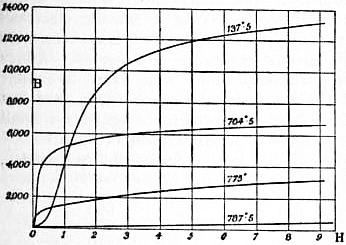
Fig. 27.
Some preliminary experiments showed the striking difference in the effects of annealing at a red heat (840° C.) and at a low white heat (1150° C). After one of the rings had been annealed at 840°, its maximum permeability at ordinary temperatures was 4000 for H = 1.84; when it had been subsequently annealed at 1150°, the maximum permeability rose to 4680 for H = 1.48, while the hysteresis loss for B= ±4000 was under 500 ergs per c.cm. As regards the effects of temperature, Morris’s results are in general agreement with those of Hopkinson, though no doubt they indicate details with greater clearness and accuracy. Specimens of curves showing the relation of induction to magnetic field at various temperatures, and of permeability to temperature with fields of different intensities, are given in figs. 27 and 28. The most striking feature presented by these is the enormous value, 12,660, which, with H = 0.153, is attained by the permeability at 765° C., followed by a drop so precipitous that when the temperature is only 15° higher, the value of the permeability has become quite insignificant. The critical temperatures for three different specimens of iron were 795°, 780°, and 770° respectively. Above these temperatures the little permeability that remained was found to be independent of the magnetizing force, but it appeared to vary a little with the temperature, one specimen showing a permeability of 100 at 820°, 2.3 at 950°, and 17 at 1050°. These last observations are, however, regarded as uncertain. The effects of temperature upon hysteresis were also carefully studied, and many hysteresis loops were plotted. The results of a typical experiment are given in the annexed table, which shows how greatly the hysteresis loss is diminished as the critical temperature is approached. The coercive force at 764°.5 is stated to have been little more than 0.1 C.G.S. unit; above the critical temperature no evidence of hysteresis could be obtained.
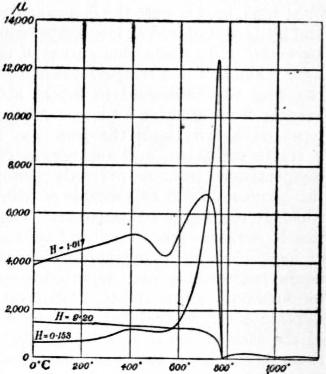
Fig. 28.
Hysteresis Loss in Ergs per c.cm. Max. H. = ±6.83.
Temp. C.° Ergs. Temp. C.° Ergs.
764.5 120 457 2025
748 328 352 2565
730 426 249 3130
695 797 137.5 3500
634 1010 24 3660
554 1345
A paper by H. Nagaoka and S. Kusakabe50 generally confirms Morris’s results for iron, and gives some additional observations for steel, nickel and cobalt. The magnetometric method was employed, and the metals, in the form of ovoids, were heated by a specially designed burner, fed with gas and air under pressure, which directed 90 fine jets of flame upon the asbestos covering the ovoid. The temperature was determined by a platinum-rhodium and platinum thermo-junction in contact with the metal. Experiments were made at several constant temperatures with varying magnetic fields, and also at constant fields with rising and falling temperatures. For ordinary steel the critical temperature, at which magnetization practically disappeared, was found to be about 830°, and the curious fact was revealed that, on cooling, magnetization did not begin to reappear until the temperature had fallen 40° below the critical value. This retardation was still more pronounced in the case of tungsten-steel, which lost its magnetism at 910° and remained non-magnetic till it was cooled to 570°, a difference of 240°. For nearly pure nickel the corresponding temperature-difference was about 100°. This phenomenon is of the same nature as that first discovered by J. Hopkinson for nickel-steel. The paper contains tables and curves showing details of the magnetic changes, sometimes very complex, at different temperatures and with different fields. The behaviour of cobalt is particularly noticeable; its permeability increased with rising temperature up to a maximum at 500°, when it was about twice as great as at ordinary temperatures, while at 1600°, corresponding to white heat, there was still some magnetization remaining.
Further contributions to the subject have been made by K. Honda and S. Shimizu,51 who experimented at temperatures ranging from -186° to 1200°. As regards the higher temperatures, the chief point of interest is the observation that the curve of magnetization for annealed cobalt shows a small depression at about 450°, the temperature at which they had found the sign of the length-change to be reversed for all fields. In the case of all the metals tested a small but measurable trace of magnetization remained after the so-called critical temperature had been exceeded; this decreased very slightly up to the highest temperature reached (1200°) without undergoing any such variation as had been suspected by Morris. When the curve after its steep descent has almost reached the axis, it bends aside sharply and becomes a nearly horizontal straight line; the authors suggest that the critical temperature should be defined as that corresponding to the point of maximum curvature. As thus defined the critical temperatures for iron, nickel and cobalt were found to be 780°, 360° and 1090° respectively, but these values are not quite independent of the magnetizing force.
Experiments on the effect of high temperatures have also been made by M. P. Ledeboer,52 H. Tomlinson,53 P. Curie,54 and W. Kunz,55 R. L. Wills,56 J. R. Ashworth57 and E. P. Harrison.58
Low Temperature.—J. A. Fleming and J. Dewar (Proc. Roy. Soc., 1896, 60, 81) were the first to experiment on the permeability and hysteresis of iron at low temperatures down to that of liquid air (−186° C.). Induction curves of an annealed soft-iron ring were taken first at a temperature of 15° C., and afterwards when the ring was immersed in liquid air, the magnetizing force ranging from about 0.8 to 22. After this operation had been repeated a few times the iron was found to have acquired a stable condition, and the curves corresponding to the two temperatures became perfectly definite. They showed that the permeability of this sample of iron was considerably diminished at the lower temperature. The maximum permeability (for H = 2) was 3400 at 15° and only 2700 at −186°, a reduction of more than 20%; but the percentage reduction became less as the magnetizing force departed from the value corresponding to maximum permeability. Observations were also made of the changes of permeability which took place as the temperature of the sample slowly rose from −186° to 15°, the magnetizing force being kept constant throughout an experiment. The values of the permeability corresponding to the highest and lowest temperatures are given in the following table. Most of the permeability-temperature curves were more or less convex towards the axis of temperature, and in all the experiments, except those with annealed iron and steel wire, the permeability was greatest at the lowest temperature.59 The hysteresis of the soft annealed iron turned out to be sensibly the same for equal values of the induction at −186° as at 15°, the loss in ergs per c.cm. per cycle being approximately represented by 0.002 B1.56 when the maximum limits of B were ±9000. Experiments with the sample of unannealed iron failed to give satisfactory results, owing to the fact that no constant magnetic condition could be obtained.
Sample of Iron. H. μ at 15°. μ at −186°.
Annealed Swedish 1.77 2835 2332
Unannealed ” 1.78 917 1272
” ” 9.79 1210 1293
Hardened ” 2.66 56 132
” ” 4.92 106.5 502
” ” 11.16 447.5 823
” ” 127.7 109 124
Steel wire 7.50 86 64.5
” 20.39 361 144
Honda and Shimizu have made similar experiments at the temperature of liquid air, employing a much wider range of magnetizing forces (up to about 700 C.G.S.) and testing a greater variety of metals. They found that the permeability of Swedish iron, tungsten-steel and nickel, when the metals were cooled to −186°, was diminished in weak fields but increased in strong ones, the field in which the effect of cooling changed its sign being 115 for iron and steel and 580 for nickel. The permeability of cobalt, both annealed and unannealed, was always diminished at the low temperature. The hysteresis-loss in Swedish iron was decreased for inductions below about 9000 and increased for higher inductions; in tungsten-steel, nickel and cobalt the hysteresis-loss was always increased by cooling. The range of ±B within which Steinmetz’s formula is applicable becomes notably increased at low temperature. It may be remarked that, whereas Fleming and Dewar employed the ballistic method, their specimens having the form of rings, Honda and Shimizu worked magnetometrically with metals shaped as ovoids.
Permanent Magnets.—Fleming and Dewar (loc. cit. p. 57) also investigated the changes which occurred in permanently magnetized metals when cooled to the temperature of liquid air. The metals, which were prepared in the form of small rods, were magnetized between the poles of an electromagnet and tested with a magnetometer at temperatures of −186° and 15°. The first immersion into liquid air generally produced a permanent decrease of magnetic moment, and there was sometimes a further decrease when the metal was warmed up again; but after a few alternations of temperature the changes of moment became definite and cyclic. When the permanent magnetic condition had been thus established, it was found that in the case of all the metals, except the two alloys containing large percentages of nickel, the magnetic moment was temporarily increased by cooling to −186°. The following table shows the principal results. It is suggested that a permanent magnet might conveniently be “aged” (or brought into a constant condition) by dipping it several times into liquid air.
Metal. Percentage Gain or Loss of Moment at −186° C.
First Effect. Cyclic Effect.
Carbon steel, hard −6 +12
Carbon steel, medium Decrease +22
Carbon steel, annealed −33 +33
Chromium steels (four samples) Increase +12
Aluminium steels (three samples) −2 +10
Nickel steels, up to 7.65% Small +10
Nickel steels, up to 9.64% −50 −25
Nickel steels, up to 29% −20 −10
Pure nickel Decrease +3
Silicon steel, 2.67% ” +4
Iron, soft None +2.5
Iron, hard Decrease +10
Tungsten steel, 15% ” +6
Tungsten steel, 7.5% ” +10
Tungsten steel, 1% ” +12
Other experiments relating to the effect of temperature upon permanent magnets have been carried out by J. R. Ashworth,60 who showed that the temperature coefficient of permanent magnets might be reduced to zero (for moderate ranges of temperature) by suitable adjustment of temper and dimension ratio; also by R. Pictet,61 A. Durward62 and J. Trowbridge.63
Alloys of Nickel and Iron.—A most remarkable effect of temperature was discovered by Hopkinson (Proc. Roy. Soc., 1890, 47, 23; 1891, 48, 1) in 1889. An alloy containing about 3 parts of iron and 1 of nickel—both strongly magnetic metals—is under ordinary conditions practically non-magnetizable (μ = 1.4 for any value of H). If, however, this non-magnetic substance is cooled to a temperature a few degrees below freezing-point, it becomes as strongly magnetic as average cast-iron (μ = 62 for H = 40), and retains its magnetic properties indefinitely at ordinary temperatures. But if the alloy is heated up to 580° C. it loses its susceptibility—rather suddenly when H is weak, more gradually when H is strong—and remains non-magnetizable till it is once more cooled down below the freezing-point. This material can therefore exist in either of two perfectly stable conditions, in one of which it is magnetizable, while in the other it is not. When magnetizable it is a hard steel, having a specific electrical resistance of 0.000052; when non-magnetizable it is an extremely soft, mild steel, and its specific resistance is 0.000072. Alloys containing different proportions of nickel were found to exhibit the phenomenon, but the two critical temperatures were less widely separated. The following approximate figures for small magnetizing forces are deduced from Hopkinson’s curves:—
Percentage of Nickel. Susceptibility lost at temp. C. Susceptibility gained at temp. C.
0.97 890 —
4.7 820 660
4.7 780 600
24.5 680 −10
30.0 140 125
33.0 207 193
73.0 202 202
Honda and Shimizu (loc. cit.) have determined the two critical temperatures for eleven nickel-steel ovoids, containing from 24.04 to 70.32% of nickel, under a magnetizing force of 400, and illustrated by an interesting series of curves, the gradual transformation of the magnetic properties as the percentage of nickel was decreased. They found that the hysteresis-loss, which at ordinary temperatures is very small, was increased in liquid air, the increase for the alloys containing less than 30% of nickel being enormous. Steinmetz’s formula applies only for very weak inductions when the alloys are at the ordinary temperature, but at the temperature of liquid air it becomes applicable through a wide range of inductions. According to C. E. Guillaume64 the temperature at which the magnetic susceptibility of nickel-steel is recovered is lowered by the presence of chromium; a certain alloy containing chromium was not rendered magnetic even by immersion in liquid air. Experiments on the subject have also been made by E. Dumont65 and F. Osmond.66
9. Alloys and Compounds or Iron
In 1885 Hopkinson (Phil. Trans., 1885, 176, 455) employed his yoke method to test the magnetic properties of thirty-five samples of iron and steel, among which were steels containing substantial proportions of manganese, silicon, chromium and tungsten. The results, together with the chemical analysis of each sample, are given in a table contained in this paper, some of them being also represented graphically. The most striking phenomenon which they bring into prominence is the effect of any considerable quantity of manganese in annihilating the magnetic property of iron. A sample of Hadfield’s manufacture, containing 12.36% of manganese, differed hardly at all from a non-magnetic substance, its permeability being only 1.27. According to Hopkinson’s calculation, this sample behaved as if 91% of the iron contained in it had completely lost its magnetic property.67 Another point to which attention is directed is the exceptionally great effect which hardening has upon the magnetic properties of chrome steel; one specimen had a coercive force of 9 when annealed, and of no less than 38 when oil-hardened. The effect of the addition of tungsten in increasing the coercive force is very clearly shown; in two specimens containing respectively 3.44 and 2.35% of tungsten the coercive force was 64.5 and 70.7. These high values render hardened tungsten-steel particularly suitable for the manufacture of permanent magnets. Hopkinson (Proc. Roy. Soc., 1890, 48, 1) also noticed some peculiarities of an unexpected nature in the magnetic properties of the nickel-steel alloys already referred to. The permeability of the alloys containing from 1 to 4.7% of nickel, though less than that of good soft iron for magnetizing forces up to about 20 or 30, was greater for higher forces, the induction reached in a field of 240 being nearly 21,700. The induction for considerable forces was found to be greater in a steel containing 73% of nickel than in one with only 33%, though the permeability of pure nickel is much less than that of iron.
The magnetic qualities of various alloys of iron have been submitted to a very complete examination by W. F. Barrett, W. Brown and R. A. Hadfield (Trans. Roy. Dub. Soc., 1900, 7, 67; Journ. Inst. Elec. Eng., 1902, 31, 674).68 More than fifty different specimens were tested, most of which contained a known proportion of manganese, nickel, tungsten, aluminium, chromium, copper or silicon: in some samples two of the substances named were present. Of the very numerous results published, a few of the most characteristic are collected in the following table. The first column contains the symbols of the various elements which were added to the iron, and the second the percentage proportion in which each element was present; the sample containing 0.03% of carbon was a specimen of the best commercial iron, the values obtained for it being given for comparison. All the metals were annealed.
A few among several interesting points should be specially noticed. The addition of 15.2% of manganese produced an enormous effect upon the magnetism of iron, while the presence of only 2.25% was comparatively unimportant. When nickel was added to the iron in increasing quantities the coercive force increased until the proportion of nickel reached 20%; then it diminished, and when the proportion of nickel was 32% the coercive force had fallen to the exceedingly low value of 0.5. In the case of iron containing 7.5% of tungsten (W), the residual induction had a remarkably high value; the coercive force, however, was not very great. The addition of silicon in small quantities considerably diminished permeability and increased coercive force; but when the proportion amounted to 2.5% the maximum permeability (μ = 5100 for H = 2) was greater than that of the nearly pure iron used for comparison, while the coercive force was only 0.9.69 A small percentage of aluminium produced still higher permeability (μ = 6000 for H = 2), the induction in fields up to 60 being greater than in any other known substance, and the hysteresis-loss for moderate limits of B far less than in the purest commercial iron. Certain non-magnetizable alloys of nickel, chromium-nickel and chromium-manganese were rendered magnetizable by annealing.
Element. Per cent. B for H = 45. B residual. μ for H = 8. Coercive Force.
C 0.03 16800 9770 1625 1.66
Cu 2.5 14300 10410 .. 5.4
Mn 2.25 14720 10460 1080 6.0
Mn 15.2 0 .. .. ..
Ni 3.82 16190 9320 1375 2.76
Ni 19.64 7770 4770 90 20.0
Ni 31.4 4460 1720 357 0.5
W 7.5 15230 13280 500 9.02
Al 2.25 16900 10500 1700 1.0
Cr 3.25 .. .. .. 12.25
Si 2.5 16420 4080 1680 0.9
Si 5.5 15980 3430 1630 0.85
Later papers70 give the results of a more minute examination of those specimens which were remarkable for very low and very high permeabilities, and were therefore likely to be of commercial importance. The following table gives the exact composition of some alloys which were found to be non-magnetizable, or nearly so, in a field of 320.
An. = Annealed. Un. = Unannealed.
State. Percentage Composition. I, for H = 320.
Un. Fe, 85.77; C, 1.23; Mn, 13. 0
An. Fe, 84.64; C, 0.15; Mn, 15.2 0
An. Fe, 80.16; C, 0.8; Mn, 5.04; Ni, 14.55. 3
Un. Ditto 0
Un. Fe, 75.36; C, 0.6; Mn, 5.04; Ni, 19. 3
An. Fe, 86.61; C, 1.08; Mn, 10.2; W, 2.11. 5
A very small difference in the constitution often produces a remarkable effect upon the magnetic quality, and it unfortunately happens that those alloys which are hardest magnetically are generally also hardest mechanically and extremely difficult to work; they might however be used rolled or as castings. The specimens distinguished by unusually high permeability were constituted as follows:—
Silicon-iron.—Fe, 97.3; C, 0.2; Si, 2.5. Aluminium-iron.—Fe, 97.33; C, 0.18; Al, 2.25.
The silicon-iron had, in fields up to about 10, a greater permeability than a sample of the best Swedish charcoal-iron, and its hysteresis-loss for max. B = 9000, at a frequency of 100 per second, was only 0.254 watt per pound, as compared with 0.382 for the Swedish iron. The aluminium-iron attained its greatest permeability in a field of 0.5, about that of the earth’s force, when its value was 9000, this being more than twice the maximum permeability of the Swedish iron. Its hysteresis-loss for B = 9000 was 0.236 per pound. It was, however, found that the behaviour of this alloy was in part due to a layer of pure iron (“ferrite”) averaging 0.1 mm. in thickness, which occurred on the outside of the specimen, and the exceptional magnetic quality which has been claimed for aluminium-iron cannot yet be regarded as established.
A number of iron alloys have been examined by Mme. Curie (Bull. Soc. d’Encouragement, 1898, pp. 36-76), chiefly with the object of determining their suitability for the construction of permanent magnets. Her tests appear to show that molybdenum is even more effective than tungsten in augmenting the coercive force, the highest values observed being 70 to 74 for tungsten-steel, and 80 to 85 for steel containing 3.5 to 4% of molybdenum. For additional information regarding the composition and qualities of permanent magnet steels reference may be made to the publications cited below.71 Useful instructions have been furnished by Carl Barus (Terrestrial Magnetism, 1897, 2, 11) for the preparation of magnets calculated to withstand the effects of time, percussion and ordinary temperature variations. The metal, having first been uniformly tempered glass-hard, should be annealed in steam at 100° C. for twenty or thirty hours; it should then be magnetized to saturation, and finally “aged” by a second immersion in steam for about five hours.
Magnetic Alloys of Non-Magnetic Metals.—The interesting discovery was made by F. Heusler72 in 1903 that certain alloys of the non-magnetic metal manganese with other non-magnetic substances were strongly magnetizable, their susceptibility being in some cases equal to that of cast iron. The metals used in different combinations included tin, aluminium, arsenic, antimony, bismuth and boron; each of these, when united in certain proportions with manganese, together with a larger quantity of copper (which appears to serve merely as a menstruum), constituted a magnetizable alloy. So far, the best results have been attained with aluminium, and the permeability was greatest when the percentages of manganese and aluminium were approximately proportional to the atomic weights of the two metals. Thus in an alloy containing 26.5% of manganese and 14.6% of aluminium, the rest being copper, the induction for H = 20 was 4500, and for H = 150, 5550. When the proportion of aluminium to manganese was made a little greater or smaller, the permeability was diminished. Next to aluminium, tin was found to be the most effective of the metals enumerated above. In all such magnetizable alloys the presence of manganese appears to be essential, and there can be little doubt that the magnetic quality of the mixtures is derived solely from this component. Manganese, though belonging (with chromium) to the iron group of metals, is commonly classed as a paramagnetic, its susceptibility being very small in comparison with that of the recognized ferromagnetics; but it is remarkable that its atomic susceptibility in solutions of its salts is even greater than that of iron. Now iron, nickel and cobalt all lose their magnetic quality when heated above certain critical temperatures which vary greatly for the three metals, and it was suspected by Faraday73 as early as 1845 that manganese might really be a ferromagnetic metal having a critical temperature much below the ordinary temperature of the air. He therefore cooled a piece of the metal to −105° C., the lowest temperature then attainable, but failed to produce any change in its magnetic quality. The critical temperature (if there is one) was not reached in Faraday’s experiment; possibly even the temperature of −250° C., which by the use of liquid hydrogen has now become accessible, might still be too high.74 But it has been shown that the critical temperatures of iron and nickel may be changed by the addition of certain other substances. Generally they are lowered, sometimes, however, they are raised75; and C. E. Guillaume76 explains the ferromagnetism of Heusler’s alloy by supposing that the naturally low critical temperature of the manganese contained in it is greatly raised by the admixture of another appropriate metal, such as aluminium or tin; thus the alloy as a whole becomes magnetizable at the ordinary temperature. If this view is correct, it may also be possible to prepare magnetic alloys of chromium, the only other paramagnetic metals of the iron group.
J. A. Fleming and R. A. Hadfield77 have made very careful experiments on an alloy containing 22.42% of manganese, 11.65% of aluminium and 60.49% of copper. The magnetization curve was found to be of the same general form as that of a paramagnetic metal, and gave indications that with a sufficient force magnetic saturation would probably be attained. There was considerable hysteresis, the energy-loss per cycle being fairly represented by W = 0.0005495B2.238. The hysteretic exponent is therefore much higher than in the case of iron, nickel and cobalt, for which its value is approximately 1.6.
10. Miscellaneous Effects of Magnetization
Electrical Conductivity.—The specific resistance of many electric conductors is known to be temporarily changed by the action of a magnetic field, but except in the case of bismuth the effect is very small.
A. Gray and E. Taylor Jones (Proc. Roy. Soc., 1900, 67, 208) found that the resistance of a soft iron wire was increased by about 1⁄700 in a field of 320 C.G.S. units. The effect appeared to be closely connected with the intensity of magnetization, being approximately proportional to I. G. Barlow (Proc. Roy. Soc., 1903, 71, 30), experimenting with wires of iron, steel and nickel, showed that in weak fields the change of resistance was proportional to a function aI2 + bI4 + cI6, where a, b and c are constants for each specimen. W. E. Williams (Phil. Mag., 1902, 4, 430) found that for nickel the curves showing changes of resistance in relation to magnetizing force were strikingly similar in form to those showing changes of length. H. Tomlinson (Phil. Trans., 1883, Part I., 153) discovered in 1881 that the resistance of a bismuth rod was slightly increased when the rod was subjected to longitudinal magnetic force, and a year or two later A. Righi (Atti R. A. Lincei, 1883-1884, 19, 545) showed that a more considerable alteration was produced when the magnetic force was applied transversely to the bismuth conductor; he also noticed that the effect was largely dependent upon temperature (see also P. Lenard, Wied. Ann., 1890, 39, 619). Among the most important experiments on the influence of magnetic force at different temperatures are those of J. B. Henderson and of Dewar and Fleming. Henderson (Phil. Mag., 1894, 38, 488) used a little spiral of the pure electrolytic bismuth wire prepared by Hartmann and Braun; this was placed between the pole-pieces of an electromagnet and subjected to fields of various strengths up to nearly 39,000 units. At constant temperature the resistance increased with the field; the changes in the resistance of the spiral when the temperature was 18° C. are indicated in the annexed table, from which it will be seen that in the strongest transverse field reached the resistance was increased more than threefold. Other experiments showed the relation of resistance to temperature (from 0° to about 90°) in different constant fields. It appears that as the temperature rises the resistance decreases to a minimum and then increases, the minimum point occurring at a higher temperature the stronger the field. For H = 11,500 the temperature of minimum resistance was about 50°; for much lower or higher values of H the actual minimum did not occur within the range of temperature dealt with. Dewar and Fleming (Proc. Roy. Soc., 1897, 60, 425) worked with a similar specimen of bismuth, and their results for a constant temperature of 19° agree well with those of Henderson. They also experimented with constant temperatures of −79°, −185° and −203°, and found that at these low temperatures the effect of magnetization was enormously increased. The following table gives some of their results, the specific resistance of the bismuth being expressed in C.G.S. units.
H. R. H. R.
0 1.000 27450 2.540
6310 1.253 32730 2.846
12500 1.630 38900 3.334
20450 2.160
Field Strength. Temp. 19°C. Temp. −185°C.
Spec. Res. Comp. Res. Spec. Res. Comp. Res.
0 116200 1.000 41000 1.00
1375 118200 1.017 103300 2.52
2750 123000 1.059 191500 4.67
8800 149200 1.284 738000 18.0
14150 186200 1.602 1730000 42.2
21800 257000 2.212 6190000 151
At the temperature of liquid air (−185°) the application of a field of 21,800 multiplied the resistance of the bismuth no less than 150 times. Fig. 29 shows the variations of resistance in relation to temperature for fields of different constant values. It will be seen that for H = 2450 and H = 5500 the minimum resistance occurs at temperatures of about −80° and −7° respectively.
Hall Effect.—If an electric current is passed along a strip of thin metal, and the two points at opposite ends of an equipotential line are connected with a galvanometer, its needle will of course not be deflected. But the application of a magnetic field at right angles to the plane of the metal causes the equipotential lines to rotate through a small angle, and the points at which the galvanometer is connected being no longer at the same potential, a current is indicated by the galvanometer.78 The tranverse electromotive force is equal to KCH/D, where C is the current, H the strength of the field, D the thickness of the metal, and K a constant which has been termed the rotatory power or rotational coefficient. (See Hopkinson, Phil. Mag., 1880, 10, 430). The following values of K for different metals are given by E. H. Hall, the positive sign indicating that the electromotive force is in the same direction as the mechanical force acting upon the conductor. A. von Ettinghausen and W. Nernst (Wien. Ber., 1886, 94, 560) have found that the rotational coefficient of tellurium is more than fifty times greater than that of bismuth, its sign being positive. Several experimenters have endeavoured to find a Hall effect in liquids, but such results as have been hitherto obtained are by no means free from doubt. E. A. Marx (Ann. d. Phys., 1900, 2, 798) observed a well-defined Hall effect in incandescent gases. A large effect, proportional to the field, has been found by H. A. Wilson (Cam. Phil. Soc. Proc., 1902, 11, pp. 249, 391) in oxygen, hydrogen and air at low pressures, and by C. D. Child (Phys. Rev., 1904, 18, 370) in the electric arc.
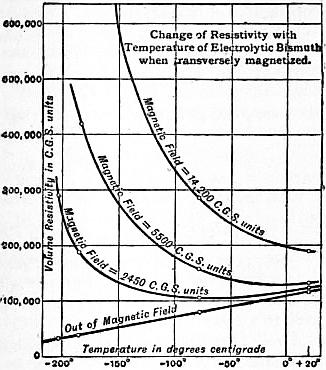
Fig. 29
Metal. K × 1015 Metal. K × 1015
Antimony +114000 Copper −520
Steel +12060 Gold −660
Iron +7850 Nickel −14740
Cobalt +2460 Bismuth79 −8580000
Zinc +820
Electro-Thermal Relations.—The Hall electromotive force is only one of several so-called “galvano-magnetic effects” which are observed when a magnetic field acts normally upon a thin plate of metal traversed by an electric current. It is remarkable that if a flow of heat be substituted for a current of electricity a closely allied group of “thermo-magnetic effects” is presented. The two classes of phenomena have been collated by M. G. Lloyd (Am. Journ. Sci., 1901, 12, 57), as follows:—
Galvano-Magnetic Effects. Thermo-Magnetic Effects.
1. A transverse difference of electric potential (Hall effect). i. A transverse difference of electric potential (Nernst effect).
2. A transverse difference of temperature(Ettinghausen effect). ii. A transverse difference of temperature (Leduc effect).
3. Longitudinal change of electric conductivity. iii. Longitudinal change of thermal conductivity.
4. Longitudinal difference of temperature. iv. Longitudinal difference of electric potential.80
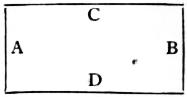
If in the annexed diagram ABCD represents the metallic plate through which the current of electricity or heat flows in the direction AB, then effects (1), (2), (i.) and (ii.) are exhibited at C and D, effects (4) and (iv.) at A and B, and effects (3) and (iii.) along AB. The transverse effects are reversed in direction when either the magnetic field or the primary current (electric or thermal) is reversed, but the longitudinal effects are independent of the direction of the field. It has been shown by G. Moreau (C. R., 1900, 130, pp. 122, 412, 562) that if K is the coefficient of the Hall effect (1) and K′ the analogous coefficient of the Nernst effect (i.) (which is constant for small values of H), then K′ = Kσ/ρ, σ being the coefficient of the Thomson effect for the metal and ρ its specific resistance. He considers that Hall’s is the fundamental phenomenon, and that the Nernst effect is essentially identical with it, the primary electromotive force in the case of the latter being that of the Thomson effect in the unequally heated metal, while in the Hall experiment it is derived from an external source.
Attempts have been made to explain these various effects by the electron theory.81
Thermo-electric Quality.—The earliest observations of the effect of magnetization upon thermo-electric power were those of W. Thomson (Lord Kelvin), who in 1856 announced that magnetization rendered iron and steel positive to the unmagnetized metals.82 It has been found by Chassagny,83 L. Houllevigue84 and others that when the magnetizing force is increased, this effect passes a maximum, while J. A. Ewing85 has shown that it is diminished and may even be reversed by tensile stress. Nickel was believed by Thomson to behave oppositely to iron, becoming negative when magnetized; but though his conclusion was accepted for nearly fifty years, it has recently been shown to be an erroneous one, based, no doubt, upon the result of an experiment with an impure specimen. Nickel when magnetized is always positive to the unmagnetized metal. So also is cobalt, as was found by H. Tomlinson.86 The curves given by Houllevigue for the relation of thermo-electric force to magnetic field are of the same general form as those showing the relation of change of length to field. E. Rhoads87 obtained a cyclic curve for iron which indicated thermo-electric hysteresis of the kind exhibited by Nagaoka’s curves for magnetic strain. He also experimented with nickel and again found a resemblance to the strain curve. The subject was further investigated by S. Bidwell,88 who, adopting special precautions against sources of error by which former work was probably affected, measured the changes of thermo-electric force for iron, steel, nickel and cobalt produced by magnetic fields up to 1500 units. In the case of iron and nickel it was found that, when correction was made for mechanical stress due to magnetization, magnetic change of thermo-electric force was, within the limits of experimental error, proportional to magnetic change of length. Further, it was shown that the thermo-electric curves were modified both by tensile stress and by annealing in the same manner as were the change-of-length curves, the modification being sometimes of a complex nature. Thus a close connexion between the two sets of phenomena seems to be established. In the case of cobalt no such relation could be traced; it appeared that the thermo-electric power of the unmagnetized with respect to the magnetized cobalt was proportional to the square of the magnetic induction or of the magnetization. Of nickel six different specimens were tested, all of which became, like iron, thermo-electrically positive to the unmagnetized metals.
As to what effect, if any, is produced upon the thermo-electric quality of bismuth by a magnetic field there is still some doubt. E. van Aubel89 believes that in pure bismuth the thermo-electric force is increased by the field; impurities may neutralize this effect, and in sufficient quantities reverse it.
Elasticity.—The results of experiments as to the effect of magnetization were for long discordant and inconclusive, sufficient care not having been taken to avoid sources of error, while the effects of hysteresis were altogether disregarded. The subject, which is of importance in connexion with theories of magnetostriction, has been investigated by K. Honda and T. Terada in a research remarkable for its completeness and the ingenuity of the experimental methods employed.90 The results are too numerous to discuss in detail; some of those to which special attention is directed are the following: In Swedish iron and tungsten-steel the change of elastic constants (Young’s modulus and rigidity) is generally positive, but its amount is less than 0.5%; changes of Young’s modulus and of rigidity are almost identical. In nickel the maximum change of the elastic constants is remarkably large, amounting to about 15% for Young’s modulus and 7% for rigidity; with increasing fields the elastic constants first decrease and then increase. In nickel-steels containing about 50 and 70% of nickel the maximum increase of the constants is as much as 7 or 8%. In a 29% nickel-steel, magnetization increases the constants by a small amount. Changes of elasticity are in all cases dependent, not only upon the field, but also upon the tension applied; and, owing to hysteresis, the results are not in general the same when the magnetization follows as when it precedes the application of stress; the latter is held to be the right order.
Chemical and Voltaic Effects.—If two iron plates, one of which is magnetized, are immersed in an electrolyte, a current will generally be indicated by a galvanometer connected with the plates.
As to whether the magnetized plate becomes positive or negative to the other, different experimenters are not in agreement. It has, however, been shown by Dragomir Hurmuzescu (Rap. du Congrès Int. de Phys., Paris, 1900, p. 561) that the true effect of magnetization is liable to be disguised by secondary or parasitic phenomena, arising chiefly from polarization of the electrodes and from local variations in the concentration and magnetic condition of the electrolyte; these may be avoided by working with weak solutions, exposing only a small surface in a non-polar region of the metal, and substituting a capillary electrometer for the galvanometer generally used. When such precautions are adopted it is found that the “electromotive force of magnetization” is, for a given specimen, perfectly definite both in direction and in magnitude; it is independent of the nature of the corrosive solution, and is a function of the field-strength alone, the curves showing the relation of electromotive force to field-intensity bearing a rough resemblance to the familiar I-H curves. The value of the E.M.F. when H = 2000 is of the order of 1/100 volt for iron, 1/1000 volt for nickel and 1/10,000 for bismuth. When the two electrodes are ferromagnetic, the direction of the current through the liquid is from the unmagnetized to the magnetized electrode, the latter being least attacked; with diamagnetic electrodes the reverse is the case. Hurmuzescu shows that these results are in accord with theory. Applying the principle of the conservation of internal energy, he demonstrates that for iron in a field of 1000 units and upwards the E.M.F. of magnetization is
E = l · I²
δ 2κ
approximately, l being the electrochemical equivalent and δ the density of the metal. Owing to the difficulty of determining the magnetization I and the susceptibility κ with accuracy, it has not yet been possible to submit this formula to a quantitative test, but it is said to afford an indication of the results given by actual experiment. It has been discovered by E. L. Nichols and W. S. Franklin (Am. Journ. Sci., 1887, 34, 419; 1888, 35, 290) that the transition from the “passive” to the active state of iron immersed in strong nitric acid is facilitated by magnetization, the temperature of transition being lowered. This is attributed to the action of local currents set up between unequally magnetized portions of the iron. Similar results have been obtained by T. Andrews (Proc. Roy. Soc., 1890, 48, 116).
11. Feebly Susceptible Substances
Water.—The following are recent determinations of the magnetic susceptibility of water:—
Observer. κ × 106. Publication.
G. Quincke −0.797 at 18° C. Wied. Ann., 1885, 24, 387.
H. du Bois −0.837 (1 − 0.0025t − 15°) Wied. Ann., 1888, 35, 137.
P. Curie −0.790 at 4° C. C. R., 1893, 116, 136.
J. Townsend −0.77 Phil. Trans., 1896, 187, 544.
J. A. Fleming and J. Dewar −0.74 Proc. Roy. Soc., 1898, 63, 311.
G. Jäger and S. Meyer 707. −0.689(1 − 0.0016t) Wied. Ann., 1899, 67,
J. Koenigsberger −0.781 at 22° C. Ann. d. Phys., 1901, 6, 506.
H. D. Stearns −0.733 at 22° C. Phys. Rev., 1903, 16, 1.
A. P. Wills −0.720 at 18° C. Phys. Rev., 1905, 20, 188.
Wills found that the susceptibility was constant in fields ranging from 4200 to 15,000.
Oxygen and Air.—The best modern determinations of the value of κ for gaseous oxygen agree very fairly well with that given by Faraday in 1853 (Exp. Res. III, 502). Assuming that for water κ = −0.8 × 10⁻⁶, his value of κ for oxygen at 15° C. reduces to 0.15 × 10⁻⁶. Important experiments on the susceptibility of oxygen at different pressures and temperatures were carried out by P. Curie (C.R. 1892, 115, 805; 1893, 116, 136). Journ. de Phys., 1895, 4, 204. He found that the susceptibility for unit of mass, K, was independent of both pressure and magnetizing force, but varied inversely as the absolute temperature, θ, so that 106K = 33700/θ. Since the mass of 1 cub. cm. of oxygen at 0° C. and 760 mm. pressure is 0.00141 grm., the mass at any absolute temperature θ is by Charles’s law 0.00141 × 273θ = 0.3849/θ grm.; hence the susceptibility per unit of volume at 760 mm. will be
κ = 10−6 × 0.3849 × 33700 / θ² = 10−6 × 12970 / θ².
At 15° C. θ = 273 + 15 = 288, and therefore κ = 0.156 × 10⁻⁶, nearly the same as the value found by Faraday. At 0° C., κ = 0.174 × 10⁻⁶. For air Curie calculated that the susceptibility per unit mass was 106K = 7830/θ; or, taking the mass of 1 c.c. of air at 0° C. and 760 mm. as 0.001291 grm., κ = 10−6 × 2760/θ² for air at standard atmospheric pressure. It is pointed out that this formula may be used as a temperature correction in magnetic determinations carried out in air.
Fleming and Dewar determined the susceptibility of liquid oxygen (Proc. Roy. Soc., 1896, 60, 283; 1898, 63, 311) by two different methods. In the first experiments it was calculated from observations of the mutual induction of two conducting circuits in air and in the liquid; the results for oxygen at −182° C. were
μ = 1.00287, κ = 228 × 10−6.
In the second series, to which greater importance is attached, measurements were made of the force exerted in a divergent field upon small balls of copper, silver and other substances, first when the balls were in air and afterwards when they were immersed in liquid oxygen. If V is the volume of a ball, H the strength of the field at its centre, and κ′ its apparent susceptibility, the force in the direction x is ƒ = κ′VH × dH/dx; and if κ′a and κ′0 are the apparent susceptibilities of the same ball in air and in liquid oxygen, κ′a − κ′0 is equal to the difference between the susceptibilities of the two media. The susceptibility of air being known—practically it was negligible in these experiments—that of liquid oxygen can at once be found. The mean of 36 experiments with 7 balls gave
μ = 1.00407, κ = 324 × 10−6.
A small but decided tendency to a decrease of susceptibility in very strong fields was observed. It appears, therefore, that liquid oxygen is by far the most strongly paramagnetic liquid known, its susceptibility being more than four times greater than that of a saturated solution of ferric chloride. On the other hand, its susceptibility is about fifty times less than that of Hadfield’s 12% manganese steel, which is commonly spoken of as non-magnetizable.
Bismuth.—Bismuth is of special interest, as being the most strongly diamagnetic substance known, the mean value of the best determinations of its susceptibility being about −14 × 10-6 (see G. Meslin, C. R., 1905, 140, 449). The magnetic properties of the metal at different temperatures and in fields up to 1350 units have been studied by P. Curie (loc. cit.), who found that its “specific susceptibility” (K) was independent of the strength of the field, but decreased with rise of temperature up to the melting-point, 273°C. His results appear to show the relation
−Κ × 106 = 1.381 − 0.00155t°.
Assuming the density of Bi to be 9.8, and neglecting corrections for heat dilatation, his value for the susceptibility at 20°C. is equivalent to κ = −13.23 × 10⁻⁶. As the temperature was raised up to 273°, κ gradually fell to −9.38 × 10⁻⁶, rising suddenly when fusion occurred to −0.37 × 10⁻⁶, at which value it remained constant when the fluid metal was further heated. Fleming and Dewar give for the susceptibility the values −13.7 × 10⁻⁶ at 15°C. and −15.9 × 10⁻⁶ at −182°, the latter being approximately equivalent to Κ × 106 = −1.62. Putting t° = −182 in the equation given above for Curie’s results, we get Κ × 106 = −1.66, a value sufficiently near that obtained by Fleming and Dewar to suggest the probability that the diamagnetic susceptibility varies inversely as the temperature between −182° and the melting-point.
Other Diamagnetics.—The following table gives Curie’s determinations (Journ. de Phys., 1895, 4, 204) of the specific susceptibility Κ of other diamagnetic substances at different temperatures. It should be noted that Κ = κ/density.
Substance Temp. °C. −Κ × 106.
Water 15-189 0.790
Rock salt 16-455 0.580
Potassium chloride 18-465 0.550
Potassium sulphate 17-460 0.430
Potassium nitrate (fusion 350°) 18-420 0.330
Quartz 18-430 0.441
Sulphur, solid or fused 18-225 0.510
Selenium, solid or fused 20-200 0.320
Selenium, fused 240-415 0.307
Tellurium 20-305 0.311
Bromine 20 0.410
Iodine, solid or fused 18-164 0.385
Phosphorus, solid or fused 19-71 0.920
Phosphorus, amorphous 20-275 0.730
Antimony, electrolytic 20 0.680
Antimony 540 0.470
Bismuth, solid 20 1.350
Bismuth, solid 273 0.957
Bismuth, fused 273-405 0.038
For all diamagnetic substances, except antimony and bismuth, the value of Κ was found to be independent of the temperature.
Paramagnetic Substances.—Experiments by J. S. Townsend (Phil. Trans., 1896, 187, 533) show that the susceptibility of solutions of salts of iron is independent of the magnetizing force, and depends only on the quantity of iron contained in unit volume of the liquid. If W is the weight of iron present per c.c. at about 10°C., then for ferric salts
106κ = 266W − 0.77
and for ferrous salts
106κ = 206W − 0.77,
the quantity −0.77 arising from the diamagnetism of the water of solution. Annexed are values of 106κ for the different salts examined, w being the weight of the salt per c.c. of the solution.
Salt. 106κ + 0.77 Salt. 106κ + 0.77
Fe2Cl6 91.6w FeCl2 90.8w
Fe2(SO4)3 74.5w FeSO4 74.9w
Fe2(NO3)6 61.5w
Susceptibility was found to diminish greatly with rise of temperature. According to G. Jäger and S. Meyer (Wien. Akad. Sitz., 1897, 106, II. a, p. 623, and 1898, 107, II. a, p. 5) the atomic susceptibilities k of the metals nickel, chromium, iron, cobalt and manganese in solutions of their salts are as follows:—
Metal. k × 106 Metal. k × 106.
Ni 4.95 = 2.5 × 2 Co 10.0 = 2.5 × 4
Cr 6.25 = 2.5 × 2.5 Fe(2) 12.5 = 2.5 × 5
Fe(1) 7.5 = 2.5 × 3 Mn 15.0 = 2.5 × 6
Fe(1) is iron contained in FeCl2 and Fe(2) iron contained in Fe2(NO3)6.
Curie has shown, for many paramagnetic bodies, that the specific susceptibility K is inversely proportional to the absolute temperature θ. Du Bois believes this to be an important general law, applicable to the case of every paramagnetic substance, and suggests that the product Kθ should be known as “Curie’s constant” for the substance.
Elementary Bodies and Atomic Susceptibility.—Among a large number of substances the susceptibilities of which have been determined by J. Koenigsberger (Wied. Ann., 1898, 66, 698) are the following elements:—
Element. κ × 106. Element. κ × 106.
Copper −0.82 Tellurium − 2.10
Silver −1.51 Graphite + 2
Gold −3.07 Aluminium + 1.80
Zinc −0.96 Platinum +22
Tin +0.46 Palladium +50 to 60
Lead −1.10 Tungsten +14
Thallium −4.61 Magnesium + 4
Sulphur −0.86 Sodium + 2.2
Selenium (red) −0.50 Potassium + 3.6
In a table accompanying Koenigsberger’s paper the elements are arranged upon the periodic system and the atomic susceptibility (product of specific susceptibility into atomic weight) is given for each. It appears that the elements at about the middle of each row are the most strongly paramagnetic; towards the ends of a row the susceptibility decreases, and ultimately becomes negative. Thus a relation between susceptibility and atomic weight is clearly indicated. Tables similarly arranged, but much more complete, have been published by S. Meyer (Wied. Ann., 1899, 68, 325 and 1899, 69, 236), whose researches have filled up many previously existing gaps. The values assigned to the atomic susceptibilities of most of the known elements are appended. According to the notation adopted by Meyer the atomic susceptibility k = κ × atomic-weight / (density × 1000).
Meyer thinks that the susceptibilities of the metals praseodymium, neodymium, ytterbium, samarium, gadolinium, and erbium, when obtained in a pure form, will be found to equal or even exceed those of the well-known ferromagnetic metals. Many of their compounds are very strongly magnetic; erbium, for example, in Er2O3 being four times as strong as iron in the familiar magnetite or lodestone, Fe2O3. The susceptibilities of some hundreds of inorganic compounds have also been determined by the same investigator (loc. cit.). Among other researches relating to atomic and molecular magnetism are those of O. Liebknecht and A. P. Wills (Ann. d. Phys., 1900, 1, 178), H. du Bois and O. Liebknecht (ibid. p. 189), and Meyer (ibid. p. 668). An excellent summary regarding the magnetic properties of matter, with many tables and references, has been compiled by du Bois (Report to the Congrès Int. de Phys., Paris, 1900, ii. 460).
Element 106k Element 106k Element 106k
Be +0.72 Cu −0.006 Cs − 0.03*
B +0.05 Zn −0.010 Ba − 0.02*
C −0.05 Ga − La +13.0
N ? Ge − Ce +34.0
O + As ? Pr + Strong
F −0.01* Se −0.025 Nd +
· · · · · · · · · · Br −0.033 Sa +
Na −0.005* · · · · · · · · · · Gd +
Mg +0.014 Rb −0.02* · · · · · · · · · ·
Al + Sr −0.02* Er +41.8(?)
Si +0.002 Y +3.2(?) · · · · · · · · · ·
P −0.007 Zr −0.014 Yb + (?)
S −0.011 Nb +0.49(?) Ta + 1.02(?)
Cl −0.02* Mo +0.024 W + 0.1
· · · · · · · · · · Ru + Os + 0.074
K −0.001* Rh + Ir +
Ca −0.003* Pd +0.55 Pt + 0.227
Sc ? Ag −0.016 Au − 0.031
Ti +0.09 Cd −0.015 Hg − 0.030
V +0.17 In +0.01* Tl − 0.93
Cr + Strong Sn +0.004* Pb − 0.025
Mn + Sb −0.069 Bi − 0.023
Fe + Te −0.039 · · · · · · · · · ·
Co + I −0.040 Th +16.0(?)
Ni + · · · · · · · · · · U + 0.21
* Calculated.
12. Molecular Theory of Magnetism
According to W. E. Weber’s theory, the molecules of a ferromagnetic metal are small permanent magnets, the axes of which under ordinary conditions are turned indifferently in every direction, so that no magnetic polarity is exhibited by the metal as a whole; a magnetic force acting upon the metal tends to turn the axes of the little magnets in one direction, and thus the entire piece acquires the properties of a magnet. If, however, the molecules could turn with perfect freedom, it is clear that the smallest magnetizing force would be sufficient to develop the highest possible degree of magnetization, which is of course not the case. Weber therefore supposed each molecule to be acted on by a force tending to preserve it in its original direction, the position actually assumed by the axis being in the direction of the resultant of this hypothetical force and the applied magnetizing force. Maxwell (Electricity and Magnetism, § 444), recognizing that the theory in this form gave no account of residual magnetization, made the further assumption that if the deflection of the axis of the molecule exceeded a certain angle, the axis would not return to its original position when the deflecting force was removed, but would retain a permanent set. Although the amended theory as worked out by Maxwell is in rough agreement with certain leading phenomena of magnetization, it fails to account for many others, and is in some cases at variance with observed facts.
J. A. Ewing (Proc. Roy. Soc., 1890, 48, 342) has demonstrated that it is quite unnecessary to assume either the directive force of Weber, the permanent set of Maxwell, or any kind of frictional resistance, the forces by which the molecular magnets are constrained being simply those due to their own mutual attractions and repulsions. The effect of these is beautifully illustrated by a model consisting of a number of little compass needles pivoted on sharp points and grouped near to one another upon a board, which is placed inside a large magnetizing coil. When no current is passing through the coil and the magnetic field is of zero strength, the needles arrange themselves in positions of stable equilibrium under their mutual forces, pointing in many different directions, so that there is no resultant magnetic moment. This represents the condition of the molecules in unmagnetized iron. If now a gradually increasing magnetizing force is applied, the needles at first undergo a stable deflection, giving to the group a small resultant moment which increases uniformly with the force; and if the current is interrupted while the force is still weak, the needles merely return to their initial positions. This illustrates the first stage in the process of magnetization, when the moment is proportional to the field and there is no hysteresis or residual magnetism (see ante). A somewhat stronger field will deflect many of the needles beyond the limits of stability, causing them to turn round and form new stable combinations, in which the direction assumed by most of them approximates to that of the field. The rearrangement is completed within a comparatively small range of magnetizing force, a rapid increase of the resultant moment being thus brought about. When the field is removed, many of the newly formed combinations are but slightly disturbed, and the group may consequently retain a considerable resultant moment. This corresponds to the second stage of magnetization, in which the susceptibility is large and permanent magnetization is set up. A still stronger magnetizing force has little effect except in causing the direction of the needles to approach still more nearly to that of the field; if the force were infinite, every member of the group would have exactly the same direction and the greatest possible resultant moment would be reached; this illustrates “magnetic saturation”—the condition approached in the third stage of magnetization. When the strong magnetizing field is gradually diminished to zero and then reversed, the needles pass from one stable position of rest to another through a condition of instability; and if the field is once more reversed, so that the cycle is completed, the needles again pass through a condition of instability before a position of stable equilibrium is regained. Now the unstable movements of the needles are of a mechanically irreversible character; the energy expended in dissociating the members of a combination and placing them in unstable positions assumes the kinetic form when the needles turn over, and is ultimately frittered down into heat. Hence in performing a cycle there is a waste of energy corresponding to what has been termed hysteresis-loss.
Supposing Ewing’s hypothesis to be correct, it is clear that if the magnetization of a piece of iron were reversed by a strong rotating field instead of by a field alternating through zero, the loss of energy by hysteresis should be little or nothing, for the molecules would rotate with the field and no unstable movements would be possible.91 Some experiments by F. G. Baily (Phil. Trans., 1896, 187, 715) show that this is actually the case. With small magnetizing forces the hysteresis was indeed somewhat larger than that obtained in an alternating field, probably on account of the molecular changes being forced to take place in one direction only; but at an induction of about 16,000 units in soft iron and 15,000 in hard steel the hysteresis reached a maximum and afterwards rapidly diminished. In one case the hysteresis loss per cubic centimetre per cycle was 16,100 ergs for B = 15,900, and only 1200 ergs for B = 20,200, the highest induction obtained in the experiment; possibly it would have vanished before B had reached 21,000.92 These experiments prove that actual friction must be almost entirely absent, and, as Baily remarks, the agreement of the results with the previously suggested deduction affords a strong verification of Ewing’s form of the molecular theory. Ewing has himself also shown how satisfactorily this theory accords with many other obscure and complicated phenomena, such as those presented by coercive force, differences of magnetic quality, and the effects of vibration, temperature and stress; while as regards simplicity and freedom from arbitrary assumptions it leaves little to be desired.
The fact being established that magnetism is essentially a molecular phenomenon, the next step is to inquire what is the constitution of a magnetic molecule, and why it is that some molecules are ferromagnetic, others paramagnetic, and others again diamagnetic. The best known of the explanations that have been proposed depend upon the magnetic action of an electric current. It can be shown that if a current i circulates in a small plane circuit of area S, the magnetic action of the circuit for distant points is equivalent to that of a short magnet whose axis is perpendicular to the plane of the circuit and whose moment is iS, the direction of the magnetization being related to that of the circulating current as the thrust of a right-handed screw to its rotation. Ferromagnetism was explained by Ampère on the hypothesis that the magnetization of the molecule is due to an electric current constantly circulating within it. The theory now most in favour is merely a development of Ampère’s hypothesis, and applies not only to ferromagnetics, but to paramagnetics as well. To account for diamagnetism, Weber supposed that there exist within the molecules of diamagnetic substances certain channels around which an electric current can circulate without any resistance. The creation of an external magnetic field H will, in accordance with Lenz’s law, induce in the molecule an electric current so directed that the magnetization of the equivalent magnet is opposed to the direction of the field. The strength of the induced current is −HS cos θ/L, where θ is the inclination of the axis of the circuit to the direction of the field, and L the coefficient of self-induction; the resolved part of the magnetic moment in the direction of the field is equal to −HS² cos² θ/L, and if there are n molecules in a unit of volume, their axes being distributed indifferently in all directions, the magnetization of the substance will be −1⁄3nHS²/L, and its susceptibility -1⁄3S²/L (Maxwell, Electricity and Magnetism, § 838). The susceptibility is therefore constant and independent of the field, while its negative sign indicates that the substance is diamagnetic. There being no resistance, the induced current will continue to circulate round the molecule until the field is withdrawn, when it will be stopped by the action of an electromotive force tending to induce an exactly equal current in the opposite direction. The principle of Weber’s theory, with the modification necessitated by lately acquired knowledge, is the basis of the best modern explanation of diamagnetic phenomena.
There are strong reasons for believing that magnetism is a phenomenon involving rotation, and as early as 1876 Rowland, carrying out an experiment which had been proposed by Maxwell, showed that a revolving electric charge produced the same magnetic effects as a current. Since that date it has more than once been suggested that the molecular currents producing magnetism might be due to the revolution of one or more of the charged atoms or “ions” constituting the molecule. None of the detailed hypotheses which were based on this idea stood the test of criticism, but towards the end of the 19th century the researches of J. J. Thomson and others once more brought the conception of moving electric charges into prominence. Thomson has demonstrated the existence under many different conditions of particles more minute than anything previously known to science. The mass of each is about 1/1700th part of that of a hydrogen atom, and with each is indissolubly associated a charge of negative electricity equal to about 3.1 × 10⁻¹⁰ C.G.S. electrostatic unit. These particles, which were termed by their discoverer corpuscles, are more commonly spoken of as electrons,93 the particle thus being identified with the charge which it carries. An electrically neutral atom is believed to be constituted in part, or perhaps entirely, of a definite number of electrons in rapid motion within a “sphere of uniform positive electrification” not yet explained. One or more of the electrons may be detached from the system by a finite force, the number so detachable depending on the valency of the atom; if the atom loses an electron, it becomes positively electrified; if it receives additional electrons, it is negatively electrified. The process of electric conduction in metals consists in the movement of detached electrons, and many other phenomena, both electrical and thermal, can be more or less completely explained by their agency. It has been supposed that certain electrons revolve like satellites in orbits around the atoms with which they are associated, a view which receives strong support from the phenomena of the Zeeman effect, and on this assumption a theory has been worked out by P. Langevin,94 which accounts for many of the observed facts of magnetism. As a consequence of the structure of the molecule, which is an aggregation of atoms, the planes of the orbits around the latter may be oriented in various positions, and the direction of revolution may be right-handed or left-handed with respect to the direction of any applied magnetic field. For those orbits whose projection upon a plane perpendicular to the field is right-handed, the period of revolution will be accelerated by the field (since the electron current is negative), and the magnetic moment consequently increased; for those which are left-handed, the period will be retarded and the moment diminished. The effect of the field upon the speed of the revolving electrons, and therefore upon the moments of the equivalent magnets, is necessarily a very small one. If S is the area of the orbit described in time τ by an electron of charge e, the moment of the equivalent magnet is M = eSτ; and the change in the value of M due to an external field H is shown to be ΔM = −He2S/4πm, m being the mass of the electron. Whence
ΔM = − Hτ e .
M 4π m
According to the best determinations the value of e/m does not exceed 1.8 × 10⁷, and τ is of the order of 10−15 second, the period of luminous vibrations; hence ΔM/M must always be less than 10−9H, and therefore the strongest fields yet reached experimentally, which fall considerably short of 105, could not change the magnetic moment M by as much as a ten-thousandth part. If the structure of the molecule is so perfectly symmetrical that, in the absence of any external field, the resultant magnetic moment of the circulating electrons is zero, then the application of a field, by accelerating the right-handed (negative) revolutions, and retarding those which are left-handed, will induce in the substance a resultant magnetization opposite in direction to the field itself; a body composed of such symmetrical molecules is therefore diamagnetic. If however the structure of the molecule is such that the electrons revolving around its atoms do not exactly cancel one another’s effects, the molecule constitutes a little magnet, which under the influence of an external field will tend to set itself with its axis parallel to the field. Ordinarily a substance composed of asymmetrical molecules is paramagnetic, but if the elementary magnets are so conditioned by their strength and concentration that mutual action between them is possible, then the substance is ferromagnetic. In all cases however it is the diamagnetic condition that is initially set up—even iron is diamagnetic—though the diamagnetism may be completely masked by the superposed paramagnetic or ferromagnetic condition. Diamagnetism, in short, is an atomic phenomenon; paramagnetism and ferromagnetism are molecular phenomena. Hence may be deduced an explanation of the fact that, while the susceptibility of all known diamagnetics (except bismuth and antimony) is independent of the temperature, that of paramagnetics varies inversely as the absolute temperature, in accordance with the law of Curie.
13. Historical and Chronological Notes
The most conspicuous property of the lodestone, its attraction for iron, appears to have been familiar to the Greeks at least as early as 800 B.C., and is mentioned by Homer, Plato, Aristotle, Theophrastus and others. A passage in De rerum natura (vi. 910-915) by the Roman poet, Lucretius (96-55 B.C.), in which it is stated that the stone can support a chain of little rings, each adhering to the one above it, indicates that in his time the phenomenon of magnetization by induction had also been observed. The property of orientation, in virtue of which a freely suspended magnet points approximately to the geographical north and south, is not referred to by any European writer before the 12th century, though it is said to have been known to the Chinese at a much earlier period. The application of this property to the construction of the mariner’s compass is obvious, and it is in connexion with navigation that the first references to it occur (see Compass). The needles of the primitive compasses, being made of iron, would require frequent re-magnetization, and a “stone” for the purpose of “touching the needle” was therefore generally included in the navigator’s outfit. With the constant practice of this operation it is hardly possible that the repulsion acting between like poles should have entirely escaped recognition; but though it appears to have been noticed that the lodestone sometimes repelled iron instead of attracting it, no clear statement of the fundamental law that unlike poles attract while like poles repel was recorded before the publication in 1581 of the New Attractive by Robert Norman, a pioneer in accurate magnetic work. The same book contains an account of Norman’s discovery and correct measurement of the dip (1576). The downward tendency of the north pole of a magnet pivoted in the usual way had been observed by G. Hartmann of Nüremberg in 1544, but his observation was not published till much later.
The foundations of the modern science of magnetism were laid by William Gilbert (q.v.). His De magnete magneticisque corporibus et de magno magnete tellure physiologia nova (1600), contains many references to the expositions of earlier writers from Plato down to those of the author’s own age. These show that the very few facts known with certainty were freely supplemented by a number of ill-founded conjectures, and sometimes even by “figments and falsehoods, which in the earliest times, no less than nowadays, used to be put forth by raw smatterers and copyists to be swallowed of men.”95 Thus it was taught that “if a lodestone be anointed with garlic, or if a diamond be near, it does not attract iron,” and that “if pickled in the salt of a sucking fish, there is power to pick up gold which has fallen into the deepest wells.” There were said to be “various kinds of magnets, some of which attract gold, others silver, brass, lead; even some which attract flesh, water, fishes;” and stories were told about “mountains in the north of such great powers of attraction that ships are built with wooden pegs, lest the iron nails should be drawn from the timber.” Certain occult powers were also attributed to the stone. It was “of use to thieves by its fume and sheen, being a stone born, as it were, to aid theft,” and even opening bars and locks; it was effective as a love potion, and possessed “the power to reconcile husbands to their wives, and to recall brides to their husbands.” And much more of the same kind, which, as Gilbert says, had come down “even to [his] own day through the writings of a host of men, who, to fill out their volumes to a proper bulk, write and copy out pages upon pages on this, that and the other subject, of which they know almost nothing for certain of their own experience.” Gilbert himself absolutely disregarded authority, and accepted nothing at second-hand. His title to be honoured as the “Father of Magnetic Philosophy” is based even more largely upon the scientific method which he was the first to inculcate and practise than upon the importance of his actual discoveries. Careful experiment and observation, not the inner consciousness, are, he insists, the only foundations of true science. Nothing has been set down in his book “which hath not been explored and many times performed and repeated” by himself. “It is very easy for men of acute intellect, apart from experiment and practice, to slip and err.” The greatest of Gilbert’s discoveries was that the globe of the earth was magnetic and a magnet; the evidence by which he supported this view was derived chiefly from ingenious experiments made with a spherical lodestone or terrella, as he termed it, and from his original observation that an iron bar could be magnetized by the earth’s force. He also carried out some new experiments on the effects of heat, and of screening by magnetic substances, and investigated the influence of shape upon the magnetization of iron. But the bulk of his work consisted in imparting scientific definiteness to what was already vaguely known, and in demolishing the errors of his predecessors.
No material advance upon the knowledge recorded in Gilbert’s book was made until the establishment by Coulomb in 1785 of the law of magnetic action. The difficulties attending the experimental investigation of the forces acting between magnetic poles have already been referred to, and indeed a rigorously exact determination of the mutual action could only be made under conditions which are in practice unattainable. Coulomb,96 however, by using long and thin steel rods, symmetrically magnetized, and so arranged that disturbing influences became negligibly small, was enabled to deduce from his experiments with reasonable certainty the law that the force of attraction or repulsion between two poles varies inversely as the square of the distance between them. Several previous attempts had been made to discover the law of force, with various results, some of which correctly indicated the inverse square; in particular the German astronomer, J. Tobias Mayer (Gött. Anzeiger, 1760), and the Alsatian mathematician, J. Heinrich Lambert (Hist. de l’Acad. Roy. Berlin, 1766, p. 22), may fairly be credited with having anticipated the law which was afterwards more satisfactorily established by Coulomb. The accuracy of this law was in 1832 confirmed by Gauss,97 who employed an indirect but more perfect method than that of Coulomb, and also, as Maxwell remarks, by all observers in magnetic observatories, who are every day making measurements of magnetic quantities, and who obtain results which would be inconsistent with each other if the law of force had been erroneously assumed.
Coulomb’s researches provided data for the development of a mathematical theory of magnetism, which was indeed initiated by himself, but was first treated in a complete form by Poisson in a series of memoirs published in 1821 and later.98 Poisson assumed the existence of two dissimilar magnetic fluids, any element of which acted upon any other distant element in accordance with Coulomb’s law of the inverse square, like repelling and unlike attracting one another. A magnetizable substance was supposed to consist of an indefinite number of spherical particles, each containing equivalent quantities of the two fluids, which could move freely within a particle, but could never pass from one particle to another. When the fluids inside a particle were mixed together, the particle was neutral; when they were more or less completely separated, the particle became magnetized to an intensity depending upon the magnetic force applied; the whole body therefore consisted of a number of little spheres having north and south poles, each of which exerted an elementary action at a distance. On this hypothesis Poisson investigated the forces due to bodies magnetized in any manner, and also originated the mathematical theory of magnetic induction. The general confirmation by experiment of Poisson’s theoretical results created a tendency to regard his hypothetical magnetic fluids as having a real existence; but it was pointed out by W. Thomson (afterwards Lord Kelvin) in 1849 that while no physical evidence could be adduced in support of the hypothesis, certain discoveries, especially in electromagnetism, rendered it extremely improbable (Reprint, p. 344). Regarding it as important that all reasoning with reference to magnetism should be conducted without any uncertain assumptions, he worked out a mathematical theory upon the sole foundation of a few well-known facts and principles. The results were substantially the same as those given by Poisson’s theory, so far as the latter went, the principal additions including a fuller investigation of magnetic distribution, and the theory of magnetic induction in aeolotropic or crystalline substances. The mathematical theory which was constructed by Poisson, and extended and freed from doubtful hypotheses by Kelvin, has been elaborated by other investigators, notably F. E. Neumann, G. R. Kirchhoff, and Maxwell. The valuable work of Gauss on magnetic theory and measurements, especially in relation to terrestrial magnetism, was published in his Intensitas vis magneticae terrestris, 1833, and in memoirs communicated to the Resultate aus den Beobachtungen des magnetischen Vereins, 1838 and 1839, which, with others, are contained in vol. 5 of the collected Werke. Weber’s molecular theory, which has already been referred to, appeared in 1852.99
An event of the first importance was the discovery made in 1819 by H. C. Oersted 100 that a magnet placed near a wire carrying an electric current tended to set itself at right angles to the wire, a phenomenon which indicated that the current was surrounded by a magnetic field. This discovery constituted the foundation of electromagnetism, and its publication in 1820 was immediately followed by A. M. Ampère’s experimental and theoretical investigation of the mutual action of electric currents,101 and of the equivalence of a closed circuit to a polar magnet, the latter suggesting his celebrated hypothesis that molecular currents were the cause of magnetism. In the same year D. F. Arago102 succeeded in magnetizing a piece of iron by the electric current, and in 1825 W. Sturgeon103 publicly exhibited an apparatus “acting on the principle of powerful magnetism and feeble galvanism” which is believed to have constituted the first actual electromagnet. Michael Faraday’s researches were begun in 1831 and continued for more than twenty years. Among the most splendid of his achievements was the discovery of the phenomena and laws of magneto-electric induction, the subject of two papers communicated to the Royal Society in 1831 and 1832. Another was the magnetic rotation of the plane of polarization of light, which was effected in 1845, and for the first time established a relation between light and magnetism. This was followed at the close of the same year by the discovery of the magnetic condition of all matter, a discovery which initiated a prolonged and fruitful study of paramagnetic and diamagnetic phenomena, including magnecrystallic action and “magnetic conducting power,” now known as permeability. Throughout his researches Faraday paid special regard to the medium as the true seat of magnetic action, being to a large extent guided by his pregnant conception of “lines of force,” or of induction, which he considered to be “closed curves passing in one part of the course through the magnet to which they belong, and in the other part through space,” always tending to shorten themselves, and repelling one another when they were side by side (Exp. Res. §§ 3266-8, 3271). In 1873 James Clerk Maxwell published his classical Treatise on Electricity and Magnetism, in which Faraday’s ideas were translated into a mathematical form. Maxwell explained electric and magnetic forces, not by the action at a distance assumed by the earlier mathematicians, but by stresses in a medium filling all space, and possessing qualities like those attributed to the old luminiferous ether. In particular, he found that the calculated velocity with which it transmitted electromagnetic disturbances was equal to the observed velocity of light; hence he was led to believe, not only that his medium and the ether were one and the same, but, further, that light itself was an electromagnetic phenomenon. Since the experimental confirmation of Maxwell’s views by H. R. Hertz in 1888 (Weid. Ann., 1888, 34, 155, 551, 609; and later vols.) they have commanded universal assent, and his methods are adopted in all modern work on electricity and magnetism.
The practice of measuring magnetic induction and permeability with scientific accuracy was introduced in 1873 by H. A. Rowland,104 whose careful experiments led to general recognition of the fact previously ignored by nearly all investigators, that magnetic susceptibility and permeability are by no means constants (at least in the case of the ferromagnetic metals) but functions of the magnetizing force. New light was thrown upon many important details of magnetic science by J. A. Ewing’s Experimental Researches of 1885; throughout the whole of his work special attention was directed to that curious lagging action to which the author applied the now familiar term “hysteresis.”105 His well-known modification106 of Weber’s molecular theory, published in 1890, presented for the first time a simple and sufficient explanation of hysteresis and many other complexities of magnetic quality. The amazing discoveries made by J. J. Thomson in 1897 and 1898107 resulted in the establishment of the electron theory, which has already effected developments of an almost revolutionary character in more than one branch of science. The application of the theory by P. Langevin to the case of molecular magnetism has been noticed above, and there can be little doubt that in the near future it will contribute to the solution of other problems which are still obscure.
See W. Gilbert, De magnete (London, 1600; trans. by P. F. Mottelay, New York, 1893, and for the Gilbert Club, London, 1900); M. Faraday, Experimental Researches in Electricity, 3 vols. (London, 1839, 1844 and 1855); W. Thomson (Lord Kelvin), Reprint of Papers on Electrostatics and Magnetism (London, 1884, containing papers on magnetic theory originally published between 1844 and 1855, with additions); J. C. Maxwell, Treatise on Electricity and Magnetism (3rd ed., Oxford, 1892); E. Mascart and J. Joubert, Leçons sur l’électricité et le magnétisme (2nd ed., Paris, 1896-1897; trans., not free from errors, by E. Atkinson, London, 1883); J. A. Ewing, Magnetic Induction in Iron and other Metals (3rd ed., London, 1900); J. J. Thomson, Recent Researches in Electricity and Magnetism (Oxford, 1893); Elements of Mathematical Theory of Electricity and Magnetism (3rd ed., Cambridge, 1904); H. du Bois, The Magnetic Circuit (trans. by E. Atkinson, London, 1896); A. Gray, Treatise on Magnetism and Electricity, vol. i. (London, 1898); J. A. Fleming, Magnets and Electric Currents (London, 1898); C. Maurain, Le magnétisme du fer (Paris, 1899; a lucid summary of the principal facts and laws, with special regard to their practical application); Rapports présentés au Congrès international de physique, vol. ii. (Paris, 1900); G. C. Foster and A. W. Porter, Treatise on Electricity and Magnetism (London, 1903); A. Winkelmann, Handbuch der Physik, vol. v. part i. (2nd ed., Leipzig, 1905; the most exhaustive compendium of magnetic science yet published, containing references to all important works and papers on every branch of the subject).
(S. Bi.)
1 In London in 1910 the needle pointed about 16° W. of the geographical north. (See Terrestrial Magnetism.)
2 For the relations between magnetism and light see Magneto-Optics.
3 Clerk Maxwell employed German capitals to denote vector quantities. J. A. Fleming first recommended the use of blockletters as being more convenient both to printers and readers.
4 The C.G.S. unit of current = 10 amperes.
5 The principal theoretical investigations are summarized in Mascart and Joubert’s Electricity and Magnetism, i. 391-398 and ii. 646-657. The case of a long iron bar has been experimentally studied with great care by C. G. Lamb, Proc. Phys. Soc., 1899, 16, 509.
6 Wied. Ann., 1884, 22, 411.
7 See C. G. Lamb, loc. cit. p. 518.
8 Hopkinson specified the retentiveness by the numerical value of the “residual induction” (= 4πI).
9 For all except ferromagnetic substances the coefficient is sensibly equal to κ.
10 See W. Thomson’s Reprint, §§ 615, 634-651.
11 Ibid. §§ 646, 684.
12 Faraday, Exp. Res. xxi.
13 J. J. Thomson, Electricity and Magnetism, § 205.
14 Maxwell, Electricity and Magnetism, § 431.
15 H. du Bois, Electrician, 1898, 40, 317.
16 M. Faraday, Exp. Res. xxii., xxiii.; W. Thomson, Reprint, § 604; J. C. Maxwell, Treatise, § 435; E. Mascart and J. Joubert, Electricity and Magnetism, §§ 384, 396, 1226; A. Winkelmann, Physik, v. 287.
17 See A. Winkelmann, Physik, v. 69-94; Mascart and Joubert. Electricity and Magnetism, ii. 617.
18 Sci. Abs. A, 1906, 9, 225.
19 See C. G. Lamb, Proc. Phys. Soc., 1899, 16, 517.
20 Soc. Franc. Phys. Séances, 1904, 1, 27.
21 E. G. Warburg, Wied. Ann. 1881, 13, 141; Ewing, Phil. Trans., 1885, 176, 549; Hopkinson, Phil. Trans. 1885, 176, 466. For a simple proof, see Ewing, Magnetic Induction (1900), p. 99. Hopkinson pointed out that the greatest dissipation of energy which can be caused by a to-and-fro reversal is approximately represented by Coercive force × maximum induction /π.
22 Magnetic Induction, 1900, 378.
23 Phil. Trans., 1902, 198, 33.
24 Phil. Mag., 1903, 5, 117.
25 Some experiments by F. G. Baily showed that hysteresis ceased to increase when B was carried beyond 23,000. This value of B corresponds to I = 1640, the saturation point for soft iron.—Brit. Assoc. Rep., 1895, p. 636.
26 Tokyo Phys.-Math. Soc., 1904, 2, No. 14.
27 Phil. Mag., 1873, 46, 140.
28 S. Bidwell, Proc. Roy. Soc., 1886, 40, 495.
29 Since in most practicable experiments H³ is negligible in comparison with B², the force may be taken as B²/8π without sensible error.
30 The same phenomenon is exhibited in a less marked degree when soft iron is magnetized in stronger fields (Ewing, Phil. Trans., 1885, 176, 569).
31 Principal publications: J. P. Joule, Scientific Papers, pp. 46, 235; A. M. Meyer, Phil. Mag., 1873, 46, 177; W. F. Barrett, Nature, 1882, 26, 585; S. Bidwell, Phil. Trans., 1888, 179A, 205; Proc. Roy. Soc., 1886, 40, 109 and 257; 1888, 43, 406; 1890, 47, 469; 1892, 51, 495; 1894, 55, 228; 1894, 56, 94; 1904, 74, 60; Nature, 1899, 60, 222; M. Cantone, Mem. d. Acc d. Lincei, 1889, 6, 487; Rend. d. Acc. d. Lincei, 1890, 6, 252; A. Berget, C.R., 1892, 115, 722; S. J. Lochner, Phil. Mag., 1893, 36, 498; H. Nagaoka, Phil. Mag., 1894, 37, 131; Wied. Ann., 1894, 53, 487; C. G. Knott, Proc. Roy. Soc. Ed., 1891, 18, 315; Phil. Mag., 1894, 37, 141; Trans. Roy. Soc. Ed., 1896, 38, 527; 1898, 39, 457; C. G. Knott and A. Shand, Proc. Roy. Soc. Ed., 1892, 19, 85 and 249; 1894, 20, 295; L. T. More, Phil. Mag., 1895, 40, 345; G. Klingenberg, Rostock Univ. Thesis, Berlin, 1897; E. T. Jones, Phil. Trans., 1897, 189A, 189; B. B. Brackett, Phys. Rev., 1897, 5, 257; H. Nagaoka and K. Honda, Phil. Mag., 1898, 46, 261; 1900, 49, 329; Journ. Coll. Sci. Tokyo, 1900, 13, 57; 1903, 19, art. 11; J. S. Stevens, Phys. Rev., 1898, 7, 19; E. Rhoads, Phys. Rev., 1898, 7, 5; Phil. Mag., 1901, 2, 463; G. A. Shakespear, Phil. Mag., 1899, 17, 539; K. Honda, Journ. Coll. Sci. Tokyo, 1900, 13, 77; L. W. Austin, Phys. Rev., 1900, 10, 180; Deutsch. Phys. Gesell. Verh., 1904, 6, 4, 211; K. Honda and S. Shimizu, Phil. Mag., 1902, 4, 338; 1905, 10, 548.
32 The loads were successively applied in decreasing order of magnitude. They are indicated in fig. 25 as kilos per sq. cm.
33 Joule believed that the volume was unchanged.
34 For a discussion of theories of magnetic stress, with copious references, see Nagaoka, Rap. du Congrès International de Physique (Paris, 1900), ii. 545. Also Nagaoka and Jones, Phil. Mag., 1896, 41, 454.
35 S. Bidwell, Phil. Trans., 1888, 179a, 321.
36 Phil. Mag., 1895, 40, 345.
37 J. C. Maxwell, Treatise, § 643.
38 See correspondence in Nature, 1896, 53, pp. 269, 316, 365, 462, 533; 1906, 74, pp. 317, 539; B. B. Brackett, loc. cit., quotes the opinion of H. A. Rowland in support of compressive stress.
39 J. A. Ewing, Phil. Trans., 1885, 176, 580; 1888, 179, 333; Magnetic Induction, 1900, ch. ix.; J. A. Ewing and G. C. Cowan, Phil. Trans., 1888, 179a, 325; C. G. Knott, Trans. Roy. Soc. Ed., 1882-1883, 32, 193; 1889, 35, 377; 1891, 36, 485; Proc. Roy. Soc. Ed., 1899, 586; H. Nagaoka, Phil. Mag., 1889, 27, 117; 1890, 29, 123; H. Nagaoka and K. Honda, Journ. Coll. Sci. Tokyo, 1900, 13, 263; 1902, 16, art. 8; Phil. Mag., 1898, 46, 261; 1902, 4, 45; K. Honda and S. Shimizu, Ann. d. Phys., 1904, 14, 791; Tokyo Physico-Math. Soc. Rep., 1904, 2, No. 13; K. Honda and T. Terada, Journ. Coll. Sci. Tokyo, 1906, 21, art. 4.
40 H. Tomlinson found a critical point in the “temporary magnetization” of nickel (Proc. Phys. Soc., 1890, 10, 367, 445), but this does not correspond to a Villari reversal. Its nature is made clear by Ewing and Cowan’s curves (Phil. Trans., 1888, 179, plates 15, 16).
41 Wied. Ann., 1894, 52, 462; Electrician, 1894, 34, 143.
42 Phil. Trans., 1890, 131, 329.
43 Magnetic Induction, 1900, 222.
44 Phys. Rev., 1904, 18, 432.
45 Phil. Mag., 1886, 22, 50.
46 Ibid. 251.
47 Phil. Mag., 1891, 32, 383.
48 C.R., 1896, 122, 1192; 1898, 126, 463.
49 Phil. Mag., 1889, 27, 117.
50 Journ. Coll. Sci. Tokyo, 1904, 19, art. 9.
51 Phil. Mag., 1905, 10, 548; Tokyo Phys.-Math. Soc. Rep., 1904, 2, No. 14; Journ. Coll. Sci. Tokyo, 1905, 20, art. 6.
52 C.R., 1888, 106, 129.
53 Proc. Phys. Soc., 1888, 9, 181.
54 C.R., 1892, 115, 805; 1894, 118, 796 and 859.
55 Elekt. Zeits., 1894, 15, 194.
56 Phil. Mag., 1900, 50, 1.
57 Phil. Trans., 1903, 201, 1.
58 Phil. Mag., 1904, 8, 179.
59 A. M. Thiessen (Phys., 1899, 8, 65) and G. Claude (C. R., 1899, 129, 409) found that for considerable inductions (B = 15,000) the permeability and hysteresis-loss remained nearly constant down to -186°; for weak inductions both notably diminished with temperature.
60 Proc. Roy. Soc., 1898, 62, 210.
61 C.R., 1895, 120, 263.
62 Amer. Journ. Sci., 1898, 5, 245.
63 Phys. Rev., 1901, 14, 181.
64 C.R., 1897, 124, 176 and 1515; 1897, 125, 235; 1898, 126, 738.
65 Ibid., 1898, 126, 741.
66 Ibid., 1899, 128, 304 and 1395.
67 See also J. Hopkinson, Journ. Inst. Elect. Eng., 1890, 19, 20, and J. A. Ewing, Phil. Trans., 1889, 180, 239.
68 Many of the figures which, through an error, were inaccurately stated in the first paper are corrected in the second.
69 The marked effect of silicon in increasing the permeability of cast iron has also been noticed by F. C. Caldwell, Elect. World, 1898, 32, 619.
70 Trans. Roy. Dub. Soc., 1902-4, 8, 1 and 123.
71 J. Trowbridge and S. Sheldon, Phil. Mag., 1890, 29, 136; W. H. Preece, Journ. Inst. Elec. Eng., 1890, 19, 62; Electrician, 1890, 25, 546; I. Klemençiç, Wien. Ber., 1896, 105, IIa, 635; B. O. Peirce, Am. Journ. Sci., 1896, 2, 347; A. Abt, Wied. Ann., 1898, 66, 116; F. Osmond, C. R., 1899, 128, 1513.
72 Deutsch. phys. Gesell. Verh., 1903, 5, 220 and 224.
73 Exp. Res., iii. 440.
74 No record can be found of experiments with manganese at the temperature of liquid air or hydrogen; probably, however, negative results would not be published.
75 The critical temperature of iron, for instance, is raised more than 100° by the addition of a little carbon and tungsten.
76 Bull. Soc. Int. des Électriciens, 1906, 6, 301.
77 Proc. Roy. Soc., 1905, 76A, 271.
78 E. H. Hall, Phil. Mag., 1880, 9, 225; 1880, 10, 301; 1881, 12, 157; 1883, 15, 341; 1885, 19, 419.
79 The large Hall effect in bismuth was discovered by Righi, Journ. de Phys., 1884, 3, 127.
80 References.—(2) A. von Ettinghausen, Wied. Ann., 1887, 31, 737.—(4) H. W. Nernst, ibid., 784.—(i.) and (iv.); A. von Ettinghausen and H. W. Nernst, Wied. Ann., 1886, 29, 343.—(ii.) and (iii.); A. Righi, Rend. Acc. Linc., 1887, 3 II, 6 and I, 481; and A. Leduc, Journ. de Phys., 1887, 6, 78. Additional authorities are quoted by Lloyd, loc. cit.
81 P. Drude, Ann. d. Phys., 1900, 1, 566; 1900, 3, 369; 1902, 7, 687. See also E. van Everdingen, Arch. Néerlandaises, 1901, 4, 371; G. Barlow, Ann. d. Phys., 1903, 12, 897; H. Zahn, ibid. 1904, 14, 886; 1905, 16, 148.
82 Phil. Trans., 1856, p. 722. According to the nomenclature adopted by the best modern authorities, a metal A is said to be thermo-electrically positive to another metal B when the thermo-current passes from A to B through the cold junction, and from B to A through the hot (see Thermo-Electricity).
83 C.R., 1893, 116, 997.
84 Journ. de Phys., 1896, 5, 53.
85 Phil. Trans., 1887, 177, 373.
86 Proc. Roy. Soc., 1885, 39, 513.
87 Phys. Rev., 1902, 15, 321. The sign of the thermo-electric effect for nickel, as given by Rhoads, is incorrect.
88 Proc. Roy. Soc., 1904, 73, 413.
89 C.R., 1903, 136, 1131.
90 Journ. Coll. Sci. Tokyo, 1906, 21, art. 4. The paper contains 40 tables and 85 figures.