VOLUME XVII SLICE III McKinley, William to Magnetism, Terrestrial (continued 6)
Reading edition
Negative Magic.—There is also a negative side to magic, which, together with ritual prohibitions of a religious nature, is often embraced under the name of taboo (q.v.); this extension of meaning is not justified, for taboo is only concerned with sacred things, and the mark of it is that its violation causes the taboo to be transmitted. All taboos are ritual prohibitions, but all ritual prohibitions are not taboos; they include also (a) interdictions of which the sanction is the wrath of a god; these may be termed religious interdictions; (b) interdictions, the violation of which will automatically cause some undesired magico-religious effect; to these the term negative magic should be restricted, and they might conveniently be called “bans”; they correspond in the main to positive rites and are largely based on the same principles.
(a) Certain prohibitions, such as those imposed on totem kins, seem to occupy an intermediate place; they depend on the sanctity of the totem animal without being taboos in the strict sense; to them no positive magical rites correspond, for the totemic prohibition is clearly religious, not magical.
(b) Among cases of negative magic may be mentioned (i.) the couvade, and prohibitions observed by parents and relatives generally; this is most common in the case of young children, but a sympathetic relation is held to exist in other cases also. In Madagascar a son may not eat fallen bananas, for the result would be to cause the death of his own father; the sympathy between father and son establishes a sympathy between the father and objects touched or eaten by the son, and, in addition, the fall of the bananas is equated with the death of a human being. Again, the wife of a Malagasy warrior may not be faithless to him when he is absent; if she is, he will be killed or wounded. Ownership, too, may create a sympathetic relation of this kind, for it is believed in parts of Europe that if a man kills a swallow his cows will give bloody milk. In some cases it is even harder to see how the sympathetic bond is established; some Indians of Brazil always hamstring animals before bringing them home, in the belief that by so doing they make it easier for themselves and their children to run down their enemies, who are then magically deprived of the use of their legs. These are all examples of negative magic with regard to persons, but things may be equally affected; thus in Borneo men who search for camphor abstain from washing their plates for fear the camphor, which is found crystallized in the crevices of trees, should dissolve and disappear. (ii.) Rules which regulate diet exist not only for the benefit of others but also for that of the eater. Some animals, such as the hare, are forbidden, just as others, like the lion, are prescribed; the one produces cowardice, while the other makes a man’s heart bold. (iii.) Words may not be used; Scottish fishermen will not mention the pig at sea; the real names of certain animals, like the bear, may not be used; the names of the dead may not be mentioned; a sacred language must be used, e.g. camphor language in the Malay peninsula, or only words of good omen (cf. Gr. εὐφημεῖτε); or absolute silence must be preserved. Personal names are concealed; a man may not mention the names of certain relatives, &c. There are customs of avoidance not only as to (iv.) the names of relatives, but as to the persons themselves; the mother-in-law must avoid the son-in-law, and vice versa; sometimes they may converse at a distance, or in low tones, sometimes not at all, and sometimes they may not even meet. (v.) In addition to these few classes selected at random, we have prohibitions relating to numbers (cf. unlucky thirteen, which is, however, of recent date), the calendar (Friday as an unlucky day, May as an unlucky month for marriage), places, persons, orientation, &c.; but it is impossible to enumerate even the main classes. The individual origin of such beliefs, which with us form the superstitions of daily life but in a savage or semi-civilized community play a large part in regulating conduct, is often shrouded in darkness; the meaning of the positive rite is easily forgotten; the negative rite persists, but it is observed merely to avoid some unknown misfortune. Sometimes we can, however, guess at the meaning of our civilized notions of ill luck; it is perhaps as a survival of the savage belief that stepping over a person is injurious to him that many people regard going under a ladder as unlucky; in the one case the luck is taken away by the person stepping over, in the other left behind by the person passing under.
History of Magic.—The subject is too vast and our data are too slight to make a general sketch of magic possible. Our knowledge of Assyrian magic, for example, hardly extends beyond the rites of exorcism; the magic of Africa is most inadequately known, and only in recent years have we well-analysed repertories of magical rituals from any part of the world. For certain departments of ancient magic, however, like the Pythagorean philosophy, there is no lack of illustrative material; it depended on mystical speculations based on numbers or analogous principles. The importance of numbers is recognized in the magic of America and other areas, but the science of the Mediterranean area, combined with the art of writing, was needed to develop such mystical ideas to their full extent. Among the neo-Platonists there was a strong tendency to magical speculation, and they sought to impress into their service the demons with which they peopled the universe. Alexandria was the home of many systems of theurgic magic, and gnostic gems afford evidence of the nature of their symbols. In the middle ages the respectable branches of magic, such as astrology and alchemy, included much of the real science of the period; the rise of Christianity introduced a new element, for the Church regarded all the religions of the heathen as dealings with demons and therefore magical (see Witchcraft). In our own day the occult sciences still find devotees among the educated; certain elements have acquired a new interest, in so far as they are the subject matter of psychical research (q.v.) and spiritualism (q.v.). But it is only among what are regarded as the lower classes, and in England especially the rural population, that belief in its efficacy still prevails to any large extent.
Psychology of Magic.—The same causes which operated to produce a belief in witchcraft (q.v.) aided the creed of magic in general. Fortuitous coincidences attract attention; the failures are disregarded or explained away. Probably the magician is never wholly an impostor, and frequently has a whole-hearted belief in himself; in this connexion may be noted the fact that juggling tricks have in all ages been passed off as magical; the name of “conjuring” (q.v.) survives in our own day, though the conjurer no longer claims that his mysterious results are produced by demons. It is interesting to note that magical leechcraft depended for its success on the power of suggestion (q.v.), which is to-day a recognized element in medicine; perhaps other elements may have been instrumental in producing a cure, for there are cases on record in which European patients have been cured by the apparently meaningless performances of medicine-men, but an adequate study of savage medicine is still a desideratum.
Bibliography.—For a general discussion of magic with a list of selected works see Hubert and Mauss in Année sociologique, vii. 1-146; also A. Lehmann, Aberglaube und Zauberei; the article “Religion” in La Grande encyclopédie; K. T. Preuss in Globus, vols. 86, 87; Mauss, L’Origine des pouvoirs magiques, and Hubert, La Réprésentation du temps (Reports of École pratique des hautes études, Paris). For general bibliographies see Hauck, Realencyklopädie, s.v. “Magie”; A. C. Haddon, Magic and Fetishism. J. G. T. Graesse’s Bibliotheca magica is an exhaustive list of early works dealing with magic and superstition. For Australia see Spencer and Gillen’s works, and A. W. Howitt, Native Tribes. For America see Reports of Bureau of Ethnology, vii. xvii. For India see W. Caland, Altindisches Zauber-ritual; and W. Crooke, Popular Religion; also V. Henry, La Magie. For the Malays see W. W. Skeat, Malay Magic. For Babylonia and Assyria see L. W. King’s works. For magic in Greece and Rome see Daremberg and Saglio, s.v. “Magia,” “Amuletum,” &c. For medieval magic see A. Maury, La Magie. For illustrations of magic see J. G. Frazer, The Golden Bough; E. S. Hartland, Legend of Perseus; E. B. Tylor, Primitive Culture; W. G. Black, Folkmedicine. For negative magic see the works of Frazer and Skeat cited above; also Journ. Anthrop. Inst. xxxvi. 92-103; Zeitschrift für Ethnologie (Verhandlungen) (1905), 153-162; Bulletin trimestriel de l’académie malgache, iii. 105-159. See also bibliography to Taboo and Witchcraft.
(N. W. T.)
1 For what is often called “magic,” but is really trick-performance, see Conjuring.

MAGIC SQUARE, a square divided into equal squares, like a chess-board, in each of which is placed one of a series of consecutive numbers from 1 up to the square of the number of cells in a side, in such a manner that the sum of the numbers in each row or column and in each diagonal is constant.
From a very early period these squares engaged the attention of mathematicians, especially such as possessed a love of the marvellous, or sought to win for themselves a superstitious regard. They were then supposed to possess magical properties, and were worn, as in India at the present day, engraven in metal or stone, as amulets or talismans. According to the old astrologers, relations subsisted between these squares and the planets. In later times such squares ranked only as mathematical curiosities; till at last their mode of construction was systematically investigated. The earliest known writer on the subject was Emanuel Moscopulus, a Greek (4th or 5th century). Bernard Frenicle de Bessy constructed magic squares such that if one or more of the encircling bands of numbers be taken away the remaining central squares are still magical. Subsequently Poignard constructed squares with numbers in arithmetical progression, having the magical summations. The later researches of Phillipe de la Hire, recorded in the Mémoires de l’Académie Royale in 1705, are interesting as giving general methods of construction. He has there collected the results of the labours of earlier pioneers; but the subject has now been fully systematized, and extended to cubes.
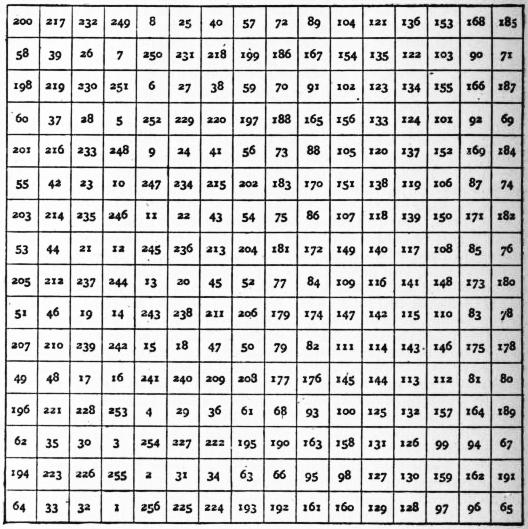
Fig. 1.
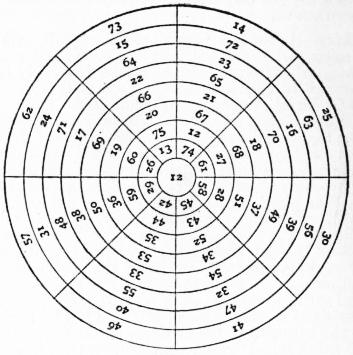
Fig. 2.
Two interesting magical arrangements are said to have been given by Benjamin Franklin; these have been termed the “magic square of squares” and the “magic circle of circles.” The first (fig. 1) is a square divided into 256 squares, i.e. 16 squares along a side, in Fig. 2. which are placed the numbers from 1 to 256. The chief properties of this square are (1) the sum of the 16 numbers in any row or column is 2056; (2) the sum of the 8 numbers in half of any row or column is 1028, i.e. one half of 2056; (3) the sum of the numbers in two half-diagonals equals 2056; (4) the sum of the four corner numbers of the great square and the four central numbers equals 1028; (5) the sum of the numbers in any 16 cells of the large square which themselves are disposed in a square is 2056. This square has other curious properties. The “magic circle of circles” (fig. 2) consists of eight annular rings and a central circle, each ring being divided into eight cells by radii drawn from the centre; there are therefore 65 cells. The number 12 is placed in the centre, and the consecutive numbers 13 to 75 are placed in the other cells. The properties of this figure include the following: (1) the sum of the eight numbers in any ring together with the central number 12 is 360, the number of degrees in a circle; (2) the sum of the eight numbers in any set of radial cells together with the central number is 360; (3) the sum of the numbers in any four adjoining cells, either annular, radial, or both radial and two annular, together with half the central number, is 180.
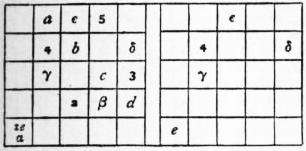
Fig. 3.
Construction of Magic Squares.—A square of 5 (fig. 3) has adjoining it one of the eight equal squares by which any square may be conceived to be surrounded, each of which has two sides resting on adjoining squares, while four have sides resting on the surrounded square, and four meet it only at its four angles. 1, 2, 3 are placed along the path of a knight in chess; 4, along the same path, would fall in a cell of the outer square, and is placed instead in the corresponding cell of the original square; 5 then falls within the square. a, b, c, d are placed diagonally in the square; but e enters the outer square, and is removed thence to the same cell of the square it had left. α, β, γ, δ, ε pursue another regular course; and the diagram shows how that course is recorded in the square they have twice left. Whichever of the eight surrounding squares may be entered, the corresponding cell of the central square is taken instead. The 1, 2, 3, ..., a, b, c, ..., α, β, γ, ... are said to lie in “paths.”
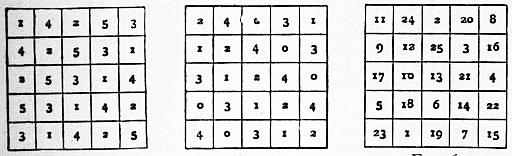
Fig. 4. Fig. 5. Fig. 6.
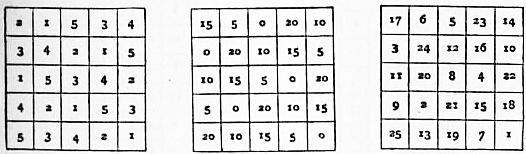
Fig. 7. Fig. 8. Fig. 9.
Squares whose Roots are Odd.—Figs 4, 5, and 6 exhibit one of the earliest methods of constructing magic squares. Here the 3’s in fig. 4 and 2’s in fig. 5 are placed in opposite diagonals to secure the two diagonal summations; then each number in fig. 5 is multiplied by 5 and added to that in the corresponding square in fig. 4, which gives the square of fig. 6. Figs. 7, 8 and 9 give De la Hire’s method; the squares of figs. 7 and 8, being combined, give the magic square of fig. 9. C. G. Bachet arranged the numbers as in fig. 10, where there are three numbers in each of four surrounding squares; these being placed in the corresponding cells of the central square, the square of fig. 11 is formed. He also constructed squares such that if one or more outer bands of numbers are removed the remaining central squares are magical. His method of forming them may be understood from a square of 5. Here each summation is 5 × 13; if therefore 13 is subtracted from each number, the summations will be zero, and the twenty-five cells will contain the series ± i, ± 2, ± 3, ... ± 12, the odd cell having 0. The central square of 3 is formed with four of the twelve numbers with + and − signs and zero in the middle; the band is filled up with the rest, as in fig. 12; then, 13 being added in each cell, the magic square of fig. 13 is obtained.
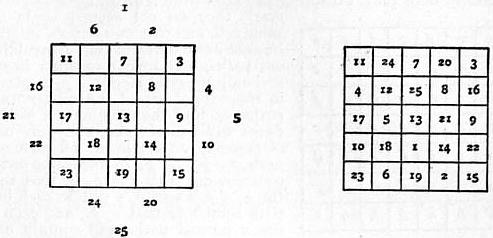
Fig. 10. Fig. 11.
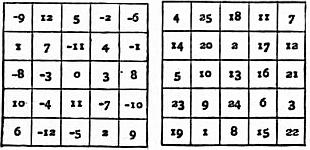
Fig. 12. Fig. 13.
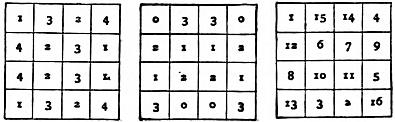
Fig. 14. Fig. 15. Fig. 16.
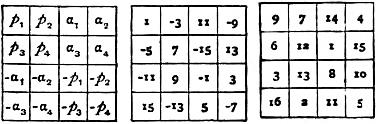
Fig. 17. Fig. 18. Fig. 19.
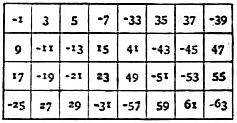
Fig. 20.
Squares whose Roots are Even.—These were constructed in various ways, similar to that of 4 in figs. 14, 15 and 16. The numbers in fig. 15 being multiplied by 4, and the squares of figs. 14 and 15 being superimposed, give fig. 16. The application of this method to squares the half of whose roots are odd requires a complicated adjustment. Squares whose half root is a multiple of 4, and in which there are summations along all the diagonal paths, may be formed, by observing, as when the root is 4, that the series 1 to 16 may be changed into the series 15, 13, ... 3, 1, −1, −3, ... −13, −15, by multiplying each number by 2 and subtracting 17; and, vice versa, by adding 17 to each of the latter, and dividing by 2. The diagonal summations of a square, filled as in fig. 17, make zero; and, to obtain the same in the rows and columns, we must assign such values to the p’s and q’s as satisfy the equations p1 + p2 + a1 + a2 = 0, p3 + p4 + a3 + a4 = 0, p1 + p3 − a1 − a3 = 0, and p2 + p4 − a2 − a4 = 0,—a solution of which is readily obtained by inspection, as in fig. 18; this leads to the square, fig. 19. When the root is 8, the upper four subsidiary rows may at once be written, as in fig. 20; then, if 65 be added to each, and the sums halved, the square is completed. In such squares as these, the two opposite squares about the same diagonal (except that of 4) may be turned through any number of right angles, in the same direction, without altering the summations.
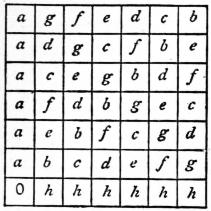
Fig. 21.
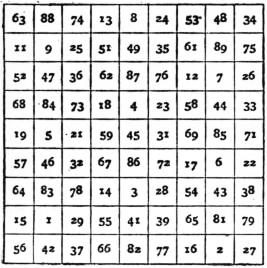
Fig. 22.
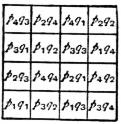
Fig. 23.
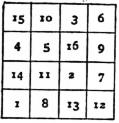
Fig. 24.
Nasik Squares.—Squares that have many more summations than in rows, columns and diagonals were investigated by A. H. Frost (Cambridge Math. Jour., 1857), and called Nasik squares, from the town in India where he resided; and he extended the method to cubes, various sections of which have the same singular properties. In order to understand their construction it will be necessary to consider carefully fig. 21, which shows that, when the root is a prime, and not composite, number, as 7, eight letters a, b, ... h may proceed from any, the same, cell, suppose that marked 0, each letter being repeated in the cells along different paths. These eight paths are called “normal paths,” their number being one more than the root. Observe here that, excepting the cells from which any two letters start, they do not occupy again the same cell, and that two letters, starting from any two different cells along different paths, will appear together in one and only one cell. Hence, if p1 be placed in the cells of one of the n + 1 normal paths, each of the remaining n normal paths will contain one, and only one, of these p1’s. If now we fill each row with p2, p3, ... pn in the same order, commencing from the p1 in that row, the p2’s, p3’s and pn’s will lie each in a path similar to that of p1, and each of the n normal paths will contain one, and only one, of the letters p1, p2,... pn, whose sum will be Σp. Similarly, if q1 be placed along any of the normal paths, different from that of the p’s, and each row filled as above with the letters q2, q3, ... qn, the sum of the q’s along any normal path different from that of the q1 will be Σq. The n² cells of the square will now be found to contain all the combinations of the p’s and q’s; and if the q’s be multiplied by n, the p’s made equal to 1, 2, ... n, and the q’s to 0, 1, 2, ... (n − 1) in any order, the Nasik square of n will be obtained, and the summations along all the normal paths, except those traversed by the p’s and q’s, will be the constant Σnq + Σp. When the root is an odd composite number, as 9, 15, &c., it will be found that in some paths, different from the two along which the p1 and q1 were placed, instead of having each of the p’s and q’s, some will be wanting, while some are repeated. Thus, in the case of 9, the triplets, p1p4p7, p2p5p8, p3p6p9, and q1q4q7, q2q5q8, q3q6q9 occur, each triplet thrice, along paths whose summation should be—Σp 45 and Σr 36. But if we make p1, p2, ... p9, = 1, 3, 6, 5, 4, 7, 9, 8, 2, and the r1, r2, ... r9 = 0, 2, 5, 4, 3, 6, 8, 7, 1, thrice each of the above sets of triplets will equal Σp and Σq respectively. If now the q’s are multiplied by 9, and added to the p’s in their several cells, we shall have a Nasik square, with a constant summation along eight of its ten normal paths. In fig. 22 the numbers are in the nonary scale; that in the centre is the middle one of 1 to 9², and the sum of pair of numbers equidistant from and opposite to the central 45 is twice 45; and the sum of any number and the 8 numbers 3 from it, diagonally, and in its row and column, is the constant Nasical summation, e.g. 72 and 32, 22, 76, 77, 26, 37, 36, 27. The numbers in fig. 22 being kept in the nonary scale, it is not necessary to add any nine of them together in order to test the Nasical summation; for, taking the first column, the figures in the place of units are seen at once to form the series, 1, 2, 3, ... 9, and those in the other place three triplets of 6, 1, 5. For the squares of 15 the p’s and q’s may be respectively 1, 2, 10, 8, 6, 14, 15, 11, 4, 13, 9, 7, 3, 12, 5, and 0, 1, 9, 7, 5, 13, 14, 10, 3, 12, 8, 6, 2, 11, 4, where five times the sum of every third number and three times the sum of every fifth number makes Σp and Σq; then, if the q’s are multiplied by 15, and added to the p’s, the Nasik square of 15 is obtained. When the root is the multiple of 4, the same process gives us, for the square of 4, fig. 23. Here the columns give Σp, but alternately 2q1, 2q3, and 2q2, 2q4; and the rows give Σq, but alternately 2p1, 2p3, and 2p2, 2p4; the diagonals giving Σp and Σq. If p1, p2, p3, p4 and q1, q2, q3, q4 be 1, 2, 4, 3, and 0, 1, 3, 2, we have the Nasik square of fig. 24. A square like this is engraved in the Sanskrit character on the gate of the fort of Gwalior, in India. The squares of higher multiples of 4 are readily obtained by a similar adjustment.
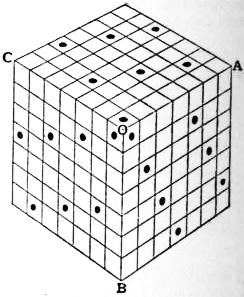
Fig. 25—Nasik Cube.
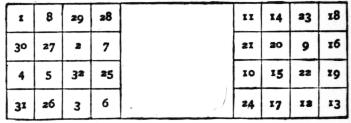
Fig. 26.
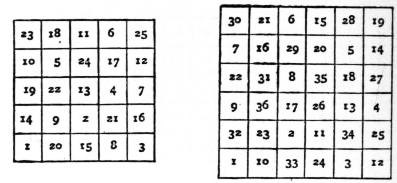
Fig. 27. Fig. 28.
Nasik Cubes.—A Nasik cube is composed of n³ small equal cubes, here called cubelets, in the centres of which the natural numbers from 1 to n³ are so placed that every section of the cube by planes perpendicular to an edge has the properties of a Nasik square; also sections by planes perpendicular to a face, and passing through the cubelet centres of any path of Nasical summation in that face. Fig. 25 shows by dots the way in which these cubes are constructed. A dot is here placed on three faces of a cubelet at the corner, showing that this cubelet belongs to each of the faces AOB, BOC, COA, of the cube. Dots are placed on the cubelets of some path of AOB (here the knight’s path), beginning from O, also on the cubelets of a knight’s path in BOC. Dots are now placed in the cubelets of similar paths to that on BOC in the other six sections parallel to BOC, starting from their dots in AOB. Forty-nine of the three hundred and forty-three cubelets will now contain a dot; and it will be observed that the dots in sections perpendicular to BO have arranged themselves in similar paths. In this manner, p1, q1, r1 being placed in the corner cubelet O, these letters are severally placed in the cubelets of three different paths of AOB, and again along any similar paths in the seven sections perpendicular to AO, starting from the letters’ position in AOB. Next, p2q2r2, p3q3r3, ... p7q7r7 are placed in the other cubelets of the edge AO, and dispersed in the same manner as p1q1r1. Every cubelet will then be found to contain a different combination of the p’s, q’s and r’s. If therefore the p’s are made equal to 1, 2, ... 7, and the q’s and r’s to 0, 1, 2, ... 6, in any order, and the q’s multiplied by 7, and the r’s by 7², then, as in the case of the squares, the 7³ cubelets will contain the numbers from 1 to 7³, and the Nasical summations will be Σ7²r + Σ7q + p. If 2, 4, 5 be values of r, p, q, the number for that cubelet is written 245 in the septenary scale, and if all the cubelet numbers are kept thus, the paths along which summations are found can be seen without adding, as the seven numbers would contain 1, 2, 3, ... 7 in the unit place, and 0, 1, 2, ... 6 in each of the other places. In all Nasik cubes, if such values are given to the letters on the central cubelet that the number is the middle one of the series 1 to n³, the sum of all the pairs of numbers opposite to and equidistant from the middle number is the double of it. Also, if around a Nasik cube the twenty-six surrounding equal cubes be placed with their cells filled with the same numbers, and their corresponding faces looking the same way,—and if the surrounding space be conceived thus filled with similar cubes, and a straight line of unlimited length be drawn through any two cubelet centres, one in each of any two cubes,—the numbers along that line will be found to recur in groups of seven, which (except in the three cases where the same p, q or r recur in the group) together make the Nasical summation of the cube. Further, if we take n similarly filled Nasik cubes of n, n new letters, s1, s2, ... sn, can be so placed, one in each of the n4 cubelets of this group of n cubes, that each shall contain a different combination of the p’s, q’s, r’s and s’s. This is done by placing s1 on each of the n² cubelets of the first cube that contain p1, and on the n² cubelets of the 2d, 3d, ... and nth cube that contain p2, p3, ... pn respectively. This process is repeated with s2, beginning with the cube at which we ended, and so on with the other s’s; the n4 cubelets, after multiplying the q’s, r’s, and s’s by n, n², and n³ respectively, will now be filled with the numbers from 1 to n4, and the constant summation will be Σn³s + Σn²r + Σnq + Σp. This process may be carried on without limit; for, if the n cubes are placed in a row with their faces resting on each other, and the corresponding faces looking the same way, n such parallelepipeds might be put side by side, and the n5 cubelets of this solid square be Nasically filled by the introduction of a new letter t; while, by introducing another letter, the n6 cubelets of the compound cube of n³ Nasik cubes might be filled by the numbers from 1 to n6, and so ad infinitum. When the root is an odd composite number the values of the three groups of letters have to be adjusted as in squares, also in cubes of an even root. A similar process enables us to place successive numbers in the cells of several equal squares in which the Nasical summations are the same in each, as in fig. 26.
Among the many ingenious squares given by various writers, this article may justly close with two by L. Euler, in the Histoire de l’académie royale des sciences (Berlin, 1759). In fig. 27 the natural numbers show the path of a knight that moves within an odd square in such a manner that the sum of pairs of numbers opposite to and equidistant from the middle figure is its double. In fig. 28 the knight returns to its starting cell in a square of 6, and the difference between the pairs of numbers opposite to and equidistant from the middle point is 18.
A model consisting of seven Nasik cubes, constructed by A. H. Frost, is in the South Kensington Museum. The centres of the cubes are placed at equal distances in a straight line, the similar faces looking the same way in a plane parallel to that line. Each of the cubes has seven parallel glass plates, to which, on one side, the seven numbers in the septenary scale are fixed, and behind each, on the other side, its value in the common scale. 1201, the middle number from 1 to 74 occupies the central cubelet of the middle cube. Besides each cube having separately the same Nasical summation, this is also obtained by adding the numbers in any seven similarly situated cubelets, one in each cube. Also, the sum of all pairs of numbers, in a straight line, through the central cube of the system, equidistant from it, in whatever cubes they are, is twice 1201.
(A. H. F.)
Fennell’s Magic Ring.—It has been noticed that the numbers of magic squares, of which the extension by repeating the rows and columns of n numbers so as to form a square of 2n − 1 sides yields n² magic squares of n sides, are arranged as if they were all inscribed round a cylinder and also all inscribed on another cylinder at right angles to the first. C. A. M. Fennell explains this apparent anomaly by describing such magic squares as Mercator’s projections, so to say, of “magic rings.”
The surface of these magic rings is symmetrically divided into n² quadrangular compartments or cells by n equidistant zonal circles parallel to the circular axis of the ring and by n transverse circles which divide each of the n zones between any two neighbouring zonal circles into n equal quadrangular cells, while the zonal circles divide the sections between two neighbouring transverse circles into n unequal quadrangular cells. The diagonals of cells which follow each other passing once only through each zone and section, form similar and equal closed curves passing once quite round the circular axis of the ring and once quite round the centre of the ring. The position of each number is regarded as the intersection of two diagonals of its cell. The numbers are most easily seen if the smallest circle on the surface of the ring, which circle is concentric with the axis, be one of the zonal circles. In a perfect magic ring the sum of the numbers of the cells whose diagonals form any one of the 2n diagonal curves aforesaid is ½n (n² + 1) with or without increment, i.e. is the same sum as that of the numbers in each zone and each transverse section. But if n be 3 or a multiple of 3, only from 2 to n of the diagonal curves carry the sum in question, so that the magic rings are imperfect; and any set of numbers which can be arranged to make a perfect magic ring or magic square can also make an imperfect magic ring, e.g. the set 1 to 16 if the numbers 1, 6, 11, 16 lie thus on a diagonal curve instead of in the order 1, 6, 16, 11. From a perfect magic ring of n² cells containing one number each, n² distinct magic squares can be read off; as the four numbers round each intersection of a zonal circle and a transverse circle constitute corner numbers of a magic square. The shape of a magic ring gives it the function of an indefinite extension in all directions of each of the aforesaid n² magic squares.
(C. A. M. F.)
See F. E. A. Lucas, Récréations mathématiques (1891-1894); W. W. R. Ball, Mathematical Recreations (1892); W. E. M. G. Ahrens, Mathematische Unterhaltungen und Spiele (1901); H. C. H. Schubert, Mathematische Mussestunden (1900). A very detailed work is B. Violle, Traité complet des carrés magiques (3 vols., 1837-1838). The theory of “path nasiks” is dealt with in a pamphlet by C. Planck (1906).
MAGINN, WILLIAM (1793-1842), Irish poet and journalist, was born at Cork on the 10th of July 1793. The son of a schoolmaster, he graduated at Trinity College, Dublin, in 1811, and after his father’s death in 1813 succeeded him in the school. In 1819 he began to contribute to the Literary Gazette and to Blackwood’s Magazine, writing as “R. T. Scott” and “Morgan O’Doherty.” He first made his mark as a parodist and a writer of humorous Latin verse. In 1821 he visited Edinburgh, where he made acquaintance with the Blackwood circle. He is credited with having originated the idea of the Noctes ambrosianae, of which some of the most brilliant chapters were his. His connexion with Blackwood lasted, with a short interval, almost to the end of his life. His best story was “Bob Burke’s Duel with Ensign Brady.” In 1823 he removed to London. He was employed by John Murray on the short-lived Representative, and was for a short time joint-editor of the Standard. But his intemperate habits and his imperfect journalistic morality prevented any permanent success. In connexion with Hugh Fraser he established Fraser’s Magazine (1830), in which appeared his “Homeric Ballads.” Maginn was the original of Captain Shandon in Pendennis. In spite of his inexhaustible wit and brilliant scholarship, most of his friends were eventually alienated by his obvious failings, and his persistent insolvency. He died at Walton-on-Thames on the 21st of August 1842.
His Miscellanies were edited (5 vols., New York, 1855-1857) by R. Shelton Mackenzie and (2 vols., London, 1885) by R. W. Montagu [Johnson].
MAGISTRATE (Lat. magistratus, from magister, master, properly a public office, hence the person holding such an office), in general, one vested with authority to administer the law or one possessing large judicial or executive authority. In this broad sense the word is used in such phrases as “the first magistrate” of a king in a monarchy or “the chief magistrate” of the president of the United States. But it is more generally applied to minor or subordinate judicial officers, whether unpaid, as justices of the peace, or paid, as stipendiary magistrates. A stipendiary magistrate is appointed in London under the Metropolitan Police Courts Act 1839, in municipal boroughs under the Municipal Corporations Act 1882, and in particular districts under the Stipendiary Magistrates Act 1863 and special acts. In London and municipal boroughs a stipendiary magistrate must be a barrister of at least seven years’ standing, while under the Stipendiary Magistrates Act 1863 he may be of five years’ standing. A stipendiary magistrate may do alone all acts authorized to be done by two justices of the peace.
The term magistratus in ancient Rome originally implied the office of magister (master) of the Roman people, but was subsequently applied also to the holder of the office, thus becoming identical in sense with magister, and supplanting it in reference to any kind of public office. The fundamental conception of Roman magistracy is tenure of the imperium, the sovereignty which resides with the Roman people, but is by it conferred either upon a single ruler for life, as in the later monarchy, or upon a college of magistrates for a fixed term, as in the Republican period. The Roman theory of magistracy underwent little change when two consuls were substituted for the king; but the subdivision of magisterial powers which characterized the first centuries of the Republic, and resulted in the establishment of twenty annually elected magistrates of the people, implied some modification of this principle of the investiture of magistrates with supreme authority. For when the magistracies were multiplied a distinction was drawn between magistrates with imperium, namely consuls, praetors and occasionally dictators, and the remaining magistrates, who, although exercising independent magisterial authority and in no sense agents of the higher magistrates, were invested merely with an authority (potestas) to assist in the administration of the state. At the same time the actual authority of every magistrate was weakened not only by his colleagues’ power of veto, but by the power possessed by any magistrate of quashing the act of an inferior, and by the tribune’s right of putting his veto on the act of any magistrate except a dictator; and the subdivision of authority, which placed a great deal of business in the hands of young and inexperienced magistrates, further tended to increase the actual power as well as the influence of the senate at the expense of the magistracy.
In the developed Republic magistracies were divided into two classes: (a) magistrates of the whole people (populi Romani) and (b) magistrates of the plebs. The former class is again divided into two sections: (α) curule and (β) non-curule, a distinction which rests mainly on dignity rather than on actual power, for it cuts across the division of magistrates according to their tenure or non-tenure of imperium.
a. The magistrates of the people—also known as patrician magistrates, probably because the older and more important of these magistracies could originally be held only by patricians (q.v.)—were: (α) Dictator, master of the horse (see Dictator), consuls, praetors, curule, aediles and censors (curule); and (β) Quaestors, and the body of minor magistrates known as xxvi. viri (non-curule). The dictatorship and consulship were as old as the Republic. The first praetor was appointed in 366 B.C., a second was added in 242 B.C., and the number was gradually increased for provincial government until Sulla brought it up to eight, and under the early principate it grew to eighteen. Censors were first instituted in 443 B.C., and the office continued unchanged until its abolition by Sulla, after which, though restored, it rapidly fell into abeyance. Curule aediles were instituted at the same time as the praetorship, and continued throughout the Republic. The quaestorship was at least as old as the Republic, but the number rose during the Republic from two to twenty. All these offices except the censorship continued for administrative purposes during the principate, though shorn of all important powers.
b. The plebeian magistrates had their origin in the secession of the plebs to Mons Sacer in 494 B.C. (see Rome: History). In that year tribunes of the plebs were instituted, and two aediles were given them as subordinate officials, who were afterwards known as plebeian aediles, to distinguish them from the curule magistrates of the same name. Both these offices were abolished during the decemvirate, but were restored in 449 B.C., and survived into the principate.
The powers possessed by all magistrates alike were two:—that of enforcing their enactments (coercitio) by the exercise of any punishment short of capital, and that of veto (intercessio) of any act of a colleague or minor magistrate. The right of summoning and presiding over an assembly of that body of citizens with whose powers the magistrate was invested lay with the higher magistrates only in each class, with the consuls and praetors, and with the tribunes of the plebs. Civil jurisdiction was always a magisterial prerogative at Rome, and criminal jurisdiction also, except in capital cases, the decision of which was vested in the people at least as early as the first year of the Republic, was wielded by magistrates until the establishment of the various quaestiones perpetuae during the last century of the Republic. But in civil cases the magistrate, though controlling the trial and deciding matters of law, was quite distinct from the judge or body of judges who decided the question of fact; and the quaestiones perpetuae, which reduced the magistrate in criminal cases to a mere president of the court, gave him a position inferior to that of the praetor, who tried civil cases, only in so far as the praetor controlled the trial in some degree by his formula, under which the judges decided the question of fact.
Tenure of magistracy was always held to depend upon election by the body whose powers the magistrate wielded. Thus the magistrates of the plebs were elected by the plebeian council, those of the people in the Comitia (q.v.). In every case the outgoing magistrate, as presiding officer of the elective assembly, exercised the important right of nominating his successor for election.
See A. H. J. Greenidge, Roman Public Life, 152 seq., 363 seq. (London, 1901); T. Mommsen, Römisches Staatsrecht, I. 11. i. (1887).
(A. M. Cl.)
MAGLIABECHI, ANTONIO DA MARCO (1633-1714), Italian bibliophile, was born at Florence on the 28th of October 1633. He followed the trade of a goldsmith until 1673, when he received the appointment of librarian to the grand-duke of Tuscany, a post for which he had qualified himself by his vast stores of self-acquired learning. He died on the 4th of July 1714, bequeathing his large private library to the grand-duke, who in turn handed it over to the city.
MAGLIANI, AGOSTINO (1824-1891), Italian financier, was a native of Lanzino, near Salerno. He studied at Naples, and a book on the philosophy of law based on Liberal principles won for him a post in the Neapolitan treasury. He entered the Italian Senate in 1871, and had already secured a reputation as a financial expert before his Questione monetaria appeared in 1874. In December 1877 he became minister of finance in the reconstructed Depretis ministry, and he subsequently held the same office in three other Liberal cabinets. In his second tenure he carried through (1880) the abolition of the grist tax, to take effect in 1884. Having to face an increased expenditure without offending the Radical electorate by unpopular taxes, he had recourse to unsound methods of finance, which seriously embarrassed Italian credit for some years after he finally laid down office in 1888. He died in Rome on the 22nd of February 1891. He was one of the founders of the anti-socialistic “Adam Smith Society” at Florence.
MAGNA CARTA, or the Great Charter, the name of the famous charter of liberties granted at Runnimede in June 1215 by King John to the English people. Although in later ages its importance was enormously magnified, it differs only in degree, not in kind, from other charters granted by the Norman and early Plantagenet kings. Its greater length, however, still more the exceptional circumstances attending its birth, gave to it a position absolutely unique in the minds of later generations of Englishmen. This feeling was fostered by its many confirmations, and in subsequent ages, especially during the time of the struggle between the Stuart kings and the parliament, it was regarded as something sacrosanct, embodying the very ideal of English liberties, which to some extent had been lost, but which must be regained. Its provisions, real and imaginary, formed the standard towards which Englishmen must strive.
The causes which led to the grant of Magna Carta are described in the article on English History. Briefly, they are to be found in the conditions of the time; the increasing insularity of the English barons, now no longer the holders of estates in Normandy; the substitution of an unpopular for a popular king, an active spur to the rising forces of discontent; and the unprecedented demands for money—demands followed, not by honour, but by dishonour, to the arms of England abroad. So much for the general causes. The actual crisis may be said to begin with the quarrel between John and Pope Innocent III. regarding the appointment of a new archbishop to the see of Canterbury. This was settled in May 1213, and in the new prelate, the papal nominee, Stephen Langton, who landed in England and absolved the king in the following July, the baronial party found an able and powerful ally. But before this event John had instituted a great inquiry, the inquest of service of June 1212, for the purpose of finding out how much he could exact from each of his vassals, a measure which naturally excited some alarm; and then, fearing a baronial rising, he had abandoned his proposed expedition into Wales, had taken hostages from the most prominent of his foes, and had sought safety in London.
His absolution followed, and then he took courage. Turning once more his attention to the recovery of Normandy, he asked the barons for assistance for this undertaking; in reply they, or a section of them, refused, and instead of crossing the seas the king marched northwards with the intention of taking vengeance on his disobedient vassals, who were chiefly barons of the north of England. Langton followed his sovereign to Northampton and persuaded him, at least for the present, to refrain from any serious measures of revenge. Before this interview a national council had met at St Albans at the beginning of August 1213, and this was followed by another council, held in St Paul’s church, London, later in the same month; it was doubtless summoned by the archbishop, and was attended by many of the higher clergy and a certain number of the barons. Addressing the gathering, Langton referred to the laws of Edward the Confessor as “good laws,” which the king ought to observe, and then mentioned the charter granted by Henry I. on his accession as a standard of good government. This event has such an important bearing on the issue of Magna Carta that it is not inappropriate to quote the actual words used by Matthew Paris in describing the incident. The chronicler represents the archbishop as saying “Inventa est quoque nunc carta quaedam Henrici primi regis Angliae per quam, si volueritis, libertates diu amissas poteritis ad statum pristinum revocare.” Those present decided to contend to the death for their “long-lost liberties,” and with this the meeting came to an end. Nothing, however, was done during the remainder of the year, and John, feeling his position had grown stronger, went abroad early in 1214, and remained for some months in France. With his mercenaries behind him he met with some small successes in his fight for Normandy, but on the 27th of July he and his ally, the emperor Otto IV., met with a crushing defeat at Bouvines at the hands of Philip Augustus, and even the king himself was compelled to recognise that his hopes of recovering Normandy were at an end.
Meanwhile in England, which was ruled by Peter des Roches as justiciar, the discontent had been increasing rather than diminishing, and its volume became much larger owing to an event of May 1214. Greatly needing money for his campaign, John ordered another scutage to be taken from his tenants; this, moreover, was to be at the unprecedented rate of three marks on the knight’s fee, not as on previous occasions of two marks, although this latter sum had hitherto been regarded as a very high rate. The northern barons refused to pay, and the gathering forces of resistance received a powerful stimulus when a little later came the news of the king’s humiliation at Bouvines. Then in October the beaten monarch returned to England, no course open to him but to bow before the storm. In November he met some of his nobles at Bury St Edmunds, but as they still refused to pay the scutage no agreement was reached. At once they took another step towards the goal. With due solemnity (super majus altare) they swore to withdraw their allegiance from the king and to make war upon him, unless within a stated time he restored to them their rightful laws and liberties. While they were collecting troops in order to enforce their threats, John on his part tried to divide his enemies by a concession to the clerical section. By a charter, dated the 21st of November 1214, he granted freedom of election to the church. However, this did not prevent the prelates from continuing to act to some extent with the barons, and early in January 1215 the malcontents asked the king to confirm the laws of Edward the Confessor and the other liberties of the kingdom. He evaded the request and secured a truce until Easter was passed. Energetically making use of this period of respite, he again issued the charter to the church, ordered his subjects to take a fresh oath of allegiance to him, and sent to the pope for aid; but neither these precautions, nor his expedient of taking the cross, deterred the barons from returning to the attack. In April they met in arms at Stamford, and as soon as the truce had expired they marched to Brackley, where they met the royal ministers and again presented their demands. These were carried to the king at Oxford, but angrily he refused to consider them. Then the storm burst. On the 5th of May the barons formally renounced their allegiance to John, and appointed Robert Fitzwalter as their leader. They marched towards London, while John made another attempt to delay the crisis, or to divide his foes, by granting a charter to the citizens of London (May 9, 1215), and then by offering to submit the quarrel to a court of arbitrators under the presidency of the pope. But neither the one nor the other expedient availed him. Arbitration under such conditions was contemptuously rejected, and after the king had ordered the sheriffs to seize the lands and goods of the revolting nobles, London opened its gates and peacefully welcomed the baronial army. Other towns showed also that their sympathies were with the insurgents, and John was forced to his knees. Promising to assent to their demands, he agreed to meet the barons, and the gathering was fixed for the 15th of June, and was to take place in a meadow between Staines and Windsor, called Runnimede.
At the famous conference, which lasted from Monday the 15th to Tuesday the 23rd of June, the hostile barons were present in large numbers; on the other hand John, who rode over each day from Windsor, was only attended by a few followers. At once the malcontents presented their demands in a document known popularly as the Articles of the Barons, more strictly as Capitula quae barones petunt et dominus rex concedit. Doubtless this had been drawn up beforehand, and was brought by the baronial leaders to Runnimede; possibly it was identical with the document presented to the royal ministers at Brackley a few weeks before. John accepted the Articles on the same day and at once the great seal was affixed to them. They are forty-eight in number, and on them Magna Carta was based, the work of converting them into a charter, which was regarded as a much more binding form of engagement, being taken in hand immediately. This duty occupied three days, negotiations between the two parties taking place over several disputed points, and it was completed by Friday the 19th, when several copies of the charter were sealed. All then took an oath to keep its terms, and orders were sent to the sheriffs to publish it, and to see that its provisions were observed, two or three days being taken up with making and sending out copies for this purpose. It should be mentioned that, although the charter was evidently not sealed until the 19th, the four existing copies of it are dated the 15th, the day on which John accepted the articles.
The days between Friday the 19th and the following Tuesday, when the conference came to an end, were occupied in providing, as far as possible, for the due execution of the reforms promised by the king in Magna Carta. The document itself provided for an elected committee of twenty-five barons, whose duty was to compel John, by force if necessary, to keep his promises; but this was evidently regarded as insufficient, and the matter was dealt with in a supplementary treaty (Conventio facta inter regem Angliae et barones ejusdum regni). As a guarantee of his good faith the king surrendered the city of London to his foes, while the Tower was entrusted to the neutral keeping of the archbishop of Canterbury. John then asked the barons for a charter that they on their part would keep the peace. This was refused, and although some of the bishops entered a mild protest, the question was allowed to drop. Regarding another matter also, the extent of the royal forests, the prelates made a protest. John and his friends feared lest the inquiry promised into the extent of the hated forest areas would be carried out too rigorously, and that these would be seriously curtailed, if not abolished altogether. Consequently, the two archbishops and their colleagues declared that the articles in the charter which provided for this inquiry, and for a remedy against abuses of the forest laws by the king, must not be interpreted in too harsh a spirit. The customs necessary for the preservation of the forests must remain in force.
No securities, however, could bind John. Even before Magna Carta was signed he had set to work to destroy it, and he now turned to this task with renewed vigour. He appealed to the pope, and hoped to crush his enemies by the aid of foreign troops, while the barons prepared for war, and the prelates strove to keep the peace. Help came first from the spiritual arm. On the 24th of August 1215 Innocent III. published a bull which declared Magna Carta null and void. It had been extorted from the king by force (per vim et metum), and in the words of the bull the pope said “compositionem hujusmodi reprobamus penitus et damnamus.” He followed this up by excommunicating the barons who had obtained it, and in the autumn of 1215 the inevitable war began. Capturing Rochester castle, John met with some other successes, and the disheartened barons invited Louis, son of Philip Augustus of France and afterwards king as Louis VIII., to take the English crown. In spite of the veto of the pope Louis accepted the invitation, landed in England in May 1216, and occupied London and Winchester, the fortune of war having in the meantime turned against John. The “ablest and most ruthless of the Angevins,” as J. R. Green calls this king, had not, however, given up the struggle, and he was still in the field when he was taken ill, dying in Newark castle on the 19th of October 1216.
In its original form the text of Magna Carta was not divided into chapters, but in later times a division of this kind was adopted. This has since been retained by all commentators, the number of chapters being 63.
The preamble states that the king has granted the charter on the advice of various prelates and barons, some of whom, including the archbishop of Canterbury, the papal legate Pandulf, and William Marshal, earl of Pembroke, are mentioned by name.
Chapter I. declares that the English church shall be free and shall enjoy freedom of election. This follows the precedent set in the accession charter of Henry I. and in other early charters, although it had no place in the Articles of the Barons. On the present occasion it was evidently regarded as quite a formal and introductory matter, and the same remark applies to the general grant of liberties to all freemen and their heirs, with which the chapter concludes.
Then follows a series of chapters intended to restrain the king from raising money by the harsh and arbitrary methods adopted in the past. These chapters, however, only afforded protection to the tenants-in-chief of the crown, and it is clear from their prominent position that the framers of the charter regarded them as of paramount importance.
Chapter II. fixes the amount of the relief to be paid to the king by the heir of any of his vassals. Previously John, disregarding the custom of the past, had taken as much as he could extort. Henceforward he who inherits a barony must pay £100, he who inherits a knight’s fee 100 shillings or less, and for smaller holdings less “according to the ancient custom of fiefs.”
Chapters III. to VI. deal with the abuses of the king’s privilege of acting as guardian of minors and their lands. Money must not be extorted from a ward when he receives his inheritance. The guardian or his servant must not take from the ward’s property more than a reasonable amount for his expenses and the like; on the contrary he must maintain the houses, estates and other belongings in a proper state of efficiency. A ward must be allowed a reasonable liberty in the matter of marriage. He or she must not, as had been so often the case in the past, be forced to marry some royal favourite, or some one who had paid a sum of money for the privilege.
Chapters VII. and VIII. are for the protection of the widows of tenants-in-chief. On the death of her husband a widow must receive her rightful inheritance, without delay or hindrance. Moreover she must not be compelled to marry, a proceeding sometimes adopted to get her lands into the possession of a royal minion.
Chapter IX. is intended to prevent the king from collecting the money owing to him in an oppressive manner.
Now for a short time the document leaves the great questions at issue between the king and the barons, and two chapters are devoted to protecting the people generally against the exactions of the Jews.
Chapter X. declares that money borrowed from the Jews shall not bear interest during a minority.
Chapter XI. provides for the repayment of borrowed money to the Jews, and also to other creditors. This, however, is only to be done after certain liabilities have been met out of the estate, including the services due to the lord of the land.
Having thus disposed of this matter, the grievances of the barons are again considered, the vexed question of scutage being dealt with.
Chapter XII. says that in future no scutage or aid, beyond the three recognized feudal aids, shall be levied except by the consent of the general council of the nation (commune concilium regni nostri), while the three recognized aids shall only be levied at a reasonable rate. In dealing with this matter the Articles of the Barons had declared that aids and tallages must not be taken from the citizens of London and of other places without the consent of the council. This provision was omitted from Magna Carta, except so far as it related to aids from the citizens of London. This chapter does not give the people the right to control taxation. It gives to the men interested a certain control over one form of taxation, and protects one class only from arbitrary exactions, and that class the most powerful and the most wealthy.
Chapter XIII. gives to the citizens of London all their ancient liberties and free customs.
Chapter XIV. provides for the assembly of the council when its consent is necessary for raising an aid or a scutage. Individual summonses must be sent to the prelates and greater barons, while the lesser barons will be called together through the sheriffs and bailiffs. At least forty days’ notice of the meeting must be given, and the cause thereof specified. No chapter corresponding to this is found in the Articles and none was inserted in the reissues of Magna Carta. It is very interesting, but it does not constitute any marked advance in the history of parliament, as it merely expresses the customary method of summoning a council. It does not, as has been sometimes asserted, in any way establish a representative system, as this is understood to-day.
Chapter XV. extends the concessions obtained by the greater barons for themselves to the lesser landholders, the tenants of the tenants-in-chief.
Chapter XVI. declares that those who owe military service for their lands shall not be called upon to perform more than the due amount of such service.
We now come to an important series of articles which deal with abuses in the administration of justice. Henry II. made the royal courts of law a lucrative source of revenue, but he gave protection to suitors. Under his sons justice was equally, perhaps more, costly, while adequate protection was much harder to obtain. Here were many grievances, and the barons set to work to redress them.
Chapter XVII. declares that common pleas must henceforward be heard in a fixed place. This had already been to some extent the practice when this class of cases was heard; it was now made the rule. From this time suitors in this court were not put to the expense and inconvenience of following the king from place to place.
Chapters XVIII. and XIX. deal with the three petty assizes, three kinds of cases regarding disputes about the possession of land. These must be heard in the county courts before two visiting justices and four knights of the shire. The hardship of attendance at the county courts was to some extent obviated.
Chapters XX. to XXII. regulate the amount of fines imposed for offences against the law. Property necessary for one’s livelihood must not be taken. The fines must only be imposed by the oath of honest men of the neighbourhood. In the same way earls and barons must only be fined by their peers, and a similar privilege is extended to the clergy, who, moreover, were not to be fined in accordance with the value of their benefices, but only of their other property. It should be noticed that trial by one’s peers, as understood in Magna Carta, is not confined to the nobility; in every class of society an accused man is punished in accordance with the verdict of his peers, or equals.
Chapter XXIII. asserts that persons shall not be compelled to make bridges, unless they are bound to do so by ancient custom. John had oppressed his subjects in this way before he visited a district for purposes of sport, and the hardship was a real one.
Chapter XXIV. declared that the sheriffs and other officers of the king must not hold the pleas of the crown. This was intended to remove an old and serious evil, as the sheriffs had earned a very bad reputation by their methods of administering justice.
Chapter XXV. also concerns the sheriffs. It prevents the king from increasing by their agency the amount of money annually due to him from the various counties and hundreds. The custom was for the king to get a fixed sum from the sheriff of each county, this being called the firma comitatus, and for the sheriff to collect this as best he could. Henceforward this amount must not be raised.
Chapters XXVI. and XXVII. were intended to protect the property of deceased persons, and also to secure the full payment of debts due therefrom to the crown. Other creditors were also protected, and the property of an intestate must be distributed to his heirs under the supervision of the church.
Chapter XXVIII. strikes a blow at the custom of purveyance. Royal officials must pay for the corn and provisions which they take on behalf of the king.
Chapter XXIX. says knights must not be compelled to give money instead of performing castle-guard, if they are willing to perform this service. Castle-guard was the liability incumbent on the holders of some estates to serve in the garrison of the royal castles. The constables of these castles had adopted the custom of compelling these landholders to give money and not service, mercenaries being then hired to perform this.
Chapters XXX. and XXXI. forbid the royal officials to seize the horses or carts of freemen for transport duty, or to take wood for the king’s buildings.
Chapter XXXII. says that the lands of convicted felons shall be handed over to the lords of such lands and not kept by the king beyond a year and a day. In cases of treason the king had a right to the forfeited lands, but he was not allowed to establish a similar right in cases of felony.
Chapter XXXIII. provided for the removal of kydells, or weirs, from all English rivers. This was intended to give greater freedom to inland navigation, the rivers being the main highways of trade.
Chapter XXXIV. limits the use of the writ known as Praecipe. This writ was one transferring cases concerning the ownership of property from the courts of the feudal lords to those of the king. This custom, which owes its origin to Henry II., meant a loss of revenue to the lords, whose victory in this matter, however, was a step backwards. It checked temporarily the process of centralizing the administration of justice.
Chapter XXXV. provides for the uniformity of weights and measures throughout the kingdom.
Chapter XXXVI. promises that in future writs of inquisition shall be granted freely without payment of any kind. This kind of writ allowed a man to refer the question of his guilt or innocence to the verdict of his neighbours instead of proving his innocence by the duel.
Chapter XXXVII. prevents the king from administering certain kinds of land when these fall into the possession of minors. In the past John had evidently stretched his authority and seized lands over which others had really the right of wardship.
Chapter XXXVIII. prevents a bailiff from compelling an accused man to submit to the ordeal without the approval of credible witnesses.
Chapter XXXIX. is more important and the English rendering of it may be given in full. “No freeman shall be arrested, or detained in prison, or deprived of his freehold, or outlawed, or banished, or in any way molested; and we will not set forth against him, nor send against him, unless by the lawful judgment of his peers and by the law of the land.” The object of this was clearly to restrain John from arbitrary proceedings against his free subjects. The principle of judgment by one’s peers is asserted, and is obviously the privilege of every class of freemen, not of the greater lords alone.
Chapter XL. simply says, “To no one will we sell, to no one will we refuse or delay, right or justice.”
Chapters XLI. and XLII. give permission to merchants, both English and foreign, to enter and leave the kingdom, except in time of war. They are not to pay “evil tolls.” The privilege is extended to all travellers, except the prisoner and the outlaw, and natives of a country with which England is at war.
Chapter XLIII. is intended to compel the king to refrain from exacting greater dues from an escheated barony than were previously due from such barony.
Chapter XLIV. deals with the hated and oppressive forest laws. In future attendance at the forest courts is only obligatory on those who have business thereat.
Chapter XLV. says that the royal officials must know something of the law and must be desirous of keeping it.
Chapter XLVI. gives to the founders of religious houses the right of acting as guardians of such houses when they are without heads.
Chapters XLVII. and XLVIII. deal again with the great grievance of the royal forests. John undertakes to disforest all forests which have been made in his time, and also to give up such river banks as he has seized for his own use when engaged in sport. Twelve knights in each county are to make a thorough inquiry into all evil customs connected with the forests, and these are to be utterly abolished.
Chapter XLIX. provides for the restoration of hostages. John had been in the habit of taking the children of powerful subjects as pledges for the good behaviour of their parents.
Chapter L. says that certain royal minions, who are mentioned by name, are to be removed from their offices.
Chapter LI. says that as soon as peace is made all foreign mercenaries are to be banished.
Chapters LII. and LIII. are those in which the king promises to make amends for the injuries he has done to his barons in the past. He will restore lands and castles to those who have been deprived of them without the judgment of their peers; he will do the same concerning property unlawfully seized by Henry II. or Richard I. and now in his hands. In the latter case, however, he was allowed a respite until he returned from the projected crusade. He promises also to do right concerning forests, abbeys and the wardship of lands which belong lawfully to others.
Chapter LIV. prevents any one from being arrested on the appeal of a woman, except on a charge of causing the death of her husband. As a woman could not prove her case in the judicial combat, it was felt that the earlier practice gave her an unfair advantage.
Chapter LV. provides for the remission of unjust fines. The decision on these matters is to rest with the archbishop of Canterbury and the twenty-five barons appointed to see that the terms of the charter are carried out.
Chapters LVI. and LVII. deal with the grievances of Welshmen. Restoration of property is promised to them practically in the same way as to Englishmen. Welsh law is to be used in Wales, and in the marches the law of the marches is to be employed.
Chapter LVIII. promises that his hostages and his charters shall be restored to Llewellyn, prince of Wales.
Chapter LIX. promises a restoration of hostages to Alexander I. king of Scotland. Right is also to be done to him concerning the lands which he holds in England.
Chapter LX. is a general statement that the aforesaid customs and liberties are to be observed by all classes.
Chapter LXI. provides for the execution of the royal promises. A committee is to be formed of twenty-five barons. Then if the king or any of his servants do wrong and complaint is made to four of the twenty-five, they are to ask for redress. In the event of this not being granted within forty days the matter is to be referred to the twenty-five, who are empowered to seize the lands and property of the king, or to obtain justice in any other way possible. They must, however, spare the persons of the king, the queen and their children. Vacancies in the committee are to be filled by the barons themselves. The twenty-five barons were duly appointed, their names being given by Matthew Paris. This chronicler also reports that another committee of thirty-eight members was appointed to assist and control the twenty-five. S. R. Gardiner calls the scheme “a permanent organization for making war against the king.”
Chapter LXII. is an expression of general forgiveness.
Chapter LXIII. repeats the promise of freedom to the English church and of their rights and liberties to all.
Magna Carta is an elaboration of the accession charter of Henry I., and is based upon the Articles of the Barons. It is, however, very much longer than the former charter and somewhat longer than the Articles. Moreover, it differs in several particulars from the Articles, these differences being doubtless the outcome of deliberation and of compromise. For instance, the provisions in Magna Carta concerning the freedom of the church find no place in the Articles, while a comparison between the two documents suggests that in other ways also influences favourable to the church and the clergy were at work while the famous charter was being framed. When one reflects how active and prominent Langton and other prelates were at Runnimede the change is not surprising. Another difference between the two documents concerns the towns and the trading classes. Certain privileges granted to them in the Articles are not found in Magna Carta, although, it must be noted, this document bestows exceptionally favoured treatment on the citizens of London. The conclusion is that the friends of the towns and the traders were less in evidence at Runnimede than they were at the earlier meetings of the barons, but that the neighbouring Londoners were strong enough to secure a good price for their support.
Magna Carta throws much light on the condition of England in the early 13th century. By denouncing the evil deeds of John and the innovations practised by him, it shows what these were and how they were hated; how money had been raised, how forest areas had been extended, how minors and widows had been cheated and oppressed. By declaring, as it does, what were the laws and customs of a past age wherein justice prevailed, it shows what was the ideal of good government formed by John’s prelates and barons. Magna Carta can hardly be said to have introduced any new ideas. As Pollock and Maitland (History of English Law) say “on the whole the charter contains little that is absolutely new. It is restorative.” But although mature study has established the truth of this proposition it was not always so. Statesmen and commentators alike professed to find in Magna Carta a number of political ideas which belonged to a later age, and which had no place in the minds of its framers. It was regarded as having conferred upon the nation nothing less than the English constitution in its perfect and completed form. Sir Edward Coke finds in Magna Carta a full and proper legal answer to every exaction of the Stuart kings, and a remedy for every evil suffered at the time. Sir William Blackstone is almost equally admiring. Edmund Burke says “Magna Carta, if it did not give us originally the House of Commons, gave us at least a House of Commons of weight and consequence.” Lord Chatham used words equally superlative. “Magna Carta, the Petition of Rights and the Bill of Rights form that code, which I call the Bible of the English Constitution.” Modern historians, although less rhetorical, speak in the highest terms of the importance of Magna Carta, the view of most of them being summed up in the words of Dr Stubbs: “The whole of the constitutional history of England is a commentary on this charter.”
Many regard Magna Carta as giving equal rights to all Englishmen. J. R. Green says “The rights which the barons claimed for themselves they claimed for the nation at large.” As a matter of fact this statement is only true with large limitations. The villains, who formed the majority of the population, got very little from it; in fact the only clauses which protect them do so because they are property—the property of their lords—and therefore valuable. They get neither political nor civil rights under Magna Carta. The traders, too, get little, while preferential treatment is meted out to the clergy and the barons. Its benefits are confined to freemen, and of the benefits the lion’s share fell to the larger landholders; the smaller landholders getting, it is true, some crumbs from the table. It did not establish freedom from arbitrary arrest, or the right of the representatives of the people to control taxation, or trial by jury, or other conceptions of a later generation.
The story of Magna Carta after the death of John is soon told. On the 12th of November 1216 the regent William Marshal, earl of Pembroke, reissued the charter in the name of the young king Henry III. But important alterations were made. War was being waged against Louis of France, and the executive must not be hampered in the work of raising money; moreover the personal equation had disappeared, the barons did not need to protect themselves against John. Consequently the chapter limiting the power of the crown to raise scutages and aids without the consent of the council vanished, and with it the complementary one which determined the method of calling a council. Other provisions, the object of which had been to restrain John from demanding more money from various classes of his subjects, were also deleted, and the same fate befell such chapters as dealt with mere temporary matters. The most important of these was Chapter LXI., which provided for the appointment of 25 executors to compel John to observe the charter. The next year peace was made at Lambeth (Sept. 11, 1217) between Henry III. and Louis and another reissue of the charter was promised. This promise was carried out, but two charters appeared, one being a revised issue of Magna Carta proper, and the other a separate charter dealing with the forests, all references to which were omitted from the more important document. The date of this issue appears to have been the 6th of November 1217. The issue of a separate forest charter at this time led subsequently to some confusion. Roger of Wendover asserts that John issued a separate charter of this kind when Magna Carta appeared. This statement was believed by subsequent writers until the time of Blackstone, who was the first to discover the mistake.
As issued in 1217 Magna Carta consists of 47 chapters only. It declares that henceforward scutages shall be taken according to the precedents of Henry II.’s reign. New provisions were introduced for the preservation of the peace—unlawful castles were to be destroyed—while others were directed towards making the administration of justice by the visiting justices less burdensome. With regard to the land and the services due therefrom a beginning was made of the policy which culminated in the statutes of Mortmain and of Quia Emptores. The sheriffs were ordered to publish the revised charter on the 22nd of February 1218. Then in February 1225 Henry III. again issued the two charters with only two slight alterations, and this is the final form taken by Magna Carta, this text being the one referred to by Coke and the other early commentators. Subsequently the charters were confirmed several times by Henry III. and by Edward I., the most important occasion being their confirmation by Edward at Ghent in November 1297. On this occasion some supplementary articles were added to the charter; these were intended to limit the taxing power of the crown.
There are at present in existence four copies of Magna Carta, sealed with the great seal of King John, and several unsealed copies. Of the four two are in the British Museum. Both came into the possession of the Museum with the valuable collection of papers which had belonged to Sir Robert Cotton, who had obtained possession of both. One was found in Dover castle about 1630. This was damaged by fire in 1731; the other is undamaged. The two other sealed copies belong to the cathedrals of Lincoln and of Salisbury. Both were written evidently in a less hurried fashion than those in the British Museum, and the one at Lincoln was regarded as the most perfect by the commissioners who were responsible for the appearance of the Statutes of the Realm in 1810. The British Museum also contains the original parchment of the Articles of the Barons. Magna Carta was first printed by Richard Pynson in 1499. This, however, was not the original text, which was neglected until the time of Blackstone, who printed the various issues of the charter in his book The Great Charter and the Charter of the Forest (1759). The earliest commentator of note was Sir Edward Coke, who published his Second Institute, which deals with Magna Carta, by order of the Long Parliament in 1642. Modern commentators, who also print the various texts of the charter, are Richard Thomson, An Historical Essay on the Magna Carta of King John (1829); C. Bémont, in his Chartes des libertés anglaises (1892); and W. Stubbs in his Select Charters (1895). A more recent book and one embodying the results of the latest research is W. S. McKechnie, Magna Carta (1905). The text of Magna Carta is also printed in the Statutes of the Realm (1810-1828), and in T. Rymer’s Foedera (1816-1869). In addition to Blackstone, Coke and these later writers, the following works may also be consulted: John Reeves, History of English Law (1783-1784); L. O. Pike, A Constitutional History of the House of Lords (1894); W. Stubbs, Constitutional History of England (1897); Sir F. Pollock and F. W. Maitland, The History of English Law (1895); W. S. Holdsworth, A History of English Law (1903), and Kate Norgate, John Lackland (1902).
(A. W. H.*)
MAGNA GRAECIA (ἡ μεγάλη Ἑλλάς), the name given (first, apparently, in the 6th century B.C.) to the group of Greek cities along the coast of the “toe” of South Italy (or more strictly those only from Tarentum to Locri, along the east coast), while the people were called Italiotes (Ἰταλιῶται). The interior, which the Greeks never subdued, continued to be in the hands of the Bruttii, the native mountaineers, from whom the district was named in Roman times (Βρεττία also in Greek writers). The Greek colonies were established first as trading stations, which grew into independent cities. At an early time a trade in copper was carried on between Greece and Temesa (Homer, Od. i. 181).1 The trade for a long time was chiefly in the hands of the Euboeans; and Cyme (Cumae) in Campania was founded in the 8th century B.C., when the Euboean Cyme was still a great city. After this the energy of Chalcis went onward to Sicily, and the states of the Corinthian Gulf carried out the colonization of Italy, Rhegium having been founded, it is true, by Chalcis, but after Messana (Zancle), and at the request of the inhabitants of the latter. Sybaris (721) and Crotona (703) were Achaean settlements; Locri Epizephyrii (about 710) was settled by Ozolian Locrians, so that, had it not been for the Dorian colony of Tarentum, the southern coast of Italy would have been entirely occupied by a group of Achaean cities. Tarentum (whether or no founded by pre-Dorian Greeks—its founders bore the unexplained name of Partheniae) became a Laconian colony at some unknown date, whence a legend grew up connecting the Partheniae with Sparta, and 707 B.C. was assigned as its traditional date. Tarentum is remarkable as the only foreign settlement made by the Spartans. It was industrial, depending largely on the purple and pottery trade. Ionian Greeks fleeing from foreign invasion founded Siris about 650 B.C., and, much later, Elea (540).
The Italian colonies were planted among friendly, almost kindred, races, and grew much more rapidly than the Sicilian Greek states, which had to contend against the power of Carthage. After the Achaean cities had combined to destroy the Ionic Siris, and had founded Metapontum as a counterpoise to the Dorian Tarentum, there seems to have been little strife among the Italiotes. An amphictyonic league, meeting in common rites at the temple of Hera on the Lacinian promontory, fostered a feeling of unity among them. The Pythagorean and Eleatic systems of philosophy had their chief seat in Magna Graecia. Other departments of literature do not seem to have been so much cultivated among them. The poet Ibycus, though a native of Rhegium, led a very wandering life. They sent competitors to the Olympic games (among them the famous Milo of Croton); and the physicians of Croton early in the 6th century (especially in the person of Democedes) were reputed the best in Greece; but politically they appear to have generally kept themselves separate. One ship of Croton, however, fought at Salamis, though it is not recorded that Greece asked the Italiotes for help when it sent ambassadors to Gelon of Syracuse. Mutual discord first sapped the prosperity of Magna Graecia. In 510 Croton, having defeated the Sybarites in a great battle, totally destroyed their city. Croton maintained alone the leading position which had belonged jointly to the Achaean cities (Diod. xiv. 103); but from that time Magna Graecia steadily declined. In the war between Athens and Syracuse Magna Graecia took comparatively little part; Locri was strongly anti-Athenian, but Rhegium, though it was the headquarters of the Athenians in 427, remained neutral in 415. Foreign enemies pressed heavily on it. The Lucanians and Bruttians on the north captured one town after another. Dionysius of Syracuse attacked them from the south; and after he defeated the Crotoniate league and destroyed Caulonia (389 B.C.), Tarentum remained the only powerful city. Henceforth the history of Magna Graecia is only a record of the vicissitudes of Tarentum (q.v.). Repeated expeditions from Sparta and Epirus tried in vain to prop up the decaying Greek states against the Lucanians and Bruttians; and when in 282 the Romans appeared in the Tarentine Gulf the end was close at hand. The aid which Pyrrhus brought did little good to the Tarentines, and his final departure in 274 left them defenceless. During these constant wars the Greek cities had been steadily decaying; and in the second Punic war, when most of them seized the opportunity of revolting from Rome, their very existence was in some cases annihilated. Malaria increased in strength as the population diminished. We are told by Cicero (De am. 4), Magna Graecia nunc quidem deleta est. Many of the cities completely disappeared, and hardly any of them were of great importance under the Roman empire; some, like Tarentum, maintained their existence into modern times, and in these only (except at Locri) have archaeological investigations of any importance been carried on; so that there still remains a considerable field for investigation.
(T. As.)
1 This passage should perhaps be referred to the 8th century B.C. It is the first mention of an Italian place in a literary record.
MAGNATE (Late Lat. magnas, a great man), a noble, a man in high position, by birth, wealth or other qualities. The term is specifically applied to the members of the Upper House in Hungary, the Förendihaz or House of Magnates (see Hungary).
MAGNES (c. 460 B.C.), Athenian writer of the Old Comedy, a native of the deme of Icaria in Attica. His death is alluded to by Aristophanes (Equites, 518-523, which was brought out in 424 B.C.), who states that in his old age Magnes had lost the popularity which he had formerly enjoyed. The few titles of his plays that remain, such as the Frogs, the Birds, the Gall-flies, indicate that he anticipated Aristophanes in introducing grotesque costumes for the chorus.
See T. Kock, Comicorum atticorum fragmenta, i. (1880); G. H. Bode, Geschichte der hellenischen Dichtkunst, iii. pt. 2 (1840).
MAGNESIA, in ancient geography the name of two cities in Asia Minor and of a district in eastern Thessaly, lying between the Vale of Tempe and the Pagasaean Gulf.
(1) Magnesia ad Maeandrum, a city of Ionia, situated on a small stream flowing into the Maeander, 15 Roman miles from Miletus and rather less from Ephesus. According to tradition, reinforced by the similarity of names, it was founded by colonists from the Thessalian tribe of the Magnetes, with whom were associated, according to Strabo, some Cretan settlers (Magnesia retained a connexion with Crete, as inscriptions found there attest). It was thus not properly an Ionic city, and for this reason, apparently, was not included in the Ionian league, though superior in wealth and prosperity to most of the members except Ephesus and Miletus. It was destroyed by the Cimmerii in their irruption into Asia Minor, but was soon after rebuilt, and gradually recovered its former prosperity. It was one of the towns assigned by Artaxerxes to Themistocles for support in his exile, and there the latter ended his days. His statue stood in its market-place. Thibron, the Spartan, persuaded the Magnesians to leave their indefensible and mutinous city in 399 B.C. and build afresh at Leucophrys, an hour distant, noted for its temple of Artemis Leucophryne, which, according to Strabo, surpassed that at Ephesus in the beauty of its architecture, though inferior in size and wealth. Its ruins were excavated by Dr K. Humann for the Constantinople Museum in 1891-1893; but most of the frieze of the temple of Artemis Leucophryne, representing an Amazon battle, had already been carried off by Texier (1843) to the Louvre. It was an octostyle, pseudo-dipteral temple of highly ornate Ionic order, built on older foundations by Hermogenes of Alabanda at the end of the 3rd century B.C. The platform has been greatly overgrown since the excavation, but many bases, capitals, and other architectural members are visible. In front of the west façade stood a great altar. An immense peribolus wall is still standing (20 ft. high), but its Doric colonnade has vanished. The railway runs right through the precinct, and much of Magnesia has gone into its bridges and embankments. South and west of the temple are many other remains of the Roman city, including a fairly perfect theatre excavated by Hiller von Gärtringen, and the shell of a large gymnasium. Part of the Agora was laid open to Humann, but his trenches have fallen in. The site is so unhealthy that even the Circassians who settled there twenty years ago have almost all died off or emigrated. Magnesia continued under the kings of Pergamum to be one of the most flourishing cities in this part of Asia; it resisted Mithradates in 87 B.C., and was rewarded with civic freedom by Sulla; but it appears to have greatly declined under the Roman empire, and its name disappears from history, though on coins of the time of Gordian it still claimed to be the seventh city of Asia.
See K. Haumann, Magnesia am Maeander (1904).
(2) Magnesia ad Sipylum (mod. Manisa, q.v.), a city of Lydia about 40 m. N.E. of Smyrna on the river Hermus at the foot of Mt Sipylus. No mention of the town is found till 190 B.C., when Antiochus the Great was defeated under its walls by the Roman consul L. Scipio Asiaticus. It became a city of importance under the Roman dominion and, though nearly destroyed by an earthquake in the reign of Tiberius, was restored by that emperor and flourished through the Roman empire. It was one of the few towns in this part of Asia Minor which remained prosperous under the Turkish rule. The most famous relic of antiquity is the “Niobe of Sipylus” (Suratlu Tash) on the lowest slopes of the mountain about 4 m. east of the town. This is a colossal seated image cut in a niche of the rock, of “Hittite” origin, and perhaps that called by Pausanias the “very ancient statue of the Mother of the Gods,” carved by Broteas, son of Tantalus, and sung by Homer. Near it lie many remains of a primitive city, and about half a mile east is the rock-seat conjecturally identified with Pausanias’ “Throne of Pelops.” There are also hot springs and a sacred grotto of Apollo. The whole site seems to be that of the early “Tantalus” city.
(D. G. H.)
MAGNESITE, a mineral consisting of magnesium carbonate, MgCO3, and belonging to the calcite group of rhombohedral carbonates. It is rarely found in crystals or crystalline masses, being usually compact or earthy and intermixed with more or less hydrous magnesium silicate (meerschaum). The compact material has the appearance of unglazed porcelain, and the earthy that of chalk. In colour it is usually dead white, sometimes yellowish. The hardness of the crystallized mineral is 4; sp. gr. 3.1. The name magnesite as originally applied by J. C. Delamétherie in 1797 included several minerals containing magnesium, and at the present day it is used by French writers for meerschaum. The mineral has also been called baudisserite from the locality Baudissero near Ivrea in Piedmont. Breunnerite is a ferriferous variety.
Magnesite is a product of alteration of magnesium silicates, and occurs as veins and patches in serpentine, talc-schist or dolomite-rock. It is extensively mined in the island of Euboea in the Grecian Archipelago, near Salem in Madras, and in California, U.S.A. It is principally used for the manufacture of highly refractory fire-bricks for lining steel furnaces and electric furnaces; also for making plaster, tiles and artificial stone; for the preparation of magnesium salts (Epsom salts, &c.); for whitening; paper-pulp and wool; and as a paint.
MAGNESIUM [symbol Mg, atomic weight 24.32 (O = 16)], a metallic chemical element. The sulphate or “Epsom salts” (q.v.) was isolated in 1695 by N. Grew, while in 1707 M. B. Valentin prepared magnesia alba from the mother liquors obtained in the manufacture of nitre. Magnesia was confounded with lime until 1755, when J. Black showed that the two substances were entirely different; and in 1808 Davy pointed out that it was the oxide of a metal, which, however, he was not able to isolate. Magnesium is found widely distributed in nature, chiefly in the forms of silicate, carbonate and chloride, and occurring in the minerals olivine, hornblende, talc, asbestos, meerschaum, augite, dolomite, magnesite, carnallite, kieserite and kainite. The metal was prepared (in a state approximating to purity) by A. A. B. Bussy (Jour. de pharm. 1829, 15, p. 30; 1830, 16, p. 142), who fused the anhydrous chloride with potassium; H. Sainte Claire Deville’s process, which used to be employed commercially, was essentially the same, except that sodium was substituted for potassium (Comptes rendus, 1857, 44, p. 394), the product being further purified by redistillation. It may also be prepared by heating a mixture of carbon, oxide of iron and magnesite to bright redness; and by heating a mixture of magnesium ferrocyanide and sodium carbonate, the double cyanide formed being then decomposed by heating it with metallic zinc. Electrolytic methods have entirely superseded the older methods. The problem of magnesium reduction is in many respects similar to that of aluminium extraction, but the lightness of the metal as compared, bulk for bulk, with its fused salts, and the readiness with which it burns when exposed to air at high temperatures, render the problem somewhat more difficult.
Moissan found that the oxide resisted reduction by carbon in the electric furnace, so that electrolysis of a fusible salt of the metal must be resorted to. Bunsen, in 1852, electrolysed fused magnesium chloride in a porcelain crucible. In later processes, carnallite (a natural double chloride of magnesium and potassium) has commonly, after careful dehydration, been substituted for the single chloride. Graetzel’s process, which was at one time employed, consisted in electrolysing the chloride in a metal crucible heated externally, the crucible itself forming the cathode, and the magnesium being deposited upon its inner surface. W. Borchers also used an externally heated metal vessel as the cathode; it is provided with a supporting collar or flange a little below the top, so that the upper part of the vessel is exposed to the cooling influence of the air, in order that a crust of solidified salt may there be formed, and so prevent the creeping of the electrolyte over the top. The carbon anode passes through the cover of a porcelain cylinder, open at the bottom, and provided with a side-tube at the top to remove the chlorine formed during electrolysis. The operation is conducted at a dull red heat (about 760° C. or 1400° F.), the current density being about 0.64 amperes per sq. in. of cathode surface, and the pressure about 7 volts. The fusing-point of the metal is about 730° C. (1350° F.), and the magnesium is therefore reduced in the form of melted globules which gradually accumulate. At intervals the current is interrupted, the cover removed, and the temperature of the vessel raised considerably above the melting-point of magnesium. The metal is then removed from the walls with the aid of an iron scraper, and the whole mass poured into a sheet-iron tray, where it solidifies. The solidified chloride is then broken up, the shots and fused masses of magnesium are picked out, run together in a plumbago crucible without flux, and poured into a suitable mould. Smaller pieces are thrown into a bath of melted carnallite and pressed together with an iron rod, the bath being then heated until the globules of metal float to the top, when they may be removed in perforated iron ladles, through the holes in which the fused chloride can drain away, but through which the melted magnesium cannot pass by reason of its high surface tension. The globules are then re-melted. F. Oettel (Zeit. f. Elektrochem., 1895, 2, p. 394) recommends the electrolytic preparation from carnallite; the mineral should be freed from water and sulphates.