VOLUME XVII SLICE III McKinley, William to Magnetism, Terrestrial (continued 3)
Reading edition
The result was that the protectorate of France was re-established in the central provinces, but the queen was allowed to retain her position. Early in 1896, however, a serious Rebellion of 1896, and Gradual Subjection of the Malagasy. rebellion broke out in several parts of Imèrina. This movement was not only anti-French and anti-foreign, but also distinctly anti-Christian. The French troops gradually broke up the power of the rebellion in the central provinces, but as there appeared to be considerable unrest in many other parts of the island, General Gallieni, an officer with a reputation for vigour and ability in the Sudan and Tongking campaigns, was sent out to relieve the then resident-general.
General Gallieni had a difficult task in establishing the authority of France throughout the island among numbers of tribes who had never submitted to any control from others. Among the first steps he took were to put the country Administration of General Gallieni. under martial law, to abolish royalty and all semblance of Hòva government, and to declare Madagascar to be henceforth a colony of France. Queen Rànavàlona III. was exiled to Réunion, and subsequently to Algeria. Meanwhile carriage roads were commenced to connect all the chief centres, and the military posts were gradually extended so as to consolidate French rule over all the outlying tribes. French residents and numerous other officials were placed at every important town, and various projects were started for the civilization of the Malagasy in accordance with French ideas. At the close of 1899, General Gallieni was able to report that only portions of the west and south-west remained to be brought into submission. Not long afterwards the authority of France was recognized throughout the island. General Gallieni, whose firm and vigorous administration, and desire to treat the Malagasy justly and kindly, made him liked by the people, retired in 1905, and was succeeded in that office by M. Victor Augagneur, late mayor of Lyons. Since the French occupation the Malagasy have conformed pretty readily to the new order of things, although many of the most intelligent Hòva deeply regret that their country did not retain its independence. Justice is administered, on the whole, with fairness and impartiality; but the taxation seems too heavy for the means of the people, indeed it is affirmed by trustworthy natives that the well-to-do classes are being gradually drained of their property. To an outsider it also appears that the staff of officials is very largely in excess of any real needs of administration; several monopolies, which interfere with the habits of the people, tend to produce discontent; and the taking of their land and houses for public works, roads, &c., while but a mere fraction of their real value is allowed as compensation, does not help to increase their acquiescence in foreign control. But the most serious cause for dislike to government action was the interference by the governor-general, in 1907, with their religious customs, by the suppression of hundreds of their congregational schools, and the closing of numbers of their churches. In July 1910 M. Augagneur was replaced as governor-general by N. Picquié, a prominent official of the Colonial Department, who had previously served with acceptance as deputy governor-general of French Indo-China, and who had a reputation for tact and impartiality.
Christian Missions and Education.—As already noticed, the Malagasy owe to missionaries of the London Missionary Society their first school system and their first literature, in 1820 and subsequent years;8 and for fifteen years all educational work was carried on by them, some 10,000 to 12,000 children having been instructed in their schools. On the reopening of the country to Europeans in 1862, the L.M.S. mission was resumed and was carried on with vigour for several years, stations being formed in several parts of Imèrina, in the Bétsiléo and Antsihànaka provinces, and at the ports of Tamatàve, Majunga and Fàrafangàna (south-east coast). In 1890 the number of their churches was 1220; adherents, 248,000; and scholars, 68,000; so that for long the greater part of the educational work was in their hands, carried on not only in primary schools, but also in high schools and colleges. In 1863 the Church of England began work in the island through the Society for the Propagation of the Gospel and the Church Missionary Society. After some time, however, the latter society withdrew, leaving the field to the S.P.G. A bishop is stationed in the capital, with a theological college in its neighbourhood, but the chief work of the Anglican mission is on the east coast. In 1866 the Norwegian Lutheran Society began work in Madagascar, and was joined in 1888 by an American Lutheran Society. With a representative church at the capital, the chief work of these missions is in the Vàkinankàratra district (south-west of Imèrina), in the Bétsiléo province, and on the south-east and south-west coasts; in these places they have a large number of converts and (until lately) schools. In 1867 a mission was begun by the Society of Friends, who gave great attention to education and literary work, and afterwards took up as their field of labour the western and south-western parts of Imèrina, where they have a large and well-organized mission. Immediately after the island became a French possession the French Protestant Churches began (in 1896) to take part in the evangelizing of their new colony, and about half the area for long occupied by the London Missionary Society was transferred to the Paris Society. The bulk of the Malagasy Christians are Protestants, probably three-fourths or four-fifths of those professing Christianity. A Roman Catholic (Jesuit) mission was begun in 1861, and a large force of priests with a bishop and lay brethren and sisters engaged in education, have been at work in the island since then, except during the two Franco-Malagasy wars.9 Since the French conquest, the north of the island has been occupied by a mission of priests of the Saint Esprit, and the southern portion by the Lazarist mission, each with a bishop at its head. The following table gives the statistics of the various Protestant missions at the close of 1906:—
Mission Missionaries Churches Adherents Members Scholars
Lond. Miss. Soc. 25 630 120,000 32,000 27,000
Soc. Prop. Gospel. 15 121 13,000 4,094 7,655
Norweg. Luth. 60 892 84,000 71,500 38,000
Am. Luth. 14 ? ? ? ?
Soc. of Friends. 27 178 15,000 2,540 7,122
French Prot. Miss. 29 491 110,660 10,500 18,200
Since 1897 high schools, and medical and technical schools, and a few primary schools, have been formed by the French government; and all other schools have been placed under regulations issued by an educational department, the scholars being required to learn the French language; but until the end of 1906 the bulk of the educational work was carried on by the various missions. At that date the anti-clerical movement in France began to affect Madagascar. In all the missions the churches had, in the vast majority of cases, been used as school-houses, but in November 1906 it was strictly forbidden to use churches for educational purposes after two months from that date; and the effect of the decree, with other provisions, was to close hundreds of schools, probably three-fourths of the whole number.
For many years (1862-1896), all medical aid to the sick, the formation of hospitals and dispensaries, the training of native doctors, midwives and nurses, and the production of medical literature was entirely due to the Protestant missionaries, viz. the London Missionary Society, the Friends and the Norwegians. Numbers of young men received a full course of medical and surgical training, and were awarded diplomas after passing strict examinations. This work is now mostly in charge of a government department, and mission medical work is much restricted; but for thirty-five years the Malagasy owed all such help to the benevolence of European Christians. Besides care for the sick in ordinary diseases, asylums for lepers were for many years carried on; two by the London Missionary Society, one, a large one, with 800 or 900 inmates, by the Norwegian Society, and another by the Roman Catholic mission. This last, with one of those of the L.M.S., is now taken over by the government.
Authorities.—As regards the scientific aspects of the country, almost everything of value in previous books and papers is included in the magnificent work (1882 et seq.), in 28 4to vols., by Alfred Grandidier, entitled Histoire naturelle, physique, et politique de Madagascar. Many of the volumes consist of coloured lithograph plates illustrating the natural history of the country, as well as atlases of maps from the earliest period.
General: Étienne de Flacourt, Histoire de la grande isle Madagascar (Paris, 1658); Madagascar, or Robert Drury’s Journal during Fifteen Years’ Captivity on that Island (London, 1729; new ed., 1890); Voyages et mémoires de Maurice Auguste, comte de Benyowski (Paris, 1791); Froberville, Histoire de Madagascar (Isle de France, 1809); Ellis, History of Madagascar (London, 1838); Guillain, Documents sur ... la partie occidentale de Madagascar (Paris, 1845); Macé Descartes, Histoire et géographie de Madagascar (Paris, 1846); Ellis, Three Visits to Madagascar (London, 1859); J. Sibree, Madagascar and its People (London, 1870); Tantara ny Andrìana eto Madagascar: Histoire des rois d’Imérina d’après les manuscrits malgaches (Antanànarìvo, 1875); Mullens, Twelve Months in Madagascar (London, 1875); Blanchard, L’Île de Madagascar (Paris, 1875); Dahle, Madagaskar og dets Beboere (Christiania, 1876-1878); Sibree and Baron (eds.), The Antanànarìvo Annual, Nos. i-xxiv. (1875-1900, pp. 3115); Notes, reconnaissances, et explorations, revue mensuelle (Antanànarìvo, 5 vols., 1897-1899, pp. 3041); Sibree, A Madagascar Bibliography (Antanànarìvo, 1885); Vaissière, Histoire de Madagascar (Paris, 1884), Vingt ans à Madagascar (Paris, 1885); Oliver, Madagascar: an Historical and Descriptive Account (2 vols., London, 1886); Cousins, Madagascar of To-day (London, 1895); Bulletin du comité de Madagascar (monthly) (Paris, 1895, et seq.); Sibree, Madagascar before the Conquest (London, 1896); Catat, Voyage à Madagascar (Paris, 1895); Annuaire de Madagascar (Antanànarìvo, 1898, et seq.); J. S. Gallieni; Rapport d’ensemble sur la situation générale de Madagascar (2 vols., Paris, 1899); Revue de Madagascar, mensuelle, illustrée (1895, et seq.); Guide de l’immigrant à Madagascar (3 vols., with atlas, Paris, 1899); Collection des anciens ouvrages relatifs à Madagascar, par les soins du comité de Madagascar (a collection and translation of all works relating to the island from 1500 to 1800, in 10 vols.), (Paris, 1899 et seq.); Bulletin trimestriel de l’académie de Malgache (quarterly) (Antanànarìvo, 1902 et seq.); G, Grandidier et autres, Madagascar au début du xxe siècle (Paris, 1902); G. Grandidier, Bibliographie de Madagascar (2 vols., Paris, 1905 and 1907).
Political: Sibree, “What are ‘French Claims’ on Madagascar?” Madagascar Tracts (1882); Oliver, True Story of the French Dispute in Madagascar (London, 1885); Shaw, Madagascar and France (London, 1885); Saillens, Nos droits sur Madagascar (Paris, 1885); K. Blind “The Fictitious French Claim to Madagascar,” Contemp. Rev. (1894); Martineau, Étude de politique contemporaine. Madagascar (Paris, 1894); Rentier, Les droits de la France sur Madagascar (1895); Corlay, Notre campagne à Madagascar (Paris, 1896); Knight, Madagascar in War-time (London, 1896); Carol, Chez les Hovas (Paris, 1898); Gallieni, Neuf ans à Madagascar (Paris, 1908).
Philology: Houtman, Spraak ende woord boek in de Maleische ende Madagaskarsche talen (Amsterdam, 1603); Voyage de C. van Heemskerk; vocabulaire de la langue parlée dans l’Île Saint-Laurent (Amsterdam, 1603) Megiser, Beschreibung der Mechtigen und Weitberhümbten Insul Madagascar, with dictionary and dialogues (Altenburg, 1609); Arthus, Colloquia latino-maleyica et madagascarica (Frankfort, 1613); Challand, Vocabulaire français-malgache et malgache-français (Île de France, 1773); Froberville, Dictionnaire français-madécasse (3 vols., Île de France, 1809); Freeman and Johns, Dictionary of the Malagasy Language (Eng.-Mal. and Mal.-Eng.), (Antanànarìvo, 1835); Dalmond, Vocabulaire et grammaire pour les langues malgaches, Sàkalàva et Bétsimisàra (Bourbon, 1842); R. C. Missionaries’ Dictionnaire français-malgache (Réunion, 1853); and Dictionnaire malgache-français (Réunion, 1855); Van der Tunk, “Outlines of a Grammar of the Malagasy Language,” Jour. Roy. Asiat. Soc. (1860); Ailloud, Grammaire malgache-hòva (Antanànarìvo, 1872); W. E. Cousins, Concise Introduction to the Study of the Malagasy Language as spoken in Imèrina (Antanànarìvo, 1873); Marre de Marin, Grammaire malgache (Paris, 1876); id., Essai sur le malgache, ou Étude comparée des langues javanaise, malgache, et malayse (Paris, 1876); id., Le Jardin des racines océaniennes (Paris, 1876); Dahle, Specimens of Malagasy Folk-lore (Antanànarìvo, 1877); and W. E. Cousins, “The Malagasy Language,” in Trans. Phil. Soc. (1878). Besides these there are several valuable papers by Dahle in the yearly numbers of The Antanànarìvo Annual (ante) (1876-1877); Richardson, A New Malagasy-English Dictionary (Antanànarìvo, 1885); Cousins and Barrett, Malagasy Proverbs (Antanànarìvo, 1885); Caussèque, Grammaire malgache (Antanànarìvo, 1886); Abinal et Malzac, Dictionnaire malgache-français (Antanànarìvo, 1889); Brandstetter, “Die Beziehungen des Malagasy zum Malaiischen,” Malaio-polynesische Forschungen, pt. 2 (Lucerne, 1893).
Missions and Religious History: Freeman and Johns, Narrative of the Persecutions of the Christians in Madagascar (London, 1840); Prout, Madagascar, its Missions and its Martyrs (London, 1863); Ellis, Madagascar Revisited (London, 1867); id., The Martyr Church (London, 1869); “Religion in Madagascar,” Ch. Quar. Rev. (1878); Briggs, The Madagascar Mission (L.M.S. 1879); id., Ten Years’ Review of Mission Work in Madagascar (L.M.S. 1870-1880, 1881); Johnson, Review of Work of the Friends’ Foreign Mission Association in Madagascar, 1867-1880 (Antanànarìvo, 1880); Vaissière, Histoire de Madagascar, ses habitants et ses missionaires (Paris, 1884); The Church in Madagascar (S.P.G., 15 years’ progress, 1874-1889, 1889); La Liberté religieuse à Madagascar (Paris, 1897); Matthews, Thirty Years in Madagascar (London, 1904); Sibree, The L.M.S. Mission in Madagascar (L.M.S. Mission Hand Books, London, 1907); id., “Christian Missions in Madagascar and French Colonial Policy,” The East and the West (Jan. 1909); and General Gallieni’s “Neuf ans à Madagascar”, Journal of the African Society (April 1909).
(J. Si.*)
1 In the apparent absence of any Cambrian formation above them, there is little doubt that these rocks are Archean, although this cannot be absolutely proved.
2 For most of the information here given on the geology the writer is indebted to Captain Mouneyres, chef de services des mines, and the Rev. R. Baron, F.G.S., F.L.S.
3 See “On a Collection of Fossils from Madagascar,” by R. B. Newton, Quart. Journ. Geol. Soc. (Feb. 1895).
4 The following are figures of mean temperature, kindly supplied by the Rev. E. Colin, S. J., director of the observatory: Diégo-Suarez, N., 79°; Fàrafangàna, S.E. coast, 75°; Màrovoày, W. intr., 81°; Mòrondàva, W. coast, 77°; Tullēar, S.W. coast, 78°.
5 The words in parentheses are the native Malagasy names.
6 The census taken in 1905 gives 2,664,000 as the total population, but it is probably a little over that amount, as some localities are still imperfectly known.
7 This is a special and restricted use of the word, Hòva in its widest sense being a tribal name, including all ranks of people in Imèrina.
8 It is true that 200 years earlier than this, persistent efforts were made for nineteen years (1600-1619) by Portuguese Roman Catholic missionaries to propagate their faith among the south-east coast tribes. But although much zeal and self-denial were shown by these men, their efforts were abortive, and the mission was at length abandoned, leaving no fruit of their labours in a single church or convert. Half a dozen small books of devotion are all that remain to show their presence in Madagascar.
9 The work of the “Frères chrétiens” was, however, almost broken up by the anti-clerical policy of the French government.

MADAN, MARTIN (1726-1790), English writer, was educated at Westminster School, and at Christ Church, Oxford, where he graduated in 1746. In 1748 he was called to the bar, and for some time lived a very gay life, until he was persuaded to change his ways on hearing a sermon by John Wesley. He took holy orders, and was appointed chaplain to the Lock Hospital, London. He was closely connected with the Calvinistic Methodist movement supported by the countess of Huntingdon, and from time to time acted as an itinerant preacher. He was a first cousin of William Cowper, with whom he had some correspondence on religious matters. In 1767 much adverse comment was aroused by his support of his friend Thomas Haweis in a controversy arising out of the latter’s possession of the living of Aldwinkle, Northamptonshire (see Monthly Review, xxxvii. 382, 390, 465). In 1780 Madan raised more serious storm of opposition by the publication of his Thelyphthora, or A Treatise on Female Ruin, in which he advocated polygamy as the remedy for the evils he deplored. The author was no doubt sincere in his arguments, which he based chiefly on scriptural authority; but his book called forth many angry replies. Nineteen attacks on it are catalogued by Falconer Madan in Dict. Nat. Biog. Madan resigned his chaplainship and retired to Epsom, where he produced, among other works, A New and Literal Translation of Juvenal and Persius (1789). He died on the 2nd of May 1790.
MADDALONI, a town of Campania, Italy, in the province of Caserta, about 3½ m. S.E. of Caserta, with stations on the railways from Caserta to Benevento and from Caserta to Avellino, 200 ft. above sea-level. Pop. (1901), 19,778 (town); 21,270 (commune). It is prettily situated at the base of one of the Tifata hills, the towers of its medieval castle and the church of San Michele crowning the heights above. The fine old palace of the Caraffa family, once dukes of Maddaloni, the old college now named after Giordano Bruno, and the institute for the sons of soldiers are the chief points of interest. About 2½ m. east of Valle di Maddaloni, the Ponte della Valle, an aqueduct built by the orders of Charles III. of Naples and his son to convey the water of the Tiburno to Caserta (19 m.), is carried across the valley between Monte Longano and Monte Gargano by a threefold series of noble arches rising to a height of 210 ft. The work was designed by Lodovico Vanvitelli, and constructed between 1753 and 1759.
MADDEN, SIR FREDERIC (1801-1873), English palaeographer, the son of an officer of Irish extraction, was born at Portsmouth on the 16th of February 1801. From his earliest years he displayed a strong bent to linguistic and antiquarian studies. In 1826 he was engaged by the British Museum to assist in the preparation of the classified catalogue of printed books then contemplated, and in 1828 he became assistant keeper of manuscripts. In 1833 he was knighted, and in 1837 succeeded Josiah Forshall as keeper of manuscripts. He was not entirely successful in this office, partly owing to want of harmony with his colleagues; he retired in 1866. He edited for the Roxburghe Club Havelok the Dane (1828), discovered by himself among the Laudian MSS. in the Bodleian, William and the Werwolf (1832) and the old English versions of the Gesta Romanorum (1838). In 1839 he edited the ancient metrical romances of Syr Gawayne for the Bannatyne Club, and in 1847 Layamon’s Brut, with a prose translation, for the Society of Antiquaries. In 1850 the magnificent edition, in parallel columns, of what are known as the “Wycliffite” versions of the Bible, from the original MSS., upon which he and his coadjutor, Forshall, had been engaged for twenty years, was published by the university of Oxford. In 1866-1869 he edited the Historia Minor of Matthew Paris for the Rolls Series. In 1833 he wrote the text of Henry Shaw’s Illuminated Ornaments of the Middle Ages; and in 1850 edited the English translation of Silvestre’s Paléographie universelle. He died on the 8th of March 1873, bequeathing his journals and other private papers to the Bodleian Library, where they were to remain unopened until 1920.
Madden was perhaps the first palaeographer of his day. He was an acute as well as a laborious antiquary, but his ignorance of German prevented his ranking high as a philologist, although he paid much attention to the early dialectical forms of French and English. His minor contributions to antiquarian research were exceedingly numerous: the best known, perhaps, was his dissertation on the orthography of Shakespeare’s name, which, mainly on the strength of the Florio autograph, he contended should be “Shakspere.”
MADDER, or Dyers’ Madder, the root of Rubia tinctorum and perhaps also of R. peregrina, both European, R. cordifolia, a native of the hilly districts of India and of north-east Asia and Java, supplying the Indian madder or manjit. Rubia is a genus of about thirty-five species of the tribe Galieae of the order Rubiaceae, and much resembles the familiar Galiums, e.g. lady’s bedstraw (G. verum) and the cleavers (G. aparine) of English hedges, having similarly whorled leaves, but the parts of the flowers are in fives and not fours, while the fruit is somewhat fleshy. The only British species is R. peregrina, which is found in Wales, the south and west of England, and in east and south Ireland. The use of madder appears to have been known from the earliest times, as cloth dyed with it has been found on the Egyptian mummies. It was the ἐρευθέδανον used for dyeing the cloaks of the Libyan women in the days of Herodotus (Herod. iv. 189). It is the ἐρυθρόδανον of Dioscorides, who speaks of its cultivation in Caria (iii. 160), and of Hippocrates (De morb. mul. i.), and the Rubia of Pliny (xix. 17). R. tinctorum, a native of western Europe, &c., has been extensively cultivated in south Europe, France, where it is called garance, and Holland, and to a small extent in the United States. Large quantities have been imported into England from Smyrna, Trieste, Leghorn, &c. The cultivation, however, decreased after alizarin, the red colouring principle of madder, was made artificially. Madder was employed medicinally by the ancients and in the middle ages. Gerard, in 1597, speaks of it as having been cultivated in many gardens in his day, and describes its supposed many virtues (Herball, p. 960); but any pharmacological or therapeutic action which madder may possess is unrecognizable. Its most remarkable physiological effect is that of colouring red the bones of animals fed upon it, as also the claws and beaks of birds. This appears to be due to the chemical affinity of phosphate of lime for the colouring matter (Pereira, Mat. med., vol. ii. pt. 2, p. 52). This property has been of much use in enabling physiologists to ascertain the manner in which bones develop, and the functions of the various types of cells found in growing bone. R. chilensis has been used for dyeing red from time immemorial. The chay-root, which furnishes a red dye in Coromandel and other parts of India, is the root-bark of Oldenlandia umbellata, a low-growing plant of the same family as madder.
MADEC, RENÉ-MARIE (1736-1784)—called Medoc in Anglo-Indian writings—French adventurer in India, was born at Quimper in Brittany on the 7th of February 1736, of poor parents. He went out to India and served under Dupleix and Lally, but being taken prisoner by the British he enlisted in the Bengal army. Deserting with some of his companions shortly before the battle of Buxar (1764), he became military instructor to various native princes, organizing successively the forces of Shuja-ud-Dowlah, nawab of Oudh, and of the Jats and Rohillas. He took service under the emperor Shah Alam in 1772, and when that prince was defeated at Delhi by the Mahrattas, Madec rejoined his own countrymen in Pondicherry, where he took an active part in the defence of the town (1778). After the capitulation of Pondicherry he returned to France with a considerable fortune, and died there in 1784. At one time he formed a scheme for a French alliance with the Mogul emperor against the British, but the project came to nothing.
See Émile Barbé, Le Nabab René Madec (1894).
MADEIRA, or The Madeiras, a group of islands in the North Atlantic Ocean, which belong to Portugal, and consist of two inhabited islands named Madeira and Porto Santo and two groups of uninhabited rocks named the Desertas and Selvagens. Pop. (1900), 150,574; area, 314 sq. m. Funchal, the capital of the archipelago, is on the south coast of Madeira Island, in 32° 37′ 45″ N. and 16° 54′ W. It is about 360 m. from the coast of Africa, 535 from Lisbon, 1215 from Plymouth, 240 from Teneriffe, and 480 from Santa Maria, the nearest of the Azores.
Madeira (pop. 1900, 148,263), the largest island of the group, has a length of 30 m., an extreme breadth of 12 m., and a coast-line of 80 or 90 m. Its longer axis lies east and west, in which direction it is traversed by a mountain chain, the backbone of the island, having a mean altitude of 4000 ft., up to which many deep ravines penetrate from both coasts and render travel by land very difficult. Pico Ruivo, the highest summit, stands in the centre of the island, and has a height of 6056 ft., while some of the adjacent summits are very little lower. The depth and narrowness of the ravines, the loftiness of the rugged peaks, often covered with snow, that tower above them, the bold precipices of the coast, and the proximity of the sea, afford many scenes of picturesque beauty or striking grandeur. The greater part of the interior is uninhabited, though cultivated, for the towns, villages and scattered huts are usually built either at the mouths of ravines or upon the lower slopes that extend from the mountains to the coast. The ridges between the ravines usually terminate in lofty headlands, one of which, called Cabo Girão, has the height of 1920 ft., and much of the seaboard is bound by precipices of dark basalt. The north coast, having been more exposed to the erosion of the sea, is more precipitous than the south, and presents everywhere a wilder aspect. On the south there is left very little of the indigenous forest which once clothed the whole island and gave it the name it bears (from the Portuguese madeira, Lat. materia, wood), but on the north some of the valleys still contain native trees of fine growth. A long, narrow and comparatively low rocky promontory forms the eastern extremity of the island; and here is a tract of calcareous sand, known as the Fossil Bed, containing land shells and numerous bodies resembling the roots of trees, probably produced by infiltration.
Porto Santo is about 25 m. N.E. of Madeira. Pop. (1900), 2311. It has a length of 61⁄3 m. and a width of 3 m. The capital is Porto Santo, called locally the villa or town. The island is very unproductive, water being scarce and wood wholly absent. Around the little town there is a considerable tract of pretty level ground covered by calcareous sand containing fossil land-shells. At each end of the island are hills, of which Pico do Facho, the highest, reaches the altitude of 1663 ft. Barley, but little else, is grown here, the limited requirements of the inhabitants being supplied from Funchal.
The Desertas lie about 11 m. S.E. of Madeira, and consist of three islands, Ilheo Chão, Bugio and Deserta Grande, together with Sail Rock off the north end of Ilheo Chão. They present lofty precipices to the sea on all sides. Rabbits and goats abound on them. The archil weed grows on the rocks, and is gathered for exportation. The largest islet (Deserta Grande) is 6½ m. long, and attains the height of 1610 ft. These rocks are conspicuous objects in the sea-views from Funchal.
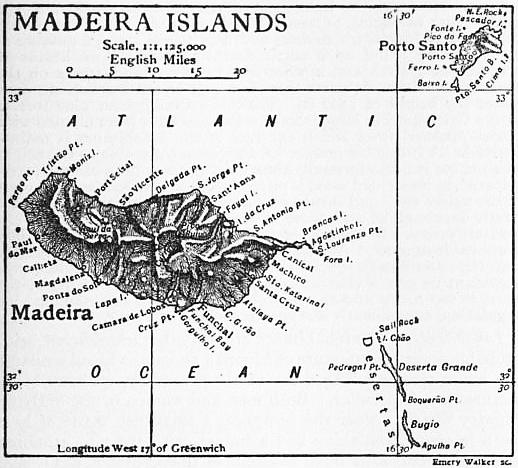
The Selvagens or Salvages are a group of three islands, 156 m. from Madeira, and between Madeira and the Canary Islands. The largest island is the Great Piton, 3 m. long, and 1 m. broad. The inclusion of the Selvagens in the Madeira Archipelago is due to political rather than to geographical reasons.
Geology.—All the islands of the group are of volcanic origin. They are the summits of very lofty mountains which have their bases in an abyssal ocean. The greater part of what is now visible in Madeira is of subaerial formation, consisting of basaltic and trachytic lavas, beds of tuff and other ejectamenta, the result of a long and complicated series of eruptions from innumerable vents. Besides this building up by the emission of matter from craters and clefts, a certain amount of upheaval in mass has taken place, for at a spot about 1200 ft. above the sea in the northern valley of São Vicente, and again at about the same height in Porto Santo, there have been found fragments of limestone accompanied by tuffs containing marine shells and echinoderms of the Miocene Tertiary epoch. We have here proof that during or since that epoch portions at least of these islands have been bodily uplifted more than 1000 ft. The fossils are sufficiently well preserved to admit of their genera, and in many instances even their species, being made out.
There were pauses of considerable duration whilst the island of Madeira was being increased in height. The leaf bed and the accompanying carbonaceous matter, frequently termed lignite, although it displays no trace of structure, which lie under 1200 ft. of lavas in the valley of São Jorge, afford proof that there had been sufficient time for the growth of a vegetation of high order, many of the leaf impressions belonging to species of trees and shrubs which still exist on the island. Moreover, great alterations and dislocations had taken place in the rocks of various localities before other lavas and tuffs had been thrown upon them.
There are no data for determining when volcanic action began in this locality, but looking at the enormous depth of the surrounding sea it is clear that a vast period of time must have elapsed to allow of a great mountain reaching the surface and then rising several thousand feet. Again, considering the comparatively feeble agents for effecting the work of denudation (neither glaciers nor thick accumulations of alpine snow being found here), and then the enormous erosion that has actually taken place, the inference is inevitable that a very great lapse of time was required to excavate the deep and wide ravines that everywhere intersect the island. Nor is anything known as to the period of the cessation of volcanic action. At the present day there are no live craters or smoking crevices, as at the Canaries and Cape Verdes, nor any hot springs, as at the Azores.
In one of the northern ravines of Madeira by Porto da Cruz some masses of a coarsely crystalline Essexite are exposed to view; this rock is evidently the deep-seated representative of the Trachydoleritic and Nepheline basalt lavas. Fragments of a sodalite-syenite have also been found at Soca in the same neighbourhood.
In the eastern part of the island several small crater rings are to be seen; their rims are formed of spheroidal basalt, while within the craters themselves masses of bauxite are found accompanied by evidences of fumerolic action.
In the sections afforded by the ravines, which strike north and south from the central ridge of Madeira to the sea, the nucleus of the island is seen to consist of a confused mass of more or less stratified rock, upon which rest beds of tuff, scoriae and lava, in the shape of basalt, trap and trachyte, the whole traversed by dykes. These beds are thinnest near the central axis; as they approach the coast they become thicker and less intersected by dykes.
In various parts are elevated tracts of comparatively level ground. These are supposed to have been formed by the meeting of numerous streams of lava flowing from cones and points of eruption in close proximity, various ejectamenta assisting at the same time to fill up inequalities. Deep down in some of the lateral ravines may be seen ancient cones of eruption which have been overwhelmed by streams of melted matter issuing from the central region, and afterwards exposed to view by the same causes that excavated the ravines. These ravines may be regarded as having been formed at first by subterranean movements, both gradual and violent, which dislocated the rocks and cut clefts through which streams flowed to the sea. In course of time the waters, periodically swollen by melted snows and the copious rains of winter, would cut deeper and deeper into the heart of the mountains, and would undermine the lateral cliffs, until the valleys became as large as we now find them. Even the Curral, which from its rounded shape and its position in the centre of the island has been usually deemed the ruins of a crater, is thought to be nothing more than a valley scooped out in the way described. The rarity of crateriform cavities in Madeira is very remarkable. There exists, however, to the east of Funchal, on a tract 2000 ft. high, the Lagoa, a small but perfect crater, 500 ft. in diameter, and with a depth of 150 ft.; and there is another, which is a double one, in the district known as Fanal, in the north-west of Madeira, nearly 5000 ft. above the sea. The basalt, of which much of the outer part of the island is composed, is of a dark colour and a tough texture, with small disseminated crystals of olivine and augite. It is sometimes full of vesicular cavities, formed by the expansion of imprisoned gases. A rudely columnar structure is very often seen in the basalt, but there is nothing so perfect as the columns of Staffa or the Giant’s Causeway. The trachytic rocks are small in quantity compared with those of the basaltic class. The tufa is soft and friable, and generally of a yellow colour; but where it has been overflowed by a hot stream of lava it has assumed a red colour. Black ashes and fragments of pumice are sometimes found in the tufaceous strata.
There are no metallic ores, nor has any sulphur been found; but a little iron pyrites and specular iron are occasionally met with. The basalt yields an excellent building-stone, various qualities of which are quarried near Camara de Lobos, five or six miles west of Funchal.
In Porto Santo the trachytic rocks bear a much greater proportion to the basaltic than in Madeira. An adjacent islet is formed of tuffs and calcareous rock, indicating a submarine origin, upon which supramarine lavas have been poured. The older series contains corals and shells (also of the Miocene Tertiary epoch), with water-worn pebbles, cemented together by carbonate of lime, the whole appearing to have been a coral reef near an ancient beach. The calcareous rock is taken in large quantities to Funchal, to be burnt into lime for building purposes.
Climate.—Observations taken at Funchal Observatory (80 ft. above sea-level) in the last twenty years of the 19th century showed that the mean annual temperature is about 65° F. The mean minimum for the coldest part of the year (October to May inclusive) does not fall below 55°, and the average daily variation of temperature in the same period does not exceed 10°. Madeira thus has a remarkably mild climate, though it lies only 10° north of the Tropic of Cancer. This mildness is due to the surrounding ocean, from which the atmosphere obtains a large supply of watery vapour. The mean humidity of the air is about 75 (saturation = 100). The prevalent winds are from the north or from a few points east or west of north, but these winds are much mitigated on the south coast by the central range of mountains. The west wind usually brings rain. That from the east is a dry wind. A hot and dry wind, the leste of the natives, occasionally blows from the east-south-east, the direction of the Sahara, and causes the hill region to be hotter than below; but even on the coast the thermometer under its influence sometimes indicates 93°. The leste is often accompanied by sandstorms. As the thermometer has never been known to fall as low as 46° at Funchal, frost and snow are there wholly unknown; but snow falls on the mountains once or twice during the winter, very seldom, however, below the altitude of 2000 ft. Thunderstorms are rare, and scarcely ever violent.
Madeira has long had a high reputation as a sanatory resort for persons suffering from diseases of the chest. Notwithstanding the ever-increasing competition of other winter resorts, a considerable number of invalids, especially English and German, winter at Funchal.
Fauna.—No species of land mammal is indigenous to the Madeiras. Some of the early voyagers indeed speak of wild goats and swine, but these animals must have escaped from confinement. The rabbit, black rat, brown rat and mouse have been introduced. The first comers encountered seals, and this amphibious mammal (Monachus albiventer) still lingers at the Desertas. Amongst the thirty species of birds which breed in these islands are the kestrel, buzzard and barn owl, the blackbird, robin, wagtail, goldfinch, ring sparrow, linnet, two swifts, three pigeons, the quail, red-legged partridge, woodcock, tern, herring gull, two petrels and three puffins. Only one species is endemic, and that is a wren (Regulus madeirensis), but five other species are known elsewhere only at the Canaries. These are the green canary (Fringilla butyracea, the parent of the domesticated yellow variety), a chaffinch (Fringilla tintillon), a swift (Cypselus unicolor), a wood pigeon (Columba trocaz) and a petrel (Thalassidroma Bulwerii). There is also a local variety of the blackcap, distinguishable from the common kind by the extension in the male of the cap to the shoulder. About seventy other species have been seen from time to time in Madeira, chiefly stragglers from the African coast, many of them coming with the leste wind.
The only land reptile is a small lizard (Lacerta dugesii), which is abundant and is very destructive to the grape crop. The loggerhead turtle (Caouana caretta, Gray) is frequently captured, and is cooked for the table, but the soup is much inferior to that made from the green turtle of the West Indies. A single variety of frog (Rana esculenta) has been introduced; there are no other batrachians.
About 250 species of marine fishes taken at Madeira have been scientifically determined, the largest families being Scombridae with 35 species, the sharks with 24, the Sparidae with 15, the rays with 14, the Labridae with 13, the Gadidae with 12, the eels with 12, the Percidae with 11, and the Carangidae with 10. Many kinds, such as the mackerel, horse mackerel, groper, mullet, braise, &c.., are caught in abundance, and afford a cheap article of diet to the people. Several species of tunny are taken plentifully in spring and summer, one of them sometimes attaining the weight of 300 ℔. The only freshwater fish is the common eel, which is found in one or two of the streams.
According to T. V. Wollaston (Testacea atlantica, 1878), there have been found 158 species of mollusca on the land, 6 inhabiting fresh water, and 7 littoral species, making a total of 171. A large majority of the land shells are considered to be peculiar. Many of the species are variable in form or colour, and some have an extraordinary number of varieties. Of the land mollusca 91 species are assigned to the genus Helix, 31 to the genus Pupa, and 15 to the genus Achatina (or Lovea). About 43 species are found both living and fossil in superficial deposits of calcareous sand in Madeira or Porto Santo. These deposits were assigned by Lyell to the Newer Pliocene period. Some 12 or 13 species have not been hitherto discovered alive. More than 100 species of Polyzoa (Bryozoa) have been collected, among them are some highly interesting forms.
The only order of insects which has been thoroughly examined is that of the Coleoptera. By the persevering researches of T. V. Wollaston the astonishing number of 695 species of beetles has been brought to light at the Madeiras. The proportion of endemic kinds is very large, and it is remarkable that 200 of them are either wingless or their wings are so poorly developed that they cannot fly, while 23 of the endemic genera have all their species in this condition. With regard to the Lepidoptera, 11 or 12 species of butterflies have been seen, all of which belong to European genera. Some of the species are geographical varieties of well-known types. Upward of 100 moths have been collected, the majority of them being of a European stamp, but probably a fourth of the total number are peculiar to the Madeiran group. Thirty-seven species of Neuroptera have been observed in Madeira, 12 of them being so far as is known peculiar.
The bristle-footed worms of the coast have been studied by Professor P. Langerhans, who has met with about 200 species, of which a large number were new to science. There are no modern coral reefs, but several species of stony and flexible corals have been collected, though none are of commercial value. There is, however, a white stony coral allied to the red coral of the Mediterranean which would be valuable as an article of trade if it could be obtained in sufficient quantity. Specimens of a rare and handsome red Paragorgia are in the British Museum and Liverpool Museum.
Flora.—The vegetation is strongly impressed with a south-European character. Many of the plants in the lower region undoubtedly were introduced and naturalized after the Portuguese colonization. A large number of the remainder are found at the Canaries and the Azores, or in one of these groups, but nowhere else. Lastly, there are about a hundred plants which are peculiarly Madeiran, either as distinct species or as strongly marked varieties. The flowering plants found truly wild belong to about 363 genera and 717 species,—the monocotyledons numbering 70 genera and 128 species, the dicotyledons 293 genera and 589 species. The three largest orders are the Compositae, Leguminosae and Graminaceae. Forty-one species of ferns grow in Madeira, three of which are endemic species and six others belong to the peculiar flora of the North Atlantic islands. About 100 species of moss have been collected, and 47 species of Hepaticae. A connexion between the flora of Madeira and that of the West Indies and tropical America has been inferred from the presence in the former of six ferns found nowhere in Europe or North Africa, but existing on the islands of the east coast of America or on the Isthmus of Panama. A further relationship to that continent is to be traced by the presence in Madeira of the beautiful ericaceous tree Clethra arborea, belonging to a genus which is otherwise wholly American, and of a Persea, a tree laurel, also an American genus. The dragon tree (Dracaena Draco) is almost extinct. Amongst the trees most worthy of note are four of the laurel order belonging to separate genera, an Ardisia, Pittosporum, Sideroxylon, Notelaea, Rhamnus and Myrica,—a strange mixture of genera to be found on a small Atlantic island. Two heaths of arborescent growth and a whortleberry cover large tracts on the mountains. In some parts there is a belt of the Spanish chestnut about the height of 1500 ft. There is no indigenous pine tree as at the Canaries; but large tracts on the hills have been planted with Pinus pinaster, from which the fuel of the inhabitants is mainly derived. A European juniper (J. Oxycedrus), growing to the height of 40 or 50 ft., was formerly abundant, but has been almost exterminated, as its scented wood is prized by the cabinet-maker. Several of the native trees and shrubs now grow only in situations which are nearly inaccessible, and some of the indigenous plants are of the greatest rarity. But some plants of foreign origin have spread in a remarkable manner. Among these is the common cactus or prickly pear (Opuntia Tuna), which in many spots on the coast is sufficiently abundant to give a character to the landscape. As to Algae, the coast is too rocky and the sea too unquiet for a luxuriant marine vegetation, consequently the species are few and poor.
Inhabitants.—The inhabitants are of Portuguese descent, with probably some intermixture of Moorish and negro blood amongst the lower classes. The dress of the peasantry, without being picturesque, is peculiar. Both men and women in the outlying country districts wear the carapuça, a small cap made of blue cloth in shape something like a funnel, with the pipe standing upwards. The men have trousers of linen, drawn tight, and terminating at the knees; a coarse shirt enveloping the upper part of their person, covered by a short jacket, completes their attire, with the exception of a pair of rough yellow boots. The women’s outer garments consist of a gaudily coloured gown, made from island material, with a small cape of coarse scarlet or blue woollen cloth. The population tends to increase rapidly. In 1900 it amounted to 150,574, including 890 foreigners, of whom the majority were British. The number of females exceeds that of males by about 6000, partly because many of the able-bodied males emigrate to Brazil or the United States. The density of population (479.5 per sq. m.) is very great for a district containing no large town and chiefly dependent on agriculture and viticulture.
Agriculture.—A large portion of the land was formerly entailed in the families of the landlords (morgados), but entails have been abolished by the legislature, and the land is now absolutely free. The deficiency of water is a great obstacle to the proper cultivation of the land, and the rocky nature or steep inclination of the upper parts of the islands is an effectual bar to all tillage. An incredible amount of labour has been expended upon the soil, partly in the erection of walls intended to prevent its being washed away by the rains, and to build up the plots of ground in the form of terraces. Watercourses have been constructed for purposes of irrigation, without which at regular intervals the island would not produce a hundredth part of its present yield. These watercourses originate high up in the ravines, are built of masonry or driven through the rock, and wind about for miles until they reach the cultivated land. Some of them are brought by tunnels from the north side of the island through the central crest of hill. Each occupier takes his turn at the running stream for so many hours in the day or night at a time notified to him beforehand. In this climate flowing water has a saleable value as well as land, which is useless without irrigation.
The agricultural implements employed are of the rudest kind, and the system of cultivation is extremely primitive. Very few of the occupiers own the land they cultivate; but they almost invariably own the walls, cottages and trees standing thereon, the land alone belonging to the landlord. The tenant can sell his share of the property without the consent of the landlord, and if he does not so dispose of it that share passes to his heirs. In this way the tenant practically enjoys fixity of tenure, for the landlord is seldom in a position to pay the price at which the tenant’s share is valued. Money rents are rare, the métayer system regulating almost universally the relations between landlord and tenant; that is, the tenant pays to the owner a certain portion of the produce, usually one half or one third. The holdings are as a rule rarely larger than one man can cultivate with a little occasional assistance. There are few meadows and pastures, the cattle being stall-fed when not feeding on the mountains. Horses are never employed for draught, all labour of that kind being done by oxen.
The two staple productions of the soil are wine and sugar. The vine was introduced from Cyprus or Crete soon after the discovery of the island by the Portuguese (1420), but it was not actively cultivated until the early part of the 16th century. The vines, after having been totally destroyed by the oidium disease, which made its first appearance in the island in 1852, were replanted, and Wine. in a few years wine was again made. The phylloxera also made its way to the island, and every vineyard in Madeira was more or less affected by it. The wine usually termed Madeira is made from a mixture of black and white grapes, which are also made separately into wines called Tinta and Verdelho, after the names of the grapes. Other high-class wines, known as Bual, Sercial and Malmsey, are made from varieties of grapes bearing the same names. (See also Wine.)
The sugar cane is said to have been brought from Sicily about 1452, and in course of time its produce became the sole staple of the island. The cultivation languished, however, as the more abundant produce of tropical countries came into the European market, and sugar had long ceased to be made when the destruction of the vines compelled the peasants to turn their attention to other things. Its cultivation was resumed and sugar machinery imported. A Sugar. considerable quantity of spirit is made by the distillation of the juice or of the molasses left after extracting the sugar, and this is consumed on the island. The cane does not flourish here as luxuriantly as within the tropics; but in localities below 1000 ft., where there is a good supply of water, it pays the cultivator well.
The grain produced on the island (principally wheat, barley and Indian corn) is not sufficient for the consumption of the people. The common potato, sweet potato and gourds of various kinds are extensively grown, as well as the Colocasia esculenta, the kalo of the Pacific islanders, the root of which yields an insipid food. Most of the common table vegetables of Europe are plentiful. Besides apples, pears and peaches, all of poor quality, oranges, lemons, guavas, mangoes, loquats, custard-apples, figs, bananas and pineapples are produced, the last two forming articles of export. The date palm is occasionally grown, but its fruit is scarcely edible. On the hills large quantities of the Spanish chestnut afford an item in the food of the common people. A little tobacco is grown, and is made into cigars of inferior quality.
The total foreign trade of Madeira was valued at £628,000 in 1900. The principal exports are wine, sugar, embroidery, vegetables, fruits and wicker goods. Coal is imported for the ships calling at Funchal, which is the headquarters of Madeiran commerce and industry. Spirits, beer, olive oil, soap, butter, linen and woollen goods, straw hats and leather, are manufactured for home consumption, and there are important fisheries.
Chief Towns and Communications.—Funchal (pop. 20,850) is described in a separate article. The other chief towns are Camara de Lobos (7150), Machico (6128), Santa Cruz (5876), Ponta do Sol (5665), São Vicente (4896), Calheta (3475), Sant’ Anna (3011) and Porto Santo (2311). Each of these is the capital of a commune (concelho), to which it gives its name. Madeira is connected by regular lines of steamships with Great Britain, Germany, Portugal, Cape Colony, Brazil and the United States. There is no railway in the archipelago, and partly owing to the irregularities of the surface of the roads, of which there are some 580 m., are bad, except in the neighbourhood of Funchal. Wheel carriages are rare, and all heavy goods are transported either on the backs of mules or upon rude wooden sledges drawn by bullocks. When horses are not employed, locomotion is effected either by means of hammocks or by bullock cars. The hammock (rêde) is a piece of stout canvas gathered up and secured at each end to a long pole carried by a couple of bearers. In place of cabs, curtained cars on sledges, made to hold four persons, and drawn by a pair of bullocks, are employed. They are convenient, but the rate of progress is very slow.
Administration.—The archipelago is officially styled the district of Funchal; it returns members to the Portuguese Cortes, and is regarded as an integral part of the kingdom. The district is subdivided into the eight communes already enumerated, and is administered in accordance with the same laws that regulate local government on the mainland (see Portugal). Funchal is a Roman Catholic bishopric in the archiepiscopal province of Lisbon. Education is compulsory in name only, for less than 2% of the population could read when the census of 1900 was taken. An infantry regiment and a battery of garrison artillery are permanently stationed in Madeira.
History.—It has been conjectured, but on insufficient evidence, that the Phoenicians discovered Madeira at a very early period. Pliny mentions certain Purple or Mauretanian Islands, the position of which with reference to the Fortunate Islands or Canaries might seem to indicate the Madeiras. There is a romantic story, to the effect that two lovers, Robert Machim, à Machin, or Macham, and Anna d’Arfet, fleeing from England to France (c. 1370) were driven out of their course by a violent storm and cast on the coast of Madeira at the place subsequently named Machico, in memory of one of them. Both perished here, but some of their crew escaped to the Barbary coast, and were made slaves. Among them was the pilot Pedro Morales of Seville, who is said to have been ransomed and to have communicated his knowledge of Madeira to João Gonçalvez Zarco (or Zargo). How far this story is true cannot now be ascertained. It is, however, certain that Zarco first sighted Porto Santo in 1418, having been driven thither by a storm while he was exploring the coast of West Africa. Madeira itself was discovered in 1420. It is probable that the whole archipelago had been explored at an earlier date by Genoese adventurers, and had been forgotten; for an Italian map dated 1351 (the Laurentian portolano) shows the Madeiras quite clearly, and there is some reason to believe that they were known to the Genoese before 1339. When Zarco visited Madeira in 1420 the islands were uninhabited, but Prince Henry the Navigator at once began their colonization, aided by the knights of the Order of Christ. Sanctioned by the pope and by two charters which the king of Portugal granted in 1430 and 1433, the work proceeded apace; much land was deforested and brought into cultivation, and the Madeiran sugar trade soon became important. For the sixty years 1580-1640 Madeira, with Portugal itself, was united with Spain. Slavery was abolished in Madeira in 1775, by order of Pombal. In 1801 British troops, commanded by General Beresford, occupied the island for a few months, and it was again under the British flag from 1807 to 1814. It shared in the civil disturbances brought about by the accession of Dom Miguel (see Portugal: History), but after 1833 its history is a record of peaceful commercial development.
See A. S. Brown, Madeira, the Canary Islands and the Azores (1903), a comprehensive study of the three archipelagoes. The Land of the Wine, by A. J. D. Biddle (Philadelphia, 1901) is generally valuable, but its history cannot be trusted. See also P. Langerhaus, Handbuch für Madeira (1884) and Vahl, Madeira’s Vegetation (Copenhagen, 1904).
MADELENIAN, a term derived from La Madeleine, a cave in the Vézère, about midway between Moustier and Les Eyzies, France, and given by the French anthropologist Gabriel de Mortillet to the third stage of his system of cave-chronology, synchronous with the fourth or most recent division of the Quaternary Age. The Madelenian epoch was a long one, represented by numerous stations, whose contents show progress in the arts and general culture. It was characterized by a cold and dry climate, the existence of man in association with the reindeer, and the extinction of the mammoth. The use of bone and ivory for various implements, already begun in the preceding Solutrian epoch, was much increased, and the period is essentially a Bone age. The bone instruments are very varied: spear-points, harpoon-heads, borers, hooks and needles. Most remarkable is the evidence La Madeleine affords of prehistoric art. Numbers of bones, reindeer antlers and animals’ teeth were found, with rude pictures, carved or etched on them, of seals, fishes, reindeer, mammoths and other creatures. The best of these are a mammoth engraved on a fragment of its own ivory; a dagger of reindeer antler, with handle in form of a reindeer; a cave-bear cut on a flat piece of schist; a seal on a bear’s tooth; a fish well drawn on a reindeer antler; and a complete picture, also on reindeer antler, showing horses, an aurochs, trees, and a snake biting a man’s leg. The man is naked, and this and the snake suggest a warm climate, in spite of the presence of the reindeer. The fauna of the Madelenian epoch seems, indeed, to have included tigers and other tropical species side by side with reindeer, blue foxes, Arctic hares and other polar creatures. Madelenian man appears to have been of low stature, dolichocephalic, with low retreating forehead and prominent brow ridges. Besides La Madeleine the chief stations of the epoch are Les Eyzies, Laugerie Basse, and Gorge d’Enfer in Dordogne; Grotte du Placard in Charente and others in south-west France.
See G. de Mortillet, Le Préhistorique (1900); Edouard Lartet and Henry Christy, Reliquiae Aquitanicae (1865-1875); Edouard Dupont, Le Temps préhistorique en Belgique (1872); Lord Avebury, Prehistoric Times (1900).
MADELEY, a market town in the municipal borough of Wenlock, and the Wellington (Mid) parliamentary division of Shropshire, England, 159 m. N.W. from London, with stations on the London & North Western (Madeley Market) and Great Western railways (Madeley Court). Pop. of civil parish (1901), 8442. There are large ironworks, ironstone and coal are mined, and potter’s clay is raised. The church of St Michael (1796) replaced a Norman building. The living was held from 1760 to 1783 by John William Fletcher or de la Flechêre, a close friend of the Wesleys. The parish includes a portion of Coalbrookdale (q.v.), and the towns of Ironbridge and Coalport. Ironbridge, a town picturesquely situated on the steep left bank of the Severn, adjoins Madeley on the south-west. It takes its name from the iron bridge of one span crossing the river, erected in 1779. This bridge is a remarkable work considering its date; it was probably the first erected, at any rate on so large a scale, and attracted great attention. It is the work of Abraham Darby, the third of the name, one of the famous family of iron-workers in Coalbrookdale. Here are brick and tile works and lime-kilns. There is a station (Ironbridge and Broseley) on the Great Western railway, across the river. Coalport lies also on the Severn, S. of Madeley and 2 m. S.E. of Ironbridge, with a station on the Great Western railway. It has large china works, founded at the close of the 18th century, which subsequently incorporated those of Caughley, across the Severn, and of Nantgarw in Glamorganshire.
MĀDHAVA ĀCHĀRYA (fl. c. 1380), Hindu statesman and philosopher, lived at the court of Vijayanagar (the modern Humpi in the district of Bellary), the vigorous Southern Hindu kingdom that so long withstood Mahommedan influence and aggression. His younger brother Sāyaṇa (d. 1387) was associated with him in the administration and was a famous commentator on the Rigveda. Sāyaṇa’s commentaries were influenced by and dedicated to Mādhava, who is best known as the author of the Sarvadarsana Samgraha (Compendium of Speculations). With remarkable mental detachment he places himself in the position of an adherent of sixteen distinct systems. Mādhava also wrote a commentary on the Mīmāṃsā Sūtras. He died as abbot of the monastery of Sringeri.
MADI (A-Madi), a negro race of the Nile valley, occupying both banks of the Bahr-el-Jebel immediately north of Albert Nyanza. Tradition makes them immigrants from the north-west. They are remarkable for the consideration shown to their women, who choose their own husbands, are never ill-treated or hard-worked, and take part in tribal deliberations. The Madi build sepulchral monuments of an elaborate type, two huge narrow stones sloping towards each other with two smaller slabs covering the opening between them. They have been much harried by the Azandeh and Abarambo. They were visited by W. Junker in 1882-1883, and described by him in Petermann’s Mittheilungen for May 1883.
MADISON, JAMES (1751-1836), fourth president of the United States, was born at Port Conway, in King George county, Virginia, on the 16th of March 1751. His first ancestor in America may possibly have been Captain Isaac Maddyson, a colonist of 1623 mentioned by John Smith as an excellent Indian fighter. His father, also named James Madison, was the owner of large estates in Orange county, Virginia. In 1769 the son entered the college of New Jersey (now Princeton University), where, in the same year, he founded the well-known literary club, “The American Whig Society.” He graduated in 1771, but remained for another year at Princeton studying, apparently for the ministry, under the direction of John Witherspoon (1722-1794). In 1772 he returned to Virginia, where he pursued his reading and studies, especially theology and Hebrew, and acted as a tutor to the younger children of the family. In 1775 he became chairman of the committee of public safety for Orange county, and wrote its response to Patrick Henry’s call for the arming of a colonial militia, and in the spring of 1776 he was chosen a delegate to the new Virginia convention, where he was on the committee which drafted the constitution for the state, and proposed an amendment (not adopted) which declared that “all men are equally entitled to the full and free exercise” of religion, and was more radical than the similar one offered by George Mason. In 1777, largely, it seems, because he refused to treat the electors with rum and punch, after the custom of the time, he was not re-elected, but in November of the same year he was chosen a member of the privy council or council of state, in which he acted as interpreter for a few months, as secretary prepared papers for the governor, and in general took a prominent part from the 14th of January 1778 until the end of 1779, when he was elected a delegate to the Continental Congress.
He was in Congress during the final stages of the War of Independence, and in 1780 drafted instructions to Jay, then representing the United States at Madrid, that in negotiations with Spain he should insist upon the free navigation of the Mississippi and upon the principle that the United States succeeded to British rights affirmed by the treaty of Paris of 1763. When the confederation was almost in a state of collapse because of the failure of the states to respond to requisitions of Congress for supplies for the federal treasury, Madison was among the first to advocate the granting of additional powers to Congress, and urged that congress should forbid the states to issue more paper money. In 1781 he favoured an amendment of the Articles of Confederation giving Congress power to enforce its requisitions, and in 1783, in spite of the open opposition of the Virginia legislature, which considered the Virginian delegates wholly subject to its instructions, he advocated that the states should grant to Congress for twenty-five years authority to levy an import duty, and suggested a scheme to provide for the interest on the debt not raised by the import duty—apportioning it among the states on the basis of population, counting three-fifths of the slaves, a ratio suggested by Madison himself. Accompanying this plan was an address to the states drawn up by Madison, and one of the ablest of his state papers. In the same year, with Oliver Ellsworth of Connecticut, Nathaniel Gorham of Massachusetts. Gunning Bedford of Delaware, and John Rutledge of South Carolina, he was a member of the committee which reported on the Virginia proposal as to the terms of cession to the Confederation of the “back lands,” or unoccupied Western territory, held by several of the states; the report was a skilful compromise made by Madison, which secured the approval of the rather exigent Virginia legislature.
In November 1783 Madison’s term in Congress expired, and he returned to Virginia and took up the study of the law. In the following year he was elected to the House of Delegates. As a member of its committee on religion, he opposed the giving of special privileges to the Episcopal (or any other) church, and contended against a general assessment for the support of the churches of the state. His petition of remonstrance against the proposed assessment, drawn up at the suggestion of George Nicholas (c. 1755-1799), was widely circulated and procured its defeat. On the 26th of December 1785 Jefferson’s Bill for establishing religious freedom in Virginia, which had been introduced by Madison, was passed. In the Virginia House of Delegates, as in the Continental Congress, he opposed the further issue of paper money; and he tried to induce the legislature to repeal the law confiscating British debts, but he did not lose sight of the interests of the Confederacy. The boundary between Virginia and Maryland, according to the Baltimore grant, was the south shore of the Potomac, a line to which Virginia had agreed on condition of free navigation of the river and the Chesapeake Bay. Virginia now feared that too much had been given up, and desired joint regulation of the navigation and commerce of the river by Maryland and Virginia. On Madison’s proposal commissioners from the two states met at Alexandria (q.v.) and at Mount Vernon in March 1785. The Maryland legislature approved the Mount Vernon agreement and proposed to invite Pennsylvania and Delaware to join in the arrangement. Madison, seeing an opportunity for more general concert in regard to commerce and trade (and possibly for the increase of the power of Congress), proposed that all the states should be invited to send commissioners to consider commercial questions, and a resolution to that effect was adopted (on Jan. 21, 1786) by the Virginia legislature. This led to the Annapolis convention of 1786, and that in turn led to the Philadelphia convention of 1787. In April 1787 Madison had written a paper, The Vices of the Political System of the United States, and from his study of confederacies, ancient and modern, later summed up in numbers 17, 18, and 19 of The Federalist, he had concluded that no confederacy could long endure if it acted upon states only and not directly upon individuals. As the time for the convention of 1787 approached he drew up an outline of a new system of government, the basis of the “Virginia plan” presented in the convention by Edmund Jennings Randolph. Madison’s scheme, as expressed in a letter to Washington dated the 16th of April 1787, was that individual sovereignty of states was irreconcilable with aggregate sovereignty, but that the “consolidation of the whole into one simple republic would be as inexpedient as it is unattainable.” He considered as a practical middle ground changing the basis of representation in Congress from states to population; giving the national government “positive and complete authority in all cases which require uniformity”; giving it a negative on all state laws, a power which might best be vested in the Senate, a comparatively permanent body; electing the lower house, and the more numerous, for a short term; providing for a national executive, for extending the national supremacy over the judiciary and the militia, for a council to revise all laws, and for an express statement of the right of coercion; and finally, obtaining the ratification of a new constitutional instrument from the people, and not merely from the legislatures. The “Virginia plan” was the basis of the convention’s deliberations which resulted in the constitution favourably voted on by the convention on the 17th of September 1787. Among the features of the plan which were not embodied in the constitution were the following: proportionate representation in the Senate and the election of its members by the lower house “out of a proper number of persons nominated by the individual legislatures”; the vesting in the national Congress of power to negative state acts; and the establishment of a council of revision (the executive and a convenient number of national judges) with veto power over all laws passed by the national Congress. Madison, always an opponent of slavery, disapproved of the compromise (in Art. I. § 9 and Art. V.) postponing to 1808 (or later) the prohibition of the importation of slaves. He took a leading part in the debates of the convention, of which he kept full and careful notes, afterwards published by order of Congress (3 vols., Washington, 1843). Many minute and wise provisions are due to him, and he spoke before the convention more frequently than any delegate except James Wilson and Gouverneur Morris. In spite of the opposition to the constitution of the Virginia leaders George Mason and E. J. Randolph, Madison induced the state’s delegation to stand by the constitution in the convention. His influence largely shaped the form of the final draft of the constitution, but the labour was not finished with this draft; that the constitution was accepted by the people was due in an eminent degree to the efforts of Madison, who, to place the new constitution before the public in its true light, and to meet the objections brought against it, joined Alexander Hamilton (q.v.) and John Jay in writing The Federalist, a series of eighty-five papers, out of which twenty certainly, and nine others probably, were written by him. In the Virginia convention for ratifying the constitution (June 1788), when eight states had ratified and it seemed that Virginia’s vote would be needed to make the necessary nine (New Hampshire’s favourable vote was cast only shortly before that of Virginia), and it appeared that New York would vote against the constitution if Virginia did not ratify it, Madison was called upon to defend that instrument again, and he appeared at his best against its opponents, Patrick Henry, George Mason, James Monroe, Benjamin Harrison, William Grayson and John Tyler. He answered their objections in detail, calmly and with an intellectual power and earnestness that carried the convention. The result was a victory against an originally adverse public opinion and against the eloquence of the opponents of the constitution, for Madison and for his lieutenants, Edmund Pendleton, John Marshall, George Nicholas, Harry Innes and Henry Lee. At the same time Madison’s labours in behalf of the constitution alienated from him valuable political support in Virginia. He was defeated by Richard Henry Lee and William Grayson in his candidacy for the United States Senate, but in his own district he was chosen a representative to Congress, defeating James Monroe, who seems to have had the powerful support of Patrick Henry.
Madison took his seat in the House of Representatives in April 1789, and assumed a leading part in the legislation necessary to the organization of the new government. He drafted a Tariff Bill giving certain notable advantages to nations with which the United States had commercial treaties, hoping to force Great Britain into a similar treaty; but his policy of discrimination against England was rejected by Congress. It was his belief that such a system of retaliation would remove the possibility of war arising from commercial quarrels. He introduced resolutions calling for the establishment of three executive departments, foreign affairs, treasury and war, the head of each removable by the president. Most important of all, he proposed nine amendments to the constitution, embodying suggestions made by a number of the ratifying states, especially those made by Virginia at the instance of George Mason; and the essential principles of Madison’s proposed amendments were included in a Bill of Rights, adopted by the states in the form of ten amendments. The absence of a Bill of Rights from the constitution as first adopted had been the point on which the opposition had made common cause, and the adoption of this now greatly weakened the same opposition. Although a staunch friend of the constitution, Madison believed, however, that the instrument should be interpreted conservatively and not be made the means of introducing radical innovations. The tide of strict construction was setting in strongly in his state, and he was borne along with the flood. It is very probable that Jefferson’s influence over Madison, which was greater than Hamilton’s, contributed to this result. Madison now opposed Hamilton’s measures for the funding of the debt, the assumption of state debts, and the establishment of a National Bank, and on other questions he sided more and more with the opposition, gradually assuming its leadership in the House of Representatives and labouring to confine the powers of the national government within the narrowest possible limits; his most important argument against Hamilton’s Bank was that the constitution did not provide for it explicitly, and could not properly be construed into permitting its creation. Madison, Jefferson and Randolph were consulted by Washington, and they advised him not to sign the bill providing for the Bank, but Hamilton’s counter-argument was successful. On the same constitutional grounds Madison objected to the carrying out of the recommendations in Hamilton’s famous report on manufactures (Dec. 5, 1791), which favoured a protective tariff. In the presidential campaign of 1792 Madison seems to have lent his influence to the determined efforts of the Jeffersonians to defeat John Adams by electing George Clinton vice-president. In 1793-1796 he strongly criticized the administration for maintaining a neutral position between Great Britain and France, writing for the public press five papers (signed “Helvidius”), attacking the “monarchical prerogative of the executive” as exercised in the proclamation of neutrality in 1793 and denying the president’s right to recognize foreign states. He found in Washington’s attitude—as in Hamilton’s failure to pay an instalment of the moneys due France—an “Anglified complexion,” in direct opposition to the popular sympathy with France and French Republicanism. In 1794 he tried again his commercial weapons, introducing in the House of Representatives resolutions based on Jefferson’s report on commerce, advising retaliation against Great Britain and discrimination in commercial and navigation laws in favour of France; and he declared that the friends of Jay’s treaty were “a British party systematically aiming at an exclusive connexion with the British government,” and in 1796 strenuously but unsuccessfully opposed the appropriation of money to carry this treaty into effect. Still thinking that foreign nations could be coerced through their commercial interests, he scouted as visionary the idea that Great Britain would go to war on a refusal to carry Jay’s treaty into effect, thinking it inconceivable that Great Britain “would wantonly make war” upon a country which was the best market she had in the world for her manufactures, and one with which her export trade was so much larger than her import.
In 1797 Madison retired from Congress, but not to a life of inactivity. In 1798 he joined Jefferson in opposing the Alien and Sedition Laws, and Madison himself wrote the resolutions of the Virginia legislature declaring that it viewed “the powers of the Federal government as resulting from the compact to which the states are parties, as limited by the plain sense and intention of the instrument constituting that compact; as no further valid than they are authorized by the grants enumerated in that compact; and that, in case of a deliberate, palpable and dangerous exercise of other powers, not granted by the said compact, the states, who are parties thereto, have the right and are in duty bound to interpose for arresting the progress of the evil, and for maintaining within their respective limits, the authorities, rights and liberties appertaining to them.” The Virginia resolutions and the Kentucky resolutions (the latter having been drafted by Jefferson) were met by dissenting resolutions from the New England states, from New York, and from Delaware. In answer to these, Madison, who had become a member of the Virginia legislature in the autumn of 1799, wrote for the committee to which they were referred a report elaborating and sustaining in every point the phraseology of the Virginia resolutions.1
Upon the accession of the Republican party to power in 1801, Madison became secretary of state in Jefferson’s cabinet, a position for which he was well fitted both because he possessed to a remarkable degree the gifts of careful thinking and discreet and able speaking, and of large constructive ability; and because he was well versed in constitutional and international law and practised a fairness in discussion essential to a diplomat. During the eight years that he held the portfolio of state, he had continually to defend the neutral rights of the United States against the encroachments of European belligerents; in 1806 he published An Examination of the British Doctrine which subjects to Capture a Neutral Trade not open in Time of Peace, a careful argument—with a minute examination of authorities on international law—against the rule of war of 1756 extended by Great Britain in 1793 and 1803.
During Jefferson’s presidency and whilst Madison was secretary of state, by the purchase of Louisiana, Madison’s campaign begun in 1780 for the free navigation of the Mississippi was brought to a successful close. The candidate in 1808 of the Republican party, although bitterly opposed in the party by John Randolph and George Clinton, Madison was elected president, defeating C. C. Pinckney, the Federalist candidate, by 122 votes to 47. Madison had no false hopes of placating the Federalist opposition, but as the preceding administration was one with which he was in harmony, his position was different from that of Jefferson in 1801, and he had less occasion for removing Federalists from office. Jefferson’s peace policy—or, more correctly, Madison’s peace policy—of commercial restrictions to coerce Great Britain and France he continued to follow until 1812, when he was forced to change these futile commercial weapons for a policy of war, which was very popular with the extreme French wing of his party. There is a charge, which has never been proved or disproved, that Madison’s real desire was for peace, but that in order to secure the renomination he yielded to that wing of his party which was resolved on war with Great Britain. The only certain fact is that Madison, whatever were his personal feelings in this matter, acted according to the wishes of a majority of the Republicans; but whether in doing so he was influenced by the desire of another nomination is largely a matter of conjecture. Madison was renominated on the 18th of May 1812, issued his war message on the 1st of June, and in the November elections he was re-elected, defeating De Witt Clinton by 128 votes to 89. His administration during the war was pitiably weak. His cabinet in great part had been dictated to him in 1809 by a senatorial clique, and it was hopelessly discordant; for two years he was to all intents and purposes his own secretary of state, Robert Smith being a mere figure-head of whom he gladly got rid in 1811, giving Monroe the vacant place. Madison himself had attempted alternately to prevent war by his “commercial weapons” and to prepare the country for war, but he had met with no success, because of the tricky diplomacy of Great Britain and of France, and because of the general distrust of him coupled with the particular opposition to the war of the prosperous New England Federalists, who suggested with the utmost seriousness that his resignation should be demanded. In brief, Madison was too much the mere scholar to prove a strong leader in such a crisis. The supreme disgrace of the administration was the capture and partial destruction in August 1814 of the city of Washington—this was due, however, to incompetence of the military and not to any lack of prudence on the cabinet’s part. In general, Congress was more blamable than either the president or his official family, or the army officers. With the declaration of peace the president again gained a momentary popularity much like that he had won in 1809 by his apparent willingness at that time to fight France.
Retiring from the presidency in 1817, Madison returned to his home, Montpelier (in Orange county, Virginia), which he left in no official capacity save in 1829, when he was a delegate to the state constitutional convention and served on several of its committees. Montpelier, like Jefferson’s Monticello and Monroe’s Oak-Hill, was an expensive bit of “gentleman farming,” which with his generous Virginia hospitality nearly ruined its owner financially. Madison’s home was peculiarly a centre for literary travellers in his last years; when he was eighty-three he was visited by Harriet Martineau, who reported her conversations with him in her Retrospect of Western Travel (1838). He took a great interest in education—his library was left to the university of Virginia, where it was burned in 1895—in emancipation, and in agricultural questions, to the very last. He died at Montpelier on the 28th of June 1836. Madison married, in 1794, Dorothy Payne Todd (1772-1849), widow of John Todd, a Philadelphia lawyer. She had great social charm, and upon Madison’s entering Jefferson’s cabinet became “first lady” in Washington society. Her plump beauty was often remarked—notably by Washington Irving—in contrast to her husband’s delicate and feeble figure and wizened face—for even in his prime Madison was, as Henry Adams says, “a small man, quiet, somewhat precise in manner, pleasant, fond of conversation, with a certain mixture of ease and dignity in his address.” Her son, spoiled by his mother and his step-father, became a wild young fellow, and added his debts to the heavy burden of Montpelier upon Madison.
Madison’s portrait was painted by Gilbert Stuart and by Charles Willson Peale; Giuseppe Ceracchi made a marble bust of him in 1792 and John H. J. Browere another in 1827, now in possession of the Virginia Historical Society at Richmond. Though commonly dignified and a little stiff he seems to have had a strong sense of humour and he was fond of telling a good story. Henry Clay, contrasting him with Jefferson, said that Jefferson had more genius, Madison more judgment and common sense; that Jefferson was a visionary and a theorist; Madison cool, dispassionate, practical, and safe.2 The broadest and most accurate scholar among the “founders and fathers,” he was particularly an expert in constitutional history and theory. In the great causes for which Madison fought in his earlier years—religious freedom and separation of church and state, the free navigation of the Mississippi, and the adoption of the constitution—he met with success. His greatest and truest fame is as the “father of the constitution.” The “commercial weapons” with which he wished to prevent armed conflict proved less useful in his day than they have since been in international disputes.
Authorities.—Madison’s personality is perplexingly vague; the biographies of him are little more than histories of the period, and the best history of the later period in which he was before the public, Henry Adams’s History of the United States from 1801 to 1817 (1889-1890), gives the clearest sketch and best criticism of him. The lives of Madison are: J. Q. Adams’s (Boston, 1850); W. C. Rives’s (Boston, 1859-1869, 3 vols.), covering the period previous to 1797; S. H. Gay’s (Boston, 1884) in the “American Statesmen Series”; and Gaillard Hunt’s (New York, 1902). Madison’s Writings (7 vols., New York, 1900-1906) were edited by Hunt, who also edited The Journal of the Debates in the Convention which framed the Constitution of the United States, as Recorded by James Madison (2 vols., New York, 1908). See also Mrs Madison’s Memoirs and Letters (Boston, 1887) and Maud Wilder Goodwin, Dolly Madison (New York, 1897).
1 Thirty years later Madison’s arguments for the Virginia resolutions and the resolutions themselves were freely used by Calhoun and his followers in support of his doctrine of nullification. But Madison insisted that the Resolutions of 1798 did not involve the principles of nullification. Nearly all his arguments, especially where he attempts to interpret Jefferson’s writings on the point, notably the Kentucky resolutions, are rather strained and specious, but it does seem that the Virginia resolutions were based on a different idea from Calhoun’s doctrine of nullification. Madison’s theory was that the legislature of Virginia, being one of the bodies which had chosen delegates to the constitutional convention, was legally capable of considering the question of the constitutionality of laws passed by the Federal government, and that the state of Virginia might invite other states to join her, but could not singly, as Calhoun argued, declare any law of the Federal legislature null and void. (It is to be noted the words “null and void” were in Madison’s first draft of the Virginia resolutions, but that they were omitted by the Virginia legislature.) It is notable, besides, that Madison had always feared that the national congress would assume too great power, that he had approved of Supreme Court checks on the national legislature, and of veto power by a council of revision.
2 Clay’s opinion is given in a report written by Mrs Samuel H. Smith of a conversation in 1829 between Clay and her husband, a prominent politician.
MADISON, a city and the county-seat of Jefferson county, Indiana, U.S.A., on the N. bank of the Ohio river, about 90 m. below Cincinnati, and 44 m. above Louisville, Kentucky. Pop. (1870), 10,709; (1890), 8936; (1900), 7835 (554 foreign-born and 570 negroes); (1910), 6934. Madison is served by the Pittsburg, Cincinnati, Chicago & St Louis railroad and by river steamboats. The city is picturesquely situated on bluffs above the river and has two public parks. In Madison are a King’s Daughters’ Hospital, a children’s home, and the Drusilla home for old ladies, and immediately north of the city are the buildings of the Indiana South-eastern Insane Hospital. Madison is a trading centre of the surrounding farming region, whose principal products are burley tobacco, grain and fruits (peaches, apples, pears, plums and small fruits). The municipality owns and operates the waterworks. Madison was settled about the beginning of the 19th century; was incorporated as a town in 1824, and was first chartered as a city in 1836.
MADISON, a borough of Morris county, New Jersey, U.S.A., 27 m. (by rail) W. of New York City and 4 m. S.E. of Morristown. Pop. (1890), 2469; (1900), 3754, of whom 975 were foreign-born and 300 were negroes; (1905), 4115; (1910), 4658. It is served by the Morris & Essex division of the Delaware, Lackawanna & Western railroad. The borough is attractively situated among the hills of Northern New Jersey, is primarily a residential suburb of New York and Newark, and contains many fine residences. There are a public library and a beautiful public park, both given to the borough by Daniel Willis James (1832-1907), a prominent metal manufacturer; the library is closely allied with the public schools. Madison is the seat of the well-known Drew theological seminary (Methodist Episcopal; founded in 1866 and opened in 1867), named in honour of Daniel Drew (1788-1879), who, having acquired great wealth from steamboat and railway enterprises, especially from trading in railway stocks, presented the large and beautiful grounds and most of the buildings. The seminary’s course covers three years; no fee is charged. In connexion with the seminary the Drew settlement in New York City—officially the department of applied Christianity—has for its object the “practical study of present-day problems in city evangelism, church organization, and work among the poor.” In 1907-1908 the seminary had 9 instructors, 175 students, and a library of more than 100,000 volumes, especially rich in works dealing with the history of Methodism and in Greek New Testament manuscripts. About 2 m. N.W. of Madison is Convent Station, the seat of a convent of the Sisters of Charity, who here conduct the college of St Elizabeth, for girls, founded in 1859; also conducted by the Sisters of Charity is St Joseph’s preparatory school for boys, founded in 1862. The cultivation of roses and chrysanthemums is practically the only industry of Madison. Madison owns and operates its waterworks and electric-lighting plant. Before 1844 when it took its present name (in honour of President Madison), Madison was called Bottle Hill; it is one of the older places of the state, and its first church (Presbyterian) was built about 1748. The borough was incorporated in 1889.
MADISON, the capital of Wisconsin, U.S.A., and the county-seat of Dane County, situated between Lakes Mendota and Monona in the south central part of the state, about 82 m. W. of Milwaukee and about 131 m. N.W. of Chicago. Pop. (1890), 13,426; (1900) 19,164, of whom 3362 were foreign-born and 69 were negroes; (1910 census) 25,531. Madison is served by the Chicago & North-Western, the Chicago, Milwaukee & St Paul, and the Illinois Central railways (being the northern terminus of the last), and by interurban electric lines, connecting with Janesville, Beloit and Chicago. It has a picturesque situation in what is known as “the Four-Lakes region”; this region takes its name from a chain of lakes, Kegonsa, Waubesa, Monona and Mendota, which, lying in the order named and connected with one another by the Yahara or Catfish River, form the head-waters of Rock river flowing southward through Illinois into the Mississippi. The city occupies a hilly isthmus about a mile wide between Lakes Mendota and Monona, bodies of water of great clearness and beauty, with bottoms of white sand and granite.
The state capitol is in a wooded park at the summit of a hill 85 ft. high in the centre of the city. From this park the streets and avenues radiate in all directions. The capitol, built in 1860-1867 (with an addition in 1883) on the site of the original capitol building (1837-1838), was partially destroyed by fire in 1904, and in 1909-1910 was replaced by a larger edifice. The principal business portion of the city is built about the capitol park and the university. Among the public buildings on or near the park are the federal building, housing the post office and the United States courts, the city hall, the Dane county court-house, the public library, the Fuller opera-house, the county gaol, and the high school. Running directly west from the capitol is State Street, at the western end of which lie the grounds of the university of Wisconsin (q.v.), occupying a hilly wooded tract of 300 acres, and extending for a mile along the south shore of Lake Mendota. University Hill, on which the main building of the university stands, is 125 ft. above the lake; at its foot stands the magnificent library building of the State Historical Society. In it, in addition to the interesting and valuable historical museum and art gallery, are the Society’s library of more than 350,000 books and pamphlets, the university library of 150,000 volumes, and the library of the Wisconsin academy of arts and sciences, 5000 volumes. Other libraries in the city include the state law library (45,000 volumes) in the capitol, the Madison public library (22,500 volumes), and the Woodman astronomical library (7500 volumes). The Madison public library houses also the state library school maintained by the Wisconsin library commission. Connected with the university is the Washburn observatory. On the margin of the city lies the extensive experimental farm of the state college of agriculture. In addition to the state university, Madison is the seat of several Roman Catholic and Lutheran parochial schools, two business schools, and the Wisconsin academy, a non-sectarian preparatory school of high grade. On the banks of Lake Monona are the beautiful grounds of the Monona Lake assembly, a summer assembly on the Chautauqua model. Near the city is one of the five fish-hatcheries maintained by the state; it is largely devoted to the propagation of trout and other small fish. North of the city, occupying a tract of 500 acres, on Lake Mendota, are the buildings and grounds of the state hospital for the insane, opened in 1860.
The city’s streets are broad and heavily shaded with a profusion of elm, oak and maple trees. There are many fine stone residences dating from the middle of the 19th century. There are several parks of great beauty, and along the shores of Lake Mendota there is a broad boulevarded drive of 12 m. The municipality owns its waterworks, the water being obtained from eleven artesian wells, and being chemically similar to that of Waukesha Springs. The city and surrounding region are a summer resort, the lakes affording opportunities for fishing and for yachting and boating.
Madison is an important jobbing centre for central and south-western Wisconsin; it has an extensive trade in farm, garden and dairy products, poultry and tobacco; and there are various manufactures. In 1905 the value of the total factory product was $3,291,143, an increase of 22.4% over that in 1900.
At the time of the settlement by the whites the aboriginal inhabitants of the Four-Lakes region were the Winnebago. Prehistoric earthworks are to be seen in the neighbourhood, several animal-shaped mounds upon the shores of Lakes Mendota, Monona and Waubesa being among the best examples. A regular trading post is known to have been established on Lake Mendota as early as 1820. The title to the Indian lands was acquired by the United States by treaty in 1825. Colonel Ebenezer Brigham established himself at Blue Mounds, in the western part of Dane county, in 1827. In 1832 the “Four-Lakes” country was in the theatre of hostilities during the Black Hawk War; Colonel Henry Dodge held a conference with Winnebago chiefs on Lake Mendota, and there were several skirmishes in the neighbourhood between his troops and the followers of Black Hawk, one of which took place on the site of Madison. After Black Hawk’s defeat on the Bad Axe he fled to the Wisconsin river Dalles, near the present Kilbourn, where he was betrayed by the Winnebago. In 1836 Stevens T. Mason, governor of Michigan, and James Duane Doty, then U.S. district judge, who had visited the region as early as 1829, recorded a tract of land, including most of the present site of Madison. Here they surveyed a “paper” city which they named in honour of James Madison. On the 3rd of December 1836 the territorial legislature in session at Belmont, after a protracted and acrimonious debate, determined, largely through Doty’s influence, to make Madison the permanent capital. The construction of houses began in the early spring of 1837. The first constitutional convention met here in 1846, the second in 1847. Madison was chartered as a city in 1856. In 1862 a large number of Confederate prisoners were confined in Camp Randall, at Madison, and many of them died in hospital.
See D. S. Durrie, History of Madison, Wisconsin (Madison, 1874); Lyman C. Draper, Madison the Capital of Wisconsin (Madison, 1857); J. D. Butler, “The Four Lakes Country” in Wisconsin Historical Society Collections, vol. 10 (1888), and R. G. Thwaites, “Madison” in Historic Towns of the Western States (New York, 1900), and his “Story of Madison” in The University of Wisconsin (Madison, 1900).
MADOU, JEAN BAPTISTE (1796-1877), Belgian painter and lithographer, was born at Brussels on the 3rd of February 1796. He studied at the Brussels Academy of Fine Arts and was a pupil of François. While draughtsman to the topographical military division at Courtrai, he received a commission for lithographic work from a Brussels publisher. It was about 1820 that he began his artistic career. Between 1825 and 1827 he contributed to Les Vues pittoresques de la Belgique, to a Life of Napoleon, and to works on the costumes of the Netherlands, and later made a great reputation by his work in La Physionomie de la société en Europe depuis 1400 jusqu’ à nos jours (1836) and Les Scènes de la vie des peintres. It was not until about 1840 that he began to paint in oils, and the success of his early efforts in this medium resulted in a long series of pictures representing scenes of village and city life, including “The Fiddler,” “The Jewel Merchant,” “The Police Court,” “The Drunkard,” “The Ill-regulated Household,” and “The Village Politicians.” Among his numerous works mention may also be made of “The Feast at the Château” (1851), “The Unwelcome Guests” (1852, Brussels Gallery), generally regarded as his masterpiece, “The Rat Hunt” (acquired by Leopold II., king of the Belgians), “The Arquebusier” (1860), and “The Stirrup Cup.” At the age of sixty-eight he decorated a hall in his house with a series of large paintings representing scenes from La Fontaine’s fables, and ten years later made for King Leopold a series of decorative paintings for the château of Ciergnon. Madou died at Brussels on the 31st of March 1877.