VOLUME XVII SLICE IV Magnetite to Malt (continued 9)
Reading edition
Dutch Ascendancy, 1674-1749.—The weakness of Spain and Portugal and the withdrawal of the British left the Dutch company free to develop its vast colonial and commercial interests. In 1627 the so-called Dutch “colonial system” had been inaugurated by the fourth governor-general, Jan Pieterszoon Coen (q.v.). Under this system, which was intended to provide Netherlands India with a fixed population of European descent, Dutch girls were sent to the archipelago to be married to white settlers, and subsequently marriages between Dutchmen and captive native women were encouraged. As early as 1624 vast fortunes had been acquired by trade: two members of the company who died in that year were stated to possess seven and eight tons of gold respectively, an amount approximately equivalent, in the aggregate, to £2,000,000. The use of slave labour, and the application of the corvée system to natives who were nominally free, enabled the company to lower the cost of production, while the absence of competition enabled it to raise prices. The hardship inflicted on the native races provoked an insurrection throughout Java, in which the Chinese settlers participated; but the Dutch maintained naval and military forces strong enough to crush all resistance, and a treaty between the company and the Susuhunan in November 1749 made them practically supreme throughout the island.
Decline of Dutch Power, 1749-1811.—In the second half of the 17th century the monopoly system and the employment of slaves and forced labour gave rise to many abuses, and there was a rapid decline in the revenue from sugar, coffee and opium, while the competition of the British East India Company, which now exported spices, indigo, &c. from India to Europe, was severely felt. The administration was corrupt, largely because of the vast powers given to officials, who were invariably underpaid; and the financial methods of the company precipitated its ruin, large dividends being paid out of borrowed money. The burden of defence could no longer be sustained; piracy and smuggling became so common that the company was compelled to appeal to the states-general for aid. In 1798 it was abolished and its authority vested in a “Council of the Asiatic Possessions.” In 1803 a commission met to consider the state of the Dutch colonies, and advocated drastic administrative and commercial reforms, notably freedom of trade in all commodities except firearms, opium, rice and wood—with coffee, pepper and spices, which were state monopolies. Some of these reforms were carried out by H. W. Daendels (1808-1811), who was sent out as governor-general by Louis Bonaparte, after the French conquest of Holland. Daendels, however, maintained the existing restrictions upon trade and even made rice a state monopoly. His harsh rule aroused great antagonism; in 1811 he was recalled and J. W. Janssens became governor-general.
British Occupation, 1811-1816.—Netherlands India was at this time regarded as a part of the Napoleonic Empire, with which Great Britain was at war. A British naval squadron arrived in the Moluccas in February 1810 and captured Amboyna, Banda, Ternate and other islands. In 1811 a strong fleet was equipped by Lord Minto, then governor-general of India, for the conquest of Java; a British force was landed on the 4th of August; Batavia was captured on the 26th, and on the 18th of September Janssens and the remnant of his army surrendered. Lord Minto had issued a proclamation establishing British rule on the 11th of September, and Thomas (afterwards Sir Thomas) Stamford Raffles was appointed lieutenant-governor. Raffles (q.v.) held office until March 1816, and introduced many important changes in the departments of revenue, commerce and judicature. He was succeeded by John Fendall, who in 1816 carried out the retrocession of Netherlands India to the Dutch, in accordance with the Treaty of Vienna (1814).
Restoration and Reform of Dutch Power, 1816-1910.—Various disputes between Great Britain and the Netherlands, arising chiefly out of the transfer of power in Java and the British occupation of Singapore (1819), were settled by treaty between the two powers in 1824. By this treaty the Dutch were given almost entire freedom of action in Sumatra, while the Malay Peninsula was recognized as within the British sphere of influence. In 1825-30 a serious rebellion in Java involved the despatch of a large military force from the Netherlands, and was with difficulty suppressed. An outbreak of Mahommedan fanaticism in Sumatra also gave much trouble.
The reform movement inaugurated by the commission of 1803 was resumed in 1830, when Governor-General Johannes van den Bosch endeavoured to improve the conditions of land-tenure and agriculture by introducing the so-called “culture system.” The native cultivators were to be exempted from the ground-tax, but were to cultivate one-fifth of their land as the government might direct, the government taking the produce. This culture-system worked fairly during Van den Bosch’s tenure of office, but gave rise to many abuses between 1833 and 1844, involving, as it did, a combination of the métayer and corvée systems.
In 1848 the Grondwet, or fundamental law of the Netherlands, recognized for the first time the responsibility of the Dutch nation for its colonial dependencies. The Grondwet involved certain important changes, which were embodied in an act passed in 1854 and commonly known as the Regulations for the Government of Netherlands India. The Regulations substituted statute law for administrative and military despotism, and made the governor-general in council responsible to the minister of the colonies at the Hague. They reformed the judicature, introduced elementary education for the natives, and abolished slavery in Java as from the 1st of January 1860. They also prepared the way for further legislation tending towards the gradual emancipation of the natives from the culture system, and from semi-feudal servitude to their native rulers. That servitude existed in many forms all over the archipelago, but among the most curious must be reckoned the pandelingschap or “pledgedom,” which originated in Borneo, and according to which a man had the power to make his debtors his serfs until their debts were paid.
The reform movement was aided by the publication in 1860 of Max Havelaar, a romance by E. Douwes Dekker (q.v.), which contained a scathing indictment of the colonial system. Many important financial and agrarian measures were carried between 1860 and 1890. In 1863 Fransen van de Putte, minister for the colonies, introduced the first of the annual colonial budgets for which the Regulations had provided, thus enabling the states-general to control the revenue and expenditure of Netherlands India; in 1865 he reduced and in 1872 abolished the differentiation of customs dues in favour of goods imported from Holland, substituting a uniform import duty of 6% and establishing a number of free ports throughout the archipelago. The import duty was considered so moderate that an increase required for revenue purposes was readily conceded in 1886. In 1876 the practice of paying a yearly surplus (batig slot) from the revenues of Netherlands India to the treasury at the Hague was discontinued. The chief reforms in the land system were those introduced by De Waal, then minister for the colonies, in 1870. The cultivation of pepper, cochineal, cinnamon and indigo for the government had already ceased; De Waal restricted the area of the sugar plantations (carried on by forced native labour) as from 1878, and provided for their abolition after 1890. He also enabled natives to secure proprietary rights over the land they cultivated, and legalized the leasing of Crown forest-lands to Europeans.
The extension of Dutch political power—notably in Java, Sumatra, Celebes, the Moluccas, Borneo, the Sunda Islands and New Guinea—proceeded simultaneously with the reform movement, and from time to time involved war with various native states. A large expedition was sent to Lombok in 1894, and almost the whole of that island was incorporated in the Dutch dominions. The long and costly war with Achin (q.v.) began in 1873 and reached its climax in the military occupation of the country after 1905, when the native sultan surrendered and was deported. A guerrilla war was still carried on by his subjects, but their principal leader, the chief Panglima Polim, was captured in 1907; in 1908-1910 the condition of Achin under the military rule of General Swart was one of almost unbroken peace, and taxes were regularly paid.
While the Dutch were thus consolidating their authority, other countries were acquiring new commercial or colonial interests in the archipelago. Immigration from China and Japan steadily increased, especially towards the end of the period 1816-1910. The enterprise of Sir James Brooke (q.v.) led, after 1838, to the establishment of British sovereignty in North Borneo; in 1895 New Guinea was divided between Great Britain, Germany and the Netherlands; and the Spanish-American War of 1898 resulted in the cession of the Philippines, Sulu Island and the largest of the Mariana Islands to the United States, and the sale of the Caroline group to Germany. Australian and Japanese trade in the archipelago was stimulated by the establishment of the Australian Commonwealth (1901) and the Russo-Japanese War (1904-5). In 1910 the nations most directly interested in the future of the archipelago were the Netherlands, Great Britain, the United States, Germany, Japan, China and Portugal.
Bibliography.—For the period 1511-1595, the chief Portuguese authorities are the chronicles of Barros, Corrêa, Castanheda and Couto (see Portugal: History), with the letters of Xavier (q.v.), and the Tratado of A. Galvão (Lisbon, 1563 and 1731), of which a translation entitled Discoveries of the World was made for Richard Hakluyt and reprinted by the Hakluyt Society (London, 1862). See also M. F. de Navarette, Coleccion de los viages (vols. 4 and 5, Madrid, 1837). For later history see John Crawfurd, History of the Indian Archipelago (Edinburgh, 1820), which quotes from native as well as European records, and Twentieth-Century Impressions of Netherlands India (ed. A. Wright, London, 1910), which gives references to the principal English and Dutch authorities. Further bibliography will be found in J. A. van der Chijs, Proeve eener nederlandsch-indische Bibliografie, 1659-1870 (Batavia, 1875).
(K. G. J.)
1 For more detailed information respecting the several islands and groups of the archipelago, see the separate articles Borneo; Java; Philippine Islands; Sumatra, &c.
2 See The Geographical Journal, ix. 80 seq. (London, 1897).

MALĀIR, a small province of Persia, situated between Hamadan and Burujird. It has a population of about 70,000, and, together with the district Tusirkhan, pays a yearly revenue of about £13,000. It produces much corn and fruit; a great quantity of the latter, dried, is exported. Its capital and seat of government is Doletabad (Dowletabad), a thriving little city, with a population of about 5000, situated at an elevation of 5680 ft., 38 m. from Hamadan and 32 m. from Burujird. It has post and telegraph offices.
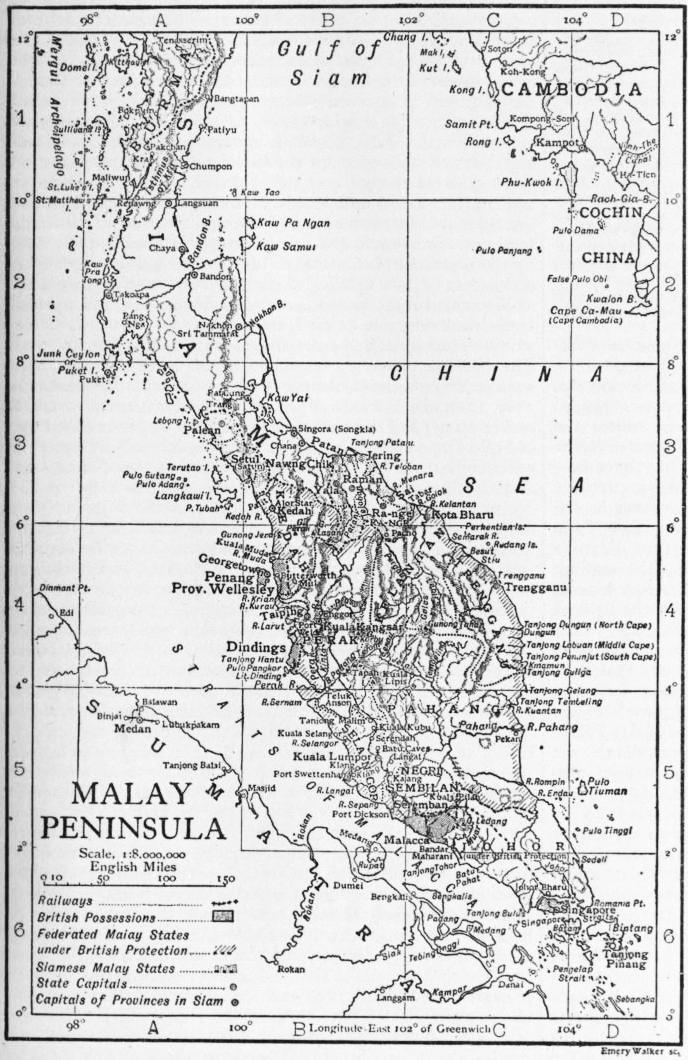
MALAY PENINSULA (called by the Malays Tanah Malayu, i.e. the Malay Land), a lozenge-shaped strip of land projecting into the China Sea, and forming the most southerly portion of the continent of Asia. Geographically, the peninsula begins at the isthmus of Kra, 10° N., at which point it is only between 60 and 70 m. in width, and the distance from sea to sea is further diminished by a large irregular salt-water inlet. Politically and anthropologically, however, this upper portion must be regarded as a continuation of the kingdom of Siam rather than as a section of Malaya. From the isthmus of Kra the peninsula extends south with a general inclination towards the east, the most southerly point being Tanjong Bulus in 1° 16½′ N. A line drawn diagonally down the centre from the isthmus of Kra to Cape Romania (Ramunya) gives the extreme length at about 750 miles. The breadth at the widest point, from Tanjong Pen-unjut in Trengganu to Tanjong Hantu in the Dindings territory, is about 200 m. The area is estimated at about 70,000 sq. m. The peninsula is bounded on the N. by Siam, on the S. by the island and strait of Singapore, on the E. by the China Sea, and on the W. by the Strait of Malacca.
Physical Characteristics.—A range of granite mountains forms a backbone which divides the peninsula into two unequal portions, the larger of which lies to the east and the smaller to the west of the chain. Smaller ranges run parallel to the main mountain chain in many places, and there are numerous isolated spurs which have no connexion with either. The country is covered with limestone in many parts, and large isolated bluffs of this formation stand up in the plains both on the eastern and the western slopes. The descent from the summits of the range into the plain is somewhat less abrupt on the western than it is on the eastern side, and between the foot of the mountains and the Strait of Malacca the largest known alluvial deposits of tin are situated. On the eastern side of the range, after a steep descent, the granite formation speedily gives place to slates of vast depth, intersected here and thereby fissures of quartz containing gold, and in many places covered by limestone which has been superimposed upon the slates. The highest known peak in the main range is that of Gunong Korbu, 7217 ft. above sea-level. The highest mountain is believed to be Gunong Tahan, which forms part of an isolated range on the eastern side, between Pahang and Kelantan, and is estimated at about 8000 ft. The west coast throughout its whole length is covered to a depth of some miles with mangrove swamps, with only a few isolated stretches of sandy beach, the dim foliage of the mangroves and the hideous mud flats presenting a depressing spectacle. On the east coast the force of the north-east monsoon, which beats upon the shores of the China Sea annually from November to February, has kept the land for the most part free from mangroves, and the sands, broken here and there by rocky headlands thickly wooded, and fringed by casuarina trees, stretch for miles without interruption. The islands on each coast present the features of the shore to which they are adjacent. On both the east and the west coast the islands are thickly wooded, but whereas the former are surrounded by beautiful sands and beaches, the latter are fringed by mangrove-swamps. The whole peninsula may be described as one vast forest, intersected in every direction by countless streams and rivers which together form the most lavish water-system in the world. Only an insignificant fraction of these forests has ever been visited by human beings, the Malays and even the aboriginal tribe having their homes on the banks of the rivers, and never, even when travelling from one part of the country to another, leaving the banks of a stream except for a short time when passing from one river-system to another. The bulk of the jungle, therefore, which lies between stream and stream, has never been trodden by the foot of man. The principal rivers on the west coast are the Perak, the Bernam and the Muar. The first-named is far finer than its fellows, and is navigable for steamers for about 40 m. from its mouth, and for native craft for over 250 m. It is exceedingly shallow, however, and is not of much importance as a waterway. The Bernam runs through flat swampy country for the greater part of its course, and steam-launches can penetrate to a distance of over 100 m. from its mouth, and it is therefore probably the deepest river. The country which it waters, however, is not of any value, and it is not much used. The Muar waters a very fertile valley, and is navigable for native boats for over 150 m. On the east coast the principal streams are the Petani, Telubin, Kelantan, Besut, Trengganu, Dungun, Kmamun, Kuantan, Pahang, Rompin, Endau and Sedeli, all guarded by difficult bars at their mouths, and dangerous during the continuance of the north-east monsoon. The deepest rivers are the Kuantan and Rompin; the largest are the Kelantan and the Pahang, both of which are navigable for native boats for a distance of over 250 m. The Trengganu river is obstructed by impassable rapids at a distance of about 30 m. from its mouth. The rivers on the east coast are practically the only highways, the Malays always travelling by boat in preference to walking, but they serve their purpose very indifferently, and their great beauty is their chief claim to distinction. Magnificent caves are found on both slopes of the peninsula, those at Batu in Selangor being the finest on the west coast, while those of Chadu and Koto Glanggi in Pahang are the most extensive yet visited by Europeans on the east coast. They are all of limestone formation. So far as is known, the Malay Peninsula consists of an axial zone of crystalline rocks, flanked on each side by an incomplete band of sedimentary deposits. Granite is the most widely spread of the crystalline rocks; but dikes of various kinds occur, and gneiss, schist and marble are also met with. These rocks form the greater part of the central range, and they are often—especially the granite—decomposed and rotten to a considerable depth. The sedimentary deposits include slate, limestone and sandstone. Impure coal has also been recorded. The limestone has yielded Proetus, Chonetes and other fossils, and is believed to be of Carboniferous age. In the sandstone Myophoria and other Triassic fossils have been found, and it appears to belong to the Rhaetic or Upper Trias.1 The minerals produced are tin, gold, iron, galena and others, in insignificant quantities.
The tin occurs in the form of cassiterite, and is found chiefly in or near the crystalline rocks, especially the granite. As stream tin it occurs abundantly in some of the alluvial deposits derived from the crystalline area, especially on the west coast. Only two tin lodes are worked, however, and both are situated on the east coast, the one at Kuantan in Pahang, the other at Bandi in Trengganu territory. On the west coast no true lode has yet been discovered, though the vast alluvial deposits of tin found there seem to make such a discovery probable in the future. Since 1890 the tin produced from these alluvial beds has supplied between 50% and 75% of the tin of the world. Gold is worked with success in Pahang, and has been exploited from time immemorial by the natives of that state and of Kelantan. Small quantities have also been found on the western slope in Perak.
Climate, &c.—It was formerly the custom to speak of the Malay Peninsula as an unhealthy climate, and even to compare it with the west coast of Africa. It is now generally admitted, however, that, though hot, it compares favourably with that of Burma. The chief complaint which Europeans make concerning it is the extreme humidity, which causes the heat to be more oppressive than is the case where the air is dry. On the other hand, the thermometer, even at Singapore on the southern coast, which is the hottest portion of the peninsula, seldom rises above 98° in the shade, whereas the mean for the year at that place is generally below 80°. On the mainland, and more especially on the eastern slope, the temperature is cooler, the thermometer seldom rising above 93° in the shade, and falling at night below 70°. On an average day in this part of the peninsula the temperature in a European house ranged from 88° to 68°. The number of rainy days throughout the peninsula varies from 160 to over 200 in each year, but violent gusts of wind, called “Sumatras,” accompanied by a heavy downpour of short duration, are more common than persistent rain. The rainfall on the west coast varies from 75 to 120 in. per annum, and that of the east coast, where the north-east monsoon breaks with all its fury, is usually about 155 in. per annum. Malarial fevers make their appearance in places where the forest has been recently felled, or where the surface earth has been disturbed. It is noticed that labourers employed in deep mines worked by shafts suffer less from fever than do those who are engaged in stripping the alluvial deposits. This, of course, means that a new station, where clearing, digging, and building are in progress, is often unhealthy for a time, and to this must be attributed the evil reputation which the peninsula formerly enjoyed. To Europeans the climate is found to be relaxing and enervating, but if, in spite of some disinclination for exertion, regular exercise is taken from the beginning, and ordinary precautions against chills, more especially to the stomach, are adopted, a European has almost as good a chance of remaining in good health in the peninsula as in Europe. A change of climate, however, is imperatively necessary every five or six years, and the children of European parents should not be kept in the peninsula after they have attained the age of four or five years. The Chinese immigrants suffer chiefly from fever of a malarial type, from beri-beri, a species of tropical dropsy, and from dysentery. The Malays formerly suffered severely from smallpox epidemics, but in the portion of the peninsula under British rule vaccination has been introduced, and the ravages of the disease no longer assume serious dimensions. Occasional outbreaks of cholera occur from time to time, and in the independent states these cause terrible loss of life, as the natives fly from the disease and spread the infection in every direction. As a whole, the Malays are, however, a remarkably healthy people, and deformity and hereditary diseases are rare among them. There is little leprosy in the peninsula, but there is a leper hospital near Penang on Pula Deraja and another on an island on the west coast for the reception of lepers from the Federated Malay States.
Flora and Fauna.—The soil of the peninsula is remarkably fertile both in the plains and on the mountain slopes. In the vast forests the decay of vegetable matter during countless ages has enriched the soil to the depth of many feet, and from it springs the most marvellous tangle of huge trees, shrubs, bushes, underwood, creepers, climbing plants and trailing vines, the whole hung with ferns, mosses, and parasitic growths, and bound together by rattans and huge rope-like trailers. In most places the jungle is so dense that it is impossible to force a way through it without the aid of a wood-knife, and even the wild beasts use well-worn game-tracks through the forest. In the interior brakes of bamboos are found, many of which spread for miles along the river banks. Good hard-wood timber is found in plenty, the best being the merabau, penak, rasok and chengal. Orchids of countless varieties abound. The principal fruit trees are the duri-an, mangosteen, custard-apple, pomegranate, rambut-an, pulas-an, langsat, rambai, jack-fruit, coco-nut, areca-nut, sugar-palm, and banana. Coffee, tobacco, sugar-cane, rice, pepper, gambier, cotton and sago are cultivated with success. Great developments have been made of recent years in the cultivation of rubber in British Malaya. The principal jungle products are gutta and rubber of several varieties, and many kinds of rattan. The mangrove grows on the shores of the west coast in profusion. Agilawood, the camphor tree, and ebony are also found in smaller quantities.
The fauna of the peninsula is varied and no less profuse than is the vegetable life. The Asiatic elephant; the seladang, a bison of a larger type than the Indian gaur; two varieties of rhinoceros; the honey bear (bruang), the tapir, the sambhur (rusa); the speckled deer (kijang), three varieties of mouse-deer (napoh, plandok and kanchil); the gibbon (ungka or wawa’), the siamang, another species of anthropoid ape, the brok or coco-nut monkey, so called because it is trained by the Malays to gather the nuts from the coco-nut trees, the lotong, kra, and at least twenty other kinds of monkey; the binturong (arctictis binturong), the lemur; the Asiatic tiger, the black panther, the leopard, the large wild cat (harimau akar), several varieties of jungle cat; the wild boar, the wild dog; the flying squirrel, the flying fox; the python, the cobra, and many other varieties of snake, including the hamadryad; the alligator, the otter and the gavial, as well as countless kinds of squirrel, rat, &c., are found throughout the jungles of the peninsula in great numbers. On the east coast peafowl are found, and throughout the interior the argus pheasant, the firebacked pheasant, the blue partridge, the adjutant-bird, several kinds of heron and crane, duck, teal, cotton-teal, snipe, wood-pigeon, green-pigeon of several varieties, swifts, swallows, pied-robins, hornbills, parakeets, fly-catchers, nightjars, and many other kinds of bird are met with frequently. A few specimens of solitary goose have been procured, but the bird is rarely met with. The forests literally swarm with insects of all kinds, from cicadae to beautiful butterflies, and from stick- and leaf-insects to endless varieties of ants. The scorpion and the centipede are both common. The study of the insect life of the peninsula opens a splendid field for scientific research, and the profusion and variety of insects found in these forests probably surpass those to be met with anywhere else in the world.
Political Divisions and Population.—Politically the Malay Peninsula is divided into four sections: the colony of the Straits Settlements and the Federated Malay States; the independent Malay State of Johor, which is within the British sphere of influence; the non-federated states under British protection; and the groups of states to the north of Perak and Pahang which are now recognized as lying within the sphere of influence of Siam. The colony of the Straits Settlements consists of the islands of Singapore, Penang and the Dindings, the territory of Province Wellesley, on the mainland opposite to Penang, the insignificant territory of the Dindings, and the town and territory of Malacca. The Federated Malay States under British protection consist of the sultanates of Perak, Selangor and the Negri Sambilan on the west coast, and the sultanate of Pahang on the east coast. Johor is the only Malay state in the southern portion of the peninsula, the whole of which is within the British sphere, which has been suffered to remain under native rule. The non-federated states under British protection (since 1909) are Kelantan, Trengganu, Kedah and Perlis (Palit). The population of the peninsula numbers about 2,000,000, of whom about 600,000 inhabit the colony of the Straits Settlements, about 900,000 the Federated Malay States, about 200,000 the Malay State of Johor, and about 250,000 to 300,000 the remainder of the peninsula. The population of the peninsula includes about 850,000 Chinese, mostly immigrants or descendants of immigrants from the southern provinces of China, of whom about 300,000 reside in the colony of the Straits Settlements, 365,000 in the Federated Malay States, 150,000 in Johor, and the remainder in smaller communities or as isolated traders scattered throughout the villages and small towns of the peninsula. The Malay population of the peninsula, including immigrants from the eastern archipelago, number some 750,000 to 800,000, while the Tamils and other natives of India number about 100,000, the aboriginal natives of the peninsula perhaps 20,000, Europeans and Americans about 6500, and Eurasians about 9000. The colony of the Straits Settlements, and to a lesser extent the towns of the Federated Malay States, carry a considerable heterogenous population, in which most of the races of Asia find their representatives.
Races of the Peninsula.—Excluding the Tai, or Siamese, who are undoubtedly recent intruders from the north, there are three races which for an extended period of time have had their home in the Malay Peninsula. These are the Semang or Pangan, the Sakai or Jakun, and the Malays. The Semang, as they are most usually called by the Malays, are Negritos—a small, very dark people, with features of the negroid type, very prognathous, and with short, woolly hair clinging to the scalp in tiny crisp curls. These people belong to the race which would seem to be the true aboriginal stock of southern Asia. Representatives of it are found scattered about the islands from the Andaman group southwards. The state of civilization to which they have attained is very low. They neither plant nor have they any manufactures except their rude bamboo and rattan vessels, the fish and game traps which they set with much skill, and the bows, blow-pipes and bamboo spears with which they are armed. They are skilful hunters, however, catch fish by ingeniously constructed traps, and live almost entirely on jungle-roots and the produce of their hunting and fishing. The most civilized of these people is found in Upper Perak, and the members of this clan have acquired some knowledge of the art of planting, &c. They cannot, however, be taken as typical of their race, and other specimens of this people are seldom seen even by the Sakai. From time to time they have been raided by the latter, and many Negritos are to be found in captivity in some of the Malayan villages on the eastern side of the peninsula. The mistake of speaking of the Sakai tribes as practically identical with the Semang or Pangan has very frequently been made, but as a matter of fact the two races are absolutely distinct from one another. It has also been customary to include the Sakai in the category of Malayan races, but this too is undoubtedly incorrect. The Sakai still inhabit in greatest numbers the country which forms the interior of Pahang, the Plus and Kinta districts of Perak, and the valley of Nenggiri in Kelantan. Representatives of their race are also found scattered among the Malayan villages throughout the country, and also along the coast, but these have intermixed so much with the Malays, and have acquired so many customs, &c., from their more civilized neighbours, that they can no longer be regarded as typical of the race to which they belong. The pure Sakai in the interior have a good knowledge of planting rice, tapioca, &c., fashion pretty vessels from bamboos, which they decorate with patterns traced by the aid of fire, make loin-cloths (their only garment) from the bark of the trap and ipoh trees; are very musical, using a rude lute of bamboo, and a nose-flute of a very sweet tone, and singing in chorus very melodiously; and altogether have attained in their primitive state to a higher degree of civilization than have the Semang. They are about as tall as the average Malay, are slimly built, light of colour, and have wavy fine hair. In their own language they usually have only three numerals, viz. na-nun, one; nar, two; and ne’, three, or variants of these; all higher arithmetical ideas being expressed by the word kerpn, which means “many.” A few cases have been recorded, however, of tribes who can count in their own tongue up to four and five. Among the more civilized, however, the Malay numerals up to ten are adopted by the Sakai. An examination of their language seems to indicate that it belongs to the Mon-Khmer group of languages, and the anthropological information forthcoming concerning the Sakai points to the conclusion that they show a greater affinity to the people of the Mon-Khmer races than to the Malayan stock. Though they now use metal tools imported by the Malays, it is noticeable that the names which they give to those weapons which most closely resemble in character the stone implements found in such numbers all over the peninsula are native names wholly unconnected with their Malay equivalents. On account of this, it has been suggested that in a forgotten past the Sakai were themselves the fashioners of the stone implements, and certain it is that all tools which have no representatives among the stone kelts are known to the Sakai by obvious corruptions of their Malayan names. The presence of the Sakai, a people of the Mon-Khmer stock, in the interior of the peninsula has also been considered as one of many proofs that the Malays intruded from the south and approached the peninsula by means of a sea-route, since had they swept down from the north, being driven thence by the people of a stronger breed, it might be expected that the fringe of country dividing the two contending races would be inhabited by men of the more feeble stock. Instead, we find the Sakai occupying this position, thus indicating that they have been driven northward by the Malays, and that the latter people has not been expelled by the Mon-Khmer races from the countries now represented by Burma, Siam and French Indo-China. The Sakai population is dying out, and must eventually disappear. (With regard to the Malay, see Malays.)
Archaeology.—The only ancient remains found in the peninsula are the stone implements, of which mention has already been made, and some remarkable ancient mines, which are situated in the Jelai valley in Pahang. The stone implements are generally of one or two types: a long rectangular adze or wedge rudely pointed at one end, and used in conjunction with a mallet or flat stone, and a roughly triangular axe-head, which has evidently been fixed in the cleft of a split stick. A few stones, which might perhaps be arrowheads, have been found, but they are very rare. The mines, which have been constructed for the purpose of working quartz lodes containing gold, are very extensive, and argue a high stage of civilization possessed by the ancient miners. They consist of a number of circular or rectangular pits sunk from the cap of a hill, and going down to a depth of in some cases as much as 120 ft., until in fact the miners have been stopped by being unable to cope with the quantity of water made when the level of the valley was reached. The shafts are placed so close together that in many instances they are divided by only a couple of feet of solid ground, but at their bases a considerable amount of gallery work has been excavated, though it is possible that this was done by miners who came after the people who originally sank the shafts. Native tradition attributes these mines to the Siamese, but no importance can be attached to this, as it is very general for the Malays to give this explanation for anything which is obviously not the work of their own ancestors. A theory, which seems to have some probability in its favour, is that these mines were worked by the Khmer people during the period of power, energy and prosperity which found its most lofty expression in the now ruined and deserted city of Angkor Thom; while another attributes these works to the natives of India whose Hindu remains are found in Java and elsewhere, whose influence was at one time widespread throughout Malayan lands, and of whose religious teaching remnants still linger in the superstitions of the Malays and are preserved in some purity in Lombok and Bali. In the absence, however, of any relics of a kind which might lead to the identification of the ancient miners, their nationality and origin are matters which must continue to be mere questions of speculation and conjecture.
History.—The first hint to reach Europe concerning the existence of habitable lands to the eastward of the Ganges is to be found in the writings of Pomponius Mela (A.D. 43) which speak of Chryse, or the Golden Isle, as lying off Cape Tamus—supposed to be the most easterly point in Asia—and over against the estuary of the Ganges. Thereafter there occur vague references to Chryse in the Periplus of the Erythrean Sea, &c., but the earliest trace of anything resembling first-hand knowledge concerning the peninsula of Indo-China and Malaya is revealed in the writings of Ptolemy, whose views were mainly derived from those of his predecessor Marinus of Tyre, who in his turn drew his deductions from information supplied to him by the mariner Alexander who, there is every reason to think, had himself voyaged to the Malay Peninsula and beyond. In the light of present knowledge concerning the trade-routes of Asia, which had been in existence for thousands of years ere ever Europeans attempted to make use of them, it is safe to identify Ptolemy’s Sinus Perimulicus with the Gulf of Siam, the Sinus Sabaricus with the Straits of Malacca from their southern portals to the Gulf of Martaban, the Aurea Chersonesus with the Malay Peninsula, and the island of Iabadius or Sabadius—the reading of the name is doubtful—with Sumatra, not as has often been mistakenly attempted with Java. Although the first definite endeavour to locate the Golden Chersonese thus dates from the middle of the 2nd century of our era, the name was apparently well known to the learned of Europe at a somewhat earlier period, and in his Antiquities of the Jews, written during the latter half of the 1st century, Josephus says that Solomon gave to the pilots furnished to him by Hiram of Tyre commands “that they should go along with his stewards to the land that of old was called Ophir, but now the Aurea Chersonesus, which belongs to India, to fetch gold.” After the time of Ptolemy no advance in knowledge concerning the geography of south-eastern Asia was made until Cosmas Indicopleustes, a monk and an Alexandrian Greek, wrote from personal knowledge between A.D. 530 and 550. His primary object was to prove that the world was built after the same shape and fashion as the Ark made by the Children of Israel in the desert; but he was able to show that the Malay Peninsula had to be rounded and thereafter a course steered in a northerly direction if China was to be reached. Meanwhile inter-Asiatic intercourse by means of sea-routes had been steadily on the increase since the discovery of the way to utilize the monsoons and to sail directly to and fro across the Indian Ocean (attributed to the Greek pilot Hippalus) had been made. After the decline of the power of Rome, the dominant force in Asiatic commerce and navigation was Persia, and from that time onward, until the arrival of the Portuguese upon the scene early in the 16th century the spice trade, whose chief emporia were in or near the Malay Peninsula, was in Persian or Arab hands. There is considerable reason to think, however, that the more frequent ports of call in the Straits of Malacca were situated in Sumatra, rather than on the shores of the Malay Peninsula, and two famous medieval travellers, Marco Polo and Ibn Batuta, both called and wintered at the former, and make scant mention of the latter.
The importance of the Malay Peninsula, as has been noted, consisted in the privilege which its locality conferred upon it of being the distributing centre of the spices brought thither from the Moluccas en route for India and Europe. As early as the 3rd century B.C. Megasthenes makes mention of spices brought to the shores of the Ganges from “the southern parts of India,” and the trade in question was probably one of the most ancient in the world. So long, however, as India held the monopoly of the clove, the Malay Peninsula was ignored, the Hindus spreading their influence through the islands of the archipelago and leaving traces thereof even to this day. The Mahommedan traders from Persia and Arabia, following the routes which had been prepared for them by their forebears, broke down the Hindu monopoly and ousted the earlier exploiters so effectually that by the beginning of the 16th century the spice trade was almost exclusively in their hands. These traders were also missionaries of their religion, as indeed is every Mahommedan, and to them is due the conversion of the Malays from rude pantheism, somewhat tinctured by Hindu mythology, to the Mahommedan creed. The desire to obtain the monopoly of the spice trade has been a potent force in the fashioning of Asiatic history. The Moluccas were, from the first, the objective of the Portuguese invaders, and no sooner had the white men found their way round the Cape of Good Hope and established themselves successively upon the coast of East Africa, in the neighbourhood of the Gulf of Aden and the Malabar coast, than Malacca, then the chief trading centre of the Malayan Archipelago, became the object of their desire. The first Portuguese expedition sent out to capture Malacca was under the command of Diogo Lopez de Siqueira and sailed from Portugal in 1508. At Cochin Siqueira took on board certain adherents of Alphonso d’Alboquerque who were in bad odour with his rival d’Almeida, among them being Magellan, the future circumnavigator of the world, and Francisco Serrão, the first European who ever lived in the Spice Islands. Siqueira’s expedition ended in failure, owing partly to the aggressive attitude of the Portuguese, partly to the very justifiable suspicions of the Malays, and he was presently forced to destroy one of his vessels, to leave a number of his men in captivity, and to sail direct for Portugal. In 1510 a second expedition against Malacca was sent out from Portugal under the command of Diogo Mendez de Vasconcellos, but d’Alboquerque retained it at Cochin to aid him in the retaking of Goa, and it was not until 1511 that the great viceroy could spare time to turn his attention to the scene of Siqueira’s failure. After some futile negotiations, which had for their object the recovery of the Portuguese captives before hostilities should begin, an assault was delivered upon Malacca, and though the first attempt to take the city failed after some hard fighting, a second assault made some days later succeeded, and Malacca passed for ever into European hands. The Portuguese were satisfied with the possession of Malacca itself and did not seek further to extend their empire in Malaya. Instead they used every endeavour to establish friendly relations with the rulers of all the neighbouring kingdoms, and before d’Alboquerque returned to India he despatched embassies to China, Siam, and several kingdoms of Sumatra, and sent a small fleet, with orders to assume a highly conciliatory attitude toward all natives, in search of the Moluccas. Very soon the spice trade had become a Portuguese monopoly, and Malacca was the great headquarters of the trade. It should moreover be noted that Magellan’s famous expedition had for its object not the barren feat of circumnavigation but the breaking down of this monopoly, without violating the terms of the papal bull which gave to Spain the conquest of the West, to Portugal the possession of the East. In 1528 a French expedition sailed from Dieppe, penetrated as far as Achin in Sumatra, but returned without reaching the Malay Peninsula. It was, however, the first attempt ever made to defy the papal bull. In 1591, three years after the defeat of the Armada, Raymond and Lancaster rounded the Cape, and after cruising off Penang, decided to winter in Achin. They subsequently hid among the Pulau Sambilan near the mouth of the Perak river, and thence captured a large Portuguese vessel which was sailing from Malacca in company with two Burmese ships. In 1595 the first Dutch expedition sailed from the Texel, but it took a more southerly course than its predecessors and confined its operations to Java and the neighbouring islands. During this period Achin developed a determined enmity to the Portuguese, and more than one attempt was made to drive the strangers from Malacca. Eventually, in 1641, a joint attack was made by the Achinese and the Dutch, but the latter, not the people of the sturdy little Sumatran kingdom, became the owners of the coveted port. Malacca was taken from the Dutch by the British in 1795; was restored to the latter in 1818; but in 1824 was exchanged for Benkulen and a few more unimportant places in Sumatra. The first British factory in the peninsula was established in the native state of Patani on the east coast in 1613, the place having been used by the Portuguese in the 16th century for a similar purpose; but the enterprise came to an untimely end in 1620 when Captain Jourdain, the first president, was killed in a naval engagement in Patani Roads by the Dutch. Penang was purchased from Kedah in 1786, and Singapore from the then sultan of Johor in 1819. The Straits Settlements—Singapore, Malacca and Penang—were ruled from India until 1867, when they were erected into a crown colony under the charge of the Colonial Office. In 1874 the Malay state of Perak was placed under British protection by a treaty entered into with its sultan; and this eventually led to the inclusion in a British protectorate of the neighbouring Malay States of Selangor, Sungei Ujong, the cluster of small states called the Negri Sembilan and Pahang, which now form the Federated Malay States. By a treaty made between Great Britain and Siam in 1902 the northern Malay states of the peninsula were admitted to lie within the Siamese sphere of influence, but by a treaty of 1909 Siam ceded her suzerain rights over the states of Kelantan, Trengganu, Kedah and Perlis to Britain.
Singapore is the political, commercial and administrative headquarters of the colony of the Straits Settlements, and the governor for the time being is ex officio high commissioner of the Federated Malay States, British North Borneo, Sarawak, the Cocos-Keeling and Christmas Islands, and governor of Labuan.
See Sir F. Swettenham, British Malaya (1906); H. Clifford, Further India (1904); Journal of the Malay Archipelago, Logan (Singapore); Journal of the Straits Branch of the Royal Asiatic Society (Singapore); Weld, Maxwell, Swettenham and Clifford in the Journal of the Royal Colonial Institute (London); Clifford in the Journal of the Royal Geographical Society (London).
(H. Cl.)
1 See R. B. Newton, “Notes on Literature bearing upon the Geology of the Malay Peninsula; with an Account of a Neolithic Implement from that Country” (Geol. Mag., 1901, pp. 128-134). See also the various reports by J. B. Scrivenor in Suppl. Perak Gov. Gazette, 1905.
MALAYS, the name given by Europeans to the people calling themselves Orang Malayu, i.e. Malayan folk, who are the dominant race of the Malay Peninsula and of the Malay Archipelago. Broadly speaking, all the brown races which inhabit the portion of Asia south of Siam and Indo-China, and the islands from the Philippines to Java, and from Sumatra to Timor, may be described as belonging to the Malayan family, if the aboriginal tribes, such as the Sakai and Semang in the Malay Peninsula, the Bataks in Sumatra, and the Muruts in Borneo, be excepted. For the purposes of this article, however, only those among these races which bear the name of Orang Malayu, speak the Malayan language, and represent the dominant people of the land, can be included under the title of Malays. These people inhabit the whole of the Malayan Peninsula to the borders of lower Siam, the islands in the vicinity of the mainland, the shores of Sumatra and some portions of the interior of that island, Sarawak and Brunei in Borneo, and some parts of Dutch Borneo, Batavia and certain districts in Java, and some of the smaller islands of the archipelago. Though in these lands they have for not less than a thousand years enjoyed the position of the dominant race, they all possess a tradition that they are not indigenous, and that their first rulers “came out of the sea,” with a large band of Malayan warriors in their train. In the peninsula especially, where the presence of the Malays is more recent than elsewhere, many traditions exist which point to a comparatively recent occupation of the country. It has been remarked that there is evidence that the Malays had attained to a certain stage of civilization before ever they set foot in Malaya. For instance, the names which they give to certain fruits, such as the duri-an, the rambut-an and the pulas-an, which are indigenous in the Malayan countries, and are not found elsewhere, are all compound words meaning respectively the thorny, the hairy and the twisted fruit. These words are formed by the addition of the substantial affix “-an,” the use of which is one of the recognized methods by which the Malays turn primitive words into terms of more complex meaning. This may be taken to indicate that when first the Malays became acquainted with the fruits which are indigenous in Malayan lands they already possessed a language in which most primary words were represented, and also that their tongue had attained to a stage of development which provided for the formation of compound words by a system sanctioned by custom and the same linguistic instinct which causes a Malay to-day to form similar compounds from European and other foreign roots. For any aboriginal race inhabiting these countries, such important articles of diet as the duri-an, &c., could not fail to be among the first natural objects to receive a name, and thus we find primary terms in use among the Sakai and Semang, the aborigines of the Peninsula, to describe these fruits. The use by the Malays of artificially constructed terms to denote these things may certainly be taken to strengthen the opinion that the Malays arrived in the lands they now inhabit at a comparatively late period in their history, and at a time when they had developed considerably from the original state of primitive man.
In the Malay Peninsula itself there is abundant evidence, ethnological and philological, of at least two distinct immigrations of people of the Malayan stock, the earlier incursions, it is probable, taking place from the eastern archipelago to the south, the later invasion spreading across the Straits of Malacca from Sumatra at a comparatively recent date. The fact that the semi-wild tribes, which are ethnologically Malayan and distinct from the aboriginal Semang and Sakai, are met with almost invariably in the neighbourhood of the coast would seem to indicate that they reached the peninsula by a sea, not by a land route, a supposition which is strengthened by their almost amphibious habits. Many of these tribes have retained their pristine paganism, but many others it is certain have adopted the Mahommedan religion and have been assimilated by the subsequent and stronger wave of Sumatran immigrants. A study of the local dialects to be met with in some of the districts of the far interior, e.g. the Tembeling valley in Pahang, whose people are now Mahommedans and in many respects indistinguishable from the ordinary Malays of the peninsula, reveals the fact that words, current in the archipelago to the south but incomprehensible to the average peninsula Malays, by whom these more ancient populations are now completely surrounded, have been preserved as local words, whereas they really belong to an older dialect once spoken widely in the peninsula, as to-day it is spoken in the Malayan islands. This would seem to show that in some instances the earlier Malay immigrants fell or were driven by the later invaders back from the coast and sought refuge in the far interior.
Until recently many eminent scientists held the theory that the Malayan peoples were merely an offspring of the Mongol stock, and that their advance into the lands they now inhabit had taken place from the cradle of the Mongolian Theories of Origin. race—that is to say, from the north. In the fifth edition of his Malay Archipelago, A. R. Wallace notes the resemblance which he traced between the Malays and the Mongolians, and others have recorded similar observations as to the physical appearance of the two races. To-day, however, fuller data are available than when Wallace wrote, and the more generally accepted theory is that the Malayan race is distinct, and came from the south, until it was stayed by the Mongolian races living on the mainland of southern Asia. The cranial measurements of the Malays and an examination of their hair sections seem to bear out the theory that they are distinct from the Mongolian races. Their language, which is neither monosyllabic nor tonic, has nothing in common with that of the Mon-Annam group. It has, moreover, been pointed out that had the Malays been driven southwards by the stronger races of the mainland of Asia, it might be expected that the people inhabiting the country nearest to the border between Siam and Malaya would belong to the Malayan and not to the Mon-Annam or Mon-Khmer stock. As a matter of fact the Sâkai of the interior of the peninsula belong to the latter race. It might also be anticipated, were the theory of a southward immigration to be sustained, that the Malays would be new-comers in the islands of the archipelago, and have their oldest settlements on the Malayan Peninsula. The facts, however, are in exact contradiction to this; and accordingly the theory now most generally held by those who have studied the question is that the Malays form a distinct race, and had their original home in the south. Where this home lay it is not easy to say, but the facts recorded by many writers as to the resemblance between the Polynesian and the Malayan races, and the strong Malayan element found in the languages of the former (see Tregear’s Maori and Comparative Polynesian Dictionary, London, 1891), have led some students to think that the two races may have had a common origin. John Crawfurd, in the Dissertation to his Dictionary of the Malay Language, published in 1840, noted the prevalence of Malayan terms in the Polynesian languages, and attributed the fact to the casting away of ships manned by Malays upon the islands of the Polynesian Archipelago. The appearance of the same Malayan words in localities so widely separated from each other, however, cannot be satisfactorily accounted for by any such explanation, and the theory is now more generally held that the two races are probably allied and may at some remote period of history have shared a common home. It has been suggested that their separation did not take place until after the continent which once existed in the north Pacific had become submerged, and that the Malays wandered northward, while the Polynesian race spread itself over the islands of the southern archipelago. All this, however, must necessarily be of the nature of the purest speculation, and the only facts which we are able to deduce in the present state of our knowledge of the subject may be summed up as follows: (a) That the Malays ethnologically belong to a race which is allied to the Polynesians; (b) that the theory formerly current to the effect that the Sakai and other similar races of the peninsula and archipelago belonged to the Malayan stock cannot be maintained, since recent investigations tend to identify them with the Mon-Annam or Mon-Khmer family of races; (c) that the Malays are, comparatively speaking, new-comers in the lands which they now inhabit; (d) that it is almost certain that their emigration took place from the south; (e) and that, at some remote period of their history, they came into close contact with the Polynesian race, probably before its dispersion over the extensive area which it now occupies.
The Malays to-day are Sunni Mahommedans of the school of Shafi’i, and they habitually use the terms Orang Malayu, i.e. a Malay, and Orang Islam, i.e. a Mahommedan, as synonymous expressions. Their conversion from paganism took Religion and Superstitions. place during the 13th, 14th and 15th centuries of our era. The raja of Achin, in northern Sumatra, is said to have been converted as early as 1206, while the Bugis people in Celebes are supposed not to have become Mahommedans until 1495. Mahommedanism undoubtedly spread to the Malays of the peninsula from Sumatra, but their conversion was slow and gradual, and may even now in some respects be regarded as imperfect. Upon the bulk of the Malayan peoples their religion sits but lightly. Few are found to observe the law concerning the Five Hours of Prayer, and many fail to put in an appearance at the Friday congregational services in the mosques. The Fast of Ramadhān, however, is generally observed with some faithfulness. Compared with other Mahommedan peoples, the Malays are not fanatical, though occasionally an outbreak against those of a different creed is glorified by them into a holy war. The reason of such outbreaks, however, is usually to be found in political and social rather than in religious grievances. Prior to their conversion to Mahommedanism the Malays were subjected to a considerable Hindu influence, which reached them by means of the traders who visited the archipelago from India. In the islands of Bali and Lombok the people still profess a form of Hinduism, and Hindu remains are to be found in many other parts of the archipelago, though their traces do not extend to the peninsula. Throughout, however, the superstitions of the Malays show indications of this Hindu influence, and many of the demons whom their medicine-men invoke in their magic practices are clearly borrowed from the pantheon of India. For the rest, a substratum of superstitious beliefs, which survives from the days when the Malays professed only their natural religion, is to be found firmly rooted in the minds of the people, and the influence of Mahommedanism, which regards such things with horror, has been powerless to eradicate this. Mr W. W. Skeat’s Malay Magic (London, 1900) is a compilation of all the writings on the subject of Malay superstitions by the best authorities and contains considerable original matter.
The Malays of the coast are a maritime people, and were long famous for the daring character of their acts of piracy. They are now peaceable fisher-folk, who show considerable ingenuity in their calling. Inland the Malays live by Mode of Life, &c. preference on the banks of rivers, building houses on piles some feet from the ground, and planting groves of coco-nut, betel-nut, sugar-palm and fruit-trees around their dwellings. Behind their villages the rice-fields usually spread, and rice, which is the staple food of the people, is the principal article of agriculture among them. Sugar-cane, maize, tapioca and other similar products are grown, however, in smaller quantities. In planting rice three methods are in use: the cultivation of swamp-rice in irrigated fields; the planting of ploughed areas; and the planting of hill-rice by sowing each grain separately in holes bored for the purpose. In the irrigated fields the rice plants are first grown in nurseries, and are subsequently transplanted when they have reached a certain stage of development. The Malays also work jungle produce, of which the most important are gutta, rattans, agila wood, camphor wood, and the beautiful kamuning wood which is used by the natives for the hilts of their weapons. The principal manufactures of the Malays are cotton and silk cloths, earthenware and silver vessels, mats and native weapons. The best cotton cloths are those manufactured by the Bugis people in Celebes, and the batek cloths which come from Java and are stamped with patterns. The best silks are produced by the natives of Pahang, Kĕlantan and Johor in the Malay Peninsula. Lord Leighton pronounced the silver ware from Malaya to be the most artistic of any exhibited at the Colonial Exhibition held in London in 1886. The pottery of the Malays is rude but curious. When the first Europeans visited the Malay Archipelago the Malays had already acquired the art of manufacturing gunpowder and forging cannon. The art of writing also appears to have been independently invented by the Malayan races, since numerous alphabets are in use among the peoples of the archipelago, although for the writing of Malay itself the Arabic character has been adopted for some hundreds of years. The Malays are excellent boat-builders.
While the Malays were famous almost exclusively for their piratical expeditions they naturally bore an evil reputation among Europeans, but now that we have come into closer contact with them, and have learned to understand Character, &c. them better, the old opinions concerning them have been greatly modified. They used to be described as the most cruel and treacherous people in the world, and they certainly are callous of the pain suffered by others, and regard any strategy of which their enemies are the victims with open admiration. In ordinary circumstances, however, the Malay is not treacherous, and there are many instances recorded in which men of this race have risked their own lives on behalf of Europeans who chanced to be their friends. As a race they are exceedingly courteous and self-respecting. Their own code of manners is minute and strict, and they observe its provisions faithfully. Unlike many Orientals, the Malays can be treated with a friendly familiarity without such treatment breeding lack of respect or leading to liberties being taken with the superior. The Malays are indolent, pleasure-loving, improvident beyond belief, fond of bright clothing, of comfort, of ease, and they dislike toil exceedingly. They have no idea of the value of money, and little notion of honesty where money is concerned. They would always borrow rather than earn money, and they feel no shame in adopting the former course. They will frequently refuse to work for a wage when they most stand in need of cash, and yet at the invitation of one who is their friend they will toil unremittingly without any thought of reward. They are much addicted to gambling, and formerly were much given to fighting, though they never display that passion for war in the abstract which is characteristic of some of the white races, and their courage on the whole is not high if judged by European standards. It is notorious, however, on the coasts that a Malay gang on board a ship invariably gets the better of any fight which may arise between it and the Chinese crew. The sexual morality of the Malays is very lax, but prostitution is not common in consequence. Polygamy, though allowed by their religion, is practised for the most part among the wealthy classes only. The Malays are an intensely aristocratic people, and show a marvellous loyalty to their rajas and chiefs. Their respect for rank is not marred by any vulgarity or snobbery. The ruling classes among them display all the vices of the lower classes, and few of the virtues except that of courtesy. They are for the most part, when left to their own resources, cruel, unjust, selfish and improvident.
Much has been written concerning the acts of homicidal mania called amuck (amok), which word in the vernacular means to attack. It was formerly believed that these outbursts were to be attributed to madness pur et simple, and some cases of amok can certainly be traced to this source. These are not, however, in any sense typical, and might equally have been perpetrated by men of another race. The typical amok is usually the result of circumstances which render a Malay desperate. The motive is often inadequate from the point of view of a European, but to the Malay it is sufficient to make him weary of life and anxious to court death. Briefly, where a man of another race might not improbably commit suicide, a Malay runs amok, killing all whom he may meet until he himself is slain.
The nervous affliction called latah, to which many Malays are subject, is also a curious trait of the people. The victims of this affliction lose for the time all self-control and all sense of their own identity, imitating the actions of any person who chances to rivet their attention. Accounts of these manifestations will be found in Swettenham’s Malay Sketches (London, 1895) and Clifford’s Studies in Brown Humanity (London, 1897).
The Malays wear a loose coat and trousers, and a cap or head-kerchief, but the characteristic item of their costume is the sarong, a silk or cotton cloth about two yards long by a yard and a quarter wide, the ends of which are sewn together, Costume, Weapons, &c. forming a kind of skirt. This is worn round the waist folded in a knot, the women allowing it to fall to the ankle, the men, when properly dressed in accordance with ancient custom, folding it over the hilt of their waist-weapon, and draping it around them so that it reaches nearly to the knee. In the hall of a raja on state occasions a head-kerchief twisted into a peak is worn, and the coat is furnished with a high collar extending round the back of the neck only. This coat is open in front, leaving the chest bare. The trousers are short and of a peculiar cut and material, being coloured many hues in parallel horizontal lines. The sarong is of Celebes manufacture and made of cotton, to the surface of which a high polish is imparted by friction with a shell. The typical fighting costume of the Malay is a sleeveless jacket with texts from the Koran written upon it, short tight drawers reaching to the middle of the thigh, and the sarong is then bound tightly around the waist, leaving the hilt of the dagger worn in the girdle exposed to view. The principal weapon of the Malays is the kris, a short dagger with a small wooden or ivory handle, of which there are many varieties. The blade of a kris may either be wavy or straight, but if wavy the number of waves must always be uneven in number. The kris most prized by the Malays are those of Bugis (Celebes) manufacture, and of these the kind called tuasek are of the greatest value. Besides the short kris, the Malays use long straight kris with very narrow blades, shorter straight kris of the same form, short broad swords called sundang, long swords of ordinary pattern called pedang, somewhat shorter swords curved like scimitars with curiously carved handles called chenangkas, and short stabbing daggers called tumbok lada. The principal tools of the Malays are the parang or gôlok, a heavy knife used in the jungle, without which no peasant ever stirs abroad from his house, the beliong or native axe, and the pisau raut, which is used for scraping rattan. Their implements are very primitive, consisting of a plough fashioned from a fork of a tree, and a rude harrow. Reaping is usually performed by the aid of a curious little knife which severs each ear of grain separately. The fisher-folk use many kinds of nets, which they manufacture themselves. Sails, paddles, oars and punting-poles are all in use.
Malay Language and Literature
The Malay language is a member of the Malayan section of the Malayo-Polynesian class of languages, but it is by no means a representative type of the section which has taken its name from it. The area over which it is spoken comprises the peninsula of Malacca with the adjacent islands (the Rhio-Lingga Archipelago), the greater part of the coast districts of Sumatra and Borneo, the seaports of Java, the Sunda and Banda Islands. It is the general medium of communication throughout the archipelago from Sumatra to the Philippine Islands, and it was so upwards of three hundred and fifty years ago when the Portuguese first appeared in those parts.
There are no Malay manuscripts extant, no monumental records with inscriptions in Malay, dating from before the spreading of Islam in the archipelago, about the end of the 13th century. By some it has been argued from this fact that the Malays possessed no kind of writing prior to the introduction of the Arabic alphabet (W. Robinson, J. J. de Hollander); whereas others have maintained, with greater show of probability, that the Malays were in possession of an ancient alphabet, and that it was the same as the Rechang (Marsden, Friederich), as the Kawi (Van der Tuuk), or most like the Lampong (Kern)—all of which alphabets, with the Battak, Bugi and Macassar, are ultimately traceable to the ancient Cambojan characters. With the Mahommedan conquest the Perso-Arabic alphabet was introduced among the Malays; it has continued ever since to be in use for literary, religious and business purposes. Where Javanese is the principal language, Malay is sometimes found written with Javanese characters; and in Palembang, in the Mĕnangkabo country of Middle Sumatra, the Rechang or Renchong characters are in general use, so called from the sharp and pointed knife with which they are cut on the smooth side of bamboo staves. It is only since the Dutch have established their supremacy in the archipelago that the Roman character has come to be largely used in writing and printing Malay. This is also the case in the Straits Settlements.
By the simplicity of its phonetic elements, the regularity of its grammatical structure, and the copiousness of its nautical vocabulary, the Malay language is singularly well fitted to be the lingua franca throughout the Indian archipelago. It possesses the five vowels a, i, u, e, o, both short and long, and one pure diphthong, au. Its consonants are k, g, ng, ch, j, ñ, t, d, n, p, b, m, y, r, l, w, s, h. Long vowels can only occur in open syllables. The only possible consonantal nexus in purely Malay words is that of a nasal and mute, a liquid and mute and vice versa, and a liquid and nasal. Final k and h are all but suppressed in the utterance. Purely Arabic letters are only used in Arabic words, a great number of which have been received into the Malay vocabulary. But the Arabic character is even less suited to Malay than to the other Eastern languages on which it has been foisted. As the short vowels are not marked, one would, in seeing, e.g. the word bntng, think first of bintang, a star; but the word might also mean a large scar, to throw down, to spread, rigid, mutilated, enceinte, a kind of cucumber, a redoubt, according as it is pronounced, bantang, banting, bentang, buntang, buntung, bunting, bonteng, benteng.
Malay is essentially, with few exceptions, a dissyllabic language, and the syllabic accent rests on the penultimate unless that syllable is open and short; e.g. dātang, namấña, bĕsár, diumpatkanñấlah. Nothing in the form of a root word indicates the grammatical category to which it belongs; thus, kāsih, kindness, affectionate, to love; ganti, a proxy, to exchange, instead of. It is only in derivative words that this vagueness is avoided. Derivation is effected by infixes, prefixes, affixes and reduplication. Infixes occur more rarely in Malay than in the cognate tongues. Examples are—gūruh, a rumbling noise, gumūruh, to make such a noise; tunjuḳ, to point, telunjuḳ, the forefinger; chūchuk, to pierce, cherūchuḳ, a stockade. The import of the prefixes—mĕ (mĕng, mĕñ, mĕn, mĕm), pĕ (pĕng, pĕñ, pĕn, pĕm bĕr (bĕl), pĕr, pĕl, ka, di, tĕr,—and affixes—an, kan, i, lah—will best appear from the following examples—root word ājar, to teach, to learn; mĕngājar, to instruct (expresses an action); blĕājar, to study (state or condition); mĕngajāri, to instruct (some one, trans.); mĕngājarkan, to instruct (in something, causative); pĕngājar, the instructor; pĕlājar, the learner; pĕngajāran, the lesson taught, also the school; pĕlajāran, the lesson learnt; diājar, to be learnt; terājar, learnt; tĕrājarkan, taught; tĕrajāri, instructed; [pĕrāja (from rāja, prince), to recognize as prince; pĕrajākan, to crown as prince; karajāan, royalty]; ājarkanlah, teach! Examples of reduplication are—ājar-ājar, a sainted person; ājar-bĕrājar (or bĕlājar), to be learning and teaching by turns; similarly there are forms like ājar-mĕngājar, bĕrājār-ajāran, ājar-ajāri, mĕmpĕrājar, mĕmpĕrājarkan, mĕmpĕrajāri, tĕrbĕlājarkan, pĕrbĕlājarkan, &c. Altogether there are upwards of a hundred possible derivative forms, in the idiomatic use of which the Malays exhibit much skill. See especially H. von Dewall, De vormveranderingen der Maleische taal (Batavia, 1864) and I. Pijnappel, Maleisch-Hollandsch Woordenboek (Amsterdam, 1875), “Inleiding.” In every other respect the language is characterized by great simplicity and indefiniteness. There is no inflexion to distinguish number, gender or case. Number is never indicated when the sense is obvious or can be gathered from the context; otherwise plurality is expressed by adjectives such as sagāla, all, and bāñak, many; more rarely by the repetition of the noun, and the indefinite singular by sa or sātu, one, with a class-word. Gender may, if necessary, be distinguished by the words laki-lāki, male, and pĕrampūan, female, in the case of persons, and of jantan and bĕtīna in the case of animals. The genitive case is generally indicated by the position of the word after its governing noun. Also adjectives and demonstrative pronouns have their places after the noun. Comparison is effected by the use of particles. Instead of the personal pronouns, both in their full and abbreviated forms, conventional nouns are in frequent use to indicate the social position or relation of the respective interlocutors, as, e.g. hamba tuan, the master’s slave, i.e. I. These nouns vary according to the different localities. Another peculiarity of Malay (and likewise of Chinese, Shan, Talaing, Burmese and Siamese) is the use of certain class-words or coefficients with numerals, such as orang (man), when speaking of persons, ekor (tail) of animals, kĕping (piece) of flat things, bīji (seed) of roundish things; e.g. līma bīji, tĕlor, five eggs. The number of these class-words is considerable. Malay verbs have neither person or number nor mood or tense. The last two are sometimes indicated by particles or auxiliary verbs; but these are generally dispensed with if the meaning is sufficiently plain without them. The Malays avoid the building up of long sentences. The two main rules by which the order of the words in a sentence is regulated are—subject, verb, object; and qualifying words follow those which they qualify. This is quite the reverse of what is the rule in Burmese.
The history of the Malays amply accounts for the number and variety of foreign ingredients in their language. Hindus appear to have settled in Sumatra and Java as early as the 4th century of our era, and to have continued to exercise sway over the native populations for many centuries. These received from them into their language a very large number of Sanskrit terms, from which we can infer the nature of the civilizing influence imparted by the Hindu rulers. Not only in words concerning commerce and agriculture, but also in terms connected with social, religious and administrative matters that influence is traceable in Malay. See W. E. Maxwell, Manual of the Malay Language (1882), pp. 5-34, where this subject is treated more fully than by previous writers. This Sanskrit element forms such an integral part of the Malay vocabulary that in spite of the subsequent infusion of Arabic and Persian words adopted in the usual course of Mahommedan conquest it has retained its ancient citizenship in the language. The number of Portuguese, English, Dutch and Chinese words in Malay is not considerable; their presence is easily accounted for by political or commercial contact.
The Malay language abounds in idiomatic expressions, which constitute the chief difficulty in its acquisition. It is sparing in the use of personal pronouns, and prefers impersonal and elliptical diction. As it is rich in specific expressions for the various aspects of certain ideas, it is requisite to employ always the most appropriate term suited to the particular aspect. In Maxwell’s Manual, pp. 120 seq., no less than sixteen terms are given to express the different kinds of striking, as many for the different kinds of speaking, eighteen for the various modes of carrying, &c. An unnecessary distinction has been made between High Malay and Low Malay. The latter is no separate dialect at all, but a mere brogue or jargon, the medium of intercourse between illiterate natives and Europeans too indolent to apply themselves to the acquisition of the language of the people; its vocabulary is made up of Malay words, with a conventional admixture of words from other languages; and it varies, not only in different localities, but also in proportion to the individual speaker’s acquaintance with Malay proper. A few words are used, however, only in speaking with persons of royal rank—e.g. santap, to eat (of a raja) instead of mākan; bĕrādu, to sleep, instead of tīdor; gring, unwell, instead of sākit; mangkat, to die, instead of māti, &c. The use is different as regards the term Jāwī as applied to the Malay language. This has its origin in the names Great Java and Lesser Java, by which the medieval Java and Sumatra were called, and it accordingly means the language spoken along the coasts of the two great islands.
The Malays cannot, strictly speaking, be said to possess a literature, for none of their writings can boast any literary beauty or value. Their most characteristic literature is to be found, not in their writings, but in the folk-tales which are transmitted Literature. orally from generation to generation, and repeated by the wandering minstrels called by the people Pĕng-līpor Lāra, i.e. “Soothers of Care.” Some specimens of these are to be found in the Journal of the Straits Branch of the Asiatic Society (Singapore). The collections of Malay Proberbs made by Klinkert, Maxwell and Clifford also give a good idea of the literary methods of the Malays. Their verse is of a very primitive description, and is chiefly used for purposes of love-making. There are numerous rhymed fairy tales, which are much liked by the people, but they are of no literary merit. The best Malay books are the Hikāyat Hang Tūak, Bĕstāmam and the Hikāyat Abdullah. The latter is a diary of events kept during Sir Stamford Raffle’s administration by his Malay scribe.
Authorities.—Hugh Clifford, In Court and Kampong (London, 1897); Studies in Brown Humanity (London, 1898); In a Corner of Asia (London, 1899); Bush-whacking (London 1901); Clifford and Swettenham, Dictionary of the Malay Language, parts i. to v. A-G. Taiping (Perak, 1894-1898); John Crawfurd, History of the Indian Archipelago (3 vols., Edinburgh, 1820); Grammar and Dictionary of the Malay Language (2 vols., London, 1852); A Descriptive Dictionary of the Indian Islands and Adjacent Countries (London, 1856); Journal of the Indian Archipelago (12 vols., Singapore, 1847-1862); Journal of the Straits Branch of the Royal Asiatic Society, 33 Nos. (Singapore, 1878-1900); H. C. Klinkert, Nieuw Maleisch-Nederlandisch Woordenboek (Leiden, 1893); John Leyden, Malay Annals (London, 1821); William Marsden, The History of Sumatra (London, 1811); Malay Dictionary (London, 1824); Sir William Maxwell, A Manual of the Malay Language (London, 1888); T. J. Newbold, Political and Statistical Account of the British Settlements in the Straits of Malacca; W. W. Skeat, Malay Magic (London, 1900); Skeat and Blagden, Pagan Races of the Malay Peninsula (London, 1906); Sir Frank Swettenham, Malay Sketches (London, 1895); The Real Malay (London, 1899); British Malaya (London, 1906); H. von-de Wall, edited by H. N. van der Tuuk, Maleisch-Nederlandisch Woordenboek (Batavia, 1877-1880); Malay Dictionary (Singapore, 1903), Wilkinson.
(H. Cl.)
MALAY STATES (British). The native states of the Malay Peninsula under British protection are divided into two groups: (1) federated, and (2) non-federated.
I.—Federated States
The federated states, under the protection of Great Britain, but not British possessions, are Perak, Selangor and the confederation of small states known as the Negri Sembilan (i.e. Nine States) on the west coast, and the state of Pahang on the east coast. Each state is under the rule of a sultan, who is assisted in his legislative duties by a state council, upon which the resident, and in some cases the secretary to the resident, has a seat, and which is composed of native chiefs and one or more Chinese members nominated by the sultan with the advice and consent of the resident. The council, in addition to legislative and other duties, revises all sentences of capital punishment. The administrative work of each state is carried on by the resident and his staff of European officials, whose ranks are recruited by successful candidates in the competitive examinations held annually by the Civil Service commissioners. The sultan of each state is bound by treaty with the British government to accept the advice of the resident, who is thus practically paramount; but great deference is paid to the opinions and wishes of the sultans and their chiefs, and the British officials are pledged not to interfere with the religious affairs of the Mahommedan community. In the actual administration of the Malay population great use is made of the native aristocratic system, the peasants being governed largely by their own chiefs, headmen and village elders, under the close supervision of British district officers. The result is a benevolent autocracy admirably adapted to local conditions and to the character and traditions of the people. A recognition of the fact that the welfare of the Malays, who are the people of the land and whose sultans have never ceded their territories to the British, must be regarded as the first consideration has been the guiding principle of the administration of the Malay States, and this has resulted in an extraordinary amelioration of the condition of the natives, which has proceeded concurrently with a notable development of the country and its resources, mineral and agricultural. To the work of development, however, the Malays have themselves contributed little, sound administration having been secured by the British officials, enterprise and capital having been supplied mainly by the Chinese, and the labour employed being almost entirely Chinese or Tamil. Meanwhile the Malays have improved their ancestral holdings, have enjoyed a peace and a security to which their past history furnishes no parallel, have obtained easy access to new and important markets for their agricultural produce, and for the rest have been suffered to lead the lives best suited to their characters and their desires. Each principal department of the administration has its federal head, and all the residents correspond with and are controlled by the resident-general, who, in his turn, is responsible to the high commissioner, the governor of the Straits Settlements for the time being.
The estimated aggregate area of the Federated Malay States is 28,000 sq. m., and the estimated population in 1905 was 860,000, as against 678,595 in 1901. Of these only about 230,000 are Malays. The revenue of the federation in 1905 was $23,964,593 (about £2,795,000), and the expenditure was $20,750,395 (about £2,460,000). The imports for the same year were valued at $50,575,455 (about £5,900,000), and the exports at $80,057,654 (about £9,340,000), making a total trade of nearly 15¼ millions sterling. The principal sources of revenue are an export duty on tin, the rents paid for the revenue farms of the right to collect import duties on opium, wine and spirits, and to keep licensed gambling-houses for the exclusive use of the Chinese population, railway receipts, land and forest revenue and postal revenue. The tin is won from large alluvial deposits found in the states of the western seaboard, and the mines are worked almost exclusively by Chinese capital and labour. Since 1889 the Federated Malay States have produced considerably more than half the tin of the world. Recently there has been a great development in agricultural enterprise, especially with regard to rubber, which is now grown in large quantities, the estates being mainly in the hands of Europeans, and the labour mostly Tamil. The states are opened up by over 2500 m. of some of the best metalled cart-roads in the world, and by a railway system, 350 m. of which, extending from the mainland opposite Penang to the ancient town of Malacca, are open to traffic. Another 150 m. of railway is under construction. The government offices at Kuala Lumpor, the federal capital of the states, are among the finest buildings of the kind in Asia. The whole of this extraordinary development, it should be noted, has been effected by careful, sound and wise administration coupled with a courageous and energetic policy of expenditure upon public works. Throughout, not one penny of debt has been incurred, the roads, railways, &c., being constructed entirely from current balances. This of course has only been rendered possible by the extraordinary mineral wealth which the states on the western seaboard have developed in the hands of Chinese miners amid the peace and security which British rule has brought to these once lawless lands. The value of the tin output for the year 1905 amounted to $69,460,993 (£8,104,199). Although agricultural enterprise in the Malay States is assuming considerable proportions and a growing importance, the total value of the principal agricultural products, including timber, for the year 1905 only aggregated $2,435,513 (£289,143).
The whole of the Malay Peninsula is one vast forest, through which flow countless streams that form one of the most lavish water-systems in the world. The rivers, though many of them are of imposing appearance and of considerable length, are uniformly shallow, only a few on the west coast being navigable by ships for a distance of some 40 m. from their mouths. In spite of the notable development above referred to, only a very small fraction of the entire area of the states has as yet been touched either by mining or agricultural enterprise. It is not too much to assert that the larger half of the forest-lands has never been trodden by the foot of man. (For information concerning the botany, geology, &c., of the Malay States see Malay Peninsula. For the ethnology see Malays.)
Perak is situated between the parallels 3° 37′ and 6° 5′ N. and 100° 3′ to 101° 51′ E. on the western side of the Malay Peninsula. It is bounded on the N. by the British possession of Province Wellesley and the Malay state of Kedah; on the S. by the protected native state of Selangor; on the E. by the protected native state of Pahang and the independent states of Kelantan and Petani; and on the W. by the Straits of Malacca. The coast-line is about 90 m. in length. The extreme distance from the most northerly to the most southerly portions of the state is about 172 m., and the greatest breadth from east to west is about 100 m. The total area of the country is estimated at about 10,000 sq. m.
The Perak river, which runs in a southerly direction almost parallel with the coast for nearly 150 m. of its course, is navigable for small steamers for about 40 m. from its mouth, and by native trading boats for nearly 200 m. The Plus, Batang, Padang and Kinta rivers are its principal tributaries, all of them falling into the Perak on its left bank. The other principal rivers of the state are the Krian, Kurau, Larut and Bruas to the north of the mouth of the Perak, and the Bernam to the south. None of these rivers is of any great importance as a waterway, although the Bernam River is navigable for small steamers for nearly 100 m. of its course. The mountain ranges, which cover a considerable area, run from the north-east to the south-west. The highest altitudes attained by them do not exceed 7500 ft., but they average about 2500 ft. They are all thickly covered with jungle. The ranges are two, running parallel to one another, with the valley of the Perak between them. The larger is a portion of the main chain, which runs down the peninsula from north to south. The lesser is situated in the district of Larut. There are several hill sanatoria in the state at heights which vary from 2500 to 4700 ft. above sea-level, but the extreme humidity of the atmosphere renders the coolness thus obtainable the reverse of enjoyable.
Mr Leonard Wray, curator of the Perak museum, writes as follows on the subject of the geological formation of the state: “There are really only four formations represented—firstly, the granitic rocks; secondly, a large series of beds of Geology. gneiss, quartzite, schist and sandstone, overlaid in many places by thick beds of crystalline limestone; thirdly, small sheets of trap rock; and fourthly, river-gravels and other Quaternary deposits. The granites are of many varieties, and also, in all probability, of several different geological periods. The series of quartzites, schists, and limestone are of great age, but as no fossils have ever been found in any of them, nothing definite can be stated as to their exact chronological position. Their lithological characteristics and the total absence of all organic remains point to the Archaean period. The failure to discover signs of life in them is, of course, merely negative evidence, and the finding of a single fossil would at once upset it. However, until this happens they may be conveniently classed as Laurentian. It is at present impossible to form anything approaching an accurate estimate of the thickness of this extensive series, but it is probable that it is somewhere between 4000 and 5000 ft. Unconformability has been noticed between the limestones and the beds beneath, but whether this is sufficient to separate them or not is a matter for future investigation.... The taller hills are exclusively composed of granite, as also are some of the lower ones.... The ores of the following metals have been found in the formations named: Granite—tin, lead, iron, arsenic, tungsten and titanium; Laurentian—tin, gold, lead, silver, iron, arsenic, copper, zinc, tungsten, manganese and bismuth; Quaternary—tin, gold, copper, tungsten, iron and titanium. This is not to be considered a complete list, as small quantities of other metals have also been found.”
The early history of Perak is obscure, the only information on the subject being obtained from native traditions, which are altogether untrustworthy. According to these authorities, however, a settlement was first made by Malays in Perak at Bruas, and the capital History. was later moved to the banks of the Perak River, the site chosen being a little village called Temong, which lies some miles up stream from Kuala Kangsar, the present residence of the sultan. When the Malacca sultanate fell, owing to the invasion of the Portuguese in 1511, a member of that royal house is said to have migrated to Perak, and the present dynasty claims to have been descended from him. As this boast is also made by almost every ruling family in the peninsula, the tradition is not worthy of any special attention. What is more certain is the tradition that Perak was twice invaded by the Achinese, and its rulers carried off into captivity, one of them, Sultan Mansur Shah, subsequently becoming the ruler of Achin. The first European settlement in Perak was made by the Dutch in 1650, under a treaty entered into with the Achinese, but the natives of the country rose against the Dutch again and again, and it was abandoned in 1783, though it was afterwards reoccupied, the Dutch being finally ejected by the British in 1795. In 1818 the Siamese conquered Perak, but its independence was secured by a treaty between the British and Siamese governments in 1824. From that date until 1874 Perak was ruled by its own sultans, but in that year, owing to internal strife, Sultan Abdullah applied to the then governor of the Straits Settlements, Sir Andrew Clarke, for the assistance of a British Resident. The treaty of Pangkor was concluded on the 20th of January 1874, and the first resident, Mr J. W. W. Birch, was murdered on the 2nd of November 1875. A punitive expedition became necessary; sultan Abdullah and the other chiefs concerned in the murder were banished, the actual murderers were hanged, and Raja Muda Jusuf was declared regent. He died in 1888, and was succeeded by the sultan Raja Idris, K.C.M.G., a most enlightened ruler, who was from the first a strong and intelligent advocate of British methods of administration. Sir Hugh Low was appointed resident, a position which he held until 1889, when he was succeeded by Sir Frank Swettenham. Since then the history of Perak has been one of continuous peace and growing prosperity and wealth. Although the federal capital is Kuala Lumpor in Selangor, Perak still enjoys the honour of being the senior and leading state of the federation.
By the census taken on the 5th of April 1891 the population of Perak was shown to be as follows: Europeans, 366; Eurasians, Jews and Armenians, 293; Malays, 96,719; Chinese, 94,345; Tamils, 13,086; aborigines, 5779; other nationalities, Population. 3666; thus making a grand total of 214,254, of whom 156,408 were males and 57,846 were females. The estimated population in 1905 was 400,000, of whom 200,000 were Chinese and 160,000 were Malays, but owing to the disparity of the proportions between the sexes the deaths in each year largely outnumber the births, and the increase in the population is accounted for solely by the number of immigrants, chiefly from the mainland of China, and to a lesser extent from India also.
The revenue of Perak in 1874 amounted to $226,333. That for 1905 amounted to $12,242,897. Of this latter sum $4,876,400 was derived from duty on exported tin, $2,489,300 from railway receipts, $505,300 from land revenue and $142,800 from postal and telegraphic revenue. The remainder is mainly derived from the revenue farms, which are leased to Chinese capitalists for a short term of years, conveying to the lessee the right to collect import duties upon opium, wine and spirits, to keep pawnbroking shops, and to keep public licensed gambling-houses for the use of Chinese only. The expenditure for 1905 amounted to $10,141,980. Of this sum $4,236,000 was expended upon railway upkeep and construction and $2,176,100 upon public works. The value of the imports into Perak during 1905 was over $20,000,000, and that of the exports exceeded $40,000,000, making a total of over $60,000,000, equivalent to about seven million sterling. The output of tin from Perak ranged between 18,960 tons, valued at $23,099,506 in 1899, and 26,600 tons, valued at $35,500,000, in 1905. The fluctuating character of the output is due, not to any exhaustion of the mineral deposits of the state—that is not to be anticipated for many years yet to come—but to the uncertainty of the labour supply. The mining population is recruited exclusively from the districts of southern China, and during certain years an increased demand for labourers in China itself, in French Indo-China, in the Dutch colonies, and in South Africa temporarily and adversely affected immigration to the Straits of Malacca. The output has, moreover, been affected from time to time by the price of tin, which was $32.20 per pikul in 1896, rose to $42.96 in 1898, to $74.15 in 1900, and averaged $80.60 in 1905. Exclusive of tin, the principal exports were $108,000 worth of Para rubber, $181,000 of copra, $54,000 of hides, $48,000 of patchouli, and considerable quantities of timber, rattans and other jungle produce. The agricultural development of the state is still in its infancy, but rubber is cultivated in rapidly increasing areas, and the known fertility of the soil, the steady and regular rainfall, the excellent means of communication, and the natural and artificial conditions of the country, justify the expectation that the future of Perak as an agricultural country will be prosperous.
Although so much has been done to develop the resources of Perak, by far the greater portion of the state is still covered by dense and virgin forest. In 1898 it was calculated that only 330,249 acres of land were occupied or cultivated out of a total acreage of 6,400,000. General. The area of agricultural holdings has notably increased, but a considerable period must yet elapse before it will amount to even one-tenth of the whole. A line of railway connects the port of Teluk Anson with the great mining district of Kinta, whence the line runs, crossing the Perak River at Enggor, to Kuala Kangsar, the residence of the sultan, thence to Taiping, the administrative capital of the state, and via Krian to a point opposite to the island of Penang. A second line runs south from Perak and connects with the railway system of Selangor, which in its turn connects with the Negri Sembilan and Malacca line, thus giving through railway communication between the last-named town and Penang. Perak also possesses some 600 miles of excellent metalled cart-road, and the length of completed road is annually increasing.