VOLUME XVII SLICE IV Magnetite to Malt (continued 5)
Reading edition
There were at the same time powers existing in India to keep the Mahrattas in check, and some parts of India were excepted from their depredations. The English power was rising at Calcutta, Madras and Bombay. The nascent Sikh power prevented Mahratta incursions from being permanently successful in the Punjab. As the Mogul Empire broke up, some separate Mahommedan powers rose upon its ruins. The nizam of the Deccan established himself at Hyderabad, comparatively near the headquarters of the pēshwa. Hyder Ali was proclaimed sultan of Mysore in the south. Ahmed Shah Abdali burst upon India from Afghanistan. The Mahrattas bravely encountered him at Panipat near Delhi in 1761, and were decisively defeated. The defeat, however, did not essentially shake the Mahratta confederation. It was collision with the English that broke that wonderful fabric to pieces.
The first collision with the English occurred in 1775, arising from a disputed succession to the pēshwaship. The English government at Bombay supported one of the claimants, and the affair became critical for the English as well as for the Mahrattas. It was at this conjuncture that Warren Hastings displayed his political genius and rendered signal service to his country, by succouring from Bengal the defeated Bombay army and negotiating a peace (in 1782) that restored the status quo.
The next collision happened in 1803. The pēshwa had fallen into grave difficulties with some of the principal members of the Mahratta confederation. He therefore placed himself under British protection, and this led to the great Mahratta War, in which the Marquis Wellesley displayed those talents for military and political combination which rendered him illustrious. It was during the campaigns which ensued that General Arthur Wellesley defeated Sindhia and the Bhonsla raja at Assaye, and General Lake won the victories of Farrukhabad, Dīg and Laswari over Sindhia and Holkar. The three confederates, Sindhia, Holkar and the Bhonsla, concluded peace with the British government, after making large sacrifices of territory in favour of the victor, and submitting to British control politically. It was during these events that the British won the province of Orissa, the old Hindustan afterwards part of the North-Western Provinces, and a part of the western coast in Gujarat.
The third collision came to pass between 1816 and 1818, through the conduct, not only of the confederates, but also of the pēshwa (Baji Bao) himself. During the previous war the pēshwa had been the protégé and ally of the British; and since the war he had fallen more completely than before under British protection—British political officers and British troops being stationed at his capital. He apparently felt encouraged by circumstances to rebel. Holkar and the Bhonsla committed hostile acts. The predatory Pindaris offered a formidable resistance to the British troops. So the pēshwa ventured to take part in the combination against the British power, which even yet the Mahrattas did not despair of overthrowing. After long-protracted menaces, he attacked the British at Kirkee, but failed utterly, and fled a ruined man. Ultimately he surrendered to Sir John Malcolm, and was sent as a state pensioner to Bithūr, near Cawnpore. The British, however, released the raja of Satara from the captivity in which he had been kept during the pēshwa’s time, and reinstated him on the throne, with a limited territory. Owing to these events the British government became possessed of the Konkan and of the greater part of the Deccan.
It remains to mention briefly the fortunes of each remaining member of the once imperial confederation. The principality of Satara was held to have lapsed in 1848 by the death of the raja without lineal heirs, and was annexed by the British government. The Bhonsla raja of Nagpur died without lineal heirs in 1853, and his territory was likewise annexed. The house of Holkar remained faithful to its engagements with the British government, and its position as a feudatory of the empire was maintained. In Sindhia’s territory, by reason of internal feuds, the British had to undertake measures which were successfully terminated after the battles of Maharajpur and Panniar in 1843. But on the whole the house of Sindhia remained faithful. Sindhia himself was actively loyal during the Mutiny. The gaekwar gradually fell under British control towards the close of the 18th century, and his house never engaged in hostilities with the British government. The ex-pēshwa lived to old age at Bithur, and died in 1857. His adopted son grew up to be the Nana Sahib, of infamous memory, who took a leading part in the Mutiny.
See J. Grant Duff, History of the Mahrattas (3 vols., 1826); T. D. Broughton, Letters written in a Mahratta Camp (1813); M. G. Ranade, Rise of the Maratha Power (Bombay, 1900).
(R. T.; J. S. Co.)

MAHSEER, or Mahaseer (Barbus mosal), a kind of barbel, abundant in the rivers of India, especially in pools of the upper and more rapid streams where they issue from the mountainous part of the country. It is one of the largest species of the Cyprinid family, attaining to a length of 3 to 5 ft., and sometimes exceeding a weight of 70 ℔. Its body is well-proportioned, rather elongate, and somewhat like that of the European barbel, but covered with very large scales, of which there are only twenty-five or twenty-seven placed along the lateral line; the dorsal fin is armed with a long and strong spine, and the mouth provided with four slender and short barbels. The lips are sometimes produced into fleshy lobes. To the fisherman in India the mahseer affords the same kind of sport as the salmon in the British Isles, and it rivals that fish as regards size, strength and activity. Its flesh is likewise much esteemed.
MAI, ANGELO (1782-1854), Italian cardinal and philologist, was born of humble parents at Schilpario in the province of Bergamo, Lombardy, on the 7th of March 1782. In 1799 he entered the Society of Jesus, and in 1804 he became a teacher of classics in the college of Naples. After completing his studies at the Collegium Romanum, he lived for some time at Orvieto, where he was engaged in teaching and palaeographical studies. The political events of 1808 necessitated his withdrawal from Rome (to which he had meanwhile returned) to Milan, where in 1813 he was made custodian of the Ambrosian library. He now threw himself with characteristic energy and zeal into the task of examining the numerous MSS. committed to his charge, and in the course of the next six years was able to restore to the world a considerable number of long-lost works. Having withdrawn from the Society of Jesus, he was invited to Rome in 1819 as chief keeper of the Vatican library. In 1833 he was transferred to the office of secretary of the congregation of the Propaganda; on the 12th of February 1838 he was raised to the dignity of cardinal. He died at Castelgandolfo, near Albano, on the 8th of September 1854.
It is on his skill as a reader of palimpsests that Mai’s fame chiefly rests. To the period of his residence at Milan belong: Fragments of Cicero’s Pro Scauro, Pro Tullio, Pro Flacco, In Clodium et Curionem, De aere alieno Milonis, De rege (Alexandrino (1814); M. Corn. Frontonis opera inedita, cum epistolis item ineditis, Antonini Pii, Marci Aurelii, Lucii Veri et Appiani (1815; new ed., 1823, with more than 100 additional letters found in the Vatican library); portions of eight speeches of Quintus Aurelius Symmachus; fragments of Plautus; the oration of Isaeus De hereditate Cleonymi; the last nine books of the Antiquities of Dionysius of Halicarnassus, and a number of other works. M. Tullii Ciceronis de republica quae supersunt appeared at Rome in 1822; Scriptorum veterum nova collectio, e vaticanis codicibus edita in 1825-1838; Classici scriptores e vaticanis codicibus editi in 1828-1838; Spicilegium romanum in 1839-1844; and Patrum nova bibliotheca in 1845-1853. His edition of the celebrated Codex vaticanus, completed in 1838, but not published (ostensibly on the ground of inaccuracies) till four years after his death (1858), is the least satisfactory of his labours and was superseded by the edition of Vercellone and Cozza (1868), which itself leaves much to be desired. Although Mai was not as successful in textual criticism as in the decipherment of manuscripts, he will always be remembered as a laborious and persevering pioneer, by whose efforts many ancient writings have been rescued from oblivion.
See B. Prina, Biografia del cardinale Angelo Mai (Bergamo, 1882), a scientific work, which gives a full and, at the same time, a just appreciation of his work; Cozza-Luzi, Epistolario del card. Angelo Mai (Bergamo, 1883); life by G. Poletto (Siena, 1887).
MAIA, in Greek mythology, the eldest of the Pleiades, the seven daughters of Atlas and the Oceanid Pleïone. She and her sisters, born on Mt Cyllene in Arcadia, are sometimes called mountain goddesses. In a cave of Cyllene Maia became by Zeus the mother of the god Hermes. The story is told in the Hymn to Hermes attributed to Homer. She was identified by the Romans with Maia Majesta, an old Italian goddess of spring, to whom a sacrifice was offered on the 1st of May by the priest of Vulcan.
MAIDA, a town of Calabria, Italy, in the province of Catanzaro, from which it is 30 m. W.S.W. direct, and 12 m. N.N.E. of Pizzo by rail (the station is 8 m. W. of the town). Pop. (1901), 5190. The town gives its name to the plain of Maida, where in 1806 British troops under Sir John Stuart defeated the French under Regnier. The names Maida Hill and Maida Vale in London are derived from this battle.
MAIDAN, an Indian term for any open plain. The Maidan is the name of the park in Calcutta, surrounding Fort William, where society people drive in the afternoon. The name is also applied to one of the valleys in the Afridi country of Tirah, and to the plateau portion of the state of Mysore.
MAIDEN, or Maid, a young unmarried girl. “Maid” is a shortened form of “maiden,” O. Eng. maegden, which represents a diminutive of a Teutonic word meaning “young person,” of either sex. An old English word “may,” meaning a kinsman or kinswoman, and also a virgin or girl, represents the original. In early usage “maiden” as meaning “virgin” is frequently applied to the male sex, thus, in Malory’s Morte d’Arthur, Sir Percyvale is called a “parfyte clene megden.” Apart from the direct applications of the word to the unmarried state, such as “maiden name,” “maiden lady,” &c., the word is used adjectivally, implying the preservation of the first state of an object, or indicating a first effort of any kind. Probably a “maiden” fortress is one which has never fallen, though the New English Dictionary suggests that the various “maiden castles” in England, usually ancient earthworks, may have been so called from being so strong that they could be defended by maidens, and points out that Edinburgh Castle, called “maiden-castle” by William Drummond of Hawthornden (Speech for Edinburgh to the King), is styled Castrum puellarum, the “castle of the maidens,” in Geoffrey of Monmouth. A “maiden” assize, circuit or session is one at which there are no prisoners for trial; a “maiden over” or “maiden” in cricket is an over from which no runs are scored. A “maiden speech” is the first speech made by a member of parliament in the house. In the Annual Register for 1794 (quoted in N.E.D.) the expression, with reference to Canning’s first speech, is said to be “according to the technical language of the house.” “Maiden” is applied to several objects, to a movable framework or horse for drying and airing of linen, to a washerwoman’s “dolly” or wooden beater, to the “kirnbaby” formed of the last sheaf of corn reaped which formerly figured in the Scottish harvest homes, and to the beheading instrument, known as the “Scottish maiden” (see below). “Maid,” apart from its primary sense of an unmarried woman, is chiefly used for a domestic female servant, usually with a qualifying word prefixed, such as “housemaid,” “parlour-maid,” &c.
The title of “Maid of Honour” is given to an unmarried lady attached to the personal suite of a queen. The custom of sending young girls of noble or good birth to the court of a prince or feudal superior, for the purpose, primarily, of education, goes back to early feudal times, and is parallel with the sending of boys to act as pages and squires to the feudal castles. The regular establishment of maids of honour (filles d’honneur) appears first in the royal court of France. This has usually been attributed to Anne of Brittany, wife of Charles VIII.; she had a group of unmarried girls of high rank at her court as part of her household, in whom she took a lively and parental interest, educating them and bestowing a dowry upon them on their marriage. A slightly earlier instance, however, has been found. When the young Margaret of Austria came to France on her espousal to Charles VIII., broken by his marriage to Anne of Brittany, there were in her train several filles d’honneur, whose names appear in the Comptes d’argenterie de la reine Marguerite d’Autriche, from 1484-1485 and 1488-1489 (Archives de l’empire K. K. 80 and 81 quoted by A. Jal, Dictionnaire critique de biographie et d’histoire). It is from the days of Francis I. that the chroniques scandaleuses begin which circle round the maids of honour of the French court. The maids of Catherine de Medici, celebrated as the “flying squadron,” l’escadron volant, are familiar from the pages of Pierre de l’Estoile (1574-1611) and Brantôme. Among those whose beauty Catherine used in her political intrigues, the most famous were Isabelle de Limeuil, Mlle de Montmorency-Fosseux, known as la belle Fosseuse, and Charlotte de Baune. The filles d’honneur, as an institution, were suppressed in the reign of Louis XIV., at the instigation of Mme de Montespan—who had been one of them—and their place was taken by the dames de palais. In the English court, this custom of attaching “maids of honour” to the queen’s person was no doubt adopted from France. At the present day a queen regnant has eight maids of honour, a queen consort four. They take precedence next after the daughters of barons, and where they have not by right or courtesy a title of their own, they are styled “Honourable.”
The Scottish Maiden was an instrument of capital punishment formerly in use in Scotland. It is said to have been invented by the earl of Morton, who is also said to have been its first victim. This, however, could not have been the case, as the maiden was first used at the execution of the inferior agents in the assassination of Rizzio (1561) and Morton was not beheaded till 1581. The maiden was practically an early form of guillotine. A loaded blade or axe moving in grooves was fixed in a frame about ten feet high. The axe was raised to the full height of the frame and then released, severing the victim’s head from his body. At least 120, suffered death by the maiden, including the regent Morton, Sir John Gordon of Haddo, President Spottiswood, the marquis and earl of Argyll. In 1710 it ceased to be used; it is now preserved in the museum of the Society of Antiquaries of Scotland, in Edinburgh.
MAIDENHAIR, in botany, the common name for a fern, Adiantum Capillus-Veneris, characterized by the spreading hairlike branches of the frond, the ultimate pinnules of which are ½ to 1 in. long with a rounded crenate outer edge and repeatedly forked veins; the sori (or masses of spore-capsules) are in the crenatures of the pinnules, and are protected by a kidney-shaped involucre. The plant is widely distributed in temperate and tropical regions, and is occasionally found in the western counties of England, the Isle of Man, and west Ireland, growing on damp rocks or walls especially near the sea. The genus Adiantum is a large one containing many handsome species both tropical and temperate, well known in greenhouse and hothouse cultivation.
Maidenhair-tree is a popular name for Ginkgo biloba, a remarkable and handsome gymnospermous tree, the fan-shaped leaves of which with their forked veins recall those of the maidenhair (see Gymnosperms).
MAIDENHEAD, a market town and municipal borough in the Wokingham parliamentary division of Berkshire, England; 24½ m. W. of London by the Great Western railway. Pop. (1901), 12,980. Area, 2125 acres. It is pleasantly situated on and above the west (right) bank of the Thames, and is much in favour as a residential town and a resort of boating parties. Though of high antiquity it is wholly modern in appearance, and a large number of handsome houses have been built in its vicinity. A beautiful timbered house of the 15th century, however, survives in Ockwells, a short distance south of the town. The stone bridge carrying the London road over the Thames dates from 1772; but the crossing is of ancient importance. Maidenhead has trade in malt and grain. The borough is under a mayor, 4 aldermen and 12 councillors.
The history of Maidenhead (Maydenhutt, Maydenhith) is bound up with that of the ancient bridge. It is not mentioned in Domesday. Edward I. (1297) gave a grant of pontage in aid of the bridge, which was almost broken down; similar grants to the “bailiffs and good men of Maydenhithe” were made by succeeding sovereigns. In 1451 Henry VI. incorporated the gild of the Brethren and Sisters of Maydenhith to provide certain necessaries for the celebration of Mass and to keep the bridge in order: the gild, dissolved at the Reformation, was revived by Elizabeth, who, however, later (1581) substituted for it a corporation consisting of a warden, bridgemaster, burgesses and commonalty: the governing charter until the 19th century was that of James I. (1685) incorporating the town under the title of the mayor, bridgemaster and burgesses. In 1400 Thomas Holand, earl of Kent, held the bridge in the interests of the deposed Richard II., but was eventually forced to retire. In 1643 a meeting took place in the town between Charles I. and three of his children. In the 18th century a considerable trade was done in carrying malt, meal and timber in barges to London: at that time three fairs were held which have now practically disappeared. The Wednesday market is held under a charter of Elizabeth (1582).
MAID MARIAN, a personage incorporated in the English legend of Robin Hood. There is no evidence that she had originally any connexion with the Robin Hood cycle. She seems to have been an essential feature of the morris dance, and in the may-game was paired sometimes with Robin-Hood, but oftener with Friar Tuck. The well-known pastoral play of Adam de la Hale, Jeu de Robin et Marion, and the many French songs on the subject, account for the association of the names. In the ballads on Robin Hood her name is twice casually mentioned, but there is a late ballad, by a certain S. G. (F. J. Child, English and Scottish Ballads, i. 219), which tells how Maid Marian sought Robin in the forest disguised as a page, and fought with him for an hour before she recognized him by his voice. S. G. was perhaps acquainted with the two plays, written in 1598, of The Downfall and The Death of Robert Earl of Huntingdon, by Anthony Munday and Harry Chettle. In The Downfall Matilda Fitz Walter escapes from the persecution of King John by following her lover to Sherwood Forest, where they took the names of Robin Hood and Maid Marian, and lived apart until they could be legally united. Perhaps this tale has some connexion with the romance of the outlaw Fulk Fitz Warin. Matilda or Mahaud, widow of Theobald Walter, escaped from John’s solicitations by marrying the outlawed Fulk and following him to the forest. There were in semi-historical legends three Matildas pursued by King John, of whom particulars are given by H. L. D. Ward in his Catalogue of Romances (i. 502). Their several histories were fused by the Elizabethan dramatists, and associated with the Maid Marian of the morris dance, who up to that time had probably only a vague connexion with Robin Hood.
MAIDSTONE, a market town and municipal and parliamentary borough, and the county town of Kent, England, 41 m. E.S.E. of London by the South Eastern & Chatham railway. Pop. (1901), 33,516; area, 4008 acres. It lies principally on the eastern bank of the river Medway, the modern part spreading over the western slopes of a picturesque valley, which is intersected and environed by orchards and hop gardens, this being the richest agricultural district of Kent. The hop grounds form the so-called middle growth of Kent, and the town has the principal grain market in the county. Archbishop Boniface in 1260 established a hospital here (Newark hospital) for poor pilgrims, the chapel of which, with modern additions, is now St Peter’s Church. The parish church of St Mary, which had existed from Norman times, was demolished in 1395 by Archbishop Courtenay, who erected on the site the present church of All Saints. This fine Perpendicular building contains, besides many excellent monuments, the richly carved sedilia and the twenty-eight oak seats used by the collegiate priests. Courtenay also founded a college of secular canons, the ruins of which are an interesting specimen of 14th-century architecture. From the reign of John until the Reformation the archbishops had a residence here, at which Stafford and Courtenay died. This Perpendicular building, with its Elizabethan east front, was acquired by the corporation as a memorial of Queen Victoria’s Jubilee in 1887, and houses the school of science and art. The rectory, with the manor, passed into lay hands at the Reformation; and, having been a perpetual curacy for three hundred and twenty years, the living became a vicarage in 1866. The grammar school was founded in 1549, and endowed with the estates of the local Corpus Christi fraternity, then dissolved; the hall in which the gild assembled remains, but the school is established in modern buildings on a new site. There are oil-mills, rope, sacking and twine factories, and cement, lime, and brick works. There is a considerable carrying trade on the Medway. A museum, with public library, was opened in 1858, in an interesting building of the early part of the 16th century. This is the headquarters of the Kent Archaeological Society, founded by the Rev. L. B. Larking in 1858. In 1890 an art gallery was added. The West Kent and General hospital, the county ophthalmic hospital, county gaol and barracks may be mentioned among other institutions. From Saxon times down to 1830 condemned malefactors were executed, and all the great county meetings were held, on Penenden Heath, a common situated about a mile north-east of the town, and enclosed by the corporation as a public recreation ground. The parliamentary borough of Maidstone returns one member. The town is governed by a mayor, 6 aldermen and 18 councillors.
There is evidence of a Roman settlement at Maidstone. The name Maidstone (Medwegestun, Meddestane, Maydestan), probably meaning Medway Town, is presumably of Saxon origin. At the time of the Domesday Survey it belonged to the archbishop of Canterbury, and from the reign of John the archbishops had a residence there. Its position in the centre of Kent gave it an early importance; the shire-moot was held on Penenden Heath in the 11th century, and Maidstone was an assize town in the reign of Edward I. In 1537 Cranmer exchanged the manor of Maidstone with the king, and it was granted by Edward VI. to Sir Thomas Wyatt. Edward also incorporated the town by the title of the mayor, jurats and commonalty; it had formerly been governed by a portreve and 12 “brethren.” This charter was forfeited through Wyatt’s rebellion; a second charter was granted by Elizabeth in 1559 and confirmed by subsequent sovereigns. A new charter constituting a governing body of a mayor, 12 jurats and 40 common councilmen was given at the petition of the inhabitants by George II. in 1747, and remained the governing charter until 1835. Four fairs were granted by the charter of 1559; these are now held on the 13th of February, the 12th of May, the 20th of June and the 17th of October. A Thursday market was granted by Henry III. to Archbishop Boniface, and a market every second Tuesday in the month by charter of George II. A corn market on Tuesday and a cattle market on Thursday are still held. The manufacture of linen and woollen goods was introduced by Walloons, who settled here in 1567. This was succeeded by paper-making, now the chief industry of the town. The cultivation of hops has been carried on since the 17th century.
Maidstone has been associated with various incidents of general history. Wat Tyler broke into the prison, liberated John Ball the rebel preacher, and committed various depredations. Several of the leading inhabitants joined Jack Cade’s rising. The rising of the Kentish Royalists in 1648 collapsed at Maidstone, where on the 1st of June Fairfax, after five hours’ obstinate fighting, captured the town at midnight.
See Victoria County History, Kent; I. M. Russell, History of Maidstone (1881).
MAIHAR, a native state of Central India, in the Baghelkhand agency. Area, 407 sq. m.; pop. (1901), 63,702; estimated revenue, £4700. The state, which is watered by the Tons river, consists mainly of alluvial soil covering sandstone, and is fertile except in the hilly district of the south. A large area is under forest, the produce of which provides a small export trade. The chief, whose title is raja, claims descent from the Kachwaha Rajput clan. The state suffered severely from famine in 1896-1897. The town of Maihar (pop. 6802) is on the East Indian railway, 97 m. N. of Jubbulpore. Extensive ruins of shrines and other buildings in its neighbourhood indicate a former much greater extent of the place.
MAIL. (1) (Through Fr. maille, from Lat. macula, a spot or hole, the mesh of a net), properly a metal ring or link which, joined closely with other links, formed the fabric of body and other armour in the middle ages, till it was superseded by plate-armour. The word “mail,” properly applied to this form of chain-armour, is also used of armour generally, whether plate or chain, and is also transferred to the horny defensive coverings of animals, such as the tortoise, crab, &c. (see Arms and Armour). (2) (O. Eng. mál, speech; probably the same as O. Saxon mahal, assembly; in meaning connected with O. Norse mále, stipulation), a Scots law term meaning rent, tax. “Mails and duties” are the rents, whether in kind or money, of an estate. In English the word only survives in “blackmail” (q.v.). (3) (Through O. Fr. male, mod. malle, a Teutonic word surviving in Dutch maal), properly a bag, especially one used in travelling; this word, which appears in Chaucer, is now applied chiefly to the despatch and delivery of postal matter. In this sense “mail” is properly the bag in which such matter is conveyed, and hence is applied to the contents of the mail, postal matter collectively, and to the train, carts, or other means used in the despatch and delivery of the same. In general usage “mail” is confined to the “foreign” as opposed to the “inland” despatch of letters, &c., and to which the word “post” is chiefly applied; in official language, the word refers to the inland despatch. The word appears also in “mail-coach,” a coach used for conveying the mails, and in “mail-cart,” a cart similarly employed. This word is also applied to a light low vehicle propelled or drawn by hand, suitable for young children. The “mail phaeton” is a type of phaeton with high seat for two persons and drawn by a pair of horses.
MAILLY, LOUISE JULIE, Comtesse de (1710-1751), mistress of Louis XV. of France, was the daughter of Louis, marquis de Nesle. She was the eldest of three sisters who succeeded one another as favourites of the king. In 1726 she married her cousin, Louis Alexandre de Mailly. Although Louis XV. had paid her attentions from 1732, she did not become titular mistress until 1738. She did not use her position either to enrich herself or to interfere in politics. She was supplanted by her sister, the duchess of Châteauroux, and obliged to leave court in 1742.
See E. and J. de Goncourt, La Duchesse de Châteauroux et ses sœurs (1879); Toussaint, Anecdotes curieuses de ... Louis XV. (2 vols., 1905); J. B. H. R. Capefigue, Mesdemoiselles de Nesle et la jeunesse de Louis XV. (1864).
MAIMANA, a town and khanate of Afghan Turkestan. The town is situated 100 m. S.W. of Balkh, and only some 25 m. from the frontier of Russian Turkestan. It is about two-thirds the size of Herat, square built and surrounded by a ruined wall and moat. The khanate was for long in dispute between Bokhara and Kabul, but in 1868 Abdur Rahman laid siege to the town, and it was compelled to come to terms. Its political status as an Afghan province was definitely fixed by the Russo-Afghan boundary commission of 1885. The inhabitants are chiefly Uzbegs.
MAIMAND, a town in the province of Fars, Persia, a few miles east of Firuzabad and about 70 m. from Shiraz. It has a population of about 5000, almost wholly occupied with the manufacture and sale of rose-water, which is largely exported to many parts of Persia as well as to Arabia, India and Java. The district also produces great quantities of almonds. The rose gardens cover several square miles. In 1349 a great part of Maimand and of three little villages belonging to it became wakf (pious endowment) of the shrine at Shiraz of Mïr Ahmed, surnamed Shah Chiragh, a son of Musa Kazim, the seventh imām of the Shiahs, and the remainder of the Maimand grounds was given to the shrine by Mīr Habbib Ullah Sharifi and by Shah Ismail in 1504; the administration of the Maimand property as well as the guardianship of the shrine is still with the descendants of Mīr Habbib Ullah.
MAIMBOURG, LOUIS (1610-1686), French Jesuit and historian, was born at Nancy. He entered the Society of Jesus at the age of sixteen, and after studying at Rome became a classical master in the Jesuit college at Rouen. He afterwards devoted himself to preaching, but with only moderate success. After having taken some part in minor controversies he threw himself with energy into the dispute which had arisen as to the Gallican liberties; for his Traité historique sur les prérogatives de l’Église de Rome (1682) he was by command of Innocent XI. expelled from the Society, but rewarded by Louis XIV. with a residence at the abbey of St Victor, Paris, and a pension. He died on the 13th of August 1686. His numerous works include histories of Arianism, the iconoclastic controversy, the Greek schism, Lutheranism, Calvinism, and of the pontificates of Leo I. and Gregory I.; they are mere compilations, written indeed in a very lively and attractive style, but inaccurate and untrustworthy.
The History of Arianism was published in English (1728-1729) by William Webster, with an appendix on the English writers in the Socinian and Arian controversies.
MAIMING, mutilation, a physical injury which involves the loss of, or incapacity to use, a bodily member. The verb “to maim,” in M. E. maynhe, mahayme, mayme, &c. was adopted from O. Fr. mahaignier: cf. It. magagnars, Med. Lat. mahemiare, mahennare, &c. (see Du Cange, Gloss., s.v. “Mahamium”). Maiming or mutilation is and has been practised by many races with various ethnical and religious significances, and was a customary form of punishment on the principle of an “eye for an eye” (see Mutilation). In law “maiming” is a criminal offence; the old law term for a special case of maiming of persons was “mayhem” (q.v.), an Anglo-French variant form of the word. Maiming of animals by others than their owners is a particular form of the offences generally grouped as “malicious damage.” For the purpose of the law as to this offence animals are divided into cattle, which includes horses, pigs and asses, and other animals which are either subjects of larceny at common law or are usually kept in confinement or for domestic purposes. The punishment for maiming of cattle is three to fourteen years’ penal servitude. Malicious injury to other animals is a misdemeanour punishable on summary conviction. For a second offence the penalty is imprisonment with hard labour for over twelve months. (Malicious Damage Act 1861.) Maiming of animals by their owner falls under the Cruelty to Animals Acts.
MAIMON, SALOMON (1754-1800), German philosopher, was born of Jewish parentage in Polish Lithuania, and died at Nieder-Siegersdorf on the 22nd of November 1800. He married at the age of twelve, and studied medicine in Berlin. In 1770 he severed his connexion with his orthodox co-religionists by his critical commentary on the Moreh Nebuḥim of Maimonides, and devoted himself to the study of philosophy on the lines of Wolff and Moses Mendelssohn. After many vicissitudes he found a peaceful residence in the house of Count Kalkreuth at Nieder-Siegersdorf in 1790. During the ensuing ten years he published the works which have made his reputation as a critical philosopher. Hitherto his life had been a long struggle against difficulties of all kinds. From his autobiography, it is clear that his keen critical faculty was developed in great measure by the slender means of culture at his disposal. It was not till 1788 that he made the acquaintance of the Kantian philosophy, which was to form the basis of his lifework, and as early as 1790 he published the Versuch über die Transcendentalphilosophie, in which he formulates his objections to the system. He seizes upon the fundamental incompatibility of a consciousness which can apprehend, and yet is separated from, the “thing-in-itself.” That which is object of thought cannot be outside consciousness; just as in mathematics √−1 is an unreal quantity, so “things-in-themselves” are ex hypothesi outside consciousness, i.e. are unthinkable. The Kantian paradox he explains as the result of an attempt to explain the origin of the “given” in consciousness. The form of things is admittedly subjective; the mind endeavours to explain the material of the given in the same terms, an attempt which is not only impossible but involves a denial of the elementary laws of thought. Knowledge of the given is, therefore, essentially incomplete. Complete or perfect knowledge is confined to the domain of pure thought, to logic and mathematics. Thus the problem of the “thing-in-itself” is dismissed from the inquiry, and philosophy is limited to the sphere of pure thought. The Kantian categories are, indeed, demonstrable and true, but their application to the given is meaningless and unthinkable. By this critical scepticism Maimon takes up a position intermediate between Kant and Hume. Hume’s attitude to the empirical is entirely supported by Maimon. The casual concept, as given by experience, expresses not a necessary objective order of things, but an ordered scheme of perception; it is subjective and cannot be postulated as a concrete law apart from consciousness. The main argument of the Transcendentalphilosophie not only drew from Kant, who saw it in MS., the remark that Maimon alone of his all critics had mastered the true meaning of his philosophy, but also directed the path of most subsequent criticism.
Maimon’s chief works, in addition to the above quoted, are Philos. Wörterbuch (1791); Streifereien im Gebiete der Philos.(1793); Über die Progresse der Philos. (1793); Die Kategorien des Aristoteles mit Anmerkungen erläutert (1794); Versuch einer neuen Logik (1794 and 1798); Kritische Untersuchungen über den menschl. Geist (1797). See S. Maimons Lebensgeschichte von ihm selbst beschrieben (1792, ed. K. P. Moritz; Eng. trans. by J. C. Murray, 1888); Wolff, Maimoniana (1813); Witte, S. Maimon (1876).
MAIMONIDES, the common name of Rabbi Moses ben Maimon (1135-1204), also known from the initials of these last words as Rambam, Jewish philosopher. His life falls into three epochs, which may be typified by the towns in which they were passed, viz. Cordova, Fez and Cairo. He was born in Cordova on the 20th of March 1135, the eve of Passover; he had a brother, David, and one sister. His early years were spent in his native town, which had then just passed the zenith of its glory. The Arab rulers had fostered the development of science, art, medicine, philosophy, literature and learning. All these influences played their part in the education of Maimonides, whose father, besides training him in all branches of Hebrew and Jewish scholarship, implanted in the youth a sound knowledge of these secular studies as well. In 1148 Cordova was taken from the last Fatimite caliph by the victorious Almohades, who had spread over Spain from N. Africa. These militant revivalists strove to re-establish Islam in what they considered its primitive simplicity. They laid great stress on the unity of God, and tolerated neither schism within the faith nor dissent without. The position of the orthodox Spanish Jews became intolerable, and Maimon, after ten years of hardships, wanderings and escapes, decided to take his family out of the country. He settled in Fez. The years which Maimonides spent there (1160-1165) were memorable for his friendship with Abdul Arab Ibn Muisha—a Moslem poet and theologian—and for the commencement of his literary activity. His energies were diverted towards stimulating the religious feelings of his brethren and combating assimilation. In consequence he became alarmed for his own safety, and in 1165 left for Egypt, where he settled after a passing visit to the Holy Land. Cordova taught him the humanities; Fez humanity. Cairo, besides giving him prominence at court and in the Jewish community, was the centre of the almost world-wide influence which he exercised over Jewry by his monumental writings and dominant personality. By 1177 Maimonides was the recognized chief of the Cairene congregation and consulted on important matters by communities far and wide. Here he was joined by his most famous disciple, Joseph Aknin. But his early life in Egypt was fraught with deep sorrow. His father died soon after their arrival, and Maimonides himself suffered severely from prostration and sickness. His brother David, jointly with whom he carried on a trade in gems, was shipwrecked in the Indian Ocean. With him perished the entire fortune of the family. Forced to earn a livelihood, Maimonides turned to medicine. The fame of his skill eventually brought him the appointment of body physician to Saladin, to whom, it is said, he was so attached that when Richard I. wrote from Ascalon, offering him a similar post at the English court, Maimonides refused. He married the sister of Ibn al Māli, one of the royal secretaries. In 1186, his son Abraham was born. His remaining years were spent in ceaseless activity and in controversy, which he sought to avoid. He died amidst universal sorrow and veneration.
The works of Maimonides fall into three periods: (a) To the Spanish period belong his commentary on the whole Talmud (not fully carried out), a treatise on the calendar (Maamar ha-ibbur), a treatise on logic (Milloth Higgayon), and his commentary on the Mishnah (this was called Siraj or Maor, i.e. “Light”: begun 1158, completed 1168 in Egypt). (b) While he was in Fez, he wrote an essay on the Sanctification of the Name of God (Maamar Kiddush Hashem, Iggereth Hashemad). (c) The works written in Egypt were: Letter to the Yemenites (Iggereth Teman or Pethaḥ Tiqvah); Responsa on questions of law; Biblical and Rabbinical Code (Misnheh Torah or Yad Hahazaka, completed 1180); Sepher hamitzvoth, an abbreviated handbook of the preceding; and his great philosophical work Moreh Nebuḥim or “the guide of the perplexed” (1190). To these must be added certain portions of the Mishnah commentary, such as the “Eight Chapters,” the discussion on reward and punishment and immortality, the Jewish Creed, which have acquired fame as independent works.
The influence of Moses ben Maimon is incalculable. “From Moses unto Moses there arose not one like Moses,” is the verdict of posterity. Maimonides was the great exponent of reason in faith and toleration in theology. One of the main services to European thought of the “Guide” was its independent criticism of some of Aristotle’s principles. His codification of the Talmud was equally appreciated in the study of the scholar and in practical life. Christian Europe owed much to Maimonides. Not only did his “Guide” influence scholasticism in general, but it was from his Code that the Church derived its medieval knowledge of the Synagogue.
A complete bibliography will be found in Maimonides, by David Yellin and Israel Abrahams (London, 1903); the final chapter of that work gives a summary of the influence of Maimonides on Christian philosophers such as Aquinas, and Jewish such as Spinoza. The “Guide” has been translated into English by M. Friedlander (1881-1885; new ed., 1905). See also Jewish Encyclopedia, articles s.v., and the volumes edited by Guttmann, Moses ben Maimon (Leipzig, 1908, &c.).
(H. Le.)
MAIN (Lat. Moenus), a river of Germany, and the most important right-bank tributary of the Rhine. It has two sources, the Weisse Main (White Main), which rises in the Fichtelgebirge on the east side of the Ochsenkopf, and the Rote Main (Red Main), which, rising on the eastern slope of the Frankish Jura, flows past Bayreuth. They unite 3 m. below Kulmbach, 920 ft. above the sea. Hence the river, already of considerable size, pursues a north-westerly direction, skirting the spurs of the Frankish Jura in a pleasant valley. At Lichtenfels the river takes a south-westerly course, which it retains until entering the fertile basin of Bamberg. Here it receives from the south-east the waters of its chief tributary, the Regnitz, and enters upon its middle course. Its direction is now again north-west, and meandering through pleasant vales and pastures it passes Hassfurt and reaches Schweinfurt. Its course is now almost due south to Ochsenfurt, when it again proceeds north-west. Continuing in this direction amid vine-clad hills, it washes the walls of the university city of Würzburg, and thence, dividing the forest-clad ranges of the Spessart and the Odenwald, reaches Gemünden. Here it is joined from the right by the Frankish Saale and, turning abruptly south, receives at Wertheim the beautiful Tauber. Feudal castles and medieval towns now crown its banks, notably, Freudenberg and Miltenberg. From the latter it proceeds due north to Aschaffenburg, whence passing Frankfort it pours its yellow waters into the green waters of the Rhine just above Mainz. The Main has a total length of 310 m. and drains a basin of approximately 11,000 sq. m. It is navigable from the confluence of the Regnitz, 240 m. from its mouth, for barges and other small craft, and through the Ludwig Canal is connected with the Danube.
See Ulrici, Das Maingebiet in seiner natürlichen Beschaffenheit (Kassel, 1885); E. Faber, Zur Hydrographie des Maingebiets (Munich, 1895), and Lill, Mainthal, Main und Mainschiffahrt (Berlin, 1904).
MAIN (from the Aryan root which appears in “may” and “might,” and Lat. magnus, great), a word meaning properly power or strength, especially physical. This use chiefly survives in the expression “with might and main.” The word is more common as a substantival elliptical use of the adjective, which usually has the sense of principal or chief in size, strength, importance, &c. Thus “the main,” the high open sea, is for “main sea,” cf. “mainland,” the principal part of a territory excluding islands and sometimes far-projecting peninsulas. The expression “the Spanish main” properly meant that part of the main land of the N.E. coast of South America stretching from the Orinoco to the Isthmus of Panama, and the former Spanish possessions in Central America bordering on the Caribbean Sea, but it is often loosely used, especially in connexion with the buccaneers, of the Caribbean Sea itself. The term “main” is also thus used of a principal pipe or cable for conducting gas, water, electricity, &c. The elliptical use does not appear, however, in such expressions as main road, line, stream. Another use of the word “main” has a somewhat obscure history. It appears as a term in the game of hazard, and also in cock-fighting. In the last it is used for a match, and for the cocks engaged in a match. In hazard it is the number called by the “caster” before the dice are thrown; this may be any number from five to nine inclusive. The usual derivation is from the French main, a hand, but according to the New English Dictionary there is no evidence for this, and the more probable explanation is that it is an adaptation of “main” meaning principal or chief. From this use of the word in hazard the expression “main chance” is derived. “Main,” a shortened form of domain or demesne, only now survives in Scotland, usually in the plural “mains” for a home farm.
MAINA (or Mani) and MAINOTES, a district and people of the Peloponnesus, the modern Morea. Maina is the country occupied by the mountain range of Taygetus from Sparta to Cape Matapan, the ancient Taenarum. It is now divided between the modern districts Oetylos and Gythion. Before the organization of the present kingdom of Greece, Maina was subdivided into Εξω Μάνη, Outer Maina, from the frontier of Kalamata, on the Gulf of Messenia, to Vitylo (Oetylos) and inland to the summit of Taygetus; Κάτω Μάνη, Lower Maina, from Vitylo to Cape Matapan; and Μέσα Μάνη, or Inner Maina, on the east, and on the Gulf of Laconia as far as the plain of Elos. It contained over a hundred villages. The country is mountainous and inaccessible, a formation to which it owes its historical importance. The Mainotes claim to descend from the Spartans, and probably represent the Eleuthero, or free, Laconians who were delivered by Rome from the power of Sparta, as is suggested by the traces of ancient Greek in their dialect and by their physical type. Their country being a natural fortress, they were able to defend themselves against the Byzantine emperors, the barbarians who broke into the empire, the Latin princes of Achaea of the house of Villehardouin, and the Turks. As their country is also poor and maritime, they were early tempted to take to piratical adventure. Gibbon says that “in the time of Constantine Porphyrogenitus they had acquired the name of Mainotes, under which they dishonour the claim of liberty by the inhuman pillage of all that is shipwrecked on their rocky shore.” Their neighbours gave their country the name of “Kakaboulia”—the land of wicked counsels. The passes of their mountains were elaborately fortified and their villages were full of fortified towers (pyrgoi) from which they formed their own favourite epithet, Maina Polypyrgos—many-towered Maina. On the western side it also contains the remains of feudal keeps, erected by William II. de Villehardouin (1245-1278) and other Latin princes of Achaea. The Mainotes did not become Christians till the 9th century. From the 15th till the 17th century they recognized a family which claimed to belong to the Comneni of Trebizond as head chiefs. But the real power was in the hands of the chiefs of the different families and villages, who formed a turbulent and martial aristocracy. Enduring and ferocious feuds were common among them. In the course of the 18th century the family of Mavromicheli (Black Michael), which belonged to lower Maina, established a general headship over the Mainotes after much strife and many murders. When Russia endeavoured to promote a rising against the Turks in the Morea in 1770 the Mainotes acted with her, and the strength of their country enabled them to escape the vengeance of the Turks when the Christians were cynically deserted by the Russians. In 1777 their practical independence was recognized by the sultan’s officers. During the Greek war of independence the Mainotes were chiefly led by Petros (Petro Bey) Mavromicheli, known to his countrymen as the king of Maina, who undoubtedly cherished the hope of establishing a principality for himself. The freedom of Greece, for which he had fought in his own way, proved the ruin of his ambition. He found the new order less compatible with his schemes than the Turkish dominion. Petro Bey was imprisoned by the Greek president Capodistrias (see Capo d’Istria, Count.), who was in revenge murdered by the Mavromichelis. The family were finally content to become courtiers and officials in the reign of King Otto I. In the 19th century Maina was but little affected by civilization, except in so far as the efficiency of modern navies debarred the Mainotes from their old resource of piracy.
See W. Martin Leake, Travels in the Morea (1830); M. E. Yemeniz, “La Maina,” in Revue des deux mondes (March 1, 1865); and Philipson, “Zur Ethnographie des Peloponnes,” in Petermanns Mittheilungen, vol. 36 (Gotha).
MAINE, ANNE LOUISE BÉNÉDICTE DE BOURBON, Duchesse du (1676-1753), daughter of Henri Jules de Bourbon, prince de Condé and Anne of Bavaria, was born on the 8th of November 1676. On the 19th of March 1692 she married Louis Auguste de Bourbon, duc du Maine, son of Louis XIV. and Mme de Montespan. The duchesse du Maine held a little court at Sceaux, where she gave brilliant entertainments and immersed herself in political intrigues. Displeased with the action of the regent Orleans in degrading the illegitimate children of Louis XIV. from their precedence above the peers of France, she induced her husband to join in the Cellamare conspiracy for the transference of the regency to the king of Spain. The plot, however, was discovered, and she was imprisoned in 1719. The following year she returned to Sceaux, where she resumed her salon and gathered round her a brilliant company of wits and poets. She died in Paris on the 23rd of January 1753.
See Général de Piépape, La Duchesse du Maine (1910).
MAINE, SIR HENRY JAMES SUMNER (1822-1888), English comparative jurist and historian, son of Dr James Maine, of Kelso, Roxburghshire, was born on the 15th of August 1822. He was at school at Christ’s Hospital, and thence went up to Pembroke College, Cambridge, in 1840. At Cambridge he was one of the most brilliant classical scholars of his time. He won a Craven scholarship and graduated as senior classic in 1844, being also senior chancellor’s medallist in classics. Shortly afterwards he accepted a tutorship at Trinity Hall. In 1847 he was appointed regius professor of civil law, and he was called to the bar three years later; he held this chair till 1854. Even the rudiments of Roman law were not then included in the ordinary training of English lawyers; it was assumed at the universities that any good Latin scholar could qualify himself at short notice for keeping up such tradition of civilian studies as survived. Maine cannot have known much Roman law in 1847, but in 1856 he contributed to the Cambridge Essays the essay on Roman law and legal education, republished in the later editions of Village Communities, which was the first characteristic evidence of his genius. Meanwhile he had become one of the readers appointed by the Inns of Court, in the first of their many half-hearted attempts at legal education, in 1852. Lectures delivered by Maine in this capacity were the groundwork of Ancient Law (1861), the book by which his reputation was made at one stroke. Its object, as modestly stated in the preface, was “to indicate some of the earliest ideas of mankind, as they are reflected in ancient law, and to point out the relation of those ideas to modern thought.” Within a year of its publication the post of legal member of council in India was offered to Maine, then a junior member of the bar with little practice, few advantages of connexion, and no political or official claims. He declined once, on grounds of health; the very next year the office was again vacant. This time Maine was persuaded to accept, not that his health had improved, but that he thought India might not make it much worse. It turned out that India suited him much better than Cambridge or London. His work, like most of the work done by Englishmen in India in time of peace, was not of a showy kind—its value is shown by the fact that he was asked to prolong his services beyond the regular term of five years, and returned to England only in 1869. The subjects on which it was his duty to advise the government of India were as much political as legal. They ranged from such problems as the land settlement of the Punjab, or the introduction of civil marriage to provide for the needs of unorthodox Hindus, to the question how far the study of Persian should be required or encouraged among European civil servants. On the civil marriage question in particular, and some years earlier on the still more troublesome one of allowing the remarriage of native converts to Christianity, his guidance, being not only learned but statesmanlike, was of the greatest value. Plans of codification, moreover, were prepared, and largely shaped, under Maine’s direction, which were carried into effect by his successors, Sir J. Fitzjames Stephen and Dr Whitley Stokes. The results are open to criticism in details, but form on the whole a remarkable achievement in the conversion of unwritten and highly technical law into a body of written law sufficiently clear to be administered by officers to many of whom its ideas and language are foreign. All this was in addition to the routine of legislative and consulting work and the establishment of the legislative department of the government of India on substantially its present footing.
Maine’s power of swiftly assimilating new ideas and appreciating modes of thought and conduct remote from modern Western life came into contact with the facts of Indian society at exactly the right time, and his colleagues and other competent observers expressed the highest opinion of his work. In return Maine brought back from his Indian office a store of knowledge which enriched all his later writings, though he took India by name for his theme only once. This essay on India was his contribution to the composite work entitled The Reign of Queen Victoria (ed. T. H. Ward, 1887). Not having been separately published, it is perhaps the least known of Maine’s writings; but its combination of just perception and large grasp with command of detail is not easily matched outside W. Stubbs’s prefaces to some of the chronicles in the Rolls series, and (more lately) F. W. Maitland’s monographs. As vice-chancellor of the university of Calcutta, Maine commented, with his usual pregnant ingenuity, on the results produced by the contact of Eastern and Western thought. Three of these addresses were published, wholly or in part, in the later editions of Village Communities; the substance of others is understood to be embodied in the Cambridge Rede lecture of 1875, which is to be found in the same volume. The practical side of Maine’s experience was not long lost to India; he became a member of the secretary of state’s council in 1871, and remained so for the rest of his life. In the same year he was gazetted a K.C.S.I. In 1869 Maine was appointed to the chair of historical and comparative jurisprudence newly founded in the university of Oxford by Corpus Christi College. Residence at Oxford was not required, and the election amounted to an invitation to the new professor to resume and continue in his own way the work he had begun in Ancient Law. During the succeeding years he published the principal matters of his lectures in a carefully revised literary form: Village Communities in the East and the West (1871); Early History of Institutions (1875); Early Law and Custom (1883). In all these works the phenomena of societies in an archaic stage, whether still capable of observation or surviving in a fragmentary manner among more modern surroundings or preserved in contemporary records, are brought into line, often with singular felicity, to establish and illustrate the normal process of development in legal and political ideas.
In 1877 the mastership of Trinity Hall, Cambridge, where Maine had formerly been tutor, became vacant. There were two strong candidates whose claims were so nearly equal that it was difficult to elect either; the difficulty was solved by a unanimous invitation to Maine to accept the post. His acceptance entailed the resignation of the Oxford chair, though not continuous residence at Cambridge. Ten years later considerations of a somewhat similar kind led to his election to succeed Sir William Harcourt as Whewell professor of international law at Cambridge. His all too short performance in this office is represented by a posthumous volume which had not received his own final revision, International Law (1888).
Meanwhile Maine had published in 1885 his one work of speculative politics, a volume of essays on Popular Government, designed to show that democracy is not in itself more stable than any other form of government, and that there is no necessary connexion between democracy and progress. The book was deliberately unpopular in tone; it excited much controversial comment and some serious and useful discussion.
In 1886 there appeared in the Quarterly Review (clxii. 181) an article on the posthumous work of J. F. M’Lennan, edited and completed by his brother, entitled “The Patriarchal Theory.” The article, though necessarily unsigned (in accordance with the rule of the Quarterly as it then stood), was Maine’s reply to the M‘Lennan brothers’ attack on the historical reconstruction of the Indo-European family system put forward in Ancient Law and supplemented in Early Law and Custom. Maine was generally averse from controversy, but showed on this occasion that it was not for want of controversial power. He carried the war back into the invader’s country, and charged J. F. M‘Lennan’s theory of primitive society with owing its plausible appearance of universal validity to general neglect of the Indo-European evidence and misapprehension of such portions of it as M‘Lennan did attempt to handle.
Maine’s health, which had never been strong, gave way towards the end of 1887. He went to the Riviera under medical advice, and died at Cannes on the 3rd of February 1888. He left a wife and two sons, of whom the elder died soon afterwards.
An excellent summary of Maine’s principal writings may be seen in Sir Mountstuart Grant Duff’s memoir. The prompt and full recognition of Maine’s genius by continental publicists must not pass unmentioned even in the briefest notice. France, Germany, Italy, Russia have all contributed to do him honour; this is the more remarkable as one or two English publicists of an older school signally failed to appreciate him. Maine warned his countrymen against the insularity which results from ignorance of all law and institutions save one’s own; his example has shown the benefit of the contrary habit. His prominent use of Roman law and the wide range of his observation have made his works as intelligible abroad as at home, and thereby much valuable information—for example, concerning the nature of British supremacy in India, and the position of native institutions there—has been made the property of the world of letters instead of the peculiar and obscure possession of a limited class of British public servants. Foreign readers of Maine have perhaps understood even better than English ones that he is not the propounder of a system but the pioneer of a method, and that detailed criticism, profitable as it may be and necessary as in time it must be, will not leave the method itself less valid or diminish the worth of the master’s lessons in its use. The rather small bulk of Maine’s published and avowed work may be explained partly by a fine literary sense which would let nothing go out under his name unfinished, partly by the drawbacks incident to precarious health. Maine’s temperament was averse from the labour of minute criticism, and his avoidance of it was no less a matter of prudence. But it has to be remembered that Maine also wrote much which was never publicly acknowledged. Before he went to India he was one of the original contributors to the Saturday Review, founded in 1855, and the inventor of its name. Like his intimate friend Fitzjames Stephen, he was an accomplished journalist, enjoyed occasional article-writing as a diversion from official duties, and never quite abandoned it. The practice of such writing probably counted for something in the freedom and clearness of Maine’s style and the effectiveness of his dialectic. His books are a model of scientific exposition which never ceases to be literature.
See Sir A. Lyall and others, in Law Quart. Rev. iv. 129 seq. (1888); Sir F. Pollock, “Sir Henry Maine and his Work,” in Oxford Lectures, &c. (1890); “Sir H. Maine as a Jurist,” Edin. Rev. (July 1893); Introduction and Notes to new ed. of Ancient Law (1906); Sir M. E. Grant Duff, Sir Henry Maine: a brief Memoir of his Life, &c. (1892); Notes from a Diary, passim; L. Stephen, “Maine” in Dict. Nat. Biog. (1893); Paul Vinogradoff, The Teaching of Sir Henry Maine (1904).
(F. Po.)
MAINE, an old French province, bounded N. by Normandy, E. by Orléanais, S. by Touraine and Anjou, and W. by Brittany. Before the Roman Conquest the region occupied by this province was inhabited by the Aulerci Cenomanni and the Aulerci Diablintes; under the Roman empire it consisted of two civitates comprised in the Provincia Lugdunensis Tertia—the Civitas Cenomannorum and the Civitas Diablintum, whose chief towns were Le Mans and Jublains. These two civitates were united during the barbarian period and formed a single bishopric, that of Le Mans, suffragan to the metropolitan see of Tours. Under the Merovingians and Carolingians the diocese of Le Mans corresponded to the Pagus Cenomanensis, and in the feudal period to the county of Maine. In the 16th century the county of Maine, with the addition of Perche, formed a military government—the province of Maine. Since 1790 this province has been represented approximately by the departments of Sarthe and Mayenne, the respective capitals of which are Le Mans and Laval. In 1855 the bishopric of Laval was separated from that of Le Mans. Maine was evangelized in the 3rd century by St Julian. After forming part of the kingdom of Syagrius, it was conquered by Clovis at the end of the 5th century. Owing to the scarcity of documents the history of Maine until the end of the 9th century is merged in the history of the bishops of Le Mans, which has come down to us in the Actus pontificum Cenomannis in urbe degentium (ed. Busson-Ledru, Le Mans, 1901), composed under the direction of Bishop Aldric (832-857). Roger (c. 892-c. 898) was perhaps the first hereditary count of Maine; the counts whose existence is certain are Hugh I. (c. 939-before 992), Hugh II. (before 992-1015), Herbert I. (1015-1032 to 1036), Hugh III. (1032 to 1036-1051), Herbert II. (1051-1062), William the Bastard (1063-1087), Robert Curthose (1087-1091), Hugh IV. (1091-1092) and Helias (1092-1110). Maine, which was in the vassalage of Anjou as early as the 9th century, was united to Anjou in 1110 by the marriage of Count Helias’s daughter to Fulk V., count of Anjou, and passed to the English crown in 1154, when Henry Plantagenet (who was born at Le Mans) became king of England. In 1204, after the confiscation of the estates of John of England, Maine was united to France; in 1246 it was separated from France by Louis IX., who handed it over to his brother Charles, count of Provence. Again united to France in 1328, it was given in 1356 as an apanage to Louis, second son of King John II., and did not definitely return to the French crown until 1481, after the death of Charles II., count of Maine. During the Hundred Years’ War Maine was taken in 1425 by the English, who lost it in 1448.
See Histoire de l’église du Mans, by Dom Piolin (Paris, 1851-1858), which is useful but out of date; Revue historique et archéologique du Maine (1876); La Province du Maine (1893); B. Hauréau, Histoire littéraire du Maine (1870-1877).
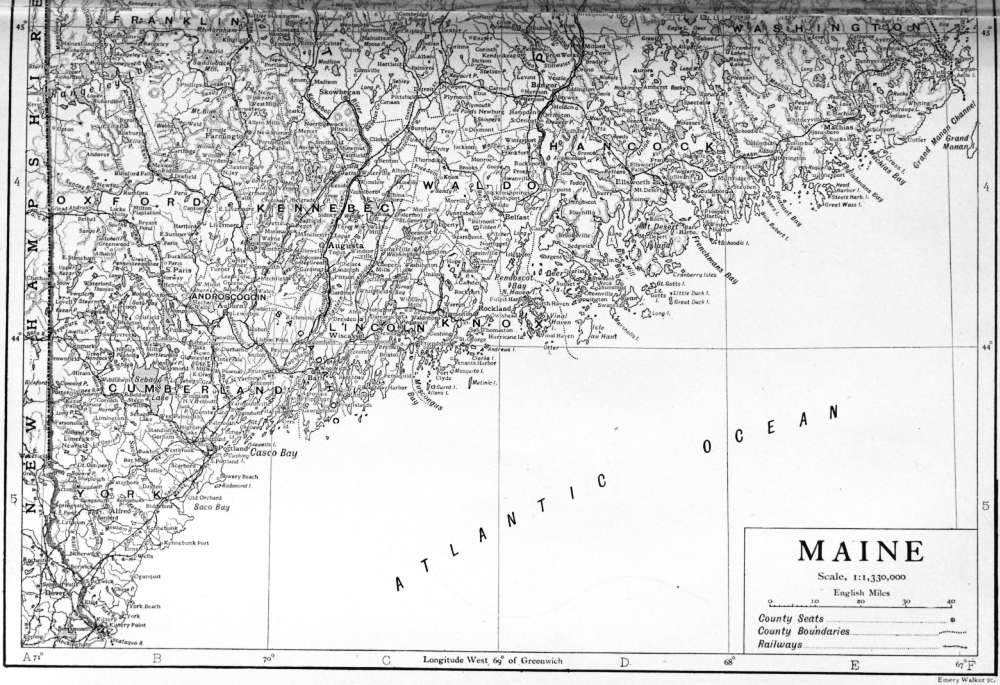
MAINE, a North Atlantic state of the United States of America, the most north-easterly state in the Union, and the largest of the New England group. It lies between 43° 4′ and 47° 27′ 33″ N., and between 66° 56′ 48″ and 71° 6′ 41″ W. It is bounded N.W. by the Canadian province of Quebec; N. and E. by the Canadian province of New Brunswick, from which it is separated in part by the natural barriers of the Saint John River, the Grand (or Schoodic) Lakes, the Saint Croix River, and Passamaquoddy Bay; S.S.E. by the Atlantic Ocean; and W. by New Hampshire, the Piscataqua and Salmon Falls rivers being the natural boundary lines at the S.W. The area of the state is 33,040 sq. m., 3145 sq. m. being water surface.
Maine attracts more summer visitors than any other state in the Union. This is due to the cool and refreshing summer climate; the picturesque coast and its many islands, which are favourite grounds for camps and summer cottages; the mountains, and the beautiful lakes and rivers, many of which afford opportunities for good fishing and canoeing. Among the more widely known resorts are Mount Desert Island, on which is Bar Harbor, a fashionable summer place of great beauty; Long Island, Orr’s and other islands in Casco Bay; Old Orchard, with a gently sloping white sand sea-beach 9 m. long, Rangeley and Moosehead Lakes, favourite resorts of fishermen and hunters; Mt Katahdin, in the heart of the moose country; and Poland Springs (38 m. by rail from Portland) in Androscoggin county, near lake Anasigunticook. About 1870, camps, summer cottages, summer hotels and boarding houses began to multiply throughout the state. The needs of this summer population gave a new impulse and a new turn to agriculture; and the demand for souvenirs revived among the Indians basket-weaving, moccasin-making, and such crafts.
Physical Features.—The surface is a gently rolling upland, forming a part of the “New England uplands,” above which rise isolated mountain peaks and clusters of peaks, and below which are cut numerous river valleys.1 The highest peak is Mt Katahdin (5200 ft.), a little N.E. of the centre of the state in Piscataquis county, which rises from a comparatively level upland. South-west of Katahdin, in Franklin county, are most of the other high peaks of the state: Saddleback Mountain (4000 ft.), Mt Abraham (3388 ft.), Mt Bigelow (3600 ft.), and Mt Blue (3200 ft.). A little N. of this line of mountain peaks is the water-parting which divides the state into a north slope and a south slope. The north slope descends gently both to the N. and to the E.; although quite hilly in the middle and western portions it is so poorly drained that swamps abound in all sections. The south slope which contains nearly all the mountains and is generally more hilly, has a mean descent toward the sea of about 7 ft. to the mile, the fall being greater in the W., where the mountains are high at the N. and the shore low at the S., and less to the E., where the water-parting is lower and the shore high and rocky.
After the uplift which caused the rivers to cut below the general “uplands,” and develop well marked valleys for themselves, came the period of the great continental glaciation. The glacier or ice sheet overran all Maine, irregularly scouring out the bed rock to produce rock basins, damming up many river valleys with glacial deposits and completely disarranging the drainage lines. When the ice melted, the rock basins and the dammed-up valleys filled with water to produce lakes. This is the origin of the numerous lakes of Maine, which give it some of its most beautiful scenery, and help to make it a holiday resort in summer. These lakes are about 1600 in number, are scattered in all parts of the state, are especially numerous at high elevations, and have an aggregate area of more than 2000 sq. m. Few other regions have so many large lakes so variously situated, and with such beauty of aspect and surroundings. They contribute largely to a constant supply of water power for which the course of the rivers of S.W. Maine are exceptionally well adapted, many of them abound in trout, salmon, togue, black bass and pickerel; and near them there is still much game. Moosehead Lake (about 120 sq. m.; 35 m. long and from 2 m. to 10 m. wide), on the boundary between Piscataquis and Somerset counties, is the largest in Maine and the largest inland body of water wholly in New England; the Kennebec River is its principal outlet and Mt Kineo rises abruptly to about 1760 ft. above the sea (about 700 ft. above the lake) on its eastern shore. Other lakes, such as the Rangeley Lakes,2 Chesuncook and Twin Lakes on the Penobscot, and the Grand or Schoodic Lakes, in the western boundary at the head waters of the Saint Croix River, equal or surpass Moosehead in picturesqueness. The glacier or ice sheet, above referred to, deposited till or boulder clay, which was compacted under the enormous pressure of the ice sheet to form the “hard-pan” referred to later. The glaciation is also responsible for the poor soil of most of the state, for, although the rocks are the same crystallines which give good soils further south in unglaciated regions, all the decayed portions of the Maine rocks have been removed by glacial erosion, revealing fresh, barren rock over great areas, or depositing the rather sterile hard-pan as a thin coating in other places.
After the uplift came a period of subsidence, during which this region sank one or more thousand feet, allowing the sea to encroach on the land and run far inland into the previously made river valleys. This depression probably occurred during the glacial period, perhaps toward its close, and is responsible for the second most important feature of Maine physiography, the embayed coast. To this subsidence are due the picturesque coastal scenery, the numerous islands and bays, the good harbours and the peculiar coast-line.
The shortest distance between the N.E. and the S.W. extremities of the coast is only 225 m.; but, on account of projections and indentations, the coast-line measures not less than 2500 m. The headlands, the deep indentations and the numerous islands in the bays and beyond produce a beautiful mingling of land and sea and give to the whole ocean front the appearance of a fringed and tasselled border; west of the mouth of the Kennebec River are a marshy shore and many low grassy islands; but east of this river the shore becomes more and more bold, rising in the precipitous cliffs and rounded summits of Mt Desert and Quoddy Head, 1527 and 1000 ft. high respectively. All along the coast-line there are capacious and well-protected harbours, Casco, Penobscot, Frenchman’s, Machias and Passamaquoddy bays being especially noteworthy.
After the subsidence came another period of uplift, possibly still in progress. This uplift has brought up submarine deposits of sand, &c., to form little coastal plains at some points along the coast, providing good land for settlement and clay for brick and pottery. Further evidence of this uplift is found in old beach lines now well above sea-level.
The principal river systems of Maine are the Saint John on the north slope, and the Penobscot, the Kennebec, the Androscoggin, and the Saco on the south slope. The mean height of the basin of the St John is exceeded only by that of the Androscoggin, but the fall of the St John River through the greater part of its course in Maine is only sufficient to give a sluggish or a gentle current. The Penobscot, Kennebec, Androscoggin and Saco have numerous falls and rapids.
Fauna.—The animal life of Maine shows a mixture of northern and southern forms, and very little that is peculiar as compared with surrounding regions. The state has moose, caribou and deer, especially in the northern part. The black bear, wolf, catamount, wolverine, wild cat, fox, beaver, racoon, marten, sable, woodchuck, skunk, otter, mink, rabbit and squirrel are also found. Geese, ducks and other water fowl frequent the lakes and bays in the migratory season, and eagles, gulls, hawks, kingfishers, owls, plover, woodcock, “partridge” (ruffed grouse), robins, orioles, bobolinks, blue birds, swallows, sparrows, and many other insectivorous birds are common. In the inland waters salmon, trout, togue (Salvelinus namaycush), pickerel and bass abound; along the shore there are lobsters, clams and scallops (Pecten irradians); and off the shore are herring, alewives, mackerel, cod, halibut, haddock, smelts, hake, menhaden, porgies and porpoises. The game in the North Woods attracts large numbers of sportsmen during the autumn season.
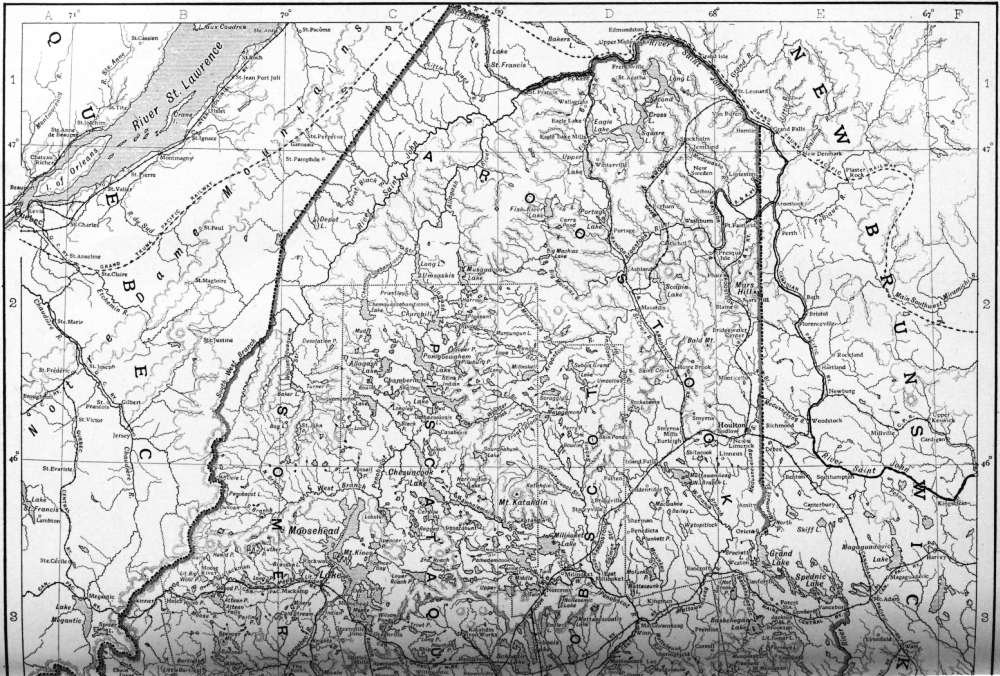
(Click to enlarge top section.)
(Click to enlarge bottom section.)
Flora.—Maine was formerly covered with forests, principally of white pine and spruce, but mixed with these were some hemlock, tamarack, cedar, and, on the south slope, birch, poplar, oak, maple and beech. Chestnut and walnut are rare and are found only near the south-west border. In 1900 about 21% of the state’s area was cleared, and much besides had once been cleared, but not being suited to agriculture had become reforested. Of fruit trees the chief is the apple. The plum, cherry and pear also thrive. The peach grows well only in the south-west near the border. Species of grape, gooseberry and currant are native, and others are cultivated with advantage. The blackberry, raspberry, blueberry and strawberry grow wild in profusion throughout the state.
Climate.—The climate of the state is moist and, for its latitude, cold. Extremes of temperature are not so great as farther inland in the same latitude; for the summer heats are tempered by the sea and the cool north winds, and the winter cold is so constant as to be less severely felt than the changing temperature of more southern districts. The summers are short, there being only about 4½ months between frosts even in the southern sections, and the mean summer temperature is about 62° F. The mean winter temperature is approximately 20° F., and the mean annual temperature for the entire state is 42° F., that for the north slope being about 5° F. less than that for the south slope. Although the temperature remains pretty steadily below the freezing point for at least three months of the year, many of the harbours remain unobstructed; for the tides and the prevailing off-shore winds break up and drive off the ice. The precipitation is about 42 in. annually, and is distributed very evenly throughout the year, 10-11 in. of rain or its equivalent in snow falling each season. During 4½ months about 44% of the precipitation is in the form of snow; but the snow-fall varies from about 60 in. on the coast to more than 100 in. on the north slope. The winds are variable; at no season of the year is it usual for them to blow from the same direction for many days in succession. But, with the exception of those from the west, they are maritime and consequently moisture-bearing. In summer, especially in the latter part of it, the cool and moist N. or N.E. winds often cause a considerable part of the state to be enveloped in fog for several days in succession.
Agriculture.—The soil is for the most part glacial drift, containing a large mixture of clay with sand or gravel, and the subsoil is mostly “hard-pan,” i.e. mingled clay and boulders which have been so much compressed by glacial action as to make the mixture hard and ledge-like. Except in the valley of the Aroostook and along the Kennebec, the Penobscot, and some other rivers, the soil is generally unfit for cultivation, there being too little alluvium mixed with it to make it fertile. In the Aroostook valley, however, is the largest undivided area of good arable land in all New England, the soil being a deep, porous, yellow loam well adapted to the growth of cereals and to market gardening. The most sterile regions are on the mountains and along the coast. Because of the cold climate, the large areas in which there is little or no good arable land, the growing demand for timber land, and the large and constant supply of water-power afforded by the principal rivers, agriculture in Maine, as in all the other New England states except Vermont, is a smaller industry than manufacturing; in 1900 there were 87,932 people engaged in manufacturing and only 76,932 engaged in agriculture. Only 32.9% of the state’s land area was in that year included in farms, only 37.9% of this farm land was improved, and only 16.3% of the improved land was in crops other than hay and forage. Nevertheless, as indicated by the unusually large proportion of farmers who either own their farms or pay cash rent for them, farming usually is profitable. The number of farms in 1900 was 59,299; of these 18,644 contained between 50 and 100 acres and 17,191 contained between 100 and 175 acres, the average size being 106.2 acres; 54,263 (or 91.5%) were operated by their owners, 775 were operated by part owners, 2030 by cash tenants, and only 745 by share tenants. Beginning with the middle of the 19th century, the increasing competition of the more productive soils of the West, the growth of urban population in the state, and the number of summer visitors effected the reforesting of much poor land and the more intensive cultivation of the better arable land. The cultivation of cereals, for example, has given way to a marked extent in nearly all the farming districts except in Aroostook county to market gardening, dairying, and egg and poultry production. The number of dairy cows increased from 157,240 in 1890 to 183,000 in 1908, and the annual production of milk increased from 57,969,791 gallons in 1890 to 99,586,188 gallons in 1900. The number of other neat cattle (180,878 in 1900; 151,000 in 1908) decreased during every decade from 1860 to 1900; the number of sheep in 1900 was 427,209 (31.9% less than in 1890), and in 1908 it was 267,000; but the number of horses in 1890 and 1900 was about the same (140,310 in 1960, but only 116,000 in 1908). Hay is still by far the largest crop, the acreage of it and of forage in 1899 being 1,270,254 acres, or 76.5% of that of all crops, and the yield was 1,133,932 tons; in 1907 the acreage was 1,400,000 acres, and the crop was 2,100,000 tons. The acreage of cereals decreased from 187,013 in 1880, when agriculture in Aroostook county was little developed, to 166,896 in 1899, when the cereal acreage in Aroostook county alone was 82,069. Maine potatoes are of a superior quality, and the acreage of this crop increased from 49,617 in 1889 to 118,000 in 1907. Sweet Indian corn, cabbages, turnips, cucumbers and tomatoes are grown in large quantities. The fruit crop consists very largely of apples and strawberries (1,421,773 bushels of apples and 1,066,860 quarts of strawberries in 1899). The output of eggs increased from 9,369,534 dozen in 1889 to 13,304,150 dozen in 1899. The most productive dairy section of the state is a belt extending from the south-west corner N.E. entirely across the state and embracing the whole or parts of the counties of York, Oxford, Cumberland, Androscoggin, Kennebec, Penobscot and Aroostook.
Lumber Industry.—Except in the remote parts, the valuable white pine, for which Maine was long noted, has been cut; but the woodland of the state was estimated in 1900 at 23,700 sq. m. or 79% of its area. The tendency is for this area to increase, for the establishment between 1890 and 1900 of large paper and pulp mills on some of the principal rivers of the south slope greatly increased the value of forests, especially those of spruce and poplar. The state makes large appropriations for preventing and extinguishing forest fires, and in 1903 established a department of forestry in the university of Maine. Good spruce, which is by far the most valuable timber in the state and is used most largely for the manufacture of paper and pulp, stands in large quantities in the St John, Penobscot, Androscoggin and Kennebec basins. Poplar, also used for the manufacture of paper, abounds in several sections of the south slope, but is most abundant in the basin of the Kennebec. White birch, used largely for the manufacture of spools, is found throughout a wide belt extending across the middle of the state. There is much cedar on the north slope. Oak, maple and beech are rather scarce. A new growth of white pine and other timber is gradually becoming valuable. The value of the timber product increased from $11,849,654 in 1890 to $13,489,401 in 1900, and to $17,937,683 in 1905.
Fisheries.—Fishing has always been an important industry in Maine. From 1901 to 1904 inclusive, the average annual catch amounted to 195,335,646 ℔, and its average value was $5,557,083. In 1908, according to state reports, the catch was 185,476,343 ℔, valued at $3,849,900. Herrings are caught in largest quantities (in 1908, according to state reports, 68,210,800 ℔, valued at $450,665), and Maine is noted for the canning of the smaller herrings under the name of “sardines.” In 1908, according to state reports, the take of lobsters was 17,635,980 ℔ valued at $1,558,252. Maine markets more clams than any other state in the Union, and the catches of cod, hake, haddock, smelt, mackerel, swordfish, shad, pollock, cusk, salmon, alewives, eels and halibut are of importance. The scallop fishery is becoming more and more valuable. For the protection and promotion of the lobster fishery the United States government has established a lobster hatchery at Boothbay Harbor; and the state legislature enacted a law in 1895 prohibiting the taking of lobsters less than 10-1/2 in. in length (one effect of this law being to drive the lobster-canning industry from the state) and another law in 1903 for the protection of lobsters with eggs attached. This latter law directs the state fish commissioner to purchase such lobsters whenever caught and either to liberate them or to sell them to the United States for keeping in a fish hatchery.
Minerals.—The principal mineral products are granite, limestone, slate, clay products and mineral waters. In 1905 Maine held first rank among the states of the Union as a producer of granite, the value of the output being $2,713,795. In 1907 Maine’s granite was valued at $2,146,420, that of Massachusetts at $2,328,777, and that of Vermont at $2,693,889. The stone is of superior quality, and the largest part of it is used for building purposes; much of it is used as paving blocks and some for monuments. It abounds all along the coast east of the Kennebec and on the adjacent islands, and is found farther inland, especially about the Rangeley lakes in Franklin and Oxford counties, and, near Mt Katahdin, in Penobscot and Piscataquis counties. The principal quarries, however, are situated in positions most convenient for shipment by water, in the vicinity of Penobscot bay and in Kennebec county, and these have supplied the bulk of the material used in the construction of many prominent buildings and monuments in the United States. The Fox Island granite comes from the quarries on Vinalhaven Island and the surrounding islands, and on Vinalhaven were quarried monolithic columns 51.5 to 54 ft. long and 6 ft. in diameter for the Cathedral of St John the Divine in New York City. Black granite was quarried in 1907 at 12 quarries, in York, Lincoln, Waldo, Penobscot and Washington counties. Limestone abounds, especially in the south-east part of the state, but it is quarried chiefly in Knox county. As its colour—blue and blue-black streaked with white—renders it undesirable for building purposes, nearly all of it is burned into lime, which has become a very important article of manufacture in the city of Rockland; the industry dates back to 1733 in Knox county. In 1907 the quantity of lime burned in Maine was 159,494 tons and its value was $747,947. Slate is quarried chiefly in Piscataquis county, most of it being used for roofing, but some for blackboards; in 1907 the amount quarried in Maine was valued at $236,106. About 1896 some remarkably white and pure feldspar began to be quarried in Androscoggin, Oxford and Sagadahoc counties, but afterwards the spar mined in Maine was of less excellent quality; in 1907 the production in Maine was valued at $157,334, the total for the entire country being $499,069. Clay is obtained in various places, and in 1905 the total value of the clay products was $619,294. In Oxford county tourmaline, spodumene (or kunzite) and beryl occur, the tourmaline crystals being notably large and beautiful. Mineral water occurs in many localities, particularly in Androscoggin, York, Cumberland and Oxford counties; the most famous springs are the Poland Springs in Androscoggin county. Most of the mineral waters bottled in the state are chalybeate and slightly alkaline—saline; their average temperature is about 43°. In 1908 27 springs were reported, their aggregate sales amounting to 1,182,322 gallons. Copper, gold alloyed with platinum, iron ore, barytes, graphite and lead occur in small quantities in the state. In 1908 the total mineral product of the state was valued at $7,044,678.
Manufactures.—Although Maine has no coal and only a very small amount of iron ore within her borders for the encouragement of manufacturing, yet the abundance of fine timber and the numerous coves, bays and navigable streams along or near the coast promoted ship-building from the first, and this was the leading industry of the state until about the middle of the 19th century, when wooden ships began to be supplanted by those of iron and steel. Until about the same time, when the Maine liquor law was passed, the manufacture of rum from molasses, received in exchange for lumber and fish in the West Indies, was also an important industry. It was not until early in the 19th century that the large and constant supply of water power afforded by the rivers began to be used to any considerable extent. The first cotton mill was built at Brunswick on the Androscoggin about 1809, and from 1830 the development of cotton manufacturing was rapid; woollen mills followed, and late in the 19th century were erected some of the largest paper and pulp mills in the country, which are run by water power from the rivers, and use the spruce and poplar timber in the river basins. The total value of the manufactures of the state increased from $95,689,500 in 1890 to $127,361,485 in 1900; and in 1905 the value of factory-made products alone was $144,020,197, or 27.5% greater than their value in 1900.3 Measured by the value of the output, paper and wood pulp rose from fifth among the state’s manufactures in 1890 to third in 1900 and to first in 1905; from $3,281,051 in 1890 to $13,223,275 in 1900, an increase of 303% within the decade, and to $22,951,124 in 1905, a further increase of 73.6% in this period. Lumber and timber products ranked second (1905)—$11,849,654 in 1890, $13,489,401 in 1900, and $17,937,683 in 1905. Cotton goods ranked third (1905) in value—$15,316,909 in 1890, $14,631,086 in 1900, and $15,404,823 in 1905. Woollen goods ranked fourth (1905)—$8,737,653 in 1890, $13,744,126 in 1900, an increase of 57.3% within the decade; and the value of the factory-made product alone in 1905 was $13,969,600, or 20.1% greater than in 1900. Boots and shoes ranked fifth (1905)—$12,295,847 in 1900, and $12,351,293 in 1905. Fish, canned and preserved, followed next, $1,660,881 in 1890 and $4,779,773 in 1900, an increase within the decade of 187.8%, most of which was in one branch—the canning of small herring under the name “sardines”; from 1900 to 1905 the increase was slight, only $275,358, or 5.8%. In the value of its manufactures as compared with those of the other states of the Union, in wooden ships and boats, Maine in 1900 and in 1905 was outranked by New York only; in canned and preserved fish by Washington only (the value of fish canned and preserved in Maine in 1900 was 21.7% of the total for the United States, and in 1905 19.2%); in the output of woollen mills by Massachusetts and Pennsylvania only; in the output of paper mills by New York and Massachusetts only. It ranked ninth in 1900 and tenth in 1905 in the value of its cotton goods. Portland, Lewiston, Biddeford, and Auburn are the leading manufacturing cities, and in 1905 the total value of their manufactures was 21.5% of those of the entire state. But from 1900 to 1905 the value of manufactures grew most rapidly in Rockland (especially noted for lime), the increase being from $1,243,881 to $1,822,591 (46.5%), and in Waterville, where the increase was from $2,283,536 to $3,069,309 (34.4%). Among the largest paper mills are those at Millinocket, in Penobscot county, at Madison on the Kennebec river, and at Rumford Falls on the Androscoggin river. Lewiston leads in the manufacture of cotton goods; Auburn, Bangor and Augusta, in the manufacture of boots and shoes; Bath, in ship and boat building; Eastport and Lubec, in canning “sardines.”
Transportation and Commerce.—The south-western part of the state, including the manufacturing, the quarrying, and much of the older agricultural district, early had fairly satisfactory means of transportation either by water or by rail; for the coast has many excellent harbours, the Kennebec river is navigable for coast vessels to Augusta, the Penobscot to Bangor, and railway service was soon supplied for the villages of the south-west, but it was not until the last decade of the 19th century that the forests, the farming lands, and the summer resorts of Aroostook county were reached by a railway, the Bangor & Aroostook. The first railway in the state, from Bangor to Old Town, was completed in 1836, and the state’s railway mileage increased from 12 m. in that year to 245 m. in 1850, to 1377.47 m. in 1890, and to 2210.79 in January 1909. The principal railway systems are the Maine Central, which enters every county but one, the Boston & Maine, the Bangor & Aroostook, the Grand Trunk and the Canadian Pacific. Lines of steamboats ply regularly between the largest cities of the state and Boston, between Portland and New York, and between Portland and several Canadian ports.
The foreign trade, especially that with the West Indies and with Great Britain, decreased after 1875, and yet much trade from the West that goes to Montreal during the warmer months passes through Portland during the winter season. The chief exports to foreign countries are textile fabrics, Indian corn, meat, dairy products, apples, paraffin, boards and shooks; the chief imports from foreign countries are sugar, molasses and wool. Fish, canned goods, potatoes, granite, lime, paper, and boots and shoes are also exported to foreign countries to some extent, but they are shipped in larger quantities to other states of the Union, from which Maine receives in return cotton, coal, iron, oil, &c. The ports of entry in Maine are Bangor, Bath, Belfast, Castine, Eastport, Ellsworth, Houlton, Kennebunk, Machias, Portland, Wiscasset and York.
Population.—The population in 1880 was 648,936; in 1890, 661,086; in 1900, 694,466; and in 1910, 742,371.4 From 1880 to 1900 there was an increase of only 7%, a percentage which was exceeded in every other state in the Union except Nevada and Vermont. Of the total population of 1900, 599,291, or 86.3%, were native whites, 93,330 were foreign-born, 1,319 were negroes, 798 were Indians, 119 were Chinese, and 4 were Japanese. Of the inhabitants born in the United States, 588,211, or 97.8%, were natives of New England and 560,506 were natives of Maine, and of the foreign-born 67,077, or 71.8%, were natives of Canada (36,169 English and 30,908 French), and 10,159, or 10.8%, were natives of Ireland. Of the total population, 199,734 were of foreign parentage—i.e. either one or both parents were foreign-born—and 89,857 were of Canadian parentage, both on the father’s and on the mother’s side (41,355 English and 48,502 French). The French-speaking inhabitants probably number considerably more than 50,000. They are of two quite distinct classes. One, numbering about 15,000, includes those who became citizens by the establishment of the northern boundary in 1842 and their descendants. They are largely of Acadian stock. The state has established among them a well-appointed training school for teachers, conducted in the English language, the graduates of which render excellent service in the common schools. The other class is of French-Canadian immigrants, who find profitable employment in the manufacturing centres. The colony of Swedes established by the state near its north-eastern border in 1870 has proved in every way successful. The Indians are remnants of the Penobscot and Passamaquoddy tribes, the Passamaquoddies being a little the more numerous. The Penobscots’ chief gathering places are on the islands of the Penobscot river north of Old Town; the Passamaquoddies’, on the shores of Passamaquoddy Bay and the banks of the Saint Croix river.
Roman Catholics are more numerous than all the Protestant sects taken together, having in 1906 a membership of 113,419 out of a total of 212,988 in all denominations. In the last decade of the 19th century the urban population (i.e. population of places having 4,000 inhabitants or more) increased from 226,268 to 251,685, or 11.2%; the semi-urban population (i.e. population of incorporated places, or the approximate equivalent, having less than 4,000 inhabitants) increased from 14,221 to 26,674, or 87.5%; while the rural population (i.e. population outside of incorporated places) decreased from 420,597 to 416,134, or 1%. The principal cities of the state are: Portland, pop. (1910), 58,571; Lewiston, 26,247; Bangor, 24,803; Biddeford, 17,079; Auburn, 15,064; Augusta (the capital), 13,211; Waterville, 11,458; Bath, 9,396; Westbrook, 8,281; and Rockland, 8,174.
Administration.—Maine has had but one state constitution; this was ratified in December 1819, about three months before the admission of the state into the Union. It admits of amendment by a two-thirds vote of both houses of the legislature followed by a majority vote of the electorate at the next September election; or, as provided by an amendment adopted in 1875, the legislature may by a two-thirds vote of each house summon a constitutional convention. From 1819 to 1875 twelve amendments were adopted; in 1875, after nine more were added, the twenty-one were incorporated in the text; and between 1875 and 1899 nine more were adopted. Suffrage is conferred by the constitution on all male citizens of the United States who are at least twenty-one years of age and have, for some other reason than because of being in the military, naval or marine service of the United States, or of being students at college, lived in the state for three months next preceding any election; the following classes, however, are excepted: paupers, persons under guardianship, Indians not taxed, and, as provided by an amendment adopted in 1892, persons intellectually incapable of reading the state constitution in the English language or of writing their names. State elections were annual until 1897 when they were made biennial; they are held on the second Monday in September in even numbered years, Maine being one of the few states in the Union in which they are not held in November.
The governor is the only executive officer of the state elected by popular vote. There is no lieutenant-governor, the president of the Senate succeeding to the office of governor in case of a vacancy, but there is a council of seven members elected by the legislature (not more than one from any one senatorial district), whose sole function is to advise the governor. The governor’s term of office is two years (before 1879 it was one year); and the constitution further directs that he shall be at least thirty years of age at the beginning of his term, that he shall be a native-born citizen of the United States, that when elected he shall have been a resident of the state for five years, and that he shall reside in the state while in office. His power of appointment is unusually extensive and the advice and consent of the council (instead of that of the Senate as in other states) are required for his appointments. He appoints all judges, coroners and notaries public, besides all other civil and military officers for whose appointment neither the constitution nor the laws provide otherwise. The governor is commander-in-chief of the state militia. Any bill of which he disapproves he can within five days after its passage prevent from becoming a law unless it is passed over his veto by a two-thirds vote of each house of the legislature. He and the council examine and pass upon election returns; he may summon extra sessions of the legislature, and he may grant pardons, reprieves, and commutations in all cases except impeachment, but the manner of hearing applications for pardon is in a measure prescribed by statute, and he must present to the legislature an account of each case in which he grants a pardon. His salary is $2,000 a year. The seven members of the council, the secretary of state, the treasurer, the attorney general and the commissioner of agriculture are elected biennially by a joint ballot of the two houses of the legislature, which also elects, one every two years, the three state assessors, whose term is six years.