VOLUME XVII SLICE IV Magnetite to Malt (continued 8)
Reading edition
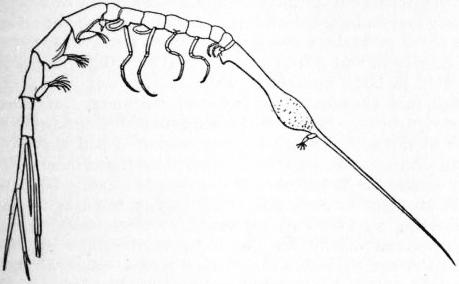
Fig. 4.—Rhabdosoma piratum, Stebbing.
6. Isopoda.—This vast and populous order can be traced far back in geological time. It is now represented in all seas and lands, in fresh-water lakes and streams, and even in warm springs. It adapts itself to parasitic life not only in fishes, but in its own class Crustacea, and that in species of every order, its own included. In this process changes of structure are apt to occur, and sometimes unimaginable sacrifices of the normal appearance. The order has been divided into seven tribes, of which a fuller summary than can here be given will be found in Stebbing, History of Crustacea (1893). The first tribe, called Chelifera, from the usually chelate or claw-bearing first limbs, may be regarded as Isopoda anomala, of which some authors would form a separate order, Tanaidea. Like the genuine isopods, they have seven pairs of trunk-legs, but instead of having seven segments of the middle body (or peraeon) normally free, they have the first one or two of its segments coalesced with the head. Instead of the breathing organs being furnished by the appendages of the pleon with the heart in their vicinity, the respiration is controlled by the maxillipeds, with the heart in the peraeon (see Delage, Arch. Zool. expér. et gén., vol. ix., 1881). There are two families, Tanaidae and Apseudidae. Occasionally the ocular lobes are articulated.
The genuine Isopoda are divided among the Flabellifera, in which the terminal segment and uropods form a flabellum or swimming fan; the Epicaridea, parasitic on Crustaceans; the Valvifera, in which the uropods fold valve-like over the branchial pleopods; the Asellota, in which the first pair of pleopods of the female are usually transformed into a single opercular plate; the Phreatoicidea, a fresh-water tribe, known as yet only from subterranean waters in New Zealand and an Australian swamp nearly 6000 ft. above sea-level; and lastly, the Oniscidea, which are terrestrial. Only the last of these, under the contemptuous designation of wood-lice, has established a feeble claim to popular recognition. Few persons hear without surprise that England itself possesses more than a score of species in this air-breathing tribe. Those known from the world at large number hundreds of species, distributed among dozens of genera in six families. That a wood-louse and a land-crab are alike Malacostracans, and that they have by different paths alike become adapted to terrestrial life, are facts which even a philosopher might condescend to notice. Of the other tribes which are aquatic there is not space to give even the barest outline. Their swarming multitudes are of enormous importance in the economy of the sea. If in their relation to fish it must be admitted that many of them plague the living and devour the dead, in return the fish feed rapaciously upon them. Among the most curious of recent discoveries is that relating to some of the parasitic Cymothoidae, as to which Bullar has shown that the same individual can be developed first as a male and then as a female. Of lately discovered species the most striking is one of the deep-sea Cirolanidae, Bathynomus giganteus, A. M. Edwards (1879), which is unique in having supplementary ramified branchiae developed at the bases of the pleopods. Its eyes are said to contain nearly 4000 facets. The animal attains what in this order is the monstrous size of 9 in. by 4. A general uniformity of the trunk-limbs in Isopoda justifies the ordinal name, but the valviferous Astacillidae, and among the Asellota the Munnopsidae, offer some remarkable exceptions to this characteristic. Among many essential works on this group may be named the Monogr. Cymothoarum of Schiödte and Meinert (1879-1883); “Challenger” Report, Beddard (1884-1886); Cirolanidae, H. J. Hansen (1890); Isopoda Terrestria, Budde-Lund (1885); Bopyridae, Bonnier (1900); Crustacea of Norway, vol. ii. (Isopoda), Sars (1896-1899), while their multitude precludes specification of important contributions by Benedict, Bovallius, Chilton, Dohrn, Dollfus, Fraisse, Giard and Bonnier, Harger, Haswell, Kossmann, Miers, M’Murrich, Norman, Harriet Richardson, Ohlin, Studer, G. M. Thomson, A. O. Walker, Max Weber and many others.
7. Amphipoda.—As in the genuine Isopoda, the eyes of Amphipoda are always sessile, and generally paired, and, in contrast to crabs and lobsters, these two groups have only four pairs of mouth-organs instead of six, but seven pairs of trunk-legs instead of five. From the above-named isopods the present order is strongly differentiated by having heart and breathing organs not in the pleon, but in the peraeon, or middle body, the more or less simple branchial vesicles being attached to some or all of the last six pairs of trunk-legs. Normally the pleon carries six pairs of two-branched appendages, of which the first three are much articulated flexible swimming feet, the last three few-jointed comparatively indurated uropods. There are three tribes, Gammaridea, Caprellidea, Hyperiidea. The middle one contains but two families, the cylindrical and often thread-like skeleton shrimps, Caprellidae, and their near cousins, the broad, flattened, so-called whale-lice, Cyamidae. This tribe has the pleon dwindled into insignificance, whereas in the other two tribes it is powerfully developed. The Hyperiidea are distinguished by having their maxillipeds never more than three-jointed. In the companion tribes these appendages have normally seven joints, and always more than three. The order thus sharply divided is united by an intimate interlacing of characters, and forms a compact whole at present defying intrusion from any other crustacean group. Since 1775, when J. C. Fabricius instituted the genus Gammarus for five species, of which only three were amphipods, while he left five other amphipods in the genus Oniscus, from this total of eight science has developed the order, at first very slowly, but of late by great leaps and bounds, so that now the Gammaridea alone comprise more than 1300 species, distributed among some 300 genera and 39 families. They burrow in the sands of every shore; they throng the weeds between tide-marks; they ascend all streams; they are found in deep wells, in caverns, in lakes; in Arctic waters they swarm in numbers beyond computation; they find lodgings on crabs, on turtles, on weed-grown buoys; they descend into depths of the ocean down to hundreds or thousands of fathoms; they are found in mountain streams as far above sea-level as some of their congeners live below it. The Talitridae, better known as sandhoppers, can forgo the briny shore and content themselves with the damp foliage of inland forests or casual humidity in the crater of an extinct volcano. Over the ocean surface, as well as at various depths, float and swim innumerable Hyperiidea—the wonderful Phronima, glass-like in its glassy barrel hollowed out of some Tunicate; the Cystisoma, 4 or 5 in. long, with its eye-covered head; the Rhabdosoma, like a thin rod of glass, with needle-like head and tail, large eyes, but limbs and mouth-organs all in miniature, and the second antennae of the male folding up like a carpenter’s rule (fig. 4). On jelly-fishes are to be found species of Hyperia and their kindred, so fat and wholesome that they have been commended to shipwrecked men in open boats as an easily procurable resource against starvation. Many of the Amphipoda are extremely voracious. Some of them are even cannibals. The Cyamidæ afflict the giant whale by nibbling away its skin; the Chelura terebrans is destructive to submerged timber. But, on the other hand, they largely help to clear the sea and other waters of refuse and carrion, and for fishes, seals and whales they are food desirable and often astoundingly copious. From the little flea-like species, scarcely a tenth of an inch long, up to the great and rare but cosmopolitan Eurythenes gryllus, Lichtenstein, and the still larger Alicella gigantea, Chevreux, nearly half a foot long, captured by the prince of Monaco from a depth of 2936 fathoms, not one of these ubiquitous, uncountable hordes has ever been accused of assailing man. For the naturalist they have the recommendation that many are easy to obtain, that most, apart from the very minute, are easy to handle, and that all, except as to the fleeting colours, are easy to preserve.
A nearly complete bibliography of the order down to 1888 will be found in the “Challenger” Reports, vol. xxviii., and supplementary notices in Della Valle’s Monograph of the Gammarini (1893), the scope of his work, however, not covering the Hyperiidea and Oxycephalidae of Bovallius (1889, 1890); but since these dates very numerous additions to the literature have been made by Birula, Bonnier, Norman, Walker and others, especially the Crustacea of Norway, vol. i. (Amphipoda), Sars (1890-1895), demanding attention, and the quite recent Amphipoda of the Hirondelle, Chevreux (1900), and Hyperiidea of the Plankton-Expedition, Vosseler (1901).
(T. R. R. S.)
1 In Huxley’s terminology the first two or three joints of the stem constitute a “protopodite,” from which spring the “endopodite” and “exopodite.”

MALAGA, a maritime province of southern Spain, one of the eight modern subdivisions of Andalusia; bounded on the W. by Cadiz, N. by Seville and Cordova, E. by Granada, and S. by the Mediterranean Sea. Pop. (1900), 511,989; area, 2812 sq. m. The northern half of Malaga belongs to the great Andalusian plain watered by the Guadalquivir, the southern is mountainous, and rises steeply from the coast. Of the numerous sierras may be mentioned that of Alhama, separating the province from Granada, and at one point rising above 7000 ft.; its westward continuation in the Sierra de Abdalajis and the Axarquia between Antequera and Malaga; and not far from the Cadiz boundary the Sierras de Ronda, de Mijas, de Tolox and Bermeja, converging and culminating in a summit of nearly 6500 ft. The rivers which rise in the watershed formed by all these ranges reach the sea after a short and precipitous descent, and in rainy seasons are very liable to overflow their banks. In 1907 great loss of life and destruction of property were caused in this manner. The principal river is the Guadalhorce, which rises in the Sierra de Alhama, and, after a westerly course past the vicinity of Antequera, bends southward through the wild defile of Peñarrubia and the beautiful vega or vale of Malaga, falling into the sea near that city. The only other considerable stream is the Guadiaro, which has the greater part of its course within the province and flows past Ronda. There is an extensive salt lagoon near the northern boundary. The mountains are rich in minerals, lead, and (in the neighbourhood of Marbella) iron, being obtained in large quantities. There are warm sulphurous springs and baths at Carratraca. Though the methods of agriculture are for the most part rude, the yield of wheat in good seasons is considerably in excess of the local demand; and large quantities of grapes and raisins, oranges and lemons, figs and almonds, are annually exported. The oil and wines of Malaga are also highly esteemed, and after 1870 the manufacture of beet and cane sugar developed into an important industry. In 1905 there were about 500 flour mills and 230 oil factories beside 95 stills and 100 wine-presses in the province. Malaga has suffered severely from the agricultural depression prevalent throughout southern Spain, but its manufacturing industries tend to expand. The fisheries are important; a fleet of about 300 boats brings in 18,000,000 ℔ annually, of which 25% is exported. The internal communications are in many parts defective, owing to the broken nature of the surface; but the province is traversed from north to south by the Cordova-Malaga railway, which sends off branches from Bobadilla to Granada and Algeciras. A branch line along the coast from Malaga to Vélez Malaga was opened in 1908.
Malaga, the capital (pop. 130,109), Antequera (31,609), Vélez Malaga (23,586), Ronda (20,995), Coín (12,326), and Alora (10,325), are described in separate articles. Other towns with more than 7000 inhabitants are Marbella (9629), Estepona (9310), Archidona (8880) and Nerja (7112). The population of the province tends gradually to decrease, as many families emigrate to South America, Algeria and Hawaii.
MALAGA, the capital of the province of Malaga, an episcopal see, and, next to Barcelona, the most important seaport of Spain, finely situated on the Mediterranean coast, at the southern base of the Axarquia hills and at the eastern extremity of the fertile vega (plain) of Malaga in 36° 43′ N. and 4° 25′ W. Pop. (1900), 130,109. From the clearness of its sky, and the beautiful sweep of its bay, Malaga has sometimes been compared with Naples. The climate is one of the mildest and most equable in Europe, the mean annual temperature being 66.7° Fahr. The principal railway inland gives access through Bobadilla to all parts of Spain, and a branch line along the coast to Vélez-Malaga was opened in 1908. Malaga lies principally on the left bank of a mountain torrent, the Guadalmedina (“river of the city”); the streets near the sea are spacious and comparatively modern, but those in the older part of the town, where the buildings are huddled around the ancient citadel, are narrow, winding and often dilapidated. Well-built suburbs have also spread on all sides into the rich and pleasant country which surrounds Malaga, and several acres of land reclaimed from the sea have been converted into a public park. There are various squares or plazas and public promenades; of the former the most important are the Plaza de Riego (containing the monument to General José Maria Torrijos, who, with forty-eight others, was executed in Malaga on the 11th of December 1831, for promoting an insurrection in favour of the constitution) and the Plaza de la Constitucion; adjoining the quays is the fine Paseo de la Alameda. The city has no public buildings of commanding architectural or historical importance. The cathedral, on the site of an ancient mosque, was begun about 1528; after its construction had been twice interrupted, it was completed to its present state in the 18th century, and is in consequence an obtrusive record of the degeneration of Spanish architecture. The woodwork of the choir, however, is worthy of attention. The church of El Cristo de la Victoria contains some relics of the siege of 1487. There are an English church and an English cemetery, which dates from 1830; up to that year all Protestants who died in Malaga were buried on the foreshore, where their bodies were frequently exposed by the action of wind and sea. Of the old Moorish arsenal only a single horseshoe gateway remains, the rest of the site being chiefly occupied by an iron structure used as a market; the Alcazába, or citadel, has almost disappeared. The castle of Gibralfaro, on a bold eminence to the north-east dates from the 13th century, and is still in fairly good preservation.
During the 19th century so much silt accumulated in the harbour that vessels were obliged to lie in the roads outside, and receive and discharge cargo by means of lighters; but new harbour works were undertaken in 1880, and large ships can now again load or discharge at the quays, which are connected with the main railway system by a branch line. About 2150 ships of 1,750,000 tons enter at Malaga every year. Iron, lead, wine, olive oil, almonds, fresh and dried fruit, palmetto hats and canary seed are exported in large quantities, while the imports include grain, codfish, fuel, chemicals, iron and steel, machinery, manures and staves for casks. Although trade was impeded during the early years of the 20th century by a succession of bad harvests and by the disastrous floods of September 1907, the number of industries carried on in and near Malaga tends steadily to increase. There are large cotton mills, iron foundries, smelting works and engineering works. Pottery, mosaic, artificial stone and tiles are produced chiefly for the home market, though smaller quantities are sent abroad. There is a chromo-lithographic establishment, and the other industries include tanning, distilling and the manufacture of sugar, chocolate, soap, candles, artificial ice, chemical products, white lead and pianos. Foreign capital has played a prominent part in the development of Malaga; a French syndicate owns the gas-works, and the electric lighting of the streets is controlled by British and German companies.
Malaga is the Μάλακα of Strabo (iii. 156) and Ptolemy (ii. 4, 7) and the Malaca foederatorum of Pliny (iii. 3). The place seems to have been of some importance even during the Carthaginian period; under the Romans it became a municipium, and under the Visigoths an episcopal see. In 711 it passed into the possession of the Moors, and soon came to be regarded as one of the most important cities of Andalusia. It was attached to the caliphate of Cordova, but on the fall of the Omayyad dynasty it became for a short time the capital of an independent kingdom; afterwards it was dependent on Granada. In 1487 it was taken and treated with great harshness by Ferdinand and Isabella after a protracted siege. In 1810 it was sacked by the French under General Sebastiani. The citizens of Malaga are noted for their opposition to the Madrid government; they took a prominent part in the movements against Espartero (1843), against Queen Isabella (1868) and in favour of a republic (1873).
MALAKAND PASS, a mountain pass in the North-West Province of India, connecting the British district of Peshawar with the Swat Valley. It is now a military post and the headquarters of a political agency. It came into prominence for the first time in 1895 during the Chitral campaign, when 7000 Pathans held it against Sir Robert Low’s advance, but were easily routed. After the campaign was over a fortified camp was formed on the Malakand to guard the road to Chitral. During the frontier risings of 1897 the Swatis made a determined attack on the Malakand, where 700 were killed, and on the adjacent post of Chakdara, where 2000 were killed. This was the origin of the Malakand Expedition of the same year. (See Swat.)
MALALAS (or Malelas) (Syriac for “orator”), JOHN (c. 491-578), Byzantine chronicler, was born at Antioch. He wrote a Χρονογραφία in 18 books, the beginning and the end of which are lost. In its present state it begins with the mythical history of Egypt and ends with the expedition to Africa under Marcianus, the nephew of Justinian. Except for the history of Justinian and his immediate predecessors, it possesses little historical value; it is written without any idea of proportion and contains astonishing blunders. The writer is a supporter of Church and State, an upholder of monarchical principles. The work is rather a chronicle written round Antioch, which he regarded as the centre of the world, and (in the later books) round Constantinople. It is, however, important as the first specimen of a chronicle written not for the learned but for the instruction of the monks and the common people, in the language of the vulgar, with an admixture of Latin and Oriental words. It obtained great popularity, and was conscientiously exploited by various writers until the 11th century, being translated even into the Slavonic languages. It is preserved in an abridged form in a single MS. now at Oxford.
For the authorities consulted by Malalas, the influence of his work on Slavonic and Oriental literature, the state of the text, the original form and extent of the work, the date of its composition, the relation of the concluding part to the whole, and the literature of the subject, see C. Krumbacher’s Geschichte der byzantinischen Litteratur (1897). See also the editio princeps, by E. Chilmead (Oxford, 1691), containing an essay by Humphrey Hody and Bentley’s well-known letter to Mill; other editions in the Bonn Corpus scriptorum hist. byz., by L. Dindorf (1831), and in J. P. Migne Patrologia graeca, xcvii.
MALAN, SOLOMON CAESAR (1812-1894), British divine and orientalist, was by birth a Swiss descended from an exiled French family, and was born at Geneva on the 22nd of April 1812, where his father, Dr Henry Abraham Caesar Malan (1787-1864) enjoyed a great reputation as a Protestant divine. From his earliest youth he manifested a remarkable faculty for the study of languages, and when he came to Scotland as tutor in the marquis of Tweeddale’s family at the age of 18 he had already made progress in Sanskrit, Arabic and Hebrew. In 1833 he matriculated at St Edmund Hall, Oxford; and English being almost an unknown tongue to him, he petitioned the examiners to allow him to do his paper work of the examination in French, German, Spanish, Italian, Latin or Greek, rather than in English. But his request was not granted. After gaining the Boden and the Pusey and Ellerton scholarships, he graduated 2nd class in Lit. hum. in 1837. He then proceeded to India as classical lecturer at Bishop’s College, Calcutta, to which post he added the duties of secretary to the Bengal branch of the Royal Asiatic Society; and although compelled by illness to return in 1840, laid the foundation of a knowledge of Tibetan and Chinese. After serving various curacies, he was presented in 1845 to the living of Broadwindsor, Dorset, which he held until 1886. During this entire period he continued to augment his linguistic knowledge, which he carried so far as to be able to preach in that most difficult language, Georgian, on a visit which he paid to Nineveh in 1872. His translations from the Armenian, Georgian and Coptic were numerous. He applied his Chinese learning to the determination of important points connected with Chinese religion, and published a vast number of parallel passages illustrative of the Book of Proverbs. In 1880 the university of Edinburgh conferred upon him the honorary degree of D.D. No modern scholar, perhaps, has so nearly approached the linguistic omniscience of Mezzofanti; but, like Mezzofanti, Dr Malan was more of a linguist than a critic. He made himself conspicuous by the vehemence of his opposition to Westcott and Hort’s text of the New Testament, and to the transliteration of Oriental languages, on neither of which points did he in general obtain the suffrages of scholars. His extensive and valuable library, some special collections excepted, was presented by him in his lifetime to the Indian Institute at Oxford. He died at Bournemouth on the 25th of November 1894. His life has been written by his son.
MÄLAR, a lake of Sweden, extending 73 m. westward from Stockholm, which lies at its junction with the Saltsjö, an arm of the Baltic Sea. The height of the lake is normally only from 11 in. to 2 ft. above sea-level, and its outflow is sometimes reversed. The area is 449 sq. m. The bottom consists of a series of basins separate by ridges from which rise numerous islands. The deepest sounding is 210 ft. The outline is very irregular, the mean breadth being about 15 m., but an arm extends northward for 30 m. nearly to the city of Upsala with many ramifications. The area of the drainage basin is 8789 sq. m., of which 1124 are occupied by lakes. The navigable connexions with the lake are—(1) with lake Hjelmar to the south-west by the Arboga river and the Hjelmar canal; and by the Eskilstuna river and the Thorshälla canal; (2) with the Baltic southward through the Södertelge canal, the route followed by the Göta canal steamers; (3) with the Baltic by two channels at Stockholm. The more important towns, besides Stockholm, are Vesterås on the north, Södertelge and Eskilstuna near the south shore. The lake offers a field for recreation fully appreciated by the inhabitants of the capital, and many of those whose business lies at Stockholm have their residences on the shores of Mälar. On Drottningholm (Queen’s Island, named from Catherine, wife of John III.) is a palace with a fine park and formal gardens. John III. built a palace at the close of the 16th century, but the existing building, by Nicodemus Tessin and his son Nicodemus, dates from the second half of the 17th century. At Mariefred on the south shore there is the castle of Gripsholm (1537), built by Gustavus Vasa, a picturesque erection with four towers, richly adorned within, and containing a large collection of portraits. Strengnäs, on the same shore, became an episcopal see in 1291, when the fine cathedral, much altered since, was consecrated. In the episcopal palace, a building of the 15th century now used as a school, Gustavus Vasa was elected to the throne of Sweden in 1523. On the northward arm of the lake is the palace of Rosenberg, used as a school of gunnery, in a well-wooded park. On a branch of the same arm is Sigtuna, a village whose ruined churches are a memorial of its rank among the principal towns of Sweden after its foundation in the 11th century. Remains prove that on Björkö, an island in the eastern part of the lake, there was a large settlement of earlier importance than Sigtuna. Here a cross commemorates the preaching of Christianity by St Ansgar in 829. Finally, on the northern arm about 10 m. south of Upsala, there is the château of Skokloster, occupying the site of a monastery, and presented by Gustavus Adolphus to Marshal Herman Wrangel, whose son Charles Gustavus Wrangel stored it with a remarkable collection of trophies from Germany, taken during the Thirty Years’ War; including a library, an armoury, and a great accumulation of curios.
MALARIA, an Italian colloquial word (from mala, bad, and aria, air), introduced into English medical literature by Macculloch (1827) as a substitute for the more restricted terms “marsh miasm” or “paludal poison.” It is generally applied to the definite unhealthy condition of body known by a variety of names, such as ague, intermittent (and remittent) fever, marsh fever, jungle fever, hill fever, “fever of the country” and “fever and ague.” A single paroxysm of simple ague may come upon the patient in the midst of good health or it may be preceded by some malaise. The ague-fit begins with chills proceeding as if from the lower part of the back, and gradually extending until the coldness overtakes the whole body. Tremors of the muscles more or less violent accompany the cold sensations, beginning with the muscles of the lower jaw (chattering of the teeth), and extending to the extremities and trunk. The expression has meanwhile changed: the face is pale or livid; there are dark rings under the eyes; the features are pinched and sharp, and the whole skin shrunken; the fingers are dead white, the nails blue.
All those symptoms are referable to spasmodic constriction of the small surface arteries, the pulse at the wrist being itself small, hard and quick. In the interior organs there are indications of a compensating accumulation of blood, such as swelling of the spleen, engorgement (very rarely rupture) of the heart, with a feeling of oppression in the chest, and a copious flow of clear and watery urine from the congested kidneys. The body temperature will have risen suddenly from the normal to 103° or higher. This first or cold stage of the paroxysm varies much in length; in temperate climates it lasts from one to two hours, while in tropical and subtropical countries it may be shortened. It is followed by the stage of dry heat, which will be prolonged in proportion as the previous stage is curtailed. The feeling of heat is at first an internal one, but it spreads outwards to the surface and to the extremities; the skin becomes warm and red, but remains dry; the pulse becomes softer and more full, but still quick; and the throbbings occur in exposed arteries, such as the temporal. The spleen continues to enlarge; the urine is now scanty and high-coloured; the body temperature is high, but the highest temperatures occur during the chill; there is considerable thirst; and there is the usual intellectual unfitness, and it may be confusion, of the feverish state. This period of dry heat, having lasted three or four hours or longer, comes to an end in perspiration, at first a mere moistness of the skin, passing into sweating that may be profuse and even drenching. Sleep may overtake the patient in the midst of the sweating stage, and he awakes, not without some feeling of what he has passed through, but on the whole well, with the temperature fallen almost or altogether to the normal, or it may be even below the normal; the pulse moderate and full; the spleen again of its ordinary size; the urine that is passed after the paroxysm deposits a thick brick-red sediment of urates. The three stages together will probably have lasted six to twelve hours. The paroxysm is followed by a definite interval in which there is not only no fever, but even a fair degree of bodily comfort and fitness; this is the intermission of the fever. Another paroxysm begins at or near the same hour next day (quotidian ague), which results from a double tertian infection, or the interval may be forty-eight hours (tertian ague), or seventy-two hours (quartan ague). It is the general rule, with frequent exceptions, that the quotidian paroxysm comes on in the morning, the tertian about noon, and the quartan in the afternoon. Another rule is that the quartan has the longest cold stage, while its paroxysm is shortest as a whole; the quotidian has the shortest cold stage and a long hot stage, while its paroxysm is longest as a whole. The point common to the various forms of ague is that the paroxysm ceases about midnight or early morning. Quotidian intermittent is on the whole more common than tertian in hot countries; elsewhere the tertian is the usual type, and quartan is only occasional.
If the first paroxysm should not cease within the twenty-four hours, the fever is not reckoned as an intermittent, but as a remittent.
Remittent is a not unusual form of the malarial process in tropical and subtropical countries, and in some localities or in some seasons it is more common than intermittent. It may be said to arise out of that type of intermittent in which the cold stage is shortened while the hot stage tends to be prolonged. A certain abatement or remission of the fever takes place, with or without sweating, but there is no true intermission or interval of absolute apyrexia. The periodicity shows itself in the form of an exacerbation of the still continuing fever, and that exacerbation may take place twenty-four hours after the first onset, or the interval may be only half that period, or it may be double. A fever that is to be remittent will usually declare itself from the outset: it begins with chills, but without the shivering and shaking fit of the intermittent; the hot stage soon follows, presenting the same characters as the prolonged hot stage of the quotidian, with the frequent addition of bilious symptoms, and it may be even of jaundice and of tenderness over the stomach and liver. Towards morning the fever abates; the pulse falls in frequency, but does not come down to the normal; headache and aching in the loins and limbs become less, but do not cease altogether; the body temperature falls, but does not touch the level of apyrexia. The remission or abatement lasts generally throughout the morning; and about noon there is an exacerbation, seldom ushered in by chills, which continues till the early morning following, when it remits or abates as before. A patient with remittent may get well in a week under treatment, but the fever may go on for several weeks; the return to health is often announced by the fever assuming the intermittent type, or, in other words, by the remissions touching the level of absolute apyrexia. Remittent fevers (as well as intermittents) vary considerably in intensity; some cases are intense from the outset, or pernicious, with aggravation of all the symptoms—leading to stupor, delirium, collapse, intense jaundice, blood in the stools, blood and albumen in the urine, and, it may be, suppression of urine followed by convulsions. The severe forms of intermittent are most apt to occur in the very young, or in the aged, or in debilitated persons generally. Milder cases of malarial fever are apt to become dangerous from the complications of dysentery, bronchitis or pneumonia. Severe remittents (pernicious or bilious remittents) approximate to the type of yellow fever (q.v.), which is conventionally limited to epidemic outbreaks in western longitudes and on the west coast of Africa.
Of the mortality due to malarial disease a small part only is referable to the direct attack of intermittent, and chiefly to the fever in its pernicious form. Remittent fever is much more fatal in its direct attack. But probably the greater part of the enormous total of deaths set down to malaria is due to the malarial cachexia. The dwellers in a malarious region like the Terai (at the foot of the Himalayas) are miserable, listless and ugly, with large heads and particularly prominent ears, flat noses, tumid bellies, slender limbs and sallow complexions; the children are impregnated with malaria from their birth, and their growth is attended with aberrations from the normal which practically amount to the disease of rickets. The malarial cachexia that follows definite attacks of ague consists in a state of ill-defined suffering, associated with a sallow skin, enlarged spleen and liver, and sometimes with dropsy.
Causation.—From the time of Hippocrates onwards the malarial or periodical fevers have engaged the attention of innumerable observers, who have suggested various theories of causation, and have sometimes anticipated—vaguely, indeed, but with surprising accuracy—the results of modern research; but the true nature of the disease remained in doubt until the closing years of the 19th century. It has now been demonstrated by a series of accurate investigations, contributed by many workers, that malaria is caused by a microscopic parasite in the blood, into which it is introduced by the bites of certain species of mosquito. (See Parasitic Diseases and Mosquitoes.)
The successive steps by which the present position has been reached form an interesting chapter in the history of scientific progress. The first substantial link in the actual chain of discovery was contributed in 1880 by History of Discovery. Laveran, a French army surgeon serving in Algeria. On the 6th of November in that year he plainly saw the living parasites under the microscope in the blood of a malarial patient, and he shortly afterwards communicated his observations to the Paris Académie de Médecine. They were confirmed, but met with little acceptance in the scientific world, which was preoccupied with the claims of a subsequently discredited Bacillus malariae. In 1885 the Italian pathologists came round to Laveran’s views, and began to work out the life history of his parasites. The subject has a special interest for Italy, which is devastated by malaria, and Italian science has contributed materially to the solution of the problem. The labours of Golgi, Marchiafava, Celli and others established the nature of the parasite and its behaviour in the blood; they proved the fact, guessed by Rasori so far back as 1846, that the periodical febrile paroxysm corresponds with the development of the organisms; and they showed that the different forms of malarial fever have their distinct parasites, and consequently fall into distinct groups, defined on an etiological as well as a clinical basis—namely, the mild or spring group, which includes tertian and quartan ague, and the malignant or “aestivo-autumnal” group, which includes a tertian or a semi-tertian and the true quotidian type. Three distinct parasites, corresponding with the tertian, quartan and malignant types of fever, have been described by Italian observers, and the classification is generally accepted; intermediate types are ascribed to mixed and multiple infections. So far, however, only half the problem, and from the practical point of view the less important half, had been solved. The origin of the parasite and its mode of introduction into the blood remained to be discovered. An old popular belief current in different countries, and derived from common observation, connected mosquitoes with malaria, and from time to time this theory found support in more scientific quarters on general grounds, but it lacked demonstration and attracted little attention. In 1894, however, Sir Patrick Manson, arguing with greater precision by analogy from his own discovery of the cause of filariasis and the part played by mosquitoes, suggested that the malarial parasite had a similar intermediate host outside the human body, and that a suctorial insect, which would probably be found to be a particular mosquito, was required for its development. Following up this line of investigation, Major Ronald Ross in 1895 found that if a mosquito sucked blood containing the parasites they soon began to throw out flagellae, which broke away and became free; and in 1897 he discovered peculiar pigmented cells, which afterwards turned out to be the parasites of aestivo-autumnal malaria in an early stage of development, within the stomach-wall of mosquitoes which had been fed on malarial blood. He further found that only mosquitoes of the genus Anopheles had these cells, and that they did not get them when fed on healthy blood. Then, turning his attention to the malaria of birds, he worked out the life-history of these cells within the body of the mosquito. “He saw that they increased in size, divided, and became full of filiform spores, then ruptured and poured out their multitudinous progeny into the body-cavity of their insect host. Finally, he saw the spores accumulate within the cells of the salivary glands, and discovered that they actually passed down the salivary ducts and along the grooved hypopharynx into the seat of puncture, thus causing infection in a fresh vertebrate host” (Sambon). To apply these discoveries to the malaria of man was an obvious step. In working out the details the Italian school have again taken a prominent part.
Thus we get a complete scientific demonstration of the causation of malaria in three stages: (1) the discovery of the parasite by Laveran; (2) its life-history in the human host and connexion with the fever demonstrated by the Italian observers; (3) its life-history in the alternate host, and the identification of the latter with a particular species of mosquito by Ross and Manson. The conclusions derived from the microscopical laboratory were confirmed by actual experiment. In 1898 Experiment. it was conclusively shown in Italy that if a mosquito of the Anopheles variety bites a person suffering from malaria, and is kept long enough for the parasite to develop in the salivary gland, and is then allowed to bite a healthy person, the latter will in due time develop malaria. The converse proposition, that persons efficiently protected from mosquito bites escape malaria, has been made the subject of several remarkable experiments. One of the most interesting was carried out in 1900 for the London School of Tropical Medicine by Dr Sambon and Dr Low, who went to reside in one of the most malarious districts in the Roman Campagna during the most dangerous season. Together with Signor Terzi and two Italian servants, they lived from the beginning of July until the 19th of October in a specially protected hut, erected near Ostia. The sole precaution taken was to confine themselves between sunset and sunrise to their mosquito-proof dwelling. All escaped malaria, which was rife in the immediate neighbourhood. Mosquitoes caught by the experimenters, and sent to London, produced malaria in persons who submitted themselves to the bites of these insects at the London School of Tropical Medicine. Experiments in protection on a larger scale, and under more ordinary conditions, have been carried out with equal success by Professor Celli and other Italian authorities. The first of these was in 1899, and the subjects were the railwaymen employed on certain lines running through highly malarious districts. Of 24 protected persons, all escaped but four, and these had to be out at night or otherwise neglected precautions; of 38 unprotected persons, all contracted malaria except two, who had apparently acquired immunity. In 1900 further experiments gave still better results. Of 52 protected persons on one line, all escaped except two, who were careless; of 52 protected on another line, all escaped; while of 51 unprotected persons, living in alternate houses, all suffered except seven. Out of a total of 207 persons protected in these railway experiments, 197 escaped. In two peasants’ cottages in the Campagna, protected with wire netting by Professor Celli, all the inmates—10 in number—escaped, while the neighbours suffered severely; and three out of four persons living in a third hut, from which protection was removed owing to the indifference of the inmates, contracted malaria. In the malarious islet of Asinara a pond of stagnant water was treated with petroleum and all windows were protected with gauze. The result was that the houses were free from mosquitoes and no malaria occurred throughout the entire season, though there had been 40 cases in the previous year. Eight Red Cross ambulances, each with a doctor and attendant, were sent into the most malarious parts of the Campagna in 1900. By living in protected houses and wearing gloves and veils at night all the staff escaped malaria except one or two attendants. These and other experiments, described by Dr Manson in the Practitioner for March 1900, confirming the laboratory evidence as they do, leave no doubt whatever of the correctness of the mosquito-parasitic theory of malaria.
It is possible, though not probable, that malaria may also be contracted in some other way than by mosquito bite, but there are no well-authenticated facts which require any other theory for their explanation. The alleged occurrence of the disease in localities free from mosquitoes or without their agency is not well attested; its absence from other localities where they abound is accounted for by their being of an innocent species, or—as in England—free from the parasite. The old theory of paludism or of a noxious miasma exhaled from the ground is no longer necessary. The broad facts on which it is based are sufficiently accounted for by the habits of mosquitoes. For instance, the swampy character of malarial areas is explained by their breeding in stagnant water; the effect of drainage, and the general immunity of high-lying, dry localities, by the lack of breeding facilities; the danger of the night air, by their nocturnal habits; the comparative immunity of the upper storeys of houses, by the fact that they fly low; the confinement of malaria to well-marked areas and the diminution of danger with distance, by their habit of clinging to the breeding-grounds and not flying far. Similarly, the subsidence of malaria during cold weather and its seasonal prevalence find an adequate explanation in the conditions governing insect life. At the same time it should be remembered that many points await elucidation, and it is unwise to assume conclusions in advance of the evidence.
With regard to the parasites, which are the actual cause of malaria in man, an account of them is given under the heading of Parasitic Diseases, and little need be said about them here. They belong to the group of Protozoa, Parasites. and, as already explained, have a double cycle of existence: (1) a sexual cycle in the body of the mosquito, (2) an asexual cycle in the blood of human beings. They occupy and destroy the red corpuscles, converting the haemoglobin into melanin; they multiply in the blood by sporulation, and produce accessions of fever by the liberation of a toxin at the time of sporulation (Ross). The number in the blood in an acute attack is reckoned by Ross to be not less than 250 millions. A more general and practical interest attaches to the insects which act as their intermediate hosts. These mosquitoes or gnats—the terms are synonymous—belong to the family Culicidae and the genus Anopheles, which was first classified by Meigen in 1818. It has a wide geographical distribution, being found in Europe (including England), Asia Minor, Burma, Straits Settlements, Java, China, Formosa, Egypt; west, south and Central Africa; Australia, South America, West Indies, United States and Canada, but is generally confined to local centres in those countries. About fifty species are recognized at present. It is believed that all of them may serve as hosts of the parasite. The species best known in connexion with malaria are A. maculipennis (Europe and America), A. funestus and A. costales (Africa). In colour Anopheles is usually brownish or slaty, but sometimes buff, and the thorax frequently has a dark stripe on each side. The wings in nearly all species have a dappled or speckled appearance, owing to the occurrence of blotches on the front margin and to the arrangement of the scales covering the veins in alternating light and dark patches (Austen). The genus with which Anopheles is most likely to be confounded is Culex, which is the commonest of all mosquitoes, has a world-wide distribution, and is generally a greedy blood-sucker. A distinctive feature is the position assumed in resting; Culex has a humpbacked attitude, while in Anopheles the proboscis, head and body are in a straight line, and in many species inclined at an angle to the wall, the tail sticking outwards. In the female of Culex the palpi are much shorter than the proboscis; in Anopheles they are of the same length. The wings in Culex have not the same dappled appearance. Anopheles is also a more slender insect, with a smaller head, narrower body and thinner legs. There are further differences in the other stages of life. Mosquitoes go through four phases: (1) ovum, (2) larva, (3) nympha, (4) complete insect. The ova of Anopheles are tiny black rod-shaped objects, which are deposited on the water of natural puddles, ponds, or slowly moving streams, by preference those which are well supplied with vegetation; they float, singly or attached to other objects or clustered together in patterns. They can live in brackish and even in sea water. The larva has no breathing-tube, and floats horizontally at the surface, except when feeding; it does not frequent sewage or foul water. The ova of Culex, on the other hand, are deposited in any stagnant water, including cesspools, drains, cisterns, or water collected in any vessel; they float in boat-shaped masses on the surface. The larva has a breathing-tube, and floats head downwards; when disturbed it wriggles to the bottom (Christy). Some observers maintain that Anopheles does not “sing,” like the common mosquito, and its bite is much less irritating. Only the females suck blood; the act is believed to be necessary for fertilization and reproduction. Anopheles rarely bites by day, and then only in dark places. In the daytime “the gorged females rest motionless on the walls and ceilings of rooms, choosing always the darkest situations for this purpose” (Austen). In temperate climates the impregnated females hibernate during the winter in houses, cellars, stables, the trunks of trees, &c., coming out to lay their eggs in the spring. The four phases are passed in thirty days in a favourable season, and consequently there are ordinarily four or five generations from April to September (Celli).
The most important question raised by the mosquito-parasitic theory of malaria is that of prevention. This may be considered under two heads: (1) individual prophylaxis; (2) administrative prevention on a large scale.
(1) In the first place, common sense suggests the avoidance, in malarious countries, of unhealthy situations, and particularly the neighbourhood of stagnant water. Among elements of unhealthiness is next to be reckoned Prophylaxis. the proximity of native villages, the inhabitants of which are infected. In the tropics “no European house should be located nearer to a native village than half a mile” (Manson), and, since children are almost universally infected, “the presence of young natives in the house should be absolutely interdicted” (Manson). When unhealthy situations cannot be avoided, they may be rendered more healthy by destroying the breeding-grounds of mosquitoes in the neighbourhood. All puddles and collections of water should be filled in or drained; as a temporary expedient they may be treated with petroleum, which prevents the development of the larvae. When a place cannot be kept free from mosquitoes the house may be protected, as in the experiments in Italy, by wire gauze at the doors and windows. The arrangement used for the entrance is a wire cage with double doors. Failing such protection mosquito curtains should be used. Mosquitoes in the house may be destroyed by the fumes of burning sulphur or tobacco smoke. According to the experiments of Celli and Casagrandi, these are the most effective culicides; when used in sufficient quantity they kill mosquitoes in one minute. The same authorities recommend a powder, composed of larvicide (an aniline substance), chrysanthemum flowers, and valerian root, to be burnt in bedrooms. Anointing the skin with strong-smelling substances is of little use in the open air, but more effective in the house; turpentine appears to be the best. Exposure at night should be avoided. All these prophylactic measures are directed against mosquitoes. There remains the question of protection against the parasite. Chills are recognized as predisposing both to primary infection and to relapses, and malnutrition is also believed to increase susceptibility; both should therefore be avoided. Then a certain amount of immunity may be acquired by the systematic use of quinine. Manson recommends five to ten grains once or twice a week; Ross recommends the same quantity every day before breakfast. There is some evidence that arsenic has a prophylactic effect. An experiment made on the railway staff at Bovino, a highly malarious district on the Adriatic, gave a striking result. The number of persons was 78, and they were divided into two equal groups of 39 each. One group was treated with arsenic, and of these 36 escaped altogether, while three had mild attacks; the remaining 39 who were not treated, all had fever. In a more extended experiment on 657 railwaymen 402 escaped. This was in 1889; but in spite of the encouraging results the use of arsenic does not appear to have made any further progress. Experiments in immunizing by sero-therapeutic methods have not as yet met with success.
(2) Much attention has been directed in scientific circles to the possibility of “stamping out” epidemic malaria by administrative measures. The problem is one of great practical importance, especially to the Administrative Measures. British Empire. There are no data for estimating the damage inflicted by malaria in the British colonies. It is, indeed, quite incalculable. In Italy the annual mortality from this cause averages 15,000, which is estimated to represent two million cases of sickness and a consequent loss of several million francs. In British tropical possessions the bill is incomparably heavier. There is not only the heavy toll in life and health exacted from Europeans, but the virtual closing of enormous tracts of productive country which would otherwise afford scope for British enterprise. The “deadly” climates, to which so much dread attaches, generally mean malaria, and the mastery of this disease would be equivalent to the addition of vast and valuable areas to the empire. The problem, therefore, is eminently one for the statesman and administrator. A solution may be sought in several directions, suggested by the facts already explained. The existence of the parasite is maintained by a vicious interchange between its alternate hosts, mosquitoes and man, each infecting the other. If the cycle be broken at any point the parasite must die out, assuming that it has no other origin or mode of existence. The most effective step would obviously be the extermination of the Anopheles mosquito. A great deal may be done towards this end by suppressing their breeding-places, which means the drying of the ground. It is a question for the engineer, and may require different methods in different circumstances. Put comprehensively, it involves the control of the subsoil and surface waters by drainage, the regulation of rivers and floods, suitable agriculture, the clearing of forests or jungles, which tend to increase the rainfall and keep the ground swampy.
The city of Rome is an example of what can be done by drainage; situated in the midst of malaria, it is itself quite healthy. Recent reports also show us how much may be done in infected districts. At Ismailia malaria was reduced from 1551 cases in 1902 to 37 cases in 1905. The cost of operations amounted to an initial expenditure of 6.25 francs, and an annual expenditure of about 2.3 francs per head of the population. “The results are due to mosquito reduction together with cinchonization.” The following is a tabulated list of the cases. The population of Ismailia is about 6000.
Year 1900 1901 1902* 1903 1904 1905
Cases of Malaria 2250 1990 1548 214 90 372**
* Drainage works begun.
** Nearly all were relapses of previous infection.
Klang and Port Swettenham are contiguous towns in the Federated Malay States, having a population of 4000 and a rainfall of 100 in. a year. At Klang the expenditure has been £3100, with an annual expenditure of £270, devoted to clearing and draining 332 acres. At Port Swettenham £7000, with an annual upkeep of £240, has been devoted to treating 110 acres. In Hong-Kong similar measures were carried out, with the result that the hospital admissions for malaria diminished from 1294 in 1901, the year when operations were begun, to 419 in 1905.
Klang and Port Swettenham.
Year 1900 1901* 1902 1903 1904 1905
Cases of Malaria 510 610 199 69 32 23
* Drainage works begun.
A systematic campaign for the destruction of breeding-places has been inaugurated in the British West African colonies, with encouraging results. The planting of eucalyptus trees is out of favour at present, but it appears to have been successful in Portugal, not from any prophylactic virtues in the plant, but through the great absorption of moisture by its deep roots, which tends to dry the subsoil. Treating the breeding-ponds with petroleum or similar preparations seems to be hardly applicable on a large scale, and in any case can only be a temporary expedient. H. Ziemann advocates the destruction of mosquito larvae by the growing of such plants as the water-pest (Anacharis alsinatrum) which covers the surface of the water and suffocates larvae and nymphae. Short of suppressing mosquitoes, the parasitic cycle may theoretically be broken by preventing them from giving the infection to man or taking it from him. The means of accomplishing the former have been already pointed out, but they are obviously difficult to carry out on a large scale, particularly in native communities. It is one thing to protect individuals from mosquito bites, another to prevent the propagation of the parasite in a whole community. Perhaps the converse is more feasible in some circumstances—that is to say, preventing mosquitoes from having access to malarial persons, and so propagating the parasite in themselves. It could be carried out where the infected persons are few, by isolating and protecting them, but not where many are infected, as in native villages. Koch has suggested that the disinfection of malarial persons by quinine would have the desired effect, but other authorities of greater experience do not consider it practicable. In spite of the difficulties, however, there is no doubt that a great deal can be done to reduce, if not stamp out, malaria by the methods indicated, which should be applied according to circumstances. An encouraging example is afforded by the remarkable fact that malaria, which was once rife in certain districts of England, has now died out, although the Anopheles maculipennis mosquito still exists there. The parasitic cycle has been broken, and the insect is no longer infected. The suggested causes are (1) reduction of insects by drainage, (2) reduced population, (3) the use of quinine. Sir Patrick Manson has suggested that the problem of stamping out malaria may be assisted by the discovery of some at present unknown factors. He has pointed out that certain areas and certain islands are entirely free from the disease, while neighbouring areas and islands are devastated. This immunity is apparently not due to the absence of favourable conditions, but rather to the presence of some inimical factor which prevents the development of the parasite. If this factor could be discovered it might be applied to the suppression of the disease in malarious localities.
A few other points may be noted. The pathological changes in malaria are due to the deposition of melanin and the detritus of red corpuscles and haemoglobin, and to the congregation of parasites in certain sites (Ross). In chronic cases the eventual effects are anaemia, melanosis, enlargement of the spleen and liver, and general cachexia. Apparently the parasites may remain quiescent in the blood for years and may cause relapses by fresh sporulation. Recent discoveries have done little or nothing for treatment. Quinine still remains the one specific. In serious cases it should not be given in solid form, but in solution by the stomach, rectum, or—better—hypodermically (Manson). According to Ross, it should be given promptly, in sufficient doses (up to 30 grains), and should be continued for months. Euquinine is by some preferred to quinine, but it is more expensive. Nucleogen and Aristochin have also been recommended instead of quinine. The nature of immunity is not known. Some persons are naturally absolutely immune (Celli), but this is rare; immunity is also sometimes acquired by infection, but as a rule persons once infected are more predisposed than others. Races inhabiting malarious districts acquire a certain degree of resistance, no doubt through natural selection. Children are much more susceptible than adults.
Malaria in the Lower Vertebrates.—Birds are subject to malaria, which is caused by blood parasites akin to those in man and having a similar life-history. Two species, affecting different kinds of birds, have been identified. Their alternate hosts are mosquitoes of the Culex genus. Oxen, sheep, dogs, monkeys, bats, and probably horses also suffer from similar parasitic diseases. In the case of oxen the alternate host of the parasite is a special tick (Smith and Kilborne). In the other animals several parasites have been described by different observers, but the alternate hosts are not known.
Authorities.—Celli, Malaria; Christy, Mosquitoes and Malaria; Manson, Tropical Diseases; Allbutt’s System of Medicine; Ross, “Malaria,” Quain’s Dictionary of Medicine, 3rd ed.; The Practitioner, March, 1901 (Malaria Number); Lancet (Sept. 29, 1907); British Medical Journal (Oct. 19, 1907); Indian Medical Gazette (February 1908).
(A. Sl.; H. L. H.)
MALATIA (Malatieh or Aspuzu) the chief town of a sanjak of the same name in the Mamuret el-Aziz vilayet of Asia Minor, and a military station on the Samsun-Sivas-Diarbekr road, altitude 2900 ft., situated about 10 m. S.W. of the junction of the Tokhma Su (med. Kubakīb) with the Euphrates, near the south end of a fertile plain, and at the northern foot of the Taurus. Pop. about 30,000, including, besides many Armenian Christians, bodies of Kurds and “Kizilbash.” It is a wholly modern place, rebuilt since the earthquake of 1893, contains fine public buildings, and is noted for its fruit orchards. There are Protestant (American) and Roman Catholic missions, and an Armenian Catholic archbishop has his seat here. Eskishehr or Old Malatia (Melitene), 5 m. N.E. and 3 m. from the great medieval bridge (Kirkgeuz) over the Tokhma Su, is said to owe its present desolation largely to its occupation by Hafiz Pasha as his headquarters in 1838 before his advance to fight the disastrous battle of Nizib with the Egyptian, Ibrahim. But it has still many inhabitants and large gardens and many ruinous mosques, baths, &c., relics of Mansur’s city. It was the residence of von Moltke for some months, while attached to Hafiz’s army. The earliest site was possibly Arslan Tepe about 2 m. south of Eskishehr were two “Hittite” stelae, representing hunting scenes, now in the Constantinople and Paris museums, were found in 1894.
In the time of Strabo (xii. 537) there was no town in the district of Melitene, which was reckoned part of Cappadocia. Under Titus the place became the permanent station of the 12th (“Thundering”) legion; Trajan raised it to a city. Lying in a very fertile country at the crossing point of important routes, including the Persian “Royal Road,” and two imperial military highways from Caesarea and along the Euphrates bank, it grew in size and importance, and was the capital of Armenia Minor or Secunda. Justinian, who completed the walls commenced by Anastasius, made it the capital of Armenia Tertia; it was then a very great place (Procop., De aed., iii. 4). The town was burnt by Chosroes on his retreat after his great defeat there in 577. Taken by the Saracens, retaken and destroyed by Constantine Copronymus, it was presently recovered to Islam, and rebuilt under Mansur (A.D. 756). It again changed hands more than once, being reckoned among the frontier towns of Syria (Istakhry, pp. 55, 62). At length the Greeks recovered it in 934, and Nicephorus II., finding the district much wasted, encouraged the Jacobites to settle in it, which they did in great numbers. A convent of the Virgin, and the great church which bears his name, were erected by the bishop Ignatius (Isaac the Runner). From this time Malatia continued to be a great seat of the Jacobites, and it was the birthplace of their famous maphrian Barhebraeus (or Abulfaragius). At the commencement of the 11th century the population was said to number 60,000 fighting men (Assem., Bib. Or., ii. 149; cf. Barheb., Chr. Eccl., i. 411, 423). At the time of the first crusade, the city, being hard pressed by the Turks under Ibn Danishmend, was relieved by Baldwin, after Bohemund had failed and lost his liberty in the attempt. But the Jacobites had no cause to love Byzantium, and the Greek governor Gabriel was so cruel and faithless that the townsmen were soon glad to open their gates to Ibn Danishmend (1102), and the city subsequently became part of the realm of Kilij Arslan, sultan of Iconium.
See H. C. B. v. Moltke, Briefe über Zustände, &c. in der Türkei (1835-1839).
(D. G. H.)
MALAYALAM, a language of the Dravidian family, spoken on the west coast of southern India. It is believed to have developed out of Tamil as recently as the 9th century. It possesses a large literature, in which words borrowed from Sanskrit are conspicuous. In 1901 the total number of speakers of Malayalam in all India was just about six millions.
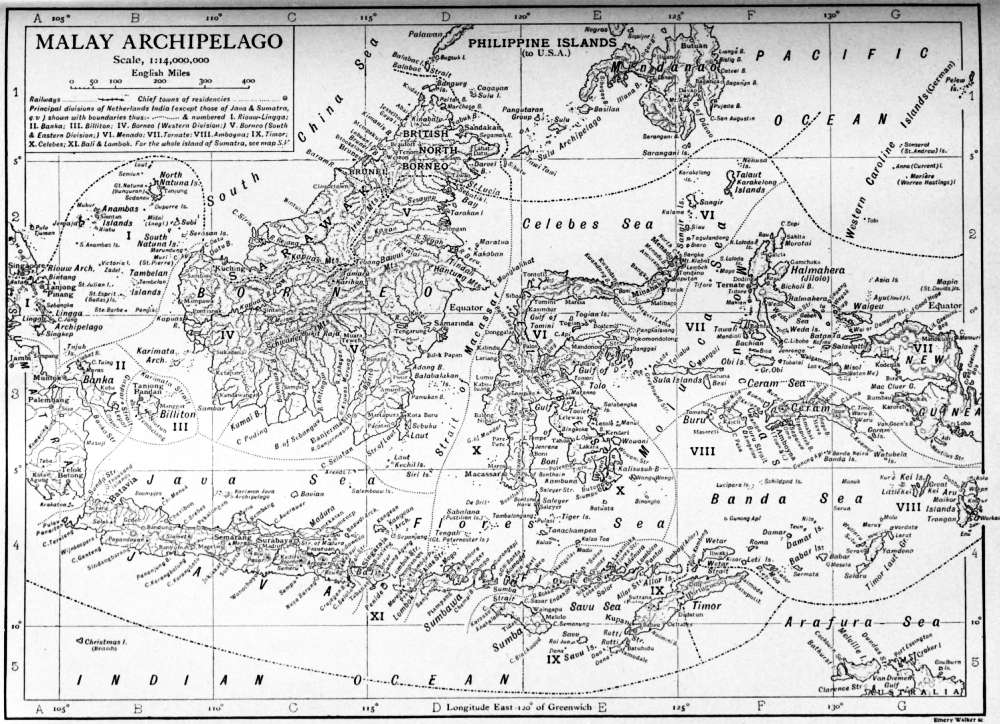
MALAY ARCHIPELAGO1 (variously called Malaysia, the Indian Archipelago, the East Indies, Indonesia, Insulinde), the largest group of islands in the world, lying south-east of Asia and north and north-west of Australia. It includes the Sunda Islands, the Moluccas, New Guinea, and the Philippine Islands, but excludes the Andaman-Nicobar group. The equator passes through the middle of the archipelago; it successively cuts Sumatra, Borneo, Celebes and Halmahera, four of the most important islands. A. R. Wallace (who includes the Solomon Islands as well as New Guinea in the group) points out that the archipelago “includes two islands larger than Great Britain; and in one of them, Borneo, the whole of the British Isles might be set down, and would be surrounded by a sea of forests. Sumatra is about equal in extent to Great Britain; Java, Luzon, and Celebes are each about the size of Ireland. Eighteen more islands are on the average as large as Jamaica; and more than a hundred are as large as the Isle of Wight.”
Area. Estimated Population.
Sunda Islands 459,578 32,632,400
Moluccas, with Celebes 115,334 3,000,000
New Guinea 312,329 800,000
Philippine Islands 115,026 7,635,400
The islands of the archipelago nearly all present bold and picturesque profiles against the horizon, and at the same time the character of the scenery varies from island to island and even from district to district. The mountains are arranged for the most part in lines running either from north-west to south-east or from west to east. In Sumatra and in the islands between Sumatra and Borneo the former direction is distinctly marked, and the latter is equally noticeable in Java and the other southern islands. The mountains of Borneo, however, rise rather in short ridges and clusters. Nothing in the general physiognomy of the islands is more remarkable than the number and distribution of the volcanoes, active or extinct. Running south-east through Sumatra, east through Java and the southern islands to Timor, curving north through the Moluccas, and again north, from the end of Celebes through the whole line of the Philippines, they follow a line roughly resembling a horseshoe narrowed towards the point. The loftiest mountain in the archipelago would appear to be Kinabalu in Borneo (13,698 ft.). An important fact in the physical geography of the archipelago is that Java, Bali, Sumatra and Borneo, and the lesser islands between them and the Asiatic mainland, all rest on a great submerged bank, nowhere more than 100 fathoms below sea-level, which may be considered a continuation of the continent; while to the east the depth of the sea has been found at various places to be from 1000 to 2500 fathoms. As the value of this fact was particularly emphasized by Wallace, the limit of the shallow water, which is found in the narrow but deep channel between Bali and Lombok, and strikes north to the east of Borneo, has received the name of “Wallace’s Line.” The Philippines on the other hand, “are almost surrounded by deep sea, but are connected with Borneo by means of two narrow submarine banks” (A. R. Wallace, Island Life). The archipelago, in effect, is divided between two great regions, the Asiatic and the Australian, and the fact is evident in various branches of its geography—zoological, botanical, and even human. It is believed that there was a land-connexion between Asia and Australia in the later part of the Secondary epoch, and that the Australian continent, when separated, became divided into islands before the south-eastern part of the Asiatic did so.
The most notable fact in the geological history of the archipelago is the discovery in Java of the fossil remains of Pithecanthropus erectus, a form intermediate between the higher apes and man. In its structure and cranial capacity it is entitled to a higher place in the zoological scale than any anthropoid, for it almost certainly walked erect; and, on the other hand, in its intellectual powers it must have been much below the lowest of the human race at present known. The strata in which it was found belong to the Miocene or Upper Pliocene. Among the rocks of economic importance may be mentioned granite of numerous kinds, syenite, serpentine, porphyry, marble, sandstones and marls. Coal is worked in Sumatra, Borneo and Labuan. Diamonds are obtained in Borneo, garnets in Sumatra, Bachian and Timor, and topazes in Bachian, antimony in Borneo and the Philippines; lead in Sumatra, Borneo and the Philippines; copper and malachite in the Philippines, Timor, Borneo and Sumatra; and, most important of all, tin in Banka, Billiton and Singkep. Iron is pretty frequent in various forms. Gold is not uncommon in the older ranges of Sumatra, Banka, Celebes, Bachian, Timor and Borneo. Manganese could be readily worked in Timor, where it lies in the Carboniferous Limestone. Platinum is found in Landak and other parts of Borneo. Petroleum is a valuable product of Sumatra and Java, and is also found in Borneo.
Climate, Flora, Fauna.—The most striking general fact as regards climate in the archipelago is that wherever that part of the south-east monsoon which has passed over Australia strikes, the climate is comparatively dry, and the vegetation is less luxuriant. The east end of Java, e.g. has a less rainfall than the west; the distribution of the rain on the north coast is quite different from that on the south, and a similar difference is observed between the east and the west of Celebes. The north-west monsoon, beginning in October and lasting till March, brings the principal rainy season in the archipelago.
Most of the islands of the archipelago belong to the great equatorial forest-belt. In its economical aspect the vegetation, whether natural or cultivated, is of prime interest. The list of fruits is very extensive, though few of them are widely known. These, however, include the orange, mango, mangosteen, shaddock, guava and the durian. The variety of food-plants is equally notable. Not only are rice and maize, sugar and coffee, among the widely cultivated crops, but the coco-nut, the bread-fruit, the banana and plantain, the sugar-palm, the tea-plant, the sago-palm, the coco-tree, the ground-nut, the yam, the cassava, and others besides, are of practical importance. The cultivation of sugar and coffee owes its development mainly to the Dutch; and to them also is due the introduction of tea. They have greatly encouraged the cultivation of the coco-nut among the natives, and it flourishes, especially in the coast districts, in almost every island in their territory. The oil is largely employed in native cookery. Pepper, nutmegs and cloves were long the objects of the most important branch of Dutch commerce; and gutta-percha, camphor, dammar, benzoin and other forest products have a place among the exports.
To the naturalist the Malay Archipelago is a region of the highest interest; and from an early period it has attracted the attention of explorers of the first rank. The physical division between the Asiatic and Australian regions is clearly reflected in the botany and zoology. The flora of the Asiatic islands (thus distinguished) “is a special development of that prevailing from the Himalayas to the Malay Peninsula and south China. Farther east this flora intermingles with that of Australia” (F. H. H. Guillemard, Australasia). Similarly, in the Asiatic islands are found the great mammals of the continent—the elephant, tiger, rhinoceros, anthropoid ape, &c., which are wanting in the Australian region, with which the eastern part of the archipelago is associated. (For details concerning flora and fauna, see separate articles, especially Java.)
(Click to enlarge.)
Inhabitants.—The majority of the native inhabitants of the Malay Archipelago belong to two races, the Malays and the Melanesians (Papuans). As regards the present racial distribution, the view accepted by many anthropologists, following A. H. Keane, is that the Negritos, still found in the Philippines, are the true aborigines of Indo-China and western Malaysia, while the Melanesians, probably their kinsmen, were the earliest occupants of eastern Malaysia and western Polynesia. At some date long anterior to history it is supposed that Indo-China was occupied first by a fair Caucasian people and later by a yellow Mongolian race. From these two have come all the peoples—other than Negrito or Papuan—found to-day from the Malay Peninsula to the farthest islands of Polynesia. The Malay Archipelago was thus first invaded by the Caucasians, who eventually passed eastward and are to-day represented in the Malay Archipelago only by the Mentawi islanders. They were followed by an immigration of Mongol-Caucasic peoples with a preponderance of Caucasic blood—the Indonesians of some, the pre-Malays of other writers—who are to-day represented in the archipelago by such peoples as the Dyaks of Borneo and the Battas of Sumatra. At a far later date, probably almost within historic times, the true Malay race, a combination of Mongol and Caucasic elements, came into existence and overran the archipelago, in time becoming the dominant race. A Hindu strain is evident in Java and others of the western islands; Moors and Arabs (that is, as the names are used in the archipelago, Mahommedans from various countries between Arabia and India) are found more or less amalgamated with many of the Malay peoples; and the Chinese form, from an economical point of view, one of the most important sections of the community in many of the more civilized districts. Chinese have been established in the archipelago from a very early date: the first Dutch invaders found them settled at Jacatra; and many of them, as, for instance, the colony of Ternate, have taken so kindly to their new home that they have acquired Malay to the disuse of their native tongue. Chinese tombs are among the objects that strike the traveller’s attention at Amboyna and other ancient settlements.
There is a vast field for philological explorations in the archipelago. Of the great number of distinct languages known to exist, few have been studied scientifically. The most widely distributed is the Malay, which has not only been diffused by the Malays themselves throughout the coast regions of the various islands, but, owing partly to the readiness with which it can be learned, has become the common medium between the Europeans and the natives. The most cultivated of the native tongues is the Javanese, and it is spoken by a greater number of people than any of the others. To it Sundanese stands in the relation that Low German holds to High German, and the Madurese in the relation of a strongly individualized dialect. Among the other languages which have been reduced to writing and grammatically analysed are the Balinese, closely connected with the Javanese, the Batta (with its dialect the Toba), the Dyak and the Macassarese. Alfurese, a vague term meaning in the mouths of the natives little else than non-Mahommedan, has been more particularly applied by Dutch philologists to the native speech of certain tribes in Celebes. The commercial activity of the Buginese causes their language to be fairly widely spoken—little, however, by Europeans.
Political Division.—Politically the whole of the archipelago, except British North Borneo, &c. (see Borneo), part of Timor (Portuguese), New Guinea east of the 141st meridian (British and German), and the Philippine Islands, belongs to the Netherlands. The Philippine Islands which had been for several centuries a Spanish possession, passed in 1898 by conquest to the United States of America. For these several political units see the separate articles; a general view, however, is here given of the government, economic conditions, &c., of the Dutch possessions, which the Dutch call Nederlandsch-Indië.
Netherlands India
Administration.—The Dutch possessions in Asia lie between 6° N. and 11° S. and 95° E. and 141° E. Politically they are divided into lands under the direct government of the Netherlands vassal lands and confederated lands. Administratively they are further divided into residencies, divisions, regencies, districts, and dessas or villages. In the principal towns and villages there are parish councils, and in some provinces county councils have been established. Natives, Chinese and Arabs, are given seats, and in certain instances some of the members are elected, but more generally they are appointed by government. The islands are often described as of two groups, Java and Madura forming one, and the other consisting of Sumatra, Borneo, Riouw-Lingga Archipelago, Banka, Billiton, Celebes, Molucca Archipelago, the small Sunda Islands, and a part of New Guinea—the Outposts as they are collectively named. The Outposts are divided into 20 provinces. A governor-general holds the superior administrative and executive authority, and is assisted by a council of five members, partly of a legislative and partly of an advisory character, but with no share in the executive work of the government. In 1907 a Bill was introduced to add four extraordinary members to the council, but no immediate action was taken. The governor-general not only has supreme executive authority, but can of his own accord pass laws and regulations, except in so far as these, from their nature, belong of right to the home government, and as he is bound by the constitutional principles on which, according to the Regulations for the Government of Netherlands India, passed by the king and States-General in 1854, the Dutch East Indies must be governed. There are nine departments, each under a director: namely, justice; interior; instruction, public worship and industry; agriculture (created in 1905); civil public works; government works (created in 1908); finance; war; marine. The administration of the larger territorial divisions (gouvernement, residentie) is in the hands of Dutch governors, residents, assistant residents and contrôleurs. In local government a wide use is made of natives, in the appointment of whom a primary consideration is that if possible the people should be under their own chieftains. In Surakarta and Jokjakarta in Java, and in many parts of the Outposts, native princes preserve their positions as vassals; they have limited power, and act generally under the supervision of a Dutch official. In concluding treaties with the vassal princes since 1905, the Dutch have kept in view the necessity of compelling them properly to administer the revenues of their states, which some of them formerly squandered in their personal uses. Provincial banks have been established which defray the cost of public works.
Population.—The following table gives the area and population of Java (including Madura) and of the Outposts:—
Area: English sq. m. Pop.
1900. 1905.
Java and Madura 50,970 28,746,688 30,098,008
Sumatra Sumatra, West Coast 31,649 1,527,297 4,029,505
Sumatra, East Coast 35,312 421,090
Benkulen 9,399 162,396
Lampong Districts 11,284 142,426
Palembang 53,497 804,299
Achin 20,471 110,804
Riouw-Lingga Archipelago 16,301 86,186 112,216
Banka 4,446 106,305 115,189
Billiton 1,863 43,386 36,858
Borneo, West Coast 55,825 413,067 1,233,655
Borneo, South and East Districts 156,912 716,822
Celebes Celebes 49,390 454,368 415,499
Menado 22,080 429,773 436,406
Molucca Islands 43,864 410,190 407,419
Timor Archipelago 17,698 119,239 308,600
Bali and Lombok 4,065 1,041,696 523,535
New Guinea to 141° E. 151,789 200,000 ....
Total 736,815 36,000,000 37,717,377*
* Including 487 in Merauke, the capital of Dutch New Guinea.
In no case are the above figures for population more than fairly accurate, and in some instances they are purely conjectural. The population is legally divided into Europeans and persons assimilated to them, and natives and persons assimilated to them. The first class includes half-castes (who are numerous, for the Dutch are in closer relationship with the natives than is the case with most colonizing peoples), and also Armenians, Japanese, &c. The total number of this class in 1900 was 75,833; 72,019 of these were called Dutch, but 61,022 of them were born in Netherlands India; there were also 1382 Germans, 441 British and 350 Belgians. Among the natives and persons assimilated to them were about 537,000 Chinese and 27,000 Arabs. In the decade 1890-1900 the increase of the European population was 30.9%, of the Arabs 26.6%, and of the Chinese 16.5%. A large proportion of the Europeans are government officials, or retired officials, for many of the Dutch, once established in the colonies, settle there for life. The remaining Europeans are mostly planters and heads of industrial establishments; the Arabs are nearly all traders, as are some of the Chinese, but a large number of the latter are labourers in the Sumatra tobacco plantations and the tin mines of Banka, Billiton, &c. The bulk of the natives are agriculturists.
Religion and Instruction.—Entire liberty is granted to the members of all religious confessions. The Reformed Church has about 40 ministers and 30 assistants, the Roman Catholic 35 curates and 20 priests, not salaried out of the public funds. There are about 170 Christian missionaries, and the progress of their work may be illustrated by showing that the number of Christians among the natives and foreign Orientals was:—
In 1873. In 1896. In 1903.
In Java and Madura 5,673 19,193 About 34,000
In the Outposts 148,672 290,065 About 390,000
About 10,000 natives go annually to Mecca on pilgrimage.
Both the government and private enterprise maintain vernacular schools. Large sums have been voted in Holland for the establishment of primary and secondary schools, and the government has undertaken to assist in the establishment of parochial schools, the object being that every village, at least in Java, should possess one. There are schools for higher education at Batavia, Surabaya and Semarang; at the first two of these towns are government schools for mechanical engineering, and at Batavia a crafts school and a medical school for natives. There are five colleges for native schoolmasters and four for sons of native officials. Government schools for the European education of Chinese children are established in the principal towns. Private mechanical and crafts schools are established at Jokjakarta, Surabaya and Semarang, and there is an agricultural school at Buitenzorg.
Justice.—As regards the administration of justice, the distinction is maintained between (1) Europeans and persons assimilated with them (who include Christians and Japanese), and (2) natives, together with Chinese, Arabs, &c. The former are subject to laws closely resembling those of the mother country, while the customs and institutions of natives are respected in connexion with the administration of justice to the latter. In 1906 a bill was passed somewhat modifying the existing status of the classes above mentioned, and especially directing new ordinances with regard to the judicial treatment of Christian natives. A general judicial revision being also in contemplation, this bill did not immediately come into force. Justice for Europeans is administered by European judges, but, as with administration at large so in judicial matters, native chiefs have extensive powers in native affairs. For European justice the High Court of Justice is established at Batavia; there are councils of justice at Batavia, Semarang and Surabaya, with authority not only over Java but over parts of the Outposts; there is a resident court of justice in each residency. For native justice there are courts in the districts and regencies; residents act as police judges; provincial councils have judicial powers, and there are councils of priests with powers in matrimonial disputes, questions of succession, &c.
As regards pauperism, the government subsidizes Protestant and Catholic orphan houses.
Finance.—The revenue of Netherlands India has been derived mainly from customs, excise, ground-tax, licences, poll-tax, &c., from monopolies—opium, salt and pawn-shops (the management of which began to be taken over by the government in 1903, in place of the previous system of farming-out), coffee, &c., railways, tin mines and forests, and from agricultural and other concessions. But attempts have been made, and have been largely successful, to make the revenue dependent to a less extent on monopolies and the products (especially agricultural) of the land; and to abolish licences and substitute direct taxes. There is a progressive income-tax for Europeans, and the system has also been applied in the case of natives.
The following table affords comparisons in the revenue and expenditure:—
Year. Revenue. Expenditure.
1880 £12,236,500 £12,244,666
1890 11,482,457 10,644,728
1900 11,832,417 12,313,854
1905 12,951,497 13,844,173
The monetary system is similar to that of Holland (the unit being the guilder), but there are also certain silver and copper coins of small value bearing Malay or Javanese inscriptions. The Java Bank, established in 1828, with headquarters at Batavia, is the only bank issuing notes, two-fifths of the amount of which must be covered by specie or bullion. The government has a control over the administration of this bank.
Defence.—The army is purely colonial, i.e. distinct from that of the Netherlands. Its strength is a little under 40,000, about one-third being Europeans of various nationalities and two-thirds natives of various races. No portion of the regular army of the Netherlands is allowed to be sent on colonial service, but individual soldiers are at liberty to enlist, by permission of their commanding officers, in the army of Netherlands India, and they form its nucleus. Native and European soldiers are generally mixed together in the same battalions, though in separate companies. The officers were all Dutch till 1908, when a trial was made of native officers from noble Javanese families. The artillery is composed of European gunners, with native riders, while the cavalry are Europeans and natives. A military academy is established at Meester Cornelis, near Batavia. Schools for soldiers are attached to every battalion. There are certain local forces outside the regular army—militia in some of the large towns, native infantry in Madura, and guards of some of the vassal princes. Unlike the army, which is purely colonial, the navy in Netherlands India is partly colonial, partly belonging to the royal navy of the Netherlands, and its expenses are therefore borne partly by the mother country and partly by the colony. About six ironclads and twenty smaller vessels of the royal navy are stationed in colonial waters; the vessels of the colonial marine number about twenty-four, and undertake police supervision, prevention of slave trading, &c.
Trade and Industries.—The principal articles of export are sugar, tobacco, copra, forest products (various gums, &c.), coffee, petroleum, tea, cinchona, tin, rice, pepper, spices and gambier. The average annual value of exports during 1900-1905 was £22,496,468, and of imports £17,050,338. A great proportion of the exports goes to the mother country, though a considerable quantity of rice is exported to China. An indication of the mineral products has already been given; as regards the export trade, tin is the most important of these, but the Ombilin coalfields of Sumatra, connected by a railway with the coast, call for mention here also. Agricultural labour is very carefully regulated by law, in the enforcement of which the residents and lower officials have wide powers. One day’s gratuitous labour out of seven or more can be demanded of labourers either on private or on government estates; but in 1882 this form of labour was for the most part abolished as far as government estates were concerned, each labourer so exempted paying one guilder per year. The principal private agricultural estates are in the west of Java, in which island the greater part of the soil is government property. Such estates have increased greatly in number and extent, not only in Java but elsewhere, since the agrarian law of 1870, under which it became possible for settlers to obtain waste lands on hereditary lease for 75 years. In 1899 the total acreage of land ceded was 1,002,766 acres; in 1903 it was 1,077,295. The government ceased to cultivate sugar in 1891, but coffee, and to some extent cinchona, are cultivated on government plantations, though not in equal quantity to that grown on land held on emphyteusis. The average annual yield of sugar in 1900-1905 was 852,400 tons, but it increased steadily during that period. The average annual yield of coffee during the same period was 101,971,132 ℔; it fluctuates greatly. The average annual production of tobacco is about fifty million pounds from each of the islands of Java and Sumatra. The total annual yield of the tin mines is about 15,000 tons, and of the coal mines 240,000 tons. The average output of petroleum annually in 1900-1905 was 120,000,000 gallons; this, again, has fluctuated greatly. There are upwards of 3000 miles of railways and steam tramways in Netherlands India, but these are almost entirely in Java; elsewhere only Sumatra has a few short lines. The principal steamship company in the archipelago is the Royal Packet (Koninklyke Paketvaart) Company.
Bibliography.—See Aardrijkskundig en statistisch Woordenboek van Nederl. Indië (Amsterdam, 1869), to which P. J. Veth and other specialists were contributors. A general survey of the people, administration and resources of the Dutch colony is provided in Twentieth Century Impressions of Netherlands India, ed. by Arnold Wright (London, 1910). See also A. R. Wallace, Malay Archipelago (London, 1869, and later editions, notably for zoological distribution) and Island Life (London, 1880, notably for ornithology). H. O. Forbes, A Naturalist’s Wanderings in the Eastern Archipelago (London, 1885); P. van der Lith, Nederlandsch Oostindië (2nd ed., Leiden, 1893-1895); F. H. H. Guillemard, Australasia, vol. ii., in Stamford’s Compendium (London, 1894); Encyclopaedie van Nederlandsch-Indië (the Hague, 1895-1904); Guide à travers la section des Indes néerlandaises, Paris Exhibition (the Hague, 1900); A. R. Colquhoun, The Mastery of the Pacific (London, 1902); M. Weber, Der indo-australische Archipel und die Geschichte seiner Tierwelt (Jena, 1902); G. Karsten and H. Schenck, Vegetationsbilder, vol. ii. (Jena, 1903); J. van Bemmelen and G. B. Hooyer, Guide through Netherlands India (London, 1903); D. Bezemer, Nederlandsch Oost-Indië (the Hague, 1904); H. Blink, Nederlandsch Oost- en West-Indië, geographisch, ethnologisch, en economisch beschreven (Leiden, 1904, sqq.). Among Dutch official publications may be mentioned Jaarcijfers door het Centraal Bureau voor de Statistiek; Jaarboek van het Mijnwezen in Nederlandsch Oost-Indië (Amsterdam); Koloniale-Economische Bijdragen (the Hague); Koloniaal Verslag (the Hague); Regeerings-Almanak voor Nederlandsch-Indië (Batavia). A number of important periodicals (Tijdschrift) of various institutions are issued at Batavia, &c. Languages: P. J. Veth in De Gids (1864); R. N. Cust, Sketch of the Modern Languages of the East Indies (London, 1878); and for bibliography, Boele van Neusbroek, De Beoefening der oostersche talen ... (Leiden, 1875).
History
Portuguese and Spanish Ascendancy, 1511-1595.—Ptolemy and other ancient geographers describe the Malay Archipelago, or part of it, in vague and inaccurate terms, and the traditions they preserved were supplemented in the middle ages by the narratives of a few famous travellers, such as Ibn Batuta, Marco Polo, Odoric of Pordenone and Niccolò Conti. Malay and Chinese records also furnish material for the early history of individual islands, but the known history of the archipelago as a whole begins in the 16th century. At this period a civilization, largely of Hindu origin, had flourished and decayed in Java, where, as in all the more important islands, Mahommedanism had afterwards become the dominant creed. But the smaller islands and the remoter districts, even of Java and Sumatra, remained in a condition of complete savagery.
The Portuguese were the first Europeans to colonize any part of the archipelago. A Portuguese squadron under Diogo Lopes de Sequeira arrived off Sumatra in 1509, explored the north coast for some distance, and noted that the inhabitants of the interior were cannibals, while those of the littoral were civilized and possessed a gold coinage. The main object of the Portuguese was to obtain a share in the lucrative spice trade carried on by the Malays, Chinese and Japanese; the trade-routes of the archipelago converged upon Malacca, which was the point of departure for spice merchants trading with every country on the shores of the Indian Ocean and Arabian Sea. In 1511 the Portuguese under Alphonso d’Albuquerque occupied Malacca, and in November of that year an expedition under Antonio de Abreu was despatched to find a route to the Moluccas and Banda Islands, then famous for their cloves and nutmegs. The explorers reached Amboyna and Ternate, after gaining some knowledge of Java, Madura, Sumbawa and other islands, possibly including New Guinea. During the return voyage the second-in-command, Francisco Serrão, was shipwrecked, but succeeded in making his way in a native boat to Mindanao. Thus the Philippines were discovered: In 1514 a second Portuguese fleet arrived at Ternate, which during the next five years became the centre of Portuguese enterprise in the archipelago; regular traffic with Malacca and Cochin was established, and the native raja became a vassal of Portugal.
Meanwhile the Spanish government was considering whether the Moluccas did not fall within the Spanish sphere of influence as defined by the Treaty of Tordesillas in 1494; and in August 1519 an expedition commanded by Ferdinand Magellan (q.v.) sailed from Seville to seek a westward passage to the archipelago. After losing the commander in the Philippines and discovering Borneo, the two surviving ships reached the Moluccas late in 1520. One vessel returned to Seville by the Cape route, thus completing the first voyage round the world; the other attempted to return by the Pacific, but was driven back to Tidore and there welcomed by the natives as a useful ally against the Portuguese. Reinforcements from Spain arrived in 1525 and 1528; but in 1529 a treaty was concluded between the emperor Charles V. and John III. of Portugal, by which, in return for 350,000 gold ducats, the Spanish claim to the Moluccas was withdrawn. The boundary between the Spanish and Portuguese spheres was fixed at 17° E. of the Moluccas, but by a geographical fiction the Philippines were included within the Spanish sphere. Further disputes occurred from time to time, and in 1542 a Spanish fleet came into conflict with the Portuguese off Amboyna; but after 1529 the supremacy of each power in its own sphere was never seriously endangered.
Though the Portuguese traders frequented the coast of Java, they annexed no territory either there or in Sumatra; but farther east they founded numerous forts and factories, notably in Amboyna, the Banda Island, Celebes and Halmahera. Ternate remained the seat of the governor of the Moluccas, who was the highest official in the archipelago, though subordinate to the viceroy or governor of Portuguese India. The first attempt to enter into relations with the states of Borneo was made by D. Jorge de Menezes, who visited Brunci in 1526, and in 1528 sent an envoy to its raja. The embassy failed in a curious manner. Among the gifts sent by Menezes was a piece of tapestry representing the marriage of Catherine of Aragon to Arthur, prince of Wales. The raja was persuaded that these mysterious figures were demons under a spell, which might come to life and kill him as he slept. The envoy was therefore dismissed.
In 1536, after a period of war and anarchy caused by the tyrannical rule of Menezes, Antonio Galvão, the historian, was appointed governor of the Moluccas. He crushed the rebellion and won the affection of the natives by his just and enlightened administration, which had no parallel in the annals of Portuguese rule in the archipelago. He returned to Europe in 1540 (see Portugal: Literature), after inaugurating an active missionary movement, which was revived in 1546-1547 by Francis Xavier (q.v.). At this period the Portuguese power in the East was already beginning to wane; in the archipelago it was weakened by administrative corruption and by incessant war with native states, notably Bintang and Achin; bitter hostility was aroused by the attempts which the Portuguese made to establish a commercial monopoly and to force Christianity upon their native subjects and allies (see Portugal: History). From 1580 to 1640 Portugal was itself united to Spain—a union which differed from annexation in little but name.
The English and Dutch, 1595-1674.—Pirates from Dieppe visited the archipelago between 1527 and 1539. It is possible that they reached Australia2—more than sixty years before the first voyage thither of which there is any clear record; but their cruise had no political significance, and the Spaniards and Portuguese remained without European competitors until the appearance of Sir Francis Drake in 1579. An English squadron under Sir James Lancaster came into conflict with the Portuguese in 1591, and an expedition under Sir Henry Middleton traded in the archipelago in 1604. But the English were simple traders or explorers; far more formidable were the Dutch, who came to the East partly to avenge the injuries inflicted on their country by the Spaniards, partly to break the commercial monopoly of the peninsular states. As middlemen they already possessed a large interest in the spice trade, for the Portuguese, having no direct access to the principal European markets, had made a practice of sending cargo to the Netherlands for distribution by way of the Scheldt and Rhine. The Dutch now sought to monopolize not only the distribution but the production of spices—an enterprise facilitated by the co-operation of many exiled Portuguese Jews who had settled in Holland.
The first Dutch fleet sailed from Texel, under the command of Cornelis Houtman, on the 2nd of April 1595 and reached Sumatra on the 1st of January 1596. It visited Madura, and came into conflict with the Portuguese at Bantam in Java, returning to Holland in 1597. Though not a commercial success, the expedition had demonstrated the weakness of the Portuguese. In 1602 the Dutch East India Company (q.v.) was incorporated, and for nearly two centuries this organization played the chief part in the history of the archipelago. By 1604 the Dutch could already claim to be the stronger power at sea. They had attacked the Portuguese in Ceylon (1601), established friendly relations with Achin (1602), and defeated a powerful fleet off Banda (1602). In 1606 they concluded a treaty of alliance with the sultan of Johor, and in 1608 they forced the Portuguese to assent to an armistice for twelve years. On the 29th of November 1609 Pieter Both was chosen by the states-general, on the nomination of the Dutch East India Company, as first governor-general of Netherlands India. In 1611 the headquarters of the Dutch was changed from Bantam to Jakarta, which in 1619 was renamed Batavia, and was thenceforward the Dutch capital. Meanwhile the English East India Company, chartered in 1600, had also extended its operations to the archipelago. After 1611 the commercial rivalry between the Dutch and British became acute, and in 1613, 1615 and 1618 commissioners met in London to discuss the matters in dispute. The result of their deliberations was the Treaty of Defence, signed on the 2nd of June 1619 and modified on the 24th of January 1620, which arranged for co-operation between the Dutch and British companies, and especially for the maintenance of a joint fleet. But neither company could restrain its agents in the East from aggressive action, and many fresh causes of dispute arose, the chief being the failure of the British to provide the naval forces required for service against the Portuguese, and the so-called “massacre of Amboyna” (q.v.) in 1623. The Treaty of Defence lapsed in 1637, but as early as 1634 the British made peace with Portugal. Even without allies, however, the Dutch continued to extend their trade and to annex fresh territory, for the British were weakened by civil war at home, while, after 1640, the Portuguese were struggling to maintain their independence against Spain. The Dutch company opened up a profitable trade with Japan and China, and prosecuted the war against Portugal with great vigour, invading Portuguese India and capturing Point de Galle in 1640, Malacca in 1641, Cochin and Cannanore in 1663. The war with England in 1652-54 and the renewal of the Anglo-Portuguese alliance by the marriage of Charles II. to Catherine of Braganza in 1661 were unable to check the growth of Dutch power; more serious was the resistance offered by some of the native states. Rebellions in Java (1629) and the Moluccas (1650) were suppressed with great severity, but in 1662 the company suffered a heavy reverse in Formosa, all its colonists being expelled from the island. A new war between Great Britain and Holland broke out in 1672 and was terminated by the Treaty of Westminster (February 17, 1674), by which the points at issue between the two companies were referred first to commissioners and finally to an arbitrator. The full details of the settlement are unknown, but thenceforward the British company devoted its energies chiefly to the development of its Indian possessions, while the Dutch were left supreme in the archipelago. In 1684 the British even evacuated Bantam, their chief settlement, and retired to Benkulen in Sumatra, which remained for more than a century their sole territorial possession in the archipelago.