VOLUME XVII SLICE IV Magnetite to Malt (continued 11)
Reading edition
The lordship of Malines was conferred as a separate fief by Pippin the Short on his kinsman Count Adon in 754. In the 9th century Charles the Bald bestowed the fief on the bishop of Liége, and after being shared between Brabant and Flanders it passed into the hands of Philip the Bold, founder of the house of Burgundy, in 1384. During the religious troubles of the 16th century Malines suffered greatly, and in 1572 it was sacked by Alva’s troops during three days. In the wars of the 17th and 18th centuries it was besieged many times and captured by the French, Dutch and English on several occasions. The French finally removed the fortifications in 1804, since which year it has been an open town.

MALLANWAN, a town in Hardoi district, the United Provinces, India. Pop. (1901), 11,158. Under native rule the town possessed considerable political importance, and upon the British annexation of Oudh it was selected as the headquarters of the district, but was abandoned in favour of Hardoi after the Mutiny. Saltpetre and brass utensils are manufactured.
MALLARMÉ, FRANÇOIS RENÉ AUGUSTE (1755-1835), French Revolutionist, the son of a lawyer, was born at Nancy on the 25th of February 1755. He was brought up in his father’s profession, and was appointed procureur-syndic of the district of Pont-à-Mousson. During the Revolution he was elected by the department of Meurthe deputy to the Legislative Assembly and the Convention, where he attached himself to the Mountain and voted for the death of Louis XVI. He was elected president of the Convention on the 30th of May 1793, and by his weakness during the crisis of the following day contributed much to the success of the insurrection against the Girondists. He took an active part in the levée-en-masse, and in November 1793 was given the task of establishing the revolutionary government in the departments of Meuse and Moselle, where he gained an unenviable notoriety by ordering the execution of the sentence of death decreed by the revolutionary tribunal on some young girls at Verdun who had offered flowers to the Prussians when they entered the town. After the fall of Robespierre he joined the group of “Thermidorians” and was sent on mission to the south of France, where he closed the Jacobin club at Toulouse and set free a number of imprisoned “suspects.” On the 1st of June 1795 he was denounced and arrested, but was soon set at liberty. In 1796 he was appointed by the Directory commissioner for the organization of the departments of Dyle and Mont-Tonnerre. Under the empire he was receiver of the droits réunis at Nancy, and lost his money in 1814 in raising a levy of volunteers. Appointed sub-prefect of Avesnes during the Hundred Days, he was imprisoned by the Prussians in revenge for the death of the maidens of Verdun, and lived in exile during the Restoration. He returned to France after the revolution of 1830, and died at Richemont (Seine-Inférieure) on the 25th of July 1835.
MALLARMÉ, STÉPHANE (1842-1898), French poet and theorist, was born at Paris, on the 18th of March 1842. His life was simple and without event. His small income as professor of English in a French college was sufficient for his needs, and, with his wife and daughter, he divided the year between a fourth-floor flat in Paris and a cottage on the banks of the Seine. His Tuesday evening receptions, which did so much to form the thought of the more interesting of the younger French men of letters, were almost as important a part of his career as the few carefully elaborated books which he produced at long intervals. L’Après-midi d’un faune (1876) and other fragments of his verse and prose had been known to a few people long before the publication of the Poésies complètes of 1887, in a facsimile of his clear and elegant handwriting, and of the Pages of 1891 and the Vers et prose of 1893. His remarkable translation of poems of Poe appeared in 1888, “The Raven” having been published as early as 1875, with illustrations by Manet. Divagations, his own final edition of his prose, was published in 1897, and a more or less complete edition of the Poésies, posthumously, in 1899. He died at Valvins, Fontainebleau, on the 9th of September 1898. All his life Mallarmé was in search of a new aesthetics, and his discoveries by the way were often admirable. But he was too critical ever to create freely, and too limited ever to create abundantly. His great achievement remains unfinished, and all that he left towards it is not of equal value. There are a few poems and a few pieces of imaginative prose which have the haunting quality of Gustave Moreau’s pictures, with the same jewelled magnificence, mysterious and yet definite. His later work became more and more obscure, as he seemed to himself to have abolished limit after limit which holds back speech from the expression of the absolute. Finally, he abandoned punctuation in verse, and invented a new punctuation, along with a new construction, for prose. Patience in the study of so difficult an author has its reward. No one in our time has vindicated with more pride the self-sufficiency of the artist in his struggle with the material world. To those who knew him only by his writings his conversation was startling in its clearness; it was always, like all his work, at the service of a few dignified and misunderstood ideas.
See also Paul Verlaine, Les Poètes maudits (1884); J. Lemaître, Les Contemporains (5th series, 1891); Albert Moekel, Stéphane Mallarmé, un héros (1899); E. W. Gosse, French Profiles (1905) and A. Symons, The Symbolist Movement in Literature (1900). A complete bibliography is given in the Poètes d’aujourd’hui (1880-1900, 11th ed., 1905) of MM. A. van Bever and P. Léautaud.
(A. Sy.)
MALLECO, a province of southern Chile, once a part of the Indian territory of Araucania (q.v.), lying between the provinces of Bio-Bio on the N. and E., Cautin on the S. and Arauco on the W. Area, 2973 sq. m. Pop. (1895), 98,032. It belongs to the rainy, forested region of southern Chile, and is thinly populated, a considerable part of its population being Araucanian Indians, who occupy districts in the Andean foothills. Gold placer mining has attracted some attention, but the output is small. The principal industries are cattle and wheat raising and timber-cutting. The capital is Angol (pop., 7056 in 1895; estimated at 7638 in 1902), a small town in the northern part of the province, on the Malleco river, and a station on the Traiguen branch of the state railway. Traiguen (pop., 5732 in 1895; estimated at 7099 in 1902) in the southern part of the province is the second town in importance, and Victoria (pop., 6989 in 1895; estimated at 10,002 in 1902), about 20 m. E. of the last-named town, was for a time the terminal station of the main line of the railway.
MALLEMUCK, from the German rendering of the Dutch Mallemugge (which originally meant small flies or midges that madly whirl round a light), a name given by the early Dutch Arctic voyagers to the Fulmar (q.v.), of which the English form is nowadays most commonly applied by our sailors to the smaller albatrosses, of about the size of a goose, met with in the Southern Ocean—corrupted into “molly mawk,” or “mollymauk.” A number of species have been identified. Diomedea irrorata of West Peru is sooty-brown with white mottlings and a white head; D. migripes of the North Pacific is similar in colour but with white only near the eye and at the base of the tail and bill; D. immutabilis of Japan is darker but has a white head. D. melanophrys of the southern oceans has been found in summer both in California, in England, and as far north as the Faeroes. According to J. Gould the latter is the commonest species of albatross inhabiting the Southern Ocean, and its gregarious habits and familiar disposition make it well known to every voyager to or from Australia, for it is equally common in the Atlantic as well as the Pacific. The back, wings and tail are of a blackish-grey, but all the rest of the plumage is white, except a dusky superciliary streak, whence its name of black-browed albatross, as also its scientific epithet, are taken. The bill of the adult is of an ochreous-yellow, while that of the young is dark. This species breeds on the Falkland Islands. D. bulleri of the New Zealand seas is greyish-brown, with white underparts and rump and ashy head. Diomedea (or Thalassogeron) culminata and chlororhyncha of the southern seas, D. (or T.) cauta of Tasmania, salvini of New Zealand and layardi of the Cape resemble D. bulleri, but have a strip of naked skin between the plates of the maxilla towards its base. H. N. Moseley (Notes of a Naturalist, 130) describes D. culminata as making a cylindrical nest of grass, sedge and clay, with a shallow basin atop and an overhanging rim—the whole being about 14 in. in diameter and 10 in height. The bird lays a single white egg, which is held in a sort of pouch, formed by the skin of the abdomen, while she is incubating. The feet of D. bulleri are red, of D. chlororhyncha flesh-coloured, of the others yellow.
(A. N.)
MALLESON, GEORGE BRUCE (1825-1898), Indian officer and author, was born at Wimbledon, on the 8th of May 1825. Educated at Winchester, he obtained a cadetship in the Bengal infantry in 1842, and served through the second Burmese War. His subsequent appointments were in the civil line, the last being that of guardian to the young maharaja of Mysore. He retired with the rank of colonel in 1877, having been created C.S.I. in 1872. He died at Kensington, on the 1st of March 1898. He was a voluminous writer, his first work to attract attention being the famous “Red Pamphlet,” published at Calcutta in 1857, when the Mutiny was at its height. He continued, and considerably rewrote the History of the Indian Mutiny (6 vols., 1878-1880), which was begun but left unfinished by Sir John Kaye. Among his other books the most valuable are History of the French in India (2nd ed., 1893) and The Decisive Battles of India (3rd ed., 1888).
MALLET (or Malloch), DAVID (?1705-1765), Scottish poet and dramatist, the son of a Perthshire farmer, was born in that county, probably in 1705. In 1717 he went to the high school at Edinburgh, and some three years later to the university, where he made the friendship of James Thomson, author of The Seasons. As early as 1720 he began to publish short poems in the manner of the period, a number of which appeared during the next few years in collections such as the Edinburgh Miscellany and Allan Ramsay’s Tea Table Miscellany, in which his ballad “William and Margaret” was published in 1724. For some years from 1723 he was private tutor to the duke of Montrose’s sons, with whom he travelled on the Continent in 1727. His real name was Malloch; but this he changed to Mallet in 1724. In 1735 he took the M.A. degree at Oxford. He had already made the friendship of Pope, whose vanity he flattered in a poem on Verbal Criticism, in 1733; and through Pope he became acquainted with Bolingbroke and other Tory politicians, especially those attached to the party of the prince of Wales, who in 1742 appointed Mallet to be his paid secretary. After Pope’s death, in 1744, Mallet, at the instigation of Bolingbroke and forgetful of past favours and friendship, vilified the poet’s memory, thereby incurring the resentment of Pope’s friends. For his services as a party pamphleteer, in which character he published an attack on Admiral Byng, Mallet received from Lord Bute a lucrative sinecure in 1760. He died on the 21st of April 1765. Mallet was a small man, in his younger days something of a dandy and inordinately vain. He was twice married; by his first wife he had a daughter, Dorothy, who married Pietro Paolo Celesia, a Genoese gentleman, and was the author of several poems and plays, notably Almida, produced by Garrick at Drury Lane in 1771.
Mallet’s own works included several plays, some of which were produced by Garrick, who was Mallet’s personal friend. Eurydice, a tragedy, with prologue and epilogue by Aaron Hill, was produced at Drury Lane in 1731; Mustapha, also a tragedy, had considerable success at the same theatre in 1739; in 1740, in collaboration with Thomson, he produced the masque Alfred, of which he published a new version in 1751, after Thomson’s death, claiming it to be almost entirely his own work. This masque is notable as containing the well-known patriotic song, “Rule Britannia,” the authorship of which has been attributed to Mallet, although he allowed it to appear without protest in his lifetime with Thomson’s name attached. His other writings include Poems on Several Occasions (1743); Amyntor and Theodora, or the Hermit (1747); another volume of Poems (1762).
In 1759 a collected edition of Mallet’s Works was published in three volumes; and in 1857 his Ballads and Songs were edited by F. Dinsdale with notes, and a biographical memoir of the author.
MALLET, PAUL HENRI (1730-1807), Swiss writer, was born on the 20th of August 1730, in Geneva. After having been educated there, he became tutor in the family of the count of Calenberg in Saxony. In 1752 he was appointed professor of belles lettres to the academy at Copenhagen. He was naturally attracted to the study of the ancient literature and history of his adopted country, and in 1755 he published the first fruits of his researches, under the title Introduction à l’histoire du Danemarck où l’on traite de la religion, des mœurs, des lois, et des usages des anciens Danois. A second part, more particularly relating to the ancient literature of the country, Monuments de la mythologie et de la poesie des Celtes, et particulièrement des anciens Scandinaves, was issued in 1756, and was also translated into Danish. A translation into English, with notes and preface, by Bishop Percy, was issued in 1770 under the title of Northern Antiquities (republished with additions in 1847). The book had a wide circulation, and attracted much attention on account of its being the first (though a very defective) translation into French of the Edda. The king of Denmark showed his appreciation by choosing Mallet to be preceptor of the crown prince. In 1760 he returned to Geneva, and became professor of history in his native city. While there he was requested by the czarina to undertake the education of the heir-apparent of Russia (afterwards the czar Paul I.), but declined the honour. An invitation more congenial to his tastes led to his accompanying Lord Mountstuart in his travels through Italy and thence to England, where he was presented at court and commissioned to write the history of the house of Brunswick. He had previously received a similar commission from the landgrave of Hesse-Cassel for the preparation of a history of the house of Hesse, and both works were completed in 1785. The quietude of a literary life was rudely broken by the shock of the Revolution, to which he was openly hostile. His leanings to the unpopular side were so obnoxious to his fellow-citizens that he was obliged to quit his native country in 1792, and remained in exile till 1801. He died at Geneva, on the 8th of February 1807.
A memoir of his life and writings, by Sismondi, was published at Geneva in 1807. Besides the Introduction to the History of Denmark, his principal works are: Histoire du Danemarck (3 vols., Copenhagen, 1758-1777); Histoire de la maison de Hesse (4 vols., 1767-1785); Histoire de la maison de Brunswick (4 vols., 1767-1785); Histoire de la maison et des états du Mecklenbourg (1796); Histoire des Suisses ou Helvétiens (4 vols., Geneva, 1803) (mainly an abridgment of J. von Müller’s great history); Histoire de la ligue hanséatique (1805).
MALLET, ROBERT (1810-1881), Irish engineer, physicist and geologist, was born in Dublin, on the 3rd of June 1810. He was educated at Trinity College in that city, and graduated B.A. in 1830. Trained as an engineer, he was elected M.Inst.C.E. in 1842; he built in 1848-1849 the Fastnet Rock lighthouse, south-west of Cape Clear, and was engaged in other important works. Devoting much attention to pure science, he became especially distinguished for his researches on earthquakes, and from 1852-1858 he was engaged (with his son John William Mallet) in the preparation of his great work, The Earthquake Catalogue of the British Association (1858). In 1862 he published two volumes, dealing with the Great Neapolitan Earthquake of 1857 and The First Principles of Observational Seismology. He then brought forward evidence to show that the depth below the earth’s surface, whence came the impulse of the Neapolitan earthquake, was about 8 or 9 geographical miles. One of his most important essays was that communicated to the Royal Society (Phil. Trans. clxiii. 147; 1874), entitled Volcanic Energy: an Attempt to develop its True Origin and Cosmical Relations. He sought to show that volcanic heat may be attributed to the effects of crushing, contortion and other disturbances in the crust of the earth; the disturbances leading to the formation of lines of fracture, more or less vertical, down which water would find its way, and if the temperature generated be sufficient volcanic eruptions of steam or lava would follow. He was elected F.R.S. in 1854, and he was awarded the Wollaston medal by the Geological Society of London in 1877. He died at Clapham, London, on the 5th of November 1881.
MALLET DU PAN, JACQUES (1749-1800), French journalist, of an old Huguenot family, was born near Geneva in 1749, the son of a Protestant minister. He was educated at Geneva, and through the influence of Voltaire obtained a professorship at Cassel. He soon, however, resigned this post, and going to London joined H.S.N. Linguet in the production of his Annales politiques (1778-1780). During Linguet’s imprisonment in the Bastille Mallet du Pan continued the Annales by himself (1781-1783); but Linguet resented this on his release, and Mallet du Pan changed the title of his own publication to Mémoires historiques (1783). From 1783 he incorporated this work with the Mercure de France in Paris, the political direction of which had been placed in his hands. On the outbreak of the French Revolution he sided with the Royalists, and was sent on a mission (1791-1792) by Louis XVI. to Frankfort to try and secure the sympathy and intervention of the German princes. From Germany he travelled to Switzerland and from Switzerland to Brussels in the Royalist interest. He published a number of anti-revolutionary pamphlets, and a violent attack on Bonaparte and the Directory resulted in his being exiled in 1797 to Berne. In 1798 he came to London, where he founded the Mercure britannique. He died at Richmond, Surrey, on the 10th of May 1800, his widow being pensioned by the English government. Mallet du Pan has a place in history as a pioneer of modern political journalism. His son John Lewis Mallet (1775-1861) spent a useful life in the English civil service, becoming secretary of the Board of Audit; and J. L. Mallet’s second son, Sir Louis Mallet (1823-1890) also entered the civil service in the Board of Trade and rose to be a distinguished economist and a member of the Council of India.
Mallet du Pan’s Mémoires et correspondance was edited by A. Sayous (Paris, 1851). See Mallet du Pan and the French Revolution (1902), by Bernard Mallet, son of Sir Louis Mallet, author also of a biography of his father (1900).
MALLING, EAST and WEST, two populous villages in the Medway parliamentary division of Kent, England, respectively 5 and 6 m. W. by N. of Maidstone, with a station on the South-Eastern and Chatham railway. Pop. (1901), East Malling, 2391; West Malling, 2312. They are situated in a rich agricultural district on the western slope of the valley of the Medway, and East Malling has large paper mills. At West Malling are remains of Malling Abbey, a Benedictine nunnery founded in 1090 by Gundulf, bishop of Rochester. The remains, which are partly incorporated in a modern building, include the Norman west front of the church, the Early English cloisters, the chapter-house, gate-house (the chapel of which is restored to use), and other portions. About Addington near West Malling are considerable prehistoric remains, including mounds, single stones, stone circles and pits in the chalk hills; while at Leybourne are the gateway and other fragments of the castle held by the Leybourne family from the 12th to the 14th century.
MALLOCK, WILLIAM HURRELL (1849- ), English author, was born at Cockington Court, Devonshire. He was educated privately, and at Balliol College, Oxford. He won the Newdigate prize in 1872, and took a second class in the final classical schools in 1874. He attracted considerable attention by his satirical story The New Republic (2 vols., 1877), in which he introduced characters easily recognized as prominent living men, Mark Pattison, Matthew Arnold, W. K. Clifford and others. His keen logic and gift for acute exposition and criticism were displayed in later years both in fiction and in controversial works. In a series of books dealing with religious questions he insisted on dogma as the basis of religion and on the impossibility of founding religion on purely scientific data. In Is Life Worth Living? (1879) and The New Paul and Virginia (1878) he attacked Positivist theories, and in a volume on the intellectual position of the Church of England, Doctrine and Doctrinal Disruption (1900), he advocated the necessity of a strictly defined creed. Later volumes on similar topics were Religion as a Credible Doctrine (1903) and The Reconstruction of Belief (1905). He published several brilliant works on economics, directed against Radical and Socialist theories: Social Equality (1882), Property and Progress (1884), Labour and the Popular Welfare (1893), Classes and Masses (1896) and Aristocracy and Evolution (1898); and among his anti-socialist works should be classed his novel, The Old Order Changes (1886). His other novels include A Romance of the Nineteenth Century (1881), A Human Document (1892), The Heart of Life (1895) and The Veil of the Temple (1904). He published a volume of Poems in 1880, and in 1900 Lucretius on Life and Death in verse.
MALLOW, a market town and watering place of Co. Cork, Ireland, on the Blackwater, 144½ m. S.W. from Dublin, and 21 N. from Cork by the Great Southern and Western railway. Pop. (1901), 4542. It is a junction for lines westward to Killarney and Co. Kerry, and eastward to Lismore and Co. Waterford. The town owes its prosperity to its beautiful situation in a fine valley surrounded by mountains, and possesses a tepid mineral spring, considered efficacious in cases of general debility and for scorbutic and consumptive complaints. A spa-house with pump-room and baths was erected in 1828. The parish church dates from 1818, but there are remains of an earlier building adjoining it. There are manufactures of mineral water and condensed milk, corn-mills and tanneries. Mallow received a charter of incorporation from James I. Its name was originally Magh Allo, that is, Plain of the Allo (the old name used by Spenser for this part of the river), and the ford was defended by a castle, built by the Desmonds, the ruins of which remain. A bridge connects the town with the suburb of Ballydaheen. Mallow is a centre for the fine salmon fishing on the Blackwater. The climate is very mild. The town was a parliamentary borough till 1885. It is governed by an urban district council.
MALLOW, botanically Malva, the typical genus of the natural order Malvaceae, embracing about sixteen species of annual and perennial herbaceous plants, widely distributed throughout the northern hemisphere. The mallows possess the reniform one-celled anthers which specially characterize the Malvaceae (q.v.). The petals also are united by their base to the tube formed by the coalesced filaments of the stamens. The special characters which separate the genus Malva from others most nearly allied to it are the involucre, consisting of a row of three separate bracts attached to the lower part of the true calyx, and the numerous single-seeded carpels disposed in a circle around a central axis, from which they become detached when ripe. The flowers are mostly white or pinkish, never yellow, the leaves radiate-veined, and more or less lobed or cut. Three species are natives of Britain. The musk mallow (Malva moschata) is a perennial herb with five-partite, deeply-cut leaves, and large rose-coloured flowers clustered together at the ends of the branched stems, and is found growing along hedges and borders of fields, blossoming in July and August. It owes its name to a slight musky odour diffused by the plant in warm dry weather when it is kept in a confined situation. The round-leaved dwarf mallow (Malva rotundifolia) is a creeping perennial, growing in waste sandy places, with roundish serrate leaves and small pinkish-white flowers produced in the axils of the leaves from June to September. It is common throughout Europe and the north of Africa, extending to western and northern Asia. The common mallow (Malva sylvestris), the mauve of the French, is an erect biennial or perennial plant with long-stalked roundish-angular serrate leaves, and conspicuous axillary reddish-purple flowers, blossoming from May to September. Like most plants of the order it abounds in mucilage, and hence forms a favourite domestic remedy for colds and sore throats. The aniline dye called mauve derives its name from its resemblance to the colour of this plant.
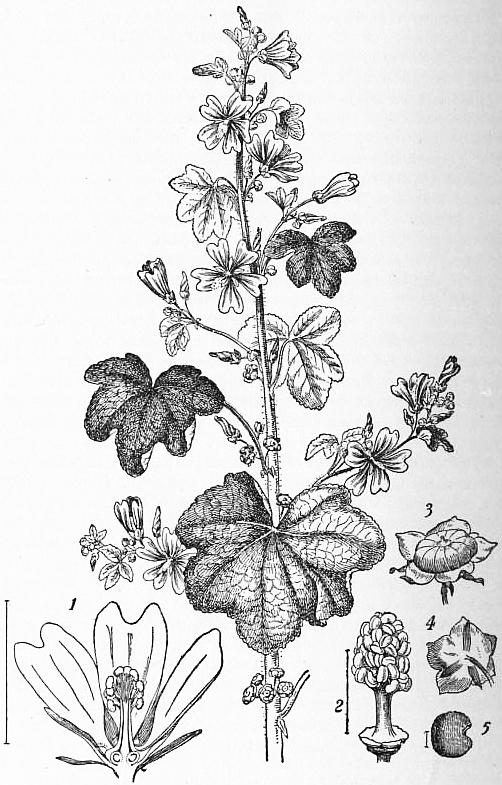
Mallow (Malva sylvestris), 1⁄3 nat. size.
1. Flower in section. 2. Stamens showing the union of the filaments into a common tube (monadelphous). 3. Fruit with persistent calyx. 1, 2 and 5 enlarged. 4. Same seen from the back showing the 3-leaved epicalyx. 5. Seed.
The marsh mallow (Althaea officinalis), the guimauve of the French, belongs to another genus having an involucre of numerous bracts. It is a native of marshy ground near the sea or in the neighbourhood of saline springs. It is an erect perennial herb, with somewhat woody stems, velvety, ovate, acute, unequally serrate leaves, and delicate pink showy flowers blooming from July to September. The flowers are said to yield a good deal of honey to bees. The marsh mallow is remarkable for containing asparagin, C4H8N2O3, H2O, which, if the root be long kept in a damp place, disappears, butyric acid being developed. The root also contains about 25% of starch and the same quantity of mucilage, which differs from that of gum arabic in containing one molecule less of water and in being precipitated by neutral acetate of lead. It is used in pâte de guimauve lozenges. Althaea rosea is the hollyhock (q.v.).
The mallow of Scripture, Job xxx. 4, has been sometimes identified with Jew’s mallow (Corchorus olitorius), a member of the closely allied order Tiliaceae, but more plausibly (the word מלוח implying a saline plant) with Atriplex Halimus, or sea orache. In Syria the Halimus was still known by the name Mallūh in the time of Ibn Beitar. See Bochart, Hieroz. iii. 16.
MALMEDY, a town of Germany, in the Prussian Rhine Province, lying in a wild and deep basin, on the Warche, 20 m. S. of Aix-la-Chapelle by rail via Eupen. It contains two Roman Catholic churches, a modern town-hall and a classical school. Its industries include tanning, dyeing and paper-making. Pop. (1900), 4680. Malmedy was famous for its Benedictine abbey, founded about 675, which was united with that of Stablo, the abbot of the joint house being a prince of the empire. In 1802 the lands of the abbey passed to France, and in 1815 they were divided between Prussia and Netherlands.
See Kellen, Malmedy und die preussische Wallonie (Essen, 1897).
MALMESBURY, JAMES HARRIS, 1st Earl of (1746-1820), English diplomatist, was born at Salisbury on the 21st of April 1746, being the son of James Harris (q.v.), the author of Hermes. Educated at Winchester, Oxford and Leiden, young Harris became secretary in 1768 to the British embassy at Madrid, and was left as chargé d’affaires at that court on the departure of Sir James Grey until the arrival of George Pitt, afterwards Lord Rivers. This interval gave him his opportunity; he discovered the intention of Spain to attack the Falkland Islands, and was instrumental in thwarting it by putting on a bold countenance. As a reward he was appointed minister ad interim at Madrid, and in January 1772 minister plenipotentiary to the court of Prussia. His success was marked, and in 1777 he was transferred to the court of Russia. At St Petersburg he made his reputation, for he managed to get on with Catherine in spite of her predilections for France, and steered adroitly through the accumulated difficulties of the first Armed Neutrality. He was made a knight of the Bath at the end of 1778, but in 1782 he returned home owing to ill-health, and was appointed by his friend Fox to be minister at the Hague, an appointment confirmed after some delay by Pitt (1784). He did very great service in furthering Pitt’s policy of maintaining England’s influence on the Continent by the arms of her allies, and held the threads of the diplomacy which ended in the king of Prussia’s overthrowing the republican party in Holland, which was inclined to France, and re-establishing the prince of Orange. In recognition of his services he was created Baron Malmesbury of Malmesbury (Sept. 1788), and permitted by the king of Prussia to bear the Prussian eagle on his arms, and by the prince of Orange to use his motto “Je maintiendrai.” He returned to England, and took an anxious interest in politics, which ended in his seceding from the Whig party with the duke of Portland in 1793; and in that year he was sent by Pitt, but in vain, to try to keep Prussia true to the first coalition against France. In 1794 he was sent to Brunswick to solicit the hand of the unfortunate Princess Caroline for the prince of Wales, to marry her as proxy, and conduct her to her husband in England. In 1796 and 1797 he was at Paris and Lille vainly negotiating with the French Directory. After 1797 he became partially deaf, and quitted diplomacy altogether; but for his long and eminent services he was in 1800 created earl of Malmesbury, and Viscount Fitzharris, of Heron Court in the county of Hants. He now became a sort of political Nestor, consulted on foreign policy by successive foreign ministers, trusted by men of the most different ideas in political crises, and above all the confidant, and for a short time after Pitt’s death almost the political director, of Canning. Younger men were also wont to go to him for advice, and Lord Palmerston particularly, who was his ward, was tenderly attached to him, and owed many of his ideas on foreign policy directly to his teaching. His later years were free from politics, and till his death on the 21st of November 1820 he lived very quietly and almost forgotten. As a statesman, Malmesbury had an influence among his contemporaries which is scarcely to be understood from his writings, but which must have owed much to personal charm of manner and persuasiveness of tongue; as a diplomatist, he seems to have deserved his reputation, and shares with Macartney, Auckland and Whitworth the credit of raising diplomacy from a profession in which only great nobles won the prizes to a career opening the path of honour to ability. He was succeeded as 2nd earl by his son James Edward (1778-1841), under-secretary for foreign affairs under Canning; from whom the title passed to James Howard, 3rd earl of Malmesbury (q.v.).
Malmesbury did not publish anything himself, except an account of the Dutch revolution, and an edition of his father’s works, but his important Diaries (1844) and Letters (1870) were edited by his grandson.
MALMESBURY, JAMES HOWARD HARRIS, 3rd Earl of (1807-1889), English statesman, son of the 2nd earl, was born on the 25th of March 1807, and educated at Eton and Oriel College, Oxford. He led a life of travel for several years, making acquaintance with famous people; and in 1841 he had only just been elected to the House of Commons as a Conservative, when his father died and he succeeded to the peerage. His political career, though not one which made any permanent impression on history, attracted a good deal of contemporary attention, partly from his being foreign secretary in 1852 and again in 1858-1859 (he was also lord privy seal in 1866-1868 and in 1874-1876), and partly from his influential position as an active Tory of the old school in the House of Lords at a time when Lord Derby and Mr Disraeli were, in their different ways, moulding the Conservatism of the period. Moreover his long life—he survived till the 17th of May 1889—and the publication of his Memoirs of an Ex-Minister in 1884, contributed to the reputation he enjoyed. These Memoirs, charmingly written, full of anecdote, and containing much interesting material for the history of the time, remain his chief title to remembrance. Lord Malmesbury also edited his grandfather’s Diaries and Correspondence (1844), and in 1870 published The First Lord Malmesbury and His Friends: Letters from 1745 to 1820. He was succeeded as 4th earl by his nephew, Edward James (1842-1899), whose son, James Edward (b. 1872) became the 5th earl in 1899.
MALMESBURY, a market town and municipal borough in the Chippenham parliamentary division of Wiltshire, England, 94½ m. W. of London by the Great Western railway. Pop. (1901), 2854. It lies on a ridge surrounded on all sides except the north-west by the river Avon and a small tributary. The church of St Mary and St Aldhelm, standing high, is a majestic fragment consisting of the greater part of the nave (with aisles) of a Benedictine abbey church. The ruined skeleton of the great tower arches now terminates the building eastward. The nave is transitional Norman, with a Decorated superstructure including the clerestory. The south porch is one of the finest Norman examples extant, both the outer and the inner doorways (especially the first) exhibiting the typical ornament of the period in remarkable exuberance. With the exception of a crypt, the monastic buildings have disappeared. In the market square stands a fine market cross of the 16th century, borne upon an octagonal battlemented basement. Early English fragments of a hospital of St John of Jerusalem appear in the corporation almshouse. Malmesbury has an agricultural trade, with breweries, tanneries and manufactures of silk and pillow lace. It is governed by a mayor, 4 aldermen and 12 councillors. Area, 178 acres.
Maildulphus, a Scottish or Irish monk, who came into England about 635, built a hermitage near the site of the modern Malmesbury (Maildulphi-urbs, Maldelmesburh, Malmesbiri) and gathered disciples round him, thus forming the nucleus of the later abbey of which Aldhelm his pupil became the first abbot. Æthelstan, who was buried here (though his tomb in the church only dates from the 16th century), rebuilt and endowed the monastery. Round the abbey the town of Malmesbury grew up, and by the time of the Domesday Survey it had become one of the only two Wiltshire boroughs. The first charter, said to be a forgery, purports to have been given by Æthelstan. It granted to the burgesses all privileges and free customs such as they held in the time of Edward the Elder, with many additional exemptions, in return for help rendered against the Danes. The castle built at Malmesbury during the reign of Henry I. gave a further impetus to the growth of the town during the 12th and 13th centuries. It was not incorporated, however, until 1645, when it was made a free borough under the title of “aldermen and burgesses of the borough of Malmesbury, County Wilts.” By this charter it was governed until 1885. The borough returned two members to parliament from 1295 to 1832 when the number was reduced to one. Finally in 1885 its representation was merged in that of the county. A grant of a yearly fair on the 31st of March, the feast of St Aldhelm, was obtained from William II., and another for three days from the 25th of July from John. In 1792 fairs were held on the 28th of March, the 28th of April and the 29th of June, but in 1891 they had ceased entirely. John also granted a weekly market on Thursday. In the 16th and 18th centuries it was held on Saturday, and in 1891 on the third Wednesday in each month. In the middle ages Malmesbury possessed a considerable cloth manufacture, and at the Dissolution the abbey was bought by a rich clothier and fitted with looms for weaving. The trade in wool still flourished in 1751.
See Victoria County History: Wiltshire; and Registrum malmesburiense (1879-1880).
MALMÖ, a seaport of Sweden, chief town of the district (län) of Malmöhus, on a small bay of the Sound, 384 m. S.S.W. of Stockholm by rail. Pop. (1800), 38,054; (1900), 60,857. It is connected with Copenhagen, 17¼ m. W. by N., by steam-ferry, the Sound being kept open in winter by an ice-breaker. It is also the first important station in Sweden on the Berlin-Stockholm route, which crosses the sea between Sassnitz in Rügen and Trelleborg, 20 m. S.E. of Malmö. The town, which stands upon a level plain, formerly had strong fortifications, of which only the citadel (Malmöhus) remains; in it the earl of Bothwell was imprisoned by Frederick II. of Denmark for some time after his departure from Scotland in 1567. The town-hall (1546, largely restored in 1864) contains a handsome chamber, the Knutssal, formerly used by the council of the gild of Canute. The hall fronts the central square (Stortorg) which is planted with trees and contains a colossal statue of Charles X. by Johan Helenus Börjeson (b. 1835) erected in 1896. The most notable church is that of St. Peter (Peterkyrka), dating in part from 1319. Malmö is second to Stockholm as an industrial centre. There are breweries and large works for the manufacture of machinery, among which may be mentioned the Kockum mechanical works, with yards for the construction of vessels of war, and others; of cotton and woollen goods, gloves, chocolate, sweetmeats and tobacco. A large export trade is carried on in butter and other agricultural produce, and matches. Coal is the chief import. The harborage includes an outer harbour of 22 ft. depth, and two inner basins admitting vessels of 21 ft. draught, with dry dock and patent slip. Malmö returns four members to the second chamber of the Riksdag (parliament).
Malmö (Malmhauge, Malmey, Malmöye, Malmoughe), sometimes called Ancona Scanorum or Ellenbogen, first appears in history about the middle of the 13th century. During the Hanseatic period it was the most important commercial town on the Sound, but in the 16th and 17th centuries greatly lost ground owing to the decay of its herring fisheries and the rise of its rival, Copenhagen. Its modern prosperity is largely due to the enterprise of Frans Snell, one of its merchants in the second half of the 18th century, who first constructed the harbour.
MALMSEY, a strong sweet wine, originally made at Monemvasia (Gr. Μονεμβασία), Napoli di Malvasia, in the Morea, Greece. The name of the place was corrupted in Med. Lat. into malmasia, whence the English form of the word. The corruption malvasia gives the O. Fr. malvesie, from which comes the alternative English form “malvoisie.” The wine is now made not only in Greece but also in Spain, Madeira and the Azores.
MALOCELLO, LANCILOTO (“Lanzarote, the ‘Lancelot Maloisiel’ of the French”), leader of the first of modern European oceanic enterprises. This was a Genoese expedition, which about 1270 seems to have sailed into the Atlantic, re-discovered the “Fortunate Islands” or Canaries, and made something of a conquest and settlement in one of the most northerly isles of this archipelago, still known (after the Italian captain) as Lanzarote. According to a Spanish authority of about 1345, the anonymous Franciscan’s Conosçimiento de todos los reinos, “Lancarote” was killed by the Canarian natives; but the castle built by him was standing in 1402-1404, when it was utilized for the storage of grain by the French conquerors under Gadifer de la Salle. To Malocello’s enterprise, moreover, it is probable that Petrarch (born 1304) alludes when he tells how, within the memory of his parents, an armed fleet of Genoese penetrated to the “Fortunatae”; this passage some would refer, without sufficient authority, to the expedition of 1291. Malocello’s name and nationality are certainly preserved by those early Portolani or scientific charts (such as the “Dulcert” of 1339 and the “Laurentian Portolano” of 1351), in which the African islands appear, for the first time in history, in clear and recognizable form. Thus Dulcert reads Insula de Lanzarotus and Marocelus, the Laurentian map I. de Lanzarote, against Lanzarote Island, which is well depicted on both designs, and marked with the cross of Genoa. The Conosçimiento (as noticed above) explicitly derives the island-name from the Genoese commander who perished here. Malocello’s enterprise not only marks the beginning of the oversea expansion of western Europe in exploration, conquest and colonization (after the age of Scandinavian world-roving had passed); it is also probably not unconnected with the great Genoese venture of 1291 (in search of a waterway to India, which soon follows), with which this attempt at Canarian discovery and dominion has been by some unjustifiably identified.
See the Conosçimiento, p. 100, as edited by Marcos Jimenez de la Espada in the Boletin de la sociedad geográfica de Madrid, (February 1877); Le Canarien in P. Margry, Conquête des ... Canaries, p. 177; M. A. P. d’Avezac in vol. vi., part ii., of L’Univers, pp. 1-41 (Îles africaines de l’océan atlantique); C. R. Beazley, Dawn of Modern Geography, iii. 411-413, 449, 451.
MALOLOS, a town and the capital of the province of Bulacán, island of Luzon, Philippine Islands, on a branch of the Pampanga Grande river. Pop. (1903), after the annexation of Barasoain and Santa Isabel, 27,025. There are thirty-eight villages, or barrios, of which eight had, in 1903, 1000 inhabitants or more. The principal language is Tagalog, but Spanish is spoken to some extent. Malolos is served by the Manila & Dagupan railway, and is a trade centre of considerable importance. The cultivation of rice is an important industry. In 1898-99, during the Filipino revolt, Malolos was the seat of the rebel government, but it was captured and reduced to desolation in March 1899. In 1904 a new municipal school building, a municipal market and a provincial building were erected.
MALONE, EDMOND (1741-1812), Irish Shakespearian scholar and editor, was born in Dublin, on the 4th of October 1741, the son of a barrister and a member of the Irish House of Commons. He was educated at Trinity College, Dublin, and was called to the Irish bar in 1767. The death of his father in 1774 assured him a competency, and he went to London, where he frequented literary and artistic circles. He frequently visited Dr Johnson and was of great assistance to Boswell in revising and proofreading his Life, four of the later editions of which he annotated. He was intimate with Sir Joshua Reynolds, to whom he sat for a portrait now in the National Portrait Gallery. He was one of Reynolds’ executors, and published a posthumous collection of his works (1798) with a memoir. Horace Walpole, Burke, Canning, Lord Charlemont, and, at first, George Steevens, were among Malone’s friends. Encouraged by the two last he devoted himself to the study of Shakespearian chronology, and the results of his “Attempt to ascertain the Order in which the Plays of Shakespeare were written” (1778) are still largely accepted. This was followed in 1780 by two supplementary volumes to Steevens’s version of Dr Johnson’s Shakespeare, partly consisting of observations on the history of the Elizabethan stage, and of the text of doubtful plays; and this again, in 1783, by an appendix volume. His refusal to alter some of his notes to Isaac Reed’s edition of 1785, which disagreed with Steevens’s, resulted in a quarrel with the latter. The next seven years were devoted to Malone’s own edition of Shakespeare in eleven volumes, of which his essays on the history of the stage, his biography of Shakespeare, and his attack on the genuineness of the three parts of Henry VI., were especially valuable. His editorial work was lauded by Burke, criticized by Walpole and damned by Joseph Ritson. It certainly showed indefatigable research and proper respect for the text of the earlier editions. Malone published a denial of the claim to antiquity of the Rowley poems (see Chatterton), and in this (1782) as in his branding (1796) of the Ireland MSS. (see Ireland, William Henry) as forgeries, he was among the first to guess and state the truth. His elaborate edition of Dryden’s works (1800), with a memoir, was another monument to his industry, accuracy and scholarly care. In 1801 the university of Dublin made him an LL.D. At the time of his death, on the 25th of April 1812, Malone was at work on a new octavo edition of Shakespeare, and he left his material to James Boswell the younger; the result was the edition of 1821—generally known as the Third Variorum edition—in twenty-one volumes. Lord Sunderlin (1738-1816), his elder brother and executor, presented the larger part of Malone’s splendid collection of books, including dramatic varieties, to the Bodleian Library, which afterwards bought many of his MS. notes and his literary correspondence. The British Museum also owns some of his letters and his annotated copy of Johnson’s Dictionary.
A memoir of Malone by James Boswell is included in the Prolegomena to the edition of 1821. See also Sir J. Prior’s Life of Edmond Malone (1860).
MALONE, a village and the county-seat of Franklin county, in the township of Malone, in the N.E. part of New York, U.S.A., about 60 m. E.N.E. of Ogdensburg. Pop. (1890), 4986; (1900), 5935 (910 foreign-born); (1905, state census), 6478; (1910), 6467. It is served by the New York Central & Hudson River and the Rutland (N.Y. Central Lines) railways. The village has a Memorial Park, Arsenal Green, on the site of an arsenal and parade-ground sold by the state in 1850, a state armoury, the Northern New York Institute for Deaf Mutes, Franklin Academy, St Joseph’s Ursuline Academy, and a detention-house for Chinamen entering the state from Canada. From Malone tourists visit the Great North Woods, in the Adirondack foothills, about 15 m. distant. Iron ore and Potsdam sandstone are found near Malone. In the surrounding region hops, potatoes, &c., are grown, and there are dairying and livestock interests. The village is a centre for the collection of hides and pelts. It manufactures woollen goods, paper and pulp, &c., and has foundry and machine shops and car repair shops. Malone, being on the line of communication between lakes Champlain and Ontario, was of strategic importance in the war of 1812, and later was twice the rendezvous of Fenians for attacks on Canada. The township of Malone was settled and erected from Chateaugay in 1805. The village was first known as Harison, was named Ezraville, in honour of Ezra L’Hommedieu, in 1808, received its present name in 1812, and was incorporated in 1853.
MALONIC ACID, C3H4O4 or CH2(COOH)2, occurs in the form of its calcium salt in the sugar beet. It was first prepared in 1858 by V. Dessaignes, who obtained it by oxidizing malic acid (Ann., 1858, 107, p. 251). It may also be obtained by oxidizing allylene and propylene with cold potassium permanganate solution, by the hydrolysis of barbituric acid (malonyl urea) with alkalis (A. Baeyer, Ann., 1864, 130, p. 143); by the hydrolysis of cyanacetic acid (H. Kolbe, Ann., 1864, 131, p. 349; H. Muller, Ann., 1864, 131, p. 352), and by the action of silver oxide on β-di-chloracrylic ester at 125° C. (O. Wallach, Ann., 1878, 193, P. 25)
CCl2:CH·COOC2H5 + Ag2O + H2O = 2AgCl + HOOC·CH2·COOC2H5.
It crystallizes in monoclinic tables, and is readily soluble in water, alcohol and ether. The acid melts at 132° C., and at a higher temperature it rapidly decomposes into acetic acid and carbon dioxide. When heated with bromine and water to 100° C. it forms tribromacetic acid, some bromoform being produced at the same time. Malonic acid, as well as its esters, is characterized by the large number of condensation products it can form. In the presence of a dehydrating agent (such as acetic anhydride), it combines with aldehydes to form compounds of the type R·CH:C(COOH)2, or their decomposition products (formed by loss of CO2) R·CH:CH·COOH.
Many salts of the acid are known and, with the exception of those of the alkali metals, they are difficultly soluble in water. Many esters of malonic acid have been prepared, the most important being the diethyl ester (malonic ester), CH2(COOC2H5)2, which is obtained by dissolving monochloracetic acid in water, neutralizing the solution with potassium carbonate, and then adding potassium cyanide and warming the mixture until the reaction begins. When the reaction has finished, the whole is evaporated and heated to about 130°-140° C. and then allowed to cool. The mass is then covered with two-thirds of its weight of alcohol, and saturated with hydrochloric acid gas. The whole is then poured into ice-cold water, extracted by ether and the ethereal solution distilled (L. Claisen, Ann., 1883, 218, p. 131). It is a colourless liquid boiling at 197°.7-198°.2 C. (W. H. Perkin). It is a most important synthetic reagent; with sodium or sodium ethylate it forms sodio-malonic ester, which reacts readily with alkyl halides, forming alkyl malonic esters, which are again capable of forming sodium derivatives, that by further treatment with alkyl halides yield the di-alkyl malonic esters. These esters are readily hydrolysed and yield the mono- and di-alkyl malonic acids which, on heating, are readily decomposed, with evolution of carbon dioxide and the formation of mono- and di-alkyl acetic acids. The scheme of reactions is shown thus:
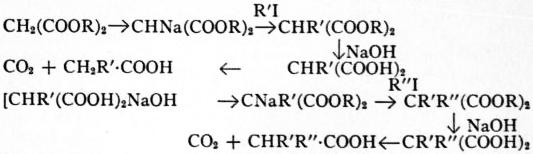
When sodio-malonic ester is heated to 145° C., it undergoes condensation, with elimination of alcohol and formation of the benzene derivative, phloroglucin tricarboxylic ester. The addition of urea to an alcoholic solution of sodio-malonic ester results in the formation of barbituric acid (A. Michael, Jour. pr. Chem., 1887 [2], 35, p. 456) The half nitrile of malonic acid is cyanacetic acid, CN·CH·2 COOH, which, in the form of its ester, may be obtained by the action of a solution of potassium cyanide on monochloracetic acid. The solution obtained is neutralized, concentrated on the water-bath, acidified by sulphuric acid and extracted with ether. It is then converted into the lead salt, which is decomposed by sulphuretted hydrogen and the solution is carefully concentrated (Th. Meves, Ann., 1867, 143, p. 201). It melts at 70° C. and at higher temperatures decomposes, with evolution of carbon dioxide and formation of aceto-nitrile, CH3·CN. The true nitrile of malonic acid is methylene cyanide, CH2(CN)2, which is obtained by distilling a mixture of cyanacetamide and phosphorus pentoxide. It is a crystalline solid, which melts at 29°-30° C. and boils at 218°-219° C., and is readily soluble in alcohol and ether.
MALORY, SIR THOMAS, translator and compiler of the famous English classic, the Morte d’Arthur. Previous to the publication of Professor Kittredge’s monograph, Who was Sir Thomas Malory? the identity of this writer remained an unsolved problem. Mr. Sidney Lee, in the Dictionary of National Biography, was compelled to admit that he could find no one of that name fulfilling the necessary conditions. Of direct evidence we have very little; in the concluding passage of the book the author asks the prayers of the reader for “Syr Thomas Maleore knyght,” and states that the book was ended “the ix. yere of the reygne of Kyng Edward the fourth.” Caxton, in his preface, says that he printed the book “after a copye unto me delivered whyche copye Syr Thomas Malorye dyd take oute of certeyn bookes of frensshe and reduced it in to Englysshe”; in his colophon he repeats this statement, adding that he himself is responsible for the division of the work into books and chapters, and that it was printed in 1485. It will be noted that Caxton does not say that he received the book from Malory, only that he had received a copy made by Malory; from this Professor Kittredge draws the conclusion that the compiler was no longer living. The problem then is to find a Thomas Malory who was (a) a knight, (b) alive in the ninth year of King Edward IV. (Mar. 4, 1469-Mar. 3, 1470), and (c) who was no longer living in July (or June) 1485.
All these conditions Professor Kittredge finds fulfilled in the life of Sir Thomas Malory, knight, of Newbold Revell (or Fenny Newbold), M.P. for Warwickshire in 1445. The date of Sir Thomas’s birth is uncertain, but he succeeded his father, Sir John, in 1433 or 1434. Previously to this he had served in France, in the retinue of the earl of Warwick, most probably during the time that that nobleman held the office of captain of Calais. It seems probable that he is also to be identified with a “Thomas Malorie, miles,” who in 1468 was, on account of the part played by him in the Wars of the Roses, excluded with several others from the operation of a pardon issued by Edward IV. As, however, on the death of Sir Thomas on the 14th of March 1470, there was no difficulty as to inheritance, his estates passing to his grandson, he must, if this identification be correct, have come under the general amnesty of 1469. It will be seen, therefore, that so far as it is in our power to state the question this Sir Thomas Malory fulfils all the necessary conditions.
It is interesting to note that the career of the earl of Warwick in France was marked by certain picturesque and chivalric features which might well impress the imagination of a young retainer. John Rous, in his Life of Richard Earl of Warwick, tells us that at a certain tourney held near Calais at Christmastide, Earl Richard appeared three days running in different armour, overthrowing his adversary on each occasion—an exploit obviously imitated from the chivalric romances of the period.
The work with which Malory’s name is connected is an abridged compilation of the great body of Arthurian romance in its latest form. The Merlin (Vulgate and Suite), Tristan, Lancelot, Queste and Mort Artus are all represented, the only branch omitted is that dealing with the “early history” of the Grail, the Joseph of Arimathea and Grand S. Graal. Thanks mainly to the labours of Dr Oskar Sommer, we can now assign the majority of the books to their separate sources, although certain stories, such as the adventures of Sir Gareth under the pseudonym of Beaumains, the handling of Sir Urre of Hungary, and the details of the abduction of Guenevere by Meleagaunt, still remain unidentified. But we do not yet know whether Malory himself was responsible for this selection, or whether he found it ready to hand in a MS., the “Frensshe Booke” to which he often refers. To make such a compilation at first hand, considering the extent of the ground covered, would involve an enormous amount of study and selection, and the access to a very large library—conditions which scarcely seem to fit in with the social position and activities of Sir Thomas. On the other hand it is undeniable that the medieval copyists, at the instance of their patrons, did make compilations from the various romances within their reach, such as e.g. the enormous codex 112 (fonds Franç.) of the Bibliothèque Nationale, which includes large sections of the Tristan, the Lancelot, and the Merlin Suite. Taking into consideration alike what Malory retains and what he omits, it seems most probable that he was in possession, not of complete copies of the romances, but of one or more volumes of compilations from these sources.
From the point of view of matter it must be admitted that the Morte d’ Arthur does not represent the Arthurian cycle at its best, but rather in the period of its decadence; nor does Malory in any way endeavour to overcome the difficulties caused by the juxtaposition of a number of independent (and often contradictory) versions. This is especially noticeable in his treatment of Gawain; in the section derived from the Lancelot and Mort Artus he is a good and valiant knight, “a ful noble knyghte as ever was borne,” in those derived from the Tristan and the Queste, he is treacherous, dissolute, and a murderer of good knights.
The great charm of Malory’s work lies in his style; stately, earnest and dignified, it has lent to the relations between Lancelot and Guenevere a character of truth and vitality in which the French original is wholly lacking. Malory achieved a remarkable feat—he took the Arthurian story in its worst and weakest form and he imparted to it a moral force and elevation which the cycle, even in its earlier and finer stage, had, save in the unique case of Von Eschenbach’s Parzival, never possessed. While genuine lovers of the Arthurian cycle must regret that the romances should only be known to the great majority of English readers through the versions of Malory and Tennyson, it is impossible to withhold from the Morte d’ Arthur the admiration due to an imperishable monument of English language and literature.
See Who was Sir Thomas Malory? G. L. Kittredge (Harvard Studies and Notes, vol. v., 1896); Morte d’ Arthur, ed. by Dr Oskar Sommer (an exact reproduction of the original text in 2 vols.)—vol. iii. a study on “The Sources of Malory.” The sections on Lancelot and Queste are unfortunately very inadequate; for these cf. The Legend of Sir Lancelot, Grimm Library, vol. xii.
(J. L. W.)
MALOT, HECTOR HENRI (1830-1907), French novelist and man of letters, the son of a notary, was born at La Bouille (Seine Inférieure) on the 20th of May 1830. He studied law at Rouen and Paris, but literature early absorbed his attention. He collaborated in the Biographie générale of Didot, became literary critic of L’Opinion Nationale, and dramatic critic of the Lloyd français. He is the author of a long series of popular novels dealing with contemporary life, including: a trilogy of domestic novels entitled Victimes d’amour (1859, 1865, 1866); Un Beau frère (1869); Madame Obernin (1870); Le Docteur Claude (1879); Justice (1889). Les Aventures de Romain Kalbris (1869) and Sans famille (1888) are excellent stories for children. A complete edition of Hector Malot’s works appeared in 1894-1897. He died at Vincennes in July 1907.
MALOU, JULES ÉDOUARD XAVIER (1810-1886), Belgian statesman, one of the leaders of the clerical party, was born at Ypres on the 19th of October 1810. He was a civil servant in the department of justice when he was elected to the Chamber of Deputies by his native constituency in 1841, and was for some time governor of the province of Antwerp. He was minister of finance in the coalition ministry of J. B. Nothomb in 1844, and formed with B. T. de Theux a Catholic cabinet in 1846, which was overthrown in the Liberal victory of 1847. Malou then became a member of the senate, and his party only regained ascendancy in 1870. The extreme clerical ministry of Baron d’Anethan retired in December 1871 after serious rioting in Brussels, and Malou was the real, though not the nominal, head of the more moderate clerical administrations of de Theux and Aspremont-Lynden (1870-1878). He was wise enough to disavow the noisy sympathy of Belgian Ultramontane politicians with the German victims of the Kulturkampf, and, retaining in his own hands the portfolio of finance, he subordinated his clerical policy to a useful administration in commercial matters, including a development of the railway system. It was only after the fall of the ministry in 1878 that he adopted a frankly clerical policy, and when he became chief of a new government in June 1884 he proceeded to undo the educational compromise of his predecessors in the Frère-Orban ministry. His legislation in favour of the Catholic schools caused rioting in Brussels, and in October the king demanded the retirement of MM. Jacobs and Woeste, the members of the cabinet against whom popular indignation was chiefly directed. Malou followed them into retirement, and died at Woluwe Saint Lambert, in Brabant, on the 11th of July 1886. He was a financier of great knowledge and experience, and his works (of which a long list is given in Koninck’s Bibliographie nationale de Belgique) include three series (1874-1880) of memoirs on financial questions, edited by him for the Chamber of Deputies, besides pamphlets on railroad proposals, mining and other practical questions. His brother Jean Baptiste Malou (1809-1864) was a well-known divine.
MALOUET, PIERRE VICTOR,, Baron (1740-1814), French publicist and politician, was born at Riom (Puy-de-Dôme) on the 11th of February 1740, the son of a lawyer. He entered the civil service and was employed successively at the French embassy in Lisbon, in the administrative department of the duc de Broglie’s army, as commissary in San Domingo from 1767-1774, and, after his return to France, as commissary-general of the marine. In 1776 he was entrusted to carry out plans of colonization in French Guiana, but was superseded in 1779. On his return to France he was well received at court, and the execution of his plans in Guiana was assured. He became intendant of the port of Toulon, and in 1789 was returned to the states-general, where he soon became well known as a defender of the monarchical principle. He emigrated to England in September, 1792, but shortly afterwards sought in vain permission to return to assist in the defence of Louis XVI. His name was erased from the list of emigrants in 1801 by Napoleon, who restored him to his position in the service and sent him to Antwerp as commissioner-general and maritime prefect to superintend the erection of defence works, and the creation of a fleet. He entered the council of state in 1810, but, having offended the emperor by his plainness of speech, he was disgraced in 1812. At the Restoration, Louis XVIII. made him minister of marine; and he died on the 7th of September 1814.
The most important documents for his domestic and colonial policy are a Collection de ses opinions à l’Assemblée Nationale (3 vols., 1791-1792); and Collection de mémoires et correspondances officielles sur l’administration des colonies et notamment sur la Guiane française et hollandaise (5 vols., 1802).
MALPIGHI, MARCELLO (1628-1694), Italian physiologist, was born at Crevalcuore near Bologna, on the 10th of March 1628. At the age of seventeen he began the study of philosophy; it appears that he was also in the habit of amusing himself with the microscope. In 1649 he started to study medicine; after four years at Bologna he graduated there as doctor. He at once applied to be admitted to lecture in the university, but it was not till after three years (1656) that his request was granted. A few months later he was appointed to the chair of theoretical medicine at Pisa, where he enjoyed the friendship and countenance of G. A. Borelli. At the end of four years he left Pisa, on the ground of ill-health, and returned to Bologna. A call to be professor primarius at Messina (procured for him through Borelli, who had in the meantime become professor there) induced him to leave Bologna in 1662. His engagement at Messina was for a term of four years, at an annual stipend of 1000 scudi. An attempt was made to retain him at Messina beyond that period, but his services were secured for his native university, and he spent the next twenty-five years there. In 1691, being then in his sixty-fourth year, and in failing health, he removed to Rome to become private physician to Pope Innocent XII., and he died there of apoplexy three years later, on the 30th of November 1694. Shortly before his death, he drew up a long account of his academical and scientific labours, correspondence and controversies, and committed it to the charge of the Royal Society of London, a body with which he had been in intimate relations for more than twenty years. The autobiography, along with some other posthumous writings, was published in London in 1696, at the cost of the Society. The personal details left by Malpighi are few and dry. His narrative is mainly occupied with a summary of his scientific contributions and an account of his relations to contemporary anatomists, and is entirely without graces of style or elements of ordinary human interest.
Malpighi was one of the first to apply the microscope to the study of animal and vegetable structure; and his discoveries were so important that he may be considered to be the founder of microscopic anatomy. It was his practice to open animals alive, and some of his most striking discoveries were made in those circumstances. Although Harvey had correctly inferred the existence of the capillary circulation, he had never seen it; it was reserved for Malpighi in 1661 (four years after Harvey’s death) to see for the first time the marvellous spectacle of the blood coursing through a network of small tubes on the surface of the lung and of the distended urinary bladder of the frog. We are enabled to measure the difficulties of microscopic observation at the time by the fact that it took Malpighi four years longer to reach a clear understanding of the corpuscles in the frog’s blood, although they are the parts of the blood by which its movement in the capillaries is made visible. His discovery of the capillary circulation was given to the world in the form of two letters De Pulmonibus, addressed to Borelli, published at Bologna in 1661 and reprinted at Leiden and other places in the years following; these letters contained also the first account of the vesicular structure of the human lung, and they made a theory of respiration for the first time possible. The achievement that comes next both in importance and in order of time was a demonstration of the plan of structure of secreting glands; against the current opinion (revived by F. Ruysch forty years later) that the glandular structure was essentially that of a closed vascular coil from which the secretion exuded, he maintained that the secretion was formed in terminal acini standing in open communication with the ducts. The name of Malpighi is still associated with his discovery of the soft or mucous character of the lower stratum of the epidermis, of the vascular coils in the cortex of the kidney, and of the follicular bodies in the spleen. He was the first to attempt the finer anatomy of the brain, and his descriptions of the distribution of grey matter and of the fibre-tracts in the cord, with their extensions to the cerebrum and cerebellum, are distinguished by accuracy; but his microscopic study of the grey matter conducted him to the opinion that it was of glandular structure and that it secreted the “vital spirits.” At an early period he applied himself to vegetable histology as an introduction to the more difficult study of the animal tissues, and he was acquainted with the spiral vessels of plants in 1662. It was not till 1671 that he wrote his Anatome plantarum and sent it to the Royal Society, who published it in the following year. An English work under a similar title (Anatomy of Vegetables) had been published in London a few months earlier, by Nehemiah Grew; so that Malpighi’s priority as a vegetable histologist is not so incontestable as it is in animal histology. The Anatome plantarum contained an appendix, Observations de ovo incubato, which gave an account (with good plates) of the development of the chick (especially of the later stages) in many points more complete than that of Harvey, although the observations were needlessly lessened in value by being joined to the metaphysical notion of “praedelineation” in the undeveloped ovum.
He also wrote Epistolae anatomicae Marc. Malpighii et Car. Fracassati (Amsterdam, 1662) (on the tongue, brain, skin, omentum, &c.); De viscerum structura: exercitatio anatomica (London, 1669); De structura glandularum conglobatarum (London, 1689); Opera posthuma, et vita a seipso scripta (London, 1697; another edition, with preface and additions, was published at Amsterdam in 1700.). An edition containing all his works except the last two was published in London in 1687, in 2 vols. folio, with portrait and plates.
MALPLAQUET, a village of France in the department of the Nord, close to the Belgian frontier and about 10 miles S. by E. of Mons, famous as the scene of the battle, September 1709, between the Allies under the duke of Marlborough and Prince Eugène and the French commanded by Marshal Villars, in which the former were victorious. The country to the west and south of Mons is enclosed by a semicircular wall of woods and broken ground, through which there are only two important gaps—that of Jemappes (famous in 1792) to the west, and that of Aulnois, in which stands the village of Malplaquet, to the south. In the latter gap and the woods on either side Villars took up his position facing north-eastwards, on August 29/September 9. The forces in presence, over 90,000 on each side, were exceptionally large, and the French army in particular represented the spirit of its nation to a degree unusual in the armies of that time. Villars was the best general in the service of Louis XIV. and the veteran Marshal Boufflers, though senior to him, had volunteered to serve as his second in command. Marlborough and Eugène lay with their army between Mons and the French camps, which were almost within cannon shot. Marlborough’s own wish was for an immediate battle, but he was opposed by the Dutch deputies at his headquarters, and even by Eugène, so that it was only on August 31/September 11 that the attack actually took place. Villars had made full use of his respite. The French right stood at the fringe of the wood of Lanière, the left was strongly posted in the midst of the wood of Taisnière, and across the two and a half miles of open ground between the woods the position was entrenched with several successive lines of works. The troops were almost equally distributed along the whole line as usual, and the cavalry was massed in rear of the infantry. In the Allied army the mounted troops were also kept back, but for the most part distributed to the various infantry commands.
The intention of Marlborough and Eugène, when on the morning of the battle they examined this formidable position, was to deliver the main attack upon the French left wing, combining the assaults of several columns on its front and flanks. In this quarter the French not only held the interior of the wood but also were thrown forward so as to occupy the edges of its north-eastern salient, and upon the two faces of this salient Count Lottum (1650-1719) with the Prussians, and Count von der Schulenburg (1661-1747) with the Austrian infantry were to deliver a double attack, while farther to the Allied right a column under the English General Withers was detached to make a wide turning movement through the woods. Marlborough took command on the right, Eugène on the left. The centre, which was intended only to observe the enemy until the decision had been forced at the wood of Taisnière, consisted of Lord Orkney’s British corps and the prince of Orange’s Dutch contingent. These extended across the Trouée d’Aulnois as soon as the combined attack of Lottum and Schulenburg opened. The general advance was covered by a heavy cannonade, and the salient of the Taisnière wood was duly attacked on its two faces by the Prussians and Austrians about 9 a.m. They encountered a sterner resistance than in any of the battles and combats of the past seven campaigns, for on this field the defenders were fighting, not as hitherto for the interests of their king, but to defend their country, and the regiments of Picardie and Champagne which held the salient were the oldest and most famous of the French line. Lottum attacked the works on the eastern edge, again and again without success, until three British battalions had to be sent to reinforce him, and Marlborough placed himself with a corps of cavalry in close support. At last the entrenchments were stormed. Schulenburg, with the Austrians, had by this time fought his way through the woods and undergrowth, and the united force pressed back the French farther and farther into the wood. Still, so stubborn was the defence and so dense the wood that the impetus of the assault died away and the troops on both sides broke up into small disconnected bodies, fighting too fiercely to be amenable to superior control.
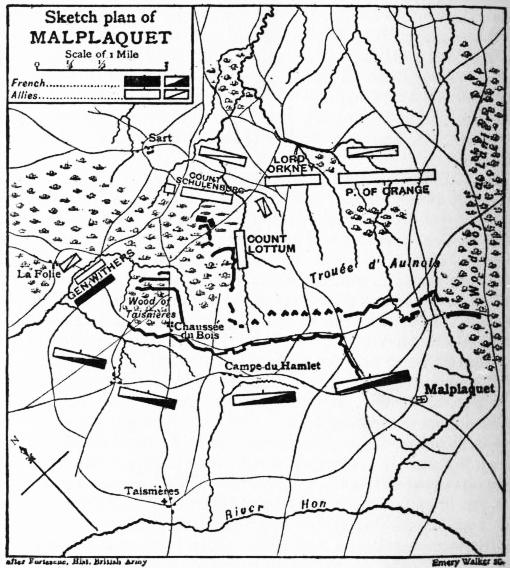
After Hon. J. W. Fortescue, History of the British Army, by permission of Macmillan & Co., Ltd.
But the French were not reinforced from their right wing as Villars expected. The prince of Orange, far from merely observing the hostile right as he had been ordered to do, committed his corps, very early in the battle, to a serious assault upon it, which Boufflers repulsed with enormous loss. The Dutch infantry never recovered from its casualties on this day, and the memory of Malplaquet was strong even at Fontenoy nearly forty years afterwards. Some Hanoverian troops which took part in this futile attack suffered equally heavily. The only advantage to the Allies—an advantage which, as it happened, counted for much—was that Boufflers did not dare to send reinforcements to the hard-pressed left wing. Thanks to this the Austrians and Prussians, with the English detached to their aid, made steady progress in the wood of Taisnière. Villars launched the “Irish brigade” to check the advance of the Allies, and this famous corps charged into the forest. Villars, Eugène and Marlborough personally led their troops in the encounter which followed. Eugène was wounded, but refused to quit the field. Villars was more seriously hurt, and after trying in vain to direct the fighting from a chair was carried insensible from the field. At this crisis General Withers, who commanded the force that had been ordered to turn the French extreme left, and had fought his way through the forest, appeared on the scene. The British 18th regiment (Royal Irish), encountering the French Royal Irlandais, put it to the rout, and Villars’s counterstroke was at an end. The French maintained themselves on this side only by the aid of troops drawn from the centre and right, and this gave the Allied centre the opportunity which the prince of Orange had so rashly anticipated. The great attack over the open was carried out, in spite of the previous repulse, with the greatest determination. Preceded by forty guns, the corps of the prince of Orange and Lord Orkney swiftly carried the first line of works. The Allied cavalry then pushed out to the front, and horse, foot and artillery were combined in the last advance. Boufflers’s cavalry masses, coming into play for the first time, fought hard, and the struggle fluctuated with the arrival of successive reserves on either side, but in the end, shortly before 3 p.m., Boufflers (who had been in command since Villars’s fall) decided to retreat. The Allies had no troops left intact for the pursuit, and those engaged had expended their last efforts. Moreover Boufflers, experienced soldier as he was, drew off his men before they had lost their order and discipline.
Thus this “very murdering battle” as Marlborough called it—the last and greatest pitched battle of the war—was almost barren of results. The Allies lost not less than twenty thousand men, or nearly a quarter of the whole force, the thirty battalions of the Dutch infantry losing half their numbers. On the French side there were some twelve thousand casualties. If further evidence were necessary to prove that the French fought their hardest, it could be found in the fact that whereas in almost every other battle, from 1660 to 1792, there were deserters and prisoners by the thousand, at Malplaquet only 500 of the French fell into the hands of the victors unwounded.
MALSTATT-BURBACH, a town of Germany, in the Prussian Rhine province on the right bank of the Saar (Sarre), which separates it from Saarbrücken. Pop. (1900), 31,195. It lies in the midst of an important coal-mining and industrial district, and is itself little more than a long and narrow row of manufactories and workmen’s houses. The largest factories are engaged in the production of iron, steel and cement. There is a large wharf on the river for the export of coal.
Malstatt received municipal rights in 1321. These, however, were afterwards resigned to the newer town of Saarbrücken, and in 1818 Malstatt and Burbach were two small villages with a joint population of only about 800. About the middle of the century the population began to increase rapidly, in consequence of the development of the mining industry of the district and the extension of the railway system, and in 1874 the two villages were united to form a town.
MALT (O. Eng., mealt; O. Sax., malt; O. Teut., maltos; Mod. Ger., Malz; Scand., malt; probably derived from the Sanskrit mrdu, soft, thus having reference to the fact that malt is raw grain rendered soft or tender), the name given to grain in which germination has been caused to proceed to a certain stage and has then been arrested by the removal of water and the application of heat. During this limited germination enzymes are developed (see Fermentation), and the constituents of the grain modified so that the finished malt, when ground and submitted to the mashing process (see Brewing), differs from the original raw grain in that the greater portion dissolves. This solubility is, however, a direct one to a slight extent only; it is due for the most part to the action of the malt enzymes, diastase, &c. on the constituents of the grain, the main portion of which are of themselves insoluble. Thus starch, the main constituent of all graminaceous seeds, probably exists in the same condition in raw grain and in malt. When however the malt is mashed, the starch is attacked by the enzyme diastase, and converted by the process of hydrolysis into a mixture of soluble compounds, e.g. the crystalline sugar, maltose, and a number of gummy substances known as maltodextrins. But to a certain extent starch and other carbohydrate substances are rendered directly soluble and diffusible during the malting process, some of the products serving the respiratory needs of the growing germ, others being assimilated by the plantlet and reconverted into reserve carbohydrates in the tissues of the germ and rootlets, whilst the remaining portions are retained as such in the finished malt. Similarly certain of the nitrogenous constituents of the grain, the proteïns, are broken down and rendered soluble by proteolytic enzymes, the products being assimilated to a certain extent by the germ and rootlets, by the cells of which they are again built up into complex proteïns, whilst others remain in their simplified form. It is now known that proteolytic enzymes exist in finished malt, and that, when the mashing process is conducted under certain conditions, these are able to degrade and render soluble some of the higher proteïns present in the malt. When germination is allowed to proceed as it does when the grain is planted in the soil, the whole of the contents are rendered soluble by degrees and in turn assimilated by the growing plantlet. By the limited germination which constitutes the malting process, however, the balance of soluble compounds left in the finished malt is from 15 to 25% of the total weight of the corn.
Although other seeds of the natural order Gramineae are occasionally malted, the greater portion of malt is made from the various species of Hordeum, known by the name of barley (q.v.), bigg, or bere. Indeed ordinary beer derives its characteristic flavour to the greatest extent from barley malt. A small proportion of malted oats or malted wheat is sometimes used in conjunction with barley malt for certain kinds of beer, whilst rye, maize, and even rice are occasionally malted. Barley is, however, the grain best adapted for making malt intended for brewing beer, and accordingly some space will be devoted to a description of those varieties of this grain which are used by the brewer.
Barley belongs to the genus Hordeum, of which there are numerous species and varieties. Linnaeus and the earlier botanists recognized six species of cultivated barleys, but modern botanists usually consider all cultivated barleys as belonging to one species to which the name H. sativum has been given. Körnicke regards H. spontaneum, a very long thin-grained two-rowed barley (see below) which grows in the East, as being the parent form; but E. S. Beaven inclines to the view that wild species of more than one form were originally used as food and subsequently cultivated. The last-named author has drawn up a scheme of classification for the varieties and races of cultivated barleys.
Fig. 1. Fig. 2. Fig. 3. Fig. 4.
Six-rowed barleys. Fig. 1.—H. hexastichum.
a. Three spikelets in situ on the rachis, showing short internodes.
b. Spike. Median spikelets uppermost, and with lower awns removed.
c. Spike. Lateral spikelets uppermost, and with lower awns removed.
Fig. 2.—H. vulgare.
a. Three spikelets in situ on the rachis, showing long internodes.
b. Spike. Median spikelets uppermost.
c. Spike. Lateral spikelets uppermost.
Two-rowed barleys. Fig. 3.—H. zeocriton.
a, d. Spikelets. Rachis edgewise, showing short internodes.
b. Var. zeocrithum (fan barley). Spike converging.
c. Var. erectum (Goldthorpe). Spike parallel.
Fig. 4.—H. distichum.
a, d. Spikelets. Rachis edgewise, showing long internodes.
b. Var. nutans (Chevallier).
c. Ouchak barley.
Figures 1-4 redrawn from a paper by E. S. Beaven in Journ. Fed. Inst. Brewing (1902), 8. 542.
In an ear of barley the primary axis or rachis is divided into internodes of which there may be any number up to forty. Each internode bears three single-flowered spikelets arranged alternately on either side of the rachis. In the six-rowed varieties the whole of these spikelets attain maturity, whilst in the two-rowed varieties only one on each side of the rachis, viz. the median, develops. British beer is brewed principally from the malt made from home-grown two-rowed barleys. Of late years, however, it has been found advantageous to employ a proportion of malt made from the thinner and more husky foreign barleys, mostly six-rowed varieties. The corns of two-rowed barleys are as a rule plumper than those of six-rowed barleys.
The most favourite barley for malting purposes grown in the United Kingdom is the narrow-eared two-rowed H. distichum, commonly known as Chevallier, from the name of the original cultivator, the Rev. John Chevallier. Of late years the quantity of barley of the so-called Goldthorpe type (H. zeocriton), used for malting, has increased. The paleae or outer coverings of the corns of this variety are somewhat “greasy” in appearance, and do not adhere so closely to the corn as in the Chevallier. The corns of Goldthorpe barley possess a small dimple or transverse furrow near the basal end. Further the basal bristle or rachilla (the prolongation of the axis or point from which the corn was originally developed) is invariably covered with long hairs, whilst in the case of Chevallier it has generally very short hairs. In the variety of Chevallier known as Archer, however, the rachilla has somewhat long hairs. Further the corns of Chevallier barley lie nearly vertical, that is almost parallel to the rachis, whereas in Goldthorpe they are spread out at a greater angle, hence the name fan or peacock barley given to that variety commonly known as sprat. It is believed by some brewers that Goldthorpe barleys never yield malt of so high a quality as do Chevallier barleys. On the other hand, when well matured, Goldthorpes work evenly and freely on the malting floors; and from an agricultural point of view they have the advantage of standing up better against unfavourable weather conditions on account of their stouter straws. Numerous fresh varieties of barley are continually being introduced as a result of artificial cross-fertilization, but cross-fertilization rarely if ever occurs naturally.
Hungarian two-rowed barleys are excellent as regards quality, and command a high price. The so-called Californian Chevallier and Chilean Chevallier contain a certain admixture of the six-rowed H. vulgare.
Of the imported thin barleys may be mentioned Brewing Californian, Brewing Chilean, Danubian and Smyrna (Yerli), all for the most part six-rowed varieties; also Ouchak, consisting principally of a two-rowed variety. For the manufacture of grain spirit a malt of high diastatic activity is required, and this is largely made from a very thin barley shipped from Odessa.
In the common six-rowed English barley or Scottish bere (H. vulgare), the two lateral rows of spikelets springing from one side of the rachis, either partially or entirely intersect and overlap the alternate lateral spikelets which spring from the opposite side of the rachis. This has given rise to the term “four-rowed barley.” Figs. 1-4 show some typical barleys in the ear.
The production of new varieties by cross-fertilization has of late years attained a degree of almost mathematical precision by the application of the law of inheritance first discovered by Gregor Mendel in 1865, and brought to light in 1901 independently by de Vries, Correns and Tschermak.
Constitution of Barley.—A grain of barley is shuttle-shaped; the end containing the germ which was originally attached to the rachis is known as the proximal end, whilst the opposite end of the corn is called the distal end. A deep furrow runs down the more convex side, which is accordingly denoted the ventral side, the opposite side being distinguished as the dorsal side. Within the ventral furrow at the proximal end is the rachilla already referred to. The skin or husk of a barleycorn consists of two paleae, one adhering to the dorsal side (the palea inferior) and the other to the ventral side (the palea superior); the former overlaps the edges of the latter. The awn or beard is merely an elongation of the palea inferior. If the two paleae are removed from a barleycorn after soaking it in water, it will be seen that there are other skins completely enveloping the embryo and endosperm. These are the true skins, and are known as the pericarp and the testa respectively. It may here be mentioned that A. J. Brown has shown recently that the embryo and endosperm of a barleycorn are enclosed in a semi-permeable membrane, i.e. one which allows the passage of water to the interior of the corn, but not of certain salts and acids. This property appears to be associated with one of the layers of the testa. Next to these skins will be seen the triple layer of thick-walled square-shaped aleurone cells.
The histology of the barleycorn is best studied by the examination of sections under the microscope. The grain consists of two main portions, the embryo or germ, and the endosperm, the storehouse of reserve materials for the growing plant.
The accompanying illustrations show portions of longitudinal sections of a barleycorn magnified to different degrees.
On examining fig. 5, which represents a section of the germ end of a grain of barley cut through the ventral furrow, it will be noticed that the rudimentary leaves, stem and roots are distinguishable. The embryo lies embedded in a mass of cells, the part dividing it from the endosperm being known as the scutellum. Special note should be taken of the elongated cells known as the absorptive epithelial layer, which has certain very important functions to fulfil during the process of germination, notably in feeding the embryo when it begins to develop into a young plant. Next to this, actually between the scutellum and the endosperm, will be seen a layer of empty cells. These at one time in the history and the development of the corn contained starch granules, but this starch was absorbed during its later development by the embryo. It will be observed further that the endosperm is filled with a network of thin-walled cells closely packed with starch granules, and smaller granules of proteïn matter (fig. 6). Nearest the skin will be seen the triple layer of aleurone cells already referred to (fig. 7).
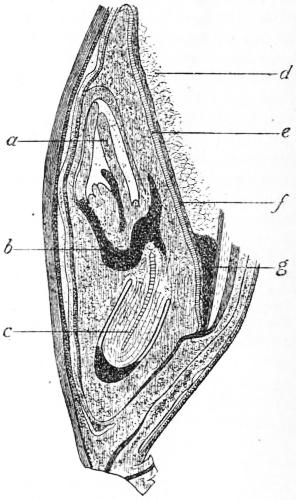
Fig. 5.—Median longitudinal section of a barleycorn showing the germ and its appendages.
a, Rudimentary leaves or plumules; b, Rudimentary stem; c, Rudimentary root; d, Empty starch cells of the endosperm; e, Absorptive epithelial layer; f, Compressed layer of empty cells; g, Starch cells (filled).
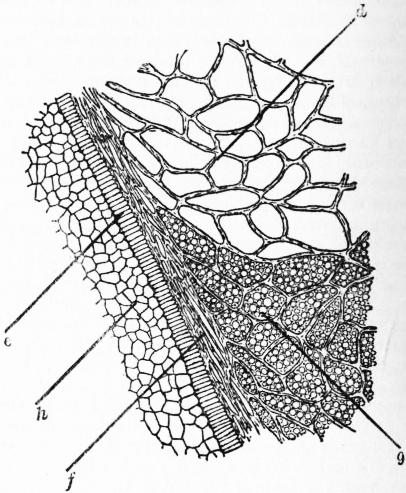
Fig. 6.—Section showing absorptive epithelial layer more highly magnified.
d, Walls of starch cells; e, Epithelial layer; f, Compressed layer of empty cells; g, Cells filled with starch granules; h, Cells of the scutellum.
Germination.—The barleycorn in its resting stage is in a state which may be described as one of dormant vitality; it respires very slowly and thus loses weight during storage. The best and driest barleys are said to lose 1.3% of their weight in the first year, 0.9% in the second, and 0.5% in the third. The loss is considerably more with coarse and damp samples. When the grain is steeped this dormant vitality gives place to that complicated series of processes comprised under the general term germination. When germination begins, enzymes are secreted, and these act on the reserve materials, starch and proteïns of the endosperm, converting them into simpler compounds, capable of diffusing to various parts of the growing germ. Following this, starch and proteïns are re-formed, the former being deposited in the tissues of the germ and in the cells of the scutellum, which previously were almost free from starch; the proteïn matter deposited in the latter disappears to a considerable extent, and the protoplasmic content of the cells assumes a very granular appearance. The pointed mass of cells constituting the root-sheath is pushed forward by the root which protrudes through the base of the grain. It is at this stage that the barley is said by the maltster to “chit.” After the first rootlet has broken through the ends of the sheath, it is followed by others. The cotyledonary sheath begins to elongate on the third or fourth day of germination and ruptures the true covering of the seed; it then grows upwards between this and the husk and forms the acrospire or “spire” of the maltster.
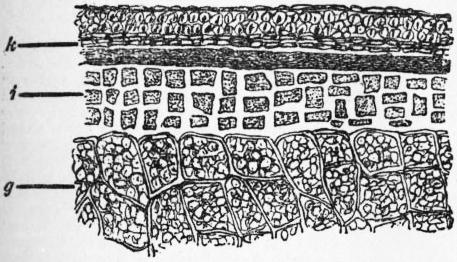
Fig. 7.—Section showing the aleurone layer.
g, Starch cells; i, Aleurone layer; k, Layers which collectively constitute the husk.
[Figs. 5-7 from Sykes & Ling, Principles and Practice of Brewing (1907), Charles Griffin & Co., Ltd.]
According to Brown and Morris, when the first rootlet is breaking through the sheath, starch begins to appear in the tissues of the grain, also in the protoplasm of those cells which are nearest the epithelial layer, and it gradually invades the deeper-seated cells. Further the cellulose walls of the endosperm, situated immediately above the secretory layer, are partially dissolved, the dissolved matter passing into the scutellum, there to be transformed into starch. Brown and Morris state that this process gradually extends to the cellulose walls of the endosperm, and until these are affected there is no evidence of any solvent action on the starch granules themselves. Thus according to these authors the first enzyme to be formed is one which dissolves cell walls, and it was consequently termed by them a “cytohydrolyst.” They assert further that the so-called mealy or modified condition, which the maltster desires to bring about to the fullest degree, depends on the extent to which the cell walls have been affected, and they enter into a minute description of the entire disappearance of these during the malting process. On the other hand, J. Grüss has pointed out that the action which takes place on the cell walls of the endosperm during germination does not consist in their complete solution. Schulze has shown that these cell walls consist of two carbohydrates, an araban and a xylan. Grüss states that the araban is completely dissolved, whilst the xylan is more or less unattacked. The cell walls become, however, transparent so that they can only be seen in sections which have been stained; Brown and Morris examined unstained sections. The writer (A. R. Ling) has proved that the cell wall is present in the most friable and well modified finished malt.
Condition.—Barley is bought in the open market solely on the evidence of certain external signs, and judgment can only be acquired by long experience. The corns should be plump, even in size, and the colour should be uniform from end to end. The sample should have a sweet odour, and it should be dry to the touch. The presence of light or weevilled corns may be detected by the fact that they float in water. Careless threshing or dressing is responsible for much damage done to barley. In this way many of the corns may be broken, have the palcae partly stripped off or portions removed along with the awn. All broken and dead corns are prone to become mouldy on the malting floors, the contagion thus presented becoming general. E. R. Moritz drew attention in 1895 to the ill effects of close dressing, and more recently (1905) the matter has been brought before the Highland and Agricultural Society, chiefly through Montagu Baird, who with C. H. Babington was instrumental in inducing the Board of Agriculture to publish a leaflet recommending more careful methods of threshing barley. Close dressing was at one time practised as a means of raising the bushel weight, and thus giving a fictitious value to the barley. Immature barley feels cold to the hand, has a greenish-yellow colour, and, when dry, a starved wrinkled appearance. Over-ripeness in barley is distinguished by a white dead appearance of the corn. Mature or dry grains slip through the fingers more readily than unripe or damp ones. The contents of the endosperm should present a white friable or mealy appearance when the corns are bitten or cut in two with a penknife. The condition of the grain may be determined by means of a mechanical cutter, which cuts a certain number of corns (fifty or more) at one time. Some cutters are constructed to cut the corns transversely, others to cut them longitudinally. The so-called transparency test may be used for the same purpose. It is carried out in an apparatus known as the diaphanoscope, which consists of a box fitted with a sliding tray, furnished with a certain number of shuttle-shaped holes (usually 500), each of such a size as just to hold a barleycorn longitudinally. Into the portion of the box below this tray an electric lamp is placed, and the corns are looked at from above. Thoroughly mealy corns are opaque, whilst steely corns are transparent. When certain portions of a corn are steely, these present the appearance of lakes. By this means the percentage of mealy, steely, or half steely corns in a sample may readily be estimated.
E. Prior points out that steeliness of barley is of two kinds, one of which disappears after the grain has been steeped and dried, and therefore does not necessarily influence the malting value of the sample, and the other which is permanent, and therefore retards the modification of the corn. He proposed to determine what he called the coefficient of mellowness of a sample of barley by means of the formula:—