VOLUME XVII SLICE IV Magnetite to Malt (continued 7)
Reading edition

MAITREYA, the name of the future Buddha. In one of the works included in the Pali canon, the Dīgha Nikāya, a prophecy is put into the Buddha’s mouth that after the decay of the religion another Buddha, named Metteyya, will arise who will have thousands of followers instead of the hundreds that the historical Buddha had. This is the only mention of the future Buddha in the canon. For some centuries we hear nothing more about him. But when, in the period just before and after the Christian era, some Buddhists began to write in Sanskrit instead of Pali, they composed new works in which Maitreya (the Sanskrit form of Metteyya) is more often mentioned, and details are given as to his birthplace and history. These are entirely devised in imitation of the details of the life of the historical Buddha, and have no independent value. Only the names differ. The document in which the original prophecy occurs was put together at some date during the 1st century after the Buddha’s death (see Nikāya). It is impossible to say whether tradition was, at that time, correct in attributing it to the Buddha. But whoever chose the name (it is a patronymic or family, not a personal name), had no doubt regard to the etymological connexion with the word for “love,” which is Mettā in Pali. This would only be one of those punning allusions so frequent in Indian literature.
Long afterwards, probably in the 6th or 7th century, a reformer in south India, at a time when the incoming flood of ritualism and superstition threatened to overwhelm the simple teaching of the earlier Buddhism, wrote a Pali poem, entitled the Anāgata Vaṃsa. In this he described the golden age of the future when, in the time of Metteyya, kings, ministers and people would vie one with the other in the maintenance of the original simple doctrine, and in the restoration of the good times of old. The other side also claimed the authority of the future Buddha for their innovations. Statues of Maitreya are found in Buddhist temples, of all sects, at the present day; and the belief in his future advent is universal among Buddhists.
Authorities.—Dīgha Nikāya, vol. iii., edited by J. E. Carpenter, (London, 1908); “Anāgata Vaṃsa,” edited by J. Minayeff in Journal of the Pali Text Society (1886); Watters on Yuan Chwang, edited by Rhys Davids and S. W. Bushell (London, 1904-1905).
(T. W. R. D.)
MAIWAND, a village of Afghanistan, 50 m. N.W. of Kandahar. It is chiefly notable for the defeat inflicted on a British brigade under General Burrows by Ayub Khan on the 27th of July 1880 during the second Afghan War (see Afghanistan). Ayub Khan, Shere Ali’s younger son, who had been holding Herat during the British operations at Kabul and Kandahar, set out towards Kandahar with a small army in June 1880, and a brigade under General Burrows was detached from Kandahar to oppose him. Burrows advanced to the Helmund, opposite Girishk, to oppose Ayub Khan, but was there deserted by the troops of Shere Ali, the wali of Kandahar, and forced to retreat to Kushk-i-Nakhud, half way to Kandahar. In order to prevent Ayub passing to Ghazni, Burrows advanced to Maiwand on the 27th of July, and attacked Ayub, who had already seized that place. The Afghans, who numbered 25,000, outflanked the British, the artillery expended their ammunition, and the native portion of the Brigade got out of hand and pressed back on the few British infantry. The British were completely routed, and had to thank the apathy of the Afghans for escaping total annihilation. Of the 2476 British troops engaged, 934 were killed and 175 wounded or missing. This defeat necessitated Sir Frederick Roberts’ famous march from Kabul to Kandahar.
See Lord Roberts, Forty-one Years in India (1896).
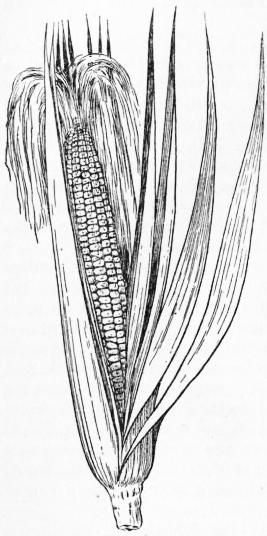
Fig. 1.
Maize—Zea Mays—unripe cob. The membranous spathes have been cut and drawn aside, revealing the spike of fruit which bears the long silky styles. One-third nat. size.
MAIZE, or Indian Corn, Zea Mays (from ζεά or ζειά, which appears to have been “spelt,” Triticum spelta, according to the description of Theophrastus), a plant of the tribe Maydeae of the order Gramineae or grasses (see fig. 1). It is unknown in the native state, but is most probably indigenous to tropical America. Small grains of an unknown variety have been found in the ancient tombs of Peru, and Darwin found heads of maize embedded on the shore in Peru at 85 ft. above the present sea-level. Bonafous, however (Histoire naturelle du maïs), quotes authorities (Bock, 1532, Ruel and Fuchs) as believing that it came from Asia, and maize was said by Santa Rosa de Viterbo to have been brought by the Arabs into Spain in the 13th century. A drawing of maize is also given by Bonafous from a Chinese work on natural history, Li-chi-tchin, dated 1562, a little over sixty years after the discovery of the New World. It is not figured on Egyptian monuments, nor was any mention made of it by Eastern travellers in Africa or Asia prior to the 16th century. Humboldt, Alphonse de Candolle and others, however, do not hesitate to say that it originated solely in America, where it had been long and extensively cultivated at the period of the discovery of the New World; and that is the generally accepted modern view. Some hold the view that maize originated from a common Mexican fodder grass, Euchlaena mexicana, known as Teosinte, a closely allied plant which when crossed with maize yields a maize-like hybrid.
The plant is monoecious, producing the staminate (male) flowers in a large feathery panicle at the summit, and the (female) dense spikes of flowers, or “cobs,” in the axils of the leaves below, the long pink styles hanging out like a silken tassel. They are invested by the sheaths of leaves, much used in packing oranges in south Europe, and the more delicate ones for cigarettes in South America. Fig. 2 shows a branch of the terminal male inflorescence. Fig. 3 is a single spikelet of the same, containing two florets, with the three stamens of one only protruded. Fig. 4 is a spike of the female inflorescence, protected by the sheaths of leaves—the blades being also present. Usually the sheaths terminate in a point, the blades being arrested. Fig. 5 is a spikelet of the female inflorescence, consisting of two outer glumes, the lower one ciliated, which enclose two florets—one (a) barren (sometimes fertile), consisting of a flowering glume and pale only, and the other (b) fertile, containing the pistil with elongated style. The mass of styles from the whole spike is pendulous from the summit of the sheaths, as in fig. 4. Fig. 6 shows the fruit or grain. More than three hundred varieties are known, which differ more among themselves than those of any other cereal. Some come to maturity in two months, others require seven months; some are as many feet high as others are inches; some have kernels eleven times larger than others. They vary similarly in shape and size of ears, colour of the grain, which may be white, yellow, purple, striped, &c., and also in physical characters and chemical composition. Dr E. Lewis Sturtevant, who has made an extended study of the forms and varieties, classes into seven groups those grown primarily for the grain, the distinguishing characters of which are based on the grains or kernels; there are, in addition, forms of horticultural interest grown for ornament. Pod corn (var. tunicata) is characterized by having each kernel enclosed in a husk. Pop corn (var. everta) has a very large proportion of the “endosperm”—the nutritious matter which with the small embryo makes up the grain—of a horny consistency, which causes the grain to pop when heated, that is to say, the kernel becomes turned inside out by the explosion of the contained moisture. It is also characterized by the small size of the grain and ear. Flint corn (var. indurata) has a starchy endosperm enclosed in a horny layer of varying thickness in the different varieties. The colour of the grain is white, yellow, red, blue or variegated. It is commonly cultivated in Canada and northern United States, where the seasons are too short for Dent corn, and has been grown as far north as 50° N. lat. Dent or field corn (var. indentata) has the starchy endosperm extending to the summit of the grain, with horny endosperm at the sides. The top of the grain becomes indented, owing to the drying and shrinkage of the starchy matter; the character of the indented surface varies with the height and thickness of the horny endosperm. This is the form commonly grown in the United States; the varieties differ widely in the size of the plants and the appearance of the ear.
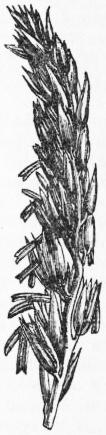
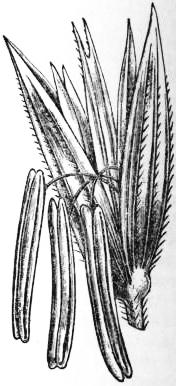
Fig. 2.—Spike of Male Flowers. Fig. 3.—Male Spikelet.
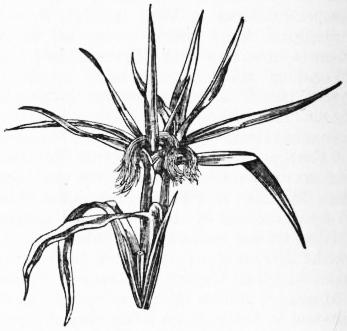
Fig. 4.—Female Spike.
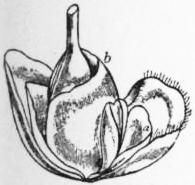
Fig. 5.—Female Spikelet.
The colour of the grain varies greatly, being generally white, yellow, mottled red, or less commonly red. Soft corn (var. amylacea) has no horny endosperm, and hence the grains shrink uniformly. It is cultivated only to a limited extent in the United States, but seems to have been commonly grown by the Indians in many localities in North and South America. Sweet corn (var. saccharata) is characterized by the translucent horny appearance of the grains and their more or less wrinkled condition. It is pre-eminently a garden vegetable, the ear being used before the grain hardens, when it is well filled but soft and milky. It is often cooked and served in the cob; when canned it is cut from the cob. Canned sweet corn is an important article of domestic commerce in Canada and the United States. In starchy sweet corn (var. amylea-saccharata) the grain has the external appearance of sweet corn, but examination shows the lower half to be starchy, the upper horny and translucent. A form of flint corn, with variegated leaves, is grown for ornament under the name Zea japonica or Japanese striped corn.
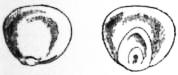
Fig. 6.—Grain.
Chemical analysis, like common experience, shows that Indian corn is a very nutritious article of food, being richer in albuminoids than any other cereals when ripe (calculated in the dry weight). It can be grown in the tropics from the level of the sea to a height equal to that of the Pyrenees and in the south and middle of Europe, but it cannot be grown in England with any chance of profit, except perhaps as fodder. Frost kills the plant in all its stages and all its varieties; and the crop does not flourish well if the nights are cool, no matter how favourable the other conditions. Consequently it is the first crop to disappear as one ascends into the mountain regions, and comparatively little is grown west of the great plains of North America. In Brittany, where it scarcely ripens the grain, it furnishes a strong crop in the autumn upon sandy soil where clover and lucerne will yield but a poor produce. It prefers a deep, rich, warm, dry and mellow soil, and hence the rich bottoms and fertile prairies of the Mississippi basin constitute the region of its greatest production. It is extensively grown throughout India, both for the ripe grain and for use of the unripe cob as a green vegetable. It is the most common crop throughout South Africa, where it is known as mealies, being the staple food of the natives. It is also largely used for fodder and is an important article of export.
As an article of food maize is one of the most extensively used grains in the world. Although rich in nitrogenous matter and fat, it does not make good bread. A mixture of rye and corn meal, however, makes an excellent coarse bread, formerly much used in the Atlantic states, and a similar bread is now the chief coarse bread of Portugal and some parts of Spain. It is either baked into cakes, called tortilla by the Indians of Yucatan, or made into a kind of porridge, as in Ireland. When deprived of the gluten it constitutes oswego, maizena or corn flour. Maize contains more oil than any other cereal, ranging from 3.5 to 9.5% in the commercial grain. This is one of the factors in its value for fattening purposes. In distilling and some other processes this oil is separated and forms an article of commerce. When maize is sown, broadcast or closely planted in drills the ears may not develop at all, but the stalk is richer in sugar and sweeter; and this is the basis of growing “corn-fodder.” The amount of forage that may be produced in this way is enormous; 50,000 to 80,000 ℔ of green fodder are grown per acre, which makes 8000 to 12,000 ℔ as field-cured. Sugar and molasses have from time to time been manufactured from the corn stalks.
See articles on corn and Zea Mays in L. H. Bailey’s Cyclopaedia of American Horticulture (1900-1902); and for cultivation in India, Watt’s Dictionary of the Economic Products of India, vi. (1893).
MAJESTY (Fr. majesté; Lat. majestas, grandeur, greatness, from the base mag-, as in magnus, great, major, greater, &c.), dignity, greatness, a term especially used to express the dignity and power of a sovereign. This application is to be traced to the use of majestas in Latin to express the supreme sovereign dignity of the Roman state, the majestas reipublicae or populi Romani, hence majestatem laedere or minuere, was to commit high treason, crimen majestatis. (For the modern law and usage of laesa majestas, lèse majesté, Majestätsbeleidigung, see Treason.) From the republic majestas was transferred to the emperors, and the majestas populi Romani became the majestas imperii, and augustalis majestas is used as a term to express the sovereign person of the emperor. Honorius and Theodosius speak of themselves in the first person as nostra majestas. The term “majesty” was strictly confined in the middle ages to the successors of the Roman emperors in the West, and at the treaty of Cambrai (1529) it is reserved for the emperor Charles V. Later the word is used of kings also, and the distinction is made between imperial majesty (caesareana majestas) and kingly or royal majesty. From the 16th century dates the application of “Most Christian and Catholic Majesty” to the kings of France, of “Catholic Majesty” to the kings of Spain, of “Most Faithful Majesty” to the kings of Portugal, and “Apostolic Majesty” to the kings of Hungary. In England the use is generally assigned to the reign of Henry VIII., but it is found, though not in general usage, earlier; thus the New English Dictionary quotes from an Address of the Kings Clerks to Henry II. in 1171 (Materials for the History of Archbishop Becket, vii. 471, Rolls Series, 1885), where the king is styled vestra majestas, and Selden (Titles of Honour, part i. ch. 7, p. 98, ed. 1672) finds many early uses in letters to Edward I., in charters of creation of peers, &c. The fullest form in English usage is “His Most Gracious Majesty”; another form is “The King’s Most Excellent Majesty,” as in the English Prayer-book. “His Sacred Majesty” was common in the 17th century; and of this form Selden says: “It is true, I think, that in our memory or the memory of our fathers, the use of it first began in England.” “His Majesty,” abbreviated H.M., is now the universal European use in speaking of any reigning king, and “His Imperial Majesty,” H.I.M., of any reigning emperor.
From the particular and very early use of “majesty” for the glory and splendour of God, the term has been used in ecclesiastical art of the representation of God the Father enthroned in glory, sometimes with the other persons of the Trinity, and of the Saviour alone, enthroned with an aureole.
MAJLÁTH, JÁNOS, or John, Count (1786-1855), Hungarian historian and poet, was born at Pest on the 5th of October 1786. First educated at home, he subsequently studied philosophy at Eger (Erlau) and law at Györ (Raab), his father, Count Joseph Majláth, an Austrian minister of state, eventually obtaining for him an appointment in the public service. Majláth devoted himself to historical research and the translation into German of Magyar folk-tales, and of selections from the works of the best of his country’s native poets. Moreover, as an original lyrical writer, and as an editor and adapter of old German poems, Majláth showed considerable talent. During the greater part of his life he resided either at Pest or Vienna, but a few years before his death he removed to Munich, where he fell into a state of destitution and extreme despondency. Seized at last by a terrible infatuation, he and his daughter Henriette, who had long been his constant companion and amanuensis, drowned themselves in the Lake of Starnberg, a few miles south-west of Munich, on the 3rd of January 1855.
Of his historical works the most important are the Geschichte der Magyaren (Vienna, 1828-1831, 5 vols.; 2nd ed., Ratisbon, 1852-1853) and his Geschichte des österreichischen Kaiserstaats (Hamburg, 1834-1850, 5 vols.). Specially noteworthy among his metrical translations from the Hungarian are the Magyarische Gedichte (Stuttgart and Tübingen, 1825); and Himfy’s auserlesene Liebeslieder (Pest, 1829; 2nd ed., 1831). A valuable contribution to folk-lore appeared in the Magyarische Sagen, Märchen und Erzählungen (Brünn, 1825; 2nd ed., Stuttgart and Tübingen, 1837, 2 vols.).
MAJOLICA, a name properly applied to a species of Italian ware in which the body is coated with a tin-enamel, on which is laid and fired a painted decoration. It is also applied to similar wares made in imitation of the Italian ware in other countries. The word in Italian is maiolica. Du Cange (Gloss. s.v. “Majorica”) quotes from a chronicle of Verona of 1368, in which the form majolica occurs for the more usual Latin form majorica. It has usually been supposed that this type of pottery was first made in the island of Majorca, but it is more probable that the name was given by the Italians to the lustred Spanish ware imported by ships hailing from the Balearic Islands. (See Ceramics: Medieval and Later Italian.)
MAJOR (or Mair), JOHN (1470-1550), Scottish theological and historical writer, was born at the village of Gleghornie, near North Berwick, Scotland, in the year 1470. He was educated at the school of Haddington, where John Knox was later a pupil. After a short period spent at Cambridge (at God’s House, afterwards Christ’s College) he entered the university of Paris in 1493, studying successively at the colleges of St Barbe, Montaigu and Navarre, and graduating as master of arts in 1496. Promoted to the doctorate in 1505, he lectured on philosophy at Montaigu College and on theology at Navarre. He visited Scotland in 1515 and returned in 1518, when he was appointed principal regent in the university of Glasgow, John Knox being among the number of those who attended his lectures there. In 1522 he removed to St Andrew’s University, where in 1525 George Buchanan was one of his pupils. He returned to the college of Montaigu in 1525, but was once more at St Andrew’s in 1531, where he was head of St Salvator’s College from 1534 until his death.
Major’s voluminous writings may be grouped under (a) logic and philosophy, (b) Scripture commentary, and (c) history. All are in Latin, all appeared between 1503 and 1530, and all were printed at Paris. The first group includes his Exponabilia (1503), his commentary on Petrus Hispanus (1505-1506), his Inclitarum artium libri (1506, &c.), his commentary on Joannes Dorp (1504, &c.), his Insolubilia (1516, &c.), his introduction to Aristotle’s logic (1521, &c.), his commentary on the ethics (1530), and, chief of all, his commentary on Peter Lombard’s Sentences (1509, &c.); the second consists of a commentary on Matthew (1518) and another on the Four Gospels (1529); the last is represented by his famous Historia Majoris Britanniae tam Angliae quam Scotiae per J. M. (1521). In political philosophy he maintained the Scotist position, that civil authority was derived from the popular will, but in theology he was a scholastic conservative, though he never failed to show his approbation of Gallicanism and its plea for the reform of ecclesiastical abuses. He has left on record that it was his aim and hope to reconcile realism and nominalism in the interests of theological peace. He had a world-wide reputation as a teacher and writer. Buchanan’s severe epigram, perhaps the only unfriendly words in the flood of contemporary praise, may be explained as a protest against the compromise which Major appeared to offer rather than as a personal attack on his teacher. Major takes a more independent attitude in his History, which is a remarkable example of historical accuracy and insight. He claims that the historian’s chief duty is to write truthfully, and he is careful to show that a theologian may fulfil this condition.
The History, on which his fame now rests, was reprinted by Freebairn (Edinburgh, 1740), and was translated in 1892 by Archibald Constable for the Scottish History Society. The latter volume contains a full account of the author by Aeneas J. G. Mackay and a bibliography by Thomas Graves Law.
MAJOR (Lat. for “greater”), a word used, both as a substantive and adjective, for that which is greater than another in size, quality, degree, importance, &c., often opposed correlatively to that to which “minor” is applied in the same connotation. In the categorical syllogism in logic, the major term is the term which forms the predicate of the conclusion, the major premise is that which contains the major term. (For the distinction between major and minor intervals, and other applications in music, see Music and Harmony.)
The use of Major as part of an official title in Med. Lat. has given the Span. mayor, Fr. maire, and Eng. “mayor” (q.v.). In English the unadapted form “major” is the title of a military officer now ranking between a captain and a lieutenant-colonel. Originally the word was used adjectivally in the title “sergeant-major,” an officer of high rank (third in command of an army) who performed the same duties of administration, drill and encampments on the staff of the chief commander as the sergeant in a company performs as assistant to the captain. This was in the latter half of the 16th century, and very soon afterwards the “sergeant-major” became known as the “sergeant-major-general”—hence the modern title of major-general. By the time of the English Civil War “majors” had been introduced in each regiment of foot, who corresponded in a lesser sphere to the “major-general” of the whole army. The major’s sphere of duties, precedence and title have since varied but little, though he has, in the British service, taken the place of the lieutenant-colonel as second in command—the latter officer exercising the command of the cavalry regiment, infantry battalion or artillery brigade, and the colonel being, save for certain administrative functions, little more than the titular chief of his regiment. Junior majors command companies of infantry; squadrons of cavalry and batteries of artillery are also commanded by majors. In most European armies, however, and of late years in the army of the United States also, the major has become a battalion commander under the orders of a regimental commander (colonel or lieutenant-colonel). The word appears also in the British service in “brigade-major” (the adjutant or staff officer of a brigade). “Town-majors” (garrison staff officers) are now no longer appointed. In the French service up to 1871 the “major-general” was the chief of the general staff of a field army, and thus preserved the tradition of the former “sergeant-major” or “sergeant-major-general.”
MAJORCA (Mallorca), the largest of the group of Spanish islands in the Mediterranean Sea known as the Balearic Islands (q.v.). Pop. (1900), 248,191; area, 430 sq. m. Majorca has the shape of a trapezoid, with the angles directed to the cardinal points; and its diagonal, from Cape Grozer in the west to Cape Pera in the east, is about 60 m. On the north-west the coast is precipitous, but on the other sides it is low and sloping. On the north-east there are several considerable bays, of which the chief are those of Alcudia and Pollensa; while on the south-west is the still more important bay of Palma. No fewer than twelve ports or harbours are enumerated round the island, of which may be mentioned Andraitx and Sóller. In the north-west Majorca is traversed by a chain of mountains running parallel with the coast, and attaining its highest elevation in Silla de Torrellas (5154 ft.). Towards the south and east the surface is comparatively level, though broken by isolated peaks of considerable height. The northern mountains afford great protection to the rest of the island from the violent gales to which it would otherwise be exposed, and render the climate remarkably mild and pleasant. The scenery of Majorca has all the picturesqueness of outline that usually belongs to a limestone formation. Some of the valleys, such as those of Valdemosa and Sóller, with their luxuriant vegetation, are delightful resorts. There are quarries of marble of various grains and colours—those near Santañy, in the district of Manacor, being especially celebrated; while lead, iron and cinnabar have also been obtained. Coal of a jet-like character is found at Benisalem, where it was first worked in 1836; at Selva, where it has been mined since 1851; near Santa Maria and elsewhere. It is used in the industrial establishments of Palma, and in the manufacture of lime, plaster and bricks near the mines. A considerable quantity is also exported to Barcelona.
The inhabitants are principally devoted to agriculture, and most of the arable land is cultivated. The mountains are terraced; and the old pine woods have in many places given way to the olive, the vine and the almond tree, to fields of wheat and flax, or to orchards of figs and oranges. For the last-mentioned fruits the valley of Sóller is one of the most important districts, the produce being largely transmitted to France. The yield of oil is very considerable, and Inca is the centre of the oil district. The wines are light but excellent, especially the Muscadel and Montona. During the summer there is often great scarcity of water; but, according to a system handed down by the Moors, the rains of autumn and winter are collected in enormous reservoirs, which contain sufficient water to last through the dry season; and on the payment of a certain rate, each landholder has his fields flooded at certain intervals. Mules are used in the agriculture and traffic of the island. The cattle are small, but the sheep are large and well fleeced. Pigs are reared for export to Barcelona, and there is abundance of poultry and small game. Brandy is made and exported in large quantities. Excellent woollen and linen cloths are woven; the silkworm is reared and its produce manufactured; and canvas, rope and cord are largely made, from both native and foreign materials.
The roads are excellent, the four principal being those from Alcudia, Manacor, Sóller and Andraitx to the capital. Forty-eight miles of railway were open at the beginning of the 20th century. The main line runs from Palma to Manacor and Alcudia. The telegraphic system is fairly complete, and there is regular steam communication with Barcelona and Alicante. The principal towns include—besides Palma (63,937), Felanitx (11,294) and Manacor (12,408), which are described in separate articles—Andraitx (6516), Inca (7579), Llummayor (8859), Pollensa (8308), Santañy (6692) and Sóller (8026).
MAJORIAN (Julius Valerius Majorianus), emperor of the West from 457 to 461. He had distinguished himself as a general by victories over the Franks and Alemanni, and six months after the deposition of Avitus he was declared emperor by the regent Ricimer. After repelling an attack by the Vandals upon Campania (458) he prepared a large force, composed chiefly of barbarians, to invade Africa, which he previously visited in disguise. Having during his stay in Gaul defeated and concluded an alliance with Theodoric the Visigoth, at the beginning of 460 he crossed the Pyrenees for the purpose of joining the powerful fleet which he had collected at Carthagena. The Vandal king Genseric, however, after all overtures of peace had been rejected, succeeded through the treachery of certain officers in surprising the Roman fleet, most of the ships being either taken or destroyed. Majorian thereupon made peace with Genseric. But his ill-success had destroyed his military reputation; his efforts to put down abuses and improve the condition of the people had roused the hatred of the officials; and Ricimer, jealous of his fame and influence, stirred up the foreign troops against him. A mutiny broke out in Lombardy, and on the 2nd of August 461 Majorian was forced to resign. He died five days afterwards, either of dysentery or by violence. Majorian was the author of a number of remarkable laws, contained in the Theodosian Code. He remitted all arrears of taxes, the collection of which was for the future placed in the hands of the local officials. He revived the institution of defensores, defenders of cities, whose duty it was to protect the poor and inform the emperor of abuses committed in his name. The practice of pulling down the ancient monuments to be used as building material, which was connived at by venal officials, was strictly prohibited. He also passed laws against compulsory ordination and premature vows of celibacy.
See Sidonius Apollinaris, Panegyric of Majorian; Gibbon, Decline and Fall, ch. xxxvi. (where an outline of the “novels” of Majorian is given); J. B. Bury, Later Roman Empire, bk. iii.
MAJORITY (Fr. majorité; Med. Lat. majoritas; Lat. major, greater), a term signifying the greater number. In legislative and deliberative assemblies it is usual to decide questions by a majority of those present at a meeting and voting. In law, majority is the state of being of full age, which in the United Kingdom is twenty-one years of age. A person attains his majority at twelve o’clock at night of the day preceding his twenty-first birthday (see Infant; Age).
MAJUBA (properly Amajuba, Zulu for “the hill of doves”), a mountain in northern Natal, part of the Drakensberg range, rising about 7000 ft. above the sea and over 2000 ft. above the level of the surrounding country. It overlooks the pass through the Drakensberg known as Laing’s Nek, is 8 m. S. of the Transvaal border and 18 m. N. of the town of Newcastle. The railway from Durban to Johannesburg skirts the base of the mountain. During the Boer War of 1880-81 Majuba was occupied on the night of the 26th of February 1881 by some 600 British troops under Sir George Pomeroy Colley. On the following morning the hill was stormed by the Boers under Piet Joubert and the British routed, Colley being among the slain.
MAKALAKA, a general designation used by the Bechuana, Matabele and kindred peoples, for conquered or slave tribes. Thus many of the tribes subjugated by the Makololo chief, Sebituane, about 1830 were called Makalaka (see David Livingstone’s Missionary Travels and Researches in South Africa, London, 1857). By early writers on south-central Africa certain of the inhabitants of Barotseland were styled Makalaka; the name is more frequently used to designate the Makalanga, one of the tribes now classed as Mashonas (q.v.), who were brought into subjection by the Matabele.
MAKARAKA, or Iddio (“Cannibals”), a negroid people of Central Africa, closely related to the powerful Azandeh or Niam-Niam race, occupying the Bahr-el-Ghazal west of Lado. They came originally from the country of the Kibas, north of the Welle. Dr W. Junker described them as among the most trustworthy, industrious and intelligent people of the Bahr-el-Ghazal. They are a reddish-black, with nose less flat and cheek-bones less prominent than the ordinary negroes, and, unlike the latter, do not extract the incisors. Their long silky hair is built up in the most fantastic form by means of vegetable substances. They are well-known for strength and staying power.
See W. Junker, Travels in Africa (1890-1892).
MAKART, HANS (1840-1884), Austrian painter, born at Salzburg, was the son of an inspector of the imperial castle. He has been aptly called the first German painter of the 19th century. When he, as a youth, entered the Vienna Academy German art was under the rule of Cornelius’s cold classicism. It was entirely intellectual and academic. Clear and precise drawing, sculpturesque modelling, and pictorial erudition were the qualities most esteemed; and it is not surprising that Makart, poor draughtsman to the very last, with a passionate and sensual love of colour, and ever impatient to escape the routine of art-school drawing, was found to be “devoid of all talent” and forced to leave the Vienna Academy. He went to Munich, and after two years of independent study attracted the attention of Piloty, under whose guidance he made rapid and astonishing progress. The first picture he painted under Piloty, “Lavoisier in Prison,” though timid and conventional, attracted attention by its sense of colour. In the next, “The Knight and the Water Nymphs,” he first displayed the decorative qualities to which he afterwards sacrificed everything else in his work. With the “Cupids” and “The Plague in Florence” of the next year his fame became firmly established. “Romeo and Juliet” was soon after bought by the Austrian emperor for the Vienna Museum, and Makart was invited to come to Vienna, where a large studio was placed at his disposal. In Vienna Makart became the acknowledged leader of the artistic life of the city, which in the ’seventies passed through a period of feverish activity, the chief results of which are the sumptuously decorated public buildings of the Ringstrasse.
The enthusiasm of the time, the splendour of the fêtes over which Makart presided, and the very obvious appeal of his huge compositions in their glowing richness of colour, in which he tried to emulate Rubens, made him appear a very giant to his contemporaries in Vienna, and indeed in all Austria and Germany. The appearance of each of his ambitious historical and allegorical paintings was hailed with enthusiasm—the “Catherina Cornaro,” “Diana’s Hunt,” “The Entry of Charles V. into Antwerp,” “Abundantia,” “Spring,” “Summer,” “The Death of Cleopatra” and the “Five Senses.” He reached the zenith of his fame when, in 1879, he designed, single-handed, the costumes, scenic setting, and triumphal cars of the grand pageant with which the citizens of Vienna celebrated the silver wedding of their rulers. Some 15,000 people participated in the pageant, all dressed in the costumes of the Rubens and Rembrandt period. Makart died in Vienna in October 1884.
Unfortunately Makart was in the habit of using such villainous pigments and mediums that in the few decades which have passed since his death, the vast majority of his large paintings have practically perished. The blues have turned into green; the bitumen has eaten away the rich glow of the colour harmonies; the thickly applied paint has cracked and in some instances crumbled away. And this loss of their chief quality has accentuated the weaknesses of these pictures—the faulty drawing, careless and hasty execution, lack of deeper significance and prevalence of glaring anachronisms. Important examples of his work are to be found at the galleries of Vienna, Berlin, Hamburg and Stuttgart. For the Vienna Museum he also executed a series of decorative lunettes.
MAKING-UP PRICE, a term used in the London and other British Stock Exchanges, to denote the price at which speculative bargains are carried over from one account to the next. The carrying over of a “bull” position in Eries, for example, implies a sale for cash and a simultaneous repurchase for the new account, both bargains being done at the making-up price. This is fixed at noon on carry-over day, in accordance with the market price then current (see Account; Stock Exchange). The term is also used in New York, where the making-up prices are fixed at the end of a day’s business, in accordance with the American system of daily settlements.
MAKÓ, a town of Hungary, capital of the county of Csanád 135 m. S.E. of Budapest by rail. Pop. (1900), 33,701. It is situated near the right bank of the Maros, and is a typical Hungarian town of the Alföld. The most noteworthy building is the palace of the bishop of Csanád, whose usual residence is in Temesvár. The town possesses numerous mills, and the surrounding country is fertile. The communal lands are extensive; they afford excellent pasturage for horses and sheep and also for large herds of horned cattle, for the size and quality of which Makó has obtained a high repute.
MAKRAN, or Mekran, a province of Baluchistan, fringing the Arabian Sea from Persia almost to Sind for about 200 m. It is subject to the khan of Kalat under British political supervision. Estimated area, 26,000 sq. m.; estimated pop. (1903), 78,000. The long lateral valley of Kej is usually associated with Makran in early geographical records. The Kej-Macoran of Marco Polo is the Makran of to-day.
The long stretch of sandy foreshore is broken on the coast-line by the magnificent cliffs of Malan, the hammer-shaped headlands of Ormarah and Gwadar, and the precipitous cliffs of Jebel Zarain, near Pasni. Within them lies the usual frontier band of parallel ridges, alternating with narrow valleys. Amongst them the ranges called Talana and Talur are conspicuous by their height and regular configuration. The normal conformation of the Baluchistan frontier is somewhat emphasized in Makran. Here the volcanic action, which preceded the general upheaval of recent strata and the folding of the edges of the interior highlands, is still in evidence in occasional boiling mud volcanoes on the coast-line. It is repeated in the blazing summit of the Kuh-i-taftan (the burning mountain of the Persian frontier) which is the highest active volcano in Asia (13,000 ft.), and probably the farthest inland. Evidence of extinct mud volcanoes exists through a very wide area in Baluchistan and Seistan. Probably the miri, or fort, at Quetta represents one of them. The coast is indented by several harbours. Ormarah, Khor Kalmat, Pasni and Gwadar are all somewhat difficult of approach by reason of a sand-bar which appears to extend along the whole coast-line, and which is very possibly the last evidence of a submerged ridge; and they are all subject to a very lively surf under certain conditions of wind. Of these the port of Gwadar (which belongs to Muscat and is therefore foreign territory) is the most important. They all are (or were) stations of the Indo-Persian telegraph system which unites Karachi with Bushire. With the exception of the Kej valley, and that of the Bolida, which is an affluent of the Kej, there are no considerable spaces of cultivation in Makran. These two valleys seem to concentrate the whole agricultural wealth of the country. They are picturesque, with thick groves of date palms at intervals, and are filled with crops and orchards. They are indeed exceedingly beautiful; and yet the surrounding waste of hills is chiefly a barren repetition of sun-cracked crags and ridges with parched and withered valleys intersecting them, where a trickle of salt water leaves a white and leprous streak amongst the faded tamarisk or the yellow stalks of last season’s grass. Makran is the home of remnants of an innumerable company of mixed people gathered from the four corners of Asia and eastern Africa. The ancient Dravidians, of whom the Brahui is typical, still exist in many of the districts which are assigned to them in Herodotus. Amongst them there is always a prominent Arab element, for the Arabs held Makran even before they conquered Sind and made the Kej valley their trade highway to India. There are negroes on the coast, bred from imported slaves. The Meds of the Indus valley still form the greater part of the fishing population, representing the Ichthyophagi of Arrian. The old Tajik element of Persia is not so evident in Makran as it is farther north; and the Karak pirates whose depredations led to the invasion of India and the conquest of Sind, seem to have disappeared altogether. The fourth section includes the valleys formed by the Rakshān and Mashkel, which, sweeping downwards from the Kalat highlands and the Persian border east and west, unite to break through the intervening chain of hills northward to form the Mashkel swamps, and define the northern limits of Makran. In these valleys are narrow strips of very advanced cultivation, the dates of Panjgur being generally reckoned superior even to those of the Euphrates. The great Mashkel swamp and the Kharan desert to the east of it, mark the flat phase of southern Baluchistan topography. It is geologically part of an ancient inland lake or sea which included the present swamp regions of the Helmund, but not the central depression of the Lora. The latter is buttressed against hills at a much higher elevation than the Kharan desert, which is separated from the great expanse of the Helmund desert within the borders of Afghanistan by a transverse band of serrated hills forming a distinct watershed from Nushki to Seistan. Here and there these jagged peaks appear as if half overwhelmed by an advancing sea of sand. They are treeless and barren, and water is but rarely found at the edges of their foothills. The Koh-i-Sultan, at the western extremity of the northern group of these irregular hills, is over 6000 ft. above sea-level, but the general level of the surrounding deserts is only about 2000 ft., sinking to 1500 ft. in the Mashkel Hamun and the Gaod-i-Zirreh.
The whole of this country has been surveyed by Indian surveyors and the boundary between Persian and British Baluchistan was demarcated by a commission in 1895-1896. In 1898 a column of British troops under Colonel Mayne was despatched to Makran by sea, owing to a rebellion against the authority of the khan of Kalat, and an attack made by some Makran chiefs on a British survey party. The campaign was short and terminated with the capture of the Kej citadel. Another similar expedition was required in 1901 to storm the fort at Nodiz. The headquarters of the native governor, under the khan of Kalat, are at Turbat, with deputies at Tump, Kolwa, Pasni and Panjgur. A levy corps, with two British officers, is stationed along the western frontier. The port of Gwadur forms an enclave belonging to the sultan of Muscat.
Baluchistan District Gazetteer, vol. vii. (Bombay, 1907).
(T. H. H.*)
MAKSOORA, the term in Mahommedan architecture given to the sanctuary or praying-chamber in a mosque, which was sometimes enclosed with a screen of lattice-work; the word is occasionally used for a similar enclosure round a tomb.
MALABAR, a district of British India, in the Madras Presidency. Geographically the name is sometimes extended to the entire western coast of the peninsula. Properly it should apply to the strip below the Ghāts, which is inhabited by people speaking the Malayalam language, a branch of the Dravidian stock, who form a peculiar race, with castes, customs and traditions of their own. It would thus be coextensive with the old kingdom of Chera, including the modern states of Travancore and Cochin, and part of Kanara. In 1901 the total number of persons speaking Malayalam in all India was 6,029,304.
The district of Malabar extends for 145 m. along the coast, running inland to the Ghāts with a breadth varying from 70 to 25 m. The administrative headquarters are at Calicut. Area, 5795 sq. m. Malabar is singularly diversified in its configuration; from the eastward, the great range of the Western Ghāts, only interrupted by the Palghāt gap, looks down on a country broken by long spurs, extensive ravines, dense forests and tangled jungle. To the westward, gentler slopes and downs, and gradually widening valleys closely cultivated, succeed the forest uplands, till, nearer the seaboard, the low laterite table-lands shelve into rice plains and backwaters fringed with coco-nut palms. The coast runs in a south-easterly direction, and forms a few headlands and small bays, with a natural harbour in the south at Cochin. In the south there is considerable extent of table-land. The mountains of the Western Ghāts run almost parallel to the coast, and vary from 3000 to 7000 ft. in height. One of the most characteristic features of Malabar is an all but continuous chain of lagoons or backwaters lying parallel to the coast, which have been formed by the action of the waves and shore currents in obstructing the waters of the rivers. Connected by artificial canals, they form a cheap means of transit; and a large local trade is carried on by inland navigation. Fishing and fishcuring is an important industry. The forests are extensive and of great value, but they are almost entirely private property. The few tracts which are conserved have come into government hands by escheat or by contract. Wild animals include the elephant, tiger, panther, bison, sambhar, spotted deer, Nīlgiri ibex, and bear. The population in 1901 was 2,800,555, showing an increase of 5.6% in the decade.
The staple crop is rice, the next most important product being coco-nuts. Coffee is grown chiefly in the upland tract known as the Wynaad, where there are also a few acres under tea. The Madras railway crosses the district and has been extended from Calicut to Cannanore along the coast. There are eleven seaports, of which the principal are Calicut, Tellicherry, Cannanore and Cochin. The principal exports are coffee, coco-nut products and timber. There are factories for cleaning coffee, pressing coir and making matting, making tiles, sawing timber and weaving cotton.
See Malabar District Gazetteer (Madras, 1908).
MALABARI, BEHRAMJI (1853- ), Indian journalist and social reformer, was born in 1853 at Baroda, the son of a poor Parsi in the employment of the state, who died shortly after his birth. His mother took him to Surat, where he was educated in a mission school, but he never succeeded in gaining an academical degree. Coming to Bombay, he fell under the influence of Dr John Wilson, principal of the Scottish College. As early as 1875 he published a volume of poems in Gujarati, followed in 1877 by The Indian Muse in English Garb, which attracted attention in England, notably from Tennyson, Max Müller, and Florence Nightingale. His life work began in 1880 when he acquired the Indian Spectator, which he edited for twenty years until it was merged in the Voice of India. In 1901 he became editor of East and West. Always holding aloof from politics, he was an ardent and indefatigable advocate of social reform in India, especially as regards child marriage and the remarriage of widows. It was largely by his efforts, both in the press and in tours through the country, that the Age of Consent Act was passed in 1891. His account of his visits to England, entitled The Indian Eye on English Life (1893), passed through three editions, and an earlier book of a somewhat satirical nature, Gujarat and the Gujaratis (1883), was equally popular.
See R. P. Karkaria, India, Forty Years of Progress and Reform, (London, 1896).
MALABON, a town of the province of Rizal, Luzon, Philippine Islands, 1 m. inland from the shore of Manila Bay and 3 m. N. of the city of Manila, with which it is connected by an electric tramway. Pop. (1903), 20,136. The leading industries are the refining of sugar, fishing, trade, the weaving of jusi cloth, the making of cigars, and the cultivation of ilang-ilang-trees (Cananga odorata) for their flowers, from which a fine perfume is distilled; ilang-ilang is one of the principal exports, mostly to France. Tagalog and Spanish are the principal languages. Malabon was formerly known as Tambóbong.
MALACCA, a town on the west coast of the Malay Peninsula, in 2° 14′ N., 102° 12′ E., which, with the territory lying immediately around and behind it forms one of the Straits Settlements, and gives its name to the Straits which divide Sumatra from the Malay Peninsula. Its name, which is more correctly transliterated mĕlāka, is that of a species of jungle fruit, and is also borne by the small river on the right bank of which the old Dutch town stands. The Dutch town is connected by a bridge with the business quarter on the left bank, which is inhabited almost exclusively by Chinese, Eurasians and Malays.
Malacca, now a somnolent little town, a favourite resort of rich Chinese who have retired from business, is visited by few ships and is the least important of the three British settlements on the Straits which give their name to the colony. It has, however, a remarkable history. The precise date of its foundation cannot be ascertained, but there is strong reason to believe that this event took place at the earliest in the 14th century. The Roman youth Ludovigo Barthema is believed to have been the first European to visit it, some time before 1503; and in 1509 Diogo Lopez de Siqueira sailed from Portugal for the express purpose of exploiting Malacca. At first he was hospitably received, but disagreements with the natives ensued and word was brought to Siqueira by Magellan, who was one of his company, that a treacherous attack was about to be made upon his ships. Siqueira then sent a native man and woman ashore “with an arrow passed through their skulls” to the sultan, “who was thus informed,” says de Barros, “through his subjects that unless he kept a good watch the treason which he had perpetrated would be punished with fire and sword.” The sultan retaliated by arresting Ruy de Araujo, the factor, and twenty other men who were ashore with him collecting cargo for the ships. Siqueira immediately burned one of his vessels and sailed direct for Portugal. In 1510 Mendez de Vasconcellos with a fleet of four ships set out from Portugal “to go and conquer Malacca,” but d’Alboquerque detained him at Goa, and it was not until 1511 that d’Alboquerque himself found time to visit Malacca and seek to rescue the Portuguese prisoners who all this time had remained in the hands of the sultan. An attack was delivered by d’Alboquerque on the 25th of July 1511, but it was only partially successful, and it was not until the 4th of August, when the assault was repeated, that the place finally fell. Since that time Malacca has continued to be the possession of one or another of the European Powers. It was a Portuguese possession for 130 years, and was the headquarters of their trade and the base of their commercial explorations in south-eastern Asia while they enjoyed, and later while they sought to hold, their monopoly in the East. It was from Malacca, immediately after its conquest, that d’Alboquerque sent d’Abreu on his voyage of discovery to the Moluccas, or Spice Islands, which later were the objective of Magellan’s voyage of circumnavigation. During the Portuguese tenure of Malacca the place was attacked at least twice by the Achinese; its shipping was harried by Lancaster in 1592, when the first British fleet made its way into these seas; it was besieged by the Dutch in 1606, and finally fell to a joint attack of the Dutch and the Achinese in 1641. It was under the Portuguese government that St Francis Xavier started a mission in Malacca, the first Christian mission in Malayan lands.
The Dutch held Malacca till 1795, when it was taken from them by Great Britain, and the Dutch system of monopoly in the straits was forthwith abolished. The colony was restored to the Dutch, however, in 1818, but six years later it came finally into the hands of Great Britain, being exchanged by a treaty with Holland for the East India Company’s settlement of Benkulen and a few other unimportant places on the western coast of Sumatra. By this treaty the Dutch were precluded from interference in the affairs of the Malay Peninsula, and Great Britain from similar action in regard to the States of Sumatra, with the sole exception of Achin, the right to protect that state being maintained by Great Britain until 1872 when it was finally abandoned by a treaty concluded with Holland in that year. The Dutch took advantage of this immediately to invade Achin, and the strife begun in 1873 still continues and is now a mere war of extermination. It was not until 1833 that the whole territory lying at the back of Malacca was finally brought under British control, and as late as 1887 the Negri Sembilan, or Nine States, which adjoin Malacca territory on the east and north-east, were completely independent. They to-day form part of the Federated Malay States, which are under the protection of Great Britain, and are governed with the assistance and by the advice of British officers.
Malacca, in common with the rest of the Straits Settlements, was administered by the government of India until 1867, when it became a crown colony under the control of the Colonial Office. It is to-day administered by a resident councillor, who is responsible to the governor of the Straits Settlements, and by a number of district officers and other officials under his direction. The population of the town and territory of Malacca in 1901 was 94,487, of whom 74 were Europeans and Americans, 1598 were Eurasians, the rest being Asiatics (chiefly Malays with a considerable sprinkling of Chinese). The population in 1891 was 92,170, and the estimated population for 1905 was 97,000. The birth-rate is about 35 per thousand, and the death-rate about 29 per thousand. The trade of this once flourishing port has declined, most of the vessels being merely coasting craft, and no large line of steamers holding any communication with the place. This is due partly to the shallowness of the harbour, and partly to the fact that the ports of Penang and Singapore, at either entrance to the straits, draw all the trade and shipping to themselves. The total area of the settlement is about 700 sq. m. The colony is wholly agricultural, and the land is almost entirely in the hands of the natives. About 50,000 acres are under tapioca, and about 9000 acres are under rubber (hevea). This cultivation is rapidly extending. There are still considerable areas unoccupied which are suitable for rubber and for coco-nuts. The settlement is well opened up by roads; and a railway, which is part of the Federated Malay States railway system, has been constructed from the town of Malacca to Tampin in the Negri Sembilan. There is a good rest-house at Malacca and a comfortable seaside bungalow at Tanjong Kling, seven miles from the town. Malacca is 118 m. by sea from Singapore and 50 m. by rail from Seremban, the capital of the Negri Sembilan. There is excellent snipe-shooting to be had in the vicinity of Malacca.
See The Commentaries of d’Alboquerque (Hakluyt Society); The Voyages and Adventures of Fernand Mendez Pinto (London, 1653); An Account of the East Indies, by Captain Alexander Hamilton (Edinburgh. 1727); Valentyn’s History of Malacca, translated by Dudley Hervey; Journal of the Straits Branch of the Royal Asiatic Society; “Our Tropical Possessions in Malayan India,” by the same author, ibid.; Further India, by Hugh Clifford (London, 1904); British Malaya, by Sir Frank Swettenham (London, 1906).
(H. Cl.)
MALACHI, the name assigned to the last book of the Old Testament in English (the last of the “prophets” in the Hebrew Bible), which according to the title (Mal. i. 1) contains the “word of Yahweh to Israel by the hand of Malachi.” In form the word means “my messenger.” It could be explained as a contraction of Malachiah, “messenger of Yahweh”; but the Septuagint is probably right in not regarding it as a proper name (“by the hand of His messenger”). Not only do we know nothing from internal or external evidence of the existence of a prophet of this name,1 but the occurrence of the word in the title is naturally explained as derived from iii. 1: “Behold, I send my messenger” (cf. ii. 7). The prophecy must, therefore, be regarded as anonymous; the title was added by the compiler who wrote similar editorial titles to the anonymous prophecies beginning Zech. ix. 1, xii. 1.
The contents of the prophecy fall into a series of clearly marked sections, as in the paragraph division of the Revised Version. These apply, in various ways, the truth emphasized at the outset: Yahweh’s love for Israel in contrast with his treatment of Edom (i. 2-5). Israel’s response should be a proper regard for the ritual of His worship; yet any offering, however imperfect, is thought good enough for Yahweh’s altar (i. 6-14). Let the priests, who are responsible, take warning, and return to their ancient ideals (ii. 1-9). Again, the common Fatherhood of God should inspire a right relation among fellow Israelites, not such conduct as the divorce of Israelite wives in order to marry non-Israelite women (ii. 10-16).2 The prevalence of wrong-doing has provoked scepticism as to righteous judgment; but the messenger of Yahweh is at hand to purge away indifferentism from worship and immorality from conduct (ii. 17-iii. 6). The payment of tithes now withheld will be followed by the return of prosperity (iii. 7-12). Religion may seem useless, but Yahweh remembers His own, and will soon in open judgment distinguish them from the irreligious (iii. 13-iv. 3). The book closes with an appeal to observe the law of Moses, and with a promise that Elijah shall come before the threatened judgment.3
The topics noticed clearly relate the prophecy to the period of Ezra and Nehemiah, when the Temple had been rebuilt (i. 10; iii. 1, 10), the province of Judah was under a Persian governor (i. 8), and there had been time enough for the loss of earlier enthusiasm. The majority of modern scholars are agreed that the prophet prepares for the work of those reformers (Ezra, 458; Nehemiah, 444, 432 B.C.). The abuses of which he particularly complains are such as were found rampant by Ezra and Nehemiah—marriage with foreign women (ii. 11; cf. Ezra ix.; Neh. xiii. 23 seq.; Deut. vii. 3) and failure in payment of sacred dues (iii. 8 seq.; cf. Neh. x. 34 seq.; xiii. 10 seq.; Deut. xxvi. 12 seq.). The priests have fallen into contempt (ii. 9) and have neglected what is still one of their chief trusts, the oral law (ii. 6 seq.). The priestly code of written law was not promulgated until 444 B.C. (Neh. viii.-x.); “Malachi” writes under the influence of the earlier Code of Deuteronomy only,4 and must therefore belong to a date prior to 444. The independent character of the attack on current abuses also suggests priority to the work of Ezra in 458. The prophecy affords an interesting and valuable glimpse of the post-exilic community, with its various currents of thought and life. The completion of the second Temple (516 B.C.) has been followed by disillusionment as to the anticipated prosperity, by indifference to worship, scepticism as to providence, and moral laxity.5 In view of these conditions, the prophet’s message is to reassert the true relation of Israel to Yahweh, and to call for a corresponding holiness, especially in regard to questions of ritual and of marriage. He saw that “the disobedience of his time was the outcome of a lowered morality, not of a clearer spiritual vision.”6 A strong sense of the unique privileges of the children of Jacob, the objects of electing love (i. 2), the children of the Divine Father (ii. 10), is combined with an equally strong assurance of Yahweh’s righteousness notwithstanding the many miseries that pressed on the unhappy inhabitants of Judaea. At an earlier date the prophet Haggai had taught that the people could not expect Yahweh’s blessing while the Temple lay in ruins. In Malachi’s time the Temple was built (i. 10) and the priests waited in their office, but still a curse seemed to rest on the nation’s labours (iii. 9). To Malachi the reason of this is plain. The “law of Moses” was forgotten (iv. 4 [iii. 22]); let the people return to Yahweh, and He will return to them. It was in vain to complain, saying, “Every one that doeth evil is good in the eyes of Yahweh,” or “Where is the God of judgment?”—vain to ask “Wherein shall we return?” Obedience to the law is the sure path to blessing (ii. 17-iii. 12).
He calls the people to repentance, and he enforces the call by proclaiming the approach of Yahweh in judgment against the sorcerers, the adulterers, the false swearers, the oppressors of the poor, the orphan and the stranger. Then it shall be seen that He is indeed a God of righteous judgment, distinguishing between those that serve Him and those that serve Him not. The Sun of Righteousness shall shine forth on those that fear Yahweh’s name; they shall go forth with joy, and tread the wicked under foot. The conception of the day of final decision, when Yahweh shall come suddenly to His temple (iii. 1) and confound those who think the presumptuous godless happy (iii. 15), is taken from earlier prophets, but is applied wholly within the Jewish nation. The day of Yahweh would be a curse, not a blessing, if it found the nation in its present state: the priests listlessly performing a fraudulent service (i. 7-ii. 9), the people bound by marriage to heathen women, while the tears of the daughters of Israel, thrust aside to make way for strangers, cover the altar (ii. 11-16), all faith in divine justice gone (ii. 17; iii. 14 seq.), sorcery, uncleanness, falsehood and oppression rampant (iii. 5), the house of God deprived of its dues (iii. 8), and the true fearers of God a little flock gathered together in private exercises of religion (perhaps the germ of the later synagogue) in the midst of a godless nation (iii. 16). That the day of Yahweh is delayed in such a state of things is but a new proof of His unchanging love (iii. 6), which refuses to consume the sons of Jacob. Meantime He is about to send His messenger to prepare His way before Him. The prophet Elijah must reappear to bring back the hearts of fathers and children before the great and terrible day of Yahweh come. Elijah was the advocate of national decision in the great concerns of Israel’s religion; and it is such decision, a clear recognition of what the service of Yahweh means, a purging of His professed worshippers from hypocritical and half-hearted service (iii. 3) that Malachi with his intense religious earnestness sees to be the only salvation of the nation. In thus looking to the return of the ancient prophet to do the work for which later prophecy is too weak, Malachi unconsciously signalizes the decay of the order of which he was one of the last representatives; and the somewhat mechanical measure which he applies to the people’s sins, as for example when he teaches that if the sacred dues were rightly paid prosperous seasons would at once return (iii. 10), heralds the advent of that system of formal legalism which thought that all religious duty could be reduced to a system of set rules. Yet Malachi himself is no mere formalist. To him, as to the Deuteronomic legislation, the forms of legal observance are of value only as the fitting expression of Israel’s peculiar sonship and service, and he shows himself a true prophet when he contrasts the worthless ministry of unwilling priests with the pure offering of prayer and praise that rises from the implicit monotheism of even Gentile worship7 (i. 11), or when he asserts the brotherhood of all Israelites under their one Father (ii. 10), not merely as a ground of separation from the heathen, but as inconsistent with the selfish and cruel freedom of divorce current in his time.8 The book is a significant landmark in the religious history of Israel. Its emphasis on the observance of ritual finds fullest development in the Priestly Code, subsequently promulgated; its protest against foreign marriages is made effective through the reforms of Ezra and Nehemiah;9 the influence of its closing words on later expectation is familiar to every reader of the new Testament.10
The style of Malachi, like his argument, corresponds in its generally prosaic character to that transformation or decay of prophecy which began with Ezekiel; and Ewald rightly called attention to the fact that the conduct of the argument already shows traces of the dialectic manner of the schools. Yet there is a simple dignity in the manner not unworthy of a prophet, and rising from time to time to poetical rhythm.
Literature.—Nowack, Die kleinen Propheten (1897; 2nd ed., 1904); Wellhausen, id. (iii. 1898); G. A. Smith, The Book of the Twelve (ii. 1898); A. C. Welch, art. “Malachi” in Hastings’s Dict. of the Bible, iii. 218-222 (1900); C. C. Torrey, id. in Ency. Bib. iii. c. 2907-2910 (1902); Marti, Dodekapropheton (1904); Stade, Biblische Theologie des Alten Test. § 141 (1905); Driver, The Minor Prophets, ii. (Century Bible, 1906).
(W. R. S.; H. W. R.*)
1 A Hebrew tradition given in the Targum of Jonathan, and approved by Jerome, identifies Malachi with Ezra the priest and scribe.
2 Torrey (Ency. Bib. c. 2908) holds that the reference here is purely figurative; “Judah has dealt falsely with the wife of his youth, the covenant religion, and is wedding a strange cult.” But he assigns the book to the 4th century.
3 This closing prophecy may possibly be a later addition (so Marti) rounding off the prophetic canon by reference to the two great names of Moses and Elijah, and their characteristic activities. In this case, “Elijah” will represent an early interpretation (cf. Ecclus. xlviii. 10) of the “messenger,” originally conceived as a purely ideal figure. The only other passage in the book whose originality is not generally accepted is that referring to mixed marriages (ii. 11, 12).
4 It is the Deuteronomic law that is most familiar to him, as appears from his use of the name Horeb for the mountain of the law, and the Deuteronomic phrase “statutes and judgments” (iv. 4), from his language as to tithes and offerings (iii. 8, 10; cf. Deut. xii. 11; xxvi. 12), and especially from his conception of the priesthood as resting on a covenant with Levi (ii. 4 seq.). Malachi indeed assumes that the “whole tithe”—the Deuteronomic phrase for the tithe in which the Levites shared—is not stored in each township, but brought into the treasury at the Temple. But this was a modification of the Deuteronomic law naturally called for under the circumstances of the return from Babylon, and Neh. x. and xiii. produce the impression that it was not introduced for the first time by Ezra and Nehemiah, though the collection of the tithe was enforced by them. See further, W.R.S. in O.T.J.C. ii. 425-427.
5 Cf. Stade’s reconstruction, G.V.I. ii. 128-138.
6 Welch in D.B. iii. 220.
7 This remarkable utterance is sometimes (as by W.R.S.) interpreted of the worship of Jews scattered in the Dispersion: reasons for the above view are given by Driver.
8 In ii. 16 the Targum renders “If thou hatest her put her away.” It is characteristic of later Judaism that an arbitrary exegesis transformed the above anticipation of the doctrine of marriage laid down in the gospel into an express sanction of the right of the husband to put away his wife at will.
9 “The permanence of Judaism depended on the religious separateness of the Jews” (Ryle, Ezra and Nehemiah, p. 143).
10 Matt. xvii. 3, 4, 10-13; xxvii. 47, 49; John i. 21, 25.
MALACHITE, a copper-ore of fine green colour, sometimes polished as an ornamental stone. The name is derived from Gr. μαλάχη, the mallow, in allusion to the colour of the mineral being rather like that of the mallow-leaf. Malachite was perhaps one of the green minerals described by Theophrastus under the general name of σμάραγδος; and according to the late Rev. C. W. King it was probably the smaragdus medicus of Pliny, whilst his molochites seems to have been a different stone from our malachite and may have been a green jasper. It is suggested by J. L. Myres (Ency. Bib.) that malachite may have been the Heb. soham, of the high priest’s breastplate.
Malachite is a basic cupric carbonate, represented by the formula CuCO3Cu(HO)2, and has usually been formed by the action of meteoric agencies on other copper-minerals; hence it is found in the upper part of ore-deposits, often as an incrustation, and occasionally as a pseudomorph after cuprite, chalcocite, &c. When formed, as commonly happens, by the alteration of copper-pyrites the iron of this mineral usually takes the form of limonite, which may remain associated with the malachite. Occasionally, though but rarely, malachite occurs in small dark-green prismatic crystals of the monoclinic system. Its usual mode of occurrence is in nodular or stalagmitic forms, with a mammillated, reniform or botryoidal surface, whilst in other cases it forms fibrous, compact or even earthy masses. The nodules, though commonly dull on the outside, may display on fracture a beautiful zonary structure, the successive layers often succeeding each other as curved deposits of light and dark tints. The colours include various shades of apple-green, grass-green, emerald-green and verdigris-green. Certain varieties exhibit a finely fibrous structure, producing on the fractured surface a soft silky sheen.
Whilst malachite is found in greater or less quantity in most copper-mines, the finer varieties useful for ornamental purposes are of very limited occurrence, and the lapidary has generally drawn his supply from Russia and Australia. The principal source in recent years has been the Medno-Rudiansk mine near Nizhne Tagilsk, on the Siberian side of the Urals, but it was formerly obtained from mines near Bogoslovsk to the north and Gumishev to the south of this locality. A mass from Gumishev, preserved in the museum of the Mining Institute of St Petersburg weighs 3240℔ and still larger masses have been found near Nizhne Tagilsk. The mineral is prized in Russia for use in mosaic-work, and for the manufacture of vases, snuff-boxes and various ornamental objects. Even folding doors, mantelpieces, table-tops and other articles of furniture have been executed in malachite, the objects being veneered with thin slabs cleverly fitted together so as to preserve the pattern, and having the interspaces filled up with fragments and powder of malachite applied with a cement. The malachite is sawn into slabs, ground with emery and polished with tripoli. Its hardness is less than 4, but it takes a good polish like marble: it is rather denser than marble, having a specific gravity of 3.7 to 4, but it is more difficult to work, in consequence of a tendency to break along the curved planes of deposition. Exceptionally fine examples of the application of malachite are seen in some of the columns of St Isaac’s Cathedral in St Petersburg, which are hollow iron columns encrusted with malachite. Large masses of ornamental malachite have been found in Australia, especially at the old Burra Burra copper-mine in South Australia. The Copper Queen and other mines in Arizona have yielded fine specimens of malachite associated with azurite, and polished slabs of the mixed minerals sometimes show the vivid green and the deep blue carbonate in very striking contrast. This natural association, cut as an ornamental stone, has been named, by Dr G. F. Kunz, azurmalachite. Malachite is occasionally used for cameo-work, and some fine antique examples are known. It was formerly worn as an amulet to preserve the wearer from lightning, contagion and witchcraft.
The mineral, when ground, has been used as a pigment under the name of “mountain green.” The coarser masses are extensively used, with other minerals, as ores of copper, malachite containing about 57% of metal. “Blue malachite” is a name sometimes given to azurite (q.v.), whilst “siliceous malachite” is a term inappropriately applied to chrysocolla (q.v.).
(F. W. R.*)
MALACHOWSKI, STANISLAW (1736-1809), Polish statesman, the younger son of Stanislaw Malachowski, palatine of Posen, the companion in arms of Sobieski. From his youth Malachowski laboured zealously for the good of his country, and as president of the royal court of justice won the honourable title of the “Polish Aristides.” He was first elected a deputy to the Coronation Diet of 1764, and the great Four Years’ Diet unanimously elected him its speaker at the beginning of its session in 1788. Accurately gauging the situation, Malachowski speedily gathered round him all those who were striving to uphold the falling republic and warmly supported every promising project of reform. He was one of the framers of the constitution of the 3rd of May 1791, exceeding in liberality all his colleagues and advocating the extension of the franchise to the towns and the emancipation of the serfs. He was the first to enter his name as a citizen of Warsaw in the civic register and to open negotiations with his own peasantry for their complete liberation. Disappointed in his hopes by the overthrow of the constitution, he resigned office and left the country in 1792, going first to Italy and subsequently to his estates in Galicia, where he was imprisoned for a time on a false suspicion of conspiracy. In 1807 Malachowski was placed at the head of the executive committee appointed at Warsaw after its evacuation by the Prussians, and when the grand duchy of Warsaw was created Malachowski became president of the senate under King Frederick Augustus of Saxony. In the negotiations with the Austrian government concerning the Galician salt-mines Malachowski came to the assistance of the depleted treasury by hypothecating all his estates as an additional guarantee. In 1809 he died at Warsaw. His death was regarded as a public calamity, and multitudes followed his remains to their last resting-place in the Church of the Holy Cross. In all the other towns of the grand duchy funeral services were held simultaneously as a tribute of the respect and gratitude of the Polish nation.
See August Sokolowski, Illustrated History of Poland (Pol.), vol. iv. (Vienna, 1900); Life and Memoirs of S. Malachowski, edited by Lucyan Siemienski (Pol; Cracow, 1853).
(R. N. B.)
MALACHY, ST (c. 1094-1148), otherwise known as Maol-Maodhog (or Maelmaedhog) Ua Morgair, archbishop of Armagh and papal legate in Ireland, was born at Armagh. His father, an Irish clergyman, the Fearleighlinn, or lector, at the university, was said to have been of noble family. Having been ordained to the priesthood, he for some time acted as vicar of Archbishop Celsus or Ceallach of Armagh, and carried out many reforms tending to increase conformity with the usage of the Church of Rome. In order to improve his knowledge of the Roman ritual he spent four years with Malchus, bishop of Lismore (in Munster), a strong advocate of Romanism. Here he became acquainted with Cormac MacCarthy, king of Desmond, who had sought refuge with Malchus, and, when he subsequently regained his kingdom, rendered great services to Malachy. On his return from Lismore, Malachy undertook the government of the decayed monastery of Bangor (in Co. Down), but very soon afterwards he was elected bishop of Connor (now a small village near Ballymena). After the sack of that place by the king of Ulster he withdrew into Munster; here he was kindly received by Cormac MacCarthy, with whose assistance he built the monastery of Ibrach (in Kerry). Meanwhile he had been designated by Celsus (in whose family the see of Armagh had been hereditary for many years) to succeed him in the archbishopric; in the interests of reform he reluctantly accepted the dignity, and thus became involved for some years in a struggle with the so-called heirs. Having finally settled the diocese, he was permitted, as had been previously stipulated by himself, to return to his former diocese, or rather to the smaller and poorer portion of it, the bishopric of Down. Although the Roman party had by this time obtained a firm hold in the north of Ireland, the organization of the Church had not yet received the sanction of the pope. Accordingly, in 1139, Malachy set out from Ireland with the purpose of soliciting from the pope the pallium (the token of archiepiscopal subjection to Rome) for the archbishop of Armagh. On his way to Rome he visited Clairvaux, and thus began a lifelong friendship with St Bernard. Malachy was received by Innocent II. with great honour, and made papal legate in Ireland, though the pope refused to grant the pallium until it had been unanimously applied for “by a general council of the bishops, clergy and nobles.” On his way home Malachy revisited Clairvaux, and took with him from there four members of the Cistercian order, by whom the abbey of Mellifont (in the county of Louth) was afterwards founded in 1141. For the next eight years after his return from Rome Malachy was active in the discharge of his legatine duties, and in 1148, at a synod of bishops and clergy held at Inis-Patrick (St Patrick’s Island, near Skerries, Co. Dublin), he was commissioned to return to Rome and make fresh application for the pallium; he did not, however, get beyond Clairvaux, where he died in the arms of St Bernard on the 2nd of November 1148. The object of his life was realized four years afterwards, in 1152, during the legateship of his successor. Malachy was canonized by Clement III. in 1190.
The influence of Malachy in Irish ecclesiastical affairs has been compared with that of Boniface in Germany. He reformed and reorganized the Irish Church and brought it into subjection to Rome; like Boniface, he was a zealous reformer and a promoter of monasticism. But perhaps his chief claim to distinction is that of having opened the first Cistercian monastery in Ireland, five more being soon afterwards established. Several works are attributed to him, but are all probably spurious. The most curious of these is a Prophecy concerning the Future Roman Pontiffs, which has produced an extensive literature. It is now generally attributed to the year 1590, and is supposed to have been forged to support the election of Cardinal Simoncelli to the papal chair.
St Bernard’s Life of Malachy, and two sermons on his death will be found in J. P. Migne, Patrologia Latina; clxxxii., clxxxiii.; see also Annals of the Kingdom of Ireland by the Four Masters, ed. J. O’Donovan (Dublin, 1851); G. Germano, Vita, gesti e predittioni del padre san Malachia (Naples, 1670); the ecclesiastical histories of Ireland by J. Lanigan (1829) and W. D. Killen (1875); A. Bellesheim, Geschichte der katholischen Kirche in Irland, Bd. I. (Mainz, 1890); G. T. Stokes, Ireland and the Celtic Church (6th ed., 1907); J. O’Hanlon, Life of Saint Malachy (Dublin, 1859); articles in Dictionary of National Biography and Herzog-Hauck’s Realencyklopädie für protestantische Theologie. On the Prophecy, see the treatise by C. F. Menêtrier (Paris, 1689); Marquis of Bute in Dublin Review (1885); A. Harnack in Zeitschrift für Kirchengeschichte, Bd. III.
MALACOSTRACA. Under this zoological title are included several groups of Crustacea (q.v.), united by characters which attest their common origin, though some, and probably all of them, were already separated in distant geological ages, and some have now attained a peculiar isolation. Throughout the whole, the researches made since 1860 have not only added a great throng of new species, genera and families, but have thrown a flood of light upon questions of their phylogeny, systematic arrangement, horizontal and bathymetric distribution, organization, habits of life and economic importance. There are at least seven orders: the stalk-eyed Brachyura, Macrura, Schizopoda, Stomatopoda, and the sessile-eyed Sympoda, Isopoda, Amphipoda. An ocular segment claimed by the former division is not present or in no case demonstrable in the latter. In neither does the terminal segment or telson, whether large or obsolescent, whether articulated or coalescent, carry appendages, unless occasionally in fusion with itself. Between the eyes and the tail-piece in all the orders nineteen segments are counted, the proof of a segment’s existence depending on its separateness, complete or partial, or on a sutural indication, or else on the pair of appendages known to belong to it. All these marks may fail, and then the species must be proved to be Malacostracan by other evidence than the number of its segments; but if some exceptions exhibit fewer, none of the Malacostraca exhibits more than 19 (+1 or + 2) segments, unless the Nebaliidae be included. Of the corresponding pairs of appendages thirteen belong to the head and trunk, two pairs of antennae, one pair of mandibles, two pairs of maxillae, followed by three which may be all maxillipeds or may help to swell the number of trunk-legs to which the next five pairs belong. The abdomen or pleon carries the remaining six pairs, of which from three to five are called pleopods and the remainder uropods. Underlying the diversity of names and functions and countless varieties of shape, there is a common standard to which the appendages in general can be referred. In the maxillipeds and the trunk-legs it is common to find or otherwise easy to trace a seven-jointed stem, the endopod, from which may spring two branches, the epipod from the first joint, the exopod from the second.1 The first antennae are exceptional in branching, if at all, at the third joint. In the mandibles and maxillae some of the terminal joints of the stem are invariably wanting. In the rest of the appendages they may either be wanting or indistinguishable. The latter obscurity results either from coalescence, to which all joints and segments are liable, or from subdivision, which occasionally affects joints even in the trunk-legs. The carapace, formerly referred only to the antennar-mandibular segments, may perhaps in fact contain elements from any number of other segments of head and trunk, Huxley, Alcock, Bouvier giving support to this opinion by the sutural or other divisional lines in Potamobius, Nephrops, Thalassina, and various fossil genera. Not all questions of classification internal to this division are yet finally settled. Between the Brachyura and Macrura some authors uphold an order Anomura, though in a much restricted sense, the labours of Huxley, Boas, Alcock and conjointly Alphonse Milne-Edwards and Bouvier, having resulted in restoring the Dromiidea and Raninidae to the Brachyura, among which de Haan long ago placed them. The French authors argue that from the macruran lobsters (Nephropsidae) anciently diverged two lines: one leading through the Dromiidea to the genuine Brachyura; or crabs, the other independently to the Anomura proper, which may conveniently be named and classed as Macrura anomala. Spence Bate maintained that the Schizopoda ought not to form a separate order, but to be ranged as a macruran tribe, “more nearly allied to the degraded forms of the Penaeidea than to those of any other group” (”Challenger” Reports, “Macrura,” p. 472, 1888). According to Sars, the Sympoda (or Cumaceans), in spite of their sessile eyes, have closer affinities with the stalk-eyed orders. H. J. Hansen and others form a distinct order Tanaidea for the decidedly anomalous group called by Sars Isopoda chelifera.
1. Brachyura.—For the present, as of old, the true Brachyura are divided into four tribes: Cyclometopa, with arched front as in the common eatable crab; Catometopa, with front bent down as in the land-crabs and the little oyster-crab; Oxyrhyncha, with sharpened beak-like front as in the various spider-crabs; Oxystomata, including the Raninidae, and named not from the character of the front but from that of the buccal frame which is usually narrowed forwards. In these tribes the bold and active habits, the striking colours, or the fantastic diversities of structure, have so long attracted remark that recent investigations, while adding a multitude of new species and supplying the specialist with an infinity of new details, have not materially altered the scientific standpoint. New light, however, has been thrown upon the “intellectual” capacity of Crustacea by the proof that the spider-crabs deliberately use changes of raiment to harmonize with their surroundings, donning and doffing various natural objects as we do our manufactured clothes. Others have the power of producing sounds, one use to which they put this faculty being apparently to signal from their burrow in the sand that they are “not at home” to an inopportune visitor. Deep-sea exploration has shown that some species have an immensely extended range, and still more, that species of the same genus, and genera of the same family, though separated by great intervals of space, may be closely allied in character. A curious effect of parasitism, well illustrated in crabs, though not confined to them, has been expounded by Professor Giard, namely, that it tends to obliterate the secondary sexual characters. Modern research has discovered no crab to surpass Macrocheira kämpferi, De Haan, that can span between three and four yards with the tips of its toes, but at the other end of the scale it has yielded Collodes malabaricus, Alcock, “of which the carapace, in an adult and egg-laden female, is less than one-sixth of an inch in its greatest diameter.” The most abyssal of all crabs yet known is Ethusina abyssicola, Smith, or what is perhaps only a variety of it, E. challengeri, Miers. Of the latter the “Albatross” obtained a specimen from a depth of 2232 fathoms (Faxon, 1895), of the former from 2221 fathoms, and of this S. I. Smith remarks that it has “distinctly faceted black eyes,” although in them “there are only a very few visual elements at the tips of the immobile eye-stalks.”
The Brachyura anomala, or Dromiidea, “have preserved the external characters and probably also the organization of the Brachyura of the Secondary epoch” (Milne-Edwards and Bouvier, 1901). They agree with the true crabs in not having appendages (uropods) to the sixth segment of the pleon, the atrophy being complete in the Homolidae and Homolodromiidae, whereas in the Dromiidae and Dynomenidae a pair of small plates appear to be vestiges of these organs. In the family Homolidae stands the strange genus Latreillia, Roux, with long slender limbs and triangular carapace after the fashion of oxyrhynch spider-crabs. In Homola the carapace is quadrilateral. Between these two a very interesting link was discovered by the “Challenger” in the species Latreillopsis bispinosa. Henderson. Bouvier (1896) has shown that Palaeinachus longipes, Woodward, from the Forest Marble of Wiltshire, is in close relationship, not to the oxyrhynch Inachidae, but to the genera Homolodromia and Dicranodromia of the Homolodromiidae, and that the Jurassic crabs in general, of the family Prosoponidae (Meyer), are Dromiidea.
2. Macrura.—The Macrura anomala, or Anomura in restricted sense, are popularly known through the hermit-crabs alone. These only partially represent one of the three main divisions, Paguridea, Galatheidea, Hippidea. The first of these is subdivided into Pagurinea, Lithodinea, Lomisinea, each with a literature of its own. Among the Pagurinea is the Birgus latro, or robber-crab, whose expertness in climbing the coco-nut palm need no longer be doubted, since in recent years it has been noted and photographed by trustworthy naturalists in the very act. Alcock “observed one of these crabs drinking from a runnel of rain-water, by dipping the fingers of one of its chelipeds into the water and then carrying the wet fingers to its mouth.” Hermits of the genus Coenobita he found feeding voraciously on nestling sea-terns. That pagurids must have the usually soft pleon or abdomen protected by the shell of a mollusc is now known to be subject to a multitude of exceptions. Birgus dispenses with a covering; Coenobita can make shift with half the shell of a coco-nut; Chlaenopagurus wraps itself up in a blanket of colonial polyps; Cancellus tanneri, Faxon, was found in a piece of dead coral rock; Xylopagurus rectus, A. Milne-Edwards, lodges in tubes of timber or bits of hollow reed. The last-named species has a straight symmetrical abdomen, with the penultimate segment expanded and strongly calcified to form a back-door to the very unconventional habitation. This it enters head-foremost from the rear, while “hermits” in general are forced to go backwards into their spiral or tapering shelters by the front. Some of the species can live in the ocean at a depth of two or three miles. Some can range inland up to a considerable height on mountains. The advantage that this group has derived from the adoption of mollusc shells as houses or fortresses, ready built and light enough for easy transport, is obviously discounted by a twofold inconvenience. There is nothing to ensure that the supply will be equal to the demand, and Nature has not arranged that the borrowed tenement shall continue to grow with the growth of its new tenant. To meet these defects it is found that numerous species encourage or demand the companionship of various zoophytes, simple or colonial. These sometimes completely absorb the shell on which they are settled, but then act as a substitute for it, and in any case by their outgrowth they extend the limits of the dwelling, so that the inmate can grow in comfort without having to hunt or fight for a larger abode. Among the Lithodinea, or stone crabs, besides important readjustments of classification (Bouvier, 1895, 1896), should be noticed the evidence of their cosmopolitan range, and the species Neolithodes agassizii (Smith) and N. grimaldii, Milne-Edwards and Bouvier, which carry to an extreme the spinosity characteristic of the group (fig. 1). S. I. Smith’s investigations on the early stages of Hippa talpoida, Say, were published in 1877.
Fig. 1.—Neolithodes grimaldii, A. Milne-Edwards and Bouvier.
With regard to the accessions to knowledge in the enormous group of the genuine Macrura, reference need only be made to the extensive reports in which Spence Bate, S. I. Smith, Faxon, Wood-Mason, Alcock, and others have made known the results of celebrated explorations. Various larval stages have been successfully investigated by Sars. Alcock (1901) describes from his own observation the newly hatched Phyllosoma larva of Thenus orientalis, Fabricius. An admirable discrimination of the larval and adult characters of the genus Sergestes has been given by H. J. Hansen (Proc. Zool. Soc., London, 1896). Singularity excites our wonder in Thaumastocheles zaleucus, v. Willemoes Suhm, which makes up for its vanished eyes by its extraordinarily elongate and dentated claws; in Psalidopus huxleyi, Wood-Mason and Alcock (1892), bristling with spikes from head to tail; in the Nematocarcinidae, with their long thread-like limbs and longer antennae; in species of Aristaeopsis reported by Chun from deep water off the east coast of Africa, bright red prawns nearly a foot long, with antennae about five times the length of the body. That certain species, particularly many from deep water, have disproportionately large eggs, is explained by the supposition that the young derive the advantage of being hatched in an advanced stage of development.
Fig. 2.—Anaspides tasmaniae, Thomson.
3. Schizopoda.—This order of animals for the most part delicately beautiful, has for the moment five families—Lophogastridae, Eucopiidae, Euphausiidae, Mysidae and Anaspididae. In the Euphausiidae the digitiform-arborescent branchiae, as if conscious of their own extreme elegance, remain wholly uncovered. In the two preceding families they are partially covered. In the Mysidae the branchiae are wanting, and some would form this family into a separate order, Mysidacea. In Anaspides, a peculiar fresh-water genus discovered in 1892 by G. M. Thomson on Mount Wellington, in Tasmania, the gills are not arborescent, and there are seven segments of the trunk free of the carapace (fig. 2). A membranaceous carapace separates the Eucopiidae from the more solidly invested Lophogastridae. Among many papers that the student will find it necessary to consult may be mentioned the “Challenger” Report on Schizopoda, by Sars, 1885, dealing with the order at large; “British Schizopoda,” by Norman Ann. Nat. Hist. (1892); “Decapoden und Schizopoden,” Plankton-Expedition (Ortmann, 1893); “Euphausiidae,” by Stebbing, Proc. Zool. Soc. (London, 1900); Mysidae of the Russian Empire, by Czerniavski (1882-1883); and Mysidae of the Caspian, by Sars (1893-1895-1897).
4. Stomatopoda.—This order, at one time a medley of heterogeneous forms, is now confined to the singularly compact group of the Squillidae. Here the articulation of the ocular segment is unusually distinct, and here two characters quite foreign to all the preceding groups come into view. The second maxillipeds are developed into powerful prehensile organs, and the branchiae, instead of being connected with the appendages of head and trunk, are developed on the pleopods, appendages of the abdomen. At least three segments of the trunk are left uncovered by the carapace. The developing eggs are not carried about by the mother, but deposited in her subaqueous burrow, “where they are aerated by the currents of water produced by the abdominal feet of the parent.” An excellent synopsis of the genera and species is provided by R. P. Bigelow (Proc. U.S. Mus. vol. xvii., 1894). For the habits and peculiarities of these and many other Crustaceans, A. E. Verrill and S. I. Smith on the Invertebrates of Vineyard Sound should be consulted (1874). The general subject has been illuminated by the labours of Claus, Miers, Brooks (”Challenger” Report, 1886), and the latest word on the relationship between the various larvae and their respective genera has been spoken by H. J. Hansen (Plankton-Expedition Report, 1895). The striking forms of Alima and Erichthus, at one time regarded as distinct genera, are now with more or less certainty affiliated to their several squillid parents.
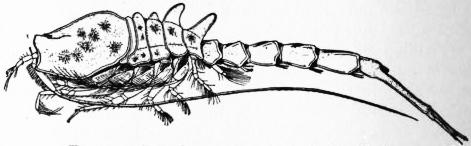
Fig. 3.—Pseudocuma pectinatum, Sowinsky.
5. Sympoda.—This order of sessile-eyed decapods was absolutely unknown to science till 1779. A species certainly belonging to it was described by Lepekhin in 1780, but the obscure Gammarus esca, “food Gammarus” beloved of herrings, described by J. C. Fabricius in the preceding year, may also be one of its members. Nutritious possibilities are implied in Diastylis rathkii, Kröyer, one of the largest forms, which, though slender and rarely an inch long, in its favourite Arctic waters is found “in incalculable masses, in thousands of specimens” (Stuxberg, 1880). Far on in the 19th century eminent naturalists were still debating whether in this group there were eyes or no eyes, whether the eyes were stalked or sessile, whether the animals observed were larval or adult. The American T. Say in 1818 gave a good description of a new species and founded the premier genus Diastylis, but other investigators derived little credit from the subject till more than sixty years after its introduction by the Russian Lepekhin. Then Goodsir, Kröyer, Lilljeborg, Spence Bate and one or two others made considerable advances, and in 1865 a memorable paper by G. O. Sars led the way to the great series of researches which he has continued to the present day. The name Cumacea, however, which he uses cannot be retained, being founded on the preoccupied name Cuma (Milne-Edwards, 1828). The more recent name Sympoda (see Willey, Results, pt. v. p. 609, 1900) alludes to the huddling together of the legs, which is conspicuous in most of the species. Ten families are now distinguished—Diastylidae, Lampropidae, Platyaspidae, Pseudocumidae, all with an articulated telson; without one, the Bodotriidae (formerly called Cumidae), Vaunthompsoniidae, Leuconidae, Nannastacidae, Campylaspidae, Procampylaspidae. All the Leuconidae and Procampylaspidae are blind, and some species in most of the other families. Usually the sides of the carapace are strangely produced into a mock rostrum in front of the ocular lobe, be it oculiferous or not. The last four or five segments of the trunk are free from the carapace. The slender pleon has always six distinct segments, the sixth carrying two-branched uropods, the preceding five armed with no pleopods in the female, whereas in the male the number of pairs varies from five to none. The resemblance of these creatures to miniature Macrura is alluded to in the generic name Nannastacus, meaning dwarf-lobster. In this genus alone of the known Sympoda the eyes sometimes form a pair, in accordance with the custom of all other malacostracan orders except this and of this order itself in the embryo (Sars, 1900). The most but not the only remarkable character lies in the first maxillipeds. These, with the main stem more or less pediform, have the epipod and exopod modified for respiratory purposes. The backward-directed epipods usually carry branchial vesicles. The forward-directed exopods either act as valves or form a tube (rarely two tubes), protensile and retractile, for regulating egress of water from the branchial regions. This mechanism as a whole is unique, although, as Sars observes, the epipod of the first maxillipeds has a respiratory function also in the Lophogastridae and Mysidae and in the cheliferous isopods. As a rule armature of the carapace is much more developed in the comparatively sedentary female than in the usually more active male. Only in the male do the second antennae attain considerable length, with strong resemblance to what is found in some of the Amphipoda. About 150 species distributed among thirty-four genera are now known, many from shallow water and from between tide-marks, some from very great depths. H. J. Hansen concludes that “they are all typically ground animals, and as yet no species has been taken under such conditions that it could be reckoned to the pelagic plankton.” As they have been found in all zones and chiefly by a very few observers, it is probable that a great many more species remain to be discovered. In recent years thirteen species, all belonging to the same genus Pseudocuma (fig. 3), have been recorded by Sars from the Caspian Sea. A bibliography of the order is given in that author’s Crustacea of Norway, vol. iii. (1899-1900).