VOLUME XVII SLICE II Luray Cavern to Mackinac Island
Reading edition
Articles in This Slice
LURAY CAVERN MACABRE
LURCH McADAM, JOHN LOUDON
LURGAN MACAIRE
LURIA, ISAAC BEN SOLOMON McALESTER
LURISTAN MACALPINE, JOHN
LUSATIA MACAO
LUSHAI HILLS MACAQUE
LUSIGNAN MACARONI
LUSSIN MACARONICS
LUSTRATION MACARSCA
LUTE MACARTNEY, GEORGE MACARTNEY
LUTHARDT, CHRISTOPH ERNST MACASSAR
LUTHER, MARTIN MACAULAY, THOMAS BABINGTON MACAULAY
LUTHERANS MACAW
LUTHER LEAGUE MACBETH
LUTON MACCABEES
LUTSK MACCABEES, BOOKS OF
LUTTERWORTH MacCARTHY, DENIS FLORENCE
LUTTRELL, HENRY M‘CARTHY, JUSTIN
LÜTTRINGHAUSEN McCHEYNE, ROBERT MURRAY
LÜTZEN McCLELLAN, GEORGE BRINTON
LÜTZOW, ADOLF McCLERNAND, JOHN ALEXANDER
LUXEMBURG, FRANÇOIS HENRI DE MONTMORENCY-BOUTEVILLE MACCLESFIELD, CHARLES GERARD
LUXEMBURG (district) MACCLESFIELD
LUXEMBURG (town) M‘CLINTOCK, SIR FRANCIS LEOPOLD
LUXEUIL-LES-BAINS McCLINTOCK, JOHN
LUXOR McCLOSKEY, JOHN
LUXORIUS M‘CLURE, SIR ROBERT JOHN LE MESURIER
LUYNES MacCOLL, MALCOLM
LUZÁN CLARAMUNT DE SUELVES Y GURREA, IGNACIO McCOMBIE, WILLIAM
LUZ-SAINT-SAUVEUR McCOOK, ALEXANDER McDOWELL
LUZZATTI, LUIGI MacCORMAC, SIR WILLIAM
LUZZATTO, MOSES ḤAYIM McCORMICK, CYRUS HALL
LUZZATTO, SAMUEL DAVID McCOSH, JAMES
LYALL, SIR ALFRED COMYN McCOY, SIR FREDERICK
LYALL, EDNA M‘CRIE, THOMAS
LYALLPUR MACCULLAGH, JAMES
LYCAEUS MACCULLOCH, HORATIO
LYCANTHROPY McCULLOCH, HUGH
LYCAON M‘CULLOCH, SIR JAMES
LYCAONIA MACCULLOCH, JOHN
LYCEUM M‘CULLOCH, JOHN RAMSAY
LYCIA McCULLOUGH, JOHN EDWARD
LYCK MACCUNN, HAMISH
LYCOPHRON MACDONALD, FLORA
LYCOPODIUM MACDONALD, GEORGE
LYCOSURA MACDONALD, SIR HECTOR ARCHIBALD
LYCURGUS (founder of the Spartan constitution) MACDONALD, JACQUES ÉTIENNE JOSEPH ALEXANDRE
LYCURGUS (Attic orator) MACDONALD, SIR JOHN ALEXANDER
LYCURGUS (Greek leader) MACDONALD, JOHN SANDFIELD
LYDD MACDONALD, LAWRENCE
LYDENBURG MACDONELL, JAMES
LYDFORD MACDONNELL, ALESTAIR RUADH
LYDGATE, JOHN MACDONNELL, SORLEY BOY
LYDIA MACDONOUGH, THOMAS
LYDUS, JOANNES LAURENTIUS MacDOWELL, EDWARD ALEXANDER
LYE McDOWELL, IRVIN
LYELL, SIR CHARLES MACDUFF
LYLY, JOHN McDUFFIE, GEORGE
LYME REGIS MACE
LYMINGTON MACEDO, JOSÉ AGOSTINHO DE
LYMPH and LYMPH FORMATION MACEDONIA
LYMPHATIC SYSTEM MACEDONIAN EMPIRE
LYNCH, PATRICIO MACEDONIUS
LYNCHBURG MACEIÓ
LYNCH LAW McENTEE, JERVIS
LYNDHURST, JOHN SINGLETON COPLEY MACER, AEMILIUS
LYNDSAY, SIR DAVID MACERATA
LYNEDOCH, THOMAS GRAHAM MACFARREN, SIR GEORGE ALEXANDER
LYNN McGEE, THOMAS D’ARCY
LYNTON and LYNMOUTH McGIFFERT, ARTHUR CUSHMAN
LYNX McGILLIVRAY, ALEXANDER
LYON, MARY MASON MACGILLIVRAY, WILLIAM
LYON, NATHANIEL MacGREGOR, JOHN
LYONNESSE MACH, ERNST
LYONS, EDMUND LYONS MACHAERODUS
LYONS, RICHARD BICKERTON PEMELL LYONS MACHALE, JOHN
LYONS (city of France) MACHAULT D’ARNOUVILLE, JEAN BAPTISTE DE
LYONS, COUNCILS OF MACHAUT, GUILLAUME DE
LYRA MACHIAVELLI, NICCOLÒ
LYRE MACHICOLATION
LYRE-BIRD MACHINE
LYRICAL POETRY MACHINE-GUN
LYSANDER MACÍAS
LYSANIAS MACINTOSH, CHARLES
LYSIAS MACKAY, CHARLES
LYSIMACHUS MACKAY, HUGH
LYSIPPUS MACKAY, JOHN WILLIAM
LYSIS OF TARENTUM MACKAY
LYSISTRATUS McKEESPORT
LYTE, HENRY FRANCIS McKEES ROCKS
LYTHAM MACKENNAL, ALEXANDER
LYTTELTON, GEORGE LYTTELTON MACKENZIE, SIR ALEXANDER
LYTTELTON MACKENZIE, ALEXANDER
LYTTON, EDWARD GEORGE EARLE LYTTON, BULWER-LYTTON MACKENZIE, SIR ALEXANDER CAMPBELL
LYTTON, EDWARD ROBERT BULWER-LYTTON MACKENZIE, SIR GEORGE
M MACKENZIE, HENRY
MAAS, JOSEPH McKENZIE, SIR JOHN
MAASIN MACKENZIE, SIR MORELL
MAASSLUIS MACKENZIE, WILLIAM LYON
MAASTRICHT MACKENZIE (river of Canada)
MABILLON, JOHN MACKEREL
MABINOGION McKIM, CHARLES FOLLEN
MABUSE, JAN MACKINAC ISLAND
MACABEBE

LURAY CAVERN, a large cave in Page county, Virginia, U.S.A., 39° 35′ N. and 78° 17′ W., near the village of Luray, on the Norfork & Western railway. The valley, here 10 m. wide, extends from the Blue Ridge to the Massanutton Mountain. The ridges lie in vast folds and wrinkles; and elevations in the valley are often found to be pierced by erosion. Cave Hill, 300 ft. above the water-level, had long been an object of local interest on account of its pits and oval hollows or sink-holes, through one of which, on the 13th of August 1878, Andrew J. Campbell and others entered, thus discovering the cavern now described.
The Luray cavern does not date beyond the Tertiary period, though carved from the Silurian limestone. At some period, long subsequent to its original excavation, and after many large stalactites had grown, it was completely filled with glacial mud charged with acid, whereby the dripstone was eroded into singularly grotesque shapes. After the mud had been mostly removed by flowing water, these eroded forms remained amid the new growths. To this contrast may be ascribed some of the most striking scenes in the cave. The many and extraordinary monuments of aqueous energy include massive columns wrenched from their place in the ceiling and prostrate on the floor; the Hollow Column, 40 ft. high and 30 ft. in diameter, standing erect, but pierced by a tubular passage from top to bottom; the Leaning Column nearly as large, undermined and tilting like the campanile of Pisa; the Organ, a cluster of stalactites in the chamber known as the Cathedral; besides a vast bed of disintegrated carbonates left by the whirling flood in its retreat through the great space called the Elfin Ramble.
The stalactitic display exceeds that of any other cavern known. The old material is yellow, brown or red; and its wavy surface often shows layers like the gnarled grain of costly woods. The new stalactites growing from the old, and made of hard carbonates that had already once been used, are usually white as snow, though often pink, blue or amber-coloured. The Empress Column is a stalagmite 35 ft. high, rose-coloured, and elaborately draped. The double column, named from Professors Henry and Baird, is made of two fluted pillars side by side, the one 25 and the other 60 ft. high, a mass of snowy alabaster. Several stalactites in the Giant Hall exceed 50 ft. in length. The smaller pendants are innumerable; in the canopy above the Imperial Spring it is estimated that 40,000 are visible at once.
The “cascades” are wonderful formations like foaming cataracts caught in mid-air and transformed into milk-white or amber alabaster. The Chalcedony Cascade displays a variety of colours. Brand’s Cascade, the finest of all, is 40 ft. high and 30 ft. wide, and is unsullied and wax-like white, each ripple and braided rill seeming to have been polished.
The Swords of the Titans are monstrous blades, eight in number, 50 ft. long, 3 to 8 ft. wide, hollow, 1 to 2 ft. thick, but drawn down to an extremely thin edge, and filling the cavern with tones like tolling bells when struck heavily by the hand. Their origin and also that of certain so-called scarfs and blankets is from carbonates deposited by water trickling down a sloping and corrugated surface. Sixteen of these alabaster scarfs hang side by side in Hovey’s Balcony, three white and fine as crape shawls, thirteen striated like agate with every shade of brown, and all perfectly translucent. Down the edge of each a tiny rill glistens like silver, and this is the ever-plying shuttle that weaves the fairy fabric.
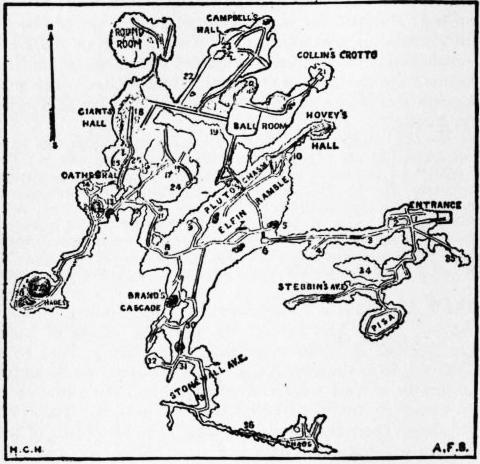
Luray Cavern. Scale 500 ft. to the inch.
1. The Vestibule. 2. Washington’s Pillar. 3. Flower Garden. 4. Amphitheatre. 5. Natural Bridge. 6. Fish Market. 7. Crystal Spring. 8. Proserpine’s Pillar. 9. The Spectral Column. 10. Hovey’s Balcony. 11. Oberon’s Grot. 12. Titania’s Veil. 13. Saracen’s Tent. 14. The Organ. 15. Tower of Babel. 16. Empress Column. 17. Hollow Column. 18. Henry-Baird Column. 19. Chalcedony Cascade. 20. Coral Spring. 21. The Dragon. 22. Bootjack Alley. 23. Scaly Column. 24. Lost Blanket. 25. Helen’s Scarf. 26. Chapman’s Lake. 27. Broaddus Lake. 28. Castles on the Rhine. 29. Imperial Spring. 30. The Skeleton. 31. The Twin Lakes. 32. The Engine Room. 33. Miller’s Room. 34. Hawes Cabinet. 35. Specimen Avenue. 36. Proposed Exit.
Streams and true springs are absent, but there are hundreds of basins, varying from 1 to 50 ft. in diameter, and from 6 in. to 15 ft. in depth. The water in them is exquisitely pure, except as it is impregnated by the carbonate of lime, which often forms concretions, called according to their size, pearls, eggs and snowballs. A large one is known as the cannon ball. On fracture these spherical growths are found to be radiated in structure.
Calcite crystals, drusy, feathery or fern-like, line the sides and bottom of every water-filled cavity, and indeed constitute the substance of which they are made. Variations of level at different periods are marked by rings, ridges and ruffled margins. These are strongly marked about Broaddus Lake and the curved ramparts of the Castles on the Rhine. Here also are polished stalagmites, a rich buff slashed with white, and others, like huge mushrooms, with a velvety coat of red, purple or olive-tinted crystals. In some of the smaller basins it sometimes happens that, when the excess of carbonate acid escapes rapidly, there is formed, besides the crystal bed below, a film above, shot like a sheet of ice across the surface. One pool 12 ft. wide is thus covered so as to show but a third of its surface. The quantity of water in the cavern varies greatly at different seasons. Hence some stalactites have their tips under water long enough to allow tassels of crystals to grow on them, which, in a drier season, are again coated over with stalactitic matter; and thus singular distortions are occasioned. Contiguous stalactites are often inwrapped thus till they assume an almost globular form, through which by making a section the primary tubes appear. Twig-like projections, to which the term helictite has been applied by the present writer, are met with in certain portions of the cave, and are interesting by their strange and uncouth contortions. Their presence is due to lateral outgrowths of crystals shooting from the side of a growing stalactite, or to deflections caused by currents of air, or to the existence of a diminutive fungus peculiar to the locality and designated from its habitat Mucor stalactitis. The Toy-Shop is an amusing collection of these freaks of nature.
The dimensions of the various chambers included in Luray Cavern cannot easily be stated, on account of the great irregularity of their outlines. Their size may be seen from the diagram. But it should be understood that there are several tiers of galleries, and the vertical depth from the highest to the lowest is 260 ft. The large tract of land owned by the Luray Caverns Corporations covers all possible modes of entrance.
The waters of this cavern appear to be entirely destitute of life; and the existing fauna comprises only a few bats, rats, mice, spiders, flies and small centipedes. When the cave was first entered, the floor was covered with thousands of tracks of raccoons, wolves and bears—most of them probably made long ago, as impressions made in the tenacious clay that composes most of the cavern floor would remain unchanged for centuries. Layers of excrementitious matter appear, and also many small bones, along with a few large ones, all of existing species. The traces of human occupation are pieces of charcoal, flints, moccasin tracks and a single skeleton embedded in stalagmite in one of the chasms, estimated, from the present rate of stalagmitic growth, to have lain where found for not more than five hundred years.
The temperature is uniformly 54° Fahr., coinciding with that of Mammoth Cave, Kentucky. The air is very pure, and the avenues are not uncomfortably damp. The portions open to the public are now lighted by electric lamps. The registered number of visitors in 1906 was 18,000. A unique and highly successful experiment merits mention, by which the cool pure air of Luray Cavern is forced through all the rooms of the Limair sanatorium erected in 1901, by Mr T. C. Northcott, president of the Luray Caverns Corporation, on the summit of Cave Hill. Tests made for several successive years by means of culture media and sterile plates, demonstrated the perfect bacteriologic purity of the air, first drawn into the caverns through myriads of rocky crevices that served as natural filters, then further cleansed by floating over the transparent springs and pools, and finally supplied to the inmates of the sanatorium.
For a full description see an article by Dr G. L. Hunner, of Johns Hopkins University, in the Popular Science Monthly for April 1904.
(H. C. H.)
LURCH, a word with several meanings, the etymological relationships of which are obscure. The chief uses which survive are—(1) in the phrase “to leave in the lurch,” to abandon some one, to leave him in a position of great difficulty; (2) a stagger, sudden leaning over, originally a nautical expression of a sudden “list” made by a ship; (3) the name of a dog, the “lurcher” used by poachers, properly a cross between a sheepdog or collie and a greyhound. In (1) “lurch” is the name of a game, of which nothing is known (it is supposed to have resembled backgammon), and also of a state of the score in various games, in which the loser either scores nothing or is beaten by very heavy points. In this sense the term is practically obsolete. It was taken from Fr. lourche, connected with many German forms, now only dialectical such as Lortsch, Lurtsch, Lorz, Lurz, all for some kind of game, but also meaning left-hand, wrong, which the New English Dictionary thinks is the origin of the word, it being first used as a term in gambling. In (2) “lurch” occurs first in the form “lee-lurches,” sudden rolls a ship takes to leeward in a heavy sea, which may be a corruption of “lee-latch,” defined in Smyth’s Sailor’s Word Book as dropping to leeward of the course. In (3) “lurch” is probably another form of “lurk,” to lie in wait for, watch stealthily, hence to pilfer, steal.
LURGAN, a market-town of Co. Armagh, Ireland, well situated on high ground overlooking Lough Neagh a few miles to the north; 20 m. S.W. of Belfast by the Great Northern railway. Pop. (1901) 11,782. The parish church of Shankill (this parish including Lurgan) has a finely proportioned tower. Contiguous to the town is Lurgan Castle, a fine modern Elizabethan structure, the seat of Lord Lurgan. Lurgan is famed for its diapers, and the linen trade is of the first importance, but there are also tobacco factories and coach factories. It is governed by an urban district council. Lurgan was founded by William Brownlow, to whom a grant of the town was made by James I. In 1619 it consisted of forty-two houses, all inhabited by English settlers. It was burned by the insurgents in 1641, and again by the troops of James II. After its restoration in 1690 a patent for a market and fair was obtained.
LURIA, ISAAC BEN SOLOMON (1534-1572), Jewish mystic, was born in Jerusalem. From his German descent he was surnamed Ashkenazi (the German), and we find that epithet applied to him in a recently discovered document of date 1559. In that year Isaac Luria was living in Cairo and trading as a spice merchant with his headquarters in Alexandria. He had come to Egypt as a boy after his father’s death, and was brought up by his wealthy maternal uncle Mordecai Francis. The boy, according to the legends which soon grew round his life, was a “wonder-child,” and early displayed marvellous capacity. He married as a lad of fifteen, his bride being his cousin. For some time he continued his studies; later on when engaged in business there was no break in this respect. Two years after his marriage he became possessed of a copy of the Kabbalistic “Bible”—the Zohar of Moses de Leon (q.v.). In order to meditate on the mystic lore he withdrew to a hut by the Nile, returning home for the Sabbath. Luria afterwards gave to the Sabbath a mystic beauty such as it had never before possessed. Thus passed several years; he was still young, but his new mode of life produced its effects on a man of his imagination and saintly piety. He became a visionary. Elijah, who had been his godfather in his babyhood, now paid him frequent visits, initiating him into sublime truths. By night Luria’s soul ascended to heaven and conversed with celestial teachers who had once been men of renown on earth.
In 1566 at earliest Luria removed to Safed. This Palestinian town was in the 16th century the headquarters of the Kabbala. A large circle of Talmudists lived there; at their head Joseph Qaro, then over eighty years of age. Qaro’s son married Luria’s daughter, and Qaro rejoiced at the connexion, for he had a high opinion of Luria’s learning. Mysticism is often the expression of a revolt against authority, but in Luria’s case mysticism was not divorced from respect for tradition. After his arrival at Safed Luria lived at most six years, and died in 1572. But these years were momentous for Judaism. He established an extraordinary reputation; his personality had a winning attractiveness; and he founded a school of mystics who powerfully affected Judaism after the master’s death. The Holy Spirit, we are told, rested on him, drawn to him by the usual means of the mystics—self-flogging, ablutions and penance. He had wonderful gifts of insight, and spoke to the birds. Miracles abounded. More soberly true is the statement that he went on long walks with enthusiastic disciples, whom he taught without books. Luria himself wrote no mystical works; what we know of his doctrines and habits comes chiefly from his Boswell, Hayim Vital.
There was little of originality in Luria’s doctrines; the theory of emanations, the double belief in the process of the Divine Essence as it were self-concentrating (Zimzum) and on the other hand as expanding throughout creation; the philosophical “sceptism” which regards God as unknowable but capable of direct intuition by feeling—these were all common elements of mystical thought. Luria was an inspirer of saintly conduct rather than an innovator in theories. Not beliefs, he said, but believers need rebirth. As he rose in the morning he prayed: “O God, grant that throughout this coming day I may be able to love my neighbour as myself.” Never would he retire to rest until he had fulfilled his definite engagements to those who had served him. Luria and his school altered the very look of the Jewish Prayer Book. Prayer was his main prop. By it men became controllers of the earthly world and reached God. He or his school introduced innumerable ritual customs, some of them beautiful enough. On Sabbath he dressed in white, wearing a four-fold garment to typify the four letters of the Divine Name. The Sabbath was to him an actual cult. It was a day of the most holy joy. Resuming the Talmudic idea of an Over-soul present in every Israelite on the Sabbath, Luria and his school made play with this Over-soul, fed it with spiritual and material dainties and evolved an intricate maze of mystic ceremonial, still observed by countless masses. Another strong point with Luria was penance. The confessions of sin which he introduced descend to minute ritual details and rise to the most exalted aspects of social and spiritual life. He deprecated general confessions and demanded that the individual must lay bare the recesses of his heart. Hayim Vital reports that on his death-bed Luria said to his disciples: “Be at peace with one another: bear with one another: and so be worthy of my coming again to reveal to you what no mortal ear has heard before.” His mystic ceremonial became a guide to religious practice, and though with this there came in much meaningless and even bewildering formalism, yet the example of his life and character was a lasting inspiration to saintliness.
See S. Schecher, Studies in Judaism, second series, pp. 251 seq.; Jewish Encyclopedia, viii. 210; E. Worman in Revue des Études Juives, lvii. 281.
(I. A.)
LURISTAN, in the wider sense (as its name implies) the “Land of the Lurs,” namely that part of western Persia which is bounded by Turkish territory on the west and extends for about 400 m. N.W.-S.E. from Kermanshah to Fars with a breadth of 100 to 140 m. It is chiefly mountainous, being intersected by numerous ranges running N.W.-S.E. The central range has many summits which are almost within the line of perpetual snow, rising to 13,000 ft. and more, and in it are the sources of Persia’s most important rivers, as the Zayendeh-rud, Jarahi, Karun, Diz, Abi, Kerkheh. Between the higher ranges are many fertile plains and low hilly districts, well watered but comparatively little cultivated in consequence of intertribal feuds. The Lurs are thought to be aboriginal Persians with a mixture of Semitic blood. Their language is a dialect of Persian and does not differ materially from Kurdish. Outwardly they are Mussulmans of the Shiah branch, but most of them show little veneration for either Prophet or Koran, and the religion of some of them seems to be a mixture of Ali-Illahism involving a belief in successive incarnations combined with mysterious, ancient, heathen rites. The northern part of Luristan, which was formerly known as Lurikuchik (little Luristan), is inhabited by the Feili Lurs and these are divided into the Pishkuh (cis-montane) Lurs in the east and Pushtkuh (ultra-montane) Lurs in the west adjoining Turkish territory. They number about 350,000. Little Luristan was governed by a race of independent princes of the Khurshidi dynasty, and called atabegs, from 1155 to the beginning of the 17th century when the last atabeg, Shah Verdi Khan, was removed by Shah Abbas I. and the government of the province given to Husain Khan, the chief of a rival tribe, with the title of vali in exchange for that of atabeg. The descendants of Husain Khan have retained the title but now govern only the Pushtkuh Lurs, to whom only the denomination of Feili is at present applied. The southern part of Luristan was formerly known as Lur i Buzurg (great Luristan) and is composed of the Bakhtiari division of the Arabistan province and the districts of the Mamasennis and Kuhgilus which belong to Fars. The Bakhtiaris number about 200,000, the others 40,000. Great Luristan was an independent state under the Fazlevieh atabegs from 1160 until 1424, and its capital was Idaj, now represented by mounds and ruins at Malamir 60 m. S.E. of Shushter.
LUSATIA (Ger. Lausitz), a name applied to two neighbouring districts in Germany, Upper and Lower Lusatia, belonging now mainly to Prussia, but partly to Saxony. The name is taken from the Lusitzi, a Slav tribe, who inhabited Lower Lusatia in the 9th and 10th centuries.
In the earliest times Lower Lusatia reached from the Black Elster to the Spree; its inhabitants, the Lusitzi, were conquered by the German king, Henry the Fowler, and by the margrave Gero in the 10th century. Their land was formed into a separate march, which for about three centuries was sometimes attached to, and sometimes independent of, the margraviate of Meissen, its rulers being occasionally called margraves of Lusatia. In 1303 it was purchased by the margrave of Brandenburg, and after other changes it fell in 1368 into the hands of the king of Bohemia, the emperor Charles IV., who already possessed Upper Lusatia. During the Hussite wars its people remained loyal to the Roman Catholic Church. In 1469 they recognized Matthias Corvinus, king of Hungary, as their sovereign, but in 1490 they came again under the rule of the Bohemian king.
The district now known as Upper Lusatia was occupied by a Slav tribe, the Milzeni, who like the Lusitzi, were subdued by Henry the Fowler early in the 10th century. For about three centuries it was called Baudissin (Bautzen), from the name of its principal fortress. In the 11th and 12th centuries it was connected at different periods with Meissen, Poland and Bohemia. Towards 1160 the emperor Frederick I. granted it to Ladislas, king of Bohemia, and under this ruler and his immediate successors it was largely colonized by German immigrants. In 1253 it passed to the margrave of Brandenburg, and about the same time it was divided into an eastern and a western part, Baudissin proper and Görlitz. In 1319 the former was restored to Bohemia, which also recovered Görlitz in 1329. During the 14th century the nobles and the townsmen began to take part in the government, and about this time Upper Lusatia was known as the district of the six towns (Sechsstädtelandes), these being Bautzen, Görlitz, Zittau, Löbau, Lauban and Kamenz. From 1377 to 1396 Görlitz was a separate duchy ruled by John, a son of the emperor Charles IV., and, like Lower Lusatia, Upper Lusatia owned the authority of Matthias Corvinus from 1469 to 1490, both districts passing a little later with the kingdoms of Hungary and Bohemia to the German king, Ferdinand I. The “six towns” were severely punished for their share in the war of the league of Schmalkalden, and about this time the reformed teaching made very rapid progress in Lusatia, the majority of the inhabitants becoming Protestants. The name of Lusatia hitherto confined to Lower Lusatia, was soon applied to both districts, the adjectives Upper and Lower being used to distinguish them. In 1620, early in the Thirty Years’ War, the two Lusatias were conquered by the elector of Saxony, John George I., who was allowed to keep them as the price of his assistance to the emperor Ferdinand I. In 1635 by the treaty of Prague they were definitely transferred from Bohemia to Saxony, although the emperor as king of Bohemia retained a certain supremacy for the purpose of guarding the rights and privileges of the Roman Catholics. They suffered much during the wars of the 18th century. By the peace of Vienna (1815) the whole of Lower Lusatia and part of Upper Lusatia were transferred from Saxony to Prussia.
The area of the part of Upper Lusatia retained by Saxony was slightly increased in 1845; it is now about 960 sq. m. In 1900 Lower Lusatia contained 461,973 inhabitants, of whom 34,837 were Wends; the portion of Upper Lusatia belonging to Prussia had 305,080 inhabitants, of whom 24,361 were Wends. There were 405,173 inhabitants, including 28,234 Wends, in Saxon Upper Lusatia. Laws relating to this district, after passing through the Saxon parliament must be submitted to the Lusatian diet at Bautzen. The chief towns of Upper Lusatia are Bautzen, Zittau, Löbau, Kamenz, Görlitz, Rothenburg, Hoyerswerda and Lauban; in Lower Lusatia they are Guben, Kottbus, Forst, Lubben and Spremberg. The principal rivers are the Spree with its tributaries, the Black Elster and the Neisse. Upper Lusatia is generally mountainous and picturesque, Lower Lusatia is flat and sandy. The chief industries are linen weaving, cloth making and coal mining.
For the history of Lusatia see the collections, Scriptores rerum Lusaticarum antiqui et recentiores, edited by C. G. Hoffmann (4 vols., Leipzig and Bautzen, 1719); and Scriptores rerum Lusaticarum (4 vols., Görlitz, 1839-1870). See also W. Lippert, Wettiner und Wittelsbacher sowie die Niederlausitz im 14 Jahrhundert (Dresden, 1894); T. Scheltz, Gesamtgeschichte der Ober- und Niederlausitz, Band i. (Halle, 1847), Band ii. (Görlitz, 1882); J. G. Worbs, Urkundenbuch zur Geschichte des Markgraftums Niederlausitz (Lübben 1897); and J. A. E. Kohler, Die Geschichte der Oberlausitz (Görlitz, 1867).
LUSHAI HILLS, a mountainous district of Eastern Bengal and Assam, south of Cachar, on the border between Assam and Burma. Area, 7227 sq. m.; pop. (1901) 82,434. The hills are for the most part covered with dense bamboo jungle and rank undergrowth; but in the eastern portion, owing probably to a smaller rainfall, open grass-covered slopes are found, with groves of oak and pine interspersed with rhododendrons. These hills are inhabited by the Lushais and cognate tribes, but the population is extremely scanty. From the earliest known times the original inhabitants were Kukis, and the Lushais were not heard of until 1840, when they invaded the district from the north. Their first attack upon British territory took place in November 1849, and after that date they proved one of the most troublesome tribes on the north-east frontier of India; but operations in 1890 resulted in the complete pacification of the northern Lushai villages, and in 1892 the eastern Lushais were reduced to order. The management of the South Lushai hill country was transferred from Bengal to Assam in 1898. To obtain more efficient control over the country the district has been divided into eighteen circles, each in charge of an interpreter, through whom all orders are transmitted to the chiefs. The Welsh Presbyterian Mission began work at Aijal in 1897, and the people have shown unexpected readiness to accept education. According to the census of 1901 the total number of Lushais in Assam was 63,452.
See Colonel T. H. Lewin, Wild Races of N.E. India (1870); Lushai Hills Gazetteer (Calcutta, 1906).
LUSIGNAN, the name of a family which sprang from Poitou1 and distinguished itself by its connexion with the kingdom of Jerusalem, and still more by its long tenure of the kingdom of Cyprus (1192-1475). A Hugh de Lusignan appears in the ill-fated crusade of 1100-1101; another Hugh, the Brown, came as a pilgrim to the Holy Land in 1164, and was taken prisoner by Nureddin. In the last quarter of the 12th century the two brothers Amalric and Guy, sons of Hugh the Brown, played a considerable part in the history of the Latin East. About 1180 Amalric was constable of the kingdom of Jerusalem; and he is said to have brought his handsome brother Guy to the notice of Sibylla, the widowed heiress of the kingdom. Guy and Sibylla were married in 1180; and Guy thus became heir presumptive of the kingdom, if the young Baldwin V., Sibylla’s son by her first marriage to William of Montferrat, should die without issue. He acted as regent in 1183, but he showed some incapacity in the struggle with Saladin, and was deprived of all right of succession. In 1186, however, on the death of Baldwin V., he succeeded in obtaining the crown, in spite of the opposition of Raymund of Tripoli. Next year he suffered a crushing defeat at the battle of Hittin, and was taken prisoner by Saladin. Released on parole in 1188, he at once broke his parole, and began the siege of Acre. Difficulties, however, had arisen with Conrad of Montferrat; and when Guy lost his wife Sibylla in 1190, and Conrad married Isabella, her sister, now heiress of the kingdom, these difficulties culminated in Conrad’s laying claim to the crown. Guy found his cause espoused in 1191 by the overlord of his house, Richard I. of England; but Conrad’s superior ability, and the support of the French crusaders, ultimately carried the day, and in 1192 Richard himself abandoned the pretensions of Guy, and recognized Conrad as king. Though Conrad was almost immediately assassinated, the crown did not return to Guy, but went to Henry of Champagne, who married the widowed Isabella. Guy found some satisfaction for his loss in buying from the Templars the island of Cyprus, and there he reigned for the last two years of his life (1192-1194). He is judged harshly by contemporary writers, as simplex and insufficiens; but Dodu (in his Histoire des institutions du royaume de Jérusalem) suggests that Guy was depreciated because the kingdom had been lost in his reign, in much the same way as Godfrey of Bouillon was exalted because Jerusalem had just been won at his accession. Guy was a brave if not a particularly able knight; and his instant attack on Acre after his release by Saladin shows that he had the sentiment de ses devoirs.
He was succeeded in Cyprus by his brother Amalric, who acquired the title of king of Cyprus from the emperor Henry VI., and became king of Jerusalem in 1197 by his marriage to Isabella, after the death of Henry of Champagne (see Amalric II.). Amalric was the founder of a dynasty of kings of Cyprus, which lasted till 1475, while after 1269 his descendants regularly enjoyed the title of kings of Jerusalem. The scions of the house of Lusignan proved themselves the most sincere of crusaders. They possessed in Cyprus a kingdom, in which they had vindicated for themselves a stronger hold over their feudatories than the kings of Jerusalem had ever enjoyed, and in which trading centres like Famagusta flourished vigorously; and they used the resources of their kingdom, in conjunction with the Hospitallers of Rhodes, to check the progress of the Mahommedans.
Among the most famous members of the house who ruled in Cyprus three may be mentioned. The first is Hugh III. (the Great), who was king from 1267 to 1285: to him, apparently, St Thomas dedicated his De Regimine Principum; and it is in his reign that the kingdom of Jerusalem becomes permanently connected with that of Cyprus. The second is Hugh IV. (1324-1359), to whom Boccaccio dedicated one of his works, and who set on foot an alliance with the pope, Venice and the Hospitallers, which resulted in the capture of Smyrna (1344). The last is Peter I., Hugh’s second son and successor, who reigned from 1359 to 1369, when he was assassinated as the result of a conspiracy of the barons. Peter and his chancellor de Mezières represent the last flicker of the crusading spirit (see Crusades).
Before the extinction of the line in 1475, it had succeeded in putting a branch on the throne of Armenia. Five short-lived kings of the house ruled in Armenia after 1342, “Latin exiles,” as Stubbs says, “in the midst of several strange populations all alike hostile.” The kingdom of Armenia fell before the sultan of Egypt, who took prisoner its last king Leo V. in 1375, though the kings of Cyprus afterwards continued to bear the title; the kingdom of Cyprus itself continued to exist under the house of Lusignan for 100 years longer. The mother of the last king, James III. (who died when he was two years old), was a Venetian lady, Catarina Cornaro. She had been made a daughter of the republic at the time of her marriage to the king of Cyprus; and on the death of her child the republic first acted as guardian for its daughter, and then, in 1489, obtained from her the cession of the island.
See J. M. J. L. de Mas-Latrie, Histoire de l’île de Chypre sous les princes de la maison de Lusignan (Paris, 1852-1853); W. Stubbs, Lectures on Medieval and Modern History (3rd ed., Oxford, 1900).
1 A branch of the line continued in Poitou during the 13th century, and ruled in LaMarche till 1303. Hugh de la Marche, whose betrothed wife, Isabella of Angoulême, King John of England seized (thus bringing upon himself the loss of the greater part of his French possessions), was a nephew of Guy of Lusignan. He ultimately married Isabella, after the death of John, and had by her a number of sons, half-brothers of Henry III. of England, who came over to England, amongst other foreign favourites, during his reign.
LUSSIN, a small island in the Adriatic Sea, in the Gulf of Quarnero, forming together with the adjacent islands of Veglia and Cherso an administrative district in the Austrian crownland of Istria. Pop. (1900) 11,615. The island is 24 m. in length, is of an average breadth of 1.64 m., being little more than 300 yds. wide at its narrowest point, and has an area of 29 sq. m. The chief town and principal harbour is Lussinpiccolo (pop. 7207), which is the most important trading centre in the Quarnero group. The town has become a favourite winter resort, its climate resembling that of Nice. To the south-east of it is Lussingrande (pop. 2349), with an old Venetian palace and a shipbuilding wharf. The island was first peopled at the end of the 14th century. Its inhabitants are renowned seamen.
LUSTRATION, a term that includes all the methods of purification and expiation among the Greeks and Romans. Among the Greeks there are two ideas clearly distinguishable—that human nature must purify itself (κάθαρσις) from guilt before it is fit to enter into communion with God or even to associate with men, and that guilt must be expiated voluntarily (ἱλασμός) by certain processes which God has revealed, in order to avoid the punishment that must otherwise overtake it. It is not possible to make such a distinction among the Latin terms lustratio, piacula, piamenta, caerimoniae, and even among the Greeks it is not consistently observed. Guilt and impurity arose in various ways; among the Greeks, besides the general idea that man is always in need of purification, the species of guilt most insisted on by religion are incurred by murder, by touching a dead body, by sexual intercourse, and by seeing a prodigy or sign of the divine will. The last three spring from the idea that man had been without preparation and improperly brought into communication with God, and was therefore guilty. The first, which involves a really moral idea of guilt, is far more important than the others in Hellenic religion. Among the Romans we hear more of the last species of impurity; in general the idea takes the form that after some great disaster the people become convinced that guilt has been incurred and must be expiated. The methods of purification consist in ceremonies performed with water, fire, air or earth, or with a branch of a sacred tree, especially of the laurel, and also in sacrifice and other ceremonial. Before entering a temple the worshipper dipped his hand in the vase of holy water (περιῤῥανήριον, aqua lustralis) which stood at the door; before a sacrifice bathing was common; salt-water was more efficacious than fresh, and the celebrants of the Eleusinian mysteries bathed in the sea (ἄλαδε, μύσται); the water was more efficacious if a firebrand from the altar were plunged in it. The torch, fire and sulphur (τὸ θεῖον) were also powerful purifying agents. Purification by air was most frequent in the Dionysiac mysteries; puppets suspended and swinging in the air (oscilla) formed one way of using the lustrative power of the air. Rubbing with sand and salt was another method. The sacrifice chiefly used for purification by the Greeks was a pig; among the Romans it was always, except in the Lupercalia, a pig, a sheep and a bull (suovetaurilia). In Athens a purificatory sacrifice and prayer was held before every meeting of the ecclesia; the Maimacteria,1 in honour of Zeus Maimactes (the god of wrath), was an annual festival of purification, and at the Thargelia two men (or a woman and a man) were sacrificed on the seashore, their bodies burned and the ashes thrown into the sea, to avert the wrath of Apollo. On extraordinary occasions lustrations were performed for a whole city. So Athens was purified by Epimenides after the Cylonian massacre, and Delos in the Peloponnesian War (426 B.C.) to stop the plague and appease the wrath of Apollo. In Rome, besides such annual ceremonies as the Ambarvalia, Lupercalia, Cerialia, Paganalia, &c., there was a lustration of the fleet before it sailed, and of the army before it marched. Part of the ceremonial always consisted in leading or carrying the victims round the impure persons or things. After any disaster the lustratio classium or exercitus was often again performed, so as to make certain that the gods got all their due. The Amburbium, a solemn procession of the people round the boundaries of Rome, was a similar ceremonial performed for the whole city on occasions of great danger or calamity; the Ambilustrium (so called from the sacrificial victims being carried round the people assembled on the Campus Martius) was the purificatory ceremony which took place after the regular quinquennial census (lustrum) of the Roman people.
See C. F. Hermann, Griechische Altertümer, ii.; G. F. Schömann, ib. ii.; P. Stengel, Die griechischen Kultusaltertümer (1898); Marquardt, Römische Staatsverwaltung, iii. p. 200 (1885); P. E. von Lasaulx, Die Sühnopfer der Griechen und Römer (1841); J. Donaldson, “On the Expiatory and Substitutionary Sacrifices of the Greeks,” in Transactions of the Royal Society of Edinburgh, xxvii., 1876; and the articles by A. Bouché-Leclercq in Daremberg and Saglio, Dictionnaire des antiquités, and by W. Warde Fowler in Smith’s Dictionary of Greek and Roman Antiquities (3rd ed., 1891).
1 Maimacteria does not actually occur in ancient authorities as the name of a festival.
LUTE (Arabic al‘ūd, “the wood”; Fr. luth; Ital. liuto; Span. laud; Ger. Laute; Dut. luit), an ancient stringed musical instrument, derived in form as well as name from the Arabs. The complete family consisted of the pandura, tanbur or mandoline as treble, the lute as alto or tenor, the barbiton or theorbo as bass, and the chitarrone as double bass. The Arab instrument, with convex sound-body, pointing to the resonance board or membrane having been originally placed upon a gourd, was strung with silk and played with a plectrum of shell or quill. It was adopted by the Arabs from Persia. Instruments with vaulted backs are all undoubtedly of Eastern origin; the distinct type, resembling the longitudinal section of a pear, is more specially traced in ancient India, Persia and the countries influenced by their civilization. This type of instrument includes many families which became known during the middle ages of western Europe, being introduced into southern Europe and Spain by the Moors, into southern Russia by the Persians of the Sassanian period, into Greece from the confines of the Byzantine Empire. As long as the strings were plucked by fingers or plectrum the large pear-shaped instrument may be identified as the archetype of the lute. When the bow, obtained from Persia, was applied to the instrument by the Arabs, a fresh family was formed, which was afterwards known in Europe as rebab and later rebec. The largest member of the ancient lute family—the bass lute or theorbo—has been identified with the barbiton.
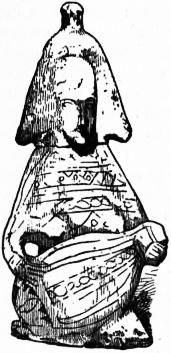
Fig. 1.—Post-Mycenaean terra-cotta figure, with ancient lute (1000 B.C.) from the cemetery at Goshen.
Until recently the existence of these ancient stringed instruments was presumed on the evidence of the early medieval European instruments and of the meagre writings extant, such as those of Fārābī.1 But a chain of plastic evidence can now be offered, beginning with the Greek post-Mycenaean age (c. 1000 B.C.). A statuette of a female musician playing upon a large lute with only an embryonic neck, on which nevertheless the left hand is stopping strings, was unearthed in Egypt in a tomb of the XXth Dynasty in the cemetery of Goshen by the members of the British School of Archaeology in Egypt,2 under the direction of Professor Flinders Petrie, to whose courtesy we owe the photograph (fig. 1) here reproduced. It is difficult to form a conclusive opinion as to the number of strings the artist intended to represent, owing to the decorative figures following the direction of the strings, but, judging from the position of the right hand plucking a string, there may have been seven. Among a number of terra-cotta figures of musicians, brought to light during the excavations in a Tell at Suza and dating from the 8th century B.C.,3 although there is no instrument that might be identified with the alto lute, the treble lute or tanbur is represented with a long, curved neck and a head bent back to increase the tension, and there is also an instrument having a smaller and more elongated body than the lute. On one of the friezes from Afghanistan presented to the British Museum by Major-General Cunningham, which formed the risers of steps leading to the tope at Jumal Garhi, dating from the 1st century A.D. are represented scenes of music and dancing. Here the archetype of the lute appears several times; it had four strings, and the head was bent back at right angles to the neck. In the 6th century A.D. illustrations of this early lute are no longer rare, more especially on Persian silver-work of the Sassanian period4 and in the paintings of the Buddhist cave-temples of Ajanta.5 Several representations of the barbiton are extant from the classical Roman period.
The modern Egyptian ‘ūd is the direct descendant of the Arabic lute, and, according to Lane, is strung with seven pairs of catgut strings played by a plectrum. A specimen in the Victoria and Albert Museum, given by the khedive, has four pairs only, which appears to have been the old stringing of the instrument. When frets (cross-lines dividing the neck or finger-board to show the fingering) are employed they are of catgut disposed according to the Arabic scale of seventeen intervals in the octave, consisting of twelve limmas, an interval rather less than our equal semitone, and five commas, which are very small but quite recognizable differences of pitch.
The lute family is separated from the guitars, also of Eastern origin, by the formation of the sound body, which is in all lutes pear-shaped, without the sides or ribs necessary to the structure of the flat-backed guitar and cither. Observing this distinction, we include with the lute the little Neapolitan mandoline of 2 ft. long and the large double-necked Roman chitarrone, not infrequently 6 ft. long. Mandolines are partly strung with wire, and are played with a plectrum, indispensable for metal or short strings. Perhaps the earliest lutes were so played, but the large lutes and theorbos strung with catgut have been invariably touched by the fingers only, the length permitting this more sympathetic means of producing the tone.
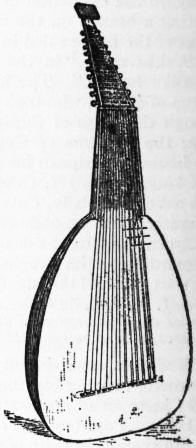
Fig. 2.—Lute, by Venere of Padua.
Praetorius,6 writing when the lute was in universal favour, mentions seven varieties distinguished by size and tuning. The smallest would be larger than a mandoline, and the melody string, the “chanterelle,” often a single string, lower in pitch. Praetorius calls this an octave lute, with the chanterelle C or D. The two discant lutes have respectively B and A, the alto G, the tenor E, the bass D, and the great octave bass G, an octave below the alto lute which may be taken as the model lute cultivated by the amateurs of the time. The bass lutes were theorbos, that is, double-necked lutes, as described below. The accordance of an alto lute was founded upon that of the original eight-stringed European lute, to which the highest and lowest notes had, in course of time, been added. A later addition was the also on the finger-board, and bass strings, double or single, known as diapasons, which, descending to the deep C of the violoncello, were not stopped with the fingers. The diapasons were tuned as the key of the piece of music required. Fig. 2 represents an Italian instrument made by one of the most celebrated lute makers, Venere of Padua, in 1600; it is 3 ft. 6 in. high, and has six pairs of unisons and eight single diapasons. The finger-board, divided into approximately equal half tones by the frets, as a rule eight in number, was often further divided on the higher notes, for ten, eleven, or, as in the woodcut, even twelve, semitones. The head, bearing the tuning pegs, was placed at an obtuse or a right angle to the neck, to increase the bearing of the strings upon the nut, and be convenient for sudden requirements of tuning during performance, the trouble of keeping a lute in tune being proverbial.


The lute was in general use during the 16th and 17th centuries. In the 18th it declined; still J. S. Bach wrote a “partita” for it. The latest date we have met with of an engraved publication for the lute is 1760.
The large double-necked lute, with two sets of tuning pegs, the lower for the finger-board, the higher for the diapason strings, was known as the theorbo; also, and especially in England, as the arch-lute; and, in a special form, the neck being then very long, as the chitarrone. Theorbo and chitarrone appear together at the close of the 16th century, and their introduction was synchronous with the rise of accompanied monody in music, that is, of the oratorio and the opera. Peri, Caccini and Monteverde used theorbos to accompany their newly-devised recitative, the invention of which in Florence, from the impulse of the Renaissance, is well known. The height of a theorbo varied from 3 ft. 6 in. to 5 ft., the Paduan being always the largest, excepting the Roman 6-ft. long chitarrone. These large lutes had very deep notes, and doubtless great liberties were allowed in tuning, but the strings on the finger-board followed the lute accordance already given, or another quoted by Baron (Untersuchung des Instruments der Lauten, Nuremberg, 1727) as the old theorbo or “violway” (see Mace, Musick’s Monument, London, 1676):—

We find again both these accordances varied and transposed a tone higher, perhaps with thinner strings, or to accommodate local differences of pitch. Praetorius recommends the chanterelles of theorbos being tuned an octave lower on account of the great strain. By such a change, another authority, the Englishman Thomas Mace, says, the life and spruceness of airy lessons were quite lost. The theorbo or arch-lute had at last to give way to the violoncello and double bass, which are still used to accompany the “recitativo secco” in oratorios and operas. Handel wrote a part for a theorbo in Esther (1720); after that date it appears no more in orchestral scores, but remained in private use until nearly the end of the century.
The lute and the organ share the distinction of being the first instruments for which the oldest instrumental compositions we possess were written. For the lute, however, they were not written in our present notation, but in tablature, “lyrawise,” a system by which as many lines were drawn horizontally as there were pairs of strings on the finger-board, the frets, distributed at intervals of a semitone, being distinguished by the letters of the alphabet, repeated from A, representing the open string, for each line. This was the English and French manner; the Italian was by numbers instead of letters. The signs of time were placed over the stave, and were not repeated unless the mensural values changed.
(A. J. H.; K. S.)
1 See Latin translation by J. G. L. Kosegarten, Alii Ispahenensis Liber ... Arabice editur adjectaque translatione adnotationibusque illustratus (Greifswald, 1840).
2 See Hyksos and Israelite Cities, by W. M. Flinders Petrie and J. Garrow Duncan, 1906 (double volume), Brit. Sch. of Arch.
3 J. de Morgan, Délégation en Perse (Paris, 1900), vol. i. pl. viii. Nos. 8, 7 and 9.
4 See “The Treasures of the Oxus,” catalogue of the Franks Bequest to the British Museum by Ormonde M. Dalton (London, 1905), pl; xxvi. No. 190; see also J. R. Aspelin, “Les antiquités du nord,” No. 608; also for further references, Kathleen Schlesinger, “Precursors of the Violin Family,” pt. ii. of The Instruments of the Orchestra, pp. 407-408, and appendix B, pp. 492-493; and Gazette archéologique (Paris, 1886), vol. xi. pl. x. and p. 70.
5 By John Griffiths (London, 1896), vol. ii. pl. 105, cave I. 10, e.
6 Syntagm. Music. pt. ii., “Organographie” (Wolfenbüttel, 1618), pp. 30 and 58-61.
LUTHARDT, CHRISTOPH ERNST (1823-1902), German Lutheran theologian, was born at Maroldsweisach, Bavaria, on the 22nd of March 1823. He studied theology at Erlangen and Berlin, and in 1856 became professor ordinarius of systematic theology and New Testament exegesis at Leipzig. In 1865 he was made a counsellor to the consistory, in 1871 canon of Meissen cathedral, and in 1887 a privy councillor to the church. He died at Leipzig on the 21st of September 1902. A strictly orthodox theologian, and a clear writer, though not a very profound scholar, Luthardt became widely appreciated as the author of apologetic lectures. These were collected under the title Apologie des Christentums (vol. i., 1864, 14th ed. 1896; vol. ii. 7th ed., 1901; vol. iii. 7th ed., 1898; vol. iv. 2nd ed., 1880), a work of which the first three volumes have been translated into English. In 1868 he founded and edited the Allgemeine evang.-lutherische Kirchenzeitung, with its supplement the Theologisches Litteraturblatt, and in 1880 became editor of the Zeitschrift für kirchl. Wissenschaft und kirchl. Leben.
His other works include Das Johanneische Evangelium ... erklärt (1852-1853; 2nd ed. in 2 vols., 1875-1876), Offenbarung Johannis erklärt (1861), Lehre von den letzten Dingen (1861; 3rd ed. 1885); Kompendium der Dogmatik (1865; 9th ed., 1893), Geschichte der christlichen Ethik (2 vols., 1888-1893), Gnade und Wahrheit (1874), Das Wort des Lebens (1877) and Gnade und Frieden (1880). His autobiography was published with the title Erinnerungen aus vergangenen Tagen (1889; 2nd ed., 1891).
LUTHER, MARTIN (1483-1546), the great German religious reformer, was born at Eisleben on the 10th of November 1483. His father, Hans Luther (Lyder, Luder, Ludher), a peasant from the township of Möhra in Thuringia, after his marriage with Margarethe Ziegler, had settled in Mansfeld, attracted by the prospects of work in the mines there. The counts of Mansfeld, who, many years before, had started the mining industry, made a practice of building and letting out for hire small furnaces for smelting the ore. Hans Luther soon leased one, then three. In 1491 he became one of the four elected members of the village council (vier Herren von der Gemeinde); and we are told that the counts of Mansfeld held him in esteem. The boy grew up amid the poor, coarse surroundings of the German peasant life, imbibing its simple beliefs. He was taught that the Emperor protected the poor people against the Turk, that the Church was the “Pope’s House,” wherein the Bishop of Rome had all the rights of the house-father. He shared the common superstitions of the time and some of them never left him.
Young Martin went to the village school at Mansfeld; to a school at Magdeburg kept by the Brethren of the Common Lot; then to the well-known St George’s school at Eisenach. At Magdeburg and Eisenach Luther was “a poor student,” i.e. a boy who was received into a hospice where he lived rent-free, attended school without paying fees, and had the privilege of begging for his bread at the house-doors of the town; in return for which he sang as a chorister in the church to which the school was attached. Luther was never a “wandering student”; his parents were too careful of their child to permit him to lead the life of wandering licence which marked these pests of medieval German scholastic life. At Eisenach he attracted the notice of the wife of a wealthy merchant of Eisenach, whom his biographers usually identify as Frau Cotta.
After three happy years at Eisenach, Luther entered the university of Erfurt (1501), then the most famous in Germany. Hans Luther had been prospering, and was more than ever resolved to make his son a lawyer. Young Luther entered his name on the matriculation book in letters which can still be read “Martinus Ludher ex Mansfelt,” a free student, no longer embarrassed by great poverty. In Luther’s time Erfurt was the intellectual centre of Germany and its students were exposed to a variety of influences which could not fail to stimulate young men of mental ability.
Its theology was, of course, scholastic, but of what was then called the modern type, the Scotist; its philosophy was the nominalist system of William of Occam, whose great disciple, Gabriel Biel (d. 1495), had been one of its most famous professors; Nicholas de Lyra’s (d. 1340) system of biblical interpretation had been long taught there by a succession of able teachers; Humanism had won an early entrance to the university; the anti-clerical teaching of John of Wessel, who had himself taught at Erfurt for fifteen years (1445-1460), had left its mark on the place and was not forgotten. Hussite propagandists, even in Luther’s time, secretly visited the town and whispered among the students their anti-clerical Christian socialism. Papal legates to Germany seldom failed to visit the university and by their magnificence bore witness to the majesty of the Roman church.
A study of the scholastic philosophy was then the preliminary training for a course of law, and Luther worked so hard at the prescribed studies that he had little leisure, he said, for classical learning. He attended none of the Humanist lectures, but he read a good many of the Latin authors and also learned a little Greek. He never was a member of the Humanist circle; he was too much in earnest about religious questions and of too practical a turn of mind. The young Humanists would have gladly welcomed him into their select band. They dubbed him the “philosopher,” the “musician,” recalled in after days his fine social disposition, his skill in playing the lute, and his ready power in debate. He took the various degrees in an unusually brief time. He was bachelor in 1502 and master in 1505. His father, proud of his son’s steady application and success, sent him the costly present of a Corpus Juris. He may have begun to study law. Suddenly he plunged into the Erfurt Convent of the Augustinian Eremites and after due noviciate became a monk.
The action was so unexpected that his contemporaries felt bound to give all manner of explanations which have been woven into accounts which are legendary. Nothing is known about the cause of the sudden plunge but what Luther has himself revealed. He has told us that he entered the monastery because he doubted of himself, and that his action was sudden because he knew that his father would have disapproved of his intention.
The word “doubt” has made historians think of intellectual difficulties—of the “theological scepticism” taught by Occam and Biel, of the disintegrating criticism of Humanism. But there is no trace of any theological difficulties in Luther’s mind in the struggles which sent him into the convent and distracted him there. He was driven to do what he did by the pressure of a practical religious need, the desire to save his soul. The fires of hell and the shades of purgatory, which are the constant background of Dante’s “Paradiso,” were present to Luther from childhood.
Luther was the greatest religious genius which the 16th century produced, and the roots of the movement in which he was the central figure must be sought for in the popular religious life of the last decades of the 15th and opening decades of the 16th centuries—a field which has been neglected by almost all his biographers. When it is explored traces of at least five different types of religious sentiment can be discovered. Pious parents, whether among the burghers or peasants, seem to have taught their children a simple evangelical faith. Martin Luther and thousands of children like him were trained at home to know the creed, the ten commandments, the Lord’s prayer, and such simple hymns as Ein Kindelein so lobelich, Nun bitten wir den Heiligen Geist and Crist ist erstanden; and they were taught to believe that God for Christ’s sake freely pardons sin. They learned that simple faith which Luther afterwards expounded in his Small Catechism and called the Kinderlehre. When lads trained like himself entered school and college they came in contact with that religious revival which characterized the last half of the 15th century. Fear seemed to brood over the peoples of Western Europe. The plague devastated the badly drained towns, new diseases spread death, the fear of the Turks was permanent. All this went to feed revival, which, founded on fear, refused to see in Jesus Christ anything but a stern judge, and made the Virgin Mother and Anna the “grandmother” the intercessors; which found consolation in pilgrimages from shrine to shrine; which believed in crude miracles, and in the thought that God could be best served within convent walls. Luther’s mind was caught in this current of feeling. He records how it was burnt into him by pictures which filled his boyish imagination. Jesus in the painted window of Mansfeld church, stern of face, sword in hand, sitting on a rainbow, coming to judge; an altar-piece at Magdeburg, in which a ship with its crew was sailing on to heaven, carrying no layman on board; the deeds of St Elizabeth emblazoned on the window of St George’s parish church at Eisenach; the living pictures of a young nobleman who had turned monk to save his soul, of a monk, the holiest man Luther had ever known, who was aged far beyond his years by his maceration; and many others of the same kind.
Alongside this we can trace the growth of another religious movement of a different kind. We can see a sturdy common-sense religion taking possession of multitudes in Germany, which insisted that laymen might rule in many departments supposed to belong exclusively to the clergy. The jus episcopale which Luther afterwards claimed for the secular authorities had been practically exercised in Saxony and Brandenburg; cities and districts had framed police regulations which set aside ecclesiastical decrees about holidays and begging; the supervision of charity was passing from the hands of the church into those of laymen; and religious confraternities which did not take their guidance from the clergy were increasing. Lastly, the medieval Brethren were engaged in printing and distributing tracts, mystical, anti-clerical, sometimes socialist. All these influences abounded as Luther was growing to manhood and laid their marks upon him. It was the momentary power of the second which drove him into the convent, and he selected the monastic order which represented all that was best in the revival of the latter half of the 15th century—the Augustinian Eremites.
In the convent Luther set himself to find salvation. The last word of that Scotist theology which ruled at the close of the middle ages was that man must work out his own salvation, and Luther tried to do so in the most approved later medieval fashion by the strictest asceticism. He fasted and scourged himself; he practised all the ordinary forms of maceration and invented new ones, all to no purpose. His theological studies, part of the convent education, told him that pardon could be had through the Sacrament of Penance, and that the first part of the sacrament was sorrow for sin. The older theology declared that such sorrow must be based on love to God. Had he this love? God always appeared to him as an implacable judge, threatening punishment for breaking a law which it was impossible to keep. He confessed to himself that he often hated this arbitrary Will which Scotist theology called God. The later theology, taught in the convent by John of Palz and John Nathin, said that sorrow might be based on a meaner motive provided the Sacrament of Penance was continually resorted to. Luther wearied his superiors with his attendance at the confessional. He was looked upon as a young saint, and his reputation extended throughout the convents of his order. The young saint felt himself to be no nearer the pardon of God; he thought that he was “gallows-ripe.” At last his superiors seemed to discover his real difficulties. Partly by their help, partly by study of the scriptures, he came to understand that God’s pardon was to be won by trusting to His promises. Thus after two years of indescribable mental conflicts Luther found peace. The struggle marked him for life. His victory gave him a sense of freedom, and the feeling that life was given by God to be enjoyed. In all external things he remained unchanged. He was a faithful son of the medieval church, with its doctrines, ceremonies and usages.
Soon after he had attained inward peace, Luther was ordained. He continued his studies in theology, devoting himself to the more “experimental” portions of Augustine, Bernard and Gerson. He showed himself a good man of business and was advanced in his order. In 1508 he was sent with some other monks to Wittenberg to assist the small university which had been opened there in 1502 by Frederick the Wise, elector of Saxony. It was there that Luther began to preach, first in a small chapel to the monks of his order; later taking the place of one of the town’s clergy who was in ill-health. From Wittenberg he was sent by the chiefs of the German Augustinian Eremites to Rome on a mission concerning the organization of the order. He went up with the feelings of the medieval pilgrim rather than with the intoxication of the ardent Humanist. On his return (1512) he was sent by Staupitz, his vicar-general, to Erfurt to take the necessary steps for higher graduation in theology, in order to succeed Staupitz himself as professor of theology in Wittenberg. He graduated as Doctor of the Holy Scripture, took the Wittenberg doctor’s oath to defend the evangelical truth vigorously (viriliter), became a member of the Wittenberg Senate, and three weeks later succeeded Staupitz as professor of theology.
From the first Luther’s lectures in theology differed from those ordinarily given at the time. He had no opinions on theological subjects at variance with the theology taught at Erfurt and elsewhere. No one attributed any heretical views to the young Wittenberg professor. He differed from others because he looked at theology in a more practical way. He thought it ought to be made useful to guide men to the grace of God and to tell them how to persevere in a life of joyous obedience to God and His commandments. His teaching was “experimental” from the beginning. Besides he believed that he had been specially set apart to lecture on the Holy Scriptures, and he began by commenting on the Psalms and on the Epistles of St Paul. He never knew much Hebrew and was not specially strong in Greek; so he used the Vulgate in his prelections. He had a huge widely printed volume on his desk, and wrote the notes for his lectures on the margins and between the lines. Some of the pages survive. They contain in the germ the leading thoughts of what became Lutheran theology. At first he expressed himself in the phrases common to scholastic theology, when these were found to be inadequate in words borrowed from the mystical writers of the 14th and 15th centuries, and then in new phrases more appropriate to the circle of fresh thoughts. Those new thoughts at first simply pushed aside the ordinary theology taught in the schools without staying to criticize it. Gradually, however, Luther began to find that there was some real opposition between what he was teaching and the theology he had been taught in the Erfurt convent. It appeared characteristically enough on the practical and not on the speculative side of theology in a sermon on Indulgences preached in July 1516. Once begun the breach widened, until Luther could contrast “our theology” with what was taught at Erfurt, and by September he began to write against the scholastic theology, to declare that it was Pelagian at heart, that it repudiated the Augustinian doctrines of grace, and neglected to teach the supreme value of that faith “which throws itself upon God.”
These lectures and the teaching they contained soon made a great impression. Students began to flock to the small obscure university of Wittenberg, and the elector grew proud of the teacher who was making his university famous. It was at this interesting stage of his own religious career that he felt himself compelled to stand forth in opposition to what he believed to be a great religious scandal, and almost unconsciously to become a Reformer.
Luther began his work as a Reformer by proposing to discuss the true meaning of Indulgences. The occasion was an Indulgence proclaimed by Pope Leo X., farmed by the archbishop of Mainz, and preached by John Tetzel, a Dominican monk and a famed seller of Indulgences. Many of the German princes had no great love for Indulgence sellers, and Frederick of Saxony had prohibited Tetzel from entering his territories. But it was easy to reach most parts of Electoral Saxony without actually crossing the frontiers. The Red Cross of the Indulgence seller had been set up at Zerbst and at Jüterbogk, and people had gone from Wittenberg to buy the Papal Tickets. Luther believed that the sales were injurious to the morals of the townsmen; he had heard reports of Tetzel’s sermons; he had become wrathful on reading the letter of recommendation of the archbishop; and friends had urged him to interfere. He protested with a characteristic combination of caution and courage. The church of All Saints (the castle church) was closely connected with the university of Wittenberg. Its doors were commonly used for university proclamations. The Elector Frederick was a great collector of relics and had stored them in his church. He had procured an Indulgence for all who attended its services on All Saints’ Day, and crowds commonly gathered. Luther nailed ninety-five theses on the church door on that day, the 1st of November 1517, when the crowd could see and read them.
The proceeding was strictly academic. The matter discussed, to judge by the writings of theologians, was somewhat obscure; and Luther offered his theses as an attempt to make it clearer. No one was supposed to be committed to every opinion he advanced in such a way. But the theses posted somehow touched heart and conscience in a way unusual in the common subjects of academic disputation. Every one wanted to read them. The University Press could not supply copies fast enough. They were translated into German, and were known throughout Germany in less than a fortnight. Within a month they had been heard of all over western and southern Europe. Luther himself was staggered at the way they were received. He said he had never meant to determine, but to debate.
The theses were singularly unlike what might have been expected from a professor of theology. They made no attempt at theological definition, no pretence at logical arrangement; they were anything but a brief programme of reformation. They were simply ninety-five sledge-hammer blows directed against the most flagrant ecclesiastical abuse of the age. They were addressed to the “common” man and appealed to his common sense of spiritual things.
The practice of offering, selling and buying Indulgences (see Indulgence) was everywhere common in the beginning of the 16th century. The beginnings go back more than a thousand years before the time of Luther. In the earliest church life, when Christians fell into sin, they were required to make public confession before the congregation, to declare their sorrow, and to vow to perform certain acts which were regarded as evidence of the sincerity of their repentance. When the custom of public confession before the congregation had changed to private confession to the clergy, it became the confessor’s duty to impose these satisfactions. It was thought only right that there should be some uniformity in dealing with repentant sinners, and books appeared giving lists of sins and what were supposed to be suitable satisfactions. When the sins confessed were very heinous the satisfactions were correspondingly severe and sometimes lasted over many years. About the 7th century arose a custom of commuting or relaxing these imposed satisfactions. A penance of several years fasting might be commuted into saying so many prayers, or giving an arranged amount in alms, or even into a money-fine. In the last case the analogy of the Wergeld of the German tribal codes was commonly followed. The usage generally took the form that any one who visited a church, to which the Indulgence had been attached, on a day named, and gave a contribution to its funds, had his penance shortened by one-seventh, one-third or one-half, as might be arranged. This was the origin of Indulgences properly so-called. They were always mitigations of satisfactions or penances which had been imposed by the church as outward signs of inward sorrow, tests of fitness for pardon, and the needful precedents of absolution. Luther uttered no protest against Indulgences of this kind. He held that what the church had imposed the church could remit.
This old and simple conception of Indulgences had been greatly altered since the beginning of the 13th century. The institution of penance had been raised to the dignity of a sacrament, and this had changed both the place and the character of satisfactions. Under the older conception the order had been Sorrow (Contritio), Confession, Satisfaction (or due manifestation of sorrow in ways prescribed) and Absolution. Under the newer theory the order was Sorrow, Confession, Absolution, Satisfaction, and both satisfaction and sorrow took new meanings. It was held that Absolution removed guilt and freed from eternal punishment, but that something had to be done to free the penitent from temporal punishment whether in this life or in purgatory. Satisfactions took the new meaning of the temporal punishments due in this life and the substitute for the pains of purgatory. The new thought of a treasury of merits (thesaurus meritorum) introduced further changes. It was held that the good deeds over and above what were needed for their own salvation by the living or by the saints in heaven, together with the inexhaustible merits of Christ, were all deposited in a treasury out of which they could be taken by the pope and given by him to the faithful. They could be added to the satisfactions actually done by penitents. Thus Satisfactions became not merely signs of sorrow but actual merits, which freed men from the need to undergo the temporal pains here and in purgatory which their sins had rendered them liable to. By an Indulgence merits could be transferred from the storehouse to those who required them. The change made in the character of Sorrow made Indulgences all the more necessary for the indifferent penitent. On the older theory Sorrow (Contritio) had for its one basis love to God; but on the newer theory the starting-point might be a less worthy king of sorrow (Attritio) which it was held would be changed into the more worthy kind in the Sacrament of Penance. The conclusion was naturally drawn that a process of penitence which began with sorrow of the more unworthy kind needed a larger amount of Satisfactions or penance than what began with Contrition. Hence for the indifferent Christian, Attrition, Confession and Indulgence became the three heads in the scheme of the church of the later middle ages for his salvation. The one thing which satisfied his conscience was the burdensome thing he had to do, and that was to procure an Indulgence—a matter made increasingly easy for him as time went on.
This doctrine of Attrition had not the undivided support of the theologians of the later medieval church; but it was taught by the Scotists and was naturally a favourite theme with the sellers of Indulgences. Nor were all theologians at one upon the whole theory of Indulgences. The majority of the best theologians held that Indulgences had nothing to do with the pardoning of guilt, but only with freeing from temporal penalties in this life or in purgatory. But the common people did not discriminate, and believed that when they bought an Indulgence they were purchasing pardon from sin; and Luther placed himself in the position of the ordinary Christian uninstructed in the niceties of theological distinctions.
His Ninety-five Theses made six different assertions about Indulgences and their efficacy:—
i. An Indulgence is and can only be the remission of a merely ecclesiastical penalty; the church can remit what the church has imposed; it cannot remit what God has imposed.
ii. An Indulgence can never remit guilt; the pope himself cannot do such a thing; God has kept that in His own hand.
iii. It cannot remit the divine punishment for sin; that also is in the hands of God alone.
iv. It can have no efficacy for souls in Purgatory; penalties imposed by the church can only refer to the living; death dissolves them; what the pope can do for souls in Purgatory is by prayer, not by jurisdiction or the power of the keys.
v. The Christian who has true repentance has already received pardon from God altogether apart from an Indulgence, and does not need one; Christ demands this true repentance from every one.
vi. The Treasury of Merits has never been properly defined; it is hard to say what it is, and it is not properly understood by the people; it cannot be the merits of Christ and of His saints, because these act of themselves and quite apart from the intervention of the pope; it can mean nothing more than that the pope, having the power of the keys, can remit ecclesiastical penalties imposed by the church; the true Treasure-house of merits is the Holy Ghost of the grace and glory of God.
The unexpected effect of the Theses was that the sale of Indulgences began to decline rapidly, and the archbishop of Mainz, disappointed in his hopes of revenue, sent a copy to Rome. The pope thinking that the whole dispute was a monkish quarrel, contented himself with asking the general of the Augustinian Eremites to keep his monks quiet. This was not easy. Tetzel, in conjunction with a friend, Conrad Wimpina, had published a set of counter-theses. John Mayr of Eck, a noted controversialist and professor of theology in the university of Ingolstadt, scented the Hussite heresy in the Theses, and denounced them in a tract entitled Obelisks. Luther at once answered in his Asterisks. A controversy raged in Germany. Meanwhile, at Rome, Silvester Mazzolini of Prierio, a Dominican monk and Inquisitor, had been studying the Theses, was profoundly dissatisfied with them, and wrote a Dialogue about the Power of the Pope, against the presumptuous conclusions of Martin Luther. This book reached Germany about the middle of January 1518, and increased the tumult.
Luther’s friends had been provokingly silent about the Theses; but in April 1518, at the annual chapter of the Augustinian Eremites held at Heidelberg, Luther heard his positions temperately discussed, and found somewhat to his astonishment that his views were not acceptable to all his fellow monks. On his return to Wittenberg he began an answer to his opponents. He carefully considered his positions, found them unassailable, and published his Resolutions, the most carefully written of all his works. The book practically discarded all the ideas and practices concerning Indulgences which had come into the medieval church since the beginning of the 13th century, and all the ingenious explanations of the scholastic theologians from Bonaventura and Thomas Aquinas downwards. The effect of the controversy was a great decrease in the sale of Indulgences in Germany, and the Papal Curia saw with alarm a prolific source of revenue decaying. It was felt that Luther must be silenced. He was accordingly summoned to Rome. To obey would have meant death; to refuse in his own name would have been contumacy. But the peremptory summons could be construed as an attack on the university of Wittenberg, and both the elector of Saxony and the emperor Maximilian so regarded it. The result was that Pope Leo cancelled the summons, and it was arranged that Luther should appear before the papal Legate to the German Diet, Thomas de Vio, Cardinal Cajedtan, at Augsburg. The interview was not very successful. At its conclusion Luther wrote two appeals—one from the pope ill-informed to the pope well-informed, and the other to a General Council. True to his habit of taking the German people into his confidence, he wrote an account of his interview with the Legate, and published it under the title of the Acta Augustana.
The publication greatly increased the sympathy of almost all classes in Germany for Luther. They saw in him a pious man, an esteemed professor, who had done nothing but propose a discussion on the notoriously intricate subject of Indulgences, peremptorily ordered to recant and to remain silent. The elector Frederick shared the common feelings and resolved to defend the man who had made his university so famous. His action compelled the Roman Curia to pause. Germany was on the eve, it was believed, of an election of a king of the Romans; it was possible that an imperial election was not far distant; Frederick was too important a personage to offend. So the condemnation by the Cardinal-Legate was withdrawn for the time, and the pope resolved to deal with the matter otherwise. He selected one of his chamberlains, Charles von Miltitz, the elector’s private agent at Rome, and commissioned him to deal with the matter as he best could. Miltitz received the “golden rose” to give to Frederick, and was furnished with several letters in all of which the pope spoke of Luther as a “child of the devil.” His holiness had probably forgotten the fact when he addressed Luther some months later as “his dear son.”
When Miltitz arrived in Germany he discovered that the movement was much more important than the Roman Curia had imagined. He had not to deal with the opposition of a recalcitrant monk, but with the awakening of a nation. He resolved to meet with Tetzel and with Luther privately before he produced his credentials. Tetzel he could not see; the man was afraid to leave his convent; but he had lengthy interviews with Luther in the house of Spalatin the chaplain and private secretary of the elector Frederick. There he disowned the sermons of the pardon-sellers, let it be seen that he did not approve of the action of the Legate, and so prevailed with Luther that the latter promised to write a submissive letter to the pope, to exhort people to reverence the Roman See, to say that Indulgences were useful to remit canonical penances, and to promise to write no more on the matter unless he happened to be attacked. Luther did all this. A reconciliation might have taken place had the Roman Curia supported Miltitz. But the Curia did not support Miltitz, and placed more faith in Eck, who was eager to extinguish Luther in a public discussion.
Luther had been spending the time between his interview with the Legate at Augsburg (Oct. 1518) and the Leipzig Disputation (June 1519) in severe and disquieting studies. He had found that all his opponents had pursued one line of argument: the power to issue an Indulgence is simply one case of the universal papal jurisdiction; Indulgences are what the pope proclaims them to be, and to attack them is to attack the power of the pope; the pope represents the Roman church, which is actually the universal church, and to oppose the pope is to defy the whole church of Christ; whoever attacks such a long-established system as that of Indulgences is a heretic. Such was the argument. Luther felt himself confronted with the pope’s absolute supremacy in all ecclesiastical matters. It was a plea whose full force he felt. The papal supremacy was one of his oldest inherited beliefs. He re-examined his convictions about justifying faith and whether they did lead to his declarations about Indulgences. He could come to no other conclusion. It then became necessary to examine the papal claims. He set himself to study the Decretals, and to his amazement and indignation he found that they were full of frauds. It is hard to say whether the discovery brought him more joy or more grief. His letters show him half-exultant and half-terrified. While he was in this state of mind he received Eck’s challenge to dispute with him at Leipzig on the papal supremacy.
This Leipzig Disputation was perhaps the most important point in Luther’s career. He met Eck in June 1519. It soon appeared that the intention of that practised debater was to force Luther into some admission which would justify opponents in accusing him of holding the opinions of Huss, who had been condemned by the great German Council of Constance. In this he was eminently successful. Eck left Leipzig triumphant, and Luther returned to Wittenberg much depressed. As usual he wrote out and published an account of the Disputation, which was an appeal to his fellow Germans. The result surpassed his expectations. The Disputation made him see that his protest against the abuses of Indulgences was no criticism of an excrescence on the medieval ecclesiastical system, but an attack on its centre of existence. He saw that he stood for the spiritual priesthood of all believers and that medievalism in religion meant that man cannot approach God without a priestly mediator. The people also saw his position and rallied round him; and the Humanists discerned in him a champion against the old intolerance against which they had been revolting in vain. Luther’s depression fled. Sermons, pamphlets, letters from his tireless pen flooded the land, and Luther began to be the leader of a German revolt against Rome.
The year 1520 saw the publication of his three most important works, all written at a time when he was fully convinced that he had broken for ever with Rome. They were, On the Liberty of a Christian Man, An Address to the Nobility of the German Nation, and On the Babylonian Captivity of the Church of God—the three primary treatises, as they have been called.
Meanwhile at Rome the pope had entrusted Eck and Prierias with the preparation of a bull (Exurge Domine) against Luther—a bull which followed the line of Eck’s charges at Leipzig. The reformer had been expecting it ever since the Disputation at Leipzig, and had resolved to answer it by one striking act which would impress the imagination of every man. He posted up a notice inviting the Wittenberg students to witness the burning of the bull (10th of December 1520). Rome had shot its last ecclesiastical bolt. Nothing remained but an appeal to the secular power, and this was at once prepared.
The emperor Maximilian had died suddenly (12th January 1519), and for long Germany was disturbed with intrigues about the succession—the papal policy being specially tortuous. The widely expressed desire for a German emperor secured the unanimous election of Charles, the grandson of Maximilian and the king of Spain. Never were a people more mistaken and disappointed. The veins of Charles were full of German blood, but he was his mother’s son. It was the Spaniard, not the German, who faced Luther at Worms.
Charles was crowned at Aachen, 23rd of October 1520, and opened his first German diet at Worms, 22nd of January 1521. The pope had selected two envoys to wait on the young emperor, one of them, Jerome Aleander, being specially appointed to secure the outlawry of Luther. The agenda of the diet contained many things seriously affecting all Germany, but the one problem which every one was thinking about was how Luther would be dealt with. The Electoral College was divided. The archbishop of Cologne, the elector of Brandenburg and his brother the archbishop of Mainz were for instant outlawry, while the elector of Saxony, who was resolved to protect Luther, had great influence with the archbishop of Trier and the Count Palatine of the Rhine.
Aleander had no difficulty in persuading Charles, while both were still in the Netherlands, to put Luther under the ban within his hereditary dominions, and the papal nuncio expected that the decree would be extended to the whole German empire. But Charles at first refused to deal summarily with Luther so far as Germany was concerned. The emperor even wrote to the elector of Saxony, asking him to bring Luther with him to the diet for examination. Gradually he came to think that Luther might be condemned without appearing. The members of the diet were slow to come to any conclusion. At last they made up their minds, and presented a memorial to the emperor (19th of February 1521) in which they reminded him that no imperial edict could be published against Luther without their sanction, and proposed that he should be invited to Worms under a safe-conduct and be there examined. They also suggested that Luther should be heard upon the papal claims, and ended by asking the emperor to deliver Germany from the papal tyranny. The emperor agreed to summon Luther under a safe-conduct, and that he should be heard; but he refused to mix his case with that of grievances against Rome. He had no sooner made the promise than he seems to have repented it. He saw no need for Luther’s appearance. He tried to get him condemned unheard. An edict against Luther had been drafted (15th of February) which the diet refused to sanction. A few days later a second edict was drafted which ordered the burning of Luther’s books. The diet again objected. Finally four days after the safe-conduct had been despatched the emperor revised this second edict, limited it to the seizure of Luther’s books, and published it on his own authority without consulting the diet (10th March). After Luther had begun his journey, this edict was posted up along his route in order to intimidate him; other means were taken to make him turn aside from Worms; but he was resolved to go there and nothing daunted him. He reached the town (16th April) and was met by encouraging crowds. He was summoned to appear before the diet on the 17th and measures were taken to prevent him doing more than answering definite questions put to him. He was asked whether certain books had been written by him and whether he was prepared to maintain or to abjure what he had written. He asked time to prepare an answer to the second question. The diet was anxious to hear Luther, if the emperor was not, and his request was granted. He thus defeated the plot to keep him silent. On the 18th he made his second appearance and delivered the speech, which electrified his audience. At the close he was threatened by Spaniards in the diet. The Germans ringed him round, and, with their hands raised high in the fashion of a landsknecht who had struck a successful blow, passed out into the street and escorted him to his lodgings. Next day (April 19th) the emperor proposed to place Luther under the ban of the empire and read to the assembly a brief statement of his own views. The diet objected, and asked for a conference between Luther and some selected members. Conferences were held, but came to nothing. No compromise was possible between the declaration that man’s conscience could only be bound by the Word of God and the emperor’s belief in the infallibility of a general council. The commission had to report that its efforts had failed. Luther was ordered to leave Worms and to return to Wittenberg. His safe-conduct was to expire twenty-one days after the 16th of April. Then he was liable to be seized and put to death as a pestilent heretic. There only remained to draft and publish the edict containing the ban. Days passed and it did not appear. Suddenly the startling news reached Worms that Luther had disappeared, no one knew where. It was reported that his body had been found in a silver-mine pierced with a dagger. The news flew over Germany and beyond it that he had been slain by papal emissaries. At Worms the indignation of the populace was intense. The public buildings were placarded during the night with an intimation that four hundred knights had sworn not to leave Luther unavenged, and the ominous words Bundschuh, Bundschuh, Bundschuh (the watchword of peasant revolts) were written at the foot. The combination suggested an alliance between the lesser knights and the peasants, dreaded by all the ruling classes. The true story of Luther’s disappearance was not known until long afterwards. After the failure of the conference the elector of Saxony had commissioned two of the councillors to convey Luther to a place of safety without telling him where it was. Many weeks elapsed before Frederick himself learned that Luther was safe in his own castle of the Wartburg. The disappearance did not mean that Luther had ceased to be a leader of men; but it marked the beginning of an organized national opposition to Rome.
It was not till the 25th of May that the edict against Luther was presented to a small number of members of the diet, after the elector of Saxony and many important members had left Worms. It threatened all Luther’s sympathisers with extermination, and practically proclaimed an Albigensian war in Germany. But few public documents prepared with so much care have proved so futile. The latter half of 1521 saw the silent spread of Lutheran opinions all over Germany. This was not unaccompanied with dangers. Every movement for reform carries within it the seeds of revolution, and Luther’s was no exception to the rule.
The revolution began in Wittenberg during Luther’s seclusion in the Wartburg. Andrew Boden of Carlstadt, a colleague of Luther’s in the university of Wittenberg, was strongly impressed with the contradiction which he believed to exist between evangelical teaching and the usages of medieval ecclesiastical life. He denounced monastic vows, a distinctive dress for the clergy, the thought of a propitiatory mass, and the presence of images and pictures in the churches. Zwilling, a young Augustinian Eremite, added his fiery denunciations. His preaching stirred the commonalty. Turbulent crowds invaded two of the churches and rioted inside. The excitement of the people was increased by the arrival of three men known in history as the Zwickau prophets. Melanchthon felt himself powerless to restrain the tumult. The magistrates of the town were won over and issued an ordinance which attempted to express in legislation the new evangelical ideas. Duke George of Saxony, a resolute opponent of the Reformation, threatened to make the diet interfere. Luther became alarmed, and, not without a private hint from the elector of Saxony,1 left his retreat and appeared among his townsmen. His presence and exertions restored order, and the conservative reformation resumed its quiet course. From this time onwards to the outbreak of the Peasants’ War (1525) Luther was the real leader of the German nation, and everything seemed to promise a gradual reformation without tumult.
The Peasants’ War ended this anticipation. From one point of view this insurrection was simply the last, the most wide-spreading and the most disastrous of these revolts, which had been almost chronic in Germany during the later decades of the 15th and earlier years of the 16th century and which had been almost continuous between 1503 and 1517. All the social and economic causes which produced them were increasingly active in 1524 and 1525. But it is undoubted that the religious revolt intensified the rebellion of the lower classes. Luther’s voice awoke echoes he never dreamt of. The times were ripe for revolution, and the message which spoke of a religious democracy could not fail to suggest the social democracy also. In his appeal to the Nobility of the German Nation he had stated with severe precision the causes of social discontent. Himself a peasant’s son and acquainted with the grievances under which the peasant lived, he had at various times formulated most of the demands which afterwards figured conspicuously in the Twelve Articles. The insurgents had good cause to regard him as a sympathiser. But Luther, rightly or wrongly, believed that of the two ways in which wrongs can be set right—the way of war and the path of peace—the latter is the only sure road in the long run. He did his best therefore to prevent the rising and risked his life among the infuriated peasants as readily as when he stood before the emperor and the diet. When the rebellion was at its height and Thomas Münzer had sent forth fiery proclamations urging the peasantry “not to let the blood cool on their swords,” Luther issued the pamphlet, which casts a stain on his whole life, in which he hounds on the ruling classes to suppress the insurgents with all violence. In the end the rebellion, formidable as it seemed for a few months, was crushed, and a heavier yoke was laid on the shoulders of the unfortunate peasants.
This year, 1525, saw the parting of the ways in the movement for reform. It ceased to be national and became ecclesiastical. It divided into three separate parts. One, guided by Luther himself, ended, after a long struggle with pope and emperor, in the establishment of evangelical churches under the rule of the secular authorities of the territories which adopted the Lutheran Reformation. Another, remaining true to the principles, doctrines, usages and hierarchy of the medieval church, dreamt only of a purification of moral life, and saw its end realised in the reforms of the council of Trent. The third, gathering together the more revolutionary impulses, expanded into that complex movement called Anabaptism—which spread over western Europe from England to Poland and from Scandinavia to northern Italy, and endured a long and sanguinary persecution at the hands of the civil authorities in most European countries. Its strength and popularity, especially among the artizan classes, have been very much underrated by most historians.