VOLUME XVII SLICE II Luray Cavern to Mackinac Island (continued 2)
Reading edition
During the storm of the Peasants’ War (13th of June 1525) Luther married Catherine von Bora, the daughter of a noble but impoverished family belonging to Meissen. She had been a Cistercian nun in the convent of Nimtzch near Grimma—a convent reserved for ladies of noble birth. Luther’s writings, circulating through Saxony, had penetrated the convent walls and had convinced most of the inmates of the unlawfulness of monastic vows. Catherine and eight companions resolved to escape. Their relatives refused to aid them, and they applied to Luther. He entrusted the business to Leonhard Koppe of Torgau, and the rescue was safely carried out (4th of April 1523). The rescued nuns found places of refuge in the families of Wittenberg burghers. The elector John of Saxony (who had succeeded his brother Frederick) gave Luther the house which had served as the Augustinian Convent. The family gathered in this three-storeyed building, with its back windows looking over the Elbe and its front door opening on a great garden, was latterly Luther and his wife, their three sons and two daughters, Magdelena von Bora, Catherine’s aunt, two orphan nieces and a grandniece. At the beginning of his married life Luther must have been in straitened circumstances. He married a portionless nun. On to 1532 his salary was two hundred gulden annually (about £160 in present money); after 1532 the stipend was increased to £240 with various payments in kind—corn, wood, malt, wine, &c.—which meant a great deal more. The town added occasional gifts to enable Luther to entertain the great personages who came to consult him frequently. Princes made him presents in money. This enabled Luther to purchase from his wife’s brother the small estate of Zulsdorf. Catherine, too, was an excellent house-wife. She made the long-neglected garden profitable; kept pigs and poultry; rented other gardens; stocked a fishpond; farmed in a small way; and had her house full of boarders. Luther had a high opinion of her intelligence; she took rank among those consulted on all important occasions; in one letter to her, seldom quoted, he gives the fairest statement he ever made about the views of Zwingli on the Sacrament of the Supper.
The diet of Speyer (1526) saw Germany divided into a Protestant and a Romanist party. After much debate a compromise was arrived at, which foreshadowed the religious peace of Augsburg of 1555. It was resolved that the Word of God should be preached without disturbance, that indemnity should be given for past offences against the edict of Worms, and that meanwhile each state should live religiously as it hoped to answer for its conduct to God and the emperor. The Lutherans interpreted this to mean the right to frame ecclesiastical regulations for various principalities and to make changes in public worship. Luther busied himself in simplifying the service, in giving advice, anxiously sought for, about the best modes of organising ecclesiastical affairs. In the diet held at Speyer in 1529 a compact Roman Catholic majority faced a weak Lutheran minority. The emperor declared through his commissioners that he abolished “by his imperial and absolute authority” the clause in the ordinance of 1526 on which the Lutherans had relied when they began to organize their territorial churches. The majority of the diet supported the emperor in this, and further proceeded to decree that no ecclesiastical body was to be deprived of its revenues or authority. This meant that throughout all Germany medieval ecclesiastical rule was to be upheld, and that none of the revenues of the medieval church could be appropriated for Protestant uses. On this a portion of the Protestant minority drafted a legal protest, in which the signers declared that they meant to abide by the decision of the diet of 1526 and refused to be bound by that of 1529. From this protest came the name Protestant.
A minority in such a case could only maintain their protest if they were prepared to defend each other by force in case of an attack. Three days after the protest had been read, many of the protesting cities and states concluded “a secret and particular treaty,” and Philip of Hesse, the ablest statesman among the Protesters, saw the need for a general union of all evangelical Christians in the empire. The difficulties in the way were great. The Saxons and the Swiss, Luther and Zwingli, were in fierce controversy about the true doctrine of the sacrament of the Supper. Luther was a patriotic German who was for ever bewailing the disintegration of the Fatherland; Zwingli was full of plans for confederations of Swiss cantons with South German cities, which could not fail to weaken the empire. Luther had but little trust in the “common man”; Zwingli was a thorough democrat. When Luther thought of the Swiss reformer he muttered as Archbishop Parker did of John Knox—“God keep us from such visitations as Knox hath attempted in Scotland; the people to be orderers of things.” Above all Luther had good grounds for believing that at the conference at Memmingen friends of Zwingli had helped to organize a Peasants’ War and to link the social revolution to the religious awakening. All these suspicions were in Luther’s mind when he consented very half-heartedly to meet Zwingli at a conference to be held in Philip of Hesse’s castle at Marburg. The debate proceeded as such debates usually do. Zwingli attacked the weakest part of Luther’s theory—the ubiquity of the body of Christ; and Luther attacked Zwingli’s exegesis of the words of the institution. Neither sought to bring out their points of agreement. Yet the conference did good; it showed that the Protestants were agreed on all doctrinal points but one. If union was for the present impossible, there were hopes for it in the future.
In 1530 the emperor Charles, resolved to crush the Reformation, himself presided at the diet. The Protestant divisions were manifest. Three separate confessions were presented to the emperor—one from Zwingli, one by the theologians of the four cities of Strassbourg, Constance, Lindau and Memmingen (Confessio Tetrapolitana), and the Augsburg Confession, the future symbol of the Lutheran church. The third was the most important, and the emperor seriously set himself to see whether it might not be made the basis of a compromise. He found that reconciliation was hopeless. Thereupon the diet resolved that the edict of Worms was to be enforced against Luther and his partizans; that the ecclesiastical jurisdictions were to be preserved; and that all the church property taken possession of by the Lutheran princes was to be restored; and that in all cases of dispute the last court of appeal was to be the Imperial Court of Appeals. The last provision meant that the growing Protestantism was to be fought by harrassing litigation—nicht fechten sondern rechten was the phrase.
Luther was not present at the diet nor at the negotiations. He was still an outlaw according to imperial ideas. Melanchthon took his place as leader.
The decision of the diet compelled the Protestant princes to face the new and alarming situation. They met in conference in mid-winter at the little town of Schmalkald, and laid the foundations of what became the powerful Schmalkald League, which effectually protected the Protestants of Germany until it was broken up by the intrigues of the imperial party. From the time of the formation of this league, Luther retired gradually from the forefront of a reformation movement which had become largely political, and busied himself with reforms in public worship and suggestions for an organization of the polity of the Evangelical church. In this work his natural conservatism is apparent, and he contented himself with such changes as would make room for the action of evangelical principles. He disclaimed the right of suggesting a common order of worship or a uniform ecclesiastical polity; and Lutheran ritual and polity, while presenting common features, did not follow one common use. It may be said generally that while Luther insisted on a service in the vernacular, including the singing of German hymns, he considered it best to retain most of the ceremonies, the vestments and the uses of lights on the altar, which had existed in the unreformed church, while he was careful to explain that their retention might be dispensed with if thought necessary. To the popular mind the great distinction between the Lutheran and the medieval church service, besides the use of the vernacular and the supreme place assigned to preaching, was that the people partook of the cup in the sacrament of the Lord’s Supper; and the Lutheran service became popularly distinguished from the Reformed because it retained, while the Reformed did away with, most of the medieval ceremonies and vestments (see Lutherans). The variations in the details of the polity of the Lutheran churches were very numerous, but they all preserved the same distinctive principles. Two conceptions lay at the basis—the thought of the spiritual priesthood of all believers and the belief that the state was a divine ordinance, that the magistracy might represent the whole body of believers and that discipline and administration might be exercised through courts constituted somewhat like the consistorial courts of the medieval bishops, their members being appointed by the magistracy.
The last years of Luther’s life were spent in incessant labour disturbed by almost continuous ill-health. He was occupied in trying to unite firmly together the whole evangelical movement; he laboured to give his countrymen a good system of schools; he was on the watch to defeat any attempt of the Roman Curia to regain its hold over Germany; and he was the confidential adviser of a large number of the evangelical princes. Luther’s intimacy with his own elector, first John, then John Frederick, helped to give him the place accorded to him by the princes. The chiefs of the Houses of Anhalt and Lüneburg, Duke Henry of Saxony, Joachim II. of Brandenburg, Albert of Brandenburg and the counts of Mansfeld, were among Luther’s most devoted supporters and most frequently sought his advice. Princely correspondence was not always pleasant. It took its most disagreeable form when Philip of Hesse besieged Luther with requests to give his sanction to taking a second wife while his first was still alive. Luther’s weakness brought the second great blot on his career. The document sanctioning the bigamy of the landgrave was signed by Martin Bucer, Luther and Melanchthon, and is a humiliating paper. It may be thus summarized. According to the original commandment of God, marriage is between one man and one woman, and this original precept has been confirmed by our Lord; but sin brought it about that first Lamech, then the heathen, and then Abraham, took more than one wife, and this was permitted under the law. We are now living under the Gospel, which does not give prescribed rules for the external life and has not expressly prohibited bigamy. The law of the land expresses the original commandment of God, and the plain duty of the pastorate is to denounce bigamy. Nevertheless, the pastorate, in single cases of the direst need and to prevent worse, may sanction bigamy in a purely exceptional way. Such a bigamous marriage is a true marriage in the sight of God (the necessity being proved), but it is not a true marriage in the eye of public law and custom. Such a marriage and the dispensation for it ought to be kept secret; if it is made known, the dispensation becomes eo ipso invalid and the marriage is mere concubinage. The principle which underlies this extraordinary paper is probably the conception that the Protestant church has the same dispensing power which the medieval church claimed, but that it was to be exercised altogether apart from fees of any kind.
In his later years Luther became more tolerant on the sacramental question which divided him from the South German cities, although he never departed from his strong opposition to the supposed views of Zwingli himself. He consented to a conference, which, as he was too ill to leave home, met at Wittenberg (May-June 1536). After prolonged discussion the differences were narrowed to one point—the presence of the body of Christ extended in space in the sacrament of the Supper. It was agreed in the Wittenberg Concord to leave this an open question. Thus North and South Germany were united. It is possible that had Luther lived longer his followers might have been united with the Swiss. He repeatedly expressed an admiration for Calvin’s writings on the subject of the sacrament; and Melanchthon believed that if the Swiss accepted Calvin’s theory of the Supper, the Wittenberg Concord could be extended to include them. But the Consensus Tigurinus, which dates the adhesion of the Swiss to the views of Calvin, was not signed until 1549, when Luther was already dead.
Year by year Luther had been growing weaker, his attacks of illness more frequent and his bodily pains more continuous. Despite the entreaties of wife and elector he resolved to do what he could to end some trifling dispute about inheritance which threatened the peace of the House of Mansfeld. He left Wittenberg in bitterly cold weather on the 23rd of January 1546, and the journey was tedious and hazardous. He was accepted as arbiter and his decision brought an end to the strife. He preached in Eisleben (February 14) with all his old fervour; but suddenly said quietly: “This and much more is to be said about the Gospel; but I am too weak and we will close here.” These were his last words in the pulpit. On the 16th and 17th the deeds of reconciliation were signed and Luther’s work was done. The end came swiftly. He was very ill on the evening of the 17th; he died on the early morning of the 18th of February 1546 in his sixty-third year.
The elector of Saxony and Luther’s family resolved that he must be buried at Wittenberg, and on the 20th the funeral procession began its long march. The counts of Mansfeld, the magistrates of the city and all the burghers of Eisleben accompanied the coffin to the gates of their town. A company of fifty light-armed troops commanded by the young counts of Mansfeld headed the procession and went with it all the way to Wittenberg. The following was temporarily swelled as it passed through villages and towns. Delegates from the elector of Saxony met it as it crossed the boundaries of the principality. Luther was laid to rest in the Castle church on whose door he had nailed the theses which had kindled the great conflagration.
Bibliography.—(a) For Luther’s life as a whole: Melanchthon, “Historia de vita et actis Lutheri” (Wittenberg, 1545), in the Corpus Reformatorum, vi.; Mathesius, Historien von ... Martini Lutheri, Anfang, Lehre, Leben und Sterben (Prague, 1896); Myconius, Historia Reformationis 1517-1542 (Leipzig, 1718); Ratzeberger, Geschichte über Luther und seine Zeit (Jena, 1850); Wrampelmeyer, Tagebuch über Dr Martin Luther geführt von Dr Conrad Cordatus, 1537 (Halle, 1885); Förstemann, Neues Urkundenbuch zur Geschichte der evangelischen Kirchenreformation (Hamburg, 1842); Kolde, Analecta Lutherana (Gotha, 1883); G. Lösche, Analecta Lutherana et Melanchthoniana (Gotha, 1892); G. Lösche, Vollständige Reformations-Acta und Documenta (Leipzig, 1720-1729); Enders, Dr Martin Luther’s Briefwechsel (5 vols., Frankfurt, 1884-1893); J. Cochlaeus (Rom. Cath.), Commentarius de actis et scriptis M. Lutheri, &c. (St Victor prope Moguntium). See also J. Köstlin, Martin Luther, sein Leben und seine Schriften (2 vols., Berlin, 1889); Th. Kolde, Martin Luther, Eine Biographie (2 vols., Gotha, 1884-1893); A. Hausrath, Luther’s Leben (2 vols., Berlin, 1904); Lindsay, Luther and the German Reformation (Edinburgh, 1900); Cambridge Modern History, ii. (Cambridge, 1903); History of the Reformation, i. (Edinburgh, 1906).
(b) For special incidents: The Theses and their publication: W. Köhler, Luthers 95 Theses sammt seinen Resolutionen, den Gegenschriften von Wimpina-Tetzel, Eck und Prierias, und den Antworten Luthers darauf (Leipzig, 1903); Emil Reich, Select Documents illustrating Medieval and Modern History (London, 1905); The Leipzig Disputation: Seidemann, Die Leipziger Disputation im Jahre 1519 (Dresden, 1843); Luther before the Diet of Worms: Deutsche Reichstagsakten unter Kaiser Karl V. (Gotha, 1893-1901), ii.; The Marburg Colloquy; Schirrmacher, Briefe und Acten zu der Geschichte des Religionsgespräches zu Marburg, 1529, und des Reichstages zu Augsburg 1530 (Gotha, 1876); Hospinian, Historia Sacramentaria, ii. 123b-126b; Ehrard, Das Dogma vom heiligen Abendmahl und seine Geschichte, ii. (Frankfurt a M., 1846); The Augsburg Confession: Schaff, The Creeds of the Evangelical Protestant Churches (London, 1877), History of the Creeds of Christendom (London, 1877).
(T. M. L.)
1 Enders, Dr Martin Luther’s Briefwechsel, iii. 292-295; von Bezold, Zeitschrift für Kirchengeschichte xx. 186 sqq.; Barge, Andreas Bodenstein von Karlstadt, i. 432 sqq.

LUTHERANS, the general title given to those Christians who have adopted the principles of Martin Luther in his opposition to the Roman Church, to the followers of Calvin, and to the sectaries of the times of the Reformation. Their distinctive name is the Evangelical, as opposed to the Reformed church. Their dogmatic symbols are usually said to include nine separate creeds which together form the Book of Concord (Liber Concordiae). Three belong to the Early Christian church—the Apostles’ Creed, the Nicene Creed (in its Western form, i.e. with the filioque), and the so-called Athanasian Creed; six come from the 16th century—the Augsburg Confession, the Apology for the Augsburg Confession, the Schmalkald Articles, Luther’s two Catechisms, and the Form of Concord. But only the three early creeds and the Augsburg Confession are recognized by all Lutherans. Luther’s Catechisms, especially the shorter of the two, have been almost universally accepted, but the Form of Concord was and is expressly rejected by many Lutheran churches. The Augsburg Confession and Luther’s Short Catechism may therefore be said to contain the distinctive principles which all Lutherans are bound to maintain, but, as the principal controversies of the Lutheran church all arose after the publication of the Augsburg Confession and among those who had accepted it, it does not contain all that is distinctively Lutheran. Its universal acceptance is perhaps due to the fact that it exists in two forms (the variata and the invariata) which vary slightly in the way in which they state the doctrine of the sacrament of the Supper. The variata edition was signed by Calvin, in the meaning, he said, of its author Melanchthon.
After Luther’s death the more rigid Lutherans declared it to be their duty to preserve the status religionis in Germania per Lutherum instauratus, and to watch over the depositum Jesu Christi which he had committed to their charge. As Luther was a much greater preacher than a systematic thinker, it was not easy to say exactly what this deposit was, and controversies resulted among the Lutheran theologians of the 16th century. The Antinomian controversy was the earliest (1537-1560). It arose from differences about the precise meaning of the word “law” in Luther’s distinction between law and gospel. Luther limited the meaning of the word to mean a definite command accompanied by threats, which counts on terror to produce obedience. He declared that Christ was not under the dominion of the law in this sense of the word, and that believers enter the Christian life only when they transcend a rule of life which counts on selfish motives for obedience. But law may mean ethical rule, and the Antinomians so understood it, and interpreted Luther’s declaration to mean that believers are not under the dominion of the moral law. The controversy disturbed the Lutheran church for more than twenty years.
The Arminian controversy in the Reformed church, the Jansenist controversy in the Roman Catholic church, had their parallel in three separate disputes among the Lutherans lasting from 1550 to 1580. (1) George Major, discussing the relation of good works to conversion, declared that such works were both useful and necessary to holiness. He was attacked by Flacius and Amsdorf, and after a long controversy, full of ambiguities and lacking in the exhibition of guiding principles, he was condemned because his statement savoured of Pelagianism. (2) The same problem took a new form in the Synergist controversy, which discussed the first impulse in conversion. One party taught that while the first impulse must come from the Holy Spirit the work might be compared to reviving a man apparently dead. It was answered that the sinner was really dead, and that the work of the Spirit was to give an actually new life. The latter assertion was generally approved of. (3) Then a fresh controversy was started by the assertion that sin was part of the substance of man in his fallen condition. It was answered that sin had not totally destroyed man’s ethical nature, and that grace changed what was morally insensitive into what was morally sensitive, so that there could be a co-operation between God’s grace and man’s will.
The controversy raised by Andrew Osiander was more important. He felt that Luther had omitted to make adequate answer to an important practical question, how Christ’s death on the cross could be brought into such actual connexion with every individual believer as to be the ground of his actual justification. The medieval church had spanned the centuries by supposing that Christ’s death was continuous down through the age in the sacrifice of the Mass; Protestant theology had nothing equivalent. He proposed to supply the lack by the theory that justification is a real work done in the individual by the same Christ who died so many centuries ago. Redemption, he said, was the result of the historical work of Christ; but justification was the work of the living risen Christ, dwelling within the believer and daily influencing him. Osiander’s theory did not win much support, but it was the starting-point of two separate doctrines. In the Lutheran church, Striegel taught that the principal effect of Christ’s work on the cross was to change the attitude of God towards the whole human race, and that, in consequence, when men come into being and have faith, they can take advantage of the change of attitude effected by the past historical work of Christ. The Reformed church, on the other hand, constructed their special doctrine of the limited reference in the atonement.
The other controversies concerned mainly the doctrine of the sacrament of the Supper, and Luther’s theory of Consubstantiation. This required a doctrine of Ubiquity, or the omnipresence of the body of Christ extended in space, and therefore of its presence in the communion elements. Calvin had taught that the true way to regard substance was to think of its power (vis), and that the presence of a substance was the immediate application of its power. The presence of the body of Christ in the sacramental elements did not need a presence extended in space. Melanchthon and many Lutherans accepted the theory of Calvin, and alleged that Luther before his death had approved of it. Whereupon the more rigid Lutherans accused their brethren of Crypto-Calvinism, and began controversies which dealt with that charge and with a defence of the idea of ubiquity.
The university of Jena, led by Matthias Flacius, was the headquarters of the stricter Lutherans, while Wittenberg and Leipzig were the centres of the Philippists or followers of Melanchthon. Conferences only increased the differences. The Lutheran church seemed in danger of falling to pieces. This alarmed both parties. New conferences were held and various articles of agreement were proposed, the most notable being the Torgau Book (1576). In the end, the greater proportion adopted the Book of Concord (1577), drafted chiefly by Jacob Andreae of Tübingen, Martin Chemnitz of Brunswick and Nicolas Selnecker of Leipzig. Its recognition was mainly due to the efforts of Augustus, elector of Saxony. This Book of Concord was accepted by the Lutheran churches of Sweden and of Hungary in 1593 and 1597; but it was rejected by the Lutheran churches of Denmark, of Hesse, of Anhalt, of Pomerania and of several of the imperial cities. It was at first adopted and then rejected by Brunswick, the Palatinate and Brandenburg. The churches within Germany which refused the Book of Concord became for the most part Calvinistic or Reformed. They published, as was the fashion among the Reformed churches, separate creeds for themselves, but almost all accepted the Heidelberg Catechism. These differences in the German Protestant churches of the second half of the 16th century are reflected in the great American Lutheran church. The church exists in three separate organizations. The General Synod of the Evangelical Church of the United States, organized in 1820, has no other creed than the Augsburg Confession, so liberally interpreted as not to exclude Calvinists. The Synodical Conference of North America, organized in 1872, compels its pastors to subscribe to the whole of the nine creeds contained in the Book of Concord. The General Council, a secession from the General Synod, was organized in 1867, and accepts the “unaltered” (invariata) Augsburg Confession in its original sense, and the other Lutheran symbols as explanatory of the Augsburg Confession.
The divided state of German Protestantism, resulting from these theological differences, contributed in no small degree to the disasters of the Thirty Years’ War, and various attempts were made to unite the two confessions. Conferences were held at Leipzig (1631), Thorn (1645), Cassel (1661); but without success. At length the union of the two churches was effected by the force of the civil authorities in Prussia (1817), in Nassau (1817), in Hesse (1823), in Anhalt-Dessau (1827) and elsewhere. These unions for the most part aimed, not at incorporating the two churches in doctrine and in worship, but at bringing churches or congregations professing different confessions under one government and discipline. They permitted each congregation to use at pleasure the Augsburg Confession or the Heidelberg Catechism. The enforced union in Prussia was combined with the publication of a new liturgy intended for common use. This led to secessions from the state church. These seceders were at first treated with great harshness, but have won their way to toleration, and form the Lutheran Free churches of Germany.
The most important of these latter is the Evangelical Lutheran church of Prussia, sometimes called the Old Lutherans. It came into being in 1817 and gradually gained the position of a tolerated nonconformist church (1845 being the date of its complete recognition by the state). At the 1905 census it numbered 51,600 members under 75 pastors. Its affairs are managed by an Oberkirchencollegium, with four ordained and two lay members. The Evangelical Lutheran Immanuel Synod came into being in 1864, and has a membership of 5300 with 13 ordained pastors. Its headquarters is Liegnitz. The Independent Evangelical Lutheran church in the lands of Hesse arose partly on account of the slumbering opposition to the union of 1823 and more particularly in consequence of an attempt made at a stricter union in 1874. It has a membership of about 1800. The renitente church of Lower Hesse has a membership of 2400. The Evangelical Lutheran Free Church of Hanover has a membership of 3050 under 10 ordained pastors. The Hermannsburg Free Church has a membership of about 2000 under 2 pastors. The Evangelical Lutheran Community in Baden has a membership of about 1100 with 2 ordained pastors. The Evangelical Lutheran Free Church of Saxony has a membership of about 3780 with 15 ordained pastors. These free churches exist separate from the State Evangelical United Church (Evangelische unirte Landskirche).
The general system of ecclesiastical government which prevails among all Lutheran churches is called the consistorial. It admits of great variety of detail under certain common features of organization. It arose partly from the makeshift policy of the times of the Reformation, and partly from Luther’s strong belief that the jus episcopale belonged in the last resort to the civil authorities. It may be most generally described by saying that the idea was taken from the consistorial courts through which the medieval bishops managed the affairs of their dioceses. Instead of the appointments to the membership of the consistories being made by the bishops, they were made by the supreme civil authority, whatever that might be. Richter, in his Evangelische Kirchenordnungen des 16ten Jahrhunderts (2 vols., 1846), has collected more than one hundred and eight separate ecclesiastical constitutions, and his collection is confessedly imperfect. The publication of a complete collection by Emil Sehling was begun in 1902.
The liturgies of the Lutheran churches exhibit the same diversities in details as appear in their constitutions. It may be said in general that while Luther insisted that public worship ought to be conducted in a language understood by the people, and that all ideas and actions which were superstitious and obscured the primary truth of the priesthood of all believers should be expurged, he wished to retain as much as possible of the public service of the medieval church. The external features of the medieval churches were retained; but the minor altars, the tabernacula to contain the Host, and the light permanently burning before the altar, were done away with. The ecclesiastical year with its fasts and festivals was retained in large measure. In 1526 Luther published the German Mass and order of Divine Service, which, without being slavishly copied, served as a model for Lutheran communities. It retained the altar, vestments and lights, but explained that they were not essential and might be dispensed with. The peril attending the misuse of pictures in churches was recognized, but it was believed to be more than counterbalanced by the instruction given through them when their presence was not abused. In short Luther contented himself with setting forth general principles of divine service, leaving them to be applied as his followers thought best. The consequence was that there is no uniform Lutheran liturgy. In his celebrated Codex Liturgicus Ecclesiae Lutheranae in epitomen redactus (Leipzig, 1848), Daniel has used 98 different liturgies and given specimens to show the differences which they exhibit.
The divergences in ritual and organization, the principle underlying all the various ecclesiastical unions, viz. to combine two different confessions under one common government, and, resulting from it, the possibility of changing from one confession to another, have all combined to free the state churches from any rigid interpretation of their theological formulas. A liberal and a conservative theology (rationalist and orthodox) exist side by side within the churches, and while the latter clings to the theology of the 16th century, the former ventures to raise doubts about the truth of such a common and simple standard as the Apostles’ Creed. The extreme divergence in doctrinal position is fostered by the fact that the theology taught in the universities is in a great measure divorced from the practical religious life of the people, and the theological opinions uttered in the theological literature of the country cannot be held to express the thoughts of the members of the churches. In each state the sovereign is still held to be the summus episcopus. He appoints a minister of public worship, and through him nominates the members of the governing body, the Oberkirchenrath or Consistorium or Directorium. This council deals with the property, patronage and all other ecclesiastical matters. But each parish elects its own council for parochial affairs, which has a legal status and deals with such matters as the ecclesiastical assessments. Delegates from these parish councils form the Landessynode. In cases that call for consultation together, the Consistorium and the Synod appoint committees to confer. In Alsace-Lorraine about half of those entitled to vote appear at the polls; but in other districts of Germany very little interest is shown in the elections to the parish councils.
The income of the state churches is derived from four sources. The state makes an annual provision for the stipends of the clergy, for the maintenance of fabrics and for other ecclesiastical needs. The endowments for church purposes, of which there are many, and which are destined to the support of foreign missions, clerical pensions, supply of books to the clergy, &c. are administered by the supreme council. The voluntary contributions of the people are all absorbed in the common income of the national churches and are administered by the supreme council. Each parish is legally entitled to levy ecclesiastical assessments for defined purposes.
Appointments to benefices are in the hands of the state (sometimes with consent of parishes), of private patrons and of local parish councils. The number of these benefices is always increasing; and in 1897 they amounted to 16,400, or 300 more than in 1890. The state appoints to 56%, private and municipal patrons to 34%, and congregations to 10% of the whole. Customs vary in different states; thus in Schleswig-Holstein the state nominates but the parish elects; in Alsace-Lorraine the directorium or supreme consistory appoints, but the appointment must be confirmed by the viceroy; in Baden the state offers the parish a selection from six names and then appoints the one chosen.
The Lutheran state churches of Denmark, Sweden and Norway have retained the episcopate. In all of them the king is recognized to be the summus episcopus or supreme authority in all ecclesiastical matters, but in Norway and Sweden his power is somewhat limited by that of parliament. The king exercises his ecclesiastical authority through a minister who superintends religion and education. The position and functions of the bishops vary in the different countries. In all the rite of ordination is in their hands. In Denmark they are the inspectors of the clergy and of the schools. In Sweden they preside over local consistories composed of clerical and lay members. The episcopate in all three countries accommodates itself to something like the Lutheran consistorial system of ecclesiastical government.
The two leading religions within Germany are the Evangelical (Lutheran) and the Roman Catholic, including respectively 58 and 39% of the population. The proportions are continually varying, owing to the new migratory habits of almost every class of the population. Generally speaking, the Roman Catholics are on the increase in Prussia, Bavaria, Saxony and Württemburg; and the Evangelicals in the other districts of Germany, especially in the large cities. There is a growing tendency to mixed marriages, which are an important factor in religious changes.
Bibliography.—Richter, Die evangelischen Kirchenordnungen des sechzehnten Jahrhunderts (Weimar, 1846); Sehling, Die evangelischen Kirchenordnungen des 16ten Jahrhunderts (Leipzig, 1902, &c.); Richter, Lehrbuch des katholischen und evangelischen Kirchenrechts (8th ed., Leipzig, 1886); Hundeshagen, Beiträge zur Kirchenverfassungsgeschichte und Kirchenpolitik inbesondere des Protestantismus, i. (Wiesbaden, 1864), or in Ausgewählte kl. Schriften, ii. (Gotha, 1875); Höfling, Grundsätze der evangelischen-Lutherischen Kirchenverfassung (Erlangen, 1850, 3rd ed., 1853); Drews, Das kirchl. Leben d. deutschen evangelischen Landeskirchen (Tübingen, 1902); Erich Förster, Die Enstehung der preussischen Landeskirchen unter der Regierung König Friedrich Wilhelms III., i. (Tübingen, 1905); Emil Sehling, Geschichte der protestantischen Kirchenverfassung (Leipzig, 1907); articles in Herzog’s Realencyklopädie für protest. Theologie (3rd ed.), on Kirchenregiment, Kirchenrecht, Kirchenordnung, Konsistorien, Episcopalsystem, Gemeinde, Kollegialsystem, Territorialsystem; Schaff, History of the Creeds of Christendom (London, 1877).
(T. M. L.)
LUTHER LEAGUE, a religious association for young people in the United States of America. It began with a local society founded by delegates of six Lutheran church societies in New York City in 1888. The first national convention was held at Pittsburg, Pennsylvania, on the 30th and 31st of October 1895. The basis of the league is the Augsburg Confession. Its membership is open to “any society of whatever name connected with a Lutheran congregation or a Lutheran institution of learning.” According to the constitution its objects are “to encourage the formation of the young people’s societies in all Lutheran congregations in America, to urge their affiliation with their respective state or territorial leagues, and with this league to stimulate the various young people’s societies to greater Christian activity and to foster the spirit of loyalty to the church.” The league publishes a monthly paper, The Luther League Review, in Washington. According to its official report it had 70,000 members in 1906, which had increased to more than 100,000 in 1910.
LUTON, a market town and municipal borough in the southern or Luton parliamentary division of Bedfordshire, England, 30 m. N.W. by N. of London by the Midland railway, served also by a branch of the Great Northern. Pop. (1901) 36,404. It lies in a narrow valley on the south flank of the Chiltern Hills, on the upper part of the river Lea. The church of St Mary is mainly Decorated, but has portions of Early English and Perpendicular work. It has brasses and monuments of interest and a late Decorated baptistery of stone, an ornate roofed structure, octagonal in form. The font within it is Early English. Luton is the principal seat in England of the straw-plait manufacture, and large quantities of hats and other straw goods have been exported, though in recent years the industry has suffered from increased foreign competition. The industry originated with the colony of straw-plaiters transplanted by James I. from Scotland, whither they had been brought from Lorraine by Queen Mary. The town has also foundries, motor car works and other manufactures. The borough is under a mayor, 6 aldermen and 18 councillors. Area, 3133 acres.
LUTSK (Polish, Luck), a town of southern Russia, in the government of Volhynia, on the Styr, 51 m. by rail N.W. of Kovel. Pop. (1900) 17,701. It is supposed to have been founded in the 7th century; in the 11th century it was known as Luchesk, and was the chief town of an independent principality. In the 15th century it was the seat of a bishop and became wealthy, but during the wars between Russia and Poland in the second half of the 16th century, and especially after the extermination of its 40,000 inhabitants, it lost its importance. In 1791 it was taken by Russia. Its inhabitants, many of them Jews, live mainly by shipping goods on the Styr. Among its buildings is a 16th-century castle. Lutsk is the seat of a Roman Catholic bishop.
LUTTERWORTH, a market town in the Harborough parliamentary division of Leicestershire, England; 90 m. N.N.W. from London by the Great Central railway. Pop. (1901) 1734. It lies in a pleasant undulating country on the small river Swift, an affluent of the Avon. The church of St Mary is a fine building, mainly Decorated and Perpendicular, wherein are preserved relics of John Wycliffe, who was rector here from 1374 until his death in 1384. The exhumation and burning of his body in 1428, when the ashes were cast into the Swift, gave rise to the saying that their distribution by the river to the ocean resembled that of Wycliffe’s doctrines over the world. Wycliffe is further commemorated by a modern obelisk in the town. Trade is principally agricultural.
LUTTRELL, HENRY (c. 1765-1851), English wit and writer of society verse, was the illegitimate son of Henry Lawes Luttrell, 2nd earl of Carhampton (1743-1821), a grandson of Colonel Henry Luttrell (c. 1655-1717), who served James II. in Ireland in 1689 and 1690, and afterwards deserted him, being murdered in Dublin in November 1717. Colonel Luttrell’s son Simon (1713-1787) was created earl of Carhampton in 1785, and the latter’s son was Henry Lawes Luttrell. Before succeeding to the peerage, the 2nd earl, then Colonel Luttrell, had won notoriety by opposing John Wilkes at the Middlesex election of 1769. He was beaten at the poll, but the House of Commons declared that he and not Wilkes had been elected. In 1796 he was made commander of the forces in Ireland and in 1798 he became a general. Being an Irish peer, Carhampton was able to sit in the English parliament until his death in April 1821. The earldom became extinct on the death of his brother John, the 3rd earl, in 1829.
Henry Luttrell secured a seat in the Irish parliament in 1798 and a post in the Irish government, which he commuted for a pension. Introduced into London society by the duchess of Devonshire, his wit made him popular. Soon he began to write verse, in which the foibles of fashionable people were outlined. In 1820 he published his Advice to Julia, of which a second edition, altered and amplified, appeared in 1823 as Letters to Julia in Rhyme. This poem, suggested by the ode to Lydia in the first book of Horace’s Odes, was his most important work. His more serious literary contemporaries nicknamed it “Letters of a Dandy to a Dolly.” In 1827 in Crockford House he wrote a satire on the high play then in vogue. Byron characterized him as “the best sayer of good things, and the most epigrammatic conversationist I ever met”; Sir Walter Scott wrote of him as “the great London wit,” and Lady Blessington described him as the one talker “who always makes me think.” Luttrell died in London on the 19th of December 1851.
LÜTTRINGHAUSEN, a town of Germany, in the Prussian Rhine province, 6 m. S.E. of Elberfeld by rail. Pop. (1905) 11,829. It is the seat of various iron and other metal industries, and has cloth and calico mills.
LÜTZEN, a town in Prussian Saxony, in the circle of Merseburg (pop. in 1905, 3981), chiefly famous as the scene of a great battle fought on the 6/16th of November 1632 between the Swedes, under King Gustavus Adolphus, and the Imperialists, under Wallenstein. On the 5/15th November, Gustavus, with some 20,000 men, advanced from Naumburg on the Saale to meet a contingent of his German allies at Grimma, S.E. of Leipzig, but becoming aware of the presence of Wallenstein’s army near Lützen, and that it had been weakened by a large detachment sent away under Pappenheim towards Halle, he turned towards Lützen. Wallenstein’s posts at Weissenfels and Rippach prevented him from fighting his main battle the same evening, and the Swedes went into camp near Rippach, a little more than an hour’s march from Lützen.
Wallenstein made ready to give battle on the following day and recalled Pappenheim. The latter had taken a small castle, the reduction of which was one of the objects of his expedition, but his men had dispersed to plunder and could not be rallied before the following morning. Gustavus had now to choose between proceeding to Grimma and fighting Wallenstein on the chance that Pappenheim had not rejoined. He chose the latter. In the mist of the early morning Wallenstein’s army was formed in line of battle along the Leipzig road with its right on Lützen. Its left was not carried out as far as the Flossgraben in order to leave room on that flank for Pappenheim. His infantry was arranged in five huge oblongs, four of which (in lozenge formation) formed the centre and one the right wing at Lützen. These “battalias” had their angles strengthened in the old-fashioned way that had prevailed since Marignan, with small outstanding bodies of musketeers, so that they resembled rectangular forts with bastions. On either side of this centre was the cavalry in two long lines, while in front of the centre and close to the right at Lützen were the two batteries of heavy artillery. Lützen was set on fire as a precaution. Skirmishers lined the bank and the ditch of the Leipzig road. The total strength of the Imperial army was about 12,000 foot and 8000 horse.
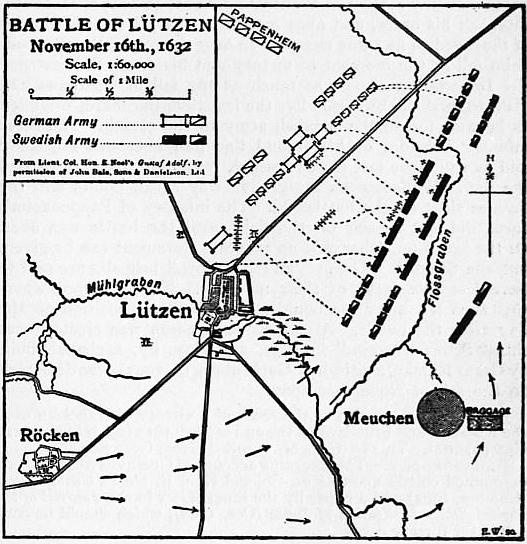
Gustavus’s hopes of an early decision were frustrated by the fog, which delayed the approach and deployment of the Swedes. It was 8 A.M. before all was ready. The royal army was in two lines. The infantry in the centre was arrayed in the small and handy battalions then peculiar to Gustavus’s army, the horse on either wing extended from opposite Lützen to some distance beyond Wallenstein’s left, which Pappenheim was to extend on his arrival. By the accident of the terrain, or perhaps, following the experience of Breitenfeld (q.v.), by design, the right of the Swedes was somewhat nearer to the enemy than the left. In front, near the centre, were the heavy guns and each infantry battalion had its own light artillery. The force of infantry and cavalry on either side was about equal, the Swedes had perhaps rather less cavalry and rather more infantry, but their artillery was superior to Wallenstein’s. Not until 11 was it possible to open fire, for want of a visible target, but about noon, after a preliminary cannonade, Gustavus gave the word to advance.
The king himself commanded the right wing, which had to wait until small bodies of infantry detached for the purpose had driven in the Imperialist skirmish line, and had then to cross a ditch leading the horses. They were not charged by the Imperialists at this moment, for Pappenheim had not yet arrived, and the usual cavalry tactics of the day were founded on the pistol and not on the sword and the charging horse. Gaining at last room to form, the Swedes charged and routed the first line of the Imperial cavalry but were stopped by the heavy squadrons of cuirassiers in second line, and at that moment Gustavus galloped away to the centre where events had taken a serious turn. The Swedish centre (infantry) had forced their way across the Leipzig road and engaged Wallenstein’s living forts at close quarters. The “Blue” brigade—Gustavus’s infantry wore distinctive colours—overran the battery of heavy guns, and the “Swedish”1 and “Yellow” brigades engaged the left face of the Imperialist lozenge with success. But a gap opened between the right of the infantry and the left of the cavalry and Wallenstein’s second line squadrons pressed into it. It was this which brought Gustavus from the extreme right, and he was killed here in leading a counter charge.
On the extreme left, meanwhile, the “Green” brigade had come to close quarters with Wallenstein’s infantry and guns about Lützen, and the heavy artillery had gone forward to close range between the “Green” and the “Yellow” infantry. But the news of Gustavus’s death spread and the fire of the assault died out. Wallenstein advanced in his turn, recaptured his guns and drove the Swedes over the road.
But the fiery Duke Bernhard of Saxe-Weimar took up the command and ordered a fresh advance. He was too good a soldier to waste his reserves and only brought up a few units of the second line to help the disordered brigades of the first. Again the Imperialists were driven in and their guns recaptured, this time all along the line. About three in the afternoon the Swedes were slowly bearing back Wallenstein’s stubborn infantry when Pappenheim appeared. The famous cavalry leader had brought on his mounted men ahead of the infantry and asking, “Where is the king of Sweden?” charged at once in the direction of the enemy’s right. Wallenstein thus gained time to reestablish his order, and once more the now exhausted brigades of the Swedish first line were driven over the road. But Pappenheim fell in the moment of victory and his death disheartened the Imperialists almost as much as the fall of Gustavus had disheartened the Swedes. For the last time Bernhard, wounded as he was, forced the Swedish army to the attack. The three infantry brigades of his second line had not been engaged,2 and as usual the last closed reserve, resolutely handled, carried the day. Wallenstein’s army gave way at all points and the Swedes slept on the battlefield. The infantry of Pappenheim’s corps did not appear on the field until the battle was over. Of the losses on either side no accurate statement can be given, but the Swedish “Green” and “Yellow” brigades are said to have lost five-sixths of their numbers. Near the spot where Gustavus fell a granite boulder was placed in position on the day after the battle. A canopy of cast-iron was erected over this “Schwedenstein” in 1832, and close by, a chapel, built by Oskar Ekman. a citizen of Gothenburg (d. 1907), was dedicated on the 6th of November 1907.
Lützen is famous also as the scene of a victory of Napoleon over the Russians and Prussians on the 2nd of May 1813 (see Napoleonic Campaigns). This battle is often called Gross Görschen.
Bibliography.—The foregoing account of Gustavus’s last victory is founded chiefly upon Lieut.-Colonel Hon. E. Noel’s Gustaf Adolf (London, 1904) and a paper by the same officer in the Journal of the United States Institution of India (Oct. 1908), which should be consulted for further details.
1 So called as being the only brigade containing no foreign elements in the army.
2 They had, however, found detachments to reinforce the first line.
LÜTZOW, ADOLF, Freiherr von (1782-1834), Prussian lieutenant-general, entered the army in 1795, and eleven years later as a lieutenant took part in the disastrous battle of Auerstädt. He achieved distinction in the siege of Colberg, as the leader of a squadron of Schill’s volunteers. In 1808, as a major, he retired from the Prussian army, indignant at the humiliating treaty of Tilsit. He took part in the heroic venture of his old chief Schill in 1809; wounded at Dodendorf and left behind, he thereby escaped the fate of his comrades. In 1811 he was restored to the Prussian army as major, and at the outbreak of the “war of liberation” received permission from Scharnhorst to organize a “free corps” consisting of infantry, cavalry and Tirolese marksmen, for operating in the French rear and rallying the smaller governments into the ranks of the allies. This corps played a marked part in the campaign of 1813. But Lützow was unable to coerce the minor states, and the wanderings of the corps had little military influence. At Kitzen (near Leipzig) the whole corps, warned too late of the armistice of Poischwitz, was caught on the French side of the line of demarcation and, as a fighting force, annihilated. Lützow himself, wounded, cut his way out with the survivors, and immediately began reorganizing and recruiting. In the second part of the campaign the corps served in more regular warfare under Wallmoden. Lützow and his men distinguished themselves at Gadebusch (where Körner fell) and Göhrde (where Lützow himself, for the second time, received a severe wound at the head of the cavalry). Sent next against Denmark, and later employed at the siege of Jülich, Lützow in 1814 fell into the hands of the French. After the peace of 1814 the corps was dissolved, the infantry becoming the 25th Regiment, the cavalry the 6th Ulans. At Ligny he led the 6th Ulans to the charge, but they were broken by the French cavalry, and he finally remained in the hands of the enemy, escaping, however, on the day of Waterloo. Made colonel in this year, his subsequent promotions were: major-general 1822, and lieutenant-general (on retirement) 1830. He died in 1834. One of the last acts of his life for which Lützow is remembered is his challenge (which was ignored) to Blücher, who had been ridden down in the rout of the 6th Ulans at Ligny, and had made, in his official report, comments thereon, which their colonel considered disparaging.
See Koberstein in Preussisches Jahrbuch, vol. xxiii (Berlin, 1868), and Preussisches Bilderbuch (Leipzig, 1889); K. von Lützow, Adolf Lützows Freikorps (Berlin, 1884); Fr. von Jagwitz, Geschichte des Lützowschen Freikorps (Berlin, 1892); and the histories of the campaigns of 1813 and 1815.
LUXEMBURG, FRANÇOIS HENRI DE MONTMORENCY-BOUTEVILLE, Duke of (1628-1695), marshal of France, the comrade and successor of the great Condé, was born at Paris on the 8th of January 1628. His father, the comte de Montmorency-Bouteville, had been executed six months before his birth for killing the marquis de Beuvron in a duel, but his aunt, Charlotte de Montmorency, princess of Condé, took charge of him and educated him with her son, the duc d’Enghien. The young Montmorency (or Bouteville as he was then called) attached himself to his cousin, and shared his successes and reverses throughout the troubles of the Fronde. He returned to France in 1659 and was pardoned, and Condé, then much attached to the duchesse de Châtillon, Montmorency’s sister, contrived the marriage of his adherent and cousin to the greatest heiress in France, Madeleine de Luxemburg-Piney, princesse de Tingry and heiress of the Luxemburg dukedom (1661), after which he was created duc de Luxembourg and peer of France. At the opening of the War of Devolution (1667-68), Condé, and consequently Luxemburg, had no command, but during the second campaign he served as Condé’s lieutenant-general in the conquest of Franche Comté. During the four years of peace which followed Luxemburg cultivated the favour of Louvois, and in 1672 held a high command against the Dutch. He defeated the prince of Orange at Woerden and ravaged Holland, and in 1673 made his famous retreat from Utrecht to Maestricht with only 20,000 men in face of 70,000, an exploit which placed him in the first rank of generals. In 1674 he was made captain of the gardes du corps, and in 1675 marshal of France. In 1676 he was placed at the head of the army of the Rhine, but failed to keep the duke of Lorraine out of Philipsburg; in 1677 he stormed Valenciennes; and in 1678 he defeated the prince of Orange, who attacked him at St Denis after the signature of the peace of Nijmwegen. His reputation was now high, and it is reputed that he quarrelled with Louvois, who managed to involve him in the “affair of the poisons” (see La Voisin, Catherine) and get him sent to the Bastille. Rousset in his Histoire de Louvois has shown that this quarrel is probably apocryphal. There is no doubt that Luxemburg spent some months of 1680 in the Bastille, but on his release took up his post at court as capitaine des gardes. When the war of 1690 broke out, the king and Louvois recognized that Luxemburg was the only general fit to cope with the prince of Orange, and he was put in command of the army of Flanders. On the 1st of July 1690 he won a great victory over the prince of Waldeck at Fleurus. In the following year he commanded the army which covered the king’s siege of Mons and defeated William III. of England at Leuze on September 18, 1691. Again in the next campaign he covered the king’s siege of Namur, and defeated William at Steenkirk (q.v.) on June 5, 1692; and on July 29, 1693, he won his greatest victory over his old adversary at Neerwinden, after which he was called le tapissier de Nôtre Dame from the number of captured colours that he sent to the cathedral. He was received with enthusiasm at Paris by all but the king, who looked coldly on a relative and adherent of the Condés. St Simon describes in the first volume of his Memoirs how, instead of ranking as eighteenth peer of France according to his patent of 1661, he claimed through his wife to be duc de Piney of an old creation of 1571, which would place him second on the roll. The affair is described with St Simon’s usual interest in the peerage, and was chiefly checked through his assiduity. In the campaign of 1694, Luxemburg did little in Flanders, except that he conducted a famous march from Vignamont to Tournay in face of the enemy. On his return to Versailles for the winter he fell ill, and died on January 4, 1695. In his last moments he was attended by the famous Jesuit priest Bourdaloue, who said on his death, “I have not lived his life, but I would wish to die his death.” Luxemburg’s morals were bad even in those times, and he had shown little sign of religious conviction. But as a general he was Condé’s grandest pupil. Though slothful like Condé in the management of a campaign, at the moment of battle he seemed seized with happy inspirations, against which no ardour of William’s and no steadiness of Dutch or English soldiers could stand. His death and Catinat’s disgrace close the second period of the military history of the reign of Louis XIV., and Catinat and Luxemburg, though inferior to Condé and Turenne, were far superior to Tallard and Villeroi. He was distinguished for a pungent wit. One of his retorts referred to his deformity. “I never can beat that cursed humpback,” William was reputed to have said of him. “How does he know I have a hump?” retorted Luxemburg, “he has never seen my back.” He left four sons, the youngest of whom was a marshal of France as Maréchal de Montmorency.
See, besides the various memoirs and histories of the time, Beaurain’s Histoire militaire du duc de Luxembourg (Hague and Paris, 1756); Mémoires pour servir a l’histoire du maréchal duc de Luxembourg (Hague and Paris, 1758); Courcelles, Dictionnaire des généraux français (Paris, 1823), vol. viii. There are some interesting facts in Desormeaux’s Histoire de la maison de Montmorency (1764), vols. iv. and v. Camille Rousset’s Louvois and the recent biography of Luxemburg by Count de Ségur (1907) should also be studied.
LUXEMBURG, a district in the European low countries, of which the eastern part forms the grand-duchy of Luxemburg, and the western is the Belgian province of that name (for map, see Belgium). The name is derived from the chief town.
Under the Romans the district was included in the province of Belgica prima, afterwards forming part of the Frankish kingdom of Austrasia and of the empire of Charlemagne. About 1060 it came under the rule of Conrad (d. 1086), who took the title of count of Luxemburg. His descendants ruled the county, first in the male and then in the female line, until the death of the emperor Sigismund in 1437. Through the marriage of Sigismund’s daughter, Elizabeth, with the German king, Albert II., Luxemburg, which had been made a duchy in 1354, passed to the house of Habsburg, but was seized in 1443 by Philip III. the Good, duke of Burgundy, who based his claim upon a bargain concluded with Sigismund’s niece Elizabeth (d. 1451). Regained by the Habsburgs in 1477 when Mary, daughter and heiress of duke Charles the Bold, married the German king Maximilian I., the duchy passed to Philip II. of Spain in 1555, though subject to the laws of the empire, of which it still formed part. After a section had been ceded to France in 1659, the remainder was given to the emperor Charles VI. by the treaty of Utrecht in 1713. It was conquered by France in 1795, and retained by that power until the end of the Napoleonic wars. The congress of Vienna (1814-1815) erected Luxemburg into a grand-duchy, added part of the duchy of Bouillon to it, and assigned it to William I., king of the Netherlands, in return for the German territories of the house of Orange-Nassau, which Napoleon had confiscated in 1806, and which were given by the congress to the king of Prussia. In 1830 when the Belgian provinces separated from Holland, an effort was made to include Luxemburg in the new kingdom of the Belgians; but in November 1831 the powers decided that part of the grand-duchy should be retained by the king of Holland, who refused to accept this arrangement. Consequently the whole of Luxemburg remained in the possession of the Belgians until 1838, when the treaty of the 19th of April, concluded at the conference of London, enforced the partition of 1831.
The grand-duchy of Luxemburg, the portion under the rule of William I. retaining the name, was ruled by the kings of Holland until the death of William III. in 1890. William’s daughter, Wilhelmina, succeeded to the throne of Holland, but under the Salic law1 the grand-duchy passed to his kinsman, Adolphus, duke of Nassau, who died in 1905, and was succeeded by his son William (b. 1852).
By modifications of the treaty of Vienna the garrisoning of the fortress of Luxemburg had passed into Prussian hands, an arrangement which lasted until 1867. In the previous year the German Confederation, to which the grand-duchy of Luxemburg had belonged since 1815, had been dissolved; but the Prussians maintained their garrison in Luxemburg, which was not included in the new North German Confederation, while King William III. proposed to sell his rights over the grand-duchy to France. The Prussians were irritated by this proposal, but war was averted, and the question was referred to a conference of the powers in London. The treaty of London, signed on the 11th of May 1867, decided that the Prussian garrison must be withdrawn and the fortress dismantled, which was done in 1872. At the same time the great powers guaranteed the neutrality of the grand-duchy, and although a member of the German Zollverein, Luxemburg now forms a sovereign and independent state.
The Grand-Duchy lies S.E. of Belgium. Its area is 999 sq. m., with a population (1905) of 246,455. The people are nearly all Catholics. The country is rich in iron ore. The hills in the south of the duchy are a continuation of the Lorraine plateau, and the northern districts are crossed in all directions by outrunners from the Ardennes. The streams mostly join the Moselle, which forms the boundary between Luxemburg and the Rhine province for about 20 m. The Sure or Sauer, the most important stream in the duchy, rises at Vaux-les-Rosières in Belgian Luxemburg, crosses the duchy, and forms the eastern boundary from the confluence of the Our till it joins the Moselle after a course of 50 m., during which it receives the Wiltz, Attert, Alzette, White and Black Ernz, &c. The soil of Luxemburg is generally good; the southern districts are on the whole the most fertile as well as the most populous. Building materials of all sorts are obtained throughout the duchy. Besides the iron furnaces, situated in the south near the Lorraine plateau, there are tanneries, weaving and glove-making factories, paper-mills for all sorts of paper, breweries and distilleries, and sugar refineries. A German patois mixed with French words is spoken throughout the country; but French, which is employed by the commercial community, is also the common speech on the French and Belgian frontiers. Though liberty of worship prevails, Roman Catholicism is almost the sole form. The government is in the hands of the grand-duke, who sanctions and promulgates the laws. There is a council (staatsrat) of 15 members. There is a chamber of deputies with 48 members elected by the cantons (12 in number) for six years, half the body being elected every three years. No law can be passed without the consent of the chamber. Bills are introduced by the grand-duke, but the house has also the right of initiative. A single battalion (150) of volunteers composes the grand-ducal army. The gendarmerie consists of about 150 men. There are cantonal courts and two district courts, one at Luxemburg, the other at Diekirch, and a high court at Luxemburg. The bishopric of Luxemburg holds its authority directly from the Holy See. From 13,000,000 to 17,000,000 francs is the annual amount of the state budget, and the debt, consisting of loans contracted principally for the construction of railways, of which there are about 350 m., is 12,000,000 francs.
Among towns next to the capital, Luxemburg, are Echternach and Diekirch, both worthy of note for their blast furnaces. Grevenmacher is the centre of a great wine district.
The Province of Luxemburg is the largest and least populous of the nine provinces of Belgium. Its capital is Arlon, which lies near the borders of the grand-duchy. A considerable part of the province is forested and the state requires systematic replanting. Marble, granite and slate quarries are worked in different districts. Successful attempts have been made to introduce fruit cultivation. The province is well watered by the Ourthe, the Semois and the Sûre. The general elevation of the country is about 500 ft., but the hills and plateaus which form the prominent feature in the scenery of Luxemburg range from 1200 to 1500 ft. The highest point of the province is the Baraque de Fraiture (1980 ft.), N.E. of La Roche. The woods are well stocked with red and roe deer, wild boar, hares, rabbits, pheasants, woodcock and snipe. The area of the province is 1725 sq. m. The population was 225,963 in 1904.
The House of Luxemburg was descended from Count Conrad (d. 1086), and its fortunes were advanced through the election of Count Henry IV. as German king in 1308 and his coronation as emperor under the title of Henry VII. Henry’s son was John, king of Bohemia, who fell on the field of Crécy, and John’s eldest son was the emperor Charles IV., while another famous member of the family was Baldwin, archbishop of Treves (1285-1354), who took an active part in imperial affairs. Two of the sons of Charles IV., Wenceslaus and Sigismund, succeeded in turn to the imperial throne, and one of his nephews, Jobst, margrave of Moravia, was chosen German king in opposition to Sigismund in 1410. The French branch of the Luxemburg family was descended from Waleran (d. 1288), lord of Ligny and Roussy, a younger son of Count Henry II. Waleran’s great-grandson was Guy (d. 1371), who married Matilda, sister and heiress of Guy V., count of Saint-Pol (d. 1360), and was created count of Ligny in 1367. Guy’s son, Waleran (d. 1417), who became constable of France in 1412, had been carried as a prisoner to England, and had married Matilda, daughter of Thomas Holland, earl of Kent (d. 1360) and half-sister of King Richard II. To avenge Richard’s death he made a raid on the Isle of Wight, and then took part in the civil wars in France. He left no sons, and was succeeded by his nephew, Peter, count of Brienne (d. 1433), who, like his brother Louis (d. 1443), cardinal archbishop of Rouen and chancellor of France, was found on the side of the English in their struggle against France. Another of Peter’s brothers, John (d. 1440), a stout supporter of England, was made governor of Paris by Henry V. He sold Joan of Arc to the English. Peter’s son and successor, Louis, fought at first for England, but about 1440 he entered the service of France and obtained the office of constable. King Louis XI. accused him of treachery, and he took refuge with Charles the Bold, duke of Burgundy; but the duke handed him over to the king and he was beheaded in 1475. The elder branch of his descendants became extinct in the male line in 1482, and was merged through the female line in the house of Bourbon-Vendôme. Louis’s third son, Anthony (d. 1510), founded the family of Luxemburg-Brienne, the senior branch of which became extinct in 1608. A junior branch, however, was the family of the duke of Luxemburg-Piney, whose last representative, Margaret-Charlotte (d. 1680), married firstly Léon d’Albert de Luynes (d. 1630) and secondly Charles Henry de Clermont-Tonnerre (d. 1674). Her daughter by her second husband, Madeleine Charlotte, married Francis Henry de Montmorenci (d. 1695) and de Luynes, and, subsequently, members of the family of Montmorenci claimed the title of duke of Luxemburg. The Luxembourg palace in Paris owes its name to the fact that it was built on a site belonging to the duke of Luxemburg-Piney.
See N. van Werveke, Beiträge zur Geschichte des Luxemburger Landes (Luxemburg, 1886-1887); J. Schötter, Geschichte des Luxemburger Landes (Luxemburg, 1882); and N. Vigner, Histoire de la maison de Luxembourg (Paris, 1619).
1 It should be noticed, however, that the Salic law is subordinate to the Nassau family law, which provides for the succession in the case of the complete extinction of males. Thus Article xlii. of the Nassau Pact of the 30th of June 1783 provides “that in the event of the extinction of males, the rights of succession pass to the daughter or nearest heiress of the last male.”
LUXEMBURG, or Lützelburg (i.e. the little fortress or town), the capital of the grand-duchy of the same name (see above), situated on the Alzette, a tributary of the Sûre. Pop. (1905) 20,984. The situation is romantic, steep cliffs overhanging the winding river, and the principal portion of the town with the palace and public buildings covering a central plateau. The more densely populated parishes of Clausen, Pfaffenthal and Grund lie in the valley. As a fortress Luxemburg was considered the strongest in Europe after Gibraltar, which it was supposed to resemble because many of its casemates were cut into the rock. It was dismantled in 1867. Two colossal viaducts carry the railway and the approach from the railway station to the town. Since the place ceased to be a fortress the population has more than doubled, and the Alzette is lined with tanneries, breweries and distilleries. The Hôtel de Ville dates from 1844 and contains a collection of antiquities. The church of Notre Dame was built in 1613, and that of St Michael, with parts dating from 1320, contains the tomb of blind John of Luxemburg, king of Bohemia, slain at Crécy. There are two annual fête days, one in honour of Our Lady of Luxemburg, patroness of the city, held on the Sunday before Ascension Day, and the other the annual fair or Schobermesse (tent fair), instituted in 1340 and held each year on the 24th of August.
LUXEUIL-LES-BAINS, a town of eastern France, in the department of Haute-Saône, 18 m. N.E. of Vesoul. Pop. (1906) 5195. It is situated in a region of forests on the right bank of the Breuchin. It has an abbey-church dating from the 13th and 14th centuries, containing a curious 17th-century organ loft in the form of an immense bracket supported by a colossal figure of Hercules. The abbot’s palace (16th and 18th centuries) serves as presbytery and town hall. A cloister of the 15th century and other buildings of the 17th century also remain. There are several mansions and houses dating from various periods from the 14th to the 16th century. The Maison Carrée, once the town hall, an interesting specimen of 15th-century architecture, was built by Perrin Jouffroy, father of Cardinal Jouffroy. The cardinal, who was born at Luxeuil in 1412, built the house with a graceful balcony and turret which faces the Maison Carrée. The Maison de la Baille and the Maison François I. are of the Renaissance period. The fine modern Grammont Hospital is in the style of Louis XIII. Luxeuil is renowned for its mineral springs, of which there are seventeen, two being ferruginous, and the rest charged with chloride of sodium; their temperatures range from 70° to 158° F. The water is employed for drinking and for baths. The bathing establishment contains a museum of Gallo-Roman antiquities and there are also remains of Roman baths and aqueducts to be seen in or near it. Luxeuil has a communal college. Copper-founding, the spinning and weaving of cotton, lace-making, dyeing and the distilling of kirsch are carried on.
Luxeuil was the Roman Lixovium and contained many fine buildings at the time of its destruction by the Huns under Attila in 451. In 590 St Columban here founded a monastery, afterwards one of the most famous in Franche Comté. In the 8th century it was destroyed by the Saracens; afterwards rebuilt, monastery and town were devastated by the Normans in the 9th century and plllaged on several occasions afterwards. The abbey schools were celebrated in the middle ages and the abbots had great influence; but their power was curtailed by the emperor Charles V. and the abbey was suppressed at the Revolution.
See H. Beaumont, Étude hist. sur l’abbaye de Luxeuil, 590-1790 (Lux. 1895); Grandmongin and A. Garnier, Hist. de la ville et des thermes de Luxeuil (Paris, 1866), with 16 plates.
LUXOR, more properly El-Aksur, “The Castles” (plur. of kasr), a town of Upper Egypt, on the east bank of the Nile 450 m. above Cairo by river and 418 by rail. Pop. (1907 census) 12,644. It is the centre for visitors to the ruins of and about Thebes, and is frequented by travellers and invalids in the winter season, several fine hotels having been built for their accommodation. There are Anglican and Roman Catholic churches, and a hospital for natives, opened in 1891. The district is the seat of an extensive manufacture of forged antiques.
The temple of Luxor is one of the greatest of the monuments of Thebes (q.v.). It stands near the river bank on the S.W. side of the town and measures nearly 300 yds. from back to front. There may have been an earlier temple here, but the present structure, dedicated to the Theban triad of Ammon, Mut and Khons, was erected by Amenophis III. The great colonnade, which is its most striking feature, was apparently intended for the nave of a hypostyle hall like that of Karnak, but had to be hastily finished without the aisles. After the heresy of Amenophis IV. (Akhenaton), the decoration of this incomplete work was taken in hand by Tutenkhamun and Haremhib. The axis of the temple ran from S.W. to N.E.; a long paved road bordered by recumbent rams led from the façade to the temples of Karnak (q.v.) in a somewhat more easterly direction, and Rameses II. adopted the line of this avenue in adding an extensive court to the work of Amenophis, producing a curious change of axis. He embellished the walls and pylons of his court with scenes from his victories over Hittites and Syrians, and placed a number of colossal statues within it. In front of the pylon Rameses set up colossi and a pair of obelisks (one of which was taken to Paris in 1831 and re-erected in the Place de la Concorde). A few scenes and inscriptions were added by later kings, but the above is practically the history of the temple until Alexander the Great rebuilt the sanctuary itself. The chief religious festival of Thebes was that of “Southern Opi,” the ancient name of Luxor. The sacred barks of the divinities preserved in the sanctuary of Karnak were then conveyed in procession by water to Luxor and back again; a representation of the festal scenes is given on the walls of the great colonnade. The Christians built churches within the temple. The greater part of the old village of Luxor lay inside the courts: it was known also as Abu ‘l Haggag from a Moslem saint of the 7th century, whose tomb-mosque, mentioned by Ibn Batuta, stands on a high heap of débris in the court of Rameses. This is the last of the buildings and rubbish which encumbered the temple before the expropriation and clearances by the Service des Antiquités began in 1885. The principal street of Luxor follows the line of the ancient avenue.
See G. Daressy, Notice explicative des ruines du temple de Louxor (Cairo, 1803); Baedeker’s Egypt.
(F. Ll. G.)
LUXORIUS, Roman writer of epigrams, lived in Africa during the reigns of the Vandal kings Thrasamund, Hilderic and Gelimer (A.D. 496-534). He speaks of his poor circumstances, but from the superscription clarissimus and spectabilis in one MS., he seems to have held a high official position. About a hundred epigrams by him in various metres (the elegiac predominating) have been preserved. They are after the manner of Martial, and many of them are coarse. They deal chiefly with the games of the circus and works of art, and the language shows the author to have been well acquainted with the legends and antiquities of the classical period of Rome.
Luxorius also wrote on grammatical subjects (see R. Ellis in Journal of Philology, viii., 1879). The epigrams are contained in the Anthologia Latina, edited by F. Bücheler and A. Riese (1894).
LUYNES, a territorial name belonging to a noble French house. The family of Albert, which sprang from Thomas Alberti (d. 1455), seigneur de Boussargues, bailli of Viviers and Valence, and viguier of Bagnols and Pont St Esprit in Languedoc, acquired the estate of Luynes (dep. of Indre-et-Loire) in the 16th century. Honoré d’Albert (d. 1592), seigneur de Luynes, was in the service of the three last Valois kings and of Henry IV., and became colonel of the French bands, commissary of artillery in Languedoc and governor of Beaucaire. He had three sons: Charles (1578-1621), first duke of Luynes, and favourite of Louis XIII.; Honoré (1581-1649), seigneur de Cadenet, who married Charlotte Eugénie d’Ailly, countess of Chaulnes, in 1619, and was created duke of Chaulnes in 1621; and Léon, seigneur de Brantes, who became duke of Luxemburg-Piney by his marriage in 1620 with Margaret Charlotte of Luxemburg.
By her marriage with Claude of Lorraine, duke of Chevreuse, Marie de Rohan, the widow of the first duke of Luynes, acquired in 1655 the duchy of Chevreuse, which she gave in 1663 to Louis Charles d’Albert, her son by her first husband; and from that time the title of duke of Chevreuse and duke of Luynes was borne by the eldest sons of the family of Luynes, which also inherited the title of duke of Chaulnes on the extinction of the descendants of Honoré d’Albert in 1698. The branch of the dukes of Luxemburg-Piney became extinct in 1697.
Charles (1578-1621), the first duke of Luynes, was brought up at court and attended the dauphin, who later became Louis XIII. The king shared his fondness for hunting and rapidly advanced him in favour. In 1615 he was appointed commander of the Louvre and counsellor, and the following year grand falconer of France. He used his influence over the king in the court intrigues against the queen-mother Marie de Medici and her favourite Concini. It was Luynes who, with Vitry, captain of the guard, arranged the plot that ended in Concini’s assassination (1617) and secured all the latter’s possessions in Italy and France. In the same year he was appointed captain of the Bastille and lieutenant-general of Normandy, and married Marie de Rohan, daughter of the duke of Montbazon. He employed extreme measures against the pamphleteers of the time, but sought peace in Italy and with the Protestants. In 1619 he negotiated the treaty of Angoulême by which Marie de Medici was accorded complete liberty. He was made governor of Picardy in 1619; suppressed an uprising of nobles in 1620; and in 1621, with slight military ability or achievement, was appointed constable of France. His rapid rise to power made him a host of enemies, who looked upon him as but a second Concini. In order to justify his newly-won laurels, Luynes undertook an expedition against the Protestants, but died of a fever in the midst of the campaign, at Longueville in Guienne, on the 15th of December 1621.
His brother Honoré (1581-1649), first duke of Chaulnes, was governor of Picardy and marshal of France (1619), and defended his province successfully in 1625 and 1635. Louis Auguste d’Albert d’Ailly (1676-1744), duke of Chaulnes, also became marshal of France (1741). Louis Joseph d’Albert de Luynes (1670-1750), prince of Grimberghen, was in the service of the emperor Charles VII., and became field-marshal and ambassador in France.
Several members of the family of Albert were distinguished in letters and science. Louis Charles d’Albert (1620-1690), duke of Luynes, son of the constable, was an ascetic writer and friend of the Jansenists; Paul d’Albert de Luynes (1703-1788), cardinal and archbishop of Sens, an astronomer; Michel Ferdinand d’Albert d’Ailly (1714-1769), duke of Chaulnes, a writer on mathematical instruments, and his son Marie Joseph Louis (1741-1793), a chemist; and Honoré Théodore Paul Joseph (1802-1867), duke of Luynes, a writer on archaeology.
For the first duke see Recueil des pièces les plus curieuses qui ont esté faites pendant le règne du connestable M. de Luynes (2nd ed., 1624); Le Vassor, Histoire de Louis XIII. (Paris, 1757); Griffet, Histoire du règne de Louis XIII., roi de France et de Navarre (Paris, 1758); V. Cousin, “Le Duc et connétable de Luynes,” in Journal des savants (1861-1863); B. Zeller, Études critiques sur le règne de Louis XIII.: le connétable de Luynes, Montauban et la Valteline (Paris, 1879); E. Pavie, La Guerre entre Louis XIII. et Marie de Médicis (Paris, 1899); Lavisse, Histoire de France, vi.2, 141-216 (Paris, 1905).
LUZÁN CLARAMUNT DE SUELVES Y GURREA, IGNACIO (1702-1754), Spanish critic and poet, was born at Saragossa on the 28th of March 1702. His youth was passed under the care of his uncle, and, after studying at Milan, he graduated in philosophy at the university of Catania. In 1723 he took minor orders, but abandoned his intention of entering the church and took up his residence at Naples, where he read assiduously. Business took him to Spain in 1733, and he became known in Madrid as a scholar with a tendency towards innovations in literature. La Poética, ó Reglas de la poesía en general y de sus principales especies (1737) proved that this impression was correct. He at once took rank as the leader of the literary reformers, and his courteous determination earned him the respect of his opponents. In 1747 he was appointed secretary to the Spanish embassy in Paris and, on returning to Madrid in 1750, was elected to the “Academia Poética del Buen Gusto,” where, on account of his travels, he was known by the sobriquet of El Peregrino. He became master of the mint and treasurer of the royal library. He died at Madrid, after a short illness, on the 19th of May 1754. Luzán was not the pioneer of Franco-Italian theories in Spain, but he was their most powerful exponent, and his Poética is an admirable example of destructive criticism. The defects of Lope de Vega and Calderón are indicated with vigilant severity, but on the constructive side Luzán is notably weak, for he merely proposes to substitute one exhausted convention for another. The doctrine of the dramatic unities had not the saving virtues which he ascribed to it, and, though he succeeded in banishing the older dramatists from the boards, he and his school failed to produce a single piece of more than mediocre merit. His theories, derived chiefly from Muratori, were ineffective in practice; but their ingenuity cannot be denied, and they acted as a stimulus to the partisans of the national tradition.
LUZ-SAINT-SAUVEUR, a town of south-western France in the department of Hautes-Pyrénées, 21 m. S. of Lourdes by rail. Pop. (1906) 1069. Luz is beautifully situated at a height of 2240 ft. on the Bastan. It has a remarkable church, built by the Templars in the 12th and 13th centuries and fortified later. The crenelated ramparts with which it is surrounded, and the tower to the north of the apse resembling a keep, give it the aspect of a fortress; other interesting features are the Romanesque north door and a chapel of the 16th century. The village of St Sauveur lies a little above Luz on the left bank of the gorge of the Gave de Pau, which is crossed higher up by the imposing Pont Napoléon (1860). It is a pleasant summer resort, and is visited for its warm sulphurous springs. Discovered in the 16th century, the waters came into vogue after 1820, in which year they were visited by the duchesses of Angoulême and Berry. There is much picturesque mountain scenery in the vicinity; 12 m. to the south is the village of Gavarnie, above which is the magnificent rock amphitheatre or cirque of Gavarnie, with its cascade, one of the highest in Europe.
LUZZATTI, LUIGI (1841- ), Italian economist and financier, was born of Jewish parents at Venice on the 11th of March 1841. After completing his studies in law at the university of Padua, he attracted the attention of the Austrian police by his lectures on political economy, and was obliged to emigrate. In 1863 he obtained a professorship at the Milan Technical Institute; in 1867 he was appointed professor of constitutional law at Padua, whence he was transferred to the university of Rome. Gifted with eloquence and energy, he popularized in Italy the economic ideas of Schultze-Delitzsch, worked for the establishment of a commercial college at Venice, and contributed to the spread of people’s banks on a basis of limited liability throughout the country. In 1869 he was appointed by Minghetti under secretary of state to the ministry of agriculture and commerce, in which capacity he abolished government control over commercial companies and promoted a state inquiry into the conditions of industry. Though theoretically a free trader, he was largely instrumental in creating the Italian protective system. In 1877 he participated in the commercial negotiations with France, in 1878 compiled the Italian customs tariff, and subsequently took a leading part in the negotiations of all the commercial treaties between Italy and other countries. Appointed minister of the treasury in the first Di Rudini cabinet of 1891, he imprudently abolished the system of frequent clearings of bank-notes between the state banks, a measure which facilitated the duplication of part of the paper currency and hastened the bank crisis of 1893. In 1896 he entered the second Di Rudini cabinet as minister of the treasury, and by timely legislation helped to save the bank of Naples from failure. After his fall from office in June 1898, his principal achievement was the negotiation of the Franco-Italian commercial treaty, though, as deputy, journalist and professor, he continued to take an active part in all political and economic manifestations. He was again minister of the treasury from November 1903 to March 1905 in Giolitti’s second administration, and for the third time from February to May 1906, under Sonnino’s premiership. During the latter term of office he achieved the conversion of the Italian 5% debt (reduced to 4% by the tax) to 3¾% to be eventually lowered to 3½%, an operation which other ministers had attempted without success; although the actual conversion was not completed until after the fall of the cabinet of which he formed part the merit is entirely his. In 1907 he was president of the co-operative congress at Cremona.
See L. Carpi’s Risorgimento Italiano, vol. ii. (Milan, 1886), which contains a biographical sketch of Luzzatti.
LUZZATTO, MOSES ḤAYIM (1707-1747), Hebrew dramatist and mystic, was born in Padua 1707, and died at Acre 1747. He was influenced by Isaac Luria (q.v.) on the mystical side, and on the poetical side by Italian drama of the school of Guarini (q.v.). He attacked Leon of Modena’s anti-Kabbalistic treatises, and as a result of his conflict with the Venetian Rabbinate left Italy for Amsterdam, where, like Spinoza, he maintained himself by grinding lenses. Here, in 1740, he wrote his popular religious manual the Path of the Upright (Messilath Yesharim) and other ethical works. He visited London, but finally settled in Palestine, where he died. Luzzatto’s most lasting work is in the realm of Hebrew drama. His best-known compositions are: the Tower of Victory (Migdal ’Oz) and Glory to the Upright (Layesharim Tehillah). Both of these dramas, which were not printed at the time but were widely circulated in manuscript, are of the type which preceded the Shakespearean age—they are allegorical and all the characters are types. The beautiful Hebrew style created a new school of Hebrew poetry, and the Hebrew renaissance which resulted from the career of Moses Mendelssohn owed much to Luzzatto.
See Grätz, History of the Jews, v. ch. vii.; I. Abrahams, Jewish Life in the Middle Ages, pp. 190, 268; N. Slouschz, The Renascence of Hebrew Literature, ch. i.
(I. A.)
LUZZATTO, SAMUEL DAVID (1800-1865), Jewish scholar, was born at Trieste in 1800, and died at Padua in 1865. He was the most distinguished of the Italian Jewish scholars of the 19th century. The first Jew to suggest emendations to the text of the Hebrew Bible, he edited Isaiah (1856-1867), and wrote a commentary on the Pentateuch (1871). His grammatical works were mostly written in Italian. He also contributed to the history of the Synagogue liturgy, and enjoys with Geiger (q.v.) and Zunz (q.v.) the honour of reviving interest in the medieval Hebrew hymnology and secular verse.
See Grätz, History of the Jews (Eng. trans.), v. 622 seq.; N. Slouschz, The Renascence of Hebrew Literature, pp. 84-92; the Jewish Encyclopedia, viii. 225-226, with list of works.
(I. A.)
LYALL, SIR ALFRED COMYN (1835- ), Anglo-Indian civil servant and man of letters, son of the Rev. Alfred Lyall, was born in 1835, and educated at Eton and Haileybury. He entered the Bengal civil service in 1855, saw service during the Mutiny in the Bulandshahr district, at Meerut, and with the Khaki Risala of volunteers. He was commissioner in Berar (1867), secretary to the government of India in the Home and Foreign departments, lieutenant-governor of the North-western Provinces (1882-1887), and member of the Council of India (1888-1903). Among his writings, his Verses Written in India (1889) attained considerable popularity, and in his Asiatic Studies (1882 and 1899) he displays a deep insight into Indian life and character. He wrote the Life of Lord Dufferin (1905), and made numerous contributions to periodical literature.
LYALL, EDNA, the pen-name of Ada Ellen Bayly (1857-1903), English novelist. She was born at Brighton in 1857, the daughter of a barrister. Her parents died while she was a child, and she was brought up at Caterham, Surrey. At Eastbourne, where most of her life was spent, she was well known for her philanthropic activity. She died on the 8th of February 1903. Edna Lyall’s vogue as a novelist was the result of a combination of the story-teller’s gift with a sincere ethical and religious spirit of Christian tolerance, which at the time was new to many readers. Though her Won by Waiting (1879) had some success, it was with Donovan (1882) and We Two (1884), in which the persecuted atheist was inevitably identified with Charles Bradlaugh, that she became widely popular. Other novels were In the Golden Days (1885), a story of the Great Rebellion; Knight Errant (1887); Autobiography of a Slander (1887); A Hardy Norseman (1889); Derrick Vaughan, The Story of a Novelist (1889); To Right the Wrong (1892); Doreen (1894), a statement of the case for Irish Home Rule; The Autobiography of a Truth (1896), the proceeds of which were devoted to the Armenian Relief Fund; In Spite of All (1901), which had originally been produced by Mr Ben Greet as a play; and The Bruges Letters (1902), a book for children.
A Life by J. N. Escreet appeared in 1904, and a shorter account of her by the Rev. G. A. Payne was printed at Manchester in 1903.
LYALLPUR, a district of India, in the Multan division of the Punjab. It was constituted in 1904 to comprise the “Chenab Colony,” being the waste portion of the former Jhang district that is now irrigated by the Lower Chenab canal. Area, 3075 sq. m.; pop. (1906) 654,666. It is traversed by a section of the North-western railway. The headquarters are at Lyallpur town (pop. in 1906, 13,483), named after Sir James Lyall, a lieutenant-governor. It contains several factories for ginning and pressing cotton.
See Chenab Colony Gazetteer (Lahore, 1904).
LYCAEUS (Mons Lycaeus, Λύχαιον ὄρος: mod. Diaphorti), a mountain in Arcadia, sacred to Zeus Lycaeus, who was said to have been born and brought up on it, and the home of Pelasgus and his son Lycaon, who is said to have founded the ritual of Zeus practised on its summit. This seems to have involved a human sacrifice, and a feast in which the man who received the portion of a human victim was changed to a wolf, as Lycaon had been after sacrificing a child. The altar of Zeus consists of a great mound of ashes with a retaining wall. It was said that no shadows fell within the precincts; and that any who entered it died within the year.
LYCANTHROPY (Gr. λύκος, wolf, ἄνθρωπος, man), a name employed (1) in folk-lore for the liability or power of a human being to undergo transformation into an animal; (2) in pathology for a form of insanity in which the patient believes that he is transformed into an animal and behaves accordingly.
I. Although the term lycanthropy properly speaking refers to metamorphosis into a wolf (see Werwolf), it is in practice used of transformation into any animal. The Greeks also spoke of kynanthropy (κύων, dog); in India and the Asiatic islands the tiger is the commonest form, in North Europe the bear, in Japan the fox, in Africa the leopard or hyena, sometimes also the lion, in South America the jaguar; but though there is a tendency for the most important carnivorous animal of the area to take the first place in stories and beliefs as to transformation, the less important beasts of prey and even harmless animals like the deer also figure among the wer-animals.
Lycanthropy is often confused with transmigration; but the essential feature of the wer-animal is that it is the alternative form or the double of a living human being, while the soul-animal is the vehicle, temporary or permanent, of the spirit of a dead human being. The vampire is sometimes regarded as an example of lycanthropy; but it is in human form, sometimes only a head, sometimes a whole body, sometimes that of a living person, at others of a dead man who issues nightly from the grave to prey upon the living.
Even if the denotation of lycanthropy be limited to the animal-metamorphosis of living human beings, the beliefs classed together under this head are far from uniform, and the term is somewhat capriciously applied. The transformation may be voluntary or involuntary, temporary or permanent; the wer-animal may be the man himself metamorphosed, it may be his double whose activity leaves the real man to all appearance unchanged, it may be his soul, which goes forth seeking whom it may devour and leaving its body in a state of trance; or it may be no more than the messenger of the human being, a real animal or a familiar spirit, whose intimate connexion with its owner is shown by the fact that any injury to it is believed, by a phenomenon known as repercussion, to cause a corresponding injury to the human being.
The phenomenon of repercussion, the power of animal metamorphosis, or of sending out a familiar, real or spiritual, as a messenger, and the supernormal powers conferred by association with such a familiar, are also attributed to the magician, male and female, all the world over; and witch superstitions are closely parallel to, if not identical with, lycanthropic beliefs, the occasional involuntary character of lycanthropy being almost the sole distinguishing feature. In another direction the phenomenon of repercussion is asserted to manifest itself in connexion with the bush-soul of the West African and the nagual of Central America; but though there is no line of demarcation to be drawn on logical grounds, the assumed power of the magician and the intimate association of the bush-soul or the nagual with a human being are not termed lycanthropy. Nevertheless it will be well to touch on both these beliefs here.
In North and Central America, and to some extent in West Africa, Australia and other parts of the world, every male acquires at puberty a tutelary spirit (see Demonology); in some tribes of Indians the youth kills the animal of which he dreams in his initiation fast; its claw, skin or feathers are put into a little bag and become his “medicine” and must be carefully retained, for a “medicine” once lost can never be replaced. In West Africa this relation is said to be entered into by means of the blood bond, and it is so close that the death of the animal causes the man to die and vice versa. Elsewhere the possession of a tutelary spirit in animal form is the privilege of the magician. In Alaska the candidate for magical powers has to leave the abodes of men; the chief of the gods sends an otter to meet him, which he kills by saying “O” four times; he then cuts out its tongue and thereby secures the powers which he seeks. The Malays believe that the office of pawang (priest) is only hereditary if the soul of the dead priest, in the form of a tiger, passes into the body of his son. While the familiar is often regarded as the alternative form of the magician, the nagual or bush-soul is commonly regarded as wholly distinct from the human being. Transitional beliefs, however, are found, especially in Africa, in which the power of transformation is attributed to the whole of the population of certain areas. The people of Banana are said to change themselves by magical means, composed of human embryos and other ingredients, but in their leopard form they may do no hurt to mankind under pain of retaining for ever the beast shape. In other cases the change is supposed to be made for the purposes of evil magic and human victims are not prohibited. We can, therefore, draw no line of demarcation, and this makes it probable that lycanthropy is connected with nagualism and the belief in familiar spirits, rather than with metempsychosis, as Dr Tylor argues, or with totemism, as suggested by J. F. M‘Lennan. A further link is supplied by the Zulu belief that the magician’s familiar is really a transformed human being; when he finds a dead body on which he can work his spells without fear of discovery, the wizard breathes a sort of life into it, which enables it to move and speak, it being thought that some dead wizard has taken possession of it. He then burns a hole in the head and through the aperture extracts the tongue. Further spells have the effect of changing the revivified body into the form of some animal, hyena, owl or wild cat, the latter being most in favour. This creature then becomes the wizard’s servant and obeys him in all things; its chief use is, however, to inflict sickness and death upon persons who are disliked by its master.