VOLUME XVII SLICE II Luray Cavern to Mackinac Island (continued 5)
Reading edition
In Lyndsay we have the first literary expression in Scotland of the Renaissance. His interest lies on the theological side of the revival; he is in no sense a humanist, and he is indifferent to the artistic claims of the movement. Still he appeals to the principle which is fundamental to all. He demands first-hand impression. He feels that men must get their lesson direct, not from intermediaries who understand the originals no more “than they do the ravyng of the rukis.” Hence his persistent plea for the vernacular, nowhere more directly put than in the Dialog, in the “Exclamatioun to the Redar, toucheyng the wrytting of the vulgare and maternall language.” Though he is concerned only in the theological and ecclesiastical application of this, he undoubtedly stimulated the use of the vernacular in a Scotland which in all literary matters beyond the concern of the irresponsible poet still used the lingua franca of Europe.
A complete edition of Lyndsay’s poetical works was published by David Laing in 3 vols. in 1879. This was anticipated during the process of preparation by a cheaper edition (slightly expurgated) by the same editor in 1871 (2 vols.). The E.E.T.S. issued the first part of a complete edition in 1865 (ed. F. Hall). Five parts have appeared, four edited by F. Hall, the fifth by J. A. H. Murray. For the bibliography see Laing’s 3 vol. edition, u.s. iii. pp. 222 et seq., and the E.E.T.S. edition passim. See also the editions by Pinkerton (1792), Sibbald (1803), and Chalmers (1806); and the critical accounts in Henderson’s Scottish Vernacular Literature (1898), Gregory Smith’s Transition Period (1900), and J. H. Millar’s Literary History of Scotland (1903). A professional work prepared by Lyndsay in the Lyon Office, entitled the Register of Scottish Arms (now preserved in MS. in the Advocates’ Library), was printed in 1821 and reprinted in 1878. It remains the most authoritative document on Scottish heraldry.
(G. G. S.)

LYNEDOCH, THOMAS GRAHAM, 1st Baron (1748-1843), British general, was the son of Thomas Graeme, laird of Balgowan, and was born on the 19th of October 1748. He was educated by private tutors, among whom was James Macpherson (q.v.), and was a gentleman commoner of Christ Church, Oxford, between 1766 and 1768. He then travelled on the continent of Europe, and in 1772 unsuccessfully contested a parliamentary seat in Perthshire. In 1774 he married a daughter of the ninth Lord Cathcart, and took a house in the Leicestershire hunting country. After a few years, owing to the state of his wife’s health, Graham was compelled to live mainly in the south of Europe, though while at home he was a prominent sportsman and agriculturist. In 1787 he bought the small estate of Lynedoch or Lednock, a few miles from Perth. In 1791 his wife died in the Mediterranean, off Hyères. Graham tried to find distraction in renewed travels, and during his wanderings fell in with Lord Hood’s fleet on its way to Toulon. He joined it as a volunteer, served on Lord Mulgrave’s staff during the British occupation of Toulon, and returned, after the failure of the expedition, to Scotland, where he organized a regiment of infantry, the 90th Foot, Perthshire Volunteers (now 2nd Battalion Scottish Rifles). Graham’s men were the first regiment in the army to be equipped and trained wholly as light infantry, though they were not officially recognized as such for many years. In the same year (1794) Graham became member of parliament, in the Whig interest, for the county of Perth. He saw some active service in 1795 in “conjunct expeditions” of the army and navy, and in 1796, being then a brevet colonel, he was appointed British commissioner at the headquarters of the Austrian army in Italy. He took part in the operations against Napoleon Bonaparte, was shut up in Mantua with Würmser’s army, escaped in disguise, and after many adventures reached the relieving army of Alvinzi just before the battle of Rivoli. On returning to his regiment he served in more “conjunct” expeditions, in one of which, at Messina, he co-operated with Nelson, and in 1799 he was sent as brigadier-general to invest the fortress of Valetta, Malta. He blockaded the place for two years, and though Major-General Pigot arrived shortly before the close of the blockade and assumed command, the conquest of Malta stands almost wholly to the credit of Graham and his naval colleague Sir Alexander Ball. In 1801 Graham proceeded to Egypt, where his regiment was engaged in Abercromby’s expedition, but arrived too late to take part in any fighting. He took the opportunity afforded by the peace of Amiens to visit Turkey, Austria, Germany and France, and only resumed command of his regiment in 1804. When the latter was ordered to the West Indies he devoted himself to his duties as a member of parliament. He sat for Perthshire until 1807, when he was defeated, as he was again in 1812. Graham was with Moore in Sweden in 1808 and in Spain 1808-1809, and was present at his death at the battle of Corunna. In 1809 he became a major-general, and after taking part in the disastrous Walcheren expedition he was promoted lieutenant-general and sent to Cadiz (1810).
In 1811, acting in conjunction with the Spanish army under General la Peña (see Peninsular War), he took the offensive, and won the brilliant action of Barossa (5th of March). The victory was made barren of result by the timidity of the Spanish generals. The latter nevertheless claimed more than their share of the credit, and Graham answered them with spirit. One of the Spanish officers he called out, fought and disarmed, and after refusing with contempt the offer of a Spanish dukedom, he resigned his command in the south and joined Wellington in Portugal. His seniority as lieutenant-general made him second in command of Wellington’s army. He took part in the siege of Ciudad Rodrigo, and commanded a wing of the army in the siege of Badajoz and the advance to Salamanca. In July 1812, his eyesight becoming seriously impaired, he went home, but rejoined in time to lead the detached wing of the army in the wide-ranging manœuvre which culminated in the battle of Vittoria. Graham was next entrusted with the investment and siege of San Sebastian, which after a desperate defence fell on the 9th of September 1813. He then went home, but in 1814 accepted the command of a corps to be despatched against Antwerp. His assault on Bergen op Zoom was, however, disastrously repulsed (3rd of February 1814).
At the peace Graham retired from active military employment. He was created Baron Lynedoch of Balgowan in the peerage of the United Kingdom, but refused the offered pension of £2000 a year. In 1813 he proposed the formation of a military club in London, and though Lord St Vincent considered such an assemblage of officers to be unconstitutional, Wellington supported it and the officers of the army and navy at large received the idea with enthusiasm. Lynedoch’s portrait, by Sir T. Lawrence, is in possession of this club, the (Senior) United Service. In his latter years he resumed the habits of his youth, travelling all over Europe, hunting with the Pytchley so long as he was able to sit his horse, actively concerned in politics and voting consistently for liberal measures. At the age of ninety-two he hastened from Switzerland to Edinburgh to receive Queen Victoria when she visited Scotland after her marriage. He died in London on the 18th of December 1843. He had been made a full general in 1821, and at the time of his death was a G.C.B., Colonel of the 1st (Royal Scots) regiment, and governor of Dumbarton Castle.
See biographies by John Murray Graham (2nd ed., Edinburgh, 1877) and Captain A. M. Delavoye (London, 1880); also the latter’s History of the 90th (Perthshire Volunteers) (London, 1880), Philipparts’ Royal Military Calendar (1820), ii. 147, and Gentleman’s Magazine, new series, xxi. 197.
LYNN, a city and seaport of Essex county, Massachusetts, 9 m. N.E. of Boston, on the N. shore of Massachusetts Bay. Pop. (1900) 68,513, of whom 17,742 were foreign-born (6609 being English Canadians, 5306 Irish, 1527 English and 1280 French Canadians), and 784 were negroes; (1910 census) 89,336. It is served by the Boston & Maine and the Boston, Revere Beach & Lynn railways, and by an interurban electric railway, and has an area of 10.85 sq. m. The business part is built near the shore on low, level ground, and the residential sections are on the higher levels. Lynn Woods, a beautiful park, covers more than 2000 acres. On the shore, which has a fine boulevard, is a state bath house. The city has a handsome city hall, a free public library, founded in 1862, a soldiers’ monument and two hospitals. Lynn is primarily a manufacturing city. The first smelting works in New England were established here in 1643. More important and earlier was the manufacture of boots and shoes, an industry introduced in 1636 by Philip Kertland, a Buckingham man; a corporation of shoemakers existed here in 1651, whose papers were lost in 1765. There were many court orders in the seventeenth century to butchers, tanners, bootmakers and cordwainers; and the business was made more important by John Adam Dagyr (d. 1808), a Welshman who came here in 1750 and whose work was equal to the best in England. In 1767 the output was 80,000 pairs; in 1795 about 300,000 pairs of women’s shoes were made by 600 journeymen and 200 master workmen. The product of women’s shoes had become famous in 1764, and about 1783 the use of morocco had been introduced by Ebenezer Breed. In 1900 and 1905 Lynn was second only to Brockton among the cities of the United States in the value of boots and shoes manufactured, and outranked Brockton in the three allied industries, the manufacture of boots and shoes, of cut stock and of findings. In the value of its total manufactured product Lynn ranked second to Boston in the state in 1905, having been fifth in 1900; the total number of factories in 1905 was 431; their capital was $23,139,185; their employees numbered 21,540; and their product was valued at $55,003,023 (as compared with $39,347,493 in 1900). Patent medicines and compounds and the manufacture of electrical machinery are prominent industries. The Lynn factories of the General Electric Company had in 1906 an annual product worth between $15,000,000 and $20,000,000. The foreign export of manufactured products is estimated at $5,000,000 a year.
Lynn was founded in 1629 and was called Saugus until 1637, when the present name was adopted, from Lynn Regis, Norfolk, the home of the Rev. Samuel Whiting (1597-1679), pastor at Lynn from 1636 until his death. From Lynn Reading was separated in 1644, Lynnfield in 1782, Saugus in 1815, and, after the incorporation of the city of Lynn in 1850, Swampscott in 1852, and in 1853 Nahant, S. of Lynn, on a picturesque peninsula and now a fashionable summer resort.
See James R, Newhall, History of Lynn (Lynn, 1883), and H. K. Sanderson, Lynn in the Revolution (1910).
LYNTON and LYNMOUTH, two seaside villages in the Barnstaple parliamentary division of Devonshire, England, on the Bristol Channel; 17 m. E. of Ilfracombe, served by the Lynton light railway, which joins the South Western and Great Western lines at Barnstaple. Both are favoured as summer resorts. Lynmouth stands where two small streams, the East Lyn and West Lyn, flow down deep and well-wooded valleys to the sea. Lynton is on the cliff-edge, 430 ft. above. A lift connects the villages. The industries are fishing and a small coasting trade. Not far off are the Doone Valley, part of the vale of the East Lyn, here called Badgeworthy water, once the stronghold of a notorious band of robbers and famous through R. D. Blackmore’s novel Lorna Doone; Watersmeet, where two streams, the Tavy and Walkham, join amid wild and beautiful scenery; and the Valley of Rocks, a narrow glen strewn with immense boulders. Lynton is an urban district, with a population (1901) of 1641.
LYNX (Lat. Lynx, Gr. λύγξ, probably connected with λεύοσειν, to see), a genus of mammals of the family Felidae, by some naturalists regarded only as a subgenus or section of the typical genus Felis (see Carnivora). As an English word (lynx) the name is used of any animal of this group. It is not certain to which of these, if to any of them, the Greek name λύγξ was especially applied, though it was more probably the caracal (q.v.) than any of the northern species. The so-called lynxes of Bacchus were generally represented as resembling leopards rather than any of the species now known by the name. Various fabulous properties were attributed to the animal, whatever it was, by the ancients, that of extraordinary powers of vision, including ability to see through opaque substances, being one; whence the epithet “lynx-eyed,” which has survived to the present day.
Lynxes are found in the northern and temperate regions of both the Old and New World; they are smaller than leopards, and larger than true wild cats, with long limbs, short stumpy tail, ears tufted at the tip, and pupil of the eye linear when contracted. Their fur is generally long and soft, and always longish upon the cheeks. Their colour is light brown or grey, and generally spotted with a darker shade. The naked pads of the feet are more or less covered by the hair that grows between them. The skull and skeleton do not differ markedly from those of the other cats. Their habits are exactly those of the other wild cats. Their food consists of any mammals or birds which they can overpower. They commit extensive ravages upon sheep and poultry. They generally frequent rocky places and forests, being active climbers, and passing much of their time among the branches of the trees. Their skins are of considerable value in the fur trade. The northern lynx (L. lynx or L. borealis) of Scandinavia, Russia, northern Asia, and till lately the forest regions of central Europe, has not inhabited Britain during the historic period, but its remains have been found in cave deposits of Pleistocene age. Dr W. T. Blanford says that the characters on which E. Blyth relied in separating the Tibetan lynx (L. isabellinus) from the European species are probably due to the nature of its habitat among rocks, and that he himself could find no constant character justifying separation. The pardine lynx (L. pardinus) from southern Europe is a very handsome species; its fur is rufous above and white beneath.
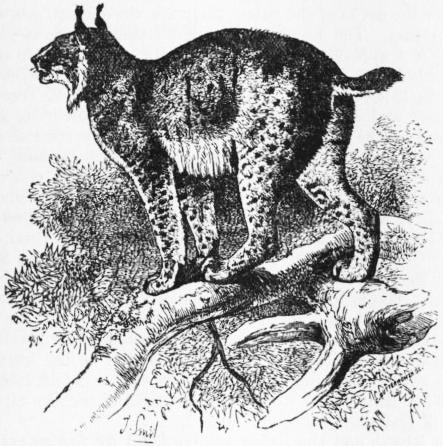
From a drawing by Wolf in Elliot’s Monograph of the Felidae.
European Lynx.
Several lynxes are found in North America; the most northerly has been described as the Canadian lynx (L. canadensis); the bay lynx (L. rufus), with a rufous coat in summer, ranges south to Mexico, with spotted and streaked varieties—L. maculatus in Texas and southern California, and L. fasciatus in Washington and Oregon. The first three were regarded by St George Mivart as local races of the northern lynx. A fifth form, the plateau lynx (L. baileyi), was described by Dr C. H. Merriam in 1890, but the differences between it and the bay lynx are slight and unimportant.
LYON, MARY MASON (1797-1849), American educationalist, was born on the 28th of February 1797 on a farm near Buckland, Franklin county, Massachusetts. She began to teach when she was seventeen, and in 1817, with the earnings from her spinning and weaving, she went to Sanderson Academy, Ashfield. She supported herself there, at Amherst Academy, where she spent one term, and at the girls’ school in Byfield, established in 1819 by Joseph Emerson (1777-1833), where she went in 1821, by teaching in district schools and by conducting informal normal schools. In 1822-1824 she was assistant principal of Sanderson Academy, and then taught in Miss Zilpah P. Grant’s Adams Female Academy, in Londonderry (now Derry), N.H. This school had only summer sessions, and Miss Lyon spent her winters in teaching, especially at Buckland and at Ashfield, and in studying chemistry and natural science with Edward Hitchcock, the geologist. In 1828-1834 she taught in Miss Grant’s school, which in 1828 had been removed to Ipswich, and for two years managed the school in Miss Grant’s absence. In 1828-1830 she had kept up her winter “normal” school at Buckland, and this was the beginning of her greater plan, “a permanent institution consecrated to the training of young women for usefulness ... designed to furnish every advantage which the state of education in this country will allow ... to put within reach of students of moderate means such opportunities that none can find better.” She was assisted by Dr Hitchcock, and her own mystical enthusiasm and practical common sense secured for her plan ready financial support. In 1835 a site was selected near the village of South Hadley and Mount Holyoke; in 1836 the school was incorporated as Mount Holyoke Female Seminary; and on the 8th of November 1837 it opened with Mary Lyon as principal, and, as assistant, Miss Eunice Caldwell, afterwards well known as Mrs J. P. Cowles of Ipswich Academy. Miss Lyon died at Mount Holyoke on the 5th of March 1849, having served nearly twelve years as principal of the seminary, on a salary of $200 a year. From her work at Holyoke sprang modern higher education for women in America.
See Edward Hitchcock, Life and Labors of Mary Lyon (1851); B. B. Gilchrist, Life of Mary Lyon (Boston, 1910).
LYON, NATHANIEL (1818-1861), American soldier, was born in Ashford, Connecticut, on the 14th of July 1818, and graduated at West Point in 1841. He was engaged in the Seminole War and the war with Mexico, won the brevet of captain for his gallantry at Contreras and Churubusco, and was wounded in the assault on the city of Mexico. In 1850, while serving in California, he conducted a successful expedition against the Indians. He was promoted captain in 1851, and two years later was ordered to the East, when he became an ardent opponent of “States’ Rights” and slavery. He was stationed in Kansas and in Missouri on the eve of the Civil War. In Missouri not only was sentiment divided, but the two factions were eager to resort to force long before they were in the other border states. Lyon took an active part in organizing the Union party in Missouri, though greatly hampered, at first by the Federal government which feared to provoke hostilities, and afterwards by the military commander of the department, General W. S. Harney. On Harney’s removal in April 1861, Lyon promptly assumed the command, called upon Illinois to send him troops, and mustered the Missouri contingent into the United States’ service. He broke up the militia camp at St Louis established by the secessionist governor of Missouri, Claiborne F. Jackson, and but for the express prohibition of Harney, who had resumed the command, would have proceeded at once to active hostilities. In all this Lyon had co-operated closely with Francis P. Blair, Jr., who now obtained from President Lincoln the definitive removal of Harney and the assignment of Lyon to command the Department of the West, with the rank of brigadier-general. On Lyon’s refusal to accede to the Secessionists’ proposal that the state should be neutral, hostilities opened in earnest, and Lyon, having cleared Missouri of small hostile bands in the central part of the state, turned to the southern districts, where a Confederate army was advancing from the Arkansas border. The two forces came to action at Wilson’s Creek on the 10th of August 1861. The Union forces, heavily outnumbered, were defeated, and Lyon himself was killed while striving to rally his troops. He bequeathed almost all he possessed, some $30,000, to the war funds of the national government.
See A. Woodward, Memoir of General Nathaniel Lyon (Hartford, 1862); James Peckham, Life of Lyon (New York, 1866); and T. L. Snead, The Fight for Missouri (New York, 1886). Also Last Political Writings of General Nathaniel Lyon (New York, 1862).
LYONNESSE, Lyonesse, Leonnoys or Leonais, a legendary country off the south coast of Cornwall, England. Lyonnesse is the scene of many incidents in the Arthurian romances, and especially in the romances of Tristram and Iseult. It also plays an important part in purely Cornish tradition and folk-lore. Early English chronicles, such as the Chronicon e chronicis of Florence of Worcester, who died in 1118, described minutely and without a suggestion of disbelief the flourishing state of Lyonnesse, and its sudden disappearance beneath the sea. The legend may be a greatly exaggerated version of some actual subsidence of inhabited land. There is also a very ancient local tradition, apparently independent of the story of Lyonnesse, that the Scilly Islands formed part of the Cornish mainland within historical times.
See Florentii Wigorniensis monachi Chronicon ex chronicis, &c., ed. B. Thorpe (London, 1848-1849).
LYONS, EDMUND LYONS, Baron (1790-1858), British admiral, was born at Burton, near Christchurch, Hampshire, on the 21st of November 1790. He entered the navy, and served in the Mediterranean, and afterwards in the East Indies, where in 1810 he won promotion by distinguished bravery. He became post-captain in 1814, and in 1826 commanded the “Blonde” frigate at the blockade of Navarino, and took part with the French in the capture of Kasteo Morea. Shortly before his ship was paid off in 1835 he was knighted. From 1840 till 1853 Lyons was employed on the diplomatic service, being successively minister to Greece, Switzerland and Sweden. On the outbreak of the war with Russia he was appointed second in command of the British fleet in the Black Sea under Admiral Dundas, whom he succeeded in the chief command in 1854. As admiral of the inshore squadron he had the direction of the landing of the troops in the Crimea, which he conducted with marvellous energy and despatch. According to Kinglake, Lyons shared the “intimate counsels” of Lord Raglan in regard to the most momentous questions of the war, and toiled, with a “painful consuming passion,” to achieve the object of the campaign. His principal actual achievements in battle were two—the support he rendered with his guns to the French at the Alma in attacking the left flank of the Russians, and the bold and brilliant part he took with his ship the “Agamemnon” in the first bombardment of the forts of Sebastopol; but his constant vigilance, his multifarious activity, and his suggestions and counsels were much more advantageous to the allied cause than his specific exploits. In 1855 he was created vice-admiral; in June 1856 he was raised to the peerage with the title of Baron Lyons of Christchurch. He died on the 23rd of November 1858.
See Adam S. Eardley-Wilmot, R. N., Life of Lord Lyons (1898).
LYONS, RICHARD BICKERTON PEMELL LYONS, 1st Earl (1817-1887), British diplomatist, son of the preceding, was born at Lymington on the 26th of April 1817. He entered the diplomatic service, and in 1859-1864 was British minister at Washington, where, after the outbreak of the Civil War, the extremely important negotiations connected with the arrest of the Confederate envoys on board the British mail-steamer “Trent” devolved upon him. After a brief service at Constantinople, he succeeded Lord Cowley at the Paris embassy in 1867. In the war of 1870 he used his best efforts as a mediator, and accompanied the provisional government to Tours. He continued to hold his post with universal acceptance until November 1887. He died on the 5th of December 1887, when the title became extinct.
LYONS (Fr. Lyon), a city of eastern France, capital of the department of Rhône, 315 m. S.S.E. of Paris and 218 m. N. by W. of Marseilles on the Paris-Lyon railway. Pop. (1906) town, 430,186; commune, 472,114. Lyons, which in France is second only to Paris in commercial and military importance, is situated at the confluence of the Rhone and the Saône at an altitude of 540 to 1000 ft. above sea-level. The rivers, both flowing south, are separated on the north by the hill on which lies the populous working quarter of Croix-Rousse, then by the narrow tongue of land ending in the Perrache Quarter. The peninsula thus formed is over 3 m. long and from 650 to 1000 yds. broad. It is traversed lengthwise by the finest streets of the city, the rue de la République, the rue de l’Hôtel de Ville, and the rue Victor Hugo. Where it enters Lyons the Saône has on its right the faubourg of Vaise and on its left that of Serin, whence the ascent is made to the top of the hill of Croix-Rousse. Farther on, its right bank is bordered by the scarped heights of Fourvière, St Irénée, Ste Foy, and St Just, leaving room only for the quays and one or two narrow streets; this is the oldest part of the city. The river sweeps in a semicircle around this eminence (410 ft. above it), which is occupied by convents, hospitals and seminaries, and has at its summit the famous church of Notre-Dame de Fourvière, the resort of many thousands of pilgrims annually.
On the peninsula between the rivers, at the foot of the hill of Croix-Rousse, are the principal quarters of the town: the Terreaux, containing the hôtel de ville, and the chief commercial establishments; the wealthy residential quarter, centring round the Place Bellecour, one of the finest squares in France; and the Perrache. The Rhone and Saône formerly met on the site of this quarter, till, in the 18th century, the sculptor Perrache reclaimed it; on the peninsula thus formed stands the principal railway station, the Gare de Perrache with the Cours du Midi, the most extensive promenade in Lyons, stretching in front of it. Here, too, are the docks of the Saône, factories, the arsenal, gas-works and prisons. The Rhone, less confined than the Saône, flows swiftly in a wide channel, broken when the water is low in spring by pebbly islets. On the right hand it skirts first St Clair, sloping upwards to Croix-Rousse, and then the districts of Terreaux, Bellecour and Perrache; on the left it has a low-lying plain, occupied by the Parc de la Tête d’Or and the quarters of Brotteaux and Guillotière. The park, together with its lake, comprises some 285 acres, and contains a zoological collection, botanical and pharmaceutical gardens, and the finest greenhouses in France, with unique collections of orchids, palm-trees and Cycadaceae. It is defended from the Rhone by the Quai de la Tête d’Or, while on the east the railway line to Geneva separates it from the race-course. Brotteaux is a modern residential quarter. Guillotière to the south consists largely of workmen’s dwellings, bordering wide, airy thoroughfares. To the east extend the manufacturing suburbs of Villeurbanne and Montchat. The population, displaced by the demolition of the lofty old houses and the widening of the streets on the peninsula, migrates to the left bank of the Rhone, the extension of the city into the plain of Dauphiné being unhindered.
The Rhone and the Saône are bordered by fine quays and crossed by 24 bridges—11 over the Rhone, 12 over the Saône, and 1 at the confluence. Of these the Pont du Change over the Saône and the Pont de la Guillotière over the Rhone have replaced medieval bridges, the latter of the two preserving a portion of the old structure.
Of the ancient buildings Notre-Dame de Fourvière is the most celebrated. The name originally applied to a small chapel built in the 9th century on the site of the old forum (forum vetus) from which it takes its name. It has been often Public Buildings. rebuilt, the chief feature being a modern Romanesque tower surmounted by a cupola and statue of the Virgin. In 1872 a basilica was begun at its side in token of the gratitude of the city for having escaped occupation by the German troops. The building, finished in 1894, consists of a nave without aisles flanked at each exterior corner by a turret and terminating in an apse. The façade, the lower half of which is a lofty portico supported on four granite columns, is richly decorated on its upper half with statuary and sculpture. Marble and mosaic have been lavishly used in the ornamentation of the interior and of the crypt. Round the apse runs a gallery from which, according to an old custom, a benediction is pronounced upon the town annually on the 8th of September. From this gallery a magnificent view of the city and the surrounding country can be obtained. At the foot of the hill of Fourvière rises the cathedral of St Jean, one of the finest examples of early Gothic architecture in France. Begun in the 12th century, to the end of which the transept and choir belong, it was not finished till the 15th century, the gable and flanking towers of the west front being completed in 1480. A triple portal surmounted by a line of arcades and a rose window gives entrance to the church. Two additional towers, that to the north containing one of the largest bells in France, rise at the extremities of the transept. The nave and choir contain fine stained glass of the 13th and 14th centuries as well as good modern glass. The chapel of St Louis or of Bourbon, to the right of the nave, is a masterpiece of Flamboyant Gothic. To the right and left of the altar stand two crosses preserved since the council of 1274 as a symbol of the union then agreed upon between the Greek and Latin churches. Adjoining St Jean is the ancient Manécanterie or singers’ house, much mutilated and frequently restored, but still preserving graceful Romanesque arcades along its front. St Martin d’Ainay, on the peninsula, is the oldest church in Lyons, dating from the beginning of the 6th century and subsequently attached to a Benedictine abbey. It was rebuilt in the 10th and 11th centuries and restored in modern times, and is composed of a nave with four aisles, a transept and choir terminating in three semicircular apses ornamented with paintings by Hippolyte Flandrin, a native of Lyons. The church is surmounted by two towers, one in the middle of the west front, the other at the crossing; the four columns supporting the latter are said to have come from an altar to Augustus. A mosaic of the 12th century, a high altar decorated with mosaic work and a beautifully carved confessional are among the works of art in the interior. St Nizier, in the heart of the city, was the first cathedral of Lyons; and the crypt in which St Pothinus officiated still exists. The present church is a Gothic edifice of the 15th century, with the exception of the porch, constructed by Philibert Delorme, a native of Lyons, in the 16th century. The Church of St Paul (12th and 15th centuries), situated on the right bank of the Saône, preserves an octagonal central tower and other portions of Romanesque architecture; that of St Bonaventure, originally a chapel of the Cordeliers, was rebuilt in the 15th and 19th centuries. With the exception of the imposing prefecture, the vast buildings of the faculties, which are in the Guillotière quarter, and the law court, the colonnade of which overlooks the Saône from its right bank, the chief civil buildings are in the vicinity of the Place des Terreaux. The east side of this square (so called from the terreaux or earth with which the canal formerly connecting the Rhone and the Saône hereabouts was filled) is formed by the hôtel de ville (17th century), the east façade of which, towards the Grand Theatre, is the more pleasing. The south side of the square is occupied by the Palais des Arts, built in the 17th century as a Benedictine convent and now accommodating the school of fine arts, the museums of painting and sculpture, archaeology and natural history, and the library of science, arts and industry. The museums are second in importance only to those of Paris. The collection of antiquities, rich in Gallo-Roman inscriptions, contains the bronze tablets discovered in 1528, on which is engraved a portion of a speech delivered in A.D. 48, by the emperor Claudius, advocating the admission of citizens of Gallia Comata to the Roman senate. The “Ascension,” a masterpiece of Perugino, is the chief treasure of the art collection, in which are works by nearly all the great masters. A special gallery contains the works of artists of Lyons, among whom are numbered Antoine Berjon, Meissonier, Paul Chenavard, Puvis de Chavannes. In the Rue de la République, between the Place de la Bourse and the Place des Cordeliers, each of which contains one of its highly ornamented fronts, stands the Palais du Commerce et de la Bourse, the finest of the modern buildings of Lyons. The Bourse (exchange) has its offices on the ground floor round the central glass-roofed hall; the upper storeys accommodate the commercial tribunal, the council of trade arbitration, the chamber of commerce and the Musée historique des Tissus, in which the history of the weaving industry is illustrated by nearly 400,000 examples. In the buildings of the lycée on the right bank of the Rhone are the municipal library and a collection of globes, among them the great terrestrial globe made at Lyons in 1701, indicating the great African lakes.
The Hôtel Dieu, instituted according to tradition in the beginning of the 6th century by King Childebert, is still one of the chief charitable establishments in the city. The present building dates from the 18th century; its façade, fronting the west quay of the Rhone for over 1000 ft., was begun according to the designs of Soufflot, architect of the Pantheon at Paris. The Hospice de la Charité and the military hospital are on the same bank slightly farther down stream. The Hospice de l’Antiquaille, at Fourvière, occupies the site of the palace of the praetorian prefects, in which Germanicus, Claudius and Caracalla were born. Each of these hospitals contains more than 1000 beds. Lyons has many other benevolent institutions, and is also the centre of the operations of the Société de la Propagation de la Foi. The chief monuments are the equestrian statue of Louis XIV. in the Place Bellecour, the monuments of President Carnot, Marshal Suchet, the physicist André-Marie Ampère, and those in honour of the Republic and in memory of the citizens of the department who fell in the war of 1870-71. The most noteworthy fountain is that in the Place des Terreaux with the leaden group by Bartholdi representing the rivers on their way to the ocean.
There are Roman remains—baths, tombs and the relics of a theatre—in the St Just quarter on the right bank of the Saône. Three ancient aqueducts on the Fourvière level, from Montromant, Mont d’Or and Mont Pilat, can still be traced. Magnificent remains of the latter work may be seen at St Irénée and Chaponost. Traces also exist along the Rhone of a subterranean canal conveying the water of the river to a naumachia (lake for mimic sea-fights). Agrippa made Lyons the starting-point of the principal Roman roads throughout Gaul; and it remains an important centre in the general system of communication owing to its position on the natural highway from north to south-eastern France. The Saône above the town and the Rhone below have large barge and steamboat traffic. The main line of the Paris-Lyon-Méditerranée railway runs first through the station at Vaise, on the right bank of the Saône, and thence to that of Perrache, the chief station in the city. The line next in importance, that to Geneva, has its station in the Brotteaux quarter, and the line of the eastern Lyonnais to St Genix d’Aoste has a terminus at Guillotière; both these lines link up with the Paris-Lyon main line. The railway to Montbrison starts from the terminus of St Paul in Fourvière and that to Bourg, Trévoux and the Dombes region from the station of Croix-Rousse. A less important line to Vaugneray and Mornant has a terminus at St Just. Besides the extensive system of street tramways, cable tramways (ficelles) run to the summits of the eminences cf Croix-Rousse, Fourvière and St Just.
Lyons is, next to Paris, the principal fortress of the interior of France, and, like the capital, possesses a military governor. The immediate protection of the city is provided for on the east side by a modern enceinte, of simple trace, in the plain (subsidiary to this is a group of fairly modern detached forts forming an advanced position at the village of Bron), and on the west by a line of detached forts, not of recent design, along the high ground on the right bank of the Saône. Some older forts and a portion of the old enceinte are still kept up in the city itself, and two of these forts, Montessuy and Caluire, situated on the peninsula, serve with their annexes to connect the northern extremities of the two lines above mentioned. The main line of defence is as usual the outer fort-ring, the perimeter of which is more Defence. than 40 m., and the mean distance from the centre of the city 6½ m. This naturally divides into four sections. In the eastern plain, well in advance of the enceinte, eight principal sites have been fortified, Feyzin, Corbas, St Priest, Genas, Azieu, Meyzieux, Décines and Chaurant. These form a semicircle from the lower to the upper reaches of the Rhone. The northern (or north eastern) section, between the Rhone and the Saône, has forts Neyron and Vancia as its principal defences; these and their subsidiary batteries derive some additional support from the forts Montessuy and Caluire mentioned above. On the north-west side there is a strong group of works disposed like a redan, of which the salient, fort Verdun and annexes, is on the high plateau of Mont d’Or pointing northward, and the faces, represented by forts Frêta and Paillet, are lower down on the spurs of the ridge, facing north-east and north-west respectively. The south-western section comprises three principal groups, Bruisson, Côte-Lorette and Montcorin-Champvillard, the last-named crossing its fire over the Lower Rhone with Fort Feyzin. Lastly a connecting battery was built near Chapoly in 1895 to close the gap between the north-western and south-western sections and to command the westward approaches by the valley of Charbonnières.
Lyons is the headquarters of the XIV. army-corps, the seat of an archbishop who holds the title of primate of the Gauls and also that of archbishop of Vienne, and of a prefect, a court of appeal, a court of assizes, tribunals of commerce and of first instance, and of two boards of trade arbitration (conseils de prud’hommes). It is the centre of an académie (educational division) and has a university with faculties of law, letters, science and medicine and pharmacy. There are also Catholic faculties (facultés libres) of law, theology, science and letters, three lycées, training colleges for teachers and numerous minor educational establishments. There are besides many special schools at Lyons, the more important being the school of fine arts which was founded in the 18th century to train competent designers for the textile manufactures, but has also done much for painting and sculpture; an army medical school, schools of drawing, agriculture, music, commerce (école supérieure de commerce), weaving, tanning, watch-making and applied chemistry, and the écoles La Martinière for free instruction in science and art as applied to industry. The veterinary school, instituted in 1761, was the first of its kind in Europe; its laboratory for the study of comparative physiology is admirably equipped. Besides the Académie des Sciences, Belles Lettres et Arts (founded in 1700), Lyons possesses societies of agriculture, natural history, geography, horticulture, &c.
Its trade in silk and silk goods has formed the basis of the prosperity of Lyons for several centuries. Derived from Italy, this industry rapidly developed, thanks to the monopoly granted to the city in 1450 by Charles VII. and to the patronage of Industry and trade. Francis I., Henry II. and Henry IV. From time to time new kinds of fabrics were invented—silk stuffs woofed with wool or with gold and silver threads, shawls, watered silks, poplins, velvets, satinades, moires, &c. In the beginning of the 19th century J. M. Jacquard introduced his famous loom by which a single workman was enabled to produce elaborate fabrics as easily as the plainest web, and by changing the “cartoons” to make the most different textures on the same looms. In the 17th century the silk manufacture employed at Lyons, 9000 to 12,000 looms. After the revocation of the edict of Nantes the number sank to 3000 or 4000; but after the Reign of Terror was past it rose again about 1801 to 12,000. Towards the middle of the 19th century the weaving branch of the industry began to desert Lyons for the surrounding districts. The city remains the business centre for the trade and carries on dyeing, printing and other accessory processes. Lyons disputes with Milan the position of the leading silk market of Europe. In 1905 the special office (la Condition des soies) which determines the weight of the silk examined over 4700 tons of silk. France furnished barely one-tenth of this quantity, two-thirds came from China and Japan, the rest from Italy and the Levant. The traders of Lyons re-export seven-twelfths of these silks, the industries of the town employing the remainder. An almost equal quantity of cotton, wool and waste-silk threads is mixed with the silk. A few thousand hand-looms are still worked in the town, more especially producing the richest materials, 50,000 or 55,000 in the surrounding districts, and some 33,000 machine looms in the suburbs and neighbouring departments. Allied industries such as dyeing, finishing and printing, employ 12,000 workers. Altogether 300,000 workpeople depend upon the silk industry. In 1905 the total value of the manufacture was £15,710,000, the chief items being pure silk textures (plain) £3,336,000; textures of silk mixed with other materials £3,180,000; silk and foulards £1,152,000; muslins £3,800,000, this product having increased from £100,000 in 1894. Speaking roughly the raw material represents half the value, and the value of the labour the remaining half. About 30% of the silk goods of Lyons finds a market in France. Great Britain imported them to the value of over £6,000,000, and the United States to the value of over £1,600,000, notwithstanding the heavy duty. The dyeing industry and the manufacture of chemicals have both developed considerably to meet the requirements of the silk trade. Large quantities of mineral and vegetable colouring matters are produced and there is besides a large output of glue, gelatine, superphosphates and phosphorus, all made from bones and hides, of picric, tartaric, sulphuric and hydrochloric acids, sulphates of iron and copper, and pharmaceutical and other chemical products.
Lyons does a large trade in metals, iron, steel and copper, and utilizes them in the manufacture of iron buildings, framework, bridges, machinery, railway material, scales, metal cables, pins and needles, copper-founding and the making of clocks and bronzes. Gold and silver-working is of importance, especially for embroidery and articles used in religious ceremonies. Other industries are those of printing, the manufacture of glass goods, of tobacco (by the state), the preparation of hides and skins (occupying 20,000 workmen), those connected with the miller’s trade, the manufacture of various forms of dried flour-paste (macaroni, vermicelli, &c.), brewing, hat-making, the manufacture of chocolate, and the pork-butcher’s industry. Apart from the dealings in silk and silk goods, trade is in cloth, coal and charcoal, metals and metal goods, wine and spirits, cheese and chestnuts. Four miles south-west of Lyons is Oullins (pop. 9859) which has the important works of the Paris-Lyon railway.
Lyons is the seat of important financial companies; of the Crédit Lyonnais, which does business to the amount of £200,000,000 annually in Lyons alone; also of coal and metallurgical companies and gas companies, the former extending their operations as far as Russia, the latter lighting numerous towns in France and foreign countries.
History.—The earliest Gallic occupants of the territory at the confluence of the Rhone and the Saône were the Segusians. In 59 B.C. some Greek refugees from the banks of the Hérault, having obtained permission of the natives to establish themselves beside the Croix-Rousse, called their new town by the Gallic name Lugudunum (q.v.) or Lugdunum; and in 43 B.C. Lucius Munatius Plancus brought a Roman colony to Fourvières from Vienne. This settlement soon acquired importance, and was made by Agrippa the starting-point of four great roads. Augustus, besides building aqueducts, temples and a theatre, gave it a senate and made it the seat of an annual assembly of deputies from the sixty cities of Gallia Comata. At the same time the place became the Gallic centre for the worship of Rome and the emperor. Under the emperors the colony of Forum Vetus and the municipium of Lugdunum were united, receiving the jus senatus. The town was burnt in A.D. 59 and afterwards rebuilt in a much finer style with money given by Nero; it was also adorned by Trajan, Adrian and Antoninus. The martyrdom of Pothinus and Blandina occurred under Marcus Aurelius (A.D. 177), and some years later a still more savage persecution of the Christians took place under Septimius Severus, in which Irenaeus, according to some authors, perished.
After having been ravaged by the barbarians and abandoned by the empire, Lyons in 478 became capital of the kingdom of the Burgundians. It afterwards fell into the hands of the Franks, and suffered severely from the Saracens, but revived under Charlemagne, and after the death of Charles the Bald became part of the kingdom of Provence. From 1032 it was a fief of the emperor of Germany. Subsequently the authority over the town was a subject of dispute between the archbishops of Lyons and the counts of Forez; but the supremacy of the French kings was established under Philip the Fair in 1312. The citizens were constituted into a commune ruled by freely elected consuls (1320). In the 13th century two ecclesiastical councils were held at Lyons—one in 1245, presided over by Innocent IV., at which the emperor Frederick II. was deposed; the second, the œcumenical, under the presidency of Gregory X., in 1274, at which five hundred bishops met. Pope Clement V. was crowned here in 1305, and his successor, John XXII., elected in 1316. The Protestants obtained possession of the place in 1562; their acts of violence were fiercely avenged in 1572 after the St Bartholomew massacre. Under Henry III. Lyons sided with the League; but it pronounced in favour of Henry IV. The executions of Henri d’Effiat, marquis of Cinq-Mars, and of François de Thou, who had plotted to overthrow Richelieu, took place on the Place des Terreaux in 1642. In 1793 the Royalists and Girondists, powerful in the city, rose against the Convention, but were compelled to yield to the army of the republic under General Kellermann after enduring a siege of seven weeks (October 10). Terrible chastisement ensued: the name of Lyons was changed to that of Ville-affranchie; the demolition of its buildings was set about on a wholesale scale; and vast numbers of the proscribed, whom the scaffold had spared, were butchered with grape shot. The town resumed its old name after the fall of Robespierre, and the terrorists in their turn were drowned in large numbers in the Rhone. Napoleon rebuilt the Place Bellecour, reopened the churches, and made the bridge of Tilsit over the Saône between Bellecour and the cathedral. In 1814 and 1815 Lyons was occupied by the Austrians. In 1831, 1834, 1849, 1870 and 1871 it was the scene of violent industrial or political disturbances. In 1840 and 1856 disastrous floods laid waste portions of the city. International exhibitions were held here in 1872 and 1894, the latter occasion being marked by the assassination of President Carnot.
See S. Charléty, Histoire de Lyon (Lyon, 1903); J. Godart, L’Ouvrier en soie. Monographie du tisseur lyonnais (Lyon, 1899); A. Vachet, A travers les rues de Lyon (Lyon, 1902); A. Steyert, Nouvelle Histoire de Lyon et des provinces de Lyonnais Forez, Beaujolais (3 vols., Lyon, 1895-1899).
LYONS, COUNCILS OF. The first Council of Lyons (the thirteenth general council) met at the summons of Pope Innocent IV. in June and July of 1245, to deliberate on the conflict between Church and emperor, on the assistance to be granted to the Holy Land and the Eastern empire, on measures of protection against the Tatars, and on the suppression of heresy. Among the tasks of the council mentioned in the writs of convocation, the most important, in the eyes of the pope, was that it should lend him effectual aid in his labours to overthrow the emperor Frederick II.; and, with this object in view, he had described the synod as a general council. Since its numbers were not far in excess of 150 bishops and archbishops, and the great majority of these came from France, Italy and Spain; while the schismatic Greeks and the other countries—especially Germany, whose interests were so deeply involved—were but weakly represented; the ambassador of Frederick, Thaddaeus of Suessa, contested its oecumenicity in the assembly itself. The condemnation of the emperor was a foregone conclusion. The articles of indictment described him as the “prince of tyranny, the destroyer of ecclesiastical dogma, the annihilator of the faith, the master of cruelty,” and so forth; while the grossest calumnies were treated as approved facts. The objections of the ambassador, that the accused had not been regularly cited, that the pope was plaintiff and judge in one, and that therefore the whole process was anomalous, achieved as little success as his appeal to the future pontiff and to a truly oecumenical council. The representatives of the kings of England and France were equally unfortunate in their claim for a prorogation of the decision. On the 17th of July the verdict was pronounced by Innocent IV., excommunicating Frederick and dethroning him on the grounds of perjury, sacrilege, heresy and felony. All oaths of fealty sworn to him were pronounced null and void, and the German princes were commanded to proceed with the election of a new sovereign. In addition the council enacted decrees against the growing irregularities in the Church, and passed resolutions designed to support the Crusaders and revive the struggle for the Holy Land.
See Mansi, Collectio conciliorum, tom, xxiii.; Huillard-Bréholles, Historia diplomatica Frederici II., 6 tom. (Paris, 1852-1861); Hefele, Conciliengeschichte, ed. 2, vol. v. (1886), pp. 1105-1126; Fr. W. Schirrmacher, Kaiser Friederich der Zweite (4 vols., Göttingen, 1859-1865); H. Schulz, in Herzog-Hauck, Realencyklopädie, ed. 3, vol. ix. (1901), p. 122 sqq., s.v. “Innocenz IV.”; A. Folz, Kaiser Friedrich II. u. Papst Innocenz IV. (Strassburg, 1905).
The second Council of Lyons (the fourteenth general council) met from the 7th of May to the 17th of July 1274, under the presidency of Pope Gregory X., and was designed to resolve three problems: to terminate the Greek schism, to decree a new Crusade, and to counteract the moral corruption among clerics and laity. The council entered on its third task at a very late period, with the result that the requisite time for an adequate deliberation was not available. Nevertheless, on the 1st of November, Gregory was enabled to publish thirty-one constitutions, which may be taken to represent the fruits of the synod and its labours. The most important of the enactments passed is that regulating the papal election. It prescribed that the new election conducted by the college of cardinals should be held in conclave (q.v.), and its duration abridged by progressive simplification of the cardinal’s diet. The motive for this decision, which has maintained its ground in ecclesiastical law, was given by the circumstances which followed the death of Clement IV. (1268). The pope felt a peculiar interest in the Holy Land, from which he was recalled by his elevation to the pontifical throne. He succeeded in bringing influential interests to work in the cause; but his scheme of a great enterprise backed by the whole force of the West came to nothing, for the day of the Crusades was past. His projected Crusade was interwoven with his endeavours to end the schism; and the political straits of the emperor Michael Palaeologus in Constantinople came to the aid of these aspirations. To ensure his safety against the attacks of King Charles of Sicily, who had pledged himself to assist the ex-emperor Baldwin in his reconquest of the Latin empire, Michael was required to own the supremacy of the pope in the spiritual domain; while Gregory, in return, would restrain the Sicilian monarch from his bellicose policy with regard to the Eastern empire. The ambassadors of the emperor appeared at the council with letters acknowledging the Roman pontiff and the confession of faith previously dispatched from the eternal city, and submitted similarly-worded declarations from the heads of the Byzantine Church. One member of the embassy, the Logothete Georgius Acropolites, was authorized by the emperor to take an oath in his name, renouncing the schism. In short, the subjection of the East to the Roman see was completed in the most binding forms, and the long-desired union seemed at last assured. Gregory himself did not live to discover its illusory character. The Council of Lyons was, moreover, of importance for the German dynastic struggle: for Gregory took the first public step in favour of Count Rudolph of Habsburg, the king-elect, by receiving his deputy and denying an audience to the delegate of the rival claimant, King Alphonso of Castile.
See Mansi, Collectio conciliorum, tom. xxiv.; Hefele, Conciliengeschichte, vol. vi. ed. 2 (1890), p. 119 sqq. Also C. Mirbt, in Herzog-Hauck, Realencyklop. f. protestantische Theologie, vol. vii. (1899), p. 122, s.v. “Gregor X.”
(C. M.)
LYRA (“The Harp”), in astronomy, a constellation in the northern hemisphere, mentioned by Eudoxus (4th century B.C.) and Aratus (3rd century B.C.). Ptolemy catalogued 10 stars in this constellation; Tycho Brahe 11 and Hevelius 17. α Lyrae or Vega, is the second brightest star in the northern hemisphere, and notable for the whiteness of its light, which is about 100 times that of the sun. The name “vega” is a remnant of an Arabic phrase meaning “falling eagle,” “Altair,” or α Aquilae, is the similar remnant of “flying eagle.” ε Lyrae is a multiple star, separated by the naked eye or by a small telescope into two stars; these are each resolved into two stars by a 3″ telescope, while a more powerful instrument (4″) reveals three smaller stars between the two pairs, β Lyrae and R. Lyrae are short period variables. There is the famous ring or annular nebula, M. 57 Lyrae, in the middle of which is a very faint star, which is readily revealed by photography; and also the meteoric swarm named the Lyrids, which appear in April and have their radiant in this constellation (see Meteor).
LYRE (Gr. λύρα), an ancient stringed musical instrument. The recitations of the Greeks were accompanied by it. Yet the lyre was not of Greek origin; no root in the language has been discovered for λύρα, although the special names bestowed upon varieties of the instrument are Hellenic. We have to seek in Asia the birthplace of the genus, and to infer its introduction into Greece through Thrace or Lydia. The historic heroes and improvers of the lyre were of the Aeolian or Ionian colonies, or the adjacent coast bordering on the Lydian empire, while the mythic masters, Orpheus, Musaeus and Thamyris, were Thracians. Notwithstanding the Hermes tradition of the invention of the lyre in Egypt, the Egyptians seem to have adopted it from Assyria or Babylonia.
To define the lyre, it is necessary clearly to separate it from the allied harp and guitar. In its primal form the lyre differs from the harp, of which the earliest, simplest notion is found in the bow and bowstring. While the guitar (and lute) can be traced back to the typical “nefer” of the fourth Egyptian dynasty, the fretted finger-board of which, permitting the production of different notes by the shortening of the string, is as different in conception from the lyre and harp as the flute with holes to shorten the column of air is from the syrinx or Pandean pipes. The frame of a lyre consists of a hollow body or sound-chest (ἠχεῖον). From this sound-chest are raised two arms (πήχεις), which are sometimes hollow, and are bent both outward and forward. They are connected near the top by a crossbar or yoke (ζυγόν, ζύγωμα, or, from its having once been a reed, κάλαμος). Another crossbar (μάλας, ὑπολύριον), fixed on the sound-chest, forms the bridge which transmits the vibrations of the strings. The deepest note was the farthest from the player; but, as the strings did not differ much in length, more weight may have been gained for the deeper notes by thicker strings, as in the violin and similar modern instruments, or they were turned with slacker tension. The strings were of gut (χορδή, whence chord). They were stretched between the yoke and bridge, or to a tailpiece below the bridge. There were two ways of tuning: one was to fasten the strings to pegs which might be turned (κόλλαβοι, κόλλοπες); the other was to change the place of the string upon the crossbar; probably both expedients were simultaneously employed. It is doubtful whether ἡ χορδοτόνος meant the tuning key or the part of the instrument where the pegs were inserted. The extensions of the arms above the yoke were known as κέρατα, horns.
The number of strings varied at different epochs, and possibly in different localities—four, seven and ten having been favourite numbers. They were used without a finger-board, no Greek description or representation having ever been met with that can be construed as referring to one. Nor was a bow possible, the flat sound-board being an insuperable impediment. The plectrum, however (πλῆκτρον), was in constant use. It was held in the right hand to set the upper strings in vibration (κρέκειν, κρούειν τῷ πλήκτρῳ); at other times it hung from the lyre by a ribbon. The fingers of the left hand touched the lower strings (ψάλλειν).
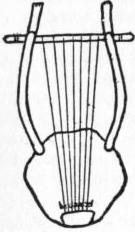
Fig. 1.—Chelys or Lyre from a vase in the British Museum, where also are fragments of such an instrument, the back of which is of shell.
Gerhard, Auserl. griech. Vasenbilder.
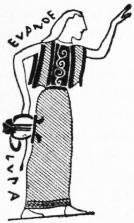
Fig. 2.—Tortoise-shell Lyre from a Greek vase in Munich.
With Greek authors the lyre has several distinct names; but we are unable to connect these with anything like certainty to the varieties of the instrument. Chelys (χέλυς, “tortoise”) may mean the smallest lyre, which, borne by one arm or supported by the knees, offered in the sound-chest a decided resemblance to that familiar animal. That there was a difference between lyre and cithara (κιθάρα) is certain, Plato and other writers separating them. Hermes and Apollo had an altar at Olympia in common because the former had invented the lyre and the latter the cithara. The lyre and chelys on the one hand, and the cithara and phorminx on the other, were similar or nearly identical. Apollo is said to have carried a golden phorminx.
(A. J. H.)
There are three lines of evidence that establish the difference between the lyre and cithara: (1) There are certain vase paintings in which the name λύρα accompanies the drawing of the instrument, as, for instance, in fig. 2 where the tortoise-shell lyre is obviously represented.1 (2) In all legends accounting for the invention of the lyre, the shell or body of the tortoise is invariably mentioned as forming the back of the instrument, whereas the tortoise has never been connected with the cithara. (3) The lyre is emphatically distinguished as the most suitable instrument for the musical training of young men and maidens and as the instrument of the amateur, whereas the cithara was the instrument of citharoedus or citharista, professional performers at the Pythian Games, at ceremonies and festivals, the former using his instrument to accompany epic recitations and odes, the latter for purely instrumental music. The costume worn by citharoedus and citharista was exceedingly rich and quite distinct from any other.2
We find the lyre represented among scenes of domestic life, in lessons, receptions, at banquets and in mythological scenes; it is found in the hands of women no less than men, and the costume of the performer is invariably that of an ordinary citizen. Lyres were of many sizes and varied in outline according to period and nationality.
We therefore possess irrefutable evidence of identification in both cases, all of which tallies exactly. Examination of the construction of the instruments thus identified reveals the fact that both possessed characteristics which have persisted throughout the middle ages to the present day in various instruments evolved from these two archetypes. The principal feature of both lyre and cithara was the peculiar method of construction adopted in the sound-chest, which may be said to have been almost independent of the outline. In the lyre the sound-chest consisted of a vaulted back, in imitation of the tortoise, over which was directly glued a flat sound-board of wood or parchment. In the cithara (q.v.) the sound-chest was shallower, and the back and front were invariably connected by sides or ribs. These two methods of constructing the sound-chests of stringed instruments were typical, and to one or the other may be referred every stringed instrument with a neck which can be traced during the middle ages in miniatures, early printed books, on monuments and other works of art.
(K. S.)
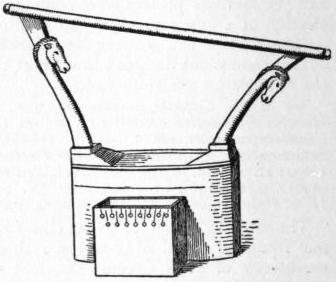
Fig. 3.—Egyptian Cithara now at Berlin.
Passing by the story of the discovery of the lyre from a vibrating tortoise-shell by Hermes, we will glance at the real lyres of Egypt and Semitic Asia. The Egyptian lyre is unmistakably Semitic. The oldest representation that has been discovered is in one of the tombs of Beni Hassan, the date of the painting being in the XIIth Dynasty, that is, shortly before the invasion of “the shepherd kings” (the Hyksos). In this painting, which both Rosellini and Lepsius have reproduced, an undoubted Semite carries a seven or eight-stringed lyre, or rather cithara in transition, similar to the rotta of the middle ages. The instrument has a four-cornered body and an irregular four-cornered frame above it, and the player carries it horizontally from his breast, just as a modern Nubian would his kissar. He plays as he walks, using both hands, a plectrum being in the right. Practical knowledge of these ancient instruments may be gained through two remarkable specimens preserved in the museums of Berlin (fig. 3) and Leiden (see Cithara). During the rule of the Hyksos the lyre became naturalized in Egypt, and in the 18th dynasty it is frequently depicted, and with finer grace of form. In the 19th and 20th dynasties the lyre is sometimes still more slender, or is quite unsymmetrical and very strong, the horns surmounted by heads of animals as in the Berlin one, which has horses’ heads at those extremities. Prokesch copied one in the ruins of Wadi Halfa, splendid in blue and gold, with a serpent wound round it. The Egyptians always strung their lyres fan-shaped, like the modern Nubian kissar. Their paintings show three to eight or nine strings, but the painters’ accuracy may not be unimpeachable; the Berlin instrument had fifteen. The three-stringed lyre typified the three seasons of the Egyptian year—the water, the green and the harvest; the seven, the planetary system from the moon to Saturn. The Greeks had the same notion of the harmony of the spheres.
There is no evidence as to what the stringing of the Greek lyre was in the heroic age. Plutarch says that Olympus and Terpander used but three strings to accompany their recitation. As the four strings led to seven and eight by doubling the tetrachord, so the trichord is connected with the hexachord or six-stringed lyre depicted on so many archaic Greek vases. We cannot insist on the accuracy of this representation, the vase painters being little mindful of the complete expression of details; yet we may suppose their tendency would be rather to imitate than to invent a number. It was their constant practice to represent the strings as being damped by the fingers of the left hand of the player, after having been struck by the plectrum which he held in the right hand. Before the Greek civilization had assumed its historic form, there was likely to be great freedom and independence of different localities in the matter of lyre stringing, which is corroborated by the antique use of the chromatic (half-tone) and enharmonic (quarter-tone) tunings, pointing to an early exuberance, and perhaps also to an Asiatic bias towards refinements of intonation, from which came the χρόαι, the hues of tuning, old Greek modifications of tetrachords entirely disused in the classic period. The common scale of Olympus

remained, a double trichord which had served as the scaffolding for the enharmonic varieties.
We may regard the Olympus scale, however, as consisting of two tetrachords, eliding one interval in each, for the tetrachord, or series of four notes, was very early adopted as the fundamental principle of Greek music, and its origin in the lyre itself appears sure. The basis of the tetrachord is the employment of the thumb and first three fingers of the left hand to twang as many strings, the little finger not being used on account of natural weakness. As a succession of three whole tones would form the disagreeable and untunable interval of a tritonus, two whole tones and a half-tone were tuned, fixing the tetrachord in the consonant interval of the perfect fourth. This succession of four notes being in the grasp of the hand was called συλλαβή, just as in language a group of letters incapable of further reduction is called syllable. In the combination of two syllables or tetrachords the modern diatonic scales resemble the Greek so-called disjunct scale, but the Greeks knew nothing of our categorical distinctions of major and minor. We might call the octave Greek scale minor, according to our descending minor form, were not the keynote in the middle the thumb note of the deeper tetrachord. The upper tetrachord, whether starting from the keynote (conjunct) or from the note above (disjunct), was of exactly the same form as the lower, the position of the semitones being identical. The semitone was a limma (λεῖμμα), rather less than the semitone of our modern equal temperament, the Greeks tuning both the whole tones in the tetrachord by the same ratio of 8:9, which made the major third a dissonance, or rather would have done so had they combined them in what we call harmony. In melodious sequence the Greek tetrachord is decidedly more agreeable to the ear than the corresponding series of our equal temperament. And although our scales are derived from combined tetrachords, in any system of tuning that we employ, be it just, mean-tone, or equal, they are less logical than the conjunct or disjunct systems accepted by the Greeks. But modern harmony is not compatible with them, and could not have arisen on the Greek melodic lines.
The conjunct scale of seven notes

attributed to Terpander, was long the norm for stringing and tuning the lyre. When the disjunct scale

the octave scale attributed to Pythagoras, was admitted, to preserve the time-honoured seven strings one note had to be omitted; it was therefore customary to omit the C, which in Greek practice was a dissonance. The Greek names for the strings of seven and eight stringed lyres, the first note being highest in pitch and nearest the player, were as follows: Nete, Paranete, Paramese; Mese, Lichanos, Parhypate, Hypate; or Nete, Paranete, Trite, Paramese; Mese, Lichanos, Parhypate, Hypate—the last four from Mese to Hypate being the finger tetrachord, the others touched with the plectrum. The highest string in pitch was called the last, νεάτη; the lowest in pitch was called the highest, ὑπάτη, because it was, in theory at least, the longest string. The keynote and thumb string was μέση, middle; the next lower was λίχανος, the first finger or lick-finger string; τρίτη, the third, being in the plectrum division, was also known as ὀξεῖα, sharp, perhaps from the dissonant quality to which we have referred as the cause of its omission. The plectrum and finger tetrachords together were διαπασῶν, through all; in the disjunct scale, an octave.
In transcribing the Greek notes into our notation, the absolute pitch cannot be represented; the relative positions of the semitones are alone determined. We have already quoted the scale of Pythagoras, the Dorian or true Greek succession:—

Shifting the semitone one degree upwards in each tetrachord, we have the Phrygian

Another degree gives the Lydian

which would be our major scale of E were not the keynote A. The names imply an Asiatic origin. We need not here pursue further the much-debated question of Greek scales and their derivation; it will suffice to remark that the outside notes of the tetrachords were fixed in their tuning as perfect fourths—the inner strings being, as stated, in diatonic sequence, or when chromatic two half-tones were tuned, when enharmonic two quarter-tones, leaving respectively the wide intervals of a minor and major third, and both impure, to complete the tetrachord.
(A. J. H.)
See the article by Théodore Reinach in Daremberg and Saglio, Antiguités grecques et romaines; Wilhelm Johnsen, Die Lyra, ein Beitrag zur griechischen Kunstgeschichte (Berlin, 1876); Hortense Panum, “Harfe und Lyra in Nord Europa,” Intern. Mus. Ges., Sbd. vii. 1, pp. 1-40 (Leipzig, 1905); A. J. Hipkins, “Dorian and Phrygian, reconsidered from a non-harmonic point of view,” in Intern. Mus. Ges. (Leipzig, 1903), iv. 3.
1 See Ed. Gerhard, Auserlesene griech. Vasenbilder, part iii. (Berlin, 1847), pl. 236 and p. 157.
2 See Aristotle, Polit. v. 6. 5.
LYRE-BIRD, the name by which one of the most remarkable birds Of Australia is commonly known, the Menura superba or M. novae-hollandiae of ornithologists. It was first observed in 1798 in New South Wales, and though called by its finders a “pheasant”—from its long tail—the more learned of the colony seem to have regarded it as a bird-of-Paradise.1 A specimen having reached England in 1799, it was described by General Davies as forming a new genus of birds, in the Linnean Society’s Transactions (vi. p. 207, pl. xxii.), no attempt, however, being made to fix its systematic place. In 1802 L. P. Vieillot figured and described it in a supplement to his Oiseaux Dorés as a bird-of-Paradise (ii. pp. 30 seq., pls. 14-16), from drawings by Sydenham Edwards, sent him by Parkinson, the manager of the Leverian Museum. The first to describe any portion of its anatomy was T. C. Eyton, who in 1841 (Ann. Nat. History, vii. pp. 49-53) perceived that it was a Passerine bird and that it presented some points of affinity to the South American genus Pteroptochus. In 1867 Huxley stated that he was disposed to divide his very natural assemblage the Coracomorphae (essentially identical with Eyton’s Insessores) into two groups, “one containing Menura, and the other all the other genera which have yet been examined” (Proc. Zool. Soc., 1867, p. 472)—a still further step in advance.2 In 1875 A. Newton put forth the opinion in his article on birds, in the 9th edition of this Encyclopaedia, that Menura had an ally in another Australian form, Atrichia (see Scrub-Bird), which he had found to present peculiarities hitherto unsuspected, and he regarded them as standing by themselves, though each constituting a distinct family. This opinion was partially adopted in the following year by A. H. Garrod, who (Proc. Zool. Society, 1876, p. 518) formally placed these two genera together in his group of Abnormal Acromyodian Oscines under the name of Menurinae; ornithologists now generally recognize at once the alliance and distinctness of the families Menuridae and Atrichiidae, and place them together to form the group Suboscines of the Diacromyodian Passeres.
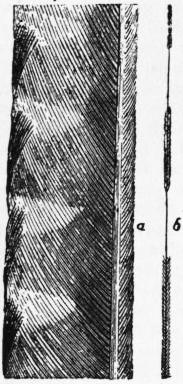
Fig. 1.
Since the appearance in 1865 of J. Gould’s Handbook to the Birds of Australia, little important information has been published concerning the habits of this form, and the account therein given must be drawn upon for what here follows. Of all birds, says that author, the Menura is the most shy and hard to procure. He has been among the rocky and thick “brushes”—its usual haunts—hearing its loud and liquid call-notes for days together without getting sight of one. Those who wish to see it must advance only while it is singing or scratching up the earth and leaves; and to watch its actions they must keep perfectly still. The best way of procuring an example seems to be by hunting it with dogs, when it will spring upon a branch to the height of 10 ft. and afford an easy shot ere it has time to ascend farther or escape as it does by leaps. Natives are said to hunt it by fixing on their heads the erected tail of a cock-bird, which alone is allowed to be seen above the brushwood. The greater part of its time is said to be passed upon the ground, and seldom are more than a pair to be found in company. One of the habits of the cock is to form small round hillocks, which he constantly visits during the day, mounting upon them and displaying his tail by erecting it over his head, drooping his wings, scratching and pecking at the soil, and uttering various cries—some his own natural notes, others an imitation of those of other animals. The tail, his most characteristic feature, only attains perfection in the bird’s third or fourth year, and then not until the month of June, remaining until October, when the feathers are shed to be renewed the following season. The food consists of insects, especially beetles and myriapods, as well as snails. The nest is placed near to or on the ground, at the base of a rock or foot of a tree, and is closely woven of fine but strong roots or other fibres, and lined with feathers, around all which is heaped a mass, in shape of an oven, of sticks, grass, moss and leaves, so as to project over and shelter the interior structure, while an opening in the side affords entrance and exit. Only one egg is laid, and this of rather large size in proportion to the bird, of a purplish-grey colour, suffused and blotched with dark purplish-brown.
Incubation is believed to begin in July or August, and the young is hatched about a month later. It is at first covered with dark down, and appears to remain for some weeks in the nest. It is greatly to be hoped that so remarkable a form as the lyre-bird, the nearly sole survivor apparently of a very ancient race of beings, will not be allowed to become extinct—its almost certain fate so far as can be judged—without many more observations of its manners being made. Several examples of Menura have been brought alive to Europe, and some have long survived in captivity.
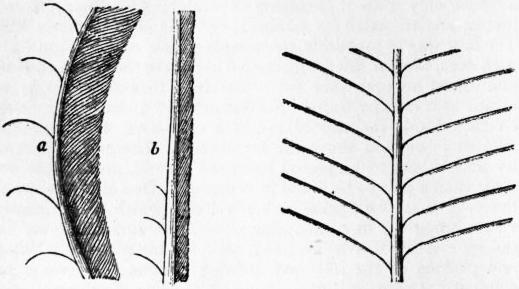
Fig. 2. Fig. 3.
Three species of Menura have been indicated—the old M. superba, the lyre-bird proper, which inhabits New South Wales, the southern part of Queensland, and perhaps some parts of Victoria; M. victoriae, separated from the former by Gould (Proc. Zool. Soc., 1862, p. 23), and said to take its place near Melbourne; and M. alberti, first described by C. L. Bonaparte (Consp. Avium, i. 215) on Gould’s authority, and, though discovered on the Richmond river in New South Wales, having apparently a more northern range than the other two. All those have the apparent bulk of a hen pheasant, but are really much smaller, and their general plumage is of a sooty brown, relieved by rufous on the chin, throat, some of the wing-feathers and the tail-coverts. The wings, consisting of twenty-one remiges, are rather short and rounded; the legs3 and feet very strong, with long, nearly straight claws. In the immature and female the tail is somewhat long, though affording no very remarkable character, except the possession of sixteen rectrices; but in the fully-plumaged male of M. superba and M. victoriae it is developed in the extraordinary fashion that gives the bird its common English name. The two exterior feathers (fig. 1, a, b) have the outer web very narrow, the inner very broad, and they curve at first outwards, then somewhat inwards, and near the tip outwards again, bending round forwards so as to present a lyre-like form. But this is not all; their broad inner web, which is of a lively chestnut colour, is apparently notched at regular intervals by spaces that, according to the angle at which they are viewed, seem either black or transparent; and this effect is, on examination, found to be due to the barbs at those spaces being destitute of barbules. The middle pair of feathers (fig. 2, a, b) is nearly as abnormal. These have no outer web, and the inner web very narrow; near their base they cross each other, and then diverge, bending round forwards near their tip. The remaining twelve feathers (fig. 3) except near the base are very thinly furnished with barbs, about ¼ in. apart, and those they possess, on their greater part, though long and flowing, bear no barbules, and hence have a hair-like appearance. The shafts of all are exceedingly strong. In the male of M. alberti the tail is not only not lyriform, but the exterior rectrices are shorter than the rest.
(A. N.)
1 Collins, Account of New South Wales, ii. 87-92 (London, 1802).
2 Owing to the imperfection of the specimen at his disposal, Huxley’s brief description of the bones of the head in Menura is not absolutely correct. A full description of them, with elaborate figures, is given by Parker in the same Society’s Transactions (ix. 306-309, pl. lvi. figs. 1-5).
3 The metatarsals are very remarkable in form, as already noticed by Eyton (loc. cit.), and their tendons strongly ossified.
LYRICAL POETRY, a general term for all poetry which is, or can be supposed to be, susceptible of being sung to the accompaniment of a musical instrument. In the earliest times it may be said that all poetry was of its essence lyrical. The primeval oracles were chanted in verse, and the Orphic and Bacchic Mysteries, which were celebrated at Eleusis and elsewhere, combined, it is certain, metre with music. Homer and Hesiod are each of them represented with a lyre, yet if any poetry can be described as non-lyrical, it is surely the archaic hexameter of the Iliad and the Erga. These poems were styled epic, in direct contradistinction to the lyric of Pindar and Bacchylides. But inexactly, since it is plain that they were recited, with a plain accompaniment on a stringed instrument. However, the distinction between epical and lyrical, between τὰ ἔπη, what was said, and τὰ μέλη, what was sung, is accepted, and neither Homer nor Hesiod is among the lyrists. This distinction, however, is often without a difference, as for example, in the case of the so-called Hymns of Homer, epical in form but wholly lyrical in character. Hegel, who has gone minutely into this question in his Esthetik, contends that when poetry is objective it is epical, and when it is subjective it is lyrical. This is to ignore the metrical form of the poem, and to deal with its character only. It would constrain us to regard Wordsworth’s Excursion as a lyric, and Tennyson’s Revenge (where the subject is treated exactly as one of the Homeridae would have treated an Ionian myth) as an epic. This is impossible, and recalls us to the importance of taking the form into consideration. But, with this warning, the definition of Hegel is valuable. It is, as he insists, the personal thought, or passion, or inspiration, which gives its character to lyrical poetry.
The lyric has the function of revealing, in terms of pure art, the secrets of the inner life, its hopes, its fantastic joys, its sorrows, its delirium. It is easier to exclude the dramatic species from lyric than to banish the epic. There are large sections of drama which it is inconceivable should be set to music, or sung, or even given in recitative. The tragedies of Racine, for example, are composed of the purest poetry, but they are essentially non-lyrical, although lyrical portions are here and there attached to them. The intensity of feeling and the melody of verse in Othello does not make that work an example of lyrical poetry, and this is even more acutely true of Le Misanthrope, which is, nevertheless, a poem. The tendency of modern drama is to divide itself further and further from lyric, but in early ages the two kinds were indissoluble. Tragedy was goat-song, and the earliest specimens of it were mainly composed of choruses. As Prof. G. G. Murray says, in the Suppliants of Aeschylus, the characters “are singing for two-thirds of the play,” accompanied by tumultuous music. This primitive feature has gradually been worn away; the chorus grew less and less prominent, and disappeared; the very verse-ornament of drama tends to vanish, and we have plays essentially so poetical as those of Ibsen and Maeterlinck written from end to end in bare prose.
To return again to Greece, there was an early distinction, soon accentuated, between the poetry chanted by a choir of singers, and the song which expressed the sentiments of a single poet. The latter, the μέλος or song proper, had reached a height of technical perfection in “the Isles of Greece, where burning Sappho loved and sung,” as early as the 7th century B.C. That poetess, and her contemporary Alcaeus, divide the laurels of the pure Greek song of Dorian inspiration. By their side, and later, flourished the great poets who set words to music for choirs, Alcman, Arion, Stesichorus, Simonides and Ibycus, who lead us at the close of the 5th century to Bacchylides and Pindar, in whom the magnificent tradition of the dithyrambic odes reached its highest splendour of development. The practice of Pindar and Sappho, we may say, has directed the course of lyrical poetry ever since, and will, unquestionably, continue to do so. They discovered how, with the maximum of art, to pour forth strains of personal magic and music, whether in a public or a private way. The ecstasy, the uplifted magnificence, of lyrical poetry could go no higher than it did in the unmatched harmonies of these old Greek poets, but it could fill a much wider field and be expressed with vastly greater variety. It did so in their own age. The gnomic verses of Theognis were certainly sung; so were the satires of Archilochus and the romantic reveries of Mimnermus.
At the Renaissance, when the traditions of ancient life were taken up eagerly, and hastily comprehended, it was thought proper to divide poetry into a diversity of classes. The earliest English critic who enters into a discussion of the laws of prosody, William Webbe, lays it down, in 1586, that in verse “the most usual kinds are four, the heroic, elegiac, iambic and lyric.” Similar confusion of terms was common among the critics of the 15th and 16th centuries, and led to considerable error. It is plain that a border ballad is heroic, and may yet be lyrical; here the word “heroic” stands for “epic.” It is plain that whether a poem is lyrical or not had nothing to do with the question whether it is composed in an iambic measure. Finally, it is undoubted that the early Greek “elegies” were sung to an accompaniment on the flute, whether they were warlike, like those of Tyrtaeus, or philosophical and amatory like those of Theognis. But (see Elegy) the present significance of “elegy,” and this has been the case ever since late classical times, is funereal; in modern parlance an elegy is a dirge. Whether the great Alexandrian dirges, like those of Bion and of Moschus, on which our elegiacal tradition is founded, were actually sung to an accompaniment or not may be doubted; they seem too long, too elaborate, and too ornate for that. But, at any rate, they were composed on the convention that they would be sung, and it is conceivable that music might have been wedded to the most complex of these Alexandrian elegies. Accordingly, although Lycidas and Adonais are not habitually “set to music,” there is no reason why they should not be so set, and their rounded and limited although extensive form links them with the song, not with the epic. There are many odes of Swinburne’s for which it would be more difficult to write music than for his Ave atque Vale. In fact, in spite of its solemn and lugubrious regularity, the formal elegy or dirge is no more nor less than an ode, and is therefore entirely lyrical.
More difficulty is met with in the case of the sonnet, for although no piece of verse, when it is inspired by subjective passion, fits more closely with Hegel’s definition of what lyrical poetry should be, yet the rhythmical complication of the sonnet, and its rigorous uniformity, seem particularly ill-fitted to interpretation on a lyre. When F. M. degli Azzi put the book of Genesis (1700) into sonnets, and Isaac de Benserade the Metamorphoses of Ovid (1676) into rondeaux, these eccentric and laborious versifiers produced what was epical rather than lyrical poetry, if poetry it was at all. But the sonnet as Shakespeare, Wordsworth and even Petrarch used it was a cry from the heart, a subjective confession, and although there is perhaps no evidence that a sonnet was ever set to music with success, yet there is no reason why that might not be done without destroying its sonnet-character.
Jouffroy was perhaps the first aesthetician to see quite clearly that lyrical poetry is, really, nothing more than another name for poetry itself, that it includes all the personal and enthusiastic part of what lives and breathes in the art of verse, so that the divisions of pedantic criticism are of no real avail to us in its consideration. We recognize a narrative or epical poetry; we recognize drama; in both of these, when the individual inspiration is strong, there is much that trembles on the verge of the lyrical. But outside what is pure epic and pure drama, all, or almost all, is lyrical. We say almost all, because the difficulty arises of knowing where to place descriptive and didactic poetry. The Seasons of Thomson, for instance, a poem of high merit and lasting importance in the history of literature—where is that to be placed? What is to be said of the Essay on Man? In primitive times, the former would have been classed under epic, the second would have been composed in the supple iambic trimeter which so closely resembled daily speech, and would not have been sharply distinguished from prose. Perhaps this classification would still serve, were it not for the element of versification, which makes a sharp line of demarcation between poetic art and prose. This complexity of form, rhythmical and stanzaic, takes much of the place which was taken in antiquity by such music as Terpander is supposed to have supplied. In a perfect lyric by a modern writer the instrument is the metrical form, to which the words have to adapt themselves. There is perhaps no writer who has ever lived in whose work this phenomenon may be more fruitfully studied than it may be in the songs and lyrics of Shelley. The temper of such pieces as “Arethusa” and “The Cloud” is indicated by a form hardly more ambitious than a guitar; Hellas is full of passages which suggest the harp; in his songs Shelley touches the lute or viol de gamba, while in the great odes to the “West Wind” and to “Liberty” we listen to a verse-form which reminds us by its volume of the organ itself. On the whole subject of the nature of lyric poetry no commentary can be more useful to the student than an examination of the lyrics of Shelley in relation to those of the songwriters of ancient Greece.
See Hegel, Die Phänomenologie des Geistes (1807); T. S. Jouffroy, Cours d’esthétique (1843); W. Christ, Metrik der Griechen und Römer, 2te. Aufl. (1879).
(E. G.)
LYSANDER (Gr. Λύσανδρος), son of Aristocritus, Spartan admiral and diplomatist. Aelian (Var. Hist. xii. 43) and Phylarchus (ap. Athen. vi. 271 e) say that he was a mothax, i.e. the son of a helot mother (see Helots), but this tradition is at least doubtful; according to Plutarch he was a Heraclid, though not of either royal family. We do not know how he rose to eminence: he first appears as admiral of the Spartan navy in 407 B.C. The story of his influence with Cyrus the Younger, his naval victory off Notium, his quarrel with his successor Callicratidas in 406, his appointment as ἐπιστολεύς in 405, his decisive victory at Aegospotami, and his share in the siege and capitulation of Athens belong to the history of the Peloponnesian War (q.v.). By 404 he was the most powerful man in the Greek world and set about completing the task of building up a Spartan empire in which he should be supreme in fact if not in name. Everywhere democracies were replaced by oligarchies directed by bodies of ten men (decarchies, δεκαρχίαι) under the control of Spartan governors (harmosts, ἁρμοσταί). But Lysander’s boundless influence and ambition, and the superhuman honours paid him, roused the jealousy of the kings and the ephors, and, on being accused by the Persian satrap Pharnabazus, he was recalled to Sparta. Soon afterwards he was sent to Athens with an army to aid the oligarchs, but Pausanias, one of the kings, followed him and brought about a restoration of democracy. On the death of Agis II., Lysander secured the succession of Agesilaus (q.v.), whom he hoped to find amenable to his influence. But in this he was disappointed. Though chosen to accompany the king to Asia as one of his thirty advisers (σύμβουλοι), he was kept inactive and his influence was broken by studied affronts, and finally he was sent at his own request as envoy to the Hellespont. He soon returned to Sparta to mature plans for overthrowing the hereditary kingship and substituting an elective monarchy open to all Heraclids, or even, according to another version, to all Spartiates. But his alleged attempts to bribe the oracles were fruitless, and his schemes were cut short by the outbreak of war with Thebes in 395. Lysander invaded Boeotia from the west, receiving the submission of Orchomenus and sacking Lebadea, but the enemy intercepted his despatch to Pausanias, who had meanwhile entered Boeotia from the south, containing plans for a joint attack upon Haliartus. The town was at once strongly garrisoned, and when Lysander marched against it he was defeated and slain. He was buried in the territory of Panopeus, the nearest Phocian city. An able commander and an adroit diplomatist, Lysander was fired by the ambition to make Sparta supreme in Greece and himself in Sparta. To this end he shrank from no treachery or cruelty; yet, like Agesilaus, he was totally free from the characteristic Spartan vice of avarice, and died, as he had lived, a poor man.
See the biographies by Plutarch and Nepos; Xen. Hellenica, i. 5-iii. 5; Diod. Sic. xiii. 70 sqq., 104 sqq., xiv. 3, 10, 13, 81; Lysias xii. 60 sqq.; Justin v. 5-7; Polyaenus i. 45, vii. 19; Pausanias iii., ix. 32, 5-10, x. 9, 7-11; C. A. Gehlert, Vita Lysandri (Bautzen, 1874); W. Vischer, Alkibiades und Lysandros (Basel, 1845); O. H. J. Nitzsch, De Lysandro (Bonn, 1847); and the Greek histories in general.
(M. N. T.)
LYSANIAS, tetrarch of Abilene (see Abila), according to Luke iii. 1, in the time of John the Baptist. The only Lysanias mentioned in profane history as exercising authority in this district was executed in 36 B.C. by M. Antonius (Mark Antony). This Lysanias was the son of Ptolemy Mennaeus, the ruler of an independent state, of which Abilene formed only a small portion. According to Josephus (Ant. xix. 5, 1) the emperor Claudius in A.D. 42 confirmed Agrippa I. in the possession of “Abila of Lysanias” already bestowed upon him by Caligula, elsewhere described as “Abila, which had formed the tetrarchy of Lysanias.” It is argued that this cannot refer to the Lysanias executed by M. Antonius, since his paternal inheritance, even allowing for some curtailment by Pompey, must have been of far greater extent. It is therefore assumed by some authorities that the Lysanias in Luke (A.D. 28-29) is a younger Lysanias, tetrarch of Abilene only, one of the districts into which the original kingdom was split up after the death of Lysanias I. This younger Lysanias may have been a son of the latter, and identical with, or the father of, the Claudian Lysanias. On the other hand, Josephus knows nothing of a younger Lysanias, and it is suggested by others that he really does refer to Lysanias I. The explanation given by M. Krenkel (Josephus und Lucas, Leipzig, 1894, p. 97) is that Josephus does not mean to imply that Abila was the only possession of Lysanias, and that he calls it the tetrarchy or kingdom of Lysanias because it was the last remnant of the domain of Lysanias which remained under direct Roman administration until the time of Agrippa. The expression was borrowed from Josephus by Luke, who wrongly imagined that Lysanias I. had ruled almost up to the time of the bestowal of his tetrarchy upon Agrippa, and therefore to the days of John the Baptist. Two inscriptions are adduced as evidence for the existence of a younger Lysanias—Böckh, C.I.G. 4521 and 4523. The former is inconclusive, and in the latter the reading Ανσ[ανιου] is entirely conjectural; the name might equally well be Lysimachus or Lysias.
See E. Schürer, Geschichte des jüdischen Volkes (3rd ed., 1901), i. p. 712; and (especially on the inscriptional evidence) E. Renan, “Mémoire sur la dynastie des Lysanias d’Abilène” in Mémoires de l’institut impérial de France (xxvi., 1870); also P. W. Schmiedel in the Encyclopaedia Biblica, s.v.
LYSIAS, Attic orator, was born, according to Dionysius of Halicarnassus and the author of the life ascribed to Plutarch, in 459 B.C. This date was evidently obtained by reckoning back from the foundation of Thurii (444 B.C.), since there was a tradition that Lysias had gone thither at the age of fifteen. Modern critics would place his birth later,—between 444 and 436 B.C.,—because, in Plato’s Republic, of which the scene is laid about 430 B.C., Cephalus, the father of Lysias, is among the dramatis personae, and the emigration of Lysias to Thurii was said to have followed his father’s death. The latter statement, however, rests only on the Plutarchic life; nor can Plato’s dialogue be safely urged as a minutely accurate authority. The higher date assigned by the ancient writers agrees better with the tradition that Lysias reached, or passed, the age of eighty.1 Cephalus, his father, was a native of Syracuse, and on the invitation of Pericles had settled at Athens. The opening scene of Plato’s Republic is laid at the house of his eldest son, Polemarchus, in Peiraeus. The tone of the picture warrants the inference that the Sicilian family were well known to Plato, and that their houses must often have been hospitable to such gatherings.
At Thurii, the colony newly planted on the Tarentine Gulf (see Pericles), the boy may have seen Herodotus, now a man in middle life, and a friendship may have grown up between them. There, too, Lysias is said to have commenced his studies in rhetoric—doubtless under a master of the Sicilian school—possibly, as tradition said, under Tisias, the pupil of Corax, whose name is associated with the first attempt to formulate rhetoric as an art. In 413 B.C. the Athenian armament in Sicily was annihilated. The desire to link famous names is illustrated by the ancient ascription to Lysias of a rhetorical exercise purporting to be a speech in which the captive general Nicias appealed for mercy to the Sicilians. The terrible blow to Athens quickened the energies of an anti-Athenian faction at Thurii. Lysias and his elder brother Polemarchus, with three hundred other persons, were “accused of Atticizing.” They were driven from Thurii and settled at Athens (412 B.C.).