VOLUME XVII SLICE II Luray Cavern to Mackinac Island (continued 8)
Reading edition
See Sir C. R. Markham, Life of Admiral Sir Leopold M‘Clintock (1909).

McCLINTOCK, JOHN (1814-1870), American Methodist Episcopal theologian and educationalist, was born in Philadelphia on the 27th of October 1814. He graduated at the university of Pennsylvania in 1835, and was assistant professor of mathematics (1836-1837), professor of mathematics (1837-1840), and professor of Latin and Greek (1840-1848) in Dickinson College, Carlisle, Pennsylvania. He opposed the Mexican War and slavery, and in 1847 was arrested on the charge of instigating a riot, which resulted in the rescue of several fugitive slaves; his trial, in which he was acquitted, attracted wide attention. In 1848-1856 he edited The Methodist Quarterly Review (after 1885 The Methodist Review); from 1857 to 1860 he was pastor of St Paul’s (Methodist Episcopal) Church, New York City; and in 1860-1864 he had charge of the American chapel in Paris, and there and in London did much to turn public opinion in favour of the Northern States. In 1865-1866 he was chairman of the central committee for the celebration of the centenary of American Methodism. He retired from the regular ministry in 1865, but preached in New Brunswick, New Jersey, until the spring of 1867, and in that year, at the wish of its founder, Daniel Drew, became president of the newly established Drew theological seminary at Madison, New Jersey, where he died on the 4th of March 1870. A great preacher, orator and teacher, and a remarkably versatile scholar, McClintock by his editorial and educational work probably did more than any other man to raise the intellectual tone of American Methodism, and, particularly, of the American Methodist clergy. He introduced to his denomination the scholarly methods of the new German theology of the day—not alone by his translation with Charles E. Blumenthal of Neander’s Life of Christ (1847), and of Bungener’s History of the Council of Trent (1855), but by his great project, McClintock and Strong’s Cyclopaedia of Biblical, Theological and Ecclesiastical Literature (10 vols., 1867-1881; Supplement, 2 vols., 1885-1887), in the editing of which he was associated with Dr James Strong (1822-1894), professor of exegetical theology in the Drew Theological Seminary from 1868 to 1893, and the sole editor of the last six volumes of the Cyclopaedia and of the supplement. With George Richard Crooks (1822-1897), his colleague at Dickinson College and in 1880-1897 professor of historical theology at Drew Seminary, McClintock edited several elementary textbooks in Latin and Greek (of which some were republished in Spanish), based on the pedagogical principle of “imitation and constant repetition.” Among McClintock’s other publications are: Sketches of Eminent Methodist Ministers (1863); an edition of Richard Watson’s Theological Institutes (1851); and The Life and Letters of Rev. Stephen Olin (1854).
See G. R. Crooks, Life and Letters of the Rev. Dr John McClintock (New York, 1876).
McCLOSKEY, JOHN (1810-1885), American cardinal, was born in Brooklyn, New York, on the 20th of March 1810. He graduated at Mt St Mary’s College, Emmitsburg, Maryland, in 1827, studied theology there, was ordained a priest in 1834, and in 1837, after two years in the college of the Propaganda at Rome, became rector of St Joseph’s, New York City, a charge to which he returned in 1842 after one year’s presidency of St John’s College (afterwards Fordham University), Fordham, New York, then just opened. In 1844 he was consecrated bishop of Axieren in partibus, and was made coadjutor to Bishop Hughes of New York with the right of succession; in 1847 he became bishop of the newly created see of Albany; and in 1864 he succeeded to the archdiocese of New York, then including New York, New Jersey, and New England. In April 1875 he was invested as a cardinal, with the title of Sancta Maria supra Minervam, being the first American citizen to receive this dignity. He attended the conclave of 1878, but was too late to vote for the new pope. In May 1879 he dedicated St Patrick’s Cathedral in New York City, whose corner-stone had been laid by Archbishop Hughes in 1858. Archbishop Corrigan became his coadjutor in 1880 because of the failure of McCloskey’s always delicate health. The fiftieth anniversary of his ordination to the priesthood was celebrated in 1884. He died in New York City on the 10th of October 1885. He was a scholar, a preacher, and a man of affairs, temperamentally quiet and dignified; and his administration differed radically from that of Archbishop Hughes; he was conciliatory rather than polemic and controversial, and not only built up the Roman Catholic Church materially, but greatly changed the tone of public opinion in his diocese toward the Church.
M‘CLURE, SIR ROBERT JOHN LE MESURIER (1807-1873), English Arctic explorer, born at Wexford, in Ireland, on the 28th of January 1807, was the posthumous son of one of Abercrombie’s captains and spent his childhood under the care of his godfather, General Le Mesurier, governor of Alderney, by whom he was educated for the army. He entered the navy, however, in 1824, and twelve years later gained his first experience of Arctic exploration as mate of the “Terror” in the expedition (1836-1837) commanded by Captain (afterwards Sir) George Back. On his return he obtained his commission as lieutenant, and from 1838 to 1839 served on the Canadian lakes, being subsequently attached to the North American and West Indian naval stations, where he remained till 1846. Two years later he joined the Franklin search expedition (1848-1849) under Sir J. C. Ross as first lieutenant of the “Enterprise,” and on the return of this expedition was given the command of the “Investigator” in the new search expedition (1850-1854) which was sent out by way of Bering Strait to co-operate with another from the north-west. In the course of this voyage he achieved the distinction of completing (1830) the work connected with the discovery of a North-West Passage (see Polar Regions). On his return to England, M‘Clure was awarded gold medals by the English and French geographical societies, was knighted and promoted to post-rank, his commission being dated back four years in recognition of his special services. From 1856 to 1861 he served in Eastern waters, commanding the division of the naval brigade before Canton in 1858, for which he received a C.B. in the following year. His latter years were spent in a quiet country life; he attained the rank of rear-admiral in 1867, and of vice-admiral in 1873.
See Admiral Sherard Osborn, The Discovery of a North-West Passage (1856).
MacCOLL, MALCOLM (c. 1838-1907), British clergyman and publicist, was the son of a Scottish farmer. He was educated at Trinity College, Glenalmond, for the Scotch Episcopal ministry, and after further study at the university of Naples was ordained in 1859, and entered on a succession of curacies in the Church of England, in London and at Addington, Bucks. He quickly became known as a political and ecclesiastical controversialist, wielding an active pen in support of W. E. Gladstone, who rewarded him with the living of St George’s, Botolph Lane, in 1871, and with a canonry of Ripon in 1884. The living was practically a sinecure, and he devoted himself to political pamphleteering and newspaper correspondence, the result of extensive European travel, a wide acquaintance with the leading personages of the day, strong views on ecclesiastical subjects from a high-church standpoint, and particularly on the politics of the Eastern Question and Mahommedanism. He took a leading part in ventilating the Bulgarian and Armenian “atrocities,” and his combative personality was constantly to the fore in support of the campaigns of Gladstonian Liberalism. He died in London on the 5th of April 1907.
McCOMBIE, WILLIAM (1805-1880), Scottish agriculturist, was born at Tillyfour, Aberdeenshire, where he founded the herd of black-polled cattle with which his name is associated. He was the first tenant farmer to represent a Scottish constituency, and was returned to parliament, unopposed, as Liberal member for the western division of Aberdeen in 1868. He died unmarried in February 1880. His work Cattle and Cattle-breeders (1867) passed into a fourth edition in 1886.
McCOOK, ALEXANDER McDOWELL (1831-1903), American soldier, was born in Columbiana county, Ohio, on the 22nd of April 1831. He graduated at the U. S. military academy in 1852, served against the Apaches and Utes in New Mexico in 1853-57, was assistant instructor of infantry tactics at the military academy in 1858-1861, and in April 1861 became colonel of the 1st Ohio Volunteers. He served in the first battle of Bull Run; commanded a brigade in Kentucky in the winter of 1861, a division in Tennessee and Mississippi early in 1862, and the 1st Corps in Kentucky in October of the same year; was in command of Nashville in November and December of that year; and was then engaged in Tennessee until after the battle of Chickamauga, after which he saw no active service at the front during the Civil War. He was promoted to be brigadier-general of volunteers in September 1861, and to be major-general of volunteers in July 1862, earned the brevet of lieutenant-colonel in the regular army at the capture of Nashville, Tennessee, that of colonel at Shiloh, and that of brigadier-general at Perryville, and in March 1865 was breveted major-general for his services during the war. In February-May 1865 he commanded the district of Eastern Arkansas. He resigned from the volunteer service in October 1865, was commissioned lieutenant-colonel of the 26th Infantry in March 1867, served in Texas, mostly in garrison duty, until 1874, and in 1886-1890 (except for brief terms of absence) commanded Fort Leavenworth, Kansas, and the infantry and cavalry school there. He became a brigadier-general in 1890, and a major-general in 1894; retired in 1895; and in 1898-1899 served on a commission to investigate the United States department of war as administered during the war with Spain.
His father, Daniel McCook (1798-1863), killed at Buffington’s Island during General John H. Morgan’s raid in Ohio, and seven of his eight brothers (three of whom were killed in battle) all served in the Civil War; this family and that of John McCook (1806-1865), Daniel’s brother, a physician, who served as a volunteer surgeon in the Civil War, are known as the “fighting McCooks”—four of John’s sons served in the Union army and one in the Union navy.
John James McCook (b. 1845), the youngest brother of Alexander McDowell McCook, served in the West and afterwards in the army of the Potomac, was wounded at Shady Grove, Virginia, in 1864, and in 1865 was breveted lieutenant-colonel of volunteers; he graduated at Kenyon College in 1866, subsequently practised law in New York City, where he became head of the firm Alexander & Green; was a prominent member of the Presbyterian Church, and was a member of the prosecuting committee in the Briggs heresy trial in 1892-1893.
His cousin, Anson George McCook (b. 1835), a son of John, was admitted to the Ohio bar in 1861, served throughout the Civil War in the Union Army, and was breveted brigadier-general of volunteers; he was a Republican representative in Congress from New York in 1877-1883; and in 1884-1893 was secretary of the United States Senate.
Another son of John McCook, Edward Moody McCook (1833-1909), was an efficient cavalry officer in the Union army, was breveted brigadier-general in the regular army and major-general of volunteers in 1865, was United States minister to Hawaii in 1866-1869, and was governor of Colorado Territory in 1869-1873, and in 1874-1875.
His brother, Henry Christopher McCook (b. 1837), was first lieutenant and afterwards chaplain of the 41st Illinois, was long pastor of the Tabernacle Presbyterian Church in Philadelphia, and was president of the American Presbyterian Historical Society, but is best known for his popular and excellent works on entomology, which include: The Mound-making Ants of the Alleghanies (1877); The Natural History of the Agricultural Ants of Texas (1879); Tenants of an Old Farm (1884); American Spiders and their Spinning-work (3 vols., 1889-1893), Nature’s Craftsmen (1907) and Ant Communities (1909).
Another brother, John James McCook (b. 1843), a cousin of the lawyer of the same name, was a 2nd lieutenant of volunteers in the Union army in 1861; graduated at Trinity College, Hartford, Connecticut, in 1863, and at the Berkeley divinity school in 1866; entered the Protestant Episcopal ministry in 1867, and in 1869 became rector of St John’s, East Hartford, Connecticut; became professor of modern languages in Trinity College, Hartford, in 1883; in 1895-1897 was president of the board of directors of the Connecticut reformatory; and wrote on prison reform and kindred topics.
MacCORMAC, SIR WILLIAM, Bart. (1836-1901), Irish surgeon, was born at Belfast on the 17th of January 1836, being the son of Dr Henry MacCormac. He studied medicine and surgery at Belfast, Dublin and Paris, and graduated in arts, medicine and surgery at the Queen’s University of Ireland, in which he afterwards became an examiner in surgery. He began practice in Belfast, where he became surgeon to the General Hospital, but left it for London on his marriage in 1861 to Miss Katherine M. Charters. In the Franco-German War of 1870 he was surgeon-in-chief to the Anglo-American Ambulance, and was present at Sedan; and he also went through the Turco-Servian War of 1876. He became in this way an authority on gun-shot wounds, and besides being highly successful as a surgeon was very popular in society, his magnificent physique and Irish temperament making him a notable and attractive personality. In 1881 he was appointed assistant-surgeon at St Thomas’s Hospital, London, and for twenty years continued his work there as surgeon, lecturer and consulting surgeon. In 1881 he acted as honorary secretary-general of the International Medical Congress in London, and was knighted for his services. In 1883 he was elected member of the council of the College of Surgeons, and in 1887 a member of the court of examiners; in 1893 he delivered the Bradshaw lecture, and in 1896 was elected president, being re-elected to this office in 1897, 1898, 1899, and 1900 (the centenary year of the college), an unprecedented record. In 1897 he was created a baronet, and appointed surgeon-in-ordinary to the prince of Wales. In 1899 he was Hunterian Orator. In the same year he volunteered to go out to South Africa as consulting surgeon to the forces, and from November 1899 to April 1900 he saw much active service both in Cape Colony and Natal, his assistance being cordially acknowledged on his return. In 1901 he was appointed honorary serjeant-surgeon to the king. But during 1898 he had suffered from a prolonged illness, and he had perhaps put too much strain on his strength, for on the 4th of December 1901 he died somewhat suddenly at Bath. Besides treatises on Surgical Operations and Antiseptic Surgery, and numerous contributions to the medical journals, MacCormac was the author of Work under the Red Cross and of an interesting volume commemorating the centenary of the Royal College of Surgeons in 1900. The latter contains biographical notices of all the masters and presidents up to that date.
McCORMICK, CYRUS HALL (1809-1884), American inventor of grain-harvesting machinery, was born at Walnut Grove, in what is now Roane county, W. Va., U.S.A., on the 15th of February 1809. His father was a farmer who had invented numerous labour-saving devices for farmwork, but after repeated efforts had failed in his attempts to construct a successful grain-cutting machine. In 1831, Cyrus, then twenty-two years old, took up the problem, and after careful study constructed a machine which was successfully employed in the late harvest of 1831 and patented in 1834. The McCormick reaper after further improvements proved a complete success; and in 1847 the inventor removed to Chicago, where he established large works for manufacturing his agricultural machines. William H. Seward has said of McCormick’s invention, that owing to it “the line of civilization moves westward thirty miles each year.” Numerous prizes and medals were awarded for his reaper, and he was elected a corresponding member of the French Academy of Sciences, “as having done more for the cause of agriculture than any other living man.” He died in Chicago on the 13th of May 1884.
See Herbert N. Casson, Cyrus Hall McCormick: his Life and Work (Chicago, 1909).
McCOSH, JAMES (1811-1894), Scottish philosophical writer, was born of a Covenanting family in Ayrshire, on the 1st of April 1811. He studied at Glasgow and Edinburgh, receiving at the latter university his M.A., at the suggestion of Sir William Hamilton, for an essay on the Stoic philosophy. He became a minister of the Established Church of Scotland, first at Arbroath and then at Brechin, and took part in the Free Church movement of 1843. In 1852 he was appointed professor of logic and metaphysics in Queen’s College, Belfast; and in 1868 was chosen president and professor of philosophy of the college of New Jersey, at Princeton. He resigned the presidency in 1888, but continued as lecturer on philosophy till his death on the 16th of November 1894. He was most successful in college administration, a good lecturer and an effective preacher. His general philosophical attitude and method were Hamiltonian; he insisted on severing religious and philosophical data from merely physical, and though he added little to original thought, he clearly restated and vigorously used the conclusions of others. In his controversial writings he often failed to understand the real significance of the views which he attacked, and much of his criticism is superficial.
His chief works are: Method of Divine Government, Physical and Moral (Edinburgh, 1850, 5th ed., 1856, and frequently republished in New York); The Typical Forms and Special Ends in Creation (Edinburgh, 1855; new editions, New York, 1867-1880); Intuitions of the Mind inductively investigated (London and New York, 1860; 3rd rev. ed., 1872); An Examination of Mr J. S. Mill’s Philosophy (London and New York, 1866; enlarged 1871, several eds.); Philosophical Papers containing (1) “Examination of Sir W. Hamilton’s Logic,” (2) “Reply to Mr Mill’s third edition,” and (3) “Present State of Moral Philosophy in Britain;” Religious Aspects of Evolution (New York, 1888, 2nd ed., 1890). For a complete list of his writings see J. H. Dulles, McCosh Bibliography (Princeton, 1895).
McCOY, SIR FREDERICK (1823-1899), British palaeontologist, the son of Dr Simon McCoy, was born in Dublin in 1823, and was educated in that city for the medical profession. His interests, however, became early centred in natural history, and especially in geology, and at the age of eighteen he published a Catalogue of Organic Remains compiled from specimens exhibited in the Rotunda at Dublin (1841). He assisted Sir R. J. Griffith (q.v.) by studying the fossils of the carboniferous and silurian rocks of Ireland, and they prepared a joint Synopsis of the Silurian Fossils of Ireland (1846). In 1846 Sedgwick secured his services, and for at least four years he devoted himself to the determination and arrangement of the fossils in the Woodwardian Museum at Cambridge. Sedgwick wrote of him as “an excellent naturalist, an incomparable and most philosophical palaeontologist, and one of the steadiest and quickest workmen that ever undertook the arrangement of a museum” (Life and Letters of Sedgwick, ii. 194). Together they prepared the important and now classic work entitled A Synopsis of the Classification of the British Palaeozoic Rocks, with a Systematic Description of the British Palaeozoic Fossils in the Geological Museum of the University of Cambridge (1855). Meanwhile McCoy in 1850 had been appointed professor of geology in Queen’s College, Belfast, and in 1854 he accepted the newly founded professorship of natural science in the university of Melbourne. There he lectured for upwards of thirty years; he established the National Museum of Natural History and Geology in Melbourne, of which he was director; and becoming associated with the geological survey of Victoria as palaeontologist, he issued a series of decades entitled Prodromus of the Palaeontology of Victoria. He also issued the Prodromus of the Zoology of Victoria. To local societies he contributed many papers, and he continued his active scientific work for fifty-eight years—his last contribution, “Note on a new Australian Pterygotus,” being printed in the Geological Magazine for May 1899. He was elected F.R.S. in 1880, and was one of the first to receive the Hon. D.Sc. from the university of Cambridge. In 1886 he was made C.M.G., and in 1891 K.C.M.G. He died in Melbourne on the 16th of May 1899.
Obituary (with bibliography) in Geol. Mag. 1899, p. 283.
M‘CRIE, THOMAS (1772-1835), Scottish historian and divine, was born at Duns in Berwickshire in November 1772. He studied in Edinburgh University, and in 1796 he was ordained minister of the Second Associate Congregation, Edinburgh. In 1806, however, with some others M‘Crie seceded from the “general associate synod,” and formed the “constitutional associate presbytery,” afterwards merged in the “original seceders.” He was consequently deposed by the associate synod, and his congregation withdrew with him and built another place of worship in which he officiated until his death. M‘Crie devoted himself to investigations into the history, constitution and polity of the churches of the Reformation; and the first-fruits of his study were given to the public in November 1811 as The Life of John Knox, containing Illustrations of the History of the Reformation in Scotland, which procured for the author the degree of D.D. from Edinburgh University, an honour conferred then for the first time upon a Scottish dissenting minister. This work, of great learning and value, exercised an important influence on public opinion at the time. At the solicitation of his friend Andrew Thomson, M‘Crie became a contributor to The Edinburgh Christian Instructor, and in 1817 he subjected some of Sir W. Scott’s works to a criticism which took the form of a vindication of the Covenanters. Preserving the continuity of his historical studies, he followed up his first work with The Life of Andrew Melville (1819). In 1827 he published a History of the Progress and Suppression of the Reformation in Italy, and in 1829 a History of the Progress and Suppression of the Reformation in Spain.
His latest literary undertaking was a life of John Calvin. Only three chapters were completed when the writer died on the 5th of August 1835, leaving four sons and one daughter.
See Thomas M‘Crie (1797-1875), Life of T. M‘Crie (1840), and Hugh Miller, My Schools and Schoolmasters (1869).
MACCULLAGH, JAMES (1809-1847), Irish mathematician and physicist, was born in 1809, near Strabane, Ireland. After a brilliant career at Trinity College, Dublin, he was elected fellow in 1832. From 1832 to 1843 he held the chair of mathematics; and during his tenure of this post he improved in a most marked manner the position of his university as a mathematical centre. In 1843 he was transferred to the chair of natural philosophy. Overwork, mainly on subjects beyond the natural range of his powers, induced mental disease; and he died by his own hand in October 1847.
His Works were published in 1880. Their distinguishing feature is the geometry—which has rarely been applied either to pure space problems or to known physical questions such as the rotation of a rigid solid or the properties of Fresnel’s wave-surface with such singular elegance; in this respect his work takes rank with that of Louis Poinsot. One specially remarkable geometrical discovery of MacCullagh’s is that of the “modular generation of surfaces of the second degree”; and a noteworthy contribution to physical optics is his “theorem of the polar plane.” But his methods, which, in less known subjects, were almost entirely tentative, were altogether inadequate to the solution of the more profound physical problems to which his attention was mainly devoted, such as the theory of double refraction, &c. See G. G. Stokes’s “Report on Double Refraction” (B. A. Report, 1862).
MACCULLOCH, HORATIO (1805-1867), Scottish landscape painter, was born in Glasgow. He studied for a year under John Knox, a Glasgow landscapist of some repute, was then engaged at Cumnock, painting the ornamental lids of snuff-boxes, and afterwards employed in Edinburgh by Lizars, the engraver, to colour the illustrations in Selby’s British Birds and similar works. Meanwhile he was working unweariedly from nature, greatly influenced in his early practice by the watercolours of H. W. Williams. Returning to Glasgow in some four or five years, he was employed on several large pictures for the decoration of a public hall in St George’s Place, and he did a little as a theatrical scene-painter. About this time he was greatly impressed with a picture by Thomson of Duddingston. Gradually MacCulloch asserted his individuality, and formed his own style on a close study of nature; his works form an interesting link between the old world of Scottish landscape and the new. In 1829 MacCulloch first figured in the Royal Scottish Academy’s exhibition, and year by year, till his death on the 24th of June 1867, he was a regular exhibitor. In 1838 he was elected a member of the Scottish Academy. The subjects of his numerous landscapes were taken almost exclusively from Scottish scenery.
Several works by MacCulloch were engraved by William Miller and William Forrest, and a volume of photographs from his landscapes, with an excellent biographical notice of the artist by Alexander Fraser, R.S.A., was published in Edinburgh in 1872.
McCULLOCH, HUGH (1808-1895), American financier, was born at Kennebunk, Maine, on the 7th of December 1808. He was educated at Bowdoin College, studied law in Boston, and in 1833 began practice at Fort Wayne, Indiana. He was cashier and manager of the Fort Wayne branch of the old state bank of Indiana from 1835 to 1857, and president of the new state bank from 1857 to 1863. Notwithstanding his opposition to the National Banking Act of 1862, he was selected by Secretary Chase as comptroller of the currency in 1863 to put the new system into operation. His work was so successful that he was appointed secretary of the treasury by President Lincoln in 1865, and was continued in office by President Johnson until the close of his administration in 1869. In his first annual report, issued on the 4th of December 1865, he strongly urged the retirement of the legal tenders or greenbacks as a preliminary to the resumption of specie payments. In accordance with this suggestion an act was passed, on the 12th of March 1866, authorizing the retirement of not more than $10,000,000 in six months and not more than $4,000,000 per month thereafter, but it met with strong opposition and was repealed on the 4th of February 1868, after only $48,000,000 had been retired. He was much disappointed by the decision of the United States Supreme Court upholding the constitutionality of the legal tenders (12 Wallace 457). Soon after the close of his term of office McCulloch went to England, and spent six years (1870-1876) as a member of the banking firm of Jay Cooke, McCulloch & Co. From October 1884 until the close of President Arthur’s term of office in March 1885 he was again secretary of the treasury. He died at his home near Washington, D.C., on the 24th of May 1895.
The chief authority for the life of McCulloch is his own book, Men and Measures of Half a Century (New York, 1888).
M‘CULLOCH, SIR JAMES (1819-1893), Australian statesman, was born in Glasgow. He entered the house of Dennistoun Brothers, became a partner, and went to Melbourne to open a branch. In 1854, shortly after his arrival in Victoria, he was appointed a nominee member of the Legislative Council, and in the first Legislative Assembly under the new constitution was returned for the electorate of the Wimmera. In 1857 he was appointed minister of trade and customs in the second ministry of Haines, which lasted till 1858, and subsequently he became treasurer in the Nicholson administration, which held office from October 1859 to November 1860. In June 1862 the third O’Shanassy ministry was defeated by a combination between a section of its supporters led by M‘Culloch and the opposition proper under Heales, and M‘Culloch became premier and chief secretary. Hitherto he had been regarded as a supporter of the landed, squatting and importing interests, but the coalition ministry introduced a number of measures which at the time were regarded by the propertied classes in the colony as revolutionary. In addition to passing a Land Bill, which extended the principle of free selection and deferred payments, the ministry announced their intention of reducing the duties on the export of gold and the import duties upon tea and sugar, and of supplying the deficiency by the imposition of duties ranging from 5 to 10% upon a number of articles which entered into competition with the local industries, thus introducing protection. The mercantile community took alarm at the proposal, and at the general election of 1864 the ministerial policy was warmly opposed. But a majority was returned in its favour, and a new tariff was carried through the popular branch of the legislature. There was no probability of its being assented to by the Council, which, under the constitution, had the power of rejecting, although it could not amend, any money Bill. The government therefore decided upon tacking the tariff to the Appropriation Bill, and compelling the Council either to agree to the new fiscal proposals or to refuse to pay the public creditors and the civil servants. The Council accepted the challenge, and rejected the Appropriation Bill. But M‘Culloch and his colleagues would not give way. They continued to collect the new duties under the authority of the Assembly, and took advantage of a clause in the Audit Act which directed the governor to sign the necessary warrants for the payment of any sum awarded by verdicts in the supreme court in favour of persons who had sued the government. M‘Culloch borrowed £40,000 from the London Chartered Bank, of which he was a director, to meet pressing payments, and the bank at his instigation sued the government for the amount of the advance. The attorney-general at once accepted judgment, and the governor, who had placed himself unreservedly in the hands of his ministers, signed the necessary warrant, and the Treasury repaid to the bank the amount of its advance, plus interest and costs. In the next session the tariff was again sent up to the Council, which promptly rejected it, whereupon the ministry dissolved the assembly and appealed to the country. The result of the general election was to increase M‘Culloch’s majority, and the tariff was again sent to the Council, only to be again rejected. M‘Culloch resigned, but no member of the opposition was willing to form a ministry, and he resumed office. Eventually a conference between the two houses was held, and the Council passed the tariff, after a few modifications in it had been agreed to by the Assembly. Just at the moment that peace was restored, the governor, Sir Charles Darling, was recalled by the home government, on the ground that he had displayed partisanship by assisting M‘Culloch’s government and their majority in the Assembly to coerce the Council. In order to show their gratitude to the dismissed governor, the Assembly decided to grant a sum of £20,000 to Lady Darling. The home government intimated that Sir Charles Darling must retire from the Colonial service if this gift were accepted by his wife, but M‘Culloch included the money in the annual Appropriation Bill, with the result that it was rejected by the Council. The new governor, Viscount Canterbury, was less complaisant than his predecessor, but after an unsuccessful attempt to obtain other advisers, he agreed to recommend the Council to pass the Appropriation Bill with the £20,000 grant included. The Upper House declined to adopt this course, and again rejected the Bill. A long and bitter struggle between the two Chambers ended in another general election in 1868, which still further increased the ministerial majority; but Lord Canterbury, in obedience to instructions from the colonial office, declined to do anything to facilitate the passage of the Darling grant. M‘Culloch resigned, and after protracted negotiations Sir Charles Sladen formed from the minority in the Assembly a ministry which only lasted two months. The deadlock seemed likely to become more stringent than ever, when a communication was received from Sir Charles Darling, that neither he nor his wife could receive anything like a donation from the people of Victoria. The attempt to pass the grant was therefore abandoned, and in July 1868 M‘Culloch resumed office with different colleagues, but resigned in the following year, when he was knighted. He formed a third ministry in 1870. During this third administration he passed a measure through both Houses which secured a life annuity of £1000 per annum to Lady Darling. Additional taxation being necessary, Sir James M‘Culloch was urged by his protectionist supporters to increase the import duties, but he refused, and proposed to provide for the deficit by levying a tax upon town, suburban and country property. This proposal was defeated in the Assembly; Sir James resigned in June 1871, and was appointed agent-general for Victoria in London. He held that appointment till 1873, was created K.C.M.G. in 1874, returned to the colony the same year, and in 1875 formed his fourth and last ministry, which kept power till May 1877, when his party was defeated at the general election. During his eighteen months of office he had to encounter a persistent opposition from Berry and his followers, who systematically obstructed the business of the Assembly, on the ground that the acting-governor, Sir William Stawell, had improperly refused a dissolution. Sir James M‘Culloch, to counteract this obstruction, invented the closure, which was afterwards introduced with some modifications into the house of commons. After his defeat in 1877 Sir James retired from public life and returned to England, where he died on the 30th of January 1893 at Ewell, Surrey. He was twice married—first, in 1841, to Susan, daughter of the Rev. James Renwick, of Muirton, Scotland; secondly, in 1867, to Margaret, daughter of William Inglis, of Walflat, Dumbartonshire. He left the house of Dennistoun Brothers in 1862, and founded a new firm at Melbourne in conjunction with Leishman, Inglis & Co. of London, under the title of M‘Culloch, Sellars & Co. He held several important commercial positions, and was president of the Melbourne Chamber of Commerce.
(G. C. L.)
MACCULLOCH, JOHN (1773-1835), Scottish geologist, descended from the Maccullochs of Nether Ardwell in Galloway, was born in Guernsey, on the 6th of October 1773, his mother being a native of that island. Having displayed remarkable powers as a boy, he was sent to study medicine in the university of Edinburgh, where he qualified as M.D. in 1793, and then entered the army as assistant surgeon. Attaching himself to the artillery, he became chemist to the board of ordnance (1803). He still continued, however, to practise for a time as a physician, and during the years 1807-1811 he resided at Blackheath. In 1811 he communicated his first papers to the Geological Society. They were devoted to an elucidation of the geological structure of Guernsey, of the Channel Islands, and of Heligoland. The evidence they afforded of his capacity, and the fact that he already had received a scientific appointment, probably led to his being selected in the same year to make some geological and mineralogical investigations in Scotland. He was asked to report upon stones adapted for use in powder-mills, upon the suitability of the chief Scottish mountains for a repetition of the pendulum experiments previously conducted by Maskelyne and Playfair at Schiehallion, and on the deviations of the plumb-line along the meridian of the Trigonometrical Survey. In the course of the explorations necessary for the purposes of these reports he made extensive observations on the geology and mineralogy of Scotland. He formed also a collection of the mineral productions and rocks of that country, which he presented to the Geological Society in 1814. In that year he was appointed geologist to the Trigonometrical Survey; and in 1816-1817 he was president of the Geological Society. Comparatively little had been done in the investigation of Scottish geology, and finding the field so full of promise, he devoted himself to its cultivation with great ardour. One of his most important labours was the examination of the whole range of islands along the west of Scotland, at that time not easily visited, and presenting many obstacles to a scientific explorer. The results of this survey appeared (1819) in the form of his Description of the Western Islands of Scotland, including the Isle of Man (2 vols. 8vo, with an atlas of plates in 4to), which forms one of the classical treatises on British geology. He was elected F.R.S. in 1820. He continued to write papers, chiefly on the rocks and minerals of Scotland, and had at last gathered so large an amount of information that the government was prevailed upon in the year 1826 to employ him in the preparation of a geological map of Scotland. From that date up to the time of his death he returned each summer to Scotland and traversed every district of the kingdom, inserting the geological features upon Arrowsmith’s map, the only one then available for his purpose. He completed the field-work in 1832, and in 1834 his map and memoir were ready for publication, but these were not issued until 1836, the year after he died. Among his other works the following may be mentioned: A Geological Classification of Rocks with Descriptive Synopses of the Species and Varieties, comprising the Elements of Practical Geology (1821); The Highlands and Western Isles of Scotland, in a series of letters to Sir Walter Scott (4 vols. 1824); A System of Geology, with a Theory of the Earth and an Examination of its Connexion with the Sacred Records (2 vols. 1831). During a visit to Cornwall he was killed by being dragged along in the wheel of his carriage, on the 21st of August 1835.
In penning an obituary notice, C. Lyell in 1836 (Proc. Geol. Soc. ii. 357) acknowledged “with gratitude” that he had “received more instruction from Macculloch’s labours in geology than from those of any living writer.”
M‘CULLOCH, JOHN RAMSAY (1789-1864), British economist and statistician, was born on the 1st of March 1789 at Whithorn in Wigtownshire. His family belonged to the class of “statesmen,” or small landed proprietors. He was for some time employed at Edinburgh as a clerk in the office of a writer to the signet. But, the Scotsman newspaper having been established at the beginning of 1817, M‘Culloch sent a contribution to the fourth number, the merit of which was at once recognized; he soon became connected with the management of the paper, and during 1818 and 1819 acted as editor. Most of his articles related to questions of political economy, and he delivered lectures in Edinburgh on that science. He now also began to write on subjects of the same class in the Edinburgh Review, his first contribution being an article on Ricardo’s Principles of Political Economy in 1818. Within the next few years he gave both public lectures and private instruction in London on political economy. In 1823 he was chosen to fill the lectureship established by subscription in honour of the memory of Ricardo. A movement was set on foot in 1825 by Jeffrey and others to induce the government to found in the university of Edinburgh a chair of political economy, separate from that of moral philosophy, the intention being to obtain the appointment for M‘Culloch. This project fell to the ground; but in 1828 he was made professor of political economy in London University. He then fixed his residence permanently in London, where he continued his literary work, being now one of the regular writers in the Edinburgh Review. In 1838 he was appointed comptroller of the stationery office; the duties of this position, which he held till his death, he discharged with conscientious fidelity, and introduced important reforms in the management of the department. Sir Robert Peel, in recognition of the services he had rendered to political science, conferred on him a literary pension of £200 per annum. He was elected a foreign associate of the Institute of France (Académie des sciences morales et politiques). He died in London, after a short illness, on the 11th of November 1864, in the seventy-sixth year of his age. To his personal character and social qualities very favourable testimony was borne by those who knew him best. In general politics he always remained a Whig pure and simple; though he was in intimate relations with James Mill and his circle, he never shared the Radical opinions of that group.
M‘Culloch cannot be regarded as an original thinker on political economy. He did not contribute any new ideas to that science, or introduce any noteworthy correction of the views, either as to method or doctrine, generally accepted by the dominant school of his day. But the work he did must be pronounced, in relation to the wants of his time, a very valuable one. His name will probably be less permanently associated with anything he has written on economic science, strictly so called, than with his great statistical and other compilations. His Dictionary of Commerce and Commercial Navigation (1832) and his Statistical Account of the British Empire (1837) remain imposing monuments of his extensive and varied knowledge and his indefatigable industry. Another useful work of reference, also the fruit of wide erudition and much labour, is his Literature of Political Economy (1845). Though weak on the side of the foreign literature of the science, it is very valuable as a critical and biographical guide to British writers.
McCULLOUGH, JOHN EDWARD (1837-1885), American actor, was born in Coleraine, Ireland, on the 2nd of November 1837. He went to America at the age of sixteen, and made his first appearance on the stage at the Arch Street Theatre, Philadelphia, in 1857. In support of Edwin Forrest and Edwin Booth he played second rôles in Shakespearian and other tragedies, and Forrest left him by will all his prompt books. Virginius was his greatest success, although even in this part and as Othello he was coldly received in England (1881). In 1884 he broke down physically and mentally, and he died in an asylum at Philadelphia on the 8th of November 1885.
MACCUNN, HAMISH (1868- ), Scottish musical composer, was born at Greenock, the son of a shipowner, and was educated at the Royal College of Music. His first success was with the overture Land of the Mountain and Flood in 1887 at the Crystal Palace, and this was followed by other compositions, with a characteristic Scottish colouring. From 1888 to 1894 he was a professor at the Royal College of Music, and this latter year saw both his marriage to a daughter of John Pettie, R.A., and the production of his opera Jeanie Deans at Edinburgh. He was for some years conductor to the Carl Rosa Opera company, and subsequently to other companies. His opera Diarmid was produced at Covent Garden in 1897, and his other music includes cantatas, overtures, part-songs, instrumental pieces, and songs, all markedly Scottish in type.
MACDONALD, FLORA (1722-1790), Jacobite heroine, was the daughter of Ranald Macdonald of Milton in the island of South Uist in the Hebrides, and his wife Marion the daughter of Angus Macdonald, minister of South Uist. Her father died when she was a child, and her mother was abducted and married by Hugh Macdonald of Armadale. She was brought up under the care of the chief of her clan, Macdonald of Clanranald, and was partly educated in Edinburgh. In June 1746 she was living in Benbecula in the Hebrides when Prince Charles Edward (q.v.) took refuge there after the battle of Culloden. The prince’s companion, Captain O’Neill, sought her help. The island was held for the government by the local militia, but the secret sympathies of the Macdonalds were with the Jacobite cause. After some hesitation Flora promised to help. At a later period she told the duke of Cumberland, son of George III. and commander-in-chief in Scotland, that she acted from charity and would have helped him also if he had been defeated and in distress, a statement which need not be accepted as quite literally true. The commander of the militia in the island, a Macdonald, who was probably admitted into the secret, gave her a pass to the mainland for herself, a manservant, an Irish spinning maid, Betty Burke, and a boat’s crew of six men. The prince was disguised as Betty Burke. After a first repulse at Waternish, the party landed at Portree. The prince was hidden in a cave while Flora Macdonald found help for him in the neighbourhood, and was finally able to escape. He had left Benbecula on the 27th of June. The talk of the boatmen brought suspicion on Flora Macdonald, and she was arrested and brought to London. After a short imprisonment in the Tower, she was allowed to live outside of it, under the guard of a “messenger” or gaoler. When the Act of Indemnity was passed in 1747 she was left at liberty. Her courage and loyalty had gained her general sympathy, which was increased by her good manners and gentle character. Dr Johnson, who saw her in 1773, describes her as “a woman of soft features, gentle manners and elegant presence.” In 1750 she married Allen Macdonald of Kingsburgh, and in 1773 they emigrated to America. In the War of Independence he served the British government and was taken prisoner. In 1779 his wife returned home in a merchant ship which was attacked by a privateer. She refused to leave the deck during the action, and was wounded in the arm. She died on the 5th of March 1790. There is a statue to her memory in Inverness. Flora Macdonald had a large family of sons, who mostly entered the army or navy, and two daughters.
See A. C. Ewald, Life and Times of Prince Charles Edward (1886). The so-called Autobiography of Flora Macdonald, published by her grand-daughter F. F. Walde (1870) is of small value.
MACDONALD, GEORGE (1824-1905), Scottish novelist and poet, was born at Huntly, Aberdeenshire. His father, a farmer, was one of the Macdonalds of Glencoe, and a direct descendant of one of the families that suffered in the massacre. Macdonald’s youth was passed in his native town, under the immediate influence of the Congregational Church, and in an atmosphere strongly impregnated with Calvinism. He took his degree at Aberdeen University, and migrated thence to London, studying at Highbury College for the Congregational ministry. In 1850 he was appointed pastor of Trinity Congregational Church, Arundel, and, after resigning his cure there, was engaged in ministerial work in Manchester. His health, however, was unequal to the strain, and after a short sojourn in Algiers he settled in London and adopted the profession of literature. In 1856 he published his first book, Within and Without, a dramatic poem; following it in 1857 with a volume of Poems, and in 1858 by the delightful “faerie romance” Phantastes. His first conspicuous success was achieved in 1862 with David Elginbrod, the forerunner of a number of popular novels, which include Alec Forbes of Howglen (1865), Annals of a Quiet Neighbourhood (1866), Robert Falconer (1868), Malcolm (1875), The Marquis of Lossie (1877), and Donal Grant (1883). He was for a time editor of Good Words for the Young, and lectured successfully in America in 1872-1873. He wrote admirable stories for the young, and published some volumes of sermons. In 1877 he was given a civil list pension. He died on the 18th of September 1905.
Both as preacher and as lecturer on literary topics George Macdonald’s sincerity and moral enthusiasm exercised great influence upon thoughtful minds. His verse is homely and direct, and marked by religious fervour and simplicity. As a portrayer of Scottish peasant-life in fiction he was the precursor of a large school, which has benefited by his example and surpassed its original leader in popularity. The religious tone of his novels is relieved by tolerance and a broad spirit of humour, and the simpler emotions of humble life are sympathetically treated.
MACDONALD, SIR HECTOR ARCHIBALD (1852-1903), British soldier, was born of humble parentage at Muir of Allan-Grange, Ross-shire, Scotland, in 1852. As a boy he was employed in a draper’s shop at Dingwall, but in 1870 he enlisted in the 92nd (Gordon) Highlanders. He rose rapidly through the non-commissioned ranks, and had already been a colour-sergeant for some years when, in the Afghan War of 1879, he distinguished himself in the presence of the enemy so much as to be promoted to commissioned rank, his advancement being equally acceptable to his brother officers and popular with the rank and file. As a subaltern he served in the first Boer War of 1880-81, and at Majuba, where he was made prisoner, his bravery was so conspicuous that General Joubert gave him back his sword. In 1885 he served under Sir Evelyn Wood in the reorganization of the Egyptian army, and he took part in the Nile Expedition of that year. In 1888 he became a regimental captain in the British service, but continued to serve in the Egyptian army, being particularly occupied with the training of the Sudanese battalions. In 1889 he received the D.S.O. for his conduct at Toski and in 1891, after the action at Tokar, he was promoted substantive major. In 1896 he commanded a brigade of the Egyptian army in the Dongola Expedition, and during the following campaigns he distinguished himself in every engagement, above all in the final battle of Omdurman (1898) at the crisis of which Macdonald’s Sudanese brigade, manœuvring as a unit with the coolness and precision of the parade ground, repulsed the most determined attack of the Mahdists. After this great service Macdonald’s name became famous in England and Scotland, the popular sobriquet of “Fighting Mac” testifying the interest aroused in the public mind by his career and his soldierly personality. He was promoted colonel in the army and appointed an aide-de-camp to the queen, and in 1899 he was promoted major-general and appointed to a command in India. In December 1899 he was called to South Africa to command the Highland Brigade, which had just suffered very heavily and had lost its commander, Major-General A. G. Wauchope, in the battle of Magersfontein. He commanded the brigade throughout Lord Roberts’s Paardeberg, Bloemfontein and Pretoria operations, and in 1901 he was made a K.C.B. In 1902 he was appointed to command the troops in Ceylon, but early in the following year (March 25, 1903) he committed suicide in Paris. A memorial to this brilliant soldier, in the form of a tower 100 ft. high, was erected at Dingwall and completed in 1907.
MACDONALD, JACQUES ÉTIENNE JOSEPH ALEXANDRE (1765-1840), duke of Taranto and marshal of France, was born at Sedan on the 17th of November 1765. His father came of an old Jacobite family, which had followed James II. to France, and was a near relative of the celebrated Flora Macdonald. In 1785 Macdonald joined the legion raised to support the revolutionary party in Holland against the Prussians, and after it was disbanded he received a commission in the regiment of Dillon. On the breaking out of the Revolution, the regiment of Dillon remained eminently loyal, with the exception of Macdonald, who was in love with Mlle Jacob, whose father was enthusiastic for the doctrines of the Revolution. Directly after his marriage he was appointed aide-de-camp to General Dumouriez. He distinguished himself at Jemmapes, and was promoted colonel in 1793. He refused to desert to the Austrians with Dumouriez, and as a reward was made general of brigade, and appointed to command the leading brigade in Pichegru’s invasion of Holland. His knowledge of the country proved most useful, and he was instrumental in the capture of the Dutch fleet by French hussars. In 1797, having been made general of division, he served first in the army of the Rhine and then in that of Italy. When he reached Italy, the peace of Campo Formio had been signed, and Bonaparte had returned to France; but, under the direction of Berthier, Macdonald first occupied Rome, of which he was made governor, and then in conjunction with Championnet he defeated General Mack, and revolutionized the kingdom of Naples under the title of the Parthenopaean Republic. When Suvarov invaded northern Italy, and was winning back the conquests of Bonaparte, Macdonald collected all the troops in the peninsula and moved northwards. With but 30,000 men he attacked, at the Trebbia, Suvarov with 50,000, and after three days’ fighting, during which he held the Russians at bay, and gave time for Moreau to come up, he retired in good order to Genoa. After this gallant behaviour he was made governor of Versailles, and acquiesced, if he did not co-operate, in the events of the 18th Brumaire. In 1800 he received the command of the army in Switzerland which was to maintain the communications between the armies of Germany and of Italy. He carried out his orders to the letter, and at last, in the winter of 1800-1, he was ordered to march over the Splügen Pass. This achievement is fully described by Mathieu Dumas, who was chief of his staff, and is at least as noteworthy as Bonaparte’s famous passage of the St Bernard before Marengo, though followed by no such successful battle. On his return to Paris Macdonald married the widow of General Joubert, and was appointed French plenipotentiary in Denmark. Returning in 1805 he associated himself with Moreau and incurred the dislike of Napoleon, who did not include him in his first creation of marshals. Till 1809 he remained without employment, but in that year Napoleon gave him the command of a corps and the duties of military adviser to the young prince Eugène Beauharnais, viceroy of Italy. He led the army from Italy till its junction with Napoleon, and at Wagram commanded the celebrated column of attack which broke the Austrian centre and won the victory. Napoleon made him marshal of France on the field of battle, and presently created him duke of Taranto. In 1810 he served in Spain, and in 1812 he commanded the left wing of the grand army for the invasion of Russia. In 1813, after sharing in the battles of Lützen and Bautzen, he was ordered to invade Silesia, where Blücher defeated him with great loss at the Katzbach (see Napoleonic Campaigns). After the terrible battle of Leipzig he was ordered with Prince Poniatowski to cover the evacuation of Leipzig; after the blowing up of the bridge, he managed to swim the Elster, while Poniatowski was drowned. During the defensive campaign of 1814 Macdonald again distinguished himself; he was one of the marshals sent by Napoleon to take his abdication in favour of his son to Paris. When all were deserting their old master, Macdonald remained faithful to him. He was directed by Napoleon to give in his adherence to the new régime, and was presented by him with the sabre of Murad Bey for his fidelity. At the Restoration he was made a peer of France and knight grand cross of the order of St Louis; he remained faithful to the new order of things during the Hundred Days. In 1815 he became chancellor of the Legion of Honour (a post he held till 1831), in 1816 major-general of the royal bodyguard, and he took a great part in the discussions in the House of Peers, voting consistently as a moderate Liberal. In 1823 he married Mlle de Bourgony, by whom he had a son, Alexander, who succeeded on his death in 1840 as duke of Taranto. From 1830 his life was spent in retirement at his country place Courcelles-le-Roi (Seine et Oise), where he died on the 7th of September 1840.
Macdonald had none of that military genius which distinguished Davout, Masséna and Lannes, nor of that military science conspicuous in Marmont and St Cyr, but nevertheless his campaign in Switzerland gives him a rank far superior to such mere generals of division as Oudinot and Dupont. This capacity for independent command made Napoleon, in spite of his defeats at the Trebbia and the Katzbach, trust him with large commands till the end of his career. As a man, his character cannot be spoken of too highly; no stain of cruelty or faithlessness rests on him.
Macdonald was especially fortunate in the accounts of his military exploits, Mathieu Dumas and Ségur having been on his staff in Switzerland. See Dumas, Événements militaires; and Ségur’s rare tract, Lettre sur la campagne du Général Macdonald dans les Grisons en 1800 et 1801 (1802), and Éloge (1842). His memoirs were published in 1892 (Eng. trans., Recollections of Marshal Macdonald), but are brief and wanting in balance.
MACDONALD, SIR JOHN ALEXANDER (1815-1891), first premier of the dominion of Canada, was born in Glasgow on the 11th of January 1815, the third child of Hugh Macdonald (d. 1841), a native of Sutherlandshire. The family emigrated to Canada in 1820, settling first at Kingston, Ontario. At the age of fifteen Macdonald entered a law office; he was called to the bar in 1836, and began practice in Kingston, with immediate success. Macdonald entered upon his active career at a critical period in the history of Canada, and the circumstances of the time were calculated to stimulate political thought. It was the year before the rebellion of 1837; the condition of the whole country was very unsettled; and it seemed well-nigh impossible to reconcile differences arising from racial and political antagonisms. During the rebellion young Macdonald volunteered for active service, but his military career never went farther than drilling and marching. The mission of Lord Durham; the publication of his famous report; the union of the two Canadas; the administrations of Lord Sydenham, Sir Charles Bagot, and Sir Charles Metcalfe, filled the years immediately succeeding 1837 with intense political interest, and in their results have profoundly influenced the constitution of the British Empire.
Macdonald made his first acquaintance with public business as an alderman of Kingston. In 1844 Sir Charles Metcalfe, in his contest with the Reform party led by Baldwin and Lafontaine, appealed to the electors, and Macdonald was elected to the provincial assembly as Conservative member for Kingston. A sentence in his first address to the electors strikes the dominant note of his public career: “I therefore need scarcely state my firm belief that the prosperity of Canada depends upon its permanent connexion with the mother country, and that I shall resist to the utmost any attempt (from whatever quarter it may come) which may tend to weaken that union.” He took his seat on the 28th of November as a supporter of the Draper government. During the first three or four years he spoke little, but devoted himself with assiduity to mastering parliamentary forms and the business of the house. His capacity soon attracted attention, and in 1847 he was made receiver-general with a seat in the executive council, an office soon exchanged for the more important one of commissioner of Crown-lands. Although the government of which he thus became a member held office for only ten months, being placed in a hopeless minority on making an appeal to the country, Macdonald from this time forward took a position of constantly increasing weight in his party.
One of the first acts of the Reform government which succeeded that of which Macdonald was a member was to pass the Rebellion Losses Bill, made famous in colonial history by the fact that it brought to a crucial test the principle of responsible government. The assent of Lord Elgin to the bill provoked in Montreal a riot which ended in the burning of the houses of parliament, and so great was the indignation of the hitherto ultra-loyal Conservative party that many of its most prominent members signed a document favouring annexation to the United States; Macdonald on the other hand took steps, in conjunction with others, to form a British-American league, having for its object the confederation of all the provinces, the strengthening of the connexion with the mother country, and the adoption of a national commercial policy. He remained in opposition from 1848 till 1854, holding together under difficult circumstances an unpopular party with which he was not entirely in sympathy. The two great political issues of the time were the secularization of the clergy reserves in Ontario, and the abolition of seigniorial tenure in Quebec. Both of these reforms Macdonald long opposed, but when successive elections had proved that they were supported by public opinion, he brought about a coalition of Conservatives and moderate reformers for the purpose of carrying them.
Out of this coalition was gradually developed the Liberal-conservative party, of which until his death Macdonald continued to be the most considerable figure, and which for more than forty years largely moulded the history of Canada. From 1854 to 1857 he was attorney-general of Upper Canada, and then, on the retirement of Colonel Taché, he became prime minister. This first coalition had now accomplished its temporary purpose, but so closely were parties divided at this period, that the defeat and reinstatement of governments followed each other in rapid succession.
The experiment of applying responsible government on party lines to the two Canadian provinces at last seemed to have come to a deadlock. Two general elections and the defeat of four ministries within three years had done nothing to solve the difficulties of the situation. At this critical period a proposal was made for a coalition of parties in order to carry out a broad scheme of British-American confederation. The immediate proposal is said to have come from George Brown; the large political idea had long been advocated by Macdonald and Alexander Galt in Upper Canada—by Joseph Howe and others in the maritime provinces. The close of the American Civil War, the Fenian raids across the American border, and the dangers incident to the international situation, gave a decisive impulse to the movement. Macdonald, at the head of a representative delegation from Ontario and Quebec, met the public men of the maritime provinces in conference at Charlottetown in 1864, and the outline of confederation then agreed upon was filled out in detail at a conference held at Quebec soon afterwards. The actual framing of the British North America Act, into which the resolutions of these two conferences were consolidated, was carried out at the Westminster Palace Hotel in London, during December 1866 and January 1867, by delegates from all the provinces working in co-operation with the law officers of the Crown, under the presidency of Lord Carnarvon, then secretary of state for the colonies. Macdonald took the leading part in all these discussions, and he thus naturally became the first premier of the Dominion. He was made a K.C.B. in recognition of his services to the empire.
The difficulties of organizing the new Dominion, the questions arising from diverse claims and the various conditions of the country, called for infinite tact and resource on the part of the premier. Federal rights were to be safeguarded against the provincial governments, always jealous of their privileges. The people of Nova Scotia in particular, dissatisfied with the way in which their province had been drawn into the Union, maintained a fierce opposition to the Ottawa government, until their leader, Joseph Howe, fearing an armed rising, came to an agreement with Macdonald and accepted a seat in his cabinet. The establishment of a supreme court also occupied the attention of Sir John, who had a strong sense of the necessity of maintaining the purity and dignity of the judicial office. The act creating this court was finally passed during the administration of Alexander Mackenzie. The pledge made at confederation with regard to the building of the Intercolonial railway to connect the maritime provinces with those of the St Lawrence was fulfilled. The North-West Territories were secured as a part of confederated Canada by the purchase of the rights of the Hudson’s Bay Company, and the establishment of Manitoba as a province in 1870. Canada’s interests were protected during the negotiations which ended in the treaty of Washington in 1871, and in which Sir John took a leading part as one of the British delegates. In this year British Columbia entered the confederation, one of the provisions of union being that a transcontinental railroad should be built within ten years. This was declared by the opposition to be impossible. It was possible only to a leader of indomitable will. Charges of bribery against the government in connexion with the contract for the building of this line led to the resignation of the cabinet in 1874, and for four years Sir John was in opposition. But he was by no means inactive. During the summer of 1876 he travelled through Ontario addressing the people on the subject of a commercial system looking to the protection of native industries. This was the celebrated “National Policy,” which had been in his thoughts as long ago as the formation of the British-American League in 1850. The government of Alexander Mackenzie refused to consider a protection policy, and determined to adhere to Free Trade, with a tariff for revenue only. On these strongly defined issues the two parties appealed to the people in 1878. The Liberal party was almost swept away, and Sir John, on his return to power, put his policy into effect with a thoroughness that commanded the admiration even of his opponents, who, after long resistance, adopted it on their accession to office in 1896. He also undertook the immediate construction of the Canadian Pacific railway, which had been postponed by the former government. The line was begun late in 1880, and finished in November 1885—an achievement which Sir John ranked among his greatest triumphs. “The faith of Sir John,” says one of his biographers, “did more to build the road than the money of Mount-Stephen.”
During the remaining years of his life his efforts at administration were directed mainly towards the organization and development of the great North-West. From 1878 until his death in 1891 Sir John retained his position as premier of Canada, and his history is practically that of Canada (q.v.). For forty-six years of a stormy political life he remained true to the cardinal policy that he had announced to the electors of Kingston in 1844. “A British subject I was born; a British subject I will die,” says his last political manifesto to the people of the Dominion. At his advanced age the anxiety and excitement of the contested election of 1891 proved too great. On the 29th of May he suffered a stroke of paralysis, which caused his death eight days later (June 6).
The career of Sir John Macdonald must be considered in connexion with the political history of Canada and the conditions of its government during the latter half of the 19th century. Trained in a school where the principles of responsible government were still in an embryonic state, where the adroit management of coalitions and cabals was essential to the life of a political party, and where plots and counterplots were looked upon as a regular part of the political game, he acquired a dexterity and skill in managing men that finally gave him an almost autocratic power among his political followers. But great personal qualities supplemented his political dexterity and sagacity. A strong will enabled him to overcome the passionate temper which marked his youth, and later in his career a habit of intemperance, which he at first shared with many public men of his time. He was a man of strong ambitions, but these were curbed by a shrewd foresight, which led him for a long time to submit to the nominal leadership of other and smaller men. Politics he made his business, and to this he devoted all his energies. He had the gift of living for the work in hand without feeling the distraction of other interests. He had a singular faculty for reading the minds and the motives of men, and to this insight he perhaps owed the power of adaptability (called by his opponents shiftiness) which characterized his whole career. To this power the successful guidance of the Dominion through its critical formative period must be ascribed. Few political leaders have ever had such a number of antagonistic elements to reconcile as presented themselves in the first Canadian parliament after confederation. The man who could manage to rule a congeries of jealous factions, including Irish Catholics and Orangemen, French and English anti-federationists and agitators for independence, Conservatives and Reformers, careful economists and prodigal expansionists, was manifestly a man of unusual power, superior to small prejudices, and without strong bias towards any creed or section. Such a man Macdonald proved himself to be. His personality stands out at this period as the central power in which each faction chiefly reposed trust, and under which it could join hands with the others in the service of the state. His singleness of purpose, personal independence and indomitable energy enabled him to achieve triumphs that to others seemed impossible. His methods cannot always be defended, and were explained by himself only on grounds of necessity and the character of the electorate with which he had to deal. After the “Pacific scandal” of 1874 the leader of the opposite party declared that “John A.” (as he was generally called) “has fallen, never to rise again.” Yet he not only cleared his own character from the charges laid against him, but succeeded four years later in achieving his most signal party triumph. His natural urbanity allowed him to rule without seeming to rule. When baffled in minor objects he gave way with a good-natured flexibility which brought upon him at times charges of inconsistency. Yet Canada has seen statesmen of more contracted view insist on such small points, fall, and drag down their party with them. He lived at a time when the exigencies of state seemed to require the peculiar talents which he possessed. Entering politics at the dreariest and least profitable stage in Canadian history, he took the foremost part in the movement which made of Canada a nation; he guided that nation through the nebulous stages of its existence, and left it united, strong and vigorous, a monument to his patriotic and far-sighted statesmanship. His statue adorns the squares of the principal Canadian towns. In the crypt of St Paul’s Cathedral a memorial has rightly been placed to him as a statesman, not merely of Canada, but of the empire. In unveiling that memorial Lord Rosebery fitly epitomized the meaning of his life and work when he said: “We recognize only this, that Sir John Macdonald had grasped the central idea that the British Empire is the greatest secular agency for good now known to mankind; that that was the secret of his success; and that he determined to die under it, and strove that Canada should live under it.” Macdonald became a member of the Imperial Privy Council in 1879, and in 1884 he received the Grand Cross of the Bath. His first wife was his cousin, Miss Isabella Clark, who died in 1858, leaving one surviving son, the Hon. Hugh John Macdonald, at one time premier of the province of Manitoba. By his second marriage, to Miss Bernard in 1867, Macdonald left an only daughter. On his death in 1891 his widow was created Baroness Macdonald of Earnscliffe.
The authorized and fullest biography of Sir John A. Macdonald is one written by his private secretary, Joseph Pope. Others have been written by his nephew, Colonel J. Pennington Macpherson, and by J. E. Collins. A bright and amusing anecdotal life has been compiled by E. D. Biggar. A condensed biography by G. R. Parkin forms one of the “Makers of Canada” series (Toronto, 1907; new ed., 1909).
(G. R. P.)
MACDONALD, JOHN SANDFIELD (1812-1872), Canadian statesman, was born at St Raphael, Glengarry county, Ontario, on the 12th of December 1812. He was admitted to the bar in 1840, and settled in Cornwall. In the same year he married Miss Waggaman, the daughter of an American senator from Louisiana. In 1841 he was elected to the Canadian parliament for Glengarry, which seat he held for sixteen years. In 1842 he joined the Reformers in the cry for constitutional government, and from 1852 to 1854 was Speaker of the house. He was always uncertain in his party allegiance, and often attacked George Brown, the Liberal leader. Indeed, he well described himself as “the Ishmael of parliament.” In 1862 he was called on by Lord Monck, the governor-general, to form a ministry, which by manifold shifts held office till February 1864. In the debates on federation he opposed the measure, but on its passage was in 1867 entrusted by the Conservatives with the task of organizing the provincial government of Ontario. He ruled the province with economy and efficiency, but was defeated in December 1871 by the Liberals, resigned the premiership, and died on the 1st of June 1872.
MACDONALD, LAWRENCE (1799-1878), British sculptor, was born at Findo-Gask, Perthshire, Scotland. In early life he served as a mason’s apprentice. Having shown an aptitude for stone carving, he became an art student at the Trustees’ Academy, Edinburgh. By the help of friends he was enabled to visit Rome, where together with other artists he helped to found the British Academy of Arts. He returned to Edinburgh in 1826. In 1829 he was elected a member of the Scottish Academy. From 1832 until his death his home was in Rome. Among his ideal works may be mentioned “Ulysses and his Dog Argos,” “Andromeda chained to the Rock,” “Eurydice,” “Hyacinth,” a “Siren,” and a “Bacchante.”
MACDONELL, JAMES (1841-1879), British journalist, was born at Dyce, Aberdeenshire. In 1858, after his father’s death, he became clerk in a merchant’s office. He began writing in the Aberdeen Free Press; in 1862 he was appointed to the staff of the Daily Review at Edinburgh, and at twenty-two he became editor of the Northern Daily Express. In 1865 he went to London to accept a position on the staff of the Daily Telegraph, which he retained until 1875, being special correspondent in France in 1870 and 1871. In 1873 he became a leader-writer on The Times. He died in London on the 2nd of March 1879. His posthumous France since the First Empire, though incomplete, gave a clever and accurate account of the French politics of his time.
MACDONNELL (or Macdonell), ALESTAIR (i.e. Alexander) RUADH (c. 1725-1761), chief of Glengarry, a Scottish Jacobite who has been identified by Andrew Lang as the secret agent “Pickle,” who acted as a spy on Prince Charles Edward after 1750. The family were a branch of the clan Macdonald, but spelt their name Macdonnell or Macdonell. His father was John, 12th chief of Glengarry, a violent and brutal man, who is said to have starved his first wife, Alestair’s mother, to death on an island in the Hebrides. Alestair ran away to France while a mere boy in 1738, and there entered the Royal Scots, a regiment in the French service. In 1743 he commanded a company in it, and in 1744 was sent to Scotland as a Jacobite agent. In January 1745 he was sent back with messages, and was in France when Prince Charles Edward landed in Scotland. Late in 1745 he was captured at sea while bringing a picquet of the Royal Scots to help the prince. He remained a prisoner in the Tower for twenty-two months, and when released went abroad. In 1744 his father had made a transfer to him of the family estates, which were ruined. Alestair, who still affected to be a Jacobite, lived for a time in great poverty. In 1749 he was in London, and there is good reason to believe that he then offered his services as a spy to the British government, with which he communicated under the name of Pickle. His information enabled British ministers to keep a close watch on the prince and on the Jacobite conspiracies. Though he was denounced by a Mrs Cameron, whose husband he betrayed to death in 1752, he never lost the confidence of the Jacobite leaders. On the death of his father, in 1754, he succeeded to the estates, and proved himself a greedy landlord. He died on the 23rd of December 1761.
See Andrew Lang, Pickle the Spy (1897) and The Companions of Pickle (1898).
MACDONNELL, SORLEY BOY (c. 1505-1590), Scoto-Irish chieftain, son of Alexander Macdonnell, lord of Islay and Kintyre (Cantire), was born at Ballycastle, Co. Antrim. From an ancestor who about a hundred years earlier had married Margaret Bisset, heiress of the district on the Antrim coast known as the Glynns (or Glens), he inherited a claim to the lordship of that territory; and he was one of the most powerful of the Scottish settlers in Ulster whom the English government in the 16th century found difficulty in bringing into subjection. Many attempts were made to drive them out of Ireland, in one of which, about 1550, Sorley Boy Macdonnell was taken prisoner and conveyed to Dublin Castle, where, however, his confinement was brief. The chief rivals of the Macdonnells were the Mac Quillins who dominated the northern portion of Antrim, known as the Route, and whose stronghold was Dunluce Castle, near the mouth of the Bush. Sorley Boy Macdonnell took an active part in the tribal warfare between his own clan and the Mac Quillins; and in 1558, when the latter had been to a great extent overcome, his elder brother James committed to him the lordship of the Route, his hold on which he made good by decisively defeating the Mac Quillins in Glenshesk. Sorley Boy was now too powerful and turbulent to be neglected by Queen Elizabeth and her ministers, who were also being troubled by his great contemporary, Shane O’Neill; and the history of Ulster for the next twenty years consists for the most part of alternating conflict and alliance between Macdonnells and O’Neills, and attempts on the part of the English government to subdue them both. With this object Elizabeth aimed at fomenting the rivalry between the two clans; and she came to terms sometimes with the one and sometimes with the other. Sorley Boy’s wife was an illegitimate half-sister of Shane O’Neill; but this did not deter him from leaguing himself with the government against the O’Neills, if by so doing he could obtain a formal recognition of his title to the lands of which he was in actual possession. In 1562 Shane O’Neill paid his celebrated visit to London, where he obtained recognition by Elizabeth of his claims as head of the O’Neills; and on his return to Ireland he attacked the Macdonnells, ostensibly in the English interest. He defeated Sorley Boy near Coleraine in the summer of 1564; in 1565 he invaded the Glynns, and at Ballycastle won a decisive victory, in which James Macdonnell and Sorley Boy were taken prisoners. James soon afterwards died, but Sorley Boy remained O’Neill’s captive till 1567, when Shane was murdered by the Macdonnells at Cushendun (see O’Neill). Sorley Boy then went to Scotland to enlist support, and he spent the next few years in striving to frustrate the schemes of Sir Thomas Smith, and later of the earl of Essex, for colonizing Ulster with English settlers. Sorley Boy was willing to come to terms with the government provided his claims to his lands were allowed, but Essex determined to reduce him to unconditional submission. John Norris was ordered to proceed by sea from Carrickfergus to Rathlin Island, where Sorley Boy’s children and valuables, together with the families of his principal retainers, had been lodged for safety; and while the chieftain was himself at Ballycastle, within sight of the island, the women and children were massacred by the English. Sorley Boy retaliated by a successful raid on Carrickfergus and by re-establishing his power in the Glynns and the Route, which the Mac Quillins made ineffectual attempts to recover. Macdonnell’s position was still further strengthened by an alliance with Turlough Luineach O’Neill, and by a formidable immigration of followers from the Scottish islands. In 1584 Sir John Perrot determined to make a further effort to subdue the turbulent chieftain. After another expedition to Scotland seeking help, Sorley Boy landed at Cushendun in January 1585, and his followers regained possession of Dunluce Castle. In these circumstances Sir John Perrot opened negotiations with Sorley Boy, who in the summer of 1586 repaired to Dublin and made submission to Elizabeth’s representative. He obtained a grant to himself and his heirs of all the Route country between the rivers Bann and Bush, with certain other lands to the east, and was made constable of Dunluce Castle, For the rest of his life Sorley Boy gave no trouble to the English government. He died in 1590, and was buried in Bonamairgy Abbey, at Ballycastle. He is said to have married when over eighty years of age, as his second wife, a daughter of Turlough Luineach O’Neill, a kinswoman of his first wife; and two of his five daughters married members of the O’Neill family. Sorley Boy had several sons by his first marriage, one of whom, Randal, was created earl of Antrim (q.v.), and was ancestor of the present holder of that title.
See G. Hill, An Historical Account of the Macdonnells of Antrim (London, 1873); Richard Bagwell, Ireland under the Tudors (3 vols., London, 1885-1890); Calendar of State Papers: Carew MSS. i., ii., (6 vols., 1867-1873); Donald Gregory, History of the Western Highlands and Isles of Scotland 1493-1625 (London, 1881); Sir J. T. Gilbert, History of the Viceroys of Ireland (Dublin, 1865).
(R. J. M.)
MACDONOUGH, THOMAS (1786-1825), American sailor, was born in the state of Delaware, his father being an officer of the Continental Army, and entered the United States navy in 1800. During his long service as a lieutenant he took part in the bombardment of Tripoli, and on a subsequent occasion showed great firmness in resisting the seizure of a seaman as an alleged deserter from the British navy, his ship at the time lying under the guns of Gibraltar. When war with England broke out, in 1812, he was ordered to cruise in the lakes between Canada and the United States, with his headquarters on lake Champlain. He was instrumental in saving New York and Vermont from invasion by his brilliant victory of lake Champlain gained, on the 11th of September 1814, with a flotilla of 14 vessels carrying 86 guns, over Captain George Downie’s 16 vessels and 92 guns. For this important achievement New York and Vermont granted him estates, whilst Congress gave him a gold medal.
MacDOWELL, EDWARD ALEXANDER (1861-1908), American musical composer, was born in New York City on the 18th of December 1861. His father, an Irishman of Belfast, had emigrated to America shortly before the boy’s birth. He had a varied education in music, first under Spanish-American teachers, and then in Europe, at Paris (Debussy being a fellow pupil), Stuttgart, Wiesbaden and Weimar, where he was chiefly influenced by Joachim, Raff and Liszt. From 1879 to 1887 he lived in Germany, teaching and studying, and also appearing as solo pianist at important concerts. In 1884 he married Marian Nevins, of New York. In 1888 he returned to America, and settled in Boston till in 1896 he was made professor of music at Columbia University, New York. He resigned this post in 1904, and in 1905 overwork and insomnia resulted in a complete cerebral collapse. He died on the 24th of January 1908. MacDowell’s work gives him perhaps the highest place among American composers. Deeply influenced by modern French models and by German romanticism, full of poetry and “atmosphere,” and founded on the “programme,” idea of composition, it is essentially creative in the spirit of a searcher after delicate truths of artistic expression. His employment of touches of American folk-song, suggested by Indian themes, is characteristic. This is notably the case with his orchestral Indian Suite (1896) and Woodland Sketches for the piano. His first concerto, in A minor, for piano and orchestra, and first pianoforte suite, were performed at Weimar in 1882. His works include orchestral suites and “poems,” songs, choruses, and various pieces for pianoforte, his own instrument; they are numbered from op. 9 to op. 62, his first eight numbered works being destroyed by him.
See Lawrence Gilman, Edward MacDowell (1906).
McDOWELL, IRVIN (1818-1885), American soldier, was born in Columbus, Ohio, on the 15th of October 1818. He was educated in France, and graduated at the U. S. military academy in 1838. From 1841 to 1845 he was instructor, and later adjutant, at West Point. He won the brevet of captain in the Mexican War, at the battle of Buena Vista, and served as adjutant-general, chiefly at Washington, until 1861, being promoted major in 1856. In 1858-1859 he visited Europe. Whilst occupied in mustering volunteers at the capital, he was made brigadier-general in May 1861, and placed in command during the premature Virginian campaign of July, which ended in the defeat at Bull Run. Under McClellan he became a corps commander and major-general of volunteers (March 1862). When the Peninsular campaign began McDowell’s corps was detained against McClellan’s wishes, sent away to join in the fruitless chase of “Stonewall” Jackson in the Shenandoah Valley, and eventually came under the command of General Pope, taking part in the disastrous campaign of Second Bull Run. Involved in Pope’s disgrace, McDowell was relieved of duty in the field (Sept. 1862), and served on the Pacific coast 1864-68. He became, on Meade’s death in November 1872, major-general of regulars (a rank which he already held by brevet), and commanded successively the department of the east, the division of the south, and the division of the Pacific until his retirement in 1882. The latter years of his life were spent in California, and he died at San Francisco on the 4th of May 1885. As a commander he was uniformly unfortunate. Undoubtedly he was a faithful, unselfish and energetic soldier, in patriotic sympathy with the administration, and capable of great achievements. It was his misfortune to be associated with the first great disaster to the Union cause, to play the part of D’Erlon at Quatre-Bras between the armies of Banks and McClellan, and finally to be involved in the catastrophe of Pope’s campaign. That he was perhaps too ready to accept great risks at the instance of his superiors is the only just criticism to which his military character was open.
MACDUFF, a police burgh and seaport of Banffshire, Scotland. Pop. (1001), 3431. It lies on the right bank of the mouth of the Deveron, 1 m. E. of Banff and 50¼ m. N.W. of Aberdeen by the Great North of Scotland railway. The site was originally occupied by the fishing village of Doune, but after its purchase by the 1st earl of Fife, about 1732, the name was altered to Macduff by the 2nd earl, who also procured for it in 1783 a royal charter constituting it a burgh. In honour of the occasion he rebuilt the market cross, in front of the parish church. The harbour, safer and more accessible than that of Banff, was constructed by the duke of Fife, and transferred to the burgh in 1808. The inhabitants are chiefly employed in the herring fishery, but there is some boat-building, besides rope-and-sail making, manure works, saw-mills and oilcake mills. A stone bridge across the Deveron communicates with Banff. Good bathing facilities, a bracing climate and a mineral well attract numerous visitors to Macduff every summer. The burgh unites with Banff, Cullen, Elgin, Inverurie, Kintore and Peterhead (the Elgin burghs) in returning one member to parliament.
McDUFFIE, GEORGE (1788-1851), American political leader, was born in Columbia county, Georgia. He Was admitted to the bar in 1814, and served in the South Carolina General Assembly in 1818-1821, and in the national House of Representatives in 1821-1834. In 1821 he published a pamphlet in which strict construction and states’ rights were strongly denounced; yet in 1832 there were few more uncompromising nullificationists. The change seems to have been gradual, and to have been determined in part by the influence of John C. Calhoun. When, after 1824, the old Democratic-Republican party split into factions, he followed Andrew Jackson and Martin Van Buren in opposing the Panama Congress and the policy of making Federal appropriations for internal improvements. He did not hesitate, however, to differ from Jackson on the two chief issues of his administration: the Bank and nullification. In 1832 he was a prominent member of the South Carolina Nullification Convention, and drafted its address to the people of the United States. He served as governor in 1834-1836, during which time he helped to reorganize South Carolina College. From January 1843 until January 1846 he was a member of the United States Senate. The leading Democratic measures of those years all received his hearty support. McDuffie, like Calhoun, became an eloquent champion of state sovereignty; but while Calhoun emphasized state action as the only means of redressing a grievance, McDuffie paid more attention to the grievance itself. Influenced in large measure by Thomas Cooper, he made it his special work to convince the people of the South that the downfall of protection was essential to their material progress. His argument that it is the producer who really pays the duty of imports has been called the economic basis of nullification. He died at Cherry Hill, Sumter district, South Carolina, on the 11th of March 1851.

From Jewitt and Hope’s Corporation Plate and Insignia (1895), by permission of Bemrose & Co.
Fig. 2.—Mace of the House of Commons.
MACE (Fr. masse, O. Fr. mace, connected with Lat. mateola, a mallet), originally a weapon of offence, made of iron, steel or latten, capable of breaking through the strongest armour.1 The earliest ceremonial maces, as they afterwards became, though at first intended to protect the king’s person, were those borne by the serjeants-at-arms, a royal body-guard established in France by Philip II., and in England probably by Richard I. By the 14th century a tendency towards a more decorative serjeant’s mace, encased with precious metals, is noticeable. The history of the civic mace (carried by the serjeants-at-mace) begins about the middle of the 13th century, though no examples of that period are in existence to-day. Ornamented civic maces were considered an infringement of one of the privileges of the king’s serjeants, who, according to the Commons’ petition in 1344, were alone deemed worthy of having maces enriched with costly metals. This privilege was, however, granted to the serjeants of London, and later to those of York (in 1396), Norwich (in 1403/4) and Chester (in 1506). Maces covered with silver are known to have been used at Exeter in 1387/8; two were bought at Norwich in 1435, and others for Launceston in 1467/8. Several other cities and towns had silver maces in the next century, and in the 16th they were almost universally used. Early in the 15th century the flanged end of the mace, i.e. the head of the war mace, was borne uppermost, and the small button with the royal arms in the base. By the beginning of the Tudor period, however, these blade-like flanges, originally made for offence, degenerated into mere ornaments, while the greater importance of the end with the royal arms (afterwards enriched with a cresting) resulted in the reversal of the position. The custom of carrying the flanged end upward did not die out at once: a few maces were made to carry both ways, such as the beautiful pair of Winchcombe silver maces, dating from the end of the 15th century. The Guildford mace is one of the finest of the fifteen specimens of the 15th century. The flanged ends of the maces of this period were often beautifully pierced and decorated. These flanges gradually became smaller, and later (in the 16th and early 17th centuries) developed into pretty projecting scroll-brackets and other ornaments, which remained in vogue till about 1640. The next development in the embellishment of the shaft was the reappearance of these small scroll-brackets on the top, immediately under the head of the mace. They disappear altogether from the foot in the last half of the 17th century, and are found only under the heads, or, in rarer instances, on a knob on the shaft. The silver mace-heads were mostly plain, with a cresting of leaves or flowers in the 15th and 16th centuries. In the reign of James I. they began to be engraved and decorated with heraldic devices, &c. As the custom of having serjeants’ maces ceased (about 1650), the large maces, borne before the mayor or bailiffs, came into general use. Thomas Maundy was the chief maker of maces during the Commonwealth. He made the mace for the House of Commons in 1649, which is the one at present in use there, though without the original head with the non-regal symbols, the latter having been replaced by one with regal symbols at the Restoration. There are two maces in the House of Lords, the earliest dating from the reign of William III. The dates of the eight large and massive silver-gilt maces of the serjeants-at-arms, kept in the jewel-house at the Tower of London, are as follows: two of Charles II., two of James II., three of William and Mary, and one of Queen Anne (the cypher of George I. was subsequently added to the latter). All the foregoing are of the type which was almost universally adopted, with slight differences, at the Restoration. The civic maces of the 18th century follow this type, with some modifications in shape and ornamentation. The historic English silver maces of the 18th century include the one of 1753 at Norfolk, Virginia, and that of 1756 of the state of South Carolina, both in the United States of America; two, made in 1753 and 1787, at Jamaica; that of 1791 belonging to the colony of Grenada, and the Speaker’s mace at Barbados, dating from 1812; and the silver mace of the old Irish House of Commons, 1765-1766, now in the possession of Lord Massereene and Ferrard.
Among other maces, more correctly described as staves, in use at the present time, are those carried before ecclesiastical dignitaries and clergy in cathedrals and parish churches and the maces of the universities. At Oxford there are three of the second half of the 16th century and six of 1723-1724, while at Cambridge there are three of 1626 and one of 1628, but altered at the Commonwealth and again at the Restoration. The silver mace with crystal globe of the lord high treasurer of Scotland, at Holyrood Palace, was made about 1690 by Francis Garthorne. The remarkable mace or sceptre of the lord mayor of London is of crystal and gold and set with pearls; the head dates from the 15th century, while the mounts of the shaft are early medieval. A mace of an unusual form is that of the Tower ward of London, which has a head resembling the White Tower in the Tower of London, and which was made in the reign of Charles II. The beautiful mace of the Cork gilds, made by Robert Goble of Cork in 1696 for the associated gilds, of which he had been master, is in the Victoria and Albert Museum, where there is also a large silver mace of the middle of the 18th century, with the arms of Pope Benedict XIV., which is said to have been used at the coronation of Napoleon as king of Italy at Milan in 1805.
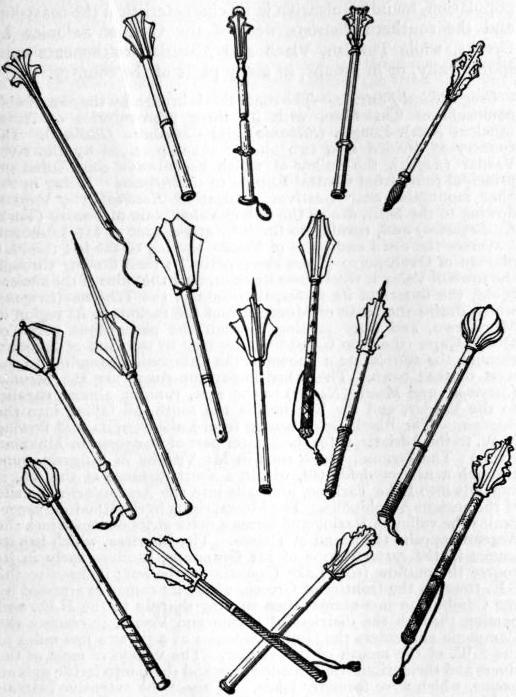
From Jewitt and Hope’s Corporation Plate and Insignia (1895), by permission of Bemrose & Co.