VOLUME XVII SLICE II Luray Cavern to Mackinac Island (continued 3)
Reading edition
Lycanthropy in Europe.—The wolf is the commonest form of the wer-animal (see Werwolf), though in the north the bear disputes its pre-eminence. In ancient Greece the dog was also associated with the belief. Marcellus of Sida, who wrote under the Antonines, gives an account of a disease which befell people in February; but a pathological state seems to be meant.
Lycanthropy in Africa.—In Abyssinia the power of transformation is attributed to the Boudas, and at the same time we have records of pathological lycanthropy (see below). Blacksmiths are credited with magical powers in many parts of the world, and it is significant that the Boudas are workers in iron and clay; in the Life of N. Pearce (i. 287) a European observer tells a story of a supposed transformation which took place in his presence and almost before his eyes; but it does not appear how far hallucination rather than coincidence must be invoked to explain the experience.
The Wer-tiger of the East Indies.—The Poso-Alfures of central Celebes believe that man has three souls, the inosa, the angga and the tanoana. The inosa is the vital principle; it can be detected in the veins and arteries; it is given to man by one of the great natural phenomena, more especially the wind. The angga is the intellectual part of man; its seat is unknown; after death it goes to the under-world, and, unlike the inosa, which is believed to be dissolved into its original elements, takes possession of an immaterial body. The tanoana is the divine in man and after death returns to its lord, Poewempala boeroe. It goes forth during sleep, and all that it sees it whispers into the sleeper’s ear and then he dreams. According to another account, the tanoana is the substance by which man lives, thinks and acts; the tanoana of man, plants and animals is of the same nature. A man’s tanoana can be strengthened by those of others; when the tanoana is long away or destroyed the man dies. The tanoana seems to be the soul of which lycanthropic feats are asserted.
Among the Toradjas of central Celebes it is believed that a man’s “inside” can take the form of a cat, wild pig, ape, deer or other animal, and afterwards resume human form; it is termed lamboyo. The exact relation of the lamboyo to the tanoana does not seem to be settled; it will be seen below that the view seems to vary. According to some the power of transformation is a gift of the gods, but others hold that werwolfism is contagious and may be acquired by eating food left by a werwolf or even by leaning one’s head against the same pillar. The Todjoers hold that any one who touches blood becomes a werwolf. In accordance with this view is the belief that werwolfism can be cured; the breast and stomach of the werman must be rubbed and pinched, just as when any other witch object has to be extracted. The patient drinks medicine, and the contagion leaves the body in the form of snakes and worms. There are certain marks by which a werman can be recognized. His eyes are unsteady and sometimes green with dark shadows underneath. He does not sleep soundly and fireflies come out of his mouth. His lips remain red in spite of betel chewing, and he has a long tongue. The Todjoers add that his hair stands on end.
Some of the forms of the lamboyo are distinguishable from ordinary animals by the fact that they run about among the houses; the wer-buffalo has only one horn, and the wer-pig transforms itself into an ants’ nest, such as hangs from trees. Some say that the werman does not really take the form of an animal himself, but, like the sorcerer, only sends out a messenger. The lamboyo attacks by preference solitary individuals, for he does not like to be observed. The victim feels sleepy and loses consciousness; the lamboyo then assumes human form (his body being, however, still at home) and cuts up his victim, scattering the fragments all about. He then takes the liver and eats it, puts the body together again, licks it with his long tongue and joins it together. When the victim comes to himself again he has no idea that anything unusual has happened to him. He goes home, but soon begins to feel unwell. In a few days he dies, but before his death he is able sometimes to name the werman to whom he has fallen a victim.
From this account it might be inferred that the lamboyo was identical with the tanoana; the absence of the lamboyo seems to entail a condition of unconsciousness, and it can assume human form. In other cases, however, the lamboyo seems to be analogous to the familiar of the sorcerer. The Toradjas tell a story of how a man once came to a house and asked the woman to give him a rendezvous; it was night and she was asleep; the question was put three times before the answer was given “in the tobacco plantation.” The husband was awake, and next day followed his wife, who was irresistibly drawn thither. The werman came to meet her in human form, although his body was engaged in building a new house, and caused the woman to faint by stamping three times on the ground. Thereupon the husband attacked the werman with a piece of wood, and the latter to escape transformed himself into a leaf; this the husband put into a piece of bamboo and fastened the ends so that he could not escape. He then went back to the village and put the bamboo in the fire. The werman said “Don’t,” and as soon as it was burnt he fell dead.
In another case a woman died, and, as her death was believed to be due to the malevolence of a werwolf, her husband watched by her body. For, like Indian witches, the werwolf, for some reason, wishes to revive his victim and comes in human form to carry off the coffin. As soon as the woman was brought to life the husband attacked the werwolf, who transformed himself into a piece of wood and was burnt. The woman remained alive, but her murderer died the same night.
According to a third form of the belief, the body of the werman is itself transformed. One evening a man left the hut in which a party were preparing to pass the night; one of his companions heard a deer and fired into the darkness. Soon after the man came back and said he had been shot. Although no marks were to be seen he died a few days later.
In Central Java we meet with another kind of wer-tiger. The power of transformation is regarded as due to inheritance, to the use of spells, to fasting and will-power, to the use of charms, &c. Save when it is hungry or has just cause for revenge it is not hostile to man; in fact, it is said to take its animal form only at night and to guard the plantations from wild pigs, exactly as the balams (magicians) of Yucatan were said to guard the corn fields in animal form. Variants of this belief assert that the werman does not recognize his friends unless they call him by name, or that he goes out as a mendicant and transforms himself to take vengeance on those who refuse him alms. Somewhat similar is the belief of the Khonds; for them the tiger is friendly; he reserves his wrath for their enemies, and a man is said to take the form of a tiger in order to wreak a just vengeance.
Lycanthropy in South America.—According to K. F. P. v. Martius the kanaima is a human being who employs poison to carry out his function of blood avenger; other authorities represent the kanaima as a jaguar, which is either an avenger of blood or the familiar of a cannibalistic sorcerer. The Europeans of Brazil hold that the seventh child of the same sex in unbroken succession becomes a wer-man or woman, and takes the form of a horse, goat, jaguar or pig.
II. As a pathological state lycanthropy may be described as a kind of hysteria, and may perhaps be brought into connexion with the form of it known as latah. It is characterized by the patient’s belief that he has been metamorphosed into an animal, and is often accompanied by a craving for strange articles of food, including the flesh of living beings or of corpses. In the lower stages of culture the state of the patient is commonly explained as due to possession, but where he leaves the neighbourhood of man real metamorphosis may be asserted, as in ordinary lycanthropic beliefs. Marcellus of Sida says that in Greece the patients frequented the tombs at night; they were recognizable by their yellow complexion, hollow eyes and dry tongue. The Garrows of India are said to tear their hair when they are seized with the complaint, which is put down to the use of a drug applied to the forehead; this recalls the stories of the witch’s salve in Europe. In Abyssinia the patient is usually a woman; two forms are distinguished, caused by the hyena and the leopard respectively. A kind of trance ushers in the fit; the fingers are clenched, the eyes glazed and the nostrils distended; the patient, when she comes to herself, laughs hideously and runs on all fours. The exorcist is a blacksmith; as a rule, he applies onion or garlic to her nose and proceeds to question the evil spirit.
Bibliography.—For the anthropological side of the subject see bibliography to Werwolf; also Tijdskrift voor indische Taal, Land en Volkenkunde, xxviii. 338, xli. 548, 568; Med. Zendelingsgenootschap, xxxix. 3, 16; O. Stoll, Suggestion, p. 418; W. H. Brett, Indians of British Guiana. For the pathological side, see Hack Tuke, Dict. of Psychological Medicine, s.v. “Lycanthropy”; Dict. des sciences médicales; Waldmeier, Autobiography, p. 64; A. J. Hayes, Source of Blue Nile, p. 286 seq.; Abh. phil.-hist. Klasse kgl. sächsische Gesellschaft der Wiss. 17, No. 3.
(N. W. T.)

LYCAON, in Greek mythology, son of Pelasgus, the mythical first king of Arcadia. He, or his fifty impious sons, entertained Zeus and set before him a dish of human flesh; the god pushed away the dish in disgust and either killed the king and his sons by lightning or turned them into wolves (Apollodorus iii. 8; Ovid, Metam. i. 198). Some say that Lycaon slew and dished up his own son Nyctimus (Clem. Alex. Protrept. ii. 36; Nonnus, Dionys. xviii. 20; Arnobius iv. 24). The deluge was said to have been sent by Zeus in the time of Deucalion in consequence of the sons’ impiety. Pausanias (viii. 2) says that Lycaon sacrificed a child to Zeus on the altar on mount Lycaeus, and immediately after the sacrifice was turned into a wolf. This gave rise to the story that a man was turned into a wolf at each annual sacrifice to Zeus Lycaeus, but recovered his human form if he abstained from human flesh for ten years. The oldest city, the oldest cultus (that of Zeus Lycaeus), and the first civilization of Arcadia are attributed to Lycaon. His story has been variously interpreted. According to Weizsäcker, he was an old Pelasgian or pre-Hellenic god, to whom human sacrifice was offered, bearing a non-Hellenic name similar to λύκος, whence the story originated of his metamorphosis into a wolf. His cult was driven out by that of the Hellenic Zeus, and Lycaon himself was afterwards represented as an evil spirit, who had insulted the new deity by setting human flesh before him. Robertson Smith considers the sacrifices offered to the wolf-Zeus in Arcadia to have been originally cannibal feasts of a wolf-tribe, who recognized the wolf as their totem. Usener and others identify Lycaon with Zeus Lycaeus, the god of light, who slays his son Nyctimus (the dark) or is succeeded by him, in allusion to the perpetual succession of night and day. According to Ed. Meyer, the belief that Zeus Lycaeus accepted human sacrifice in the form of a wolf was the origin of the myth that Lycaon, the founder of his cult, became a wolf, i.e. participated in the nature of the god by the act of sacrifice, as did all who afterwards duly performed it. W. Mannhardt sees in the ceremony an allusion to certain agricultural rites, the object of which was to prevent the failure of the crops and to avert pestilence (or to protect them and the flocks against the ravages of wolves). Others (e.g. V. Bérard) take Zeus Lycaeus for a Semitic Baal, whose worship was imported into Arcadia by the Phoenicians; Immerwahr identifies him with Zeus Phyxios, the god of the exile who flees on account of his having shed blood. Another explanation is that the place of the sacred wolf once worshipped in Arcadia was taken in cult by Zeus Lycaeus, and in popular tradition by Lycaon, the ancestor of the Arcadians, who was supposed to have been punished for his insulting treatment of Zeus. It is possible that the whole may be merely a reminiscence of a superstition similar to the familiar werwolf stories.
See articles by P. Weizsäcker in Roscher’s Lexikon and by G. Fougères (s.v. “Lykaia”) in Daremberg and Saglio’s Dictionnaire des antiquités; W. Immerwahr, Die Kulte und Mythen Arkadiens, 1. (1891), p. 14; L. R. Farnell, Cults of the Greek States, i. (1896), p. 40; A. Lang, Myth, Ritual and Religion (1899); C. Pascal, Studii di antichità e mitologia (1896), who sees in Lycaon a god of death honoured by human sacrifice; Ed. Meyer, Forschungen zur alten Geschichte, i. (1892), p. 60; W. Mannhardt, Wald- und Feldkulte, ii. (1905); G. Fougères, Mantinée et l’Arcadie orientale (1898), p. 202; V. Bérard, De l’origine des cultes arcadiens (1894); H. D. Müller, Mythologie der griechischen Stämme, ii. (1861), p. 78; H. Usener, Rheinisches Museum, liii. (1898), p. 375; G. Görres, Berliner Studien für classische Philologie, x. 1 (1889), who regards the Lycaea as a funeral festival connected with the changes of vegetation; Vollgraf, De Ovidii mythopoeia; a concise statement of the various forms of the legend in O. Gruppe, Griechische Mythologie, ii. p. 920, n. 4; see also Lycanthropy; D. Bassi, “Apollo Liceo,” in Rivista di storia antica, i. (1895); and Frazer’s Pausanias, iv. p. 189.
(J. H. F.)
LYCAONIA, in ancient geography, a large region in the interior of Asia Minor, north of Mount Taurus. It was bounded on the E. by Cappadocia, on the N. by Galatia, on the W. by Phrygia and Pisidia, while to the S. it extended to the chain of Mount Taurus, where it bordered on the country popularly called in earlier times Cilicia Tracheia and in the Byzantine period Isauria; but its boundaries varied greatly at different times. The name is not found in Herodotus, but Lycaonia is mentioned by Xenophon as traversed by Cyrus the younger on his march through Asia. That author describes Iconium as the last city of Phrygia; and in Acts xiv. 5 St Paul, after leaving Iconium, crossed the frontier and came to Lystra in Lycaonia. Ptolemy, on the other hand, includes Lycaonia as a part of the province of Cappadocia, with which it was associated by the Romans for administrative purposes; but the two countries are clearly distinguished both by Strabo and Xenophon and by authorities generally.
Lycaonia is described by Strabo as a cold region of elevated plains, affording pasture to wild asses and to sheep; and at the present day sheep abound, but asses are practically unknown. Amyntas, king of Galatia, to whom the district was for a time subject, maintained there not less than three hundred flocks. It forms part of the interior tableland of Asia Minor, and has an elevation of more than 3000 ft. It suffers from want of water, aggravated in some parts by abundance of salt in the soil, so that the northern portion, extending from near Iconium to the salt lake of Tatta and the frontiers of Galatia, is almost wholly barren, only small patches being cultivated near Iconium and the large villages. The soil, where water is supplied, is productive. In ancient times great attention was paid to storing and distributing the water, so that much land now barren was formerly cultivated and supported a large number of cities.
The plain is interrupted by some minor groups of mountains, of volcanic character, of which the Kara Dagh in the south, a few miles north of Karaman, rises above 7000 ft., while the Karadja Dagh, north-east of it, though of inferior elevation, presents a striking range of volcanic cones. The mountains in the north-west, near Iconium and Laodicea, are the termination of the Sultan Dagh range, which traverses a large part of Phrygia.
The Lycaonians appear to have been in early times to a great extent independent of the Persian empire, and were like their neighbours the Isaurians a wild and lawless race of freebooters; but their country was traversed by one of the great natural lines of high road through Asia Minor, from Sardis and Ephesus to the Cilician gates, and a few considerable towns grew up along or near this line. The most important was Iconium, in the most fertile spot in the country, of which it was always regarded by the Romans as the capital, although ethnologically it was Phrygian. It is still called Konia, and it was the capital of the Seljuk Turkish empire for several centuries. A little farther north, immediately on the frontier of Phrygia, stood Laodicea (Ladik), called Combusta, to distinguish it from the Phrygian city of that name; and in the south, near the foot of Mount Taurus, was Laranda, now called Karaman, which has given name to the province of Karamania. Derbe and Lystra, which appear from the Acts of the Apostles to have been considerable towns, were between Iconium and Laranda. There were many other towns, which became bishoprics in Byzantine times. Lycaonia was Christianized very early; and its ecclesiastical system was more completely organized in its final form during the 4th century than that of any other region of Asia Minor.
After the defeat of Antiochus the Great, Lycaonia was given by the Romans to Eumenes II., king of Pergamos. About 160 B.C. part of it, the “Tetrarchy of Lycaonia,” was added to Galatia; and in 129 B.C. the eastern half (usually called during the following 200 years Lycaonia proper) was given to Cappadocia as an eleventh strategia. In the readjustment of the Provinciae, 64 B.C., by Pompey after the Mithradatic wars, he gave the northern part of the tetrarchy to Galatia and the eastern part of the eleventh strategia to Cappadocia. The remainder was attached to Cilicia. Its administration and grouping changed often under the Romans. In A.D. 371 Lycaonia was first formed into a separate province. It now forms part of the Konia viláyet.
The Lycaonians appear to have retained a distinct nationality in the time of Strabo, but their ethnical affinities are unknown. The mention of the Lycaonian language in the Acts of the Apostles (xiv. 11) shows that the native language was spoken by the common people at Lystra about A.D. 50; and probably it was only later and under Christian influence that Greek took its place.
See Sir W. M. Ramsay, Historical Geography of Asia Minor (1890), Historical Commentary on Galatians (1899) and Cities of St Paul (1907); also an article on the topography in the Jahreshefte des Oesterr. Archaeolog. Instituts, 194 (Beiblatt) pp. 57-132.
(W. M. Ra.)
LYCEUM, the latinized form of Gr. Λύκειον, the name of a gymnasium and garden with covered walks, near the temple of Apollo Lyceus (Ἀπόλλων Λύκειος) at Athens. Aristotle taught here, and hence the name was applied to his school of philosophy. The name had been used in many languages for places of instruction, &c. In France the term lycée is given to the secondary schools which are administered by the state, in contradistinction to the communal collèges.
LYCIA, in ancient geography, a district in the S.W. of Asia Minor, occupying the coast between Caria and Pamphylia, and extending inland as far as the ridge of Mt Taurus. The region thus designated is a peninsula projecting southward from the great mountain masses of the interior. It is for the most part a rugged mountainous country, traversed by offshoots of the Taurus range, which terminate on the coast in lofty promontories. The coast, though less irregular than that of Caria, is indented by a succession of bays—the most marked of which is the Gulf of Macri (anc. Glaucus Sinus) in the extreme west. A number of smaller bays, and broken rocky headlands, with a few small islets, constitute the coast-line thence to the S.E. promontory of Lycia, formed by a long narrow tongue of rocky hill, known in ancient times as the “Sacred Promontory” (Hiera Acra), with three small adjacent islets, called the Chelidonian islands, which was regarded by some ancient geographers as the commencement of Mt. Taurus. Though the mountain ranges of Lycia are all offshoots of Mt, Taurus, in ancient times several of them were distinguished by separate names. Such were Daedala in the west, adjoining the Gulf of Macri, Cragus on the sea-coast, west of the valley of the Xanthus, Massicytus (10,000 ft.) nearly in the centre of the region, and Solyma in the extreme east above Phaselis (7800 ft.). The steep and rugged pass between Solyma and the sea, called the Climax (“Ladder”), was the only direct communication between Lycia and Pamphylia.
The only two considerable rivers are: (1) the Xanthus, which descends from the central mass of Mt Taurus, and flows through a narrow valley till it reaches the city of the same name, below which it forms a plain of some extent before reaching the sea, and (2) the Limyrus, which enters the sea near Limyra. The small alluvial plains at the mouths of these rivers are the only level ground in Lycia, but the hills that rise thence towards the mountains are covered with a rich arborescent vegetation. The upper valleys and mountain sides afford good pasture for sheep, and the main Taurus range encloses several extensive upland basin-shaped valleys (vailas), which are characteristic of that range throughout its extent (see Asia Minor).
The limits of Lycia towards the interior seem to have varied at different times. The high and cold upland tract to the north-east, called Milyas, was by some writers included in that province, though it is naturally more connected with Pisidia. According to Artemidorus (whose authority is followed by Strabo), the towns that formed the Lycian league in the days of its integrity were twenty-three in number; but Pliny states that Lycia once possessed seventy towns, of which only twenty-six remained in his day. Recent researches have fully confirmed the fact that the sea-coast and the valleys were thickly studded with towns, many of which are proved by existing remains to have been places of importance. By the aid of inscriptions the position of the greater part of the cities mentioned in ancient authors can be fixed. On the gulf of Glaucus, near the frontiers of Caria, stood Telmessus, an important place, while a short distance inland from it were the small towns of Daedala and Cadyanda. At the entrance of the valley of the Xanthus were Patara, Xanthus itself, and, a little higher up, Pinara on the west and Tlos on the east side of the valley, while Araxa stood at the head of the valley, at the foot of the pass leading into the interior. Myra, one of the most important cities of Lycia, occupied the entrance of the valley of the Andriacus; on the coast between this and the mouth of the Xanthus stood Antiphellus, while in the interior at a short distance were found Phellus, Cyaneae and Candyba. In the alluvial plain formed by the rivers Arycandus and Limyrus stood Limyra, and encircling the same bay the three small towns of Rhodiapolis, Corydalla and Gagae. Arycanda commanded the upper valley of the river of the same name. On the east coast stood Olympus, one of the cities of the league, while Phaselis, a little farther north, which was a much more important place, never belonged to the Lycian league and appears always to have maintained an independent position.
The cold upland district of the Milyas does not seem to have contained any town of importance. Podalia appears to have been its chief place. Between the Milyas and the Pamphylian Gulf was the lofty mountain range of Solyma, which was supposed to derive its name from the Solymi, a people mentioned by Homer in connexion with the Lycians and the story of Bellerophon. In the flank of this mountain, near a place called Deliktash, was the celebrated fiery source called the Chimaera, which gave rise to many fables. It has been visited in modern times by Captain F. Beaufort, T. A. B. Spratt and Edward Forbes, and other travellers, and is merely a stream of inflammable gas issuing from crevices in the rocks, such as are found in several places in the Apennines. No traces of recent volcanic action exist in Lycia.
History.—The name of the Lycians, Lukki, is first met with in the Tel el-Amarna tablets (1400 B.C.) and in the list of the nations from the eastern Mediterranean who invaded Egypt in the reign of Mineptah, the successor of Rameses II. At that time they seem to have occupied the Cilician coast. Their occupation of Lycia was probably later, and since the Lycian inscriptions are not found far inland, we may conclude that they entered the country from the sea. On the other hand the name appears to be preserved in Lycaonia, where some bands of them may have settled. According to Herodotus they called themselves Termilae, written Trmmile in the native inscriptions, and he further states that the original inhabitants of the country were the Milyans and Solymi, the Lycians being invaders from Crete. In this tradition there is a reminiscence of the fact that the Lycians had been sea-rovers before their settlement in Lycia. The Lycian Sarpedon was believed to have taken part in the Trojan war. The Lydians failed to subdue Lycia, but after the fall of the Lydian empire it was conquered by Harpagus the general of Cyrus, Xanthus or Arnna, the capital, being completely destroyed. While acknowledging the suzerainty of Persia, however, the Lycians remained practically independent, and for a time joined the Delian league. “The son of Harpagus” on the obelisk of Xanthus boasts of having sacked numerous cities in alliance with the Athenian goddess. The Lycians were incorporated into the empire of Alexander and his successors, but even after their conquest by the Romans, preserved their federal institutions as late as the time of Augustus. According to Strabo the principal towns in the league were Xanthus, Patara, Pinara, Olympus, Myra and Tlos; each of these had three votes in the general assembly, while the other towns had only two or one. Taxation and the appointment of the Lyciarch and other magistrates were vested in the assembly. Under Claudius Lycia was formally annexed to the Roman empire, and united with Pamphylia: Theodosius made it a separate province.
Antiquities.—Few parts of Asia Minor were less known in modern times than Lycia up to the 19th century. Captain Beaufort was the first to visit several places on the sea-coast, and the remarkable rock-hewn tombs of Telmessus had been already described by Dr Clarke, but it was Sir Charles Fellows who first discovered and drew attention to the extraordinary richness of the district in ancient remains, especially of a sepulchral character. His visits to the country in 1838 and 1840 were followed by an expedition sent by the British government in 1842 to transport to England the valuable monuments now in the British Museum, while Admiral Spratt and Edward Forbes explored the interior, and laid down its physical features on an excellent map. The monuments thus brought to light are among the most interesting of those discovered in Asia Minor, and prove the existence of a distinct native architecture, especially in the rock-cut tombs. But the theatres found in almost every town, some of them of very large size, are sufficient to attest the pervading influence of Greek civilization; and this is confirmed by the sculptures, which are for the most part wholly Greek. None of them, indeed, can be ascribed to a very early period, and hardly any trace can be found of the influence of Assyrian or other Oriental art.
One of the most interesting results of these recent researches has been the discovery of numerous inscriptions in the native language of the country, and written in an alphabet peculiar to Lycia. A few of these inscriptions are bilingual, in Greek and Lycian, and the clue thus afforded to their interpretation has been followed up, first by Daniel Sharpe and Moritz Schmidt, and in more recent years by J. Imbert, W. Arkwright, V. Thomsen, A. Torp, S. Bugge and E. Kalinka.
The alphabet was derived from the Doric alphabet of Rhodes, but ten other characters were added to it to express vocalic and other sounds not found in Greek. The attempts to connect the language with the Indo-European family have been unsuccessful; it belongs to a separate family of speech which we may term “Asianic.” Most of the inscriptions are sepulchral; by far the longest and most important is that on an obelisk found at Xanthus, which is a historical document, the concluding part of it being in a peculiar dialect, supposed to be an older and poetical form of the language. Among the deities mentioned are Trzzube (Trosobis) and Trqqiz or Trqqas.
Lycian art was modelled on that of the Greeks. The rock-cut tomb usually represented the house of the living, with an elaborate façade, but in one or two instances, notably that of the so-called Harpy-tomb, the façade is surmounted by a tall, square tower, in the upper part of which is the sepulchral chamber. Lycian sculpture followed closely the development of Greek sculpture, and many of the sculptures with which the tombs are adorned are of a high order of merit. The exquisite bas-reliefs on a Lycian sarcophagus now in the museum of Constantinople are among the finest surviving examples of classical art. The bas-reliefs were usually coloured. For the coinage, see Numismatics, section “Asia Minor.”
Authorities.—C. Fellows, Journal in Asia Minor (1839) and Discoveries in Lycia (1841); T. A. B. Spratt and E. Forbes, Travels in Lycia (1847); O. Benndorf and G. Niemann, Reisen im südwestlichen Kleinasien (1884); E. Petersen and F. von Luschan, Reisen in Lykien (1889); O. Treuber, Geschichte der Lykier (1887); G. Perrot and C. Chipiez, Histoire de l’art dans l’antiquité, v. (1890); P. Kretschmer, Einleitung in die Geschichte der griechischen Sprache (1896); S. Bugge, Lykische Studien (from 1897); A. Torp, Lykische Beiträge (from 1898); V. Thomsen, Études lyciennes (1899); E. Kalinka and R. Heberdey, Tituli Asiae Minoris, i. (1901); see also articles Xanthus, Myra, Patara.
(A. H. S.)
LYCK, or Lyk, a town of Germany, in the Prussian province of East Prussia, 112 m. by rail S.E. of Königsberg, and close to the frontier of Poland, on a lake and river of the same name. Pop. (1900) 11,386. It is the chief town of the region known as Masuria. On an island in the lake is a castle formerly belonging to the Teutonic order, and dating from 1273, now used as a prison. There are iron-foundries, distilleries, breweries, tanneries, paper mills and flour mills, and a trade in grain and cattle.
LYCOPHRON, Greek poet and grammarian, was born at Chalcis in Euboea. He flourished at Alexandria in the time of Ptolemy Philadelphus (285-247 B.C.). According to Suïdas, he was the son of Socles, but was adopted by Lycus of Rhegium. He was entrusted by Ptolemy with the task of arranging the comedies in the Alexandrian library, and as the result of his labours composed a treatise On Comedy. His own compositions, however, chiefly consisted of tragedies (Suïdas gives the titles of twenty, of which very few fragments have been preserved), which secured him a place in the Pleiad of Alexandrian tragedians. One of his poems, Alexandra or Cassandra, containing 1474 iambic lines, has been preserved entire. It is in the form of a prophecy uttered by Cassandra, and relates the later fortunes of Troy and of the Greek and Trojan heroes. References to events of mythical and later times are introduced, and the poem ends with a reference to Alexander the Great, who was to unite Asia and Europe in his world-wide empire. The style is so enigmatical as to have procured for Lycophron, even among the ancients, the title of “obscure” (σκοτεινός). The poem is evidently intended to display the writer’s knowledge of obscure names and uncommon myths; it is full of unusual words of doubtful meaning gathered from the older poets, and many long-winded compounds coined by the author. It has none of the qualities of poetry, and was probably written as a show-piece for the Alexandrian school. It was very popular in the Byzantine period, and was read and commented on very frequently; the collection of scholia by Isaac and John Tzetzes is very valuable, and the MSS. of the Cassandra are numerous.1 A few well-turned lines which have been preserved from Lycophron’s tragedies show a much better style; they are said to have been much admired by Menedemus of Eretria, although the poet had ridiculed him in a satyric drama. Lycophron is also said to have been a skilful writer of anagrams.
Editio princeps (1513); J. Potter (1697, 1702); L. Sebastiani (1803); L. Bachmann (1830); G. Kinkel (1880); E. Scheer (1881-1908), vol. ii. containing the scholia. The most complete edition is by C. von Holzinger (with translation, introduction and notes, 1895). There are translations by F. Dehèque (1853) and Viscount Royston (1806; a work of great merit). See also Wilamowitz-Möllendorff, De Lycophronis Alexandra (1884); J. Konze, De Dictione Lycophronis (1870). The commentaries of the brothers Tzetzes have been edited by C. O. Müller (1811).
1 Two passages of the Cassandra, 1446-1450 and 1226-1282, in which the career of the Roman people and their universal empire are spoken of, could not possibly have been written by an Alexandrian poet of 250 B.C. Hence it has been maintained by Niebuhr and others that the poem was written, by a later poet mentioned by Tzetzes, but the opinion of Welcker that these paragraphs are a later interpolation is generally considered more probable.
LYCOPODIUM, the principal genus of the Lycopodiaceae, a natural order of the Fern-allies (see Pteridophyta). They are flowerless herbs, with an erect, prostrate or creeping widely-branched stem, with small simple leaves which thickly cover the stem and branches. The “fertile” leaves are arranged in cones, and bear spore-cases (sporangia) in their axils, containing spores of one kind only. The prothallium developed from the spore is a subterranean mass of tissue of considerable size, and bears the male and female organs (antheridia and archegonia). There are about a hundred species widely distributed in temperate and tropical climates; five occur in Britain on heaths and moors, chiefly in mountainous districts, and are known as club-mosses The commonest species, L. clavatum, is also known as stag-horn moss.
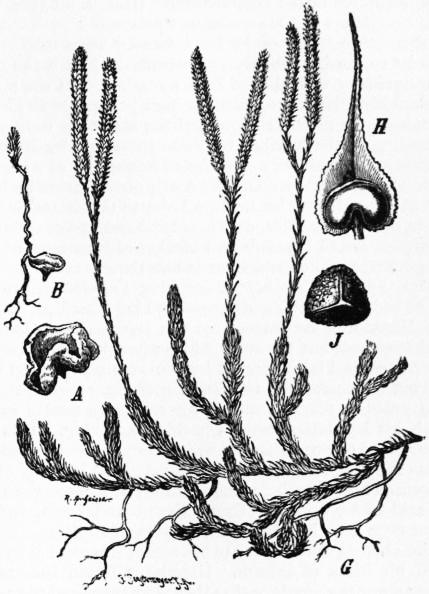
From Strasburger’s Lehrbuch der Botanik, by permission of Gustav Fischer.
Fig. 1.—Lycopodium clavatum.
Fig. 1.—Lycopodium clavatum. A, Old prothallus. B, Prothallus bearing a young sporophyte. G, Polian of a mature plant, showing the creeping habit, the adventitious roots and the specialized erect branches bearing the strobile or cones. H, Sporophyte bearing the single sporangium on its upper surface. J, Spore.
Gerard, in 1597, described two kinds of lycopodium (Herball, p. 1373) under the names Muscus denticulatus and Muscus clavatus (L. clavatum) as “Club Mosse or Woolfes Clawe Mosse,” the names being in Low Dutch, “Wolfs Clauwen,” from the resemblance of the club-like or claw-shaped shoots to the toes of a wolf, “whereupon we first named it Lycopodion.” Gerard also speaks of its emetic and many other supposed virtues. L. Selago and L. catharticum (a native of the Andes) have been said to be, at least when fresh, cathartic; but, with the exception of the spores of L. clavatum (“lycopodium powder”), lycopodium as a drug has fallen into disuse. The powder is used for rolling pills in, as a dusting powder for infants’ sores, &c. A tinctura lycopodii, containing one part of the powder to ten of alcohol (90%), has been given, in doses of 15 to 60 minims, in cases of irritation and spasm of the bladder. The powder is highly inflammable, and is used in pyrotechny and for artificial lightning on the stage. If the hand be covered with the powder it cannot be wetted on being plunged into water. Another use of lycopodium is for dyeing; woollen cloth boiled with species of lycopodium, as L. clavatum, becomes blue when dipped in a bath of Brazil wood.
LYCOSURA (mod. Palaeokastro or Siderokastro), a city of Arcadia, reputed to be the most ancient city in Greece, and to have been founded by Lycaon the son of Pelasgus. Its fame in later times was chiefly associated with the temple of Despoena, containing the colossal group made by Damophon of Messene, of Despoena and Demeter seated, with Artemis and the Titan Anytus standing beside them. The temple and considerable remains of the group of sculpture were found in 1889. The date of both has been a matter of dispute, Damophon being placed at dates varying from the 4th century B.C. to the age of Hadrian. But it has now been shown that he lived in the 2nd century B.C. Remains of a portico, altars and other structures have also been found.
See Πρακτικὰ τῆς Ἀρχ. Ἑταιρίας (1896); G. Dickens, Annual of British School at Athens, xii. and xiii.
LYCURGUS (Gr. Λυκοῦργος), in Greek history, the reputed founder of the Spartan constitution. Plutarch opens his biography of Lycurgus with these words: “About Lycurgus the lawgiver it is not possible to make a single statement that is not called in question. His genealogy, his travels, his death, above all, his legislative and constitutional activity have been variously recorded, and there is the greatest difference of opinion as to his date.” Nor has modern historical criticism arrived at any certain results. Many scholars, indeed, suppose him to be in reality a god or hero, appealing to the existence of a temple and cult of Lycurgus at Sparta as early as the time of Herodotus, (i. 66), and to the words of the Delphic oracle (Herod. i. 65)—
δίζω ἤ σε θεὸν μαντεύσομαι ἤ ἄνθρωπον. ἀλλ᾿ ἔτι καὶ μᾶλλον θεὸν ἔλπομαι, ὦ Λυκόοργε.
If this be so, he is probably to be connected with the cult of Apollo Lycius or with that of Zeus Lycaeus. But the majority of modern historians agree in accepting Lycurgus as an historical person, however widely they may differ about his work.
According to the Spartan tradition preserved by Herodotus, Lycurgus was a member of the Agiad house, son of Agis I. and brother of Echestratus. On the death of the latter he became regent and guardian of his nephew Labotas (Leobotes), who was still a minor. Simonides, on the other hand, spoke of him as a Eurypontid, son of Prytanis and brother of Eunomus, and later the tradition prevailed which made him the son of Eunomus and Dionassa, and half-brother of the king Polydectes, on whose death he became guardian of the young king Charillus. According to Herodotus he introduced his reforms immediately on becoming regent, but the story which afterwards became generally accepted and is elaborated by Plutarch represented him as occupying for some time the position of regent, then spending several years in travels, and on his return to Sparta carrying through his legislation when Charillus was king. This latter version helped to emphasize the disinterestedness of the lawgiver, and also supplied a motive for his travels—the jealousy of those who accused him of trying to supplant his nephew on the throne. He is said to have visited Crete, Egypt and Ionia, and some versions even took him to Spain, Libya and India.
Various beliefs were held as to the source from which Lycurgus derived his ideas of reform. Herodotus found the tradition current among the Spartans that they were suggested to Lycurgus by the similar Cretan institutions, but even in the 5th century there was a rival theory that he derived them from the Delphic oracle. These two versions are united by Ephorus, who argued that, though Lycurgus had really derived his system from Crete, yet to give it a religious sanction he had persuaded the Delphic priestess to express his views in oracular form.
The Reforms.—Herodotus says that Lycurgus changed “all the customs,” that he created the military organization of ἐνωμοτίαι (enomoties), τριηκάδες (triecades) and συσσίτια (syssitia), and that he instituted the ephorate and the council of elders. To him, further, are attributed the foundation of the apella (the citizen assembly), the prohibition of gold and silver currency, the partition of the land (γῆς ἀναδασμός) into equal lots, and, in general, the characteristic Spartan training (ἀγωγή). Some of these statements are certainly false. The council of elders and the assembly are not in any sense peculiar to Sparta, but are present in the heroic government of Greece as depicted in the Homeric poems. The ephors, again, are almost universally held to be either an immemorial heritage of the Dorian stock or—and this seems more probable—an addition to the Spartan constitution made at a later date than can be assigned to Lycurgus. Further, the tradition of the Lycurgan partition of the land is open to grave objections. Grote pointed out (History of Greece, pt. ii. ch. 6) that even from the earliest historical times we find glaring inequalities of property at Sparta, and that the tradition was apparently unknown to all the earlier Greek historians and philosophers down to Plato and Aristotle: Isocrates (xii. 259) expressly denied that a partition of land had ever taken place in the Spartan state. Again, the tradition presupposes the conquest by the Spartans of the whole, or at least the greater part, of Laconia, yet Lycurgus must fall in the period when the Spartans had not yet subjugated even the middle Eurotas plain, in which their city lay. Finally, we can point to an adequate explanation of the genesis of the tradition in the ideals of the reformers of the latter part of the 3rd century, led by the kings Agis IV. and Cleomenes III. (q.v.). To them the cause of Sparta’s decline lay in the marked inequalities of wealth, and they looked upon a redistribution of the land as the reform most urgently needed. But it was characteristic of the Greeks to represent the ideals of the present as the facts of the past, and so such a story as that of the Lycurgan γῆς ἀναδασμός may well have arisen at this time. It is at least noteworthy that the plan of Agis to give 4500 lots to Spartans and 15,000 to perioeci suspiciously resembles that of Lycurgus, in whose case the numbers are said to have been 9000 and 30,000 respectively. Lastly, the prohibition of gold and silver money cannot be attributed to Lycurgus, for at so early a period coinage was yet unknown in Greece.
Lycurgus, then, did not create any of the main elements of the Spartan constitution, though he may have regulated their powers and defined their position. But tradition represented him as finding Sparta the prey of disunion, weakness and lawlessness, and leaving her united, strong and subject to the most stable government which the Greek world had ever seen. Probably Grote comes near to the truth when he says that Lycurgus “is the founder of a warlike brotherhood rather than the lawgiver of a political community.” To him we may attribute the unification of the several component parts of the state, the strict military organization and training which soon made the Spartan hoplite the best soldier in Greece, and above all the elaborate and rigid system of education which rested upon, and in turn proved the strongest support of, that subordination of the individual to the state which perhaps has had no parallel in the history of the world.
Lycurgus’s legislation is very variously dated, and it is not possible either to harmonize the traditions or to decide with confidence between them. B. Niese (Hermes, xlii. 440 sqq.) assigns him to the first half of the 7th century B.C. Aristotle read Lycurgus’s name, together with that of Iphitus, on the discus at Olympia which bore the terms of the sacred truce, but even if the genuineness of the document and the identity of this Lycurgus with the Spartan reformer be granted, it is uncertain whether the discus belongs to the so-called first Olympiad, 776 B.C., or to an earlier date. Most traditions place Lycurgus in the 9th century: Thucydides, whom Grote follows, dates his reforms shortly before 804, Isocrates and Ephorus go back to 869, and the chronographers are divided between 821, 828 and 834 B.C. Finally, according to a tradition recorded by Xenophon (Resp. Laced. x. 8), he was contemporary with the Heraclidae, in which case he would belong to the 10th century B.C.
Authorities.—Our chief ancient authorities, besides Plutarch’s biography, are:—Herodotus i. 65; Xenophon, Respublica Lacedaemoniorum; Ephorus ap. Strabo x. 481, 482; Aristotle, Politics, ii.; Pausanias iii. and v. 4; and scattered passages in Plato, Isocrates, Polybius, Diodorus, Polyaenus, &c. Of modern works the most important are: E. Meyer, “Lykurgos von Sparta,” in Forschungen zur alten Geschichte (Halle, 1892), i. 211 sqq.; A. Kopstadt, De rerum Laconicarum constitutionis Lycurgeae origine et indole (Greifswald, 1849); H. K. Stein, Kritik der Überlieferung über den spartanischen Gesetzgeber Lykurg (Glatz, 1882); S. Wide, “Bemerkungen zur spartanischen Lykurglegende,” in Skand. Archiv. i. (1891), 90 sqq.; E. Nusselt, Das Lykurgproblem (Erlangen, 1898); H. Bazin, De Lycurgo (Paris, 1885); C. Reuss, De Lycurgea quae fertur agrorum divisione (Pforzheim, 1878); A. Busson, Lykurgos und die grosse Rhetra (Innsbruck, 1887); H. Gelzer, “Lykurg und die delphische Priesterschaft” in Rhein. Mus. xxviii. 1 sqq.; F. Winicker, Stand der Lykurgischen Frage (Graudenz, 1884); G. Attinger, Essai sur Lycurgue et ses institutions (Neuchâtel, 1892); the general Greek histories, and the works on the Spartan constitution cited under Sparta.
(M. N. T.)
LYCURGUS (c. 396-325 B.C.), one of the “ten” Attic orators. Through his father, Lycophron, he belonged to the old Attic priestly family of the Eteobutadae. He is said to have been a pupil both of Plato and of Isocrates. His early career is unknown, but after the real character of the struggle with Philip of Macedon became manifest he was recognized, with Demosthenes and Hypereides, as one of the chiefs of the national party. He left the care of external relations to his colleagues, and devoted himself to internal organization and finance. He managed the finances of Athens for twelve successive years (338-326), at first directly as treasurer of the revenues (ὁ ἑπὶ τῇ διοικήσει) for four years, and in two succeeding terms, when the actual office was forbidden him by law, through his son and a nominal official chosen from his party. Part of one of the deeds in which he rendered account of his term of office is still preserved in an inscription. During this time he raised the public income from 600 to 1200 talents yearly. He increased the navy, repaired the dockyards, and completed an arsenal, the σκευοθήκη designed by the architect Philo. He was also appointed to various other offices connected with the preservation and improvement of the city. He was very strict in his superintendence of the public morals, and passed a sumptuary law to restrain extravagance. He did much to beautify the city; he reconstructed the great Dionysiac theatre and the gymnasium in the Lyceum, and erected the Panathenaic stadium on the Ilissus. He is mentioned as the proposer of five laws, of which the most famous was that statues of the three great tragedians should be erected in the theatre, and that their works should be carefully edited and preserved among the state archives. For his services he was honoured with crowns, statues and a seat in the town hall; and after his death his friend Stratocles drew up a decree (still extant in pseudo-Plutarch, Vit. dec. orat. p. 851; see also E. L. Hicks, Greek Historical Inscriptions, 1st ed., No. 145), ordering the erection of a statue of bronze to Lycurgus, and granting the honours of the Prytaneum to his eldest son. He was one of the orators whose surrender was demanded by Alexander the Great, but the people refused to give him up. He died while president of the theatre of Dionysus, and was buried on the road leading to the Academy at the expense of the state.
Lycurgus was a man of action; his orations, of which fifteen were published, are criticized by the ancients for their awkward arrangement, harshness of style, and the tendency to digressions about mythology and history, although their noble spirit and lofty morality are highly praised. The one extant example, Against Leocrates, fully bears out this criticism. After the battle of Chaeroneia (338), in spite of the decree which forbade emigration under pain of death, Leocrates had fled from Athens. On his return (probably about 332) he was impeached by Lycurgus, but acquitted, the votes of the judges being equally divided.
The speech has been frequently edited. Editio princeps (Aldine, 1513); F. G. Kiessling (1847) with M. H. E. Meier’s commentary on pseudo-Plutarch’s Life of Lycurgus and the fragments of his speeches; C. Rehdantz (1876); T. Thalheim (1880); C. Scheibe (1885); F. Blass (ed. major, 1889), with bibliography of editions and articles (ed. minor, 1902); E. Sofer (Leipzig, 1905), with notes and introd. There is an index to Andocides, Lycurgus and Dinarchus by L. L. Forman (Oxford, 1897). The exhaustive treatise of F. Dürrbach, L’Orateur Lycurgue (1890), contains a list of the most important review articles on the financial and naval administration of Lycurgus and on his public works; see also C. Droege, De Lycurgo publicarum pecuniarum administratore (Minden, 1880). Several fragments of his various laws have been preserved in inscriptions (Corpus inscriptionum atticarum, ii. 162, 163, 173, 176, 180). On the history of the period see authorities under Demosthenes.
LYCURGUS, “the Logothete” (1772-1851), Greek leader in the War of Independence, was born in the island of Samos. He was educated at Constantinople, received the usual training, and followed the customary career of a Phanariot Greek. He accompanied Constantine Ypsilanti when he was appointed hospodar of Walachia, as secretary, and served Ypsilanti’s successor, Alexander Soutzos, as treasurer and chancellor (Logothete). In 1802 he returned to Samos, and having become suspected by the Turkish government was imprisoned. He fled to Smyrna, when he was pardoned and released by the Turks. When the War of Independence began he induced his countrymen to declare Samos independent, and was chosen ruler. His share in the War of Independence is chiefly memorable because he provoked the massacre of Chios in 1822. Lycurgus conducted an expedition of 2500 to that island, which was held by a Turkish garrison under Velna Pasha. His force was insufficient, the time was ill-chosen, for a strong Turkish fleet was at sea, and Lycurgus displayed utter incapacity as a military leader. After these events, he was deposed by the Samians, but recovered some influence and had a share in the defence of Samos against the Turks in 1824. When the island was left under the authority of Turkey by the protocol of the 3rd of February 1830, he helped to obtain autonomy for the Samians. He retired to Greece and died on the 22nd of May 1851.
See G. Finlay, History of the Greek Revolution (London, 1861).
LYDD, a market town and municipal borough in the southern parliamentary division of Kent, England, 71½ m. S.E. by E. of London by a branch of the South-Eastern & Chatham railway. Pop. (1901) 2675. It lies in the open lowland of Dunge Marsh. To the south-east are the bare shingle banks of the promontory of Dungeness. Its church of All Saints has a beautiful Perpendicular tower with rich vaulting within. The neighbourhood affords pasture for large flocks of sheep. On the land known as the Rypes, in the neighbourhood, there is a military camp, with artillery and rifle ranges; hence the name given to the explosive “lyddite.” The town is governed by a mayor, 4 aldermen and 12 councillors. Area, 12,043 acres.
The first settlement at Lydd (Hlide, Lide, Lyde) was probably due to its convenience as a fishing-station. After the Conquest it became a seaport of some consequence and although now, owing to the alteration of the coast, it stands nearly 3 m. inland a number of its inhabitants are still fishermen. In 774 land in Lydd was granted by Offa to the monks of Christ Church, Canterbury, and the archbishop of Canterbury evidently held the lordship of the town from an early date. At some time before the reign of Edward I. Lydd was made a member of the Cinque Port of Romney, and in 1290 was granted the same liberties and free customs as the Cinque Ports on condition of aiding the service of its head-port to the crown with one ship. This charter was confirmed by Edward III. in 1365. The corporation also possesses documents of 1154, 1399 and 1413, granting to the archbishop’s men of Lydd the privileges enjoyed by the Cinque Ports and confirming all former privileges. Lydd is called a borough in the Hundred Rolls. Its incorporation under a bailiff, of which there is evidence in the 15th century, may have been due to the archbishop or to the court of Shepway, but it was not incorporated by the crown until 1885, when, by a charter under the Municipal Acts, the last bailiff was elected the first mayor. In 1494 a grant was made to the bailiff, jurats and commonalty of a yearly fair on the 12th of July and two days following. A fair was held under this grant until 1874.
LYDENBURG, a town and district of the Transvaal, South Africa. The town is 60 m. by rail N.N.E. of Belfast on the Pretoria-Delagoa Bay railway. Pop. (1904) 1523. It is picturesquely situated on the Spekboom tributary of the Olifants river at an altitude of 4900 ft. Some 15 m. E. is the Mauchberg (8725 ft.), the highest point in the Transvaal. The town is the chief centre for the Lydenburg goldfields. Next to Lydenburg the most important settlement in these goldfields is Pilgrim’s Rest, pop. (1904) 1188, 23 m. N.E. of Lydenburg. Lydenburg (the town of suffering) was founded in 1846 by Boers who two years previously had established themselves farther north at Ohrigstad, which they abandoned on account of the fever endemic there. Lydenburg at once became the capital of a district (of the same name) which then embraced all the eastern part of the Transvaal. In 1856 the Boers of Lydenburg separated from their brethren and proclaimed an independent republic, which was, however, incorporated with the South African Republic in 1860. The discovery of gold near the town was made in 1869, and in 1873 the first successful goldfield in the Transvaal was opened here. It was not until 1910, however, that Lydenburg was placed in railway communication with the rest of the country. The present district of Lydenburg consists of the north-east and central parts of the original district. In the Lulu Mountains, a spur of the Drakensberg, and some 40 m. N.W. of Lydenburg, was the stronghold of the Kaffir chief Sikukuni, whose conflict with the Boers in 1876 was one of the causes which led to the annexation of the Transvaal by Great Britain in 1877. (See Transvaal: History.)
LYDFORD, or Lidford, a village, once an important town, in the western parliamentary division of Devonshire, England, near the western confines of Dartmoor, 27 m. N. of Plymouth by the London & South-Western railway. From its Perpendicular church of St Petrock fine views of the Dartmoor tors are seen. The village stands on the small river Lyd, which traverses a deep narrow chasm, crossed by a bridge of single span; and at a little distance a tributary stream forms a cascade in an exquisite glen. Close to the church are slight remains of the castle of Lydford.
Lydford (Lideford) was one of the four Saxon boroughs of Devon, and possessed a mint in the days of Æthelred the Unready. It first appears in recorded history in 997, when the Danes made a plundering expedition up the Tamar and Tavy as far as “Hlidaforda.” In the reign of Edward the Confessor it was the most populous centre in Devonshire after Exeter, but the Domesday Survey relates that forty houses had been laid waste since the Conquest, and the town never recovered its former prosperity; the history from the 13th century centres round the castle, which is first mentioned in 1216, when it was granted to William Briwere, and was shortly afterwards fixed as the prison of the stannaries and the meeting-place of the Forest Courts of Dartmoor. A gild at Lideford is mentioned in 1180, and the pipe roll of 1195 records a grant for the reestablishment of the market. In 1238 the borough, which had hitherto been crown demesne, was bestowed by Henry III. on Richard, earl of Cornwall, who in 1268 obtained a grant of a Wednesday market and a three days’ fair at the feast of St Petrock. The borough had a separate coroner and bailiff in 1275, but it was never incorporated by charter, and only once, in 1300, returned members to parliament. Lydford prison is described in 1512 as “one of the most hainous, contagious and detestable places in the realm,” and “Lydford Law” was a by-word for injustice. At the time of the Commonwealth the castle was entirely in ruins, but in the 18th century it was restored and again used as a prison and as the meeting-place of the manor and borough courts.
LYDGATE, JOHN (c. 1370-c. 1451), English poet, was born at the village of Lydgate, some 6 or 7 m. from Newmarket. It is, however, with the Benedictine abbey of Bury St Edmunds that he is chiefly associated. Probably he was educated at the school attached to the monastery, and in his Testament he has drawn a lively picture of himself as a typical orchard-robbing boy, who had scant relish for matins, fought, and threw creed and paternoster at the cock. He was ordained sub-deacon in 1389, deacon in 1393, and priest in 1397. These dates are valuable as enabling us to fix approximately the date of his birth, which must have occurred somewhere about 1370. Lydgate passed as a portent of learning, and, according to Bale, he pursued his studies not only at both the English universities but in France and Italy. Koeppel (see Laurents de Premierfait und John Lydgates Bearbeitungen von Boccaccios De Casibus, Munich, 1885) has thrown much doubt on this statement as regards Italy, but Lydgate knew France and visited Paris in an official capacity in 1426. Bale is also the authority for another assertion that figures in what has been aptly termed the poet’s “traditional biography,” viz. that Lydgate, on completing his own education, kept school for the sons of noblemen and gentlemen. This “traditional biography” prolongs his life to the year 1461, but it is quite improbable that he lived many years after 1446, when Abbot Curteys died and John Baret, treasurer of Bury, signed an extant receipt for a pension which he shared with Lydgate, and which continued to be paid till 1449. If it be true, as Bishop Alcock of Ely affirms, that Lydgate wrote a poem on the loss of France and Gascony, it seems necessary to suppose that he lived two years longer, and thus indications point to the year 1451, or thereabouts, as the date of his death.
Lydgate had a consuming passion for literature, and it was probably that he might indulge this taste more fully that in 1434 he retired from the priorate of Hatfield Broadoak (or Hatfield Regis), to which he had been appointed in June 1423. After 1390—but whilst he was still a young man—he made the acquaintance of Geoffrey Chaucer, with whose son Thomas he was on terms of considerable intimacy. This friendship appears to have decided Lydgate’s career, and in his Troy-book and elsewhere are reverent and touching tributes to his “master.” The passages in question do not exaggerate his obligations to the “well of English.” The themes of all his more ambitious poems can be traced to Chaucerian sources. The Story of Thebes, for instance, was doubtless suggested by the “romance” which Cressida and her companions are represented as reading when interrupted by Pandarus (Troilus and Cressida, II. xii.-xvi.). The Falls of Princes, again, is merely the Monk’s Tale “writ large.”
Lydgate is a most voluminous writer. The Falls of Princes alone comprises 7000 stanzas; and his authentic compositions reach the enormous total of 150,000 lines. Cursed with such immoderate fluency Lydgate could not sustain himself at the highest level of artistic excellence; and, though imbued with a sense of the essentials of poetry, and eager to prove himself in its various manifestations, he stinted himself of the self-discipline necessary to perfection of form. As the result the bulk of his composition is wholly or comparatively rough-hewn. That he was capable of better work than is suggested by his average accomplishment is shown by two allegorical poems—the Complaint of the Black Knight and the Temple of Glass (once attributed to Hawes). In these he reveals himself as a not unworthy successor of Chaucer, and the pity of it is that he should have squandered his powers in a futile attempt to create an entire literature. For a couple of centuries Lydgate’s reputation equalled, if it did not surpass, that of his master. This was in a sense only natural, since he was the real founder of the school of which Stephen Hawes was a distinguished ornament, and which “held the field” in English letters during the long and dreary interval between Chaucer and Spenser. One of the most obvious defects of this school is excessive attachment to polysyllabic terms. Lydgate is not quite so great a sinner in this respect as are some of his successors, but his tendency cannot be mistaken, and John Metham is amply justified in his censure—
Eke John Lydgate, sometime monk of Bury, His books indited with terms of rhetoric And half-changed Latin, with conceits of poetry.
Pedantry was an inevitable effect of the early Renaissance. French literature passed through the same phase, from which indeed it was later in emerging; and the ultimate consequence was the enrichment of both languages. It must be conceded as no small merit in Lydgate that, in an age of experiment he should have succeeded so often in hitting the right word. Thomas Warton remarks on his lucidity. Since his writings are read more easily than Chaucer’s, the inference is plain—that he was more effectual as a maker of our present English. In spite of that, Lydgate is characteristically medieval—medieval in his prolixity, his platitude, his want of judgment and his want of taste; medieval also in his pessimism, his Mariolatry and his horror of death. These attributes jarred on the sensitive Ritson, who racked his brains for contumelious epithets such as “stupid and disgusting,” “cart-loads of rubbish,” &c.; and during the greater part of the 18th and 19th centuries Lydgate’s reputation was at its lowest ebb. Recent criticism has been far more impartial, and almost too much respect has been paid to his attainments, especially in the matter of metre, though Lydgate himself, with offensive lightheartedness, admits his poor craftsmanship.
Lydgate’s most doughty and learned apologist is Dr Schick, whose preface to the Temple of Glass embodies practically all that is known or conjectured concerning this author, including the chronological order of his works. With the exception of the Damage and Destruction in Realms—an account of Julius Caesar, his wars and his death—they are all in verse and extremely multifarious—narrative, devotional hagiological, philosophical and scientific, allegorical and moral, historical, satirical and occasional. The Troy-book, undertaken at the command of Henry V., then prince of Wales, dates from 1412-1420; the Story of Thebes from 1420-1422; and the Falls of Princes towards 1430. His latest work was Secreta Secretorum or Secrets of Old Philosophers, rhymed extracts from a pseudo-Aristotelian treatise. Lydgate certainly possessed extraordinary versatility, which enabled him to turn from elaborate epics to quite popular poems like the Mumming at Hertford, A Ditty of Women’s Horns and London Lickpenny. The humour of this last is especially bright and effective, but, unluckily for the author, the piece is believed to have been retouched by some other hand. The longer efforts partake of the nature of translations from sundry medieval compilations like those of Guido di Colonna and Boccaccio, which are in Latin.
See publications of the Early English Text Society, especially the Temple of Glass, edited by Dr Schick; Koeppel’s Lydgate’s Story of Thebes, eine Quellenuntersuchung (Munich, 1884), and the same scholar’s Laurents de Premierfait und John Lydgates Bearbeitungen von Boccaccios De Casibus Illustrium Virorum (Munich, 1885); Warton’s History of English Poetry; Ritson’s Bibliotheca Anglo-Poetica; Furnivall’s Political Poems (E. E. T. S.); and Sidney Lee’s article in the Dict. Nat. Biog.
(F. J. S.)
LYDIA, in ancient geography, a district of Asia Minor, the boundaries of which it is difficult to fix, partly because they varied at different epochs. The name is first found under the form of Luddi in the inscriptions of the Assyrian king Assur-bani-pal, who received tribute from Gyges about 660 B.C. In Homer we read only of Maeonians (Il. ii. 865, v. 43, x. 431), and the place of the Lydian capital Sardis is taken by Hydē (Il. xx. 385), unless this was the name of the district in which Sardis stood (see Strabo xiii. p. 626).1 The earliest Greek writer who mentions the name is Mimnermus of Colophon, in the 37th Olympiad. According to Herodotus (i. 7), the Meiones (called Maeones by other writers) were named Lydians after Lydus, the son of Attis, in the mythical epoch which preceded the rise of the Heraclid dynasty. In historical times the Maeones were a tribe inhabiting the district of the upper Hermus, where a town called Maeonia existed (Pliny, N.H. v. 30; Hierocles, p. 670). The Lydians must originally have been an allied tribe which bordered upon them to the north-west, and occupied the plain of Sardis or Magnesia at the foot of Tmolus and Sipylus. They were cut off from the sea by the Greeks, who were in possession, not only of the Bay of Smyrna, but also of the country north of Sipylus as far as Temnus in the pass (boghaz), through which the Hermus forces its way from the plain of Magnesia into its lower valley.2 In a Homeric epigram the ridge north of the Hermus, on which the ruins of Temnus lie, is called Sardenē. Northward the Lydians extended at least as far as the Gygaean Lake (Lake Coloe, mod. Mermereh), and the Sardenē range (mod. Dumanli Dagh). The plateau of the Bin Bir Tepē, on the southern shore of the Gygaean Lake, was the chief burial-place of the inhabitants of Sardis, and is still thickly studded with tumuli, among which is the “tomb of Alyattes” (260 ft. high). Next to Sardis the chief city was Magnesia ad Sipylum (q.v.), in the neighbourhood of which is the famous seated figure of “Niobe” (Il. xxiv. 614-617), cut out of the rock, and probably intended to represent the goddess Cybele, to which the Greeks attached their legend of Niobe. According to Pliny (v. 31), Tantalis, afterwards swallowed up by earthquake in the pool Salē or Saloē, was the ancient name of Sipylus and “the capital of Maeonia” (Paus. vii. 24; Strabo xii. 579). Under the Heraclid dynasty the limits of Lydia must have been already extended, since according to Strabo (xiii. 590), the authority of Gyges reached as far as the Troad. Under the Mermnads Lydia became a maritime as well as an inland power. The Greek cities were conquered, and the coast of Ionia included within the Lydian kingdom. The successes of Alyattes and of Croesus finally changed the Lydian kingdom into a Lydian empire, and all Asia Minor westward of the Halys, except Lycia, owned the supremacy of Sardis. Lydia never again shrank back into its original dimensions. After the Persian conquest the Maeander was regarded as its southern boundary, and in the Roman period it comprised the country between Mysia and Caria on the one side and Phrygia and the Aegean on the other.
Lydia proper was exceedingly fertile. The hill-sides were clothed with vine and fir, and the rich broad plain of Hermus produced large quantities of corn and saffron. The climate of the plain was soft but healthy, though the country was subject to frequent earthquakes. The Pactolus, which flowed from the fountain of Tarnē in the Tmolus mountains, through the centre of Sardis, into the Hermus, was believed to be full of golden sand; and gold mines were worked in Tmolus itself, though by the time of Strabo the proceeds had become so small as hardly to pay for the expense of working them (Strabo xiii. 591). Maeonia on the east contained the curious barren plateau known to the Greeks as the Katakekaumenē (“Burnt country”), once a centre of volcanic disturbance. The Gygaean lake (where remains of pile dwellings have been found) still abounds with carp.
Herodotus (i. 171) tells us that Lydus was a brother of Mysus and Car. The statement is on the whole borne out by the few Lydian, Mysian and Carian words that have been preserved, as well as by the general character of the civilization prevailing among the three nations. The race was probably a mixed one, consisting of aborigines and Aryan immigrants. It was characterized by industry and a commercial spirit, and, before the Persian conquest, by bravery. The religion of the Lydians resembled that of the other civilized nations of Asia Minor. It was a nature worship, which at times became wild and sensuous. By the side of the supreme god Medeus stood the sun-god Attis, as in Phrygia the chief object of the popular cult. He was at once the son and bridegroom of Cybele (q.v.) or Cybebe, the mother of the gods, whose image carved by Broteas, son of Tantalus, was adored on the cliffs of Sipylus (Paus. iii. 22). The cult may have been brought westward by the Hittites who have left memorials of themselves in the pseudo-Sesostris figures of Kara-bel (between Sardis and Ephesus) as well as in the figure of the Mother-goddess, the so-called Niobe. At Ephesus, where she was adored under the form of a meteoric stone, she was identified with the Greek Artemis (see also Great Mother of the Gods). Her mural crown is first seen in the Hittite sculptures of Boghaz Keui (see Pteria and Hittites) on the Halys. The priestesses by whom she was served are depicted in early art as armed with the double-headed axe, and the dances they performed in her honour with shield and bow gave rise to the myths which saw in them the Amazons, a nation of woman-warriors. The pre-Hellenic cities of the coast—Smyrna, Samorna (Ephesus), Myrina, Cyme, Priene and Pitane—were all of Amazonian origin, and the first three of them have the same name as the Amazon Myrina, whose tomb was pointed out in the Troad. The prostitution whereby the Lydian girls gained their dowries (Herod, i. 93) was a religious exercise, as among the Semites, which marked their devotion to the goddess Cybele. In the legend of Heracles, Omphale takes the place of Cybele, and was perhaps her Lydian title. Heracles is here the sun-god Attis in a new form; his Lydian name is unknown, since E. Meyer has shown (Zeitschr. d. Morg. Gesell. xxxi. 4) that Sandon belongs not to Lydia but to Cilicia. By the side of Attis stood Manes or Men, identified later with the Moon-god.
According to the native historian Xanthus (460 B.C.) three dynasties ruled in succession over Lydia. The first, that of the Attiads, is mythical. It was headed by a god, and included geographical personages like Lydus, Asies and Meies, or such heroes of folk-lore as Cambletes, who devoured his wife. To this mythical age belongs the colony which, according to Herodotus (i. 94), Tyrsenus, the son of Attis, led to Etruria. Xanthus, however, puts Torrhebus in the place of Tyrsenus, and makes him the eponym of a district in Lydia. It is doubtful whether Xanthus recognized the Greek legends which brought Pelops from Lydia, or rather Maeonia, and made him the son of Tantalus. The second dynasty was also of divine origin, but the names which head it prove its connexion with the distant East. Its founder, a descendant of Heracles and Omphale, was, Herodotus tells us (i. 7), a son of Ninus and grandson of Belus. The Assyrian inscriptions have shown that the Assyrians had never crossed the Halys, much less known the name of Lydia, before the age of Assur-bani-pal, and consequently the theory which brought the Heraclids from Nineveh must be given up. But the Hittites, another Oriental people, deeply imbued with the elements of Babylonian culture, had overrun Asia Minor and established themselves on the shores of the Aegean before the reign of the Egyptian king Rameses II.
The subject allies who then fight under their banners include the Masu or Mysians and the Dardani of the Troad, while the Hittites have left memorials in Lydia. G. Dennis discovered an inscription in Hittite hieroglyphics attached to the figure of “Niobe” on Sipylus, and a similar inscription accompanies the figure (in which Herodotus, ii. 106, wished to see Sesostris or Rameses II.) in the pass of Karabel. We learn from Eusebius that Sardis was first captured by the Cimmerii 1078 B.C.; and since it was four centuries later before the real Cimmerii (q.v.) appeared on the horizon of history, we may perhaps find in the statement a tradition of the Hittite conquest. As the authority of the Hittite satraps at Sardis began to decay the Heraclid dynasty arose. According to Xanthus, Sadyattes and Lixus were the successors of Tylon the son of Omphale. After lasting five hundred and five years, the dynasty came to an end in the person of Sadyattes, as he is called by Nicolas of Damascus, whose account is doubtless derived from Xanthus. The name Candaules, given him by Herodotus, meant “dog strangler” and was a title of the Lydian Hermes. Gyges (q.v.) put him to death and established the dynasty of the Mermnads, 687 B.C. Gyges initiated a new policy, that of making Lydia a maritime power; but towards the middle of his reign the kingdom was overrun by the Cimmerii. The lower town of Sardis was taken, and Gyges sent tribute to Assur-bani-pal, as well as two Cimmerian chieftains he had himself captured in battle. A few years later Gyges joined in the revolt against Assyria, and the Ionic and Carian mercenaries he despatched to Egypt enabled Psammetichus to make himself independent. Assyria, however, was soon avenged. The Cimmerian hordes returned, Gyges was slain in battle (652 B.C.), and Ardys his son and successor returned to his allegiance to Nineveh. The second capture of Sardis on this occasion was alluded to by Callisthenes (Strabo xiii. 627). Alyattes, the grandson of Ardys, finally succeeded in extirpating the Cimmerii, as well as in taking Smyrna, and thus providing his kingdom with a port. The trade and wealth of Lydia rapidly increased, and the Greek towns fell one after the other before the attacks of the Lydian kings. Alyattes’s long reign of fifty-seven years saw the foundation of the Lydian empire. All Asia Minor west of the Halys acknowledged his sway, and the six years’ contest he carried on with the Medes was closed by the marriage of his daughter Aryenis to Astyages. The Greek cities were allowed to retain their own institutions and government on condition of paying taxes and dues to the Lydian monarch, and the proceeds of their commerce thus flowed into the imperial exchequer. The result was that the king of Lydia became the richest prince of his age. Alyattes was succeeded by Croesus (q.v.), who had probably already for some years shared the royal power with his father, or perhaps grandfather, as V. Floigl thinks (Geschichte des semitischen Alterthums, p. 20). He reigned alone only fifteen years, Cyrus the Persian, after an indecisive battle on the Halys, marching upon Sardis, and capturing both acropolis and monarch (546 B.C.). The place where the acropolis was entered was believed to have been overlooked by the mythical Meles when he carried the lion round his fortress to make it invulnerable; it was really a path opened by one of the landslips, which have reduced the sandstone cliff of the acropolis to a mere shell, and threaten to carry it altogether into the plain below. The revolt of the Lydians under Pactyas, whom Cyrus had appointed to collect the taxes, caused the Persian king to disarm them, though we can hardly credit the statement that by this measure their warlike spirit was crushed. Sardis now became the western capital of the Persian empire, and its burning by the Athenians was the indirect cause of the Persian War. After Alexander the Great’s death, Lydia passed to Antigonus; then Achaeus made himself king at Sardis, but was defeated and put to death by Antiochus. The country was presented by the Romans to Eumenes, and subsequently formed part of the proconsular province of Asia. By the time of Strabo (xiii. 631) its old language was entirely supplanted by Greek.
The Lydian empire may be described as the industrial power of the ancient world. The Lydians were credited with being the inventors, not only of games such as dice, huckle-bones and ball (Herod, i. 94), but also of coined money. The oldest known coins are the electrum coins of the earlier Mermnads (Madden, Coins of the Jews, pp. 19-21), stamped on one side with a lion’s head or the figure of a king with bow and quiver; these were replaced by Croesus with a coinage of pure gold and silver. To the latter monarch were probably due the earliest gold coins of Ephesus (Head, Coinage of Ephesus, p. 16). The electrum coins of Lydia were of two kinds, one weighing 168.4 grains for the inland trade, and another of 224 grains for the trade with Ionia. The standard was the silver mina of Carchemish (as the Assyrians called it) which contained 8656 grains. Originally derived by the Hittites from Babylonia, but modified by themselves, this standard was passed on to the nations of Asia Minor during the period of Hittite conquest, but was eventually superseded by the Phoenician mina of 11,225 grains, and continued to survive only in Cyprus and Cilicia (see also Numismatics). The inns, which the Lydians were said to have been the first to establish (Herod. i. 94), were connected with their attention to commercial pursuits. Their literature has wholly perished. They were celebrated for their music and gymnastic exercises, and their art formed a link between that of Asia Minor and that of Greece. R. Heberdey’s excavations at Ephesus since 1896, like those of D. G. Hogarth in 1905, belong to the history of Greek and not native art. The ivory figures, however, found by Hogarth on the level of the earliest temple of Artemis show Asiatic influence, and resemble the so-called “Phoenician” ivories from the palace of Sargon at Calah (Nimrud). For a description of a pectoral of white gold, ornamented with the heads of animals, human faces and the figure of a goddess, discovered in a tomb on Tmolus, see Academy, January 15, 1881, p. 45. Lydian sculpture was probably similar to that of the Phrygians. Phallic emblems, for averting evil, were plentiful; the summit of the tomb of Alyattes is crowned with an enormous one of stone, about 9 ft. in diameter. The tumulus itself is 281 yds. in diameter and about half a mile in circumference. It has been partially excavated by G. Spiegelthal and G. Dennis, and a sepulchral chamber discovered in the middle, composed of large well-cut and highly polished blocks of marble, the chamber being 11 ft. long, nearly 8 ft. broad and 7 ft. high. Nothing was found in it except a few ashes and a broken vase of Egyptian alabaster. The stone basement which, according to Herodotus, formerly surrounded the mound has disappeared.
Bibliography.—A. von Ölfers, Über die lydischen Königsgräber bei Sardes (1858); H. Gelzer in the Rheinisches Museum (1874); R. Schubert, Geschichte der Könige von Lydien (1884); G. Perrot and C. Chipiez, Histoire de l’art dans l’antiquité, v. (1890); O. Radet, La Lydie et le monde grec au temps des Mermnades (1893); G. Maspero, Dawn of Civilization, pp. 232-301 (1892) and Passing of the Empires, pp. 339, 388, 603-621 (1900); J. Keil and A. von Premerstein, Bericht über eine Reise in Lydien (1908).
(A. H. S.)
1 Pliny (v. 30) makes it the Maeonian name.
2 See Sir W. M. Ramsay in the Journal of Hellenic Studies, ii. 2.
LYDUS (“The Lydian”), JOANNES LAURENTIUS, Byzantine writer on antiquarian subjects, was born at Philadelphia in Lydia about A.D. 490. At an early age he set out to seek his fortune in Constantinople, and held high court and state offices under Anastasius and Justinian. In 552 he lost favour, and was dismissed. The date of his death is not known, but he was probably alive during the early years of Justin II. (reigned 565-578). During his retirement he occupied himself in the compilation of works on the antiquities of Rome, three of which have been preserved: (1) De Ostentis (Περὶ διοσημειῶν), on the origin and progress of the art of divination; (2) De Magistratibus reipublicae Romanae (Περὶ ἀρχῶν τῆς Ῥωμαίων πολιτείας), especially valuable for the administrative details of the time of Justinian; (3) De Mensibus (Περὶ μηνῶν), a history of the different festivals of the year. The chief value of these books consists in the fact that the author made use of the works (now lost) of old Roman writers on similar subjects. Lydus was also commissioned by Justinian to compose a panegyric on the emperor, and a history of his successful campaign against Persia; but these, as well as some poetical compositions, are lost.
Editions of (1) by C. Wachsmuth (1897), with full account of the authorities in the prolegomena; of (2) and (3) by R. Wünsch (1898-1903); see also the essay by C. B. Hase (the first editor of the De Ostentis) prefixed to I. Bekker’s edition of Lydus (1837) in the Bonn Corpus scriptorum hist. Byzantinae.
LYE (O. Eng. léag, cf. Dutch loog, Ger. Lauge, from the root meaning to wash, see in Lat. lavare, and Eng. “lather,” froth of soap and water, and “laundry”), the name given to the solution of alkaline salts obtained by leaching or lixiviating wood ashes with water, and sometimes to a solution of a caustic alkali. Lixiviation (Lat. lixivium, lye, lix, ashes) is the action of separating, by the percolation of water, a soluble from an insoluble substance. “Leaching,” the native English term for this process, is from “leach,” to water, the root probably being the same as in “lake.”
LYELL, SIR CHARLES (1797-1875), British geologist, was the eldest son of Charles Lyell of Kinnordy, Forfarshire, and was born on the 14th of November 1797, on the family estate in Scotland. His father (1767-1849) was known both as a botanist and as the translator of the Vita Nuova and the Convito of Dante: the plant Lyellia was named after him. From his boyhood Lyell had a strong inclination for natural history, especially entomology, a taste which he cultivated at Bartley Lodge in the New Forest, to which his family had removed soon after his birth. In 1816 he entered Exeter College, Oxford, where the lectures of Dr Buckland first drew his attention to geological study. After taking his degree of B.A. in 1819 (M.A. in 1821) he entered Lincoln’s Inn, and in 1825, after a delay caused by chronic weakness of the eyes, he was called to the bar, and went on the western circuit for two years. During this time he was slowly gravitating towards the life of a student of science. In 1819 he had been elected a fellow of the Linnean and Geological Societies, communicating his first paper, “On a Recent Formation of Freshwater Limestone in Forfarshire,” to the latter society in 1822, and acting as one of the honorary secretaries in 1823. In that year he went to France, with introductions to Cuvier, Humboldt and other men of science, and in 1824 made a geological tour in Scotland in company with Dr Buckland. In 1826 he was elected a fellow of the Royal Society, from which in later years he received both the Copley and Royal medals; and in 1827 he finally abandoned the legal profession, and devoted himself to geology.
At this time he had already begun to plan his chief work, The Principles of Geology. The subsidiary title, “An Attempt to Explain the Former Changes of the Earth’s Surface by Reference to Causes now in Operation,” gives the keynote of the task to which Lyell devoted his life. A journey with Murchison in 1828 gave rise to joint papers on the volcanic district of Auvergne and the Tertiary formations of Aix-en-Provence. After parting with Murchison he studied the marine remains of the Italian Tertiary Strata and then conceived the idea of dividing this geological system into three or four groups, characterized by the proportion of recent to extinct species of shells. To these groups, after consulting Dr Whewell as to the best nomenclature, he gave the names now universally adopted—Eocene (dawn of recent), Miocene (less of recent), and Pliocene (more of recent); and with the assistance of G. P. Deshayes he drew up a table of shells in illustration of this classification. The first volume of the Principles of Geology appeared in 1830, and the second in January 1832. Received at first with some opposition, so far as its leading theory was concerned, the work had ultimately a great success, and the two volumes had already reached a second edition in 1833 when the third, dealing with the successive formations of the earth’s crust, was added. Between 1830 and 1872 eleven editions of this work were published, each so much enriched with new material and the results of riper thought as to form a complete history of the progress of geology during that interval. Only a few days before his death Sir Charles finished revising the first volume of the 12th edition; the revision of the second volume was completed by his nephew Mr (afterwards Sir) Leonard Lyell; and the work appeared in 1876.
In August 1838 Lyell published the Elements of Geology, which, from being originally an expansion of one section of the Principles, became a standard work on stratigraphical and palaeontological geology. This book went through six editions in Lyell’s lifetime (some intermediate editions being styled Manual of Elementary Geology), and in 1871 a smaller work, the Student’s Elements of Geology, was based upon it. His third great work, The Antiquity of Man, appeared in 1863, and ran through three editions in one year. In this he gave a general survey of the arguments for man’s early appearance on the earth, derived from the discoveries of flint implements in post-Pliocene strata in the Somme valley and elsewhere; he discussed also the deposits of the Glacial epoch, and in the same volume he first gave in his adhesion to Darwin’s theory of the origin of species. A fourth edition appeared in 1873.
In 1831-1833 Lyell was professor of geology at King’s College, London, and delivered while there a course of lectures, which became the foundation of the Elements of Geology. In 1832 he married Mary (1809-1873) eldest daughter of Leonard Horner (q.v.), and she became thenceforward associated with him in all his work, and by her social qualities making his home a centre of attraction. In 1834 he made an excursion to Denmark and Sweden, the result of which was his Bakerian lecture to the Royal Society “On the Proofs of the gradual Rising of Land in certain Parts of Sweden.” He also brought before the Geological Society a paper “On the Cretaceous and Tertiary Strata of Seeland and Möen.” In 1835 he became president of the Geological Society. In 1837 he was again in Norway and Denmark, and in 1841 he spent a year in travelling through the United States, Canada and Nova Scotia. This last journey, together with a second one to America in 1845, resulted not only in papers, but also in two works not exclusively geological, Travels in North America (1845) and A Second Visit to the United States (1849). During these journeys he estimated the rate of recession of the falls of Niagara, the annual average accumulation of alluvial matter in the delta of the Mississippi, and studied those vegetable accumulations in the “Great Dismal Swamp” of Virginia, which he afterwards used in illustrating the formation of beds of coal. He also studied the coal-formations in Nova Scotia, and discovered in company with Dr (afterwards Sir J. W.) Dawson (q.v.) of Montreal, the earliest known landshell, Pupa vetusta, in the hollow stem of a Sigillaria. In bringing a knowledge of European geology to bear upon the extended formations of North America Lyell rendered immense service. Having visited Madeira and Teneriffe in company with G. Hartung, he accumulated much valuable evidence on the age and deposition of lava-beds and the formation of volcanic cones. He also revisited Sicily in 1858, when he made such observations upon the structure of Etna as refuted the theory of “craters of elevation” upheld by Von Buch and Élie de Beaumont (see Phil. Trans., 1859).
Lyell was knighted in 1848, and was created a baronet in 1864, in which year he was president of the British Association at Bath. He was elected corresponding member of the French Institute and of the Royal Academy of Sciences at Berlin, and was created a knight of the Prussian Order of Merit.
During the later years of his life his sight, always weak, failed him altogether. He died on the 22nd of February 1875, and was buried in Westminster Abbey. Among his characteristics were his great thirst for knowledge, his perfect fairness and sound judgment; while the extreme freshness of his mind enabled him to accept and appreciate the work of younger men.
The Lyell Medal, established in 1875 under the will of Sir Charles Lyell, is cast in bronze and is to be awarded annually (or from time to time) by the Council of the Geological Society. The medallist may be of any country or either sex. Not less than one-third of the annual interest of a sum of £2000 is to be awarded with the medal; the remaining interest, known as the Lyell Geological Fund, is to be given in one or more portions at the discretion of the Council for the encouragement of geological science.
See Life, Letters and Journals of Sir Charles Lyell, Bart., edited by his sister-in-law, Mrs Lyell (2 vols., 1881); Charles Lyell and Modern Geology, by T. G. Bonney (1895).
(H. B. Wo.)
LYLY (Lilly, or Lylie), JOHN (1553-1606), English writer, the famous author of Euphues, was born in Kent in 1553 or 1554. At the age of sixteen, according to Wood, he became a student of Magdalen College, Oxford, where in due time he proceeded to his bachelor’s and master’s degrees (1573 and 1575), and from whence we find him in 1574 applying to Lord Burghley “for the queen’s letters to Magdalen College to admit him fellow.” The fellowship, however, was not granted, and Lyly shortly after left the university. He complains of what seems to have been a sentence of rustication passed upon him at some period in his academical career, in his address to the gentlemen scholars of Oxford affixed to the second edition of the first part of Euphues, but in the absence of any further evidence it is impossible to fix either its date or its cause. If we are to believe Wood, he never took kindly to the proper studies of the university. “For so it was that his genius being naturally bent to the pleasant paths of poetry (as if Apollo had given to him a wreath of his own bays without snatching or struggling) did in a manner neglect academical studies, yet not so much but that he took the degrees in arts, that of master being compleated 1575.” After he left Oxford, where he had already the reputation of “a noted wit,” Lyly seems to have attached himself to Lord Burghley. “This noble man,” he writes in the “Glasse for Europe,” in the second part of Euphues (1580), “I found so ready being but a straunger to do me good, that neyther I ought to forget him, neyther cease to pray for him, that as he hath the wisdom of Nestor, so he may have the age, that having the policies of Ulysses he may have his honor, worthy to lyve long, by whom so many lyve in quiet, and not unworthy to be advaunced by whose care so many have been preferred.” Two years later we possess a letter of Lyly to the treasurer, dated July 1582, in which the writer protests against some accusation of dishonesty which had brought him into trouble with his patron, and demands a personal interview for the purpose of clearing his character. What the further relations between them were we have no means of knowing, but it is clear that neither from Burghley nor from the queen did Lyly ever receive any substantial patronage. In 1578 he began his literary career by the composition of Euphues, or the Anatomy of Wit, which was licensed to Gabriel Cawood on the 2nd of December, 1578, and published in the spring of 1579. In the same year the author was incorporated M.A. at Cambridge, and possibly saw his hopes of court advancement dashed by the appointment in July of Edmund Tylney to the office of master of the revels, a post at which, as he reminds the queen some years later, he had all along been encouraged to “aim his courses.” Euphues and his England appeared in 1580, and, like the first part of the book, won immediate popularity. For a time Lyly was the most successful and fashionable of English writers. He was hailed as the author of “a new English,” as a “raffineur de l’Anglois”; and, as Edmund Blount, the editor of his plays, tells us in 1632, “that beautie in court which could not parley Euphuism was as little regarded as she which nowe there speakes not French.” After the publication of Euphues, however, Lyly seems to have entirely deserted the novel form himself, which passed into the hands of his imitators, and to have thrown himself almost exclusively into play-writing, probably with a view to the mastership of revels whenever a vacancy should occur. Eight plays by him were probably acted before the queen by the children of the Chapel Royal and the children of St Paul’s between the years 1584 and 1589, one or two of them being repeated before a popular audience at the Blackfriars Theatre. Their brisk lively dialogue, classical colour and frequent allusions to persons and events of the day maintained that popularity with the court which Euphues had won. Lyly sat in parliament as member for Hindon in 1589, for Aylesbury in 1593, for Appleby in 1597 and for Aylesbury a second time in 1601. In 1589 Lyly published a tract in the Martin Marprelate controversy, called Pappe with an hatchet, alias a figge for my Godsonne; Or Crack me this nut; Or a Countrie Cuffe, &c.1 About the same time we may probably date his first petition to Queen Elizabeth. The two petitions, transcripts of which are extant among the Harleian MSS., are undated, but in the first of them he speaks of having been ten years hanging about the court in hope of preferment, and in the second he extends the period to thirteen years. It may be conjectured with great probability that the ten years date from 1579, when Edmund Tylney was appointed master of the revels with a tacit understanding that Lyly was to have the next reversion of the post. “I was entertained your Majestie’s servaunt by your own gratious favor,” he says, “strengthened with condicions that I should ayme all my courses at the Revells (I dare not say with a promise, but with a hopeful Item to the Revercion) for which these ten yeres I have attended with an unwearyed patience.” But in 1589 or 1590 the mastership of the revels was as far off as ever—Tylney in fact held the post for thirty-one years—and that Lyly’s petition brought him no compensation in other directions may be inferred from the second petition of 1593. “Thirteen yeres your highnes servant but yet nothing. Twenty freinds that though they saye they will be sure, I finde them sure to be slowe. A thousand hopes, but all nothing; a hundred promises but yet nothing. Thus casting up the inventory of my friends, hopes, promises and tymes, the summa totalis amounteth to just nothing.” What may have been Lyly’s subsequent fortunes at court we do not know. Edmund Blount says vaguely that Elizabeth “graced and rewarded” him, but of this there is no other evidence. After 1590 his works steadily declined in influence and reputation; other stars were in possession of the horizon; and so far as we know he died poor and neglected in the early part of James I.’s reign. He was buried in London at St Bartholomew the Less on the 20th of November, 1606. He was married, and we hear of two sons and a daughter.