VOLUME XVI SLICE II Lamennais, Robert de to Latini, Brunetto
Reading edition
Articles in This Slice
LAMENNAIS, HUGUES FÉLICITÉ ROBERT DE LANTARA, SIMON MATHURIN
LAMENTATIONS LANTERN
LAMETH, ALEXANDRE THÉODORE VICTOR LANTERN-FLY
LAMETTRIE, JULIEN OFFRAY DE LANTERNS OF THE DEAD
LAMIA LANTHANUM
LAMMAS LANUVIUM
LÄMMERGEYER LANZA, DOMENICO GIOVANNI GIUSEPPE MARIA
LAMOIGNON LANZAROTE
LAMONT, JOHANN VON LANZI, LUIGI
LAMORICIÈRE, CHRISTOPHE LÉON LOUIS JUCHAULT DE LAOAG
LA MOTHE LE VAYER, FRANÇOIS DE LAOCOON
LA MOTTE, ANTOINE HOUDAR DE LAODICEA
LAMOUREUX, CHARLES LAODICEA, SYNOD OF
LAMP LAOMEDON
LAMP-BLACK LAON
LAMPEDUSA LAOS (territory)
LAMPERTHEIM LAOS (Thai race)
LAMPETER LÂO-TSZE
LAMPOON LA PAZ (department of Bolivia)
LAMPREY LA PAZ (capital of Bolivia)
LAMPROPHYRES LA PÉROUSE, JEAN-FRANÇOIS DE GALAUP
LAMPSACUS LAPIDARY, and GEM CUTTING
LAMPSTAND LAPILLI
LANARK LAPIS LAZULI
LANARKSHIRE LAPITHAE
LANCASHIRE LA PLACE, JOSUÉ DE
LANCASTER, HOUSE OF LAPLACE, PIERRE SIMON
LANCASTER, HENRY LAPLAND
LANCASTER, SIR JAMES LA PLATA
LANCASTER, JOHN OF GAUNT LAPORTE, ROLAND
LANCASTER, JOSEPH LA PORTE
LANCASTER, THOMAS LAPPA
LANCASTER (England) LAPPARENT, ALBERT AUGUSTE COCHON DE
LANCASTER (Ohio, U.S.A.) LAPPENBERG, JOHANN MARTIN
LANCASTER (Pennsylvania, U.S.A.) LAPRADE, PIERRE MARTIN VICTOR RICHARD DE
LANCE LAPSE
LANCELOT LAPWING
LANCET LAPWORTH, CHARLES
LANCEWOOD LAR
LAN-CHOW-FU LARA
LANCIANO LARAISH
LANCRET, NICOLAS LARAMIE
LAND LARBERT
LANDAU LARCENY
LANDECK LARCH
LANDEN, JOHN LARCHER, PIERRE HENRI
LANDEN (Belgium) LARCIUS, TITUS
LANDER, RICHARD LEMON and JOHN LARD
LANDES (department in France) LARDNER, DIONYSIUS
LANDES (region of France) LARDNER, NATHANIEL
LANDESHUT LAREDO
LANDGRAVE LA RÉOLE
LANDLORD AND TENANT LARES
LANDON, CHARLES PAUL LA RÉVELLIÈRE-LÉPEAUX, LOUIS MARIE DE
LANDON, LETITIA ELIZABETH LARGENTIÈRE
LANDOR, WALTER SAVAGE LARGILLIÈRE, NICOLAS
LANDOUR LARGS
LAND REGISTRATION LARGUS, SCRIBONIUS
LANDSBERG AM LECH LARINO
LANDSBERG-AN-DER-WARTHE LARISSA
LANDSBERG BEI HALLE LĀRISTĀN
LANDSEER, SIR EDWIN HENRY LARIVEY, PIERRE
LAND’S END LARK
LANDSHUT LARKHALL
LANDSKNECHT LARKHANA
LANDSKRONA LARKSPUR
LANDSTURM LARNACA
LANDWEHR LA ROCHE
LANE, EDWARD WILLIAM LA ROCHEFOUCAULD
LANE, GEORGE MARTIN LA ROCHEFOUCAULD, FRANÇOIS DE
LANE, JAMES HENRY LA ROCHEFOUCAULD-LIANCOURT, FRANÇOIS ALEXANDRE FRÉDÉRIC
LANESSAN, JEAN MARIE ANTOINE DE LA ROCHEJACQUELEIN, DE
LANFRANC LA ROCHELLE
LANFREY, PIERRE LA ROCHE-SUR-YON
LANG, ANDREW LAROMIGUIÈRE, PIERRE
LANG, KARL HEINRICH LARRA, MARIANO JOSÉ DE
LANGDELL, CHRISTOPHER COLUMBUS LARSA
LANGDON, JOHN LARTET, EDOUARD
LANGE, ANNE FRANÇOISE ELIZABETH LARVAL FORMS
LANGE, ERNST PHILIPP KARL LARYNGITIS
LANGE, FRIEDRICH ALBERT LA SABLIÈRE, MARGUERITE DE
LANGE, JOHANN PETER LA SALE, ANTOINE DE
LANGEAIS LASALLE, ANTOINE CHEVALIER LOUIS COLLINET
LANGEN, JOSEPH LA SALLE, RENÉ ROBERT CAVELIER
LANGENBECK, BERNHARD RUDOLF KONRAD VON LA SALLE, ST JEAN BAPTISTE DE
LANGENSALZA LA SALLE (Illinois, U.S.A.)
LANGHAM, SIMON LASAULX, ARNOLD CONSTANTIN PETER FRANZ VON
LANGHOLM LASCAR
LANGHORNE, JOHN LASCARIS, CONSTANTINE
LANGIEWICZ, MARYAN LASCARIS, JOANNES
LANGLAND, WILLIAM LAS CASAS, BARTOLOMÉ DE
LANGLEY, SAMUEL PIERPONT LAS CASES, EMMANUEL AUGUSTIN DIEUDONNÉ MARIN JOSEPH
LANGLOIS, HIPPOLYTE LASHIO
LANGPORT LASKER, EDUARD
LANGREO LASKI
LANGRES LAS PALMAS
LANGTOFT, PETER LASSALLE, FERDINAND
LANGTON, JOHN LASSEN, CHRISTIAN
LANGTON, STEPHEN LASSEN, EDUARD
LANGTON, WALTER LASSO, ORLANDO
LANGTRY, LILLIE LASSO
LANGUAGE LAST
LANGUEDOC LASUS
LANGUET, HUBERT LAS VEGAS
LANGUR LASWARI
LANG VON WELLENBURG, MATTHÄUS LATACUNGA
LANIER, SIDNEY LA TAILLE, JEAN DE
LANJUINAIS, JEAN DENIS LATAKIA
LANMAN, CHARLES ROCKWELL LATEEN
LANNES, JEAN LA TÈNE
LANNION LATERAN COUNCILS
LANNOY, GUILLEBERT DE LATERITE
LANOLIN LATH
LA NOUE, FRANÇOIS DE LATHE
LANSDOWNE, WILLIAM PETTY FITZMAURICE LATHROP, FRANCIS
LANSDOWNE LATIMER, HUGH
LANSING LATINA, VIA
LANSING MAN LATINI, BRUNETTO
LANSQUENET

LAMENNAIS, HUGUES FÉLICITÉ ROBERT DE (1782-1854), French priest, and philosophical and political writer, was born at Saint Malo, in Brittany, on the 19th of June 1782. He was the son of a shipowner of Saint Malo ennobled by Louis XVI. for public services, and was intended by his father to follow mercantile pursuits. He spent long hours in the library of an uncle, devouring the writings of Rousseau, Pascal and others. He thereby acquired a vast and varied, though superficial, erudition, which determined his subsequent career. Of a sickly and sensitive nature, and impressed by the horrors of the French Revolution, his mind was early seized with a morbid view of life, and this temper characterized him throughout all his changes of opinion and circumstance. He was at first inclined towards rationalistic views, but partly through the influence of his brother Jean Marie (1775-1861), partly as a result of his philosophical and historical studies, he felt belief to be indispensable to action and saw in religion the most powerful leaven of the community. He gave utterance to these convictions in the Réflexions sur l’état de l’église en France pendant le 18ième siècle et sur sa situation actuelle, published anonymously in Paris in 1808. Napoleon’s police seized the book as dangerously ideological, with its eager recommendation of religious revival and active clerical organization, but it awoke the ultramontane spirit which has since played so great a part in the politics of churches and of states.
As a rest from political strife, Lamennais devoted most of the following year to a translation, in exquisite French, of the Speculum Monachorum of Ludovicus Blosius (Louis de Blois) which he entitled Le Guide spirituel (1809). In 1811 he received the tonsure and shortly afterwards became professor of mathematics in an ecclesiastical college founded by his brother at Saint Malo. Soon after Napoleon had concluded the Concordat with Pius VII. he published, in conjunction with his brother, De la tradition de l’église sur l’institution des évêques (1814), a writing occasioned by the emperor’s nomination of Cardinal Maury to the archbishopric of Paris, in which he strongly condemned the Gallican principle which allowed bishops to be created irrespective of the pope’s sanction. He was in Paris at the first Bourbon restoration in 1814, which he hailed with satisfaction, less as a monarchist than as a strenuous apostle of religious regeneration. Dreading the Cent Jours, he escaped to London, where he obtained a meagre livelihood by giving French lessons in a school founded by the abbé Jules Carron for French émigrés; he also became tutor at the house of Lady Jerningham, whose first impression of him as an imbecile changed into friendship. On the final overthrow of Napoleon in 1815 he returned to Paris, and in the following year, with many misgivings as to his calling, he yielded to his brother’s and Carron’s advice, and was ordained priest by the bishop of Rennes.
The first volume of his great work, Essai sur l’indifférence en matière de religion, appeared in 1817 (Eng. trans. by Lord Stanley of Alderley, London, 1898), and affected Europe like a spell, investing, in the words of Lacordaire, a humble priest with all the authority once enjoyed by Bossuet. Lamennais denounced toleration, and advocated a Catholic restoration to belief. The right of private judgment, introduced by Descartes and Leibnitz into philosophy and science, by Luther into religion and by Rousseau and the Encyclopaedists into politics and society, had, he contended, terminated in practical atheism and spiritual death. Ecclesiastical authority, founded on the absolute revelation delivered to the Jewish people, but supported by the universal tradition of all nations, he proclaimed to be the sole hope of regenerating the European communities. Three more volumes (Paris, 1818-1824) followed, and met with a mixed reception from the Gallican bishops and monarchists, but with the enthusiastic adhesion of the younger clergy. The work was examined by three Roman theologians, and received the formal approval of Leo XII. Lamennais visited Rome at the pope’s request, and was offered a place in the Sacred College, which he refused. On his return to France he took a prominent part in political work, and together with Chateaubriand, the vicomte de Villèle, was a regular contributor to the Conservateur, but when Villèle became the chief of the supporters of absolute monarchy, Lamennais withdrew his support and started two rival organs, Le Drapeau blanc and Le Mémorial catholique. Various other minor works, together with De la religion considérée dans ses rapports avec l’ordre civil et politique (2 vols., 1825-1826), kept his name before the public.
He retired to La Chênaie and gathered round him a host of brilliant disciples, including C. de Montalembert, Lacordaire and Maurice de Guérin, his object being to form an organized body of opinion to persuade the French clergy and laity to throw off the yoke of the state connexion. With Rome at his back, as he thought, he adopted a frank and bold attitude in denouncing the liberties of the Gallican church. His health broke down and he went to the Pyrenees to recruit. On his return to La Chênaie in 1827 he had another dangerous illness, which powerfully impressed him with the thought that he had only been dragged back to life to be the instrument of Providence. Les Progrès de la révolution et de la guerre contre l’église (1828) marked Lamennais’s complete renunciation of royalist principles, and henceforward he dreamt of the advent of a theocratic democracy. To give effect to these views he founded L’Avenir, the first number of which appeared on the 16th of October 1830, with the motto “God and Liberty.” From the first the paper was aggressively democratic; it demanded rights of local administration, an enlarged suffrage, universal freedom of conscience, freedom of instruction, of meeting, and of the press. Methods of worship were to be criticized, improved or abolished in absolute submission to the spiritual, not to the temporal authority. With the help of Montalembert, he founded the Agence générale pour la défense de la liberté religieuse, which became a far-reaching organization, it had agents all over the land who noted any violations of religious freedom and reported them to headquarters. As a result, L’Avenir’s career was stormy, and the opposition of the Conservative bishops checked its circulation; Lamennais, Montalembert and Lacordaire resolved to suspend it for a while, and they set out to Rome in November 1831 to obtain the approval of Gregory XVI. The “pilgrims of liberty” were, after much opposition, received in audience by the pope, but only on the condition that the object which brought them to Rome should not be mentioned. This was a bitter disappointment to such earnest ultramontanes, who received, a few days after the audience, a letter from Cardinal Pacca, advising their departure from Rome and suggesting that the Holy See, whilst admitting the justice of their intentions, would like the matter left open for the present. Lacordaire and Montalembert obeyed; Lamennais, however, remained in Rome, but his last hope vanished with the issue of Gregory’s letter to the Polish bishops, in which the Polish patriots were reproved and the tsar was affirmed to be their lawful sovereign. He then “shook the dust of Rome from off his feet.” At Munich, in 1832, he received the encyclical Mirari vos, condemning his policy; as a result L’Avenir ceased and the Agence was dissolved.
Lamennais, with his two lieutenants, submitted, and deeply wounded, retired to La Chênaie. His genius and prophetic insight had turned the entire Catholic church against him, and those for whom he had fought so long were the fiercest of his opponents. The famous Paroles d’un croyant, published in 1834 through the intermediary of Sainte-Beuve, marks Lamennais’s severance from the church. “A book, small in size, but immense in its perversity,” was Gregory’s criticism in a new encyclical letter. A tractate of aphorisms, it has the vigour of a Hebrew prophecy and contains the choicest gems of poetic feeling lost in a whirlwind of exaggerations and distorted views of kings and rulers. The work had an extraordinary circulation and was translated into many European languages. It is now forgotten as a whole, but the beautiful appeals to love and human brotherhood are still reprinted in every hand-book of French literature.
Henceforth Lamennais was the apostle of the people alone. Les Affaires de Rome, des maux de l’église et de la société (1837) came from old habit of religious discussions rather than from his real mind of 1837, or at most it was but a last word. Le Livre du peuple (1837), De l’esclavage moderne (1839), Politique à l’usage du peuple (1839), three volumes of articles from the journal of the extreme democracy, Le Monde, are titles of works which show that he had arrived among the missionaries of liberty, equality and fraternity, and he soon got a share of their martyrdom. Le Pays et le gouvernement (1840) caused him a year’s imprisonment. He struggled through difficulties of lost friendships, limited means and personal illnesses, faithful to the last to his hardly won dogma of the sovereignty of the people, and, to judge by his contribution to Louis Blanc’s Revue du progrès was ready for something like communism. He was named president of the “Société de la solidarité républicaine,” which counted half a million adherents in fifteen days. The Revolution of 1848 had his sympathies, and he started Le Peuple constituant; however, he was compelled to stop it on the 10th of July, complaining that silence was for the poor, but again he was at the head of La Révolution démocratique et sociale, which also succumbed. In the constituent assembly he sat on the left till the coupe d’état of Napoleon III. in 1851 put an end to all hopes of popular freedom. While deputy he drew up a constitution, but it was rejected as too radical. Thereafter a translation of Dante chiefly occupied him till his death, which took place in Paris on the 27th of February 1854. He refused to be reconciled to the church, and was buried according to his own directions at Père La Chaise without funeral rites, being mourned by a countless concourse of democratic and literary admirers.
During the most difficult time of his republican period he found solace for his intellect in the composition of Une voix de prison, written during his imprisonment in a similar strain to Les paroles d’un croyant. This is an interesting contribution to the literature of captivity; it was published in Paris in 1846. He also wrote Esquisse de philosophie (1840). Of the four volumes of this work the third, which is an exposition of art as a development from the aspirations and necessities of the temple, stands pre-eminent, and remains the best evidence of his thinking power and brilliant style.
There are two so-called Œuvres complètes de Lamennais, the first in 10 volumes (Paris, 1836-1837), and the other in 10 volumes (Paris, 1844); both these are very incomplete and only contain the works mentioned above. The most noteworthy of his writings subsequently published are: Amschaspands et Darvands (1843), Le Deuil de la Pologne (1846), Mélanges philosophiques et politiques (1856), Les Évangiles (1846) and La Divine Comédie, these latter being translations of the Gospels and of Dante.
Part of his voluminous correspondence has also appeared. The most interesting volumes are the following: Correspondance de F. de Lamennais, edited by E. D. Forgues (2 vols., 1855-1858); Œuvres inédites de F. Lamennais, edited by Ange Blaize (2 vols., 1866); Correspondance inédite entre Lamennais et le baron de Vitrolles, edited by E. D. Forgues (1819-1853); Confidences de Lamennais, lettres inédites de 1821 à 1848, edited by A. du Bois de la Villerabel (1886); Lamennais d’après des documents inédits, by Alfred Roussel (Rennes, 2 vols., 1892); Lamennais intime, d’après une correspondance inédite, by A. Roussel (Rennes, 1897); Un Lamennais inconnu, edited by A. Laveille (1898); Lettres de Lamennais à Montalembert, edited by E. D. Forgues (1898); and many other letters published in the Revue bleue, Revue britannique, &c.
A list of lives or studies on Lamennais would fill several columns. The following may be mentioned. A Blaize, Essai biographique sur M. de Lamennais (1858); E. D. Forgues, Notes et souvenirs (1859); F. Brunetière, Nouveaux essais sur la littérature contemporaine (1893); E. Faguet, Politiques et moralistes, ii. (1898); P. Janet, La Philosophie de Lamennais (1890); P. Mercier, S.J., Lamennais d’après sa correspondance et les travaux les plus récents (1893); A. Mollien et F. Duine, Lamennais, sa vie et ses idées; Pages choisies (Lyons, 1898); The Hon. W. Gibson, The Abbé de Lammenais and the Liberal Catholic Movement in France (London, 1896); E. Renan Essais de morale et de critique (1857); E. Schérer, Mélanges de critique religieuse (1859); G. E. Spuller, Lamennais, étude d’histoire et de politique religieuse (1892); Mgr. Ricard, L’école menaisienne (1882), and Sainte-Beuve, Portraits contemporains, tome i. (1832), and Nouveaux Lundis, tome i. p. 22; tome xi. p. 347.
LAMENTATIONS (Lamentations of Jeremiah), a book of the Old Testament. In Hebrew MSS. and editions this little collection of liturgical poems is entitled איכה Ah how!, the first word of ch. i. (and chs. ii., iv.); cf. the books of the Pentateuch, and the Babylonian Epic of Creation (a far older example). In the Septuagint it is called Θρῆνοι, “Funeral-songs” or “Dirges,” the usual rendering of Heb. קינות (Am. v. 1; Jer. vii. 29; 2 Sam. i. 17), which is, in fact, the name in the Talmud (Baba Bathra 15a) and other Jewish writings; and it was known as such to the Fathers (Jerome, Cinoth). The Septuagint (B) introduces the book thus: “And it came to pass, after Israel was taken captive and Jerusalem laid waste, Jeremiah sat weeping, and lamented with this lamentation over Jerusalem, and said...,” a notice which may have related originally to the first poem only. Some Septuagint MSS., and the Syriac and other versions, have the fuller title Lamentations of Jeremiah. In the Hebrew Bible Lamentations is placed among the Cetubim or Hagiographa, usually as the middle book of the five Megilloth or Ferial Rolls (Canticles, Ruth, Lamentations, Ecclesiastes, Esther) according to the order of the days on which they are read in the Synagogue, Lamentations being read on the 9th of Ab (6th of August), when the destruction of the Temple is commemorated (Mass. Sopherim 18). But the Septuagint appends the book to Jeremiah (Baruch intervening), just as it adds Ruth to Judges; thus making the number of the books of the Hebrew Canon the same as that of the letters of the Hebrew alphabet, viz. twenty-two (so Jos. c. Ap. i. 8), instead of the Synagogal twenty-four (see Baba Bathra 14b).
External features and poetical structure.—These poems exhibit a peculiar metre, the so-called “limping verse,” of which Am. v. 2 is a good instance:
“She is fállen, to ríse no móre— Maid Iśraël! Left lórn upón her lánd— none raísing hér!”
A longer line, with three accented syllables, is followed by a shorter with two. Chs. i.-iii. consist of stanzas of three such couplets each; chs. iv. and v. of two like Am. v. 2. This metre came in time to be distinctive of elegy. The text of Lamentations, however, so often deviates from it, that we can only affirm the tendency of the poet to cast his couplets into this type (Driver). Some anomalies, both of metre and of sense, may be removed by judicious emendation; and many lines become smooth enough, if we assume a crasis of open vowels of the same class, or a diphthongal pronunciation of others, or contraction or silence of certain suffixes as in Syriac. The oldest elegiac utterances are not couched in this metre; e.g. David’s (2 Sam. iii. 33 f. Abner; ib. i. 19-27 Saul and Jonathan). Yet the refrain of the latter, ’Eik náf ’lu gíbborím, “Ah how are heroes fallen!” agrees with our longer line. The remote ancestor of this Hebrew metre may be recognized in the Babylonian epic of Gilgamesh, written at least a thousand years earlier:—
Ea-báni íbri kuṭáni | Nímru sha çéri “Eabani, my friend, my little brother! | Leopard of the Wild!”
and again:—
Kíki lúskut | Kíki luqúl-ma Íbri shá arámmu | Itémi ṭiṭṭish “How shall I be dumb? | How shall I bewail? The friend whom I love | Is turned to clay!”
Like a few of the Psalms, Lamentations i.-iv. are alphabetical acrostics. Each poem contains twenty-two stanzas, corresponding to the twenty-two letters of the Hebrew alphabet; and each stanza begins with its proper letter. (In ch. iii. each of the three couplets in a stanza begins with the same letter, so that the alphabet is repeated thrice: cf. Psalm cxix. for an eight-fold repetition.) The alphabet of Lamentations ii. iii. iv. varies from the usual order of the letters by placing Pe before Ain. The same was doubtless the case in ch. i. also until some scribe altered it. He went no further, because the sense forbade it in the other instances. The variation may have been one of local use, either in Judea or in Babylonia; or the author may have had some fanciful reason for the transposition, such as, for example, that Pe following Samech (ספ) might suggest the word ספדו, “Wail ye!” (2 Sam. iii. 31). Although the oldest Hebrew elegies are not alphabetic acrostics, it is a curious fact that the word הידך, “Was he a coward?” (Sc. לבו; Is. vii. 4), is formed by the initial letters of the four lines on Abner (om. ו, line 3); and the initials of the verses of David’s great elegy are הא המשכ אצא, which may be read as a sentence meaning, perhaps, “Lo, I the Avenger” (cf. Deut. xxxii. 41, 43) “will go forth!”; or the first two letters (ה′א′) may stand for הוי אחי, “Alas, my brother!” (Jer. xxii. 18; cf. xxxiv. 5). In cryptic fashion the poet thus registers a vow of vengeance on the Philistines. Both kinds of acrostic occur side by side in the Psalms. Psalm cx., an acrostic of the same kind as David’s elegy, is followed by Psalms cxi. cxii., which are alphabetical acrostics, like the Lamentations. Such artifices are not in themselves greater clogs on poetic expression than the excessive alliteration of old Saxon verse or the strict rhymes of modern lyrics. (Alliteration, both initial and internal, is common in Lamentations.)
As the final piece, ch. v. may have suffered more in transmission than those which precede it—even to the extent of losing the acrostic form (like some of the Psalms and Nahum i.), besides half of its stanzas. If we divide the chapter into quatrains, like ch. iv., we notice several vestiges of an acrostic. The Aleph stanza (verses 7, 8) still precedes the Beth (verses 9, 10), and the Ain is still quite clear (verses 17, 18; cf. i. 16). Transposing verses 5, 6, and correcting their text, we see that the Jod stanza (verses 3, 4) precedes the Lamed (verses 6, 5), Caph having disappeared between them. With this clue, we may rearrange the other quatrains in alphabetical sequence, each according to its initial letter. We thus get a broken series of eleven stanzas, beginning with the letters א (verses 7, 8), ב (9, 10), ה (21, 22), ו (19, cf. Psalm cii. 13; and 20), ן (1, 2), ח (13, חורים; 14), י (3, 4), ל (6, לצרים; 5, הכבידו ... על), נ (11, 12), ע (17, 18), and ש (15, 16), successively. An internal connexion will now be apparent in all the stanzas.
General subject and outline of contents.—The theme of Lamentations is the final siege and fall of Jerusalem (586 B.C.), and the attendant and subsequent miseries of the Jewish people.
In ch. i. we have a vivid picture of the distress of Zion, after all is over. The poet does not describe the events of the siege, nor the horrors of the capture, but the painful experience of subjection and tyranny which followed. Neither this nor ch. ii. is strictly a “dirge.” Zion is not dead. She is personified as a widowed princess, bereaved and desolate, sitting amid the ruins of her former joys, and brooding over her calamities. From verse 11c to the end (except verse 17) she herself is the speaker:—
“O come, ye travellers all! Behold and see If grief there be like mine!”
She images her sorrows under a variety of metaphors (cf. ch. iii. 1-18); ascribing all her woes to Yahweh’s righteous wrath, provoked by her sins, and crying for vengeance on the malicious rivals who had rejoiced at her overthrow.
The text has suffered much. Verse 5c read: בשבי (v. 18), “into captivity,” צרים (v. 7), “adversaries.” For verse 7, see Budde, V. 14: נשקד, read נקשר, “was bound.” Verse 19c read: אבל להשיב נפש ולא מצאו כי בקשו “For they sought food to restore life, and found it not:” cf. Septuagint; and verses 11, 16. Verse 20: the incongruous כי מרו מריתי, “For I grievously rebelled,” should be נכמרו רחמי, “My inwards burn”; Hos. xi. 8. Verses 21 f.: “All my foes heard, rejoiced That IT” (cf. Psalm ix. 13), “Thou didst. Bring Thou” (הבא את), “the Day Thou hast proclaimed; Let them become like me! Let the time” (עת; see Septuagint) “of their calamity come!”
Chapter ii.—“Ah how in wrath the Lord | Beclouds Bath-Sion!” The poet laments Yahweh’s anger as the true cause which destroyed city and kingdom, suspended feast and Sabbath, rejected altar and sanctuary. He mentions the uproar of the victors in the Temple; the dismantling of the walls; the exile of king and princes (verses 1-9). He recalls the mourning in the doomed city; the children dying of hunger in the streets; the prophets deluding the people with vain hopes. Passers-by jeered at the fallen city; and all her enemies triumphed over her (verses 10-17). Sion is urged to cry to the Lord in protest against His pitiless work (verses 18-22).
Here too emendation is necessary. Verse 4a: הציב הצו, “He fixed His arrow,” sc. on the string (Septuagint, ἐστερέωσεν); cf. Psalm xi. 2. Add at the end כלה (את) אפו, “He spent His anger:” see iv. 11; Ezek. vii. 8, xx. 8, 21. Verse 6: ויפרץ גדר משכנו, “And He broke down the wall of His dwelling-place” (Septuagint τὸ σκήνωμα αὐτοῦ; cf. Psalm lxxxiv. 7f., where מועד follows, as here). Is. v. 5; Psalms lxxx. 13, lxxxix. 41. Perhaps ויהרס, verses 2, 17. But Septuagint καὶ διεπέτασεν = ויפרש (i. 13, 17) = ויפרס (iv. 4) or even ויפרץ. Verse 9, perhaps: “He sunk (טבע) her gates in the ground,—He shattered her bars; He made her king and her princes wander (אבר, Jer. xxiii. 1)—Among the nations without Torah” (cf. Ezek. vii. 26 f.). Verse 18: “Cry much” (רבת; or bitterly, מר, Zeph. i. 14) “unto the Lord, O Virgin Daughter of Zion!” Verse 19 is metrically redundant, and the last clauses do not agree with what follows. “For the life of thy children” was altered from “for what He hath done to thee” (על שעולל לך); and then the rest was added. The uniform gloom of this, the most dirge-like of all the pieces, is unrelieved by a single ray of hope, even the hope of vengeance; cf. chapters i. iii. iv. ad fin.
Chapter iii.—Here the nation is personified as a man (cf. Hos. xi. 1), who laments his own calamities. In view of i. 12-22, ii. 20-22, this is hardly a serious deviation from the strict form of elegy (Klagelied). Budde makes much of “the close external connexion with ch. ii.” The truth is that the break is as great as between any two of these poems. Chapter ii. ends with a mother’s lament over her slaughtered children; chapter iii. makes an entirely new beginning, with its abruptly independent “I am the Man!” The suppression of the Divine Name is intentional. Israel durst not breathe it, until compelled by the climax, verse 18: cf. Am. vi. 10. Contrast its frequency afterwards, when ground of hope is found in the Divine pity and purpose (verses 22-40), and when the contrite nation turns to its God in prayer (verses 55-66). The spiritual aspect of things is now the main topic. The poet deals less with incident, and more with the moral significance of the nation’s sufferings. It is the religious culmination of the book. His poem is rather lyrical than narrative, which may account for some obscurities in the connexion of thought; but his alphabetic scheme proves that he designed twenty-two stanzas, not sixty-six detached couplets. There is something arresting in that bold “I am the Man”; and the lyrical intensity, the religious depth and beauty of the whole, may well blind us to occasional ruggedness of metre and language, abrupt transitions from figure to figure and other alleged blemishes, some of which may not have seemed such to the poet’s contemporaries (e.g. the repetition of the acrostic word, far more frequent in Psalm cxix.); and some disappear on revision of the text.
Verse 5, perhaps: “He swallowed me up” (Jer. li. 34) “and begirt my head” (Septuagint) “with gloom” (אפלה Is. lviii. 10, cf. verse 6, yet cf. also הלאה, Neh. ix. 32). Verse 14: “all my people,” rather all peoples (Heb. MSS. and Syr.). Verse 16b, rd. הפלישני, “He made me bore” (i.e. grovel) “in the ashes:” cf. Jer. vi. 26; Ezek. xxvii. 30. Verse 17a should be: ויזנח לעולם נפשי “And He cast off my soul for ever:” see verse 31; Psalm lxxxviii. 15. Verse 26: “It is good to wait” להחיל “in silence” (דומם Is. xlvii. 5); or “It is good that he wait and be silent” (כי יחיל ודמם; cf. verse 27). Verse 31, add נפשו, “his soul.” The verse is a reply to 17a. Verses 34-36 render: “To crush under His feet ... Adonai purposed not” (Gen. xx. 10; Psalm lxvi. 18). Verse 39, חי (Gen. v. 5; or חיה Neh. ix. 29) is the necessary second verb: “Why doth a mortal complain?” (or “What ... lament?”). “Doth a man live by his sins?”: Man “lives by” righteousness (Ezek. xxxiii. 19). For the wording, cf. Psalm lxxxix. 49. Verse 43a: “Thou didst encompass with” (rg. סבותה; Hos. xii. 1) “anger and pursue us.” Syntax as verse 66a. Verse 49, rd. תפונה (cf. ii. 18 also). Verse 51: “Mine eye did hurt to herself” (לנפשה), “By weeping over my people:” Verse 48: ch. i. 16; Jer. xxxi. 15. Verse 52: “They quelled my life in the pit” (Sheol; Psalms xxx. 4, lxxxviii. 4, 7; verse 55); “They brought me down to Abaddon” (הרידוני אבדון; cf. Psalm lxxxviii. 12). Verse 58: “O plead, Lord, the cause of my soul! O redeem my life!”; cf. Psalm cxix. 154. If the prayer for vengeance begins here, Budde’s “deep division in the middle of an acrostic letter-group” vanishes. Verse 59, rd. עותי, “my perverting;” inf. pi. c. suff. obj.; cf. verse 36. Verse 61b repeated by mistake from 60b. Perhaps: “Wherewith they dogged my steps:” שחרפו עקבתי: Psalm lxxxix. 51 f. Verse 63, rd. קומם, as usual, and נגינתם, as in verse 14 and Job xxx. 9. Verse 65: “Thou wilt give them madness” (cf. Arab. gunûn; magnûn, mad) “of heart; Thou wilt curse and consume them!” (תאר תכלם).
Chapter iv.
“Ah, how doth gold grow dim,— The finest ore change hue!”
The poet shows how famine and the sword desolated Zion (verses 1-10). All was Yahweh’s work; a wonder to the heathen world, but accounted for by the crimes of prophets and priests (Jer. xxiii. 11, 14, xxvi. 8, 20 ff., xxix. 21-23), who, like Cain, became homeless wanderers and outcasts (verses 11-16). Vainly did the besieged watch for succours from Egypt (Jer. xxxvii. 5 ff.); and even the last forlorn hope, the flight of “Yahweh’s Anointed,” King Zedekiah, was doomed to fail (verses 17-20; Jer. xxxix. 4 ff). Edom rejoiced in her ruin (Ezek. xxv. 12; xxxv. 15; Obad.; Psalm cxxxvii. 7); but Zion’s sin is now atoned for (cf. Is. xl. 2), and she may look forward to the judgment of her foe (verses 21-22).
Verse 6d, perhaps: “And their ruin tarried not” (פירס ולא יחל); cf. Pro. xxiv. 22. Verse 7d: “Their body” (rd. נויחם) “was a sapphire:” see Ct. v. 14; Dn. x. 6. Verse 9: “Happier were the slain of the sword Than the slain of famine! For they” (Septuagint om.), “they passed away” (הלכו Septuagint; Psalm xxxix. 14) “with a stab” (Ju. ix. 54; Is. xiii. 15; Jer. li. 4), “Suddenly, in the field” (פתאם בש′; Jer. xiv. 18). Verse 13, add היא after נביאיה; cf. Ju. xiv. 4; Jer. xxii. 16. Verse 17c: “While we watched” (Septuagint) “continually:” בצפותנו צפו. Verse 18: “Our steps were curbed” (צרו MSS.; see Pro. iv. 12; Job xviii. 7) “from walking In our open places” (before the city gates: Neh. viii. 1, 3); “The completion of our days drew nigh” (קרב יום מלאות ימינו; cf. Lev. viii. 33; Job xx. 22), “For our end was come” (Ezek. vii. 2, 6, &c.). Verse 21, Septuagint om. Uz (dittogr.?); “Settler in the Land!” (i.e. of Judah; cf. Ezek. xxxv. 10, xxxvi. 5. Perhaps יורשתי הא′ “Seizer of the Land”).
Chapter v.—A sorrowful supplication, in which the speakers deplore, not the fall of Jerusalem, but their own state of galling dependence and hopeless poverty. They are still suffering for the sins of their fathers, who perished in the catastrophe (verse 7). They are at the mercy of “servants” (verse 8; cf. 2 Kings xxv. 24; Neh. v. 15: “Yea, even their ‘boys’ lorded it over the people”), under a tyranny of pashas of the worst type (verses 11 f.). The soil is owned by aliens; and the Jews have to buy their water and firewood (verses 2, 4; cf. Neh. ix. 36 f.). While busy harvesting, they are exposed to the raids of the Bedouins (verse 9). Jackals prowl among the ruins of Zion (verse 18; cf. Neh. iv. 3). And this condition of things has already lasted a very long time (verse 20).
Verses 5 f. transpose and read: “To adversaries” (לצרים) “we submitted, Saying” (לאמור), “’We shall be satisfied with bread’” (cf. Jer. xlii. 14); “The yoke of our neck they made heavy” (Neh. v. 15: הכבידו על העם); “We toil, and no rest is allowed us.” Verse 13: “Nobles endured to grind, And princes staggered under logs” (חורים for בחורים, which belongs to verse 14; שרים for נערים. Eccl. x. 7; Is. xxxiv. 12; Neh. iv. 14; v. 7; vi. 17). Verse 19, “But Thou...” Psalm cii. 13 (ו fell out after preceding ו, verse 18). Verse 22, omit אם; dittogr. of following מא.
Authorship and date.—The tradition of Jeremiah’s authorship cannot be traced higher than the Septuagint version. The prefatory note there may come from a Hebrew MS., but perhaps refers to chapter i. only (“Jeremiah sang this dirge”). The idea that Lamentations was originally appended to Jeremiah in the Hebrew Canon, as it is in the old versions, and was afterwards separated from it and added to the other Megilloth for the liturgical convenience of the Synagogue, rests on the fact that Josephus (Ap. i. 1, 8) and, following him, Jerome and Origen reckon 22 books, taking Ruth with Judges and Lamentations with Jeremiah; whereas the ordinary Jewish reckoning gives 24 books, as in our Hebrew Bibles. There is no evidence that this artificial reckoning according to the number of letters in the Hebrew alphabet was ever much more than a fanciful suggestion. Even in the Septuagint the existing order may not be original. It appears likely that Lamentations was not translated by the same hand as Jeremiah (Nöldeke). Unlike the latter, the Septuagint Lamentations sticks closely to the Massoretic text. The two books can hardly have been united from the first. On the strength of 2 Chron. xxxv. 25, some ancient writers (e.g. Jerome ad Zech. xii. 11) held that Jeremiah composed Lamentations. When, however, Josephus (Ant. x. 5, 1) states that Jeremiah wrote an elegy on Josiah still extant in his day, he may be merely quoting a little too much of Chron. loc. cit.; and it is obvious that he need not mean our book (see Whiston’s note). It is urged, indeed, that the author of Chronicles could not have imagined a prophet to have sympathized with such a king as Zedekiah so warmly as is implied by Lamentations iv. 20; and, therefore, he must have connected the passage with Josiah, the last of the good kings. However that may have been, the Chronicler neither says that Jeremiah wrote all the elegies comprised in The Qinoth, nor does he imply that the entire collection consisted of only five pieces. Rather, the contrary; for he implies that The Qinoth contained not only Jeremiah’s single dirge on Josiah, but also the elegies of “all the singing men and singing women,” from the time of Josiah’s death (608) down to his own day (3rd century). The untimely fate of Josiah became a stock allusion in dirges. It is not meant that for three centuries the dirge-writers had nothing else to sing of; much less, that they sang of the fall of Jerusalem (presupposed by our book) before its occurrence. Upon the whole, it does not seem probable, either that the Chronicler mistook Lamentations iv. for Jeremiah’s dirge on Josiah, or that the book he calls The Qinoth was identical with our Qinoth. Later writers misunderstood him, because—on the ground of certain obtrusive similarities between Jeremiah and Lamentations (see Driver, L.O.T. p. 433 f.), and the supposed reference in Lamentations iii. 53 ff. to Jeremiah xxxviii. 6 ff., as well as the fact that Jeremiah was the one well-known inspired writer who had lived through the siege of Jerusalem—they naturally enough ascribed this little book to the prophet. It is certainly true that the same emotional temperament, dissolving in tears at the spectacle of the country’s woes, and expressing itself to a great extent in the same or similar language, is noticeable in the author(s) of Lamentations i.-iv. and in Jeremiah. And both refer these woes to the same cause, viz. the sins of the nation, and particularly of its prophets and priests.
This, however, is not enough to prove identity of authorship; and the following considerations militate strongly against the tradition. (i.) The language and style of Lamentations are in general very unlike those of Jeremiah (see the details in Nägelsbach and Löhr); whatever allowance may be made for conventional differences in the phraseology of elegiac poetry and prophetic prose, even of a more or less lyrical cast. (ii.) Lamentations i.-iv. show a knowledge of Ezekiel (cf. Lamentations ii. 4c; Ez. xx. 8, 21; Lam. ii. 14; Ez. xii. 24; xiii. 10, 14; Lam. ii. 15; Ez. xxvii. 3; xxviii. 12; Lam. iv. 20; Ez. xix. 4, 8) and of Is. xl.-lxvi. (Lam. i. 10, מחמדים; Is. lxiv. 10; Lam. i. 15; Is. lxiii. 2; Lam. ii. 1; Is. lxvi. 1; Lam. ii. 2c; Is. xliii. 28; Lam. ii. 13 the 3 verbs; Is. xl. 18, 25; Lam. ii. 15c; Is. lx. 15b; Lam. iii. 26 דומם; Is. xlvii. 5; Lam. iii. 30; Is. i. 6; Lam. iv. 14; Is. lix. 3, 10; Lam. iv. 15; Is. lii. 11; Lam. iv. 17c; Is. xlv. 20; Lam. iv. 22; Is. xl. 2). Jeremiah does not quote Ezekiel; and he could hardly have quoted writings of the age of Cyrus. (iii.) The coincidences of language between Lamentations and certain late Psalms, such as Psalms lxix., lxxiv., lxxx., lxxxviii., lxxxix., cxix., are numerous and significant, at least as a general indication of date. (iv.) The point of view of Lamentations sometimes differs from that of the prophet. This need not be the case in i. 21 f. where the context shows that the “enemies” are not the Chaldeans, but Judah’s ill neighbours, Edom, Ammon, Moab and the rest (cf. iv. 21 f.; iii. 59-66 may refer to the same foes). Ch. ii. 9c may refer to popular prophecy (“her prophets”; cf. verse 14), which would naturally be silenced by the overwhelming falsification of its comfortable predictions (iv. 14 ff.; cf. Jer. xiv. 13; Ezek. vii. 26 f.; Psalm lxxiv. 9). But though Jeremiah was by no means disloyal (Jer. xxxiv. 4 f.), he would hardly have spoken of Zedekiah in the terms of Lam. iv. 20; and the prophet never looked to Egypt for help, as the poet of iv. 17 appears to have done. It must be admitted that Lamentations exhibits, upon the whole, “a poet (more) in sympathy with the old life of the nation, whose attitude towards the temple and the king is far more popular than Jeremiah’s” (W. Robertson Smith); cf. i. 4, 10, 19, ii. 6, 7, 20c. (v.) While we find in Lamentations some things that we should not have expected from Jeremiah, we miss other things characteristic of the prophet. There is no trace of his confident faith in the restoration of both Israel and Judah (Jer. iii. 14-18, xxiii. 3-8, xxx.-xxxiii.), nor of his unique doctrine of the New Covenant (Jer. xxxi. 31-34), as a ground of hope and consolation for Zion. The only hope expressed in Lamentations i. is the hope of Divine vengeance on Judah’s malicious rivals (i. 21 f.); and even this is wanting from ch. ii. Chapter iii. finds comfort in the thought of Yahweh’s unfailing mercy; but ends with a louder cry for vengeance. Chapter iv. suggests neither hope nor consolation, until the end, where we have an assurance that Zion’s punishment is complete, and she will not again be exiled (iv. 21 f.). The last word is woe for Edom. In chapter v. we have a prayer for restoration: “Make us return, O Yahweh, and we shall return!” (i.e. to our pristine state). Had Jeremiah been the author, we should have expected something more positive and definitely prophetic in tone and spirit. (The author of chapter iii. seems to have felt this. It was apparently written in view of chapter ii. as a kind of religious counterpoise to its burden of despair, which it first takes up, verses 1-20, and then dissipates, verses 21 ff.). (vi.) It seems almost superfluous to add that, in the brief and troubled story of the prophet’s life after the fall of the city Jer. xxxix.-xliv.), it is difficult to specify an occasion when he may be supposed to have enjoyed the necessary leisure and quiet for the composition of these elaborate and carefully constructed pieces, in a style so remote from his ordinary freedom and spontaneity of utterance. And if at the very end of his stormy career he really found time and inclination to write anything of this nature, we may wonder why it was not included in the considerable and somewhat miscellaneous volume of his works, or at least mentioned in the chapters which relate to his public activity after the catastrophe.
Budde’s date, 550 B.C., might not be too early for chapter v., if it stood alone. But it was evidently written as the close of the book, and perhaps to complete the number of five divisions, after the model of the Pentateuch; which would bring it below the date of Ezra (457 B.C.). And this date is supported by internal indications. The Divine forgetfulness has already lasted a very long time since the catastrophe (“for ever,” verse 20); which seems to imply the lapse of much more than thirty-six years (cf. Zech. i. 12). The hill of Zion is still a deserted site haunted by jackals, as it was when Nehemiah arrived, 445 B.C. (Neh. i. 3, ii. 3, 13, 17, iv. 3). And the conditions, political and economic, seem to agree with what is told us by Nehemiah of the state of things which he found, and which prevailed before his coming: cf. esp. Neh. v. 2-5 with Lamentations v. 2, 10, and Neh. v. 15 with Lamentations v. 5, 8. There is nothing in chapter i. which Nehemiah himself might not have written, had he been a poet (cf. Neh. i. 4). The narrative of Neh. xiii. throws light on verse 10; and there are many coincidences of language, e.g. “The Province” (of Judea), Neh. i. 3, cf. verse 1; “adversaries” (צרים), of Judah’s hostile neighbours, verse 7, Neh. iv. 11; “made my strength stumble,” verse 14, cf. Neh. iv. 4 (Heb.); the prayers, verses 21 f., Neh. iv. 4 f. (Heb. iii. 36 f.), are similar. The memory of what is told in Neh. iv. 5 (11), Ezra iv. 23 f., v. 5, may perhaps have suggested the peculiar term משבת, stoppage, arrest, verse 7. With verse 3 “Judah migrated from oppression; From greatness of servitude; She settled among the nations, Without finding a resting-place,” cf. Neh. v. 18 end, Jer. xl. 11 f. The “remnant of the captivity” (Neh. i. 2 f.) became much attenuated (cf. verse 4), because all who could escape from the galling tyranny of the foreigner left the country (cf. verse 6). Verses 11, 19 (dearth of food), 20 (danger in the field, starvation in the house) agree curiously with Neh. v. 6, 9 f.
Chapters ii. and iv. can hardly be dated earlier than the beginning of the Persian period. They might then have been written by one who, as a young man of sixteen or twenty, had witnessed the terrible scenes of fifty years before. If, however, as is generally recognized, these poems are not the spontaneous and unstudied outpourings of passionate grief, but compositions of calculated art and studied effects, written for a purpose, it is obvious that they need not be contemporary. A poet of a later generation might have sung of the great drama in this fashion. The chief incidents and episodes would be deeply graven in the popular memory; and it is the poet’s function to make the past live again. There is much metaphor (i. 13-15, ii. 1-4, iii. 1-18, iv. 1 ff.), and little detail beyond the horrors usual in long sieges (see Deut. xxviii. 52 ff.; 2 Kings vi. 28 f.) Acquaintance with the existing literature and the popular reminiscences of the last days of Jerusalem would supply an ample foundation for all that we find in these poems.
Literature.—The older literature is fully given by Nägelsbach in Lange’s Bibelwerk A.T. xv. (1868, Eng. trans., 1871, p. 17). Among commentaries may be noticed those of Kalkar (in Latin) (1836); O. Thenius in Kurzgefasstes Exeg. Handbuch (1855), who ascribes chapters ii. and iv. to Jeremiah (comp. K. Budde in Z.A.T.W., 1882, p. 45); Vaihinger (1857); Neumann (1858); H. Ewald in his Dichter, vol. i. pt. ii. (2nd ed., 1866); Engelhardt (1867); Nägelsbach, op. cit. (1868); E. Gerlach, Die Klagelied. Jer. (1868); A. Kamphausen in Bunsen’s Bibelwerk iii. (1868); C. F. Keil (1872) (Eng. trans., 1874); Payne Smith in The Speaker’s Commentary; Reuss, La Bible: poésie lyrique (1879); T. K. Cheyne, at end of “Jeremiah,” Pulpit Commentary (1883-1885); E. H. Plumptre, in Ellicott’s O.T. for English Readers (1884); S. Oettli in Strack-Zöckler’s Kurzgef. Komm. A.T. vii. (1889); M. Löhr (1891) and again Handkommentar zum A.T. (1893); F. Baethgen ap. Kautzsch, Die Heilige Schrift d. A.T. (1894); W. F. Adeney, Expositor’s Bible (1895); S. Minocchi, Le Lamentazioni di Geremia (Rome, 1897); and K. Budde, “Fünf Megillot,” in Kurzer Hd.-Comm. zum A. T. (1898).
For textual and literary criticism see also Houbigant, Notae Criticae, ii. 477-483 (1777); E. H. Rodhe, Num Jeremias Threnos scripserit quaestiones (Lundae, 1871); F. Montet, Étude sur le livre des Lamentations (Geneva, 1875); G. Bickell, Carmina V. T. metrice, 112-120 (1882), and Wiener Zeitschrift für Kunde des Morgenlandes, viii. 101 ff. (1894) (Cf. also his Dichtungen der Hebräer, i. 87-108, 1882); Merkel, Über das A.T. Buch der Klagelieder (Halle, 1889); J. Dyserinck, Theologisch Tijdschrift, xxvi. 359 ff. (1892); S. A. Fries, “Parallele zwischen Thr. iv., v. und der Makkabäerzeit,”Z.A.T.W., xiii. 110 ff. (1893) (chaps. iv. v. Maccabean; i.-iii. Jeremiah’s); and on the other side Löhr, Z.A.T.W. xiv. 51 ff. (1894); id. ib., p. 31 ff., Der Sprachgebrauch des Buches der Klagelieder; and Löhr, “Threni iii. und die jeremianische Autorschaft des Buches der Klagelieder,” Z.A.T.W., xxiv. 1 ff. (1904).
On the prosody, see (besides the works of Bickell and Dyserinck) K. Budde, “Das hebräische Klagelied,” Z.A.T.W., ii. 1 ff. (1882), iii. 299 ff. (1883), xi. 234 ff. (1891), xii. 31 ff. 261 ff. (1892); Preussische Jahrbücher, lxxiii. 461 ff. (1893); and C. J. Ball, “The Metrical Structure of Qinoth,” P.S.B.A. (March 1887). (The writer was then unacquainted with Budde’s previous labours.)
The following may also be consulted, Nöldeke, Die A.T. Literatur, pp. 142-148 (1868); Seinecke, Gesch. des Volkes Israel, ii. 29 ff. (1884); Stade, Gesch. p. 701, n. 1 (1887); Smend in Z.A.T.W. (1888), p. 62 f.; Steinthal, “Die Klagelieder Jer.” in Bibel und Rel.-philosophie, 16-33 (1890); Driver, L.O.T. (1891), p. 428, “The Lamentations”; and Cheyne’s article “Lamentations (Book),” in Enc. Bibl. iii.
(C. J. B.*)
LAMETH, ALEXANDRE THÉODORE VICTOR, Comte de (1760-1829), French soldier and politician, was born in Paris on the 20th of October 1760. He served in the American War of Independence under Rochambeau, and in 1789 was sent as deputy to the States General by the nobles of the bailliage of Péronne. In the Constituent Assembly he formed with Barnave and Adrien Duport a sort of association called the “Triumvirate,” which controlled a group of about forty deputies forming the advanced left of the Assembly. He presented a famous report in the Constituent Assembly on the organization of the army, but is better known by his eloquent speech on the 28th of February 1791, at the Jacobin Club, against Mirabeau, whose relations with the court were beginning to be suspected, and who was a personal enemy of Lameth. However, after the flight of the king to Varennes, Lameth became reconciled with the court. He served in the army as maréchal-de-camp under Luckner and Lafayette, but was accused of treason on the 15th of August 1792, fled the country, and was imprisoned by the Austrians. After his release he engaged in commerce at Hamburg with his brother Charles and the duc d’Aiguillon, and did not return to France until the Consulate. Under the Empire he was made prefect successively in several departments, and in 1810 was created a baron. In 1814 he attached himself to the Bourbons, and under the Restoration was appointed prefect of Somme, deputy for Seine-Inférieure and finally deputy for Seine-et-Oise, in which capacity he was a leader of the Liberal opposition. He died in Paris on the 18th of March 1829. He was the author of an important History of the Constituent Assembly (Paris, 2 vols., 1828-1829).
Of his two brothers, Théodore Lameth (1756-1854) served in the American war, sat in the Legislative Assembly as deputy from the department of Jura, and became maréchal-de-camp; and Charles Malo François Lameth (1757-1832), who also served in America, was deputy to the States General of 1789, but emigrated early in the Revolution, returned to France under the Consulate, and was appointed governor of Würzburg under the Empire. Like Alexandre, Charles joined the Bourbons, succeeding Alexandre as deputy in 1829.
See F. A. Aulard, Les Orateurs de l’Assemblée Constituante (Paris, 1905); also M. Tourneux, Bibliog. de l’histoire de Paris (vol. iv., 1906, s.v. “Lameth”).
LAMETTRIE, JULIEN OFFRAY DE (1709-1751), French physician and philosopher, the earliest of the materialistic writers of the Illumination, was born at St Malo on the 25th of December 1709. After studying theology in the Jansenist schools for some years, he suddenly decided to adopt the profession of medicine. In 1733 he went to Leiden to study under Boerhaave, and in 1742 returned to Paris, where he obtained the appointment of surgeon to the guards. During an attack of fever he made observations on himself with reference to the action of quickened circulation upon thought, which led him to the conclusion that psychical phenomena were to be accounted for as the effects of organic changes in the brain and nervous system. This conclusion he worked out in his earliest philosophical work, the Histoire naturelle de l’âme, which appeared about 1745. So great was the outcry caused by its publication that Lamettrie was forced to take refuge in Leiden, where he developed his doctrines still more boldly and completely, and with great originality, in L’Homme machine (Eng. trans., London, 1750; ed. with introd. and notes, J. Assézat, 1865), and L’Homme plante, treatises based upon principles of the most consistently materialistic character. The ethics of these principles were worked out in Discours sur le bonheur, La Volupté, and L’Art de jouir, in which the end of life is found in the pleasures of the senses, and virtue is reduced to self-love. Atheism is the only means of ensuring the happiness of the world, which has been rendered impossible by the wars brought about by theologians. The soul is only the thinking part of the body, and with the body it passes away. When death comes, the farce is over (la farce est jouée), therefore let us take our pleasure while we can. Lamettrie has been called “the Aristippus of modern materialism.” So strong was the feeling against him that in 1748 he was compelled to quit Holland for Berlin, where Frederick the Great not only allowed him to practise as a physician, but appointed him court reader. He died on the 11th of November 1751. His collected Œuvres philosophiques appeared after his death in several editions, published in London, Berlin and Amsterdam respectively.
The chief authority for his life is the Éloge written by Frederick the Great (printed in Assézat’s ed. of Homme machine). In modern times Lamettrie has been judged less severely; see F. A. Lange, Geschichte des Materialismus (Eng. trans. by E. C. Thomas, ii. 1880); Nérée Quépat (i.e. René Paquet), La Mettrie, sa vie et ses œuvres (1873, with complete history of his works); J. E. Poritzky, J. O. de Lamettrie, Sein Leben und seine Werke (1900); F. Picavet, “La Mettrie et la critique allemande,” in Compte rendu des séances de l’Acad. des Sciences morales et politiques, xxxii. (1889), a reply to German rehabilitations of Lamettrie.
LAMIA, in Greek mythology, queen of Libya. She was beloved by Zeus, and when Hera robbed her of her children out of jealousy, she killed every child she could get into her power (Diod. Sic. xx. 41; Schol. Aristophanes, Pax, 757). Hence Lamia came to mean a female bogey or demon, whose name was used by Greek mothers to frighten their children; from the Greek she passed into Roman demonology. She was represented with a woman’s face and a serpent’s tail. She was also known as a sort of fiend, the prototype of the modern vampire, who in the form of a beautiful woman enticed young men to her embraces, in order that she might feed on their life and heart’s blood. In this form she appears in Goethe’s Die Braut von Corinth, and Keats’s Lamia. The name Lamia is clearly the feminine form of Lamus, king of the Laestrygones (q.v.). At some early period, or in some districts, Lamus and Lamia (both, according to some accounts, children of Poseidon) were worshipped as gods; but the names did not attain general currency. Their history is remarkably like that of the malignant class of demons in Germanic and Celtic folk-lore. Both names occur in the geographical nomenclature of Greece and Asia Minor; and it is probable that the deities belong to that religion which spread from Asia Minor over Thrace into Greece.
LAMMAS (O. Eng. hlammaesse, hlafmaesse, from hlaf, loaf, and maesse, mass, “loaf-mass”), originally in England the festival of the wheat harvest celebrated on the 1st of August, O.S. It was one of the old quarter-days, being equivalent to midsummer, the others being Martinmas, equivalent to Michaelmas, Candlemas (Christmas) and Whitsuntide (Easter). Some rents are still payable in England at Lammastide, and in Scotland it is generally observed, but on the 12th of August, since the alteration of the calendar in George II.’s reign. Its name was in allusion to the custom that each worshipper should present in the church a loaf made of the new wheat as an offering of the first-fruits.
A relic of the old “open-field” system of agriculture survives in the so-called “Lammas Lands.” These were lands enclosed and held in severalty during the growing of corn and grass and thrown open to pasturage during the rest of the year for those who had common rights. These commoners might be the several owners, the inhabitants of a parish, freemen of a borough, tenants of a manor, &c. The opening of the fields by throwing down the fences took place on Lammas Day (12th of August) for corn-lands and on Old Midsummer Day (6th of July) for grass. They remained open until the following Lady Day. Thus, in law, “lammas lands” belong to the several owners in fee-simple subject for half the year to the rights of pasturage of other people (Baylis v. Tyssen-Amherst, 1877, 6 Ch. D., 50).
See further F. Seebohm, The English Village Community; C. I. Elton, Commons and Waste Lands; P. Vinogradoff, Villainage in England.
LÄMMERGEYER (Ger. Lämmergeier, Lamm, lamb, and Geier, vulture), or bearded vulture, the Falco barbatus of Linnaeus and the Gypaetus barbatus of modern ornithologists, one of the grandest birds-of-prey of the Palaearctic region—inhabiting lofty mountain chains from Portugal to the borders of China, though within historic times it has been exterminated in several of its ancient haunts. Its northern range in Europe does not seem to have extended farther than the southern frontier of Bavaria, or the neighbourhood of Salzburg;1 but in Asia it formerly reached a higher latitude, having been found even so lately as 1830 in the Amur region where, according to G. F. Radde (Beitr. Kenntn. Russ. Reichs, xxiii. p. 467), it has now left but its name. It is not uncommon on many parts of the Himalayas, where it breeds; and on the mountains of Kumaon and the Punjab, and is the “golden eagle” of most Anglo-Indians. It is found also in Persia, Palestine, Crete and Greece, the Italian Alps, Sicily, Sardinia and Mauritania.
In some external characters the lämmergeyer is intermediate between the families Vulturidae and Falconidae, and the opinion of systematists has from time to time varied as to its proper position. It is now generally agreed, however, that it is more closely allied with the eagles than with the vultures, and the sub-family Gypaëtinae of the Falconidae has been formed to contain it.
The whole length of the bird is from 43 to 46 in., of which, however, about 20 are due to the long cuneiform tail, while the pointed wings measure more than 30 in. from the carpal joint to the tip. The top of the head is white, bounded by black, which, beginning in stiff bristly feathers turned forwards over the base of the beak, proceeds on either side of the face in a well-defined band to the eye, where it bifurcates into two narrow stripes, of which the upper one passes above and beyond that feature till just in front of the scalp it suddenly turns upwards across the head and meets the corresponding stripe from the opposite side, enclosing the white forehead already mentioned, while the lower stripe extends beneath the eye about as far backwards and then suddenly stops. A tuft of black, bristly feathers projects beardlike from the base of the mandible, and gives the bird one of its commonest epithets in many languages. The rest of the head, the neck, throat and lower parts generally are clothed with lanceolate feathers of a pale tawny colour—sometimes so pale as to be nearly white beneath; while the scapulars, back and wing-coverts generally, are of a glossy greyish-black, most of the feathers having a white shaft and a median tawny line. The quill-feathers, both of the wings and tail, are of a dark blackish-grey. The irides are of a light orange, and the sclerotic tunics—equivalent to the “white of the eye” in most animals—which in few birds are visible, are in this very conspicuous and of a bright scarlet, giving it an air of great ferocity. In the young of the year the whole head, neck and throat are clothed in dull black, and most of the feathers of the mantle and wing-coverts are broadly tipped and mesially streaked with tawny or lightish-grey.
The lämmergeyer breeds early in the year. The nest is of large size, built of sticks, lined with soft material and placed on a ledge of rock—a spot being chosen, and often occupied for many years, which is nearly always difficult of access. Here in the month of February a single egg is usually laid. This is more than 3 in. in length by nearly 2½ in breadth, of a pale but lively brownish-orange. The young when in the nest are clad in down of a dirty white, varied with grey on the head and neck, and with ochraceous in the iliac region.
There is much discrepancy as to the ordinary food of the lämmergeyer, some observers maintaining that it lives almost entirely on carrion, offal and even ordure; but there is no question of its frequently taking living prey, and it is reasonable to suppose that this bird, like so many others, is not everywhere uniform in its habits. Its name shows it to be the reputed enemy of shepherds, and it is in some measure owing to their hostility that it has been exterminated in so many parts of its European range. But the lämmergeyer has also a great partiality for bones, which when small enough it swallows. When they are too large, it is said to soar with them to a great height and drop them on a rock or stone that they may be broken into pieces of convenient size. Hence its name ossifrage,2 by which the Hebrew Peres is rightly translated in the Authorized Version of the Bible (Lev. xi. 13; Deut. xiv. 12)—a word corrupted into osprey, and applied to a bird which has no habit of the kind.
The lämmergeyer of north-eastern and south Africa is specifically distinct, and is known as Gypaetus meridionalis or G. nudipes. In habits it resembles the northern bird, from which it differs in little more than wanting the black stripe below the eye and having the lower part of the tarsus bare of feathers. It is the “golden eagle” of Bruce’s Travels, and has been beautifully figured by Joseph Wolf in E. Rüppell’s Syst. Übers. der Vögel Nord-Ost-Afrika’s (Taf. 1).
(A. N.)
1 See a paper by Dr Girtanner on this bird in Switzerland (Verhandl. St-Gall. naturw. Gesellschaft, 1869-1870, pp. 147-244).
2 Among other crimes attributed to the species is that, according to Pliny (Hist. Nat. x. cap. 3), of having caused the death of the poet Aeschylus, by dropping a tortoise on his bald head! In the Atlas range the food of this bird is said to consist chiefly of the Testudo mauritanica, which “it carries to some height in the air, and lets fall on a stone to break the shell” (Ibis, 1859, p. 177). It was the ἄρπη and φήνη of Greek classical writers.
LAMOIGNON, a French family, which takes its name from Lamoignon, a place said to have been in its possession since the 13th century. One of its several branches is that of Lamoignon de Malesherbes. Several of the Lamoignons have played important parts in the history of France and the family has been specially distinguished in the legal profession. Guillaume de Lamoignon (1617-1677), attained eminence as a lawyer and became president of the parlement of Paris in 1658. First on the popular, and later on the royalist side during the Fronde, he presided at the earlier sittings of the trial of Fouquet, whom he regarded as innocent, and he was associated with Colbert, whom he was able more than once to thwart. Lamoignon tried to simplify the laws of France and sought the society of men of letters like Boileau and Racine. Having received rich rewards for his public services, he died in Paris on the 10th of December 1677. Guillaume’s second son, Nicolas de Lamoignon (1648-1724), took the surname of Basville. Following his hereditary calling he filled many public offices, serving as intendant of Montauban, of Pau, of Poitiers and of Languedoc before his retirement in 1718. His administration of Languedoc was chiefly remarkable for vigorous measures against the Camisards and other Protestants, but in other directions his work in the south of France was more beneficent, as, following the example of Colbert, he encouraged agriculture and industry generally and did something towards improving the means of communication. He wrote a Mémoire, which contains much interesting information about his public work. This was published at Amsterdam in 1724. Lamoignon, who is called by Saint Simon, “the king and tyrant of Languedoc,” died in Paris on the 17th of May 1724. Chrétien François de Lamoignon (1735-1789) entered public life at an early age and was an actor in the troubles which heralded the Revolution. First on the side of the parlement and later on that of the king he was one of the assistants of Loménie de Brienne, whose unpopularity and fall he shared. He committed suicide on the 15th of May 1789.
LAMONT, JOHANN VON (1805-1879), Scottish-German astronomer and magnetician, was born at Braemar, Aberdeenshire, on the 13th of December 1805. He was sent at the age of twelve to be educated at the Scottish monastery in Regensburg, and apparently never afterwards returned to his native country. His strong bent for scientific studies was recognized by the head of the monastery, P. Deasson, on whose recommendation he was admitted in 1827 to the then new observatory of Bogenhausen (near Munich), where he worked under J. Soldner. After the death of his chief in 1835 he was, on H. C. Schumacher’s recommendation, appointed to succeed him as director of the observatory. In 1852 he became professor of astronomy at the university of Munich, and held both these posts till his death, which took place on the 6th of August 1879. Lamont was a member of the academies of Brussels, Upsala and Prague, of the Royal Society of Edinburgh, of the Cambridge Philosophical Society and of many other learned corporations. Among his contributions to astronomy may be noted his eleven zone-catalogues of 34,674 stars, his measurements, in 1836-1837, of nebulae and clusters, and his determination of the mass of Uranus from observations of its satellites (Mem. Astron. Soc. xi. 51, 1838). A magnetic observatory was equipped at Bogenhausen in 1840 through his initiative; he executed comprehensive magnetic surveys 1849-1858; announced the magnetic decennial period in 1850, and his discovery of earth-currents in 1862. His Handbuch des Erdmagnetismus (Berlin, 1849) is a standard work on the subject.
See Allgemeine Deutsche Biographie (S. Günther); V. J. Schrift, Astr. Gesellschaft, xv. 60; Monthly Notices Roy. Astr. Society, xl. 203; Nature, xx. 425; Quart. Journal Meteor. Society, vi. 72; Proceedings Roy. Society of Edinburgh, x. 358; The Times (12 Aug., 1879); Sir F. Ronalds’s Cat. of Books relating to Electricity and Magnetism, pp. 281-283; Royal Society’s Cat. of Scientific Papers, vols. iii. vii.
LAMORICIÈRE, CHRISTOPHE LÉON LOUIS JUCHAULT DE (1806-1865), French general, was born at Nantes on the 11th of September 1806, and entered the Engineers in 1828. He served in the Algerian campaigns from 1830 onwards, and by 1840 he had risen to the grade of maréchal-de-camp (major-general). Three years later he was made a general of division. He was one of the most distinguished and efficient of Bugeaud’s generals, rendered special service at Isly (August 14, 1844), acted temporarily as governor-general of Algeria, and finally effected the capture of Abd el-Kader in 1847. Lamoricière took some part in the political events of 1848, both as a member of the Chamber of Deputies and as a military commander. Under the régime of General Cavaignac he was for a time minister of war. From 1848 to 1851 Lamoricière was one of the most conspicuous opponents of the policy of Louis Napoleon, and at the coup d’état of the 2nd of December 1851 he was arrested and exiled. He refused to give in his allegiance to the emperor Napoleon III., and in 1860 accepted the command of the papal army, which he led in the Italian campaign of 1860. On the 18th of September of that year he was severely defeated by the Italian army at Castelfidardo. His last years were spent in complete retirement in France (he had been allowed to return in 1857), and he died at Prouzel (Somme) on the 11th of September 1865.
See E. Keller, Le Général de Lamoricière (Paris, 1873).
LA MOTHE LE VAYER, FRANÇOIS DE (1588-1672), French writer, was born in Paris of a noble family of Maine. His father was an avocat at the parlement of Paris and author of a curious treatise on the functions of ambassadors, entitled Legatus, seu De legatorum privilegiis, officio et munere libellus (1579) and illustrated mainly from ancient history. François succeeded his father at the parlement, but gave up his post about 1647 and devoted himself to travel and belles lettres. His Considérations sur l’éloquence française (1638) procured him admission to the Academy, and his De l’instruction de Mgr. le Dauphin (1640) attracted the attention of Richelieu. In 1649 Anne of Austria entrusted him with the education of her second son and subsequently with the completion of Louis XIV.’s education, which had been very much neglected. The outcome of his pedagogic labours was a series of books comprising the Géographie, Rhétorique, Morale, Économique, Politique, Logique, and Physique du prince (1651-1658). The king rewarded his tutor by appointing him historiographer of France and councillor of state. La Mothe Le Vayer died in Paris. Modest, sceptical, and occasionally obscene in his Latin pieces and in his verses, he made himself a persona grata at the French court, where libertinism in ideas and morals was hailed with relish. Besides his educational works, he wrote Jugement sur les anciens et principaux historiens grecs et latins (1646); a treatise entitled Du peu de certitude qu’il y a en histoire (1668), which in a sense marks the beginning of historical criticism in France; and sceptical Dialogues, published posthumously under the pseudonym of Orosius Tubero. An incomplete edition of his works was published at Dresden in 1756-1759.
See Bayle, Dictionnaire critique, article “Vayer”; L. Étienne, Essai sur La Mothe Le Vayer (Paris, 1849).
LA MOTTE, ANTOINE HOUDAR DE (1672-1731), French author, was born in Paris on the 18th of January 1672. In 1693 his comedy Les Originaux proved a complete failure, which so depressed the author that he contemplated joining the Trappists, but four years later he again began writing operas and ballets, e.g. L’Europe galante (1697), and tragedies, one of which, Inès de Castro (1723), was produced with immense success at the Théâtre Français. He was a champion of the moderns in the revived controversy of the ancients and moderns. Madame Dacier had published (1699) a translation of the Iliad, and La Motte, who knew no Greek, made a translation (1714) in verse founded on her work. The nature of his work may be judged from his own expression: “I have taken the liberty to change what I thought disagreeable in it.” He defended the moderns in the Discours sur Homère prefixed to his translation, and in his Réflexions sur la critique (1716). Apart from the merits of the controversy, it was conducted on La Motte’s side with a wit and politeness which compared very favourably with his opponent’s methods. He was elected to the Academy in 1710, and soon after became blind. La Motte carried on a correspondence with the duchesse du Maine, and was the friend of Fontenelle. He had the same freedom from prejudice, the same inquiring mind as the latter, and it is on the excellent prose in which his views are expressed that his reputation rests. He died in Paris on the 26th of December 1731.
His Œuvres du théâtre (2 vols.) appeared in 1730, and his Œuvres (10 vols.) in 1754. See A. H. Rigault, Histoire de la querelle des anciens et des modernes (1859).
LAMOUREUX, CHARLES (1834-1899), French conductor and violinist, was born at Bordeaux on the 28th of September 1834. He studied at the Pau Conservatoire, was engaged as violinist at the Opéra, and in 1864 organized a series of concerts devoted to chamber music. Having journeyed to England and assisted at a Handel festival, he thought he would attempt something similar in Paris. At his own expense he founded the “Société de l’Harmonie Sacrée,” and in 1873 conducted the first performance in Paris of Handel’s Messiah. He also gave performances of Bach’s St Matthew Passion, Handel’s Judas Maccabaeus, Gounod’s Gallia, and Massenet’s Eve. In 1875 he conducted the festival given at Rouen to celebrate the centenary of Boïeldieu. The following year he became chef d’orchestre at the Opéra Comique. In 1881 he founded the famous concerts associated with his name, which contributed so much to popularize Wagner’s music in Paris. The performances of detached pieces taken from the German master’s works did not, however, satisfy him, and he matured the project to produce Lohengrin, which at that time had not been heard in Paris. For this purpose he took the Eden Theatre, and on the 3rd of May 1887 he conducted the first performance of Wagner’s opera in the French capital. Owing to the opposition of the Chauvinists, the performance was not repeated; but it doubtless prepared the way for the production of the same masterpiece at the Paris Opéra a few years later. Lamoureux was successively second chef d’orchestre at the Conservatoire, first chef d’orchestre at the Opéra Comique, and twice first chef d’orchestre at the Opéra. He visited London on several occasions, and gave successful concerts at the Queen’s Hall. Lamoureux died at Paris on the 21st of December 1899. Tristan und Isolde had been at last heard in Paris, owing to his initiative and under his direction. After conducting one of the performances of this masterpiece he was taken ill and succumbed in a few days, having had the consolation before his death of witnessing the triumph of the cause he had so courageously championed.
LAMP (from Gr. λαμπάς, a torch, λάμπειν, to shine), the general term for an apparatus in which some combustible substance, generally for illuminating purposes, is held. Lamps are usually associated with lighting, though the term is also employed in connexion with heating (e.g. spirit-lamp); and as now employed for oil, gas and electric light, they are dealt with in the article on Lighting. From the artistic point of view, in modern times, their variety precludes detailed reference here; but their archaeological history deserves a fuller account.
Fig. 1. Fig. 2. Fig. 3.
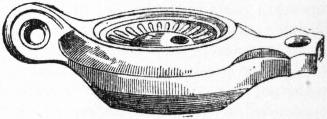
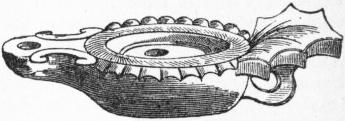
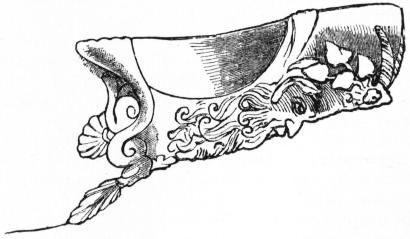
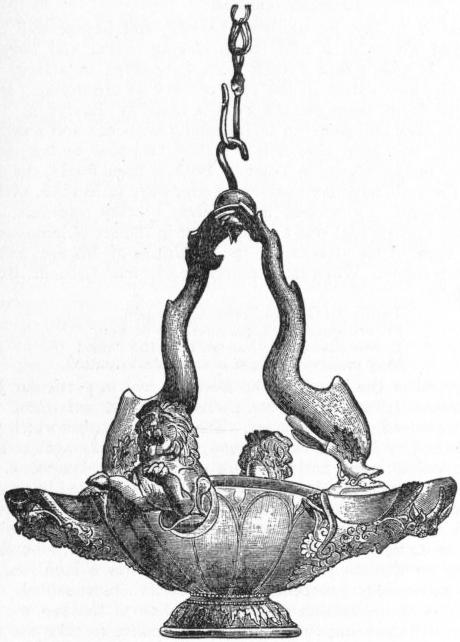
Fig. 4.—Bronze Lamp in British Museum.
Fig. 5.
Ancient Lamps.—Though Athenaeus states (xv. 700) that the lamp (λύχνος) was not an ancient invention in Greece, it had come into general use there for domestic purposes by the 4th century B.C., and no doubt had long before been employed for temples or other places where a permanent light was required in room of the torch of Homeric times. Herodotus (ii. 62) sees nothing strange in the “festival of lamps,” Lychnokaie, which was held at Sais in Egypt, except in the vast number of them. Each was filled with oil so as to burn the whole night. Again he speaks of evening as the time of lamps (περὶ λύχνων, vii. 215). Still, the scarcity of lamps in a style anything like that of an early period, compared with the immense number of them from the late Greek and Roman age, seems to justify the remark of Athenaeus. The commonest sort of domestic lamps were of terra-cotta and of the shape seen in figs. 1 and 2 with a spout or nozzle (μυκτήρ) in which the wick (θρυαλλίς) burned, a round hole on the top to pour in oil by, and a handle to carry the lamp with. A lamp with two or more spouts was δίμυξος, τρίμυξος, &c., but these terms would not apply strictly to the large class of lamps with numerous holes for wicks but without nozzles. Decoration was confined to the front of the handle, or more commonly to the circular space on the top of the lamp, and it consisted almost always of a design in relief, taken from mythology or legend, from objects of daily life or scenes such as displays of gladiators or chariot races, from animals and the chase. A lamp in the British Museum has a view of the interior of a Roman circus with spectators looking on at a chariot race. In other cases the lamp is made altogether of a fantastic shape, as in the form of an animal, a bull’s head, or a human foot. Naturally colour was excluded from the ornamentation except in the form of a red or black glaze, which would resist the heat. The typical form of hand lamp (figs. 1, 2) is a combination of the flatness necessary for carrying steady and remaining steady when set down, with the roundness evolved from the working in clay and characteristic of vessels in that material. In the bronze lamps this same type is retained, though the roundness was less in keeping with metal. Fanciful shapes are equally common in bronze. The standard form of handle consists of a ring for the forefinger and above it a kind of palmette for the thumb. Instead of the palmette is sometimes a crescent, no doubt in allusion to the moon. It would only be with bronze lamps that the cover protecting the flame from the wind could be used, as was the case out of doors in Athens. Such a lamp was in fact a lantern. Apparently it was to the lantern that the Greek word lampas, a torch, was first transferred, probably from a custom of having guards to protect the torches also. Afterwards it came to be employed for the lamp itself (λύχνος, lucerna). When Juvenal (Sat. iii. 277) speaks of the aenea lampas, he may mean a torch with a bronze handle, but more probably either a lamp or a lantern. Lamps used for suspension were mostly of bronze, and in such cases the decoration was on the under part, so as to be seen from below. Of this the best example is the lamp at Cortona, found there in 1840 (engraved, Monumenti d. inst. arch. iii. pls. 41, 42, and in Dennis, Cities and Cemeteries of Etruria, 2nd ed. ii. p. 403). It is set round with sixteen nozzles ornamented alternately with a siren and a satyr playing on a double flute. Between each pair of nozzles is a head of a river god, and on the bottom of the lamp is a large mask of Medusa, surrounded by bands of animals. These designs are in relief, and the workmanship, which appears to belong to the beginning of the 5th century B.C., justifies the esteem in which Etruscan lamps were held in antiquity (Athenaeus xv. 700). Of a later but still excellent style is a bronze lamp in the British Museum found in the baths of Julian in Paris (figs. 3, 4, 5). The chain is attached by means of two dolphins very artistically combined. Under the nozzles are heads of Pan (fig. 3); and from the sides project the foreparts of lions (fig. 5). To what extent lamps may have been used in temples is unknown. Probably the Erechtheum on the acropolis of Athens was an exception in having a gold one kept burning day and night, just as this lamp itself must have been an exception in its artistic merits. It was the work of the sculptor Callimachus, and was made apparently for the newly rebuilt temple a little before 400 B.C. When once filled with oil and lit it burned continuously for a whole year. The wick was of a fine flax called Carpasian (now understood to have been a kind of cotton), which proved to be the least combustible of all flax (Pausanias i. 26. 7). Above the lamp a palm tree of bronze rose to the roof for the purpose of carrying off the fumes. But how this was managed it is not easy to determine unless the palm be supposed to have been inverted and to have hung above the lamp spread out like a reflector, for which purpose the polished bronze would have served fairly well. The stem if left hollow would collect the fumes and carry them out through the roof. This lamp was refilled on exactly the same day each year, so that there seems to have been an idea of measuring time by it, such as may also have been the case in regard to the lamp stand (λύχνειον) capable of holding as many lamps as there were days of the year, which Dionysius the Sicilian tyrant placed in the Prytaneum of Tarentum. At Pharae in Achaia there was in the market-place an oracular statue of Hermes with a marble altar before it to which bronze lamps were attached by means of lead. Whoever desired to consult the statue went there in the evening and first filled the lamps and lit them, placing also a bronze coin on the altar. A similar custom prevailed at the oracle of Apis in Egypt (Pausanias vii. 22. 2). At Argos he speaks of a chasm into which it was a custom continued to his time to let down burning lamps, with some reference to the goddess of the lower world, Persephone (ii. 22. 4). At Cnidus a large number of terra-cotta lamps were found crowded in one place a little distance below the surface, and it was conjectured that there must have been there some statue or altar at which it had been a custom to leave lamps burning at night (Newton, Discoveries at Halicarnassus, &c., ii. 394). These lamps are of terra-cotta, but with little ornamentation, and so like each other in workmanship that they must all have come from one pottery, and may have been all brought to the spot where they were found on one occasion, probably the funeral of a person with many friends, or the celebration of a festival in his honour, such as the parentalia among the Romans, to maintain which it was a common custom to bequeath property. For example, a marble slab in the British Museum has a Latin inscription describing the property which had been left to provide among other things that a lighted lamp with incense on it should be placed at the tomb of the deceased on the kalends, nones and ides of each month (Mus. Marbles, v. pl. 8, fig. 2). For birthday presents terra-cotta lamps appear to have been frequently employed, the device generally being that of two figures of victory holding between them a disk inscribed with a good wish for the new year: ANNV NOV FAVSTV FELIX. This is the inscription on a lamp in the British Museum, which besides the victories has among other symbols a disk with the head of Janus. As the torch gave way to the lamp in fact, so also it gave way in mythology. In the earlier myths, as in that of Demeter, it is a torch with which she goes forth to search for her daughter, but in the late myth of Cupid and Psyche it is an oil lamp which Psyche carries, and from which to her grief a drop of hot oil falls on Cupid and awakes him. Terra-cotta lamps have very frequently the name of the maker stamped on the foot. Clay moulds from which the lamps were made exist in considerable numbers.
(A. S. M.)
LAMP-BLACK, a deep black pigment consisting of carbon in a very fine state of division, obtained by the imperfect combustion of highly carbonaceous substances. It is manufactured from scraps of resin and pitch refuse and inferior oils and fats, and other similar combustible bodies rich in carbon, the finest lamp-black being procured by the combustion of oils obtained in coal-tar distillation (see Coal-Tar). Lamp-black is extensively used in the manufacture of printing ink, as a pigment for oil painting and also for “ebonizing” cabinet work, and in the waxing and lacquering of leather. It is the principal constituent of China ink.
LAMPEDUSA, a small island in the Mediterranean, belonging to the province of Girgenti, from which it is about 112 m. S.S.W. Pop. (1901, with Linosa—see below) 2276. Its greatest length is about 7 m., its greatest width about 2 m.; the highest point is 400 ft. above sea-level. Geologically it belongs to Africa, being situated on the edge of the submarine platform which extends along the east coast of Tunisia, from which (at Mahadia) it is 90 m. distant eastwards. The soil is calcareous; it was covered with scrub (chiefly the wild olive) until comparatively recent times, but this has been cut, and the rock is now bare. The valleys are, however, fairly fertile. On the south, near the only village, is the harbour, which has been dredged to a depth of 13 ft. and is a good one for torpedo boats and small craft.
The island was, as remains of hut foundations show, inhabited in prehistoric times. Punic tombs and Roman buildings also exist near the harbour. The island is the Lopadusa of Strabo, and the Lipadosa of Ariosto’s Orlando Furioso, the scene of the landing of Roger of Sicily and of his conversion by the hermit. A thousand slaves were taken from its population in 1553. In 1436 it was given by Alfonso of Aragon to Don Giovanni de Caro, baron of Montechiaro. In 1661, Ferdinand Tommasi, its then owner, received the title of prince from Charles II. of Spain. In 1737 the earl of Sandwich found only one inhabitant upon it; in 1760 some French settlers established themselves there. Catherine II. of Russia proposed to buy it as a Russian naval station, and the British government thought of doing the same if Napoleon had succeeded in seizing Malta. In 1800 a part of it was leased to Salvatore Gatt of Malta, who in 1810 sublet part of it to Alessandro Fernandez. In 1843 onwards Ferdinand II. of Naples established a colony there. There is now an Italian penal colony for domicilio coatto, with some 400 convicts (see B. Sanvisente, L’Isola di Lampedusa eretta a colonia, Naples, 1849). Eight miles W. is the islet of Lampione. Linosa, some 30 m. to the N.N.E., measures about 2 by 2 m., and is entirely volcanic; its highest point is 610 ft. above sea-level. Pop. (1901) about 200. It has landing-places on the S. and W., and is more fertile than Lampedusa; but it suffers from the lack of springs. Sanvisente says the water in Lampedusa is good. A few fragments of undoubtedly Roman pottery and some Roman coins have been found there, but the cisterns and the ruins of houses are probably of later date (P. Calcara, Descrizione dell’ isola di Linosa, Palermo, 1851, 29).
(T. As.)
LAMPERTHEIM, a town in the grand-duchy of Hesse-Darmstadt, 8 m. N. from Mannheim by the railway to Frankfort-on-Main via Biblis, and at the junction of lines to Worms and Weinheim. It contains a Roman Catholic church and a fine Evangelical church, and has chemical and cigar factories. Pop. (1900) 8020.
LAMPETER (Llanbedr-pont-Stephan), a market town, municipal borough and assize town of Cardiganshire, Wales, on the right bank of the Teifi, here crossed by an ancient stone bridge. Pop. (1901) 1722. Lampeter is a station on the so-called Manchester-and-Milford branch line of the Great Western railway. Though of ancient origin, the town is entirely modern in appearance, its most conspicuous object being the Gothic buildings of St David’s College, founded in 1822, which cover a large area and contain a valuable library of English, Welsh and foreign works (see Universities). The modernized parish church of St Peter, or Pedr, contains some old monuments of the Lloyd family. North of the town are the park and mansion of Falcondale, the seat of the Harford family.
The name of Llanbedr-pont-Stephan goes to prove the early foundation of the place by St Pedr, a Celtic missionary of the 6th century, while one Stephen was the original builder of the bridge over the Teifi. As an important outpost in the upper valley of the Teifi, Lampeter possessed a castle, which was demolished by Owen Gwynedd in the 12th century. In 1188 the town was visited by Archbishop Baldwin on his way from Cardigan to Strata-Florida Abbey, and the Crusade was vigorously preached at this spot. Lampeter was first incorporated under Edward II., but the earliest known charter dates from the reign of Henry VI., whereby the principal officer of the town, a portreeve, was to be appointed annually at the court-leet of the manor. The town was subsequently governed under a confirmatory charter of 1814, but in 1884 a new charter was obtained, whereby the corporation was empowered to consist of a mayor, 4 aldermen and 12 councillors. Although only a small agricultural centre, Lampeter has since 1886 become the assize town of Cardiganshire owing to its convenient position. Until the Redistribution Act of 1885 Lampeter formed one of the group of boroughs comprising the Cardigan parliamentary district.
LAMPOON, a virulent satire either in prose or verse; the idea of injustice and unscrupulousness seems to be essential to its definition. Although in its use the word is properly and almost exclusively English, the derivation appears to be French. Littré derives it from a term of Parisian argot, lamper, to drink, greedily, in great mouthfuls. This word appears to have begun to be prevalent in the middle of the 17th century, and Furetière has preserved a fragment from a popular song, which says:—
Jacques fuyant de Dublin Dit à Lauzun, son cousin, “Prenez soin de ma couronne, J’aurai soin de ma personne, Lampons! lampons!”
—that is to say, let us drink heavily, and begone dull care. Scarron speaks of a wild troop, singing leridas and lampons. There is, also, a rare French verb, lamponner, to attack with ridicule, used earlier in the 17th century by Brantôme. In its English form, lampoon, the word is used by Evelyn in 1645, “Here they still paste up their drolling lampoons and scurrilous papers,” and soon after it is a verb,—“suppose we lampooned all the pretty women in Town.” Both of these forms, the noun and the verb, have been preserved ever since in English, without modification, for violent and reckless literary censure. Tom Brown (1663-1704) was a past master in the art of lampooning, and some of his attacks on the celebrities of his age have a certain vigour. When Dryden became a Roman Catholic, Brown wrote:—
Traitor to God and rebel to thy pen, Priest-ridden Poet, perjured son of Ben, If ever thou prove honest, then the nation May modestly believe in transubstantiation.
Several of the heroes of the Dunciad, and in particular John Oldmixon (1673-1742), were charged without unfairness with being professional lampooners. The coarse diatribes which were published by Richard Savage (1697-1743), mainly against Lady Macclesfield, were nothing more nor less than lampoons, and the word may with almost equal justice be employed to describe the coarser and more personal portions of the satires of Churchill. As a rule, however, the lampoon possessed no poetical graces, and in its very nature was usually anonymous. The notorious Essay on Woman (1764) of John Wilkes was a lampoon, and was successfully proceeded against as an obscene libel. The progress of civilization and the discipline of the law made it more and more impossible for private malice to take the form of baseless and scurrilous attack, and the lampoon, in its open shape, died of public decency in the 18th century. Malice, especially in an anonymous form, and passing in manuscript from hand to hand, has continued, however, to make use of this very unlovely form of literature. It has constantly reappeared at times of political disturbance, and the French have seldom failed to exercise their wicked wit upon their unpopular rulers. See also Pasquinade.
(E. G.)
LAMPREY, a fish belonging to the family Petromyzontidae (from πέτρος and μύζω, literally, stone-suckers), which with the hag-fishes or Myxinidae forms a distinct subclass of fishes, the Cyclostomata, distinguished by the low organization of their skeleton, which is cartilaginous, without vertebral segmentation, without ribs or real jaws, and without limbs. The lampreys are readily recognized by their long, eel-like, scaleless body, terminating anteriorly in the circular, suctorial mouth characteristic of the whole sub-class. On each side, behind the head, there is a row of seven branchial openings, through which the water is conveyed to and from the gills. By means of their mouth they fasten to stones, boats, &c., as well as to other fishes, their object being to obtain a resting-place on the former, whilst they attach themselves to the latter to derive nourishment from them. The inner surface of their cup-shaped mouth is armed with pointed teeth, with which they perforate the integuments of the fish attacked, scraping off particles of the flesh and sucking the blood. Mackerel, cod, pollack and flat-fishes are the kinds most frequently attacked by them in the sea; of river-fish the migratory Salmonidae and the shad are sometimes found with the marks of the teeth of the lamprey, or with the fish actually attached to them. About fifteen species are known from the coasts and rivers of the temperate regions of the northern and southern hemispheres. In Great Britain and Europe generally three species occur, viz. the large spotted sea-lamprey (Petromyzon marinus), the river-lamprey or lampern (P. fluviatilis), and the small lampern or “pride” or “sand-piper” (P. branchialis). The first two are migratory, entering rivers in the spring to spawn; of the river-lamprey, however, specimens are met with in fresh water all the year round. In North America about ten species of lamprey occur, while in South America and Australasia still others are found. Lampreys, especially the sea-lamprey, are esteemed as food, formerly more so than at present; but their flesh is not easy of digestion. Henry I. of England is said to have fallen a victim to this, his favourite dish. The species of greatest use is the river-lamprey, which as bait is preferred to all others in the cod and turbot fisheries of the North Sea. Yarrell states that formerly the Thames alone supplied from 1,000,000 to 1,200,000 lamperns annually, but their number has so much fallen off that, for instance, in 1876 only 40,000 were sold to the cod-fishers. That year, however, was an unusually bad year; the lamperns, from their scarcity, fetched £8, 10s. a thousand, whilst in ordinary years £5 is considered a fair price. The season for catching lamperns closes in the Thames about the middle of March. The origin of the name lamprey is obscure; it is an adaptation of Fr. lamproie, Med. Lat. lampreda; this has been taken as a variant of another Med. Lat. form Lampetra, which occurs in ichthyological works of the middle ages; the derivation from lambere petras, to lick stones, is a specimen of etymological ingenuity. The development of lampreys has received much attention on the part of naturalists, since Aug. Müller discovered that they undergo a metamorphosis, and that the minute worm-like lamperns previously known under the name of Ammocoetes, and abundant in the sand and mud of many streams, were nothing but the undeveloped young of the river-lampreys and small lamperns. See Cyclostomata.
LAMPROPHYRES (from Gr. λαμπρός, bright, and the terminal part of the word porphyry, meaning rocks containing bright porphyritic crystals), a group of rocks containing phenocrysts, usually of biotite and hornblende (with bright cleavage surfaces), often also of olivine and augite, but not of felspar. They are thus distinguished from the porphyries and porphyrites in which the felspar has crystallized in two generations. They are essentially “dike rocks,” occurring as dikes and thin sills, and are also found as marginal facies of plutonic intrusions. They furnish a good example of the correlation which often exists between petrographical types and their mode of occurrence, showing the importance of physical conditions in determining the mineralogical and structural characters of rocks. They are usually dark in colour, owing to the abundance of ferro-magnesian silicates, of relatively high specific gravity and liable to decomposition. For these reasons they have been defined as a melanocrate series (rich in the dark minerals); and they are often accompanied by a complementary leucocrate series (rich in the white minerals felspar and quartz) such as aplites, porphyries and felsites. Both have been produced by differentiation of a parent magma, and if the two complementary sets of rocks could be mixed in the right proportions, it is presumed that a mass of similar chemical composition to the parent magma would be produced.