VOLUME XVI SLICE II Lamennais, Robert de to Latini, Brunetto (continued 10)
Reading edition
La Rochefoucauld’s character, if considered without the prejudice which a dislike to his ethical views has sometimes occasioned, is thoroughly respectable and even amiable. Like almost all his contemporaries, he saw in politics little more than a chessboard where the people at large were but pawns. The weight of testimony, however, inclines to the conclusion that he was unusually scrupulous in his conduct, and that his comparative ill-success in the struggle arose more from this scrupulousness than from anything else. He has been charged with irresolution, and there is some ground for admitting the charge so far as to pronounce him one of those the keenness of whose intellect, together with their apprehension of both sides of a question, interferes with their capacity as men of action. But there is no ground whatever for the view which represents the Maxims as the mere outcome of the spite of a disappointed intriguer, disappointed through his own want of skill rather than of fortune.
His importance as a social and historical figure is, however, far inferior to his importance in literature. His work in this respect consists of three parts—letters, Memoirs and the Maxims. His letters exceed one hundred in number, and are biographically valuable, besides displaying not a few of his literary characteristics; but they need not further detain us. The Memoirs, when they are read in their proper form, yield in literary merit, in interest, and in value to no memoirs of the time, not even to those of Retz, between whom and La Rochefoucauld there was a strange mixture of enmity and esteem which resulted in a couple of most characteristic “portraits.” But their history is unique in its strangeness. It has been said that a pirated edition appeared in Holland, and this, despite the author’s protest, continued to be reprinted for some thirty years. It has been now proved to be a mere cento of the work of half a dozen different men, scarcely a third of which is La Rochefoucauld’s, and which could only have been possible at a time when it was the habit of persons who frequented literary society to copy pell-mell in commonplace books the MS. compositions of their friends and others. Some years after La Rochefoucauld’s death a new recension appeared, somewhat less incorrect than the former, but still largely adulterated, and this held its ground for more than a century. Only in 1817 did anything like a genuine edition (even then by no means perfect) appear. The Maxims, however, had no such fate. The author re-edited them frequently during his life, with alterations and additions; a few were added after his death, and it is usual now to print the whole of them, at whatever time they appeared, together. Thus taken, they amount to about seven hundred in number, in hardly any case exceeding half a page in length, and more frequently confined to two or three lines. The view of conduct which they illustrate is usually and not quite incorrectly summed up in the words “everything is reducible to the motive of self-interest.” But though not absolutely incorrect, the phrase is misleading. The Maxims are in no respect mere deductions from or applications of any such general theory. They are on the contrary independent judgments on different relations of life, different affections of the human mind, and so forth, from which, taken together, the general view may be deduced or rather composed. Sentimental moralists have protested loudly against this view, yet it is easier to declaim against it in general than to find a flaw in the several parts of which it is made up. With a few exceptions La Rochefoucauld’s maxims represent the matured result of the reflection of a man deeply versed in the business and pleasures of the world, and possessed of an extraordinarily fine and acute intellect, on the conduct and motives which have guided himself and his fellows. There is as little trace in them of personal spite as of forfanterie de vice. But the astonishing excellence of the literary medium in which they are conveyed is even more remarkable than the general soundness of their ethical import. In uniting the four qualities of brevity, clearness, fulness of meaning and point, La Rochefoucauld has no rival. His Maxims are never mere epigrams; they are never platitudes; they are never dark sayings. He has packed them so full of meaning that it would be impossible to pack them closer, yet there is no undue compression; he has sharpened their point to the utmost, yet there is no loss of substance. The comparison which occurs most frequently, and which is perhaps on the whole the justest, is that of a bronze medallion, and it applies to the matter no less than to the form. Nothing is left unfinished, yet none of the workmanship is finical. The sentiment, far from being merely hard, as the sentimentalists pretend, has a vein of melancholy poetry running through it which calls to mind the traditions of La Rochefoucauld’s devotion to the romances of chivalry. The maxims are never shallow; each is the text for a whole sermon of application and corollary which any one of thought and experience can write. Add to all this that the language in which they are written is French, still at almost its greatest strength, and chastened but as yet not emasculated by the reforming influence of the 17th century, and it is not necessary to say more. To the literary critic no less than to the man of the world La Rochefoucauld ranks among the scanty number of pocket-books to be read and re-read with ever new admiration, instruction and delight.
The editions of La Rochefoucauld’s Maxims (as the full title runs, Réflexions ou sentences et maximes morales) published in his lifetime bear the dates 1665 (editio princeps), 1666, 1671, 1675, 1678. An important edition which appeared after his death in 1693 may rank almost with these. As long as the Memoirs remained in the state above described, no edition of them need be mentioned, and none of the complete works was possible. The previous more or less complete editions are all superseded by that of MM Gilbert and Gourdault (1868-1883), in the series of “Grands Écrivains de la France,” 3 vols. There are still some puzzles as to the text; but this edition supplies all available material in regard to them. The handsomest separate edition of the Maxims is the so-called Édition des bibliophiles (1870); but cheap and handy issues are plentiful. See the English version by G. H. Powell (1903). Nearly all the great French critics of the 19th century have dealt more or less with La Rochefoucauld: the chief recent monograph on him is that of J. Bourdeau in the Grands écrivains français (1893).
(G. Sa.)

LA ROCHEFOUCAULD-LIANCOURT, FRANÇOIS ALEXANDRE FRÉDÉRIC, Duc de (1747-1827), French social reformer, was born at La Roche Guyon on the 11th of January 1747, the son of François Armand de La Rochefoucauld, duc d’Estissac, grand master of the royal wardrobe. The duc de Liancourt became an officer of carbineers, and married at seventeen. A visit to England seems to have suggested the establishment of a model farm at Liancourt, where he reared cattle imported from England and Switzerland. He also set up spinning machines on his estate, and founded a school of arts and crafts for the sons of soldiers, which became in 1788 the École des Enfants de la Patrie under royal protection. Elected to the states-general of 1789 he sought in vain to support the cause of royalty while furthering the social reforms he had at heart. On the 12th of July, two days before the fall of the Bastille, he warned Louis XVI. of the state of affairs in Paris, and met his exclamation that there was a revolt with the answer, “Non, sire, c’est une révolution.” On the 18th of July he became president of the Assembly. Established in command of a military division in Normandy, he offered Louis a refuge in Rouen, and, failing in this effort, assisted him with a large sum of money. After the events of the 10th of August 1792 he fled to England, where he was the guest of Arthur Young, and thence passed to America. After the assassination of his cousin, Louis-Alexandre, duc de La Rochefoucauld d’Enville, at Gisors on the 14th of September 1792 he assumed the title of duc de La Rochefoucauld. He returned to Paris in 1799, but received small favour from Napoleon. At the Restoration he entered the House of Peers, but Louis XVIII. refused to reinstate him as master of the wardrobe, although his father had paid 400,000 francs for the honour. Successive governments, revolutionary and otherwise, recognized the value of his institutions at Liancourt, and he was for twenty-three years government inspector of his school of arts and crafts, which had been removed to Châlons. He was one of the first promoters of vaccination in France; he established a dispensary in Paris, and he was an active member of the central boards of administration for hospitals, prisons and agriculture. His opposition to the government in the House of Peers led to his removal in 1823 from the honorary positions he held, while the vaccination committee, of which he was president, was suppressed. The academies of science and of medicine admitted him to their membership by way of protest. Official hostility pursued him even after his death (27th of March 1827), for the old pupils of his school were charged by the military at his funeral. His works, chiefly on economic questions, include books on the English system of taxation, poor-relief and education.
His eldest son, François, duc de La Rochefoucauld (1765-1848), succeeded his father in the House of Peers. The second, Alexandre, comte de La Rochefoucauld (1767-1841), married a San Domingo heiress allied to the Beauharnais family. Mme de La Rochefoucauld became dame d’honneur to the empress Josephine, and their eldest daughter married a brother-in-law of Pauline Bonaparte, Princess Borghese. La Rochefoucauld became ambassador successively to Vienna (1805) and to the Hague (1808-1810), where he negotiated the union of Holland with France. During the “Hundred Days” he was made a peer of France. He subsequently devoted himself to philanthropic work, and in 1822 became deputy to the Chamber and sat with the constitutional royalists. He was again raised to the peerage in 1831.
The third son, Frédéric Gaétan, marquis de La Rochefoucauld-Liancourt (1779-1863), was a zealous philanthropist and a partisan of constitutional monarchy. He took no part in politics after 1848. The marquis wrote on social questions, notably on prison administration; he edited the works of La Rochefoucauld, and the memoirs of Condorcet; and he was the author of some vaudevilles, tragedies and poems.
LA ROCHEJACQUELEIN, DE, the name of an ancient French family of La Vendée, celebrated for its devotion to the throne during and after the Revolution. Its original name was Duverger, derived from a fief near Bressuire in Poitou, and its pedigree is traceable to the 13th century. In 1505 Gui Duverger married Renée, heiress of Jacques Lemartin, seigneur de La Rochejacquelein, whose name he assumed. His grandson, Louis Duverger, seigneur de La Rochejacquelein, was a devoted adherent of Henry II., and was badly wounded at the battle of Arques; other members of the family were also distinguished soldiers, and the seigniory was raised to a countship and marquisate in reward for their services.
At the outbreak of the Revolution the chief of the family was Henri Louis Auguste, marquis de La Rochejacquelein, maréchal de camp in the royal army, who had three sons named after himself—Henri, Louis and Auguste. The marquis fled abroad with his second son Louis at the time of the emigration of the nobles. He entered the service of Great Britain, and died in San Domingo in 1802.
Henri, comte de La Rochejacquelein, born at Dubertien, near Châtillon, sur Sèvres, on the 20th of August 1772, did not emigrate with his father. He served in the constitutional guard of the king, and remained in Paris till the execution of Louis XVI. He then took refuge with the marquis de Lescure on his own estates in Poitou. When the anti-clerical policy of the revolutionary powers provoked the rising of the peasantry of La Vendée, he put himself at the head of the men of his neighbourhood, and came rapidly to the front among the gentlemen whom the peasants took for leaders. In spite of his youth and his reluctance to assume the responsibility, he was chosen as commander-in-chief after the defeat of the Vendéans by the republicans at Cholet. His brilliant personal courage, his amiability and his loyalty to the cause make him a very attractive figure, but a commander-in-chief of the Vendéans, who came and went as they pleased, had little real power or opportunity to display the qualities of a general. The comte de La Rochejacquelein had in fact to obey his army, and could only display his personal valour in action. He could not avert the mistaken policy which led to the rout at Le Mans, and was finally shot in an obscure skirmish at Nouaillé on the 4th of March 1794.
Louis, marquis de La Rochejacquelein, the younger brother of Henri, accompanied his father in the emigration, served in the army of Condé, and entered the service of England in America. He returned to France during the Consulate, and in 1801 married the marquise de Lescure, widow of his brother’s friend, who was mortally wounded at Cholet. Marie Louise Victoire de Donnissan, born at Versailles on the 25th of October 1772, belonged to a court family and was the god-daughter of Mme Victoire, daughter of Louis XV. At the age of seventeen she married the marquis de Lescure, whom she accompanied in the war of La Vendée. After his death she went through various adventures recorded in her memoirs, first published at Bordeaux in 1815. They are of extreme interest, and give a remarkable picture of the war and the fortunes of the royalists. She saved much of her own property and her first husband’s, when a conciliatory policy was adopted after the fall of the Terrorists. After her second marriage she lived with her husband on her estates, both refusing all offers to take service with Napoleon. In 1814 they took an active part in the royalist movement in and about Bordeaux. In 1815 the marquis endeavoured to bring about another Vendéan rising for the king, and was shot in a skirmish with the Imperialist forces at the Pont des Marthes on the 4th of June 1815. The marquis died at Orleans in 1857.
Their eldest son, Henri Auguste Georges, marquis de La Rochejacquelein, born at Château Citran in the Gironde on the 28th of September 1805, was educated as a soldier, served in Spain in 1822, and as a volunteer in the Russo-Turkish War of 1828. During the reign of Louis Philippe he adhered to the legitimist policy of his family, but he became reconciled to the government of Napoleon III. and was mainly known as a clerical orator and philanthropist. He died on the 7th of January 1867.
His son and successor, Julien Marie Gaston, born at Chartres on the 27th of March 1833, was an active legitimist deputy in the Assembly chosen at the close of the German War of 1870-1871. He was a strong opponent of Thiers, and continued to contest constituencies as a legitimist with varying fortunes till his death in 1897.
Authorities.—Henri de La Rochejacquelein et la guerre de la Vendée d’après des documents inédits (Niort, 1890); A. F. Nettement, Vie de Mme la Marquise de La Rochejacquelein (Paris, 1876). The Memoirs of the marquise were translated into English by Sir Walter Scott, and issued as a volume of “Constable’s Miscellany” (Edinburgh, 1827).
LA ROCHELLE, a seaport of western France, capital of the department of Charente-Inférieure, 90 m. S. by E. of Nantes on the railway to Bordeaux. Pop. (1906) town 24,524, commune 33,858. La Rochelle is situated on the Atlantic coast on an inlet opening off the great bay in which lie the islands of Ré and Oléron. Its fortifications, constructed by Vauban, have a circuit of 3½ m. with seven gates. Towards the sea are three towers, of which the oldest (1384) is that of St Nicholas. The apartment in the first storey was formerly used as a chapel. The Chain Tower, built towards the end of the 14th century, is so called from the chain which guarded the harbour at this point; the entrance to the tidal basin was at one time spanned by a great pointed arch between the two towers. The lantern tower (1445-1476), seven storeys high, is surmounted by a lofty spire and was once used as a lighthouse. Of the ancient gateways only one has been preserved in its entirety, that of the “Grosse Horloge,” a huge square tower of the 14th or 15th century, the corner turrets of which have been surmounted with trophies since 1746. The cathedral of La Rochelle (St Louis or St Bartholomew) is a heavy Grecian building (1742-1762) with a dome above the transept, erected on the site of the old church of St Bartholomew, destroyed in the 16th century and now represented by a solitary tower dating from the 14th century. Externally the town-house is in the Gothic style of the latter years of the 15th century and has the appearance of a fortress, though its severity is much relieved by the beautiful carving of the two entrances, of the machicolations and of the two belfries. The buildings looking into the inner court are in the Renaissance style (16th and early 17th centuries) and contain several fine apartments. In the old episcopal palace (which was in turn the residence of Sully, the prince of Condé, Louis XIII., and Anne of Austria, and the scene of the marriage of Alphonso VI. of Portugal with a princess of Savoy) accommodation has been provided for a library, a collection of records and a museum of art and antiquities. Other buildings of note are an arsenal with an artillery museum, a large hospital, a special Protestant hospital, a military hospital and a lunatic asylum for the department. In the botanical gardens there are museums of natural history. Medieval and Renaissance houses give a peculiar character to certain districts: several have French, Latin or Greek inscriptions of a moral or religious turn and in general of Protestant origin. Of these old houses the most interesting is one built in the middle of the 16th century and wrongly known as that of Henry II. The parade-ground, which forms the principal public square, occupies the site of the castle demolished in 1590. Some of the streets have side-arcades; the public wells are fed from a large reservoir in the Champ de Mars; and among the promenades are the Cours des Dames with the statue of Admiral Duperré, and outside the Charruyer Park on the west front of the ramparts, and the Mail, a beautiful piece of greensward. In this direction are the sea-bathing establishments.
La Rochelle is the seat of a bishopric and a prefect, and has tribunals of first instance and of commerce, a chamber of commerce and a branch of the Bank of France; its educational establishments include an ecclesiastical seminary, a lycée and a training college for girls. Ship-building, saw-milling and the manufacture of briquettes and chemicals, sardine and tunny-preserving and petroleum-refining are among the industries. The rearing of oysters and mussels and the exploitation of salt marshes is carried on in the vicinity.
The inlet of La Rochelle is protected by a stone mole constructed by Richelieu and visible at low tide. The harbour, one of the safest on the coast, is entered by a channel 2730 yds. long, and comprises an outer harbour opening on the one hand into a floating basin, on the other into a tidal basin with another floating basin adjoining it. Behind the tidal basin is the Maubec reservoir, the waters of which, along with those of the Marans canal, help to scour the port and navigable channel. Some 200 sailing ships are engaged in the fisheries, and the fish market of La Rochelle is the most important on the west coast. The harbour is, however, inaccessible to the largest vessels, for the accommodation of which the port of La Pallice, inaugurated in 1891, was created. Lying about 3 m. W.S.W. of La Rochelle, this port opens into the bay opposite the eastern extremity of the island of Ré. It was artificially excavated and affords safe anchorage in all weathers. The outer port, protected by two jetties, has an area of 29 acres and a depth of 16½ ft. below lowest tide-level. At the extremity of the breakwater is a wharf where ships may discharge without entering the basin. A lock connects with the inner basin, which has an area of 27 acres, with 5900 ft. of quayage, a minimum depth of 28 ft., and depths of 29½ ft. and 36 ft. at high, neap and spring tides. Connected with the basin are two graving docks. La Pallice has regular communication with South America by the vessels of the Pacific Steam Navigation Company and by those of other companies with London, America, West Africa, Egypt and the Far East. The port has petroleum refineries and chemical manure works.
In 1906 there entered the port of La Rochelle, including the dock of La Pallice, 441 vessels with a tonnage of 629,038, and cleared 468 vessels with a tonnage of 664,861 (of which 235 of 241,146 tons cleared with ballast). These figures do not include vessels entering from, or clearing for, other ports in France. The imports (value, £1,276,000 in 1900 as compared with £1,578,000 in 1907) include coal and patent fuel, superphosphates, natural phosphates, nitrate of soda, pyrites, building-timber, wines and alcohol, pitch, dried codfish, petroleum, jute, wood-pulp. Exports (value, £1,294,000 in 1900; £1,979,000 in 1907) include wine and brandy, fancy goods, woven goods, garments, skins, coal and briquettes, furniture, potatoes.
La Rochelle existed at the close of the 10th century under the name of Rupella. It belonged to the barony of Châtelaillon, which was annexed by the duke of Aquitaine and succeeded Châtelaillon as chief town in Aunis. In 1199 it received a communal charter from Eleanor, duchess of Guienne, and it was in its harbour that John Lackland disembarked when he came to try to recover the domains seized by Philip Augustus. Captured by Louis VIII. in 1224, it was restored to the English in 1360 by the treaty of Brétigny, but it shook off the yoke of the foreigner when Du Guesclin recovered Saintonge. During the 14th, 15th and 16th centuries La Rochelle, then an almost independent commune, was one of the great maritime cities of France. From its harbour in 1402 Jean de Béthencourt set out for the conquest of the Canaries, and its seamen were the first to turn to account the discovery of the new world. The salt-tax provoked a rebellion at Rochelle which Francis I. repressed in person; in 1568 the town secured exemption by the payment of a large sum. At the Reformation La Rochelle early became one of the chief centres of Calvinism, and during the religious wars it armed privateers which preyed on Catholic vessels in the Channel and on the high seas. In 1571 a synod of the Protestant churches of France was held within its walls under the presidency of Beza for the purpose of drawing up a confession of faith. After the massacre of St Bartholomew, La Rochelle held out for six and a half months against the Catholic army, which was ultimately obliged to raise the siege after losing more than 20,000 men. The peace of the 24th of June 1573, signed by the people of La Rochelle in the name of all the Protestant party, granted the Calvinists full liberty of worship in several places of safety. Under Henry IV. the town remained quiet, but under Louis XIII. it put itself again at the head of the Huguenot party. Its vessels blockaded the mouth of the Gironde and stopped the commerce of Bordeaux, and also seized the islands of Ré and Oléron and several vessels of the royal fleet. Richelieu then resolved to subdue the town once for all. In spite of the assistance rendered by the English troops under Buckingham and in spite of the fierce energy of their mayor Guiton, the people of La Rochelle were obliged to capitulate after a year’s siege (October 1628). During this investment Richelieu raised the celebrated mole which cut off the town from the open sea. La Rochelle then became the principal port for the trade between France and the colony of Canada. But the revocation of the Edict of Nantes (1685) deprived it of some thousands of its most industrious inhabitants, and the loss of Canada by France completed for the time the ruin of its commerce. Its privateers, however, maintained a vigorous struggle with the English during the republic and the empire.
See P. Suzanne, La Rochelle pittoresque (La Rochelle, 1903), and E. Couneau, La Rochelle disparue (La Rochelle, 1904).
LA ROCHE-SUR-YON, a town of western France, capital of the department of Vendée, on an eminence on the right bank of the Yon, 48 m. S. of Nantes on the railway to Bordeaux. Pop. (1906) town 10,666, commune 13,685. The castle of La Roche, which probably existed before the time of the crusades, and was frequently attacked or taken in the Hundred Years’ War and in the wars of religion, was finally dismantled under Louis XIII. When Napoleon in 1804 made this place, then of no importance, the chief town of a department, the stones from its ruins were employed in the erection of the administrative buildings, which, being all produced at once after a regular plan, have a monotonous effect. The equestrian statue of Napoleon I. in an immense square overlooking the rest of the town; the statue of General Travot, who was engaged in the “pacification” of La Vendée; the museum, with several paintings by P. Baudry, a native artist, of whom there is a statue in the town, are the only objects of interest. Napoleon-Vendée and Bourbon-Vendée, the names borne by the town according to the dominance of either dynasty, gave place to the original name after the revolution of 1870. The town is the seat of a prefect and a court of assizes, and has a tribunal of first instance, a chamber of commerce, a branch of the Bank of France, a lycée for boys and training colleges for both sexes. It is a market for farm-produce, horses and cattle, and has flour-mills. The dog fairs of La Roche are well known.
LAROMIGUIÈRE, PIERRE (1756-1837), French philosopher, was born at Livignac on the 3rd of November 1756, and died on the 12th of August 1837 in Paris. As professor of philosophy at Toulouse he was unsuccessful and incurred the censure of the parliament by a thesis on the rights of property in connexion with taxation. Subsequently he came to Paris, where he was appointed professor of logic in the École Normale and lectured in the Prytanée. In 1799 he was made a member of the Tribunate, and in 1833 of the Academy of Moral and Political Science. In 1793 he published Projet d’éléments de metaphysique, a work characterized by lucidity and excellence of style. He wrote also two Mémoires, read before the Institute, Les Paradoxes de Condillac (1805) and Leçons de philosophie (1815-1818). Laromiguière’s philosophy is interesting as a revolt against the extreme physiological psychology of the natural scientists, such as Cabanis. He distinguished between those psychological phenomena which can be traced directly to purely physical causes, and the actions of the soul which originate from within itself. Psychology was not for him a branch of physiology, nor on the other hand did he give to his theory an abstruse metaphysical basis. A pupil of Condillac and indebted for much of his ideology to Destutt de Tracy, he attached a fuller importance to Attention as a psychic faculty. Attention provides the facts, Comparison groups and combines them, while Reason systematizes and explains. The soul is active in its choice, i.e. is endowed with freewill, and is, therefore, immortal. For natural science as a method of discovery he had no respect. He held that its judgments are, at the best, statements of identity, and that its so-called discoveries are merely the reiteration, in a new form, of previous truisms. Laromiguière was not the first to develop these views; he owed much to Condillac, Destutt de Tracy and Cabanis. But, owing to the accuracy of his language and the purity of his style, his works had great influence, especially over Armand Marrast, Cardaillac and Cousin. A lecture of his in the École Normale impressed Cousin so strongly that he at once devoted himself to the study of philosophy. Jouffroy and Taine agree in describing him as one of the great thinkers of the 19th century.
See Damiron, Essai sur la philosophie en France au XIXe siècle; Biran, Examen des leçons de philosophie; Victor Cousin, De Methodo sive de Analysi; Daunou, Notice sur Laromiguière; H. Taine, Les Philosophes classiques du XIXe siècle; Gatien Arnoult, Étude sur Laromiguière; Compayré, Notice sur Laromiguière; Ferraz, Spiritualisme et Libéralisme; F. Picavet, Les Idéologues.
LARRA, MARIANO JOSÉ DE (1809-1837), Spanish satirist, was born at Madrid in 1809. His father served as a regimental doctor in the French army, and was compelled to leave the Peninsula with his family in 1812. In 1817 Larra returned to Spain, knowing less Spanish than French. His nature was disorderly, his education was imperfect, and, after futile attempts to obtain a degree in medicine or law, he made an imprudent marriage at the age of twenty, broke with his relatives and became a journalist. On the 27th of April 1831 he produced his first play, No más mostrador, based on two pieces by Scribe and Dieulafoy. Though wanting in originality, it is brilliantly written, and held the stage for many years. On the 24th of September 1834 he produced Macias, a play based on his own historical novel, El Doncel de Don Enrique el Doliente (1834). The drama and novel are interesting as experiments, but Larra was essentially a journalist, and the increased liberty of the press after the death of Ferdinand VII. gave his caustic talent an ampler field. He was already famous under the pseudonyms of “Juan Pérez de Munguía” and “Figaro” which he used in El Pobrecito Hablador and La Revista Española respectively. Madrid laughed at his grim humour; ministers feared his vitriolic pen and courted him assiduously; he was elected as deputy for Ávila, and a great career seemed to lie before him. But the era of military pronunciamientos ruined his personal prospects and patriotic plans. His writing took on a more sombre tinge; domestic troubles increased his pessimism, and, in consequence of a disastrous love-affair, he committed suicide on the 13th of February 1837. Larra lived long enough to prove himself the greatest prose-writer that Spain can boast during the 19th century. He wrote at great speed with the constant fear of the censor before his eyes, but no sign of haste is discernible in his work, and the dexterity with which he aims his venomous shafts is amazing. His political instinct, his abundance of ideas and his forcible, mordant style would have given him a foremost position at any time and in any country; in Spain, and in his own period, they placed him beyond all rivalry.
(J. F.-K.)
LARSA (Biblical Ellasar, Gen. xiv. 1), an important city of ancient Babylonia, the site of the worship of the sun-god, Shamash, represented by the ancient ruin mound of Senkereh (Senkera). It lay 15 m. S.E. of the ruin mounds of Warka (anc. Erech), near the east bank of the Shatt-en-Nil canal. Larsa is mentioned in Babylonian inscriptions as early as the time of Ur-Gur, 2700 or 2800 B.C., who built or restored the ziggurat (stage-tower) of E-Babbar, the temple of Shamash. Politically it came into special prominence at the time of the Elamite conquest, when it was made the centre of Elamite dominion in Babylonia, perhaps as a special check upon the neighbouring Erech, which had played a prominent part in the resistance to the Elamites. At the time of Khammurabi’s successful struggle with the Elamite conquerors it was ruled by an Elamite king named Eriaku, the Arioch of the Bible, called Rim-Sin by his Semitic subjects. It finally lost its independence under Samsu-iluna, son of Khammurabi, c. 1900 B.C., and from that time until the close of the Babylonian period it was a subject city of Babylon. Loftus conducted excavations at this site in 1854. He describes the ruins as consisting of a low, circular platform, about 4½ m. in circumference, rising gradually from the level of the plain to a central mound 70 ft. high. This represents the ancient ziggurat of the temple of Shamash, which was in part explored by Loftus. From the inscriptions found there it appears that, besides the kings already mentioned, Khammurabi, Burna-buriash (buryas) and the great Nebuchadrezzar restored or rebuilt the temple of Shamash. The excavations at Senkereh were peculiarly successful in the discovery of inscribed remains, consisting of clay tablets, chiefly contracts, but including also an important mathematical tablet and a number of tablets of a description almost peculiar to Senkereh, exhibiting in bas-relief scenes of everyday life. Loftus found also the remains of an ancient Babylonian cemetery. From the ruins it would appear that Senkereh ceased to be inhabited at or soon after the Persian conquest.
See W. K. Loftus, Chaldaea and Susiana (1857).
(J. P. Pe.)
LARTET, EDOUARD (1801-1871), French archaeologist, was born in 1801 near Castelnau-Barbarens, department of Gers, France, where his family had lived for more than five hundred years. He was educated for the law at Auch and Toulouse, but having private means elected to devote himself to science. The then recent work of Cuvier on fossil mammalia encouraged Lartet in excavations which led in 1834 to his first discovery of fossil remains in the neighbourhood of Auch. Thenceforward he devoted his whole time to a systematic examination of the French caves, his first publication on the subject being The Antiquity of Man in Western Europe (1860), followed in 1861 by New Researches on the Coexistence of Man and of the Great Fossil Mammifers characteristic of the Last Geological Period. In this paper he made public the results of his discoveries in the cave of Aurignac, where evidence existed of the contemporaneous existence of man and extinct mammals. In his work in the Périgord district Lartet had the aid of Henry Christy (q.v.). The first account of their joint researches appeared in a paper descriptive of the Dordogne caves and contents, published in Revue archéologique (1864). The important discoveries in the Madeleine cave and elsewhere were published by Lartet and Christy under the title Reliquiae Aquitanicae, the first part appearing in 1865. Christy died before the completion of the work, but Lartet continued it until his breakdown in health in 1870. The most modest and one of the most illustrious of the founders of modern palaeontology, Lartet’s work had previously been publicly recognized by his nomination as an officer of the Legion of Honour; and in 1848 he had had the offer of a political post. In 1857 he had been elected a foreign member of the Geological Society of London, and a few weeks before his death he had been made professor of palaeontology at the museum of the Jardin des Plantes. He died at Seissan in January 1871.
LARVAL FORMS, in biology. As is explained in the article on Embryology (q.v.), development and life are coextensive, and it is impossible to point to any period in the life of an organism when the developmental changes cease. Nevertheless it is customary to speak of development as though it were confined to the early period of life, during which the important changes occur by which the uninucleated zygote acquires the form characteristic of the species. Using the word in this restricted sense, it is pointed out in the same article that the developmental period frequently presents two phases, the embryonic and the larval. During the embryonic phase the development occurs under protection, either within the egg envelopes, or within the maternal body, or in a brood pouch. At the end of this phase the young organism becomes free and uses, as a rule, its own mouth and digestive organs. If this happens before it has approximately acquired the adult form, it is called a larva (Lat. larva, ghost, spectre, mask), and the subsequent development by which the adult form is acquired constitutes the larval phase. In such forms the life-cycle is divided into three phases, the embryonic, the larval and the adult. The transition between the first two of these is always abrupt; whereas the second and third, except in cases in which a metamorphosis occurs (see Metamorphosis), graduate into one another, and it is not possible to say when the larval stage ends and the adult begins. This is only what would be expected when it is remembered that the developmental changes never cease. It might be held that the presence of functional reproductive organs, or the possibility of rapidly acquiring them, marks off the adult phase of life from the larval. But this test sometimes fails. In certain of the Ctenophora there is a double sexual life; the larva becomes sexually mature and lays eggs, which are fertilized and develop; it then loses its generative organs and develops into the adult, which again develops reproductive organs (dissogony; see Chun, Die Ctenophoren des Golfes von Neapel, 1880). In certain Amphibia the larva may develop sexual organs and breed (axolotl), but in this case (neoteny) it is doubtful whether further development may occur in the larva. A very similar phenomenon is found in certain insect larvae (Cecidomyia), but in this case ova alone are produced and develop parthenogenetically (paedogenesis). Again in certain Trematoda larval stages known as the sporocyst and redia produce ova which have the power of developing unfertilized; in this case the larva probably has not the power of continuing its development. It is very generally held by philosophers that the end of life is reproduction, and there is much to be said for this view; but, granting its truth, it is difficult to see why the capacity for reproduction should so generally be confined to the later stages of life. We know by more than one instance that it is possible for the larva to reproduce by sexual generation; why should not the phenomenon be more common? It is impossible in the present state of our knowledge to answer this question.
The conclusion, then, that we reach is that the larval phase of life graduates into the later phases, and that it is impossible to characterize it with precision, as we can the embryonic phase. Nevertheless great importance has been attached, in certain cases, to the forms assumed by the young organism when it breaks loose from its embryonic bonds. It has been widely held that the study of larvae is of greater importance in determining genetic affinity than the study of adults. What justification is there for this view? The phase of life, chosen for the ordinary anatomical and physiological studies and labelled as the adult phase, is merely one of the large number of stages of structure through which the organism passes during its free life. In animals with a well-marked larval phase, by far the greater number of the stages of structure are included in the larval period, for the developmental changes are more numerous and take place with greater rapidity at the beginning of life than in its later periods. As each of the larval stages is equal in value for the purposes of our study to the adult phase, it clearly follows that, if there is anything in the view that the anatomical study of organisms is of importance in determining their mutual relations, the study of the organism in its various larval stages must have a greater importance than the study of the single and arbitrarily selected stage of life called the adult.
The importance, then, of the study of larval forms is admitted, but before proceeding to it this question may be asked: What is the meaning of the larval phase? Obviously this is part of a larger problem: Why does an organism, as soon as it is established at the fertilization of the ovum, enter upon a cycle of transformations which never cease until death puts an end to them? It is impossible to give any other answer to this question than this, viz. that it is a property of living matter to react in a remarkable way to external forces without undergoing destruction. As is explained in Embryology, development consists of an orderly interaction between the organism and its environment. The action of the environment produces certain morphological changes in the organism. These changes enable the organism to move into a new environment, which in its turn produces further structural changes in the organism. These in their turn enable, indeed necessitate, the organism to move again into a new environment, and so the process continues until the end of the life-cycle. The essential condition of success in this process is that the organism should always shift into the environment to which its new structure is suited, any failure in this leading to impairment of the organism. In most cases the shifting of the environment is a very gradual process, and the morphological changes in connexion with each step of it are but slight. In some cases, however, jumps are made, and whenever such jumps occur we get the morphological phenomenon termed metamorphosis. It would be foreign to our purpose to consider this question further here, but before leaving it we may suggest, if we cannot answer, one further question. Has the duration and complexity of the life-cycle expanded or contracted since organisms first appeared on the earth? According to the current view, the life-cycle is continually being shortened at one end by the abbreviation of embryonic development and by the absorption of larval stages into the embryonic period, and lengthened at the other by the evolutionary creation of new adult phases. What was the condition of the earliest organisms? Had they the property of reacting to external forces to the same extent and in the same orderly manner that organisms have to-day?
For the purpose of obtaining light upon the genetic affinities of an organism, a larval stage has as much importance as has the adult stage. According to the current views of naturalists, which are largely a product of Darwinism, it has its counterpart, as has the adult stage, in the ancestral form from which the living organism has been derived by descent with modification. Just as the adult phase of the living form differs owing to evolutionary modification from the adult phase of the ancestor, so each larval phase will differ for the same reason from the corresponding larval phase in the ancestral life-history. Inasmuch as the organism is variable at every stage of its existence, and is exposed to the action of natural selection, there is no reason why it should escape modification at any stage. But, as the characters of the ancestor are unknown, it is impossible to ascertain what the modification has been, and the determination of which of the characters of its descendant (whether larval or adult) are new and which ancient must be conjectural. It has been customary of late years to distinguish in larvae those characters which are supposed to have been recently acquired as caenogenetic, the ancient characters being termed palingenetic. These terms, if they have any value, are applicable with equal force to adults, but they are cumbrous, and the absence of any satisfactory test which enables us to distinguish between a character which is ancestral and one which has been recently acquired renders their utility very doubtful. Just as the adult may be supposed, on evolution doctrine, to be derived from an ancestral adult, so the various larval stages may be supposed to have been derived from the corresponding larval stage of the hypothetical ancestor. If we admit organic evolution at all, we may perhaps go so far, but we are not in a position to go further, and to assert that each larval stage is representative of and, so to speak, derived from some adult stage in the remote past, when the organism progressed no further in its life-cycle than the stage of structure revealed by such a larval form. We may perhaps have a right to take up this position, but it is of no advantage to us to do so, because it leads us into the realm of pure fancy. Moreover, it assumes that an answer can be given to the question asked above—has the life-cycle of organisms contracted or expanded as the result of evolution? This question has not been satisfactorily answered. Indeed we may go further and say that naturalists have answered it in different ways according to the class of facts they were contemplating at the moment. If we are to consider larvae at all from the evolution point of view, we must treat them as being representative of ancestral larvae from which they have been derived by descent with modification; and we must leave open the question whether and to what extent the first organisms themselves passed through a complicated life-cycle.
From the above considerations it is not surprising to find that the larvae of different members of any group resemble each other to the same kind of degree as do the adults, and that the larvae of allied groups resemble one another more closely than do the larvae of remote groups, and finally that a study of larvae does in some cases reveal affinities which would not have been evident from a study of adults alone. Though it is impossible to give here an account of the larval forms of the animal kingdom, we may illustrate these points, which are facts of fundamental importance in the study of larvae, by a reference to specific cases.
The two great groups, Annelida and Mollusca, which by their adult structure present considerable affinity with one another, agree in possessing a very similar larval form, known as the trochosphere or trochophore.
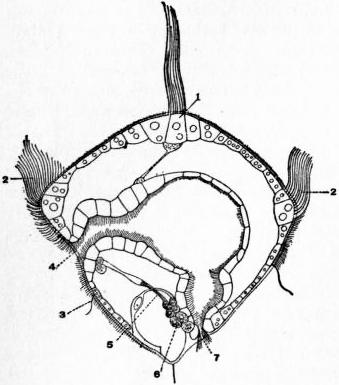
After V. Drasche in Beiträge zur Entwickelung der Polychaeten, Entwickelung von Pomatoceros.
Fig. 1.—Trochosphere Larva of the Chaetopod Pomatoceros trigueter, L. (Osmic acid preparation.)
1. The apical plate. 2. Long cilia of preoral band (velum). 3. Long cilia of postoral band. 4. Mouth. 5. Excretory organ. 6. Mesoblastic band. 7. Anus.
A typical trochosphere larva (figs. 1, 2) possesses a small, transparent body divided into a large preoral lobe and a small postoral region. The mouth (4) is on the ventral surface at the junction of the preoral lobe with the hinder part of the body, and there is an anus (7) at the hind end. Connecting the two is a curved alimentary canal which is frequently divided into oesophagus, stomach and intestine. There is a preoral circlet of powerful cilia, called the “velum” (2), which encircles the body just anterior to the mouth and marks off the preoral lobe, and there is very generally a second ring of cilia immediately behind the mouth (3). At the anterior end of the preoral lobe is a nervous thickening of the ectoderm called the apical plate (1). This usually carries a tuft of long cilia or sensory hairs, and sometimes rudimentary visual organs. Mesoblastic bands are present, proceeding a short distance forwards from the anus on each side of the middle ventral line (6), and at the anterior end of each of these structures is a tube (5) which more or less branches internally and opens on the ventral surface. The branches of this tube end internally in peculiar cells containing a flame-shaped flagellum and floating in the so-called body cavity, into which, however, they do not open. These are the primitive kidneys. The body cavity, which is a space between the ectoderm and alimentary canal, is not lined by mesoderm and is traversed by a few muscular fibres. Such a larva is found, almost as described, in many Chaetopods (fig. 1), in Echiurus (fig. 2), in many Gastropods (fig. 3), and Lamellibranchiates (fig. 4). This typical structure of the larva is often departed from, and the molluscan trochosphere can be distinguished from the annelidan by the possession of a rudiment at least of the shell-gland and foot (figs. 3 and 4); but in all cases in which the young leaves the egg at an early stage of development it has a form which can be referred without much difficulty to the trochosphere type just described. A larva similar to the trochosphere in some features, particularly in possessing a preoral ring of cilia and an apical plate, is found in the Polyzoa, and in adult Rotifera, which latter, in their ciliary ring and excretory organs, present some resemblance to the trochosphere, and are sometimes described as permanent adult trochospheres. But in these phases the resemblance to the typical forms is not nearly so close as it is in the case of the larva of Annelida and Mollusca.
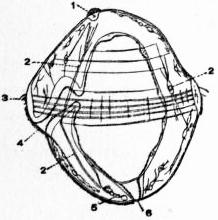
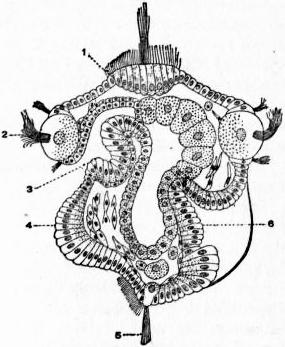
After Hatschek, “Echiurus” in Claus’s Arbeiten aus dem zoolog. Institut der Wien. After Patten, “Patella” in Claus’s Arbeiten aus dem zoolog. Institut der Wien.
Fig. 2.—Young Trochosphere Larva of the Gephyrean Echiurus, seen in optical section. Fig. 3.—Larva of the Gastropod Patella, seen in longitudinal vertical section.
1. Apical plate. 2. Muscle-bands. 3. Preoral band of cilia (velum). 4. Mouth. 5. Mesoblastic band. 6. Anus. 1. Apical plate. 2. Cilia of preoral circlet (velum). 3. Mouth. 4. Foot. 5. Anal tuft of cilia. 6. Shell-gland covered by shell.
In the Echinodermata there are two distinct larval forms which cannot be brought into relation with one another. The one of these is found in the Asteroids, Ophiuroids, Echinoids and Holothuroids; the other in the Crinoids.
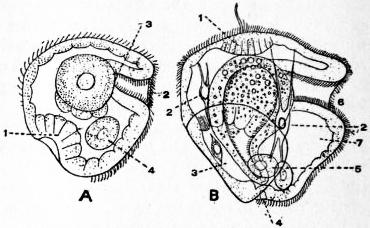
After Hatschek on “Teredo” in Claus’ Arbeiten aus dem zoolog. Institut der Wien.
Fig. 4.—A, Embryo, and B, Young Trochosphere Larva of the Lamellibranch Teredo.
In A the shell-gland (1) and the mouth (2) and the rudiment of the enteron (3) are shown; (4) primitive mesoderm cells.
In B the shell-gland has flattened out and the shell is formed. 1, Apical plate; 2, muscles; 3, shell; 4, anal invagination; 5, mesoblast; 6, mouth; 7, foot.
The cilia of the preoral and postoral bands are not clearly differentiated at this stage.
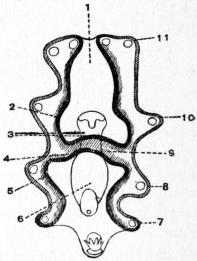
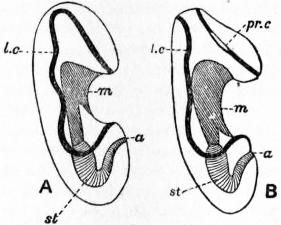
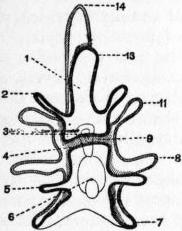
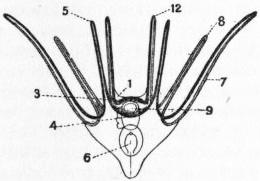
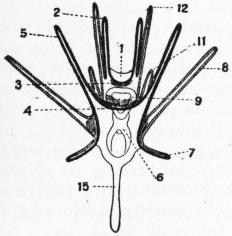
The first is, in its most primitive form, a small transparent creature, with a mouth and anus and a postoral longitudinal ciliated band (fig. 5, A). In Asteroids the band of cilia becomes divided in such a way as to give rise to two bands, the one preoral, encircling the preoral lobe, and the other remaining postoral (fig. 5, B). In the other groups the band remains single and longitudinal. In all cases the edges of the body carrying the ciliary bands become sinuous (fig. 6) and sometimes prolonged into arms (figs. 7-9), and each of the four groups has its own type of larva. In Asteroids, in which the band divides, the larva is known as the bipinnaria (fig. 7); in Holothurians it is called the auricularia (fig. 6); in Echinoids and Ophiuroids, in which the arms are well marked, it is known as the pluteus, the echinopluteus (fig. 9) and ophiopluteus (fig. 8) respectively.
All these forms were obviously distinct but as obviously modifications of a common type and related to one another. They present certain remarkable structural features which differentiate them from other larval types except the tornaria larvae of the Enteropneusta. They possess an alimentary canal with a mouth and anus as does the trochosphere, but they differ altogether from that larva in having a diverticulum of the alimentary canal which gives rise to the coelom and to a considerable part of the mesoblast. Further, they are without an apical plate with its tuft of sensory hairs.
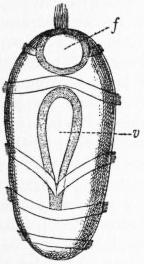
In Crinoids the type is different (fig. 10), and might belong to a different phylum. The body is opaque, and encircled by five ciliary bands, and is without either mouth, anus or arms, and there is a tuft of cilia on the preoral lobe. A resemblance to the other Echinoderm larvae is found in the fact that coelomic diverticula of the enteron are present.
From Balfour’s Comparative Embryology, by permission of Macmillan & Co., Ltd. After J. Müller.
Fig. 5.—Diagrams of side views of two young Echinoderm Larvae, showing the course of the ciliary bands. A, auricularia larva of a Holothurian; B, bipinnaria larva of an Asteroid; a, anus; l.c, in A primitive longitudinal ciliary band, in B postoral longitudinal ciliary band; m, mouth; pr.c, preoral ciliary band; st, stomach. Fig. 6.—Auricularia stelligera, ventral view, somewhat diagrammatic. The larva of a Holothurian.
1. Frontal area. 2. Preoral arm. 3. Anterior transverse portion of ciliary band. 4. Posterior transverseportion of same. 5. Postoral arm. 6. Anal area. 7. Posterior lateral arm. 8. Posterior dorsal arm. 9. Oral depression. 10. Middle dorsal arm. 11. Anterior dorsal arm. 12. Anterior lateral arm. 13. Ventral median arm. 14. Dorsal median arm. 15. Unpaired posterior arm.
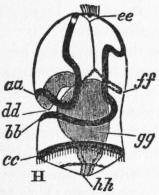
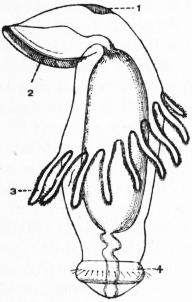
The larvae of two other groups present certain resemblances to the typical Echinoderm larvae. The one of these is the tornaria larva of the Enteropneusta (fig. 11), which recalls Echinoderms in the possession of two ciliary bands, the one preoral and the other postoral and partly longitudinal, and in the presence of gut diverticula which give rise to the coelom; but, like the trochosphere, it possesses an apical plate with sensory organs on the preoral lobe. The resemblance of the tornaria to the bipinnaria is so close that, taking into consideration certain additional resemblances in the arrangement of the coelomic vesicles which arise from the original gut diverticulum, it is impossible to resist the conclusion that there is affinity between the Echinoderm and Enteropneust phyla. Here we have a case like that of the Tunicata in which an affinity which is not evident from a study of the adult alone is revealed by a study of the young form. The other larva which recalls the Echinoderm type is the Actinotrocha of Phoronis (fig. 12), but the resemblance is not nearly so close, being confined to the presence of a postoral longitudinal band of cilia which is prolonged into arm-like processes.
After J. Müller. After J. Müller.
Fig. 7.—Bipinnaria elegans, the Larva of a Star-fish. Description and lettering as in fig. 6. Fig. 8.—Ophiopluteus bimaculatus, the Larva of an Ophiurid. Description and lettering as in fig. 6.
After J. Müller. After Seeliger on “Antedon” in Spengel’s Zoologische Jahrbücher.
Fig. 9.—Echinopluteus, the Larva of a Spatangid. Description and lettering as in fig. 6. Fig. 10.—A free-swimming Larva of Antedon, ventral view. It has an apical tuft of cilia, five ciliated bands, and a depression—the vestibular depression—on its ventral surface. v, Vestibular depression; f, adhesive pit.
The following groups have larvae which cannot be related to other larvae: the Porifera, Coelenterata, Turbellaria and Nemertea, Brachiopoda, Myriapoda, Insecta, Crustacea, Tunicata. We may shortly notice the larvae of the two latter.
After Metschnikoff.
Fig. 11.—Tornaria Larva of an Enteropneust, side view. Fig. 12.—Actinotrocha Larva of Phoronis, side view. (Modified after Benham.)
ee, Apical plate. aa, Preoral ciliary band. bb, Postoral ciliary band. dd, Mouth. ff, Anterior coelomic vesicle and pore. gg, Alimentary canal. hh, Anus. 1. Apical plate. 2. Mouth. 3. Postoral ciliary band and arms. 4. Perianal ciliary band.
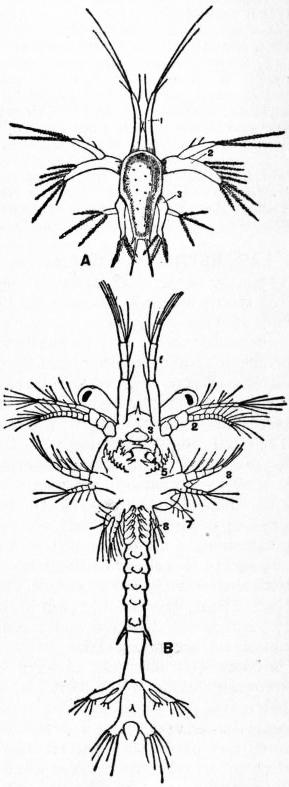
Fig. 13.—A, Nauplius of the Crustacean Penaeus, dorsal view. B, Zoaea Larva of the same animal, ventral view.
1. 2. 3. The three pairs of appendages of the nauplius larva (the future first and second antennae and mandibles). 3. Mandible. 4. First maxilla. 5. Second maxilla. 6. First maxilliped. 7. Second maxilliped. 8. Third maxilliped.
In the Crustacea the larvae are highly peculiar and share, in a striking manner, certain of the important features of specialization presented by the adult, viz. the presence of a strong cuticle and of articulated appendages and the absence of cilia. They are remarkable among larvae for the number of stages which they pass through in attaining the adult state. However numerous these may be, they almost always have, when first set free from the egg, one of two forms, that of the nauplius (fig. 13, A) or that of the zoaea (fig. 13, B). The nauplius is found throughout the group and is the more important of the two; the zoaea is confined to the higher members, in some of which it merely forms a stage through which the larva, hatched as a nauplius, passes in its gradual development. The nauplius larva is of classic interest because its occurrence has enabled zoologists to determine with precision the position in the animal kingdom of a group, the Cirripedia, which was placed by the illustrious Cuvier among the Mollusca.
In the Tunicata the remarkable tadpole larva, the structure and development of which was first elucidated by the great Russian naturalist, A. Kowalevsky, possesses a similar interest to that of the nauplius larva of Cirripeds, and of the tornaria larva of the Enteropneusta, in that it pointed the way to the recognition of the affinities of the Tunicata, affinities which were entirely unsuspected till they were revealed by a study of the larvae.
With regard to the occurrence of larvae, three general statements may be made. (1) They are always associated with a small egg in which the amount of food yolk is not sufficient to enable the animal to complete its development in the embryonic state. (2) A free-swimming larva is usually found in cases in which the adult is attached to foreign objects. (3) A larval stage is, as a rule, associated with internal parasitism of the adult. The object gained by the occurrence of a larva in the two last cases is to enable the species to distribute itself over as wide an area as possible. It may further be asserted that land and fresh-water animals develop without a larval stage much more frequently than marine forms. This is probably partly due to the fact that the conditions of land and fresh-water life are not so favourable for the spread of a species over a wide area by means of simply-organized larvae as are those of marine life, and partly to the fact that, in the case of fresh-water forms at any rate, a feebly-swimming larva would be in danger of being swept out to sea by currents.
1. The association of larvae with small eggs. This is a true statement as far as it goes, but in some cases small eggs do not give rise to larvae, some special form of nutriment being provided by the parent, e.g. Mammalia, in which there is a uterine nutrition by means of a placenta; some Gastropoda (e.g. Helix waltoni, Bulimus), in which, though the ovum is not specially large, it floats in a large quantity of albumen at the expense of which the development is completed; some Lamellibranchiata (Cyclas, &c.), Echinodermata (many Ophiurids, &c.), &c., in which development takes place in a brood pouch. In the majority of cases, however, in which there is a small amount of food yolk and no special arrangements for parental care, a larva is formed. No better group than the Mollusca can be taken to illustrate this point, for in them we find every kind of development from the completely embryonic development of the Cephalopoda, with their large heavily-yolked eggs, to the development of most marine Lamellibranchiata and many Gastropoda, in which the embryonic period is short and there is a long larval development. The Mollusca are further specially interesting for showing very clearly cases in which, though the young are born or hatched fully developed, the larval stages are passed through in the egg, and the larval organs (e.g. velum) are developed but without function (e.g. Paludina, Cyclas, Onchidium). As already mentioned, the larval form of the Mollusca is the trochosphere.
2. Free-swimming larvae are usually formed when the adult is fixed. We need only refer to the cases of the Cirripedia with their well-marked nauplius and cypris larvae, to Phoronis with its remarkable actinotrocha, to the Crinoidea, Polyzoa, &c. There are a few exceptions to this rule, e.g. the Molgulidae amongst the fixed Tunicata, Tubularia, Myriothela, &c., among the Hydrozoa.
3. Internal parasites generally have a stage which may be called larval, in which they are transferred either by active or passive migration to a new host. In most Nematoda, some Cestoda, and in Trematoda this larva leads a free life; but in some nematodes (Trichina) and some cestodes the larva does not become free.
(A. Se.*)
LARYNGITIS, an inflammation of the mucus of the larynx. There are three chief varieties: acute, chronic, and oedematous. The larynx is also liable to attacks of inflammation in connexion with tubercle or syphilis.
Acute Laryngitis may be produced by an independent catarrh, or by one extending either from the nasal or the bronchial mucous membrane into that of the larynx. The causes are various, “catching cold” being the most common. Excessive use of the voice either in speaking or singing sometimes gives rise to it. The inhalation of irritating particles, vapours, &c., and swallowing very hot fluids or corrosive poisons are well-recognized causes. It may also occur in connexion with diseases, notably measles and influenza. As a result of the inflammation there is a general swelling of the parts about the larynx and the epiglottis, the result being a narrowing of the channel for the entrance of the air, and to this the chief dangers are due. The symptoms vary with the intensity of the attack; there is first a sense of tickling, then of heat, dryness, and pain in the throat, with some difficulty in swallowing. There is a dry cough, with expectoration later; phonation becomes painful, while the voice is husky, and may be completely lost. In children there is some dyspnoea. In favourable cases, which form the majority, the attack tends to abate in a few days, but the inflammation may become of the oedematous variety, and death may occur suddenly from an asphyxial paroxysm. Many cases of acute laryngitis are so slight as to make themselves known only by hoarseness and the character of the cough, nevertheless in every instance the attack demands serious attention. The diagnosis is not, in adults, a matter of much difficulty, especially if an examination is made with the laryngoscope; in children, however, it is more difficult, and the question of diphtheria must not be lost sight of. The treatment is, first and foremost, rest; no talking must be allowed. The patient should be kept in bed, in a room at an even temperature, and the air saturated with moisture. An ice-bag round the throat gives much relief, while internally diaphoretics may be given, and a full dose of Dover’s powder if there be much pain or cough.
Chronic Laryngitis usually occurs as a result of repeated attacks of the acute form. It is extremely common in people who habitually over-use the voice, and is the cause of the hoarse voice one associates with street sellers. The constant inhalation of irritating vapours, such as tobacco smoke, may also cause it. There is usually little or no pain, only the unpleasant sensation of tickling in the larynx, with a constant desire to cough. The changes in the mucous membrane are more permanent than in the acute variety, and there nearly always accompanies this a chronic alteration of the membrane of the pharynx (granular pharyngitis). The treatment consists in stopping the cause, where known, e.g. the smoking or shouting. Careful examination should be made to see if there is any nasal obstruction, and the larynx should be treated locally with suitable astringents, by means of a brush, spray or insufflation. Overheated and ill-ventilated rooms must be avoided, as entrance into them immediately aggravates the trouble and causes a paroxysm of coughing.
Oedematous Laryngitis is a very fatal condition, which may occur, though rarely, as a sequence of acute laryngitis. It is far more commonly seen in syphilitic and tubercular conditions of the larynx, in kidney disease, in certain fevers, and in cases of cellulitis of the neck. The larynx is also one of the sites of Angeioneurotic oedema. In this form of laryngitis there are all the symptoms of acute laryngitis, but on a very much exaggerated scale. The dyspnoea, accompanied by marked stridor, may arise and reach a dangerous condition within the space of an hour, and demand the most prompt treatment. On examination the mucous membrane round the epiglottis is seen to be enormously swollen. The treatment is ice round the throat and internally, scarification of the swollen parts, and should that not relieve the asphyxial symptoms, tracheotomy must be performed immediately.
Tubercular Laryngitis is practically always associated with phthisis. The mucous membrane is invaded by the tubercles, which first form small masses. These later break down and ulcerate; the ulceration then spreads up and down, causing an immense amount of destruction. The first indication is hoarseness, or, in certain forms, pain on swallowing. The cough is, as a rule, a late symptom. A sudden oedema may bring about a rapid fatal termination. The general treatment is the same as that advised for phthisis; locally, the affected parts may be removed by one or a series of operations, generally under local anaesthesia, or they may be treated with some destructive agent such as lactic acid. The pain on swallowing can be best alleviated by painting with a weak solution of cocaine. The condition is a very grave one; the prognosis depends largely on the associated pulmonary infection—if that be extensive, a very small amount of laryngeal mischief resists treatment, while, if the case be the contrary, a very extensive mischief may be successfully dealt with.
Syphilitic Laryngitis.—Invasion of the larynx in syphilis is very common. It may occur in both stages of the disease and in the inherited form. In the secondary stage the damage is superficial, and the symptoms those of a slight acute laryngitis. The injury in the tertiary stage is much more serious, the deeper structures are invaded with the formation of deep ulcers, which may when they heal form strong cicatrices, which produce a narrowing of the air-passage which may eventually require surgical interference. Occasionally a fatal oedema may arise. The treatment consists of administering constitutional remedies, local treatment being of comparatively slight importance.
Paroxysmal Laryngitis, or Laryngismus stridulus, is a nervous affection of the larynx that occurs in infants. It appears to be associated with adenoids. The disease consists of a reflex spasm of the glottis, which causes a complete blocking of the air-passages. The attacks, which are recurrent, cause acute asphyxiation. They may cease for no obvious reason, or one may prove fatal. The whole attack is of such short duration that the infant has either recovered or succumbed before assistance can be called. After an attack, careful examination should be made, and the adenoids, if present, removed by operation.
LA SABLIÈRE, MARGUERITE DE (c. 1640-1693), friend and patron of La Fontaine, was the wife of Antoine Rambouillet, sieur de la Sablière (1624-1679), a Protestant financier entrusted with the administration of the royal estates, her maiden name being Marguerite Hessein. She received an excellent education in Latin, mathematics, physics and anatomy from the best scholars of her time, and her house became a meeting-place for poets, scientists and men of letters, no less than for brilliant members of the court of Louis XIV. About 1673 Mme de la Sablière received into her house La Fontaine, whom for twenty years she relieved of every kind of material anxiety. Another friend and inmate of the house was the traveller and physician François Bernier, whose abridgment of the works of Gassendi was written for Mme de la Sablière. The abbé Chaulieu and his fellow-poet, Charles Auguste, marquis de La Fare, were among her most intimate associates. La Fare sold his commission in the army to be able to spend his time with her. This liaison, which seems to have been the only serious passion of her life, was broken in 1679. La Fare was seduced from his allegiance, according to Mme de Sévigné by his love of play, but to this must be added a new passion for the actress La Champmeslé. Mme de la Sablière thenceforward gave more and more attention to good works, much of her time being spent in the hospital for incurables. Her husband’s death in the same year increased her serious tendencies, and she was presently converted to Roman Catholicism. She died in Paris on the 8th of January 1693.
LA SALE (or La Salle), ANTOINE DE (c. 1388-1462?), French writer, was born in Provence, probably at Arles. He was a natural son of Bernard de la Salle,1 a famous soldier of fortune, who served many masters, among others the Angevin dukes. In 1402 Antoine entered the court of Anjou, probably as a page, and in 1407 he was at Messina with Duke Louis II., who had gone there to enforce his claim to the kingdom of Sicily. The next years he perhaps spent in Brabant, for he was present at two tournaments given at Brussels and Ghent. With other gentlemen from Brabant, whose names he has preserved, he took part in the expedition of 1415 against the Moors, organized by John I. of Portugal. In 1420 he accompanied Louis III. on another expedition to Naples, making in that year an excursion from Norcia to the Monte della Sibilla, and the neighbouring Lake of Pilate. The story of his adventures on this occasion, and an account, with some sceptical comments, of the local legends regarding Pilate, and the Sibyl’s grotto,2 form the most interesting chapter of La Salade, which is further adorned with a map of the ascent from Montemonaco. La Sale probably returned with Louis III. of Anjou, who was also comte de Provence, in 1426 to Provence, where he was acting as viguier of Aries in 1429. In 1434 René, Louis’s successor, made La Sale tutor to his son Jean d’Anjou, duc de Calabre, to whom he dedicated, between the years 1438 and 1447, his La Salade, which is a text-book of the studies necessary for a prince. The primary intention of the title is no doubt the play on his own name, but he explains it on the ground of the miscellaneous character of the book—a salad is composed “of many good herbs.” In 1439 he was again in Italy in charge of the castle of Capua, with the duc de Calabre and his young wife, Marie de Bourbon, when the place was besieged by the king of Aragon. René abandoned Naples in 1442, and Antoine no doubt returned to France about the same time. His advice was sought at the tournaments which celebrated the marriage of the unfortunate Margaret of Anjou at Nancy in 1445; and in 1446, at a similar display at Saumur, he was one of the umpires. La Sale’s pupil was now twenty years of age, and, after forty years’ service of the house of Anjou, La Sale left it to become tutor to the sons of Louis de Luxembourg, comte de Saint Pol, who took him to Flanders and presented him at the court of Philippe le Bon, duke of Burgundy. For his new pupils he wrote at Châtelet-sur-Oise, in 1451, a moral work entitled La Salle.
He was nearly seventy years of age when he wrote the work that has made him famous, L’Hystoire et plaisante cronicque du petit Jehan de Saintré et de la jeune dame des Belles-Cousines, Sans autre nom nommer, dedicated to his former pupil, Jean de Calabre. An envoi in MS. 10,057 (nouv. acq. fr.) in the Bibliothèque Nationale, Paris, states that it was completed at Châtelet on the 6th of March 1455 (i.e. 1456). La Sale also announces an intention, never fulfilled, apparently, of writing a romance of Paris et Vienne. The MSS. of Petit Jehan de Saintré usually contain in addition Floridam et Elvide, translated by Rasse de Brunhamel from the Latin of Nicolas de Clamange, and dedicated to La Sale; also Addiction extraite des Cronicques de Flandres, of which only a few lines are original. Brunhamel says in his dedication that La Sale had delighted to write honourable histories from the time of his “florie jeunesse,” which confirms a reasonable inference from the style of Petit Jehan de Saintré that its author was no novice in the art of romance-writing. The Réconfort à Madame de Neufville, a consolatory epistle including two stories of parental fortitude, was written at Vendeuil-sur-Oise about 1458, and in 1459 La Sale produced his treatise Des anciens tournois et faictz d’armes and the Journée d’Onneur et de Prouesse. He followed his patron to Genappe in Brabant when the Dauphin (afterwards Louis XI.) took refuge at the Burgundian court.
La Sale is generally accepted as the author of one of the most famous satires in the French language, Les Quinze Joyes de mariage, because his name has been disengaged from an acrostic at the end of the Rouen MS. He is also supposed to have been the “acteur” in the collection of licentious stories supposed to be narrated by various persons at the court of Philippe le Bon, and entitled the Cent Nouvelles Nouvelles. One only of the stories is given in his name, but he is credited with the compilation of the whole, for which Louis XI. was long held responsible. A completed copy of this was presented to the Duke of Burgundy at Dijon in 1462. If then La Sale was the author, he probably was still living; otherwise the last mention of him is in 1461.
Petit Jehan de Saintré gives, at the point when the traditions of chivalry were fast disappearing, an account of the education of an ideal knight and rules for his conduct under many different circumstances. When Petit Jehan, aged thirteen, is persuaded by the Dame des Belles-Cousines to accept her as his lady, she gives him systematic instruction in religion, courtesy, chivalry and the arts of success. She materially advances his career until Saintré becomes an accomplished knight, the fame of whose prowess spreads throughout Europe. This section of the romance—apparently didactic in intention—fits in with the author’s other works of edification. But in the second part this virtuous lady falls a victim to a vulgar intrigue with Damp Abbé. One of La Sale’s commentators, M. Joseph Nève, ingeniously maintains that the last section is simply to show how the hero, after passing through the other grades of education, learns at last by experience to arm himself against coquetry. The book may, however, be fairly regarded as satirizing the whole theory of “courteous” love, by the simple method of fastening a repulsive conclusion on an ideal case. The contention that the fabliau-like ending of a romance begun in idyllic fashion was due to the corrupt influences of the Dauphin’s exiled court, is inadmissible, for the last page was written when the prince arrived in Brabant in 1456. That it is an anti-clerical satire seems unlikely. The profession of the seducer is not necessarily chosen from that point of view. The language of the book is not disfigured by coarseness of any kind, but, if the brutal ending was the expression of the writer’s real views, there is little difficulty in accepting him as the author of the Quinze Joyes de mariage and the Cent Nouvelles Nouvelles.—Both these are masterpieces in their way and exhibit a much greater dramatic power and grasp of dialogue than does Petit Jehan. Some light is thrown on the romance by the circumstances of the duc de Calabre, to whom it was dedicated. His wife, Marie de Bourbon, was one of the “Belles-Cousines” who contended for the favour of Jacques or Jacquet de Lalaing in the Livre des faits de Jacques Lalaing which forms the chief source of the early exploits of Petit Jehan.
The incongruities of La Sale’s aims appear in his method of construction. The hero is not imaginary. Jehan de Saintré flourished in the Hundred Years’ War, was taken prisoner after Poitiers, with the elder Boucicaut, and was employed in negotiating the treaty of Bretigny. Froissart mentioned him as “le meilleur et le plus vaillant chevalier de France.” His exploits as related in the romance are, however, founded on those of Jacques de Lalaing (c. 1422-1453), who was brought up at the Burgundian court, and became such a famous knight that he excited the rivalry of the “Belles-Cousines,” Marie de Bourbon and Marie de Clèves, duchesse d’Orléans. Lalaing’s exploits are related by more than one chronicler, but M. Gustave Raynaud thinks that the Livre des faits de Jacques de Lalaing, published among the works of Georges Chastelain, to which textual parallels may be found in Petit Jehan, should also be attributed to La Sale, who in that case undertook two accounts of the same hero, one historical and the other fictitious. To complicate matters, he drew, for the later exploits of Petit Jehan, on the Livres des faits de Jean Boucicaut, which gives the history of the younger Boucicaut. The atmosphere of the book is not the rough realities of the English wars in which the real Saintré figured but that of the courts to which La Sale was accustomed.
The title of Les Quinze Joyes de mariage is, with a profanity characteristic of the time, borrowed from a popular litany, Les Quinze Joies de Notre Dame, and each chapter terminates with a liturgical refrain voicing the miseries of marriage. Evidence in favour of La Sale’s authorship is brought forward by M. E. Gossart (Bibliophile belge, 1871, pp. 83-7), who quotes from his didactic treatise of La Salle a passage paraphrased from St Jerome’s treatise against Jovinian which contains the chief elements of the satire. Gaston Paris (Revue de Paris, Dec. 1897) expressed an opinion that to find anything like the malicious penetration by which La Sale divines the most intimate details of married life, and the painful exactness of the description, it is necessary to travel as far as Balzac. The theme itself was common enough in the middle ages in France, but the dialogue of the Quinze Joyes is unusually natural and pregnant. Each of the fifteen vignettes is perfect in its kind. There is no redundance. The diffuseness of romance is replaced by the methods of the writers of the fabliaux.
In the Cent Nouvelles Nouvelles the Italian novella is naturalized in France. The book is modelled on the Decameron of Boccaccio, and owes something to the Latin Facetiae of the contemporary scholar Poggio; but the stories are rarely borrowed, and in cases where the Nouvelles have Italian parallels they appear to be independent variants. In most cases the general immorality of the conception is matched by the grossness of the details, but the ninety-eighth story narrates what appears to be a genuine tragedy, and is of an entirely different nature from the other contes. It is another version of the story of Floridam et Elvide already mentioned.
Not content with allowing these achievements to La Sale, some critics have proposed to ascribe to him also the farce of Maître Pathelin.
The best editions of La Sale’s undoubted and reputed works are:—Petit Jehan de Saintré by J. M. Guichard (1843); Les Cent Nouvelles Nouvelles by Thomas Wright (Bibl. elzévérienne, 1858); Les Quinze Joyes de mariage by P. Jannet (Bibl. elzév., 1857). La Salade was printed more than once during the 16th century. La Salle was never printed. For its contents see E. Gossart in the Bibliophile belge (1871, pp. 77 et seq.). See also the authorities quoted above, and Joseph Nève, Antoine de la Salle, sa vie et ses ouvrages ... suivi du Réconfort de Madame de Fresne ... et de fragments et documents inédits (1903), who argues for the rejection of Les Quinze Joyes and the Cent Nouvelles Nouvelles from La Sale’s works; Pietro Toldo, Contributo allo studio della novella francese del XV e XVI secolo (1895), and a review of it by Gaston Paris in the Journal des Savants (May 1895); L. Stern, “Versuch über Antoine de la Salle,” in Archiv für das Studium der neueren Sprachen, vol. xlvi.; and G. Raynaud, “Un Nouveau Manuscrit du Petit Jehan de Saintré,” in Romania, vol. xxxi.
(M. Br.)
1 For his career, see Paul Durrieu, Les Gascons en Italie (Auch, 1885, pp. 107-71).
2 For the legend of the Sibyl current in Italy at the time, given by La Sale, and its inter-relation with the Tannhäuser story, see W. Soederhjelm, “A. de la Salle et la légende de Tannhäuser” in Mémoires de la soc. néo-philologique d’Helsingfors (1897, vol. ii.); and Gaston Paris, “Le Paradis de la Reine Sibylle,” and “La Légende du Tannhäuser,” in the Revue de Paris (Dec. 1897 and March 1898).
LASALLE, ANTOINE CHEVALIER LOUIS COLLINET, Count (1775-1809), French soldier, belonged to a noble family in Lorraine. His grandfather was Abraham Fabert, marshal of France. Entering the French army at the age of eleven, he had reached the rank of lieutenant when the Revolution broke out. As an aristocrat, he lost his commission, but he enlisted in the ranks, where his desperate bravery and innate power of command soon distinguished him. By 1795 he had won back his grade, and was serving as a staff-officer in the army of Italy. On one occasion, at Vicenza, he rivalled Seydlitz’s feat of leaping his horse over the parapet of a bridge to avoid capture, and, later, in Egypt, he saved Davout’s life in action. By 1800 he had become colonel, and in one combat in that year he had two horses killed under him, and broke seven swords. Five years later, having attained the rank of general of brigade, he was present with his brigade of light cavalry at Austerlitz. In the pursuit after Jena in 1806, though he had but 600 hussars and not one piece of artillery with him, he terrified the commandant of the strong fortress of Stettin into surrender, a feat rarely equalled save by that of Cromwell on Bletchingdon House. Made general of division for this exploit, he was next in the Polish campaign, and at Heilsberg saved the life of Murat, grand duke of Berg. When the Peninsular War began, Lasalle was sent out with one of the cavalry divisions, and at Medina de Rio Seco, Gamonal and Medellin broke every body of troops which he charged. A year later, at the head of one of the cavalry divisions of the Grande Armée he took part in the Austrian war. At Wagram he was killed at the head of his men. With the possible exception of Curély, who was in 1809 still unknown, Napoleon never possessed a better leader of light horse. Wild and irregular in his private life, Lasalle was far more than a beau sabreur. To talent and experience he added that power of feeling the pulse of the battle which is the true gift of a great leader. A statue of him was erected in Lunéville in 1893. His remains were brought from Austria to the Invalides in 1891.
LA SALLE, RENÉ ROBERT CAVELIER, Sieur de (1643-1687), French explorer in North America, was born at Rouen on the 22nd of November 1643. He taught for a time in a school (probably Jesuit) in France, and seems to have forfeited his claim to his father’s estate by his connexion with the Jesuits. In 1666 he became a settler in Canada, whither his brother, a Sulpician abbé, had preceded him. From the Seminary of St Sulpice in Montreal La Salle received a grant on the St Lawrence about 8 m. above Montreal, where he built a stockade and established a fur-trading post. In 1669 he sold this post (partly to the Sulpicians who had granted it to him) to raise funds for an expedition to China1 by way of the Ohio,2 which he supposed, from the reports of the Indians, to flow into the Pacific. He passed up the St Lawrence and through Lake Ontario to a Seneca village on the Genesee river; thence with an Iroquois guide he crossed the mouth of the Niagara (where he heard the noise of the distant falls) to Ganastogue, an Iroquois colony at the head of Lake Ontario, where he met Louis Joliet and received from him a map of parts of the Great Lakes. La Salle’s missionary comrades now gave up the quest for China to preach among the Indians. La Salle discovered the Ohio river, descended it at least as far as the site of Louisville, Kentucky, and possibly, though not probably, to its junction with the Mississippi, and in 1669-1670, abandoned by his few followers, made his way back to Lake Erie. Apparently he passed through Lake Erie, Lake Huron and Lake Michigan, and some way down the Illinois river. Little is known of these explorations, for his journals are lost, and the description of his travels rests only on the testimony of the anonymous author of a Histoire de M. de la Salle. Before 1673 La Salle had returned to Montreal. Becoming convinced, after the explorations of Marquette and Joliet in 1673, that the Mississippi flowed into the Gulf of Mexico, he conceived a vast project for exploring that river to its mouth and extending the French power to the lower Mississippi Valley. He secured the support of Count Frontenac, then governor of Canada, and in 1674 and 1677 visited France, obtaining from Louis XIV. on his first visit a patent of nobility and a grant of lands about Fort Frontenac, on the site of the present Kingston, Ontario, and on his second visit a patent empowering him to explore the West at his own expense, and giving him the buffalo-hide monopoly. Late in the year 1678, at the head of a small party, he started from Fort Frontenac. He established a post above Niagara Falls, where he spent the winter, and where, his vessel having been wrecked, he built a larger ship, the “Griffon,” in which he sailed up the Great Lakes to Green Bay (Lake Michigan), where he arrived in September 1679. Sending back the “Griffon” freighted with furs, by which he hoped to satisfy the claims of his creditors, he proceeded to the Illinois river, and near what is now Peoria, Illinois, built a fort, which he called Fort Crèvecœur. Thence he detached Father Hennepin, with one companion, to explore the Illinois to its mouth, and, leaving his lieutenant, Henri de Tonty (c. 1650-c. 1702),3 with about fifteen men, at Fort Crèvecœur, he returned by land, afoot, to Canada to obtain needed supplies, discovering the fate of the “Griffon” (which proved to have been lost), thwarting the intrigues of his enemies and appeasing his creditors. In July 1680 news reached him at Fort Frontenac that nearly all Tonty’s men had deserted, after destroying or appropriating most of the supplies; and that twelve of them were on their way to kill him as the surest means of escaping punishment. These he met and captured or killed. He then returned to the Illinois, to find the country devastated by the Iroquois, and his post abandoned. He formed a league of the Western Indians to fight the Iroquois, then went to Michilimackinac, where he found Tonty, proceeded again to Fort Frontenac to obtain supplies and organize his expedition anew, and returned in December 1681 to the Illinois. Passing down the Illinois to the Mississippi, which he reached in February 1682, he floated down that stream to its mouth, which he reached on the 9th of April, and, erecting there a monument and a cross, took formal possession in the name of Louis XIV., in whose honour he gave the name “Louisiana” to the region. He then returned to Michilimackinac, whence, with Tonty, he went again to the Illinois and established a fort, Fort St Louis, probably on Starved Rock (near the present Ottawa, Illinois), around which nearly 20,000 Indians (Illinois, Miamis and others seeking protection from the Iroquois) had been gathered. La Salle then went to Quebec, and La Barre, who had succeeded Frontenac, being unfriendly to him, again visited France (1684), where he succeeded in interesting the king in a scheme to establish a fort at the mouth of the Mississippi and to seize the Spanish posts in the vicinity. On the 24th of July 1684, with four vessels under the command of himself and Captain Beaujeu, a naval officer, he sailed from La Rochelle. Mistaking, it appears, the inlets of Matagorda Bay (which La Salle called St Louis’s Bay) in the present state of Texas, for the mouth of an arm of the Mississippi, he landed there, and Beaujeu, soon afterwards returned to France. The expedition had met with various misfortunes; one vessel had been captured by the Spaniards and another had been wrecked; and throughout La Salle and Beaujeu had failed to work in harmony. Soon finding that he was not at the mouth of the Mississippi, La Salle established a settlement and built a fort, Fort St Louis, on the Lavaca (he called it La Vache) river, and leaving there the greater part of his force, from October 1685 to March 1686 he vainly sought for the Mississippi. He also made two attempts to reach the Illinois country and Canada, and during the second, after two months of fruitless wanderings, he was assassinated, on the 19th of March 1687, by several of his followers, near the Trinity river in the present Texas.
His colony on the Lavaca, after suffering terribly from privation and disease and being attacked by the Indians, was finally broken up, and a force of Spaniards sent against it in 1689 found nothing but dead bodies and a dismantled fort; the few survivors having become domesticated in the Indian villages near by. Some writers, notably J. G. Shea, maintain that La Salle never intended to fortify the mouth of the Mississippi, but was instructed to establish an advanced post near the Spanish possessions, where he was to await a powerful expedition under a renegade Spaniard, Peñalosa, with whom he was to co-operate in expelling the Spaniards from this part of the continent.4
La Salle was one of the greatest of the explorers in North America. Besides discovering the Ohio and probably the Illinois, he was the first to follow the Mississippi from its upper course to its mouth and thus to establish the connexion between the discoveries of Radisson, Joliet and Marquette in the north with those of De Soto in the south. He was stern, indomitable and full of resource.
The best accounts of La Salle’s explorations may be found in Francis Parkman’s La Salle and the Discovery of the Great West (Boston, 1879; later revised editions), in Justin Winsor’s Cartier to Frontenac (Boston, 1894), and in J. G. Shea’s Discovery and Exploration of the Mississippi Valley (New York, 1852); see also P. Chesnel, Histoire de Cavelier de La Salle, explorations et conquête du bassin du Mississippi (Paris, 1901). Of the early narratives see Louis Hennepin, Description de la Louisiane (1683); Joutel, Journal historique du dernier voyage que feu M. de la Salle fit dans le Golfe de Mexique, &c. (Paris, 1713); and Henri de Tonty, Derniers Découvertes dans l’Amérique septentrionale de M. de La Salle (Paris, 1697). Original narratives may be found, translated into English, in The Journeys of René Robert Cavelier, Sieur de La Salle, as related by his Faithful Lieutenant, Henri de Tonty, &c. (2 vols., New York, 1905), edited by I. J. Cox; in Benjamin E. French’s Historical Collections of Louisiana (6 series, New York, 1846-1853), and in Shea’s Early Voyages Up and Down the Mississippi (Albany, 1861); and an immense collection of documents relating to La Salle may be found in Pierre Margry’s Découvertes et établissements des Français dans l’ouest et dans le sud de l’Amérique septentrionale, 1614-1754; Mémoires et documents originaux recueillis et publiés (6 vols., Paris, 1875-1886), especially in vol. ii.
(C. C. W.)
1 The name La Chine was sarcastically applied to La Salle’s settlement on the St Lawrence.
2 The Iroquois seem to have used the name Ohio for the Mississippi, or at least for its lower part; and this circumstance makes the story of La Salle’s exploration peculiarly difficult to disentangle.
3 Tonty (or Tonti), an Italian, born at Gaeta, was La Salle’s principal lieutenant, and was the equal of his chief in intrepidity. Before his association with La Salle he had engaged in military service in Europe, during which he had lost a hand. He accompanied La Salle to the mouth of the Mississippi, and was in command of Fort St Louis from the time of its erection until 1702, except during his journeys down the Mississippi in search of his chief. In 1702 he joined d’Iberville in lower Louisiana, and soon after was despatched on a mission to the Chickasaw Indians. This is the last authentic trace of him.
4 Although La Salle and Don Diego de Peñalosa (1624-1687) presented to the French government independent plans for an expedition against the Spaniards and Peñalosa afterwards proposed their co-operation, there is no substantial evidence that this project was adopted. Parkman is of the opinion that La Salle proposed his expedition against the Spaniards in the hope that the conclusion of peace between France and Spain would prevent its execution and that he might then use the aid he had thus received in establishing a fortified commercial colony at the mouth of the Mississippi. See E. T. Miller, “The Connection of Peñalosa with the La Salle Expedition,” in the Quarterly of the Texas State Historical Association, vol. v. (Austin, Tex., 1902).
LA SALLE, ST JEAN BAPTISTE DE (1651-1719), founder of the order of Christian Brothers, was born at Reims. The son of a rich lawyer, his father’s influence early secured him a canonry in the cathedral; there he established a school, where free elementary instruction was given to poor children. The enterprise soon broadened in scope; a band of enthusiastic assistants gathered round him; he resolved to resign his canonry, and devote himself entirely to education. His assistants were organized into a community, which gradually rooted itself all over France; and a training-school for teachers, the Collège de Saint-Yon, was set up at Rouen. In 1725, six years after the founder’s death, the society was recognized by the pope, under the official title of “Brothers of the Christian Schools”; its members took the usual monastic vows, but did not aspire to the priesthood. During the first hundred years of its existence its activities were mainly confined to France; during the 19th century it spread to most of the countries of western Europe, and has been markedly successful in the United States. When La Salle was canonized in 1900, the total number of brothers was estimated at 15,000. Although the order has been chiefly concerned with elementary schools, it undertakes most branches of secondary and technical education; and it has served as a model for other societies, in Ireland and elsewhere, slightly differing in character from the original institute.
LA SALLE, a city of La Salle county, Illinois, U.S.A., on the Illinois river, near the head of navigation, 99 m. S.W. of Chicago. Pop. (1900) 10,446, of whom 3471 were foreign-born; (1910 census) 11,537. The city is served by the Chicago, Burlington & Quincy, the Chicago, Rock Island & Pacific, and the Illinois Central railways, and by the Illinois & Michigan Canal, of which La Salle is the western terminus. The city has a public library. The principal industries are the smelting of zinc and the manufacture of cement, rolled zinc, bricks, sulphuric acid and clocks; in 1905 the city’s factory products were valued at $3,158,173. In the vicinity large quantities of coal are mined, for which the city is an important shipping point. The municipality owns and operates the waterworks and the electric lighting plant. The first settlement was made here in 1830; and the place which was named in honour of the explorer, René Robert Cavelier, Sieur de La Salle, was chartered as a city in 1852 and rechartered in 1876.