VOLUME XVI SLICE II Lamennais, Robert de to Latini, Brunetto (continued 2)
Reading edition
Both in the hand specimens and in microscopic slides of lamprophyric rocks biotite and hornblende are usually conspicuous. Though black by reflected light they are brown by transmitted light and highly pleochroic. In some cases they are yellow-brown, in other cases chestnut-brown and reddish brown; in the same rock the two minerals have strikingly similar colour and pleochroism. Augite, when it occurs, is sometimes green, at other times purple. Felspar is restricted to the ground mass; quartz occurs sometimes but is scarce. Although porphyritic structure is almost universal, it is sometimes not very marked. The large biotites and hornblendes are not sharply distinct from those of intermediate size, which in turn graduate into the small crystals of the same minerals in the ground mass. As a rule all the ingredients have rather perfect crystalline forms (except quartz), hence these rocks have been called “panidiomorphic.” In many lamprophyres the pale quartz and felspathic ingredients tend to occur in rounded spots, or ocelli, in which there has been progressive crystallization from the margins towards the centre. These spots may consist of radiate or brush-like felspars (with some mica and hornblende) or of quartz and felspar. A central area of quartz or of analcite probably represents an original miarolitic cavity infilled at a later period.
There are two great groups of lamprophyres differing in composition while retaining the general features of the class. One of these accompanies intrusions of granite and diorite and includes the minettes, kersantites, vogesites and spessartites. The other is found in association with nepheline syenites, essexites and teschenites, and is exemplified by camptonites, monchiquites and alnoites. The complementary facies of the first group is the aplites, porphyrites and felsites; that of the second group includes bostonites, tinguaites and other rocks.
The granito-dioritic-lamprophyres (the first of these two groups) are found in many districts where granites and diorites occur, e.g. the Scottish Highlands and Southern Uplands, the Lake district, Ireland, the Vosges, Black Forest, Harz, &c. As a rule they do not proceed directly from the granite, but form separate dikes which may be later than, and consequently may cut, the granites and diorites. In other districts where granites are abundant no rocks of this class are known. It is rare to find only one member of the group present, but minettes, vogesites, kersantites, &c., all appear and there are usually transitional forms. For this reason these rock species must not be regarded as sharply distinct from one another. The group as a whole is a well-characterized one and shows few transitions to porphyries, porphyrites and other dike types; its subdivisions, however, tend to merge into one another and especially when they are weathered are hard to differentiate. The presence or absence of the four dominant minerals, orthoclase, plagioclase, biotite and hornblende, determines the species. Minettes contain biotite and orthoclase; kersantites, biotite and plagioclase. Vogesites contain hornblende and orthoclase; spessartites, hornblende and plagioclase. Each variety of lamprophyre may and often does contain all four minerals but is named according to the two which preponderate. These rocks contain also iron oxides (usually titaniferous), apatite, sometimes sphene, augite and olivine. The hornblende and biotite are brown or greenish brown, and as a rule their crystals even when small are very perfect and give the micro-sections an easily recognizable character. Green hornblende occurs in some of these rocks. The augite builds eumorphic crystals of pale green colour, often zonal and readily weathering. Olivine in the fresh state is rare; it forms rounded, corroded grains; in many cases it is decomposed to green or colourless hornblende in radiating nests (pilite). The plagioclase occurs as small rectangular crystals; orthoclase may have similar shapes or may be fibrous and grouped in sheaflike aggregates which are narrow in the middle and spread out towards both ends. If quartz is present it is the last product of crystallization and the only mineral devoid of idiomorphism; it fills up the spaces between the other ingredients of the rock. As all lamprophyres are prone to alteration by weathering a great abundance of secondary minerals is usually found in them; the principal are calcite and other carbonates, limonite, chlorite, quartz and kaolin.
Ocellar structure is common; the ocelli consist mainly of orthoclase and quartz, and may be a quarter of an inch in diameter. Another feature of these rocks is the presence of large foreign crystals or xenocrysts of felspar and of quartz. Their forms are rounded, indicating partial resorption by the solvent action of the lamprophyric magma; and the quartz may be surrounded by corrosion borders of minerals such as augite and hornblende produced where the magma is attacking the crystal. These crystals are of doubtful origin; they are often of considerable size and may be conspicuous in hand-specimens of the rocks. It is supposed that they did not crystallize in the lamprophyre dike but in some way were caught up by it. Other enclosures, more certainly of foreign origin, are often seen, such as quartzite, schists, garnetiferous rocks, granite, &c. These may be baked and altered or in other cases partly dissolved. Cordierite may be formed either in the enclosure or in the lamprophyre, where it takes the shape of hexagonal prisms which in polarized light break up into six sectors, triangular in shape, diverging from the centre of the crystal.
The second group of lamprophyric dike rocks (the camptonite, monchiquite, alnoite series) is much less common than those above described. As a rule they occur together, and there are transitions between the different sub-groups as in the granito-dioritic lamprophyres. In Sweden, Brazil, Portugal, Norway, the north of Scotland, Bohemia, Arkansas and other places this assemblage of rock types has been met with, always presenting nearly identical features. In most cases, though not in all, they have a close association with nepheline or leucite syenites and similar rocks rich in alkalies. This indicates a genetic affinity like that which exists between the granites and the minettes, &c., and further proof of this connexion is furnished by the occasional occurrence in those lamprophyres of leucite, haüyne and other felspathoid minerals.
The camptonites (called after Campton, New Hampshire) are dark brown, nearly black rocks often with large hornblende phenocrysts. Their essential minerals in thin section are hornblende of a strong reddish-brown colour; augite purple, pleochroic and rich in titanium, olivine and plagioclase felspar. They have the porphyritic and panidiomorphic structures described in the rocks of the previous group, and like them also have an ocellar character, often very conspicuous under the microscope. The accessory minerals are biotite, apatite, iron oxides and analcite. They decompose readily and are then filled with carbonates. Many of these rocks prove on analysis to be exceedingly rich in titanium; they may contain 4 or 5% of titanium dioxide.
The monchiquites (called after the Serra de Monchique, Portugal) are fine-grained and devoid of felspar. Their essential constituents are olivine and purplish augite. Brown hornblende, like that of the camptonites, occurs in many of them. An interstitial substance is present, which may sometimes be a brown glass, but at other times is colourless and is believed by some petrographers to be primary crystalline analcite. They would define the monchiquites as rocks consisting of olivine, augite and analcite; others regard the analcite as secondary, and consider the base as essentially glassy. Some monchiquites contain haüyne; while in others small leucites are found. Ocellar structure is occasionally present, though less marked than in the camptonites. A special group of monchiquites rich in deep brown biotite has been called fourchites (after the Fourche Mountains, Arkansas).
The alnoites (called after the island of Alnö in Norway) are rare rocks found in Norway, Montreal and other parts of North America and in the north of Scotland. They contain olivine, augite, brown biotite and melilite. They are free from felspar, and contain very low percentages of silica.
The chemical composition of some of these rocks will be indicated by the analyses of certain well-known examples.
SiO2 TiO2 Al2O3 Fe2O3 FeO MgO CaO Na2O K2O
I.1 52.70 1.71 15.07 8.41 ... 7.23 5.33 3.12 4.81
II. 52.12 1.20 13.52 2.56 4.53 6.36 5.78 2.34 5.36
III. 45.15 ... 15.39 2.76 5.64 6.38 8.83 2.67 2.77
IV. 54.67 ... 12.68 11.68 2.13 6.11 4.96 3.85 3.65
V. 41.96 4.15 15.36 3.27 9.89 5.01 9.47 5.15 0.19
VI. 43.74 2.80 14.82 2.40 7.52 6.98 10.81 3.06 2.90
VII. 29.25 2.54 8.80 3.92 5.42 17.66 17.86 0.77 2.45
In addition to the oxides given these rocks contain small quantities of water (combined and hygroscopic), CO2, S, MnO, P2O5, Ca2O3, &c.
(J. S. F.)
1 I. Minette (Weiler, Alsace). II. Kersantite (Neubrunn, Thuringia). III. Vogesite (Castle Mountain, Montana). IV. Spessartite (Waldmichael, Spessart). V. Camptonite (Campton Falls). VI. Monchiquite (Ria do Ouro, Serra de Tingua). VII. Alnöite (Alnö, Sweden).

LAMPSACUS, an ancient Greek colony in Mysia, Asia Minor, known as Pityusa or Pityussa before its colonization by Ionian Greeks from Phocaea and Miletus, was situated on the Hellespont, opposite Callipolis (Gallipoli) in Thrace. It possessed a good harbour; and the neighbourhood was famous for its wine, so that, having fallen into the hands of the Persians during the Ionian revolt, it was assigned by Artaxerxes I. to Themistocles to provide him with wine, as Percote did with meat and Magnesia with bread. After the battle of Mycale (479 B.C.), Lampsacus joined the Athenians, but, having revolted from them in 411, was reduced by force. It was defended in 196 B.C. against Antiochus the Great of Syria, after which its inhabitants were received as allies of Rome. Lampsacus was the chief seat of the worship of Priapus, a gross nature-god closely connected with the culture of the vine. The ancient name is preserved in that of the modern village of Lapsaki, but the Greek town possibly lay at Chardak immediately opposite Gallipoli.
See A. L. Castellan, Lettres sur la Morée, l’Hellespont, &c. (Paris, 1820); Choiseul Gouffier, Voyage pittoresque dans l’empire ottoman (1842).
LAMPSTAND, a pillar, tripod or figure extending to the floor for supporting or holding a lamp. The lampstand (lampadère) is probably of French origin; it appears to have been in use in France before the end of the 17th century.
LANARK, a royal, municipal and police burgh, and county town of Lanarkshire, Scotland, standing on high ground about half a mile from the right bank of the Clyde, 31 m. S.E. of Glasgow by the Caledonian railway. Pop. (1901) 6440. It is a favourite holiday resort, being the point from which the falls of the Clyde are usually visited. The principal buildings are the town hall, the county buildings, the assembly rooms, occupying the site of an old Franciscan monastery, three hospitals, a convalescent home, the Smyllum orphanage and the Queen Victoria Jubilee fountain. The industries include cotton-spinning, weaving, nail-making and oilworks, and there are frequent markets for cattle and sheep. Lanark is a place of considerable antiquity. Kenneth II. held a parliament here in 978, and it was sometimes the residence of the Scottish kings, one of whom, William the Lion (d. 1214), granted it a charter. Several of the earlier exploits of William Wallace were achieved in the neighbourhood. He burned the town and slew the English sheriff William Hezelrig. About 1 m. N.W. are Cartland Craigs, where Mouse Water runs through a precipitous red sandstone ravine, the sides of which are about 400 ft. high. The stream is crossed by a bridge of single span, supposed to be Roman, and by a three-arched bridge, designed by Thomas Telford and erected in 1823. On the right bank, near this bridge, is the cave in which Wallace concealed himself after killing Hezelrig and which still bears his name. Lanark was the centre of much activity in the days of the Covenanters. William Lithgow (1582-1645), the traveller, William Smellie (1697-1763), the obstetrician and Gavin Hamilton (1730-1797), the painter, were born at Lanark. The town is one of the Falkirk district group of parliamentary burghs, the other constituents being Airdrie, Hamilton, Falkirk and Linlithgow.
New Lanark (pop. 795), 1 m. S., is famous in connexion with the socialist experiments of Robert Owen. The village was founded by David Dale (1739-1806) in 1785, with the support of Sir Richard Arkwright, inventor of the spinning-frame, who thought the spot might be made the Manchester of Scotland. In ten years four cotton mills were running, employing nearly 1400 hands. They were sold in 1799 to a Manchester company, who appointed Owen manager. In the same year he married Dale’s daughter. For many years the mills were successfully conducted, but friction ultimately arose and Owen retired in 1828. The mills, however, are still carried on.
There are several interesting places near Lanark. Braxfield, on the Clyde, gave the title of Lord Braxfield to Robert Macqueen (1722-1799), who was born in the mansion and acquired on the bench the character of the Scottish Jeffreys. Robert Baillie, the patriot who was executed for conscience’ sake (1684), belonged to Jerviswood, an estate on the Mouse. Lee House, the home of the Lockharts, is 3 m. N.W. The old castle was largely rebuilt in the 19th century. It contains some fine tapestry and portraits, and the Lee Penny—familiar to readers of Sir Walter Scott’s Talisman—which was brought from Palestine in the 14th century by the Crusading knight, Sir Simon Lockhart. It is described as a cornelian encased in a silver coin. Craignethan Castle on the Nethan, a left-hand tributary joining the Clyde at Crossford, is said to be the original of the “Tillietudiem” of Scott’s Old Mortality.
LANARKSHIRE, a south-western county of Scotland, bounded N. by the shires of Dumbarton and Stirling, E. by Linlithgowshire, Mid-Lothian and Peeblesshire, S. by Dumfriesshire and W. by the counties of Ayr, Renfrew and Dumbarton. Its area is 879 sq. m. (562,821 acres). It may be described as embracing the valley of the Clyde; and, in addition to the gradual descent from the high land in the south, it is also characterized by a gentle slope towards both banks of the river. The shire is divided into three wards, the Upper, comprising all the southern section, or more than half the whole area (over 330,000 acres); the Middle, with Hamilton for its chief town, covering fully 190,000 acres; and the Lower, occupying the northern area of about 40,000 acres. The surface falls gradually from the uplands in the south to the Firth of Clyde. The highest hills are nearly all on or close to the borders of Peeblesshire and Dumfriesshire, and include Culter Fell (2454 ft.) and Lowther Hill (2377). The loftiest heights exclusively belonging to Lanarkshire are Green Lowther (2403), Tinto (2335), Ballencleuch Law (2267), Rodger Law (2257), Dun Law (2216), Shiel Dod (2190), Dungrain Law (2186) and Comb Law (2107). The principal rivers are the Clyde and its head waters and affluents (on the right, the Medwin, Mouse, South Calder, North Calder and Kelvin; on the left, the Douglas, Nethan, Avon, Rotten Calder and Cart). There are no lochs of considerable size, the few sheets of water in the north—Woodend Reservoir, Bishop Loch, Hogganfield Loch, Woodend Loch, Lochend Loch—mainly feeding the Monkland and the Forth and Clyde Canals. The most famous natural features are the Falls of Clyde at Bonnington, Corra, Dundaff and Stonebyres.
Geology.—The southern upland portion is built up of Silurian and Ordovician rocks; the northern lower-lying tracts are formed of Carboniferous and Old Red Sandstone rocks. Ordovician strata cross the county from S.W. to N.E. in a belt 5-7 m. in breadth which is brought up by a fault against the Old Red and the Silurian on the northern side. This fault runs by Lamington, Roberton and Crawfordjohn. The Ordovician rocks lie in a synclinal fold with beds of Caradoc age in the centre flanked by graptolitic shales, grits and conglomerates, including among the last-named the local “Haggis-rock”; the well-known lead mines of Leadhills are worked in these formations. Silurian shales and sandstones, &c., extend south of the Ordovician belt to the county boundary; and again, on the northern side of the Ordovician belt two small tracts appear through the Old Red Sandstone on the crests of anticlinal folds. The Old Red Sandstone covers an irregular tract north of the Ordovician belt; a lower division consisting of sandstone, conglomerates and mud-stones is the most extensively developed; above this is found a series of contemporaneous porphyrites and melaphyres, conformable upon the lower division in the west of the county but are not so in the east. An upper series of sandstones and grits is seen for a short distance west of Lamington. Lanark stands on the Old Red Sandstone and the Falls of Clyde occur in the same rocks. Economically the most important geological feature is the coal basin of the Glasgow district. The axis of this basin lies in a N.E.-S.W. direction; in the central part, including Glasgow, Airdrie, Motherwell, Wishaw, Carluke, lie the coal-measures, consisting of sandstones, shales, marls and fireclays with seams of coal and ironstone. There are eleven beds of workable coal, the more important seams being the Ell, Main, Splint, Pyotshaw and Virtuewell. Underlying the coal-measures is the Millstone Grit seen on the northern side between Glenboig and Hogganfield—here the fireclays of Garnkirk, Gartcosh and Glenboig are worked—and on the south and south-east of the coal-measures, but not on the western side, because it is there cut out by a fault. Beneath the last-named formation comes the Carboniferous Limestone series with thin coals and ironstones, and again beneath this is the Calciferous Sandstone series which in the south-east consists of sandstones, shales, &c., but in the west the greater part of the series is composed of interbedded volcanic rocks—porphyrites and melaphyres. It will be observed that in general the younger formations lie nearer the centre of the basin and the older ones crop out around them. Besides the volcanic rocks mentioned there are intrusive basalts in the Carboniferous rocks like that in the neighbourhood of Shotts, and the smaller masses at Hogganfield near Glasgow and elsewhere. Volcanic necks are found in the Carluke and Kilcadzow districts, marking the vents of former volcanoes and several dikes of Tertiary age traverse the older rocks. An intrusion of pink felsite in early Old Red times has been the cause of Tinto Hill. Evidences of the Glacial period are abundant in the form of kames and other deposits of gravel, sand and boulder clay. The ice in flowing northward and southward from the higher ground took an easterly direction when it reached the lower ground. In the lower reaches of the Clyde the remains of old beaches at 25, 50 and 100 ft. above the present sea-level are to be observed.
Climate and Agriculture.—The rainfall averages 42 in. annually, being higher in the hill country and lower towards the north. The temperature for the year averages 48° F., for January 38° and for July 59°. The area under grain has shown a downward tendency since 1880. Oats is the principal crop, but barley and wheat are also grown. Potatoes and turnips are raised on a large scale. In the Lower Ward market-gardening has increased considerably, and the quantity of vegetables, grapes and tomatoes reared under glass has reached great proportions. An ancient industry in the vale of the Clyde for many miles below Lanark is the cultivation of fruit, several of the orchards being said to date from the time of Bede. The apples and pears are of good repute. There has been a remarkable extension in the culture of strawberries, hundreds of acres being laid down in beds. The sheep walks in the upper and middle wards are heavily stocked and the herds of cattle are extensive, the favoured breeds being Ayrshire and a cross between this and “improved Lanark.” Dairy-farming flourishes, the cheeses of Carnwath and Lesmahagow being in steady demand. Clydesdale draught-horses are of high class. They are supposed to have been bred from Flanders horses imported early in the 18th century by the 5th duke of Hamilton. Most of the horses are kept for agricultural work, but a considerable number of unbroken horses and mares are maintained for stock. Pigs are numerous, being extensively reared by the miners. The largest farms are situated in the Upper Ward, but the general holding runs from 50 to 100 acres. More than 21,000 acres are under wood.
Other Industries.—The leading industries are those in connexion with the rich and extensive coal and iron field to the east and southeast of Glasgow; the shipbuilding at Govan and Partick and in Glasgow harbour; the textiles at Airdrie, Blantyre, Hamilton, Lanark, New Lanark, Rutherglen and Glasgow; engineering at Cambuslang, Carluke, Coatbridge, Kinning Park, Motherwell and Wishaw, and the varied and flourishing manufactures centred in and around Glasgow.
Communications.—In the north of the county, where population is most dense and the mineral field exceptionally rich, railway facilities are highly developed, there being for 10 or 12 m. around Glasgow quite a network of lines. The Caledonian Railway Company’s main line to the south runs through the whole length of the shire, sending off branches at several points, especially at Carstairs Junction. The North British Railway Company serves various towns in the lower and middle wards and its lines to Edinburgh cross the northwestern corner and the north of the county. Only in the immediate neighbourhood of Glasgow does the Glasgow and South Western system compete for Lanarkshire traffic, though it combines with the Caledonian to work the Mid-Lanarkshire and Ayrshire railway. The Monkland Canal in the far north and the Forth and Clyde Canal in the north and north-west carry a considerable amount of goods, and before the days of railways afforded one of the principal means of communication between east and west.
Population and Administration.—The population amounted in 1891 to 1,105,899 and in 1901 to 1,339,327, or 1523 persons to the sq. m. Thus though only tenth in point of extent, it is much the most populous county in Scotland, containing within its bounds nearly one-third of the population of the country. In 1901 there were 104 persons speaking Gaelic only, and 26,905 speaking Gaelic and English. The chief towns, with populations in 1901, apart from Glasgow, are Airdrie (22,288), Cambuslang (12,252), Coatbridge (36,991), Govan (82,174), Hamilton (32,775), Kinning Park (13,852), Larkhall (11,879), Motherwell (30,418), Partick (54,298), Rutherglen (17,220), Shettleston (12,154), Wishaw (20,873). Among smaller towns are Bellshill, Carluke, Holytown, Lanark, Stonefield, Tollcross and Uddingston; and Lesmahagow and East Kilbride are populous villages and mining centres. The county is divided into six parliamentary divisions:—North-east, North-west, Mid and South Lanark, Govan and Partick each returning one member. The royal burghs are Glasgow, Lanark and Rutherglen; the municipal and police burghs Airdrie, Biggar, Coatbridge, Glasgow, Govan, Hamilton, Kinning Park, Lanark, Motherwell, Partick, Rutherglen and Wishaw. Glasgow returns seven members to Parliament; Airdrie, Hamilton and Lanark belong to the Falkirk group and Rutherglen to the Kilmarnock group of parliamentary burghs. Lanarkshire is a sheriffdom, whose sheriff-principal is confined to his judicial duties in the county, and he has eight substitutes, five of whom sit constantly in Glasgow, and one each at Airdrie, Hamilton and Lanark. The shire is under school-board jurisdiction, many schools earning grants for higher education. For advanced education, besides the university and many other institutions in Glasgow there are a high school in Hamilton, and technical schools at Coatbridge and Wishaw. The county council expends the “residue” grant in supporting lectures and classes in agriculture and agricultural chemistry, mining, dairying, cookery, laundry work, nursery and poultry-keeping, in paying fees and railway fares and providing bursaries for technical students, and in subsidizing science and art and technical classes in day and evening schools. A director of technical education is maintained by the council. Lanark, Motherwell and Biggar entrust their shares of the grant to the county council, and Coatbridge and Airdrie themselves subsidize science and art and evening classes and continuation schools.
History.—At an early period Lanarkshire was inhabited by a Celtic tribe, the Damnonii, whose territory was divided by the wall of Antoninus between the Forth and Clyde (remains of which are found in the parish of Cadder), but who were never wholly subjugated by the Romans. Traces of their fortifications, mounds and circles exist, while stone axes, bronze celts, querns and urns belonging to their age are occasionally unearthed. Of the Romans there are traces in the camp on Beattock summit near Elvanfoot, in the fine bridge over the Mouse near Lanark, in the road to the south of Strathaven, in the wall already mentioned and in the coins and other relics that have been dug up. After their departure the country which included Lanarkshire formed part of the kingdom of Strathclyde, which, in the 7th century, was subdued by Northumbrian Saxons, when great numbers of the Celts migrated into Wales. The county once embraced a portion of Renfrewshire, but this was disjoined in the time of Robert III. The shire was then divided into two wards, the Over (with Lanark as its chief town) and the Nether (with Rutherglen as its capital). The present division into three wards was not effected till the 18th century. Independently of Glasgow, Lanarkshire has not borne any part continuously in the general history of Scotland, but has been the scene of several exciting episodes. Many of Wallace’s daring deeds were performed in the county, Queen Mary met her fate at Langside (1568) and the Covenanters received constant support from the people, defeating Claverhouse at Drumclog (1679), but suffering defeat themselves at Bothwell Brig (1679).
See W. Hamilton, Description of the Sheriffdoms of Lanark and Renfrew, Maitland Club (1831); C. V. Irving and A. Murray, The Upper Ward of Lanarkshire (Glasgow, 1864); The Clydesdale Stud Book (Glasgow); W. A. Cowan, History of Lanark (Lanark, 1867); Extracts from the Records of the Burgh of Lanark (Glasgow, 1893).
LANCASHIRE, a north-western county of England, bounded N.E. by Westmorland, E. by Yorkshire, S. by Cheshire, W. by the Irish Sea and N.W. by Cumberland. The area is 1880.2 sq. m., the county being the sixth in size in England. The coast is generally flat, and broken by great inlets, with wide expanses of sandy foreshore at low tide. The chief inlets, from N. to S., are—the estuary of the river Duddon, which, with the river itself, separates the county from Cumberland; Morecambe Bay; and the estuaries of the Ribble and the Mersey. Morecambe Bay receives the rivers Crake and Leven in a common estuary, and the Kent from Westmorland; while the Lune and the Wyre discharge into Lancaster Bay, which is only partially separated from Morecambe Bay by the promontory of Red Nab. Morecambe Bay also detaches from the rest of the county the district of Furness (q.v.), extending westward to the Duddon, and having off its coast the island of Walney, 8 m. in length, and several small isles within the strait between Walney and the mainland. The principal seaside resorts and watering-places, from S. to N., are Southport, Lytham, St Anne’s-on-the-Sea, Blackpool, Fleetwood and Morecambe; while at the head of Morecambe Bay are several pleasant villages frequented by visitors, such as Arnside and Grange. Of the rivers the Mersey (q.v.), separating the county from Cheshire, is the principal, and receives from Lancashire the Irwell, Sankey and other small streams. The Ribble, which rises in the mountains of the West Riding of Yorkshire, forms for a few miles the boundary with that county, and then flows S.W. to Preston, receiving the Hodder from the N. and the Calder and Darwen from the S. Lancashire has a share in two of the English districts most famous for their scenery, but does not include the finest part of either. Furness, entirely hilly except for a narrow coastal tract, extends N. to include the southern part of the Lake District (q.v.); it contains Coniston Lake and borders Windermere, which are drained respectively by the Leven and Crake, with some smaller lakes and such mountains as the Old Man and Wetherlam. Another elevated district, forming part of a mountainous chain stretching from the Scottish border, covered by the name of Pennine uplands in its broader application, runs along the whole eastern boundary of the main portion of the county, and to the south of the Ribble occupies more than half the area, stretching west nearly to Liverpool. The moorlands in the southern district are generally bleak and covered with heather. Towards the north the scenery is frequently beautiful, the green rounded elevated ridges being separated by pleasant cultivated valleys variegated by woods and watered by rivers. None of the summits of the range within Lancashire attains an elevation of 2000 ft., the highest being Blackstone Edge (1523 ft.), Pendle Hill (1831 ft.) and Boulsworth Hill (1700 ft.).
Along the sea-coast from the Mersey to Lancaster there is a continuous plain formerly occupied by peat mosses, many of which have been reclaimed. The largest is Chat Moss between Liverpool and Manchester. In some instances these mosses have exhibited the phenomenon of a moving bog. A large district in the north belonging to the duchy of Lancaster was at one time occupied by forests, but these have wholly disappeared, though their existence is recalled in nomenclature, as in the Forest of Rossendale, near the Yorkshire boundary somewhat south of the centre.
Geology.—The greater part of Lancashire, the central and eastern portions, is occupied by Carboniferous rocks; a broad belt of Triassic strata fringes the west and south; while most of the detached northern portion is made up of Silurian and Ordovician formations. The Carboniferous system includes the great coal-field in which are gathered all the principal manufacturing towns, Colne, Burnley, Blackburn, Chorley, Wigan, Bolton, Preston, Oldham, Rochdale and Manchester. In the centre of the coal-field is an elevated moorland tract formed of the grits and shales of the Millstone Grit series. Part of the small coal-field of Ingleton also lies within the county. Between these two coal basins there is a moderately hilly district in which grits and black shales predominate, with a broad tract of limestone and shales which are well exposed in the quarries at Clitheroe and at Longridge, Chipping, Whalley and Downham. The limestone again appears in the north at Bolton-le-Sands, Burton-in-Kendall, Grange, Ulverston and Dalton-in-Furness. Large pockets of rich iron ore are worked in the limestone in the Furness district. The belt of Trias includes the Bunter sandstone and conglomerate, which ranges from Barrow-in-Furness, through Garstang, Preston, Ormskirk, Liverpool, Warrington and Salford; and Keuper marls, which underlie the surface between the Bunter outcrop and the sea. On the coast there is a considerable development of blown sand between Blackpool and Lytham and between Southport and Seaforth. North of Broughton-in-Furness, Ulverston and Cartmel are the Silurian rocks around Lakes Windermere and Coniston Water, including the Coniston grits and flags and the Brathay flags. These rocks are bounded by the Ordovician Coniston limestone, ranging north-east and south-west, and the volcanic series of Borrowdale. A good deal of the solid geology is obscured in many places by glacial drift, boulder clay and sands.
The available coal supply of Lancashire has been estimated at about five thousand millions of tons. In 1852 the amount raised was 8,225,000 tons; in 1899 it was 24,387,475 tons. In the production of coal Lancashire vies with Yorkshire, but each is about one-third below Durham. There are also raised in large quantities—fireclay, limestone, sandstone, slate and salt, which is also obtained from brine. The red hematitic iron obtained in the Furness district is very valuable, but is liable to decrease. The district also produces a fine blue slate. Metals, excepting iron, are unimportant.
Climate and Agriculture.—The climate in the hilly districts is frequently cold, but in the more sheltered parts lying to the south and west it is mild and genial. From its westerly situation and the attraction of the hills there is a high rainfall in the hilly districts (e.g. at Bolton the average is 58.71 in.), while the average for the other districts is about 35. The soil after reclamation and drainage is fertile; but, as it is for the most part a strong clayey loam it requires a large amount of labour. In some districts it is more of a peaty nature, and in the Old Red Sandstone districts of the Mersey there is a tract of light sandy loam, easily worked, and well adapted for wheat and potatoes. In many districts the ground has been rendered unfit for agricultural operations by the rubbish from coal-pits. A low proportion (about seven-tenths) of the total area is under cultivation, and of this nearly three-fourths is in permanent pasture, cows being largely kept for the supply of milk to the towns, while in the uplands many sheep are reared. In addition to the cultivated area, about 92,000 acres are under hill pasturage. A gradual increase is noticeable in the acreage under oats, which occupy more than seven-tenths of the area under grain crops, and in that under wheat, to the exclusion of the cultivation of barley. Of green crops the potato is the chief.
Industries and Trade.—South Lancashire is the principal seat of the cotton manufacture in the world, the trade centring upon Manchester, Oldham and the neighbouring densely populated district. It employs upwards of 400,000 operatives. The worsted, woollen and silk manufactures, flax, hemp and jute industries, though of less importance, employ considerable numbers. Non-textile factories employ about 385,000 hands. The manufacture of machines, appliances, conveyances, tools, &c., are very important, especially in supplying the needs of the immense weaving and spinning industries. For the same purpose there is a large branch of industry in the manufacture of bobbins from the wood grown in the northern districts of the county. Of industries principally confined to certain definite centres there may be mentioned—the manufacture of iron and steel at Barrow-in-Furness, a town of remarkably rapid growth since the middle of the 19th century; the great glass works at St Helens; the watch-making works at Prescot and the leather works at Warrington. Printing, bleaching and dyeing works, paper and chemical works, india-rubber and tobacco manufactures are among the chief of the other resources of this great industrial region. Besides the port of Liverpool, of worldwide importance, the principal ports are Manchester, brought into communication with the sea by the Manchester Ship Canal opened in 1894, Barrow-in-Furness and Fleetwood, while Preston and Lancaster have docks and a considerable shipping trade by the rivers Lune and Ribble respectively. The sea fisheries, for which Fleetwood and Liverpool are the chief ports, are of considerable value.
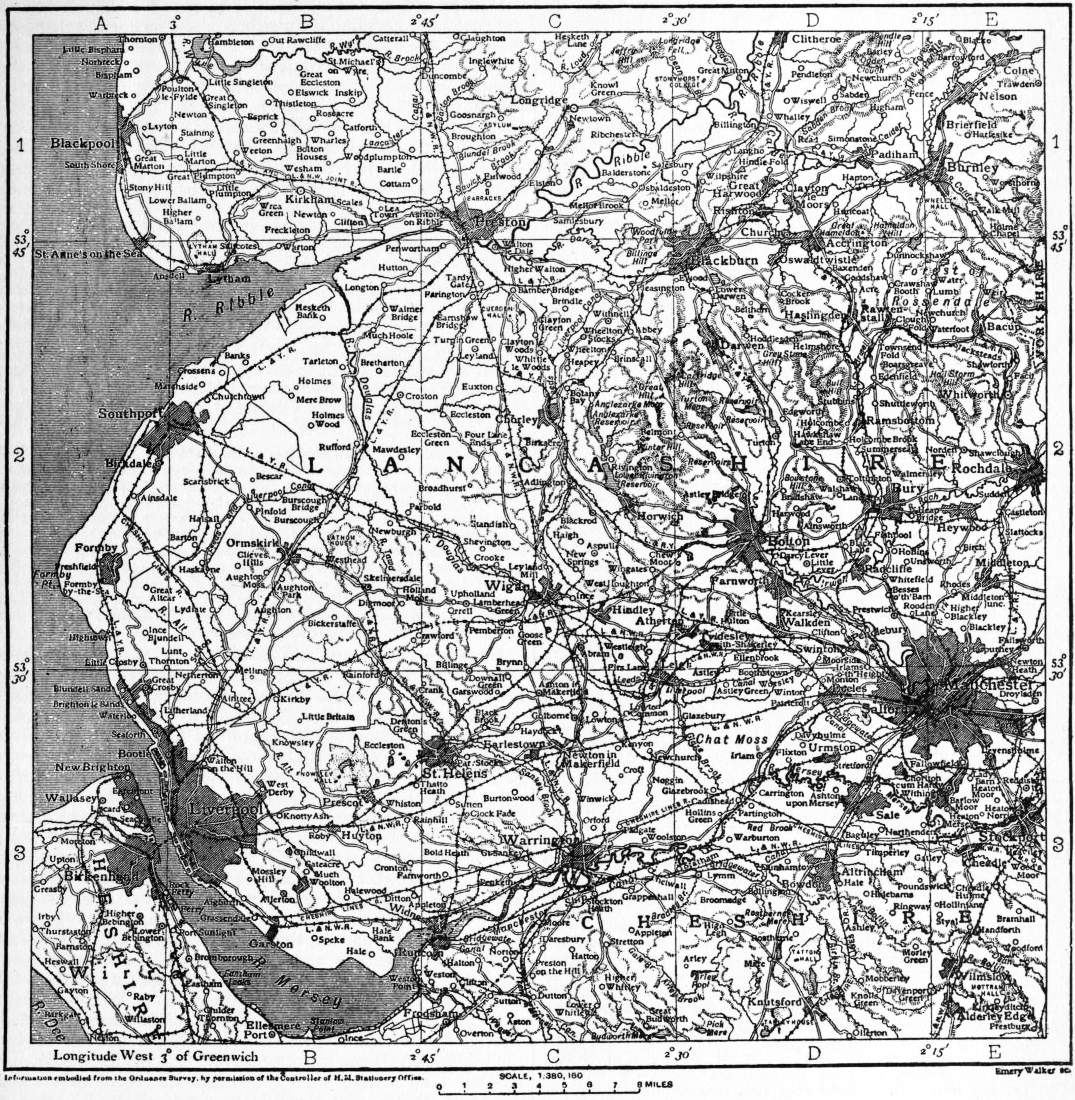
Communications.—Apart from the Manchester Ship Canal, canal-traffic plays an important part in the industrial region. In 1760 the Sankey canal, 10 m. long, the first canal opened in Britain (apart from very early works), was constructed to carry coal from St Helens to Liverpool. Shortly afterwards the duke of Bridgewater projected the great canal from Manchester across the Irwell to Worsley, completed in 1761 and bearing the name of its originator. The Leeds and Liverpool canal, begun in 1770, connects Liverpool and other important towns with Leeds by a circuitous route of 130 m. The other principal canals are the Rochdale, the Manchester (to Huddersfield) and the Lancaster, connecting Preston and Kendal. A short canal connects Ulverston with Morecambe Bay. A network of railways covers the industrial region. The main line of the London and North Western railway enters the county at Warrington, and runs north through Wigan, Preston, Lancaster and Carnforth. It also serves Liverpool and Manchester, providing the shortest route to each of these cities from London, and shares with the Lancashire and Yorkshire company joint lines to Southport, to Blackpool and to Fleetwood, whence there is regular steamship communication with Belfast. The Lancashire and Yorkshire line serves practically all the important centres as far north as Preston and Fleetwood. All the northern trunk lines from London have services to Manchester and Liverpool. The Cheshire Lines system, worked by a committee of the Great Northern, Great Central and Midland companies, links their systems with the South Lancashire district generally, and maintains lines between Liverpool and Manchester, both these cities with Southport, and numerous branches. Branches of the Midland railway from its main line in Yorkshire serve Lancaster, Morecambe, and Heysham and Carnforth, where connexion is made with the Furness railway to Ulverston, Barrow, Lake Side, Coniston, &c.
Population and Administration.—The area of the ancient county is 1,203,365 acres. Its population in 1801 was 673,486; in 1891, 3,926,760; and in 1901, 4,406,409. The area of the administrative county is 1,196,753 acres. The distribution of the industrial population may be best appreciated by showing the parliamentary divisions, parliamentary, county and municipal boroughs and urban districts as placed among the four divisions of the ancient county. In the case of urban districts the name of the great town to which each is near or adjacent follows where necessary. The figures show population in 1901.
Northern Division.—This embraces almost all the county N. of the Ribble, including Furness, and a small area S. of the Ribble estuary. It is considerably the largest of the divisions. Parliamentary divisions, from N. to S.—North Lonsdale, Lancaster, Blackpool, Chorley. Parliamentary, county and municipal boroughs—Barrow-in-Furness (57,586; one member); Preston (112,989; two members). Municipal boroughs—Blackpool (county borough; 47,348), Chorley (26,852), Lancaster (40,329; county town), Morecambe (11,798). Urban districts—Adlington (4523; Chorley), Bispham-with-Norbreck (Blackpool), Carnforth (3040; Lancaster), Croston (2102; Chorley), Dalton-in-Furness (13,020), Fleetwood (12,082), Fulwood (5238; Preston), Grange (1993), Heysham (3381; Morecambe), Kirkham (3693; Preston), Leyland (6865; Chorley), Longridge (4304; Preston), Lytham (7185), Poulon-le-Fylde (2223; Blackpool). Preesall-with-Hackinsall (1423; Fleetwood), St Anne’s-on-the-Sea (6838, a watering-place between Blackpool and Lytham), Thornton (3108; Fleetwood), Ulverston (10,064, in Furness), Withnell (3349; Chorley).
North-Eastern-Division.—This lies E. of Preston, and is the smallest of the four. Parliamentary divisions—Accrington, Clitheroe, Darwen, Rossendale. Parliamentary, county and municipal boroughs—Blackburn (127,626; two members); Burnley (97,043; one member). Municipal boroughs—Accrington (43,122), Bacup (22,505), Clitheroe (11,414), Colne (23,000), Darwen (38,212), Haslingden (18,543, extending into South-Eastern division), Nelson (32,816), Rawtenstall (31,053). Urban districts—Barrowford (4959; Colne), Brierfield (7288; Burnley), Church (6463; Accrington), Clayton-le-Moors (8153; Accrington), Great Harwood (12,015; Blackburn), Oswaldtwistle (14,192; Blackburn), Padiham (12,205; Burnley), Rishton (7031; Blackburn), Trawden (2641; Colne), Walton-le-Dale (11,271; Preston).
South-Western Division.—This division represents roughly a quadrant with radius of 20 m. drawn from Liverpool. Parliamentary divisions—Bootle, Ince, Leigh, Newton, Ormskirk, Southport, Widnes. Parliamentary boroughs—the city and county and municipal borough of Liverpool (684,958; nine members); the county and municipal boroughs of St Helens (84,410; one member); Wigan (60,764; one member), Warrington (64,242; a part only of the parliamentary borough is in this county). Municipal boroughs—Bootle (58,566), Leigh (40,001), Southport (county borough; 48,083), Widnes (28,580). Urban districts—Abram (6306; Wigan), Allerton (1101; Liverpool), Ashton-in-Makerfield (18,687), Atherton (16,211), Billinge (4232; Wigan), Birkdale (14,197; Southport), Childwall (219; Liverpool), Formby (6060), Golborne (6789; St Helens), Great Crosby (7555; Liverpool), Haydock (8575; St Helens), Hindley (23,504; Wigan), Huyton-with-Roby (4661; St Helens), Ince-in-Makerfield (21,262), Lathom-and-Burscough (7113; Ormskirk), Litherland (10,592; Liverpool), Little Crosby (563; Liverpool), Little Woolton (1091; Liverpool), Much Woolton (4731; Liverpool), Newton-in-Makerfield (16,699), Ormskirk (6857), Orrell (5436; Wigan), Prescot (7855; St Helens), Rainford (3359; St Helens), Skelmersdale (5699; Ormskirk), Standish-with-Langtree (6303; Wigan), Tyldesley-with-Shakerley (14,843), Upholland (4773; Wigan), Waterloo-with-Seaforth (23,102; Liverpool).
South-Eastern Division.—This is of about the same area as the South-Western division, and it constitutes the heart of the industrial region. Parliamentary divisions—Eccles, Gorton, Heywood, Middleton, Prestwich, Radcliffe-cum-Farnworth, Stretford, Westhoughton. Parliamentary boroughs—the city and county of a city of Manchester (543,872; six members); with which should be correlated the adjoining county and municipal borough of Salford (220,957; three members), also the county and municipal boroughs of Bolton (168,215; two members), Bury (58,029; one member), Rochdale (83,114; one member), Oldham (137,246; two members), and the municipal borough of Ashton-under-Lyne (43,890). Part only of the last parliamentary borough is within the county, and this division also contains part of the parliamentary boroughs of Stalybridge and Stockport. Municipal boroughs—Eccles (34,369), Heywood (25,458), Middleton (25,178), Mossley (13,452). Urban districts—Aspull (8388; Wigan), Audenshaw (7216; Ashton-under-Lyne), Blackrod (3875; Wigan), Chadderton (24,892; Oldham), Crompton (13,427; Oldham), Denton (14,934; Ashton-under-Lyne), Droylsden (11,087; Manchester), Failsworth (14,152; Manchester), Farnworth (25,925; Bolton), Gorton (26,564; Manchester), Heaton Norris (9474; Stockport). Horwich (15,084; Bolton), Hurst (7145; Ashton-under-Lyne), Irlam (4335; Eccles), Kearsley (9218; Bolton), Lees (3621; Oldham), Levenshulme (11,485; Manchester), Littleborough (11,166; Rochdale), Little Hulton (7294; Bolton), Little Lever (5119; Bolton), Milnrow (8241; Rochdale), Norden (3907; Rochdale), Prestwich (12,839; Manchester), Radcliffe (25,368; Bury), Ramsbottom (15,920; Bury), Royton (14,881; Oldham), Stretford (30,436; Manchester), Swinton-and-Pendlebury (27,005; Manchester), Tottington (6118; Bury), Turton (12,355; Bolton), Urmston (6594; Manchester), Wardle (4427; Rochdale), Westhoughton (14,377; Bolton), Whitefield or Stand (6588; Bury), Whitworth (9578; Rochdale), Worsley (12,462; Eccles).
Lancashire is one of the counties palatine. It is attached to the duchy of Lancaster, a crown office, and retains the chancery court for the county palatine. The chancery of the duchy of Lancaster was once a court of appeal for the chancery of the county palatine, but now even its jurisdiction in regard to the estates of the duchy is merely nominal. The chancery of the county palatine has concurrent jurisdiction with the High Court of Chancery in all matters of equity within the county palatine, and independent jurisdiction in regard to a variety of other matters. The county palatine comprises six hundreds.
Lancashire is in the northern circuit, and assizes are held at Lancaster for the north, and at Liverpool and Manchester for the south of the county. There is one court of quarter sessions, and the county is divided into 33 petty sessional divisions. The boroughs of Blackburn, Bolton, Burnley, Liverpool, Manchester, Oldham, Salford and Wigan have separate commissions of the peace and courts of quarter sessions; and those of Accrington, Ashton-under-Lyne, Barrow-in-Furness, Blackpool, Bolton, Bury, Clitheroe, Colne, Darwen, Eccles, Heywood, Lancaster, Middleton, Mossley, Nelson, Preston, Rochdale, St Helens, Southport and Warrington have separate commissions of the peace only. There are 430 civil parishes. Lancashire is mainly in the diocese of Manchester, but parts are in those of Liverpool, Carlisle, Ripon, Chester and Wakefield. There are 787 ecclesiastical parishes or districts wholly or in part within the county.
Manchester and Liverpool are each seats of a university and of other important educational institutions. Within the bounds of the county there are many denominational colleges, and near Clitheroe is the famous Roman Catholic college of Stonyhurst. There is a day training college for schoolmasters in connexion with University College, Liverpool, and a day training college for both schoolmasters and schoolmistresses in connexion with Owens College, Manchester. At Edgehill, Liverpool, there is a residential training college for schoolmistresses which takes day pupils, at Liverpool a residential Roman Catholic training college for schoolmasters, and at Warrington a residential training college (Chester, Manchester and Liverpool diocesan) for schoolmistresses.
History.—The district afterwards known as Lancashire was after the departure of the Romans for many years apparently little better than a waste. It was not until the victory of Æthelfrith, king of Deira, near Chester in 613 cut off the Britons of Wales from those of Lancashire and Cumberland that even Lancashire south of the Ribble was conquered. The part north of the Ribble was not absorbed in the Northumbrian kingdom till the reign of Ecgfrith (670-685). Of the details of this long struggle we know nothing, but to the stubborn resistance made by the British leaders are due the legends of Arthur; and of the twelve great battles he is supposed to have fought against the English, four are traditionally, though probably erroneously, said to have taken place on the river Douglas near Wigan. In the long struggle for supremacy between Mercia and Northumbria, the country between the Mersey and Ribble was sometimes under one, sometimes under the other kingdom. During the 9th century Lancashire was constantly invaded by the Danes, and after the peace of Wedmore (878) it was included in the Danish kingdom of Northumbria. The A.S. Chronicle records the reconquest of the district between the Ribble and Mersey in 923 by the English king, when it appears to have been severed from the kingdom of Northumbria and united to Mercia, but the districts north of the Ribble now comprised in the county belonged to Northumbria until its incorporation with the kingdom of England. The names on the Lancashire coast ending in by, such as Crosby, Formby, Roby, Kirkby, Derby, show where the Danish settlements were thickest. William the Conqueror gave the lands between the Ribble and Mersey, and Amounderness to Roger de Poictou, but at the time of Domesday Book these had passed out of his hand and belonged to the king.
The name Lancashire does not appear in Domesday; the lands between the Ribble and Mersey were included in Cheshire and those north of the Ribble in Yorkshire. Roger de Poictou soon regained his lands, and Rufus added to his possessions the rest of Lonsdale south of the Sands, of which he already held a part; and as he had the Furness fells as well, he owned all that is now known as Lancashire. In 1102 he finally forfeited all his lands, which Henry I. held till, in 1118, he created the honour of Lancaster by incorporating with Roger’s forfeited lands certain escheated manors in the counties of Nottingham, Derby and Lincoln, and certain royal manors, and bestowed it upon his nephew Stephen, afterwards king. During Stephen’s reign the history of the honour presents certain difficulties, for David of Scotland held the lands north of the Ribble for a time, and in 1147 the earl of Chester held the district between the Ribble and Mersey. Henry II. gave the whole honour to William, Stephen’s son, but in 1164 it came again into the king’s hands until 1189, when Richard I. granted it to his brother John. In 1194, owing to John’s rebellion, it was confiscated and the honour remained with the crown till 1267. In 1229, however, all the crown demesne between the Ribble and Mersey was granted to Ranulf, earl of Chester, and on his death in 1232 came to William Ferrers, earl of Derby, in right of his wife Agnes, sister and co-heir of Ranulf. The Ferrers held it till 1266, when it was confiscated owing to the earl’s rebellion. In 1267 Henry III. granted the honour and county and all the royal demesne therein to his son Edmund, who was created earl of Lancaster. His son, Earl Thomas, married the heiress of Henry de Lacy, earl of Lincoln, and thus obtained the great estates belonging to the de Lacys in Lancashire. On the death of Henry, the first duke of Lancaster, in 1361, the estates, title and honour fell to John of Gaunt in right of his wife Blanche, the duke’s elder daughter, and by the accession of Henry IV., John of Gaunt’s only son, to the throne, the duchy and honour became merged in the crown.
The county of Lancaster is first mentioned in 1169 as contributing 100 marks to the Royal Exchequer for defaults and fines. The creation of the honour decided the boundaries, throwing into it Furness and Cartmel, which geographically belong to Westmorland; Lonsdale and Amounderness, which in Domesday had been surveyed under Yorkshire; and the land between the Ribble and Mersey. In Domesday this district south of the Ribble was divided into the six hundreds of West Derby, Newton, Warrington, Blackburn, Salford and Leyland, but before Henry II.’s reign the hundreds of Warrington and Newton were absorbed in that of West Derby. Neither Amounderness nor Lonsdale was called a hundred in Domesday, but soon after that time the former was treated as a hundred. Ecclesiastically the whole of the county originally belonged to the diocese of York, but after the reconquest of the district between the Ribble and Mersey in 923 this part was placed under the bishop of Lichfield in the archdeaconry of Chester, which was subdivided into the rural deaneries of Manchester, Warrington and Leyland. Up to 1541 the district north of the Ribble belonged to the archdeaconry of Richmond in the diocese of York, and was subdivided into the rural deaneries of Amounderness, Lonsdale and Coupland. In 1541 the diocese of Chester was created, including all Lancashire, which was divided into two archdeaconries: Chester, comprising the rural deaneries of Manchester, Warrington and Blackburn, and Richmond, comprising the deaneries of Amounderness, Furness, Lonsdale and Kendal. In 1847 the diocese of Manchester was created, which included all Lancashire except parts of West Derby, which still belonged to the diocese of Chester, and Furness and Cartmel, which were added to Carlisle in 1856. In 1878 by the creation of the diocese of Liverpool the south-eastern part of the county was subtracted from the Manchester diocese.
No shire court was ever held for the county, but as a duchy and county palatine it has its own special courts. It may have enjoyed palatine jurisdiction under Earl Morcar before the Conquest, but these privileges, if ever exercised, remained in abeyance till 1351, when Henry, duke of Lancaster, received power to have a chancery in the county of Lancaster and to issue writs therefrom under his own seal, as well touching pleas of the crown as any other relating to the common laws, and to have all Jura Regalia belonging to a county palatine. In 1377 the county was erected into a palatinate for John of Gaunt’s life, and in 1390 these rights of jurisdiction were extended and settled in perpetuity on the dukes of Lancaster. The county palatine courts consist of a chancery which dates back at least to 1376, a court of common pleas, the jurisdiction of which was transferred in 1873 by the Judicature Act to the high court of justice, and a court of criminal jurisdiction which in no way differs from the king’s ordinary court. In 1407 the duchy court of Lancaster was created, in which all questions of revenue and dignities affecting the duchy possessions are settled. The chancery of the duchy has been for years practically obsolete. The duchy and county palatine each has its own seal. The office of chancellor of the duchy and county palatine dates back to 1351.
Lancashire is famed for the number of old and important county families living within its borders. The most intimately connected with the history of the county are the Stanleys, whose chief seat is Knowsley Hall. Sir John Stanley early in the 15th century married the heiress of Lathom and thus obtained possession of Lathom and Knowsley. In 1456 the head of the family was created a peer by the title of Baron Stanley and in 1485 raised to the earldom of Derby. The Molyneuxes of Sephton and Croxteth are probably descended from William de Molines, who came to England with William the Conqueror, and is on the roll of Battle Abbey. Roger de Poictou gave him the manor of Sephton, and Richard de Molyneux who held the estate under Henry II. is undoubtedly an ancestor of the family. In 1628 Sir Richard Molyneux was advanced to the peerage of Ireland by the title of Viscount Maryborough, and in 1771 Charles, Lord Maryborough, became earl of Sefton in the peerage of Ireland. His son was created a peer of the United Kingdom as Baron Sefton of Croxteth. The Bootle Wilbrahams, earls of Lathom, are, it is said, descended from John Botyll of Melling, who was alive in 1421, and from the Wilbrahams of Cheshire, who date back at least to Henry III.’s reign. In 1755 the two families intermarried. In 1828 the title of Baron Skelmersdale was bestowed on the head of the family and in 1880 that of earl of Lathorn. The Gerards of Bryn are said to be descended from an old Tuscan family, one of whom came to England in Edward the Confessor’s time, and whose son is mentioned in Domesday. Bryn came into this family by marriage early in the 14th century. Sir Thomas Gerard was created a baronet by James I. in 1611, and in 1876 a peerage was conferred on Sir Robert Gerard. The Gerards of Ince were a collateral branch. The Lindsays, earls of Crawford and Balcarres, are representative on the female side of the Bradshaighs of Haigh Hall, who are said to be of Saxon origin. Other great Lancashire families are the Hoghtons of Hoghton Tower, dating back to the 12th century, the Blundells of Ince Blundell, who are said to have held the manor since the 12th century, now represented by the Weld-Blundells, the Tyldesleys of Tyldesley, now extinct, and the Butlers of Bewsey, barons of Warrington, of whom the last male heir died in 1586.
At the close of the 12th and during the 13th century there was a considerable advance in the importance of the towns; in 1199 Lancaster became a borough, in 1207 Liverpool, in 1230 Salford, in 1246 Wigan, and in 1301 Manchester. The Scottish wars were a great drain to the county, not only because the north part was subject to frequent invasions, as in 1322, but because some of the best blood was taken for these wars. In 1297 Lancashire raised 1000 men, and at the battle of Falkirk (1298) 1000 Lancashire soldiers were in the vanguard, led by Henry de Lacy, earl of Lincoln. In 1349 the county was visited by the Black Death and a record exists of its ravages in Amounderness. In ten parishes between September 1349 and January 1350, 13,180 persons perished. At Preston 3000 died, at Lancaster 3000, at Garstang 2000 and at Kirkham 3000. From the effects of this plague Lancashire was apparently slow to recover; its boroughs ceased to return members early in the 14th century and trade had not yet made any great advance. The drain of the Wars of the Roses on the county must also have been heavy, although none of the battles was fought within its borders; Lord Stanley’s force of 5000 raised in Lancashire and Cheshire virtually decided the battle of Bosworth Field. The poverty of the county is shown by the fact that out of £40,000 granted in 1504 by parliament to the king, Lancashire’s share was only £318. At the battle of Flodden (1513) the Lancashire archers led by Sir Edward Stanley almost totally destroyed the Highlanders on the right Scottish wing and greatly contributed to the victory. Under the Tudors the county prospered; the parliamentary boroughs once more began to return members, the towns increased in size, many halls were built by the gentry and trade increased.
In 1617 James I. visited Lancashire, and in consequence of a petition presented to him at Hoghton, complaining of the restrictions imposed upon Sunday amusements, he issued in 1618 the famous Book of Sports. Another of James’s works, the Daemonologie, is closely connected with the gross superstitions concerning witches which were specially prevalent in Lancashire. The great centre of this witchcraft was Pendle Forest, in the parish of Whalley, and in 1612 twelve persons from Pendle and eight from Samlesbury were tried for witchcraft, nine of whom were hanged. In 1633 another batch of seventeen witches from Pendle were tried and all sentenced to be executed, but the king pardoned them. This was the last important case of witchcraft in Lancashire.
In the assessment of ship money in 1636 the county was put down for £1000, towards which Wigan was to raise £50, Preston £40, Lancaster £30, and Liverpool £25, and these figures compared with the assessments of £140 on Hull and £200 on Leeds show the comparative unimportance of the Lancashire boroughs. On the eve of the Great Rebellion in 1641 parliament resolved to take command of the militia, and Lord Strange, Lord Derby’s eldest son, was removed from the lord lieutenancy. On the whole, the county was Royalist, and the moving spirit among the Royalists was Lord Strange, who became Lord Derby in 1642. Manchester was the headquarters of the Parliamentarians, and was besieged by Lord Derby in September 1642 for seven days, but not taken. Lord Derby himself took up his headquarters at Warrington and garrisoned Wigan. At the opening of 1643 Sir Thomas Fairfax made Manchester his headquarters. Early in February the Parliamentarians from Manchester successfully assaulted Preston, which was strongly Royalist; thence the Parliamentarians marched to Hoghton Tower, which they took, and within a few days captured Lancaster. On the Royalist side Lord Derby made an unsuccessful attack on Bolton from Wigan. In March a large Spanish ship, laden with ammunition for the use of parliament, was driven by a storm on Rossall Point and seized by the Royalists; Lord Derby ordered the ship to be burned, but the parliament forces from Preston succeeded in carrying off some of the guns to Lancaster castle. In March Lord Derby captured the town of Lancaster but not the castle, and marching to Preston regained it for the king, but was repulsed in an attack on Bolton. In April Wigan, one of the chief Royalist strongholds in the county, was taken by the parliament forces, who also again captured Lancaster, and the guns from the Spanish ship were moved for use against Warrington, which was obliged to surrender in May after a week’s siege. Lord Derby also failed in an attempt on Liverpool, and the tide of war had clearly turned against the Royalists in Lancashire. In June Lord Derby went to the Isle of Man, which was threatened by the king’s enemies. Soon after, the Parliamentarians captured Hornby castle, and only two strongholds, Thurland castle and Lathom house, remained in Royalist hands. In the summer, after a seven weeks’ siege by Colonel Alexander Rigby, Thurland castle surrendered and was demolished. In February 1644 the Parliamentarians, under Colonel Rigby, Colonel Ashton and Colonel Moore, besieged Lathom house, the one refuge left to the Royalists, which was bravely defended by Lord Derby’s heroic wife, Charlotte de la Trémoille. The siege lasted nearly four months and was raised on the approach of Prince Rupert, who marched to Bolton and was joined on his arrival outside the town by Lord Derby. Bolton was carried by storm; Rupert ordered that no quarter should be given, and it is usually said at least 1500 of the garrison were slain. Prince Rupert advanced without delay to Liverpool, which was defended by Colonel Moore, and took it after a siege of three weeks. After the battle of Marston Moor Prince Rupert again appeared in Lancashire and small engagements took place at Ormskirk, Upholland and Preston; in November Liverpool surrendered to the Parliamentarians. Lathom house was again the only strong place in Lancashire left to the Royalists, and in December 1645 after a five months’ siege it was compelled to surrender through lack of provisions, and was almost entirely destroyed. For the moment the war in Lancashire was over. In 1648, however, the Royalist forces under the duke of Hamilton and Sir Marmaduke Langdale marched through Lancaster to Preston, hoping to reach Manchester; but near Preston were defeated by Cromwell in person. The remnant retreated through Wigan towards Warrington, and after being again defeated at Winwick surrendered at Warrington. In 1651 Charles II. advanced through Lancaster, Preston and Chorley on his southward march, and Lord Derby after gathering forces was on his way to meet him when he was defeated at Wigan. In 1658, after Cromwell’s death, a Royalist rebellion was raised in which Lancashire took a prominent part, but it was quickly suppressed. During the Rebellion of 1715 Manchester was the chief centre of Roman Catholic and High Church Toryism. On the 7th of November the Scottish army entered Lancaster, where the Pretender was proclaimed king, and advanced to Preston, at which place a considerable body of Roman Catholics joined it. The rebels remained at Preston a few days, apparently unaware of the advance of the government troops, until General Wills from Manchester and General Carpenter from Lancaster surrounded the town, and on the 13th of November the town and the rebel garrison surrendered. Several of the rebels were hanged at Preston, Wigan, Lancaster and other places. In 1745 Prince Charles Edward passed through the county and was joined by about 200 adherents, called the Manchester regiment and placed under the command of Colonel Townley, who was afterwards executed.
The first industry established in Lancashire was that of wool, and with the founding of Furness abbey in 1127 wool farming on a large scale began here, but the bulk of the wool grown was exported, not worked up in England. In 1282, however, there was a mill for fulling or bleaching wool in Manchester, and by the middle of the 16th century there was quite a flourishing trade in worsted goods. In an act of 1552 Manchester “rugs and frizes” are specially mentioned, and in 1566 another act regulated the fees of the aulnager who was to have his deputies at Manchester, Rochdale, Bolton, Blackburn and Bury; the duty of the aulnagers was to prevent “cottons, frizes and rugs” from being sold unsealed, but it must be noted that by cottons is not meant what we now understand by the word, but woollen goods. The 17th century saw the birth of the class of clothiers, who purchased the wool in large quantities or kept their own sheep, and delivered it to weavers who worked it up into cloth in their houses and returned it to the employers. The earliest mention of the manufacture of real cotton goods is in 1641, when Manchester made fustians, vermilions and dimities, but the industry did not develop to any extent until after the invention of the fly shuttle by John Kay in 1733, of the spinning jenny by James Hargreaves of Blackburn in 1765, of the water frame throstle by Richard Arkwright of Bolton in 1769, and of the mule by Samuel Crompton of Hall-in-the-Wood near Bolton in 1779. So rapid was the development of the cotton manufacture that in 1787 there were over forty cotton mills in Lancashire, all worked by water power. In 1789, however, steam was applied to the industry in Manchester, and in 1790 in Bolton a cotton mill was worked by steam. The increase in the import of raw cotton from 3,870,000 ℔ in 1769 to 1,083,600,000 in 1860 shows the growth of the industry. The rapid growth was accompanied with intermittent periods of depression, which in 1819 in particular led to the formation of various political societies and to the Blanketeers’ Meeting and the Peterloo Massacre. During the American Civil War the five years’ cotton famine caused untold misery in the county, but public and private relief mitigated the evils, and one good result was the introduction of machinery capable of dealing with the shorter staple of Indian cotton, thus rendering the trade less dependent for its supplies on America.
During the 18th century the only town where maritime trade increased was Liverpool, where in the last decade about 4500 ships arrived annually of a tonnage about one-fifth that of the London shipping. The prosperity of Liverpool was closely bound up with the slave trade, and about one-fourth of its ships were employed in this business. With the increase of trade the means of communication improved. In 1758 the duke of Bridgewater began the Bridgewater canal from Worsley to Salford and across the Irwell to Manchester, and before the end of the century the county was intersected by canals. In 1830 the first railway in England was opened between Manchester and Liverpool, and other railways rapidly followed.
The first recorded instance of parliamentary representation in Lancashire was in 1295, when two knights were returned for the county and two burgesses each for the boroughs of Lancaster, Preston, Wigan and Liverpool. The sheriff added to this return “There is no city in the county of Lancaster.” The boroughs were, however, excused one after another from parliamentary representation, which was felt as a burden owing to the compulsory payment of the members’ wages. Lancaster ceased to send members in 1331 after making nineteen returns, but renewed its privileges in 1529; from 1529 to 1547 there are no parliamentary returns, but from 1547 to 1867 Lancaster continued to return two members. Preston similarly was excused after 1331, after making eleven returns, but in 1529 and from 1547 onwards returned two members. Liverpool and Wigan sent members in 1295 and 1307, but not again till 1547. To the writ issued in 1362 the sheriff in his return says: “There is not any City or Borough in this County from which citizens or burgesses ought or are accustomed to come as this Writ requires.” In 1559 Clitheroe and Newton-le-Willows first sent two members. Thus in all Lancashire returned fourteen members, and, with a brief exception during the Commonwealth, this continued to be the parliamentary representation till 1832. By the Reform Act of 1832 Lancashire was assigned four members, two for the northern and two for the southern division. Lancaster, Preston, Wigan and Liverpool continued to send two members, Clitheroe returned one and Newton was disfranchised. The following new boroughs were created: Manchester, Bolton, Blackburn, Oldham, returning two members each; Ashton-under-Lyne, Bury, Rochdale, Salford and Warrington, one each. In 1861 a third member was given to South Lancashire and in 1867 the county was divided into four constituencies, to each of which four members were assigned; since 1885 the county returns twenty-three members. The boroughs returned from 1867 to 1885 twenty-five members, and since 1885 thirty-four.
Antiquities.—The Cistercian abbey of Furness (q.v.) is one of the finest and most extensive ecclesiastical ruins in England. Whalley abbey, first founded at Stanlawe in Cheshire in 1178, and removed in 1296, belonged to the same order. There was a priory of Black Canons at Burscough, founded in the time of Richard I., one at Conishead dating from Henry II.’s reign, and one at Lancaster. A convent of Augustinian friars was founded at Cartmel in 1188, and one at Warrington about 1280. There are some remains of the Benedictine priory of Upholland, changed from a college of secular priests in 1318; and the same order had a priory at Lancaster founded in 1094, a cell at Lytham, of the reign of Richard I., and a priory at Penwortham, founded shortly after the time of the Conqueror. The Premonstratensians had Cockersand abbey, changed in 1190 from a hospital founded in the reign of Henry II., of which the chapter-house remains. At Kersal, near Manchester, there was a cell of Cluniac monks founded in the reign of John, while at Lancaster there were convents of Dominicans and Franciscans, and at Preston a priory of Grey Friars built by Edmund, earl of Lancaster, son of Henry III.
Besides the churches mentioned under the several towns, the more interesting are those of Aldingham, Norman doorway; Aughton; Cartmel priory church (see Furness); Hawkshead; Heysham, Norman with traces of earlier date; Hoole; Huyton; Kirkby, rebuilt, with very ancient font; Kirkby Ireleth, late Perpendicular, with Norman doorway; Leyland; Melling (in Lonsdale), Perpendicular, with stained-glass windows; Middleton, rebuilt in 1524, but containing part of the Norman church and several monuments; Ormskirk, Perpendicular with traces of Norman, having two towers, one of which is detached and surmounted by a spire; Overton, with Norman doorway; Radcliffe, Norman; Sefton, Perpendicular, with fine brass and recumbent figures of the Molyneux family, also a screen exquisitely carved; Stidd, near Ribchester, Norman arch and old monuments; Tunstall, late Perpendicular; Upholland priory church, Early English, with low massy tower; Urswick, Norman, with embattled tower and several old monuments; Walton-on-the-hill, anciently the parish church of Liverpool; Walton-le-Dale; Warton, with old font; Whalley abbey church, Decorated and Perpendicular, with Runic stone monuments.
The principal old castles are those of Lancaster; Dalton, a small rude tower occupying the site of an older building; two towers of Gleaston castle, built by the lords of Aldingham in the 14th century; the ruins of Greenhalgh castle, built by the first earl of Derby, and demolished after a siege by order of parliament in 1649; the ruins of Fouldrey in Piel Island near the entrance to Barrow harbour, erected in the reign of Edward III., now most dilapidated. There are many old timber houses and mansions of interest, as well as numerous modern seats.
See Victoria History of Lancashire (1906-1907); E. Baines, The History of the County Palatine and Duchy of Lancaster (1888); H. Fishwick, A History of Lancashire (1894); W. D. Pink and A. B. Beavan, The Parliamentary Representation of Lancashire (1889).
LANCASTER, HOUSE OF. The name House of Lancaster is commonly used to designate the line of English kings immediately descended from John of Gaunt, the fourth son of Edward III. But the history of the family and of the title goes back to the reign of Henry III., who created his second son, Edmund, earl of Lancaster in 1267. This Edmund received in his own day the surname of Crouchback, not, as was afterwards supposed, from a personal deformity, but from having worn a cross upon his back in token of a crusading vow. He is not a person of much importance in history except in relation to a strange theory raised in a later age about his birth, which we shall notice presently. His son Thomas, who inherited the title, took the lead among the nobles of Edward II.’s time in opposition to Piers Gaveston and the Despensers, and was beheaded for treason at Pontefract. At the commencement of the following reign his attainder was reversed and his brother Henry restored to the earldom; and Henry being appointed guardian to the young king Edward III., assisted him to throw off the yoke of Mortimer. On this Henry’s death in 1345 he was succeeded by a son of the same name, sometimes known as Henry Tort-Col or Wryneck, a very valiant commander in the French wars, whom the king advanced to the dignity of a duke. Only one duke had been created in England before, and that was fourteen years previously, when the king’s son Edward, the Black Prince, was made duke of Cornwall. This Henry Wryneck died in 1361 without heir male. His second daughter, Blanche, became the wife of John of Gaunt, who thus succeeded to the duke’s inheritance in her right; and on the 13th of November 1362, when King Edward attained the age of fifty, John was created duke of Lancaster, his elder brother, Lionel, being at the same time created duke of Clarence. It was from these two dukes that the rival houses of Lancaster and York derived their respective claims to the crown. As Clarence was King Edward’s third son, while John of Gaunt was his fourth, in ordinary course on the failure of the elder line the issue of Clarence should have taken precedence of that of Lancaster in the succession. But the rights of Clarence were conveyed in the first instance to an only daughter, and the ambition and policy of the house of Lancaster, profiting by advantageous circumstances, enabled them not only to gain possession of the throne but to maintain themselves in it for three generations before they were dispossessed by the representatives of the elder brother.
As for John of Gaunt himself, it can hardly be said that this sort of politic wisdom is very conspicuous in him. His ambition was generally more manifest than his discretion; but fortune favoured his ambition, even as to himself, somewhat beyond expectation, and still more in his posterity. Before the death of his father he had become the greatest subject in England, his three elder brothers having all died before him. He had even added to his other dignities the title of king of Castile, having married, after his first wife’s death, the daughter of Peter the Cruel. The title, however, was an empty one, the throne of Castile being actually in the possession of Henry of Trastamara, whom the English had vainly endeavoured to set aside. His military and naval enterprises were for the most part disastrous failures, and in England he was exceedingly unpopular. Nevertheless, during the later years of his father’s reign the weakness of the king and the declining health of the Black Prince threw the government very much into his hands. He even aimed, or was suspected of aiming, at the succession to the crown; but in this hope he was disappointed by the action of the Good Parliament a year before Edward’s death, in which it was settled that Richard the son of the Black Prince should be king after his grandfather. Nevertheless the suspicion with which he was regarded was not altogether quieted when Richard came to the throne, a boy in the eleventh year of his age. The duke himself complained in parliament of the way he was spoken of out of doors, and at the outbreak of Wat Tyler’s insurrection the peasants stopped pilgrims on the road to Canterbury and made them swear never to accept a king of the name of John. On gaining possession of London they burnt his magnificent palace of the Savoy. Richard found a convenient way to get rid of John of Gaunt by sending him to Castile to make good his barren title, and on this expedition he was away three years. He succeeded so far as to make a treaty with his rival, King John, son of Henry of Trastamara, for the succession, by virtue of which his daughter Catherine became the wife of Henry III. of Castile some years later. After his return the king seems to have regarded him with greater favour, created him duke of Aquitaine, and employed him in repeated embassies to France, which at length resulted in a treaty of peace, and Richard’s marriage to the French king’s daughter.
Another marked incident of his public life was the support which he gave on one occasion to the Reformer Wycliffe. How far this was due to religious and how far to political considerations may be a question; but not only John of Gaunt but his immediate descendants, the three kings of the house of Lancaster, all took deep interest in the religious movements of the times. A reaction against Lollardy, however, had already begun in the days of Henry IV., and both he and his son felt obliged to discountenance opinions which were believed to be politically and theologically dangerous.
Accusations had been made against John of Gaunt more than once during the earlier part of Richard II.’s reign of entertaining designs to supplant his nephew on the throne. But these Richard never seems to have wholly credited, and during his three years’ absence his younger brother, Thomas of Woodstock, duke of Gloucester, showed himself a far more dangerous intriguer. Five confederate lords with Gloucester at their head took up arms against the king’s favourite ministers, and the Wonderful Parliament put to death without remorse almost every agent of his former administration who had not fled the country. Gloucester even contemplated the dethronement of the king, but found that in this matter he could not rely on the support of his associates, one of whom was Henry, earl of Derby, the duke of Lancaster’s son. Richard soon afterwards, by declaring himself of age, shook off his uncle’s control, and within ten years the acts of the Wonderful Parliament were reversed by a parliament no less arbitrary. Gloucester and his allies were then brought to account; but the earl of Derby and Thomas Mowbray, earl of Nottingham, were taken into favour as having opposed the more violent proceedings of their associates. As if to show his entire confidence in both these noblemen, the king created the former duke of Hereford and the latter duke of Norfolk. But within three months from this time the one duke accused the other of treason, and the truth of the charge, after much consideration, was referred to trial by battle according to the laws of chivalry. But when the combat was about to commence it was interrupted by the king, who, to preserve the peace of the kingdom, decreed by his own mere authority that the duke of Hereford should be banished for ten years—a term immediately afterwards reduced to five—and the duke of Norfolk for life.
This arbitrary sentence was obeyed in the first instance by both parties, and Norfolk never returned. But Henry, duke of Hereford, whose milder sentence was doubtless owing to the fact that he was the popular favourite, came back within a year, having been furnished with a very fair pretext for doing so by a new act of injustice on the part of Richard. His father, John of Gaunt, had died in the interval, and the king, troubled with a rebellion in Ireland, and sorely in want of money, had seized the duchy of Lancaster as forfeited property. Henry at once sailed for England, and landing in Yorkshire while King Richard was in Ireland, gave out that he came only to recover his inheritance. He at once received the support of the northern lords, and as he marched southwards the whole kingdom was soon practically at his command. Richard, by the time he had recrossed the channel to Wales, discovered that his cause was lost. He was conveyed from Chester to London, and forced to execute a deed by which he resigned his crown. This was recited in parliament, and he was formally deposed. The duke of Lancaster then claimed the kingdom as due to himself by virtue of his descent from Henry III.
The claim which he put forward involved, to all appearance, a strange falsification of history, for it seemed to rest upon the supposition that Edmund of Lancaster, and not Edward I., was the eldest son of Henry III. A story had gone about, even in the days of John of Gaunt, who, if we may trust the rhymer John Hardyng (Chronicle, pp. 290, 291), had got it inserted in chronicles deposited in various monasteries, that this Edmund, surnamed Crouchback, was really hump-backed, and that he was set aside in favour of his younger brother Edward on account of his deformity. No chronicle, however, is known to exist which actually states that Edmund Crouchback was thus set aside; and in point of fact he had no deformity at all, while Edward was six years his senior. Hardyng’s testimony is, moreover, suspicious as reflecting the prejudices of the Percys after they had turned against Henry IV., for Hardyng himself expressly says that the earl of Northumberland was the source of his information (see note, p. 353 of his Chronicle). But a statement in the continuation of the chronicle called the Eulogium (vol. iii. pp. 369, 370) corroborates Hardyng to some extent; for we are told that John of Gaunt had once desired in parliament that his son should be recognized on this flimsy plea as heir to the crown; and when Roger Mortimer, earl of March, denied the story and insisted on his own claim as descended from Lionel, duke of Clarence, Richard imposed silence on both parties. However this may be, it is certain that this story, though not directly asserted to be true, was indirectly pointed at by Henry when he put forward his claim, and no one was then bold enough to challenge it.
This was partly due, no doubt, to the fact that the true lineal heir after Richard was then a child, Edmund, who had just succeeded his father as earl of March. Another circumstance was unfavourable to the house of Mortimer—that it derived its title through a woman. No case precisely similar had as yet arisen, and, notwithstanding the precedent of Henry II., it might be doubted whether succession through a female was favoured by the constitution. If not, Henry could say with truth that he was the direct heir of his grandfather, Edward III. If, on the other hand, succession through females was valid, he could trace his descent through his mother from Henry III. by a very illustrious line of ancestors. And, in the words by which he formally made his claim, he ventured to say no more than that he was descended from the king last mentioned “by right line of the blood.” In what particular way that “right line” was to be traced he did not venture to indicate.
A brief epitome of the reigns of the three successive kings belonging to the house of Lancaster (Henry IV., V. and VI.) will be found elsewhere. With the death of Henry VI. the direct male line of John of Gaunt became extinct. But by his daughters he became the ancestor of more than one line of foreign kings, while his descendants by his third wife, Catherine Swynford, conveyed the crown of England to the house of Tudor. It is true that his children by this lady were born before he married her; but they were made legitimate by act of parliament, and, though Henry IV. in confirming the privilege thus granted to them endeavoured to debar them from the succession to the crown, it is now ascertained that there was no such reservation in the original act, and the title claimed by Henry VII. was probably better than he himself supposed.
We show on the following page a pedigree of the royal and illustrious houses that traced their descent from John of Gaunt.
(J. Ga.)
LANCASTER, HENRY, Earl of (c. 1281-1345), was the second son of Edmund, earl of Lancaster (d. 1296), and consequently a grandson of Henry III. During his early days he took part in campaigns in Flanders, Scotland and Wales, but was quite overshadowed by his elder brother Thomas (see below). In 1324, two years after Thomas had lost his life for opposing the king, Henry was made earl of Leicester by his cousin, Edward II., but he was not able to secure the titles and estates of Lancaster to which he was heir, and be showed openly that his sympathies were with his dead brother. When Queen Isabella took up arms against her husband in 1326 she was joined at once by the earl, who took a leading part in the proceedings against the king and his favourites, the Despensers, being Edward’s gaoler at Kenilworth castle. Edward III. being now on the throne, Leicester secured the earldom of Lancaster and his brother’s lands, becoming also steward of England; he knighted the young king and was the foremost member of the royal council, but he was soon at variance with Isabella and her paramour, Roger Mortimer, and was practically deprived of his power. In 1328 his attempt to overthrow Mortimer failed, and he quietly made his peace with the king; a second essay against Mortimer was more successful. About this time Lancaster became blind; he retired from public life and died on the 22nd of September, 1345.
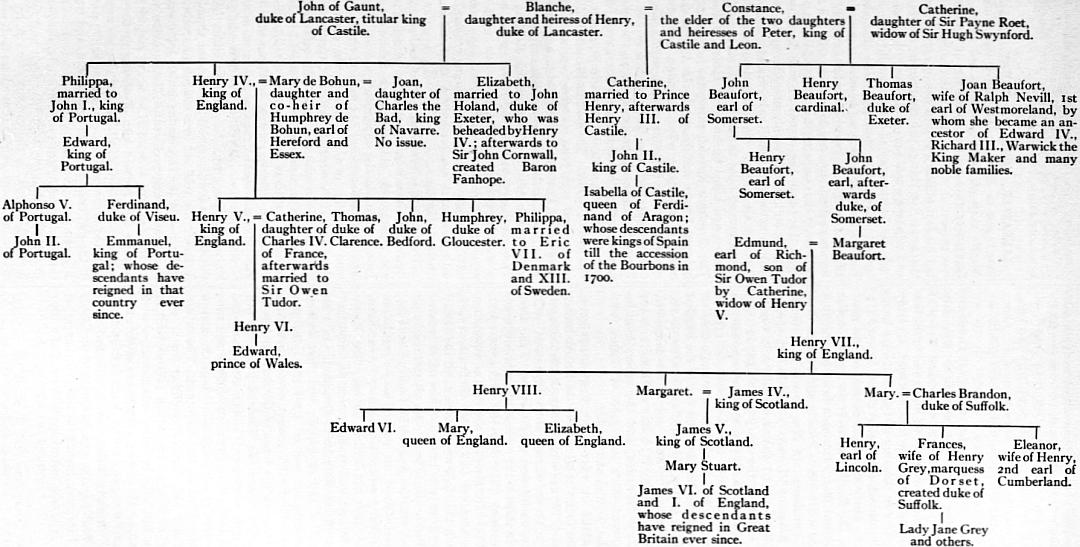
His son and successor, Henry, 1st duke of Lancaster (c. 1300-1361), was a soldier of unusual distinction. Probably from his birthplace in Monmouthshire he was called Henry of Grosmont. He fought in the naval fight off Sluys and in the one off Winchelsea in 1350; he led armies into Scotland, Gascony and Normandy, his exploits in Gascony in 1345 and 1346 being especially successful; he served frequently under Edward III. himself; and he may be fairly described as one of the most brilliant and capable of the English warriors during the earlier part of the Hundred Years’ War. During a brief respite from the king’s service he led a force into Prussia and he was often employed on diplomatic business. In 1354 he was at Avignon negotiating with Pope Innocent VI., who wished to make peace between England and France, and one of his last acts was to assist in arranging the details of the treaty of Brétigny in 1360. In 1337 he was made earl of Derby; in 1345 he succeeded to his father’s earldoms of Lancaster and Leicester; in 1349 he was created earl of Lincoln, and in 1351 he was made duke of Lancaster. He was steward of England and one of the original knights of the order of the garter. He died at Leicester on the 13th of March 1361. He left no sons; one of his daughters, Maud (d. 1362), married William V., count of Holland, a son of the emperor Louis the Bavarian, and the other, Blanche (d. 1369), married Edward III.’s son, John of Gaunt, who obtained his father-in-law’s titles and estates.
LANCASTER, SIR JAMES (fl. 1591-1618), English navigator and statesman, one of the foremost pioneers of the British Indian trade and empire. In early life he fought and traded in Portugal. On the 10th of April 1591 he started from Plymouth, with Raymond and Foxcroft, on his first great voyage to the East Indies; this fleet of three ships is the earliest of English oversea Indian expeditions. Reaching Table Bay (1st of August 1591), and losing one ship off Cape Corrientes on the 12th of September, the squadron rested and refitted at Zanzibar (February 1592), rounded Cape Comorin in May following, and was off the Malay Peninsula in June. Crossing later to Ceylon, the crews insisted on returning home; the voyage back was disastrous; only twenty-five officers and men reappeared in England in 1594. Lancaster himself reached Rye on the 24th of May 1594; in the same year he led a military expedition against Pernambuco, without much success; but his Indian voyage, like Ralph Fitch’s overland explorations and trading, was an important factor in the foundation of the East India Company. In 1600 he was given command of the company’s first fleet (which sailed from Torbay towards the end of April 1601); he was also accredited as Queen Elizabeth’s special envoy to various Eastern potentates. Going by the Cape of Good Hope (1st of November 1601) Lancaster visited the Nicobars (from the 9th of April 1602), Achin and other parts of Sumatra (from the 5th of June 1602), and Bantam in Java; an alliance was concluded with Achin, a factory established at Bantam and a commercial mission despatched to the Moluccas. The return voyage (20th of February to 11th of September 1603) was speedy and prosperous, and Lancaster (whose success both in trade and in diplomacy had been brilliant) was rewarded with knighthood (October 1603). He continued to be one of the chief directors of the East India Company till his death in May 1618; most of the voyages of the early Stuart time both to India and in search of the North-West passage were undertaken under his advice and direction; Lancaster Sound, on the north-west of Baffin’s Bay (in 74° 20′ N.), was named by William Baffin after Sir James (July 1616).
See Hakluyt, Principal Navigations, vol. ii. pt. ii. pp. 102-110, vol. iii. pp. 708-715 (1599); Purchas, Pilgrims, vol. i. pt. ii. pp. 147-164; also The Voyages of Sir James Lancaster ... to the East Indies ..., ed. Sir Clements Markham, Hakluyt Soc. (1877), Calendars of State Papers, East Indies. The original journals of Lancaster’s voyage of 1601-1603 have disappeared, and here we have only Purchas to go on.
LANCASTER, JOHN OF GAUNT, Duke of (1340-1399), fourth son of Edward III. and Queen Philippa, was born in March 1340 at Ghent, whence his name. On the 29th of September 1342 he was made earl of Richmond; as a child he was present at the sea fight with the Spaniards in August 1350, but his first military service was in 1355, when he was knighted. On the 19th of May 1359 he married his cousin Blanche, daughter and ultimately sole heiress of Henry, duke of Lancaster. In her right he became earl of Lancaster in 1361, and next year was created duke. His marriage made him the greatest lord in England, but for some time he took no prominent part in public affairs. In 1366 he joined his eldest brother, Edward the Black Prince, in Aquitaine, and in the year after led a strong contingent to share in the campaign in support of Pedro the Cruel of Castile. With this began the connexion with Spain, which was to have so great an influence on his after-life. John fought in the van at Najera on the 3rd of April 1367, when the English victory restored Pedro to his throne. He returned home at the end of the year. Pedro proved false to his English allies, and was finally overthrown and killed by his rival, Henry of Trastamara, in 1369. The disastrous Spanish enterprise led directly to renewed war between France and England. In August 1369 John had command of an army which invaded northern France without success. In the following year he went again to Aquitaine, and was present with the Black Prince at the sack of Limoges. Edward’s health was broken down, and he soon after went home, leaving John as his lieutenant. For a year John maintained the war at his own cost, but whilst in Aquitaine a greater prospect was opened to him. The duchess Blanche had died in the autumn of 1369 and now John married Constance (d. 1394), the elder daughter of Pedro the Cruel, and in her right assumed the title of king of Castile and Leon. For sixteen years the pursuit of his kingdom was the chief object of John’s ambition. No doubt he hoped to achieve his end, when he commanded the great army which invaded France in 1373. But the French would not give battle, and though John marched from Calais right through Champagne, Burgundy and Auvergne, it was with disastrous results; only a shattered remnant of the host reached Bordeaux.
The Spanish scheme had to wait, and when John got back to England he was soon absorbed in domestic politics. The king was prematurely old, the Black Prince’s health was broken. John, in spite of the unpopularity of his ill-success, was forced into the foremost place. As head of the court party he had to bear the brunt of the attack on the administration made by the Good Parliament in 1376. It was not perhaps altogether just, and John was embittered by reflections on his loyalty. As soon as the parliament was dissolved he had its proceedings reversed, and next year secured a more subservient assembly. There came, however, a new development. The duke’s politics were opposed by the chief ecclesiastics, and in resisting them he had made use of Wycliffe. With Wycliffe’s religious opinions he had no sympathy. Nevertheless when the bishops arraigned the reformer for heresy John would not abandon him. The conflict over the trial led to a violent quarrel with the Londoners, and a riot in the city during which John was in danger of his life from the angry citizens. The situation was entirely altered by the death of Edward III. on the 21st of June. Though his enemies had accused him of aiming at the throne, John was without any taint of disloyalty. In his nephew’s interests he accepted a compromise, disclaimed before parliament the truth of the malicious rumours against him, and was reconciled formally with his opponents. Though he took his proper place in the ceremonies at Richard’s coronation, he showed a tactful moderation by withdrawing for a time from any share in the government. However, in the summer of 1378, he commanded in an attack on St Malo, which through no fault of his failed. To add to this misfortune, during his absence some of his supporters violated the sanctuary at Westminster. He vindicated himself somewhat bitterly in a parliament at Gloucester, but still avoiding a prominent part in the government, accepted the command on the Scottish border. He was there engaged when his palace of the Savoy in London was burnt during the peasants’ revolt in June 1381. Wild reports that even the government had declared him a traitor made him seek refuge in Scotland. Richard had, however, denounced the calumnies, and at once recalled his uncle.
John’s self-restraint had strengthened his position, and he began again to think of his Spanish scheme. He urged its undertaking in parliament in 1382, but nearer troubles were more urgent, and John himself was wanted on the Scottish border. There he sought to arrange peace, but against his will was forced into an unfortunate campaign in 1384. His ill-success renewed his unpopularity, and the court favourites of Richard II. intrigued against him. They were probably responsible for the allegation, made by a Carmelite, called Latemar, that John was conspiring against his nephew. Though Richard at first believed it, the matter was disposed of by the friar’s death. However, the court party soon after concocted a fresh plot for the duke’s destruction; John boldly denounced his traducers, and the quarrel was appeased by the intervention of the king’s mother. The intrigue still continued, and broke out again during the Scottish campaign in 1385. John was not the man to be forced into treason to his family, but the impossibility of the position at home made his foreign ambitions more feasible.
The victory of John of Portugal over the king of Castile at Aljubarrota, won with English help, offered an opportunity. In July 1386 John left England with a strong force to win his Spanish throne. He landed at Corunna, and during the autumn conquered Galicia. Juan, who had succeeded his father Henry as king of Castile, offered a compromise by marriage. John of Gaunt refused, hoping for greater success with the help of the king of Portugal, who now married the duke’s eldest daughter Philippa. In the spring the allies invaded Castile. They could achieve no success, and sickness ruined the English army. The conquests of the previous year were lost, and when Juan renewed his offers, John of Gaunt agreed to surrender his claims to his daughter by Constance of Castile, who was to marry Juan’s heir. After some delay the peace was concluded at Bayonne in 1388. The next eighteen months were spent by John as lieutenant of Aquitaine, and it was not till November 1389 that he returned to England. By his absence he had avoided implication in the troubles at home. Richard, still insecure of his own position, welcomed his uncle, and early in the following year marked his favour by creating him duke of Aquitaine. John on his part was glad to support the king’s government; during four years he exercised his influence in favour of pacification at home, and abroad was chiefly responsible for the conclusion of a truce with France. Then in 1395 he went to take up the government of his duchy; thanks chiefly to his lavish expenditure his administration was not unsuccessful, but the Gascons had from the first objected to government except by the crown, and secured his recall within less than a year. Almost immediately after his return John married as his third wife Catherine Swynford; Constance of Castile had died in 1394. Catherine had been his mistress for many years, and his children by her, who bore the name of Beaufort, were now legitimated. In this and in other matters Richard found it politic to conciliate him. But though John presided at the trial of the earl of Arundel in September 1397, he took no active part in affairs. The exile of his son Henry in 1398 was a blow from which he did not recover. He died on the 3rd of February 1399, and was buried at St Paul’s near the high altar.
John was neither a great soldier nor a statesman, but he was a chivalrous knight and loyal to what he believed were the interests of his family. In spite of opportunities and provocations he never lent himself to treason. He deserves credit for his protection of Wycliffe, though he had no sympathy with his religious or political opinions. He was also the patron of Chaucer, whose Boke of the Duchesse was a lament for Blanche of Lancaster.
The chief original sources for John’s life are Froissart, the maliciously hostile Chronicon Angliae (1328-1388), and the eulogistic Chronicle of Henry Knighton (both the latter in the Rolls Series). But fuller information is to be found in the excellent biography by S. Armytage-Smith, published in 1904. For his descendants see the table under Lancaster, House of.
(C. L. K.)
LANCASTER, JOSEPH (1778-1838), English educationist, was born in Southwark in 1778, the son of a Chelsea pensioner. He had few opportunities of regular instruction, but he very early showed unusual seriousness and desire for learning. At sixteen he looked forward to the dissenting ministry; but soon after his religious views altered, and he attached himself to the Society of Friends, with which he remained associated for many years, until long afterwards he was disowned by that body. At the age of twenty he began to gather a few poor children under his father’s roof, and to give them the rudiments of instruction, without a fee, except in cases in which the parent was willing to pay a trifle. Soon a thousand children were assembled in the Borough Road; and, the attention of the duke of Bedford, Mr Whitbread, and others having been directed to his efforts, he was provided with means for building a schoolroom and supplying needful materials. The main features of his plan were the employment of older scholars as monitors, and an elaborate system of mechanical drill, by means of which these young teachers were made to impart the rudiments of reading, writing and arithmetic to large numbers at the same time. The material appliances for teaching were very scanty—a few leaves torn out of spelling-books and pasted on boards, some slates and a desk spread with sand, on which the children wrote with their fingers. The order and cheerfulness of the school and the military precision of the children’s movements began to attract much public observation at a time when the education of the poor was almost entirely neglected. Lancaster inspired his young monitors with fondness for their work and with pride in the institution of which they formed a part. As these youths became more trustworthy, he found himself at leisure to accept invitations to expound what he called “his system” by lectures in various towns. In this way many new schools were established, and placed under the care of young men whom he had trained. In a memorable interview with George III., Lancaster was encouraged by the expression of the king’s wish that every poor child in his dominions should be taught to read the Bible. Royal patronage brought in its train resources, fame and public responsibility, which proved to be beyond Lancaster’s own powers to sustain or control. He was vain, reckless and improvident. In 1808 a few noblemen and gentlemen paid his debts, became his trustees and founded the society at first called the Royal Lancasterian Institution, but afterwards more widely known as the British and Foreign School Society. The trustees soon found that Lancaster was impatient of control, and that his wild impulses and heedless extravagance made it impossible to work with him. He quarrelled with the committee, set up a private school at Tooting, became bankrupt, and in 1818 emigrated to America. There he met at first a warm reception, gave several courses of lectures which were well attended, and wrote to friends at home letters full of enthusiasm. But his fame was short-lived. The miseries of debt and disappointment were aggravated by sickness, and he settled for a time in the warmer climate of Carácas. He afterwards visited St Thomas and Santa Cruz, and at length returned to New York, the corporation of which city made him a public grant of 500 dollars in pity for the misfortunes which had by this time reduced him to lamentable poverty. He afterwards visited Canada, where he gave lectures at Montreal, and was encouraged to open a school which enjoyed an ephemeral success, but was soon abandoned. A small annuity provided by his friends in England was his only means of support. He formed a plan for returning home and giving a new impetus to his “system,” by which he declared it would be possible “to teach ten thousand children in different schools, not knowing their letters, all to read fluently in three weeks to three months.” But these visions were never realized. He was run over by a carriage in the streets of New York on the 24th of October 1838, and died in a few hours.