VOLUME XVI SLICE II Lamennais, Robert de to Latini, Brunetto (continued 6)
Reading edition

LANGTON, WALTER (d. 1321), bishop of Lichfield and treasurer of England, was probably a native of Langton West in Leicestershire. Appointed a clerk in the royal chancery, he became a favourite servant of Edward I., taking part in the suit over the succession to the Scottish throne in 1292, and visiting France more than once on diplomatic business. He obtained several ecclesiastical preferments, became treasurer in 1295, and in 1296 bishop of Lichfield. Having become unpopular, the barons in 1301 vainly asked Edward to dismiss him; about the same time he was accused of murder, adultery and simony. Suspended from his office, he went to Rome to be tried before Pope Boniface VIII., who referred the case to Winchelsea, archbishop of Canterbury; the archbishop, although Langton’s lifelong enemy, found him innocent, and this sentence was confirmed by Boniface in 1303. Throughout these difficulties, and also during a quarrel with the prince of Wales, afterwards Edward II., the treasurer was loyally supported by the king. Visiting Pope Clement V. on royal business in 1305, Langton appears to have persuaded Clement to suspend Winchelsea; after his return to England he was the chief adviser of Edward I., who had already appointed him the principal executor of his will. His position, however, was changed by the king’s death in July 1307. The accession of Edward II. and the return of Langton’s enemy, Piers Gaveston, were quickly followed by the arrest of the bishop and his removal from office. His lands, together with a great hoard of movable wealth, were seized, and he was accused of misappropriation and venality. In spite of the intercession of Clement V. and even of the restored archbishop, Winchelsea, who was anxious to uphold the privileges of his order, Langton, accused again by the barons in 1309, remained in prison after Edward’s surrender to the “ordainers” in 1310. He was released in January 1312 and again became treasurer; but he was disliked by the “ordainers,” who forbade him to discharge the duties of his office. Excommunicated by Winchelsea, he appealed to the pope, visited him at Avignon, and returned to England after the archbishop’s death in May 1313. He was a member of the royal council from this time until his dismissal at the request of parliament in 1315. He died in November 1321, and was buried in Lichfield cathedral, which was improved and enriched at his expense. Langton appears to have been no relation of his contemporary, John Langton, bishop of Chichester.
LANGTRY, LILLIE (1852- ), English actress, was the daughter of the Rev. W. C. le Breton, dean of Jersey, and married in 1874 Edward Langtry (d. 1897). For many years she was famous as one of the most beautiful women in England. It was not till 1881 that she definitely went on the stage, appearing from that time under her own management both in London and in America. In 1899 she married Sir Hugo de Bathe, Bart.
LANGUAGE (adapted from the Fr. langage, from langue, tongue, Lat. lingua), the whole body of words and combinations of words as used in common by a nation, people or race, for the purpose of expressing or communicating their thoughts; also, more widely, the power of expressing thought by verbal utterance. See generally under Philology, Phonetics, Voice, Writing, Grammar, &c.; and the articles on the various languages, or under headings of countries and races.
LANGUEDOC, one of the old provinces of France, the name of which dates from the end of the 13th century. In 1290 it was used to refer to the country in whose tongue (langue) the word for “yes” was oc, as opposed to the centre and north of France, the langue d’oil (the oui of to-day). Territorially Languedoc varied considerably in extent, but in general from 1360 until the French Revolution it included the territory of the following departments of modern France: part of Tarn et Garonne, Tarn, most of Haute-Garonne, Ariège, Aude, Pyrénées-Orientales, Hérault, Gard, Lozère, part of Ardèche and Haute-Loire. The country had no natural geographical unity. Stretching over the Cevennes into the valleys of the upper Loire on the north and into that of the upper Garonne on the west, it reached the Pyrenees on the south and the rolling hills along the Rhone on the east. Its unity was entirely a political creation, but none the less real, as it was the great state of the Midi, the representative of its culture and, to some degree, the defence of its peculiar civilization. Its climate, especially in Hérault (Montpellier), is especially delightful in spring and early summer, and the scenery still holds enough ruined remains of Roman and feudal times to recall the romance and the tragedy of its history.
Although the name is of comparatively late medieval origin, the history of Languedoc, which had little in common with that of northern France, begins with the Roman occupation. Toulouse was an important place as early as 119 B.C.; the next year Narbonne, the seaport, became a Roman colony. By the time of Julius Caesar the country was sufficiently Romanized to furnish him with men and money, and though at first involved in the civil wars which followed, it prospered under Roman rule as perhaps no other part of the empire did. While it corresponded exactly to no administrative division of the Roman empire, it was approximately the territory included in Gallia Narbonensis, one of the seventeen provinces into which the empire was divided at the death of Augustus. It was rich and flourishing, crowded with great and densely populated towns, Nîmes, Narbonne, Béziers, Toulouse; with schools of rhetoric and poetry still vigorous in the 5th century; theatres, amphitheatres and splendid temples. In the 5th century this high culture was an open prize for the barbarians; and after the passing of the Vandals, Suebi and Visigoths into Spain, the Visigoths returned under Wallia, who made his capital at Toulouse in 419. This was the foundation of the Visigothic kingdom which Clovis dismembered in 507, leaving the Visigoths only Septimania—the country of seven cities, Narbonne, Carcassonne, Elne, Béziers, Maguelonne, Lodève and Agde—that is, very nearly the area occupied later by the province of Languedoc. At the council of Narbonne in 589 five races are mentioned as living in the province, Visigoths, Romans, Jews—of whom there were a great many—Syrians and Greeks. The repulse of the Arabs by Charles Martel in 732 opened up the country for the Frankish conquest, which was completed by 768. Under the Carolingians Septimania became part of the kingdom of Aquitaine, but became a separate duchy in 817.
Until the opening of the 13th century there is no unity in the history of Languedoc, the great houses of Toulouse and Carcassonne and the swarm of warlike counts and barons practically ignoring the distant king of France, and maintaining a chronic state of civil war. The feudal régime did not become at all universal in the district, as it tended to become in the north of France. Allodial tenures survived in sufficient numbers to constitute a considerable class of non-vassal subjects of the king, with whose authority they were little troubled. By the end of the 11th century the house of the counts of Toulouse began to play the predominant rôle; but their court had been famous almost a century before for its love of art and literature and its extravagance in dress and fashions, all of which denoted its wealth. Constance, wife of King Robert II. and daughter of the count of Toulouse, gave great offence to the monks by her following of gallant gentlemen. They owed their tastes, not only to their Roman blood, and the survival of their old love for rhetoric and poetry, but also to their intercourse with the Mahommedans, their neighbours and enemies, and their friends when they were not fighting. Under Raymond of Saint Gilles, at the end of the 11th century, the county of Toulouse began its great career, but Raymond’s ambition to become an Oriental prince, which led him—and the hundred thousand men who, according to the chroniclers, followed him—away on the first crusade, left a troubled heritage to his sons Bertrand and Alphonse Jourdain. The latter successfully beat off William IX., duke of Aquitaine, and won from the count of Barcelona that part of Provence between the Drôme and the Durance. The reign of Alphonse lasted from 1109 to 1148. By the opening of the 13th century the sovereignty of the counts of Toulouse was recognized through about half of Provence, and they held the rich cities of the most cultured and wealthiest portion of France, cities which had a high degree of local independence. Their local governments, with their consuls at the head, show, at least in name, the influence of Roman ideas. It is still an open question how much of their autonomy had remained untouched by the barbarian invasions from the Roman period. The citizens of these free cities were in continual intercourse with Saracens of Palestine and Moors of Spain; they had never entirely abandoned pagan customs; their poetry—the poetry of the troubadours—taught them the joys of life rather than the fear of death, the licence of their chivalry with its courts of love led to the other extreme of asceticism in such as were of religious temperament; all things combined to make Languedoc the proper soil for heresy. The Church never had the hold upon the country that it had in the north, the people of the Midi were always lukewarm in the faith; there was no noteworthy ecclesiastical literature in Languedoc from the end of the Carolingian period until after the Albigensian crusade, no theological centre like Paris, Bec or Laon. Yet Languedoc furnished the most heroic martyrs for the ascetic Manichaean creed. The era of heresy began with the preaching of Peter de Brueys and his follower, Henry of Lausanne, who emptied the churches and taught contempt for the clergy. Saint Bernard himself was able to make but temporary headway against this rebellion from a sacramental and institutionalized Christianity. In the first decade of the 13th century came the inevitable conflict. The whole county of Toulouse, with its fiefs of Narbonne, Béziers, Foix, Montpellier and Quercy, was in open and scornful secession from the Catholic Church, and the suppression of this Manichaean or Cathar religion was the end of the brilliant culture of Languedoc. (See Albigenses, Cathars, Inquisition.) The crusade against the Albigenses, as the Cathars were locally termed, in 1209, resulted in the union to the crown of France in 1229 of all the country from Carcassonne to the Rhone, thus dividing Languedoc into two. The western part left to Raymond VII., by the treaty of 1229, included the Agenais, Quercy, Rouergue, the Toulousain and southern Albigeois. He had as well the Venaissin across the Rhone. From 1229 to his death in 1249 Raymond VII. worked tirelessly to bring back prosperity to his ruined country, encouraging the foundation of new cities, and attempting to gain reconciliation with the Church. He left only a daughter, Jeanne, who was married to Alphonse of Poitiers. Alphonse, a sincere Catholic, upheld the Inquisition, but, although ruling the country from Paris, maintained peace. Jeanne died without heirs four days after her husband, upon their return from the crusade in Africa, in 1271, and although she attempted by will to prevent the reversion of her lands to the crown, they were promptly seized by King Philip III., who used the opposition of Roger Bernard, count of Foix, as an excuse to appear with a formidable army, which had little to do to secure entire submission. Thus the county of Toulouse passed to the crown, though Philip III. turned over the Agenais to Edward I. of England in 1279. In 1274 he ceded the county of Venaissin to Pope Gregory X., the papacy having claimed it, without legal grounds, since the Albigensian crusade (see Avignon).
Such was the fate of the reduced county of Toulouse. At the division of Languedoc in 1229 Louis IX. was given all the country from Carcassonne to the Rhone. This royal Languedoc was at first subject to much trickery on the part of northern speculators and government officials. In 1248 Louis IX. sent royal enquêteurs, much like Charlemagne’s missi dominici, to correct all abuses, especially to inquire concerning peculation by royal agents. On the basis of their investigations the king issued royal edicts in 1254 and 1259 which organized the administration of the province. Two sénéchaussées were created—one at Nîmes, the other at Carcassonne—each with its lesser divisions of vigueries and bailliages. During the reign of Philip III. the enquêteurs were busily employed securing justice for the conquered, preventing the seizure of lands, and in 1279 a supreme court of justice was established at Toulouse. In 1302 Philip IV. convoked the estates of Languedoc, but in the century which followed they were less an instrument for self-government than one for securing money, thus aiding the enquêteurs, who during the Hundred Years’ War became mere revenue hunters for the king. In 1355 the Black Prince led a savage plundering raid across the country to Narbonne. After the battle of Poitiers, Languedoc supported the count of Armagnac, but there was no enthusiasm for a national cause. Under Charles V., Louis of Anjou, the king’s brother, was governor of Languedoc, and while an active opponent of the English, he drained the country of money. But his extortions were surpassed by those of another brother, the duc de Berry, after the death of Charles V. In 1382 and 1383 the infuriated peasantry, abetted by some nobles, rose in a rebellion—known as the Tuchins—which was put down with frightful butchery, while still greater sums were demanded from the impoverished country. In the anarchy which followed brigandage increased. Redress did not come until 1420, when the dauphin, afterwards Charles VII., came to Languedoc and reformed the administration. Then the country he saved furnished him with the means for driving out the English in the north. For the first time, in the climax of its miseries, Languedoc was genuinely united to France. But Charles VII. was not able to drive out the brigands, and it was not until after the English were expelled in 1453 that Languedoc had even comparative peace. Charles VII. united Comminges to the crown; Louis XI. Roussillon and Cerdagne, both of which were ceded to Aragon by Charles VIII. as the price of its neutrality during his expedition into Italy. From the reign of Louis XI. until 1523 the governorship of Languedoc was held by the house cf Bourbon. After the treason of the constable Bourbon it was held by the Montmorency family with but slight interruption until 1632.
The Reformation found Languedoc orthodox. Persecution had succeeded. The Inquisition had had no victims since 1340, and the cities which had been centres of heresy were now strongly orthodox. Toulouse was one of the most fanatically orthodox cities in Europe, and remained so in Voltaire’s day. But Calvinism gained ground rapidly in the other parts of Languedoc, and by 1560 the majority of the population was Protestant. It was, however, partly a political protest against the misrule of the Guises. The open conflict came in 1561, and from that until the edict of Nantes (1598) there was intermittent civil war, accompanied with iconoclasm on the one hand, massacres on the other and ravages on both.
The main figure in this period is that of Henri de Montmorency, seigneur de Damville, later duc de Montmorency, governor of the province from 1563, who was, at first, hostile to the Protestants, then from 1574 to 1577, as leader of the “Politiques,” an advocate of compromise. But peace was hardly ever established, although there was a yearly truce for the ploughing. By the edict of Nantes, the Protestants were given ten places of safety in Languedoc; but civil strife did not come to an end, even under Henry IV. In 1620 the Protestants in Languedoc rose under Henri, duc de Rohan (1579-1638), who for two years defied the power of Louis XIII. When Louis took Montpellier in 1622, he attempted to reconcile the Calvinists by bribes of money and office, and left Montauban as a city of refuge. Richelieu’s extinction of Huguenotism is less the history of Languedoc than of the Huguenots (q.v.). By 1629 Protestantism was crushed in the Midi as a political force. Then followed the tragic episode of the rebellion of Henri II., duc de Montmorency, son of the old governor of Languedoc. As a result, Languedoc lost its old provincial privilege of self-assessment until 1649, and was placed under the governorship of Marshal Schomberg. During Louis XIV.’s reign Languedoc prospered until the revocation of the edict of Nantes. Industries and agriculture were encouraged, roads and bridges were built, and the great canal giving a water route from the Atlantic to the Mediterranean increased the trade of its cities. Colbert especially encouraged its manufactures. The religious persecutions which accompanied the revocation of the edict of Nantes bore hardest on Languedoc, and resulted in a guerilla warfare known as the rebellion of the Camisards (q.v.). On the eve of the Revolution some of the brightest scenes of contentment and prosperity which surprised Arthur Young, the English traveller in France, were those of the grape harvests in Languedoc vineyards.
In 1790 Languedoc disappeared from the map of France, with the other old provinces; and the departments mentioned took its place. But the peculiar characteristics of the men of the Midi remain as clearly distinct from those of the north as the Scottish type is distinct from the English. The “peaceful insurrection” of the Languedoc vine-growers in the summer of 1907 revealed to the astonished Parisians the same spirit of independence as had underlain the resistance to Simon de Montfort and Richelieu.
The one monumental history of Languedoc is that of the Benedictines, Dom Claude Devic and Dom J. J. Vaissete, Histoire générale de la province de Languedoc (5 vols., Paris, 1730-1745). This has been re-edited, and continued and increased by the addition of important monographs, to 15 volumes (Toulouse, 1872-1892). It is the great library of sources, critical apparatus and bibliographies concerning Languedoc, and carries the history up to 1790. The fine article “Languedoc” in La Grande Encyclopédie is by A. Molinier, perhaps the greatest modern authority on Languedoc.
(J. T. S.*)
LANGUET, HUBERT (1518-1581), French Huguenot writer and diplomat, was born at Vitteaux in Burgundy, of which town his father was governor. He received his early education from a distinguished Hellenist, Jean Perelle, and displayed remarkable ability in Greek and Latin. He studied law, theology and science at the university of Poitiers from 1536 to 1539; then, after some travel, attended the universities of Bologna and Padua, receiving the doctorate from the latter in 1548. At Bologna he read Melanchthon’s Loci communes theologiae and was so impressed by it that in 1549 he went to Wittenberg to see the author, and shortly afterwards became a Protestant. He made his headquarters at Wittenberg until the death of Melanchthon in 1560, although during that period, as well as throughout the rest of his life, he travelled extensively in France, Italy, Spain, Germany, Sweden, and even Finland and Lapland. In 1557 he declined the invitation of Gustavus I. to enter the service of Sweden, but two years later accepted a similar invitation of Augustus I., elector of Saxony. He showed great ability in diplomacy, particularly in organizing the Protestants. He represented the elector at the French court from 1561 to 1572 except when the religious and political troubles in France occasionally compelled him temporarily to withdraw. He performed many minor diplomatic missions for the elector, and in 1567 accompanied him to the siege of Gotha. He delivered a violent harangue before Charles IX. of France in 1570 on behalf of the Protestant princes, and escaped death on St Bartholomew’s Day (1572) only through the intervention of Jean de Morvilliers, the moderate and influential bishop of Orleans. He represented the elector of Saxony at the imperial court from 1573 to 1577. Financial embarrassment and disgust at the Protestant controversies in which he was forced to participate caused him to seek recall from the imperial court. His request being granted, Languet spent the last years of his life mainly in the Low Countries, and though nominally still in the service of the elector, he undertook a mission to England for John Casimir of Bavaria and was a valuable adviser to William the Silent, prince of Orange. Languet died at Antwerp on the 30th of September 1581.
His correspondence is important for the history of the 16th century. Three hundred and twenty-nine letters to Augustus of Saxony dating from the 17th of November 1565 to the 8th of September 1581, and one hundred and eleven letters to the chancellor Mordeisen dating from November 1559 to the summer of 1565, are preserved in MS. in the Saxon archives, and were published by Ludovicus at Halle in 1699 under the title Arcana seculi decimi sexti. One hundred and eight letters to Camerarius were published at Groningen in 1646 under the title Langueti Epistolae ad Joach. Camerarium, patrem et filium; and ninety-six to his great friend Sir Philip Sidney, dating from the 22nd of April 1573 to the 28th of October 1580, appeared at Frankfort in 1633 and have been translated into English by S. A. Pears (London, 1845). The Historica Descriptio of the siege and capture of Gotha appeared in 1568 and has been translated into French and German. The authorship of the work by which Languet is best known has been disputed. It is entitled Vindiciae contra tyrannos, sive de principis in populum populique in principem legitima potestate, Stephano Junio Bruto Celta auctore, and is thought to have been published at Basel (1579) although it bears the imprint of Edinburgh. It has been attributed to Beza, Hotman, Casaubon and Duplessis-Mornay, by divers writers on various grounds—to the last-named on the very respectable authority of Grotius. The authorship of Languet was supported by Peter Bayle (for reasons stated in the form of a supplement to the Dictionnaire) and confirmed by practically all later writers. The work has been frequently reprinted, the Leipzig edition (1846) containing a life of Languet by Treitschke. A French translation appeared in 1581 and an English translation in 1689. The work upholds the doctrine of resistance, but affirms that resistance must come from properly constituted authorities and objects to anything which savours of anabaptism or other extreme views. The Apologie ou défence du très illustre Prince Guillaume contre le ban et l’édit du roi d’Espagne (Leiden, 1581) is sometimes attributed to Languet. There seems little doubt, however, that it was really the work of the prince himself, with the help either of Languet (Groen van Prinsterer, Archives) or of Pierre de Villiers (Motley, Rise of the Dutch Republic; and Blok, History of the People of the Netherlands).
See Ph. de la Mare, Vie d’Hubert Languet (Halle, 1700); E. and E. Haag, La France protestante; H. Chevreul, Hubert Languet (Paris, 1852); J. Blasel, Hubert Languet (Breslau, 1872); O. Scholz, Hubert Languet als kursächsischer Berichterstatter u. Gesandter in Frankreich während 1560-1572 (Halle, 1875); G. Touchard, De politica Huberti Langueti (Paris, 1898). There is a good article on Languet by P. Tschackert in Hauck’s Real-Encyklopädie, 3rd ed., xi. 274-280.
LANGUR, one of the two Hindu names (the other being hanuman) of the sacred Indian monkey scientifically known as Semnopithecus entellus, and hence sometimes called the entellus monkey. A prodigiously long tail, beetling eyebrows with long black hairs, black ears, face, feet and hands, and a general greyish-brown colour of the fur are the distinctive characteristics of the langur. These monkeys roam at will in the bazaars of Hindu cities, where they help themselves freely from the stores of the grain-dealers, and they are kept in numbers at the great temple in Benares. In a zoological sense the term is extended to embrace all the monkeys of the Asiatic genus Semnopithecus, which includes a large number of species, ranging from Ceylon, India and Kashmir to southern China and the Malay countries as far east as Borneo and Sumatra. These monkeys are characterized by their lank bodies, long slender limbs and tail, well-developed thumbs, absence of cheek-pouches, and complex stomachs. They feed on leaves and young shoots.
(R. L.*)
LANG VON WELLENBURG, MATTHÄUS (1469-1540), German statesman and ecclesiastic, was the son of a burgher of Augsburg. He afterwards assumed the name of Wellenburg from a castle that came into his possession. After studying at Ingolstadt, Vienna and Tübingen he entered the service of the emperor Frederick III. and quickly made his way to the front. He was also one of the most trusted advisers of Frederick’s son and successor Maximilian I., and his services were rewarded in 1500 with the provostship of the cathedral at Augsburg and in the following year with the bishopric of Gurk. In 1511 he was made a cardinal by Pope Julius II., and in 1514 he became coadjutor to the archbishop of Salzburg, whom he succeeded in 1519. He also received the bishopric of Cartagena in Murcia in 1521, and that of Albano in 1535. Lang’s adherence to the older faith, together with his pride and arrogance, made him very unpopular in his diocese of Salzburg; in 1523 he was involved in a serious struggle with his subjects, and in 1525, during the Peasants’ War, he had again to fight hard to hold his own. He was one of the chief ministers of Charles V.; he played an important part in the tangled international negotiations of his time; and he was always loyal to his imperial masters. Not without reason has he been compared with Cardinal Wolsey. He died on the 30th of March 1540.
LANIER, SIDNEY (1842-1881), American poet, was born at Macon, Georgia, on the 3rd of February 1842. He was of Huguenot descent on his father’s side, and of Scottish and Virginian on his mother’s. From childhood he was passionately fond of music. His subsequent mastery of the flute helped to support him and greatly increased his reputation. At the age of fourteen he entered Oglethorpe College, where, after graduating with distinction, he held a tutorship. He enlisted in the Confederate army in April 1861, serving first in Virginia, and finding opportunities to continue his studies. After the Seven Days’ battles around Richmond, he was transferred to the signal service. About this time the first symptoms of consumption appeared. He subsequently served in a blockade-runner, but his vessel was captured, and he was confined for five months in a Federal prison, his flute proving the best of companions. Exchanged early in 1865, he started home on foot, arriving in a state of exhaustion that led to a severe illness. In 1867 he visited New York in connexion with his novel Tiger Lilies—an immature work, dealing in part with his war experiences, and now difficult to obtain. Later in the same year he took charge of a country school in Alabama, and was married to Miss Mary Day of his native town. The next year he returned to Macon in low health, and began to study and practise law with his father. In 1872 he went to Texas for his health, but was forced to return, and he secured an engagement as first flute in the Peabody concerts at Baltimore (December 1873). He wrote a guide-book to Florida (1876), and tales for boys from Froissart, Malory, the Mabinogion and Percy’s Reliques (1878-1882). He now made congenial friends, such as Bayard Taylor, his reputation gradually increased, and he was enabled to study music and literature, especially Anglo-Saxon poetry. In 1876 he wrote his ambitious cantata for the Centennial Exhibition, and brought his family north. A small volume of verse appeared in the next year. In 1879 he was made lecturer on English literature at Johns Hopkins University. His lectures became the basis of his Science of English Verse (1880)—his most important prose work, and an admirable discussion of the relations of music and poetry—and also of his English Novel (New York, 1883), which, devoted largely to George Eliot, is suggestive, but one-sided. Work had to be abandoned on account of growing feebleness, and in the spring of 1881 he was carried to Lynn, North Carolina, to try camp life, and died there on the 7th of September. Since his death his fame has grown steadily and greatly, an enlarged and final edition (1884) of his poems, prepared by his wife, his Letters, 1866-1881 (1899), and several volumes of miscellaneous prose having assisted in keeping his name before the public. A posthumous work on Shakspere and his Forerunners (London, 2 vols., 1902) was edited by H. W. Lanier. Among his more noteworthy poems are “Corn,” “The Revenge of Hamish,” “Song of the Chattahoochee” and “The Marshes of Glynn.” By some his genius is regarded as musical rather than poetic, and his style is considered hectic; by others he is held to be one of the most original and most talented of modern American poets. He is considered the leading writer of the New South, the greatest Southern poet since Poe, and a man of heroic and exquisite character.
See a “Memorial,” by William Hayes Ward, prefixed to the Poems (1884); Letters of Sidney Lanier 1866-1881 (1899), edited by H. W. Lanier and Mrs Sidney Lanier; E. Mims, Sidney Lanier (1905). There is a bibliography of Lanier’s scattered writings in Select Poems (New York, 1896; Toronto, 1900) edited by Morgan Callaway.
(W. P. T.)
LANJUINAIS, JEAN DENIS, Comte (1753-1827), French politician, was born at Rennes (Ille-et-Vilaine) on the 12th of March 1753. After a brilliant college career, which made him doctor of laws and a qualified barrister at nineteen, he was appointed counsel to the Breton estates and in 1775 professor of ecclesiastical law at Rennes. At this period he wrote two important works which, owing to the distracted state of public affairs, remained unpublished, Institutiones juris ecclesiastici and Praelectiones juris ecclesiastici. He had begun his career at the bar by pleading against the feudal droit du colombier, and when he was sent by his fellow-citizens to the states-general of 1789 he demanded the abolition of nobility and the substitution of the title of king of the French and the Navarrese for king of France and Navarre, and helped to establish the civil constitution of the clergy. Returned to the Convention in September 1792 he developed moderate, even reactionary views, becoming one of the fiercest opponents of the Mountain, though he never wavered in his support of republican principles. He refused to vote for the death of Louis XVI., alleging that the nation had no right to despatch a vanquished prisoner. His daily attacks on the Mountain resulted, on the 15th of April 1793, in a demand by the commune for his exclusion from the assembly, but, undaunted, when the Parisian populace invaded the Chamber on the 2nd of June, Lanjuinais renewed his defiance of the victorious party. Placed under arrest with the Girondins, he escaped to Rennes where he drew up a pamphlet denouncing the constitution of 1793 under the curious title Le Dernier Crime de Lanjuinais (Rennes, 1793). Pursued by J. B. Carrier, who was sent to stamp out resistance in the west, he lay hidden until some time after the revolution of Thermidor (July 1794), but he was readmitted to the Convention on the 8th of March 1795. He maintained his liberal and independent attitude in the Conseil des Anciens, the Senate and the Chamber of Peers, being president of the upper house during the Hundred Days. Together with G. J. B. Target, J. E. M. Portalis and others he founded under the empire an academy of legislation in Paris, himself lecturing on Roman law. Closely associated with oriental scholars, and a keen student of oriental religions, he entered the Academy of Inscriptions in 1808. After the Bourbon restoration Lanjuinais consistently defended the principles of constitutional monarchy, but most of his time was given to religious and political subjects. Besides many contributions to periodical literature he wrote, among other works, Constitutions de la nation française (1819); Appréciation du projet de loi relatif aux trois concordats (1806, 6th ed. 1827), in defence of Gallicanism; and Études biographiques et littéraires sur Antoine Arnauld, P. Nicole et Jacques Necker (1823). He died in Paris on the 13th of January 1827.
His son, Victor Ambroise, Vicomte de Lanjuinais (1802-1869), was also a politician, becoming a deputy in 1838. His interests lay chiefly in financial questions and in 1849 he became minister of commerce and agriculture in the cabinet of Odilon Barrot. He wrote a Notice historique sur la vie et les ouvrages du comte de Lanjuinais, which was prefixed to an edition of his father’s Œuvres (4 vols., 1832).
For the life of the comte de Lanjuinais see also A. Robert and G. Cougny, Dictionnaire des parlementaires, vol. ii. (1890); and F. A. Aulard, Les Orateurs de la Législative et de la Convention (Paris, 1885-1886). For a bibliography of his works see J. M. Quérard, La France littéraire, vol. iii. (1829).
LANMAN, CHARLES ROCKWELL (1850- ), American Sanskrit scholar, was born in Norwich, Connecticut, on the 8th of July 1850. He graduated at Yale in 1871, was a graduate student there (1871-1873) under James Hadley and W. D. Whitney, and in Germany (1873-1876) studied Sanskrit under Weber and Roth and philology under Georg Curtius and Leskien. He was professor of Sanskrit at Johns Hopkins University in 1876-1880 and subsequently at Harvard University. In 1889 he travelled in India and bought for Harvard University Sanskrit and Prākrit books and manuscripts, which, with those subsequently bequeathed to the university by Fitzedward Hall, make the most valuable collection of its kind in America, and made possible the Harvard Oriental Series, edited by Professor Lanman. In 1879-1884 he was secretary and editor of the Transactions, and in 1889-1890 president of the American Philological Association, and in 1884-1894 he was corresponding secretary of the American Oriental Society, in 1897-1907 vice-president, and in 1907-1908 president. In the Harvard Oriental Series he translated (vol. iv.) into English Rājaçekhara’s Karpūra-Mañjarī (1900), a Prākrit drama, and (vols. vii. and viii.) revised and edited Whitney’s translation of, and notes on, the Atharva-Veda Samhitā (2 vols., 1905); he published A Sanskrit Reader, with Vocabulary and Notes (2 vols., 1884-1888); and he wrote on early Hindu pantheism and contributed the section on Brahmanism to Messages of the World’s Religions.
LANNES, JEAN, duke of Montebello (1769-1809), marshal of France, was born at Lectoure (Gers) on the 11th of April 1769. He was the son of a livery stables keeper, and was apprenticed to a dyer. He had had little education, but his great strength and proficiency in all manly sports caused him in 1792 to be elected sergeant-major of the battalion of volunteers of Gers, which he had joined on the breaking out of war between Spain and the French republic. He served through the campaigns in the Pyrenees in 1793 and 1794, and rose by distinguished conduct to the rank of chef de brigade. However, in 1795, on the reform of the army introduced by the Thermidorians, he was dismissed from his rank. He re-enlisted as a simple volunteer in the army of Italy, and in the famous campaign of 1796 he again fought his way up to high rank, being eventually made a general of brigade by Bonaparte. He was distinguished in every battle, and was wounded at Arcola. He was chosen by Bonaparte to accompany him to Egypt as commander of one of Kléber’s brigades, in which capacity he greatly distinguished himself, especially on the retreat from Syria. He went with Bonaparte to France, assisted at the 18th Brumaire, and was appointed general of division, and commandant of the consular guard. He commanded the advanced guard in the crossing of the Alps in 1800, was instrumental in winning the battle of Montebello, from which he afterwards took his title, and bore the brunt of the battle of Marengo. In 1801 Napoleon sent him as ambassador to Portugal. Opinions differ as to his merits in this capacity; Napoleon never made such use of him again. On the establishment of the empire he was created a marshal of France, and commanded once more the advanced guard of a great French army in the campaign of Austerlitz. At Austerlitz he had the left of the Grand Army. In the 1806-07 campaign he was at his best, commanding his corps with the greatest credit in the march through the Thuringian Forest, the action of Saalfeld (which is studied as a model to-day at the French Staff College) and the battle of Jena. His leadership of the advanced guard at Friedland was even more conspicuous. He was now to be tried as a commander-in-chief, for Napoleon took him to Spain in 1808, and gave him a detached wing of the army, with which he won a victory over Castaños at Tudela on November 22. In January 1809 he was sent to attempt the capture of Saragossa, and by February 21, after one of the most stubborn defences in history, was in possession of the place. Napoleon then created him duc de Montebello, and in 1809, for the last time, gave him command of the advanced guard. He took part in the engagements around Eckmühl and the advance on Vienna. With his corps he led the French army across the Danube, and bore the brunt, with Masséna, of the terrible battle of Aspern-Essling (q.v.). On the 22nd of May he had to retreat. During the retreat Lannes exposed himself as usual to the hottest fire, and received a mortal wound, to which he succumbed at Vienna on the 31st of May. As he was being carried from the field to Vienna he met the emperor hurrying to the front. It was reported that the dying man reproached Napoleon for his ambition, but this rests on little evidence save the fact that Lannes was the most blunt and outspoken of all Napoleon’s marshals. He was one of the few men for whom the emperor felt a real and deep affection, and at this their last meeting Napoleon gave way to a passionate burst of grief, even in the midst of the battle. His eldest son was made a peer of France by Louis XVIII.
Lannes ranks with Davout and Masséna as the ablest of all Napoleon’s marshals, and consciously or unconsciously was the best exponent of the emperor’s method of making war. Hence his constant employment in tasks requiring the utmost resolution and daring, and more especially when the emperor’s combinations depended upon the vigour and self-sacrifice of a detachment or fraction of the army. It was thus with Lannes at Friedland and at Aspern as it was with Davout at Austerlitz and Auerstädt, and Napoleon’s estimate of his subordinates’ capacities can almost exactly be judged by the frequency with which he used them to prepare the way for his own shattering blow. Routine generals with the usual military virtue, or careful and exact troop leaders like Soult and Macdonald, Napoleon kept under his own hand for the final assault which he himself launched, but the long hours of preparatory fighting against odds of two to one, which alone made the final blow possible, he entrusted only to men of extraordinary courage and high capacity for command. In his own words, he found Lannes a pigmy, and lost him a giant. Lannes’s place in his affections was never filled.
See R. Périn, Vie militaire de Jean Lannes (Paris, 1809).
LANNION, a town of north-western France, capital of an arrondissement in the department of Côtes-du-Nord, on the right bank of the Léguer, 45 m. W.N.W. of St Brieuc by rail. Pop. (1906) 5336. Lannion is 5 m. in direct line from the mouth of the Léguer; its port does a small trade (exports of agricultural produce, imports of wine, salt, timber, &c.), and there is an active fishing industry. The town contains many houses of the 15th and 16th centuries and other old buildings, the chief of which is the church of St Jean-du-Baly (16th and 17th centuries). On an eminence close to Lannion is the church of Brélevenez of the 12th century, restored in the 15th or 16th century; it has an interesting 16th-century Holy Sepulchre.
Some 6 m. S.E. of the town are the imposing ruins of the château of Tonquédec (c. 1400) styled the “Pierrefonds of Brittany,” and there are other buildings of antiquarian interest in the vicinity. The coast north of Lannion at Trégastel and Ploumanac presents curious rock formations.
Lannion is the seat of a subprefect and has a tribunal of first instance and a communal college. Its industries include saw-milling, tanning and the manufacture of farm implements. The town was taken in 1346 by the English; it was defended against them by Geoffroy de Pontblanc whose valour is commemorated by a cross close to the spot where he was slain.
LANNOY, GUILLEBERT DE (1386-1462), Flemish diplomatist, was chamberlain to the duke of Burgundy, governor of the fort of Sluys, and a knight of the Golden Fleece. He discharged several diplomatic missions in France, England, Prussia, Poland and Lithuania, and was one of the negotiators of the treaty of Troyes (1420). In 1421 he was sent by Henry V. of England to Palestine to inquire into the possibility of reviving the kingdom of Jerusalem, and wrote an account of his travels, Les Pèlerinages de Surye et de Egipte, which was published in 1826 and again in 1842.
LANOLIN (Lat. lana, wool, and oleum, oil), the commercial name of the preparation styled adeps lanae hydrosus in the British Pharmacopoeia, and which consists of 7 oz. of neutral wool-fat (adeps lanae) mixed with 3 fluid oz. of water. The wool-fat is obtained by purification of the “brown grease,” “recovered grease” or dégras extracted from raw sheep’s wool in the process of preparing it for the spinner. It is a translucent unctuous substance which has the property of taking up large quantities of water and forming emulsions which are very slow to separate into their constituents. Owing to the ease with which it penetrates the skin, wool-fat both in the anhydrous form and as lanolin, sometimes mixed with such substances as vaseline or fatty oils, is largely employed as a basis for ointments. It is slightly antiseptic and does not become rancid.
LA NOUE, FRANÇOIS DE (1531-1591), called Bras-de-Fer, one of the Huguenot captains of the 16th century, was born near Nantes in 1531, of an ancient Breton family. He served in Italy under Marshal Brissac, and in the first Huguenot war, but his first great exploit was the capture of Orleans at the head of only fifteen cavaliers in 1567, during the second war. At the battle of Jarnac in March 1569 he commanded the rearguard, and at Moncontour in the following October he was taken prisoner; but he was exchanged in time to resume the governorship of Poitou, and to inflict a signal defeat on the royalist troops before Rochefort. At the siege of Fontenay (1570) his left arm was shattered by a bullet; but a mechanic of Rochelle made him an iron arm (hence his sobriquet) with a hook for holding his reins. When peace was made in France in the same year, La Noue carried his sword against the Spaniards in the Netherlands, but was taken at the recapture of Mons by the Spanish in 1572. Permitted to return to France, he was commissioned by Charles IX., after the massacre of St Bartholomew, to reconcile the inhabitants of La Rochelle, the great stronghold of the Huguenots, to the king. But the Rochellois were too much alarmed to come to terms; and La Noue, perceiving that war was imminent, and knowing that his post was on the Huguenot side, gave up his royal commission, and from 1574 till 1578 acted as general of La Rochelle. When peace was again concluded La Noue once more went to aid the Protestants of the Low Countries. He took several towns and captured Count Egmont in 1580; but a few weeks afterwards he fell into the hands of the Spaniards. Thrust into a loathsome prison at Limburg, La Noue, the admiration of all, of whatever faith, for his gallantry, honour and purity of character, was kept confined for five years by a powerful nation, whose reluctance to set him free is one of the sincerest tributes to his reputation. It was in captivity that he wrote his celebrated Discours politiques et militaires, a work which was published at Basel in 1587 [republished at La Rochelle 1590, Frankfurt on Main (in German) 1592 and 1612; and London (in English) 1597] and had an immense influence on the soldiers of all nations. The abiding value of La Noue’s “Discourses” lies in the fact that he wrote of war as a human drama, before it had been elaborated and codified. At length, in June 1585, La Noue was exchanged for Egmont and other prisoners of consideration, while a heavy ransom and a pledge not to bear arms against his Catholic majesty were also exacted from him. Till 1589 La Noue took no part in public matters, but in that year he joined Henry of Navarre against the Leaguers. He was present at both sieges of Paris, at Ivry and other battles. At the siege of Lamballe in Brittany he received a wound of which he died at Moncontour on the 4th of August 1591.
He wrote, besides the Discourses, Déclaration pour prise d’armes et la défense de Sedan et Jamets (1588); Observations sur l’histoire de Guicciardini (2 vols., 1592); and notes on Plutarch’s Lives. His Correspondance was published in 1854. See La Vie de François, seigneur de La Noue, by Moyse Amirault (Leiden, 1661); Brantôme’s Vies des Capitaines français; C. Vincens’ Les Héros de la Réforme. Fr. de La Noue (1875); and Hauser, François de La Noue (Paris, 1892).
LANSDOWNE, WILLIAM PETTY FITZMAURICE, 1st Marquess of (1737-1805), British statesman, better known under his earlier title of earl of Shelburne, was born at Dublin on the 20th of May 1737. He was a descendant of the lords of Kerry (dating from 1181), and his grandfather Thomas Fitzmaurice, who was created earl of Kerry (1723), married the daughter of Sir William Petty (q.v.). On the death without issue of Sir William Petty’s sons, the first earls of Shelburne, the estates passed to his nephew John Fitzmaurice (advanced in 1753 to the earldom of Shelburne), who in 1751 took the additional name of Petty. His son William spent his childhood “in the remotest parts of the south of Ireland,” and, according to his own account, when he entered Christ Church, Oxford, in 1755, he had both “everything to learn and everything to unlearn.” From a tutor whom he describes as “narrow-minded” he received advantageous guidance in his studies, but he attributes his improvement in manners and in knowledge of the world chiefly to the fact that, as was his “fate through life,” he fell in “with clever but unpopular connexions.” Shortly after leaving the university he served in Wolfe’s regiment during the Seven Years’ War, and so distinguished himself at Minden and Kloster-Kampen that he was raised to the rank of colonel and appointed aide-de-camp to the king (1760). Being thus brought into near communication with Lord Bute, he was in 1761 employed by that nobleman to negotiate for the support of Henry Fox, Lord Holland. He was returned to the House of Commons as member for Wycombe, but in 1761 he succeeded his father as earl of Shelburne in the Irish peerage, and Baron Wycombe in the peerage of Great Britain (created 1760). Though he declined to take office under Bute he undertook negotiations to induce C. J. Fox to gain the consent of the Commons to the peace of 1763. Fox affirmed that he had been duped, and, although Shelburne always asserted that he had acted in thorough good faith, Bute spoke of the affair as a “pious fraud.” Shelburne joined the Grenville ministry in 1763 as president of the Board of Trade, but, failing in his efforts to replace Pitt in the cabinet, he in a few months resigned office. Having moreover on account of his support of Pitt on the question of Wilkes’s expulsion from the House of Commons incurred the displeasure of the king, he retired for a time to his estate. After Pitt’s return to power in 1766 he became secretary of state, but during Pitt’s illness his conciliatory policy towards America was completely thwarted by his colleagues and the king, and in 1768 he was dismissed from office. In 1782 he consented to take office under the marquess of Rockingham on condition that the king would recognize the United States. On the death of Lord Rockingham in the same year he became premier; but the secession of Fox and his supporters led to the famous coalition of Fox with North, which caused his resignation in the following February, his fall being perhaps hastened by his plans for the reform of the public service. He had also in contemplation a bill to promote free commercial intercourse between England and the United States. When Pitt acceded to office in 1784, Shelburne, instead of receiving a place in the cabinet, was created marquess of Lansdowne. Though giving a general support to the policy of Pitt, he from this time ceased to take an active part in public affairs. He died on the 7th of May 1805. During his lifetime he was blamed for insincerity and duplicity, and he incurred the deepest unpopularity, but the accusations came chiefly from those who were dissatisfied with his preference of principles to party, and if he had had a more unscrupulous regard to his personal ambition, his career as a statesman would have had more outward success. He was cynical in his estimates of character, but no statesman of his time possessed more enlightened political views, while his friendship with those of his contemporaries eminent in science and literature must be allowed considerable weight in qualifying our estimate of the moral defects with which he has been credited. He was twice married, first to Lady Sophia (1745-1771), daughter of John Carteret, Earl Granville, through whom he obtained the Lansdowne estates near Bath, and secondly to Lady Louisa (1755-1789), daughter of John Fitzpatrick, 1st earl of Upper Ossory. John Henry Petty Fitzmaurice (1765-1809), his son by the first marriage, succeeded as 2nd marquess, after having sat in the House of Commons for twenty years as member for Chipping Wycombe.
Henry Petty Fitzmaurice, 3rd marquess of Lansdowne (1780-1863), son of the 1st marquess by his second marriage, was born on the 2nd of July 1780 and educated at Edinburgh University and at Trinity College, Cambridge. He entered the House of Commons in 1802 as member for the family borough of Calne and quickly showed his mettle as a politician. In February 1806, as Lord Henry Petty, he became chancellor of the exchequer in the ministry of “All the Talents,” being at this time member for the university of Cambridge; but he lost both his seat and his office in 1807. In 1809 he became marquess of Lansdowne; and in the House of Lords and in society he continued to play an active part as one of the Whig leaders. His chief interest was perhaps in the question of Roman Catholic emancipation, a cause which he consistently championed, but he sympathized also with the advocates of the abolition of the slave-trade and with the cause of popular education. Lansdowne, who had succeeded his cousin, Francis Thomas Fitzmaurice, as 4th earl of Kerry in 1818, took office with Canning in May 1827 and was secretary for home affairs from July of that year until January 1828; he was lord president of the council under Earl Grey and then under Lord Melbourne from November 1830 to August 1841, with the exception of the few months in 1835 when Sir Robert Peel was prime minister. He held the same office during the whole of Lord John Russell’s ministry (1846-1852), and, having declined to become prime minister, sat in the cabinets of Lord Aberdeen and of Lord Palmerston, but without office. In 1857 he refused the offer of a dukedom, and he died on the 31st of January 1863. Lansdowne’s social influence and political moderation made him one of the most powerful Whig statesmen of the time; he was frequently consulted by Queen Victoria on matters of moment, and his long official experience made his counsel invaluable to his party. He married Louisa (1785-1851), daughter of the 2nd earl of Ilchester, and was succeeded by his son Henry, the 4th marquess (1816-1866). The latter, who was member of parliament for Calne for twenty years and chairman of the Great Western railway, married for his second wife Emily (1819-1895), daughter of the comte de Flahaut de la Billarderie, a lady who became Baroness Nairne in her own right in 1867. By her he had two sons, the 5th marquess and Lord Edmond Fitzmaurice (Baron Fitzmaurice of Leigh).
Henry Charles Keith Petty Fitzmaurice, 5th marquess of Lansdowne (b. 1845), was educated at Balliol, Oxford, where he became one of Jowett’s favourite pupils. In 1869 he married the daughter of the 1st duke of Abercorn. As a member of the Liberal party he was a lord of the treasury (1869-1872), under-secretary of war (1872-1874), and under-secretary of India (1880); in 1883 he was appointed governor-general of Canada, and from 1888 to 1893 he was viceroy of India. He joined the Liberal Unionist party when Mr Gladstone proposed home rule for Ireland, and on returning to England became one of its most influential leaders. He was secretary of state for war from 1895 to 1900, and foreign secretary from 1900 to 1906, becoming leader of the Unionist party in the House of Lords on Lord Salisbury’s death.
His brother Edmond George Fitzmaurice, Baron Fitzmaurice (b. 1846), was educated at Trinity, Cambridge, where he took a first class in classics. Unlike Lord Lansdowne, he remained a Liberal in politics and followed Mr Gladstone in his home rule policy. As Lord Edmond Fitzmaurice he entered the House of Commons in 1868, and was under-secretary for foreign affairs from 1882 to 1885. He then had no seat in parliament till 1898, when he was elected for the Cricklade division of Wilts, and retiring in 1905, he was created Baron Fitzmaurice of Leigh in 1906, and made under-secretary for foreign affairs in Sir Henry Campbell-Bannerman’s ministry. In 1908 he became chancellor of the duchy of Lancaster and a member of the Liberal cabinet, but resigned his post in 1909. He devoted much time to literary work, and was the author of excellent biographies of the 1st marquess, of Sir William Petty (1895), and of Lord Granville (1905), under whom he had served at the foreign office.
For the 1st marquess, see Lord Fitzmaurice, Life of William, Earl of Shelburne (3 vols., London, 1875-1876).
LANSDOWNE, a hill cantonment in India, in Garhwal district of the United Provinces, about 6000 ft. above the sea, 19 m. by cart road from the station of Kotdwara on the Oudh and Rohilkhand railway. Pop. (1901) 3943. The cantonment, founded in 1887, extends for more than 3 m. through pine and oak forests, and can accommodate three Gurkha battalions.
LANSING, the capital of Michigan, U.S.A., in Ingham county, at the confluence of the Grand and Cedar rivers, about 85 m. W.N.W. of Detroit and about 64 m. E.S.E. of Grand Rapids. Pop. (1900) 16,485, of whom 2397 were foreign-born; (1910 census) 31,229. It is served by the Michigan Central, the Lake Shore & Michigan Southern, the Grand Trunk and the Père Marquette railways, and by interurban electric lines. The Grand river on its way through the city makes a horse-shoe bend round a moderately elevated plateau; this is the commercial centre of the city, and here, in a square covering 10 acres, is the State Capitol, erected in 1873-1878 and containing the State library. On the opposite side of the river, farther N., and also extending across the southern portion of the city, are districts devoted largely to manufacturing. Lansing has a public library and a city hospital. About 3 m. E. of the city, at East Lansing, is the State Agricultural College (coeducational), the oldest agricultural college in the United States, which was provided for by the state constitution of 1850, was organized in 1855 and opened in 1857. Its engineering course was begun in 1885; a course in home economics for women was established in 1896; and a forestry course was opened in 1902. In connexion with the college there is an agricultural experiment station. Lansing is the seat of the Michigan School for the Blind, and of the State Industrial School for Boys, formerly the Reform School. The city has abundant water-power and is an important manufacturing centre. The value of the factory products increased from $2,942,306 in 1900 to $6,887,415 in 1904, or 134.1%. The municipality owns and operates the water-works and the electric-lighting plant. The place was selected as the site for the capital in 1847, when it was still covered with forests, and growth was slow until 1862, when the railways began to reach it. Lansing was chartered as a city in 1859 and rechartered in 1893.
LANSING MAN, the term applied by American ethnologists to certain human remains discovered in 1902 during the digging of a cellar near Lansing, Kansas, and by some authorities believed to represent a prehistoric type of man. They include a skull and several large adult bones and a child’s jaw. They were found beneath 20 ft. of undisturbed silt, in a position indicating intentional burial. The skull is preserved in the U. S. National Museum at Washington. It is similar in shape to those of historic Indians of the region. Its ethnological value as indicating the existence of man on the Missouri in the glacial period is very doubtful, it being impossible accurately to determine the age of the deposits.
See Handbook of American Indians (Washington, 1907).
LANSQUENET, the French corrupted form of the German Landsknecht (q.v.), a mercenary foot-soldier of the 16th century. It is also the name of a card game said to have been introduced into France by the Landsknechte. The pack of 52 cards is cut by the player at the dealer’s right. The dealer lays the two first cards face upwards on the table to his left; the third he places in front of him and the fourth, or réjouissance card, in the middle of the table. The players, usually called (except in the case of the dealer) punters, stake any sum within the agreed limit upon this réjouissance card; the dealer, who is also the banker, covers the bets and then turns up the next card. If this fails to match any of the cards already exposed, it is laid beside the réjouissance card and then punters may stake upon it. Other cards not matching are treated in the same manner. When a card is turned which matches the réjouissance card, the banker wins everything staked on it, and in like manner he wins what is staked on any card (save his own) that is matched by the card turned. The banker pays all stakes, and the deal is over as soon as a card appears that matches his own; excepting that should the two cards originally placed at his left both be matched before his own, he is then entitled to a second deal. In France matching means winning, not losing, as in Great Britain. There are other variations of play on the continent of Europe.
LANTARA, SIMON MATHURIN (1729-1778), French landscape painter, was born at Oncy on the 24th of March 1729. His father was a weaver, and he himself began life as a herdboy; but, having attracted the notice of Gille de Reumont, a son of his master, he was placed under a painter at Versailles. Endowed with great facility and real talent, his powers found ready recognition; but he found the constraint of a regular life and the society of educated people unbearably tiresome; and as long as the proceeds of the last sale lasted he lived careless of the future in the company of obscure workmen. Rich amateurs more than once attracted him to their houses, only to find that in ease and high living Lantara could produce nothing. He died in Paris on the 22nd of December 1778. His works, now much prized, are not numerous; the Louvre has one landscape, “Morning,” signed and dated 1761. Bernard, Joseph Vernet, and others are said to have added figures to his landscapes and sea-pieces. Engravings after Lantara will be found in the works of Lebas, Piquenot, Duret, Mouchy and others. In 1809 a comedy called Lantara, or the Painter in the Pothouse, was brought out at the Vaudeville with great success.
See E. Bellier de la Chavignerie, Recherches sur le peintre Lantara (Paris, 1852).
LANTERN (an adaptation of the Fr. lanterne from Lat. lanterna or laterna, supposed to be from Gr. λαμπτήρ, a torch or lamp, λάμπειν, to shine, cf. “lamp”; the 16th- and 17th-century form “lanthorn” is due to a mistaken derivation from “horn,” as a material frequently used in the making of lanterns), a metal case filled in with some transparent material, and used for holding a light and protecting it from rain or wind. The appliance is of two kinds—the hanging lantern and the hand lantern—both of which are ancient. At Pompeii and Herculaneum have been discovered two cylindrical bronze lanterns, with ornamented pillars, to which chains are attached for carrying or hanging the lantern. Plates of horn surrounded the bronze lamp within, and the cover at the top can be removed for lighting and for the escape of smoke. The hanging lantern for lighting rooms was composed of ornamental metal work, of which iron and brass were perhaps most frequently used. Silver, and even gold, were, however, sometimes employed, and the artificers in metal of the 17th and 18th centuries produced much exceedingly artistic work of this kind. Oriental lanterns in open-work bronze were often very beautiful. The early lantern had sides of horn, talc, bladder or oiled paper, and the primitive shape remains in the common square stable lantern with straight glass sides, to carry a candle. The hand lantern was usually a much more modest appliance than the hanging lantern, although in great houses it was sometimes richly worked and decorated. As glass grew cheaper it gradually ousted all other materials, but the horn lantern which was already ancient in the 13th century was still being used in the early part of the 19th. By the end of the 18th century lanterns in rooms had been superseded by the candlestick. The collapsible paper lanterns of China and Japan, usually known as Chinese lanterns, are globular or cylindrical in shape, and the paper is pleated and when not in use folds flat. For illuminative and decorative purposes they are coloured with patterns of flowers, &c. The lanterns carried by the ordinary foot passenger are made of oiled paper. In China the “Feast of Lanterns” takes place early in the New Year and lasts for four days. In Japan the festival of Bon is sometimes known as the “feast of lanterns.” It is then that the spirits of the dead ancestors return to the household altar. The festival takes place in July. The “bull’s-eye” lantern has a convex lens which concentrates the light and allows it to be thrown in the shape of a diverging cone. The “dark lantern” has a shutter or slide arrangement by which the light can be shut off at will. Ships’ lanterns are used as masthead or other signal lights. On Trajan’s column is a representation of a heavy poop-lantern on a ship. The ships’ lanterns of the 16th and 17th centuries were highly ornamental, especially when placed on the poop. At the Armeria Real in Madrid is a collection of these 16th-century ships’ lanterns. The protected cages which contain the lights used in lighthouses are also known as “lanterns” (see Lighthouses).
In architecture a lantern is primarily a framework of timber, with windows all round, to admit ample light, placed on the top of a roof. In a broader sense, it is applied to those portions of buildings which are largely perforated with windows, and more especially to the upper part of the towers of cathedrals and churches, as in the octagon of Ely cathedral, or the tower of Boston church, Lincolnshire. The term is also applied to the entire church, as in the case of Bath Abbey church, which was called the “lantern of England,” from the number of its windows, and St John’s Priory at Kilkenny, the “lantern of Ireland,” on account of the window on the south side of the choir which was 54 ft. long. In the Renaissance style the lantern was looked upon as a decorative feature surmounting the dome, as in St Peter’s, Rome, the Invalides, Paris, and St Paul’s, London.
Magic or Optical Lantern.
The magic or optical lantern is an instrument for projecting on a white wall or screen largely magnified representations of transparent pictures painted or photographed on glass, or of objects—crystals, animals, &c.—carried on glass slides or in glass vessels. If the light traverses the object, the projection is said to be diascopic, if by reflected light, episcopic.
The invention of the magic lantern is usually attributed to Athanasius Kircher, who described it in the first edition (1646) of his Ars magna lucis et umbrae, but it is very probably of earlier discovery. For a long period the magic lantern was used chiefly to exhibit comic pictures, or in the hands of so-called wizards to summon up ghosts and perform other tricks, astonishing to those ignorant of the simple optical principles employed. Within recent years, however, the optical lantern has been greatly improved in construction, and its use widely extended. By its means finely executed photographs on glass can be shown greatly magnified to large audiences, thus saving the trouble and expense of preparing large diagrams. When suitably constructed, it can be used in the form of a microscope to exhibit on a screen the forms and movements of minute living organisms, or to show to an audience delicate physical and chemical experiments which could otherwise be seen only by a few at a time Another application of the optical lantern is found in the cinematograph (q.v.).
The optical lantern, in its simpler forms, consists of the following parts: (1) the lantern body, (2) a source of light, (3) an optical system for projecting the images. The lantern body is a rectangular casing usually made of Russian iron, but sometimes covered with wood (which must be protected by asbestos at parts liable to damage by heat), provided with the openings necessary to the insertion of the source of light, windows for viewing the same, a chimney for conveying away the products of combustion, fittings to carry the slides and the optical system. In the earlier and simpler lanterns, oil lamps were commonly used, and in the toy forms either an oil flame or an ordinary gas jet is still employed. Natural petroleum burnt in a specially constructed lamp by means of two or three parallel wicks set edgeways to the lenses was employed in the sciopticon, an improved lantern invented in America which gave well-defined pictures 6 to 10 ft. in diameter. The Argand gas burner also found application. A great improvement attended the introduction of lime-light, i.e. the light emitted by a block of lime made incandescent by an impinging oxyhydrogen or oxygen-coal-gas flame, and the readiness with which hydrogen and oxygen can be prepared and rendered available by compression in steel cylinders and the increased commercial supply of coal-gas greatly popularized these illuminants. Many improvements have been made on the original apparatus. The lime-cylinders are specially prepared to withstand better the disintegrating effects of the flame, and are mounted on a rotating pin in order that fresh surfaces may be brought into play. Cones of zirconia are also used in the same way; or a thorium mantle in conjunction with alcohol vapour may be employed. Two types of burner are in use: (1) the “blow-through jet,” in which the oxygen is forced through the jet of the burning gas (this is the safest type), and (2) where the gases are mixed before combustion (this is the more dangerous but also the more powerful type). Ether burners are also in use. In one type the oxygen supply is divided into two streams, one of which passes through a chamber containing cotton wool soaked with ether, and then rejoins the undiverted stream at the jet. The application of the incandescent gas mantle is limited by the intensity of the heat emitted and the large area of the source. Of electrical illuminants the platinum and carbon filament lamps are not much used, the Nernst lamp (in which the preliminary heating is effected by a spirit lamp and not by an auxiliary coil) being preferred. But the arc light is undoubtedly the best illuminant for use in the projecting lantern. The actual size of the source is comparatively small, and hence it is necessary to mount the carbons so that the arc remains at one point on the axis of the optical system. It is also advisable to set back the carbons relatively to one another and to tilt them, so that the brightest part of the “crater” faces the lens.
Optical System.—In the ordinary (or vertically) projecting lantern the rays are transmitted through a lens termed the “condenser,” then through the object, and finally through another lens termed the “objective.” In the horizontally projecting types the light, after passing through the condenser, is reflected vertically by a plane mirror inclined at 45° to the direction of the light; it then traverses another lens, then the object, then the objective, and is finally projected horizontally by a plane mirror inclined at 45°, or by a right angled glass prism, the hypothenuse face of which is silvered. In episcopic projection, the light, having traversed the condenser, is reflected on to the object, placed horizontally, by an inclined mirror. The rays reflecting the object then traverse the objective, and are then projected horizontally by a mirror or prism. This device inverts the object; a convenient remedy is to place an erecting prism before the lens. The object of the condenser is to collect as much light as possible from the source, and pass it through the object in a uniform beam. For this purpose the condenser should subtend as large an angle as possible at the source of light. To secure this, it should be tolerably large, and its distance from the light, that is, its focal length, small. Since effective single lenses of large diameter are necessarily of long focus, a really good condenser of considerable diameter and yet of short focus must be a combination of two or more lenses. It is essential that the condenser be white and limpid and free from defects or striae.
In the earlier lanterns, as still in the cheaper forms, only a single plano-convex lens or bull’s-eye was employed as a condenser. A good compound condenser for ordinary work is that proposed by Herschel, consisting of a biconvex lens and a meniscus mounted together with the concave side of the meniscus next the light. Other types employ two plano-convex lenses, the curved surfaces nearly in contact; or a concavo-convex and a plano-convex lens. Or it may be a triple combination, the object always being to increase the aperture. The focus must not be so short as to bring the lens too near the light, and render it liable to crack from the intense heat. In some lanterns this is guarded against by placing a plate of thin glass between the condenser and the light. If the source of light be broad, an iris diaphragm may be introduced so as to eliminate inequalities in illumination.
The function of the objective is to produce a magnified inverted image of the picture on the screen. In toy lanterns it is a simple double-convex lens of short focus. This, however, can only produce a small picture, and that not very distinct at the edges. The best objective is the portrait combination lens usually of the Petzval type as used in ordinary photographic cameras. These are carefully corrected both for spherical and chromatic aberration, which is absolutely essential in the objective, although not so necessary in the condenser.
Objects.—The commonest objects used for exhibiting with the optical lantern are named “slides” and consist of pictures printed on transparent surfaces. Solid objects mounted on glass after the ordinary manner of mounting microscopic objects are also possible of exhibition, and hollow glass tanks containing organisms or substances undergoing some alteration are also available for use with the lantern. If it be necessary to eliminate the heat rays, which may act deleteriously on the object, a vessel is introduced containing either water or a 5% solution of ferric chloride. In the ordinary slide the pictures are painted with transparent water or oil colours, or photographed on pieces of glass. If parts of the picture are to be movable, two disks of glass are employed, the one movable in front of the other, the fixed part of the picture being painted on the fixed disk and the movable part on the other. By means of a lever the latter disk is moved in its own plane; and in this way a cow, for instance, can be represented drinking, or a donkey cutting amusing capers. In the chromatrope slide two circular disks of glass are placed face to face, each containing a design radiating from the centre, and painted with brilliant transparent colours. By a small pinion gearing in toothed wheels or endless bands the disks are made to move in opposite directions in their own plane. The effect produced is a singularly beautiful change of design and colour. In astronomical slides the motions of the heavenly bodies, eclipses, the phases of the moon or the like are similarly represented by mechanical means.
Dissolving Views.—For this purpose two magic lanterns are necessary, arranged either side by side or the one on the top of the other. The fronts of the lanterns are slightly inclined to each other so as to make the illuminated disks on the screen due to each lantern coincide. By means of a pair of thin metallic shutters terminating in comb-like teeth, and movable by a rack or lever, the light from either lantern can be gradually cut off at the same time that the light from the other is allowed gradually to fall on the screen. In this way one view appears to melt or dissolve into another. This arrangement was first adopted by Childe in 1811.
Phantasmagoria.—In this arrangement the pictures on the screen appear gradually to increase or diminish in size and brightness. To effect this a semi-transparent screen of cotton or other material is used, the lantern being behind and the audience in front. The lantern is mounted on wheels so that it can be rapidly moved up to or withdrawn from the screen; and an automatic arrangement is provided whereby simultaneously with this the objective is made to approach or recede from the slide so as to focus the picture on the screen in any position of the lantern. In this way a very small picture appears gradually to grow to enormous dimensions.
See L. Wright, Optical Projection (1891); E. Trutat, Traité des Projections (Paris, 1897 and 1901); P. E. Liesegang, Die Projektions-Kunst (Leipzig, 1909).
LANTERN-FLY, the name given to insects belonging to the homopterous division of the Hemiptera, and referable to the genus Fulgora and allied forms. They are mostly of large size, with a superficial resemblance to lepidoptera due to their brilliant and varied coloration. Characteristic of the group is the presence on the front of the head of a hollow process, simulating a snout, which is sometimes inflated and as large as the rest of the insect, sometimes elongated, narrow and apically upturned. It was believed, mainly on the authority of Marie Sibylle de Mérian, that this process, the so-called “lantern,” was luminous at night. Linnaeus adopted the statement without question and made use of a number of specific names, such as lanternaria, phosphorea, candelaria, &c., to illustrate the supposed fact, and thus aided in disseminating a belief which subsequent observations have failed to establish and which is now generally rejected.
LANTERNS OF THE DEAD, the architectural name for the small towers in stone, found chiefly in the centre and west of France, pierced with small openings at the top, where a light was exhibited at night to indicate the position of a cemetery. These towers were usually circular, with a small entrance in the lower part giving access to the interior, so as to raise the lamps by a pulley to the required height. One of the most perfect in France is that at Cellefrouin (Charente), which consists of a series of eight attached semicircular shafts, raised on a pedestal, and is crowned with a conical roof decorated with fir cones; it has only one aperture, towards the main road. Other examples exist at Ciron (Indre) and Antigny (Vienne).
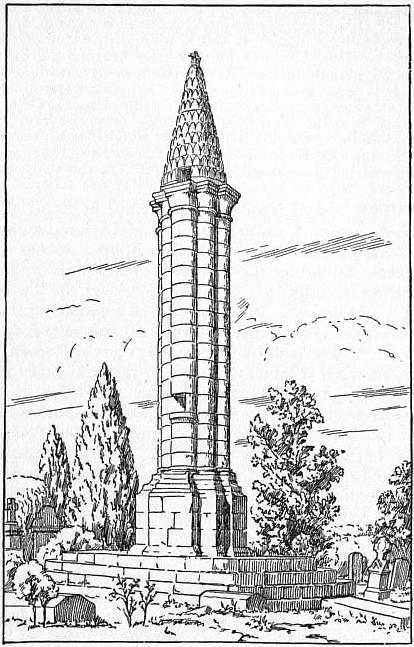
Lantern of the Dead at Cellefrouin (Charente).
LANTHANUM [symbol La, atomic weight 139.0 (O = 16)] one of the metals of the cerium group of rare earths. Its name is derived from the Gr. λανθάνειν, to lie hidden. It was first isolated in 1839 by C. G. Mosander from the “cerium” of J. Berzelius. It is found in the minerals gadolinite, cerite, samarskite and fergusonite, and is usually obtained from cerite. For details of the complex process for the separation of the lanthanum salts from cerite, see R. Bunsen (Pogg. Ann., 1875, 155, p. 377); P. T. Cleve (Bull. de la soc. chim., 1874, 21, p. 196); and A. v. Welsbach (Monats. f. Chem., 1884, 5, p. 508). The metal was obtained by Mosander on heating its chloride with potassium, and by W. F. Hillebrand and T. Norton (Pogg. Ann., 1875, 156, p. 466) on electrolysis of the fused chloride, while C. Winkler (Ber., 1890, 23, p. 78) prepared it by heating the oxide with a mixture of magnesium and magnesia. Muthmann and Weiss (Ann., 1904, 331, p. 1) obtained it by electrolysing the anhydrous chloride. It may be readily hammered, but cannot be drawn. Its specific gravity is 6.1545, and it melts at 810°. It decomposes cold water slowly, but hot water violently. It burns in air, and also in chlorine and bromine, and is readily oxidized by nitric acid.
Lanthanum oxide, La2O3, is a white powder obtained by burning the metal in oxygen, or by ignition of the carbonate, nitrate or sulphate. It combines with water with evolution of heat, and on heating with magnesium powder in an atmosphere of hydrogen forms a hydride of probable composition La2H3 (C. Winkler, Ber. 1891, 24, p. 890). Lanthanum hydroxide, La(OH)3, is a white amorphous powder formed by precipitating lanthanum salts by potassium hydroxide. It decomposes ammonium salts. Lanthanum chloride, LaCl3, is obtained in the anhydrous condition by heating lanthanum ammonium chloride or, according to C. Matignon (Compt. rend., 1905, 40, p. 1181), by the action of chlorine or hydrochloric acid on the residue obtained by evaporating the oxide with hydrochloric acid. It forms a deliquescent crystalline mass. By evaporation of a solution of lanthanum oxide in hydrochloric acid to the consistency of a syrup, and allowing the solution to stand, large colourless crystals of a hydrated chloride of the composition 2LaCl3·15H2O are obtained. Lanthanum sulphide, La2S3, is a yellow powder, obtained when the oxide is heated in the vapour of carbon bisulphide. It is decomposed by water, with evolution of sulphuretted hydrogen. Lanthanum sulphate, La2(SO4)3·9H2O, forms six-sided prisms, isomorphous with those of the corresponding cerium salt. By careful heating it may be made to yield the anhydrous salt. Lanthanum nitrate, La(NO3)3·6H2O, is obtained by dissolving the oxide in nitric acid. It crystallizes in plates, and is soluble in water and alcohol. Lanthanum carbide, LaC2, is prepared by heating the oxide with carbon in the electric furnace (H. Moissan, Compt. rend., 1896, 123, p. 148). It is decomposed by water with the formation of acetylene, methane, ethylene, &c. Lanthanum carbonate, La2CO3·8H2O, occurs as the rare mineral lanthanite, forming greyish-white, pink or yellowish rhombic prisms. The atomic weight of lanthanum has been determined by B. Brauner (Proc. Chem. Soc., 1901, 17, p. 63) by ignition of lanthanum sulphate at 500° C., the value obtained being 139 (O = 16).
LANUVIUM (more frequently Lanivium in imperial times, mod. Civita Lavinia), an ancient city of Latium, some 19 m. S.E. of Rome, a little S.W. of the Via Appia. It was situated on an isolated hill projecting S. from the main mass of the Alban Hills, and commanding an extensive view over the low country between it and the sea. It was one of the members of the Latin League, and remained independent until conquered by Rome in 338 B.C. At first it did not enjoy the right of Roman citizenship, but acquired it later; and even in imperial times its chief magistrate and municipal council kept the titles of dictator and senatus respectively. It was especially famous for its rich and much venerated temple of Juno Sospes, from which Octavian borrowed money in 31 B.C., and the possessions of which extended as far as the sea-coast (T. Ashby in Mélanges de l’école française, 1905, 203). It possessed many other temples, repaired by Antoninus Pius, who was born close by, as was also Commodus. Remains of the ancient theatre and of the city walls exist in the modern village, and above it is an area surrounded by a portico, in opus reticulatum, upon the north side of which is a rectangular building in opus quadratum, probably connected with the temple of Juno. Here archaic decorative terra-cottas were discovered in excavations carried on by Lord Savile. The acropolis of the primitive city was probably on the highest point above the temple to the north. The neighbourhood, which is now covered with vineyards, contains remains of many Roman villas, one of which is traditionally attributed to Antoninus Pius.
See Notizie degli Scavi, passim.
(T. As.)
LANZA, DOMENICO GIOVANNI GIUSEPPE MARIA (1810-1882), Italian politician, was born at Casale, Piedmont, on the 15th of February 1810. He studied medicine at Turin, and practised for some years in his native place. He was one of the promoters of the agrarian association in Turin, and took an active part in the rising of 1848. He was elected to the Piedmontese parliament in that year, and attached himself to the party of Cavour, devoting his attention chiefly to questions of economy and finance. He became minister of public instruction in 1855 in the cabinet of Cavour, and in 1858 minister of finance. He followed Cavour into his temporary retirement in July 1859 after the peace of Villafranca, and for a year (1860-1861) was president of the Chamber. He was minister of the interior (1864-1865) in the La Marmora cabinet, and arranged the transference of the capital to Florence. He maintained a resolute opposition to the financial policy of Menabrea, who resigned when Lanza was a second time elected, in 1869, president of the Chamber. Lanza formed a new cabinet in which he was himself minister of the interior. With Quintino Sella as minister of finance he sought to reorganize Italian finance, and resigned office when Sella’s projects were rejected in 1873. His cabinet had seen the accomplishment of Italian unity and the installation of an Italian government in Rome. He died in Rome on the 9th of March 1882.
See Enrico Tavallini, La Vita ed i tempi di Giovanni Lanza (2 vols., Turin and Naples, 1887).
LANZAROTE, an island in the Atlantic Ocean, forming part of the Spanish archipelago of the Canary Islands (q.v.). Pop. (1900) 17,546; area, 326 sq. m. Lanzarote, the most easterly of the Canaries, has a length of 31 m. and a breadth varying from 5 to 10 m. It is naked and mountainous, bearing everywhere marks of its volcanic origin. Montaña Blanca, the highest point (2000 ft.), is cultivated to the summit. In 1730 the appearance of half the island was altered by a volcanic outburst. A violent earthquake preceded the catastrophe, by which nine villages were destroyed. In 1825 another volcanic eruption took place accompanied by earthquakes, and two hills were thrown up. The port of Naos on the south-east of the island affords safe anchorage. It is protected by two forts. A short distance inland is the town of Arrecife (pop. 3082). The climate is hot and dry. There is only a single spring of fresh water on the island, and that in a position difficult of access. From the total failure of water the inhabitants were once compelled to abandon the island. Dromedaries are used as beasts of burden. Teguise (pop. 3786), on the north-west coast, is the residence of the local authorities. A strait about 6 m. in width separates Lanzarote from Fuerteventura.
Graciosa, a small uninhabited island, is divided from the north-eastern extremity of Lanzarote by a channel 1 m. in width, which affords a capacious and safe harbour for large ships; but basaltic cliffs, 1500 ft. high, prevent intercourse with the inhabited part of Lanzarote. A few persons reside on the little island Allegranza, a mass of lava and cinders ejected at various times from a now extinct volcano, the crater of which has still a well-defined edge.
LANZI, LUIGI (1732-1810), Italian archaeologist, was born in 1732 and educated as a priest. In 1773 he was appointed keeper of the galleries of Florence, and thereafter studied Italian painting and Etruscan antiquities and language. In the one field his labours are represented by his Storia Pittorica della Italia, the first portion of which, containing the Florentine, Sienese, Roman and Neapolitan schools, appeared in 1792, the rest in 1796. The work is translated by Roscoe. In archaeology his great achievement was Saggio di lingua Etrusca (1789), followed by Saggio delle lingue Ital. antiche (1806). In his memoir on the so-called Etruscan vases (Dei vasi antichi dipinti volgarmente chiamati Etruschi, 1806) Lanzi rightly perceived their Greek origin and characters. What was true of the antiquities would be true also, he argued, of the Etruscan language, and the object of the Saggio di lingua Etrusca was to prove that this language must be related to that of the neighbouring peoples—Romans, Umbrians, Oscans and Greeks. He was allied with E. Q. Visconti in his great but never accomplished plan of illustrating antiquity altogether from existing literature and monuments. His notices of ancient sculpture and its various styles appeared as an appendix to the Saggio di lingua Etrusca, and arose out of his minute study of the treasures then added to the Florentine collection from the Villa Medici. The abuse he met with from later writers on the Etruscan language led Corssen (Sprache der Etrusker, i. p. vi.) to protest in the name of his real services to philology and archaeology. Among his other productions was an edition of Hesiod’s Works and Days, with valuable notes, and a translation in terza rima. Begun in 1785, it was recast and completed in 1808. The list of his works closes with his Opere sacre, a series of treatises on spiritual subjects. Lanzi died on the 30th of March 1810. He was buried in the church of the Santa Croce at Florence by the side of Michelangelo.
LAOAG, a town, port for coasting vessels, and capital of the province of Ilocos Norte, Luzon, Philippine Islands, on the Laoag river, about 5 m. from its mouth, and in the N.W. part of the island. Pop. (1903) 34,454; in 1903, after the census had been taken, the municipality of San Nicolás (pop. 1903, 10,880) was added to Laoag. Laoag is on an extensive coast plain, behind which is a picturesque range of hills; it is well built and is noted for its fine climate, the name “Laoag” signifying “clear.” It is especially well equipped for handling rice, which is shipped in large quantities; Indian corn, tobacco and sugar are also shipped. Cotton is grown in the vicinity, and is woven by the women into fabrics, which find a ready sale among the pagan tribes of the mountains. The language is Ilocano.
LAOCOON, in Greek legend a brother of Anchises, who had been a priest of Apollo, but having profaned the temple of the god he and his two sons were attacked by serpents while preparing to sacrifice a bull at the altar of Poseidon, in whose service Laocoon was then acting as priest. An additional motive for his punishment consisted in his having warned the Trojans against the wooden horse left by the Greeks. But, whatever his crime may have been, the punishment stands out even among the tragedies of Greek legend as marked by its horror—particularly so as it comes to us in Virgil (Aeneid, ii. 199 sq.), and as it is represented in the marble group, the Laocoon, in the Vatican. In the oldest existing version of the legend—that of Arctinus of Miletus, which has so far been preserved in the excerpts of Proclus—the calamity is lessened by the fact that only one of the two sons is killed; and this, as has been pointed out (Arch. Zeitung, 1879, p. 167), agrees with the interpretation which Goethe in his Propylaea had put on the marble group without reference to the literary tradition. He says: “The younger son struggles and is powerless, and is alarmed; the father struggles ineffectively, indeed his efforts only increase the opposition; the elder son is least of all injured, he feels neither anguish nor pain, but he is horrified at what he sees happening to his father, and he screams while he pushes the coils of the serpent off from his legs. He is thus an observer, witness, and participant in the incident, and the work is then complete.” Again, “the gradation of the incident is this: the father has become powerless among the coils of the serpent; the younger son has still strength for resistance but is wounded; the elder has a prospect of escape.” Lessing, on the other hand, maintained the view that the marble group illustrated the version of the legend given by Virgil, with such differences as were necessary from the different limits of representation imposed on the arts of sculpture and of poetry. These limits required a new definition, and this he undertook in his still famous work, Laokoon (see the edition of Hugo Blümner, Berlin, 1876, in which the subsequent criticism is collected). The date of the Laocoon being now fixed (see Agesander) to 40-20 B.C., there can be no question of copying Virgil. The group represents the extreme of a pathetic tendency in sculpture (see Greek Art, Plate I. fig. 52).
LAODICEA, the name of at least eight cities, founded or renovated in the later Hellenic period. Most of them were founded by the Seleucid kings of Syria. Seleucus, founder of the dynasty, is said by Appian to have named five cities after his mother Laodice. Thus in the immense realm of the Seleucidae from the Aegean Sea to the borders of India we find cities called Laodicea, as also Seleucia (q.v.). So long as Greek civilization held its ground, these were the commercial and social centres. The chief are Laodicea ad Lycum (see below); Combusta on the borders of Phrygia, Lycaonia and Pisidia; a third in Pontus; a fourth, ad mare, on the coast of Syria; a fifth, ad Libanum, beside the Lebanon mountains; and three others in the far east—Media, Persia and the lower Tigris valley. In the latter countries Greek civilization was short-lived, and the last three cities disappeared; the other five continued great throughout the Greek and Roman period, and the second, third and fourth retain to the present day the ancient name under the pronunciation Ladik, Ladikiyeh or Latakia (q.v.).
Laodicea ad Lycum (mod. Denizli, q.v.) was founded probably by Antiochus II. Theos (261-46 B.C.), and named after his wife Laodice. Its site is close to the station of Gonjeli on the Anatolian railway. Here was one of the oldest homes of Christianity and the seat of one of the seven churches of the Apocalypse. Pliny states (v. 29) that the town was called in older times Diospolis and Rhoas; but at an early period Colossae, a few miles to the east, and Hierapolis, 6 m. to the north, were the great cities of the neighbourhood, and Laodicea was of no importance till the Seleucid foundation (Strabo, p. 578). A favourable site was found on some low hills of alluvial formation, about 2 m. S. of the river Lycus (Churuk Su) and 9 m. E. of the confluence of the Lycus and Maeander. The great trade route from the Euphrates and the interior passed to it through Apamea. There it forked, one branch going down the Maeander valley to Magnesia and thence north to Ephesus, a distance of about 90 m., and the other branch crossing the mountains by an easy pass to Philadelphia and the Hermus valley, Sardis, Thyatira and at last Pergamum. St Paul (Col. iv. 15) alludes to the situation of Laodicea beside Colossae and Hierapolis; and the order in which the last five churches of the Apocalypse are enumerated (Rev. i. 11) is explained by their position on the road just described. Placed in this situation, in the centre of a very fertile district, Laodicea became a rich city. It was famous for its money transactions (Cic. Ad Fam. ii. 17, iii. 5), and for the beautiful soft wool grown by the sheep of the country (Strabo 578). Both points are referred to in the message to the church (Rev. iii. 17, 18).
Little is known of the history of the town. It suffered greatly from a siege in the Mithradatic war, but soon recovered its prosperity under the Roman empire. The Zeus of Laodicea, with the curious epithet Azeus or Azeis, is a frequent symbol on the city coins. He is represented standing, holding in the extended right hand an eagle, in the left a spear, the hasta pura. Not far from the city was the temple of Men Karou, with a great medical school; while Laodicea itself produced some famous Sceptic philosophers, and gave origin to the royal family of Polemon and Zenon, whose curious history has been illustrated in recent times (W. H. Waddington, Mélanges de Numism. ser. ii.; Th. Mommsen, Ephem. Epigraph. i. and ii.; M. G. Rayet, Milet et le Golfe Latmique, chap. v.). The city fell finally into decay in the frontier wars with the Turkish invaders. Its ruins are of wide extent, but not of great beauty or interest; there is no doubt, however, that much has been buried beneath the surface by the frequent earthquakes to which the district is exposed (Strabo 580; Tac. Ann. xiv. 27).
See W. M. Ramsay, Cities and Bishoprics of Phrygia, i.-ii. (1895); Letters to the Seven Churches (1904); and the beautiful drawings of Cockerell in the Antiquities of Ionia, vol. iii. pl. 47-51.
(A. H. S.)
LAODICEA, SYNOD OF, held at Laodicea ad Lycum in Phrygia, some time between 343 and 381 (so Hefele; but Baronius argues for 314, and others for a date as late as 399), adopted sixty canons, chiefly disciplinary, which were declared ecumenical by the council of Chalcedon, 451. The most significant canons are those directly affecting the clergy, wherein the clergy appear as a privileged class, far above the laity, but with sharply differentiated and carefully graded orders within itself. For example, the priests are not to be chosen by the people; penitents are not to be present at ordinations (lest they should hear the failings of candidates discussed); bishops are to be appointed by the metropolitan and his suffragan; sub-deacons may not distribute the elements of the Eucharist; clerics are forbidden to leave a diocese without the bishop’s permission. Other canons treat of intercourse with heretics, admission of penitent heretics, baptism, fasts, Lent, angel-worship (forbidden as idolatrous) and the canonical books, from which the Apocrypha and Revelation are wanting.