VOLUME XVI SLICE II Lamennais, Robert de to Latini, Brunetto (continued 9)
Reading edition
In England theft or larceny appears to have been very early regarded by legislators as a matter calling for special attention. The pre-Conquest compilations of laws are full of provisions on the subject. The earlier laws appear to regard it as a delict which may be compounded for by payment. Considerable distinctions of person are made, both in regard to the owner and the thief. Thus, by the laws of Æthelberht, if a freeman stole from the king he was to restore ninefold, if from a freeman or from a dwelling, threefold. If a theow stole, he had only to make a twofold reparation. In the laws of Alfred ordinary theft was still only civil, but he who stole in a church was punished by the loss of his hand. The laws of Ina named as the penalty death or redemption according to the wer-gild of the thief. By the same laws the thief might be slain if he fled or resisted. Gradually the severity of the punishment increased. By the laws of Æthelstan death in a very cruel form was inflicted. At a later date the Leges Henrici Primi placed a thief in the king’s mercy, and his lands were forfeited. Putting out the eyes and other kinds of mutilation were sometimes the punishment. The principle of severity continued down to the 19th century, and until 1827 theft or larceny of certain kinds remained capital. Both before and after the Conquest local jurisdiction over thieves was a common franchise of lords of manors, attended with some of the advantages of modern summary jurisdiction.
Under the common law larceny was a felony. It was affected by numerous statutes, the main object of legislation being to bring within the law of larceny offences which were not larcenies at common law, either because they were thefts of things of which there could be no larceny at common law, e.g. beasts ferae naturae, title deeds or choses in action, or because the common law regarded them merely as delicts for which the remedy was by civil action, e.g. fraudulent breaches of trust. The earliest act in the statutes of the realm dealing with larceny appears to be the Carta Forestae of 1225, by which fine or imprisonment was inflicted for stealing the king’s deer. The next act appears to be the statute of Westminster the First (1275), dealing again with stealing deer. It seems as though the beginning of legislation on the subject was for the purpose of protecting the chases and parks of the king and the nobility. A very large number of the old acts are named in the repealing act of 1827. An act of the same date removed the old distinction between grand and petit larceny.2 The former was theft of goods above the value of twelve pence, in the house of the owner, not from the person, or by night, and was a capital crime. It was petit larceny where the value was twelve pence or under, the punishment being imprisonment or whipping. The gradual depreciation in the value of money afforded good ground for Sir Henry Spelman’s sarcasm that, while everything else became dearer, the life of man became continually cheaper. The distinction between grand and petit larceny first appears in statute law in the Statute of Westminster the First, c. 15, but it was not created for the first time by that statute. It is found in some of the pre-Conquest codes, as that of Æthelstan, and it is recognized in the Leges Henrici Primi. A distinction between simple and compound larceny is still found in the books. The latter is larceny accompanied by circumstances of aggravation, as that it is in a dwelling-house or from the person. The law of larceny is now contained chiefly in the Larceny Act 1861 (which extends to England and Ireland), a comprehensive enactment including larceny, embezzlement, fraud by bailees, agents, bankers, factors, and trustees, sacrilege, burglary, housebreaking, robbery, obtaining money by threats or by false pretences, and receiving stolen goods, and prescribing procedure, both civil and criminal. There are, however, other acts in force dealing with special cases of larceny, such as an act of Henry VIII. as to stealing the goods of the king, and the Game, Post-Office and Merchant Shipping Acts. There are separate acts providing for larceny by a partner of partnership property, and by a husband or wife of the property of the other (Married Women’s Property Act 1882). Proceedings against persons subject to naval or military law depend upon the Naval Discipline Act 1866 and the Army Act 1881. There are several acts, both before and after 1861, directing how the property is to be laid in indictments for stealing the goods of counties, friendly societies, trades unions, &c. The principal conditions which must exist in order to constitute larceny are these: (1) there must be an actual taking into the possession of the thief, though the smallest removal is sufficient; (2) there must be an intent to deprive the owner of his property for an indefinite period, and to assume the entire dominion over it, an intent often described in Bracton’s words as animus furandi; (3) this intent must exist at the time of taking; (4) the thing taken must be one capable of larceny either at common law or by statute. One or two cases falling under the law of larceny are of special interest. It was held more than once that a servant taking corn to feed his master’s horses, but without any intention of applying it for his own benefit, was guilty of larceny. To remedy this hardship, the Misappropriation of Servants Act 1863 was passed to declare such an act not to be felony. The case of appropriation of goods which have been found has led to some difficulty. It now seems to be the law that in order to constitute a larceny of lost goods there must be a felonious intent at the time of finding, that is, an intent to deprive the owner of them, coupled with reasonable means at the same time of knowing the owner. The mere retention of the goods when the owner has become known to the finder does not make the retention criminal. Larceny of money may be committed when the money is paid by mistake, if the prisoner took it animo furandi. In two noteworthy cases the question was argued before a very full court for crown cases reserved, and in each case there was a striking difference of opinion. In R. v. Middleton, 1873, L.R. 2 C.C.R., 38, the prisoner, a depositor in a post-office savings bank, received by the mistake of the clerk a larger sum that he was entitled to. The jury found that he had the animus furandi at the time of taking the money, and that he knew it to be the money of the postmaster-general. The majority of the court held it to be larceny. In a case in 1885 (R. v. Ashwell, L.R. 16 Q.B.D. 190), where the prosecutor gave the prisoner a sovereign believing it to be a shilling, and the prisoner took it under that belief, but afterwards discovered its value and retained it, the court was equally divided as to whether the prisoner was guilty of larceny at common law, but held that he was not guilty of larceny as a bailee. Legislation has considerably affected the procedure in prosecutions for larceny. The inconveniences of the common law rules of interpretation of indictments led to certain amendments of the law, now contained in the Larceny Act, for the purpose of avoiding the frequent failures of justice owing to the strictness with which indictments were construed. Three larcenies of property of the same person within six months may now be charged in one indictment. On an indictment for larceny the prisoner may be found guilty of embezzlement, and vice versa; and if the prisoner be indicted for obtaining goods by false pretences, and the offence turn out to be larceny, he is not entitled to be acquitted of the misdemeanour. A count for receiving may be joined with the count for stealing. In many cases it is unnecessary to allege or prove ownership of the property the subject of the indictment. The act also contains numerous provisions as to venue and the apprehension of offenders. In another direction the powers of courts of Summary Jurisdiction (q.v.) have been extended, in the case of charges of larceny, embezzlement and receiving stolen goods, against children and young persons and against adults pleading guilty or waiving their right to trial by jury. The maximum punishment for larceny is fourteen years’ penal servitude, but this can only be inflicted in certain exceptional cases, such as horse or cattle stealing and larceny by a servant or a person in the service of the crown or the police. The extreme punishment for simple larceny after a previous conviction for felony is ten years’ penal servitude. Whipping may be part of the sentence on boys under sixteen.
Scotland.—A vast number of acts of the Scottish parliament dealt with larceny. The general policy of the acts was to make larceny what was not larceny at common law, e.g. stealing fruit, dogs, hawks or deer, and to extend the remedies, e.g. by giving the justiciar authority throughout the kingdom, by making the master in the case of theft by the servant liable to give the latter up to justice, or by allowing the use of firearms against thieves. The general result of legislation in England and Scotland has been to assimilate the law of larceny in both kingdoms. As a rule, what would be larceny in one would be larceny in the other.
United Stales.—The law depends almost entirely upon state legislation, and is in general accordance with that of England. The only acts of Congress bearing on the subject deal with larceny in the army and navy, and with larceny and receiving on the high seas or in any place under the exclusive jurisdiction of the United States, e.g. Alaska.
Alaska.—Stealing any goods, chattels, government note, bank note, or other thing in action, books of account, &c., is larceny: punishment, imprisonment for not less than one nor more than ten years if the property stolen is in value over $35. Larceny in any dwelling-house, warehouse, steamship, church, &c., is punishable by imprisonment for not less than one nor more than seven years. Larceny of a horse, mule, ass, bull, steer, cow or reindeer is punishable by imprisonment for not less than one nor more than fifteen years. Wilfully altering or defacing marks or brands on such animals is larceny (Pen. Code Alaska, § 45, 1899).
Arizona.—Appropriating property found without due inquiry for the owner is larceny (Penal Code, § 442). “Dogs are property and of the value of one dollar each within the meaning of the terms ‘property’ and ‘value’ as used in this chapter” (id. § 448). Property includes a passage ticket though never issued. Persons stealing property in another state or county, or who receive it knowing it to be stolen and bring it into Arizona, may be convicted and punished as if the offence was committed there (id. § 454). Stealing gas or water from a main is a misdemeanour.
Iowa.—It is larceny to steal electricity, gas or water from wires, meters or mains (L. 1903, ch. 132).
New York.—Larceny as defined by § 528 of the Penal Code includes also embezzlement, obtaining property by false pretences, and felonious breach of trust (People v. Dumar, 106 N.Y. 508), but the method of proof required to establish these offences has not been changed. Grand larceny in the first degree is (a) stealing property of any value in the night time; (b) of $25 in value or more at night from a dwelling house, vessel or railway car; (c) of the value of more than $500 in any manner; in the second degree (a) stealing in any manner property of the value of over $25 and under $500; (b) taking from the person property of any value; (c) stealing any record of a court or other record filed with any public officer. Every other larceny is petit larceny. “Value” of any stock, bond or security having a market value is the amount of money due thereon or what, in any contingency, might be collected thereon; of any passenger ticket the price it is usually sold at. The value of anything else not fixed by statute is its market value. Grand larceny, in the first degree, is punishable by imprisonment not exceeding ten years; in the second degree, not exceeding five years. Petit larceny is a misdemeanour (Penal Code, §§ 530-535). Bringing stolen goods into the state knowing them to be stolen is punishable as larceny within the state (id. § 540). A “pay ticket” for removing a load of snow may be the subject of larceny and its value the amount to be paid on it. (People v. Fletcher [1906] 110 App. D. 231).
Kansas.—The owner of goods who takes them from a railroad company with intent to defeat its lien for transportation charges is guilty of larceny. (Atchison Co. v. Hinsdell [1907] 90 Pac. Rep. 800).
Massachusetts.—Larceny includes embezzlement and obtaining money by false pretences. (Rev. L. 1902, ch. 218, § 40.) The failing to restore to or to notify the owner of property removed from premises on fire is larceny (id. ch. 208, § 22). It is larceny to purchase property (payment for which is to be made on or before delivery) by means of a false pretence as to means or ability to pay, provided such pretence is signed by the person to be charged. Indictment for stealing a will need not contain an allegation of value (id. § 29). A person convicted either as accessory or principal of three distinct larcenies shall be adjudged “a common and notorious thief” and may be imprisoned for not more than twenty years (id. 31). On second conviction for larceny of a bicycle, the thief may be imprisoned for not more than five years. Larceny of things annexed to realty is punishable as if it were a larceny of personal property (id. §§ 33, 35).
Ohio.—Stealing “anything of value” is larceny (Bates Stats. § 6856). Tapping gas pipes is punishable by fine or imprisonment for not more than thirty days. Stealing timber having “timber dealers’” trade mark, or removing it from a stream, is punishable by a fine of not less than $20.
Utah.—It is grand larceny to alter the mark or brand on an animal (L. 1905, ch. 38).
Wyoming.—For branding or altering or defacing the brand on cattle with intent to steal, the penalty is imprisonment for not more than five years. It is larceny for a bailee to convert with intent to steal goods left with or found by him (Rev. Stats. §§ 4986, 4989).
Washington.—A horse not branded, but under Code § 6861 an “outlaw,” the owner being unknown, can be the subject of a larceny, having been held to be property of the state. (State v. Eddy [1907], 90 Pac. Rep. 641). For the third offence of such a larceny the penalty is imprisonment for life (L. 1903, ch. 86).
See also Embezzlement; Cheating; False Pretences; Robbery; Stolen Goods.
1 Thus destruction of a letter by a servant, with a view of suppressing inquiries into his or her character, makes the servant guilty of larceny in English law.
2 This provision was most unnecessarily repeated in the Larceny Act of 1861.

LARCH (from the Ger. Lärche, M.H.G. Lerche, Lat. larix), a name applied to a small group of coniferous trees, of which the common larch of Europe is taken as the type. The members of the genus Larix are distinguished from the firs, with which they were formerly placed, by their deciduous leaves, scattered singly, as in Abies, on the young shoots of the season, but on all older branchlets growing in whorl-like tufts, each surrounding the extremity of a rudimentary or abortive branch; they differ from cedars (Cedrus), which also have the fascicles of leaves on arrested branchlets, not only in the deciduous leaves, but in the cones, the scales of which are thinner towards the apex, and are persistent, remaining attached long after the seeds are discharged. The trees of the genus are closely allied in botanic features, as well as in general appearance, so that it is sometimes difficult to assign to them determinate specific characters, and the limit between species and variety is not always very accurately defined. Nearly all are natives of Europe, or the northern plains and mountain ranges of Asia and North America, though one (Larix Griffithii) occurs only on the Himalayas.
The common larch (L. europaea) is, when grown in perfection, a stately tree with tall erect trunk, gradually tapering from root to summit, and horizontal branches springing at irregular intervals from the stem, and in old trees often becoming more or less drooping, but rising again towards the extremities; the branchlets or side shoots, very slender and pendulous, are pretty thickly studded with the spurs each bearing a fascicle of thirty or more narrow linear leaves, of a peculiar bright light green when they first appear in the spring, but becoming of a deeper hue when mature. The yellow stamen-bearing flowers are in sessile, nearly spherical catkins; the fertile ones vary in colour, from red or purple to greenish-white, in different varieties; the erect cones, which remain long on the branches, are above an inch in length and oblong-ovate in shape, with reddish-brown scales somewhat waved on the edges, the lower bracts usually rather longer than the scales. The tree flowers in April or May, and the winged seeds are shed the following autumn. When standing in an open space, the larch grows of a nearly conical shape, with the lower branches almost reaching the ground, while those above gradually diminish in length towards the top of the trunk, presenting a very symmetrical form; but in dense woods the lower parts become bare of foliage, as with the firs under similar circumstances. When springing up among rocks or on ledges, the stem sometimes becomes much curved, and, with its spreading boughs and pendent branchlets, often forms a striking and picturesque object in alpine passes and steep ravines. In the prevalent European varieties the bark is reddish-grey, and rather rough and scarred in old trees, which are often much lichen-covered. The trunk attains a height of from 80 to 140 ft., with a diameter of from 3 to 5 ft. near the ground, but in close woods is comparatively slender in proportion to its altitude. The larch abounds on the Alps of Switzerland, on which it flourishes at an elevation of 5000 ft., and also on those of Tirol and Savoy, on the Carpathians, and in most of the hill regions of central Europe; it is not wild on the Apennine chain, or the Pyrenees, and in the wild state is unknown in the Spanish peninsula. It forms extensive woods in Russia, but does not extend to Scandinavia, where its absence is somewhat remarkable, as the tree grows freely in Norway and Sweden where planted, and even multiplies itself by self-sown seed, according to F. C. Schübeler, in the neighbourhood of Trondhjem. In the north-eastern parts of Russia, in the country towards the Petchora river, and on the Ural, a peculiar variety prevails, regarded by some as a distinct species (L. sibirica); this form is abundant nearly throughout Siberia, extending to the Pacific coast of Kamchatka and the hills of the Amur region. The Siberian larch has smooth grey bark and smaller cones, approaching in shape somewhat to those of the American hackmatack; it seems even hardier than the Alpine tree, growing up to latitude 68°, but, as the inclement climate of the polar shores is neared, dwindling down to a dwarf and even trailing bush.
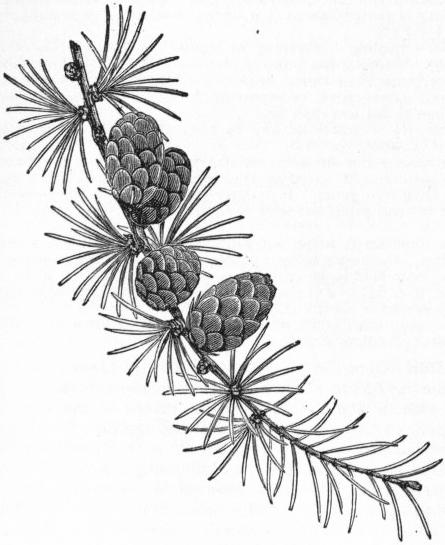
Branchlet of Larch (Larix europaea).
The larch, from its lofty straight trunk and the high quality of its wood, is one of the most important of coniferous trees; its growth is extremely rapid, the stem attaining a large size in from sixty to eighty years, while the tree yields good useful timber at forty or fifty; it forms firm heartwood at an early age, and the sapwood is less perishable than that of the firs, rendering it more valuable in the young state.
The wood of large trees is compact in texture, in the best varieties of a deep reddish colour varying to brownish-yellow, but apt to be lighter in tint, and less hard in grain, when grown in rich soils or in low sheltered situations. It is remarkably tough, resisting a rending strain better than any of the fir or pine woods in common use, though not as elastic as some; properly seasoned, it is as little liable to shrink as to split; the boughs being small compared to the trunk, the timber is more free from large knots, and the small knots remain firm and undecayed. The only drawback to these good qualities is a certain liability to warp and bend, unless very carefully seasoned; for this purpose it is recommended to be left floating in water for a year after felling, and then allowed some months to dry slowly and completely before sawing up the logs; barking the trunk in winter while the tree is standing, and leaving it in that state till the next year, has been often advised with the larch as with other timber, but the practical inconveniences of the plan have prevented its adoption on any large scale. When well prepared for use, larch is one of the most durable of coniferous woods. Its strength and toughness render it valuable for naval purposes, to which it is largely applied; its freedom from any tendency to split adapts it for clinker-built boats. It is much employed for house-building; most of the picturesque log-houses in Vaud and the adjacent cantons are built of squared larch trunks, and derive their fine brown tint from the hardened resin that slowly exudes from the wood after long exposure to the summer sun; the wooden shingles, that in Switzerland supply the place of tiles, are also frequently of larch. In Germany it is much used by the cooper as well as the carpenter, while the form of the trunk admirably adapts it for all purposes for which long straight timber is needed. It answers well for fence-posts and river piles; many of the foundations of Venice rest upon larch, the lasting qualities of which were well known and appreciated, not only in medieval times, but in the days of Vitruvius and Pliny. The harder and darker varieties are used in the construction of cheap solid furniture, being fine in grain and taking polish better than many more costly woods. A peculiarity of larch wood is the difficulty with which it is ignited, although so resinous; and, coated with a thin layer of plaster, beams and pillars of larch might probably be found to justify Caesar’s epithet “igni impenetrabile lignum”; even the small branches are not easily kept alight, and a larch fire in the open needs considerable care. Yet the forests of larch in Siberia often suffer from conflagration. When these fires occur while the trees are full of sap, a curious mucilaginous matter is exuded from the half-burnt stems; when dry it is of pale reddish colour, like some of the coarser kinds of gum-arabic, and is soluble in water, the solution resembling gum-water, in place of which it is sometimes used; considerable quantities are collected and sold as “Orenburg gum”; in Siberia and Russia it is occasionally employed as a semi-medicinal food, being esteemed an antiscorbutic. For burning in close stoves and furnaces, larch makes tolerably good fuel, its value being estimated by Hartig as only one-fifth less than that of beech; the charcoal is compact, and is in demand for iron-smelting and other metallurgic uses in some parts of Europe.
In the trunk of the larch, especially when growing in climates where the sun is powerful in summer, a fine clear turpentine exists in great abundance; in Savoy and the south of Switzerland, it is collected for sale, though not in such quantity as formerly, when, being taken to Venice for shipment, it was known in commerce as “Venice turpentine.” Old trees are selected, from the bark of which it is observed to ooze in the early summer; holes are bored in the trunk, somewhat inclined upward towards the centre of the stem, in which, between the layers of wood, the turpentine is said to collect in small lacunae; wooden gutters placed in these holes convey the viscous fluid into little wooden pails hung on the end of each gutter; the secretion flows slowly all through the summer months, and a tree in proper condition yields from 6 to 8 ℔ a year, and will continue to give an annual supply for thirty or forty years, being, however, rendered quite useless for timber by subjection to this process. In Tirol, a single hole is made near the root of the tree in the spring; this is stopped with a plug, and the turpentine is removed by a scoop in the autumn; but each tree yields only from a few ounces to ½ ℔ by this process. Real larch turpentine is a thick tenacious fluid, of a deep yellow colour, and nearly transparent; it does not harden by time; it contains 15% of the essential oil of turpentine, also resin, succinic, pinic and sylvic acids, and a bitter extractive matter. According to Pereira, much sold under the name of Venice turpentine is a mixture of common resin and oil of turpentine. On the French Alps a sweet exudation is found on the small branchlets of young larches in June and July, resembling manna in taste and laxative properties, and known as Manna de Briançon or Manna Brigantina; it occurs in small whitish irregular granular masses, which are removed in the morning before they are too much dried by the sun; this manna seems to differ little in composition from the sap of the tree, which also contains mannite; its cathartic powers are weaker than those of the manna of the manna ash (Fraximus ornus), but it is employed in France for the same purposes.
The bark of the larch is largely used in some countries for tanning; it is taken from the trunk only, being stripped from the trees when felled; its value is about equal to that of birch bark; but, according to the experience of British tanners, it is scarcely half as strong as that of the oak. The soft inner bark is occasionally used in Siberia as a ferment, by hunters and others, being boiled and mixed with rye-meal, and buried in the snow for a short time, when it is employed as a substitute for other leaven, and in making the sour liquor called “quass.” In Germany a fungus (Polyporus Laricis) grows on the roots and stems of decaying larches, which was formerly in esteem as a drastic purgative. The young shoots of the larch are sometimes given in Switzerland as fodder to cattle.
The larch, though mentioned by Parkinson in 1629 as “nursed up” by a few “lovers of variety” as a rare exotic, does not seem to have been much grown in England till early in the 18th century. In Scotland the date of its introduction is a disputed point, but it seems to have been planted at Dunkeld by the 2nd duke of Athole in 1727, and about thirteen or fourteen years later considerable plantations were made at that place, the commencement of one of the largest planting experiments on record; it is estimated that 14 million larches were planted on the Athole estates between that date and 1826. The cultivation of the tree rapidly spread, and the larch has become a conspicuous feature of the scenery in many parts of Scotland. It grows as rapidly and attains as large a size in British habitats suited to it as in its home on the Alps, and often produces equally good timber. The larch of Europe is essentially a mountain tree, and requires not only free air above, but a certain moderate amount of moisture in the soil beneath, with, at the same time, perfect drainage, to bring the timber to perfection. Where there is complete freedom from stagnant water in the ground, and abundant room for the spread of its branches to light and air, the larch will flourish in a great variety of soils, stiff clays, wet or mossy peat, and moist alluvium being the chief exceptions; in its native localities it seems partial to the debris of primitive and metamorphic rocks, but is occasionally found growing luxuriantly on calcareous subsoils; in Switzerland it attains the largest size, and forms the best timber, on the northern declivities of the mountains; but in Scotland a southern aspect appears most favourable.
The best variety for culture in Britain is that with red female flowers; the light-flowered kinds are said to produce inferior wood, and the Siberian larch does not grow in Scotland nearly as fast as the Alpine tree. The larch is raised from seed in immense numbers in British nurseries; that obtained from Germany is preferred, being more perfectly ripened than the cones of home growth usually are. The seeds are sown in April, on rich ground, which should not be too highly manured; the young larches are planted out when two years old, or sometimes transferred to a nursery bed to attain a larger size; but, like all conifers, they succeed best when planted young; on the mountains, the seedlings are usually put into a mere slit made in the ground by a spade with a triangular blade, the place being first cleared of any heath, bracken, or tall herbage that might smother the young tree; the plants should be from 3 to 4 ft. apart, or even more, according to the growth intended before thinning, which should be begun as soon as the boughs begin to overspread much; little or no pruning is needed beyond the careful removal of dead branches. The larch is said not to succeed on arable land, especially where corn has been grown, but experience does not seem to support this view; that against the previous occupation of the ground by Scotch fir or Norway spruce is probably better founded, and, where timber is the object, it should not be planted with other conifers. On the Grampians and neighbouring hills the larch will flourish at a greater elevation than the pine, and will grow up to an altitude of 1700 or even 1800 ft.; but it attains its full size on lower slopes. In very dry and bleak localities, the Scotch fir will probably be more successful up to 900 ft. above the sea, the limit of the luxuriant growth of that hardy conifer in Britain; and in moist valleys or on imperfectly drained acclivities Norway spruce is more suitable. The growth of the larch while young is exceedingly rapid; in the south of England it will often attain a height of 25 ft. in the first ten years, while in favourable localities it will grow upwards of 80 ft. in half a century or less; one at Dunkeld felled sixty years after planting was 110 ft. high; but usually the tree does not increase so rapidly after the first thirty of forty years. Some larches in Scotland rival in size the most gigantic specimens standing in their native woods; a tree at Dalwick, Peeblesshire, attained 5 ft. in diameter; one at Glenarbuck, near the Clyde, grew above 140 ft. high, with a circumference of 13 ft. The annual increase in girth is often considerable even in large trees; the fine larch near the abbey of Dunkeld figured by Strutt in his Sylva Britannica increased 2½ ft. between 1796 and 1825, its measurement at the latter date being 13 ft., with a height of 97½ ft.
In the south of England, the larch is much planted for the supply of hop-poles, though in parts of Kent and Sussex poles formed of Spanish chestnut are regarded as still more lasting. In plantations made with this object, the seedlings are placed very close (from 1½ to 2 ft. apart), and either cut down all at once, when the required height is attained or thinned out, leaving the remainder to gain a greater length; the land is always well trenched before planting. The best month for larch planting, whether for poles or timber, is November; larches are sometimes planted in the spring, but the practice cannot be commended, as the sap flows early, and, if a dry period follows, the growth is sure to be checked. The thinnings of the larch woods in the Highlands are in demand for railway sleepers, scaffold poles, and mining timber, and are applied to a variety of agricultural purposes. The tree generally succeeds on the Welsh hills.
The young seedlings are sometimes nibbled by the hare and rabbit; and on parts of the highland hills both bark and shoots are eaten in the winter by the roe-deer; larch woods should always be fenced in to keep out the hill-cattle, which will browse upon the shoots in spring. The “woolly aphis,” “American blight,” or “larch blight” (Eriosoma laricis) often attacks the trees in close valleys, but rarely spreads much unless other unhealthy conditions are present. The larch suffers from several diseases caused by fungi; the most important is the larch-canker caused by the parasitism of Peziza Willkommii. The spores germinate on a damp surface and enter the cortex through small cracks or wounds in the protecting layer. The fungus-mycelium will go on growing indefinitely in the cambium layer, thus killing and destroying a larger area year by year. The most effective method of treatment is to cut out the diseased branch or patch as early as possible. Another disease which is sometimes confused with that caused by the Peziza is “heart-rot”; it occasionally attacks larches only ten years old or less, but is more common when the trees have acquired a considerable size, sometimes spreading in a short time through a whole plantation. The trees for a considerable period show little sign of unhealthiness, but eventually the stem begins to swell somewhat near the root, and the whole tree gradually goes off as the disease advances; when cut down, the trunk is found to be decayed at the centre, the “rot” usually commencing near the ground. Trees of good size are thus rendered nearly worthless, often showing little sign of unhealthiness till felled. Great difference of opinion exists among foresters as to the cause of this destructive malady; but it is probably the direct result of unsuitable soil, especially soil containing insufficient nourishment.
Considerable quantities of larch timber are imported into Britain for use in the dockyards, in addition to the large home supply. The quality varies much, as well as the colour and density; an Italian sample in the museum at Kew (of a very dark red tint) weighs about 24½ ℔ to the cub. ft., while a Polish specimen, of equally deep hue, is 44 ℔ 1 oz. to the same measurement.
For the landscape gardener, the larch is a valuable aid in the formation of park and pleasure ground; but it is never seen to such advantage as when hanging over some tumbling burn or rocky pass among the mountains. A variety with very pendent boughs, known as the “drooping” larch var. pendula, is occasionally met with in gardens.
The bark of the larch has been introduced into pharmacy, being given, generally in the form of an alcoholic tincture, in chronic bronchitic affections and internal haemorrhages. It contains, in addition to tannin, a peculiar principle called larixin, which may be obtained in a pure state by distillation from a concentrated infusion of the bark; it is a colourless substance in long crystals, with a bitter and astringent taste, and a faint acid reaction; hence some term it larixinic acid.
The European larch has long been introduced into the United States, where, in suitable localities, it flourishes as luxuriantly as in Britain. Plantations have been made in America with an economic view, the tree growing much faster, and producing good timber at an earlier age than the native hackmatack (or tamarack), while the wood is less ponderous, and therefore more generally applicable.
The genus is represented in the eastern parts of North America by the hackmatack (L. americana), of which there are several varieties, two so well marked that they are by some botanists considered specifically distinct. In one (L. microcarpa) the cones are very small, rarely exceeding ½ in. in length, of a roundish-oblong shape; the scales are very few in number, crimson in the young state, reddish-brown when ripe; the tree much resembles the European larch in general appearance but is of more slender growth; its trunk is seldom more than 2 ft. in diameter and rarely above 80 ft. high; this form is the red larch, the épinette rouge of the French Canadians. The black larch (L. pendula) has rather larger cones, of an oblong shape, about ¾ in. long, purplish or green in the immature state, and dark brown when ripe, the scales somewhat more numerous, the bracts all shorter than the scales. The bark is dark bluish-grey, smoother than in the red larch, on the trunk and lower boughs often glossy; the branches are more or less pendulous and very slender.
The red larch grows usually on higher and drier ground, ranging from the Virginian mountains to the shores of Hudson Bay; the black larch is found often on moist land, and even in swamps. The hackmatack is one of the most valuable timber trees of America; it is in great demand in the ports of the St Lawrence for shipbuilding. It is far more durable than any of the oaks of that region, is heavy and close-grained, and much stronger, as well as more lasting, than that of the pines and firs of Canada. In many parts all the finer trees have been cut down, but large woods of it still exist in the less accessible districts; it abounds especially near Lake St John, Quebec, and in Newfoundland is the prevalent tree in some of the forest tracts; it is likewise common in Maine and Vermont. In the timber and building yards the “red” hackmatack is the kind preferred, the produce, probably, of L. microcarpa; the “grey” is less esteemed; but the varieties from which these woods are obtained cannot always be traced with certainty. Several fine specimens of the red larch exist in English parks, but its growth is much slower than that of L. europaea; the more pendulous forms of L. pendula are elegant trees for the garden. The hackmatacks might perhaps be grown with advantage in places too wet for the common larch.
In western America a larch (L. occidentalis) occurs more nearly resembling L. europaea. The leaves are short, thicker and more rigid than in any of the other larches; the cones are much larger than those of the hackmatacks, egg-shaped or oval in outline; the scales are of a fine red in the immature state, the bracts green and extending far beyond the scales in a rigid leaf-like point. The bark of the trunk has the same reddish tint as that of the common larch of Europe. It is the largest of all larches and one of the most useful timber trees of North America. Some of the trees are 250 ft. high and 6 to 8 ft. in diameter. The wood is the hardest and strongest of all the American conifers; it is durable and adapted for construction work or household furniture.
LARCHER, PIERRE HENRI (1726-1812), French classical scholar and archaeologist, was born at Dijon on the 12th of October 1726. Originally intended for the law, he abandoned it for the classics. His (anonymous) translation of Chariton’s Chaereas and Callirrhoë (1763) marked him as an excellent Greek scholar. His attack upon Voltaire’s Philosophie de l’historie (published under the name of l’Abbé Bazin) created considerable interest at the time. His archaeological and mythological Mémoire sur Vénus (1775), which has been ranked with similar works of Heyne and Winckelmann, gained him admission to the Académie des Inscriptions (1778). After the imperial university was founded, he was appointed professor of Greek literature (1809) with Boissonade as his assistant. He died on the 22nd of December 1812. Larcher’s best work was his translation of Herodotus (1786, new ed. by L. Humbert, 1880) on the preparation of which he had spent fifteen years. The translation itself, though correct, is dull, but the commentary (translated into English, London, 1829, new ed. 1844, by W. D. Cooley) dealing with historical, geographical and chronological questions, and enriched by a wealth of illustration from ancient and modern authors, is not without value.
See J. F. Boissonade, Notice sur la vie et les écrits de P. L. (1813); F. A. Wolf, Literarische Analecten, i. 205; D. A. Wyttenbach, Philomathia, iii. (1817).
LARCIUS (less accurately Lartius), TITUS, probably surnamed Flavus, a member of an Etruscan family (cf. Lars Tolumnius, Lars Porsena) early settled in Rome. When consul in 501 B.C. he was chosen dictator (the title and office being then introduced for the first time) to command against the thirty Latin cities, which had sworn to reinstate Tarquin in Rome. Other authorities put the appointment three years later, when the plebeians refused to serve against the Latins until they had been released from the burden of their debts. He opposed harsh measures against the Latins, and also interested himself in the improvement of the lot of the plebeians. His brother, Spurius, is associated with Horatius Cocles in the defence of the Sublician bridge against the Etruscans.
See Livy ii. 10, 18, 21, 29; Dion. Halic. v. 50-77, vi. 37; Cicero, De Re Publica, ii. 32.
LARD (Fr. lard, from Lat. laridum, bacon fat, related to Gr. λαρινός fat, λαρός dainty or sweet), the melted and strained fat of the common hog. Properly it is prepared from the “leaf” or fat of the bowel and kidneys, but in commerce the term as applied to products which include fat obtained from other parts of the animal and sometimes containing no “leaf” at all. Lard of various grades is made in enormous quantities by the great pork-packing houses at Chicago and elsewhere in America. “Neutral lard” is prepared at a temperature of 40°-50° C. from freshly killed hogs; the finest quality, used for making oleomargarine, is got from the leaf, while the second, employed by biscuit and pastry bakers, is obtained from the fat of the back. Steam heat is utilized in extracting inferior qualities, such as “choice lard” and “prime steam lard,” the source of the latter being any fat portion of the animal. Lard is a pure white fat of a butter-like consistence; its specific gravity is about 0.93, its solidifying point about 27°-30° C., and its melting point 35°-45° C. It contains about 60% of olein and 40% of palmitin and stearin. Adulteration is common, the substances used including “stearin” both of beef and of mutton, and vegetable oils such as cotton seed oil: indeed, mixtures have been sold as lard that contain nothing but such adulterants. In the pharmacopoeia lard figures as adeps and is employed as a basis for ointments. Benzoated lard, used for the same purpose, is prepared by heating lard with 3% of powdered benzoin for two hours; it keeps better than ordinary lard, but has slightly irritant properties.
Lard oil is the limpid, clear, colourless oil expressed by hydraulic pressure and gentle heat from lard; it is employed for burning and for lubrication. Of the solid residue, lard “stearine,” the best qualities are utilized for making oleomargarine, the inferior ones in the manufacture of candles.
See J. Lewkowitsch, Oils, Fats and Waxes (London, 1909).
LARDNER, DIONYSIUS (1793-1859), Irish scientific writer, was born at Dublin on the 3rd of April 1793. His father, a solicitor, wished his son to follow the same calling. After some years of uncongenial desk work, Lardner entered Trinity College, Dublin, and graduated B.A. in 1817. In 1828 he became professor of natural philosophy and astronomy at University College, London, a position he held till 1840, when he eloped with a married lady, and had to leave the country. After a lecturing tour through the principal cities of the United States, which realized £40,000, he returned to Europe in 1845. He settled at Paris, and resided there till within a few months of his death, which took place at Naples on the 29th of April 1859.
Though lacking in originality or brilliancy, Lardner showed himself to be a successful popularizer of science. He was the author of numerous mathematical and physical treatises on such subjects as algebraic geometry (1823), the differential and integral calculus (1825), the steam engine (1828), besides hand-books on various departments of natural philosophy (1854-1856); but it is as the editor of Lardner’s Cabinet Cyclopaedia (1830-1844) that he is best remembered. To this scientific library of 134 volumes many of the ablest savants of the day contributed, Lardner himself being the author of the treatises on arithmetic, geometry, heat, hydrostatics and pneumatics, mechanics (in conjunction with Henry Kater) and electricity (in conjunction with C. V. Walker). The Cabinet Library (12 vols., 1830-1832) and the Museum of Science and Art (12 vols., 1854-1856) are his other chief undertakings. A few original papers appear in the Royal Irish Academy’s Transactions (1824), in the Royal Society’s Proceedings (1831-1836) and in the Astronomical Society’s Monthly Notices (1852-1853); and two Reports to the British Association on railway constants (1838, 1841) are from his pen.
LARDNER, NATHANIEL (1684-1768), English theologian, was born at Hawkhurst, Kent. After studying for the Presbyterian ministry in London, and also at Utrecht and Leiden, he took licence as a preacher in 1709, but was not successful. In 1713 he entered the family of a lady of rank as tutor and domestic chaplain, where he remained until 1721. In 1724 he was appointed to deliver the Tuesday evening lecture in the Presbyterian chapel, Old Jewry, London, and in 1729 he became assistant minister to the Presbyterian congregation in Crutched Friars. He was given the degree of D.D. by Marischal College, Aberdeen, in 1745. He died at Hawkhurst on the 24th of July 1768.
An anonymous volume of Memoirs appeared in 1769; and a life by Andrew Kippis is prefixed to the edition of the Works of Lardner, published in 11 vols., 8vo in 1788, in 4 vols. 4to in 1817, and 10 vols. 8vo in 1827. The full title of his principal work—a work which, though now out of date, entitles its author to be regarded as the founder of modern critical research in the field of early Christian literature—is The Credibility of the Gospel History; or the Principal Facts of the New Testament confirmed by Passages of Ancient Authors, who were contemporary with our Saviour or his Apostles, or lived near their time. Part i., in 2 vols. 8vo, appeared in 1727; the publication of part ii., in 12 vols. 8vo, began in 1733 and ended in 1755. In 1730 there was a second edition of part i., and the Additions and Alterations were also published separately. A Supplement, otherwise entitled A History of the Apostles and Evangelists, Writers of the New Testament, was added in 3 vols. (1756-1757), and reprinted in 1760. Other works by Lardner are A Large Collection of Ancient Jewish and Heathen Testimonies to the Truth of the Christian Revelation, with Notes and Observations (4 vols., 4to, 1764-1767); The History of the Heretics of the two first Centuries after Christ, published posthumously in 1780 and a considerable number of occasional sermons.
LAREDO, a city and the county-seat of Webb county, Texas, U.S.A., and a sub-port of entry, on the Rio Grande opposite Nuevo Laredo, Mexico, and 150 m. S. of San Antonio. Pop. (1900) 13,429, of whom 6882 were foreign-born (mostly Mexicans) and 82 negroes; (1910 census) 14,855. It is served by the International & Great Northern, the National of Mexico, the Texas Mexican and the Rio Grande & Eagle Pass railways, and is connected by bridges with Nuevo Laredo. Among the principal buildings are the U.S. Government Building, the City Hall and the County Court House; and the city’s institutions include the Laredo Seminary (1882) for boys and girls, the Mercy Hospital, the National Railroad of Mexico Hospital and an Ursuline Convent. Loma Vista Park (65 acres) is a pleasure resort, and immediately W. of Laredo on the Rio Grande is Fort McIntosh (formerly Camp Crawford), a United States military post. Laredo is a jobbing centre for trade between the United States and Mexico, and is a sub-port of entry in the Corpus Christi Customs District. It is situated in a good farming and cattle-raising region, irrigated by water from the Rio Grande. The principal crop is Bermuda onions; in 1909 it was estimated that 1500 acres in the vicinity were devoted to this crop, the average yield per acre being about 20,000 ℔. There are coal mines about 25 m. above Laredo on the Rio Grande, and natural gas was discovered about 28 m. E. in 1908. The manufacture of bricks is an important industry. Laredo was named from the seaport in Spain, and was founded in 1767 as a Mexican town; it originally included what is now Nuevo Laredo, Mexico, and was long the only Mexican town on the left bank of the river. It was captured in 1846 by a force of Texas Rangers, and in 1847 was occupied by U.S. troops under General Lamar. In 1852 it was chartered as a city of Texas.
LA RÉOLE, a town of south-western France, capital of an arrondissement in the department of Gironde, on the right bank of the Gironde, 38 m. S.E. of Bordeaux by rail. Pop. (1906) 3469. La Réole grew up round a monastery founded in the 7th or 8th century, which was reformed in the 11th century and took the name of Regula, whence that of the town. A church of the end of the 12th century and some of the buildings (18th century) are left. There is also a town hall of the 12th and 14th centuries. The town fortifications were dismantled by order of Richelieu, but remains dating from the 12th and 14th centuries are to be seen, as well as a ruined château built by Henry II. of England. La Réole has a sub-prefecture, a tribunal of first instance, a communal college and an agricultural school. The town is the centre of the district in which the well-known breed of Bazadais cattle is reared. It is an agricultural market and carries on trade in the wine of the region together with liqueur distillery and the manufacture of casks, rope, brooms, &c.
LARES (older form Lases), Roman tutelary deities. The word is generally supposed to mean “lords,” and identified with Etruscan larth, lar; but this is by no means certain. The attempt to harmonize the Stoic demonology with Roman religion led to the Lares being compared with the Greek “heroes” during the period of Greco-Roman culture, and the word is frequently translated ἥρωες. In the later period of the republic they are confounded with the Penates (and other deities), though the distinction between them was probably more sharply marked in earlier times. They were originally gods of the cultivated fields, worshipped by each household where its allotment joined those of others (see below). The distinction between public and private Lares existed from early times. The latter were worshipped in the house by the family alone, and the household Lar (familiaris) was conceived of as the centre-point of the family and of the family cult. The word itself (in the singular) came to be used in the general sense of “home.” It is certain that originally each household had only one Lar; the plural was at first only used to include other classes of Lares, and only gradually, after the time of Cicero, ousted the singular. The image of the Lar, made of wood, stone or metal, sometimes even of silver, stood in its special shrine (lararium), which in early times was in the atrium, but was afterwards transferred to other parts of the house, when the family hearth was removed from the atrium. In some of the Pompeian houses the lararium was represented by a niche only, containing the image of the lar. It was usually a youthful figure, dressed in a short, high-girt tunic, holding in one hand a rhyton (drinking-horn), in the other a patera (cup). Under the Empire we find usually two of these, one on each side of the central figure of the Genius of the head of the household, sometimes of Vesta the hearth-deity. The whole group was called indifferently Lares or Penates. A prayer was said to the Lar every morning, and at each meal offerings of food and drink were set before him; a portion of these was placed on the hearth and afterwards shaken into the fire. Special sacrifices were offered on the kalends, nones, and ides of every month, and on the occasion of important family events. Such events were the birthday of the head of the household; the assumption of the toga virilis by a son; the festival of the Caristia in memory of deceased members of the household; recovery from illness; the entry of a young bride into the house for the first time; return home after a long absence. On these occasions the Lares were crowned with garlands, and offerings of cakes and honey, wine and incense, but especially swine, were laid before them. Their worship persisted throughout the pagan period, although its character changed considerably in later times. The emperor Alexander Severus had images of Abraham, Christ and Alexander the Great among his household Lares.
The public Lares belonged to the state religion. Amongst these must be included, at least after the time of Augustus, the Lares compitales. Originally two in number, mythologically the sons of Mercurius and Lara (or Larunda), they were the presiding deities of the cross-roads (compita), where they had their special chapels. It has been maintained by some that they are the twin brothers so frequent in early religions, the Romulus and Remus of the Roman foundation legends. Their sphere of influence included not only the cross-roads, but the whole neighbouring district of the town and country in which they were situated. They had a special annual festival, called Compitalia, to which public games were added some time during the republican period. When the colleges of freedmen and slaves, who assisted the presidents of the festival, were abolished by Julius Caesar, it fell into disuse. Its importance was revived by Augustus, who added to these Lares his own Genius, the religious personification of the empire.
The state itself had its own Lares, called praestites, the protecting patrons and guardians of the city. They had a temple and altar on the Via Sacra, near the Palatine, and were represented on coins as young men wearing the chlamys, carrying lances, seated, with a dog, the emblem of watchfulness, at their feet. Mention may also be made of the Lares grundules, whose worship was connected with the white sow of Alba Longa and its thirty young (the epithet has been connected with grunnire, to grunt): the viales, who protected travellers; the hostilii, who kept off the enemies of the state; the permarini, connected with the sea, to whom L. Aemilius Regillus, after a naval victory over Antiochus (190 B.C.), vowed a temple in the Campus Martius, which was dedicated by M. Aemilius Lepidus the censor in 179.
The old view that the Lares were the deified ancestors of the family has been rejected lately by Wissowa, who holds that the Lar was originally the protecting spirit of a man’s lot of arable land, with a shrine at the compitum, i.e. the spot where the path bounding his arable met that of another holding; and thence found his way into the house.
In addition to the manuals of Marquardt and Preller-Jordan, and Roscher’s Lexikon der Mythologie, see A. de Marchi, Il Culto privato di Roma antica (1896-1903), p. 28 foll.; G. Wissowa, Religion und Kultus der Römer (1902), p. 148 foll.; Archiv für Religionswissenschaft (1904, p. 42 foll.) and W. Warde Fowler in the same periodical (1906; p. 529).
LA RÉVELLIÈRE-LÉPEAUX, LOUIS MARIE DE (1753-1824), French politician, member of the Directory, the son of J. B. de la Révellière, was born at Montaign (Vendée), on the 24th of August 1753. The name of Lépeaux he adopted from a small property belonging to his family, and he was known locally as M. de Lépeaux. He studied law at Angers and Paris, being called to the bar in 1775. A deputy to the states-general in 1789, he returned at the close of the session to Angers, where with his school-friends J. B. Leclerc and Urbain René Pilastre he sat on the council of Maine-et-Loire, and had to deal with the first Vendéen outbreaks. In 1792 he was returned by the department to the Convention, and on the 19th of November he proposed the famous decree by which France offered protection to foreign nations in their struggle for liberty. Although La Révellière-Lépeaux voted for the death of Louis XVI., he was not in general agreement with the extremists. Proscribed with the Girondins in 1793 he was in hiding until the revolution of 9.10 Thermidor (27th and 28th of July 1794). After serving on the commission to prepare the initiation of the new constitution he became in July 1795 president of the Assembly, and shortly afterwards a member of the Committee of Public Safety. His name stood first on the list of directors elected, and he became president of the Directory. Of his colleagues he was in alliance with Jean François Rewbell and to a less degree with Barras, but the greatest of his fellow-directors, Lazare Carnot, was the object of his undying hatred. His policy was marked by a bitter hostility to the Christian religion, which he proposed to supplant as a civilizing agent by theophilanthropy, a new religion invented by the English deist David Williams. The credit of the coup d’état of 18 Fructidor (4th of September 1797), by which the allied directors made themselves supreme, La Révellière arrogated to himself in his Mémoires, which in this as in other matters must be read with caution. Compelled to resign by the revolution of 30 Prairial (18th of June 1799) he lived in retirement in the country, and even after his return to Paris ten years later took no part in public affairs. He died on the 27th of March 1824.
The Mémoires of La Révellière-Lépeaux were edited by R. D. D’Angers (Paris, 3 vols., 1895). See also E. Charavay, La Révellière-Lépeaux et ses mémoires (1895) and A. Meynier, Un Représentant de la bourgeoisie angevine (1905).
LARGENTIÈRE, a town of south-eastern France, capital of an arrondissement in the department of Ardèche, in the narrow valley of the Ligne, 29 m. S.W. of Privas by road. Pop. (1906) 1690. A church of the 12th, 13th and 15th centuries and the old castle of the bishops of Viviers, lords of Largentière, now used as a hospital, are the chief buildings. The town is the seat of a sub-prefect and of a tribunal of first instance; and has silk-mills, and carries on silk-spinning, wine-growing and trade in fruit and silk. It owes its name to silver-mines worked in the vicinity in the middle ages.
LARGILLIÈRE, NICOLAS (1656-1746), French painter, was born at Paris on the 20th of October 1656. His father, a merchant, took him to Antwerp at the age of three, and while a lad he spent nearly two years in London. The attempt to turn his attention to business having failed, he entered, some time after his return to Antwerp, the studio of Goubeau, quitting this at the age of eighteen to seek his fortune in England, where he was befriended by Lely, who employed him for four years at Windsor. His skill attracted the notice of Charles II., who wished to retain him in his service, but the fury aroused against Roman Catholics by the Rye House Plot alarmed Largillière, and he went to Paris, where he was well received by Le Brun and Van der Meulen. In spite of his Flemish training, his reputation, especially as a portrait-painter, was soon established; his brilliant colour and lively touch attracted all the celebrities of the day—actresses, public men and popular preachers flocking to his studio. Huet, bishop of Avranches, Cardinal de Noailles, the Duclos and President Lambert, with his beautiful wife and daughter, are amongst his most noted subjects. It is said that James II. recalled Largillière to England on his accession to the throne in 1685, that he declined the office of keeper of the royal collections, but that, during a short stay in London, he painted portraits of the king, the queen and the prince of Wales. This last is impossible, as the birth of the prince did not take place till 1688; the three portraits, therefore, painted by Largillière of the prince in his youth must all have been executed in Paris, to which city he returned some time before March 1686, when he was received by the Academy as a member, and presented as his diploma picture the fine portrait of Le Brun, now in the Louvre. He was received as an historical painter; but, although he occasionally produced works of that class (“Crucifixion,” engraved by Roettiers), and also treated subjects of still life, it was in historical portraits that he excelled. Horace Walpole states that he left in London those of Pierre van der Meulen and of Sybrecht. Several of his works are at Versailles. The church of St Étienne du Mont at Paris contains the finest example of Largillière’s work when dealing with large groups of figures; it is an ex voto offered by the city to St Geneviève, painted in 1694, and containing portraits of all the leading officers of the municipality. Largillière passed through every post of honour in the Academy, until in 1743 he was made chancellor. He died on the 20th of March 1746. Jean Baptiste Oudry was the most distinguished of his pupils. Largillière’s work found skilful interpreters in Van Schuppen, Edelinck, Desplaces, Drevet, Pitou and other engravers.
LARGS, a police burgh and watering place of Ayrshire, Scotland. Pop. (1901) 3246. It is situated 43 m. W. by S. of Glasgow by the Glasgow & South-Western railway. Its fine beach and dry, bracing climate have attracted many wealthy residents, and the number of summer visitors is also large. The public buildings include the Clark hospital, the Victoria infirmary convalescent home and the Stevenson institute and mechanics’ library. Skelmorlie Aisle, the sole relic of the old parish church of St Columba, was converted into a mausoleum in 1636. Near it a mound covers remains, possibly those of the Norwegians who fell in the battle (1263) between Alexander III. and Haco, king of Norway. The harbour is used mainly by Clyde passenger steamers and yachtsmen. From the quay a broad esplanade has been constructed northwards round the bay, and there is an excellent golf course. Kelburne Castle, 2 m. S., a seat of the earl of Glasgow, stands in romantic scenery. Fairlie, 3 m. S., another seaside resort, with a station on the Glasgow & South-Western railway, is the connecting-point for Millport on Great Cumbrae. Once a fishing village, it has acquired a great reputation for its yachts.
LARGUS, SCRIBONIUS, court physician to the emperor Claudius. About A.D. 47, at the request of Gaius Julius Callistus, the emperor’s freedman, he drew up a list of 271 prescriptions (Compositiones), most of them his own, although he acknowledged his indebtedness to his tutors, to friends and to the writings of eminent physicians. Certain old wives’ remedies are also included. The work has no pretensions to style, and contains many colloquialisms. The greater part of it was transferred without acknowledgment to the work of Marcellus Empiricus (c. 410), De Medicamentis Empiricis, Physicis, et Rationabilibus, which is of great value for the correction of the text of Largus.
See the edition of the Compositiones by G. Helmreich (Teubner series, 1887).
LARINO (anc. Larinum) a town and episcopal see of the Molise (province of Campobasso), Italy, 32 m. N.E. of Campobasso by rail (20 m. direct), 984 ft. above sea-level. Pop. (1901) 7044. The cathedral, completed in 1319, has a good Gothic façade; the interior has to some extent been spoilt by later restoration. The campanile rests upon a Gothic arch erected in 1451. The Palazzo Comunale has a courtyard of the 16th century. That the ancient town (which is close to the modern) existed before the Roman supremacy had extended so far is proved by the coins. It lay in the 2nd Augustan region (Apulia), but the people belonged to the Frentani by race. Its strong position gave it importance in the military history of Italy from the Hannibalic wars onwards. The town was a municipium, situated on the main road to the S.E., which left the coast at Histonium (Vasto) and ran from Larinum E. to Sipontum. From Larinum a branch road ran to Bovianum Vetus. Remains of its city walls, of its amphitheatre and also of baths, &c., exist, and it did not cease to be inhabited until after the earthquake of 1300, when the modern city was established. Cluentius, the client of Cicero, who delivered a speech in his favour, was a native of Larinum, his father having been praetor of the allied forces in the Social War.
(T. As.)
LARISSA (Turk. Yeni Shehr, “new town”), the most important town of Thessaly, situated in a rich agricultural district on the right bank of the Salambria (Peneios, Peneus, Peneius), about 35 m. N.W. of Volo, with which it is connected by rail. Pop. (1889) 13,610, (1907) 18,001. Till 1881 it was the seat of a pasha in the vilayet of Jannina; it is now the capital of the Greek province and the seat of a nomarch. Its long subjection to Turkey has left little trace of antiquity, and the most striking features in the general view are the minarets of the disused mosques (only four are now in use) and the Mahommedan burying-grounds. It was formerly a Turkish military centre and most of the people were of Turkish blood. In the outskirts is a village of Africans from the Sudan—a curious remnant of the forces collected by Ali Pasha. The manufactures include Turkish leather, cotton, silk and tobacco; trade and industry, however, are far from prosperous, though improving owing to the immigration of the Greek commercial element. Fevers and agues are prevalent owing to bad drainage and the overflowing of the river; and the death-rate is higher than the birth-rate. A considerable portion of the Turkish population emigrated in 1881; a further exodus took place in 1898. The department of Larissa had in 1907 a population of 95,066.
Larissa, written Larisa on ancient coins and inscriptions, is near the site of the Homeric Argissa. It appears in early times, when Thessaly was mainly governed by a few aristocratic families, as an important city under the rule of the Aleuadae, whose authority extended over the whole district of Pelasgiotis. This powerful family possessed for many generations before 369 B.C. the privilege of furnishing the Tagus, or generalissimo, of the combined Thessalian forces. The principal rivals of the Aleuadae were the Scopadae of Crannon, the remains of which (called by the Turks Old Larissa) are about 14 m. to the S.W. The inhabitants sided with Athens during the Peloponnesian War, and during the Roman invasion their city was of considerable importance. Since the 5th century it has been the seat of an archbishop, who has now fifteen suffragans. Larissa was the headquarters of Ali Pasha during the Greek War of Independence, and of the crown prince Constantine during the Greco-Turkish War; the flight of the Greek army from this place to Pharsala took place on the 23rd of April 1897. Notices of some ancient inscriptions found at Larissa are given by Miller in Mélanges philologiques (Paris, 1880); several sepulchral reliefs were found in the neighbourhood in 1882. A few traces of the ancient acropolis and theatre are still visible.
The name Larissa was common to many “Pelasgian” towns, and apparently signified a fortified city or burg, such as the citadel of Argos. Another town of the name in Thessaly was Larissa Cremaste, surnamed Pelasgia (Strabo ix. p. 440), situated on the slope of Mt. Othrys.
(J. D. B.)
LĀRISTĀN, a sub-province of the province of Fars in Persia, bounded E. and N.E. by Kerman and S. by the Persian Gulf. It lies between 26° 30′ and 28° 25′ N. and between 52° 30′ and 55° 30′ E. and has an extreme breadth and length of 120 and 210 m. respectively, with an area of about 20,000 sq. m. Pop. about 90,000. Laristan consists mainly of mountain ranges in the north and east, and of arid plains varied with rocky hills and sandy valleys stretching thence to the coast. In the highlands, where some fertile upland tracts produce corn, dates and other fruits, the climate is genial, but elsewhere it is extremely sultry, and on the low-lying coast lands malarious. Good water is everywhere so scarce that but for the rain preserved in cisterns the country would be mostly uninhabitable. Many cisterns are infested with Guinea worm (filaria medinensis, Gm.). The coast is chiefly occupied by Arab tribes who were virtually independent, paying merely a nominal tribute to the shah’s government until 1898. They reside in small towns and mud forts scattered along the coast. The people of the interior are mostly of the old Iranian stock, and there are also a few nomads of the Turkish Bahārlū tribe which came to Persia in the 11th century when the province was subdued by a Turkish chief. Laristan remained an independent state under a Turkish ruler until 1602, when Shah Ibrahim Khan was deposed and put to death by Shah ‘Abbas the Great. The province is subdivided into eight districts: (1) Lar, the capital and environs, with 34 villages; (2) Bikhah Ihsham with 11; (3) Bikhah Fal with 10; (4) Jehangiriyeh with 30; (5) Shibkuh with 36; (6) Fumistan with 13; (7) Kauristan with 4; (8) Mazayijan with 6 villages. Lingah, with its principal place Bander Lingah and 11 villages, formerly a part of Laristan, is now included in the “Persian Gulf Ports,” a separate administrative division. Laristan is famous for the condiment called māhiābeh (fish-jelly), a compound of pounded small sprat-like fish, salt, mustard, nutmeg, cloves and other spices, used as a relish with nearly all foods.
LARIVEY, PIERRE (c. 1550-1612), French dramatist, of Italian origin, was the son of one of the Giunta, the famous printers of Florence and Venice. The family was established at Troyes and had taken the name of Larivey or L’Arrivey, by way of translation from giunto. Pierre Larivey appears to have cast horoscopes, and to have acted as clerk to the chapter of the church of St Étienne, of which he eventually became a canon. He has no claim to be the originator of French comedy. The Corrivaux of Jean de la Taille dates from 1562, but Larivey naturalized the Italian comedy of intrigue in France. He adapted, rather than translated, twelve Italian comedies into French prose. The first volume of the Comédies facétieuses appeared in 1579, and the second in 1611. Only nine in all were printed.1 The licence of the manners depicted in these plays is matched by the coarseness of the expression. Larivey’s merit lies in the use of popular language in dialogue, which often rises to real excellence, and was not without influence on Molière and Regnard. Molière’s L’Avare owes something to the scene in Larivey’s masterpiece, Les Esprits, where Séverin laments the loss of his purse, and the opening scene of the piece seems to have suggested Regnard’s Retour imprévu. It is uncertain whether Larivey’s plays were represented, though they were evidently written for the stage. In any case prose comedy gained very little ground in popular favour before the time of Molière. Larivey was the author of many translations, varying in subject from the Facétieuses nuits (1573) of Straparola to the Humanité de Jésus-Christ (1604) from Pietro Aretino.
1 Le Laquais, from the Ragazzo of Ludovico Dolce; La Veuve, from the Vedova of Nicolo Buonaparte; Les Esprits, from the Aridosio of Lorenzino de Medicis; Le Morfondu, from the Gelosia of Antonio Grazzini; Les Jaloux, from the Gelosi of Vincent Gabbiani; and Les Escolliers, from the Cecca of Girolamo Razzi, in the first volume; and in the second, Constance, from the Costanza of Razzi; Le Fidèle, from the Fedele of Luigi Pasqualigo; and Les Tromperies, from the Inganni of N. Secchi.
LARK (O. Eng. láwerce, Ger. Lerche, Dan. Laerke, Dutch Leeuwerik), a bird’s name used in a rather general sense, the specific meaning being signified by a prefix, as skylark, titlark, woodlark. It seems to be nearly conterminous with the Latin Alauda as used by older authors; and, though this was to some extent limited by Linnaeus, several of the species included by him under the genus he so designated have long since been referred elsewhere. By Englishmen the word lark, used without qualification, almost invariably means the skylark, Alauda arvensis, which, as the best-known and most widely spread species throughout Europe, has been invariably considered the type of the genus. Of all birds it holds unquestionably the foremost place in English literature. It is one of the most favourite cage birds, as it will live for many years in captivity, and, except in the season of moult, will pour forth its thrilling song many times in an hour for weeks or months together. The skylark is probably the most plentiful of the class in western Europe. Not only does it frequent almost all unwooded districts in that quarter of the globe, but, unlike most birds, its numbers increase with the spread of agricultural improvement. Nesting chiefly in the growing corn, its eggs and young are protected in a great measure from molestation; and, as each pair of birds will rear several broods in the season, their produce on the average may be set down as at least quadrupling the original stock—the eggs in each nest varying from five to three. Young larks leave their birthplace as soon as they can shift for themselves. When the stubbles are cleared, old and young congregate in flocks.
In Great Britain in the autumn they give place to others coming from more northerly districts, and then as winter succeeds in great part vanish, leaving but a tithe of the numbers previously present. On the approach of severe weather great flocks arrive from the continent of Europe. On the east coast of both Scotland and England this immigration has been noticed as occurring in a constant stream for as many as three days in succession. Farther inland the birds are observed “in numbers simply incalculable,” and “in countless hundreds.” In these migrations enormous numbers are netted for the markets, but the rate of reproduction is so rapid, and the conditions of life so favourable in Europe that there is no reason to fear any serious diminution in the numbers of the species.
The skylark’s range extends across the Old World from the Faeroe to the Kurile Islands. In winter it occurs in North China, Nepal, the Punjab, Persia, Palestine, Lower Egypt and Barbary. It sometimes strays to Madeira, and has been killed in Bermuda, though its unassisted appearance there is doubtful. It has been successfully introduced on Long Island, in the state of New York, into Hawaii and into New Zealand—in which latter it has become as troublesome a denizen as are some other subjects upon which acclimatization societies have exercised their activity.
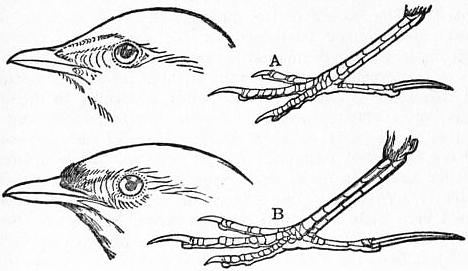
Fig. 1.—A, Alauda agrestis; B, Alauda arvensis.
Allied to the skylark a considerable number of species have been described, of which perhaps a dozen may be deemed valid, besides a supposed local race, Alauda agrestis, the difference between which and the normal bird is shown in the annexed woodcut (fig. 1), kindly lent to this work by H. E. Dresser, in whose Birds of Europe it is described at length. These are found in various parts of Africa and Asia.
The woodlark, Lullula arborea, is a much more local and, therefore, a far less numerous bird than the skylark, from which it may be easily distinguished by its finer bill, shorter tail, more spotted breast and light superciliary stripe. Though not actually inhabiting woods, as its common name might imply, it is seldom found far from trees. Its song wants the variety and power of the skylark’s, but has a resonant sweetness peculiarly its own. The bird, however, requires much care in captivity. It has by no means so wide a range as the skylark, and perhaps the most eastern locality recorded for it is Erzerum, while its appearance in Egypt and even in Algeria must be accounted rare.
Not far removed from the foregoing is a group of larks characterized by a larger crest, a stronger and more curved bill, a rufous lining to the wings, and some other minor features. This group has been generally termed Galerita, and has for its type the crested lark, the Alauda cristata of Linnaeus, a bird common enough in parts of France and some other countries of the European continent, and one which has been obtained several times in the British Islands. Many of the birds of this group frequent the borders if not the interior of deserts, and such as do so exhibit a more or less pale coloration, whereby they are assimilated in hue to that of their haunts. The same characteristic may be observed in several other groups—especially those known as belonging to the genera Calandrella, Ammomanes and Certhilauda, some species of which are of a light sandy or cream colour. The genus last named is of very peculiar appearance, presenting in some respects an extraordinary resemblance to the hoopoes, so much so that the first specimen described was referred to the genus Upupa, and named U. alaudipes. The resemblance, however, is merely one of analogy.
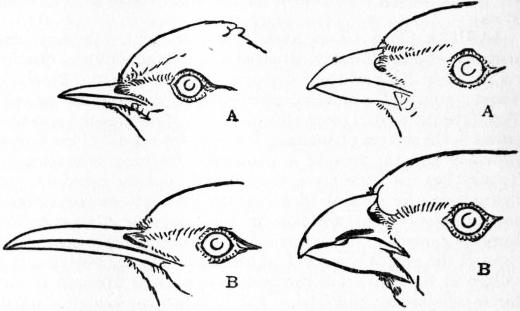
Fig. 2.—A, Lullula arborea; B, Certhilauda. Fig. 3.—A, Melanocorypha calandra; B, Rhamphocorys clot-bey.
There is, however, abundant evidence of the susceptibility of the Alaudine structure to modification from external circumstances—in other words, of its plasticity; and perhaps no homogeneous group of Passeres could be found which better displays the working of natural selection. Almost every character that among Passerine birds is accounted most sure is in the larks found subject to modification. The form of the bill varies in an extraordinary degree. In the woodlark (fig. 2, A), already noticed, it is almost as slender as a warbler’s; in Ammomanes it is short; in Certhilauda (fig. 2, B) it is elongated and curved; in Pyrrhulauda and Melanocorypha (fig. 3, A) it is stout and finchlike; while in Rhamphocorys (fig. 3, B) it is exaggerated to an extent that surpasses almost any Fringilline form, exceeding in its development that found in some members of the perplexing genus Paradoxornis, and even presenting a resemblance to the same feature in the far-distant Anastomus—the tomia of the maxilla not meeting those of the mandibula along their whole length, but leaving an open space between them. The hind claw, generally greatly elongated in larks, is in Calandrella (fig. 4) and some other genera reduced to a very moderate size. The wings exhibit almost every modification, from the almost entire abortion of the first primary in the skylark to its considerable development (fig. 5), and from tertials and scapulars of ordinary length to the extreme elongation found in the Motacillidae and almost in certain Limicolae. The most constant character indeed of the Alaudidae would seem to be that afforded by the podotheca or covering of the tarsus, which is scutellate behind as well as in front, but a character easily overlooked.1
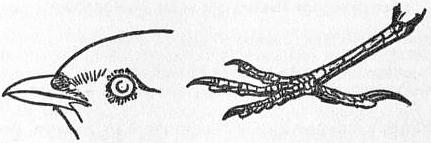
Fig. 4.—Calandrella brachydactyla.
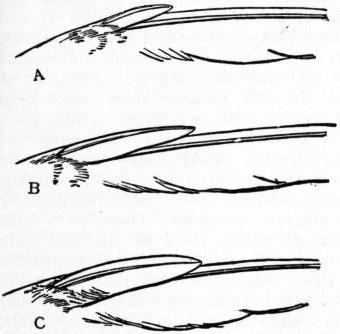
Fig. 5.—A, Alauda arborea; B, Certhilauda; C, Melanocorypha calandra.
In the Old World larks are found in most parts of the Palaearctic, Ethiopian and Indian regions; but only one genus, Mirafra, inhabits Australia, where it is represented by, so far as is ascertained, a single species, M. horsfieldi; and there is no true lark indigenous to New Zealand. In the New World there is also only one genus, Otocorys, where it is represented by many races, some of which closely approach the Old World shore-lark, O. alpestris. The shore-lark is in Europe a native of only the extreme north, but is very common near the shores of the Varanger Fjord, and likewise breeds on mountain-tops farther south-west, though still well within the Arctic circle. The mellow tone of its call-note has obtained for it in Lapland a name signifying “bell-bird,” and the song of the cock is lively, though not very loud. The bird trustfully resorts to the neighbourhood of houses, and even enters the villages of East Finmark in search of its food. It produces at least two broods in the season, and towards autumn migrates to lower latitudes in large flocks. These have been observed in winter on the east coast of Great Britain, and the species instead of being regarded, as it once was, in the light of an accidental visitor to the United Kingdom, must now be deemed an almost regular visitor, though in very varying numbers. The observations on its habits made by Audubon in Labrador have long been known, and often reprinted. Other congeners of this bird are the O. penicillata of south-eastern Europe, Palestine and central Asia—to which are referred by H. E. Dresser (B. Europe, iv. 401) several other forms originally described as distinct. All these birds, which have been termed horned larks, from the tuft of elongated black feathers growing on each side of the head, form a little group easily recognized by their peculiar coloration, which calls to mind some of the ringed plovers, Aegialitis.
The name of lark is also frequently applied to many birds which do not belong to the Alaudidae as now understood. The mud-lark, rock-lark, tit-lark and tree-lark are pipits (q.v.). The grasshopper-lark is one of the aquatic warblers (q.v.), while the so-called meadow-lark of America is an Icterus (q.v.). Sand-lark and sea-lark are likewise names often given to some of the smaller members of the Limicolae. Of the true larks, Alaudidae, there may be perhaps about one hundred species, and it is believed to be a physiological character of the family that they moult but once in the year, while the pipits, which in general appearance much resemble them, undergo a double moult, as do others of the Motacillidae, to which they are most nearly allied.
(A. N.)
1 By assigning far too great an importance to this superficial character (in comparison with others), C. J. Sundevall (Tentamen, pp. 53-63) was induced to array the larks, hoopoes and several other heterogeneous groups in one “series,” to which he applied the name of Scutelliplantares.
LARKHALL, a mining and manufacturing town of Lanarkshire, Scotland, near the left bank of the Clyde, 1 m. S.E. of Glasgow by the Caledonian railway. Pop. (1901) 11,879. The highest bridge in Scotland has been thrown across the river Avon, which flows close by. Brick-making is carried on at several of the adjoining collieries. Other industries include bleaching, silk-weaving, fire-clay and enamelling works, and a sanitary appliances factory. The town has a public hall and baths.
LARKHANA, a town and district of British India, in Sind, Bombay. The town is on a canal not far from the Indus, and has a station on the North-Western railway, 281 m. N. by E. of Karachi. It is pleasantly situated in a fertile locality, and is well laid out with wide streets and spacious gardens. It is a centre of trade, with manufactures of cotton, silk, leather, metal-ware and paper. Pop. (1901) 14,543.
The District of Larkhana, lying along the right bank of the Indus, was formed out of portions of Sukkur and Karachi districts in 1901, and has an area of 5091 sq. m.; pop. (1901) 656,083, showing an increase of 10% in the decade. Its western part is mountainous, but the remainder is a plain of alluvium watered by canals and well cultivated, being the most fertile part of Sind. The staple grain-crops are rice, wheat and millets, which are exported, together with wool, cotton and other agricultural produce. Cotton cloth, carpets, salt and leather goods are manufactured, and dyeing is an important industry. The district is served by the North-Western railway.
LARKSPUR, in botany, the popular name for species of Delphinium, a genus of hardy herbaceous plants belonging to the natural order Ranunculaceae (q.v.). They are of erect branching habit, with the flowers in terminal racemes, often of considerable length. Blue is the predominating colour, but purple, pink, yellow (D. Zalil or sulphureum), scarlet (D. cardinale) and white also occur; the “spur” is produced by the elongation of the upper sepal. The field or rocket larkspur (D. Ajacis), the branching larkspur (D. consolida), D. cardiopetalum and their varieties, are charming annuals; height about 18 in. The spotted larkspur (D. requienii) and a few others are biennials. The perennial larkspurs, however, are the most gorgeous of the family. There are numerous species of this group, natives of the old and new worlds, and a great number of varieties, raised chiefly from D. exaltatum, D. formosum and D. grandiflorum. Members of this group vary from 2 ft. to 6 ft. in height.
The larkspurs are of easy cultivation, either in beds or herbaceous borders; the soil should be deeply dug and manured. The annual varieties are best sown early in April, where they are intended to flower, and suitably thinned out as growth is made. The perennial kinds are increased by the division of existing plants in spring, or by cuttings taken in spring or autumn and rooted in pots in cold frames. The varieties cannot be perpetuated with certainty by seed. Seed is the most popular means, however, of raising larkspurs in the majority of gardens, and is suitable for all ordinary purposes; it should be sown as soon as gathered, preferably in rows in nursery beds, and the young plants transplanted when ready. They should be fit for the borders in the spring of the following year, and if strong, should be planted in groups about 3 ft. apart. Delphiniums require exposure to light and air. Given plenty of space in a rich soil, the plants rarely require to be staked except in windy localities.
LARNACA, Larnica or Larneca (anc. Citium, Turk. Tuzla), a town of the island of Cyprus, at the head of a bay on the south coast, 23 m. S.S.E. from Nicosia. Pop. (1901) 7964. It is the principal port of the island, exporting barley, wheat, cotton, raisins, oranges, lemons and gypsum. There is an iron pier 450 ft. long, but vessels anchor in the bay in from 16 to 70 ft. of water. Larnaca occupies the site of the ancient Citium, but the citadel of the ancient city was used to fill up the ancient harbour in 1879. The modern and principal residential part of the town is called Scala. Mycenaean tombs and other antiquities have been found (see Cyprus).
LA ROCHE, a small town in the Belgian Ardennes, noticeable for its antiquity and its picturesque situation. Pop. (1904) 2065. Its name is derived from its position on a rock commanding the river Ourthe, which meanders round the little place, and skirts the rock on which are the interesting ruins of the old castle of the 11th century. This is supposed to have been the site of a hunting box of Pippin, and certainly the counts of La Roche held it in fief from his descendants, the Carolingian rulers. In the 12th century they sold it to the counts of Luxemburg. In the 16th and 17th centuries the French and Imperialists frequently fought in its neighbourhood, and at Tenneville, not far distant, is shown the tomb of an English officer named Barnewall killed in one of these encounters in 1692. La Roche is famous as a tourist centre on account of its fine sylvan scenery. Among the local curiosities is the Diable-Château, a freak of nature, being the apparent replica of a medieval castle. La Roche is connected by steam tramway with Melreux, a station on the main line from Marloie to Liége.
LA ROCHEFOUCAULD, the name of an old French family which is derived from a castle1 in the province of Angoumois (department of Charente), which was in its possession in the 11th century. François de La Rochefoucauld (1494-1517), godson of King Francis I., was made count in 1515. At the time of the wars of religion the family fought for the Protestant cause. François (1588-1650) was created duke and peer of France by Louis XIII. in 1622. His son François was the author of the Maxims, and the son of the latter acquired for his house the estates of La Roche-Guyon and Liancourt by his marriage with Jeanne Charlotte du Plessis-Liancourt. Alexandre, duc de La Rochefoucauld (d. 1762), left two daughters, who married into the Roye branch of the family. Of the numerous branches of the family the most famous are those of Roucy, Roye, Bayers, Doudeauville, Randan and Estissac, which all furnished distinguished statesmen and soldiers.
1 The castle was largely rebuilt in the reign of Francis I., and is one of the finest specimens of the Renaissance architecture in France.
LA ROCHEFOUCAULD, FRANÇOIS DE (1613-1680), the greatest maxim writer of France, one of her best memoir writers, and perhaps the most complete and accomplished representative of her ancient nobility, was born at Paris in the Rue des Petits Champs on the 15th of September 1613. The author of the Maxims, who during the lifetime of his father (see above) and part of his own most stirring years bore the title of prince de Marcillac, was somewhat neglected in the matter of education, at least of the scholastic kind; but he joined the army before he was sixteen, and almost immediately began to make a figure in public life. He had been nominally married a year before to Andrée de Vivonne, who seems to have been an affectionate wife, while not a breath of scandal touches her—two points in which La Rochefoucauld was perhaps more fortunate than he deserved. For some years Marcillac continued to take part in the annual campaigns, where he displayed the utmost bravery, though he never obtained credit for much military skill. Then he passed under the spell of Madame de Chevreuse, the first of three celebrated women who successively influenced his life. Through Madame de Chevreuse he became attached to the queen, Anne of Austria, and in one of her quarrels with Richelieu and her husband a wild scheme seems to have been formed, according to which Marcillac was to carry her off to Brussels on a pillion. These caballings against Richelieu, however, had no more serious results (an eight days’ experience of the Bastille excepted) than occasional exiles, that is to say, orders to retire to his father’s estates. After the death of the great minister (1642), opportunity seemed to be favourable to the vague ambition which then animated half the nobility of France. Marcillac became one of the so-called importants, and took an active part in reconciling the queen and Condé in a league against Gaston of Orleans. But the growing credit of Mazarin came in his way, and the liaison in which about this time (1645) he became entangled with the beautiful duchess of Longueville made him irrevocably a Frondeur. He was a conspicuous figure in the siege of Paris, fought desperately in the desultory engagements which were constantly taking place, and was severely wounded at the siege of Mardyke. In the second Fronde Marcillac followed the fortunes of Condé, and the death of his father, which happened at the time (1650), gave rise to a characteristic incident. The nobility of the province gathered to the funeral, and the new duke de La Rochefoucauld took the opportunity of persuading them to follow him in an attempt on the royalist garrison of Saumur, which, however, was not successful. We have no space to follow La Rochefoucauld through the tortuous cabals and negotiations of the later Fronde; it is sufficient to say that he was always brave and generally unlucky. His run of bad fortune reached its climax in the battle of the Faubourg Saint Antoine (1652), where he was shot through the head, and it was thought that he would lose the sight of both eyes. It was nearly a year before he recovered, and then he found himself at his country seat of Verteuil, with no result of twenty years’ fighting and intriguing except impaired health, a seriously embarrassed fortune, and some cause for bearing a grudge against almost every party and man of importance in the state. He spent some years in this retirement, and he was fortunate enough (thanks chiefly to the fidelity of Gourville, who had been in his service, and who, passing into the service of Mazarin and of Condé, had acquired both wealth and influence) to be able to repair in some measure the breaches in his fortune. He did not, however, return to court life much before Mazarin’s death, when Louis XIV. was on the eve of assuming absolute power, and the turbulent aristocratic anarchy of the Fronde was a thing utterly of the past.
Somewhat earlier, La Rochefoucauld had taken his place in the salon of Madame de Sablé, a member of the old Rambouillet coterie, and the founder of a kind of successor to it. It was known that he, like almost all his more prominent contemporaries, had spent his solitude in writing memoirs, while the special literary employment of the Sablé salon was the fabrication of Sentences and Maxims. In 1662, however, more trouble than reputation, and not a little of both, was given to him by a surreptitious publication of his memoirs, or what purported to be his memoirs, by the Elzevirs. Many of his old friends were deeply wounded, and he hastened to deny flatly the authenticity of the publication, a denial which (as it seems, without any reason) was not very generally accepted. Three years later (1665) he published, though without his name, the still more famous Maxims, which at once established him high among the men of letters of the time. About the same date began the friendship with Madame de la Fayette, which lasted till the end of his life. The glimpses which we have of him henceforward are chiefly derived from the letters of Madame de Sévigné, and, though they show him suffering agonies from gout, are on the whole pleasant. He had a circle of devoted friends; he was recognized as a moralist and man of letters of the first rank; he might have entered the Academy for the asking; and in the altered measure of the times his son, the prince de Marcillac, to whom some time before his death he resigned his titles and honours, enjoyed a considerable position at court. Above all, La Rochefoucauld was generally recognized by his contemporaries from the king downward as a type of the older noblesse as it was before the sun of the great monarch dimmed its brilliant qualities. This position he has retained until the present day. He died at Paris on the 17th of March 1680, of the disease which had so long tormented him.