VOLUME XVI SLICE II Lamennais, Robert de to Latini, Brunetto (continued 3)
Reading edition
As one of the two rival inventors of what was called the “monitorial” or “mutual” method of instruction, Lancaster’s name was prominent for many years in educational controversy. Dr Andrew Bell (q.v.) had in 1797 published an account of his experiments in teaching; and Lancaster in his first pamphlet, published in 1803, frankly acknowledges his debt to Bell for some useful hints. The two worked independently, but Lancaster was the first to apply the system of monitorial teaching on a large scale. As an economical experiment his school at the Borough Road was a signal success. He had one thousand scholars under discipline, and taught them to read, write and work simple sums at a yearly cost of less than 5s. a head. His tract Improvements in Education described the gradation of ranks, the system of signals and orders, the functions of the monitors, the method of counting and of spelling and the curious devices he adopted for punishing offenders. Bell’s educational aims were humbler, as he feared to “elevate above their station those who were doomed to the drudgery of daily labour,” and therefore did not desire to teach even writing and ciphering to the lower classes. The main difference between them was that the system of the one was adopted by ecclesiastics and Conservatives,—the “National Society for the Education of the Poor in the principles of the Established Church” having been founded in 1811 for its propagation; while Lancaster’s method was patronized by the Edinburgh Review, by Whig statesmen, by a few liberal Churchmen and by Nonconformists generally. It was the design of Lancaster and his friends to make national education Christian, but not sectarian,—to cause the Scriptures to be read, explained and reverenced in the schools, without seeking by catechisms or otherwise to attract the children to any particular church or sect. This principle was at first vehemently denounced as deistic and mischievous, and as especially hostile to the Established Church. To do them justice, it must be owned that the rival claims and merits of Bell and Lancaster were urged with more passion and unfairness by their friends than by themselves. Yet neither is entitled to hold a very high place among the world’s teachers. Bell was cold, shrewd and self-seeking. Lancaster had more enthusiasm, a genuine and abounding love for children, and some ingenuity in devising plans both for teaching and governing. But he was shiftless, wayward and unmethodical, and incapable of sustained and high-principled personal effort. His writings were not numerous. They consist mainly of short pamphlets descriptive of the successes he attained at the Borough Road. His last publication, An Epitome of the Chief Events and Transactions of my Own Life, appeared in America in 1833, and is characterized, even more strongly than his former writings, by looseness and incoherency of style, by egotism and by a curious incapacity for judging fairly the motives either of his friends or his foes. We have since come to believe that intelligent teaching requires skill and previous training, and that even the humblest rudiments are not to be well taught by those who have only just acquired them for themselves, or to be attained by mere mechanical drill. But in the early stages of national education the monitorial method served a valuable purpose. It brought large numbers of hitherto neglected children under discipline, and gave them elementary instruction at a very cheap rate. Moreover, the little monitors were often found to make up in brightness, tractability and energy for their lack of experience, and to teach the arts of reading, writing and computing with surprising success. And one cardinal principle of Bell and Lancaster is of prime importance. They regarded a school, not merely as a place to which individual pupils should come for guidance from teachers, but as an organized community whose members have much to learn from each other. They sought to place their scholars from the first in helpful mutual relations, and to make them feel the need of common efforts towards the attainment of common ends.
(J. G. F.)

LANCASTER, THOMAS, Earl of (c. 1277-1322), was the eldest son of Edmund, earl of Lancaster and titular king of Sicily, and a grandson of the English king, Henry III.; while he was related to the royal house of France both through his mother, Blanche, a granddaughter of Louis VIII., and his step-sister, Jeanne, queen of Navarre, the wife of Philip IV. A minor when Earl Edmund died in 1296, Thomas received his father’s earldoms of Lancaster and Leicester in 1298, but did not become prominent in English affairs until after the accession of his cousin, Edward II., in July 1307. Having married Alice (d. 1348), daughter and heiress of Henry Lacy, earl of Lincoln, and added the earldom of Derby to those which he already held, he was marked out both by his wealth and position as the leader of the barons in their resistance to the new king. With his associates he produced the banishment of the royal favourite, Piers Gaveston, in 1308; compelled Edward in 1310 to surrender his power to a committee of “ordainers,” among whom he himself was numbered; and took up arms when Gaveston returned to England in January 1312. Lancaster, who had just obtained the earldoms of Lincoln and Salisbury on the death of his father-in-law in 1311, drove the king and his favourite from Newcastle to Scarborough, and was present at the execution of Gaveston in June 1312. After lengthy efforts at mediation, he made his submission and received a full pardon from Edward in October 1313; but he refused to accompany the king on his march into Scotland, which ended at Bannockburn, and took advantage of the English disaster to wrest the control of affairs from the hands of Edward. In 1315 he took command of the forces raised to fight the Scots, and was soon appointed to the “chief place in the council,” while his supporters filled the great offices of state, but his rule was as feeble as that of the monarch whom he had superseded. Quarrelling with some of the barons, he neglected both the government and the defence of the kingdom, and in 1317 began a private war with John, Earl Warrenne, who had assisted his countess to escape from her husband. The capture of Berwick by the Scots, however, in April 1318 led to a second reconciliation with Edward. A formal treaty, made in the following August, having been ratified by parliament, the king and earl opened the siege of Berwick; but there was no cohesion between their troops, and the undertaking was quickly abandoned. On several occasions Lancaster was suspected of intriguing with the Scots, and it is significant that his lands were spared when Robert Bruce ravaged the north of England. He refused to attend the councils or to take any part in the government until 1321, when the Despensers were banished, and war broke out again between himself and the king. Having conducted some military operations against Lancaster’s friends on the Welsh marches, Edward led his troops against the earl, who gradually fell back from Burton-on-Trent to Pontefract. Continuing this movement, Lancaster reached Boroughbridge, where he was met by another body of royalists under Sir Andrew Harclay. After a skirmish he was deserted by his troops, and was obliged to surrender. Taken to his own castle at Pontefract, where the king was, he was condemned to death as a rebel and a traitor, and was beheaded near the town on the 22nd of March 1322. He left no children.
Although a coarse, selfish and violent man, without any of the attributes of a statesman, Lancaster won a great reputation for patriotism; and his memory was long cherished, especially in the north of England, as that of a defender of popular liberties. Over a hundred years after his death miracles were said to have been worked at his tomb at Pontefract; thousands visited his effigy in St Paul’s Cathedral, London, and it was even proposed to make him a saint.
See Chronicles of the Reigns of Edward I. and Edward II., edited with introduction by W. Stubbs (London, 1882-1883); and W. Stubbs, Constitutional History, vol. ii. (Oxford, 1896).
LANCASTER, a market town and municipal borough, river port, and the county town of Lancashire, England, in the Lancaster parliamentary division, 230 m. N.W. by N. from London by the London & North-Western railway (Castle Station); served also by a branch of the Midland railway (Green Ayre station). Pop. (1891) 33,256; (1901) 40,329. It lies at the head of the estuary of the river Lune, mainly on its south bank, 7 m. from the sea. The site slopes sharply up to an eminence crowned by the castle and the church of St Mary. Fine views over the rich valley and Morecambe Bay to the west are commanded from the summit. St Mary’s church was originally attached by Roger de Poictou to his Benedictine priory founded at the close of the 11th century. It contains some fine Early English work in the nave arcade, but is of Perpendicular workmanship in general appearance, while the tower dates from 1759. There are some beautiful Decorated oak stalls in the chancel, brought probably from Cockersand or Furness Abbey.
The castle occupies the site of a Roman castrum. The Saxon foundations of a yet older structure remain, and the tower at the south-west corner is supposed to have been erected during the reign of Hadrian. The Dungeon Tower, also supposed to be of Roman origin, was taken down in 1818. The greater part of the old portion of the present structure was built by Roger de Poictou, who utilized some of the Roman towers and the old walls. In 1322 much damage was done to the castle by Robert Bruce, whose attack it successfully resisted, but it was restored and strengthened by John of Gaunt, who added the greater part of the Gateway Tower as well as a turret on the keep or Lungess Tower, which on that account has been named “John o’ Gaunt’s Chair.” During the Civil War the castle was captured by Cromwell. Shortly after this it was put to public use, and now, largely modernized, contains the assize courts and gaol. Its appearance, with massive buildings surrounding a quadrangle, is picturesque and dignified. Without the walls is a pleasant terrace walk. Other buildings include several handsome modern churches and chapels (notably the Roman Catholic church); the Storey Institute with art gallery, technical and art schools, museum and library, presented to the borough by Sir Thomas Storey in 1887; Palatine Hall, Ripley hospital (an endowed school for the children of residents in Lancaster and the neighbourhood), the asylum, the Royal Lancaster infirmary and an observatory in the Williamson Park. A new town hall, presented by Lord Ashton in 1909, is a handsome classical building from designs of E. W. Mountford. The Ashton Memorial in Williamson Park, commemorating members of the Ashton family, is a lofty domed structure. The grammar school occupies modern buildings, but its foundation dates from the close of the 15th century, and in its former Jacobean house near the church William Whewell and Sir Richard Owen were educated. A horseshoe inserted in the pavement at Horseshoe Corner in the town, and renewed from time to time, is said to mark the place where a shoe was cast by John of Gaunt’s horse.
The chief industries are cotton-spinning, cabinet-making, oil cloth-making, railway wagon-building and engineering. Glasson Dock, 5 m. down the Lune, with a graving dock, is accessible to vessels of 600 tons. The Kendal and Lancaster canal reaches the town by an aqueduct over the Lune, which is also crossed by a handsome bridge dated 1788. The town has further connexion by canal with Preston. The corporation consists of a mayor, 8 aldermen and 24 councillors. Area, 3506 acres.
History.—Lancaster (Lone-caster or Lunecastrum) was an important Roman station, and traces of the Roman fortification wall remain. The Danes left few memorials of their occupation, and the Runic Cross found here, once supposed to be Danish, is now conclusively proved to be Anglo-Saxon. At the Conquest, the place, reduced in size and with its Roman castrum almost in ruins, became a possession of Roger de Poictou, who founded or enlarged the present castle on the old site. The town and castle had a somewhat chequered ownership till in 1266 they were granted by Henry III. to his son Edmund, first earl of Lancaster, and continued to be a part of the duchy of Lancaster till the present time. A town gathered around the castle, and in 1193 John, earl of Mertoun, afterwards king, granted it a charter, and another in 1199 after his accession. Under these charters the burgesses claimed the right of electing a mayor, of holding a yearly fair at Michaelmas and a weekly market on Saturday. Henry III. in 1226 confirmed the charter of 1199; in 1291 the style of the corporation is first mentioned as Ballivus et communitas burgi, and Edward III.’s confirmation and extension (1362) is issued to the mayor, bailiffs and commonalty. Edward III.’s charter was confirmed by Richard II. (1389), Henry IV. (1400), Henry V. (1421), Henry VII. (1488) and Elizabeth (1563). James I. (1604) and Charles II. (1665 and 1685) ratified, with certain additions, all previous charters, and again in 1819 a similar confirmation was issued. John of Gaunt in 1362 obtained a charter for the exclusive right of holding the sessions of pleas for the county in Lancaster itself, and up to 1873 the duchy appointed a chief justice and a puisne justice for the court of common pleas at Lancaster. In 1322 the Scots burnt the town, the castle alone escaping; the town was rebuilt but removed from its original position on the hill to the slope and foot. Again in 1389, after the battle of Otterburn, it was destroyed by the same enemy. At the outbreak of the Great Rebellion the burgesses sided with the king, and the town and castle were captured in February 1643 by the Parliamentarians. In March 1643 Lord Derby assaulted and took the town with great slaughter, but the castle remained in the hands of the Parliamentarians. In May and June of the same year the castle was again besieged in vain, and in 1648 the Royalists under Sir Thomas Tyldesley once more fruitlessly besieged it. During the rebellion of 1715 the northern rebels occupied Lancaster for two days and several of them were later executed here. During the 1745 rebellion Prince Charles Edward’s army passed through the town in its southward march and again in its retreat, but the inhabitants stood firm for the Hanoverians.
Two chartered markets are held weekly on Wednesday and Saturday and three annual fairs in April, July and October. A merchant gild existed here, which was ratified by Edward III.’s charter (1362), and in 1688 six trade companies were incorporated. The chief manufactures used to be sailcloth, cabinet furniture, candles and cordage. The borough returned two members to parliament from 1295 to 1331 and again from some time in Henry VIII.’s reign before 1529 till 1867, when it was merged in the Lancaster division of north Lancashire. A church existed here, probably on the site of the parish church of St Mary’s, in Anglo-Saxon times, but the present church dates from the early 15th century. An act of parliament was passed in 1792 to make the canal from Kendal through Lancaster and Preston, which is carried over the Lune about a mile above Lancaster by a splendid aqueduct.
See Fleury, Time-Honoured Lancaster (1891); E. Baines, History of Lancashire (1888).
LANCASTER, a city and the county-seat of Fairfield county, Ohio, U.S.A., on the Hocking river (non-navigable), about 32 m. S.E. of Columbus. Pop. (1900) 8991, of whom 442 were foreign-born and 212 were negroes; (1910 census) 13,093. Lancaster is served by the Hocking Valley, the Columbus & Southern and the Cincinnati & Muskingum Valley (Pennsylvania Lines) railways, and by the electric line of the Scioto Valley Traction Company, which connects it with Columbus. Near the centre of the city is Mt. Pleasant, which rises nearly 200 ft. above the surrounding plain and about which cluster many Indian legends; with 70 acres of woodland and fields surrounding it, this has been given to the city for a park. On another hill is the county court house. Lancaster has a public library and a children’s home; and 6 m. distant is the State Industrial School for Boys. The manufactures include boots and shoes, glass and agricultural implements. The total value of the city’s factory product in 1905 was $4,159,410, being an increase of 118.3% over that of 1900. Lancaster is the trade centre of a fertile agricultural region, has good transportation facilities, and is near the Hocking Valley and Sunday Creek Valley coal-fields; its commercial and industrial importance increased greatly, after 1900, through the development of the neighbouring natural gas fields and, after 1907-1908, through the discovery of petroleum near the city. Good sandstone is quarried in the vicinity. The municipality owns and operates its waterworks and natural gas plant. Lancaster was founded in 1800 by Ebenezer Zane (1747-1811), who received a section of land here as part compensation for opening a road, known as “Zane’s Trace,” from Wheeling, West Virginia, to Limestone (now Maysville), Kentucky. Some of the early settlers were from Lancaster, Pennsylvania, whence the name. Lancaster was incorporated as a village in 1831 and twenty years later became a city of the third class.
LANCASTER, a city and the county-seat of Lancaster county, Pennsylvania, U.S.A., on the Conestoga river, 68 m. W. of Philadelphia. Pop. (1900) 41,459, of whom 3492 were foreign-born and 777 were negroes; (1910 census) 47,227. It is served by the Pennsylvania, the Philadelphia & Reading and the Lancaster, Oxford & Southern railways, and by tramways of the Conestoga Traction Company, which had in 1909 a mileage of 152 m. Lancaster has a fine county court house, a soldiers’ monument about 43 ft. in height, two fine hospitals, the Thaddeus Stevens Industrial School (for orphans), a children’s home, the Mechanics’ Library, and the Library of the Lancaster Historical Society. It is the seat of Franklin and Marshall College (Reformed Church), of the affiliated Franklin and Marshall Academy, and of the Theological Seminary of the Reformed Church, conducted in connexion with the college. The college was founded in 1852 by the consolidation of Franklin College, founded at Lancaster in 1787, and Marshall College, founded at Mercersburg in 1836, both of which had earned a high standing among the educational institutions of Pennsylvania. Franklin College was named in honour of Benjamin Franklin, an early patron; Marshall College was founded by the Reformed Church and was named in honour of John Marshall. The Theological Seminary was opened in 1825 at Carlisle, Pa., and was removed to York, Pa., in 1829, to Mercersburg, Pa., in 1837 and to Lancaster in 1871; in 1831 it was chartered by the Pennsylvania legislature. Among its teachers have been John W. Nevin and Philip Schaff, whose names, and that of the seminary, are associated with the so-called “Mercersburg Theology.” At Millersville, 4 m. S.W. of Lancaster, is the Second Pennsylvania State Normal School. At Lancaster are the graves of General John F. Reynolds, who was born here; Thaddeus Stevens, who lived here after 1842; and President James Buchanan, who lived for many years on an estate, “Wheatland,” near the city and is buried in the Woodward Hill Cemetery. The city is in a productive tobacco and grain region, and has a large tobacco trade and important manufactures. The value of the city’s factory products increased from $12,750,429 in 1900 to $14,647,681 in 1905, or 14.9%. In 1905 the principal products were umbrellas and canes (valued at $2,782,879), cigars and cigarettes ($1,951,971), and foundry and machine-shop products ($1,036,526). Lancaster county has long been one of the richest agricultural counties in the United States, its annual products being valued at about $10,000,000; in 1906 the value of the tobacco crop was about $3,225,000, and there were 824 manufactories of cigars in the county.
Lancaster was settled about 1717 by English Quakers and Germans, was laid out as a town in 1730, incorporated as a borough in 1742, and chartered as a city in 1818. An important treaty with the Iroquois Indians was negotiated here by the governor of Pennsylvania and by commissioners from Maryland and Virginia in June 1744. Some of General Burgoyne’s troops, surrendered at Saratoga, were confined here after the autumn of 1780. The Continental Congress sat here on the 27th of September 1777 after being driven from Philadelphia by the British; and subsequently, after the organization of the Federal government, Lancaster was one of the places seriously considered when a national capital was to be chosen. From 1799 to 1812 Lancaster was the capital of Pennsylvania.
LANCE, a form of spear used by cavalry (see Spear). The use of the lance, dying away on the decay of chivalry and the introduction of pistol-armed cavalry, was revived by the Polish and Cossack cavalry who fought against Charles XII. and Frederick the Great. It was not until Napoleon’s time, however, that lancer regiments appeared in any great numbers on European battlefields. The effective use of the weapon—long before called by Montecucculi the “queen of weapons”—by Napoleon’s lancers at Waterloo led to its introduction into the British service, and except for a short period after the South African War, in which it was condemned as an anachronism, it has shared, or rather contested, with the sword the premier place amongst cavalry arms. In Great Britain and other countries lances are carried by the front rank of cavalry, except light cavalry, regiments, as well as by lancer regiments. In Germany, since 1889, the whole of the cavalry has been armed with the lance. In Russia, on the other hand, line cavalry being, until recently, considered as a sort of mounted infantry or dragoons, the lance was restricted to the Cossacks, and in Austria it enjoys less favour than in Germany. Altogether there are few questions of armament or military detail more freely disputed, in the present day as in the past, than this of sword versus lance.
The lances used in the British service are of two kinds, those with ash and those with bamboo staves. The latter are much preferred and are generally used, the “male” bamboo being peculiarly tough and elastic. The lance is provided with a sling, through which the trooper passes his right arm when the lance is carried slung, the point of the steel shoe fitting into a bucket attached to the right stirrup. A small “dee” loop is also provided, by which the lance can be attached to the saddle when the trooper dismounts. The small flag is removed on service. The head is of the best steel. The Germans, doubtless owing to difficulty in obtaining bamboos, or ash in large quantity straight enough in the grain over a considerable length, for lance staves, have adopted a stave of steel tubing as well as one of pine (figs. 2, 3 and 4).
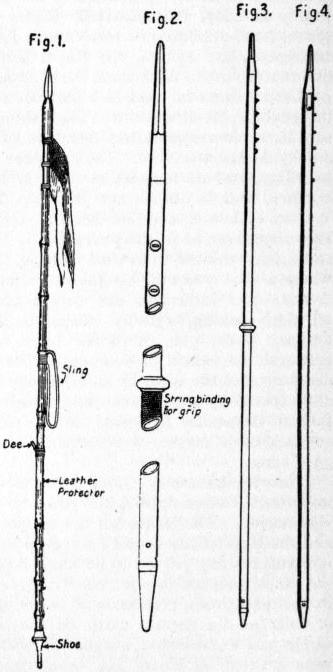
Types of British and German Lances.
Fig. 1 is the British bamboo lance; figs. 2 and 3 the German steel tubular lance, and fig. 4 the German pine-wood lance. The full length of the German lance is 11 ft. 9 in., that of the Cossacks 9 ft. 10 in., that of the Austrian lancers 8 ft. 8 in., and the French lance 11 ft. The British lance is 9 ft. long. The weight of a lance varies but slightly. The steel-staved lance weighs 4 ℔, the bamboo 4½.
As to the question of the relative efficiency of the lance and the sword as the principal arm for cavalry, it is alleged that the former is heavy and fatiguing to carry, conspicuous, and much in the way when reconnoitring in close country, working through woods and the like; that, when unslung ready for the charge, it is awkward to handle, and may be positively dangerous if a horse becomes restive and the rider has to use both hands on the reins; that unless the thrust be delivered at full speed, it is easily parried; and, lastly, that in the mêlée, when the trooper has not room to use his lance, he will be helpless until he either throws it away or slings it, and can draw his sword. While admitting the last-mentioned objection, those who favour the lance contend that success in the first shock of contact is all-important, and that this success the lancer will certainly obtain, owing to his long reach enabling him to deliver a blow before the swordsman can retaliate, while, when the mêlée commences, the rear rank will come to the assistance of the front rank. Further, it is claimed that the power of delivering the first blow gives confidence to the young soldier; that the appearance of a lancer regiment, preceded as it were by a hedge of steel, has an immense moral effect; that in single combat a lancer, with room to turn, can always defeat an opponent armed with a sword; and, lastly, that in pursuit a lancer is terrible to an enemy, whether the latter be mounted or on foot. As in the case of the perennial argument whether a sword should be designed mainly for cutting or thrusting, it is unlikely that the dispute as to the merits of the lance over the sword will ever be definitely settled, since so many other factors—horsemanship, the training of the horse, the skill and courage of the adversary—determine the trooper’s success quite as much as the weapon he happens to wield. The following passage from Cavalry: its History and Tactics (London, 1853), by Captain Nolan, explains how the lance gained popularity in Austria:—“In the last Hungarian war (1848-49) the Hungarian Hussars were ... generally successful against the Austrian heavy cavalry—cuirassiers and dragoons; but when they met the Polish Lancers, the finest regiments of light horse in the Austrian service, distinguished for their discipline, good riding, and, above all, for their esprit de corps and gallantry in action, against those the Hungarians were not successful, and at once attributed this to the lances of their opponents. The Austrians then extolled the lance above the sword, and armed all their light cavalry regiments with it.”
The lancer regiments in the British service are the 5th, the 9th, the 12th, the 16th, the 17th and the 21st. All these were converted at different dates from hussars and light dragoons, the last-named in 1896. The typical lancer uniform is a light-fitting short-skirted tunic with a double-breasted front, called the plastron, of a different colour, a girdle, and a flat-topped lancer “cap,” adapted from the Polish czapka (see Uniforms: Naval and Military). The British lancers, with the exception of the 16th, who wear scarlet with blue facings, are clad in blue, the 5th, 9th and 12th having scarlet facings and green, black and red plumes respectively, the 17th (famous as the “death or glory boys” and wearing a skull and crossbones badge) white facings and white plume, and the 21st light-blue facings and plume.
LANCELOT (Lancelot du Lac, or Lancelot of the Lake), a famous figure in the Arthurian cycle of romances. To the great majority of English readers the name of no knight of King Arthur’s court is so familiar as is that of Sir Lancelot. The mention of Arthur and the Round Table at once brings him to mind as the most valiant member of that brotherhood and the secret lover of the Queen. Lancelot, however, is not an original member of the cycle, and the development of his story is still a source of considerable perplexity to the critic.
Briefly summarized, the outline of his career, as given in the German Lanzelet and the French prose Lancelot, is as follows: Lancelot was the only child of King Ban of Benoic and his queen Helaine. While yet an infant, his father was driven from his kingdom, either by a revolt of his subjects, caused by his own harshness (Lanzelet), or by the action of his enemy Claudas de la Deserte (Lancelot). King and queen fly, carrying the child with them, and while the wife is tending her husband, who dies of a broken heart on his flight, the infant is carried off by a friendly water-fairy, the Lady of the Lake, who brings the boy up in her mysterious kingdom. In the German poem this is a veritable “Isle of Maidens,” where no man ever enters, and where it is perpetual spring. In the prose Lancelot, on the other hand, the Lake is but a mirage, and the Lady’s court does not lack its complement of gallant knights; moreover the boy has the companionship of his cousins, Lionel and Bohort, who, like himself, have been driven from their kingdom by Claudas. When he reaches the customary age (which appears to be fifteen), the young Lancelot, suitably equipped, is sent out into the world. In both versions his name and parentage are concealed, in the Lanzelet he is genuinely ignorant of both; here too his lack of all knightly accomplishments (not unnatural when we remember he has here been brought up entirely by women) and his inability to handle a steed are insisted upon. Here he rides forth in search of what adventure may bring. In the prose Lancelot his education is complete, he knows his name and parentage, though for some unexplained reason he keeps both secret, and he goes with a fitting escort and equipment to Arthur’s court to demand knighthood. The subsequent adventures differ widely: in the Lanzelet he ultimately reconquers his kingdom, and, with his wife Iblis, reigns over it in peace, both living to see their children’s children, and dying on the same day, in good old fairy-tale fashion. In fact, the whole of the Lanzelet has much more the character of a fairy or folk-tale than that of a knightly romance.
In the prose version, Lancelot, from his first appearance at court, conceives a passion for the queen, who is very considerably his senior, his birth taking place some time after her marriage to Arthur. This infatuation colours all his later career. He frees her from imprisonment in the castle of Meleagant, who has carried her off against her will—(a similar adventure is related in Lanzelet, where the abductor is Valerîn, and Lanzelet is not the rescuer)—and, although he recovers his kingdom from Claudas, he prefers to remain a simple knight of Arthur’s court, bestowing the lands on his cousins and half-brother Hector. Tricked into a liaison with the Fisher King’s daughter Elaine, he becomes the father of Galahad, the Grail winner, and, as a result of the queen’s jealous anger at his relations with the lady, goes mad, and remains an exile from the court for some years. He takes part, fruitlessly, in the Grail quest, only being vouchsafed a fleeting glimpse of the sacred Vessel, which, however, is sufficient to cast him into unconsciousness, in which he remains for as many days as he has spent years in sin. Finally, his relations with Guenevere are revealed to Arthur by the sons of King Lot, Gawain, however, taking no part in the disclosure. Surprised together, Lancelot escapes, and the queen is condemned to be burnt alive. As the sentence is about to be carried into execution Lancelot and his kinsmen come to her rescue, but in the fight that ensues many of Arthur’s knights, including three of Gawain’s brothers, are slain. Thus converted into an enemy, Gawain urges his uncle to make war on Lancelot, and there follows a desperate struggle between Arthur and the race of Ban. This is interrupted by the tidings of Mordred’s treachery, and Lancelot, taking no part in the last fatal conflict, outlives both king and queen, and the downfall of the Round Table. Finally, retiring to a hermitage, he ends his days in the odour of sanctity.
The process whereby the independent hero of the Lanzelet (who, though his mother is Arthur’s sister, has but the slightest connexion with the British king), the faithful husband of Iblis, became converted into the principal ornament of Arthur’s court, and the devoted lover of the queen, is by no means easy to follow, nor do other works of the cycle explain the transformation. In the pseudo-chronicles, the Historia of Geoffrey and the translations by Wace and Layamon, Lancelot does not appear at all; the queen’s lover, whose guilty passion is fully returned, is Mordred. Chrétien de Troyes’ treatment of him is contradictory; in the Erec, his earliest extant poem, Lancelot’s name appears as third on the list of the knights of Arthur’s court. (It is well, however, to bear in mind the possibility of later addition or alteration in such lists.) In Cligés he again ranks as third, being overthrown by the hero of the poem. In Le Chevalier de la Charrette, however, which followed Cligés, we find Lancelot alike as leading knight of the court and lover of the queen, in fact, precisely in the position he occupies in the prose romance, where, indeed, the section dealing with this adventure is, as Gaston Paris clearly proved, an almost literal adaptation of Chrétien’s poem. The subject of the poem is the rescue of the queen from her abductor Meleagant; and what makes the matter more perplexing is that Chrétien handles the situation as one with which his hearers are already familiar; it is Lancelot, and not Arthur or another, to whom the office of rescuer naturally belongs. After this it is surprising to find that in his next poem, Le Chevalier au Lion, Lancelot is once, and only once, casually referred to, and that in a passing reference to his rescue of the queen. In the Perceval, Chrétien’s last work, he does not appear at all, and yet much of the action passes at Arthur’s court.
In the continuations added at various times to Chrétien’s unfinished work the rôle assigned to Lancelot is equally modest. Among the fifteen knights selected by Arthur to accompany him to Chastel Orguellous he only ranks ninth. In the version of the Luite Tristran inserted by Gerbert in his Perceval, he is publicly overthrown and shamed by Tristan. Nowhere is he treated with anything approaching the importance assigned to him in the prose versions. Welsh tradition does not know him; early Italian records, which have preserved the names of Arthur and Gawain, have no reference to Lancelot; among the group of Arthurian knights figured on the architrave of the north doorway of Modena cathedral (a work of the 12th century) he finds no place; the real cause for his apparently sudden and triumphant rise to popularity is extremely difficult to determine. What appears the most probable solution is that which regards Lancelot as the hero of an independent and widely diffused folk-tale, which, owing to certain special circumstances, was brought into contact with, and incorporated in, the Arthurian tradition. This much has been proved certain of the adventures recounted in the Lanzelet; the theft of an infant by a water-fairy; the appearance of the hero three consecutive days, in three different disguises, at a tournament; the rescue of a queen, or princess, from an Other-World prison, all belong to one well-known and widely-spread folk-tale, variants of which are found in almost every land, and of which numerous examples have been collected alike by M. Cosquin in his Contes Lorrains, and by Mr J. F. Campbell in his Tales of the West Highlands.
The story of the loves of Lancelot and Guenevere, as related by Chrétien, has about it nothing spontaneous and genuine; in no way can it be compared with the story of Tristan and Iseult. It is the exposition of a relation governed by artificial and arbitrary rules, to which the principal actors in the drama must perforce conform. Chrétien states that he composed the poem (which he left to be completed by Godefroi de Leigni) at the request of the countess Marie of Champagne, who provided him with matière et san. Marie was the daughter of Louis VII. of France and of Eleanor of Aquitaine, subsequently wife of Henry II. of Anjou and England. It is a matter of history that both mother and daughter were active agents in fostering that view of the social relations of the sexes which found its most famous expression in the “Courts of Love,” and which was responsible for the dictum that love between husband and wife was impossible. The logical conclusion appears to be that the Charrette poem is a “Tendenz-Schrift,” composed under certain special conditions, in response to a special demand. The story of Tristan and Iseult, immensely popular as it was, was too genuine—(shall we say too crude?)—to satisfy the taste of the court for which Chrétien was writing. Moreover, the Arthurian story was the popular story of the day, and Tristan did not belong to the magic circle, though he was ultimately introduced, somewhat clumsily, it must be admitted, within its bounds. The Arthurian cycle must have its own love-tale; Guenevere, the leading lady of that cycle, could not be behind the courtly ladies of the day and lack a lover; one had to be found for her. Lancelot, already popular hero of a tale in which an adventure parallel to that of the Charrette figured prominently, was pressed into the service, Modred, Guenevere’s earlier lover, being too unsympathetic a character; moreover, Modred was required for the final rôle of traitor.
But to whom is the story to be assigned? Here we must distinguish between the Lancelot proper and the Lancelot-Guenevere versions; so far as the latter are concerned, we cannot get behind the version of Chrétien,—nowhere, prior to the composition of the Chevalier de la Charrette is there any evidence of the existence of such a story. Yet Chrétien does not claim to have invented the situation. Did it spring from the fertile brain of some court lady, Marie, or another? The authorship of the Lancelot proper, on the other hand, is invariably ascribed to Walter Map (see Map), the chancellor of Henry II., but so also are the majority of the Arthurian prose Romances. The trend of modern critical opinion is towards accepting Map as the author of a Lancelot romance, which formed the basis for later developments, and there is a growing tendency to identify this hypothetical original Lancelot with the source of the German Lanzelet. The author, Ulrich von Zatzikhoven, tells us that he translated his poem from a French (welsches) book in the possession of Hugo de Morville, one of the English hostages, who, in 1194, replaced Richard Cœur de Lion in the prison of Leopold of Austria. Further evidence on the point is, unfortunately, not at present forthcoming. To the student of the original texts Lancelot is an infinitely less interesting hero than Gawain, Perceval or Tristan, each of whom possesses a well-marked personality, and is the centre of what we may call individual adventures. Saving and excepting the incident of his being stolen and brought up by a water-fairy (from a Lai relating which adventure the whole story probably started), there is absolutely nothing in Lancelot’s character or career to distinguish him from any other romantic hero of the period. The language of the prose Lancelot is good, easy and graceful, but the adventures lack originality and interest, and the situations repeat themselves in a most wearisome manner. English readers, who know the story only through the medium of Malory’s noble prose and Tennyson’s melodious verse, carry away an impression entirely foreign to that produced by a study of the original literature. The Lancelot story, in its rise and development, belongs exclusively to the later stage of Arthurian romance; it was a story for the court, not for the folk, and it lacks alike the dramatic force and human appeal of the genuine “popular” tale.
The prose Lancelot was frequently printed; J. C. Brunet chronicles editions of 1488, 1494, 1513, 1520 and 1533—of this last date there are two, one published by Jehan Petit, the other by Philippe Lenoire, this last by far the better, being printed from a much fuller manuscript. There is no critical edition, and the only version available for the general reader is the modernized and abridged text published by Paulin Paris in vols. iii. to v. of Romans de la Table Ronde. A Dutch verse translation of the 13th century was published by M. W. J. A. Jonckbloet in 1850, under the title of Roman van Lanceloet. This only begins with what Paulin Paris terms the Agravain section, all the part previous to Guenevere’s rescue from Meleagant having been lost; but the text is an excellent one, agreeing closely with the Lenoire edition of 1533. The Books devoted by Malory to Lancelot are also drawn from this latter section of the romance; there is no sign that the English translator had any of the earlier part before him. Malory’s version of the Charrette adventure differs in many respects from any other extant form, and the source of this special section of his work is still a question of debate among scholars. The text at his disposal, especially in the Queste section, must have been closely akin to that used by the Dutch translator and the compiler of Lenoire, 1533. Unfortunately, Dr Sommer, in his study on the Sources of Malory, omitted to consult these texts, with the result that the sections dealing with Lancelot and Queste urgently require revision.
Bibliography.—Lanzelet (ed. Hahn, 1845, out of print and extremely difficult to obtain). Chrétien’s poem has been published by Professor Wendelin Foerster, in his edition of the works of that poet, Der Karrenritter (1899). A Dutch version of a short episodic poem, Lancelot et le cerf au pied blanc will be found in M. Jonckbloet’s volume, and a discussion of this and other Lancelot poems, by Gaston Paris, is contained in vol. xxx. of Histoire littéraire de la France. For critical studies on the subject cf. Gaston Paris’s articles in Romania, vols. x. and xii.; Wechssler, Die verschiedenen Redaktionen des Graal-Lancelot Cyklus; J. L. Weston, The Legend of Sir Lancelot du Lac (Grimm Library, vol. xii.); and The Three Days’ Tournament (Grimm Library, vol. xv.) an appendix to the (J. L. W.) previous vol.
LANCET (from Fr. lancette, dim. of lance, lance), the name given to a surgical instrument, with a narrow two-edged blade and a lance-shaped point, used for opening abscesses, &c. The term is applied, in architecture, to a form of the pointed arch, and to a window of which the head is a lancet-arch.
LANCEWOOD, a straight-grained, tough, light elastic wood obtained from the West Indies and Guiana. It is brought into commerce in the form of taper poles of about 20 ft. in length and from 6 to 8 in. in diameter at the thickest end. Lancewood is used by carriage-builders for shafts; but since the practice of employing curved shafts has come largely into use it is not in so great demand as formerly. The smaller wood is used for whip-handles, for the tops of fishing-rods, and for various minor purposes where even-grained elastic wood is a desideratum. The wood is obtained from two members of the natural order Anonaceae. The black lancewood or carisiri of Guiana (Guatteria virgata) grows to a height of 50 ft., is of remarkably slender form, and seldom yields wood more than 8 in. diameter. The yellow lancewood tree (Duguetia quitarensis, yari-yari, of Guiana) is of similar dimensions, found in tolerable abundance throughout Guiana, and used by the Indians for arrow-points, as well as for spars, beams, &c.
LAN-CHOW-FU, the chief town of the Chinese province of Kan-suh, and one of the most important cities of the interior part of the empire, on the right bank of the Hwang-ho. The population is estimated at 175,000. The houses, with very few exceptions, are built of wood, but the streets are paved with blocks of granite and marble. Silks, wood-carvings, silver and jade ornaments, tin and copper wares, fruits and tobacco are the chief articles of the local trade. Tobacco is very extensively cultivated in the vicinity.
LANCIANO (anc. Anxanum), a town and episcopal see of the Abruzzi, Italy, in the province of Chieti, situated on three hills, 984 ft. above sea-level, about 8 m. from the Adriatic coast and 12 m. S.E. of Chieti. Pop. (1901) 7642 (town), 18,316 (commune). It has a railway station on the coast railway, 19 m. S.E. of Castellammare Adriatico. It has broad, regular streets, and several fine buildings. The cathedral, an imposing structure with a fine clock-tower of 1619, is built upon bridges of brickwork, dating perhaps from the Roman period (though the inscription attributing the work to Diocletian is a forgery), that span the gorge of the Feltrino, and is dedicated to S. Maria del Ponte, Our Lady of the Bridge. The Gothic church of S. Maria Maggiore dates from 1227 and has a fine façade, with a portal of 1317 by a local sculptor. The processional cross by the silversmith Nicola di Guardiagrele (1422) is very beautiful. In S. Nicola is a fine reliquary of 1445 by Nicola di Francavilla. The church of the Annunziata has a good rose window of 1362. The industries of the town, famous in the middle ages, have declined. Anxanum belonged originally to the tribe of the Frentani and later became a municipium. It lay on the ancient highroad, which abandoned the coast at Ortona 10 m. to the N. and returned to it at Histonium (Vasto). Remains of a Roman theatre exist under the bishop’s palace.
See V. Bindi, Monumenti degli Abruzzi (Naples, 1889, 690 sqq.), and for discoveries in the neighbourhood see A. de Nino in Notizie degli scavi (1884), 431.
(T. As.)
LANCRET, NICOLAS (1660-1743), French painter, was born in Paris on the 22nd of January 1660, and became a brilliant depicter of light comedy which reflected the tastes and manners of French society under the regent Orleans. His first master was Pierre d’Ulin, but his acquaintance with and admiration for Watteau induced him to leave d’Ulin for Gillot, whose pupil Watteau had been. Two pictures painted by Lancret and exhibited on the Place Dauphine had a great success, which laid the foundation of his fortune, and, it is said, estranged Watteau, who had been complimented as their author. Lancret’s work cannot now, however, be taken for that of Watteau, for both in drawing and in painting his touch, although intelligent, is dry, hard and wanting in that quality which distinguished his great model; these characteristics are due possibly in part to the fact that he had been for some time in training under an engraver. The number of his paintings (of which over eighty have been engraved) is immense; he executed a few portraits and attempted historical composition, but his favourite subjects were balls, fairs, village weddings, &c. The British Museum possesses an admirable series of studies by Lancret in red chalk, and the National Gallery, London, shows four paintings—the “Four Ages of Man” (engraved by Desplaces and l’Armessin), cited by d’Argenville amongst the principal works of Lancret. In 1719 he was received as Academician, and became councillor in 1735; in 1741 he married a grandchild of Boursault, author of Aesop at Court. He died on the 14th of September 1743.
See d’Argenville, Vies des peintres; and Ballot de Sovot, Éloge de M. Lancret (1743, new ed. 1874).
LAND, the general term for that part of the earth’s surface which is solid and dry as opposed to sea or water. The word is common to Teutonic languages, mainly in the same form and with essentially the same meaning. The Celtic cognate forms are Irish lann, Welsh llan, an enclosure, also in the sense of “church,” and so of constant occurrence in Welsh place-names, Cornish lan and Breton lann, health, which has given the French lande, an expanse or tract of sandy waste ground. The ultimate root is unknown. From its primary meaning have developed naturally the various uses of the word, for a tract of ground or country viewed either as a political, geographical or ethnographical division of the earth, as property owned by the public or state or by a private individual, or as the rural as opposed to the urban or the cultivated as opposed to the built on part of the country; of particular meanings may be mentioned that of a building divided into tenements or flats, the divisions being known as “houses,” a Scottish usage, and also that of a division of a ploughed field marked by the irrigating channels, hence transferred to the smooth parts of the bore of a rifle between the grooves of the rifling.
For the physical geography of the land, as the solid portion of the earth’s surface, see Geography. For land as the subject of cultivation see Agriculture and Soil, also Reclamation of Land. For the history of the holding or tenure of land see Village Communities and Feudalism; a particular form of land tenure is dealt with under Métayage. The article Agrarian Laws deals with the disposal of the public land (Ager publicus) in Ancient Rome, and further information with regard to the part played by the land question in Roman history will be found under Rome: § History. The legal side of the private ownership of land is treated under Real Property and Conveyancing (see also Landlord and Tenant, and Land Registration).
LANDAU, a town in the Bavarian Palatinate, on the Queich, lying under the eastern slope of the Hardt Mountains, 32 m. by rail S.W. from Mannheim, at the junction of lines to Neustadt an der Hardt, Weissenburg and Saarbrücken. Pop. (1905) 17,165. Among its buildings are the Gothic Evangelical church, dating from 1285; the chapel of St Catherine built in 1344; the church of the former Augustinian monastery, dating from 1405; and the Augustinian monastery itself, founded in 1276 and now converted into a brewery. There are manufactures of cigars, beer, hats, watches, furniture and machines, and a trade in wine, fruit and cereals. Large cattle-markets are held here. Landau was founded in 1224, becoming an imperial city fifty years later. This dignity was soon lost, as in 1317 it passed to the bishopric of Spires and in 1331 to the Palatinate, recovering its former position in 1511. Captured eight times during the Thirty Years’ War the town was ceded to France by the treaty of Westphalia in 1648, although with certain ill-defined reservations. In 1679 Louis XIV. definitely took possession of Landau. Its fortifications were greatly strengthened; nevertheless it was twice taken by the Imperialists and twice recovered by the French during the Spanish Succession War. In 1815 it was given to Austria and in the following year to Bavaria. The fortifications were finally dismantled in 1871.
The town is commonly supposed to have given its name to the four-wheeled carriage, with an adjustable divided top for use either open or closed, known as a “landau” (Ger. Landauer). But this derivation is doubtful, the origin of the name being also ascribed to that of an English carriage-builder, Landow, who introduced this form of equipage.
See E. Heuser, Die Belagerungen von Landau in den Jahren 1702 und 1703 (Landau, 1894); Lehmann, Geschichte der ehemaligen freien Reichsstadt Landau (1851); and Jost, Interessante Daten aus der 600 jährigen Geschichte der Stadt Landau (Landau, 1879).
LANDECK, a town and spa in the Prussian province of Silesia, on the Biele, 73 m. by rail S. of Breslau and close to the Austrian frontier. Pop. (1905) 3,481. It is situated at an altitude of 1400 ft. It has manufactures of gloves. Landeck is visited by nearly 10,000 people annually on account of its warm sulphur baths, which have been known since the 13th century. In the neighbourhood are the ruins of the castle of Karpenstein.
See Langner, Bad Landeck (Glatz, 1872); Schütze, Die Thermen von Landeck (Berlin, 1895); Wehse, Bad Landeck (Breslau, 1886); Joseph, Die Thermen von Landeck (Berlin, 1887), and Patschovsky, Führer durch Bad Landeck und Umgebung (Schweidnitz, 1902).
LANDEN, JOHN (1719-1790), English mathematician, was born at Peakirk near Peterborough in Northamptonshire on the 23rd of January 1719, and died on the 15th of January 1790 at Milton in the same county. He lived a very retired life, and saw little or nothing of society; when he did mingle in it, his dogmatism and pugnacity caused him to be generally shunned. In 1762 he was appointed agent to the Earl Fitzwilliam, and held that office to within two years of his death. He was first known as a mathematician by his essays in the Ladies’ Diary for 1744. In 1766 he was elected a fellow of the Royal Society. He was well acquainted with the works of the mathematicians of his own time, and has been called the “English d’Alembert.” In his Discourse on the “Residual Analysis,” he proposes to avoid the metaphysical difficulties of the method of fluxions by a purely algebraical method. The idea may be compared with that of Joseph Louis Lagrange’s Calcul des Fonctions. His memoir (1775) on the rotatory motion of a body contains (as the author was aware) conclusions at variance with those arrived at by Jean le Rond, d’Alembert and Leonhard Euler in their researches on the same subject. He reproduces and further develops and defends his own views in his Mathematical Memoirs, and in his paper in the Philosophical Transactions for 1785. But Landen’s capital discovery is that of the theorem known by his name (obtained in its complete form in the memoir of 1775, and reproduced in the first volume of the Mathematical Memoirs) for the expression of the arc of an hyperbola in terms of two elliptic arcs. His researches on elliptic functions are of considerable elegance, but their great merit lies in the stimulating effect which they had on later mathematicians. He also showed that the roots of a cubic equation can be derived by means of the infinitesimal calculus.
The list of his writings is as follows:—Ladies’ Diary, various communications (1744-1760); papers in the Phil. Trans. (1754, 1760, 1768, 1771, 1775, 1777, 1785); Mathematical Lucubrations (1755); A Discourse concerning the Residual Analysis (1758); The Residual Analysis, book i. (1764); Animadversions on Dr Stewart’s Method of computing the Sun’s Distance from the Earth (1771); Mathematical Memoirs (1780, 1789).
LANDEN, a town in the province of Liége, Belgium, an important junction for lines of railway from Limburg, Liége and Louvain. Pop. (1904) 2874. It is the birthplace of the first Pippin, distinguished as Pippin of Landen from his grandson Pippin of Herstal. In 1693 the French under Marshal Luxemburg defeated here the Anglo-Dutch army under William III. This battle is also called Neerwinden from a village 3 m. W. of Landen. Here in 1793 the Austrians under Frederick of Saxe-Coburg and Clerfayt defeated the French under Dumouriez.
LANDER, RICHARD LEMON (1804-1834) and JOHN (1807-1839), English explorers of the Niger, were natives of Cornwall, sons of an innkeeper at Truro. At the age of eleven Richard went to the West Indies in the service of a merchant. Returning to England after an absence of three years he took service with various wealthy families, with whom he travelled on the continent. In 1823-1824 he accompanied Major (afterwards General Sir) W. M. Colebrooke, on a tour through Cape Colony. In 1825 Richard offered his services to Hugh Clapperton, then preparing for his second expedition to West Africa. He was Clapperton’s devoted servant and companion in this expedition, and on Clapperton’s death near Sokoto in April 1827 Richard Lander, after visiting Kano and other parts of the Hausa states, returned to the Guinea coast through Yoruba bringing with him Clapperton’s journal. To this on its publication (1829) was added The Journal of Richard Lander from Kano to the Coast, and in the next year Lander published another account of the expedition entitled Records of Captain Clapperton’s Last Expedition to Africa ... with the subsequent Adventures of the Author. To this narrative he prefixed an autobiographical note. Richard Lander, though without any scientific attainments, had exhibited such capacity for exploration that the British government decided to send him out to determine the course of the lower Niger. In the expedition he was accompanied by his brother John, by trade a printer, and better educated than Richard, who went as an unsalaried volunteer. Leaving England in January 1830, the brothers landed at Badagry on the Guinea coast on the 22nd of March. They then travelled by the route previously taken by Clapperton to Bussa on the right bank of the Niger, reached on the 17th of June. Thence they ascended the river for about 100 m. Going back to Bussa the travellers began, on the 20th of September, the descent of the river, not knowing whither it would lead them. They journeyed in canoes accompanied by a few negroes, their only scientific instrument a common compass. They discovered the Benue river, ascertaining when passing its confluence, by paddling against its stream, that their course was not in that direction. At the beginning of the delta they were captured by the Ibos, from whom they were ransomed by “King Boy” of Brass Town; by him they were taken to the Nun mouth of the river, whence a passage was obtained to Fernando Po, reached on the 1st of December. The Landers were thus able to lay down with approximate correctness the lower course of the Niger—a matter till then as much in dispute as was the question of the Nile sources. In the attack by the Ibos the Landers lost many of their records, but they published a narrative of their discoveries in 1832, in three small volumes—Journal of an Expedition to Explore the Course and Termination of the Niger. In recognition of his services the Royal Geographical Society—formed two years previously—granted Richard Lander in 1832 the royal medal, he being the first recipient of such an award. In the same year Richard went to Africa again as leader of an expedition organized by Macgregor Laird and other Liverpool merchants to open up trade on the Niger and to found a commercial settlement at the junction of the Benue with the main stream. The expedition encountered many difficulties, suffered great mortality from fever, and was not able to reach Bussa. Lander made several journeys up and down stream, and while going up the river in a canoe was attacked by the natives on the 20th of January 1834 at a spot about 84 m. above the Nun mouth, and wounded by a musket ball in the thigh. He was removed to Fernando Po, where he died on the 6th of February. John Lander, who on his return to England in 1831 obtained a situation at the London customs house, died on the 16th of November 1839 of a disease contracted in Africa.
See, besides the books mentioned, the Narrative of the Niger expedition of 1832-1834, published in 1837 by Macgregor Laird and R. A. K. Oldfield.
LANDES, a department in the south-west of France, formed in 1790 of portions of the ancient provinces of Guyenne (Landes, Condomios Chalosse), Gascony and Béarn, and bounded N. by Gironde, E. by Lot-et-Garonne and Gers, S. by Basses Pyrenées, and W. (for 68 m.) by the Bay of Biscay. Pop. (1906) 293,397. Its area, 3615 sq. m., is second only to that of the department of Gironde. The department takes its name from the Landes, which occupy three-quarters of its surface, or practically the whole region north of the Adour, the chief river of the department. They are separated from the sea by a belt of dunes fringed on the east by a chain of lakes. South of the Adour lies the Chalosse—a hilly region, intersected by the Gabas, Luy and Gave de Pau, left-hand tributaries of the Adour, which descend from the Pyrenees. On the right the Adour is joined by the Midouze, formed by the junction of the Douze and the Midou. The climate of Landes is the Girondine, which prevails from the Loire to the Pyrenees. Snow is almost unknown, the spring is rainy, the summer warm and stormy. The prevailing wind is the south-west, and the mean temperature of the year is 53° F., the thermometer hardly ever rising above 82° or falling below 14°. The annual rainfall in the south of the department in the neighbourhood of the sea reaches 55 in., but diminishes by more than half towards the north-east.
The fertility of La Chalosse is counterbalanced by the comparative poorness of the soil of the Landes, and small though the population is, the department does not produce wheat enough for its own consumption. The chief cereal is maize; next in importance are rye, wheat and millet. Of vegetables, the bean is most cultivated. The vine is grown in the Chalosse, sheep are numerous, and the “Landes” breed of horses is well known. Forests, chiefly composed of pines, occupy more than half the department, and their exploitation forms the chief industry. The resin of the maritime pine furnishes by distillation essence of turpentine, and from the residue are obtained various qualities of resin, which serve to make varnish, tapers, sealing-wax and lubricants. Tar, and an excellent charcoal for smelting purposes, are also obtained from the pine-wood. The department has several mineral springs, the most important being those of Dax, which were frequented in the time of the Romans, and of Eugénie-les-Bains and Préchacq. The cultivation of the cork tree is also important. There are salt-workings and stone quarries. There are several iron-works in the department; those at Le Boucau, at the mouth of the Adour, are the most important. There are also saw-mills, distilleries, flour-mills, brick and tile works and potteries. Exports include resinous products, pine-timber, metal, brandy; leading imports are grain, coal, iron, millinery and furniture. In its long extent of coast the department has no considerable port. Opposite Cape Breton, however, where the Adour formerly entered the sea, there is, close to land, a deep channel where there is safe anchorage. It was from this once important harbour of Capbreton that the discoverers of the Canadian island of that name set out. Landes includes three arrondissements (Mont-de-Marsan, Dax and St Sever), 28 cantons and 334 communes.
Mont-de-Marsan is the capital of the department, which comes within the circumscription of the appeal court of Pau, the académie (educational division) of Bordeaux and the archbishopric of Auch, and forms part of the region of the 18th army corps. It is served by the Southern railway; there is some navigation on the Adour, but that upon the other rivers is of little importance. Mont-de-Marsan, Dax, St Sever and Aire-sur-l’Adour, the most noteworthy towns, receive separate notice. Hagetmau has a church built over a Romanesque crypt, the roof of which is supported on columns with elaborately-carved capitals. Sorde has an interesting abbey-church of the 13th and 14th centuries.
LANDES, an extensive natural region of south-western France, known more strictly as the Landes de Gascogne. It has an area of 5400 sq. m., and occupies three-quarters of the department of Landes, half of that of Gironde, and some 175,000 acres of Lot-et-Garonne. The Landes, formerly a vast tract of moorland and marsh, now consist chiefly of fields and forests of pines. They form a plateau, shaped like a triangle, the base of which is the Atlantic coast while the apex is situated slightly west of Nérac (Lot-et-Garonne). Its limits are, on the S. the river Adour; on the E. the hills of Armagnac, Eauzan, Condomois, Agenais and Bazadais; and on the N.E. the Garonne, the hills of Médoc and the Gironde. The height of the plateau ranges in general from 130 to 260 ft.; the highest altitude (498 ft.) is found in the east near Baudignan (department of Landes), from which point there is a gradual slope towards north, south, east and west. The soil is naturally sterile. It is composed of fine sand resting on a subsoil of tufa (alios) impermeable by water; for three-quarters of the year, consequently, the waters, settling on the almost level surface and unable to filter through, used to transform the country into unwholesome swamps, which the Landesats could only traverse on stilts. About the middle of the 18th century an engineer, François Chambrelent, instituted a scheme of draining and planting to remedy these evils. As a result about 1600 m. of ditches have been dug which carry off superficial water either to streams or to the lakes which fringe the landes on the west, and over 1,600,000 acres have been planted with maritime pines and oaks. The coast, for a breadth of about 4 m., and over an area of about 225,000 acres, is bordered by dunes, in ranges parallel to the shore, and from 100 to 300 ft. in height. Driven by the west wind, which is most frequent in these parts, the dunes were slowly advancing year by year towards the east, burying the cultivated lands and even the houses. Nicolas Thomas Brémontier, towards the end of the 18th century, devised the plan of arresting this scourge by planting the dunes with maritime pines. Upwards of 210,000 acres have been thus treated. In the south-west, cork trees take the place of the pines. To prevent the formation of fresh dunes, a “dune littorale” has been formed by means of a palisade. This barrier, from 20 to 30 ft. high, presents an obstacle which the sand cannot cross. On the eastern side of the dunes is a series of lakes (Hourtin et Carcans, Lacanau, Cazau or Sanguinet, Biscarrosse, Aureilhan, St Julien, Léon and Soustons) separated from the sea by the heaping up of the sand. The salt water has escaped by defiltration, and they are now quite fresh. The Basin of Arcachon, which lies midway between the lakes of Lacanau and Cazau, still communicates with the ocean, the current of the Leyre which flows into it having sufficient force to keep a passage open.
LANDESHUT, a town in the Prussian province of Silesia, at the north foot of the Riesengebirge, and on the river Bober, 65 m. S.W. of Breslau by rail. Pop. (1905) 9000. Its main industries are flax-spinning, linen-weaving and manufactures of cloth, shoes and beer. The town dates from the 13th century, being originally a fortress built for protection against the Bohemians. There the Prussians defeated the Austrians in May 1745, and in June 1760 the Prussians were routed by a greatly superior force of Austrians.
See Perschke, Beschreibung und Geschichte der Stadt Landeshut (Breslau, 1829).
LANDGRAVE (Ger. Landgraf, from Land, “a country” and Graf, “count” ), a German title of nobility surviving from the times of the Holy Roman Empire. It originally signified a count of more than usual power or dignity, and in some cases implied sovereignty. The title is now rare; it is borne by the former sovereign of Hesse-Homburg, now incorporated in Prussia, the heads of the various branches of the house of Hesse, and by a branch of the family of Fürstenberg. In other cases the title of landgrave is borne by German sovereigns as a subsidiary title; e.g. the grand-duke of Saxe-Weimar is landgrave of Thuringia.
LANDLORD AND TENANT. In Roman Law, the relationship of landlord and tenant arose from the contract of letting and hiring (locatio conductio), and existed also with special incidents, under the forms of tenure known as emphyteusis—the long lease of Roman law—and precarium, or tenancy at will (see Roman Law).
Law of England.—The law of England—and the laws of Scotland and Ireland agree with it on this point—recognizes no absolute private ownership of land. The absolute and ultimate owner of all land is the crown, and the highest interest that a subject can hold therein—viz. an estate in fee simple—is only a tenancy. But this aspect of the law, under which the landlord, other than the crown, is himself always a tenant, falls beyond the scope of the present article, which is restricted to those holdings that arise from the hiring and leasing of land.
The legal relationship of landlord and tenant is constituted by a lease, or an agreement for a lease, by assignment, by attornment and by estoppel. And first of a lease and an agreement for a lease. All kinds of interests and Leases. property, whether corporeal, such as lands or buildings, or incorporeal, such as rights of common or of way, may be let. The Benefices Act 1898, however, now prohibits the grant of a lease of an advowson. Titles of honour, offices of trust or relating to the administration of justice, and pensions granted by the crown for military services are also inalienable. Generally speaking, any person may grant or take a lease. But there are a number of common-law and statutory qualifications and exceptions. A lease by or to an infant is voidable at his option. But extensive powers of leasing the property of infants have been created by the Settled Estates Act 1877 and the Settled Land Act 1882. A person of unsound mind can grant or take a lease if he is capable of contracting. Leases may be made on behalf of lunatics subject to the jurisdiction in lunacy under the provisions of the Lunacy Act 1890 and the Settled Land Act 1882. A married woman can lease her “separate property” apart from or under the Married Women’s Property Acts, as if she were a single woman (feme sole). As regards other property, the concurrence of her husband is generally necessary. An alien was, at common law, incapable of being either a lessor or a lessee. But this disqualification is removed by the Naturalization Act 1870. The right to deal with the property of a convict while he is undergoing sentence (but not while he is out of prison on leave) is, by the Forfeiture Act 1870, vested in his administrator. Leases by or to corporations must be by deed under their common seal, and the leasing powers of ecclesiastical corporations in particular are subject to complicated statutory restrictions which cannot here be examined (see Phillimore, Eccl. Law, 2nd ed., p. 1281). Powers of granting building and other leases have been conferred by modern legislation on municipal corporations and other local authorities.
A person having an interest in land can, in general, create a valid interest only to the extent of that interest. Thus a tenant for years, or even from year to year only, may stand in his turn as landlord to another tenant. If he profess, however, to create a tenancy for a period longer than that to which his own interest extends, he does not thereby give to his tenant an interest available against the reversioner or remainder man. The subtenant’s interest will expire with the interest of the person who created it. But as between the subtenant and his immediate lessor the subtenancy will be good, and should the interest of the lessor become greater than it was when the subtenancy was created the subtenant will have the benefit of it. On his side, again, the subtenant, by accepting that position, is estopped from denying that his lessor’s title (whatever it be) is good. There are also special rules of law with reference to leases by persons having only a limited interest in the property leased, e.g. a tenant for life under the Settled Land Acts, or a mortgagor or mortgagee.
The Letting.—To constitute the relationship of landlord and tenant in the mode under consideration, it is necessary not only that there should be parties capable of entering into the contract, but that there should be a letting, as distinct from a mere agreement to let, and that the right conveyed should be a right to the exclusive possession of the subject of the letting and not a simple licence to use it. Whether a particular instrument is a lease, or an agreement for a lease, or a bare licence, is a question the answer to which depends to a large extent on the circumstances of individual cases; and the only general rule is that in a lease there must be an expression of intention on the part of the lessor to convey, and of the lessee to accept, the exclusive possession of the thing let for the prescribed term and on the prescribed conditions. The landlord must not part with the whole of his interest, since, if he does so, the instrument is not a lease but an assignment. Where a tenant enters under an agreement for a lease and pays rent, the agreement will be regarded as a lease from year to year; and if the agreement is one of which specific performance would be decreed (i.e. if it contains a complete contract between the parties and satisfies the provisions—to be noted immediately—of the Statute of Frauds, and if, in all the circumstances, its enforcement is just and equitable), the lessee is treated as having a lease for the term fixed in the agreement from the time that he took possession under it, just as if a valid lease had been executed. At common law a lease for a term of years (other than a lease by a corporation) might be made by parol. But under the Statute of Frauds (1677, ss., 1, 2) leases, except those the term of which does not exceed three years, and in which the reserved rent is equal to two-thirds at least of the improved value of the premises, were required to be in writing signed by the parties or their lawfully authorized agents; and, under the Real Property Act 1845, a lease required by law to be in writing is void unless made by deed. The Statute of Frauds also prohibits an action from being brought upon any agreement for a lease, for any term, unless such agreement is in writing and signed by the party to be charged therewith or by some agent lawfully authorized by him.
Forms of Tenancy.—The following are the principal forms of tenancy: (i.) Tenancy for Life.—A lease for life must be made by deed, and the term may be the life of the lessee and the life or lives of some other person or persons, and in the latter case either for their joint lives or for the life of the survivor; also for the lives of the lessee himself and of some other person or persons, and this constitutes a single estate. A tenant for life under a settlement has extensive powers of leasing under the Settled Land Act 1882. He may lease the settled land, or any part of it, for any time not exceeding (a) in the case of a building lease, 99 years; (b) in the case of a mining lease, 60 years, (c) in the case of any other lease, 21 years. He may also grant either a lease of the surface of settled land, reserving the mines and minerals, or a lease of the minerals without the surface. A lease under the Settled Land Act 1882 must be by deed and must be made to take effect in possession not later than 12 months after its date; the best rent that can reasonably be obtained must be reserved and the lease must contain a covenant by the lessee for payment of the rent, and a condition of re-entry on non-payment within a specified time not exceeding 30 days, (ii.) Tenancy for Years, i.e. for a term of years.—This tenancy is created by an express contract between the parties and never by implication, as in the case of tenancy from year to year and tenancy at will. Here the tenancy ends on the expiry of the prescribed term, without notice to quit or any other formality. (iii.) Tenancy from Year to Year.—This tenancy may be created by express agreement between the parties, or by implication as, e.g. where a person enters and pays rent under a lease for years, void either by law or by statute, or without any actual lease or agreement, or holds over after the determination of a lease whether for years or otherwise. In the absence of express agreement or custom or statutory provision (such as is made by the Agricultural Holdings Act 1883), a tenancy from year to year is determinable on half a year’s notice expiring at the end of some current year of the tenancy. Where there is no express stipulation creating a yearly tenancy, if the parties have contracted that the tenant may be dispossessed by a notice given at any time, effect will be given to this provision. The common law doctrine of a six months’ notice being required to terminate a tenancy from year to year of a corporeal hereditament, does not apply to an incorporeal hereditament such as a right to shoot. (iv.) Tenancies for Shorter Periods.—Closely associated with tenancies from year to year are various other tenancies for shorter periods than a year—weekly, monthly or quarterly. Questions of considerable importance frequently arise as to the notice necessary to terminate tenancies of this character. The issue is one of fact; the date at which the rent is payable is a material circumstance, but it may be said generally that a week’s notice should be given to determine a weekly tenancy, a month’s to determine a monthly tenancy, and a quarter’s to determine a quarterly tenancy. It is chiefly in connexion with the letting of lodgings, flats, &c., that tenancies of this class arise (see Flats, Lodger and Lodgings). (v.) Tenancy at Will.—A tenancy at will is one which endures at the will of the parties only, i.e. at the will of both, for if a demise be made to hold at the will of the lessor, the law implies that it is at the will of the lessee also and vice versa. Any signification of a desire to terminate the tenancy, whether expressed as “notice” or not, will bring it to an end. This form of tenancy, like tenancy from year to year, may be treated either by express contract or by implication, as where premises are occupied with the consent of the owner, but without any express or implied agreement as to the duration of the tenancy, or where a house is lent rent free by one person to another. A tenancy at will is determined by either party alienating his interest as soon as such alienation comes to the knowledge of the other. (vi.) Tenancy at Sufferance.—A tenant who comes into possession by a lawful demise, but “holds over” or continues in possession after his estate is ended, is said to be a “tenant at sufferance.” Properly speaking, tenancy at sufferance is not a tenancy at all, inasmuch as if the landlord acquiesces in it, it becomes a tenancy at will; and it is to be regarded merely as a legal fiction which prevented the rightful owner from treating the tenant as a trespasser until he had himself made an actual entry on or had brought an action to recover the land. The Distress for Rent Act 1737, however, enables a landlord to recover double rent from a tenant who holds over after having himself given notice to quit; while another statute in the reign of George II.—the Landlord and Tenant Act 1730—makes a tenant who holds over after receiving a notice from his landlord liable to the extent of double the value of the premises. There is no tenancy by sufferance against the crown.
Form of a Lease.—The component parts of a lease are the parties, the recitals (when necessary) setting out such matters as the title of the lessor; the demise or actual letting (the word “demise” is ordinarily used, but any term indicating an express intention to make a present letting is sufficient); the parcels in which the extent of the premises demised is stated; the habendum (which defines the commencement and the term of the lease), the reddendum or reservation of rent, and the covenants and conditions. The Conveyancing Act 1881 provides that, as regards conveyances subsequent to 1881, unless a contrary intention is expressed, a lease of “land” is to be deemed to include all buildings, fixtures, easements, &c., appertaining to it; and, if there are houses or other buildings on the land demised, all out-houses, erections, &c., are to pass with the lease of the land. Rights which the landlord desires to retain over the lands let are excepted or reserved. Sporting rights will pass to the lessee unless reserved (see Game Laws). A grant or reservation of mines in general terms confers, or reserves, a right to work the mines, subject to the obligation of leaving a reasonable support to the surface as it exists at the time of the grant or reservation. It is not necessary that a lease should be dated. In the absence of a date, it will take effect from the day of delivery.
Covenants in Leases.—These may be roughly divided into four groups: (i.) Implied Covenants.—A covenant is said to be implied when it is raised by implication of law without any express provision being made for it in the lease. Thus a lessee is under an implied obligation to treat the premises demised in a tenant-like or “husband-like” manner, and again, where in a lease by deed the word “demise” is used, the lessor probably covenants impliedly for his own title and for the quiet enjoyment of the premises by the lessee. (ii.) ”Usual” Covenants.—Where an agreement for a lease specifies only such essential conditions as the payment of rent, and either mentions no other terms, or provides that the lease shall contain the “usual” covenants, the parties are entitled to have inserted in the lease made in pursuance of the agreement such other provisions as are “usual” in leases of property of the same character, and in the same district, not being provisions tending to abridge or qualify the legal incidents of the estate intended to be granted to the lessee. The question what covenants are “usual” is a question of fact. A covenant by the lessor, limited to his own acts and those of persons claiming under or through him, for the “quiet enjoyment” by the lessee of the demised premises, and covenants by the lessee to pay rent, to pay taxes, except such as fall upon the landlord, to keep the premises in repair, and to allow the landlord to enter and view the condition of the premises may be taken as typical instances of “usual” covenants. Covenants by the lessee to build and repair, not to assign or underlet without license, or to insure, or not to carry on a particular trade on the premises leased, have been held not to be “usual.” Where the agreement provides for the insertion in the lease of “proper” covenants, such covenants only are pointed at as are calculated to secure the full effect of the contract, and a covenant against assignment or under-letting would not ordinarily be included. (iii.) The Covenants running with the Land.—A covenant is said to “run with the land” when the rights and duties which it creates are not merely personal to the immediate parties (in which case a covenant is said to be “collateral”), but pass also to their assignees. At common law, it was said that covenants “ran with the land” but not with the reversion, the assignee of the reversion not having the rights of the original lessor. But the assignees of both parties were placed on the same footing by a statute of Henry VIII. (1540). A covenant “runs with the land” if it relates either to a thing in esse, which is part and parcel of the demise, e.g. the payment of rent, the repair of houses or fixtures or machinery already built or set up, or to a thing not in esse at the time of the demise, but touching the land, provided that the word “assigns” is used in the covenant. All implied covenants run with the land. As instances of “collateral” covenants, we may take a covenant by a lessor to give the lessee a right of pre-emption over a piece of land adjoining the subject of the demise, or in the case of a lease of a beer-shop, not to keep any similar shop within a prescribed distance from the premises demised, or a covenant by a lessee to pay rates on premises not demised. A covenant not to assign without the lessor’s assent runs with the land and applies to a re-assignment to the original lessee. (iv.) Restrictive Covenants.—These may be subdivided into two classes—covenants not to assign or underlet without the lessor’s consent (it may be noted that such consent must be applied for even if, under the covenant, it cannot be withheld); and covenants in restraint of trade, e.g. not to use the demised premises for certain trading purposes, and in the case of “tied houses” a covenant by the lessees to purchase all beer required from the lessors.
In addition a lease frequently contains covenants for renewal of the lease at the option of the lessee, and for repairs or insurance against damage by fire by the lessee. Leases frequently contain a covenant by the lessee to bear and pay rates, taxes, assessments and other “impositions” or “charges,” or “duties” or “outgoings,” or “burdens” (except property tax) imposed upon the demised premises during the term. Considerable difficulty has arisen as to the scope of the terms “impositions,” “charges,” “duties,” “outgoings,” “burdens.” The words, “rates, taxes, assessments” point to payments of a periodical or recurring character. Are the latter words in such covenants limited to payments of this kind, or do they include single and definite payments demanded, for example, by a local authority, acting under statutory powers, for improvements of a permanent kind affecting the premises demised? The decisions on the point are numerous and difficult to reconcile, but the main test is whether, on the true construction of the particular covenant, the lessee has undertaken to indemnify the landlord against payments of all kinds. The stronger current of modern authority is in favour of the landlords and not in favour of restricting the meaning of covenants of this class. It may be added that, if a lessee covenants to pay rates and taxes, no demand by the collector apparently is necessary to constitute a breach of the covenant; where a rate is duly made and published it is the duty of the parties assessed to seek out the collector and pay it.
Mutual Rights and Liabilities of Landlord and Tenant.—These are to a large extent regulated by the covenants of the lease. (i.) The landlord generally covenants—and, in the absence of such a proviso, a covenant will be implied from the fact of letting—that the tenant shall have quiet enjoyment of the premises for the time agreed upon. This obligation makes the landlord responsible for any lawful eviction of the tenant during the term, but not for wrongful eviction unless he is himself the wrong-doer or has expressly made himself responsible for evictions of all kinds. It may be noted here that at common law no lease for years is complete till actual entry has been made by the lessee. Till then, he has only a right of entry or interesse termini. (ii.) The tenant, on his part, is presumed to undertake to use the property in a reasonable manner, according to the purposes for which it was let, and to do reasonable repairs. Repairs. A landlord is not presumed to have undertaken to put the premises in repair, nor to execute repairs. But the respective obligations of parties where repairs are, as they always are in leases for years, the subject of express covenant, may vary indefinitely. The obligation is generally imposed upon the tenant to keep the premises in “good condition” or “tenantable repair.” The amount and quality of the repairs necessary to fulfil the covenant are always relative to the age, class and condition of the premises at the time of the lease. A tenant is not responsible, under such a covenant, for deterioration due to diminution in value caused by lapse of time or by the elements. Where there is an unqualified covenant to repair, and the premises during the tenancy are burnt down, or destroyed by some other inevitable calamity, the tenant is bound to rebuild and restore them at his own expense, even although the landlord has taken out a policy on his own account and been paid by the insurance company in respect of it. A covenant to keep in repair requires the tenant to put the premises in repair if they are out of it, and to maintain them in that condition up to and at the end of the tenancy. A breach of the covenant to repair gives the landlord an action for damages which will be measured by the estimated injury to the reversion if the action be brought during the tenancy, and by the sum necessary to execute the repairs, if the action be brought later. (iii.) The improper user of the premises to the injury of the reversioner is waste (q.v.). (iv.) Covenants by the tenants to insure the premises and keep them insured are also common; and if the premises are left uninsured for the smallest portion of the term, though there is no damage by fire, the covenant is broken. (v.) Covenants to bear and pay rates and taxes have been discussed above. (vi.) As to the tenant’s obligation to pay rent, see Rent.
Assignment, Attornment, Estoppel.—The relationship of landlord and tenant may be altered either voluntarily, by the act of the parties, or involuntarily, by the operation of law, and may also be dissolved. The principal mode of voluntary alteration is an assignment either by the tenant of his term or by the landlord of his reversion. An assignment which creates the relationship of landlord and tenant between the lessor or lessee and the assignee, must be by deed, but the acceptance by a landlord of rent from a tenant under an invalid assignment may create an implied tenancy from year to year; and similarly payment of rent by a tenant may amount to an acknowledgment of his landlord’s title. This is one form of tenancy by estoppel. The principle of all tenancies of this kind is that something has been done by the party estopped, amounting to an admission which he cannot be allowed to contradict. “Attornment,” or the agreement by a tenant to become tenant to a new landlord, is a term now often used to indicate an acknowledgment of the existence of the relationship of landlord and tenant. It may be noted that it is still common to insert in mortgage deeds what is called an “attornment clause,” by which the mortgagor “attorns” tenant to the mortgagee, and the latter thereupon acquires a power of distress as an additional security. If the lands assigned are situated in Middlesex or Yorkshire, the assignment should be registered under the Middlesex Registry or Yorkshire Registries Acts, as the case may be; and similar provision is now made for the registration by an assignee of his title under the Land Transfer Acts 1875 and 1897.
Underlease.—Another form of alteration in a contract of tenancy is an under-lease, which differs from assignment in this—that the lessor parts with a portion of his estate instead of, as in assignment, with the whole of it. There is no privity of contract between an underlessee and the superior landlord, but the latter can enforce against the former restrictive covenants of which he had notice; it is the duty of the underlessee to inform himself as to the covenants of the original lease, and, if he enters and takes possession, he will be considered to have had full notice of, and will be bound by, these covenants.
Bankruptcy, Death.—The contract of tenancy may also be altered by operation of law. If a tenant become bankrupt, his interest passes to his trustee in bankruptcy—unless, as is frequently the case, the lease makes the occurrence of that contingency determine the lease. So, on the death of a tenant, his interest passes to his legal representatives.
Dissolution of Tenancy.—Tenancy is dissolved by the expiry of the term for which it was created, or by forfeiture of the tenant’s interest on the ground of the breach of some condition by the tenant and re-entry by the landlord. A breach of condition may, however, be waived by the landlord, and the legislature has made provision for the relief of the tenant from the consequences of such breaches in certain cases. Relief from forfeiture and rights of re-entry are now regulated chiefly by the Conveyancing Acts 1881 and 1882. Under these acts a right of re-entry or forfeiture is not to be enforceable unless and until the lessor has served on the lessee a written notice specifying the breach of covenant or condition complained of, and requiring him to remedy it or make compensation, and this demand has not within a reasonable time been complied with; and when a lessor is proceeding to enforce such a right the court may, if it think fit, grant relief to the lessee. A forfeiture is also waived if the landlord elects not to take advantage of it—and shows his election either expressly or impliedly by some act, which acknowledges the continuance of the tenancy, e.g. by the acceptance of, or even by an absolute and unqualified demand for, rent, which has accrued due since the forfeiture, by bringing an action for such rent, or by distraining for rent whether due before or after the forfeiture.
A tenancy may also be determined by merger, i.e. where a greater and a less estate coincide and meet in one and the same person, without any intermediate estate, as, for instance, when a tenant for years obtains the fee simple. There may also be a surrender, either voluntary or by operation of law, which will determine a tenancy, as, for example, when a tenant is party to some act, the validity of which he is legally estopped from denying and which would not have been valid had the tenancy continued to exist.
The land, on the expiration of the tenancy, becomes at common law the absolute property of the landlord, no matter how it may have been altered or improved during the occupation. In certain cases, however, the law has discriminated between the contending claims of landlord and tenant. (1) In respect of fixtures (which may be shortly defined as movables so affixed to the soil as to become part thereof), the tenant may sometimes remove them, e.g. when they have been brought on the premises for the purpose of being used in business (see Fixtures). (2) In respect of emblements, i.e. the profits of sown land, a tenant may be entitled to these whose term comes to an end by the happening of an uncertain contingency (see Emblements). (3) A similar right is very generally recognized by custom in tenants whose term expires in the ordinary way. The custom of the district, in the absence of stipulations between the parties, would be imported into their contract—the tenant going out on the same conditions as he came in. Such customary tenant right only arises at the expiration of the lease, and on the substantial performance of the covenants; and is forfeited if the tenant abandons his tenancy during the term. Tenant right is assignable, and will pass under an assignment of “all the estate and interest” of the outgoing tenant in the farm. But, with the exceptions noted, the land in its improved condition passes over at common law to the landlord. The tenant may have added to its value by buildings, by labour applied to the land, or by the use of fertilizing manures, but, whatever be the amount of the additional value, he is not entitled to any compensation whatever. This again is a matter which the parties may, if they please, regulate for themselves.