VOLUME XVI SLICE I L to Lamellibranchia
Reading edition
Articles in This Slice
L LA FARINA, GIUSEPPE
LAACHER SEE LA FAYETTE, GILBERT MOTIER DE
LAAGER LA FAYETTE, LOUISE DE
LAAS, ERNST LA FAYETTE, MARIE JOSEPH PAUL YVES ROCH GILBERT DU MOTIER
LA BADIE, JEAN DE LA FAYETTE, MARIE-MADELEINE PIOCHE DE LA VERGNE
LABEL LAFAYETTE
LABEO, MARCUS ANTISTIUS LA FERTÉ
LABERIUS, DECIMUS LA FERTÉ-BERNARD
LABIATAE LA FERTÉ-MILON
LABICANA, VIA LAFFITTE, JACQUES
LABICHE, EUGÈNE MARIN LAFFITTE, PIERRE
LABICI LA FLÈCHE
LABĪD LAFONT, PIERRE CHÉRI
LABIENUS LA FONTAINE, JEAN DE
LABLACHE, LUIGI LAFONTAINE, SIR LOUIS HIPPOLYTE
LABOR DAY LAFOSSE, CHARLES DE
LA BOURBOULE LAGARDE, PAUL ANTON DE
LABOUR CHURCH, THE LAGASH
LA BOURDONNAIS, BERTRAND FRANÇOIS LAGHMAN
LABOUR EXCHANGE LAGOON
LABOUR LEGISLATION LAGOS (province of Nigeria)
LABOUR PARTY LAGOS (seaport of Nigeria)
LABRADOR LAGOS (seaport of Portugal)
LABRADORITE LA GRÂCE
LABRADOR TEA LA GRAND’ COMBE
LABRUM LAGRANGE, JOSEPH LOUIS
LA BRUYÈRE, JEAN DE LAGRANGE-CHANCEL, FRANÇOIS JOSEPH
LABUAN LA GRANJA
LABURNUM LAGRENÉE, LOUIS JEAN FRANÇOIS
LABYRINTH LA GUAIRA
LABYRINTHULIDEA LA GUÉRONNIÈRE, LOUIS ÉTIENNE ARTHUR DUBREUIL HÉLION
LAC LAGUERRE, JEAN HENRI GEORGES
LACAILLE, NICOLAS LOUIS DE LAGUNA
LACAITA, SIR JAMES LA HARPE, JEAN FRANÇOIS DE
LA CALLE LAHIRE, LAURENT DE
LA CALPRENÈDE, GAUTHIER DE COSTES LAHN
LA CARLOTA LAHNDA
LACCADIVE ISLANDS LA HOGUE, BATTLE OF
LACCOLITE LAHORE
LACE LA HOZ Y MOTA, JUAN CLAUDIO DE
LACE-BARK TREE LAHR
LACEDAEMON LAIBACH
LACÉPÈDE, BERNARD GERMAIN ÉTIENNE DE LA VILLE LAIDLAW, WILLIAM
LACEWING-FLY LAING, ALEXANDER GORDON
LA CHAISE, FRANÇOIS DE LAING, DAVID
LA CHAISE-DIEU LAING, MALCOLM
LA CHALOTAIS, LOUIS RENÉ DE CARADEUC DE LAING, SAMUEL
LA CHARITÉ LAING’S NEK
LA CHAUSSÉE, PIERRE CLAUDE NIVELLE DE LAIRD, MACGREGOR
LACHES LAÏS
LACHINE LAISANT, CHARLES ANNE
LACHISH LAI-YANG
LACHMANN, KARL KONRAD FRIEDRICH WILHELM LAKANAL, JOSEPH
LACINIUM, PROMUNTURIUM LAKE, GERARD LAKE
LA CIOTAT LAKE
LA CLOCHE, JAMES DE LAKE CHARLES
LA CONDAMINE, CHARLES MARIE DE LAKE CITY
LACONIA (Peloponnese district) LAKE DISTRICT
LACONIA (New Hampshire, U.S.A.) LAKE DWELLINGS
LACONICUM LAKE GENEVA
LACORDAIRE, JEAN BAPTISTE HENRI LAKE OF THE WOODS
LACQUER LAKE PLACID
LACRETELLE, PIERRE LOUIS DE LAKEWOOD
LACROIX, ANTOINE FRANÇOIS ALFRED LAKH
LACROIX, PAUL LAKHIMPUR
LACROMA LAKSHMI
LA CROSSE LALAING, JACQUES DE
LACROSSE LALANDE, JOSEPH JÉRÔME LEFRANÇAIS DE
LA CRUZ, RAMÓN DE LALÍN
LACRYMATORY LA LINEA
LACTANTIUS FIRMIANUS LALITPUR
LACTIC ACID LALLY, THOMAS ARTHUR
LACTONES LALLY-TOLLENDAL, TROPHIME GÉRARD
LA CUEVA, JUAN DE LALO, EDOUARD
LACUNAR LA MADDALENA
LACUZON LĀMĀISM
LACY, FRANZ MORITZ LAMALOU-LES-BAINS
LACY, HARRIETTE DEBORAH LAMA-MIAO
LACY, MICHAEL ROPHINO LAMAR, LUCIUS QUINTUS CINCINNATUS
LACYDES OF CYRENE LAMARCK, JEAN BAPTISTE PIERRE ANTOINE DE MONET
LADAKH AND BALTISTAN LA MARGHERITA, CLEMENTE SOLARO
LADD, GEORGE TRUMBULL LA MARMORA, ALFONSO FERRERO
LADDER LAMARTINE, ALPHONSE MARIE LOUIS DE PRAT DE
LADING LAMB, CHARLES
LADISLAUS [I.] LAMB
LADISLAUS IV. LAMBALLE, MARIE THÉRÈSE LOUISE OF SAVOY-CARIGNANO
LADISLAUS V. LAMBALLE
LA DIXMERIE, NICOLAS BRICAIRE DE LAMBAYEQUE
LADO ENCLAVE LAMBEAUX, JEF
LADOGA LAMBERMONT, AUGUSTE
LADY LAMBERT, DANIEL
LADYBANK LAMBERT, FRANCIS
LADYBRAND LAMBERT, JOHANN HEINRICH
LADY-CHAPEL LAMBERT, JOHN (English Protestant martyr)
LADY DAY LAMBERT, JOHN (English general)
LADYSMITH LAMBERT OF HERSFELD
LAELIUS LAMBESSA
LAENAS LAMBETH
LAER, PIETER VAN LAMBETH CONFERENCES
LAESTRYGONES LAMBINUS, DIONYSIUS
LAETUS, JULIUS POMPONIUS LAMBOURN
LAEVIUS LAMECH
LAEVULINIC ACID LAMEGO
LA FARGE, JOHN LAMELLIBRANCHIA
INITIALS USED IN VOLUME XVI. TO IDENTIFY INDIVIDUAL CONTRIBUTORS,1 WITH THE HEADINGS OF THE ARTICLES IN THIS VOLUME SO SIGNED.
A. B. Ch. A. B. Chatwood, B.Sc., A.M.Inst.C.E., M.Inst.Elec.E. Lock.
A. B. R. Alfred Barton Rendle, M.A., D.Sc, F.R.S., F.L.S. Keeper, Department of Botany, British Museum. Author of Text Book on Classification of Flowering Plants, &c. Leaf.
A. C. F. Alexander Campbell Fraser, LL.D. See the biographical article: Fraser, A. C. Locke, John.
A. C. S. Algernon Charles Swinburne. See the biographical article: Swinburne, A. C. Landor.
A. D. Henry Austin Dobson, LL.D. See the biographical article: Dobson, Henry Austin. Locker-Lampson.
A. Fi. Pierre Marie Auguste Filon. See the biographical article: Filon, P. M. A. Labiche.
A. F. P. Albert Frederick Pollard, M.A., F.R.Hist.Soc. Professor of English History in the University of London. Fellow of All Souls’ College, Oxford. Assistant editor of the Dictionary of National Biography, 1893-1901. Lothian Prizeman, Oxford, 1892; Arnold Prizeman, 1898. Author of England under the Protector Somerset; Henry VIII.; Life of Thomas Cranmer; &c. Lambert, Francis; Lambert, Nicholson.
A. Gl. Arnold Glover, M.A., LL.B. (d. 1905) Trinity College, Cambridge; Joint-editor of Beaumont and Fletcher for the Cambridge University Press. Layard.
A. Go.* Rev. Alexander Gordon, M.A. Lecturer in Church History in the University of Manchester. Laurentius, Paul; Libertines.
A. G. D. Arthur George Doughty, C.M.G., M.A., Litt.D., F.R.Hist.S., F.R.S.(Canada). Dominion Archivist of Canada. Member of the Geographical Board of Canada. Author of The Cradle of New France; &c. Joint editor of Documents relating to the Constitutional History of Canada. Lafontaine.
A. H. S. Rev. Archibald Henry Sayce, Litt.D., LL.D. See the biographical article: Sayce, A. H. Laodicea.
A. J. G. Rev. Alexander James Grieve, M.A., B.D. Professor of New Testament and Church History, Yorkshire United Independent College, Bradford. Sometime Registrar of Madras University, and Member of Mysore Educational Service. Logos (in part).
A. J. L. Andrew Jackson Lamoureux. Librarian, College of Agriculture, Cornell University. Editor of the Rio News (Rio de Janeiro), 1879-1901. Lima (Peru).
A. L. Andrew Lang. See the biographical article: Lang, Andrew. La Cloche.
A. M. An. Adelaide Mary Anderson, M.A. H.M. Principal Lady Inspector of Factories, Home Office. Clerk to the Royal Commission on Labour, 1892-1894. Gamble Gold Medallist, Girton College, Cambridge, 1893. Author of various articles on Industrial Life and Legislation, &c. Labour Legislation.
A. M. C. Agnes Mary Clerke. See the biographical article: Clerke, A. M. Lagrange; Laplace; Leverrier.
A. N. Alfred Newton, F.R.S. See the biographical article: Newton, Alfred. Lämmergeyer; Lapwing; Lark; Linnet; Loom.
A. P. C. Arthur Philemon Coleman, M.A., Ph.D., F.R.S. Professor of Geology in the University of Toronto. Geologist, Bureau of Mines, Toronto, 1893-1910. Author of Reports of the Bureau of Mines of Ontario. Labrador (in part).
A. P. Lo. Albert Peter Low. Deputy Minister of Department of Mines, Canada. Member of Geological Survey of Canada. Author of Report on the Exploration in the Labrador Peninsula; &c. Labrador (in part).
A. Se.* Adam Sedgwick, M.A., F.R.S. Professor of Zoology at the Imperial College of Science and Technology, London. Fellow, and formerly Tutor, of Trinity College, Cambridge. Professor of Zoology in the University of Cambridge, 1907-1909. Larval Forms.
A. Sl. Arthur Shadwell, M.A., M.D., LL.D., F.R.C.P. Member of Council of Epidemiological Society. Author of The London Water-Supply; Industrial Efficiency; Drink, Temperance and Legislation. Liquor Laws.
A. So. Albrecht Socin, Ph.D. (1844-1899). Formerly Professor of Semitic Philology in the Universities of Leipzig and Tübingen. Author of Arabische Grammatik; &c. Lebanon (in part).
A. S. C. Alan Summerly Cole, C.B. Assistant Secretary for Art, Board of Education, 1900-1908. Author of Ancient Needle Point and Pillow Lace; Embroidery and Lace; Ornament in European Silks; &c. Lace.
A. St H. G. Alfred St Hill Gibbons. Major, East Yorkshire Regiment. Explorer in South Central Africa. Author of Africa from South to North through Marotseland. Lewanika.
A. S. M. Alexander Stuart Murray, LL.D. See the biographical article: Murray, Alexander Stuart. Lamp.
A. S. W. Augustus Samuel Wilkins, M.A., LL.D., Litt.D. (1843-1905). Professor of Latin, Owens College, Manchester, 1869-1905. Author of Roman Literature; &c. Latin Language (in part).
A. T. T. A. T. Thorson. Official in Life Saving Service, U.S.A. Life-boat: United States.
A. W. H.* Arthur William Holland. Formerly Scholar of St John’s College, Oxford. Bacon Scholar of Gray’s Inn, 1900. Leopold I. (Roman Emperor); Levellers.
A. W. Hu. Rev. Arthur Wollaston Hutton, M.A. Rector of Bow Church, Cheapside. Librarian National Liberal Club, 1889-1899. Author of Life of Cardinal Newman; Life of Cardinal Manning; &c. Leo XIII.
A. W. R. Alexander Wood Renton, M.A., LL.B. Puisne Judge of the Supreme Court of Ceylon. Editor of Encyclopaedia of the Laws of England. Landlord and Tenant; Letters Patent; Lodger and Lodgings.
A. W. W. Adolphus William Ward, Litt.D., LL.D. See the biographical article: Ward, Adolphus William. Lodge, Thomas.
B. D. J. Benjamin Daydon Jackson, Ph.D. General Secretary of the Linnean Society. Secretary to Departmental Committee of H.M. Treasury on Botanical Work, 1900-1901. Author of Glossary of Botanic Terms; &c. Linnaeus.
C. The Rt. Hon. the Earl of Crewe. See the biographical article: Crewe, 1st Earl of. Laprade.
C. C. W. Charles Crawford Whinery, A.M. Cornell University. Assistant editor 11th Edition of the Encyclopaedia Britannica. La Salle; Lincoln, Abraham (in part).
C. Di. Charles Dibdin. F.R.G.S. Secretary of the Royal National Life-boat Institution. Hon. Secretary of the Civil Service Life-boat Fund, 1870-1906. Life-boat: British.
C. D. W. Hon. Carroll Davidson Wright. See the biographical article: Wright, Hon. Carroll Davidson. Labour Legislation: United States.
C. E.* Charles Everitt. M.A., F.C.S., F.G.S., F.R.A.S. Formerly Scholar of Magdalen College, Oxford. Light: Introduction and History.
C. F. A. Charles Francis Atkinson. Formerly Scholar of Queen’s College, Oxford. Captain, 1st City of London (Royal Fusiliers). Author of The Wilderness and Cold Harbour. Long Island (Battle).
C. F.-Br. Charles Fortescue-Brickdale. Barrister-at-Law, Lincoln’s Inn. Registrar of the Office of the Land Registry, Lincoln’s Inn Fields. Author of Registration of Title to Land; The Practice of the Land Registry; Land Transfer in Various Countries; &c. Land Registration.
C. H.* Sir Charles Holroyd. See the biographical article: Holroyd, Sir Charles. Legros.
C. H. Ha. Carlton Huntley Hayes, A.M., Ph.D. Assistant Professor of History in Columbia University, New York City. Member of the American Historical Association. Leo I.-X. (Popes).
C. J. B.* Rev. Charles James Ball, M.A. University Lecturer in Assyriology, Oxford. Author of Light from the East. Lamentations.
C. L. K. Charles Lethbridge Kingsford, MA., F.R.Hist.S., F.S.A. Assistant Secretary, Board of Education. Author of Life of Henry V. Editor of Chronicles of London and Stow’s Survey of London. Lancaster, John of Gaunt, duke of.
C. M. Carl Theodor Mirbt, D.Th. Professor of Church History in the University of Marburg. Author of Publizistik im Zeitalter Gregor VII.; Quellen zur Geschichte des Papstthums; &c. Lateran Councils.
C. Mo. William Cosmo Monkhouse. See the biographical article: Monkhouse, W. C. Leighton, Lord.
C. R. B. Charles Raymond Beazley, M.A., D.Litt., F.R.G.S., F.R.Hist.S. Professor of Modem History in the University of Birmingham. Formerly Fellow of Merton College, Oxford, and University Lecturer in the History of Geography. Lothian Prizeman, Oxford, 1889. Lowell Lecturer, Boston, 1908. Author of Henry the Navigator; The Dawn of Modern Geography; &c. Leif Ericsson; Leo, Johannes.
De B. Henri G. S. A. de Blowitz. See the biographical article: Blowitz, H. de. Lesseps, Ferdinand de.
D. F. T. Donald Francis Tovey. Author of Essays in Musical Analysis: comprising The Classical Concerto, The Goldberg Variations, and analysis of many other classical works. Lasso, Orlando.
D. G. H. David George Hogarth, M.A. Keeper of the Ashmolean Museum, Oxford. Fellow of Magdalen College, Oxford. Fellow of the British Academy. Excavated at Paphos, 1888; Naucratis, 1899 and 1903; Ephesus, 1904-1905; Assiut, 1906-1907; Director, British School at Athens, 1897-1900; Director, Cretan Exploration Fund, 1899. Latakia; Lebanon (in part).
D. H. David Hannay. Formerly British Vice-Consul at Barcelona. Author of Short History of the Royal Navy; Life of Emilio Castelar; &c. La Hogue, Battle of; Lauria, Roger de; Lepanto, Battle of; Lissa.
D. Ll. T. Daniel Lleufer Thomas. Barrister-at-Law, Lincoln’s Inn. Stipendiary Magistrate at Pontypridd and Rhondda. Llantwit Major.
D. Mn. Rev. Dugald Macfadyen, M.A. Minister of South Grove Congregational Church, Highgate. Author of Constructive Congregational Ideals; &c. Leighton, Robert (in part).
D. M. W. Sir Donald Mackenzie Wallace, K.C.I.E., K.C.V.O. Extra Groom of the Bedchamber to H.M. King George V. Director of the Foreign Department of The Times, 1891-1899. Member of the Institut de Droit International and Officier de l’Instruction Publique (France). Joint-editor of New Volumes (10th ed.) of the Encyclopaedia Britannica. Author of Russia; Egypt and the Egyptian Question; The Web of Empire; &c. Lobánov-Rostovski.
E. B.* Ernest Charles François Babelon. Professor at the Collège de France. Keeper of the department of Medals and Antiquities at the Bibliothèque Nationale. Member of the Académie des Inscriptions et de Belles Lettres, Paris. Chevalier of the Legion of Honour. Author of Descriptions Historiques des Monnaies de la République Romaine; Traités des Monnaies Grecques et Romaines; Catalogue des Camées de la Bibliothèque Nationale. Leptis.
E. C. B. Edward Cuthbert Butler, O.S.B., M.A., D.Litt. (Dublin). Abbot of Downside Abbey, Bath. Author of “The Lausiac History of Palladius,” in Cambridge Texts and Studies, vol. vi. Leo, Brother.
E. Da. Edward George Dannreuther (1844-1905). Member of Board of Professors, Royal College of Music, 1895-1905. Conducted the first Wagner Concerts in London, 1873-1874. Author of The Music of the Future; &c. Editor of a critical edition of Liszt’s Etudes. Liszt.
E. D. J. W. Edward D. J. Wilson. Formerly Leader-writer on The Times. Londonderry, 2nd Marquess of.
E. G. Edmund Gosse, LL.D., D.C.L. See the biographical article: Gosse, Edmund. Lampoon; Lie, Jonas L. E.
E. Ga. Emile Garcke, M.Inst.E.E. Managing Director of British Electric Traction Co., Ltd. Author of Manual of Electrical Undertakings; &c. Lighting: Electric (Commercial Aspects).
E. He. Edward Heawood, M.A. Gonville and Caius College, Cambridge. Librarian of the Royal Geographical Society, London. Livingstone Mountains.
E. J. D. Edward Joseph Dent, M.A., Mus.Bac. Formerly Fellow of King’s College, Cambridge. Author of A. Scarlatti: his Life and Works. Leo, Leonardo.
E. O.* Edmund Owen, M.B., F.R.C.S., LL.D., D.Sc. Consulting Surgeon to St Mary’s Hospital, London, and to the Children’s Hospital, Great Ormond Street, London. Chevalier of the Legion of Honour. Late Examiner in Surgery at the Universities of Cambridge, London and Durham. Author of A Manual of Anatomy for Senior Students. Liver: Surgery of Liver and Gall Bladder.
E. Pr. Edgar Prestage. Special Lecturer in Portuguese Literature in the University of Manchester. Examiner in Portuguese in the Universities of London, Manchester, &c. Commendador, Portuguese Order of S. Thiago. Corresponding Member of Lisbon Royal Academy of Sciences, Lisbon Geographical Society, &c. Author of Letters of a Portuguese Nun; Azurara’s Chronicle of Guinea; &c. Lobo, F. R.; Lopes, Fernão.
E. R. L. Sir Edwin Ray Lankester, K.C.B., F.R.S., D.Sc. Hon. Fellow of Exeter College, Oxford. Director of the Natural History Departments of the British Museum, 1898-1907. President of the British Association, 1906. Professor of Zoology and Comparative Anatomy in University College, London, 1874-1890. Linacre Professor of Comparative Anatomy at Oxford, 1891-1898. Vice-President of the Royal Society, 1896. Romanes Lecturer at Oxford, 1905. Author of Degeneration; The Advancement of Science; The Kingdom of Man; &c. Lamellibranchia (in part).
E. V. L. Edward Verrall Lucas. Editor of Works of Charles Lamb. Author of Life of Charles Lamb. Lamb, Charles.
F. E. B. Frank Evers Beddard, M.A., F.R.S. Prosector of Zoological Society, London. Formerly Lecturer in Biology at Guy’s Hospital, London. Naturalist to “Challenger” Expedition Commission, 1882-1884. Author of Monograph of the Oligochaeta; Animal Colouration; &c. Leech.
F. E. W. Rev. Frederick Edward Warren, M.A., B.D., F.S.A. Rector of Bardwell, Bury St Edmunds. Fellow of St John’s College, Oxford, 1865-1882. Author of The Old Catholic Ritual done into English and compared with the Corresponding Offices in the Roman and Old German Manuals; The Liturgy and Ritual of the Celtic Church; &c. Lection, Lectionary; Lector; Litany; Liturgy.
F. G. M. B. Frederick George Meeson Beck, M.A. Fellow and Lecturer in Classics, Clare College, Cambridge. Lombards (in part).
F. G. P. Frederick Gymer Parsons, F.R.C.S., F.Z.S., F.R.Anthrop.Inst. Vice-President, Anatomical Society of Great Britain and Ireland. Lecturer on Anatomy at St Thomas’s Hospital and the London School of Medicine for Women. Formerly Hunterian Professor at the Royal College of Surgeons. Liver: Anatomy.
F. J. H. Francis John Haverfield, M.A., LL.D., F.S.A. Camden Professor of Ancient History in the University of Oxford. Fellow of Brasenose College. Ford’s Lecturer, 1906-1907. Fellow of the British Academy. Author of Monographs on Roman History, especially Roman Britain; &c. Legion (in part); Limes Germanicus.
F. L.* Sir Franklin Lushington, M.A. Formerly Chief Police Magistrate for London. Author of Wagers of Battle. Lear, Edward.
F. V. B. F. Vincent Brooks. Lithography.
F. v. H. Baron Friedrich von Hügel. Member of Cambridge Philological Society; Member of Hellenic Society. Author of The Mystical Element of Religion. Loisy.
F. Wa. Francis Watt, M.A. Barrister-at-Law, Middle Temple. Author of Law’s Lumber Room; Scotland of to-day; &c. Law, John.
F. W. R.* Frederick William Rudler, I.S.O., F.G.S. Curator and Librarian of the Museum of Practical Geology, London, 1879-1902. President of the Geologists’ Association, 1887-1889. Labradorite; Lapis Lazuli.
F. W. Ra. Francis William Raikes, K.C., LL.D. (1842-1906). Judge of County Courts, Hull, 1898-1906. Joint-author of The New Practice; &c. Lien.
G. A. Gr. George Abraham Grierson, C.I.E., Ph.D., D.Litt. (Dubl.). Member of the Indian Civil Service, 1873-1903. In charge of Linguistic Survey of India, 1898-1902. Gold Medallist, Royal Asiatic Society, 1909. Vice-President of the Royal Asiatic Society. Formerly Fellow of Calcutta University. Author of The Languages of India; &c. Lahnda.
G. E. Rev. George Edmundson. M.A., F.R.Hist.S. Formerly Fellow and Tutor of Brasenose College, Oxford. Ford’s Lecturer, 1909-1910. Employed by British Government in preparation of the British Case in the British Guiana-Venezuelan and British Guiana-Brazilian boundary arbitrations. Limburg.
G. F. B. George Frederick Barwick. Assistant-Keeper of Printed Books and Superintendent of Reading-room, British Museum. Lavigerie.
G. F. K. George Frederick Kunz, A.M., Ph.D., D.Sc. Gem Expert to Messrs Tiffany & Co., New York. Hon. Curator of Precious Stones, American Museum of Natural History, New York. Fellow of Geological Society of America. Author of Precious Stones of North America; &c. Senior Editor of Book of the Pearl. Lapidary and Gem-cutting.
G. H. C. George Herbert Carpenter, B.Sc. Professor of Zoology in the Royal College of Science, Dublin. Author of Insects: Their Structure and Life. Lepidoptera.
G. Sa. George Saintsbury, D.C.L., LL.D. See the biographical article: Saintsbury, George E. B. La Bruyère; La Fontaine; Lamartine; La Rochefoucauld; Le Sage.
G. S. L. George Somes Layard. Trinity College, Cambridge. Barrister-at-Law, Inner Temple. Author of Charles Keene; Shirley Brooks; &c. Linton, William James.
G. W. T. Rev. Griffithes Wheeler Thatcher, M.A., B.D. Warden of Camden College, Sydney, N.S.W. Formerly Tutor in Hebrew and Old Testament History at Mansfield College, Oxford. Labid.
H. A. L. Hendrik Antoon Lorentz. Professor of Physics in the University of Leiden. Author of La théorie electromagnétique de Maxwell et son application aux corps mouvants. Light: Nature of.
H. B. W.* Henry Benjamin Wheatley, F.S.A. Assistant Secretary, Royal Society of Arts, 1879-1909. President of the Samuel Pepys Club, 1903-1910. Vice-President of the Bibliographical Society, 1908-1910. Author of The Story of London; London Past and Present; &c. London: History.
H. B. Wo. Horace Bolingbroke Woodward, F.R.S., F.G.S. Formerly Assistant Director of the Geological Survey of England and Wales. President Geologists’ Association, 1893-1894. Wollaston Medallist, 1908. Logan, Sir William E.; Lonsdale, William.
H. Ch. Hugh Chisholm, M.A. Formerly Scholar of Corpus Christi College, Oxford. Editor of the 11th edition of the Encyclopaedia Britannica; Co-editor of the 10th edition. Lloyd George, D.
H. De. Rev. Hippolyte Delehaye, S.J. Bollandist. Joint-author of the Acta Sanctorum. Lawrence, St; Linus.
H. F. G. Hans Friedrich Gadow, M.A., F.R.S., Ph.D. Strickland Curator and Lecturer on Zoology in the University of Cambridge. Author of Amphibia and Reptiles (Cambridge Natural History). Lizard.
H. F. P. Henry Francis Pelham, LL.D. See the biographical article: Pelham, H. F. Livy (in part).
H. H. J. Sir Henry Hamilton Johnston, K.C.B., G.C.M.G. See the biographical article: Johnston, Sir Henry Hamilton. Liberia.
H. M. S. Henry Morse Stephens, M.A., Litt.D. Professor of History and Director of University Extension, University of California. Author of History of the French Revolution; Revolutionary Europe; &c. Littré.
H. R. T. Henry Richard Tedder, F.S.A. Secretary and Librarian of the Athenaeum Club, London. Libraries (in part).
H. St. Henry Sturt, M.A. Author of Idola Theatri; The Idea of a Free Church; and Personal Idealism. Lange, Friedrich Albert.
H. T. A. Rev. Herbert Thomas Andrews. Professor of New Testament Exegesis, New College, London. Author of the “Commentary on Acts,” in the Westminster New Testament; Handbook on the Apocryphal Books in the “Century Bible.” Logia.
H. W. B.* Herbert William Blunt, M.A. Student, Tutor, and Librarian, Christ Church, Oxford. Formerly Fellow of All Souls’ College. Logic: History.
H. W. C. D. Henry William Carless Davis, M.A. Fellow and Tutor of Balliol College, Oxford. Fellow of All Souls’ College, Oxford, 1895-1902. Author of Charlemagne; England under the Normans and Angevins; &c. Lanfranc; Langton, Stephen.
H. Y. Sir Henry Yule, K.C.S.I. See the biographical article: Yule, Sir Henry. Lhasa (in part).
I. A. Israel Abrahams. Reader in Talmudic and Rabbinic Literature in the University of Cambridge. Formerly President, Jewish Historical Society of England. Author of A Short History of Jewish Literature; Jewish Life in the Middle Ages; Judaism; &c. Lazarus, Emma; Leon, Moses; Leon of Modena.
J. An. Joseph Anderson, LL.D. Keeper of the National Museum of Antiquities, Edinburgh. Assistant Secretary to the Society of Antiquaries of Scotland, and Rhind Lecturer, 1879-1882 and 1892. Editor of Drummond’s Ancient Scottish Weapons; &c. Lake Dwellings.
J. A. F. John Ambrose Fleming, M.A., D.Sc., F.R.S. Pender Professor of Electrical Engineering in the University of London. Fellow of University College, London. Formerly Fellow of St John’s College, Cambridge. Vice-President of the Institution of Electrical Engineers. Author of The Principles of Electric Wave Telegraphy; Magnets and Electric Currents; &c. Leyden Jar; Lighting: Electric.
J. A. F. M. John Alexander Fuller Maitland, M.A., F.S.A. Musical critic of The Times. Author of Life of Schumann; The Musician’s Pilgrimage; Masters of German Music; English Music in the Nineteenth Century; The Age of Bach and Handel. Editor of Grove’s Dictionary of Music and Musicians; &c. Lind, Jenny.
J. A. H. John Allen Howe, B.Sc. Curator and Librarian of the Museum of Practical Geology, London. Author of The Geology of Building Stones; &c. Lias; Llandovery Group.
J. Dr. Sir James Dewar, F.R.S., LL.D. See the biographical article: Dewar, Sir J. Liquid Gases.
J. D. B. James David Bourchier, M.A., F.R.G.S. King’s College, Cambridge. Correspondent of The Times in South-Eastern Europe. Commander of the Orders of Prince Danilo of Montenegro and of the Saviour of Greece, and Officer of the Order of St Alexander of Bulgaria. Larissa.
J. D. Br. James Duff Brown. Borough Librarian, Islington Public Libraries. Vice-President of the Library Association. Author of Guide to Librarianship; &c. Libraries (in part).
J. F.-K. James Fitzmaurice-Kelly, Litt.D., F.R.Hist.S. Gilmour Professor of Spanish Language and Literature, Liverpool University. Norman McColl Lecturer, Cambridge University. Fellow of the British Academy. Member of the Royal Spanish Academy. Knight Commander of the Order of Alphonso XII. Author of A History of Spanish Literature; &c. La Cueva; Larra; Literature.
J. F. St. John Frederick Stenning, M.A. Dean and Fellow of Wadham College, Oxford. University Lecturer in Aramaic, Lecturer in Divinity and Hebrew at Wadham College. Leviticus.
J. Ga. James Gairdner, C.B., LL.D. See the biographical article: Gairdner, James. Lancaster, House of; Leicester, Robert Dudley, earl of.
J. G. F. Sir Joshua Girling Fitch, LL.D. See the biographical article: Fitch, Sir J. G. Lancaster, Joseph.
J. G. N. John George Nicolay (1832-1901). Marshal of the U.S. Supreme Court, 1872-1887. Joint-author of Abraham Lincoln: &c. Lincoln, Abraham (in part).
J. G. P.* James Gordon Parker, D.Sc., F.C.S. Principal of Leathersellers Technical College, London. Gold Medallist, Society of Arts. Author of Leather for Libraries; Principles of Tanning; &c. Leather.
J. G. R. John George Robertson, M.A., Ph.D. Professor of German Language and Literature, University of London. Editor of the Modern Language Journal. Author of History of German Literature; Schiller after a Century; &c. Lessing (in part).
J. Hn. Jŭstuŭs Hashagen, Ph.D. Privat-dozent in Medieval and Modern History, University of Bonn. Author of Das Rheinland unter der französische Herrschaft. Lang, Karl Heinrich; Ledochowski; Leo, Heinrich.
J. H. F. John Henry Freese, M.A. Formerly Fellow of St John’s College, Cambridge. Leo VI. (Emperor of the East).
J. Hl. R. John Holland Rose, M.A., Litt.D. Lecturer on Modern History to the Cambridge University Local Lectures Syndicate. Author of Life of Napoleon I.; Napoleonic Studies; The Development of the European Nations; The Life of Pitt; &c. Las Casas.
J. J. L.* Rev. John James Lias, M.A. Chancellor of Llandaff Cathedral. Formerly Hulsean Lecturer in Divinity and Lady Margaret Preacher, University of Cambridge. Langen.
J. K. I. John Kells Ingram, LL.D. See the biographical article: Ingram, J. K. Leslie, Thomas E. C.
J. Le. Rev. James Legge, M.A. See the biographical article: Legge, James. Lâo-Tsze.
J. L. M. John Linton Myres, M.A., F.S.A., F.R.G.S. Wykeham Professor of Ancient History in the University of Oxford. Formerly Gladstone Professor of Greek and Lecturer in Ancient Geography, University of Liverpool. Lecturer in Classical Archaeology in University of Oxford. Leleges; Locri (Greece).
J. L. W. Jessie Laidlay Weston. Author of Arthurian Romances unrepresented in Malory. Lancelot.
J. Mu. Sir John Murray, K.C.B., F.R.S. See the biographical article: Murray, Sir John. Lake.
J. M. C. Rev. James M. Crombie. Author of Braemar: its Topography and Natural History; Lichenes Britannici. Lichens (in part).
J. M. G. John Miller Gray (1850-1894). Art Critic and Curator of the Scottish National Portrait Gallery, 1884-1894. Author of David Scott, R.S.A.; James and William Tassie. Leech, John.
J. P. E. Jean Paul Hippolyte Emmanuel Adhémar Esmein. Professor of Law in the University of Paris. Officer of the Legion of Honour. Member of the Institute of France. Author of Cours élémentaire d’histoire du droit français; &c. Lettres de Cachet.
J. P. P. John Percival Postgate, M.A., Litt.D. Professor of Latin in the University of Liverpool. Fellow of Trinity College, Cambridge. Fellow of the British Academy. Editor of the Classical Quarterly. Editor-in-chief of the Corpus Poetarum Latinorum; &c. Latin Literature (in part).
J. P. Pe. Rev. John Punnett Peters, Ph.D., D.D. Canon Residentiary, P. E. Cathedral of New York. Formerly Professor of Hebrew in the University of Pennsylvania. Director of the University Expedition to Babylonia, 1888-1895. Author of Nippur, or Explorations and Adventures on the Euphrates; Scriptures, Hebrew and Christian. Lagash; Larsa.
J. S. James Sully, LL.D. See the biographical article: Sully, James. Lewes, George Henry (in part).
J. Si. James Sime, M.A. (1843-1895). Author of A History of Germany; &c. Lessing (in part).
J. S. F. John Smith Flett, D.Sc., F.G.S. Petrographer to the Geological Survey. Formerly Lecturer on Petrology in Edinburgh University. Neill Medallist of the Royal Society of Edinburgh. Bigsby Medallist of the Geological Society of London. Laccolite; Lamprophyres; Laterite; Leucite: Leucite Rocks; Limestone.
J. S. K. John Scott Keltie, LL.D., F.S.S., F.S.A. (Scot.). Secretary, Royal Geographical Society. Hon. Member, Geographical Societies of Paris, Berlin, Rome, &c. Editor of the Statesman’s Year Book. Editor of the Geographical Journal. Livingstone.
J. S. W. John Stephen Willison, LL.D., F.R.S. (Canada). Editor of The News (Toronto). Canadian Correspondent of The Times. Author of Sir Wilfrid Laurier and the Liberal Party; &c. Laurier.
J. T. Be. John Thomas Bealby. Joint-author of Stanford’s Europe. Formerly Editor of the Scottish Geographical Magazine. Translator of Sven Hedin’s Through Asia, Central Asia and Tibet; &c. Ladoga (in part); Livonia (in part); Lop-nor.
J. T. Br. J. Taylor Brown. Leighton, Robert (in part).
J. T. C. Joseph Thomas Cunningham, M.A., F.Z.S. Lecturer on Zoology at the South-Western Polytechnic, London. Formerly Fellow of University College, Oxford. Assistant Professor of Natural History in the University of Edinburgh. Naturalist to the Marine Biological Association. Lamellibranchia (in part).
J. T. S.* James Thomson Shotwell, Ph.D. Professor of History in Columbia University, New York City. Languedoc.
J. V.* Jules Viard. Archivist at the National Archives, Paris. Officer of Public Instruction. Author of La France sous Philippe VI. de Valois; &c. Le Maçon.
J. W. D. Captain J. Whitly Dixon, R.N. Nautical Assessor to the Court of Appeal. Log.
J. W. He. James Wycliffe Headlam, M.A. Staff Inspector of Secondary Schools under the Board of Education. Formerly Fellow of King’s College, Cambridge. Professor of Greek and Ancient History at Queen’s College, London. Author of Bismarck and the Foundation of the German Empire; &c. Lasker.
J. W. L. G. James Whitbread Lee Glaisher, M.A., D.Sc., F.R.S. Fellow of Trinity College, Cambridge. Formerly President of the Cambridge Philosophical Society, and the Royal Astronomical Society. Editor of Messenger of Mathematics and the Quarterly Journal of Pure and Applied Mathematics. Legendre, A. M.; Logarithm.
K. H. Killingworth Hedges, M.Inst.C.E., M.Inst.Elect.E. Hon. Secretary of the Lightning Research Committee. Author of Modern Lightning Conductors; &c. Lightning Conductor.
K. S. Kathleen Schlesinger. Editor of The Portfolio of Musical Archaeology. Author of The Instruments of the Orchestra. Lituus.
L. A. W. Laurence Austine Waddell, C.B., C.I.E., LL.D., M.B. Lieut.-Colonel I.M.S. (retired). Author of Lhasa and its Mysteries; &c. Lhasa (in part).
L. B. Laurence Binyon. See the biographical article: Binyon, L. Lawson, Cecil Gordon.
L. D.* Louis Marie Olivier Duchesne. See the biographical article: Duchesne, L. M. O. Liberius.
L. J. S. Leonard James Spencer, M.A. Assistant in the Department of Mineralogy, British Museum. Formerly Scholar of Sidney Sussex College, Cambridge, and Harkness Scholar. Editor of the Mineralogical Magazine. Leadhillite; Lepidolite; Leucite (in part); Liroconite.
L. T. D. Sir Lewis Tonna Dibdin, M.A., D.C.L., F.S.A. Dean of the Arches; Master of the Faculties; and First Church Estates Commissioner. Bencher of Lincoln’s Inn. Author of Monasticism in England; &c. Lincoln Judgment, The.
L. V.* Luigi Villari. Italian Foreign Office (Emigration Dept.). Formerly Newspaper Correspondent in east of Europe. Italian Vice-Consul in New Orleans, 1906, Philadelphia, 1907, and Boston, U.S.A., 1907-1910. Author of Italian Life in Town and Country; &c. Leopold II. (Grand Duke of Tuscany).
M. Br. Margaret Bryant. Landor: Bibliography; La Sale.
M. Ca. Moritz Cantor, Ph.D. Honorary Professor of Mathematics in the University of Heidelberg. Author of Vorlesungen über die Geschichte der Mathematik; &c. Leonardo of Pisa.
M. H. S. Marion H. Spielmann, F.S.A. Formerly Editor of the Magazine of Art. Member of Fine Art Committee of International Exhibitions of Brussels, Paris, Buenos Aires, Rome, and the Franco-British Exhibition, London. Author of History of “Punch”; British Portrait Painting to the Opening of the Nineteenth Century; Works of G. F. Watts, R.A.; British Sculpture and Sculptors of To-day; Henriette Ronner; &c. Line Engraving (in part).
M. N. T. Marcus Niebuhr Tod, M.A. Fellow and Tutor of Oriel College, Oxford. University Lecturer in Epigraphy. Joint-author of Catalogue of the Sparta Museum. Laconia; Leonidas; Leotychides.
M. O. B. C. Maximilian Otto Bismarck Caspari, M.A. Reader in Ancient History at London University. Lecturer in Greek at Birmingham University, 1905-1908. Leo I.-V. (Emperors of the East); Lesbos; Leuctra.
M. P.* Leon Jacques Maxime Prinet. Formerly Archivist to the French National Archives. Auxiliary of the Institute of France (Academy of Moral and Political Sciences). L’Aubespine.
N. G. G. Nicholas G. Gedye. Chief Engineer to the Tyne Improvement Commission. Lighthouse (in part).
O. Hr. Otto Henker, Ph.D. On the Staff of the Carl Zeiss Factory, Jena, Germany. Lens.
P. A. K. Prince Peter Alexeivitch Kropotkin. See the biographical article: Kropotkin, Prince P. A. Ladoga (in part); Lithuanians and Letts: History; Livonia (in part).
P. C. M. Peter Chalmers Mitchell, M.A., F.R.S., D.Sc., LL.D. Secretary to the Zoological Society of London. University Demonstrator in Comparative Anatomy and Assistant to Linacre Professor at Oxford, 1888-1891. Lecturer on Biology at Charing Cross Hospital, 1892-1894; at London Hospital, 1894. Examiner in Biology to the Royal College of Physicians, 1892-1896, 1901-1903. Examiner in Zoology to the University of London, 1903. Life; Longevity.
P. C. Y. Philip Chesney Yorke, M.A. Magdalen College, Oxford. Laud, Archbishop; Lauderdale, Duke of; Leeds, 1st Duke of.
P. G. Percy Gardner. Litt.D., LL.D., F.S.A. See the biographical article: Gardner, Percy. Leochares.
P. Gi. Peter Giles, M.A., LL.D., Litt.D. Fellow and Classical Lecturer of Emmanuel College, Cambridge, and University Reader in Comparative Philology. Late Secretary of the Cambridge Philological Society. Author of Manual of Comparative Philology; &c. L.
P. G. H. Philip Gilbert Hamerton. See the biographical article: Hamerton, Philip Gilbert. Line Engraving (in part).
R. A. S. M. Robert Alexander Stewart Macalister, M.A., F.S.A. St John’s College, Cambridge. Director of Excavations for the Palestine Exploration Fund. Lachish.
R. G. Richard Garnett, LL.D. See the biographical article: Garnett, Richard. Leopardi.
R. I. P. Reginald Innes Pocock, F.Z.S. Superintendent of the Zoological Gardens, London. Leaf-insect; Locust (in part).
R. J. M. Ronald John McNeill, M.A. Christ Church, Oxford. Barrister-at-Law. Formerly Editor of the St James’s Gazette, London. Lawn Tennis; Leicester, R. Sidney, earl of; Lockhart, George.
R. K. D. Sir Robert Kennaway Douglas. Formerly Professor of Chinese, King’s College, London. Keeper of Oriental Printed Books and MSS. at British Museum, 1892-1907. Member of the Chinese Consular Service, 1858-1865. Author of The Language and Literature of China; Europe and the Far East; &c. Li Hung Chang.
R. L.* Richard Lydekker, F.R.S., F.G.S., F.Z.S. Member of the Staff of the Geological Survey of India, 1874-1882. Author of Catalogue of Fossil Mammals, Reptiles and Birds in the British Museum; The Deer of all Lands; The Game Animals of Africa; &c. Langur; Lemming (in part); Lemur; Leopard (in part); Lion (in part); Litopterna.
R. M’L. Robert M’Lachlan. Editor of the Entomologists’ Monthly Magazine. Locust (in part).
R. M. B. Robert Michael Ballantyne. See the biographical article: Ballantyne, R. M. Life-boat: British (in part).
R. N. B. Robert Nisbet Bain (d. 1909). Assistant Librarian, British Museum, 1883-1909. Author of Scandinavia: the Political History of Denmark, Norway and Sweden, 1513-1900; The First Romanovs, 1613-1725; Slavonic Europe: the Political History of Poland and Russia from 1469 to 1796; &c. Ladislaus I. and IV. of Hungary; Laski.
R. S. C. Robert Seymour Conway, M.A., D.Litt. (Cantab.). Professor of Latin and Indo-European Philology in the University of Manchester. Formerly Professor of Latin in University College, Cardiff; and Fellow of Gonville and Caius College, Cambridge. Author of The Italic Dialects. Latin Language (in part); Liguria: Archaeology and Philology.
R. We. Richard Webster, A.M. Formerly Fellow in Classics, Princeton University. Editor of The Elegies of Maximianus; &c. Long Island.
R. W. C. The Very Rev. R. W. Church, D.D. See the biographical article: Church, R. W. Lombards: The Kingdom in Italy.
S. A. C. Stanley Arthur Cook, M.A. Lecturer in Hebrew and Syriac, and formerly Fellow, Gonville and Caius College, Cambridge. Editor for Palestine Exploration Fund. Examiner in Hebrew and Aramaic, London University, 1904-1908. Author of Glossary of Aramaic Inscriptions; The Laws of Moses and the Code of Hammurabi; Critical Notes on Old Testament History; Religion of Ancient Palestine; &c. Levites.
S. C. Sidney Colvin, LL.D. See the biographical article: Colvin, Sidney. Leonardo da Vinci.
St C. Viscount St Cyres. See the biographical article: Iddesleigh, 1st Earl of. Liguori.
S. D. F. S. Rev. Stewart Dingwall Fordyce Salmon, M.A., D.D. (1838-1905). Professor of Systematic Theology and Exegesis of the Epistles, U.F.C. College Aberdeen, 1876-1905. Author of The Parables of our Lord; &c. Editor of The International Library of Theology; &c. Logos (in part).
S. N. Simon Newcomb, LL.D., D.Sc. See the biographical article: Newcomb, Simon. Latitude; Light: Velocity.
T. As. Thomas Ashby, M.A., D.Litt., F.S.A. Director of the British School of Archaeology at Rome. Corresponding Member of the Imperial German Archaeological Institute. Formerly Scholar of Christ Church, Oxford. Craven Fellow, Oxford, 1897. Author of The Classical Topography of the Roman Campagna; &c. Labicana, Via; Labici; Lampedusa; Lanciano; Lanuvium; Larino; Latina, Via; Latium; Laurentina, Via; Lavinium; Lecce; Leghorn; Leontini; Licodia Eubea; Ligures Baebiani; Liguria: History; Locri: Italy.
T. A. I. Thomas Allan Ingram, M.A., LL.D. Trinity College, Dublin. Livery Companies; London: Finance.
T. Ca. Thomas Case, M.A. President of Corpus Christi College, Oxford. Formerly Waynflete Professor of Moral and Metaphysical Philosophy at Oxford and Fellow of Magdalen College. Author of Physical Realism; &c. Logic.
T. C. A. Sir Thomas Clifford Allbutt, K.C.B., M.A., M.D., D.Sc., LL.D., F.R.S. Regius Professor of Physic in the University of Cambridge. Physician to Addenbrooke’s Hospital, Cambridge. Fellow of Gonville and Caius College, Cambridge. Editor of Systems of Medicine. Lister, 1st Baron.
T. Da. Thomas Davidson, LL.D. Longfellow.
T. F. C. Theodore Freylinghuysen Collier, Ph.D. Assistant Professor of History, Williams College, Williamstown, Mass., U.S.A. Laodicea, Synod of.
T. F. H. Thomas F. Henderson. Author of Mary Queen of Scots and the Casket Letters; &c. Latimer.
T. H. H.* Sir Thomas Hungerford Holdich, K.C.M.G., K.C.I.E., D.Sc., F.R.G.S. Colonel in the Royal Engineers. Superintendent, Frontier Surveys, India, 1892-1898. Gold Medallist, R.G.S. (London), 1887. H.M. Commissioner for the Perso-Beluch Boundary, 1896. Author of The Indian Borderland; The Gates of India; &c. Ladakh and Baltistan
T. K. Thomas Kirkup, M.A., LL.D. Author of An Inquiry into Socialism; Primer of Socialism; &c. Lassalle.
T. Mo. Thomas Moore, F.L.S. (1821-1887). Curator of the Garden of the Apothecaries Company at Chelsea, 1848-1887. Editor of the Gardeners’ Magazine of Botany; Author of Handbook of British Ferns; Index Filicum; Illustrations of Orchidaceous Plants. Labyrinth.
T. M. L. Rev. Thomas Martin Lindsay, LL.D., D.D. Principal of the United Free Church College, Glasgow. Formerly Assistant to the Professor of Logic and Metaphysics in the University of Edinburgh. Author of History of the Reformation; Life of Luther; &c. Lollards.
T. Se. Thomas Seccombe, M.A. Lecturer in History, East London and Birkbeck Colleges, University of London. Stanhope Prizeman, Oxford, 1887. Assistant Editor of Dictionary of National Biography, 1891-1900. Author of The Age of Johnson; &c. Lever, Charles.
T. W. R. D. Thomas William Rhys Davids, LL.D., Ph.D. Professor of Comparative Religion, Manchester University. Professor of Pali and Buddhist Literature, University College, London, 1882-1904. President of the Pali Text Society. Fellow of the British Academy. Secretary and Librarian of Royal Asiatic Society, 1885-1902. Author of Buddhism; Sacred Books of the Buddhists; Early Buddhism; Buddhist India; Dialogues of the Buddha; &c. Lāmāism.
T. Wo. Thomas Woodhouse. Head of the Weaving and Textile Designing Department, Technical College, Dundee. Linen and Linen Manufactures.
V. B. L. Vivian Byam Lewes, F.I.C., F.C.S. Professor of Chemistry, Royal Naval College. Chief Superintendent Gas Examiner to the Corporation of the City of London. Lighting: Oil and Gas.
V. H. B. Vernon Herbert Blackman, M.A., D.Sc. Professor of Botany in the University of Leeds. Formerly Fellow of St John’s College, Cambridge. Lichens (in part).
W. A. B. C. Rev. William Augustus Brevoort Coolidge, M.A., F.R.G.S. Fellow of Magdalen College, Oxford. Professor of English History, St David’s College, Lampeter, 1880-1881. Author of Guide to Switzerland; The Alps in Nature and in History; &c. Editor of The Alpine Journal, 1880-1889. Lausanne; Leuk; Liechtenstein; Linth; Locarno; Locle, Le.
W. A. P. Walter Alison Phillips, M.A. Formerly Exhibitioner of Merton College and Senior Scholar of St John’s College, Oxford. Author of Modern Europe; &c. Laibach, Congress of; Lights, Ceremonial use of.
W. E. Co. The Rt. Rev. William Edward Collins, M.A., D.D. Bishop of Gibraltar. Formerly Professor of Ecclesiastical History, King’s College, London. Lecturer of Selwyn and St John’s Colleges, Cambridge. Author of The Study of Ecclesiastical History; Beginnings of English Christianity; &c. Libellatici.
W. F. I. William Fergusson Irvine, Hon. M.A. (Liverpool). Hon. Secretary and General Editor of Historical Society of Lancashire and Cheshire. Hon. Local Secretary for Cheshire of the Society of Antiquaries. Author of Liverpool in the reign of Charles II.; Old Halls of Wirral; &c. Liverpool.
W. H. Be. William Henry Bennett, M.A., D.D., D.Litt. (Cantab.). Professor of Old Testament Exegesis in New and Hackney Colleges, London. Formerly Fellow of St John’s College, Cambridge. Lecturer in Hebrew at Firth College, Sheffield. Author of Religion of the Post-Exilic Prophets; &c. Lamech.
W. H. F. Sir William Henry Flower, F.R.S. See the biographical article: Flower, Sir W. H. Lemming (in part); Leopard (in part); Lion (in part).
W. M. R. William Michael Rossetti. See the biographical article: Rossetti, Dante Gabriel. Lely, Sir Peter; Lippi.
W. P. T. William Peterfield Trent, LL.D., D.C.L. Professor of English Literature. Columbia University. Author of English Culture in Virginia; A Brief History of American Literature; &c. Lanier.
W. R. So. William Ritchie Sorley, M.A., Litt.D., LL.D. Professor of Moral Philosophy in the University of Cambridge. Fellow of King’s College, Cambridge. Fellow of the British Academy. Formerly Fellow of Trinity College. Author of The Ethics of Naturalism; The Interpretation of Evolution; &c. Leibnitz.
W. R. S.-R. William Ralston Shedden-Ralston, M.A. Formerly Assistant in the Department of Printed Books, British Museum. Author of Russian Folk Tales; &c. Lermontov.
W. T. Ca. William Thomas Calman. D.Sc., F.Z.S. Assistant in charge of Crustacea, Natural History Museum, South Kensington. Author of “Crustacea” in A Treatise on Zoology, edited by Sir E. Ray Lankester. Lobster.
W. T. D. William Tregarthen Douglass, M.Inst.C.E., M.I.M.E. Consulting Engineer to Governments of Western Australia, New South Wales, Victoria, Cape of Good Hope, &c. Erected the Eddystone and Bishop Rock Lighthouses. Author of The New Eddystone Lighthouse; &c. Lighthouse (in part).
W. W. R.* William Walker Rockwell, Lic.Theol. Assistant Professor of Church History, Union Theological Seminary, New York. Leo XI. and XII. (popes).
W. W. S. Walter William Skeat, Litt.D., LL.D., D.C.L. See the biographical article: Skeat, W. W. Layamon.
W. Y. S. William Young Sellar, LL.D. See the biographical article: Sellar, William Young. Latin Literature (in part).
1 A complete list, showing all individual contributors, appears in the final volume.
PRINCIPAL UNSIGNED ARTICLES
Labiatae. Lacrosse. Lagos. Lahore. Lake District. Lambeth Conferences. Lanarkshire. Lancashire. Lantern. Lapland. Larceny. Larch. Lead Poisoning. Leeds. Legitimacy. Leguminosae. Leicestershire. Leipzig. Leith. Lemnos. Lemon. Lent. Leprosy. Libel. Liberal Party. Liliaceae. Lille. Lily. Limitation, Statutes of. Lincoln. Lincolnshire. Lippe. Lisbon.

L a letter which was the twelfth letter of the Phoenician alphabet. It has in its history passed through many changes of form, ending curiously enough in its usual manuscript form with a shape almost identical with that which it had about 900 B.C. (). As was the case with B and some other letters the Greeks did not everywhere keep the symbol in the position in which they had borrowed it . This, which was its oldest form in Attica and in the Chalcidian colonies of Italy, was the form adopted by the Romans, who in time converted it into the rectangle , which passed from them to the nations of western Europe. In the Ionic alphabet, however, from which the ordinary Greek alphabet is derived it appeared as . A still more common form in other parts of Greece was , with the legs of unequal length. The editors of Herodotus have not always recognized that the name of Labda, the mother of Cypselus, in the story (v. 92) of the founding of the great family of Corinthian despots, was derived from the fact that she was lame and so suggested the form of the Corinthian . Another form or was practically confined to the west of Argolis. The name of the Greek letter is ordinarily given as Lambda, but in Herodotus (above) and in Athenaeus x. p. 453 e, where the names of the letters are given, the best authenticated form is Labda. The Hebrew name, which was probably identical with the Phoenician, is Lamed, which, with a final vowel added as usual, would easily become Lambda, b being inserted between m and another consonant. The pronunciation of l varies a great deal according to the point at which the tongue makes contact with the roof of the mouth. The contact, generally speaking, is at the same point as for d, and this accounts for an interchange between these sounds which occurs in various languages, e.g. in Latin lacrima from the same root as the Greek δάκρυ and the English tear. The change in Latin occurs in a very limited number of cases and one explanation of their occurrence is that they are borrowed (Sabine) words. In pronunciation the breath may be allowed to escape at one or both sides of the tongue. In most languages l is a fairly stable sound. Orientals, however, have much difficulty in distinguishing between l and r. In Old Persian l is found in only two foreign words, and in Sanskrit different dialects employ r and l differently in the same words. Otherwise, however, the interchanges between r and l were somewhat exaggerated by the older philologists. Before other consonants l becomes silent in not a few languages, notably in French, where it is replaced by u, and in English where it has occasionally been restored in recent times, e.g. in fault which earlier was spelt without l (as in French whence it was borrowed), and which Goldsmith could still rhyme with aught. In the 15th century the Scottish dialect of English dropped l largely both before consonants and finally after a and ū, a’ = all, fa’ = fall, pu’ = pull, ’oo’ = wool, bulk pronounced like book, &c., while after o it appears as w, row (pronounced rau) = roll, know = knoll, &c. It is to be observed that = 50 does not come from this symbol, but was an adaptation of , the western Greek form of χ, which had no corresponding sound in Latin and was therefore not included in the ordinary alphabet. This symbol was first rounded into and then changed first to , and ultimately to .


(P. Gi.)
LAACHER SEE, a lake of Germany, in the Prussian Rhine Province, 5 m. W. of Brohl on the Rhine, and N. of the village of Niedermendig. It occupies what is supposed to be a crater of the Eifel volcanic formation, and the pumice stone and basalt found in great quantities around it lend credence to this theory. It lies 850 ft. above the sea, is 5 m. in circumference and 160 ft. deep, and is surrounded by an amphitheatre of high hills. The water is sky blue in colour, very cold and bitter to the taste. The lake has no natural outlet and consequently is subjected to a considerable rise and fall. On the western side lies the Benedictine abbey of St Maria Laach (Abballa Lacensis) founded in 1093 by Henry II., count palatine of the Rhine. The abbey church, dating from the 12th century, was restored in 1838. The history of the monastery down to modern times appears to have been uneventful. In 1802 it was abolished and at the close of the Napoleonic wars it became a Prussian state demesne. In 1863 it passed into the hands of the Jesuits, who, down to their expulsion in 1873, published here a periodical, which still appears, entitled Stimmen aus Maria Laach. In 1892 the monastery was again occupied by the Benedictines.
LAAGER, a South African Dutch word (Dutch leger, Ger. lager, connected with Eng. “lair”) for a temporary defensive encampment, formed by a circle of wagons. The English word is “leaguer,” an armed camp, especially that of a besieging or “beleaguering” army. The Ger. lager, in the sense of “store,” is familiar as the name of a light beer (see Brewing).
LAAS, ERNST (1837-1885), German philosopher, was born on the 16th of June 1837 at Fürstenwalde. He studied theology and philosophy under Trendelenburg at Berlin, and eventually became professor of philosophy in the new university of Strassburg. In Kant’s Analogien der Erfahrung (1876) he keenly criticized Kant’s transcendentalism, and in his chief work Idealismus und Positivismus (3 vols., 1879-1884), he drew a clear contrast between Platonism, from which he derived transcendentalism, and positivism, of which he considered Protagoras the founder. Laas in reality was a disciple of Hume. Throughout his philosophy he endeavours to connect metaphysics with ethics and the theory of education.
His chief educational works were Der deutsche Aufsatz in den obern Gymnasialklassen (1868; 3rd ed., part i., 1898, part ii, 1894), and Der deutsche Unterricht auf höhern Lehranstalten (1872; 2nd ed. 1886). He contributed largely to the Vierteljahrsschr. f. wiss. Philos. (1880-1882); the Litterarischer Nachlass, a posthumous collection, was published at Vienna (1887). See Hanisch, Der Positivismus von Ernst Laas (1902); Gjurits, Die Erkenntnistheorie des Ernst Laas (1903); Falckenberg, Hist. of Mod. Philos. (Eng. trans., 1895).
LA BADIE, JEAN DE (1610-1674), French divine, founder of the school known as the Labadists, was born at Bourg, not far from Bordeaux, on the 13th of February 1610, being the son of Jean Charles de la Badie, governor of Guienne. He was sent to the Jesuit school at Bordeaux, and when fifteen entered the Jesuit college there. In 1626 he began to study philosophy and theology. He was led to hold somewhat extreme views about the efficacy of prayer and the direct influence of the Holy Spirit upon believers, and adopted Augustinian views about grace, free will and predestination, which brought him into collision with his order. He therefore separated from the Jesuits, and then became a preacher to the people, carrying on this work in Bordeaux, Paris and Amiens. At Amiens in 1640 he was appointed a canon and teacher of theology. The hostility of Cardinal Mazarin, however, forced him to retire to the Carmelite hermitage at Graville. A study of Calvin’s Institutes showed him that he had more in common with the Reformed than with the Roman Catholic Church, and after various adventures he joined the Reformed Church of France and became professor of theology at Montauban in 1650. His reasons for doing so he published in the same year in his Déclaration de Jean de la Badie. His accession to the ranks of the Protestants was deemed a great triumph; no such man since Calvin himself, it was said, had left the Roman Catholic Church. He was called to the pastorate of the church at Orange on the Rhone in 1657, and at once became noted for his severity of discipline. He set his face zealously against dancing, card-playing and worldly entertainments. The unsettled state of the country, recently annexed to France, compelled him to leave Orange, and in 1659 he became a pastor in Geneva. He then accepted a call to the French church in London, but after various wanderings settled at Middelburg, where he was pastor to the French-speaking congregation at a Walloon church. His peculiar opinions were by this time (1666) well known, and he and his congregation found themselves in conflict with the ecclesiastical authorities. The result was that la Badie and his followers established a separate church in a neighbouring town. In 1669 he moved to Amsterdam. He had enthusiastic disciples, Pierre Yvon (1646-1707) at Montauban, Pierre Dulignon (d. 1679), François Menuret (d. 1670), Theodor Untereyk (d. 1693), F. Spanheim (1632-1701), and, more important than any, Anna Maria v. Schürman (1607-1678), whose book Eucleria is perhaps the best exposition of the tenets of her master. At the head of his separatist congregation, la Badie developed his views for a reformation of the Reformed Churches: the church is a communion of holy people who have been born again from sin; baptism is the sign and seal of this regeneration, and is to be administered only to believers; the Holy Spirit guides the regenerate into all truth, and the church possesses throughout all time those gifts of prophecy which it had in the ancient days; the community at Jerusalem is the continual type of every Christian congregation, therefore there should be a community of goods, the disciples should live together, eat together, dance together; marriage is a holy ordinance between two believers, and the children of the regenerate are born without original sin, marriage with an unregenerate person is not binding. They did not observe the Sabbath, because—so they said—their life was a continual Sabbath. The life and separatism of the community brought them into frequent collision with their neighbours and with the magistrates, and in 1670 they accepted Society is in Miss Edith Sichel’s Women and Men of the French Renaissance (1901). See also J. Favre, Olivier de Magny (1885).
LABEL (a French word, now represented by lambeau, possibly a variant; it is of obscure origin and may be connected with a Teutonic word appearing in the English “lap,” a flap or fold), a slip, ticket, or card of paper, metal or other material, attached to an object, such as a parcel, bottle, &c., and containing a name, address, description or other information, for the purpose of identification. Originally the word meant a band or ribbon of linen or other material, and was thus applied to the fillets (infulae) attached to a bishop’s mitre. In heraldry the “label” is a mark of “cadency.”
In architecture the term “label” is applied to the outer projecting moulding over doors, windows, arches, &c., sometimes called “Dripstone” or “Weather Moulding,” or “Hood Mould.” The former terms seem scarcely applicable, as this moulding is often inside a building where no rain could come, and consequently there is no drip. In Norman times the label frequently did not project, and when it did it was very little, and formed part of the series of arch mouldings. In the Early English styles they were not very large, sometimes slightly undercut, sometimes deeply, sometimes a quarter round with chamfer, and very frequently a “roll” or “scroll-moulding,” so called because it resembles the part of a scroll where the edge laps over the body of the roll. Labels generally resemble the string-courses of the period, and, in fact, often return horizontally and form strings. They are less common in Continental architecture than in English.
LABEO, MARCUS ANTISTIUS (c. 50 B.C.-A.D. 18), Roman jurist, was the son of Pacuvius Antistius Labeo, a jurist who caused himself to be slain after the defeat of his party at Philippi. A member of the plebeian nobility, and in easy circumstances, the younger Labeo early entered public life, and soon rose to the praetorship; but his undisguised antipathy to the new régime, and the somewhat brusque manner in which in the senate he occasionally gave expression to his republican sympathies—what Tacitus (Ann. iii. 75) calls his incorrupta libertas—proved an obstacle to his advancement, and his rival, Ateius Capito, who had unreservedly given in his adhesion to the ruling powers, was promoted by Augustus to the consulate, when the appointment should have fallen to Labeo; smarting under the wrong done him, Labeo declined the office when it was offered to him in a subsequent year (Tac. Ann. iii. 75; Pompon, in fr. 47, Dig. i. 2). From this time he seems to have devoted his whole time to jurisprudence. His training in the science had been derived principally from Trebatius Testa. To his knowledge of the law he added a wide general culture, devoting his attention specially to dialectics, philology (grammatica), and antiquities, as valuable aids in the exposition, expansion, and application of legal doctrine (Gell. xiii. 10). Down to the time of Hadrian his was probably the name of greatest authority; and several of his works were abridged and annotated by later hands. While Capito is hardly ever referred to, the dicta of Labeo are of constant recurrence in the writings of the classical jurists, such as Gaius, Ulpian and Paul; and no inconsiderable number of them were thought worthy of preservation in Justinian’s Digest. Labeo gets the credit of being the founder of the Proculian sect or school, while Capito is spoken of as the founder of the rival Sabinian one (Pomponius in fr. 47, Dig. i. 2); but it is probable that the real founders of the two scholae were Proculus and Sabinus, followers respectively of the methods of Labeo and Capito.
Labeo’s most important literary work was the Libri Posteriorum, so called because published only after his death. It contained a systematic exposition of the common law. His Libri ad Edictum embraced a commentary, not only on the edicts of the urban and peregrine praetors, but also on that of the curule aediles. His Probabilium (πιθανῶν) lib. VIII., a collection of definitions and axiomatic legal propositions, seems to have been one of his most characteristic productions.
See van Eck, “De vita, moribus, et studiis M. Ant. Labeonis” (Franeker, 1692), in Oelrichs’s Thes. nov., vol. i.; Mascovius, De sectis Sabinianor. et Proculianor. (1728); Pernice, M. Antistius Labeo. Das röm. Privatrecht im ersten Jahrhunderte der Kaizerzeit (Halle, 1873-1892).
LABERIUS, DECIMUS (c. 105-43 B.C.), Roman knight and writer of mimes. He seems to have been a man of caustic wit, who wrote for his own pleasure. In 45 Julius Caesar ordered him to appear in one of his own mimes in a public contest with the actor Publilius Syrus. Laberius pronounced a dignified prologue on the degradation thus thrust on his sixty years, and directed several sharp allusions against the dictator. Caesar awarded the victory to Publilius, but restored Laberius to his equestrian rank, which he had forfeited by appearing as a mimus (Macrobius, Sat. ii. 7). Laberius was the chief of those who introduced the mimus into Latin literature towards the close of the republican period. He seems to have been a man of learning and culture, but his pieces did not escape the coarseness inherent to the class of literature to which they belonged; and Aulus Gellius (xvi. 7, 1) accuses him of extravagance in the coining of new words. Horace (Sat. i. 10) speaks of him in terms of qualified praise.
In addition to the prologue (in Macrobius), the titles of forty-four of his mimi have been preserved; the fragments have been collected by O. Ribbeck in his Comicorum Latinorum reliquiae (1873).
LABIATAE (i.e. “lipped,” Lat. labium, lip), in botany, a natural order of seed-plants belonging to the series Tubiflorae of the dicotyledons, and containing about 150 genera with 2800 species. The majority are annual or perennial herbs inhabiting the temperate zone, becoming shrubby in warmer climates. The stem is generally square in section and the simple exstipulate leaves are arranged in decussating pairs (i.e. each pair is in a plane at right angles to that of the pairs immediately above and below it); the blade is entire, or toothed, lobed or more or less deeply cut. The plant is often hairy, and the hairs are frequently glandular, the secretion containing a scent characteristic of the genus or species. The flowers are borne in the axils of the leaves or bracts; they are rarely solitary as in Scutellaria (skull-cap), and generally form an apparent whorl (verticillaster) at the node, consisting of a pair of cymose inflorescences each of which is a simple three-flowered dichasium as in Brunella, Salvia, &c., or more generally a dichasium passing over into a pair of monochasial cymes as in Lamium (fig. 1), Ballota, Nepeta, &c. A number of whorls may be crowded at the apex of the stem and the subtending leaves reduced to small bracts, the whole forming a raceme- or spike-like inflorescence as in Mentha (fig. 2, 5) Brunella, &c.; the bracts are sometimes large and coloured as in Monarda, species of Salvia, &c., in the latter the apex of the stem is sometimes occupied with a cluster of sterile coloured bracts. The plan of the flower is remarkably uniform (fig. 1, 3); it is bisexual, and zygomorphic in the median plane, with 5 sepals united to form a persistent cup-like calyx, 5 petals united to form a two-lipped gaping corolla, 4 stamens inserted on the corolla-tube, two of which, generally the anterior pair, are longer than the other two (didynamous arrangement)—sometimes as in Salvia, the posterior pair is aborted—and two superior median carpels, each very early divided by a constriction in a vertical plane, the pistil consisting of four cells each containing one erect anatropous ovule attached to the base of an axile placenta; the style springs from the centre of the pistil between the four segments (gynobasic), and is simple with a bifid apex. The fruit comprises four one-seeded nutlets included in the persistent calyx; the seed has a thin testa and the embryo almost or completely fills it. Although the general form and plan of arrangement of the flower is very uniform, there are wide variations in detail. Thus the calyx may be tubular, bell-shaped, or almost spherical, or straight or bent, and the length and form of the teeth or lobes varies also; it may be equally toothed as in mint (Mentha) (fig. 2, 3), and marjoram (Origanum), or two-lipped as in thyme (Thymus), Lamium (fig. 1) and Salvia (fig. 2, 1); the number of nerves affords useful characters for distinction of genera, there are normally five main nerves between which simple or forked secondary nerves are more or less developed. The shape of the corolla varies widely, the differences being doubtless intimately associated with the pollination of the flowers by insect-agency. The tube is straight or variously bent and often widens towards the mouth. Occasionally the limb is equally five-toothed, or forms, as in Mentha (fig. 2, 3, 4) an almost regular four-toothed corolla by union of the two posterior teeth. Usually it is two-lipped, the upper lip being formed by the two posterior, the lower lip by the three anterior petals (see fig. 1, and fig. 2, 1, 6); the median lobe of the lower lip is generally most developed and forms a resting-place for the bee or other insect when probing the flower for honey, the upper lip shows great variety in form, often, as in Lamium (fig. 1), Stachys, &c., it is arched forming a protection from rain for the stamens, or it may be flat as in thyme. In the tribe Ocimoideae the four upper petals form the upper lip, and the single anterior one the lower lip, and in Teucrium the upper lip is absent, all five lobes being pushed forward to form the lower. The posterior stamen is sometimes present as a staminode, but generally suppressed; the upper pair are often reduced to staminodes or more or less completely suppressed as in Salvia (fig. 2, 2, 6); rarely are these developed and the anterior pair reduced. In Coleus the stamens are monadelphous. In Nepeta and allied genera the posterior pair are the longer, but this is rare, the didynamous character being generally the result of the anterior pair being the longer. The anthers are two-celled, each cell splitting lengthwise; the connective may be more or less developed between the cells; an extreme case is seen in Salvia (fig. 2, 2), where the connective is filiform and jointed to the filament, while the anterior anther-cell is reduced to a sterile appendage. Honey is secreted by a hypogynous disk. In the more general type of flower the anthers and stigmas are protected by the arching upper lip as in dead-nettle (fig. 1) and many other British genera; the lower lip affords a resting-place for the insect which in probing the flower for the honey, secreted on the lower side of the disk, collects pollen on its back. Numerous variations in detail are found in the different genera; in Salvia (fig. 2), for instance, there is a lever mechanism, the barren half of each anther forming a knob at the end of a short arm which when touched by the head of an insect causes the anther at the end of the longer arm to descend on the insect’s back. In the less common type, where the anterior part of the flower is more developed, as in the Ocimoideae, the stamens and style lie on the under lip and honey is secreted on the upper side of the hypogynous disk; the insect in probing the flower gets smeared with pollen on its belly and legs. Both types include brightly-coloured flowers with longer tubes adapted to the visits of butterflies and moths, as species of Salvia, Stachys, Monarda, &c.; some South American species of Salvia are pollinated by humming-birds. In Mentha (fig. 2, 3), thyme, marjoram (Origanum), and allied genera, the flowers are nearly regular and the stamens spread beyond the corolla.
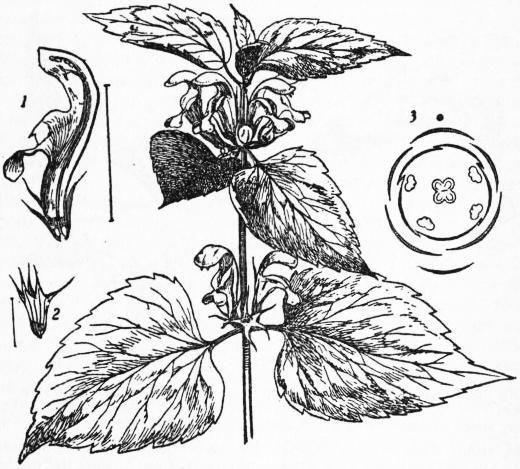
Fig. 1.—Flowering Shoot of Dead-nettle (Lamium album). 1, Flower cut lengthwise, enlarged; 2 calyx, enlarged; 3, floral diagram.
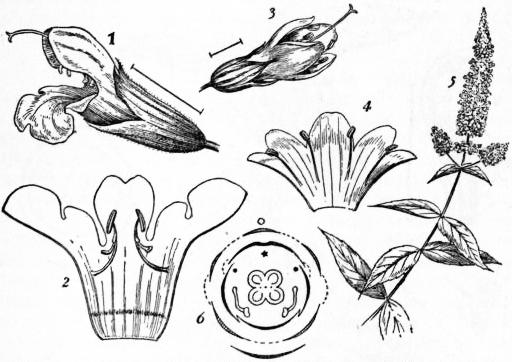
Fig. 2.—1, Flower of Sage (Salvia officinalis); 2, Corolla of same cut open showing the two stamens; 3, flower of spearmint (Mentha viridis); 4, corolla of same cut open showing stamens; 5, flowering shoot of same, reduced; 6, floral diagram of Salvia.
The persistent calyx encloses the ripe nutlets, and aids in their distribution in various ways, by means of winged spiny or hairy lobes or teeth; sometimes it forms a swollen bladder. A scanty endosperm is sometimes present in the seed; the embryo is generally parallel to the fruit axis with a short inferior radicle and generally flat cotyledons.
The order occurs in all warm and temperate regions; its chief centre is the Mediterranean region, where some genera such as Lavandula, Thymus, Rosmarinus and others form an important feature in the vegetation. The tribe Ocimoideae is exclusively tropical and subtropical and occurs in both hemispheres. The order is well represented in Britain by seventeen native genera; Mentha (mint) including also M. piperita (peppermint) and M. Pulegium (pennyroyal); Origanum vulgare (marjoram); Thymus Serpyllum (thyme); Calamintha (calamint), including also C. Clinopodium (wild basil) and C. Acinos (basil thyme); Salvia (sage), including S. Verbenaca (clary); Nepeta Cataria (catmint), N. Glechoma (ground-ivy); Brunella (self-heal); Scutellaria (skull-cap); Stachys (woundwort); S. Betonica is wood betony; Galeopsis (hemp-nettle); Lamium (dead-nettle); Ballota (black horehound); Teucrium (germander); and Ajuga (bugle).
Labiatae are readily distinguished from all other orders of the series excepting Verbenaceae, in which, however, the style is terminal; but several genera, e.g. Ajuga, Teucrium and Rosmarinus, approach Verbenaceae in this respect, and in some genera of that order the style is more or less sunk between the ovary lobes. The fruit-character indicates an affinity with Boraginaceae from which, however, they differ in habit and by characters of ovule and embryo.
The presence of volatile oil renders many genera of economic use, such are thyme, marjoram (Origanum), sage (Salvia), lavender (Lavandula), rosemary (Rosmarinus), patchouli (Pogostemon). The tubers of Stachys Sieboldi are eaten in France.
LABICANA, VIA, an ancient highroad of Italy, leading E.S.E. from Rome. It seems possible that the road at first led to Tusculum, that it was then prolonged to Labici, and later still became a road for through traffic; it may even have superseded the Via Latina as a route to the S.E., for, while the distance from Rome to their main junction at Ad Bivium (or to another junction at Compitum Anagninum) is practically identical, the summit level of the former is 725 ft. lower than that of the latter, a little to the west of the pass of Algidus. After their junction it is probable that the road bore the name Via Latina rather than Via Labicana. The course of the road after the first six miles from Rome is not identical with that of any modern road, but can be clearly traced by remains of pavement and buildings along its course.
See T. Ashby in Papers of the British School at Rome, i. 215 sqq.
(T. As.)
LABICHE, EUGÈNE MARIN (1815-1888), French dramatist, was born on the 5th of May 1815, of bourgeois parentage. He read for the bar, but literature had more powerful attractions, and he was hardly twenty when he gave to the Chérubin—an impertinent little magazine, long vanished and forgotten—a short story, entitled, in the cavalier style of the period, Les plus belles sont les plus fausses. A few others followed much in the same strain, but failed to catch the attention of the public. He tried his hand at dramatic criticism in the Revue des théâtres, and in 1838 made a double venture on the stage. The small Théâtre du Panthéon produced, amid some signs of popular favour, a drama of his, L’Avocat Loubet, while a vaudeville, Monsieur de Coislin ou l’homme infiniment poli, written in collaboration with Marc Michel, and given at the Palais Royal, introduced for the first time to the Parisians a provincial actor who was to become and to remain a great favourite with them, Grassot, the famous low comedian. In the same year Labiche, still doubtful about his true vocation, published a romance called La Clé des champs. M. Léon Halévy, his successor at the Academy and his panegyrist, informs us that the publisher became a bankrupt soon after the novel was out. “A lucky misadventure, for,” the biographer concludes, “this timely warning of Destiny sent him back to the stage, where a career of success was awaiting him.” There was yet another obstacle in the way. When he married, he solemnly promised his wife’s parents that he would renounce a profession then considered incompatible with moral regularity and domestic happiness. But a year afterwards his wife spontaneously released him from his vow, and Labiche recalled the incident when he dedicated the first edition of his complete works: “To my wife.” Labiche, in conjunction with Varin,1 Marc Michel,2 Clairville,3 Dumanoir,4 and others contributed comic plays interspersed with couplets to various Paris theatres. The series culminated in the memorable farce in five acts, Un Chapeau de paille d’Italie (August 1851). It remains an accomplished specimen of the French imbroglio, in which some one is in search of something, but does not find it till five minutes before the curtain falls. Prior to that date Labiche had been only a successful vaudevilliste among a crowd of others; but a twelvemonth later he made a new departure in Le Misanthrope et l’Auvergnat. All the plays given for the next twenty-five years, although constructed on the old plan, contained a more or less appreciable dose of that comic observation and good sense which gradually raised the French farce almost to the level of the comedy of character and manners. “Of all the subjects,” he said, “which offered themselves to me, I have selected the bourgeois. Essentially mediocre in his vices and in his virtues, he stands half-way between the hero and the scoundrel, between the saint and the profligate.” During the second period of his career Labiche had the collaboration of Delacour,5 Choler,6 and others. When it is asked what share in the authorship and success of the plays may be claimed for those men, we shall answer in Émile Augier’s words: “The distinctive qualities which secured a lasting vogue for the plays of Labiche are to be found in all the comedies written by him with different collaborators, and are conspicuously absent from those which they wrote without him.” A more useful and more important collaborator he found in Jean Marie Michel Geoffroy (1813-1883) whom he had known as a débutant in his younger days, and who remained his faithful interpreter to the last. Geoffroy impersonated the bourgeois not only to the public, but to the author himself; and it may be assumed that Labiche, when writing, could see and hear Geoffroy acting the character and uttering, in his pompous, fussy way, the words that he had just committed to paper. Célimare le bien-aimé (1863), Le Voyage de M. Perrichon (1860), La Grammaire, Un Pied dans le crime, La Cagnotte (1864), may be quoted as the happiest productions of Labiche.
In 1877 he brought his connexion with the stage to a close, and retired to his rural property in Sologne. There he could be seen, dressed as a farmer, with low-brimmed hat, thick gaiters and an enormous stick, superintending the agricultural work and busily engaged in reclaiming land and marshes. His lifelong friend, Augier, visited him in his principality, and, being left alone in the library, took to reading his host’s dramatic productions, scattered here and there in the shape of theatrical brochures. He strongly advised Labiche to publish a collected and revised edition of his works. The suggestion, first declined as a joke and long resisted, was finally accepted and carried into effect. Labiche’s comic plays, in ten volumes, were issued during 1878 and 1879. The success was even greater than had been expected by the author’s most sanguine friends. It had been commonly believed that these plays owed their popularity in great measure to the favourite actors who had appeared in them; but it was now discovered that all, with the exception of Geoffroy, had introduced into them a grotesque and caricatural element, thus hiding from the spectator, in many cases, the true comic vein and delightful delineation of human character. The amazement turned into admiration, and the engouement became so general that very few dared grumble or appear scandalized when, in 1880, Labiche was elected to the French Academy. It was fortunate that, in former years, he had never dreamt of attaining this high distinction; for, as M. Pailleron justly observed, while trying to get rid of the little faults which were in him, he would have been in danger of losing some of his sterling qualities. But when the honour was bestowed upon him, he enjoyed it with his usual good sense and quiet modesty. He died in Paris on the 23rd of January 1888.
Some foolish admirers have placed him on a level with Molière, but it will be enough to say that he was something better than a public amuseur. Many of his plays have been transferred to the English stage. They are, on the whole, as sound as they are entertaining. Love is practically absent from his theatre. In none of his plays did he ever venture into the depths of feminine psychology, and womankind is only represented in them by pretentious old maids and silly, insipid, almost dumb, young ladies. He ridiculed marriage according to the invariable custom of French playwrights, but in a friendly and good-natured manner which always left a door open to repentance and timely amendment. He is never coarse, never suggestive. After he died the French farce, which he had raised to something akin to literature, relapsed into its former grossness and unmeaning complexity.
(A. Fi.)
His Théâtre complet (10 vols., 1878-1879) contains a preface by Émile Augier.
1 Victor Varin, pseudonym of Charles Voirin (1798-1869).
2 Marc Antoine Amédée Michel (1812-1868), vaudevillist.
3 Louis François Nicolaise, called Clairville (1811-1879), part-author of the famous Fille de Mme Angot (1872).
4 Philippe François Pinel, called Dumanoir (1806-1865).
5 Alfred Charlemagne Lartigue, called Delacour (1815-1885). For a list of this author’s pieces see O. Lorenz, Catalogue Général (vol. ii., 1868).
6 Adolphe Joseph Choler (1822-1889).
LABICI, an ancient city of Latium, the modern Monte Compatri, about 17 m. S.E. from Rome, on the northern slopes of the Alban Hills, 1739 ft. above sea-level. It occurs among the thirty cities of the Latin League, and it is said to have joined the Aequi in 419 B.C. and to have been captured by the Romans in 418. After this it does not appear in history, and in the time of Cicero and Strabo was almost entirely deserted if not destroyed. Traces of its ancient walls have been noticed. Its place was taken by the respublica Lavicanorum Quintanensium, the post-station established in the lower ground on the Via Labicana (see Labicana, Via), a little S.W. of the modern village of Colonna, the site of which is attested by various inscriptions and by the course of the road itself.
See T. Ashby in Papers of the British School at Rome, i. 256 sqq.
(T. As.)
LABĪD (Abū ‘Aqīl Labīd ibn Rabī’a) (c. 560-c. 661), Arabian poet, belonged to the Banī ’Āmir, a division of the tribe of the Hawāzin. In his younger years he was an active warrior and his verse is largely concerned with inter-tribal disputes. Later, he was sent by a sick uncle to get a remedy from Mahomet at Medina and on this occasion was much influenced by a part of the Koran. He accepted Islam soon after, but seems then to have ceased writing. In Omar’s caliphate he is said to have settled in Kufa. Tradition ascribes to him a long life, but dates given are uncertain and contradictory. One of his poems is contained in the Mo‘allakat (q.v.).
Twenty of his poems were edited by Chalidī (Vienna, 1880); another thirty-five, with fragments and a German translation of the whole, were edited (partly from the remains of A. Huber) by C. Brockelmann (Leiden, 1892); cf. A. von Kremer, Über die Gedichte des Lebyd (Vienna, 1881). Stories of Labīd are contained in the Kitābul-Aghāni, xiv. 93 ff. and xv. 137 ff.
(G. W. T.)
LABIENUS, the name of a Roman family, said (without authority) to belong to the gens Atia. The most important member was Titus Labienus. In 63 B.C., at Caesar’s instigation, he prosecuted Gaius Rabirius (q.v.) for treason; in the same year, as tribune of the plebs, he carried a plebiscite which indirectly secured for Caesar the dignity of pontifex maximus (Dio Cassius xxxvii. 37). He served as a legatus throughout Caesar’s Gallic campaigns and took Caesar’s place whenever he went to Rome. His chief exploits in Gaul were the defeat of the Treviri under Indutiomarus in 54, his expedition against Lutetia (Paris) in 52, and his victory over Camulogenus and the Aedui in the same year. On the outbreak of the civil war, however, he was one of the first to desert Caesar, probably owing to an overweening sense of his own importance, not adequately recognized by Caesar. He was rapturously welcomed on the Pompeian side; but he brought no great strength with him, and his ill fortune under Pompey was as marked as his success had been under Caesar. From the defeat at Pharsalus, to which he had contributed by affecting to despise his late comrades, he fled to Corcyra, and thence to Africa. There he was able by mere force of numbers to inflict a slight check upon Caesar at Ruspina in 46. After the defeat at Thapsus he joined the younger Pompey in Spain, and was killed at Munda (March 17th, 45).
LABLACHE, LUIGI (1794-1858), Franco-Italian singer, was born at Naples on the 6th of December 1794, the son of a merchant of Marseilles who had married an Irish lady. In 1806 he entered the Conservatorio della Pieta de Turchini, where he studied music under Gentili and singing under Valesi, besides learning to play the violin and violoncello. As a boy he had a beautiful alto voice, and by the age of twenty he had developed a magnificent bass with a compass of two octaves from E♭ below to E♭ above the bass stave. After making his first appearance at Naples he went to Milan in 1817, and subsequently travelled to Turin, Venice and Vienna. His first appearances in London and Paris in 1830 led to annual engagements in both the English and French capitals. His reception at St Petersburg a few years later was no less enthusiastic. In England he took part in many provincial musical festivals, and was engaged by Queen Victoria to teach her singing. On the operatic stage he was equally successful in comic or tragic parts, and with his wonderfully powerful voice he could express either humour or pathos. Among his friends were Rossini, Bellini, Donizetti and Mercadante. He was one of the thirty-two torch-bearers chosen to surround the coffin at Beethoven’s funeral in 1827. He died at Naples on the 23rd of January 1858 and was buried at Maison Lafitte, Paris. Lablache’s Leporello in Don Giovanni was perhaps his most famous impersonation; among his principal other rôles were Dandini in Cenerentola (Rossini), Assur in Semiramide (Rossini), Geronimo in La Gazza Ladra (Rossini), Henry VIII. in Anna Bolena (Donizetti), the Doge in Marino Faliero (Donizetti), the title-rôle in Don Pasquale (Donizetti), Geronimo in Il Matrimonio Segreto (Cimarosa), Gritzenko in L’Étoile du Nord (Meyerbeer), Caliban in The Tempest (Halévy).
LABOR DAY, in the United States, a legal holiday in nearly all of the states and Territories, where the first Monday in September is observed by parades and meetings of labour organizations. In 1882 the Knights of Labor paraded in New York City on this day; in 1884 another parade was held, and it was decided that this day should be set apart for this purpose. In 1887 Colorado made the first Monday in September a legal holiday; and in 1909 Labor Day was observed as a holiday throughout the United States, except in Arizona and North Dakota; in Louisiana it is a holiday only in New Orleans (Orleans parish), and in Maryland, Wyoming and New Mexico it is not established as a holiday by statute, but in each may be proclaimed as such in any year by the governor.
LA BOURBOULE, a watering-place of central France, in the department of Puy-de-Dôme, 4½ m. W. by N. of Mont-Dore by road. Pop. (1906) 1401. La Bourboule is situated on the right bank of the Dordogne at a height of 2790 ft. Its waters, of which arsenic is the characteristic constituent, are used in cases of diseases of the skin and respiratory organs, rheumatism, neuralgia, &c. Though known to the Romans they were not in much repute till towards the end of the 19th century. The town has three thermal establishments and a casino.
LABOUR CHURCH, THE, an organization intended to give expression to the religion of the labour movement. This religion is not theological—it leaves theological questions to private individual conviction—but “seeks the realization of universal well-being by the establishment of Socialism—a commonwealth founded upon justice and love.” It asserts that “improvement of social conditions and the development of personal character are both essential to emancipation from social and moral bondage, and to that end insists upon the duty of studying the economic and moral forces of society.” The first Labour Church was founded at Manchester (England) in October 1891 by a Unitarian minister, John Trevor. This has disappeared, but vigorous successors have been established not only in the neighbourhood, but in Bradford, Birmingham, Nottingham, London, Wolverhampton and other centres of industry, about 30 in all, with a membership of 3000. Many branches of the Independent Labour Party and the Social Democratic Federation also hold Sunday gatherings for adults and children, using the Labour Church hymn-book and a similar form of service, the reading being chosen from Dr Stanton Coit’s Message of Man. There are special forms for child-naming, marriages and burials. The separate churches are federated in a Labour Church Union, which holds an annual conference and business meeting in March. At the conference of 1909, held in Ashton-under-Lyne, the name “Labour Church” was changed to “Socialist Church.”
LA BOURDONNAIS, BERTRAND FRANÇOIS, Count Mahé de (1699-1753), French naval commander, was born at Saint Malo on the 11th of February 1699. He went to sea when a boy, and in 1718 entered the service of the French India Company as a lieutenant. In 1724 he was promoted captain, and displayed such bravery in the capture of Mahé of the Malabar coast that the name of the town was added to his own. For two years he was in the service of the Portuguese viceroy of Goa, but in 1735 he returned to French service as governor of the Île de France and the Île de Bourbon. His five years’ administration of the islands was vigorous and successful. A visit to France in 1740 was interrupted by the outbreak of hostilities with Great Britain, and La Bourdonnais was put at the head of a fleet in Indian waters. He saved Mahé, relieved General Dupleix at Pondicherry, defeated Lord Peyton, and in 1746 participated in the siege of Madras. He quarrelled with Dupleix over the conduct of affairs in India, and his anger was increased on his return to the Île de France at finding a successor to himself installed there by his rival. He set sail on a Dutch vessel to present his case at court, and was captured by the British, but allowed to return to France on parole. Instead of securing a settlement of his quarrel with Dupleix, he was arrested (1748) on a charge of gubernatorial peculation and maladministration, and secretly imprisoned for over two years in the Bastille. He was tried in 1751 and acquitted, but his health was broken by the imprisonment and by chagrin at the loss of his property. To the last he made unjust accusations against Dupleix. He died at Paris on the 10th of November 1753. The French government gave his widow a pension of 2400 livres.
La Bourdonnais wrote Traité de la mâture des vaisseaux (Paris 1723), and left valuable memoirs which were published by his grandson, a celebrated chess player, Count L. C. Mahé de la Bourdonnais (1795-1840) (latest edition, Paris, 1890). His quarrel with Dupleix has given rise to much debate; for a long while the fault was generally laid to the arrogance and jealousy of Dupleix, but W. Cartwright and Colonel Malleson have pointed out that La Bourdonnais was proud, suspicious and over-ambitious.
See P. de Gennes, Mémoire pour le sieur de la Bourdonnais, avec les pièces justificatives (Paris, 1750); The Case of Mde la Bourdonnais, in a Letter to a Friend (London, 1748); Fantin des Odoards, Révolutions de l’Inde (Paris, 1796); Collin de Bar, Histoire de l’Inde ancienne et moderne (Paris, 1814); Barchou de Penhoën, Histoire de la conquête et de la fondation de l’empire anglais dans l’Inde (Paris, 1840); Margry, “Les Isles de France et de Bourbon sous le gouvernement de La Bourdonnais,” in La Revue maritime et coloniale (1862); W. Cartwright, “Dupleix et l’Inde française,” in La Revue britannique (1882); G. B. Malleson, Dupleix (Oxford, 1895); Anandaranga Pillai, Les Français dans l’Inde, Dupleix et Labourdonnais, extraits du journal d’Anandaran-gappoullé 1736-1748, trans. in French by Vinsor in École spéciale des langues orientales vivantes, séries 3, vol. xv. (Paris, 1894).
LABOUR EXCHANGE, a term very frequently applied to registries having for their principal object the better distribution of labour (see Unemployment). Historically the term is applied to the system of equitable labour exchanges established in England between 1832 and 1834 by Robert Owen and his followers. The idea is said to have originated with Josiah Warren, who communicated it to Owen. Warren tried an experiment in 1828 at Cincinnati, opening an exchange under the title of a “time store.” He joined in starting another at Tuscarawas, Ohio, and a third at Mount Vernon, Indiana, but none were quite on the same line as the English exchanges. The fundamental idea of the English exchanges was to establish a currency based upon labour; Owen in The Crisis for June 1832 laid down that all wealth proceeded from labour and knowledge; that labour and knowledge were generally remunerated according to the time employed, and that in the new exchanges it was proposed to make time the standard or measure of wealth. This new currency was represented by “labour notes,” the notes being measured in hours, and the hour reckoned as being worth sixpence, this figure being taken as the mean between the wage of the best and the worst paid labour. Goods were then to be exchanged for the new currency. The exchange was opened in extensive premises in the Gray’s Inn Road, near King’s Cross, London, on the 3rd of September 1832. For some months the establishment met with considerable success, and a considerable number of tradesmen agreed to take labour notes in payment for their goods. At first, an enormous number of deposits was made, amounting in seventeen weeks to 445,501 hours. But difficulties soon arose from the lack of sound practical valuators, and from the inability of the promoters to distinguish between the labour of the highly skilled and that of the unskilled. Tradesmen, too, were quick to see that the exchange might be worked to their advantage; they brought unsaleable stock from their shops, exchanged it for labour notes, and then picked out the best of the saleable articles. Consequently the labour notes began to depreciate; trouble also arose with the proprietors of the premises, and the experiment came to an untimely end early in 1834.
See F. Podmore’s Robert Owen, ii. c. xvii. (1906); B. Jones, Co-operative Production, c. viii. (1894); G. J. Holyoake, History of Co-operation, c. viii. (1906).
LABOUR LEGISLATION. Regulation of labour,1 in some form or another, whether by custom, royal authority, ecclesiastical rules or by formal legislation in the interests of a community, is no doubt as old as the most ancient forms of civilization. And older than all civilization is the necessity for the greater part of mankind to labour for maintenance, whether freely or in bonds, whether for themselves and their families or for the requirements or superfluities of others. Even while it is clear, however, that manual labour, or the application of the bodily forces—with or without mechanical aid—to personal maintenance and the production of goods, remains the common lot of the majority of citizens of the most developed modern communities, still there is much risk of confusion if modern technical terms such as “labour,” “employer,” “labour legislation” are freely applied to conditions in bygone civilizations with wholly different industrial organization and social relationships. In recent times in England there has been a notable disappearance from current use of correlative terms implying a social relationship which is greatly changed, for example, in the rapid passage from the Master and Servant Act 1867 to the Employer and Workman Act 1875. In the 18th century the term “manufacturer” passed from its application to a working craftsman to its modern connotation of at least some command of capital, the employer being no longer a small working master. An even more significant later change is seen in the steady development of a labour legislation, which arose in a clamant social need for the care of specially helpless “protected” persons in factories and mines, into a wider legislation for the promotion of general industrial health, safety and freedom for the worker from fraud in making or carrying out wage contracts.
If, then, we can discern these signs of important changes within so short a period, great caution is needed in rapidly reviewing long periods of time prior to that industrial revolution which is traced mainly to the application of mechanical power to machinery in aid of manual labour, practically begun and completed within the second half of the 18th century. “In 1740 save for the fly-shuttle the loom was as it had been since weaving had begun ... and the law of the land was” (under the Act of Apprentices of 1503) “that wages in each district should be assessed by Justices of the Peace.”2 Turning back to still earlier times, legislation—whatever its source or authority—must clearly be devoted to aims very different from modern aims in regulating labour, when it arose before the labourer, as a man dependent on an “employer” for the means of doing work, had appeared, and when migratory labour was almost unknown through the serfdom of part of the population and the special status secured in towns to the artisan.
In the great civilizations of antiquity there were great aggregations of labour which was not solely, though frequently it was predominantly, slave labour; and some of the features of manufacture and mining on a great scale arose, producing the same sort of evils and industrial maladies known and regulated in our own times. Some of the maladies were described by Pliny and classed as “diseases of slaves.” And he gave descriptions of processes, for example in the metal trades, as belonging entirely to his own day, which modern archaeological discoveries trace back through the earliest known Aryan civilizations to a prehistoric origin in the East, and which have never died out in western Europe, but can be traced in a concentrated manufacture with almost unchanged methods, now in France, now in Germany, now in England.
Little would be gained in such a sketch as this by an endeavour to piece together the scattered and scanty materials for a comparative history of the varying conditions and methods of labour regulation over so enormous a range. While our knowledge continually increases of the remains of ancient craft, skill and massed labour, much has yet to be discovered that may throw light on methods of organization of the labourers. While much, and in some civilizations most, of the labour was compulsory or forced, it is clear that too much has been sometimes assumed, and it is by no means certain that even the pyramids of Egypt, much less the beautiful earliest Egyptian products in metal work, weaving and other skilled craft work, were typical products of slave labour. Even in Rome it was only at times that the proportion of slaves valued as property was greater than that of hired workers, or, apart from capture in war or self-surrender in discharge of a debt, that purchase of slaves by the trader, manufacturer or agriculturist was generally considered the cheapest means of securing labour. As in early England the various stages of village industrial life, medieval town manufacture, and organization in craft gilds, and the beginnings of the mercantile system, were parallel with a greater or less prevalence of serfdom and even with the presence in part of slavery, so in other ages and civilizations the various methods of organization of labour are found to some extent together. The Germans in their primitive settlements were accustomed to the notion of slavery, and in the decline of the Roman Empire Roman captives from among the most useful craftsmen were carried away by their northern conquerors.
The history and present details of the labour laws of various countries are dealt with below in successive sections: (1) history of legislation in the United Kingdom; (2) the results as shown by the law in force in 1909, with the corresponding facts for (3) Continental Europe and (4) the United States. Under other headings (Trade-Unions, Strikes and Lock-Outs, Arbitration and Conciliation, &c., &c.) are many details on cognate subjects.
I. History in the United Kingdom
1. Until the Close of the 15th Century.—Of the main conditions of industrial labour in early Anglo-Saxon England details are scanty. Monastic industrial communities were added in Christian times to village industrial communities. While generally husbandry was the first object of toil, and developed under elaborate regulation in the manorial system, still a considerable variety of industries grew up, the aim being expressly to make each social group self-sufficing, and to protect and regulate village artisans in the interest of village resources. This protective system, resting on a communal or co-operative view of labour and social life, has been compared as analogous to the much later and wider system under which the main purpose was to keep England as a whole self-sufficing.3 It has also been shown how greatly a fresh spirit of enterprise in industry and trade was stimulated first by the Danish and next by the Norman invasion; the former brought in a vigour shown in growth of villages, increase in number of freemen, and formation of trading towns; the latter especially opened up new communications with the most civilized continental people, and was followed by a considerable immigration of artisans, particularly of Flemings. In Saxon England slavery in the strictest sense existed, as is shown in the earliest English laws, but it seems that the true slave class as distinct from the serf class was comparatively small, and it may well be that the labour of an ordinary serf was not practically more severe, and the remuneration in maintenance and kind not much less than that of agricultural labourers in recent times. In spite of the steady protest of the Church, slavery (as the exception, not the general rule) did not die out for many centuries, and was apt to be revived as a punishment for criminals, e.g. in the fierce provisions of the statute of Edward VI. against beggars, not repealed until 1597. At no time, however, was it general, and as the larger village and city populations grew the ratio of serfs and slaves to the freemen in the whole population rapidly diminished, for the city populations “had not the habit and use of slavery,” and while serfs might sometimes find a refuge in the cities from exceptionally severe taskmasters, “there is no doubt that freemen gradually united with them under the lord’s protection, that strangers engaged in trade sojourned among them, and that a race of artisans gradually grew up in which original class feelings were greatly modified.” From these conditions grew two parallel tendencies in regulation of labour. On the one hand there was, under royal charters, the burgh or municipal organization and control of artisan and craft labour, passing later into the more specialized organization in craft gilds; on the other hand, there was a necessity, sometimes acute, to prevent undue diminution in the numbers available for husbandry or agricultural labour. To the latter cause must be traced a provision appearing in a succession of statutes (see especially an act of Richard II., 1388), that a child under twelve years once employed in agriculture might never be transferred to apprenticeship in a craft. The steady development of England, first as a wool-growing, later as a cloth-producing country, would accentuate this difficulty. During the 13th century, side by side with development of trading companies for the export of wool from England, may be noted many agreements on the part of monasteries to sell their wool to Florentines, and during the same century absorption of alien artisans into the municipal system was practically completed. Charters of Henry I. provided for naturalization of these aliens. From the time of Edward I. to Edward III. a gradual transference of burgh customs, so far as recognized for the common good, to statute law was in progress, together with an assertion of the rights of the crown against ecclesiastical orders. “The statutes of Edward I.,” says Dr. Cunningham, “mark the first attempt to deal with Industry and Trade as a public matter which concerns the whole state, not as the particular affair of leading men in each separate locality.” The first direct legislation for labour by statute, however, is not earlier than the twenty-third year of the reign of Edward III., and it arose in an attempt to control the decay and ruin, both in rural and urban districts, which followed the Hundred Years’ War, and the pestilence known as the Black Death. This first “Statute of Labourers” was designed for the benefit of the community, not for the protection of labour or prevention of oppression, and the policy of enforcing customary wages and compelling the able-bodied labourer, whether free or bond, not living in merchandise or exercising any craft, to work for hire at recognized rates of pay, must be reviewed in the circumstances and ideals of the time. Regulation generally in the middle ages aimed at preventing any individual or section of the community from making what was considered an exceptional profit through the necessity of others.4 The scarcity of labour by the reduction of the population through pestilence was not admitted as a justification for the demands for increased pay, and while the unemployed labourer was liable to be committed to gaol if he refused service at current rates, the lords of the towns or manors who promised or paid more to their servants were liable to be sued treble the sum in question. Similar restrictions were made applicable to artificers and workmen. By another statute, two years later, labourers or artificers who left their work and went into another county were liable to be arrested by the sheriff and brought back. These and similar provisions with similar aims were confirmed by statutes of 1360, 1368 and 1388, but the act of 1360, while prohibiting “all alliances and covins of masons, carpenters, congregations, chapters, ordinances and oaths betwixt them made,” allowed “every lord to bargain or covenant for their works in gross with such labourers and artificers when it pleaseth them, so that they perform such works well and lawfully according to the bargain and covenant with them thereof made.” Powers were given by the acts of 1368 and 1388 to justices to determine matters under these statutes and to fix wages. Records show that workmen of various descriptions were pressed by writs addressed to sheriffs to work for their king at wages regardless of their will as to terms and place of work. These proceedings were founded on notions of royal prerogative, of which impressment of seamen survived as an example to a far later date. By an act of 1388 no servant or labourer, man or woman, however, could depart out of the hundred to serve elsewhere unless bearing a letter patent under the king’s seal stating the cause of going and time of return. Such provisions would appear to have widely failed in their purpose, for an act of 1414 declares that the servants and labourers fled from county to county, and justices were empowered to send writs to the sheriffs for fugitive labourers as for felons, and to examine labourers, servants and their masters, as well as artificers, and to punish them on confession. An act of 1405, while putting a property qualification on apprenticeship and requiring parents under heavy penalties to put their children to such labour as their estates required, made a reservation giving freedom to any person “to send their children to school to learn literature.” Up to the end of the 15th century a monotonous succession of statutes strengthening, modifying, amending the various attempts (since the first Statute of Labourers) to limit free movement of labour, or demands by labourers for increased wages, may be seen in the acts of 1411, 1427, 1444, 1495. It was clearly found extremely difficult, if not impracticable, to carry out the minute control of wages considered desirable, and exceptions in favour of certain occupations were in some of the statutes themselves. In 1512 the penalties for giving wages contrary to law were repealed so far as related to masters, but it also appears that London workmen would not endure the prevalent restrictions as to wages, and that they secured in practice a greater freedom to arrange rates when working within the city. Several of these statutes, and especially one of 1514, fixed the hours of labour when limiting wages. During March to September the limits were 5 A.M. to 7 or 8 P.M., with half an hour off for breakfast and an hour and a half off for mid-day dinner. In winter the outside limits were fixed by the length of daylight.