VOLUME XVI SLICE I L to Lamellibranchia (continued 5)
Reading edition
At present the chief sources of hand-made lace are France, Belgium, Ireland and England.
France is faithful to her traditions in maintaining a lively and graceful taste in lace-making. Fashion of late years has called for ampler and more boldly effective laces, readily produced with both braids and cords and far less intricate needle or pillow work than was required for the dainty and smaller laces of earlier date.
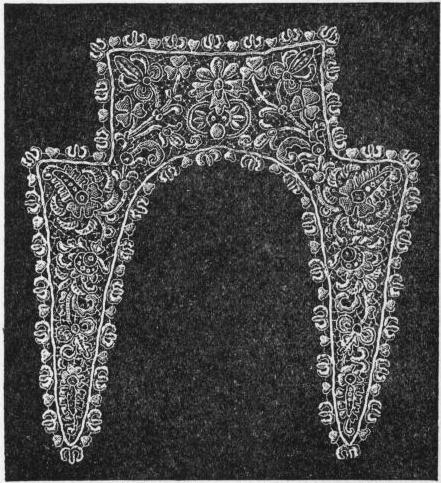
Fig. 25.—Collar and Berthe of Irish Crochet Lace.
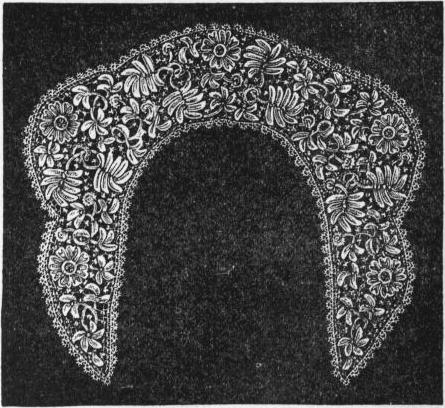
Fig. 26.—Collar of Irish Crochet Lace.
In Belgium the social and economic conditions are, as they have been in the past, more conducive and more favourable than elsewhere to lace-making at a sufficiently remunerative rate of wages. The production of hand-made laces in Belgium was in 1900 greater than that of France. The principal modern needle-made lace of Belgium is the “Point de Gaze”; “Duchesse” and Bruges laces are the chief pillow-made laces; whilst “Point Appliqué” and “Plat Appliqué” are frequently the results not only of combining needle-made and pillow work, but also of using them in conjunction with machine-made net. Ireland is the best producer of that substantial looped-thread work known as crochet (see figs. 25, 26, 27), which must be regarded as a hand-made lace fabric although not classifiable as a needlepoint or pillow lace. It is also quite distinct in character from pseudo-laces, which are really embroideries with a lace-like appearance, e.g. embroideries on net, cut and embroidered cambrics and fine linen. For such as these Ireland maintains a reputation in its admirable Limerick and Carrickmacross laces, made not only in Limerick and Carrickmacross, but also in Kinsale, Newry, Crossmaglen and elsewhere. The demand from France for Irish crochet is now far beyond the supply, a condition which leads not only to the rapid repetition by Irish workers of old patterns, but tends also to a gradual debasement of both texture and ornament. Attempts have been made to counteract this tendency, with some success, as the specimens of Irish crochet in figs. 25, 26 and 27 indicate.
Plate III.
Fig. 8.—MARY, COUNTESS OF PEMBROKE, WEARING A COIF AND CUFFS OF RETICELLA LACE. National Portrait Gallery. Dated 1614. Fig. 11.—JAMES II. WEARING A JABOT AND CUFFS OF RAISED NEEDLEPOINT LACE By Riley. National Portrait Gallery. About 1685. (Figs. 8 and 11, photo by Emery Walker.) Fig. 9.—HENRI II., DUC DE MONTMORENCY, WEARING A FALLING LACE COLLAR. By Le Nain. Louvre. About 1628. (By permission of Messrs Braun, Clement & Co., Dornach (Alsace), and Paris.) Fig. 10.—SCALLOPPED COLLAR OF TAPE-LIKE PILLOW-MADE LACE. Possibly of English early 17th-century work. Its texture is typical of a development in pillow-lace-making later than that of the lower edge of “merletti a piombini” in Pl. II. fig. 3. Fig. 12.—JABOT OF NEEDLEPOINT LACE WORKED PARTLY IN RELIEF, AND USUALLY KNOWN AS “GROS POINT DE VENISE.” Middle of 17th century. Conventional scrolling stems with off-shooting pseudo-blossoms and leafs are specially characteristic.
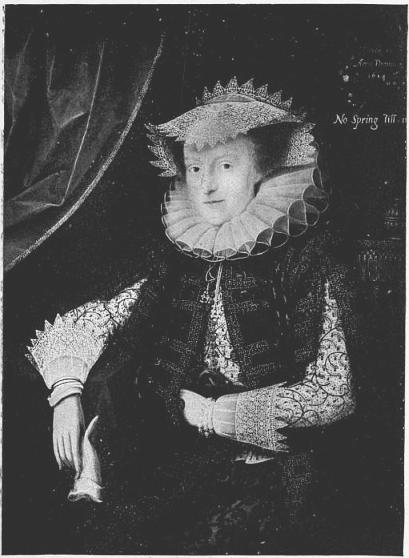
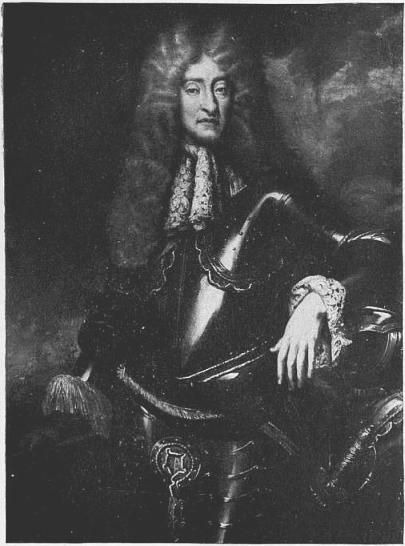
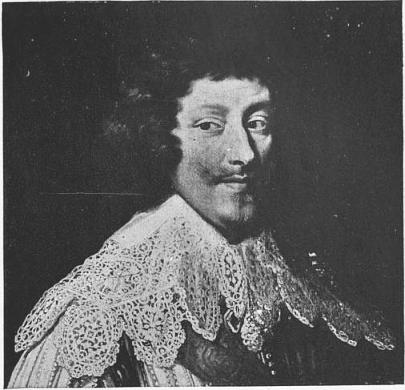
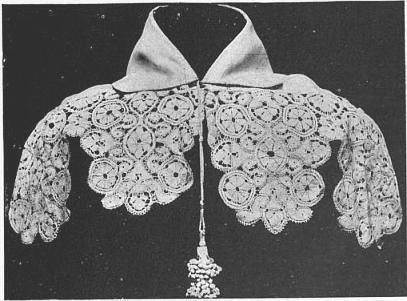
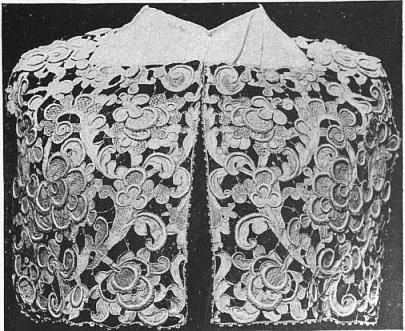
Plate IV.
Fig. 13.—MME VERBIEST, WEARING PILLOW-MADE LACE À RÉSEAU. From the family group by Gonzales Coquer. Buckingham Palace. About 1664. (By permission of Messrs Braun, Clement & Co., Dornach (Alsace), and Paris.) Fig. 14.—PIECE OF PILLOW-MADE LACE USUALLY KNOWN AS “POINT DE FLANDRES À BRIDES.” Of the middle of the 17th century, the designs for which were often adaptations from those made for such needlepoint lace as that of the Jabot in fig. 12. Fig. 15.—PRINCESS MARIA TERESA STUART, WEARING A FLOUNCE OR TABLIER OF LACE SIMILAR TO THAT IN FIG. 17. Dated 1695. From a group by Largilliere. National Portrait Gallery. (Photo by Emery Walker.) Fig. 16.—FLOUNCE OF PILLOW-MADE LACE À RÉSEAU. Flemish, of the middle of the 17th century. This lace is usually thought to be the earliest type of “Point d’Angleterre” in contradistinction to the “Point de Flandres” (fig. 14). Fig. 17—VERY DELICATE NEEDLEPOINT LACE WITH CLUSTERS OF SMALL RELIEF WORK. Venetian, middle of the 17th century, and often called “rose-point lace,” and sometimes “Point de Neige.”
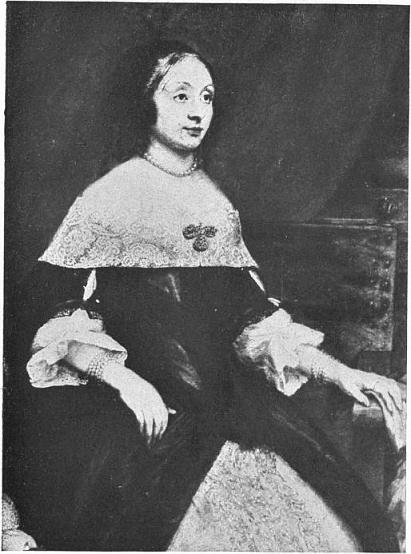
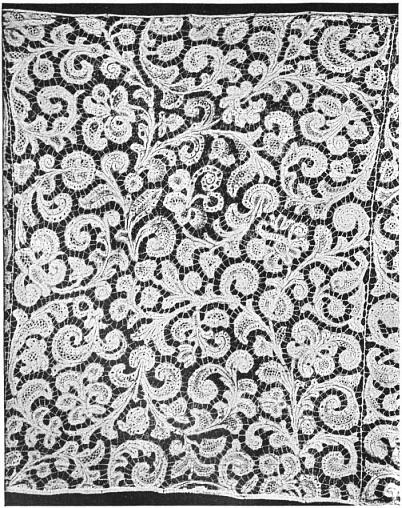
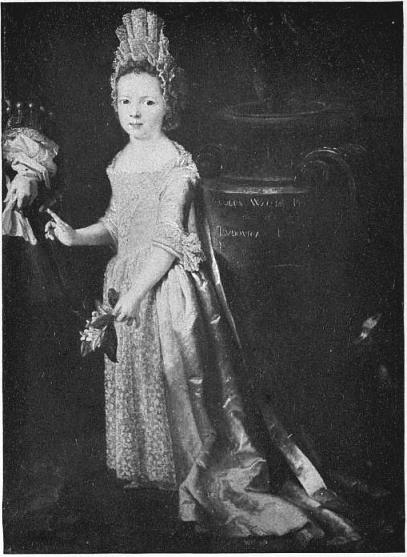
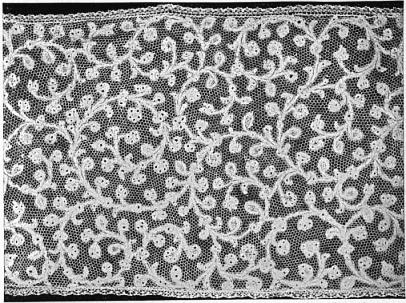
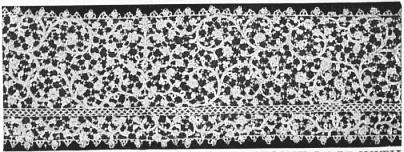
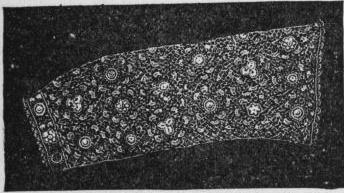
Fig. 27.—Lady’s Sleeve of Irish Crochet Lace.
An appreciable amount of pillow-made lace is annually supplied from Devonshire, Buckinghamshire, Bedfordshire and Northampton, but it is bought almost wholly for home use. The English laces are made almost entirely in accordance with the precedents of the 19th century—that is to say, in definite lengths and widths, as for borders, insertions and flounces, although large shaped articles, such as panels for dresses, long sleeves complete skirts, jackets, blouses, and fancifully shaped collars of considerable dimensions have of late been freely made elsewhere. To make such things entirely of lace necessitates many modifications in the ordinary methods; the English lace-workers are slow to adapt their work in the manner requisite, and hence are far behind in the race to respond to the fashionable demand. No countries succeed so well in promptly answering the variable call of fashion as France and Belgium.
As regards trade in lace, America probably buys more from Belgium than from France; France and England come next as purchasers of nearly equal quantities, after which come Russia and Italy.
The greatest amount of lace now made is that which issues from machines in England, France and Germany. The total number of persons employed in the lace industry in England in 1871 was 49,370, and in 1901 about 34,929, of whom not more than 5000 made lace by hand.
The early history7 of the lace-making machine coincides with that of the stocking frame, that machine having been adapted about the year 1768 for producing open-looped fabrics which had a net-like appearance. About 1786 frames for making point nets by machinery first appear at Mansfield and later at Ashbourne and Nottingham and soon afterwards modifications were introduced into such frames in order to make varieties of meshes in the point nets which were classed as figured nets. In 1808 and 1809 John Heathcoat of Nottingham obtained patents for machines for making bobbin net with a simpler and more readily produced mesh than that of the point net just mentioned. For at least thirty years thousands of women had been employed in and about Nottingham in the embroidery of simple ornament on net. In 1813 John Leavers began to improve the figured net weaving machines above mentioned, and from these the lace-making machines in use at the present time were developed. But it was the application of the celebrated Jacquard apparatus to such machines that enabled manufacturers to produce all sorts of patterns in thread-work in imitation of the patterns for hand-made lace. A French machine called the “dentellière” was devised (see La Nature for the 3rd of March 1881), and the patterns produced by it were of plaited threads. The expense, however, attending the production of plaited lace by the “dentellière” is as great as that of pillow lace made by the hand, and so the machine has not succeeded for ordinary trade purposes. More successful results have been secured by the new patent circular lace machine of Messrs. Birkin & Co. of Nottingham, the productions of which, all of simple design, cannot be distinguished from hand-made pillow lace of the same style (see figs. 57, 58, 59).
Before dealing with technical details in processes of making lace whether by hand or by the machine, the component parts of different makes of lace may be considered. These are governed by the ornaments or patterns, which may be so designed, as they were in the earlier laces, that the different component parts may touch one another without any intervening groundwork. But as a wish arose to vary the effect of the details in a pattern ground-works were gradually developed and at first consisted of links or ties between the substantial parts of the pattern. The bars or ties were succeeded by grounds of meshes, like nets. Sometimes the substantial parts of a pattern were outlined with a single thread or by a strongly marked raised edge of buttonhole-stitched or of plaited work. Minute fanciful devices were then introduced to enrich various portions of the pattern. Some of the heavier needle-made laces resemble low relief carving in ivory, and the edges of the relief portions are often decorated with clusters of small loops. For the most part all this elaboration was brought to a high pitch of variety and finish by French designers and workers; and French terms are more usual in speaking of details in laces. Thus the solid part of the pattern is called the toilé or clothing, the links or ties are called brides, the meshed grounds are called réseaux, the outline to the edges of a pattern is called cordonnet or brodé, the insertions of fanciful devices modes, the little loops picots. These terms are applicable to the various portions of laces made with the needle, on the pillow or by the machine.
The sequence of patterns in lace (which may be verified upon referring to figs. 1 to 23) is roughly as follows. From about 1540 to 1590 they were composed of geometric forms set within squares, or of crossed and radiating line devices, resulting in a very open fabric, stiff and almost wiry in effect, without brides or réseaux. From 1590 may be dated the introduction into patterns of very conventional floral and even human and animal forms and slender scrolls, rendered in a tape-like texture, held together by brides. To the period from 1620 to 1670 belongs the development of long continuous scroll patterns with réseaux and brides, accompanied in the case of needle-made laces with an elaboration of details, e.g. cordonnet with massings of picots. Much of these laces enriched with fillings or modes was made at this time. From 1650 to 1700 the scroll patterns gave way to arrangements of detached ornamental details (as in Pl. VI. fig. 22): and about 1700 to 1760 more important schemes or designs were made (as in Pl. fig. 19, and in fig. 24 in text), into which were introduced naturalistic renderings of garlands, flowers, birds, trophies, architectural ornament and human figures. Grounds composed entirely of varieties of modes as in the case of the réseau rosacé (Pl. V. fig. 21) were sometimes made then. From 1760 to 1800 small details consisting of bouquets, sprays of flowers, single flowers, leaves, buds, spots and such like were adopted, and sprinkled over meshed grounds, and the character of the texture was gauzy and filmy (as in figs. 40 and 42). Since that time variants of the foregoing styles of pattern and textures have been used according to the bent of fashion in favour of simple or complex ornamentation, or of stiff, compact or filmy textures.
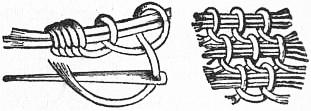
Fig. 28. Fig. 29.
Needlepoint Lace.—The way in which the early Venetian “punto in aria” was made corresponds with that in which needlepoint lace is now worked. The pattern is first drawn upon a piece of parchment. The parchment is then stitched to two pieces of linen. Upon the leading lines drawn on the parchment a thread is laid, and fastened through to the parchment and linen by means of stitches, thus constructing a skeleton thread pattern (see left-hand part of fig. 30). Those portions which are to be represented as the “clothing” or toilé are usually worked as indicated in the enlarged diagram (fig. 29), and then edged as a rule with buttonhole stitching (fig. 28). Between these toilé portions of the pattern are worked ties (brides) or meshes (réseaux), and thus the various parts united into one fabric are wrought on to the face of the parchment pattern and reproducing it (see right-hand part of fig. 30). A knife is passed between the two pieces of linen at the back of the parchment, cutting the stitches which have passed through the parchment and linen, and so releasing the lace itself from its pattern parchment. In the earlier stages, the lace was made in lengths to serve as insertions (passements) and also in vandykes (dentelles) to serve as edgings. Later on insertions and vandykes were made in one piece. All of such were at first of a geometric style of pattern (Pl. figs. 3-5 and 6).
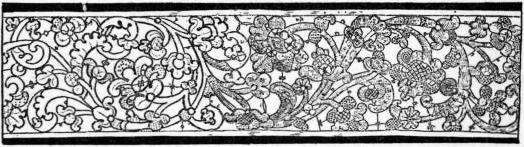
Fig. 30.—Parchment Pattern showing work in progress: the more complete lace is on the right half of the pattern.
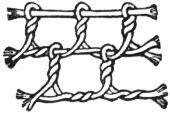
Fig. 31.
Following closely upon them came the freer style of design already mentioned, without and then with links or ties—brides—interspersed between the various details of the patterns (Pl. II. fig. 7), which were of flat tape-like texture. In elaborate specimens of this flat point lace some lace workers occasionally used gold thread with the white thread. These flat laces (“Punto in Aria”) are also called “flat Venetian point.” About 1640 “rose (raised) point” laces began to be made (Pl. III. fig. 12). They were done in relief and those of bold design with stronger reliefs are called “gros point de Venise.” Lace of this latter class was used for altar cloths, flounces, jabots or neckcloths which hung beneath the chin over the breast (Pl. III. fig. 11), as well as for trimming the turned-over tops of jack boots. Tabliers and ladies’ aprons were also made of such lace. In these no regular ground was introduced. All sorts of minute embellishments, like little knots, stars and loops or picots, were worked on to the irregularly arranged brides or ties holding the main patterns together, and the more dainty of these raised laces (Pl. fig. 17) exemplify the most subtle uses to which the buttonhole stitch appears capable of being put in making ornaments. But about 1660 came laces with brides or ties arranged in a honeycomb reticulation or regular ground. To them succeeded lace in which the compact relief gave place to daintier and lighter material combined with a ground of meshes or réseau. The needle-made meshes were sometimes of single and sometimes of double threads. A diagram is given of an ordinary method of making such meshes (fig. 31). At the end of the 17th century the lightest of the Venetian needlepoint laces were made; and this class which was of the filmiest texture is usually known as “point de Venise à réseau” (Pl. V. fig. 20a). It was contemporary with the needle-made French laces of Alençon and Argentan8 that became famous towards the latter part of the 17th century (Pl. V. fig. 20b). “Point d’Argentan” has been thought to be especially distinguished on account of its delicate honeycomb ground of hexagonally arranged brides (fig. 32), a peculiarity already referred to in certain antecedent Venetian point laces. Often intermixed with this hexagonal brides ground is the fine-meshed ground or réseau (fig. 20b), which has been held to be distinctive of “point d’Alençon.” But the styles of patterns and the methods of working them, with rich variety of insertions or modes, with the brodé or cordonnet of raised buttonhole stitched edging, are alike in Argentan and Alençon needle-made laces (Pl. V. fig. 20b and fig. 32). Besides the hexagonal brides ground and the ground of meshes another variety of grounding (réseau rosacé) was used in certain Alençon designs. This ground consisted of buttonhole-stitched skeleton hexagons within each of which was worked a small hexagon of toilé connected with the outer surrounding hexagon by means of six little ties or brides (Pl. V. fig. 21). Lace with this particular ground has been called “Argentella,” and some writers have thought that it was a specialty of Genoese or Venetian work. But the character of the work and the style of the floral patterns are those of Alençon laces. The industry at Argentan was virtually an offshoot of that nurtured at Alençon, where “lacis,” “cut work” and “vélin” (work on parchment) had been made for years before the well-developed needle-made “point d’Alençon” came into vogue under the favouring patronage of the state-aided lace company mentioned as having been formed in 1665. Madame Despierre in her Histoire du point d’Alençon gives an interesting and trustworthy account of the industry.
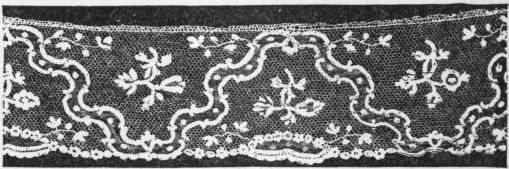
Fig. 32.—Border of Needlepoint Lace made in France about 1740-1750, the clear hexagonal mesh ground, which is compactly stitched, being usually regarded as characteristic of the point de France made at Argentan.
In Belgium, Brussels has acquired some celebrity for needle-made laces. These, however, are chiefly in imitation of those made at Alençon, but the toilé is of less compact texture and sharpness in definition of pattern. Brussels needlepoint lace is often worked with meshed grounds made on a pillow, and a plain thread is used as a cordonnet for their patterns instead of a thread overcast with buttonhole stitches as in the French needlepoint laces. Note the bright sharp outline to the various ornamental details in Pl. V. fig. 20b.
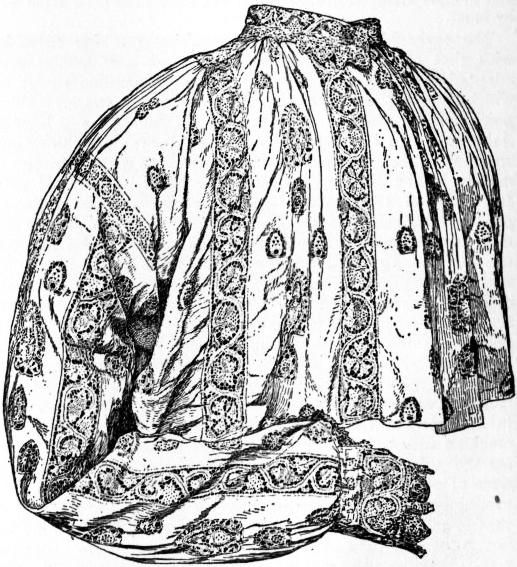
Fig. 33.—Shirt decorated with Insertions of Flat Needlepoint Lace. (English, 17th century. Victoria and Albert Museum.)
Plate IV.
Fig. 18.—CHARLES GASPARD GUILLAUME DE VINTI-MILLE, WEARING LACE SIMILAR IN STYLE OF DESIGN SHOWN IN FIG. 19. About 1730. Fig. 19.—PORTION OF FLOUNCE, NEEDLEPOINT LACE COPIED AT THE BURANO LACE SCHOOL FROM THE ORIGINAL OF THE SO-CALLED “POINT DE VENISE À BRIDES PICOTÉES.” 17th century. Formerly belonging to Pope Clement XIII., but now the property of the queen of Italy. The design and work, however, are indistinguishable from those of important flounces of “Point de France.” The pattern consists of repetitions of two vertically-arranged groups of fantastic pine-apples and vases with flowers, intermixed with bold rococo bands and large leaf devices. The hexagonal meshes of the ground, although similar to the Venetian “brides picotées,” are much akin to the buttonhole stitched ground of “Point d’Argentan.” (Victoria and Albert Museum.) A Fig. 20. B A.—A LAPPET OF “POINT DE VENISE À RÉSEAU.” The conventional character of the pseudo-leaf and floral forms contrasts with that of the realistic designs of contemporary French laces. Italian. Early 18th century. B.—A LAPPET OF FINE “POINT D’ALENÇON.” Louis XV. period. The variety of the fillings of geometric design is particularly remarkable in this specimen, as is the buttonhole stitched cordonnat or outline to the various ornamental forms. Fig. 21.—BORDER OF FRENCH NEEDLEPOINT LACE, WITH GROUND OF “RÉSEAU ROSACÉ.” 18th century.
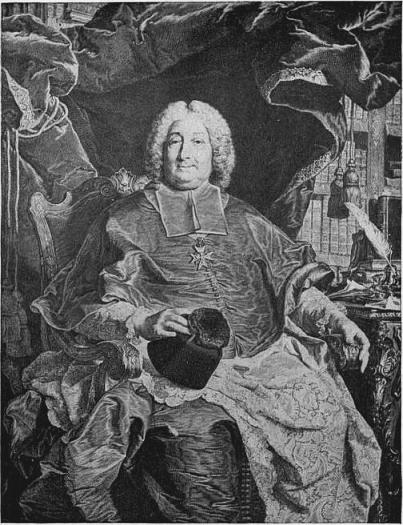
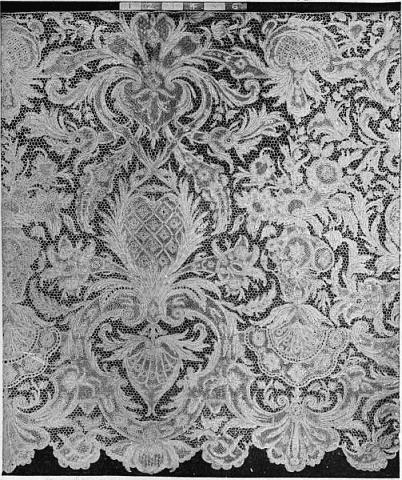
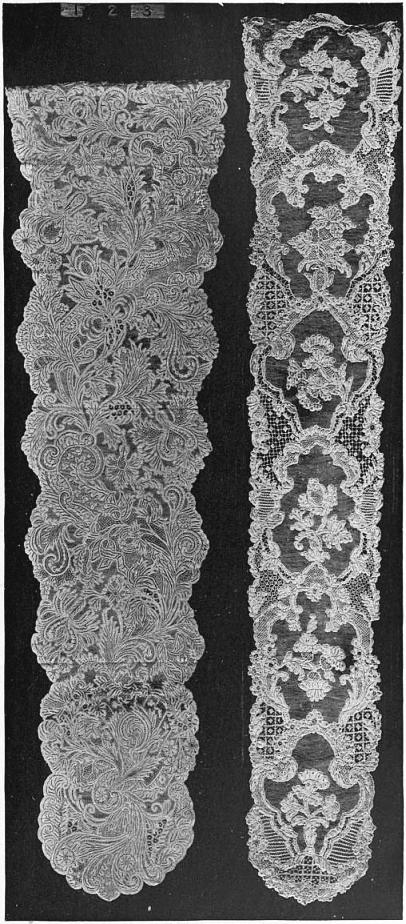
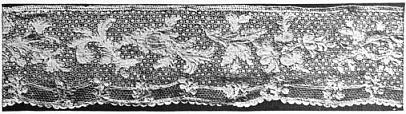
Plate VI.
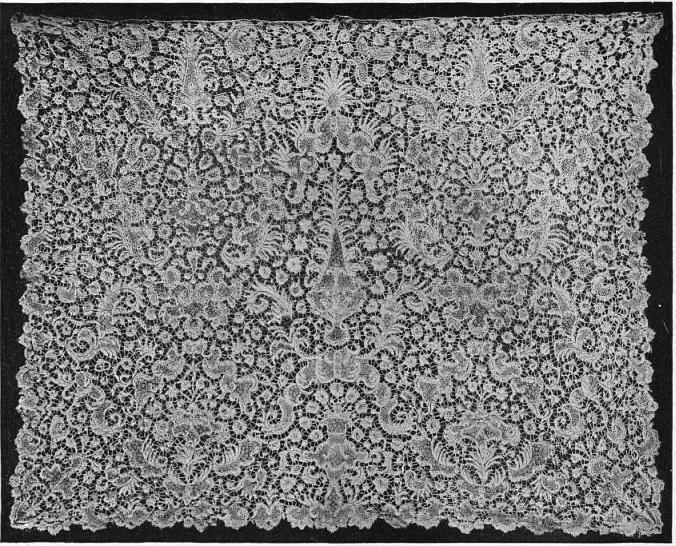
Fig. 22.—JABOT OR CRAVAT OF PILLOW-MADE LACE. Brussels. Late 17th century. (Victoria and Albert Museum.)
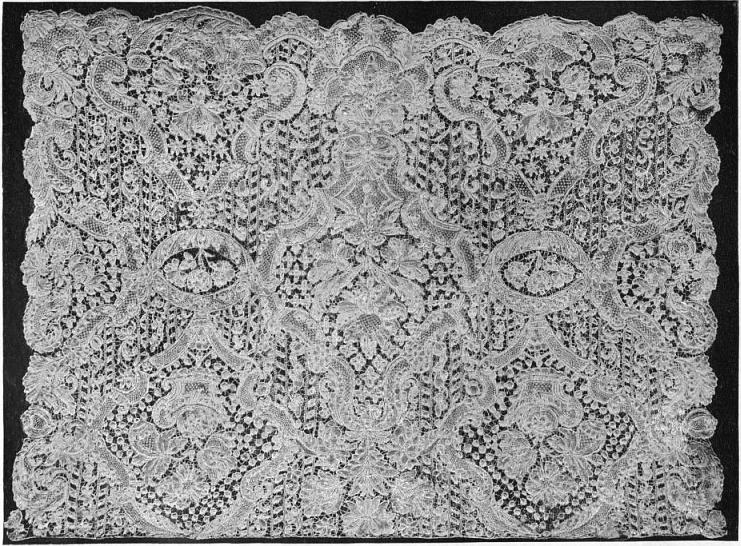
Fig. 23.—JABOT OR CRAVAT OF PILLOW-MADE LACE OF FANTASTIC FLORAL DESIGN, THE GROUND OF WHICH IS COMPOSED OF LITTLE FLOWERS AND LEAVES ARRANGED WITHIN SMALL OPENWORK VERTICAL STRIPS.
Brussels. 18th century. (Victoria and Albert Museum.)
Needlepoint lace has also been occasionally produced in England. Whilst the character of its design in the early 17th century was rather more primitive, as a rule, than that of the contemporary Italian, the method of its workmanship is virtually the same and an interesting specimen of English needle-made lace inset into an early 17th-century shirt is illustrated in fig. 33. Specimens of needle-made work done by English school children may be met with in samplers of the 17th and 18th centuries. Needlepoint lace is successfully made at Youghal, Kenmare and New Ross in Ireland, where of late years attention has been given to the study of designs for it. The lace-making school at Burano near Venice produces hand-made laces which are, to a great extent, careful reproductions of the more celebrated classes of point laces, such as “punto in aria,” “rose point de Venise,” “point de Venise à réseau,” “point d’Alençon,” “point d’Argentan” and others. Some good needlepoint lace is made in Bohemia and elsewhere in the Austrian empire.
Pillow-made Lace.—Pillow-made lace is built upon no substructure corresponding with a skeleton thread pattern such as is used for needlepoint lace, but is the representation of a pattern obtained by twisting and plaiting threads.
These patterns were never so strictly geometric in style as those adopted for the earliest point lace making from the antecedent cut linen and drawn thread embroideries. Curved forms, almost at the outset of pillow lace, seem to have been found easy of execution (see lower border, Pl. II. fig. 3); its texture was more lissom and less crisp and wiry in appearance than that of contemporary needle-made lace. The early twisted and plaited thread laces, which had the appearance of small cords merging into one another, were soon succeeded by laces of similar make but with flattened and broader lines more like fine braids or tapes (Pl. I. fig. 2, and Pl. fig. 10). But pillow laces of this tapey character must not be confused with laces in which actual tape or braid is used. That peculiar class of lace-work does not arise until after the beginning of the 17th century when the weaving of tape is said to have commenced in Flanders. In England this sort of tape-lace dates no farther back than 1747, when two Dutchmen named Lanfort were invited by an English firm to set up tape looms in Manchester.
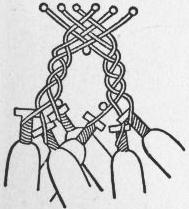
Fig. 34.—Diagram showing six Bobbins in use.

Fig. 35.
The process by which lace is made on the pillow is roughly and briefly as follows. A pattern is first drawn upon a piece of paper or parchment. It is then pricked with holes by a skilled “pattern pricker,” who determines where the principal pins shall be stuck for guiding the threads. This pricked pattern is then fastened to the pillow. The pillow or cushion varies in shape in different countries. Some lace-makers use a circular pad, backed with a flat board, in order that it may be placed upon a table and easily moved. Other lace-workers use a well-stuffed round pillow or short bolster, flattened at the two ends, so that they may hold it conveniently on their laps. From the upper part of pillow with the pattern fastened on it hang the threads from the bobbins. The bobbin threads thus hang across the pattern. Fig. 34 shows the commencement, for instance, of a double set of three-thread plaitings. The compact portion in a pillow lace has a woven appearance (fig. 35).
About the middle of the 17th century pillow lace of formal scroll patterns somewhat in imitation of those for point lace was made, chiefly in Flanders. The earlier of these had grounds of ties or brides and was often called “point de Flandres” (Pl. fig. 14) in contradistinction to scroll patterns with a mesh ground, which were called “point d’Angleterre” (Pl. fig. 16). Into Spain and France much lace from Venice and Flanders was imported as well as into England, where from the 16th century the manufacture of the simple pattern “bone lace” by peasants in the midland and southern counties was still being carried on. In Charles II.’s time its manufacture was threatened with extinction by the preference given to the more artistic and finer Flemish laces. The importation of the latter was accordingly prohibited. Dealers in Flemish lace sought to evade the prohibitions by calling certain of their laces “point d’Angleterre,” and smuggling them into England. But smuggling was made so difficult that English dealers were glad to obtain the services of Flemish lace-makers and to induce them to settle in England. It is from some such cause that the better 17th- and 18th-century English pillow laces bear resemblance to pillow laces of Brussels, of Mechlin and of Valenciennes.
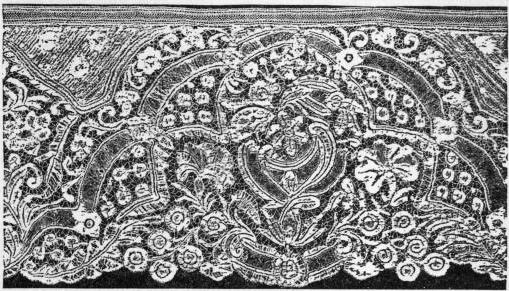
Fig. 36.—Border of English Pillow-made (Devonshire) Lace in the style of a Brussels design of the middle of the 18th century.
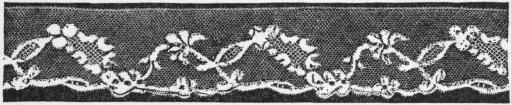
Fig. 37—Border of English (Bucks. or Beds.) Pillow-made Lace in the Style of a Mechlin design of the latter part of the 18th century.
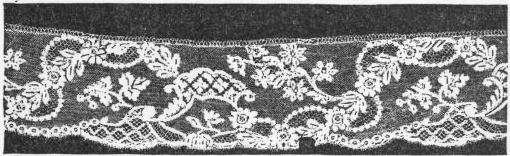
Fig. 38—Border of Pillow-made Lace, Mechlin, from a design similar to such as was used for point d’Alençon of the Louis XV. period.
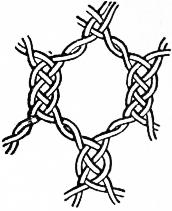
Fig. 39.—Mechlin Mesh.
As skill in the European lace-making developed soon after the middle of the 17th century, patterns and particular plaitings came to be identified with certain localities. Mechlin, for instance, enjoyed a high reputation for her productions. The chief technical features of this pillow lace lie in the plaiting of the meshes, and the outlining of the clothing or toilé with a thread cordonnet. The ordinary Mechlin mesh is hexagonal in shape. Four of the sides are of double twisted threads, two are of four threads plaited three times (fig. 39).
In Brussels pillow lace, which has greater variety of design, the mesh is also hexagonal; but in contrast with the Mechlin mesh whilst four of its sides are of double-twisted threads the other two are of four threads plaited four times (fig. 41). The finer specimens of Brussels lace are remarkable for the fidelity and grace with which the botanical forms in many of its patterns are rendered (Pl. VI. fig. 23). These are mainly reproductions or adaptations of designs for point d’Alençon, and the soft quality imparted to them in the texture of pillow-made lace contrasts with the harder and more crisp appearance in needlepoint lace. An example of dainty Brussels pillow lace is given in fig. 42. In the Brussels pillow lace a delicate modelling effect is often imparted to the close textures of the flowers by means of pressing them with a bone instrument which gives concave shapes to petals and leaves, the edges of which consist in part of slightly raised cordonnet of compact plaited work.
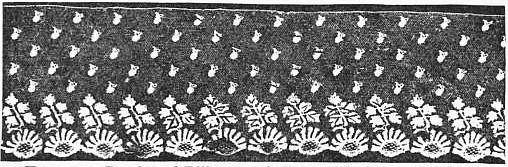
Fig. 40.—Border of Pillow-made Lace, Mechlin, end of the 18th century.
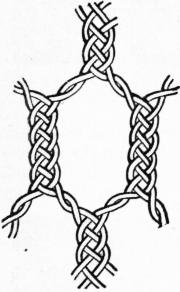
Fig. 41.—Enlargement of Brussels Mesh.
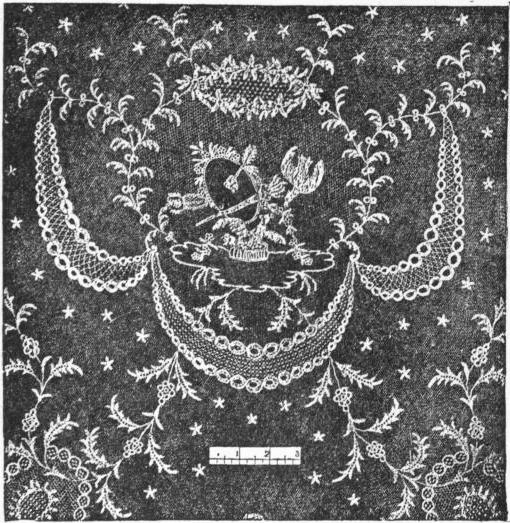
Fig. 42.—Portion of a Wedding Veil, 7 ft. 6 in. × 6 ft. 6 in., of Pillow-made Lace, Brussels, late 18th century. The design consists of light leafy garlands of orange blossoms and other flowers daintily festooned. Little feathery spirals and stars are powdered over the ground, which is of Brussels vrai réseau. In the centre upon a more open ground of pillow-made hexagonal brides is a group of two birds, one flying towards the other which appears ready to take wing from its nest; an oval frame containing two hearts pierced by an arrow, and a hymeneal torch. Throughout this veil is a profusion of pillow renderings of various modes, the réseau rosacé, star devices, &c. The ornamental devices are partly applied and partly worked into the ground (Victoria and Albert Museum).
Honiton pillow lace resembles Brussels lace, but in most of the English pillow laces (Devonshire, Buckinghamshire, Bedfordshire) the réseau is of a simple character (fig. 43). As a rule, English lace is made with a rather coarser thread than that used in the older Flemish laces. In real Flemish Valenciennes lace there are no twisted sides to the mesh; all are closely plaited (fig. 44) and as a rule the shape of the mesh is diamond but without the openings as shown in fig. 44. No outline or cordonnet to define the pattern is used in Valenciennes lace (see fig. 45). Much lace of the Valenciennes type (fig. 54) is made at Ypres. Besides these distinctive classes of pillow-like laces, there are others in which equal care in plaiting and twisting threads is displayed, though the character of the design is comparatively simple, as for instance in ordinary pillow laces from Italy, from the Auvergne, from Buckinghamshire, or rude and primitive as in laces from Crete, southern Spain and Russia. Pillow lace-making in Crete is now said to be extinct. The laces were made chiefly of silk. The patterns in many specimens are outlined with one, two or three bright-coloured silken threads. Uniformity in simple character of design may also be observed in many Italian, Spanish, Bohemian, Swedish and Russian pillow laces (see the lower edge of fig. 46).
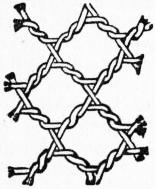
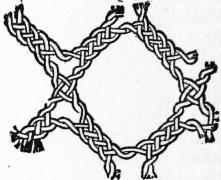
Fig. 43. Fig. 44.
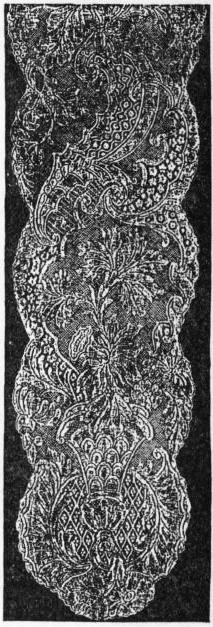
Fig. 45.—Lappet of delicate Pillow-made Lace, Valenciennes, about 1750. The peculiarity of Valenciennes lace is the filmy cambric-like texture and the absence of any cordonnet to define the separate parts of the ornament such as is used in needlepoint lace of Alençon, and in pillow Mechlin and Brussels lace.
Guipure.—This name is often applied to needlepoint and pillow laces in which the ground consists of ties or brides, but it more properly designates a kind of lace or “passementerie,” made with gimp of fine wires whipped round with silk, and with cotton thread. An earlier kind of gimp was formed with “Cartisane,” a little strip of thin parchment or vellum covered with silk, gold or silver thread. These stiff gimp threads, formed into a pattern, were held together by stitches worked with the needle. Gold and silver thread laces have been usually made on the pillow, though gold thread has been used with fine effect in 17th-century Italian needlepoint laces.
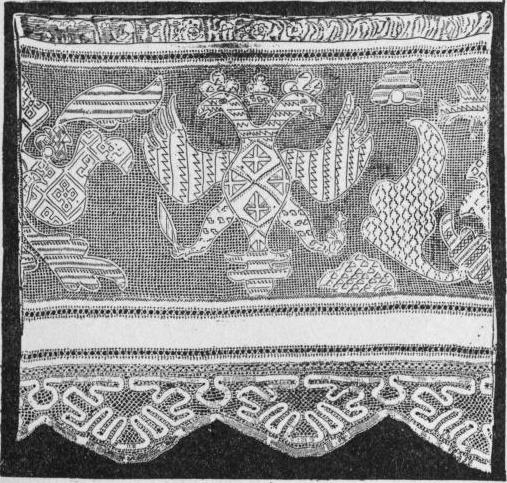
Fig. 46.—Border to a Cloth. The wide part bearing the double-headed eagle of Russia is of drawn thread embroidery: the scalloped edging is of Russian pillow-made lace, though the style of its pattern is often seen in pillow laces made by peasants in Danubian provinces as well as in the south of Spain.
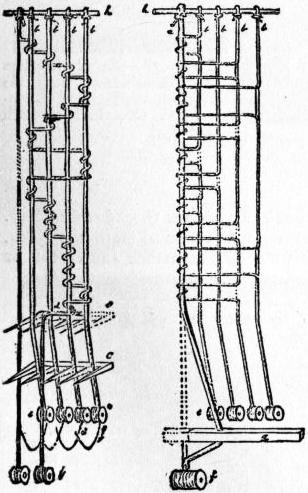
Fig. 47. Fig. 48.
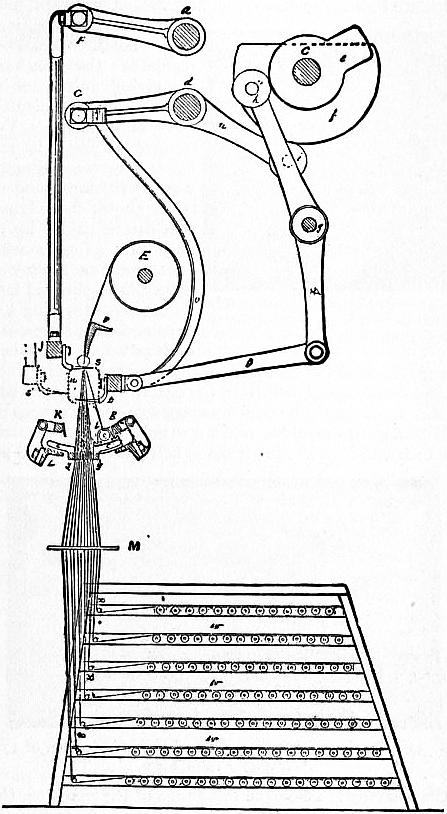
Fig. 49.—Section of Lace Machine.
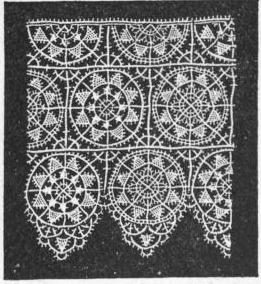
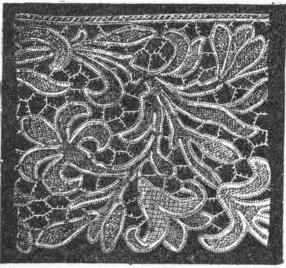
Fig. 50.—Machine-made Lace in imitation of 16th-century Needlepoint “Reticella” Lace. Fig. 51.—Border of Machine-made Lace in the style of 17th-century Pillow Guipure Lace.
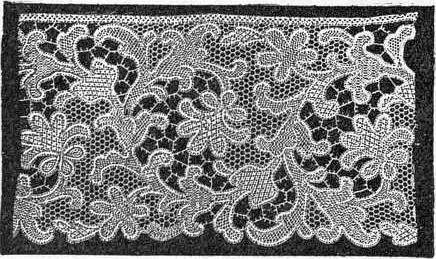
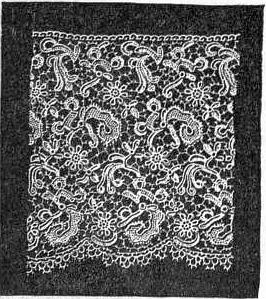
Fig. 52.—Border of Machine-made Lace in imitation of 17th-century Pillow Lace. Fig. 53.—Machine-made Trimming Border in imitation of Irish Crochet Lace.
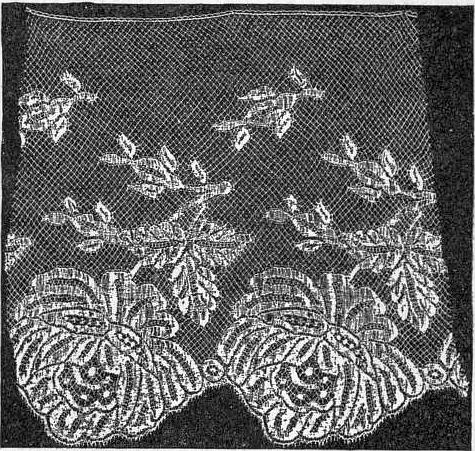
Fig. 54.—A Piece of Hand-made Pillow Lace, Belgian (Ypres), 20th century. (The machine imitation is given in fig. 55.)
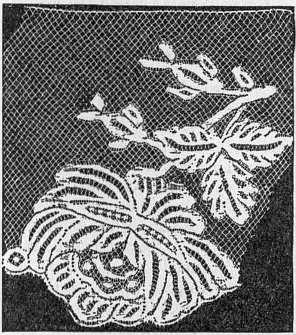
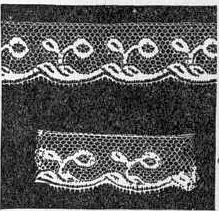
Fig. 55.—Machine-made Lace in imitation of the Hand-made Specimen of fig. 54. (Nottingham, 20th century.) Fig. 56.—Small Borders (a) Hand-made and (b) Machine-made Lace Valenciennes. (Nottingham, 20th century.)
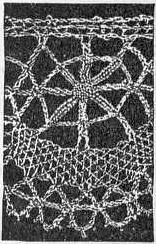
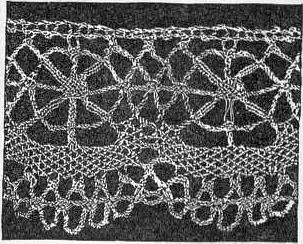
Fig. 57.—Specimen of Hand-made Pillow Lace. Fig. 58.—Specimen of Machine-made Lace in which the twisting and plaiting of the threads are identical with those of the hand-made specimen of fig. 57. (Nottingham, 20th century.)
Machine-made Lace.—We have already seen that a technical peculiarity in making needlepoint lace is that a single thread and needle are alone used to form the pattern, and that the buttonhole stitch and other loopings which can be worked by means of a needle and thread mark a distinction between lace made in this manner and lace made on the pillow. For the process of pillow lace making a series of threads are in constant employment, plaited and twisted the one with another. A buttonhole stitch is not producible by it. The Leavers lace machine does not make either a buttonhole stitch or a plait. An essential principle of this machine-made work is that the threads are twisted together as in stocking net. The Leavers lace machine is that generally in use at Nottingham and Calais. French ingenuity has developed improvements in this machine whereby laces of delicate thread are made; but as fast as France makes an improvement England follows with another, and both countries virtually maintain an equal position in this branch of industry. The number of threads brought into operation in a Leavers machine is regulated by the pattern to be produced, the threads being of two sorts, beam or warp threads and bobbin or weft threads. Upwards of 8880 are sometimes used, sixty pieces of lace being made simultaneously, each piece requiring 148 threads—100 beam threads and 48 bobbin threads. The ends of both sets of threads are fixed to a cylinder upon which as the manufacture proceeds the lace becomes wound. The supply of the beam or warp threads is held upon reels, and that of the bobbins or weft threads is held in bobbins. The beam or warp thread reels are arranged in frames or trays beneath the stage, above which and between it and the cylinder the twisting of the bobbin or weft with beam or warp threads takes place. The bobbins containing the bobbin or weft threads are flattened in shape so as to pass conveniently between the stretched beam or warp threads. Each bobbin can contain about 120 yds. of thread. By most ingenious mechanism varying degrees of tension can be imparted to warp and weft threads as required. As the bobbins or weft threads pass like pendulums between the warp threads the latter are made to oscillate, thus causing them to become twisted with the bobbin threads. As the twistings take place, combs passing through both warp and weft threads compress the twistings. Thus the texture of the clothing or toilé in machine-made lace may generally be detected by its ribbed appearance, due to the compressed twisted threads. Figs. 47 and 48 are intended to show effects obtained by varying the tensions of weft and warp threads. For instance, if the weft, as threads b, b, b, b in fig. 47, be tight and the warp thread slack, the warp thread a will be twisted upon the weft threads. But if the warp thread a be tight and the weft threads b, b, b, b, be slack, as in fig. 48, then the weft threads will be twisted on the warp thread. At the same time the twisting in both these cases arises from the conjunction of movements given to the two sets of threads, namely, an oscillation or movement from side to side of the beam or warp threads, and the swinging or pendulum-like movement of the bobbin or weft threads between the warp threads. Fig. 49 is a diagram of a sectional elevation of a lace machine representing its more essential parts. E is the cylinder or beam upon which the lace is rolled as made, and upon which the ends of both warp and weft threads are fastened at starting. Beneath are w, w, w, a series of trays or beams, one above the other, containing the reels of the supplies of warp threads; c, c represent the slide bars for the passage of the bobbin b with its thread from k to k, the landing bars, one on each side of the rank of warp threads; s, t are the combs which take it in turns to press together the twistings as they are made. The combs come away clear from the threads as soon as they have pressed them together and fall into positions ready to perform their pressing operations again. The contrivances for giving each thread a particular tension and movement at a certain time are connected with an adaptation of the Jacquard system of pierced cards. The machine lace pattern drafter has to calculate how many holes shall be punched in a card, and to determine the position of such holes. Each hole regulates the mechanism for giving movement to a thread. Fig. 54 displays a piece of hand-made Valenciennes (Ypres) lace and fig. 55 a corresponding piece woven by the machine. The latter shows the advantage that can be gained by using very fine gauge machines, thus enabling a very close imitation of the real lace to be made by securing a very open and clear réseau or net, such as would be made on a coarse machine, and at the same time to keep the pattern fine and solid and standing out well from the net, as is the case with the real lace, which cannot be done by using a coarse gauge machine. In this example the machine used is a 16 point (that is 32 carriages to the inch), and the ground is made half gauge, that is 8 point, and the weaving is made the full gauge of the machine, that is 16 point. Fig. 56 gives other examples of hand- and machine-made Valenciennes lace. The machine-made lace (b) imitating the real (a) is made on a 14-point machine (that is 28 carriages to the inch), the ground being 7 point and the pattern being full gauge or 14 point. Although the principle in these examples of machine work is exactly the same, in so far that they use half gauge net and full gauge clothing to produce the contrast as mentioned above, the fabrication of these two examples is quite different, that in fig. 55 being an example of tight bobbins or weft, and slack warp threads as shown in fig. 47. Whereas the example in fig. 56 is made with slack bobbins or weft threads and tight warp threads as in fig. 48. In fig. 57 is a piece of hand-made lace of stout thread, very similar to much Cluny lace made in the Auvergne and to the Buckinghamshire “Maltese” lace. Close to it are specimens of lace (figs. 58 and 59) made by the new patent circular lace machine of Messrs Birkin of Nottingham. This machine although very slow in production actually reproduces the real lace, at a cost slightly below that of the hand-made lace. In another branch of lace-making by machinery, mechanical ingenuity, combined with chemical treatment, has led to surprising results (figs. 53 and 50). Swiss, German and other manufacturers use machines in which a principle of the sewing-machine is involved. A fine silken tissue is thereby enriched with an elaborately raised cotton or thread embroidery. The whole fabric is then treated with chemical mordants which, whilst dissolving the silky web, do not attack the cotton or thread embroidery. A relief embroidery possessing the appearance of hand-made raised needlepoint lace is thus produced. Figs. 60 and 61 give some idea of the high quality to which this admirable counterfeit has been brought.

Fig. 59.—Specimens of Machine-made Torchon Lace, in the same manner as such lace is made on the pillow by hand. (Nottingham, 20th century.)
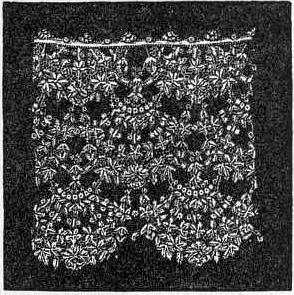
Fig. 60.—Machine-made Lace of Modern Design.
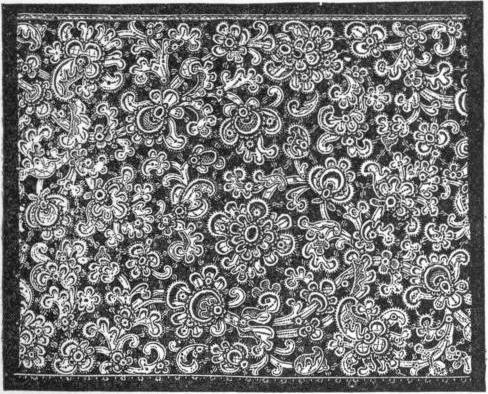
Fig. 61.—Machine-made Lace in imitation of 17th-century Needlepoint Lace, “Gros point de Venise.”
Collections of hand-made lace chiefly exist in museums and technical institutions, as for instance the Victoria and Albert Museum in London, the Musée des Arts Décoratifs in Paris, and museums at Lyons, Nuremberg, Berlin, Turin and elsewhere. In such places the opportunity is presented of tracing in chronological sequence the stages of pattern and texture development.
Literature.—The literature of the art of lace-making is considerable. The series of 16th- and 17th-century lace pattern-books, of which the more important are perhaps those by F. Vinciolo (Paris, 1587), Cesare Vecellio (Venice, 1592), and Isabetta Catanea Parasole (Venice, 1600), not to mention several kindred works of earlier and later date published in Germany and the Netherlands, supplies a large field for exploration. Signor Ongania of Venice published a limited number of facsimiles of the majority of such works. M. Alvin of Brussels issued a brochure in 1863 upon these patterns, and in the same year the marquis Girolamo d’Adda contributed two bibliographical essays upon the same subject to the Gazette des Beaux-Arts (vol. xv. p. 342 seq., and vol. xvii. p. 421 seq.). In 1864 Cavaliere A. Merli wrote a pamphlet (with illustrations) entitled Origine ed uso delle trine a filo di rete; Mons F. de Fertiault compiled a brief and rather fanciful Histoire de la dentelle in 1843, in which he reproduced statements to be found in Diderot’s Encyclopédie, subsequently quoted by Roland de la Platière. The first Report of the Department of Practical Art (1853) contains a “Report on Cotton Print Works and Lace-Making” by Octavius Hudson, and in the first Report of the Department of Science and Art are some “Observations on Lace.” Reports upon the International Exhibitions of 1851 (London) and 1867 (Paris), by M. Aubry, Mrs Palliser and others contain information concerning lace-making. The most important work first issued upon the history of lace-making is that by Mrs Bury Palliser (History of Lace, 1869). In this work the history is treated rather from an antiquarian than a technical point of view; and wardrobe accounts, inventories, state papers, fashionable journals, diaries, plays, poems, have been laid under contribution with surprising diligence. A new edition published in 1902 presents the work as entirely revised, rewritten and enlarged under the editorship of M. Jourdain and Alice Dryden. In 1875 the Arundel Society brought out Ancient Needlepoint and Pillow Lace, a folio volume of permanently printed photographs taken from some of the finest specimens of ancient lace collected for the International Exhibition of 1874. These were accompanied by a brief history of lace, written from the technical aspect of the art, by Alan S. Cole. At the same time appeared a bulky imperial 4to volume by Seguin, entitled La Dentelle, illustrated with wood-cuts and fifty photo-typographical plates. Seguin divides his work into four sections. The first is devoted to a sketch of the origin of laces; the second deals with pillow laces, bibliography of lace and a review of sumptuary edicts; the third relates to needle-made lace; and the fourth contains an account of places where lace has been and is made, remarks upon commerce in lace, and upon the industry of lace makers. Without sufficient conclusive evidence Seguin accords to France the palm for having excelled in producing practically all the richer sorts of laces, notwithstanding that both before and since the publication of his otherwise valuable work, many types of them have been identified as being Italian in origin. Descriptive catalogues are issued of the lace collections at South Kensington Museum, at the Science and Art Museum, Dublin, and at the Industrial Museum, Nuremberg. In 1881 a series of four Cantor Lectures on the art of lace-making were delivered before the Society of Arts by Alan S. Cole.
A Technical History of the Manufacture of Venetian Laces, by G. M. Urbani de Gheltof, with plates, was translated by Lady Layard, and published at Venice by Signor Ongania. The History of Machine-wrought Hosiery and Lace Manufacture (London, 1867), by Felkin, has already been referred to. There is also a technological essay upon lace made by machinery, with diagrams of lace stitches and patterns (Technologische Studien im sächsischen Erzgebirge, Leipzig, 1878), by Hugo Fischer. In 1886 the Libraire Renouard, Paris, published a History of Point d’Alençon, written by Madame G. Despierres, which gives a close and interesting account of the industry, together with a list, compiled from local records, of makers and dealers from 1602 onwards.—Embroidery and Lace: their manufacture and history from the remotest antiquity to the present day, by Ernest Lefebure, lace-maker and administrator of the École des Arts Décoratifs, translated and enlarged with notes by Alan S. Cole, was published in London in 1888. It is a well-illustrated handbook for amateurs, collectors and general readers.—Irish laces made from modern designs are illustrated in a Renascence of the Irish Art of Lace-making, published in 1888 (London).—Anciennes Dentelles belges formant la collection de feue madame Augusta Baronne Liedts et données au Musée de Grunthuis à Bruges, published at Antwerp in 1889, consists of a folio volume containing upwards of 181 phototypes—many full size—of fine specimens of lace. The ascriptions of country and date of origin are occasionally inaccurate, on account of a too obvious desire to credit Bruges with being the birthplace of all sorts of lace-work, much of which shown in this work is distinctly Italian in style.—The Encyclopaedia of Needlework, by Thérèse de Dillmont-Dornach (Alsace, 1891), is a detailed guide to several kinds of embroidery, knitting, crochet, tatting, netting and most of the essential stitches for needlepoint lace. It is well illustrated with wood-cuts and process blocks.—An exhaustive history of Russian lace-making is given in La Dentelle russe, by Madame Sophie Davidoff, published at Leipzig, 1895. Russian lace is principally pillow-work with rather heavy thread, and upwards of eighty specimens are reproduced by photo-lithography in this book.
A short account of the best-known varieties of Point and Pillow Lace, by A. M. S. (London, 1899), is illustrated with typical specimens of Italian, Flemish, French and English laces, as well as with magnified details of lace, enabling any one to identify the plaits, the twists and loops of threads in the actual making of the fabric.—L’Industrie des tulles et dentelles mécaniques dans le Pas de Calais, 1815-1900, by Henri Hénon (Paris, 1900), is an important volume of over 600 pages of letterpress, interspersed with abundant process blocks of the several kinds of machine nets and laces made at Calais since 1815. It opens with a short account of the Arras hand-made laces, the production of which is now almost extinct. The book was sold for the benefit of a public subscription towards the erection of a statue in Calais to Jacquard, the inventor of the apparatus by means of which all figured textile fabrics are manufactured. It is of some interest to note that machine net and lace-making at Calais owe their origin to Englishmen, amongst whom “le sieur R. Webster arrivé à St Pierre-les-Calais en Décembre, 1816, venant d’Angleterre, est l’un des premiers qui ont établi dans la communauté une fabrique de tulles,” &c. Lace-making in the Midlands: Past and Present, by C. C. Channer and M. E. Roberts (London, 1900) upon the lace-making industry in Buckinghamshire, Bedfordshire and Northamptonshire contains many illustrations of laces made in these counties from the 17th century to the present time. Musée rétrospectif. Dentelles à l’exposition universelle internationale de 1900 à Paris. Rapport de Mons. E. Lefebvre contains several good illustrations, especially of important specimens of Point de France of the 17th and 18th centuries. Le Point de France et les autres dentelliers au XVIIe et au XVIIIe siècles, by Madame Laurence de Laprade (Paris, 1905), brings together much hitherto scattered information throwing light upon operations in many localities in France where the industry has been carried on for considerable periods. The book is well and usefully illustrated.
See also Irische Spitzen (30 half-tone plates), with a short historical introduction by Alan S. Cole (Stuttgart, 1902); Pillow Lace, a practical handbook by Elizabeth Mincoff and Margaret S. Marriage (London, 1907); The Art of Bobbin Lace, a practical text-book of workmanship, &c., by Louisa Tebbs (London, 1907); Antiche trine italiane, by Elisa Ricci (Bergamo, 1908), well illustrated; Seven Centuries of Lace, by Mrs John Hungerford Pollen (London and New York, 1908), very fully illustrated.
(A. S. C.)
1 The prevalence of fashion in the above-mentioned sorts of embroidery during the 16th century is marked by the number of pattern-books then published. In Venice a work of this class was issued by Alessandro Pagannino in 1527; another of a similar nature, printed by Pierre Quinty, appeared in the same year at Cologne; and La Fleur de la science de pourtraicture et patrons de broderie, façon arabicque et ytalique, was published at Paris in 1530. From these early dates until the beginning of the 17th century pattern-books for embroidery in Italy, France, Germany and England were published in great abundance. The designs contained in many of those dating from the early 16th century were to be worked for costumes and hangings, and consisted of scrolls, arabesques, birds, animals, flowers, foliage, herbs and grasses. So far, however, as their reproduction as laces might be concerned, the execution of complicated work was involved which none but practised lace-workers, such as those who arose a century later, could be expected to undertake.
2 A very complete account of how these conditions began and developed at Alençon, for instance, is given in Madame Despierre’s Histoire du Point d’Alençon (1886) to which is appended an interesting and annotated list of merchants, designers and makers of Point d’Alençon.
3 E.g. The family of Camusat at Alençon from 1602 until 1795.
4 The picture, however, as Seguin has pointed out, was probably painted some thirty years later, and by Jean Matsys.
5 See the poetical skit Révolte des passements et broderies, written by Mademoiselle de la Tousse, cousin of Madame de Sévigné, in the middle of the 17th century, which marks the favour which foreign laces at that time commanded amongst the leaders of French fashion. It is fairly evident too that the French laces themselves, known as “bisette,” “gueuse,” “campane” and “mignonette,” were small and comparatively insignificant works, without pretence to design.
6 Useful information has been communicated to the writer of the present article on lace by Mrs B. Wishaw of Seville.
7 See Felkin’s Machine-wrought Hosiery and Lace Manufactures.
8 After 1650 the lace-workers at Alençon and its neighbourhood produced work of a daintier kind than that which was being made by the Venetians. As a rule the hexagonal bride grounds of Alençon laces are smaller than similar details in Venetian laces. The average size of a diagonal taken from angle to angle in an Alençon (or so-called Argentan) hexagon was about one-sixth of an inch, and each side of the hexagon was about one-tenth of an inch. An idea of the minuteness of the work can be formed from the fact that a side of a hexagon would be overcast with some nine or ten buttonhole stitches.

LACE-BARK TREE, a native of Jamaica, known botanically as Lagetta lintearia, from its native name lagetto. The inner bark consists of numerous concentric layers of interlacing fibres resembling in appearance lace. Collars and other articles of apparel have been made of the fibre, which is also used in the manufacture of whips, &c. The tree belongs to the natural order Thymelaeaceae, and is grown in hothouses in Britain.
LACEDAEMON, in historical times an alternative name of Laconia (q.v.). Homer uses only the former, and in some passages seems to denote by it the Achaean citadel, the Therapnae of later times, in contrast to the lower town Sparta (G. Gilbert, Studien zur altspartanischen Geschichte, Göttingen, 1872, p. 34 foll.). It is described by the epithets κοίλη (hollow) and κητώεσσα (spacious or hollow), and is probably connected etymologically with λάκκος, lacus, any hollow place. Lacedaemon is now the name of a separate department, which had in 1907 a population of 87,106.
LACÉPÈDE, BERNARD GERMAIN ÉTIENNE DE LA VILLE, Comte de (1756-1825), French naturalist, was born at Agen in Guienne on the 26th of December 1756. His education was carefully conducted by his father, and the early perusal of Buffon’s Natural History awakened his interest in that branch of study, which absorbed his chief attention. His leisure he devoted to music, in which, besides becoming a good performer on the piano and organ, he acquired considerable mastery of composition, two of his operas (which were never published) meeting with the high approval of Gluck; in 1781-1785 he also brought out in two volumes his Poétique de la musique. Meantime he wrote two treaties, Essai sur l’électricité (1781) and Physique générale et particulière (1782-1784), which gained him the friendship of Buffon, who in 1785 appointed him subdemonstrator in the Jardin du Roi, and proposed to him to become the continuator of his Histoire naturelle. This continuation was published under the titles Histoire des quadrupèdes ovipares et des serpents (2 vols., 1788-1789) and Histoire naturelle des reptiles (1789). After the Revolution Lacépède became a member of the legislative assembly, but during the Reign of Terror he left Paris, his life having become endangered by his disapproval of the massacres. When the Jardin du Roi was reorganized as the Jardin des Plantes, Lacépède was appointed to the chair allocated to the study of reptiles and fishes. In 1798 he published the first volume of Histoire naturelle des poissons, the fifth volume appearing in 1803; and in 1804 appeared his Histoire des cétacés. From this period till his death the part he took in politics prevented him making any further contribution of importance to science. In 1799 he became a senator, in 1801 president of the senate, in 1803 grand chancellor of the legion of honour, in 1804 minister of state, and at the Restoration in 1819 he was created a peer of France. He died at Épinay on the 6th of October 1825. During the latter part of his life he wrote Histoire générale physique et civile de l’Europe, published posthumously in 18 vols., 1826.
A collected edition of his works on natural history was published in 1826.
LACEWING-FLY, the name given to neuropterous insects of the families Hemerobiidae and Chrysopidae, related to the ant-lions, scorpion-flies, &c., with long filiform antennae, longish bodies and two pairs of large similar richly veined wings. The larvae are short grubs beset with hair-tufts and tubercles. They feed upon Aphidae or “green fly” and cover themselves with the emptied skins of their prey. Lacewing-flies of the genus Chrysopa are commonly called golden-eye flies.
LA CHAISE, FRANÇOIS DE (1624-1709), father confessor of Louis XIV., was born at the château of Aix in Forey on the 25th of August 1624, being the son of Georges d’Aix, seigneur de la Chaise, and of Renée de Rochefort. On his mother’s side he was a grandnephew of Père Coton, the confessor of Henry IV. He became a novice of the Society of Jesus before completing his studies at the university of Lyons, where, after taking the final vows, he lectured on philosophy to students attracted by his fame from all parts of France. Through the influence of Camille de Villeroy, archbishop of Lyons, Père de la Chaise was nominated in 1674 confessor of Louis XIV., who intrusted him during the lifetime of Harlay de Champvallon, archbishop of Paris, with the administration of the ecclesiastical patronage of the crown. The confessor united his influence with that of Madame de Maintenon to induce the king to abandon his liaison with Madame de Montespan. More than once at Easter he is said to have had a convenient illness which dispensed him from granting absolution to Louis XIV. With the fall of Madame de Montespan and the ascendancy of Madame de Maintenon his influence vastly increased. The marriage between Louis XIV. and Madame de Maintenon was celebrated in his presence at Versailles, but there is no reason for supposing that the subsequent coolness between him and Madame de Maintenon arose from his insistence on secrecy in this matter. During the long strife over the temporalities of the Gallican Church between Louis XIV. and Innocent XI. Père de la Chaise supported the royal prerogative, though he used his influence at Rome to conciliate the papal authorities. He must be held largely responsible for the revocation of the Edict of Nantes, but not for the brutal measures applied against the Protestants. He exercised a moderating influence on Louis XIV.’s zeal against the Jansenists, and Saint-Simon, who was opposed to him in most matters, does full justice to his humane and honourable character. Père de la Chaise had a lasting and unalterable affection for Fénelon, which remained unchanged by the papal condemnation of the Maximes. In spite of failing faculties he continued his duties as confessor to Louis XIV. to the end of his long life. He died on the 20th of January 1709. The cemetery of Père-la-Chaise in Paris stands on property acquired by the Jesuits in 1826, and not, as is often stated, on property personally granted to him.
See R. Chantelauze, Le Père de la Chaize. Études d’histoire religieuse (Paris and Lyons, 1859).
LA CHAISE-DIEU, a town of central France, in the department of Haute Loire, 29 m. N.N.W. of Le Puy by rail. Pop. (1906) 1203. The town, which is situated among fir and pine woods, 3500 ft. above the sea, preserves remains of its ramparts and some houses of the 14th and 15th centuries, but owes its celebrity to a church, which, after the cathedral of Clermont-Ferrand, is the most remarkable Gothic building in Auvergne. The west façade, approached by a flight of steps, is flanked by two massive towers. The nave and aisles are of equal height and are separated from the choir by a stone rood screen. The choir, terminating in an apse with radiating chapel, contains the fine tomb and statue of Clement VI., carved stalls and some admirable Flemish tapestries of the early 16th century. There is a ruined cloister on the south side. The church, which dates from the 14th century, was built at the expense of Pope Clement VI., and belonged to a powerful Benedictine abbey founded in 1043. There are spacious monastic buildings of the 18th century. The abbey was formerly defended by fortifications, the chief survival of which is a lofty rectangular keep to the south of the choir. Trade in timber and the making of lace chiefly occupy the inhabitants of the town.
LA CHALOTAIS, LOUIS RENÉ DE CARADEUC DE (1701-1785), French jurist, was born at Rennes, on the 6th of March 1701. He was for 60 years procureur général at the parliament of Brittany. He was an ardent opponent of the Jesuits; drew up in 1761 for the parliament a memoir on the constitutions of the Order, which did much to secure its suppression in France; and in 1763 published a remarkable “Essay on National Education,” in which he proposed a programme of scientific studies as a substitute for those taught by the Jesuits. The same year began the conflict between the Estates of Brittany and the governor of the province, the duc d’Aiguillon (q.v.). The Estates refused to vote the extraordinary imposts demanded by the governor in the name of the king. La Chalotais was the personal enemy of d’Aiguillon, who had served him an ill turn with the king, and when the parliament of Brittany sided with the Estates, he took the lead in its opposition. The parliament forbade by decrees the levy of imposts to which the Estates had not consented. The king annulling these decrees, all the members of the parliament but twelve resigned (October 1764 to May 1765). The government considered La Chalotais one of the authors of this affair. At this time the secretary of state who administered the affairs of the province, Louis Philypeaux, duc de la Vrillière, comte de Saint-Florentin (1705-1777), received two anonymous and abusive letters. La Chalotais was suspected of having written them, and three experts in handwriting declared that they were by him. The government therefore arrested him, his son and four other members of the parliament. The arrest made a great sensation. There was much talk of “despotism.” Voltaire stated that the procureur général, in his prison of Saint Malo, was reduced, for lack of ink, to write his defence with a toothpick dipped in vinegar—which was apparently pure legend; but public opinion all over France was strongly aroused against the government. On the 16th of November 1765 a commission of judges was named to take charge of the trial. La Chalotais maintained that the trial was illegal; being procureur général he claimed the right to be judged by the parliament of Rennes, or failing this by the parliament of Bordeaux, according to the custom of the province. The judges did not dare to pronounce a condemnation on the evidence of experts in handwriting, and at the end of a year, things remained where they were at the first. Louis XV. then decided on a sovereign act, and brought the affair before his council, which without further formality decided to send the accused into exile. That expedient but increased the popular agitation; philosophes, members of the parliament, patriot Bretons and Jansenists all declared that La Chalotais was the victim of the personal hatred of the duc d’Aiguillon and of the Jesuits. The government at last gave way, and consented to recall the members of the parliament of Brittany who had resigned. This parliament, when it met again, after the formal accusation of the duc d’Aiguillon, demanded the recall of La Chalotais. This was accorded in 1775, and La Chalotais was allowed to transmit his office to his son. In this affair public opinion showed itself stronger than the absolutism of the king. The opposition to the royal power gained largely through it, and it may be regarded as one of the preludes to the revolution of 1789. La Chalotais, who was personally a violent, haughty and unsympathetic character, died at Rennes on the 12th of July 1785.
See, besides the Comptes-Rendus des Constitutions des Jésuites and the Essai d’éducation nationale, the Mémoires de la Chalotais (3 vols., 1766-1767). Two works containing detailed bibliographies are Marion, La Bretagne et le duc d’Aiguillon (Paris, 1893), and B. Pocquet, Le Duc d’Aiguillon et La Chalotais (Paris, 1901). See also a controversy between these two authors in the Bulletin critique for 1902.
LA CHARITÉ, a town of central France in the department of Nièvre, on the right bank of the Loire, 17 m. N.N.W. of Nevers on the Paris-Lyon-Méditerranée railway. Pop. (1906) 3990. La Charité possesses the remains of a fine Romanesque basilica, the church of Sainte-Croix, dating from the 11th and early 12th centuries. The plan consists of a nave, rebuilt at the end of the 17th century, transept and choir with ambulatory and side chapels. Surmounting the transept is an octagonal tower of one story, and a square Romanesque tower of much beauty flanks the main portal. There are ruins of the ramparts, which date from the 14th century. The manufacture of hosiery, boots and shoes, files and iron goods, lime and cement and woollen and other fabrics are among the industries; trade is chiefly in wood and iron.
La Charité owes its celebrity to its priory, which was founded in the 8th century and reorganized as a dependency of the abbey of Cluny in 1052. It became the parent of many priories and monasteries, some of them in England and Italy. The possession of the town was hotly contested during the wars of religion of the 16th century, at the end of which its fortifications were dismantled.
LA CHAUSSÉE, PIERRE CLAUDE NIVELLE DE (1692-1754), French dramatist, was born in Paris in 1692. In 1731 he published an Épître à Clio, a didactic poem in defence of Lériget de la Faye in his dispute with Antoine Houdart de la Motte, who had maintained that verse was useless in tragedy. La Chaussée was forty years old before he produced his first play, La Fausse Antipathie (1734). His second play, Le Préjugé à la mode (1735) turns on the fear of incurring ridicule felt by a man in love with his own wife, a prejudice dispelled in France, according to La Harpe, by La Chaussée’s comedy. L’École des amis (1737) followed, and, after an unsuccessful attempt at tragedy in Maximinien, he returned to comedy in Mélanide (1741). In Mélanide the type known as comédie larmoyante is fully developed. Comedy was no longer to provoke laughter, but tears. The innovation consisted in destroying the sharp distinction then existing between tragedy and comedy in French literature. Indications of this change had been already offered in the work of Marivaux, and La Chaussée’s plays led naturally to the domestic drama of Diderot and of Sedaine. The new method found bitter enemies. Alexis Piron nicknames the author “le Révérend Père Chaussée,” and ridiculed him in one of his most famous epigrams. Voltaire maintained that the comédie larmoyante was a proof of the inability of the author to produce either of the recognized kinds of drama, though he himself produced a play of similar character in L’Enfant prodigue. The hostility of the critics did not prevent the public from shedding tears nightly over the sorrows of La Chaussée’s heroine. L’École des mères (1744) and La Gouvernante (1747) form, with those already mentioned, the best of his work. The strict moral aims pursued by La Chaussée in his plays seem hardly consistent with his private preferences. He frequented the same gay society as did the comte de Caylus and contributed to the Recueils de ces messieurs. La Chaussée died on the 14th of May 1754. Villemain said of his style that he wrote prosaic verses with purity, while Voltaire, usually an adverse critic of his work, said he was “un des premiers après ceux qui ont du génie.”
For the comédie larmoyante see G. Lanson, Nivelle de la Chaussée et la comédie larmoyante (1887).
LACHES (from Anglo-French lachesse, negligence, from lasche, modern lâche, unloosed, slack), a term for slackness or negligence, used particularly in law to signify negligence on the part of a person in doing that which he is by law bound to do, or unreasonable lapse of time in asserting a right, seeking relief, or claiming a privilege. Laches is frequently a bar to a remedy which might have been had if prosecuted in proper time. Statutes of limitation specify the time within which various classes of actions may be brought. Apart from statutes of limitation courts of equity will often refuse relief to those who have allowed unreasonable time to elapse in seeking it, on the principle vigilantibus ac non dormientibus jura subveniunt.
LACHINE, an incorporated town in Jacques Cartier county, Quebec, Canada, 8 m. W. of Montreal, on Lake St Louis, an expansion of the St Lawrence river, and at the upper end of the Lachine canal. Pop. (1901) 5561. It is a station on the Grand Trunk railway and a port of call for steamers plying between Montreal and the Great Lakes. It is a favourite summer resort for the people of Montreal. It was named in 1669 in mockery of its then owner, Robert Cavelier de la Salle (1643-1687), who dreamed of a westward passage to China. In 1689 it was the scene of a terrible massacre of the French by the Iroquois.
LACHISH, a town of great importance in S. Palestine, often mentioned in the Tell el-Amarna tablets. It was destroyed by Joshua for joining the league against the Gibeonites (Joshua x. 31-33) and assigned to the tribe of Judah (xv. 39). Rehoboam fortified it (2 Chron. xi. 9). King Amaziah having fled hither, was here murdered by conspirators (2 Kings xiv. 19). Sennacherib here conducted a campaign (2 Kings xviii. 13) during which Hezekiah endeavoured to make terms with him: the campaign is commemorated by bas-reliefs found in Nineveh, now in the British Museum (see G. Smith’s History of Sennacherib, p. 69). It was one of the last cities that resisted Nebuchadnezzar (Jer. xxxiv. 7). The meaning of Micah’s denunciation (i. 13) of the city is unknown. The Onomasticon places it 7 m. from Eleutheropolis on the S. road, which agrees with the generally received identification, Tell el-Ḥesi, an important mound excavated for the Palestine Exploration Fund by Petrie and Bliss, 1890-1893. The name is preserved in a small Roman site in the neighbourhood, Umm Lakis, which probably represents a later dwelling-place of the descendants of the ancient inhabitants of the city.
See W. M. Flinders Petrie, Tell el-Hesy, and F. J. Bliss, A Mound of many Cities, both published by the Palestine Exploration Fund.
(R. A. S. M.)
LACHMANN, KARL KONRAD FRIEDRICH WILHELM (1793-1851), German philologist and critic, was born at Brunswick on the 4th of March 1793. He studied at Leipzig and Göttingen, devoting himself mainly to philological studies. In 1815 he joined the Prussian army as a volunteer chasseur and accompanied his detachment to Paris, but did not encounter the enemy. In 1816 he became an assistant master in the Friedrich Werder gymnasium at Berlin, and a privat-docent at the university. The same summer he became one of the principal masters in the Friedrichs-Gymnasium of Königsberg, where he assisted his colleague, the Germanist Friedrich Karl Köpke (1785-1865) with his edition of Rudolf von Ems’ Barlaam und Josaphat (1818), and also assisted his friend in a contemplated edition of the works of Walther von der Vogelweide. In January 1818 he became professor extraordinarius of classical philology in the university of Königsberg, and at the same time began to lecture on Old German grammar and the Middle High German poets. He devoted himself during the following seven years to an extraordinarily minute study of those subjects, and in 1824 obtained leave of absence in order that he might search the libraries of middle and south Germany for further materials. In 1825 Lachmann was nominated extraordinary professor of classical and German philology in the university of Berlin (ordinary professor 1827); and in 1830 he was admitted a member of the Academy of Sciences. The remainder of his laborious and fruitful life as an author and a teacher was uneventful. He died on the 13th of March 1851.
Lachmann, who was the translator of the first volume of P. E. Müller’s Sagabibliothek des skandinavischen Altertums (1816), is a figure of considerable importance in the history of German philology (see Rudolf von Raumer, Geschichte der germanischen Philologie, 1870). In his “Habilitationsschrift” Über die ursprüngliche Gestalt des Gedichts der Nibelunge Not (1816), and still more in his review of Hagen’s Nibelungen and Benecke’s Bonerius, contributed in 1817 to the Jenaische Literaturzeitung he had already laid down the rules of textual criticism and elucidated the phonetic and metrical principles of Middle High German in a manner which marked a distinct advance in that branch of investigation. The rigidly scientific character of his method becomes increasingly apparent in the Auswahl aus den hochdeutschen Dichtern des dreizehnten Jahrhunderts (1820), in the edition of Hartmann’s Iwein (1827), in those of Walther von der Vogelweide (1827) and Wolfram von Eschenbach (1833), in the papers “Über das Hildebrandslied,” “Über althochdeutsche Betonung und Verskunst,” “Über den Eingang des Parzivals,” and “Über drei Bruchstücke niederrheinischer Gedichte” published in the Abhandlungen of the Berlin Academy, and in Der Nibelunge Not und die Klage (1826, 11th ed., 1892), which was followed by a critical commentary in 1836. Lachmann’s Betrachtungen über Homer’s Ilias, first published in the Abhandlungen of the Berlin Academy in 1837 and 1841, in which he sought to show that the Iliad consists of sixteen independent “lays” variously enlarged and interpolated, have had considerable influence on modern Homeric criticism (see Homer), although his views are no longer accepted. His smaller edition of the New Testament appeared in 1831, 3rd ed. 1846; the larger, in two volumes, in 1842-1850. The plan of Lachmann’s edition, explained by himself in the Stud. u. Krit. of 1830, is a modification of the unaccomplished project of Bentley. It seeks to restore the most ancient reading current in Eastern MSS., using the consent of the Latin authorities (Old Latin and Greek Western Uncials) as the main proof of antiquity of a reading where the oldest Eastern authorities differ. Besides Propertius (1816), Lachmann edited Catullus (1829); Tibullus (1829); Genesius (1834); Terentianus Maurus (1836); Babrius (1845); Avianus (1845); Gaius (1841-1842); the Agrimensores Romani (1848-1852); Lucilius (edited after his death by Vahlen, 1876); and Lucretius (1850). The last, which was the main occupation of the closing years of his life, from 1845, was perhaps his greatest achievement, and has been characterized by Munro as “a work which will be a landmark for scholars as long as the Latin language continues to be studied.” Lachmann also translated Shakespeare’s sonnets (1820) and Macbeth (1829).
See M. Hertz, Karl Lachmann, eine Biographie (1851), where a full list of Lachmann’s works is given; F. Leo, Rede zur Säcularfeier K. Lachmanns (1893); J. Grimm, biography in Kleine Schriften; W. Scherer in Allgemeine deutsche Biographie, xvii., and J. E. Sandys, Hist. of Classical Scholarship, iii. (1908), pp. 127-131.
LACINIUM, PROMUNTURIUM (mod. Capo delle Colonne), 7 m S.E. of Crotona (mod. Cotrone); the easternmost point of Bruttii (mod. Calabria). On the cape still stands a single column of the temple erected to Hera Lacinia, which is said to have been fairly complete in the 16th century, but to have been destroyed to build the episcopal palace at Cotrone. It is a Doric column with capital, about 27 ft. in height. Remains of marble roof-tiles have been seen on the spot (Livy xlii. 3) and architectural fragments were excavated in 1886-1887 by the Archaeological Institute of America. The sculptures found were mostly buried again, but a few fragments, some decorative terra-cottas and a dedicatory inscription to Hera of the 6th century B.C., in private possession at Cotrone, are described by F. von Duhn in Notizie degli scavi, 1897, 343 seq. The date of the erection of the temple may be given as 480-440 B.C.; it is not recorded by any ancient writer.
See R. Koldewey and O. Puchstein, Die griechischen Tempel in Unteritalien und Sicilien (Berlin 1899, 41).
LA CIOTAT, a coast town of south-eastern France in the department of Bouches-du-Rhône, on the west shore of the Bay of La Ciotat, 26 m. S.E. of Marseilles by rail. Pop. (1906) 10,562. The port is easily accessible and well sheltered. The large shipbuilding yards and repairing docks of the Messageries Maritimes Company give employment to between 2000 and 3000 workmen. Fishing and an active coasting trade are carried on; the town is frequented for sea-bathing. La Ciotat was in ancient times the port of the neighbouring town of Citharista (now the village of Ceyreste).
LA CLOCHE, JAMES DE [”Prince James Stuart”] (1644?-1669), a character who was brought into the history of England by Lord Acton in 1862 (Home and Foreign Review, i. 146-174: “The Secret History of Charles II.”). From information discovered by Father Boero in the archives of the Jesuits in Rome, Lord Acton averred that Charles II., when a lad at Jersey, had a natural son, James. The evidence follows. On the 2nd of April 1668, as the register of the Jesuit House of Novices at Rome attests, “there entered Jacobus de la Cloche.” His baggage was exiguous, his attire was clerical. He is described as “from the island of Jersey, under the king of England, aged 24.” He possessed two documents in French, purporting to have been written by Charles II. at Whitehall, on the 25th of September 1665, and on the 7th of February 1667. In both Charles acknowledges James to be his natural son, he styles him “James de la Cloche de Bourg du Jersey,” and avers that to recognize him publicly “would imperil the peace of the kingdoms”—why is not apparent. A third certificate of birth, in Latin, undated, was from Christina of Sweden, who declares that James, previously a Protestant, has been received into the church of Rome at Hamburg (where in 1667-1668 she was residing) on the 29th of July 1667. The next paper purports to be a letter from Charles II. of August 3/13 to Oliva, general of the Jesuits. The king writes, in French, that he has long wished to be secretly received into the church. He therefore desires that James, his son by a young lady “of the highest quality,” and born to him when he was about sixteen, should be ordained a priest, come to England and receive him. Charles alludes to previous attempts of his own to be secretly admitted (1662). James must be sent secretly to London at once, and Oliva must say nothing to Christina of Sweden (then meditating a journey to Rome), and must never write to Charles except when James carries the letter. Charles next writes on August 29/September 9. He is most anxious that Christina should not meet James; if she knows Charles’s design of changing his creed she will not keep it secret, and Charles will infallibly lose his life. With this letter there is another, written when the first had been sealed. Charles insists that James must not be accompanied, as novices were, when travelling, by a Jesuit socius or guardian. Charles’s wife and mother have just heard that this is the rule, but the rule must be broken. James, who is to travel as “Henri de Rohan,” must not come by way of France. Oliva will supply him with funds. On the back of this letter Oliva has written the draft of his brief reply to Charles (from Leghorn, October 14, 1668). He merely says that the bearer, a French gentleman (James spoke only French), will inform the king that his orders have been executed. Besides these two letters is one from Charles to James, of date August 4/14. It is addressed to “Le Prince Stuart,” though none of Charles’s bastards was allowed to bear the Stuart name. James is told that he may desert the clerical profession if he pleases. In that case “you may claim higher titles from us than the duke of Monmouth.” (There was no higher title save prince of Wales!) If Charles and his brother, the duke of York, die childless, “the kingdoms belong to you, and parliament cannot legally oppose you, unless as, at present, they can only elect Protestant kings.” This letter ought to have opened the eyes of Lord Acton and other historians who accept the myth of James de la Cloche. Charles knew that the crown of England was not elective, that there was no Exclusion Act, and that there were legal heirs if he and his brother died without issue. The last letter of Charles is dated November 18/28, and purports to have been brought from England to Oliva by James de la Cloche on his return to Rome. It reveals the fact that Oliva, despite Charles’s orders, did send James by way of France, with a socius or guardian whom he was to pick up in France on his return to England. Charles says that James is to communicate certain matters to Oliva, and come back at once. Oliva is to give James all the money he needs, and Charles will later make an ample donation to the Jesuits. He acknowledges a debt to Oliva of £800, to be paid in six months. The reader will remark that the king has never paid a penny to James or to Oliva, and that Oliva has never communicated directly with Charles. The truth is that all of Charles’s letters are forgeries. This is certain because in all he writes frequently as if his mother, Henrietta Maria, were in London, and constantly in company with him. Now she had left England for France in 1665, and to England she never returned. As the letters—including that to “Prince Stuart”—are all forged, it is clear that de la Cloche was an impostor. His aim had been to get money from Oliva, and to pretend to travel to England, meaning to enjoy himself. He did not quite succeed, for Oliva sent a socius with him into France. His precautions to avoid a meeting with Christina of Sweden were necessary. She knew no more of him than did Charles, and would have exposed him.
The name of James de la Cloche appears no more in documents. He reached Rome in December 1668, and in January a person calling himself “Prince James Stuart” appears in Naples, accompanied by a socius styling himself a French knight of Malta. Both are on their way to England, but Prince James falls ill and stays in Naples, while his companion departs. The knight of Malta may be a Jesuit. In Naples, Prince James marries a girl of no position, and is arrested on suspicion of being a coiner. To his confessors (he had two in succession) he says that he is a son of Charles II. Our sources are the despatches of Kent, the English agent at Naples, and the Lettere, vol. iii., of Vincenzo Armanni (1674), who had his information from one of the confessors of the “Prince.” The viceroy of Naples communicated with Charles II., who disowned the impostor; Prince James, however, was released, and died at Naples in August 1669, leaving a wild will, in which he claims for his son, still unborn, the “apanage” of Monmouth or Wales, “which it is usual to bestow on natural sons of the king.” The son lived till about 1750, a penniless pretender, and writer of begging letters.
It is needless to pursue Lord Acton’s conjectures about later mysterious appearances of James de la Cloche at the court of Charles, or to discuss the legend that his mother was a lady of Jersey—or a sister of Charles! The Jersey myths may be found in The Man of the Mask (1908), by Monsignor Barnes, who argued that James was the man in the iron mask (see Iron Mask). Later Monsignor Barnes, who had observed that the letter of Charles to Prince James Stuart is a forgery, noticed the impossibility that Charles, in 1668, should constantly write of his mother as resident in London, which she left for ever in 1665.
Who de la Cloche really was it is impossible to discover, but he was a bold and successful swindler, who took in, not only the general of the Jesuits, but Lord Acton and a generation of guileless historians.
(A. L.)
LA CONDAMINE, CHARLES MARIE DE (1701-1774), French geographer and mathematician, was born at Paris on the 28th of January 1701. He was trained for the military profession, but turned his attention to science and geographical exploration. After taking part in a scientific expedition in the Levant (1731), he became a member with Louis Godin and Pierre Bouguer of the expedition sent to Peru in 1735 to determine the length of a degree of the meridian in the neighbourhood of the equator. His associations with his principals were unhappy; the expedition was beset by many difficulties, and finally La Condamine separated from the rest and made his way from Quito down the Amazon, ultimately reaching Cayenne. His was the first scientific exploration of the Amazon. He returned to Paris in 1744 and published the results of his measurements and travels with a map of the Amazon in Mém. de l’académie des sciences, 1745 (English translation 1745-1747). On a visit to Rome La Condamine made careful measurements of the ancient buildings with a view to a precise determination of the length of the Roman foot. The journal of his voyage to South America was published in Paris in 1751. He also wrote in favour of inoculation, and on various other subjects, mainly connected with his work in South America. He died at Paris on the 4th of February 1774.
LACONIA (Gr. Λακωνική), the ancient name of the south-eastern district of the Peloponnese, of which Sparta was the capital. It has an area of some 1,048,000 acres, slightly greater than that of Somersetshire, and consists of three well-marked zones running N. and S. The valley of the Eurotas, which occupies the centre, is bounded W. by the chain of Taygetus (mod. Pentedaktylon, 7900 ft.), which starts from the Arcadian mountains on the N., and at its southern extremity forms the promontory of Taenarum (Cape Matapan). The eastern portion of Laconia consists of a far more broken range of hill country, rising in Mt. Parnon to a height of 6365 ft. and terminating in the headland of Malea. The range of Taygetus is well watered and was in ancient times covered with forests which afforded excellent hunting to the Spartans, while it had also large iron mines and quarries of an inferior bluish marble, as well as of the famous rosso antico of Taenarum. Far poorer are the slopes of Parnon, consisting for the most part of barren limestone uplands scantily watered. The Eurotas valley, however, is fertile, and produces at the present day maize, olives, oranges and mulberries in great abundance. Laconia has no rivers of importance except the Eurotas and its largest tributary the Oenus (mod. Kelefína). The coast, especially on the east, is rugged and dangerous. Laconia has few good harbours, nor are there any islands lying off its shores with the exception of Cythera (Cerigo), S. of Cape Malea. The most important towns, besides Sparta and Gythium, were Bryseae, Amyclae and Pharis in the Eurotas plain, Pellana and Belbina on the upper Eurotas, Sellasia on the Oenus, Caryae on the Arcadian frontier, Prasiae, Zarax and Epidaurus Limera on the east coast, Geronthrae on the slopes of Parnon, Boeae, Asopus, Helos, Las and Teuthrone on the Laconian Gulf, and Hippola, Messa and Oetylus on the Messenian Gulf.
The earliest inhabitants of Laconia, according to tradition, were the autochthonous Leleges (q.v.). Minyan immigrants then settled at various places on the coast and even appear to have penetrated into the interior and to have founded Amyclae. Phoenician traders, too, visited the shores of the Laconian Gulf, and there are indications of trade at a very early period between Laconia and Crete, e.g. a number of blocks of green Laconian porphyry from the quarries at Croceae have been found in the palace of Minos at Cnossus. In the Homeric poems Laconia appears as the realm of an Achaean prince, Menelaus, whose capital was perhaps Therapne on the left bank of the Eurotas, S.E. of Sparta; the Achaean conquerors, however, probably contented themselves with a suzerainty over Laconia and part of Messenia (q.v.) and were too few to occupy the whole land. The Achaean kingdom fell before the incoming Dorians, and throughout the classical period the history of Laconia is that of its capital Sparta (q.v.). In 195 B.C. the Laconian coast towns were freed from Spartan rule by the Roman general T. Quinctius Flamininus, and became members of the Achaean League. When this was dissolved in 146 B.C., they remained independent under the title of the “Confederation of the Lacedaemonians” or “of the Free-Laconians” (κοινὸν τῶν Λακεδαιμονίων or Ἐλευθερολακώνων), the supreme officer of which was a στρατηγός (general) assisted by a ταμίας (treasurer). Augustus seems to have reorganized the league in some way, for Pausanias (iii. 21, 6) speaks of him as its founder. Of the twenty-four cities which originally composed the league, only eighteen remained as members by the reign of Hadrian (see Achaean League). In A.D. 395 a Gothic horde under Alaric devastated Laconia, and subsequently it was overrun by large bands of Slavic immigrants. Throughout the middle ages it was the scene of vigorous struggles between Slavs, Byzantines, Franks, Turks and Venetians, the chief memorials of which are the ruined strongholds of Mistra near Sparta, Geráki (anc. Geronthrae) and Monemvasia, “the Gibraltar of Greece,” on the east coast, and Passava near Gythium. A prominent part in the War of Independence was played by the Maniates or Mainotes, the inhabitants of the rugged peninsula formed by the southern part of Taygetus. They had all along maintained a virtual independence of the Turks and until quite recently retained their medieval customs, living in fortified towers and practising the vendetta or blood-feud.
The district has been divided into two departments (nomes), Lacedaemon and Laconia, with their capitals at Sparta and Gythium respectively. Pop. of Laconia (1907) 61,522.
Archaeology.—Until 1904 archaeological research in Laconia was carried on only sporadically. Besides the excavations undertaken at Sparta, Gythium and Vaphio (q.v.), the most important were those at the Apollo sanctuary of Amyclae carried out by C. Tsountas in 1890 (Ἐφημ. ἀρχαιολ. 1892, 1 ff.) and in 1904 by A. Furtwängler. At Kampos, on the western side of Taygetus, a small domed tomb of the “Mycenean” age was excavated in 1890 and yielded two leaden statuettes of great interest, while at Arkina a similar tomb of poor construction was unearthed in the previous year. Important inscriptions were found at Geronthrae (Geráki), notably five long fragments of the Edictum Diocletiani, and elsewhere. In 1904 the British Archaeological school at Athens undertook a systematic investigation of the ancient and medieval remains in Laconia. The results, of which the most important are summarized in the article Sparta, are published in the British School Annual, x. ff. The acropolis of Geronthrae, a hero-shrine at Angelona in the south-eastern highlands, and the sanctuary of Ino-Pasiphae at Thalamae have also been investigated.
Bibliography.—Besides the Greek histories and many of the works cited under Sparta, see W. M. Leake, Travels in the Morea (London, 1830), cc. iv.-viii., xxii., xxiii.; E. Curtius, Peloponnesos (Gotha, 1852), ii. 203 ff.; C. Bursian, Geographie von Griechenland (Leipzig, 1868), ii. 102 ff.; Strabo viii. 5; Pausanias iii. and the commentary in J. G. Frazer, Pausanias’s Description of Greece (London, 1898), vol. iii.; W. G. Clark, Peloponnesus (London, 1858), 155 ff.; E. P. Boblaye, Recherches géographiques sur les ruines de la Morée (Paris, 1835), 65 ff.; L. Ross, Reisen im Peloponnes (Berlin, 1841), 158 ff.; W. Vischer, Erinnerungen u. Eindrücke aus Griechenland (Basel, 1857), 360 ff.; J. B. G. M. Bory de Saint-Vincent, Relation du voyage de l’expédition scientifique de Morée (Paris, 1836), cc. 9, 10; G. A. Blouet, Expédition scientifique de Morée (Paris, 1831-1838), ii. 58 ff.; A. Philippson, Der Peloponnes (Berlin, 1892), 155 ff.; Annual of British School at Athens, 1907-8.
Inscriptions: Le Bas-Foucart, Voyage archéologique: Inscriptions, Nos. 160-290; Inscriptiones Graecae, v.; Corpus Inscriptionum Graecarum (Berlin, 1828), Nos. 1237-1510; Collitz-Bechtel, Sammlung der griech. Dialektinschriften, iii. 2 (Göttingen, 1898), Nos. 4400-4613. Coins: Catalogue of Greek Coins in the British Museum: Peloponnesus (London, 1887), xlvi. ff., 121 ff.; B. V. Head, Historia Numorum (Oxford, 1887), 363 ff. Cults: S. Wide, Lakonische Kulte (Leipzig, 1893). Ancient roads: W. Loring, “Some Ancient Routes in the Peloponnese” in Journal of Hellenic Studies, xv. 25 ff.
(M. N. T.)
LACONIA, a city and the county-seat of Belknap county, New Hampshire, U.S.A., on both sides of the Winnepesaukee river, 28 m. N.N.E. of Concord. Pop. (1900) 8042 (1770 foreign-born); (1910) 10,183. Laconia is served by two divisions of the Boston & Maine railway, which has a very handsome granite passenger station (1892) and repair shops here. It is pleasantly situated in the lake district of central New Hampshire, and in the summer season Lake Winnisquam on the S. and W. and Lake Winnepesaukee on the N.E. attract many visitors. The city covers an area of 24.65 sq. m. (5.47 sq. m. annexed since 1890). Within the city limits, and about 6 m. from its centre, are the grounds of the Winnepesaukee Camp-Meeting Association, and the camping place for the annual reunions of the New Hampshire Veterans of the Civil War, both at The Weirs, the northernmost point in the territory claimed by colonial Massachusetts; about 2 m. from the centre of Laconia is Lakeport (pop. 1900, 2137), which, like The Weirs, is a summer resort and a ward in the city of Laconia. Among the public institutions are the State School for Feeble-minded Children, a cottage hospital and the Laconia Public Library, lodged in the Gale Memorial Library building (1903). Another fine building is the Congregational Church (1906). The New Hampshire State Fish Hatchery is in Laconia. Water-power is furnished by the river. In 1905 Laconia ranked first among the cities of the state in the manufacture of hosiery and knit goods, and the value of these products for the year was 48.4% of the total value of the city’s factory product; among its other manufactures are yarn, knitting machines, needles, sashes and blinds, axles, paper boxes, boats, gas and gasolene engines, and freight, passenger and electric cars. The total value of the factory products increased from $2,152,379 in 1900 to $3,096,878 in 1905, or 43.9%. The portion of the city N. of the river, formerly known as Meredith Bridge, was set apart from the township of Meredith and incorporated as a township under the name of Laconia in 1855; a section S. of the river was taken from the township of Gilford in 1874; and Lakeport was added in 1893, when Laconia was chartered as a city. The same Laconia was first applied in New England to the region granted in 1629 to Mason and Gorges (see Mason, John).
LACONICUM (i.e. Spartan, sc. balneum, bath), the dry sweating room of the Roman thermae, contiguous to the caldarium or hot room. The name was given to it as being the only form of warm bath that the Spartans admitted. The laconicum was usually a circular room with niches in the axes of the diagonals and was covered by a conical roof with a circular opening at the top, according to Vitruvius (v. 10), “from which a brazen shield is suspended by chains, capable of being so lowered and raised as to regulate the temperature.” The walls of the laconicum were plastered with marble stucco and polished, and the conical roof covered with plaster and painted blue with gold stars. Sometimes, as in the old baths at Pompeii, the laconicum was provided in an apse at one end of the caldarium, but as a rule it was a separate room raised to a higher temperature and had no bath in it. In addition to the hypocaust under the floor the wall was lined with flue tiles. The largest laconicum, about 75 ft. in diameter, was that built by Agrippa in his thermae on the south side of the Pantheon, and is referred to by Cassius (liii. 23), who states that, in addition to other works, “he constructed the hot bath chamber which he called the Laconicum Gymnasium.” All traces of this building are lost; but in the additions made to the thermae of Agrippa by Septimius Severus another laconicum was built farther south, portions of which still exist in the so-called Arco di Giambella.
LACORDAIRE, JEAN BAPTISTE HENRI (1802-1861), French ecclesiastic and orator, was born at Recey-sur-Ource, Côte d’Or, on the 12th of March 1802. He was the second of a family of four, the eldest of whom, Jean Théodore (1801-1870), travelled a great deal in his youth, and was afterwards professor of comparative anatomy at Liége. For several years Lacordaire studied at Dijon, showing a marked talent for rhetoric; this led him to the pursuit of law, and in the local debates of the advocates he attained a high celebrity. At Paris he thought of going on the stage, but was induced to finish his legal training and began to practise as an advocate (1817-1824). Meanwhile Lamennais had published his Essai sur l’Indifférence,—a passionate plea for Christianity and in particular for Roman Catholicism as necessary for the social progress of mankind. Lacordaire read, and his ardent and believing nature, weary of the theological negations of the Encyclopaedists, was convinced. In 1823 he became a theological student at the seminary of Saint Sulpice; four years later he was ordained and became almoner of the college Henri IV. He was called from it to co-operate with Lamennais in the editorship of L’Avenir, a journal established to advocate the union of the democratic principle with ultramontanism. Lacordaire strove to show that Catholicism was not bound up with the idea of dynasty, and definitely allied it with a well-defined liberty, equality and fraternity. But the new propagandism was denounced from Rome in an encyclical. In the meantime Lacordaire and Montalembert, believing that, under the charter of 1830, they were entitled to liberty of instruction, opened an independent free school. It was closed in two days, and the teachers fined before the court of peers. These reverses Lacordaire accepted with quiet dignity; but they brought his relationship with Lamennais to a close. He now began the course of Christian conférences at the Collége Stanislas, which attracted the art and intellect of Paris; thence he went to Nôtre Dame, and for two years his sermons were the delight of the capital. His presence was dignified, his voice capable of indefinite modulation, and his gestures animated and attractive. He still preached the gospel of the people’s sovereignty in civil life and the pope’s supremacy in religion, but brought to his propagandism the full resources of a mind familiar with philosophy, history and literature, and indeed led the reaction against Voltairean scepticism. He was asked to edit the Univers, and to take a chair in the university of Louvain, but he declined both appointments, and in 1838 set out for Rome, revolving a great scheme for christianizing France by restoring the old order of St Dominic. At Rome he donned the habit of the preaching friar and joined the monastery of Minerva. His Mémoire pour le rétablissement en France de l’ordre des frères prêcheurs was then prepared and dedicated to his country; at the same time he collected the materials for the life of St Dominic. When he returned to France in 1841 he resumed his preaching at Nôtre Dame, but he had small success in re-establishing the order of which he ever afterwards called himself monk. His funeral orations are the most notable in their kind of any delivered during his time, those devoted to Marshal Drouet and Daniel O’Connell being especially marked by point and clearness. He next thought that his presence in the National Assembly would be of use to his cause; but being rebuked by his ecclesiastical superiors for declaring himself a republican, he resigned his seat ten days after his election. In 1850 he went back to Rome and was made provincial of the order, and for four years laboured to make the Dominicans a religious power. In 1854 he retired to Sorrèze to become director of a private lyceum, and remained there until he died on the 22nd of November 1861. He had been elected to the Academy in the preceding year.
The best edition of Lacordaire’s works is the Œuvres complètes (6 vols., Paris, 1872-1873), published by C. Poussielgue, which contains, besides the Conférences, the exquisitely written, but uncritical, Vie de Saint Dominique and the beautiful Lettres à un jeune homme sur la vie chrétienne. For a complete list of his published correspondence see L. Petit de Julleville’s Histoire de la langue et de la littérature française, vii. 598.