VOLUME XVI SLICE I L to Lamellibranchia (continued 4)
Reading edition
1 The term “labour” (Lat. labor) means strictly any energetic work, though in general it implies hard work, but in modern parlance it is specially confined to industrial work of the kind done by the “working-classes.”
2 H. D. Traill, Social England, v. 602 (1896).
3 W. Cunningham, Growth of English Commerce and Industry.
4 W. Cunningham, Growth of English Commerce and Industry.
5 From an “Essay on Trade” (1770), quoted in History of Factory Legislation, by B. L. Hutchins and A. Harrison (1903), pp. 5, 6.
6 Minutes of Evidence, House of Commons, 1876; quoted in History of Factory Legislation, by Harrison and Hutchinson, p. 179.

LABOUR PARTY, in Great Britain, the name given to the party in parliament composed of working-class representatives. As the result of the Reform Act of 1884, extending the franchise to a larger new working-class electorate, the votes of “labour” became more and more a matter of importance for politicians; and the Liberal party, seeking for the support of organized labour in the trade unions, found room for a few working-class representatives, who, however, acted and voted as Liberals. It was not till 1893 that the Independent Labour party, splitting off under Mr J. Keir Hardie (b. 1856) from the socialist organization known as the Social Democratic Federation (founded 1881), was formed at Bradford, with the object of getting independent candidates returned to parliament on a socialist programme. In 1900 Mr Keir Hardie, who as secretary of the Lanarkshire Miners’ Union had stood unsuccessfully as a labour candidate for Mid-Lanark in 1888, and sat as M.P. for West Ham in 1892-1895, was elected to parliament for Merthyr-Tydvil by its efforts, and in 1906 it obtained the return of 30 members, Mr Keir Hardie being chairman of the group. Meanwhile in 1899 the Trade Union Congress instructed its parliamentary committee to call a conference on the question of labour representation; and in February 1900 this was attended by trade union delegates and also by representatives of the Independent Labour party, the Social Democratic Federation and the Fabian Society. A resolution was carried “to establish a distinct labour group in parliament, who shall have their own whips, and agree upon their own policy, which must embrace a readiness to co-operate with any party which for the time being may be engaged in promoting legislation in the direct interest of labour,” and the committee (the Labour Representation Committee) was elected for the purpose. Under their auspices 29 out of 51 candidates were returned at the election of 1906. These groups were distinct from the Labour members (“Lib.-Labs”) who obeyed the Liberal whips and acted with the Liberals. In 1908 the attempts to unite the parliamentary representatives of the Independent Labour party with the Trades Union members were successful. In June of that year the Miners’ Federation, returning 15 members, joined the Independent Labour party, now known for parliamentary purposes as the “Labour Party”; other Trades Unions, such as the Amalgamated Society of Railway Servants, took the same step. This arrangement came into force at the general election of 1910, when the bulk of the miners’ representatives signed the constitution of the Labour party, which after the election numbered 40 members of parliament.
LABRADOR,1 a great peninsula in British North America, bounded E. by the North Atlantic, N. by Hudson Strait, W. by Hudson and James Bays, and S. by an arbitrary line extending eastwards from the south-east corner of Hudson Bay, near 51° N., to the mouth of the Moisie river, on the Gulf of St Lawrence, in 50° N., and thence eastwards by the Gulf of St Lawrence. It extends from 50° to 63° N., and from 55° to 80° W., and embraces an approximate area of 511,000 sq. m. Recent explorations and surveys have added greatly to the knowledge of this vast region, and have shown that much of the peninsula is not a land of “awful desolation,” but a well-wooded country, containing latent resources of value in its forests, fisheries and minerals.
Physical Geography.—Labrador forms the eastern limb of the V in the Archaean protaxis of North America (see Canada), and includes most of the highest parts of that area. Along some portions of the coasts of Hudson and also of Ungava Bay there is a fringe of lowland, but most of the interior is a plateau rising toward the south and east. The highest portion extends east and west between 52° and 54° N., where an immense granite area lies between the headwaters of the larger rivers of the four principal drainage basins; the lowest area is between Hudson Bay and Ungava Bay in the north-west, where the general level is not more than 500 ft. above the sea. The only mountains are the range along the Atlantic coast, extending from the Strait of Belle Isle to Cape Chidley; in their southern half they rarely exceed 1500 ft., but increase in the northern half to a general elevation of upwards of 2000 ft., with numerous sharp peaks between 3000 and 5000 ft., some say 7000 or 8000 ft. The coasts are deeply indented by irregular bays and fringed with rocky islands, especially along the high Atlantic coast, where long narrow fiords penetrate inland. Hamilton Inlet, 250 m. north of the Strait of Belle Isle, is the longest of these bays, with a length of 150 m. and a breadth varying from 2 to 30 m. The surface of the outer portions of the plateau is deeply seamed by valleys, cut into the crystalline rocks by the natural erosion of rivers, depending for their length and depth upon the volume of water flowing through them. The valley of the Hamilton river is the greatest, forms a continuation of the valley of the Inlet and extends 300 m. farther inland, while its bottom lies from 500 to 1500 ft. below the surface of the plateau into which it is cut. The depressions between the low ridges of the interior are occupied by innumerable lakes, many of great size, including Mistassini, Mishikamau, Clearwater, Kaniapiskau and Seal, all from 50 to 100 m. long. The streams discharging these lakes, before entering their valleys, flow on a level with the country and occupy all depressions, so that they frequently spread out into lake-expansions and are often divided into numerous channels by large islands. The descent into the valleys is usually abrupt, being made by heavy rapids and falls; the Hamilton, from the level interior, in a course of 12 m. falls 760 ft. into the head of its valley, this descent including a sheer drop of 315 ft. at the Grand Falls, which, taken with the large volume of the river, makes it the greatest fall in North America. The rivers of the northern and western watersheds drain about two-thirds of the peninsula; the most important of the former are the Koksoak, the largest river of Labrador (over 500 m. long), the George, Whale and Payne rivers, all flowing into Ungava Bay. The large rivers flowing westwards into Hudson Bay are the Povungnituk, Kogaluk, Great Whale, Big, East Main and Rupert, varying in length from 300 to 500 m. The rivers flowing south are exceedingly rapid, the Moisie, Romaine, Natashkwan and St Augustine being the most important; all are about 300 m. long. The Atlantic coast range throws most of the drainage northwards into the Ungava basin, and only small streams fall into the ocean, except the Hamilton, North-west and Kenamou, which empty into the head of Hamilton Inlet.
Geology.—The peninsula is formed largely of crystalline schists and gneisses associated with granites and other igneous rocks, all of archaean age; there are also large areas of non-fossiliferous, stratified limestones, cherts, shales and iron ores, the unaltered equivalents of part of the schists and gneisses. Narrow strips of Animikie (Upper Huronian or perhaps Cambrian) rocks occur along the low-lying southern and western shores, but there are nowhere else indications of the peninsula having been below sea-level since an exceedingly remote time. During the glacial period the country was covered by a thick mantle of ice, which flowed out radially from a central collecting-ground. Owing to the extremely long exposure to denudation, to the subsequent removal of the greater part of the decomposed rock by glaciers, and to the unequal weathering of the component rocks, it is now a plateau, which ascends somewhat abruptly within a few miles of the coast-line to heights of between 500 and 2000 ft. The interior is undulating, and traversed by ridges of low, rounded hills, seldom rising more than 500 ft. above the surrounding general level.
Minerals.—The mineral wealth is undeveloped. Thick beds of excellent iron ore cover large areas in the interior and along the shores of Hudson and Ungava Bays. Large areas of mineralized Huronian rocks have also been discovered, similar to areas in other parts of Canada, where they contain valuable deposits of gold, copper, nickel and lead; good prospects of these metals have been found.
Climate.—The climate ranges from cold temperate on the southern coasts to arctic on Hudson Strait, and is generally so rigorous that it is doubtful if the country is fit for agriculture north of 51°, except on the low grounds near the coast. On James Bay good crops of potatoes and other roots are grown at Fort George, 54° N., while about the head of Hamilton Inlet, on the east coast, and in nearly the same latitude, similar crops are easily cultivated. On the outer coasts the climate is more rigorous, being affected by the floating ice borne southwards on the Arctic current. In the interior at Mistassini, 50° 30′ N, a crop of potatoes is raised annually, but they rarely mature. No attempts at agriculture have been made elsewhere inland. Owing to the absence of grass plains, there is little likelihood that it will ever be a grazing district. There are only two seasons in the interior: winter begins early in October, with the freezing of the small lakes, and lasts until the middle of June, when the ice on rivers and lakes melts and summer suddenly bursts forth. From unconnected observations the lowest temperatures of the interior range from −50° F. to −60° F., and are slightly higher along the coast. The mean summer temperature of the interior is about 55° F., with frosts during every month in the northern portion. On the Atlantic coast and in Hudson Bay the larger bays freeze solid between the 1st and 15th of December, and these coasts remain ice-bound until late in June. Hudson Strait is usually sufficiently open for navigation about the 10th of July.
Vegetation.—The southern half is included in the sub-Arctic forest belt, and nine species of trees constitute the whole arborescent flora of this region; these species are the white birch, poplar, aspen, cedar. Banksian pine, white and black spruce, balsam fir and larch. The forest is continuous over the southern portion to 53° N., the only exceptions being the summits of rocky hills and the outer islands of the Atlantic and Hudson Bay, while the low margins and river valleys contain much valuable timber. To the northward the size and number of barren areas rapidly increase, so that in 55° N. more than half the country is treeless, and two degrees farther north the limit of trees is reached, leaving, to the northward, only barrens covered with low Arctic flowering plants, sedges and lichens.
Fisheries.—The fisheries along the shores of the Gulf of St Lawrence and of the Atlantic form practically the only industry of the white population scattered along the coasts, as well as of a large proportion of the inhabitants of Newfoundland. The census (1891) of Newfoundland gave 10,478 men, 2081 women and 828 children employed in the Labrador fishery in 861 vessels, of which the tonnage amounted to 33,689; the total catch being 488,788 quintals of cod, 1275 tierces of salmon and 3828 barrels of herring, which, compared with the customs returns for 1880, showed an increase of cod and decreases of salmon and herring. The salmon fishery along the Atlantic coast is now very small, the decrease being probably due to excessive use of cod-traps. The cod fishery is now carried on along the entire Atlantic coast and into the eastern part of Ungava Bay, where excellent catches have been made since 1893. The annual value of the fisheries on the Canadian portion of the coast is about $350,000. The fisheries of Hudson Bay and of the interior are wholly undeveloped, though both the bay and the large lakes of the interior are well stocked with several species of excellent fish, including Arctic trout, brook trout, lake trout, white fish, sturgeon and cod.
Population.—The population is approximately 14,500, or about one person to every 35 sq. m.; it is made up of 3500 Indians, 2000 Eskimo and 9000 whites. The last are confined to the coasts and to the Hudson Bay Company’s trading posts of the interior. On the Atlantic coast they are largely immigrants from Newfoundland, together with descendants of English fishermen and Hudson Bay Company’s servants. To the north of Hamilton Inlet they are of more or less mixed blood from marriage with Eskimo women. The Newfoundland census of 1901 gave 3634 as the number of permanent white residents along the Atlantic coast, and the Canadian census (1891) gave a white population of 5728, mostly French Canadians, scattered along the north shore of the Gulf of St Lawrence, while the whites living at the inland posts did not exceed fifty persons. It is difficult to give more than a rough approximation of the number of the native population, owing to their habits of roving from one trading post to another, and the consequent liability of counting the same family several times if the returns are computed from the books of the various posts, the only available data for an enumeration. The following estimate is arrived at in this manner: Indians—west coast, 1200; Ungava Bay, 200; east coast, 200; south coast, 1900. Eskimo—Atlantic coast, 1000; south shore of Hudson Strait, 800; east coast of Hudson Bay, 500. The Indians roam over the southern interior in small bands, their northern limit being determined by that of the trees on which they depend for fuel. They live wholly by the chase, and their numbers are dependent upon the deer and other animals; as a consequence there is a constant struggle between the Indian and the lower animals for existence, with great slaughter of the latter, followed by periodic famines among the natives, which greatly reduce their numbers and maintain an equilibrium. The native population has thus remained about stationary for the last two centuries. The Indians belong to the Algonquin family, and speak dialects of the Cree language. By contact with missionaries and fur-traders they are more or less civilized, and the great majority of them are Christians. Those living north of the St Lawrence are Roman Catholic, while the Indians of the western watershed have been converted by the missionaries of the Church Mission Society; the eastern and northern bands have not yet been reached by the missionaries, and are still pagans. The Eskimo of the Atlantic coast have long been under the guidance of the Moravian missionaries, and are well advanced in civilization; those of Hudson Bay have been taught by the Church Mission Society, and promise well; while the Eskimo of Hudson Strait alone remain without teachers, and are pagans. The Eskimo live along the coasts, only going inland for short periods to hunt the barren-ground caribou for their winter clothing; the rest of the year they remain on the shore or the ice, hunting seals and porpoises, which afford them food, clothing and fuel. The christianized Indians and Eskimo read and write in their own language; those under the teaching of the Church Mission Society use a syllabic character, the others make use of the ordinary alphabet.
Political Review.—The peninsula is divided politically between the governments of Canada, Newfoundland and the province of Quebec. The government of Newfoundland, under Letters Patent of the 28th of March 1876, exercises jurisdiction along the Atlantic coast; the boundary between its territory and that of Canada is a line running due north and south from Anse Sablon, on the north shore of the Strait of Belle Isle, to 52° N., the remainder of the boundary being as yet undetermined. The northern boundary of the province of Quebec follows the East Main river to its source in Patamisk lake, thence by a line due east to the Ashuanipi branch of the Hamilton river; it then follows that river and Hamilton Inlet to the coast area under the jurisdiction of Newfoundland. The remainder of the peninsula, north of the province of Quebec, by order in council dated the 18th of December 1897, was constituted Ungava District, an unorganized territory under the jurisdiction of the government of the Dominion of Canada.
Authorities.—W. T. Grenfell and others, Labrador: the Country and the People (New York, 1909); R. F. Holmes, “A Journey in the Interior of Labrador,” Proc. R.G.S. x. 189-205 (1887); A. S. Packard, The Labrador Coast (New York, 1891); Austen Cary, “Exploration on Grand River, Labrador,” Bul. Am. Geo. Soc. vol. xxiv., 1892; R. Bell, “The Labrador Peninsula,” Scottish Geo. Mag. July 1895. Also the following reports by the Geological Survey of Canada:—R. Bell, “Report on an Exploration of the East Coast of Hudson Bay,” 1877-1878; “Observations on the Coast of Labrador and on Hudson Strait and Bay,” 1882-1884; A. P. Low, “Report on the Mistassini Expedition,” 1885; “Report on James Bay and the Country East of Hudson Bay,” 1887-1888; “Report on Explorations in the Labrador Peninsula, 1892-1895,” 1896; “Report on a Traverse of the Northern Part of the Labrador Peninsula,” 1898; “Report on the South Shore of Hudson Strait,” 1899. For History: W. G. Gosling, Labrador (1910).
(A. P. Lo.; A. P. C.)
1 From the Portuguese llavrador (a yeoman farmer). The name was originally given to Greenland (1st half of 16th century) and was transferred to the peninsula in the belief that it formed part of the same country as Greenland. The name was bestowed “because he who first gave notice of seeing it [Greenland] was a farmer (llavrador) from the Azores.” See the historical sketch of Labrador by W. S. Wallace in Grenfell’s Labrador, &c., 1909.
LABRADORITE, or Labrador Spar, a lime-soda felspar of the plagioclase (q.v.) group, often cut and polished as an ornamental stone. It takes its name from the coast of Labrador, where it was discovered, as boulders, by the Moravian Mission about 1770, and specimens were soon afterwards sent to the secretary in London, the Rev. B. Latrobe. The felspar itself is generally of a dull grey colour, with a rather greasy lustre, but many specimens exhibit in certain directions a magnificent play of colours—blue, green, orange, purple or red; the colour in some specimens changing when the stone is viewed in different directions. This optical effect, known sometimes as “labradorescence,” seems due in some cases to the presence of minute laminae of certain minerals, like göthite or haematite, arranged parallel to the surface which reflects the colour; but in other cases it may be caused not so much by inclusions as by a delicate lamellar structure in the felspar. An aventurine effect is produced by the presence of microscopic enclosures. The original labradorite was found in the neighbourhood of Nain, notably in a lagoon about 50 m. inland, and in St Paul’s Island. Here it occurs with hypersthene, of a rich bronzy sheen, forming a coarse-grained norite. When wet, the stones are remarkably brilliant, and have been called by the natives “fire rocks.” Russia has also yielded chatoyant labradorite, especially near Kiev and in Finland; a fine blue labradorite has been brought from Queensland; and the mineral is also known in several localities in the United States, as at Keeseville, in Essex county, New York. The ornamental stone from south Norway, now largely used as a decorative material in architecture, owes its beauty to a felspar with a blue opalescence, often called labradorite, but really a kind of orthoclase which Professor W. C. Brögger has termed cryptoperthite, whilst the rock in which it occurs is an augite-syenite called by him laurvigite, from its chief locality, Laurvik in Norway. Common labradorite, without play of colour, is an important constituent of such rocks as gabbro, diorite, andesite, dolerite and basalt. (See Plagioclase.) Ejected crystals of labradorite are found on Monti Rossi, a double parasitic cone on Etna.
The term labradorite is unfortunately used also as a rock-name, having been applied by Fouqué and Lévy to a group of basic rocks rich in augite and poor in olivine.
(F. W. R.*)
LABRADOR TEA, the popular name for a species of Ledum, a small evergreen shrub growing in bogs and swamps in Greenland and the more northern parts of North America. The leaves are tough, densely covered with brown wool on the under face, fragrant when crushed and have been used as a substitute for tea. The plant is a member of the heath family (Ericaceae).
LABRUM (Lat. for “lip”), the large vessel of the warm bath in the Roman thermae. These were cut out of great blocks of marble and granite, and have generally an overhanging lip. There is one in the Vatican of porphyry over 12 ft. in diameter. The term labrum is used in zoology, of a lip or lip-like part; in entomology it is applied specifically to the upper lip of an insect, the lower lip being termed labium.
LA BRUYÈRE, JEAN DE (1643-1696), French essayist and moralist, was born in Paris on the 16th of August 1645, and not as was once the common statement, at Dourdan (Seine-et-Oise) in 1639. His family was of the middle class, and his reference to a certain Geoffroy de la Bruyère, a crusader, is only a satirical illustration of a method of self-ennoblement common in France as in some other countries. Indeed he himself always signed the name Delabruyère in one word, thus avowing his roture. His progenitors, however, were of respectable position, and he could trace them back at least as far as his great-grandfather, who had been a strong Leaguer. La Bruyère’s own father was controller-general of finance to the Hôtel de Ville. The son was educated by the Oratorians and at the university of Orleans; he was called to the bar, and in 1673 bought a post in the revenue department at Caen, which gave the status of noblesse and a certain income. In 1687 he sold this office. His predecessor in it was a relation of Bossuet, and it is thought that the transaction was the cause of La Bruyère’s introduction to the great orator. Bossuet, who from the date of his own preceptorship of the dauphin, was a kind of agent-general for tutorships in the royal family, introduced him in 1684 to the household of the great Condé, to whose grandson Henri Jules de Bourbon as well as to that prince’s girl-bride Mlle de Nantes, one of Louis XIV.’s natural children, La Bruyère became tutor. The rest of his life was passed in the household of the prince or else at court, and he seems to have profited by the inclination which all the Condé family had for the society of men of letters. Very little is known of the events of this part—or, indeed, of any part—of his life. The impression derived from the few notices of him is of a silent, observant, but somewhat awkward man, resembling in manners Joseph Addison, whose master in literature La Bruyère undoubtedly was. Yet despite the numerous enemies which his book raised up for him, most of these notices are favourable—notably that of Saint-Simon, an acute judge and one bitterly prejudiced against roturiers generally. There is, however, a curious passage in a letter from Boileau to Racine in which he regrets that “nature has not made La Bruyère as agreeable as he would like to be.” His Caractères appeared in 1688, and at once, as Nicolas de Malezieu had predicted, brought him “bien des lecteurs et bien des ennemis.” At the head of these were Thomas Corneille, Fontenelle and Benserade, who were pretty clearly aimed at in the book, as well as innumerable other persons, men and women of letters as well as of society, on whom the cap of La Bruyère’s fancy-portraits was fitted by manuscript “keys” compiled by the scribblers of the day. The friendship of Bossuet and still more the protection of the Condés sufficiently defended the author, and he continued to insert fresh portraits of his contemporaries in each new edition of his book, especially in the 4th (1689). Those, however, whom he had attacked were powerful in the Academy, and numerous defeats awaited La Bruyère before he could make his way into that guarded hold. He was defeated thrice in 1691, and on one memorable occasion he had but seven votes, five of which were those of Bossuet, Boileau, Racine, Pellisson and Bussy-Rabutin. It was not till 1693 that he was elected, and even then an epigram, which, considering his admitted insignificance in conversation, was not of the worst, haesit lateri:—
“Quand la Bruyère se présente Pourquoi faut il crier haro? Pour faire un nombre de quarante Ne falloit il pas un zéro?”
His unpopularity was, however, chiefly confined to the subjects of his sarcastic portraiture, and to the hack writers of the time, of whom he was wont to speak with a disdain only surpassed by that of Pope. His description of the Mercure galant as “immédiatement au dessous de rien” is the best-remembered specimen of these unwise attacks; and would of itself account for the enmity of the editors, Fontenelle and the younger Corneille. La Bruyère’s discourse of admission at the Academy, one of the best of its kind, was, like his admission itself, severely criticized, especially by the partisans of the “Moderns” in the “Ancient and Modern” quarrel. With the Caractères, the translation of Theophrastus, and a few letters, most of them addressed to the prince de Condé, it completes the list of his literary work, with the exception of a curious and much-disputed posthumous treatise. La Bruyère died very suddenly, and not long after his admission to the Academy. He is said to have been struck with dumbness in an assembly of his friends, and, being carried home to the Hôtel de Condé, to have expired of apoplexy a day or two afterwards, on the 10th of May 1696. It is not surprising that, considering the recent panic about poisoning, the bitter personal enmities which he had excited and the peculiar circumstances of his death, suspicions of foul play should have been entertained, but there was apparently no foundation for them. Two years after his death appeared certain Dialogues sur le Quiétisme, alleged to have been found among his papers incomplete, and to have been completed by the editor. As these dialogues are far inferior in literary merit to La Bruyère’s other works, their genuineness has been denied. But the straightforward and circumstantial account of their appearance given by this editor, the Abbé du Pin, a man of acknowledged probity, the intimacy of La Bruyère with Bossuet, whose views in his contest with Fénelon these dialogues are designed to further, and the entire absence, at so short a time after the alleged author’s death, of the least protest on the part of his friends and representatives, seem to be decisive in their favour.
Although it is permissible to doubt whether the value of the Caractères has not been somewhat exaggerated by traditional French criticism, they deserve beyond all question a high place. The plan of the book is thoroughly original, if that term may be accorded to a novel and skilful combination of existing elements. The treatise of Theophrastus may have furnished the first idea, but it gave little more. With the ethical generalizations and social Dutch painting of his original La Bruyère combined the peculiarities of the Montaigne essay, of the Pensées and Maximes of which Pascal and La Rochefoucauld are the masters respectively, and lastly of that peculiar 17th-century product, the “portrait” or elaborate literary picture of the personal and mental characteristics of an individual. The result was quite unlike anything that had been before seen, and it has not been exactly reproduced since, though the essay of Addison and Steele resembles it very closely, especially in the introduction of fancy portraits. In the titles of his work, and in its extreme desultoriness, La Bruyère reminds the reader of Montaigne, but he aimed too much at sententiousness to attempt even the apparent continuity of the great essayist. The short paragraphs of which his chapters consist are made up of maxims proper, of criticisms literary and ethical, and above all of the celebrated sketches of individuals baptized with names taken from the plays and romances of the time. These last are the great feature of the work, and that which gave it its immediate if not its enduring popularity. They are wonderfully piquant, extraordinarily life-like in a certain sense, and must have given great pleasure or more frequently exquisite pain to the originals, who were in many cases unmistakable and in most recognizable.
But there is something wanting in them. The criticism of Charpentier, who received La Bruyère at the Academy, and who was of the opposite faction, is in fact fully justified as far as it goes. La Bruyère literally “est [trop] descendu dans le particulier.” He has neither, like Molière, embodied abstract peculiarities in a single life-like type, nor has he, like Shakespeare, made the individual pass sub speciem aeternitatis, and serve as a type while retaining his individuality. He is a photographer rather than an artist in his portraiture. So, too, his maxims, admirably as they are expressed, and exact as their truth often is, are on a lower level than those of La Rochefoucauld. Beside the sculpturesque precision, the Roman brevity, the profoundness of ethical intuition “piercing to the accepted hells beneath,” of the great Frondeur, La Bruyère has the air of a literary petit-maître dressing up superficial observation in the finery of esprit. It is indeed only by comparison that he loses, but then it is by comparison that he is usually praised. His abundant wit and his personal “malice” have done much to give him his rank in French literature, but much must also be allowed to his purely literary merits. With Racine and Massillon he is probably the very best writer of what is somewhat arbitrarily styled classical French. He is hardly ever incorrect—the highest merit in the eyes of a French academic critic. He is always well-bred, never obscure, rarely though sometimes “precious” in the turns and niceties of language in which he delights to indulge, in his avowed design of attracting readers by form, now that, in point of matter, “tout est dit.” It ought to be added to his credit that he was sensible of the folly of impoverishing French by ejecting old words. His chapter on “Les ouvrages de l’esprit” contains much good criticism, though it shows that, like most of his contemporaries except Fénelon, he was lamentably ignorant of the literature of his own tongue.
The editions of La Bruyère, both partial and complete, have been extremely numerous. Les Caractères de Théophraste traduits du Grec, avec les caractères et les mœurs de ce siècle, appeared for the first time in 1688, being published by Michallet, to whose little daughter, according to tradition, La Bruyère gave the profits of the book as a dowry. Two other editions, little altered, were published in the same year. In the following year, and in each year until 1694, with the exception of 1693, a fresh edition appeared, and, in all these five, additions, omissions and alterations were largely made. A ninth edition, not much altered, was put forth in the year of the author’s death. The Academy speech appeared in the eighth edition. The Quietist dialogues were published in 1699; most of the letters, including those addressed to Condé, not till 1867. In recent times numerous editions of the complete works have appeared, notably those of Walckenaer (1845), Servois (1867, in the series of Grands écrivains de la France), Asselineau (a scholarly reprint of the last original edition, 1872) and finally Chassang (1876); the last is one of the most generally useful, as the editor has collected almost everything of value in his predecessors. The literature of “keys” to La Bruyère is extensive and apocryphal. Almost everything that can be done in this direction and in that of general illustration was done by Edouard Fournier in his learned and amusing Comédie de La Bruyère (1866); M. Paul Morillot contributed a monograph on La Bruyère to the series of Grands écrivains français in 1904.
(G. Sa.)
LABUAN (a corruption of the Malay word labuh-an, signifying an “anchorage”), an island of the Malay Archipelago, off the north-west coast of Borneo in 5° 16′ N., 115° 15′ E. Its area is 30.23 sq. m.; it is distant about 6 m. from the mainland of Borneo at the nearest point, and lies opposite to the northern end of the great Brunei Bay. The island is covered with low hills rising from flats near the shore to an irregular plateau near the centre. About 1500 acres are under rice cultivation, and there are scattered patches of coco-nut and sago palms and a few vegetable gardens, the latter owned for the most part by Chinese. For the rest Labuan is covered over most of its extent by vigorous secondary growth, amidst which the charred trunks of trees rise at frequent intervals, the greater part of the forest of the island having been destroyed by great accidental conflagrations. Labuan was ceded to Great Britain in 1846, chiefly through the instrumentality of Sir James Brooke, the first raja of Sarawak, and was occupied two years later.
At the time of its cession the island was uninhabited, but in 1881 the population numbered 5731, though it had declined to 5361 in 1891. The census returns for 1901 give the population at 8411. The native population consists of Malay fishermen, Chinese, Tamils and small shifting communities of Kadayans, Tutongs and other natives of the neighbouring Bornean coast. There are about fifty European residents. At the time of its occupation by Great Britain a brilliant future was predicted for Labuan, which it was thought would become a second Singapore. These hopes have not been realized. The coal deposits, which are of somewhat indifferent quality, have been worked with varying degrees of failure by a succession of companies, one of which, the Labuan & Borneo Ltd., liquidated in 1902 after the collapse of a shaft upon which large sums had been expended. It was succeeded by the Labuan Coalfields Ltd. The harbour is a fine one, and the above-named company possesses three wharves capable of berthing the largest Eastern-going ocean steamers. To-day Labuan chiefly exists as a trading depôt for the natives of the neighbouring coast of Borneo, who sell their produce—beeswax, edible birds-nests, camphor, gutta, trepang, &c.,—to Chinese shopkeepers, who resell it in Singapore. There is also a considerable trade in sago, much of which is produced on the mainland, and there are three small sago-factories on the island where the raw product is converted into flour. The Eastern Extension Telegraph Company has a central station at Labuan with cables to Singapore, Hong-Kong and British North Borneo. Monthly steam communication is maintained by a German firm between Labuan, Singapore and the Philippines. The colony joined the Imperial Penny Postage Union in 1889. There are a few miles of road on the island and a metre-gauge railway from the harbour to the coal mines, the property of the company. There is a Roman Catholic church with a resident priest, an Anglican church, visited periodically by a clergyman from the mainland, two native and Chinese schools, and a sailors’ club, built by the Roman Catholic mission. The bishop of Singapore and Sarawak is also bishop of Labuan. The European graveyard has repeatedly been the scene of outrages perpetrated, it is believed, by natives from the mainland of Borneo, the graves being rifled and the hair of the head and other parts of the corpses being carried off to furnish ornaments to weapons and ingredients in the magic philtres of the natives. Pulau Dat, a small island in the near neighbourhood of Labuan, is the site of a fine coco-nut plantation whence nuts and copra are exported in bulk. The climate is hot and very humid.
Until 1869 the expenditure of the colony was partly defrayed by imperial grants-in-aid, but after that date it was left to its own resources. A garrison of imperial troops was maintained until 1871, when the troops were withdrawn after many deaths from fever and dysentery had occurred among them. Since then law and order have been maintained without difficulty by a small mixed police force of Punjabis and Malays. From the 1st of January 1890 to the 1st of January 1906 Labuan was transferred for administrative purposes to the British North Borneo Company, the governor for the time being of the company’s territories holding also the royal commission as governor of Labuan. This arrangement did not work satisfactorily and called forth frequent petitions and protests from the colonists. Labuan was then placed under the government of the Straits Settlements, and is administered by a deputy governor who is a member of the Straits Civil Service.
LABURNUM, known botanically as Laburnum vulgare (or Cytisus Laburnum), a familiar tree of the pea family (Leguminosae); it is also known as “golden chain” and “golden rain.” It is a native of the mountains of France, Switzerland, southern Germany, northern Italy, &c., has long been cultivated as an ornamental tree throughout Europe, and was introduced into north-east America by the European colonists. Gerard records it as growing in his garden in 1597 under the names of anagyris, laburnum or beane trefoyle (Herball, p. 1239), but the date of its introduction into England appears to be unknown. In France it is called l’aubour—a corruption from laburnum according to Du Hamel—as also arbois, i.e. arc-bois, “the wood having been used by the ancient Gauls for bows. It is still so employed in some parts of the Mâconnois, where the bows are found to preserve their strength and elasticity for half a century” (Loudon, Arboretum, ii. 590).
Several varieties of this tree are cultivated, differing in the size of the flowers, in the form of the foliage, &c., such as the “oak-leafed” (quercifolium), pendulum, crispum, &c.; var. aureum has golden yellow leaves. One of the most remarkable forms is Cytisus Adami (C. purpurascens), which bears three kinds of blossoms, viz. racemes of pure yellow flowers, others of a purple colour and others of an intermediate brick-red tint. The last are hybrid blossoms, and are sterile, with malformed ovules, though the pollen appears to be good. The yellow and purple “reversions” are fertile. It originated in Paris in 1828 by M. Adam, who inserted a “shield” of the bark of Cytisus purpureus into a stock of Laburnum. A vigorous shoot from this bud was subsequently propagated. Hence it would appear that the two distinct species became united by their cambium layers, and the trees propagated therefrom subsequently reverted to their respective parentages in bearing both yellow and purple flowers, but produce as well blossoms of an intermediate or hybrid character. Such a result may be called a “graft-hybrid.” For full details see Darwin’s Animals and Plants under Domestication.
The laburnum has highly poisonous properties. The roots taste like liquorice, which is a member of the same family as the laburnum. It has proved fatal to cattle, though hares and rabbits eat the bark of it with avidity (Gardener’s Chronicle, 1881, vol. xvi. p. 666). The seeds also are highly poisonous, possessing emetic as well as acrid narcotic principles, especially in a green state. Gerard (loc. cit.) alludes to the powerful effect produced on the system by taking the bruised leaves medicinally. Pliny states that bees will not visit the flowers (N.H. xvi. 31), but this is an error, as bees and butterflies play an important part in the fertilization of the flowers, which they visit for the nectar.
The heart wood of the laburnum is of a dark reddish-brown colour, hard and durable, and takes a good polish. Hence it is much prized by turners, and used with other coloured woods for inlaying purposes. The laburnum has been called false ebony from this character of its wood.
LABYRINTH (Gr. λαβύρινθος, Lat. labyrinthus), the name given by the Greeks and Romans to buildings, entirely or partly subterranean, containing a number of chambers and intricate passages, which rendered egress puzzling and difficult. The word is considered by some to be of Egyptian origin, while others connect it with the Gr. λαῦρα, the passage of a mine. Another derivation suggested is from λάβρυς, a Lydian or Carian word meaning a “double-edged axe” (Journal of Hellenic Studies, xxi. 109, 268), according to which the Cretan labyrinth or palace of Minos was the house of the double axe, the symbol of Zeus.
Pliny (Nat. Hist. xxxvi. 19, 91) mentions the following as the four famous labyrinths of antiquity.
1. The Egyptian: of which a description is given by Herodotus (ii. 148) and Strabo (xvii. 811). It was situated to the east of Lake Moeris, opposite the ancient site of Arsinoë or Crocodilopolis. According to Egyptologists, the word means “the temple at the entrance of the lake.” According to Herodotus, the entire building, surrounded by a single wall, contained twelve courts and 3000 chambers, 1500 above and 1500 below ground. The roofs were wholly of stone, and the walls covered with sculpture. On one side stood a pyramid 40 orgyiae, or about 243 ft. high. Herodotus himself went through the upper chambers, but was not permitted to visit those underground, which he was told contained the tombs of the kings who had built the labyrinth, and of the sacred crocodiles. Other ancient authorities considered that it was built as a place of meeting for the Egyptian nomes or political divisions; but it is more likely that it was intended for sepulchral purposes. It was the work of Amenemhē III., of the 12th dynasty, who lived about 2300 B.C. It was first located by the Egyptologist Lepsius to the north of Hawara in the Fayum, and (in 1888) Flinders Petrie discovered its foundation, the extent of which is about 1000 ft. long by 800 ft. wide. Immediately to the north of it is the pyramid of Hawara, in which the mummies of the king and his daughter have been found (see W. M. Flinders Petrie, Hawara, Biahmu, and Arsinoë, 1889).
2. The Cretan: said to have been built by Daedalus on the plan of the Egyptian, and famous for its connexion with the legend of the Minotaur. It is doubtful whether it ever had any real existence and Diodorus Siculus says that in his time it had already disappeared. By the older writers it was placed near Cnossus, and is represented on coins of that city, but nothing corresponding to it has been found during the course of the recent excavations, unless the royal palace was meant. The rocks of Crete are full of winding caves, which gave the first idea of the legendary labyrinth. Later writers (for instance, Claudian, De sexto Cons. Honorii, 634) place it near Gortyna, and a set of winding passages and chambers close to that place is still pointed out as the labyrinth; these are, however, in reality ancient quarries.
3. The Lemnian: similar in construction to the Egyptian. Remains of it existed in the time of Pliny. Its chief feature was its 150 columns.
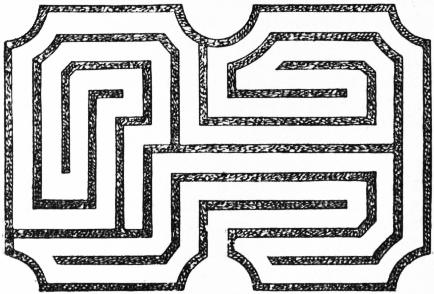
Fig. 1.—Labyrinth of London and Wise.
4. The Italian: a series of chambers in the lower part of the tomb of Porsena at Clusium. This tomb was 300 ft. square and 50 ft. high, and underneath it was a labyrinth, from which it was exceedingly difficult to find an exit without the assistance of a clew of thread. It has been maintained that this tomb is to be recognized in the mound named Poggio Gajella near Chiusi.
Lastly, Pliny (xxxvi. 19) applies the word to a rude drawing on the ground or pavement, to some extent anticipating the modern or garden maze.
On the Egyptian labyrinth see A. Wiedemann, Ägyptische Geschichte (1884), p. 258, and his edition of the second book of Herodotus (1890); on the Cretan, C. Höck, Kreta (1823-1829), and A. J. Evans in Journal of Hellenic Studies; on the subject generally, articles in Roscher’s Lexikon der Mythologie and Daremberg and Saglio’s Dictionnaire des antiquités.
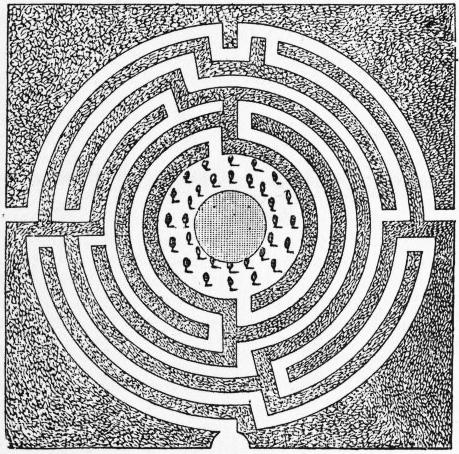
Fig. 2.—Labyrinth of Batty Langley.
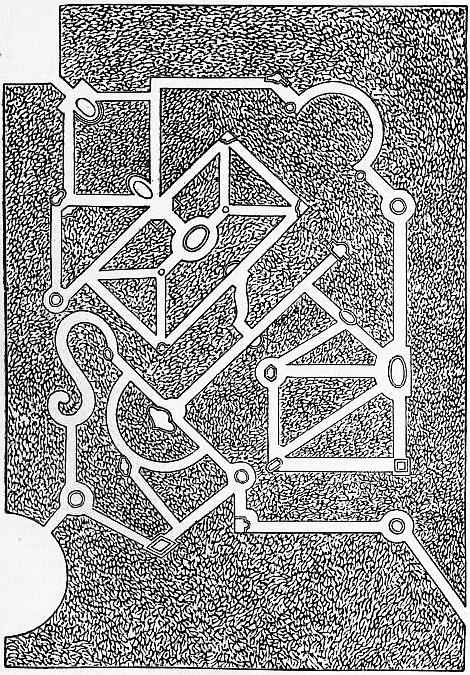
Fig. 3.—Labyrinth at Versailles.
In gardening, a labyrinth or maze means an intricate network of pathways enclosed by hedges or plantations, so that those who enter become bewildered in their efforts to find the centre or make their exit. It is a remnant of the old geometrical style of gardening. There are two methods of forming it. That which is perhaps the more common consists of walks, or alleys as they were formerly called, laid out and kept to an equal width or nearly so by parallel hedges, which should be so close and thick that the eye cannot readily penetrate them. The task is to get to the centre, which is often raised, and generally contains a covered seat, a fountain, a statue or even a small group of trees. After reaching this point the next thing is to return to the entrance, when it is found that egress is as difficult as ingress. To every design of this sort there should be a key, but even those who know the key are apt to be perplexed. Sometimes the design consists of alleys only, as in fig. 1, published in 1706 by London and Wise. In such a case, when the farther end is reached, there only remains to travel back again. Of a more pretentious character was a design published by Switzer in 1742. This is of octagonal form, with very numerous parallel hedges and paths, and “six different entrances, whereof there is but one that leads to the centre, and that is attended with some difficulties and a great many stops.” Some of the older designs for labyrinths, however, avoid this close parallelism of the alleys, which, though equally involved and intricate in their windings, are carried through blocks of thick planting, as shown in fig. 2, from a design published in 1728 by Batty Langley. These blocks of shrubbery have been called wildernesses. To this latter class belongs the celebrated labyrinth at Versailles (fig. 3), of which Switzer observes, that it “is allowed by all to be the noblest of its kind in the world.”
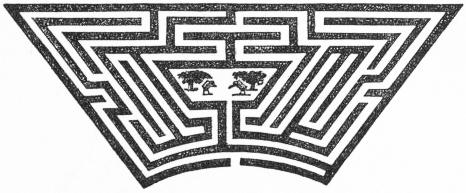
Fig. 4.—Maze at Hampton Court.
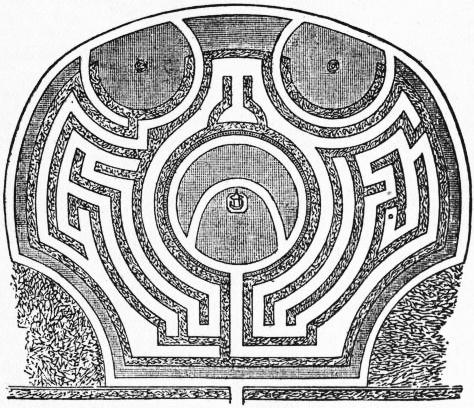
Fig. 5.—Maze at Somerleyton Hall.
Whatever style be adopted, it is essential that there should be a thick healthy growth of the hedges or shrubberies that confine the wanderer. The trees used should be impenetrable to the eye, and so tall that no one can look over them; and the paths should be of gravel and well kept. The trees chiefly used for the hedges, and the best for the purpose, are the hornbeam among deciduous trees, or the yew among evergreens. The beech might be used instead of the hornbeam on suitable soil. The green holly might be planted as an evergreen with very good results, and so might the American arbor vitae if the natural soil presented no obstacle. The ground must be well prepared, so as to give the trees a good start, and a mulching of manure during the early years of their growth would be of much advantage. They must be kept trimmed in or clipped, especially in their earlier stages; trimming with the knife is much to be preferred to clipping with shears. Any plants getting much in advance of the rest should be topped, and the whole kept to some 4 ft. or 5 ft. in height until the lower parts are well thickened, when it may be allowed to acquire the allotted height by moderate annual increments. In cutting, the hedge (as indeed all hedges) should be kept broadest at the base and narrowed upwards, which prevents it from getting thin and bare below by the stronger growth being drawn to the tops.
The maze in the gardens at Hampton Court Palace (fig. 4) is considered one of the finest examples in England. It was planted in the early part of the reign of William III., though it has been supposed that a maze had existed there since the time of Henry VIII. It is constructed on the hedge and alley system, and was, it is believed, originally planted with hornbeam, but many of the plants have been replaced by hollies, yews, &c., so that the vegetation is mixed. The walks are about half a mile in length, and the ground occupied is a little over a quarter of an acre. The centre contains two large trees, with a seat beneath each. The key to reach this resting place is to keep the right hand continuously in contact with the hedge from first to last, going round all the stops.
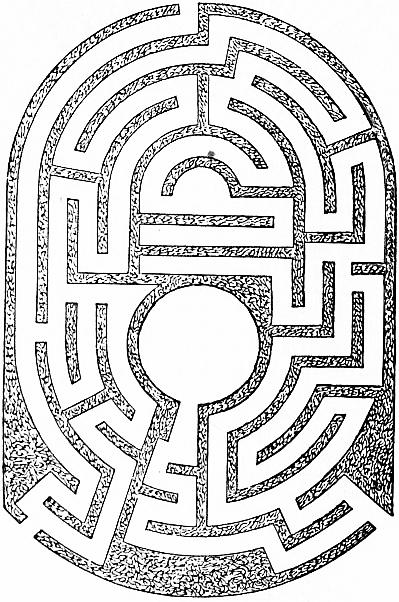
Fig. 6.—Labyrinth in Horticultural Society’s Garden.
The maze in the gardens at Somerleyton Hall, near Lowestoft (fig. 5), was designed by Mr John Thomas. The hedges are of English yew, are about 6½ ft. high, and have been planted about sixty years. In the centre is a grass mound, raised to the height of the hedges, and on this mound is a pagoda, approached by a curved grass path. At the two corners on the western side are banks of laurels 15 or 16 ft. high. On each side of the hedges throughout the labyrinth is a small strip of grass.
There was also a labyrinth at Theobald’s Park, near Cheshunt, when this place passed from the earl of Salisbury into the possession of James I. Another is said to have existed at Wimbledon House, the seat of Earl Spencer, which was probably laid out by Brown in the 18th century. There is an interesting labyrinth, somewhat after the plan of fig. 2, at Mistley Place, Manningtree.
When the gardens of the Royal Horticultural Society at South Kensington were being planned, Albert, Prince Consort, the president of the society, especially desired that there should be a maze formed in the ante-garden, which was made in the form shown in fig. 6. This labyrinth, designed by Lieut. W. A. Nesfield, was for many years the chief point of attraction to the younger visitors to the gardens; but it was allowed to go to ruin, and had to be destroyed. The gardens themselves are now built over.
(T. Mo.)
LABYRINTHULIDEA, the name given by Sir Ray Lankester (1885) to Sarcodina (q.v.) forming a reticulate plasmodium, the denser masses united by fine pseudopodical threads, hardly distinct from some Proteomyxa, such as Archerina.
This is a small and heterogeneous group. Labyrinthula, discovered by L. Cienkowsky, forms a network of relatively stiff threads on which are scattered large spindle-shaped enlargements, each representing an amoeba, with a single nucleus. The threads are pseudopods, very slowly emitted and withdrawn. The amoebae multiply by fission in the active state. The nearest approach to a “reproductive” state is the approximation of the amoebae, and their separate encystment in an irregular heap, recalling the Acrasieae. From each cyst ultimately emerges a single amoeba, or more rarely four (figs. 6, 7). The saprophyte Diplophrys (?) stercorea (Cienk.) appears closely allied to this.
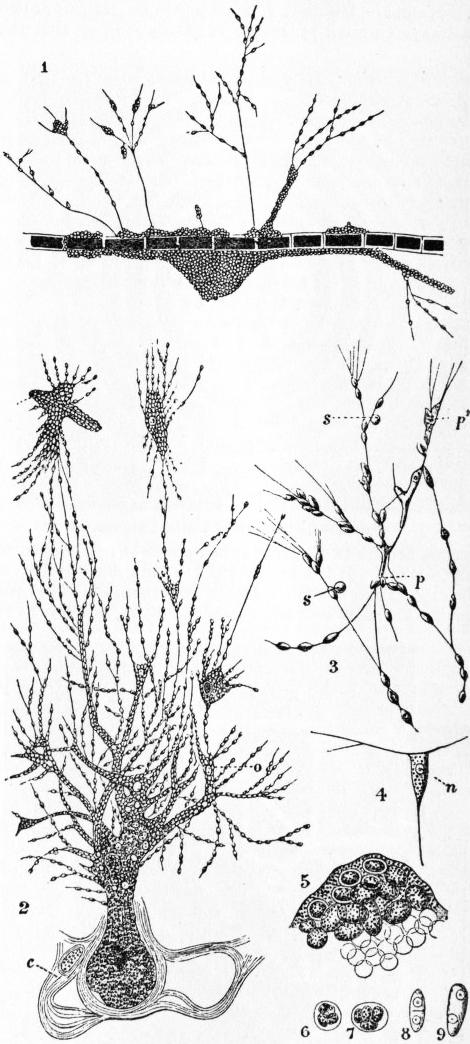
Labyrinthulidea.
1. A colony or “cell-heap” of Labyrinthula vitellina, Cienk., crawling upon an Alga. 2. A colony or “cell-heap” of Chlamydomyxa labyrinthuloides, Archer, with fully expanded network of threads on which the oat-shaped corpuscles (cells) are moving. o, Is an ingested food particle; at c a portion of the general protoplasm has detached itself and become encysted. 3 A portion of the network of Labyrinthula vitellina, Cienk., more highly magnified. p, Protoplasmic mass apparently produced by fusion of several filaments. p′, Fusion of several cells which have lost their definite spindle-shaped contour. s, Corpuscles which have become spherical and are no longer moving (perhaps about to be encysted). 4. A single spindle cell and threads of Labyrinthula macrocystis, Cienk. n, Nucleus. 5. A group of encysted cells of L. Macrocystis, embedded in a tough secretion. 6, 7. Encysted cells of L. macrocystis, with enclosed protoplasm divided into four spores. 8, 9. Transverse division of a non-encysted spindle-cell of L. macrocystis.
Chlamydomyxa (W. Archer) resembles Labyrinthula in its freely branched plasmodium, but contains yellowish chromatophores, and minute oval vesicles (“physodes”) filled with a substance allied to tannin—possibly phloroglucin—which glide along the plasmodial tracks. The cell-body contains numerous nuclei; but in its active state is not resolvable into distinct oval amoeboids. It is amphitrophic, ingesting and digesting other Protista, as well as “assimilating” by its chromatophores, the product being oil, not starch. The whole body may form a laminated cellulose resting cyst, from which it may only temporarily emerge (fig. 2), or it may undergo resolution into nucleate cells which then encyst, and become multinucleate before rupturing the cyst afresh.
Leydenia (F. Schaudinn) is a parasite in malignant diseases of the pleura. The pseudopodia of adjoining cells unite to form a network; but its affinities seem to such social naked Foraminifera as Mikrogromia.
See Cienkowsky, Archiv f. Microscopische Anatomie, iii. 274 (1867), xii. 44 (1876); W. Archer, Quart. Jour. Microscopic Science, xv. 107 (1875); E. R. Lankester, Ibid., xxxix., 233 (1896); Hieronymus and Jenkinson, Ibid., xiii. 89 (1899); W. Zopf, Beiträge zur Physiologie und Morphologie niederer Organismen, ii. 36 (1892), iv. 60 (1894); Pènard, Archiv für Protistenkunde, iv. 296 (1904); F. Schaudinn and Leyden, Sitzungsberichte der Königlich preussischen Akademie der Wissenschaft, vi. (1896).
LAC, a resinous incrustation formed on the twigs and young branches of various trees by an insect, Coccus lacca, which infests them. The term lac (laksha, Sanskrit; lakh, Hindi) is the same as the numeral lakh—a hundred thousand—and is indicative of the countless hosts of insects which make their appearance with every successive generation. Lac is a product of the East Indies, coming especially from Bengal, Pegu, Siam and Assam, and is produced by a number of trees of the species Ficus, particularly F. religiosa. The insect which yields it is closely allied to the cochineal insect, Coccus cacti; kermes, C. ilicis and Polish grains, C. polonicus, all of which, like the lac insect, yield a red colouring matter. The minute larval insects fasten in myriads on the young shoots, and, inserting their long proboscides into the bark, draw their nutriment from the sap of the plant. The insects begin at once to exude the resinous secretion over their entire bodies; this forms in effect a cocoon, and, the separate exudations coalescing, a continuous hard resinous layer regularly honeycombed with small cavities is deposited over and around the twig. From this living tomb the female insects, which form the great bulk of the whole, never escape. After their impregnation, which takes place on the liberation of the males, about three months from their first appearance, the females develop into a singular amorphous organism consisting in its main features of a large smooth shining crimson-coloured sac—the ovary—with a beak stuck into the bark, and a few papillary processes projected above the resinous surface. The red fluid in the ovary is the substance which forms the lac dye of commerce. To obtain the largest amount of both resin and dye-stuff it is necessary to gather the twigs with their living inhabitants in or near June and November. Lac encrusting the twigs as gathered is known in commerce as “stick lac”; the resin crushed to small fragments and washed in hot water to free it from colouring matter constitutes “seed lac”; and this, when melted, strained through thick canvas, and spread out into thin layers, is known as “shellac,” and is the form in which the resin is usually brought to European markets. Shellac varies in colour from a dark amber to an almost pure black; the palest, known as “orange-lac,” is the most valuable; the darker varieties—“liver-coloured,” “ruby,” “garnet,” &c.—diminish in value as the colour deepens. Shellac may be bleached by dissolving it in a boiling lye of caustic potash and passing chlorine through the solution till all the resin is precipitated, the product being known as white shellac. Bleached lac takes light delicate shades of colour, and dyed a golden yellow it is much used in the East Indies for working into chain ornaments for the head and for other personal adornments. Lac is a principal ingredient in sealing-wax, and forms the basis of some of the most valuable varnishes, besides being useful in various cements, &c. Average stick lac contains about 68% of resin, 10 of lac dye and 6 of a waxy substance. Lac dye is obtained by evaporating the water in which stick lac is washed, and comes into commerce in the form of small square cakes. It is in many respects similar to, although not identical with, cochineal.
LACAILLE, NICOLAS LOUIS DE (1713-1762), French astronomer, was born at Rumigny, in the Ardennes, on the 15th of March 1713. Left destitute by the death of his father, who held a post in the household of the duchess of Vendôme, his theological studies at the Collège de Lisieux in Paris were prosecuted at the expense of the duke of Bourbon. After he had taken deacon’s orders, however, he devoted himself exclusively to science, and, through the patronage of J. Cassini, obtained employment, first in surveying the coast from Nantes to Bayonne, then, in 1739, in remeasuring the French arc of the meridian. The success of this difficult operation, which occupied two years, and achieved the correction of the anomalous result published by J. Cassini in 1718, was mainly due to Lacaille’s industry and skill. He was rewarded by admission to the Academy and the appointment of mathematical professor in Mazarin college, where he worked in a small observatory fitted for his use. His desire to observe the southern heavens led him to propose, in 1750, an astronomical expedition to the Cape of Good Hope, which was officially sanctioned, and fortunately executed. Among its results were determinations of the lunar and of the solar parallax (Mars serving as an intermediary), the first measurement of a South African arc of the meridian, and the observation of 10,000 southern stars. On his return to Paris in 1754 Lacaille was distressed to find himself an object of public attention; he withdrew to Mazarin college, and there died, on the 21st of March 1762, of an attack of gout aggravated by unremitting toil. Lalande said of him that, during a comparatively short life, he had made more observations and calculations than all the astronomers of his time put together. The quality of his work rivalled its quantity, while the disinterestedness and rectitude of his moral character earned him universal respect.
His principal works are: Astronomiae Fundamenta (1757), containing a standard catalogue of 398 stars, re-edited by F. Baily (Memoirs Roy. Astr. Society, v. 93); Tabulae Solares (1758); Coelum australe stelliferum (1763) (edited by J. D. Maraldi), giving zone-observations of 10,000 stars, and describing fourteen new constellations; “Observations sur 515 étoiles du Zodiaque” (published in t. vi. of his Éphémérides, 1763); Leçons élémentaires de Mathématiques (1741), frequently reprinted; ditto de Mécanique (1743), &c.; ditto d’Astronomie (1746), 4th edition augmented by Lalande (1779); ditto d’Optique (1750), &c. Calculations by him of eclipses for eighteen hundred years were inserted in L’Art de vérifier les dates (1750); he communicated to the Academy in 1755 a classed catalogue of forty-two southern nebulae, and gave in t. ii. of his Éphémérides (1755) practical rules for the employment of the lunar method of longitudes, proposing in his additions to Pierre Bouguer’s Traité de Navigation (1760) the model of a nautical almanac.
See G. de Fouchy, “Éloge de Lacaille,” Hist. de l’Acad. des Sciences, p. 197 (1762); G. Brotier, Preface to Lacaille’s Coelum australe; Claude Carlier, Discours historique, prefixed to Lacaille’s Journal historique du voyage fait au Cap (1763); J. J. Lalande, Connoissance des temps, p. 185 (1767); Bibl. astr. pp. 422, 456, 461, 482; J. Delambre, Hist. de l’astr. au XVIIIe siècle, pp. 457-542; J. S. Bailly, Hist. de l’astr. moderne, tomes ii., iii., passim; J. C. Poggendorff, Biog. Lit. Handwörterbuch; R. Grant, Hist. of Physical Astronomy, pp. 486, &c.; R. Wolf, Geschichte der Astronomie. A catalogue of 9766 stars, reduced from Lacaille’s observations by T. Henderson, under the supervision of F. Baily, was published in London in 1847.
LACAITA, SIR JAMES [Giacomo] (1813-1895), Anglo-Italian politician and writer. Born at Manduria in southern Italy, he practised law in Naples, and having come in contact with a number of prominent Englishmen and Americans in that city, he acquired a desire to study the English language. Although a moderate Liberal in politics, he never joined any secret society, but in 1851 after the restoration of Bourbon autocracy he was arrested for having supplied Gladstone with information on Bourbon misrule. Through the intervention of the British and Russian ministers he was liberated, but on the publication of Gladstone’s famous letters to Lord Aberdeen he was obliged to leave Naples. He first settled in Edinburgh, where he married Maria Carmichael, and then in London where he made numerous friends in literary and political circles, and was professor of Italian at Queen’s College from 1853 to 1856. In the latter year he accompanied Lord Minto to Italy, on which occasion he first met Cavour. From 1857 to 1863 he was private secretary (non-political) to Lord Lansdowne, and in 1858 he accompanied Gladstone to the Ionian Islands as secretary, for which services he was made a K.C.M.G. the following year. In 1860 Francis II. of Naples had implored Napoleon III. to send a squadron to prevent Garibaldi from crossing over from Sicily to Calabria; the emperor expressed himself willing to do so provided Great Britain co-operated, and Lord John Russell was at first inclined to agree. At this juncture Cavour, having heard of the scheme, entrusted Lacaita, at the suggestion of Sir James Hudson, the British minister at Turin, with the task of inducing Russell to refuse co-operation. Lacaita, who was an intimate friend both of Russell and his wife, succeeded, with the help of the latter, in winning over the British statesman just as he was about to accept the Franco-Neapolitan proposal, which was in consequence abandoned. He returned to Naples late in 1860 and the following year was elected member of parliament for Bitonto, although he had been naturalized a British subject in 1855. He took little part in parliamentary politics, but in 1876 was created senator. He was actively interested in a number of English companies operating in Italy, and was made one of the directors of the Italian Southern Railway Co. He had a wide circle of friends in many European countries and in America, including a number of the most famous men in politics and literature. He died in 1895 at Posilipo near Naples.
An authority on Dante, he gave many lectures on Italian literature and history while in England; and among his writings may be mentioned a large number of articles on Italian subjects in the Encyclopaedia Britannica (1857-1860), and an edition of Benvenuto da Imola’s Latin lectures on Dante delivered in 1375; he co-operated with Lord Vernon in the latter’s great edition of Dante’s Inferno (London, 1858-1865), and he compiled a catalogue in four volumes of the duke of Devonshire’s library at Chatsworth (London, 1879).
LA CALLE, a seaport of Algeria, in the arrondissement of Bona, department of Constantine, 56 m. by rail E. of Bona and 10 m. W. of the Tunisian frontier. It is the centre of the Algerian and Tunisian coral fisheries and has an extensive industry in the curing of sardines; but the harbour is small and exposed to the N.E. and W. winds. The old fortified town, now almost abandoned, is built on a rocky peninsula about 400 yds. long, connected with the mainland by a bank of sand. Since the occupation of La Calle by the French in 1836 a new town has grown up along the coast. Pop. (1906) of the town, 2774; of the commune, 4612.
La Calle from the times of its earliest records in the 10th century has been the residence of coral merchants. In the 16th century exclusive privileges of fishing for coral were granted by the dey of Algiers to the French, who first established themselves on a bay to the westward of La Calle, naming their settlement Bastion de France; many ruins still exist of this town. In 1677 they moved their headquarters to La Calle. The company—Compagnie d’Afrique—who owned the concession for the fishery was suppressed in 1798 on the outbreak of war between France and Algeria. In 1806 the British consul-general at Algiers obtained the right to occupy Bona and La Calle for an annual rent of £11,000; but though the money was paid for several years no practical effect was given to the agreement. The French regained possession in 1817, were expelled during the wars of 1827, when La Calle was burnt, but returned and rebuilt the place in 1836. The boats engaged in the fishery were mainly Italian, but the imposition, during the last quarter of the 19th century, of heavy taxes on all save French boats drove the foreign vessels away. For some years the industry was abandoned, but was restarted on a small scale in 1903.
See Abbé Poiret, Voyage en Barbarie ... (Paris, 1789); E. Broughton, Six Years’ Residence in Algiers (London, 1839) and Sir R. L. Playfair, Travels in the Footsteps of Bruce (London, 1877).
LA CALPRENÈDE, GAUTHIER DE COSTES, Seigneur de (c. 1610-1663), French novelist and dramatist, was born at the Château of Tolgou, near Sarlat (Dordogne), in 1609 or 1610. After studying at Toulouse, he came to Paris and entered the regiment of the guards, becoming in 1650 gentleman-in-ordinary of the royal household. He died in 1663 in consequence of a kick from his horse. He was the author of several long heroic romances ridiculed by Boileau. They are: Cassandre (10 vols., 1642-1650); Cléopatre (1648); Faramond (1661); and Les Nouvelles, ou les Divertissements de la princesse Alcidiane (1661) published under his wife’s name, but generally attributed to him. His plays lack the spirit and force that occasionally redeem the novels. The best is Le Comte d’Essex, represented in 1638, which supplied some ideas to Thomas Corneille for his tragedy of the same name.
LA CARLOTA, a town of the province of Negros Occidental, Philippine Islands, on the W. coast of the island and the left bank of San Enrique river, about 18 m. S. of Bacolod, the capital of the province. Pop. (1903), after the annexation of San Enrique, 19,192. There are fifty-four villages or barrios in the town; the largest had a population in 1903 of 3254 and two others had each more than 1000 inhabitants. The Panayano dialect of the Visayan language is spoken by most of the inhabitants. At La Carlota the Spanish government established a station for the study of the culture of sugar-cane; by the American government this has been converted into a general agricultural experiment station, known as “Government Farm.”
LACCADIVE ISLANDS, a group of coral reefs and islands in the Indian Ocean, lying between 10° and 12° 20′ N. and 71° 40′ and 74° E. The name Laccadives (laksha dwipa, the “hundred thousand isles”) is that given by the people of the Malabar coast, and was probably meant to include the Maldives; they are called by the natives simply Divi, “islands,” or Amendivi, from the chief island. There are seventeen separate reefs, “round each of which the 100-fathom line is continuous” (J. S. Gardiner). There are, however, only thirteen islands, and of these only eight are inhabited. They fall into two groups—the northern, belonging to the collectorate of South Kanara, and including the inhabited islands of Amini, Kardamat, Kiltan and Chetlat; and the southern, belonging to the administrative district of Malabar, and including the inhabited islands of Agatti, Kavaratti, Androth and Kalpeni. Between the Laccadives and the Maldives to the south lies the isolated Minikoi, which physically belongs to neither group, though somewhat nearer to the Maldives (q.v.). The principal submerged banks lie north of the northern group of islands; they are Munyal, Coradive and Sesostris, and are of greater extent than those on which the islands lie. The general depth over these is from 23 to 28 fathoms, but Sesostris has shallower soundings “indicating patches growing up, and some traces of a rim” (J. S. Gardiner). The islands have in nearly all cases emerged from the eastern and protected side of the reef, the western being completely exposed to the S.W. monsoon. The islands are small, none exceeding a mile in breadth, while the total area is only about 80 sq. m. They lie so low that they would be hardly discernible but for the coco-nut groves with which they are thickly covered. The soil is light coral sand, beneath which, a few feet down, lies a stratum of coral stretching over the whole of the islands. This coral, generally a foot to a foot and a half in thickness, has been in the principal islands wholly excavated, whereby the underlying damp sand is rendered available for cereals. These excavations—a work of vast labour—were made at a remote period, and according to the native tradition by giants. In these spaces (totam, “garden”) coarse grain, pulse, bananas and vegetables are cultivated; coco-nuts grow abundantly everywhere. For rice the natives depend upon the mainland.
Population and Trade.—The population in 1901 was 10,274. The people are Moplas, i.e. of mixed Hindu and Arab descent, and are Mahommedans. Their manners and customs are similar to those of the coast Moplas; but they maintain their own ancient caste distinctions. The language spoken is Malayalim, but it is written in the Arabic character. Reading and writing are common accomplishments among the men. The chief industry is the manufacture of coir. The various processes are entrusted to the women. The men employ themselves with boatbuilding and in conveying the island produce to the coast. The exports from the Laccadives are of the annual value of about £17,000.
History.—No data exist for determining at what period the Laccadives were first colonized. The earliest mention of them as distinguished from the Maldives seems to be by Albírúní (c. 1030), who divides the whole archipelago (Díbaját) into the Dívah Kúzah or Cowrie Islands (the Maldives), and the Divah Kanbar or Coir Islands (the Laccadives). (See Journ. Asiat. Soc., September 1844, p. 265). The islanders were converted to Islam by an Arab apostle named Mumba Mulyaka, whose grave at Androth still imparts a peculiar sanctity to that island. The kazee of Androth was in 1847 still a member of his family, and was said to be the twenty-second who had held the office in direct line from the saint. This gives colour to the tradition that the conversion took place about 1250. It is also further corroborated by the story given by the Ibn Batuta of the conversion of the Maldives, which occurred, as he heard, four generations (say one hundred and twenty years) before his visit to these islands in 1342. The Portuguese discovered the Laccadives in May 1498, and built forts upon them, but about 1545 the natives rose upon their oppressors. The islands subsequently became a suzerainty of the raja of Cannanore, and after the peace of Seringapatam, 1792 the southern group was permitted to remain under the management of the native chief at a yearly tribute. This was often in arrear, and on this account these islands were sequestrated by the British government in 1877.
See The Fauna and Geography of the Maldive and Laccadive Archipelagoes, ed. J. Stanley Gardiner (Cambridge 1901-1905); Malabar District Gazetteer (Madras, 1908); G. Pereira, “As Ilhas de Dyve” (Boletim da Soc. Geog., Lisbon, 1898-1899) gives details relating to the Laccadives from the 16th-century MS. volume De insulis et peregrinatione lusitanorum in the National Library, Lisbon.
LACCOLITE (Gr. λάκκος, cistern, λίθος, stone), in geology, the name given by Grove K. Gilbert to intrusive masses of igneous rock possessing a cake-like form, which he first described from the Henry Mountains of southern Utah. Their characteristic is that they have spread out along the bedding planes of the strata, but are not so broad and thin as the sheets or intrusive sills which, consisting usually of basic rocks, have spread over immense distances without attaining any great thickness. Laccolites cover a comparatively small area and have greater thickness. Typically they have a domed upper surface while their base is flat. In the Henry Mountains they are from 1 to 5 m. in diameter and range in thickness up to about 5000 ft. The cause of their peculiar shape appears to be the viscosity of the rock injected, which is usually of intermediate character and comparatively rich in alkalis, belonging to the trachytes and similar lithological types. These are much less fluid than the basalts, and the latter in consequence spread out much more readily along the bedding planes, forming thin flat-topped sills. At each side the laccolites thin out rapidly so that their upper surface slopes steeply to the margins. The strata above them which have been uplifted and bent are often cracked by extension, and as the igneous materials well into the fissures a large number of dikes is produced. At the base of the laccolite, on the other hand, the strata are flat and dikes are rare, though there may be a conduit up which the magma has flowed into the laccolite. The rocks around are often much affected by contact alteration, and great masses of them have sometimes sunk into the laccolite, where they may be partly melted and absorbed.
Gilbert obtained evidence that these laccolites were filled at depths of 7000 to 10,000 ft. and did not reach the surface, giving rise to volcanoes. From the effects on the drainage of the country it seemed probable that above the laccolites the strata swelled up in flattish eminences. Often they occur side by side in groups belonging to a single period, though all the members of each group are not strictly of the same age. One laccolite may be formed on the side of an earlier one, and compound laccolites also occur. When exposed by erosion they give rise to hills, and their appearance varies somewhat with the stage of development.
In the western part of South America laccolites agreeing in all essential points with those described by Gilbert occur in considerable numbers and present some diversity of types. Occasionally they are asymmetrical, or have one steep or vertical side while the other is gently inclined. In other cases they split into a number of sheets spreading outwards through the rocks around. But the term laccolite has also been adopted by geologists in Britain and elsewhere to describe a variety of intrusive masses not strictly identical in character with those of the Henry Mountains. Some of these rest on a curved floor, like the gabbro masses of the Cuillin Hills in Skye; others are injected along a flattish plane of unconformability where one system of rocks rests on the upturned and eroded edges of an older series. An example of the latter class is furnished by the felsite mass of the Black Hill in the Pentlands, near Edinburgh, which has followed the line between the Silurian and the Old Red Sandstone, forcing the rocks upwards without spreading out laterally to any great extent.
The term laccolite has also been applied to many granite intrusions, such as those of Cornwall. We know from the evidence of mining shafts which have been sunk in the country near the edge of these granites that they slope downwards underground with an angle of twenty to thirty degrees. They have been proved also to have been injected along certain wall-marked horizons; so that although the rocks of the country have been folded in a very complicated manner the granite can often be shown to adhere closely to certain members of the stratigraphical sequence for a considerable distance. Hence it is clear that their upper surfaces are convex and gently arched, and it is conjectured that the strata must extend below them, though at a great depth, forming a floor. The definite proof of this has not been attained for no borings have penetrated the granites and reached sedimentary rocks beneath them. But often in mountainous countries where there are deep valleys the bases of great granite laccolites are exposed to view in the hill sides. These granite sills have a considerable thickness in proportion to their length, raise the rocks above them and fill them with dikes, and behave generally like typical laccolites. In contradistinction to intrusions of this type with a well-defined floor we may place the batholiths, bysmaliths, plutonic plugs and stocks, which have vertical margins and apparently descend to unknown depths. It has been conjectured that masses of this type eat their way upwards by dissolving the rock above them and absorbing it, or excavate a passage by breaking up the roof of the space they occupy while the fragments detached sink downwards and are lost in the ascending magma.
(J. S. F.)
LACE (corresponding to Ital. merletto, trina; Genoese pizzo; Ger. spitzen; Fr. dentelle; Dutch kanten; Span. encaje; the English word owes something to the Fr. lassis or lacis, but both are connected with the earlier Lat. laqueus; early French laces were also called passements or insertions and dents or edgings), the name applied to ornamental open work formed of threads of flax, cotton, silk, gold or silver, and occasionally of mohair or aloe fibre, looped or plaited or twisted together by hand, (1) with a needle, when the work is distinctively known as “needlepoint lace”; (2) with bobbins, pins and a pillow or cushion, when the work is known as “pillow lace”; and (3) by steam-driven machinery, when imitations of both needlepoint and pillow laces are produced. Lace-making implies the production of ornament and fabric concurrently. Without a pattern or design the fabric of lace cannot be made.
The publication of patterns for needlepoint and pillow laces dates from about the middle of the 16th century. Before that period lace described such articles as cords and narrow braids of plaited and twisted threads, used not only to fasten shoes, sleeves and corsets together, but also in a decorative manner to braid the hair, to wind round hats, and to be sewn as trimmings upon costumes. In a Harleian MS. of the time of Henry VI. and Edward IV., about 1471, directions are given for the making of “lace Bascon, lace indented, lace bordered, lace covert, a brode lace, a round lace, a thynne lace, an open lace, lace for hattys,” &c. The MS. opens with an illuminated capital letter, in which is the figure of a woman making these articles. The MS. supplies a clear description how threads in combinations of twos, threes, fours, fives, to tens and fifteens, were to be twisted and plaited together. Instead of the pillow, bobbins and pins with which pillow lace soon afterwards was made, the hands were used, each finger of a hand serving as a peg upon which was placed a “bowys” or “bow,” or little ball of thread. Each ball might be of different colour from the other. The writer of the MS. says that the first finger next the thumb shall be called A, the next B, and so on. According to the sort of cord or braid to be made, so each of the four fingers, A, B, C, D might be called into service. A “thynne lace” might be made with three threads, and then only fingers A, B, C would be required. A “round” lace, stouter than the “thynne” lace, might require the service of four or more fingers. By occasionally dropping the use of threads from certain fingers a sort of indented lace or braid might be made. But when laces of more importance were wanted, such as a broad lace for “hattys,” the fingers on the hands of assistants were required. The smaller cords or “thynne laces,” when fastened in simple or fantastic loops along the edges of collars and cuffs, were called “purls” (see the small edge to the collar worn by Catherine de’ Medici, Pl. II. fig. 4). In another direction from which some suggestion may be derived as to the evolution of lace-making, notice should be taken of the fact that at an early period the darning of varied ornamental devices, stiff and geometric in treatment into hand-made network of small square meshes (see squares of “lacis,” Pl. I. fig. 1) became specialized in many European countries. This is held by some writers to be “opus filatorium,” or “opus araneum” (spider work). Examples of this “opus filatorium,” said to date from the 13th century exist in public collections. The productions of this darning in the early part of the 16th century came to be known as “punto a maglia quadra” in Italy and as “lacis” in France, and through a growing demand for household and wearing linen, very much of the “lacis” was made in white threads not only in Italy and France but also in Spain. In appearance it is a filmy fabric. With white threads also were the “purlings” above mentioned made, by means of leaden bobbins or “fuxii,” and were called “merletti a piombini” (see lower border, Pl. II. fig. 3). Cut and drawn thread linen work (the latter known as “tela tirata” in Italy and as “deshilado” in Spain) were other forms of embroidery as much in vogue as the darning on net and the “purling.” The ornament of much of this cut and drawn linen work (see collar of Catherine de’ Medici, Pl. II. fig. 4), more restricted in scope than that of the darning on net, was governed by the recurrence of open squares formed by the withdrawal of the threads. Within these squares and rectangles radiating devices usually were worked by means of whipped and buttonhole stitches (Pl. fig. 5). The general effect in the linen was a succession of insertions or borders of plain or enriched reticulations, whence the name “punto a reticella” given to this class of embroidery in Italy. Work of similar style and especially that with whipped stitches was done rather earlier in the Grecian islands, which derived it from Asia Minor and Persia. The close connexion of the Venetian republic with Greece and the eastern islands, as well as its commercial relations with the East, sufficiently explains an early transplanting of this kind of embroidery into Venice, as well as in southern Spain. At Venice besides being called “reticella,” cut work was also called “punto tagliato.” Once fairly established as home industries such arts were quickly exploited with a beauty and variety of pattern, complexity of stitch and delicacy of execution, until insertions and edgings made independently of any linen as a starting base (see first two borders, Pl. II. fig. 3) came into being under the name of “Punto in aria” (Pl. II. fig. 7). This was the first variety of Venetian and Italian needlepoint lace in the middle of the 16th century,1 and its appearance then almost coincides in date with that of the “merletti a piombini,” which was the earliest Italian cushion or pillow lace (see lower edging, Pl. II. fig. 3).
The many varieties of needlepoint and pillow laces will be touched on under the heading allotted to each of these methods of making lace. Here, however, the general circumstances of their genesis may be briefly alluded to. The activity in cord and braid-making and in the particular sorts of ornamental needlework already mentioned clearly postulated such special labour as was capable of being converted into lace-making. And from the 16th century onwards the stimulus to the industry in Europe was afforded by regular trade demand, coupled with the exertions of those who encouraged their dependents or protegés to give their spare time to remunerative home occupations. Thus the origin and perpetuation of the industry have come to be associated with the women folk of peasants and fishermen in circumstances which present little dissimilarity whether in regard to needle lace workers now making lace in whitewashed cottages and cabins at Youghal and Kenmare in the south of Ireland, or those who produced their “punti in aria” during the 16th century about the lagoons of Venice, or Frenchwomen who made the sumptuous “Points de France” at Alençon and elsewhere in the 17th and 18th centuries; or pillow lace workers to be seen at the present day at little seaside villages tucked away in Devonshire dells, or those who were engaged more than four hundred years ago in “merletti a piombini” in Italian villages or on “Dentelles au fuseau” in Flemish lowlands. The ornamental character, however, of these several laces would be found to differ much; but methods, materials, appliances and opportunities of work would in the main be alike. As fashion in wearing laces extended, so workers came to be drawn together into groups by employers who acted as channels for general trade.2 Nuns in the past as in the present have also devoted attention to the industry, often providing in the convent precincts workrooms not only for peasant women to carry out commissions in the service of the church or for the trade, but also for the purpose of training children in the art. Elsewhere lace schools have been founded by benefactors or organized by some leading local lace-maker3 as much for trading as for education. In all this variety of circumstance, development of finer work has depended upon the abilities of the workers being exercised under sound direction, whether derived through their own intuitions, or supplied by intelligent and tasteful employers. Where any such direction has been absent the industry viewed commercially has suffered, its productions being devoid of artistic effect or adaptability to the changing tastes of demand.
It is noteworthy that the two widely distant regions of Europe where pictorial art first flourished and attained high perfection, north Italy and Flanders, were precisely the localities where lace-making first became an industry of importance both from an artistic and from a commercial point of view. Notwithstanding more convincing evidence as to the earlier development of pillow lace making in Italy the invention of pillow lace is often credited to the Flemings; but there is no distinct trace of the time or the locality. In a picture said to exist in the church of St Gomar at Lierre, and sometimes attributed to Quentin Matsys (1495), is introduced a girl apparently working at some sort of lace with pillow, bobbins, &c., which are somewhat similar to the implements in use in more recent times.4 From the very infancy of Flemish art an active intercourse was maintained between the Low Countries and the great centres of Italian art; and it is therefore only what might be expected that the wonderful examples of the art and handiwork of Venice in lace-making should soon have come to be known to and rivalled among the equally industrious, thriving and artistic Flemings. At the end of the 16th century pattern-books were issued in Flanders having the same general character as those published for the guidance of the Venetian and other Italian lace-makers.
Plate I.
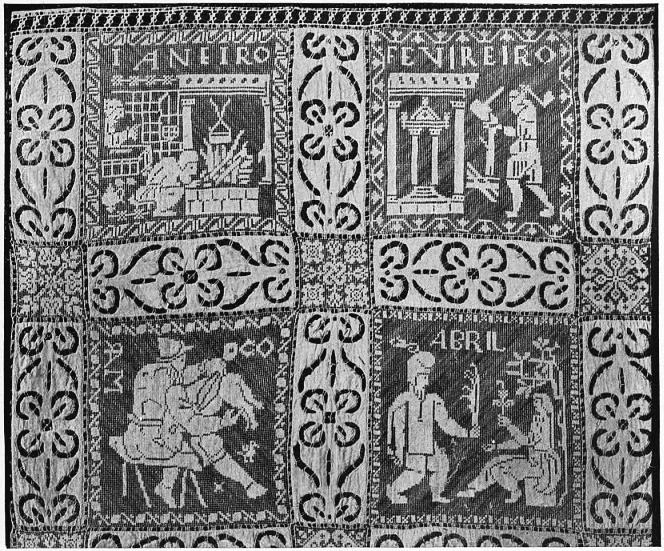
Fig. 1.—PORTION OF A COVERLET COMPOSED OF SQUARES OF “LACIS” OR DARNED NETTING, DIVIDED BY LINEN CUT-WORK BANDS. The squares are worked with groups representing the twelve months, and with scenes from the old Spanish dramatic story “Celestina.” Spanish or Portuguese. 16th century. (Victoria and Albert Museum.)
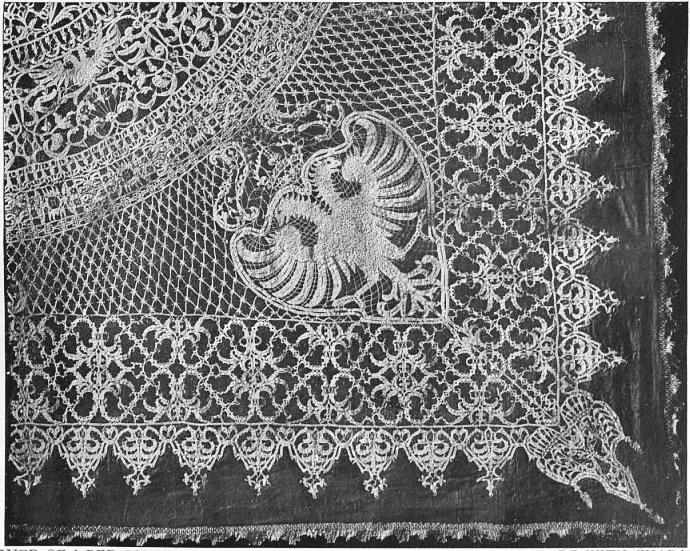
Fig. 2.—CORNER OF A BED-COVER OF PILLOW-MADE LACE OF A TAPE-LIKE TEXTURE WITH CHARACTERISTICS IN THE TWISTED AND PLAITED THREADS RELATING THE WORK TO ITALIAN “MERLETTI A PIOMBINI” OR EARLY ENGLISH “BONE LACE.” Possibly made in Flanders or Italy during the early part of the 17th or at the end of the 16th century. The design includes the Imperial double-headed eagle of Austria with the ancient crown of the German Empire. (Victoria and Albert Museum.)
Plate II.
Fig. 3.—THREE VANDYKE OR DENTATED BORDERS OF ITALIAN LACE OF THE LATE 16th CENTURY. Style usually called “Reticella” on account of the patterns being based on repeated squares or reticulations. The two first borders are of needlepoint work; the lower border is of such pillow lace as was known in Italy as “merletti a piombini.” Fig. 7.—BORDER OF FLAT NEEDLEPOINT LACE OF FULLER TEXTURE THAN THAT OF FIG. 3, AND FROM A FREER STYLE OF DESIGN IN WHICH CONVENTIONALIZED FLORAL FORMS HELD TOGETHER BY SMALL BARS OR TYES ARE USED. Style called “Punto in Aria,” chiefly on account of its independence of squares or reticulations. Italian. Early 17th century. Fig. 5.—CORNER OF A NAPKIN OR HANDKERCHIEF BORDERED WITH “RETICELLA” NEEDLEPOINT LACE IN THE DESIGN OF WHICH ACORNS AND CARNATIONS ARE MINGLED WITH GEOMETRIC RADIATIONS. Probably of English early 17th century. Fig. 4.—CATHERINE DE MEDICI, WEARING A LINEN UPTURNED COLLAR OF CUT WORK AND NEEDLEPOINT LACE. Louvre. About 1540. Fig. 6.—AMELIE ELISABETH, COMTESSE DE HAINAULT, WEARING A RUFF OF NEEDLEPOINT RETICELLA LACE. By Morcelse. The Hague. About 1600. (Figs. 4 and 6 by permission of Messrs Braun, Clement & Co., Dornach (Alsace), and Paris.)
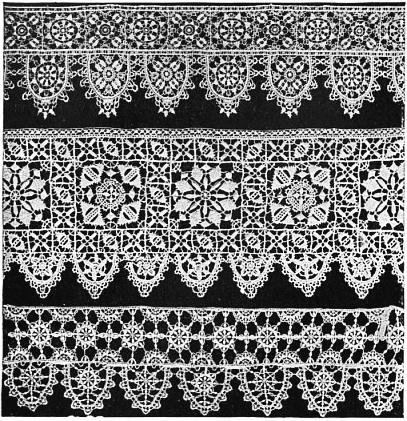
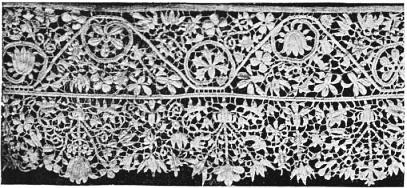
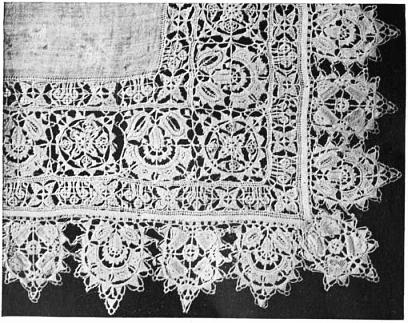
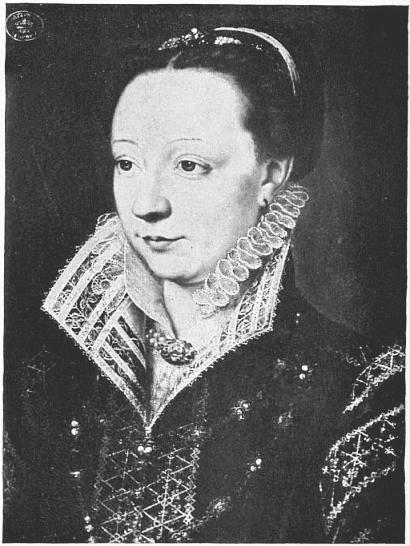
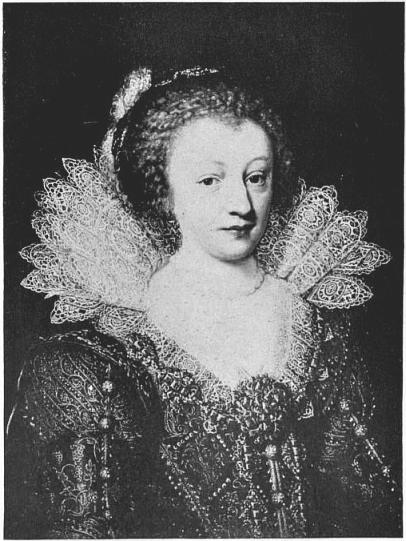
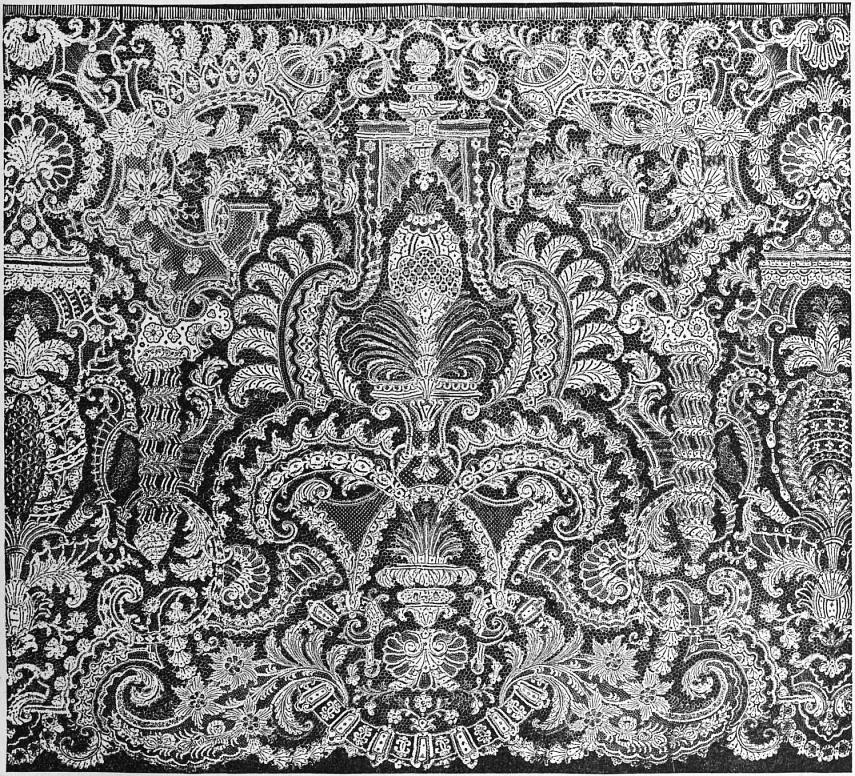
Fig. 24.—Portion of a Flounce of Needlepoint Lace, French, early 18th century, “Point de France.” The honeycomb ground is considered to be a peculiarity of “Point d’Argentan”: some of the fillings are made in the manner of the “Point d’Alençon” réseau.
France and England were not far behind Venice and Flanders in making needle and pillow lace. Henry III. of France (1574-1589) appointed a Venetian, Frederic Vinciolo, pattern maker for varieties of linen needle works and laces to his court. Through the influence of this fertile designer the seeds of a taste for lace in France were principally sown. But the event which par excellence would seem to have fostered the higher development of the French art of lace-making was the aid officially given it in the following century by Louis XIV., acting on the advice of his minister Colbert. Intrigue and diplomacy were put into action to secure the services of Venetian lace-workers; and by an edict dated 1665 the lace-making centres at Alençon, Quesnoy, Arras, Reims, Sedan, Château Thierry, Loudun and elsewhere were selected for the operations of a company in aid of which the state made a contribution of 36,000 francs; at the same time the importation of Venetian, Flemish and other laces was strictly forbidden.5 The edict contained instructions that the lace-makers should produce all sorts of thread work, such as those done on a pillow or cushion and with the needle, in the style of the laces made at Venice, Genoa, Ragusa and other places; these French imitations were to be called “points de France.” By 1671 the Italian ambassador at Paris writes, “Gallantly is the minister Colbert on his way to bring the ‘lavori d’aria’ to perfection.” Six years later an Italian, Domenigo Contarini, alludes to the “punto in aria,” “which the French can now do to admiration.” The styles of design which emanated from the chief of the French lace centre, Alençon, were more fanciful and less severe than the Venetian, and it is evident that the Flemish lace-makers later on adopted many of these French patterns for their own use. The provision of French designs (fig. 24) which owes so much to the state patronage, contrasts with the absence of corresponding provision in England and was noticed early in the 18th century by Bishop Berkeley. “How,” he asks, “could France and Flanders have drawn so much money from other countries for figured silk, lace and tapestry, if they had not had their academies of design?”
The humble endeavours of peasantry in England (which could boast of no schools of design), Germany, Sweden, Russia and Spain could not result in work of so high artistic pretension as that of France and Flanders. In the 18th century good lace was made in Devonshire, but it is only in recent years that to some extent the hand lace-makers of England and Ireland have become impressed with the necessity of well-considered designs for their work. Pillow lace making under the name of “bone lace making” was pursued in the 17th century in Buckinghamshire, Hertfordshire and Bedfordshire, and in 1724 Defoe refers to the manufacture of bone lace in which villagers were “wonderfully exercised and improved within these few years past.” “Bone” lace dates from the 17th century in England and was practically the counterpart of Flemish “dentelles au fuseau,” and related also to the Italian “merletti a piombini” (see Pl. fig. 10). In Germany, Barbara Uttmann, a native of Nuremberg, instructed peasants of the Harz mountains to twist and plait threads in 1561. She was assisted by certain refugees from Flanders. A sort of “purling” or imitation of the Italian “merletti a piombini” was the style of work produced then.
Lace of comparatively simple design has been made for centuries in villages of Andalusia as well as in Spanish conventual establishments. The “point d’Espagne,” however, appears to have been a commercial name given by French manufacturers of a class of lace made in France with gold or silver threads on the pillow and greatly esteemed by Spaniards in the 17th century. No lace pattern-books have been found to have been published in Spain. The needle-made laces which came out of Spanish monasteries in 1830, when these institutions were dissolved, were mostly Venetian needle-made laces. The lace vestments preserved at the cathedral at Granada hitherto presumed to be of Spanish work are verified as being Flemish of the 17th century (similar in style to Pl. fig. 14). The industry is not alluded to in Spanish ordinances of the 15th, 16th or 17th centuries, but traditions which throw its origin back to the Moors or Saracens are still current in Seville and its neighbourhood, where a twisted and knotted arrangement of fine cords is often worked6 under the name of “Morisco” fringe, elsewhere called macramé lace. Black and white silk pillow laces, or “blondes,” date from the 18th century. They were made in considerable quantity in the neighbourhood of Chantilly, and imported for mantillas by Spain, where corresponding silk lace making was started. Although after the 18th century the making of silk laces more or less ceased at Chantilly and the neighbourhood, the craft is now carried on in Normandy—at Bayeux and Caen—as well as in Auvergne, which is also noted for its simple “torchon” laces. Silk pillow lace making is carried on in Spain, especially at Barcelona. The patterns are almost entirely imitations from 18th-century French ones of a large and free floral character. Lace-making is said to have been promoted in Russia through the patronage of the court, after the visit of Peter the Great to Paris in the early days of the 18th century. Peasants in the districts of Vologda, Balakhua (Nijni-Novgorod), Bieleff (Tula) and Mzensk (Orel) make pillow laces of simple patterns. Malta is noted for producing a silk pillow lace of black or white, or red threads, chiefly of patterns in which repetitions of circles, wheels and radiations of shapes resembling grains of wheat are the main features. This characteristic of design, appearing in white linen thread laces of similar make which have been identified as Genoese pillow laces of the early 17th century, reappears in Spanish and Paraguayan work. Pillow lace in imitation of Maltese, Buckinghamshire and Devonshire laces is made to a small extent in Ceylon, in different parts of India and in Japan. A successful effort has also been made to re-establish the industry in the island of Burano near Venice, and pillow and needlepoint lace of good design is made there.