VOLUME XVI SLICE I L to Lamellibranchia (continued 6)
Reading edition
The authoritative biography is by Ch. Foisset (2 vols., Paris, 1870). The religious aspect of his character is best shown in Père B. Chocarne’s Vie du Père Lacordaire (2 vols., Paris, 1866—English translation by A. Th. Drane, London, 1868); see also Count C. F. R. de Montalembert’s Un Moine au XIXème siècle (Paris, 1862—English translation by F. Aylward, London, 1867). There are lives by Mrs H. L. Lear (London, 1882); by A. Ricard (1 vol. of L’École menaisienne, Paris, 1883); by Comte O. d’Haussonville (1 vol., Les Grands écrivains Français series, Paris, 1897); by Gabriel Ledos (Paris, 1901); by Dora Greenwell (1867); and by the duc de Broglie (Paris, 1889). The Correspondance inédite du Père Lacordaire, edited by H. Villard (Paris, 1870), may also be consulted. See also Saint-Beuve in Causeries de Lundi. Several of Lacordaire’s Conférences have been translated into English, among these being, Jesus Christ (1869); God (1870); God and Man (1872); Life (1875). For a theological study of the Conférences de Nôtre Dame, see an article by Bishop J. C. Hedley in Dublin Review (October 1870).

LACQUER, or Lacker, a general term for coloured and frequently opaque varnishes applied to certain metallic objects and to wood. The term is derived from the resin lac, which substance is the basis of lacquers properly so called. Technically, among Western nations, lacquering is restricted to the coating of polished metals or metallic surfaces, such as brass, pewter and tin, with prepared varnishes which will give them a golden, bronze-like or other lustre as desired. Throughout the East Indies the lacquering of wooden surfaces is universally practised, large articles of household furniture, as well as small boxes, trays, toys and papier-mâché objects, being decorated with bright-coloured and variegated lacquer. The lacquer used in the East is, in general, variously coloured sealing-wax, applied, smoothed and polished in a heated condition; and by various devices intricate marbled, streaked and mottled designs are produced. Quite distinct from these, and from all other forms of lacquer, is the lacquer work of Japan, for which see Japan, § Art.
LACRETELLE, PIERRE LOUIS DE (1751-1824), French politician and writer, was born at Metz on the 9th of October 1751. He practised as a barrister in Paris; and under the Revolution was elected as a député suppléant in the Constituent Assembly, and later as deputy in the Legislative Assembly. He belonged to the moderate party known as the “Feuillants,” but after the 10th of August 1792 he ceased to take part in public life. In 1803 he became a member of the Institute, taking the place of La Harpe. Under the Restoration he was one of the chief editors of the Minerve française; he wrote also an essay, Sur le 18 Brumaire (1799), some Fragments politiques et littéraires (1817), and a treatise Des partis politiques et des factions de la prétendue aristocratie d’aujourd’hui (1819).
His younger brother, Jean Charles Dominique de Lacretelle, called Lacretelle le jeune (1766-1855), historian and journalist, was also born at Metz on the 3rd of September 1766. He was called to Paris by his brother in 1787, and during the Revolution belonged, like him, to the party of the Feuillants. He was for some time secretary to the duc de la Rochefoucauld-Liancourt, the celebrated philanthropist, and afterwards joined the staff of the Journal de Paris, then managed by Suard, and where he had as colleagues André Chénier and Antoine Roucher. He made no attempt to hide his monarchist sympathies, and this, together with the way in which he reported the trial and death of Louis XVI., brought him in peril of his life; to avoid this danger he enlisted in the army, but after Thermidor he returned to Paris and to his newspaper work. He was involved in the royalist movement of the 13th Vendémiaire, and condemned to deportation after the 18th Fructidor; but, thanks to powerful influence, he was left “forgotten” in prison till after the 18th Brumaire, when he was set at liberty by Fouché. Under the Empire he was appointed a professor of history in the Faculté des lettres of Paris (1809), and elected as a member of the Académie française (1811). In 1827 he was prime mover in the protest made by the French Academy against the minister Peyronnet’s law on the press, which led to the failure of that measure, but this step cost him, as it did Villemain, his post as censeur royal. Under Louis Philippe he devoted himself entirely to his teaching and literary work. In 1848 he retired to Mâcon; but there, as in Paris, he was the centre of a brilliant circle, for he was a wonderful causeur, and an equally good listener, and had many interesting experiences to recall. He died on the 26th of March 1855. His son Pierre Henri (1815-1899) was a humorous writer and politician of purely contemporary interest.
J. C. Lacretelle’s chief work is a series of histories of the 18th century, the Revolution and its sequel: Précis historique de la Révolution française, appended to the history of Rabaud St Étienne, and partly written in the prison of La Force (5 vols., 1801-1806); Histoire de France pendant le XVIIIe siècle (6 vols., 1808); Histoire de l’Assemblée Constituante (2 vols., 1821); L’Assemblée Législative (1822); La Convention Nationale (3 vols., 1824-1825); Histoire de France depuis la restauration (1829-1835); Histoire du consulat et de l’empire (4 vols., 1846). The author was a moderate and fair-minded man, but possessed neither great powers of style, nor striking historical insight, nor the special historian’s power of writing minute accuracy of detail with breadth of view. Carlyle’s sarcastic remark on Lacretelle’s history of the Revolution, that it “exists, but does not profit much,” is partly true of all his books. He had been an eyewitness of and an actor in the events which he describes, but his testimony must be accepted with caution.
LACROIX, ANTOINE FRANÇOIS ALFRED (1863- ), French mineralogist and geologist, was born at Mâcon, Saône et Loire, on the 4th of February 1863. He took the degree of D. ès Sc. in Paris, 1889. In 1893 he was appointed professor of mineralogy at the Jardin des Plantes, Paris, and in 1896 director of the mineralogical laboratory in the École des Hautes Études. He paid especial attention to minerals connected with volcanic phenomena and igneous rocks, to the effects of metamorphism, and to mineral veins, in various parts of the world, notably in the Pyrenees. In his numerous contributions to scientific journals he dealt with the mineralogy and petrology of Madagascar, and published an elaborate and exhaustive volume on the eruptions in Martinique, La Montagne Pelée et ses éruptions (1904). He also issued an important work entitled Mineralogie de la France et de ses Colonies (1893-1898), and other works in conjunction with A. Michel Lévy. He was elected member of the Académie des sciences in 1904.
LACROIX, PAUL (1806-1884), French author and journalist, was born in Paris on the 27th of April 1806, the son of a novelist. He is best known under his pseudonym of P. L. Jacob, bibliophile, or “Bibliophile Jacob,” suggested by the constant interest he took in public libraries and books generally. Lacroix was an extremely prolific and varied writer. Over twenty historical romances alone came from his pen, and he also wrote a variety of serious historical works, including a history of Napoleon III., and the life and times of the Tsar Nicholas I. of Russia. He was the joint author with Ferdinand Séré of a five-volume work, Le Moyen Âge et La Renaissance (1847), a standard work on the manners, customs and dress of those times, the chief merit of which lies in the great number of illustrations it contains. He also wrote many monographs on phases of the history of culture. Over the signature Pierre Dufour was published an exhaustive Histoire de la Prostitution (1851-1852), which has always been attributed to Lacroix. His works on bibliography were also extremely numerous. In 1885 he was appointed librarian of the Arsenal Library, Paris. He died in Paris on the 16th of October 1884.
LACROMA (Serbo-Croatian Lokrum), a small island in the Adriatic Sea, forming part of the Austrian kingdom of Dalmatia, and lying less than half a mile south of Ragusa. Though barely 1¼ m. in length, Lacroma is remarkable for the beauty of its subtropical vegetation. It was a favourite resort of the archduke Maximilian, afterwards emperor of Mexico (1832-1867), who restored the château and park; and of the Austrian crown prince Rudolph (1857-1889). It contains an 11th-century Benedictine monastery; and the remains of a church, said by a very doubtful local tradition to have been founded by Richard I. of England (1157-1199), form part of the imperial château.
See Lacroma, an illustrated descriptive work by the crown princess Stéphanie (afterwards Countess Lónyay) (Vienna, 1892).
LA CROSSE, a city and the county-seat of La Crosse county, Wisconsin, U.S.A., about 180 m. W.N.W. of Milwaukee, and about 120 m. S.E. of St Paul, Minnesota, on the E. bank of the Mississippi river, at the mouth of the Black and of the La Crosse rivers. Pop. (1900) 28,895; (1910 census) 30,417. Of the total population in 1900, 7222 were foreign-born, 3130 being German and 2023 Norwegian, and 17,555 were of foreign-parentage (both parents foreign-born), including 7853 of German parentage, 4422 of Norwegian parentage, and 1062 of Bohemian parentage. La Crosse is served by the Chicago & North Western, the Chicago, Milwaukee & St Paul, the Chicago, Burlington & Quincy, the La Crosse & South Eastern, and the Green Bay & Western railways, and by river steamboat lines on the Mississippi. The river is crossed here by a railway bridge (C.M. & St P.) and wagon bridge. The city is situated on a prairie, extending back from the river about 2½ m. to bluffs, from which fine views may be obtained. Among the city’s buildings and institutions are the Federal Building (1886-1887), the County Court House (1902-1903), the Public Library (with more than 20,000 volumes), the City Hall (1891), the High School Building (1905-1906), the St Francis, La Crosse and Lutheran hospitals, a Young Men’s Christian Association Building, a Young Women’s Christian Association Building, a U.S. Weather Station (1907), and a U.S. Fish Station (1905). La Crosse is the seat of a state Normal School (1909). Among the city’s parks are Pettibone (an island in the Mississippi), Riverside, Burns, Fair Ground and Myrick. The city is the see of a Roman Catholic bishop. La Crosse is an important lumber and grain market, and is the principal wholesale distributing centre for a large territory in S.W. Wisconsin, N. Iowa and Minnesota. Proximity to both pine and hardwood forests early made it one of the most important lumber manufacturing places in the North-west; but this industry has now been displaced by other manufactures. The city has grain elevators, flour mills (the value of flour and grist mill products in 1905 was $2,166,116), and breweries (product value in 1905, $1,440,659). Other important manufactures are agricultural implements ($542,425 in 1905), lumber and planing mill products, leather, woollen, knit and rubber goods, tobacco, cigars and cigarettes, carriages, foundry and machine-shop products, copper and iron products, cooperage, pearl buttons, brooms and brushes. The total value of the factory product in 1905 was $8,139,432, as against $7,676,581 in 1900. The city owns and operates its water-works system, the wagon bridge (1890-1891) across the Mississippi, and a toll road (2½ m. long) to the village of La Crescent, Minn.
Father Hennepin and du Lhut visited or passed the site of La Crosse as early as 1680, but it is possible that adventurous coureurs-des-bois preceded them. The first permanent settlement was made in 1841, and La Crosse was made the county-seat in 1855 and was chartered as a city in 1856.
LACROSSE, the national ball game of Canada. It derives its name from the resemblance of its chief implement used, the curved netted stick, to a bishop’s crozier. It was borrowed from the Indian tribes of North America. In the old days, according to Catlin, the warriors of two tribes in their war-paint would form the sides, often 800 or 1000 strong. The goals were placed from 500 yds. to ½ m. apart with practically no side boundaries. A solemn dance preceded the game, after which the ball was tossed into the air and the two sides rushed to catch it on “crosses,” similar to those now in use. The medicine-men acted as umpires, and the squaws urged on the men by beating them with switches. The game attracted much attention from the early French settlers in Canada. In 1763, after Canada had become British, the game was used by the aborigines to carry out an ingenious piece of treachery. On the 4th of June, when the garrison of Fort Michilimackinac (now Mackinac) was celebrating the king’s birthday, it was invited by the Ottawas, under their chief Pontiac, to witness a game of “baggataway” (lacrosse). The players gradually worked their way close to the gates, when, throwing aside their crosses and seizing their tomahawks which the squaws suddenly produced from under their blankets, they rushed into the fort and massacred all the inmates except a few Frenchmen.
The game found favour among the British settlers, but it was not until 1867, the year in which Canada became a Dominion, that G. W. Beers, a prominent player, suggested that Lacrosse should be recognized as the national game, and the National Lacrosse Association of Canada was formed. From that time the game has flourished vigorously in Canada and to a less extent in the United States. In 1868 an English Lacrosse Association was formed, but, although a team of Indians visited the United Kingdom in 1867, it was not until sometime later that the game became at all popular in Great Britain. Its progress was much encouraged by visits of teams representing the Toronto Lacrosse Club in 1888 and 1902, the methods of the Canadians and their wonderful “short-passing” exciting much admiration. In 1907 the Capitals of Ottawa visited England, playing six matches, all of which were won by the Canadians. The match North v. South has been played annually in England since 1882. A county championship was inaugurated in 1905. A North of England League, embracing ten clubs, began playing league matches in 1897; and a match between the universities of Oxford and Cambridge has been played annually since 1903. A match between England and Ireland was played annually from 1881 to 1904.
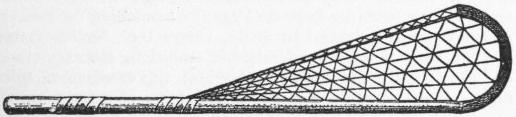
The Crosse.
Implements of the Game.—The ball is made of india-rubber sponge, weighs between 4¼ and 4½ oz., and measures 8 to 8½ in. in circumference. The “crosse” is formed of a light staff of hickory wood, the top being bent to form a kind of hook, from the tip of which a thong is drawn and made fast to the shaft about 2 ft. from the other end. The oval triangle thus formed is covered with a network of gut or rawhide, loose enough to hold the ball but not to form a bag. At no part must the crosse measure more than 12 in. in breadth, and no metal must be used in its manufacture. It may be of any length to suit the player. The goals are set up not less than 100 nor more than 150 yds. apart, the goal-posts being 6 ft. high and the same distance apart. They are set up in the middle of the “goal-crease,” a space of 12 ft. square marked with chalk. A net extends from the top rail and sides of the posts back to a point 6 ft. behind the middle of the line between the posts. Boundaries are agreed upon by the captains. Shoes may have india-rubber soles, but must be without spikes.
The Game.—The object of the game is to send the ball, by means of the crosse, through the enemy’s goal-posts as many times as possible during the two periods of play, precisely as in football and hockey. There are twelve players of each side. In every position save that of goal there are two men, one of each side, whose duties are to “mark” and neutralize each other’s efforts. The game is opened by the act of “facing,” in which the two centres, each with his left shoulder towards his opponents’ goal, hold their crosses, wood downwards, on the ground, the ball being placed between them. When the signal is given the centres draw their crosses sharply inwards in order to gain possession of the ball. The ball may be kicked or struck with the crosse, as at hockey, but the goal-keeper alone may handle it, and then only to block and not to throw it. Although the ball may be thrown with the crosse for a long distance—220 yds. is about the limit—long throws are seldom tried, it being generally more advantageous for a player to run with the ball resting on the crosse, until he can pass it to a member of his side who proceeds with the attack, either by running, passing to another, or trying to throw the ball through the opponents’ goal. The crosse, usually held in both hands, is made to retain the ball by an ingenious rocking motion only acquired by practice. As there is no “off-side” in Lacrosse, a player may pass the ball to the front, side or rear. No charging is allowed, but one player may interfere with another by standing directly in front of him (“body-check”), though without holding, tripping or striking with the crosse. No one may interfere with a player who is not in possession of the ball. Fouls are penalized either by the suspension of the offender until a goal has been scored or until the end of the game; or by allowing the side offended against a “free position.” When a “free position” is awarded each player must stand in the position where he is, excepting the goal-keeper who may get back to his goal, and any opponent who may be nearer the player getting the ball than 5 yds.; this player must retire to that distance from the one who has been given the “free position,” who then proceeds with the game as he likes when the referee says “play.” This penalty may not be carried out nearer than 10 yds. from the goal. If the ball crosses a boundary the referee calls “stand,” and all players stop where they are, the ball being then “faced” not less than 4 yds. within the boundary line by the two nearest players.
See the official publications of the English Lacrosse Union; and Lacrosse by W. C. Schmeisser, in Spalding’s “Athletic Library.” Also Manners, Customs and Condition of the North American Indians, by George Catlin.
LA CRUZ, RAMÓN DE (1731-1794), Spanish dramatist, was born at Madrid on the 28th of March 1731. He was a clerk in the ministry of finance, and is the author of three hundred sainetes, little farcical sketches of city life, written to be played between the acts of a longer play. He published a selection in ten volumes (Madrid, 1786-1791), and died on the 5th of March 1794. The best of his pieces, such as Las Tertulias de Madrid, are delightful specimens of satiric observation.
See E. Cotardo y Mori, Don Ramón de la Cruz y sus obras (Madrid, 1899); C. Cambronero, Sainetes inédites existentes en la Biblioteca Municipal de Madrid (Madrid, 1900).
LACRYMATORY (from Lat. lacrima, a tear), a class of small vessels of terra-cotta, or, more frequently, of glass, found in Roman and late Greek tombs, and supposed to have been bottles into which mourners dropped their tears. They contained unguents, and to the use of unguents at funeral ceremonies the finding of so many of these vessels in tombs is due. They are shaped like a spindle, or a flask with a long small neck and a body in the form of a bulb.
LACTANTIUS FIRMIANUS (c. 260-c. 340), also called Lucius Caelius (or Caecilius) Lactantius Firmianus, was a Christian writer who from the beauty of his style has been called the “Christian Cicero.” His history is very obscure. He was born of heathen parents in Africa about 260, and became a pupil of Arnobius, whom he far excelled in style though his knowledge of the Scriptures was equally slight. About 290 he went to Nicomedia in Bithynia while Diocletian was emperor, to teach rhetoric, but found little work to do in that Greek-speaking city. In middle age he became a convert to Christianity, and about 306 he went to Gaul (Trèves) on the invitation of Constantine the Great, and became tutor to his eldest son, Crispus. He probably died about 340.
Lactantius’ chief work, Divinarum Institutionum Libri Septem, is an “apology” for and an introduction to Christianity, written in exquisite Latin, but displaying such ignorance as to have incurred the charge of favouring the Arian and Manichaean heresies. It seems to have been begun in Nicomedia about 304 and finished in Gaul before 311. Two long eulogistic addresses and most of the brief apostrophes to the emperor are from a later hand, which has added some dualistic touches. The seven books of the institutions have separate titles given to them either by the author or by a later editor. The first, De Falsa Religione, and the second, De Origine Erroris, attack the polytheism of heathendom, show the unity of the God of creation and providence, and try to explain how men have been corrupted by demons. The third book, De Falsa Sapientia, describes and criticizes the various systems of prevalent philosophy. The fourth book, De Vera Sapientia et Religione, insists upon the inseparable union of true wisdom and true religion, and maintains that this union is made real in the person of Christ. The fifth book, De Justitia, maintains that true righteousness is not to be found apart from Christianity, and that it springs from piety which consists in the knowledge of God. The sixth book, De Vero Cultu, describes the true worship of God, which is righteousness, and consists chiefly in the exercise of Christian love towards God and man. The seventh book, De Vita Beata, discusses, among a variety of subjects, the chief good, immortality, the second advent and the resurrection. Jerome states that Lactantius wrote an epitome of these Institutions, and such a work, which may well be authentic, was discovered in MS. in the royal library at Turin in 1711 by C. M. Pfaff.
Besides the Institutions Lactantius wrote several treatises: (1) De Ira Dei, addressed to one Donatus and directed against the Epicurean philosophy. (2) De Opificio Dei sive de Formatione Hominis, his earliest work, and one which reveals very little Christian influence. He exhorts a former pupil, Demetrianus, not to be led astray by wealth from virtue; and he demonstrates the providence of God from the adaptability and beauty of the human body. (3) A celebrated incendiary treatise, De Mortibus Persecutorum, which describes God’s judgments on the persecutors of his church from Nero to Diocletian, and has served as a model for numberless writings. De Mort. Persecut. is not in the earlier editions of Lactantius; it was discovered and printed by Baluze in 1679. Many critics ascribe it to an unknown Lucius Caecilius; there are certainly serious differences of grammar, style and temper between it and the writings already mentioned. It was probably composed in Nicomedia, c. 315. Jerome speaks of Lactantius as a poet, and several poems have been attributed to him:—De Ave Phoenice (which Harnack thinks makes use of 1 Clement), De Passione Domini and De Resurrectione (Domini) or De Pascha ad Felicem Episcopum. The first of these may belong to Lactantius’s heathen days, the second is a product of the Renaissance (c. 1500), the third was written by Venantius Fortunatus in the 6th century.
Editions: O. F. Fritzsche in E. G. Gersdorf’s Bibl. patr. eccl. x., xi. (Leipzig, 1842-1844); Migne, Patr. Lat. vi., vii.; S. Brandt and G. Laubmann in the Vienna Corpus Script. Eccles. Lat. xix., xxvii. 1 and 2 (1890-93-97). Translation: W. Fletcher in Ante-Nicene Fathers, vii. Literature: the German histories of early Christian literature, by A. Harnack, O. Bardenhewer, A. Ebert, A. Ehrhard, G. Kruger’s Early Chr. Lit. p. 307 and Hauck-Herzog’s Realencyk. vol. xi., give guides to the copious literature on the subject.
LACTIC ACID (hydroxypropionic acid), C3H6O3. Two lactic acids are known, differing from each other in the position occupied by the hydroxyl group in the molecule; they are known respectively as α-hydroxypropionic acid (fermentation or inactive lactic acid), CH3·CH(OH)·CO2H, and β-hydroxypropionic acid (hydracrylic acid), (q.v.), CH2(OH)·CH2·CO2H. Although on structural grounds there should be only two hydroxypropionic acids, as a matter of fact four lactic acids are known. The third isomer (sarcolactic acid) is found in meat extract (J. v. Liebig), and may be prepared by the action of Penicillium glaucum on a solution of ordinary ammonium lactate. It is identical with α-hydroxypropionic acid in almost every respect, except with regard to its physical properties. The fourth isomer, formed by the action of Bacillus laevo-lacti on cane-sugar, resembles sarcolactic acid in every respect, except in its action on polarized light (see Stereoisomerism).
Fermentation, or ethylidene lactic acid, was isolated by K. W. Scheele (Trans. Stockholm Acad. 1780) from sour milk (Lat. lac, lactis, milk, whence the name). About twenty-four years later Bouillon Lagrange, and independently A. F. de Fourcroy and L. N. Vauquelin, maintained that Scheele’s new acid was nothing but impure acetic acid. This notion was combated by J. Berzelius, and finally refuted (in 1832) by J. v. Liebig and E. Mitscherlich, who, by the elementary analyses of lactates, proved the existence of this acid as a distinct compound. It may be prepared by the lactic fermentation of starches, sugars, gums, &c., the sugar being dissolved in water and acidified by a small quantity of tartaric acid and then fermented by the addition of sour milk, with a little putrid cheese. Zinc carbonate is added to the mixture (to neutralize the acid formed), which is kept warm for some days and well stirred. On boiling and filtering the product, zinc lactate crystallizes out of the solution. The acid may also be synthesized by the decomposition of alanine (α-aminopropionic acid) by nitrous acid (K. Strecker, Ann., 1850, 75, p. 27); by the oxidation of propylene glycol (A. Wurtz); by boiling α-chlorpropionic acid with caustic alkalis, or with silver oxide and water; by the reduction of pyruvic acid with sodium amalgam; or from acetaldehyde by the cyanhydrin reaction (J. Wislicenus, Ann., 1863, 128, p. 13)
CH3·CHO → CH3·CH(OH)·CN → CH3·CH(OH)·CO2H.
It forms a colourless syrup, of specific gravity 1.2485 (15°/4°), and decomposes on distillation under ordinary atmospheric pressure; but at very low pressures (about 1 mm.) it distils at about 85° C., and then sets to a crystalline solid, which melts at about 18° C. It possesses the properties both of an acid and of an alcohol. When heated with dilute sulphuric acid to 130° C., under pressure, it is resolved into formic acid and acetaldehyde. Chromic acid oxidizes it to acetic acid and carbon dioxide; potassium permanganate oxidizes it to pyruvic acid; nitric acid to oxalic acid, and a mixture of manganese dioxide and sulphuric acid to acetaldehyde and carbon dioxide. Hydrobromic acid converts it into α-brompropionic acid, and hydriodic acid into propionic acid.
Lactide, , a crystalline solid, of melting-point 124° C., is one of the products obtained by the distillation of lactic acid.

LACTONES, the cyclic esters of hydroxy acids, resulting from the internal elimination of water between the hydroxyl and carboxyl groups, this reaction taking place when the hydroxy acid is liberated from its salts by a mineral acid. The α and β-hydroxy acids do not form lactones, the tendency for lactone formation appearing first with the γ-hydroxy acids, thus γ-hydroxybutyric acid, CH2OH·CH2·CH2·CO2H, yields γ-butyrolactone, These compounds may also be prepared by the distillation of the γ-halogen fatty acids, or by the action of alkaline carbonates on these acids, or from βγ- or γδ-unsaturated acids by digestion with hydrobromic acid or dilute sulphuric acid. The lactones are mostly liquids which are readily soluble in alcohol, ether and water. On boiling with water, they are partially reconverted into the hydroxy acids. They are easily saponified by the caustic alkalis.

On the behaviour of lactones with ammonia, see H. Meyer, Monatshefte, 1899, 20, p. 717; and with phenylhydrazine and hydrazine hydrate, see R. Meyer, Ber., 1893, 26, p. 1273; L. Gattermann, Ber., 1899, 32, p. 1133, E. Fischer, Ber., 1889, 22, p. 1889.
γ-Butyrolactone is a liquid which boils at 206° C. It is miscible with water in all proportions and is volatile in steam, γ-valerolactone, , is a liquid which boils at 207-208° C. δ-lactones are also known, and may be prepared by distilling the δ-chlor acids.

LA CUEVA, JUAN DE (1550?-1609?), Spanish dramatist and poet, was born at Seville, and towards 1579 began writing for the stage. His plays, fourteen in number, were published in 1588, and are the earliest manifestations of the dramatic methods developed by Lope de Vega. Abandoning the Senecan model hitherto universal in Spain, Cueva took for his themes matters of national legend, historic tradition, recent victories and the actualities of contemporary life: this amalgam of epical and realistic elements, and the introduction of a great variety of metres, prepared the way for the Spanish romantic drama of the 17th century. A peculiar interest attaches to El Infamador, a play in which the character of Leucino anticipates the classic type of Don Juan. As an initiative force, Cueva is a figure of great historical importance; his epic poem, La Conquista de Bética (1603), shows his weakness as an artist. The last work to which his name is attached is the Ejemplar poético (1609), and he is believed to have died shortly after its publication.
See the editions of Saco de Roma and El Infamador, by E. de Ochoa, in the Tesoro del teatro español (Paris, 1838), vol. i. pp. 251-285; and of Ejemplar poético, by J. J. López de Sedano, in the Parnaso español, vol. viii. pp. 1-68; also E. Walberg, “Juan de la Cueva et son Ejemplar poético” in the Acta Universitatis Lundensis (Lund, 1904), vol. xxix.; “Poèmes inédits de Juan de la Cueva (Viaje de Sannio,)” edited by F. A. Wulff, in the Acta Universitatis Lundensis (Lund, 1886-1887), vol. xxiii.; F. A. Wulff, “De la rimas de Juan de la Cueva, Primera Parte” in the Homenaje á Menéndez y Pelayo (Madrid, 1899), vol. ii. pp. 143-148.
(J. F.-K.)
LACUNAR, the Latin name in architecture for a panelled or coffered ceiling or soffit. The word is derived from lacuna, a cavity or hollow, a blank, hiatus or gap. The panels or coffers of a ceiling are by Vitruvius called lacunaria.
LACUZON (O. Fr. la cuzon, disturbance), the name given to the Franc-Comtois leader Claude Prost (1607-1681), who was born at Longchaumois (department of Jura) on the 17th of June 1607. He gained his first military experience when the French invaded Burgundy in 1636, harrying the French troops from the castles of Montaigu and St Laurent-la-Roche, and devastating the frontier districts of Bresse and Bugey with fire and sword (1640-1642). In the first invasion of Franche-Comté by Louis XIV. in 1668 Lacuzon was unable to make any effective resistance, but he played an important part in Louis’s second invasion. In 1673 he defended Salins for some time; after the capitulation of the town he took refuge in Italy. He died at Milan on the 21st of December 1681.
LACY, FRANZ MORITZ, Count (1725-1801), Austrian field marshal, was born at St Petersburg on the 21st of October 1725. His father, Peter, Count Lacy, was a distinguished Russian soldier, who belonged to an Irish family, and had followed the fortunes of the exiled James II. Franz Moritz was educated in Germany for a military career, and entered the Austrian service. He served in Italy, Bohemia, Silesia and the Netherlands during the War of the Austrian Succession, was twice wounded, and by the end of the war was a lieut.-colonel. At the age of twenty-five he became full colonel and chief of an infantry regiment. In 1756 with the opening of the Seven Years’ War he was again on active service, and in the first battle (Lobositz) he distinguished himself so much that he was at once promoted major-general. He received his third wound on this occasion and his fourth at the battle of Prague in 1757. Later in 1757 Lacy bore a conspicuous part in the great victory of Breslau, and at Leuthen, where he received his fifth wound, he covered the retreat of the defeated army. Soon after this began his association with Field-Marshal Daun, the new generalissimo of the empress’s forces, and these two commanders, powerfully assisted later by the genius of Loudon, made head against Frederick the Great for the remainder of the war. A general staff was created, and Lacy, a lieutenant field-marshal at thirty-two, was made chief of staff (quartermaster-general) to Daun. That their cautiousness often degenerated into timidity may be admitted—Leuthen and many other bitter defeats had taught the Austrians to respect their great opponent—but they showed at any rate that, having resolved to wear out the enemy by Fabian methods, they were strong enough to persist in their resolve to the end. Thus for some years the life of Lacy, as of Daun and Loudon, is the story of the war against Prussia (see Seven Years’ War). After Hochkirch (October 15, 1758) Lacy received the grand cross of the Maria Theresa order. In 1759 both Daun and Lacy fell into disfavour for failing to win victories, and Lacy owed his promotion to Feldzeugmeister only to the fact that Loudon had just received this rank for the brilliant conduct of his detachment at Kunersdorf. His responsibilities told heavily on Lacy in the ensuing campaigns, and his capacity for supreme command was doubted even by Daun, who refused to give him the command when he himself was wounded at the battle of Torgau.
After the peace of Hubertusburg a new sphere of activity was opened, in which Lacy’s special gifts had the greatest scope. Maria Theresa having placed her son, the emperor Joseph II., at the head of Austrian military affairs, Lacy was made a field-marshal, and given the task of reforming and administering the army (1766). He framed new regulations for each arm, a new code of military law, a good supply system. As the result of his work the Austrian army was more numerous, far better equipped, and cheaper than it had ever been before. Joseph soon became very intimate with his military adviser, but this did not prevent his mother, after she became estranged from the young emperor, from giving Lacy her full confidence. His activities were not confined to the army. He was in sympathy with Joseph’s innovations, and was regarded by Maria Theresa as a prime mover in the scheme for the partition of Poland. But his self-imposed work broke down Lacy’s health, and in 1773, in spite of the remonstrances of Maria Theresa and of the emperor, he laid down all his offices and went to southern France. On returning he was still unable to resume office, though as an unofficial adviser in political and military matters he was far from idle. In the brief and uneventful War of the Bavarian Succession, Lacy and Loudon were the chief Austrian commanders against the king of Prussia, and when Joseph II. at Maria Theresa’s death, became the sovereign of the Austrian dominions as well as emperor, Lacy remained his most trusted friend. More serious than the War of the Bavarian Succession was the Turkish war which presently broke out. Lacy was now old and worn out, and his tenure of command therein was not marked by any greater measure of success than in the case of the other Austrian generals. His active career was at an end, although he continued his effective interest in the affairs of the state and the army throughout the reign of Joseph’s successor, Leopold I. His last years were spent in retirement at his castle of Neuwaldegg near Vienna. He died at Vienna on the 24th of November 1801.
See memoir by A. v. Arneth in Allgemeine deutsche Biographie (Leipzig, 1883).
LACY, HARRIETTE DEBORAH (1807-1874), English actress, was born in London, the daughter of a tradesman named Taylor. Her first appearance on the stage was at Bath in 1827 as Julia in The Rivals, and she was immediately given leading parts there in both comedy and tragedy. Her first London appearance was in 1830 as Nina, in Dimond’s Carnival of Naples. Her Rosalind, Aspatia (to Macready’s Melantius) in The Bridal, and Lady Teazle to the Charles Surface of Walter Lacy (1809-1898)—to whom she was married in 1839—confirmed her position and popularity. She was the original Helen in The Hunchback (1832), and also created Nell Gwynne in Jerrold’s play of that name, and the heroine in his Housekeeper. She was considered the first Ophelia of her day. She retired in 1848.
LACY, MICHAEL ROPHINO (1795-1867), Irish musician, son of a merchant, was born at Bilbao and appeared there in public as a violinist in 1801. He was sent to study in Paris under Kreutzer, and soon began a successful career, being known as “Le Petit Espagnol.” He played in London for some years after 1805, and then became an actor, but in 1818 resumed the musical profession, and in 1820 became leader of the ballet at the King’s theatre, London. He composed or adapted from other composers a number of operas and an oratorio, The Israelites in Egypt. He died in London on the 20th of September 1867.
LACYDES OF CYRENE, Greek philosopher, was head of the Academy at Athens in succession to Arcesilaus about 241 B.C. Though some regard him as the founder of the New Academy, the testimony of antiquity is that he adhered in general to the theory of Arcesilaus, and, therefore, that he belonged to the Middle Academy. He lectured in a garden called the Lacydeum, which was presented to him by Attalus I. of Pergamum, and for twenty-six years maintained the traditions of the Academy. He is said to have written treatises, but nothing survives. Before his death he voluntarily resigned his position to his pupils, Euander and Telecles. Apart from a number of anecdotes distinguished rather for sarcastic humour than for probability, Lacydes exists for us as a man of refined character, a hard worker and an accomplished orator. According to Athenaeus (x. 438) and Diogenes Laërtius (iv. 60) he died from excessive drinking, but the story is discredited by the eulogy of Eusebius (Praep. Ev. xiv. 7), that he was in all things moderate.
See Cicero, Acad. ii. 6; and Aelian, V.H. ii. 41; also articles Academy, Arcesilaus, Carneades.
LADAKH AND BALTISTAN, a province of Kashmir, India. The name Ladak, commonly but less correctly spelt Ladakh, and sometimes Ladag, belongs primarily to the broad valley of the upper Indus in West Tibet, but includes several surrounding districts in political connexion with it; the present limits are between 75° 40′ and 80° 30′ E., and between 32° 25′ and 36° N. It is bounded N. by the Kuenlun range and the slopes of the Karakoram, N.W. and W. by the dependency of Baltistan or Little Tibet, S.W. by Kashmir proper, S. by British Himalayan territory, and E. by the Tibetan provinces of Ngari and Rudok. The whole region lies very high, the valleys of Rupshu in the south-east being 15,000 ft., and the Indus near Leh 11,000 ft., while the average height of the surrounding ranges is 19,000 ft. The proportion of arable and even possible pasture land to barren rock and gravel is very small. Pop., including Baltistan (1901) 165,992, of whom 30,216 in Ladakh proper are Buddhists, whereas the Baltis have adopted the Shiah form of Islam.
The natural features of the country may be best explained by reference to two native terms, under one or other of which every part is included; viz. changtang, i.e. “northern, or high plain,” where the amount of level ground is considerable, and rong, i.e. “deep valley,” where the contrary condition prevails. The former predominates in the east, diminishing gradually westwards. There, although the vast alluvial deposits which once filled the valley to a remarkably uniform height of about 15,000 ft. have left their traces on the mountain sides, they have undergone immense denudation, and their débris now forms secondary deposits, flat bottoms or shelving slopes, the only spots available for cultivation or pasture. These masses of alluvium are often either metamorphosed to a subcrystalline rock still showing the composition of the strata, or simply consolidated by lime.
Grand scenery is exceptional, for the valleys are confined, and from the higher points the view is generally of a confused mass of brown or yellow hills, absolutely barren, and of no great apparent height. The parallelism characteristic of the Himalayan ranges continues here, the direction being north-west and south-east. A central range divides the Indus valley, here 4 to 8 m. wide, from that of its north branch the Shyok, which with its fertile tributary valley of Nubra is again bounded on the north by the Karakoram. This central ridge is mostly syenitic gneiss, and north-east from it are found, successively, Silurian slates, Carboniferous shales and Triassic limestones, the gneiss recurring at the Turkestan frontier. The Indus lies along the line which separates the crystalline rocks from the Eocene sandstones and shales of the lower range of hills on the left bank, the lofty mountains behind them consisting of parallel bands of rocks from Silurian to Cretaceous.
Several lakes in the east districts at about 14,000 ft. have been of much greater extent, and connected with the river systems of the country, but they are now mostly without outlet, saline, and in process of desiccation.
Leh is the capital of Ladakh, and the road to Leh from Srinagar lies up the lovely Sind valley to the sources of the river at the Zoji La Pass (11,300 ft.) in the Zaskar range. This is the range which, skirting the southern edge of the upland plains of Deosai in Baltistan, divides them from the valley of Kashmir, and then continues to Nanga Parbat (26,620 ft.) and beyond that mountain stretches to the north of Swat and Bajour. To the south-east it is an unbroken chain till it merges into the line of snowy peaks seen from Simla and the plains of India—the range which reaches past Chini to the famous peaks of Gangotri, Nandadevi and Nampa. It is the most central and conspicuous range in the Himalaya. The Zoji La, which curves from the head of the Sind valley on to the bleak uplands of Dras (where lies the road to the trough of the Indus and Leh), is, in spite of its altitude, a pass on which little snow lies; but for local accumulations, it would be open all the year round. It affords a typical instance of that cutting-back process by which a river-head may erode a channel through a watershed into the plateau behind, there being no steep fall towards the Indus on the northern side of the range. From the Zoji La the road continues by easy gradients, following the line of the Dras drainage, to the Indus, when it turns up the valley to Leh. From Leh there are many routes into Tibet, the best known being that from the Indus valley to the Tibetan plateau, by the Chang La, to Lake Pangkong and Rudok (14,000 ft.). Rudok occupies a forward position on the western Tibetan border analogous to that of Leh in Kashmir. The chief trade route to Lhasa from Leh, however, follows the line offered by the valleys of the Indus and the Brahmaputra (or Tsanpo), crossing the divide between these rivers north of Lake Manasarowar.
The observatory at Leh is the most elevated observatory in Asia. “The atmosphere of the Indus valley is remarkably clear and transparent, and the heat of the sun is very great. There is generally a difference of more than 60° between the reading of the exposed sun thermometer in vacuo and the air temperature in the shade, and this difference has occasionally exceeded 90°.... The mean annual temperature at Leh is 40°, that of the coldest months (January and February) only 18° and 19°, but it rises rapidly from February to July, in which month it reaches 62° with a mean diurnal maximum of 80° both in that month and August, and an average difference of 29° or 30° between the early morning and afternoon. The mean highest temperature of the year is 90°, varying between 84° and 93° in the twelve years previous to 1893. On the other hand, in the winter the minimum thermometer falls occasionally below 0°, and in 1878 reached as low as 17° below zero. The extreme range of recorded temperature is therefore not less than 110°. The air is as dry as Quetta, and rather more uniformly so.... The amount of rain and snow is insignificant. The average rain (and snow) fall is only 2.7 in. in the year.”1 The winds are generally light, and depend on the local direction of the valleys. At Leh, which stands at the entrance of the valley leading to the Kardang Pass, the most common directions are between south and west in the daytime and summer, and from north-east in the night, especially in the later months of the year. In January and February the air is generally calm, and April and May are the most windy months of the year.
Vegetation is confined to valleys and sheltered spots, where a stunted growth of tamarisk and Myricaria, Hippophae and Elaeagnus, furze, and the roots of burtsi, a salsolaceous plant, supply the traveller with much-needed firewood. The trees are the pencil cedar (Juniperus excelsa), the poplar and willow (both extensively planted, the latter sometimes wild), apple, mulberry, apricot and walnut. Irrigation is skilfully managed, the principal products being wheat, a beardless variety of barley called grim, millet, buckwheat, pease, beans and turnips. Lucerne and prangos (an umbelliferous plant) are used as fodder.
Among domestic animals are the famous shawl goat, two kinds of sheep, of which the larger (huniya) is used for carrying burdens, and is a principal source of wealth, the yak and the dso, a valuable hybrid between the yak and common cow. Among wild animals are the kiang or wild ass, ibex, several kinds of wild sheep, antelope (Pantholops), marmot, hare and other Tibetan fauna.
The present value of the trade between British India and Tibet passing through Ladakh is inconsiderable. Ladakh, however, is improving in its trade prospects apart from Tibet. It is curious that both Ladakh and Tibet import a considerable amount of treasure, for on the borders of western Tibet and within a radius of 100 or 200 m. of Leh there centres a gold-mining industry which apparently only requires scientific development to render it enormously productive. Here the surface soil has been for many centuries washed for gold by bands of Tibetan miners, who never work deeper than 20 to 50 ft., and whose methods of washing are of the crudest description. They work in winter, chiefly because of the binding power of frost on the friable soil, suffering great hardships and obtaining but a poor return for their labour. But the remoteness of Ladakh and its extreme altitude still continue to bar the way to substantial progress, though its central position naturally entitles it to be a great trade mart.
The adjoining territory of Baltistan forms the west extremity of Tibet, whose natural limits here are the Indus from its abrupt southward bend in 74° 45′ E., and the mountains to the north and west, separating a comparatively peaceful Tibetan population from the fiercer Aryan tribes beyond. Mahommedan writers about the 16th century speak of Baltistan as “Little Tibet,” and of Ladakh as “Great Tibet,” thus ignoring the really Great Tibet altogether. The Balti call Gilgit “a Tibet,” and Dr Leitner says that the Chilasi call themselves Bot or Tibetans; but, although these districts may have been overrun by the Tibetans, or have received rulers of that race, the ethnological frontier coincides with the geographical one given. Baltistan is a mass of lofty mountains, the prevailing formation being gneiss. In the north is the Baltoro glacier, the largest out of the arctic regions, 35 m. long, contained between two ridges whose highest peaks to the south are 25,000 and to the north 28,265 ft. The Indus, as in Lower Ladakh, runs in a narrow gorge, widening for nearly 20 m. after receiving the Shyok. The capital, Skardu, a scattered collection of houses, stands here, perched on a rock 7250 ft. above the sea. The house roofs are flat, occupied only in part by a second story, the remaining space being devoted to drying apricots, the chief staple of the main valley, which supports little cultivation. But the rapid slope westwards is seen generally in the vegetation. Birch, plane, spruce and Pinus excelsa appear; the fruits are finer, including pomegranate, pear, peach, vine and melon, and where irrigation is available, as in the North Shigar, and at the deltas of the tributary valleys, the crops are more luxuriant and varied.
History.—The earliest notice of Ladakh is by the Chinese pilgrim Fa-hien, A.D. 400, who, travelling in search of a purer faith, found Buddhism flourishing there, the only novelty to him being the prayer-cylinder, the efficacy of which he declares is incredible. Ladakh formed part of the Tibetan empire until its disruption in the 10th century, and since then has continued ecclesiastically subject, and sometimes tributary, to Lhasa. Its inaccessibility saved it from any Mussulman invasion until 1531, when Sultan Said of Kashgar marched an army across the Karakoram, one division fighting its way into Kashmir and wintering there. Next year they invaded eastern Tibet, where nearly all perished from the effects of the climate.
Early in the 17th century Ladakh was invaded by its Mahommedan neighbours of Baltistan, who plundered and destroyed the temples and monasteries; and again, in 1685-1688, by the Sokpa, who were expelled only by the aid of the lieutenant of Aurangzeb in Kashmir, Ladakh thereafter becoming tributary. The gyalpo or king then made a nominal profession of Islam, and allowed a mosque to be founded at Leh, and the Kashmiris have ever since addressed his successors by a Mahommedan title. When the Sikhs took Kashmir, Ladakh, dreading their approach, offered allegiance to Great Britain. It was, however, conquered and annexed in 1834-1841 by Gulab Singh of Jammu—the unwar-like Ladakhis, even with nature fighting on their side, and against indifferent generalship, being no match for the Dogra troops. These next turned their arms successfully against the Baltis (who in the 18th century were subject to the Mogul), and were then tempted to revive the claims of Ladakh to the Chinese provinces of Rudok and Ngari. This, however, brought down an army from Lhasa, and after a three days’ fight the Indian force was almost annihilated—chiefly indeed by frostbite and other sufferings, for the battle was fought in mid-winter, 15,000 ft. above the sea. The Chinese then marched on Leh, but were soon driven out again, and peace was finally made on the basis of the old frontier. The widespread prestige of China is illustrated by the fact that tribute, though disguised as a present, is paid to her, for Ladakh, by the maharaja of Kashmir.
The principal works to be consulted are F. Drew, The Jummoo and Kashmir Territories; Cunningham, Ladak; Major J. Biddulph, The Tribes of the Hindoo Koosh; Ramsay, Western Tibet; Godwin-Austen, “The Mountain Systems of the Himalaya,” vol. vi., Proc. R.G.S. (1884); W. Lawrence, The Valley of Kashmir (1895); H. F. Blandford, The Climate and Weather of India (1889).
(T. H. H.*)
1 H. F. Blandford, Climate and Weather of India (London, 1889).
LADD, GEORGE TRUMBULL (1842- ), American philosopher, was born in Painesville, Lake county, Ohio, on the 19th of January 1842. He graduated at Western Reserve College in 1864 and at Andover Theological Seminary in 1869; preached in Edinburg, Ohio, in 1869-1871, and in the Spring Street Congregational Church of Milwaukee in 1871-1879; and was professor of philosophy at Bowdoin College in 1879-1881, and Clark professor of metaphysics and moral philosophy at Yale from 1881 till 1901, when he took charge of the graduate department of philosophy and psychology; he became professor emeritus in 1905. In 1879-1882 he lectured on theology at Andover Theological Seminary, and in 1883 at Harvard, where in 1895-1896 he conducted a graduate seminary in ethics. He lectured in Japan in 1892, 1899 (when he also visited the universities of India) and 1906-1907. He was much influenced by Lotze, whose Outlines of Philosophy he translated (6 vols., 1877), and was one of the first to introduce (1879) the study of experimental psychology into America, the Yale psychological laboratory being founded by him.
Publications.—The Principles of Church Polity (1882); The Doctrine of Sacred Scripture (1884); What is the Bible? (1888); Essays on the Higher Education (1899), defending the “old” (Yale) system against the Harvard or “new” education, as praised by George H. Palmer; Elements of Physiological Psychology (1889, rewritten as Outlines of Physiological Psychology, in 1890); Primer of Psychology (1894); Psychology, Descriptive and Explanatory (1894); and Outlines of Descriptive Psychology (1898); in a “system of philosophy,” Philosophy of the Mind (1891); Philosophy of Knowledge (1897); A Theory of Reality (1899); Philosophy of Conduct (1902); and Philosophy of Religion (2 vols., 1905); In Korea with Marquis Ito (1908); and Knowledge, Life and Reality (1909).
LADDER, (O. Eng. hlaeder; of Teutonic origin, cf. Dutch leer, Ger. Leiter; the ultimate origin is in the root seen in “lean,” Gr. κλῖμαξ), a set of steps or “rungs” between two supports to enable one to get up and down; usually made of wood and sometimes of metal or rope. Ladders are generally movable, and differ from a staircase also in having only treads and no “risers.” The term “Jacob’s ladder,” taken from the dream of Jacob in the Bible, is applied to a rope ladder with wooden steps used at sea to go aloft, and to a common garden plant of the genus Polemonium on account of the ladder-like formation of the leaves. The flower known in England as Solomon’s seal is in some countries called the “ladder of heaven.”
LADING (from “to lade,” O. Eng. hladan, to put cargo on board; cf. “load”), BILL OF, the document given as receipt by the master of a merchant vessel to the consignor of goods, as a guarantee for their safe delivery to the consignee. (See Affreightment.)
LADISLAUS [I.], Saint (1040-1095), king of Hungary, the son of Béla I., king of Hungary, and the Polish princess Richeza, was born in Poland, whither his father had sought refuge, but was recalled by his elder brother Andrew I. to Hungary (1047) and brought up there. He succeeded to the throne on the death of his uncle Geza in 1077, as the eldest member of the royal family, and speedily won for himself a reputation scarcely inferior to that of Stephen I., by nationalizing Christianity and laying the foundations of Hungary’s political greatness. Instinctively recognizing that Germany was the natural enemy of the Magyars, Ladislaus formed a close alliance with the pope and all the other enemies of the emperor Henry IV., including the anti-emperor Rudolph of Swabia and his chief supporter Welf, duke of Bavaria, whose daughter Adelaide he married. She bore him one son and three daughters, one of whom, Piriska, married the Byzantine emperor John Comnenus. The collapse of the German emperor in his struggle with the pope left Ladislaus free to extend his dominions towards the south, and colonize and Christianize the wildernesses of Transylvania and the lower Danube. Hungary was still semi-savage, and her native barbarians were being perpetually recruited from the hordes of Pechenegs, Kumanians and other races which swept over her during the 11th century. Ladislaus himself had fought valiantly in his youth against the Pechenegs, and to defend the land against the Kumanians, who now occupied Moldavia and Wallachia as far as the Alt, he built the fortresses of Turnu-Severin and Gyula Féhervár. He also planted in Transylvania the Szeklers, the supposed remnant of the ancient Magyars from beyond the Dnieper, and founded the bishoprics of Nagy-Várad, or Gross-Wardein, and of Agram, as fresh foci of Catholicism in south Hungary and the hitherto uncultivated districts between the Drave and the Save. He subsequently conquered Croatia, though here his authority was questioned by the pope, the Venetian republic and the Greek emperor. Ladislaus died suddenly in 1095 when about to take part in the first Crusade. No other Hungarian king was so generally beloved. The whole nation mourned for him for three years, and regarded him as a saint long before his canonization. A whole cycle of legends is associated with his name.
See J. Babik, Life of St Ladislaus (Hung.) (Eger, 1892); György Pray, Dissertatio de St Ladislao (Pressburg, 1774); Antál Gánóczy, Diss. hist. crit. de St Ladislao (Vienna, 1775).
(R. N. B.)
LADISLAUS IV., The Kumanian (1262-1290), king of Hungary, was the son of Stephen V., whom he succeeded in 1272. From his tenth year, when he was kidnapped from his father’s court by the rebellious vassals, till his assassination eighteen years later, his whole life, with one bright interval of military glory was unrelieved tragedy. His minority, 1272-1277, was an alternation of palace revolutions and civil wars, in the course of which his brave Kumanian mother Elizabeth barely contrived to keep the upper hand. In this terrible school Ladislaus matured precociously. At fifteen he was a man, resolute, spirited, enterprising, with the germs of many talents and virtues, but rough, reckless and very imperfectly educated. He was married betimes to Elizabeth of Anjou, who had been brought up at the Hungarian court. The marriage was a purely political one, arranged by his father and a section of the Hungarian magnates to counterpoise hostile German and Czech influences. During the earlier part of his reign, Ladislaus obsequiously followed the direction of the Neapolitan court in foreign affairs. In Hungary itself a large party was in favour of the Germans, but the civil wars which raged between the two factions from 1276 to 1278 did not prevent Ladislaus, at the head of 20,000 Magyars and Kumanians, from co-operating with Rudolph of Habsburg in the great battle of Durnkrüt (August 26th, 1278), which destroyed, once for all, the empire of the Přemyslidae. A month later a papal legate arrived in Hungary to inquire into the conduct of the king, who was accused by his neighbours, and many of his own subjects, of adopting the ways of his Kumanian kinsfolk and thereby undermining Christianity. Ladislaus was not really a pagan, or he would not have devoted his share of the spoil of Durnkrüt to the building of the Franciscan church at Pressburg, nor would he have venerated as he did his aunt St Margaret. Political enmity was largely responsible for the movement against him, yet the result of a very careful investigation (1279-1281) by Philip, bishop of Fermo, more than justified many of the accusations brought against Ladislaus. He clearly preferred the society of the semi-heathen Kumanians to that of the Christians; wore, and made his court wear, Kumanian dress; surrounded himself with Kumanian concubines, and neglected and ill-used his ill-favoured Neapolitan consort. He was finally compelled to take up arms against his Kumanian friends, whom he routed at Hodmézö (May 1282) with fearful loss; but, previously to this, he had arrested the legate, whom he subsequently attempted to starve into submission, and his conduct generally was regarded as so unsatisfactory that, after repeated warnings, the Holy See resolved to supersede him by his Angevin kinsfolk, whom he had also alienated, and on the 8th of August 1288 Pope Nicholas IV. proclaimed a crusade against him. For the next two years all Hungary was convulsed by a horrible civil war, during which the unhappy young king, who fought for his heritage to the last with desperate valour, was driven from one end of his kingdom to the other like a hunted beast. On the 25th of December 1289 he issued a manifesto to the lesser gentry, a large portion of whom sided with him, urging them to continue the struggle against the magnates and their foreign supporters; but on the 10th of July 1290 he was murdered in his camp at Korosszeg by the Kumanians, who never forgave him for deserting them.
See Karoly Szabó, Ladislaus the Cumanian (Hung.), (Budapest, 1886); and Acsády, History of the Hungarian Realm, i. 2 (Budapest, 1903). The latter is, however, too favourable to Ladislaus.
(R. N. B.)
LADISLAUS V. (1440-1457), king of Hungary and Bohemia, the only son of Albert, king of Hungary, and Elizabeth, daughter of the emperor Sigismund, was born at Komárom on the 22nd of February 1440, four months after his father’s death, and was hence called Ladislaus Posthumus. The estates of Hungary had already elected Wladislaus III. of Poland their king, but Ladislaus’s mother caused the holy crown to be stolen from its guardians at Visegrad, and compelled the primate to crown the infant king at Székesfejérvár on the 15th of May 1440; whereupon, for safety’s sake, she placed the child beneath the guardianship of his uncle the emperor Frederick III. On the death of Wladislaus III. (Nov. 10th, 1444), Ladislaus V. was elected king by the Hungarian estates, though not without considerable opposition, and a deputation was sent to Vienna to induce the emperor to surrender the child and the holy crown; but it was not till 1452 that Frederick was compelled to relinquish both. The child was then transferred to the pernicious guardianship of his maternal grandfather Ulrich Cillei, who corrupted him soul and body and inspired him with a jealous hatred of the Hunyadis. On the 28th of October 1453 he was crowned king of Bohemia, and henceforth spent most of his time at Prague and Vienna. He remained supinely indifferent to the Turkish peril; at the instigation of Cillei did his best to hinder the defensive preparations of the great Hunyadi, and fled from the country on the tidings of the siege of Belgrade. On the death of Hunyadi he made Cillei governor of Hungary at the diet of Futtak (October 1456), and when that traitor paid with his life for his murderous attempt on Laszló Hunyadi at Belgrade, Ladislaus procured the decapitation of young Hunyadi (16th of March 1457), after a mock trial which raised such a storm in Hungary that the king fled to Prague, where he died suddenly (Nov. 23rd, 1457), while making preparations for his marriage with Magdalena, daughter of Charles VII. of France. He is supposed to have been poisoned by his political opponents in Bohemia.
See F. Palacky, Zeugenverhör über den Tod König Ladislaus von Ungarn u. Böhmen (Prague, 1856); Ignacz Acsády, History of the Hungarian State (Hung.), vol. i. (Budapest, 1903).
LA DIXMERIE, NICOLAS BRICAIRE DE (c. 1730-1791), French man of letters, was born at Lamothe (Haute-Marne). While still young he removed to Paris, where the rest of his life was spent in literary activity. He died on the 26th of November 1791. His numerous works include Contes philosophiques et moraux (1765), Les Deux Âges du goût et du génie sous Louis XIV. et sous Louis XV. (1769), a parallel and contrast, in which the decision is given in favour of the latter; L’Espagne littéraire (1774); Éloge de Voltaire (1779) and Éloge de Montaigne (1781).
LADO ENCLAVE, a region of the upper Nile formerly administered by the Congo Free State, but since 1910 a province of the Anglo-Egyptian Sudan. It has an area of about 15,000 sq. m., and a population estimated at 250,000 and consisting of Bari, Madi, Kuku and other Nilotic Negroes. The enclave is bounded S.E. by the north-west shores of Albert Nyanza—as far south as the port of Mahagi—E. by the western bank of the Nile (Bahr-el-Jebel) to the point where the river is intersected by 5° 30′ N., which parallel forms its northern frontier from the Nile westward to 30° E. This meridian forms the west frontier to 4° N., the frontier thence being the Nile-Congo watershed to the point nearest to Mahagi and from that point direct to Albert Nyanza.
The country is a moderately elevated plateau sloping northward from the higher ground marking the Congo-Nile watershed. The plains are mostly covered with bush, with stretches of forest in the northern districts. Traversing the plateau are two parallel mountainous chains having a general north to south direction. One chain, the Kuku Mountains (average height 2000 ft.), approaches close to the Nile and presents, as seen from the river, several apparently isolated peaks. At other places these mountains form precipices which stretch in a continuous line like a huge wall. From Dufile in 3° 34′ N. to below the Bedden Rapids in 4° 40′ N. the bed of the Nile is much obstructed and the river throughout this reach is unnavigable (see Nile). Below the Bedden Rapids rises the conical hill of Rejaf, and north of that point the Nile valley becomes flat. Ranges of hill, however, are visible farther westwards, and a little north of 5° N. is Jebel Lado, a conspicuous mountain 2500 ft. high and some 12 m. distant from the Nile. It has given its name to the district, being the first hill seen from the Nile in the ascent of some 1000 m. from Khartum. On the river at Rejaf, at Lado, and at Kiro, 28 m. N. of Lado, are government stations and trading establishments. The western chain of hills has loftier peaks than those of Kuku, Jebel Loka being about 3000 ft. high. This western chain forms a secondary watershed separating the basin of the Yei, a large river, some 400 m. in length, which runs almost due north to join the Nile, from the other streams of the enclave, which have an easterly or north-easterly direction and join the Nile after comparatively short courses.
The northern part of the district was first visited by Europeans in 1841-1842, when the Nile was ascended by an expedition despatched by Mehemet Ali to the foot of the rapids at Bedden. The neighbouring posts of Gondokoro, on the east bank of the Nile, and Lado, soon became stations of the Khartum ivory and slave traders. After the discovery of Albert Nyanza by Sir Samuel Baker in 1864, the whole country was overrun by Arabs, Levantines, Turks and others, whose chief occupation was slave raiding. The region was claimed as part of the Egyptian Sudan, but it was not until the arrival of Sir Samuel Baker at Gondokoro in 1870 as governor of the equatorial provinces, that any effective control of the slave traders was attempted. Baker was succeeded by General C. G. Gordon, who established a separate administration for the Bahr-el-Ghazal. In 1878 Emin Pasha became governor of the Equatorial Province, a term henceforth confined to the region adjoining the main Nile above the Sobat confluence, and the region south of the Bahr-el-Ghazal province. (The whole of the Lado Enclave thus formed part of Emin’s old province.) Emin made his headquarters at Lado, whence he was driven in 1885 by the Mahdists. He then removed to Wadelai, a station farther south, but in 1889 the pasha, to whose aid H. M. Stanley had conducted an expedition from the Congo, evacuated the country and with Stanley made his way to the east coast. While the Mahdists remained in possession at Rejaf, Great Britain in virtue of her position in Uganda claimed the upper Nile region as within the British sphere; a claim admitted by Germany in 1890. In February 1894 the union jack was hoisted at Wadelai, while in May of the same year Great Britain granted to Leopold II., as sovereign of the Congo State, a lease of large areas lying west of the upper Nile inclusive of the Bahr-el-Ghazal and Fashoda. Pressed however by France, Leopold II. agreed to occupy only that part of the leased area east of 30° E. and south of 5° 30′ N., and in this manner the actual limits of the Lado Enclave, as it was thereafter called, were fixed. Congo State forces had penetrated to the Nile valley as early as 1891, but it was not until 1897, when on the 17th of February Commandant Chaltin inflicted a decisive defeat on the Mahdists at Rejaf, that their occupation of the Lado Enclave was assured. After the withdrawal of the French from Fashoda, Leopold II. revived (1899) his claim to the whole of the area, leased to him in 1894. In this claim he was unsuccessful, and the lease, by a new agreement made with Great Britain in 1906, was annulled (see Africa, § 5). The king however retained the enclave, with the stipulation that six months after the termination of his reign it should be handed over to the Anglo-Sudanese government (see Treaty Series, No. 4, 1906).
See Le Mouvement géographique (Brussels) passim, and especially articles in the 1910 issues.
LADOGA (formerly Nevo), a lake of northern Russia, between 59° 56′ and 61° 46′ N., and 29° 53′ and 32° 50′ E., surrounded by the governments of St Petersburg and Olonets, and of Viborg in Finland. It has the form of a quadrilateral, elongated from N.W. to S.E. Its eastern and southern shores are flat and marshy, the north-western craggy and fringed by numerous small rocky islands, the largest of which are Valamo and Konnevitz, together having an area of 14 sq. m. Ladoga is 7000 sq. m. in area, that is, thirty-one times as large as the Lake of Geneva; but, its depth being less, it contains only nineteen times as much water as the Swiss lake. The greatest depth, 730 ft., is in a trough in the north-western part, the average depth not exceeding 250 to 350 ft. The level of Lake Ladoga is 55 ft. above the Gulf of Finland, but it rises and falls about 7 ft., according to atmospheric conditions, a phenomenon very similar to the seiches of the Lake of Geneva being observed in connexion with this.
The western and eastern shores consist of boulder clay, as well as a narrow strip on the southern shore, south of which runs a ridge of crags of Silurian sandstones. The hills of the north-western shore afford a variety of granites and crystalline slates of the Laurentian system, whilst Valamo island is made up of a rock which Russian geologists describe as orthoclastic hypersthenite. The granite and marble of Serdobol, and the sandstone of Putilovo, are much used for buildings at St Petersburg; copper and tin from the Pitkäranta mine are exported.
No fewer than seventy rivers enter Ladoga, pouring into it the waters of numberless smaller lakes which lie at higher levels round it. The Volkhov, which conveys the waters of Lake Ilmen, is the largest; Lake Onega discharges its waters by the Svir; and the Saima system of lakes of eastern Finland contributes the Vuoxen and Taipale rivers; the Syas brings the waters from the smaller lakes and marshes of the Valdai plateau. Ladoga discharges its surplus water by means of the Neva, which flows from its south-western corner into the Gulf of Finland, rolling down its broad channel 104,000 cubic ft. of water per second.
The water of Ladoga is very pure and cold; in May the surface temperature does not exceed 36° Fahr., and even in August it reaches only 50° and 53°, the average yearly temperature of the air at Valamo being 36.8°. The lake begins to freeze in October, but it is only about the end of December that it is frozen in its deeper parts; and it remains ice-bound until the end of March, though broad icefields continue to float in the middle of the lake until broken up by gales. Only a small part of the Ladoga ice is discharged by the Neva; but it is enough to produce in the middle of June a return of cold in the northern capital. The thickness of the ice does not exceed 3 or 4 ft.; but during the alternations of cold and warm weather, with strong gales, in winter, stacks of ice, 70 and 80 ft. high, are raised on the shores and on the icefields. The water is in continuous rotatory motion, being carried along the western shore from north to south, and along the eastern from south to north. The vegetation on the shores is poor; immense forests, which formerly covered them, are now mostly destroyed. But the fauna of the lake is somewhat rich; a species of seal which inhabits its waters, as well as several species of arctic crustaceans, recall its former connexion with the Arctic Ocean. The sweet water Diatomaceae which are found in great variety in the ooze of the deepest parts of the lake also have an arctic character.
Fishing is very extensively carried on. Navigation, which is practicable for only one hundred and eighty days in the year, is rather difficult owing to fogs and gales, which are often accompanied, even in April and September, with snow-storms. The prevailing winds blow from N.W. and S.W.; N.E. winds cause the water to rise in the south-western part, sometimes 3 to 5 ft. Steamers ply regularly in two directions from St Petersburg—to the monasteries of Konnevitz and Valamo, and to the mouth of the Svir, whence they go up that river to Lake Onega and Petrozavodsk; and small vessels transport timber, firewood, planks, iron, kaolin, granite, marble, fish, hay and various small wares from the northern shore to Schlüsselburg, and thence to St Petersburg. Navigation on the lake being too dangerous for small craft, canals with an aggregate length of 104 m. were dug in 1718-1731, and others in 1861-1886 having an aggregate length of 101 m. along its southern shore, uniting with the Neva at Schlüsselburg the mouths of the rivers Volkhov, Syas and Svir, all links in the elaborate system of canals which connect the upper Volga with the Gulf of Finland.
The population (35,000) on the shores of the lake is sparse, and the towns—Schlüsselburg (5285 inhabitants in 1897); New Ladoga (4144); Kexholm (1325) and Serdobol—are small. The monasteries of Valamo, founded in 992, on the island of the same name, and Konnevskiy, on Konnevitz island, founded in 1393, are visited every year by many thousands of pilgrims.
(P. A. K.; J. T. Be.)
LADY (O. Eng. hlaéfdige, Mid. Eng. láfdi, lāvedi; the first part of the word is hláf, loaf, bread, as in the corresponding hláford, lord; the second part is usually taken to be from the root dig-, to knead, seen also in “dough”; the sense development from bread-kneader, bread-maker, to the ordinary meaning, though not clearly to be traced historically, may be illustrated by that of “lord”), a term of which the main applications are two, (1) as the correlative of “lord” (q.v.) in certain of the usages of that word, (2) as the correlative of “gentleman” (q.v.). The primary meaning of mistress of a household is, if not obsolete, in present usage only a vulgarism. The special use of the word as a title of the Virgin Mary, usually “Our Lady,” represents the Lat. Domina Nostra. In Lady Day and Lady Chapel the word is properly a genitive, representing the O. Eng. hlaéfdigan. As a title of nobility the uses of “lady” are mainly paralleled by those of “lord.” It is thus a less formal alternative to the full title giving the specific rank, of marchioness, countess, viscountess or baroness, whether as the title of the husband’s rank by right or courtesy, or as the lady’s title in her own right. In the case of the younger sons of a duke or marquess, who by courtesy have lord prefixed to their Christian and family name, the wife is known by the husband’s Christian and family name with Lady prefixed, e.g. Lady John B.; the daughters of dukes, marquesses and earls are by courtesy Ladies; here that title is prefixed to the Christian and family name of the lady, e.g. Lady Mary B., and this is preserved if the lady marry a commoner, e.g. Mr and Lady Mary C. “Lady” is also the customary title of the wife of a baronet or knight; the proper title, now only used in legal documents or on sepulchral monuments, is “dame” (q.v.); in the latter case the usage is to prefix Dame to the Christian name of the wife followed by the surname of the husband, thus Dame Eleanor B., but in the former, Lady with the surname of the husband only, Sir A. and Lady B. During the 15th and 16th centuries “princesses” or daughters of the blood royal were usually known by their Christian names with “the Lady” prefixed, e.g. the Lady Elizabeth.
While “lord” has retained its original application as a title of nobility or rank without extension, an example which has been followed in Spanish usage by “don,” “lady” has been extended in meaning to be the feminine correlative of “gentleman” throughout its sense developments, and in this is paralleled by Dame in German, madame in French, donna in Spanish, &c. It is the general word for any woman of a certain social position (see Gentleman).
LADYBANK, a police burgh of Fifeshire, Scotland, 5½ m. S.W. of Cupar by the North British railway, ½ m. from the left bank of the Eden. Pop. (1901) 1340. Besides having a station on the main line to Dundee, it is also connected with Perth and Kinross and is a railway junction of some importance and possesses a locomotive depot. It is an industrial centre, linen weaving, coal mining and malting being the principal industries. Kettle, a village 1 m. S., has prehistoric barrows and a fort. At Collessie, 2½ m. N. by W., a standing stone, a mound and traces of ancient camps exist, while urns and coins have been found. Between the parishes of Collessie and Monimail the boundary line takes the form of a crescent known as the Bow of Fife. Monimail contains the Mount, the residence of Sir David Lindsay the poet (1490-1555). Its lofty site is now marked by a clump of trees. Here, too, is the Doric pillar, 100 ft. high, raised to the memory of John Hope, 4th earl of Hopetoun. Melville House, the seat of the earls of Leven, lies amidst beautiful woods.
LADYBRAND, a town of the Orange Free State, 80 m. E. of Bloemfontein by rail. Another railway connects it with Natal via Harrismith. Pop. (1904) 3862, of whom 2334 were whites. The town is pleasantly situated at the foot of a flat-topped hill (the Platberg), about 4 m. W. of the Caledon river, which separates the province from Basutoland. Ladybrand is the centre of a rich arable district, has a large wheat market and is also a health resort, the climate, owing to the proximity of the Maluti Mountains, being bracing even during the summer months (November-March). Coal and petroleum are found in the neighbourhood. It is named after the wife of Sir J. H. Brand, president of the Orange Free State.
LADY-CHAPEL, the chapel dedicated to the Blessed Virgin and attached to churches of large size. Generally the chapel was built eastward of the high altar and formed a projection from the main building, as in Winchester, Salisbury, Exeter, Wells, St Albans, Chichester, Peterborough and Norwich cathedrals,—in the two latter cases now destroyed. The earliest Lady-chapel built was that in the Saxon cathedral of Canterbury; this was transfered in the rebuilding by Archbishop Lanfranc to the west end of the nave, and again shifted in 1450 to the chapel on the east side of the north transept. The Lady-chapel at Ely cathedral is a distinct building attached to the north transept; at Rochester the Lady-chapel is west of the south transept. Probably the largest Lady-chapel was that built by Henry III. in 1220 at Westminster Abbey, which was 30 ft. wide, much in excess of any foreign example, and extended to the end of the site now occupied by Henry VII.’s chapel. Among other notable English examples of Lady-chapels are those at Ottery-St-Mary, Thetford, Bury St Edmund’s, Wimborne, Christ-church, Hampshire; in Compton Church, Surrey, and Compton Martin, Somersetshire, and Darenth, Kent, it was built over the chancel. At Croyland Abbey there were two Lady-chapels. Lady-chapels exist in most of the French cathedrals and churches, where they form part of the chevet; in Belgium they were not introduced before the 14th century; in some cases they are of the same size as the other chapels of the chevet, but in others, probably rebuilt at a later period, they became much more important features, and in Italy and Spain during the Renaissance period constitute some of its best examples.
LADY DAY, originally the name for all the days in the church calendar marking any event in the Virgin Mary’s life, but now restricted to the feast of the Annunciation, held on the 25th of March in each year. Lady Day was in medieval and later times the beginning of the legal year in England. In 1752 this was altered to the 1st of January, but the 25th of March remains one of the Quarter Days; though in some parts old Lady Day, on the 6th of April, is still the date for rent paying. See Annunciation.
LADYSMITH, a town of Natal, 189 m. N.W. of Durban by rail, on the left bank of the Klip tributary of the Tugela. Pop. (1904) 5568, of whom 2269 were whites. It lies 3284 ft. above the sea and is encircled by hills, while the Drakensberg are some 30 m. distant to the N.W. Ladysmith is the trading centre of northern Natal, and is the chief railway junction in the province, the main line from the south dividing here. One line crosses Van Reenen’s pass into the Orange Free State, the other runs northwards to the Transvaal. There are extensive railway workshops. Among the public buildings are the Anglican church and the town hall. The church contains tablets with the names of 3200 men who perished in the defence and relief of the town in the South African War (see below), while the clock tower of the town hall, partially destroyed by a Boer shell, is kept in its damaged condition.
Ladysmith, founded in 1851, is named after Juana, Lady Smith, wife of Sir Harry Smith, then governor of Cape Colony. It stands near the site of the camp of the Dutch farmers who in 1848 assembled for the purpose of trekking across the Drakensberg. Here they were visited by Sir Harry Smith, who induced the majority of the farmers to remain in Natal. The growth of the town, at first slow, increased with the opening of the railway from Durban in 1886 and the subsequent extension of the line to Johannesburg.
In the first and most critical stage of the South African War of 1899-1902 (see Transvaal) Ladysmith was the centre of the struggle. During the British concentration on the town there were fought the actions of Talana (or Dundee) on the 20th, Elandslaagte on the 21st and Rietfontein on the 24th of October 1899. On the 30th of October the British sustained a serious defeat in the general action of Lombard’s Kop or Farquhar’s Farm, and Sir George White decided to hold the town, which had been fortified, against investment and siege until he was relieved directly or indirectly by Sir Redvers Buller’s advance. The greater portion of Buller’s available troops were despatched to Natal in November, with a view to the direct relief of Ladysmith, which meantime the Boers had closely invested. His first attempt was repelled on the 15th of December in the battle of Colenso, his second on the 24th of January 1900 by the successful Boer counterstroke against Spion Kop, and his third was abandoned without serious fighting (Vaalkranz, Feb. 5). But two or three days after Vaalkranz, almost simultaneously with Lord Roberts’s advance on Bloemfontein Sir Redvers Buller resumed the offensive in the hills to the east of Colenso, which he gradually cleared of the enemy, and although he was checked after reaching the Tugela below Colenso (Feb. 24) he was finally successful in carrying the Boer positions (Pieter’s Hill) on the 27th and relieving Ladysmith, which during these long and anxious months (Nov. 1-Feb. 28) had suffered very severely from want of food, and on one occasion (Caesar’s Camp, Jan. 6, 1900) had only with heavy losses and great difficulty repelled a powerful Boer assault. The garrison displayed its unbroken resolution on the last day of the investment by setting on foot a mobile column, composed of all men who were not too enfeebled to march out, in order to harass the Boer retreat. This expedition was however countermanded by Buller.
LAELIUS, the name of a Roman plebeian family, probably settled at Tibur (Tivoli). The chief members were:—
Gaius Laelius, general and statesman, was a friend of the elder Scipio, whom he accompanied on his Spanish campaign (210-206 B.C.). In Scipio’s consulship (205), Laelius went with him to Sicily, whence he conducted an expedition to Africa. In 203 he defeated the Massaesylian prince Syphax, who, breaking his alliance with Scipio, had joined the Carthaginians, and at Zama (202) rendered considerable service in command of the cavalry. In 197 he was plebeian aedile and in 196 praetor of Sicily. As consul in 190 he was employed in organizing the recently conquered territory in Cisalpine Gaul. Placentia and Cremona were repeopled, and a new colony founded at Bononia. He is last heard of in 170 as ambassador to Transalpine Gaul. Though little is known of his personal qualities, his intimacy with Scipio is proof that he must have been a man of some importance. Silius Italicus (Punica, xv. 450) describes him as a man of great endowments, an eloquent orator and a brave soldier.
See Index to Livy; Polybius x. 3. 9, 39, xi. 32, xiv. 4. 8, xv. 9. 12, 14; Appian, Hisp. 25-29; Cicero, Philippica, xi. 7.
His son, Gaius Laelius, is known chiefly as the friend of the younger Scipio, and as one of the speakers in Cicero’s De senectute, De amicitia (or Laelius) and De Republica. He was surnamed Sapiens (“the wise”), either from his scholarly tastes or because, when tribune, he “prudently” withdrew his proposal (151 B.C.) for the relief of the farmers by distributions of land, when he saw that it was likely to bring about disturbances. In the third Punic War (147) he accompanied Scipio to Africa, and distinguished himself at the capture of the Cothon, the military harbour of Carthage. In 145 he carried on operations with moderate success against Viriathus in Spain; in 140 he was elected consul. During the Gracchan period, as a staunch supporter of Scipio and the aristocracy, Laelius became obnoxious to the democrats. He was associated with P. Popillius Laenas in the prosecution of those who had supported Tiberius Gracchus, and in 131 opposed the bill brought forward by C. Papirius Carbo to render legal the election of a tribune to a second year of office. The attempts of his enemies, however, failed to shake his reputation. He was a highly accomplished man and belonged to the so-called “Scipionic circle.” He studied philosophy under the Stoics Diogenes Babylonius and Panaetius of Rhodes; he was a poet, and the plays of Terence, by reason of their elegance of diction, were sometimes attributed to him. With Scipio he was mainly instrumental in introducing the study of the Greek language and literature into Rome. He was a gifted orator, though his refined eloquence was perhaps less suited to the forum than to the senate. He delivered speeches De Collegiis (145) against the proposal of the tribune C. Licinius Crassus to deprive the priestly colleges of their right of co-optation and to transfer the power of election to the people; Pro Publicanis (139), on behalf of the farmers of the revenue; against the proposal of Carbo noticed above; Pro Se, a speech in his own defence, delivered in answer to Carbo and Gracchus; funeral orations, amongst them two on his friend Scipio. Much information is given concerning him in Cicero, who compares him to Socrates.
See Index to Cicero; Plutarch, Tib. Gracchus, 8; Appian, Punica, 126; Horace, Sat. ii. 1. 72; Quintilian, Instit. xii. 10. 10; Suetonius, Vita Terentii; Terence, Adelphi, Prol. 15, with the commentators.
LAENAS, the name of a plebeian family in ancient Rome, notorious for cruelty and arrogance. The two most famous of the name1 are:—
Gaius Popillius Laenas, consul in 172 B.C. He was sent to Greece in 174 to allay the general disaffection, but met with little success. He took part in the war against Perseus, king of Macedonia (Livy xliii. 17, 22). When Antiochus Epiphanes, king of Syria, invaded Egypt, Laenas was sent to arrest his progress. Meeting him near Alexandria, he handed him the decree of the senate, demanding the evacuation of Egypt. Antiochus having asked time for consideration, Laenas drew a circle round him with his staff, and told him he must give an answer before he stepped out of it. Antiochus thereupon submitted (Livy xlv. 12; Polybius xxix. 11; Cicero, Philippica, viii. 8; Vell. Pat. i. 10).
Publius Popillius Laenas, son of the preceding. When consul in 132 B.C. he incurred the hatred of the democrats by his harsh measures as head of a special commission appointed to take measures against the accomplices of Tiberius Gracchus. In 123 Gaius Gracchus brought in a bill prohibiting all such commissions, and declared that, in accordance with the old laws of appeal, a magistrate who pronounced sentence of death against a citizen, without the people’s assent, should be guilty of high treason. It is not known whether the bill contained a retrospective clause against Laenas, but he left Rome and sentence of banishment from Italy was pronounced against him. After the restoration of the aristocracy the enactments against him were cancelled, and he was recalled (121).
See Cicero, Brutus, 25. 34, and De domo sua, 31; Vell. Pat. ii. 7; Plutarch, C. Gracchus, 4.
1 The name is said by Cicero to be derived from laena, the sacerdotal cloak carried by Marcus Popillius (consul 359) when he went to the forum to quell a popular rising.
LAER (or Laar), PIETER VAN (1613-c. 1675), Dutch painter, was born at Laaren in Holland. The influence of a long stay in Rome begun at an early age is seen in his landscape and backgrounds, but in his subjects he remained true to the Dutch tradition, choosing generally lively scenes from peasant life, as markets, feasts, bowling scenes, farriers’ shops, robbers, hunting scenes and peasants with cattle. From this taste, or from his personal deformity, he was nicknamed Bamboccio by the Italians. On his return to Holland about 1639, he lived chiefly at Amsterdam and Haarlem, in which latter city he died in 1674 or 1675. His pictures are marked by skilful composition and good drawing; he was especially careful in perspective. His colouring, according to Crowe, is “generally of a warm, brownish tone, sometimes very clear, but oftener heavy, and his execution broad and spirited.” Certain etched plates are also attributed to him.
LAESTRYGONES, a mythical race of giants and cannibals. According to the Odyssey (x. 80) they dwelt in the farthest north, where the nights were so short that the shepherd who was driving out his flock met another driving it in. This feature of the tale contains some hint of the long nightless summer in the Arctic regions, which perhaps reached the Greeks through the merchants who fetched amber from the Baltic coasts. Odysseus in his wanderings arrived at the coast inhabited by the Laestrygones, and escaped with only one ship, the rest being sunk by the giants with masses of rock. Their chief city was Telepylus, founded by a former king Lamus, their ruler at that time being Antiphates. This is a purely fanciful name, but Lamus takes us into a religious world where we can trace the origin of the legend, and observe the god of an older religion becoming the subject of fairy tales (see Lamia) in a later period.
The later Greeks placed the country of the Laestrygones in Sicily, to the south of Aetna, near Leontini; but Horace (Odes, iii. 16. 34) and other Latin authors speak of them as living in southern Latium, near Formiae, which was supposed to have been founded by Lamus.
LAETUS, JULIUS POMPONIUS [Giulio Pomponio Leto], (1425-1498), Italian humanist, was born at Salerno. He studied at Rome under Laurentius Valla, whom he succeeded (1457) as professor of eloquence in the Gymnasium Romanum. About this time he founded an academy, the members of which adopted Greek and Latin names, met on the Quirinal to discuss classical questions and celebrated the birthday of Romulus. Its constitution resembled that of an ancient priestly college, and Laetus was styled pontifex maximus. The pope (Paul II.) viewed these proceedings with suspicion, as savouring of paganism, heresy and republicanism. In 1468 twenty of the academicians were arrested during the carnival; Laetus, who had taken refuge in Venice, was sent back to Rome, imprisoned and put to the torture, but refused to plead guilty to the charges of infidelity and immorality. For want of evidence, he was acquitted and allowed to resume his professorial duties; but it was forbidden to utter the name of the academy even in jest. Sixtus IV. permitted the resumption of its meetings, which continued to be held till the sack of Rome (1527) by Constable Bourbon during the papacy of Clement VII. Laetus continued to teach in Rome until his death on the 9th of June 1498. As a teacher, Laetus, who has been called the first head of a philological school, was extraordinarily successful; in his own words, like Socrates and Christ, he expected to live on in the person of his pupils, amongst whom were many of the most famous scholars of the period. His works, written in pure and simple Latin, were published in a collected form (Opera Pomponii Laeti varia, 1521). They contain treatises on the Roman magistrates, priests and lawyers, and a compendium of Roman history from the death of the younger Gordian to the time of Justin III. Laetus also wrote commentaries on classical authors, and promoted the publication of the editio princeps of Virgil at Rome in 1469.
See The Life of Leto by Sabellicus (Strassburg, 1510); G. Voigt, Die Wiederbelebung des klassischen Alterthums, ii.; F. Gregorovius, Geschichte der Stadt Rom im Mittelalter, vii. (1894), p. 576, for an account of the academy; Sandys, History of Classical Scholarship (1908), ii. 92.
LAEVIUS (? c. 80 B.C.), a Latin poet of whom practically nothing is known. The earliest reference to him is perhaps in Suetonius (De grammaticis, 3), though it is not certain that the Laevius Milissus there referred to is the same person. Definite references do not occur before the 2nd century (Fronto, Ep. ad M. Caes. i. 3; Aulus Gellius, Noct. Att. ii. 24, xii. 10, xix. 9; Apuleius, De magia, 30; Porphyrion, Ad Horat. carm. iii. 1, 2). Some sixty miscellaneous lines are preserved (see Bährens, Fragm. poët. rom. pp. 287-293), from which it is difficult to see how ancient critics could have regarded him as the master of Ovid or Catullus. Gellius and Ausonius state that he composed an Erotopaegnia, and in other sources he is credited with Adonis, Alcestis, Centauri, Helena, Ino, Protesilaudamia, Sirenocirca, Phoenix, which may, however, be only the parts of the Erotopaegnia. They were not serious poems, but light and often licentious skits on the heroic myths.