VOLUME XIV SLICE IV Independence, Declaration of to Indo-European Languages (continued 5)
Reading edition
Within a month after the news reached Calcutta, Lord Auckland had been superseded by Lord Ellenborough, whose first impulse was to be satisfied with drawing off in safety the garrisons from Kandahar and Jalalabad. But bolder counsels prevailed. General Pollock, who was marching straight through the Punjab to relieve General Sale, was ordered to penetrate to Kabul, while General Nott was only too glad not to be forbidden to retire from Kandahar through Kabul. After a good deal of fighting, the two British forces met at their common destination in September 1842. The great bazar at Kabul was blown up with gunpowder to fix a stigma upon the city; the prisoners were recovered; and all marched back to India, leaving Dost Mahommed to take undisputed possession of his throne. The drama closed with a bombastic proclamation from Lord Ellenborough, who had caused the gates from the tomb of Mahmud of Ghazni to be carried back as a memorial of “Somnath revenged.”
Lord Ellenborough, who loved military display, had his tastes gratified by two more wars. In 1843 the Mahommedan rulers of Sind, known as the “meers” or amirs, whose only fault was that they would not surrender their Annexation of Sind. independence, were crushed by Sir Charles Napier. The victory of Meeanee, in which 3000 British troops defeated 20,000 Baluchis, is perhaps the most brilliant feat of arms in Indian history; but an honest excuse can scarcely be found for the annexation of the country. In the same year a disputed succession at Gwalior, fomented by femimine intrigue, resulted in an outbreak of the overgrown army which the Sindhia family had been allowed to maintain. Peace was restored by the battles of Maharajpur and Punniar, at the former of which Lord Ellenborough was present in person.
In 1844 Lord Ellenborough was recalled by the court of directors, who differed from him on many points of administration, and distrusted his erratic genius. He was First Sikh War. succeeded by Sir Henry (afterwards Lord) Hardinge, who had served through the Peninsular War and had lost a hand at Ligny. It was felt on all sides that a trial of strength between the British and the Sikhs was at hand. (For the origin of the Sikh power see Punjab.)
Ranjit Singh, the founder of the Sikh kingdom in the Punjab, had faithfully fulfilled all his obligations towards the British. But on his death in 1839 no successor was left to curb the ambition of the Sikh nationality.
In 1845 the khalsa, or Sikh army, numbering 60,000 men with 150 guns, crossed the Sutlej and invaded British territory. Sir Hugh Gough, the commander-in-chief, together with the governor-general, hurried up to the frontier. Within three weeks four pitched battles were fought, at Mudki, Ferozeshah, Aliwal and Sobraon. The British loss on each occasion was heavy; but by the last victory the Sikhs were fairly driven into and across the Sutlej, and Lahore surrendered to the British. By the terms of peace then dictated the infant son of Ranjit, Dhuleep Singh, was recognized as raja; the Jullundur Doab, or tract between the Sutlej and the Ravi, was annexed; the Sikh army was limited to a specified number; Major Henry Lawrence was appointed to be resident at Lahore; and a British force was detailed to garrison the Punjab for a period of eight years.
Lord Dalhousie succeeded Lord Hardinge, and his eight years’ administration (from 1848 to 1856) was more pregnant of results than that of any governor-general since Wellesley. Though professedly a man of peace, he was compelled Dalhousie. to fight two wars, in the Punjab and in Burma. These both ended in large acquisitions of territory, while Nagpur, Oudh and several minor states also came under British rule. But Dalhousie’s own special interest lay in the advancement of the moral and material condition of the country. The system of administration carried out in the conquered Punjab by the two Lawrences and their assistants is probably the most successful piece of difficult work ever accomplished by Englishmen. Lower Burma prospered under their rule scarcely less than the Punjab. In both cases Lord Dalhousie deserves a large share of the credit. No branch of the administration escaped his reforming hand. He founded the public works department, to pay special attention to roads and canals. He opened the Ganges canal, still the largest work of the kind in the country, and he turned the sod of the first Indian railway. He promoted steam communication with England via the Red Sea, and introduced cheap postage and the electric telegraph. It is Lord Dalhousie’s misfortune that these benefits are too often forgotten in the vivid recollections of the Mutiny, which avenged his policy of annexation.
Lord Dalhousie had not been six months in India before the second Sikh war broke out. Two British officers were treacherously assassinated at Multan. Unfortunately Henry Lawrence was at home on sick leave. The British Second Sikh War. army was not ready to act in the hot season, and, despite the single-handed exertions of Lieutenant (afterwards Sir Herbert) Edwardes, this outbreak of fanaticism led to a general rising. The khalsa army again came together, and more than once fought on even terms with the British. On the fatal field of Chillianwalla, which patriotism prefers to call a drawn battle, the British lost 2400 officers and men, besides four guns and the colours of three regiments. Before reinforcements could come out from England, with Sir Charles Napier as commander-in-chief, Lord Gough had restored his own reputation by the crowning victory of Gujrat, which absolutely destroyed the Sikh army. Multan had previously fallen; and the Afghan horse under Dost Mahommed, who had forgotten their hereditary antipathy to the Sikhs in their greater hatred of the British name, were chased back with ignominy to their native hills. The Punjab henceforth became a British province, supplying a virgin field for the administrative talents of Dalhousie and the two Lawrences. Raja Dhuleep Singh received an allowance of £50,000 a year, on which he retired as a country gentleman to Norfolk in England. (See Punjab.)
The second Burmese war of 1852 was caused by the ill-treatment of European merchants at Rangoon, and the insolence Second Burmese War. offered to the captain of a frigate who had been sent to remonstrate. The whole valley of the Irrawaddy, from Rangoon to Prome, was occupied in a few months, and, as the king of Ava refused to treat, it was annexed, under the name of Pegu, to the provinces of Arakan and Tenasserim, which had been acquired in 1826.
Lord Dalhousie’s dealings with the feudatory states of India, though actuated by the highest motives, seem now to have proceeded upon mistaken lines. His policy of annexing each native state on the death of its ruler without natural heirs produced The doctrine of lapse. a general feeling of insecurity of tenure among the princes, and gave offence to the people of India. This policy was reversed when India was taken over by the crown after the Mutiny; and its reversal has led to the native princes being amongst the most loyal subjects of the British government. The first state to escheat to the British government was Satara, which had been reconstituted by Lord Hastings on the downfall of the peshwa Baji Rao in 1818. The last direct representative of Sivaji died without a male heir in 1848, and his deathbed adoption was set aside. In the same year the Rajput state of Karauli was saved by the interposition of the court of directors, who drew a fine distinction between a dependent principality and a protected ally. In 1853 Jhansi suffered the same fate as Satara. But the most conspicuous application of the doctrine of lapse was the case of Nagpur. The last of the Bhonslas, a dynasty older than the British government itself, died without a son, natural or adopted, in 1853. That year also saw British administration extended to the Berars, or the assigned districts which the nizam of Hyderabad was induced to cede as a territorial guarantee for the subsidies which he perpetually kept in arrear. Three more distinguished names likewise passed away in 1853, though without any attendant accretion to British territory. In the extreme south the titular nawab of the Carnatic and the titular raja of Tanjore both died without heirs. Their rank and their pensions died with them, though compassionate allowances were continued to their families. In the north of India, Baji Rao, the ex-peshwa who had been dethroned in 1818, lived on till 1853 in the enjoyment of his annual pension of £80,000. His adopted son, Nana Sahib, inherited his accumulated savings, but could obtain no further recognition.
The annexation of the province of Oudh was justifiable on the ground of morals, though not on that of policy. Ever since the nawab wazir, Shuja-ud-Dowlah, received back his forfeited territories from the hands of Lord Clive in Annexation of Oudh. 1765, the very existence of Oudh as an independent state had depended only upon the protection of British bayonets. Thus, preserved alike from foreign invasion and from domestic rebellion, the long line of subsequent nawabs had given way to that neglect of public affairs and those private vices which naturally flow from irresponsible power. Their only redeeming virtue was steady loyalty to the British government. Warning after warning had been given to the nawabs, who had assumed the title of king since 1819, to put their house in order; but every warning was neglected, and Lord Dalhousie at last carried into effect what both the previous governors-general had threatened. In 1856, the last year of his rule, he issued orders to General (afterwards Sir James) Outram, then resident at the court of Lucknow, to assume the direct administration of Oudh, on the ground that “the British government would be guilty in the sight of God and man, if it were any longer to aid in sustaining by its countenance an administration fraught with suffering to millions.” The king, Wajid Ali, bowed to irresistible force, though he ever refused to recognize the justice of his deposition. After a mission to England, by way of protest and appeal, he settled down in the pleasant suburb of Garden Reach near Calcutta, where he lived in the enjoyment of a pension of £120,000 a year. Oudh was thus annexed without a blow; but it may be doubted whether the one measure of Lord Dalhousie upon which he looked back himself with the clearest conscience was not the very one that most alarmed native public opinion.
Lord Dalhousie was succeeded by his friend, Lord Canning, who, at the farewell banquet in England given to him by the court of directors, uttered these prophetic words: “I wish for a peaceful term of office. But I cannot The Mutiny. forget that in the sky of India, serene as it is, a small cloud may arise, no larger than a man’s hand, but which, growing larger and larger, may at last threaten to burst and overwhelm us with ruin.” In the following year the sepoys of the Bengal army mutinied, and all the valley of the Ganges from Patna to Delhi rose in open rebellion.
The various motives assigned for the Mutiny appear inadequate to the European mind. The truth seems to be that native opinion throughout India was in a ferment, predisposing men to believe the wildest stories, and to act precipitately upon their fears. The influence of panic in an Oriental population is greater than might be readily believed. In the first place, the policy of Lord Dalhousie, exactly in proportion as it had been dictated by the most honourable considerations, was utterly distasteful to the native mind. Repeated annexations, the spread of education, the appearance of the steam engine and the telegraph wire, all alike revealed a consistent determination to substitute an English for an Indian civilization. The Bengal sepoys, especially, thought that they could see into the future farther than the rest of their countrymen. Nearly all men of high caste, and many of them recruited from Oudh, they dreaded tendencies which they deemed to be denationalizing, and they knew at first hand what annexation meant. They believed it was by their prowess that the Punjab had been conquered, and all India was held quiet. The numerous dethroned princes, their heirs and their widows, were the first to take advantage of the spirit of disaffection that was abroad. They had heard of the Crimean War, and were told that Russia was the perpetual enemy of England. Owing to the silladar system, under which the native cavalry provided their own horses and accoutrements, many of the sowars were in debt, and were in favour of a change which would wipe out the existing régime and with it the money-lender.
But in addition to these general causes of unrest the condition of the native army had long given cause for uneasiness to acute observers. During the course of its history it had broken out into mutiny at recurrent intervals, the latest occasion being the winter of 1843-1844, when there were two separate mutinies in Sind and at Ferozepur. Moreover the spirit of the sepoys during the Sikh wars was unsatisfactory, and led to excessive casualties amongst the British officers and soldiers. Both General Jacob and Sir Charles Napier had prophesied that the Mutiny would take place. Sir Hugh Gough and other commanders-in-chief had petitioned for the removal of India’s chief arsenal from Delhi to Umballa; and Lord Dalhousie himself had protested against the reduction of the British element in the army. But all these warnings were disregarded with a blindness as great as was the incapacity that allowed the Mutiny to gather head unchecked after its first outbreak at Meerut. Moreover the outbreak was immediately provoked by an unparalleled instance of carelessness. It has recently been proved by Mr G. W. Forrest’s researches in the Government of India records that the sepoys’ belief that their cartridges were greased with the fat of cows and pigs had some foundation in fact. Such a gross violation of their caste prejudices would alone be sufficient to account for the outbreak that followed. (For the military incidents of the Mutiny see Indian Mutiny.)
The Mutiny sealed the fate of the East India company, after a life of more than two and a half centuries. The Act for the Better Government of India (1858), which finally transferred the entire administration from the company Transfer to the Crown. to the crown, was not passed without an eloquent protest from the directors, nor without acrimonious party discussion in parliament. It enacts that India shall be governed by, and in the name of, the sovereign of England through a principal secretary of state, assisted by a council. The governor-general received the new title of viceroy. The European troops of the company, numbering about 24,000 officers and men, were amalgamated with the royal service, and the Indian navy was abolished. By the Indian Councils Act 1861 the governor-general’s council and also the councils at Madras and Bombay were augmented by the addition of non-official members, either natives or Europeans, for legislative purposes only; and by another act passed in the same year high courts of judicature were constituted out of the existing supreme courts and company’s courts at the presidency towns.
India under the Crown.
It fell to the lot of Lord Canning both to suppress the Mutiny and to introduce the peaceful revolution that followed. As regards his execution of the former part of his duties, it is sufficient to say that he preserved his equanimity undisturbed in the darkest hours of peril, and that the strict impartiality of his conduct incurred alternate praise and blame from the fanatics on either side. The epithet then scornfully applied to him of “Clemency” Canning is now remembered only to his honour. On November 1, 1858, at a grand durbar held at Allahabad the royal proclamation was published which announced that the queen had assumed the government of India. This document, which has been called the Magna Charta of the Indian people, went on to explain the policy of political justice and religious toleration which it was her royal pleasure to pursue, and granted an amnesty to all except those who had directly taken part in the murder of British subjects. Peace was proclaimed throughout India on the 8th of July 1859; and in the following cold season Lord Canning made a viceregal progress through the upper provinces, to receive the homage of loyal princes and chiefs, and to guarantee to them the right of adoption. The suppression of the Mutiny increased the debt of India by about 40 millions sterling, and the military changes that ensued augmented the annual expenditure by about 10 millions. To grapple with this deficit, James Wilson was sent out from the treasury as financial member of council. He reorganized the customs system, imposed an income tax and licence duty and created a state paper currency. The penal code, originally drawn up by Macaulay in 1837, passed into law in 1860, together with codes of civil and criminal procedure.
Lord Canning left India in March 1862, and died before he had been a month in England. His successor, Lord Elgin, only lived till November 1863, when he too fell a victim to the excessive work of the governor-generalship, dying at the Himalayan station of Dharmsala, where he lies buried. He was succeeded by Sir John Lawrence, the saviour of the Punjab. The chief incidents of his administration were the Bhutan war and the terrible Orissa famine of 1866. Lord Mayo, who succeeded him in 1869, carried on the permanent British policy of moral and material progress with a special degree of personal energy. The Umballa durbar, at which Shere Ali was recognized as amir of Afghanistan, though in one sense the completion of what Lord Lawrence had begun, owed much of its success to the personal influence of Lord Mayo himself. The same quality, combined with sympathy and firmness, stood him in good stead in all his dealings both with native chiefs and European officials. His example of hard work stimulated all to their best. While engaged in exploring with his own eyes the furthest corners of the empire, he fell by the hand of an assassin in the convict settlement of the Andaman islands in 1872. His successor was Lord Northbrook, whose ability showed itself chiefly in the department of finance. During the time of his administration a famine in Lower Bengal in 1874 was successfully obviated by government relief and public works, though at an enormous cost; the gaekwar of Baroda was dethroned in 1875 for misgovernment and disloyalty, while his dominions were continued to a nominated child of the family; and the prince of Wales (Edward VII.) visited the country in the cold season of 1875-1876. Lord Lytton followed Lord Northbrook in 1876. On the 1st of January 1877 Queen Victoria was proclaimed empress of India at a durbar of great magnificence, held on the historic “Ridge” overlooking the Mogul capital Delhi. But, while the princes and high officials of the country were flocking to this gorgeous scene, the shadow of famine was already darkening over the south of India. Both the monsoons of 1876 had failed to bring their due supply of rain, and the season of 1877 was little better. The consequences of this prolonged drought, which extended from Cape Comorin to the Deccan, and subsequently invaded northern India, were more disastrous than any similar calamity up to that time from the introduction of British rule. Despite unparalleled importations of grain by sea and rail, despite the most strenuous exertions of the government, which incurred a total expenditure on this account of 11 millions sterling, the loss of life from actual starvation and its attendant train of diseases was lamentable. In the autumn of 1878 the affairs of Afghanistan again forced themselves into notice. Shere Ali, the amir, who had been hospitably entertained by Lord Mayo, was found to be favouring Russian intrigues. A British envoy was refused admittance to the country, while a Russian mission was received with honour. This led to a declaration of war. British armies advanced by three routes—the Khyber, the Kurram and the Bolan—and without much opposition occupied the inner entrances of the passes. Shere Ali fled to Afghan Turkestan, and there died. A treaty was entered into with his son, Yakub Khan, at Gandamak, by which the British frontier was advanced to the crests or farther sides of the passes and a British officer was admitted to reside at Kabul. Within a few months the British resident, Sir Louis Cavagnari, was treacherously attacked and massacred, together with his escort, and a second war became necessary. Yakub Khan abdicated, and was deported to India, while Kabul was occupied in force.
At this crisis of affairs a general election in England resulted in a change of government. Lord Lytton resigned with the Conservative ministry, and the marquis of Ripon was nominated as his successor in 1880. Shortly afterwards Lord Ripon. a British brigade was defeated at Maiwand by the Herati army of Ayub Khan, a defeat promptly and completely retrieved by the brilliant march of General Sir Frederick Roberts from Kabul to Kandahar, and by the total rout of Ayub Khan’s army on the 1st of September 1880. Abdur Rahman Khan, the eldest male representative of the stock of Dost Mahommed, was then recognized as amir of Kabul. Lord Ripon was sent out to India by the Liberal ministry of 1880 for the purpose of reversing Lord Lytton’s policy in Afghanistan, and of introducing a more sympathetic system into the administration of India. The disaster at Maiwand, and the Russian advance east of the Caspian, prevented the proposed withdrawal from Quetta; but Kandahar was evacuated, Abdur Rahman was left in complete control of his country and was given an annual subsidy of twelve lakhs of rupees in 1883. In the second purpose of his administration Lord Ripon’s well-meant efforts only succeeded in setting Europeans and natives against each other. His term of office was chiefly notable for the agitation against the Ilbert Bill, which proposed to subject European offenders to trial by native magistrates. The measure aroused a storm of indignation amongst the European community which finally resulted in the bill being shorn of its most objectionable features. Lord Ripon’s good intentions and personal sympathy were recognized by the natives, and on leaving Bombay he received the greatest ovation ever accorded to an Indian viceroy.
After the arrival of Lord Dufferin as governor-general the incident known as the Panjdeh Scare brought Britain to the verge of war with Russia. During the preceding decades Russia had gradually advanced her power The Panjdeh scare. from the Caspian across the Turkoman steppes to the border of Afghanistan, and Russian intrigue was largely responsible for the second Afghan war. In February 1884 Russia annexed Merv. This action led to an arrangement in August of the same year for a joint Anglo-Russian commission to delimit the Afghan frontier. In March 1885, while the commission was at work, Lord Dufferin was entertaining the amir Abdur Rahman at a durbar at Rawalpindi. The durbar was interrupted by the news that a Russian general had attacked and routed the Afghan force holding the bridge across the river Kushk, and the incident might possibly have resulted in war between Britain and Russia but for the slight importance that Abdur Rahman attributed to what he termed a border scuffle.
The incident, however, led to military measures being taken by the government of Lord Dufferin, which had far-reaching Increase in the Army. effects on Indian finance. The total strength of the army was raised by 10,000 British and 20,000 native troops, at an annual cost of about two millions sterling; and the frontier post of Quetta, in the neighbourhood of Kandahar, was connected with the Indian railway system by a line that involved very expensive tunnelling.
The Panjdeh incident was likewise the cause of the establishment of Imperial Service troops in India. At the moment when war seemed imminent, the leading native princes made offers of pecuniary aid. These offers were Imperial Service troops. declined, but it was intimated to them at a later date that, if they would place a small military force in each state at the disposal of the British government, to be commanded by state officers, but drilled, disciplined and armed under the supervision of British officers and on British lines, the government would undertake to find the necessary supervising officer, arms and organization. The proposal was widely accepted, and the Imperial Service troops, as they are called, amount at present to some 20,000 cavalry, infantry and transport, whose efficiency is very highly thought of. They have rendered good service in the wars on the north-west frontier, and also in China and Somaliland. Later in the same year (1885) occurred the third Burmese war. For the causes of the dispute with King Thebaw, and a description of the military operations which ensued before the country was finally pacified, see Burma.
From 1885 onwards the attention of the Indian government was increasingly devoted to the north-west frontier. Between the years 1885 and 1895 there were delimited at various times by joint commissions the Russo-Afghan frontier between the Oxus and Sarakhs on the Persian frontier, the Russo-Afghan frontier from Lake Victoria to the frontier of China and the Afghan-Indian frontier from the Kunar river to a point in the neighbourhood of the Nawa Kotal. To the westward, after various disagreements and two military expeditions, the territories comprising the Zhob, Barhan and Bori valleys, occupied by Pathan tribes, were in 1890 finally incorporated in the general system of the Trans-Indus protectorate. About the same time in the extreme north the post of British resident in Gilgit was re-established, and the supremacy of Kashmir over the adjoining petty chiefships of Hunza-Nagar was enforced (1891-1892). In 1893 the frontiers of Afghanistan and British India were defined by a joint agreement between the two governments, known as the Durand agreement. There followed on the part of the British authorities, interference in Chitral, ending in an expedition in 1895 and the ejection of the local chiefs in favour of candidates amenable to British influence. A more formidable hostile combination, however, awaited the government of India. By the agreement of 1893 with the amir most of the Waziri clan and also the Afridis had been left outside the limits of the amir’s influence and transferred to the British zone. Soon after that date the establishment by the British military authorities of posts within the Waziri country led to apprehension on the part of the local tribesmen. In 1895 the occupation of points within the Swat territory for the safety of the road from India to Chitral similarly roused the suspicion of the Swatis. The Waziris and Swatis successively rose in arms, in June and July 1897, and their example was followed by the Mohmands. Finally, in August the powerful Afridi tribe joined the combination and closed the Khyber Pass, which runs through their territory, and which was held by them, on conditions, in trust for the government of India. This led to the military operations known as the Tirah campaign, which proved very costly both in men and money.
Meanwhile considerable difficulties had been experienced with the Indian currency, which was on a purely silver basis. Before 1873 the fluctuations in the value of silver as compared with gold had been comparatively small, The currency. and the exchange value of the rupee was rarely less than two shillings. But after 1873, in consequence of changes in the monetary systems of France and Germany, and the increased production of silver, this stability of exchange no longer continued, and the rupee sank steadily in value, till it was worth little more than half its face value. This great shrinkage in exchange caused considerable loss to the Indian government in remitting to Europe, and entailed hardship upon Anglo-Indians who received pensions or other payments in rupees, while on the other hand it supplied an artificial stimulus to the export trade by increasing the purchasing power of gold. This advantage, however, was outweighed by the uncertainty as to what the exchange value of the rupee might be at any particular date, which imported a gambling element into commerce. Accordingly in June 1893 an act was passed closing the Indian mints to the free coinage of silver. Six years later, in 1899, the change was completed by an act making gold legal tender at the rate of £1 for Rs.15, or at the rate of is. 4d. per rupee, and both the government and the individual now know exactly what their obligations will be.
When Lord Curzon became viceroy in 1898, he reversed the policy on the north-west frontier which had given rise to the Tirah campaign, withdrew outlying garrisons in tribal country, substituted for them tribal militia, Lord Curzon’s reforms. and created the new North-West Frontier province, for the purpose of introducing consistency of policy and firmness of control upon that disturbed border. In addition, after making careful inquiry through various commissions, he reformed the systems of education and police, laid down a comprehensive scheme of irrigation, improved the leave rules and the excessive report-writing of the civil service, encouraged the native princes by the formation of the Imperial Cadet Corps and introduced many other reforms. His term of office was also notable for the coronation durbar at Delhi in January 1903, the expedition to Lhasa in 1904, which first unveiled that forbidden city to European gaze, and the partition of Bengal in 1905. In December 1904 Lord Curzon entered upon a second term of office, which was unfortunately marred by a controversy with Lord Kitchener, the commander-in-chief, as to the position of the military member of council. Lord Curzon, finding himself at variance with the secretary of state, resigned before the end of the first year, and was succeeded by Lord Minto.
The new viceroy, who might have expected a tranquil time after the energetic reforms of his predecessor, soon found himself face to face with the most serious troubles, euphemistically called the “unrest,” that British rule has had Lord Minto. The unrest. to encounter in India since the Mutiny. For many years the educated class among the natives had been claiming for themselves a larger share in the administration, and had organized a political party under the name of the National Congress, which held annual meetings at Christmas in one or ether of the large cities of the peninsula. This class also exercised a wide influence through the press, printed both in the vernacular languages and in English, especially among young students. There is no doubt too that the adoption of Western civilization by the Japanese and their victorious war with Russia set in motion a current through all the peoples of the East. The occasion though not the cause of trouble arose from the partition of Bengal, which was represented by Bengali agitators as an insult to their mother country. While the first riots occurred in the Punjab and Madras, it is only in Bengal and eastern Bengal that the unrest has been bitter and continuous. This is the centre of the swadeshi movement for the boycott of English goods, of the most seditious speeches and writings and of conspiracies for the assassination of officials. At first the government attempted to quell the disaffection by means of the ordinary law, with fair success outside Bengal; but there, owing to the secret ramifications of the conspiracy, it has been found necessary to adopt special measures. Recourse has been had to a regulation of the year 1818, by which persons may be imprisoned or “deported” without reason assigned; and three acts of the legislature have been passed for dealing more directly with the prevalent classes of crime: (1) an Explosives Act, containing provisions similar to those in force in England; (2) a Prevention of Seditious Meetings Act, which can only be applied specially by proclamation; and (3) a Criminal Law Amendment Act, of which the two chief provisions are—a magisterial inquiry in private (similar to the Scotch procedure) and a trial before three judges of the High Court without a jury.
While the law was thus sternly enforced, important acts of conciliation and measures of reform were carried out simultaneously. Reforms. In 1907 two natives, a Hindu and a Mahommedan, were appointed to the secretary of state’s council; and in 1909 another native, a Hindu barrister, was for the first time appointed, as legal member, to the council of the viceroy. Occasion was taken of the fiftieth anniversary of the assumption by the crown of the government of India to address a message (on November 2, 1908) by the king-emperor to the princes and peoples, reviewing in stately language the later development, and containing these memorable words:—
“From the first, the principle of representative institutions began to be gradually introduced, and the time has come when, in the judgment of my viceroy and governor-general and others of my counsellors, that principle may be prudently extended. Important classes among you, representing ideas that have been fostered and encouraged by British rule, claim equality of citizenship, and a greater share in legislation and government. The politic satisfaction of such a claim will strengthen, not impair, existing authority and power. Administration will be all the more efficient if the officers who conduct it have greater opportunities of regular contact with those whom it affects and with those who influence and reflect common opinion about it.”
The policy here adumbrated was (at least partly) carried into effect by parliament in the Indian Councils Act 1909, which reconstituted all the legislative councils by the addition of members directly elected, and conferred upon these councils wider powers of discussion. It further authorized the addition of two members to the executive councils at Madras and Bombay, and the creation of an executive council in Bengal and also (subject to conditions) in other provinces under a lieutenant-governor. Regulations for bringing the act into operation were issued by the governor-general in council, with the approval of the secretary of state, in November 1909. They provided (inter alia) for a non-official majority in all of the provincial councils, but not in that of the governor-general; for an elaborate system of election of members by organized constituencies; for nomination where direct election is not appropriate; and for the separate representation of Mahommedans and other special interests. They also contain provisions authorizing the asking of supplementary questions, the moving and discussion of resolutions on any matter of public interest and the annual consideration of the contents of the budget. In brief, the legislative councils were not only enlarged, but transformed into debating bodies, with the power of criticizing the executive. The first elections took place during December 1909, with results that showed widespread interest and were generally accepted as satisfactory. The new council of the governor-general met in the following month.
Authorities.—Vincent A. Smith, The Early History of India (Oxford, 1904, 2nd ed., 1908); and Asoka (“Rulers of India” series, Oxford, 1901); J. W. McCrindle, Ancient India (1901); T. W. Rhys Davids, Buddhist India (1903); Imperial Gazetteer of India (1907-1909); Sir J. Campbell, Gazetteer of Bombay (1896); Stanley Lane-Poole, Medieval India (“Story of the Nations” series, 1903); The Mohammedan Dynasties (1894) and The Mogul Emperors (1892); H. C. Fanshawe, Delhi Past and Present (1902); Sir H. M. Elliot, History of India as told by its own Historians (1867). For the “unrest,” its causation and history, see the series of articles in The Times, beginning July 16, 1910.
(W. W. H.; J. S. Co.)
Indian Costume
Personal attire in India so far resembles a uniform that a resident can tell from a garb alone the native place, religion and social standing of the wearer. This is still true, though the present facility of intercommunication has had its effect in tending to assimilate the appearance of natives. Together with costume it is necessary to study the methods of wearing the hair, for each race adopts a different method.
The population of India, of which the main divisions are religious, falls naturally into four groups, (1) Mahommedans, (2) Hindus, (3) Sikhs, (4) Parsees. To these may be added aboriginal races such as Bhils, Sonthals, Gonds, &c., whose costume is chiefly noticeable from its absence.
Mahommedan Men.—Apart from the two sects, Sunnis and Shias, whose garb differs in some respects, there are four families of Moslems, viz. Pathans, Moguls, Syeds and Sheiks. The first came to India with Sultan Mahmud Ghaznavi in A.D. 1002; the second are of Tatar origin and came to India with Baber; the Syeds claim descent from Mahomet, while Sheiks comprise all other Mussulmans, including converted Hindus. It is now no longer possible to distinguish these families by their turbans as was formerly the case.
Hair.—In the hadis, or traditional sayings of Mahomet other than those to be found in the Koran, it is laid down that the head is to be shaved and the beard to be allowed to grow naturally to “a legal” length, i.e. 7 or 8 in. long. This is known as fitrah or the custom of prophets. The beard is frequently dyed with henna and indigo for much the same reasons as in Europe by elderly men; this is entirely optional. The wearing of whiskers while shaving the chin was a Mogul fashion of the 17th and 18th centuries and is now seldom seen except among Deccani Mahommedans. The mustachios must not grow below the line of the upper lip, which must be clearly seen; a division or parting is made below the nose. The lower lip is also carefully kept clear. Hair under the arms or elsewhere on the body except the breast is always removed.
Mahommedan clothing for indoor wear consists of three pieces: (a) Head-dress, (b) body-covering, (c) covering for the legs.
Head-dress.—This is of two kinds: the turban and the cap. The former is chiefly worn in northern India, the latter in Oudh and the United Provinces. What is known in Europe as a turban (from the Persian sarband, a binding for the head) is in India divided into two classes. The first, made of a single piece of cloth 20 to 30 in. wide and from 6 to 9 yds. long, is bound round the head from right to left or from left to right indifferently and quite simply, so as to form narrow angles over the forehead and at the back. This form is called amāmāh (Arabic), dastār (Persian), shimlā or shamlā, safā, lungi, selā, rumāl, or dopattā. The terms amāmāh and dastār are used chiefly with reference to the turbans of priests and ulema, that is learned and religious persons. They are usually white; formerly Syeds wore them of green colour. They are never of bright hue. The lungi is made of cloth of a special kind manufactured mostly in Ludhiana. It is generally blue and has an ornamented border. In the case of Pathans and sometimes of Punjabi Moslems it is bound round a tall red conical cap called a kullah (Plate I. fig. 1). The ends are frequently allowed to hang down over the shoulders, and are called shimla or shamla, terms which also apply to the whole head-dress. The names safa, sela, rumal and dopatta are sometimes given to this form of turban. The sela is gaudier and more ornamental generally; it is worn by the nobles and wealthier classes.
The second form of the turban is known as the pagri.12 This head-dress is of Hindu origin but is much worn by Mahommedans. It is a single piece of cloth 6 to 8 in. wide, and of any length from 10 to 50 yds. The methods of binding the pagri are innumerable, each method having a distinctive name as arabi (Arab fashion); mansabi (official fashion, much used in the Deccan); mushakhi (sheik fashion); chakridar (worn by hadjis, that is those who have made the pilgrimage to Mecca); khirki-dār (a fashion of piling the cloth high, adopted by retainers of great men); latudār (top-shaped, worn by kāyasths or writers); joridār (the cloth twisted into rope shape) (Plate I. fig. 6); siparali (shield-shaped, worn by the Shiā sect); murassa, or nastālikh (ornately bound), latpati (carelessly bound) (Plate I. fig. 4). Many other fashions which it would be difficult to describe can best be learned by studying pictures with the help of a competent teacher. The chīrā is a pagri of checked cloth. The mandīl is of gold or highly ornamented cloth; it is worn by nobles and persons of distinction.
The cap or topi is not bound round the head, but is placed upon it. It is made of cut and sewn cloth. Some varieties are dopallari, a skull-cap; kishtinumā, or boat-shaped cap; goltopi, a round cap of the kind known in England as “pork-pie”; bezwi, or egg-shaped cap; sigoshiā, or three-cornered cap; chaugoshiā, or four-cornered cap; tājdār, or crown-shaped cap; &c. Many other caps are named after the locality of manufacture or some peculiarity of make, e.g. Kashmīrē-kītopī; jhālardār, fringed cap, &c.
A form of cap much worn in Bengal and western India is known as Irānī kullāh, or Persian cap. It is made of goatskin and is shaped like a tārbūsh but has no tassel. The cap worn in cold weather is called top, topa, or kantop (ear-cover) (Plate I. fig. 2); these are sometimes padded with cotton. Caps are much worn by Mussulmans of Delhi, Agra, Lucknow and other cities of the United provinces.
The tārbūsh or tūrki-topī was introduced into India by Sir Sayyid Ahmad (Plate I. fig. 3). It must not be confused with the Moorish “fez,” which is skull-shaped. The tārbūsh is of Greek origin and was adopted by Sultan Mahmud of Turkey in the early part of the 19th century. To remove the head-dress of whatever kind is, in the East, an act of discourtesy; to strike it off is a deep insult.
Clothing.—The following rules from the hadith or traditional sayings of the prophet are noteworthy:—“Wear white garments, for verily they are full of cleanliness, and pleasant to the eye.” “It is lawful for the woman of my people to clothe herself in silken garments, and to wear ornaments of gold; but it is forbidden to man: any man who shall wear silken garments in this world, shall not wear them in the next.” “God will not be merciful to him who through vanity wears long trousers” (i.e. reaching below the ankle). The foregoing rules are now only observed by the ultra-orthodox, such as the Wāhabī sect and by ulemas, or learned elderly men. The Mogul court of Delhi, especially during the reign of Mahommed Shah, nicknamed Rangīla or the “dandy,” greatly influenced change in these matters. Coloured clothing, gold ornaments and silken raiment began to be worn commonly by Mussulman men in his reign.
For the upper part of the body the principal article of clothing is the kūrtā. The Persian name for this is pairahan and the Arabic kamīs, whence “chemise.” This kūrtā is the equivalent for the shirt of Europe. It is usually of white cotton, and has the opening or galā in front, at the back, or on either side indifferently. It was formerly fastened with strings, but now with the ghundi (the old form of button) and tukmah or loop. In southern India, Gujarat and in the United Provinces the kūrtā is much the same as to length and fit as the English shirt; as the traveller goes northward from Delhi to the Afghan border he sees the kūrtā becoming longer and looser till he finds the Pathan wearing it almost to his ankles, with very full wide sleeves. The sleeves are everywhere long and are sometimes fastened with one or two buttons at the wrist.
Mussulmans always wear some form of trousers. They are known as izār (Arabic) or pa’ejáma13 (Persian). This article of clothing is sometimes loose, sometimes tight all the way, sometimes loose as far as the knee and tight below like Jodhpur riding breeches. They are fastened round the waist with a scarf or string called kamarband (waistband) or izārband, and are usually of white cotton. The varieties of cut are sharai or canonical, orthodox, which reach to the ankles and fit as close to the leg as European trousers; rumi or gharāredār, which reach to the ankles but are much wider than European trousers (this pattern is much worn by the Shias); and tang or chust, reaching to the ankles, from which to the knee they fit quite close. When this last kind is “rucked” at the ankle it is called churidār (Plate I. fig. 4). They are sometimes buttoned at the ankle, especially in the Meerut district. The shalwār pattern, very large round the waist and hanging in folds, is worn by Pathans, Baluchis, Sindis, Multanis, &c.
Plate I.
Fig. 1.—Punjabi Mahommedan wearing lungi bound round a red or gold kullah. Fig. 2.—Mahommedan Saint, pir, wearing the kāntōp, ear-cap. Fig. 3.—Student of the Aligarh College wearing the tārbūsh.
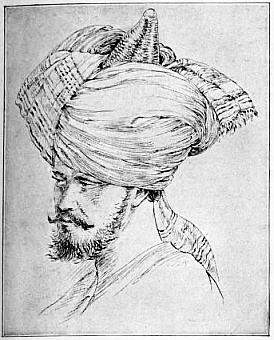
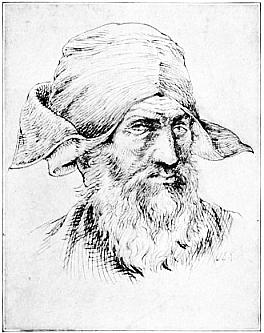
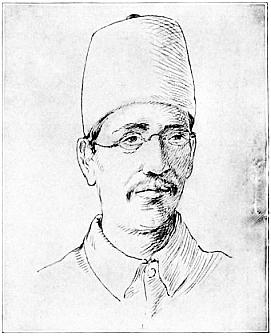
Fig. 4.—Punjabi Mahommedan wearing pagri, with shimla, achkan izār or paejamas. Fig. 5.—Bombay or Gujarati Bora wearing white and gold turban with red top. Fig. 6.—Mahommedan Jat cultivators. Wife:—with izār, kurta, and orhni or chadar; husband:—with majba, chadar, and joridar pagri.
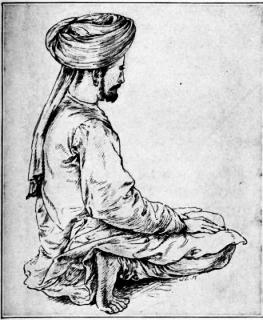
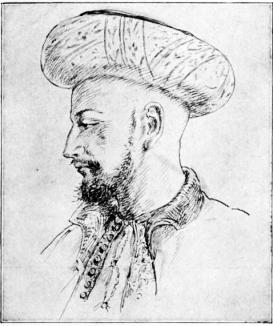
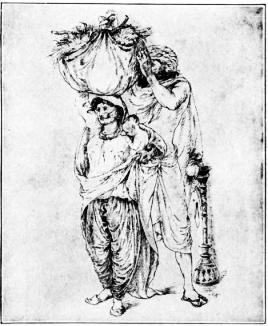
Fig. 7.—The Parsi khoka, a tall hat of glazed chintz. Fig. 8.—Parsi woman wearing Parsi sari and mathabana or white hair cover. Fig. 9.—Parsi schoolgirl. Fig. 10.—Parsi pith hat with felt brim. From Pen and Ink Drawings by J. Lockwook Kipling, C.I.E.
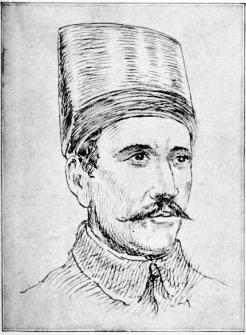
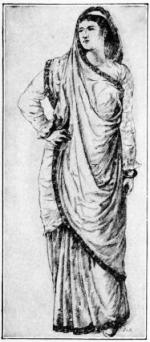
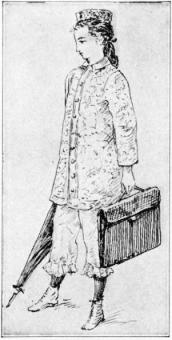
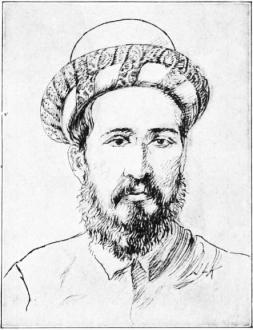
Plate II.
Fig. 1.—Deccan Brahman wearing pagri, dhoti or pitamber, angā and dopatta. Fig. 2.—Brahman wearing dhoti and janeo or sacred thread. This is the dining and sacrificial dress of most Hindus. Fig. 3.—Rajput wearing chapkan, which is worn both by Mussulmans and Hindus, buttoning on different sides.
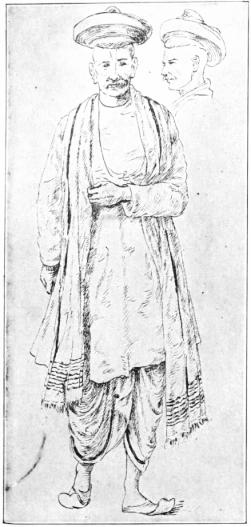
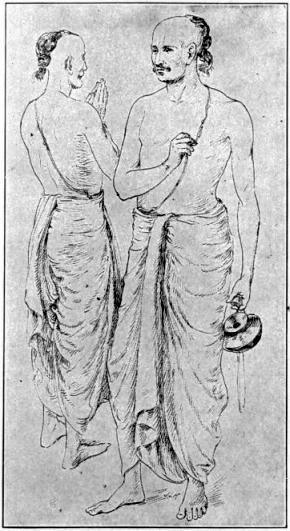
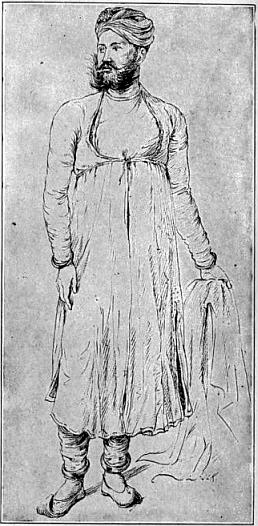
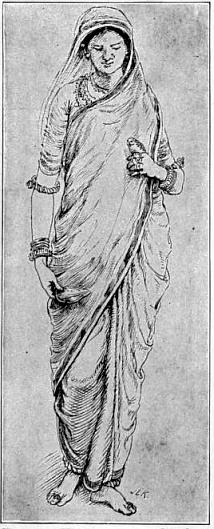
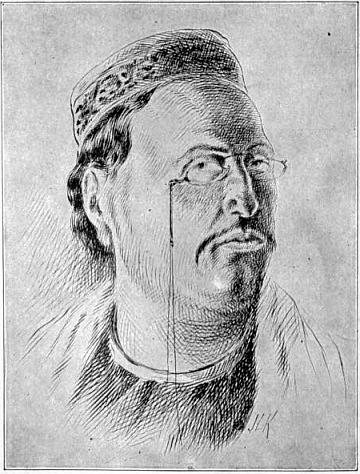
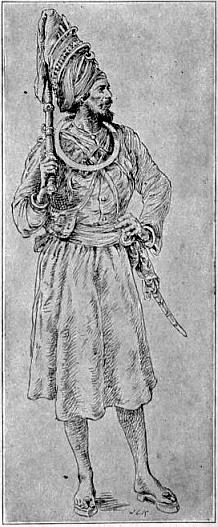
Fig. 4.—Hindu woman showing method of wearing the sari. Fig. 5.—Bengali Babū wearing the most popular form of the embroidered cap. Fig. 6.—Sikh devotee, Akali or Nihung, vowed to the wearing of blue and steel, &c. From Pen and Ink Drawings by J. Lockwook Kipling, C.I.E.
The new fashion in vogue amongst the younger generation of Mussulman is called the ikbārah or patalūnnumā, which is like the European trousers. They are usually made of calico; they have no buttons but are fastened with string (kamarband). Bathing drawers are called ghutannah and reach to the knee. The tight drawers worn by wrestlers are called janghiah.
Garments for outdoor wear are the angā, or angarkhā, the chapkan, the achkan or sherwāni; the angā, a coat with full sleeves, is made of any material, white or coloured. It is slit at the sides, has perpendicularly cut side-pockets, and is fastened with strings just below the breast. It is opened on the right or left side according to local custom. The angā is now considered old-fashioned, and is chiefly worn by elderly men or religious persons. It is still not uncommon in Delhi, Agra, Lucknow and at native courts, but is being superseded by the achkan (Plate I. fig. 4), which is buttoned straight down the front. Both angā and achkan reach to a little below the knee, as also does the chapkan, a relic of Mogul court dress, best known as the shield-like and highly adorned coat worn by government chaprasis (Plate II. fig. 3). Over the angā is sometimes worn an overcoat called a chogā; this is made of any material, thick or thin, plain or ornamented; it has one or two fastenings only, loops below the breast whence it hangs loosely to below the knees. The chogā is sometimes known by its Arabic names abā or kabā, terms applied to it when worn by priests or ulemas. In cold weather Pathans and other border residents wear posteens, sleeved coats made of sheepskin with the woolly side in. In India farther south in cold weather an overcoat called daglā is worn; this is an angā padded with cotton wool. A padded chogā is called labādā; when very heavily padded farghūl. Whereas the European wears his waistcoat under his coat, the Indian wears his over his angā or chapkan (not over the achkan). A sleeveless waistcoat generally made of silk is called a sadari; when it has half sleeves it is called nimāstīn; the full-sleeved waistcoat worn in winter padded with cotton is called mirzāi. For ceremonial purposes a coat called jāmā is worn. This fits closely as to the upper part of the body, but flows loosely below the waist. It is generally white, and is fastened in front by strings.
In Gujarat and other parts of western India are to be found classes of Moslems who differ somewhat from those met with elsewhere, such as Memans, Borās and Khojās. The first are Sunnis: the two last Shias. Memans wear (1) a gold embroidered skull-cap, (2) a long kamīs fastened at the neck with 3 or 4 buttons on a gold chain, (3) sadariya, i.e. a tight waistcoat without sleeves, fastened in front with small silk buttons and loops, (4) an over-waistcoat called shāyā-sadriya instead of the angā, with sleeves, and slits at the sides (probably of Arab origin). When he does not wear a skull-cap his amāmāh is made after the arched Arab form, or is a Kashmir scarf wound round a skull-cap made of Java straw. The Borā adopts one of four forms of pagri; the Ujjain, a small neatly bound one; the Āhmadābād, a loose high one; the Surat, fuller and higher than the Ujjain pattern (Plate I. fig. 5); or the Kathiāwādā, a conical turban with a gold stripe in the middle of the cone. The Borā wears the angā, otherwise he resembles the Meman. The Khoja wears a pagri smaller than the Meman’s, called a Moghalāi phentā; this leaves a portion of the head bare at the back. The material is always of kashīda, a kind of embroidered cloth. Amongst Mahommedans only Pathans wear ear-rings.
Mahommedan Women. Head-dress.—The rupatta (also called dopatta), or veil, is of various colours and materials. Its length is about 3 yds., its width about 1½. It is worn over the head and thrown over the left shoulder. It is considered essential to modesty to cover the head. This head-dress is also known as orhna, orhni, pochan, pochni (Baluchistan and western India) chundri, reo (Sind), sipatta, takrai or chadar (Pathan). Among the poorer classes it is called pacholi. Farther south in India when of thicker material it is called chadar or chaddar. It is called pachedi, potra or malāyā by Meman, Borā and Khojā women. As a rule married women wear brighter colours than unmarried ones. In Kashmir a small round cap, goltopi, is worn. The kassawa is a handkerchief bound over the head and tied at the back, and is worn by Mahommedan women indoors to keep the hair tidy; Mahommedan women plait their hair and let it hang down behind (Plate I. fig. 6).
Clothing.—A short jacket fastened at the back and with short sleeves is worn. It may be of any material. In Sind, Gujarat and other parts of western India it is called a choli. It is also very generally known as angiyā. Other common names are mahram and sināband (breast-cover). The kūrtā is a sort of sleeveless shirt, open in front and reaching to the waist. It may be of any material. When this is worn with the angiya it is worn over it. This combination of dress is worn only by young married women. In Kashmir and northern India generally the angiya is not worn, and the kūrtā is worn instead. This is like the kamīs of the man, already described; it has full sleeves, is open at the front, which is embroidered, and reaches to the knee or lower. Among Pathans there are two kinds of kūrtā (kamīs or khat); one worn by married women called gìrādānā khat is dark red or blue, embroidered with silk in front; the jalānā khat worn by unmarried women is less conspicuous for colour and ornament. A large pocket (jeb) is often sewn on in front like the Highlander’s sporran.
The Pa’ejāmās, also called izār, are cut like those of men, and known by the same names. They differ only in being of silk or other fine material and being coloured (Plate I. fig. 6). Among Pathans they are called partog or partek (pardek), and those of unmarried girls are of white, while married women wear them of susi, a kind of coloured silk or cotton. As a general rule the wearing of paijāmās is the chief distinction between Mussulman and Hindu women. In the Shahpur and other districts, however, where Mahommedans have followed Hindu customs, Moslem women wear the majlā, a cloth about 3 yds. long by 1½ wide tied tightly round the waist so as to fall in folds over the legs. Even Mahommedan men sometimes wear the majlā in these districts. This form of dress is known among Moslems as tahband [lower binding] (Plate I. fig. 6). In Rajputana, Gujarat and the southern Punjab, Mahommedan women sometimes wear a lhenga or ghagra skirt without trousers; in the Sirsa district and parts of Gujarat the ghagra is worn over the trousers. The sadari or waistcoat is worn by women as well as men. The tillak or peshwaz is a dress or robe the skirt and bodice of which are made in one piece, usually of red or other coloured material; it is common in Gujarat, Rajputana and the Sirsa district, and is the style usually adopted by nautch girls when dancing. Meman women wear also the abā, or overcoat, which differs from that worn by men in that it has loose half sleeves, and fastens with two buttons at each side of the neck over the shoulders; it is embroidered on the breast, and adorned with gold lace on the skirts.
In Delhi, Lucknow, Agra and other towns in the Punjab and the United Provinces a special wedding dress is worn by the bride, called rīt-kājorā, the “dress of custom.” It is worn on the wedding night only; and it is a rule that no scissors are employed in making it. The trouser string of this dress is not the usual kamarband, but is made of untwisted cotton thread called kalāwā. Out of doors Mahommedan women wear the būrkā, a long loose white garment entirely covering the head and body. It has two holes for the eyes. Mahommedan women pencil the eyes with kohl or sūrmā, use missi for the teeth and colour the palms and nails of the hand with henna. A nose-ring is a sign of marriage.
Hindus.—Caste does not influence dress amongst Hindus as much as might be expected. The garment distinctive of the Hindus of all castes, men and women, all over India, is the dhoti or loin cloth. It is a very ancient dress, and their gods are represented as clothed in it in old sculptures.
The general term used for clothing is kaprā, latā or lugā. Under Mahommedan influence Hindu clothing developed into “suits,” consisting of five pieces for men, hence called pancho tuk kapra—(1) head-dress, (2) dhoti, (3) coat, (4) chaddar or sheet, (5) bathing cloth; and three for women, hence called tīn tuk—(1) dhoti, (2) jacket, (3) shawl.
Men.—The Hindu (except the Rajput) shaves his head, leaving only a top-knot on the point of the skull. He shaves the face (except the eye-brows) and his body. The Rajput wears a full beard and whiskers, usually parted in the middle. He sometimes draws the beard and whiskers to the side of the head, and to keep it tidy wraps round it a cloth called dhātā or galmochā.
Head-dress.—Hindus wear sometimes turbans and sometimes caps. When the turban is worn it is always of the pagri form, never the amāmāh. Hindus wind the pagri in various ways as described for Mussulmans, but the angles are formed over the ears and not from front to back. Mahrattas wear flat red pagris, with a small conical peak variously shaped and placed. The pagri is known in different parts of India as pāg, phentā, phag, phagdi and many other names. In Bengal a sort of turban is worn which can be taken off like a hat. When Hindus wear caps or topis they resemble those worn by Mahommedans, but they never wear the fez, tārbūsh or irāni topi. In Gaya a peculiar cap made of tāl leaves is worn in rainy weather, called ghungā. Bengalis, whether Brahmans or of other castes, frequently go bareheaded.
Body Clothing.—The dhoti is a simple piece of cloth (cotton), generally white. It is wound round the loins, the end passed between the legs from front to back and tucked in at the waist behind (Plate II. fig. 2). The small form of dhoti worn by men of the lower class is called langoti. It does not fall below mid-thigh. A Brahman’s dhoti, as also that of some other castes, reaches to a little below the knee; a Rajput’s to his ankles. The dhoti is known under many names, dhutia, pitambar, lungi, &c. In some parts of India half the dhoti only is wound round the loins, the other half being thrown over the left shoulder. Some upper classes of Hindus wear for coat the kūrtā; most wear the angharkā (Plate II. fig. 1), a short angā reaching to the waist. It is also known as kamri, baktari, badan or bandi. Hindus wear the angharkhā or angā as Mahommedans do, but whereas the Mahommedan has the opening on the left the Hindu wears it on the right. When the kūrtā is worn it is worn under the angā. The chaddar (chadar or dopatta) is of various kinds. It is a piece of cotton cloth 3 yds. long by 1 yd. wide. It is worn across the shoulders, or wrapped round the body, but when bathing, round the loins. Hindus, both men and women, wear ear-rings.
The Brakminical thread (janeo) (Plate II. fig. 2) is a cord made of twisted cotton prepared with many ceremonies. It is worn over the left shoulder and hangs down to the right hip. It is of three strands till the wearer is married, when it becomes six or nine. It is 96 handbreadths in length, and is knotted. Rajputs also wear this thread, similar in make and length, but the knots are different.
Caste and sect marks also distinguish Hindus from each other.
Women.—The hair is sometimes worn plaited (chotì), usually an odd number of thin plaits made into one large one, falling down the back and fastened at the end with ribbons. Another style is wearing it in a knot after the ancient Grecian fashion; it is always worn smooth in front and parted in the middle. Over the head is worn the orhna or veil. The end is thrown over the left shoulder in such a manner as to conceal the breast. On the upper part of the body the kūrtā is sometimes worn. A bodice called angiyā is worn. This covers the breast and shoulder; it has half sleeves, is very short, and is fastened at the back with strings.
The skirt is called lhenga or ghagra. It is worn mostly in Rajputana hanging in full flounces to the knee or a little below. In Bengal, Madras and Bombay Presidencies women do not wear a skirt, only a choli and sārī. This last is a long piece of cotton or silk cloth. Half is draped round the waist and hangs to the feet in folds; the remainder is passed over the head and thrown over the left shoulder (Plate II. fig. 4).
Sikh.—The Sikh does not shave or cut his hair. The beard is parted in the middle and carried up each side of the face to the top of the head. A piece of cloth called dhātā or galmochā is wound round the chin and head so as to keep the hair clean and tidy. The hair of the head is tied into a knot (kes) at the top of the head or at the back, a distinguishing mark of the Sikh. His religion requires the Sikh to carry five articles—kes, the knot of hair on the head; the kanga, a comb; the kard, a knife; the kach, a pair of short trousers peculiar to the Sikh; and the kharā, an iron bangle on the wrist. It is de rigueur that he should carry some piece of iron on his person. His head-dress he calls a pāg; it is a turban of amāmāh shape but enormously large. The Sikh nobility and gentry wear two turbans, either both of pagri form or one of pagri and one of amāmāh form. Each is of a different colour.
The Sikh calls his kūrtā jhaggā; it is very large and loose, bound with a scarf round the waist. The kach is a sort of knickerbockers reaching to just below the knee, which they encircle tightly. Over all the Sikh wears the choga. In outlying villages he wears instead of the kūrtā a chādar or cloth, which he calls khes, on the upper part of his body. Some village Sikhs wear a tahband or waistcloth instead of the kach. Sikhs are fond of jewelry and wear ear-rings. The dress of Sikh women does not differ greatly from that of Hindu women; but in the Sirsa district and some other parts she wears the Mahommedan sutan or trousers, under the lhenga or skirt. There is a small sect of Sikh known as Akāli or Nihang. Their dress is entirely of dark blue colour, the turban being also blue, high and pointed; on it are fastened three steel quoits. The quoit was the ancient weapon of the Sikh, who calls it chakar. Certain steel blades are stuck through the body of the turban. The Akālis also wear large flat iron rings round the neck and arms (Plate II. fig. 6).
Parsis.—When the Parsis were first admitted into India, certain conditions were imposed upon them by the Hindus; among others they were not to eat beef, and they were to follow the Hindu custom of wearing a top-knot of hair. Old-fashioned Parsis in country districts still follow these customs. To uncover the head is looked upon as a sin; hence Parsis of both sexes always wear some head covering whether indoors or out. In the house the man wears a skull cap; out of doors the older Parsis wear the khoka, a tall hat, higher in front than at the back, made of a stiff shiny material, with a diaper pattern (Plate I. fig. 7). The younger generation adopted a round pith hat with a rolled edge of felt, but, under the influence of the swadeshi movement, they have generally reverted to the older form (Plate I. fig. 10). Next to the skin the Parsi wears a sadra or sacred shirt, with a girdle called kasti. Over the sadra a white cotton coat is worn, reaching to a little below the waist. The Parsi wears loose cotton trousers like a Mussulman. In country districts he wears a jāmā, and over the jāmā a pechodi or shoulder cloth. The young Parsi in Bombay has adopted European dress to a great extent, except as to head-gear. The Parsi woman dresses her hair in the old Greek fashion with a knot behind. She also wears a sadra or sacred shirt. Country Parsis in villages wear a tight-fitting sleeveless bodice, and trousers of coloured cloth. Over all she winds a silken sari or sheet round the body; it is then passed between the legs and the end thrown over the right shoulder. Out of doors she covers her head and right temple (Plate I. fig. 8). In towns the sari is not passed between the legs, but hangs in loose folds so as to hide the trousers. The upper classes wear a sleeved polka jacket instead of the bodice. Parsi children up to the age of seven wear cotton frocks called jabhlan. They wear long white trousers of early Victorian cut, with frills at the bottom. They wear a round cap like a smoking-cap. The little girls wear their hair flowing loose (Plate I. fig. 9).
Shoes.—There is no distinction between the shoes worn by Hindus, Moslems, Sikhs or Parsis, but Hindus will not wear them when made of cow’s leather. Shoes are called juta, juti or jute by Mahommedans, and jore or zore by Hindus. Shoes are usually distinguished by the name of the material, as nāri kā jūtā, leather shoes, banati jūtā, felt shoes, and so on.
There are innumerable styles of cut of shoe, three being the commonest: (1) Salimshahi, these are shaped like English slippers, but are pointed at the toe, terminating in a thin wisp turned back and fastened to the instep. They are mostly made of thin red leather, plain in the case of poorer people and richly embroidered in the case of rich people. This cut of shoe is most in vogue amongst Moslems. (2) Gol panjē ki jūti, like English slippers, but rounded at the toes. (3) Gheltā or nāgphani (snake’s head) jutā, the toe is turned up, while the back part is folded inwards and trodden under the heel. Ladies usually wear shoes of this fashion, known as phiri juti. Women’s shoes differ only in size and in being made of finer material, and in being embroidered. Hindu women seldom wear shoes. On the northern frontier the pattern known as the kafshi is worn; this is a slipper having neither sides nor back; the sole towards the heel is narrow and raised by a small iron-shod heel. In the hills shoes resembling sandals, called chaplis, made of wood, straw or grass are worn. The soles are very thick, and are secured with straps; there is generally a loop for the big toe. They are known as phulkārru in Kashmir, and pula in Kulu and Chamba.
Shoes are invariably removed on entering mosques or other holy places. It is also customary to remove them when entering a house. Orientals sit on the floor in preference to chairs; hence it is thought very necessary by them that the carpet should be kept clean, which could not be done were persons to keep their shoes on. While it would be considered a breach of good manners to enter a room with the shoes on, an exception has been made in favour of those natives who have adopted European boots or shoes. The babus of Bengal have taken to English-made shoes of patent leather worn over white socks or stockings.
Authorities.—The Indian section of the Victoria and Albert Museum (London) includes an exhibition of oriental dress; and the library of the India Office many prints and photographs. The following books may be consulted: Coloured Drawings illustrating the Manners and Customs of Natives of India (originally prepared by order of the marquess Wellesley, Governor-General; vide Council minute dated 16th August, 1866) (1 vol.); J. Forbes Watson and J. W. Kaye, The People of India; F. Baltazar Solvyns, Les Hindous (4 vols. illustrated, Paris, 1808); India Office Library, 3 small portfolios of pictures of Katch and Bombay men and women; Costume of Bala Ghat (Carnatic), S.E. India (large water-colours, India Office Library); Illustrations of various trades in Kashmir, by Indian artists (India Office Library); R. H. Thalbhoy, Portrait Gallery of Western India (1886) (chiefly portraits of Parsi notables); Edward Tuite Dalton, C.S.I., Descriptive Ethnology of Bengal (1 vol., 1872); Talboys Wheeler, History of the Imperial Assembly at Delhi, 1st January 1877; Queen Victoria’s Jubilee, 6th February 1887 (in Urdu, illustrated); T. H. Hendley, C.I.E., V.D., Rulers of India and Chiefs of Rajputana (London, 1897)—the last three are useful for the study of ceremonial dress; G. A. Grierson, Bihar Peasant Life (Calcutta, 1885; this is a most valuable work of learning and research; in division 2, subdivision 3, chapter 1, on clothes, will be found names and descriptions of every article of clothing used in south, central and eastern India); H. B. Baden-Powell, Handbook of Manufactures and Arts of the Punjab (Lahore, 1872); W. W. Hunter, Statistical Account of Bengal (1875); Hughes’ Dictionary of Islam (London, 1895); Sir Denzil Ibbetson, Outlines of Punjab Ethnography; E. Thurston, Castes and Tribes of Southern India. It is to be hoped that steps will shortly be taken to arrange articles of costume now displayed at the Indian Section, Victoria and Albert Museum, in some systematic order so as to assist students in arriving at a scientific knowledge of the subject.
(C. G.)
1 The spelling throughout all the articles dealing with India is that adopted by the government of India, modified in special instances with deference to long-established usage.
2 The historicity of this convention, not now usually admitted by scholars, is maintained by Bishop Copleston of Calcutta in his Buddhism, Primitive and Present (1908).
3 In 1909 the excavation of a ruined stupa near Peshawar disclosed a casket, with an inscription of Kanishka, and containing fragments of bones believed to be those of Buddha himself.
4 In 1909 an inscription in Brahmi characters was discovered near Bhilsa in Central India recording the name of a Greek, Heliodorus. He describes himself as a worshipper of Bhagavata (= Vishnu), and states that he had come from Taxila in the name of the great king Antialcidas, who is known from his coins to have lived c. 170 B.C.
5 This is the conventional European form of the name. For other forms see Yue-Chi.
6 V. A. Smith, Early Hist. of India, p. 238.
7 Smith, op. cit. pp. 239, &c., says that he probably succeeded Kadphises II. about A.D. 120. Dr Fleet dates the beginning of Kanishka’s reign 58 B.C. (see Inscriptions: Indian). Mr Vincent Smith (Imp. Gaz. of India, The Indian Empire, ed. 1908, vol. ii. p. 289, note) dissents from this view, which is also held by Dr Otto Franke of Berlin, stating that Dr Stein’s discoveries in Chinese Turkestan “strongly confirm the view” held by himself.
8 See V. A. Smith, op. cit. pp. 297, &c.
9 His era, however, is dated from 606.
10 So V. A. Smith, op. cit. p. 314, who on this point differs from Sylvain Levi and Ettinghausen.
11 For Harsha’s reign see Smith, op. cit. xiii. 311-331.
12 This has been Englished by Anglo-Indians into “puggaree” or “pugree” and applied to a scarf of white cotton or silk wound round a hat or helmet as a protection against the sun.
13 Anglicized as “pyjamas” (in America “pajamas”), the term is used of a form of night-wear for men which has now generally superseded the night-shirt. This consists of a loose coat and trousers of silk, wool or other material; the trousers are fastened by a cord round the waist.
INDIA, FRENCH, a general name for the French possessions in India—on the Coromandel coast, Pondicherry, Karikal and Yanaon; on the Malabar coast, Mahé; and in Bengal, Chandernagore. In addition there are a few “lodges” elsewhere, but they are merely nominal remnants of French factories. The total area amounts to 203 sq. m., of which 113 sq. m. belong to the territory of Pondicherry. In 1901 the total population amounted to 273,185. By decree of the 25th of January 1879 French India was provided with an elective general council and elective local councils. The results of this measure have not been very satisfactory, and the qualifications for and the classes of the franchise have been modified. The governor resides at Pondicherry, and is assisted by a council. There are two tribunals of first instance (at Pondicherry and Karikal), one court of appeal (at Pondicherry) and five justices of the peace. The agricultural produce consists of rice, earth-nuts, tobacco, betel nuts and vegetables.
History.—The first French expedition to India is believed to have taken place in the reign of Francis I., when two ships were fitted out by some merchants of Rouen to trade in eastern seas; they sailed from Havre in that year and were never afterwards heard of. In 1604 a company was granted letters patent by Henry IV., but the project failed. Fresh letters patent were issued in 1615, and two ships went to India, only one returning. La Compagnie des Indes was formed under the auspices of Richelieu (1642) and reconstructed under Colbert (1664), sending an expedition to Madagascar. In 1667 the French India Company sent out another expedition, which reached Surat in 1668, where the first French factory in India was established. In 1672 Saint Thomé was taken, but the French were driven out by the Dutch and retired to Pondicherry (1674). In 1741 Dupleix became governor of Pondicherry and in 1744 war broke out between France and England; for the remaining history of the French in India see India.
See Haurigot, French India (Paris, 1887); Henrique, Les Colonies françaises (Paris, 1889); Lee, French Colonies (Foreign Office Report, 1900); L’Année coloniale (Paris, 1900); and F. C. Danvers, Records of the India Office (1887).
INDIANA, a north-central state of the United States of America, the second state to be erected from the old North-West Territory; popularly known as the “Hoosier State.” It is located between latitudes 37° 47′ and 41° 50′ N. and longitudes 84° 49′ and 88° 2′ W. It is bounded on the N. by Michigan and Lake Michigan, on the E. by Ohio, on the S. by Kentucky from which it is separated by the Ohio river, and on the W. by Illinois. Its total area is 36,350 sq. m., of which 440 sq. m. are water surface.
Physiography.—Topographically, Indiana is similar to Ohio and Illinois, the greater part of its surface being undulating prairie land, with a range of sand-hills in the N. and a chain of picturesque and rocky hills, known as “Knobs,” some of which rise to a height of 500 ft., in the southern counties along the Ohio river. This southern border of hills is the edge of the “Cumberland Plateau” physiographic province. In the northern portion of the state there are a number of lakes, of glacial origin, of which the largest are English Lake in Stark county, James Lake and Crooked Lake in Steuben county, Turkey Lake and Tippecanoe Lake in Kosciusko county and Lake Maxinkuckee in Marshall county. In the limestone region of the south there are numerous caves, the most notable being Wyandotte Cave in Crawford county, next to Mammoth Cave the largest in the United States. In the southern and south-central part of the state, particularly in Orange county, there are many mineral springs, of which the best known are those at French Lick and West Baden. The larger streams flow in a general south-westerly direction, and the greater part of the state is drained into the Ohio through the Wabash river and its tributaries. The Wabash, which has a total length of more than 500 m., has its headwaters in the western part of Ohio, and flows in a north-west, south-west, and south direction across the state, emptying into the Ohio river and forming for a considerable distance the boundary between Indiana and Illinois. It is navigable for river steamboats at high water for about 350 m. of its course. Its principal tributaries are the Salamanie, Mississinewa, Wild Cat, Tippecanoe and White rivers. Of these the White river is by far the most important, being second only to the Wabash itself in extent of territory drained. It is formed by the confluence of its East and West Forks, almost 50 m. above its entrance into the Wabash, which it joins about 100 m. above the Ohio. Other portions of the state are drained by the Kankakee, a tributary of the Illinois, the St Joseph and its principal branch, the Elkhart, which flow north through the south-west corner of Michigan and empty into Lake Michigan; the St Mary’s and another St Joseph, whose confluence forms the Maumee, which empties into Lake Erie; and the White Water, which drains a considerable portion of the south-west part of the state into the Ohio.
Flora and Fauna.—The flora of the state is varied, between 1400 and 1500 species of flowering plants being found. Among its native fruits are the persimmon, the paw-paw, the goose plum and the fox grape. Cultivated fruits, such as apples, pears, peaches, plums, grapes and berries, are raised in large quantities for the market. The economic value of the forests was originally great, but there has been reckless cutting, and the timber-bearing forests are rapidly disappearing. As late as 1880 Indiana was an important timber-producing state, but in 1900 less than 30% of the total acreage of the state—only about 10,800 sq. m.—was woodland, and on very little of this land were there forests of commercial importance. There are about 110 species of trees in the state, the commonest being the oak. The bald cypress, a southern tree, seems to be an anomalous growth. Blue grass is valuable for grazing and hay-making. The principal crops include Indian corn, wheat, oats, potatoes, buckwheat, rye and clover.
The fauna originally included buffalo, elk, deer, wolves, bear, lynx, beaver, otter, porcupine and puma, but civilization has driven them all out entirely. Rattlesnakes and copperheads were formerly common in the south. The game birds include quail (Bob White), ruffed grouse and a few pinnated grouse (once very plentiful, then nearly exterminated, but now apparently reappearing under strict protection), and such water birds as the mallard duck, wood duck, blue- and green-winged teals, Wilson’s snipe, and greater and lesser yellow legs (snipe). The song birds and insectivorous birds include the cardinal grosbeak, scarlet and summer tanagers, meadow lark, song sparrow, catbird, brown thrasher, wood thrush, house wren, robin, blue bird, goldfinch, red-headed woodpecker, flicker (golden-winged woodpecker), and several species of warblers. The game fish include the bass (small-mouth and large-mouth), brook trout, pike, pickerel, and muskallonge, and there are many other large and small food fishes.
Climate.—The climate of Indiana is unusually equable. The mean annual temperature is about 52° F., ranging from 49° F. in the north to 54° in the south. The mean monthly temperature varies from 25° in the months of December and January to 77°-79° in July and August. Cold winds from the Great Lakes region frequently cause a fall in temperature to an extreme of −25° F. in the north and north central parts of the state. The mean annual rainfall for the entire state is about 43 in., varying from 35 in. in the north to 46 in. in the Ohio Valley.
The soil of the greater part of the state consists of a drift deposit of loose calcareous loam, which extends to a considerable depth, and which is exceedingly fertile. In the Ohio and White Water river valleys a sandstone and limestone formation predominates. The north and north central portions of the state, formerly rather swampy, have become since the clearing of the forests as productive as the south central. The most fertile part of the state is the Wabash valley; the least fertile the sandy region, of small extent, immediately south of Lake Michigan.
Industry and Manufactures.—Agriculture has always been and still is the chief industry of the state of Indiana. According to the census of 1900, 94.1% of the land area was included in farms, and of this 77.2% was improved. The proportion of farms rented comprised 28.6% of the whole number, four-fifths of these being rented on a share basis. The average size of farms, which in 1850 was 136.2 acres, had decreased to 105.3 acres in 1880 and to 97.4 acres in 1900. The value of the farm property increased from $726,781,857 in 1880 to $978,616,471 in 1900. The farms are commonly cultivated on the three-crop rotation system. The proximity of such good markets as Chicago, Cincinnati, St Louis and Louisville, in addition to the local markets, and the unusual opportunities afforded by the railways that traverse every portion of the state, have been important factors in the rapid agricultural advance which has enabled Indiana to keep pace with the newly developed states farther west. Indiana was ninth in the value of its agricultural products in 1889, and retained the same relative rank in 1899, although the value had considerably more than doubled, increasing from $94,759,262 in 1889 to $204,450,196 in 1899. The principal crops in which the state has maintained a high relative rank are Indian corn, wheat and hay; the acreage devoted to each of these increased considerably in the decade 1890-1900. In 1907, according to the Department of Agriculture, the acreage of Indian corn was 4,690,000 acres (7th of the states), and the yield was 168,840,000 bushels (5th of the states); of wheat, 2,362,000 acres (6th of the states) was planted, and the crop was 34,013,000 bushels (7th of the states); and 2,328,000 acres of hay (the 8th largest acreage among the states of the United States) produced 3,143,000 tons (the 8th largest crop). Other important staple crops are oats, rye and potatoes, of which the crops in 1907 were respectively 36,683,000 bushels, 961,000 bushels, and 7,308,000 bushels. There are no well-defined crop belts, the production of the various crops being general throughout the state, except in the case of potatoes, most of which are raised in the sandy regions of the north. The value of the orchard products is large, and is steadily increasing: in the decade 1890-1900 the number of pear trees increased from 204,579 to 868,184, and between 1889 and 1899 the crop increased from 157,707 to 231,713 bushels. Of apple trees, which surpass all other orchard trees in number, there were more than 8,600,000 in 1900. The total value of the state’s orchard products in 1899 was $3,166,338, and the value of small fruits was $1,113,527. The canning industry both for fruits and small vegetables has become one of much importance since 1890.
Stock-raising is an industry of growing importance, the value of the live stock in the state increasing from $71,068,758 in 1880 to $93,361,422 in 1890 and $109,550,761 in 1900. Sheep-raising, however, which is confined largely to the north and east portions of the state, decreased slightly in importance between 1890 and 1900. The value of the dairy products sold in 1899 (census of 1900) was $8,027,370, nearly one-half of which was represented by butter; and the total value of dairy products was $15,739,594.
In the value, extent and producing power of her manufacturing industries Indiana has made remarkable advance since 1880. This increase, which more than kept pace with that of the country as a whole, was due largely to local causes, among which may be mentioned the unusual shipping facilities afforded by the network of railways, the discovery and development of natural gas, and the proximity of coal fields, the gas and the coal together furnishing an ample supply of cheap fuel. The number of manufacturing establishments (under the “factory” system) within the state was 7128 in 1900, 7044 in 1905; their invested capital was $219,321,080 in 1900 and $312,071,234 in 1905, an increase of 42.3%; and the value of their total product was $337,071,630 in 1900 and $393,954,405 in 1905, an increase of 16.9%. The most important manufactured products in 1905 were flour and grist mill products, valued at $36,473,543; in 1900, when they were second in importance to slaughter-house products and packed meats, they were valued at $29,037,843. Next in importance in 1905 was the slaughtering and meat-packing industry, of which the total product was valued at $29,352,593; in 1900 it was valued at $43,862,273. Other important manufactured products were: those of machine shops and foundries, the value of which increased from $17,228,096 in 1900 to $23,108,516 in 1905, or 34.1%; distilled liquors, the value of which had increased from $16,961,058 in 1900 to $20,520,261 in 1905, an increase of 21%; iron and steel, valued at $19,338,481 in 1900 and at $16,920,326 in 1905; carriages and wagons, valued at $12,661,217 in 1900 and at $15,228,337 in 1905; lumber and timber products, valued at $19,979,971 in 1900 and at $14,559,662 in 1905; and glass, valued at $14,757,883 in 1900 and at $14,706,929 in 1905—this being 3.7% of the product value of all manufactures in the state in 1905, and 18.5% of the value of glass produced in the United States in that year. The growth in the preceding decade of the iron and steel industry, the products of which increased in value from $4,742,760 in 1890 to $19,338,481 in 1900 (307.7%), and of the manufacture of glass, the value of which increased from $2,995,409 in 1890 to $14,757,883 in 1900 (392.7%), is directly attributable to the development of natural gas as fuel; the decrease in the value of the products of these same industries in 1900-1905 is partly due to the growing scarcity of the natural gas supply. As compared with the other states of the United States in value of manufactured products, Indiana ranked second in 1900 and in 1905 in carriages and wagons, glass and distilled liquors; was seventh in 1900 and fourth in 1905 in furniture; was fourth in 1900 and seventh in 1905 in wholesale slaughtering and meat-packing; was fifth in 1900 and sixth in 1905 in agricultural implements; and in iron and steel and flour and grist mill products was fifth in 1900 and eighth in 1905. The most important manufacturing centres are Indianapolis, Terre Haute, Evansville, South Bend, Fort Wayne, Anderson, Hammond, Richmond, Muncie, Michigan City and Elwood, each having a gross annual product of more than $6,000,000.
According to the annual report on Mineral Resources of the United States for 1906, Indiana ranked fifth in the Union in the value of natural gas produced, sixth in petroleum, and sixth in coal. Natural gas was discovered in 1886 in the east-central part of the state, and its general application to manufacturing purposes caused an industrial revolution in the immediate region. Pipe lines carried it to various manufacturing centres within the state and to Chicago, Ill., and Dayton, Ohio. During the early years an enormous amount was wasted; this was soon prohibited by law, and a realization that the supply was not unlimited resulted in a better appreciation of its great value. The gas, which is found in the Trenton limestone, had an initial pressure at the point of discovery of 325 ℔; this pressure had decreased in the field centre by January 1896 to 230 ℔, and by January 1901 to 115 ℔, the general average of pressure at the latter date being 80 ℔. The gas field extends over Hancock, Henry, Hamilton, Tipton, Madison, Grant and Delaware counties. The value of the output fell from $7,254,539 in 1900 to $1,750,715 in 1906, when the state’s product was only 4.2% of that of the entire country. On the 1st of January 1909 there were 3223 wells in operation, some of which were 1200 ft. deep. It has been found that “dead” gas wells, if drilled somewhat deeper, generally become active oil wells. The development of the petroleum field, which extends over Adams, Wells, Jay, Blackford and Grant counties, was rapid up to 1904. The annual output increased from 33,375 barrels in 1889 to 11,339,124 barrels in 1904, the latter amount being valued at $12,235,674 and being 12.09% of the value of the product of the entire country. In 1906 there was an output of only 7,673,477 barrels, valued at $6,770,066, being 7.3% of the product value of the entire country. The Indiana coal fields, which cover an area of between 7000 and 7500 sq. m. in the west and south-west, chiefly in Clay, Vigo, Sullivan, Vermilion and Greene counties, yielded in 1902 9,446,424 tons, valued at $10,399,660; in 1907, 13,985,713 tons, valued at $15,114,300; the production more than trebled since 1896, when it was 3,905,779 tons. The deposits consist of workable veins, 50 to 220 ft. in depth, and averaging 80 ft. below the surface. It is a high grade block, or “splint” coal, remarkably free from sulphur and rich in carbon, peculiarly adapted to blast furnace use. The quarries and clay beds of the state are of great value. The quarries of sandstone and limestone are chiefly in the south and south-central portions of the state. The value of the limestone quarried in 1908 was $3,643,261, as compared with $2,553,502 in 1902. The Bedford oolitic limestone quarries in Owen, Monroe, Lawrence, Washington and Crawford counties furnish one of the most valuable and widely used building stones in the United States, the value of the product in 1905 being $2,492,960, of which $2,393,475 was from Lawrence and Monroe counties and $1,550,076 from Lawrence county alone. Beds of brick-clays and potters’ clay are widely distributed throughout the state, the total value of pottery products in 1902 being $5,283,733 and in 1906 $7,158,234. Marls adapted to the manufacture of Portland cement are found along the Ohio river, and in the lake region in the north. In 1905 and 1906 Indiana ranked third among the states in the production of Portland cement, which in 1908 was 6,478,165 barrels, valued at $5,386,563—an enormous advance over 1903, when the product was 1,077,137 barrels, valued at $1,347,797. The production of natural rock cement, chiefly in Clark county, is one of the two oldest industries in the state, but in Indiana as elsewhere it is falling off—from an output in 1903 of about 1,350,000 barrels to 212,901 barrels (valued at $240,000) in 1908. There are many mineral springs in the state, and there are famous resorts at French Lick and West Baden in Orange county. A large part of the water bottled is medicinal: hence the high average price per gallon ($0.99 in 1907 when 514,366 gallons were sold, valued at $507,746, only 2% being table waters). In 1907 19 springs were reported at which mineral waters were bottled and sold; they were in Allen, Hendricks, Pike, Bartholomew, Warren, Clark, Martin, Brown, Gibson, Wayne, Orange, Vigo and Dearborn counties. A law of 1909 prohibited the pumping of certain mineral waters if such pumping diminished the flow or injured the quality of the water of any spring.
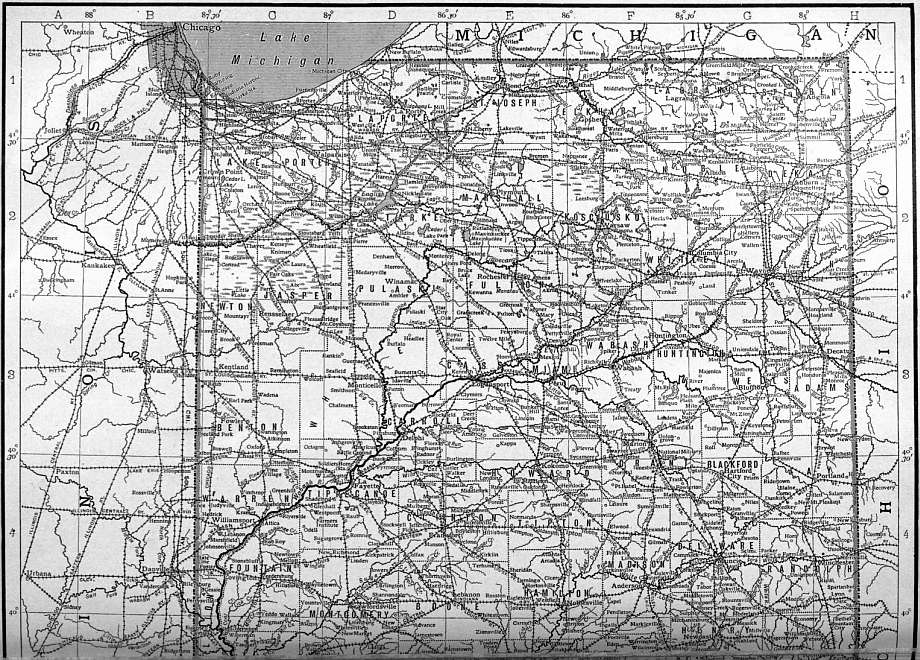
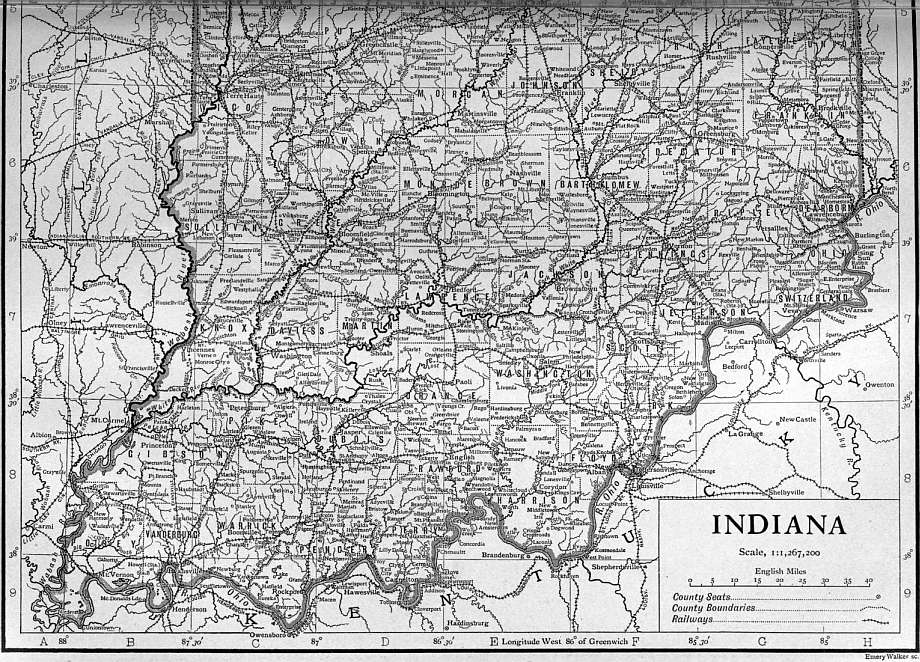
(Click to enlarge top section.)
(Click to enlarge bottom section.)
Communications.—During the early period, the settlement of the northern and central portions of the state was greatly retarded by the lack of highways or navigable waterways. The Wabash and Erie canal (1843), which connected Lake Erie with the Ohio river, entering the state in Allen county, east of Fort Wayne, and following the Wabash river to Terre Haute and the western fork of the White river from Worthington, Greene county, to Petersburg, Pike county, whence it ran south-south-west to Evansville; and the White Water canal from Hagerstown, Wayne county, mostly along the course of the White Water river, to Lawrenceburg, on the Ohio river, in the south-eastern corner of the state, although now abandoned, served an important purpose in their day. The completion (about 1850) of the National Road, which traversed the state, still further aided the internal development. With the beginning of railway construction (about 1847), however, a new era was opened. Indiana is unusually well served with railways, which form a veritable network of track in every part of the state. It is traversed by nearly all the great transcontinental trunk line systems, and also by important north and south lines. The total railway mileage in January 1909 was 7286.20 m. There has been a great development also in interurban electric lines, which have been adapted both to passenger and to light freight and express traffic; in 1908 there were 31 interurban electric lines within the state with a mileage of 1500 m. Indianapolis is the centre of this interurban network. The first trolley sleeping cars were those used on the Ohio and Indiana interurban railways. The deepening of the channel of the Wabash river was begun in 1872. Below Vincennes before 1885 boats of 3-ft. draft could navigate the river, but after work was concentrated in 1885 on the lock at Grand Rapids, near Mt Carmel, Ill., the channel was soon clogged again, and in 1909 it was impossible for boats with a greater draft than 20 in. to go from Mt Carmel to Vincennes, although up to June 1909 about $810,000 had been spent by the Federal government on improving this river. In 1879 an appropriation was made for the improvement of the channel of the White river, but no work was done here between 1895 and 1909, and although the lower 13 m. of the river was navigable for boats with a draft of 3 ft. or less, there was practically no traffic up to 1909 on the White, because there was no outlet for it by the Wabash river.
Population.—The population of Indiana, according to the Federal Census of 1910, was 2,700,876, and the rank of the state in the Union as regards population was ninth. In 1810, the year following the erection of the western part of Indiana into Illinois Territory, the population was 24,520, in 1820 it had increased to 147,178, in 1850 to 988,416, in 1870 to 1,680,637, in 1890 to 2,192,404, and in 1900 to 2,516,462. In 1900 34.3% was urban, i.e. lived in places of 2500 inhabitants and over. The foreign-born population in the same year amounted to 142,121, or 5.6% of the whole, and the negro population to 57,505, or 2.3%. There were in 1900 five cities with a population of more than 35,000, viz. Indianapolis (169,164), Evansville (59,007), Fort Wayne (45,115), Terre Haute (36,673), and South Bend (35,999). In the same year there were 14 cities with a population of less than 35,000 (all less than 21,000) and more than 10,000; and there were 21 places with a population of less than 10,000 and more than 5000. In 1906 it was estimated that there were 938,405 members of different religious denominations; of this total 233,443 were Methodists (210,593 of the Northern Church), 174,849 were Roman Catholics, 108,188 were Disciples of Christ (and 10,259 members of the Churches of Christ), 92,705 were Baptists (60,203 of the Northern Convention, 13,526 of the National (Colored) Convention, 8132 Primitive Baptists, and 6671 General Baptists), 58,633 were Presbyterians (49,041 of the Northern Church, and 6376 of the Cumberland Church—since united with the Northern), 55,768 were Lutherans (34,028 of the Evangelical Lutheran Synodical Conference, 8310 of the Evangelical Lutheran Joint Synod of Ohio and other states), 52,700 were United Brethren (48,059 of the Church of the United Brethren in Christ; the others of the “Old Constitution”) and 21,624 of the German Evangelical Synod.
Constitution.—Indiana is governed under a constitution adopted in 1851, which superseded the original state constitution of 1816. An amendment to the constitution may be proposed by either branch of the General Assembly; if a majority of both houses votes in favour of an amendment and it is favourably voted upon by the General Assembly chosen by the next general election, the amendment is submitted to popular vote and a majority vote is necessary for its ratification. The constitution of 1816 had conferred the suffrage upon all “white male citizens of the United States of the age of twenty-one and upward,” had prohibited slavery, and had provided that no alteration of the constitution should ever introduce it. The new constitution contained similar suffrage restrictions, and further by Article XIII., which was voted upon separately, prohibited the entrance of negroes or mulattoes into the state and made the encouragement of their immigration or employment an indictable offence. This prohibition was held by the United States Supreme Court in 1866 to be in conflict with the Federal Constitution and therefore null and void. It was not until 1881 that the restriction of the suffrage to “white” males, which was in conflict with the Fifteenth Amendment (1870) to the Federal Constitution, was removed by constitutional amendment. Since that date those who may vote have been all male citizens twenty-one years old and upward who have lived in Indiana six months immediately preceding the election, and every foreign-born male of the requisite age who has lived in the United States one year and in Indiana six months immediately preceding the election, and who has declared his intention of becoming a citizen of the United States; but the General Assembly has the power to deprive of the suffrage any person convicted of an infamous crime. The Australian ballot was adopted in 1889. The general state election (up to 1881, held in October) takes place on the first Tuesday after the first Monday in November of even-numbered years. The governor and lieutenant-governor (minimum age, 30 years) and the clerk of the Supreme Court are chosen in presidential years for a term of four years,1 the other state officers—secretary of state, attorney-general, auditor, treasurer and superintendent of public instruction—every two years. The state legislature, known as the General Assembly, which meets biennially in odd-numbered years and in special session summoned by the governor, consists of a Senate of fifty members (minimum age, 25 years) elected for four years, and a House of Representatives of one hundred members (minimum age, 21 years) elected for two years. Two-thirds of each house constitute a quorum to do business. The governor has the veto power, but the provision that a bill may be passed over his veto by a majority of all elected members renders it little more than an expression of opinion.