VOLUME XIV SLICE IV Independence, Declaration of to Indo-European Languages (continued 11)
Reading edition
In Canada the most notable institutions for the education of the Indians are the Mohawk Institute at Brantford, Ontario; the Mount Elgin Institute at Muncey, Ontario; the Brandon Industrial school at Brandon, Manitoba; the Qu’Appelle Industrial school at Lebret, Saskatchewan.
The Mohawk Institute is the oldest, having been founded in 1831 by the “New England Company,” which began its work among the Canadian Iroquois in 1822. It is undenominational, aided by a government grant, and had in 1907 an average attendance of 106 out of an enrolment of 111 of both sexes. The Mount Elgin Industrial Institute was founded by the Methodist Missionary Society in 1847, and had an attendance for 1907 of 104 of both sexes. The Brandon Industrial school, under Methodist auspices, had in 1907 an attendance of 104 of both sexes. The Qu’Appelle Industrial school, under Roman Catholic auspices, had an average attendance of 210 of both sexes. All these schools receive government aid. As in the United States, Indian teachers and assistants are often employed when fitted for such labours.
The first appropriation by the Congress of the United States for the general education of the Indians was made in 1819, when the sum of $10,000 was assigned for that and closely allied purposes, and by 1825 there were 38 schools among the Indians receiving government aid, but government schools proper date from 1873 (contract schools are four years older), the order of their institution being day schools, reservation boarding schools, then non-reservation boarding schools. In 1900 the contract schools were practically abandoned and the Indian appropriation devoted to government schools altogether. Latterly some departure from this policy has occurred, following a decision of the Supreme Court. In less than a century the expenditure for Indian education increased from an annual outlay of $10,000 to one of about $5,000,000, to which must be added the expenditures from private sources, which are considerable.
Exclusive of Alaska, there were in the United States in 1906, according to the report of the Commissioner of Indian Affairs, 324 Indian schools (government 261, mission 48, contract 15), with an enrolment of 30,929 and an average attendance of 25,492 pupils, costing the government annually $3,115,953. Of the government schools 25 were non-reservation and 90 reservation boarding schools, and 146 day schools; of the mission schools 45 boarding and 3 day; of the contract schools 8 boarding and 6 public. The schools of a denominational character belonged as follows: 29 to the Catholic Church, 5 to the Presbyterian, 4 to the Protestant Episcopal, 2 to the Congregational, 2 to the Lutheran, and 1 each to the Evangelical Lutheran, Reformed Presbyterian, Methodist, Christian Reformed and Baptist. Besides there were in all 446 public schools on or near reservations which Indians could attend.
In Canada, according to the report of the Department of Indian Affairs for 1907, there was a total of 303 Indian schools (day 226, boarding 55, industrial 22), of which 45 were undenominational, 91 Church of England, 106 Roman Catholic, 44 Methodist and 1 Salvation Army. The total enrolment of pupils was 9618, with an average attendance of 6138. In several cases Indians attend white schools, not being counted in these statistics. The total amount appropriated for Indian schools during the year 1906-1907 was $356,277.
The intelligence of the American Indians north of Mexico ranges from a minimum with the lowest of the Athabaskan tribes of extreme north-western Canada and the lowest of the Shoshonian tribes of the south-western United Indian talent and capacity. States to a maximum with the highest developed members of the Muskogian and Iroquoian stocks (both the Cherokee branch and the Iroquois proper). It must be remembered, however, that the possibilities of improvement by change of environment are very great, as is shown by the fact that the Hupa of California and the Navaho of Arizona and New Mexico (also the cruel and cunning Apaches) belong to the Athabaskan family, while the Shoshonian includes many of the “civilized nations” of ancient Mexico and, in particular, the famous Aztecs. One way of judging of the intellectual character of the various stocks of North American aborigines is from the “great men” they have produced during the historical periods of contact with the whites. Many of these stocks have, of course, not had occasion for the development of great men, their small numbers, their isolation, their lack of historical experience, their long residence in an unfavourable environment, their perpetual and unrestricted democracy, &c., are some of the sufficient explanations for this state of affairs, as they would be in any other part of the world. The Eskimoan, Athabaskan, Koluschan, Wakashan (and other tribes of the North Pacific coast), Salishan and Shoshonian (except in Mexico) stocks, together with the numerous small or unimportant stocks of the Oregon-California and Gulf-Atlantic regions, have not produced any great men, although members of many tribes have been individually of not a little service to the intruding race in pioneer times and since then, or have been highly esteemed by them on account of their abilities or character, &c. Here might be mentioned perhaps Sacajawea (see Out West, xxiii. 223), the Indian woman who acted as guide and helper of the Lewis and Clark expedition and saved the journals at the risk of her life (she has now a statue erected to her memory in Seattle); Louise Sighouin, the Sahaptian convert of whom the missionary de Smet thought so much; Catherine Tekatawitha, the “Iroquois saint,” &c.
The following list will serve to indicate some of the “great men” of the Indian race north of Mexico and the stocks to which they have belonged; in it are included also some products of the contact of the two cultures:—
1. Algonkian.—In politics and in oratory, as well as in combat, this stock has produced notable characters, the conflict with the whites and the Iroquois doubtless serving to stimulate native genius. Among Algonkian notables may be mentioned “King Philip” and Powhatan; Pontiac and Tecumseh; Black Hawk; Sampson Occum; George Copway; Francis Assickinack, &c.
2. Athabaskan.—The possibilities of this stock have been recently illustrated by the Apaches, who, on the one hand, have produced Geronimo, the chief who from 1877 to 1886 gave the United States authorities such trouble, and, on the other, Dr Carlos Montezuma, a full-blood Indian, who, after receiving a good education, served the government as physician at several Indian agencies, and in 1908 was practising his profession in Chicago and teaching in the College of Physicians and Surgeons and the Post-Graduate Medical School. From these southern Athabaskans much is to be expected under favouring conditions.
3. Iroquoian.—Here, as among the Algonkian tribes, circumstances favoured the development of men of great ability. Of these may be mentioned: Hiawatha, statesman and reformer (fl. c. 1450), the chief mover in the formation of the great “League of the Iroquois”; Captain Joseph Brant; “Red Jacket”; Oronhyatekha (d. 1906), the head of the Independent Order of Foresters, an important secret charitable society, a physician, and a man of remarkable power as an organizer.
4. Sahaptian.—A remarkable Indian character was Nez Percé Joseph, the leader of his people in the troubles of 1877. In 1905, at the general assembly of the Presbyterian Church, a delegate representing both whites and Indians was Mark Arthur (b. 1873), a full-blood Nez Percé and since 1900 the successful pastor (fully ordained) of the church at Lapwai, Idaho, the oldest Presbyterian church west of the Rocky Mountains.
5. Siouan.—The most famous Indian of Siouan stock is “Sitting Bull” (d. 1890), medicine-man and chief. Miss Angel de Cora, a Winnebago, was in 1908 instructor in art at the Carlisle school.
Another, not always just or fair, method of gauging the intelligence of the North American Indians is by their ability to assimilate the culture of the whites and to profit by the contact of the two races. Curiously enough, some of the tribes at one time considered lowest in point of general intellectual equipment have shown not a little of this ability, and there is a marked difference in this respect between tribes belonging to one and the same stock. The Athabaskan stock e.g. shows such variations, or rather perhaps this stock in general exhibits a tendency to adopt the culture of other peoples, thus some of the Athabaskan tribes in Alaska have acquired elements of culture from the Eskimo; the Takulli have been influenced by the Tsimshian, and Nahané by the Tlingit, the Chilcotin by the Salish, the Sarcee by the western Algonkian tribes, and in the extreme south the Navaho by the Pueblos Indians. The Salishan stock has largely this same characteristic. Of these two peoples Mr C. Hill-Tout (The Salish and Déné, London, 1907, p. 50) says: “It would be difficult indeed to find two peoples more susceptible to foreign influences, more receptive of new ideas and more ready and willing to adopt and carry them out.” In the relations established between them and the whites not enough advantage in the proper way has been taken of this “philoneism,” which ought to have been the basis of their acquisition of our culture, or such aspects of it as suited them best. And perhaps there are other stocks of which, if we knew them well, similar things might be said. Of the Indians of the Shoshonian stock the Paiutes of Nevada and Arizona have shown themselves capable of making themselves necessary to the whites (farmers, &c.) of that region, and not falling victims to the “vices of civilization.” Although they still retain their primitive wickiups (or rush huts), they seem actually to have improved in health, wealth and character from association with the “superior” race, a rare thing in many respects among the lower Indian tribes of North America. This improvement of the Paiutes causes us not to be surprised when we find the more cultured Moquis and the “civilized” Aztecs of ancient Mexico to belong to the same Shoshonian stock. Acculturation by borrowing has played an important rôle in the development of North American Indian ideas and institutions. This is well illustrated by the history of the Plains Indians, with their numerous intertribal societies, their temporary and their permanent alliances, federations, &c. If ways and means for the transfer of elements of culture indicate intelligence, some of these tribes must rank rather high in the scale. The Algonkian, Iroquoian and Muskogian stocks, both in the case of individuals and in the case of whole tribes (or their remnants), have exhibited great ability in the directions indicated. Of the Caddoan stock the Pawnees seem gifted with considerable native ability expressing itself particularly in the matter of religion (the Hupas, of the Athabaskan stock, seem also to have “a religious sense”). Some tribes of the Siouan stock have, both in the case of individuals and as peoples, given evidence of marked intelligence, especially in relation to psychic phenomena and the treatment of adolescent youth. In their culture, their ceremonies and ritual proceedings, as well as in their material arts, the Pueblos Indians of the south-western United States show, in many ways, their mental kinship with the creators and sustainers of the civilization of ancient Mexico and Central America. From the table of Indian tribes it will be seen that aborigines of the most diverse stocks have shown themselves capable of assimilating white culture and of adapting themselves to the new set of circumstances. Progress and improvement are not at all confined to any one stock.
A very interesting fact in the history of the education of the aborigines north of Mexico is the success of the attempt to enable them to read and write their own language by means of specially prepared syllabaries, “alphabets,” Syllabaries. &c. The first of these, the still existing “Micmac hieroglyphics,” so-called, was the work of Father le Clercq in 1665, improved by Father Kauder in 1866; one of the most recent, the adaptation of the “Cree syllabary” of Evans by Peck to the language of the Eskimo of Cumberland Sound. The basis of many of the existing syllabaries is “the Cree syllabary,” or “Evans Syllabary,” invented about 1841 by the Rev. James Evans, a Methodist missionary in the Hudson’s Bay region from the study of the shorthand systems current at that time. This syllabary and modifications of it are now in use (with much printed literature) for both writing and printing among many tribes of the Algonkian, Athabaskan (modified by Morice for the Carriers, by Kirkby and others for Chipewyan, Slavé, &c.), Eskimo (modified by Peck), Siouan (Cree syllabary used by Canadian Stonies) stocks. Among the Salishan tribes of the Thompson river region, the Shushwap, Okanagan, &c., a stenographic modification (reproduced by mimeograph) by Father le Jeune of the Duployan system of shorthand has been used with great success. But the most remarkable of all these syllabaries is one more of Indian than missionary origin, in its application at least, the well-known “Cherokee alphabet” of Sequoyah, an uneducated Cherokee half-blood, who got part of his idea from an old spelling-book though his characters did not at all correspond to English sounds—at first 82, later 86 syllables were represented. Invented about 1821 the “Cherokee alphabet” was first used for printing in 1827, and has been in constant use since then for correspondence and for various literary purposes. The effect of this invention is thus described by Mooney (Myths of the Cherokee, 1902):—
“The invention of the alphabet had an immediate and wonderful effect on Cherokee development. An account of the remarkable adaptation of the syllabary to the language, it was only necessary to learn the characters to be able to read at once. No school-houses were built and no teachers hired, but the whole Nation became an academy for the study of the system, until, in the course of a few months, without school or expense of time or money, the Cherokee were able to read and write in their own language. An active correspondence began to be carried on between the Eastern and Western divisions, and plans were made for a national press, with a national library and museum to be established at the capital, New Echota. The missionaries, who had at first opposed the new alphabet on the ground of its Indian origin, now saw the advisability of using it to further their own work.”
In spite of absurdities of form and position in the characters of this syllabary, it serves its purpose so well that, as Pilling informs us (Amer. Anthrop., 1893), “a few hours of instruction are sufficient for a Cherokee to learn to read his own language intelligibly,” and in two and a half months the Cherokee child “acquires the art of reading and writing fluently in these rude characters.” The success of the “Cree syllabary” was also astonishing, and in 1890, according to Maclean (Canad. Sav. Folk, p. 283), “few Cree Indians can be found who are not able to read the literature printed in the syllabic characters.” Here again, “an Indian with average intelligence can memorize the whole in a day, and in less than one week read fluently any book written upon this plan,” and many Indians learn to read fluently “with no other teachers but the Indians around the camp-fires.” Morice reports equal success with his syllabary: “Through it Indians of common intelligence have learnt to read in one week’s leisurely study before they had any primer or printed matter of any kind to help them on. We even know of a young man who performed the feat in the space of two evenings.” Le Jeune’s experience with the Shuswap and Thompson Indians is the same. The creation of a “literary” class among so many Indian tribes within a comparatively brief period is certainly a very interesting result, and one which gives evidence of native intelligence among children and adults alike (Amer. Journ. Psychol., 1905).
For a general list of authorities on the American aborigines, see bibliography under America, section 3, Ethnology. The literature on the subject, already vast, is continually increasing, and it is impossible to enumerate every contribution made by the large number of expert anthropologists working in this field. The chief works of a special nature have already been cited in the text.
(A. F. C.)
INDICATOR (from Lat. indicare, to point out), that which points out or records. In engineering, the word is specifically given to a mechanical device for registering the pressure of the working fluid in an engine cylinder during a stroke of the piston, the record so provided being termed the “indicator diagram” (see Steam-engine). In chemistry, the word is generically applied to re-agents or chemicals which detect usually small quantities or traces of other substances; it is, however, more customarily restricted to re-agents which show whether a substance or solution is acid, alkaline or neutral, the character being revealed in a definite colour change.
Here we shall only deal with indicators in this last restricted sense. They were first systematically employed in analytical chemistry by Robert Boyle, who used the aqueous extracts of the coloured principles present in red-cabbage, violets and cornflowers. The indicator most in use to-day is litmus (q.v.), whose solution is turned red by an acid, and blue by an alkali. Several synthetic indicators are employed in acidimetry and alkalimetry. The choice is not altogether arbitrary, for experiments have shown that some are more suitable for acidimetry, while others are only applicable in alkalimetry; moreover, the strength of the acids and bases employed may exert a considerable influence on the behaviour of the indicator.
The following are well-known synthetic indicators: hacmoid, obtained from resorcin and sodium nitrite, resembles litmus. Phenolphthalein, obtained by condensing phenol with phthalic anhydride, is colourless both in acid and in neutral solution, but intensely red in the presence of alkali; the colour change is very sharp with strong bases, but tardy with weak ones, and consequently its use should be restricted to acidimetry when a strong base can be chosen, or to alkalimetry when a strong base is present. α-Naphtholphthalein has also been used (Biochem. Zeit., 1910, p. 381). Methyl orange, which is the sodium salt of the acid helianthin, obtained by diazotizing sulphanilic acid and coupling with dimethylaniline, is yellow in neutral and alkaline solutions, but red in acid; the change is only sharp with strong acids. Para-nitrophenol, obtained in the direct nitration of phenol, yields a colourless solution in the presence of acids, and an intense yellow with alkalis. Of more recent introduction are: alizarin red, I.W.S. (alizarin mono-sulphonic acid), claimed by G. E. Knowles (Abst. J.C.S., 1907, ii. 389) to be better than methyl orange in alkalimetry; 3-amino-2-methylquinoline, used by O. Stark (ibid. 1907, i. 974) in ammonia estimations; para-nitrobenzeneazo-a-naphthol, shown by J. T. Hewitt (Analyst, 1908, 33, p. 85) to change from purple to yellow when alkalis are titrated with weak acids; para-dimethylaminoazobenzene-ortho-carboxylic acid, proposed by E. Rupp and R. Loose (Ber., 1908, 41, p. 3905) as very serviceable in the estimation of weak bases, such as the alkaloids or centinormal ammonia; the “resorubin” of M. Barberio (Gazzetta, 1907, ii. 577), obtained by acting with nitrous acid on resorcin, which forms a violet, blue or yellow coloration according as the solution is neutral, alkaline or acid. Mention may be made of E. Linder’s (J. Soc. Chem. Ind., 1908, 27, p. 485) suggestion to employ metanil yellow, obtained by coupling diazotized meta-aminobenzenesulphonic acid with diphenylamine for distinguishing mineral from organic acids, a violet coloration being produced in the presence of the former.
Theory of Indicators.—The ionic theory of solutions permitted the formulation of a logical conception of the action of indicators by W. Ostwald which for many years held its ground practically unchallenged; and even now the arguments originally advanced hold good, except for certain qualifications rendered necessary by more recent research. In the language of the ionic theory, an acid solution is one containing free hydrions, and an alkaline solution is one containing free hydroxidions. A neutral solution contains hydrions and hydroxidions in equal concentration; this is a consequence of the fact that pure water itself undergoes a certain dissociation, and several different methods show that in the purest water obtainable the concentration of the free hydrions and hydroxidions is 10−7 at 24°. Moreover, the law of mass-action (see Chemical Action) demands that the product of the concentrations of the hydrions and hydroxidions in any solution is constant at a given temperature, and we see from the above values that this constant is 10−14. It follows, therefore, that the acidity or alkalinity of any solution can be expressed both in terms of hydrion or hydroxidion concentration. Many researches have been directed to classify acid and alkaline solutions according to the concentration of the hydrion. Conductivity determinations show that the maximum concentration of hydrion occurs in 5.8 - N nitric acid, where it has a value of about 2 - N, and the minimum occurs in 6.7 - N potassium hydroxide, where its value is 5 × 10⁻¹⁵, that of the hydroxidion being about 2 - N. These figures apply to a temperature of 24°. Bearing in mind the concentration of the ions in a neutral solution, it is seen that a scheme of seven grades of “neutrality,” differing by successive powers of ten, may be formulated. The concentration of hydrion and hydroxidion in any solution may be determined by several independent methods, and it is therefore a simple matter to prepare solutions of definite ionic concentrations and to test these with the object of obtaining a list of indicators according to their sensitiveness. It is found that litmus responds to concentrations of 10−6H· and 10−6OH′, a result which shows this dye to be the best indicator of true neutrality. Methyl orange responds to between 10−4H· and 10−5H·; para-nitrophenol to between 10−5H· and 10−6H·; and phenolphthalein to between 10−5OH′ and 10−6OH′. Salm (Zeit. Elektrochem., 1904, 10, p. 341) gives a list of twenty-seven indicators classified on this principle. Other papers bearing on this subject are Friedenthal, ibid., p. 113; Salessky, ibid., p. 204; Fels, ibid., p. 208; Scholtz, ibid., p. 549; M. Handa, Ber., 1909, 42, p. 3179.
The actual mechanism by which the indicator changes colour with varying concentrations of hydrion or hydroxidion is now to be considered. Ostwald formulated his ionization theory which assumes the change to be due to the transition of the non-dissociated indicator to the ionized condition, which are necessarily of different colours. On this theory, an indicator must be weakly basic or acid, for if it were a strong acid or base high dissociation would occur when it was in the free state, and there would be no change of colour when the solution was neutralized. Take the case of a weakly acid indicator such as phenolphthalein. The presence of an acid depresses the very slight dissociation of the indicator, and the colour of the solution is that of the non-dissociated molecule. The addition of an alkali, if it be strong, brings about the formation of a salt of phenolphthalein, which is readily ionized, and so reveals the intense red coloration of the anion; a weak base, however, fails to give free ions. An acid indicator of medium strength is methyl orange. When free this substance is ionized and the solution shows an orange colour, due to a mixing of the red of the non-dissociated molecule and the yellow of the ionized molecule. Addition of hydrions lessens the dissociation and the solution assumes the red colour, while a base increases the dissociation and so brings about the yellow colour. If the alkaline solution be titrated with a strong acid, the hydrions present in a very small amount of the acid suffices to reverse the colour; a weak acid, however, must be added in considerable excess of the quantity properly required to neutralize the solution, owing to its weak dissociation. This indicator is therefore only useful when strong acids are being dealt with, while its strongly acid nature renders it serviceable for both strong and weak bases.
It seems, however, that in addition to a change in the ionic condition of an indicator, there are cases where the coloration is associated with tautomeric change. For example, J. T. Hewitt (Analyst, 1908, 33, p. 85) regards phenolphthalein and similar indicators as obeying the following equilibrium in solution,
O : Xu·H ⇄ Xv·O·H ⇄ Xv·O′ + H·,
Xu and Xv, being isomeric. This indicates the presence of two tautomeric forms, one being of a quinonoid structure, and an ionized molecule. A similar view is advanced by A. Hantzsch and F. Hilscher (Ber., 1908, 41, p. 1187) who find that helianthin is quinonoid when solid, whilst in solution there is an equilibrium between an aminoazo- and sulphonic acid-form; on the other hand, the sodium salt, methyl orange, is a sulphonate under both conditions.
INDICTMENT (from Anglo-Fr. enditement, enditer, to charge; Lat. in, against, dictare, declare), in English law, a formal accusation in writing laid before a grand jury and by them presented on oath to a court of competent jurisdiction. The accusation is drawn up in the form of a “bill” of indictment, prepared by the officer of the court or the legal adviser of the prosecution, engrossed on parchment, and sent before the grand jury. The grand jury hear in private the witnesses in support of the accusation (whose names are endorsed on the back of the bill), and, if satisfied that a prima facie case has been made out, find the bill to be a true bill and return it to the court as such. If otherwise, the jury ignore the bill and return to the court that they find “no true bill.” Indictments differ from presentments, which are made by the grand jury on their own motion and their own knowledge; and from informations, which are instituted on the suggestion of a public officer without the intervention of a grand jury.
An indictment lies for “all treasons and felonies, for misprision of treasons and felonies and for all misdemeanours of a public nature at common law.” And if a statute prohibit a matter of public grievance or command a matter of public convenience all acts or omissions in disobedience to the command or prohibition of the statute are treated as misdemeanours at common law, and unless the statute otherwise provides are punishable on indictment. In other words, the ordinary common law remedy in respect of criminal offences is by indictment of the accused and trial before a petty jury; and except in the case of informations for misdemeanour and summary proceedings by a court of record for “contempt of court” it is the only remedy, except where a statute creates another remedy, e.g. by trial before a court of summary jurisdiction.
The form of an indictment is still in the main regulated by the old common law rules of pleading, which as to civil pleadings were often amended during the 19th century, and finally abolished under the Judicature Acts.
An indictment may consist of one or more counts charging different offences. Each count consists of three parts: (1) the commencement, (2) the statement, (3) the conclusion. The formal commencement runs thus: “Surrey to wit.” The first count begins “The jurors for our Lord the King (i.e. the grand jurors) upon their oath present that, &c.”; and the subsequent counts begin, the “jurors aforesaid on their oath aforesaid do further present.” The first words, which are placed in the margin of the document, are the “venue,” i.e. the county or district over which extends the jurisdiction of the court before which the indictment is found. Subject to certain statutory exceptions it is necessary to prove that the acts or omissions alleged to constitute the offence occurred within that area. The conclusion consists of the words following: “against the form of the statute (or statutes) in that case made and provided, and against the peace of our Lord the King, his crown and dignity.” Where the offence is statutory the whole phrase is used; where it is at common law only the second part is used. A formal conclusion is not now essential to the validity of the indictment, but from inveterate habit is in continued use. The statement sets forth the circumstances alleged to constitute the offence, i.e. the accusation made. There are still in force a number of rules as to the proper elements in the statement; but in substance it is only necessary to set forth the facts alleged against the accused with accuracy and sufficient precision as to the time and place and circumstances of the alleged offence, and to indicate whether felony or misdemeanour are charged, and so to frame the statement as to indicate a definite offence for which a lawful sentence may be imposed.
The following example illustrates the form of the statement:—
“That A. B. on the first day of June in the year of our Lord 1906 one oak tree of the value of five pounds the property of C. D. then growing in a certain park of the said C. D. situate in the parish of E. in the county of F. feloniously did steal take and carry away contrary to the statute, &c.”
Only one offence should be stated in one count; and separate and distinct felonies should not be charged in the same indictment. If they are, the court makes the prosecution choose one upon which to proceed. This rule is altered by statute in certain cases: e.g. by allowing a limited number of separate thefts, or receivings of stolen property to be included in the same indictment. Misdemeanours and felonies may not be included in the same indictment because of the difference of procedure on the trial; but any number of misdemeanours may be included in different counts of the same indictment, subject to the right of the court to order separate trials or to quash the indictment if it is rendered vexatious by the agglomeration of charges.
There is no general limitation of the time within which indictments may lawfully be preferred; but various limitations have been fixed by statute for certain offences, e.g. in the case of certain forms of treason, of riot, of night poaching and of corrupt and illegal practices at elections. In this respect English law differs from European law, in which limitations of time for prosecution are the rule and not the exception.
Until the mitigation of the draconic severity of the English law in the early part of the 19th century, little or no power existed of amending defective statements or indictments, and the courts in favorem vitae insisted strictly on accurate pleading and on proof of the offences exactly as charged. Since 1827 numerous enactments have been passed for getting rid of these technicalities, which led to undeserved acquittals, and since 1851 the courts have had power to disregard technical objections to the form of indictment and to amend in matters not essential in case of variance between the indictment and the evidence. These changes apply to ordinary offences; but for the most part do not touch charges of treason, as to which the old law in the main still applies. At the present time the looseness of pleading in criminal cases is carried almost too far; for while there is no danger in such looseness when times are quiet and when law is administered by the judges of the High Court in England, yet when crimes of a certain character are committed in times of great political excitement and the law is administered by an inferior judiciary, there may be some danger of injustice if the strictness of pleading and procedure is too much relaxed. In the Criminal Code drafted by Sir James Fitz James Stephen and revised by a judicial commission (Lord Blackburn and Lords Justices Lush and Barry), it was proposed to substitute for the old form of indictment a statement of the particulars of the offence with a reference to the section of the code defining the offence.
The law of Ireland as to indictments is in substance the same as that of England; but is to a certain extent expressed in different statutes.
In Scotland the terms indictment or criminal letters are used to express the acte d’accusation. But except in the case of high treason there is no grand jury, and the indictment is filed like an English criminal information by the lord advocate or one of his deputies: and it is only by order of the court of justiciary that a prosecution can be instituted without the general or particular assent of the lord advocate. By the Criminal Procedure Scotland Act 1887 the form of Scots indictments is much simplified. They are drawn in the second and not in the third person.
In those of the British colonies in which by settlement or statute the English criminal law runs, the form of indictment is substantially the same, and is found by a grand jury as in England. But in certain colonies, e.g. the Australian states, an indictment by a public officer without the intervention of a grand jury has been adopted. In India and British Asiatic possessions the procedure is regulated by the Indian Procedure Code or its adaptations. In South Africa indictments are framed under Roman Dutch law as modified by local legislation.
In the United States prosecution or indictment by a grand jury is the rule: the form of indictment is the same, substituting the state or commonwealth of the United States for references to the king, and the conclusions “against the form of the statute” and “against the peace” are still in use.
(W. F. C.)
“INDIES, LAWS OF THE,” in the colonial history of Spain, a general term designative either (1) of certain codifications of legislation for the colonies listed below, and especially the compilation of 1680; or (2) of the whole body of colonial law, of which those compilations were but a selection, and which was made up of a multitude of royal cédulas, orders, letters, ordinances, provisions, instructions, autos, dispatches, pragmatics and laws—all emanating from the crown (or crown and cortes) and all of equal force—that were passed through various departments of government to various officers and branches of the colonial administration, or between the different departments of government in Spain. The transfer of Spanish law to Ultramar began with the first days of the Conquest; and especially the civil law was translated with comparatively slight alteration. Many things, however, peculiar to colonial conditions—the special relations of the crown and the papacy in America, the repartimientos and encomiendas (“divisions of lands” and “commendations,” a system of patronage, or modified slavery) of the Indians, the development of African slavery, questions of natural and international law, the spread of discovery and establishment of new settlements and administrative areas, the sales and grants of public lands, the working of the mines—necessitated the organization of a great mass of special law, made up of a body of general doctrine and a vast quantity of administrative applications, la matéria de Indias—to which references are already found in the time of Ferdinand. The general doctrine was applicable everywhere in Ultramar, and the difficult and inconstant communication between the provinces, and other considerations, early counselled some work of codification. The first efforts to this end were begun in Mexico in 1525; a volume was published in 1563, and other inadequate compilations in 1596 and 1628, and finally the great Recopilación de Leyes de las Reinos de las Indias of 1680. This code has enjoyed great fame, and in some ways even extravagant praise. The greatest praise that has been given it is that its dominant spirit through and through is not the mercantile aim but the political aim—the principle of civilization; and this praise it deserves. It had various defects, however, of an administrative nature; and as time passed its basic doctrines—especially its minute administrative strangulation of colonial political life, and its monopolistic economic principles—became fatally opposed to conditions and tendencies in the colonies. Two centuries in formation, the code of 1680—continually altered by supplementary interpretation and application—was only one century in effect; for in the seventeen-sixties Charles III. began, in a series of liberal decrees, to break down the monopolistic principles of colonial commerce. This change came too late to save the mainland colonies in America, but its remarkable effects were quickly seen in the aggrandizement of Cuba. It is in the history of this colony (as also in Porto Rico and the Philippines) that one must follow the later history of the Laws of the Indies (see Cuba).
Of the Recopilación of 1680, five editions were issued by the government, the last in 1841 (Madrid, 4 vols.); and there are later, private editions approved by the government. See also J. M. Zomora y Coronado, Biblioteca de legislacion Ultramarina (Madrid, 1844-1849, 6 vols., with appendices often bound as vol. 7); J. Rodriguez San Pedro, Legislacion Ultramarina concordada, covering 1837-1868 (12 vols., Madrid, 1865-1868, vols. 10-12 being a supplement); the Boletin oficial del Ministerio de Ultramar, covering 1869-1879; and M. Fernandez Martin, Compilacion legislativa del gobierno y administracion civil de Ultramar (Madrid, 1886-1894); the gap of 1879-1886 can be filled for Cuba by the series of Reales Ordenes ... publicadas en la Gaceta de la Habana (annual, Havana, 1857-1898, covering 1854-1898).
INDIGO (earlier indico, from Lat. indicum, the Indian substance or dye; the Sans. name was niti, from nila, dark blue, and this through Arab. al-nil, annil, gives “aniline”) one of the most important and valuable of all dyestuffs. Until comparatively recently it was obtained exclusively from the aqueous extract of certain plants, principally of the genus Indigofera which belongs to the natural order Leguminosae. Small quantities are also obtained from Lonchocarpus eyanescens (west coast of Africa), Polygonum tintorium (China) and the woad plant Isatis tinctoria. The latter is of historical interest, since up to the middle of the 17th century it was the only blue dyestuff used by dyers in England and on the adjoining continent; at the present time woad is still cultivated in Europe, but serves merely as a ferment in the setting of the fermentation indigo vat or so-called “woad vat” used in wool dyeing.
The bulk of the natural indigo which is brought into the market comes from India, while smaller quantities are imported from Java, Guatemala and other places. The plant from which indigo is made in Bengal is the Indigofera sumatrana, which is reared from seed sown about the end of April or the beginning of March. By the middle of June the plant has attained a height of from 3 to 5 ft., and it is at this period that the first manufacturing begins, a second crop being obtained in August. The indigo is contained in the leaf of the plant in the form of a colourless glucoside, known as indican, C14H17O6N·3H2O. This substance is soluble in water and by the joint action of an enzyme, contained in the leaf, and atmospheric oxygen it yields indigotine, the colouring matter of indigo. It is on these facts that the manufacturing of indigo from the plant is based.
The plant is cut early in the morning and transported to the factory in bullock carts. Here it is steeped in water in steeping vats having a capacity of about 1000 cub. ft. for periods varying, according to circumstances, from nine to fourteen hours, when the liquid—the colour of which varies from a bright orange to an olive green—is run into the beating vats which lie at a lower level. The beating, the object of which is to bring the liquor as freely as possible into contact with the air, was formerly done by striking the surface with bamboo sticks, but is now effected either by means of a paddle wheel or by forcing a current of air from a steam blower or a compressor through the liquid. When the beating is finished, the precipitated indigo is allowed to settle, the supernatant liquid being drawn off and run to waste. The indigo mud thus obtained, which is known as mal, is strained, boiled for a short period for the purpose of sterilizing, formed into bars, cut into blocks of about 3 in. cube and dried.1 The actual amount of colouring matter yielded by the leaf is but small, averaging, according to Ch. Rawson, 0.5%, but the yield from the whole plant is considerably less, since the stalks and twigs contain practically no colour.
Since the introduction on a large scale of synthetic indigo efforts have been made in India and in Java to place the cultivation of the plant and the manufacture of the natural product on a more scientific basis. But although many important improvements have been achieved from the agricultural as well as from the manufacturing point of view, resulting no doubt in the retention of a portion of the industry, the synthetic product has gained the upper hand and is likely to retain it.
Natural indigoes vary considerably in composition, containing in some qualities as much as 90% and in others as little as 20% of colouring matter. The blue colouring matter which indigo contains is known as indigotine, but there are usually also present in small quantities other colouring matters such as indigo red or indirubrine, a yellow colour known as kaempferol, indigo green and indigo brown, as well as indigo gluten and more or less mineral matter.
The bulk of the indigo which now comes into the European market is prepared synthetically from coal tar. The following figures indicate the values of the imports into England of natural and synthetic indigo, and are taken from the official Board of Trade returns:—
Natural Indigo. Synthetic Indigo.
1899 £986,090 ..
1900 542,089 ..
1901 788,820 ..
1902 498,043 £143,613
1903 262,775 110,970
1904 316,070 83,397
1905 116,902 121,269
1906 111,455 147,325
1907 151,297 158,481
1908 136,882 134,052
During the period 1899-1908, the average price of indigo had declined from a fraction under 3s. to about 2s. 2½d. per ℔. At first sight it might appear that the use of indigo in England was rapidly declining, but this does not necessarily follow when it is borne in mind that London was formerly the distributing centre of natural indigo for the continent and America.
Chemistry.—Our knowledge of the chemistry of indigo is largely derived from the classical researches of A. von Baeyer and his collaborators. In 1841 Erdmann and Laurent observed that on oxidation indigo yielded isatin; and in 1848 Fritzsche obtained aniline by distilling the dyestuff with potash. In 1870 A. v. Baeyer and Knop succeeded in preparing indigotine by heating isatin with phosphorus trichloride, acetyl chloride and phosphorus. In the same year, C. Engler and A. Emmerling obtained small quantities of the dyestuff by heating nitroacetophenone with soda-lime and zinc dust, while in 1875 M. v. Nencki prepared it by the oxidation of indol by ozone. Indol had been previously obtained from albuminoids by means of the pancreas ferment. It was not, however, until 1880 that v. Baeyer, who had been at work on the subject since 1865, was able to obtain indigotine from more or less easily accessible coal tar derivatives of known constitution. The most important of these synthetic processes due to the researches of v. Baeyer was the production of the dyestuff from ortho-nitrophenylpropiolic acid (see Propiolic Acid), which yields indigotine on being treated with caustic soda and a reducing agent such as grape sugar or xanthate of soda. Although used in small quantities in calico printing, it never attained any commercial importance as a means of producing indigo, the cost of production being far too high.
Many synthetic processes of preparing indigotine have since been devised, but the one which stands out pre-eminently from a technical point of view and the one which ultimately led to the commercial success of the synthetic product is that of Heumann who showed in 1890 that indigotine can be prepared by melting phenylglycocoll (phenylglycine), C6H5·NH·CH2·COOH, with caustic alkalis. The yield was at first very unsatisfactory. It was subsequently found, however, that by starting with phenylglycocoll-ortho-carboxylic acid, the yield was sufficiently good to render the process a practical success. The starting-point for the manufacture of synthetic indigo is naphthalene, C10H8, which is oxidized, by heating with concentrated sulphuric acid in the presence of a little mercury, to phthalic anhydride, C6H4(CO)2O, which is then converted into ortho-aminobenzoic acid, C6H4(NH2)(CO2H), by treatment with an alkaline hypochlorite. This acid is then condensed with monochloracetic acid to form phenylglycocoll-ortho-carboxylic acid, C6H4(NH·CH2·CO2H)(CO2H), which on being melted with caustic alkali yields indoxylic acid, , and this readily loses carbon dioxide and passes over into indoxyl, . By alkaline oxidation indoxyl is converted into indigotine.

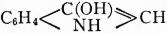
The patent literature of processes for bringing about the conversion of the phenylglycine or its carboxylic acid into indoxylic acid, indoxyl and indigotine is enormous; a circumstance due to the fact that the efficiency of this operation controls the price of the synthetic dyestuff. Caustic soda has been practically given up, being replaced partly or wholly by caustic potash; in addition, alkaline earths, sodamide, nitrides, alkali carbides, &c., have been used. In 1906, Meister, Lucius and Brüning patented the addition of lead and sodium to a mixture of caustic potash and soda; the Basler Chemische Fabrik use a mixture of caustic potash and soda at 210°-260°; Léon Lilienfeld added slaked lime or magnesia to the fused alkali, with a subsequent heating in a current of ammonia at 150°-300°, and in 1908 patented a process wherein the melt is heated under greatly reduced pressure; this gave a yield of 80-90%.
Synthetic indigo comes into the market chiefly in the form of a 20% paste but is also sold in the solid state in the form of a powder.
Indigotine, C16H10N2O2, is a derivative of indol and its constitution is
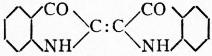
It can be prepared in an almost pure state by extracting good qualities of Bengal or Java indigo or synthetic indigo with boiling nitrobenzene, from which it crystallizes on cooling in dark blue crystals having a metallic sheen. When heated in an open vessel it readily volatilizes, yielding a violet vapour which condenses on cooling in the form of crystals. Indigotine is also soluble in boiling aniline oil, quinoline, glacial acetic acid and chloroform, but is insoluble in water, dilute acids and alkalis and ordinary solvents like alcohol, ether, &c. By nitric acid and many other oxidizing agents it is readily converted into isatin, C8H5NO2. Heated with concentrated sulphuric acid it yields a disulphonic acid, C16H8N2O2(SO3H)2, the sodium salt of which finds application as an acid colour in wool dyeing under the name of Indigo carmine.2 By the action of reducing agents, indigotine is converted into indigo white, C16H12N2O2, which is readily soluble in alkalis or milk of lime with a yellow colour. On exposing the alkaline solution to the air the indigo white is rapidly oxidized back to indigotine, and on these two reactions the application of indigo in dyeing and printing is based. (See Dyeing and Textile Printing.)
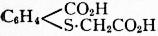
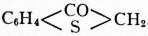
Various halogen (chlorine and bromine) substitutive derivatives of indigotine have been introduced which, while not differing essentially from ordinary indigo in their properties, produce for the most part redder shades in dyeing. They are claimed to be faster and brighter colours. It has been shown by Friedländer (Ber., 1909, 42, p. 765) that the reddish violet colouring matter obtained from the colour-yielding glands of the mollusc Murex brandaris, by means of which the famous Tyrian purple of the ancients was dyed, is a dibromindigo, C16H8Br2N2O2. A new departure in the synthetic dyestuffs belonging to the indigo group was inaugurated by the discovery in 1906 by P. Friedländer of thioindigo red, a derivative of thionaphthen, which is formed from phenylthioglycol-ortho-carboxylic acid, . This substance, on boiling with alkali and then with dilute acid yields thioindoxyl, , which is converted by alkaline oxidation into thioindigotin, having the constitution . The new dyestuff is therefore analogous to indigotine, from which it differs by having the imino groups replaced by sulphur atoms. Thioindigo red can be readily crystallized from boiling benzene, and forms reddish brown crystals possessing a metallic reflex. Thioindigo scarlet, , is also obtained synthetically. Both products come into the market in the form of pastes and are used in dyeing like indigo (see Dyeing).


(E. K.)
1 For a full account of the manufacture of indigo in northern Behar see Ch. Rawson, Journ. Soc. Dyers and Colourists (July 1899).
2 Although bright shades of blue are produced with this derivative, they are not fast.
INDIUM (symbol In, atomic weight 114.8), a metallic chemical element, included in the sub-group of the periodic classification of the elements containing aluminium, gallium and thallium. It was first discovered in 1863 by F. Reich and Th. Richter (Journ. für prak. Chem., 1863, 89, p. 444) by means of its spectrum. It occurs naturally in very small quantities in zinc blende, and is best obtained from metallic zinc (which contains a small quantity of indium) by treating it with such an amount of hydrochloric acid that a little of the zinc remains undissolved; when on standing for some time the indium is precipitated on the undissolved zinc. The crude product is freed from basic zinc salts, dissolved in nitric acid and the nitric acid removed by evaporation with sulphuric acid, after which it is precipitated by addition of ammonia. The precipitated indium hydroxide is converted into a basic sulphite by boiling with excess of sodium bisulphite, and then into the normal sulphite by dissolving in hot sulphurous acid. This salt on strong ignition leaves a residue of the trioxide, which can be converted into the metal by heating in a current of hydrogen, or by fusion with sodium (C. Winkler, Journ. für prak. Chem., 1867, 102, p. 273). Indium is a soft malleable metal, melting at 155° C. Its specific gravity is 7.421 and its specific heat 0.05695 (R. Bunsen).
Indium oxide, In2O3, is a yellow powder which is formed on ignition of the hydroxide. It is readily reduced on heating with carbon or hydrogen, and does not pass into an insoluble form when ignited. The hydroxide, In(OH)3, is prepared, as a gelatinous precipitate, by adding ammonia to any soluble indium salt. It is readily soluble in caustic potash, but insoluble in ammonia.
Three chlorides of indium are known: the trichloride, InCl3, a deliquescent salt, formed by heating a mixture of the oxide and carbon in a current of chlorine; the dichloride, InCl2, obtained by heating the metal in hydrochloric acid gas; and the monochloride, InCl, which is prepared by distilling the vapour of the dichloride over metallic indium. The mono- and dichlorides are decomposed by water with the formation of the trichloride, and separation of metallic indium. Indium Sulphate, In2(SO4)3, is obtained as a white powder very soluble in water by evaporating the trioxide with sulphuric acid. Concentration of the aqueous solution in a desiccator gives a deposit of crystals of a very deliquescent salt, H2In2(SO4)4·8H2O. An indium ammonium alum, In2(S04)3·(NH4)2S04·24H20 is known.
The atomic weight of indium has been determined by C. Winkler and by R. Bunsen by converting the metal into its oxide. Thiel (Ber., 1904, 37, p. 1135) obtained the values 115.08 and 114.81 from analyses of the chloride and bromide, whilst F. C. Mathers (Abst. J.C.S., 1907, ii. 352) obtained 114.88 and 114.86. Indium salts can be recognized by the dark blue colour they give in the flame of the Bunsen burner; and by the white beads of metal and the yellow incrustation formed when heated on charcoal with sodium carbonate.
INDIVIDUALISM (from Lat. individualis, that which is not divided, an individual), in political philosophy, the theory of government according to which the good of the state consists in the well-being and free initiative of the component members. From this standpoint, as contrasted with that of the various forms of socialism (q.v.) which subordinate the individual to the community, the community as such is an artificial unity. Individualism is, however, by no means identical with egoism, though egoism is always individualistic. An individualist may also be a conscientious altruist: he is by no means hostile to or aloof from society (any more than the socialist is necessarily hostile to the individual), but he is opposed to state interference with individual freedom wherever, in his opinion, it can be avoided. The practical distinction in modern society is necessarily one of degree, and both “individualism” and “socialism” are very vaguely used, and generally as terms of reproach by opponents. Every practical politician of whatever party must necessarily combine in his programme individualistic and socialist principles. Extreme individualism is pure anarchy: on the other hand Thomas Hobbes, a characteristic individualist, vigorously supported absolute government as necessary to the well-being of individuals. Moreover it is conceivable under given circumstances that an individualist might logically advocate measures (e.g. compulsory military service) which conflict with individual freedom. In practice individualism is chiefly concerned to oppose the concentration of commercial and industrial enterprise in the hands of the state and the municipality. The principles on which this opposition is based are mainly two: that popularly elected representatives are not likely to have the qualifications or the sense of responsibility required for dealing with the multitudinous enterprises and the large sums of public money involved, and that the health of the state depends on the exertions of individuals for their personal benefit.
INDO-ARYAN LANGUAGES. “Indo-Aryan” is the name generally adopted for those Aryans who entered India and settled there in prehistoric times, and for their descendants. It distinguishes them from the other Aryans who settled in Persia and elsewhere, just as the name “Aryo-Indian” signifies those inhabitants of India who are Aryans, as distinguished from other Indian races, Dravidians, Mundas and so on. A synonym of “Aryo-Indian” is “Gaudian” or “Gaurian,” based on a Sanskrit word for the non-Dravidian parts of India proper. These two words refer to the people from the point of view of India, while “Indo-Aryan” looks at them from the wider aspect of Indo-European ethnology and philology. The general history of the Aryan languages is treated in the articles Indo-European Languages and Aryan. Here we propose to offer a brief review of the special course of their development in India.
Most of the Indo-Aryans branched off from the common Aryan stock in the highlands of Khokand and Badakshan, and marched south into what is now eastern Afghanistan. Here some of them settled, while others entered the Punjab by the valley of the river Kabul. This last migration was a gradual process extending over several centuries, and at different epochs different tribes came in, speaking different dialects of the common language. The literary records of the latest times of this invasion show us one Indo-Aryan tribe complaining of the unintelligible speech of another, and even denying to it the right of common Aryan-hood.
The Piśāca Languages.—Before proceeding farther, it is advisable to discuss the fate of another small group of languages spoken in the extreme north-west of India. After the great fission which separated the main body of the Indo-Aryans from the Iranians, but before all the special phonetic characteristics of Iranian speech had developed, another horde of invaders crossed the Hindū Kush from the Pāmirs, journeying directly south. They occupied the submontane tract, including the country round Chitral and Gilgit, Kashmir and Kafiristan. Some even followed the course of the Indus as far as Sind, and formed colonies there and in the western Punjab. Here they mingled with the Indo-Aryans who had come down the Kabul valley, and to a certain extent infected the local dialect with their idioms. How far their influence extended over the rest of India is undecided, and will probably never be known, but traces of it have been detected by some inquirers even in the dialects of modern Marathi. Those who remained behind in the hill country, the whole of which is popularly known as Dardistan, were isolated by the inhospitable nature of their home and by their own savage character. They seem to have had customs allied to cannibalism, and in later Indian literature legends grew around them as a race of demons called Piśācas, ὠμοφάγοι, who spoke a barbaric tongue called Paiśācī. This language appears now and then in the Sanskrit drama, and Sanskrit philologists wrote still-extant grammatical notices of its peculiarities. These show that it possessed an extremely archaic character, and the same fact is prominent in the Piśāca languages of the present day. Some words which were spoken in the oldest time are preserved with hardly a change of letter, while in India proper the corresponding forms have either disappeared altogether or have been so changed as to be hardly recognizable at first sight. The principal modern Piśāca languages are three or four spoken in Kafiristan, Khōwar of Chitral, Shīnā of Gilgit, Kāshmīrī, and Kōhistānī. The last two are border tongues, much mixed with the neighbouring languages of India proper. The only one which has any literature is Kashmiri (q.v.). The rest are entirely uncultivated. Their general character may be described as partly Indian and partly Iranian, although they have in their isolated position developed some phonetic laws of their own.
Indo-Aryan Classification.—The oldest specimens of Indo-Aryan speech which we possess very closely resemble the oldest Iranian (see Persia: Language). There are passages in the Iranian Avesta which can be turned into good Vedic Sanskrit by the application of a few simple phonetic laws. It is sufficient for our present purposes to note that after the separation the development of the two old forms of speech went on independently and followed somewhat different lines. This is most marked in the treatment of a nexus of two consonants. While modern Iranian often retains the nexus with little or no alteration, modern Indo-Aryan prefers to simplify it. For instance, while the old Aryan sth becomes sit or ist in modern Persian, it becomes tth or th in modern Indo-Aryan. Similarly bhr becomes bir in the former, but bbh or bh in the latter. Thus:—
Old Indo-Aryan. Old Iranian. Modern Persian. Hindī.
sthāna- stāna- sitān or istān thānā, a place.
bhrātar- brātar- birādar bhāī, a brother.
The earliest extant literary record of Indo-Aryan languages is the collection of hymns known as the Rig-Veda. As we have it now, we may take it as representing, on the whole, the particular vernacular dialect spoken in the east of the Punjab and in the upper portion of the Gangetic Doab where it was compiled. The tribe which spoke this dialect spread east and south, and their habitat, as so extended, between the Punjab and the modern Allahabad and reaching from the Himalaya to the Vindhya Hills in the south, became known to Sanskrit geographers as the Madhyadēśa or “Midland,” also called Āryāvarta, or the “home of the Aryans.” The language spoken here received constant literary culture, and a refined form of its archaic dialect became fixed by the labours of grammarians about the year 300 B.C., receiving the name of Saṃskŗta (Sanskrit) or “purified,” in contradistinction to the folk-speech of the same tract and to the many Indo-Aryan dialects of other parts of India, all of which were grouped together under the title of Prākŗta (Prakrit) or “natural,” “unpurified.” Sanskrit (q.v.) became the language of religion and polite literature, and thus the Midland, the native land of its mother dialect, became accepted as the true pure home of the Indo-Aryan people, the rest being, from the point of view of educated India, more or less barbarous. In later times, the great lingua franca of India, Hindostani, also took its origin in this tract.
Round the Midland, on three sides—west, south and east—lay a country inhabited, even in Vedic times, by other Indo-Aryan tribes. This tract included the modern Punjab, Sind, Gujarat, Rajputana with the country to its east, Oudh and Behar. Rajputana belongs geographically to the Midland, but it was a late conquest, and for our present purposes may be considered as belonging to the Outer Band. The various Indo-Aryan dialects spoken over this band were all more closely related to each other than was any of them to the language of the Midland. In fact, at an early period of the linguistic history of India there must have been two sets of Indo-Aryan dialects,—one the language of the Midland and the other that of the Outer Band.1 Hoernle was the first to suggest that the dialects of the Outer Band represent on the whole the language of the earlier Indo-Aryan immigrants, while the language of the Midland was that of the latest comers, who entered the Punjab like a wedge and thrust the others outwards in three directions.
As time went on, the population of the Midland expanded and forced the Outer Band into a still wider circuit. The Midland conquered the eastern Punjab, Rajputana with Gujarat (where it reached the sea) and Oudh. With its armies and its settlers it carried its language, and hence in all these territories we now find mixed forms of speech. The basis of each is that of the Outer Band, but the body is that of the Midland. Moreover, as we leave the Midland and approach the external borders of this tract, the influence of the Midland language grows weaker and weaker, and traces of the original Outer language become more and more prominent. In the same way the languages of the Outer Band were forced farther and farther afield. There was no room for expansion to the west, but to the south it flowed over the Maratha country, and to the east into Orissa, into Bengal and, last of all, into Assam.
The state of affairs at the present day is therefore as follows: There is a Midland Indo-Aryan language (Western Hindi) occupying the Gangetic Doab and the country immediately to its north and south. Round it, on three sides, is a band of mixed languages, Panjabi (of the central Punjab), Gujarati, Rajasthani (of Rajputana and its neighbourhood), and Eastern Hindi (of Oudh and the country to its south). Beyond these again, there is the band of Outer Languages (Kashmiri, with its Pisaca basis), Lahnda (of the western Punjab), Sindhi (here the band is broken by Gujarati), Marathi, Oriya (of Orissa), Bihari, Bengali and Assamese. There are also, at the present day, Indo-Aryan languages in the Himalaya, north of the Midland. These belong to the Intermediate Band, being recent importations from Rajputana. The Midland language is therefore now enclosed within a ring fence of Intermediate forms of speech.
We have seen that the word “Prakrit” means “natural” or “vernacular,” as opposed to the “purified” literary Sanskrit. From this point of view every vernacular of India, from the earliest times, is a Prakrit. The Rig-Veda itself, composed long before the birth of “purified” Sanskrit, can only be considered as written in an old vernacular, and its language, together with the other contemporary Indo-Aryan dialects which never attained to the honour of “purification,” may be called the Primary Prakrits of India. If we compare literary Sanskrit with classical Latin (see Brandreth, “The Gaurian compared with the Romance Languages,” Journal of the Royal Asiatic Society xi. (1879), 287; xii. (1880), 335), then these Primary Prakrits correspond to the old Italic dialects contemporary with and related to the literary language of Rome. They were synthetic languages with fairly complicated grammars, no objection to harsh combinations of consonants, and several grammatical forms strange to the classical speech. In the course of centuries (while literary Sanskrit remained stereotyped) they decayed into Secondary Prakrits. These still remained synthetic, and still retained the non-classical forms of grammar, but diphthongs and harsh combinations of consonants were eschewed. They now corresponded to the post-classical Italic dialects. Just as Sanskrit (and the Primary Prakrits) knew of a city called Kauśāmbī, which was known as Kōsambī to the Secondary Prakrits, so the real Umbrian name of the poet known to literature as Plautus was Plot(u)s. Again, as the Latin lactuca became lattuca, so the Primary Prakrit bhakta- became the Secondary bhatta-. In India, the dislike to harsh consonantal sounds, a sort of glottic laziness, finally led to a condition of almost absolute fluidity, each word of the Secondary Prakrits ultimately becoming an emasculated collection of vowels hanging on to an occasional consonant. This weakness brought its own Nemesis and from, say, A.D. 1000 we find in existence the series of modern Indo-Aryan vernaculars, or, as they may be called, Tertiary Prakrits, closely corresponding to the modern Romance languages. Here we find the hiatus between contiguous vowels abolished by the creation of new diphthongs, declensional and conjugational terminations consisting merely of vowels becoming worn away, and new languages appearing, no longer synthetic, but analytic, and again reverting to combinations of consonants under new forms, which had existed three thousand years ago, but which two thousand years of attrition had caused to vanish.
It is impossible to fix any approximate date for the change from the Primary to the Secondary Prakrits. We see sporadic traces of the secondary stage already occurring in the Rig-Veda itself, of which the canon was closed about 1000 B.C. At any rate Secondary Prakrits were the current vernacular at the time of the emperor Asoka (250 B.C.). Their earliest stage was that of what is now called Pāli, the sacred language of the Buddhists, which forms the subject of a separate article (see Pali). A still later and more abraded stage is also discussed under the head of Prakrit. This stage is known as that of the Prakrit par excellence. When we talk of Prakrit without any qualifying epithet, we usually mean this later stage of the Secondary Prakrits, when they had developed beyond the stage of Pāli, but before they had reached the analytic stage of the modern Indo-Aryan vernaculars. The next, and final, stage of the Secondary Prakrits was that of the Apabhraṁśas. The word Apabhraṁśa means “corrupt” or “decayed,” and was applied to the vernaculars in contrast to the Prakrit par excellence, which had in its turn (like Sanskrit and Pali) become stereotyped by being employed for literature. It is these Apabhraṁśas which are the direct parents of the modern vernacular. The following is a list of the Indo-Aryan vernaculars, showing, when known, the names of the Apabhraṁśas from which they are sprung, and the number of speakers of each in the year 1901:—
Apabhraṁśa. Modern Language. Number of Speakers.
A. Language of the Midland.
Śaurasēna Western Hindī 40,714,925
B. Intermediate Languages.
Āvanta Rājasthānī 10,917,712
” Pahārī Languages 3,124,681
Gaurjara Gujarātī 9,439,925
Śaurasēna Pañjābī 17,070,961
Ardhamāgadha Eastern Hindī 22,136,358
C. Outer Languages.
(a) North-Western Group.
Unknown Kāshmīrī (with a Piśāca basis) 1,007,957
” Kōhistānī (with a Piśāca basis) (unknown)
” Lahndā or Western Pañjābī 3,337,917
Vrācaḍa Sindhī 3,494,971
(b) Southern Language.
Māhārāṣṭra Marāṭhī 18,237,899
(c) Eastern Group.
Māgadha Bihārī 34,579,844
” Oṛiyā 9,687,429
” Bengali 44,624,048
” Assamese 1,350,846
Total More than 219,725,473
Of these, the Pahāṛī languages are offshoots of Rājasthānī imported into the Himalaya. Kōhistānī includes the mixed dialects of the Swat and Indus Kohistans. The census of 1901 did not extend to these tracts. A full account of the Apabhraṁśas will be found in the article Prakrit.
Although the modern Indo-Aryan vernaculars are not derived from Sanskrit, and though all, or nearly all, are not derived from the language of the Rig-Veda, nevertheless, as these are almost the only sources of our information as to what the Primary Prakrits of India were, and as all Primary Prakrits were related to these two and were in approximately the same stage of phonetic development, they afford a convenient means for carrying out historical investigation into the origin of all the modern Indo-Aryan vernaculars to its legitimate conclusion. At the same time they are not always trustworthy guides, and sometimes fail to explain forms derived from other ancient contemporary dialects, the originals of which were unknown to the Vedic and classical literature. A striking example is the origin of the very common locative suffix -ē. This can be traced through the Apabhraṁśa -hi to the Pali -dhi. There all Indian clues cease, and it is not till we recognize its relationship to the Greek -θι that we understand that it is an ancient Indo-European termination kept alive in India by some of the Primary Prakrits, but ignored both by the dialect of the Rig-Veda and by literary Sanskrit. With this reservation, a short comparison of Sanskrit with the Secondary and Tertiary Prakrit developments will be of interest. As the Pali and Prakrit stages are fully treated under their proper heads, very brief references to them will be sufficient.
A. Vocabulary.—The ground of all the vocabularies of the modern Indo-Aryan vernaculars is, of course, the vocabulary of Aryan India in the Vedic period. Thousands of words have descended from the earliest times and are still in existence, after passing through certain changes subject to well-known phonetic laws. As many of these laws are the same for every language, it follows that a large stock of words, which principally differ in inflection, is common to all these modern forms of speech. These words, which natives believe to be derived from Sanskrit itself, are called by them tadbhava, i.e. “having ’that’ (sc. Sanskrit, or, more correctly, the Primary Prakrit) for its origin.” As the language of the Midland is derived from the old dialect of which Sanskrit is the “polished” form, it is approximately true to say that it is derived from that form of speech, and its native vocabulary (allowing for phonetic development) may be said to be the same as that of Sanskrit. But the farther we go from the Midland, the more examples we meet of a new class of words which natives of India call dēśya or “country-born.” Most of these are really also tadbhavas, descendants of the old Primary Prakrit dialects spoken outside the Midland, of whose existence native scholars took no account. Finally, owing to the ever-present influence of literary Sanskrit, words are, and have been for many generations, borrowed direct from that language. Some of these borrowed words are due to the existence of Sanskrit as the language of religion. Their use is paralleled by the employment of Greek and Latin words for religious technical terms in all the languages of Europe. Others are technical terms of arts and sciences, but most of those which we meet are simply employed for the sake of fine language, much as if some purist were to insist on employing hlāford instead of “lord” in writing English. These Sanskrit words are known as tatsama or “the same as ‘that’ (sc. Sanskrit).” The number of tatsamas employed varies much. In languages such as Panjabi which have little or no literature, and in the speech of the peasantry all over India, they are few in number. In the modern literary Bengali a false standard of literary taste has led to their employment in overwhelming numbers, and the homely vigorous home-speech, which is itself capable of expressing every idea that the mind of man can conceive, flounders about awkwardly enough under the weight of its borrowed plumes. The native vocabulary of the modern Indo-Aryan vernaculars is thus made up of tadbhavas, dēśyas and tatsamas.
The Dravidian languages of southern India have also contributed a small quota to the Indo-Aryan vocabulary. Most of the words have been given a colour of contempt in the process of borrowing. Thus the word pillā, a cub, is really the Dravidian pillai, a son. But the most important accretion from outside comes from Persian, and (through Persian) from Arabic. This is due to Mahommedan influence. In the Mogul courts Persian was for long the language of politeness and literature, and words belonging to it filtered into all stages of society. The proportion of these Persian words varies greatly in the different languages. In some forms of Western Hindī they have almost monopolized the vocabulary, while in others, such as Bengali and Marathi, the number is very few. Instances of borrowing from other languages are of small importance.
B. Phonetics.—The alphabet of the Indo-Aryan languages is, on the whole, the same as that of Sanskrit (q.v.), and the system of transliteration adopted for that language is also followed for them.2 Some new sounds have, however, developed in the Secondary and Tertiary Prakrits. New signs will be used for them, and will be explained in the proper places. Sanskrit knew only long ē and ō, but already in the Secondary Prakrits we find a corresponding short pair, e and o, of which the use is considerably extended in the tertiary stage. The Sanskrit diphthongs āi and āu disappeared in the secondary stage, ē and ō being substituted for them respectively. On the other hand, in the same stage, we frequently come across pairs of vowels, such as aï, aü, with a hiatus between the two members. In the tertiary stage, these pairs have been combined into new diphthongs ai and au, shorter in pronunciation than āi and āu. The pronunciation of āi and ai may be compared with that of the English “aye” and “I” respectively. In the languages of the Outer Band, there is again a tendency to weaken this new ai to ē, and the new au to ō. All the tertiary languages weaken a short final vowel. In most it is elided altogether in prose, but in some of those of the Outer Band (Kashmiri, Sindhi and Bihari) it is half pronounced. Some of the Outer languages have also developed a new a-sound, corresponding to that of a in the German Mann. The stress-accent of classical Sanskrit has as a rule been preserved throughout. In the tertiary stage it generally resolves itself into falling on the ante-penultimate, if the penultimate is short. If the latter is long it takes the accent. In the eastern-languages there is a tendency to throw the accent even farther back. There is also everywhere a tendency to lighten the pronunciation of a short vowel after an accented syllable, so that it is barely audible. Thus, cálatā for cálatā. In some dialects, e.g. the Urdu form of Western Hindi, this “imperfect” vowel has altogether disappeared, as in cáltā.
The tertiary languages have on the whole preserved the consonantal system of the secondary stage, preferring, however, as a rule, to simplify double consonants, with compensatory lengthening of the preceding vowel. Thus, for Sanskrit hasta-, a hand, we have Secondary Prakrit hattha-, Tertiary hāth. Some tertiary languages have both hatth and hāth: others (like Gujarati) have only hāth: while others (like Panjabi) have only hatth. In the extreme north-west, Sindhi and Lahnda, under the influence of the Pisaca languages, simplify the double consonant without compensatory lengthening, so that we have hath. Again, many languages of the Outer Band show a tendency to avoid aspiration, so that Kashmiri, Marathi, Bengali and others have hāt. It is well known that the Iranian languages change s to h. The Tertiary Prakrits of the Outer Band find analogous difficulty in pronouncing a sibilant. The north-western languages change it to h as in Persian. Marathi changes s to ś before palatal sounds, and the same change occurs in Bengali in the case of every uncompounded sibilant. Eastern Bengali and Assamese go farther. Here s is again sounded almost like h. On the other hand, in the Midland, s rarely becomes h and then only when medial. In the Outer languages the palatal consonants are also liable to change; j and jh approach the sound of z, and c and ch often become ts, or, in the East, a simple s. Thus, the Midland cākar. a servant, is pronounced tsākar in Marathi, and the Midland māch, a fish, is sounded mās in Marathi, Bengali and Assamese.
C. Declension.—In the latest stage of the Secondary Prakrits the neuter gender begins to disappear, and in the tertiary stage, except in Gujarati and Marathi, it is nearly altogether wanting. Elsewhere we only come across occasional relics of its employment. In some of the tertiary languages grammatical gender, as distinct from sexual gender, has disappeared as entirely as it has in English. The dual number had already fallen into disuse in the Secondary Prakrits. In the secondary stage we see a gradual simplification of grammatical form and a disappearance of case endings. The complicated Sanskrit system is more and more superseded by the simple uniformity of the declension of a-bases. One by one the case endings were discarded, and cases were confounded with one another till at length in Apabhramśa only one or two forms remained for each number. In the tertiary stage there remain in most languages only two cases, which we may call the nominative and the oblique. The latter can be employed for any case except the nominative, but the sense is usually defined by the aid of help-words called postpositions.3 It is a linguistic rule that languages in which the genitive precedes the governing noun prefer suffixes to prefixes and vice versa;4 and, as the genius of the Indo-Aryan languages does require the genitive to be prefixed, these help-words take the form of suffixes. In the Midland they are still separate words, but in the Outer Band each has in general become incorporated with the main word to which it is attached. Thus, the Midland ghōṛā, a horse, has its oblique form ghōṛē, genitive ghōṛē ker, but Bengali has oblique form ghōṛā, genitive gkōṛār contracted from ghōṛā + (k)ar. The ground principles of declension in all tertiary languages are the same, but as each employs different postpositions the systems of declension vary considerably. Marathi is the only true Indo-Aryan language which has preserved anything more than sporadic relics of the old system of case terminations.
D. Conjugation.—Two tenses, the present and the imperative, of the old synthetic system of conjugation have survived in all the Tertiary Prakrits, and in some of them we also find the ancient future. All other tenses are now made periphrastically, mostly with the aid of participles to which auxiliary verbs may or may not be added. The participles employed are all survivals of the old participles of the present, of the past and (in some languages) of the future. The past and future participles are passive in their origin, and hence tenses formed with these participles must be construed passively. Thus, instead of “I struck him” we must say, either “he was struck by me,” or else (impersonally) “it was struck by me with reference to him.” So, for an intransitive verb we have, either “I am gone,” or “it is gone by me.” In the language of the Midland this is quite simple and clear, but in those of the Outer Band the subject (in the instrumental, or as it is usually called “agent” case) is indicated by means of pronominal suffixes attached to the participle or auxiliary verb; thus (Bengali) mārila + am, struck + by-me, becomes mārilām, I struck. In such cases all memory of the passive meaning of the participle is lost by the eastern languages, and it, together with the appropriate pronominal suffixes, becomes in appearance and in practical use an ordinary past tense conjugated as in Latin or in Sanskrit. It is an instance of reversion to the original type; first synthetic, then analytic, and then again a new synthetic conjugation. In the other languages of the Outer Band, the memory of the passive nature of the participle is retained, although the conjugation is as synthetic as in the East, and the subject has to be put into the “agent” case.
Authorities.—No work has yet been published dealing with Indo-Aryan subjects as a whole, although several have been written which treat of one or more stages of their development. For the general question of the Piśāca languages, the reader may consult G. A. Grierson’s The Piśāca Languages of North-Western India (London, 1906). For the different languages of this group, see G. W. Leitner, Dardistan (Lahore, 1877); J. Biddulph, Tribes of the Hindoo Koosh, (Calcutta, 1880); D. J. O’Brien, Grammar and Vocabulary of the Khowār Dialect (Lahore, 1895); J. Davidson, Notes on the Bashgali (Kāfir) Language (Calcutta, 1901). For the linguistic conditions of Vedic times, the Introduction to J. Wackernagel’s Altindische Grammatik (Göttingen, 1896) gives much useful information in a convenient form. For the literature concerning Pāli and Prakrit, see under those heads. The following are the principal works dealing with the general question of the Tertiary Prakrits: J. Beames, Comparative Grammar of the Modern Aryan Languages of India (1872-1879); A. F. R. Hoernle, A Grammar of the Eastern Hindi compared with the other Gaudian Languages (1880); R. G. Bhandarkar, “The Phonology of the Prakrits of Northern India,” in the Journal of the Royal Asiatic Society (Bombay Branch), vol. XVII., ii., 99-182 (see also the same author’s series of papers on cognate subjects in vol. XVI. of the same Journal); and G. A. Grierson’s essays “On the Phonology of the Modern Indo-Aryan Vernaculars” in the Zeitschrift der deutschen morgenländischen Gesellschaft, vols. xlix., 1. (1895-1896), 393, 1; “On the Radical and Participial Tenses of the Modern Indo-Aryan Vernaculars” in the Journal of the Asiatic Society of Bengal, vol. lxiv. (1895), part i., 352; and “On certain Suffixes in the Modern Indo-Aryan Vernaculars” in the Zeitschrift für vergleichende Sprachforschung (1903), p. 473. The general subject of this article is discussed at greater length in chapter vii. of the Report on the Census of India, 1901 (Calcutta, 1903). The volumes of the Linguistic Survey of India also contain much detailed information, summed up at length in the introductory volume.
(G. A. Gr.)
1 Attempts have been made to discover dialectic variations in the Veda itself, and, as originally composed in various parts of the Punjab widely distant from each other, the hymns probably did contain many such. But they have been edited by compilers whose home was in the Midland, and now their language is fairly uniform throughout. In the time of Asōka (250 B.C.) there were at least two dialects, an eastern and a western, as well as another in the extreme north-west. The grammarian Patañjali (150 B.C.) mentions the existence of several dialects.
2 The Nāgarī (see Sanskrit) and allied alphabets, when employed for modern Indo-Aryan languages or for Prakrit, are transliterated in this work according to the following system:—
a ā i ī u ū ṛ ṝ e ē ai āī o ō au āū ṁ (anusvāra) ∞ (anunāsika) ḥ (visarga). k kh g gh rc c (ts) ch (tsh) j (dz) jh (dzh) ñ ṭ ṭh ḍ (ṛ) ḍh (ṛh) ḷ ḷh ṇ t th d dh n p ph b bh m y r l v (w) ś ṣ s h.
Special sounds employed by particular languages are described in the articles in which reference is made to them. Here we may mention å, sounded like the aw in “law,” and ä, ö, ü, pronounced as in German.
3 The origin of the postpositions is discussed in the article Hindostani.
4 See P. W. Schmidt in Mitteilungen der Wiener Anthropologischen Gesellschaft, xxxiii. 381.
INDO-CHINA, FRENCH.1 The geographical denomination of French Indo-China includes the protectorates of Annam, Tongking and Cambodia, the colony of Cochin-China and part of the Laos country. In 1900 the newly-acquired territory of Kwang-Chow Bay, on the coast of China, was placed under the authority of the governor-general of Indo-China. Cochin-China, a geographical definition which formerly included all the countries in the Annamese empire—Tongking, Annam and Cochin-China—now signifies only the French colony, consisting of the “southern provinces” originally conquered from Annam, having Saigon as its capital. In its entirety French Indo-China, the eastern portion of the Indo-Chinese peninsula, lies between 8° 30′ and 230 25′ N. and 100° and 109° 20′ E. It is bounded N. by China, on which side the frontiers have been delimited; E. and S.E. by the Gulf of Tongking and the China Sea; W. by the Gulf of Siam and Siam, and N.W. by Burma. The area is estimated at about 290,000 sq. m., with a population of 17¼ millions, of whom 75 or 80% are Annamese. The French inhabitants number about 13,000.
The configuration of the country is determined by two rivers of unequal importance—the Mekong and the Song-Koi—and a continuous chain of mountains, an offshoot of the great Chinese group of Yun-nan, which, making a double curve, forms an immense S. South and west of this mountain chain the country forms part of the Mekong basin. To the north and north-east of the chain the valley of the Song-Koi, or Red river, constitutes almost the whole of Tongking, of which its delta represents the most fertile and populous if not the largest portion. The small mountainous provinces of Lang-Son, That-Ke and Kao-Bang, however, belong geographically to the Si-Kiang basin. On the east the small province of Mon-Kay, on the borders of Kwang-Tung, forms a little basin enclosed between the mountains and the sea; on the south the province of Thanh-Hoa, although crossed by the small river Song-Ma, forms the extremity of the Red river delta and belongs to it, the two rivers being united at some distance from the sea by a natural channel formed by the junction of a northern branch of the Song-Ma with a southern branch of the Song-Koi. The Red river descends from the mountains of Yun-nan, rising near Tali-fu between deep and inaccessible gorges, and becomes navigable only on its entry into Tongking. Means have been taken to render it available to steam launches, and in consequence of an agreement between the state and the Compagnie des Correspondances Fluviales a service of steamers is provided from its mouth to Lao-Kay. Near Hung-Hoa the Red river receives its two chief tributaries, the Black river from the plateaus of the west—the land pf the Muongs—and the Clear river, one of the largest of whose tributaries issues from the Ba-Be lakes. The Black river is navigable for a considerable distance, the Clear river only from Tuyen-Kwang. Between the basins of the Song-Koi and the Mekong the chain of mountains, crowned by tolerably extensive plateaus, covers, with its ramifications and transverse spurs, a vast extent of country little known, although several trade-routes traverse it, thus placing the Laos country in communication with Tongking and Annam. In about 19° N. the mountain-ridge approaches the sea and runs parallel to the coast, presenting on its eastern side a steep declivity which encloses a narrow littoral, in places only a mile or two broad, between the base of its cliffs and the shore. This coast-belt constitutes the habitable and cultivable portion of Annam proper, and consists of alluvial matter accumulated at the mouths of mountain streams, and marshes and swamps enclosed between land and sea by sand ridges heaped up by wind and tide. The high valleys and plateaus originally belonged to the empire, the limits of which, although invaded and occupied by Siamese, formerly extended to the banks of the Mekong. The western slopes form part of the French Laos possessions. The Mekong valley includes Laos, Cambodia and the greater part of Cochin-China. The Mekong (q.v.) is one of the largest rivers of south-eastern Asia, having a course 1900 m. in length. Its mouths, six in number, communicate by means of a navigable canal with the Saigon river (fed by the Don-Nai and the two Vaico rivers), which is navigable by the largest warships, rendering Saigon the most important natural port of Indo-China.
Geology.—The deltaic tracts of the Mekong and Red river are composed of alluvium (generally silicious clay) deposited by the rivers. The mountains from which this soil is derived are granitic in formation, the framework being almost always schists of ancient date, dislocated, folded and occasionally rounded into hills 1000 to 1300 ft. in height, belonging to the Devonian period. Above these schists lie—more especially in the north and south of Tongking—marbles and other highly crystalline limestones, upon which rest, unconformably in places (Nong-Son, Ke-Bao, Hon-Gáy), Carboniferous formations. In the upper part of the Red river valley rich deposits of coal have been found between Yen-Bay and Hai-Duong, in a considerable tract of Tertiary rock. Limestone occurs also in the valley of the Mekong, forming an extensive massif in the district of Lakhon and in the basins of the Nam-Ka-Dinh and Nam-Hin-Bun. These limestones appear to be Carboniferous. In the region south of Lakhon the rock is Triassic, and gold has been found in several districts. The natives collect it in very small quantities by a washing process. In the lateral valleys of the Mekong copper and tin are found. On the course of the Nam-Paton, a tributary of the Nam-Hin-Bun, the natives work a moderately productive tin-mine. Layers of spiegeleisen, limonite and other iron ores are numerous in the Laos states, in which also antimony occurs.
Climate.—The climate of Indo-China is that of an inter-tropical country, damp and hot. But the difference between the southern and northern regions is marked, as regards both temperature and meteorology. Cochin-China and Cambodia have very regular seasons, corresponding with the monsoons. The north-easterly monsoon blows from about the 15th of October to the 15th of April, within a day or so. The temperature remains almost steady during this time, varying but slightly from 78.8° to 80.6° F. by day to 68° by night. This is the dry season. From the 15th of April to the 15th of October the monsoon reverses, and blows from the south-west. The season of daily rains and tornadoes commences. The temperature rises from 80.6° to 84.2°, at which it remains day and night. April and May are the hottest months (from 86° to 93.2°). The damp unwholesome heat sometimes produces dysentery and cholera. The climate of Annam is less regular. The north-easterly monsoon, which is “the ocean-wind,” brings the rains in September. The north-easterly gales lower the temperature below 59°. September is the month in which the typhoon blows. During the dry season—June, July and August—the thermometer oscillates between 86° and 95°. The nights, however, are comparatively cool. Tongking has a winter season—October to May. The temperature, lowered by fog and the rains, does not rise above 75.2° and descends to 50° over the delta, and to 44.6° and even 42.8° in the highlands, where white frost is occasionally seen. The summer, on the other hand, is scorching. The wind veers to the south-east and remains there until October. The temperature rises to over 83°; often it reaches and continues for several days at 95° or even more. The nights are distressingly airless. The Laos country in the interior and lying at a high altitude is cooler and drier. Its deep valleys and high hills vary its climate.
Fauna and Flora.—From the populous cultivated districts wild animals, once plentiful, have retired towards the wooded and mountainous districts. The wild life of Laos includes fairly numerous herds of elephants, the rhinoceros (one- and two-horned rhinoceros horn is employed as a “medicine”), tiger, panther, brown bear, tree-bear, monkeys and rats, among which are the musk rat, the palm rat and the nu-khi, or rat found in the rice-fields of the highlands, in which its ravages are considerable. In mountain districts the leopard, wild boar and deer are found, and in the neighbourhood of habitations the tiger-cat and ichneumon. The buffalo is commonly found wild in Laos as a domesticated animal it also holds a prominent place. The zebu bull is used for transport purposes. Attempts to acclimatize the Arab horse and to introduce sheep from Aden and China have failed. There is, however, an indigenous race of horses, excellent in spite of their small size—the horses of Phu-Yen. Among birds the woodcock, peacock and numerous species of duck inhabit the woods and marshes. The goose and guinea-fowl appear, as also the turkey, to have become easily acclimatized. Reptiles (apart from the caimans of the Mekong, which attain a length of over 30 ft., and are much appreciated by the Annamese as food) are extremely numerous and varied in species. The rivers are rich in fish. The sole is found in the rivers of Tongking. The Mekong is fished for two species peculiar to it—the pa-beuk and the pa-leun, which attain a length of nearly 6 ft. All varieties of mosquitoes, ants and leeches combine to render the forests bordering the Mekong impracticable. Peculiar species of grubs and caterpillars destroy the cotton and coffee plantations of Cochin-China. The silkworm may be said to be indigenous in Tongking, where there are several thousand acres of mulberry trees.
The flora is inter-tropical, and comprises nearly all the trees known in China and Japan. The bamboo is utilized in building and a variety of other ways. Formerly the teak was believed not to exist in the forests of Indo-China, but it was found some years ago in considerable abundance, and plantations of it have been made. Certain hard woods are used for marqueterie and other ornamental work. Rubber is also exploited. Cotton, previously cultivated in Cochin-China and Cambodia, gives excellent results in Laos. Tea, of which there are a certain number of plantations in the highlands of Tongking and Annam, grows wild in Upper Laos, and in quality closely resembles the Pou-eurl or Pueul variety noted in Yun-nan. Cocoa, coffee and cotton are cultivated in Tongking and Cambodia. Cinnamon and cardamoms are gathered in Laos and Annam. Ground nuts, sesame, sugar canes, pepper, jute, tobacco and indigo are also grown. The area under rice, which is incomparably the most important crop, is approximately 1,750,000 acres. All European fruits and vegetables have been introduced into Tongking, and with certain exceptions—the grape, for example—succeed perfectly. Measures taken to secure the monopoly of opium have notably increased the cultivation of the poppy.
People.—The population of French Indo-China falls into five chief divisions—the Annamese, forming the bulk of the population in Annam, Tongking and Cochin-China and four-fifths of that of the whole country; the Khmers or Cambodians; the Chains of southern Annam; the Thais, including the Laotians; and the autochthonous tribes classed by the other inhabitants as Mois or Khas (“savages”). Driven into the interior by the now dominant races, these older people have mixed and blended with the peoples whom they found there, and new tribes have arisen, intermingled with fugitives from China, Annam and even Siam. In the north of Tongking people of Laos origin occur—the Thōs round Kaobang, the Muongs in the mountains bordering the Red river. When mixed, with Chinese the Muongs and the Thōs are known as the Hung-dans, Māns and Miens. The Muongs are bigger and stronger than the Annamese, their eyes often almost straight. They have square foreheads, large faces and prominent cheek-bones. In the centre and south of the Indo-Chinese mountain chain are found, under a multiplicity of names—Phon-tays, Souis, Bah-nan, Bolovens, Stiengs, Mors, Kongs, &c.—people of Malayan origin mixed with all the races of Indo-China. Laos is inhabited by an essentially miscellaneous population—falling into three main groups—the Thais; various aboriginal peoples classed as Khās; and the Moos and Yaos, tribes of Chinese origin.
Religions.—The Annamese religion is a somewhat vague and very tolerant Buddhism, which in practice resolves itself chiefly into the worship of ancestors. Certain ceremonies performed in Cambodia resemble distantly the Brahminical cult. The Roman Catholic religion has been introduced by missionaries. The course of its history has not been free from catastrophes and accidents. There is an apostolical vicariate in Cochin-China, one in Cambodia and several mission stations in Tongking. Two of these missions are mainly conducted by Spanish priests.
Administration.—Before taking its present form the governmental organization of Indo-China underwent many changes. Originally Cochin-China, the only French possession in the peninsula, was a colony directly administered, like other colonies, by the ministry of marine, and its earliest governors were admirals. Later, as further conquests were effected, Tongking and Cambodia were subjected to the régime of a protectorate somewhat ill-defined, and placed under the authority of residents-general. The seat of the resident-general of Tongking was at Hanoi; of Cambodia, at Pnom-Penh. The government of the colonies having been transferred (1889) from the ministry of marine to the ministry of commerce, and in 1894 to the newly created ministry of the colonies, the control of the residencies passed gradually into the hands of civil agents. Cochin-China, which already by the decree of the 8th of February 1880 had been endowed with a colonial council, had a municipality, a chamber of commerce, and even a deputy in the French parliament. There had thus been three distinct states, each with its own ruler and government. But by the decrees of the 17th of October and the 3rd of November 1887 the unity of Indo-China was determined. By decree of October the post of director of the interior of Cochin-China was done away with and replaced by that of lieutenant-governor under the immediate authority of a governor-general. The functions and powers of the latter official were, however, but vaguely defined before the decree of the 21st of April 1891, which conferred on M J. M. A. de Lanessan, appointed governor-general, the most extensive powers. The residents-general of Tongking, Annam and Cambodia, and the lieutenant-governor of Cochin-China, as well as the military authorities, were placed under him. But this change of policy, which put an end to the system of expeditions and minor military operations, and restricted the power of the residents whilst restoring to the mandarins a share of authority, was unwelcome to numerous interests, which, combining, secured the abrupt recall of M de Lanessan on the 29th of December 1894. The decree of the 21st of April 1891 was not, however, revoked, but the powers it conferred were restricted. After the appointment of M Doumer, successor to M Rousseau, who died on the 10th of December 1896, this decree was again put in force on the former scale, and in 1898 it was supplemented by the decrees of the 3rd and 31st of July, which definitely established the political and financial unity of Indo-China. The governor-general is the sole intermediary between the Indo-Chinese Union and the home government, the powers of which, with few restrictions, are delegated to him. As supreme administrative and military authority, he directly controls the civil services, and, though prohibited from commanding in the field, disposes of the land and sea forces in the country. His diplomatic negotiations with foreign powers must be carried on under the authorization and surveillance of the home authorities. The governor-general is assisted by the Superior Council of Indo-China, which meets monthly, and as reorganized by the decree of the 8th of August 1898 is composed as follows: the governor-general (president); the general commanding as head of the troops; the rear-admiral commanding the naval squadron of the Far East; the lieutenant-governor of Cochin-China; the residents superior of Tongking, Annam, Cambodia and Laos; the director-general of finances; the director of the contrôle financier; the head of the judicial service of Indo-China; the director-general of the customs and excise of Indo-China; the directors-general of agriculture, forests and commerce; of public works; of posts and telegraphs; of health; and of public instruction; the treasurer-general of Indo-China; the director of the school of medicine at Hanoi; the president of the colonial council of Cochin-China; the presidents of the chambers of commerce of Saigon, Hanoi and Hai-Phong; the presidents of the united chambers of commerce and agriculture of Annam and Cambodia; the presidents of the chambers of agriculture of Tongking and Cochin-China; four influential natives; the chief of the cabinet and the governor-general’s secretary. This list sufficiently indicates the departmental services, by means of which the general government is carried on. The Superior Council meets not only at Hanoi, the seat of the government, but also at Saigon, Hué and Pnom-Penh. It delegates its powers to a “permanent commission” consisting of thirteen of its members, and dispensing with the attendance of the local authorities of regions other than those in which the place of meeting is situated. The Superior Council meets annually to receive the general budget and the local budgets which “must be accepted by the governor-general at a session of the Superior Council.”2 It must also be consulted on the distribution of military credits, and on the credits to be devoted to public works. The contrôle financier, which scrutinizes and sanctions all measures of the public services involving outlay of money, is dependent on the ministry of the colonies. Its returns have to be communicated to the governor-general.