VOLUME XIV SLICE IV Independence, Declaration of to Indo-European Languages (continued 2)
Reading edition
Reptiles.—The serpent tribe in India is numerous; they swarm in all the gardens, and intrude into the dwellings of the inhabitants, especially in the rainy season. Most are comparatively harmless, but the bite of others is speedily fatal. The Reptiles. cobra di capello (Naia tripudians)—the name given to it by the Portuguese, from the appearance of a hood which it produces by the expanded skin about the neck—is the most dreaded. It seldom exceeds 3 or 4 ft. in length, and is about 1¼ in. thick, with a small head, covered on the forepart with large smooth scales; it is of a pale brown colour above, and the belly is of a bluish-white tinged with pale brown or yellow. The Russelian snake (Vipera russellii), about 4 ft. in length, is of a pale yellowish-brown, beautifully variegated with large oval spots of deep brown, with a white edging. Its bite is extremely fatal. Itinerant showmen carry about these serpents, and cause them to assume a dancing motion for the amusement of the spectators. They also give out that they render snakes harmless by the use of charms or music,—in reality it is by extracting the venomous fangs. But, judging from the frequent accidents which occur, they sometimes dispense with this precaution. All the salt-water snakes in India are poisonous, while the freshwater forms are wholly innocuous.
The other reptiles include two species of crocodile (C. porosus and C. palustris) and the ghariyal (Gavialis gangeticus). These are more ugly in appearance than destructive to human life. Scorpions also abound.
Fishes.—All the waters of India—the sea, the rivers and the tanks—swarm with a great variety of fishes, which are caught in every conceivable way, and furnish a considerable proportion of the food of the poorer classes. They are eaten fresh, or Fishes. as nearly fresh as may be, for the art of curing them is not generally practised, owing to the exigencies of the salt monopoly. In Burma the favourite relish of nga-pi is prepared from fish; and at Goalanda, at the junction of the Brahmaputra with the Ganges, and along the Madras coast many establishments exist for salting fish in bond. The indiscriminate slaughter of fry, and the obstacles opposed by irrigation dams to breeding fish, are said to be causing a sensible diminution in the supply in certain rivers. Measures of conservancy have been suggested, but their execution would be almost impracticable. Among Indian fishes, the Cyprinidae or carp family and the Siluridae or cat-fishes are best represented. From the angler’s point of view, by far the finest fish is the mahseer (Barbustor), found in all hill streams, whether in Assam, the Punjab or the South. One has been caught weighing 60 ℔, which gave play for more than seven hours. Though called the salmon of India, the mahseer is really a species of barbel. One of the richest and most delicious of Indian fishes is the hilsa (Clupea ilisha), which tastes and looks like a fat white salmon. But the enhanced price of fish and the decreased supply throughout the country are matters of grave concern both to the government and the people.
Insects.—The insect tribes in India may be truly said to be innumerable. The heat and the rains give incredible activity to noxious or troublesome insects, and to others of a more showy class, whose large wings surpass in brilliancy the most splendid colours of art. Mosquitoes are innumerable, and moths and ants of the most destructive kind, as well as others equally noxious and disagreeable. Amongst those which are useful are the bee, the silk-worm, and the insect that produces lac. Clouds of locusts occasionally appear, which leave no trace of green behind them, and give the country over which they pass the appearance of a desert. Their size is about that of a man’s finger, and their colour reddish. They are swept north by the wind till they strike upon the outer ranges of the Himalayas.
Political Divisions
India (including Burma) has a total area of 1,766,597 sq. m., and a population (1901) of 294,361,056. Of this total, 1,087,204 sq. m., with a population of 231,899,515, consists of British territory, administered directly by British officers; while the remaining 679,393 sq. m., with a population of 62,461,549, is divided up among various native states, all of which acknowledge the suzerainty of the paramount power, but are directly administered by semi-independent rulers, usually assisted by a British resident.
The British possessions are distributed into thirteen provinces of varying size, each with a separate head, but all under the supreme control of the governor-general in council. These thirteen provinces or local governments are British India. Ajmer-Merwara, Andaman and Nicobar Islands, British Baluchistan, Bengal, Bombay, Burma, Central Provinces with Berar, Coorg, Eastern Bengal and Assam, Madras, North-West Frontier Province, Punjab, and the United Provinces of Agra and Oudh. Each of these provinces is described under its separate name.
The native states are governed, as a rule, by native princes with the help of a political officer appointed by the British government and residing at their courts. Some of them administer the internal affairs of their states The native states. with almost complete independence; others require more assistance or a stricter control. These feudatory rulers possess revenues and armies of their own, and the more important exercise the power of life and death over their subjects; but the authority of each is limited by treaties or engagements, or recognized practice by which their subordinate dependence on the British government is determined. That government, as suzerain in India, does not allow its feudatories to form alliances with each other or with foreign states. It interferes when any chief misgoverns his people; rebukes, and if needful removes, the oppressor; protects the weak; and firmly imposes peace upon all. There are in all nearly 700 distinct units, which may be divided into the following groups.
The most important states are Hyderabad, Mysore, Baroda, Kashmir and Jammu, the Rajputana Agency, and the Central Major states. India Agency. The first four of these are single units, each under its separate ruler; but Rajputana and Central India are political groups consisting of many states, enjoying different degrees of autonomy. Rajputana is the name of a great territorial circle, containing twenty states in all; while under the Central India Agency there are grouped 148 states and petty chiefs.
Amongst the minor states, subordinate to the various provincial governments, five are controlled by Madras; 354 by Bombay, many of them being quite petty; 26 by Bengal, of Minor states. which Kuch Behar is the chief; 34 by the Punjab, amongst which the Phulkian Sikh states and Bhawalpur are the most important; 2 under Eastern Bengal and Assam; 15 under the Central Provinces; and 2 under the United Provinces. Burma contains a number of Shan states, which technically form part of British India, but are administered through their hereditary chiefs. All the most important of these native states are separately described.
In addition to the internal states, which have a fixed status, there are several frontier tracts of India, whose status is fluctuating or not strictly defined. In Baluchistan there are the native states of Kalat and Las Bela, and also Frontier states. tribal areas belonging to the Marri and Bugti tribes. On the north-west frontier, in addition to the chief ships of Chitral and Dir, there are a number of independent tribes which reside within the political frontier of British India, but over which effective control has never been exercised. The territory belonging to these tribes, of whom the chief are the Waziris, Afridis, Orakzais, Mohmands, Swatis and Bajouris, is attached to, but is not strictly within, the North-West Frontier Province. Kashmir possesses as feudatories Gilgit and a number of petty states, of which the most important are Hunza-Nagar and Chilas, but effective control over these outlying states has only been asserted in comparatively recent years for political reasons. Nepal and Bhutan, though independent, are under various commercial and other agreements with the government of India. On the north-east frontier, as on the north-west, semi-independent tribes extend across the frontier into independent country. Similarly Karenni, on the Burmese border, is not included in British territory, but the superintendent of the Shan states exercises some judicial and other powers over it.
The People
According to the census of 1901 the population of India (including Burma) was 294,361,056. But this vast mass of people does not constitute a single nationality, neither is it divided into a number of different nations of distinct blood and distinct language. They are drawn, indeed, from four well-marked elements: the non-Aryan tribes or aborigines of the country; the Aryan or Sanskrit-speaking race; the great mixed population which has grown out of a fusion of the two previous elements; and the Mahommedan invaders from the north-west. These four elements, however, have become inextricably mixed together, some predominating in one portion of the country, some in another, while all are found in every province and native state. The chief modern divisions of the population, therefore, do not follow the lines of blood and language, but of religion and caste.
Of the four elements already enumerated the oldest are the wild tribes of central India, such as the Bhils and Gonds, who probably represent the original inhabitants of the country. These number some 11,000,000. Second come the Dravidians of the south, amounting to about 54,000,000. Thirdly come the Aryans, inhabiting mainly that portion of India north of the Nerbudda which is known as Hindustan proper. Of these only the Brahmans and Rajputs, about 20,000,000, are of pure Aryan blood. The remaining 135,000,000 Hindus represent the fusion of Aryan and non-Aryan elements. Fourthly come the Mahommedans, numbering some 62,000,000. Many of them are the descendents of Arab, Afghan, Mogul and Persian invaders, and the remainder are converts made to Islam in the course of the centuries of Mahommedan rule.
The census report of 1901 divided the population of India into seven distinct racial types: the Turko-Iranian type, represented by the Baluch, Brahui and Afghans of the Baluchistan Agency and the North-West Frontier Province; the Racial types. Indo-Aryan type, occupying the Punjab, Rajputana and Kashmir, and having as its characteristic members the Rajputs, Khatris and Jats; the Scytho-Dravidian type of western India, comprising the Mahrattas; the Kunbis, and the Coorgs, probably formed by a mixture of Scythian and Dravidian elements; the Aryo-Dravidian type found in the United Provinces, in parts of Rajputana, and in Behar, represented in its upper strata by the Hindustani Brahman, and in its lower by the Chamar. This type is probably the result of the intermixture, in varying proportions, of the Indo-Aryan and Dravidian types, the former element predominating in the higher groups and the latter in the lower. The fifth type is the Mongolo-Dravidian of Bengal and Orissa, comprising the Bengal Brahmans and Kayasths, the Mahommedans of Eastern Bengal, and other groups peculiar to this part of India. It is probably a blend of Dravidian and Mongoloid elements with a strain of Indo-Aryan blood in the higher groups. The sixth type is the Mongoloid of the Himalayas, Nepal, Assam and Burma, represented by the Kanets of Lahoul and Kulu, the Lepchas of Darjeeling, the Limbus, Murmis and Gurungs of Nepal, the Bodo of Assam, and the Burmese. Seventh and last comes the Dravidian type, extending from Ceylon to the valley of the Ganges, and pervading the whole of Madras and Mysore and most of Hyderabad, the Central Provinces, Central India and Chota Nagpur. Its most characteristic representatives are the Paniyans of the south Indian hills and the Santals of Chota Nagpur. This is probably the original type of the population of India, now modified to a varying extent by the admixture of Aryan, Scythian and Mongoloid elements.
It is apparently from the differences in civilization and political power resulting from these successive strata of conquerors over the conquered that the Hindu system of caste arose. A caste is defined in the census report of 1901 as a collection Caste. of families or groups of families bearing a common name, which usually denotes or is associated with a specific occupation; claiming common descent from a mythical ancestor, human or divine, professing to follow the same calling, and regarded by those who are competent to give an opinion as forming a single homogeneous community. A caste is almost invariably endogamous, in the sense that a member of the large circle denoted by the common name may not marry outside that circle, but within the circle there are usually a number of smaller circles, each of which is also endogamous. Thus it is not enough to say at the present day that a Brahman cannot marry any woman who is not a Brahman; his wife must not only be a Brahman, but must also belong to the same endogamous division of the Brahman caste. The origin of caste was described by Sir Denzil Ibbetson in the Punjab Census Report of 1881 in the following terms: “We have the following steps in the process by which caste has been evolved in the Punjab—(1) the tribal divisions common to all primitive societies; (2) the gilds based upon hereditary occupation common to the middle life of all communities; (3) the exaltation of the priestly office to a degree unexampled in other countries; (4) the exaltation of the Levitical blood by a special insistence upon the necessarily hereditary nature of occupation; (5) the preservation and support of this principle by the elaboration from the theories of the Hindu creed or cosmogony of a purely artificial set of rules regulating marriage and intermarriage, declaring certain occupations and foods to be impure and polluting, and prescribing the conditions and degree of social intercourse permitted between the several castes. Add to these the pride of social rank and the pride of blood, which are natural to man, and which alone could reconcile a nation to restrictions at once irksome from a domestic and burdensome from a material point of view, and it is hardly to be wondered at that caste should have assumed the rigidity which distinguishes it in India.” Caste has, in fact, come to be the chief dominating factor in the life of the ordinary native of India. All a man’s actions from the cradle to the grave are regulated by it; and the tendency in modern India is for tribes to turn into castes. So widespread is its influence that, though originally a purely Hindu institution, it has come to exercise considerable influence over their Mahommedan neighbours (see Caste).
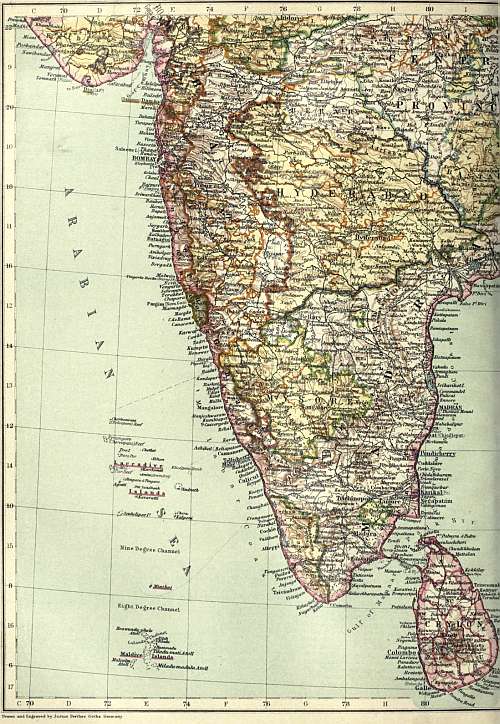
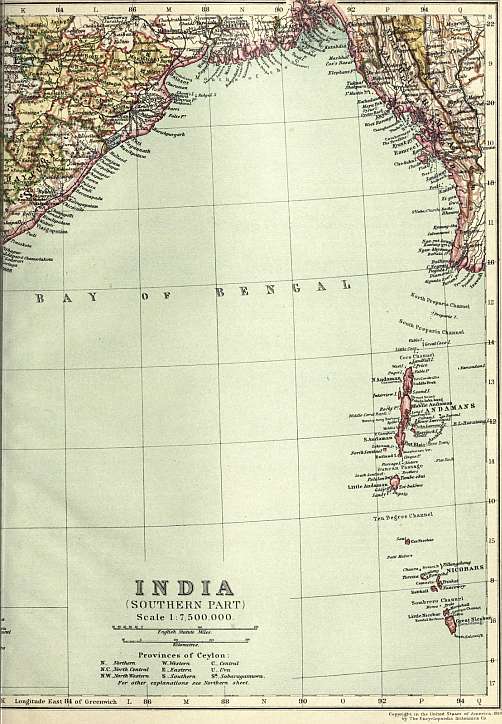
(Click to enlarge left side.)
(Click to enlarge right side.)
The chief Indian religions with the numbers of their followers according to the census of 1901 are: Hindu (207,147,026), Mahommedan (62,458,077), Buddhist (9,476,759), Sikh (2,195,339), Jain (1,334,148), Christian (2,923,241), Religion. Parsee (94,190), and Animist (8,584,148). The oldest of these religions is Animism (q.v.), which represents the beginnings of religion in India, and is still professed by the more primitive tribes, such as Santals, Bhils and Gonds. The transition from this crude form of religion to popular Hinduism (q.v.) is comparatively easy. The most obvious characteristics of the ordinary Hindu are that he worships a plurality of gods, looks upon the cow as a sacred animal, and accepts the Brahmanical supremacy (see Brahmanism) and the caste system; and when it is a question whether one of the animistic tribes has or has not entered the fold of Hinduism, these two latter points seem to be the proper test to apply. On the other hand there are various offshoots from orthodox Hinduism, the distinguishing feature of which, in their earlier history at least, is the obliteration of caste distinctions and the rejection of the Brahmanical hierarchy. It is doubtful if Buddhism, and still more so if Jainism and Sikhism, all of which are commonly recognized as distinct religions, ever differed from Hinduism to a greater extent than did the tenets of the earlier followers of Chaitanya in Bengal or those of the Lingayats in Mysore; and yet these latter two are regarded only as sects of Hinduism. Considerations of their history and past political importance have led to the elevation of Buddhism, Jainism and Sikhism to the rank of independent religions, while the numerous other schismatic bodies are held to be only sects. But there is a marked tendency both on the part of the sects and of the distinct religions to lapse into the parent religion from which they sprang. In this way both Buddhism (q.v.) and Jains (q.v.) have almost been swallowed up by Hinduism; Sikhism (q.v.) is only preserved by the military requirements of the British, and even the antagonism between Hindu and Mahommedan is much less acute than it used to be. The bewildering diversity of religious beliefs collected under the name of Hinduism has no counterpart amongst the Mahommedans (see Mahommedan Religion), who are limited as to their main tenets by the teaching of a single book, the Koran. The two main sects are the Sunnis and the Shiahs. In India the Sunnis greatly preponderate, but they usually share with the Shiahs their veneration for Hasan and Husain and strictly observe the Mohurrum.
The Mahommedans of India may be divided into two classes, pure Mahommedans from the Mogul and Pathan conquering races, and Mahommedan converts, who differ very little from the surrounding Hindu population from which they originally sprang. The pure Mahommedans may again be subdivided into four sections: Moguls, or the descendants of the last conquering race, including Persians; Afghans or Pathans, who from their proximity to the frontier are much more strongly represented, chiefly in the Punjab and in the Rohilkhand division of the United Provinces; Sayads, who claim to be lineally descended from the Prophet; and Sheikhs, which is a name often adopted by converts. The remainder are unspecified, but the following tribes or classes among Indian Mussulmans are worthy of notice. In Bengal the vast majority of the Mahommedans manifestly belong to the same race as the lowest castes of Hindus. They are themselves subdivided into many classes, which in their devotion to hereditary occupations are scarcely to be distinguished from Hindu castes. In the Punjab, besides the Pathan immigrants from across the frontier, Islam has taken a strong hold of the native population. The census returned large numbers of Jats, Rajputs and Gujars among the Mussulmans. Here, again, the Mahommedans are not strongly distinguished from their Hindu brethren. Bombay possesses three peculiar classes of Mussulmans, each of which is specially devoted to maritime trade—the Memons, chiefly in Sind; the Borahs, mainly in Gujarat; and the Khojahs, of whom half live in the island of Bombay. In southern India the majority are known as Deccani Mussulmans, being descendants of the armies led by the kings and nawabs of the Deccan. But the two peculiar races of the south are the Moplahs and the Labbays, both of which are seated along the coast and follow a seafaring life. They are descended from the Arab traders who settled there in very early times, and were recruited partly by voluntary adhesions and partly by forcible conversions during the persecutions of Hyder Ali and Tippoo Sultan. The Moplahs of Malabar are notorious for repeated outbreaks of bloody fanaticism. In proportion to the total population Islam is most strongly represented in the North-West Frontier Province, where it is the religion of 92% of the inhabitants; then follow Kashmir and Sind with about 75% each. Eastern Bengal and Assam with 58%, the Punjab with 49%, Bengal with 18%, and the United Provinces with 14%. In the great Mahommedan state of Hyderabad the proportion is only 10%. It appears that the Mahommedans generally tend to increase at a faster rate than the Hindus.
The Sikh religion is almost entirely confined to the Punjab. Of the total number of 2,195,339 Sikhs all but 64,352 are found in the Punjab, and two-thirds of the remainder are in the United Provinces and Kashmir which adjoin it.
Buddhism had disappeared from India long before the East India Company gained a foothold in the country, and at the present day there are very few Buddhists in India proper. Of the 9,476,759 enumerated in the census of 1901 all but some three hundred thousand were in Burma. The greater part of the remainder are found in Bengal on the borders of Burma, on the borders of Nepal, Tibet and Bhutan, and in the Spiti, Lahul and Kanawar districts of the Punjab Himalayas, where many of the inhabitants are of Tibetan origin.
More than two-fifths of the Jains in India are found in Bombay and its native states, including Baroda. They are proportionally most numerous in central and western Rajputana and in Gujarat and Central India.
The Parsees, though influential and wealthy, are a very small community, numbering only 94,000, of whom all but 7000 are found in Bombay. The remainder are scattered all over India, but are most numerous in Hyderabad, the Central India Agency, and the Central Provinces.
The Christian community numbers 2,923,241, of whom, 2,664,313 are natives and the remainder Europeans and Eurasians. Of the native Christians about two-fifths are Roman Catholics and one-eighth Uniat Syrians; one-ninth belong to the Anglican communion, one-eleventh are Jacobite Syrians, and one-twelfth are Baptists; while Lutherans, Methodists and Presbyterians are also represented. Nearly two-thirds of the total number are found in the Madras Presidency, including its native states. In Cochin and Travancore, where the Syrian church has most of its adherents, nearly a quarter of the entire population profess the Christian faith. More than four-fifths of the Christians in Madras proper are found in the eight southernmost districts, the scene of the labours of St Francis Xavier and the Protestant missionary Schwarz. The adherents of the Syrian church, known as “Christians of St Thomas,” in Malabar, Travancore and Cochin are the most ancient Christian community in the south. After these come the Roman Catholics, who trace their origin to the teaching of St Francis Xavier and the Madura Jesuits. The Protestant churches date only from about the beginning of the 19th century, but their progress since that time has been considerable. As is to be expected in the case of a religion with a strong proselytizing agency, the growth of Christianity is far more rapid than that of the general population. Taking native Christians alone, their numbers increased from 1,246,288 in 1872 to 2,664,313 in 1901, and the rate of increase in the thirty years was even greater than these figures would show, because they include the Syrian church, whose numbers are practically constant. The classes most receptive of Christianity are those who are outside the Hindu system, or whom Hinduism regards as degraded. Amongst the Hindu higher castes there are serious obstacles in the way of conversion, of which family influence and the caste system are the greatest.
Languages.—According to the linguistic survey of India no fewer than 147 distinct languages are recorded as vernacular in India. These are grouped according to the following system:—
Vernaculars of India.
Number of languages spoken.
Malayo-Polynesian Family—
Malay Group (7831) 2
Mon-Khmer Family (427,760) 4
Tibeto-Chinese Family—
Tibeto-Burman Sub-family (9,560,454) 79
Siamese-Chinese Sub-family (1,724,085) 9
Dravidian Family (56,514,524) 14
Munda Family (3,179,275) 10
Indo-European Family, Aryan Sub-family—
Iranian Branch (1,377,023) 3
Indo-Aryan Branch (219,780,650) 22
Semitic Family (42,881) 1
Hamitic Family (5530) 1
Unclassed Languages 2
Andamanese (1882)
Gipsy Languages (344,143)
Others (125)
——
Total Vernaculars of India 147
The only representatives of the Malayo-Polynesian group in India are the Selungs of the Mergui Archipelago and the Nicobarese. The Mon-Khmer family, which is most numerous in Indo-China, is here represented by the Talaings of southern Burma and the Khasis of Assam. Of the Tibeto-Chinese family, the Tibeto-Burman subfamily, as its name implies, is spoken from Tibet to Burma; while the Siamese-Chinese subfamily is represented by the Karens and Shans of Burma. The Munda or Kolarian family, which is now distinguished from the Dravidian, is almost confined to Chota Nagpur, its best-known tribe being the Santals. The Dravidian family includes the four literary languages of the south, as well as many dialects spoken by hill tribes in central India, and also the isolated Brahui in Baluchistan. Of the Indo-European family, the Iranian branch inhabits Persia, Afghanistan and Baluchistan; while the Indo-Aryan branch is spoken by the great mass of the people of northern India. The only Semitic language is Arabic, found at Aden, where also the Hamitic Somali was returned. Gipsy dialects are used by the nomadic tribes of India, while Andamanese has not been connected by philologists with any recognized family of speech.
All the chief languages of India are described under their separate names.
Education.—The existing system of education in India is mainly dependent upon the government, being directly organized by the state, at least in its higher departments, assisted throughout by grants-in-aid and under careful inspection. But at no period of its history has India been an altogether unenlightened country. The origin of the Deva-Nagari alphabet is lost in antiquity, though that is generally admitted not to be of indigenous invention. Inscriptions on stone and copper, the palm-leaf records of the temples, and in later days the widespread manufacture of paper, all alike indicate, not only the general knowledge, but also the common use, of the art of writing. From the earliest times the caste of Brahmans has preserved, by oral tradition as well as in MSS., a literature unrivalled alike in its antiquity and in the intellectual subtlety of its contents. The Mahommedan invaders introduced the profession of the historian, which reached a high degree of excellence, even as compared with contemporary Europe. Through all changes of government vernacular instruction in its simplest form has always been given, at least to the children of respectable classes, in every large village. On the one hand, the tols or seminaries for teaching Sanskrit philosophy at Benares and Nadiya recall the schools of Athens and Alexandria; on the other, the importance attached to instruction in accounts reminds us of the picture which Horace has left of a Roman education. Even at the present day knowledge of reading and writing is, owing to the teaching of Buddhist monks, as widely diffused throughout Burma as it is in some countries of Europe. English efforts to stimulate education have ever been most successful when based upon the existing indigenous institutions.
During the early days of the East India Company’s rule the promotion of education was not recognized as a duty of government. The enlightened mind of Warren Hastings did indeed anticipate his age by founding the Calcutta madrasa for Mahommedan teaching, and by affording steady patronage alike to Hindu pundits and European students. But Wellesley’s schemes of imperial dominion did not extend beyond the establishment of a college for English officials. Of the Calcutta colleges, that of Sanskrit was founded in 1824, when Lord Amherst was governor-general, the medical college by Lord William Bentinck in 1835, the Hooghly madrasa by a wealthy native gentleman in 1836. The Sanskrit college at Benares had been established in 1791, the Agra college in 1823. Meanwhile the missionaries made the field of vernacular education their own. Discouraged by the official authorities, and ever liable to banishment or deportation, they not only devoted themselves with courage to their special work of evangelization, but were also the first to study the vernacular dialects spoken by the common people. Just as two centuries earlier the Jesuits at Madura, in the extreme south, composed works in Tamil, which are still acknowledged as classical by native authors, so did the Baptist mission at Serampur, near Calcutta, first raise Bengali to the rank of a literary dialect. The interest of the missionaries in education, which has never ceased to the present day, though now comparatively overshadowed by government activity, had two distinct aspects. They studied the vernacular, in order to reach the people by their preaching and to translate the Bible; and they taught English, as the channel of non-sectarian learning.
At last the government awoke to its own responsibility in the matter of education, after the long and acrimonious controversy between the advocates of English and vernacular teaching had worn itself out. The present system dates from 1854, being based upon a comprehensive despatch sent out by Sir C. Wood (afterwards Lord Halifax) in that year. At that time the three universities were founded at Calcutta, Madras and Bombay; English-teaching schools were established in every district; the benefit of grants-in-aid was extended to the lower vernacular institutions and to girls’ schools; and public instruction was erected into a department of the administration in every province, under a director, with a staff of inspectors. In some respects this scheme may have been in advance of the time; but it supplied a definite outline, which has gradually been filled up with each succeeding year of progress. A network of schools has now been spread over the country, graduated from the indigenous village institutions up to the highest colleges. All alike receive some measure of pecuniary support, which is justified by the guarantee of regular inspection; and a series of scholarships at once stimulates efficiency and opens a path to the university for children of the poor.
During Lord Curzon’s term of office the whole system of education in India was examined, reported upon and improved. The five universities of Calcutta, Madras, Bombay, Allahabad and Lahore, which were formerly merely examining bodies, had their senates reformed by the introduction of experts; while hostels or boarding-houses for the college students were founded, so as to approach more nearly to the English ideal of residential institutions. The schools for secondary education were found to be fairly prosperous, owing to the increasing demand for English education; but more teachers and more inspectors were provided. In the primary schools, however, which provide vernacular teaching for the masses, there were only 4½ million pupils to the 300 millions of India. In 1901 three out of every four country villages had no school, only 3,000,000 boys, or less than one-fifth of the total number of school-going age, were in receipt of primary education, and only one girl for every ten of the male sex, or 2½% of the female population of school-going age. In order to remedy these defects primary education was made a first charge upon provincial revenues, and a permanent annual grant of £213,000 was made from the central government, with the result that thousands of new primary schools have since been opened. The technical schools may be divided into two classes, technical colleges and schools and industrial schools. The former include colleges of engineering and agriculture, veterinary colleges, schools of art and similar institutions. Several of these, such as the Rurki and Sibpur engineering colleges, the college of science at Poona, the Victoria Jubilee Institute at Bombay and some of the schools of art, have shown excellent results. The agricultural colleges have been less successful. The industrial schools were largely engaged in 1901 in teaching carpentry and smithy-work to boys who never intended to be carpenters or smiths; but this misdirection of industry has since been remedied, and the industrial schools have been made the first stepping-stone towards a professional career. In addition a number of technical scholarships of £150 each have been founded tenable in Europe or America.
Administration
By the act of parliament which transferred the government of India from the company to the crown, the administration in England is exercised by the sovereign through a secretary of state, who inherits all the powers formerly belonging to the Court of Directors and the Board of Control, and who, as a member of the cabinet, is responsible to parliament. In administrative details he is assisted by the Council of India, an advisory body, with special control over finance. This council consists of not more than fifteen and not fewer than ten members, appointed by the secretary of state for a term of seven years, of whom at least nine must have served or resided in India for ten years. A Hindu and a Mahommedan were for the first time appointed to the council in 1907.
At the head of the government in India is the governor-general, styled also viceroy, as representative of the sovereign. He is appointed by the crown, and his tenure of office is five years. The supreme authority, civil and The Supreme Government. military, including control over all the local governments, is vested in the governor-general in council, commonly known as “the Government of India,” which has its seat at Calcutta during the cold season from November to April, and migrates to Simla in the Punjab hills for the rest of the year. The executive council of the governor-general is composed of six ordinary members, likewise appointed by the crown for a term of five years, of whom three must have served for ten years in India and one must be a barrister, together with the commander-in-chief as an extraordinary member. A Hindu barrister was first appointed a member of council in 1909. The several departments of administration—Foreign, Home, Finance, Legislative, Army, Revenue and Agriculture (with Public Works), Commerce and Industry, Education (added in 1910)—are distributed among the council after the fashion of a European cabinet, the foreign portfolio being reserved by the viceroy; but all orders and resolutions are issued in the name of the governor-general in council and must be signed by a secretary.
For legislative purposes the executive council is enlarged into a legislative council by the addition of other members, ex officio, nominated and elected. In accordance with regulations made under the Indian Councils Act The Legislative Council. 1909, these additional members number 61, making 68 in all with the viceroy, so arranged as to give an official majority of three. The only ex-officio additional member is the lieutenant-governor of the province in which the legislative council may happen to meet; nominated members number 35, of whom not more than 28 may be officials; while 25 are elected, directly or indirectly, with special representation for Mahommedans and landholders. Apart from legislation, the members of the council enjoy the right to interpellate the government on all matters of public interest, including the putting of supplementary questions; the right to move and discuss general resolutions, which, if carried, have effect only as recommendations; and the right to discuss and criticize in detail the budget, or annual financial statement.
The local or provincial governments are fifteen in all, with varying degrees of responsibility. First stand the two presidencies of Madras (officially Fort St George) and Bombay, each of which is administered by a governor and council appointed by the crown. The governor is usually sent from England; the members of council may number four, of whom two must have served in India for ten years. Next follow the five lieutenant-governorships of Bengal, the United Provinces of Agra and Oudh, the Punjab, Burma, and Eastern Bengal and Assam, for each of which a council may be appointed, beginning with Bengal. Last come the chief commissionerships, of which the Central Provinces (with Berar) rank scarcely below the lieutenant-governorships, while the rest—the North-West Frontier Province, British Baluchistan, Ajmer-Merwara, Coorg and the Andamans—are minor charges, generally associated with political supervision over native states or frontier tribes. The two presidencies and also the five lieutenant-governorships each possesses a legislative council, modelled on that of the governor-general, but so that in every case there shall be a majority of non-official members, varying from 13 to 3.
Within the separate provinces the administrative unit is the district, of which there are 249 in India. In every province except Madras there are divisions, consisting of three or more districts under a commissioner. The title Districts. of the district officer varies according to whether the province is “regulation” or “non-regulation.” This is an old distinction, which now tends to become obsolete; but broadly speaking a larger measure of discretion is allowed in the non-regulation provinces, and the district officer may be a military officer, while in the regulation provinces he must be a member of the Indian civil service. In a regulation province the district officer is styled a collector, while in a non-regulation province he is called a deputy-commissioner. The chief non-regulation provinces are the Punjab, Central Provinces and Burma; but non-regulation districts are also to be found in Bengal, Eastern Bengal and Assam, the United Provinces and Sind.
The districts are partitioned out into lesser tracts, which are strictly units of administration, though subordinate ones. The system of partitioning, and also the nomenclature, vary in the different provinces; but generally it may be said that the subdivision or tahsil is the ultimate unit of administration. The double name indicates the twofold principle of separation: the subdivision is properly the charge of an assistant magistrate or executive officer, the tahsil is the charge of a deputy-collector or fiscal officer; and these two offices may or may not be in the same hands. Broadly speaking, the subdivision is characteristic of Bengal, where revenue duties are in the background, and the tahsil of Madras, where the land settlement requires attention year by year. There is no administrative unit below the subdivision or tahsil. The thana, or police division, only exists for police purposes. The pargana, or fiscal division, under native rule, has now but an historical interest. The village still remains as the agricultural unit, and preserves its independence for revenue purposes in most parts of the country. The township is peculiar to Burma.
Bengal (including Eastern Bengal and Assam), Madras, Bombay and the old North-Western Provinces each has a high court, established by charter under an act of parliament, with judges appointed by the crown. The Judicial Service. Of the other provinces the Punjab and Lower Burma have chief courts, and Oudh, the Central Provinces, Upper Burma, Sind and the North-West Frontier Province have judicial commissioners, all established by local legislation. From the high courts, chief courts and judicial commissioners an appeal lies to the judicial committee of the privy council in England. Below these courts come district and sessions judges, who perform the ordinary judicial work of the country, civil and criminal. Their jurisdictions coincide for the most part with the magisterial and fiscal boundaries. But, except in Madras, where the districts are large, a single civil and sessions judge sometimes exercises jurisdiction over more than one district. In the non-regulation territory judicial and executive functions are to a large extent combined in the same hands.
The law administered in the Indian courts is described in the article Indian Law.
The chief of the Indian services is technically known as the Indian civil service. It is limited to about a thousand members, who are chosen by open competition in England between the ages of twenty-one and twenty-four. Indian Services. Nearly all the higher appointments, administrative and judicial, are appropriated by statute to this service, with the exception of a few held by military officers on civil duty in the non-regulation provinces. Other services mainly or entirely recruited in England are the education department, police, engineering, public works, telegraph and forest services. In addition to the British officials employed in these services, there is a host of natives of India holding superior or subordinate appointments in the government service. According to a calculation made in 1904, out of 1370 appointments with a salary of £800 a year and upwards, 1263 were held by Europeans, 15 by Eurasians and 92 by natives of India. But below that line natives of India greatly preponderate; of 26,908 appointments ranging between £800 and £60 a year, only 5205 were held by Europeans, 5420 by Eurasians and 16,283 by natives.
These figures show that less than 6500 Englishmen are employed to rule over the 300 millions of India. On the other hand, natives manage the greater part of the administration of the revenue and land affairs and magisterial work. The subordinate courts throughout India are almost entirely manned by native judges, who sit also on the bench in each of the High Courts. Similarly in the other services. There are four engineering colleges in India, which furnish to natives access to the higher grades of the public works department; and the provincial education services are recruited solely in India.
Though the total strength of the army in India has undergone little change, important reforms of organization have been effected in recent years which have greatly improved its efficiency. In 1895, after long discussion, the The Army. old presidency system was abolished and the whole army was placed under one commander-in-chief, though it was not till 1904 that the native regiments of cavalry and infantry were re-numbered consecutively, and the Hyderabad contingent and a few local battalions were incorporated with the rest of the army. About the same time (1903) the designation of British officers serving with native troops was changed from “Indian Staff Corps” to “Indian Army.” The entire force, British and native, is now subdivided into a Northern and a Southern Army, with Burma as an independent command attached to the latter. Each of these armies is organized in divisions, nine in number, based on the principles that the troops in peace should be trained in units of command similar to those in which they would take the field, and that much larger powers should be entrusted to the divisional commanders. At the same time large sums of money have been expended on strategic works along the north-west frontier, supply and transport has been reorganized, rifle, gun and ammunition factories have been established, and a Staff College at Quetta.
In 1907-1908 the actual strength of the army in India numbered 227,714 officers and men, of whom 73,947 were British troops; and the total military expenditure amounted to £17,625,000, of which £2,996,000 was for non-effective charges. In addition, the reserve of the native army numbered 34,846 men, the volunteers 34,962, the frontier militia (including the Khyber Rifles) about 6000, the levies (chiefly in Baluchistan) about 6000, and the military police (chiefly in Burma) about 22,000. These figures do not include the Imperial Service troops, consisting of cavalry, infantry and transport corps, about 18,000 in all, which are paid and officered by the native states furnishing them, though supervised by British inspectors. The military forces otherwise maintained by the several native states are estimated to number about 100,000 men, of varying degrees of efficiency.
The police, it is admitted, still form an unsatisfactory part of the administration, though important reforms have recently been introduced. The present system, which is modelled somewhat on that of the Irish constabulary, Police. dates from shortly after the Mutiny, and is regulated for the greater part of the country by an act passed in 1861. It provides a regular force in each district, under a superintendent who is almost always a European, subordinate for general purposes to the district magistrate. For the preservation of order this force is by no means inefficient, but it fails as a detective agency and also in the prosecution of crime, being distrusted by the people generally. As the result of a Commission appointed in 1902, a considerable addition has been made to the expenditure on police, which is being devoted to increasing the pay of all the lower grades and to augmenting the number of investigating officers. In 1901 the total strength of the civil police force was about 145,000 men, maintained at a total cost of about £2,200,000. In addition, the village watchmen or chaukidars, a primitive institution paid from local sources but to some extent incorporated in the general system, aggregated about 700,000; while a special force of military police, numbering about 20,000 under officers seconded from the army, is maintained along the frontier, more especially in Burma.
The administration of gaols in India can be described more favourably. As a rule, there is one gaol in each district, under the management of the civil surgeon. Discipline is well maintained, though separate confinement Gaols. is practically unknown; and various industries (especially carpet-weaving) are profitably pursued wherever possible. So much attention has been directed to diet and sanitation that the death-rate compares well with that of the general working population: in 1907 it was as low as 18 per 1000. Convicts with more than six years to serve are transported to the Andaman Islands, where the penal settlement is organized on an elaborate system, permitting ultimately self-support on a ticket of leave and even marriage. In 1907 the daily average gaol population in India was 87,306, while the convicts in the Andamans numbered 14,235.
Local self-government, municipal and rural, in the form in which it now prevails in India, is essentially a product of British rule. Village communities and trade gilds in towns existed previously, but these were only rudimentary forms of Municipalities. self-government. The beginnings of municipal government occurred in the Presidency towns. Apart from these the act of 1850 respecting improvements in towns initiated consultative committees. In 1870 Lord Mayo delegated to local committees the control over these improvement funds. But the system at present in force is based upon legislation by Lord Ripon in 1882, providing for the establishment of municipal committees and local boards, whose members should be chosen by election with a preponderance of non-official members. The large towns of Calcutta, Bombay and Madras have municipalities of this character, and there are large numbers of municipal committees and local boards all over the country. There are also Port Trusts in the great maritime cities of Calcutta, Bombay, Madras, Karachi and Rangoon.
As the land furnishes the main source of Indian revenue, so the assessment of the land tax is the main work of Indian administration. No technical term is more familiar to Anglo-Indians, and none more strange to the Land Settlement. English public, than that of land settlement. No subject has given rise to more voluminous controversy. It will be enough in this place to explain the general principles upon which the system is based, and to indicate the chief differences of application in the several provinces. That the state should appropriate to itself a direct share in the produce of the soil is a fundamental maxim of Indian finance that has been recognized throughout the East from time immemorial. The germs of rival systems can be traced in the old military and other service tenures of Assam, and in the poll tax of Burma, &c. The exclusive development of the land system is due to two conditions,—a comparatively high state of agriculture and an organized plan of administration,—both of which are supplied by the primitive village community. During the lapse of untold generations, despite domestic anarchy and foreign conquest, the Hindu village has in many parts preserved its simple customs, written in the imperishable tablets of traditions. The land was not held by private owners but by occupiers under the petty corporation; the revenue was not due from individuals, but from the community represented by its head-man. The aggregate harvest of the village fields was thrown into a common fund, and before the general distribution the head-man was bound to set aside the share of the state. No other system of taxation could be theoretically more just, or in practice less obnoxious to the people. Such is an outline of the land system as it may be found at the present day throughout large portions of India both under British and native rule; and such we may fancy it to have been universally before the Mahommedan conquest. The Mussulmans brought with them the avarice of conquerors, and a stringent system of revenue collection. Under the Mogul empire, as organized by Akbar the Great, the share of the state was fixed at one-third of the gross produce of the soil; and a regular army of tax-collectors was permitted to intervene between the cultivator and the supreme government. The entire vocabulary of the present land system is borrowed from the Mogul administration. The zamindar himself is a creation of the Mahommedans, unknown to the early Hindu system. He was originally a mere tax-collector, or farmer of the land revenue, who agreed to furnish a lump sum from the tract of country assigned to him. If the Hindu village system may be praised for its justice, the Mogul farming system had at least the merit of efficiency. Shah Jahan and Aurangzeb extracted a larger land revenue than the British do. When the government was first undertaken by the East India Company, no attempt was made to understand the social system upon which the land revenue was based. The zamindar was conspicuous and useful; the village community and the cultivating ryot did not force themselves into notice. The zamindar seemed a solvent person, capable of keeping a contract; and his official position as tax-collector was confused with the proprietary rights of an English landlord. The superior stability of the village system was overlooked, and in the old provinces of Bengal and Madras the village organization has gradually been suffered to fall into decay. The consistent aim of the British authorities has been to establish private property in the soil, so far as is consistent with the punctual payment of the revenue. The annual government demand, like the succession duty in England, is universally the first liability on the land; when that is satisfied, the registered landholder has powers of sale or mortgage scarcely more restricted than those of a tenant in fee-simple. At the same time the possible hardships, as regards the cultivator, of this absolute right of property vested in the owner have been anticipated by the recognition of occupancy rights or fixity of tenure, under certain conditions. Legal rights are everywhere taking the place of unwritten customs. Land, which was before merely a source of livelihood to the cultivator and of revenue to the state, has now become the subject of commercial speculation. The fixing of the revenue demand has conferred upon the owner a credit which he never before possessed, by allowing him a certain share of the unearned increment. This credit he may use improvidently, but none the less has the land system of India been raised from a lower to a higher stage of civilization.
The means by which the land revenue is assessed is known as settlement, and the assessor is styled a settlement officer. In Bengal the assessment has been accomplished once and for all, but throughout the greater part of the rest of India the process is continually going on. The details vary in the different provinces; but, broadly speaking, a settlement may be described as the ascertainment of the agricultural capacity of the land. Prior to the settlement is the work of survey, which first determines the area of every village and frequently of every field also. Then comes the settlement officer, whose duty it is to estimate the character of the soil, the kind of crop, the opportunities for irrigation, the means of communication and their probable development in the future, and all other circumstances which tend to affect the value of the produce. With these facts before him, he proceeds to assess the government demand upon the land according to certain general principles, which may vary in the several provinces. The final result is a settlement report, which records, as in a Domesday Book, the entire mass of agricultural statistics concerning the district.
Lower Bengal and a few adjoining districts of the United Provinces and of Madras have a permanent settlement, i.e. the land revenue has been fixed in perpetuity. When the Company obtained the diwání or financial administration of Bengal in 1765, the theory of a settlement, as described above, was unknown. The existing Mahommedan system was adopted in its entirety. Engagements, sometimes yearly, sometimes for a term of years, were entered into with the zamindars to pay a lump sum for the area over which they exercised control. If the offer of the zamindar was not deemed satisfactory, another contractor was substituted in his place. But no steps were taken, and perhaps no steps were possible, to ascertain in detail the amount which the country could afford to pay. For more than twenty years these temporary engagements continued, and received the sanction of Warren Hastings, the first titular governor-general of India. Hastings’ great rival, Francis, was among those who urged the superior advantages of a permanent assessment. At last, in 1789, a more accurate investigation into the agricultural resources of Bengal was commenced, and the settlement based upon this investigation was declared perpetual by Lord Cornwallis in 1793. The zamindars of that time were raised to the status of landlords, with rights of transfer and inheritance, subject always to the payment in perpetuity of a rent-charge. In default of due payment, their lands were liable to be sold to the highest bidder. The aggregate assessment was fixed at sikká Rs.26,800,989, equivalent to Co.’s Rs.28,587,722, or say 2¾ millions sterling. While the claim of Government against the zamindars was thus fixed for ever, it was intended that the rights of the zamindars over their own tenants should be equally restricted. But no detailed record of tenant-right was inserted in the settlement papers, and, as a matter of fact, the cultivators lost rather than gained in security of tenure. The same English prejudice which made a landlord of the zamindar could recognize nothing but a tenant-at-will in the ryot. By two stringent regulations of 1799 and 1812 the tenant was practically put at the mercy of a rack-renting landlord. If he failed to pay his rent, however excessive, his property was rendered liable to distraint and his person to imprisonment. At the same time the operation of the revenue sale law had introduced a new race of zamindars, who were bound to their tenants by no traditions of hereditary sympathy, but whose sole object was to make a profit out of their newly purchased property. The rack-rented peasantry found no protection in the law courts until 1859, when an act was passed which restricted the landlord’s powers of enhancement in certain specified cases. Later the Bengal Tenancy Act of 1885, since amended by an act of 1898, created various classes of privileged tenants, including one class known as “settled ryots,” in which the qualifying condition is holding land, not necessarily the same land, for twelve years continuously in one village. Outside the privileged classes of tenants the act gives valuable protection to tenants-at-will. The progress in the acquisition of occupancy rights by tenants may be judged from the fact that, whereas in 1877 it was stated of the Champaran district that the cultivator had hardly acquired any permanent interest in the soil, the settlement officer in 1900 reported that 87% of the occupied area was in the possession of tenants with occupancy rights or holding at fixed rates. It is believed that the ryots will eventually be able to secure, and to hold against all comers, the strong legal position which the Bengal Tenancy Act has given them.
The permanent settlement was confined to the three provinces of Bengal, Behar and Orissa, according to their boundaries at that time. Orissa proper, which was conquered from the Mahrattas in 1803, is subject to a temporary settlement, which expired in 1897 and a re-settlement was made in 1900. The enhancement in the revenue amounted to 52% of the previous demand; but in estates in which the increase was specially large it was decided to introduce the new rates gradually.
The prevailing system throughout the Madras presidency is the ryotwari, which takes the cultivator or peasant proprietor as its rent-paying unit, somewhat as the Bengal system takes the zamindar. This system cannot be called The Ryotwari system. indigenous to the country, any more than the zamindari of Bengal. If any system deserves that name, it is that of village assessment, which still lingers in the memories of the people in the south. When the British declared themselves heir to the nawab of the Carnatic at the opening of the 19th century, they had no adequate experience of revenue management. The authorities in England favoured the zamindari system already at work in Bengal, which appeared at least calculated to secure punctual payment. The Madras Government was accordingly instructed to enter into permanent engagements with zamindars, and, where no zamindars could be found, to create substitutes out of enterprising contractors. The attempt resulted in failure in every case, except where the zamindars happened to be the representatives of ancient lines of powerful chiefs. Several of such chiefs exist in the extreme south and in the north of the presidency. Their estates have been guaranteed to them on payment of a peshkash or permanent tribute, and are saved by the custom of primogeniture from the usual fate of subdivision. Throughout the rest of Madras there are no zamindars either in name or fact. The influence of Sir Thomas Munro afterwards led to the adoption of the ryotwari system, which will always be associated with his name. According to this system, an assessment is made with the cultivating proprietor upon the land taken up for cultivation year by year. Neither zamindar nor village officer intervenes between the cultivator and the state, which takes directly upon its own shoulders all a landlord’s responsibility. The early ryotwari settlements in Madras were based upon insufficient experience. They were preceded by no survey, but adopted the crude estimates of native officials. Since 1858 a department of revenue survey has been organized, and the old assessments have been everywhere revised.
Nothing can be more complete in theory and more difficult of exposition than a Madras ryotwari settlement. First, the entire area of the district, whether cultivated or uncultivated, and of each field within the district is accurately measured. The next step is to calculate the estimated produce of each field, having regard to every kind of both natural and artificial advantage. Lastly, a rate is fixed upon every field, which may be regarded as roughly equal to one-third of the gross and one-half of the net produce. The elaborate nature of these inquiries and calculations may be inferred from the fact that as many as thirty-five different rates are sometimes struck for a single district, ranging from 6d. to £1, 4s. per acre. The rates thus ascertained are fixed for a term of thirty years; but during that period the aggregate rent-roll of a district is liable to be affected by several considerations. New land may be taken up for cultivation, or old land may be abandoned; and occasional remissions are permitted under no less than eighteen specified heads. Such matters are discussed and decided by the collector at the jamabandi or court held every year for definitely ascertaining the amount of revenue to be paid by each ryot for the current season. This annual inquiry has sometimes been mistaken by careless passers-by for an annual reassessment of each ryot’s holding. It is not, however, a change in the rates for the land which he already holds, but an inquiry into and record of the changes in his former holding or of any new land which he may wish to take up.
In the early days of British rule no system whatever prevailed throughout the Bombay presidency; and even at the present time there are tracts where something of the old confusion survives. The modern “survey tenure,” as it is called, dates from 1838, when it was first introduced into one of the tálukas of Poona district, and it has since been gradually extended over the greater part of the presidency. As its name implies, the settlement is preceded by survey. Each field is measured, and an assessment placed upon it according to the quality of the soil without any attempt to fix the actual average produce. This assessment holds good, without any possibility of modification, for a term of thirty years. The Famine Commission of 1901 suggested the following measures with a view to improving the position of the Bombay ryot: (1) A tenancy law to protect expropriated ryots, (2) a bankruptcy law, (3) the limitation of the right of transfer, in the interests of ryots who are still in possession of their land.
In the other provinces variations of the zamindari and ryotwari systems are found. In the United Provinces and the Punjab the ascertainment of the actual rents paid is the necessary preliminary to the land revenue demand. The other Provinces. In the Central Provinces, where the landlords (malguzars) derive their title from the revenue settlements made under British rule, the rents are actually fixed by the settlement officer for varying periods. In addition nearly every province has its own laws regulating the subject of tenancy; the tenancy laws of the United Provinces and of the Central Provinces were revised and amended during the decade 1891-1901.
The principles of the land revenue settlement and administration were reviewed by the government of India in a resolution presented to parliament in 1902, in which its policy is summarised as follows:—
“In Land Tenures and Settlements. the review of their land revenue policy which has now been brought to a close, the Government of India claim to have established the following propositions, which, for convenience’ sake, it may be desirable to summarize before concluding this Resolution:—
(1) That a Permanent Settlement, whether in Bengal or elsewhere, is no protection against the incidence and consequences of famine.
(2) That in areas where the State receives its land revenue from landlords, progressive moderation is the key-note of the policy of Government, and that the standard of 50% of the assets is one which is almost uniformly observed in practice, and is more often departed from on the side of deficiency than of excess.
(3) That in the same areas the State has not objected, and does not hesitate, to interfere by legislation to protect the interests of the tenants against oppression at the hands of the landlord.
(4) That in areas where the State takes the land revenue from the cultivators, the proposal to fix the assessment at one-fifth of the gross produce would result in the imposition of a greatly increased burden upon the people.
(5) That the policy of long term settlements is gradually being extended, the exceptions being justified by conditions of local development.
(6) That a simplification and cheapening of the proceedings connected with new settlements and an avoidance of the harassing invasion of an army of subordinate officials, are a part of the deliberate policy of Government.
(7) That the principle of exempting or allowing for improvements is one of general acceptance, but may be capable of further extension.
(8) That assessments have ceased to be made upon prospective assets.
(9) That local taxation as a whole, though susceptible of some redistribution, is neither immoderate nor burdensome.
(10) That over-assessment is not, as alleged, a general or widespread source of poverty and indebtedness in India, and that it cannot fairly be regarded as a contributory cause of famine.
The Government of India have further laid down liberal principles for future guidance and will be prepared, where the necessity is established, to make further advance in respect of:—
(11) The progressive and graduated imposition of large enhancements.
(12) Greater elasticity in the revenue collection, facilitating its adjustment to the variations of the seasons, and the circumstances of the people.
(13) A more general resort to reduction of assessments in cases of local deterioration, where such reduction cannot be claimed under the terms of settlement.”
In 1900-1901 the total land revenue realized from territory under British administration in India amounted to £17,325,000, the rate per cultivated acre varying from 3s. 1d. in Madras to 10d. in the Central Provinces. The general conclusion of the Famine Commission of 1901 was that “except in Bombay, where it is full, the incidence of land revenue is low to moderate in ordinary years, and it should in no way per se be the cause of indebtedness.”
Prior to the successive reductions of the salt duty in 1903, 1905 and 1907, next to land, salt contributed the largest share to the Indian revenue; and, where salt is locally manufactured, its supervision becomes an important part of Salt Administration. administrative duty. Up to within quite recent times the tax levied upon salt varied extremely in different parts of the country, and a strong preventive staff was required to be stationed along a continuous barrier hedge, which almost cut the peninsula into two fiscal sections. The reform of Sir J. Strachey in 1878, by which the higher rates were reduced and the lower rates raised, with a view to their ultimate equalization over the whole country, effectually abolished this old engine of oppression. Communication is now free; and it has been found that prices are absolutely lowered by thus bringing the consumer nearer to his market, even though the rate of taxation be increased. Broadly speaking the salt consumed in India is derived from four sources: (1) importation by sea, chiefly from England and the Red Sea and Aden; (2) solar evaporation in shallow tanks along the seaboard; (3) the salt lakes in Rajputana; (4) quarrying in the salt hills of the northern Punjab. The salt lakes in Rajputana have been leased by the government of India from the rulers of the native states in which they lie, and the huge salt deposits of the Salt Range mines are worked under government control, as also are the brine works on the Runn of Cutch. At the Kohat mines, and in the salt evaporation works on the sea-coast, with the exception of a few of the Madras factories, the government does not come between the manufacturer and the merchant, except in so far as is necessary in order to levy the duty from the salt as it issues from the factory. The salt administration is in the hands of (1) the Northern India Salt Department, which is directly under the government of India, and controls the salt resources of Rajputana and the Punjab, and (2) the salt revenue authorities of Madras and Bombay.
The consumption of salt per head in India varies from 7 ℔ in Rajputana to 16.02 ℔ in Madras. The salt duty, which stood in 1888 at Rs.2½ per maund, was reduced in 1903 to Rs.2, in 1905 to Rs.1½ and in 1907 to R. 1 per maund, the rate being uniform all over India. In 1907-1908 the gross yield of the salt duty was £3,339,000, of which more than one-fourth was derived from imported salt.
The heading Opium in the finance accounts represents the duty on the export of the drug. The duty on local consumption, which is included under excise, yielded £981,000 in 1907-1908. The opium revenue proper is derived Opium. from two sources: (1) a monopoly of production in the valley of the Ganges, and (2) a transit duty levied on opium grown in the native states of western India, known as Malwa opium. Throughout British territory the growth of the poppy is almost universally prohibited, except in a certain tract of Bengal and the United Provinces, where it is grown with the help of advances from government and under strict supervision. The opium, known as “provision opium,” is manufactured in government factories at Patna and Ghazipur, and sold by auction at Calcutta for export to China. The net opium revenue represents the difference between the sum realized at these sales and the cost of production. Malwa opium is exported from Bombay, the duty having previously been levied on its passage into British territory. In 1907-1908 the net opium revenue from both sources amounted to £3,576,000. The Chinese government having issued an edict that the growth and consumption of opium in China should be entirely suppressed within ten years, the government of India accordingly agreed in 1908 that the export of opium from India should be reduced year by year, so that the opium revenue would henceforth rapidly decline and might be expected to cease altogether. In 1908 an international commission that met at Shanghai passed resolutions inviting all the states there represented to take measures for the gradual suppression of the manufacture, sale and distribution of opium, except for medicinal purposes.
Excise.—Excise, like salt, is not only a department of revenue collection, but also to a great extent a branch of the executive. In other words, excise duties in India are not a mere tax upon the consumer, levied for convenience through the manufacturer and retail dealer, but a species of government monopoly. The only excisable articles are intoxicants and drugs; and the avowed object of the state is to check consumption not less than to raise revenue. The limit of taxation and restriction is the point at which too great encouragement is given to smuggling. Details vary in the different provinces, but the general plan of administration is the same. The right to manufacture and the right to retail are both monopolies of government permitted to private individuals only upon terms. Distillation of country spirits is allowed according to two systems—either to the highest bidder under strict supervision, or only upon certain spots set apart for the purpose. The latter is known as the sadr or central distillery system. The right of sale is also usually farmed out to the highest bidder, subject to regulations fixing the minimum quantity of liquor that may be sold at one time. The brewing of beer from rice and other grains, which is universal among the hill tribes and other aboriginal races, is practically untaxed and unrestrained. The European breweries at several hill stations pay the same tax as imported beer. Apart from spirits, excise duties are levied upon the sale of a number of intoxicating or stimulant drugs, of which the most important are opium, bhang, ganja and charas. Opium is issued for local consumption in India from the government manufactories at Ghazipur and Patna in the Behar and Benares Agencies, and sold through private retailers at a monopoly price. Bhang, ganja and charas are three different narcotic drugs prepared from the hemp plant (Cannabis sativa, var. indica). Scientifically speaking, bhang consists of the dried leaves and small stalks, with a few fruits; ganja of the flowering and fruiting heads of the female plant; while charas is the resin itself, collected in various ways as it naturally exudes. The plant grows wild in many parts of India; but the cultivation of it for ganja is practically confined to a limited area in the Rajshahi district of eastern Bengal, and charas is mainly imported from Central Asia. The use of bhang in moderation is comparatively harmless; ganja and charas when taken in excess are undoubtedly injurious, leading to crime and sometimes to insanity. In accordance with the recommendations of the Hemp Drugs Commission, the government of India passed an act in 1896 providing that, in regard to ganja and charas, cultivation of the plants should be restricted as much as possible, and that a direct quantitative duty should be levied on the drugs on issue from the warehouse in the province of consumption; while as regards bhang, cultivation of the hemp for its production should be prohibited or taxed, and collection of the drug from wild plants permitted only under licence, a moderate quantitative duty being levied in addition to vend fees. No duty whatever is now levied upon tobacco in any part of India. The plant is universally grown by the cultivators for their own smoking, and, like everything else, was subject to taxation under native rule; but the impossibility of accurate excise supervision has caused the British government to abandon the impost. In 1907-1908 the total gross revenue from excise amounted to £6,214,000, of which more than two-thirds was derived from spirits and toddy.
Since 1894 a uniform customs duty of 5% ad valorem has been levied generally on imported goods, certain classes being placed on the free list, of which the most important are food-grains, machinery, railway material, coal, and cotton twist and yarn (exempted in 1896). Most classes of iron and steel are admitted at the lower rate of 1%. Cotton goods are taxed at 3½%, whether imported or woven in Indian mills. Special duties are imposed on liquors, arms and ammunition and petroleum, while imported salt pays the same duty as salt manufactured locally. From 1899 to 1904 a countervailing duty was imposed on bounty-fed beet sugar. There is also a customs duty at the rate of about 3d. per 82 ℔ on exported rice. In 1907-1908 the total customs revenue amounted to £4,910,000, of which £664,000 was derived from the export duty on rice and £223,730 from the excise on cotton manufactures.
Since 1886 an assessed tax has been levied on all sources of income except that derived from land. The rate is a little more than 2½% on all incomes exceeding £133 a year, and a little more than 2% on incomes exceeding £66, the minimum income liable to assessment having been raised in 1903 from £33. The total number of persons assessed is only about 260,000. In 1907-1908 the gross receipts from income tax amounted to £1,504,000.
Other sources of revenue are stamps, levied on judicial proceedings and commercial documents; registration of mortgages and other instruments; and provincial rates, chiefly in Bengal and the United Provinces for public works or rural police. The rates levied at a certain percentage of the land revenue for local purposes are now excluded from the finance accounts. In 1907-1908 the gross receipts amounted to: from stamps, £4,259,000, of which more than two-thirds was derived from the sale of court fee stamps; from registration, £415,000; and from provincial rates, £526,000.
Commerce and Industries.
India may almost be said to be a country of a single industry, that industry being agriculture. According to the census of 1901 two-thirds of the total population were employed in occupations connected with the land, while not one-tenth of that proportion were supported by any other single industry. The prosperity of agriculture therefore is of overwhelming importance to the people of India, and all other industries are only subsidiary to this main occupation. This excessive dependence upon a single industry, which is in its turn dependent upon the accident of the seasons, upon a favourable or unfavourable monsoon, has been held to be one of the main causes of the frequent famines which ravage India.
Agriculture.—The cultivation of the soil is the occupation of the Indian people in a sense which is difficult to realize in England, and which cannot be adequately expressed by figures. As the land tax forms the mainstay of the imperial revenue, so the ryot or cultivator constitutes the unit of the social system. The organized village community contains many other members besides the cultivators; but they all exist for his benefit, and all alike are directly maintained from the produce of the village fields. Even in considerable towns, the traders and handicraftsmen almost always possess plots of land of their own, on which they raise sufficient grain to supply their families with food. The operations of rural life are familiar to every class. They are enveloped in a cloud of religious sanctions, and serve to mark out by their recurring periods the annual round of common life.
But though agriculture thus forms the staple industry of the country, its practice is pursued in different provinces with infinite variety of detail. Everywhere the same perpetual assiduity is found, but the inherited experience of generations has taught the cultivators to adapt their simple methods to differing circumstances. For irrigation, native patience and ingenuity have devised means which compare not unfavourably with the colossal projects of government. Manure is copiously applied to the more valuable crops whenever manure is available, its use being limited by poverty and not by ignorance. The rotation of crops is not adopted as a principle of cultivation; but in practice it is well known that a succession of exhausting crops cannot be taken in consecutive seasons from the same field, and the advantage of fallows is widely recognized. The periodicity of the seasons usually allows two, and sometimes three, harvests in the year, but not necessarily, nor indeed usually, from the same fields. For inexhaustible fertility, and for retentiveness of moisture in a dry year, no soil in the world can surpass the “black cotton-soil” of the Deccan. In the broad river basins the inundations deposit annually a fresh top-dressing of silt, thus superseding the necessity of manures.
Wheat.—Within recent years wheat has become one of the most important crops in India, more especially for export. The canal colonies of the Punjab have turned northern India into one of the great grain-fields of the British empire; and in 1904 India took the first place in supplying wheat to the United Kingdom, sending nearly 25½ million cwts. out of a total of 97¾ millions. In 1905, however, it fell back again into the third place, being passed by Russia and Argentina. Wheat is grown chiefly in the Punjab, the United Provinces, and the Central Provinces. In 1905-1906 there were 23 million acres under wheat in the whole of India, of which 8½ million were in the Punjab alone.
Rice.—The name of rice has from time immemorial been so closely associated with Indian agriculture that it is difficult to realize how comparatively small an area is planted with this crop. With the exception of the deltas of the great rivers and the long strip of land fringing the western coast, rice may be called an occasional crop throughout the remainder of the peninsula. But where it is grown it is grown to the exclusion of all other crops. The rice crop is most important in Burma, Bengal and Madras, and there is an average of 20 million acres under rice in the other provinces of British India. In Bengal the area varies from 36 to 40 million acres according to the season. In Burma, where the large waste area is being gradually brought under cultivation, there has been an almost uninterrupted increase in the area of the rice crop, and the rice export is one of the main industries of the province. In ordinary years most of this rice goes either to Europe or to the Farther East; but in famine seasons a large part is diverted to peninsular India, and Burma is the most important of the outside sources from which the deficient crops are supplemented. In 1905-1906 the export of rice from India was valued at 12½ millions sterling.
Millets.—Taking India as a whole, the staple food grain is neither rice nor wheat, but millets, which are probably the most prolific grain in the world, and the best adapted to the vicissitudes of a tropical climate. Excluding the special rice-growing tracts, different kinds of millet are grown more extensively than any other crop from Madras in the south at least as far as Rajputana in the north. The sorghum or great millet, generally known as jowar or cholum, is the staple grain crop of southern India. The spiked millet, known as bajra or cumbu, which yields a poorer food, is grown on dry sandy soil in the Deccan and the Punjab. A third sort of millet, ragi or marua, is cultivated chiefly in Madras and Bengal. There are also other kinds, which are included as a rule under the general head of “other food grains.” Millet crops are grown for the most part on unirrigated land. In the Bombay Deccan districts they cover generally upwards of 60% of the grain area, or an even larger proportion in years of drought. In Gujarat about half the grain area is under millets or maize in ordinary years. The grain is consumed almost entirely in India, though a small amount is exported.
Pulses.—Among pulses gram covers in ordinary years more than 10 millions of acres, chiefly in the United Provinces, the Punjab and Bengal. Gram is largely eaten by the poorer classes, but it is also used as horse-food. Other pulses, lentils, &c., are extensively grown, but the area under these crops is liable to great contraction in years of drought, as it consists for the most part of unirrigated lands.
Oil-seeds.—Oil-seeds also form an important crop in all parts of the country, being perhaps more universally grown than any other, as oil is necessary, according to native custom, for application to the person, for food, and for burning in lamps. In recent years the cultivation of oil-seeds has received an extraordinary stimulus owing to the demand for export to Europe, especially to France; but as they can be grown after rice, &c., as a second crop, this increase has hardly at all tended to diminish the production of food grains. The four chief varieties grown are mustard or rape seed, linseed, til or gingelly (sesamum), and castor-oil. Bengal and the United Provinces are at present the chief sources of supply for the foreign demand, but gingelly is largely exported from Madras, and, to a smaller extent, from Burma. These seeds are for the most part pressed in India either in bullock presses or in oil-mills. The refuse or cake is of great value to agriculturists, as it forms a food for cattle, and in the case of sesamum it is eaten by the people. But a very large quantity of the seeds is exported. The total value of oils and oil-seeds exported in 1905-1906 was over 7½ millions sterling.
Vegetables.—Vegetables are everywhere cultivated in garden plots for household use, and also on a larger scale in the neighbourhood of great towns. Among favourite native vegetables, the following may be mentioned:—the egg-plant, called brinjal or baigan (Solanum Melongena), potatoes, cabbages, cauliflower, radishes, onions, garlic, turnips, yams, and a great variety of cucurbitaceous plants, including Cucumis sativus, Cucurbita maxima, Lagenaria vulgaris, Trichosanthes dioica, and Benincasa cerifera. Of these, potatoes, cabbages, and turnips are of comparatively recent introduction. Almost all English vegetables can be raised by a careful gardener. Potatoes thrive best on the higher elevations, such as the Khasi hills, the Nilgiris, the Mysore uplands, the Shan States, and the slopes of the Himalayas; but they are also grown even in lowland districts.
Fruits.—Among cultivated fruits are the following:—Mango (Mangifera indica), plantain (Musa paradisiaca), pine-apple (Ananassa sativa), pomegranate (Punica Granatum), guava (Psidium pomiferum and P. pyriferum), tamarind (Tamarindus indica), jack (Artocarpus integrifolia), custard-apple (Anona squamosa), papaw (Carica Papaya), shaddock (Citrus decumana), and several varieties of fig, melon, orange, lime and citron. According to the verdict of Europeans, no native fruits can compare with those of England. But the mangoes of Bombay, of Multan, and of Malda in Bengal, and the oranges of Nagpur and the Khasi hills, enjoy a high reputation; while the guavas of Madras are made into an excellent preserve.
Spices.—Among spices, for the preparation of curry and other hot dishes, turmeric and chillies hold the first place, being very generally cultivated. Next in importance come ginger, coriander, aniseed, black cummin, and fenugreek. Pepper proper is confined to the Malabar coast, from Kanara to Travancore. Cardamoms are a valuable crop in the same locality, and also in the Nepalese Himalayas. Pan or betel-leaf is grown by a special caste in most parts of the country. Its cultivation requires constant care, but is highly remunerative. The betel-nut or areca palm is chiefly grown in certain favoured localities, such as the deltaic districts of Bengal and the highlands of southern India.
Palms.—Besides betel-nut (Areca Catechu), the palms of India include the coco-nut (Cocos nucifera), the bastard date (Phoenix sylvestris), the palmyra (Borassus flabellifer), and the true date (Phoenix dactylifera). The coco-nut, which loves a sandy soil and a moist climate, is found in greatest perfection along the strip of coast-line that fringes the west of the peninsula, where it ranks next to rice as the staple product. The bastard date, grown chiefly in the country round Calcutta and in the north-east of the Madras presidency, supplies both the jaggery sugar of commerce and intoxicating liquors for local consumption. Spirit is also distilled from the palmyra, especially in the neighbourhood of Bombay and in the south-east of Madras. The true date is almost confined to Sind.
Sugar.—Sugar is manufactured both from the sugar-cane and from the bastard date-palm, but the total production is inadequate to the local demand. The best cane is grown in the United Provinces, on irrigated land. It is an expensive crop, requiring much attention, and not yielding a return within the year; but the profits are proportionately large. The normal area under sugar-cane in India is generally about 3 million acres, chiefly in the United Provinces, Bengal, and the Punjab. A large share of the produce is consumed in the form of gur or unrefined sugar, and the market for this preparation is independent of foreign competition. The total import of sugar in 1905-1906 was valued at £5,182,000, chiefly from Java and Mauritius.
Indigo.—Owing to the manufacture of synthetic indigo by German chemists the export trade in indigo, which was formerly the most important business carried on by European capital in India, has been almost entirely ruined. In the early years of the 19th century there were colonies of English planters in many districts of Bengal, and it was calculated that the planters of North Behar alone had a turnover of a million sterling. The industry suffered depression owing to the indigo riots of 1860 and the emancipation of the peasantry by the Land Act of 1859; but in the closing decade of the century it received a much more disastrous blow from the invention of the German chemists. In 1895-1896 the area under indigo was 1,570,000 acres, and the value of the exports £3,569,700, while in 1905-1906 the area had sunk to 383,000 acres, and the value of the exports to £390,879. The only hope of rescuing the industry from total disappearance lies in the fact that the natural indigo gives a faster dye than the manufactured product, while an effort has also been made to introduce the Java-Natal seed into India, which gives a much heavier yield, and so may be better able to compete in price with synthetic indigo.
Tea.—The cultivation of tea in India began within the memory of men still living, and now has replaced indigo as the chief article for European capital, more particularly in Assam. Unlike coffee-planting the enterprise owes its origin to the initiation of government, and has never attracted the attention of the natives. Early travellers reported that the tea-plant was indigenous to the southern valleys of the Himalayas; but they were mistaken in the identity of the shrub, which was the Osyris nepalensis. The real tea (Thea viridis), a plant akin to the camellia, grows wild in Assam, being commonly found throughout the hilly tract between the valleys of the Brahmaputra and the Barak. There it sometimes attains the dimensions of a large tree; and from that, as well as from other indications, it has been plausibly inferred that Assam is the original home of the plant, which was thence introduced at a prehistoric date into China. The real progress of tea-planting in Assam dates from about 1851, and was greatly assisted by the promulgation of the Waste-land Rules of 1854. By 1859 there were already fifty-one gardens in existence, owned by private individuals; and the enterprise had extended from its original headquarters in Lakhimpur and Sibsagar as far down the Brahmaputra as Kamrup. In 1856 the tea-plant was discovered wild in the district of Cachar in the Barak valley, and European capital was at once directed to that quarter. At about the same time tea-planting was introduced into the neighbourhood of the sanatorium of Darjeeling, among the Sikkim Himalayas. The success of these undertakings engendered a wild spirit of speculation in tea companies both in India and at home, which reached its climax in 1865. The industry recovered but slowly from the effects of this disastrous crisis, and did not again reach a stable position until 1869. Since that date it has rapidly but steadily progressed, and has been ever opening new fields of enterprise. At the head of the Bay of Bengal in Chittagong district, side by side with coffee on the Nilgiri hills, on the forest-clad slopes of Kumaon and Kangra, amid the low-lying jungle of the Bhutan Dwars, and even in Arakan, the energetic pioneers of tea-planting have established their industry. Different degrees of success may have rewarded them, but in no case have they abandoned the struggle. The area under tea, of which nine-tenths lies in the new province of Eastern Bengal and Assam, expanded by 85% during the sixteen years from 1885 to 1901, while the production increased by 167%. This great rise in the supply, unaccompanied by an equal expansion of the market for Indian tea, involved the industry in great difficulties, to meet which it became necessary to restrict the area under tea as far as possible, and to reduce the quantity of leaf taken from the plant, thus at the same time improving the quality of the tea. The area under tea in 1885 was 283,925 acres and the yield 71,525,977 ℔, while in 1905 the area had increased to 527,290 acres and the yield to 222,360,132 ℔, while the export alone was 214,223,728 ℔. As much as 92% of the export goes to the United Kingdom, where China tea has been gradually ousted by tea from India and Ceylon. The other chief countries that afford a market for Indian tea are Canada, Russia, Australia, Turkey in Asia, Persia, and the United States. India’s consumption of tea is computed to average 8¼ million pounds, of which 5½ millions are Indian and the remainder Chinese. There should therefore be considerable room for expansion in the home market. In 1905 there were 134 tea-planting companies registered in India, about 80% of the capital being held by shareholders in London.
Coffee.—The cultivation of coffee is confined to southern India, though attempts have been made to introduce the plant both into Lower Burma and into the Eastern Bengal district of Chittagong. The coffee tract may be roughly defined as a section of the landward slope of the Western Ghats, extending from Kanara in the north to Travancore in the extreme south. That tract includes almost the whole of Coorg, the districts of Kadur and Hassan in Mysore, the Nilgiri hills, and the Wynaad. The cultivation has also extended to the Shevaroy hills in Salem district and to the Palni hills in Madura.
Unlike tea, coffee was not introduced into India by European enterprise; and even to the present day its cultivation is largely followed by the natives. The Malabar coast has always enjoyed a direct commerce with Arabia, and at an early date gave many converts to Islam. One of these converts, Baba Budan by name, is said to have gone on a pilgrimage to Mecca and to have brought back with him the coffee berry, which he planted on the hill range in Mysore still called after him. According to local tradition this happened more than two centuries ago. The shrubs thus sown lived on, but the cultivation did not spread until the beginning of the 19th century. The state of Mysore and the Baba Budan range also witnessed the first opening of a coffee-garden by an English planter about 1840. The success of this experiment led to the extension of coffee cultivation into the neighbouring tract of Manjarabad, also in Mysore, and into the Wynaad subdivision of the Madras district of Malabar. From 1840 to 1860 the enterprise made slow progress; but since the latter date it has spread with great rapidity along the whole line of the Western Ghats, clearing away the primeval forest, and opening a new era of prosperity to the labouring classes. The export of coffee in 1905 was 360,000 cwt., being the highest for sixteen years. The over-supply of cheap Brazilian coffee in the consuming markets caused a heavy fall in prices at the beginning of the decade, the average price in London in 1901 being 47s. per cwt. compared with 101s. in 1894. The United Kingdom and France are the chief consumers. An agreement with France at the beginning of the decade secured to Indian produce imported into that country the benefits of the minimum tariff, thus protecting the coffee industry from taxation in French ports on a scale which would have seriously hampered the trade. There is practically no local market for coffee in India.
Cinchona.—The cultivation of cinchona was introduced into India in the year 1860 under the auspices of government, owing to the efforts of Sir Clements Markham, and a stock of plants was prepared and distributed to planters in the Nilgiris and in Coorg. At the same time governmental plantations were established in the Nilgiri hills and at Darjeeling, and these have been continued up to the present time. A considerable amount of the bark from private plantations is bought by the government and treated at the government factories. The sulphate of quinine and the cinchona febrifuge thus produced are issued for the most part to medical officers in the various provinces, to gaols, and to the authorities of native states; but a large and increasing amount is disposed of in the form of 5-grain packets, costing a farthing each, through the medium of the post-offices. This system brings the drug easily within the reach of the people.
Cattle.—Throughout the whole of India, except in Sind and the western districts of the Punjab, horned cattle are the only beasts used for ploughing. The well-known humped species of cattle predominates everywhere, being divided into many varieties. Owing partly to unfavourable conditions of climate and soil, partly to the insufficiency of grazing ground, and partly to the want of selection in breeding, the general condition of the cattle is miserably poor. As cultivation advances, the area of waste land available for grazing steadily diminishes, and the prospects of the poor beasts are becoming worse rather than better. Their only hope lies in the introduction of fodder crops as a regular stage in the agricultural course. There are, however, some fine breeds in existence. In Mysore the amrit mahal, a breed said to have been introduced by Hyder Ali for military purposes, is still kept up by the state. In the Madras districts of Nellore and Kurnool the indigenous breed has been greatly improved under the stimulus of cattle shows and prizes founded by British officials. In the Central Provinces there is a peculiar breed of trotting bullocks which is in great demand for wheeled carriages. The large and handsome oxen of Gujarat in Bombay and of Hariana in the Punjab are excellently adapted for drawing heavy loads in a sandy soil. The fodder famines that accompanied the great famines of 1897 and 1900 proved little short of disastrous to the cattle in the affected provinces. In Gujarat and the arid plains of the south-east Punjab the renowned herds almost disappeared. In the affected districts of the Punjab the loss of cattle averaged from 17 to 45% of the whole. In Rajputana more than half of its thirteen or fourteen millions of stock is said to have perished in 1900 alone. In one state the loss amounted to 90%, and in four others to 70%. In Gujarat half of its 1½ million cattle perished in spite of the utmost efforts to obtain fodder. The worst cattle are to be found always in the deltaic tracts, but there their place is to a large extent taken by buffaloes. These last are more hardy than ordinary cattle; their character is maintained by crossing the cows with wild bulls, and their milk yields the best ghi or clarified butter. Along the valley of the Indus, and in the sandy desert which stretches into Rajputana, camels supersede cattle for agricultural operations. The breed of horses has generally deteriorated since the demand for military purposes has declined with the establishment of British supremacy. In Bengal Proper, and also in Madras, it may be broadly said that horses are not bred. But horses are still required for the Indian army, the native cavalry, and the police; and in order to maintain the supply of remounts a civil veterinary department was founded in 1892, transferred in 1903 to the army remount department. Horse-breeding is carried on chiefly in the Punjab, the United Provinces, and Baluchistan, and government keep a number of stallions in the various provinces. Formerly Norfolk trotters held the first place in point of number, but their place has been taken in recent years by English thoroughbreds, Arabs, and especially Australians. For the supply of ordnance, baggage, and transport mules a large number of donkey stallions have been imported by the government annually from various European and other sources. But the supply of suitable animals is not good, and their cost is large; so the breeding of donkey stallions has been undertaken at the Hissar farm in the Punjab.