VOLUME XIV SLICE III Ichthyology to Independence (continued 8)
Reading edition
Among illustrators of Teutonic race the one artist who seems worthy of comparison with the great Menzel is Hans Tegner, if, indeed, he be not in some respects his technical superior; but apart from these two, the illustrators respectively of Germany. Kügler’s Frederick the Great and Holberg’s Comedies, there is no German, Danish or Dutch illustrator who can lay claim to first rank. Max Klinger, A. Böcklin, W. Trübner, Franz Stück and Hans Thoma are all symbolists who combine in a singular degree force with brutality; the imaginative quality in their work is for the most part ruined by the hard, braggart way in which it is driven home. The achievements and tendency of the later school of illustration in Germany are best seen in the weekly illustrated journal, Jugend, of Munich. Typical of an older German school is the work of Adolf Oberländer, a solid, scientific sort of caricaturist, whose illustrations are at times so monumental that the humour in them seems crushed out of life. Others who command high qualities of technique are W. Dietz, L. von Nagel, Hermann Vogel, H. Lüders and Robert Haug. Behind all these men in greater or less degree lies the influence of Menzel’s coldly balanced and dry-lighted realism; but wherever the influence of Menzel ceases, the merit of German illustration for the most part tends to disappear or become mediocre.
Authorities.—W. J. Linton, The Masters of Wood Engraving (London, 1889); C. G. Harper, English Pen Artists of To-day (London, 1892); Joseph Pennell, Pen Drawing and Pen Draughtsmen (London, 1894), Modern Illustration (London, 1895); Walter Crane, The Decorative Illustration of Books (London, 1896); Gleeson White, English Illustration: “The ’Sixties”: 1855-1870 (Westminster, 1897); W. A. Chatto, A Treatise on Wood Engraving (London, n.d.); Bar-le-Duc, Les Illustrations du XIXe siècle (Paris, 1882); T. Kutschmann, Geschichte der deutschen Illustration vom ersten Auftreten des Formschnittes bis auf die Gegenwart (Berlin, 1899).
(L. Ho.)
Technical Developments.
The history of illustration, apart from the merits of individual artists, during the period since the year 1875, is mainly that of the development of what is called Process (q.v.), the term applied to methods of reproducing a drawing or photograph which depend on the use of some mechanical agency in the making of the block, as distinguished from such products of manual skill as steel or wood-engraving, lithography and the like. There is good reason to believe that the art of stereotyping—the multiplication of an already existing block by means of moulds and casts—is as old as the 15th century; and the early processes were, in a measure, a refinement upon this: with the difference that they aimed at the making of a metal block by means of a cast of the lines of the drawing itself, the background of which had been cut away so as to leave the design in a definite relief. Experiments of this nature may be said to have assumed practical shape from the time of the invention of Palmer’s process called at first Glyphography, about the year 1844; this was afterwards perfected and used to a considerable extent under the name of Dawson’s Typographic Etching, and its results were in many cases quite admirable, and often appear in books and periodicals of the first part of the period with which we are now concerned. The Graphic, for instance, published its first process block in 1876, and the Illustrated London News also made similar experiments at about the same time.
From this time begins the gradual application of photography to the uses of illustration, the first successful line blocks made by its help being probably those of Gillot, at Paris, in the early ’eighties. The next stage was to be the invention of some means of reproducing wash drawings. To do this it was necessary for the surface of the block to be so broken up that every tone of the drawing should be represented thereon by a grain holding ink enough to reproduce it. This was finally accomplished by the insertion of a screen, in the camera, between the lens and the plate—the effect of which was to break up the whole surface of the negative into dots, and so secure, when printed on a zinc plate and etched, an approximation to the desired result. Half-tone blocks (as they were called) of this nature (see Process) were used in the Graphic from 1884 and the Illustrated London News from 1885 onwards, the methods at first in favour being those of Meisenbach and Boussod Valadon and Co.’s phototype. Lemercier and Petit of Paris, Angerer and Göschl of Vienna, and F. Ives of Philadelphia also perfected processes giving a similar result, a block by the latter appearing in the Century magazine as early as 1882. Processes of this description had, however, been used for some years before by Henry Blackburn in his Academy Notes.
During the decade 1875-1885, however, the main body of illustration was accomplished by wood-engraving, which a few years earlier had achieved such splendid results. Its artistic qualities were now at a rather low ebb, although good facsimile engravings of pen-drawings were not infrequent. The two great illustrated periodicals already referred to during that period relied more upon pictorial than journalistic work. An increasing tendency towards the illustration of the events of the day was certainly shown, but the whole purpose of the journal was not, as at present, subordinated thereto. The chief illustrated magazines of the time, Harper’s, the Century, the English Illustrated, were also content with the older methods, and are filled with wood-engravings, in which, if the value of the simple line forming the chief quality of the earlier work has disappeared, a most astonishing delicacy and success were obtained in the reproduction of tone.
Perhaps the most notable and most characteristic production of the time in England was colour-printing. The Graphic and the Illustrated London News published full-page supplements of high technical merit printed from wood-blocks in conjunction with metal plates, the latter sometimes having a relief aquatint surface which produced an effect of stipple upon the shading; metal was also used in preference to wood for the printing of certain colours. The children’s books illustrated by Randolph Caldecott, Walter Crane and Kate Greenaway at this time are among the finest specimens of colour-printing yet seen outside of Japan; in them the use of flat masses of pleasant colour in connexion with a bold and simple outline was carried to a very high pitch of excellence. These plates were generally printed by Edmund Evans. In 1887 the use of process was becoming still more general; but its future was by no means adequately foreseen, and the blocks of this and the next few years are anything but satisfactory. This, it soon appeared, was due to inefficient printing on the one hand, and, on the other, to a want of recognition by artists of the special qualities of drawing most suitable for photographic reproduction. The publication of Quevedo’s Pablo de Segovia with illustrations by Daniel Vierge in 1882, although hardly noticed at the time, was to be a revelation of the possibilities of the new development; and a serious study of pen-drawing from this point of view was soon inaugurated by the issue of Joseph Pennell’s Pen Drawing and Pen Draughtsmen in 1889, followed in by C. G. Harper’s English Pen Artists of To-day and in 1896 by Walter Crane’s Decorative Illustration of Books. At this time also the influence of Aubrey Beardsley made itself strongly felt, not merely as a matter of style, but, by the use of simple line or mass of solid black, as an almost perfect type of the work most suitable to the needs of process. Wider experience of printing requirements, and finer workmanship in the actual making of the blocks, in Paris, Vienna, New York and London, soon brought the half-tone process into great vogue. The spread of education has enormously increased the demand for ephemeral literature, more especially that which lends itself to pictorial illustration; and the photograph or drawing in wash reproduced in half-tone has of late to a great extent ousted line work from the better class of both books and periodicals.
Improvements in machinery have made it possible to print illustrations at a very high speed; and the facility with which photographs can now be taken of scenes such as the public delight to see reproduced in pictures has brought about an almost complete change in pictorial journalism. In addition, reference must be made to an extraordinary increase in the numbers and circulation of cheap periodical publications depending to a very large extent for popularity on their illustrations. Several of these, printed on the coarsest paper, from rotary machines, sell to the extent of hundreds of thousands of copies per week. It was inevitable that this cheapening process should not be permitted to develop without opposition, and the Dial (1889-1897) must be looked on as a protest by the band of artists who promoted it against the unintelligent book-making now becoming prevalent. Much more effective and far-reaching in the same direction was the influence of William Morris, as shown in the publications of the Kelmscott Press (dating from 1891). In these volumes the aim was to produce illustrations and ornaments which were of their own nature akin to, and thus able to harmonize with the type, and to do this by pure handicraft work. As a result, a distinct improvement is to be found in the mere book-making of Great Britain; and although the main force of the movement soon spent itself in somewhat uninspired imitations, there can be no doubt of the survival of a taste for well-produced volumes, in which the relationship of type, paper, illustration and binding has been a matter of careful and artistic consideration. Under this influence, a notable feature has been the re-issue, in an excellent form, of illustrated editions of the works of most of the famous writers.
In France the general movement has proceeded upon lines on the whole very similar. Process—especially what was called “Gillotage”—was adopted earlier, and used at first with greater liberality than in England, although wood-engraving has persisted effectively even up to our own time. In the various types of periodicals of which the Revue Illustrée, Figaro Illustré and Gil Blas Illustré may be taken as examples, the most noticeable feature is a use of colour-printing, which is far in advance of anything generally attempted in Great Britain. A favourite and effective process is that employed for the reproduction of chalk drawings (as by Steinlen), which consists of the application of a surface-tint of colour from a metal plate to a print from an ordinary process block.
In Germany, Jugend, Simplicissimus, and other publications devoted to humour and caricature, employ colour-printing to a great extent with success. The organ of the artists of the younger German schools, Pan (1895), makes use of every means of illustration, and has especially cultivated lithography and wood-cuts, using these arts effectively but with some eccentricity. Holland has also employed coloured lithography for a remarkable series of children’s books illustrated by van Hoytema and others. The Viennese Kunst und Kunsthandwerk is an art publication which is exceptionally well produced and printed.
Illustration in the United States has some few characteristics which differentiate it from that of other countries. The later school of fine wood-engraving is even yet in existence. American artists also introduced an effective use of the process block, namely, the engraving or working over of the whole or certain portions of it by hand. This is generally done by an engraver, but in certain cases it has been the work of the original draughtsman, and its possibilities have been foreseen by him in making his drawing. The only other variant of note is the use of half-tone blocks superimposed for various colours.
(E. F. S.)
ILLUSTRES, the Latin name given to the highest magistrates of the later Roman Empire. The designation was at first informal, and not strictly differentiated from other marks of honour. From the time of Valentinian I. it became an official title of the consuls, the chief praefecti or ministers, and of the commanders-in-chief of the army. Its usage was eventually extended to lower grades of the imperial service, and to pensionaries from the order of the spectabiles. The Illustres were privileged to be tried in criminal cases by none but the emperor or his deputy, and to delegate procuratores to represent them in the courts.
See O. Hirschfeld in Sitzungsberichte der Berliner Akademie (1901), p. 594 sqq.; and T. Hodgkin, Italy and her Invaders (Oxford, 1892), i. 603-617.
ILLYRIA, a name applied to part of the Balkan Peninsula extending along the eastern shore of the Adriatic from Fiume to Durazzo, and inland as far as the Danube and the Servian Morava. This region comprises the modern provinces or states of Dalmatia, Bosnia and Herzegovina, and Montenegro, with the southern half of Croatia-Slavonia, part of western Servia, the sanjak of Novibazar, and the extreme north of Albania. As the inhabitants of Illyria never attained complete political unity its landward boundaries were never clearly defined. Indeed, the very name seems originally to have been an ethnological rather than a geographical term; the older Greek historians usually wrote of “the Illyrians” (οἰ Ἰλλυρίοι), while the names Illyris (Ἰλλυρίς) or less commonly Illyria (Ἰλλυρία) came subsequently to be used of the indeterminate area inhabited by the Illyrian tribes, i.e. a region extending eastward from the Adriatic between Liburnia on the N. and Epirus on the S., and gradually shading off into the territories of kindred peoples towards Thrace. The Latin name Illyricum was not, unless at a very early period, synonymous with Illyria; it also may originally have signified the land inhabited by the Illyrians, but it became a political expression, and was applied to various divisions of the Roman Empire, the boundaries of which were frequently changed and often included an area far larger than Illyria properly so called. Vienna and Athens at different times formed part of Illyricum, but no geographer would ever have included these cities in Illyria.
Ethnology.—Little can be learned from written sources of the origin and character of the Illyrians. The Greek legend that Cadmus and Harmonia settled in Illyria and became the parents of Illyrius, the eponymous ancestor of the whole Illyrian people, has been interpreted as an indication that the Greeks recognized some affinity between themselves and the Illyrians; but this inference is based on insufficient data. Herodotus and other Greek historians represent the Illyrians as a barbarous people, who resembled the ruder tribes of Thrace. Both are described as tattooing their persons and offering human sacrifices to their gods. The women of Illyria seem to have occupied a high position socially and even to have exercised political power. Queens are mentioned among their rulers. Fuller and more trustworthy information can be obtained from archaeological evidence. In Bosnia the lake-dwellings at Butmir, the cemeteries of Jezerine and Glasinac and other sites have yielded numerous stone and horn implements, iron and bronze ornaments, weapons, &c., and objects of more recent date fashioned in silver, tin, amber and even glass. These illustrate various stages in the development of primitive Illyrian civilization, from the neolithic age onward. The Hallstatt and La Tène cultures are especially well represented. (See W. Ridgeway, The Early Age of Greece, 1901; R. Munro, Bosnia-Herzegovina and Dalmatia, Edinburgh, 1900; and W. Radimský, Die neolithische Station von Butmir, Vienna, 1895-1898.) Similar discoveries have been made in Dalmatia, as among the tumuli on the Sabbioncello promontory, and in Croatia-Slavonia. H. Kiepert (“Über den Volkstamm der Leleges,” in Monatsber. Berl. Akad., 1861, p. 114) sought to prove that the Illyrians were akin to the Leleges; his theory was supported by E. Schrader, but is not generally accepted. In Dalmatia there appears to have been a large Celtic element, and Celtic place-names are common. The ancient Illyrian languages fall into two groups, the northern, closely connected with Venetic, and the southern, perhaps allied to Messapian and now probably represented by Albanian.
See K. Brugmann, Kurze vergleichende Grammatik der Indogermanischen Sprachen (Strassburg, 1904); and his larger Grundriss der vergleichenden Grammatik (2nd ed., Strassburg, 1897), with the authorities there quoted, especially P. Kretschmer, Einleitung in die Geschichte der Griechischen Sprachen (Göttingen, 1896): see also Albania.
History.—Greek colonization on the Illyrian seaboard probably began late in the 7th century B.C. or early in the 6th century. The most important settlements appear to have been at Epidamnus (Durazzo), Tragurium (Traù), Rhizon (near Cattaro), Salona (near Spalato), Epidaurum (Ragusavecchia), Zara and on the islands of Curzola, Lesina and Lissa. There is a collection of Greek coins from Illyria in the museum at Agram, and the researches of Professor F. Bulié and others at Salona (see Spalato) have brought to light Greek inscriptions, Greek pottery, &c. dating from 600 B.C. But Greek influence seems never to have penetrated far into the interior, and even on the coast it was rapidly superseded by Latin civilization after the 3rd century B.C. Until then the Illyrian tribes appear to have lived in a state of intermittent warfare with their neighbours and one another. They are said by Herodotus (ix. 43) to have attacked the temple of Delphi. Brasidas with his small army of Spartans was assaulted by them on his march (424 B.C.) across Thessaly and Macedonia to attack the Athenian colonies in Thrace. The earlier history of the Macedonian kings is one constant struggle against the Illyrian tribes. The migrations of the Celts at the beginning of the 4th century disturbed the country between the Danube and the Adriatic. The Scordisci and other Celtic tribes settled there, and forced the Illyrians towards the south. The necessities of defence seem to have united the Illyrians under a chief Bardylis (about 383 B.C.) and his son Clitus. Bardylis nearly succeeded in destroying the rising kingdom of Macedonia; King Amyntas II was defeated, and a few years later Perdiccas was defeated and slain (359). But the great Philip crushed the Illyrians completely, and annexed part of their country. During the next century we hear of them as pirates. Issuing from the secluded harbours of the coast, they ravaged the shores of Italy and Greece, and preyed on the commerce of the Adriatic. The Greeks applied to Rome for help. Teuta, the Illyrian queen, rejected the Roman demands for redress, and murdered the ambassadors; but the two Illyrian Wars (229 and 219 B.C.) ended in the submission of the Illyrians, a considerable part of their territory being annexed by the conquerors. Illyria, however, remained a powerful kingdom with its capital at Scodra (Scutari in Albania), until 180 B.C., when the Dalmatians declared themselves independent of Gentius or Genthius, the king of Illyria, and founded a republic with its capital at Delminium (see Dalmatia: History, on the site of Delminium). In 168 Gentius came into conflict with the Romans, who conquered and annexed his country. Dalmatia was invaded by a Roman army under Gaius Marcius Figulus in 156, but Figulus was driven back to the Roman frontier, and in Dalmatia the Illyrians were not finally subdued until 165 years afterwards. Publius Scipio Nasica, who succeeded Figulus, captured Delminium, and in 119 L. Caecilius Metellus overran the country and received a triumph and the surname Dalmaticus. But in 51 a Dalmatian raid on Liburnia led to a renewal of hostilities; the Roman armies were often worsted, and although in 39 Asinius Pollio gained some successes (see Horace, Odes ii. 1. 15) these appear to have been exaggerated, and it was not until Octavian took the field in person that the Dalmatians submitted in 33. (For an account of the war see Appian, Illyrica, 24-28; Dio Cassius xlix. 38; Livy, Epit. 131, 132). They again revolted in 16 and 11, and in A.D. 6-9 joined the rebel Pannonians. Suetonius (Tiberius, 16) declares that they were the most formidable enemies with whom the Romans had had to contend since the Punic Wars. In A.D. 9, however, Tiberius entirely subjugated them, for which he was awarded a triumph in 12 (Dio Cass. lv. 23-29, lvi. 11-17; Vell. Pat. ii. 110-115). Thenceforward Dalmatia, Iapydia and Liburnia were united as the province of Illyricum.
Latin civilization spread rapidly, the cultivation of the vine was introduced, gold-mining was carried on in Bosnia, and flourishing commercial cities arose along the coast. Illyria became one of the best recruiting grounds for the Roman legions; and in troubled times many Illyrian soldiers fought their way up from the ranks to the imperial purple. Claudius, Aurelian, Probus, Diocletian and Maximian were all sons of Illyrian peasants. It is probable, however, that most of the highland tribes now represented by the Albanians remained almost unaffected by Roman influence. The importance of Illyricum caused its name to be extended to many neighbouring districts; in the 2nd century A.D. the Illyricus Limes included Noricum, Pannonia, Moesia, Dacia and Thrace. In the reorganization of the empire by Diocletian (285) the diocese of Illyricum was created; it comprised Pannonia, Noricum and Dalmatia, while Dacia and Macedonia, together called Eastern Illyricum, were added later. Either Diocletian or after him Constantine made Illyricum one of the four prefectures, each governed by a praefectus praetorio, into which the empire was divided. This prefecture included Pannonia, Noricum, Crete and the entire Balkan peninsula except Thrace, which was attached by Constantine to the prefecture of the East. From the partition of the empire in 285 until 379 Illyricum was included in the Western Empire, but thenceforward Eastern Illyricum was annexed to the Eastern Empire; its frontier was almost identical with the line of demarcation between Latin-speaking and Greek-speaking peoples, and roughly corresponded to the boundary which now severs Latin from Greek Christianity in the Balkan peninsula. The whole peninsula except Thrace was still known as Illyricum, but was subdivided into Illyris Barbara or Romana and Illyris Graeca (Eastern Illyricum with Greece and Crete). The Via Egnatia, the great line of road which connected Rome with Constantinople and the East, led across Illyricum from Dyrrachium to Thessalonica.
In the 5th century began a series of invasions which profoundly modified the ethnical character and the civilization of the Illyrians. In 441 and 447 their country was ravaged by the Huns. In 481 Dalmatia was added to the Ostrogothic kingdom, which already included the more northerly parts of Illyricum, i.e. Pannonia and Noricum. Dalmatia was partially reconquered by Justinian in 536, but after 565 it was devastated by the Avars, and throughout the century bands of Slavonic invaders had been gradually establishing themselves in Illyria, where, unlike the earlier barbarian conquerors, they formed permanent settlements. Between 600 and 650 the main body of the immigrants occupied Illyria (see Servia: History; and Slavs). It consisted of Croats and Serbs, two groups of tribes who spoke a single language and were so closely related that the origin of the distinction between them is obscure. The Croats settled in the western half of Illyria, the Serbs in the eastern; thus the former came gradually under the influence of Italy and Roman Catholicism, the latter under the influence of Byzantium and the Greek Church. Hence the distinction between them became a marked difference of civilization and creed, which has always tended to keep the Illyrian Slavs politically disunited.
The Croats and Serbs rapidly absorbed most of the Latinized Illyrians. But the wealthy and powerful city-states on the coast were strong enough to maintain their independence and their distinctively Italian character. Other Roman provincials took refuge in the mountains of the interior; these Mavrovlachi, as they were called (see Dalmatia: Population; and Vlachs), preserved their language and nationality for many centuries. The Illyrian tribes which had withstood the attraction of Roman civilization remained unconquered among the mountains of Albania and were never Slavonized. With these exceptions Illyria became entirely Serbo-Croatian in population, language and culture.
The name of Illyria had by this time disappeared from history. In literature it was preserved, and the scene of Shakespeare’s comedy, Twelfth Night, is laid in Illyria. Politically the name was revived in 1809, when the name Illyrian Provinces was given to Carniola, Dalmatia, Istria, Fiume, Görz and Gradisca, and Trieste, with parts of Carinthia and Croatia; these territories were ceded by Austria to Italy at the peace of Schönnbrun (14th Oct. 1809). The Illyrian Provinces were occupied by French troops and governed in the interest of Napoleon; the republic of Ragusa was annexed to them in 1811, but about the end of 1813 the French occupation ceased to be effective and the provinces reverted to Austria. The kingdom of Illyria, which was constituted in 1816 out of the crown-lands of Carinthia, Carniola, Istria, Görz and Gradisca, and Trieste, formed until 1849 a kingdom of the Austrian crown. For the political propaganda known as Illyrism, see Croatia-Slavonia: History.
Bibliography.—In addition to the authorities quoted above, see G. Zippel, Die römische Herrschaft in Illyrien bis auf Augustus (Leipzig, 1877); P. O. Bahn, Der Ursprung der römischen Provinz Illyrien (Grimma, 1876); J. Marquardt, Römische Staatsverwaltung, i. (1881), p. 295; E. A. Freeman, “The Illyrian Emperors and their Land” (Historical Essays, series 3, 1879); C. Patsch in Pauly-Wissowa’s Realencyklopädie, iv. pt. 2 (1901); Th. Mommsen, The Provinces of the Roman Empire (ed. F. Haverfield, 1909).
ILMENAU, a town and summer resort of Germany, in the grand-duchy of Saxe-Weimar, at the north foot of the Thuringian Forest, on the river Ilm, 30 m. by rail south of Erfurt. Pop. (1905) 11,222. The town, which stands picturesquely among wooded hills, is much frequented by visitors in the summer. It was a favourite resort of Goethe, who wrote here his Iphigenie, and often stayed at Gabelbach in the neighbourhood. It has a grand-ducal palace, a Roman Catholic and two Evangelical churches, a sanatorium for nervous disorders, and several educational establishments. Its chief manufactures are glass and porcelain, toys, gloves and chemicals, and the town has tanneries and saw-mills. Formerly a part of the county of Henneberg, Ilmenau came in 1631 into the possession of electoral Saxony, afterwards passing to Saxe-Weimar.
See R. Springer, Die klassischen Stätten von Jena und Ilmenau (Berlin, 1869); Pasig, Goethe und Ilmenau (2nd ed., Weimar, 1902); and Fils, Bad Ilmenau und seine Umgebung (Hildburghausen, 1886).
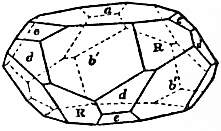
ILMENITE, a mineral known also as titanic iron, formerly regarded as an iron and titanium sesquioxide (Fe, Ti)2O3 isomorphous with haematite (Fe2O3), but now generally considered to be an iron titanate FeTiO3 isomorphous with pyrophanite (MnTiO3) and geikielite (MgTiO3). It crystallizes in the parallel-faced hemihedral class of the rhombohedral system, thus having the same degree of symmetry as phenacite and pyrophanite, but differing from that of haematite. The angles between the faces are very nearly the same as between the corresponding faces of haematite; but it is to be noted that the rhombohedral angle (94° 29′) of ilmenite is not intermediate between that of haematite (94° 0′) and of the artificially prepared crystals of titanium sesquioxide (92° 40′), which should be the case if the three substances were isomorphous. Analyses show wide variations in chemical composition, and there is a gradation from normal ilmenite FeTiO3 (with titanium dioxide 52.7, and ferrous oxide 47.3%) to titaniferous haematite and titaniferous magnetite. Frequently also, magnesia and manganous oxide are present in small amounts, the former reaching 16%. The formula (Fe, Mg)TiO3 is then analogous to those of geikielite and pyrophanite. Many analyses show the presence of TiO2 and (Fe, Mg)O in this ratio of 1:1, yet there is often an excess of ferric oxide to be accounted for; this may perhaps be explained by the regular intergrowth on a minute scale of ilmenite with haematite, like the intergrowth of such substances as calcite and sodium nitrate, which are similar crystallographically but not chemically.
In many of its external characters ilmenite is very similar to haematite; the crystals often have the same tabular or lamellar habit; the twin-laws are the same, giving rise to twin-lamellae and planes of parting parallel to the basal plane and the primitive rhombohedron; the colour is iron-black with a submetallic lustre; finally, the conchoidal fracture is the same in both minerals. Ilmenite has a black streak; it is opaque, but in very thin scales sometimes transparent with a clove-brown colour. It is slightly magnetic, but without polarity. The hardness is 5½, and the specific gravity varies with the chemical composition from 4.3 to 5.0.
Owing to the wide variations in composition, which even yet are not properly understood, several varieties of the mineral have been distinguished by special names. Crichtonite occurs as small and brilliant crystals of acute rhombohedral habit on quartz at Le Bourg d’Oisans in Dauphiné; it agrees closely in composition with the formula FeTiO3 and has a specific gravity of 4.7. Manaccanite (or Menaccanite) is a black sandy material, first found in 1791 in a stream at Manaccan near Helston in Cornwall. Iserite, from Iserwiese in the Iser Mountains, Bohemia, is a similar sand, but containing some octahedral crystals, possibly of titaniferous magnetite. Washingtonite is found as large tabular crystals at Washington, Connecticut. Uddevallite is from Uddevalla in Sweden. Picrotitanite or picroilmenite (Gr. πικρός, “bitter”) is the name given to varieties containing a considerable amount of magnesia. Other varieties are kibdelophane, hystatite, &c. The name ilmenite, proposed by A. T. Kupffer in 1827, is after the Ilmen Mountains in the southern Urals, whence come the best crystals of the mineral. The largest crystals, sometimes as much as 16 ℔ in weight, are from Kragerö and Arendal in Norway.
Ilmenite occurs, often in association with magnetite, in gneisses and schists, sometimes forming beds of considerable extent, but of little or no economic value. It is a common accessory constituent of igneous rocks of all kinds, more especially basic rocks such as gabbro, diabase and basalt. In these rocks it occurs as platy crystals, and is frequently represented by a white, opaque alteration product known as leucoxene.
(L. J. S.)
ILOILO, a town, port of entry and the capital of the province of Iloilo, Panay, Philippine Islands, at the mouth of Iloilo river, on the S.E. coast. Pop. (1903) 19,054. In 1903, after the census had been taken, the population of the town was more than doubled by the addition of the municipalities of La Paz (pop. 5724), Mandurriao (pop. 4482), Molo (pop. 8551) and Jaro (pop. 10,681); in 1908 Jaro again became a separate town. The town is built on low sandy ground, is irregularly laid out, and its streets are not paved. It has a good government house and a fine church. The harbour, suitable for ships of 15 ft. draught, is well protected by the island of Guimaras, and ocean-going vessels can lie in the channel. The surrounding country, which is traversed by gravel roads leading to the principal towns of the province, is fertile and well cultivated, producing sugar, tobacco and rice in abundance. In commercial importance Iloilo ranks next to Manila among Philippine cities; it has manufactures of piña, jusi, coconut oil, lime, vinegar and various articles made from palm wood. Much of the town was burned by Filipino insurgents soon after its capture by American troops in February 1899.
ILSENBURG, a village and health resort of Germany, in Prussian Saxony, romantically situated under the north foot of the Harz Mountains, at the entrance to the Ilsethal, 6 m. N.W. from Wernigerode by the railway to Goslar. Pop. (1900) 3868. It has an Evangelical church, a modern château of the princes of Stolberg, with pretty grounds, and a high grade school, and manufactures metal wares, machines and iron screws and bolts.
Owing to its charming surroundings and its central position in the range, Ilsenburg is one of the most frequented tourist resorts in the Harz Mountains, being visited annually by some 6000 persons. The old castle, Schloss Ilsenburg, lying on a high crag above the town, was originally an imperial stronghold and was probably built by the German king Henry I. The emperor Otto III. resided here in 995, Henry II. bestowed it in 1003 upon the bishop of Halberstadt, who converted it into a Benedictine monastery, and the school attached to it enjoyed a great reputation towards the end of the 11th century. After the Reformation the castle passed to the counts of Wernigerode, who restored it and made it their residence until 1710. Higher still, on the edge of the plateau rises the Ilsenstein, a granite peak standing about 500 ft. above the valley, crowned by an iron cross erected by Count Anton von Stolberg-Wernigerode in memory of his friends who fell in the wars of 1813-1815. Around this rock cluster numerous legends.
See Jacobs, Urkundenbuch des Klosters Ilsenburg (Halle, 1875); Brandes, Ilsenburg als Sommeraufenthalt (Wernigerode, 1885); and H. Herre, Ilsenburger Annalen (Leipzig, 1890).
IMAGE (Lat. imago, perhaps from the same root as imitari, copy, imitate), in general, a copy, representation, exact counterpart of something else. Thus the reflection of a person in a mirror is known as his “image”; in popular usage one person is similarly described as “the very image” of another; so in entomology the term is applied in its Latin form imago to an insect which, having passed through its larval stages, has achieved its full typical development. The term is in fact susceptible of two opposite connotations; on the one hand, it implies that the thing to which it is applied is only a copy; on the other that as a copy it is faithful and accurate.
Psychology (q.v.) recognizes two uses of the term. The simplest is for the impression made by an observed object on the retina, the eye; in this connexion the term “after-image” (better “after-sensation”) is used for an image which remains when the eye is withdrawn from a brilliantly lighted object; it is called positive when the colour remains the same, negative when the complementary colours are seen. The strict psychological use of the term “image” is by analogy from the physiological for a purely mental idea which is taken as being observed by the eye of the mind. These images are created or produced not by an external stimulus, such as is necessary for a visual image (even the after-image is due to the continued excitement of the same organ), but by a mental act of reproduction. The simplest ideational image, which has been described as the primary memory-image, is “the peculiarly vivid and definite ideal representation of an object which we can maintain or recall by a suitable effort of attention immediately after perceiving it” (Stout). For this no external stimulus is required, and as compared with the after-image it represents the objects in perspective just as they might be seen in perception. This is characteristic of all mental images. The essential requisite for this primary image is that the attention should have been fixed upon the impressions.
The relation between sense-impressions and mental images is a highly complicated one. Difference in intensity is not a wholly satisfactory ground of distinction; abnormal physical conditions apart, an image may have an intensity far greater than that of a sense-given impression. On the other hand, Hume is certainly right in holding that the distinctive character of a percept as compared with an image is in all ordinary cases the force and liveliness with which it strikes the mind—the distinction, therefore, being one of quality, not of degree. A distinction of some importance is found in the “superior steadiness” (Ward) of impressions; while looking at any set of surroundings, images of many different scenes may pass through the mind, each one of which is immediately distinguished from the impression of the actual scene before the eyes. This arises partly, no doubt, from the fact that the perception has clear localization, which the image has not. In many cases indeed an image even of a most familiar scene is exceedingly vague and inaccurate.
In Art the term is used for a representation or likeness of an animate or inanimate object, particularly of the figure of a person in sculpture or painting. The most general application of the word is to such a representation when used as an object of religious worship or adoration, or as a decorative or architectural ornament in places of religious worship. The worship of images, or idolatry, from the point of view of comparative religion, is treated in the article Image-Worship, and the history of the attitude of the Christian church, outside the post-Reformation church of England, towards the use of images as objects of worship and religion in the article Iconoclasts. With regard to the Pre-Reformation period in England, it is of interest to note that by the constitutions of Archbishop Winchelsey, 1305, it was the duty of the parish to provide for the parish church, among other objects, the images of Christ on the Cross, of the saint to whom the church was dedicated, to be placed in the chancel, and of other saints. The injunctions of Edward VI., 1547, ordered the destruction of all images that had been the objects of superstitious use, and the act of 1549 (3 & 4 Edw. VI. c. 10) declared all such images illegal. This act, repealed in Mary’s reign, was revived in 1604 (1 James I. c. 25) and is still in force. The present effect of this unrepealed act, as stated in Boyd v. Philpotts (L.R. 6 P.C. 449), is that it only referred to the images then subject to abuse, which had been ordered to be removed, and did not refer to the subsequent use or abuse of other images. In Article XXII. of the Articles of Religion it is laid down that “the Romish Doctrine concerning ... Worshipping and Adoration as well of Images as of Reliques ... is a fond thing mainly invented and grounded on no warranty of Scripture, but rather repugnant to the Word of God.” The law in regard to images, which in this connexion include pictures and stained-glass windows, but not sculptured effigies on monuments or merely ornamental work, is contained in various judicial decisions, and is not defined by statute. The effect of these decisions is thus summarized in the report of the Royal Commission on Ecclesiastical Discipline, 1906: “Such images are lawful as objects of decoration in a church, but are unlawful if they are made, or are in danger of being made, objects of superstitious reverence, contrary to Article XXII. against the worshipping and adoration of images. In accordance with this view, crosses, if not placed on the Holy Table, and also crucifixes, if part only of a sculptured design or architectural decoration, have been declared lawful. The question whether a crucifix or rood standing alone or combined with figures of the Blessed Virgin and St John can, in any circumstances, be regarded as merely decorative, has given rise to a difference of judicial opinion and appears to be unsettled.” Speaking generally, articles of decoration and embellishment not used in the services cannot lawfully be introduced into a church without the consent of the ordinary given by a faculty, the granting of which is subject to the judicial discretion of the chancellor or commissary, sitting as judge of the bishop’s court. By section 8 of the Public Worship Regulation Act 1874, complainants may take proceedings if it is considered that “any alteration in, or addition to, the fabric, ornaments or furniture has been made without legal authority, or that any decoration forbidden by law has been introduced into such church ... provided that no proceedings shall be taken ... if such alteration or addition has been completed five years before the commencement of such proceedings.” The following are the principal cases on the subject: in Boyd v. Philpotts, 1874 (L.R., 4 Ad. & Ec. 297; 6 P.C. 435), the Exeter reredos case, the privy council, reversing the bishop’s judgment, allowed the structure, which contained sculptures in high relief of the Ascension, Transfiguration and Descent of the Holy Ghost at Pentecost, together with a cross and angels; in R. v. the Bishop of London, 1889 (23 Q.B.D. 414, 24 Q.B.D. 213), the St Paul’s reredos case, the bishop refused further proceedings against the legality of a structure containing sculptured figures of Christ on the Cross and the Virgin and Child. In Clifton v. Ridsdale, 1876 (1 P. & D., 316), a metal crucifix on the centre of the chancel screen was declared illegal as being in danger of being used superstitiously, and in the same case pictures or rather coloured reliefs representing the “Stations of the Cross” were ordered to be removed on the ground that they had been erected without a faculty, and were also considered unlawful by Lord Penzance as connected with certain superstitious devotion authorized by the Roman church.
IMAGE WORSHIP. It is obvious that two religious votaries kneeling together before a statue may entertain widely different conceptions of what the image is and signifies, although their outward attitude is the same. The one may regard it as a mere image, picture or representation of the higher being, void in itself of value or power. It is to him, like the photograph hung on a wall of one we love, cherished as a picture and no more. But the other may regard it, as a little girl regards her doll, as an animated being, no mere picture, but as tenement and vehicle of the god and fraught with divine influence. The former is the attitude which the Latin Church officially inculcates towards sacred pictures and statues; they are intended to convey to the eyes of the faithful, especially to the illiterate among them, the history of Jesus, of the Virgin and of the saints. The other attitude, however, is that into which simple-minded Latin peasants actually lapse, as it is also that which characterizes other religions ancient or modern which use pictures or sculptures of gods, demons, men, brutes, or of particular parts and organs of the same. With the latter attitude alone does the present article deal, and it may conveniently be called idolatry or image worship. For the history of the use of images in Christian worship see Iconoclasts.
The image or idol differs from the fetish, charm, talisman, phylactery or miraculous relic, only in this, that either in the flat or the round it resembles the power adored; it has a prototype capable of being brought before the eye and visualized. This is not necessarily the case with the worshipper of aniconic or unshaped gods. The Semite or savage who sets up a sacred stone or Bethel believes indeed that a divine power or influence enters the stone and dwells in it, and he treats the stone as if it were the god, kisses it, anoints it with oil, feeds the god in it by pouring out over it the blood of victims slain. But he is not an idolater, for he has not “made unto himself any graven image, nor the likeness of anything that is in heaven above or in the water beneath or in the water under the earth.”
The question arises: must the stage of aniconic gods historically precede and lead up to that of pictures and images? Are the latter a development of the former? In the history of human religions can we trace, as it were, a law of transition from sacred stock and stone up to picture and image? Is it true to say that the latter is characteristic of a later and higher stage of religious development? It was perhaps the facility with which a pillar of stone or wood can be turned into an image by painting or sculpturing on it eyes, ears, mouth, marks of sex and so on, which led anthropologists of an earlier generation to postulate such a law of development; but facts do not bear it out. In the first place, what we are accustomed to call higher religions deliberately attach greater sanctity to aniconic gods than to iconic ones, and that from no artistic incapacity. The Jews were as well able as their neighbours to fashion golden calves, snakes and the minor idols called teraphim, when their legislator, in the words we have just cited, forbade the ancillary use of all plastic and pictorial art for religious purposes. And of our own Christianity, Robertson Smith remarks as follows: “The host in the Mass is artistically as much inferior to the Venus of Milo as a Semitic Maṣṣēba was, but no one will say that medieval Christianity is a lower form of religion than Aphrodite worship.”
Here then in the most marked manner the aniconic sacrament has ousted pictures and statues. It is the embodiment and home of divine personality and power, and not they. Equally contradictory of any such law of development is the circumstance that the Greeks of the 5th and 4th centuries B.C., although Pheidias and other artists were embodying their gods and goddesses in the most perfect of images, nevertheless continued to cherish the rude aniconic stocks and stones of their ancestors. If any such law ever operated in human religious development, how can we explain the following facts. In the shadowy age which preceded the Stone age and hardly ended later than 10,000 B.C., the cave-dwellers of the Dordogne could draw elks, bisons, elephants and other animals at rest or in movement, with a freshness and realism which to-day only a Landseer can rival. And yet in the European Stone age which followed, the age in which the great menhirs and cromlechs were erected, in which the domestication of animals began and the first corn was sown, we find in the strata no image of man or beast, big or little.
Whence this seeming blight and decay of art? Salomon Reinach, guided by the analogy of similar practices among the aborigines of Australia, and noticing that these primitive pictures represent none but animals that formed the staple food of the age and place, and that they are usually found in the deepest and darkest recesses of the caves where they could only be drawn and seen by torchlight, has argued that they were not intended for artistic gratification (a late motive in human art), but were magical representations destined to influence and perhaps attract the hunter’s quarry. In a word this earliest art was ancillary to the chase. It is a common practice in the magic of all ages and countries to acquire control and influence over men and animals by making images of them. The prototype is believed to suffer whatever is done to the image. Reinach, therefore, supposes that in the Stone age which succeeded, pictorial art was banned because it had got into the hands of magicians and had come to be regarded as inevitably uncanny and malefic. This is certainly the secret of the ordinary Mahommedan prohibition of pictures and statues, which goes even to the length of denying to poor little Arab girls the enjoyment of having dolls. It is felt that if you have got a picture of any one, you have some power of harming him through it; you can bind or loose him, just as you can a Djinn whose name you have somehow learned. It is as dangerous for your enemy to have a picture of you as for him to know your name. The old Hebrew prohibition of graven images was surely based on a like superstition, so far as it was not merely due to the physical impossibility for nomads of heavy statues that do not admit of being carried from camp to camp and from pasture to pasture. Possessing no images of Yahweh the Jews were also not exposed to the same risk as were idolaters of having their gods stolen by their foes and used against them. Lastly, the restriction to aniconic worship saved them from much superstition, for there is nothing which so much stimulates the growth of a mythology as the manufacture of idols. The artist must indeed start with imaginative types, revealed to him in visions or borrowed from current myths. But the tendency of his art is to give rise to new tales of the gods. There is perpetual action and reaction between picture and myth; and a legislator desiring to purify and raise his countrymen’s religion must devote no less attention to their plastic art than to their hymnology.
Motives drawn from homoeopathic magic may thus explain the occasional disuse and prohibition of pictorial and plastic art in cult; they may equally explain its genesis and rise in certain ages and countries. Prayer is much more hopeful and efficacious for a worshipper who has means of bringing near to himself, and even coercing the god he worships. An image fashioned like a god, and which has this advantage over a mere stock and stone that it declares itself and reveals at a glance to what god it is sacred, must surely attract and influence the god to choose it as his home and tenement. And having the god thus at hand and imprisoned in matter, the simple-minded worshipper can punish him if his prayers are left unanswered. Dr E. B. Tylor accordingly (in his chapter on “Idolatry” in Primitive Culture, ii. 170), reminds us of “the negro who feeds ancestral images and brings them a share of his trade profits, but will beat an idol or fling it into the fire if it cannot give him luck or preserve him from sickness.” So Augustus Caesar, having lost some ships in a storm, punished Neptune by forbidding his image to be carried in procession at the Circensian games (Sueton. Aug. 16).
In certain cases the wish to carry elsewhere the cult of a favourite or ancestral cult, may have dictated the manufacture of images that declare themselves and reveal at a glance whose they are. Thus a Phoenician colonist might desire to carry abroad the cult of a certain Baal or Astarte who lived in a conical stone or pillar. Pilgrims visiting Paphos, the original home and temple of Astarte, could of course be in no doubt about which of the heavenly powers inhabited the cone of stone in which she was there held to be immanent; nor was any Semite ever ignorant as to which Baal he stood before. It was necessarily the Baal or Lord of the region. But small portrait statues must surely have been made to be carried about or used in private worship. Meanwhile the shapeless cone remained the object of public adoration and pilgrimage.
The Egyptian writer Hermes Trismegistus (c. 250), in a work called Asclepius (cited by Augustine, De civit. Dei, viii. 26), claims that his ancestors discovered the art of making gods, and since they could not create souls, they called up the souls of demons or angels and introduced them into the holy images and divine mysteries, that through these souls the idols might possess powers of doing good and harm. This was the belief of the pagans, and the Christians for centuries shared it with them. Not a few Christian martyrs sought and won the palm by smashing the idols in order to dislodge the indwelling devil; occasionally their zeal was further gratified by beholding it pass away like smoke from its ruined home.
Image worship then is a sort of animism. It is a continuance by adults of their childish games with dolls. In the Roman religion, on a feast of thanksgiving for a great victory, couches were spread in the temples for the gods, whose images were taken down from their pedestals and laid on the couches, and tables set before them loaded with delicate viands. This was called a Lectisternium. So Marco Polo (i. chap. 53) relates how the Tatars had each a figure of Natigay, the god of the earth, who watched over their children, cattle and crops. The image was made of felt and cloth, and similar images of his wife and children were set on his left hand and in front of him. “And when they eat, they take the fat of the meat and grease the god’s mouth withal, as well as the mouths of his wife and children.” The old Greek statues moved of themselves, shook their spears, kneeled down, spoke, walked, wept, laughed, winked, and even bled and sweated,—a mighty portent. Images of Christ, of the Virgin and saints have achieved many a similar miraculous portent. A figure of Christ has been known even to give its shoes to a poor man, and a Virgin to drop a ring off her finger to a suppliant. In Umbrian villages on Easter Sunday the images of Jesus and His Mother are carried in rival processions from their respective chapels, and are made to bow when they meet face to face. The spectators applaud or hiss according as they make their bow well or ill. In antiquity it was a common ceremony to arrange a holy marriage between male and female images, and such unions acted on the earth as a fertility charm. Much of a priest’s time was given up to the toilet of the god or goddess. Thus Isis was dressed and coiffed every day by her special attendants according to Apuleius (Met. xi. 9). Like the statue of St Agatha of Catania to-day, her image was loaded with jewels, and an inscription of Cadiz (C.I.L. ii. 3386) contains an inventory of the jewels with which Isis had been endowed by Spanish devotees.
Idolatrous cults repose so largely on make-believe and credulity that the priests who administered them, perhaps oftener than we know, fell into the kind of imposture and trickery of which the legend of Bel and the dragon represents a classical example. “Thinkest thou not,” said King Astyages, “that Bel is a living god? Or seest thou not how much he eateth and drinketh every day? Then Daniel laughed, and said, O King, be not deceived: for this is but clay within, and brass without, and did never eat or drink anything.” In the sequel Daniel proves to the king that the priests with their wives and children came in through privy doors and consumed the viands set before the god; and the king, angered at their trickery, slew them all and gave Bel over to Daniel for destruction.
The invectives against idolatry of the early Jewish and Christian apologists, of Philo, Minucius Felix, Tertullian, Arnobius, Lactantius and others, are very good reading and throw much light on the question how an ancient pagan conceived of his idols. One capital argument of the Christians was the absurdity of a man making an idol and then being afraid of or adoring the work of his own hands. Lactantius preserves the answer of the pagans so attacked (De origine Erroris, ii. 2): We do not, they said, fear the images themselves, but those beings after whose likeness they were fashioned and by whose names they were consecrated. Few such rites of consecration remain, but they must have been similar to those used in India to-day. There the Brahmin invites the god to dwell within the image, specially made hollow to contain him, “performing the ceremony of adhivāsa or inhabitation, after which he puts in the eyes and the prāna, i.e. breath, life or soul.”1 Similarly Augustine (De civ. Dei, viii. 23) relates how, according to Hermes, the spirits entered by invitation (spiritus invitatos), so that the images became bodies of the gods (corpora deorum). Thus the invisible spirits by a certain art are so joined unto the visible objects of corporeal matter that the latter become as it were animated bodies, images dedicated to those spirits and controlled by them (see Consecration). Such statues were animated with sense and full of spirit, they foresaw the future, and foretold it by lot, through their priests, in dreams and in other ways.
See E. B. Tylor, Primitive Culture, ed. 1903 (list of authorities and sources vol., p. 171); L. R. Farnell, The Evolution of Religion (London, 1905); Jacob Grimm, Teutonic Mythology, translation by J. S. Stallybrass.
(F. C. C.)
1 Tylor, Prim. Culture, ii. 178.
IMAGINATION, in general, the power or process of producing mental pictures or ideas. The term is technically used in psychology for the process of reviving in the mind percepts of objects formerly given in sense perception. Since this use of the term conflicts with that of ordinary language, some psychologists have preferred to describe this process as “imaging” or “imagery” or to speak of it as “reproductive” as opposed to “productive” or “constructive” imagination (see Image and Psychology). The common use of the term is for the process of forming in the mind new images which have not been previously experienced, or at least only partially or in different combinations. Thus the image of a centaur is the result of combining the common percepts of man and horse: fairy tales and fiction generally are the result of this process of combination. Imagination in this sense, not being limited to the acquisition of exact knowledge by the requirements of practical necessity, is up to a certain point free from objective restraints. In various spheres, however, even imagination is in practice limited: thus a man whose imaginations do violence to the elementary laws of thought, or to the necessary principles of practical possibility, or to the reasonable probabilities of a given case is regarded as insane. The same limitations beset imagination in the field of scientific hypothesis. Progress in scientific research is due largely to provisional explanations which are constructed by imagination, but such hypotheses must be framed in relation to previously ascertained facts and in accordance with the principles of the particular science. In spite, however, of these broad practical considerations, imagination differs fundamentally from belief in that the latter involves “objective control of subjective activity” (Stout). The play of imagination, apart from the obvious limitations (e.g. of avoiding explicit self-contradiction), is conditioned only by the general trend of the mind at a given moment. Belief, on the other hand, is immediately related to practical activity: it is perfectly possible to imagine myself a millionaire, but unless I believe it I do not, therefore, act as such. Belief always endeavours to conform to objective conditions; though it is from one point of view subjective it is also objectively conditioned, whereas imagination as such is specifically free. The dividing line between imagination and belief varies widely in different stages of mental development. Thus a savage who is ill frames an ideal reconstruction of the causes of his illness, and attributes it to the hostile magic of an enemy. In ignorance of pathology he is satisfied with this explanation, and actually believes in it, whereas such a hypothesis in the mind of civilized man would be treated as a pure effort of imagination, or even as a hallucination. It follows that the distinction between imagination and belief depends in practice on knowledge, social environment, training and the like.
Although, however, the absence of objective restraint, i.e. a certain unreality, is characteristic of imagination, none the less it has great practical importance as a purely ideational activity. Its very freedom from objective limitation makes it a source of pleasure and pain. A person of vivid imagination suffers acutely from the imagination of perils besetting a friend. In fact in some cases the ideal construction is so “real” that specific physical manifestations occur, as though imagination had passed into belief or the events imagined were actually in progress.
IMĀM, an Arabic word, meaning “leader” or “guide” in the sense of a “pattern whose example is followed, whether for good or bad.” Thus it is applied to the Koran, to a builder’s level and plumb-line, to a road, to a school-boy’s daily task, to a written record. It is used in several of these, senses in the Koran, but specifically several times of leaders and (ii. 118) of Abraham, “Lo, I make thee a pattern for mankind.” Imām thus became the name of the head of the Moslem community, whose leadership and patternhood, as in the case of Mahomet himself, is to be regarded as of the widest description. His duty is to be the lieutenant, the Caliph (q.v.) of the Prophet, to guard the faith and maintain the government of the state. Round the origin and basis of his office all controversies as to the Moslem state centre. The Sunnites hold that it is for men to appoint and that the basis is obedience to the general usage of the Moslem peoples from the earliest times. The necessity for leaders has always been recognized, and a leader has always been appointed. The basis is thus agreement in the technical sense (see Mahommedan Law), not Koran nor tradition from Mahomet nor analogy. The Shī’ites in general hold that the appointment lies with God, through the Prophet or otherwise, and that He always has appointed. The Khārijites theoretically recognize no absolute need of an Imām; he is convenient and allowable. The Motazilites held that reason, not agreement, dictated the appointment. Another distinction between the Sunnites and the Shī’ites is that the Sunnites regard the Imām as liable to err, and to be obeyed even though he personally sins, provided he maintains the ordinances of Islām. Effective leadership is the essential point. But the Shī’ites believe that the divinely appointed Imām is also divinely illumined and preserved (ma‘ṣūm) from sin. The above is called the greater Imāmate. The lesser Imāmate is the leadership in the Friday prayers. This was originally performed by the Imām in the first sense, who not only led in prayers but delivered a sermon (khuṭba); but with the growth of the Moslem empire and the retirement of the caliph from public life, it was necessarily given over to a deputy—part of a gradual process of putting the Imāmate or caliphate into commission. These deputy Imāms are, in Turkey, ministers of the state, each in charge of his own parish; they issue passports, &c., and perform the rites of circumcision, marriage and burial. In Persia among Shī’ites their position is more purely spiritual, and they are independent of the state. A few of their leaders are called Mujtahids, i.e. capable of giving an independent opinion on questions of religion and canon law. A third use of the term Imām is as an honorary title. It is thus applied to leading theologians, e.g. to Abū Ḥanīfa, ash-Shāfi‘ī, Malik ibn Anas, Aḥmad ibn Ḥanbal (these are called “the four Imāms”), Ghazāli.
See McG. de Slane’s transl. of Ibn Khaldūn’s Prolégomènes, i. 384 seq., 402 seq., 426 seq., 445; iii. 35, 58 seq.; Ostrorog’s transl. of Māwardī’s Ahkām i. 89 seq.; Haarbrücker’s transl. of Shahrastānī by index; Juynboll’s De Mohammedanische Wet, 316 seq.; Sell’s Faith of Islam, 95 seq.; Macdonald’s Development of Muslim Theology, 56 seq.
(D. B. Ma.)
IMBECILE (through the French from Lat. imbecillus or imbecillis, weak, feeble; of unknown origin), weak or feeble, particularly in mind. The term “imbecility” is used conventionally of a condition of mental degeneration less profound than “idiotcy” (see Insanity).
IMBREX (Latin for “tile”), in architecture the term given to the covering tile of the ancient roof: the plain tile is turned up on each side and the imbrex covers the joint. In the simpler type of roof the imbrex is semicircular, but in some of the Greek temples it has vertical sides and an angular top. In the temple of Apollo at Bassae, where the tiles were in Parian marble, the imbrex on one side of the tile and the tile were worked in one piece out of the solid marble.
IMBROS, a Turkish island in the Aegean, at the southern end of the Thracian Chersonese peninsula. It forms with Samothrace, about 17 m. distant, a caza (or canton) in the sanjak of Lemnos and province of the Archipelago Isles. Herodotus (v. 26) mentions it as an abode of the historic Pelasgians (q.v.). It was, like Samothrace, a seat of the worship of the Cabeiri (q.v.). The island is now the seat of a Greek bishopric. There is communication with the mainland by occasional vessels. The island is of great fertility—wheat, oats, barley, olives, sesame and valonia being the principal products, in addition to a variety of fruits. Pop. about 92,000, nearly all Turks.
IMERETIA, or Imeritia a district in Russian Transcaucasia, extends from the left bank of the river Tskheniz-Tskhali to the Suram range, which separates it from Georgia on the east, and is bounded on the south by Akhaltsikh, and thus corresponds roughly to the eastern part of the modern government of Kutais. Anciently a part of Colchis, and included in Lazia during the Roman empire, Imeretia was nominally under the dominion of the Greek emperors. In the early part of the 6th century it became the theatre of wars between the Byzantine emperor Justinian and Chosroes, or Khosrau, king of Persia. Between 750 and 985 it was ruled by a dynasty (Apkhaz) of native princes, but was devastated by hostile incursions, reviving only after it became united to Georgia. It flourished until the reign of Queen Thamar, but after her death (1212) the country became impoverished through strife and internal dissensions. It was reunited with Georgia from 1318 to 1346, and again in 1424. But the union only lasted forty-five years; from 1469 until 1810 it was governed by a Bagratid dynasty, closely akin to that which ruled over Georgia. In 1621 it made the earliest appeal to Russia for aid; in 1650 it acknowledged Russian suzerainty and in 1769 a Russian force expelled the Turks. In 1803 the monarch declared himself a vassal of Russia, and in 1810 the little kingdom was definitively annexed to that empire. (See Georgia.)
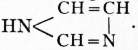
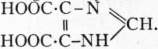
IMIDAZOLES, or Glyoxalines, organic chemical compounds containing the ring system Imidazole itself was first prepared by H. Debus (Ann. 1858, 107, p. 254) by the action of ammonia on glyoxal, 2C2H2O2 + 2NH3 = C3H4N2 + H2CO2 + 2H2O. The compounds of this series may be prepared by the condensation of ortho-diketones with ammonia and aldehydes

from thioimidazolones by oxidation with dilute nitric acid (W. Marckwald, Ber., 1892, 25, p. 2361); by distillation of hydrobenzamide and similarly constituted bodies; and by the action of phosphorus pentachloride on symmetrical dimethyloxamide, a methylchlorglyoxaline being formed (O. Wallach, Ann., 1877, 184, p. 500).
The glyoxalines are basic in character, and the imide hydrogen is replaceable by metals and alkyl groups. They are stable towards reducing agents, and acidyl groups are only introduced with difficulty.
Imidazole (glyoxaline), C3H4N2, crystallizes in thick prisms which melt at 88-89° C. and boil at 253° C., and are readily soluble in alcohol and in water. It is unaffected by chromic acid, but potassium permanganate oxidizes it to formic acid. It forms salts with acids.
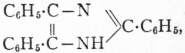
Lophine (triphenylglyoxaline), is formed by the dry distillation of hydrobenzamide, or by saturating an alcoholic solution of benzil and benzaldehyde (at a temperature of 40° C.) with ammonia. It crystallizes in needles which melt at 275° C. It is a weak base. When heated to 300° C. with hydriodic acid and hydrochloric acid, in the presence of some red phosphorus, it yields benzoic acid.
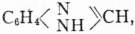
The keto-glyoxalines are known as imidazolones and are prepared by the action of acids on acetalyl thioureas (W. Marckwald, Ber., 1892, 25, p. 2357). Benzimidazole, is the simplest representative of the benzoglyoxalines and is prepared by the condensation of formic acid with ortho-phenylene diamine. It forms rhombic crystals which melt at 170° C. It is basic in character, and on oxidation with potassium permanganate yields a small amount of glyoxaline dicarboxylic acid, (E. Bamberger, Ann., 1893, 273, p. 338).
IMITATION (Lat. imitatio, from imitari, to imitate), the reproduction or repetition of an action or thought as observed in another person or in oneself, or the construction of one object in the likeness of another. By some writers (e.g. Preyer and Lloyd Morgan) the term “imitation” is limited to cases in which one person copies the action or thought of another; others have preferred a wider use of the term (i.e. including “self-imitation”), and have attempted to classify imitative action into various groupings, e.g. as cases of “conscious imitation,” “imitative suggestion,” “plastic imitation” (as when the members of a crowd subconsciously reproduce one another’s modes of thought and action), and the like. The main distinction is that which takes into account the question of attention (q.v.). In conscious imitation, the attention is fixed on the act and its reproduction: in unconscious imitation the reproduction is entirely mechanical and the agent does not “attend” to the action or thought which he is copying: in subconscious imitation the action is not deliberate, though the necessary train of thought would immediately follow if the attention were turned upon it under normal conditions. Imitation plays an extremely important part in human and animal development, and a clear understanding of its character is important both for the study of primitive peoples, and also in the theories of education, art and sociology. The child’s early development is in large measure imitative: thus the first articulate sounds and the first movements are mainly reproductions of the words and actions of parents, and even in the later stages that teacher is likely to achieve the best results who himself gives examples of how a word should be pronounced or an action done. The impulse to imitate is, however, not confined to children: there is among the majority of adults a tendency to assimilate themselves either to their society or to those whom they especially admire or respect: this tendency to shun the eccentric is rooted deeply in human psychology. Moreover, even among highly developed persons the imitative impulse frequently overrides the reason, as when an audience, a crowd, or even practically a whole community is carried away by a panic for which no adequate ground has been given, or when a cough or a yawn is imitated by a company of people. Such cases may be compared with those of persons in mesmeric trances who mechanically copy a series of movements made by the mesmerist. The universality of the imitative impulse has led many psychologists to regard it as an instinct (so William James, Principles of Psychology, ii. 408; cf. Instinct), and in that large class of imitative actions which have no obvious ulterior purpose the impulse certainly appears to be instinctive in character. On the other hand where the imitator recognizes the particular effect of a process and imitates with the deliberate intention of producing the same effect, his action can scarcely be classed as instinctive. A considerable number of psychologists have distinguished imitative from instinctive actions (e.g. Baldwin, and Sully). According to Darwin the imitative impulse begins in infants at the age of four months. It is to be noted, however, that the child imitates, not every action indiscriminately, but especially those towards which it has a congenital tendency. The same is true of animals: though different kinds of animals may live in close proximity, the young of each kind imitate primarily the actions of their own parents.
Among primitive man imitation plays a very important part. The savage believes that he can bring about events by imitating them. He makes, for instance, an image of his enemy and pierces it with darts or burns it, believing that by so doing he will cause his enemy’s death: similarly sailors would whistle, or farmers would pour water on the ground, in the hope of producing wind or rain. This form of imitation is known as sympathetic magic (see Magic). The sociological importance of imitation is elaborately investigated by Gabriel Tarde (Les Lois de l’imitation, 2nd ed., 1895), who bases all social evolution on the imitative impulse. He distinguishes “custom imitations,” i.e. imitations of ancient or even forgotten actions, and “mode imitations,” i.e. imitations of current fashions. New discoveries are, in his scheme, the product of the conflict of imitations. This theory, though of great value, seems to neglect original natural similarities which, by the law of causation, produce similar consequences, where imitation is geographically or chronologically impossible.
The term “imitation” has also the following special uses:—
1. In Art-theory.—According to Plato all artistic production is a form of imitation (μίμησις). That which really exists is the idea or type created by God; of this type all concrete objects are representations, while the painter, the tragedian, the musician are merely imitators, thrice removed from the truth (Rep. x. 596 seq.). Such persons are represented by Plato as a menace to the moral fibre of the community (Rep. iii.), as performing no useful function, drawing men away from reality and pandering to the irrational side of the soul. All art should aim at moral improvement. Plato clearly intends by “imitation” more than is connotated by the modern word: though in general he associates with it all that is bad and second-rate, he in some passages admits the value of the imitation of that which is good, and thus assigns to it a certain symbolic significance. Aristotle, likewise regarding art as imitation, emphasizes its purely artistic value as purging the emotions (κάθαρσις), and producing beautiful things as such (see Aesthetics and Fine Arts).
2. In Biology, the term is sometimes applied to the assimilation by one species of certain external characteristics (especially colour) which enable them to escape the notice of other species which would otherwise prey upon them. It is a form of protective resemblance and is generally known as mimicry (q.v.; see also Colours of Animals).
3. In Music, the term “imitation” is applied in contrapuntal composition to the repetition of a passage in one or more of the other voices or parts of a composition. When the repetition is note for note with all the intervals the same, the imitation is called “strict” and becomes a canon (q.v.); if not it is called “free,” the latter being much the more common. There are many varieties of imitation, known as imitation “by inversion,” “by inversion and reversion,” “by augmentation,” “by diminution” (see Grove’s Dictionary of Music, s. v., and textbooks of musical theory).
IMITATION OF CHRIST, THE (Imitatio Christi), the title of a famous medieval Christian devotional work, much used still by both Catholics and Protestants and usually ascribed to Thomas à Kempis. The “Contestation” over the author of the Imitation of Christ is probably the most considerable and famous controversy that has ever been carried on concerning a purely literary question. It has been going on almost without flagging for three centuries, and nearly 200 combatants have entered the lists. In the present article nothing is said on the history of the controversy, but an attempt is made to summarize the results that may be looked on as definitely acquired.
Until quite recently there were three candidates in the field—Thomas à Kempis (1380-1471), a canon regular of Mount St Agnes in Zwolle, in the diocese of Utrecht, of the Windesheim Congregation of Augustinian Canons; John Gerson (1363-1429), chancellor of the University of Paris; and an abbot, John Gersen, said to have been abbot of a Benedictine monastery at Vercelli in the 12th century. Towards the end of the 15th century the Imitation circulated under the names of the first two; but Gerson is an impossible author, and his claims have never found defenders except in France, where they are no longer urged. The Benedictine abbot Gersen is an absolutely mythical personage, a mere “double” of the chancellor. Consequently at the present day the question is narrowed to the issue: Thomas à Kempis, or an unknown author.
The following is a statement of the facts that may be received as certain:—
1. The earliest-known dated MS. of the Imitation is of 1424—it contains only Bk. I.; the earliest MSS. of the whole work of certain date are of 1427. Probably some of the undated MSS. are older; but it is the verdict of the most competent modern expert opinion that there is no palaeographical reason for suspecting that any known MS. is earlier than the first quarter of the 15th century.
2. A Latin letter of a Dutch canon regular, named Johann van Schoonhoven, exhibits such a close connexion with Bk. I. that plagiarism on the one side or the other is the only possible explanation. It is capable of demonstration that the author of the Imitation was the borrower, and that the opposite hypothesis is inadmissible. Now, this letter can be shown to have been written after 1382. Therefore Bk. I. was beyond controversy written between the years 1382 and 1424.
3. It is not here assumed that the four treatises formed a single work, or even that they are all by the same author; and the date of the other three books cannot be fixed with the same certainty. But, on the one hand, before the beginning of the 15th century there is no trace whatever of their existence—a strong argument that they did not yet exist; and on the other hand, after 1424 nearly each year produces its quota of MSS. and other signs of the existence of these books become frequent. Moreover, as a matter of fact, the four treatises did commonly circulate together. The presumption is strong that Bks. II., III., IV., like Bk. I., were composed shortly before they were put into circulation.
It may then be taken as proved that the Imitation was composed between 1380 and 1425, and probably towards the end rather than the beginning of that period. Having ascertained the date, we must consider the birthplace.
4. A number of idioms and turns of expression throughout the book show that its author belonged to some branch of the Teutonic race. Further than this the argument does not lead; for when the dialects of the early 15th century are considered it cannot be said that the expressions in question are Netherlandic rather than German—as a matter of fact, they have all been paralleled out of High German dialects.
5. Of the 400 MSS. of the Imitation 340 come from the Teutonic countries—another argument in favour of its Teutonic origin. Again, 100 of them, including the earliest, come from the Netherlands. This number is quite disproportionate to the relative size of the Netherlands, and so points to Holland as the country in which the Imitation was first most widely circulated and presumably composed.
6. There is a considerable body of early evidence, traceable before 1450, that the author was a canon regular.
7. Several of the MSS. were written in houses belonging to the Windesheim Congregation of canons regular, or, in close touch with it. Moreover there is a specially intimate literary and spiritual relationship between the Imitation and writings that emanated from what has been called the “Windesheim Circle.”
To sum up: the indirect evidence points clearly to the conclusion that the Imitation was written by a Teutonic canon regular, probably a Dutch canon regular of the Windesheim Congregation, in the first quarter of the 15th century. These data are satisfied by Thomas à Kempis.
We pass to the direct evidence, neglecting that of witnesses who had no special sources of information.
8. There can be no question that in the Windesheim Congregation itself there was already, during Thomas à Kempis’s lifetime, a fixed tradition that he was the author of the Imitation. The most important witness to this tradition is Johann Busch. It is true that the crucial words are missing in one copy of his “Chronicle”; but it is clear there were two redactions of the work, and there are no grounds whatever for doubting that the second with its various enlargements came from the hands of Busch himself—a copy of it containing the passage exists written in 1464, while both Busch and Thomas à Kempis were still alive. Busch passed a great part of his life in Windesheim, only a few miles from Mount St Agnes where Thomas lived. It would be hard to find a more authentic witness. Another witness is Hermann Rhyd, a German member of the Windesheim Congregation, who also had personally known Thomas. Besides, two or three MSS. originating in the Windesheim Congregation state or imply the same tradition.
9. More than this: the tradition existed in Thomas à Kempis’s own monastery shortly after his death. For John Mauburne became a canon in Mount St Agnes within a few years of Thomas’s death, and he states more than once that Thomas wrote the Imitation.
10. The earliest biographer of Thomas à Kempis was an anonymous contemporary: the Life was printed in 1494, but it exists in a MS. of 1488. The biographer says he got his information from the brethren at Mount St Agnes, and he states in passing that Bk. III. was written by Thomas. Moreover, he appends a list of Thomas’s writings, 38 in number, and 5-8 are the four books of the Imitation.
It is needless to point out that such a list must be of vastly greater authority than those given by St Jerome or Gennadius in their De Viris Illustribus, and its rejection must, in consistency, involve methods of criticism that would work havoc in the history of early literature of what king soever. The domestic tradition in the Windesheim Congregation, and in Mount St Agnes itself, has a weight that cannot be legitimately avoided or evaded. Indeed the external authority for Thomas’s authorship is stronger than that for the authorship of most really anonymous books—such, that is, as neither themselves claim to be by a given author, nor have been claimed by any one as his own. A large proportion of ancient writings, both ecclesiastical and secular, are unquestioningly assigned to writers on far less evidence than that for Thomas’s authorship of the Imitation.
Internal arguments have been urged against Thomas’s authorship. It has been said that his certainly authentic writings are so inferior that the Imitation could not have been written by the same author. But only if they were of the most certain and peremptory nature could such internal arguments be allowed to weigh against the clear array of facts that make up the external argument in favour of à Kempis. And it cannot be said that the internal difficulties are such as this. Let it be granted that Thomas was a prolific writer and that his writings vary very much in quality; let it be granted also that the Imitation surpasses all the rest, and that some are on a level very far below it; still, when at their best, some of the other works are not unworthy of the author of the Imitation.
In conclusion, it is the belief of the present writer that the “Contestation” is over, and that Thomas à Kempis’s claims to the authorship of the Imitation have been solidly established.
The best account in English of the Controversy is that given by F. R. Cruise in his Thomas à Kempis (1887). Works produced before 1880 are in general, with the exception of those of Eusebius Amort, superannuated, and deal in large measure with points no longer of any living interest. A pamphlet by Cruise, Who was the Author of the Imitation? (1898) contains sufficient information on the subject for all ordinary needs; it has been translated into French and German, and may be regarded as the standard handbook.
It has been said that the Imitation of Christ has had a wider religious influence than any book except the Bible, and if the statement be limited to Christendom, it is probably true. The Imitation has been translated into over fifty languages, and is said to have run through more than 6000 editions. The other statement, often made, that it sums up all that is best of earlier Western mysticism—that in it “was gathered and concentered all that was elevating, passionate, profoundly pious in all the older mystics” (Milman) is an exaggeration that is but partially true, for it depreciates unduly the elder mystics and fails to do justice to the originality of the Imitation. For its spiritual teaching is something quite different from the mysticism of Augustine in the Confessions, or of Bernard in the Sermons on the Song of Songs; it is different from the scholastic mysticism of the St Victors or Bonaventure; above all, it is different from the obscure mysticism, saturated with the pseudo-Dionysian Neoplatonism of the German school of Eckhart, Suso, Tauler and Ruysbroek. Again, it is quite different from the later school of St Teresa and St John of the Cross, and from the introspective methods of what may be called the modern school of spirituality. The Imitation stands apart, unique, as the principal and most representative utterance of a special phase of religious thought—non-scholastic, non-platonic, positive and merely religious in its scope—herein reflecting faithfully the spirit of the movement initiated by Gerhard Groot (q.v.), and carried forward by the circles in which Thomas à Kempis lived. In contrast with more mystical writings it is of limpid clearness, every sentence being easily understandable by all whose spiritual sense is in any degree awakened. No doubt it owes its universal power to this simplicity, to its freedom from intellectualism and its direct appeal to the religious sense and to the extraordinary religious genius of its author. Professor Harnack in his book What is Christianity? counts the Imitation as one of the chief spiritual forces in Catholicism: it “kindles independent religious life, and a fire which burns with a flame of its own” (p. 266).
The best Latin edition of the Imitation is that of Hirsche (1874), which follows closely the autograph of 1441 and reproduces the rhythmical character of the book. Of English translations the most interesting is that by John Wesley, under the title The Christian’s Pattern (1735).
(E. C. B.)
IMMACULATE CONCEPTION, THE. This dogma of the Roman Catholic Church was defined, as “of faith” by Pope Pius IX. on the 8th of December 1854 in the following terms: “The doctrine which holds that the Blessed Virgin Mary, from the first instant of her conception, was, by a most singular grace and privilege of Almighty God, in view of the merits of Jesus Christ, the Redeemer of the human race, preserved from all stain of Original Sin, is a doctrine revealed, by God, and therefore to be firmly and steadfastly believed by all the faithful.”1 These words presuppose the distinction between original, or racial, and actual, or personally incurred sin. There is no dispute that the Church has always held the Blessed Virgin to be sinless, in the sense of actual or personal sin. The question of the Immaculate Conception regards original or racial sin only. It is admitted that the doctrine as defined by Pius IX. was not explicitly mooted before the 12th century. But it is claimed that it is implicitly contained in the teaching of the Fathers. Their expressions on the subject of the sinlessness of Mary are, it is pointed out, so ample and so absolute that they must be taken to include original sin as well as actual. Thus we have in the first five centuries such epithets applied to her as “in every respect holy,” “in all things unstained,” “super-innocent” and “singularly holy”; she is compared to Eve before the fall, as ancestress of a redeemed people; she is “the earth before it was accursed.”2 The well-known words of St Augustine (d. 430) may be cited: “As regards the mother of God,” he says, “I will not allow any question whatever of sin.”3 It is true that he is here speaking directly of actual or personal sin. But his argument is that all men are sinners; that they are so through original depravity; that this original depravity may be overcome by the grace of God, and he adds that he does not know but that Mary may have had sufficient grace to overcome sin “of every sort” (omni ex parte).
It seems to have been St Bernard who, in the 12th century, explicitly raised the question of the Immaculate Conception. A feast of the Conception of the Blessed Virgin had already begun to be celebrated in some churches of the West. St Bernard blames the canons of the metropolitan church of Lyons for instituting such a festival without the permission of the Holy See. In doing so, he takes occasion to repudiate altogether the view that the Conception of Mary was sinless. It is doubtful, however, whether he was using the term “Conception” in the same sense in which it is used in the definition of Pius IX. In speaking of conception one of three things may be meant: (1) the mother’s co-operation; (2) the formation of the body, or (3) the completion of the human being by the infusion of the rational or spiritual soul. In early times conception was very commonly used in the first sense—“active” conception as it was called. But it is in the second, or rather the third, sense that the word is employed in modern usage, and in the definition of Pope Pius IX. But St Bernard would seem to have been speaking of conception in the first sense, for in his argument he says, “How can there be absence of sin where there is concupiscence (libido)?” and stronger expressions follow, showing that he is speaking of the mother and not of the child.4
St Thomas Aquinas, the greatest of the medieval scholastics, refused to admit the Immaculate Conception, on the ground that, unless the Blessed Virgin had at one time or other been one of the sinful, she could not justly be said to have been redeemed by Christ.5 St Bonaventura (d. 1274), second only to St Thomas in his influence on the Christian schools of his age, hesitated to accept it for a similar reason.6 The celebrated John Duns Scotus (d. 1308), a Franciscan like St Bonaventura, argued, on the contrary, that from a rational point of view it was certainly as little derogatory to the merits of Christ to assert that Mary was by him preserved from all taint of sin, as to say that she first contracted it and then was delivered.7 His arguments, combined with a better acquaintance with the language of the early Fathers, gradually prevailed in the schools of the Western Church. In 1387 the university of Paris strongly condemned the opposite view. In 1483 Pope Sixtus IV., who had already (1476) emphatically approved of the feast of the Conception, condemned those who ventured to assert that the doctrine of the Immaculate Conception was heretical, and forbade either side to claim a decisive victory until further action on the part of the Holy See. The council of Trent, after declaring that in its decrees on the subject of original sin it did not include “the blessed and immaculate Virgin Mary, Mother of God,” renewed this prohibition.8 Pope Paul V. (d. 1651) ordered that no one, under severe penalties, should dare to assent in public “acts” or disputations that the Blessed Virgin was conceived in original sin. Pope Gregory XV., shortly afterwards, extended this prohibition to private discussions, allowing, however, the Dominicans to argue on the subjects among themselves. Clement XI., in 1708, extended the feast of the Conception to the whole Church as a holy day of obligation. Long before the middle of the 19th century the doctrine was universally taught in the Roman Catholic Church. During the reign of Gregory XVI. the bishops in various countries began to press for a definition. Pius IX., at the beginning of his pontificate, and again after 1851, appointed commissions to investigate the whole subject, and he was advised that the doctrine was one which could be defined and that the time for a definition was opportune. On the 8th of December 1854 in a great assembly of bishops, in the basilica of St Peter’s at Rome, he promulgated the Bull Ineffabilis Deus, in which the history of the doctrine is summarily traced, and which contains the definition as given above.
The festival of the Conception of the Blessed Virgin, as distinct from her Nativity, was certainly celebrated in the Greek Church in the 7th century, as we learn from one of the canons of St Andrew of Crete (or of Jerusalem) who died about A.D. 700.9 There is some evidence that it was kept in Spain in the time of St Ildefonsus of Toledo (d. 667) and in southern Italy before A.D. 1000. In England it was known in the 12th century; a council of the province of Canterbury, in 1328, ascribes its introduction to St Anselm. It spread to France and Germany in the same century. It was extended to the whole church, as stated above, in 1708. It is kept, in the Western Church, on the 8th of December; the Greeks have always kept it one day later.
The chief répertoire of Patristic passages, both on the doctrine and on the festival, is Father Charles Passaglia’s great collection, entitled De immaculato Deiparae semper Virginis conceptu Caroli Passaglia sac. S.J. commentarius (3 vols., Romae, 1854-1855).
A useful statement of the doctrine with numerous references to the Fathers and scholastics is found in Hürter’s Theologia Dogmatica (5th ed.), tom. i. tract. vii. cap. 6, p. 438.
The state of Catholic belief in the middle of the 19th century is well brought out in La Croyance générale el constante de l’Église touchant l’immaculée conception de la bienheureuse Vierge Marie, published in 1855 by Thomas M. J. Gousset (1792-1866), professor of moral theology at the grand seminary of Besançon, and successively archbishop of Besançon and cardinal archbishop of Reims.
For English readers the doctrine, and the history of its definition, is clearly stated by Archbishop Ullathorne in The Immaculate Conception of the Mother of God (2nd ed., London, 1904). Dr F. G. Lee, in The Sinless Conception of the Mother of God; a Theological Essay (London, 1891) argued that the doctrine of the Immaculate Conception is a legitimate development of early church teaching.
(†J. C. H.)
1 From the Bull Ineffabilis Deus.
2 See Passaglia’s work, referred to below.
3 De natura et gratia, cap. xxxvi.
4 S. Bernardi Epist. clxxiv. 7.
5 Summa theologia, part iii., quaest. 27, art. 3.
6 In librum III. sententiarum distinct. 3 quaest. i. art. 2.
7 In librum III. sententiarum dist. 3 quaest. i. n. 4; Cfr. Distinct. 18 n. 15. Also the Summa theologia of Scotus (compiled by a disciple), part iii., quaest. 27, art. 2.
8 Sess. v. De peccato originale.
9 P. G., tom. cxvii. p. 1305.
IMMANENCE (from Lat. in-manere to dwell in, remain), in philosophy and theology a term applied in contradistinction to “transcendence,” to the fact or condition of being entirely within something. Its most important use is for the theological conception of God as existing in and throughout the created world, as opposed, for example, to Deism (q.v.), which conceives Him as separate from and above the universe. This conception has been expressed in a great variety of forms (see Theism, Pantheism). It should be observed that the immanence doctrine need not preclude the belief in the transcendence of God: thus God may be regarded as above the world (transcendent) and at the same time as present in and pervading it (immanent). The immanence doctrine has arisen from two main causes, the one metaphysical, the other religious. Metaphysical speculation on the relation of matter and mind has naturally led to a conviction of an underlying unity of all existence, and so to a metaphysical identification of God and the universe: when this identification proceeds to the length of expressing the universe as merely a mode or form of deity the result is pantheism (cf. the Eleatics): when it regards the deity as simply the sum of the forces of nature (cf. John Toland) the result is naturalism. In either case, but especially in the former, it frequently becomes pure mysticism (q.v.). Religious thinkers are faced by the problem of the Creator and the created, and the necessity for formulating a close relationship between God and man, the Infinite and Perfect with the finite and imperfect. The conception of God as wholly external to man, a purely mechanical theory of the creation, is throughout Christendom regarded as false to the teaching of the New Testament as also to Christian experience. The contrary view has gained ground in some quarters (cf. the so-called “New Theology” of Rev. R. J. Campbell) so far as to postulate a divine element in human beings, so definitely bridging over the gap between finite and infinite which was to some extent admitted by the bulk of early Christian teachers. In support of such a view are adduced not only the metaphysical difficulty of postulating any relationship between the infinite and the purely finite, but also the ethical problems of the nature of human goodness—i.e. how a merely human being could appreciate the nature of or display divine goodness—and the epistemological problem of explaining how finite mind can cognize the infinite. The development of the immanence theory of God has coincided with the deeper recognition of the essentially spiritual nature of deity as contrasted with the older semi-pagan conception found very largely in the Old Testament of God as primarily a mighty ruler, obedience to whom is comparable with that of a subject to an absolute monarch: the idea of the dignity of man in virtue of his immediate relation with God may be traced in great measure to the humanist movement of the 14th and 15th centuries (cf. the Inner Light doctrine of Johann Tauler). In later times the conception of conscience as an inward monitor is symptomatic of the same movement of thought. In pure metaphysics the term “immanence-philosophy” is given to a doctrine held largely by German philosophers (Rehmke, Leclair, Schuppe and others) according to which all reality is reduced to elements immanent in consciousness. This doctrine is derived from Berkeley and Hume on the one hand and from Kantianism on the other, and embodies the principle that nothing can exist for the mind save itself. The natural consequence of this theory is that the individual consciousness alone exists (solipsism): this position is, however, open to the obvious criticism that in some cases individual consciousnesses agree in their content. Schuppe, therefore, postulates a general consciousness (Bewusstsein überhaupt).