VOLUME XIV SLICE III Ichthyology to Independence (continued 10)
Reading edition
A distinction between the liability of sailors and of other men dates from the 16th century. From an act of Philip and Mary (1556) it appears that the watermen of the Thames claimed exemption from the press as a privileged body. They were declared liable, and the liability was clearly meant to extend to service as a soldier on shore. In the fifth year of Queen Elizabeth (1563) an act was passed to define the liability of the sailors. It is known as “an Act touching politick considerations for the maintenance of the Navy.” By its term all fishermen and mariners were protected from being compelled “to serve as any soldiers upon the Land or upon the Sea, otherwise than as a mariner, except it shall be to serve under any Captain of some ship or vessel, for landing to do some special exploit which mariners have been used to do.” The operation of the act was limited to ten years, but it was renewed repeatedly, and was at last indefinitely prolonged in the sixteenth year of the reign of Charles I. (1631). By the Vagrancy Act of the close of Queen Elizabeth’s reign (1597), disorderly serving-men and other disreputable characters, of whom a formidable list is given, were declared to be liable to be impressed for service in the fleet. The “Takers,” as they were called in early times, the Press Gang of later days, were ordered to present their commission to two justices of the peace, who were bound to pick out “such sufficient number of able men, as in the said commission shall be contained, to serve Her Majesty as aforesaid.” The justices of the peace in the coast districts, who were often themselves concerned in the shipping trade, were not always zealous in enforcing the press. The pressed sailors often deserted with the “imprest money” given them. Loud complaints were made by the naval officers of the bad quality of the men sent up to serve in the king’s ships. On the other hand, the Press Gangs were accused of extorting money, and of making illegal arrests. In the reign of Queen Anne (1703) an act was passed “for the increase of Seamen and the better encouragement of navigation, and the protection of the Coal Trade.” The act which gave parish authorities power to apprentice boys to the sea exempted the apprentices from the press for three years, and until the age of eighteen. It especially reaffirmed the part of the Vagrancy Act of Elizabeth’s reign which left rogues and vagabonds subject to be pressed for the sea service. By the act for the “Increase of Mariners and Seamen to navigate Merchant Ships and other trading ships or vessels,” passed in the reign of George II. (1740), all men over fifty-five were exempted from the press together with lads under eighteen, foreigners serving in British ships (always numerous in war time), and landsmen who had gone to sea during their first two years. The act for “the better supplying of the cities of London and Westminster with fish” gave exemption to all masters of fishing-boats, to four apprentices and one mariner to each boat, and all landsmen for two years, except in case of actual invasion. By the act for the encouragement of insurance passed in 1774, the fire insurance companies in London were entitled to secure exemption for thirty watermen each in their employment. Masters and mates of merchant vessels, and a proportion of men per ship in the colliers trading from the north to London, were also exempt.
Subject to such limitations as these, all seafaring men, and watermen on rivers, were liable to be pressed between the ages of eighteen and fifty-five, and might be pressed repeatedly for so long as their liability lasted. The rogue and vagabond element were at the mercy of the justices of the peace. The frightful epidemics of fever which desolated the navy till late in the 18th century were largely due to the infection brought by the prisoners drafted from the ill-kept jails of the time. As service in the fleet was most unpopular with the sailors, the press could often only be enforced by making a parade of strength and employing troops. The men had many friends who were always willing to conceal them, and they themselves became expert in avoiding capture. There was, however, one way of procuring them which gave them no chance of evasion. The merchant ships were stopped at sea and the sailors taken out. This was done to a great extent, more especially in the case of homeward-bound vessels. On one occasion, in 1802, an East Indiaman on her way home was deprived of so many of her crew by a man of war in the Bay of Biscay that she was unable to resist a small French privateer, and was carried off as a prize with a valuable cargo. The press and the jails failed to supply the number of men required. In 1795 it was found necessary to impose on the counties the obligation to provide “a quota” of men, at their own expense. The local authorities provided the recruits by offering high bounties, often to debtors confined in the prisons. These desperate men were a very bad element in the navy. In 1797 they combined with the United Irishmen, of whom large numbers had been drafted into the fleet as vagabonds, to give a very dangerous political character to the mutinies at the Nore and on the south of Ireland. After the conclusion of the great Napoleonic wars in 1815 the power of the press was not again exercised. In 1835 an act was passed during Sir James Graham’s tenure of office as first lord of the admiralty, by which men who had once been pressed and had served for a period of five years were to be exempt from impressment in future. Sir James, however, emphatically reaffirmed the right of the crown to enforce the service of the subject, and therefore to impress the seamen. The introduction of engagements for a term of five years in 1853, and then of long service, has produced so large a body of voluntary recruits, and service in the navy is so popular, that the question has no longer any interest save an historical one. If compulsory service in the fleet should again become necessary it will not be in the form of the old system of impressment, which left the sailor subject to compulsory service from the age of eighteen to fifty-five, and flooded the navy with the scum of the jails and the workhouse.
Authorities.—Grose’s Military Antiquities, for the general subject of impressment, vol. ii. p. 73 et seq. S. R. Gardiner gives many details in his history of James I. and Charles I., and in The Civil War. The acts relating to the navy are quoted in A Collection of the Statutes relating to the Admiralty, &c., published in 1810. Some curious information is in the papers relating to the Brest Blockade edited by John Leyland for the Navy Record Society. Sir James Graham’s speech is in Hansard for 1835.
(D. H.)
1 It is now accepted generally that “to press” is a corruption of “prest,” as “impress” is of “imprest,” but the word was quite early connected with “press,” to squeeze, crush, hence to compel or force. The “prest” was a sum of money advanced (O. Fr. prester, modern prêter, to lend, Lat. praestare, to stand before, provide, become surety for, &c.) to a person to enable him to perform some undertaking, hence used of earnest money given to soldiers on enlistment, or as the “coat and conduct” money alluded to in this article. The methods of compulsion used to get men for military service naturally connected the word with “to press” (Lat. pressare, frequentative of premere) to force, and all reference to the money advanced was lost (see Skeat, Etym. Dict., 1898, and the quotation from H. Wedgwood, Dict. of Eng. Etym.).
IMPROMPTU (from in promptu, on the spur of the moment), a short literary composition which has not been, or is not supposed to have been, prepared beforehand, but owes its merit to the ready skill which produces it without premeditation. The word seems to have been introduced from the French language in the middle of the 17th century. Without question, the poets have, from earliest ages, made impromptus, and the very art of poetry, in its lyric form, is of the nature of a modified improvisation. It is supposed that many of the epigrams of the Greeks, and still more probably those of the Roman satirists, particularly Martial, were delivered on the moment, and gained a great part, at least, of their success from the evidence which they gave of rapidity of invention. But it must have been difficult then, as it has been since, to be convinced of the value of that evidence. Who is to be sure that, like Mascarille in Les Précieuses ridicules, the impromptu-writer has not employed his leisure in sharpening his arrows? James Smith received the highest praise for his compliment to Miss Tree, the cantatrice:—
On this tree when a nightingale settles and sings, The Tree will return him as good as he brings.
This was extremely neat, but who is to say that James Smith had not polished it as he dressed for dinner? One writer owed all his fame, and a seat among the Forty Immortals of the French Academy, to the reputation of his impromptus. This was the Marquis François Joseph de St Aulaire (1643-1742). The piece which threw open the doors of the Academy to him in 1706 was composed at Sceaux, where he was staying with the duchess of Maine, who was guessing secrets, and who called him Apollo. St Aulaire instantly responded:—
La divinité qui s’amuse A me demander mon secret, Si j’étais Apollon, ne serait pas ma muse, Elle serait Thétis—et le jour finirait.
This is undoubtedly as neat as it is impertinent, and if the duchess had given him no ground for preparation, this is typical of the impromptu at its best. Voltaire was celebrated for the savage wit of his impromptus, and was himself the subject of a famous one by Young. Less well known but more certainly extemporaneous is the couplet by the last-mentioned poet, who being asked to put something amusing in an album, and being obliged to borrow from Lord Chesterfield a pencil for the purpose, wrote:—
Accept a miracle instead of wit,— See two dull lines with Stanhope’s pencil writ.
The word “impromptu” is sometimes used to designate a short dramatic sketch, the type of which is Molière’s famous Impromptu du Versailles (1663), a miniature comedy in prose.
IMPROVISATORE, a word used to describe a poet who recites verses which he composes on the spur of the moment, without previous preparation. The term is purely Italian, although in that language it would be more correctly spelt improvvisatore. It became recognized as an English word in the middle of the eighteenth century, and is so used by Smollett in his Travels (1766); he defines an improvisatore as “an individual who has the surprising talent of reciting verses extempore, on any subject you propose.” In speaking of a woman, the female form improvisatrice is sometimes used in English.
Improvisation is a gift which properly belongs to those languages in which a great variety of grammatical inflections, wedded to simplicity of rhythm and abundance of rhyme, enable a poet to slur over difficulties in such a way as to satisfy the ear of his audience. In ancient times the greater part of the popular poetry with which the leisure of listeners was beguiled was of this rhapsodical nature. But in modern Europe it was the troubadours, owing to the extreme flexibility of the languages of Provence, who distinguished themselves above all others as improvisatores. It is difficult to believe, however, that the elaborate compositions of these poets, which have come down to us, in which every exquisite artifice of versification is taken advantage of, can have been poured forth without premeditation. These poets, we must rather suppose, took a pride in the ostentation of a prodigious memory, most carefully trained, and poured forth in public what they had laboriously learned by heart in private. The Italians, however, in the 16th century, cultivated what seems to have been a genuine improvisation, in which the bards rhapsodized, not as they themselves pleased, but on subjects which were unexpected by them, and which were chosen on the spot by their patrons. Of these, the most extraordinary is said to have been Silvio Antoniano (1540-1603), who from the age of ten was able to pour out melodious verse on any subject which was suggested to him. He was brought to Rome, where successive popes so delighted in his talent that in 1598 he was made a cardinal. In the 17th century the celebrated Metastasio first attracted attention by his skill as an improvisatore. But he was excelled by Bernardino Perfetti (1681-1747), who was perhaps the most extraordinary genius of this class who has ever lived. He was seized, in his moments of composition, with a transport which transfigured his whole person, and under this excitement he poured forth verses in a miraculous flow. It was his custom to be attended by a guitarist, who played a recitative accompaniment. In this way Perfetti made a triumphal procession through the cities of Italy, ending up with the Capitol of Rome, where Pope Benedict XIII. crowned him with laurel, and created him a Roman citizen. One of the most remarkable improvisatores of modern times appeared in Sweden, in the person of Karl Mikael Bellman (1740-1795), who used to take up a position in the public gardens and parks of Stockholm, accompanying himself on a guitar, and treating metre and rhythm with a virtuosity and originality which place him among the leading poets of Swedish literature. In England, somewhat later, Theodore Hook (1788-1841) developed a surprising talent for this kind, but his verses were rarely of the serious or sentimental character of which we have hitherto spoken. Hook’s animal spirits were unfortunately mingled with vulgarity, and his clever jeux d’esprit had little but their smartness to recommend them. A similar talent, exercised in a somewhat more literary direction, made Joseph Méry (1798-1865) a delightful companion in the Parisian society of his day. It is rare indeed that the productions of the improvisatore, taken down in shorthand, and read in the cold light of criticism, are found to justify the impression which the author produced on his original audience. Imperfections of every kind become patent when we read these transcripts, and the reader cannot avoid perceiving weaknesses of style and grammar. The eye and voice of the improvisatore so hypnotize his auditors as to make them incapable of forming a sober judgment on matters of mere literature.
IN-ANTIS, the architectural term given to those temples the entrance part of which consisted of two columns placed between the antae or pilasters (see Temple).
INAUDI, JACQUES (1867- ), Italian calculating prodigy, was born at Onorato, Piedmont, on the 15th of October 1867. When between seven and eight years old, at which time he was employed in herding sheep, he already exhibited an extraordinary aptitude for mental calculation. His powers attracted the notice of various showmen, and he commenced to give exhibitions. He was carefully examined by leading French scientists, including Charcot, from the physiological, psychological and mathematical point of view. The secret of his arithmetical powers appeared to reside in his extraordinary memory, improved by continuous practice. It appeared to depend upon hearing rather than sight, more remarkable results being achieved when figures were read out than when they were written.
INCANTATION, the use of words, spoken, sung or chanted, usually as a set formula, for the purpose of obtaining a result by their supposed magical power. The word is derived from the Latin incantare, to chant a magical formula; cf. the use of carmen, for such a formula of words. The Latin use is very early; thus it appears in a fragment of the XII. Tables quoted in Pliny (N.H. xxviii. 2, 4, 17), “Qui malum carmen incantasset.” From the O. Fr. derivative of incantare, enchanter, comes “enchant,” “enchantment,” &c., properly of the exercise of magical powers, hence to charm, to fascinate, words which also by origin are of magical significance. The early magi of Assyria and Babylonia were adepts at this art, as is evident from the examples of Akkadian spells that have been discovered. Daniel (v. 11) is spoken of as “master of the enchanters” of Babylon. In Egypt and in India many formulas of religious magic were in use, witness especially the Vedic mantras, which are closely akin to the Maori karakias and the North American matamanik. Among the holy men presented by the king of Korea to the mikado of Japan in A.D. 577 was a reciter of mantras, who would find himself at home with the majinahi or incantation practised by the ancient Japanese for dissipating evil influences. One of the most common, widespread and persistent uses of incantation was in healing wounds, instances of which are found in the Odyssey and the Kalevala, and in the traditional folk-lore of almost every European country. Similar songs were sung to win back a faithless lover (cf. the second Idyll of Theocritus).
See further Magic.
INCE, WILLIAM, English 18th century furniture designer and cabinetmaker. He was one of the most successful imitators of Chippendale, although his work was in many respects lighter. He helped, indeed, to build the bridge between the massive and often florid style of Chippendale and the more boudoir-like forms of Hepplewhite. Although many of his designs were poor and extravagant, his best work was very good indeed. His chairs are sometimes mistaken for those of Chippendale, to which, however, they are much inferior. He greatly affected the Chinese and Gothic tastes of the second half of the 18th century. He was for many years in partnership in Broad Street, Golden Square, London, with Thomas Mayhew (q.v.), in collaboration with whom he published a folio volume of ninety-five plates, with letterpress in English and French under the title of The Universal System of Household Furniture (undated, but probably about 1762).
INCE-IN-MAKERFIELD, an urban district in the Ince parliamentary division of Lancashire, England, adjoining the borough of Wigan. Pop. (1901) 21,262. The Leeds and Liverpool Canal intersects the township. There are large collieries, ironworks, forges, railway wagon works, and cotton mills. There is preserved here the Old Hall, a beautiful example of half-timbered architecture.
INCENDIARISM (Lat. incendere, to set on fire, burn), in law, the wilful or malicious burning of the house or property of another, and punishable as arson (q.v.). It may be noted that in North Carolina it is provided in case of fires that there is to be a preliminary investigation by local authorities: all towns and cities have to make an annual inspection of buildings and a quarterly inspection within fire limits and report to the state insurance commissioner; all expenses so incurred are met by a tax of 1⁄5% on the gross receipts of the insurance companies (L. 1903, ch. 719).
INCENSE,1 the perfume (fumigation) arising from certain resins and gum-resins, barks, woods, dried flowers, fruits and seeds, when burnt, and also the substances so burnt. In its literal meaning the word “incense” is one with the word “perfume,” the aroma given off with the smoke (per fumum2) of any odoriferous substance when burnt. But, in use, while the meaning of the word “perfume” has been extended so as to include everything sweet in smell, from smoking incense to the invisible fresh fragrance of fruits and exquisite scent of flowers, that of the word “incense,” in all the languages of modern Europe in which it occurs, has, by an opposite process of limitation, been gradually restricted almost exclusively to frankincense (see Frankincense). Frankincense has always been obtainable in Europe in greater quantity than any other of the aromatics imported from the East; it has therefore gradually come to be the only incense used in the religious rites and domestic fumigations of many countries of the West, and at last to be properly regarded as the only “true” or “genuine” (i.e. “franc”) incense (see Littré’s Fr. Dict. and Skeat’s Etym. Dict. of Engl. Lang.).3
The following is probably an exhaustive list of the substances available for incense or perfume mentioned in the Hebrew Scriptures:—Algum or almug wood (almug in 1 Kings x. 11, 12; algum in 2 Chron. ii. 8, and ix. 10, 11), generally identified with sandalwood (Santalum album), a native of Malabar and Malaya; aloes, or lign aloes (Heb. ahālim, ahālōth), produced by the Aloexylon Agallochum (Loureiro), a native of Cochin-China, and Aquilaria Agallocha (Roxburgh), a native of India beyond the Ganges; balm (Heb. tsorī), the oleo-resin of Balsamodendron opobalsamum and B. gileadense; bdellium (Heb. bdōlah), the resin produced by Balsamodendron roxburghii, B. Mukul and B. pubescens, all natives of Upper India (Lassen, however, identifies bdōlah with musk); calamus (Heb. kaneh; sweet calamus, keneh bosem, Ex. xxx. 23; Ezek. xxvii. 19; sweet cane, kaneh hattob, Jer. vi. 20; Isa. xliii. 24), identified by Royle with the Andropogon Calamus aromaticus or roosa grass of India; cassia (Heb. kiddah) the Cinnamomum Cassia of China; cinnamon (Heb. kinnamon), the Cinnamomum zeylanicum of the Somali country, but cultivated largely in Ceylon, where also it runs wild, and in Java; costus (Heb. ketzioth), the root of the Aucklandia Costus (Falconer), native of Kashmir; frankincense (Heb. lebōnah), the gum-resin of Bosiwellia Frereana and B. Bhau-Dajiana of the Somali country, and of B. Carterii of the Somali country and the opposite coast of Arabia (see “The Genus Boswellia” by Sir George Birdwood, Transactions of the Linnean Society, xxi. 1871); galbanum (Heb. helbenah), yielded by Opoidia galbanifera (Royle) of Khorassan, and Galbanum officinale (Don) of Syria and other Ferulas; ladanum (Heb. lōt, translated “myrrh” in Gen. xxxvii. 25, xliii. 11), the resinous exudation of Cistus creticus, C. ladaniferus and other species of “rock rose” or “rose of Sharon”; myrrh (Heb. mōr), the gum-resin of the Balsamodendron Myrrha of the Somali country and opposite shore of Arabia; onycha (Heb. sheḥeleth), the celebrated odoriferous shell of the ancients, the operculum or “nail” of a species of Strombus or “wing shell,” formerly well known in Europe under the name of Blatta byzantina; it is still imported into Bombay to burn with frankincense and other incense to bring out their odours more strongly; saffron (Heb. karkōm), the stigmata of Crocus sativus, a native originally of Kashmir; spikenard (Heb. nerd), the root of the Nardostachys Jatamansi of Nepal and Bhutan; stacte (Heb. nataf), generally referred to the Styrax officinalis of the Levant, but Hanbury has shown that no stacte or storax is now derived from S. officinalis, and that all that is found in modern commerce is the product of the Liquidambar orientalis of Cyprus and Anatolia.
Besides these aromatic substances named in the Bible, the following must also be enumerated on account of their common use as incense in the East; benzoin or gum benjamin, first mentioned among Western writers by Ibn Batuta (1325-1349) under the name of lubân d’ Javi (i.e. olibanum of Java), corrupted in the parlance of Europe into benjamin and benzoin; camphor, produced by Cinnamomum Camphora, the “camphor laurel” of China and Japan, and by Dryobalanops aromatica, a native of the Indian Archipelago, and widely used as incense throughout the East, particularly in China; elemi, the resin of an unknown tree of the Philippine Islands, the elemi of old writers being the resin of Boswellia Frereana; gum-dragon or dragon’s blood, obtained from Calamus Draco, one of the ratan palms of the Indian Archipelago, Dracaena Draco, a liliaceous plant of the Canary Island, and Pterocarpus Draco, a leguminous tree of the island of Socotra; rose-malloes, a corruption of the Javanese rasamala, or liquid storax, the resinous exudation of Liquidambar Altingia, a native of the Indian Archipelago (an American Liquidambar also produces a rose-malloes-like exudation); star anise, the starlike fruit of the Illicum anisatum of Yunan and south-western China, burnt as incense in the temples of Japan; sweet flag, the root of Acorus Calamus, the bach of the Hindus, much used for incense in India. An aromatic earth, found on the coast of Cutch, is used as incense in the temples of western India. The animal excreta, musk and civet, also enter into the composition of modern European pastils and clous fumants. Balsam of Tolu, produced by Myroxylon toluiferum, a native of Venezuela and New Granada; balsam of Peru, derived from Myroxylon Pereirae, a native of San Salvador in Central America; Mexican and Brazilian elemi, produced by various species of Icica or “incense trees,” and the liquid exudation of an American species of Liquidambar, are all used as incense in America. Hanbury quotes a faculty granted by Pope Pius V. (August 2, 1571) to the bishops of the West Indies permitting the substitution of balsam of Peru for the balsam of the East in the preparation of the chrism to be used by the Catholic Church in America. The Sangre del drago of the Mexicans is a resin resembling dragon’s blood obtained from a euphorbiaceous tree, Croton Draco.
Probably nowhere can the actual historical progress from the primitive use of animal sacrifices to the later refinement of burning incense be more clearly traced than in the pages of the Old Testament, where no mention of the latter rite occurs before the period of the Mosaic legislation; but in the monuments of ancient Egypt the authentic traces of the use of incense that still exist carry us back to a much earlier date. From Meroe to Memphis the commonest subject carved or painted in the interiors of the temples is that of some contemporary Phrah or Pharaoh worshipping the presiding deity with oblations of gold and silver vessels, rich vestments, gems, the firstlings of the flock and herd, cakes, fruits, flowers, wine, anointing oil and incense. Generally he holds in one hand the censer, and with the other casts the pastils or osselets of incense into it: sometimes he offers incense in one hand and makes the libation of wine with the other. One of the best known of these representations is that carved on the memorial stone placed by Tethmosis (Thothmes) IV. (1533 B.C.) on the breast of the Sphinx at Gizeh.4 The tablet represents Tethmosis before his guardian deity, the sun-god Rê, pouring a libation of wine on one side and offering incense on the other. The ancient Egyptians used various substances as incense. They worshipped Rê at sunrise with resin, at mid-day with myrrh and at sunset with an elaborate confection called kuphi, compounded of no fewer than sixteen ingredients, among which were honey, wine, raisins, resin, myrrh and sweet calamus. While it was being mixed, holy writings were read to those engaged in the operation. According to Plutarch, apart from its mystic virtues arising from the magical combination of 4 × 4, its sweet odour had a benign physiological effect on those who offered it.5 The censer used was a hemispherical cup or bowl of bronze, supported by a long handle, fashioned at one end like an open hand, in which the bowl was, as it were, held, while the other end within which the pastils of incense were kept was shaped into the hawk’s head crowned with a disk, as the symbol of Rê.6 In embalming their dead the Egyptians filled the cavity of the belly with every sort of spicery except frankincense (Herod, ii. 86), for it was regarded as specially consecrated to the worship of the gods. In the burnt-offerings of male kine to Isis, the carcase of the steer, after evisceration, was filled with fine bread, honey, raisins, figs, frankincense, myrrh and other aromatics, and thus stuffed was roasted, being basted all the while by pouring over it large quantities of sweet oil, and then eaten with great festivity.
How important the consumption of frankincense in the worship of the gods became in Egypt is shown by two of its monuments, both of the greatest interest and value for the light they throw on the early history of the commerce of the Indian Ocean. One is an inscription in the rocky valley of Hammamat, through which the desert road from the Red Sea to the valley of Egypt opens on the green fields and palm groves of the river Nile near Coptos. It was cut on the rocks by an Egyptian nobleman named Hannu, who states that he was sent by Pharaoh Sankhkere, Menthotp IV., with a force gathered out of the Thebaid, from Coptos to the Red Sea, there to take command of a naval expedition to the Holy Land of Punt (Puoni), “to bring back odoriferous gums.” Punt is identified with the Somali country, now known to be the native country of the trees that yield the bulk of the frankincense of commerce. The other bears the record of a second expedition to the same land of Punt, undertaken by command of Queen Hatshepsut, 1600 B.C. It is preserved in the vividly chiselled and richly coloured decorations portraying the history of the reign of this famous Pharaoh on the walls of the “Stage Temple” at Thebes. The temple is now in ruins, but the entire series of gorgeous pictures recording the expedition to “the balsam land of Punt,” from its leaving to its returning to Thebes, still remains intact and undefaced.7 These are the only authenticated instances of the export of incense trees from the Somali country until Colonel Playfair, then political agent at Aden, in 1862-1864, collected and sent to Bombay the specimens from which Sir George Birdwood prepared his descriptions of them for the Linnean Society in 1868. King Antigonus is said to have had a branch of the true frankincense tree sent to him.
Homer tells us that the Egyptians of his time were emphatically a nation of druggists (Od. iv. 229, 230). This characteristic, in which, as in many others, they so remarkably resemble the Hindus, the Egyptians have maintained to the present day; and, although they have changed their religion, the use of incense among them continues to be as familiar and formal as ever. The kohl or black powder with which the modern, like the ancient, Egyptian ladies paint their languishing eyelids, is nothing but the smeeth of charred frankincense, or other odoriferous resin brought with frankincense, and phials of water, from the well of Zem-zem, by the pilgrims returning from Mecca. They also melt frankincense as a depilatory, and smear their hands with a paste into the composition of which frankincense enters, for the purpose of communicating to them an attractive perfume. Herodotus (iv. 75) describes a similar artifice as practised by the women of Scythia (compare also Judith x. 3, 4). In cold weather the Egyptians warm their rooms by placing in them a brazier, “chafing-dish,” or “standing-dish,” filled with charcoal, whereon incense is burnt; and in hot weather they refresh them by occasionally swinging a hand censer by a chain through them—frankincense, benzoin and aloe wood being chiefly used for the purpose.8
In the authorized version of the Bible, the word “incense” translates two wholly distinct Hebrew words. In various passages in the latter portion of Isaiah (xl.-lxvi.), in Jeremiah and in Chronicles, it represents the Hebrew lebōnah, more usually rendered “frankincense”; elsewhere the original word is ketoreth (Ex. xxx. 8, 9; Lev. x. 1; Num. vii. 14, &c.), a derivative of the verb kitter (Pi.) or hiktir (Hiph.), which verb is used, not only in Ex. xxx. 7, but also in Lev. i. 9, iii. 11, ix. 13, and many other passages, to denote the process by which the “savour of satisfaction” in any burnt-offering, whether of flesh or of incense, is produced. Sometimes in the authorized version (as in 1 Kings iii. 3; 1 Sam. ii. 28) it is made to mean explicitly the burning of incense with only doubtful propriety. The expression “incense (ketoreth) of rains” in Ps. lxvi. 15 and the allusion in Ps. cxli. 2 ought both to be understood, most probably, of ordinary burnt-offerings.9 The “incense” (ketoreth), or “incense of sweet scents” (ketoreth sammim), called, in Ex. xxx. 35, “a confection after the art of the apothecary,” or rather “a perfume after the art of the perfumer,” which was to be regarded as most holy, and the imitation of which was prohibited under the severest penalties, was compounded of four “sweet scents” (sammim),10 namely stacte (nataph), onycha (sheheleth), galbanum (helbenah) and “pure” or “fine” frankincense (lebōnah zaccah), pounded together in equal proportions, with (perhaps) an admixture of salt (memullah).11 It was then to be “put before the testimony” in the “tent of meeting.” It was burnt on the altar of incense by the priest every morning when the lamps were trimmed in the Holy Place, and every evening when they were lighted or “set up” (Ex. xxx. 7, 8). A handful of it was also burnt once a year in the Holy of Holies by the high priest on a pan of burning coals taken from the altar of burnt-offering (Lev. xvi. 12, 13). Pure frankincense (lebōnah) formed part of the meat-offering (Lev. ii. 16, vi. 15), and was also presented along with the shew bread (Lev. xxiv. 7) every Sabbath day (probably on two golden saucers; see Jos. Ant. iii. 10, 7). The religious significance of the use of incense, or at least of its use in the Holy of Holies, is distinctly set forth in Lev. xvi. 12, 13.
The Jews were also in the habit of using odoriferous substances in connexion with the funeral obsequies of distinguished persons (see 2 Chron. xvi. 14, xxi. 19; Jer. xxxiv. 5). In Amos vi. 10 “he that burneth him” probably means “he that burns perfumes in his honour.” References to the domestic use of incense occur in Cant. iii. 6; Prov. xxvii. 9; cf. vii. 17.
The “marbles” of Nineveh furnish frequent examples of the offering of incense to the sun-god and his consort (2 Kings xxiii. 5). The kings of Assyria united in themselves the royal and priestly offices, and on the monuments they erected they are generally represented as offering incense and pouring out wine to the Tree of Life. They probably carried the incense in the sacred bag so frequently seen in their hands and in those also of the common priests. According to Herodotus (i. 183), frankincense to the amount of 1000 talents’ weight was offered every year, during the feast of Bel, on the great altar of his temple in Babylon.
The monuments of Persepolis and the coins of the Sassanians show that the religious use of incense was as common in ancient Persia as in Babylonia and Assyria. Five times a day the priests of the Persians (Zoroastrians) burnt incense on their sacred fire altars. In the Avesta (Vendidad, Fargard xix. 24, 40), the incense they used is named vohu gaono. It has been identified with benzoin, but was probably frankincense. Herodotus (iii. 97) states that the Arabs brought every year to Darius as tribute 1000 talents of frankincense. The Parsees still preserve in western India the pure tradition of the ritual of incense as followed by their race from probably the most ancient times.
The Ramayana and Mahabharata afford evidence of the employment of incense by the Hindus, in the worship of the gods and the burning of the dead, from the remotest antiquity. Its use was obviously continued by the Buddhists during the prevalence of their religion in India, for it is still used by them in Nepal, Tibet, Ceylon, Burma, China and Japan. These countries all received Buddhism from India, and a large proportion of the porcelain and earthenware articles imported from China and Japan into Europe consists of innumerable forms of censers. The Jains all over India burn sticks of incense before their Jina. The commonest incense in ancient India was probably frankincense. The Indian frankincense tree, Boswellia thurifera, Colebrooke (which certainly includes B. glabra, Roxburgh), is a doubtful native of India. It is found chiefly where the Buddhist religion prevailed in ancient times, in Bihar and along the foot of the Himalayas and in western India, where it particularly flourishes in the neighbourhood of the Buddhist caves at Ajanta. It is quite possible therefore that, in the course of their widely extended commerce during the one thousand years of their ascendancy, the Buddhists imported the true frankincense trees from Africa and Arabia into India, and that the accepted Indian species are merely varieties of them. Now, however, the incense in commonest use in India is benzoin. But the consumption of all manner of odoriferous resins, gum resins, roots, woods, dried leaves, flowers, fruits and seeds in India, in social as well as religious observances, is enormous. The grateful perfumed powder abir or randa is composed either of rice, flour, mango bark or deodar wood, camphor and aniseed, or of sandalwood or wood aloes, and zerumbet, zedoary, rose flowers, camphor and civet. The incense sticks and pastils known all over India under the names of ud-buti (“benzoin-light”) or aggar-ki-buti (“wood aloes light”) are composed of benzoin, wood aloes, sandalwood, rock lichen, patchouli, rose-malloes, talispat (the leaf of Flacourtia Cataphracta of Roxburgh), mastic and sugar-candy or gum. The abir and aggir butis made at the Mahommedan city of Bijapur in the Mahratta country are celebrated all over western India. The Indian Mussulmans indeed were rapidly degenerating into a mere sect of Hindus before the Wahabi revival, and the more recent political propaganda in support of the false caliphate of the sultans of Turkey; and we therefore find the religious use of incense among them more general than among the Mahommedans of any other country. They use it at the ceremonies of circumcision, bismillah (teaching the child “the name of God”), virginity and marriage. At marriage they burn benzoin with nim seeds (Melia Azadirachta, Roxburgh) to keep off evil spirits, and prepare the bride-cakes by putting a quantity of benzoin between layers of wheaten dough, closed all round, and frying them in clarified butter. For days the bride is fed on little else. In their funeral ceremonies, the moment the spirit has fled incense is burnt before the corpse until it is carried out to be buried. The begging fakirs also go about with a lighted stick of incense in one hand, and holding out with the other an incense-holder (literally, “incense chariot”), into which the coins of the pious are thrown. Large “incense trees” resembling our Christmas trees, formed of incense-sticks and pastils and osselets, and alight all over, are borne by the Shiah Mussulmans in the solennial procession of the Mohurrum, in commemoration of the martyrdom of the sons of Ali. The worship of the tulsi plant, or holy basil (Ocymum sanctum, Don), by the Hindus is popularly explained by its consecration to Vishnu and Krishna. It grows on the four-horned altar before the house, or in a pot placed in one of the front windows, and is worshipped every morning by all the female members of every Hindu household. It is possible that its adoration has survived from the times when the Hindus buried their dead in their houses, beneath the family hearth. When they came into a hot climate the fire of the sacrifices and domestic cookery was removed out of the house; but the dead were probably still for a while buried in or near it, and the tulsi was planted over their graves, at once for the salubrious fragrance it diffuses and to represent the burning of incense on the altar of the family Lar. The rich land round about the holy city of Pandharpur, sacred to Vithoba the national Mahratta form of (Krishna)-Vishnu, is wholly restricted to the cultivation of the tulsi plant.
As to the θύεα mentioned in Homer (Il. ix. 499, and elsewhere) and in Hesiod (Works and Days, 338), there is some uncertainty whether they were incense offerings at all, and if so, whether they were ever offered alone, and not always in conjunction with animal sacrifices. That the domestic use, however, of the fragrant wood θύον (the Arbor vitae or Cailitris quadrivalvis of botanists, the source of the resin sandarach) was known in the Homeric age, is shown by the case of Calypso (Od. v. 60), and the very similarity of the word θύον to θύος may be taken as almost conclusively proving that by that time the same wood was also employed for religious purposes. It is not probable that the sweet-smelling gums and resins of the countries of the Indian Ocean began to be introduced into Greece before the 8th or 7th century B.C., and doubtless λίβανος or λιβανωτός first became an article of extensive commerce only after the Mediterranean trade with the East had been opened up by the Egyptian king Psammetichus (c. 664-610 B.C.). The new Oriental word is frequently employed by Herodotus; and there are abundant references to the use of the thing among the writers of the golden age of Attic literature (see, for example, Aristophanes, Plut. 1114; Frogs, 871, 888; Clouds, 426; Wasps, 96, 861). Frankincense, however, though the most common, never became the only kind of incense offered to the gods among the Greeks. Thus the Orphic hymns are careful to specify, in connexion with the several deities celebrated, a great variety of substances appropriate to the service of each; in the case of many of these the selection seems to have been determined not at all by their fragrance but by some occult considerations which it is now difficult to divine.
Among the Romans the use of religious fumigations long preceded the introduction of foreign substances for the purpose (see, for example, Ovid, Fast. i. 337 seq., “Et non exiguo laurus adusta sono”). Latterly the use of frankincense (“mascula thura,” Virg. Ecl. viii. 65) became very prevalent, not only in religious ceremonials, but also on various state occasions, such as in triumphs (Ovid, Trist, iv. 2, 4), and also in connexion with certain occurrences of domestic life. In private it was daily offered by the devout to the Lar familiaris (Plaut. Aulul. prol. 23); and in public sacrifices it was not only sprinkled on the head of the victim by the pontifex before its slaughter, and afterwards mingled with its blood, but was also thrown upon the flames over which it was roasted.
No perfectly satisfactory traces can be found of the use of incense in the ritual of the Christian Church during the first four centuries.12 It obviously was not contemplated by the author of the epistle to the Hebrews; its use was foreign to the synagogue services on which, and not on those of the temple, the worship of the primitive Christians is well known to have been originally modelled; and its associations with heathen solemnities, and with the evil repute of those who were known as “thurificati,” would still further militate against its employment. Various authors of the ante-Nicene period have expressed themselves as distinctly unfavourable to its religious, though not of course to its domestic, use. Thus Tertullian, while (De Cor. Mil. 10) ready to acknowledge its utility in counteracting unpleasant smells (“si me odor alicujus loci offenderit, Arabiae aliquid incendo”), is careful to say that he scorns to offer it as an accompaniment to his heartfelt prayers (Apol. 30; cf. 42). Athenagoras also (Legat. 13) gives distinct expression to his sense of the needlessness of any such ritual (“the Creator and Father of the universe does not require blood, nor smoke, nor even the sweet smell of flowers and incense”); and Arnobius (Adv. Gent. vii. 26) seeks to justify the Christian neglect of it by the fact, for which he vouches, that among the Romans themselves incense was unknown in the time of Numa, while the Etruscans had always continued to be strangers to it. Cyril of Jerusalem, Augustine and the Apostolic Constitutions make no reference to any such feature either in the public or private worship of the Christians of that time. The earliest mention, it would seem, occurs in the Apostolic Canons (can. 3), where the θυμίαμα is spoken of as one of the requisites of the eucharistic service. It is easy to perceive how it should inevitably have come in along with the whole circle of ideas involved in such words as “temple,” “altar,” “priest,” which about this time came to be so generally applied in ecclesiastical connexions. Evagrius (vi. 21) mentions the gift of a θυμιατήριον by the contemporary Chosroes of Persia to the church of Jerusalem; and all the Oriental liturgies of this period provide special prayers for the thurification of the eucharistic elements. The oldest Ordo Romanus, which perhaps takes us back to within a century of Gregory the Great, enjoins that in pontifical masses a sub-deacon, with a golden censer, shall go before the bishop as he leaves the secretarium for the choir, and two, with censers, before the deacon gospeller as he proceeds with the gospel to the ambo. And less than two centuries afterwards we read an order in one of the capitularies of Hincmar of Reims, to the effect that every priest ought to be provided with a censer and incense. That in this portion of their ritual, however, the Christians of that period were not universally conscious of its direct descent from Mosaic institutions may be inferred perhaps from the “benediction of the incense” used in the days of Charlemagne, which runs as follows: “May the Lord bless this incense to the extinction of every noxious smell, and kindle it to the odour of its sweetness.” Even Thomas Aquinas (p. iii. qu. 83, art. 5) gives prominence to this idea.
The character and order of these historical notices of incense would certainly, were there nothing else to be considered, justify the conclusion hitherto generally adopted, that its use was wholly unknown in the worship of the Christian Church before the 5th century. On the other hand, we know that in the first Christian services held in the catacombs under the city of Rome, incense was burnt as a sanitary fumigation at least. Tertullian also distinctly alludes to the use of aromatics in Christian burial: “the Sabaeans will testify that more of their merchandise, and that more costly, is lavished on the burial of Christians, than in burning incense to the gods.” And the whole argument from analogy is in favour of the presumption of the ceremonial use of incense by the Christians from the first. It is natural that little should be said of so obvious a practice until the fuller development of ritual in a later age. The slighting references to it by the Christian fathers are no more an argument against its existence in the primitive church than the similar denunciations by the Jewish prophets of burnt-offerings and sacrifices are any proof that there were no such rites as the offering of incense, and of the blood of bulls and fat of rams, in the worship of the temple at Jerusalem. There could be no real offence to Christians in the burning of incense. Malachi (i. 11) had already foretold the time when among the Gentiles, in every place, incense should be offered to God. Gold, with myrrh and frankincense were offered by the Persian Magi to the infant Jesus at his birth; and in Revelation viii. 3, 4, the image of the offering of incense with the prayers of the saints, before the throne of God, is not without its significance. If also the passage in Ambrose of Milan (on Luke i. 11), where he speaks of “us” as “adolentes altaria” is to be translated “incensing the altars,” and taken literally, it is a testimony to the use of incense by the Christian Church in, at least, the 4th century. But the earliest express mention of the censing of the altar by Christian priests is in “the works,” first quoted in the 6th century, attributed to “Dionysius the Areopagite,” the contemporary of St Paul (Acts xvii. 34).
The Missal of the Roman Church now enjoins incensation before the introit, at the gospel and again at the offertory, and at the elevation, in every high mass; the use of incense also occurs at the exposition of the sacrament, at consecrations of churches and the like, in processions, in the office for the burial of the dead and at the exhibition of relics. On high festivals the altar is censed at vespers and lauds.
In the Church of England the use of incense was gradually abandoned after the reign of Edward VI., until the ritualistic revival of the present day. Its use, however, has never been abolished by law. A “Form for the Consecration of a Censer” occurs in Sancroft’s Form of Dedication and Consecration of a Church or Chapel (1685). In various works of reference (as, for example, in Notes and Queries, 3rd ser. vol. viii. p. 11) numerous sporadic cases are mentioned in which incense appears to have been burnt in churches; the evidence, however, does not go so far as to show that it was used during divine service, least of all that it was used during the communion office. At the coronation of George III., one of the king’s grooms appeared “in a scarlet dress, holding a perfuming pan, burning perfumes, as at previous coronations.”
In 1899, on the appeal of the Rev. H. Westall, St Cuthbert’s, London, and the Rev. E. Ram, St John’s, Norwich, against the use of incense in the Church of England, the archbishops of Canterbury (Dr Temple) and York (Dr Maclagan) supported the appeal. Their decision was reviewed by Chancellor L. T. Dibdin in the 10th edition of the Encyclopaedia Britannica, and the exposition given by Sir Lewis Dibdin of the whole question of the use of incense in the Church of England may here be interpolated.
(G. B.)
Incense in the Church of England.—Mr Scudamore (Notitia Eucharistica, 2nd ed. pp. 141-142) thus describes the method and extent of the employment of incense at the mass prior to the Reformation:—
“According to the use of Sarum (and Bangor) the priest, after being himself censed by the deacon, censed the altar before the Introit began. The York rubric directed him to do it immediately alter the first saying of the Introit, which in England was thrice said. The Hereford missal gives no direction for censing the altar at that time. The middle of the altar was censed, according to Sarum, Bangor and Hereford, before the reading of the Gospel. According to Sarum and Bangor, the thurible, as well as the lights, attended the Gospel to the lectern. Perhaps the York rubric implies that this was done when it orders (which the others do not) the thurible to be carried round the choir with the Gospel while the Creed was being sung. In the Sarum and Bangor, the priest censed the oblations after offering them; then the space between himself and the altar. He was then, at Sarum, censed by the deacon, and an acolyte censed the choir; at Bangor the Sinistrum Cornu of the altar and the relics were censed instead. York and Hereford ordered no censing at the offertory. There is reason to think that, notwithstanding the order for the use of incense at every celebration, it was in practice burnt only on high festivals, and then only in rich churches, down to the period of the Reformation. In most parishes its costliness alone would preclude its daily use, while the want of an assistant minister would be a very common reason for omitting the rite almost everywhere. Incense was not burnt in private masses, so that the clergy were accustomed to celebrations without it, and would naturally forego it on any plausible ground.”
The ritual of the mass remained unchanged until the death of Henry VIII. (Jan. 28, 1547). In March 1548 the Order of the Communion was published and commanded to be used by royal proclamation in the name of Edward VI. It was the precursor of the Prayer Book, and supplemented the accustomed Latin service by additions in English to provide for the communion of the people in both kinds. But it was expressly stated in a rubric that the old service of the mass was to proceed without variation of any rite or ceremony until after the priest had received the sacrament, that is, until long after the last of the three occasions for the use of incense explained above. But on Whitsunday 1549 the first Prayer Book of Edward VI. came into use under an Act of Parliament (2 and 3 Ed. VI. ch. 1, the first Act of Uniformity) which required its exclusive use in public worship so as to supersede all other forms of service. Another Act, 3 and 4 Ed. VI. ch. 10, required the old service books to be delivered up to be destroyed. The first Prayer Book does not contain any direction to use or any mention of incense. It has been and still is a keenly controverted question whether incense did or did not continue to be in ceremonial use under the first Prayer Book or during the rest of Edward VI.’s reign. No evidence has hitherto been discovered which justifies us in answering this question in the affirmative. The second Prayer Book of Edward VI. (1552), published under the authority of the second Act of Uniformity (5 and 6 Ed. VI. ch. 1), contains no reference to incense. Edward VI. died on the 6th July 1553. Queen Mary by statute (1 Mary, sess. 2, ch. 2) abolished the Prayer Book, repealed the Acts of Uniformity and restored “divine service and administration of sacraments as were most commonly used in England in the last year of Henry VIII.” The ceremonial use of incense thus became again an undoubted part of the communion service in the Church of England. A proclamation issued (December 6, 1553) directed the churchwardens to obtain the proper ornaments for the churches; and the bishops (at any rate Bishop Bonner, see Visitation Articles 1554, Cardwell’s Doc. Ann. i. 149-153) in their visitations inquired whether censers had been furnished for use. Mary died on the 17th of November 1558. On the 24th of June 1559 the second Prayer Book of Edward VI. (with a few alterations having no reference to incense) was again established, under the authority of the third Act of Uniformity (1 Eliz. ch. 2), as the exclusive service book for public service. There is no evidence of the ceremonial use of incense under Elizabeth’s Prayer Book, or under the present Prayer Book of 1662 (established by the fourth Act of Uniformity, 13 and 14 Charles II. ch. 4) until the middle of the 19th century; and there is no doubt that as a ceremony of divine worship, whether at the Holy Communion or at other services, it was entirely disused. There are, however, a good many instances recorded of what has been called a fumigatory use of frankincense in churches, by which it was sought to purify the air, in times of public sickness, or to dispel the foulness caused by large congregations, or poisonous gases arising from ill-constructed vaults under the church floor. It seems also to have been used for the purpose of creating an agreeable perfume on great occasions, e.g. the great ecclesiastical feasts. But this use of incense must be carefully distinguished from its ceremonial use. It was utilitarian and not symbolical, and from the nature of the purpose in view must have taken place before, rather than during, service. Of the same character is the use of incense carried in a perfuming pan before the sovereign at his coronation in the procession from Westminster Hall to the Abbey. This observance was maintained from James II.’s coronation to that of George III. In the general revival of church ceremonial which accompanied and followed the Oxford Movement incense was not forgotten, and its ceremonial use in the pre-Reformation method has been adopted in a few extreme churches since 1850. Its use has been condemned as an illegal ceremony by the ecclesiastical courts. In 1868 Sir Robert Phillimore (Dean of the Arches) pronounced the ceremonial use of incense to be illegal in the suit of Martin v. Mackonochie (2 A. and E.L.R. 116). The case was carried to the Privy Council on appeal, but there was no appeal on the question of incense. Again, in 1870, the ceremonial use of incense was condemned by Sir Robert Phillimore in the suit of Sumner v. Wix (3 A. and E. L.R. 58).
Notwithstanding these decisions, it was insisted by those who defended the revival of the ceremonial use of incense that it was a legal custom of the Church of England. The question was once more elaborately argued in May 1899 before an informal tribunal consisting of the archbishop of Canterbury (Dr. Temple) and the archbishop of York (Dr. Maclagan), at Lambeth Palace. On the 31st of July 1899 the archbishops decided that the liturgical use of incense was illegal. The Lambeth “opinion,” as it was called, failed to convince the clergy against whom it was directed any better than the judgments of the ecclesiastical courts, but at first a considerable degree of obedience to the archbishops’ view was shown. Various expedients were adopted, as, e.g., the use of incense just before the beginning of service, by which it was sought to retain incense without infringing the law as laid down by the archbishops. There remained, nevertheless, a tendency on the part of the clergy who used incense, or desired to do so, to revert to the position they occupied before the Lambeth hearing—that is, to insist on the ceremonial use of incense as a part of the Catholic practice of the Church of England which it is the duty of the clergy to maintain, notwithstanding the decisions of ecclesiastical judges or the opinions or archbishops to the contrary.
(L. T. D.)
Manufacture.—For the manufacture of the incense now used in the Christian churches of Europe there is no fixed rule. The books of ritual are agreed that Ex. xxx. 34 should be taken as a guide as much as possible. It is recommended that frankincense should enter as largely as possible into its composition, and that if inferior materials be employed at all they should not be allowed to preponderate. In Rome olibanum alone is employed; in other places benzoin, storax, lign, aloes, cascarilla bark, cinnamon, cloves and musk are all said to be occasionally used. In the Russian Church, benzoin is chiefly employed. The Armenian liturgy, in its benediction of the incense, speaks of “this perfume prepared from myrrh and cinnamon.”
The preparation of pastils of incense has probably come down in a continuous tradition from ancient Egypt, Babylonia and Phoenicia. Cyprus was for centuries famous for their manufacture, and they were still known in the middle ages by the names of pastils or osselets of Cyprus.
Maimonides, in his More Nevochim, states that the use of incense in the worship of the Jews originated as a corrective of the disagreeable odours arising from the slaughter and burning of the animals offered in sacrifice. There can be no doubt that its use throughout the East is based on sanitary considerations; and in Europe even, in the time when the dead were buried in the churches, it was recognized that the burning of incense served essentially to preserve their salubrity. But evidently the idea that the odour of a burnt-offering (cf. the κνίσης ἡδὺς ἀυτμή of Odyss. xii. 369) is grateful to the deity, being indeed the most essential part of the sacrifice, or at least the vehicle by which alone it can successfully be conveyed to its destination, is also a very early one, if not absolutely primitive; and survivals of it are possibly to be met with even among the most highly cultured peoples where the purely symbolical nature of all religious ritual is most clearly understood and maintained. Some such idea plainly underlies the familiar phrase “a sweet savour,” more literally “a savour of satisfaction,” whereby an acceptable offering by fire is so often denoted in the Bible (Gen. viii. 21; Lev. i. 9, et passim; cf. Eph. v. 2). It is easy to imagine how, as men grew in sensuous appreciation of pleasant perfumes, and in empirical knowledge of the sources from which these could be derived, this advance would naturally express itself, not only in their domestic habits, but also in the details of their religious ceremonial, so that the custom of adding some kind of incense to their animal sacrifices, and at length that of offering it pure and simple, would inevitably arise. Ultimately, with the development of the spiritual discernment of men, the “offering of incense” became a mere symbolical phrase for prayer (see Rev. v. 8, viii. 3, 4). Clement of Alexandria expresses this in his well-known words: “The true altar of incense is the just soul, and the perfume from it is holy prayer.” (So also Origen, Cont. Cels. viii. 17, 20.) The ancients were familiar with the sanitary efficacy of fumigations. The energy with which Ulysses, after the slaughter of the suitors, calls to Euryclea for “fire and sulphur” to purge (literally “fumigate”) the dining-hall from the pollution of their blood (Od. xxii. 481, 482) would startle those who imagine that sanitation is a peculiarly modern science. There is not the slightest doubt that the censing of things and persons was first practised as an act of purification, and thus became symbolical of consecration, and finally of the sanctification of the soul. The Egyptians understood the use of incense as symbolical of the purification of the soul by prayer. Catholic writers generally treat it as typifying contrition, the preaching of the Gospel, the prayers of the faithful and the virtues of the saints.
(G. B.)
1 Incensum (or incensum thuris) from incendere; Ital. and Port. incenso; Span. incienso; Fr. encens. The substantive occurs in an inscription of the Arvalian brotherhood (Marini, Gli Atti e Monumenti de’ fratelli Arvali, p. 639), but is frequent only in ecclesiastical Latin. Compare the classical suffimentum and suffitus from suffio. For “incense” Ulfila (Luke i. 10, 11) has retained the Greek θυμίαμα (thymiama); all the Teutonic names (Ger. Weihrauch; Old Saxon Wîrôc; Icel. Reykelsi; Dan. Rögelse) seem to belong to the Christian period (Grimm, Deutsche Mythologie, i. 50).
2 The etymological affinities of θύω, θύος, thus, fuffio, funus, and the Sans. dhuma are well known. See Max Müller, Chips, i. 99.
3 Classical Latin has but one word (thus or tus) for all sorts of incense. Libanus, for frankincense, occurs only in the Vulgate. Even the “ground frankincense” or “ground pine” (Ajuga chamaepitys) was known to the Romans as Tus terrae (Pliny), although they called some plant, from its smelling like frankincense, Libanotis, and a kind of Thasian wine, also from its fragrance, Libanios. The Latino-barbaric word Olibanum (quasi Oleum Libani), the common name for frankincense in modern commerce, is used in a bull of Pope Benedict IX. (1033). It may here be remarked that the name “European frankincense” is applied to Pinus Taeda, and to the resinous exudation (“Burgundy pitch”) of the Norwegian spruce firs (Abies excelsa). The “incense tree” of America is the Icica guianensis, and the “incense wood” of the same continent I. heptaphylla.
4 Brugsch, Egypt under the Pharaohs, i. 77-81, 414-419.
5 Plutarch, De Iside et Osiride, c. 52. In Parthey’s edition (Berlin, 1850) other recipes for the manufacture of kuphi, by Galen and Dioscorides, are given; also some results of the editor’s own experiments.
6 Wilkinson, Ancient Egyptians, i. 493; ii. 49, 398-400, 414-416.
7 Brugsch, Egypt under the Pharaohs, i. 303-312.
8 See Lane, Mod. Egyptians, pp. 34, 41, 139, 187, 438 (ed. 1860).
9 See Wellhausen, Gesch. Israels, i. 70 sqq., who from philological and other data infers the late date of the introduction of incense into the Jewish ritual.
10 According to Philo (Opera, i. 504, ed. Mangey), they symbolized respectively water, earth, air and fire.
11 Other accounts of its composition, drawn from Rabbinical sources, will be found in various works on Jewish antiquities; see, for example, Reland, Antiq. Sacr. vet. Hebr. pp. 39-41 (1712).
12 This guarded statement still holds good. Compare Duchesne, Christian Worship (Eng. trans., 1904), ch. ii., “The Mass in the East,” v. “The Books of the Latin Rite,” and xii. “The Dedication of Churches.”
INCEST (Lat. incestus, unchaste), sexual intercourse between persons so related by kindred or affinity that legal marriage cannot take place between them (see Marriage, especially the section Canon Law). In England incest formerly was not generally treated as a crime, although, along with other offences against morals, it was made punishable by death in 1650. Since the Restoration it had, to use Blackstone’s phrase, been left to the “feeble coercion of the spiritual courts,” but bills to make it a criminal offence have at various times been unsuccessfully introduced in Parliament. In 1908 however, an act (The Punishment of Incest Act 1908) was passed, under which sexual intercourse of a male with his grand-daughter, daughter, sister or mother is made punishable with penal servitude for not less than 3 or more than 7 years, or with imprisonment for not more than two years with or without hard labour. It is immaterial that the sexual intercourse was had with the consent of the female; indeed, by s. 2 a female who consents is on conviction liable to the same punishment as the male. The act also makes an attempt to commit the offence of incest a misdemeanour, punishable by imprisonment for not more than two years with or without hard labour. The terms “brother” and “sister” include half-brother and half-sister, whether the relationship is or is not traced through lawful wedlock. All proceedings under the act are held in camera (s. 5). The act does not apply to Scotland, incest being punishable in Scots law. Under the Matrimonial Causes Act 1857, s. 27, incestuous adultery is per se sufficient ground to entitle a wife to divorce her husband. The Deceased Wife’s Sister’s Marriage Act 1907, s. 3, retained wives’ sisters in the class of persons with whom adultery is incestuous. In the law of Scotland, it was, until the Criminal Procedure (Scotland) Act 1887, a crime nominally punishable with death, but the penalty usually inflicted was penal servitude for life. This sentence was actually pronounced on a man in 1855. In the United States incest is not an indictable offence at common law, but, generally speaking, it has been made punishable by fine and imprisonment by state legislation. It is also a punishable offence in some European countries, notably Germany, Austria and Italy.
INCH (O. Eng. ynce from Lat. uncia, a twelfth part; cf. “ounce,” and see As), the twelfth part of a linear foot. As a measure of rainfall an “inch of rain” is equivalent to a fall of a gallon of water spread over a surface of about 2 sq. ft., or 100 tons to an acre.
INCHBALD, MRS ELIZABETH (1753-1821), English novelist, playwright and actress, was born on the 15th of October 1753 at Standingfield, Suffolk, the daughter of John Simpson, a farmer. Her father died when she was eight years old. She and her sisters never enjoyed the advantages of school or of any regular supervision in their studies, but they seem to have acquired refined and literary tastes at an early age. Ambitious to become an actress, a career for which an impediment in her speech hardly seemed to qualify her, she applied in vain for an engagement; and finally, in 1772, she abruptly left home to seek her fortune in London. Here she married Joseph Inchbald (d. 1779), an actor, and on the 4th of September made her début in Bristol as Cordelia, to his Lear. For several years she continued to act with him in the provinces. Her rôles included Anne Boleyn, Jane Shore, Calista, Calpurnia, Lady Anne in Richard III., Lady Percy, Lady Elizabeth Grey, Fanny in The Clandestine Marriage, Desdemona, Aspasia in Tamerlane, Juliet and Imogen; but notwithstanding her great beauty and her natural aptitude for acting, her inability to acquire rapid and easy utterance prevented her from attaining to more than very moderate success. After the death of her husband she continued for some time on the stage; making her first London appearance at Covent Garden as Bellario in Philaster on the 3rd of October 1780. Her success, however, as an author led her to retire in 1789. She died at Kensington House on the 1st of August 1821.
Mrs. Inchbald wrote or adapted nineteen plays, and some of them, especially Wives as They Were and Maids as They Are (1797), were for a time very successful. Among the others may be mentioned I’ll tell you What (translated into German, Leipzig, 1798); Such Things Are (1788); The Married Man; The Wedding Day; The Midnight Hour; Everyone has his Fault; and Lover’s Vows. She also edited a collection of the British Theatre, with biographical and critical remarks (25 vols., 1806-1809); a Collection of Farces (7 vols., 1809); and The Modern Theatre (10 vols., 1809). Her fame, however, rests chiefly on her two novels: A Simple Story (1791), and Nature and Art (1796). These works possess many minor faults and inaccuracies, but on the whole their style is easy, natural and graceful; and if they are tainted in some degree by a morbid and exaggerated sentiment, and display none of that faculty of creation possessed by the best writers of fiction, the pathetic situations, and the deep and pure feeling pervading them, secured for them a wide popularity.
Mrs Inchbald destroyed an autobiography for which she had been offered £1000 by Phillips the publisher; but her Memoirs, compiled by J. Boaden, chiefly from her private journal, appeared in 1833 in two volumes. An interesting account of Mrs Inchbald is contained in Records of a Girlhood, by Frances Ann Kemble (1878). Her portrait was painted by Sir Thomas Lawrence.
INCHIQUIN, MURROUGH O’BRIEN, 1st Earl of (c. 1614-1674), Irish soldier and statesman, was the son of Dermod O’Brien, 5th Baron Inchiquin (d. 1624). He belonged to a great family which traced its descent to Brian Boroimhe, king of Ireland, and members of which were always to the forefront in Irish public life. The first baron of Inchiquin was another Murrough O’Brien (d. 1551) who, after having made his submission to Henry VIII., was created baron of Inchiquin and earl of Thomond in 1543. When Murrough died in November 1551 by a curious arrangement his earldom passed to his nephew Donogh, son of Conor O’Brien (d. 1539), the last independent prince of Thomond (see Thomond, Earls of), leaving only his barony to be inherited by his son Dermod (d. 1557), the ancestor of the later barons of Inchiquin.
Murrough O’Brien, who became 6th baron of Inchiquin in 1624, gained some military experience in Italy, and then in 1640 was appointed vice-president of Munster. He took an active and leading part in suppressing the great Irish rebellion which broke out in the following year, and during the Civil War the English parliament made him president of Munster. Early in 1648, however, he declared, for his former master Charles I., and for about two years he sought to uphold the royalist cause in Ireland. In 1654 Charles II. made him an earl. His later years were partly spent in France and in Spain, but he had returned to Ireland when he died on the 9th of September 1674.
His son William, the 2nd earl (c. 1638-1692), served under his father in France and Spain, and for six years was governor of Tangier. He was a partisan of William III. in Ireland, and in 1690 he became governor of Jamaica where he died in January 1692. In 1800 his descendant Murrough, the 5th earl (d. 1808), was created marquess of Thomond, but on the death of James, the 3rd marquess, in July 1855 both the marquessate and the earldom became extinct. The barony of Inchiquin, however, passed to a kinsman, Sir Lucius O’Brien, Bart. (1800-1872), a descendant of the first baron and a brother of William Smith O’Brien (q.v.).
INCLEDON, CHARLES BENJAMIN (1763-1826), English singer, son of a doctor in Cornwall, began as a choir-boy at Exeter, but then went into the navy. His fine tenor voice, however, attracted general attention, and in 1783 he determined to seek his fortune on the stage. After various provincial appearances he made a great success in 1790 at Covent Garden, and thenceforth was the principal English tenor of his day. He sang both in opera and in oratorio, but his chief popularity lay in his delivery of ballads, such as “Sally in our Alley,” “Black-eyed Susan,” “The Arethusa,” and anything of a bold and manly type. He toured in America in 1817; and on retiring in 1822 from the operatic stage, he travelled through the provinces with an entertainment called “The Wandering Melodist.” He died of paralysis at Worcester on the 11th of February 1826.
INCLINOMETER (Dip Circle). Two distinct classes of instruments are used for measuring the dip (see Magnetism, Terrestrial) or inclination of the earth’s magnetic field to the horizontal, namely (1) dip circles, and (2) induction inclinometers or earth inductors.
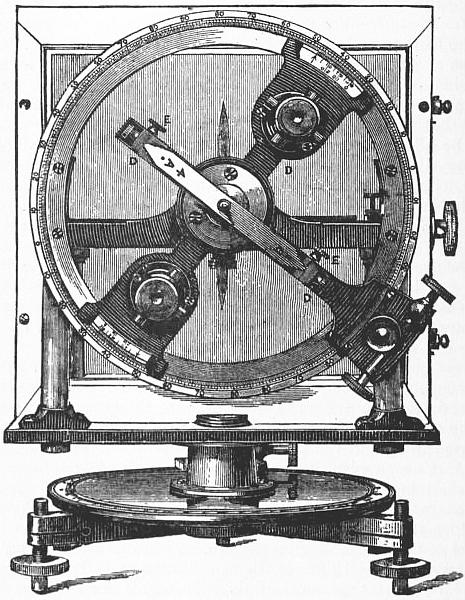
Dip Circles.—In the case of the dip circle the direction of the earth’s magnetic field is obtained by observing the position of the axis of a magnetized needle so supported as to be free to turn about a horizontal axis passing through its centre of gravity. The needles now used consist of flat lozenge-shaped pieces of steel about 9 cm. long and 0.1 cm. thick, and weigh about 4.1 grams. The axle, which is made of hard steel, projects on either side of the needle and has a diameter of about 0.05 cm. Needles considerably larger than the above have been used, but experience showed that the values for the dip observed with needles 23 cm. long, was about 1’ less than with the 9 cm. needles, and A. Schuster (Phil. Mag., 1891 [5], 31, p. 275) has shown that the difference is due to the appreciable bending of the longer needles owing to their weight.
When in use the dip needle is supported on two agate knife-edges, so that its axle is on the axis of a vertical divided circle, on which the positions of the ends of the needle are either directly observed by means of two reading lenses, in which case the circle is generally divided into thirds of a degree so that it can by estimation be read to about two minutes, or a cross arm carries two small microscopes and two verniers, the cross wires of each microscope being adjusted so as to bisect the image of the corresponding end of the needle. Two V-shaped lifters actuated by a handle serve to raise the needle from the agates, and when lowered assure the axle being at the centre of the vertical circle. The supports for the needle, and a box to protect the needle from draughts, as well as the vertical circle, can be rotated about a vertical axis, and their azimuth read off on a horizontal divided circle. There are also two adjustable stops which can be set in any position, and allow the upper part of the instrument to be rotated through exactly 180° without the necessity of reading the horizontal circle.
When making a determination of the dip with the dip circle, a number of separate readings have to be made in order to eliminate various instrumental defects. Thus, that side of the needle on which the number is engraved being called the face of the needle, and that side of the protecting box next the vertical circle the face of the instrument, both ends of the needle are observed in the following relative positions, the instrument being in every case so adjusted in azimuth that the axle of the needle points magnetic east and west:—
i. Face of instrument east and face of needle next to face of instrument;
ii. Face of instrument west and face of needle next to face of instrument;
iii. Face of instrument west and face of needle away from face of instrument;
iv. Face of instrument east and face of needle away from face of instrument.
Next the direction of magnetization of the needle is reversed by stroking it a number of times with two strong permanent magnets, when the other end of the needle dips and the above four sets of readings are repeated. The object in reading both ends of the needle is to avoid error if the prolongation of the axle of the needle does not pass through the centre of the vertical circle, as also to avoid error due to the eccentricity of the arm which carries the reading microscopes and verniers. The reversal of the instrument between (i.) and (ii.) and between (iii.) and (iv.) is to eliminate errors due to (a) the line joining the zeros of the vertical circle not being exactly horizontal, and (b) the agate knife-edges which support the needle not being exactly horizontal. The reversal of the needle between (ii.) and (iii.) is to eliminate errors due to (a) the magnetic axis of the needle not coinciding with the line joining the two points of the needle, and (b) to the centre of gravity of the needle being displaced from the centre of the axle in a direction at right angles to the length of the needle. The reversal of the poles of the needle is to counteract any error produced by the centre of gravity of the needle being displaced from the centre of the axle in a direction parallel to the length of the needle.
For use at sea the dip circle was modified, by Robert Were Fox (Annals of Electricity, 1839, 3, p. 288), who used a needle having pointed axles, the points resting in jewelled holes carried by two uprights, so that the movement of the ship does not cause the axle of the needle to change its position with reference to the vertical divided circle. To counteract the tendency of the axle to stick in the bearings, the instrument is fitted with a knob on the top of the box protecting the needle, and when a reading is being taken this knob is rubbed with an ivory or horn disk, the surface of which is corrugated. In this way a tremor is caused which is found to assist the needle in overcoming the effects of friction, so that it takes up its true position. In the Creak modification of the Fox dip circle, the upper halves of the jewels which form the bearings are cut away so that the needle can be easily removed, and thus the reversals necessary when making a complete observation can be performed (see also Magneto-Meter).
Induction Inclinometers.—The principle on which induction inclinometers depend is that if a coil of insulated wire is spun about a diameter there will be an alternating current induced in the coil, unless the axis about which it turns is parallel to the lines of force of the earth’s field. Hence if the axis about which such a coil spins is adjusted till a sensitive galvanometer connected to the coil through a commutator, by which the alternating current is converted into a direct current, is undeflected, then the axis must be parallel to the lines of force of the earth’s field, and hence the inclination of the axis to the horizontal is the dip. The introduction and perfection of this type of inclinometer is almost entirely due to H. Wild. His form of instrument for field observations1 consists of a coil 10 cm. in diameter, containing about 1000 turns of silk-covered copper wire, the resistance being about 40 ohms, which is pivoted inside a metal ring. This ring can itself rotate about a horizontal axle in its own plane, this axle being at right angles to that about which the coil can rotate. Attached to the axle of the ring is a divided circle, by means of which and two reading microscopes the inclination of the axis of rotation of the coil to the horizontal can be read. The bearings which support the horizontal axle of the ring are mounted on a horizontal annulus which can be rotated in a groove attached to the base of the instrument, as so to allow the azimuth of the axle of the ring, and hence also that of the plane in which the axis of the coil can move, to be adjusted. The coil is rotated by means of a flexible shaft worked by a small cranked handle and a train of gear wheels. The terminals of the coil are taken to a two-part commutator of the ordinary pattern on which rest two copper brushes which are connected by flexible leads to a sensitive galvanometer. The inclination of the axis of the coil can be roughly adjusted by hand by rotating the supporting ring. The final adjustment is made by means of a micrometer screw attached to an arm which is clamped on the axle of the ring.
When making a measurement the azimuth circle is first set horizontal, a striding level placed on the trunnions which carry the ring being used to indicate when the adjustment is complete. The striding level is then placed on the axle which carries the coil, and when the bubble is at the centre of the scale the microscopes are adjusted to the zeros of the vertical circle. A box containing a long compass needle and having two feet with inverted V’s is placed to rest on the axle of the coil, and the instrument is turned in azimuth till the compass needle points to a lubber line on the box. By this means the axis of the coil is brought into the magnetic meridian. The commutator being connected to a sensitive galvanometer, the coil is rotated, and the ring adjusted till the galvanometer is undeflected. The reading on the vertical circle then gives the dip. By a system of reversals slight faults in the adjustment of the instrument can be eliminated as in the case of the dip circle. With such an instrument it is claimed that readings of dip can be made accurate to ±0.1 minutes of arc.
The form of Wild inductor for use in a fixed observatory differs from the above in that the coil consists of a drum-wound armature, but without iron, of which the length is about three times the diameter. This armature has its axle mounted in a frame attached to the sloping side of a stone pillar, so that the axis of rotation is approximately parallel to the lines of force of the earth’s field. By means of two micrometer screws the inclination of the axis to the magnetic meridian and to the horizontal can be adjusted. The armature is fitted with a commutator and a system of gear wheels by means of which it can be rapidly rotated. The upper end of the axle carries a plane mirror, the normal to which is adjusted parallel to the axis of rotation of the armature. A theodolite is placed on the top of the pillar and the telescope is turned so that the image of the cross-wires, seen by reflection in the mirror, coincides with the wires themselves. In this way the axis of the theodolite telescope is placed parallel to the axis of the armature, and hence the dip can be read off on the altitude circle of the theodolite.
Authorities.—In addition to the references already given the following papers may be consulted: (1) Admiralty Manual of Scientific Inquiry, which contains directions for making observations with a dip circle; (2) Stewart and Gee, Elementary Practical Physics, which contains a full description of the dip circle and instructions for making a set of observations; (3) L. A. Bauer, Terrestrial Magnetism (1901), 6, p. 31, a memoir which contains the results of a comparison of the values for the dip obtained with a number of different circles; (4) E. Leyst, Repertorium für Meteorologie der kaiserl. Akad. der Wiss. (St Petersburg, 1887), 10, No. 5, containing a discussion of the errors of dip circles; (5) H. Wild, Bull. de l’Acad. Imp. des Sci. de St Pétersbourg (March 1895), a paper which considers the accuracy obtainable with the earth inductor.
(W. Wn.)
1 Repertorium für Meteorologie der kaiserl. Akad. der Wissensch. (St Petersburg, 1892), 16, No. 2, or Meteorolog. Zeits. (1895), 12, p. 41.
INCLOSURE, or Enclosure, in law, the fencing in of waste or common lands by the lord of the manor for the purpose of cultivation. For the history of the inclosure of such lands, and the legislation, dating from 1235, which deals with it, see COMMONS.
IN COENA DOMINI, a papal bull, so called from its opening words, formerly issued annually on Holy Thursday (in Holy Week), or later on Easter Monday. Its first publication was in 1363. It was a statement of ecclesiastical censure against heresies, schisms, sacrilege, infringement of papal and ecclesiastical privileges, attacks on person and property, piracy, forgery and other crimes. For two or three hundred years it was varied from time to time, receiving its final form from Pope Urban VIII. in 1627. Owing to the opposition of the sovereigns of Europe both Protestant and Catholic, who regarded the bull as an infringement of their rights, its publication was discontinued by Pope Clement XIV. in 1770.
INCOME TAX, in the United Kingdom a general tax on income derived from every source. Although a graduated tax on income from certain fixed sources was levied in 1435 and again in 1450, it may be said that the income tax in its present form dates in England from its introduction by W. Pitt in 1798 “granting to His Majesty an aid and contribution for the prosecution of the war.” This act of 1798 merely increased the duties of certain assessed taxes, which were regulated by the amount of income of the person assessed, provided his income amounted to £60 or upwards. These duties were repealed by an act of 1799 (39 Geo. III. c. 13), which imposed a duty of 10% on all incomes from whatever sources derived, incomes under £60 a year being exempt, and reduced rates charged on incomes between that amount and £200 a year. The produce of this tax was £6,046,624 for the first year, as compared with £1,855,996, the produce of the earlier tax. This income tax was repealed after the peace of Amiens, but the renewal of the war in 1803 caused its revival. At the same time was introduced the principle of “collection at the source” (i.e. collection before the income reaches the person to whom it belongs), which is still retained in the English Revenue system, and which, it has been said, is mainly responsible for the present development of income tax and the ease with which it is collected. The act of 1803 (43 Geo. III. c. 122) distributed the various descriptions of income under different schedules, known as A, B, C, D and E. A rate of 5% was imposed on all incomes of £150 a year and over, with graduation on incomes between £60 and £150. This income tax of 5% collected at the source yielded almost as much as the previous tax of 10% collected direct from each taxpayer. The tax was continued from year to year with the principle unchanged but with variations in the rate until the close of the war in 1815, when it was repealed. It was, during its first imposition, regarded as essentially a war tax, and in later days, when it was reimposed, it was always considered as an emergency tax, to be levied only to relieve considerable financial strain, but it has now taken its place as a permanent source of national income, and is the most productive single tax in the British financial system. The income tax was revived in 1842 by Sir R. Peel, not as a war tax, but to enable him to effect important financial reforms (see Taxation). Variations both in the rate levied and the amount of income exempted have taken place from time to time, the most important, probably, being found in the Finance Acts of 1894, 1897, 1898, 1907 and 1909-1910.
It will be useful to review the income tax as it existed before the important changes introduced in 1909. It was, speaking broadly, a tax levied on all incomes derived from sources within the United Kingdom, or received by residents in the United Kingdom from other sources. Incomes under £160 were exempt; an abatement allowed of £160 on those between £160 and £400; of £150 on those between £400 and £500; of £120 on those between £500 and £600, and of £70 on those between £600 and £700. An abatement was also allowed on account of any premiums paid for life insurance, provided they did not exceed one-sixth of the total income. The limit of total exemption was fixed in 1894, when it was raised from £150; and the scale of abatements was revised in 1898 by admitting incomes between £500 and £700; the Finance Act 1907 distinguished between “earned” and “unearned” income, granting relief to the former over the latter by 3d. in the pound, where the income from all sources did not exceed £2000. The tax was assessed as mentioned above, under five different schedules, known as A, B, C, D and E. Under schedule A was charged the income derived from landed property, including houses, the annual value or rent being the basis of the assessment. The owner is the person taxed, whether he is or is not in occupation. In England the tax under this schedule is obtained from the occupier, who, if he is not the owner, recovers from the latter by deducting the tax from the rent. In Scotland this tax is usually paid by the owner as a matter of convenience, but in Ireland it is by law chargeable to him. All real property is subject to the tax, with certain exceptions:—(a) crown property, such as public offices, prisons, &c.; (b) certain properties belonging to charitable and educational bodies, as hospitals, public schools, colleges, almshouses, &c.; (c) public parks or recreation grounds; (d) certain realities of companies such as mines, quarries, canals, &c., from which no profit is derived beyond the general profit of the concern to which they belong. Under schedule B were charged the profits arising from the occupation of land, the amount of such profits being assumed to be one-third of the annual value of the land as fixed for the purposes of schedule A. This applies principally to farmers who might, if they chose, be assessed on schedule D on their actual profits. Schedule C included income derived from interest, &c., payable out of the public funds of the United Kingdom or any other country. Schedule D, the most important branch of the income tax and the most difficult to assess, included profits arising from trade, from professional or other employment, and from foreign property, the assessment in most cases being made on an average of the receipts for three years. Schedule E covered the salaries and pensions of persons in the employment of the state or of public bodies, and of the officials of public companies, &c. The method of assessment and collection of the tax is uniformly the same. Under schedules A, B and D it is in the hands of local authorities known as the General or District Commissioners of Taxes. They are appointed by the Land Tax Commissioners out of their own body, and, as regards assessment, are not in any way controlled by the executive government. They appoint a clerk, who is their principal officer and legal adviser, assessors for each parish and collectors. There is an appeal from their decisions to the High Court of Justice on points of law, but not on questions of fact. Assessments under schedules A and B are usually made every five years, and under schedule D every year. The interests of the revenue are looked after by officers of the Board of Inland Revenue, styled surveyors of taxes, who are stationed in different parts of the country. They are in constant communication with the Board, and with the public on all matters relating to the assessment and collection of the tax; they attend the meetings of the local commissioners, examine the assessments and the taxpayers’ returns, and watch the progress of the collection. There are also certain officers, known as special commissioners, who are appointed by the crown, and receive fixed salaries from public funds. For the purpose of schedule D, any taxpayer may elect to be assessed by them instead of by the local commissioners; and those who object to their affairs being disclosed to persons in their own neighbourhood may thus have their assessments made without any risk of publicity. The special commissioners also assess the profits of railway companies under schedule D, and profits arising from foreign or colonial sources under schedules C and D. The greater part of the incomes under schedule E is assessed by the commissioners for public offices, appointed by the several departments of the government.
Previously to 1909 the rate of income tax has been as high as 16d. (in 1855-1857), and as low as 2d. (in 1874-1876). Each penny of the tax was estimated to produce in 1906-1907 a revenue of £2,666,867.1
It had long been felt that there were certain inequalities in the income tax which could be adjusted without any considerable difficulty, and from time to time committees have met and reported upon the subject. Select committees reported in 1851-1852 and in 1861, and a Departmental Committee in 1905. In 1906 a select committee was appointed to inquire into and report upon the practicability of graduating the income tax, and of differentiating, for the purpose of the tax, between permanent and precarious incomes. The summary of the conclusions contained in their Report (365 of 1906) was:—
1. Graduation of the income tax by an extension of the existing system of abatements is practicable. But it could not be applied to all incomes from the highest to the lowest, with satisfactory results. The limits of prudent extension would be reached when a large increase in the rate of tax to be collected at the source was necessitated, and the total amount which was collected in excess of what was ultimately retained became so large as to cause serious inconvenience to trade and commerce and to individual taxpayers. Those limits would not be exceeded by raising the amount of income on which an abatement would be allowed to £1000 or even more.
2. Graduation by a super-tax is practicable. If it be desired to levy a much higher rate of tax upon large incomes (say of £5000 and upwards) than has hitherto been charged, a super-tax based on personal declaration would be a practicable method.
3. Abandonment of the system of “collection at the source” and adoption of the principle of direct personal assessment of the whole of each person’s income would be inexpedient.
4. Differentiation between earned and unearned incomes is practicable, especially if it be limited to earned incomes not exceeding £3000 a year, and effect be given to it by charging a lower rate of tax upon them.
5. A compulsory personal declaration from each individual of total net income in respect of which tax is payable is expedient, and would do much to prevent the evasion and avoidance of income tax which at present prevail.