VOLUME XIV SLICE III Ichthyology to Independence (continued 5)
Reading edition
The history of the relations of the Edomites and Israelites may be briefly summarized. Saul, whose chief herdsman, Doeg, was an Edomite (1 Sam. xxi. 7), fought successfully against them (1 Sam. xiv. 47). Joab (1 Kings xi. 16) or Abishai, as his deputy (1 Chron. xviii. 11, 13), occupied Edom for six months and devastated it; it was garrisoned and permanently held by David (2 Sam. viii. 14). But a refugee named Hadad, who escaped as a child to Egypt and grew up at the court of the Egyptian king, returned in Solomon’s reign and made a series of reprisal raids on the Israelite territory (1 Kings xi. 14). This did not prevent Solomon introducing Edomites into his harem (1 Kings xi. 1) and maintaining a navy at Ezion-geber, at the head of the Gulf of Akaba (1 Kings ix. 26). Indeed, until the time of Jehoram, when the land revolted (2 Kings viii. 20, 22), Edom was a dependency of Judah, ruled by a viceroy (1 Kings xxii. 47). An attempt at recovering their independence was temporarily quelled in a campaign by Amaziah (2 Kings xiv. 7), and Azariah his successor was able to renew the sea trade of the Gulf of Akaba (2 Kings xiv. 22) which had probably languished since the wreck of Jehoshaphat’s ships (1 Kings xxii. 48); but the ancient kingdom had been re-established by the time of Ahaz, and the king’s name, Kaush-Malak, is recorded by Tiglath Pileser. He made raids on the territory of Judah (2 Chron. xxviii. 17). The kingdom, however, was short-lived, and it was soon absorbed into the vassalage of Assyria.
The later history of Edom is curious. By the constant westward pressure of the eastern Arabs, which (after the restraining force of the great Mesopotamian kingdoms was weakened) assumed irresistible strength, the ancient Edomites were forced across the Jordan-Araba depression, and with their name migrated to the south of western Palestine. In 1 Maccabees v. 65 we find them at Hebron, and this is one of the first indications that we discover of the cis-Jordanic Idumaea of Josephus and the Talmud.
Josephus used the name Idumaea as including not only Gobalitis, the original Mount Seir, but also Amalekitis, the land of Amalek, west of this, and Akrabatine, the ancient Acrabbim, S.W. of the Dead Sea. In War IV. viii. 1, he mentions two villages “in the very midst of Idumaea,” named Betaris and Caphartobas. The first of these is the modern Beit Jibrin (see Eleutheropolis), the second is Tuffūḥ, near Hebron. Jerome describes Idumaea as extending from Beit Jibrin to Petra, and ascribes the great caves at the former place to cave-dwellers like the aboriginal Horites. Ptolemy’s account presents us with the last stage, in which the name Idumaea is entirely restricted to the cis-Jordanic district, and the old trans-Jordanic region is absorbed in Arabia.
The Idumaean Antipater was appointed by Julius Caesar procurator of Judaea, Samaria and Galilee, as a reward for services rendered against Pompey. He was the father of Herod the Great, whose family thus was Idumaean in origin. (See Palestine.)
(R. A. S. M.)
1 A curious etymological speculation connects the name with the story of Esau’s begging for Jacob’s pottage, Gen. xxv. 30.
2 The same word is used in the anonymous prophecy incorporated in the book of Zachariah (xii. 5), and in one or two other places as well, of Hebrew leaders.
IDUN, or Iduna, in Scandinavian mythology, the goddess of youth and spring. She was daughter of the dwarf Svald and wife of Bragi. She was keeper of the golden apples, the eating of which preserved to the gods their eternal youth. Loki, the evil spirit, kidnapped her and the apples, but was forced by the gods to restore her liberty. Idun personifies the year between March and September, and her myth represents the annual imprisonment of spring by winter.
IDYL, or Idyll (Gr. εἰδύλλιον, a descriptive piece, from εἶδος, a shape or style; Lat. idyllium), a short poem of a pastoral or rural character, in which something of the element of landscape is preserved or felt. The earliest commentators of antiquity used the term to designate a great variety of brief and homely poems, in which the description of natural objects was introduced, but the pastoral idea came into existence in connexion with the Alexandrian school, and particularly with Theocritus, Bion and Moschus, in the 3rd century before Christ. It appears, however, that εἰδύλλιον was not, even then, used consciously as the name of a form of verse, but as a diminutive of εἶδος, and merely signified “a little piece in the style of” whatever adjective might follow. Thus the idyls of the pastoral poets were εἰδύλλια αἰπολικά, little pieces in the goatherd style. We possess ten of the so-called “Idyls” of Theocritus, and these are the type from which the popular idea of this kind of poem is taken. But it is observable that there is nothing in the technical character of these ten very diverse pieces which leads us to suppose that the poet intended them to be regarded as typical. In fact, if he had been asked whether a poem was or was not an idyl he would doubtless have been unable to comprehend the question. As a matter of fact, the first of his poems, the celebrated “Dirge for Daphnis,” has become the prototype, not of the modern idyl, but of the modern elegy, and the not less famous “Festival of Adonis” is a realistic mime. It was the six little epical romances, if they may be so called, which started the conception of the idyl of Theocritus. It must be remembered, however, that there is nothing in ancient literature which justifies the notion of a form of verse recognized as an “idyl.” In the 4th century after Christ the word seems to have become accepted in Latin as covering short descriptive poems of very diverse characters, for the early MSS. of Ausonius contain a section of “Edyllia,” which embraces some of the most admirable of the miscellaneous pieces of that writer. But that Ausonius himself called his poems “idyls” is highly doubtful. Indeed, it is not certain that the heading is not a mistake for “Epyllia.” The word was revived at the Renaissance and applied rather vaguely to Latin and Greek imitations of Theocritus and of Virgil. It was also applied to modern poems of a romantic and pastoral character published by such writers as Tasso in Italy, Montemayor in Portugal and Ronsard in French. In 1658 the English critic, Edward Phillips, defined an “idyl” as “a kind of eclogue,” but it was seldom used to describe a modern poem. Mme Deshoulières published a series of seven Idylles in 1675, and Boileau makes a vague reference to the form. The sentimental German idyls of Salomon Gessner (in prose, 1758) and Voss (in hexameters, 1800) were modelled on Theocritus. Goethe’s Alexis und Dora is an idyl. It appears that the very general use, or abuse, of the word in the second half of the 19th century, both in English and French, arises from the popularity of two works, curiously enough almost identical in date, by two eminent and popular poets. The Idylles héroïques (1858) of Victor de Laprade and the Idylls of the King (1859) of Tennyson enjoyed a success in either country which led to a wide imitation of the title among those who had, perhaps, a very inexact idea of its meaning. Among modern Germans, Berthold Auerbach and Jeremias Gotthelf have been prominent as the composers of sentimental idyls founded on anecdotes of village-life. On the whole, it is impossible to admit that the idyl has a place among definite literary forms. Its character is vague and has often been purely sentimental, and our conception of it is further obscured by the fact that though the noun carries no bucolic idea with it in English, the adjective (“idyllic”) has come to be synonymous with pastoral and rustic.
(E. G.)
IFFLAND, AUGUST WILHELM (1759-1814), German actor and dramatic author, was born at Hanover on the 19th of April 1759. His father intended his son to be a clergyman, but the boy preferred the stage, and at eighteen ran away to Gotha in order to prepare himself for a theatrical career. He was fortunate enough to receive instruction from Hans Ekhof, and made such rapid progress that he was able in 1779 to accept an engagement at the theatre in Mannheim, then rising into prominence. He soon stood high in his profession, and extended his reputation by frequently playing in other towns. In 1796 he settled in Berlin, where he became director of the national theatre of Prussia; and in 1811 he was made general director of all representations before royalty. Iffland produced the classical works of Goethe and Schiller with conscientious care; but he had little understanding for the drama of the romantic writers. The form of play in which he was most at home, both as actor and playwright, was the domestic drama, the sentimental play of everyday life. His works are almost entirely destitute of imagination; but they display a thorough mastery of the technical necessities of the stage, and a remarkable power of devising effective situations. His best characters are simple and natural, fond of domestic life, but too much given to the utterance of sentimental commonplace. His best-known plays are Die Jäger, Dienstpflicht, Die Advokaten, Die Mündel and Die Hagestolzen. Iffland was also a dramatic critic, and German actors place high value on the reasonings and hints respecting their art in his Almanach für Theater und Theaterfreunde. In 1798-1802 he issued his Dramatischen Werke in 16 volumes, to which he added an autobiography (Meine theatralische Laufbahn). In 1807-1809 Iffland brought out two volumes of Neue dramatische Werke. Selections from his writings were afterwards published, one in 11 (Leipzig, 1827-1828), the other in 10 volumes (Leipzig, 1844, and again 1860). As an actor, he was conspicuous for his brilliant portrayal of comedy parts. His fine gentlemen, polished men of the world, and distinguished princes were models of perfection, and showed none of the traces of elaborate study which were noticed in his interpretation of tragedy. He especially excelled in presenting those types of middle-class life which appear in his own comedies. Iffland died at Berlin on the 22nd of September 1814. A bronze portrait statue of him was erected in front of the Mannheim theatre in 1864.
See K. Duncker, Iffland in seinen Schriften als Künstler, Lehrer, und Direktor der Berliner Bühne (1859); W. Koffka, Iffland und Dalberg (1865); and Lampe, Studien über Iffland als Dramatiker (Celle, 1899). Iffland’s interesting autobiography, Meine theatralische Laufbahn, was republished by H. Holstein in 1885.
IGLAU (Czech Jihlava), a town of Austria, in Moravia, 56 m. N.W. of Brünn by rail. Pop. (1900) 24,387, of whom 4200 are Czechs and the remainder Germans. Iglau is situated on the Iglawa, close to the Bohemian frontier, and is one of the oldest towns in Moravia, being the centre of a German-speaking enclave. Among the principal buildings are the churches of St Jakob, St Ignatius, St John and St Paul, the town-hall, and the barracks formed from a monastery suppressed under the emperor Joseph II. There is also a fine cemetery, containing some remarkable monuments. It has the principal tobacco and cigar factory of the state monopoly, which employs about 2500 hands, and has besides a large and important textile and glass industry, corn and saw-mills, pottery and brewing. Fairs are periodically held in the town; and the trade in timber, cereals, and linen and woollen goods is generally brisk.
Iglau is an old mining town where, according to legend, the silver mines were worked so early as 799. King Ottakar I. (1198-1230) established here a mining-office and a mint. At a very early date it enjoyed exceptional privileges, which were confirmed by King Wenceslaus I. in the year 1250. The town-hall contains a collection of municipal and mining laws dating as far back as 1389. At Iglau, on the 5th of July 1436, the treaty was made with the Hussites, by which the emperor Sigismund was acknowledged king of Bohemia. A granite column near the town marks the spot where Ferdinand I., in 1527, swore fidelity to the Bohemian states. During the Thirty Years’ War Iglau was twice captured by the Swedes. In 1742 it fell into the hands of the Prussians, and in December 1805 the Bavarians under Wrede were defeated near the town.
IGLESIAS, a town and episcopal see of Sardinia in the province of Cagliari, from which it is 34 m. W.N.W. by rail, 620 ft. above sea-level. Pop. (1901) 10,436 (town), 20,874 (commune). It is finely situated among the mountains in the S.W. portion of the island, and is chiefly important as the centre of a mining district; it has a government school for mining engineers. The minerals are conveyed by a small railway via Monteponi (with its large lead and zinc mine) to Portovesme (15 m. S.W. of Iglesias in the sheltered gulf of Carloforte), near Portoscuso, where they are shipped. The total amount of the minerals extracted in Sardinia in 1905 was 170,236 tons and their value £765,054 (chiefly consisting of 99,749 tons of calamine zinc, 26,051 of blende zinc, 24,798 tons of lead and 15,429 tons of lignite): the greater part of them—118,009 tons—was exported from Portoscuso by sea and most of the rest from Cagliari, the zinc going mainly to Antwerp, and in a less proportion to Bordeaux and Dunkirk, while the lead is sent to Pertusola near Spezia, to be smelted. At Portoscuso is also a tunny fishery.
The cathedral of Iglesias, built by the Pisans, has a good façade (restored); the interior is late Spanish Gothic. San Francesco is a fine Gothic church with a gallery over the entrance, while Sta Chiara and the church of the Capuchins (the former dating from 1285) show a transition between Romanesque and Gothic. The battlemented town walls are well preserved and picturesque; the castle, built in 1325, now contains a glass factory. The church of Nostra Signora del Buon Cammino above the town (1080 ft.) commands a fine view.
IGNATIEV, NICHOLAS PAVLOVICH, Count (1832-1908), Russian diplomatist, was born at St Petersburg on the 29th of January 1832. His father, Captain Paul Ignatiev, had been taken into favour by the tsar Nicholas I., owing to his fidelity on the occasion of the military conspiracy in 1825; and the grand duke Alexander (afterwards tsar) stood sponsor at the boy’s baptism. At the age of seventeen he became an officer of the Guards. His diplomatic career began at the congress of Paris, after the Crimean War, where he took an active part as military attaché in the negotiations regarding the rectification of the Russian frontier on the Lower Danube. Two years later (1858) he was sent with a small escort on a dangerous mission to Khiva and Bokhara. The khan of Khiva laid a plan for detaining him as a hostage, but he eluded the danger and returned safely, after concluding with the khan of Bokhara a treaty of friendship. His next diplomatic exploit was in the Far East, as plenipotentiary to the court of Peking. When the Chinese government was terrified by the advance of the Anglo-French expedition of 1860 and the burning of the Summer Palace, he worked on their fears so dexterously that he obtained for Russia not only the left bank of the Amur, the original object of the mission, but also a large extent of territory and sea-coast south of that river. This success was supposed to prove his capacity for dealing with Orientals, and paved his way to the post of ambassador at Constantinople, which he occupied from 1864 till 1877. Here his chief aim was to liberate from Turkish domination and bring under the influence of Russia the Christian nationalities in general and the Bulgarians in particular. His restless activity in this field, mostly of a semi-official and secret character, culminated in the Russo-Turkish war of 1877-1878, at the close of which he negotiated with the Turkish plenipotentiaries the treaty of San Stefano. As the war which he had done so much to bring about did not eventually secure for Russia advantages commensurate with the sacrifices involved, he fell into disfavour, and retired from active service. Shortly after the accession of Alexander III. in 1881, he was appointed minister of the interior on the understanding that he would carry out a nationalist, reactionary policy, but his shifty ways and his administrative incapacity so displeased his imperial master that he was dismissed in the following year. After that time he exercised no important influence in public affairs. He died on the 3rd of July 1908.
IGNATIUS (Ἰγνάτιος), bishop of Antioch, one of the “Apostolic Fathers.” No one connected with the history of the early Christian Church is more famous than Ignatius, and yet among the leading churchmen of the time there is scarcely one about whose career we know so little. Our only trustworthy information is derived from the letters which he wrote to various churches on his last journey from Antioch to Rome, and from the short epistle of Polycarp to the Philippians. The earlier patristic writers seem to have known no more than we do. Irenaeus, for instance, gives a quotation from his Epistle to the Romans and does not appear to know (or if he knew he has forgotten) the name of the author, since he describes him (Adv. haer. v. 28. 4) as “one of those belonging to us” (τις τῶν ἡμετέρων). If Eusebius possessed any knowledge about Ignatius apart from the letters he never reveals it. The only shred of extra information which he gives us is the statement that Ignatius “was the second successor of Peter in the bishopric of Antioch” (Eccles. hist. iii. 36). Of course in later times a cloud of tradition arose, but none of it bears the least evidence of trustworthiness. The martyrologies, from which the account of his martyrdom that used to appear in uncritical church histories is taken, are full of anachronisms and impossibilities. There are two main types—the Roman and the Syrian—out of which the others are compounded. They contradict each other in many points and even their own statements in different places are sometimes quite irreconcilable. Any truth that the narrative may contain is hopelessly overlaid with fiction. We are therefore limited to the Epistles for our information, and before we can use even these we are confronted with a most complex critical problem, a problem which for ages aroused the most bitter controversy, but which happily now, thanks to the labours of Zahn, Lightfoot, Harnack and Funk, may be said to have reached a satisfactory solution.
I. The Problem of the Three Recensions.—The Ignatian problem arises from the fact that we possess three different recensions of the Epistles. (a) The short recension (often called the Vossian) contains the letters to the Ephesians, Magnesians, Trallians, Romans, Philadelphians, Smyrnaeans and to Polycarp. This recension was derived in its Greek form from the famous Medicean MS. at Florence and first published by Vossius in 1646 (see Theol. Literaturzeitung, 1906, 596 f., for an early papyrus fragment in the Berlin Museum, containing Ad Smyrn. iii. fin. xii. init.). In the Medicean MS. the Epistle to the Romans is missing, but a Greek version of this epistle was discovered by Ruinart, embedded in a martyrium, in the National Library at Paris and published in 1689. There are also (1) a Latin version made by Robert Grosseteste, bishop of Lincoln, about 1250, and published by Ussher in 1644—two years before the Vossian edition appeared; (2) an Armenian version which was derived from a Syriac not earlier than the 5th century and published at Constantinople in 1783; (3) some fragments of a Syriac version published in Cureton’s edition of Ignatius; (4) fragments of a Coptic version first published in Lightfoot’s work (ii. 859-882). (b) The long recension contains the seven Epistles mentioned above in an expanded form and several additional letters besides. The Greek form of the recension, which has been preserved in ten MSS., has thirteen letters, the additional ones being to the Tarsians, the Philippians, the Antiochians, to Hero, to Mary of Cassobola and a letter of Mary to Ignatius. The Latin form, of which there are thirteen extant MSS., omits the letter of Mary of Cassobola, but adds to the list the Laus Heronis, two Epistles to the apostle John, one to the Virgin Mary and one from Mary to Ignatius. (c) The Syriac or Curetonian recension contains only three Epistles, viz. to Polycarp, to the Romans, and to the Ephesians, and these when compared with the same letters in the short and long recensions are found to be considerably abbreviated. The Syriac recension was made by William Cureton in 1845 from three Syriac MSS. which had recently been brought from the Nitrian desert and deposited in the British Museum. One of these MSS. belongs to the 6th century, the other two are later. Summed up in a word, therefore, the Ignatian problem is this: which of these three recensions (if any) represents the actual work of Ignatius?
II. History of the Controversy.—The history of the controversy may be divided into three periods: (a) up to the discovery of the short recension in 1646; (b) between 1646 and the discovery of the Syriac recension in 1845; (c) from 1845 to the present day. In the first stage the controversy was theological rather than critical. The Reformation raised the question as to the authority of the papacy and the hierarchy. Roman Catholic scholars used the interpolated Ignatian Epistles very freely in their defence and derived many of their arguments from them, while Protestant scholars threw discredit on these Epistles. The Magdeburg centuriators expressed the gravest doubts as to their genuineness, and Calvin declared that “nothing was more foul than those fairy tales (naeniis) published under the name of Ignatius!” It should be stated, however, that one Roman Catholic scholar, Denys Petau (Petavius), admitted that the letters were interpolated, while the Protestant Vedelius acknowledged the seven letters mentioned by Eusebius. In England the Ignatian Epistles took an important place in the episcopalian controversy in the 17th century. Their genuineness was defended by the leading Anglican writers, e.g. Whitgift, Hooker and Andrewes, and vigorously challenged by Dissenters, e.g. the five Presbyterian ministers who wrote under the name of Smectymnuus and John Milton.1 The second period is marked by the recognition of the superiority of the Vossian recension. This was speedily demonstrated, though some attempts were made, notably by Jean Morin or Morinus (about 1656), Whiston (in 1711) and Meier (in 1836), to resuscitate the long recension. Many Protestants still maintained that the new recension, like the old, was a forgery. The chief attack came from Jean Daillé, who in his famous work (1666) drew up no fewer than sixty-six objections to the genuineness of the Ignatian literature. He was answered by Pearson, who in his Vindiciae epistolarum S. Ignatii (1672) completely vindicated the authenticity of the Vossian Epistles. No further attack of any importance was made till the time of Baur, who like Daillé rejected both recensions. In the third stage—inaugurated in 1845 by Cureton’s work—the controversy has ranged round the relative claims of the Vossian and the Curetonian recensions. Scholars have been divided into three camps, viz. (1) those who followed Cureton in maintaining that the three Syriac Epistles alone were the genuine work of Ignatius. Among them may be mentioned the names of Bunsen, A. Ritschl, R. A. Lipsius, E. de Pressensé, H. Ewald, Milman, Bohringer. (2) Those who accepted the genuineness of the Vossian recension and regarded the Curetonian as an abbreviation of it, e.g. Petermann, Denzinger, Uhlhorn, Merx, and in more recent times Th. Zahn, J. B. Lightfoot, Ad. Harnack and F. X. Funk. (3) Those who denied the authenticity of both recensions, e.g. Baur and Hilgenfeld and in recent times van Manen,2 Völter3 and van Loon.4 The result of more than half a century’s discussion has been to restore the Vossian recension to the premier position.
III. The Origin of the Long Recension.—The arguments against the genuineness of the long recension are decisive. (1) It conflicts with the statement of Eusebius. (2) The first trace of its use occurs in Anastasius of Antioch (A.D. 598) and Stephen Gobarus (c. 575-600). (3) The ecclesiastical system of the letters implies a date not earlier than the 4th century. (4) The recension has been proved to be dependent on the Apostolical Constitutions. (5) The doctrinal atmosphere implies the existence of Arian and Apollinarian heresies. (6) The added passages reveal a difference in style which stamps them at once as interpolations. There are several different theories with regard to the origin of the recension. Some, e.g. Leclerc, Newman and Zahn, think that the writer was an Arian and that the additions were made in the interest of Arianism. Funk, on the other hand, regards the writer as an Apollinarian. Lightfoot opposes both views and suggests that it is better “to conceive of him as writing with a conciliatory aim.”
IV. The Objections to the Curetonian Recension.—The objections to the Syriac recension, though not so decisive, are strong enough to carry conviction with them. (1) We have the express statement of Eusebius that Ignatius wrote seven Epistles. (2) There are statements in Polycarp’s Epistle which cannot be explained from the three Syriac Epistles. (3) The omitted portions are proved by Lightfoot after an elaborate analysis to be written in the same style as the rest of the epistles and could not therefore have been later interpolations. (4) The Curetonian letters are often abrupt and broken and show signs of abridgment. (5) The discovery of the Armenian version proves the existence of an earlier Syriac recension corresponding to the Vossian of which the Curetonian may be an abbreviation. It seems impossible to account for the origin of the Curetonian recension on theological grounds. The theory that the abridgment was made in the interests of Eutychianism or Monophysitism cannot be substantiated.
V. The Date and Genuineness of the Vossian Epistles.—We are left therefore with the seven Epistles. Are they the genuine work of Ignatius, and, if so, at what date were they written? The main objections are as follows: (1) The conveyance of a condemned prisoner to Rome to be put to death in the amphitheatre is unlikely on historical grounds, and the route taken is improbable for geographical reasons. This objection has very little solid basis. (2) The heresies against which Ignatius contends imply the rise of the later Gnostic and Docetic sects. It is quite certain, however, that Docetism was in existence in the 1st century (cf. 1 John), while many of the principles of Gnosticism were in vogue long before the great Gnostic sects arose (cf. the Pastoral Epistles). There is nothing in Ignatius which implies a knowledge of the teaching of Basilides or Valentinus. In fact, as Harnack says: “No Christian writer after 140 could have described the false teachers in the way that Ignatius does.” (3) The ecclesiastical system of Ignatius is too developed to have arisen as early as the time of Trajan. At first sight this objection seems to be almost fatal. But we have to remember that the bishops of Ignatius are not bishops in the modern sense of the word at all, but simply pastors of churches. They are not mentioned at all in two Epistles, viz. Romans and Philippians, which seems to imply that this form of government was not universal. It is only when we read modern ecclesiastical ideas into Ignatius that the objection has much weight. To sum up, as Uhlhorn says: “The collective mass of internal evidence against the genuineness of the letters ... is insufficient to counterbalance the testimony of the Epistle of Polycarp in their favour. He who would prove the Epistles of Ignatius to be spurious must begin by proving the Epistle of Polycarp to be spurious, and such an undertaking is not likely to succeed.” This being so, there is no reason for rejecting the opinion of Eusebius that the Epistles were written in the reign of Trajan. Harnack, who formerly dated them about 140, now says that they were written in the latter years of Trajan, or possibly a little later (117-125). The majority of scholars place them a few years earlier (110-117).5
The letters of Ignatius unfortunately, unlike the Epistles of St Paul, contain scant autobiographical material. We are told absolutely nothing about the history of his career. The fact that like St Paul he describes himself as an ἔκτρωμα (Rom. 9), and that he speaks of himself as “the last of the Antiochene Christians” (Trall. 13; Smyrn. xi.), seems to suggest that he had been converted from paganism somewhat late in life and that the process of conversion had been abrupt and violent. He bore the surname of Theophorus, i.e. “God-clad” or “bearing God.” Later tradition regarded the word as a passive form (“God-borne”) and explained it by the romantic theory that Ignatius was the child whom Christ took in his arms (Mark ix. 36-37). The date at which he became bishop of Antioch cannot be determined. At the time when the Epistles were written he had just been sentenced to death, and was being sent in charge of a band of soldiers to Rome to fight the beasts in the amphitheatre. The fact that he was condemned to the amphitheatre proves that he could not have been a Roman citizen. We lose sight of him at Troas, but the presumption is that he was martyred at Rome, though we have no early evidence of this.
But if the Epistles tell us little of the life of Ignatius, they give us an excellent picture of the man himself, and are a mirror in which we see reflected certain ideals of the life and thought of the day. Ignatius, as Schaff says, “is the incarnation of three closely connected ideas: the glory of martyrdom, the omnipotence of episcopacy, and the hatred of heresy and schism.”
1. Zeal for martyrdom in later days became a disease in the Church, but in the case of Ignatius it is the mark of a hero. The heroic note runs through all the Epistles; thus he says:
“I bid all men know that of my own free will I die for God, unless ye should hinder me.... Let me be given to the wild beasts, for through them I can attain unto God. I am God’s wheat, and I am ground by the wild beasts that I may be found the pure bread of Christ. Entice the wild beasts that they may become my sepulchre...; come fire and cross and grapplings with wild beasts, wrenching of bones, hacking of limbs, crushings of my whole body; only be it mine to attain unto Jesus Christ” (Rom. 4-5).
2. Ignatius constantly contends for the recognition of the authority of the ministers of the church. “Do nothing,” he writes to the Magnesians, “without the bishop and the presbyters.” The “three orders” are essential to the church, without them no church is worthy of the name (cf. Trall. 3). “It is not lawful apart from the bishop either to baptize or to hold a love-feast” (Smyrn. 8). Respect is due to the bishop as to God, to the presbyters as the council of God and the college of apostles, to the deacons as to Jesus Christ (Trall. 3). These terms must not, of course, be taken in their developed modern sense. The “bishop” of Ignatius seems to represent the modern pastor of a church. As Zahn has shown, Ignatius is not striving to introduce a special form of ministry, nor is he endeavouring to substitute one form for another. His particular interest is not so much in the form of ministry as in the unity of the church. It is this that is his chief concern. Centrifugal forces were at work. Differences of theological opinion were arising. Churches had a tendency to split up into sections. The age of the apostles had passed away and their successors did not inherit their authority. The unity of the churches was in danger. Ignatius was resisting this fatal tendency which threatened ruin to the faith. The only remedy for it in those days was to exalt the authority of the ministry and make it the centre of church life. It should be noted that (1) there is no trace of the later doctrine of apostolical succession; (2) the ministry is never sacerdotal in the letters of Ignatius. As Lightfoot puts it: “The ecclesiastical order was enforced by him (Ignatius) almost solely as a security for doctrinal purity. The threefold ministry was the husk, the shell, which protected the precious kernel of the truth” (i. 40).
3. Ignatius fights most vehemently against the current forms of heresy. The chief danger to the church came from the Docetists who denied the reality of the humanity of Christ and ascribed to him a phantom body. Hence we find Ignatius laying the utmost stress on the fact that Christ “was truly born and ate and drank, was truly persecuted under Pontius Pilate ... was truly raised from the dead” (Trall. 9). “I know that He was in the flesh even after the resurrection, and when He came to Peter and his company, He said to them, ‘Lay hold and handle me, and see that I am not an incorporeal spirit’” (Smyrn. 3). Equally emphatic is Ignatius’s protest against a return to Judaism. “It is monstrous to talk of Jesus Christ and to practise Judaism, for Christianity did not believe in Judaism but Judaism in Christianity” (Magn. 10).
Reference must also be made to a few of the more characteristic points in the theology of Ignatius. As far as Christology is concerned, besides the insistence on the reality of the humanity of Christ already mentioned, there are two other points which call for notice. (1) Ignatius is the earliest writer outside the New Testament to describe Christ under the categories of current philosophy; cf. the famous passage in Eph. 7, “There is one only physician, of flesh and of spirit (σαρκικὸς καὶ πνευματικός), generate and ingenerate (γεννητὸς καὶ ἀγέννητος), God in man, true life in death, son of Mary and son of God, first passible and then impassible” (πρῶτον παθητὸς καὶ ἀπαθής). (2) Ignatius is also the first writer outside the New Testament to mention the Virgin Birth, upon which he lays the utmost stress. “Hidden from the prince of this world were the virginity of Mary and her child-bearing and likewise also the death of the Lord, three mysteries to be cried aloud, the which were wrought in the silence of God” (Eph. 19). Here, it will be observed, we have the nucleus of the later doctrine of the deception of Satan. In regard to the Eucharist also later ideas occur in Ignatius. It is termed a μυστήριον (Trall. 2), and the influence of the Greek mysteries is seen in such language as that used in Eph. 20, where Ignatius describes the Eucharistic bread as “the medicine of immortality and the antidote against death.” When Ignatius says too that “the heretics abstain from Eucharist because they do not allow that the Eucharist is the flesh of Christ,” the words seem to imply that materialistic ideas were beginning to find an entrance into the church (Smyr. 6). Other points that call for special notice are: (1) Ignatius’s rather extravagant angelology. In one place for instance he speaks of himself as being able to comprehend heavenly things and “the arrays of angels and the musterings of principalities” (Trall. 5). (2) His view of the Old Testament. In one important passage Ignatius emphatically states his belief in the supremacy of Christ even over “the archives” of the faith, i.e. the Old Testament: “As for me, my archives—my inviolable archives—are Jesus Christ, His cross, His death, His resurrection and faith through Him” (Philadel. 8).
Authorities.—T. Zahn, Ignatius von Antiochien (Gotha, 1873); J. B. Lightfoot, Apostolic Fathers, part ii. (London, 2nd ed., 1889); F. X. Funk, Die Echtheit der ignat. Briefe (Tübingen, 1892); A. Harnack, Chronologie der altchristlichen Litteratur (Leipzig, 1897). There is a good bibliography in G. Krüger, Early Christian Literature (Eng. trans., 1897, pp. 28-29). See also Apostolic Fathers.
(H. T. A.)
1 In his short treatise “Of Prelatical Episcopacy,” works iii. p. 72 (Pickering, 1851).
2 Theologisch. Tijdschrift (1892), 625-633.
3 Ib. (1886) 114-136; Die Ignatianischen Briefe (1892).
4 Ib. (1893) 275-316.
5 But there are still a few scholars, e.g. van Manen and Völter, who prefer a date about 150 or later; van Loon goes as late as 175. See article “Old-Christian Literature,” Ency. Bib. iii. col. 3488.
IGNORAMUS (Latin for “we do not know,” “we take no notice of”), properly an English law term for the endorsement on the bill of indictment made by a grand jury when they “throw out” the bill, i.e. when they do not consider that the case should go to a petty jury. The expression is now obsolete, “not a true bill,” “no bill,” being used. The expressions “ignoramus jury,” “ignoramus Whig,” &c., were common in the political satires and pamphlets of the years following on the throwing out of the bill for high treason against the 2nd earl of Shaftesbury in 1681. The application of the term to an ignorant person dates from the early part of the 17th century. The New English Dictionary quotes two examples illustrating the early connexion of the term with the law or lawyers. George Ruggle (1575-1622) in 1615 wrote a Latin play with the title Ignoramus, the name being also that of the chief character in it, intended for one Francis Brakin, the recorder of Cambridge. It is a satire against the ignorance and pettifogging of the common lawyers of the day. It was answered by a prose tract (not printed till 1648) by one Robert Callis, serjeant-at-law. This bore the title of The Case and Argument against Sir Ignoramus of Cambridge.
IGNORANCE (Lat. ignorantia, from ignorare, not to know), want of knowledge, a state of mind which in law has important consequences. A well-known legal maxim runs: ignorantia juris non excusat (“ignorance of the law does not excuse”). With this is sometimes coupled another maxim: ignorantia facti excusat (“ignorance of the fact excuses”). That every one who has capacity to understand the law is presumed to know it is a very necessary principle, for otherwise the courts would be continually occupied in endeavouring to solve problems which by their very impracticability would render the administration of justice next to impossible. It would be necessary for the court to engage in endless inquiries as to the true inwardness of a man’s mind, whether his state of ignorance existed at the time of the commission of the offence, whether such a condition of mind was inevitable or brought about merely by indifference on his part. Therefore, in English, as in Roman law, ignorance of the law is no ground for avoiding the consequences of an act. So far as regards criminal offences, the maxim as to ignorantia juris admits of no exception, even in the case of a foreigner temporarily in England, who is likely to be ignorant of English law. In Roman law the harshness of the rule was mitigated in the case of women, soldiers and persons under the age of twenty-five, unless they had good legal advice within reach (Dig. xxii. 6. 9). Ignorance of a matter of fact may in general be alleged in avoidance of the consequences of acts and agreements, but such ignorance cannot be pleaded where it is the duty of a person to know, or where, having the means of knowledge at his disposal, he wilfully or negligently fails to avail himself of it (see Contract).
In logic, ignorance is that state of mind which for want of evidence is equally unable to affirm or deny one thing or another. Doubt, on the other hand, can neither affirm nor deny because the evidence seems equally strong for both. For Ignoratio Elenchi (ignorance of the refutation) see Fallacy.
IGNORANTINES (Frères Ignorantins), a name given to the Brethren of the Christian Schools (Frères des Écoles Chrétiennes), a religious fraternity founded at Reims in 1680, and formally organized in 1683, by the priest Jean Baptiste de la Salle, for the purpose of affording a free education, especially in religion, to the children of the poor. In addition to the three simple vows of chastity, poverty and obedience, the brothers were required to give their services without any remuneration and to wear a special habit of coarse black material, consisting of a cassock, a hooded cloak with hanging sleeves and a broad-brimmed hat. The name Ignorantine was given from a clause in the rules of the order forbidding the admission of priests with a theological education. Other popular names applied to the order are Frères de Saint-Yon, from the house at Rouen, which was their headquarters from 1705 till 1770, Frères à quatre bras, from their hanging sleeves, and Frères Fouetteurs, from their former use of the whip (fouet) in punishments. The order, approved by Pope Benedict XIII. in 1724, rapidly spread over France, and although dissolved by the National Assembly’s decree in February 1790, was recalled by Napoleon I. in 1804, and formally recognized by the French government in 1808. Since then its members have penetrated into nearly every country of Europe, and into America, Asia and Africa. They number about 14,000 members and have over 2000 schools, and are the strongest Roman Catholic male order. Though not officially connected with the Jesuits, their organization and discipline are very similar.
See J. B. Blain, La Vie du vénérable J. B. de la Salle (Versailles, 1887).
IGUALADA, a town of north-eastern Spain, in the province of Barcelona, on the left bank of the river Noya, a right-hand tributary of the Llobregat, and at the northern terminus of the Igualada-Martorell-Barcelona railway. Pop. (1900) 10,442. Igualada is the central market of a rich agricultural and wine-producing district. It consists of an old town with narrow and irregular streets and the remains of a fortress and ramparts, and a new town which possesses regular and spacious streets and many fine houses. The local industries, chiefly developed since 1880, include the manufacture of cotton, linen, wool, ribbons, cloth, chocolate, soap, brandies, leather, cards and nails. The famous mountain and convent of Montserrat or Monserrat (q.v.) is 12 m. E.
IGUANA, systematically Iguanidae (Spanish quivalent of Carib iwana), a family of pleurodont lizards, comprising about 50 genera and 300 species. With three exceptions, all the genera of this extensive family belong to the New World, being specially characteristic of the Neotropical region, where they occur as far south as Patagonia, while extending northward into the warmer parts of the Nearctic regions as far as California and British Columbia. The exceptional genera are Brachylophus in the Fiji Islands, Hoplurus and Chalarodon in Madagascar. The iguanas are characterized by the peculiar form of their teeth, these being round at the root and blade-like, with serrated edges towards the tip, resembling in this respect the gigantic extinct reptile Iguanodon. The typical forms belonging to this family are distinguished by the large dewlap or pouch situated beneath the head and neck, and by the crest, composed of slender elongated scales, which extends in gradually diminishing height from the nape of the neck to the extremity of the tail. The latter organ is very long, slender and compressed. The tongue is generally short and not deeply divided at its extremity, nor is its base retracted into a sheath; it is always moist and covered with a glutinous secretion. The prevailing colour of the iguanas is green; and, as the majority of them are arboreal in their habits, such colouring is generally regarded as protective. Those on the other hand which reside on the ground have much duller, although as a rule equally protective hues. Some iguanas, however (e.g. Anolis carolinensis), possess, to an extent only exceeded by the chameleon, the power of changing their colours, their brilliant green becoming transformed under the influence of fear or irritation, into more sombre hues and even into black. They differ greatly in size, from a few inches to several feet in length.
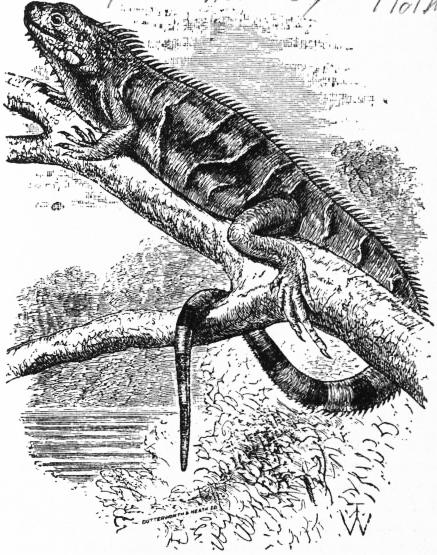
Fig. 1.—Iguana.
One of the largest and most widely distributed is the common iguana (Iguana tuberculata), which occurs in the tropical parts of Central and South America and the West Indies, with the closely allied I. rhinolophus. It attains a length of 6 ft., weighing then perhaps 30 ℔, and is of a greenish colour, occasionally mixed with brown, while the tail is surrounded with alternate rings of those colours. Its food consists of vegetable substances, mostly leaves, which it obtains from the forest trees among whose branches it lives and in the hollows of which it deposits its eggs. These are of an oblong shape about 1½ in. in length, and are said by travellers to be very pleasant eating, especially when taken raw, and mixed with farina. They are timid, defenceless animals, depending for safety on the comparative inaccessibility of their arboreal haunts, and their protective colouring, which is rendered even more effective by their remaining still on the approach of danger. But the favourite resorts of the iguana are trees which overhang the water, into which they let themselves fall with a splash, whatever the height of the tree, and then swim away, or hide at the bottom for many minutes. Otherwise they exhibit few signs of animal intelligence. “The iguana,” says H. W. Bates (The Naturalist on the Amazons), “is one of the stupidest animals I ever met. The one I caught dropped helplessly from a tree just ahead of me; it turned round for a moment to have an idiotic stare at the intruder and then set off running along the path. I ran after it and it then stopped as a timid dog would do, crouching down and permitting me to seize it by the neck and carry it off.” Along with several other species, notably Ctenosura acanthinura, which is omnivorous, likewise called iguana, the common iguana, is much sought after in tropical America; the natives esteem its flesh a delicacy, and capture it by slipping a noose round its neck as it sits in fancied security on the branch of a tree.
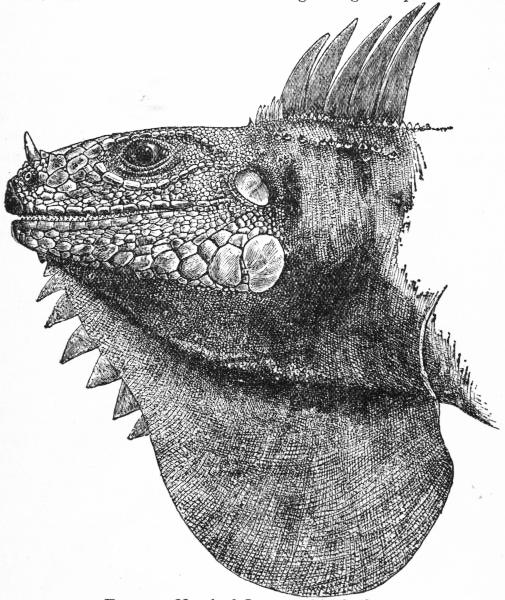
Fig. 2.—Head of Iguana rhinolophus.
Although chiefly arboreal, many of the iguanas take readily to the water; and there is at least one species, Amblyrhynchus cristatus, which leads for the most part an aquatic life. These marine lizards occur only in the Galapagos Islands, where they are never seen more than 20 yds. inland, while they may often be observed in companies several hundreds of yards from the shore, swimming with great facility by means of their flattened tails. Their feet are all more or less webbed, but in swimming they are said to keep these organs motionless by their sides. Their food consists of marine vegetation, to obtain which they dive beneath the water, where they are able to remain, without coming to the surface to breathe, for a very considerable time. Though they are thus the most aquatic of lizards, Darwin, who studied their habits during his visit to those islands, states that when frightened they will not enter the water. Driven along a narrow ledge of rock to the edge of the sea, they preferred capture to escape by swimming, while if thrown into the water they immediately returned to the point from which they started. A land species belonging to the allied genus Conolophus also occurs in the Galapagos, which differs from most of its kind in forming burrows in the ground.
IGUANODON, a large extinct herbivorous land reptile from the Wealden formation of western Europe, almost completely known by numerous skeletons from Bernissart, near Mons, Belgium. It is a typical representative of the ornithopodous (Gr. for bird-footed) Dinosauria. The head is large and laterally compressed with a blunt snout, nearly terminal nostrils and relatively small eyes. The sides of the jaws are provided with a close series of grinding teeth, which are often worn down to stumps; the front of the jaws forms a toothless beak, which would be encased originally in a horny sheath. When unworn the teeth are spatulate and crimped or serrated round the edge, closely resembling those of the existing Central American lizard, Iguana—hence the name Iguanodon (Gr. Iguana-tooth) proposed by Mantell, the discoverer of this reptile, in 1825. The bodies of the vertebrae are solid; and they are convexo-concave (i.e. opisthocoelous) in the neck and anterior part of the back, where there must have been much freedom of motion. The hindquarters are comparatively large and heavy, while the tail is long, deep and more or less laterally compressed, evidently adapted for swimming. The small and mobile fore-limbs bear four complete fingers, with the thumb reduced to a bony spur. The pelvis and hind-limbs much resemble those of a running bird, such as those of an emu or the extinct moa; but the basal bones (metatarsals) of the three-toed foot remain separate throughout life, thus differing from those of the running birds, which are firmly fused together even in the young adult. No external armour has been found. The reptile doubtless frequented marshes, feeding on the succulent vegetation, and often swimming in the water. Footprints prove that when on land it walked habitually on its hind-limbs.
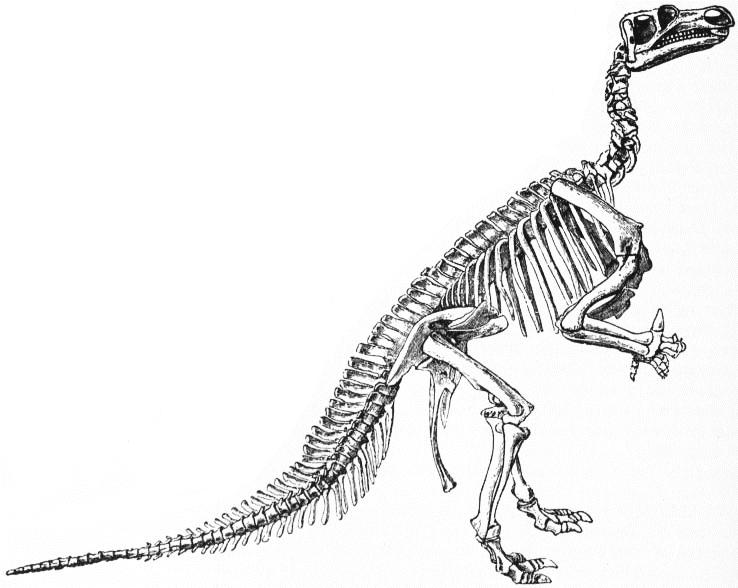
Skeleton of Iguanadon bernissartensis. (After Dollo.)
The earliest remains of Iguanodon were found by Dr G. A. Mantell in the Wealden formation of Sussex, and a large part of the skeleton, lacking the head, was subsequently discovered in a block of ragstone in the Lower Greensand near Maidstone, Kent. These fossils, which are now in the British Museum, were interpreted by Dr Mantell, who made comparisons with the skeleton of Iguana, on the erroneous supposition that the resemblance in the teeth denoted some relationship to this existing lizard. Several of the bones, however, could not be understood until the much later discoveries of Mr S. H. Beckles in the Wealden cliffs near Hastings; and an accurate knowledge of the skeleton was only obtained when many complete specimens were disinterred by the Belgian government from the Wealden beds at Bernissart, near Mons, during the years 1877-1880. These skeletons, which now form the most striking feature of the Brussels Museum, evidently represent a large troop of animals which were suddenly destroyed and buried in a deep ravine or gully. The typical species, Iguanodon mantelli, measures 5 to 6 metres in length, while I. bernissartensis (see fig.) attains a length of 8 to 10 metres. They are found both at Bernissart and in the south of England, while other species are also known from Sussex. Nearly complete skeletons of allied reptiles have been discovered in the Jurassic and Cretaceous rocks of North America.
References.—G. A. Mantell, Petrifactions and their Teaching (London, 1851); L. Dollo, papers in Bull. Mus. Roy. d’Hist. Nat. Belg., vols. i.-iii. (1882-1884).
(A. S. Wo.)
IGUVIUM (mod. Gubbio, q.v.), a town of Umbria, situated among the mountains, about 23 m. N.N.E. of Perusia and connected with it by a by-road, which joined the Via Flaminia near the temple of Jupiter Appenninus, at the modern Scheggia. It appears to have been an important place in pre-Roman times, both from its coins and from the celebrated tabulae Iguvinae (see below).
We find it in possession of a treaty with Rome, similar to that of the Camertes Umbri; and in 167 B.C. it was used as a place of safe custody for the Illyrian King Gentius and his sons (Livy xlv. 43). After the Social War, in which it took no part, it received Roman citizenship. At that epoch it must have received full citizen rights since it was included in the tribus Clustumina (C.I.L. xi. e.g. 5838). In 49 B.C. it was occupied by Minucius Thermus on behalf of Pompey, but he abandoned the town. Under the empire we hear almost nothing of it. Silius Italicus mentions it as subject to fogs. A bishop of Iguvium is mentioned as early as A.D. 413. It was taken and destroyed by the Goths in 552, but rebuilt with the help of Narses. The Umbrian town had three gates only, and probably lay on the steep mountain side as the present town does, while the Roman city lay in the lower ground. Here is the theatre, which, as an inscription records, was restored by Cn. Satrius Rufus in the time of Augustus. The diameter of the orchestra is 76½ ft. and of the whole 230 ft., so that it is a building of considerable size; the stage is well preserved and so are parts of the external arcades of the auditorium. Not far off are ruins probably of ancient baths, and the concrete core of a large tomb with a vaulted chamber within.
(T. As.)
Of Latin inscriptions (C.I.L. xi. 5803-5926) found at Iguvium two or three are of Augustan date, but none seem to be earlier. A Latin inscription of Iguvium (C.I.L. xi. 5824) mentions a priest whose functions are characteristic of the place “L. Veturius Rufio avispex extispecus, sacerdos publicus et privatus.”
The ancient town is chiefly celebrated for the famous Iguvine (less correctly Eugubine) Tables, which were discovered there in 1444, bought by the municipality in 1456, and are still preserved in the town hall. A Dominican, Leandro Alberti (Descrizione d’Italia, 1550), states that they were originally nine in number, and an independent authority, Antonio Concioli (Statuta civitatis Eugubii, 1673), states that two of the nine were taken to Venice in 1540 and never reappeared. The existing seven were first published in a careful but largely mistaken transcript by Buonarotti in 1724, as an appendix to Dempster’s De Etruria Regali.1
The first real advance towards their interpretation was made by Otfried Müller (Die Etrusker, 1828), who pointed out that though their alphabet was akin to the Etruscan their language was Italic. Lepsius, in his essay De tabulis Eugubinis (1833), finally determined the value of the Umbrian signs and the received order of the Tables, pointing out that those in Latin alphabet were the latest. He subsequently published what may be called the editio princeps in 1841. The first edition, with a full commentary based on scientific principles, was that of Aufrecht and Kirchhoff in 1849-1851, and on this all subsequent interpretations are based (Bréal, Paris, 1875; Bücheler, Umbrica, Bonn, 1883, a reprint and enlargement of articles in Fleckeisen’s Jahrbuch, 1875, pp. 127 and 313). The text is everywhere perfectly legible, and is excellently represented in photographs by the marquis Ranghiasci-Brancaleone, published with Bréal’s edition.
Language.—The dialect in which this ancient set of liturgies is written is usually known as Umbrian, as it is the only monument we possess of any length of the tongue spoken in the Umbrian district before it was latinized (see Umbria). The name, however, is certainly too wide, since an inscription from Tuder of, probably, the 3rd century B.C. (R. S. Conway, The Italic Dialects, 352) shows a final -s and a medial -d-, both apparently preserved from the changes which befell these sounds, as we shall see, in the dialect of Iguvium. On the other hand, inscriptions of Fulginia and Assisium (ibid. 354-355) agree very well, so far as they go, with Iguvine. It is especially necessary to make clear that the language known as Umbrian is that of a certain limited area, which cannot yet be shown to have extended very far beyond the eastern half of the Tiber valley (from Interamna Nahartium to Urvinum Mataurense), because the term is often used by archaeologists with a far wider connotation to include all the Italic, pre-Etruscan inhabitants of upper Italy; Professor Ridgeway, for instance, in his Early Age of Greece, frequently speaks of the “Umbrians” as the race to which belonged the Villanova culture of the Early Iron age. It is now one of the most urgent problems in the history of Italy to determine the actual historical relation (see further Rome: History, ad. init.) between the Ὀμβροί of, say, Herodotus and the language of Iguvium, of which we may now offer some description, using the term Umbrian strictly in this sense.
Under the headings Latin Language and Osca Lingua there have been collected (1) the points which separate all the Italic languages from their nearest congeners, and (2) those which separate Osco-Umbrian from Latin. We have now to notice (3) the points in which Umbrian has diverged from Oscan. The first of them antedates by six or seven centuries the similar change in the Romance languages (see Romance Languages).
(1) The palatalization of k and g before a following i or e, or consonant i as in tiçit (i.e. diçit) = Lat. decet; muieto past part. passive (pronounced as though the i were an English or French j) beside Umb. imperative mugatu, Lat. mugire.
(2) The loss of final -d, e.g. in the abl. sing. fem. Umb. tōtā = Osc. toutād.
(3) The change of d between vowels to a sound akin to r, written by a special symbol (ḍ) in Umbrian alphabet and by RS in Latin alphabet, e.g. teḍa in Umbrian alphabet = dirsa in Latin alphabet (see below), “let him give,” exactly equivalent to Paelignian dida (see Paeligni).

(4) The change of -s- to -r- between vowels as in erom, “esse” = Osc. ezum, and the gen. plur. fem. ending in -aru = Lat. -arum, Osc. -azum.
To this there appear a long string of exceptions, e.g. asa = Lat. ara. These are generally regarded as mere archaisms, and unfortunately the majority of them are in words of whose origin and meaning very little is known, so that (for all we can tell) in many the -s- may represent -ss- or -ps- as in osatu = Lat. operato, cf. Osc. opsaom.
(5) The change of final -ns to -f as in the acc. plur. masc. vitluf = Lat. vitulōs.
(6) In the latest stage of the dialect (see below) the change of final -s to -r, as in abl. plur. arver, arviis, i.e. “arvorum frugibus.”
(7) The decay of all diphthongs; ai, oi, ei all become a monophthong variously written e and i (rarely ei), as in the dat. sing. fem. tote, “civitati”; dat. sing. masc. pople, “populo”; loc. sing. masc. onse (from *om(e)sei), “in umero.” So au, eu, ou all become ō, as in ote = Osc. auti, Lat. aut.
(8) The change of initial l to v, as in vutu = Lat. lavito.
Owing to the peculiar character of the Tables no grammatical statement about Umbrian is free from difficulty; and these bare outlines of its phonology must be supplemented by reference to the lucid discussion in C. D. Buck’s Oscan and Umbrian Grammar (Boston, 1904), or to the earlier and admirably complete Oskischumbrische Grammatik of R. von Planta (Strassburg, 1892-1897). Some of the most important questions are discussed by R. S. Conway in The Italic Dialects, vol. ii. p. 495 seq.
Save for the consequences of these phonetic changes, Umbrian morphology and syntax exhibit no divergence from Oscan that need be mentioned here, save perhaps two peculiar perfect-formations with -l- and -nçi-; as in ampelust, fut. perf. “impenderit,” combifiançiust, “nuntiaverit” (or the like). Full accounts of the accidence and syntax, so far as it is represented in the inscriptions, will be found in the grammars of Buck and von Planta already mentioned, and in the second volume of Conway, op. cit.
Chronology. (I.) The Relative Dates of the Tables.—At least four periods in the history of the dialect can be distinguished in the records we have left to us, by the help of the successive changes (a) in alphabet and (b) in language, which the Tables exhibit. Of these only the outstanding features can be mentioned here; for a fuller discussion the reader must be referred to The Italic Dialects, pp. 400 sqq.
(a) Changes in Alphabet.—Observe first that Tables I., II., III. and IV., and the first two inscriptions of V. are in Umbrian character; the Latin alphabet is used in the Claverniur paragraph (V. iii.), and the whole of VI. (a and b) and VII. (a and b).
What we may call the normal Umbrian alphabet (in which e.g. Table I. a is written) consists of the following signs, the writing being always from right to left: ḍ (i.e. a sound akin to r derived from d), and and d, V u and (i.e. a voiceless palatal consonant.)





In the Latin alphabet, in which Tables VI. and VII. and the third inscription of Table V. are written, d is represented by RS, g by G, but k by C, d by D, t by T, v and u by V but o by O, ś by Ś, though the diacritic is often omitted. The interpunct is double with the Umbrian alphabet, single and medial with the Latin.
Tables VI. and VII., then, and V. iii., were written later than the rest. But even in the earlier group certain variations appear.
The latest form of the Umbrian alphabet is that of Table V. i. and ii., where the abbreviated form of m (Λ) and the angular and undivided form of k ( not ) are especially characteristic.


Nearest to this is that of Tables III. and IV., which form a single document; then that of I. (a) and (b); earliest would seem that of II. (a) and II. (b). In II. a, 18 and 24, we have the archaic letter san (M = s) of the abecedaria (E. S. Roberts, Int. Gr. Epig. pp. 17 ff.), which appears in no other Italic nor in any Chalcidian inscription, though it survived longer in Etruscan and Venetic use. Against this may be set the use of for t in I. b 1, but this appears also in IV. 20 and should be called rather Etruscan than archaic. These characteristics of II. a and b would be in themselves too slight to prove an earlier date, but they have perhaps some weight as confirming the evidence of the language.

(b) Changes in Language.—The evidence of date derived from changes in the language is more difficult to formulate, and the inquiry calls for the most diligent use of scientific method and critical judgment. Its intricacy lies in the character of the documents before us—religious formularies consisting partly of matter established in usage long before they were written down in their present shape, partly of additions made at the time of writing. The best example of this is furnished by the expansion and modernisation of the subject-matter of Table I. into Tables VI. and VII.a. Hence we frequently meet with forms which had passed out of the language that was spoken at the time they were engraved, side by side with their equivalents in that language. We may distinguish four periods, as follows:
1. The first period is represented, not by any complete table, but by the old unmodernised forms of Tables III. and IV., which show the original guttural plosives unpalatalized, e.g. kebu = Lat. cibum.
2. In the second period the gutturals have been palatalized, but there yet is no change of final s to r. This is represented by the rest of III. and IV. and by II. (a and b).
3. In the third period final s has everywhere become r. This appears in V. (i. and ii. and also iii.). Table I. is a copy or redraft made from older documents during this period. This is shown by the occasional appearance of r instead of final s.
4. Soon after the dialect had reached its latest form, the Latin alphabet was adopted. Tables VI. and VII.a contain an expanded form of the same liturgical direction as Table I.
It is probable that further research will amend this classification in detail, but its main lines are generally accepted.
(II.) Actual Date of the Tables.—Only the leading points can be mentioned here.
(i.) The Latin alphabet of the latest Tables resembles that of the Tabula Bantina, and might have been engraved at almost any time between 150 B.C. and 50 B.C. It is quite likely that the closer relations with Rome, which began after the Social War, led to the adoption of the Latin alphabet. Hence we should infer that the Tables in Umbrian alphabet were at all events older than 90 B.C.
(ii.) For an upper limit of date, in default of definite evidence, it seems imprudent to go back beyond the 5th century B.C., since neither in Rome nor Campania have we any evidence of public written documents of any earlier century. When more is known of the earliest Etruscan inscriptions it may become possible to date the Iguvine Tables by their alphabetic peculiarities as compared with their mother-alphabet, the Etruscan. The “Tuscan name” is denounced in the comprehensive curse of Table VI. b, 53-60, and we may infer that the town of Iguvium was independent but in fear of the Etruscans at the time when the curse was first composed. The absence of all mention of either Gauls or Romans seems to prove that this time was at least earlier than 400 B.C.; and the curse may have been composed long before it was written down.
The chief sources in which further information may be sought have been already mentioned.
(R. S. C.)
1 A portion of this article is taken by permission from R. S. Conway’s Italic Dialects (Camb. Univ. Press, 1897).
IJOLITE (derived from the first syllable of the Finnish words Jiwaru, Jijoki, &c., common as geographical names in the Kola peninsula, and the Gr. λίθος, a stone), a rock consisting essentially of nepheline and augite, and of great rarity, but of considerable importance from a mineralogical and petrographical standpoint. It occurs in various parts of the Kola peninsula in north Finland on the shores of the White Sea. The pyroxene is morphic, yellow or green, and is surrounded by formless areas of nepheline. The accessory minerals are apatite, cancrinite, calcite, titanite and jiwaarite, a dark-brown titaniferous variety of melanite-garnet. This rock is the plutonic and holocrystalline analogue of the nephelenites and nepheline-dolerites; it bears the same relation to them as the nepheline-syenites have to the phonolites. It is worth mentioning that a leucite-augite rock, resembling ijolite except in containing leucite in place of nepheline, is known to occur at Shonkin Creek, near Fort Benton, Montana, and has been called missourite.
IKI, an island belonging to Japan, lying off the north-western coast of Kiushiu, in 33° 45′ N. lat. and 129° 40′ E. long. It has a circumference of 86 m., an area of 51 sq. m., and a population of 36,530. The island is, for the most part, a tableland about 500 ft. above sea-level. The anchorage is at Gonoura, on the south-west. A part of Kublai Khan’s Mongols landed at Iki when about to invade Japan in the 13th century, for it lies in the direct route from Korea to Japan via Tsushima. In the immediate vicinity are several rocky islets.
ILAGAN, the capital of the province of Isabela, Luzon, Philippine Islands, on an elevated site at the confluence of the Pinacanauan river with the Grande de Cagayan, about 200 m. N.N.E. of Manila. Pop. (1903) 16,008. The neighbouring country is the largest tobacco-producing section in the Philippines.
ILCHESTER, a market town in the southern parliamentary division of Somersetshire, England, in the valley of the river Ivel or Yeo, 5 m. N.W. of Yeovil. It is connected by a stone bridge with the village of Northover on the other side of the river. Ilchester has lost the importance it once possessed, and had in 1901 a population of only 564, but its historical interest is considerable. The parish church of St Mary is Early English and Perpendicular, with a small octagonal tower, but has been largely restored in modern times. The town possesses almshouses founded in 1426, a picturesque cross, and a curious ancient mace of the former corporation.
Ilchester (Cair Pensavelcoit, Ischalis, Ivelcestre, Yevelchester) was a fortified British settlement, and subsequently a military station of the Romans, whose Fosse Way passed through it. Its importance continued in Saxon times, and in 1086 it was a royal borough with 107 burgesses. In 1180 a gild merchant was established, and the county gaol was completed in 1188. Henry II. granted a charter, confirmed by John in 1203, which gave Ilchester the same liberties as Winchester, with freedom from tolls and from being impleaded without the walls, the fee farm being fixed at £26, 10s. 0d. The bailiffs of Ilchester are mentioned before 1230. The borough was incorporated in 1556, the fee farm being reduced to £8. Ilchester was the centre of the county administration from the reign of Edward III. until the 19th century, when the change from road to rail travelling completed the decay of the town. Its place has been taken by Taunton. The corporation was abolished in 1886. Parliamentary representation began in 1298, and the town continued to return two members until 1832. A fair on the 29th of August was granted by the charter of 1203. Other fairs on the 27th of December, the 21st of July, and the Monday before Palm Sunday, were held under a charter of 1289. The latter, fixed as the 25th of March, was still held at the end of the 18th century, but there is now no fair. The Wednesday market dates from before the Conquest. The manufacture of thread lace was replaced by silk weaving about 1750, but this has decayed.
ÎLE-DE-FRANCE, an old district of France, forming a kind of island, bounded by the Seine, the Marne, the Beuvronne, the Thève and the Oise. In this sense the name is not found in written documents before 1429; but in the second half of the 15th century it designated a wide military province of government, bounded N. by Picardy, W. by Normandy, S. by Orléanais and Nivernais, and E. by Champagne. Its capital was Paris. From the territory of Île-de-France were formed under the Revolution the department of the Seine, together with the greater part of Seine-et-Oise, Seine-et-Marne, Oise and Aisne, and a small part of Loiret and Nièvre. (The term Île-de-France is also used for Mauritius, q.v.).
See A. Longnon, “L’Île-de-France, son origine, ses limites, ses gouverneurs,” in the Mémoires de la Société de l’histoire de Paris et de l’Île-de-France, vol. i. (1875).
ILETSK, formerly Fort Iletskaya Zashchita, a town of Russia, in the government of Orenburg, 48 m. S. of the town of Orenburg by the railway to Tashkent, near the Ilek river, a tributary of the Ural. Pop. 11,802 in 1897. A thick bed of excellent rock-salt is worked here to the extent of about 100,000 tons annually. The place is resorted to for its salt, mud and brine baths, and its koumiss cures.
ILFELD, a town in Germany, in the Prussian province of Hanover, situated at the south foot of the Harz, at the entrance to the Bährethal, 8 m. N. from Nordhausen by the railway to Wernigerode. Pop. 1600. It contains an Evangelical church, a celebrated gymnasium, once a monasterial school, with a fine library, and manufactures of parquet-flooring, paper and plaster of Paris, while another industry in the town is brewing. It is also of some repute as a health resort.
Ilfeld, as a town, dates from the 14th century, when it sprang up round a Benedictine monastery. Founded about 1190 this latter was reformed in 1545, and a year later converted into the school mentioned above, which under the rectorship of Michael Neander (1525-1595) enjoyed a reputation for scholarship which it has maintained until to-day.
See Förstemann, Monumenta rerum Ilfeldensium (Nordhausen, 1843); M. Neander, Bericht vom Kloster Ilfeld, edited by Bouterwek (Göttingen, 1873); and K. Meyer, Geschichte des Klosters Ilfeld (Leipzig, 1897).
ILFORD [Great Ilford], an urban district in the Romford parliamentary division of Essex, England, on the Roding, 7 m. E.N.E. of London by the Great Eastern railway. Pop. (1891) 10,913, (1901) 41,234. A portion of Hainault Forest lies within the parish. The hospital of St Mary and St Thomas, founded in the 12th century as a leper hospital, now contains almshouses and a chapel, and belongs to the marquess of Salisbury, who as “Master” is required to maintain a chaplain and six aged inmates. The chapel appears to be of the date of this foundation. Claybury Hall is a lunatic asylum (1893) of the London County Council. There are large photographic material works and paper mills. Little Ilford is a parish on the opposite (west) side of the Roding. The church of St Mary retains Norman portions, and has a curious monumental brass commemorating a boy in school-going clothes (1517). Pop. (1901) 17,915.
ILFRACOMBE, a seaport and watering-place in the Barnstaple parliamentary division of Devonshire, England, on the Bristol Channel, 225 m. W. by S. of London by the London & South-Western railway. Pop. of urban district (1901) 8557. The picturesque old town, built on the cliffs above its harbour, consists of one street stretching for about a mile through a network of lanes. Behind it rise the terraces of a more modern town, commanding a fine view across the Channel. With its beautiful scenery and temperate climate, Ilfracombe is frequented by visitors both in summer and winter. Grand rugged cliffs line the coast; while, inland, the country is celebrated for the rich colouring of its woods and glens. Wooded heights form a semicircle round the town, which is protected from sea winds by Capstone Hill. Along the inner face of this rock has been cut the Victoria Promenade, a long walk roofed with glass and used for concerts. The restored church of Holy Trinity dates originally from the 12th century. Sea-bathing is insecure, and is confined to a few small coves, approached by tunnels hewn through the rock. The harbour, a natural recess among the cliffs, is sheltered on the east by Hilsborough Head, where there are some alleged Celtic remains; on the west by Lantern Hill, where the ancient chapel of St Nicholas has been transformed into a lighthouse. In summer, passenger steamers run to and from Ilfracombe pier; but the shipping trade generally has declined, though herring fisheries are carried on with success. In the latter part of the 13th century Ilfracombe obtained a grant for holding a fair and market, and in the reign of Edward III. it was a place of such importance as to supply him with six ships and ninety-six men for his armament against Calais. During the Civil War, being garrisoned for the Roundheads, it was in 1644 captured by the Royalists, but in 1646 it fell into the hands of Fairfax.
ILHAVO, a seaport in the district of Aveiro, formerly included in the province of Beira, Portugal, 3 m. S.W. of Aveiro (q.v.), on the lagoon of Aveiro, an inlet of the Atlantic Ocean. Pop. (1900) 12,617. Ilhavo is inhabited chiefly by fishermen, but has a celebrated manufactory of glass and porcelain, the Vista-Alegre, at which the art of glass-cutting has reached a high degree of perfection. Salt is largely exported. Ilhavo is celebrated for the beauty of its women. It is said to have been founded by Greek colonists about 400 B.C., but this tradition is of doubtful validity.
ILI, one of the principal rivers of Central Asia, in the Russian province of Semiryechensk. The head-stream, called the Tekez, rises at an altitude of 11,600 ft. E. of Lake Issyk-kul, in 82° 25′ E. and 43° 23′ N., on the W. slopes of mount Kash-katur. At first it flows eastward and north-eastward, until, after emerging from the mountains, it meets the Kungez, and then, assuming the name of Ili, it turns westwards and flows between the Trans-Ili Ala-tau mountains on the south and the Boro-khoro and Talki ranges on the north for about 300 m. to Iliysk. The valley between 79° 30′ and 82° E. is 50 m. wide, and the portion above the town of Kulja (Old Kulja) is fertile and populous, Taranchi villages following each other in rapid succession, and the pastures being well stocked with sheep and cattle and horses. At Iliysk the river turns north-west, and after traversing a region of desert and marsh falls by at least seven mouths into the Balkash Lake, the first bifurcation of the delta taking place about 115 m. up the river. But it is only the southern arm of the delta that permanently carries water. The total length of the river is over 900 m. From Old Kulja to New Kulja the Ili is navigable for at most only two and a half months in the year, and even then considerable difficulty is occasioned by the shoals and sandbanks. From New Kulja to Iliysk (280 m.) navigation is easy when the water is high, and practicable even at its lowest for small boats. At Iliysk there is a ferry on the road from Kopal to Vyernyi. The principal tributaries of the Ili are the Kash, Chilik and Charyn. A vast number of streams flow towards it from the mountains on both sides, but most of them are used up by the irrigation canals and never reach their goal. The wealth of coal in the valley is said to be great, and when the Chinese owned the country they worked gold and silver with profit. Fort Ili or Iliysk, a modern Russian establishment, must not be confounded with Ili, the old capital of the Chinese province of the same name. The latter, otherwise known as Hoi-yuan-chen, New Kulja (Gulja), or Manchu Kulja, was formerly a city of 70,000 inhabitants, but now lies completely deserted. Old Kulja, Tatar Kulja or Nin-yuan, is now the principal town of the district. The Chinese district of Ili formerly included the whole of the valley of the Ili river as far as Issyk-kul, but now only its upper part. Its present area is about 27,000 sq. m. and its population probably 70,000. It belongs administratively to the province of Sin-kiang or East Turkestan. (See Kulja.)
ILION, a village of Herkimer county, New York, U.S.A., about 12 m. S.E. of Utica, on the S. bank of the Mohawk river. Pop. (1890) 4057; (1900) 5138 (755 foreign-born); (1905, state census) 5924; (1910) 6588. It is served by the New York Central & Hudson river, and the West Shore railways, by the Utica & Mohawk Valley Electric railroad, and by the Erie canal. It has a public library (1868) of about 13,500 volumes, a public hospital and a village hall. The village owns its water-works and its electric-lighting plant. Its principal manufactures are Remington typewriters and Remington fire-arms (notably the Remington rifle); other manufactures are filing cabinets and cases and library and office furniture (the Clark & Baker Co.), knit goods, carriages and harness, and store fixtures. In 1828 Eliphalet Remington (1793-1861) established here a small factory for the manufacture of rifles. He invented, and, with the assistance of his sons, Philo (1816-1889), Samuel and Eliphalet, improved the famous Remington rifle, which was adopted by several European governments, and was supplied in large numbers to the United States army. In 1856 the company added the manufacture of farming tools, in 1870 sewing-machines, and in 1874 typewriters. The last-named industry was sold to the Wyckoff, Seamans & Benedict Company in 1886, and soon afterwards, on the failure of the original Remington company, the fire-arms factory was bought by a New York City firm. A store was established on the present site of Ilion as early as 1816, but the village really dates from the completion of the Erie canal in 1825. On the canal list it was called Steele’s Creek, but it was also known as Morgan’s Landing, and from 1830 to 1843 as Remington’s Corners. The post-office, which was established in 1845, was named Remington, in honour of Eliphalet Remington; but later the present name was adopted. The village was incorporated in 1852. Ilion is a part of the township of German Flats (pop. in 1900, 8663; in 1910, 10,160), settled by Palatinate Germans about 1725. The township was the scene of several Indian raids during the French and Indian War and the War of Independence. Here General Herkimer began his advance to raise the siege of Fort Schuyler (1777), and subsequently Ilion was the rendezvous of Benedict Arnold’s force during the same campaign.
ILKESTON, a market town and municipal borough, in the Ilkeston parliamentary division of Derbyshire, England, 9 m. E.N.E. of Derby, on the Midland and the Great Northern railways. Pop. (1891) 19,744, (1901) 25,384. It is situated on a hill commanding fine views of the Erewash valley. The church of St Mary is Norman and Early English, and has a fine chancel screen dating from the later part of the 13th century. The manufactures of the town are principally hosiery and lace, and various kinds of stoneware. Coal and iron are wrought in the neighbourhood. An alkaline mineral spring, resembling the seltzer water of Germany, was discovered in 1830, and baths were then erected, which, however, were subsequently closed. The town, which is very ancient, being mentioned in Domesday, obtained a grant for a market and fair in 1251, and received its charter of incorporation in 1887. It is governed by a mayor, 6 aldermen and 18 councillors. Area, 2526 acres.
ILKLEY, an urban district in the Otley parliamentary division of the West Riding of Yorkshire, England, 16 m. N.W. from Leeds, on the Midland and the North-Eastern railways. Pop. of urban district (1901) 7455. It is beautifully situated in the upper part of the valley of the Wharfe, and owing to the fine scenery of the neighbourhood, and to the bracing air of the high moorlands above the valley, has become a favourite health resort. Here and at Ben Rhydding, 1 m. E., are several hydropathic establishments. The church of All Saints is in the main Decorated, largely restored in 1860. Three ancient sculptured crosses are preserved in the churchyard. The institutions include a museum of local antiquities, a grammar school, the Siemens Convalescent Home and the Ilkley Bath Charitable Institution. The fine remains of Bolton Abbey lie in the Wharfe valley, 5 m. above Ilkley. Ilkley has been identified with the Olicana of Ptolemy, one of the towns of the British tribe of the Brigantes. There was a Roman fort near the present church of All Saints, and the site has yielded inscriptions and other small remains. Numerous relics are preserved in the museum.
ILL, a river of Germany, entirely within the imperial territory of Alsace-Lorraine. It rises on a north foothill of the Jura, S.W. of Basel, and flows N.N.E. parallel with the Rhine, which it enters from the left, 9 m. below Strassburg. Its course lies for the most part through low meadowland; and the stream, which is 123 m. long, receives numerous small affluents, which pour out of the short narrow valleys of the Vosges. It is navigable from Ladhof near Colmar to its confluence with the Rhine, a distance of 59 m. It is on this river, and not on the Rhine, that the principal towns of Upper Alsace are situated, e.g. Mülhausen, Colmarl, Schlettstadt and Strassburg. The Ill feeds two important canals, the Rhine-Marne canal and the Rhine-Rhone canal, both starting from the neighbourhood of Strassburg.
ILLAWARRA, a beautiful and fertile district of New South Wales, Australia, extending from a point 33 m. S. of Sydney, along the coast southwards for 40 m. to Shoalhaven. It is thickly populated, and supplies Sydney with the greater part of its dairy produce. There are also numerous collieries, producing coal of superior quality, and iron ore, fireclay and freestone are plentiful. The Illawarra Lake, a salt lagoon, 9 m. long and 3 m. wide, is encircled by hills and is connected with the sea by a narrow channel; quantities of fish are caught in it and wild fowl are abundant along its shores. The chief towns in the district are Wollongong, Kiama, Clifton and Shellharbour.
ILLE-ET-VILAINE, a maritime department of north-western France, formed in 1790 out of the eastern part of the old province of Brittany. Pop. (1906) 611,805. Area 2699 sq. m. It is bounded N. by the English Channel, the Bay of St Michel and the department of Manche; E. by Mayenne; S. by Loire-Inférieure; and W. by Morbihan and Côtes-du-Nord. The territory of Ille-et-Vilaine constitutes a depression bordered by hills which reach their maximum altitudes (over 800 ft.) in the N.E. and W. of the department. The centre of this depression, which separates the hills of Brittany from those of Normandy, is occupied by Rennes, capital of the department and an important junction of roads, rivers and railways. The department takes its name from its two principal rivers, the Ille and the Vilaine. The former joins the Vilaine at Rennes after a course of 18 m. through the centre of the department; and the latter, which rises in Mayenne, flows westwards as far as Rennes, where it turns abruptly south. The stream is tidal up to the port of Redon, and is navigable for barges as far as Rennes. The Vilaine receives the Meu and the Seiche, which are both navigable. There are two other navigable streams, the Airon and the Rance, the long estuary of which falls almost entirely within the department. The Ille-et-Rance canal connects the town of Rennes with those of Dinan and St Malo. The greater portion of the shore of the Bay of St Michel is covered by the Marsh of Dol, valuable agricultural land, which is protected from the inroads of the sea by dykes. Towards the open channel the coast is rocky. Small lakes are frequent in the interior of the department. The climate is temperate, humid and free from sudden changes. The south-west winds, while they keep the temperature mild, also bring frequent showers, and in spring and autumn thick fogs prevail. The soil is thin and not very fertile, but has been improved by the use of artificial manure. Cereals of all kinds are grown, but the principal are wheat, buckwheat, oats and barley. Potatoes, early vegetables, flax and hemp are also largely grown, and tobacco is cultivated in the arrondissement of St Malo. Apples and pears are the principal fruit, and the cider of the canton of Dol has a high reputation. Cheese is made in considerable quantities, and the butter of Rennes is amongst the best in France. Large numbers of horses and cattle are raised. Mines of iron, lead and zinc (Pont-Péan) and quarries of slate, granite, &c., are worked. There are flour and saw-mills, brick works, boat-building yards, iron and copper foundries and forges, dyeworks, and a widespread tanning industry. Sail-cloth, rope, pottery, boots and shoes (Fougères), edge-tools, nails, farming implements, paper and furniture are also among the products of the department. The chief ports are St Malo and St Servan. Fishing is very active on the coast, and St Malo, St Servan and Cancale equip fleets for the Newfoundland cod-banks. There are also important oyster-fisheries in the Bay of St Michel, especially at Cancale. The little town of Dinard is well known as a fashionable bathing-resort. Exports include agricultural products, butter, mine-posts and dried fish; imports, live-stock, coal, timber, building materials and American wheat. The department is served by the Western railway, and has over 130 m. of navigable waterway. The population is of less distinctively Celtic origin than the Bretons of Western Brittany, between whom and the Normans and Angevins it forms a transitional group. Ille-et-Vilaine is divided into the arrondissements of Fougères, St Malo, Montfort-sur-Meu, Redon, Rennes and Vitré, with 43 cantons and 360 communes. The chief town is Rennes, which is the seat of an archbishop and of a court of appeal, headquarters of the X. army corps, and the centre of an académie (educational division).
In addition to the capital, Fougères, St Malo, St Servan, Redon, Vitré, Dol, Dinard and Cancale are the towns of chief importance and are separately noticed. At Combourg there is a picturesque château of the 14th and 15th centuries where Chateaubriand passed a portion of his early life. St Aubin-du-Cormier has the ruins of an important feudal fortress of the 13th century built by the dukes of Brittany for the protection of their eastern frontier. Montfort-sur-Meu has a cylindrical keep of the 15th century which is a survival of its old ramparts.
ILLEGITIMACY (from “illegitimate,” Lat. illegitimus, not in accordance with law, hence born out of lawful wedlock), the state of being of illegitimate birth. The law dealing with the legitimation of children born out of wedlock will be found under Legitimacy and Legitimation. How far the prevalence of illegitimacy in any community can be taken as a guide to the morality of that community is a much disputed question. The phenomenon itself varies so much in different localities, even in localities where the same factors seem to prevail, that affirmative conclusions are for the most part impossible to draw. In the United Kingdom, where the figures differ considerably for the three countries—England, Scotland, Ireland—the reasons that might be assigned for the differences are negatived if applied on the same lines, as they might well be, to certain other countries. Then again, racial, climatic and social differences must be allowed for, and the influence of legislation is to be taken into account. The fact that in some countries marriage is forbidden until a man has completed his military service, in another, that consent of parents is requisite, in another, that “once a bastard always a bastard” is the rule, while in yet another that the merest of subsequent formalities will legitimize the offspring, must account in some degree for variations in figures.
Table I.—Illegitimate Births per 1000 Births (excluding still-born).
1876-1880. 1881-1885. 1886-1890. 1891-1895. 1896-1900. 1901-1905.
England and Wales 48 48 46 42 41 40
Scotland 85 83 81 74 68 64
Ireland 24 27 28 36 36 26
Denmark 101 100 95 94 96 101
Norway 84 81 75 71 74 ..
Sweden 100 102 103 105 113 ..
Finland 73 70 65 65 66 ..
Russia 28 27 27 27 27 ..
Austria 138 145 147 146 141 ..
Hungary 73 79 82 85 90 94
Switzerland 47 48 47 46 45 ..
Germany 87 92 92 91 90 84
Netherlands 31 30 32 31 27 23
Belgium 74 82 87 88 80 68
France 72 78 83 87 88 88
Portugal .. .. 123 122 121 ..
Spain .. .. .. .. 49 44
Italy 72 76 74 69 62 56
New South Wales 42 44 49 60 69 70
Victoria 43 46 49 60 69 70
Queensland 39 41 44 48 59 65
South Australia .. 22 25 30 38 41
West Australia .. .. .. 48 51 42
Tasmania .. 44 38 46 57 ..
New Zealand 23 29 32 38 44 45
Table I. gives the number of illegitimate births per 1000 births in various countries of the world for quinquennial periods. It is to be noted that still-born births are excluded, as in the United Kingdom (contrary to the practice prevailing in most European countries) registration of such births is not compulsory. The United States is omitted, as there is no national system of registration of births.
This method of measuring illegitimacy by ascertaining the proportion of illegitimate births in every thousand births is a fairly accurate one, but there is another valuable one which is often applied, that of comparing the number of illegitimate births with each thousand unmarried females at the child-bearing age the “corrected” rate as opposed to the “crude,” as it is usually termed. This is given for certain countries in Table II.
Table II.—Illegitimate Births to 1000 Unmarried and Widowed Females, aged 15-49 years.
Country. 1846-55. 1856-65. 1866-75. 1876-85. 1886-95. 1896-1905.
England and Wales 17 18 16 13 10 8
Scotland .. 22 23 20 17 13
Ireland .. .. 5 4 5 3
Denmark .. 28 27 26 24 23
Sweden 20 22 23 22 22 ..
Germany .. .. .. 28 27 26
Netherlands .. .. 10 9 9 6
Belgium 16 16 17 19 17 17
France 15 17 17 16 17 18
Italy .. .. .. 24 24 19
The generally accepted idea that the inhabitants of the warmer countries of the south of Europe are more ardent in temperament has at least no support as shown in the figures in Table I., where we find a higher rate of illegitimacy in Sweden and Denmark than in Spain or Italy. Religion, however, must be taken into account as having a strong influence in preventing unchastity, though it cannot be concluded that any particular creed is more powerful in this direction than another; for example, the figures for Austria and Ireland are very different. It cannot be said, either, that figures bear out the statement that where there is a high rate of illegitimacy there is little prostitution. It is more probable that in a country where the standard of living is low, and early marriages are the rule, the illegitimate birth-rate will be low. As regards England and Wales, the illegitimate birth-rate has been steadily declining for many years, not only in actual numbers, but also in proportion to the population.
Table III.—England and Wales.
Year. Illegitimate Births. Proportion to 1000 of population. Illegitimate Births in 1000 Births.
1860 43,693 2.2 64
1865 46,585 2.2 62
1870 44,737 2.0 56
1875 40,813 1.7 48
1880 42,542 1.6 48
1885 42,793 1.6 48
1890 38,412 1.3 44
1895 38,836 1.3 42
1900 36,814 1.1 40
1905 37,515 1.1 40
1907 36,189 1.0 39
The corrected rate bears out the result shown in Table III as follows:
Table IV.—England and Wales. Illegitimate Birth-rate calculated on the Unmarried and Widowed Female Population, aged 15-45 years.
Rate per 1000. Compared with rate in 1876-1880, taken as 100.
1876-1880 14.4 100.0
1881-1885 13.5 93.8
1886-1890 11.8 81.9
1891-1895 10.1 70.1
1896-1900 9.2 63.9
1901-1905 8.4 58.3
1906 8.1 56.3
1907 7.8 54.2
Table V.—England and Wales. Illegitimate Births to 1000 Births.
Ten years 1897- 1906. 1907. Ten years 1897- 1906. 1907. Ten years 1897- 1906. 1907.
Bedford 49 53 Leicestershire 40 39 Wilts 41 42
Berks 47 48 Lincolnshire 55 54 Worcester 37 38
Bucks 40 44 London 37 38 Yorks—
Cambridge 48 53 Middlesex 30 28 E. Riding 52 49
Chester 41 39 Monmouth 29 27 N. ” 53 45
Cornwall 50 48 Norfolk 62 65 W. ” 43 41
Cumberland 61 58 Northampton 41 42
Derby 41 41 Northumberland 39 38 Anglesey 81 75
Devon 39 39 Nottingham 50 49 Brecon 44 40
Dorset 40 37 Oxford 53 56 Cardigan 64 61
Durham 34 37 Rutland 46 70 Carmarthen 37 41
Essex 28 27 Shropshire 64 61 Carnarvon 60 72
Gloucester 36 36 Somerset 37 35 Denbigh 49 47
Hants 40 36 Stafford 40 38 Flint 42 42
Hereford 66 66 Suffolk 56 62 Glamorgan 26 26
Hertford 40 42 Surrey 38 37 Merioneth 71 77
Huntingdon 49 46 Sussex 52 52 Montgomery 76 73
Kent 40 41 Warwick 32 30 Pembroke 52 47
Lancashire 38 37 Westmorland 61 62 Radnor 66 67
Table VI.—Annual Illegitimate Birth-rates in each Registration County of England and Wales, 1970-1907.
Registration Counties. Illegitimate Births to 1000 Unmarried and Widowed Females aged 15-45 years. Decrease per cent in each County between the period 1870-1872 and 1907.
Three-year Periods. Years.
1870-1872. 1880-1882. 1890-1892. 1900-1902. 1903-1905. 1906. 1907.
England and Wales 17.0 14.1 10.5 8.5 8.3 8.1 7.8 54.1
London 10.3 9.8 8.1 6.9 6.9 6.8 6.4 37.9
Bedford 21.1 18.0 11.2 8.4 8.0 8.2 8.7 58.8