VOLUME XIV SLICE III Ichthyology to Independence (continued 12)
Reading edition
The child is kept under observation by means of a sliding glass door (G) situated in the upper or roof wall of the incubator. Immediately beneath this, and attached to one of the side walls, is a thermometer (T) which records the temperature of the air in the infant-chamber. The temperature should be maintained at 31° to 32° C. The precise limit of temperature must of course be determined by the condition of the child; the smaller and weaker it is, the higher the temperature must be.
The warm water vessels contain three-quarters of a pint of water and four of them are sufficient to maintain the required temperature, provided that the external air does not fall below 16° C. The vessels are withdrawn and replaced through an entrance to the lower chamber, and which can be opened or closed by a sliding door (D).
The walls of the incubator, with the exception of the glass sliding door, are made of wood 25 millimetres thick.
The apparatus appears to have been successful, if by success is understood the indiscriminate saving of life apart from all other considerations, since the mortality of infants under 2000 grammes has been reduced by about 30%, and about 45% of children who are prematurely born are saved.
Dr Tarnier’s apparatus requires constant attention, and the water in the warm water vessels needs renewing sufficiently often. It is not provided with a temperature regulator and consequently fluctuations of internal temperature, due to external thermal variations, are liable to occur.
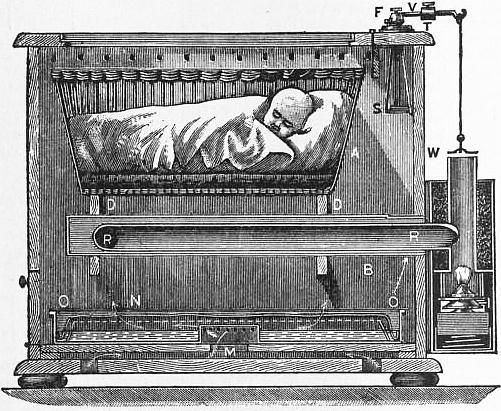
Fig. 14.—Hearson’s “Thermostatic Nurse.”
In Hearson’s Thermostatic Nurse these drawbacks are to a large extent obviated. This “Nurse” consists fundamentally of an application of the arrangements for heating and moistening the air and for regulating the temperature of Hearson’s chick incubator to Dr Tarnier’s human incubator. As in this latter form, there are two chambers (fig. 14), an upper (A) and a lower (B), connected with each other in the same way as in Tarnier’s apparatus. The upper chamber contains the infant, but the lower is not a heating but a moistening chamber. Through apertures (M) in the bottom of the lower chamber, the external air passes through, and as in the chick incubator it then passes through perforations in the inner cylinder of a water tray (O) and thence over the surface of the water in the tray, through a sheet of wet canvas, to the chamber itself. Hence it passes to the infant chamber and ultimately leaves this through a series of perforations round the top. The air in both chambers is heated by a warm-water tank. This tank forms the partition which divides the incubator into upper and lower chambers and is made of metal. Through the water contained in it, an incoming (R) and an outgoing (R) to the left flue, continuous with each other, pass. These two flues are related to each other as in the chick incubator (see above) and the inlet flue is heated in the same way and the outlet flue discharges similarly. The heat-regulating apparatus is identical with that in the chick incubator, and the thermostatic capsule (S) is placed in the upper chamber, near the head of the infant.
The child is placed in a basket which has perforated walls, and is open above. The basket rests upon two shallow supports (D) situated on the upper surface of the water-tank partition. The child is kept under observation through a glass door in the upper or roof-wall of the incubator.
In Great Britain this apparatus is in use at various hospitals and workhouses throughout the country, and provided there is no great fluctuation of barometric pressure, it maintains a uniform temperature.
Thermo-Regulators or Thermostats.
Certain special forms of thermo-regulators, adapted to the requirements of the particular incubators to which they are attached, have already been described. It remains now to describe other forms which are of more general application. Only those kinds will be described which are applicable to incubators. The special forms used for investigations in physical-chemistry are not described. There are various types of thermo-regulators, all of which fall into one of two classes. Either they act through the expansion of a solid, or through that of a liquid. They are so adjusted, that, at a certain temperature, the expansion of the material chosen causes the gas supply to be nearly completely cut off. The gas flame is prevented from being wholly extinguished by means of a small by-pass.
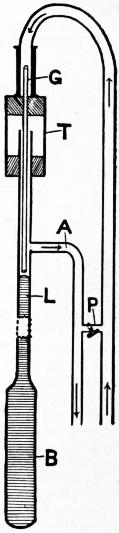
Fig. 15.—Page’s Thermostat.
We will first describe those which act through the expansion of a liquid. A very efficient and cheap form is that described by F. J. M. Page in the Journal of the Chemical Society for 1876. The regulator consists of a glass bulb (fig. 15 B), continuous above with a tubular limb (L). At the upper part of the limb is a lateral tubular arm (A) which bends downwards and constitutes the outlet pipe. At the upper extremity of the limb there is a short and much wider tube (T), the lower end of which slides upwards or downwards along it. The upper end of this wider tube is closed by a cork and through a perforation in this a very small glass tube (G) passes downwards into the limb of the regulator to a point a short distance below the exit of the outlet tube. The exact height of the lower aperture of the small tube can be varied by sliding the wider tube up or down along the limb. The by-pass (P) consists of a transverse connexion between the inlet and outlet gas pipes, and the amount of gas which travels through the short circuit thus formed is regulated by means of a stopcock. The by-pass, however, can be formed, as suggested by Schäfer (Practical Histology, 1877, p. 80), by making an extremely small hole in the small inlet tube, a little way above its lower extremity. But unless this hole be small enough, too much gas will be allowed to pass, and a sufficiently low temperature therefore unattainable. The regulator is filled with mercury until the top of the column reaches within ½ in. of the exit of the outlet tube, the bulb is placed in the incubator chamber, and gas is allowed to pass through it. By pushing down the inner inlet tube (G) until its aperture is immersed beneath the mercury, the gas supply is cut off, with the exception of that passing through the by-pass. The stopcock is now turned until only the smallest flame exists. The inlet pipe is then raised again above the mercury, and the flame consequently increases in size. The temperature of the incubator gradually rises, and when the desired degree is reached, the inlet tube is pushed down until the end is just beneath the surface of the mercury. The gas supply is thus cut off at the desired temperature. If the temperature of the incubator falls, the mercury contracts, the aperture of the inlet tube is uncovered, the gas supply is renewed and the flame increased. The temperature will then rise until the required point is reached, when the gas supply will again be cut off. A uniform temperature which oscillates within a range of half a degree is thus attained.
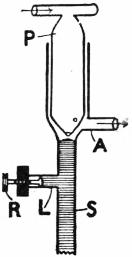
Fig. 16.—Reichert’s Thermo-Regulator.
Reichert’s Thermo-regulator (fig. 16) is another simple and also an earlier form. The stem (S) of the regulator is enlarged above and receives a hollow T-piece (P), the vertical limb of which fits accurately into the enlarged end of the stem, and one end of the cross-limb receives the inlet gas pipe; the other end is closed. The vertical limb of the T-piece is narrowed down at its lower extremity and opens by a small aperture. Above this terminal aperture is a lateral one of the smallest size. From the enlarged end of the stem there passes out a lateral arm (A) which is connected with the outlet pipe to the burner, and lower down another arm (L), which is closed at its outer extremity by a screw (R), is also attached. The stem and lower arm are filled with mercury and the bulb of the stem is placed in the incubator chamber, and gas allowed to pass. When the desired temperature is reached, the mercury in the stem is forced upwards until it closes the aperture of the T-piece, by screwing in the screw (R) of the lower lateral arm (L).
There are several modifications of Reichert’s original form. In one of these the screw arrangement in the lower arm is replaced by a piston rod working in a narrow bore of a vertically bent limb of the arm. In another form, the other end of the cross bar of the T-piece is open and leads through a stopcock to a third arm, which opens into the enlarged upper end of the stem opposite to the outlet arm (A); this modification acts as an adjustable by-pass and replaces the minute aperture in the side of the vertical limb of the T-piece.
In Babes’ modification the gas supply is cut off, not by the occlusion by the rising mercury of the aperture of the T-piece, but by a floating beaded wire-valve. The aperture of the vertical limb of the T-piece (P) is traversed by a fine wire which is enlarged at both ends into a bead-like knob. The wire fits loosely in the aperture and not only therefore works easily in it, but allows gas to freely pass. When the lower bead-like knob, however, is raised by the expansion of the mercury, the gas supply is cut off by the bead being carried up against the orifice.
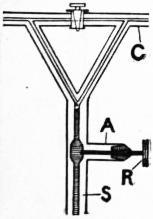
Fig. 17.—Cuccatti’s Thermo-Regulator.
Cuccatti’s thermo-regulator (fig. 17) is an exceedingly simple and ingenious form. The stem (S) of the regulator is enlarged below into a bulb, while above it divides into a V. The two limbs of the V are of course traversed by a canal and they are connected above by a tubular cross bar (C). In the middle of this there is a stopcock situated between the two points where the bar joins the limbs of the V. One end of the cross-tube serves as an inlet and the other as an outlet for the gas. The stopcock serves as an adjustable by-pass. About an inch below the point where the two limbs of the V join the stem, the bore of the latter is enlarged, and it leads into a lateral arm (A), containing a screw (R), similar to the corresponding arm in Reichert’s regulator. When the mercury in the bulb and stem expands, it rises, and reaching the point when the two limbs of the V meet occludes the orifice to both and thus cuts off the gas supply, except that which is passing through the by-pass of the stopcock. The temperature at which this occlusion will take place can be determined by the screw in the lateral arm. The more this is screwed in, the lower will be the temperature at which the gas becomes cut off, and vice versa.
Bunsen’s, Kemp’s and Muenke’s regulators are in reality of the nature of air-thermometers, and act by the expansion and contraction of air, which raises or lowers respectively a column of mercury; this in its turn results in the occlusion or opening of the gas aperture. Such forms, however, are subject to the influence of barometric pressure and an alteration of 0.5 in. of the barometer column may result in the variation of the temperature to as much as 2°.
Lothar Meyer’s regulator is described in the Berichte of the German Chemical Society, 1883, p. 1089. It is essentially a liquid thermometer, the mercury column being raised by the expansion of a liquid of low boiling-point. The liquid replaces the air in Bunsen’s and other similar forms. The boiling-point of this liquid must be below the temperature required as constant.
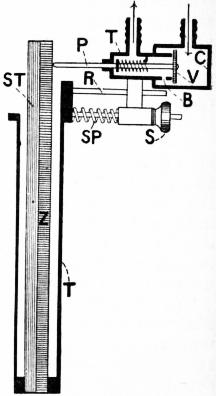
Fig. 18.—Dr Roux’s Thermostat (straight bar).
The solid forms of thermostats are constructed upon the same principle as the compensation balance of a watch or the compensation pendulum of a clock. This depends upon the fact that the co-efficient of expansion is different for different metals. It therefore results that if two bars of different metals are fastened together along their lengths (fig. 18, Z and ST) with the same rise of temperature one of these will expand or lengthen more than the other. And since both are fastened together and must therefore accommodate themselves within the same linear area, it follows that the compound rod must bend into a curved form, in order that the bar of greater expansion may occupy the surface of greater length, i.e. the convex one. Conversely, when the temperature falls, the greater degree of contraction will be in the same bar, and the surface occupied by it will tend to become the concave one. If, then, one end of this compound rod be fixed and the other free, the latter end will describe a backward and forward movement through an arc of a circle, which will correspond with the oscillations of temperature. This movement can be utilized by means of simple mechanical arrangements, to open or close the stopcock of a gas supply pipe.
In the construction of this type of thermostat it is obvious that the greater the difference in the co-efficient of expansion of the two metals used, the larger will be the amplitude of the movement obtained. Steel and zinc are two metals which satisfy this condition. The co-efficient of steel is the lowest of all metals and is comparable in its degree with that of glass. Substances which are not metals, such as vulcanite and porcelain, are sometimes used to replace steel, as the substance of low co-efficient of expansion.
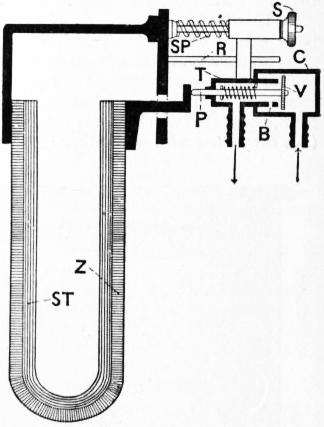
Fig. 19.—Dr Roux’s Thermostat (U-shaped bar).
The bimetallic thermostat most commonly employed is one of the two forms designed by Dr Roux. In one of these forms the compound bar is straight (fig. 18) and in the other it is U-shaped (fig. 19). In the former type the bar itself is enclosed in a tube (T) of metal, the wall of which is perforated. Towards the open end of this tube the gas box or case (C) is fixed. In the U-shape form it is attached to the outer surface (zinc) of one limb of the bar. The gas box is capable of adjustment with respect to its distance from the bar, by means of a screw (S) and a spiral spring (SP), which moves the box outwards or inwards along a rod (R). This adjustment enables the degree of temperature at which it is desired that the gas shall be cut off to be fixed accurately, and within a certain more or less extended range. The inlet and the outlet pipe are disconnected from each other in the gas box by means of a piston-like rod (P) and valve (V), which slides backwards and forwards in the tubular part (T) of the box, from which the outlet pipe emerges. When the valve (V) rests upon the edge of this box, the gas is completely cut off from passing through the outlet pipe, with the exception of that which passes through an exceedingly small aperture (B), serving as a by-pass. This is just large enough to allow sufficient gas to pass to maintain a small flame. The piston-like rod and valve, when free, is kept pressed outwards by means of a spiral spring. This ensures that the valve shall follow the movements of the compound bar. When this bar bends towards the gas box owing to a fall of temperature, the valve is pushed back away from the orifice and gas in increasing quantity passes through. The temperature of the incubator begins then to rise, and the zinc bar (Z) expanding more than the steel one (ST), the bar bends outwards and the valve once more cuts off the gas supply.
(d) Gas-Pressure Regulators.—The liquid form of thermo-regulators especially work with a greater degree of accuracy if they are combined with some apparatus which controls the variations in gas pressure. There are various forms of these regulators, most of which are figured and sometimes partially described in the catalogues of various makers of scientific instruments. It will suffice if we describe two forms, one of which (that of Buddicom) can be made by a laboratory attendant of average intelligence.
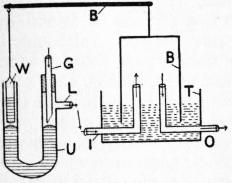
Fig. 20.—Buddicom’s Gas Regulator.
In R. A. Buddicom’s gas regulator (fig. 20) the inlet (I) and outlet (O) gas pipe open into a metal bell (B), the lower and open end of which is immersed beneath water contained in a metal tray (T). The bell is suspended upon the arm of a balance (B) and the other arm is poised by a weight (W). This weight may be made of any convenient material. In the original apparatus a test-tube partially filled with mercury was used. The weight dips into one limb of a U-shaped glass tube (U), which contains mercury. Into the other limb of this tube the gas from the meter enters through a glass tube (G) which is held in position by a well-fitting cork. The internal aperture of the tube (G) is very oblique, and it rests just above the level of the mercury when the instrument is finally adjusted. This adjustment is better made in the morning when the gas pressure in the main is at its lowest. Just above the internal aperture of the tube (G), a lateral tube (L) passes out from the limb of the U and is connected with the inlet pipe (I) of the bell. If the gas pressure rises, the bell (B) is raised and the counter-poising weight (W) is proportionately lowered. This forces the mercury up in the other limb of the U-tube and consequently diminishes the size of the oblique orifice in the tube (G). Some of the gas is thus cut off and the pressure maintained constant. Should the pressure fall, the reverse processes occur, and more gas passes through the orifice of G and consequently to the burner by the outlet tube (O).
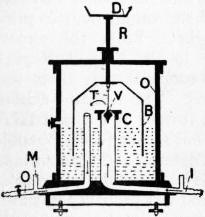
Fig. 21.—Moitessier’s Gas Regulator.
Moitessier’s regulator (fig. 21) is more complex, and needs more skilled work in its construction. It consists of an outer and closed cylinder (O), which is filled about half-way up with a mixture of acid-free glycerine and distilled water in the proportion of two to one respectively. Within the cylinder is a bell (B), the lower and open end of which dips under the glycerine-water mixture. From the top of the bell a vertical rod (R) passes up through an aperture in the cover of the outer cylinder, and supports the weighted dish (D). The inlet (I) and outlet (O) pipes enter the chamber of the bell above the level of the glycerine-water mixture. The outlet tube is a simple one; but the inlet tube is enlarged into a relatively capacious cylinder (C), and its upper end is fitted with a cover which is perforated by an aperture having a smooth surface and concave form. Into this aperture an accurately fitting ball- or socket-valve (V) fits. The ball-valve is supported by a suspension thread (T) from the roof of the bell (B). The apparatus should be adjusted in the morning when the pressure is low, and the dish (D) should be then so weighted that the full amount of gas passes through. The size of the flame should then be adjusted. Should the pressure increase, the bell (B) is raised and with it the ball-valve (V). The aperture in the cover of the inlet cylinder is consequently reduced and some of the gas cut off. When the pressure falls again, the ball-valve is lowered and more gas passes through. The relative pressure in the inlet and outlet pipes can be read off on the manometer (M) placed on each of these tubes.
Levelling screws allow of the apparatus being horizontally adjusted. The friction engendered by the working of the vertical rod (R) through the aperture in the collar of the cylinder cover is reduced to a minimum by the rod being made to slide upwards or downwards on three vertical knife-edge ridges within the aperture of the collar.
Authorities.—Charles A. Cyphers, Incubation and its Natural Laws (1776); J. H. Barlow, The Art and Method of Hatching and Rearing all Kinds of Domestic Poultry and Game Birds by Steam (London, 1827); and Daily Progress of the Chick in the Egg during Hatching in Steam Apparatus (London, 1824); Walthew, Artificial Incubation (London, 1824); William Bucknell, The Eccaleobin. A Treatise on Artificial Incubation, in 2 parts (published by the author, London, 1839); T. Christy, jun., Hydro-Incubation (London, 1877); L. Wright, The Book of Poultry (2nd ed. London, 1893); A. Forget, L’Aviculture et l’incubation artificielle (Paris, 1896); J. H. Sutcliffe, Incubators and their Management (Upcott Gill, London, 1896); H. H. Stoddard, The New Egg Farm (Orange Judd Co., New York, 1900); Edward Brown, Poultry Keeping as an Industry (5th ed., 1904); F. J. M. Page, “A Simple Form of Gas Regulator,” Journ. Chem. Soc. i. 24 (London, 1876); V. Babes, “Über einige Apparate zur Bacterienuntersuchung,” Centralblatt für Bacteriologie, iv. (1888); T. Hüppe, Methoden der Bacterienforschungen (Berlin, 1889). For further details of bacteriological incubators and accessories see catalogues of Gallenkamp, Baird & Tatlock, Hearson of London, and of the Cambridge Scientific Instrument Company, Cambridge; of P. Lequeux of Paris; and of F. & M. Lautenschläger of Berlin. That of Lequeux and of the Cambridge Company are particularly useful, as in many instances they give a scientific explanation of the principles upon which the construction of the various pieces of apparatus is based.
(G. P. M.)
INCUBUS (a Late Latin form of the classical incubo, a night-mare, from incubare, to lie upon, weigh down, brood), the name given in the middle ages to a male demon which was supposed to haunt women in their sleep, and to whose visits the birth of witches and demons was attributed. The female counterparts of these demons were called succubae. The word is also applied generally to an oppressive thing or person.
INCUMBENT (from Lat. incumbere, to lean, lie upon), a general term for the holder (rector, vicar, curate in charge) of an ecclesiastical benefice (see Benefice). In Scotland the title is generally confined to clergy of the Episcopal Church. The word in this application is peculiar to English. Du Cange (Glossarium, s.v. “Incumbens”) says that the Jurisconsulti use incumbere in the sense of obtinere, possidere, but the sense may be transferred from the general one of that which rests or is laid on one as a duty which is also found in post-classical Latin; to be “diligently resident” in a parish or benefice, has also been suggested as the source of the meaning.
INCUNABULA, a Latin neuter-plural meaning “swaddling-clothes,” a “cradle,” “birthplace,” and so the beginning of anything, now curiously specialized to denote books printed in the 15th century. Its use in this sense may have originated with the title of the first separately published list of 15th-century books, Cornelius a Beughem’s Incunabula typographiae (Amsterdam, 1688). The word is generally recognized all over Europe and has produced vernacular forms such as the French incunables, German Inkunabeln (Wiegendrucke), Italian incunaboli, though the anglicized incunables is not yet fully accepted. If its original meaning had been regarded the application of the word would have been confined to books printed before a much earlier date, such as 1475, or to the first few printed in any country or town. By the end of the 15th century book-production in the great centres of the trade, such as Venice, Lyons, Paris and Cologne, had already lost much of its primitive character, and in many countries there is no natural halting-place between 1490 and 1520 or later. The attractions of a round date have prevailed, however, over these considerations, and the year 1500 is taken as a halting-place, or more often a terminus, in all the chief works devoted to the registration and description of early printed books. The most important of these are (i.) Panzer’s Annales typographici ab artis inventae origine ad annum MD., printed in five volumes at Nuremberg in 1793 and subsequently in 1803 carried on to 1536 by six additional volumes; (ii.) Ham’s Repertorium bibliographicum in quo libri omnes ab arte typographica inventa usque ad annum MD. typis expressi ordine alphabetico vel simpliciter enumerantur vel adcuratius, recensentur (Stuttgart, 1826-1838). In Panzer’s Annales the first principle of division is that of the alphabetical order of the Latin names of towns in which incunabula were printed, the books being arranged under the towns by the years of publication. In Hain’s Repertorium the books are arranged under their authors’ names, and it was only in 1891 that an index of printers was added by Dr Konrad Burger. In 1898 Robert Proctor published an Index to the Early Printed Books in the British Museum: from the invention of printing to the year MD., with notes of those in the Bodleian Library. In this work the books were arranged as far as possible chronologically under their printers, the printers chronologically under the towns in which they worked, and the towns and countries chronologically in the order in which printing was introduced into them, the total number of books registered being nearly ten thousand. Between 1898 and 1902 Dr W. Copinger published a Supplement to Hain’s Repertorium, described as a collection towards a new edition of that work, adding some seven thousand new entries to the sixteen thousand editions enumerated by Hain. From the total of about twenty-three thousand incunabula thus registered considerable deductions must be made for duplicate entries and undated editions which probably belong to the 16th century. On the other hand Dr Copinger’s Supplement had hardly appeared before additional lists began to be issued registering books unknown both to him and to Hain, and the new Repertorium, begun in 1905, under the auspices of the German government, seemed likely to register, on its completion, not fewer than thirty thousand different incunabula as extant either in complete copies or fragments.
In any attempt to estimate the extent to which the incunabula still in existence represent the total output of the 15th-century presses, a sharp distinction must be drawn between the weightier and the more ephemeral literature. Owing to the great religious and intellectual upheaval in the 16th century much of the literature previously current went out of date, while the cumbrous early editions of books still read were superseded by handier ones. Before this happened the heavier works had found their way into countless libraries and here they reposed peacefully, only sharing the fate of the libraries themselves when these were pillaged, or by a happier fortune amalgamated with other collections in a larger library. The considerable number of copies of many books for whose preservation no special reason can be found encourages a belief that the proportion of serious works now completely lost is not very high, except in the case of books of devotion whose honourable destiny was to be worn to pieces by devout fingers. On the other hand, of the lighter literature in book-form, the cheap romances and catchpenny literature of all kinds, the destruction has been very great. Most of the broadsides and single sheets generally which have escaped have done so only by virtue of the 16th-century custom of using waste of this kind as a substitute for wooden boards to stiffen bindings. Excluding these broadsides, &c., the total output of the 15th-century presses in book form is not likely to have exceeded forty thousand editions. As to the size of the editions we know that the earliest printers at Rome favoured 225 copies, those at Venice 300. By the end of the century these numbers had increased, but the soft metal in use then for types probably wore badly enough to keep down the size of editions, and an average of 500 copies, giving a possible total of twenty million books put on the European market during the 15th century is probably as near an estimate as can be made.
Very many incunabula contain no information as to when, where or by whom they were printed, but the individuality of most of the early types as compared with modern ones has enabled typographical detectives (of whom Robert Proctor, who died in 1903, was by far the greatest) to track most of them down. To facilitate this work many volumes of facsimiles have been published, the most important being K. Burger’s Monumenta Germaniae et Italiae Typographica (1892, &c.), J. W. Holtrop’s Monuments typographiques des Pays-Bas (1868), O. Thierry-Poux’s Premiers monuments de l’imprimerie en France au XVe siècle (1890), K. Haebler’s Typographie ibérique du quinzième siècle (1901) and Gordon Duff’s Early English Printing (1896), the publications of the Type Facsimile Society (1700, &c.) and the Woolley Facsimiles, a collection of five hundred photographs, privately printed.
In his Index to the Early Printed Books at the British Museum Proctor enumerated and described all the known types used by each printer, and his descriptions have been usefully extended and made more precise by Dr Haebler in his Typenrepertorium der Wiegendrucke (1905, &c.). With the aid of these descriptions and of the facsimiles already mentioned it is usually possible to assign a newly discovered book with some certainty to the press from which it was issued and often to specify within a few weeks, or even days, the date at which it was finished.
As a result of these researches it is literally true that the output of the 15th-century presses (excluding the ephemeral publications which have very largely disappeared) is better known to students than that of any other period. Of original literature of any importance the half-century 1450-1500 was singularly barren, and the zeal with which 15th-century books have been collected and studied has been criticized as excessive and misplaced. No doubt the minuteness with which it is possible to make an old book yield up its secrets has encouraged students to pursue the game for its own sake without any great consideration of practical utility, but the materials which have thus been made available for the student of European culture are far from insignificant. The competition among the 15th-century printers was very great and they clearly sent to press every book for which they could hope for a sale, undaunted by its bulk. Thus the great medieval encyclopaedia, the Specula (Speculum naturale, Speculum historiale, Speculum morale, Speculum doctrinale) of Vincent de Beauvais went through two editions at Strassburg and found publishers and translators elsewhere, although it must have represented an outlay from which many modern firms would shrink. It would almost seem, indeed, as if some publishers specially affected very bulky works which, while they remained famous, had grown scarce because the scribes were afraid to attempt them. Hence, more especially in Germany, it was not merely the output of a single generation which came to the press before 1500, but the whole of the medieval literature which remained alive, i.e. retained a reputation sufficient to attract buyers. A study of lists of incunabula enables a student to see just what works this included, and the degree of their popularity. On the other hand in Italy the influence of the classical renaissance is reflected in the enormous output of Latin classics, and the progress of Greek studies can be traced in the displacement of Latin translations by editions of the originals. The part which each country and city played in the struggle between the old ideals and the new can be determined in extraordinary detail by a study of the output of its presses, although some allowance must be made for the extent to which books were transported along the great trade routes. Thus the fact that the Venetian output nearly equalled that of the whole of the rest of Italy was no doubt mainly due to its export trade. Venetian books penetrated everywhere, and the skill of Venetian printers in liturgical books procured them commissions to print whole editions for the English market. From the almost complete absence of scholarly books in the lists of English Incunabula it would be too much to conclude that there was no demand for such books in England. The demand existed and was met by importation, which a statute of Richard III.’s expressly facilitated. But that it was not commercially possible for a scholarly press to be worked in England, and that no man of means was ready to finance one, tells its own tale. The total number of incunabula printed in England was probably upwards of four hundred, of which Caxton produced fully one-fourth. Of the ten thousand different incunabula which the British Museum and Bodleian library possess between them, about 4100 are Italian, 3400 German, 1000 French, 700 from the Netherlands, 400 from Switzerland, 150 from Spain and Portugal, 50 from other parts of the continent of Europe and 200 English, the proportion of these last being about doubled by the special zeal with which they have been collected. The celebration in 1640 of the second centenary (as it was considered) of the invention of printing may be taken as the date from which incunabula began to be collected for their own sake, apart from their literary interest, and the publication of Beughem’s Incunabula typographiae in 1688 marks the increased attention paid to them. But up to the end of the 17th century Caxtons could still be bought for a few shillings. The third centenary of the invention of printing in 1740 again stimulated enthusiasm, and by the end of the 18th century the really early books were eagerly competed for. Interest in books of the last ten or fifteen years of the century is a much more modern development, but with the considerable literature which has grown up round the subject is not likely to be easily checked.
The chief collections of incunabula are those of the Bibliothèque Nationale at Paris, Royal library, Munich, and British Museum, London, the number of separate editions in each library exceeding nine thousand, with numerous duplicates. The number of separate editions at the Bodleian library is about five thousand. Other important collections are at the University library, Cambridge, and the John Rylands library, Manchester, the latter being based on the famous Althorp library formed by Earl Spencer (see Book-Collecting).
(A. W. Po.)
INDABA, a Zulu-Bantu word, formed from the inflexional prefix in and daba, business, news, for an important conference held by the “indunas” or principal men of the Kaffir (Zulu-Xosa) tribes of South Africa. Such “indabas” may include only the “indunas” of a particular tribe, or may be held with the representatives of other tribes or peoples.
INDAZOLES (Benzopyrazoles), organic substances containing the ring system The parent substance indazole, C7H6N2, was obtained by E. Fischer (Ann. 1883, 221, p. 280) by heating ortho-hydrazine cinnamic acid,
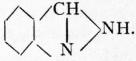

It has also been obtained by heating ortho-diazoaminotoluene with acetic acid and benzene (F. Heusler, Ber., 1891, 24, p. 4161).

It crystallizes in needles (from hot water), which melt at 146.5° C. and boil at 269°-270° C. It is readily soluble in hot water, alcohol and dilute hydrochloric acid. Nitrous acid converts it into nitrosoindazole; whilst on heating with the alkyl iodides it is converted into alkyl indazoles.
A series of compounds isomeric with these alkyl derivatives is known, and can be considered as derived from the ring system These isomers are called isindazoles, and may be prepared by the reduction of the nitroso-ortho-alkylamino-acetophenones with zinc dust and water or acetic acid. The indazoles are weak bases, which crystallize readily. Phenyl indazole, on reduction with sodium and absolute alcohol, gives a dihydro derivative (K. L. Paal, Ber., 1891, 24, p. 963).
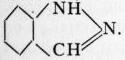
For other derivatives, see E. Fischer and J. Tafel, Ann. 1885, 227, p. 314.
INDEMNITY (through Fr. indemnité, Lat. indemnis, free from damage or loss; in-, negative, and damnum, loss), in law, an undertaking, either express or implied, to compensate another for loss or damage, or for trouble or expense incurred; also the sum so paid (see Contract; and Insurance: Marine). An act of indemnity is a statute passed for the purpose either of relieving persons from disabilities and penalties to which they have rendered themselves liable or to make legal transactions which, when they took place, were illegal. An act or bill of indemnity used to be passed every session by the English parliament for the relief of those who had unwittingly neglected to qualify themselves in certain respects for the holding of offices, &c., as, for example, justices, without taking the necessary oaths. The Promissory Oaths Act 1868 rendered this unnecessary.
INDENE, C9H8, a hydrocarbon found in the fraction of the coal tar distillate boiling between 176° and 182° C., and from which it may be extracted by means of its picrate (G. Kramer, A. Spilker, Ber., 1890, 23, p. 3276). It may also be obtained by distilling the calcium salt of hydrindene carboxylic acid, C6H4(CH2)2·CH·COOH. It is an oil which boils at 179.5°-180.5°, and has a specific gravity 1.04 (15° C.). Dilute nitric acid oxidizes it to phthalic acid, and sodium reduces it in alcoholic solution to hydrindene, C9H10. A. v. Baeyer and W. H. Perkin (Ber., 1884, 17, p. 125) by the action of sodiomalonic ester on ortho-xylylene bromide obtained a hydrindene dicarboxylic ester,
C6H4(CH2Br)2 + 2CHNa(CO2C2H5)2 = 2NaBr + CH2(CO2C2H5)2 + C6H4:[CH2]2:C(CO2C2H5)2;
this ester on hydrolysis yields the corresponding acid, which on heating loses carbon dioxide and gives the monocarboxylic acid of hydrindene. The barium salt of this acid, when heated, yields indene and not hydrindene, hydrogen being liberated (W. H. Perkin, Jour. Chem. Soc., 1894, 65, p. 228). Indene vapour when passed through a red hot tube yields chrysene. It combines with nitrosyl chloride to form indene nitrosate (M. Dennstedt and C. Ahrens, Ber., 1895, 28, p. 1331) and it reacts with benzaldehyde, oxalic ester and formic ester (J. Thiele, Ber., 1900, 33, p. 3395).
On the derivatives of indene see W. v. Miller, Ber., 1890, 23, p. 1883; Th. Zincke, Ber., 1887, 20, p. 2394, 1886, 19, p. 2493; and W. Roser and E. Haselhoff, Ann., 1888, 247, p. 140.
INDENTURE (through O. Fr. endenture from a legal Latin term indentura, indentare, to cut into teeth, to give a jagged edge, in modum dentium, like teeth), a law term for a special form of deed executed between two or more parties, and having counterparts or copies equal to the number of parties. These copies were all drawn on one piece of vellum or paper divided by a toothed or “indented” line. The copies when separated along this waved line could then be identified as “tallies” when brought together. Deeds executed by one party only had a smooth or “polled” edge, whence the name “deed poll.” By the Real Property Act 1845, § 5, all deeds purporting to be “indentures” have the effect of an “indenture,” even though the indented line be absent. The name “chirograph” (Gr. χεὶρ, hand, γράφειν, to write) was also early applied to such a form of deed, and the word itself was often written along the indented line (see further Deed and Diplomatic). The term “indenture” is now used generally of any sealed agreement between two or more parties, and specifically of a contract of apprenticeship, whence the phrase “to take up one’s indentures,” on completion of the term, and also of a contract by labourers to serve in a foreign country or colony (see Coolie).
INDEPENDENCE, a city and the county-seat of Jackson county, Missouri, U.S.A., 3 m. S. of the Missouri river and 10 m. E. of Kansas City. Pop. (1890) 6380, (1900) 6974 (937 negroes); (1910) 9859. The city is served by the Missouri Pacific, the Chicago & Alton, and the Kansas City Southern railways, and by an electric line and fine boulevard to Kansas City. It is situated about 1000 ft. above the sea, and is surrounded by a fertile agricultural district. The city has a small public square (surrounding the court-house) and a public library, and is the seat of St Mary’s Academy, under the control of the Sisters of Mercy. Among its manufactures are farming implements, flour and lumber. The municipality owns its electric lighting plant. Independence was laid out as a town and chosen as the county-seat in 1827, first chartered as a city in 1849 and made a city of the third-class in 1889. About 1500 Mormons, attracted by the “revelation” that this was to be a Zion, settled in and about Independence in 1831 and 1832. They contemplated building their chief temple about ½ m. W. of the site of the present court house, but in 1833 (partly because they invited free negroes to join them) were expelled by the “gentile” inhabitants of Independence. In 1867 a settlement of about 150 Hedrickites, or members of the “Church of Jesus Christ” (organized in Illinois in 1835), came here and secretly bought up parts of the “Temple Lot.” The heirs of the settlers of 1831-1832 conveyed the lot by deed to the Reorganized Church of Jesus Christ of Latter Day Saints (with headquarters at Lamoni, Iowa), which brought suit against the Hedrickites, but in 1894 the U.S. Circuit Court of Appeals decided the case on the ground of laches in favour of the Hedrickites, who fifteen years afterwards had nearly died out. In 1867-1869 a few families belonging to the Reorganized Church of Jesus Christ of Latter Day Saints (monogamists) settled in Independence, and in 1908 their church here had about 2000 members. Besides a large church building, they have here a printing establishment, from which is issued the weekly Zion’s Ensign (founded in 1891), and the “Independence Sanitarium” (completed in 1908). The faithful Mormons still look to Independence as the Zion of the church. In 1907 a number of Mormons from Utah settled here, moving the headquarters of the “Central States’ Mission” from Kansas City to Independence, and founded a periodical called Liahona, the Elder’s Journal. From about 1831 to 1844, when its river landing was destroyed by flood, Independence was the headquarters and outfitting point of the extensive caravan trains for the Santa Fé, Oregon and Old Salt Lake trails. During the Civil War about 300 Federals under Lieut.-Colonel D. H. Buel, occupying the town, were captured on the 16th of August 1862 by Colonel Hughes in command of 1500 Confederates, and on the 22nd of October 1864 a part of General Sterling Price’s Confederate army was defeated a few miles E. of Independence by General Alfred Pleasonton.