VOLUME XIV SLICE III Ichthyology to Independence (continued 3)
Reading edition
The boundaries of the Neotropical or Tropical American region have been sufficiently indicated in the definition of the equatorial zone. A broad and most irregular band of country, in which the South and North American forms are mixed, exists in the north.
The Tropical Pacific region includes all the islands east of Wallace’s line, New Guinea, Australia (with the exception of its south-eastern portion), and all the islands of the tropical Pacific to the Sandwich group.
Northern Zone.—The boundaries of the northern zone coincide in the main with the northern limit of the equatorial zone; but they overlap the latter at different points. This happens in Syria, as well as east of it, where the mixed faunae of the Jordan and the rivers of Mesopotamia demand the inclusion of this territory in the northern zone as well as in the equatorial; in the island of Formosa, where a Salmonid and several Japanese Cyprinids flourish; and in Central America, where a Lepidosteus, a Cyprinid (Sclerognathus meridionalis), and an Amiurus (A. meridionalis) represent the North American fauna in the midst of a host of tropical forms.
There is no separate arctic zone for freshwater fishes; ichthyic life becomes extinct towards the pole wherever the fresh water remains frozen throughout the year, or thaws for a few weeks only; and the few fishes which extend into high latitudes belong to types in no wise differing from those of the more temperate south. The highest latitude at which fishes have been obtained is 82° N. lat., whence specimens of char (Salmo arcturus and Salmo naresii) have been brought back.
The Palaearctic or Europaeo-Asiatic Region.—The western and southern boundaries of this region coincide with those of the northern zone. Bering Strait and the Kamchatka Sea have been conventionally taken as the boundary in the north, but the fishes of both coasts, so far as they are known, are not sufficiently distinct to be referred to two different regions. The Japanese islands exhibit a decided Palaearctic fish fauna with a slight influx of tropical forms in the south. In the east, as well as in the west, the distinction between the Europaeo-Asiatic and the North American regions disappears almost entirely as we advance farther towards the north. Finally, the Europaeo-Asiatic fauna mingles with African and Indian forms in Syria, Persia and Afghanistan.
The boundaries of the North American or Nearctic region have been sufficiently indicated. The main features and the distribution of this fauna are identical with those of the preceding region.
Southern Zone.—The boundaries of this zone have been indicated in the description of the equatorial zone; they overlap the southern boundaries of the latter in South Australia and South America, but we have not the means of defining the limits to which southern types extend northwards. This zone includes Tasmania, with at least a portion of south-eastern Australia (Tasmanian sub-region), New Zealand and the Auckland Islands (New Zealand sub-region), and Chile, Patagonia, Tierra del Fuego and the Falkland Islands (Fuegian sub-region). No freshwater fishes are known from Kerguelen’s Land, or from islands beyond 55° S. lat.
The Tropical American region is the richest (about 1300 species); next follow the African region (about 1000), the Indian region (about 800), the Europaeo-Asiatic region (about 500), the North American region (about 400), the Tropical Pacific region (about 60); whilst the Antarctic region is quite insignificant.
Of the migratory fishes, or fishes travelling regularly from the sea to fresh waters, most, if not all, were derived from marine forms. The anadromous forms, annually or periodically ascending rivers for the purpose of spawning, such as several species of Acipenser, Salmo, Coregonus, Clupea (shads), and Petromyzon, are only known from the northern hemisphere, whilst the catadromous forms, spending most of their life in fresh water but resorting to the sea to breed, such as Anguilla, some species of Mugil, Galaxias and Pleuronectes, have representatives in both hemispheres.
(G. A. B.)
1 For general anatomy of fishes, see T. W. Bridge, Cambridge Natural History, and R. Wiedersheim, Vergl. Anat. der Wirbeltiere. The latter contains an excellent bibliography.
2 Cf. J. Graham Kerr, Proc. Camb. Phil. Soc. x. 227.
3 For electric organs see W. Biedermann, Electro-Physiology.
4 J. Graham Kerr, Quart. Journ. Micr. Sci. vol. xlvi.
5 J. Graham Kerr, The Budgett Memorial Volume.
6 J. Phelps, Science, vol. N.S. ix. p. 366; J. Eycleshymer and Wilson, Amer. Journ. Anat. v. (1906) p. 154.
7 J. S. Budgett, Trans. Zool. Soc. Lond. xvi., 1901, p. 130.
8 L. Drüner, Zool. Jahrbücher Anat. Band xix. (1904), S. 434.
9 J. Graham Kerr, Quart. Journ. Micr. Sci. xlvi. 423.
10 J. S. Budgett, op. cit.
11 W. E. Agar, Anat. Anz., 1905, S. 298.
12 J. Graham Kerr, The Budgett Memorial Volume.
13 J. Phelps, Science, vol. N.S. ix. p. 366; J. Eycleshymer and Wilson, Amer. Journ. Anat., v. 1906, p. 154.
14: F. Maurer, Morphol. Jahrb. ix., 1884, S. 229, and xiv., 1888, S. 175.
15 J. Rückert, Arch. Entwickelungsmech. Band iv., 1897, S. 298; J. Graham Kerr, Phil. Trans. B. 192, 1900, p. 325, and The Budgett Memorial Volume.
16 Cuvier et Valenciennes, Hist. nat. des poiss. xix., 1846, p. 151.
17 J. Rathke, Üb. d. Darmkanal u.s.w. d. Fische, Halle, 1824, S. 62.
18 Cf. W. Biedermann, Electro-Physiology.
19 Literature in N. K. Koltzoff, Bull. Soc. Nat. Moscou, 1901, P. 259.
20 J. Graham Kerr, Proc. Zool. Soc. Lond. (1901), p. 484.
21 J. S. Budgett, Trans. Zool. Soc. Lond. xv. (1901), vol. p. 324.
22 H. F. Jungersen, Arb. zool. zoot. Inst. Würzburg, Band ix., 1889.
23 E. J. Bles, Proc. Roy. Soc. 62, 1897, p. 232.
24 J. Graham Kerr, Proc. Zool. Soc. Lond. (1901) p. 484.
25 F. M. Balfour and W. N. Parker, Phil. Trans. (1882).
26 J. Graham Kerr, Proc. Zool. Soc. Lond. (1901), p. 495.
27 H. Gadow and E. C. Abbott, Phil. Trans. 186 (1895), p. 163.
28 For development cf. Gaupp in Hertwig’s Handbuch der Entwickelungslehre.
29 Cf. W. E. Agar, Trans. Roy. Soc. Edin. xlv. (1906), 49.
30 Bashford Dean, Journ. Morph. ix. (1894) 87, and Trans. New York Acad. Sci. xiii. (1894) 115.
31 R. Semon, Zool. Forschungsreisen, Band i. § 115.
32 O. Hertwig, Arch. mikr. Anat. xi. (1874).
33 R. H. Traquair, Trans. Roy. Soc. Edin. xxxix. (1899).
34 Cf. E. S. Goodrich, Quart. Journ. Micr. Sci. xlvii. (1904), 465.
35 R. H. Traquair, Journ. Anat. Phys. v. (1871) 166; J. S. Budgett, Trans. Zool. Soc. Lond. xvi. 315.
36 T. W. Bridge, Trans. Zool. Soc. Lond. xiv. (1898) 350; W. E. Agar, op. cit.
37 J. V. Boas, Morphol. Jahrb. vi. (1880).
38 Cf. F. Hochstetter in O. Hertwig Handbuch der Entwickelungslehre.
39 C. v. Kupffer, Studien z. vergl. Enlwickelungsgeschichte der Cranioten.
40 Cf. F. K. Studnička’s excellent account of the parietal organs in A. Oppel’s Lehrbuch vergl, mikr. Anatomie, T. v. (1905).
41 2. F. K. Studnička, S.B. böhm. Gesell. (1901); J. Graham Kerr, Quart. Journ. Micr. Sci. vol. xlvi., and The Budgett Memorial Volume.
42 J. Graham Kerr, Quart. Journ. Micr. Sci. vol. xlvi.
43 F. K. Studnička, S.B. böhm. Gesell. (1901); J. Graham Kerr, Quart. Journ. Micr. Sci. vol. xlvi., and The Budgett Memorial Volume.
44 G. Elliot Smith, Anat. Anz. (1907).
45 F. K. Studnička, S.B. böhm. Gesell. (1896).
46 J. Graham Kerr, The Budgett Memorial Volume.
47 F. K. Studnička, S.B. böhm. Gesell. (1901); J. Graham Kerr, Quart. Journ. Micr. Sci. xlvi., and The Budgett Memorial Volume.
48: R. Wiedersheim, Kölliker’s Festschrift: cf. also Anat. Anz. (1887).
49 A. Brauer, Verhandl. deutsch. zool. Gesell. (1902).
50 C. Stewart, Journ. Linn. Soc. Zool. (1906), 439.
51 T. W. Bridge and A. C. Haddon, Phil. Trans. 184 (1893).
52 For literature of lateral line organs see Cole, Trans. Linn. Soc. vii. (1898).
53 For literature of lateral line organs see Cole, Trans. Linn. Soc., vii. (1898).
54 M. Fürbringer in Gegenbaur’s Festschrift (1896).
ICHTHYOPHAGI (Gr. for “fish-eaters”), the name given by ancient geographers to several coast-dwelling peoples in different parts of the world and ethnically unrelated. Nearchus mentions such a race as inhabiting the barren shores of the Mekran on the Arabian Sea; Pausanias locates them on the western coast of the Red Sea. Ptolemy speaks of fish-eaters in Ethiopia, and on the west coast of Africa; while Pliny relates the existence of such tribes on the islands in the Persian Gulf. Herodotus (book i. c. 200) mentions three tribes of the Babylonians who were solely fish-eaters, and in book iii. c. 19 refers to Ichthyophagi in Egypt. The existence of such tribes was confirmed by Sir Richard F. Burton (El-Medinah, p. 144).
ICHTHYOSAURUS, a fish or porpoise-shaped marine reptile which characterized the Mesozoic period and became extinct immediately after the deposition of the Chalk. It was named Ichthyosaurus (Gr. fish-lizard) by C. König in 1818 in allusion to its outward form, and is best known by nearly complete skeletons from the Lias of England and Germany. The large head is produced into a slender, pointed snout; and the jaws are provided with a row of conical teeth nearly uniform in size and deeply implanted in a continuous groove. The eye is enormous, and is surrounded by a ring of overlapping “sclerotic plates,” which would serve to protect the eye-ball during diving. The vertebrae are very numerous, short and deeply biconcave, imparting great flexibility to the backbone as in fishes. The neck is so short and thick that it is practically absent. There are always two pairs of paddle-like limbs, the hinder pair never disappearing as in porpoises and other Cetacea, though often much reduced in size. A few specimens from the Upper Lias of Württemberg (in the museums of Stuttgart, Tübingen, Budapest and Chicago) exhibit remains of the skin, which is quite smooth and forms two triangular median fins, one in the middle of the back, the other at the end of the tail. The dorsal fin consists merely of skin without any internal skeleton, while the tail-fin is expanded in a vertical plane and has the lower lobe stiffened by the tapering end of the backbone, which is sharply bent downwards. Immature individuals are sometimes observable within the full-grown skeletons, suggesting that this reptile was viviparous.
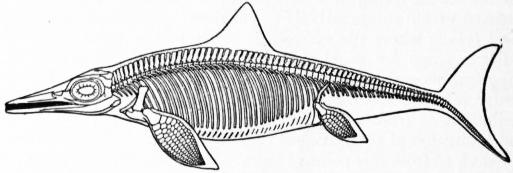
From British Museum Guide to Fossil Reptiles and Fishes, by permission of the Trustees.
Skeleton of Ichthyosaurus communis, with outline of body and fins, from the Lower Lias of Lyme Regis, Dorset; original nearly four metres in length.
The largest known species of Ichthyosaurus is I. trigonodon from the Upper Lias of Banz, Bavaria, with the head measuring about two metres in length and probably representing an animal not less than ten metres in total length. I. platyodon, from the English Lower Lias, seems to have been almost equally large. I. intermedius and I. communis, which are the commonest species in the English Lower Lias, rarely exceed a length of three or four metres. The species in rocks later than the Lias are known for the most part only by fragments, but the remains of Lower Cretaceous age are noteworthy for their very wide geographical distribution, having been found in Europe, the East Indies, Australia, New Zealand and South America. Allied Ichthyosaurians named Ophthalmosaurus and Baptanodon, from the Upper Jurassic of England and North America, are nearly or quite toothless and have very flexible broad paddles. The earliest known Ichthyosaurians (Mixosaurus), which occur in the Trias, are of diminutive size, with paddles which suggest that these marine reptiles were originally descended from land or marsh animals (see Reptiles).
Authorities.—R. Owen, A Monograph of the Fossil Reptilia of the Liassic Formations, part iii. (Mon. Palaeont. Soc., 1881); E. Fraas, Die Ichthyosaurier der süddeutschen Trias- und Jura-Ablagerungen (Tübingen, 1891). Also good figures in T. Hawkins, The Book of the Great Sea-dragons (London, 1840).
(A. S. Wo.)
ICHTHYOSIS, or Xeroderma, a general thickening of the whole skin and marked accumulation of the epidermic elements, with atrophy of the sebaceous glands, giving rise to a hard, dry, scaly condition, whence the names, from ἰχθύς, fish, and ξηρός, dry, δέρμα, skin. This disease generally first appears in infancy, and is probably congenital. It differs in intensity and in distribution, and is generally little amenable to any but palliative remedies, such as the regular application of oily substances. Ichthyosis lingualis (“smokers’ tongue”), a variety common in heavy smokers, occurs in opaque white patches on the tongue, gums and roof of the mouth. Cancer occasionally starts from the patches. The affection is obstinate, but may disappear spontaneously.
ICKNIELD STREET. (i) The Saxon name (earlier Icenhylt) of a prehistoric (not Roman) “Ridgeway” along the Berkshire downs and the Chilterns, which crossed the Thames near Streatley and ended somewhere near Tring or Dunstable. In some places there are traces of a double road, one line on the hills and one in the valley below, as if for summer and winter use. No modern highroad follows it for any distance. Antiquaries have supposed that it once ran on to Royston, Newmarket and Norfolk, and have connected its name with the Iceni, the Celtic tribe inhabiting East Anglia before the Roman conquest. But the name does not occur in early documents so far east, and it has certainly nothing to do with that of the Iceni (Haverfield, Victoria History of Norfolk, i. 286). See further Ermine Street. (2) A Roman road which ran through Derby, Lichfield, Birmingham and Alcester is sometimes called Icknield Street and sometimes Rycknield Street. The origin of this nomenclature is very obscure (Vict. Hist. of Warwick, i. 239).
(F. J. H.)
ICON (through the Latinized form, from Gr. εἰκών, portrait, image), generally any image or portrait-figure, but specially the term applied to the representations in the Eastern Church of sacred personages, whether in painting or sculpture, and particularly to the small metal plaques in archaic Byzantine style, venerated by the adherents of the Greek Church. See Iconoclasts; Image-Worship; Byzantine Art. The term “iconography,” once confined to the study of engravings (q.v.), is now applied to the history of portrait images in Christian art, though it is also used with a qualifying adjective of Greek, Roman and other art.
ICONIUM (mod. Konia), a city of Asia Minor, the last of the Phrygian land towards Lycaonia, was commonly reckoned to Lycaonia in the Roman time, but retained its old Phrygian connexion and population to a comparatively late date. Its natural surroundings must have made it an important town from the beginning of organized society in this region. It lies in an excellently fertile plain, 6 m. from the Pisidian mountains on the west, with mountains more distant on the north and south, while to the east the dead level plain stretches away for hundreds of miles, though the distant view is interrupted by island-like mountains. Streams from the Pisidian mountains make the land on the south-west and south of the city a garden; but on the east and north-east a great part of the naturally fertile soil is uncultivated. Trees grow nowhere except in the gardens near the city. Irrigation is necessary for productiveness, and the water-supply is now deficient. A much greater supply was available for agriculture in ancient times and might be reintroduced.
Originally a Phrygian city, as almost every authority who has come into contact with the population calls it, and as is implied in Acts xiv. 6, it was in a political sense the chief city of the Lycaonian tetrarchy added to the Galatian country about 165 B.C., and it was part of the Roman province Galatia from 25 B.C. to about A.D. 295. Then it was included in the province Pisidia (as Ammianus Marcellinus describes it) till 372, after which it formed part of the new province Lycaonia so long as the provincial division lasted. Later it was a principal city of the theme of Anatolia. It suffered much from the Arab raids in the three centuries following A.D. 660; its capture in 708 is mentioned, but it never was held as a city of the caliphs. In later Roman and Byzantine times it must have been a large and wealthy city. It was a metropolis and an archbishopric, and one of the earliest councils of the church was held there in A.D. 235. The ecclesiastical organization of Lycaonia and the country round Iconium on all sides was complete in the early 4th century, and monuments of later 3rd and 4th century Christianity are extremely numerous. The history of Christian Iconium is utterly obscure. The city was thrice visited by St Paul, probably in A.D. 47, 50 and 53; and it is the principal scene of the tale of Paul and Thecla (which though apocryphal has certainly some historical basis; see Thecla). There was a distinct Roman element in Iconium, arising doubtless from the presence of Roman traders. This was recognized by Claudius, who granted the honorary title Claudiconium, and by Hadrian, who elevated the city to the rank of a Roman colony about A.D. 130 under the name Colonia Aelia Hadriana Augusta Iconiensium. The period of its greatest splendour was after the conquest by the Seljuk Turks about 1072-1074. It soon became the capital of the Seljuk state, and one of the most brilliant cities of the world. The palace of the sultans and the mosque of Ala ed-dīn Kaikobād formerly covered great part of the Acropolis hill in the northern part of the city. Farther south there is still the great complex of buildings which form the chief seat of the Mevlevi dervishes, a sect widely spread over Anatolia. Many other splendid mosques and royal tombs adorned the city, and justified the Turkish proverb, “See all the world; but see Konia.” The walls, about 2 m. in circumference, consisted of a core of rubble and concrete, coated with ancient stones, inscriptions, sculptures and architectural marbles, forming a striking sight, which no traveller ever examined in detail. Beyond the walls extended the gardens and villas of a prosperous Oriental population, especially on the south-west towards the suburb of Meram.
When the Seljuk state broke up, and the Osmanli or Ottoman sovereignty arose, Konia decayed, its population dwindled and the splendid early Turkish buildings were suffered to go to ruin. As trade and intercourse diminished Konia grew poorer and more ruinous. The walls and the palace, still perfect in the beginning of the 19th century, were gradually pulled down for building material, and in 1882 there remained only a small part of the walls, from which all the outer stones had been removed, while the palace was a ruin. At that time and for some years later a large part of Konia was like a city of the dead. But about 1895 the advent of the Anatolian railway began to restore its prosperity. A good supply of drinking water was brought to the city by Ferid Pasha, who governed the vilayet ably for several years, till in 1903 he was appointed Grand Vizier. The sacred buildings, mosques, &c., were patched up (except a few which were quite ruinous) and the walls wholly removed, but an unsightly fragment of a palace-tower still remained in 1906. In 1904-1905 the first two sections of the Bagdad railway, 117 m., to Karaman and Eregli, were built. In the city there is a branch of the Ottoman bank, a government technical school, a French Catholic mission and a school, an Armenian Protestant school for boys, an American mission school for girls, mainly Armenian, and other educational establishments.
The founder of the Mevlevi dancing dervishes, the poet Mahommed Jelal-ed-Din (Rumi), in 1307, though tempted to assume the inheritance along with the empire of the Seljuk sultan Ala ed-dīn Kaikobad III., who died without heirs, preferred to pass on the power to Osman, son of Ertogrul, and with his own hands invested Osman and girt him with the sword: this investiture was the legitimate beginning of the Osmanli authority. The heirs of Jelal-ed-Din (Rumi) were favoured by the Osmanli sultans until 1516, when Selim was on the point of destroying the Mevlevi establishment as hostile to the Osmanli and the faith; and though he did not do so the Mevlevi and their chiefs were deprived of influence and dignity. In 1829 Mahmud II. restored their dignity in part, and in 1889 Abd-ul-Hamid II. confirmed their exemption from military duty. The head of the Mevlevi dervishes (Aziz-Effendi, Hazreti-Mevlana, Mollah-Unkiar, commonly styled simply Chelebi-Effendi) has the right to gird on the sultan’s sword at his investiture, and is master of the considerable revenues of the greatest religious establishment in the empire. He has also the privilege of corresponding direct with the caliph; but otherwise is regarded as rather opposed to the Osmanli administration, and has no real power.
Iconium is distant by rail 466 m. from the Bosporus at Haidar-Pasha, and 389 from Smyrna by way of Afium-Kara-Hissar. It has recently become the seat of a considerable manufacture of carpets, owing to the cheapness of labour. The population was estimated at 44,000 in 1890, and is now probably over 50,000. Mercury mines have begun to be worked; other minerals are known to exist.
(W. M. Ra.)
ICONOCLASTS (Gr. εἰκονοκλάστης: εἰκών, image, and κλάειν, to break), the name applied particularly to the opponents in the 8th and 9th centuries of the use of images in Christian cult.
As regards the attitude towards religious images assumed by the primitive Christian Church, several questions have often been treated as one which cannot be too carefully kept apart. There can be no doubt that the early Christians were unanimous in condemning heathen image-worship and the various customs, some immoral, with which it was associated. A form of iconolatry specially deprecated in the New Testament was the then prevalent adoration of the images of the reigning emperors (see Rev. xv. 2). It is also tolerably certain that, if for no other reasons besides the Judaism, obscurity, and poverty of the early converts to Christianity, the works of art seen in their meeting-houses cannot at first have been numerous. Along with these reasons would co-operate towards the exclusion of visible aids to devotion, not only the church’s sacramental use of Christ’s name as a name of power, and its living sense of his continued real though unseen presence, but also, during the first years, its constant expectation of his second advent as imminent. It was a common accusation brought against Jews and Christians that they had “no altars, no temples, no known images” (Min. Fel. Oct. c. 10), that “they set up no image or form of any god” (see Arnob. Adv. Gent. vi. I; similarly Celsus); and this charge was never denied; on the contrary Origen gloried in it (c. Celsum, bk. 7, p. 386). At a comparatively early date, indeed, we read of various Gnostic sects calling in the fine arts to aid their worship; thus Irenaeus (Haer. i. 25. 6), speaking of the followers of Marcellina, says that “they possess images, some of them painted, and others formed from different kinds of material; and they maintain that a likeness of Christ was made by Pilate at that time when Jesus lived among men. They crown these images, and set them up along with the images of the philosophers of the world; that is to say, with the images of Pythagoras and Plato and Aristotle and the rest. They have also other modes of honouring these images after the same manner as the Gentiles” (cf. Aug. De Haer. c. 7). It is also well known that the emperor Alexander Severus found a place for several Scripture characters and even for Christ in his lararium (Lamprid. Vit. Alex. Sev. c. 29). But there is no evidence that such a use of images extended at that period to orthodox Christian circles. The first unmistakable indication of the public use of the painter’s art for directly religious ends does not occur until A.D. 306, when the synod of Elvira, Spain, decreed (can. 36) that “pictures ought not to be in a church, lest that which is worshipped and adored be painted on walls.”1 This canon is proof that the use of sacred pictures in public worship was not at the beginning of the 4th century a thing unknown within the church in Spain; and the presumption is that in other places, about the same period, the custom was looked upon with a more tolerant eye. Indications of the existence of allied forms of sacred Christian art prior to this period are not wholly wanting. It seems possible to trace some of the older and better frescos in the catacombs to a very early age; and Bible manuscripts were often copiously illuminated and illustrated even before the middle of the 4th century. An often-quoted passage from Tertullian (De Pudic. c. 10, cf. c. 7) shows that in his day the communion cup was wont to bear a representation of the Good Shepherd. Clement of Alexandria (Paedag. iii. 11) mentions the dove, fish, ship, lyre, anchor, as suitable devices for Christian signet rings. Origen (c. Celsum, bk. 3) repudiates graven images as only fit for demons.
During the 4th and following centuries the tendency to enlist the fine arts in the service of the church steadily advanced; not, however, so far as appears, with the formal sanction of any regular ecclesiastical authority, and certainly not without strong protests raised by more than one powerful voice. From a passage in the writings of Gregory of Nyssa (Orat. de Laudibus Theodori Martyris, c. 2) it is easy to see how the stories of recent martyrs would offer themselves as tempting subjects for the painter, and at the same time be considered to have received from him their best and most permanent expression; that this feeling was widespread is shown in many places by Paulinus of Nola (ob. 431), from whom we gather that not only martyrdoms and Bible histories, but also symbols of the Trinity were in his day freely represented pictorially. Augustine (De Cons. Ev. i. 10) speaks less approvingly of those who look for Christ and his apostles “on painted walls” rather than in his written word. How far the Christian feeling of the 4th and 5th centuries was from being settled in favour of the employment of the fine arts is shown by such a case as that of Eusebius of Caesarea, who, in reply to a request of Constantia, sister of Constantine, for a picture of Christ, wrote that it was unlawful to possess images pretending to represent the Saviour either in his divine or in his human nature, and added that to avoid the reproach of idolatry he had actually taken away from a lady friend the pictures of Paul and of Christ which she had.2 Similarly Epiphanius in a letter to John, bishop of Jerusalem, tells how in a church at Anablatha near Bethel he had found a curtain painted with the image “of Christ or of some other saint,” which he had torn down and ordered to be used for the burial of a pauper. The passage, however, reveals not only what Epiphanius thought on the subject, but also that such pictures must have been becoming frequent. Nilus, the disciple and defender of Chrysostom, permitted the symbol of the cross in churches and also pictorial delineations of Old and New Testament history, but deprecated other symbols, pictures of martyrs, and most of all the representation of Christ. In the time of Gregory the Great the Western Church obtained something like an authoritative declaration on the question about images, but in a sense not quite the same as that of the synod of Elvira. Serenus of Marseilles had ordered the destruction of all sacred images within his diocese; this action called forth several letters from Pope Gregory (viii. 2. III; ix. 4. 11), in which he disapproved of that course, and, drawing the distinction which has since been authoritative for the Roman Church, pointed out that—
“It is one thing to worship a picture and another to learn from the language of a picture what that is which ought to be worshipped. What those who can read learn by means of writing, that do the uneducated learn by looking at a picture.... That, therefore, ought not to have been destroyed which had been placed in the churches, not for worship, but solely for instructing the minds of the ignorant.”
With regard to the symbol of the cross, its public use dates from the time of Constantine, though, according to many Christian archaeologists it had, prior to that date, a very important place in the so-called “disciplina arcani.” The introduction of the crucifix was later; originally the favourite combination was that of the figure of a lamb lying at the foot of the cross; the council of Constantinople, called “in Trullo,” in 692 enjoined that this symbol should be discontinued, and that where Christ was shown in connexion with his cross he should be represented in his human nature. In the catacombs Christ is never represented hanging on the cross, and the cross itself is only portrayed in a veiled and hesitating manner. In the Egyptian churches the cross was a pagan symbol of life borrowed by the Christians and interpreted in the pagan manner. The cross of the early Christian emperors was a labarum or token of victory in war, a standard for use in battle. Religious feeling in the West recoiled from the crucifix as late as the 6th century, and it was equally abhorrent to the Monophysites of the East who regarded the human nature of Christ as swallowed up in the divine. Nevertheless it seems to have originated in the East, perhaps as a protest against the extreme Monophysites, who even denied the passibility of Christ. Perhaps the Nestorians, who clung to the human aspect of Christ, introduced it about 550. From the East it soon passed to the West.
Not until the 8th century were the religious and theological questions which connect themselves with image-worship distinctly raised in the Eastern Church in their entirety. The controversy began with an address which Leo the Isaurian, in the tenth year of his reign (726), delivered in public “in favour of overthrowing the holy and venerable images,” as says Theophanes (Chronogr., in Migne Patr. Gr. 108, 816). This emperor had, in the years 717 and 718, hurled back the tide of Arab conquest which threatened to engulf Byzantium, and had also shown himself an able statesman and legislator. Born at Germanicia in Syria, and, before he mounted the throne, captain-general of the Anatolian theme, he had come under the influence of the anti-idolatrous sects, such as the Jews, Montanists, Paulicians and Manicheans, which abounded in Asia Minor, but of which he was otherwise no friend. But his religious reform was unpopular, especially among the women, who killed an official who, by the emperor’s command, was destroying an image of Christ in the vestibule of the imperial palace of Chalcé. This émeute provoked severe reprisals, and the partisans of the images were mutilated and killed, or beaten and exiled. A rival emperor even, Agallianus, was set up, who perished in his attempt to seize Constantinople. Italy also rose in arms, and Pope Gregory II. wrote to Leo blaming his interference in religious matters, though he dissuaded the rebels in Venetia, the Exarchate and the Pentapolis from electing a new emperor and marching against Leo. In 730 Germanus the patriarch resigned rather than subscribe to a decree condemning images; later he was strangled, in exile and replaced by an iconoclast, Anastasius. Meanwhile, inside the Arab empire, John of Damascus wrote his three dogmatic discourses against the traducers of images, arguing that their use was not idolatry but only a relative worship (προσκύνησις σχετική). The next pope, Gregory III. convoked a council of ninety-three bishops, which excommunicated the iconoclasts, and the fleet which Leo sent to retaliate on the Latin peninsula was lost in a storm in the Adriatic. The most Leo was able to do was to double the tribute of Calabria and Sicily, confiscate the pope’s revenues there, and impose on the bishops of south Italy a servitude to Byzantium which lasted for centuries.
Leo III. died in June 740, and then his son Constantine V. began a persecution of the image-worshippers in real earnest. In his eagerness to restore the simplicity of the primitive church he even assailed Mariolatry, intercession of saints, relics and perhaps infant baptism, to the scandal even of the iconoclast bishops themselves. His reign began with the seizure for eighteen months of Constantinople by his brother-in-law Artavasdes, who temporarily restored the images. He was captured and beheaded with his accomplices in November 742, and in February 754 Constantine held in the palace of Hieria a council of 388 bishops, mostly of the East; the patriarchs of Rome, Antioch, Alexandria and Jerusalem refused to attend. In it images were condemned, but the other equally conservative leanings of the emperor found no favour. The chief upholders of images, the patriarch Germanus, George of Cyprus and John of Damascus, were anathematized, and Christians forbidden to adore or make images or even to hide them. These decrees were obstinately resisted, especially by the monks, large numbers of whom fled to Italy. In 765 the emperor demanded of his subjects all over his empire an oath on the cross that they detested images, and St Stephen the younger, the chief upholder of them, was murdered in the streets. A regular crusade now began against monks and nuns, and images and relics were destroyed on a great scale. In parts of Asia Minor (Lydia and Caria) the monks were even forced to marry the nuns. In 769 Pope Stephen III. condemned the council of Hieria, and in 775 Constantine V. died. His son Leo IV. died in 780, leaving a widow, Irene, of Athenian birth, who seized the opportunity presented by the minority of her ten-year-old son Constantine VI. to restore the images and dispersed relics. In 784 she invited Pope Adrian I. to come and preside over a fresh council, which was to reverse that of 754 and heal the schism with Rome. In August 786 the council met, but was broken up by the imperial guards, who were Easterns and sturdy iconoclasts. Irene replaced them by a more trustworthy force, and convoked a fresh council of three hundred bishops and monks innumerable in September 787, at Nicaea in the church of St Sophia. The cult of images was now solemnly restored, iconoclast bishops deposed or reconciled, the dogmatic theory of images defined, and church discipline re-established. The order thus imposed lasted twenty-four years, until a military revolution placed a soldier of fortune, half Armenian, half Persian, named Leo, on the throne; he, like his soldiers, was persuaded that the ill-success of the Roman arms against Bulgarians and other invaders was due to the idolatry rampant at court and elsewhere. The soldiers stoned the image of Christ which Irene had set up afresh in the palace of Chalcé, and this provoked a counter-demonstration of the clergy. Leo feigned for a while to be on their side, but on the 2nd of February 815, in the sanctuary of St Sophia, publicly refused to prostrate himself before the images, with the approbation of the army and of many bishops who were iconoclasts at heart. Irene’s patriarch Nicephorus was now deposed and one Theodotus, a kinsman of Constantine Copronymus, consecrated in his place on the 1st of April 815. A fresh council was soon convoked, which cursed Irene and re-enacted the decrees of 754. This reaction lasted only for a generation under Leo the Armenian, who died 820, Michael II. 820-829, and Theophilus 829-842; and was frustrated mainly by the exertions of Theodore of Studion and his monks, called the Studitae. Theodore refused to attend or recognize the new council, and was banished first to Bithynia and thence to Smyrna, whence he continued to address his appeals to the pope, to the eastern patriarchs and to his dispersed monks. He died in 826. Theophilus, the last of the iconoclast emperors, was a devoted Mariolater and controversialist who invited the monks to discuss the question of images with him, and whipped or branded them when he was out-argued; he at length banished them from the cities, and branded on the hands a painter of holy pictures, Lazarus by name, who declined to secularize his art; he also raised to the patriarchal throne John Hylilas, chief instigator of the reaction of 815. In 842 Theophilus died, leaving his wife Theodora regent; she was, like Irene, addicted to images, and chose as patriarch a monk, Methodius, whom the emperor Michael had imprisoned for laying before him Pope Paschal I.’s letter of protest. John Hylilas was deposed and flogged in turn. A fresh council was now held which re-enacted the decrees of 787, and on the 20th of February 842 the new patriarch, the empress, clergy and court dignitaries assisted in the church of St Sophia at a solemn restoration of images which lasted until the advent of the Turks. The struggle had gone on for 116 years.
The iconoclastic movement is perhaps the most dramatic episode in Byzantine history, and the above outline of its external events must be completed by an appreciation of its deeper historical and religious significance and results. We can distinguish three parties among the combatants:—
1. The partisans of image worship. These were chiefly found in the Hellenic portions of the empire, where Greek art had once held sway. The monks were the chief champions of images, because they were illuminators and artists. Their doctors taught that the same grace of the Holy Spirit which imbued the living saint attaches after death to his relics, name, image and picture. The latter are thus no mere representations, but as it were emanations from the archetype, vehicles of the supernatural personality represented, and possessed of an inherent sacramental value and power, such as the name of Jesus had for the earliest believers. Here Christian image-worship borders on the beliefs which underlie sympathetic magic (see Image Worship).
2. The iconoclasts proper, who not only condemned image worship in the sense just explained but rejected all religious art whatever. Fleeting matter to their mind was not worthy to embody or reflect heavenly supersensuous energies denoted by the names of Christ and the saints. For the same reason they rejected relics and, as a rule, the worship of the cross. Statues of Christ, especially of him hanging on the cross, inspired the greatest horror and indignation; and this is why none of the graven images of Christ, common before the outbreak of the movement, survive. More than this—although the synod of 692 specially allowed the crucifix, yet Greek churches have discarded it ever since the 8th century.
This idea that material representation involves a profanation of divine personages, while disallowing all religious art which goes beyond scroll-work, spirals, flourishes and geometrical designs, yet admits to the full of secular art; and accordingly the iconoclastic emperors replaced the holy pictures in churches with frescoes of hunting scenes, and covered their palaces with garden scenes where men were plucking fruit and birds singing amid the foliage. Contemporary Mahommedans did the same, for it is an error to suppose that this religion was from the first hostile to profane art. At one time the mosques were covered with mosaics, analogous to those of Ravenna, depicting scenes from the life of Mahomet and the prophets. The Arabs only forbade plastic art in the 9th century, nor were their essentially Semitic scruples ever shared by the Persians.
The prejudice we are considering is closely connected with the Manichaean view of matter, which in strict consistency rejected the belief that God was really made flesh, or really died on the cross. The Manichaeans were therefore, by reason of their dualism, arch-enemies no less of Christian art than of relics and cross-worship; the Monophysites were equally so by reason of their belief that the divine nature in Christ entirely absorbed and sublated the human; they shaded off into the party of the aphthartodoketes, who held that his human body was incorruptible and made of ethereal fire, and that his divine nature was impassible. Their belief made them, like the Manichaeans, hostile to material portraiture of Christ, especially of his sufferings on the cross. All these nearly allied schools of Christian thought could, moreover, address, as against the image-worshippers, a very effective appeal to the Bible and to Christian antiquity. Now Egypt, Asia Minor, Armenia, western Syria and the Hauran were almost wholly given up to these forms of opinion. Accordingly in all the remains of the Christian art of the Hauran one seeks in vain for any delineation of human face or figure. The art of these countries is mainly geometrical, and allows only of monograms crowned with laurels, of peacocks, of animals gambolling amid foliage, of fruit and flowers, of crosses which are either svastikas of Hindu and Mycenaean type, or so lost in enveloping arabesques as to be merely decorative. Such was the only religious art permitted by the Christian sentiment of these countries, and also of the large enclaves of semi-Manichaean belief formed in the Balkans by the transportation thither of Armenians and Paulicians. And it is important to remark that the protagonists of iconoclasm in Byzantium came from these lands where image cult offended the deepest religious instincts of the masses. Leo the Isaurian had all the scruples of a Paulician, even to the rejection of the cult of Virgin and saints; Constantine V. was openly such. Michael Balbus was reared in Phrygia among Montanists. The soldiers and captains of the Byzantine garrisons were equally Armenians and Syrians, in whom the sight of a crucifix or image set up for worship inspired nothing but horror.
The issue of the struggle was not a complete victory even in Byzantium for the partisans of image-worship. The Iconoclasts left an indelible impress on the Christian art of the Greek Church, in so far as they put an end to the use of graven images; for the Eastern icon is a flat picture, less easily regarded than would be a statue as a nidus within which a spirit can lurk. Half the realm of creative art, that of statuary, was thus suppressed at a blow; and the other half, painting, forfeited all the grace and freedom, all the capacity of new themes, forms and colours, all the development which we see in the Latin Church. The Greeks have produced no Giotto, no Fra Angelico, no Raphael. Their artists have no choice of subjects and no initiative. Colour, dress, attitude, grouping of figures are all dictated by traditional rules, set out in regular manuals. God the Father may not be depicted at all—a restriction intelligible when we remember that the image in theory is fraught with the virtue of the archetype; but everywhere the utmost timidity is shown. What else could an artist do but make a slavish and exact copy of old pictures which worked miracles and perhaps had the reputation as well of having fallen from heaven?
3. Between these extreme parties the Roman Church took the middle way of common sense. The hair-splitting distinction of the Byzantine doctors between veneration due to images (προσκύνησις τιμητική), and the adoration (προσκύνησις λατρευτική) due to God alone, was dropped, and the utility of pictures for the illiterate emphasized. Their use was declared to be this, that they taught the ignorant through the eye what they should adore with the mind; they are not themselves to be adored. Such was Gregory the Great’s teaching, and such also is the purport of the Caroline books, which embody the conclusions arrived at by the bishops of Germany, Gaul and Aquitaine, presided over by papal legates at the council of Frankfort in 794, and incidentally also reveal the hatred and contempt of Charlemagne for the Byzantine empire as an institution, and for Irene, its ruler, as a person. The theologians whom Louis the Pious convened at Paris in 825, to answer the letter received from the iconoclast emperor Michael Balbus, were as hostile to the orthodox Greeks as to the image-worshippers, and did not scruple to censure Pope Adrian for having approved of the empress Irene’s attitude. The council of Trent decided afresh in the same sense.
Two incidental results of the iconoclastic movement must be noticed, the one of less, the other of more importance. The lesser one was the flight of Greek iconolatrous monks from Asia Minor and the Levant to Sicily and Calabria, where they established convents which for centuries were the western homes of Greek learning, and in which were written not a few of the oldest Greek MSS. found in our libraries. The greater event was the scission between East and West. The fury of the West against the iconoclastic emperors was such that the whole of Italy clamoured for war. It is true that Pope Stephen II. applied in 753 to Constantine V., one of the worst destroyers of images, for aid against the Lombards, for the emperor of Byzantium was still regarded as the natural champion of the church. But Constantine refused aid, and the pope turned to the Frankish King Pippin. The die was cast. Henceforth Rome was linked with the Carolingian house in an alliance which culminated in the coronation of Charlemagne by the pope on the 25th of December 800.
In the crusading epoch the Cathars and Paulicians carried all over Europe the old iconoclastic spirit, and perhaps helped to transmit it to Wycliffe and Hus. Not the least racy clause in the document compiled about 1389 by the Wycliffites in defence of their defunct teacher is the following: “Hit semes that this offrynge ymages is a sotile cast of Antichriste and his clerkis for to drawe almes fro pore men ... certis, these ymages of hemselfe may do nouther gode nor yvel to mennis soules, but thai myghtten warme a man’s body in colde, if thai were sette upon a fire.”
At the period of the Reformation it was unanimously felt by the reforming party that, with the invocation of saints and the practice of reverencing their relics, the adoration of images ought also to cease. The leaders of the movement were not, however, perfectly agreed on the question as to whether these might not in some circumstances be retained in churches. Luther had no sympathy with the iconoclastic outbreaks which then occurred; he classed images in themselves as among the “adiaphora,” and condemned only their cultus; so also the “Confessio Tetrapolitana” leaves Christians free to have them or not, if only due regard be had to what is expedient and edifying. The “Heidelberg Catechism,” however, emphatically declares that images are not to be tolerated at all in churches.
Sources.—“Acts of the Seventh Ecumenical Council held in Nicaea, 787,” in Mansi’s Concilia, vols. xii. and xiii.; “Acts of the Iconoclast Council of 815,” in a treatise of Nicephorus discovered by M. Serruys and printed in the Séances Acad. des Inscript. (May 1903); Theophanes, Chronographia, edit. de Boor (Leipzig, 1883-1885); and Patr. Gr. vol. 108. Also his “Continuators” in Patr. Gr. vol. 109; Nicephorus, Chronicon, edit. de Boor (Leipzig, 1880), and Patr. Gr. vol. 100; Georgius Monachus, Chronicon, edit. Muralt (Petersburg, 1859), and Patr. Gr. 110; anonymous “Life of Leo the Armenian” in Patr. Gr. 108; The Book of the Kings, by Joseph Genesios, Patr. Gr. 109; “Life of S. Stephanus, Junior,” Patr. Gr. 100; “St John of Damascus,” three “Sermones” against the iconoclasts, Patr. Gr. 95; Nicephorus Patriarch, “Antirrhetici,” Patr. Gr. 100; Theodore Studita, “Antirrhetici,” Patr. Gr. 99. For bibliography of contemporary hymns, letters, &c., bearing on the controversy see K. Krumbacher’s History of Byzantine Literature, 2nd ed. p. 674. Literature: Louis Brehier, La Querelle des images, and Les Origines du crucifix (Paris, 1904); Librairie Blond, in French, each volume 60 centimes (brief but admirable); Karl Schwartzlose, Der Bilderstreit (Gotha, 1890); Karl Schenk, “The Emperor Leo III.,” in Byzant. Zeitschrift (1896, German); Tel. Uspenskij, Skizzen zur Geschichte der byzantinischen Kultur (St Petersburg, 1892, Russian); Lombard, Études d’histoire byzantine; Constantine V.( Paris, 1902, Biblioth. de l’université de Paris, xvi.); A. Tougard, La Persécution iconoclaste (Paris, 1897); and Rev. des questions historiques (1891); Marin, Les Moines de Constantinople (Paris, 1897, bk. iv. Les Moines et les empereurs iconoclastes); Alice Gardner, Theodore of Studium (London, 1905); Louis Maimbourg, Histoire de l’hérésie des iconoclastes (Paris, 1679-1683); J. Daillé (Dallaeus), De imaginibus (Leiden, 1642, and in French, Geneva, 1641); Spanheim, Historia imaginum (Leiden, 1686). See also the account of this epoch in the Histories of Neander, Gibbon and Milman; Aug. Fr. Gfrörer, “Der Bildersturm” in Byzantinische Geschichte 2 (1873); C. J. von Hefele, Conciliengeschichte 3 (1877), 366 ff. (also in English translation; Karl Krumbacher. Byzant. Literaturgeschichte (2nd ed. p. 1090).
(F. C. C.)
1 “Placuit picturas in ecclesia esse non debere, ne quod colitur et adoratur in parietibus depingatur.” See Hefele, Conciliengesch. i. 170.
2 The letter, which is most probably, though not certainly, genuine, appears in the Acta of the second council of Nice.
ICONOSTASIS, the screen in a Greek church which divides the altar and sanctuary from the rest of the church. It is generally attached to the first eastern pier or column and rises to the level of the springing of the vault. The iconostasis or image-bearer has generally three doors, one on each side of the central door, beyond which is the principal altar. The screen is subdivided into four or five tiers, each tier decorated with a series of panels containing representations of the saints: of these only the heads, hands and feet are painted, the bodies being covered with embossed metal work, richly gilded. There is a fine example in the Russo-Greek chapel, Welbeck Street, London, which was rebuilt in 1864-1865.
ICOSAHEDRON (Gr. εἴκοσι, twenty, and ἕδρα, a face or base), in geometry, a solid enclosed by twenty faces. The “regular icosahedron” is one of the Platonic solids; the “great icosahedron” is a Kepler-Poinsot solid; and the “truncated icosahedron” is an Archimedean solid (see Polyhedron). In crystallography the icosahedron is a possible form, but it has not been observed; it is closely simulated by a combination of the octahedron and pentagonal dodecahedron, which has twenty triangular faces, but only eight are equilateral, the remaining twelve being isosceles (see Crystallography).
ICTERUS, a bird so called by classical authors, and supposed by Pliny to be the same as the Galgulus, which is generally identified with the golden oriole (Oriolus galbula).1 It signified a bird in the plumage of which yellow or green predominated, and hence Brisson did not take an unhappy liberty when he applied it in a scientific sense to some birds of the New World of which the same could be said. These are now held to constitute a distinct family, Icteridae, intermediate it would seem between the Buntings (q.v.) and Starlings (q.v.); and, while many of them are called troopials (the English equivalent of the French Troupiales, first used by Brisson), others are known as the American Grackles (q.v.). The typical species of Icterus is the Oriolus icterus of Linnaeus, the Icterus vulgaris of Daudin and modern ornithologists, an inhabitant of northern Brazil, Guiana, Venezuela, occasionally visiting some of the Antilles and of the United States. Thirty-three species of the genus Icterus alone, and more than seventy others belonging to upwards of a score of genera, are recognized by Sclater and Salvin (Nomenclator, pp. 35-39) as belonging to the Neotropical Region, though a few of them emigrate to the northward in summer. Cassicus and Ostinops may perhaps be named as the most remarkable. They are nearly all gregarious birds, many of them with loud and in most cases, where they have been observed, with melodious notes, rendering them favourites in captivity, for they readily learn to whistle simple tunes. Some have a plumage wholly black, others are richly clad, as is the well-known Baltimore oriole, golden robin or hangnest of the United States, Icterus baltimore, whose brightly contrasted black and orange have conferred upon it the name it most commonly bears in North America, those colours being, says Catesby (Birds of Carolina, i. 48), the tinctures of the armorial bearings of the Calverts, Lords Baltimore, the original grantees of Maryland, but probably more correctly those of their liveries. The most divergent form of Icteridae seems to be that known in the United States as the meadow-lark, Sturnella magna or S. ludoviciana, a bird which in aspect and habits has considerable resemblance to the larks of the Old World, Alaudidae, to which, however, it has no near affinity, while Dolichonyx oryzivorus, the bobolink or rice-bird, with its very bunting-like bill, is not much less aberrant.
(A. N.)
1 The number of names by which this species was known in ancient times—Chloris or Chlorion, Galbula (akin to Galgulus), Parra and Vireo—may be explained by its being a common and conspicuous bird, as well as one which varied in plumage according to age and sex (see Oriole). Owing to its general colour, Chloris was in time transferred to the Greenfinch (q.v.), while the names Galbula, Parra and Vireo have since been utilized by ornithologists (see Jacamar and Jacana).
ICTINUS, the architect of the Parthenon at Athens, of the Hall of the Mysteries at Eleusis, and of the temple of Apollo at Bassae, near Phigalia. He was thus active about 450-430 B.C. We know little else about him; but the remains of his two great temples testify to his wonderful mastery of the principles of Greek architecture.
IDA (d. 559), king of Bernicia, became king in 547, soon after the foundation of the kingdom of Bernicia by the Angles. He built the fortress of Bebbanburh, the modern Bamborough, and after his death his kingdom, which did not extend south of the Tees, passed in turn to six of his sons. The surname of “Flame-Bearer,” sometimes applied to him, refers, however, not to Ida, but to his son Theodric (d. 587).
See J. R. Green, Making of England, vol. i. (London, 1897).
IDAHO, a western state of the United States of America, situated between 42° and 49° N. lat. and 111° and 117° W. long. It is bounded N. by British Columbia and Montana, E. by Montana and Wyoming, S. by Utah and Nevada, and W. by Oregon and Washington. Its total area is 83,888 sq. m., of which 83,354 sq. m. are land surface, and of this 41,851.55 sq. m. were in July 1908 unappropriated and unreserved public lands of the United States, and 31,775.7 sq. m. were forest reserves, of which 15,153.5 sq. m. were reserved between the 1st of July 1906 and the 1st of July 1907.
Physical Features.—Idaho’s elevation above sea-level varies from 738 ft. (at Lewiston, Nez Perce county) to 12,078 ft. (Hyndman Peak, on the boundary between Custer and Blaine counties), and its mean elevation is about 4500 ft. The S.E. corner of the wedge-shaped surface of the state is a part of the Great Basin region of the United States. The remainder of the state is divided by a line running S.E. and N.W., the smaller section, to the N. and E., belonging to the Rocky Mountain region, and the larger, S. and W. of this imaginary line, being a part of the Columbia Plateau region. The topography of the Great Basin region in Idaho is similar to that of the same region in other states (see Nevada); in Idaho it forms a very small part of the state; its mountains are practically a part of the Wasatch Range of Utah; and the southward drainage of the region (into Great Salt Lake, by Bear river) also separates it from the other parts of the state. The Rocky Mountain region of Idaho is bounded by most of the state’s irregular E. boundary—the Bitter Root, the Cœur d’Alene and the Cabinet ranges being parts of the Rocky Mountain System. The Rocky Mountain region reaches across the N. part of the state (the Panhandle), and well into the middle of the state farther S., where the region is widest and where the Salmon River range is the principal one. The region is made up in general of high ranges deeply glaciated, preserving some remnants of ancient glaciers, and having fine “Alpine” scenery, with many sharp peaks and ridges, U-shaped valleys, cirques, lakes and waterfalls. In the third physiographic region, the Columbia plateau, are the Saw Tooth, Boisé, Owyhee and other rugged ranges, especially on the S. and W. borders of the region. The most prominent features of this part of the state are the arid Snake river plains and three mountain-like elevations—Big, Middle and East Buttes—that rise from their midst. The plains extend from near the S.E. corner of the state in a curved course to the W. and N.W. for about 350 m. over a belt 50 to 75 m. wide, and cover about 30,000 sq. m. Where they cross the W. border at Lewiston is the lowest elevation in the state, 738 ft. above the sea. Instead of being one plain formed by erosion, this region is rather a series of plains built up with sheets of lava, several thousand feet deep, varying considerably in elevation and in smoothness of surface according to the nature of the lava, and being greater in area than any other lava beds in North America except those of the Columbia river, which are of similar formation and, with the Snake river plains, form the Columbia plateau. Many volcanic cones mark the surface, but by far the most prominent among them are Big Butte, which rises precipitously 2350 ft. above the plain (7659 ft. above the sea) in the E. part of Blaine county, and East Butte, 700 ft. above the plain, in the N.W. part of Bingham county. Middle Butte (400 ft. above the plain, also in Bingham county) is an upraised block of stratified basalt. The Snake river (which receives all the drainage of Idaho except small amounts taken by the Spokane, the Pend Oreille and the Kootenai in the N., all emptying directly into the Columbia, and by some minor streams of the S.E. that empty into Great Salt Lake, Utah) rises in Yellowstone National Park a few miles from the heads of the Madison fork of the Missouri, which flows to the Gulf of Mexico, and the Green fork of the Colorado, which flows to the Gulf of California. It flows S.W. and then W. for about 800 m. in a tremendous cañon across southern Idaho; turns N. and runs for 200 m. as the boundary between Idaho and Oregon (and for a short distance between Idaho and Washington); turns again at Lewiston (where it ceases to be the boundary, and where the Clearwater empties into it) to the W. into a deep narrow valley, and joins the Columbia in S.E. Washington. Practically all the valley of the Snake from Idaho Falls in S.E. Idaho (Bingham county) to the mouth is of cañon character, with walls from a few hundred to 6000 ft. in height (about 650 m. in Idaho). The finest parts are among the most magnificent in the west; among its falls are the American (Oneida and Blaine counties), and the Shoshone and the Salmon (Lincoln county). At the Shoshone Falls the river makes a sudden plunge of nearly 200 ft., and the Falls have been compared with the Niagara and Zambezi; a short distance back of the main fall is a cataract of 125 ft., the Bridal Veil. Between Henry’s Fork and Malade (or Big Wood) river, a distance of 200 m., the river apparently has no northern tributaries; but several streams, as the Camas, Medicine Lodge and Birch creeks, and Big and Little Lost rivers, which fail to penetrate the plain of the Snake after reaching its border, are believed to join it through subterranean channels. The more important affluents are the North Fork in the E., the Raft, Salmon Falls and the Bruneau in the S., the Owyhee and the Payette in the S.W., and the Salmon and Clearwater in the W. The scenery on some of these tributaries is almost as beautiful as that of the Snake, though lacking the grandeur of its greater scale. In 1904 electricity, generated by water-power from the rivers, notably the Snake, began to be utilized in mining operations. Scattered among the mountains are numerous (glacial) lakes. In the N. are: Cœur d’Alene Lake, in Kootenai county, about 30 m. long and from 2 to 4 m. wide, drained by the Spokane river; Priest Lake, in Bonner county, 20 m. long and about 10 m. wide; and mostly in Bonner, but partly in Kootenai county, a widening of Clark Fork, Lake Pend Oreille, 60 m. long and from 3 to 15 m. wide, which is spanned by a trestle of the Northern Pacific 8400 ft. long. Bear Lake, in the extreme S.E., lies partly in Utah. Mineral springs and hot springs are also a notable feature of Idaho’s physiography, being found in Washington, Ada, Blaine, Bannock, Cassia, Owyhee, Oneida, Nez Perce, Kootenai, Shoshone and Fremont counties. At Soda Springs in Bannock county are scores of springs whose waters, some ice cold and some warm, contain magnesia, soda, iron, sulphur, &c.; near Hailey, Blaine county, water with a temperature of 144° F. is discharged from numerous springs; and at Boisé, water with a temperature of 165° is obtained from wells.
The fauna and flora of Idaho are similar in general to those of the other states in the north-western part of the United States.
Climate.—The mean annual temperature of Idaho from 1898 to 1903 was 45.5° F. There are several distinct climate zones within the state. North of Clearwater river the climate is comparatively mild, the maximum in 1902 (96° F.) being lower than the highest temperature in the state and the minimum (−16°) higher than the lowest temperature registered. The mildest region of the state is the Snake river basin between Twin Falls and Lewiston, and the valley of the Boisé, Payette and Weiser rivers; here the mean annual temperature in 1902 was 52° F., the maximum was 106° F., and the minimum was −13° F. In the Upper Snake basin, in the Camas prairie and Lost river regions, the climate is much colder, the highest temperature in 1902 being 101° and the lowest −35° F. The mean annual rainfall for the entire state in 1903 was 16.60 in.; the highest amount recorded was at Murray, Shoshone county (37.70 in.) and the lowest was at Garnet, Elmore county (5.69 in.).
Agriculture.—The principal source of wealth in Idaho was in 1900 agriculture, but it had long been secondary to mining, and its development had been impeded by certain natural disadvantages. Except for the broad valleys of the Panhandle, where the soils are black in colour and rich in vegetable mould, the surface of the state is arid; the Snake river valley is a vast lava bed, covered with deposits of salt and sand, or soils of volcanic origin. And, apart from this, the farming country was long without transport facilities. The fertile northern plateaus, the Camas and Nez Perce prairies and the Palouse country—a wonderful region for growing the durum or macaroni wheat—until 1898 had no market nearer than Lewiston, 50-70 m. away; and even in 1898, when the railway was built, large parts of the region were not tapped by it, and were as much as 30 m. from any shipping point, for the road had followed the Clearwater. In the arid southern region, also, there was no railway until 1885, when the Oregon Short Line was begun. Like limitations in N. and S. had like effects: for years the country was devoted to live-stock, which could be driven to a distant market. Timothy was grown in the northern, and alfalfa in the southern region as a forage crop. Even at this earliest period, irrigation, simple and individual, had begun in the southern section, the head waters of the few streams in this district being soon surrounded by farms. Co-operation and colonization followed, and more ditching was done, co-operative irrigation canals were constructed with some elaborate and large dams and head gates. The Carey Act (1894) and the Federal Reclamation Act (1902) introduced the most important period of irrigation. Under the Carey Act the Twin Falls project, deriving water from the Snake river near Twin Falls, and irrigating more than 200,000 acres, was completed in 1903-1905. The great projects undertaken with Federal aid were: the Minidoka, in Lincoln and Cassia counties, of which survey began in March 1903 and construction in December 1904, and which was completed in 1907, commanding an irrigable area of 130,000-150,000 acres,1 and has a diversion dam (rock-fill type) 600 ft. long, and 130 m. of canals and 100 m. of laterals; the larger Payette-Boisé project in Ada, Canyon and Owyhee counties (372,000 acres irrigable; 300,000 now desert; 60% privately owned), whose principal features are the Payette dam (rock-fill), 100 ft. high and 400 ft. long, and the Boisé dam (masonry), 33 ft. high and 400 ft. long, 200 m. of canals, 100 m. of laterals, a tunnel 1100 ft. long and 12,500 h.p. transmitted 29 m., 3000 h.p. being necessary to pump to a height of 50-90 ft. water for the irrigation of 15,000 acres; and the Dubois project, the largest in the state, on which survey and reconnaissance work were done in 1903-1904, which requires storage sites on the North Fork of the Snake and on nearly all the important branches of the North Fork, and whose field is 200,000—250,000 acres, almost entirely Federal property, in the W. end of Fremont county between Mud Lake and the lower end of Big Lost river. A further step in irrigation is the utilization of underground waters: in the Big Camas Prairie region, Blaine county, water 10 ft. below the surface is tapped and pumped by electricity generated from the only surface water of the region, Camas Creek. In 1899 the value of the crops and other agricultural products of the irrigated region amounted to more than seven-tenths of the total for the state. In 1907, according to the Report of the state commissioner of immigration, 1,559,915 irrigated acres were under cultivation, and 3,266,386 acres were “covered” by canals 3789 m. long and costing $11,257,023.
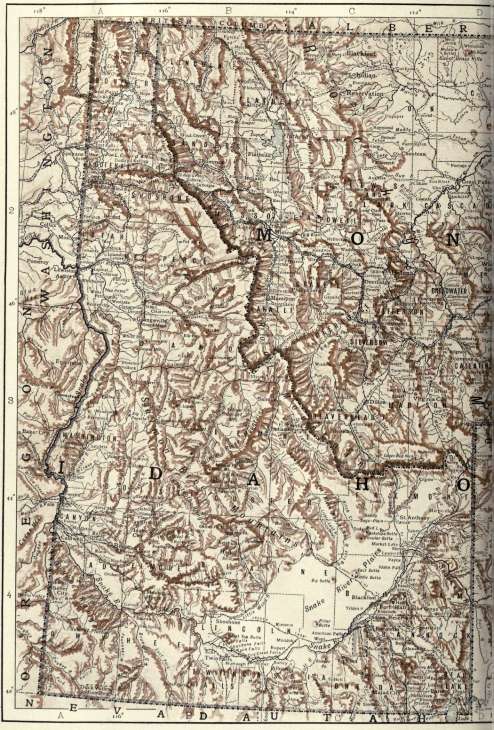
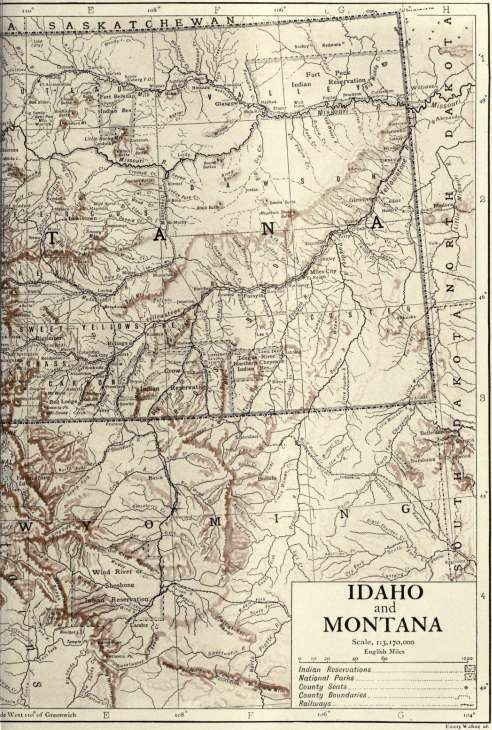
(Click to enlarge left side.)
(Click to enlarge right side.)
Up to 1900 the most prosperous period (absolutely) in the agricultural development of the state was the last decade of the 19th century; the relative increase, however, was greater between 1880 and 1890. The number of farms increased from 1885 in 1880 to 6603 in 1890 and to 17,471 in 1900; the farm acreage from 327,798 in 1880 to 1,302,256 in 1890 and to 3,204,903 acres in 1900; the irrigated area (exclusive of farms on Indian reservations) from 217,005 acres in 1889 to 602,568 acres in 1899; the value of products increased from $1,515,314 in 1879 to $3,848,930 in 1889, and to $18,051,625 in 1899; the value of farm land with improvements (including buildings) from $2,832,890 in 1880 to $17,431,580 in 1890 and $42,318,183 in 1900; the value of implements and machinery from $363,930 in 1880 to $1,172,460 in 1890 and to $3,295,045 in 1900; and that of live-stock from $4,023,800 in 1880 to $7,253,490 in 1890 and to $21,657,974 in 1900. In 1900 the average size of farms was 183.4 acres. Cultivation by owners is the prevailing form of tenure, 91.3% of the farms being so operated in 1900 (2.3% by cash tenants and 6.4% by share tenants). As illustrative of agricultural conditions the contrast of the products of farms operated by Indians, Chinese and whites is of considerable interest, the value of products (not fed to live-stock) per acre of the 563 Indian farms being in 1899 $1.40, that of the 16,876 white farms $4.67, and that of the 23 Chinese farms intensively cultivated and devoted to market vegetables $69.83.
The income from agriculture in 1899 was almost equally divided between crops ($8,951,440) and animal products ($8,784,364)—in that year forest products were valued at $315,821. Of the crops, hay and forage were the most valuable ($4,238,993), yielding 47.4% of the total value of crops, an increase of more than 200% over that of 1889, and in 1907, according to the Year-book of the Department of Agriculture, the crop was valued at $8,585,000. Wheat, which in 1899 ranked second ($2,131,953), showed an increase of more than 400% in the decade, and the farm value of the crop of 1907, according to the Year-book of the United States Department of Agriculture, was $5,788,000; the value of the barley crop in 1899 ($312,730) also increased more than 400% over that of 1889, and in 1907 the farm value of the product, according to the same authority, was $1,265,000; the value of the oat crop in 1899 ($702,955) showed an increase of more than 300% in the decade, and the value of the product in 1907, according to the United States Department of Agriculture, was $2,397,000.
More than one-half of the cereal crop in 1905 was produced in the prairie and plateau region of Nez Perce and Latah counties. The production of orchard fruits (apples, cherries, peaches, pears, plums and prunes) increased greatly from 1889 to 1899; the six counties of Ada, Canyon (probably the leading fruit county of the state), Latah (famous for apples), Washington, Owyhee and Nez Perce had in 1900 89% of the plum and prune trees, 85% of all pear trees, 78% of all cherry trees, and 74% of all apple trees in the state, and in 1906 it was estimated by the State Commissioner of Immigration that there were nearly 48,000 acres of land devoted to orchard fruits in Idaho. Viticulture is of importance, particularly in the Lewiston valley. In 1906, 234,000 tons of sugar beets were raised, and fields in the Boisé valley raised 30 tons per acre.
Of the animal products in 1899, the most valuable was live-stock sold during the year ($3,909,454); the stock-raising industry was carried on most extensively in the S.E. part of the state. Wool ranked second in value ($2,210,790), and according to the estimate of the National Association of Wool Manufactures for 1907, Idaho ranked fourth among the wool-producing states in number of sheep (2,500,000), third in wool, washed and unwashed (17,250,000 ℔), and fourth in scoured wool (5,692,500 ℔). In January 1908, according to the Year-book of the Department of Agriculture, the number and farm values of live-stock were: milch cows, 69,000, valued at $2,208,000, and other neat cattle, 344,000, valued at $5,848,000; horses, 150,000, $11,250,000; sheep, 3,575,000, $12,691,000; and swine, 130,000, $910,000. According to state reports for 1906, most of the neat cattle were then on ranges in Lemhi, Idaho, Washington, Cassia and Owyhee counties; Nez Perce, Canyon, Fremont, Idaho, and Washington counties had the largest number of horses; Owyhee, Blaine and Canyon counties had the largest numbers of sheep, and Idaho and Nez Perce counties were the principal swine-raising regions. The pasture lands of the state have been greatly decreased by the increase of forest reserves, especially by the large reservations made in 1906-1907.
Mining.—The mineral resource of Idaho are second only to the agricultural; indeed it was primarily the discovery of the immense value of the deposits of gold and silver about 1860 that led to the settlement of Idaho Territory. In Idaho, as elsewhere, the first form of mining was a very lucrative working of placer deposits; this gave way to vein mining and a greatly reduced production of gold and silver after 1878, on account of the exhaustion of the placers. Then came an adjustment to new conditions and a gradual increase of the product. The total mineral product in 1906, according to the State Mine Inspector, was valued at $24,138,317. The total gold production of Idaho from 1860 to 1906 has been estimated at $250,000,000, of which a large part was produced in the Idaho Basin, the region lying between the N. fork of the Boisé and the S. fork of the Payette rivers. In 1901-1902 rich gold deposits were discovered in the Thunder Mountain district in Idaho county. The counties with the largest production of gold in 1907 (state report) were Owyhee ($362,742), Boisé ($282,444), Custer ($210,900) and Idaho; the total for the state was $1,075,618 in 1905; in 1906 it was $1,149,100; and in 1907, according to state reports, $1,373,031. The total of the state for silver in 1905 was $5,242,172; in 1906 it was $6,042,606; in 1907, according to state reports, it was $5,546,554. The richest deposits of silver are those of Wood river and of the Cœur d’Alene district in Shoshone county (opened up in 1886); the county’s product in 1906 was valued at $5,322,706, an increase of $917,743 over the preceding year; in 1907 it was $4,780,093, according to state reports. The production of the next richest county, Owyhee, in 1907, was less than one tenth that of Shoshone county, which yields, besides, about one half of the lead mined in the United States, its product of lead being valued at $9,851,076 in 1904, at $14,365,265 in 1906, and at $12,232,233 (state report) in 1907. Idaho was the first of the states in its output of lead from 1896, when it first passed Colorado in rank, to 1906, excepting the year 1899, when Colorado again was first; the value of the lead mined in 1906 was $14,535,823, and of that mined in 1907 (state report), $12,470,375. High grade copper ores have been produced in the Seven Devils and Washington districts of Washington county; there are deposits, little developed up to 1906, in Lemhi county (which was almost inaccessible by railway) and in Bannock county; the copper mined in 1905 was valued at $1,134,846, and in 1907, according to state reports, at $2,241,177, of which about two-thirds was the output of the Cœur d’Alene district in Shoshone county. Zinc occurs in the Cœur d’Alene district, at Hailey, Blaine county and elsewhere; according to the state reports, the state’s output in 1906 was valued at $91,426 and in 1907 at $534,087. Other minerals of economic value are sandstone, quarried at Boisé, Ada county, at Preston, Oneida county, and at Goshen, Prospect and Idaho Falls, Bingham county, valued at $22,265 in 1905, and at $11,969 in 1906; limestone, valued at $14,105 in 1905 and at $12,600 in 1906, used entirely for the local manufacture of lime, part of which was used in the manufacture of sugar; and coal, in the Horseshoe Bend and Jerusalem districts in Boisé county, in Lemhi county near Salmon City, and in E. Bingham and Fremont counties, with an output in 1906 of 5365 tons, valued at $18,538 as compared with 20 and 10 tons respectively in 1899 and 1900. Minerals developed slightly, or not at all, are granite, valued at $1500 in 1905; surface salt, in the arid and semi-arid regions; nickel and cobalt, in Lemhi county; tungsten, near Murray, Shoshone county; monazite and zircon, in certain sands; and some pumice.
Manufactures.—The manufactures of Idaho in 1900 were relatively unimportant, the value of all products of establishments under the “factory system” being $3,001,442; in 1905 the value of such manufactured products had increased 192.2%, to $8,768,743. The manufacturing establishments were limited to the supply of local demands. The principal industries were devoted to lumber and timber products, valued at $908,670 in 1900, and in 1905 at $2,834,506, 211.9% more. In 1906 the Weyerhauser Syndicate built at Potlatch, a town built by the syndicate in Latah county, a lumber mill, supposed to be the largest in the United States, with a daily capacity of 750,000 ft. In Bonner county there are great mills at Sand Point and at Bonner’s Ferry. In these and the other 93 saw-mills in the state in 1905 steam generated by the waste wood was the common power. The raw material for these products was secured from the 35,000 sq. m. of timber land in the state (6164 sq. m. having been reserved up to 1905, and 31,775.7 sq. m. up to April 1907 by the United States government); four-fifths of the cut in 1900 was yellow pine. Flour and grist mill products ranked second among the manufactures, being valued at $1,584,473 in 1905, an increase of nearly 116% over the product in 1900; and steam-car construction and repairs ranked third, with a value of $913,670 in 1905 and $523,631 in 1900. In 1903-1904 the cultivation of sugar beets and the manufacture of beet sugar were undertaken, and manufacturing establishments for that purpose were installed at Idaho Falls and Blackfoot (Bingham county), at Sugar, or Sugar City (Fremont county), a place built up about the sugar refineries, and at Nampa, Canyon county. In 1906 between 57,000,000 and 64,000,000 ℔ of beet sugar were refined in the state. Brick-making was of little more than local importance in 1906, the largest kilns being at Boisé, Sand Point and Cœur d’Alene City. Lime is made at Orofino, Shoshone county, and at Hope, Bonner county.
Communications.—The total railway mileage in January 1909 was 2,022.04 m., an increase from 206 m. in 1880 and 946 m. in 1890. The Great Northern, the Northern Pacific, and the Oregon Railway & Navigation lines cross the N. part of the state; the Oregon Short Line crosses the S., and the Union Pacific, which owns the Oregon Railway & Navigation and the Oregon Short Line roads, crosses the eastern part. The constitution declares that railways are public highways, that the legislature has authority to regulate rates, and that discrimination in tolls shall not be allowed.
Population.—The population of Idaho in 1870 was 14,999; in 1880 it was 32,610, an increase of 117.4%; in 1890 it was 88,548, an increase of 158.8%; in 1900 161,772 (82.7% increase); and in 1910 325,594 (101.3% increase). Of the inhabitants 15.2% were in 1900 foreign-born and 4.5% were coloured, the coloured population consisting of 293 negroes, 1291 Japanese, 1467 Chinese and 4226 Indians. The Indians lived principally in three reservations, the Fort Hall and Lemhi reservations (1350 sq. m. and 100 sq. m. respectively), in S.E. and E. Idaho, being occupied by the Shoshone, Bannock and Sheef-eater tribes, and the Cœur d’Alene reservation (632 sq. m.), in the N.W., by the Cœur d’Alene and Spokane tribes. The former Nez Perce reservation, in the N.W. part of the state, was abolished in 1895, and the Nez Perces were put under the supervision of the superintendent of the Indian School at Fort Lapwai, about 12 m. E. of Lewiston, in Nez Perce county. Of these tribes, the Nez Perce and Cœur d’Alene were self-supporting; the other tribes were in 1900 dependent upon the United States government for 30% of their rations. Of the 24,604 foreign-born inhabitants of the state, 3943 were from England, 2974 were from Germany, 2528 were Canadian English, 2822 were from Sweden, and 1633 were from Ireland, various other countries being represented by smaller numbers. The urban population of Idaho in 1900 (i.e. the population of places having 4000 or more inhabitants) was 6.2% of the whole. There were thirty-three incorporated cities, towns and villages, but only five had a population exceeding 2000; these were Boisé (5957), Pocatello (4046), Lewiston (2425), Moscow (2484) and Wallace (2265). In 1906 it was estimated that the total membership of all religious denominations was 74,578, and that there were 32,425 Latter-Day Saints or Mormons (266 of the Reorganized Church), 18,057 Roman Catholics, 5884 Methodist Episcopalians (5313 of the Northern Church), 3770 Presbyterians (3698 of the Northern Church), 3206 Disciples of Christ, and 2374 Baptists (2331 of the Northern Convention).
Government.—The present constitution of Idaho was adopted in 1889. The government is similar in outline to that of the other states of the United States. The executive officials serve for a term of two years. Besides being citizens of the United States and residents of the state for two years preceding their election the governor, lieutenant-governor and attorney-general must each be at least thirty years of age, and the secretary of state, state auditor, treasurer and superintendent of education must be at least twenty-five years old. The governor’s veto may be overridden by a two-thirds vote of the legislature; the governor, secretary of state, and the attorney-general constitute a Board of Pardons and a Board of State Prison Commissioners. The legislature meets biennially; its members, who must be citizens of the United States and electors of the state for one year preceding their election, are chosen biennially; the number of senators may never exceed twenty-four, that of representatives sixty; each county is entitled to at least one representative. The judiciary consists of a supreme court of three judges, elected every six years, and circuit and probate courts, the five district judges being elected every four years. Suffrage requirements are citizenship in the United States, registration and residence in the state for six months and in the county for thirty days immediately before election, but mental deficiency, conviction of infamous crimes (without restoration to rights of citizenship), bribery or attempt at bribery, bigamy, living in “what is known as patriarchal, plural or celestial marriage,” or teaching its validity or belonging to any organization which teaches polygamy,2 are disqualifications. Chinese or persons of Mongolian descent not born in the United States are also excluded from suffrage rights. Women, however, since 1897, have had the right to vote and to hold office, and they are subject to jury service. An Australian ballot law was passed in 1891. The constitution forbids the chartering of corporations except according to general laws. In 1909 a direct primary elections law was passed which required a majority of all votes to nominate, and, to make a majority possible, provided for preferential (or second-choice) voting, such votes to be canvassed and added to the first-choice vote for each candidate if there be no majority by the first-choice vote. The right of eminent domain over all corporations is reserved to the state; and no corporation may issue stock except for labour, service rendered, or money paid in. The waters of the state are, by the constitution of the state, devoted to the public use, contrary to the common law theory of riparian rights. By statute (1891) it has been provided that in civil actions three-fourths of a jury may render a verdict, and in misdemeanour cases five-sixths may give a verdict. Life insurance agents not residents of Idaho cannot write policies in the state. Divorces may be obtained after residence of six months on the ground of adultery, cruelty, desertion or neglect for one year, habitual drunkenness for the same period, felony or insanity. There are a state penitentiary at Boisé, an Industrial Training School at St Anthony, an Insane Asylum at Blackfoot, and a North Idaho Insane Asylum at Orofino. The care of all defectives was let by contract to other states until 1906, when a state school for the deaf and blind was opened in Boisé. No bureau of charities is in existence, but there is a Labor Commission, and a Commissioner of Immigration and a Commissioner of Public Lands to investigate the industrial resources. The offices of State Engineer and Inspector of Mines have been created.
Education.—The public schools in 1905-1906 had an enrolment of 62,726, or 81.5% of the population between 5 and 21 years of age. The average length of school term was 6-8 months, the average expenditure (year ending Aug. 31, 1906) for instruction for each child was $19.29, and the expenditure for all school purposes was $1,008,481. There was a compulsory attendance law, which, however, was not enforced. Higher education is provided by the University of Idaho, established in 1899 at Moscow, Latah county, which confers degrees in arts, science, music and engineering, and offers free tuition. In 1907-1908 the institution had 41 instructors and 426 regular and 58 special students. In 1901 the Academy of Idaho, another state institution with industrial and technical courses and a preparatory department, was established at Pocatello, Bannock county, to be a connecting link between the public schools and the university. There are two state normal schools, one at Lewiston and the other at Albion. The only private institution of college rank in 1908 was the College of Caldwell (Presbyterian, opened 1891) at Caldwell, Canyon county, with 65 students in 1906-1907. There are Catholic academies at Boisé and Cœur d’Alene and a convent, Our Lady of Lourdes, at Wallace, Shoshone county, opened in 1905; Mormon schools at Paris (Bear Lake county), Preston (Oneida county), Rexburg (Fremont county), and Oakley (Cassia county); a Methodist Episcopal school (1906) at Weiser (Washington county); and a Protestant Episcopal school at Boisé (1892). The Idaho Industrial Institute (non-denominational; incorporated in 1899) is at Weiser.
Finance.—The finances of Idaho are in excellent condition. The bonded debt on the 30th of September 1908 was $1,364,000. The revenue system is based on the general property tax and there is a State Board of Equalization. Each year $100,000 is set aside for the sinking fund for the payment of outstanding bonds as fast as they become due. The constitution provides that the rate of taxation shall never exceed 10 mills for each dollar of assessed valuation, that when the taxable property amounts to $50,000,000 the rate shall not exceed 5 mills, when it reaches $100,000,000, 3 mills shall be the limit, and when it reaches $300,000,000 the rate shall not exceed 1½ mills; but a greater rate may be established by a vote of the people. No public debt (exclusive of the debt of the Territory of Idaho at the date of its admission to the Union as a state) may be created that exceeds 1½% of the assessed valuation (except in case of war, &c.); the state cannot lend its credit to any corporation, municipality or individual; nor can any county, city or town lend its credit or become a stockholder in any company (except for municipal works).
History.—The first recorded exploration of Idaho by white men was made by Lewis and Clark, who passed along the Snake river to its junction with the Columbia; in 1805 the site of Fort Lemhi in Lemhi county was a rendezvous for two divisions of the Lewis and Clark expedition; later, the united divisions reached a village of the Nez Perce Indians near the south fork of the Clearwater river, where they found traces of visits by other white men. In 1810 Fort Henry, on the Snake river, was established by the Missouri Fur Company, and in the following year a party under the auspices of the Pacific Fur Company descended the Snake river to the Columbia. In 1834 Fort Hall in E. Idaho (Bingham county) was founded. It acquired prominence as the meeting-point of a number of trails to the extreme western parts of North America. Missions to the Indians were also established, both by the Catholics and by the Protestants. But the permanent settlements date from the revelation of Idaho’s mineral resources in 1860, when the Cœur d’Alene, Palouses and Nez Perces were in the North, and the Blackfoots, Bannocks and Shoshones in the South. While trading with these Indians, Capt. Pierce learned in the summer of 1860 that there was gold in Idaho. He found it on Orofino Creek, and a great influx followed—coming to Orofino, Newsome, Elk City, Florence, where the ore was especially rich, and Warren. The news of the discovery of the Boisé Basin spread far and wide, and Idaho City, Placerville, Buena Vista, Centreville and Pioneerville grew up. The territory now constituting Idaho was comprised in the Territory of Oregon from 1848 to 1853; from 1853 to 1859 the southern portion of the present state was a part of Oregon, the northern a part of Washington Territory; from 1859 to 1863 the territory was within the bounds of Washington Territory. In 1863 the Territory of Idaho was organized; it included Montana until 1864, and a part of Wyoming until 1868, when the area of the Territory of Idaho was practically the same as that of the present state. Idaho was admitted into the Union as a state in 1890. There have been a few serious Indian outbreaks in Idaho. In 1856 the Cœur d’Alenes, Palouses and Spokanes went on the war-path; in April 1857 they put to flight a small force under Col. Edward Tenner Steptoe; but the punitive expedition led by Col. George Wright (1803-1865) was a success. In 1877 the Nez Perces, led by Chief Joseph, refused to go on the reservation set apart for them, defeated a small body of regulars, were pursued by Major-General O. O. Howard, reinforced by frontier volunteers, and in September and October were defeated and retreated into Northern Montana, where they were captured by Major-General Nelson A. Miles. Occasional labour troubles have been very severe in the Cœur d’Alene region, where the attempt in 1892 of the Mine Owners’ Association to discriminate in wages between miners and surfacemen brought on a union strike. Rioting followed the introduction of non-union men, the Frisco Mill was blown up, and many non-union miners were killed. The militia was called out and regular troops were hurried to Shoshone county from Fort Sherman, Idaho and Fort Missoula, Montana. These soon quieted the district. But the restlessness of the region caused more trouble in 1899. The famous Bunker Hill and Sullivan mines were wrecked, late in April, by union men. Federal troops, called for by Governor Frank Steunenberg, again took charge, and about 800 suspected men in the district were arrested and shut up in a stockade known as the “bull-pen.” Ten prisoners, convicted of destroying the property of the mine-owners, were sentenced to twenty-two months in jail. The feeling among the union men was bitter against Steunenberg, who was assassinated on the 30th of December 1905. The trial in 1907 of Charles H. Haywood, secretary of the Western Federation of Miners, who was charged with conspiracy in connexion with the murder, attracted national attention; it resulted in Haywood’s acquittal. Before 1897 the administration of the state was controlled by the Republican party; but in 1896 Democrats, Populists and those Republicans who believed in free coinage of silver united, and until 1902 elected a majority of all candidates for state offices. In 1902, 1904, 1906 and 1908 a Republican state ticket was elected.
Governors
Territorial.
William H. Wallace 1863
W. B. Daniels, Secretary, Acting Governor 1863-1864
Caleb Lyon 1864-1865
C. de Witt Smith, Secretary, Acting Governor 1865
Horace C. Gilson ” ” 1865-1866
S. R. Howlett ” ” 1866
David W. Ballard 1866-1870
E. J. Curtis, Acting Governor 1870
Thomas W. Bennett 1871-1875
D. P. Thompson 1875-1876
Mason Brayman 1876-1880
John B. Neil 1880-1883
John N. Irwin 1883-1884
William M. Bunn 1884-1885
Edward A. Stevenson 1885-1889
George L. Shoup 1889-1890
State Governors
George L. Shoup,3 Republican 1890
Norman B. Wiley, Acting Governor 1890-1892
William J. McConnell, Republican 1893-1897
Frank Steunenberg, Democrat Populist 1897-1901
Frank W. Hunt, ” ” 1901-1903
John T. Morrison, Republican 1903-1905
Frank R. Gooding, ” 1905-1909
James H. Brady, ” 1909-
Bibliography.—The physical features and economic resources of Idaho are discussed in J. L. Onderdonk’s Idaho: Facts and Statistics (San Francisco, 1885), Israel C. Russell’s “Geology and Water Resources of the Snake River Plains of Idaho,” U.S. Geological Survey, Bulletin 199 (Washington, 1902), The State of Idaho (a pamphlet issued by the State Commissioner of Immigration), Waldmor Lindgren’s “Gold and Silver Veins of Silver City, De Lamar and other Mining Districts of Idaho,” U.S. Geological Survey, 20th Annual Report (Washington, 1900), and “The Mining Districts of the Idaho Basin and the Boisé Ridge, Idaho,” U.S. Geological Survey, 18th Annual Report (Washington, 1898). These reports should be supplemented by the information contained elsewhere in the publications of the Geological Survey (see the Indexes of the survey) and in various volumes of the United States Census. W. B. Hepburn’s Idaho Laws and Decisions, Annotated and Digested (Boisé, 1900), and H. H. Bancroft’s Washington, Idaho, and Montana (San Francisco, 1890) are the principal authorities for administration and history. The reports of the state’s various executive officers should be consulted also.
1 Of these 80,000 acres are reached directly—72,000 N., and 8000 S. of the Snake river; and from 50,000 to 70,000 acres more are above the level of the canals and will have water pumped to them by the 11,000-30,000 h.p. developed.
2 This disqualification and much other legislation were due to the large Mormon population in Idaho. In 1884-1885 all county and precinct officers were required to take a test oath abjuring bigamy, polygamy, or celestial marriage; and under this law in 1888 three members of the territorial legislature were deprived of their seats as ineligible. An act of 1889, when the Mormons constituted over 20% of the population, forbade in the case of any who had since the 1st of January 1888 practised, taught, aided or encouraged polygamy or bigamy, their registration or voting until two years after they had taken a test oath renouncing such practices, and until they had satisfied the District Court that in the two years preceding they had been guilty of no such practices. The Constitutional Convention which met at Boisé in July-August 1889 was strongly anti-Mormon, and the Constitution it framed was approved by a popular vote of 12,398 out of 14,184. The United States Supreme Court decided the anti-Mormon legislation case of Davis v. Beason in favour of the Idaho legislature. In 1893 the disqualification was made no longer retroactive, the two-year clause was omitted, and the test oath covered only present renunciation of polygamy.
3 Governor Shoup resigned in December to take his seat in the U.S. Senate.
IDAR, or Edar, a native state of India, forming part of the Mahi Kantha agency, within the Gujarat division of Bombay. It has an area of 1669 sq. m., and a population (1901) of 168,557, showing a decrease of 44% in the decade as the result of famine. Estimated gross revenue, £29,000; tribute to the gaekwar of Baroda, £2000. In 1901 the raja and his posthumous son both died, and the succession devolved upon Sir Pertab Singh (q.v.) of Jodhpur. The line of railway from Ahmedabad through Parantij runs mainly through this state. Much of the territory is held by kinsmen of the raja on feudal tenure. The products are grain, oil-seeds and sugar-cane. The town of Idar is 64 m. N.E. of Ahmedabad. Pop. (1901) 7085. It was formerly the capital, but Ahmednagar (pop. 3200) is the present capital.
IDAS, in Greek legend, son of Aphareus of the royal house of Messene, brother of Lynceus. He is only mentioned in a single passage in Homer (Iliad, ix. 556 sqq.), where he is called the strongest of men on earth. He carried off Marpessa, daughter of Evenus, as his wife and dared to bend his bow against Apollo, who was also her suitor. Zeus intervened, and left the choice to Marpessa, who declared in favour of Idas, fearing that the god might desert her when she grew old (Apollodorus i. 7). The Apharetidae are best known for their fight with the Dioscuri. A quarrel had arisen about the division of a herd of cattle which the four had stolen. Idas claimed the whole of the booty as the victor in a contest of eating, and drove the cattle off to Messene. The Dioscuri overtook him and lay in wait in a hollow oak. But Lynceus, whose keenness of sight was proverbial, saw Castor through the trunk and warned his brother, who thereupon slew the mortal Castor; finally, Pollux slew Lynceus, and Idas was struck by lightning (Apollodorus iii. 11; Pindar, Nem., x. 60; Pausanias iv. 3. 1). According to others, the Dioscuri had carried off the daughters of Leucippus, who had been betrothed to the Apharetidae (Ovid, Fasti, v. 699; Theocritus xxii. 137). The scene of the combat is placed near the grave of Aphareus at Messene, at Aphidna in Attica, or in Laconia; and there are other variations of detail in the accounts (see also Hyginus, Fab. 80). Idas and Lynceus were originally gods of light, probably the sun and moon, the herd of cattle (for the possession of which they strove with the Dioscuri) representing the heavenly bodies. The annihilation of the Apharetidae in the legend indicates the subordinate position held by the Messenians after the loss of their independence and subjugation by Sparta, the Dioscuri being distinctly Spartan, as the Apharetidae were Messenian heroes. The grave of Idas and Lynceus was shown at Sparta, according to Pausanias (iii. 13. 1), whose own opinion, however, is that they were buried in Messenia. On the chest of Cypselus, Marpessa is represented as following Idas from the temple of Apollo (by whom, according to some, she had been carried off), and there was a painting by Polygnotus of the rape of the Leucippidae in the temple of the Dioscuri at Athens.