VOLUME XIII SLICE VI Home, Daniel to Hortensius, Quintus (continued 8)
Reading edition
All three Roman instruments, the tuba, the buccina and the cornu, had well-formed mouthpieces, differing but little from the modern cup-shaped form in use on the trumpet, the trombone, the tubas, &c.25 It would seem that even the short horn in the 4th century was provided with a mouthpiece,26 judging from a carved specimen on an ivory capsa or pyxis dating from the period immediately preceding the fall of the Roman Empire, preserved among the precious relics at Xanten.
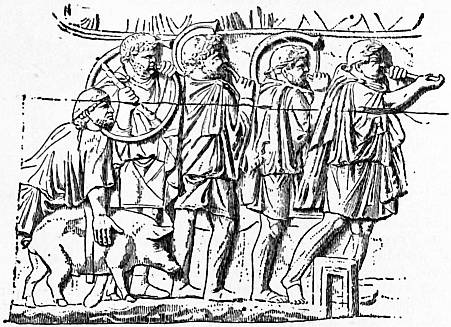
From Conrad Cichorius, Die Reliefs der Traiansäule, by permission of Georg Reimer.
Fig. 1.—Roman Cornu and Buccina.
After the fall of the Roman Empire, when instrumental music had fallen into disrepute and had been placed under a ban by the church, the art of playing upon such highly-developed instruments gradually died out in western Europe. With the disappearance of the civilization and culture of the Romans, the skilled crafts also gradually vanished, and the art of making metal pipes of delicate calibre and of bending them was completely forgotten, and had to be reacquired step by step during the middle ages from the more enlightened East. The names of the instruments and representations of them survived in MSS. and monuments of art, and as long as the West was content to turn to late Roman and Romano-Christian art for its models, no difficulties were created for the future archaeologist. By the time the Western races had begun to express themselves and to develop their own characteristics, in the 11th century, the arts of Persia, Arabia and the Byzantine Empire had laid their mark upon the West, and confusion of models, and more especially of names, ensued. The greatest confusion of all was created by the numerous translations and glosses of the Bible and by the attempts of miniaturists to illustrate the principal scenes. In Revelation, for instance (ch. viii.), the seven angels with their trumpets are diversely represented with long tubas, with curved horns of various lengths, and with the buisine, busaun or posaune, the descendant of the buccina.
We know from the colouring used in illuminated MSS., gold and pale blue, that horns were made of metal early in the middle ages. The metal was not cast in moulds but hammered into shape. Viollet-le-Duc27 reproduces a miniature from a MS. of the end of the 13th century (Paris, Bibliothèque du corps législatif), in which two metal-workers are shown hammering two large horns.
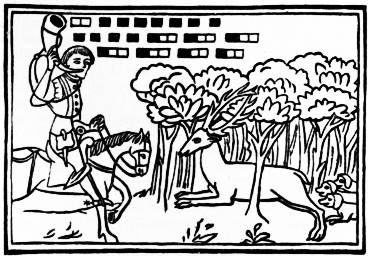
Fig. 2.—Medieval Hunting Horn with the Tablature in use in the 14th Century.
The early medieval horns had no mouthpieces, the narrow end being merely finished with a rim on which the lips rested. The tone suffered in consequence, being uncertain, rough and tremulous, wherefore it was indicated by the neume known as quilisma: “Est vox tremula; sicut est sonus flatus tubae vel cornu et designatur per neumam, quae vocatur quilisma.”28
During the middle ages the bugle-horn or bull’s horn was extensively used as a signal instrument on land and sea (see Bugle), by the night-watchmen in cities, in the watch tower of the feudal castle and by foresters and huntsmen. The hunting-horn was generally represented as small in the hunting scenes which abound in illuminated MSS. and early printed books; it was crescent-shaped and was worn slung by a leather strap over one shoulder and resting on the opposite hip. When played it was held with the wide end curving upwards in front of the huntsman’s head. A kind of tablature for the horn was in use in France in the 14th century; an example of it is here reproduced (fig. 2) from a 14th-century French MS. treatise on venery.29 Only one note is indicated, the various calls and signals being based chiefly on rhythm, and the notes being left to the taste and skill of the huntsman. The interpretation30 of the Cornure de chasse de veue seen in the figure is as follows:
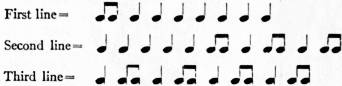
In the first poem is given a list of these signs with the names by which they were known in venery.
In the 16th century in England the hunting-horn sometimes had a spiral turn in the centre, half-way between mouthpiece and bell end; the extra length was apparently added solely in order to lower the pitch, the higher harmonics not being used for the hunting calls. In George Turbevile’s Noble Arte of Venerie (1576, facsimile reprint, Oxford, 1908) the “measures of blowing according to the order which is observed at these dayes in this Realme of Englande” are given for the horn in D. One of these, given in fig. 3, is the English 16th-century hunting call, corresponding to the 14th-century French Cornure de chasse de veue given above.
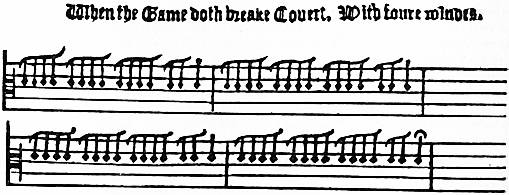
From Turbevile’s Noble Art of Venerie (1576), by permission of the Clarendon Press.
Fig. 3.—Hunting Call.
The hunting-horn, whether in its simplest form or with the one spiral, was held with the bell upwards on a level with the huntsman’s head or just above it.31
A horn of the same fine calibre as the French horn, 3 or 4 ft. in length, slightly bent to take the curve of the body, was in use in Italy, it would seem, in the 15th century.32 It was held slanting across the body with the bell already slightly parabolic, at arm’s length to the left side.
The hunting- and post-horns were favourite emblems on medieval coats of arms, more especially in Germany33 and Bohemia.
It is necessary at this point to draw attention to the fact that the French horn is a hybrid having affinities with both trumpet and primitive animal horn, or with buccina and cornu, and that both types, although frequently misnamed and confused by medieval writers and miniaturists, subsisted side by side, evolving independently until they merged in the so-called French horn. Both buccina and cornu after the fall of the Roman Empire, while Western arts and crafts were in their infancy, were made straight, being then known as the busine or straight trumpet (busaun or posaun in Germany), and the long horn, Herhorn, slightly curved.34
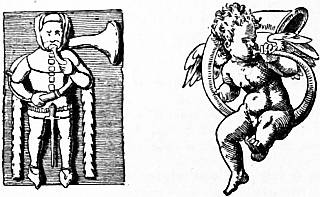
Fig. 4.—Medieval Circular Horn. Fig. 5.—Medieval Circular Horn, 1589.
From two medieval representations of instruments like the Roman cornu one might be led to conclude that the instrument had been revived and was in use from the 14th century. A wooden bas-relief on the under part of the seats of the choir of Worcester cathedral,35 said to date from the 14th century, shows a musician in a robe with long sleeves of fur playing the horn (fig. 4). The tube winds from the mouth in a circle reaching to his waist, passes under the right arm across the shoulders with the bell stretching out horizontally over his left shoulder. The tube, of strictly conical bore, is made in three pieces, the joints being strengthened by means of two rings. The other example is German, and figures in the arms of the city of Frankfort-on-Main.36 Here in the two opposite corners are two cherubs playing immense cornua. The bore of the instruments (fig. 5) is of a calibre suggestive of the contrabass tuba; the circle formed is of a diameter sufficiently large to accommodate the youthful performer in a sitting posture; the bell is the forerunner of that of the modern saxophone, shaped like a gloxinea; the mouthpiece is cup-shaped. It is possible, of course, that these two examples are attempts to reproduce the classic instrument, but the figures of the musicians and the feeling of the whole scheme of ornamentation seem to render such an explanation improbable. Moreover, Sebastian Virdung,37 writing on musical instruments at the beginning of the 16th century, gives a drawing of a cornu coiled round tightly, the tubing being probably soldered together at certain points. Virdung calls this instrument a Jegerhorn, and the short hunting-horn Acherhorn (Ackerhorn—the synonym of the modern Waldhorn). The scale of the former could have consisted only of the first eight harmonics, including the fundamental, which would be easily obtained on an instrument of such a large calibre. Mersenne,38 a century and a quarter later, gives a drawing of the same kind of horn among his cors de chasse, but does not in his description display his customary intimate knowledge of his subject; it may be that he was dealing at second-hand with an instrument of which he had had little practical experience. Praetorius39 gives as Jägerhorn only the simple forms of crescent-shaped horns with a single spiral; the spirally-wound horn of Virdung is replaced by a new instrument—the Jägertrummet (huntsman’s trumpet)—of the same form, but less cumbersome, of cylindrical bore excepting at the bell end and having a crook inserted between the mouthpiece and the main coils. The tube, which could not have been less than 8 ft. long, produced the harmonic series of the cavalry trumpet from the 3rd to the 12th. The restrictions placed upon the use of the cavalry trumpet would have rendered it unavailable for use in the hunting-field, but the snake-shaped model, as Praetorius describes it, was a decided improvement on the horn, although inferior in resonance to the cavalry model. Here then are the materials for the fusion of the trumpet and hunting-horn into the natural or hand-horn of the 17th and 18th centuries. There is evidence, however, that a century earlier, i.e. at the end of the 15th century, the art of bending a brass tube of the delicate proportions of the French horn, which is still a test of fine workmanship, had been successfully practised. In an illustrated edition of Virgil’s works published in Strassburg in 1502 and emanating from Grüninger’s office, Brant being responsible for the illustrations, the lines (Aen. viii. 1-2) “Ut belli signum Laurenti Turnus ab arce Extulit: et rauco strepuerunt cornua cantu” are illustrated by two soldiers, one with the sackbut (posaune, the descendant of the buccina), the other with a horn wound spirally round his body in three coils, which appear to have a conical bore from the funnel-shaped mouthpiece to the bell which extends at the back of the head horizontally over the left shoulder (fig. 6). There is ample room for the performer’s head and shoulders to pass through the circle: the length of the tube could not therefore have been much less than 16 ft. long, equivalent to the horn in C or B♭ basso. In the same book (pl. ccci.) is another horn, smaller, differing slightly in the disposition of the coils and held like the modern horn in front.
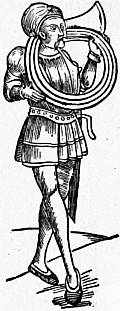
Fig. 6.—Spirally Coiled Horn from Virgil’s Works (1502), folio cccviii. versa.
These horns were not used for hunting but for war in conjunction with the draw-trumpet. Brant could not have imagined these instruments, and must have seen the originals or at least drawings of them; the instruments probably emanated from the famed workshops of Nuremberg, being intended mainly for use in Italy, and had not been generally adopted in Germany. The significance of these drawings of natural horns in a German work of the dawn of the 16th century will not be lost. It disposes once and for all of the oft-repeated fable that the hunting-horn first assumed its present form in France about 1680, a statement accepted without question by authorities of all countries, but without reference to any pièce justificative other than the story of the Bohemian Count Spörken first quoted by Gerber,40 and repeated in most musical works without the context. The account which gave rise to this statement had been published in 1782 in a book by Faustinus Prochaska:41 “Vix Parisiis inflandi cornua venatoria inventa ars quum delectatus suavitate cantus duos ex hominibus sibi obnoxiis ea instituendos curavit. Id principium apud nos artis, qua hodie Bohemi excellere putantur.” In a preceding passage after the count’s name, Franz Anton, Graf von Spörken, are the words “anno saeculi superioris octogesimo quum iter in externas provincias suscepisset,” &c. There is no reference here to the invention of the horn in Paris or to the folding of the tube spirally, but only to the manner of eliciting sound from the instrument. Count Spörken, accustomed to the medieval hunting fanfares in which the tone of the horn approximated to the blare of the trumpet, was merely struck by the musical quality of the true horn tone elicited in Paris, and gave France the credit of the so-called invention, which probably more properly belonged to Italy. The account published by Prochaska a hundred years after, without reference to the source from which it was obtained, finds no corroboration from French sources. Had the French really made any substantial improvement in the hunting-horn at the end of the 17th century, transforming it from the primitive instrument into an orchestral instrument, it would only be reasonable to expect to find some evidence of this, considering the importance attached to the art of music at the court of Louis XIV., whose musical establishments, la Chapelle Musique,42 la Musique de la Chambre du Roi and la Musique de la Grande Écurie, included the most brilliant French artists. One would expect to find horns of that period by French makers among the relics of musical instruments in the museums of Europe. This does not seem to be the case. Moreover, in Diderot and d’Alembert’s Encyclopédie (1767) the information given under the heading trompe ou cor de chasse grand et petit is very vague, and contains no hint of any special merit due to France for any improvement in construction. Among the plates (vol. v., pl. vii.) is given an illustration of a horn very similar to the instruments made in England and Germany nearly a century earlier, but with a funnel-shaped mouthpiece. Dr Julius Rühlmann states that there are two horns by Raoux, bearing the date 1703,43 in the Bavarian National Museum in Munich,44 but although fine examples, one in silver, the other in brass (fig. 6) by Raoux, they turn out on inquiry45 to bear no date whatever. Rühlmann’s statement in the same article, that in the arms of the family of Wartenberg-Kolb (now extinct), which goes back to 1169, there is a hunting-horn coiled round in a complete circle is also misleading. The horn (a post-horn) did not appear in the arms of the family in question until 1699, when the first peer Casimir Johann Friedrich was created hereditary Post-Master. The influence of such erroneous statements in the work of noted writers is far-reaching. Inquiries at the department of National Archives in Paris concerning Raoux, the founder of the afterwards famous firm of horn-makers whose model with pistons is used in the British military bands and at Kneller Hall, proved fruitless. Fétis states that he worked during the second half of the 18th century. Albert Chouquet46 states that he has seen a trumpet by Raoux, “seul ordinaire du Roy, Place du Louvre” dated 1695. The inscriptions on the horns in question are: For No. 105, a silver horn of the simplest form of construction in D, “Fait à Paris par Raoux”; for No. 106, a brass horn engraved with a crown on an ermine mantle with the initials C. A. (Carl Albert), “Fait à Paris par Raoux, seul ordinaire du Roy, Place du Louvre.” Both horns measure across the coils 56 cm. and across the bell 27½. They are practically the same as the cors de chasse now in use in French and Belgian military bands, the large diameter of the coil enabling the performer to carry it over his shoulder. The orchestral horn was given a narrower diameter in order to facilitate its being held in front of the performer in a convenient position for stopping the bell with the right hand. No. 107 in the same collection, a horn of German construction, bears the inscription “Macht Jacob Schmid in Nürnberg” and the trademark “J. S.” with a bird. A horn in E♭] of French make, having fleur-de-lys stamped on the rim of the bell, and measuring only 15 in. across the coils to the exterior edge of the bell—therefore a very small horn—is preserved in the Grand Ducal Museum at Darmstadt.47 A horn in F♯ (probably F in modern high pitch), having the rim ornamented as above and the inscription “Fait à Paris, Carlin, ordinaire du Roy,” readily gives the harmonics from the 3rd to the 12th.48 The extreme width is 20 in.49 Carlin, who lived at rue Croix des Petits Champs, died about 1780. The earliest dated horn extant is believed to be the one preserved in the Hohenzollern Museum in Sigmaringen, “Machts Wilhelm Haas, Nürnberg, 1688.”50 Another early German horn engraved “Machts Heinr. Rich. Pfeiffer in Leipzig, 1697,”51 formerly in Paul de Wit’s museum in Leipzig and now transferred with the rest of the collection to Cologne, is of similar construction.
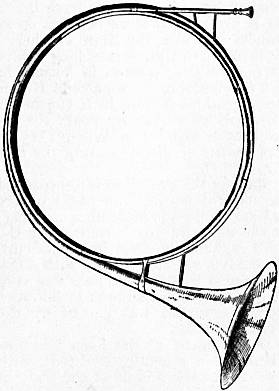
From a Photo by K. Teufel.
Fig. 7.—Early Raoux Horn (Munich).
The horn must have been well known at this time in England, for there are 17th-century horns of English manufacture still extant, one, for instance, in the collection of the Rev. F. W. Galpin by William Bull, dated 1699.52 In 1701 Clagget53 invented a contrivance by means of which two horns in different keys could be coupled and played by means of one mouthpiece, a valve or key opening the passage into the airways of one or the other of these horns at the will of the performer. Another horn of English manufacture about 1700 was exhibited at the South Kensington Museum in 1872, bearing No. 337 in the catalogue, in which unfortunately no details are given. Enough examples have been quoted to show that, judging from the specimens extant, Germany was not behind France, if not actually ahead, in the manufacture of early natural horns. Data are wanting concerning the instruments of Italy; they would probably prove to be the earliest of all, and as brass wind instruments are perishable are perhaps for that very reason unrepresented at the present day.
The horn at the present stage in its evolution was also well represented among the illustrations of the musical literature in Germany54 during the first half of the 18th century, and references to it are frequent.
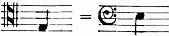
The earliest orchestral music for the horn occurs in the operas of Cavalli and Cesti, leaders of the Venetian Opera in the 17th century. Already in 1639 Cavalli in his opera Le Nozze de Tito e Pelei (act i. sc. 1) introduced a short scena, Music. “Chiamata alla Caccia”55 in C major for four horns on a basso continuo. An examination of the scoring in C clefs on the first, second, third and fourth lines shows, by the use of the note in the bass part and in the second tenor of the 5th harmonic of the series, that the fundamental could have been no other than the 16-ft. C; the highest note in the treble part is , the 12th harmonic of the 8-ft. alto horn in C, now obsolete. It is clear therefore that horns with tubing respectively 8 ft. and 16 ft. long, which must have been disposed in coils as in the present day, were in use in Italy before the middle of the 17th century, fifty years before the date of their reputed invention in Paris.
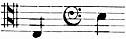

In the same opera, act i. sc. 4, “Coro di Cavalieri” is a stirring call to arms of elemental grandeur, in which occur the words: “all’ armi, ò la guerrieri corni e tamburi e trombe, ogni campo ogni canto, armi rimbombe.” There are above the voice parts four staves with treble and C clef signatures above the bass, and, although no instruments are indicated, the music written thereon, which alternates with the voices but does not accompany them, can have been intended for no instruments but trumpets and horns, thus carrying out the indications in the text. The horn is here once again put to the same use as the Roman cornu, and associated in like manner with the descendant of the buccina in a call to arms. It may be purely a coincidence that the early illustration of a horn with the tubing wound in coils round the body in the Strassburg Virgil mentioned above was put to the same use and associated with the same instrument.
Cesti’s operas likewise contain many passages evidently intended for the horn, although the instruments are not specified in the score, which was nothing unusual at the time. Lulli composed the incidental music for a ballet, La Princesse d’Elide, which formed part of Molière’s divertissement, “Les plaisirs de l’île enchantée,” written for a great festival at Versailles on the 7th of May 1664. A copy of the music for this ballet, made about 1680, is preserved in the library of the Fitzwilliam Museum, Cambridge. The music contains a piece entitled “Les violons et les cors de chasse,” written in the same style as Cavalli’s scena; there are but two staves, and on both the music is characteristic of the horn, with which the violins would play in unison. The piece finishes on B♭ and to play this note as the second of the harmonic series, the fundamental not being obtainable, the tube of the horn must have been over 17 ft. long. Among Philidor’s copies of Lulli’s ballets preserved in the library of the Paris Conservatoire of Music (vol. xlvii., p. 61) is a more complete copy of the above. The second number is an “Air des valets de chiens et des chasseurs avec les cors de chasse,” which is substantially the same as the one in the Fitzwilliam Museum, but set for five horns in B♭. Here again the use of D, the fifth note of the harmonic series, indicates that the fundamental was a tone lower than the C horn scored for by Cavalli, and known as B♭ basso. Victor Mahillon56 considers that the music reveals the fact that it was written for horns in B♭, 35 degrees (chromatic semitones) above 32-ft. C, or having a wave-length of 1.475 m. To this statement it is not possible to subscribe. The quintette required four horns in B♭ over 8 ft. long and one B♭ basso about 17 ft. long. It is obvious that the present custom of placing the bass notes of the horn on the F clef an octave too low, as is now customary, had not yet been adopted, for in that case the bass horn would in several bars be playing above the tenor.


In 1647 Cardinal Mazarin, wishing to create in France a taste for Italian opera, had procured from Italy an orchestra, singers and mise-en-scène. That he was not entirely successful in making Paris appreciate Italian music is beside the mark; he developed instead a demand for French opera, to which Lulli proved equal. The great similarity in the style of the horn scène by Cavalli and Lulli may perhaps provide a clue to the mysterious and sudden apparition of the natural horn in France, where nothing was known of the hybrid instrument thirty years before, when Mersenne57 wrote his careful treatise on musical instruments.
The orchestral horn had been introduced from Italy. It is not difficult to understand how the horn came to be called the French horn in England; the term only appears after Gerber and other writers had repeated the story of Count Spörken introducing the musical horn into Bohemia.58 By this time the firm of Raoux, established in Paris a hundred years, had won for itself full recognition of its high standard of workmanship in the making of horns.
This use of the horn by Lulli in the one ballet seems to be an isolated instance; no other has yet been quoted. The introduction of the natural horn into the orchestra of the French opera did not occur until much later in 1735 in André Campra’s Achille et Deidamie, and then only in a fanfare. In the meantime the horn had already won a place in most of the rising opera houses and ducal orchestras59 of Germany, and had been introduced by Handel into the orchestra in London in his Water-music composed in honour of George I.
Although the Italians were undoubtedly the first to introduce the horn into the orchestra, it figured at first only as the characteristic instrument of the chase, suggesting and accompanying hunting scenes or calls to arms. For a more independent use of the horn in the orchestra we must turn to Germany. Reinhard Keiser, the founder of German opera, at the end of the 17th century in Hamburg, introduced two horns in C into the opening chorus of his opera Octavia in 1705, where the horns are added to the string quartette and the oboes; they play again in act i. sc. 3, and in act ii. sc. 6 and 9. The compass used by the composer for the horns in C alto is the following:—

Wilhelm Kleefeld draws attention to the characterization, which differed in the three acts. In Henrico (1711), in Diana (1712) and in L’Inganno Fedele (1714) F horns were used. This called forth from Mattheson60 his much-quoted eulogium, the earliest description of the orchestral horn: “Die lieblich pompeusen Waldhörner sind bei itziger Zeit sehr en vogue kommen, weil sie theils nicht so rude von Natur sind als die Trompeten, teils auch weil sie mit mehr Facilité können tractiret werden. Die brauchbarsten haben F und mit den Trompeten aus dem C gleichen Ambitum. Sie klingen auch dicker und füllen besser aus als die übertäubende und schreyende Clarinen, weil sie um eine ganze quinte tiefer stehen.”
Lotti in his Giove in Argo, given in Dresden, 1717, scored for two horns in C, writing for them soli in the aria for tenor61 (act iii. sc. 1). Examples of C. H. Graun’s62 scoring for horns in F and G respectively in Polydorus (1708-1729) and in Iphigenia (1731) show the complete emancipation of the instrument from its original limitations; it serves not only as melody instrument but also to enrich the harmony and emphasize the rhythm. A comparison of the early scores of Cavalli and Lulli with those of Handel’s Wasserfahrtmusik63 (1717) and of Radamisto, performed in London in 1720, shows the rapid progress made by the horn, even at a time when its technique was still necessarily imperfect.
While Bach was conductor of the prince of Anhalt-Cöthen’s orchestra (1717-1723), it is probable that horns in several keys were used. In Dresden two Bohemian horn-players, Johann Adalbert Fischer and Franz Adam Samm, were added to the court orchestra in 1711.64 In Vienna the addition is stated to have taken place in 1712 at the opera.65 It is probable that as in Paris so in Vienna there were solitary instances in which the horn was heard in opera without attracting the attention of musicians long before 1712, for instance in Cesti’s Il Pomo d’Oro, printed in Vienna in 1667 and 1668 and performed for the wedding ceremonies of Kaiser Leopold and Margareta, infanta of Spain. A horn in E (former F pitch) in the museum of the Brussels conservatoire bears the inscription “Machts Michael Leicham Schneider in Wien, 1713.”66 Fürstenau67 gives a further list of operas in Vienna during the first two decades of the 18th century.
It will be well before the next stage in the evolution is approached to consider the compass of the natural horn. The pedal octave from the fundamental to the 2nd harmonic was altogether wanting; the next octave contained only the 2nd and 3rd harmonics or the octave and its fifth; in the third octave, the 8ve, its major 3rd, 5th and minor 7th; in the fourth octave, a diatonic scale with a few accidentals was possible. It will be seen that the compass was very limited on any individual horn, but by grouping horns in different keys, or by changing the crooks, command was gained by the composer over a larger number of open notes.
An important period in the development of the horn has now been reached. Anton Joseph Hampel is generally credited68 with the innovation of adapting the crooks to the middle of the body of the horn instead of near the mouthpiece, which greatly improved the quality of the notes obtained by means of the crooks. The crooks fitted into the two branches of U-shaped tubes, thus forming slides which acted as compensators. Hampel’s Inventionshorn, as it is called in Germany (Fr. cor harmonique), is said to date from 1753,69 the first instrument having been made for him by Johann Werner, a brass instrument-maker of Dresden. The same invention is also attributed to Haltenhof of Hanau.70 Others again mention Michael Wögel71 of Carlsruhe and Rastadt, probably confusing his adaptation of the Invention or Maschine, as the slide contrivance was called in Germany, to the trumpet in 1780. The Inventionshorn, although embodying an important principle which has also found its application in all brass wind instruments with valves as a means of correcting defective intonation, did not add to the compass of the horn. At some date before 1762 it would seem that Hampel72 also discovered the principle on which hand-stopping is founded.
By hand-stopping (Fr. sons bouchés, Ger. gestöpfte Töne) is understood the practice of inserting the hand with palm outstretched and fingers drawn together, forming a long, shallow cup, into the bell of the horn; the effect is similar to that produced in wood wind instruments, termed d’amore, by the pear-shaped bell with a narrow opening, i.e. a veiled mysterious quality, and, according to the arrangement of the hand and fingers (which cannot be taught theoretically, being inter-dependent on other acoustic conditions), a drop in pitch which enables the performer merely to correct the faulty intonation of difficult harmonics or to lower the pitch exactly a semitone or even a full tone by inserting the hand well up the bore of the bell. J. Fröhlich73 gives drawings of the two principal positions of the hand in the horn. The same phenomenon may be observed in the flute by closing all the holes, so that the fundamental note of the pipe speaks, and then gradually bringing the palm of the hand nearer the open end of the flute. As a probable explanation may be offered the following suggestion. The partial closing of the opening of the bell removes the boundary of ambient air, which determines the ventral segment of the half wave-length some distance beyond the normal length; this boundary always lies beyond the end of the tube, thus accounting for the discrepancy between the theoretical length of the air-column and the practical length actually given to the tube.74 Hampel is also said to have been the first to apply the sordini75 (Fr. sourdine) or mute, already in use in the 17th century for the trumpet,76 to the horn. The original mute did not affect the pitch of the instrument, but only the tone, and when properly constructed may be used with the valve horn to produce the mysterious veiled quality of the hand-stopped notes. No satisfactory scientific explanation of the modifications in the pitch effected by the partial obstruction of the bell, whether by the hand or by means of certain mechanical devices, has as yet been offered. D. J. Blaikley suggests that in cases when the effect of hand-stopping appears to be to raise the pitch of the notes of the harmonic series, the real result of any contraction of the bell mouth (as by the insertion of the hand) is always a flattening of pitch accompanied by the introduction of a distorted or inharmonic scale, of such a character that for instance, the c, d, e, or 8th, 9th and 10th notes of the original harmonic scale become not the c♯ d♯ e♯ of a fundamental raised a semitone, but D♭, E♭, and f due to the 9th, 10th and 11th notes of a disturbed or distorted scale having a fundamental lower than that of the normal horn.
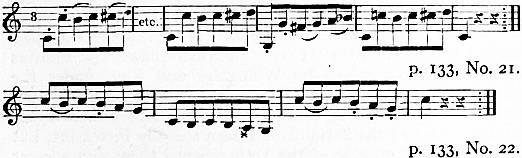
With regard to the discovery of this method of obtaining a chromatic compass for the horn, which rendered the instrument very popular with composers, instrumentalists and the public, and procured for it a generally accredited position in the orchestra, the following is the sum of evidence at present available. In the Kgl. öffentliche Bibliothek, Dresden, is preserved, amongst the musical MSS., an autograph volume of 152 pages, entitled Lection pro Cornui, bearing the signature A. J. H[ampel], the name being filled in in pencil by a different hand. There is no introduction, no letterpress of any description belonging to the MS. method for the horn, nor is any book or pamphlet explaining the Inventionshorn or the method of hand-stopping by Hampel extant or known to have existed. He has apparently left no record of his accomplishment. A few typical extracts copied and selected from the original MS., courteously communicated by the director of the Royal Library, Hofrath, P. E. Richter (a practical musician and performer on horn and trumpet), do not prove conclusively that they were intended to be played on hand-stopped horns, with the exception, perhaps, of the A, 13th harmonic from C, which could not easily be obtained except by hand-stopping on the hand-horn. On the blank sheet preceding the exercises is an inscription in the hand of Moritz Fürstenau, former custodian of the Royal Private Musical Collection (incorporated with the public library in 1896): “Anton Joseph Hampel, by whom these exercises for the horn were written, was a celebrated horn-player, a member of the Orchestra of the Electoral Prince of Saxony. He invented the so-called Inventionshorn. Cf. Neues biog.-hist. Lexicon der Tonkünstler by Gerber, pt. i. col. 493; also Zur Gesch. der Musik u. des Theaters am Hofe zu Dresden, by M. Fürstenau, Bd. ii.” It will be seen that Fürstenau gives Gerber as his authority for the attribution of the invention to Hampel, although he searched the archives, to which he had free access, for material for his book.
The first possessor of the MS., Franz Schubert (1768-1824), musical director of the Italian opera in Dresden, wrote the following note in pencil on the last page of the cover: “Franz Schubert. The complete school of horn-playing by the Kgl. Polnischen u. Kursächs. Cammermusicus Anton Joseph Hampel, a celebrated virtuoso, invented by himself in 1762.” Judging from the standard of modern technique, there are many passages in the “Lection” which could not be played without artificially humouring the production of harmonics with the lips, and it is an open question to what extent this method of correcting intonation and of altering the pitch was practised in the 18th century. When, therefore, Franz Schubert states that the method was invented by Hampel, we may take this as indirectly confirming Gerber’s statements. Further confirmation is obtained from the text of a work on the horn written by Heinrich Domnich77 (b. 1760), the son of a celebrated horn-player of Würtzburg contemporary with Hampel. Domnich junior settled eventually in Paris, where he was appointed first professor of the horn at the Conservatoire. According to him the mute (sourdine) of metal, wood or cardboard in the form of a hollow cone, having a hole in the base, was used to soften the tone of the horn without altering the pitch. But Hampel, substituting for this the pad of cotton wool used for a similar purpose with the oboe, found with surprise that its effect in the bell of the horn was to raise the pitch a semitone (see D. J. Blaikley’s explanation above). By this means, says Domnich, a diatonic and chromatic scale was obtained. Later Hampel substituted the hand for the pad. Domnich duly ascribes to Hampel the credit of the Inventionshorn, but erroneously states that it was Haltenhoff of Hanau who made the first instrument. Domnich further explains that Hampel, who had not practised the bouché notes in his youth, only made use of them in slow music, and that the credit of making practical use of the discovery was due to his pupil Giovanni Punto (Joh. Stich) the celebrated horn virtuoso, who was a friend of Domnich’s.
It may be well to draw attention to the fact that hand-stopping was not possible so long as the tube of horn was folded in a circle wide enough to be worn round the body. The reduction of the diameter of the orchestral horn in order to allow the performer to hold the instrument in front of him, thus bringing the bell in front of the right arm in a convenient position for hand-stopping, must have preceded the discovery of hand-stopping. In the absence of contrary evidence we may suppose that the change was effected for the more convenient arrangement and manipulation of the slides or Inventions. So radical a change in the compass of the horn could not occur and be adopted generally without leaving its mark on the horn music of the period; this change does not occur, as far as we know, before the last decades of the 18th century. The rapid acceptance in other countries of Hampel’s discovery of hand-stopping is evidenced by a passage from a little English work on music, published in London in 1772 but bearing at the end of the preface the date June 1766:78 “Some eminent Proficients have been so dexterous as very nearly to perform all the defective notes of the scale on the Horn by management of Breath and by a little stopping the bell with their hands.”
Hampel’s success gave a general impetus to the inventive faculty of musical instrument makers in Europe. At first the result was negative. Kölbel’s attempt must, however, be mentioned, if only to correct a misconception. Kölbel, a Bohemian horn virtuoso at the imperial Russian court from 1754, spent many years in vain endeavours to improve his instrument. At last, in 1760, he applied keys to the horn or the bugle, calling it Klappenhorn (the bugle is known in Germany as Signal or Buglehorn). Kölbel’s experiment did not become widely known or adopted during his lifetime, but Anton Weidinger, court trumpeter at Vienna, made a keyed trumpet79 in 1801, which attracted attention in musical circles and gave a fresh impetus in experimenting with keys upon brass instruments. In 1813 Joseph Weidinger, the twelve-year-old son of the above, gave a concert in Vienna on the Klappenwaldhorn80 (or keyed French horn), about which little seems to be known. Victor Mahillon81 describes such an instrument, but ascribes the invention to Kölbel; there was but one key placed on the bell, which on being opened had the effect of raising the pitch of the instrument a whole tone. By alternately using the harmonic open notes on the normal length of the tube, and then by the action of the key shortening the air column, the following diatonic scale was obtained in the third octave:

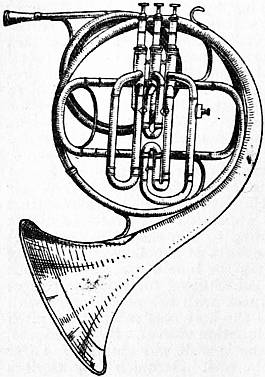
Fig. 8.—Modern Horn (Boosey & Co.)
In 1812 Dikhuth,82 horn-player in the orchestra of the grand-duke of Baden at Mannheim, constructed a horn in which a slide on the principle of that of the trombone was intended to replace hand-stopping and to lower the pitch at will a semitone.
The most felicitous, far-reaching and important of all improvements was the invention of valves (q.v.), pistons or cylinders (the principle of which has already been explained), by Heinrich Stölzel,83 who applied them first of all to the horn, the trumpet and the trombone,84 thus endowing the brass wind with a chromatic compass obtained with perfect ease throughout the compass. The inherent defect of valve instruments already explained, which causes faulty intonation needing correction when the pistons are used in combination, has now been practically overcome. The numerous attempts to solve the difficulty, made with varying success by makers of brass instruments, are described under Valve, Bombarden and Cornet.85
(K. S.)
1 See Michael Praetorius, De organographia (Wolfenbüttel, 1618), tab. viii., where crooks for lowering the key by one tone on trumpet and trombone are pictured.
2 See Victor Mahillon, Les Éléments d’acoustique musicale et instrumentale (Brussels, 1874), pp. 96, 97, &c.; Friedrich Zamminer, Die Musik und die musikalischen Instrumente (Giessen, 1855), p. 310, where diagrams of the mouthpieces are given.
3 See Joseph Fröhlich, Vollständige theoretisch-praktische Musikschule (Bonn, 1811), iii. 7, where diagrams of the two mouthpieces for first and second horn are given.
4 See Gottfried Weber, “Zur Akustik der Blasinstrumente,” in Allgemeine musikalische Zeitung (Leipzig, 1816), p. 38.
5 Les Instruments de musique au musée du Conservatoire royal de musique de Bruxelles, “Instruments à vent,” ii., “Le Cor, son histoire, sa théorie, sa construction” (Brussels and London, 1907), p. 28.
6 Die Akustik (Leipzig, 1802), p. 86, § 72.
7 Op. cit. p. 13, § 20, and p. 15, §§ 24 and 25. This apparent discrepancy between an early and a modern authority on the acoustics of wind instruments is easily explained. Chladni, when speaking of open and closed pipes, refers to the standard cylindrical and rectangular organ-pipes. Mahillon, on the other hand, draws a distinction in favour of the conical pipe, demonstrating in a practical manner how, given a certain calibre, the conical pipe must overblow the harmonics of the open pipe, whatever the method of producing the sound.
8 See Gottfried Weber, loc. cit.
9 See Ernst Heinrich and Wilhelm Weber, Wellenlehre (Leipzig, 1825), p. 519, § 281, and A Text-Book of Physics, part. ii., “Sound,” by J. H. Poynting and J. J. Thomson (London, 1906), pp. 104 and 105.
10 See Sedley Taylor, Sound and Music (1896), p. 21.
11 Id. pp. 23-25.
12 See Gottfried Weber, op. cit., pp. 39-41, and Ernst H. and Wilhelm Weber, op. cit. p. 522, end of § 285.
13 See A. Ganot, Elementary Treatise on Physics, translated by E. Atkinson (16th ed., London, 1902), p. 266, § 282, “In the horn different notes are produced by altering the distance of the lips.” Such a vague and misleading statement is worse than useless. See also Poynting and Thomson, op. cit. p. 113.
14 “Le Cor,” p. 22; p. 11, § 18; pp. 6 and 7, § 8.
15 The phraseology alone is here borrowed from Sedley Taylor, (op. cit. p. 55), who does not enter into the practical application of the theory he expounds so clearly.
16 See Dr Emil Schafhäutl’s article on musical instruments, § iv. of Bericht der Beurtheilungs Commission bei der Allg. Deutschen Industrie Ausstellung, 1854 (Munich, 1855), pp. 169-170; also F. Zamminer, op. cit.
17 The measurements are for the high philharmonic pitch a’=452.4. V. Mahillon, “Le cor” (p. 32), gives a table of the lengths of crooks in metres.
18 Robert Eitner, editor of the Monatshefte für Musikwissenschaft, published therein an article in 1881, p. 41 seq., “Wer hat die Ventiltrompete erfunden,” in which, after referring to the Klappenwaldhorn and Trompete (keyed horn and trumpet) made by Weidinger and played in public in 1802 and 1813 respectively, he goes on to state that Schilling in his Lexicon makes the comical mistake of looking upon the Klappentrompete (keyed trumpet) and Ventiltrompete (valve trumpet) as different instruments. He accordingly sets matters right, as he thinks, by according to Weidinger the honour of the invention of valves, hitherto wrongfully attributed to Stölzel; and in the Quellenlexikon (1904) he leaves out Stölzel’s name, and names Weidinger as the inventor of the Klappen or Ventil, referring readers for further particulars to his article, just quoted, in the Monatshefte.
19 See Hector Berlioz, A Treatise on Modern Instrumentation and Orchestration, translated by Mary Cowden Clarke, new edition revised by Joseph Bennett (1882), p. 141.
20 See Victor Mahillon, Catal. descriptif des instruments de musique, &c., vol. ii. p. 388, No. 1156, where an illustration is given. See also Dr August Hammerich (French translation by E. Beauvais), “Über altnordische Luren” in Vierteljährschrift für Musik-Wissenschaft x. (1894).
21 See Major J. H. L. Archer, The British Army Records (London, 1888), pp. 402, &c.
22 De re militari, iii. 5 (Basel, 1532). The successive editions and translations of this classic, both manuscript and printed, throughout the middle ages afford useful evidence of the evolution of these three wind instruments.
23 See Wilhelm Froehner, La Colonne Trajane d’après le surmoulage exécuté à Rome en 1861-1862 (Paris, 1872-1874). On pl. 51 is a cornu framing the head of a cornicen or horn-player. See also the fine plates in Conrad Cichorius, Die Reliefs der Traiansäule (Berlin, 1896, &c.).
24 Ermanno Ferrero, L’Arc d’Auguste à Suse (Segusio, 9-8 B.C.) (Turin, 1901).
25 See the mouthpiece on the Pompeian buccinas preserved in the museum at Naples, reproduced in the article Buccina. The museums of the conservatoires of Paris and Brussels and the Collection Kraus in Florence possess facsimiles of these instruments; see Victor Mahillon, Catalogue, vol. ii. p. 30. Cf. also the pair of bronze Etruscan cornua, No. 2734 in the department of Creek and Roman antiquities at the British Museum, which possess well-preserved cup-shaped mouthpieces.
26 See Bock, “Gebrauch der Hörner im Mittelalter,” in Gustav Heider’s Mittelalterliche Kunstdenkmäler Österreichs (Stuttgart, 1858-1860).
27 Dictionnaire raisonné du mobilier français (Paris, 1889), ii. p. 246.
28 Engelbertus Admontensis in De Musica Scriptores, by Martin Gerbert, Bd. ii. lib. ii. cap. 29; and Edward Buhle, Die Musikalischen Instrumente in den Miniaturen des frühen Mittelalters, pt. i., “Die Blasinstrumente” (Leipzig, 1903), p. 16.
29 Le Trésor de vénerie par Hardouin, seigneur de Fontaines-Guérin (edited by H. Michelant, Metz, 1856); the first part was edited by Jérome Pichon (Paris, 1855), with an historical introduction by Bottée de Toulmon.
30 As worked out by Edward Buhle, op. cit., p. 23.
31 See Turbevile, op. cit., also J. du Fouilloux, La Vénerie (Paris, 1628), p. 70; cf. also editions of 1650 and of 1562, where the horn is called trompe, used with the verb corner; Juliana Bernes, Boke of St Albans (1496), the frontispiece of which is a hunting scene showing a horn of very wide bore, without bell. Only half the instrument is visible.
32 See “Reliure italienne du xve siècle en argent niellé. Collection du Baron Nathaniel de Rothschild, Vienne,” in Gazette archéologique (Paris, 1880), xiii. p. 295, pl. 38, where other instruments are also represented.
33 See Jost Amman, Wappen und Stammbuch (1589). A reprint in facsimile has been published by Georg Hirth as vol. iii. of Liebhaber Bibliothek (Munich, 1881). See arms of Sultzberger aus Tirol (p. 52), “Ein Jägerhörnlin,” and of the Herzog von Wirtenberg; cf. the latter with the arms of Wurthemberch in pl. xxii. vol. ii. of Gelre’s Wappenboek ou armorial de 1334 à 1372 (miniatures of coats of arms in facsimile), edited by Victor Bouton (Paris, 1883).
34 For illustrations see autotype facsimile of Utrecht Psalter, 9th century; British Museum, Add. MS. 10,546, Ps. 150, 9th century; Add. MS. 24,199, 10th century; Eadwine Psalter, Trin. Coll. Camb., 11th century, and Cotton MS., Nero, D. IV., 8th century; also Edward Buhle, op. cit., pl. ii. and pp. 12-24.
35 See John Carter, Specimens of Ancient Sculpture and Paintings (London, 1780-1794), i. p. 53 (plates unnumbered); also reproduced in H. Lavoix, Histoire de la musique (Paris, 1884).
36 See Jost Amman, op. cit.
37 Musica getutscht und ausgezogen (Basel, 1511), p. 30. The names are not given under the drawings, but the above is the order in which they occur, which is probably reversed.
38 Harmonie universelle (Paris, 1636), p. 245.
39 Syntagma Musicum (Wolfenbüttel, 1618), pl. vii. No. 11, p. 39.
40 Historisch-biographisches Lexicon der Tonkünstler (Leipzig, 1790-1792 and 1812-1814).
41 De saecularibus Liberalium Artium in Bohemia et Moravia fatis commentarius (Prague, 1784), p. 401.
42 See Ernest Thoinan, Les Origines de la chapelle musique des souverains de France (Paris, 1864); F. J. Fétis, “Recherches sur la musique des rois de France, et de quelques princes depuis Philippe le Bel jusqu’à la fin du règne de Louis XIV.,” Revue musicale (Paris, 1832), xii. pp. 193, 217, 233, 241, 257; Castil-Blaze, La Chapelle musique des rois de France (Paris, 1882); Michel Brenet, “Deux comptes de la chapelle musique des rois de France,” Intern. Mus. Ges., Smbd. vi., i. pp. 1-32; J. Ecorcheville, “Quelques documents sur la musique de la grande écurie du roi,” Intern. Mus. Ges., Smbd. ii. 4 (Leipzig, 1901), pp. 608-642.
43 Neue Zeitschrift f. Musik (Leipzig, 1870), p. 309.
44 See Die Sammlung der Musikinstrumente des baierischen Nat. Museum by K. A. Bierdimpfl (Munich, 1883), Nos. 105 and 106.
45 Communication from Dr Georg Hagen, assistant director.
46 See Musée du Conservatoire National de Musique. Catalogue des instruments de musique (Paris, 1884), p. 147.
47 See Captain C. R. Day, Descriptive Catalogue of the Musical Instruments exhibited at the Military Exhibition (London, 1890), p. 147, No. 307.
48 See V. Mahillon, Catal. vol. i. No. 468.
49 See Captain C. R. Day, Catal. No. 309, p. 148.
50 For an illustration see Catalogue of the Special Exhibition of Ancient Musical Instruments at South Kensington Museum 1872 (London, 1873), p. 25, No. 332.
51 See Katalog des musikhistorischen Museums von Paul de Wit (Leipzig, 1904), p. 142, No. 564, where it is classified as a Jägertrompete after Praetorius; it has a trumpet mouthpiece.
52 For an illustration see F. J. Crowest, English Music, p. 449, No. 12.
53 See Ignatz and Anton Böck in Baierisches Musik-Lexikon by Felix J. Lipowski (Munich, 1811), p. 26, note.
54 See, for instance, frontispiece of Walther’s Musikalisches Lexikon (Leipzig, 1732); J. F. B. C. Majer’s Musik-Saal (Nuremberg, 1741, 2nd ed.), p. 54; Joh. Christ. Kolb, Pinacotheca Davidica (Augsburg, 1711); Ps. xci.; “Componimenti Musicali per il cembalo Dr Theofilo Muffat, organista di sua Sacra Maesta Carlo VI. Imp.” (1690), title-page in Denkmäler d. Tonkunst in Oesterreich, Bd. iii.
55 See Hugo Goldschmidt, “Das Orchester der italienischen Oper im 17 Jahrhundert,” Intern. Mus. Ges., Smbd. ii. 1, p. 73.
56 See “Le Cor,” pp. 23 and 24, and Dictionnaire de l’acad. des beaux arts, vol. iv., art. “Cor.”
57 Mersenne’s drawings of cors de chasse are very crude; they have no bell and are all of the large calibre suggestive of the primitive animal horn. He mentions nevertheless that they were not only used for signals and fanfares but also for little concerted pieces in four parts for horns alone, or with oboes, at the conclusion of the hunt.
58 See William Tans’ur Senior, The Elements of Musick (London, 1772); Br. V. Dictionary under “Horn.” Also Scale of Horn in the hand of Samuel Wesley; in Add. MS. 35011, fol. 166, Brit. Mus.
59 A horn-player, Johann Theodor Zeddelmayer, was engaged in 1706 at the Saxon court at Weissenfels; see Neue-Mitteilungen aus dem Gebiete histor. antiqu. Forschungen, Bd. xv. (2) (Halle, 1882), p. 503; also Wilhelm Kleefeld, “Das Orchester der Hamburger Oper, 1678-1738,” Intern. Mus. Ges., Smbd. i. 2, p. 280, where the appearance of the horn in the orchestras of Germany is traced.
60 Das neu-eröffnete Orchester, i. 267.
61 See Moritz Fürstenau, Zur Geschichte der Musik und des Theaters zu Dresden (Dresden, 1861-1862), vol. ii. p. 60.
62 See “Carl Heinrich Graun als Opernkomponist,” by Albert Mayer-Reinach, Intern. Mus. Ges., Smbd. i. 3 (Leipzig, 1900), pp. 516-517 and 523-524, where musical examples are given.
63 Cf. Chrysander, Haendel, ii. 146.
64 See Moritz Fürstenau, op. cit. ii. 58.
65 See Ludwig von Köchel, Die kaiserliche Hofkappelle in Wien (Vienna, 1869), p. 80.
66 See Victor Mahillon, Catalogue descriptif, vol. ii. No. 1160, p. 389.
67 Op. cit. ii. 60.
68 The Department of State Archives for Saxony in Dresden possesses no documents which can throw any light upon this point, but, through the courtesy of the director, the following facts have been communicated. Two documents concerning Anton Joseph Hampel are extant: (1) An application by his son, Johann Michael Hampel, to the elector Friedrich August III. of Saxony, dated Dresden, April 3, 1771, in which he prays that the post of his father as horn-player in the court orchestra—in which he had already served as deputy for his invalid father—may be awarded to him. (2) A petition from the widow, Aloisia Ludevica Hampelin, to the elector, bearing the same date (April 3, 1771), wherein she announces the death of her husband on the 30th of March 1771, who had been in the service of the house of Saxony thirty-four years as horn-player, and prays for the grant of a monthly pension for herself and her three delicate daughters, as she finds herself in the most unfortunate circumstances. There is no allusion in either letter to any musical merit of the deceased.
69 There is an instrument of this early type, supposed to date from the middle of the 18th century, in Paul de Wit’s fine collection of musical instruments formerly in Leipzig and now transferred to Cologne; see Katalog, No. 645, p. 148.
70 See Dictionnaire de l’acad. des beaux arts, vol. iv. (Paris), article “Cor.”
71 See Dr Gustav Schilling, Universal Lexikon der Tonkunst (Stuttgart, 1840), Bd. vi., “Trompete”; also Capt. C. R. Day, pp. 139 and 151, where the term Invention is quite misunderstood and misapplied. See Gottfried Weber in Caecilia (Mainz, 1835), Bd. xvii.
72 Gerber in the first edition of his Lexikon does not mention Hampel or award him a separate biographical article; we may therefore conclude that he was not personally acquainted with him, although Hampel was still a member of the electoral orchestra in Dresden during Gerber’s short career in Leipzig. In the edition of 1812 Gerber renders him full justice.
73 Vollständige theoretisch-praktische Musikschule (Bonn, 1811), pt. iii. p. 7.
74 See Victor Mahillon, “Le Cor,” p. 28; Chladni, op. cit. p. 87.
75 See Fröhlich, op. cit. 7; and Gerber, Lexikon (ed. 1812), p. 493; “Le Cor,” pp. 34 and 53.
76 See Praetorius and Mersenne, op. cit.; the latter gives an illustration of the trumpet mute.
77 Methode de premier et de second cor (Paris, c. 1807). The passage in question was discovered and courteously communicated by Hofrat P. E. Richter of the Royal Library, Dresden. There is no copy of Domnich’s work in the British Museum.
78 See William Tans’ur Senior, op. et loc. cit.
79 See Allgemeine musikalische Zeitung (Leipzig), Nov. 1802, p. 158, and Jan. 1803, p. 245; and E. Hanslick, Geschichte des Concertwesens in Wien (Vienna, 1869), p. 119.
80 See Allgem. mus. Ztg., 1815, p. 844.
81 “Le Cor,” pp. 34-35.
82 See the description of the instrument and of other attempts to obtain the same result by Gottfried Weber, “Wichtige Verbesserung des Horns” in Allg. musik. Ztg. (Leipzig, 1812), pp. 758, &c.; also 1815, pp. 637 and 638 (the regent or keyed bugle).
83 See Allg. musik. Ztg., 1815, May, p. 309, the first announcement of the invention in a paragraph by Captain G. B. Bierey.
84 Ibid., 1817, p. 814, by F. Schneider, and Dec. p. 558; 1818, p. 531. An announcement of the invention and of a patent granted for the same for ten years, in which Blümel is for the first time associated with Stölzel as co-inventor. See also Caecilia (Mainz, 1835), Bd. xvii. pp. 73 seq., with illustrations, an excellent article by Gottfried Weber on the valve horn and valve trumpet.
85 For a very complete exposition of the operation of valves in the horn, and of the mathematical proportions to be observed in construction, see Victor Mahillon’s “Le Cor,” also the article by Gottfried Weber in Caecilia (1835), to which reference was made above. A list of horn-players of note during the 18th century is given by C. Gottlieb Murr in Journal f. Kunstgeschichte (Nuremberg, 1776), vol. ii. p. 27. See also a good description of the style of playing of the virtuoso J. Nisle in 1767 in Schubart, Aesthetik d. Tonkunst, p. 161, and Leben u. Gesinnungen (1791), Bd. ii. p. 92; or in L. Schiedermair, “Die Blütezeit d. Ottingen-Wallensteinschen Hofkapelle,” Intern. Mus. Ges. Smbd. ix. (1), 1907, pp. 83-130.
HORNBEAM (Carpinus betulus), a member of a small genus of trees of the natural order Corylaceae. The Latin name Carpinus has been thought to be derived from the Celtic car, wood, and pin or pen, head, the wood of hornbeams having been used for yokes of cattle (see Loudon, Ency. of Pl. p. 792, new ed. 1855, and Littré, Dict. ii. 556). The common hornbeam, or yoke-elm, Carpinus betulus (Ger. Hornbaum and Hornbuche, Fr. charme), is indigenous in the temperate parts of western Asia and of Asia Minor, and in Europe, where it ranges as high as 55° and 56° N. lat. It is common in woods and hedges in parts of Wales and of the south of England. The trunk is usually flattened, and twisted as though composed of several stems united; the bark is smooth and light grey; and the leaves are in two rows, 2 to 3 in. long, elliptic-ovate, doubly toothed, pointed, numerously ribbed, hairy below and opaque, and not glossy as in the beech, have short stalks and when young are plaited. The stipules of the leaves act as protecting scale-leaves in the winter-bud and fall when the bud opens in spring. The flowers appear with the leaves in April and May. The male catkins are about 1½ in. long, and have pale-yellow anthers, bearing tufts of hairs at the apex; the female attain a length in the fruiting stage of 2 to 4 in., with bracts 1 to 1½ in. long. The green and angular fruit or “nut” ripens in October; it is about ¼ in. in length, is in shape like a small chestnut, and is enclosed in leafy, 3-lobed bracts. The hornbeam thrives well on stiff, clayey, moist soils, into which its roots penetrate deeply; on chalk or gravel it does not flourish. Raised from seed it may become a tree 40 to as much as 70 ft. in height, greatly resembling the beech, except in its rounder and closer head. It is, however, rarely grown as a timber-tree, its chief employment being for hedges. “In the single row,” says Evelyn (Sylva, p. 29, 1664), “it makes the noblest and the stateliest hedges for long Walks in Gardens or Parks, of any Tree whatsoever whose leaves are deciduous.” As it bears clipping well, it was formerly much used in geometric gardening. The branches should not be lopped in spring, on account of their tendency to bleed at that season. The wood of the hornbeam is white and close-grained, and polishes ill, is of considerable tenacity and little flexibility, and is extremely tough and hard to work—whence, according to Gerard, the name of the tree. It has been found to lose about 8% of its weight by drying. As a fuel it is excellent; and its charcoal is much esteemed for making gunpowder. The inner part of the bark of the hornbeam is stated by Linnaeus to afford a yellow dye. In France the leaves serve as fodder. The tree is a favourite with hares and rabbits, and the seedlings are apt to be destroyed by mice. Pliny (Nat. Hist. xxvi. 26), who describes its wood as red and easily split, classes the hornbeam with maples.
The American hornbeam, blue or water beech, is Carpinus americana (also known as C. caroliniana); the common hop-hornbeam, a native of the south of Europe, is a member of a closely allied genus, Ostrya vulgaris, the allied American species, O. virginiana, is also known as ironwood from its very hard, tight, close-grained wood.
HORNBILL, the English name long generally given to all the birds of the family Bucerotidae of modern ornithologists, from the extraordinary horn-like excrescence (epithema) developed on the bill of most of the species, though to which of them it was first applied seems doubtful. Among classical authors Pliny had heard of such animals, and mentions them (Hist. Nat. lib. x. cap. lxx.) under the name of Tragopan; but he deemed their existence fabulous, comparing them with Pegasi and Gryphones—in the words of Holland, his translator (vol. i. p. 296)—“I thinke the same of the Tragopanades, which many men affirme to bee greater than the Ægle; having crooked hornes like a Ram on either side of the head, of the colour of yron, and the head onely red.” Yet this is but an exaggerated description of some of the species with which doubtless his informants had an imperfect acquaintance. Medieval writers found Pliny’s bird to be no fable, for specimens of the beak of one species or another seem occasionally to have been brought to Europe, where they were preserved in the cabinets of the curious, and thus Aldrovandus was able to describe pretty fairly and to figure (Ornithologia, lib. xii. cap. xx. tab. x. fig. 7) one of them under the name of “Rhinoceros Avis,” though the rest of the bird was wholly unknown to him. When the exploration of the East Indies had extended farther, more examples reached Europe, and the “Corvus Indicus cornutus” of Bontius became fully recognized by Willughby and Ray, under the title of the “Horned Indian Raven or Topau called the Rhinocerot Bird.” Since the time of those excellent ornithologists our knowledge of the hornbills has been steadily increasing, but up to the third quarter of the 19th century there was a great lack of precise information, and the publication of D. G. Elliot’s “Monograph of the Bucerotidae,” then supplied a great want. He divides the family into two sections, the Bucerotinae and the Bucorvinae. The former group contains most of the species, which are divided into many genera. Of these, the most remarkable is Rhinoplax, which seems properly to contain but one species, the Buceros vigil, B. scutatus or B. geleatus of authors, commonly known as the helmet-hornbill, a native of Sumatra and Borneo. This is easily distinguished by having the front of its nearly vertical and slightly convex epithema composed of a solid mass of horn1 instead of a thin coating of the light and cellular structure found in the others. So dense and hard is this portion of the “helmet” that Chinese and Malay artists carve figures on its surface, or cut it transversely into plates, which from their agreeable colouring, bright yellow with a scarlet rim, are worn as brooches or other ornaments. This bird, which is larger than a raven, is also remarkable for its long graduated tail, having the middle two feathers nearly twice the length of the rest. Nothing is known of its habits. Its head was figured by George Edwards in the 18th century, but little else had been seen of it until 1801, when John Latham described the plumage from a specimen in the British Museum, and the first figure of the whole bird, from an example in the Museum at Calcutta, was published by General Hardwicke in 1823 (Trans. Linn. Society, xiv. pl. 23). Yet more than twenty years elapsed before French naturalists became acquainted with it.
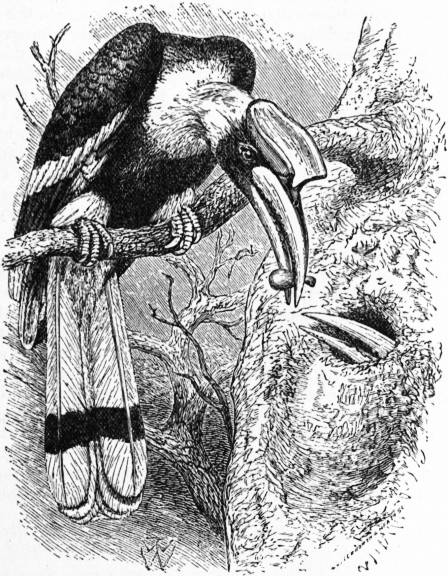
Great Indian Hornbill (B. bicornis). (After Tickell’s drawing in the Zoological Society’s Library.)
In the Bucorvinae we have only the genus Bucorvus, or Bucorax as some call it, confined to Africa, and containing at least two and perhaps more species, distinguishable by their longer legs and shorter toes, the ground-hornbills of English writers, in contrast to the Bucerotinae which are chiefly arboreal in their habits, and when not flying move by short leaps or hops, while the members of this group walk and run with facility. From the days of James Bruce at least there are few African travellers who have not met with and in their narratives more or less fully described one or other of these birds, whose large size and fearless habits render them conspicuous objects.
As a whole the hornbills, of which more than 50 species have been described, form a very natural and in some respects an isolated group, placed by Huxley among his Coccygomorphae. It has been suggested that they have some affinity with the hoopoes (Upupidae), and this view is now generally accepted. Their supposed alliance to the toucans (Rhamphastidae) rests only on the apparent similarity presented by the enormous beak, and is contradicted by important structural characters. In many of their habits, so far as these are known, all hornbills seem to be much alike, and though the modification in the form of the beak, and the presence or absence of the extraordinary excrescence,2 whence their name is derived, causes great diversity of aspect among them, the possession of prominent eyelashes (not a common feature in birds) produces a uniformity of expression which makes it impossible to mistake any member of the family. Hornbills are social birds, keeping in companies, not to say flocks, and living chiefly on fruits and seeds; but the bigger species also capture and devour a large number of snakes, while the smaller are great destroyers of insects. The older writers say that they eat carrion, but further evidence to that effect is required before the statement can be believed. Almost every morsel of food that is picked up is tossed into the air, and then caught in the bill before it is swallowed. They breed in holes of trees, laying large white eggs, and when the hen begins to sit the cock plasters up the entrance with mud or clay, leaving only a small window through which she receives the food he brings her during her incarceration.
This remarkable habit, almost simultaneously noticed by Dr Mason in Burma, S. R. Tickell in India, and Livingstone in Africa, and since confirmed by other observers, especially A. R. Wallace3 in the Malay Archipelago, has been connected by A. D. Bartlett (Proc. Zool. Society, 1869, p. 142) with a peculiarity as remarkable, which he was the first to notice. This is the fact that hornbills at intervals of time, whether periodical or irregular is not yet known, cast the epithelial layer of their gizzard, that layer being formed by a secretion derived from the glands of the proventriculus or some other upper part of the alimentary canal. The epithelium is ejected in the form of a sack or bag, the mouth of which is closely folded, and is filled with the fruit that the bird has been eating. The announcement of a circumstance so extraordinary naturally caused some hesitation in its acceptance, but the essential truth of Bartlett’s observations was abundantly confirmed by Sir W. H. Flower and especially by Dr J. Murie. These castings form the hen bird’s food during her confinement.
(A. N.)
1 Apparently correlated with this structure is the curious thickening of the “prosencephalic median septum” of the cranium as also of that which divides the “prosencephalic” from the “mesencephalic chamber,” noticed by Sir R. Owen (Cat. Osteol. Ser. Mus. Roy. Coll. Surg. England, i. 287); while the solid horny mass is further strengthened by a backing of bony props, directed forwards and meeting its base at right angles. This last singular arrangement is not perceptible in the skull of any other species examined by the present writer.
2 Buffon, as was his manner, enlarges on the cruel injustice done to these birds by Nature in encumbering them with this deformity, which he declares must hinder them from getting their food with ease. The only corroboration his perverted view receives is afforded by the observed fact that hornbills, in captivity at any rate, never have any fat about them.
3 In The Malay Archipelago (i. 213), Wallace describes a nestling hornbill (B. bicornis) which he obtained as “a most curious object, as large as a pigeon, but without a particle of plumage on any part of it. It was exceedingly plump and soft, and with a semi-transparent skin, so that it looked more like a bag of jelly, with head and feet stuck on, than like a real bird.”
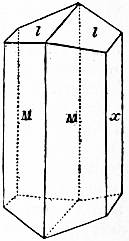
HORNBLENDE, an important member of the amphibole group of rock-forming minerals. The name is an old one of German origin, and was used for any dark-coloured prismatic crystals from which metals could not be extracted. It is now applied to the dark-coloured aluminous members of the monoclinic amphiboles, occupying in this group the same position that augite occupies in the pyroxene group. The monoclinic crystals are prismatic in habit with a six-sided cross-section; the angle between the prism-faces (M), parallel to which there are perfect cleavages, is 55° 49′. The colour (green, brown or black) and the specific gravity (3.0-3.3) vary with the amount of iron present. The pleochroism is always strong, and the angle of optical extinction on the plane of symmetry (x in the figure) varies from 0° to 37°. The chemical composition is expressed by mixtures in varying proportions of the molecules Ca(Mg, Fe)3(SiO3)4, (Mg, Fe)(Al, Fe)2SiO6 and NaAl(SiO3)2. Numerous varieties have been distinguished by special names: edenite, from Edenville in New York, is a pale-coloured aluminous amphibole containing little iron; pargasite, from Pargas near Abo in Finland, a green or bluish-green variety; common hornblende includes the greenish-black and black kinds containing more iron. The dark-coloured porphyritic crystals of basalts are known as basaltic hornblende.
Hornblende occurs as an essential constituent of many kinds of igneous rocks, such as hornblende-granite, syenite, diorite, hornblende-andesite, basalt, &c.; and in many crystalline schists, for example, amphibolite and hornblende-schist which are composed almost entirely of this mineral. Well-crystallized specimens are met with at many localities, for example: brilliant black crystals (syntagmatite) with augite and mica in the sanidine bombs of Monte Somma, Vesuvius; large crystals at Arendal in Norway, and at several places in the state of New York; isolated crystals from the basalts of Bohemia.
(L. J. S.)
HORN-BOOK, a name originally applied to a sheet containing the letters of the alphabet, which formed a primer for the use of children. It was mounted on wood and protected with transparent horn. Sometimes the leaf was simply pasted against the slice of horn. The wooden frame had a handle, and it was usually hung at the child’s girdle. The sheet, which in ancient times was of vellum and latterly of paper, contained first a large cross—the criss-crosse—from which the horn-book was called the Christ Cross Row, or criss-cross-row. The alphabet in large and small letters followed. The vowels then formed a line, and their combinations with the consonants were given in a tabular form. The usual exorcism—“in the name of the Father and of the Sonne and of the Holy Ghost, Amen”—followed, then the Lord’s Prayer, the whole concluding with the Roman numerals. The horn-book is mentioned in Shakespeare’s Love’s Labour’s Lost, v. 1, where the ba, the a, e, i, o, u, and the horn, are alluded to by Moth. It is also described by Ben Jonson—
“The letters may be read, through the horn, That make the story perfect.”
HORNBY, SIR GEOFFREY THOMAS PHIPPS (1825-1895), British admiral of the fleet, son of Admiral Sir Phipps Hornby, the first cousin and brother-in-law of the 13th earl of Derby, by a daughter of Lieut.-General Burgoyne, commonly distinguished as “Saratoga” Burgoyne, was born on the 20th of February 1825. At the age of twelve he was sent to sea in the flagship of Sir Robert Stopford, with whom he saw the capture of Acre in November 1840. He afterwards served in the flagship of Rear-Admiral Josceline Percy at the Cape of Good Hope, was flag-lieutenant to his father in the Pacific, and came home as a commander. When the Derby ministry fell in December 1852 young Hornby was promoted to be captain. Early in 1853 he married, and as the Derby connexion put him out of favour with the Aberdeen ministry, and especially with Sir James Graham, the first lord of the Admiralty, he settled down in Sussex as manager of his father’s property. He had no appointment in the navy till 1858, when he was sent out to China to take command of the “Tribune” frigate and convey a body of marines to Vancouver Island, where the dispute with the United States about the island of San Juan was threatening to become very bitter. As senior naval officer there Hornby’s moderation, temper and tact did much to smooth over matters, and a temporary arrangement for joint occupation of the island was concluded. He afterwards commanded the “Neptune” in the Mediterranean under Sir William Fanshawe Martin, was flag-captain to Rear-Admiral Dacres in the Channel, was commodore of the squadron on the west coast of Africa, and, being promoted to rear-admiral in January 1869, commanded the training squadron for a couple of years. He then commanded the Channel Fleet, and was for two years a junior lord of the Admiralty. It was early in 1877 that he went out as commander-in-chief in the Mediterranean, where his skill in manœuvring the fleet, his power as a disciplinarian, and the tact and determination with which he conducted the foreign relations at the time of the Russian advance on Constantinople, won for him the K. C. B. He returned home in 1880 with the character of being perhaps the most able commander on the active list of the navy. His later appointments were to the Royal Naval College as president, and afterwards to Portsmouth as commander-in-chief. On hauling down his flag he was appointed G. C. B., and in May 1888 was promoted to be admiral of the fleet. From 1886 he was principal naval aide-de-camp to Queen Victoria, and in that capacity, and as an admiral of the fleet, was appointed on the staff of the German emperor during his visits to England in 1889 and 1890. He died, after a short illness, on the 3rd of March 1895. By his wife, who predeceased him, he left several children, daughters and sons, one of whom, a major in the artillery, won the Victoria Cross in South Africa in 1900.
His life was written by his daughter, Mrs Fred. Egerton, (1896).
HORNCASTLE, a market-town in the S. Lindsey or Horncastle parliamentary division of Lincolnshire, England, at the foot of a line of low hills called the Wolds, at the confluence of the Bain and Waring streams; the terminus of a branch line of the Great Northern railway, 130 m. N. from London. Pop. of urban district (1901) 4038. The church of St Mary is principally Decorated and Perpendicular, with some Early English remains and an embattled western tower. Queen Elizabeth’s grammar school was founded in 1562. Other buildings are an exchange, a court-house and a dispensary founded in 1789. The prosperity of the town is chiefly dependent on agriculture and its well-known horse fairs. Brewing and malting are carried on, and there is some trade in coal and iron.
Remains have been found here which may indicate the existence of a Roman village. The manor of Horncastle (Hornecastre) belonged to Queen Edith in Saxon times and was royal demesne in 1086 and the head of a large soke. In the reign of Stephen it apparently belonged to Alice de Cundi, a partisan of the empress Maud, and passing to the crown on her death it was granted by Henry III. to Gerbald de Escald, from whom it descended to Ralph de Rhodes, who sold it to Walter Mauclerc, bishop of Carlisle in 1230. The see of Carlisle retained it till the reign of Edward VI. when it was granted to Edward, Lord Clinton, but was recovered in the following reign. In 1230 Henry III. directed the men of Horncastle to render a reasonable aid to the bishop, who obtained the right to try felons, hold a court leet and have free warren. An inquisition of 1275 shows that the bishop had then, besides the return of writs, the assize of bread and ale and waifs and strays in the soke. Horncastle was a centre of the Lincolnshire rebellion of 1536. Royalist troops occupied the town in 1643, and were pursued through its streets after the battle fought at Winceby. It was never a municipal or parliamentary borough, but during the middle ages it was frequently the residence of the bishops of Carlisle. Its prosperity has always depended largely on its fairs, the great horse fair described by George Borrow in Romany Rye being granted to the bishop in 1230 for the octave of St Lawrence, together with the fair on the feast of St Barnabas. The three other fairs are apparently of later date.
See George Weir, Historical and Descriptive Sketches of the Town and Soke of Horncastle in the County of Lincoln and of Several Places adjacent (London, 1820).
HORN DANCE, a medieval dance, still celebrated during the September “wakes” at Abbots Bromley, a village on the borders of Needwood Forest, Staffordshire. Six or seven men, each wearing a deer’s skull with antlers, dance through the streets, pursued by a comrade who bestrides a mimic horse, and whips the dancers to keep them on the move. The horn-dance usually takes place on the Monday after Wakes Sunday, which is the Sunday next after the 4th of September. Originally the dance took place on a Sunday.
See Strand Magazine for November 1896; also Folk-lore, vol. vii. (1896), p. 381.
HORNE, GEORGE (1730-1792), English divine, was born on the 1st of November 1730, at Otham near Maidstone, and received his education at Maidstone school and University College, Oxford. In 1749 he became a fellow of Magdalen, of which college he was elected president in 1768. As a preacher he early attained great popularity, and was, albeit unjustly, accused of Methodism. His reputation was helped by several clever if somewhat wrong-headed publications, including a satirical pamphlet entitled The Theology and Philosophy of Cicero’s Somnium Scipionis (1751), a defence of the Hutchinsonians in A Fair, Candid and Impartial State of the Case between Sir Isaac Newton and Mr Hutchinson (1753), and critiques upon William Law (1758) and Benjamin Kennicott (1760). In 1771 he published his well-known Commentary on the Psalms. a series of expositions based on the Messianic idea. In 1776 he was chosen vice-chancellor of his university; in 1781 he was made dean of Canterbury, and in 1790 was raised to the see of Norwich. He died at Bath on the 17th of January 1792.
His collected Works were published with a Memoir by William Jones in 1799.
HORNE, RICHARD HENRY, or HENGIST (1803-1884), English poet and critic, was born in London on New Year’s Day 1803. He was intended for the army, and entered at Sandhurst, but receiving no commission, he left his country and joined the Mexican navy. He served in the war against Spain, and underwent many adventures. Returning to England, he became a journalist, and in 1836-1837 edited The Monthly Repository. In 1837 he published two tragedies, Cosmo de Medici and The Death of Marlowe, and in 1841 a History of Napoleon. The book, however, by which he lives is his epic of Orion, which appeared in 1843. It was published originally at a farthing, was widely read, and passed through many editions. In the next year he set forth a volume of critical essays called A New Spirit of the Age, in which he was assisted by Elizabeth Barrett (Mrs Browning), with whom, from 1839 to her marriage in 1846, he conducted a voluminous correspondence. In 1852 he went to Australia in company with William Howitt, and did not return to England until 1869. He received a Civil List pension in 1874, and died at Margate on the 13th of March 1884. Horne possessed extraordinary versatility, but, except in the case of Orion, he never attained to a very high degree of distinction. That poem, indeed, has much of the quality of fine poetry; it is earnest, vivid and alive with spirit. But Horne early drove his talent too hard, and continued to write when he had little left to say. In criticism he had insight and quickness. He was one of the first to appreciate Keats and Tennyson, and he gave valuable encouragement to Mrs Browning when she was still Miss Elizabeth Barrett.
HORNE, THOMAS HARTWELL (1780-1862), English theologian and bibliographer, was born in London on the 20th of October 1780, and was educated at Christ’s Hospital, with S. T. Coleridge as an elder contemporary. On leaving school he became clerk to a barrister, but showed a keen taste for authorship. As early as 1800 he published A Brief View of the Necessity and Truth of the Christian Revelation, which was followed by several minor works on very varied subjects. In 1814, having been appointed librarian of the Surrey Institution, he issued his Introduction to the Study of Bibliography. This was followed in 1818 by his long matured work, the Introduction to the Critical Study of the Holy Scriptures, which rapidly attained popularity, and secured for its author widespread fame and an honorary M.A. degree from Aberdeen. In 1819 he received ordination from William Howley, bishop of London, and after holding two smaller livings was appointed rector of the united parishes of St Edmund the King and Martyr, and St Nicolas Acons in London. On the breaking up of the Surrey Institution in 1823, he was appointed (1824) senior assistant librarian in the department of printed books in the British Museum. After the project of making a classified catalogue had been abandoned, he took part in the preparation of the alphabetical one, and his connexion with the museum continued until within a few months of his death on the 27th of January 1862.
Horne’s works exceed forty in number. The Introduction, edited by John Ayre and S. P. Tregelles, reached a 12th edition in 1869; but, owing to subsequent advances in biblical scholarship, it fell into disuse.
HORNELL, a city of Steuben county, New York, U.S.A., on the Canisteo river, 90 m. S.E. of Buffalo. Pop. (1890) 10,996; (1900) 11,918, of whom 1230 were foreign-born; (1910 census) 13,617. Hornell is served by the Erie and the Pittsburg, Shawmut & Northern railways; the latter connects at Wayland (20 m. distant by rail) with the Delaware, Lackawanna & Western railroad. In the city are St Ann’s Academy, the St James Mercy Hospital, the Steuben Sanitarium, a public library, and a county court-house—terms of the county court being held here as well as in Bath (pop. in 1905, 3695), the county-seat, and in Corning. Hornell has extensive car shops of the Erie railroad, and among its manufactures are silk goods (silk gloves being a specially important product), sash, doors and blinds, leather, furniture, shoes, white-goods, wire-fences, foundry and machine shop products, electric motors, and brick and tile. The value of the factory product in 1905 was $3,162,677, an increase of 30.1% since 1900. The first settlement here was made in 1790, within the district of Erwin (then in Ontario county); after 1796 it was a part of Canisteo township, and the settlement itself was known as Upper Canisteo until 1820, when a new township was formed and named Hornellsville in honour of Judge George Hornell (d. 1813). The village of Hornellsville was incorporated in 1852, and in 1888 was chartered as a city; and by act of the state legislature the name was changed to Hornell in 1906.
See G. H. McMaster, History of the Settlement of Steuben County (Bath, New York, 1849).
HORNEMANN, FREDERICK (fl. 1796-1800), German traveller in Africa, was born at Hildesheim. He was a young man when, early in 1796, he offered his services to the African Association of London as an explorer in Africa. By the association he was sent to Göttingen University to study Arabic and otherwise prepare for an expedition into the unknown regions of North Africa from the east. In September 1797 he arrived in Egypt, where he continued his studies. On the invasion of the country by the French he was confined in the citadel of Cairo, to preserve him from the fanaticism of the populace. Liberated by the French, he received the patronage of Bonaparte. On the 5th of September 1798 he joined a caravan returning to the Maghrib from Mecca, attaching himself to a party of Fezzan merchants who accompanied the pilgrims. As an avowed Christian would not have been permitted to join the caravan Hornemann assumed the character of a young mameluke trading to Fezzan. He then spoke, but indifferently, both Arabic and Turkish, and he was accompanied as servant and interpreter by Joseph Freudenburg, a German convert to Islam, who had thrice made the pilgrimage to Mecca. Travelling by way of the oases of Siwa and Aujila, a “black rocky desert” was traversed to Temissa in Fezzan. Murzuk was reached on the 17th of November 1798. Here Hornemann lived till June 1799, going thence to the city of Tripoli, whence in August of the same year he despatched his journals to London. He then returned to Murzuk. Nothing further is known with certainty concerning him or his companion. In Murzuk Hornemann had collected a great deal of trustworthy information concerning the peoples and countries of the western Sahara and central Sudan, and when he left Tripoli it was his intention to go direct to the Hausa country, which region he was the first European definitely to locate. “If I do not perish in my undertaking,” he wrote in his journal, “I hope in five years I shall be able to make the Society better acquainted with the people of whom I have given this short description.” The British consul at Tripoli heard from a source believed to be trustworthy that about June 1803 Jusef (Hornemann’s Mahommedan name) was at Caśna, i.e. Katsena, in Northern Nigeria, “in good health and highly respected as a marabout.” A report reached Murzuk in 1819 that the traveller had gone to “Noofy” (Nupe), and had died there. Hornemann was the first European in modern times to traverse the north-eastern Sahara, and up to 1910 no other explorer had followed his route across the Jebel-es-Suda from Aujila to Temissa.
The original text of Hornemann’s journal, which was written in German, was printed at Weimar in 1801; an English translation, Travels from Cairo to Mourzouk, &c., with maps and dissertations by Major James Rennell, appeared in London in 1802. A French translation of the English work, made by order of the First Consul, and augmented with notes and a memoir on the Egyptian oases by L. Langlès, was published in Paris in the following year. The French version is the most valuable of the three. Consult also the Proceedings of the African Association (1810), and the Geog. Jnl. Nov. 1906.
HORNER, FRANCIS (1778-1817), British economist, was born at Edinburgh on the 12th of August 1778. After passing through the usual courses at the high school and university of his native city, he devoted five years, the first two in England, to comprehensive but desultory study, and in 1800 was called to the Scottish bar. Desirous, however, of a wider sphere, Horner removed to London in 1802, and occupied the interval that elapsed before his admission to the English bar in 1807 with researches in law, philosophy and political economy. In February 1806 he became one of the commissioners for adjusting the claims against the nawab of Arcot, and in November entered parliament as member for St Ives. Next year he sat. for Wendover, and in 1812 for St Mawes, in the patronage of the marquis of Buckingham. In 1811, when Lord Grenville was organizing a prospective ministry, Horner had the offer, which he refused, of a treasury secretaryship. He had resolved not to accept office till he could afford to live out of office; and his professional income, on which he depended, was at no time proportionate to his abilities. His labours at last began to tell upon a constitution never robust, and in October 1816 his physicians ordered him to Italy, where, however, he sank under his malady. He died at Pisa, on the 8th of February 1817. He was buried at Leghorn, and a marble statue by Chantrey was erected to his memory in Westminster Abbey.
Without the advantages of rank, or wealth, or even of genius, Francis Horner rose to a high position of public influence and private esteem. His special field was political economy. Master of that subject, and exercising a sort of moral as well as intellectual influence over the House of Commons he, by his nervous and earnest rather than eloquent style of speaking, could fix its attention for hours on such dry topics as finance, and coinage, and currency. As chairman of the parliamentary committee for investigating the depreciation of bank-notes, for which he moved in 1810, he extended and confirmed his fame as a political economist by his share in the famous Bullion Report. It was chiefly through his efforts that the paper-issue of the English banks was checked, and gold and silver reinstated in their true position as circulating media; and his views on free trade and commerce have been generally accepted at their really high value. Horner was one of the promoters of the Edinburgh Review in 1802. His articles in the early numbers of that publication, chiefly on political economy, form his only literary legacy.
See Memoirs and Correspondence of Francis Horner, M.P., published by his brother (see below) in 1843. Also the Edinburgh and Quarterly Reviews for the same year; and Blackwood’s Magazine, vol. i.
HORNER, LEONARD (1785-1864), Scottish geologist, brother of Francis Horner (above), was born in Edinburgh on the 17th of January 1785. His father, John Horner, was a linen merchant in Edinburgh, and Leonard, the third and youngest son, entered the university of Edinburgh in 1799. There in the course of the next four years he studied chemistry and mineralogy, and gained a love of geology from Playfair’s Illustrations of the Huttonian Theory. At the age of nineteen he became a partner in a branch of his father’s business, and went to London. In 1808 he joined the newly formed Geological Society and two years later was elected one of the secretaries. Throughout his long life he was ardently devoted to the welfare of the society; he was elected president in 1846 and again in 1860. In 1811 he read his first paper “On the Mineralogy of the Malvern Hills” (Trans. Geol. Soc. vol. i.) and subsequently communicated other papers on the “Brine-springs at Droitwich,” and the “Geology of the S.W. part of Somersetshire.” He was elected F.R.S. in 1813. In 1815 he returned to Edinburgh to take personal superintendence of his business, and while there (1821) he was instrumental in founding the Edinburgh School of Arts for the instruction of mechanics, and he was one of the founders of the Edinburgh Academy. In 1827 he was invited to London to become warden of the London University, an office which he held for four years; he then resided at Bonn for two years and pursued the study of minerals and rocks, communicating to the Geological Society on his return a paper on the “Geology of the Environs of Bonn,” and another “On the Quantity of Solid Matter suspended in the Water of the Rhine.” In 1833 he was appointed one of the commissioners to inquire into the employment of children in the factories of Great Britain, and he was subsequently selected as one of the inspectors. In later years he devoted much attention to the geological history of the alluvial lands of Egypt; and in 1843 he published his Life of his brother Francis. He died in London on the 5th of March 1864.
See Memoir of Leonard Horner, by Katherine M. Lyell (1890) (privately printed).
HÖRNES, MORITZ (1815-1868), Austrian palaeontologist, was born in Vienna on the 14th of July 1815. He was educated in the university and graduated Ph.D. He then became assistant in the Vienna mineralogical museum. He was distinguished for his researches on the Tertiary mollusca of the Vienna Basin, and on the Triassic mollusca of Alpine regions. Most of his memoirs were published in the Jahrbuch der K. K. geol. Reichsanstalt. In 1864 he introduced the term Neogene to include Miocene and Pliocene, as these formations are not always to be clearly separated: the fauna of the lower division being subtropical and gradually giving place in the upper division to Mediterranean forms. He died in Vienna on the 4th of November 1868. His son Dr Rudolf Hörnes (b. 1850), professor of geology and palaeontology in the university of Graz, has also carried on researches among the Tertiary mollusca, and is author of Elemente der Palaeontologie (1884).
HORNFELS (a German word meaning hornstone), the group designation for a series of rocks which have been baked and indurated by the heat of intrusive granitic masses and have been rendered massive, hard, splintery, and in some cases exceedingly tough and durable. Most hornfelses are fine-grained, and while the original rocks (such as sandstone, shale and slate, limestone and diabase) may have been more or less fissile owing to the presence of bedding or cleavage planes, this structure is effaced or rendered inoperative in the hornfels. Though they may show banding, due to bedding, &c., they break across this as readily as along it; in fact they tend to separate into cubical fragments rather than into thin plates. The commonest hornfelses (the “biotite hornfelses”) are dark-brown to black with a somewhat velvety lustre owing to the abundance of small crystals of shining black mica. The “lime hornfelses” are often white, yellow, pale-green, brown and other colours. Green and dark-green are the prevalent tints of the hornfelses produced by the alteration of igneous rocks. Although for the most part the constituent grains are too small to be determined by the unaided eye, there are often larger crystals of garnet or andalusite scattered through the fine matrix, and these may become very prominent on the weathered faces of the rock.
The structure of the hornfelses is very characteristic. Very rarely do any of the minerals show crystalline form, but the small grains fit closely together like the fragments of a mosaic; they are usually of nearly equal dimensions and from the resemblance to rough pavement work this has been called pflaster structure or pavement structure. Each mineral may also enclose particles of the others; in the quartz, for example, small crystals of graphite, biotite, iron oxides, sillimanite or felspar may appear in great numbers. Often the whole of the grains are rendered semi-opaque in this way. The minutest crystals may show traces of crystalline outlines; undoubtedly they are of new formation and have originated in situ. This leads us to believe that the whole rock has been recrystallized at a high temperature and in the solid state, so that there was little freedom for the mineral molecules to build up well-individualized crystals. The regeneration of the rock has been sufficient to efface most of the original structures and to replace the former minerals more or less completely by new ones. But crystallization has been hampered by the solid condition of the mass and the new minerals are formless and have been unable to reject impurities, but have grown around them.
Slates, shales and clays yield biotite hornfelses in which the most conspicuous mineral is black mica, in small scales which under the microscope are transparent and have a dark reddish-brown colour and strong dichroism. There is also quartz, and often a considerable amount of felspar, while graphite, tourmaline and iron oxides frequently occur in lesser quantity. In these biotite hornfelses the minerals, which consist of aluminium silicates, are commonly found; they are usually andalusite and sillimanite, but kyanite appears also in hornfelses, especially in those which have a schistose character. The andalusite may be pink and is then often pleochroic in thin sections, or it may be white with the cross-shaped dark enclosures of the matrix which are characteristic of chiastolite. Sillimanite usually forms exceedingly minute needles embedded in quartz. In the rocks of this group cordierite also occurs, not rarely, and may have the outlines of imperfect hexagonal prisms which are divided up into six sectors when seen in polarized light. In biotite hornfelses a faint striping may indicate the original bedding of the unaltered rock and corresponds to small changes in the nature of the sediment deposited. More commonly there is a distinct spotting, visible on the surfaces of the hand specimens. The spots are round or elliptical, and may be paler or darker than the rest of the rock. In some cases they are rich in graphite or carbonaceous matters; in others they are full of brown mica; some spots consist of rather coarser grains of quartz than occur in the matrix. The frequency with which this feature reappears in the less altered slates and hornfelses is rather remarkable, especially as it seems certain that the spots are not always of the same nature or origin. “Tourmaline hornfelses” are found sometimes near the margins of tourmaline granites; they are black with small needles of schorl which under the microscope are dark brown and richly pleochroic. As the tourmaline contains boron there must have been some permeation of vapours from the granite into the sediments. Rocks of this group are often seen in the Cornish tin-mining districts, especially near the lodes.