VOLUME XIII SLICE VI Home, Daniel to Hortensius, Quintus (continued 10)
Reading edition
Eclipse: Young Eclipse (D), Saltram (D), Sergeant (D), Annette (O).
Herod: Bridget (O), Faith (O), Maid of the Oaks (O), Phenomenon (L).
Matchem: Teetotum (O), Hollandaise (L).
Florizel (son of Herod): Diomed (D), Eager (D), Tartar (L), Ninety-three (L).
Highflyer: Noble (D), Sir Peter Teazle (D), Skyscraper (D), Violante (O), Omphale (L), Cowslip (L), Spadille (L), Young Flora (L).
Pot-8-os: Waxy (D), Champion (D, L), Tyrant (D), Nightshade (O).
Sir Peter (D): Sir Harry (D), Archduke (D), Ditto (D), Paris (D), Hermione (O), Parasite (O), Ambrosio (L), Fyldener (L), Paulina (L), Petronius (L).
Waxy (D): Pope (D), Whalebone (D), Blucher (D), Whisker (D), Music (O), Minuet (O), Corinne (O).
Whalebone (D): Moses (D), Lapdog (D), Spaniel (D), Caroline (O).
Woful: Augusta (O), Zinc (O), Theodore (L).
Whisker (D): Memnon (L), The Colonel (L).
Phantom: Cedric (D), Middleton (D), Cobweb (O).
Orville (L): Octavius (D), Emilius (D), Ebor (L).
Tramp: St Giles (D), Dangerous (D), Barefoot (L).
Emilius (D): Priam (D), Plenipotentiary (D), Oxygen (O), Mango (L).
Priam (D): Miss Seltz (O), Industry (O), Crucifix (O).
Sir Hercules: Coronation (D), Faugh-a-Ballagh (L), Birdcatcher (L).
Touchstone (L): Cotherstone (D), Orlando (D), Surplice (D, L), Mendicant (O), Blue Bonnet (L), Newminster (L).
Birdcatcher (L): Daniel O’Rourke (D), Songstress (O), Knight of St George (L), Warlock (L), The Baron (L).
The Baron (L): Stockwell (L).
Melbourne: West Australian (D, L), Blink Bonny (D, O), Sir Tatton Sykes (L).
Newminster (L): Musjid (D), Hermit (D), Lord Clifden (L).
Sweetmeat: Macaroni (D), Mincemeat (O), Mincepie (O).
Stockwell (L): Blair Athol (D, L), Lord Lyon (D, L), Doncaster (D), Regalia (O), St Albans (L), Caller Ou (L), The Marquis (L), Achievement (L).
King Tom: Kingcraft (D), Tormentor (O), Hippia (O), Hannah (O, L).
Rataplan (son of the Baron): Kettledrum (D).
Monarque: Gladiateur (D, L).
Parmesan (son of Sweetmeat): Favonius (D), Cremorne (D).
Buccaneer: Kisber (D), Formosa (O, L), Brigantine (O).
Lord Clifden (L): Jannette (O, L), Hawthornden (L), Wenlock (L), Petrarch (L).
Adventurer: Pretender (D), Apology (O, L), Wheel of Fortune (O).
Blair Athol (D, L): Silvio (D, L), Craig Millar (L).
In regard to mares it has very frequently turned out that animals which were brilliant public performers have been far less successful as dams than others which were comparatively valueless as runners. Beeswing, a brilliant public performer, gave birth to a good horse in Newminster; the same may be said of Alice Hawthorn, dam of Thormanby, of Canezou, dam of Fazzoletto, of Crucifix, dam of Surplice, and of Blink Bonny, dam of Blair Athol; but many of the greatest winners have dropped nothing worth training. On the other hand, there are mares of little or no value as racers who have become the mothers of some of the most celebrated horses on the turf; among them we may cite Queen Mary, Pocahontas and Paradigm. Queen Mary, who was by Gladiator out of a daughter of Plenipotentiary and Myrrha by Whalebone, when mated with Melbourne produced Blink Bonny (winner of the Derby and Oaks); when mated with Mango and Lanercost she produced Haricot, dam of Caller Ou (winner of the St Leger). Pocahontas, perhaps the most remarkable mare in the Stud-Book, never won a race on the turf, but threw Stockwell and Rataplan to the Baron, son of Birdcatcher, King Tom to Harkaway, Knight of St Patrick to Knight of St George, and Knight of Kars to Nutwith—all these horses being 16 hands high and upwards, while Pocahontas was a long low mare of about 15 hands or a trifle more. She also gave birth to Ayacanora by Birdcatcher, and to Araucaria by Ambrose, both very valuable brood mares, Araucaria being the dam of Chamant by Mortemer, and of Rayon d’Or by Flageolet, son of Plutus by Touchstone. Paradigm again produced, among several winners of more or less celebrity, Lord Lyon (winner of the Two Thousand Guineas, Derby and St Leger) and Achievement (winner of the St Leger), both being by Stockwell. Another famous mare was Manganese (1853) by Birdcatcher from Moonbeam by Tomboy from Lunatic by the Prime Minister from Maniac by Shuttle. Manganese when mated with Rataplan threw Mandragora, dam of Apology, winner of the Oaks and St Leger, whose sire was Adventurer, son of Newminster. She also threw Mineral, who, when mated with Lord Clifden, produced Wenlock, winner of the St Leger, and after being sold to go to Hungary, was there mated with Buccaneer, the produce being Kisber, winner of the Derby.
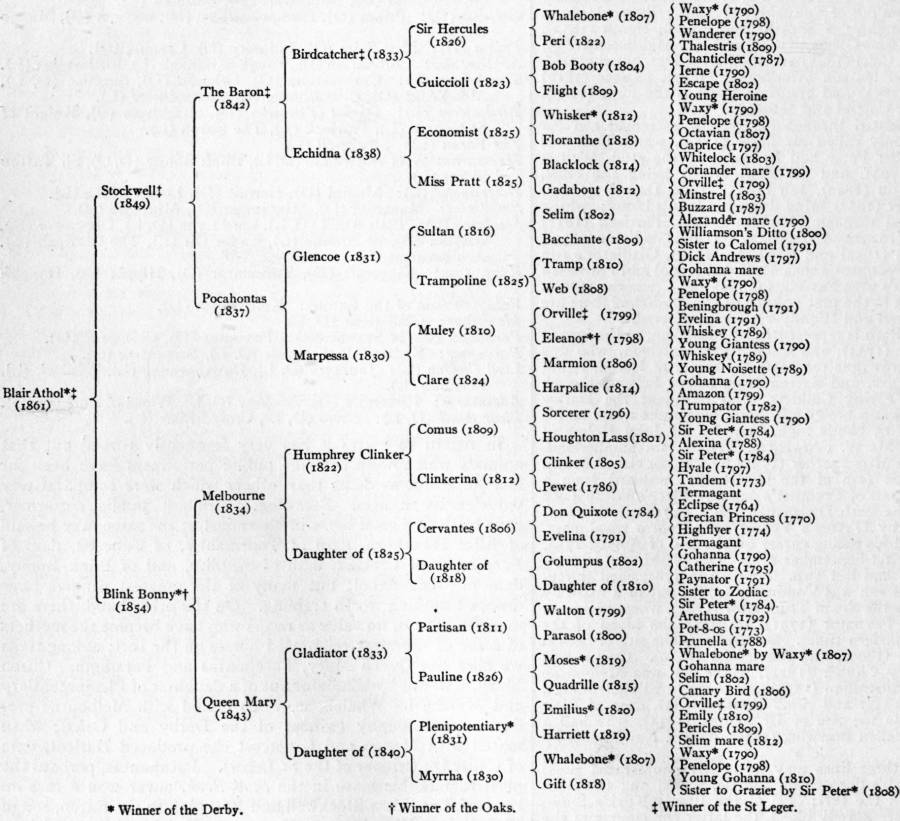
We append the pedigree of Blair Athol, winner of the Derby and St Leger in 1864, who, when subsequently sold by auction, fetched the then unprecedented sum of 12,000 guineas, as it contains, not only Stockwell (the emperor of stallions, as he has been termed), but Blink Bonny and Eleanor—in which latter animal are combined the blood of Eclipse, Herod, Matchem and Snap,—the mares that won the Derby in 1801 and 1857 respectively, as well as those queens of the stud, Eleanor’s great-granddaughter Pocahontas and Blink Bonny’s dam Queen Mary. Both Eleanor and Blink Bonny won the Oaks as well as the Derby.
The shape of a race-horse is of considerable importance, although it is said with some degree of truth that they win in all shapes. There are the neat and elegant animals, like the descendants of Saunterer and Sweetmeat; the large-framed, plain-looking, and heavy-headed Melbournes, often with lop ears; the descendants of Birdcatcher, full of quality, and of more than average stature, though sometimes disfigured with curby hocks; and the medium-sized but withal speedy descendants of Touchstone, though in some cases characterized by somewhat loaded shoulders. In height it will be found that the most successful racers average from 15 to 16½ hands, the former being considered somewhat small, while the latter is unquestionably very large; the mean may be taken as between 15½ and 16 hands (the hand = 4 in.). The head should be light and lean, and well set on; the ears small and pricked, but not too short; the eyes full; the forehead broad and flat; the nostrils large and dilating; the muzzle fine; the neck moderate in length, wide, muscular, and yet light; the throat clean; the windpipe spacious and loosely attached to the neck; the crest thin, not coarse and arched. The withers may be moderately high and thin; the chest well developed, but not too wide or deep; the shoulder should lie well on the chest, and be oblique and well covered with muscle, so as to reduce concussion in galloping; the upper and lower arms should be long and muscular; the knees broad and strong; legs short, flat and broad; fetlock joints large; pasterns strong and of moderate length; the feet should be moderately large, with the heels open and frogs sound—with no signs of contraction. The body or barrel should be moderately deep, long and straight, the length being really in the shoulders and in the quarters; the back should be strong and muscular, with the shoulders and loins running well in at each end; the loins themselves should have great breadth and substance, this being a vital necessity for weight-carrying and propelling power uphill. The hips should be long and wide, with the stifle and thigh strong, long and proportionately developed, and the hind quarters well let down. The hock should have plenty of bone, and be strongly affixed to the leg, and show no signs of curb; the bones below the hock should be flat, and free from adhesions; the ligaments and tendons well developed, and standing out from the bone; the joints well formed and wide, yet without undue enlargement; the pasterns and feet similar to those of the forehand. The tail should be high set on, the croup being continued in a straight line to the tail, and not falling away and drooping to a low-set tail. Fine action is the best criterion of everything fitting properly, and all a horse’s points ought to harmonize or be in proportion to one another, no one point being more prominent than another, such as good shoulders, fine loins or excellent quarters. If the observer is struck with the remarkable prominence of any one feature, it is probable that the remaining parts are deficient. A well-made horse wants dissecting in detail, and then if a good judge can discover no fault with any part, but finds each of good proportions, and the whole to harmonize without defect, deformity or deficiency, he has before him a well-shaped horse; and of two equally well-made and equitably proportioned horses the best bred one will be the best. As regards hue, the favourite colour of the ancients, according to Xenophon, was bay, and for a long time it was the fashionable colour in England; but for some time chestnut thoroughbreds have been the most conspicuous figure on English race-courses, so far as the more important events are concerned. Eclipse was a chestnut; Castrel, Selim and Rubens were chestnuts; so also were Glencoe and Pantaloon, of whom the latter had black spots on his hind quarters like Eclipse; and also Stockwell and Doncaster. Birdcatcher was a chestnut, so also were Stockwell and his brother Rataplan, Manganese, Mandragora, Thormanby, Kettledrum, St Albans, Blair Athol, Regalia, Formosa, Hermit, Marie Stuart, Doncaster, George Frederick, Apology, Craig Millar, Prince Charlie, Rayon d’Or and Bend Or. The dark browns or black browns, such as the Sweetmeat tribe, are not so common as the bays, and black or grey horses are almost as unusual as roans. The skin and hair of the throughbred are finer, and the veins which underlie the skin are larger and more prominent than in other horses. The mane and tail should be silky and devoid of curl, which is a sign of impurity.
Whether the race-horse of to-day is as good as the stock to which he traces back has often been disputed, chiefly no doubt because he is brought to more early maturity, commencing to win races at two years instead of at five years of age, as in the days of Childers and Eclipse; but the highest authorities, and none more emphatically than the late Admiral Rous, have insisted that he can not only stay quite as long as his ancestors, but also go a good deal faster. In size and shape the modern race-horse is unquestionably superior, being on an average fully a hand higher than the Eastern horses from which he is descended; and in elegance of shape and beauty of outline he has certainly never been surpassed. That experiments, founded on the study of his nature and properties, which have from time to time been made to improve the breed, and bring the different varieties to the perfection in which we now find them, have succeeded, is best confirmed by the high estimation in which the horses of Great Britain are held in all parts of the civilized world; and it is not too much to assert that, although the cold, humid and variable nature of their climate is by no means favourable to the production of these animals in their very best form, Englishmen have by great care, and by sedulous attention to breeding, high feeding and good grooming, with consequent development of muscle, brought them to the highest state of perfection of which their nature is capable.
(E. D. B.)
Plate I.
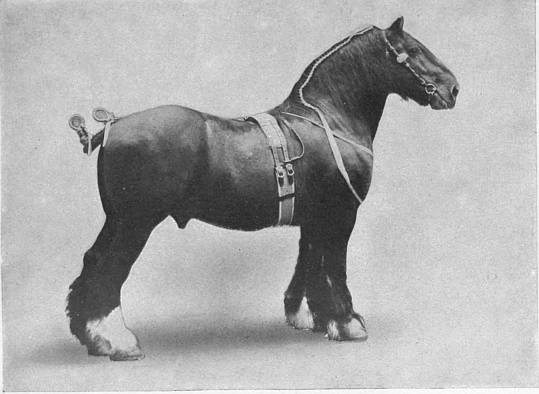
SHIRE STALLION.
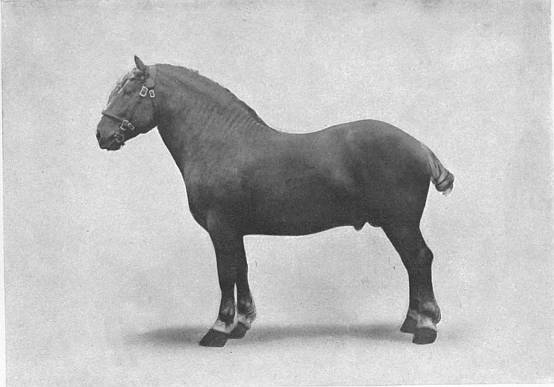
SUFFOLK STALLION.
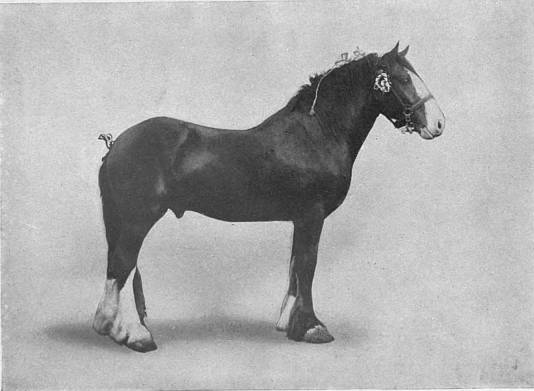
CLYDESDALE STALLION.
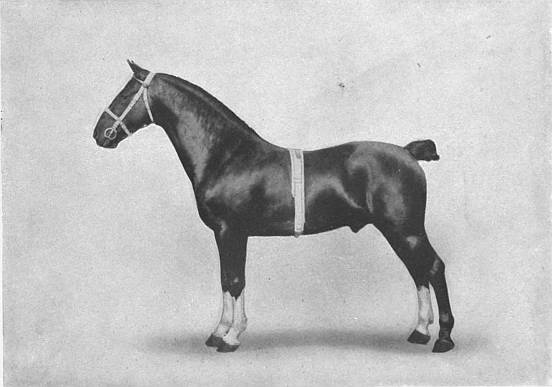
HACKNEY STALLION.
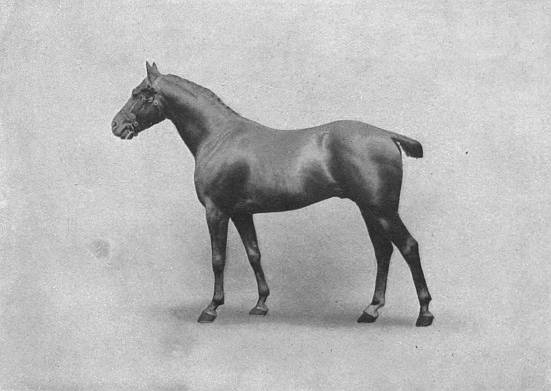
BREEDS OF HORSES. (From Photographs by F. Babbage.) The comparative sizes of the horses are shown.
Plate II.
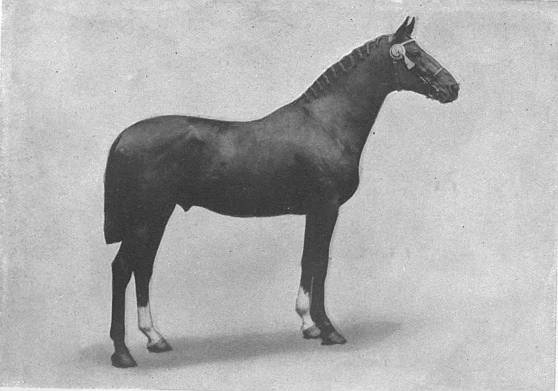
THOROUGHBRED STALLION.
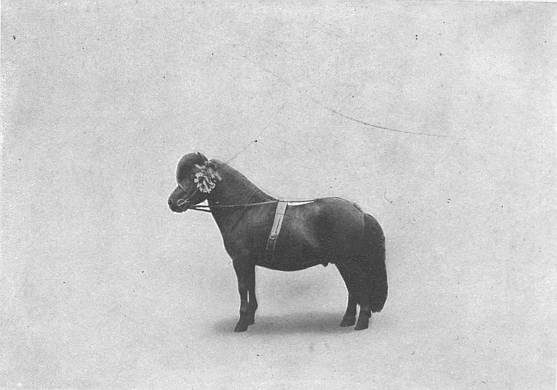
SHETLAND PONY STALLION.
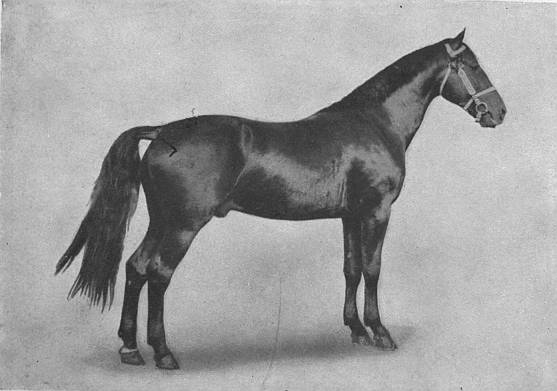
COACHING STALLION.
POLO PONY STALLION.
BREEDS OF HORSES. (From Photographs by F. Babbage.) The comparative sizes of the horses are shown.
Breeds of Horses
The British breeds of light horses include the Thoroughbred, the Yorkshire Coach-horse, the Cleveland Bay, the Hackney and the Pony; of heavy horses, the Shire, the Clydesdale and the Suffolk.
The Thoroughbred is probably the oldest of the breeds, and it is known as the “blood-horse” on account of the length of time through which its purity of descent can be traced. The frame is light, slender and graceful. The points of chief importance are a fine, clean, lean head, set on free from collar heaviness; a long and strongly muscular neck, shoulders oblique and covered with muscle; high, long withers, chest of good depth and narrow but not extremely so; body round in type; back rib well down; depth at withers a little under half the height; length equal to the height at withers and croup; loins level and muscular; croup long, rather level; tail set on high and carried gracefully; the hind quarters long, strongly developed, and full of muscle and driving power; the limbs clean-cut and sinewy, possessing abundance of good bone, especially desired in the cannons, which are short, broad and flat; comparatively little space between the fore legs; pastern joints smooth and true; pasterns strong, clean and springy, sloping when at rest at an angle of 45°; feet medium size, wide and high at the heels, concave below and set on straight. The action in trotting is generally low, but the bending of the knee and the flexing of the hock is smooth, free and true. The thoroughbred is apt to be nervous and excitable, and impatient of common work, but its speed, resolution and endurance, as tested on the race-course, are beyond praise.
Many of the best hunters in the United Kingdom are thoroughbreds, but of the substantial weight-carrying type. The Hunters Improvement Society, established in 1885, did not restrict entries to the Hunters’ Stud-Book to entirely clean-bred animals, but admitted those with breeding enough to pass strict inspection. This society acts in consort with two other powerful organizations (the Royal Commission on Horse-breeding, which began its work in 1888, and the Brood Mare Society, established in 1903), with the desirable object of improving the standard of light horse breeding. The initial efforts began by securing the services of thoroughbred stallions for specified districts, by offering a limited number of “Queen’s Premiums,” of £200 each, to selected animals of four years old and upwards. Since the formation of the Brood Mare Society mares have come within the sphere of influence of the three bodies, and well-conceived inducements are offered to breeders to retain their young mares at home. The efforts have met with gratifying success, and they were much needed, for while in 1904 the Dutch government took away 350 of the best young Irish mares, Great Britain was paying the foreigner over £2,000,000 a year for horses which the old system of management did not supply at home. The Royal Dublin Society also keeps a Register of Thoroughbred Stallions under the horse-breeding scheme of 1892, which, like the British efforts, is now bearing fruit.
The Yorkshire Coach-horse is extensively bred in the North and East Ridings of Yorkshire, and the thoroughbred has taken a share in its development. The colour is usually bay, with black or brown points. A fine head, sloping shoulders, strong loins, lengthy quarters, high-stepping action, flat bone and sound feet are characteristic. The height varies from 16 hands to 16 hands 2 in.
The Cleveland Bay is an ancestor of the Yorkshire Coach-horse and is bred in parts of Yorkshire, Durham and Northumberland. He is adapted alike for the plough, for heavy draught, and for slow saddle work. Some specimens make imposing-looking carriage horses, but they have low action and are lacking in quality. The colour is light or dark bay, with black legs. Though rather coarse-headed, the Cleveland Bay has a well-set shoulder and neck, a deep chest and round barrel. The height is from 16 to 17 hands.
The Hackney has come prominently to the front in recent years. The term Nag, applied to the active riding or trotting horse, is derived from the A.S. hnegan, to neigh. The Normans brought with them their own word haquenée, or hacquenée, a French derivative from the Latin equus, a horse, whence the name hackney. Both nag and hackney continue to be used as synonymous terms. Frequent mention is made of hackneys and trotters in old farm accounts of the 14th century. The first noteworthy trotting hackney stallion, of the modern type, was a horse foaled about 1755, and known as the Schales, Shields or Shales horse, and most of the recognized hackneys of to-day trace back to him. The breeding of hackneys is extensively pursued in the counties of Norfolk, Cambridge, Huntingdon, Lincoln and York, and in the showyard competitions a keen but friendly rivalry is usually to be noticed between the hackney-breeding farmers of Norfolk and Yorkshire. The high hackney action is uncomfortable in a riding horse. Excellent results have sometimes followed the use of hackney sires upon half-bred mares, i.e. by thoroughbred stallions and trotting mares, but it is not always so. As regards the movement, or “action,” of the hackney, he should go light in hand, and the knee should be well elevated and advanced during the trot, and, before the foot is put down, the leg should be well extended. The hackney should also possess good hock action, as distinguished from mere fetlock action, the propelling power depending upon the efficiency of the former. The hackney type of the day is “a powerfully built, short-legged, big horse, with an intelligent head, neat neck, strong, level back, powerful loins, and as perfect shoulders as can be obtained, good feet, flat-boned legs, and a height of from 15 hands 2 in. to 15 hands 3½ in.” Carriage-horses hackney-bred have been produced over 17 hands high.
The Pony differs essentially from the hackney in height, the former not exceeding 14 hands. There is one exception, which is made clear in the following extract from Sir Walter Gilbey’s Ponies Past and Present (1900):—
Before the establishment of the Hackney Horse Society in 1883 the dividing line between the horse and the pony in England was vague and undefined. It was then found necessary to distinguish clearly between horses and ponies, and, accordingly, all animals measuring 14 hands or under were designated “ponies,” and registered in a separate part of the (Hackney) Stud-Book. This record of height, with other particulars as to breeding, &c., serves to direct breeders in their choice of sires and dams. The standard of height established by the Hackney Horse Society was accepted and officially recognized by the Royal Agricultural Society in 1889, when the prize-list for the Windsor show contained pony classes for animals not exceeding 14 hands. The altered polo-rule, which fixes the limit of height at 14 hands 2 in., may be productive of some little confusion; but for all other purposes 14 hands is the recognized maximum height of a pony. Prior to 1883 small horses were called indifferently Galloways, hobbies, cobs or ponies, irrespective of their height.
Native ponies include those variously known as Welsh, New Forest, Exmoor, Dartmoor, Cumberland and Westmorland, Fell, Highland, Highland Garron, Celtic, Shetland and Connemara. Ponies range in height from 14 hands down to 8 hands, Shetland ponies eligible for the Stud-Book not exceeding the latter. As in the case of the hackney, so with the pony, thoroughbred blood has been used, and with good results, except in the case of those animals which have to remain to breed in their native haunts on the hills and moorlands. There the only possible way of improvement is by selecting the best native specimens, especially the sires, to breed from. The thin-skinned progeny of thoroughbred or Arab stock is too delicate to live unless when hand-fed—and hand-feeding is not according to custom. Excellent polo ponies are bred as first or second crosses by thoroughbred stallions on the mares of nearly all the varieties of ponies named. The defective formation of the pony, the perpendicular shoulder and the drooping hind quarters, are modified; but neither the latter, nor bent hocks, which place the hind legs under the body as in the zebra, are objected to, as the conformation is favourable to rapid turning. One object of the pony breeder, while maintaining hardiness of constitution, is to control size—to compress the most valuable qualities into small compass. He endeavours to breed an animal possessing a small head, good shoulders, true action and perfect manners. A combination of the best points of the hunter with the style and finish of the hackney produces a class of weight-carrying pony which is always saleable.
The Shire horse owes its happily-chosen name to Arthur Young’s remarks, in the description of his agricultural tours during the closing years of the 18th century, concerning the large Old English Black Horse, “the produce principally of the Shire counties in the heart of England.” Long previous to this, however, the word Shire, in connexion with horses, was used in the statutes of Henry VIII. Under the various names of the War Horse, the Great Horse, the Old English Black Horse and the Shire Horse, the breed has for centuries been cultivated in the rich fen-lands of Lincolnshire and Cambridgeshire, and in many counties to the west. The Shire is the largest of draught horses, the stallion commonly attaining a height of 17 to 17.3 hands. Though the black colour is still frequently met with, bay and brown are more usually seen. With their immense size and weight—1800 ℔ to 2200 ℔—the Shires combine great strength, and they are withal docile and intelligent. They stand on short stout legs, with a plentiful covering—sometimes too abundant—of long hair extending chiefly down the back but also round the front of the limbs from knees and hocks, and when in full feather obscuring nearly the whole of the hoofs. The head is a good size, and broad between the eyes; the neck fairly long, with the crest well arched on to the shoulders, which are deep and strong, and moderately oblique. The chest is wide, full and deep, the back short and straight, the ribs are round and deep, the hind quarters long, level and well let down into the muscular thighs. The cannon-bones should be flat, heavy and clean, and the feet wide, tough, and prominent at the heels. A good type of Shire horse combines symmetrical outlines and bold, free action. There is a good and remunerative demand for Shire geldings for use as draught horses in towns.
The Clydesdale, the Scottish breed named from the valley of the Clyde, is not quite so large as the Shire, the average height of stallions being about 16 hands 2 in. The popular colour is bay, particularly if of a dark shade, or dappled. Black is not uncommon, but grey is not encouraged. White markings on one or more of the legs, with a white star or stripe on the face, are characteristic. The long hair on the legs is not so abundant as in the Shires, and it is finer in texture. It is regarded as an indication of good bone. The bones of the legs should be short, flat, clean and hard; the feet large, with hoofs deep and concave below. With its symmetry, activity, strength and endurance the Clydesdale is easily broken to harness, and makes an excellent draught horse. This breed is growing rapidly in favour in Canada, but in the United States the Percheron, with its round bone and short pasterns, holds the field. A blend of the Shire and Clydesdale strains of the British rough-legged draught horse (virtually sections of the same breed) is a better animal than either of the parents. It is an improvement upon the Shire due to the quality contributed by the Clydesdale, and it surpasses the Clydesdale in strength and substance, as a result of the Shire connexion. To secure success the two Stud-Books will require to be opened to animals eligible to be entered in either record. The blend is being established in U.S.A. as a National breed.
The Suffolk is a horse quite distinct from the Shire and the Clydesdale. Its body looks too heavy for its limbs, which are free from the “feather” so much admired in the two other heavy breeds; it possesses a characteristic chestnut colour. How long the Suffolks have been associated with the county after which they are named is unknown, but they are mentioned in 1586 in Camden’s Britannia. With an average height of about 16 hands they often have a weight of as much as 2000 ℔., and this may explain the appearance which has given rise to the name of the Suffolk Punch, by which the breed is known. The Suffolk is a resolute and unwearying worker, and is richly endowed with many of the best qualities of a horse. The Suffolk Stud-Book and History of the Breed, published in 1880, is the most exhaustive record of its kind in England.
(W. Fr.; R. W.)
Management
Breeding.—Animals to breed from should be of good blood, sound and compactly built, with good pluck and free from nervous excitability and vicious tendency. A mare used to be put to the horse at three years old, but latterly two has become the common age. Young sires begin to serve in moderation at two. May is considered the best month for a mare to foal, as there is abundance of natural food and the weather is mild enough for the mare to lie out. Show specimens generally profit by being born earlier. The period of gestation in the mare is about eleven months. No nursing mare should go to work, if this can possibly be avoided. A brood mare requires plenty of exercise at a slow pace and may work, except between shafts or on a road, till the day of foaling.
To avoid colic an animal has to be gradually prepared by giving small quantities of green food for a few days before going to grass. Shelter against severe storms is needed. Succulent food encourages the flow of milk, and the success of the foal greatly depends on its milk supply. Mares most readily conceive when served at the “foal heat” eleven days after foaling. A mature stallion can serve from eighty to one hundred mares per annum.
Foals are weaned when five or six months old, often in October, and require to be housed to save the foal-flesh, and liberally but not overfed; but from the time they are a month old they require to be “gentled” by handling and kindly treatment, and the elementary training of leading from time to time by a halter adjusted permanently to the head. When they are hand-reared on cow’s milk foals require firm treatment and must have no fooling to teach them tricks. Young horses that are too highly fed are apt to become weak-limbed and top-heavy.
Breaking.—Systematic breaking begins at about the age of two years, and the method of subduing a colt by “galvayning” is as good as any. It is a more humane system than “rareying,” which overcame by exhaustion under circumstances which were not fruitful of permanent results. Galvayning is accomplished by bending the horse’s neck round at an angle of thirty-five to forty degrees and tieing the halter to the tail, so that when he attempts to walk forward he holds himself and turns “round and round, almost upon his own ground.” The more strenuous his resistance the sooner he yields to the inevitable force applied by himself. A wooden pole, the “third hand,” is then gently applied to all parts of the body until kicking or any form of resistance ceases. “Bitting” or “mouthing,” or the familiarizing of an animal to the bit in his mouth, and to answer to the rein without bending his neck, is still a necessity with the galvayning method of breaking. Experience can only be gained by a horse continuing during a considerable time to practise what he has been taught.
Three main characteristics of a successful horse-breaker are firmness, good temper and incessant vigilance. Carelessness in trusting too much to a young colt that begins its training by being docile is a fruitful source of untrustworthy habits which need never have developed. Driving with long reins in the field should precede the fastening of ropes to the collar, as it accustoms the animal to the pressure on the shoulders of the draught, later to be experienced in the yoke. If a young horse be well handled and accustomed to the dummy jockey, mounting it is not attended with much risk of resistance, although this should invariably be anticipated. An animal ought to be in good condition when being broken in, else it is liable to break out in unpleasant ways when it becomes high-spirited as a result of improved condition. It should be well but not overfed, and while young not overworked, as an overtired animal is liable to refuse to pull, and thus contract a bad habit. Most bad habits and stable tricks are the result of defective management and avoidable accidents.
Feeding.—Horses have small stomachs relatively to ruminating animals, and require small quantities of food frequently. While grazing they feed almost continually, preferring short pasture. No stable food for quick work surpasses a superior sample of fine-hulled whole oats like “Garton’s Abundance” (120 ℔ per week), and Timothy hay harvested in dry weather. The unbruised oats develop a spirit and courage in either a saddle or harness horse that no other food can. A double handful of clean chaff, or of bran mixed with the oats in the manger, prevents a greedy horse from swallowing a considerable proportion whole. Unchewed oats pass out in the faeces uninjured, so that they are capable of germination, and are of less than no value to a horse. Horses doing slow or other than “upper ten” work may have oats crushed, not ground, and a variety of additions made to the oats which are usually the basis of the feed—for example, a few old crushed beans, a little linseed meal, ground linseed cake or about a wine-glassful of unboiled linseed oil. Indian pulses are to be avoided on account of the danger of Lathyrus poisoning. A seasoning of ground fenugreek or spice is sometimes given to shy feeders to encourage them to eat. A little sugar or molascuit added to the food will sometimes serve the same purpose. Newly crushed barley or cracked maize, even in considerable proportion to the rest of the food, gives good results with draught, coach, ’bus and light harness horses generally. Boiled food of any kind is unnatural to a horse, and is risky to give, being liable to produce colic, especially if the animal bolts its food when hungry, although it generally produces a glossy coat. Too much linseed, often used in preparing horses for market, gives a similar appearance, but is liable to induce fatty degeneration of the liver; given in moderation it regulates the bowels and stimulates the more perfect digestion of other foods. In England red-clover hay, or, better still, crimson-clover or lucerne hay, is liberally fed to farm horses with about 10 ℔ per day of oats, while they usually run in open yards with shelter sheds. Bean straw is sometimes given as part of the roughage in Scotland, but not in England. In England hunters and carriage horses are generally fed on natural hay, in Scotland on Timothy, largely imported from Canada, or ryegrass hay that has not been grown with nitrate of soda. Heavily nitrated hay is reputed to produce excessive urination and irritation of the bladder. Pease straw, if not sandy, and good bright oat straw are good fodder for horses; but with barley and wheat straw, in the case of a horse, more energy is consumed during its passage through the alimentary canal than the digested straw yields. Three or four Swedish turnips or an equivalent of carrots is an excellent cooling food for a horse at hard work. The greater number of horses in the country should have green forage given them during summer, when the work they do will permit of it, as it is their natural food, and they thrive better on it than on any dry food.
When a horse has been overstrained by work the best remedy is a long rest at pasture, and, if it be lame or weak in the limbs, the winter season is most conducive to recovery. The horse becomes low in condition and moves about quietly, and the frost tends to brace up the limbs. In autumn all horses that have been grazing should be dosed with some vermifuge to destroy the worms that are invariably present, and thus prevent colic or an unthrifty or anaemic state. On a long journey a horse should have occasional short drinks, and near the end a long drink with a slower rate of progression with the object of cooling off. In the stable a horse should always be provided with rock salt, and water to drink at will by means of some such stall fixture as the Mundt hygienic water-supply fittings. Overhead hay-racks are unnatural and are liable to drop seeds into a horse’s eye.
Literature.—For riding, &c. see Riding, Driving, Horsemanship, and Horse-racing. For diseases of the horse see Veterinary Science. The literature about the horse and its history and uses is voluminous, and is collected up to 1887 in Huth’s Works on Horses, &c., a bibliographical record of hippology. See also, besides the works already mentioned, various books by Capt. M. Horace Hayes, Points of the Horse (1893, 2nd ed., 1897); Stable Management and Exercise (1900); Illustrated Horse-breaking (1889, 2nd ed., 1896); and The Horsewoman (1893) (with Mrs Hayes); E. L. Anderson, Modern Horsemanship (1884); W. Day, The Horse: How to Breed and Rear Him (1888); W. Ridgeway, Origin and Influence of the Thoroughbred Horse (1905); Major-General Tweedie, The Arab Horse (1894); J. Wortley Axe, The Horse; its Treatment in Health and Disease (1906); R. Wallace, Farm Live Stock of Great Britain (1885, 4th ed., 1907); Sydney Galvayne, The Twentieth Century Book of the Horse (1905); C. Bruce Low, Breeding Racehorses by the Figure System (1895); J. H. Wallace, The Horse of America in his Derivation, &c. (1897); Weatherly’s Celebrated Racehorses (1887); Ruff’s Guide to the Turf; T. A. Cook, History of the English Turf (1903); The General Stud-Book (issued quinquennially); and the Stud-Books of the various breed societies.
(R. W.)
1 Compare Sans, açva, Zendish and Old Persian açpa, Lithuanian aszva (mare), Prussian asvinan (mare’s milk), O.H. Ger. ehu, A.S. eoh, Icel. iör, Gothic aihos, aihous (?), Old Irish ech, Old Cambrian and Gaelic ep (as in Epona, the horse goddess), Lat. equus, Gr. ἴππος or ἴκκος. The word seems, however, to have disappeared from the Slavonic languages. The root is probably ak, with the idea of sharpness or swiftness (ἄκρος, ὠκύς, acus, ocior). See Pott, Etym. Forsch, ii. 256, and Hehn, Kulturpflanzen u. Hausthiere in ihrem Ueber gang aus Asien nach Griechenland u. Italien sowie in das übrige Europa (3rd ed., 1877), p. 38. The last-named author, who points out the absence of the horse from the Egyptian monuments prior to the beginning of the 18th century B.C., and the fact that the earliest references to this animal in Hebrew literature (Judges v. 22, 28; cf. Josh, xi. 4) do not carry us any farther back, is of opinion that the Semitic peoples as a whole were indebted for the horse to the lands of Iran. He also shows that literature affords no trace of the horse as indigenous to Arabia prior to about the beginning of the 5th century A.D., although references abound in the pre-Islamitic poetry. Horses were not numerous even in Mahomet’s time (Sprenger, Leb. Moh. iii. 139, 140). Compare Ignazio Guidi’s paper “Della sede primitiva dei popoli Semitici” in the Transactions of the Accademia dei Lincei (1878-1879), Professor W. Ridgeway, in his Origin and Influence of the Thoroughbred Horse (1905), reinvestigated the historical mystery as to the Arab breed, and its connexion with the English thoroughbred stock, but his conclusions have been hotly controverted; archaeology and biology are in fact still in the dark on the subject, but see the section on “Species” above. According to Ridgeway, the original source of the finest equine blood is Africa, still the home of the largest variety of wild Equidae; he concludes that thence it passed into Europe at an early time, to be blended with that of the indigenous Celtic species, and thence into western Asia into the veins of an indigenous Mongolian species, still represented by “Przewalski’s horse”; not till a comparatively late period did it reach Arabia, though the “Arab” now represents the purest form of the Libyan blood. The controversy depends upon the consideration of a wealth of detail, which should be studied in Ridgeway’s book; but zoological authorities are sceptical as to the suggested species, Equus caballus libycus.
2 Some fragments of legislation relating to the horse about this period may be gleaned from Ancient Laws and Institutes of England (fol., London, 1840), and Ancient Laws and Institutes of Wales (fol., London, 1841).
HORSE LATITUDES, the belts of calms and variable breezes at the polar edge of the N.E. and S.E. trades. According to the New English Dictionary two explanations have been given of the origin of the name: one that the calm kills horses on a sailing ship, the other that the name signifies the unruly and boisterous nature of these winds compared with the pleasant trades. The name is commonly applied to the permanent belt of high atmospheric pressure which encircles the globe in 30° to 35° from the equator.
HORSE-MACKEREL, the name applied to a genus of fishes (Caranx) found in abundance in almost all temperate and especially in tropical seas. The designation “cavalli,” given to them by the early Portuguese navigators, and often met with in the accounts of the adventures of the buccaneers, is still in frequent use among the sailors of all nations. Some ninety different kinds are known—the majority being wholesome food, and some of the species attaining a length of 3 ft. and more. The fish to which the name horse-mackerel is applied in Great Britain is Caranx trachurus, distinguished by having the lateral line in its whole length armed with large but narrow bony plates. Horse-mackerel are found singly on the coast all the year round, but sometimes they congregate in shoals of many thousands. Although well-flavoured, they are much more frequently used for bait than for food. This species has a most extraordinary range, being found almost everywhere within the temperate and tropical zones of the northern and southern hemispheres.
HORSEMANSHIP, the art of managing the horse from his back and controlling his paces and the direction and speed of his movement. The ordinary procedure is dealt with in the articles on Riding and cognate subjects (see also Horse: section Management). A special kind of skill is, however, needed in breaking, training, bitting and schooling horses for a game like polo, or for the evolutions of what is known as the haute école. It is with the latter, or “school” riding, that we deal here. The middle ages had seen chivalry developed into a social distinction, and horsemanship into a form of knightly prowess. The Renaissance introduced the cultivation of horsemanship as an art, with regular conditions and rules, instead of merely its skilful practice for utility and exercise. In Italy in the 16th century schools of horsemanship were established at Naples, Rome and other chief cities; thither flocked the nobility of France, Spain and Germany; and Henry VIII. of England and other monarchs of his time had Italians for their masters of the horse. The academy of Pignatelli at Naples was the most famous of the schools in the middle of the 16th century, but a score of other less renowned masters devoted themselves to teaching the riders and training the horses. Trappings of all sorts multiplied; the prescribed tricks, feats and postures involved considerable dexterity; they were fatiguing to both man and beast, and were really useless except for show. This elaborate art, enthusiastically followed among the Romance nations, was the parent of later developments of the haute école, and of the circus-performances of modern days. In England, however, the continental style did not find favour for long. The duke of Newcastle’s Méthode nouvelle de dresser les chevaux (1648) was the leading text-book of the day, and in 1761 the earl of Pembroke published his Manual of Cavalry Horsemanship. In France a simplification was introduced in the early part of the 18th century by La Guérinière (École de cavalerie) and others. The French military school thus became the model for Europe, though the English style remained in opposition, forming a sort of compromise with the ordinary method of riding across country. In more modern times France again came to the front in regard to the haute école, through the innovations of the vicomte d’Aure (1798-1863) and François Baucher (1796-1873). Baucher was a circus-rider who became the greatest master of his art, and who had an elaborate theory of the principles involved in training a horse. His system was carried on, with modifications, by masters and theorists like Captain Raabe, M. Barroil and M. Fillis. In more recent times the style of the haute école has also been cultivated by various masters in the United States, such as H. L. de Bussigny at Boston.
See d’Aure, Traité d’équitation (1847); Hundersdorf, Équitation allemande (Bruxelles, 1843); Baucher, Passe-temps équestres (1840), Méthode d’équitation (1867); Raabe, Méthode de haute école d’équitation (1863); Barroil, Art équestre; Fillis, Principes de dressage; Hayes, Riding on the flat, &c. (1882).
HORSENS, a market town of Denmark, at the head of Horsens Fjord, on the east side of Jutland, 32 m. by rail S.W. of Aarhus, in the amt (county) of that name. Pop. (1901) 22,243. It is the junction of branch railways to Bryrup and to Törring inland, and to Juelsminde on the coast. The exports are chiefly bacon and butter; the imports, iron, yarn, coal and timber. The town is ancient; there is a disused convent church with tombs of the 17th century, and the Vor-Frelsers-Kirke has a carved pulpit of the same period. Horsens is the birthplace of the navigator Vitus Bering or Behring (1680), the Arctic explorer. To the north lies the picturesque lake district between Skanderborg and Silkeborg (see Aarhus).
HORSE-POWER. The device, frequently seen in farmyards, by which the power of a horse is utilized to drive threshing or other machinery, is sometimes described as a “horse-power,” but this term usually denotes the unit in which the performance of steam and other engines is expressed, and which is defined as the rate at which work is done when 33,000 ℔ are raised one foot in one minute. This value was adopted by James Watt as the result of experiments with strong dray-horses, but, as he was aware, it is in excess of what can be done by an average horse over a full day’s work. It is equal to 746 watts. On the metric system it is reckoned as 4500 kilogram-metres a minute, and the French cheval-vapeur is thus equal to 32,549 foot-pounds a minute, or 0.9863 of an English horse-power, or 736 watts. The “nominal horse-power” by which engines are sometimes rated is an arbitrary and obsolescent term of indefinite significance. An ordinary formula for obtaining it is 1⁄15.6D2 3√S for high-pressure engines, and 1⁄47D2 3√S for condensing engines, where D is the diameter of the piston in inches and S the length of the stroke in feet, though varying numbers are used for the divisor. The “indicated horse-power” of a reciprocating engine is given by ASPN/33,000, where A is the area of the piston in square inches, S the length of the stroke in feet, P the mean pressure on the piston in ℔ per sq. in., and N the number of effective strokes per minute, namely, one for each revolution of the crank shaft if the engine is single-acting, but twice as many if it is double-acting. The mean pressure P is ascertained from the diagram or “card” given by an indicator (see Steam-Engine). In turbine engines this method is inapplicable. A statement of indicated horse-power supplies a measure of the force acting in the cylinder of an engine, but the power available for doing external work off the crank-shaft is less than this by the amount absorbed in driving the engine itself. The useful residue, known as the “actual,” “effective” or “brake” horse-power, can be directly measured by a dynamometer (q.v.); it amounts to about 80% of the indicated horse-power for good condensing engines and about 85% for non-condensing engines, or perhaps a little more when the engines are of the largest sizes. When turbines, as often happens in land practice, are directly coupled to electrical generators, their horse-power can be deduced from the electrical output. When they are used for the propulsion of ships recourse is had to “torsion meters” which measure the amount of twist undergone by the propeller shafts while transmitting power. Two points are selected on the surface of the shaft at different positions along it, and the relative displacement which occurs between them round the shaft when power is being transmitted is determined either by electrical means, as in the Denny-Johnson torsion-meter, or optically, as in the Hopkinson-Thring and Bevis-Gibson instruments. The twist or surface-shear being proportional to the torque, the horse-power can be calculated if the modulus of rigidity of the steel employed is known or if the amount of twist corresponding to a given power has previously been ascertained by direct experiment on the shaft before it has been put in place.
HORSE-RACING. Probably the earliest instance of the use of horses in racing recorded in literature occurs in Il. xxiii. 212-650, where the various incidents of the chariot-race at the funeral games held in honour of Patroclus are detailed with much vividness. According to the ancient authorities the four-horse chariot-race was introduced into the Olympic games as early as the 23rd Olympiad; to this the race with mounted horses was added in the 33rd; while other variations (such as two-horse chariot-races, mule races, loose-horse races, special races for under-aged horses) were admitted at a still later period. Of the training and management of the Olympic race-horse we are left in ignorance; but it is known that the equestrian candidates were required to enter their names and send their horses to Elis at least thirty days before the celebration of the games commenced, and that the charioteers and riders, whether owners or proxies, went through a prescribed course of exercise during the intervening month. At all the other national games of Greece (Pythian, Isthmian, Nemean), as well as at many of the local festivals (the Athenian Olympia and Panathenaea), similar contests had a prominent place. Some indication of the extent to which the passion for horse-racing was indulged in at Athens, for example, about the time of Aristophanes may be obtained from the scene with which The Clouds opens; while it is a significant fact that the Boeotians termed one of the months of their year, corresponding to the Athenian Hecatombaeon, Hippodromius (“Horse-race month”; see Plutarch, Cam. 15). For the chariot-races and horse-races of the Greeks and Romans, see Circus and Games.
Great Britain
There is no direct historical evidence to show that the ancient Britons addicted themselves to any form of this amusement; but there are indications that among some at least of the Germanic tribes, from a very early period, horse-racing was an accompaniment of their religious cultus. There can be no doubt that the Romans encouraged the pursuit in Britain, if they did not introduce it; traces of race-courses belonging to the period of their occupation have been frequently discovered. The influence of the Christian Church was everywhere at first strongly against the practice. The opinion of Augustine and other fathers of the church with regard to attendance at the spectacles, whether of theatre or of circus, is well known; those who performed in them were rigidly excluded from church fellowship, and sometimes even those who merely frequented them. Thus the first council of Arles, in its fourth canon, declared that those members of the church who drove chariots at the public games should, so long as they continued in that employment, be denied communion. (Compare the rule in the Ap. Const. viii. 32; ap. Bingham. Ant. Chr. Church, xvi. 4, 10.) In many cases, however, the weight of ecclesiastical authority proved insufficient to cope with the force of old custom, or with the fascination of a sport the unchristian character of which was not very easily demonstrable; and ultimately in Germany and elsewhere the old local races appear to have been admitted to a recognized place among the ceremonies peculiar to certain Christian festivals.
The first distinct indication which contemporary history affords of horse-racing as a sport occurs in the Description of the City of London of William Fitzstephen (c. 1174). He says that in a certain “plane field without one of the gates (quidam planus campus re et nomine—Smithfield, quasi Smoothfield) every Friday, unless it be one of the more solemn festivals, is a noted show of well-bred (nobilium) horses exposed for sale. The earls, barons and knights who are resident in the city, as well as a multitude of citizens, flock thither either to look on or buy.” After describing the different varieties of horses brought into the market, especially the more valuable chargers (dextrarios preciosos), he says: “When a race is to be run by such horses as these, and perhaps by others which, in like manner, according to their breed are strong for carriage and vigorous for the course, the people raise a shout and order the common horses to be withdrawn to another part of the field. The jockeys, who are boys expert in the management of horses, which they regulate by means of curb bridles, sometimes by threes and sometimes by twos, as the match is made, prepare themselves for the contest. Their chief aim is to prevent a competitor from getting before them. The horses too, after their manner, are eager for the race: their limbs tremble, and impatient of delay they cannot stand still; upon the signal being given they stretch out their limbs, hurry on the course, and are borne along with unremitting speed. The riders, inspired with the love of praise and the hope of victory, clap spurs to their flying horses, lashing them with whips, and inciting them by their shouts” (see Stow’s Translation).
In the reign of Richard I. knights rode at Whitsuntide on steeds and palfreys over a three-mile course for “forty pounds of ready gold,” according to the old romance of Sir Bevys of Hampton. The feats of the tilt-yard, however, seem to have surpassed horse-racing in popular estimation at the period of the crusades. That the sport was to some extent indulged in by King John is quite possible, as running horses are frequently mentioned in the register of royal expenditure; and we know that Edward III. had a number of running horses, but it is probable they were chiefly used for field sports.
An evidence of the growing favour in which horse-racing was held as a popular amusement is furnished by the fact that public races were established at Chester in 1512. Randle Holme of that city tells us that towards the latter part of Henry VIII.’s reign, on Shrove Tuesday, the company of saddlers of Chester presented to “the drapers a wooden ball embellished with flowers, and placed upon the point of a lance. This ceremony was performed in the presence of the mayor at the cross of the Roody or Roodee, an open place near the city; but this year (1540) the ball was changed into a silver bell, valued at three shillings and sixpence or more, to be given to him who shall run best and furthest on horseback before them on the same day, Shrove Tuesday; these bells were denominated St George’s bells.” In the reign of Elizabeth there is evidence from the poems of Bishop Hall (1597) that racing was in vogue, though apparently not patronized by the queen, or it would no doubt have formed part of the pastimes at Kenilworth; indeed, it seems then to have gone much out of fashion.
The accession of the Stuarts opened up an era of prosperity for the sport, for James I., who, according to Youatt, had encouraged if not established horse-racing in Scotland, greatly patronized it in England when he came to the throne. Not only did he run races at Croydon and Enfield, but he endeavoured to improve the breed of horses by the purchase for a high figure of the Arab stallion known as Markham’s Arabian, which little horse, however, was beaten in every race he ran.
In 1607, according to Camden’s Britannia, races were run near York, the prize being a little golden bell. Camden also mentions as the prize for running horses in Gatherley Forest a little golden ball, which was apparently anterior to the bell. In 1609 Mr Robert Ambrye, sometime sheriff of the city of Chester, caused three silver bells to be made of good value, which bells he appointed to be run for with horses on St George’s day upon the Roodee, the first horse to have the best bell and the money put in by the horses that ran—in other words, a sweepstake—the bells to be returned that day twelvemonth as challenge cups are now; towards the expenses he had an allowance from the city. In 1613 subscription purses are first mentioned. Nicholls, in his Progress of James I., makes mention of racing in the years 1617 and 1619. Challenge bells appear to have continued to be the prizes at Chester, according to Randle Holme the younger, and Ormerod’s History of Chester, until 1623 or 1624, when Mr John Brereton, mayor of Chester, altered the course and caused the horses to run five times round the Roodee, the bell to be of good value, £8 or £10, and to be a free bell to be held for ever—in other words, a presentation and not a challenge prize.
During James’s reign public race meetings were established at Gatherley or Garterley, near Richmond in Yorkshire, at Croydon in Surrey, and at Enfield Chase, the last two being patronized by the king, who not only had races at Epsom during his residence at Nonsuch, but also built a house at Newmarket for the purpose of enjoying hunting, and no doubt racing too, as we find a note of there having been horse-races at this place as early as 1605. Races are also recorded as having taken place at Linton near Cambridge, but they were probably merely casual meetings. The prizes were for the most part silver or gold bells, whence the phrase “bearing away the bell.” The turf indeed appears to have attracted a great deal of notice, and the systematic preparation of running horses was studied, attention being paid to their feeding and training, to the instruction of jockeys—although private matches between gentlemen who rode their own horses were very common,—and to the adjustment of weights, which were usually about 10 stone. The sport also seems to have taken firm hold of the people, and to have become very popular.
The reign of Charles I., which commenced in 1625, saw still more marked strides made, for the king not only patronized the racing at Newmarket, which we know was current In 1640, but thoroughly established it there, and built a stand house in 1667, since which year the races have been annual. Mention is likewise made in the comedy of the Merry Beggars, played in 1641, of races, both horse and foot, in Hyde Park, which were patronized by Charles I., who gave a silver cup, value 100 guineas, to be run for instead of bells. Butcher, in his survey of the town of Stamford (1646), also says that a race was annually run in that town for a silver and gilt cup and cover, of the value of £7 or £8, provided by the care of the aldermen for the time being out of the interest of a stock formerly made by the nobility and gentry of the neighbourhood.
In 1648 Clarendon tells us that a meeting of Royalists was held at Banstead Downs, as Epsom Downs were then called, “under the pretence of a horse-race,” so that horse-racing at Epsom was not unknown early in the 17th century; Pepys, too, in his Diary of 1663, mentions his having intended to go to Banstead Downs to see a famous horse-race. Cromwell is said to have kept running horses in the year 1653, but in 1654 he appears to have gone so far as to forbid racing for six and eight months respectively. After the Reformation in 1660, a new impetus was given to horse-racing, which had languished during the civil wars, and the races at Newmarket, which had been suspended, were restored and attended by the king; and as an additional spur to emulation, according to Youatt, royal plates were given at each of the principal courses, and royal mares, as they were called, were imported from abroad. Charles II. rebuilt the house originally erected at Newmarket by James I., which had fallen into decay. The Round course was made in 1666, and racing at the headquarters of the turf was regulated in the most systematic way, as to the course, weights and other conditions. Charles II. was the first monarch who entered and ran horses in his own name; and, besides being a frequent visitor at the races on Newmarket Heath, and on Burford Downs, near Stockbridge, where the Bibury Club meeting was held, he established races at Datchet. In the reign of James II. nothing specially noteworthy occurred, but William III. continued former crown donations and even added to them.
Anne was much devoted to horse-racing, and not only gave royal plates to be competed for, but ran horses for them in her own name. In 1703 Doncaster races were established, when 4 guineas a year were voted by the corporation towards a plate, and in 1716 the Town Plate was established by the same authority to be run on Doncaster Moor. Nearly a century, however, elapsed before the St Leger was instituted. Matches at Newmarket had become common, for we find that Basto, one of the earliest race-horses of whom we have any authentic account, won several matches there in 1708 and 1709. In the latter year, according to Camden, York races were established, the course at first being on Clifton Ings, but it was subsequently removed to Knavesmire, on which the races are now run. In 1710 the first gold cup said to have been given by the queen, of 60 guineas value, was run for by six-year-old horses carrying 12 stone each, the best of three 4-mile heats, and was won by Bay Bolton. In 1711 it was increased to 100 guineas. In 1712 Queen Anne’s gelding Pepper ran for the Royal Cup of £100 at York, and her Mustard, a nutmeg-grey horse, ran for the same prize in 1713. Again in 1714 her Majesty’s bay horse Star won a sweepstake of 10 guineas added to a plate of £40 at the same place, in four heats, carrying 11 stone. In 1716 the Ladies’ Plate at York for five-year-olds was won by Aleppo, son of the Darley Arabian. Racing and match-making continued to be a regular sport at Newmarket, and at York and Hambleton, and we also find a record of a race at Lincoln in August 1717 for a silver tea-board, won by Brocklesby Betty, as was the Queen’s Plate at Black Hambleton in the year before.
Between 1714 and 1720 there were races at Pontefract in Yorkshire for plates or money. The best of two out of three heats was to be the winner, provided the said horse was not distanced in the third heat—the distance post being 1 furlong from the winning post; and this appears to have been a usual condition. In or about the year 1721 Flying Childers is said to have run a trial against Almanzor and Brown Betty over the Round course at Newmarket (3 m. 4 f. 93 y.) in 6 m. 40 s., and another trial over the Beacon course (4 m. 1 f. 138 y.) in 7 m. 30 s.—which is fast even for a six-year old; but it is just possible that in those days the art of time-taking was anything but perfect. In 1721 George I. gave 100 guineas in specie in lieu of the gold cup at York presented by Anne, and the king’s or queen’s plates have been given in cash ever since. In 1725 a ladies’ plate was run for on the 14th of September by female riders on Ripon Heath in Yorkshire. In 1727 Mr John Cheney established the Racing Calendar—an historical list of all the horse matches run, and of all plates and prizes run for in England and Wales of the value of £10 or upwards in 1727, &c. No systematic records had till then been preserved of the running of the race-horses of the day, and it is only through the performances of certain celebrated horses and mares that we have any information of what actually took place, and even that is more or less of a fragmentary kind. At this time racing was thoroughly established as a national and popular sport, for there were upwards of a hundred meetings in England and Wales; but the plates or sweepstakes run for were for the most part of small value, as £10, £20, £30, £40, and sometimes £50. In 1727, according to Whyte, there were only a dozen royal plates run for in England: one at Newmarket in April for six-year-old horses at 12 stone each, in heats over the Round course—first called the King’s Plate course; one for five-year-old mares at 10 stone each, in one heat, and another in October for six-year-old horses at 12 stone, in heats over the same course; one at York (which commenced in 1711) for six-year-old horses, 12 stone each, 4-m. heats; one at Black Hambleton, Yorkshire (of which no regular account was kept until 1715), for five-year-old mares, 10 stone, 4 m.; one at each of the following places, Nottingham, Lincoln, Guildford, Winchester, Salisbury and Lewes, for six-year-old horses, 12 stone each, 4-m. heats; and one at Ipswich for five-year-old horses, 10 stone each. A royal plate was also run for at Edinburgh in 1728 or 1729, and one at the Curragh of Kildare in 1741.
In 1739 an act was passed to prevent racing by ponies and weak horses, 13 Geo. II. cap. 10, which also prohibited prizes or plates of less value than £50. At this period the best horses seldom ran more than five or six times, and some not so often, there being scarcely any plates of note except royal ones, and very few sweepstakes or matches of value except at Newmarket until after 1750; moreover, as the races were run in heats, best three out of four, over a course of several miles in length, the task set the horses before winning a plate was very severe, and by no means commensurate with the value of the prize. In 1751 the great subscription races commenced at York, the city also giving £50 added money to each day’s racing. At Newmarket there were only two meetings, one in April and the other in October, but in 1753 a second spring meeting was established, and in that year the Jockey Club, which was founded in 1750, established the present racing ground. In 1762 a second October meeting was added, in 1765 the July meeting, in 1770 the Houghton meeting, and in 1771 the Craven meeting. In 1766 Tattersall’s was established at Hyde Park Corner by Richard Tattersall for the sale of horses; it remained the great emporium of horses, and the rendezvous for betting on horse races, until 1865, when, the lease of the premises at the Corner having run out, it was removed to Knightsbridge.
We now come to a very important period—that at which the great three-year-old races were instituted.
The St Leger was established in 1776 by Colonel St Leger, who resided at Parkhill, near Doncaster. On the 24th of September, during the Doncaster races, which took place annually in the autumn, at his suggestion a sweepstake of The St Leger. 25 guineas each for three-year-old colts and fillies was run over a 2-m. course; there were six competitors, the property of as many subscribers,—a very small beginning, it must be owned. The race was won by a filly by Sampson, belonging to Lord Rockingham, which was afterwards named Allabaculia. In the following year the same stake had twelve subscribers and ten starters, and was won by Mr Sotheron’s Bourbon. It was not, however, until the succeeding year, 1778, that it was named the St Leger, in compliment to the founder, at the suggestion of the marquis of Rockingham. The stakes were increased in 1832 to 50 sovs. each, and the weights have been raised from time to time to keep pace with modern requirements. The Doncaster Cup, a weight for age race for three-year-olds and upwards, was established in 1801. The course is nearly flat, of an oval or kite shape, about 1¾ m. round the town-moor.
The Epsom Derby and Oaks were established in 1779 and 1780, the Oaks in the former and the Derby in the latter year. It is true that in 1730 Epsom races became annual, but the prizes were nothing more than the usual plates The Derby and Oaks. run for in heats, the money required being raised by voluntary subscriptions, as well by the owners of booths on the downs as by the parties more immediately interested, whence arose the custom of charges being made by the lord of the manor for permission to erect booths, &c. during the race-meetings. On the 14th of May 1779 the twelfth earl of Derby originated the Oaks stakes (named after his seat or hunting-box “The Oaks” at Woodmansterne), a sweepstake for three-year-old fillies run on a course 1½ m. long. The race was won by Lord Derby’s bay filly Bridget, bred by himself—her sire being Herod and her dam Jemima. In the following year the earl established a sweepstake of 50 sovs. each, half forfeit, for three-year-old colts. This, the first Derby, was won by Sir C. Bunbury’s chestnut colt Diomed by Florizel, son of Herod, who beat eight opponents, including the duke of Bolton’s Bay Bolton and Lord Grosvenor’s Diadem. These two races have since been run for regularly every year, the Derby, which before 1839 was run on the Thursday, now taking place on the Wednesday, and the Oaks on the Friday, in the same week at the end of May.
Ascot races, which are held on Ascot Heath, were established by the duke of Cumberland, uncle of George III., and are patronized by royalty in state or semi-state. They are mentioned in the first Racing Calendar, published in Ascot Races. 1727, but the races were for the most part plates and other prizes of small importance, though a royal plate for hunters appears to have been given in 1785. The Gold Cup was first given in 1807, and has been regularly competed for ever since, though from 1845 to 1853 inclusive it went by the designation of the Emperor’s Plate, the prize being offered by the emperor of Russia. In 1854, during the Crimean War, the cup was again called the Ascot Gold Cup, and was given from the race fund. The Queen’s Vase was first given in 1838, and the Royal Hunt Cup in 1843, while in 1865 a new long-distance race for four-year-olds and upwards was established, and named the Alexandra Plate, after the Princess of Wales.
Goodwood races were established by the duke of Richmond on the downs at the northern edge of Goodwood Park in 1802, upon the earl of Egremont discontinuing races in his Goodwood. park at Petworth. The races take place at the end of July, on the close of the London season. The Goodwood Cup, the chief prize of the meeting, was first given in 1812; but from 1815 to 1824 inclusive there was no race for it, with the single exception of 1816.
During the latter half of the 18th century horse-racing declined very much in England, and numbers of meetings were discontinued, the wars which took place necessarily causing the change. From the beginning of the 19th Two Thousand, &c. century, and especially after the conclusion of the French war in 1815, racing rapidly revived, and many new meetings were either founded or renewed after a period of suspension, and new races were from time to time established. Among others the Two Thousand Guineas at Newmarket for three-year-old colts and fillies, and the One Thousand Guineas for fillies, were established in 1809 and 1814 respectively, the Goodwood Stakes in 1823, the Chester Cup and Brighton Stakes in 1824, the Liverpool Summer Cup in 1828, the Northumberland Plate in 1833, the Manchester Cup in 1834, the Ascot Stakes and the Cesarewitch and Cambridgeshire Handicaps at Newmarket in 1839, the Stewards’ and Chesterfield Cups at Goodwood in 1840, the Great Ebor Handicap at York in 1843, and, to omit others, the City and Suburban Handicap at Epsom in 1851, and the Lincoln Handicap in 1853.
Two-year-old racing was established very shortly after the great three-year-old races, and on a similar footing, that is to say, the competitors carried the same weights, with the exception of a slight allowance for sex,—the July Stakes at the Newmarket Midsummer Meeting having been founded as early as 1786. The Woodcote Stakes at Epsom succeeded in 1807, the Champagne Stakes at Doncaster in 1823, the Criterion Stakes at the Houghton Meeting in 1829, the Chesterfield Stakes at the Newmarket July meeting in 1834, the New Stakes at Ascot in 1843, the Middle Park Plate (or two-year-old Derby, as it is sometimes called) at the Newmarket Second October Meeting in 1866, the Dewhurst Plate at the Houghton Meeting in 1875, and the Richmond Stakes at Goodwood in 1877.
(E. D. B.)
Present Conditions.—Horse-racing, usually described as “the national sport,” has greatly advanced in general popularity in the British Isles. There is no doubt that the best specimens of the English thoroughbred horse are the Classic Races in England. finest animals of their kind in existence; the value of an infusion of the blood for chargers, hunters, hacks, and other varieties is scarcely to be overestimated; and the only way of ascertaining what animals may be most judiciously employed for breeding purposes is to submit them to the tests of preparation for and performance on the turf. Racing is therefore a practical necessity. On some accepted authority, the origin of which is not to be traced, five races run each season by three-year-olds are distinguished as “classic.” Of these the chief, by universal consent, is the Derby, which takes place at Epsom during the week which includes the 31st May. The Epsom course, on which the Derby has been run since its origin in 1780, is by no means a good one, in consequence of the abrupt turn at Tattenham Corner; and the severe descent after this turn is made is also held to be a disadvantage, though a really good horse should be able to act on ascents, descents and level ground with equal relative facility. In many respects the St Leger, run at Doncaster about the middle of September, is a better test, as here colts and fillies meet when both are presumably able to do themselves the fullest justice. September, indeed, has been called “the Mares’ Month,” for though fillies are eligible to run in the Derby, they are very frequently out of sorts and always more or less uncertain in their performances during the summer—only four have been successful in 129 contests for the stake—whereas in the autumn their numerous victories in the St Leger prove them to be at their best. It was the recognition of this fact which induced an alteration of the weights in the year 1882, previously to which fillies had carried 5 ℔ less than colts; the weights, formerly 8 st. 10 ℔ and 8 st. 5 ℔, are now 9 st. and 8 st. 11 ℔. The Doncaster course is superior for racing purposes to that at Epsom, where the Oaks, another of the “classic races,” is run on the Friday following the Derby; the other two contests which come into this category being the Two Thousand Guineas for colts and fillies, and the One Thousand Guineas for fillies only. These races take place at Newmarket during the First Spring Meeting, the former always on a Wednesday, the latter on Friday. The expression “a Derby horse” is common, but has no precise significance, as the three-year-olds vary much in capacity from year to year. It is generally understood, for instance, that Ormonde, who won the Derby in 1886, must have been at least 21 ℔ superior to Sir Visto or Jeddah, who were successful in 1895 and 1898. By their ability to carry weight the value of horses is estimated on the turf. Thus one horse who beats another by a length over a distance of a mile would be described as a 5-℔ better animal.
The term “handicap horse” once had an adverse significance which it does not now possess. In handicaps horses carry weight according to their presumed capacity, as calculated by handicappers who are licensed by the Jockey Club and Handicap Horses. employed by the directors of different meetings. The idea of a handicap is to afford chances of success to animals who would have no prospect of winning if they met their rivals on equal terms; but of late years the value of handicaps has been so greatly increased that few owners resist the temptation of taking part in them. Horses nowadays who do not run in this kind of contest are very rare, though a few, such as Ormonde, Isinglass, and Persimmon, never condescended to this class of sport. The duke of Westminster did not hesitate to put his Derby winner Bend Or into some of the chief handicaps; and it is, of course, a great test of merit when horses carrying heavy weights show marked superiority in these contests to rivals of good reputation more lightly burdened. St Gatien, who dead-heated with Harvester in the Derby of 1884; Robert the Devil, who won the St Leger in 1880 and on several occasions beat the Derby winner Bend Or; and La Flèche, who won the Oaks and the St Leger in 1892, added to the esteem in which they were held by their successes under heavy weights, the colts in the Cesarewitch, the filly in the Cambridgeshire. Of the chief handicaps of the year, special mention may be made of the City and Suburban, run at the Epsom Spring Meeting over 1¼ m.; the Kempton Park Jubilee, over 1 m.; the Ascot Stakes, 2 m., and the Royal Hunt Cup, 1 m.; the Stewards’ Cup at Goodwood, six furlongs; the Cesarewitch Stakes and the Cambridgeshire Stakes at Newmarket, the former 2¼ m., the latter now a mile and a furlong—till lately it was “a mile and a distance”—“a distance” on the Turf being a fixed limit of 240 yds. The cups at Manchester, Newbury, and Liverpool are also handicaps of some note, though it may be remarked that the expression “a cup horse” is understood to imply an animal capable of distinguishing himself over a long distance at even weights against the best opponents. There are many other valuable stakes of almost equal importance, diminishing to what are known as “selling handicaps,” the winners of which are always put up for sale by auction immediately after the race, in the lowest class of them the condition being that the winner is to be offered for £50. No stake of less than £100 can be run for under Jockey Club rules, which govern all reputable flat racing in England, nor is any horse ever entered to be sold for less than £50. As horses mature they are naturally able to carry heavier weights.
Scale of Weight for Age.
The following scale of weight for age is published under the sanction of the Stewards of the Jockey Club as a guide to managers of race meetings, but is not intended to be imperative, especially as regards the weights of two-and three-year olds relatively to the old horses in selling races early in the year. It is founded on the scale published by Admiral Rous, and revised by him in 1873, but has been modified in accordance with suggestions from the principal trainers and practical authorities.
Age. Mar. and April. May. June. July. Aug. Sept. Oct. and Nov.
Five Furlongs— st. ℔ st. ℔ st. ℔ st. ℔ st. ℔ st. ℔ st. ℔
Two years 6 0 6 2 6 7 6 9 7 0 7 4 7 7
Three years 8 2 8 3 8 5 8 7 8 9 8 10 8 11
Four years 9 0 9 0 9 0 9 0 9 0 9 0 9 0
Five, six and aged 9 1 9 0 9 0 9 0 9 0 9 0 9 0
Six Furlongs—
Two years 6 0 6 4 6 7 6 11 7 0 7 5 7 7
Three years 8 4 8 6 8 8 8 10 8 12 9 0 9 2
Four years 9 7 9 7 9 7 9 7 9 7 9 7 9 7
Five, six and aged 9 9 9 8 9 7 9 7 9 7 9 7 9 7
One Mile—
Two years .. .. .. .. .. 6 5 6 7
Three years 7 9 7 11 7 13 8 2 8 4 8 5 8 6
Four years 9 0 9 0 9 0 9 0 9 0 9 0 9 0
Five, six and aged 9 4 9 3 9 2 9 0 9 0 9 0 9 0
One Mile and a Half—
Two years .. .. .. .. .. 6 0 6 4
Three years 7 7 7 9 7 11 7 13 8 1 8 3 8 5
Four years 9 0 9 0 9 0 9 0 9 0 9 0 9 0
Five, six and aged 9 5 9 4 9 3 9 2 9 1 9 0 9 0
Two Miles—
Two years .. .. .. .. .. 6 0 6 2
Three years 7 8 7 11 7 12 8 0 8 3 8 4 8 5
Four years 9 4 9 4 9 4 9 4 9 4 9 4 9 4
Five, six and aged 9 10 9 9 9 8 9 7 9 6 9 5 9 4
Three Miles—
Three years 7 1 7 4 7 5 7 7 7 9 7 11 7 13
Four years 9 0 9 0 9 0 9 0 9 0 9 0 9 0
Five years 9 8 9 7 9 6 9 5 9 5 9 4 9 3
Six and aged 9 10 9 8 9 7 9 6 9 5 9 4 9 3
In the year 1884 the managers of Sandown Park formulated the scheme of a race for a prize of £10,000, to be called the Eclipse Stakes, and to be run over a distance of 1¼ m. In order to secure a large entry, horses were to be £10,000 Races. nominated soon after their birth; owners who perceived the hopelessness of their nominations could withdraw at stated intervals by the payment of increasing forfeits; if their animals finally went to the post a stake amounting in all to £115 would have to be paid for them; and thus it will be seen that owners were really running for their own money, though if there were an insufficient number of entries the funds of the club might be taxed to supply the deficiency. The scheme was found to be attractive, and the example was followed at Leicester and at Manchester, at both of which places, however, it lapsed. At Newmarket, under the immediate auspices of the Jockey Club, the £10,000 races succeeded, and there were two of them each year. The Princess of Wales’s Stakes was run for the first time in 1894 at the First July Meeting, and the Jockey Club Stakes at the First October. The former has, however, now been reduced to £2000 added to a sweepstake of £30 each with a minor forfeit. In the year 1900 a fourth race of similar character, the Century Stakes, was originated at Sandown, but the experiment proved a failure, and the contest was discontinued.
The age of the thoroughbred horse is always dated from the 1st January. Foals are generally born in February, March or April, though not a few good horses have been born in May; they become yearlings, therefore, on the 1st Two-year-old Races. January following, two-year-olds twelve months later, and many of them begin to race in the following March, for flat racing always starts during the week which contains the 25th, except when Easter falls unusually early. In France no two-year-olds run until the 1st August, and discussion is frequently raised as to the respective wisdom of the English and French systems. It happens, however, that some young horses “come to hand” soon, and deteriorate with equal rapidity. They are, in fact, able to win races at the beginning of the season, and fail to hold their own later in the year against bigger and more powerful animals of their own age who have taken longer to mature; so that there is some argument in favour of the earlier date. The first noteworthy two-year-old race is the Brocklesby Stakes, run at Lincoln during the first week of the season. Sometimes the winner of the Brocklesby is really a good animal, as was the case with The Bard in 1885 and Donovan in 1888, but as a general rule when the autumn comes he is found to be far inferior to the winners of subsequent two-year-old races of good class. It is seldom that a first-class two-year-old appears before the Ascot Meeting about the middle of June, though horses of character sometimes run for the Woodcote Stakes at Epsom and in other contests elsewhere. The names of many of the most famous horses on the turf are found in the list of winners of the New Stakes at Ascot, which was first run in 1843 and maintains its character. In 1890 the Coventry Stakes was originated, and is regarded as a race of practically equal importance. The July Stakes at Newmarket is the oldest of existing two-year-old races, having been first run in 1786. The list of winners is a brilliant one. The Chesterfield Stakes ranks with it. The best two-year-olds are usually seen out at Goodwood, and as a general rule those that have chiefly distinguished themselves during the year, and are to make names for themselves later in life, are found contesting the Middle Park Plate at the Newmarket Second October Meeting and the Dewhurst Plate at the Newmarket Houghton. The Middle Park Plate is generally worth over £2000, the other races named are between £1000 and £2000 in value; but these are not the richest two-year-old prizes of the year, the value of the National Breeders’ Produce Stakes at Sandown, run on the day following the Eclipse, being between £4000 and £5000, and the Imperial Stakes at Kempton Park falling not very far short of £3000. As a rule, a colt who has been specially successful as a two-year-old maintains his capacity later in life, unless it be found that he cannot “stay”—that is to say, is unable to maintain his best speed over more than five or six furlongs; but it is frequently the case that fillies who have won good races as two-year-olds entirely lose their form and meet with little or no success afterwards.
Newmarket is called with reason “the headquarters of the Turf.” There are about forty training establishments in the town, each trainer being in charge of an average of thirty to forty horses, irrespective of mares, foals and Newmarket. yearlings. During the year eight race meetings are held on the Heath: the Craven; the First and Second Spring; the First and Second October—the First October usually occurring at the end of September; and the Houghton. These are contested on “the Flat,” the course which includes the Rowley Mile. It is said that the Rowley Mile is so called from the fact of its having been a favourite race-ground with Charles II. The First and Second July Meetings take place on another course, known as “Behind the Ditch,” the Ditch being the huge embankment which runs through several counties and has existed from time immemorial. The Craven Stakes for three-year-olds is an event of some importance at the first meeting of the year. It used to finish on an ascent at what is called the “Top of the Town,” a course over which the handicap for the Cambridgeshire was run. This course has now been abandoned and the stand pulled down. At the First Spring Meeting the Two Thousand Guineas and the One Thousand Guineas occur, as already stated, but the names do not represent the values of the stakes, which are, in fact, usually worth close on £5000 each. The July Stakes and the Princess of Wales’ Stakes are run at the First July Meeting. The Jockey Club Stakes is the leading event of the First October; the Cesarewitch and the Middle Park Plates follow in the Second October; the Criterion Stakes, another of the few races that once finished at the “Top of the Town,” the Cambridgeshire and the Dewhurst Plate take place at the Houghton Meeting. The majority of races finish at the Rowley Mile post; but there are three other winning-posts along the Rowley Mile. “Behind the Ditch” races finish at two different posts, one of which enables horses to avoid the necessity of galloping up the severe ascent of the “Bunbury Mile.” Although, as a rule, there is no better racing to be seen than the best events Ascot and other meetings. at Newmarket, the programmes are often spun out by selling plates and paltry handicaps, and a high level is nowhere so consistently maintained as at Ascot. The Ascot meeting is distinguished by the entire absence of selling plates, and much more “added money” is given than on any other course. Added money is the sum supplied by the directors of a race meeting, derived by them from the amounts paid for entrances to stands and enclosures; for in many races—the Ten Thousand prizes, for instance—owners run mainly or entirely for money which they have themselves provided. The Ascot Cup is generally spoken of as a race success in which sets the seal to the fame of a good horse. It is a prize of the highest distinction, and of late years has been of considerable value, the winner in 1909 having gained for his owner £3430. That the number of runners for this race should be invariably small—the average for many years past has been about six—is not a matter of surprise to those who are familiar with the Turf. There are very few horses possessing sufficient speed and staying power to make it worth the while of their owners to submit them to the exceedingly severe test of a preparation for this race, which is run over 2½ m. of ground at a time of year when the turf is almost always extremely hard everywhere, and harder at Ascot than almost anywhere else. There is no course on which more good horses have hopelessly broken down. All the prizes are handsome, and success at Ascot confers much prestige, for the reason that the majority of horses that run are good ones; but annually there is a list of victims that never recover from the effects of galloping on this ground. Goodwood also attracts horses of high character, though some unimportant races fill out the programme. Formerly there were many meetings around London, which fell into disrepute in consequence of the manner in which they were conducted. These have been replaced by well-managed gatherings in enclosed parks, and here the value of the prizes is often so high that the best horses in training are attracted. These meetings include Sandown, Kempton, Gatwick, Lingfield, Newbury and Hurst Park. Liverpool, Manchester, Birmingham, Brighton, York and various other towns have race meetings twice or oftener in the course of each year. At the various fixtures over half a million of money is annually given in stakes. The largest sum ever won by a horse was the £57,185 gained by Isinglass in 1892-1895. Donovan follows with £54,935. In all probability these large totals would have been considerably exceeded had not Flying Fox—who had won in his first two seasons £40,090—been disqualified by the death of his owner, the duke of Westminster, as this colt was engaged in the four £10,000 races of 1900, in which to all appearance he could not have been beaten, so much was he superior to his contemporaries. The death of an owner of horses disqualifies the animals he has entered—a necessary regulation, as otherwise an heir might be burdened with a stable of horses the possession of which would entail heavy expense and serious responsibility on a person who perhaps had no knowledge of or taste for racing.
The value of an unquestionably good horse is enormous. It has been seen what handsome prizes are offered for competition, and when withdrawn from the Turf the horse may secure a large income to his owner at the stud. A Value of horses. stallion’s fee of 600 guineas (as in the case of St Simon) should mean well over £20,000 a year; and fees of 100 guineas and more are common. Proved merit on the Turf is considered essential in a sire, though there have been instances of horses, unsuccessful during their racing career, who have distinguished themselves at the stud: Wisdom, sire of the Derby winner Sir Hugo, and several notable examples might be cited. Mares are much more uncertain in this respect. On the whole, the famous mares that have won the Oaks, the St Leger and other leading races, have been apt to fail in the paddocks; but there is always a hope of success with them, and the large sum of 12,600 guineas was paid for La Flèche when she had ceased from active service on the Turf. For None-the-Wiser 7200 guineas was given; and 4600 guineas for Wedlock when well advanced in years, on the strength of her having been the dam of a good horse called Best Man. Well-bred mares that have shown no capacity for racing are, however, frequently the dams of good winners. Breeding is a lottery. An Australian enthusiast some years since published a book the object of which was to enable breeders to produce good horses by a species of mathematical calculation; but the fallacy of the “Figure System” was at once proved by the simple circumstance that in very many cases the own brothers and sisters of good winners, whose breeding conformed entirely to the system, proved to be utterly worthless for racing purposes. It is a fact difficult of explanation that the majority of famous winners have been privately bred by their owners. Many persons breed for sale, in some cases sparing no expense or trouble in the endeavour to secure good results, and yearlings sold by auction have fetched prices of from 10,000 guineas (paid for Sceptre, a daughter of Persimmon and Ornament, in 1900) downwards; sums of over 1000 guineas being frequently given. That so large a proportion of high-priced yearlings should turn out failures is not at all a matter for surprise, considering the uncertainties of the Turf, but it by no means follows that a high-priced yearling is necessarily an expensive animal; 5500 guineas was, for instance, given for La Flèche, who won for her owner £34,585 in stakes, and, as already observed, was subsequently sold for 12,600 guineas. The principal yearling sales take place during the July meeting at Newmarket and the Doncaster meeting in September. There are also sales at Ascot and elsewhere. The Royal Stud at Bushey Park, where Memoir, La Flèche, Best Man and other good animals were bred, has now been abandoned.
In many cases trainers have graduated from jockeys. The usual charge to an owner is 50s. a week per horse, but, as regards the cost of a horse in training, to this there are various additions irrespective of entrances to races, forfeits, Trainers and jockeys. travelling, jockey’s fees, &c. The recognized sum paid to a jockey is 3 guineas for a losing mount, 5 guineas for winning. In many cases special terms are made; the principal owners usually have a claim on a rider’s services, and for this call as much as £5000 per annum, exclusive of the usual riding fees, has been given.
From time immemorial until within a very recent period jockeys rode in much the same style, though, of course, with varying degrees of skill. Many hundreds of boys exercise daily at Newmarket and other training grounds, all of them necessarily having a firm seat in the saddle, for the thoroughbred horse is, as a rule, high-couraged and apt to play violent tricks; but though most of these lads find chances to distinguish themselves in trials and races for apprentices, probably not 5% grow into professional jockeys, increasing weight keeping many from the business, as a jockey has few chances unless he can ride well under 9 stone. Knowledge of pace is a rare gift or acquisition which is essential to successful jockeyship. The rider must also be quick to perceive how his own horse is going—what he has “left in him”; he must understand at a glance which of his rivals are beaten and which are still likely to be dangerous; must know when the moment comes for the supreme effort to be made, and how to balance and prepare the horse for that critical struggle. At the beginning of the race the jockey used to stand in his stirrups, with the idea of removing weight from the horse’s back and preserving perfect steadiness; towards the end of the race, if it were necessary to drive the animal home, he sat down “to finish.”
This method used to be adopted in all countries, but recently a new system came into practice in America. Instead of putting the saddle in the middle of the horse’s back, where it had always been placed previously, it was shifted forward on to the animal’s withers. The jockey rode with very short stirrups, leaning forward over the neck and grasping the reins within a few inches of the horse’s mouth. The appearance of this was ungainly in the extreme and an entire departure from ancient ways (though Fordham and a few other riders of great reputation had always sat much more forward than their contemporaries), but it was found to be remarkably effective. From the position thus adopted there was less resistance to the wind, and though the saving in this respect was largely exaggerated, in racing, where success or failure is frequently a matter of a very few inches, every little that helps is to be considered. The value of the discovery lay almost entirely in the fact that the horse carries weight better—and is therefore able to stride out more freely—when it is placed well forward on his shoulders. With characteristic conservatism the English were slow to accept the new plan. Several American jockeys, however, came to England. In all the main attributes of horsemanship there was no reason to believe that they were in the least superior to English jockeys, but their constant successes required explanation, and the only way to account for them appeared to be that horses derived a marked advantage from the new system of saddling. A number of English riders followed the American lead, and those who did so met with an unusual degree of success. Race-riding, indeed, was in a very great measure revolutionized in the closing years of the 19th century.